EP1051176B1 - SUBSTITUTED OXOAZAHETEROCYCLYL FACTOR Xa INHIBITORS - Google Patents
SUBSTITUTED OXOAZAHETEROCYCLYL FACTOR Xa INHIBITORS Download PDFInfo
- Publication number
- EP1051176B1 EP1051176B1 EP99906684A EP99906684A EP1051176B1 EP 1051176 B1 EP1051176 B1 EP 1051176B1 EP 99906684 A EP99906684 A EP 99906684A EP 99906684 A EP99906684 A EP 99906684A EP 1051176 B1 EP1051176 B1 EP 1051176B1
- Authority
- EP
- European Patent Office
- Prior art keywords
- ylmethyl
- sulfonyl
- chloro
- piperazin
- thiophene
- Prior art date
- Legal status (The legal status is an assumption and is not a legal conclusion. Google has not performed a legal analysis and makes no representation as to the accuracy of the status listed.)
- Expired - Lifetime
Links
- 229940123583 Factor Xa inhibitor Drugs 0.000 title description 7
- 150000001875 compounds Chemical class 0.000 claims abstract description 208
- 239000008194 pharmaceutical composition Substances 0.000 claims abstract description 7
- -1 benzotriazinyl Chemical group 0.000 claims description 87
- 150000003839 salts Chemical class 0.000 claims description 39
- 125000001072 heteroaryl group Chemical group 0.000 claims description 25
- 238000002360 preparation method Methods 0.000 claims description 25
- 125000000217 alkyl group Chemical group 0.000 claims description 24
- 239000003146 anticoagulant agent Substances 0.000 claims description 22
- 230000015572 biosynthetic process Effects 0.000 claims description 21
- 125000003118 aryl group Chemical group 0.000 claims description 16
- 238000011282 treatment Methods 0.000 claims description 15
- 229910052739 hydrogen Inorganic materials 0.000 claims description 14
- 208000007536 Thrombosis Diseases 0.000 claims description 13
- 125000004453 alkoxycarbonyl group Chemical group 0.000 claims description 13
- 238000002560 therapeutic procedure Methods 0.000 claims description 13
- 125000002252 acyl group Chemical group 0.000 claims description 12
- 125000002183 isoquinolinyl group Chemical group C1(=NC=CC2=CC=CC=C12)* 0.000 claims description 12
- 125000004588 thienopyridyl group Chemical group S1C(=CC2=C1C=CC=N2)* 0.000 claims description 12
- 206010053567 Coagulopathies Diseases 0.000 claims description 10
- 125000004442 acylamino group Chemical group 0.000 claims description 10
- 125000003435 aroyl group Chemical group 0.000 claims description 10
- 239000001257 hydrogen Substances 0.000 claims description 10
- 239000012453 solvate Substances 0.000 claims description 10
- 210000003462 vein Anatomy 0.000 claims description 10
- 206010047249 Venous thrombosis Diseases 0.000 claims description 9
- 206010051055 Deep vein thrombosis Diseases 0.000 claims description 8
- 125000003282 alkyl amino group Chemical group 0.000 claims description 8
- 125000004414 alkyl thio group Chemical group 0.000 claims description 8
- 210000001367 artery Anatomy 0.000 claims description 8
- 125000003785 benzimidazolyl group Chemical group N1=C(NC2=C1C=CC=C2)* 0.000 claims description 8
- 125000004196 benzothienyl group Chemical group S1C(=CC2=C1C=CC=C2)* 0.000 claims description 8
- 125000000259 cinnolinyl group Chemical group N1=NC(=CC2=CC=CC=C12)* 0.000 claims description 8
- 125000001041 indolyl group Chemical group 0.000 claims description 8
- 125000000449 nitro group Chemical group [O-][N+](*)=O 0.000 claims description 8
- 125000002294 quinazolinyl group Chemical group N1=C(N=CC2=CC=CC=C12)* 0.000 claims description 8
- 125000002943 quinolinyl group Chemical group N1=C(C=CC2=CC=CC=C12)* 0.000 claims description 8
- 230000001154 acute effect Effects 0.000 claims description 7
- 125000004093 cyano group Chemical group *C#N 0.000 claims description 7
- 208000037803 restenosis Diseases 0.000 claims description 7
- 206010000891 acute myocardial infarction Diseases 0.000 claims description 6
- 125000002541 furyl group Chemical group 0.000 claims description 6
- 230000002093 peripheral effect Effects 0.000 claims description 6
- 125000004076 pyridyl group Chemical group 0.000 claims description 6
- 125000001544 thienyl group Chemical group 0.000 claims description 6
- 210000005166 vasculature Anatomy 0.000 claims description 6
- NVLOZPBHUQDSJB-UHFFFAOYSA-N 1-[(4-aminoquinolin-7-yl)methyl]-4-[(6-chloro-1-benzothiophen-2-yl)sulfonyl]-n,n-dimethyl-6-oxopiperazine-2-carboxamide Chemical compound C1=C(Cl)C=C2SC(S(=O)(=O)N3CC(N(C(=O)C3)CC=3C=C4N=CC=C(N)C4=CC=3)C(=O)N(C)C)=CC2=C1 NVLOZPBHUQDSJB-UHFFFAOYSA-N 0.000 claims description 5
- WMGWAUCSWVFCFH-UHFFFAOYSA-N 1-[(4-aminoquinolin-7-yl)methyl]-4-[(6-chloro-1-benzothiophen-2-yl)sulfonyl]-n-methyl-6-oxopiperazine-2-carboxamide Chemical compound C1=C(Cl)C=C2SC(S(=O)(=O)N3CC(N(C(=O)C3)CC=3C=C4N=CC=C(N)C4=CC=3)C(=O)NC)=CC2=C1 WMGWAUCSWVFCFH-UHFFFAOYSA-N 0.000 claims description 5
- 238000001356 surgical procedure Methods 0.000 claims description 5
- 230000002537 thrombolytic effect Effects 0.000 claims description 5
- JSTUBAABZKIAAC-UHFFFAOYSA-N 1-[(3-amino-1h-indazol-6-yl)methyl]-4-[(6-chloro-1-benzothiophen-2-yl)sulfonyl]piperazin-2-one Chemical compound C1=C(Cl)C=C2SC(S(=O)(=O)N3CCN(C(C3)=O)CC=3C=C4NN=C(C4=CC=3)N)=CC2=C1 JSTUBAABZKIAAC-UHFFFAOYSA-N 0.000 claims description 4
- UPMNSSHHEXHKOY-UHFFFAOYSA-N 1-[(4-aminoquinolin-7-yl)methyl]-4-[(6-chloro-1-benzothiophen-2-yl)sulfonyl]-6-(morpholine-4-carbonyl)piperazin-2-one Chemical compound C=1C=C2C(N)=CC=NC2=CC=1CN(C(CN(C1)S(=O)(=O)C=2SC3=CC(Cl)=CC=C3C=2)=O)C1C(=O)N1CCOCC1 UPMNSSHHEXHKOY-UHFFFAOYSA-N 0.000 claims description 4
- VFTFIDJYZGHGCD-UHFFFAOYSA-N 1-[(4-aminoquinolin-7-yl)methyl]-4-[(6-chloro-1-benzothiophen-2-yl)sulfonyl]piperazin-2-one Chemical compound C1=C(Cl)C=C2SC(S(=O)(=O)N3CCN(C(C3)=O)CC=3C=C4N=CC=C(C4=CC=3)N)=CC2=C1 VFTFIDJYZGHGCD-UHFFFAOYSA-N 0.000 claims description 4
- YQMKOMRTVGHVTH-UHFFFAOYSA-N 1-[(4-aminothieno[3,2-c]pyridin-2-yl)methyl]-4-[(6-chloro-1-benzothiophen-2-yl)sulfonyl]piperazin-2-one Chemical compound C1=C(Cl)C=C2SC(S(=O)(=O)N3CCN(C(C3)=O)CC=3SC=4C=CN=C(C=4C=3)N)=CC2=C1 YQMKOMRTVGHVTH-UHFFFAOYSA-N 0.000 claims description 4
- 206010002388 Angina unstable Diseases 0.000 claims description 4
- 208000005189 Embolism Diseases 0.000 claims description 4
- 206010022562 Intermittent claudication Diseases 0.000 claims description 4
- 208000006011 Stroke Diseases 0.000 claims description 4
- 208000001435 Thromboembolism Diseases 0.000 claims description 4
- 208000032109 Transient ischaemic attack Diseases 0.000 claims description 4
- 208000007814 Unstable Angina Diseases 0.000 claims description 4
- 230000003187 abdominal effect Effects 0.000 claims description 4
- 125000005334 azaindolyl group Chemical group N1N=C(C2=CC=CC=C12)* 0.000 claims description 4
- 125000004603 benzisoxazolyl group Chemical group O1N=C(C2=C1C=CC=C2)* 0.000 claims description 4
- 125000000499 benzofuranyl group Chemical group O1C(=CC2=C1C=CC=C2)* 0.000 claims description 4
- 125000001164 benzothiazolyl group Chemical group S1C(=NC2=C1C=CC=C2)* 0.000 claims description 4
- 125000003354 benzotriazolyl group Chemical group N1N=NC2=C1C=CC=C2* 0.000 claims description 4
- 208000015294 blood coagulation disease Diseases 0.000 claims description 4
- 125000003178 carboxy group Chemical group [H]OC(*)=O 0.000 claims description 4
- 238000007887 coronary angioplasty Methods 0.000 claims description 4
- 239000003814 drug Substances 0.000 claims description 4
- 125000005946 imidazo[1,2-a]pyridyl group Chemical group 0.000 claims description 4
- 125000003453 indazolyl group Chemical group N1N=C(C2=C1C=CC=C2)* 0.000 claims description 4
- 125000003406 indolizinyl group Chemical group C=1(C=CN2C=CC=CC12)* 0.000 claims description 4
- 201000004332 intermediate coronary syndrome Diseases 0.000 claims description 4
- 208000021156 intermittent vascular claudication Diseases 0.000 claims description 4
- 125000000904 isoindolyl group Chemical group C=1(NC=C2C=CC=CC12)* 0.000 claims description 4
- 210000003127 knee Anatomy 0.000 claims description 4
- 210000003141 lower extremity Anatomy 0.000 claims description 4
- 230000001575 pathological effect Effects 0.000 claims description 4
- 125000004592 phthalazinyl group Chemical group C1(=NN=CC2=CC=CC=C12)* 0.000 claims description 4
- 125000001042 pteridinyl group Chemical group N1=C(N=CC2=NC=CN=C12)* 0.000 claims description 4
- 125000000561 purinyl group Chemical group N1=C(N=C2N=CNC2=C1)* 0.000 claims description 4
- 125000006085 pyrrolopyridyl group Chemical group 0.000 claims description 4
- 125000001567 quinoxalinyl group Chemical group N1=C(C=NC2=CC=CC=C12)* 0.000 claims description 4
- 230000009885 systemic effect Effects 0.000 claims description 4
- 201000010875 transient cerebral ischemia Diseases 0.000 claims description 4
- OKCXDAALGVJKCY-IBGZPJMESA-N (3s)-1-[(4-aminoquinazolin-7-yl)methyl]-4-[(6-chloro-1-benzothiophen-2-yl)sulfonyl]-3-ethylpiperazin-2-one Chemical compound C1=C(Cl)C=C2SC(S(=O)(=O)N3[C@H](C(N(CC=4C=C5N=CN=C(N)C5=CC=4)CC3)=O)CC)=CC2=C1 OKCXDAALGVJKCY-IBGZPJMESA-N 0.000 claims description 3
- FCBCOTPFDAUCKI-ZDUSSCGKSA-N (3s)-1-[(4-aminoquinazolin-7-yl)methyl]-4-[(6-chloro-1-benzothiophen-2-yl)sulfonyl]-3-methylpiperazin-2-one Chemical compound C1=C(Cl)C=C2SC(S(=O)(=O)N3[C@H](C(N(CC=4C=C5N=CN=C(N)C5=CC=4)CC3)=O)C)=CC2=C1 FCBCOTPFDAUCKI-ZDUSSCGKSA-N 0.000 claims description 3
- KBIRRSHMTNLPFD-KBPBESRZSA-N (3s,5s)-1-[(4-aminoquinazolin-7-yl)methyl]-4-[(6-chloro-1-benzothiophen-2-yl)sulfonyl]-3,5-dimethylpiperazin-2-one Chemical compound C1=C(Cl)C=C2SC(S(=O)(=O)N3[C@@H](C)C(=O)N(CC=4C=C5N=CN=C(N)C5=CC=4)C[C@@H]3C)=CC2=C1 KBIRRSHMTNLPFD-KBPBESRZSA-N 0.000 claims description 3
- WJDHFTMQMRRPEF-UHFFFAOYSA-N 1-[(1-aminoisoquinolin-6-yl)methyl]-4-[(6-chloro-1-benzothiophen-2-yl)sulfonyl]piperazin-2-one Chemical compound C1=C(Cl)C=C2SC(S(=O)(=O)N3CCN(C(C3)=O)CC=3C=C4C=CN=C(C4=CC=3)N)=CC2=C1 WJDHFTMQMRRPEF-UHFFFAOYSA-N 0.000 claims description 3
- SEKKRDRUSDOVRH-UHFFFAOYSA-N 1-[(1-aminoisoquinolin-7-yl)methyl]-4-[(6-chloro-1-benzothiophen-2-yl)sulfonyl]piperazin-2-one Chemical compound C1=C(Cl)C=C2SC(S(=O)(=O)N3CCN(C(C3)=O)CC3=CC=C4C=CN=C(C4=C3)N)=CC2=C1 SEKKRDRUSDOVRH-UHFFFAOYSA-N 0.000 claims description 3
- NNHTYOYEVGEYDN-UHFFFAOYSA-N 1-[(2-aminoquinolin-6-yl)methyl]-4-[(6-chloro-1-benzothiophen-2-yl)sulfonyl]piperazin-2-one Chemical compound C1=C(Cl)C=C2SC(S(=O)(=O)N3CCN(C(C3)=O)CC3=CC4=CC=C(N=C4C=C3)N)=CC2=C1 NNHTYOYEVGEYDN-UHFFFAOYSA-N 0.000 claims description 3
- VVLUXVCUKKXJRT-UHFFFAOYSA-N 1-[(2-aminoquinolin-7-yl)methyl]-4-[(6-chloro-1-benzothiophen-2-yl)sulfonyl]piperazin-2-one Chemical compound C1=C(Cl)C=C2SC(S(=O)(=O)N3CCN(C(C3)=O)CC=3C=CC4=CC=C(N=C4C=3)N)=CC2=C1 VVLUXVCUKKXJRT-UHFFFAOYSA-N 0.000 claims description 3
- QNLCTWFFEQSBLF-UHFFFAOYSA-N 1-[(2-aminoquinoxalin-6-yl)methyl]-4-[(6-chloro-1-benzothiophen-2-yl)sulfonyl]piperazin-2-one Chemical compound C1=C(Cl)C=C2SC(S(=O)(=O)N3CCN(C(C3)=O)CC3=CC4=NC=C(N=C4C=C3)N)=CC2=C1 QNLCTWFFEQSBLF-UHFFFAOYSA-N 0.000 claims description 3
- WUHYZYSAFCOLES-UHFFFAOYSA-N 1-[(4-aminoquinazolin-7-yl)methyl]-4-[(6-chloro-1-benzothiophen-2-yl)sulfonyl]-6-oxopiperazine-2-carboxamide Chemical compound C1=C(Cl)C=C2SC(S(=O)(=O)N3CC(N(C(=O)C3)CC=3C=C4N=CN=C(N)C4=CC=3)C(=O)N)=CC2=C1 WUHYZYSAFCOLES-UHFFFAOYSA-N 0.000 claims description 3
- FSRMNBLCZIURKT-UHFFFAOYSA-N 1-[(4-aminoquinazolin-7-yl)methyl]-4-[(6-chloro-1h-benzimidazol-2-yl)sulfonyl]piperazin-2-one Chemical compound C1=C(Cl)C=C2NC(S(=O)(=O)N3CCN(C(C3)=O)CC=3C=C4N=CN=C(C4=CC=3)N)=NC2=C1 FSRMNBLCZIURKT-UHFFFAOYSA-N 0.000 claims description 3
- RMSPWQAFNIAUBI-UHFFFAOYSA-N 1-[(4-aminoquinolin-7-yl)methyl]-4-[(6-chloro-1-benzothiophen-2-yl)sulfonyl]-n-ethyl-6-oxopiperazine-2-carboxamide Chemical compound C1=C(Cl)C=C2SC(S(=O)(=O)N3CC(N(C(=O)C3)CC=3C=C4N=CC=C(N)C4=CC=3)C(=O)NCC)=CC2=C1 RMSPWQAFNIAUBI-UHFFFAOYSA-N 0.000 claims description 3
- CRYKWXSMGAAYGH-UHFFFAOYSA-N 1-[(7-aminothieno[2,3-c]pyridin-2-yl)methyl]-4-[(6-chloro-1-benzothiophen-2-yl)sulfonyl]piperazin-2-one Chemical compound C1=C(Cl)C=C2SC(S(=O)(=O)N3CCN(C(C3)=O)CC3=CC=4C=CN=C(C=4S3)N)=CC2=C1 CRYKWXSMGAAYGH-UHFFFAOYSA-N 0.000 claims description 3
- UVJOUYXWFNHFIO-UHFFFAOYSA-N 2-[2-[[4-[(6-chloro-1-benzothiophen-2-yl)sulfonyl]-2-oxopiperazin-1-yl]methyl]pyrrolo[3,2-c]pyridin-1-yl]acetamide Chemical compound N1=CC=C2N(CC(=O)N)C(CN3C(CN(CC3)S(=O)(=O)C=3SC4=CC(Cl)=CC=C4C=3)=O)=CC2=C1 UVJOUYXWFNHFIO-UHFFFAOYSA-N 0.000 claims description 3
- XOEGHPVQJFFHDW-UHFFFAOYSA-N 4-(6-chlorothieno[2,3-b]pyridin-2-yl)sulfonyl-1-(1h-pyrrolo[2,3-c]pyridin-2-ylmethyl)piperazin-2-one Chemical compound C1=NC=C2NC(CN3CCN(CC3=O)S(=O)(=O)C3=CC4=CC=C(N=C4S3)Cl)=CC2=C1 XOEGHPVQJFFHDW-UHFFFAOYSA-N 0.000 claims description 3
- BMWPEMIDDMRFQL-UHFFFAOYSA-N 4-(6-chlorothieno[2,3-b]pyridin-2-yl)sulfonyl-1-(1h-pyrrolo[3,2-c]pyridin-2-ylmethyl)piperazin-2-one Chemical compound N1=CC=C2NC(CN3CCN(CC3=O)S(=O)(=O)C3=CC4=CC=C(N=C4S3)Cl)=CC2=C1 BMWPEMIDDMRFQL-UHFFFAOYSA-N 0.000 claims description 3
- IKMGUSTUEXADKO-UHFFFAOYSA-N 4-[(6-bromo-1-benzothiophen-2-yl)sulfonyl]-1-(1h-pyrrolo[3,2-c]pyridin-2-ylmethyl)piperazin-2-one Chemical compound N1=CC=C2NC(CN3CCN(CC3=O)S(=O)(=O)C3=CC4=CC=C(C=C4S3)Br)=CC2=C1 IKMGUSTUEXADKO-UHFFFAOYSA-N 0.000 claims description 3
- RBJGVOFWIYFBMK-UHFFFAOYSA-N 4-[(6-chloro-1-benzothiophen-2-yl)sulfonyl]-1-(1h-pyrrolo[2,3-c]pyridin-2-ylmethyl)piperazin-2-one Chemical compound C1=NC=C2NC(CN3CCN(CC3=O)S(=O)(=O)C3=CC4=CC=C(C=C4S3)Cl)=CC2=C1 RBJGVOFWIYFBMK-UHFFFAOYSA-N 0.000 claims description 3
- JHKADIBGGLFWIN-UHFFFAOYSA-N 4-[(6-chloro-1-benzothiophen-2-yl)sulfonyl]-1-(isoquinolin-6-ylmethyl)piperazin-2-one Chemical compound C1=NC=CC2=CC(CN3CCN(CC3=O)S(=O)(=O)C3=CC4=CC=C(C=C4S3)Cl)=CC=C21 JHKADIBGGLFWIN-UHFFFAOYSA-N 0.000 claims description 3
- YYSHYQCBLKQDPI-UHFFFAOYSA-N 4-[(6-chloro-1-benzothiophen-2-yl)sulfonyl]-1-(quinolin-6-ylmethyl)piperazin-2-one Chemical compound N1=CC=CC2=CC(CN3CCN(CC3=O)S(=O)(=O)C3=CC4=CC=C(C=C4S3)Cl)=CC=C21 YYSHYQCBLKQDPI-UHFFFAOYSA-N 0.000 claims description 3
- NVQALUJXUKUUGD-UHFFFAOYSA-N 4-[(6-chloro-1-benzothiophen-2-yl)sulfonyl]-1-(thieno[2,3-c]pyridin-2-ylmethyl)piperazin-2-one Chemical compound C1=NC=C2SC(CN3CCN(CC3=O)S(=O)(=O)C3=CC4=CC=C(C=C4S3)Cl)=CC2=C1 NVQALUJXUKUUGD-UHFFFAOYSA-N 0.000 claims description 3
- ZFEMZURPEYWMCK-UHFFFAOYSA-N 4-[(6-chloro-1-benzothiophen-2-yl)sulfonyl]-1-(thieno[3,2-c]pyridin-2-ylmethyl)piperazin-2-one Chemical compound N1=CC=C2SC(CN3CCN(CC3=O)S(=O)(=O)C3=CC4=CC=C(C=C4S3)Cl)=CC2=C1 ZFEMZURPEYWMCK-UHFFFAOYSA-N 0.000 claims description 3
- CBSMNZBRWBTDDH-UHFFFAOYSA-N 4-[(6-chloro-1-benzothiophen-2-yl)sulfonyl]-1-[(1-chloroisoquinolin-6-yl)methyl]piperazin-2-one Chemical compound ClC1=NC=CC2=CC(CN3CCN(CC3=O)S(=O)(=O)C3=CC4=CC=C(C=C4S3)Cl)=CC=C21 CBSMNZBRWBTDDH-UHFFFAOYSA-N 0.000 claims description 3
- TVKPIDAZMYJGTO-UHFFFAOYSA-N 4-[(6-chloro-1-benzothiophen-2-yl)sulfonyl]-1-[(1-methylpyrrolo[3,2-c]pyridin-2-yl)methyl]piperazin-2-one Chemical compound N1=CC=C2N(C)C(CN3C(CN(CC3)S(=O)(=O)C=3SC4=CC(Cl)=CC=C4C=3)=O)=CC2=C1 TVKPIDAZMYJGTO-UHFFFAOYSA-N 0.000 claims description 3
- QTGODLHCEUZWTR-UHFFFAOYSA-N 4-[(6-chloro-1-benzothiophen-2-yl)sulfonyl]-1-[(5-hydroxypyrrolo[3,2-c]pyridin-2-yl)methyl]piperazin-2-one Chemical compound C1=C(Cl)C=C2SC(S(=O)(=O)N3CCN(C(C3)=O)CC=3N=C4C=CN(C=C4C=3)O)=CC2=C1 QTGODLHCEUZWTR-UHFFFAOYSA-N 0.000 claims description 3
- NZNFLUOJACWZKX-UHFFFAOYSA-N 4-[(6-chloro-1-benzothiophen-2-yl)sulfonyl]-1-[[1-(2-hydroxyethyl)pyrrolo[3,2-c]pyridin-2-yl]methyl]piperazin-2-one Chemical compound N1=CC=C2N(CCO)C(CN3C(CN(CC3)S(=O)(=O)C=3SC4=CC(Cl)=CC=C4C=3)=O)=CC2=C1 NZNFLUOJACWZKX-UHFFFAOYSA-N 0.000 claims description 3
- HHMWPVNSBJHBDE-UHFFFAOYSA-N 4-[(6-chloro-1h-benzimidazol-2-yl)sulfonyl]-1-(1h-pyrrolo[3,2-c]pyridin-2-ylmethyl)piperazin-2-one Chemical compound N1=CC=C2NC(CN3CCN(CC3=O)S(=O)(=O)C3=NC4=CC=C(C=C4N3)Cl)=CC2=C1 HHMWPVNSBJHBDE-UHFFFAOYSA-N 0.000 claims description 3
- LUQYPMOKZIGETK-UHFFFAOYSA-N 4-[5-(5-chlorothiophen-2-yl)thiophen-2-yl]sulfonyl-1-(1h-pyrrolo[3,2-c]pyridin-2-ylmethyl)piperazin-2-one Chemical compound S1C(Cl)=CC=C1C1=CC=C(S(=O)(=O)N2CC(=O)N(CC=3NC4=CC=NC=C4C=3)CC2)S1 LUQYPMOKZIGETK-UHFFFAOYSA-N 0.000 claims description 3
- 239000003937 drug carrier Substances 0.000 claims description 3
- YEUZWNMZCJAJLS-UHFFFAOYSA-N 1-[(2-aminoquinolin-6-yl)methyl]-4-(6-chlorothieno[2,3-b]pyridin-2-yl)sulfonylpiperazin-2-one Chemical compound C1=C(Cl)N=C2SC(S(=O)(=O)N3CCN(C(C3)=O)CC3=CC4=CC=C(N=C4C=C3)N)=CC2=C1 YEUZWNMZCJAJLS-UHFFFAOYSA-N 0.000 claims description 2
- QEDBPZHGCXLDNQ-UHFFFAOYSA-N 4-[(6-chloro-1-benzothiophen-2-yl)sulfonyl]-6-oxo-1-(1h-pyrrolo[3,2-c]pyridin-2-ylmethyl)piperazine-2-carboxamide Chemical compound C1=C(Cl)C=C2SC(S(=O)(=O)N3CC(N(C(=O)C3)CC=3NC4=CC=NC=C4C=3)C(=O)N)=CC2=C1 QEDBPZHGCXLDNQ-UHFFFAOYSA-N 0.000 claims description 2
- 150000001204 N-oxides Chemical class 0.000 claims description 2
- 125000003838 furazanyl group Chemical group 0.000 claims description 2
- 125000002883 imidazolyl group Chemical group 0.000 claims description 2
- 125000001786 isothiazolyl group Chemical group 0.000 claims description 2
- 125000000842 isoxazolyl group Chemical group 0.000 claims description 2
- 125000001715 oxadiazolyl group Chemical group 0.000 claims description 2
- 125000002971 oxazolyl group Chemical group 0.000 claims description 2
- 125000003373 pyrazinyl group Chemical group 0.000 claims description 2
- 125000003226 pyrazolyl group Chemical group 0.000 claims description 2
- 125000002098 pyridazinyl group Chemical group 0.000 claims description 2
- 125000000714 pyrimidinyl group Chemical group 0.000 claims description 2
- 125000000168 pyrrolyl group Chemical group 0.000 claims description 2
- 125000000547 substituted alkyl group Chemical group 0.000 claims description 2
- 125000001113 thiadiazolyl group Chemical group 0.000 claims description 2
- 125000000335 thiazolyl group Chemical group 0.000 claims description 2
- 125000004306 triazinyl group Chemical group 0.000 claims description 2
- 125000001425 triazolyl group Chemical group 0.000 claims description 2
- 125000001475 halogen functional group Chemical group 0.000 claims 3
- 125000004356 hydroxy functional group Chemical group O* 0.000 claims 3
- 125000004435 hydrogen atom Chemical class [H]* 0.000 claims 1
- 125000006514 pyridin-2-ylmethyl group Chemical group [H]C1=C([H])C([H])=C([H])C(=N1)C([H])([H])* 0.000 claims 1
- 108010074860 Factor Xa Proteins 0.000 abstract description 39
- 238000000034 method Methods 0.000 abstract description 32
- 239000000543 intermediate Substances 0.000 abstract description 12
- 230000002401 inhibitory effect Effects 0.000 abstract description 4
- 239000000243 solution Substances 0.000 description 154
- OKKJLVBELUTLKV-UHFFFAOYSA-N Methanol Chemical class OC OKKJLVBELUTLKV-UHFFFAOYSA-N 0.000 description 131
- YMWUJEATGCHHMB-UHFFFAOYSA-N Dichloromethane Chemical compound ClCCl YMWUJEATGCHHMB-UHFFFAOYSA-N 0.000 description 121
- XEKOWRVHYACXOJ-UHFFFAOYSA-N Ethyl acetate Chemical compound CCOC(C)=O XEKOWRVHYACXOJ-UHFFFAOYSA-N 0.000 description 104
- HEDRZPFGACZZDS-MICDWDOJSA-N Trichloro(2H)methane Chemical compound [2H]C(Cl)(Cl)Cl HEDRZPFGACZZDS-MICDWDOJSA-N 0.000 description 96
- 238000005160 1H NMR spectroscopy Methods 0.000 description 83
- WYURNTSHIVDZCO-UHFFFAOYSA-N Tetrahydrofuran Chemical compound C1CCOC1 WYURNTSHIVDZCO-UHFFFAOYSA-N 0.000 description 72
- XLYOFNOQVPJJNP-UHFFFAOYSA-N water Chemical compound O XLYOFNOQVPJJNP-UHFFFAOYSA-N 0.000 description 70
- 229910001868 water Inorganic materials 0.000 description 66
- ZMXDDKWLCZADIW-UHFFFAOYSA-N N,N-Dimethylformamide Chemical compound CN(C)C=O ZMXDDKWLCZADIW-UHFFFAOYSA-N 0.000 description 48
- 239000007787 solid Substances 0.000 description 48
- WEVYAHXRMPXWCK-UHFFFAOYSA-N Acetonitrile Chemical compound CC#N WEVYAHXRMPXWCK-UHFFFAOYSA-N 0.000 description 45
- 239000000203 mixture Substances 0.000 description 43
- 235000019439 ethyl acetate Nutrition 0.000 description 42
- 239000002253 acid Substances 0.000 description 40
- CSNNHWWHGAXBCP-UHFFFAOYSA-L Magnesium sulfate Chemical compound [Mg+2].[O-][S+2]([O-])([O-])[O-] CSNNHWWHGAXBCP-UHFFFAOYSA-L 0.000 description 38
- LFQSCWFLJHTTHZ-UHFFFAOYSA-N Ethanol Chemical class CCO LFQSCWFLJHTTHZ-UHFFFAOYSA-N 0.000 description 37
- ZMANZCXQSJIPKH-UHFFFAOYSA-N Triethylamine Chemical compound CCN(CC)CC ZMANZCXQSJIPKH-UHFFFAOYSA-N 0.000 description 34
- 239000000460 chlorine Substances 0.000 description 34
- VLKZOEOYAKHREP-UHFFFAOYSA-N n-Hexane Chemical class CCCCCC VLKZOEOYAKHREP-UHFFFAOYSA-N 0.000 description 34
- RTZKZFJDLAIYFH-UHFFFAOYSA-N Diethyl ether Chemical compound CCOCC RTZKZFJDLAIYFH-UHFFFAOYSA-N 0.000 description 30
- HEMHJVSKTPXQMS-UHFFFAOYSA-M Sodium hydroxide Chemical compound [OH-].[Na+] HEMHJVSKTPXQMS-UHFFFAOYSA-M 0.000 description 30
- 239000012044 organic layer Substances 0.000 description 30
- QTBSBXVTEAMEQO-UHFFFAOYSA-N Acetic acid Chemical compound CC(O)=O QTBSBXVTEAMEQO-UHFFFAOYSA-N 0.000 description 29
- 239000002585 base Substances 0.000 description 29
- 239000000047 product Substances 0.000 description 29
- OKKJLVBELUTLKV-MZCSYVLQSA-N Deuterated methanol Chemical compound [2H]OC([2H])([2H])[2H] OKKJLVBELUTLKV-MZCSYVLQSA-N 0.000 description 28
- 150000002500 ions Chemical class 0.000 description 28
- FAPWRFPIFSIZLT-UHFFFAOYSA-M Sodium chloride Chemical class [Na+].[Cl-] FAPWRFPIFSIZLT-UHFFFAOYSA-M 0.000 description 27
- 230000000694 effects Effects 0.000 description 27
- 239000007921 spray Substances 0.000 description 27
- 239000002904 solvent Substances 0.000 description 23
- UIIMBOGNXHQVGW-UHFFFAOYSA-M Sodium bicarbonate Chemical compound [Na+].OC([O-])=O UIIMBOGNXHQVGW-UHFFFAOYSA-M 0.000 description 22
- IAZDPXIOMUYVGZ-UHFFFAOYSA-N Dimethylsulphoxide Chemical compound CS(C)=O IAZDPXIOMUYVGZ-UHFFFAOYSA-N 0.000 description 21
- 239000011541 reaction mixture Substances 0.000 description 20
- 229910000104 sodium hydride Inorganic materials 0.000 description 20
- VEXZGXHMUGYJMC-UHFFFAOYSA-N Hydrochloric acid Chemical compound Cl VEXZGXHMUGYJMC-UHFFFAOYSA-N 0.000 description 19
- 239000008280 blood Substances 0.000 description 19
- 210000004369 blood Anatomy 0.000 description 19
- 239000012043 crude product Substances 0.000 description 19
- 229910052943 magnesium sulfate Inorganic materials 0.000 description 19
- CSCPPACGZOOCGX-UHFFFAOYSA-N Acetone Chemical compound CC(C)=O CSCPPACGZOOCGX-UHFFFAOYSA-N 0.000 description 18
- 108090000190 Thrombin Proteins 0.000 description 18
- 229960004072 thrombin Drugs 0.000 description 18
- IAZDPXIOMUYVGZ-WFGJKAKNSA-N Dimethyl sulfoxide Chemical compound [2H]C([2H])([2H])S(=O)C([2H])([2H])[2H] IAZDPXIOMUYVGZ-WFGJKAKNSA-N 0.000 description 17
- VUYLDVZOLYHPLL-UHFFFAOYSA-N benzyl 2-(methoxymethyl)-3-oxopiperazine-1-carboxylate Chemical compound C1CNC(=O)C(COC)N1C(=O)OCC1=CC=CC=C1 VUYLDVZOLYHPLL-UHFFFAOYSA-N 0.000 description 17
- 238000004440 column chromatography Methods 0.000 description 17
- VYPSYNLAJGMNEJ-UHFFFAOYSA-N Silicium dioxide Chemical compound O=[Si]=O VYPSYNLAJGMNEJ-UHFFFAOYSA-N 0.000 description 14
- 238000006243 chemical reaction Methods 0.000 description 14
- 239000003153 chemical reaction reagent Substances 0.000 description 14
- 239000003112 inhibitor Substances 0.000 description 13
- KDLHZDBZIXYQEI-UHFFFAOYSA-N palladium Substances [Pd] KDLHZDBZIXYQEI-UHFFFAOYSA-N 0.000 description 13
- NLXLAEXVIDQMFP-UHFFFAOYSA-N Ammonium chloride Substances [NH4+].[Cl-] NLXLAEXVIDQMFP-UHFFFAOYSA-N 0.000 description 12
- JUJWROOIHBZHMG-UHFFFAOYSA-N Pyridine Chemical compound C1=CC=NC=C1 JUJWROOIHBZHMG-UHFFFAOYSA-N 0.000 description 12
- YXFVVABEGXRONW-UHFFFAOYSA-N Toluene Chemical compound CC1=CC=CC=C1 YXFVVABEGXRONW-UHFFFAOYSA-N 0.000 description 12
- KEAYESYHFKHZAL-UHFFFAOYSA-N Sodium Chemical compound [Na] KEAYESYHFKHZAL-UHFFFAOYSA-N 0.000 description 11
- QGZKDVFQNNGYKY-UHFFFAOYSA-N ammonia Natural products N QGZKDVFQNNGYKY-UHFFFAOYSA-N 0.000 description 11
- 229940127219 anticoagulant drug Drugs 0.000 description 11
- 239000010410 layer Substances 0.000 description 11
- 238000004007 reversed phase HPLC Methods 0.000 description 11
- 239000012312 sodium hydride Substances 0.000 description 11
- PMZURENOXWZQFD-UHFFFAOYSA-L Sodium Sulfate Chemical compound [Na+].[Na+].[O-]S([O-])(=O)=O PMZURENOXWZQFD-UHFFFAOYSA-L 0.000 description 10
- 239000000872 buffer Substances 0.000 description 10
- 210000004027 cell Anatomy 0.000 description 10
- 230000035602 clotting Effects 0.000 description 10
- 230000005764 inhibitory process Effects 0.000 description 10
- 238000010992 reflux Methods 0.000 description 10
- 239000000523 sample Substances 0.000 description 10
- 239000011780 sodium chloride Substances 0.000 description 10
- 229910052938 sodium sulfate Inorganic materials 0.000 description 10
- WMFOQBRAJBCJND-UHFFFAOYSA-M Lithium hydroxide Chemical compound [Li+].[OH-] WMFOQBRAJBCJND-UHFFFAOYSA-M 0.000 description 9
- 241001465754 Metazoa Species 0.000 description 9
- 239000012267 brine Substances 0.000 description 9
- 125000002887 hydroxy group Chemical group [H]O* 0.000 description 9
- HPALAKNZSZLMCH-UHFFFAOYSA-M sodium;chloride;hydrate Chemical compound O.[Na+].[Cl-] HPALAKNZSZLMCH-UHFFFAOYSA-M 0.000 description 9
- 229940086542 triethylamine Drugs 0.000 description 9
- 230000002792 vascular Effects 0.000 description 9
- 102000004190 Enzymes Human genes 0.000 description 8
- 108090000790 Enzymes Proteins 0.000 description 8
- PCLIMKBDDGJMGD-UHFFFAOYSA-N N-bromosuccinimide Chemical compound BrN1C(=O)CCC1=O PCLIMKBDDGJMGD-UHFFFAOYSA-N 0.000 description 8
- 229960000583 acetic acid Drugs 0.000 description 8
- 238000003556 assay Methods 0.000 description 8
- 230000017531 blood circulation Effects 0.000 description 8
- 238000010168 coupling process Methods 0.000 description 8
- 238000005859 coupling reaction Methods 0.000 description 8
- 238000002330 electrospray ionisation mass spectrometry Methods 0.000 description 8
- 229940088598 enzyme Drugs 0.000 description 8
- 150000002148 esters Chemical class 0.000 description 8
- 238000002474 experimental method Methods 0.000 description 8
- 239000000706 filtrate Substances 0.000 description 8
- 239000012442 inert solvent Substances 0.000 description 8
- 229910052740 iodine Inorganic materials 0.000 description 8
- 238000000746 purification Methods 0.000 description 8
- 229910000030 sodium bicarbonate Inorganic materials 0.000 description 8
- 239000007858 starting material Substances 0.000 description 8
- YBBRCQOCSYXUOC-UHFFFAOYSA-N sulfuryl dichloride Chemical compound ClS(Cl)(=O)=O YBBRCQOCSYXUOC-UHFFFAOYSA-N 0.000 description 8
- PHPBFBHVSTXJOL-UHFFFAOYSA-N 6-chloro-1-benzothiophene-2-sulfonyl chloride Chemical compound ClC1=CC=C2C=C(S(Cl)(=O)=O)SC2=C1 PHPBFBHVSTXJOL-UHFFFAOYSA-N 0.000 description 7
- 229910021577 Iron(II) chloride Inorganic materials 0.000 description 7
- 235000011054 acetic acid Nutrition 0.000 description 7
- 150000001299 aldehydes Chemical class 0.000 description 7
- 150000001412 amines Chemical class 0.000 description 7
- 230000002785 anti-thrombosis Effects 0.000 description 7
- 239000003795 chemical substances by application Substances 0.000 description 7
- 125000001309 chloro group Chemical group Cl* 0.000 description 7
- 230000015271 coagulation Effects 0.000 description 7
- 238000005345 coagulation Methods 0.000 description 7
- 230000008878 coupling Effects 0.000 description 7
- 125000005843 halogen group Chemical group 0.000 description 7
- 238000001990 intravenous administration Methods 0.000 description 7
- NMCUIPGRVMDVDB-UHFFFAOYSA-L iron dichloride Chemical compound Cl[Fe]Cl NMCUIPGRVMDVDB-UHFFFAOYSA-L 0.000 description 7
- 239000000463 material Substances 0.000 description 7
- 238000003756 stirring Methods 0.000 description 7
- 239000000758 substrate Substances 0.000 description 7
- ZMIAGLFTJCNFIR-UHFFFAOYSA-N 7-(bromomethyl)-4-chloroquinoline Chemical compound BrCC1=CC=C2C(Cl)=CC=NC2=C1 ZMIAGLFTJCNFIR-UHFFFAOYSA-N 0.000 description 6
- 206010003178 Arterial thrombosis Diseases 0.000 description 6
- JGFZNNIVVJXRND-UHFFFAOYSA-N N,N-Diisopropylethylamine (DIPEA) Chemical compound CCN(C(C)C)C(C)C JGFZNNIVVJXRND-UHFFFAOYSA-N 0.000 description 6
- SJRJJKPEHAURKC-UHFFFAOYSA-N N-Methylmorpholine Chemical compound CN1CCOCC1 SJRJJKPEHAURKC-UHFFFAOYSA-N 0.000 description 6
- KWYUFKZDYYNOTN-UHFFFAOYSA-M Potassium hydroxide Chemical compound [OH-].[K+] KWYUFKZDYYNOTN-UHFFFAOYSA-M 0.000 description 6
- DNIAPMSPPWPWGF-UHFFFAOYSA-N Propylene glycol Chemical compound CC(O)CO DNIAPMSPPWPWGF-UHFFFAOYSA-N 0.000 description 6
- 239000012317 TBTU Substances 0.000 description 6
- XSQUKJJJFZCRTK-UHFFFAOYSA-N Urea Chemical compound NC(N)=O XSQUKJJJFZCRTK-UHFFFAOYSA-N 0.000 description 6
- CLZISMQKJZCZDN-UHFFFAOYSA-N [benzotriazol-1-yloxy(dimethylamino)methylidene]-dimethylazanium Chemical compound C1=CC=C2N(OC(N(C)C)=[N+](C)C)N=NC2=C1 CLZISMQKJZCZDN-UHFFFAOYSA-N 0.000 description 6
- 150000007513 acids Chemical class 0.000 description 6
- WCZVZNOTHYJIEI-UHFFFAOYSA-N cinnoline Chemical compound N1=NC=CC2=CC=CC=C21 WCZVZNOTHYJIEI-UHFFFAOYSA-N 0.000 description 6
- 239000006185 dispersion Substances 0.000 description 6
- 239000012458 free base Substances 0.000 description 6
- 239000002480 mineral oil Substances 0.000 description 6
- 235000010446 mineral oil Nutrition 0.000 description 6
- 229910052757 nitrogen Inorganic materials 0.000 description 6
- 239000003960 organic solvent Substances 0.000 description 6
- 230000036961 partial effect Effects 0.000 description 6
- 125000002924 primary amino group Chemical group [H]N([H])* 0.000 description 6
- UMJSCPRVCHMLSP-UHFFFAOYSA-N pyridine Natural products COC1=CC=CN=C1 UMJSCPRVCHMLSP-UHFFFAOYSA-N 0.000 description 6
- 238000003786 synthesis reaction Methods 0.000 description 6
- 238000012360 testing method Methods 0.000 description 6
- VZGDMQKNWNREIO-UHFFFAOYSA-N tetrachloromethane Chemical compound ClC(Cl)(Cl)Cl VZGDMQKNWNREIO-UHFFFAOYSA-N 0.000 description 6
- 230000001732 thrombotic effect Effects 0.000 description 6
- RIOQSEWOXXDEQQ-UHFFFAOYSA-N triphenylphosphine Chemical compound C1=CC=CC=C1P(C=1C=CC=CC=1)C1=CC=CC=C1 RIOQSEWOXXDEQQ-UHFFFAOYSA-N 0.000 description 6
- UFHFLCQGNIYNRP-UHFFFAOYSA-N Hydrogen Chemical compound [H][H] UFHFLCQGNIYNRP-UHFFFAOYSA-N 0.000 description 5
- CPELXLSAUQHCOX-UHFFFAOYSA-N Hydrogen bromide Chemical compound Br CPELXLSAUQHCOX-UHFFFAOYSA-N 0.000 description 5
- 239000007832 Na2SO4 Substances 0.000 description 5
- 108010094028 Prothrombin Proteins 0.000 description 5
- 102100027378 Prothrombin Human genes 0.000 description 5
- 241000700159 Rattus Species 0.000 description 5
- 230000002159 abnormal effect Effects 0.000 description 5
- 150000001298 alcohols Chemical class 0.000 description 5
- 150000001413 amino acids Chemical class 0.000 description 5
- 239000007864 aqueous solution Substances 0.000 description 5
- 210000001715 carotid artery Anatomy 0.000 description 5
- 230000001684 chronic effect Effects 0.000 description 5
- 208000037265 diseases, disorders, signs and symptoms Diseases 0.000 description 5
- 239000006260 foam Substances 0.000 description 5
- 238000001727 in vivo Methods 0.000 description 5
- 210000004731 jugular vein Anatomy 0.000 description 5
- 229910000069 nitrogen hydride Inorganic materials 0.000 description 5
- YORCIIVHUBAYBQ-UHFFFAOYSA-N propargyl bromide Chemical compound BrCC#C YORCIIVHUBAYBQ-UHFFFAOYSA-N 0.000 description 5
- 229940039716 prothrombin Drugs 0.000 description 5
- 230000009467 reduction Effects 0.000 description 5
- 238000006722 reduction reaction Methods 0.000 description 5
- 230000002829 reductive effect Effects 0.000 description 5
- 229920006395 saturated elastomer Polymers 0.000 description 5
- 150000003335 secondary amines Chemical class 0.000 description 5
- 239000000741 silica gel Substances 0.000 description 5
- 229910002027 silica gel Inorganic materials 0.000 description 5
- 235000017557 sodium bicarbonate Nutrition 0.000 description 5
- 235000011152 sodium sulphate Nutrition 0.000 description 5
- 239000000725 suspension Substances 0.000 description 5
- PGOHTUIFYSHAQG-LJSDBVFPSA-N (2S)-6-amino-2-[[(2S)-5-amino-2-[[(2S)-2-[[(2S)-2-[[(2S)-2-[[(2S)-4-amino-2-[[(2S)-2-[[(2S)-2-[[(2S)-2-[[(2S)-2-[[(2S)-5-amino-2-[[(2S)-5-amino-2-[[(2S)-2-[[(2S)-2-[[(2S)-2-[[(2S,3R)-2-[[(2S)-5-amino-2-[[(2S)-2-[[(2S)-2-[[(2S,3R)-2-[[(2S)-2-[[(2S)-2-[[(2S)-2-[[(2S)-2-[[(2S)-5-amino-2-[[(2S)-1-[(2S,3R)-2-[[(2S)-2-[[(2S)-2-[[(2R)-2-[[(2S)-2-[[(2S)-2-[[2-[[(2S)-2-[[(2S)-2-[[(2S)-2-[[(2S)-1-[(2S)-2-[[(2S)-2-[[(2S)-2-[[(2S)-2-amino-4-methylsulfanylbutanoyl]amino]-3-(1H-indol-3-yl)propanoyl]amino]-5-carbamimidamidopentanoyl]amino]propanoyl]pyrrolidine-2-carbonyl]amino]-3-methylbutanoyl]amino]-4-methylpentanoyl]amino]-4-methylpentanoyl]amino]acetyl]amino]-3-hydroxypropanoyl]amino]-4-methylpentanoyl]amino]-3-sulfanylpropanoyl]amino]-4-methylsulfanylbutanoyl]amino]-5-carbamimidamidopentanoyl]amino]-3-hydroxybutanoyl]pyrrolidine-2-carbonyl]amino]-5-oxopentanoyl]amino]-3-hydroxypropanoyl]amino]-3-hydroxypropanoyl]amino]-3-(1H-imidazol-5-yl)propanoyl]amino]-4-methylpentanoyl]amino]-3-hydroxybutanoyl]amino]-3-(1H-indol-3-yl)propanoyl]amino]-5-carbamimidamidopentanoyl]amino]-5-oxopentanoyl]amino]-3-hydroxybutanoyl]amino]-3-hydroxypropanoyl]amino]-3-carboxypropanoyl]amino]-3-hydroxypropanoyl]amino]-5-oxopentanoyl]amino]-5-oxopentanoyl]amino]-3-phenylpropanoyl]amino]-5-carbamimidamidopentanoyl]amino]-3-methylbutanoyl]amino]-4-methylpentanoyl]amino]-4-oxobutanoyl]amino]-5-carbamimidamidopentanoyl]amino]-3-(1H-indol-3-yl)propanoyl]amino]-4-carboxybutanoyl]amino]-5-oxopentanoyl]amino]hexanoic acid Chemical compound CSCC[C@H](N)C(=O)N[C@@H](Cc1c[nH]c2ccccc12)C(=O)N[C@@H](CCCNC(N)=N)C(=O)N[C@@H](C)C(=O)N1CCC[C@H]1C(=O)N[C@@H](C(C)C)C(=O)N[C@@H](CC(C)C)C(=O)N[C@@H](CC(C)C)C(=O)NCC(=O)N[C@@H](CO)C(=O)N[C@@H](CC(C)C)C(=O)N[C@@H](CS)C(=O)N[C@@H](CCSC)C(=O)N[C@@H](CCCNC(N)=N)C(=O)N[C@@H]([C@@H](C)O)C(=O)N1CCC[C@H]1C(=O)N[C@@H](CCC(N)=O)C(=O)N[C@@H](CO)C(=O)N[C@@H](CO)C(=O)N[C@@H](Cc1cnc[nH]1)C(=O)N[C@@H](CC(C)C)C(=O)N[C@@H]([C@@H](C)O)C(=O)N[C@@H](Cc1c[nH]c2ccccc12)C(=O)N[C@@H](CCCNC(N)=N)C(=O)N[C@@H](CCC(N)=O)C(=O)N[C@@H]([C@@H](C)O)C(=O)N[C@@H](CO)C(=O)N[C@@H](CC(O)=O)C(=O)N[C@@H](CO)C(=O)N[C@@H](CCC(N)=O)C(=O)N[C@@H](CCC(N)=O)C(=O)N[C@@H](Cc1ccccc1)C(=O)N[C@@H](CCCNC(N)=N)C(=O)N[C@@H](C(C)C)C(=O)N[C@@H](CC(C)C)C(=O)N[C@@H](CC(N)=O)C(=O)N[C@@H](CCCNC(N)=N)C(=O)N[C@@H](Cc1c[nH]c2ccccc12)C(=O)N[C@@H](CCC(O)=O)C(=O)N[C@@H](CCC(N)=O)C(=O)N[C@@H](CCCCN)C(O)=O PGOHTUIFYSHAQG-LJSDBVFPSA-N 0.000 description 4
- AVRPFRMDMNDIDH-UHFFFAOYSA-N 1h-quinazolin-2-one Chemical compound C1=CC=CC2=NC(O)=NC=C21 AVRPFRMDMNDIDH-UHFFFAOYSA-N 0.000 description 4
- WMPTYRGXBUYONY-UHFFFAOYSA-N 2-chloroquinazoline Chemical compound C1=CC=CC2=NC(Cl)=NC=C21 WMPTYRGXBUYONY-UHFFFAOYSA-N 0.000 description 4
- QKRVOGZPQVCVPZ-UHFFFAOYSA-N 2-chlorothieno[3,2-d]pyrimidine Chemical compound ClC1=NC=C2SC=CC2=N1 QKRVOGZPQVCVPZ-UHFFFAOYSA-N 0.000 description 4
- YXMZSPUJMICFKD-UHFFFAOYSA-N 7-(bromomethyl)-4-chloroquinazoline Chemical compound BrCC1=CC=C2C(Cl)=NC=NC2=C1 YXMZSPUJMICFKD-UHFFFAOYSA-N 0.000 description 4
- IJGRMHOSHXDMSA-UHFFFAOYSA-N Atomic nitrogen Chemical compound N#N IJGRMHOSHXDMSA-UHFFFAOYSA-N 0.000 description 4
- 0 C*C1=NC=C[C@@]2(C)C1CC(CBr)CCC2 Chemical compound C*C1=NC=C[C@@]2(C)C1CC(CBr)CCC2 0.000 description 4
- ZHNUHDYFZUAESO-UHFFFAOYSA-N Formamide Chemical compound NC=O ZHNUHDYFZUAESO-UHFFFAOYSA-N 0.000 description 4
- HTTJABKRGRZYRN-UHFFFAOYSA-N Heparin Chemical compound OC1C(NC(=O)C)C(O)OC(COS(O)(=O)=O)C1OC1C(OS(O)(=O)=O)C(O)C(OC2C(C(OS(O)(=O)=O)C(OC3C(C(O)C(O)C(O3)C(O)=O)OS(O)(=O)=O)C(CO)O2)NS(O)(=O)=O)C(C(O)=O)O1 HTTJABKRGRZYRN-UHFFFAOYSA-N 0.000 description 4
- OFOBLEOULBTSOW-UHFFFAOYSA-N Malonic acid Chemical compound OC(=O)CC(O)=O OFOBLEOULBTSOW-UHFFFAOYSA-N 0.000 description 4
- 206010028980 Neoplasm Diseases 0.000 description 4
- GLUUGHFHXGJENI-UHFFFAOYSA-N Piperazine Chemical compound C1CNCCN1 GLUUGHFHXGJENI-UHFFFAOYSA-N 0.000 description 4
- NQRYJNQNLNOLGT-UHFFFAOYSA-N Piperidine Chemical compound C1CCNCC1 NQRYJNQNLNOLGT-UHFFFAOYSA-N 0.000 description 4
- PXIPVTKHYLBLMZ-UHFFFAOYSA-N Sodium azide Chemical compound [Na+].[N-]=[N+]=[N-] PXIPVTKHYLBLMZ-UHFFFAOYSA-N 0.000 description 4
- QAOWNCQODCNURD-UHFFFAOYSA-N Sulfuric acid Chemical compound OS(O)(=O)=O QAOWNCQODCNURD-UHFFFAOYSA-N 0.000 description 4
- 108010000499 Thromboplastin Proteins 0.000 description 4
- 102000002262 Thromboplastin Human genes 0.000 description 4
- 208000027418 Wounds and injury Diseases 0.000 description 4
- 150000001408 amides Chemical class 0.000 description 4
- 150000001450 anions Chemical class 0.000 description 4
- 239000003125 aqueous solvent Substances 0.000 description 4
- 239000012298 atmosphere Substances 0.000 description 4
- 230000009286 beneficial effect Effects 0.000 description 4
- BAHFPJFBMJTOPU-UHFFFAOYSA-N benzyl 3-oxopiperazine-1-carboxylate Chemical compound C1CNC(=O)CN1C(=O)OCC1=CC=CC=C1 BAHFPJFBMJTOPU-UHFFFAOYSA-N 0.000 description 4
- 230000023555 blood coagulation Effects 0.000 description 4
- 230000037396 body weight Effects 0.000 description 4
- 201000011510 cancer Diseases 0.000 description 4
- 239000004202 carbamide Substances 0.000 description 4
- 239000003054 catalyst Substances 0.000 description 4
- MVPPADPHJFYWMZ-UHFFFAOYSA-N chlorobenzene Chemical compound ClC1=CC=CC=C1 MVPPADPHJFYWMZ-UHFFFAOYSA-N 0.000 description 4
- 230000006378 damage Effects 0.000 description 4
- 201000010099 disease Diseases 0.000 description 4
- 238000010438 heat treatment Methods 0.000 description 4
- 229960002897 heparin Drugs 0.000 description 4
- 229920000669 heparin Polymers 0.000 description 4
- 230000007062 hydrolysis Effects 0.000 description 4
- 238000006460 hydrolysis reaction Methods 0.000 description 4
- 208000014674 injury Diseases 0.000 description 4
- 239000012948 isocyanate Substances 0.000 description 4
- 150000002513 isocyanates Chemical class 0.000 description 4
- 150000002576 ketones Chemical class 0.000 description 4
- 229910052744 lithium Inorganic materials 0.000 description 4
- VBXCFQATBRZQBT-UHFFFAOYSA-N methyl 1-[(3-amino-4-cyanophenyl)methyl]-4-[(6-chloro-1-benzothiophen-2-yl)sulfonyl]-6-oxopiperazine-2-carboxylate Chemical compound COC(=O)C1CN(S(=O)(=O)C=2SC3=CC(Cl)=CC=C3C=2)CC(=O)N1CC1=CC=C(C#N)C(N)=C1 VBXCFQATBRZQBT-UHFFFAOYSA-N 0.000 description 4
- 230000002297 mitogenic effect Effects 0.000 description 4
- 239000003921 oil Substances 0.000 description 4
- 235000019198 oils Nutrition 0.000 description 4
- XHXFXVLFKHQFAL-UHFFFAOYSA-N phosphoryl trichloride Chemical compound ClP(Cl)(Cl)=O XHXFXVLFKHQFAL-UHFFFAOYSA-N 0.000 description 4
- IWELDVXSEVIIGI-UHFFFAOYSA-N piperazin-2-one Chemical compound O=C1CNCCN1 IWELDVXSEVIIGI-UHFFFAOYSA-N 0.000 description 4
- BWHMMNNQKKPAPP-UHFFFAOYSA-L potassium carbonate Chemical compound [K+].[K+].[O-]C([O-])=O BWHMMNNQKKPAPP-UHFFFAOYSA-L 0.000 description 4
- 230000035755 proliferation Effects 0.000 description 4
- 239000001509 sodium citrate Substances 0.000 description 4
- 238000010561 standard procedure Methods 0.000 description 4
- YLQBMQCUIZJEEH-UHFFFAOYSA-N tetrahydrofuran Natural products C=1C=COC=1 YLQBMQCUIZJEEH-UHFFFAOYSA-N 0.000 description 4
- CSRZQMIRAZTJOY-UHFFFAOYSA-N trimethylsilyl iodide Chemical compound C[Si](C)(C)I CSRZQMIRAZTJOY-UHFFFAOYSA-N 0.000 description 4
- FRONIFQNPCAWAG-UHFFFAOYSA-N (4-chloroquinolin-7-yl)methanol Chemical compound ClC1=CC=NC2=CC(CO)=CC=C21 FRONIFQNPCAWAG-UHFFFAOYSA-N 0.000 description 3
- OVSKIKFHRZPJSS-UHFFFAOYSA-N 2,4-D Chemical compound OC(=O)COC1=CC=C(Cl)C=C1Cl OVSKIKFHRZPJSS-UHFFFAOYSA-N 0.000 description 3
- YDDKTDCJSIMZQH-UHFFFAOYSA-N 2-(benzhydrylideneamino)-4-(bromomethyl)benzonitrile Chemical compound BrCC1=CC=C(C#N)C(N=C(C=2C=CC=CC=2)C=2C=CC=CC=2)=C1 YDDKTDCJSIMZQH-UHFFFAOYSA-N 0.000 description 3
- KTOJLHCKDVXMRK-UHFFFAOYSA-N 4-[(6-chloro-1-benzothiophen-2-yl)sulfonyl]-1-(1h-pyrrolo[3,2-c]pyridin-2-ylmethyl)piperazin-2-one Chemical compound N1=CC=C2NC(CN3CCN(CC3=O)S(=O)(=O)C3=CC4=CC=C(C=C4S3)Cl)=CC2=C1 KTOJLHCKDVXMRK-UHFFFAOYSA-N 0.000 description 3
- NDFNSZGGWUAZJA-UHFFFAOYSA-N 4-chloro-1-benzothiophene-2-sulfonyl chloride Chemical compound ClC1=CC=CC2=C1C=C(S(Cl)(=O)=O)S2 NDFNSZGGWUAZJA-UHFFFAOYSA-N 0.000 description 3
- JLLYLQLDYORLBB-UHFFFAOYSA-N 5-bromo-n-methylthiophene-2-sulfonamide Chemical compound CNS(=O)(=O)C1=CC=C(Br)S1 JLLYLQLDYORLBB-UHFFFAOYSA-N 0.000 description 3
- ZCYVEMRRCGMTRW-UHFFFAOYSA-N 7553-56-2 Chemical compound [I] ZCYVEMRRCGMTRW-UHFFFAOYSA-N 0.000 description 3
- HBAQYPYDRFILMT-UHFFFAOYSA-N 8-[3-(1-cyclopropylpyrazol-4-yl)-1H-pyrazolo[4,3-d]pyrimidin-5-yl]-3-methyl-3,8-diazabicyclo[3.2.1]octan-2-one Chemical class C1(CC1)N1N=CC(=C1)C1=NNC2=C1N=C(N=C2)N1C2C(N(CC1CC2)C)=O HBAQYPYDRFILMT-UHFFFAOYSA-N 0.000 description 3
- QTBSBXVTEAMEQO-UHFFFAOYSA-M Acetate Chemical compound CC([O-])=O QTBSBXVTEAMEQO-UHFFFAOYSA-M 0.000 description 3
- WFDIJRYMOXRFFG-UHFFFAOYSA-N Acetic anhydride Chemical compound CC(=O)OC(C)=O WFDIJRYMOXRFFG-UHFFFAOYSA-N 0.000 description 3
- USFZMSVCRYTOJT-UHFFFAOYSA-N Ammonium acetate Chemical compound N.CC(O)=O USFZMSVCRYTOJT-UHFFFAOYSA-N 0.000 description 3
- UHOVQNZJYSORNB-UHFFFAOYSA-N Benzene Chemical compound C1=CC=CC=C1 UHOVQNZJYSORNB-UHFFFAOYSA-N 0.000 description 3
- 239000004342 Benzoyl peroxide Substances 0.000 description 3
- OMPJBNCRMGITSC-UHFFFAOYSA-N Benzoylperoxide Chemical compound C=1C=CC=CC=1C(=O)OOC(=O)C1=CC=CC=C1 OMPJBNCRMGITSC-UHFFFAOYSA-N 0.000 description 3
- CPELXLSAUQHCOX-UHFFFAOYSA-M Bromide Chemical compound [Br-] CPELXLSAUQHCOX-UHFFFAOYSA-M 0.000 description 3
- KXDHJXZQYSOELW-UHFFFAOYSA-M Carbamate Chemical compound NC([O-])=O KXDHJXZQYSOELW-UHFFFAOYSA-M 0.000 description 3
- OKTJSMMVPCPJKN-UHFFFAOYSA-N Carbon Chemical compound [C] OKTJSMMVPCPJKN-UHFFFAOYSA-N 0.000 description 3
- PEDCQBHIVMGVHV-UHFFFAOYSA-N Glycerine Chemical compound OCC(O)CO PEDCQBHIVMGVHV-UHFFFAOYSA-N 0.000 description 3
- 108010054964 H-hexahydrotyrosyl-alanyl-arginine-4-nitroanilide Proteins 0.000 description 3
- 241000124008 Mammalia Species 0.000 description 3
- 108090000373 Tissue Plasminogen Activator Proteins 0.000 description 3
- 102000003978 Tissue Plasminogen Activator Human genes 0.000 description 3
- 230000004913 activation Effects 0.000 description 3
- 230000006978 adaptation Effects 0.000 description 3
- 239000000654 additive Substances 0.000 description 3
- 230000000996 additive effect Effects 0.000 description 3
- 239000003513 alkali Substances 0.000 description 3
- 125000003545 alkoxy group Chemical group 0.000 description 3
- 230000029936 alkylation Effects 0.000 description 3
- 238000005804 alkylation reaction Methods 0.000 description 3
- 230000033115 angiogenesis Effects 0.000 description 3
- 150000008064 anhydrides Chemical class 0.000 description 3
- 125000003710 aryl alkyl group Chemical group 0.000 description 3
- 235000019400 benzoyl peroxide Nutrition 0.000 description 3
- HGDHLSVSOZSDMY-LYKKTTPLSA-N benzyl (2s)-4-[(4-aminoquinazolin-7-yl)methyl]-2,6-dimethyl-3-oxopiperazine-1-carboxylate Chemical compound N1([C@@H](C)C(=O)N(CC=2C=C3N=CN=C(N)C3=CC=2)CC1C)C(=O)OCC1=CC=CC=C1 HGDHLSVSOZSDMY-LYKKTTPLSA-N 0.000 description 3
- UXLSUFPCDJEQJE-UHFFFAOYSA-N benzyl 4-[(2-aminoquinolin-6-yl)methyl]-3-oxopiperazine-1-carboxylate Chemical compound C1=CC2=NC(N)=CC=C2C=C1CN(C(C1)=O)CCN1C(=O)OCC1=CC=CC=C1 UXLSUFPCDJEQJE-UHFFFAOYSA-N 0.000 description 3
- 125000003917 carbamoyl group Chemical group [H]N([H])C(*)=O 0.000 description 3
- 125000004432 carbon atom Chemical group C* 0.000 description 3
- 150000001732 carboxylic acid derivatives Chemical class 0.000 description 3
- 230000003915 cell function Effects 0.000 description 3
- 230000004663 cell proliferation Effects 0.000 description 3
- 238000004587 chromatography analysis Methods 0.000 description 3
- KRKNYBCHXYNGOX-UHFFFAOYSA-N citric acid Chemical compound OC(=O)CC(O)(C(O)=O)CC(O)=O KRKNYBCHXYNGOX-UHFFFAOYSA-N 0.000 description 3
- 238000010511 deprotection reaction Methods 0.000 description 3
- AQEFLFZSWDEAIP-UHFFFAOYSA-N di-tert-butyl ether Chemical compound CC(C)(C)OC(C)(C)C AQEFLFZSWDEAIP-UHFFFAOYSA-N 0.000 description 3
- 238000010790 dilution Methods 0.000 description 3
- 239000012895 dilution Substances 0.000 description 3
- 238000001952 enzyme assay Methods 0.000 description 3
- 125000001495 ethyl group Chemical group [H]C([H])([H])C([H])([H])* 0.000 description 3
- 238000004992 fast atom bombardment mass spectroscopy Methods 0.000 description 3
- 125000001153 fluoro group Chemical group F* 0.000 description 3
- 239000007789 gas Substances 0.000 description 3
- 230000014509 gene expression Effects 0.000 description 3
- 150000002431 hydrogen Chemical class 0.000 description 3
- 239000011630 iodine Substances 0.000 description 3
- DLEDOFVPSDKWEF-UHFFFAOYSA-N lithium butane Chemical compound [Li+].CCC[CH2-] DLEDOFVPSDKWEF-UHFFFAOYSA-N 0.000 description 3
- 238000012423 maintenance Methods 0.000 description 3
- BDAGIHXWWSANSR-UHFFFAOYSA-N methanoic acid Natural products OC=O BDAGIHXWWSANSR-UHFFFAOYSA-N 0.000 description 3
- 125000002496 methyl group Chemical group [H]C([H])([H])* 0.000 description 3
- MZRVEZGGRBJDDB-UHFFFAOYSA-N n-Butyllithium Substances [Li]CCCC MZRVEZGGRBJDDB-UHFFFAOYSA-N 0.000 description 3
- 231100000252 nontoxic Toxicity 0.000 description 3
- 230000003000 nontoxic effect Effects 0.000 description 3
- 238000005897 peptide coupling reaction Methods 0.000 description 3
- 230000000144 pharmacologic effect Effects 0.000 description 3
- BXRNXXXXHLBUKK-UHFFFAOYSA-N piperazine-2,5-dione Chemical class O=C1CNC(=O)CN1 BXRNXXXXHLBUKK-UHFFFAOYSA-N 0.000 description 3
- XUWHAWMETYGRKB-UHFFFAOYSA-N piperidin-2-one Chemical compound O=C1CCCCN1 XUWHAWMETYGRKB-UHFFFAOYSA-N 0.000 description 3
- 239000002798 polar solvent Substances 0.000 description 3
- NLKNQRATVPKPDG-UHFFFAOYSA-M potassium iodide Chemical compound [K+].[I-] NLKNQRATVPKPDG-UHFFFAOYSA-M 0.000 description 3
- 239000002244 precipitate Substances 0.000 description 3
- 108010014806 prothrombinase complex Proteins 0.000 description 3
- 150000005255 pyrrolopyridines Chemical class 0.000 description 3
- 238000011552 rat model Methods 0.000 description 3
- 238000001953 recrystallisation Methods 0.000 description 3
- SQGYOTSLMSWVJD-UHFFFAOYSA-N silver(1+) nitrate Chemical compound [Ag+].[O-]N(=O)=O SQGYOTSLMSWVJD-UHFFFAOYSA-N 0.000 description 3
- LMBFAGIMSUYTBN-MPZNNTNKSA-N teixobactin Chemical compound C([C@H](C(=O)N[C@@H]([C@@H](C)CC)C(=O)N[C@@H](CO)C(=O)N[C@H](CCC(N)=O)C(=O)N[C@H]([C@@H](C)CC)C(=O)N[C@@H]([C@@H](C)CC)C(=O)N[C@@H](CO)C(=O)N[C@H]1C(N[C@@H](C)C(=O)N[C@@H](C[C@@H]2NC(=N)NC2)C(=O)N[C@H](C(=O)O[C@H]1C)[C@@H](C)CC)=O)NC)C1=CC=CC=C1 LMBFAGIMSUYTBN-MPZNNTNKSA-N 0.000 description 3
- 125000000999 tert-butyl group Chemical group [H]C([H])([H])C(*)(C([H])([H])[H])C([H])([H])[H] 0.000 description 3
- 230000001225 therapeutic effect Effects 0.000 description 3
- GFZLEUSLQORNJJ-UHFFFAOYSA-N thieno[3,2-d]pyrimidine 5-oxide Chemical compound C1=NC=C2S(=O)C=CC2=N1 GFZLEUSLQORNJJ-UHFFFAOYSA-N 0.000 description 3
- 229960000187 tissue plasminogen activator Drugs 0.000 description 3
- JOXIMZWYDAKGHI-UHFFFAOYSA-N toluene-4-sulfonic acid Chemical compound CC1=CC=C(S(O)(=O)=O)C=C1 JOXIMZWYDAKGHI-UHFFFAOYSA-N 0.000 description 3
- LENZDBCJOHFCAS-UHFFFAOYSA-N tris Chemical compound OCC(N)(CO)CO LENZDBCJOHFCAS-UHFFFAOYSA-N 0.000 description 3
- 210000005167 vascular cell Anatomy 0.000 description 3
- 239000003981 vehicle Substances 0.000 description 3
- 238000010626 work up procedure Methods 0.000 description 3
- RVUHBXCXLSZLCO-AXDSSHIGSA-N (3s)-1-[(4-aminoquinazolin-7-yl)methyl]-3,5-dimethylpiperazin-2-one Chemical compound O=C1[C@H](C)NC(C)CN1CC1=CC=C(C(N)=NC=N2)C2=C1 RVUHBXCXLSZLCO-AXDSSHIGSA-N 0.000 description 2
- JAFVPRMULXJDEN-DUXPYHPUSA-N (e)-3-(5-chlorothiophen-2-yl)prop-2-enoic acid Chemical compound OC(=O)\C=C\C1=CC=C(Cl)S1 JAFVPRMULXJDEN-DUXPYHPUSA-N 0.000 description 2
- JYEUMXHLPRZUAT-UHFFFAOYSA-N 1,2,3-triazine Chemical compound C1=CN=NN=C1 JYEUMXHLPRZUAT-UHFFFAOYSA-N 0.000 description 2
- JIHQDMXYYFUGFV-UHFFFAOYSA-N 1,3,5-triazine Chemical compound C1=NC=NC=N1 JIHQDMXYYFUGFV-UHFFFAOYSA-N 0.000 description 2
- RYHBNJHYFVUHQT-UHFFFAOYSA-N 1,4-Dioxane Chemical compound C1COCCO1 RYHBNJHYFVUHQT-UHFFFAOYSA-N 0.000 description 2
- BWCPGQKVUMWCEZ-UHFFFAOYSA-N 1-[(2-aminoquinolin-6-yl)methyl]piperazin-2-one Chemical compound C1=CC2=NC(N)=CC=C2C=C1CN1CCNCC1=O BWCPGQKVUMWCEZ-UHFFFAOYSA-N 0.000 description 2
- ORAFZAGZZVMVSE-UHFFFAOYSA-N 1-[(3-amino-1h-indazol-6-yl)methyl]-4-[(6-chloro-1-benzothiophen-2-yl)methyl]piperazin-2-one Chemical compound C1=C(Cl)C=C2SC(CN3CCN(C(C3)=O)CC=3C=C4NN=C(C4=CC=3)N)=CC2=C1 ORAFZAGZZVMVSE-UHFFFAOYSA-N 0.000 description 2
- HDCLQBCLRJGSGR-UHFFFAOYSA-N 1-[(4-aminoquinazolin-7-yl)methyl]-3-(methoxymethyl)piperazin-2-one Chemical compound O=C1C(COC)NCCN1CC1=CC=C(C(N)=NC=N2)C2=C1 HDCLQBCLRJGSGR-UHFFFAOYSA-N 0.000 description 2
- WNQPWDUXZIBVAW-UHFFFAOYSA-N 1-[(4-aminoquinazolin-7-yl)methyl]-4-(6-chlorothieno[2,3-b]pyridin-2-yl)sulfonylpiperazin-2-one Chemical compound C1=C(Cl)N=C2SC(S(=O)(=O)N3CCN(C(C3)=O)CC=3C=C4N=CN=C(C4=CC=3)N)=CC2=C1 WNQPWDUXZIBVAW-UHFFFAOYSA-N 0.000 description 2
- SXJRFJQQWDUBFI-UHFFFAOYSA-N 1-[(4-aminoquinazolin-7-yl)methyl]-4-[(6-chloro-1-benzothiophen-2-yl)sulfonyl]-6-oxopiperazine-2-carboxylic acid Chemical compound C1=C(Cl)C=C2SC(S(=O)(=O)N3CC(N(C(C3)=O)CC=3C=C4N=CN=C(C4=CC=3)N)C(O)=O)=CC2=C1 SXJRFJQQWDUBFI-UHFFFAOYSA-N 0.000 description 2
- RMIKRWSQRKNMCM-UHFFFAOYSA-N 1-[(4-aminothieno[2,3-d]pyrimidin-6-yl)methyl]piperazin-2-one Chemical compound C=1C=2C(N)=NC=NC=2SC=1CN1CCNCC1=O RMIKRWSQRKNMCM-UHFFFAOYSA-N 0.000 description 2
- QURHANUTWMEWAG-UHFFFAOYSA-N 1-[(4-azidoquinolin-7-yl)methyl]-4-[(6-chloro-1-benzothiophen-2-yl)sulfonyl]piperazin-2-one Chemical compound [N-]=[N+]=NC1=CC=NC2=CC(CN3CCN(CC3=O)S(=O)(=O)C3=CC4=CC=C(C=C4S3)Cl)=CC=C21 QURHANUTWMEWAG-UHFFFAOYSA-N 0.000 description 2
- DNDGZAZZJFILHI-UHFFFAOYSA-N 1-chloro-3-(2,2-dimethoxyethylsulfanyl)benzene Chemical compound COC(OC)CSC1=CC=CC(Cl)=C1 DNDGZAZZJFILHI-UHFFFAOYSA-N 0.000 description 2
- QKWWDTYDYOFRJL-UHFFFAOYSA-N 2,2-dimethoxyethanamine Chemical compound COC(CN)OC QKWWDTYDYOFRJL-UHFFFAOYSA-N 0.000 description 2
- LWRSYTXEQUUTKW-UHFFFAOYSA-N 2,4-dimethoxybenzaldehyde Chemical compound COC1=CC=C(C=O)C(OC)=C1 LWRSYTXEQUUTKW-UHFFFAOYSA-N 0.000 description 2
- NGNBDVOYPDDBFK-UHFFFAOYSA-N 2-[2,4-di(pentan-2-yl)phenoxy]acetyl chloride Chemical compound CCCC(C)C1=CC=C(OCC(Cl)=O)C(C(C)CCC)=C1 NGNBDVOYPDDBFK-UHFFFAOYSA-N 0.000 description 2
- ZRWNZWPHAHTLCQ-UHFFFAOYSA-N 2-amino-4-[(2-oxopiperazin-1-yl)methyl]benzonitrile Chemical compound C1=C(C#N)C(N)=CC(CN2C(CNCC2)=O)=C1 ZRWNZWPHAHTLCQ-UHFFFAOYSA-N 0.000 description 2
- DIHWKBZEFXEABO-UHFFFAOYSA-N 2-amino-4-[[4-[(6-chloro-1-benzothiophen-2-yl)methyl]-2-oxopiperazin-1-yl]methyl]benzonitrile Chemical compound C1=C(C#N)C(N)=CC(CN2C(CN(CC=3SC4=CC(Cl)=CC=C4C=3)CC2)=O)=C1 DIHWKBZEFXEABO-UHFFFAOYSA-N 0.000 description 2
- ZGOCEDVVZKFHSY-UHFFFAOYSA-N 3-iodopyridin-4-amine Chemical compound NC1=CC=NC=C1I ZGOCEDVVZKFHSY-UHFFFAOYSA-N 0.000 description 2
- FDYICBIXKAIKOA-UHFFFAOYSA-N 4-(1h-benzimidazol-2-ylsulfonyl)-1-(1h-pyrrolo[3,2-c]pyridin-2-ylmethyl)piperazin-2-one Chemical compound C1=CC=C2NC(S(=O)(=O)N3CC(N(CC3)CC=3NC4=CC=NC=C4C=3)=O)=NC2=C1 FDYICBIXKAIKOA-UHFFFAOYSA-N 0.000 description 2
- QLSDWNZNVJSIOW-UHFFFAOYSA-N 4-[(2-oxopiperazin-1-yl)methyl]benzenecarboximidamide Chemical compound C1=CC(C(=N)N)=CC=C1CN1C(=O)CNCC1 QLSDWNZNVJSIOW-UHFFFAOYSA-N 0.000 description 2
- UZIKHPWQNYBLJD-UHFFFAOYSA-N 4-[(2-oxopiperazin-1-yl)methyl]benzenecarboximidamide;2,2,2-trifluoroacetic acid Chemical compound OC(=O)C(F)(F)F.OC(=O)C(F)(F)F.C1=CC(C(=N)N)=CC=C1CN1C(=O)CNCC1 UZIKHPWQNYBLJD-UHFFFAOYSA-N 0.000 description 2
- UHOZAFQWWCFTGT-UHFFFAOYSA-N 4-[(6-chloro-1-benzothiophen-2-yl)sulfonyl]-1-[(4-chloroquinolin-7-yl)methyl]piperazin-2-one Chemical compound ClC1=CC=NC2=CC(CN3CCN(CC3=O)S(=O)(=O)C3=CC4=CC=C(C=C4S3)Cl)=CC=C21 UHOZAFQWWCFTGT-UHFFFAOYSA-N 0.000 description 2
- YGYUMNQONHLLNC-UHFFFAOYSA-N 4-chloro-1-benzothiophene Chemical compound ClC1=CC=CC2=C1C=CS2 YGYUMNQONHLLNC-UHFFFAOYSA-N 0.000 description 2
- LLRQVSZVVAKRJA-UHFFFAOYSA-N 4-chloro-7-(trifluoromethyl)quinoline Chemical compound ClC1=CC=NC2=CC(C(F)(F)F)=CC=C21 LLRQVSZVVAKRJA-UHFFFAOYSA-N 0.000 description 2
- OCHWJELTXIZAIN-UHFFFAOYSA-N 4-chloro-7-methylquinazoline Chemical compound ClC1=NC=NC2=CC(C)=CC=C21 OCHWJELTXIZAIN-UHFFFAOYSA-N 0.000 description 2
- VMGVGPMZWPOPJP-UHFFFAOYSA-N 4-chloroquinoline-7-carboxylic acid Chemical compound ClC1=CC=NC2=CC(C(=O)O)=CC=C21 VMGVGPMZWPOPJP-UHFFFAOYSA-N 0.000 description 2
- APAMKXUATGRDBB-UHFFFAOYSA-N 6-chloro-1-benzothiophene Chemical compound ClC1=CC=C2C=CSC2=C1 APAMKXUATGRDBB-UHFFFAOYSA-N 0.000 description 2
- APPHSAIPZPYEGB-UHFFFAOYSA-N 7-methyl-1h-quinazolin-4-one Chemical compound N1C=NC(=O)C=2C1=CC(C)=CC=2 APPHSAIPZPYEGB-UHFFFAOYSA-N 0.000 description 2
- DLFVBJFMPXGRIB-UHFFFAOYSA-N Acetamide Chemical compound CC(N)=O DLFVBJFMPXGRIB-UHFFFAOYSA-N 0.000 description 2
- 108010085238 Actins Proteins 0.000 description 2
- 102000007469 Actins Human genes 0.000 description 2
- GUBGYTABKSRVRQ-XLOQQCSPSA-N Alpha-Lactose Chemical compound O[C@@H]1[C@@H](O)[C@@H](O)[C@@H](CO)O[C@H]1O[C@@H]1[C@@H](CO)O[C@H](O)[C@H](O)[C@H]1O GUBGYTABKSRVRQ-XLOQQCSPSA-N 0.000 description 2
- 208000024827 Alzheimer disease Diseases 0.000 description 2
- 239000005695 Ammonium acetate Substances 0.000 description 2
- VHUUQVKOLVNVRT-UHFFFAOYSA-N Ammonium hydroxide Chemical compound [NH4+].[OH-] VHUUQVKOLVNVRT-UHFFFAOYSA-N 0.000 description 2
- PAYRUJLWNCNPSJ-UHFFFAOYSA-N Aniline Chemical compound NC1=CC=CC=C1 PAYRUJLWNCNPSJ-UHFFFAOYSA-N 0.000 description 2
- BSYNRYMUTXBXSQ-UHFFFAOYSA-N Aspirin Chemical compound CC(=O)OC1=CC=CC=C1C(O)=O BSYNRYMUTXBXSQ-UHFFFAOYSA-N 0.000 description 2
- 201000001320 Atherosclerosis Diseases 0.000 description 2
- 102000015081 Blood Coagulation Factors Human genes 0.000 description 2
- 108010039209 Blood Coagulation Factors Proteins 0.000 description 2
- OYPRJOBELJOOCE-UHFFFAOYSA-N Calcium Chemical compound [Ca] OYPRJOBELJOOCE-UHFFFAOYSA-N 0.000 description 2
- VTYYLEPIZMXCLO-UHFFFAOYSA-L Calcium carbonate Chemical compound [Ca+2].[O-]C([O-])=O VTYYLEPIZMXCLO-UHFFFAOYSA-L 0.000 description 2
- CURLTUGMZLYLDI-UHFFFAOYSA-N Carbon dioxide Chemical compound O=C=O CURLTUGMZLYLDI-UHFFFAOYSA-N 0.000 description 2
- HEDRZPFGACZZDS-UHFFFAOYSA-N Chloroform Chemical compound ClC(Cl)Cl HEDRZPFGACZZDS-UHFFFAOYSA-N 0.000 description 2
- 208000017667 Chronic Disease Diseases 0.000 description 2
- FEWJPZIEWOKRBE-JCYAYHJZSA-N Dextrotartaric acid Chemical compound OC(=O)[C@H](O)[C@@H](O)C(O)=O FEWJPZIEWOKRBE-JCYAYHJZSA-N 0.000 description 2
- XTHFKEDIFFGKHM-UHFFFAOYSA-N Dimethoxyethane Chemical compound COCCOC XTHFKEDIFFGKHM-UHFFFAOYSA-N 0.000 description 2
- 108010074105 Factor Va Proteins 0.000 description 2
- 108010073385 Fibrin Proteins 0.000 description 2
- 102000009123 Fibrin Human genes 0.000 description 2
- BWGVNKXGVNDBDI-UHFFFAOYSA-N Fibrin monomer Chemical compound CNC(=O)CNC(=O)CN BWGVNKXGVNDBDI-UHFFFAOYSA-N 0.000 description 2
- 108010049003 Fibrinogen Proteins 0.000 description 2
- 102000008946 Fibrinogen Human genes 0.000 description 2
- PNKUSGQVOMIXLU-UHFFFAOYSA-N Formamidine Chemical compound NC=N PNKUSGQVOMIXLU-UHFFFAOYSA-N 0.000 description 2
- 229910004373 HOAc Inorganic materials 0.000 description 2
- 241000282412 Homo Species 0.000 description 2
- 238000006546 Horner-Wadsworth-Emmons reaction Methods 0.000 description 2
- AVXURJPOCDRRFD-UHFFFAOYSA-N Hydroxylamine Chemical compound ON AVXURJPOCDRRFD-UHFFFAOYSA-N 0.000 description 2
- KFZMGEQAYNKOFK-UHFFFAOYSA-N Isopropanol Chemical compound CC(C)O KFZMGEQAYNKOFK-UHFFFAOYSA-N 0.000 description 2
- YQEZLKZALYSWHR-UHFFFAOYSA-N Ketamine Chemical compound C=1C=CC=C(Cl)C=1C1(NC)CCCCC1=O YQEZLKZALYSWHR-UHFFFAOYSA-N 0.000 description 2
- GUBGYTABKSRVRQ-QKKXKWKRSA-N Lactose Natural products OC[C@H]1O[C@@H](O[C@H]2[C@H](O)[C@@H](O)C(O)O[C@@H]2CO)[C@H](O)[C@@H](O)[C@H]1O GUBGYTABKSRVRQ-QKKXKWKRSA-N 0.000 description 2
- WHXSMMKQMYFTQS-UHFFFAOYSA-N Lithium Chemical compound [Li] WHXSMMKQMYFTQS-UHFFFAOYSA-N 0.000 description 2
- 241000283973 Oryctolagus cuniculus Species 0.000 description 2
- 229910020667 PBr3 Inorganic materials 0.000 description 2
- ISWSIDIOOBJBQZ-UHFFFAOYSA-N Phenol Chemical compound OC1=CC=CC=C1 ISWSIDIOOBJBQZ-UHFFFAOYSA-N 0.000 description 2
- YGYAWVDWMABLBF-UHFFFAOYSA-N Phosgene Chemical compound ClC(Cl)=O YGYAWVDWMABLBF-UHFFFAOYSA-N 0.000 description 2
- NBIIXXVUZAFLBC-UHFFFAOYSA-N Phosphoric acid Chemical compound OP(O)(O)=O NBIIXXVUZAFLBC-UHFFFAOYSA-N 0.000 description 2
- 208000010378 Pulmonary Embolism Diseases 0.000 description 2
- SMWDFEZZVXVKRB-UHFFFAOYSA-N Quinoline Chemical compound N1=CC=CC2=CC=CC=C21 SMWDFEZZVXVKRB-UHFFFAOYSA-N 0.000 description 2
- 229910006024 SO2Cl2 Inorganic materials 0.000 description 2
- 206010040070 Septic Shock Diseases 0.000 description 2
- CDBYLPFSWZWCQE-UHFFFAOYSA-L Sodium Carbonate Chemical compound [Na+].[Na+].[O-]C([O-])=O CDBYLPFSWZWCQE-UHFFFAOYSA-L 0.000 description 2
- 102000003790 Thrombin receptors Human genes 0.000 description 2
- 108090000166 Thrombin receptors Proteins 0.000 description 2
- 102100030951 Tissue factor pathway inhibitor Human genes 0.000 description 2
- DTQVDTLACAAQTR-UHFFFAOYSA-N Trifluoroacetic acid Chemical class OC(=O)C(F)(F)F DTQVDTLACAAQTR-UHFFFAOYSA-N 0.000 description 2
- 239000007983 Tris buffer Substances 0.000 description 2
- 208000024248 Vascular System injury Diseases 0.000 description 2
- 208000012339 Vascular injury Diseases 0.000 description 2
- 208000036142 Viral infection Diseases 0.000 description 2
- DHKHKXVYLBGOIT-UHFFFAOYSA-N acetaldehyde Diethyl Acetal Natural products CCOC(C)OCC DHKHKXVYLBGOIT-UHFFFAOYSA-N 0.000 description 2
- 150000001241 acetals Chemical class 0.000 description 2
- 229960001138 acetylsalicylic acid Drugs 0.000 description 2
- 230000002378 acidificating effect Effects 0.000 description 2
- 230000003213 activating effect Effects 0.000 description 2
- 150000003855 acyl compounds Chemical class 0.000 description 2
- 239000002671 adjuvant Substances 0.000 description 2
- 125000001931 aliphatic group Chemical group 0.000 description 2
- 229910052784 alkaline earth metal Inorganic materials 0.000 description 2
- 125000004466 alkoxycarbonylamino group Chemical group 0.000 description 2
- 150000003973 alkyl amines Chemical class 0.000 description 2
- 125000004397 aminosulfonyl group Chemical group NS(=O)(=O)* 0.000 description 2
- 229910021529 ammonia Inorganic materials 0.000 description 2
- 229940043376 ammonium acetate Drugs 0.000 description 2
- 235000019257 ammonium acetate Nutrition 0.000 description 2
- 235000019270 ammonium chloride Nutrition 0.000 description 2
- 239000007900 aqueous suspension Substances 0.000 description 2
- 125000005239 aroylamino group Chemical group 0.000 description 2
- 210000005249 arterial vasculature Anatomy 0.000 description 2
- 206010003246 arthritis Diseases 0.000 description 2
- DUFDBWUOXDIWHU-AMVUTOCUSA-N benzyl (2s)-4-[[3-(benzhydrylamino)-4-cyanophenyl]methyl]-2,6-dimethyl-3-oxopiperazine-1-carboxylate Chemical compound C=1C=CC=CC=1COC(=O)N([C@@H](C)C1=O)C(C)CN1CC(C=1)=CC=C(C#N)C=1NC(C=1C=CC=CC=1)C1=CC=CC=C1 DUFDBWUOXDIWHU-AMVUTOCUSA-N 0.000 description 2
- VCFOIBWFHCUOTD-UHFFFAOYSA-N benzyl 2,2-dimethyl-3-oxopiperazine-1-carboxylate Chemical compound C1CNC(=O)C(C)(C)N1C(=O)OCC1=CC=CC=C1 VCFOIBWFHCUOTD-UHFFFAOYSA-N 0.000 description 2
- IJDDHRUZALXTGG-UHFFFAOYSA-N benzyl 2-(1-methoxyethyl)-3-oxopiperazine-1-carboxylate Chemical compound C1CNC(=O)C(C(C)OC)N1C(=O)OCC1=CC=CC=C1 IJDDHRUZALXTGG-UHFFFAOYSA-N 0.000 description 2
- GZLWTZOTPJASQW-UHFFFAOYSA-N benzyl 2-(2-methoxyethyl)-3-oxopiperazine-1-carboxylate Chemical compound C1CNC(=O)C(CCOC)N1C(=O)OCC1=CC=CC=C1 GZLWTZOTPJASQW-UHFFFAOYSA-N 0.000 description 2
- OQGGCSABDDZJTE-UHFFFAOYSA-N benzyl 2-(2-methylpropyl)-3-oxopiperazine-1-carboxylate Chemical compound C1CNC(=O)C(CC(C)C)N1C(=O)OCC1=CC=CC=C1 OQGGCSABDDZJTE-UHFFFAOYSA-N 0.000 description 2
- PQJGEHDSRUJMIF-UHFFFAOYSA-N benzyl 2-(ethoxymethyl)-3-oxopiperazine-1-carboxylate Chemical compound C1CNC(=O)C(COCC)N1C(=O)OCC1=CC=CC=C1 PQJGEHDSRUJMIF-UHFFFAOYSA-N 0.000 description 2
- PENNVGXWADJIBS-UHFFFAOYSA-N benzyl 2-(methoxymethyl)-5-methyl-3-oxopiperazine-1-carboxylate Chemical compound C1C(C)NC(=O)C(COC)N1C(=O)OCC1=CC=CC=C1 PENNVGXWADJIBS-UHFFFAOYSA-N 0.000 description 2
- FHPKICGAGPSVKO-UHFFFAOYSA-N benzyl 2-butyl-3-oxopiperazine-1-carboxylate Chemical compound C1CNC(=O)C(CCCC)N1C(=O)OCC1=CC=CC=C1 FHPKICGAGPSVKO-UHFFFAOYSA-N 0.000 description 2
- XBZMLPWZBVEFNL-UHFFFAOYSA-N benzyl 2-ethyl-3-oxopiperazine-1-carboxylate Chemical compound C1CNC(=O)C(CC)N1C(=O)OCC1=CC=CC=C1 XBZMLPWZBVEFNL-UHFFFAOYSA-N 0.000 description 2
- QGOPZRYPDFSHOY-UHFFFAOYSA-N benzyl 2-methyl-3-oxopiperazine-1-carboxylate Chemical compound C1CNC(=O)C(C)N1C(=O)OCC1=CC=CC=C1 QGOPZRYPDFSHOY-UHFFFAOYSA-N 0.000 description 2
- OLTBNLURCAXBTG-UHFFFAOYSA-N benzyl 3-oxo-2-propan-2-ylpiperazine-1-carboxylate Chemical compound C1CNC(=O)C(C(C)C)N1C(=O)OCC1=CC=CC=C1 OLTBNLURCAXBTG-UHFFFAOYSA-N 0.000 description 2
- ZKETUCKAECRXHE-UHFFFAOYSA-N benzyl 3-oxo-2-propylpiperazine-1-carboxylate Chemical compound C1CNC(=O)C(CCC)N1C(=O)OCC1=CC=CC=C1 ZKETUCKAECRXHE-UHFFFAOYSA-N 0.000 description 2
- XXADZNOTLGXPJO-UHFFFAOYSA-N benzyl 3-oxo-4-[(2-phenoxyquinolin-6-yl)methyl]piperazine-1-carboxylate Chemical compound C1CN(CC=2C=C3C=CC(OC=4C=CC=CC=4)=NC3=CC=2)C(=O)CN1C(=O)OCC1=CC=CC=C1 XXADZNOTLGXPJO-UHFFFAOYSA-N 0.000 description 2
- NRDDLMIOBTZHTC-UHFFFAOYSA-N benzyl 3-oxo-4-prop-2-ynylpiperazine-1-carboxylate Chemical compound C1CN(CC#C)C(=O)CN1C(=O)OCC1=CC=CC=C1 NRDDLMIOBTZHTC-UHFFFAOYSA-N 0.000 description 2
- WWMWMNUTNHLXJK-UHFFFAOYSA-N benzyl 4-[(2-chloroquinolin-6-yl)methyl]-3-oxopiperazine-1-carboxylate Chemical compound C1=CC2=NC(Cl)=CC=C2C=C1CN(C(C1)=O)CCN1C(=O)OCC1=CC=CC=C1 WWMWMNUTNHLXJK-UHFFFAOYSA-N 0.000 description 2
- LHSPRACKEIUMJV-UHFFFAOYSA-N benzyl 4-[(4-carbamimidoylphenyl)methyl]-3-oxopiperazine-1-carboxylate Chemical compound C1=CC(C(=N)N)=CC=C1CN1C(=O)CN(C(=O)OCC=2C=CC=CC=2)CC1 LHSPRACKEIUMJV-UHFFFAOYSA-N 0.000 description 2
- CURGFLPWGVANCX-UHFFFAOYSA-N benzyl 4-[(4-cyanophenyl)methyl]-3-oxopiperazine-1-carboxylate Chemical compound C1CN(CC=2C=CC(=CC=2)C#N)C(=O)CN1C(=O)OCC1=CC=CC=C1 CURGFLPWGVANCX-UHFFFAOYSA-N 0.000 description 2
- 239000003114 blood coagulation factor Substances 0.000 description 2
- 230000036772 blood pressure Effects 0.000 description 2
- 238000009835 boiling Methods 0.000 description 2
- 125000001246 bromo group Chemical group Br* 0.000 description 2
- 239000006227 byproduct Substances 0.000 description 2
- 239000011575 calcium Substances 0.000 description 2
- 229910052791 calcium Inorganic materials 0.000 description 2
- VQXINLNPICQTLR-UHFFFAOYSA-N carbonyl diazide Chemical class [N-]=[N+]=NC(=O)N=[N+]=[N-] VQXINLNPICQTLR-UHFFFAOYSA-N 0.000 description 2
- PFKFTWBEEFSNDU-UHFFFAOYSA-N carbonyldiimidazole Chemical compound C1=CN=CN1C(=O)N1C=CN=C1 PFKFTWBEEFSNDU-UHFFFAOYSA-N 0.000 description 2
- 230000003197 catalytic effect Effects 0.000 description 2
- 150000001768 cations Chemical class 0.000 description 2
- 230000002490 cerebral effect Effects 0.000 description 2
- 239000003638 chemical reducing agent Substances 0.000 description 2
- 239000012320 chlorinating reagent Substances 0.000 description 2
- FZFAMSAMCHXGEF-UHFFFAOYSA-N chloro formate Chemical compound ClOC=O FZFAMSAMCHXGEF-UHFFFAOYSA-N 0.000 description 2
- 238000003776 cleavage reaction Methods 0.000 description 2
- 229910052681 coesite Inorganic materials 0.000 description 2
- 230000006957 competitive inhibition Effects 0.000 description 2
- 239000013068 control sample Substances 0.000 description 2
- 229910052906 cristobalite Inorganic materials 0.000 description 2
- 239000013058 crude material Substances 0.000 description 2
- HCAJEUSONLESMK-UHFFFAOYSA-N cyclohexylsulfamic acid Chemical compound OS(=O)(=O)NC1CCCCC1 HCAJEUSONLESMK-UHFFFAOYSA-N 0.000 description 2
- 239000003085 diluting agent Substances 0.000 description 2
- USIUVYZYUHIAEV-UHFFFAOYSA-N diphenyl ether Chemical compound C=1C=CC=CC=1OC1=CC=CC=C1 USIUVYZYUHIAEV-UHFFFAOYSA-N 0.000 description 2
- 238000001647 drug administration Methods 0.000 description 2
- 238000000921 elemental analysis Methods 0.000 description 2
- 210000002889 endothelial cell Anatomy 0.000 description 2
- 238000006911 enzymatic reaction Methods 0.000 description 2
- CCIVGXIOQKPBKL-UHFFFAOYSA-M ethanesulfonate Chemical compound CCS([O-])(=O)=O CCIVGXIOQKPBKL-UHFFFAOYSA-M 0.000 description 2
- WBJINCZRORDGAQ-UHFFFAOYSA-N ethyl formate Chemical compound CCOC=O WBJINCZRORDGAQ-UHFFFAOYSA-N 0.000 description 2
- 238000011156 evaluation Methods 0.000 description 2
- 229950003499 fibrin Drugs 0.000 description 2
- 229940012952 fibrinogen Drugs 0.000 description 2
- 238000001914 filtration Methods 0.000 description 2
- 238000003818 flash chromatography Methods 0.000 description 2
- 210000003194 forelimb Anatomy 0.000 description 2
- 238000001631 haemodialysis Methods 0.000 description 2
- 230000000322 hemodialysis Effects 0.000 description 2
- 239000008241 heterogeneous mixture Substances 0.000 description 2
- 238000011905 homologation Methods 0.000 description 2
- 150000004678 hydrides Chemical class 0.000 description 2
- XMBWDFGMSWQBCA-UHFFFAOYSA-N hydrogen iodide Chemical compound I XMBWDFGMSWQBCA-UHFFFAOYSA-N 0.000 description 2
- 238000005984 hydrogenation reaction Methods 0.000 description 2
- XLYOFNOQVPJJNP-UHFFFAOYSA-M hydroxide Chemical compound [OH-] XLYOFNOQVPJJNP-UHFFFAOYSA-M 0.000 description 2
- 125000004029 hydroxymethyl group Chemical group [H]OC([H])([H])* 0.000 description 2
- 150000002466 imines Chemical class 0.000 description 2
- 238000000338 in vitro Methods 0.000 description 2
- 238000000099 in vitro assay Methods 0.000 description 2
- 238000001802 infusion Methods 0.000 description 2
- 230000003993 interaction Effects 0.000 description 2
- INQOMBQAUSQDDS-UHFFFAOYSA-N iodomethane Chemical compound IC INQOMBQAUSQDDS-UHFFFAOYSA-N 0.000 description 2
- 229960003299 ketamine Drugs 0.000 description 2
- JVTAAEKCZFNVCJ-UHFFFAOYSA-N lactic acid Chemical compound CC(O)C(O)=O JVTAAEKCZFNVCJ-UHFFFAOYSA-N 0.000 description 2
- 239000008101 lactose Substances 0.000 description 2
- 108010013555 lipoprotein-associated coagulation inhibitor Proteins 0.000 description 2
- 239000012280 lithium aluminium hydride Substances 0.000 description 2
- 230000007774 longterm Effects 0.000 description 2
- 239000003055 low molecular weight heparin Substances 0.000 description 2
- 229940127215 low-molecular weight heparin Drugs 0.000 description 2
- HQKMJHAJHXVSDF-UHFFFAOYSA-L magnesium stearate Chemical compound [Mg+2].CCCCCCCCCCCCCCCCCC([O-])=O.CCCCCCCCCCCCCCCCCC([O-])=O HQKMJHAJHXVSDF-UHFFFAOYSA-L 0.000 description 2
- 235000019341 magnesium sulphate Nutrition 0.000 description 2
- NUJOXMJBOLGQSY-UHFFFAOYSA-N manganese dioxide Chemical compound O=[Mn]=O NUJOXMJBOLGQSY-UHFFFAOYSA-N 0.000 description 2
- 238000005259 measurement Methods 0.000 description 2
- 229910052751 metal Inorganic materials 0.000 description 2
- 239000002184 metal Substances 0.000 description 2
- UJGNKVLTNDDWET-UHFFFAOYSA-N methyl 1-[(4-aminoquinazolin-7-yl)methyl]-4-[(6-chloro-1-benzothiophen-2-yl)sulfonyl]-6-oxopiperazine-2-carboxylate Chemical compound C1=C(Cl)C=C2SC(S(=O)(=O)N3CC(N(C(=O)C3)CC=3C=C4N=CN=C(N)C4=CC=3)C(=O)OC)=CC2=C1 UJGNKVLTNDDWET-UHFFFAOYSA-N 0.000 description 2
- WCNXCORYJDQKRR-UHFFFAOYSA-N methyl 2-(phenylmethoxycarbonylamino)-3-(prop-2-ynylamino)propanoate Chemical compound C#CCNCC(C(=O)OC)NC(=O)OCC1=CC=CC=C1 WCNXCORYJDQKRR-UHFFFAOYSA-N 0.000 description 2
- PELBFPLEFPCHED-UHFFFAOYSA-N methyl 3-[(2-bromoacetyl)-prop-2-ynylamino]-2-(phenylmethoxycarbonylamino)propanoate Chemical compound COC(=O)C(CN(CC#C)C(=O)CBr)NC(=O)OCc1ccccc1 PELBFPLEFPCHED-UHFFFAOYSA-N 0.000 description 2
- QUCTXYQKZCLAPW-UHFFFAOYSA-N methyl 4-chloroquinoline-7-carboxylate Chemical compound ClC1=CC=NC2=CC(C(=O)OC)=CC=C21 QUCTXYQKZCLAPW-UHFFFAOYSA-N 0.000 description 2
- PSHKMPUSSFXUIA-UHFFFAOYSA-N n,n-dimethylpyridin-2-amine Chemical compound CN(C)C1=CC=CC=N1 PSHKMPUSSFXUIA-UHFFFAOYSA-N 0.000 description 2
- 208000015122 neurodegenerative disease Diseases 0.000 description 2
- 230000000269 nucleophilic effect Effects 0.000 description 2
- 210000004789 organ system Anatomy 0.000 description 2
- CTSLXHKWHWQRSH-UHFFFAOYSA-N oxalyl chloride Chemical compound ClC(=O)C(Cl)=O CTSLXHKWHWQRSH-UHFFFAOYSA-N 0.000 description 2
- 229910052763 palladium Inorganic materials 0.000 description 2
- 239000000546 pharmaceutical excipient Substances 0.000 description 2
- 230000003285 pharmacodynamic effect Effects 0.000 description 2
- 150000003904 phospholipids Chemical class 0.000 description 2
- IPNPIHIZVLFAFP-UHFFFAOYSA-N phosphorus tribromide Chemical compound BrP(Br)Br IPNPIHIZVLFAFP-UHFFFAOYSA-N 0.000 description 2
- 230000035790 physiological processes and functions Effects 0.000 description 2
- 239000004033 plastic Substances 0.000 description 2
- 229920003023 plastic Polymers 0.000 description 2
- 229920001223 polyethylene glycol Polymers 0.000 description 2
- 229920000137 polyphosphoric acid Polymers 0.000 description 2
- 229910000027 potassium carbonate Inorganic materials 0.000 description 2
- 230000002265 prevention Effects 0.000 description 2
- 238000011321 prophylaxis Methods 0.000 description 2
- MZPWKJZDOCIALD-UHFFFAOYSA-N pyrocatechol sulfate Chemical compound OC1=CC=CC=C1OS(O)(=O)=O MZPWKJZDOCIALD-UHFFFAOYSA-N 0.000 description 2
- CZAAKPFIWJXPQT-UHFFFAOYSA-N quinazolin-2-amine Chemical compound C1=CC=CC2=NC(N)=NC=C21 CZAAKPFIWJXPQT-UHFFFAOYSA-N 0.000 description 2
- 150000003254 radicals Chemical class 0.000 description 2
- 238000006268 reductive amination reaction Methods 0.000 description 2
- 238000011160 research Methods 0.000 description 2
- 230000007017 scission Effects 0.000 description 2
- 230000036303 septic shock Effects 0.000 description 2
- 239000000377 silicon dioxide Substances 0.000 description 2
- 239000011734 sodium Substances 0.000 description 2
- 229910052708 sodium Inorganic materials 0.000 description 2
- 239000012279 sodium borohydride Substances 0.000 description 2
- 229910000033 sodium borohydride Inorganic materials 0.000 description 2
- NLJMYIDDQXHKNR-UHFFFAOYSA-K sodium citrate Chemical compound O.O.[Na+].[Na+].[Na+].[O-]C(=O)CC(O)(CC([O-])=O)C([O-])=O NLJMYIDDQXHKNR-UHFFFAOYSA-K 0.000 description 2
- LPXPTNMVRIOKMN-UHFFFAOYSA-M sodium nitrite Chemical compound [Na+].[O-]N=O LPXPTNMVRIOKMN-UHFFFAOYSA-M 0.000 description 2
- 229910052682 stishovite Inorganic materials 0.000 description 2
- 239000000126 substance Substances 0.000 description 2
- 229940124530 sulfonamide Drugs 0.000 description 2
- 150000003456 sulfonamides Chemical class 0.000 description 2
- 239000003826 tablet Substances 0.000 description 2
- DYHSDKLCOJIUFX-UHFFFAOYSA-N tert-butoxycarbonyl anhydride Chemical compound CC(C)(C)OC(=O)OC(=O)OC(C)(C)C DYHSDKLCOJIUFX-UHFFFAOYSA-N 0.000 description 2
- XTPMMFFPVUAVMD-UHFFFAOYSA-N tert-butyl 2-[(2-oxo-4-phenylmethoxycarbonylpiperazin-1-yl)methyl]pyrrolo[3,2-c]pyridine-1-carboxylate Chemical compound C=1C2=CN=CC=C2N(C(=O)OC(C)(C)C)C=1CN(C(C1)=O)CCN1C(=O)OCC1=CC=CC=C1 XTPMMFFPVUAVMD-UHFFFAOYSA-N 0.000 description 2
- WFJLQMCXRVHDAY-UHFFFAOYSA-N tert-butyl 2-[(2-oxopiperazin-1-yl)methyl]pyrrolo[3,2-c]pyridine-1-carboxylate Chemical compound C=1C2=CN=CC=C2N(C(=O)OC(C)(C)C)C=1CN1CCNCC1=O WFJLQMCXRVHDAY-UHFFFAOYSA-N 0.000 description 2
- ZACVXCXQIHOJOP-UHFFFAOYSA-N tert-butyl 2-[(5-methoxycarbonyl-2-oxopiperazin-1-yl)methyl]pyrrolo[3,2-c]pyridine-1-carboxylate Chemical compound O=C1CNC(C(=O)OC)CN1CC1=CC2=CN=CC=C2N1C(=O)OC(C)(C)C ZACVXCXQIHOJOP-UHFFFAOYSA-N 0.000 description 2
- UHRUIWIRUCLMRX-UHFFFAOYSA-N tert-butyl 4-[(4-chloroquinazolin-7-yl)methyl]-3-oxopiperazine-1-carboxylate Chemical compound O=C1CN(C(=O)OC(C)(C)C)CCN1CC1=CC=C(C(Cl)=NC=N2)C2=C1 UHRUIWIRUCLMRX-UHFFFAOYSA-N 0.000 description 2
- HJUGFYREWKUQJT-UHFFFAOYSA-N tetrabromomethane Chemical compound BrC(Br)(Br)Br HJUGFYREWKUQJT-UHFFFAOYSA-N 0.000 description 2
- NHGXDBSUJJNIRV-UHFFFAOYSA-M tetrabutylammonium chloride Chemical compound [Cl-].CCCC[N+](CCCC)(CCCC)CCCC NHGXDBSUJJNIRV-UHFFFAOYSA-M 0.000 description 2
- WGTYBPLFGIVFAS-UHFFFAOYSA-M tetramethylammonium hydroxide Chemical compound [OH-].C[N+](C)(C)C WGTYBPLFGIVFAS-UHFFFAOYSA-M 0.000 description 2
- FYSNRJHAOHDILO-UHFFFAOYSA-N thionyl chloride Chemical compound ClS(Cl)=O FYSNRJHAOHDILO-UHFFFAOYSA-N 0.000 description 2
- 239000003868 thrombin inhibitor Substances 0.000 description 2
- VZCYOOQTPOCHFL-UHFFFAOYSA-N trans-butenedioic acid Natural products OC(=O)C=CC(O)=O VZCYOOQTPOCHFL-UHFFFAOYSA-N 0.000 description 2
- 125000005270 trialkylamine group Chemical group 0.000 description 2
- IMFACGCPASFAPR-UHFFFAOYSA-N tributylamine Chemical compound CCCCN(CCCC)CCCC IMFACGCPASFAPR-UHFFFAOYSA-N 0.000 description 2
- 229910052905 tridymite Inorganic materials 0.000 description 2
- QAEDZJGFFMLHHQ-UHFFFAOYSA-N trifluoroacetic anhydride Chemical compound FC(F)(F)C(=O)OC(=O)C(F)(F)F QAEDZJGFFMLHHQ-UHFFFAOYSA-N 0.000 description 2
- UCPYLLCMEDAXFR-UHFFFAOYSA-N triphosgene Chemical compound ClC(Cl)(Cl)OC(=O)OC(Cl)(Cl)Cl UCPYLLCMEDAXFR-UHFFFAOYSA-N 0.000 description 2
- HRXKRNGNAMMEHJ-UHFFFAOYSA-K trisodium citrate Chemical compound [Na+].[Na+].[Na+].[O-]C(=O)CC(O)(CC([O-])=O)C([O-])=O HRXKRNGNAMMEHJ-UHFFFAOYSA-K 0.000 description 2
- 229940038773 trisodium citrate Drugs 0.000 description 2
- 230000009385 viral infection Effects 0.000 description 2
- 238000005303 weighing Methods 0.000 description 2
- BPICBUSOMSTKRF-UHFFFAOYSA-N xylazine Chemical compound CC1=CC=CC(C)=C1NC1=NCCCS1 BPICBUSOMSTKRF-UHFFFAOYSA-N 0.000 description 2
- 229960001600 xylazine Drugs 0.000 description 2
- GCTFTMWXZFLTRR-GFCCVEGCSA-N (2r)-2-amino-n-[3-(difluoromethoxy)-4-(1,3-oxazol-5-yl)phenyl]-4-methylpentanamide Chemical compound FC(F)OC1=CC(NC(=O)[C@H](N)CC(C)C)=CC=C1C1=CN=CO1 GCTFTMWXZFLTRR-GFCCVEGCSA-N 0.000 description 1
- HILANAOEGRRUEB-ZDUSSCGKSA-N (2s)-2-(n-phenylmethoxycarbonylanilino)propanoic acid Chemical group C=1C=CC=CC=1N([C@@H](C)C(O)=O)C(=O)OCC1=CC=CC=C1 HILANAOEGRRUEB-ZDUSSCGKSA-N 0.000 description 1
- LJCBAPRMNYSDOP-LVCYMWGESA-N (2s)-3-(7-carbamimidoylnaphthalen-2-yl)-2-[4-[(3s)-1-ethanimidoylpyrrolidin-3-yl]oxyphenyl]propanoic acid;hydron;chloride;pentahydrate Chemical compound O.O.O.O.O.Cl.C1N(C(=N)C)CC[C@@H]1OC1=CC=C([C@H](CC=2C=C3C=C(C=CC3=CC=2)C(N)=N)C(O)=O)C=C1 LJCBAPRMNYSDOP-LVCYMWGESA-N 0.000 description 1
- LQHGCFKPNOTYIQ-JTQLQIEISA-N (2s)-3-methoxy-2-(phenylmethoxycarbonylamino)propanoic acid Chemical compound COC[C@@H](C(O)=O)NC(=O)OCC1=CC=CC=C1 LQHGCFKPNOTYIQ-JTQLQIEISA-N 0.000 description 1
- CANZBRDGRHNSGZ-NSHDSACASA-N (2s)-3-methyl-2-(phenylmethoxycarbonylamino)butanoic acid Chemical group CC(C)[C@@H](C(O)=O)NC(=O)OCC1=CC=CC=C1 CANZBRDGRHNSGZ-NSHDSACASA-N 0.000 description 1
- AAWZDTNXLSGCEK-LNVDRNJUSA-N (3r,5r)-1,3,4,5-tetrahydroxycyclohexane-1-carboxylic acid Chemical compound O[C@@H]1CC(O)(C(O)=O)C[C@@H](O)C1O AAWZDTNXLSGCEK-LNVDRNJUSA-N 0.000 description 1
- DEEUVNUHXFDEBU-AWEZNQCLSA-N (3s)-1-[(4-aminoquinolin-7-yl)methyl]-4-[(6-chloro-1-benzothiophen-2-yl)sulfonyl]-3-methylpiperazin-2-one Chemical compound C1=C(Cl)C=C2SC(S(=O)(=O)N3[C@H](C(N(CC=4C=C5N=CC=C(N)C5=CC=4)CC3)=O)C)=CC2=C1 DEEUVNUHXFDEBU-AWEZNQCLSA-N 0.000 description 1
- CSNBZVUJZDWSRS-JTQLQIEISA-N (3s)-1-[(4-chloroquinolin-7-yl)methyl]-3-methylpiperazin-2-one Chemical compound O=C1[C@H](C)NCCN1CC1=CC=C(C(Cl)=CC=N2)C2=C1 CSNBZVUJZDWSRS-JTQLQIEISA-N 0.000 description 1
- VJUFFDXHEOGKSO-PPHPATTJSA-N (3s)-1-[(4-chloroquinolin-7-yl)methyl]-3-methylpiperazin-2-one;hydrochloride Chemical compound Cl.O=C1[C@H](C)NCCN1CC1=CC=C(C(Cl)=CC=N2)C2=C1 VJUFFDXHEOGKSO-PPHPATTJSA-N 0.000 description 1
- QGFVOASZGAHLAL-LURJTMIESA-N (3s)-3-(methoxymethyl)piperidin-2-one Chemical compound COC[C@@H]1CCCNC1=O QGFVOASZGAHLAL-LURJTMIESA-N 0.000 description 1
- RVUHBXCXLSZLCO-ZJUUUORDSA-N (3s,5r)-1-[(4-aminoquinazolin-7-yl)methyl]-3,5-dimethylpiperazin-2-one Chemical compound O=C1[C@H](C)N[C@H](C)CN1CC1=CC=C(C(N)=NC=N2)C2=C1 RVUHBXCXLSZLCO-ZJUUUORDSA-N 0.000 description 1
- RVUHBXCXLSZLCO-UWVGGRQHSA-N (3s,5s)-1-[(4-aminoquinazolin-7-yl)methyl]-3,5-dimethylpiperazin-2-one Chemical compound O=C1[C@H](C)N[C@@H](C)CN1CC1=CC=C(C(N)=NC=N2)C2=C1 RVUHBXCXLSZLCO-UWVGGRQHSA-N 0.000 description 1
- SCYULBFZEHDVBN-UHFFFAOYSA-N 1,1-Dichloroethane Chemical compound CC(Cl)Cl SCYULBFZEHDVBN-UHFFFAOYSA-N 0.000 description 1
- GZOKAVHTSXSLNB-UHFFFAOYSA-N 1,1-dimethoxypropan-2-amine Chemical group COC(OC)C(C)N GZOKAVHTSXSLNB-UHFFFAOYSA-N 0.000 description 1
- RFFLAFLAYFXFSW-UHFFFAOYSA-N 1,2-dichlorobenzene Chemical compound ClC1=CC=CC=C1Cl RFFLAFLAYFXFSW-UHFFFAOYSA-N 0.000 description 1
- XAZGAXWLOJNGNB-UHFFFAOYSA-N 1-[(1-aminoisoquinolin-6-yl)methyl]piperazin-2-one Chemical compound C=1C=C2C(N)=NC=CC2=CC=1CN1CCNCC1=O XAZGAXWLOJNGNB-UHFFFAOYSA-N 0.000 description 1
- NJFLYWWTFLWXRD-UHFFFAOYSA-N 1-[(2-aminoquinolin-6-yl)methyl]piperazin-2-one;2,2,2-trifluoroacetic acid Chemical compound OC(=O)C(F)(F)F.OC(=O)C(F)(F)F.C1=CC2=NC(N)=CC=C2C=C1CN1CCNCC1=O NJFLYWWTFLWXRD-UHFFFAOYSA-N 0.000 description 1
- LMSGORFMUOAKFM-UHFFFAOYSA-N 1-[(3-amino-4-cyanophenyl)methyl]-4-[(6-chloro-1-benzothiophen-2-yl)sulfonyl]-6-oxopiperazine-2-carboxylic acid Chemical compound C1=C(C#N)C(N)=CC(CN2C(CN(CC2C(O)=O)S(=O)(=O)C=2SC3=CC(Cl)=CC=C3C=2)=O)=C1 LMSGORFMUOAKFM-UHFFFAOYSA-N 0.000 description 1
- UAMYABDFIMIBPC-UHFFFAOYSA-N 1-[(4-aminoquinazolin-7-yl)methyl]-3,3-dimethylpiperazin-2-one Chemical compound O=C1C(C)(C)NCCN1CC1=CC=C(C(N)=NC=N2)C2=C1 UAMYABDFIMIBPC-UHFFFAOYSA-N 0.000 description 1
- UCGMUNYQWRKBOE-UHFFFAOYSA-N 1-[(4-aminoquinazolin-7-yl)methyl]-3-(1-methoxyethyl)piperazin-2-one Chemical compound O=C1C(C(C)OC)NCCN1CC1=CC=C(C(N)=NC=N2)C2=C1 UCGMUNYQWRKBOE-UHFFFAOYSA-N 0.000 description 1
- SEPPQPTZSZNXPZ-UHFFFAOYSA-N 1-[(4-aminoquinazolin-7-yl)methyl]-3-(2-methylpropyl)piperazin-2-one Chemical compound O=C1C(CC(C)C)NCCN1CC1=CC=C(C(N)=NC=N2)C2=C1 SEPPQPTZSZNXPZ-UHFFFAOYSA-N 0.000 description 1
- YULQKYGTFCAZQO-UHFFFAOYSA-N 1-[(4-aminoquinazolin-7-yl)methyl]-3-(ethoxymethyl)piperazin-2-one Chemical compound O=C1C(COCC)NCCN1CC1=CC=C(C(N)=NC=N2)C2=C1 YULQKYGTFCAZQO-UHFFFAOYSA-N 0.000 description 1
- MQPPDURTNZUCEJ-UHFFFAOYSA-N 1-[(4-aminoquinazolin-7-yl)methyl]-3-(methoxymethyl)-6-methylpiperazin-2-one Chemical compound O=C1C(COC)NCC(C)N1CC1=CC=C(C(N)=NC=N2)C2=C1 MQPPDURTNZUCEJ-UHFFFAOYSA-N 0.000 description 1
- VRHFVXWZTMLFLT-UHFFFAOYSA-N 1-[(4-aminoquinazolin-7-yl)methyl]-3-benzylpiperazin-2-one Chemical compound C=1C=C2C(N)=NC=NC2=CC=1CN(C1=O)CCNC1CC1=CC=CC=C1 VRHFVXWZTMLFLT-UHFFFAOYSA-N 0.000 description 1
- PQBLMXHPUJIRFO-UHFFFAOYSA-N 1-[(4-aminoquinazolin-7-yl)methyl]-3-butylpiperazin-2-one Chemical compound O=C1C(CCCC)NCCN1CC1=CC=C(C(N)=NC=N2)C2=C1 PQBLMXHPUJIRFO-UHFFFAOYSA-N 0.000 description 1
- RGKINQODOCLLDW-UHFFFAOYSA-N 1-[(4-aminoquinazolin-7-yl)methyl]-3-ethylpiperazin-2-one Chemical compound O=C1C(CC)NCCN1CC1=CC=C(C(N)=NC=N2)C2=C1 RGKINQODOCLLDW-UHFFFAOYSA-N 0.000 description 1
- NMUOQCRCNSXVLC-UHFFFAOYSA-N 1-[(4-aminoquinazolin-7-yl)methyl]-3-methylpiperazin-2-one Chemical compound O=C1C(C)NCCN1CC1=CC=C(C(N)=NC=N2)C2=C1 NMUOQCRCNSXVLC-UHFFFAOYSA-N 0.000 description 1
- MKGCGHVUNHUNTJ-UHFFFAOYSA-N 1-[(4-aminoquinazolin-7-yl)methyl]-3-propan-2-ylpiperazin-2-one Chemical compound O=C1C(C(C)C)NCCN1CC1=CC=C(C(N)=NC=N2)C2=C1 MKGCGHVUNHUNTJ-UHFFFAOYSA-N 0.000 description 1
- XKSPVFNZBIDNPC-UHFFFAOYSA-N 1-[(4-aminoquinazolin-7-yl)methyl]-3-propylpiperazin-2-one Chemical compound O=C1C(CCC)NCCN1CC1=CC=C(C(N)=NC=N2)C2=C1 XKSPVFNZBIDNPC-UHFFFAOYSA-N 0.000 description 1
- PNRTXGXLSDZDTN-UHFFFAOYSA-N 1-[(4-aminoquinazolin-7-yl)methyl]piperazin-2-one Chemical compound C=1C=C2C(N)=NC=NC2=CC=1CN1CCNCC1=O PNRTXGXLSDZDTN-UHFFFAOYSA-N 0.000 description 1
- DQYSLHYVAVEKEN-UHFFFAOYSA-N 1-[(4-aminothieno[3,2-c]pyridin-3-yl)methyl]-4-[(6-chloro-1-benzothiophen-2-yl)sulfonyl]piperazin-2-one Chemical compound C1=C(Cl)C=C2SC(S(=O)(=O)N3CCN(C(C3)=O)CC3=CSC=4C=CN=C(C3=4)N)=CC2=C1 DQYSLHYVAVEKEN-UHFFFAOYSA-N 0.000 description 1
- BXGFHARRYNXCDZ-UHFFFAOYSA-N 1-[(4-chloroquinolin-7-yl)methyl]piperazin-2-one Chemical compound C=1C=C2C(Cl)=CC=NC2=CC=1CN1CCNCC1=O BXGFHARRYNXCDZ-UHFFFAOYSA-N 0.000 description 1
- HLVFKOKELQSXIQ-UHFFFAOYSA-N 1-bromo-2-methylpropane Chemical compound CC(C)CBr HLVFKOKELQSXIQ-UHFFFAOYSA-N 0.000 description 1
- 125000001088 1-naphthoyl group Chemical group C1(=CC=CC2=CC=CC=C12)C(=O)* 0.000 description 1
- JRWGYTCMJCGWIA-UHFFFAOYSA-N 1-o-benzyl 2-o-methyl 5-oxo-4-prop-2-ynylpiperazine-1,2-dicarboxylate Chemical compound COC(=O)C1CN(CC#C)C(=O)CN1C(=O)OCC1=CC=CC=C1 JRWGYTCMJCGWIA-UHFFFAOYSA-N 0.000 description 1
- WXTMDXOMEHJXQO-UHFFFAOYSA-N 2,5-dihydroxybenzoic acid Chemical class OC(=O)C1=CC(O)=CC=C1O WXTMDXOMEHJXQO-UHFFFAOYSA-N 0.000 description 1
- DKKWTXSMSSSCDL-UHFFFAOYSA-N 2-(benzhydrylideneamino)-4-methylbenzonitrile Chemical compound CC1=CC=C(C#N)C(N=C(C=2C=CC=CC=2)C=2C=CC=CC=2)=C1 DKKWTXSMSSSCDL-UHFFFAOYSA-N 0.000 description 1
- HGPATVJUCMLGIY-UHFFFAOYSA-N 2-(bromomethyl)-1-benzothiophene Chemical compound C1=CC=C2SC(CBr)=CC2=C1 HGPATVJUCMLGIY-UHFFFAOYSA-N 0.000 description 1
- RPGKFFKUTVJVPY-UHFFFAOYSA-N 2-amino-4-methylbenzoic acid Chemical compound CC1=CC=C(C(O)=O)C(N)=C1 RPGKFFKUTVJVPY-UHFFFAOYSA-N 0.000 description 1
- LGNVAEIITHYWCG-UHFFFAOYSA-N 2-amino-4-methylbenzonitrile Chemical compound CC1=CC=C(C#N)C(N)=C1 LGNVAEIITHYWCG-UHFFFAOYSA-N 0.000 description 1
- LYIIBVSRGJSHAV-UHFFFAOYSA-N 2-aminoacetaldehyde Chemical compound NCC=O LYIIBVSRGJSHAV-UHFFFAOYSA-N 0.000 description 1
- 125000004174 2-benzimidazolyl group Chemical group [H]N1C(*)=NC2=C([H])C([H])=C([H])C([H])=C12 0.000 description 1
- 125000001216 2-naphthoyl group Chemical group C1=C(C=CC2=CC=CC=C12)C(=O)* 0.000 description 1
- FWGQIOWOFSUCMM-UHFFFAOYSA-N 3-(bromomethyl)-2-chloroquinoline Chemical compound C1=CC=C2C=C(CBr)C(Cl)=NC2=C1 FWGQIOWOFSUCMM-UHFFFAOYSA-N 0.000 description 1
- CQJDYPZUDYXHLM-UHFFFAOYSA-N 3-chlorobenzenethiol Chemical compound SC1=CC=CC(Cl)=C1 CQJDYPZUDYXHLM-UHFFFAOYSA-N 0.000 description 1
- NHQDETIJWKXCTC-UHFFFAOYSA-N 3-chloroperbenzoic acid Chemical compound OOC(=O)C1=CC=CC(Cl)=C1 NHQDETIJWKXCTC-UHFFFAOYSA-N 0.000 description 1
- OSWFIVFLDKOXQC-UHFFFAOYSA-N 4-(3-methoxyphenyl)aniline Chemical compound COC1=CC=CC(C=2C=CC(N)=CC=2)=C1 OSWFIVFLDKOXQC-UHFFFAOYSA-N 0.000 description 1
- VXONTEUOQXFJJS-UHFFFAOYSA-N 4-({4-[(6-chloro-1-benzothien-2-yl)sulfonyl]-2-oxopiperazin-1-yl}methyl)benzenecarboximidamide Chemical compound C1=CC(C(=N)N)=CC=C1CN1C(=O)CN(S(=O)(=O)C=2SC3=CC(Cl)=CC=C3C=2)CC1 VXONTEUOQXFJJS-UHFFFAOYSA-N 0.000 description 1
- GVVNFEUVGSPLFW-UHFFFAOYSA-N 4-[(6-chloro-1-benzothiophen-2-yl)sulfonyl]-1-(1h-pyrrolo[3,2-c]pyridin-2-ylmethyl)piperazin-2-one;2,2,2-trifluoroacetic acid Chemical compound OC(=O)C(F)(F)F.N1=CC=C2NC(CN3CCN(CC3=O)S(=O)(=O)C3=CC4=CC=C(C=C4S3)Cl)=CC2=C1 GVVNFEUVGSPLFW-UHFFFAOYSA-N 0.000 description 1
- MPMKMQHJHDHPBE-RUZDIDTESA-N 4-[[(2r)-1-(1-benzothiophene-3-carbonyl)-2-methylazetidine-2-carbonyl]-[(3-chlorophenyl)methyl]amino]butanoic acid Chemical compound O=C([C@@]1(N(CC1)C(=O)C=1C2=CC=CC=C2SC=1)C)N(CCCC(O)=O)CC1=CC=CC(Cl)=C1 MPMKMQHJHDHPBE-RUZDIDTESA-N 0.000 description 1
- KHRQFFNPLVOGCU-SOFGYWHQSA-N 4-[[4-[(e)-3-(5-chlorothiophen-2-yl)prop-2-enoyl]-2-oxopiperazin-1-yl]methyl]benzenecarboximidamide Chemical compound C1=CC(C(=N)N)=CC=C1CN1C(=O)CN(C(=O)\C=C\C=2SC(Cl)=CC=2)CC1 KHRQFFNPLVOGCU-SOFGYWHQSA-N 0.000 description 1
- NUKYPUAOHBNCPY-UHFFFAOYSA-N 4-aminopyridine Chemical compound NC1=CC=NC=C1 NUKYPUAOHBNCPY-UHFFFAOYSA-N 0.000 description 1
- ITKOVCLQPAECAG-UHFFFAOYSA-N 6-(bromomethyl)-1-chloroisoquinoline Chemical group BrCC1=CC=C2C(Cl)=NC=CC2=C1 ITKOVCLQPAECAG-UHFFFAOYSA-N 0.000 description 1
- VUHAQQKHOFFPEF-UHFFFAOYSA-N 6-(bromomethyl)-2-chloroquinoline Chemical compound C1=C(CBr)C=CC2=NC(Cl)=CC=C21 VUHAQQKHOFFPEF-UHFFFAOYSA-N 0.000 description 1
- SUKISGZALSMAEM-UHFFFAOYSA-N 6-(bromomethyl)-4-chlorothieno[2,3-d]pyrimidine Chemical group ClC1=NC=NC2=C1C=C(CBr)S2 SUKISGZALSMAEM-UHFFFAOYSA-N 0.000 description 1
- NXKRZDGHNILPRZ-UHFFFAOYSA-N 6-[(2-oxopiperazin-1-yl)methyl]-1h-quinolin-2-one Chemical compound O=C1CNCCN1CC1=CC=C(NC(=O)C=C2)C2=C1 NXKRZDGHNILPRZ-UHFFFAOYSA-N 0.000 description 1
- 102000009027 Albumins Human genes 0.000 description 1
- 108010088751 Albumins Proteins 0.000 description 1
- 206010002091 Anaesthesia Diseases 0.000 description 1
- 102000004411 Antithrombin III Human genes 0.000 description 1
- 108090000935 Antithrombin III Proteins 0.000 description 1
- 239000004475 Arginine Substances 0.000 description 1
- 241000283690 Bos taurus Species 0.000 description 1
- UXVMQQNJUSDDNG-UHFFFAOYSA-L Calcium chloride Chemical compound [Cl-].[Cl-].[Ca+2] UXVMQQNJUSDDNG-UHFFFAOYSA-L 0.000 description 1
- 241000282465 Canis Species 0.000 description 1
- 241000282472 Canis lupus familiaris Species 0.000 description 1
- KXDHJXZQYSOELW-UHFFFAOYSA-N Carbamic acid Chemical group NC(O)=O KXDHJXZQYSOELW-UHFFFAOYSA-N 0.000 description 1
- BVKZGUZCCUSVTD-UHFFFAOYSA-L Carbonate Chemical compound [O-]C([O-])=O BVKZGUZCCUSVTD-UHFFFAOYSA-L 0.000 description 1
- 206010007688 Carotid artery thrombosis Diseases 0.000 description 1
- ZAMOUSCENKQFHK-UHFFFAOYSA-N Chlorine atom Chemical compound [Cl] ZAMOUSCENKQFHK-UHFFFAOYSA-N 0.000 description 1
- KRKNYBCHXYNGOX-UHFFFAOYSA-K Citrate Chemical compound [O-]C(=O)CC(O)(CC([O-])=O)C([O-])=O KRKNYBCHXYNGOX-UHFFFAOYSA-K 0.000 description 1
- AAWZDTNXLSGCEK-UHFFFAOYSA-N Cordycepinsaeure Natural products OC1CC(O)(C(O)=O)CC(O)C1O AAWZDTNXLSGCEK-UHFFFAOYSA-N 0.000 description 1
- 238000006969 Curtius rearrangement reaction Methods 0.000 description 1
- 235000019739 Dicalciumphosphate Nutrition 0.000 description 1
- 108010016626 Dipeptides Proteins 0.000 description 1
- 229940123900 Direct thrombin inhibitor Drugs 0.000 description 1
- LVGKNOAMLMIIKO-UHFFFAOYSA-N Elaidinsaeure-aethylester Natural products CCCCCCCCC=CCCCCCCCC(=O)OCC LVGKNOAMLMIIKO-UHFFFAOYSA-N 0.000 description 1
- 241000393496 Electra Species 0.000 description 1
- PLUBXMRUUVWRLT-UHFFFAOYSA-N Ethyl methanesulfonate Chemical compound CCOS(C)(=O)=O PLUBXMRUUVWRLT-UHFFFAOYSA-N 0.000 description 1
- PIICEJLVQHRZGT-UHFFFAOYSA-N Ethylenediamine Chemical compound NCCN PIICEJLVQHRZGT-UHFFFAOYSA-N 0.000 description 1
- WQZGKKKJIJFFOK-GASJEMHNSA-N Glucose Natural products OC[C@H]1OC(O)[C@H](O)[C@@H](O)[C@@H]1O WQZGKKKJIJFFOK-GASJEMHNSA-N 0.000 description 1
- 239000007821 HATU Substances 0.000 description 1
- 239000004705 High-molecular-weight polyethylene Substances 0.000 description 1
- 102000007625 Hirudins Human genes 0.000 description 1
- 108010007267 Hirudins Proteins 0.000 description 1
- 102000008100 Human Serum Albumin Human genes 0.000 description 1
- 108091006905 Human Serum Albumin Proteins 0.000 description 1
- 229910021578 Iron(III) chloride Inorganic materials 0.000 description 1
- 206010023237 Jugular vein thrombosis Diseases 0.000 description 1
- AHLPHDHHMVZTML-BYPYZUCNSA-N L-Ornithine Chemical compound NCCC[C@H](N)C(O)=O AHLPHDHHMVZTML-BYPYZUCNSA-N 0.000 description 1
- ODKSFYDXXFIFQN-BYPYZUCNSA-P L-argininium(2+) Chemical compound NC(=[NH2+])NCCC[C@H]([NH3+])C(O)=O ODKSFYDXXFIFQN-BYPYZUCNSA-P 0.000 description 1
- KDXKERNSBIXSRK-YFKPBYRVSA-N L-lysine Chemical compound NCCCC[C@H](N)C(O)=O KDXKERNSBIXSRK-YFKPBYRVSA-N 0.000 description 1
- JVTAAEKCZFNVCJ-UHFFFAOYSA-M Lactate Chemical compound CC(O)C([O-])=O JVTAAEKCZFNVCJ-UHFFFAOYSA-M 0.000 description 1
- KDXKERNSBIXSRK-UHFFFAOYSA-N Lysine Natural products NCCCCC(N)C(O)=O KDXKERNSBIXSRK-UHFFFAOYSA-N 0.000 description 1
- 239000004472 Lysine Substances 0.000 description 1
- OFOBLEOULBTSOW-UHFFFAOYSA-L Malonate Chemical compound [O-]C(=O)CC([O-])=O OFOBLEOULBTSOW-UHFFFAOYSA-L 0.000 description 1
- AFVFQIVMOAPDHO-UHFFFAOYSA-N Methanesulfonic acid Chemical class CS(O)(=O)=O AFVFQIVMOAPDHO-UHFFFAOYSA-N 0.000 description 1
- USPFMEKVPDBMCG-LBPRGKRZSA-N N-benzyloxycarbonyl-L-leucine Chemical group CC(C)C[C@@H](C(O)=O)NC(=O)OCC1=CC=CC=C1 USPFMEKVPDBMCG-LBPRGKRZSA-N 0.000 description 1
- MBBZMMPHUWSWHV-BDVNFPICSA-N N-methylglucamine Chemical compound CNC[C@H](O)[C@@H](O)[C@H](O)[C@H](O)CO MBBZMMPHUWSWHV-BDVNFPICSA-N 0.000 description 1
- 229910002651 NO3 Inorganic materials 0.000 description 1
- NHNBFGGVMKEFGY-UHFFFAOYSA-N Nitrate Chemical compound [O-][N+]([O-])=O NHNBFGGVMKEFGY-UHFFFAOYSA-N 0.000 description 1
- AHLPHDHHMVZTML-UHFFFAOYSA-N Orn-delta-NH2 Natural products NCCCC(N)C(O)=O AHLPHDHHMVZTML-UHFFFAOYSA-N 0.000 description 1
- UTJLXEIPEHZYQJ-UHFFFAOYSA-N Ornithine Natural products OC(=O)C(C)CCCN UTJLXEIPEHZYQJ-UHFFFAOYSA-N 0.000 description 1
- MUBZPKHOEPUJKR-UHFFFAOYSA-N Oxalic acid Chemical compound OC(=O)C(O)=O MUBZPKHOEPUJKR-UHFFFAOYSA-N 0.000 description 1
- 229910019142 PO4 Inorganic materials 0.000 description 1
- 229910019213 POCl3 Inorganic materials 0.000 description 1
- 208000031481 Pathologic Constriction Diseases 0.000 description 1
- 235000019483 Peanut oil Nutrition 0.000 description 1
- QGMRQYFBGABWDR-UHFFFAOYSA-M Pentobarbital sodium Chemical compound [Na+].CCCC(C)C1(CC)C(=O)NC(=O)[N-]C1=O QGMRQYFBGABWDR-UHFFFAOYSA-M 0.000 description 1
- 108091005804 Peptidases Proteins 0.000 description 1
- 229920002594 Polyethylene Glycol 8000 Polymers 0.000 description 1
- 239000002202 Polyethylene glycol Substances 0.000 description 1
- 241000288906 Primates Species 0.000 description 1
- XBDQKXXYIPTUBI-UHFFFAOYSA-M Propionate Chemical compound CCC([O-])=O XBDQKXXYIPTUBI-UHFFFAOYSA-M 0.000 description 1
- 239000004365 Protease Substances 0.000 description 1
- 101800004937 Protein C Proteins 0.000 description 1
- 102000017975 Protein C Human genes 0.000 description 1
- AAWZDTNXLSGCEK-ZHQZDSKASA-N Quinic acid Natural products O[C@H]1CC(O)(C(O)=O)C[C@H](O)C1O AAWZDTNXLSGCEK-ZHQZDSKASA-N 0.000 description 1
- 102100037486 Reverse transcriptase/ribonuclease H Human genes 0.000 description 1
- 101800001700 Saposin-D Proteins 0.000 description 1
- UIIMBOGNXHQVGW-DEQYMQKBSA-M Sodium bicarbonate-14C Chemical class [Na+].O[14C]([O-])=O UIIMBOGNXHQVGW-DEQYMQKBSA-M 0.000 description 1
- DBMJMQXJHONAFJ-UHFFFAOYSA-M Sodium laurylsulphate Chemical compound [Na+].CCCCCCCCCCCCOS([O-])(=O)=O DBMJMQXJHONAFJ-UHFFFAOYSA-M 0.000 description 1
- 229920002472 Starch Polymers 0.000 description 1
- 108010023197 Streptokinase Proteins 0.000 description 1
- CZMRCDWAGMRECN-UGDNZRGBSA-N Sucrose Chemical compound O[C@H]1[C@H](O)[C@@H](CO)O[C@@]1(CO)O[C@@H]1[C@H](O)[C@@H](O)[C@H](O)[C@@H](CO)O1 CZMRCDWAGMRECN-UGDNZRGBSA-N 0.000 description 1
- 229930006000 Sucrose Natural products 0.000 description 1
- QAOWNCQODCNURD-UHFFFAOYSA-L Sulfate Chemical compound [O-]S([O-])(=O)=O QAOWNCQODCNURD-UHFFFAOYSA-L 0.000 description 1
- 238000006859 Swern oxidation reaction Methods 0.000 description 1
- FEWJPZIEWOKRBE-UHFFFAOYSA-N Tartaric acid Natural products [H+].[H+].[O-]C(=O)C(O)C(O)C([O-])=O FEWJPZIEWOKRBE-UHFFFAOYSA-N 0.000 description 1
- 229940122388 Thrombin inhibitor Drugs 0.000 description 1
- 229940122202 Thromboxane receptor antagonist Drugs 0.000 description 1
- DTQVDTLACAAQTR-UHFFFAOYSA-M Trifluoroacetate Chemical compound [O-]C(=O)C(F)(F)F DTQVDTLACAAQTR-UHFFFAOYSA-M 0.000 description 1
- 108090000631 Trypsin Proteins 0.000 description 1
- 102000004142 Trypsin Human genes 0.000 description 1
- 108090000435 Urokinase-type plasminogen activator Proteins 0.000 description 1
- 102000003990 Urokinase-type plasminogen activator Human genes 0.000 description 1
- OLOFLUKZNNTGBC-UHFFFAOYSA-N [3-methoxy-3-oxo-2-(phenylmethoxycarbonylamino)propyl]azanium;chloride Chemical compound Cl.COC(=O)C(CN)NC(=O)OCC1=CC=CC=C1 OLOFLUKZNNTGBC-UHFFFAOYSA-N 0.000 description 1
- SORGEQQSQGNZFI-UHFFFAOYSA-N [azido(phenoxy)phosphoryl]oxybenzene Chemical compound C=1C=CC=CC=1OP(=O)(N=[N+]=[N-])OC1=CC=CC=C1 SORGEQQSQGNZFI-UHFFFAOYSA-N 0.000 description 1
- 125000000738 acetamido group Chemical group [H]C([H])([H])C(=O)N([H])[*] 0.000 description 1
- 125000002777 acetyl group Chemical group [H]C([H])([H])C(*)=O 0.000 description 1
- NIXOWILDQLNWCW-UHFFFAOYSA-N acrylic acid group Chemical group C(C=C)(=O)O NIXOWILDQLNWCW-UHFFFAOYSA-N 0.000 description 1
- 239000004480 active ingredient Substances 0.000 description 1
- 239000013543 active substance Substances 0.000 description 1
- 239000000443 aerosol Substances 0.000 description 1
- 238000007605 air drying Methods 0.000 description 1
- 230000001476 alcoholic effect Effects 0.000 description 1
- 235000010443 alginic acid Nutrition 0.000 description 1
- 229920000615 alginic acid Polymers 0.000 description 1
- 150000004781 alginic acids Chemical class 0.000 description 1
- 125000003342 alkenyl group Chemical group 0.000 description 1
- 150000001345 alkine derivatives Chemical class 0.000 description 1
- 125000005907 alkyl ester group Chemical group 0.000 description 1
- 150000001350 alkyl halides Chemical class 0.000 description 1
- 125000004644 alkyl sulfinyl group Chemical group 0.000 description 1
- 125000004390 alkyl sulfonyl group Chemical group 0.000 description 1
- 125000005278 alkyl sulfonyloxy group Chemical group 0.000 description 1
- 230000002152 alkylating effect Effects 0.000 description 1
- 125000002947 alkylene group Chemical group 0.000 description 1
- WNROFYMDJYEPJX-UHFFFAOYSA-K aluminium hydroxide Chemical compound [OH-].[OH-].[OH-].[Al+3] WNROFYMDJYEPJX-UHFFFAOYSA-K 0.000 description 1
- 229910000147 aluminium phosphate Inorganic materials 0.000 description 1
- 230000001668 ameliorated effect Effects 0.000 description 1
- 238000010976 amide bond formation reaction Methods 0.000 description 1
- 125000003277 amino group Chemical group 0.000 description 1
- 125000004103 aminoalkyl group Chemical group 0.000 description 1
- 235000011114 ammonium hydroxide Nutrition 0.000 description 1
- 230000037005 anaesthesia Effects 0.000 description 1
- 230000003444 anaesthetic effect Effects 0.000 description 1
- 238000010171 animal model Methods 0.000 description 1
- 239000005557 antagonist Substances 0.000 description 1
- 230000000702 anti-platelet effect Effects 0.000 description 1
- 230000010100 anticoagulation Effects 0.000 description 1
- 239000004019 antithrombin Substances 0.000 description 1
- 229960005348 antithrombin iii Drugs 0.000 description 1
- 239000000010 aprotic solvent Substances 0.000 description 1
- 239000012736 aqueous medium Substances 0.000 description 1
- 239000008346 aqueous phase Substances 0.000 description 1
- 239000002152 aqueous-organic solution Substances 0.000 description 1
- ODKSFYDXXFIFQN-UHFFFAOYSA-N arginine Natural products OC(=O)C(N)CCCNC(N)=N ODKSFYDXXFIFQN-UHFFFAOYSA-N 0.000 description 1
- 229960003121 arginine Drugs 0.000 description 1
- 230000004872 arterial blood pressure Effects 0.000 description 1
- 125000005098 aryl alkoxy carbonyl group Chemical group 0.000 description 1
- 125000004659 aryl alkyl thio group Chemical group 0.000 description 1
- 125000005161 aryl oxy carbonyl group Chemical group 0.000 description 1
- 125000005135 aryl sulfinyl group Chemical group 0.000 description 1
- 125000004391 aryl sulfonyl group Chemical group 0.000 description 1
- 125000005279 aryl sulfonyloxy group Chemical group 0.000 description 1
- 125000005110 aryl thio group Chemical group 0.000 description 1
- 125000004104 aryloxy group Chemical group 0.000 description 1
- 230000007214 atherothrombosis Effects 0.000 description 1
- QVGXLLKOCUKJST-UHFFFAOYSA-N atomic oxygen Chemical compound [O] QVGXLLKOCUKJST-UHFFFAOYSA-N 0.000 description 1
- 150000008305 azaarenes Chemical class 0.000 description 1
- 150000007514 bases Chemical class 0.000 description 1
- 230000008901 benefit Effects 0.000 description 1
- UPABQMWFWCMOFV-UHFFFAOYSA-N benethamine Chemical compound C=1C=CC=CC=1CNCCC1=CC=CC=C1 UPABQMWFWCMOFV-UHFFFAOYSA-N 0.000 description 1
- 150000003935 benzaldehydes Chemical class 0.000 description 1
- JUHORIMYRDESRB-UHFFFAOYSA-N benzathine Chemical compound C=1C=CC=CC=1CNCCNCC1=CC=CC=C1 JUHORIMYRDESRB-UHFFFAOYSA-N 0.000 description 1
- 229940077388 benzenesulfonate Drugs 0.000 description 1
- SRSXLGNVWSONIS-UHFFFAOYSA-M benzenesulfonate Chemical compound [O-]S(=O)(=O)C1=CC=CC=C1 SRSXLGNVWSONIS-UHFFFAOYSA-M 0.000 description 1
- SRSXLGNVWSONIS-UHFFFAOYSA-N benzenesulfonic acid Chemical compound OS(=O)(=O)C1=CC=CC=C1 SRSXLGNVWSONIS-UHFFFAOYSA-N 0.000 description 1
- 229940092714 benzenesulfonic acid Drugs 0.000 description 1
- JFDZBHWFFUWGJE-UHFFFAOYSA-N benzonitrile Substances N#CC1=CC=CC=C1 JFDZBHWFFUWGJE-UHFFFAOYSA-N 0.000 description 1
- 125000003236 benzoyl group Chemical group [H]C1=C([H])C([H])=C(C([H])=C1[H])C(*)=O 0.000 description 1
- NVVOSONODVYVRG-DTIOYNMSSA-N benzyl (2s)-2,6-dimethyl-3-oxopiperazine-1-carboxylate Chemical compound CC1CNC(=O)[C@H](C)N1C(=O)OCC1=CC=CC=C1 NVVOSONODVYVRG-DTIOYNMSSA-N 0.000 description 1
- QGOPZRYPDFSHOY-JTQLQIEISA-N benzyl (2s)-2-methyl-3-oxopiperazine-1-carboxylate Chemical compound C1CNC(=O)[C@H](C)N1C(=O)OCC1=CC=CC=C1 QGOPZRYPDFSHOY-JTQLQIEISA-N 0.000 description 1
- QGJHIKCMUMVICO-LYKKTTPLSA-N benzyl (2s)-4-[(3-amino-4-cyanophenyl)methyl]-2,6-dimethyl-3-oxopiperazine-1-carboxylate Chemical compound C=1C=CC=CC=1COC(=O)N([C@@H](C)C1=O)C(C)CN1CC1=CC=C(C#N)C(N)=C1 QGJHIKCMUMVICO-LYKKTTPLSA-N 0.000 description 1
- GCGHDRVWMLIDTG-INIZCTEOSA-N benzyl (2s)-4-[(4-chloroquinolin-7-yl)methyl]-2-methyl-3-oxopiperazine-1-carboxylate Chemical compound N1([C@H](C(N(CC=2C=C3N=CC=C(Cl)C3=CC=2)CC1)=O)C)C(=O)OCC1=CC=CC=C1 GCGHDRVWMLIDTG-INIZCTEOSA-N 0.000 description 1
- MWCGAQKLERGQBQ-UHFFFAOYSA-N benzyl 2-benzyl-3-oxopiperazine-1-carboxylate Chemical compound C1CNC(=O)C(CC=2C=CC=CC=2)N1C(=O)OCC1=CC=CC=C1 MWCGAQKLERGQBQ-UHFFFAOYSA-N 0.000 description 1
- ROJMCHKOLTVYMV-UHFFFAOYSA-N benzyl 3-oxo-4-[(2-oxo-1h-quinolin-6-yl)methyl]piperazine-1-carboxylate Chemical compound C1CN(CC=2C=C3C=CC(=O)NC3=CC=2)C(=O)CN1C(=O)OCC1=CC=CC=C1 ROJMCHKOLTVYMV-UHFFFAOYSA-N 0.000 description 1
- VAKNWXUWTFDWJU-UHFFFAOYSA-N benzyl 4-[(3-amino-4-cyanophenyl)methyl]-3-oxopiperazine-1-carboxylate;hydrochloride Chemical compound Cl.C1=C(C#N)C(N)=CC(CN2C(CN(CC2)C(=O)OCC=2C=CC=CC=2)=O)=C1 VAKNWXUWTFDWJU-UHFFFAOYSA-N 0.000 description 1
- SHTQNMQNQHJFHB-UHFFFAOYSA-N benzyl 4-[(4-aminoquinazolin-7-yl)methyl]-2-(methoxymethyl)-3-oxopiperazine-1-carboxylate Chemical compound C1CN(CC=2C=C3N=CN=C(N)C3=CC=2)C(=O)C(COC)N1C(=O)OCC1=CC=CC=C1 SHTQNMQNQHJFHB-UHFFFAOYSA-N 0.000 description 1
- UAUXNHHKNHZHJC-UHFFFAOYSA-N benzyl 4-[(4-chloroquinolin-7-yl)methyl]-3-oxopiperazine-1-carboxylate Chemical compound C=1C=C2C(Cl)=CC=NC2=CC=1CN(C(C1)=O)CCN1C(=O)OCC1=CC=CC=C1 UAUXNHHKNHZHJC-UHFFFAOYSA-N 0.000 description 1
- HSDAJNMJOMSNEV-UHFFFAOYSA-N benzyl chloroformate Chemical compound ClC(=O)OCC1=CC=CC=C1 HSDAJNMJOMSNEV-UHFFFAOYSA-N 0.000 description 1
- CTOUWUYDDUSBQE-UHFFFAOYSA-N benzyl piperazine-1-carboxylate Chemical compound C1CNCCN1C(=O)OCC1=CC=CC=C1 CTOUWUYDDUSBQE-UHFFFAOYSA-N 0.000 description 1
- 125000001743 benzylic group Chemical group 0.000 description 1
- WQZGKKKJIJFFOK-VFUOTHLCSA-N beta-D-glucose Chemical compound OC[C@H]1O[C@@H](O)[C@H](O)[C@@H](O)[C@@H]1O WQZGKKKJIJFFOK-VFUOTHLCSA-N 0.000 description 1
- 230000004071 biological effect Effects 0.000 description 1
- 239000012472 biological sample Substances 0.000 description 1
- SIPUZPBQZHNSDW-UHFFFAOYSA-N bis(2-methylpropyl)aluminum Chemical compound CC(C)C[Al]CC(C)C SIPUZPBQZHNSDW-UHFFFAOYSA-N 0.000 description 1
- 230000000740 bleeding effect Effects 0.000 description 1
- 238000010241 blood sampling Methods 0.000 description 1
- 230000036760 body temperature Effects 0.000 description 1
- 230000031709 bromination Effects 0.000 description 1
- 238000005893 bromination reaction Methods 0.000 description 1
- 125000004063 butyryl group Chemical group O=C([*])C([H])([H])C([H])([H])C([H])([H])[H] 0.000 description 1
- 229910000019 calcium carbonate Inorganic materials 0.000 description 1
- 239000001110 calcium chloride Substances 0.000 description 1
- 229910001628 calcium chloride Inorganic materials 0.000 description 1
- AXCZMVOFGPJBDE-UHFFFAOYSA-L calcium dihydroxide Chemical compound [OH-].[OH-].[Ca+2] AXCZMVOFGPJBDE-UHFFFAOYSA-L 0.000 description 1
- 239000000920 calcium hydroxide Substances 0.000 description 1
- 229910001861 calcium hydroxide Inorganic materials 0.000 description 1
- 239000001506 calcium phosphate Substances 0.000 description 1
- 239000002775 capsule Substances 0.000 description 1
- 125000003739 carbamimidoyl group Chemical group C(N)(=N)* 0.000 description 1
- 229910052799 carbon Inorganic materials 0.000 description 1
- 235000011089 carbon dioxide Nutrition 0.000 description 1
- 125000002915 carbonyl group Chemical group [*:2]C([*:1])=O 0.000 description 1
- 150000001735 carboxylic acids Chemical class 0.000 description 1
- 125000002057 carboxymethyl group Chemical group [H]OC(=O)C([H])([H])[*] 0.000 description 1
- 238000009903 catalytic hydrogenation reaction Methods 0.000 description 1
- 230000008859 change Effects 0.000 description 1
- 229910052801 chlorine Inorganic materials 0.000 description 1
- AHZOHFYNIDGBKN-UHFFFAOYSA-N chloro(ethoxy)phosphinic acid Chemical compound CCOP(O)(Cl)=O AHZOHFYNIDGBKN-UHFFFAOYSA-N 0.000 description 1
- AOGYCOYQMAVAFD-UHFFFAOYSA-N chlorocarbonic acid Chemical class OC(Cl)=O AOGYCOYQMAVAFD-UHFFFAOYSA-N 0.000 description 1
- VDANGULDQQJODZ-UHFFFAOYSA-N chloroprocaine Chemical compound CCN(CC)CCOC(=O)C1=CC=C(N)C=C1Cl VDANGULDQQJODZ-UHFFFAOYSA-N 0.000 description 1
- 229960002023 chloroprocaine Drugs 0.000 description 1
- OEYIOHPDSNJKLS-UHFFFAOYSA-N choline Chemical compound C[N+](C)(C)CCO OEYIOHPDSNJKLS-UHFFFAOYSA-N 0.000 description 1
- 229960001231 choline Drugs 0.000 description 1
- 239000003593 chromogenic compound Substances 0.000 description 1
- 235000015165 citric acid Nutrition 0.000 description 1
- 239000011248 coating agent Substances 0.000 description 1
- 238000000576 coating method Methods 0.000 description 1
- 238000004040 coloring Methods 0.000 description 1
- 230000009918 complex formation Effects 0.000 description 1
- 229940125900 compound 59 Drugs 0.000 description 1
- 230000001276 controlling effect Effects 0.000 description 1
- 238000001816 cooling Methods 0.000 description 1
- GBRBMTNGQBKBQE-UHFFFAOYSA-L copper;diiodide Chemical compound I[Cu]I GBRBMTNGQBKBQE-UHFFFAOYSA-L 0.000 description 1
- 239000013078 crystal Substances 0.000 description 1
- 125000004122 cyclic group Chemical group 0.000 description 1
- 125000000753 cycloalkyl group Chemical group 0.000 description 1
- 125000004851 cyclopentylmethyl group Chemical group C1(CCCC1)C* 0.000 description 1
- 125000004186 cyclopropylmethyl group Chemical group [H]C([H])(*)C1([H])C([H])([H])C1([H])[H] 0.000 description 1
- 230000001419 dependent effect Effects 0.000 description 1
- 230000005595 deprotonation Effects 0.000 description 1
- 238000010537 deprotonation reaction Methods 0.000 description 1
- 239000003599 detergent Substances 0.000 description 1
- 239000000032 diagnostic agent Substances 0.000 description 1
- NEFBYIFKOOEVPA-UHFFFAOYSA-K dicalcium phosphate Chemical compound [Ca+2].[Ca+2].[O-]P([O-])([O-])=O NEFBYIFKOOEVPA-UHFFFAOYSA-K 0.000 description 1
- 229940038472 dicalcium phosphate Drugs 0.000 description 1
- 229910000390 dicalcium phosphate Inorganic materials 0.000 description 1
- ZBCBWPMODOFKDW-UHFFFAOYSA-N diethanolamine Chemical compound OCCNCCO ZBCBWPMODOFKDW-UHFFFAOYSA-N 0.000 description 1
- 229940043237 diethanolamine Drugs 0.000 description 1
- HPNMFZURTQLUMO-UHFFFAOYSA-N diethylamine Chemical compound CCNCC HPNMFZURTQLUMO-UHFFFAOYSA-N 0.000 description 1
- QKIUAMUSENSFQQ-UHFFFAOYSA-N dimethylazanide Chemical compound C[N-]C QKIUAMUSENSFQQ-UHFFFAOYSA-N 0.000 description 1
- SXZIXHOMFPUIRK-UHFFFAOYSA-N diphenylmethanimine Chemical compound C=1C=CC=CC=1C(=N)C1=CC=CC=C1 SXZIXHOMFPUIRK-UHFFFAOYSA-N 0.000 description 1
- 208000035475 disorder Diseases 0.000 description 1
- 239000012153 distilled water Substances 0.000 description 1
- 229940079593 drug Drugs 0.000 description 1
- 229940112141 dry powder inhaler Drugs 0.000 description 1
- 230000002526 effect on cardiovascular system Effects 0.000 description 1
- 239000012636 effector Substances 0.000 description 1
- 239000012039 electrophile Substances 0.000 description 1
- 238000010828 elution Methods 0.000 description 1
- 239000003995 emulsifying agent Substances 0.000 description 1
- 239000000839 emulsion Substances 0.000 description 1
- 230000002255 enzymatic effect Effects 0.000 description 1
- 150000002170 ethers Chemical class 0.000 description 1
- 125000003754 ethoxycarbonyl group Chemical group C(=O)(OCC)* 0.000 description 1
- PQVSTLUFSYVLTO-UHFFFAOYSA-N ethyl n-ethoxycarbonylcarbamate Chemical compound CCOC(=O)NC(=O)OCC PQVSTLUFSYVLTO-UHFFFAOYSA-N 0.000 description 1
- LVGKNOAMLMIIKO-QXMHVHEDSA-N ethyl oleate Chemical compound CCCCCCCC\C=C/CCCCCCCC(=O)OCC LVGKNOAMLMIIKO-QXMHVHEDSA-N 0.000 description 1
- 229940093471 ethyl oleate Drugs 0.000 description 1
- 238000001704 evaporation Methods 0.000 description 1
- 230000006624 extrinsic pathway Effects 0.000 description 1
- 229960004979 fampridine Drugs 0.000 description 1
- 210000001105 femoral artery Anatomy 0.000 description 1
- 210000003191 femoral vein Anatomy 0.000 description 1
- 239000002319 fibrinogen receptor antagonist Substances 0.000 description 1
- 239000003527 fibrinolytic agent Substances 0.000 description 1
- 235000003599 food sweetener Nutrition 0.000 description 1
- 235000019253 formic acid Nutrition 0.000 description 1
- 125000002485 formyl group Chemical group [H]C(*)=O 0.000 description 1
- VZCYOOQTPOCHFL-OWOJBTEDSA-L fumarate(2-) Chemical compound [O-]C(=O)\C=C\C([O-])=O VZCYOOQTPOCHFL-OWOJBTEDSA-L 0.000 description 1
- 238000003304 gavage Methods 0.000 description 1
- 239000000499 gel Substances 0.000 description 1
- 239000012362 glacial acetic acid Substances 0.000 description 1
- 239000008103 glucose Substances 0.000 description 1
- 239000008187 granular material Substances 0.000 description 1
- 229940093915 gynecological organic acid Drugs 0.000 description 1
- 229910052736 halogen Inorganic materials 0.000 description 1
- 230000026030 halogenation Effects 0.000 description 1
- 238000005658 halogenation reaction Methods 0.000 description 1
- 150000002367 halogens Chemical class 0.000 description 1
- 150000005748 halopyridines Chemical group 0.000 description 1
- 230000036541 health Effects 0.000 description 1
- 230000023597 hemostasis Effects 0.000 description 1
- 230000002439 hemostatic effect Effects 0.000 description 1
- 125000004475 heteroaralkyl group Chemical group 0.000 description 1
- 125000005150 heteroarylsulfinyl group Chemical group 0.000 description 1
- 125000005143 heteroarylsulfonyl group Chemical group 0.000 description 1
- 125000005368 heteroarylthio group Chemical group 0.000 description 1
- WQPDUTSPKFMPDP-OUMQNGNKSA-N hirudin Chemical compound C([C@@H](C(=O)N[C@@H](CCC(O)=O)C(=O)N[C@@H](CCC(O)=O)C(=O)N[C@@H]([C@@H](C)CC)C(=O)N1[C@@H](CCC1)C(=O)N[C@@H](CCC(O)=O)C(=O)N[C@@H](CCC(O)=O)C(=O)N[C@@H](CC=1C=CC(OS(O)(=O)=O)=CC=1)C(=O)N[C@@H](CC(C)C)C(=O)N[C@@H](CCC(N)=O)C(O)=O)NC(=O)[C@H](CC(O)=O)NC(=O)CNC(=O)[C@H](CC(O)=O)NC(=O)[C@H](CC(N)=O)NC(=O)[C@H](CC=1NC=NC=1)NC(=O)[C@H](CO)NC(=O)[C@H](CCC(N)=O)NC(=O)[C@H]1N(CCC1)C(=O)[C@H](CCCCN)NC(=O)[C@H]1N(CCC1)C(=O)[C@@H](NC(=O)CNC(=O)[C@H](CCC(O)=O)NC(=O)CNC(=O)[C@@H](NC(=O)[C@@H](NC(=O)[C@H]1NC(=O)[C@H](CCC(N)=O)NC(=O)[C@H](CC(N)=O)NC(=O)[C@H](CCCCN)NC(=O)[C@H](CCC(O)=O)NC(=O)CNC(=O)[C@H](CC(O)=O)NC(=O)[C@H](CO)NC(=O)CNC(=O)[C@H](CC(C)C)NC(=O)[C@H]([C@@H](C)CC)NC(=O)[C@@H]2CSSC[C@@H](C(=O)N[C@@H](CCC(O)=O)C(=O)NCC(=O)N[C@@H](CO)C(=O)N[C@@H](CC(N)=O)C(=O)N[C@H](C(=O)N[C@H](C(NCC(=O)N[C@@H](CCC(N)=O)C(=O)NCC(=O)N[C@@H](CC(N)=O)C(=O)N[C@@H](CCCCN)C(=O)N2)=O)CSSC1)C(C)C)NC(=O)[C@H](CC(C)C)NC(=O)[C@H]1NC(=O)[C@H](CC(C)C)NC(=O)[C@H](CC(N)=O)NC(=O)[C@H](CCC(N)=O)NC(=O)CNC(=O)[C@H](CO)NC(=O)[C@H](CCC(O)=O)NC(=O)[C@H]([C@@H](C)O)NC(=O)[C@@H](NC(=O)[C@H](CC(O)=O)NC(=O)[C@@H](NC(=O)[C@H](CC=2C=CC(O)=CC=2)NC(=O)[C@@H](NC(=O)[C@@H](N)C(C)C)C(C)C)[C@@H](C)O)CSSC1)C(C)C)[C@@H](C)O)[C@@H](C)O)C1=CC=CC=C1 WQPDUTSPKFMPDP-OUMQNGNKSA-N 0.000 description 1
- 229940006607 hirudin Drugs 0.000 description 1
- 239000008240 homogeneous mixture Substances 0.000 description 1
- 150000004677 hydrates Chemical class 0.000 description 1
- 150000002430 hydrocarbons Chemical group 0.000 description 1
- 125000002768 hydroxyalkyl group Chemical group 0.000 description 1
- 239000005457 ice water Substances 0.000 description 1
- 238000011065 in-situ storage Methods 0.000 description 1
- 230000000977 initiatory effect Effects 0.000 description 1
- 229910052500 inorganic mineral Inorganic materials 0.000 description 1
- 239000013067 intermediate product Substances 0.000 description 1
- 238000010255 intramuscular injection Methods 0.000 description 1
- 239000007927 intramuscular injection Substances 0.000 description 1
- 230000006623 intrinsic pathway Effects 0.000 description 1
- 125000002346 iodo group Chemical group I* 0.000 description 1
- 238000005342 ion exchange Methods 0.000 description 1
- RBTARNINKXHZNM-UHFFFAOYSA-K iron trichloride Chemical compound Cl[Fe](Cl)Cl RBTARNINKXHZNM-UHFFFAOYSA-K 0.000 description 1
- SUMDYPCJJOFFON-UHFFFAOYSA-N isethionic acid Chemical class OCCS(O)(=O)=O SUMDYPCJJOFFON-UHFFFAOYSA-N 0.000 description 1
- 238000002955 isolation Methods 0.000 description 1
- 125000001449 isopropyl group Chemical group [H]C([H])([H])C([H])(*)C([H])([H])[H] 0.000 description 1
- 239000004310 lactic acid Substances 0.000 description 1
- 235000014655 lactic acid Nutrition 0.000 description 1
- 229940040692 lithium hydroxide monohydrate Drugs 0.000 description 1
- GLXDVVHUTZTUQK-UHFFFAOYSA-M lithium hydroxide monohydrate Substances [Li+].O.[OH-] GLXDVVHUTZTUQK-UHFFFAOYSA-M 0.000 description 1
- OVEHNNQXLPJPPL-UHFFFAOYSA-N lithium;n-propan-2-ylpropan-2-amine Chemical compound [Li].CC(C)NC(C)C OVEHNNQXLPJPPL-UHFFFAOYSA-N 0.000 description 1
- 238000011866 long-term treatment Methods 0.000 description 1
- 239000000314 lubricant Substances 0.000 description 1
- 229960003646 lysine Drugs 0.000 description 1
- VTHJTEIRLNZDEV-UHFFFAOYSA-L magnesium dihydroxide Chemical compound [OH-].[OH-].[Mg+2] VTHJTEIRLNZDEV-UHFFFAOYSA-L 0.000 description 1
- 239000000347 magnesium hydroxide Substances 0.000 description 1
- 229910001862 magnesium hydroxide Inorganic materials 0.000 description 1
- 235000019359 magnesium stearate Nutrition 0.000 description 1
- VZCYOOQTPOCHFL-UPHRSURJSA-N maleic acid Chemical compound OC(=O)\C=C/C(O)=O VZCYOOQTPOCHFL-UPHRSURJSA-N 0.000 description 1
- 239000003550 marker Substances 0.000 description 1
- 230000035800 maturation Effects 0.000 description 1
- 230000007246 mechanism Effects 0.000 description 1
- 229940126601 medicinal product Drugs 0.000 description 1
- 239000002609 medium Substances 0.000 description 1
- 238000002844 melting Methods 0.000 description 1
- 230000008018 melting Effects 0.000 description 1
- 125000001160 methoxycarbonyl group Chemical group [H]C([H])([H])OC(*)=O 0.000 description 1
- CMOWWXDFLCKZRC-HWKANZROSA-N methyl (e)-3-(5-chlorothiophen-2-yl)prop-2-enoate Chemical compound COC(=O)\C=C\C1=CC=C(Cl)S1 CMOWWXDFLCKZRC-HWKANZROSA-N 0.000 description 1
- NSYBFJDDEFRLFA-UHFFFAOYSA-N methyl 1-[[3-(benzhydrylideneamino)-4-cyanophenyl]methyl]-4-[(6-chloro-1-benzothiophen-2-yl)sulfonyl]-6-oxopiperazine-2-carboxylate Chemical compound COC(=O)C1CN(S(=O)(=O)C=2SC3=CC(Cl)=CC=C3C=2)CC(=O)N1CC(C=1)=CC=C(C#N)C=1N=C(C=1C=CC=CC=1)C1=CC=CC=C1 NSYBFJDDEFRLFA-UHFFFAOYSA-N 0.000 description 1
- OJEFXBDYTLJEAB-UHFFFAOYSA-N methyl 1-[[3-(benzhydrylideneamino)-4-cyanophenyl]methyl]-6-oxopiperazine-2-carboxylate Chemical compound COC(=O)C1CNCC(=O)N1CC1=CC=C(C#N)C(N=C(C=2C=CC=CC=2)C=2C=CC=CC=2)=C1 OJEFXBDYTLJEAB-UHFFFAOYSA-N 0.000 description 1
- YPHRCQHMSQLRIC-UHFFFAOYSA-N methyl 6-oxopiperazine-2-carboxylate Chemical compound COC(=O)C1CNCC(=O)N1 YPHRCQHMSQLRIC-UHFFFAOYSA-N 0.000 description 1
- 229920000609 methyl cellulose Polymers 0.000 description 1
- 239000001923 methylcellulose Substances 0.000 description 1
- 235000010981 methylcellulose Nutrition 0.000 description 1
- 238000001471 micro-filtration Methods 0.000 description 1
- 235000010755 mineral Nutrition 0.000 description 1
- 239000011707 mineral Substances 0.000 description 1
- 238000012544 monitoring process Methods 0.000 description 1
- 210000003205 muscle Anatomy 0.000 description 1
- LNOPIUAQISRISI-UHFFFAOYSA-N n'-hydroxy-2-propan-2-ylsulfonylethanimidamide Chemical compound CC(C)S(=O)(=O)CC(N)=NO LNOPIUAQISRISI-UHFFFAOYSA-N 0.000 description 1
- TYRGLVWXHJRKMT-QMMMGPOBSA-N n-benzyloxycarbonyl-l-serine-betalactone Chemical group OC(=O)[C@H](C)NC(=O)OCC1=CC=CC=C1 TYRGLVWXHJRKMT-QMMMGPOBSA-N 0.000 description 1
- 125000004108 n-butyl group Chemical group [H]C([H])([H])C([H])([H])C([H])([H])C([H])([H])* 0.000 description 1
- 125000000740 n-pentyl group Chemical group [H]C([H])([H])C([H])([H])C([H])([H])C([H])([H])C([H])([H])* 0.000 description 1
- 125000004123 n-propyl group Chemical group [H]C([H])([H])C([H])([H])C([H])([H])* 0.000 description 1
- 125000001624 naphthyl group Chemical group 0.000 description 1
- 239000006199 nebulizer Substances 0.000 description 1
- 230000017570 negative regulation of blood coagulation Effects 0.000 description 1
- 230000014508 negative regulation of coagulation Effects 0.000 description 1
- 238000011587 new zealand white rabbit Methods 0.000 description 1
- 150000002825 nitriles Chemical class 0.000 description 1
- QJGQUHMNIGDVPM-UHFFFAOYSA-N nitrogen group Chemical group [N] QJGQUHMNIGDVPM-UHFFFAOYSA-N 0.000 description 1
- 239000004006 olive oil Substances 0.000 description 1
- 235000008390 olive oil Nutrition 0.000 description 1
- 230000003287 optical effect Effects 0.000 description 1
- 150000007524 organic acids Chemical class 0.000 description 1
- 235000005985 organic acids Nutrition 0.000 description 1
- 150000002895 organic esters Chemical class 0.000 description 1
- 239000012074 organic phase Substances 0.000 description 1
- 229960003104 ornithine Drugs 0.000 description 1
- KJIFKLIQANRMOU-UHFFFAOYSA-N oxidanium;4-methylbenzenesulfonate Chemical compound O.CC1=CC=C(S(O)(=O)=O)C=C1 KJIFKLIQANRMOU-UHFFFAOYSA-N 0.000 description 1
- 230000003647 oxidation Effects 0.000 description 1
- 238000007254 oxidation reaction Methods 0.000 description 1
- 239000001301 oxygen Substances 0.000 description 1
- 229910052760 oxygen Inorganic materials 0.000 description 1
- 230000020477 pH reduction Effects 0.000 description 1
- 125000001312 palmitoyl group Chemical group O=C([*])C([H])([H])C([H])([H])C([H])([H])C([H])([H])C([H])([H])C([H])([H])C([H])([H])C([H])([H])C([H])([H])C([H])([H])C([H])([H])C([H])([H])C([H])([H])C([H])([H])C([H])([H])[H] 0.000 description 1
- 238000007911 parenteral administration Methods 0.000 description 1
- 239000000312 peanut oil Substances 0.000 description 1
- 125000003538 pentan-3-yl group Chemical group [H]C([H])([H])C([H])([H])C([H])(*)C([H])([H])C([H])([H])[H] 0.000 description 1
- 229960001412 pentobarbital Drugs 0.000 description 1
- 239000012026 peptide coupling reagents Substances 0.000 description 1
- 239000012071 phase Substances 0.000 description 1
- 125000001997 phenyl group Chemical group [H]C1=C([H])C([H])=C(*)C([H])=C1[H] 0.000 description 1
- NBIIXXVUZAFLBC-UHFFFAOYSA-K phosphate Chemical compound [O-]P([O-])([O-])=O NBIIXXVUZAFLBC-UHFFFAOYSA-K 0.000 description 1
- 239000010452 phosphate Substances 0.000 description 1
- RLOWWWKZYUNIDI-UHFFFAOYSA-N phosphinic chloride Chemical compound ClP=O RLOWWWKZYUNIDI-UHFFFAOYSA-N 0.000 description 1
- 229910052698 phosphorus Inorganic materials 0.000 description 1
- UHZYTMXLRWXGPK-UHFFFAOYSA-N phosphorus pentachloride Chemical compound ClP(Cl)(Cl)(Cl)Cl UHZYTMXLRWXGPK-UHFFFAOYSA-N 0.000 description 1
- 230000004962 physiological condition Effects 0.000 description 1
- 239000006187 pill Substances 0.000 description 1
- 229940012957 plasmin Drugs 0.000 description 1
- 229940127126 plasminogen activator Drugs 0.000 description 1
- 239000000106 platelet aggregation inhibitor Substances 0.000 description 1
- BASFCYQUMIYNBI-UHFFFAOYSA-N platinum Chemical compound [Pt] BASFCYQUMIYNBI-UHFFFAOYSA-N 0.000 description 1
- 229940051841 polyoxyethylene ether Drugs 0.000 description 1
- 229920000056 polyoxyethylene ether Polymers 0.000 description 1
- 239000000244 polyoxyethylene sorbitan monooleate Substances 0.000 description 1
- 235000010482 polyoxyethylene sorbitan monooleate Nutrition 0.000 description 1
- 229940068968 polysorbate 80 Drugs 0.000 description 1
- 229920000053 polysorbate 80 Polymers 0.000 description 1
- CHKVPAROMQMJNQ-UHFFFAOYSA-M potassium bisulfate Chemical compound [K+].OS([O-])(=O)=O CHKVPAROMQMJNQ-UHFFFAOYSA-M 0.000 description 1
- 229910000343 potassium bisulfate Inorganic materials 0.000 description 1
- USHAGKDGDHPEEY-UHFFFAOYSA-L potassium persulfate Chemical compound [K+].[K+].[O-]S(=O)(=O)OOS([O-])(=O)=O USHAGKDGDHPEEY-UHFFFAOYSA-L 0.000 description 1
- 239000000843 powder Substances 0.000 description 1
- 150000003141 primary amines Chemical class 0.000 description 1
- MFDFERRIHVXMIY-UHFFFAOYSA-N procaine Chemical compound CCN(CC)CCOC(=O)C1=CC=C(N)C=C1 MFDFERRIHVXMIY-UHFFFAOYSA-N 0.000 description 1
- 229960004919 procaine Drugs 0.000 description 1
- 230000008569 process Effects 0.000 description 1
- CAEWJEXPFKNBQL-UHFFFAOYSA-N prop-2-enyl carbonochloridate Chemical compound ClC(=O)OCC=C CAEWJEXPFKNBQL-UHFFFAOYSA-N 0.000 description 1
- 125000001325 propanoyl group Chemical group O=C([*])C([H])([H])C([H])([H])[H] 0.000 description 1
- 230000000069 prophylactic effect Effects 0.000 description 1
- 125000001436 propyl group Chemical group [H]C([*])([H])C([H])([H])C([H])([H])[H] 0.000 description 1
- 125000006239 protecting group Chemical group 0.000 description 1
- 238000000159 protein binding assay Methods 0.000 description 1
- 229960000856 protein c Drugs 0.000 description 1
- 102000004169 proteins and genes Human genes 0.000 description 1
- 108090000623 proteins and genes Proteins 0.000 description 1
- 238000000425 proton nuclear magnetic resonance spectrum Methods 0.000 description 1
- 238000010791 quenching Methods 0.000 description 1
- 230000000171 quenching effect Effects 0.000 description 1
- 150000003246 quinazolines Chemical class 0.000 description 1
- ZHNFLHYOFXQIOW-LPYZJUEESA-N quinine sulfate dihydrate Chemical compound [H+].[H+].O.O.[O-]S([O-])(=O)=O.C([C@H]([C@H](C1)C=C)C2)C[N@@]1[C@@H]2[C@H](O)C1=CC=NC2=CC=C(OC)C=C21.C([C@H]([C@H](C1)C=C)C2)C[N@@]1[C@@H]2[C@H](O)C1=CC=NC2=CC=C(OC)C=C21 ZHNFLHYOFXQIOW-LPYZJUEESA-N 0.000 description 1
- 238000011555 rabbit model Methods 0.000 description 1
- 108700038606 rat Smooth muscle Proteins 0.000 description 1
- 230000001105 regulatory effect Effects 0.000 description 1
- 238000006798 ring closing metathesis reaction Methods 0.000 description 1
- 238000007363 ring formation reaction Methods 0.000 description 1
- YGSDEFSMJLZEOE-UHFFFAOYSA-M salicylate Chemical compound OC1=CC=CC=C1C([O-])=O YGSDEFSMJLZEOE-UHFFFAOYSA-M 0.000 description 1
- 229960001860 salicylate Drugs 0.000 description 1
- 239000012047 saturated solution Substances 0.000 description 1
- 238000000926 separation method Methods 0.000 description 1
- 238000013207 serial dilution Methods 0.000 description 1
- 239000008159 sesame oil Substances 0.000 description 1
- 235000011803 sesame oil Nutrition 0.000 description 1
- 150000004760 silicates Chemical class 0.000 description 1
- 210000000329 smooth muscle myocyte Anatomy 0.000 description 1
- 229910000029 sodium carbonate Inorganic materials 0.000 description 1
- 235000019333 sodium laurylsulphate Nutrition 0.000 description 1
- 235000010288 sodium nitrite Nutrition 0.000 description 1
- 239000001488 sodium phosphate Substances 0.000 description 1
- 229910000162 sodium phosphate Inorganic materials 0.000 description 1
- AKHNMLFCWUSKQB-UHFFFAOYSA-L sodium thiosulfate Chemical class [Na+].[Na+].[O-]S([O-])(=O)=S AKHNMLFCWUSKQB-UHFFFAOYSA-L 0.000 description 1
- 239000008247 solid mixture Substances 0.000 description 1
- 238000012453 sprague-dawley rat model Methods 0.000 description 1
- 239000003381 stabilizer Substances 0.000 description 1
- 239000008107 starch Substances 0.000 description 1
- 235000019698 starch Nutrition 0.000 description 1
- 230000036262 stenosis Effects 0.000 description 1
- 208000037804 stenosis Diseases 0.000 description 1
- 230000002966 stenotic effect Effects 0.000 description 1
- 238000003860 storage Methods 0.000 description 1
- 229960005202 streptokinase Drugs 0.000 description 1
- 238000010254 subcutaneous injection Methods 0.000 description 1
- 239000007929 subcutaneous injection Substances 0.000 description 1
- 125000003107 substituted aryl group Chemical group 0.000 description 1
- KDYFGRWQOYBRFD-UHFFFAOYSA-L succinate(2-) Chemical compound [O-]C(=O)CCC([O-])=O KDYFGRWQOYBRFD-UHFFFAOYSA-L 0.000 description 1
- 239000005720 sucrose Substances 0.000 description 1
- IIACRCGMVDHOTQ-UHFFFAOYSA-M sulfamate Chemical compound NS([O-])(=O)=O IIACRCGMVDHOTQ-UHFFFAOYSA-M 0.000 description 1
- BDHFUVZGWQCTTF-UHFFFAOYSA-M sulfonate Chemical compound [O-]S(=O)=O BDHFUVZGWQCTTF-UHFFFAOYSA-M 0.000 description 1
- 125000000472 sulfonyl group Chemical group *S(*)(=O)=O 0.000 description 1
- 239000000829 suppository Substances 0.000 description 1
- 239000003765 sweetening agent Substances 0.000 description 1
- 235000020357 syrup Nutrition 0.000 description 1
- 239000006188 syrup Substances 0.000 description 1
- 239000000454 talc Substances 0.000 description 1
- 229910052623 talc Inorganic materials 0.000 description 1
- 235000012222 talc Nutrition 0.000 description 1
- 239000011975 tartaric acid Substances 0.000 description 1
- 235000002906 tartaric acid Nutrition 0.000 description 1
- PCTQBYDQALTLRB-UHFFFAOYSA-N tert-butyl 2-[(2-methoxycarbonyl-6-oxopiperazin-1-yl)methyl]pyrrolo[3,2-c]pyridine-1-carboxylate Chemical compound COC(=O)C1CNCC(=O)N1CC1=CC2=CN=CC=C2N1C(=O)OC(C)(C)C PCTQBYDQALTLRB-UHFFFAOYSA-N 0.000 description 1
- FCMLWBBLOASUSO-UHFFFAOYSA-N tert-butyl 3-oxopiperazine-1-carboxylate Chemical compound CC(C)(C)OC(=O)N1CCNC(=O)C1 FCMLWBBLOASUSO-UHFFFAOYSA-N 0.000 description 1
- YOAFNSCTBWZBSJ-UHFFFAOYSA-N tert-butyl 4-[(4-aminoquinazolin-7-yl)methyl]-3-oxopiperazine-1-carboxylate Chemical compound O=C1CN(C(=O)OC(C)(C)C)CCN1CC1=CC=C(C(N)=NC=N2)C2=C1 YOAFNSCTBWZBSJ-UHFFFAOYSA-N 0.000 description 1
- FFJIDTLUJQCVAI-UHFFFAOYSA-N tert-butyl n-(3-iodopyridin-4-yl)carbamate Chemical compound CC(C)(C)OC(=O)NC1=CC=NC=C1I FFJIDTLUJQCVAI-UHFFFAOYSA-N 0.000 description 1
- PKYJYPDHSCLTJO-UHFFFAOYSA-N tert-butyl pyrrolo[3,2-c]pyridine-1-carboxylate Chemical compound N1=CC=C2N(C(=O)OC(C)(C)C)C=CC2=C1 PKYJYPDHSCLTJO-UHFFFAOYSA-N 0.000 description 1
- 230000004797 therapeutic response Effects 0.000 description 1
- ZASCXWTVGGZQIZ-UHFFFAOYSA-N thieno[3,2-d]pyrimidin-2-amine Chemical compound NC1=NC=C2SC=CC2=N1 ZASCXWTVGGZQIZ-UHFFFAOYSA-N 0.000 description 1
- RBNBDIMXFJYDLQ-UHFFFAOYSA-N thieno[3,2-d]pyrimidine Chemical compound C1=NC=C2SC=CC2=N1 RBNBDIMXFJYDLQ-UHFFFAOYSA-N 0.000 description 1
- 125000003396 thiol group Chemical group [H]S* 0.000 description 1
- 230000002885 thrombogenetic effect Effects 0.000 description 1
- 239000002396 thromboxane receptor blocking agent Substances 0.000 description 1
- GZNAASVAJNXPPW-UHFFFAOYSA-M tin(4+) chloride dihydrate Chemical compound O.O.[Cl-].[Sn+4] GZNAASVAJNXPPW-UHFFFAOYSA-M 0.000 description 1
- FWPIDFUJEMBDLS-UHFFFAOYSA-L tin(II) chloride dihydrate Substances O.O.Cl[Sn]Cl FWPIDFUJEMBDLS-UHFFFAOYSA-L 0.000 description 1
- 238000004448 titration Methods 0.000 description 1
- 210000003437 trachea Anatomy 0.000 description 1
- 238000009901 transfer hydrogenation reaction Methods 0.000 description 1
- 230000000472 traumatic effect Effects 0.000 description 1
- 125000002023 trifluoromethyl group Chemical group FC(F)(F)* 0.000 description 1
- GETQZCLCWQTVFV-UHFFFAOYSA-N trimethylamine Chemical compound CN(C)C GETQZCLCWQTVFV-UHFFFAOYSA-N 0.000 description 1
- RYFMWSXOAZQYPI-UHFFFAOYSA-K trisodium phosphate Chemical compound [Na+].[Na+].[Na+].[O-]P([O-])([O-])=O RYFMWSXOAZQYPI-UHFFFAOYSA-K 0.000 description 1
- 238000001665 trituration Methods 0.000 description 1
- 239000012588 trypsin Substances 0.000 description 1
- 229960001322 trypsin Drugs 0.000 description 1
- 210000003606 umbilical vein Anatomy 0.000 description 1
- 229960005356 urokinase Drugs 0.000 description 1
- 238000003828 vacuum filtration Methods 0.000 description 1
- 210000004509 vascular smooth muscle cell Anatomy 0.000 description 1
- 235000015112 vegetable and seed oil Nutrition 0.000 description 1
- 239000008158 vegetable oil Substances 0.000 description 1
- 238000010792 warming Methods 0.000 description 1
- UGZADUVQMDAIAO-UHFFFAOYSA-L zinc hydroxide Chemical compound [OH-].[OH-].[Zn+2] UGZADUVQMDAIAO-UHFFFAOYSA-L 0.000 description 1
- 229910021511 zinc hydroxide Inorganic materials 0.000 description 1
- 229940007718 zinc hydroxide Drugs 0.000 description 1
Classifications
-
- C—CHEMISTRY; METALLURGY
- C07—ORGANIC CHEMISTRY
- C07D—HETEROCYCLIC COMPOUNDS
- C07D471/00—Heterocyclic compounds containing nitrogen atoms as the only ring hetero atoms in the condensed system, at least one ring being a six-membered ring with one nitrogen atom, not provided for by groups C07D451/00 - C07D463/00
- C07D471/02—Heterocyclic compounds containing nitrogen atoms as the only ring hetero atoms in the condensed system, at least one ring being a six-membered ring with one nitrogen atom, not provided for by groups C07D451/00 - C07D463/00 in which the condensed system contains two hetero rings
- C07D471/04—Ortho-condensed systems
-
- A—HUMAN NECESSITIES
- A61—MEDICAL OR VETERINARY SCIENCE; HYGIENE
- A61K—PREPARATIONS FOR MEDICAL, DENTAL OR TOILETRY PURPOSES
- A61K31/00—Medicinal preparations containing organic active ingredients
- A61K31/33—Heterocyclic compounds
- A61K31/395—Heterocyclic compounds having nitrogen as a ring hetero atom, e.g. guanethidine or rifamycins
- A61K31/495—Heterocyclic compounds having nitrogen as a ring hetero atom, e.g. guanethidine or rifamycins having six-membered rings with two or more nitrogen atoms as the only ring heteroatoms, e.g. piperazine or tetrazines
- A61K31/505—Pyrimidines; Hydrogenated pyrimidines, e.g. trimethoprim
-
- A—HUMAN NECESSITIES
- A61—MEDICAL OR VETERINARY SCIENCE; HYGIENE
- A61P—SPECIFIC THERAPEUTIC ACTIVITY OF CHEMICAL COMPOUNDS OR MEDICINAL PREPARATIONS
- A61P19/00—Drugs for skeletal disorders
- A61P19/02—Drugs for skeletal disorders for joint disorders, e.g. arthritis, arthrosis
-
- A—HUMAN NECESSITIES
- A61—MEDICAL OR VETERINARY SCIENCE; HYGIENE
- A61P—SPECIFIC THERAPEUTIC ACTIVITY OF CHEMICAL COMPOUNDS OR MEDICINAL PREPARATIONS
- A61P25/00—Drugs for disorders of the nervous system
- A61P25/28—Drugs for disorders of the nervous system for treating neurodegenerative disorders of the central nervous system, e.g. nootropic agents, cognition enhancers, drugs for treating Alzheimer's disease or other forms of dementia
-
- A—HUMAN NECESSITIES
- A61—MEDICAL OR VETERINARY SCIENCE; HYGIENE
- A61P—SPECIFIC THERAPEUTIC ACTIVITY OF CHEMICAL COMPOUNDS OR MEDICINAL PREPARATIONS
- A61P35/00—Antineoplastic agents
-
- A—HUMAN NECESSITIES
- A61—MEDICAL OR VETERINARY SCIENCE; HYGIENE
- A61P—SPECIFIC THERAPEUTIC ACTIVITY OF CHEMICAL COMPOUNDS OR MEDICINAL PREPARATIONS
- A61P43/00—Drugs for specific purposes, not provided for in groups A61P1/00-A61P41/00
-
- A—HUMAN NECESSITIES
- A61—MEDICAL OR VETERINARY SCIENCE; HYGIENE
- A61P—SPECIFIC THERAPEUTIC ACTIVITY OF CHEMICAL COMPOUNDS OR MEDICINAL PREPARATIONS
- A61P7/00—Drugs for disorders of the blood or the extracellular fluid
-
- A—HUMAN NECESSITIES
- A61—MEDICAL OR VETERINARY SCIENCE; HYGIENE
- A61P—SPECIFIC THERAPEUTIC ACTIVITY OF CHEMICAL COMPOUNDS OR MEDICINAL PREPARATIONS
- A61P7/00—Drugs for disorders of the blood or the extracellular fluid
- A61P7/02—Antithrombotic agents; Anticoagulants; Platelet aggregation inhibitors
-
- A—HUMAN NECESSITIES
- A61—MEDICAL OR VETERINARY SCIENCE; HYGIENE
- A61P—SPECIFIC THERAPEUTIC ACTIVITY OF CHEMICAL COMPOUNDS OR MEDICINAL PREPARATIONS
- A61P9/00—Drugs for disorders of the cardiovascular system
- A61P9/10—Drugs for disorders of the cardiovascular system for treating ischaemic or atherosclerotic diseases, e.g. antianginal drugs, coronary vasodilators, drugs for myocardial infarction, retinopathy, cerebrovascula insufficiency, renal arteriosclerosis
-
- C—CHEMISTRY; METALLURGY
- C07—ORGANIC CHEMISTRY
- C07D—HETEROCYCLIC COMPOUNDS
- C07D241/00—Heterocyclic compounds containing 1,4-diazine or hydrogenated 1,4-diazine rings
- C07D241/02—Heterocyclic compounds containing 1,4-diazine or hydrogenated 1,4-diazine rings not condensed with other rings
- C07D241/06—Heterocyclic compounds containing 1,4-diazine or hydrogenated 1,4-diazine rings not condensed with other rings having one or two double bonds between ring members or between ring members and non-ring members
- C07D241/08—Heterocyclic compounds containing 1,4-diazine or hydrogenated 1,4-diazine rings not condensed with other rings having one or two double bonds between ring members or between ring members and non-ring members with oxygen atoms directly attached to ring carbon atoms
-
- C—CHEMISTRY; METALLURGY
- C07—ORGANIC CHEMISTRY
- C07D—HETEROCYCLIC COMPOUNDS
- C07D401/00—Heterocyclic compounds containing two or more hetero rings, having nitrogen atoms as the only ring hetero atoms, at least one ring being a six-membered ring with only one nitrogen atom
- C07D401/02—Heterocyclic compounds containing two or more hetero rings, having nitrogen atoms as the only ring hetero atoms, at least one ring being a six-membered ring with only one nitrogen atom containing two hetero rings
- C07D401/06—Heterocyclic compounds containing two or more hetero rings, having nitrogen atoms as the only ring hetero atoms, at least one ring being a six-membered ring with only one nitrogen atom containing two hetero rings linked by a carbon chain containing only aliphatic carbon atoms
-
- C—CHEMISTRY; METALLURGY
- C07—ORGANIC CHEMISTRY
- C07D—HETEROCYCLIC COMPOUNDS
- C07D401/00—Heterocyclic compounds containing two or more hetero rings, having nitrogen atoms as the only ring hetero atoms, at least one ring being a six-membered ring with only one nitrogen atom
- C07D401/14—Heterocyclic compounds containing two or more hetero rings, having nitrogen atoms as the only ring hetero atoms, at least one ring being a six-membered ring with only one nitrogen atom containing three or more hetero rings
-
- C—CHEMISTRY; METALLURGY
- C07—ORGANIC CHEMISTRY
- C07D—HETEROCYCLIC COMPOUNDS
- C07D403/00—Heterocyclic compounds containing two or more hetero rings, having nitrogen atoms as the only ring hetero atoms, not provided for by group C07D401/00
- C07D403/02—Heterocyclic compounds containing two or more hetero rings, having nitrogen atoms as the only ring hetero atoms, not provided for by group C07D401/00 containing two hetero rings
- C07D403/06—Heterocyclic compounds containing two or more hetero rings, having nitrogen atoms as the only ring hetero atoms, not provided for by group C07D401/00 containing two hetero rings linked by a carbon chain containing only aliphatic carbon atoms
-
- C—CHEMISTRY; METALLURGY
- C07—ORGANIC CHEMISTRY
- C07D—HETEROCYCLIC COMPOUNDS
- C07D405/00—Heterocyclic compounds containing both one or more hetero rings having oxygen atoms as the only ring hetero atoms, and one or more rings having nitrogen as the only ring hetero atom
- C07D405/14—Heterocyclic compounds containing both one or more hetero rings having oxygen atoms as the only ring hetero atoms, and one or more rings having nitrogen as the only ring hetero atom containing three or more hetero rings
-
- C—CHEMISTRY; METALLURGY
- C07—ORGANIC CHEMISTRY
- C07D—HETEROCYCLIC COMPOUNDS
- C07D409/00—Heterocyclic compounds containing two or more hetero rings, at least one ring having sulfur atoms as the only ring hetero atoms
- C07D409/02—Heterocyclic compounds containing two or more hetero rings, at least one ring having sulfur atoms as the only ring hetero atoms containing two hetero rings
- C07D409/06—Heterocyclic compounds containing two or more hetero rings, at least one ring having sulfur atoms as the only ring hetero atoms containing two hetero rings linked by a carbon chain containing only aliphatic carbon atoms
-
- C—CHEMISTRY; METALLURGY
- C07—ORGANIC CHEMISTRY
- C07D—HETEROCYCLIC COMPOUNDS
- C07D409/00—Heterocyclic compounds containing two or more hetero rings, at least one ring having sulfur atoms as the only ring hetero atoms
- C07D409/02—Heterocyclic compounds containing two or more hetero rings, at least one ring having sulfur atoms as the only ring hetero atoms containing two hetero rings
- C07D409/12—Heterocyclic compounds containing two or more hetero rings, at least one ring having sulfur atoms as the only ring hetero atoms containing two hetero rings linked by a chain containing hetero atoms as chain links
-
- C—CHEMISTRY; METALLURGY
- C07—ORGANIC CHEMISTRY
- C07D—HETEROCYCLIC COMPOUNDS
- C07D409/00—Heterocyclic compounds containing two or more hetero rings, at least one ring having sulfur atoms as the only ring hetero atoms
- C07D409/14—Heterocyclic compounds containing two or more hetero rings, at least one ring having sulfur atoms as the only ring hetero atoms containing three or more hetero rings
-
- C—CHEMISTRY; METALLURGY
- C07—ORGANIC CHEMISTRY
- C07D—HETEROCYCLIC COMPOUNDS
- C07D495/00—Heterocyclic compounds containing in the condensed system at least one hetero ring having sulfur atoms as the only ring hetero atoms
- C07D495/02—Heterocyclic compounds containing in the condensed system at least one hetero ring having sulfur atoms as the only ring hetero atoms in which the condensed system contains two hetero rings
- C07D495/04—Ortho-condensed systems
Definitions
- This invention is directed to oxoazaheterocycyl compounds which inhibit factor Xa, to pharmaceutical compositions comprising these compounds, to intermediates useful for preparing these compounds and to a method of inhibiting factor Xa.
- Factor Xa and Factor Xa assembled in the prothrombinase complex activates prothrombin to generate thrombin.
- Factor Xa is strategically located at the intersection of extrinsic and intrinsic pathways of the blood coagulation system.
- an inhibitor of Factor Xa inhibits the formation of thrombin and therefore is useful for preventing or treating disorders related to blood coagulation in mammals.
- Anticoagulant therapy is indicated for the treatment and prophylaxis of a variety of thrombotic conditions of both the venous and arterial vasculature.
- abnormal thrombus formation is primarily associated with arteries of the coronary, cerebral and peripheral vasculature.
- the diseases associated with thrombotic occlusion of these vessels principally include acute myocardial infarction (AMI), unstable angina, thromboembolism, acute vessel closure associated with thrombolytic therapy and percutaneous transluminal coronary angioplasty (PTCA), transient ischemic attacks, stroke, intermittent claudication and bypass grafting of the coronary (CABG) or peripheral arteries.
- AMI acute myocardial infarction
- PTCA percutaneous transluminal coronary angioplasty
- CABG bypass grafting of the coronary
- Chronic anticoagulant therapy may also be beneficial in preventing the vessel luminal narrowing (restenosis) that often occurs following PTCA and CABG, and in the maintenance of vascular access patency in long-term hemodialysis patients.
- restenosis vessel luminal narrowing
- CABG vessel luminal narrowing
- DVT deep vein thrombosis
- DVT further predisposes the patient to a higher risk of pulmonary thromboembolism.
- a systemic, disseminated intravascular coagulopathy (DIC) commonly occurs in both vascular systems during septic shock, certain viral infections and cancer. This condition is characterized by a rapid consumption of coagulation factors and their plasma inhibitors resulting in the formation of life-threatening clots throughout the microvasculature of several organ systems.
- Oxoazaheterocyclyl Factor Xa inhibitors are disclosed in International Patent Application Numbers PCT/US98/07158, published Oct. 22,1998; PCT/US98/07159, published Oct. 22, 1998; PCT/US98/07160, published Oct. 22, 1998; PCT/US98/07161, published Oct. 22, 1998; and PCT/US96/09290, published Dec. 19, 1996.
- Oxoazaheterocyclyl fibrinogen antagonists are disclosed in International Patent Application Number PCT/US92/09467, published May 13, 1993.
- This invention is directed to a compound of formula I or a pharmaceutically acceptable salt thereof, an N-oxide thereof, a hydrate thereof or a solvate thereof, wherein
- this invention is directed to a pharmaceutical composition
- a pharmaceutical composition comprising a therapeutically effective amount of the compound of formula I and a pharmaceutically acceptable carrier.
- Compounds of the invention are meant to embrace compounds of general formula (I) as hereinbefore described, which expression includes the pharmaceutically acceptable salts, and the solvates, e.g. hydrates, where the context so permits. It is understood that the activity of individual compounds of formula (I) will vary depending on the individual compound and assay employed. Compounds of the invention as used herein includes all compounds of formula (I) having an in-vitro activity of greater than 10% at 3.9 ⁇ M in the Factor Xa in vitro enzyme assay described herein. Similarly, reference to intermediates, whether or not they themselves are claimed, is meant to embrace their salts, and solvates, where the context so permits.
- Solvate means a physical association of a compound of this invention with one or more solvent molecules. This physical association involves varying degrees of ionic and covalent bonding, including hydrogen bonding. In certain instances the solvate will be capable of isolation, for example when one or more solvent molecules are incorporated in the crystal lattice of the crystalline solid. "Solvate” encompasses both solution-phase and isolable solvates. Representative solvates include ethanolates, methanolates, and the like. "Hydrate” is a solvate wherein the solvent molecule(s) is/are H 2 O.
- acid addition salts may be formed.
- the acids which can be used to prepare the acid addition salts include preferably those which produce, when combined with the free base, pharmaceutically acceptable salts, that is, salts whose anions are non-toxic to the patient in pharmaceutical doses of the salts, so that the beneficial effects inherent in the free base are not vitiated by side effects ascribable to the anions.
- hydrochloride and hydrobromide sulfate, phosphate, nitrate, sulfamate, acetate, citrate, lactate, tartarate, malonate, oxalate, salicylate, propionate, succinate, fumarate, maleate, methylene-bis- ⁇ -hydroxynaphthoates, gentisates, mesylates, isethionates and di-p-toluoyltartratesmethanesulfonate, ethanesulfonate, benzenesulfonate, p-toluenesulfonate, cyclohexylsulfamate and quinate, respectively.
- Acid addition salts of the compounds of this invention are prepared by reaction of the free base with the appropriate acid by the application or adaptation of known methods.
- the acid addition salts of the compounds of this invention are prepared either by dissolving the free base in aqueous or aqueous-alcohol solution or other suitable solvents containing the appropriate acid and isolating the salt by evaporating the solution, or by reacting the free base and acid in an organic solvent, in which case the salt separates directly or can be obtained by concentration of the solution.
- the acid addition salts of the compounds of this invention can be regenerated from the salts by the application or adaptation of known methods.
- parent compounds of the invention can be regenerated from their acid addition salts by treatment with an alkali, e.g. aqueous sodium bicarbonate solution or aqueous ammonia solution.
- Metal salts of compounds of the present invention may be obtained by contacting a hydride, hydroxide, carbonate or similar reactive compound of the chosen metal in an aqueous or organic solvent with the free acid form of the compound.
- the aqueous solvent employed may be water or it may be a mixture of water with an organic solvent, preferably an alcohol such as methanol or ethanol, a ketone such as acetone, an aliphatic ether such as tetrahydrofuran, or an ester such as ethyl acetate.
- Such reactions are normally conducted at ambient temperature but they may, if desired, be conducted with heating.
- Amine salts of compounds of the present invention may be obtained by contacting an amine in an aqueous or organic solvent with the free acid form of the compound.
- Suitable aqueous solvents include water and mixtures of water with alcohols such as methanol or ethanol, ethers such as tetrahydrofuran, nitriles such as acetonitrile, or ketones such as acetone.
- Amino acid salts may be similarly prepared.
- salts of compounds of the invention are useful for the purposes of purification of the compounds, for example by exploitation of the solubility differences between the salts and the parent compounds, side products and/or starting materials by techniques well known to those skilled in the art.
- Cy 1 is thienyl, wherein thienyl is unsubstituted or substituted one or more times by alkyl, aryl, heteroaryl, wherein heteroaryl is as defined above for Cy 1 , hydroxy, acyl, aroyl, halo, nitro, cyano, alkoxycarbonyl, acylamino, alkylthio, alkylamino, amino, carbamoyl or thiocarbamoyl; benzothienyl, wherein benzothienyl is unsubstituted or substituted one or more times as defined above; isoquinolinyl, wherein isoquinolinyl is unsubstituted or substituted one or more times as defined above; indolyl, wherein indolyl is unsubstituted or substituted one or more times as defined above; thienopyridyl, wherein thienopyridyl is unsub
- Cy 2 is quinolinyl, wherein quinolinyl is unsubstituted or substituted one or more times as defined above; isoquinolinyl, wherein isoquinolinyl is unsubstituted or substituted one or more times as defined above; quinazolinyl, wherein quinazolinyl is unsubstituted or substituted one or more times as defined above; cinnolinyl, wherein cinnolinyl is unsubstituted or substituted one or more times as defined above; azoindolyl, wherein azoindolyl is unsubstituted or substituted one or more times as defined above; or thienopyridyl, wherein thienopyridyl is unsubstituted or substituted one or more times as defined above.
- Sulfonamide formation is accomplished with a base such as a trialkylamine in an inert solvent such as dichloromethane, THF or acetonitrile at about 0 °C to about 100 °C in the presence or absence of an activating agent such as dimethylaminopyridine (DMAP).
- a base such as a trialkylamine in an inert solvent such as dichloromethane, THF or acetonitrile at about 0 °C to about 100 °C in the presence or absence of an activating agent such as dimethylaminopyridine (DMAP).
- Alkyl amine formation can be achieved with a suitable base such as K 2 CO 3 or trialkylamine in an appropriate solvent such as DMF or acetonitrile at about 0 °C to about 100°C.
- Amide, urea, carbamate and sulfamyl urea formation can be conducted with acids and coupling reagents such as EDC or TBTU or with any variant of reactive acid derivatives and the use of an appropriate base additive such as triethylamine, N-methylmorpholine or diisopropylethylamine.
- the compound of formula II is prepared by removing a nitrogen protecting group P from the compound of formula I.
- P is an alkyl, aralkyl or aryl carbamate moiety which is removed using strong acid, strong base or catalytic hydrogenation in an appropriate solvent such as methanol or ethanol.
- the compound of formula I is obtained by coupling a compound of formula 2 with an appropriate Cy 2 -L 2 -LG group wherein LG is a leaving group such as chloro, bromo, iodo, or optionally substituted lower alkylsulfonyloxy or arylsulfonyloxy in an inert organic solvent such as THF, Et 2 O or DMF in the presence of a strong base such as NaH, lithium hexamethyldisilylazide or lithium diisopropylamine.
- P is an alkyl, aralkyl or aryl carbamate group.
- the corresponding acid is converted to the acid chloride using standard methods such as thionyl chloride or is converted to the mixed anhydride in a polar solvent such as acetone or THF to form an activated acyl compound.
- the activated acyl compound is then treated with a solution of NaN 3 in water at about -10 °C to about 25 °C to yield the corresponding acyl azide.
- the acyl azide compound is then heated slowly in an inert solvent such as benzene or toluene at about 60 °C to about 110 °C then concentrated in vacuo and heated in a higher boiling inert solvent such as 1,2-dichiorobenzene or phenyl ether at about 180 °C to about 240 °C with a catalyst such as iodine or tributylamine to obtain a compound of formula 5.
- the acyl azide compound can be added directly to a high boiling inert solvent such as phenyl ether at about 190 °C to about 240 °C with a catalyst such as iodine or tributylamine to obtain the compound of formula 5.
- a compound of formula 8, prepared as described in Syn., 739 (1975), which is incorporated herein by reference, or formula 5 above may be chlorinated using standard methods such as POCl, or POCl 3 /PCl 5 and halogenated using standard conditions such as N-halosuccinimide and benzoyl peroxide in an inert solvent such as carbon tetrachloride to give the corresponding chloro-halomethyl compounds 6 and 9, respectively.
- an aminoheteroaryl carboxylic acid or an aminoarylcarboxylic acid 11 in which the amino and carboxylic acid are adjacent is treated with formamidine under heat to form the corresponding quinazolinone or thienopyrimidinone 12.
- the quinazolinone or thienopyrimidinone 12 is then converted to the chloroquinazoline or chlorothienopyrimidine using a chlorinating reagent such as P(O)Cl 3 and heat.
- the chloroquinazoline or chlorothienopyrimidine is brominated at the benzylic carbon using radical bromination conditions.
- a chloroquinazoline or chlorothienopyrimidine, containing a hydroxy-methylene group is converted to the corresponding bromide using CBr 4 /PPh 3 ; or PBr 3 conditions.
- the bromide 13 is then reacted with the anion of the ring nitrogen of compounds of formula 2, formed using NaH, LiN(SiMe 3 ) 3 , NaN(SiMe 3 ) 3 , LDA, lithium alkoxides, sodium alkoxides or an appropriate base, in an inert solvent such as THF, DMF, ether, or DME.
- the chloro group is converted to an amino group using NH 3 in ethanol in the presence of a catalytic acid source.
- the chloro group is converted to a substituted amino using a primary or secondary amine in a solvent.
- the chloro group is converted to a hydroxy group using acetic acid in water with heating or using a hydroxide source.
- the chloro is converted to an alkoxy group using an alcoholic solvent with heated in the presence of a base.
- an amino-aryl nitrile or an amino heteroaryl nitrile 17 is treated with an aldehyde or ketone under imine forming conditions.
- the corresponding aryl or heteroaryl imine is brominated using radical bomination with NBS.
- the bromide is then reacted with the anion of the ring nitrogen of compounds of formula 2, formed using NaH, LiN(SiMe 3 ) 3 , NaN(SiMe 3 ) 3 , LDA, lithium alkoxides, sodium alkoxides or an appropriate base, in an inert solvent such as THF, DMF, ether, or DME.
- halogenated azaarenes exemplified by 4-chloro-7-trifluoromethylquinoline or cinnoline are treated with H 2 SO 4 (70 -95 %) at 180-220 °C for about 16 to 48 hours in a sealed reaction vessel.
- the solution is cooled, poured into water and neutralized with base to pH ⁇ 3-4.
- the product is dissolved in aqueous base and precipitated by acidification to yield 7-carboxy-4-chloroquinoline or cinnoline.
- This material is converted to the alkyl ester (such as methyl or ethyl) by standard methods.
- 7-Alkyloxycarbonyl-4-chloroquinoline or cinnoline is dissolved in an anhydrous, aprotic solvent (THF or ether).
- THF or ether an anhydrous, aprotic solvent
- the solution is cooled (-60 to -95 °C) and treated with a reducing agent such as lithium aluminum hydride.
- the solution is warmed (approximately -40 to -50 °C) for about 15 to 30 minutes and quenched with a solvent such as ethyl acetate.
- Standard workup gives the product 7-hydroxymethyl-4-chloroquinoline or cinnoline.
- This material is treated with 45-50 % HBr and heated to about 100-140 °C for about 45 to 90 minutes. After cooling and standard workup 7-bromomethyl-4-chloroquinoline or cinnoline is obtained.
- pyrrolopyridine derivatives are prepared by alkylation of a suitably protected oxopiperazine with propargyl bromide in the presence of a base such as sodium hydride.
- the resulting alkyne is heated (100-120 °C) with a halopyridine optionally substituted with hydroxy, alkoxycarbonylamino, or sulfhydryl, a catalyst such as Pd(PPh 3 ) 2 Cl 2 , copper iodide and triethylamine in a suitable solvent such as acetonitrile in a sealed vessel or in DMF for 2-20 hours.
- a halopyridine optionally substituted with hydroxy, alkoxycarbonylamino, or sulfhydryl
- a catalyst such as Pd(PPh 3 ) 2 Cl 2
- copper iodide and triethylamine in a suitable solvent such as acetonitrile in a sealed vessel or in DMF for 2-20 hours.
- pyrrolopyridines are substituted with an alkoxycarbonylamino moiety.
- additional treatment with DBU at about 60 °C in DMF yields pyrrolopyridines.
- carbamate deprotection using transfer hydrogenation conditions such as Pd black in formic acid yields the desired oxopiperazine furopyridines or pyrrolopyridine-1-carboxylic acid alkyl ester derivatives.
- transfer hydrogenation conditions such as Pd black in formic acid
- an additional deprotection step such as Boc removal using, for example, TFA, HCl is required for generating the oxopiperazine pyrrolopyridines.
- compounds of formula 40 are prepared from an appropriately protected mono- or di- substituted amino-acid.
- an amino-acetaldehyde protected as an acetal derivative, under standard peptide coupling procedures, employing activating reagents such as EDC, TBTU, or BOP.
- activating reagents such as EDC, TBTU, or BOP.
- the resulting dipeptidyl moiety is subjected to conditions which remove the acetal, such as acidic conditions (TsOH).
- TsOH acidic conditions
- the resulting cyclic material is reduced using hydrogenating conditions to yield compounds of formula 40. This reduction, alternatively can be carried out using a reagent which acts as a hydride source.
- an amino acid is protected as its trifluoroacetate derivative using trifluoroacetic anhydride and a base.
- An amino-alcohol is derivatized via reductive amination conditions using a benzaldehyde derivative, such as 2,4-dimethoxybenzaldehyde.
- the resulting secondary amine is then coupled to an amino-acid protected as a trifluoroacetate using standard peptide coupling procedures. Ring closure is then accomplished by utilizing Mitsinobu conditions.
- the trifluoroacetate group is removed under basic conditions, and the amide of the ring is deproteced using an aqueous solution of potassium persulfate and sodium phosphate and heat. All possible enantiomers of piperazin-2-one can be made from the corresponding amino-alcohol and amino acid as shown in scheme 2c.
- the compound of formula 61 is prepared by hydrolysis of the ester using a base such as NaOH or LiOH to yield the acid, coupling the corresponding acid with a primary or secondary amine or ammonia using standard coupling reagents such as TBTU or EDC and reduction of the ester using a reducing agent such as NaBH 4 to yield hydroxymethyl.
- an aldehyde containing the Cy 2 group is condensed with an amino acid ester under reductive amination conditions.
- the resulting secondary amine is then coupled to an N-protected amino acid.
- the resulting dipeptide is deprotected which in general results in cyclization to the Cy 2 diketopiperazine.
- diketopiperazine formation can be achieved using a peptide coupling reagent such as EDC, TBTU, or BOP.
- Cy 1 substituted sulfonyl chlorides are prepared by treatment of the appropriate aryl and heteroaryl compounds with a strong base such as n-BuLi at -78 °C followed by the addition of SO 2 gas and treatment of the lithium heteroaryl sulfonate with a chlorinating agent such as NCS or SO 2 Cl 2 or, alternately, by homologation of the appropriate aryl and heteroaryl aldehydes using, for example, ethylmethanesulfonate and ethylchlorophosphonate.
- a strong base such as n-BuLi at -78 °C
- Cy 1 alkyl and alkenyl halides as defined above can be prepared by halogenation of the corresponding alcohols using either NBS, CBr 4 or PBr 3 under standard solvent conditions.
- the alcohols are generated by reduction of the corresponding aldehydes or esters using NaBH 4 or DIBAL in an appropriate solvent.
- Cy 1 isocyanates are obtained by chlorocarbonylation methods using phosgene or triphosgene in an appropriate solvent such as CH 2 Cl 2 with an appropriate base additive such as triethylamine or pyridine on the corresponding primary or secondary amines.
- the isocyanates can also be generated by Curtius rearrangement in an appropriate solvent such as toluene, p-dioxane or DMF of the corresponding Cy 1 carbonyl azides.
- Cy 1 chloroformates are obtained by chlorocarbonylation methods using reagents such as phosgene, triphosgene or 1,1'-carbonyldiimidazole in an appropriate solvent such as CH 2 Cl 2 on the corresponding alcohols.
- reagents such as phosgene, triphosgene or 1,1'-carbonyldiimidazole
- Activated sulfamyl esters are prepared from the corresponding amines using catechol sulfate in an appropriate solvent.
- EXAMPLE 48 2-(1-Methoxyethyl)-3-oxo-piperazine-1-carboxylic acid benzyl ester.
- a mixture of ammonium acetate (18.7 g, 242 mmol) and 4-(2-phenoxyquinolin-6-ylmethyl)-3-oxopiperazine-1-carboxylic acid benzyl ester (6.92 g, 14.8 mmol) is heated overnight at 150°C. After 21 hours, an additional 3 g of ammonium acetate is added and the heating is continued. After 5 hours, the mixture is cooled to room temperature, diluted with CH 2 Cl 2 and stirred with 1N NaOH (100 mL) for 30 minutes. The two layers are separated and the aqueous layer is extracted with CH 2 Cl 2 . The combined organic layers are washed with 1N NaOH, saturated NaCl, dried over Na 2 SO 4 , filtered and concentrated. The crude mixture of the title compounds (5.50 g, 14.1 mmol) is obtained as a beige foam and used in the subsequent step without further purification.
- the crude mixture of products is purified by RP-HPLC eluting in a gradient of 2% CH 3 CN/H 2 O (0.1% TFA) to 20% CH 3 CN/H 2 O(0.1% TFA) and the appropriate product fractions are concentrated in vacuo to provide 1-(2-aminoquinolin-6-ylmethyl)-piperazin-2-one ditrifluoroacetate (2.64 g, 5.45 mmol) as the major product in the form of a white solid.
- Pd(PPh 3 ) 2 Cl 2 (0.29 g, 0.41 mmol), CuI (0.05 g, 0.25 mmol) and triethylamine (4.6 mL, 32.9 mmol) is added to a solution of 3-oxo-4-prop-2-ynylpiperazine-1-carboxylic acid benzyl ester (2.24 g, 8.23 mmol) and (3-iodopyridin-4-yl)-carbamic acid tert-butyl ester (2.63 g, 8.23 mmol) in DMF (30 mL) at room temperature. The mixture is heated to 100°C and stirred for 1.5 hours.
- the reaction mixture is then cooled to 50°C and DBU (2.5 mL, 16.5 mmol) is added. After 30 minutes the solution is cooled to room temperature, diluted with ethyl acetate and washed with saturated ammonium chloride, water and brine. The organic layer is dried over MgSO 4 , filtered and concentrated in vacuo. The resulting solid is purified by column chromatography eluting with a gradient of 2% MeOH/CH 2 Cl 2 to 5% MeOH/ CH 2 Cl 2 to give the product (2.93 g, 6.31 mmol) as a white solid.
- EXAMPLE 70 2-(5-( ⁇ )-Methoxycarbonyl-2-oxo-piperazin-1-ylmethyl)-pyrrolo[3,2-c]pyridine-1-carboxylic acid tert-butyl ester.
- Propargyl bromide (1.6 mL, 14.4 mmol) is added to a solution of 3-amino-2-benzyloxycarbonylamino-propionic acid methyl ester hydrochloride (4.0 g, 13.9 mmol) and triethylamine (4.1 mL, 29.4 mmol) in THF (46 mL).
- the resulting mixture is heated to 50°C and stirred overnight then cooled to RT and concentrated in vacuo.
- the crude residue is diluted with methylene chloride, washed with saturated NaHCO 3 and brine then the organic layer is dried over MgSO 4 , filtered and concentrated in vacuo.
- the crude material (4.0 g) is taken on to the subsequent step without further purification.
- EXAMPLE 7 To a solution of 3-oxopiperazine-1-carboxylic acid tert-butyl ester (3.93 g, 19.6 mmol) and 7-bromomethyl-4-chloroquinazoline, EXAMPLE 7, (5.0 g, 19.6 mmol) in 150 mL of THF and 15 mL of DMF at 0°C is added a 60% dispersion in mineral oil of NaH (0.79 g, 19.6 mmol). The solution is stirred at 0°C for 0.5 hours and then is allowed to warm to ambient temperature. After 4 hours, the solution is poured into a saturated solution of NH 4 Cl.
- EXAMPLE 80 1-(4-Amino-quinazoline-7-ylmethyl)-3-methyl-piperazine-2-one.
- EXAMPLE 82 1-(4-Amino-quinazoline-7-ylmethyl)-3-(1-methoxyethyl)-piperazine-2-one.
- the two epimers are separated on silica gel (1% triethylamine/15% methanol/methylene chloride).
- the minor epimer is assigned as (3S,5R)-1-(4-amino-quinazolin-7-ylmethyl)-3,5-dimethyl-piperazin-2-one and the major epimer is assigned as (3S,5S)-1-(4-amino-quinazolin-7-ylmethyl)-3,5-dimethyl-piperazin-2-one.
- EXAMPLE 66 To a solution of 4-(2-oxopiperazin-1-ylmethyl)benzamidine bistrifluoroacetate (0.38 g, 0.83mmol), EXAMPLE 66, in CH 2 Cl 2 (5 mL) is added Et 3 N (0.35 mL, 2.6 mmol) and 6-chloro-benzo[b]thiophene-2-sulfonyl chloride (0.23 g, 0.85 mmol. EXAMPLE 1. After 6 hours, the solution is concentrated. The product is purified by RP-HPLC eluting in a gradient of 10% CH 3 CN/H 2 O(0.1% TFA) to 70% CH 3 CN/H 2 O(0.1% TFA).
- EXAMPLE 123 4- ⁇ 4-[3-(5-Chloro-thiophen-2-yl)-(E)-acryloyl]-2-oxopiperazin-1-ylmethyl ⁇ benzamidine.
- EXAMPLE 66 To a solution of 4-(2-oxopiperazin-1-ylmethyl)benzamidine bistrifluoroacetate (75 mg, 0.16 mmol), EXAMPLE 66, in 1.5 mL of DMF is added N,N-diisopropylethylamine (0.14 mL, 0.80 mmol). After stirring 10 min at room temperature, 3-(5-chloro-thiophen-2-yl)-(E)-acrylic acid (32 mg, 0.17 mmol), EXAMPLE 25, is added, followed by 2-(1H-benzotriazol-1-yl)-1,1,3,3-tetramethyluronium tetrafluoroborate (TBTU) (55 mg, 0.17 mmol).
- TBTU 2-(1H-benzotriazol-1-yl)-1,1,3,3-tetramethyluronium tetrafluoroborate
- EXAMPLE 216 4-(6-Chlorobenzo[b]thiophene-2-sulfonyl)-1-(1-methyl-1H-pyrrolo[3.2-c]pyridin-2-ylmethyl)piperazin-2-one.
- Example # Name m/z 263 4-(6-Chloro-benzo[b]thiophene-2-sulfonyl)-6-oxo-1-(1H-pyrrolo[3,2-c]pyridin-2-ylmethyl)-piperazine-2-( ⁇ )-carboxylic acid amide 504,506 Cl pattern
- EXAMPLE 668 (3S, 5S)-1-(4-Amino-quinazolin-7-ylmethyl)-4-(6-chloro-benzo[b]thiophen-2-sulfonyl)-3,5-dimethyl-piperazin-2-one.
- reaction mixture is diluted with water and purified by reverse-phase HPLC [Buffer A: water w/ 0.1% TFA: Buffer B: CH3CN w/ 0.1% TFA; Gradient: 0% B to 60% B over 30 min] to provide 12 mg (63%) of the title compound as a white solid.
- EXAMPLE 876 1-(3-Amino-1H-indazol-6-ylmethyl)-4-(6-chloro-benzo[b]thiophene-2-sulfonyl)-piperazin-2-one.
- the compounds described herein inhibit blood coagulation by virtue of their ability to inhibit the penultimate enzyme in the coagulation cascade, controlling the activity of Factor Xa.
- Both the activity of free Factor Xa and Factor Xa assembled in the prothrombinase complex are inhibited by compounds of formula 1.
- the inhibition of the Factor Xa activity is obtained by direct complex formation between the inhibitor and the enzyme and is therefore independent of the plasma co-factor antithrombin III.
- Effective inhibition of the Factor Xa activity is achieved by administering the compounds either by oral administration, continuous intravenous infusion, bolus intravenous administration or any other parenteral route such that it achieves the desired effect of preventing the activity of Factor Xa induced formation of thrombin from prothrombin.
- Anticoagulant therapy is indicated for the treatment and prophylaxis of a variety of thrombotic conditions of both the venous and arterial vasculature.
- abnormal thrombus formation is primarily associated with arteries of the coronary, cerebral and peripheral vasculature.
- the diseases associated with thrombotic occlusion of these vessels principally include acute myocardial infarction (AMI), unstable angina, thromboembolism, acute vessel closure associated with thrombolytic therapy and percutaneous transluminal coronary angioplasty (PTCA), transient ischemic attacks, stroke, intermittent claudication and bypass grafting of the coronary (CABG) or peripheral arteries.
- AMI acute myocardial infarction
- PTCA percutaneous transluminal coronary angioplasty
- CABG bypass grafting of the coronary
- Chronic anticoagulant therapy may also be beneficial in preventing the vessel luminal narrowing (restenosis) that often occurs following PTCA and CABG, and in the maintenance of vascular access patency in long-term hemodialysis patients.
- restenosis vessel luminal narrowing
- CABG vessel luminal narrowing
- DVT deep vein thrombosis
- DVT further predisposes the patient to a higher risk of pulmonary thromboembolism.
- a systemic, disseminated intravascular coagulopathy (DIC) commonly occurs in both vascular systems during septic shock, certain viral infections and cancer.
- This condition is characterized by a rapid consumption of coagulation factors and their plasma inhibitors resulting in the formation of life-threatening thrombin throughout the microvasculature of several organ systems.
- the indications discussed above include some, but not all, of the possible clinical situations where anticoagulant therapy is warranted. Those experienced in this field are well aware of the circumstances requiring either acute or chronic prophylactic anticoagulant therapy.
- EPR-1 effector cell protease receptor-1, recognizing Factor Xa
- EPR-1 effector cell protease receptor-1, recognizing Factor Xa
- It has been shown to be expressed on human umbilical vein endothelial cells, rat smooth muscle cells and platelets(CR McKenzie, et al., Arterioseler Thromb Vasc Biol 16 1285-91 (1996); also F Bono, et al., J Cell Physiol 172 36-43 (1997), AC Nicholson, et al., J Biol Chem 271 28407-13 (1996),J.M.
- TAP for example inhibited the mitogenesis of human and rat cultured vascular smooth muscle cells (F Bono, et al., J Cell Physiol 172 36-43 (1997)).
- increased EPR-1 expression is detected after vascular injury.
- Animals treated with the specific Factor Xa inhibitor, DX-9065a exhibited less neointimal proliferation.
- the important regulatory role of Factor Xa in the coagulation process coupled with its mitogenic effects points to Factor Xa's involvement in the formation of thrombin at the luminal surface of the vessel wall and contribution to the atherothrombotic process and abnormal proliferation of vascular cells resulting in restenosis or angiogenesis.
- These compounds may be used alone or in combination with other diagnostic, anticoagulant, antiplatelet or fibrinolytic agents.
- adjunctive administration of inhibitors of the activity of Factor Xa with standard heparin, low molecular weight heparin, direct thrombin inhibitors (i.e. hirudin), aspirin, fibrinogen receptor antagonists, streptokinase, urokinase and/or tissue plasminogen activator may result in greater antithrombotic or thrombolytic efficacy or efficiency.
- the compounds described herein may be administered to treat thrombotic complications in a variety of animals such as primates including humans.
- Inhibition of factor Xa is useful not only in the anticoagulant therapy of individuals having thrombotic conditions but is useful whenever inhibition of blood coagulation is required such as to prevent coagulation of stored whole blood and to prevent coagulation in other biological samples for testing or storage.
- any inhibitor of Factor Xa activity can be added to or contacted with any medium containing or suspected of containing Factor Xa and in which it is desired that blood coagulation be inhibited.
- Factor Xa inhibitors may find utility in the treatment or prevention of other diseases in which the generation of thrombin has been implicated as playing a physiologic role.
- thrombin has been proposed to contribute to the morbidity and mortality of such chronic and degenerative diseases as arthritis, cancer, atherosclerosis and Alzheimer's disease by virtue of its ability to regulate many different cell types through specific cleavage and activation of a cell surface thrombin receptor, mitogenic effects, diverse cellular functions such as cell proliferation, for example, abnormal proliferation of vascular cells resulting in restenosis or angiogenesis, release of PDGF and DNA syntheses. Inhibition of Factor Xa will effectively block thrombin generation and therefore neutralize any physiologic effects of thrombin on various cell types.
- a method for the treatment of a human or animal patient suffering from, or subject to, a physiological condition which can be ameliorated by the administration of an inhibitor of the Factor Xa activity for example conditions as hereinbefore described, which comprises the administration to the patient of a therapeutically effective amount of compound of formula I or a composition containing a compound of formula I.
- Effective amount is meant to describe an amount of compound of the present invention effective in inhibiting the activity of Factor Xa and thus producing the desired therapeutic effect.
- the present invention also includes within its scope pharmaceutical formulations which comprise at least one of the compounds of formula I in association with a pharmaceutically acceptable carrier or coating.
- compounds of the present invention may generally be administered parenterally, intravenously, subcutaneously intramuscularly, colonically, nasally, intraperitoneally, rectally or orally.
- compositions containing at least one product according to the invention which are suitable for use in human or veterinary medicine.
- compositions may be prepared according to the customary methods, using one or more pharmaceutically acceptable adjuvants or excipients.
- the adjuvants comprise, inter alia, diluents, sterile aqueous media and the various non-toxic organic solvents.
- compositions may be presented in the form of tablets, pills, granules, powders, aqueous solutions or suspensions, injectable solutions, elixirs or syrups, and can contain one or more agents chosen from the group comprising sweeteners, flavorings, colorings, or stabilizers in order to obtain pharmaceutically acceptable preparations.
- excipients such as lactose, sodium citrate, calcium carbonate, dicalcium phosphate and disintegrating agents such as starch, alginic acids and certain complex silicates combined with lubricants such as magnesium stearate, sodium lauryl sulfate and talc may be used for preparing tablets.
- lactose and high molecular weight polyethylene glycols When aqueous suspensions are used they can contain emulsifying agents or agents which facilitate suspension.
- Diluents such as sucrose, ethanol, polyethylene glycol, propylene glycol, glycerol and chloroform or mixtures thereof may also be used.
- emulsions, suspensions or solutions of the products according to the invention in vegetable oil for example sesame oil, groundnut oil or olive oil, or aqueous-organic solutions such as water and propylene glycol, injectable organic esters such as ethyl oleate, as well as sterile aqueous solutions of the pharmaceutically acceptable salts, are used.
- vegetable oil for example sesame oil, groundnut oil or olive oil
- aqueous-organic solutions such as water and propylene glycol
- injectable organic esters such as ethyl oleate
- sterile aqueous solutions of the pharmaceutically acceptable salts are used.
- the solutions of the salts of the products according to the invention are especially useful for administration by intramuscular or subcutaneous injection.
- aqueous solutions also comprising solutions of the salts in pure distilled water, may be used for intravenous administration with the proviso that their pH is suitably adjusted, that they are judiciously buffered and rendered isotonic with a sufficient quantity of glucose or sodium chloride and that they are sterilized by heating, irradiation or microfiltration.
- compositions containing the compounds of the invention may be prepared by conventional means.
- compounds of the invention may be dissolved or suspended in a suitable carrier for use in a nebulizer or a suspension or solution aerosol, or may be absorbed or adsorbed onto a suitable solid carrier for use in a dry powder inhaler.
- Solid compositions for rectal administration include suppositories formulated in accordance with known methods and containing at least one compound of formula I.
- Actual dosage levels of active ingredients in the pharmaceutical compositions of this invention may be varied so as to obtain an amount of the active compound(s) that is effective to achieve the desired therapeutic response for a particular patient, composition, and mode of administration.
- the selected dosage level will depend upon the activity of the particular compound, the route of administration, the severity of the condition being treated, and the condition and prior medical history of the patient being treated. However, it is within the skill of the art to start doses of the compound at levels lower than required for to achieve the desired therapeutic effect and to gradually increase the dosage until the desired effect is achieved.
- the doses are generally from about 0.01 to about 100, preferably about 0.01 to about 10, mg/kg body weight per day by inhalation, from about 0.01 to about 100, preferably 0.1 to 70, more especially 0.5 to 10, mg/kg body weight per day by oral administration, and from about 0.01 to about 50, preferably 0.01 to 10, mg/kg body weight per day by intravenous administration.
- the doses will be determined in accordance with the factors distinctive to the subject to be treated, such as age, weight, general state of health and other characteristics which can influence the efficacy of the medicinal product.
- the products according to the invention may be administered as frequently as necessary in order to obtain the desired therapeutic effect. Some patients may respond rapidly to a higher or lower dose and may find much weaker maintenance doses adequate. For other patients, it may be necessary to have long-term treatments at the rate of 1 to 4 doses per day, in accordance with the physiological requirements of each particular patient. Generally, the active product may be administered orally I to 4 times per day. It goes without saying that, for other patients, it will be necessary to prescribe not more than one or two doses per day.
- the ability of the compounds in the present invention to act as inhibitors of factor Xa, thrombin, trypsin, tissue-plasminogen activator (t-PA), urokinase-plasminogen activator (u-PA), plasmin and activated protein C is evaluated by determining the concentration of inhibitor which resulted in a 50% loss in enzyme activity (IC50) using purified enzymes.
- All enzyme assays are carried out at room temperature in 96-well microtiter plates using a final enzyme concentration of 1 nM.
- concentrations of factor Xa and thrombin are determined by active site titration and the concentrations of all other enzymes are based on the protein concentration supplied by the manufacturer.
- Compounds according to the invention are dissolved in DMSO, diluted with their respective buffers and assayed at a maximal final DMSO concentration of 1.25%. Compound dilutions are added to wells containing buffer and enzyme and pre-equilibrated for between 5 and 30 minutes.
- An additional in vitro assay may be used to evaluate the potency of compounds according to the invention in normal human plasma.
- the activated partial thromboplastin time is a plasma-based clotting assay that relies on the in situ generation of factor Xa, its assembly into the prothrombinase complex and the subsequent generation of thrombin and fibrin which ultimately yields the formation of a clot as the assay endpoint.
- This assay is currently used clinically to monitor the ex vivo effects of the commonly used anticoagulant drug heparin as well as direct acting antithrombin agents undergoing clinical evaluation. Therefore, activity in this in vitro assay is considered as a surrogate marker for in vivo anticoagulant activity.
- Activated partial thromboplastin clotting times are determined in duplicate on a MLA Electra 800 instrument.
- a volume of 100 ml of citrated normal human pooled plasma (George King Biomedical) is added to a cuvette containing 100 ml of a compound according to the invention in Tris/NaCl buffer (pH 7.5) and placed in the instrument.
- the instrument automatically adds 100 ml of activated cephaloplastin reagent (Actin, Dade) followed by 100 ml of 0.035 M CaCl 2 to initiate the clotting reaction.
- Clot formation is determined spectrophotometrically and measured in seconds.
- Compound potency is quantitated as the concentration required to double a control clotting time measured with human plasma in the absence of the compound according to the invention.
- a compound according to the invention may also be evaluated for their in vivo antithrombotic efficacy in two well established animal experimental models of acute vascular thrombosis.
- a rabbit model of jugular vein thrombosis and a rat model of carotid artery thrombosis are used to demonstrate the antithrombotic activity of these compounds in distinct animal model paradigms of human venous thrombosis and arterial thrombosis, respectively.
- Compounds are dissolved into DMSO to prepare a 10 mM stock. Serial dilutions of compounds are made in a buffer containing 0.05M Tris, 0.15M NaCl, 0.1% PEG-8000, PH 7.5. Human FXa and the substrate, Spectrozyme FXa, are prepared in the aforementioned buffer containing human Albumin and fibrinogen at 3.45 mg/ml and 2.3 mg/ml, respectively. The FXa assay is carried out at room temperature in the 96-well microtiter plates with a final enzyme concentration and substrate concentration of 1nM and 200 ⁇ M, respectively. Compound dilutions are added to the wells containing buffer and FXa and preincubated for 30 minutes.
- the enzyme reactions are initiated by the addition of substrate, Spectrozyme FXa, and the color developed from the release of p-nitroanilide from each chromogenic substrate is monitored continuously for 5 minutes at 405 nm on a Thermomax microtiter plate reader(Molecular Devices, Sunnyvale, CA.).
- the concentration of albumin and fibeinogen is 3mg/ml and 2 mg/ml, respectively.
- thrombosis This is a well characterized model of fibrin rich venous thrombosis that is validated in the literature and shown to be sensitive to several anticoagulant drugs including heparin (Antithrombotic Effect of Recombinant Truncated Tissue Factor Pathway Inhibitor (TFPI 1-161) in Experimental Venous Thrombosis-a Comparison with Low Molecular Weight Heparin, J. Holst, B. Lindblad, D. Bergqvist, O. Nordfang, P.B. Ostergaard, J.G.L. Petersen, G. Nielsen and U. Hedner. Thrombosis and Haemostasis , 71 , 214-219 (1994).
- the purpose of utilizing this model is to evaluate the ability of compounds to prevent the formation of venous thrombi (clots) in vivo generated at a site of injury and partial stasis in the jugular vein.
- ketamine/xylazine 17/2.5 mg/kg/hr Male and female New Zealand white rabbits weighing 1.5-2 kg are anesthetized with 35 mg/kg of ketamine and 5 mg/kg xylazine in a volume of 1 ml/kg (i.m.).
- the right jugular vein is cannulated for infusion of anesthetic (ketamine/xylazine 17/2.5 mg/kg/hr at a rate of approximately 0.5 ml/hr) and administration of test substances.
- the right carotid artery is cannulated for recording arterial blood pressure and collecting blood samples. Body temperature is maintained at 39°C with a GAYMAR T-PUMP.
- the left external jugular vein is isolated and all side branches along an exposed 2-3 cm of vessel are tied off.
- the internal jugular vein is cannulated, just above the bifurcation of the common jugular, and the tip of the cannula is advanced just proximal to the common jugular vein.
- a 1 cm segment of the vein is isolated with non-traumatic vascular clamps and a relative stenosis is formed by tying a ligature around the vein with an 18G needle just below the distal most clamp. This creates a region of reduced flow and partial stasis at the injury site.
- the isolated segment is gently rinsed with saline 2-3 times via the cannula in the internal jugular. Thereafter the isolated segment is filled with 0.5 ml of 0.5% polyoxyethylene ether (W-1) for 5 minutes.
- W-1 is a detergent which disrupts the endothelial cell lining of the segment, thus providing a thrombogenic surface for initiating clot formation.
- the W-1 is withdrawn from the segment, and the segment is again gently rinsed with saline 2-3 times.
- the vascular clamps are then removed, restoring blood flow through this portion of the vessel.
- Clot formation is allowed to form and grow for 30 minutes after which the vein is cut just below the stenotic ligature and inspected for blood flow (the absence of blood flow is recorded as complete occlusion).
- the entire isolated segment of vein is then ligated and the formed clot is removed and weighed (wet weight). The effect of test agents on final clot weights is used as the primary end point.
- Antithrombotic efficacy is expressed as a reduction in the final clot weight in preparations treated with a compound according to the invention relative to vehicle treated control animals.
- the antithrombotic efficacy of factor Xa inhibitors against platelet-rich arterial thrombosis may be evaluated using a well characterized rat carotid artery FeCl 2 -induced thrombosis model (Superior Activity of a Thromboxane Receptor Antagonist as Compared with Aspirin in Rat Models of Arterial and Venous Thrombosis, W.A. Schumacher, C.L. Heran, T.E. Steinbacher, S. Youssef and M.L. Ogletree. Journal of Cardiovascular Pharmacology , 22 , 526-533 (1993); Rat Model of Arterial Thrombosis Induced by Ferric Chloride, K.D. Kurtz, B.W.
- Thrombosis Research 60 , 269-280 (1990); The Effect of Thrombin Inhibition in a Rat Arterial Thrombosis Model, R.J. Broersma, L.W. Kutcher and E.F. Heminger. Thrombosis Research 64 , 405-412 (1991).
- This model is widely used to evaluate the antithrombotic potential of a variety of agents including heparin and the direct acting thrombin inhibitors.
- Sprague Dawley rats weighing 375-450 g are anesthetized with sodium pentobarbital (50 mg/kg i.p.). Upon reaching an acceptable level of anesthesia, the ventral surface of the neck is shaved and prepared for aseptic surgery. Electrocardiogram electrodes are connected and lead II is monitored throughout the experiment.
- the right femoral vein and artery are cannulated with PE-50 tubing for administration of a compound according to the invention and for obtaining blood samples and monitoring blood pressure, respectively. A midline incision is made in the ventral surface of the neck. The trachea is exposed and intubated with PE-240 tubing to ensure airway patency.
- the right carotid artery is isolated and two 4-0 silk sutures are placed around the vessel to facilitate instrumentation.
- An electromagnetic flow probe (0.95-1.0 mm lumen) is placed around the vessel to measure blood flow.
- a 4x4 mm strip of parafilm is placed under the vessel to isolate it from the surrounding muscle bed.
- a 2x5 mm strip of filter paper previously saturated in 35% FeCl 2 is placed on top of the vessel downstream from the probe for ten minutes and then removed. The FeCl 2 is thought to diffuse into the underlying segment of artery and cause deendothelialization resulting in acute thrombus formation.
- the FeCl 2- soaked filter paper Following application of the FeCl 2- soaked filter paper, blood pressure, carotid artery blood flow and heart rate are monitored for an observation period of 60 minutes. Following occlusion of the vessel (defined as the attainment of zero blood flow), or 60 minutes after filter paper application if patency is maintained, the artery is ligated proximal and distal to the area of injury and the vessel is excised. The thrombus is removed and weighed immediately and recorded as the primary end point of the study.
- a control blood sample (B1) is drawn. All blood samples are collected from the arterial catheter and mixed with sodium citrate to prevent clotting. After each blood sample, the catheter is flushed with 0.5 ml of 0.9% saline. A compound according to the invention is administered intravenously (i.v.) starting 5 minutes prior to FeCl 2 application. The time between FeCl 2 application and the time at which carotid blood flow reached zero is recorded as time to occlusion (TTO). For vessels that did not occlude within 60 minutes, TTO is assigned a value of 60 minutes. Five minutes after application of FeCl 2 , a second blood sample is drawn (B2).
- a compound according to the invention may be administered orally. Rats are restrained manually using standard techniques and compounds are administered by intragastric gavage using a 18 gauge curved dosing needle (volume of 5 ml/kg). Fifteen minutes after intragastric dosing, the animal is anesthetized and instrumented as described previously. Experiments are then performed according to the protocol described above.
- Beagle dogs (9-13 kg) of either sex are used to evaluate the pharmacodynamic effect of compounds of this invention after intravenous and intragastric dosing.
- Blood samples for these experiments are obtained via venipuncture of the cephalic vein. After discarding the first 0.5 ml of blood drawn, the control sample of 4.5 ml of blood is drawn into chilled plastic syringes containing 0.5 ml of trisodium citrate. After drug administration, 0.9 ml of blood is obtained at each time point (after discarding the first 0.5 ml of blood) by drawing the sample directly into chilled plastic syringes containing 0.1 ml trisodium citrate.
- compounds are administered in the cephalic vein in the forelimb contralateral to that used for blood sampling.
- Compounds are dissolved in saline (0.5 ml/kg body weight) and administered as an i.v. bolus.
- Post-dosing blood samples are obtained at specific time points after dosing.
- Compounds in 0.5% methyl cellulose and 1 % polysorbate-80, 1 ml/kg dosing volume) are administered via an intragastric feeding tube.
- a pre-dosing control blood sample is obtained as above and post-dosing samples are obtained at specific time points after dosing.
- Platelet-poor plasma is used for determination of activated partial thromboplastin time (APTT) and prothrombin time (PT), which are measured using a Microsample Coagulation Analyzer (MCA210, Bio Data Corp, Horsham, PA) and Dade ® reagents (Thromboplastin-C Plus and Actin ® FS Activated PTT reagent, Baxter Diagnostics, Inc., Deerfield, IL).
- MCA210 Microsample Coagulation Analyzer
- MCA210 Bio Data Corp, Horsham, PA
- Dade ® reagents Thromboplastin-C Plus and Actin ® FS Activated PTT reagent, Baxter Diagnostics, Inc., Deerfield, IL.
Landscapes
- Chemical & Material Sciences (AREA)
- Organic Chemistry (AREA)
- Health & Medical Sciences (AREA)
- Veterinary Medicine (AREA)
- Bioinformatics & Cheminformatics (AREA)
- Medicinal Chemistry (AREA)
- Engineering & Computer Science (AREA)
- Pharmacology & Pharmacy (AREA)
- Life Sciences & Earth Sciences (AREA)
- Animal Behavior & Ethology (AREA)
- General Health & Medical Sciences (AREA)
- Public Health (AREA)
- Nuclear Medicine, Radiotherapy & Molecular Imaging (AREA)
- General Chemical & Material Sciences (AREA)
- Chemical Kinetics & Catalysis (AREA)
- Biomedical Technology (AREA)
- Diabetes (AREA)
- Hematology (AREA)
- Neurosurgery (AREA)
- Neurology (AREA)
- Vascular Medicine (AREA)
- Physical Education & Sports Medicine (AREA)
- Hospice & Palliative Care (AREA)
- Cardiology (AREA)
- Urology & Nephrology (AREA)
- Psychiatry (AREA)
- Immunology (AREA)
- Orthopedic Medicine & Surgery (AREA)
- Rheumatology (AREA)
- Heart & Thoracic Surgery (AREA)
- Epidemiology (AREA)
- Pharmaceuticals Containing Other Organic And Inorganic Compounds (AREA)
- Heterocyclic Carbon Compounds Containing A Hetero Ring Having Oxygen Or Sulfur (AREA)
- Plural Heterocyclic Compounds (AREA)
- Nitrogen And Oxygen Or Sulfur-Condensed Heterocyclic Ring Systems (AREA)
- Nitrogen Condensed Heterocyclic Rings (AREA)
- Steroid Compounds (AREA)
Abstract
Description
- This invention is directed to oxoazaheterocycyl compounds which inhibit factor Xa, to pharmaceutical compositions comprising these compounds, to intermediates useful for preparing these compounds and to a method of inhibiting factor Xa.
- Factor Xa and Factor Xa assembled in the prothrombinase complex (Factor Xa, Factor Va, calcium and phospholipid) activates prothrombin to generate thrombin. Factor Xa is strategically located at the intersection of extrinsic and intrinsic pathways of the blood coagulation system. Thus, an inhibitor of Factor Xa inhibits the formation of thrombin and therefore is useful for preventing or treating disorders related to blood coagulation in mammals.
- Anticoagulant therapy is indicated for the treatment and prophylaxis of a variety of thrombotic conditions of both the venous and arterial vasculature. In the arterial system, abnormal thrombus formation is primarily associated with arteries of the coronary, cerebral and peripheral vasculature. The diseases associated with thrombotic occlusion of these vessels principally include acute myocardial infarction (AMI), unstable angina, thromboembolism, acute vessel closure associated with thrombolytic therapy and percutaneous transluminal coronary angioplasty (PTCA), transient ischemic attacks, stroke, intermittent claudication and bypass grafting of the coronary (CABG) or peripheral arteries. Chronic anticoagulant therapy may also be beneficial in preventing the vessel luminal narrowing (restenosis) that often occurs following PTCA and CABG, and in the maintenance of vascular access patency in long-term hemodialysis patients. With respect to the venous vasculature, pathologic thrombus formation frequently occurs in the veins of the lower extremities following abdominal, knee and hip surgery (deep vein thrombosis, DVT). DVT further predisposes the patient to a higher risk of pulmonary thromboembolism. A systemic, disseminated intravascular coagulopathy (DIC) commonly occurs in both vascular systems during septic shock, certain viral infections and cancer. This condition is characterized by a rapid consumption of coagulation factors and their plasma inhibitors resulting in the formation of life-threatening clots throughout the microvasculature of several organ systems.
- In addition to their use in anticoagulant therapy, Factor Xa inhibitors are useful in the treatment or prevention of other diseases in which the generation of thrombin has been implicated as playing a physiologic role. For example, thrombin has been proposed to contribute to the morbidity and mortality of such chronic and degenerative diseases as arthritis, cancer, atherosclerosis and Alzheimer's disease by virtue of its ability to regulate many different cell types through specific cleavage and activation of a cell surface thrombin receptor, mitogenic effects, diverse cellular functions such as cell proliferation, for example, abnormal proliferation of vascular cells resulting in restenosis or angiogenesis, release of PDGF and DNA syntheses. Inhibition of Factor Xa will effectively block thrombin generation and therefore neutralize any physiologic effects of thrombin on various cell types.
- The representative indications discussed above include some, but not all, of the possible clinical situations amenable to treatment with a Factor Xa inhibitor.
- Oxoazaheterocyclyl Factor Xa inhibitors are disclosed in International Patent Application Numbers PCT/US98/07158, published Oct. 22,1998; PCT/US98/07159, published Oct. 22, 1998; PCT/US98/07160, published Oct. 22, 1998; PCT/US98/07161, published Oct. 22, 1998; and PCT/US96/09290, published Dec. 19, 1996. Oxoazaheterocyclyl fibrinogen antagonists are disclosed in International Patent Application Number PCT/US92/09467, published May 13, 1993.
- This invention is directed to a compound of formula I

- G1 is
- -CH2-Cy2,
- G2 is
- -S(O)2-Cy1,
- In another aspect, this invention is directed to a pharmaceutical composition comprising a therapeutically effective amount of the compound of formula I and a pharmaceutically acceptable carrier.
- In another aspect, this invention is directed to the use of a compound of the formula I for the preparation of a medicament for the treatment of acute myocardial infarction, unstable angina, thromboembolism, acute vessel closure associated with thrombolytic therapy, percutaneous transluminal coronary angioplasty (PTCA), transient ischemic attacks, stroke, intermittent claudication, bypass grafting of the coronary or peripheral arteries (CABG), preventing the vessel luminal narrowing (restenosis) that often occurs following PTCA and CABG, venous vasculature, pathologic thrombus formation frequently occurring in the veins of the lower extremities following abdominal, knee and hip surgery, deep vein thrombosis or a systemic, disseminated intravascular coagulopathy.
- As used above, and throughout the description of the invention, the following terms, unless otherwise indicated, shall be understood to have the following meanings:
- "Patient" includes both human and other mammals.
- "Alkyl" means an aliphatic hydrocarbon group, which may be straight or branched having about 1 to 20 carbon atoms in the chain. Preferred alkyl groups have 1 to about 12 carbon atoms in the chain. Branched means that one or more lower alkyl groups such as methyl, ethyl or propyl are attached to a linear alkyl chain. "Lower alkyl" means about 1 to about 4 carbon atoms in the chain which may be straight or branched. The alkyl may be substituted with one or more "alkyl group substituents" which may be the same or different, and include halo, cycloalkyl, hydroxy, alkoxy, amino, carbamoyl, acylamino, aroylamino, carboxy, alkoxycarbonyl, aralkyloxycarbonyl and heteroaralkyloxycarbonyl. Representative alkyl groups include methyl, trifluoromethyl, cyclopropylmethyl, cyclopentylmethyl, ethyl, n-propyl, i-propyl, n-butyl, t-butyl, n-pentyl, 3-pentyl, methoxyethyl, carboxymethyl, methoxycarbonylethyl, benzyloxycarbonylmethyl, and pyridylmethyloxycarbonylmethyl.
- "Aryl" means a 6 to 10 membered aromatic monocyclic or multicyclic hydrocarbon ring system. The aryl is optionally substituted with one or more aryl group substituents which may be the same or different, where "aryl group substituent" includes hydrogen, alkyl, aryl, heteroaryl, aralkyl, heteroaralkyl, aryldiazo, heteroaryldiazo, hydroxy, hydroxyalkyl, alkoxy, aryloxy, aralkoxy, acyl, aroyl, halo, nitro, cyano, carboxy, alkoxycarbonyl, aryloxycarbonyl, aralkoxycarbonyl, acylamino, aroylamino, alkylsulfonyl, arylsulfonyl, heteroarylsulfonyl, alkylsulfinyl, arylsulfinyl, heteroarylsulfinyl, alkylthio, arylthio, heteroarylthio, aralkylthio, heteroaralkylthio, arylazo, heteroarylazo, amino, alkylamino, carbamyl and sulfamyl. Preferred aryl groups are optionally substituted phenyl or optionally substituted naphthyl. Preferred aryl group substituents include hydrogen, alkyl, aryl, heteroaryl, hydroxy, acyl, aroyl, halo, nitro, cyano, alkoxycarbonyl, acylamino, alkylthio, alkylamino, amino, carbamyl, thiocarbamyl and amidino.
- "Acyl" means an H-CO- or alkyl-CO- group in which alkyl is defined herein. Preferred acyls contain a lower alkyl. Representative acyl groups include formyl, acetyl, propanoyl, 2-methylpropanoyl, butanoyl and palmitoyl.
- "Aroyl" means an aryl-CO- group in which aryl is defined herein. Representative aroyl groups include benzoyl and 1- and 2-naphthoyl.
- "Amino" means a group -NH2.
- "Aminoalkyl" means a NH2-alkylene group wherein alkylene is defined herein.
- "Alkoxycarbonyl" means an alkyl-O-CO- group wherein alkyl is defined herein. Representative alkoxycarbonyl groups include methoxycarbonyl, ethoxycarbonyl, or t-butyloxycarbonyl.
- "Carbamyl" means a group of carbamyl (H2NCO-) and dimethylaminocarbamyl (Me2NCO-).
- "Acylamino" means an acyl-NH- group wherein acyl is defined herein.
- "Halo" or "halogen" means fluoro, chloro, bromo, or iodo. Preferred are fluoro, chloro or bromo, and more preferred are fluoro or chloro.
- "Compounds of the invention", and equivalent expressions, are meant to embrace compounds of general formula (I) as hereinbefore described, which expression includes the pharmaceutically acceptable salts, and the solvates, e.g. hydrates, where the context so permits. It is understood that the activity of individual compounds of formula (I) will vary depending on the individual compound and assay employed. Compounds of the invention as used herein includes all compounds of formula (I) having an in-vitro activity of greater than 10% at 3.9 µM in the Factor Xa in vitro enzyme assay described herein. Similarly, reference to intermediates, whether or not they themselves are claimed, is meant to embrace their salts, and solvates, where the context so permits.
- "Solvate" means a physical association of a compound of this invention with one or more solvent molecules. This physical association involves varying degrees of ionic and covalent bonding, including hydrogen bonding. In certain instances the solvate will be capable of isolation, for example when one or more solvent molecules are incorporated in the crystal lattice of the crystalline solid. "Solvate" encompasses both solution-phase and isolable solvates. Representative solvates include ethanolates, methanolates, and the like. "Hydrate" is a solvate wherein the solvent molecule(s) is/are H2O.
- Where the compound of this invention is substituted with a basic moiety, acid addition salts may be formed. The acids which can be used to prepare the acid addition salts include preferably those which produce, when combined with the free base, pharmaceutically acceptable salts, that is, salts whose anions are non-toxic to the patient in pharmaceutical doses of the salts, so that the beneficial effects inherent in the free base are not vitiated by side effects ascribable to the anions. Although pharmaceutically acceptable salts of said basic compounds are preferred, all acid addition salts are useful as sources of the free base form even if the particular salt, per se, is desired only as an intermediate product as, for example, when the salt is formed only for purposes of purification, and identification, or when it is used as intermediate in preparing a pharmaceutically acceptable salt by ion exchange procedures. Pharmaceutically acceptable salts within the scope of the invention are those derived from the following acids: mineral acids such as hydrochloric acid, sulfuric acid, phosphoric acid and sulfamic acid; and organic acids such as acetic acid, citric acid, lactic acid, tartaric acid, malonic acid, methanesufonic acid, ethanesulfonic acid, benzenesulfonic acid, p-toluenesulfonic acid, cyclohexylsulfamic acid, quinic acid, and the like. The corresponding acid addition salts comprise the following: hydrohalides, e.g. hydrochloride and hydrobromide, sulfate, phosphate, nitrate, sulfamate, acetate, citrate, lactate, tartarate, malonate, oxalate, salicylate, propionate, succinate, fumarate, maleate, methylene-bis-β-hydroxynaphthoates, gentisates, mesylates, isethionates and di-p-toluoyltartratesmethanesulfonate, ethanesulfonate, benzenesulfonate, p-toluenesulfonate, cyclohexylsulfamate and quinate, respectively.
- Acid addition salts of the compounds of this invention are prepared by reaction of the free base with the appropriate acid by the application or adaptation of known methods. For example, the acid addition salts of the compounds of this invention are prepared either by dissolving the free base in aqueous or aqueous-alcohol solution or other suitable solvents containing the appropriate acid and isolating the salt by evaporating the solution, or by reacting the free base and acid in an organic solvent, in which case the salt separates directly or can be obtained by concentration of the solution.
- The acid addition salts of the compounds of this invention can be regenerated from the salts by the application or adaptation of known methods. For example, parent compounds of the invention can be regenerated from their acid addition salts by treatment with an alkali, e.g. aqueous sodium bicarbonate solution or aqueous ammonia solution.
- Where the compound of the invention is substituted with an acidic moiety, base addition salts may be formed. The bases which can be used to prepare the base addition salts include preferably those which produce, when combined with the free acid, pharmaceutically acceptable salts, that is, salts whose cations are non-toxic to the animal organism in pharmaceutical doses of the salts, so that the beneficial effects inherent in the free acid are not vitiated by side effects ascribable to the cations.
Pharmaceutically acceptable salts, including for example alkali and alkaline earth metal salts, within the scope of the invention are those derived from the following bases: sodium hydride, sodium hydroxide, potassium hydroxide, calcium hydroxide, aluminum hydroxide, lithium hydroxide, magnesium hydroxide, zinc hydroxide, ammonia, trimethylammonia, triethylammonia, ethylenediamine, n-methylglucamine, lysine, arginine, ornithine, choline, N,N'-dibenzylethylenediamine, chloroprocaine, diethanolamine, procaine, n-benzylphenethylamine, diethylamine, piperazine, tris(hydroxymethyl)aminomethane, tetramethylammonium hydroxide, and the like. - Metal salts of compounds of the present invention may be obtained by contacting a hydride, hydroxide, carbonate or similar reactive compound of the chosen metal in an aqueous or organic solvent with the free acid form of the compound. The aqueous solvent employed may be water or it may be a mixture of water with an organic solvent, preferably an alcohol such as methanol or ethanol, a ketone such as acetone, an aliphatic ether such as tetrahydrofuran, or an ester such as ethyl acetate. Such reactions are normally conducted at ambient temperature but they may, if desired, be conducted with heating.
- Amine salts of compounds of the present invention may be obtained by contacting an amine in an aqueous or organic solvent with the free acid form of the compound. Suitable aqueous solvents include water and mixtures of water with alcohols such as methanol or ethanol, ethers such as tetrahydrofuran, nitriles such as acetonitrile, or ketones such as acetone. Amino acid salts may be similarly prepared.
- The base addition salts of the compounds of this invention can be regenerated from the salts by the application of known methods. For example, parent compounds of the invention can be regenerated from their base addition salts by treatment with an acid, e.g. hydrochloric acid.
- As well as being useful in themselves as active compounds, salts of compounds of the invention are useful for the purposes of purification of the compounds, for example by exploitation of the solubility differences between the salts and the parent compounds, side products and/or starting materials by techniques well known to those skilled in the art.
- Compounds of this invention may exhibit stereoisomerism by virtue of the presence of one or more asymmetric of chiral centers in the compounds. The present invention contemplates the various stereoisomers and mixtures thereof. Desired enantiomers are obtained by chiral synthesis from commercially available chiral starting materials by methods well known in the art, or may be obtained from mixtures of the enantiomers by resolution using known techniques.
- Compounds of this invention may also exhibit geometrical isomerism. Geometrical isomers include the cis and trans forms of compounds of the invention having alkenyl or alkenylenyl moieties. The present invention comprises the individual geometrical isomers and stereoisomers and mixtures thereof.
- Compounds contemplated as falling within the scope of this invention, include,
1-(2-Amino-quinoxalin-6-ylmethyl)-4-(6-chloro-benzo[b]thiophene-2-sulfonyl)-piperazin-2-one,
4-(6-Chloro-benzo[b]thiophene-2-sulfonyl)-1-thieno[2,3-c]pyridin-2-ylmethyl-piperazin-2-one,
4-(6-Chloro-benzo[b]thiophene-2-sulfonyl)-1-thieno[3,2-c]pyridin-2-ylmethyl-piperazin-2-one,
1-(2-Amino-quinolin-6-ylmethyl)-4-(6-chloro-thieno[2,3-b]pyridine-2-sulfonyl)-piperazin-2-one,
4-(6-Chloro-benzo[b]thiophene-2-sulfonyl)-1-(1-chloro-isoquinolin-6-ylmethyl)-piperazin-2-one,
1-(7-Amino-thieno[2,3-c]pyridin-2-ylmethyl)-4-(6-chloro-benzo[b]thiophene-2-sulfonyl)-piperazin-2-one,
4-(6-Chloro-benzo[b]thiophene-2-sulfonyl)-1-quinolin-6-ylmethyl-piperazin-2-one,
1-(2-Amino-quinolin-7-ylmethyl)-4-(6-chloro-benzo[b]thiophene-2-sulfonyl)-piperazin-2-one,
1-(4-Amino-thieno[3,2-c]pyridin-2-ylmethyl)-4-(6-chloro-benzo[b]thiophene-2-sulfonyl)-piperazin-2-one,
4-(6-Chloro-benzo[b]thiophene-2-sulfonyl)-1-isoquinolin-6-ylmethyl-piperazin-2-one,
1-(2-Amino-quinolin-6-ylmethyl)-4-(6-chloro-benzo[b]thiophene-2-sulfonyl)-piperazin-2-one,
1-(1-Amino-isoquinolin-6-ylmethyl)-4-(6-chloro-benzo[b]thiophene-2-sulfonyl)-piperazin-2-one,
1-(1-Amino-isoquinolin-7-ylmethyl)-4-(6-chloro-benzo[b]thiophene-2-sulfonyl)-piperazin-2-one,
1-(4-Amino-thieno[3,2-c]pyridin-2-ylmethyl)-4-(6-chloro-benzo[b]thiophene-2-sulfonyl)-piperazin-2-one,
1-(4-Amino-quinazolin-7-ylmethyl)-4-(6-chloro-thieno[2,3-b]pyridine-2-sulfonyl)-piperazin-2-one,
1-(4-Amino-quinazolin-7-ylmethyl)-4-(6-chloro-1H-benzoimidazole-2-sulfonyl)-piperazin-2-one,
(S)-1-(4-Amino-quinazolin-7-ylmethyl)-4-(6-chloro-benzo[b]thiophene-2-sulfonyl)-3-ethylpiperazin-2-one,
(S)-1-(4-Amino-quinazolin-7-ylmethyl)-4-(6-chloro-benzo[b]thiophene-2-sulfonyl)-3-methylpiperazin-2-one,
(+/-)-1-(4-Amino-quinazolin-7-ylmethyl)-4-(6-chloro-benzo[b]thiophene-2-sulfonyl)-6-methylpiperazin-2-one,
4-(6-Chloro-benzo[b]thiophene-2-sulfonyl)-1-(5-oxy-1H-pyrrolo[3,2-c] pyridin-2-ylmethyl)-piperazin-2-one,
4-(6-Chloro-benzo[b]thiophene-2-sulfonyl)-1-(1-methyl-1H-pyrrolo[3,2-c]pyridin-2-ylmethyl)-piperazin-2-one,
4-(6-Chloro-thieno[2,3-b]pyridine-2-sulfonyl)-1-(1H-pyrrolo[3,2-c]pyridin-2-ylmethyl)-piperazin-2-one,
4-(6-Bromo-benzo[b]thiophene-2-sulfonyl)-1-(1H-pyrrolo[3,2-c]pyridin-2-ylmethyl)-piperazin-2-one,
4-(5'-Chloro-[2,2']bithiophenyl-5-sulfonyl)-1-(1H-pyrrolo[3,2-c]pyridin-2-ylmethyl)-piperazin-2-one,
2-{2-[4-(6-Chloro-benzo[b]thiophene-2-sulfonyl)-2-oxo-piperazin-1-ylmethyl]-pyrrolo[3,2-c]pyridin-1-yl}-acetamide,
4-(6-Chloro-benzo[b]thiophene-2-sulfonyl)-1-[1-(2-hydroxy-ethyl)-1H-pyrrolo[3,2-c]pyridin-2-ylmethyl]-piperazin-2-one,
4-(6-Chloro-1H-benzoimidazole-2-sulfonyl)-1-(1H-pyrrolo[3,2-c]pyridin-2-ylmethyl)-piperazin-2-one,
4-(1H-Benzoimidazole-2-sulfonyl)-1-(1H-pyrrolo[3,2-c]pyridin-2-ylmethyl)-piperazin-2-one,
4-(6-Chloro-benzo[b]thiophene-2-sulfonyl)-1-(1H-pyrrolo[2,3-c]pyridin-2-ylmethyl)-piperazin-2-one,
4-(6-Chloro-thieno[2,3-b]pyridine-2-sulfonyl)-1-(1H-pyrrolo[2,3-c]pyridin-2-ylmethyl)-piperazin-2-one,
4-(6-Chloro-benzo[b]thiophene-2-sulfonyl)-6-oxo-1-(1H-pyrrolo[3,2-c]pyridin-2-ylmethyl)-piperazine-2-carboxylic acid amide,
(3S,5S)-1-(4-Amino-quinazolin-7-ylmethyl)-4-(6-chloro-benzo[b]thiophene-2-sulfonyl)-3,5-dimethyl-piperazin-2-one,
1-(4-Amino-quinolin-7-ylmethyl)-4-(6-chloro-benzo[b]thiophene-2-sulfonyl)-piperazin-2-one,
1-(S)-(4-Amino-quinolin-7-ylmethyl)-4-(6-chloro-benzo[b]thiophene-2-sulfonyl)-3-methylpiperazin-2-one,
1-(4-Amino-quinolin-7-ylmethyl)-4-(6-chloro-benzo[b]thiophene-2-sulfonyl)-6-oxo-piperazine-2-carboxylic acid methylamide,
1-(4-Amino-quinolin-7-ylmethyl)-4-(6-chloro-benzo[b]thiophene-2-sulfonyl)-6-oxo-piperazine-2-carboxylic acid ethylamide,
1-(4-Amino-quinolin-7-ylmethyl)-4-(6-chloro-benzo[b]thiophene-2-sulfonyl)-6-oxo-piperazine-2-carboxylic acid dimethylamide,
1-(4-Amino-quinolin-7-ylmethyl)-4-(6-chloro-benzo[b]thiophene-2-sulfonyl)-6-(morpholine-4-carbonyl)-piperazin-2-one,
(+/-)-1-(4-Amino-quinazolin-7-ylmethyl)-4-(6-chloro-benzo[b]thiophene-2-sulfonyl)-6-oxopiperazine-2-carboxylic acid amide,
1-(4-Amino-quinolin-7-ylmethyl)-4-(6-chloro-benzo[b]thiophene-2-sulfonyl)-6-oxo-piperazine-2-carboxylic acid methylamide,
1-(4-Amino-quinolin-7-ylmethyl)-4-(6-chloro-benzo[b]thiophe-Z-sulfonyl)-6-oxo-piperazine-2-carboxylic acid ethylamide,
1-(4-Amino-quinolin-7-ylmethyl)-4-(6-chloro-benzo[b]thiophene-2-sulfonyl)-6-oxo-piperazine-2-carboxylic acid dimethylamide,
1-(4-Amino-quinolin-7-ylmethyl)-4-(6-chloro-benzo[b]thiophene-2-sulfonyl)-6-(morpholine-4-carbonyl)-piperazin-2-one or
1-(3-Amino-1H-indazol-6-ylmethyl)-4-(6-chloro-benzo[b]thiophene-2-sulfonyl)-piperazin-2-one. - Other more preferred compounds have formula I wherein Cy1 is thienyl, wherein thienyl is unsubstituted or substituted one or more times by alkyl, aryl, heteroaryl, wherein heteroaryl is as defined above for Cy1, hydroxy, acyl, aroyl, halo, nitro, cyano, alkoxycarbonyl, acylamino, alkylthio, alkylamino, amino, carbamoyl or thiocarbamoyl;
benzothienyl, wherein benzothienyl is unsubstituted or substituted one or more times as defined above;
isoquinolinyl, wherein isoquinolinyl is unsubstituted or substituted one or more times as defined above;
indolyl, wherein indolyl is unsubstituted or substituted one or more times as defined above; thienopyridyl, wherein thienopyridyl is unsubstituted or substituted one or more times as defined above;
furanyl, wherein furanyl is unsubstituted or substituted one or more times as defined above; pyridyl, wherein pyridyl is unsubstituted or substituted one or more times as defined above; or benzimidazolyl, wherein benzimidazolyl is unsubstituted or substituted one or more times as defined above. - Other more preferred compounds have formula I wherein Cy2 is quinolinyl, wherein quinolinyl is unsubstituted or substituted one or more times as defined above;
isoquinolinyl, wherein isoquinolinyl is unsubstituted or substituted one or more times as defined above;
quinazolinyl, wherein quinazolinyl is unsubstituted or substituted one or more times as defined above;
cinnolinyl, wherein cinnolinyl is unsubstituted or substituted one or more times as defined above;
azoindolyl, wherein azoindolyl is unsubstituted or substituted one or more times as defined above; or
thienopyridyl, wherein thienopyridyl is unsubstituted or substituted one or more times as defined above. - A general route to the compounds of this invention wherein L1 is -S(O)2- and L2 is -CH2- and R1, R1a, R2, R2a, R3, R3a, R4, R4a, Cy1, Cy2, m and n are defined herein is outlined in Scheme 1.

- As shown in Scheme 1, coupling of a compound of formula II with a sulfonyl chloride, an alkyl halide, an acid or an activated derivative thereof such as an anhydride or acid chloride, an isocyanate, chloroformate or activated sulfamyl ester in an appropriate solvent generates the compound of formula I
in which the L1-Cy1 portion is a sulfonamide, alkyl amine, amide, urea, carbamate or sulfamyl urea respectively. Sulfonamide formation is accomplished with a base such as a trialkylamine in an inert solvent such as dichloromethane, THF or acetonitrile at about 0 °C to about 100 °C in the presence or absence of an activating agent such as dimethylaminopyridine (DMAP). Alkyl amine formation can be achieved with a suitable base such as K2CO3 or trialkylamine in an appropriate solvent such as DMF or acetonitrile at about 0 °C to about 100°C. Amide, urea, carbamate and sulfamyl urea formation can be conducted with acids and coupling reagents such as EDC or TBTU or with any variant of reactive acid derivatives and the use of an appropriate base additive such as triethylamine, N-methylmorpholine or diisopropylethylamine. - The preparation of the compound of formula II wherein R1, R1a, R2, R2a, R3, R3a, R4, R4a, L2, Cy2, m and n are defined herein is outlined in Scheme 2.

- As shown in Scheme 2, the compound of formula II is prepared by removing a nitrogen protecting group P from the compound of formula I. In a preferred aspect, P is an alkyl, aralkyl or aryl carbamate moiety which is removed using strong acid, strong base or catalytic hydrogenation in an appropriate solvent such as methanol or ethanol.
- The preparation of the compound of formula I wherein R1, R1a, R2, R2a, R3, R3a, R4, R4a, L1, L2, Cy1, Cy2, m and n and P are defined herein is outlined in Scheme 3.

- As shown in Scheme 3, the compound of formula I is obtained by coupling a compound of formula 2 with an appropriate Cy2-L2-LG group wherein LG is a leaving group such as chloro, bromo, iodo, or optionally substituted lower alkylsulfonyloxy or arylsulfonyloxy in an inert organic solvent such as THF, Et2O or DMF in the presence of a strong base such as NaH, lithium hexamethyldisilylazide or lithium diisopropylamine. In a preferred aspect, P is an alkyl, aralkyl or aryl carbamate group.
- The preparation of intermediate compounds of formula 7 and 10 are outlined in Scheme 4.

- As shown in Scheme 4, reacting a compound of formula 3 with an appropriate malonic acid in a polar solvent such as pyridine or ethanol and a base such as piperidine or pyridine at reflux provides a compound of formula 4 wherein R is H. Alternatively, a compound of formula 3 may be reacted with a suitable Wittig or Horner-Emmons reagent in an inert solvent such as THF to give a compound of formula 4 wherein R is lower alkyl. When R is lower alkyl, the ester is hydrolyzed to the corresponding carboxylic acid (R is H) by an appropriate strong acid or alkali base. The corresponding acid is converted to the acid chloride using standard methods such as thionyl chloride or is converted to the mixed anhydride in a polar solvent such as acetone or THF to form an activated acyl compound. The activated acyl compound is then treated with a solution of NaN3 in water at about -10 °C to about 25 °C to yield the corresponding acyl azide. The acyl azide compound is then heated slowly in an inert solvent such as benzene or toluene at about 60 °C to about 110 °C then concentrated in vacuo and heated in a higher boiling inert solvent such as 1,2-dichiorobenzene or phenyl ether at about 180 °C to about 240 °C with a catalyst such as iodine or tributylamine to obtain a compound of formula 5. Alternatively the acyl azide compound can be added directly to a high boiling inert solvent such as phenyl ether at about 190 °C to about 240 °C with a catalyst such as iodine or tributylamine to obtain the compound of formula 5.
- A compound of formula 8, prepared as described in Syn., 739 (1975), which is incorporated herein by reference, or formula 5 above may be chlorinated using standard methods such as POCl, or POCl3/PCl5 and halogenated using standard conditions such as N-halosuccinimide and benzoyl peroxide in an inert solvent such as carbon tetrachloride to give the corresponding chloro-halomethyl compounds 6 and 9, respectively.
- The preparation of aminoquinazoline, quinazolinone or amino-thienopyrimidine intermediates is outlined in Scheme 5.
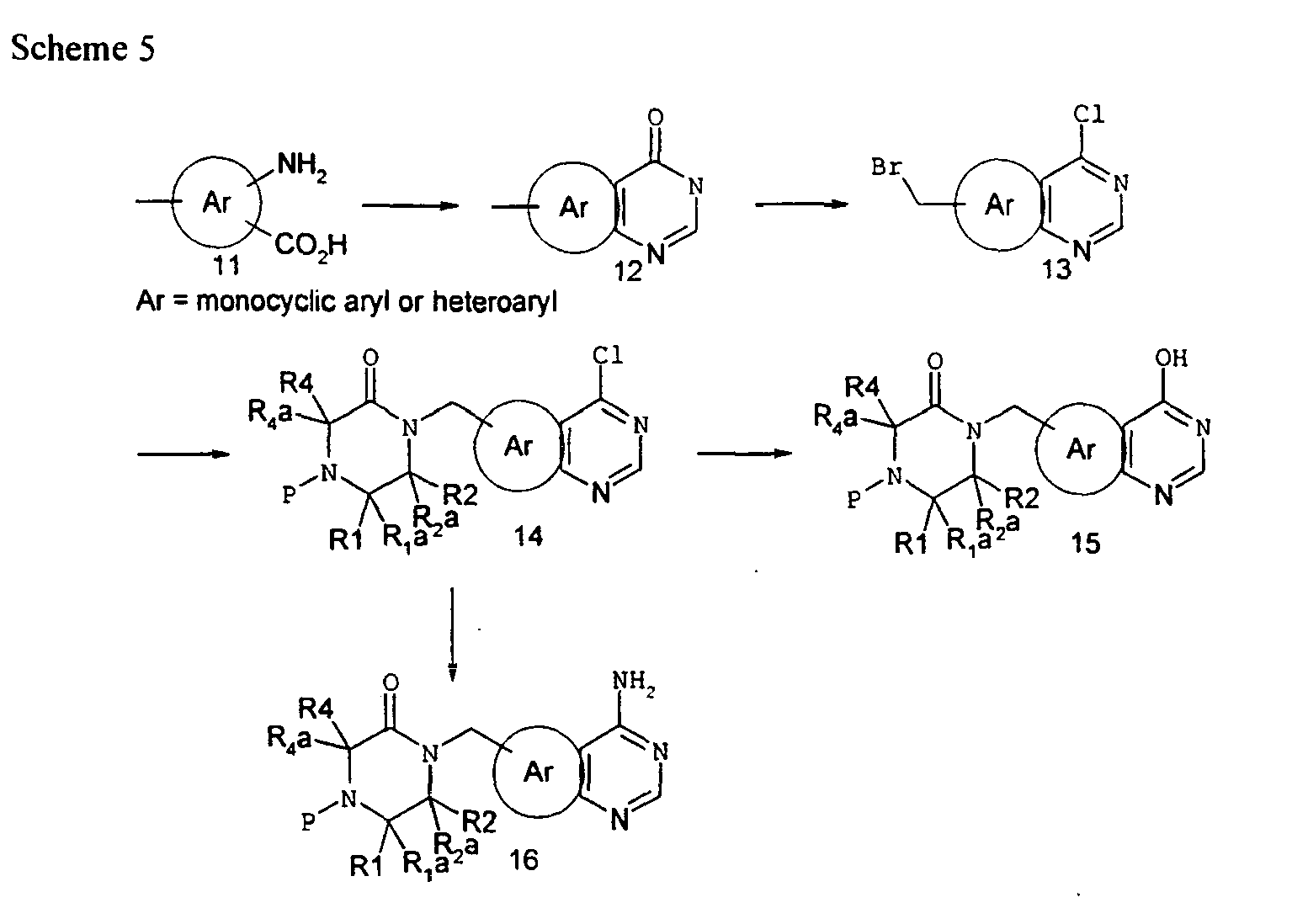
- As shown in Scheme 5, an aminoheteroaryl carboxylic acid or an aminoarylcarboxylic acid 11 in which the amino and carboxylic acid are adjacent is treated with formamidine under heat to form the corresponding quinazolinone or thienopyrimidinone 12. The quinazolinone or thienopyrimidinone 12 is then converted to the chloroquinazoline or chlorothienopyrimidine using a chlorinating reagent such as P(O)Cl3 and heat. The chloroquinazoline or chlorothienopyrimidine is brominated at the benzylic carbon using radical bromination conditions. Alternatively, a chloroquinazoline or chlorothienopyrimidine, containing a hydroxy-methylene group is converted to the corresponding bromide using CBr4/PPh3; or PBr3 conditions. The bromide 13 is then reacted with the anion of the ring nitrogen of compounds of formula 2, formed using NaH, LiN(SiMe3)3, NaN(SiMe3)3, LDA, lithium alkoxides, sodium alkoxides or an appropriate base, in an inert solvent such as THF, DMF, ether, or DME. This yields compounds of formula 14 in which Cy2 is a chloro-quinazoline or a chloro-thienopyrimidine. The chloro group is converted to an amino group using NH3 in ethanol in the presence of a catalytic acid source. Alternatively, the chloro group is converted to a substituted amino using a primary or secondary amine in a solvent. Alternatively, the chloro group is converted to a hydroxy group using acetic acid in water with heating or using a hydroxide source. Alternatively, the chloro is converted to an alkoxy group using an alcoholic solvent with heated in the presence of a base.
- An alternative synthesis of quinazolines and thienoquinazolines is outlined in Scheme 6.

- As shown in Scheme 6, an amino-aryl nitrile or an amino heteroaryl nitrile 17 is treated with an aldehyde or ketone under imine forming conditions. The corresponding aryl or heteroaryl imine is brominated using radical bomination with NBS. The bromide is then reacted with the anion of the ring nitrogen of compounds of formula 2, formed using NaH, LiN(SiMe3)3, NaN(SiMe3)3, LDA, lithium alkoxides, sodium alkoxides or an appropriate base, in an inert solvent such as THF, DMF, ether, or DME. This yields compounds of formula 20 in which Cy2 is an imino-aryl nitrile or an imino heteroaryl nitrile. The imine is deprotected using an acid such as HCl to give the corresponding aniline. The aniline-aryl-nitrile or the aniline-heteroaryl nitrile is converted to the amino-quinazoline or thienopyrimidine using triazine or formamidine. The quinazolinone or thienopyrimidinone 21 is formed using formamide.
- The preparation of cinnoline (X = N) and quinoline (X = CH) intermediates is outlined in Scheme 7.

- As shown in Scheme 7, halogenated azaarenes exemplified by 4-chloro-7-trifluoromethylquinoline or cinnoline are treated with H2SO4 (70 -95 %) at 180-220 °C for about 16 to 48 hours in a sealed reaction vessel. The solution is cooled, poured into water and neutralized with base to pH ~ 3-4. The product is dissolved in aqueous base and precipitated by acidification to yield 7-carboxy-4-chloroquinoline or cinnoline. This material is converted to the alkyl ester (such as methyl or ethyl) by standard methods. 7-Alkyloxycarbonyl-4-chloroquinoline or cinnoline is dissolved in an anhydrous, aprotic solvent (THF or ether). The solution is cooled (-60 to -95 °C) and treated with a reducing agent such as lithium aluminum hydride. The solution is warmed (approximately -40 to -50 °C) for about 15 to 30 minutes and quenched with a solvent such as ethyl acetate. Standard workup gives the product 7-hydroxymethyl-4-chloroquinoline or cinnoline. This material is treated with 45-50 % HBr and heated to about 100-140 °C for about 45 to 90 minutes. After cooling and standard workup 7-bromomethyl-4-chloroquinoline or cinnoline is obtained.
- The preparation of pyrrolopyridine derivatives is outlined in Scheme 8.

- As shown in Scheme 8 pyrrolopyridine derivatives are prepared by alkylation of a suitably protected oxopiperazine with propargyl bromide in the presence of a base such as sodium hydride. The resulting alkyne is heated (100-120 °C) with a halopyridine optionally substituted with hydroxy, alkoxycarbonylamino, or sulfhydryl, a catalyst such as Pd(PPh3)2Cl2, copper iodide and triethylamine in a suitable solvent such as acetonitrile in a sealed vessel or in DMF for 2-20 hours. When the pyridine is substituted with a hydroxyl moiety furopyridines are isolated directly. If the pyridine is substituted with an alkoxycarbonylamino moiety, additional treatment with DBU at about 60 °C in DMF yields pyrrolopyridines. Subsequent carbamate deprotection using transfer hydrogenation conditions such as Pd black in formic acid yields the desired oxopiperazine furopyridines or pyrrolopyridine-1-carboxylic acid alkyl ester derivatives. After further reaction with the L1-Cy1 group, an additional deprotection step such as Boc removal using, for example, TFA, HCl is required for generating the oxopiperazine pyrrolopyridines.
- The preparation of the compound of formula 40 are shown in Scheme 9.

- As shown in Scheme 9, compounds of formula 40 are prepared from an appropriately protected mono- or di- substituted amino-acid. To this is added an amino-acetaldehyde, protected as an acetal derivative, under standard peptide coupling procedures, employing activating reagents such as EDC, TBTU, or BOP. The resulting dipeptidyl moiety is subjected to conditions which remove the acetal, such as acidic conditions (TsOH). The resulting cyclic material is reduced using hydrogenating conditions to yield compounds of formula 40. This reduction, alternatively can be carried out using a reagent which acts as a hydride source.
- The preparation of compounds of formula 46a and b is shown scheme 10.

- As shown in Scheme 10, a protected amino acid is coupled to a beta-aminoalcohol using standard peptide coupling procedures as describe above. The alcohol is then oxidized to a ketone using, for example, Swern oxidation conditions. The protecting group is removed and the resulting compound is reduced under hydrogenation conditions to give the 2-piperidinone. The free amine can be reprotected and diastereomers are separated by chromatographic methods, or in some cases by recrystallization.
- A chiral synthesis of compounds of formula 46 is shown in Scheme 11.

- As shown in Scheme 11, an amino acid is protected as its trifluoroacetate derivative using trifluoroacetic anhydride and a base. An amino-alcohol is derivatized via reductive amination conditions using a benzaldehyde derivative, such as 2,4-dimethoxybenzaldehyde. The resulting secondary amine is then coupled to an amino-acid protected as a trifluoroacetate using standard peptide coupling procedures. Ring closure is then accomplished by utilizing Mitsinobu conditions. The trifluoroacetate group is removed under basic conditions, and the amide of the ring is deproteced using an aqueous solution of potassium persulfate and sodium phosphate and heat. All possible enantiomers of piperazin-2-one can be made from the corresponding amino-alcohol and amino acid as shown in scheme 2c.
- The preparation of the compound of formula 58 wherein R1, R2, R2a, R4 and R4a are hydrogen and R1a is carbomethoxy, methoxymethyl, or a protected hydroxyethyl group is shown in Scheme 12.

- As shown in Scheme 12, alkylating a compound of formula 55 with propargyl bromide in the presence of an amine base such as triethylamine provides the compound of formula 56. Coupling with bromoacetic acid using a standard reagent such as DCC gives the compound of formula 57 which can be cyclized using a non-nucleophilic strong base such as NaH in a solvent such as THF to yield the desired compound of formula 58.
- The preparation of a compound of formula 59 is outlined in Scheme 13.

- As shown in Scheme 13, protection of methyl 6-oxopiperazine-2-carboxylate (Aebischer, B., Helv. Chim. Acta 1989, 72, 1043-1051) using, for example, benzyl chloroformate or allyl chloroformate under standard conditions provides compound 59. Alkylation of 59 with propargyl bromide using a strong base such as NaH in polar solvents as THF or DMF provides the compound of formula 58.
- The preparation of a compound of formula 61 wherein R1, R2, R4, R4a, L1 and Cy1 are defined as above and R1a or R2a are independently carboxy, acetamido or hydroxymethyl is outlined in Scheme 14.
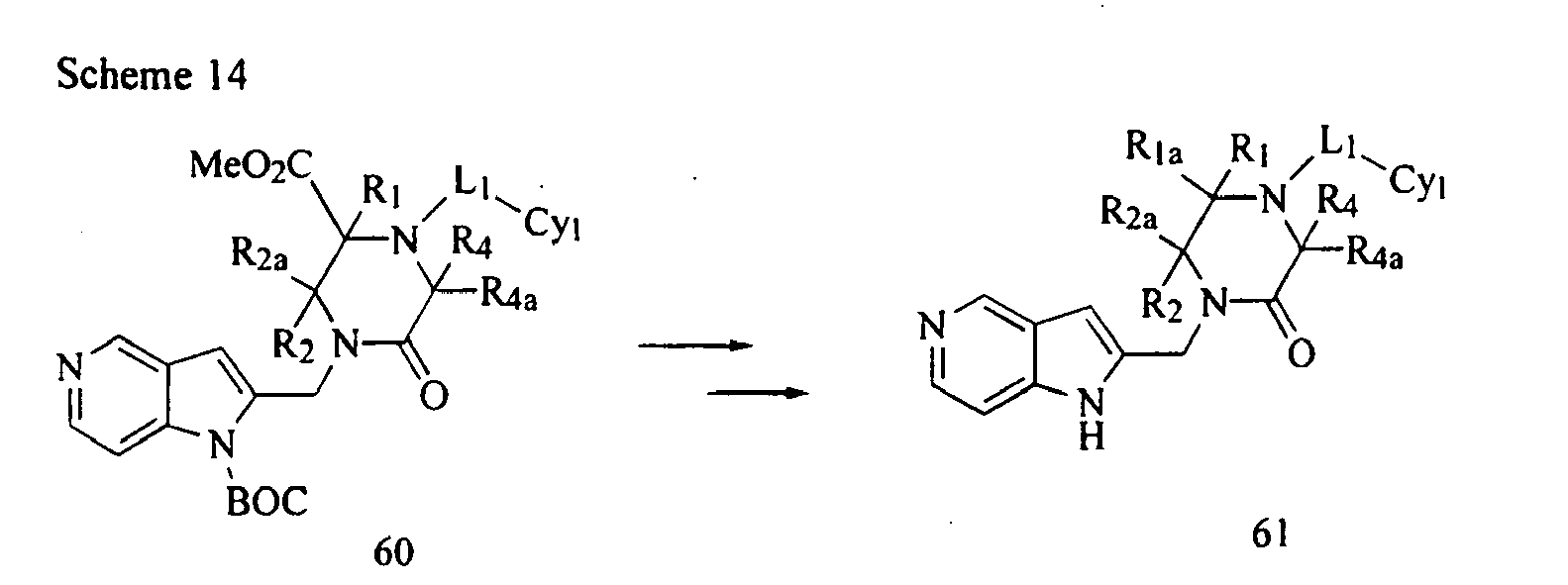
- As shown in Scheme 14, the compound of formula 61 is prepared by hydrolysis of the ester using a base such as NaOH or LiOH to yield the acid, coupling the corresponding acid with a primary or secondary amine or ammonia using standard coupling reagents such as TBTU or EDC and reduction of the ester using a reducing agent such as NaBH4 to yield hydroxymethyl.
- The preparation of diketopiperazine compounds formula 66 in which R1 and R1a together and R3 and R3a together are oxygen are prepared as outlined in Scheme 15.

- As shown in Scheme 15, an aldehyde containing the Cy2 group is condensed with an amino acid ester under reductive amination conditions. The resulting secondary amine is then coupled to an N-protected amino acid. The resulting dipeptide is deprotected which in general results in cyclization to the Cy2 diketopiperazine. Alternatively for cases which do not cyclize, diketopiperazine formation can be achieved using a peptide coupling reagent such as EDC, TBTU, or BOP.
- The preparation of sulfonyl chloride intermediates is outlined in Scheme 16.

- As shown in Scheme 16, Cy1 substituted sulfonyl chlorides are prepared by treatment of the appropriate aryl and heteroaryl compounds with a strong base such as n-BuLi at -78 °C followed by the addition of SO2 gas and treatment of the lithium heteroaryl sulfonate with a chlorinating agent such as NCS or SO2Cl2 or, alternately, by homologation of the appropriate aryl and heteroaryl aldehydes using, for example, ethylmethanesulfonate and ethylchlorophosphonate.
- The preparation of intermediate compounds of formula Cy1-CO2H is outlined in Scheme 17.

- As shown in Scheme 17, the requisite Cy1 acids as defined above can be obtained by oxidation of the corresponding alcohols or the aldehydes using, for example, MnO2, PDC or AgNO3 in an appropriate solvent such as CH2Cl2 or H2O/EtOH. The Cy1 substituted aryl and heteroaryl groups can be functionalized by deprotonation methods using an appropriate non-nucleophilic base such as n-BuLi in an appropriate solvent such as Et2O or THF and quenching with an appropriate carbonyl electrophile such as DMF, CO2 or alkyl chloroformate. Alternatively, the acids can also be generated by hydrolysis of the corresponding esters using, for example, NaOH or LiOH. For example, in the acrylic esters, the Cy1-(alkenylene)- groups as defined above are generated by homologation of the Cy1 aldehydes using the usual Wittig type or Horner-Emmons type reagents in an appropriate solvent such as CH2Cl2 or THF. The preparation of Cy1 alkyl and alkenyl halides is outlined in Scheme 18.

- As shown in Scheme 18, Cy1 alkyl and alkenyl halides as defined above can be prepared by halogenation of the corresponding alcohols using either NBS, CBr4 or PBr3 under standard solvent conditions. The alcohols are generated by reduction of the corresponding aldehydes or esters using NaBH4 or DIBAL in an appropriate solvent.
- The preparation of Cy1 isocyanate intermediates is outlined in Scheme 19.

- As shown in Scheme 19, Cy1 isocyanates are obtained by chlorocarbonylation methods using phosgene or triphosgene in an appropriate solvent such as CH2Cl2 with an appropriate base additive such as triethylamine or pyridine on the corresponding primary or secondary amines. Alternatively, the isocyanates can also be generated by Curtius rearrangement in an appropriate solvent such as toluene, p-dioxane or DMF of the corresponding Cy1 carbonyl azides. The carbonyl azides, in turn, are derived from the corresponding carboxylic acids using either DPPA reagent or by proceeding through the mixed anhydride via an alkyl chloroformate reagent in an appropriate solvent such as DMF or acetone and using an appropriate base additive such as treithylamine.
- The preparation of Cy1 chloroformate intermediates is outlined in Scheme 20.

- As shown in Scheme 20, Cy1 chloroformates are obtained by chlorocarbonylation methods using reagents such as phosgene, triphosgene or 1,1'-carbonyldiimidazole in an appropriate solvent such as CH2Cl2 on the corresponding alcohols. Activated sulfamyl esters are prepared from the corresponding amines using catechol sulfate in an appropriate solvent.
- The preparation of acetamido compounds of this invention is outlined in Scheme 21.

- As shown in Scheme 21, alkylation of piperazin-2-one 96 is achieved with a strong base such as NaH and a t-butyl ester of haloacetic acid to give the acetate 97. Pd-catalyzed hydrogenation effectes removal of the CBZ group from the acetate 97 to give amine 98 which is converted to the compound 99 as described in Scheme 1 above. Hydrolysis of t-butyl ester 99 is accomplished using, for example, TFA/CH2Cl2. The resulting acid 100 is coupled with the optionally protected amine HNCy2 under typical amide bond formation conditions to give the acetamide 101.
- The preparation of compounds of this invention wherein Cy1 is benzimidazol-2-yl is outlined in Scheme 22.

- Piperidin-2-one 102 is alkylated as described above to give the ester 103 which is hydrolyzed to give the acid 104 or reduced to give aldehyde 105. Coupling of the acid 104 and amines affords amide 106 which is cyclized with acetic anhydride to give the compound 108. Wittig-coupling of aldehyde 105 produces compound 107.
- This invention is further exemplified but not limited by the following examples which further illustrate the preparation of the compounds of this invention. The starting materials and intermediates are prepared by the application or adaptation of known methods, for example methods described herein or their obvious equivalents.
- To a solution of 3-chlorothiophenol (2.4 g, 16.6 mmol) in THF (200 mL) at 0°C is added bromoacetaldehyde dimethyl acetal (2.8 g, 16.6 mmol). To the solution is added sodium hydride (60% mineral oil dispersion, 0.70 g, 17.4 mmol). The reaction is stirred for 16 hours, and then is quenched by the addition of saturated NH4Cl (aq.). The solution is diluted with EtOAc. The organic layer is washed with a saturated NaCl (aq.). The organic layer is dried over MgSO4, filtered and concentrated. The crude product is purified by column chromatography eluting with hexanes. The title compound (3.7 g, 15.9 mmol) is obtained as an oil. 1H NMR (CDCl3, 300MHz) δ 7.32 (m, 1H), 7.25(m, 1H), 7.12(m, 1H), 4.47 (m, 1H), 3.07 (s, 3 H), 3.02 (s, 3H).
- A solution containing polyphosphoric acid (8 g) and chlorobenzene (50 mL) is heated at reflux. A solution containing 1-chloro-3-(2,2-dimethoxyethylsulfanyl)benzene (2.7 g, 11.6 mmol) in chlorobenzene (5 mL) is added dropwise to the refluxing polyphosphoric acid solution. After 6 hours, the solution is cooled to ambient temperature. The solution is diluted with CH2Cl2 and washed with water and saturated NaCl (aq.). The organic layer is dried over MgSO4, filtered and concentrated. The crude product is purified by column chromatography eluting with hexanes to yield the title compounds (2.4 g, 9.0 mmol) as a 1:1 isomeric mixture. 1H NMR (CDCl3, 300MHz) δ 7.88 (m, 1H), 7.75 (m, 2H), 7.42 (m, 2H). MS (EI): m/z 168, 170 (M+), Cl pattern.
- To a solution of 4-chloro-benzo[b]thiophene and 6-chlorobenzo[b]thiophene (11.8 g, 88.1 mmol), in 400 mL of THF at -78°C is added n-BuLi (55 mL of a 1.6M solution in hexanes. 88.1 mmol). After 15 minutes, the solution is added by cannula to a precooled (-78°C) solution of SO2 (200 g) in 100 mL of THF. After addition, the solution is allowed to warm to ambient temperature. After 0.5 hour, the solution is concentrated. The residue is suspended in hexanes (400 mL) and is cooled to 0°C. To the solution is added SO2Cl2 (12.5 g, 92.5 mmol). After stirring for 15 minutes, the solution is concentrated. The residue is dissolved in EtOAc. The organic solution is washed with saturated NH4Cl (aq.), H2O and saturated NaCl (aq.). The organic layer is dried over MgSO4, filtered and concentrated. The crude product is dissolved in CH2Cl2 and filtered through a plug of silica gel. The crude product is purified by column chromatography eluting with hexanes to yield the title compound as well as 4-chlorobenzo[b]thiophene-2-sulfonyl chloride as white solids.
4-Chlorobenzo[b]thiophene-2-sulfonyl chloride: 1H NMR (CDCl3, 300MHz) δ 8.32 (m, 1H), 7.81 (m, 1H), 7.53 (m, 2H).
6-Chlorobenzo[b]thiophene-2-sulfonyl chloride: 1H NMR (CDCl3, 300MHz) δ 8.11 (s, I H), 7.88 (m, 2H), 7.50 (m, 1H). - A solution of 2-amino-4-methylbenzoic acid (31.6 g, 206 mmol) in formamide (60mL) is heated to 130°C for 1 hour, then at 175°C for 3 hours. The solution is poured into 500 mL of ice water. The resulting solid is collected by filtration and further dried under reduced pressure. The title compound (26.2 g, 170 mmol) is obtained as a white solid. MS (EI): m/z 159 (M+).
- To a solution of 7-methyl-3H-quinazolin-4-one (10.6 g, 69 mmol) in toluene (350mL) is added triethylamine (17.5 g, 173 mmol) followed by phosphorous oxychloride (12.3 g, 80 mmol). The resulting solution is heated to 80°C. After 4 hours, the solution is cooled to ambient temperature. The reaction mixture is poured into 500 mL of water. The layers are separated and the organic layer is washed with H2O, saturated NaHCO3, and saturated NaCl, dried over MgSO4, filtered and concentrated. The resulting crude product is purified by recrystallization from EtOAc. The title compound is obtained as a white solid (10g, 56 mmol). 1H NMR (CDCl3, 300 MHz) δ 9.02 (s, 1H), 8.16 (d, 1H), 7.87 (s, 1H), 7.55 (d, 1H), 2.62 (s, 3H).
- To a solution of 4-chloro-7-methylquinazoline (7.0 g, 39 mmol) in carbon tetrachloride (140 mL) is added N-bromosuccinimide (8.0 g, 45 mmol), and benzoyl peroxide (0.8 g, 3.3 mmol). The solution is refluxed for 8 hours. After this time, the solution is filtered. The filtrate is concentrated and the residue is stirred with ether to give the title compound as an off-white solid (5.1 g, 20 mmol). 1H NMR (CDCl3, 300 MHz) δ 9.10 (s, 1H), 8.30 (d, 1H), 8.10 (s, 1H), 7.82 (d, 1H), 4.68 (s, 2H). MS (EI): m/z 237 (M+).
- To a solution of 2-amino-4-methyl benzonitrile (20 g, 151 mmol) in 1000mL of dichloroethane is added benzophenone imine (30g, 166mmol). The solution is refluxed for 48 hours After this time, the solution is cooled to ambient temperatures. The solution is washed with sat. NaHCO3, water and sat. NaCl. The organic layer is dried over MgSO4, filtered and concentrated under vacuum. The product is further purified by recrystallization from t-butyl ether. The title compound (25.5g, 118mmol) is obtained as a yellow solid. 1H NMR (CDCl3, 300MHz) δ 7.88 (m, 2H), 7.42 (m, 3H), 7.32 (m, 7H), 6.79 (d, 1H), 6.58 (s, 1H), 2.23 (s, 3H).
- To a solution of 2-(benzhydrylidene-amino)-4-methyl-benzonitrile (11.2g, 37.8mmol) in 500mL of CCl4 is added N-bromosuccinimide (7.06g, 39.7mmol), and benzoyl peroxide (0.92g, 3.8mmol). The solution is heated to reflux for 16 hours. After this time, the solution is filtered and the organic solution is concentrated under vacuum. The residue is purified by column chromatography eluting with a gradient of 20%t-butyl ether/hexanes to 25% t-butyl ether/hexanes. The product is obtained as an oil containing a mixture of the desired monobromide, dibromide and unreacted starting material. The mixture is assayed by proton NMR and is found to have a purity between 60-75%. 1H NMR (CDCl3, 300MHz) δ 7.82 (m, 2H), 7.42 (m, 9H), 6.92 (d, 1H), 6.81 (s, 1H), 4.29 (s, 2H).
- 4-Chloro-7-trifluoromethylquinoline (5.0 g, 21.6 mmol) in 100 mL 80% H2SO4 is heated to 200°C for 24 hours in a sealed tube. The solution is cooled, poured into water and neutralized with sodium hydroxide to pH ∼ 3-4. The precipitated solid is collected, washed with water and dissolved in 2 N sodium hydroxide. The aqueous solution is washed with ethyl acetate then acidified to pH-3-4. The precipitate is collected, washed with water and dried in a vacuum oven overnight to yield 7-carboxy-4-chloroquinoline as a solid (5.1 g, 24.6 mmol). A portion of this material (2.0 g, 9.6 mmol) is treated with anhydrous THF (200 mL) and DMF (2 mL) and 2 M oxalyl chloride in methylene chloride (14.5 mL, 29 mmol). The resulting suspension is stirred at room temperature for 2 h then treated with methanol (10 mL). After stirring 30 minutes the solution is concentrated and the residue is taken up in methylene chloride. The solution is washed with saturated sodium bicarbonate and dried (sodium sulfate) and concentrated to yield the title compound as a solid (2.1 g, 9.5 mmol). MS m/z: M+ = 221; 1H NMR (CDCl3, 300 MHz) δ 8.6 (s, 1H), 8.2 (s, 1H), 7.9 (d, 1H), 7.65 (d, 1H), 7.45 (s, 1H), 3.95 (s. 3H).
- 7-Methyloxycarbonyl-4-chloroquinoline (2.1 g, 9.5 mmol) is dissolved in anhydrous THF (25 mL) and anhydrous ether (200 mL). The solution is cooled in a dry ice/acetone bath and treated 1M lithium aluminum hydride in THF (11.0 mL, 11 mmol). The solution is warmed (approximately -45°C) for 20 minutes and quenched with ethyl acetate. The solution is diluted with ether (100 mL) and treated with water (36 mL), 15% NaOH (36 mL) and water (36 mL) in succession. The mixture is filtered and evaporated to yield the title compound as a residue (2.0 g, 9.7 mmol) which is dried under vacuum and used without further purification. MS m/z: M+ = 193; 1H NMR (CDCl3, 300 MHz) δ 8.65 (d, 1H), 8.15 (d, 1H), 8.0 (d, I H), 7.6 (d, 1H), 7.45 (d, 1H), 4.8 (s, 2H).
- 7-Hydroxymethyl-4-chloroquinoline (0.2 g, 0.97 mmol) is treated with 48 % HBr and heated to 120°C for 1 hours. The resulting solution is cooled with ice, diluted with water and treated with ethyl acetate and sodium bicarbonate until basic to pH paper. The layers are separated and the organic layer is washed with water, dried (Na2SO4) and concentrated to give 7-bromomethyl-4-chloroquinoline (0.23 g, 0.9 mmol). MS m/z: M+ = 255; 1H NMR (CDCl3, 300 MHz) δ 8.75 (d, I H), 8.25 (d, 1H), 8.1 (s, 1H), 7.7 (d, 1H), 7.5 (d, 1H), 4.7 (s. 2H).
- To a mixture of 3-(5-chloro-thiophen-2-yl)-(E)-acrylic acid methyl ester (0.60 g, 2.96 mmol) in 15 mL of 1:1:1 THF/MeOH/H2O at 0°C is added lithium hydroxide monohydrate (0.62 g, 14.7 mmol). The mixture is stirred at 0°C for 1 h, then at room temperature for 1 h and concentrated in vacuo. The residue is diluted with EtOAc and washed with 1N HCl. The aqueous layer is extracted with EtOAc and the combined organics are washed with water (2x), dried, filtered and concentrated to provide the title compound (0.54 g, 2.86 mmol) as a white solid. The crude material can be used in the subsequent step without further purification. 1H NMR (CDCl3, 300MHz) δ 7.65 (d, 1H), 7.05 (d, 1H), 6.90 (d, I H), 6.10 (d, 1H).
- To a solution of N-Cbz-O-methylserine (10.8g, 41.8mmol) in 500mL of CH2Cl2 is added Et3N (12.7 g, 125mmol). The solution is cooled to 0°C and TBTU (13.5g, 42 mmol) and aminoacetaldehyde dimethyl acetal (4.83g, 46mmol) are added. The solution is stirred for 16 hours. The solution is diluted with 500mL of ether. The resulting solution is washed with water, 1N KHSO4, and sat. NaCl. The title compound (13.7g, 41.8 mmol) is obtained as a white foam. 1H NMR (CDCl3, 300MHz) δ 7.40 (m, 5H),6.55 (bs, 1H), 5.66 (bs, 1H), 5.32 (m, 1H), 5.13 (s, 2H), 4.32 (m, 2H), 3.79 (dd, 1H), 3.44 (m, 2H), 3.40 (m, 9H).
- To a solution of N-Cbz-O-methylserine-aminoacetaldehyde dimethyl acetal (13.7g, 41.8mmol) in 300mL of toluene is added TsOH.H2O (0.80g, 4.2mmol). The solution is heated to 60°C. After 5h, the solution is diluted with ether. The resulting organic solution is washed with water, sat. NaHCO3, and sat. NaCl. The organic layer is dried over MgSO4, filtered and concentrated under vacuum. The resulting crude product is purified by column chromatography eluting with a gradient of 10%EtOAc:CH2Cl2 to 20%EtOAc:CH2Cl2. The title compound (10.7g, 38mmol) is obtained as a white solid. 1H NMR (CDCl3, 300MHz) δ 7.36 (m, 5H), 6.45 and 6.30 (d, 1H rotational isomers), 5.61 and 5.50 (d, 1H rotational isomers), 5.20 (s, 2H), 4.92 and 4.83 (bs, 1H rotational isomers), 3.63 (m, 3H), 3.32 and 3.20 (s, 1H rotational isomers).
- To a solution of N-Cbz-2-oxo-3-(S)-methoxymethyl-(4,5-dihydro)piperidine (10.7g, 38mmol) in 50mL of methanol is added Pt/C (1gm, 10% by weight). The atmosphere above the reaction is replaced by hydrogen. After 24h, the solution is filtered and the filtrate is washed with methanol. The collected organic solutions are concentrated under vacuum. The resulting crude product is purified by column chromatography eluting with a gradient of 2%MeOH/CH2Cl2 to 5%MeOH/CH2Cl2. The title compound (6.0g, 22mmol) is obtained as a white solid. 1H NMR (CDCl3, 300MHz) δ 7.35 (m, 5H),6.42 (bs, 1H), 5.20 (AB, 2H), 4.58 (m, 1H), 4.18 (m, 1H), 3.95 (m, 1H), 3.50 (m, 4H), 3.27 (s, 3H).
- The title compound is prepared as in EXAMPLE 41, substituting Cbz-norleucine for Cbz-O-methyl-serine. 1H NMR (CDCl3, 300mHz) δ 7.32 (m, 5H), 5.13 (AB, 2H), 4.60 (m, 1H), 4.13 (m, 1H), 3.38 (m, 2H), 3.23 (m, 2H), 1.90 (m, 1H), 1.66 (m, 1H), 1.29 (m, 4H), 0.89 (m, 3H). MS (ion spray) m/z 291, (M+H).
- The title compound is prepared as in EXAMPLE 41, substituting Cbz-2-amino-butric acid for Cbz-O-methyl-serine. 1H NMR (CDCl3, 300mHz) δ 7.37 (m, 5H), 6.55 (bs, 1H), 5.10 (AB, 2H), 4.57 (m, 1H), 4.24 (m, 1H), 3.42 (m, 1H), 3.26 (m, 2H), 2.20 (m, 1H), 1.81 (m, 1H), 0.96 (m, 3H).
- The title compound is prepared as in EXAMPLE 41, substituting Cbz-norvaline for Cbz-O-methyl-serine. 1H NMR (CDCl3, 300mHz) δ 7.32 (m, 5H), 7.00 (bs, 1H), 5.12 (AB, 2H), 4.58 (m, 1H), 4.21 (m, 1H), 3.40 (m, 1H), 3.19 (m, 2H), 1.88 (m, 1H), 1.73 (m, 1H), 1.37 (m, 2H), 0.91 (m, 3H). MS (ion spray) m/z 277, (M+H).
- The title compound is prepared as in EXAMPLE 41, substituting Cbz-O-ethyl-serine for Cbz-O-methyl-serine. 1H NMR (CDCl3, 300MHz) δ 7.32 (m, 5H),6.96 (bs, 1H), 5.17 (AB, 2H), 4.58 (m, 1H), 4.18 (m, 1H), 4.03 (m, 1H), 3.66 (m, 2H), 3.44 (m, 3H), 3.27 (s, 1H), 1.06 (m, 3H). MS (ion spray) m/z 293, (M+H).
- The title compound is prepared as in EXAMPLE 41, substituting Cbz-alanine for Cbz-O-methyl-serine. 1H NMR (CDCl3, 300MHz) δ 7.34 (m, 5H),7.02 (bs, 1H), 5.17 (AB, 2H), 4.65 (m, 1H), 4.17 (m, 1H), 3.42 (m, I H), 3.23 (m, 2H), 1.41 (d, 3H). MS (EI) m/z 248, (M+).
- The title compound is prepared as in EXAMPLE 41, substituting Cbz-phenylalanine for Cbz-O-methyl-serine. 1H NMR (CDCl3, 300MHz) δ 7.22 (m, 10H), 7.00 (bs, 1H), 5.10 (AB, 2H), 4.10 (m, 1H), 3.27 (m, 2H), 3.10 (m, 2H), 2.55 (m, 2H). MS (EI) m/z 324, (M+).
- The title compound is prepared as in EXAMPLE 41, substituting Cbz-O-methyl-threonine for Cbz-O-methyl-serine. 1H NMR (CDCl3, 300MHz) δ 7.52 (bs, 1H), 7.22 (m, 5H), 5.12 (AB, 2H), 4.33 (m, 1H), 4.05 (m, 2H), 3.60 (m, 1H), 3.14 (s, 3H), 3.10 (m, 1H), 2.82 (m, 1H), 1.10 (d, 3H). MS (ion spray) m/z 293, (M+H).
- The title compound is prepared as in EXAMPLE 41, substituting Cbz-2-amino-isobutryic acid for Cbz-O-methyl-serine. 1H NMR (CDCl3, 300MHz) δ 7.36 (m, 5H),6.52 (bs, I H), 5.12 (s, 2H), 3.72 (m, 2H), 3.33 (m, 2H), 1.68 (s, 3H), 1.64 (s, 3H). MS (EI) m/z 262, (M+).
- The title compound is prepared as in EXAMPLE 41, substituting Cbz-valine for Cbz-O-methyl-serine. 1H NMR (CDCl3, 300MHz) δ 7.36 (m, 5H),5.88 (bs, 1H), 5.10 (s, 2H), 4.35 (m, 1H), 3.44 (m, 1H), 3.27 (m, 2H), 2.31 (m, 1H), 1.00 (d, 3H), 0.94 (d, 2H).
- The title compound is prepared as in EXAMPLE 41, substituting Cbz-leucine for Cbz-O-methyl-serine. 1H NMR (CDCl3, 300MHz) δ 7.35 (m, 5H), 6.50 (m, 1H), 5.15 (s, @H), 4.18 (m, 1H), 3.42 (m, 2H), 3.21 (m, 2H), 1.50 (m, 3H), 0.90 (m, 6H).
- The title compound is prepared as in EXAMPLE 41, substituting Cbz-O-methyl-homo-serine for Cbz-O-methyl-serine. 1H NMR (CDCl3, 300MHz) δ 7.32 (m, 5H), 6.85 (bs, 1H), 5.14 (s, 2H), 4.75 (m, 2H), 4.20 (m, 2H), 3.42 (m, 1H), 3.21 (m, 3H), 2.12 (m, 4H).
- The title compound is prepared as in EXAMPLE 41, substituting 2-amino-propionaldehyde dimethyl acetal for aminoacetaldehyde dimethyl acetal. 1H NMR (CDCl3, 300MHz) δ 7.42 (m, 5H), 6.96 (bs, 1H), 5.12 (AB, 2H), 4.52 (m, 1H), 4.21 (m, 1H), 3.92 (m, 1H), 3.58 (m, 2H), 3.22 (s,3H), 3.10 (m, 1H), 0.95 (m, 3H).
- To a solution of 3-oxo-piperazine-1-carboxylic acid benzyl ester (3.0 g, 12.8 mmol) and 4-bromomethyl tolylnitrile (2.76 g, 14.1 mmol) in 135 mL of THF and 15 mL of DMF at 0°C is added a 60% dispersion in mineral oil of NaH (0.49 g, 12.8 mmol). After 5 hours, the solution is diluted with saturated MH4Cl and EtOAc. The organic layer is washed with H2O and saturated NaCl. The organic layer is dried over MgSO4, filtered and concentrated. The crude product is purified by column chromatography over silcia gel eluting with 20% EtOAc/CH2Cl2. The title compound is obtained as a white solid (4.01 g, 11.4 mmol). 1H NMR (CDCl3, 300MHz) δ 7.62 (d, 2H), 7.39 (m, 7H), 5.14 (s, 2H), 4.68 (s, 2H), 4.27 (s, 2H), 3.73 (m, 2H), 3.30 (m, 2H).
- A solution of 4-(4-cyanobenzyl)-3-oxopiperazine-1-carboxylic acid benzyl ester (2.4 g, 6.87 mmol) in 30mL of pyridine and 3 ml of Et3N is saturated with H2S. The resulting mixture is sealed and stirred for 16 hours. After this time, the solution is concentrated. The residue is dissolved in 30 mL of acetone and methyl iodide (19.4 g, 137 mmol) is added. The solution is refluxed for 2 hours. After this time, the solution is concentrated. The residue is dissolved in MeOH (40 mL) and NH4OAc (5.0 g, 65 mol) is added. The solution is reluxed for 3 hours. After this time, the solution is concentrated. The crude product is purified by RP-HPLC eluting in a gradient of CH3CN to 60% CH3CN/H2O(0.1% TFA). The appropriate collected fractions are lyophilized to give the product as a white foam. MS (FAB) m/z 367, (M+H).
- To a solution of 4-(4-carbamimidoylbenzyl)-3-oxopiperazine-1-carboxylic acid benzyl ester (2.0 g, 5.0 mmol) in 40 mL of MeOH and 4 mL of AcOH is added 10% Pd/C (0.4 g). The atmosphere above the reaction is replaced by hydrogen. After 4hours, the solution is filtered through a pad of Celite. The organic layer is concentrated. The resulting crude product is purified by RP-HPLC eluting in a gradient of 10% CH3CN/H2O (0.1 %TFA) to 40% CH3CN/H2O (0.1 % TFA). The title compound is obtained as a white foam. 1H NMR (d6-DMSO, 300 MHz) δ 9.3 (bs, 4H), 9.1 (bs, 2H), 7.83 (d, 2H), 7.42 (d, 2H), 4.78 (s, 2H), 3.80 (s, 2H), 3.44 (m, 2H), 3.32 (m, 2H).
- To a solution of 3-oxopiperazine-1-carboxylic acid benzyl ester (4.65 g, 19.8 mmol) and 6-bromomethyl-2-chloroquinoline (5.40 g, 21.0 mmol) in 80 mL of a 3:1 mixture of THF:DMF at 0°C is added sodium hydride (0.81 g, 20.2 mmol, 60% mineral oil dispersion). The resulting mixture is stirred for 1 hour at 0°C then at room temperature for 18 hours. The reaction mixture is quenched with saturated NH4Cl solution, then diluted with EtOAc. The organic layer is washed sequentially with 1N HCl, water, saturated NaHCO3 and saturated NaCl, then dried over MgSO4, filtered and concentrated. The crude product is triturated in Et2O/hexanes/EtOAc and filtered to afford the title compound (6.96 g, 17.0 mmol) as a white solid. 1H NMR (CDCl3, 300 MHz) δ 8.08 (d, 1H), 8.00 (d, 1H), 7.69 (s, 1H), 7.63 (dd, 1H), 7.41 (d, 1H), 7.35 (s, 5H), 5.15 (s, 2H), 4.78 (s, 2H), 4.28 (s, 2H), 3.70 (m, 2H), 3.32 (bs, 2H).
- A mixture of phenol (15.1 g, 160 mmol) and 4-(2-chloroquinolin-6-ylmethyl)-3-oxopiperazine-I-carboxylic acid benzyl ester (6.60 g, 16.1 mmol) is melted together at 70°C until a homogeneous mixture is obtained. Potassium hydroxide (3.15 g, 56.1 mmol) is added and the resulting mixture is heated overnight at 120°C. After 24 hours, the brown/black residue is cooled to room temperature, diluted with CH2Cl2 and stirred with 1N NaOH (100 mL) for 30 minutes. The two layers are separated and the aqueous layer is extracted with CH2Cl2. The combined organic layers are washed with 1N NaOH, saturated NaCl, dried over Na2SO4, filtered and concentrated. The crude title compound (6.92 g, 14.8 mmol) is obtained as a beige foam and used in the subsequent step without further purification. 1H NMR (CDCl3, 300 MHz) δ 8.07 (d, 1H), 7.76 (d, 1H), 7.63 (s, 1H), 7.50 (dd, 1H), 7.42 (m, 2H), 7.34 (m, 6H), 7.25 (m, 2), 7.09 (d, 1H), 5.14 (s, 2), 4.75 (s, 2H), 4.27 (s, 2H), 3.66 (m, 2H), 3.30 (bs, 2H).
- A mixture of ammonium acetate (18.7 g, 242 mmol) and 4-(2-phenoxyquinolin-6-ylmethyl)-3-oxopiperazine-1-carboxylic acid benzyl ester (6.92 g, 14.8 mmol) is heated overnight at 150°C. After 21 hours, an additional 3 g of ammonium acetate is added and the heating is continued. After 5 hours, the mixture is cooled to room temperature, diluted with CH2Cl2 and stirred with 1N NaOH (100 mL) for 30 minutes. The two layers are separated and the aqueous layer is extracted with CH2Cl2. The combined organic layers are washed with 1N NaOH, saturated NaCl, dried over Na2SO4, filtered and concentrated. The crude mixture of the title compounds (5.50 g, 14.1 mmol) is obtained as a beige foam and used in the subsequent step without further purification.
- Major component (4-(2-aminoquinolin-6-ylmethyl)-3-oxopiperazine-1-carboxylic acid benzyl ester): 1H NMR (CDCl3, 300 MHz) δ 7.86 (d, 1H), 7.63 (d, 1H), 7.48 (d, 1H), 7.45 (d, 1H), 7.35 (s, 5H), 6.74 (d, 1H), 5.14 (s, 2H), 4.79 (bs, 2H), 4.71 (s, 2H), 4.26 (s, 2H), 3.66 (s, 2H), 3.30 (s, 2H).
- Minor component (3-oxo-4-(2-oxo-1,2-dihydroquinolin-6-yimethyl)piperazine-1-carboxylic acid benzyl ester): 1H NMR (CDCl3, 300 MHz) δ 7.75 (d, 1H), 7.48 (m, 2H), 7.37 (m, 6H), 6.70 (d, 1H), 5.14 (s, 2H), 4.66 (s, 2H), 4.26 (s, 2H), 3.66 (s, 2H), 3.30 (s, 2H).
- To a solution of a mixture of 4-(2-aminoquinolin-6-ylmethyl)-3-oxopiperazine-1-carboxylic acid benzyl ester and 3-oxo-4-(2-oxo-1,2-dihydro-quinolin-6-ylmethyl)piperazine-1-carboxylic acid benzyl ester (5.50 g, 14.1 mmol) in 100 mL of 10:1 MeOH/HOAc is added a catalytic amount of 10% palladium on activated carbon. The heterogenous mixture is hydrogenated at room temperature under a balloon of H, for 18 hours. The reaction mixture is filtered through a pad of Celite, washed with MeOH, and the filtrate is concentrated in vacuo. The crude mixture of products is purified by RP-HPLC eluting in a gradient of 2% CH3CN/H2O (0.1% TFA) to 20% CH3CN/H2O(0.1% TFA) and the appropriate product fractions are concentrated in vacuo to provide 1-(2-aminoquinolin-6-ylmethyl)-piperazin-2-one ditrifluoroacetate (2.64 g, 5.45 mmol) as the major product in the form of a white solid. 1H NMR (d6-DMSO, 300 MHz) δ 8.78 (bs, 2H), 8.31 (d, 1H), 7.80 (s, 1H), 7.66 (m, 2H), 7.08 (d, 1H), 4.70 (s, 2H), 3.84 (s, 2H), 3.46 (bs, 4H). MS m/z 256, [M+]. Elemental analysis calculated with 0.25 mol of H2O cal. C=44.25%, H=3.82%, N=11.47%, found C=44.23%, H=3.76%, N=11.23%.
The minor by-product 6-(2-oxo-piperazin-1-ylmethyl)-1H-quinolin-2-one(0.62 g, 1.28 mmol) is also isolated from the RP-HPLC separation as a white solid 1H NMR (d6-DMSO, 300 MHz) δ 11.76 (bs, 1H), 9.30 (bs, 2H), 7.85 (d, 1H), 7.55 (s, 1H), 7.42 (d, 1H), 7.28 (d, 1H), 6.50 (d, 1H), 4.60 (s, 2H), 3.80 (s, 2H), 3.38 (bs, 4H). MS m/z 257, [M+]. Elemental analysis calculated with 0.5 mol of H2O cal. C=43.72%, H=3.68%, N=8.50%, found C=43.70%, H=3.62%, N=8.61%. - The title compound is prepared as described in EXAMPLE 67 substituting 6-bromomethyl-1-chloroisoquinoline for bromomethyl-2-chloroquinoline. 1H NMR (d6-DMSO, 300 MHz) δ (9.18 (bs, 2H), 8.53 (d, 1H), 7.81 (s, 1H), 7.63 (m, 2H), 7.14 (d, 1H), 4.77 (s, 2H), 3.88 (s, 2H), 3.50 (m, 4H).
- A solution of potassium iodide (19.48 g, 117.4 mmol) and iodine (18.37 g, 72.3 mmol) in water (77 mL) is added dropwise via an addition funnel to a refluxing solution of 4-aminopyridine (9.21 g, 97.8 mmol) and sodium carbonate (6.12 g, 57.7 mmol) in water (35 mL). Upon complete addition the mixture is stirred for 2 hours at reflux then cooled to room temperature and extracted with ethyl acetate. The combined organic layers are washed with saturated sodium thiosulfate solution (3x) and brine then dried over MgSO4, filtered and concentrated to give the title product (8.37 g, 38.0 mmol) and a trace of the di-iodo compound as an yellow/orange solid. This material is used in the subsequent step without further purification. 1H NMR (CDCl3, 300 MHz) δ 8.70 (s, 1H), 8.10 (d, 1H), 6.55 (d, 1H), 4.60 (bs, 2H).
- Di-tert-butyl dicarbonate (20.7 g, 94.8 mmol) is added to a solution of 3-iodopyridin-4-ylamine (19.0 g, 86.4 mmol) in THF (86 mL). The resulting solution is stirred for 2 hours at room temperature then concentrated. The residue is diluted with ethyl acetate and washed with saturated sodium bicarbonate solution and brine. The organic layer is dried over MgSO4, filtered and concentrated. The residue is purified by column chromatography eluting with 1% EtOAc/CH2Cl2 to give the title product and a small amount of the BOC-protected di-iodo compound. Trituration of the mixture with ether/hexane removes the undesired compound leaving the title product in the solution. Filtration of the solid and concentration of the filtrate yields the title product (18.95 g, 59.2 mmol). 1H NMR (CDCl3), 300 MHz) δ 8.75 (s, 1H), 8.35 (d, 1H), 8.1 (d, 1H), 7.0 (bs, 1H), 1.55 (s, 9H).
- Sodium hydride (0.82 g, 23.0 mmol, 60% mineral oil dispersion) is added to a solution of 4-benzyloxycarbonylpiperazin-2-one (5.13 g, 21.9 mmol) in THF/DMF (75 mL, 3/1 v/v) at 0°C . The mixture is stirred for 5 minutes, then propargyl bromide (3.7 mL, 41.5 mmol) is added dropwise. The resulting solution is stirred for I hour then brought to room temperature and stirred for 2 hours. The reaction is quenched with saturated ammonium chloride solution then diluted with ethyl acetate and washed with water (4x) and brine. The organic layer is dried over MgSO4, filtered and concentrated to dryness. The residue is purified by column chromatography eluting with 5% MeOH/CH2Cl2 to give the product (5.96 g, 21.9 mmol) as a white solid. 1H NMR (CDCl3, 300 MHz) δ 7.3 (m, 5H), 5.12 (s, 2H), 4.25 (s,2H), 4.16 (s, 2H), 3.75 (m, 2H), 3.47 (m, 2H), 2.22 (s, 1H).
- Pd(PPh3)2Cl2 (0.29 g, 0.41 mmol), CuI (0.05 g, 0.25 mmol) and triethylamine (4.6 mL, 32.9 mmol) is added to a solution of 3-oxo-4-prop-2-ynylpiperazine-1-carboxylic acid benzyl ester (2.24 g, 8.23 mmol) and (3-iodopyridin-4-yl)-carbamic acid tert-butyl ester (2.63 g, 8.23 mmol) in DMF (30 mL) at room temperature. The mixture is heated to 100°C and stirred for 1.5 hours. The reaction mixture is then cooled to 50°C and DBU (2.5 mL, 16.5 mmol) is added. After 30 minutes the solution is cooled to room temperature, diluted with ethyl acetate and washed with saturated ammonium chloride, water and brine. The organic layer is dried over MgSO4, filtered and concentrated in vacuo. The resulting solid is purified by column chromatography eluting with a gradient of 2% MeOH/CH2Cl2 to 5% MeOH/ CH2Cl2 to give the product (2.93 g, 6.31 mmol) as a white solid. 1H NMR (CDCl3, 300 MHz) δ 8.75 (s, 1H), 8.4 (d, 1H), 7.85 (d, 1H), 7.35 (m, 5H), 6.38 (s, 1H), 5.2 (s, 2H), 5.00 (s, 2H), 4.29 (s, 2H), 3.85 (m, 2H), 3.52 (m, 2H), 1.7 (s, 9H). Ion spray MS. [M+H]+= 465.
- Palladium black (1.1 g, 10.3 mmol) is added to a solution of 2-(4-benzyloxycarbonyl-2-oxopiperazin-1-ylmethyl)pyrrolo[3,2-c]pyridin-1-carboxylic acid tert-butyl ester (1.7 g, 3.7 mmol) in HCO2H/MeOH (45 mL, 4.4% solution). After 40 minutes the catalyst is filtered through Celite and washed with MeOH. The filtrate is concentrated in vacuo to remove methanol then the resulting solution is diluted with methylene chloride and washed with saturated sodium bicarbonate, and brine. The organic layer is dried over MgSO4, filtered and concentrated to dryness. The resulting solid is purified by column chromatography eluting with a gradient of 5% MeOH/CH2Cl2 to 10% MeOH/CH2Cl2 to give the product (0.8 g, 2.5 mmol) as a pale yellow foamy solid. 1H NMR (CDCl3, 300 MHz) δ 8.78 (s, 1H), 8.40 (d, 1H), 7.9 (d, 1H), 6.48 (s, 1H), 4.98 (s, 2H), 3.7 (s. 2H), 3.51 (t, 2H), 3.40 (t, 2H), 1.91 (bs, 1H), 1.70 (s, 9H).
- Propargyl bromide (1.6 mL, 14.4 mmol) is added to a solution of 3-amino-2-benzyloxycarbonylamino-propionic acid methyl ester hydrochloride (4.0 g, 13.9 mmol) and triethylamine (4.1 mL, 29.4 mmol) in THF (46 mL). The resulting mixture is heated to 50°C and stirred overnight then cooled to RT and concentrated in vacuo. The crude residue is diluted with methylene chloride, washed with saturated NaHCO3 and brine then the organic layer is dried over MgSO4, filtered and concentrated in vacuo. The crude material (4.0 g) is taken on to the subsequent step without further purification. 1H NMR (CDCl3, 300 MHz) δ 7.25-7.30 (m, 5H), 5.75 (bs, 1H), 5.20 (s, 2H), 4.45 (bs, 1H), 3.80 (s, 3H), 3.75 (m, 1H), 3.31 (s, 2H), 3.08 (dd, 1H), 2.98 (dd, 1H), 2.20 (t, 1H), EI MS, [M+H]+=291.
- DCC (2.27 g, 11.0 mmol) and bromoacetic acid (1.48 g, 10.7 mmol) is added to a solution of 2-benzyloxycarbonylamino-3-(prop-2-ynylamino)-propionic acid methyl ester (3.10 g, 10.7 mmol) in CH2Cl2 at RT. The mixture is stirred overnight then diluted with ether. The white solid which precipitates out is filtered and the filtrate is concentrated to give a yellow oil. The crude product is purified by chromatography eluting with a gradient of 40% EtOAc/hexanes to 50% EtOAc/hexanes to yield the title product (2.1g, 5.12 mmol) as an oil. 1H NMR (CDCl3, 300 MHz) δ 7.30 (m, 5H), 5.70 (d, 1H), 5.10 (s, 2H), 4.63 (m, 1H), 4.1 (d, 2H), 4.00 (m, 1H), 3.80 (s, 3H), 3.75 (s, 2H), 3.70 (dd, 1H), 2.27 (bs, 1H). Ion spray MS, [M+H]+=411, 413, Br pattern.
- Sodium hydride (0.20 mg, 4.9 mmol) is added to a solution of 2-benzyloxycarbonylamino-3-(bromoactyl-prop-2-ynyl-amino)-propionic acid methyl ester (2.0 g, 4.8 mmol) in THF (50 mL) at 0°C. The solution is stirred for 40 minutes then quenched with saturated NH4Cl solution. The reaction mixture is concentrated in vacuo then diluted with CH2Cl2 and washed with brine. The organic layer is dried over, filtered and concentrated in vacuo. The crude product is purified by chromatography eluting with 50% EtOAc/hexanes to give the title product (1.4 g, 4.1 mmol). 1H NMR (CDCl3, 300 MHz) δ 7.30 (m, 5H), 5.20 (s, 2H), 5.10 (m, 1H), 4.30 (dd, 1H), 4.25 (d, 2H), 4.08 (m, 1H), 4.00 (dd, 1H), 3.78 (dd, 1H), 3.78 (s, 3H), 2.25 (t, 1H).
- 1H NMR (CDCl3, 300 MHz) δ 8.75 (s, 1H), 8.41 (d, 1H), 7.90 (d, 1H), 6.42 (s, 1H), 5.00 (AB, 2H), 3.85-3.93 (m, 2H), 3.78 (s, 3H), 3.70-3.81 (m, 3H), 1.65 (s, 9H). Ion spray MS, [M+H]-=389.
- 1H NMR (CDCl3, 300 MHz) δ 8.81 (s, 1H), 8.43 (d, 1H), 7.90 (d, 1H), 6.48 (s, 1H), 5.63 (d, 1H), 4.40 (d, 1H), 4.20 (m, 1H), 3.78 (s, 3H), 3.70 (d, 1H), 3.52 (d, 1H), 3.33 (dd, 1H), 2.92 (s, 1H), 1.55 (s, 9H). Ion spray MS, [M+H]+=389.
- To a solution of 3-oxopiperazine-1-carboxylic acid tert-butyl ester (3.93 g, 19.6 mmol) and 7-bromomethyl-4-chloroquinazoline, EXAMPLE 7, (5.0 g, 19.6 mmol) in 150 mL of THF and 15 mL of DMF at 0°C is added a 60% dispersion in mineral oil of NaH (0.79 g, 19.6 mmol). The solution is stirred at 0°C for 0.5 hours and then is allowed to warm to ambient temperature. After 4 hours, the solution is poured into a saturated solution of NH4Cl. The layers are separated and the organic layer is washed with H2O, and saturated NaCl, dried over MgSO4, filtered and concentrated. The title compound is obtained as a white solid (5.1 g, 13.4 mmol). MS (FAB) m/z 377, 379, (M+H), chlorine pattern.
- A solution of 4-(4-chloroquinazoline-7-ylmethyl)-3-oxopiperazine-1-carboxylic acid tert-butyl ester (1.84 g, 4.9 mmol) in 120 mL of ethanol is saturated with NH3 gas. To the resulting solution is added acetic acid (0.03 mL). The solution is heated to reflux. After 16 hours, the solution is concentrated. The resulting solid is dissolved in CH2Cl2 and the inorganic salts are filtered off. The organic solution is concentrated. The resulting solid is triturated with EtOAc. The title compound is obtained a a white solid (1.59 g, 4.5 mmol). MS (FAB) m/z 356, (M+H).
- A solution of 4-(4-aminoquinazoline-7-ylmethyl)-3-oxo-piperazine-1-carboxylic acid tert-butyl ester (1.92 g, 5.4 mmol) in EtOAc (200 mL) at 0 °C is saturated with HCl gas. The solution is stirred at 0°C for 4 hours. After this time, the solution is concentrated. The title compound is obtained as a white solid (1.79 g, 5.4 mmol). 1H NMR (d6-DMSO, 300 MHz) δ 9.9 (bs, 3H), 9.7 (bs, 2H), 8.8 (s, 1H), 8.46 (d, 1H), 7.72 (s, 1H), 7.61 (d, 1H), 4.78 (s, 2H), 3.83 (s, 2H), 3.4 (m, 4H).
- The title compound is prepared as described in EXAMPLE 72, Part A, substituting 6-bromomethyl-4-chlorothieno[2,3-d]pyrimidine, for 7-bromomethyl-4-chloroquinazoline. Followed by treatment as described in EXAMPLE 72, Part B, the title compound is obtained. 1H NMR (CD3OD, 300 MHz) δ 8.22 (s, 1H), 7.35 (s, 1H), 5.48 (s, 2H), 4.10 (s, 2H), 3.60 (m, 2H), 3.40 (m, 2H), 1.45 (s, 9H). MS (ion spray), 364, (M+H).
- The title compound is obtained by treatment of 1-(4-amino-thieno[2,3-d]pyrimidin-6-ylmethyl)-3-oxo-piperazine-1-carboxylic acid tert-butyl ester as described in EXAMPLE 72, Part C. MS (EI), 263, (M+).
- To a solution of 2-oxo-3-(S)-methoxymethylpiperidine (5.36g, 19.3mmol), EXAMPLE 41, in 200mL of 10:1 THF:DMF is added 2-(benzhydrylidene-amino)-4-bromomethyl-benzonitrile (12.6g, 60%purity, 19.3mmol), prepared as in EXAMPLE 13. The solution is cooled to 0°C. To the solution is added NaH (0.77g of a 60% dispersion in mineral oil, 19.3mmol). The solution is stirred for 16 hours. After this time, 1N HCl is added until the pH=1. The solution is stirred for 1 hour. After this time, the solution is diluted with EtOAc. The organic layer is washed with water and sat. NaCl. The organic layer is dried over MgSO4, filtered and concentrated under vacuum. The resulting crude product is purified by column chromatography eluting with a gradient of 20%EtOAc/CH2Cl2 to 40%EtOAc/CH2Cl2. The title compound (6.8g, 16.7mmol) is obtained as a white solid. 1H NMR (CDCl3, 300MHz) δ 7.34 (m, 5H), 6.61 (m, 2H),5.13 (AB, 2H), 4.76 (m, 1H), 4.40 (AB, 2H), 4.08 (m, 5H), 3.74 (m, 2H), 3.32 (m, 1H), 3.30(s, 3H), 3.10 (m, 1H).
- To a solution of 2-methoxymethyl-3-oxo-piperazine-1-carboxylic acid benzyl ester (6.8g, 16.7mmol) in 100mL of ethanol is added triazine (2.2g, 26.4mmol) and acetic acid (1.6g,26.4mmol). The solution is heated to a reflux. After 36h, the solution is concentrated. The resulting crude product is purified by column chromatography eluting with a gradient of 2%MeOH/CH2Cl2 to 5% MeOH/CH2Cl2. The title compound (5.8g, 13.3mmol) is obtained as a white solid. 1H NMR (CDCl3, 300MHz) δ 8.55 (s, 1H), 7.72 (m, 2H), 7.48 (m, 1H), 7.35 (m, 5H), 6.40 (bs, 2H), 5.16 (AB, 2H), 5.06 (m, 1H),4.72 (m, 1H), 4.59 (m, 1H), 4.09 (m, 2H), 3.74 (m, 2H), 3.44 (m, 1H), 3.30 (s, 3H), 3.12 (m, 1H). MS (ion spray) m/z 436, (M+H).
- To a solution of 2-methoxymethyl-3-oxo-piperazine-1-carboxylic acid benzyl ester (5.8g, 13.3mmol) in 50mL of acetic acid is added dropwise, 20mL of a 30%HBr in AcOH solution. The solution is stirred for I hour. After this time, the solution is concentrated. The resulting crude product is purified by column chromatography eluting with CH2Cl2:MeOH:NH4OH (20:5:1). The title compound (2.0g, 6.6mmol) is obtained as a white solid. 1H NMR (d6-DMSO, 300MHz) δ 8.60 (s, 1H), 7.72 (m, 2H),7.48 (d, 1H), 5.60 (bs, 2H), 4.72 (AB, 2H), 3.87 (m, 2H), 3.71 (m, 1H), 3,42 (m, 1H), 3.40 (s, 3H), 3.19 (m, 2H), 3.02 (m, 1H). MS (ion spray) m/z 302, (M+H).
- The title compound is prepared as described in EXAMPLE 75, substituting 2-butyl-3-oxopiperazine-1-carboxylic acid benzyl ester, Example 42, for 2-methoxymethyl-3-oxo-piperazine-1-carboxylic acid benzyl ester. 1H NMR (CD3OD, 300MHz) δ 8.35 (s, 1H), 8.09 (d, 1H), 7.54 (s, 1H), 7.41 (d, 1H), 4.74 (s, 2H), 3.43 (m, 2H), 3.28 (m, 1H), 3.09 (m, 1H), 2.95 (m, 1H), 1.92 (m, 1H), 1.70 (m, 1H), 1.39 (m, 4H), 0.93 (m, 3H). MS (ion spray) m/z 314, (M+H).
- The title compound is prepared as described in EXAMPLE 75, substituting 2-ethyl-3-oxopiperazine-1-carboxylic acid benzyl ester r, Example 43, for 2-methoxymethyl-3-oxo-piperazine-1-carboxylic acid benzyl ester. 1H NMR (CD3OD, 300MHz) δ 8.36 (s, 1H), 8.11 (d, 1H), 7.57 (s, 1H), 7.42 (d, 1H), 4.78 (s, 2H), 3.40 (m, 2H), 3.29 (m, 1H), 3.11 (m, 1H), 2.98 (m, 1H), 2.00 (m, 1H), 1.77 (m, 1H), 1.20 (m, 3H). MS (ion spray) m/z 286, (M+H).
- The title compound is prepared as described in EXAMPLE 75, substituting 2-propyl-3-oxopiperazine-1-carboxylic acid benzyl ester, Example 44, for 2-methoxymethyl-3-oxo-piperazine-1-carboxylic acid benzyl ester. 1H NMR (CD3OD, 300MHz) δ 8.36 (s, 1H), 8.13 (d, 1H), 7.60 (s, 1H), 7.47 (d, 1H), 4.78 (s, 2H), 3.44 (m, 2H), 3.30 (m, 1H), 3.11 (m, 1H), 2.97(m, 1H), 1.98 (m, 1H), 1.72 (m, 1H), 1.50 (m, 2H), 0.97 (m, 3H). MS (ion spray) m/z 300, (M+H).
- The title compound is prepared as described in EXAMPLE 75, substituting 2-ethoxymethyl-3-oxo-piperazine-1-carboxylic acid benzyl ester, Example 45, for 2-methoxymethyl-3-oxo-piperazine-1-carboxylic acid benzyl ester. 1H NMR (CD3OD, 300MHz) δ 8.34 (s, 1H), 8.07 (d, 1H), 7.53 (s, 1H), 7.40 (d, 1H), 4.79 (AB, 2H), 3.90 (m, 1H), 3.72 (m, 1H), 3.68 (m, 1H), 3.52 (m, 2H), 3.36 (m, 2H), 3.20 (m, 1H), 3.00 (m, 1H), 1.92 (m, 3H). MS (ion spray) m/z 316, (M+H).
- The title compound is prepared as described in EXAMPLE 75, substituting 2-methyl-3-oxopiperazine-1-carboxylic acid benzyl ester, Example 46, for 2-methoxymethyl-3-oxo-piperazine-1-carboxylic acid benzyl ester. 1H NMR (CD3OD, 300MHz) δ 8.36 (s, 1H), 8.11 (d, 1H), 7.57 (s, 1H), 7.44 (d, 1H), 4.79 (AB, 2H), 3.58 (m, 1H), 3.47 (m, 1H), 3.31 (m, 1H), 3.12 (m, 1H), 3.00 (m, 1H), 1.41 (d, 3H). MS (ion spray) m/z 272, (M+H).
- The title compound is prepared as described in EXAMPLE 75, substituting 2-benzyl-3-oxopiperazine-1-carboxylic acid benzyl, Example 47, ester for 2-methoxymethyl-3-oxo-piperazine-1-carboxylic acid benzyl ester. 1H NMR (CD3OD, 300MHz) δ 8.35 (s, 1H), 8.09 (d, 1H), 7.57 (s, I H), 7.38 (d, 1H), 7.27 (m, 5H), 4.74 (AB, 2H), 3.76 (m, 1H), 3.47 (m, 1H), 3.30 (m, 3H), 3.08 (m, 1H), 2.96 (m, 1H). MS (ion spray) m/z 348, (M+H).
- The title compound is prepared as described in EXAMPLE 75, substituting 2-(1-methoxyethyl)-3-oxo-piperazine-1-carboxylic acid benzyl ester, Example 48, for 2-methoxymethyl-3-oxo-piperazine-1-carboxylic acid benzyl ester. This compound is isolated as the bis hydrobromide salt. 1H NMR (CD3OD, 300MHz) δ 8.70 (s, 1H), 8.40 (d, 1H), 7.88 (s, 1H), 7.71 (d, 1H), 4.94 (AB, 2H), 4.30 (m, 2H), 3.76 (m, 1H), 3.68 (m, 3H), 3.36 (s, 3H), 1.42 (d, 3H). MS (ion spray) m/z 316, (M+H).
- The title compound is prepared as described in EXAMPLE 75, substituting 2,2-dimethyl-3-oxopiperazine-1-carboxylic acid benzyl ester, Example 49, for 2-methoxymethyl-3-oxo-piperazine-1-carboxylic acid benzyl ester. 1H NMR (d6-DMSO, 300MHz) δ 8.34 (s, 1H), 8.12 (d, 1H), 7.72 (bs, 2H), 7.41 (s, 1H), 7.26 (d, 1H), 4.60 (s, 2H), 3.33 (m, 2H), 2.98 (m, 2H), 1.27 (s, 6H).
- The title compound is prepared as described in EXAMPLE 75, substituting 2-isopropyl-3-oxopiperazine-1-carboxylic acid benzyl ester, Example 50, for 2-methoxymethyl-3-oxo-piperazine-1-carboxylic acid benzyl ester. 1H NMR (d6-DMSO, 300MHz) δ 8.32 (s, 1H), 8.12 (d, 1H), 7.66 (bs, 2H), 7.42 (s, 1H), 7.27 (d, 1H), 4.60 (AB, 2H), 3.23 (m, 2H), 3.05(m, 1H), 2.79 (m, 1H), 2.34 (m, 1H), 0.92 (s, 3H), 0.80 (s, 3H).
- The title compound is prepared as described in EXAMPLE 75, substituting 2-isobutyl-3-oxopiperazine-1-carboxylic acid benzyl ester, Example 51, for 2-methoxymethyl-3-oxo-piperazine-1-carboxylic acid benzyl ester. 1H NMR (d6-DMSO, 300MHz) δ 8.65 (s, 1H), 7.70 (m, 2H), 7.48 (m, 1H), 5.61 (m, 2H), 4.82 (m, 1H), 4.65 (m, 1H), 3.52 (dd, 1H), 3.37 (m, 1H), 3.18 (m, 2H), 2.98 (m, 1H), 1.92 (m, 1H), 1.76 (m, I H), 1.59 (m, 2H), 0.95 (m, 6H).
- The title compound is prepared as described in EXAMPLE 75, substituting 2-(2-methoxyethyl)-3-oxo-piperazine-1-carboxylic acid benzyl ester, Example 52, for 2-methoxymethyl-3-oxo-piperazine-1-carboxylic acid benzyl ester. 1H NMR (d6-DMSO, 300MHz) δ 8.32 (s, 1H), 8.13 (d, 1H), 7.70 (bs, 2H), 7.42 (s, 1H), 7.28 (m, 1H), 4.60 (m, 2H), 3.32 (m, 8H), 3.11 (m, 1H), 2.95 (m, 1H), 2.78 (m, 1H), 2.07 (m, 1H), 1.72 (m, 1H).
- The title compound is prepared as described in EXAMPLE 75, substituting 2-methoxymethyl-5-methyl-3-oxo-piperazine-1-carboxylic acid benzyl ester, Example 53, for 2-methoxymethyl-3-oxopiperazine-1-carboxylic acid benzyl ester. 1H NMR (CD3OD, 300MHz) δ 8.72 (s, 1H), 8.32 (d, 1H), 7.78 (m, 2H), 5.11 (m, 1H), 4.81 (m, 1H), 4.42 (m, 1H), 4.13 (m, I H), 4.04 (m, 1H), 3.74 (m, 2H), 3.52 (m, I H), 3.43 (s, 3H), 1.34 (d, 3H).
- To a solution of the (2S,6RS)-2,6-dimethyl-3-oxo-piperazine-1-carboxylic acid benzyl ester (1.98 g, 7.56 mmol in 20 mL of tetrahydrofuran and 2 mL of DMF is added sodium hydride (60%, 289 mg, 12.6 mmol) at 0°C. The reaction is stirred for one hour at room temperature and the 2-benzhydrylidene-amino)-4-bromomethyl-benonitrile (4.24 mg, 11.34 mmol), Example 13, is added. After stirring at room temperature overnight, the tetrahydrofuran is removed. The residue is taken up in ethyl acetate. Excess sodium hydride is quenched with 5 mL of water, and normal aqueous work-up followed. The crude product is chromatographed on silica gel (50% EtOAc/Hexane) to give (2S,6RS)-4-[3-(benzhydryl-amino)-4-cyano-benzyl]-2,6-dimethyl-3-oxo-piperazine-1-carboxylic acid benzyl ester (2.6 g, 65%). C35H32N4O3 MS m/z: 557.
- (2S,6RS)-4-[3-(Benzhydryl)-amino)-4-cyano-benzyl]-2,6-dimethyl-3-oxo-piperazine-1-carboxylic acid benzyl ester (2.6 g, 5.21 mmol) is dissolved in 100 mL of ethyl acetate and cooled to 0°C. A 12N solution of hydrochloric acid (0.5 ml, 6.0 mmol) is added dropwise. The deprotection is complete in thirty minutes. The reaction mixture is washed with 10 % sodium bicarbonate. The ethyl acetate layer is dried with magnesium sulfate, filtered and condensed. The resulting residue is purified by flash colunm (SiO2, 60 % ethyl acetate/hexane) to give the product (2S,6RS)-4-(3-amino)-4-cyano-benzyl)-2,6-dimethyl-3-oxo-piperazine-1-carboxylic acid benzyl ester (2.03 g, 99 %).
- Glacial acetic acid (0.9 ml, 15.54 mmol) and 1,3,5-triazine (840 mg, 10.36 mmol) is added to a solution of (2S,6RS)-4-(3-amino-4-cyano-benzyl)-2,6-dimethyl-3-oxo-piperazine-1-carboxylic acid benzyl ester (2.03 g, 5.18 mmol) in ethanol. The resulting mixture is heated to reflux overnight. Replaced the ethanol with ethyl acetate and washed with saturated sodium bicarbonate (5 mL). The ethyl acetate layer is dried with magnesium sulfate, filtered and condensed. The resulting residue is purified by flash colunm (SiO2, 20% methanol/methylene chloride) to give the product (2S,6RS)-4-(4-amino-quinazolin-7-ylmethyl)-2,6-dimethyl-3-oxo-piperazine-1-carboxylic acid benzyl ester (1.85 g, 85%) as a yellow solid. C23H25N5O3) MS m/z: 420.
- Palladium on carbon (10 %, 700 mg) is added to a solution of (2S,6RS)-4-(4-amino-quinazolin-7-ylmethyl)-2,6-dimethyl-3-oxo-piperazine-1-carboxylic acid benzyl ester (1.62 g, 3.87 mmol) in 20 mL of methanol and 2 mL of acetic acid. The reaction mixture is left to stir in an atmosphere of hydrogen for eight hours. The palladium is filtered off, and the volitale solvents are removed on the rotovap. The crude product (1.7 g, 95 %) is isolated as a white solid. The two epimers are separated on silica gel (1% triethylamine/15% methanol/methylene chloride). The minor epimer is assigned as (3S,5R)-1-(4-amino-quinazolin-7-ylmethyl)-3,5-dimethyl-piperazin-2-one and the major epimer is assigned as (3S,5S)-1-(4-amino-quinazolin-7-ylmethyl)-3,5-dimethyl-piperazin-2-one.
- 4-(Benzyloxycarbonyl)-piperazin-2-one (1.1 g, 4.6 mmol) is dissolved in THF (50 mL), cooled in an ice bath and treated with tretrabutylammonium iodide (0.18 g, mmol) and 60% sodium hydride (0.24 g, 6.0 mmol). The reaction mixture is stirred at 0 C for 30 minutes then treated dropwise with a solution of 7-bromomethyl-4-chloroquinoline (1.2 g, 4.6 mmol), Example 14, in THF (50 mL). The resulting solution is stirred at 0 C for 2 h then quenched with ammonium chloride solution and concentrated. Dilution with ethyl acetate is followed by a water wash; the organic layer is dried (sodium sulfate) and concentrated. The residue is chromatographed (4% methanol/methylene chloride) to yield solid
4-(benzyloxycarbonyl)-1-(4-chloroquinolin-7-ylmethyl)-piperazin-2-one (1.2 g, 2.9 mmol). A portion of this material (0.75 g, 1.8 mmol) is dissolved in acetonitrile (20 mL) and treated with iodo trimethylsilane (0.78 mL, 5.4 mmol) at room temperature for 3 hours. The reaction is quenched with methanol and concentrated to dryness. Methanol addition and concentration is repeated four times. The final residue is taken up is 2M aqueous HCl; the solution is washed with ether and concentrated. The residue is recrystallized from isopropanol and ether to yield the title compound (0.63 g, 2.3 mmol) MS m/z: M+ = 275; 1HNMR (CD3OD, 300 MHz) δ 9.1 (d, 1H), 8.5 (d, I H), 8.2-8.3 (m, 2H), 8.0 (d, I H), 5.2 (s, 2H), 4.1 (s, 2H), 3.7-3.8 (m, 2H), 3.6-3.7 (m, 2H). - 4-(Benzyloxycarbonyl)-3-(S)-methylpiperazin-2-one (1.0 g, 4.0 mmol), EXAMPLE 46, is dissolved in THF (60 mL), cooled in an ice bath and treated with tretrabutylammonium iodide (0.10 g, 0.27 mmol) and 60% sodium hydride (0.18 g, 4.4 mmol). The reaction mixture is stirred at 0°C for 30 minutes then treated dropwise with a solution of 7-bromomethyl-4-chloroquinoline (1.12 g, 4.4 mmol), EXAMPLE 14, in THF (5 mL). The resulting solution warmed to room temperature over approximately 1 h then quenched with sodium bicarbonate solution and concentrated. The residue is partitioned between ethyl acetate and water, the organic layer is dried (sodium sulfate) and concentrated. The residue is chromatographed (5 % methanol/methylene chloride) to yield solid 4-(Benzyloxycarbonyl)-1-(4-chloroquinolin-7-ylmethyl)-3-(S)-methyl-piperazin-2-one (1.32 g, 3.1 mmol). A portion of this material (0.10 g, 0.23 mmol) is dissolved in acetonitrile (6 mL) and treated with iodotrimethyl-silane (0.1 mL, 0.75 mmol) at room temperature for 2 hours. The reaction is quenched with methanol and concentrated to dryness. Methanol addition and concentration is repeated six times. The final residue is taken up is 2M aqueous HCl; the solution is washed with ether and concentrated to yield the title compound. MS m/z: M+ = 289; 1H NMR (CD3OD, 300 MHz) δ 9.2 (d, 1H), 8.6 (d, 1H), 8.2-8.3 (m,2H), 8.0 (d, 1H), 5.1 (q, 1H), 4.3-4.4 (m, 1H), 3.8-4.0 (m, 2H), 3.6-3.8 (m, 3H), 1.75 (d, 3H).
- A solution containing (±)-1-[3-(benzhydrylidene-amino)-4-cyano-benzyl]-6-oxo-piperazine-2-carboxylic acid methyl ester (55 mg, 0.12 mmol) in CH2Cl2 (1 mL) is cooled to 0°C. DIPEA (24 mg, 0.18 mmol) is then added followed by the addition of 6-chloro-benzo[b]thiophene-2-sulfonyl chloride (32 mg, 0.12 mmol), EXAMPLE 1. The reaction mixture is warmed to ambient temperature. After 16 h, the reaction mixture is absorbed directly onto silica gel and chromatographed (CH2Cl2 to 2% MeOH/CH2Cl2) to provide 60 mg (73%) of the title compound. 1H NMR (300 MHz, CDCl3) δ 2.77 (dd, J = 12.3, 3.4 Hz, 1H), 3.50-3.72 (m, 3H), 3.79 (s, 3H), 4.15 (dd, J = 12.3, 1.4 Hz, 1H), 4.24 (d, J = 16.9 Hz, 1H), 5.41 (d,J =15.3 Hz, 1H), 6.50 (s, 1H), 6.76 (dd, J = 7.9, 1.4 Hz, 1H), 7.11-7.86 (m, 15H) ppm; MS (ISP loop): m/z 683 (M+H).
- Concentrated HCl (12M, one drop) is added at 0°C to a mixture containing (±)-1-[3-(benzhydrylidene-amino)-4-cyano-beozyl]-4-(6-chloro-benzo[b]thiophene-2-sulfonyl)-6-oxo-piperazine-2-carboxylic acid methyl ester (60 mg, 0.08 mmol) in MeOH (5 mL). Added THF (2 mL) followed by a second drop of 12M HCl and warmed reaction mixture to ambient temperature. The reaction is quenched by pouring the reaction mixture onto a 1:1 mixture of CH2Cl2/aqueous NaHCO3 and the layers are separated. The aqueous phase is washed with CH2Cl2 and then the combined organic phase is washed with brine, dried over anhydrous MgSO4, filtered and concentrated. The crude residue is chromatographed on silica gel (CH2Cl2 to 4% MeOH/ CH2Cl2) to provide 42 mg (93%) of the title compound. 1H NMR (300 MHz, CDCl3) δ 2.98 (dd, J = 12.5, 3.5 Hz, 1H), 3.60 (d, J = 16.8 Hz, 1H), 3.69 (d, J = 15.3 Hz, 1H), 3.79 (s, 3H), 3.98 (m, 1H), 4.21-4.31 (m, 2H), 4.44 (br s, 2H), 5.36 (d, J = 15.3 Hz, 1H), 6.47 (dd, J = 8.0, 1.4 Hz, 1H), 6.54 (s, 1H), 7.26 (d, J =8.0 Hz, 1H), 7.45 (dd, J = 8.5, 1.8 Hz, I H), 7.80-7.86 (m, 3H) ppm; MS (ISP loop): m/z 519 (M+H).
- Water (5 drops) is added to a solution containing (±)-1-(3-amino-4-cyano-benzyl)-4-(6-chloro-benzo[b]thiophene-2-sulfonyl)-6-oxo-piperazine-2-carboxylic acid methyl ester (30 mg, 0.05 mmol), EXAMPLE 99, in a 1:1 mixture of THF/MeOH (2 mL). At ambient temperature, LiOH monohydrate (7 mg, 1.66 mmol) is then added. After 16 h, the reaction mixture is diluted with water and purified by reverse-phase HPLC [Buffer A: water w/ 0.1% TFA; Buffer B: CH3CN w/ 0.1% TFA; Gradient: 0% B to 60% B over 30 min] to provide 10 mg (34%) of the title compound as a white solid. 1H NMR (300 MHz, d6-DMSO) δ 3.18 (dd, J = 12.1, 3.S.Hz, 1H), 3.61 (d, J = 16.0 Hz, 1H), 3.77 (d, J = 16.0 Hz, 1H), 3.95 (d, J = 16.0 Hz, 1H), 4.06 (d, J = 12.1 Hz, 1H), 4.14 (m, 1H), 6.40 (d,J = 8.0Hz, 1H), 6.54 (s, 1H), 7.21 (d, J = 8.0 Hz, 1H), 7.57 (dd, J = 8.6, 1.9 Hz, 1H), 8.06 (d, J = 8.6 Hz, 1H), 8.18 (s, I H), 8.33 (s, I H) ppm; MS (ISP loop): m/z 505 (M+H).
- To a solution of 4-(2-oxopiperazin-1-ylmethyl)benzamidine bistrifluoroacetate (0.38 g, 0.83mmol), EXAMPLE 66, in CH2Cl2 (5 mL) is added Et3N (0.35 mL, 2.6 mmol) and 6-chloro-benzo[b]thiophene-2-sulfonyl chloride (0.23 g, 0.85 mmol. EXAMPLE 1. After 6 hours, the solution is concentrated. The product is purified by RP-HPLC eluting in a gradient of 10% CH3CN/H2O(0.1% TFA) to 70% CH3CN/H2O(0.1% TFA). The appropriate collected fractions are lyophilized to afford the title compound as a white solid (0.37 g, 0.65 mmol). 1H NMR (d6-DMSO, 300MHz) δ 9.33 (bs, 2H), 8.96 (bs, 2H), 8.30 (s, 1H), 8.18 (s, 1H), 8.04 (d, 1H), 7.70 (m, 2H), 7.50 (m, 1H), 7.28 (m, 2H), 4.55 (s, 2H), 3.86 (s, 2H), 3.44 (m, 2H), 3.22 (m, 2H).
- To a solution of 4-(2-oxopiperazin-1-ylmethyl)benzamidine bistrifluoroacetate (75 mg, 0.16 mmol), EXAMPLE 66, in 1.5 mL of DMF is added N,N-diisopropylethylamine (0.14 mL, 0.80 mmol). After stirring 10 min at room temperature, 3-(5-chloro-thiophen-2-yl)-(E)-acrylic acid (32 mg, 0.17 mmol), EXAMPLE 25, is added, followed by 2-(1H-benzotriazol-1-yl)-1,1,3,3-tetramethyluronium tetrafluoroborate (TBTU) (55 mg, 0.17 mmol). The resulting mixture is stirred at room temperature for 16 h and the solution is concentrated. The crude product is purified by RP-HPLC eluting in a gradient of 10% CH3CN/H2O (0.1% TFA) to 70% CH3CN/H2O (0.1% TFA) and the appropriate product fractions are combined and lyopholized to provide the title compound (77 mg, 0.15 mmol) as a white solid. 1H NMR (d6-DMSO, 300 MHz) δ 9.27 (bs, 2H), 9.10 (bs, 2H), 7.77 (d, 2H), 7.65 (d, 1H), 7.49 (dd, 2H), 7.39 (m, 1H), 7.15 (d, 1H), 6.89 (d, 1H), 4.65 (s, 2H), 4.45, 4.21 (m, 2H, rotamers), 3.80 (m, 2H), 3.35 (m, 2H). ESI MS, [M+H]+=403,405 (Cl pattern).
- The following compounds are prepared using starting materials prepared as described in Examples 67, 68 and 73 and the appropriate carboxylic acid according to the method of Example 123.
Example # Name m/z (M+H) 129 1-(2-Amino-quinoxalin-6-ylmethyl)-4-(6-chloro-benzo[b]thiophene-2-sulfonyl)-piperazin-2-one 130 4-(6-Chloro-benzo[b]thiophene-2-sulfonyl)-1-thieno[2,3-c]pyridin-2-ylmethyl-piperazin-2-one 478, 480 Cl pattern 131 4-(6-Chloro-benzo[b]thiophene-2-sulfonyl)-1-thieno[3,2-c]pyridin-2-ylmethyl-piperazin-2-one 478, 480 Cl pattern 132 1-(2-Amino-quinolin-6-ylmethyl)-4-(6-chioro-thieno[2,3-b]pyridine-2-sulfonyl)-piperazin-2-one 488, 490 Cl pattern 134 4-(6-Chloro-benzo[b]thiophene-2-sulfonyl)-1-(1-chloro-isoquinolin-6-ylmethyl)-piperazin-2-one 506, 508 Cl pattern 137 1-(7-Amino-thieno[2,3-c]pyridin-2-ylmethyl)-4-(6-chloro-benzo[b]thiophene-2-sulfonyl)-piperazin-2-one 493,495 Cl pattern 139 4-(6-Chloro-benzo[b]thiophene-2-sulfonyl)-1-quinolin-6-ylmethyl-piperazin-2-one 472,474 Cl pattern 141 1-(2-Amino-quinolin-7-ylmethyl)-4-(6-chloro-benzo[b]thiophene-2-sulfonyl)-piperazin-2-one 487, 489 Cl pattern 142 1-(4-Amino-thieno[3,2-c]pyridin-2-ylmethyl)-4-(6-chloro-benzo[b]thiophene-2-sulfonyl)-piperazin-2-one 493,495 Cl pattern 144 4-(6-Chloro-benzo[b]thiophene-2-sulfonyl)-1-isoquinolin-6-ylmethyl-piperazin-2-one 472, 474 Cl pattern 145 1-(2-Amino-quinolin-6-ylmethyl)-4-(6-chloro-benzo[b]thiophene-2-sulfonyl)-piperazin-2-one 487, 489 Cl pattern 147 1-(1-Amino-isoquinolin-6-ylmethyl)-4-(6-chloro-benzo[b]thiophene-2-sulfonyl)-piperazin-2-one 487,489 Cl pattern 149 1-(1-Amino-isoquinolin-7-ylmethyl)-4-(6-chloro-benzo[b]thiophene-2-sulfonyl)-piperazin-2-one 487, 489 Cl pattern 150 1-(4-Amino-thieno[3,2-c]pyridin-3-ylmethyl)-4-(6-chloro-benzo[b]thiophene-2-sulfonyl)-piperazin-2-one 493,495 Cl pattern - The following compounds are prepared from the compound of Example 72 and the appropriate sulfonyl choride using the method of Example 101.
Example # Name m/z (M+H) 187 1-(4-Amino-quinazolin-7-ylmethyl)-4-(6-chloro-thieno[2,3-b]pyridine-2-sulfonyl)-piperazin-2-one 489, 491 Cl pattern 194 1-(4-Amino-quinazolin-7-ylmethyl)-4-(6-chloro-1H-benzoimidazole-2-sulfonyl)-piperazin-2-one 472 - The following compounds are prepared from starting materials obtained as described in Examples 75-88 and the appropriate sulfonyl chloride using the method of Example 101.
Example # Name m/z (M+H) 198 1-(4-Amino-quinazolin-7-ylmethyl)-4-(6-chloro-benzo[b]thiophene-2-sulfonyl)-3-(S)-ethyl-piperazin-2-one 516, 518 Cl pattern 201 1-(4-Amino-quinazolin-7-ylmethyl)-4-(6-chloro-benzo[b]thiophene-2-sulfonyl)-3-(S)-methyl-piperazin-2-one 502,504 Cl pattern 202 (+/-)-1-(4-Amino-quinazolin-7-ylmethyl)-4-(6-chloro-benzo[b]thiophene-2-sulfonyl)-6-methyl-piperazin-2-one 502, 504 Cl pattern - 1H NMR (CDCl3, 300 MHz) δ 8.7 (s, 1H), 8.41 (d, 1H), 7.9-7.8 (m, 3H), 7.45 (d, 1H), 7.25 (d, 1H), 6.31 (s, 1H), 4.95 (s, 2H), 3.98 (s, 2H), 3.65 (m, 2H), 3.55 (m, 2H), 1.68 (s, 9H). Ion spray MS, [M+H]+= 561, 563, Cl pattern.
- 1H NMR (d6-DMSO, 300 MHz) δ 14.68(bs, 1H), 12.6 (s, 1H), 9.1 (s, 1H), 8.36 (d, 1H), 8.29 (d, 1H), 8.17 (s, 1H), 8.05 (d, 1H), 7.82 (d, 1H), 7.56 (m,2H), 6.83 (s, 1H), 4.1 (s, 2H), 3.84 (s, 2H), 3.38 (m, 4H). Ion spray MS, [M+H]+= 461,463, Cl pattern.
- 4-(6-Chlorobenzo[b]thiophene-2-sulfonyl)-1-(1H-pyrrolo[3,2-c]pyridin-2-ylmethyl)piperazin-2-one (0.06 g, 0.13 mmol) is dissolved in anhydrous methylene chloride (20 ml), treated with m-chloroperbenzoic acid (0.03 g, mmol) and stirred at room temperature for 4 hours. The solution is diluted with methylene chloride, washed with NaHCO3, dried (Na2SO4) and concentrated. The residue is purified by flash chromatography (5-10 % MeOH/CH2Cl2) and converted to the TFA salt to provide the title compound (0.015 g, 0.032 mmol). 1H NMR (CDCl3, 300 MHz) δ 9.14 (bs, 1H), 8.95 (d, 1H), 7.8- 7.87 (m, 3H), 7.57 (d, 1H), 7.48 (dd, 1H), 6.87 (s, 1H), 4.90 (s, 2H), 3.95 (s, 2H), 3.86 (s, 3H), 3.49 (s, 3H). EI MS, [M+] = 474, 476, Cl pattern.
- 4-(6-Chlorobenzo[b]thiophene-2-sulfonyl)-1-(1H-pyrrolo[3,2-c]pyridin-2-ylmethyl)piperazin-2-one (0.59 g, 1.28 mmol), EXAMPLE 214, is dissolved in anhydrous DMF (30 ml), cooled in an ice bath, treated with 60 % sodium hydride (0.061 g, 1.53 mmol) and stirred at room temperature for 30 minutes. The solution is treated with methyl iodide (83 mL, 1.33 mmol) and warmed to room temperature over 4 hours. The reaction is quenched with ammonium chloride solution, diluted with ethyl acetate and separated. The organic layer is washed with brine (3x), dried (Na2SO4) and concentrated. The residue is purified by flash chromatography (5-10 % MeOH/CH2Cl2) to provide the title compound (0.31 g, 0.65 mmol). 1H NMR (CD3OD, 300 MHz) δ 8.55 (d, 1H), 7.99 (dd, 1H), 7.82 (m, 3H), 7.49 (dd, 1H), 7.43 (d, 1H), 6.55 (s, 1H), 4.75 (s, 2H), 3.96 (s, 2H), 3.52 (m, 4H), 3.86 (s, 3H), 3.49 (s, 3H). Ion Spray MS, [M+H]+=477.
- The following compounds are prepared from starting materials obtained as described in Example 69 and the appropriate sulfonyl chlorides according to the method of Example 101.
Example # Name m/z (M+H) 218 4-(6-Chlorothieno[2,3-b]pyridine-2-sulfonyl)-1-(1H-pyrrolo[3,2-c]pyridin-2-ylmethyl)piperazin-2-one. 462, 464 Cl pattern 219 4-(6-Bromobenzo[b]thiophene-2-sulfonyl)-1-(1H-pyrrolo[3,2-c]pyridin-2-ylmethyl)piperazin-2-one 505 221 4-(5'-Chloro-[2,2']bithiophenyl-5-sulfonyl)-1-(1H-pyrrolo[3,2-c]pyridin-2-ylmethyl)piperazin-2-one 493 231 2-{2-[4-(6-Chlorobenzo[b]thiophene-2-sulfonyl)-2-oxopiperazin-1-ylmethyl]pyrrolo[3,2-c]pyridin-1-yl}acetamide 518,520 232 4-(6-Chlorobenzo[b]thiophene-2-sulfonyl)-1-[1-(2-hydroxyethyl)-1H-pyrrolo[3,2-c]pyridin-2-ylmethyl]piperazin-2-one 505 233 4-(6-Chloro-1H-benzoimidazole-2-sulfonyl)-1-(1H-pyrrolo[3,2-c]pyridin-2-ylmethyl)-piperazin-2-one 445, 447 234 4-(1H-Benzoimidazole-2-sulfonyl)-1-(1H-pyrrolo[3,2-c]pyridin-2-ylmethyl)-piperazin-2-one 411 243 4-(6-Chlorobenzo[b]thiophene-2-sulfonyl)-1-(1H-pyrrolo[2,3-c)pyridin-2-ylmethyl)piperazin-2-one 460, 462 Cl pattern 244 4-(6-Chlorothieno[2,3-b]pyridine-2-sulfonyl)-1-(1H-pyrrolo[2,3-c]pyridin-2-ylmethyl)piperazin-2-one 462,464 Cl pattern - The following compounds are prepared from starting materials obtained as described in Examples 69, 70 and 71 and the appropriate sulfonyl chloride according to the method of Example 101.
Example # Name m/z 263 4-(6-Chloro-benzo[b]thiophene-2-sulfonyl)-6-oxo-1-(1H-pyrrolo[3,2-c]pyridin-2-ylmethyl)-piperazine-2-(±)-carboxylic acid amide 504,506 Cl pattern - The desired product (5.4 mg, 8.5 %) is isolated as yellow solid with a melting point of 224-226° C. C23H22ClN5O3S2 MS m/z: 516, 518.
- 1-(4-chloroquinolin-7-ylmethyl)-3-(S)-methylpiperazin-2-one hydrochloride (0.49 g, 1.4 mmol), EXAMPLE 89, is treated with acetonitrile (20 mL), triethyl amine (1.2 ml, 8.4 mmol) and a solution of 6-chlorobenzo[b]thiophen-2-sulfonyl chloride (0.41 g, 1.54 mmol), EXAMPLE 1, in acetonitrile (10 mL) at 0°C. After 2 h the solution is poured into water and extracted with ethyl acetate. The organic layer is washed with water, dried over sodium sulfate and concentrated to yielded the title compound (0.45 g, 0.95 mmol). MS m/z: 506, [M+1]+; 1H NMR (CD3OD, 300 MHz) δ 8.8 (d, 1H), 8.15 (d, 1H), 7.9 (d, 2H), 7.85 (s, 1H), 7.4-7.5 (m, 2H), 6.8 (s, 1H), 4.8 (s, 2H), 4.0 (s, 2H), 3.4-3.45 (m, 4H).
- 1-(4-Chloroquinolin-7-ylmethyl)-4-(6-chlorobenzo[b]thiophen-2-sulfonyl)-piperazin-2-one (0.52 g, 1.03 mmol) is dissolved in DMF (15 mL), treated with sodium azide (0.52 g, 8.0 mmol), tetrabutyl ammonium chloride (0.1 g, 0.36 mmol) and heated to 65 °C overnight. The reaction mixture is cooled, poured into water and extracted with ethyl acetate. The organic layer is washed with water, dried (sodium sulfate) and concentrated to give the title compound (0.5 g, 1.04 mmol). 1H NMR (CD3OD, 300 MHz) δ 9.0 (d, 1H), 8.2 (d, 1H),8.0 (s, 1H), 7.9 (d, 2H), 7.8 (d,1H), 7.6 (d,1H), 7.5 (d,1H),6.9 (s, 1H), 4.85 (s, 2H), 4.0 (s, 2H), 3.5-3.7 (m, 4H).
- A suspension of 1-(4-azidoquinolin-7-ylmethyl)-4-(6-chlorobenzo[b]thiophen-2-sulfonyl)-piperazin-2-one (0.50 g, 1.04 mmol) in 100 mL of acetic acid/methanol (∼ 1:10) is treated with 10% Pd/C (0.15 g) and stirred under hydrogen for 1.5 hours. The resulting solution is filtered through Celite and the filtrate is evaporated in vacuo. The organic layer is concentrated and the residue is purified by reverse phase HPLC (gradient elution of 30 % of 0.1 % aqueous TFA/acetonitrile to 100 % acetonitrile) and lyopholized to give the title compound (0.39 g, 0.86 mmol). MS (ISP) m/z 487. 489, (M+H), Cl pattern.
- The following compounds are prepared from the compound of Example 89 or 91 using the methods described above.
Example # Name m/z [M+H] 675 (S)-1-(4-Amino-quinolin-7-ylmethyl)-4-(6-chloro-benzo[b]thiophene-2-sulfonyl)-3-methyl-piperazin-2-one 501, 503 679 1-(4-Amino-quinolin-7-ylmethyl)-4-(6-chloro-benzo[b]thiophene-2-sulfonyl)-6-oxo-piperazine-2-carboxylic acid methylamide 544 680 1-(4-Amino-quinolin-7-ylmethyl)-4-(6-chloro-benzo[b]thiophene-2-sulfonyl)-6-oxo-piperazine-2-carboxyfic acid ethylamide 558 681 1-(4-Amino-quinolin-7-ylmethyl)-4-(6-chloro-benzo[b]thiophene-2-sulfonyl)-6-oxo-piperazine-2-carboxylic acid dimethylamide 558 682 1-(4-Amino-quinolin-7-ylmethyl)-4-(6-chloro-benzo[b]thiophene-2-sulfonyl)-6-(morphoiine-4-carbonyl)-piperazin-2-one 600 - A solution containing (±)-1-(3-amino-4-cyano-benzyl)-4-(6-chloro-benzo[b]thiophene-2-sulfonyl)-6-oxo-piperazine-2-carboxylic acid methyl ester (42 mg, 0.08 mmol), EXAMPLE 99, 1,3,5-triazine (40 mg, 0.48 mmol), and glacial HOAc (30 mg, 0.48 mmol) in absolute EtOH (1 mL) is maintained at reflux for 16 hours. The reaction mixture is concentrated and then dissolved in water/CH3CN and purified by reverse-phase HPLC [Buffer A: water w/ 0.1% TFA; Buffer B: CH3CN w/0.1% TFA; Gradient: 0% B to 60% B over 30 min] to provide 17 mg (32%) of the title compound as a white solid.
1H NMR (300 MHz, d6-DMSO) δ 3.47 (m, 1H), 3.67 (s, 3H), 3.71 (d, J = 16.1 Hz, 1H). 4.00 (d, J = 16.5 Hz, 1H), 4.05 (m, 1H), 4.52 (m, 1H), 4.72 (ABq, ΔAB = 248 Hz, JAB = 16.5 Hz, 2H), 7.57 (m, 2H), 8.05 (d, J = 8.6 Hz, 1H), 8.20 (s, 1H), 8.23 (d, J = 8.5 Hz, 1H), 8.35 (d, J = 1.9 Hz, 1H), 8.49 (s, I H), 8.72 (s, 1H), 9.57 (br s, 2H) ppm; MS (ion spray): m/z 546 (M+H). - Water (1 mL) is added to a solution containing (±)-1-(4-amino-quinazolin-7-ylmethyl)-4-(6-chloro-benzo[b]thiophene-2-sulfonyl)-6-oxo-piperazine-2-carboxylic acid methyl ester (20 mg, 0.03 mmol), EXAMPLE 799, in a 1:1 mixture of THF/MeOH (2 mL). At ambient temperature, LiOH monohydrate (15 mg, 0.35 mmol) is then added. After 16 h, the reaction mixture is diluted with water and purified by reverse-phase HPLC [Buffer A: water w/ 0.1% TFA: Buffer B: CH3CN w/ 0.1% TFA; Gradient: 0% B to 60% B over 30 min] to provide 12 mg (63%) of the title compound as a white solid. 1H NMR (300 MHz, d6-DMSO) δ 3.69 (d, J = 16.0 Hz, 1H), 3.97 (d, J = 16.0 Hz, 1H), 4.08 (d, J = 11.7 Hz, 1H), 4.18 (d, J =16.2 Hz, 1H), 4.31 (d, J = 2.7 Hz, 1H), 5.20 (d, J =16.2 Hz, 1H), 7.47 (d, J = 8.7 Hz, 1H), 7.52 (s, 1H), 7.58 (dd, J = 8.6, 1.9 Hz, 1H), 8.06 (d, J = 8.7 Hz, 1H), 8.16 (d, J= 8.6 Hz, 1H), 8.19 (s, 1H), 8.34 (d, J = 1.9 Hz, 1H), 8.54 (s, 1H), 8.77 (br s, 1H) ppm; MS (ion spray): m/z 532 (M+H).
- To a mixture containing (±)-1-(4-amino-quinazolin-7-ylmethyl)-4-(6-chloro-benzo[b]thiophene-2-sulfonyl)-6-oxo-piperazine-2-carboxylic acid (45 mg, 0.08 mmol), EXAMPLE 800, N-methylmorpholine (18 mg, 0.18 mmol), and HATU (35 mg, 0.09 mmol) in anhydrous DMF (1 mL) is added NH3 (7N in MeOH, 2 drops, approx. 0.5 mmol). The heterogeneous mixture is stirred 16 h at ambient temprature and then concentrated to dryness. The residue is dissolved in water and purified by reverse-phase HPLC [Buffer A: water w/ 0.1% TFA; Buffer B: CH3CN w/ 0.1% TFA; Gradient: 0% B to 60% B over 30 min] to provide 25 mg (46%) of the title compound as a white solid. 1H NMR (300 MHz, d6-DMSO) δ 3.63 (d, J = 16.0 Hz, 1H). 4.01 (m, 4H), 5.17 (d, J = 16.6 Hz, 1H), 7.58 (m, 3H), 8.08 (d, J = 8.6 Hz, 1H), 8.17 (s, 1H), 8.26 (d, J = 8.6 Hz, 1H), 8.34 (d, J = 1.9 Hz, 1H), 8.74 (s, 1H), 9.63 (br s, 2H) ppm; MS (ISP loop): m/z 531 (M+H).
- The following compounds are prepared using the procedures described above.
Example # Name m/z [M+H] 804 (+/-)-1-(4-Amino-quinolin-7-ylmethyl)-4-(6-chloro-benzo[b]thiophene-2-sulfonyl)-6-oxo-piperazine-2-carboxylic acid methylamide 544 805 (+/-)-1-(4-Amino-quinolin-7-ylmethyl)-4-(6-chloro-benzo[b]thiophene-2-sulfonyl)-6-oxo-piperazine-2-carboxylic acid ethylamide 558 806 (+/-)-1-(4-Amino-quinolin-7-ylmethyl)-4-(6-chloro-benzo[b]thiophene-2-sulfonyl)-6-oxo-piperazine-2-carboxylic acid dimethylamide 558 807 (+/-)-1-(4-Amino-quinolin-7-ylmethyl)-4-(6-chloro-benzo[b]thiophene-2-sulfonyl)-6-(morpholine-4-carbonyl)-piperazin-2-one 600 - To a solution of 4-(3-Amino-4-cyano-benzyl)-3-oxo-piperazine-1-carboxylic acid benzyl ester hydrochloride (4.0 g, 10.0mmol) in CH3OH (45 ml) and CH2Cl2 (10 ml) is added 10% Pd on carbon (0.6 g). The mixture is stirred under an atmosphere of H2 for 2 hours then is filtered through a pad of celite. The filtrate is concentrated and the residue purified by column chromatography eluting with 10% 7M NH3 in CH3OH / CH2Cl2 to yield the title compound (1.62 g, 7.0 mmol). 1H NMR (DMSO.300MHz) δ 7.34 (d, 1H), 6.64 (s, 1H), 6.46 (d, 1H), 6.04 (bs, 2H), 4.40 (s, 2H), 3.28 (s, 2H), 3.14 (m, 2H), 2.87 (m, 2H), 2.77 (bs, 1H). MS (ion spray): m/z 231 (M+H)+.
- To a cooled solution (0° C) of 2-Amino-4-(2-oxo-piperazin-1-ylmethyl)-benzonitrile (0.345 g, 1.5 mmol) in DMF (2 ml) is added finely powdered anhydrous K2CO3 (0.311 g, 2.25 mmol) and allowed to stir for 20 minutes. To this mixture is added a solution of 2-bromomethyl-benzo(b)thiophene (0.392 g, 1.5 mmol) in DMF (3 ml), the cold bath removed and allowed to stir for 2 hours. The reaction mixture is concentrated under high vacuum and the residue purified by column chromatography eluting with 55% EtOAc/ 5% CH3OH/ hexane to yield the title compound (0.477 g, 1.16 mmol) as a white solid. 1H NMR (DMSO,300MHz) δ 8.06 (d, 1H), 7.78 (d, 1H), 7.37 (m, 3H), 6.64 (s, 1H), 6.44 (d, 1H), 6.09 (bs, 2H), 4.42 (s, 2H), 3.88 (s, 2H), 3.21 (m, 4H), 2.72 (m, 2H). MS (ion spray): m/z 411, 413 (M+H)+, Cl pattern.
- To a cooled solution (0° C) of 2-Amino-4-[4-(6-chloro-benzo[b]thiophen-2-ylmethyl)-2-oxopiperazin-1-ylmethyl]-benzonitrile (0.365 g, 0.89 mmol) in concentrated HCl (2.1 ml) is added dropwise a solution of sodium nitrite (0.068 g, 0.98 mmol) in H2O (0.2 ml). The reaction mixture is added to a cooled solution (0° C) of tin (II) chloride dihydrate (1.61 g, 7.12 mmol) in concentrated HCl (0.62 ml) and H2O (3 ml). The precipitate is collected by vacuum filtration and dried under high vacuum. The crude solid is purified by column chromatography eluting with 10% 7M NH3 in CH3OH / CH2Cl2 to yield the title compound (0.144 g, 0.34 mmol) as a yellow solid. 1H NMR (DMSO,300MHz) δ 11.35 (bs, 1H), 8.05 (d, 1H), 7.78 (d, 1H), 7.64 (d, 1H), 7.37 (m, 2H), 7.08 (s, 1H), 6.78 (d, 1H), 5.75 (s, 1H), 5.40 (bs, 1H), 4.58 (s, 2H), 3.88 (s, 2H), 3.20 (m, 4H), 2.70 (bt, 2H). MS (ion spray): m/z 426 (M+H)+ Anal. cald. for C21H20N5OSCl;(H2O)0.25: C, 58.6; H, 4.8; N, 16.3. Found C, 58.6; H, 4.7; N, 15.9. M.P.= 246-248°C.
- Using essentially the same procedure as in EXAMPLE 874, Part B except using 6-chloro-benzo[b]thiophene-2-sulfonyl chloride, EXAMPLE 1, is obtained the title compound. MS (ion spray): m/z 461, 463 (M+H)+, Cl pattern.
- Using essentially the same procedure as in EXAMPLE 874, Part C there is obtained the title compound. 1H NMR (DMSO, 300MHz) δ 11.29 (s, 1H), 8.35 (s, 1H), 8.18 (s, 1H), 8.08 (d, 1H), 7.58 (m, 2H), 7.05 (s, 1H), 6.70 (d, 1H), 5.30 (bs, 2H), 4.56 (s, 2H), 3.84 (s, 2H), 3.40 (m, 2H), 3.30 (m, 2H). MS (ion spray): m/z 476, 478 (M+H)+, Cl pattern. Anal. cald. for C20H18ClN5O3S2: C, 50.5; H, 3.8; N, 14.7. Found C, 50.3; H, 3.6; N, 14.5. M.P.=274-276°C.
- The compounds described herein inhibit blood coagulation by virtue of their ability to inhibit the penultimate enzyme in the coagulation cascade, controlling the activity of Factor Xa. Both the activity of free Factor Xa and Factor Xa assembled in the prothrombinase complex (Factor Xa, Factor Va, calcium and phospholipid) are inhibited by compounds of formula 1. The inhibition of the Factor Xa activity is obtained by direct complex formation between the inhibitor and the enzyme and is therefore independent of the plasma co-factor antithrombin III. Effective inhibition of the Factor Xa activity is achieved by administering the compounds either by oral administration, continuous intravenous infusion, bolus intravenous administration or any other parenteral route such that it achieves the desired effect of preventing the activity of Factor Xa induced formation of thrombin from prothrombin.
- Anticoagulant therapy is indicated for the treatment and prophylaxis of a variety of thrombotic conditions of both the venous and arterial vasculature. In the arterial system, abnormal thrombus formation is primarily associated with arteries of the coronary, cerebral and peripheral vasculature. The diseases associated with thrombotic occlusion of these vessels principally include acute myocardial infarction (AMI), unstable angina, thromboembolism, acute vessel closure associated with thrombolytic therapy and percutaneous transluminal coronary angioplasty (PTCA), transient ischemic attacks, stroke, intermittent claudication and bypass grafting of the coronary (CABG) or peripheral arteries. Chronic anticoagulant therapy may also be beneficial in preventing the vessel luminal narrowing (restenosis) that often occurs following PTCA and CABG, and in the maintenance of vascular access patency in long-term hemodialysis patients. With respect to the venous vasculature, pathologic thrombus formation frequently occurs in the veins of the lower extremities following abdominal, knee and hip surgery (deep vein thrombosis, DVT). DVT further predisposes the patient to a higher risk of pulmonary thromboembolism. A systemic, disseminated intravascular coagulopathy (DIC) commonly occurs in both vascular systems during septic shock, certain viral infections and cancer. This condition is characterized by a rapid consumption of coagulation factors and their plasma inhibitors resulting in the formation of life-threatening thrombin throughout the microvasculature of several organ systems. The indications discussed above include some, but not all, of the possible clinical situations where anticoagulant therapy is warranted. Those experienced in this field are well aware of the circumstances requiring either acute or chronic prophylactic anticoagulant therapy.
- Accumulated experimental evidence has also reflected that prothrombin activation is only one of the biological activities of Factor Xa. EPR-1 (effector cell protease receptor-1, recognizing Factor Xa), is believed to mediate several of the vascular wall interactions by Factor Xa. It has been shown to be expressed on human umbilical vein endothelial cells, rat smooth muscle cells and platelets(CR McKenzie, et al., Arterioseler Thromb Vasc Biol 16 1285-91 (1996); also F Bono, et al., J Cell Physiol 172 36-43 (1997), AC Nicholson, et al., J Biol Chem 271 28407-13 (1996),J.M. Herbert, et al., J Clin Invest 101 993-1000 (1998)). This protease-receptor interaction could mediate not only prothrombinase-catalyzed thrombin generation, but also diverse cellular functions such as cell proliferation, release of PDGF and DNA syntheses. The mitogenic effect of Factor Xa has been reported to be dependent on Factor Xa enzymatic activity (F Bono, et al., J Cell Physiol 172 36-43 (1997), J.M. Herbert, et al., J Clin Invest 101 993-1000 (1998)). TAP for example inhibited the mitogenesis of human and rat cultured vascular smooth muscle cells (F Bono, et al., J Cell Physiol 172 36-43 (1997)). In a study of the rabbit carotid artery air-drying injury model, increased EPR-1 expression is detected after vascular injury. Animals treated with the specific Factor Xa inhibitor, DX-9065a, exhibited less neointimal proliferation. The important regulatory role of Factor Xa in the coagulation process coupled with its mitogenic effects points to Factor Xa's involvement in the formation of thrombin at the luminal surface of the vessel wall and contribution to the atherothrombotic process and abnormal proliferation of vascular cells resulting in restenosis or angiogenesis.
- These compounds may be used alone or in combination with other diagnostic, anticoagulant, antiplatelet or fibrinolytic agents. For example adjunctive administration of inhibitors of the activity of Factor Xa with standard heparin, low molecular weight heparin, direct thrombin inhibitors (i.e. hirudin), aspirin, fibrinogen receptor antagonists, streptokinase, urokinase and/or tissue plasminogen activator may result in greater antithrombotic or thrombolytic efficacy or efficiency. The compounds described herein may be administered to treat thrombotic complications in a variety of animals such as primates including humans. Inhibition of factor Xa is useful not only in the anticoagulant therapy of individuals having thrombotic conditions but is useful whenever inhibition of blood coagulation is required such as to prevent coagulation of stored whole blood and to prevent coagulation in other biological samples for testing or storage. Thus, any inhibitor of Factor Xa activity can be added to or contacted with any medium containing or suspected of containing Factor Xa and in which it is desired that blood coagulation be inhibited.
- In addition to their use in anticoagulant therapy, Factor Xa inhibitors may find utility in the treatment or prevention of other diseases in which the generation of thrombin has been implicated as playing a physiologic role. For example, thrombin has been proposed to contribute to the morbidity and mortality of such chronic and degenerative diseases as arthritis, cancer, atherosclerosis and Alzheimer's disease by virtue of its ability to regulate many different cell types through specific cleavage and activation of a cell surface thrombin receptor, mitogenic effects, diverse cellular functions such as cell proliferation, for example, abnormal proliferation of vascular cells resulting in restenosis or angiogenesis, release of PDGF and DNA syntheses. Inhibition of Factor Xa will effectively block thrombin generation and therefore neutralize any physiologic effects of thrombin on various cell types.
- According to a further feature of the invention there is provided a method for the treatment of a human or animal patient suffering from, or subject to, a physiological condition which can be ameliorated by the administration of an inhibitor of the Factor Xa activity, for example conditions as hereinbefore described, which comprises the administration to the patient of a therapeutically effective amount of compound of formula I or a composition containing a compound of formula I. "Effective amount" is meant to describe an amount of compound of the present invention effective in inhibiting the activity of Factor Xa and thus producing the desired therapeutic effect.
- The present invention also includes within its scope pharmaceutical formulations which comprise at least one of the compounds of formula I in association with a pharmaceutically acceptable carrier or coating.
- In practice compounds of the present invention may generally be administered parenterally, intravenously, subcutaneously intramuscularly, colonically, nasally, intraperitoneally, rectally or orally.
- The products according to the invention may be presented in forms permitting administration by the most suitable route and the invention also relates to pharmaceutical compositions containing at least one product according to the invention which are suitable for use in human or veterinary medicine. These compositions may be prepared according to the customary methods, using one or more pharmaceutically acceptable adjuvants or excipients. The adjuvants comprise, inter alia, diluents, sterile aqueous media and the various non-toxic organic solvents. The compositions may be presented in the form of tablets, pills, granules, powders, aqueous solutions or suspensions, injectable solutions, elixirs or syrups, and can contain one or more agents chosen from the group comprising sweeteners, flavorings, colorings, or stabilizers in order to obtain pharmaceutically acceptable preparations.
- The choice of vehicle and the content of active substance in the vehicle are generally determined in accordance with the solubility and chemical properties of the product, the particular mode of administration and the provisions to be observed in pharmaceutical practice. For example, excipients such as lactose, sodium citrate, calcium carbonate, dicalcium phosphate and disintegrating agents such as starch, alginic acids and certain complex silicates combined with lubricants such as magnesium stearate, sodium lauryl sulfate and talc may be used for preparing tablets. To prepare a capsule, it is advantageous to use lactose and high molecular weight polyethylene glycols. When aqueous suspensions are used they can contain emulsifying agents or agents which facilitate suspension. Diluents such as sucrose, ethanol, polyethylene glycol, propylene glycol, glycerol and chloroform or mixtures thereof may also be used.
- For parenteral administration, emulsions, suspensions or solutions of the products according to the invention in vegetable oil, for example sesame oil, groundnut oil or olive oil, or aqueous-organic solutions such as water and propylene glycol, injectable organic esters such as ethyl oleate, as well as sterile aqueous solutions of the pharmaceutically acceptable salts, are used. The solutions of the salts of the products according to the invention are especially useful for administration by intramuscular or subcutaneous injection. The aqueous solutions, also comprising solutions of the salts in pure distilled water, may be used for intravenous administration with the proviso that their pH is suitably adjusted, that they are judiciously buffered and rendered isotonic with a sufficient quantity of glucose or sodium chloride and that they are sterilized by heating, irradiation or microfiltration.
- Suitable compositions containing the compounds of the invention may be prepared by conventional means. For example, compounds of the invention may be dissolved or suspended in a suitable carrier for use in a nebulizer or a suspension or solution aerosol, or may be absorbed or adsorbed onto a suitable solid carrier for use in a dry powder inhaler.
- Solid compositions for rectal administration include suppositories formulated in accordance with known methods and containing at least one compound of formula I.
- Actual dosage levels of active ingredients in the pharmaceutical compositions of this invention may be varied so as to obtain an amount of the active compound(s) that is effective to achieve the desired therapeutic response for a particular patient, composition, and mode of administration. The selected dosage level will depend upon the activity of the particular compound, the route of administration, the severity of the condition being treated, and the condition and prior medical history of the patient being treated. However, it is within the skill of the art to start doses of the compound at levels lower than required for to achieve the desired therapeutic effect and to gradually increase the dosage until the desired effect is achieved. In the adult, the doses are generally from about 0.01 to about 100, preferably about 0.01 to about 10, mg/kg body weight per day by inhalation, from about 0.01 to about 100, preferably 0.1 to 70, more especially 0.5 to 10, mg/kg body weight per day by oral administration, and from about 0.01 to about 50, preferably 0.01 to 10, mg/kg body weight per day by intravenous administration. In each particular case, the doses will be determined in accordance with the factors distinctive to the subject to be treated, such as age, weight, general state of health and other characteristics which can influence the efficacy of the medicinal product.
- The products according to the invention may be administered as frequently as necessary in order to obtain the desired therapeutic effect. Some patients may respond rapidly to a higher or lower dose and may find much weaker maintenance doses adequate. For other patients, it may be necessary to have long-term treatments at the rate of 1 to 4 doses per day, in accordance with the physiological requirements of each particular patient. Generally, the active product may be administered orally I to 4 times per day. It goes without saying that, for other patients, it will be necessary to prescribe not more than one or two doses per day.
- Compounds within the scope of the present invention exhibit marked pharmacological activities according to tests described in the literature which tests results are believed to correlate to pharmacological activity in humans and other mammals. The following pharmacological test results are typical characteristics of compounds of the present invention.
- The ability of the compounds in the present invention to act as inhibitors of factor Xa, thrombin, trypsin, tissue-plasminogen activator (t-PA), urokinase-plasminogen activator (u-PA), plasmin and activated protein C is evaluated by determining the concentration of inhibitor which resulted in a 50% loss in enzyme activity (IC50) using purified enzymes.
- All enzyme assays are carried out at room temperature in 96-well microtiter plates using a final enzyme concentration of 1 nM. The concentrations of factor Xa and thrombin are determined by active site titration and the concentrations of all other enzymes are based on the protein concentration supplied by the manufacturer. Compounds according to the invention are dissolved in DMSO, diluted with their respective buffers and assayed at a maximal final DMSO concentration of 1.25%. Compound dilutions are added to wells containing buffer and enzyme and pre-equilibrated for between 5 and 30 minutes. The enzyme reactions are initiated by the addition of substrate and the color developed from the hydrolysis of the peptide-p-nitroanilide substrates is monitored continuously for 5 minutes at 405 nm on a Vmax microplate reader (Molecular Devices). Under these conditions, less than 10% of the substrate is utilized in all assays. The initial velocities measured are used to calculate the amount of inhibitor which resulted in a 50% reduction of the control velocity (IC50). The apparent Ki values are then determined according to the Cheng-Prusoff equation (IC50 = Ki [1+[S]/Km]) assuming competitive inhibition kinetics.
- An additional in vitro assay may be used to evaluate the potency of compounds according to the invention in normal human plasma. The activated partial thromboplastin time is a plasma-based clotting assay that relies on the in situ generation of factor Xa, its assembly into the prothrombinase complex and the subsequent generation of thrombin and fibrin which ultimately yields the formation of a clot as the assay endpoint. This assay is currently used clinically to monitor the ex vivo effects of the commonly used anticoagulant drug heparin as well as direct acting antithrombin agents undergoing clinical evaluation. Therefore, activity in this in vitro assay is considered as a surrogate marker for in vivo anticoagulant activity.
- Activated partial thromboplastin clotting times are determined in duplicate on a MLA Electra 800 instrument. A volume of 100 ml of citrated normal human pooled plasma (George King Biomedical) is added to a cuvette containing 100 ml of a compound according to the invention in Tris/NaCl buffer (pH 7.5) and placed in the instrument. Following a 3 minute warming period the instrument automatically adds 100 ml of activated cephaloplastin reagent (Actin, Dade) followed by 100 ml of 0.035 M CaCl2 to initiate the clotting reaction. Clot formation is determined spectrophotometrically and measured in seconds. Compound potency is quantitated as the concentration required to double a control clotting time measured with human plasma in the absence of the compound according to the invention.
- A compound according to the invention may also be evaluated for their in vivo antithrombotic efficacy in two well established animal experimental models of acute vascular thrombosis. A rabbit model of jugular vein thrombosis and a rat model of carotid artery thrombosis are used to demonstrate the antithrombotic activity of these compounds in distinct animal model paradigms of human venous thrombosis and arterial thrombosis, respectively.
- Compounds are dissolved into DMSO to prepare a 10 mM stock. Serial dilutions of compounds are made in a buffer containing 0.05M Tris, 0.15M NaCl, 0.1% PEG-8000, PH 7.5. Human FXa and the substrate, Spectrozyme FXa, are prepared in the aforementioned buffer containing human Albumin and fibrinogen at 3.45 mg/ml and 2.3 mg/ml, respectively. The FXa assay is carried out at room temperature in the 96-well microtiter plates with a final enzyme concentration and substrate concentration of 1nM and 200 µM, respectively. Compound dilutions are added to the wells containing buffer and FXa and preincubated for 30 minutes. The enzyme reactions are initiated by the addition of substrate, Spectrozyme FXa, and the color developed from the release of p-nitroanilide from each chromogenic substrate is monitored continuously for 5 minutes at 405 nm on a Thermomax microtiter plate reader(Molecular Devices, Sunnyvale, CA.). In the final reaction mixture, the concentration of albumin and fibeinogen is 3mg/ml and 2 mg/ml, respectively.Under the experimental conditions, less than 10% of the substrate is consumed in all assays. The initial velocities measured are used to determine the amount of inhibitor required to diminish 50% of the control velocity and defined as IC50 of the inhibitor. Assuming the kinetic mechanisms are competitive inhibition, the apparent Ki values are then calculated according to the Cheng-Prusoff equation , Ki = IC50/(1 + [S]/Km)
- This is a well characterized model of fibrin rich venous thrombosis that is validated in the literature and shown to be sensitive to several anticoagulant drugs including heparin (Antithrombotic Effect of Recombinant Truncated Tissue Factor Pathway Inhibitor (TFPI 1-161) in Experimental Venous Thrombosis-a Comparison with Low Molecular Weight Heparin, J. Holst, B. Lindblad, D. Bergqvist, O. Nordfang, P.B. Ostergaard, J.G.L. Petersen, G. Nielsen and U. Hedner. Thrombosis and Haemostasis, 71, 214-219 (1994). The purpose of utilizing this model is to evaluate the ability of compounds to prevent the formation of venous thrombi (clots) in vivo generated at a site of injury and partial stasis in the jugular vein.
- Male and female New Zealand white rabbits weighing 1.5-2 kg are anesthetized with 35 mg/kg of ketamine and 5 mg/kg xylazine in a volume of 1 ml/kg (i.m.). The right jugular vein is cannulated for infusion of anesthetic (ketamine/xylazine 17/2.5 mg/kg/hr at a rate of approximately 0.5 ml/hr) and administration of test substances. The right carotid artery is cannulated for recording arterial blood pressure and collecting blood samples. Body temperature is maintained at 39°C with a GAYMAR T-PUMP. The left external jugular vein is isolated and all side branches along an exposed 2-3 cm of vessel are tied off. The internal jugular vein is cannulated, just above the bifurcation of the common jugular, and the tip of the cannula is advanced just proximal to the common jugular vein. A 1 cm segment of the vein is isolated with non-traumatic vascular clamps and a relative stenosis is formed by tying a ligature around the vein with an 18G needle just below the distal most clamp. This creates a region of reduced flow and partial stasis at the injury site. The isolated segment is gently rinsed with saline 2-3 times via the cannula in the internal jugular. Thereafter the isolated segment is filled with 0.5 ml of 0.5% polyoxyethylene ether (W-1) for 5 minutes. W-1 is a detergent which disrupts the endothelial cell lining of the segment, thus providing a thrombogenic surface for initiating clot formation. After 5 minutes the W-1 is withdrawn from the segment, and the segment is again gently rinsed with saline 2-3 times. The vascular clamps are then removed, restoring blood flow through this portion of the vessel. Clot formation is allowed to form and grow for 30 minutes after which the vein is cut just below the stenotic ligature and inspected for blood flow (the absence of blood flow is recorded as complete occlusion). The entire isolated segment of vein is then ligated and the formed clot is removed and weighed (wet weight). The effect of test agents on final clot weights is used as the primary end point. Animals are maintained for an additional thirty minutes to obtain a final pharmacodynamic measure of anticoagulation. Drug administration is initiated 15 minutes prior to vascular injury with W-1 and continued through the period of clot formation and maturation. Three blood samples (3 ml ea.) are obtained for evaluation of hemostatic parameters: one just prior to administration of W-1; a second 30 minutes after removal of the vascular clamps and a third at the termination of the experiment. Antithrombotic efficacy is expressed as a reduction in the final clot weight in preparations treated with a compound according to the invention relative to vehicle treated control animals.
- The antithrombotic efficacy of factor Xa inhibitors against platelet-rich arterial thrombosis may be evaluated using a well characterized rat carotid artery FeCl2-induced thrombosis model (Superior Activity of a Thromboxane Receptor Antagonist as Compared with Aspirin in Rat Models of Arterial and Venous Thrombosis, W.A. Schumacher, C.L. Heran, T.E. Steinbacher, S. Youssef and M.L. Ogletree. Journal of Cardiovascular Pharmacology, 22, 526-533 (1993); Rat Model of Arterial Thrombosis Induced by Ferric Chloride, K.D. Kurtz, B.W. Main, and G.E. Sandusky. Thrombosis Research, 60, 269-280 (1990); The Effect of Thrombin Inhibition in a Rat Arterial Thrombosis Model, R.J. Broersma, L.W. Kutcher and E.F. Heminger. Thrombosis Research 64, 405-412 (1991). This model is widely used to evaluate the antithrombotic potential of a variety of agents including heparin and the direct acting thrombin inhibitors.
- Sprague Dawley rats weighing 375-450 g are anesthetized with sodium pentobarbital (50 mg/kg i.p.). Upon reaching an acceptable level of anesthesia, the ventral surface of the neck is shaved and prepared for aseptic surgery. Electrocardiogram electrodes are connected and lead II is monitored throughout the experiment. The right femoral vein and artery are cannulated with PE-50 tubing for administration of a compound according to the invention and for obtaining blood samples and monitoring blood pressure, respectively. A midline incision is made in the ventral surface of the neck. The trachea is exposed and intubated with PE-240 tubing to ensure airway patency. The right carotid artery is isolated and two 4-0 silk sutures are placed around the vessel to facilitate instrumentation. An electromagnetic flow probe (0.95-1.0 mm lumen) is placed around the vessel to measure blood flow. Distal to the probe a 4x4 mm strip of parafilm is placed under the vessel to isolate it from the surrounding muscle bed. After baseline flow measurements are made, a 2x5 mm strip of filter paper previously saturated in 35% FeCl2 is placed on top of the vessel downstream from the probe for ten minutes and then removed. The FeCl2 is thought to diffuse into the underlying segment of artery and cause deendothelialization resulting in acute thrombus formation. Following application of the FeCl2-soaked filter paper, blood pressure, carotid artery blood flow and heart rate are monitored for an observation period of 60 minutes. Following occlusion of the vessel (defined as the attainment of zero blood flow), or 60 minutes after filter paper application if patency is maintained, the artery is ligated proximal and distal to the area of injury and the vessel is excised. The thrombus is removed and weighed immediately and recorded as the primary end point of the study.
- Following surgical instrumentation a control blood sample (B1) is drawn. All blood samples are collected from the arterial catheter and mixed with sodium citrate to prevent clotting. After each blood sample, the catheter is flushed with 0.5 ml of 0.9% saline. A compound according to the invention is administered intravenously (i.v.) starting 5 minutes prior to FeCl2 application. The time between FeCl2 application and the time at which carotid blood flow reached zero is recorded as time to occlusion (TTO). For vessels that did not occlude within 60 minutes, TTO is assigned a value of 60 minutes. Five minutes after application of FeCl2, a second blood sample is drawn (B2). After 10 minutes of FeCl2 exposure, the filter paper is removed from the vessel and the animal is monitored for the remainder of the experiment. Upon reaching zero blood flow blood a third blood sample is drawn (B3) and the clot is removed and weighed. Template bleeding time measurements are performed on the forelimb toe pads at the same time that blood samples are obtained. Coagulation profiles consisting of activated partial thromboplastin time (APTT) and prothrombin time (PT) are performed on all blood samples. In some instances a compound according to the invention may be administered orally. Rats are restrained manually using standard techniques and compounds are administered by intragastric gavage using a 18 gauge curved dosing needle (volume of 5 ml/kg). Fifteen minutes after intragastric dosing, the animal is anesthetized and instrumented as described previously. Experiments are then performed according to the protocol described above.
- Beagle dogs (9-13 kg) of either sex are used to evaluate the pharmacodynamic effect of compounds of this invention after intravenous and intragastric dosing. Blood samples for these experiments are obtained via venipuncture of the cephalic vein. After discarding the first 0.5 ml of blood drawn, the control sample of 4.5 ml of blood is drawn into chilled plastic syringes containing 0.5 ml of trisodium citrate. After drug administration, 0.9 ml of blood is obtained at each time point (after discarding the first 0.5 ml of blood) by drawing the sample directly into chilled plastic syringes containing 0.1 ml trisodium citrate.
- For the intravenous experiments, compounds are administered in the cephalic vein in the forelimb contralateral to that used for blood sampling. Compounds are dissolved in saline (0.5 ml/kg body weight) and administered as an i.v. bolus. Post-dosing blood samples are obtained at specific time points after dosing.
- For the intragastric experiments, Compounds (in 0.5% methyl cellulose and 1 % polysorbate-80, 1 ml/kg dosing volume) are administered via an intragastric feeding tube. A pre-dosing control blood sample is obtained as above and post-dosing samples are obtained at specific time points after dosing.
- Coagulation times. Platelet-poor plasma is used for determination of activated partial thromboplastin time (APTT) and prothrombin time (PT), which are measured using a Microsample Coagulation Analyzer (MCA210, Bio Data Corp, Horsham, PA) and Dade® reagents (Thromboplastin-C Plus and Actin® FS Activated PTT reagent, Baxter Diagnostics, Inc., Deerfield, IL).
- Ex vivo inhibition of Factor Xa. Factor-Xa inhibitory activity is analyzed by chromogenic methods using reagents (bovine factor Xa and spectrozyme Xa) supplied by American Diagnostica (Greenwich, CT). The rate of change of optical density (Vmax, 405 nm) is measured using a SPECTRAmax microtiter plate spectrophotometer and Softmax Pro software (Molecular Devices Corp., Sunnyvale, CA). Inhibition of Xa activity is determined as follows: percent inhibition of Xa activity = 1-(Vmax of sample with inhibitor/Vmax of the pre-drug control sample) X 100.
- One skilled in the art will readily appreciate that the present invention is well adapted to carry out the objects of the invention and obtain the ends and advantages mentioned, as well as those inherent therein. The compounds, compositions and methods described herein are presented as representative of the preferred embodiments, or intended to be exemplary and not intended as limitations on the scope of the present invention.
Cy1 is selected from heteroaryl, which is a residue selected from the group azaindolyl, benzofuranyl, benzimidazolyl, benzisoxazolyl, benzothiazolyl, benzothienyl, benzotriazinyl, benzotriazolyl, cinnolinyl, furanopyridyl, furazanyl, furyl, imidazolyl, imidazo[1,2-a]pyridyl, imidazo[2,1-b]thiazolyl, indazolyl, indolizinyl, indolyl, isoindolyl, isoquinolinyl, isothiazolyl, isoxazolyl, oxadiazolyl, oxazolyl, 1,8-naphthyridinyl, phthalazinyl, pteridinyl, purinyl, pyrazinyl, pyrazolyl, pyridazinyl, pyridyl, pyrimidyl, pyrrolopyridyl, pyrrolyl, quinazolinyl, quinolinyl, quinolizinyl, quinoxalinyl, thiadiazolyl, thiazolyl, thienopyridyl, thienyl, triazinyl or triazolyl, wherein heteroaryl is unsubstituted or substituted one or more times by alkyl, aryl, heteroaryl, wherein heteroaryl is as defined above, hydroxy, acyl, aroyl, halo, nitro, cyano, alkoxycarbonyl, acylamino, alkylthio, alkylamino, amino, carbamoyl or thiocarbamoyl,
Cy2 is selected from heteroaryl, which is a residue selected from the group azaindolyl, benzofuranyl, benzimidazolyl, benzisoxazolyl, benzothiazolyl, benzothienyl, benzotriazinyl, benzotriazolyl, cinnolinyl, furanopyridyl, imidazo[1,2-a]pyridyl, imidazo[2,1-b]thiazolyl, indazolyl, indolizinyl, indolyl, isoindolyl, isoquinolinyl, 1,8-naphthyridinyl, phthalazinyl, pteridinyl, purinyl, pyrrolopyridyl, quinazolinyl, quinolinyl, quinolizinyl, quinoxalinyl or thienopyridyl,
wherein heteroaryl is unsubstituted or substituted one or more times by alkyl, aryl, heteroaryl,
wherein heteroaryl is as defined above for Cy2, hydroxy, acyl, aroyl, halo, nitro, cyano, alkoxycarbonyl, acylamino, alkylthio, alkylamino, amino, carbamoyl or thiocarbamoyl, R1, R1a, R2, R2a, R3, R3a, R4 and R4a are independently selected from hydrogen, carboxy, alkoxycarbonyl or optionally substituted alkyl,
or R2 and R2a or R3 and R3a taken together form 0.
Claims (5)
- A compound of formula
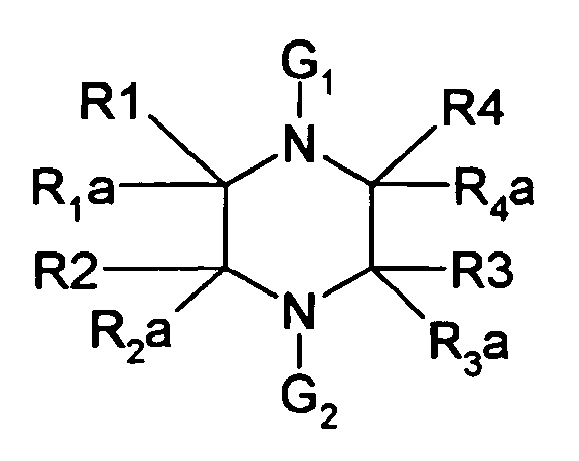 G1 is -CH2-Cy2,G2 is -S(O)2-Cy1,provided that R1 and R1a or R4 and R4a taken together form 0,
Cy1 is selected from heteroaryl, which is a residue selected from the group azaindolyl, benzofuranyl, benzimidazolyl, benzisoxazolyl, benzothiazolyl, benzothienyl, benzotriazinyl, benzotriazolyl, cinnolinyl, furanopyridyl, furazanyl, furyl, imidazolyl, imidazo[1,2-a]pyridyl, imidazo[2,1-b]thiazolyl, indazolyl, indolizinyl, indolyl, isoindolyl, isoquinolinyl, isothiazolyl, isoxazolyl, oxadiazolyl, oxazolyl, 1,8-naphthyridinyl, phthalazinyl, pteridinyl, purinyl, pyrazinyl, pyrazolyl, pyridazinyl, pyridyl, pyrimidyl, pyrrolopyridyl, pyrrolyl, quinazolinyl, quinolinyl, quinolizinyl, quinoxalinyl, thiadiazolyl, thiazolyl, thienopyridyl, thienyl, triazinyl or triazolyl,
wherein heteroaryl is unsubstituted or substituted one or more times by alkyl, aryl, heteroaryl, wherein heteroaryl is as defined above, hydroxy, acyl, aroyl, halo, nitro, cyano, alkoxycarbonyl, acylamino, alkylthio, alkylamino, amino, carbamoyl or thiocarbamoyl,
Cy2 is selected from heteroaryl, which is a residue selected from the group azaindolyl, benzofuranyl, benzimidazolyl, benzisoxazolyl, benzothiazolyl, benzothienyl, benzotriazinyl, benzotriazolyl, cinnolinyl, furanopyridyl, imidazo[1,2-a]pyridyl, imidazo[2,1-b]thiazolyl, indazolyl, indolizinyl, indolyl, isoindolyl, isoquinolinyl, 1,8-naphthyridinyl, phthalazinyl, pteridinyl, purinyl, pyrrolopyridyl, quinazolinyl, quinolinyl, quinolizinyl, quinoxalinyl or thienopyridyl,
wherein heteroaryl is unsubstituted or substituted one or more times by alkyl, aryl, heteroaryl, wherein heteroaryl is as defined above for Cy2, hydroxy, acyl, aroyl, halo, nitro, cyano, alkoxycarbonyl, acylamino, alkylthio, alkylamino, amino, carbamoyl or thiocarbamoyl,
R1, R1a, R2, R2a, R3, R3a, R4 and R4a are independently selected from hydrogen, carboxy, alkoxycarbonyl or optionally substituted alkyl,
or R2 and R2a or R3 and R3a taken together form O. - A compound according to claim 1, wherein
Cy1 is thienyl, wherein thienyl is unsubstituted or substituted one or more times by alkyl, aryl, heteroaryl, wherein heteroaryl is as defined above for Cy1, hydroxy, acyl, aroyl, halo, nitro, cyano, alkoxycarbonyl, acylamino, alkylthio, alkylamino, amino, carbamoyl or thiocarbamoyl;
benzothienyl, wherein benzothienyl is unsubstituted or substituted one or more times as defined above;
isoquinolinyl, wherein isoquinolinyl is unsubstituted or substituted one or more times as defined above;
indolyl, wherein indolyl is unsubstituted or substituted one or more times as defined above;
thienopyridyl, wherein thienopyridyl is unsubstituted or substituted one or more times as defined above;
furanyl, wherein furanyl is unsubstituted or substituted one or more times as defined above;
pyridyl, wherein pyridyl is unsubstituted or substituted one or more times as defined above; or
benzimidazolyl, wherein benzimidazolyl is unsubstituted or substituted one or more times as defined above;
Cy2 is quinolinyl, wherein quinolinyl is unsubstituted or substituted one or more times as defined above;
isoquinolinyl, wherein isoquinolinyl is unsubstituted or substituted one or more times as defined above;
quinazolinyl, wherein quinazolinyl is unsubstituted or substituted one or more times as defined above;
cinnolinyl, wherein cinnolinyl is unsubstituted or substituted one or more times as defined above;
azoindolyl, wherein azoindolyl is unsubstituted or substituted one or more times as defined above; or
thienopyridyl, wherein thienopyridyl is unsubstituted or substituted one or more times as defined above; - A compound according to claim 1 selected from
1-(2-Amino-quinoxalin-6-ylmethyl)-4-(6-chloro-benzo[b]thiophene-2-sulfonyl)-piperazin-2-one,
4-(6-Chloro-benzo[b]thiophene-2-sulfonyl)-1-thieno[2,3-c]pyridin-2-ylmethyl-piperazin-2-one,
4-(6-Chloro-benzo[b]thiophene-2-sulfonyl)-1-thieno[3,2-c]pyridin-2-ylmethyl-piperazin-2-one,
1-(2-Amino-quinolin-6-ylmethyl)-4-(6-chloro-thieno[2,3-b]pyridine-2-sulfonyl)-piperazin-2-one,
4-(6-Chloro-benzo[b]thiophene-2-sulfonyl)-1-(1-chloro-isoquinolin-6-ylmethyl)-piperazin-2-one,
1-(7-Amino-thieno[2,3-c]pyridin-2-ylmethyl)-4-(6-chloro-benzo[b]thiophene-2-sulfonyl)-piperazin-2-one,
4-(6-Chloro-benzo[b]thiophene-2-sulfonyl)-1-quinolin-6-ylmethyl-piperazin-2-one,
1-(2-Amino-quinolin-7-ylmethyl)-4-(6-chloro-benzo[b]thiophene-2-sulfonyl)-piperazin-2-one,
1-(4-Amino-thieno[3,2-c]pyridin-2-ylmethyl)-4-(6-chloro-benzo[b]thiophene-2-sulfonyl)-piperazin-2-one,
4-(6-Chloro-benzo[b]thiophene-2-sulfonyl)-1-isoquinolin-6-ylmethyl-piperazin-2-one,
1-(2-Amino-quinolin-6-ylmethyl)-4-(6-chloro-benzo[b]thiophene-2-sulfonyl)-piperazin-2-one,
1-(1-Amino-isoquinolin-6-ylmethyl)-4-(6-chloro-benzo[b]thiophene-2-sulfonyl)-piperazin-2-one,
1-(1-Amino-isoquinolin-7-ylmethyl)-4-(6-chloro-benzo[b]thiophene-2-sulfonyl)-piperazin-2-one,
1-(4-Amino-thieno[32-c]pyridin-2-ylmethyl)-4-(6-chloro-benzo[b]thiophene-2-sulfonyl)-piperazin-2-one,
1-(4-Amino-quinazolin-7-ylmethyl)-4-(Crchloro-thieno[2,3-b]pyridine-2-sulfonyl)-piperazin-2-one,
1-(4-Amino-quinazolin-7-ylmethyl)-4-(6-chloro-1H-benzoimidazole-2-sulfonyl)-piperazin-2-one,
(S)-1-(4-Amino-quinazolin-7-ylmethyl)-4-(6-chloro-benzo[b]thiophene-2-sulfonyl)-3-ethyl-piperazin-2-one,
(S)-1-(4-Amino-quinazolin-7-ylmethyl)-4-(6-chloro-benzo[b]thiophene-2-sulfonyl)-3-methyl-piperazin-2-one,
(+/-)-1-(4-Amino-quinazolin-7-ylmethyl)-4-(6-chloro-benzo[b]thiophene-2-sulfonyl)-6-methyl-piperazin-2-one,
4-(6-Chloro-benzo[b]thiophene-2-sulfonyl)-1-(5-oxy-1H-pyrrolo[3,2-c]pyridin-2-ylmethyl)-piperazin-2-one,
4-(6-Chloro-benzo[b]thiophene-2-sulfonyl)-1-(1-methyl-1H-pyrrolo[3,2-c]pyridin-2-ylmethyl)-piperazin-2-one,
4-(6-Chloro-thieno[2,3-b]pyridine-2-sulfonyl)-1-(1H-pyrrolo[3,2-c]pyridin-2-ylmethyl)-piperazin-2-one,
4-(6-Bromo-benzo[b]thiophene-2-sulfonyl)-1-(1H-pyrrolo[3,2-c]pyridin-2-ylmethyl)-piperazin-2-one,
4-(5'-Chloro-[2,2']bithiophenyl-5-sulfonyl)-1-(1H-pyrrolo[3,2-c]pyridin-2-ylmethyl)-piperazin-2-one,
2-{2-[4-(6-Chloro-benzo[b]thiophene-2-sulfonyl)-2-oxo-piperazin-1-ylmethyl]-pyrrolo[3,2-c]pyridin-1-yl}-acetamide,
4-(6-Chloro-benzo[b]thiophene-2-sulfonyl)-1-[1-(2-hydroxy-ethyl)-1H-pyrrolo[3,2-c]pyridin-2-ylmethyl]-piperazin-2-one,
4-(6-Chloro-1H-benzoimidazole-2-sulfonyl)-1-(1H-pyrrolo[3,2-c]pyridin-2-ylmethyl)-piperazin-2-one,
4-(1H-Benzoimidazole-2-sulfonyl)-1-(1H-pyrrol(3,2-c]pyridin-2-ylmethyl)-piperazin-2-one,
4-(6-Chloro-benzo[b]thiophene-2-sulfonyl)-1-(1H-pyrrolo[2,3-c]pyridin-2-ylmethyl)-piperazin-2-one,
4-(6-Chloro-thieno[2,3-b]pyridine-2-sulfonyl)-1-(1H-pyrrolo[2,3-c]pyridin-2-ylmethyl)-piperazin-2-one,
4-(6-Chloro-benzo[b]thiophene-2-sulfonyl)-6-oxo-1-(1H-pyrrolo[3,2-c]pyridin-2-ylmethyl)-piperazine-2-carboxylic acid amide,
(3S,5S)-1-(4-Amino-quinazolin-7-ylmethyl)-4-(6-chloro-benzo[b]thiophene-2-sulfonyl)-3,5-dimethyl-piperazin-2-one,
1-(4-Amino-quinolin-7-ylmethyl)-4-(6-chloro-benzo[b]thiophene-2-sulfonyl)-piperazin-2-one,
1-(S)-(4-Amino-quinolin-7-ylmethyl)-4-(6-chloro-benzo[b]thiophene-2-sulfonyl)-3-methyl-piperazin-2-one,
1-(4-Amino-quinolin-7-ylmethyl)-4-(6-chloro-benzo[b]thiophene-2-sulfonyl)-6-oxopiperazine-2-carboxylic acid methylamide,
1-(4-Amino-quinolin-7-yl-methyl)-4-(6-chloro-benzo[b]thiophene-2-sulfonyl)-6-oxopiperazine-2-carboxylic acid ethylamide,
1-(4-Amino-quinolin-7-ylmethyl)-4-(6-chloro-benzo[b]thiophene-2-sulfonyl)-6-oxopiperazine-2-carboxylic acid dimethylamide,
1-(4-Amino-quinolin-7-ylmethyl)-4-(6-chloro-benzo[b]thiophene-2-sulfonyl)-6-(morpholine-4-carbonyl)-piperazin-2-one,
(+/-)-1-(4-Amino-quinazolin-7-ylmethyl)-4-(6-chloro-benzo[b]thiophene-2-sulfonyl)-6-oxopiperazine-2-carboxylic acid amide,
1-(4-Amino-quinolin-7-ylmethyl)-4-(6-chloro-benzo[b]thiophene-2-sulfonyl)-6-oxopiperazine-2-carboxylic acid methylamide,
1-(4-Amino-quinolin-7-ylmethyl)-4-(6-chloro-benzo[b]thiophene-2-sulfonyl)-6-oxopiperazine-2-carboxylic acid ethylamide,
1-(4-Amino-quinolin-7-ylmethyl)-4-(6-chloro-benzo[b]thiophene-2-sulfonyl)-6-oxopiperazine-2-carboxylic acid dimethylamide,
1-(4-Amino-quinolin-7-ylmethyl)-4-(6-chloro-benzo[b]thiophene-2-sulfonyl)-6-(morpholine-4-carbonyl)-piperazin-2-one or
1-(3-Amino-1H-indazol-6-ylmethyl)-4-(6-chloro-benzo[b]thiophene-2-sulfonyl)-piperazin-2-one. - A pharmaceutical composition comprising a pharmaceutically effective amount of a compound according to claims 1 to 3 and a pharmaceutically acceptable carrier.
- The use of a compound of the formula I as claimed in claims 1 to 4 for the preparation of a medicament for the treatment of acute myocardial infarction, unstable angina, thromboembolism, acute vessel closure associated with thrombolytic therapy, percutaneous transluminal coronary angioplasty (PTCA), transient ischemic attacks, stroke, intermittent claudication, bypass grafting of the coronary or peripheral arteries (CABG), preventing the vessel luminal narrowing (restenosis) that often occurs following PTCA and CABG, venous vasculature, pathologic thrombus formation frequently occurring in the veins of the lower extremities following abdominal, knee and hip surgery, deep vein thrombosis or a systemic, disseminated intravascular coagulopathy.
Applications Claiming Priority (3)
| Application Number | Priority Date | Filing Date | Title |
|---|---|---|---|
| US7270798P | 1998-01-27 | 1998-01-27 | |
| US72707P | 1998-01-27 | ||
| PCT/US1999/001682 WO1999037304A1 (en) | 1998-01-27 | 1999-01-27 | SUBSTITUTED OXOAZAHETEROCYCLYL FACTOR Xa INHIBITORS |
Publications (3)
| Publication Number | Publication Date |
|---|---|
| EP1051176A1 EP1051176A1 (en) | 2000-11-15 |
| EP1051176A4 EP1051176A4 (en) | 2002-06-12 |
| EP1051176B1 true EP1051176B1 (en) | 2006-11-22 |
Family
ID=22109280
Family Applications (1)
| Application Number | Title | Priority Date | Filing Date |
|---|---|---|---|
| EP99906684A Expired - Lifetime EP1051176B1 (en) | 1998-01-27 | 1999-01-27 | SUBSTITUTED OXOAZAHETEROCYCLYL FACTOR Xa INHIBITORS |
Country Status (25)
| Country | Link |
|---|---|
| US (1) | US7612075B2 (en) |
| EP (1) | EP1051176B1 (en) |
| JP (1) | JP4676613B2 (en) |
| KR (1) | KR20010034442A (en) |
| CN (1) | CN1291892A (en) |
| AP (1) | AP2000001889A0 (en) |
| AT (1) | ATE346050T1 (en) |
| AU (1) | AU745425B2 (en) |
| BG (1) | BG104633A (en) |
| BR (1) | BR9907300A (en) |
| CA (1) | CA2319198C (en) |
| DE (1) | DE69934093T2 (en) |
| EA (1) | EA200000768A1 (en) |
| EE (1) | EE200000435A (en) |
| HU (1) | HUP0101810A3 (en) |
| IL (2) | IL137517A0 (en) |
| IS (1) | IS5574A (en) |
| NO (1) | NO20003808L (en) |
| PL (1) | PL342243A1 (en) |
| SK (1) | SK11082000A3 (en) |
| TR (1) | TR200002182T2 (en) |
| UA (1) | UA59433C2 (en) |
| WO (1) | WO1999037304A1 (en) |
| YU (1) | YU47600A (en) |
| ZA (1) | ZA99607B (en) |
Families Citing this family (144)
| Publication number | Priority date | Publication date | Assignee | Title |
|---|---|---|---|---|
| US6525042B1 (en) | 1997-09-30 | 2003-02-25 | Daiichi Pharmaceutical Co., Ltd. | Sulfonyl derivatives |
| US6403595B1 (en) * | 1998-02-05 | 2002-06-11 | Takeda Chemical Industries, Ltd. | Sulfonamide derivatives, processes for producing the same and utilization thereof |
| US7517884B2 (en) | 1998-03-30 | 2009-04-14 | Kalypsys Inc. | Sulfonyl-substituted bicyclic compounds as modulators of PPAR |
| CA2340100A1 (en) * | 1998-08-11 | 2000-02-24 | Daiichi Pharmaceutical Co., Ltd. | Novel sulfonyl derivatives |
| JP2003529531A (en) * | 1998-11-25 | 2003-10-07 | アヴェンティス ファーマシューティカルズ インコーポレイテッド | Substituted oxoazaheterocyclyl factor Xa inhibitors |
| CA2348740A1 (en) * | 1998-12-23 | 2000-07-06 | Ruth R. Wexler | Thrombin or factor xa inhibitors |
| AU5566300A (en) | 1999-06-22 | 2001-01-09 | Takeda Chemical Industries Ltd. | Acylhydrazine derivatives, process for preparing the same and use thereof |
| CA2382755A1 (en) * | 1999-07-28 | 2001-02-01 | Aventis Pharmaceuticals Products Inc. | Substituted oxoazaheterocyclyl compounds |
| SE9902987D0 (en) | 1999-08-24 | 1999-08-24 | Astra Pharma Prod | Novel compounds |
| DE19962924A1 (en) | 1999-12-24 | 2001-07-05 | Bayer Ag | Substituted oxazolidinones and their use |
| JP2001294572A (en) * | 2000-02-09 | 2001-10-23 | Dai Ichi Seiyaku Co Ltd | Novel sulfonyl derivative |
| DE10012732A1 (en) | 2000-03-18 | 2001-09-20 | Aventis Behring Gmbh | Thrombin composition, for use as hemostatic or as a component of fibrin glues, comprises non-covalently bonded inhibitor for stabilization |
| AR030357A1 (en) | 2000-08-18 | 2003-08-20 | Lundbeck & Co As H | DERIVATIVES 4 -, 5 -, 6 - AND 7-INDOL |
| BR0107282A (en) * | 2000-09-29 | 2004-07-06 | Cor Therapeutics Inc | Compound, pharmaceutical composition and methods for preventing or treating a condition in a mammal and for inhibiting coagulation of biological samples. |
| WO2002038560A1 (en) | 2000-11-08 | 2002-05-16 | Takeda Chemical Industries, Ltd. | Carbamate derivatives, process for producing the same and use thereof |
| DE10105989A1 (en) | 2001-02-09 | 2002-08-14 | Bayer Ag | Substituted oxazolidinones and their use |
| GB0104050D0 (en) | 2001-02-19 | 2001-04-04 | Astrazeneca Ab | Chemical compounds |
| GB0107228D0 (en) | 2001-03-22 | 2001-05-16 | Astrazeneca Ab | Chemical compounds |
| BR0209129A (en) | 2001-04-18 | 2005-12-20 | Euro Celtique Sa | Compounds, pharmaceutical compositions, methods for treating pain, methods for modulating a pharmacological response and uses of compounds. |
| GB0112836D0 (en) | 2001-05-25 | 2001-07-18 | Smithkline Beecham Plc | Medicaments |
| GB0114005D0 (en) | 2001-06-08 | 2001-08-01 | Glaxo Group Ltd | Chemical compounds |
| GB0114004D0 (en) | 2001-06-08 | 2001-08-01 | Glaxo Group Ltd | Chemical compounds |
| DE10129725A1 (en) | 2001-06-20 | 2003-01-02 | Bayer Ag | Combination therapy of substituted oxazolidinones |
| EP1604982A1 (en) | 2001-07-02 | 2005-12-14 | AstraZeneca AB | Intermediates for the preparation of piperidine derivatives useful as modulators of chemokine receptor activity |
| DE10134482A1 (en) | 2001-07-16 | 2003-01-30 | Bayer Ag | Substituted isoindoles and their use |
| DE10137163A1 (en) | 2001-07-30 | 2003-02-13 | Bayer Ag | New thiophenecarboxamido-substituted isoindole derivatives, useful as Factor XIa inhibitors for treatment or prophylaxis of, e.g. thromboembolic diseases, atherosclerosis, arthritis, Alzheimer's disease or cancer |
| GB0120461D0 (en) | 2001-08-22 | 2001-10-17 | Astrazeneca Ab | Novel compounds |
| US7763620B2 (en) | 2001-08-24 | 2010-07-27 | Yale University | Piperazinone compounds as anti-tumor and anti-cancer agents and methods of treatment |
| GB0122503D0 (en) | 2001-09-18 | 2001-11-07 | Astrazeneca Ab | Chemical compounds |
| DE10155727A1 (en) * | 2001-11-13 | 2003-05-28 | Morphochem Ag | Serine protease inhibitors |
| SE0103818D0 (en) | 2001-11-15 | 2001-11-15 | Astrazeneca Ab | Chemical compounds |
| EP1314733A1 (en) | 2001-11-22 | 2003-05-28 | Aventis Pharma Deutschland GmbH | Indole-2-carboxamides as factor Xa inhibitors |
| GB0130677D0 (en) * | 2001-12-21 | 2002-02-06 | Glaxo Group Ltd | Medicaments and novel compounds |
| EP1569912B1 (en) | 2002-12-03 | 2015-04-29 | Pharmacyclics, Inc. | 2-(2-hydroxybiphenyl-3-yl)-1h-benzoimidazole-5-carboxamidine derivatives as factor viia inhibitors |
| DK1472225T3 (en) | 2002-02-01 | 2010-08-09 | Euro Celtique Sa | 2-Piperazine pyridines useful for the treatment of pain |
| GB0203020D0 (en) | 2002-02-08 | 2002-03-27 | Glaxo Group Ltd | Chemical compounds |
| JP2005522436A (en) * | 2002-02-08 | 2005-07-28 | グラクソ グループ リミテッド | Piperidylcarboxamide derivatives or their use in the treatment of tachykinin-mediated diseases |
| SE0200843D0 (en) | 2002-03-19 | 2002-03-19 | Astrazeneca Ab | Chemical compounds |
| SE0200844D0 (en) | 2002-03-19 | 2002-03-19 | Astrazeneca Ab | Chemical compounds |
| CA2484261A1 (en) | 2002-04-16 | 2003-10-23 | Teijin Limited | Piperidine derivatives having ccr3 antagonism |
| US7524841B2 (en) | 2002-04-25 | 2009-04-28 | Teijin Limited | 4,4-disubstituted piperidine derivatives having CCR3 antagonism |
| KR20030084444A (en) * | 2002-04-26 | 2003-11-01 | 주식회사 파나진 | A Novel Monomer For Synthesis of PNA Oligomer And A Process For Producing The Same |
| US6864261B2 (en) | 2002-05-02 | 2005-03-08 | Euro-Celtique S.A. | Therapeutic agents useful for treating pain |
| TW200409637A (en) | 2002-06-26 | 2004-06-16 | Glaxo Group Ltd | Compounds |
| US7429581B2 (en) | 2002-12-23 | 2008-09-30 | Sanofi-Aventis Deutschland Gmbh | Pyrazole-derivatives as factor Xa inhibitors |
| US7582635B2 (en) | 2002-12-24 | 2009-09-01 | Purdue Pharma, L.P. | Therapeutic agents useful for treating pain |
| DE10300111A1 (en) | 2003-01-07 | 2004-07-15 | Bayer Healthcare Ag | Process for the preparation of 5-chloro-N - ({(5S) -2-oxo-3- [4- (3-oxo-4-morpholinyl) phenyl] -1,3-oxazolidin-5-yl} methyl ) -2-thiophenecarboxamide |
| TW200508224A (en) | 2003-02-12 | 2005-03-01 | Bristol Myers Squibb Co | Cyclic derivatives as modulators of chemokine receptor activity |
| SE0300957D0 (en) | 2003-04-01 | 2003-04-01 | Astrazeneca Ab | Chemical compounds |
| SE0301369D0 (en) | 2003-05-09 | 2003-05-09 | Astrazeneca Ab | Chemical compounds |
| GB0314738D0 (en) | 2003-06-24 | 2003-07-30 | Glaxo Group Ltd | Novel compounds |
| SI1641775T1 (en) * | 2003-07-03 | 2009-08-31 | Euro Celtique Sa | 2-pyridine alkyne derivatives useful for treating pain |
| BRPI0412808A (en) | 2003-07-24 | 2006-09-26 | Euro Celtique Sa | piperidine compounds and pharmaceutical compositions containing them |
| US7163937B2 (en) | 2003-08-21 | 2007-01-16 | Bristol-Myers Squibb Company | Cyclic derivatives as modulators of chemokine receptor activity |
| KR20060127000A (en) | 2003-11-17 | 2006-12-11 | 베링거 인겔하임 인터내셔날 게엠베하 | Novel piperidine-substituted indole derivatives or their use as heteromodulators and modulators of chemokine receptors (CCR-3) |
| DE10355461A1 (en) | 2003-11-27 | 2005-06-23 | Bayer Healthcare Ag | Solid, high bioavailabilty oral formulations of N-substituted 5-chloro-2-thiophene-carboxamide derivative in hydrophilized form, useful for combating thrombo-embolic diseases |
| WO2005084672A1 (en) * | 2004-03-03 | 2005-09-15 | Boehringer Ingelheim International Gmbh | Selected cgrp-antagonists, method for the production and use thereof as medicaments |
| US7269708B2 (en) * | 2004-04-20 | 2007-09-11 | Rambus Inc. | Memory controller for non-homogenous memory system |
| GB0414093D0 (en) | 2004-06-23 | 2004-07-28 | Glaxo Group Ltd | Novel compounds |
| PL1784402T3 (en) * | 2004-09-03 | 2011-12-30 | Yuhan Corp | PYRROLO[3,2-c]PYRIDINE DERIVATIVES AND PROCESSES FOR THE PREPARATION THEREOF |
| GB0420831D0 (en) | 2004-09-17 | 2004-10-20 | Glaxo Group Ltd | Novel compounds |
| TW200630337A (en) | 2004-10-14 | 2006-09-01 | Euro Celtique Sa | Piperidinyl compounds and the use thereof |
| CA2585172C (en) | 2004-10-29 | 2014-08-12 | Kalypsys, Inc. | Sulfonyl-substituted bicyclic compounds as modulators of ppar |
| EP1685841A1 (en) | 2005-01-31 | 2006-08-02 | Bayer Health Care Aktiengesellschaft | Prevention and treatment of thromboembolic disorders |
| MX2007010076A (en) | 2005-02-17 | 2007-10-16 | Astellas Pharma Inc | Pyridyl non-aromatic nitrogenated heterocyclic-1-carboxylate ester derivative. |
| US8197472B2 (en) | 2005-03-25 | 2012-06-12 | Maquet Cardiovascular, Llc | Tissue welding and cutting apparatus and method |
| US7918848B2 (en) | 2005-03-25 | 2011-04-05 | Maquet Cardiovascular, Llc | Tissue welding and cutting apparatus and method |
| WO2006117314A2 (en) | 2005-04-30 | 2006-11-09 | Boehringer Ingelheim International Gmbh | Novel piperidin- substituted indoles and their use as ccr-3 modulators |
| US20060281768A1 (en) * | 2005-06-10 | 2006-12-14 | Gaul Michael D | Thienopyrimidine and thienopyridine kinase modulators |
| BRPI0613563A2 (en) | 2005-07-21 | 2012-01-17 | Astrazeneca Ab | new piperidine derivatives |
| US7544685B2 (en) | 2005-08-17 | 2009-06-09 | H. Lundbeck A/S | 2,3-dihydroindole compounds |
| EP1932839A4 (en) * | 2005-09-06 | 2014-09-10 | Shionogi & Co | Indolecarboxylic acid derivative having pgd2 receptor antagonistic activity |
| DE102005045518A1 (en) | 2005-09-23 | 2007-03-29 | Bayer Healthcare Ag | New 5-thienylaminocarbonylmethyl-oxazolidin-2-one derivatives, useful for treating and preventing thromboembolic disease, are selective inhibitors of coagulation factor Xa |
| WO2007037187A1 (en) | 2005-09-27 | 2007-04-05 | Shionogi & Co., Ltd. | Sulfonamide derivative having pgd2 receptor antagonistic activity |
| PT1934208E (en) | 2005-10-04 | 2011-06-01 | Bayer Schering Pharma Ag | Novel polymorphous form of 5-chloro-n-({ (5s)-2-oxo-3-[4-(3-oxo-4-morpholinyl)-phenyl]-1,3-oxazolidine-5-yl}-methyl)-2-thiophene carboxamide |
| DE102005047561A1 (en) | 2005-10-04 | 2007-04-05 | Bayer Healthcare Ag | Drug delivery system, useful to treat and/or prevent e.g. thromboembolic disease, comprises 5-chloro-N-(((5S)-2-oxo-3-(4-(3-oxo-4-morpholinyl)-phenyl)-1,3-oxazolidine-5-yl)-methyl)-2-thiophene carboxamide with fast release active substance |
| US7863276B2 (en) | 2005-10-25 | 2011-01-04 | Kalypsys, Inc | Salts of modulators of PPAR and methods of treating metabolic disorders |
| WO2007080430A1 (en) * | 2006-01-16 | 2007-07-19 | Generics [Uk] Limited | Novel process |
| US8247442B2 (en) * | 2006-03-29 | 2012-08-21 | Purdue Pharma L.P. | Benzenesulfonamide compounds and their use |
| TW200815353A (en) * | 2006-04-13 | 2008-04-01 | Euro Celtique Sa | Benzenesulfonamide compounds and their use |
| TW200812963A (en) * | 2006-04-13 | 2008-03-16 | Euro Celtique Sa | Benzenesulfonamide compounds and the use thereof |
| US8017612B2 (en) | 2006-04-18 | 2011-09-13 | Japan Tobacco Inc. | Piperazine compound and use thereof as a HCV polymerase inhibitor |
| US7671062B2 (en) | 2006-07-28 | 2010-03-02 | Bristol-Myers Squibb Company | Modulators of chemokine receptor activity, crystalline forms and process |
| US7629351B2 (en) | 2006-07-28 | 2009-12-08 | Bristol-Myers Squibb Company | N-((1R,2S,5R)-5-(tert-butylamino)-2-((S)-2-oxo-3-(6-(trifluoromethyl)quinazolin-4-ylamino) pyrrolidin-1-yl)cyclohexyl)acetamide and other modulators of chemokine receptor activity, crystalline forms and process |
| US7687508B2 (en) | 2006-07-28 | 2010-03-30 | Bristol-Myers Squibb Company | Cyclic derivatives as modulators of chemokine receptor activity |
| CA2663436A1 (en) * | 2006-10-04 | 2008-04-10 | Pfizer Products Inc. | Pyrido[4,3-d]pyrimidin-4(3h)-one derivatives as calcium receptor antagonists |
| CA2667547C (en) | 2006-10-27 | 2014-07-29 | Boehringer Ingelheim International Gmbh | Piperidyl-propane-thiol ccr3 modulators |
| US20080176861A1 (en) | 2007-01-23 | 2008-07-24 | Kalypsys, Inc. | Sulfonyl-substituted bicyclic compounds as ppar modulators for the treatment of non-alcoholic steatohepatitis |
| BRPI0808301B1 (en) * | 2007-03-20 | 2022-05-03 | Curis, Inc | Compound and pharmaceutical composition |
| WO2008116107A2 (en) * | 2007-03-21 | 2008-09-25 | Takeda San Diego, Inc. | Piperazine derivatives as glucokinase activators |
| US8399486B2 (en) | 2007-04-09 | 2013-03-19 | Purdue Pharma L.P. | Benzenesulfonyl compounds and the use thereof |
| EP2479173A1 (en) | 2007-04-27 | 2012-07-25 | Purdue Pharma LP | Therapeutic agents useful for treating pain |
| EP2604599A1 (en) | 2007-04-27 | 2013-06-19 | Purdue Pharma LP | TRPV1 antagonists and uses thereof |
| CN101754957A (en) * | 2007-07-19 | 2010-06-23 | 弗·哈夫曼-拉罗切有限公司 | Novel heterocyclyl compounds and their use as chemokine antagonists |
| CN101835750B (en) | 2007-08-22 | 2013-07-17 | 阿斯利康(瑞典)有限公司 | Cyclopropylamide Derivatives |
| US8765736B2 (en) * | 2007-09-28 | 2014-07-01 | Purdue Pharma L.P. | Benzenesulfonamide compounds and the use thereof |
| EA201070451A1 (en) * | 2007-10-10 | 2010-10-29 | Такеда Фармасьютикал Компани Лимитед | AMIDE CONNECTIONS |
| JP2011500767A (en) | 2007-10-26 | 2011-01-06 | グラクソ グループ リミテッド | 4-Benzoyl-1-substituted piperazin-2-one derivatives as P2X7 modulators |
| KR100967171B1 (en) | 2007-12-26 | 2010-07-05 | 재단법인서울대학교산학협력재단 | Δ5-2-oxopiperazine derivative and solid phase synthesis method thereof |
| TR201904655T4 (en) | 2008-03-12 | 2019-06-21 | Ube Industries | Pyridylaminoacetic acid compound. |
| TW200944526A (en) | 2008-04-22 | 2009-11-01 | Vitae Pharmaceuticals Inc | Carbamate and urea inhibitors of 11β-hydroxysteroid dehydrogenase 1 |
| WO2009154976A2 (en) | 2008-05-27 | 2009-12-23 | Maquet Cardiovascular Llc | Surgical instrument and method |
| US9402680B2 (en) | 2008-05-27 | 2016-08-02 | Maquet Cardiovasular, Llc | Surgical instrument and method |
| US9968396B2 (en) | 2008-05-27 | 2018-05-15 | Maquet Cardiovascular Llc | Surgical instrument and method |
| GB0813144D0 (en) | 2008-07-17 | 2008-08-27 | Glaxo Group Ltd | Novel compounds |
| GB0813142D0 (en) | 2008-07-17 | 2008-08-27 | Glaxo Group Ltd | Novel compounds |
| US8703962B2 (en) * | 2008-10-24 | 2014-04-22 | Purdue Pharma L.P. | Monocyclic compounds and their use as TRPV1 ligands |
| US8759362B2 (en) * | 2008-10-24 | 2014-06-24 | Purdue Pharma L.P. | Bicycloheteroaryl compounds and their use as TRPV1 ligands |
| BRPI0922366B8 (en) | 2008-12-03 | 2021-05-25 | Presidio Pharmaceuticals Inc | compound, pharmaceutical composition and use of a compound |
| BRPI0923488A2 (en) | 2008-12-23 | 2019-09-24 | Hoffmann La Roche | didropyridone amides as modular p2x7 |
| US8153808B2 (en) | 2008-12-23 | 2012-04-10 | Roche Palo Alto Llc | Dihydropyridone amides as P2X7 modulators |
| JP5478637B2 (en) | 2008-12-23 | 2014-04-23 | エフ.ホフマン−ラ ロシュ アーゲー | Dihydropyridone amide as a P2X7 modulator |
| CA2745952A1 (en) | 2008-12-23 | 2010-07-01 | F.Hoffmann-La Roche Ag | Dihydropyridone amides as p2x7 modulators |
| EP2393781B1 (en) | 2008-12-23 | 2014-03-12 | F. Hoffmann-La Roche AG | Dihydropyridone ureas as p2x7 modulators |
| TW201039825A (en) | 2009-02-20 | 2010-11-16 | Astrazeneca Ab | Cyclopropyl amide derivatives 983 |
| KR101681347B1 (en) | 2009-03-30 | 2016-11-30 | 우베 고산 가부시키가이샤 | Pharmaceutical composition for treating or preventing glaucoma |
| TW201044234A (en) * | 2009-06-08 | 2010-12-16 | Chunghwa Picture Tubes Ltd | Method of scanning touch panel |
| US9955858B2 (en) | 2009-08-21 | 2018-05-01 | Maquet Cardiovascular Llc | Surgical instrument and method for use |
| US8383812B2 (en) | 2009-10-13 | 2013-02-26 | Bristol-Myers Squibb Company | N-((1R,2S,5R)-5-(tert-butylamino)-2-((S)-3-(7-tert-butylpyrazolo[1,5-A][1,3,5]triazin-4-ylamino)-2-oxopyrrolidin-1-yl)cyclohexyl)acetamide, a dual modulator of chemokine receptor activity, crystalline forms and processes |
| WO2011050284A1 (en) * | 2009-10-23 | 2011-04-28 | Glaxosmithkline Llc | Pyrazolylpyridine antiviral agents |
| US8716286B2 (en) | 2009-10-30 | 2014-05-06 | Glaxo Group Limited | Crystalline forms of (3R, 6R)-3-(2,3-dihydro-1H-inden-2-yl)-1-[(1R)-1-(2,6-dimethyl-3-pyridinyl)-2-(4-morpholinyl)-2-oxoethyl]-6-[(1S)-1-methylpropyl]-2,5-piperazinedione |
| US20110201623A1 (en) | 2010-02-18 | 2011-08-18 | Uczynski Michael A | Crystalline Form Of A Cyclopropyl Benzamide Derivative |
| JP5876423B2 (en) | 2010-06-22 | 2016-03-02 | 塩野義製薬株式会社 | Compounds having TRPV1 inhibitory activity and uses thereof |
| WO2012027495A1 (en) | 2010-08-27 | 2012-03-01 | University Of The Pacific | Piperazinylpyrimidine analogues as protein kinase inhibitors |
| CN102532159B (en) * | 2010-11-12 | 2015-02-11 | 姚雪彪 | Small molecule inhibitors Syntelin for centromere-associated protein E (CENP-E) |
| EP2642998B1 (en) | 2010-11-24 | 2020-09-16 | The Trustees of Columbia University in the City of New York | A non-retinoid rbp4 antagonist for treatment of age-related macular degeneration and stargardt disease |
| US9273043B2 (en) | 2011-06-22 | 2016-03-01 | Purdue Pharma L.P. | TRPV1 antagonists including dihydroxy substituent and uses thereof |
| AU2012293417A1 (en) | 2011-08-10 | 2013-05-02 | Purdue Pharma L.P. | TRPV1 antagonists including dihydroxy substituent and uses thereof |
| WO2013166037A1 (en) | 2012-05-01 | 2013-11-07 | The Trustees Of Columbia University In The City Of New York | Non-retinoid antagonists for treatment of eye disorders |
| WO2014152013A1 (en) | 2013-03-14 | 2014-09-25 | The Trustees Of Columbia University In The City Of New York | 4-phenylpiperidines, their preparation and use |
| ES2700541T3 (en) | 2013-03-14 | 2019-02-18 | Univ Columbia | Octahidrociclopentapirroles, its preparation and use |
| US9938291B2 (en) | 2013-03-14 | 2018-04-10 | The Trustess Of Columbia University In The City Of New York | N-alkyl-2-phenoxyethanamines, their preparation and use |
| WO2014151936A1 (en) | 2013-03-14 | 2014-09-25 | The Trustees Of Columbia University In The City Of New York | Octahydropyrrolopyrroles, their preparation and use |
| EP2824806B1 (en) * | 2013-07-09 | 2020-03-04 | ABB Schweiz AG | Ship's propulsion unit |
| DK4036094T3 (en) | 2014-04-30 | 2026-03-23 | Univ Columbia | SUBSTITUTED 4-PHENYLPIPERIDINES, THEIR PRODUCTION AND USE |
| KR20180019234A (en) | 2015-06-26 | 2018-02-23 | 다케다 야쿠힌 고교 가부시키가이샤 | 2,3-dihydro-4h-1,3-benzoxazin-4-one derivatives as modulators of cholinergic muscarinic m1 receptor |
| WO2017012502A1 (en) | 2015-07-17 | 2017-01-26 | Sunshine Lake Pharma Co., Ltd. | Substituted quinazoline compounds and preparation and uses thereof |
| JP6787913B2 (en) | 2015-10-20 | 2020-11-18 | 武田薬品工業株式会社 | Heterocyclic compound |
| UA122423C2 (en) | 2015-11-02 | 2020-11-10 | Янссен Фармацевтика Нв | [1,2,4]TRIAZOLO[1,5-a]PYRIMIDIN-7-YL COMPOUND |
| KR20190071721A (en) | 2016-11-02 | 2019-06-24 | 얀센 파마슈티카 엔.브이. | [1,2,4] triazolo [1,5-A] pyrimidine compound as a PDE2 inhibitor |
| UA125302C2 (en) | 2016-11-02 | 2022-02-16 | Янссен Фармацевтика Нв | DERIVATIVES [1,2,4] TRIAZOLO [1,5-A] PYRIMIDINE AS PDE2 INHIBITORS |
| MA46690A (en) | 2016-11-02 | 2019-09-11 | Janssen Pharmaceutica Nv | [1,2,4] TRIAZOLO [1,5-A] PYRIMIDINE COMPOUNDS AS PDE2 INHIBITORS |
| JP7145875B2 (en) | 2017-04-18 | 2022-10-03 | 武田薬品工業株式会社 | Heterocyclic compounds useful as modulators of acetylcholine receptors |
| CN116606271B (en) * | 2023-07-21 | 2023-09-29 | 北京百力格生物科技有限公司 | A kind of synthesis method of 3,6-dichlorotrimellitic anhydride |
Family Cites Families (34)
| Publication number | Priority date | Publication date | Assignee | Title |
|---|---|---|---|---|
| US2877227A (en) * | 1959-03-10 | Chichi | ||
| GB808046A (en) * | 1955-12-13 | 1959-01-28 | Roche Products Ltd | Novel substituted pyridone-acetic acid derivatives and process for the manufacture thereof |
| US3935214A (en) * | 1968-07-26 | 1976-01-27 | Donau-Pharmazie Gesellschaft M.B.H. | 2-or 3 keto-3-or-2-phenyl-1,4-disubstituted piperazines |
| JPS49110680A (en) * | 1973-03-12 | 1974-10-22 | ||
| JPS5793962A (en) * | 1980-12-01 | 1982-06-11 | Otsuka Pharmaceut Co Ltd | Carbostyryl derivative |
| IL92011A0 (en) * | 1988-10-19 | 1990-07-12 | Abbott Lab | Heterocyclic peptide renin inhibitors |
| US5120718A (en) * | 1991-06-13 | 1992-06-09 | Abbott Laboratories | Candida acid protease inhibiting compounds |
| TW394760B (en) * | 1993-09-07 | 2000-06-21 | Hoffmann La Roche | Novel Carboxamides, process for their preparation and pharmaceutical composition containing the same |
| IL115420A0 (en) | 1994-09-26 | 1995-12-31 | Zeneca Ltd | Aminoheterocyclic derivatives |
| HUT77309A (en) | 1994-12-01 | 1998-03-30 | Toyama Chemical Co. Ltd. | Novel 2,3-diketopiperazine derivative or salt thereof, pharmaceutical compositions containing them and their use |
| GB9508622D0 (en) | 1995-04-28 | 1995-06-14 | Pfizer Ltd | Therapeutic agants |
| US5612353A (en) * | 1995-06-07 | 1997-03-18 | Rhone-Poulenc Rorer Pharmaceuticals Inc. | Substituted (sulfinic acid, sulfonic acid, sulfonylamino or sulfinylamino) N-[(aminoiminomethyl)phenylalkyl]-azaheterocyclylamide compounds |
| GB9516709D0 (en) | 1995-08-15 | 1995-10-18 | Zeneca Ltd | Medicament |
| GB9602166D0 (en) | 1996-02-02 | 1996-04-03 | Zeneca Ltd | Aminoheterocyclic derivatives |
| GB9602294D0 (en) | 1996-02-05 | 1996-04-03 | Zeneca Ltd | Heterocyclic compounds |
| JP2000508631A (en) * | 1996-04-03 | 2000-07-11 | メルク エンド カンパニー インコーポレーテッド | Inhibitors of farnesyl protein transferase |
| NZ332173A (en) * | 1996-04-17 | 2000-06-23 | Du Pont Pharm Co | N-(amidinophenyl)-n'-(subst.)-3h-2,4-benzodiazepin-3-one derivatives as factor xa inhibitors |
| US6093718A (en) | 1996-08-14 | 2000-07-25 | Zeneca Limited | Substituted pyrimidine derivatives and their pharmaceutical use |
| WO1998009987A1 (en) * | 1996-09-06 | 1998-03-12 | Biochem Pharma, Inc. | Lactam inhibitors of thrombin |
| UA56197C2 (en) | 1996-11-08 | 2003-05-15 | Зенека Лімітед | Heterocyclic derivatives |
| AU741099B2 (en) | 1997-04-14 | 2001-11-22 | Millennium Pharmaceuticals, Inc. | Selective factor Xa inhibitors |
| AU6896398A (en) * | 1997-04-14 | 1998-11-11 | Cor Therapeutics, Inc. | Selective factor xa inhibitors |
| NZ500353A (en) * | 1997-04-14 | 2002-02-01 | Cor Therapeutics Inc | Cyclic diaza compounds that are selective inhibitors of factor Xa |
| AU747531B2 (en) * | 1997-04-14 | 2002-05-16 | Millennium Pharmaceuticals, Inc. | Selective factor Xa inhibitors |
| WO1998054164A1 (en) | 1997-05-30 | 1998-12-03 | Takeda Chemical Industries, Ltd. | Sulfonamide derivatives, their production and use |
| GB9715894D0 (en) | 1997-07-29 | 1997-10-01 | Zeneca Ltd | Heterocyclic derivatives |
| GB9715892D0 (en) * | 1997-07-29 | 1997-10-01 | Zeneca Ltd | Heterocyclic compounds |
| GB9715895D0 (en) | 1997-07-29 | 1997-10-01 | Zeneca Ltd | Heterocyclic compounds |
| US6525042B1 (en) | 1997-09-30 | 2003-02-25 | Daiichi Pharmaceutical Co., Ltd. | Sulfonyl derivatives |
| CA2318351A1 (en) * | 1997-12-26 | 1999-07-08 | Hidemitsu Nishida | Aromatic compounds having cyclic amino or salts thereof |
| JP2000204081A (en) * | 1998-02-05 | 2000-07-25 | Takeda Chem Ind Ltd | Sulfonamide derivative, its production and use |
| US6403595B1 (en) | 1998-02-05 | 2002-06-11 | Takeda Chemical Industries, Ltd. | Sulfonamide derivatives, processes for producing the same and utilization thereof |
| WO1999046267A1 (en) * | 1998-03-12 | 1999-09-16 | Novo Nordisk A/S | Modulators of protein tyrosine phosphatases (ptpases) |
| DE19835950A1 (en) * | 1998-08-08 | 2000-02-10 | Merck Patent Gmbh | Piperazinone derivatives |
-
1999
- 1999-01-27 DE DE69934093T patent/DE69934093T2/en not_active Expired - Lifetime
- 1999-01-27 UA UA2000085034A patent/UA59433C2/en unknown
- 1999-01-27 IL IL13751799A patent/IL137517A0/en active IP Right Grant
- 1999-01-27 JP JP2000528286A patent/JP4676613B2/en not_active Expired - Fee Related
- 1999-01-27 PL PL99342243A patent/PL342243A1/en not_active Application Discontinuation
- 1999-01-27 YU YU47600A patent/YU47600A/en unknown
- 1999-01-27 CN CN99803501A patent/CN1291892A/en active Pending
- 1999-01-27 AT AT99906684T patent/ATE346050T1/en not_active IP Right Cessation
- 1999-01-27 HU HU0101810A patent/HUP0101810A3/en unknown
- 1999-01-27 AU AU26533/99A patent/AU745425B2/en not_active Ceased
- 1999-01-27 ZA ZA9900607A patent/ZA99607B/en unknown
- 1999-01-27 EE EEP200000435A patent/EE200000435A/en unknown
- 1999-01-27 CA CA2319198A patent/CA2319198C/en not_active Expired - Fee Related
- 1999-01-27 AP APAP/P/2000/001889A patent/AP2000001889A0/en unknown
- 1999-01-27 SK SK1108-2000A patent/SK11082000A3/en unknown
- 1999-01-27 KR KR1020007008221A patent/KR20010034442A/en not_active Withdrawn
- 1999-01-27 TR TR2000/02182T patent/TR200002182T2/en unknown
- 1999-01-27 EP EP99906684A patent/EP1051176B1/en not_active Expired - Lifetime
- 1999-01-27 EA EA200000768A patent/EA200000768A1/en unknown
- 1999-01-27 BR BR9907300-5A patent/BR9907300A/en not_active IP Right Cessation
- 1999-01-27 WO PCT/US1999/001682 patent/WO1999037304A1/en not_active Ceased
-
2000
- 2000-07-25 IS IS5574A patent/IS5574A/en unknown
- 2000-07-25 BG BG104633A patent/BG104633A/en unknown
- 2000-07-25 IL IL137517A patent/IL137517A/en not_active IP Right Cessation
- 2000-07-25 NO NO20003808A patent/NO20003808L/en not_active Application Discontinuation
-
2003
- 2003-07-25 US US10/628,093 patent/US7612075B2/en not_active Expired - Fee Related
Also Published As
| Publication number | Publication date |
|---|---|
| IL137517A0 (en) | 2001-07-24 |
| ATE346050T1 (en) | 2006-12-15 |
| IS5574A (en) | 2000-07-25 |
| EP1051176A4 (en) | 2002-06-12 |
| HUP0101810A3 (en) | 2002-05-28 |
| US20040102450A1 (en) | 2004-05-27 |
| DE69934093T2 (en) | 2007-06-21 |
| CA2319198C (en) | 2011-02-22 |
| WO1999037304A1 (en) | 1999-07-29 |
| TR200002182T2 (en) | 2000-12-21 |
| AP2000001889A0 (en) | 2000-09-30 |
| SK11082000A3 (en) | 2001-01-18 |
| AU2653399A (en) | 1999-08-09 |
| NO20003808L (en) | 2000-09-26 |
| US7612075B2 (en) | 2009-11-03 |
| KR20010034442A (en) | 2001-04-25 |
| CA2319198A1 (en) | 1999-07-29 |
| JP4676613B2 (en) | 2011-04-27 |
| CN1291892A (en) | 2001-04-18 |
| HUP0101810A2 (en) | 2002-04-29 |
| BR9907300A (en) | 2000-10-24 |
| EA200000768A1 (en) | 2001-06-25 |
| IL137517A (en) | 2006-12-10 |
| AU745425B2 (en) | 2002-03-21 |
| DE69934093D1 (en) | 2007-01-04 |
| JP2002501024A (en) | 2002-01-15 |
| EP1051176A1 (en) | 2000-11-15 |
| YU47600A (en) | 2002-09-19 |
| UA59433C2 (en) | 2003-09-15 |
| EE200000435A (en) | 2002-02-15 |
| PL342243A1 (en) | 2001-06-04 |
| BG104633A (en) | 2001-03-30 |
| NO20003808D0 (en) | 2000-07-25 |
| ZA99607B (en) | 1999-07-27 |
Similar Documents
| Publication | Publication Date | Title |
|---|---|---|
| DE69934093T2 (en) | SUBSTITUTED OXOAZAHETEROCYCLYL FACTOR Xa HEMMER | |
| US5731315A (en) | Substituted sulfonic acid n- (aminoiminomethyl)phenylalkyl!-azaheterocyclamide compounds | |
| WO2001039759A2 (en) | Sulfonic acid or sulfonylamino n-(heteroaralkyl)-azaheterocyclylamide compounds | |
| JP4053597B2 (en) | Substituted N-[(aminoiminomethyl or aminomethyl) phenyl] propylamide | |
| EP0853618A1 (en) | Substituted (sulfinic acid, sulfonic acid, sulfonylamino or sulfinylamino) n- (aminoiminomethyl)phenylalkyl]-azaheterocyclylamide compounds | |
| EP0944386B1 (en) | Sulfonic acid or sulfonylamino n-(heteroaralkyl)-azaheterocyclylamide compounds | |
| EP1086099B1 (en) | Sulfonic acid or sulfonylamino n-(heteroaralkyl)-azaheterocyclylamide compounds | |
| EP1208097A2 (en) | Substituted oxoazaheterocyclyl compounds | |
| WO2000032590A1 (en) | SUBSTITUTED OXOAZAHETEROCYCLYL FACTOR Xa INHIBITORS | |
| US6034093A (en) | Substituted sulfonic acid N-[(aminoiminomethyl)phenylalkyl]-azaheterocyclylamide compounds | |
| CZ20002728A3 (en) | Substituted Oxoazaheterocyclyl Factor Xa Inhibitors, Processes for their Preparation, and Pharmaceutical Compositions Containing them | |
| CZ211599A3 (en) | Sulfone or sulfonylamine N-(heteroaralkyl)-azaheterocyclylamide compounds | |
| MXPA00007250A (en) | SUBSTITUTED OXOAZAHETEROCYCLYL FACTOR Xa INHIBITORS | |
| CZ20004497A3 (en) | Sulfonyl- or sulfonylamino-N-(heteroaralkyl)azaheterocyclylamide derivatives and pharmaceutical preparation containing thereof |
Legal Events
| Date | Code | Title | Description |
|---|---|---|---|
| PUAI | Public reference made under article 153(3) epc to a published international application that has entered the european phase |
Free format text: ORIGINAL CODE: 0009012 |
|
| 17P | Request for examination filed |
Effective date: 20000828 |
|
| AK | Designated contracting states |
Kind code of ref document: A1 Designated state(s): AT BE CH DE DK ES FI FR GB GR IE IT LI LU MC NL PT SE |
|
| AX | Request for extension of the european patent |
Free format text: AL PAYMENT 20000828;LT PAYMENT 20000828;LV PAYMENT 20000828;MK PAYMENT 20000828;RO PAYMENT 20000828;SI PAYMENT 20000828 |
|
| RIC1 | Information provided on ipc code assigned before grant |
Free format text: 7C 07D 241/08 A, 7A 61K 31/495 B |
|
| A4 | Supplementary search report drawn up and despatched |
Effective date: 20020425 |
|
| AK | Designated contracting states |
Kind code of ref document: A4 Designated state(s): AT BE CH DE DK ES FI FR GB GR IE IT LI LU MC NL PT SE |
|
| RAP1 | Party data changed (applicant data changed or rights of an application transferred) |
Owner name: AVENTIS PHARMACEUTICALS INC. |
|
| 17Q | First examination report despatched |
Effective date: 20030318 |
|
| GRAP | Despatch of communication of intention to grant a patent |
Free format text: ORIGINAL CODE: EPIDOSNIGR1 |
|
| GRAS | Grant fee paid |
Free format text: ORIGINAL CODE: EPIDOSNIGR3 |
|
| GRAA | (expected) grant |
Free format text: ORIGINAL CODE: 0009210 |
|
| RAP1 | Party data changed (applicant data changed or rights of an application transferred) |
Owner name: AVENTIS PHARMACEUTICALS, INC. |
|
| AK | Designated contracting states |
Kind code of ref document: B1 Designated state(s): AT BE CH DE DK ES FI FR GB GR IE IT LI LU MC NL PT SE |
|
| AX | Request for extension of the european patent |
Extension state: AL LT LV MK RO SI |
|
| PG25 | Lapsed in a contracting state [announced via postgrant information from national office to epo] |
Ref country code: NL Free format text: LAPSE BECAUSE OF FAILURE TO SUBMIT A TRANSLATION OF THE DESCRIPTION OR TO PAY THE FEE WITHIN THE PRESCRIBED TIME-LIMIT Effective date: 20061122 Ref country code: LI Free format text: LAPSE BECAUSE OF FAILURE TO SUBMIT A TRANSLATION OF THE DESCRIPTION OR TO PAY THE FEE WITHIN THE PRESCRIBED TIME-LIMIT Effective date: 20061122 Ref country code: IT Free format text: LAPSE BECAUSE OF FAILURE TO SUBMIT A TRANSLATION OF THE DESCRIPTION OR TO PAY THE FEE WITHIN THE PRESCRIBED TIME-LIMIT;WARNING: LAPSES OF ITALIAN PATENTS WITH EFFECTIVE DATE BEFORE 2007 MAY HAVE OCCURRED AT ANY TIME BEFORE 2007. THE CORRECT EFFECTIVE DATE MAY BE DIFFERENT FROM THE ONE RECORDED. Effective date: 20061122 Ref country code: FI Free format text: LAPSE BECAUSE OF FAILURE TO SUBMIT A TRANSLATION OF THE DESCRIPTION OR TO PAY THE FEE WITHIN THE PRESCRIBED TIME-LIMIT Effective date: 20061122 Ref country code: CH Free format text: LAPSE BECAUSE OF FAILURE TO SUBMIT A TRANSLATION OF THE DESCRIPTION OR TO PAY THE FEE WITHIN THE PRESCRIBED TIME-LIMIT Effective date: 20061122 Ref country code: BE Free format text: LAPSE BECAUSE OF FAILURE TO SUBMIT A TRANSLATION OF THE DESCRIPTION OR TO PAY THE FEE WITHIN THE PRESCRIBED TIME-LIMIT Effective date: 20061122 Ref country code: AT Free format text: LAPSE BECAUSE OF FAILURE TO SUBMIT A TRANSLATION OF THE DESCRIPTION OR TO PAY THE FEE WITHIN THE PRESCRIBED TIME-LIMIT Effective date: 20061122 |
|
| REG | Reference to a national code |
Ref country code: GB Ref legal event code: FG4D |
|
| REG | Reference to a national code |
Ref country code: CH Ref legal event code: EP |
|
| REG | Reference to a national code |
Ref country code: IE Ref legal event code: FG4D |
|
| REF | Corresponds to: |
Ref document number: 69934093 Country of ref document: DE Date of ref document: 20070104 Kind code of ref document: P |
|
| PG25 | Lapsed in a contracting state [announced via postgrant information from national office to epo] |
Ref country code: MC Free format text: LAPSE BECAUSE OF NON-PAYMENT OF DUE FEES Effective date: 20070131 |
|
| PG25 | Lapsed in a contracting state [announced via postgrant information from national office to epo] |
Ref country code: SE Free format text: LAPSE BECAUSE OF FAILURE TO SUBMIT A TRANSLATION OF THE DESCRIPTION OR TO PAY THE FEE WITHIN THE PRESCRIBED TIME-LIMIT Effective date: 20070222 Ref country code: DK Free format text: LAPSE BECAUSE OF FAILURE TO SUBMIT A TRANSLATION OF THE DESCRIPTION OR TO PAY THE FEE WITHIN THE PRESCRIBED TIME-LIMIT Effective date: 20070222 |
|
| PG25 | Lapsed in a contracting state [announced via postgrant information from national office to epo] |
Ref country code: ES Free format text: LAPSE BECAUSE OF FAILURE TO SUBMIT A TRANSLATION OF THE DESCRIPTION OR TO PAY THE FEE WITHIN THE PRESCRIBED TIME-LIMIT Effective date: 20070305 |
|
| PG25 | Lapsed in a contracting state [announced via postgrant information from national office to epo] |
Ref country code: PT Free format text: LAPSE BECAUSE OF FAILURE TO SUBMIT A TRANSLATION OF THE DESCRIPTION OR TO PAY THE FEE WITHIN THE PRESCRIBED TIME-LIMIT Effective date: 20070423 |
|
| LTIE | Lt: invalidation of european patent or patent extension |
Effective date: 20061122 |
|
| NLV1 | Nl: lapsed or annulled due to failure to fulfill the requirements of art. 29p and 29m of the patents act | ||
| REG | Reference to a national code |
Ref country code: CH Ref legal event code: PL |
|
| ET | Fr: translation filed | ||
| PLBE | No opposition filed within time limit |
Free format text: ORIGINAL CODE: 0009261 |
|
| STAA | Information on the status of an ep patent application or granted ep patent |
Free format text: STATUS: NO OPPOSITION FILED WITHIN TIME LIMIT |
|
| 26N | No opposition filed |
Effective date: 20070823 |
|
| PG25 | Lapsed in a contracting state [announced via postgrant information from national office to epo] |
Ref country code: IE Free format text: LAPSE BECAUSE OF NON-PAYMENT OF DUE FEES Effective date: 20070129 |
|
| PG25 | Lapsed in a contracting state [announced via postgrant information from national office to epo] |
Ref country code: GR Free format text: LAPSE BECAUSE OF FAILURE TO SUBMIT A TRANSLATION OF THE DESCRIPTION OR TO PAY THE FEE WITHIN THE PRESCRIBED TIME-LIMIT Effective date: 20070223 |
|
| PG25 | Lapsed in a contracting state [announced via postgrant information from national office to epo] |
Ref country code: LU Free format text: LAPSE BECAUSE OF NON-PAYMENT OF DUE FEES Effective date: 20070127 |
|
| PGFP | Annual fee paid to national office [announced via postgrant information from national office to epo] |
Ref country code: FR Payment date: 20110128 Year of fee payment: 13 Ref country code: DE Payment date: 20110119 Year of fee payment: 13 |
|
| PGFP | Annual fee paid to national office [announced via postgrant information from national office to epo] |
Ref country code: GB Payment date: 20110126 Year of fee payment: 13 |
|
| GBPC | Gb: european patent ceased through non-payment of renewal fee |
Effective date: 20120127 |
|
| REG | Reference to a national code |
Ref country code: FR Ref legal event code: ST Effective date: 20120928 |
|
| PG25 | Lapsed in a contracting state [announced via postgrant information from national office to epo] |
Ref country code: GB Free format text: LAPSE BECAUSE OF NON-PAYMENT OF DUE FEES Effective date: 20120127 Ref country code: DE Free format text: LAPSE BECAUSE OF NON-PAYMENT OF DUE FEES Effective date: 20120801 |
|
| REG | Reference to a national code |
Ref country code: DE Ref legal event code: R119 Ref document number: 69934093 Country of ref document: DE Effective date: 20120801 |
|
| PG25 | Lapsed in a contracting state [announced via postgrant information from national office to epo] |
Ref country code: FR Free format text: LAPSE BECAUSE OF NON-PAYMENT OF DUE FEES Effective date: 20120131 |