EP1050603B1 - Surface treated steel sheet having excellent corrosion resistance - Google Patents
Surface treated steel sheet having excellent corrosion resistance Download PDFInfo
- Publication number
- EP1050603B1 EP1050603B1 EP19990954400 EP99954400A EP1050603B1 EP 1050603 B1 EP1050603 B1 EP 1050603B1 EP 19990954400 EP19990954400 EP 19990954400 EP 99954400 A EP99954400 A EP 99954400A EP 1050603 B1 EP1050603 B1 EP 1050603B1
- Authority
- EP
- European Patent Office
- Prior art keywords
- coating
- compound
- resin
- steel sheet
- silica
- Prior art date
- Legal status (The legal status is an assumption and is not a legal conclusion. Google has not performed a legal analysis and makes no representation as to the accuracy of the status listed.)
- Expired - Lifetime
Links
- 229910000831 Steel Inorganic materials 0.000 title claims abstract description 109
- 239000010959 steel Substances 0.000 title claims abstract description 109
- 238000005260 corrosion Methods 0.000 title claims abstract description 100
- 230000007797 corrosion Effects 0.000 title claims abstract description 100
- 238000000576 coating method Methods 0.000 claims abstract description 310
- 239000011248 coating agent Substances 0.000 claims abstract description 299
- NBIIXXVUZAFLBC-UHFFFAOYSA-N Phosphoric acid Chemical compound OP(O)(O)=O NBIIXXVUZAFLBC-UHFFFAOYSA-N 0.000 claims abstract description 269
- 229910000147 aluminium phosphate Inorganic materials 0.000 claims abstract description 98
- 239000002131 composite material Substances 0.000 claims abstract description 80
- 229910052751 metal Inorganic materials 0.000 claims abstract description 35
- 239000002184 metal Substances 0.000 claims abstract description 35
- HCHKCACWOHOZIP-UHFFFAOYSA-N Zinc Chemical compound [Zn] HCHKCACWOHOZIP-UHFFFAOYSA-N 0.000 claims abstract description 25
- 229910052725 zinc Inorganic materials 0.000 claims abstract description 25
- 239000011701 zinc Substances 0.000 claims abstract description 25
- 229910052782 aluminium Inorganic materials 0.000 claims abstract description 22
- XAGFODPZIPBFFR-UHFFFAOYSA-N aluminium Chemical compound [Al] XAGFODPZIPBFFR-UHFFFAOYSA-N 0.000 claims abstract description 22
- VYPSYNLAJGMNEJ-UHFFFAOYSA-N Silicium dioxide Chemical compound O=[Si]=O VYPSYNLAJGMNEJ-UHFFFAOYSA-N 0.000 claims description 404
- 229920005989 resin Polymers 0.000 claims description 121
- 239000011347 resin Substances 0.000 claims description 121
- 239000000377 silicon dioxide Substances 0.000 claims description 119
- -1 phosphoric acid compound Chemical class 0.000 claims description 116
- 150000001875 compounds Chemical class 0.000 claims description 105
- 239000010419 fine particle Substances 0.000 claims description 93
- 239000007787 solid Substances 0.000 claims description 71
- 150000002429 hydrazines Chemical class 0.000 claims description 48
- 238000006243 chemical reaction Methods 0.000 claims description 42
- 229910052749 magnesium Inorganic materials 0.000 claims description 36
- 239000000047 product Substances 0.000 claims description 33
- 239000001257 hydrogen Substances 0.000 claims description 30
- 229910052739 hydrogen Inorganic materials 0.000 claims description 30
- 239000000314 lubricant Substances 0.000 claims description 18
- 239000007795 chemical reaction product Substances 0.000 claims description 16
- 229910052791 calcium Inorganic materials 0.000 claims description 8
- 229910052788 barium Inorganic materials 0.000 claims description 7
- 229910052712 strontium Inorganic materials 0.000 claims description 7
- 229910000838 Al alloy Inorganic materials 0.000 claims description 5
- 229910001297 Zn alloy Inorganic materials 0.000 claims description 3
- 125000004435 hydrogen atom Chemical class [H]* 0.000 claims description 3
- 239000002245 particle Substances 0.000 abstract description 23
- AFINAILKDBCXMX-PBHICJAKSA-N (2s,3r)-2-amino-3-hydroxy-n-(4-octylphenyl)butanamide Chemical compound CCCCCCCCC1=CC=C(NC(=O)[C@@H](N)[C@@H](C)O)C=C1 AFINAILKDBCXMX-PBHICJAKSA-N 0.000 abstract 1
- 235000011007 phosphoric acid Nutrition 0.000 description 155
- 239000011777 magnesium Substances 0.000 description 147
- 241001163841 Albugo ipomoeae-panduratae Species 0.000 description 84
- 239000000126 substance Substances 0.000 description 77
- 230000000052 comparative effect Effects 0.000 description 67
- 239000008119 colloidal silica Substances 0.000 description 65
- 239000000203 mixture Substances 0.000 description 65
- 238000002156 mixing Methods 0.000 description 61
- 229910052814 silicon oxide Inorganic materials 0.000 description 57
- 239000002585 base Substances 0.000 description 56
- 239000000654 additive Substances 0.000 description 54
- 238000000034 method Methods 0.000 description 48
- 238000007747 plating Methods 0.000 description 48
- 239000003973 paint Substances 0.000 description 47
- 230000000996 additive effect Effects 0.000 description 46
- 239000010410 layer Substances 0.000 description 44
- 238000005238 degreasing Methods 0.000 description 42
- 230000000694 effects Effects 0.000 description 37
- 239000003822 epoxy resin Substances 0.000 description 34
- 229920000647 polyepoxide Polymers 0.000 description 34
- 239000007788 liquid Substances 0.000 description 32
- 239000011342 resin composition Substances 0.000 description 31
- 239000007864 aqueous solution Substances 0.000 description 28
- 239000011575 calcium Substances 0.000 description 25
- FYYHWMGAXLPEAU-UHFFFAOYSA-N Magnesium Chemical compound [Mg] FYYHWMGAXLPEAU-UHFFFAOYSA-N 0.000 description 24
- 150000002500 ions Chemical class 0.000 description 24
- 239000010408 film Substances 0.000 description 23
- 229910002012 Aerosil® Inorganic materials 0.000 description 22
- NLYAJNPCOHFWQQ-UHFFFAOYSA-N kaolin Chemical compound O.O.O=[Al]O[Si](=O)O[Si](=O)O[Al]=O NLYAJNPCOHFWQQ-UHFFFAOYSA-N 0.000 description 22
- UFHFLCQGNIYNRP-UHFFFAOYSA-N Hydrogen Chemical compound [H][H] UFHFLCQGNIYNRP-UHFFFAOYSA-N 0.000 description 20
- 238000010438 heat treatment Methods 0.000 description 20
- XLYOFNOQVPJJNP-UHFFFAOYSA-N water Substances O XLYOFNOQVPJJNP-UHFFFAOYSA-N 0.000 description 19
- 229910052784 alkaline earth metal Inorganic materials 0.000 description 17
- 125000003700 epoxy group Chemical group 0.000 description 17
- 150000003839 salts Chemical class 0.000 description 17
- 230000002378 acidificating effect Effects 0.000 description 16
- 229910001425 magnesium ion Inorganic materials 0.000 description 16
- 239000003795 chemical substances by application Substances 0.000 description 15
- XEEYBQQBJWHFJM-UHFFFAOYSA-N Iron Chemical group [Fe] XEEYBQQBJWHFJM-UHFFFAOYSA-N 0.000 description 14
- PXHVJJICTQNCMI-UHFFFAOYSA-N nickel Substances [Ni] PXHVJJICTQNCMI-UHFFFAOYSA-N 0.000 description 13
- IISBACLAFKSPIT-UHFFFAOYSA-N bisphenol A Chemical compound C=1C=C(O)C=CC=1C(C)(C)C1=CC=C(O)C=C1 IISBACLAFKSPIT-UHFFFAOYSA-N 0.000 description 12
- 238000001723 curing Methods 0.000 description 12
- 238000001035 drying Methods 0.000 description 12
- 239000003960 organic solvent Substances 0.000 description 12
- LFQSCWFLJHTTHZ-UHFFFAOYSA-N Ethanol Chemical compound CCO LFQSCWFLJHTTHZ-UHFFFAOYSA-N 0.000 description 11
- JLVVSXFLKOJNIY-UHFFFAOYSA-N Magnesium ion Chemical compound [Mg+2] JLVVSXFLKOJNIY-UHFFFAOYSA-N 0.000 description 10
- 229910045601 alloy Inorganic materials 0.000 description 10
- 239000000956 alloy Substances 0.000 description 10
- 150000002431 hydrogen Chemical class 0.000 description 10
- NBIIXXVUZAFLBC-UHFFFAOYSA-K phosphate Chemical compound [O-]P([O-])([O-])=O NBIIXXVUZAFLBC-UHFFFAOYSA-K 0.000 description 10
- 239000005056 polyisocyanate Substances 0.000 description 10
- 229920001228 polyisocyanate Polymers 0.000 description 10
- NIXOWILDQLNWCW-UHFFFAOYSA-M Acrylate Chemical compound [O-]C(=O)C=C NIXOWILDQLNWCW-UHFFFAOYSA-M 0.000 description 9
- LYCAIKOWRPUZTN-UHFFFAOYSA-N Ethylene glycol Chemical compound OCCO LYCAIKOWRPUZTN-UHFFFAOYSA-N 0.000 description 9
- 229910019142 PO4 Inorganic materials 0.000 description 9
- 230000004888 barrier function Effects 0.000 description 9
- ZCDOYSPFYFSLEW-UHFFFAOYSA-N chromate(2-) Chemical compound [O-][Cr]([O-])(=O)=O ZCDOYSPFYFSLEW-UHFFFAOYSA-N 0.000 description 9
- 239000012948 isocyanate Substances 0.000 description 9
- 239000000178 monomer Substances 0.000 description 9
- 239000010452 phosphate Substances 0.000 description 9
- 239000007921 spray Substances 0.000 description 9
- 239000004593 Epoxy Substances 0.000 description 8
- NTIZESTWPVYFNL-UHFFFAOYSA-N Methyl isobutyl ketone Chemical compound CC(C)CC(C)=O NTIZESTWPVYFNL-UHFFFAOYSA-N 0.000 description 8
- UIHCLUNTQKBZGK-UHFFFAOYSA-N Methyl isobutyl ketone Natural products CCC(C)C(C)=O UIHCLUNTQKBZGK-UHFFFAOYSA-N 0.000 description 8
- 239000002253 acid Substances 0.000 description 8
- NIXOWILDQLNWCW-UHFFFAOYSA-N acrylic acid group Chemical group C(C=C)(=O)O NIXOWILDQLNWCW-UHFFFAOYSA-N 0.000 description 8
- 230000007547 defect Effects 0.000 description 8
- 239000006185 dispersion Substances 0.000 description 8
- 238000011156 evaluation Methods 0.000 description 8
- 230000007246 mechanism Effects 0.000 description 8
- 229940043265 methyl isobutyl ketone Drugs 0.000 description 8
- 239000001993 wax Substances 0.000 description 8
- UKLDJPRMSDWDSL-UHFFFAOYSA-L [dibutyl(dodecanoyloxy)stannyl] dodecanoate Chemical compound CCCCCCCCCCCC(=O)O[Sn](CCCC)(CCCC)OC(=O)CCCCCCCCCCC UKLDJPRMSDWDSL-UHFFFAOYSA-L 0.000 description 7
- 230000009471 action Effects 0.000 description 7
- 229910001424 calcium ion Inorganic materials 0.000 description 7
- 239000003054 catalyst Substances 0.000 description 7
- 239000008199 coating composition Substances 0.000 description 7
- 239000012975 dibutyltin dilaurate Substances 0.000 description 7
- QTBSBXVTEAMEQO-UHFFFAOYSA-N Acetic acid Chemical compound CC(O)=O QTBSBXVTEAMEQO-UHFFFAOYSA-N 0.000 description 6
- RTZKZFJDLAIYFH-UHFFFAOYSA-N Diethyl ether Chemical compound CCOCC RTZKZFJDLAIYFH-UHFFFAOYSA-N 0.000 description 6
- 229910001335 Galvanized steel Inorganic materials 0.000 description 6
- 239000004698 Polyethylene Substances 0.000 description 6
- DNIAPMSPPWPWGF-UHFFFAOYSA-N Propylene glycol Chemical compound CC(O)CO DNIAPMSPPWPWGF-UHFFFAOYSA-N 0.000 description 6
- 230000015572 biosynthetic process Effects 0.000 description 6
- MTHSVFCYNBDYFN-UHFFFAOYSA-N diethylene glycol Chemical compound OCCOCCO MTHSVFCYNBDYFN-UHFFFAOYSA-N 0.000 description 6
- 239000008397 galvanized steel Substances 0.000 description 6
- 150000002513 isocyanates Chemical class 0.000 description 6
- 150000001455 metallic ions Chemical class 0.000 description 6
- 229920000573 polyethylene Polymers 0.000 description 6
- JIAARYAFYJHUJI-UHFFFAOYSA-L zinc dichloride Chemical compound [Cl-].[Cl-].[Zn+2] JIAARYAFYJHUJI-UHFFFAOYSA-L 0.000 description 6
- POAOYUHQDCAZBD-UHFFFAOYSA-N 2-butoxyethanol Chemical compound CCCCOCCO POAOYUHQDCAZBD-UHFFFAOYSA-N 0.000 description 5
- 229920006358 Fluon Polymers 0.000 description 5
- ABLZXFCXXLZCGV-UHFFFAOYSA-N Phosphorous acid Chemical compound OP(O)=O ABLZXFCXXLZCGV-UHFFFAOYSA-N 0.000 description 5
- MCMNRKCIXSYSNV-UHFFFAOYSA-N Zirconium dioxide Chemical compound O=[Zr]=O MCMNRKCIXSYSNV-UHFFFAOYSA-N 0.000 description 5
- 239000012320 chlorinating reagent Substances 0.000 description 5
- 238000007598 dipping method Methods 0.000 description 5
- 229910021485 fumed silica Inorganic materials 0.000 description 5
- XLYOFNOQVPJJNP-UHFFFAOYSA-M hydroxide Chemical compound [OH-] XLYOFNOQVPJJNP-UHFFFAOYSA-M 0.000 description 5
- 210000003739 neck Anatomy 0.000 description 5
- 230000009257 reactivity Effects 0.000 description 5
- 238000003786 synthesis reaction Methods 0.000 description 5
- TUSDEZXZIZRFGC-UHFFFAOYSA-N 1-O-galloyl-3,6-(R)-HHDP-beta-D-glucose Natural products OC1C(O2)COC(=O)C3=CC(O)=C(O)C(O)=C3C3=C(O)C(O)=C(O)C=C3C(=O)OC1C(O)C2OC(=O)C1=CC(O)=C(O)C(O)=C1 TUSDEZXZIZRFGC-UHFFFAOYSA-N 0.000 description 4
- SDXAWLJRERMRKF-UHFFFAOYSA-N 3,5-dimethyl-1h-pyrazole Chemical compound CC=1C=C(C)NN=1 SDXAWLJRERMRKF-UHFFFAOYSA-N 0.000 description 4
- 239000005977 Ethylene Substances 0.000 description 4
- 239000001263 FEMA 3042 Substances 0.000 description 4
- 229920000877 Melamine resin Polymers 0.000 description 4
- LRHPLDYGYMQRHN-UHFFFAOYSA-N N-Butanol Chemical compound CCCCO LRHPLDYGYMQRHN-UHFFFAOYSA-N 0.000 description 4
- LRBQNJMCXXYXIU-PPKXGCFTSA-N Penta-digallate-beta-D-glucose Natural products OC1=C(O)C(O)=CC(C(=O)OC=2C(=C(O)C=C(C=2)C(=O)OC[C@@H]2[C@H]([C@H](OC(=O)C=3C=C(OC(=O)C=4C=C(O)C(O)=C(O)C=4)C(O)=C(O)C=3)[C@@H](OC(=O)C=3C=C(OC(=O)C=4C=C(O)C(O)=C(O)C=4)C(O)=C(O)C=3)[C@H](OC(=O)C=3C=C(OC(=O)C=4C=C(O)C(O)=C(O)C=4)C(O)=C(O)C=3)O2)OC(=O)C=2C=C(OC(=O)C=3C=C(O)C(O)=C(O)C=3)C(O)=C(O)C=2)O)=C1 LRBQNJMCXXYXIU-PPKXGCFTSA-N 0.000 description 4
- ISWSIDIOOBJBQZ-UHFFFAOYSA-N Phenol Chemical compound OC1=CC=CC=C1 ISWSIDIOOBJBQZ-UHFFFAOYSA-N 0.000 description 4
- PTFCDOFLOPIGGS-UHFFFAOYSA-N Zinc dication Chemical compound [Zn+2] PTFCDOFLOPIGGS-UHFFFAOYSA-N 0.000 description 4
- XLOMVQKBTHCTTD-UHFFFAOYSA-N Zinc monoxide Chemical compound [Zn]=O XLOMVQKBTHCTTD-UHFFFAOYSA-N 0.000 description 4
- 150000001412 amines Chemical class 0.000 description 4
- 239000011651 chromium Substances 0.000 description 4
- 229920006026 co-polymeric resin Polymers 0.000 description 4
- 238000004040 coloring Methods 0.000 description 4
- 238000001816 cooling Methods 0.000 description 4
- 239000007822 coupling agent Substances 0.000 description 4
- JQVDAXLFBXTEQA-UHFFFAOYSA-N dibutylamine Chemical compound CCCCNCCCC JQVDAXLFBXTEQA-UHFFFAOYSA-N 0.000 description 4
- 239000002355 dual-layer Substances 0.000 description 4
- 239000000975 dye Substances 0.000 description 4
- LNEPOXFFQSENCJ-UHFFFAOYSA-N haloperidol Chemical compound C1CC(O)(C=2C=CC(Cl)=CC=2)CCN1CCCC(=O)C1=CC=C(F)C=C1 LNEPOXFFQSENCJ-UHFFFAOYSA-N 0.000 description 4
- 125000002887 hydroxy group Chemical group [H]O* 0.000 description 4
- 230000001965 increasing effect Effects 0.000 description 4
- JVTAAEKCZFNVCJ-UHFFFAOYSA-N lactic acid Chemical compound CC(O)C(O)=O JVTAAEKCZFNVCJ-UHFFFAOYSA-N 0.000 description 4
- QQFLQYOOQVLGTQ-UHFFFAOYSA-L magnesium;dihydrogen phosphate Chemical compound [Mg+2].OP(O)([O-])=O.OP(O)([O-])=O QQFLQYOOQVLGTQ-UHFFFAOYSA-L 0.000 description 4
- 238000004519 manufacturing process Methods 0.000 description 4
- 239000000463 material Substances 0.000 description 4
- OKKJLVBELUTLKV-UHFFFAOYSA-N methanol Natural products OC OKKJLVBELUTLKV-UHFFFAOYSA-N 0.000 description 4
- WHIVNJATOVLWBW-UHFFFAOYSA-N n-butan-2-ylidenehydroxylamine Chemical compound CCC(C)=NO WHIVNJATOVLWBW-UHFFFAOYSA-N 0.000 description 4
- 229910052759 nickel Inorganic materials 0.000 description 4
- 239000012860 organic pigment Substances 0.000 description 4
- 239000000049 pigment Substances 0.000 description 4
- 229940058401 polytetrafluoroethylene Drugs 0.000 description 4
- 239000004810 polytetrafluoroethylene Substances 0.000 description 4
- 239000000843 powder Substances 0.000 description 4
- 239000002244 precipitate Substances 0.000 description 4
- 125000002924 primary amino group Chemical group [H]N([H])* 0.000 description 4
- RMAQACBXLXPBSY-UHFFFAOYSA-N silicic acid Chemical compound O[Si](O)(O)O RMAQACBXLXPBSY-UHFFFAOYSA-N 0.000 description 4
- LRBQNJMCXXYXIU-NRMVVENXSA-N tannic acid Chemical compound OC1=C(O)C(O)=CC(C(=O)OC=2C(=C(O)C=C(C=2)C(=O)OC[C@@H]2[C@H]([C@H](OC(=O)C=3C=C(OC(=O)C=4C=C(O)C(O)=C(O)C=4)C(O)=C(O)C=3)[C@@H](OC(=O)C=3C=C(OC(=O)C=4C=C(O)C(O)=C(O)C=4)C(O)=C(O)C=3)[C@@H](OC(=O)C=3C=C(OC(=O)C=4C=C(O)C(O)=C(O)C=4)C(O)=C(O)C=3)O2)OC(=O)C=2C=C(OC(=O)C=3C=C(O)C(O)=C(O)C=3)C(O)=C(O)C=2)O)=C1 LRBQNJMCXXYXIU-NRMVVENXSA-N 0.000 description 4
- 229920002258 tannic acid Polymers 0.000 description 4
- 229940033123 tannic acid Drugs 0.000 description 4
- 235000015523 tannic acid Nutrition 0.000 description 4
- 229910000165 zinc phosphate Inorganic materials 0.000 description 4
- VZSRBBMJRBPUNF-UHFFFAOYSA-N 2-(2,3-dihydro-1H-inden-2-ylamino)-N-[3-oxo-3-(2,4,6,7-tetrahydrotriazolo[4,5-c]pyridin-5-yl)propyl]pyrimidine-5-carboxamide Chemical compound C1C(CC2=CC=CC=C12)NC1=NC=C(C=N1)C(=O)NCCC(N1CC2=C(CC1)NN=N2)=O VZSRBBMJRBPUNF-UHFFFAOYSA-N 0.000 description 3
- SMZOUWXMTYCWNB-UHFFFAOYSA-N 2-(2-methoxy-5-methylphenyl)ethanamine Chemical compound COC1=CC=C(C)C=C1CCN SMZOUWXMTYCWNB-UHFFFAOYSA-N 0.000 description 3
- ZWEHNKRNPOVVGH-UHFFFAOYSA-N 2-Butanone Chemical compound CCC(C)=O ZWEHNKRNPOVVGH-UHFFFAOYSA-N 0.000 description 3
- CSCPPACGZOOCGX-UHFFFAOYSA-N Acetone Chemical compound CC(C)=O CSCPPACGZOOCGX-UHFFFAOYSA-N 0.000 description 3
- HRPVXLWXLXDGHG-UHFFFAOYSA-N Acrylamide Chemical compound NC(=O)C=C HRPVXLWXLXDGHG-UHFFFAOYSA-N 0.000 description 3
- 239000004925 Acrylic resin Substances 0.000 description 3
- 229910002016 Aerosil® 200 Inorganic materials 0.000 description 3
- VEXZGXHMUGYJMC-UHFFFAOYSA-M Chloride anion Chemical compound [Cl-] VEXZGXHMUGYJMC-UHFFFAOYSA-M 0.000 description 3
- VYZAMTAEIAYCRO-UHFFFAOYSA-N Chromium Chemical compound [Cr] VYZAMTAEIAYCRO-UHFFFAOYSA-N 0.000 description 3
- 229910000599 Cr alloy Inorganic materials 0.000 description 3
- XEKOWRVHYACXOJ-UHFFFAOYSA-N Ethyl acetate Chemical compound CCOC(C)=O XEKOWRVHYACXOJ-UHFFFAOYSA-N 0.000 description 3
- WSFSSNUMVMOOMR-UHFFFAOYSA-N Formaldehyde Chemical compound O=C WSFSSNUMVMOOMR-UHFFFAOYSA-N 0.000 description 3
- VEXZGXHMUGYJMC-UHFFFAOYSA-N Hydrochloric acid Chemical compound Cl VEXZGXHMUGYJMC-UHFFFAOYSA-N 0.000 description 3
- IMQLKJBTEOYOSI-GPIVLXJGSA-N Inositol-hexakisphosphate Chemical compound OP(O)(=O)O[C@H]1[C@H](OP(O)(O)=O)[C@@H](OP(O)(O)=O)[C@H](OP(O)(O)=O)[C@H](OP(O)(O)=O)[C@@H]1OP(O)(O)=O IMQLKJBTEOYOSI-GPIVLXJGSA-N 0.000 description 3
- 239000005058 Isophorone diisocyanate Substances 0.000 description 3
- CERQOIWHTDAKMF-UHFFFAOYSA-N Methacrylic acid Chemical compound CC(=C)C(O)=O CERQOIWHTDAKMF-UHFFFAOYSA-N 0.000 description 3
- IMQLKJBTEOYOSI-UHFFFAOYSA-N Phytic acid Natural products OP(O)(=O)OC1C(OP(O)(O)=O)C(OP(O)(O)=O)C(OP(O)(O)=O)C(OP(O)(O)=O)C1OP(O)(O)=O IMQLKJBTEOYOSI-UHFFFAOYSA-N 0.000 description 3
- 229920000388 Polyphosphate Polymers 0.000 description 3
- GWEVSGVZZGPLCZ-UHFFFAOYSA-N Titan oxide Chemical compound O=[Ti]=O GWEVSGVZZGPLCZ-UHFFFAOYSA-N 0.000 description 3
- YXFVVABEGXRONW-UHFFFAOYSA-N Toluene Chemical compound CC1=CC=CC=C1 YXFVVABEGXRONW-UHFFFAOYSA-N 0.000 description 3
- ZMANZCXQSJIPKH-UHFFFAOYSA-N Triethylamine Chemical compound CCN(CC)CC ZMANZCXQSJIPKH-UHFFFAOYSA-N 0.000 description 3
- 229920000180 alkyd Polymers 0.000 description 3
- QVGXLLKOCUKJST-UHFFFAOYSA-N atomic oxygen Chemical compound [O] QVGXLLKOCUKJST-UHFFFAOYSA-N 0.000 description 3
- 230000015556 catabolic process Effects 0.000 description 3
- 239000002738 chelating agent Substances 0.000 description 3
- 229920001429 chelating resin Polymers 0.000 description 3
- 229910052804 chromium Inorganic materials 0.000 description 3
- JOPOVCBBYLSVDA-UHFFFAOYSA-N chromium(6+) Chemical compound [Cr+6] JOPOVCBBYLSVDA-UHFFFAOYSA-N 0.000 description 3
- 229920001577 copolymer Polymers 0.000 description 3
- 239000003431 cross linking reagent Substances 0.000 description 3
- 238000006731 degradation reaction Methods 0.000 description 3
- XPPKVPWEQAFLFU-UHFFFAOYSA-N diphosphoric acid Chemical compound OP(O)(=O)OP(O)(O)=O XPPKVPWEQAFLFU-UHFFFAOYSA-N 0.000 description 3
- 229940093476 ethylene glycol Drugs 0.000 description 3
- 239000000194 fatty acid Substances 0.000 description 3
- 229910001385 heavy metal Inorganic materials 0.000 description 3
- 239000003112 inhibitor Substances 0.000 description 3
- 229910052742 iron Inorganic materials 0.000 description 3
- NIMLQBUJDJZYEJ-UHFFFAOYSA-N isophorone diisocyanate Chemical compound CC1(C)CC(N=C=O)CC(C)(CN=C=O)C1 NIMLQBUJDJZYEJ-UHFFFAOYSA-N 0.000 description 3
- GVALZJMUIHGIMD-UHFFFAOYSA-H magnesium phosphate Chemical compound [Mg+2].[Mg+2].[Mg+2].[O-]P([O-])([O-])=O.[O-]P([O-])([O-])=O GVALZJMUIHGIMD-UHFFFAOYSA-H 0.000 description 3
- 239000004137 magnesium phosphate Substances 0.000 description 3
- 229960002261 magnesium phosphate Drugs 0.000 description 3
- 229910000157 magnesium phosphate Inorganic materials 0.000 description 3
- 235000010994 magnesium phosphates Nutrition 0.000 description 3
- 229910021645 metal ion Inorganic materials 0.000 description 3
- 239000001301 oxygen Substances 0.000 description 3
- 229910052760 oxygen Inorganic materials 0.000 description 3
- 239000012188 paraffin wax Substances 0.000 description 3
- 239000005011 phenolic resin Substances 0.000 description 3
- UEZVMMHDMIWARA-UHFFFAOYSA-M phosphonate Chemical compound [O-]P(=O)=O UEZVMMHDMIWARA-UHFFFAOYSA-M 0.000 description 3
- 235000002949 phytic acid Nutrition 0.000 description 3
- 239000000467 phytic acid Substances 0.000 description 3
- 229940068041 phytic acid Drugs 0.000 description 3
- 229920002857 polybutadiene Polymers 0.000 description 3
- 229920001225 polyester resin Polymers 0.000 description 3
- 239000004645 polyester resin Substances 0.000 description 3
- 239000001205 polyphosphate Substances 0.000 description 3
- 235000011176 polyphosphates Nutrition 0.000 description 3
- 229920001343 polytetrafluoroethylene Polymers 0.000 description 3
- 229920005749 polyurethane resin Polymers 0.000 description 3
- 230000003449 preventive effect Effects 0.000 description 3
- 235000012239 silicon dioxide Nutrition 0.000 description 3
- 239000000243 solution Substances 0.000 description 3
- 239000002904 solvent Substances 0.000 description 3
- HWCKGOZZJDHMNC-UHFFFAOYSA-M tetraethylammonium bromide Chemical compound [Br-].CC[N+](CC)(CC)CC HWCKGOZZJDHMNC-UHFFFAOYSA-M 0.000 description 3
- 150000003573 thiols Chemical class 0.000 description 3
- OGIDPMRJRNCKJF-UHFFFAOYSA-N titanium oxide Inorganic materials [Ti]=O OGIDPMRJRNCKJF-UHFFFAOYSA-N 0.000 description 3
- 239000011592 zinc chloride Substances 0.000 description 3
- 235000005074 zinc chloride Nutrition 0.000 description 3
- LRXTYHSAJDENHV-UHFFFAOYSA-H zinc phosphate Chemical compound [Zn+2].[Zn+2].[Zn+2].[O-]P([O-])([O-])=O.[O-]P([O-])([O-])=O LRXTYHSAJDENHV-UHFFFAOYSA-H 0.000 description 3
- UKGJZDSUJSPAJL-YPUOHESYSA-N (e)-n-[(1r)-1-[3,5-difluoro-4-(methanesulfonamido)phenyl]ethyl]-3-[2-propyl-6-(trifluoromethyl)pyridin-3-yl]prop-2-enamide Chemical compound CCCC1=NC(C(F)(F)F)=CC=C1\C=C\C(=O)N[C@H](C)C1=CC(F)=C(NS(C)(=O)=O)C(F)=C1 UKGJZDSUJSPAJL-YPUOHESYSA-N 0.000 description 2
- AFBBKYQYNPNMAT-UHFFFAOYSA-N 1h-1,2,4-triazol-1-ium-3-thiolate Chemical compound SC=1N=CNN=1 AFBBKYQYNPNMAT-UHFFFAOYSA-N 0.000 description 2
- HZAXFHJVJLSVMW-UHFFFAOYSA-N 2-Aminoethan-1-ol Chemical compound NCCO HZAXFHJVJLSVMW-UHFFFAOYSA-N 0.000 description 2
- YGYGASJNJTYNOL-CQSZACIVSA-N 3-[(4r)-2,2-dimethyl-1,1-dioxothian-4-yl]-5-(4-fluorophenyl)-1h-indole-7-carboxamide Chemical compound C1CS(=O)(=O)C(C)(C)C[C@@H]1C1=CNC2=C(C(N)=O)C=C(C=3C=CC(F)=CC=3)C=C12 YGYGASJNJTYNOL-CQSZACIVSA-N 0.000 description 2
- VJPPLCNBDLZIFG-ZDUSSCGKSA-N 4-[(3S)-3-(but-2-ynoylamino)piperidin-1-yl]-5-fluoro-2,3-dimethyl-1H-indole-7-carboxamide Chemical compound C(C#CC)(=O)N[C@@H]1CN(CCC1)C1=C2C(=C(NC2=C(C=C1F)C(=O)N)C)C VJPPLCNBDLZIFG-ZDUSSCGKSA-N 0.000 description 2
- YFCIFWOJYYFDQP-PTWZRHHISA-N 4-[3-amino-6-[(1S,3S,4S)-3-fluoro-4-hydroxycyclohexyl]pyrazin-2-yl]-N-[(1S)-1-(3-bromo-5-fluorophenyl)-2-(methylamino)ethyl]-2-fluorobenzamide Chemical compound CNC[C@@H](NC(=O)c1ccc(cc1F)-c1nc(cnc1N)[C@H]1CC[C@H](O)[C@@H](F)C1)c1cc(F)cc(Br)c1 YFCIFWOJYYFDQP-PTWZRHHISA-N 0.000 description 2
- XYWIPYBIIRTJMM-IBGZPJMESA-N 4-[[(2S)-2-[4-[5-chloro-2-[4-(trifluoromethyl)triazol-1-yl]phenyl]-5-methoxy-2-oxopyridin-1-yl]butanoyl]amino]-2-fluorobenzamide Chemical compound CC[C@H](N1C=C(OC)C(=CC1=O)C1=C(C=CC(Cl)=C1)N1C=C(N=N1)C(F)(F)F)C(=O)NC1=CC(F)=C(C=C1)C(N)=O XYWIPYBIIRTJMM-IBGZPJMESA-N 0.000 description 2
- HVCNXQOWACZAFN-UHFFFAOYSA-N 4-ethylmorpholine Chemical compound CCN1CCOCC1 HVCNXQOWACZAFN-UHFFFAOYSA-N 0.000 description 2
- CYJRNFFLTBEQSQ-UHFFFAOYSA-N 8-(3-methyl-1-benzothiophen-5-yl)-N-(4-methylsulfonylpyridin-3-yl)quinoxalin-6-amine Chemical compound CS(=O)(=O)C1=C(C=NC=C1)NC=1C=C2N=CC=NC2=C(C=1)C=1C=CC2=C(C(=CS2)C)C=1 CYJRNFFLTBEQSQ-UHFFFAOYSA-N 0.000 description 2
- ZRPZPNYZFSJUPA-UHFFFAOYSA-N ARS-1620 Chemical compound Oc1cccc(F)c1-c1c(Cl)cc2c(ncnc2c1F)N1CCN(CC1)C(=O)C=C ZRPZPNYZFSJUPA-UHFFFAOYSA-N 0.000 description 2
- 229910002014 Aerosil® 130 Inorganic materials 0.000 description 2
- 229910002018 Aerosil® 300 Inorganic materials 0.000 description 2
- 229910000680 Aluminized steel Inorganic materials 0.000 description 2
- KLSJWNVTNUYHDU-UHFFFAOYSA-N Amitrole Chemical compound NC1=NC=NN1 KLSJWNVTNUYHDU-UHFFFAOYSA-N 0.000 description 2
- QGZKDVFQNNGYKY-UHFFFAOYSA-N Ammonia Chemical compound N QGZKDVFQNNGYKY-UHFFFAOYSA-N 0.000 description 2
- OYPRJOBELJOOCE-UHFFFAOYSA-N Calcium Chemical compound [Ca] OYPRJOBELJOOCE-UHFFFAOYSA-N 0.000 description 2
- OKTJSMMVPCPJKN-UHFFFAOYSA-N Carbon Chemical compound [C] OKTJSMMVPCPJKN-UHFFFAOYSA-N 0.000 description 2
- FBPFZTCFMRRESA-JGWLITMVSA-N D-glucitol Chemical compound OC[C@H](O)[C@@H](O)[C@H](O)[C@H](O)CO FBPFZTCFMRRESA-JGWLITMVSA-N 0.000 description 2
- GISRWBROCYNDME-PELMWDNLSA-N F[C@H]1[C@H]([C@H](NC1=O)COC1=NC=CC2=CC(=C(C=C12)OC)C(=O)N)C Chemical compound F[C@H]1[C@H]([C@H](NC1=O)COC1=NC=CC2=CC(=C(C=C12)OC)C(=O)N)C GISRWBROCYNDME-PELMWDNLSA-N 0.000 description 2
- PEDCQBHIVMGVHV-UHFFFAOYSA-N Glycerine Chemical compound OCC(O)CO PEDCQBHIVMGVHV-UHFFFAOYSA-N 0.000 description 2
- 239000004640 Melamine resin Substances 0.000 description 2
- 229910002651 NO3 Inorganic materials 0.000 description 2
- NHNBFGGVMKEFGY-UHFFFAOYSA-N Nitrate Chemical compound [O-][N+]([O-])=O NHNBFGGVMKEFGY-UHFFFAOYSA-N 0.000 description 2
- 239000005062 Polybutadiene Substances 0.000 description 2
- 239000006087 Silane Coupling Agent Substances 0.000 description 2
- XUIMIQQOPSSXEZ-UHFFFAOYSA-N Silicon Chemical compound [Si] XUIMIQQOPSSXEZ-UHFFFAOYSA-N 0.000 description 2
- PPBRXRYQALVLMV-UHFFFAOYSA-N Styrene Chemical compound C=CC1=CC=CC=C1 PPBRXRYQALVLMV-UHFFFAOYSA-N 0.000 description 2
- QAOWNCQODCNURD-UHFFFAOYSA-L Sulfate Chemical compound [O-]S([O-])(=O)=O QAOWNCQODCNURD-UHFFFAOYSA-L 0.000 description 2
- 229910021626 Tin(II) chloride Inorganic materials 0.000 description 2
- RTAQQCXQSZGOHL-UHFFFAOYSA-N Titanium Chemical compound [Ti] RTAQQCXQSZGOHL-UHFFFAOYSA-N 0.000 description 2
- XSQUKJJJFZCRTK-UHFFFAOYSA-N Urea Chemical compound NC(N)=O XSQUKJJJFZCRTK-UHFFFAOYSA-N 0.000 description 2
- 229910009369 Zn Mg Inorganic materials 0.000 description 2
- 229910007570 Zn-Al Inorganic materials 0.000 description 2
- 229910007573 Zn-Mg Inorganic materials 0.000 description 2
- 229910007567 Zn-Ni Inorganic materials 0.000 description 2
- 229910007564 Zn—Co Inorganic materials 0.000 description 2
- 229910007614 Zn—Ni Inorganic materials 0.000 description 2
- 235000011054 acetic acid Nutrition 0.000 description 2
- 238000007259 addition reaction Methods 0.000 description 2
- 125000002723 alicyclic group Chemical group 0.000 description 2
- 125000001931 aliphatic group Chemical group 0.000 description 2
- 239000003513 alkali Substances 0.000 description 2
- 229910052783 alkali metal Inorganic materials 0.000 description 2
- PNEYBMLMFCGWSK-UHFFFAOYSA-N aluminium oxide Inorganic materials [O-2].[O-2].[O-2].[Al+3].[Al+3] PNEYBMLMFCGWSK-UHFFFAOYSA-N 0.000 description 2
- 229920003180 amino resin Polymers 0.000 description 2
- 150000001450 anions Chemical class 0.000 description 2
- 239000000987 azo dye Substances 0.000 description 2
- QRUDEWIWKLJBPS-UHFFFAOYSA-N benzotriazole Chemical compound C1=CC=C2N[N][N]C2=C1 QRUDEWIWKLJBPS-UHFFFAOYSA-N 0.000 description 2
- PXKLMJQFEQBVLD-UHFFFAOYSA-N bisphenol F Chemical compound C1=CC(O)=CC=C1CC1=CC=C(O)C=C1 PXKLMJQFEQBVLD-UHFFFAOYSA-N 0.000 description 2
- AXCZMVOFGPJBDE-UHFFFAOYSA-L calcium dihydroxide Chemical compound [OH-].[OH-].[Ca+2] AXCZMVOFGPJBDE-UHFFFAOYSA-L 0.000 description 2
- 239000000920 calcium hydroxide Substances 0.000 description 2
- 229910001861 calcium hydroxide Inorganic materials 0.000 description 2
- 150000001732 carboxylic acid derivatives Chemical class 0.000 description 2
- 238000010349 cathodic reaction Methods 0.000 description 2
- 239000013522 chelant Substances 0.000 description 2
- DGLFSNZWRYADFC-UHFFFAOYSA-N chembl2334586 Chemical compound C1CCC2=CN=C(N)N=C2C2=C1NC1=CC=C(C#CC(C)(O)C)C=C12 DGLFSNZWRYADFC-UHFFFAOYSA-N 0.000 description 2
- 238000004532 chromating Methods 0.000 description 2
- KRVSOGSZCMJSLX-UHFFFAOYSA-L chromic acid Substances O[Cr](O)(=O)=O KRVSOGSZCMJSLX-UHFFFAOYSA-L 0.000 description 2
- 239000011247 coating layer Substances 0.000 description 2
- 229910052681 coesite Inorganic materials 0.000 description 2
- 238000006482 condensation reaction Methods 0.000 description 2
- 229910052906 cristobalite Inorganic materials 0.000 description 2
- 239000013078 crystal Substances 0.000 description 2
- 125000004122 cyclic group Chemical group 0.000 description 2
- IOJUPLGTWVMSFF-UHFFFAOYSA-N cyclobenzothiazole Natural products C1=CC=C2SC=NC2=C1 IOJUPLGTWVMSFF-UHFFFAOYSA-N 0.000 description 2
- JHIVVAPYMSGYDF-UHFFFAOYSA-N cyclohexanone Chemical compound O=C1CCCCC1 JHIVVAPYMSGYDF-UHFFFAOYSA-N 0.000 description 2
- 235000014113 dietary fatty acids Nutrition 0.000 description 2
- RGPUVZXXZFNFBF-UHFFFAOYSA-K diphosphonooxyalumanyl dihydrogen phosphate Chemical compound [Al+3].OP(O)([O-])=O.OP(O)([O-])=O.OP(O)([O-])=O RGPUVZXXZFNFBF-UHFFFAOYSA-K 0.000 description 2
- 238000002845 discoloration Methods 0.000 description 2
- 238000005516 engineering process Methods 0.000 description 2
- 125000001495 ethyl group Chemical group [H]C([H])([H])C([H])([H])* 0.000 description 2
- 229930195729 fatty acid Natural products 0.000 description 2
- 150000004665 fatty acids Chemical class 0.000 description 2
- AWJWCTOOIBYHON-UHFFFAOYSA-N furo[3,4-b]pyrazine-5,7-dione Chemical compound C1=CN=C2C(=O)OC(=O)C2=N1 AWJWCTOOIBYHON-UHFFFAOYSA-N 0.000 description 2
- 125000003055 glycidyl group Chemical group C(C1CO1)* 0.000 description 2
- 150000002391 heterocyclic compounds Chemical class 0.000 description 2
- RRAMGCGOFNQTLD-UHFFFAOYSA-N hexamethylene diisocyanate Chemical compound O=C=NCCCCCCN=C=O RRAMGCGOFNQTLD-UHFFFAOYSA-N 0.000 description 2
- 230000006872 improvement Effects 0.000 description 2
- 230000006698 induction Effects 0.000 description 2
- 230000001939 inductive effect Effects 0.000 description 2
- 239000001023 inorganic pigment Substances 0.000 description 2
- 229910017053 inorganic salt Inorganic materials 0.000 description 2
- VAKIVKMUBMZANL-UHFFFAOYSA-N iron phosphide Chemical compound P.[Fe].[Fe].[Fe] VAKIVKMUBMZANL-UHFFFAOYSA-N 0.000 description 2
- JEIPFZHSYJVQDO-UHFFFAOYSA-N iron(III) oxide Inorganic materials O=[Fe]O[Fe]=O JEIPFZHSYJVQDO-UHFFFAOYSA-N 0.000 description 2
- 230000001788 irregular Effects 0.000 description 2
- 150000004658 ketimines Chemical class 0.000 description 2
- 150000002576 ketones Chemical class 0.000 description 2
- 239000004310 lactic acid Substances 0.000 description 2
- 235000014655 lactic acid Nutrition 0.000 description 2
- 238000005461 lubrication Methods 0.000 description 2
- VTHJTEIRLNZDEV-UHFFFAOYSA-L magnesium dihydroxide Chemical compound [OH-].[OH-].[Mg+2] VTHJTEIRLNZDEV-UHFFFAOYSA-L 0.000 description 2
- 239000000347 magnesium hydroxide Substances 0.000 description 2
- 229910001862 magnesium hydroxide Inorganic materials 0.000 description 2
- JDSHMPZPIAZGSV-UHFFFAOYSA-N melamine Chemical compound NC1=NC(N)=NC(N)=N1 JDSHMPZPIAZGSV-UHFFFAOYSA-N 0.000 description 2
- ZQKXQUJXLSSJCH-UHFFFAOYSA-N melamine cyanurate Chemical compound NC1=NC(N)=NC(N)=N1.O=C1NC(=O)NC(=O)N1 ZQKXQUJXLSSJCH-UHFFFAOYSA-N 0.000 description 2
- 150000002739 metals Chemical class 0.000 description 2
- BDAGIHXWWSANSR-UHFFFAOYSA-N methanoic acid Natural products OC=O BDAGIHXWWSANSR-UHFFFAOYSA-N 0.000 description 2
- 125000002496 methyl group Chemical group [H]C([H])([H])* 0.000 description 2
- MEFBJEMVZONFCJ-UHFFFAOYSA-N molybdate Chemical compound [O-][Mo]([O-])(=O)=O MEFBJEMVZONFCJ-UHFFFAOYSA-N 0.000 description 2
- GEMHFKXPOCTAIP-UHFFFAOYSA-N n,n-dimethyl-n'-phenylcarbamimidoyl chloride Chemical compound CN(C)C(Cl)=NC1=CC=CC=C1 GEMHFKXPOCTAIP-UHFFFAOYSA-N 0.000 description 2
- 239000003921 oil Substances 0.000 description 2
- 150000007524 organic acids Chemical class 0.000 description 2
- 150000002894 organic compounds Chemical class 0.000 description 2
- 238000010422 painting Methods 0.000 description 2
- 150000003016 phosphoric acids Chemical class 0.000 description 2
- IEQIEDJGQAUEQZ-UHFFFAOYSA-N phthalocyanine Chemical compound N1C(N=C2C3=CC=CC=C3C(N=C3C4=CC=CC=C4C(=N4)N3)=N2)=C(C=CC=C2)C2=C1N=C1C2=CC=CC=C2C4=N1 IEQIEDJGQAUEQZ-UHFFFAOYSA-N 0.000 description 2
- 125000003367 polycyclic group Chemical group 0.000 description 2
- 229920000098 polyolefin Polymers 0.000 description 2
- 150000008442 polyphenolic compounds Chemical class 0.000 description 2
- 235000013824 polyphenols Nutrition 0.000 description 2
- 229920000137 polyphosphoric acid Polymers 0.000 description 2
- LZMJNVRJMFMYQS-UHFFFAOYSA-N poseltinib Chemical compound C1CN(C)CCN1C(C=C1)=CC=C1NC1=NC(OC=2C=C(NC(=O)C=C)C=CC=2)=C(OC=C2)C2=N1 LZMJNVRJMFMYQS-UHFFFAOYSA-N 0.000 description 2
- 238000003825 pressing Methods 0.000 description 2
- 239000011164 primary particle Substances 0.000 description 2
- 230000008569 process Effects 0.000 description 2
- 125000001436 propyl group Chemical group [H]C([*])([H])C([H])([H])C([H])([H])[H] 0.000 description 2
- 229960004063 propylene glycol Drugs 0.000 description 2
- 235000013772 propylene glycol Nutrition 0.000 description 2
- 229940005657 pyrophosphoric acid Drugs 0.000 description 2
- 229910052710 silicon Inorganic materials 0.000 description 2
- 239000010703 silicon Substances 0.000 description 2
- XGVXKJKTISMIOW-ZDUSSCGKSA-N simurosertib Chemical compound N1N=CC(C=2SC=3C(=O)NC(=NC=3C=2)[C@H]2N3CCC(CC3)C2)=C1C XGVXKJKTISMIOW-ZDUSSCGKSA-N 0.000 description 2
- 235000011150 stannous chloride Nutrition 0.000 description 2
- 229910052682 stishovite Inorganic materials 0.000 description 2
- 150000005846 sugar alcohols Polymers 0.000 description 2
- BFKJFAAPBSQJPD-UHFFFAOYSA-N tetrafluoroethene Chemical group FC(F)=C(F)F BFKJFAAPBSQJPD-UHFFFAOYSA-N 0.000 description 2
- 239000010409 thin film Substances 0.000 description 2
- XOLBLPGZBRYERU-UHFFFAOYSA-N tin dioxide Chemical compound O=[Sn]=O XOLBLPGZBRYERU-UHFFFAOYSA-N 0.000 description 2
- 229910001887 tin oxide Inorganic materials 0.000 description 2
- AXZWODMDQAVCJE-UHFFFAOYSA-L tin(II) chloride (anhydrous) Chemical compound [Cl-].[Cl-].[Sn+2] AXZWODMDQAVCJE-UHFFFAOYSA-L 0.000 description 2
- 239000010936 titanium Substances 0.000 description 2
- 229910052719 titanium Inorganic materials 0.000 description 2
- 229910052905 tridymite Inorganic materials 0.000 description 2
- GETQZCLCWQTVFV-UHFFFAOYSA-N trimethylamine Chemical compound CN(C)C GETQZCLCWQTVFV-UHFFFAOYSA-N 0.000 description 2
- 229920003169 water-soluble polymer Polymers 0.000 description 2
- 239000011787 zinc oxide Substances 0.000 description 2
- VCGRFBXVSFAGGA-UHFFFAOYSA-N (1,1-dioxo-1,4-thiazinan-4-yl)-[6-[[3-(4-fluorophenyl)-5-methyl-1,2-oxazol-4-yl]methoxy]pyridin-3-yl]methanone Chemical compound CC=1ON=C(C=2C=CC(F)=CC=2)C=1COC(N=C1)=CC=C1C(=O)N1CCS(=O)(=O)CC1 VCGRFBXVSFAGGA-UHFFFAOYSA-N 0.000 description 1
- DOMQFIFVDIAOOT-ROUUACIJSA-N (2S,3R)-N-[4-(2,6-dimethoxyphenyl)-5-(5-methylpyridin-3-yl)-1,2,4-triazol-3-yl]-3-(5-methylpyrimidin-2-yl)butane-2-sulfonamide Chemical compound COC1=C(C(=CC=C1)OC)N1C(=NN=C1C=1C=NC=C(C=1)C)NS(=O)(=O)[C@@H](C)[C@H](C)C1=NC=C(C=N1)C DOMQFIFVDIAOOT-ROUUACIJSA-N 0.000 description 1
- MAYZWDRUFKUGGP-VIFPVBQESA-N (3s)-1-[5-tert-butyl-3-[(1-methyltetrazol-5-yl)methyl]triazolo[4,5-d]pyrimidin-7-yl]pyrrolidin-3-ol Chemical compound CN1N=NN=C1CN1C2=NC(C(C)(C)C)=NC(N3C[C@@H](O)CC3)=C2N=N1 MAYZWDRUFKUGGP-VIFPVBQESA-N 0.000 description 1
- MOWXJLUYGFNTAL-DEOSSOPVSA-N (s)-[2-chloro-4-fluoro-5-(7-morpholin-4-ylquinazolin-4-yl)phenyl]-(6-methoxypyridazin-3-yl)methanol Chemical compound N1=NC(OC)=CC=C1[C@@H](O)C1=CC(C=2C3=CC=C(C=C3N=CN=2)N2CCOCC2)=C(F)C=C1Cl MOWXJLUYGFNTAL-DEOSSOPVSA-N 0.000 description 1
- FMCUPJKTGNBGEC-UHFFFAOYSA-N 1,2,4-triazol-4-amine Chemical compound NN1C=NN=C1 FMCUPJKTGNBGEC-UHFFFAOYSA-N 0.000 description 1
- LZTSCEYDCZBRCJ-UHFFFAOYSA-N 1,2-dihydro-1,2,4-triazol-3-one Chemical compound OC=1N=CNN=1 LZTSCEYDCZBRCJ-UHFFFAOYSA-N 0.000 description 1
- BIGYLAKFCGVRAN-UHFFFAOYSA-N 1,3,4-thiadiazolidine-2,5-dithione Chemical compound S=C1NNC(=S)S1 BIGYLAKFCGVRAN-UHFFFAOYSA-N 0.000 description 1
- RTTZISZSHSCFRH-UHFFFAOYSA-N 1,3-bis(isocyanatomethyl)benzene Chemical compound O=C=NCC1=CC=CC(CN=C=O)=C1 RTTZISZSHSCFRH-UHFFFAOYSA-N 0.000 description 1
- VGHSXKTVMPXHNG-UHFFFAOYSA-N 1,3-diisocyanatobenzene Chemical compound O=C=NC1=CC=CC(N=C=O)=C1 VGHSXKTVMPXHNG-UHFFFAOYSA-N 0.000 description 1
- OHLKMGYGBHFODF-UHFFFAOYSA-N 1,4-bis(isocyanatomethyl)benzene Chemical compound O=C=NCC1=CC=C(CN=C=O)C=C1 OHLKMGYGBHFODF-UHFFFAOYSA-N 0.000 description 1
- ALQLPWJFHRMHIU-UHFFFAOYSA-N 1,4-diisocyanatobenzene Chemical compound O=C=NC1=CC=C(N=C=O)C=C1 ALQLPWJFHRMHIU-UHFFFAOYSA-N 0.000 description 1
- APWRZPQBPCAXFP-UHFFFAOYSA-N 1-(1-oxo-2H-isoquinolin-5-yl)-5-(trifluoromethyl)-N-[2-(trifluoromethyl)pyridin-4-yl]pyrazole-4-carboxamide Chemical compound O=C1NC=CC2=C(C=CC=C12)N1N=CC(=C1C(F)(F)F)C(=O)NC1=CC(=NC=C1)C(F)(F)F APWRZPQBPCAXFP-UHFFFAOYSA-N 0.000 description 1
- MJUVRTYWUMPBTR-MRXNPFEDSA-N 1-(2,2-difluoro-1,3-benzodioxol-5-yl)-n-[1-[(2r)-2,3-dihydroxypropyl]-6-fluoro-2-(1-hydroxy-2-methylpropan-2-yl)indol-5-yl]cyclopropane-1-carboxamide Chemical compound FC=1C=C2N(C[C@@H](O)CO)C(C(C)(CO)C)=CC2=CC=1NC(=O)C1(C=2C=C3OC(F)(F)OC3=CC=2)CC1 MJUVRTYWUMPBTR-MRXNPFEDSA-N 0.000 description 1
- ROFVGYAMRSGUSQ-UHFFFAOYSA-N 1-(2-bromoethyl)piperazine;hydrobromide Chemical compound Br.BrCCN1CCNCC1 ROFVGYAMRSGUSQ-UHFFFAOYSA-N 0.000 description 1
- KBPLFHHGFOOTCA-UHFFFAOYSA-N 1-Octanol Chemical compound CCCCCCCCO KBPLFHHGFOOTCA-UHFFFAOYSA-N 0.000 description 1
- GGZHVNZHFYCSEV-UHFFFAOYSA-N 1-Phenyl-5-mercaptotetrazole Chemical compound SC1=NN=NN1C1=CC=CC=C1 GGZHVNZHFYCSEV-UHFFFAOYSA-N 0.000 description 1
- ABDDQTDRAHXHOC-QMMMGPOBSA-N 1-[(7s)-5,7-dihydro-4h-thieno[2,3-c]pyran-7-yl]-n-methylmethanamine Chemical compound CNC[C@@H]1OCCC2=C1SC=C2 ABDDQTDRAHXHOC-QMMMGPOBSA-N 0.000 description 1
- PJUPKRYGDFTMTM-UHFFFAOYSA-N 1-hydroxybenzotriazole;hydrate Chemical compound O.C1=CC=C2N(O)N=NC2=C1 PJUPKRYGDFTMTM-UHFFFAOYSA-N 0.000 description 1
- ARXJGSRGQADJSQ-UHFFFAOYSA-N 1-methoxypropan-2-ol Chemical compound COCC(C)O ARXJGSRGQADJSQ-UHFFFAOYSA-N 0.000 description 1
- XRNSUHLEVOUTDT-UHFFFAOYSA-N 10-hydrazinyl-10-oxodecanoic acid Chemical compound NNC(=O)CCCCCCCCC(O)=O XRNSUHLEVOUTDT-UHFFFAOYSA-N 0.000 description 1
- SJIXRGNQPBQWMK-UHFFFAOYSA-N 2-(diethylamino)ethyl 2-methylprop-2-enoate Chemical compound CCN(CC)CCOC(=O)C(C)=C SJIXRGNQPBQWMK-UHFFFAOYSA-N 0.000 description 1
- MIJDSYMOBYNHOT-UHFFFAOYSA-N 2-(ethylamino)ethanol Chemical compound CCNCCO MIJDSYMOBYNHOT-UHFFFAOYSA-N 0.000 description 1
- IMSODMZESSGVBE-UHFFFAOYSA-N 2-Oxazoline Chemical compound C1CN=CO1 IMSODMZESSGVBE-UHFFFAOYSA-N 0.000 description 1
- TXBCBTDQIULDIA-UHFFFAOYSA-N 2-[[3-hydroxy-2,2-bis(hydroxymethyl)propoxy]methyl]-2-(hydroxymethyl)propane-1,3-diol Chemical compound OCC(CO)(CO)COCC(CO)(CO)CO TXBCBTDQIULDIA-UHFFFAOYSA-N 0.000 description 1
- BKMMTJMQCTUHRP-UHFFFAOYSA-N 2-aminopropan-1-ol Chemical compound CC(N)CO BKMMTJMQCTUHRP-UHFFFAOYSA-N 0.000 description 1
- NQBXSWAWVZHKBZ-UHFFFAOYSA-N 2-butoxyethyl acetate Chemical compound CCCCOCCOC(C)=O NQBXSWAWVZHKBZ-UHFFFAOYSA-N 0.000 description 1
- YIWUKEYIRIRTPP-UHFFFAOYSA-N 2-ethylhexan-1-ol Chemical compound CCCCC(CC)CO YIWUKEYIRIRTPP-UHFFFAOYSA-N 0.000 description 1
- UPGSWASWQBLSKZ-UHFFFAOYSA-N 2-hexoxyethanol Chemical compound CCCCCCOCCO UPGSWASWQBLSKZ-UHFFFAOYSA-N 0.000 description 1
- XSXYESVZDBAKKT-UHFFFAOYSA-N 2-hydroxybenzohydrazide Chemical compound NNC(=O)C1=CC=CC=C1O XSXYESVZDBAKKT-UHFFFAOYSA-N 0.000 description 1
- QTWJRLJHJPIABL-UHFFFAOYSA-N 2-methylphenol;3-methylphenol;4-methylphenol Chemical compound CC1=CC=C(O)C=C1.CC1=CC=CC(O)=C1.CC1=CC=CC=C1O QTWJRLJHJPIABL-UHFFFAOYSA-N 0.000 description 1
- HCGFUIQPSOCUHI-UHFFFAOYSA-N 2-propan-2-yloxyethanol Chemical compound CC(C)OCCO HCGFUIQPSOCUHI-UHFFFAOYSA-N 0.000 description 1
- GUSWJGOYDXFJSI-UHFFFAOYSA-N 3,6-dichloropyridazine Chemical compound ClC1=CC=C(Cl)N=N1 GUSWJGOYDXFJSI-UHFFFAOYSA-N 0.000 description 1
- HCDMJFOHIXMBOV-UHFFFAOYSA-N 3-(2,6-difluoro-3,5-dimethoxyphenyl)-1-ethyl-8-(morpholin-4-ylmethyl)-4,7-dihydropyrrolo[4,5]pyrido[1,2-d]pyrimidin-2-one Chemical compound C=1C2=C3N(CC)C(=O)N(C=4C(=C(OC)C=C(OC)C=4F)F)CC3=CN=C2NC=1CN1CCOCC1 HCDMJFOHIXMBOV-UHFFFAOYSA-N 0.000 description 1
- BYHQTRFJOGIQAO-GOSISDBHSA-N 3-(4-bromophenyl)-8-[(2R)-2-hydroxypropyl]-1-[(3-methoxyphenyl)methyl]-1,3,8-triazaspiro[4.5]decan-2-one Chemical compound C[C@H](CN1CCC2(CC1)CN(C(=O)N2CC3=CC(=CC=C3)OC)C4=CC=C(C=C4)Br)O BYHQTRFJOGIQAO-GOSISDBHSA-N 0.000 description 1
- WNEODWDFDXWOLU-QHCPKHFHSA-N 3-[3-(hydroxymethyl)-4-[1-methyl-5-[[5-[(2s)-2-methyl-4-(oxetan-3-yl)piperazin-1-yl]pyridin-2-yl]amino]-6-oxopyridin-3-yl]pyridin-2-yl]-7,7-dimethyl-1,2,6,8-tetrahydrocyclopenta[3,4]pyrrolo[3,5-b]pyrazin-4-one Chemical compound C([C@@H](N(CC1)C=2C=NC(NC=3C(N(C)C=C(C=3)C=3C(=C(N4C(C5=CC=6CC(C)(C)CC=6N5CC4)=O)N=CC=3)CO)=O)=CC=2)C)N1C1COC1 WNEODWDFDXWOLU-QHCPKHFHSA-N 0.000 description 1
- SRVXSISGYBMIHR-UHFFFAOYSA-N 3-[3-[3-(2-amino-2-oxoethyl)phenyl]-5-chlorophenyl]-3-(5-methyl-1,3-thiazol-2-yl)propanoic acid Chemical compound S1C(C)=CN=C1C(CC(O)=O)C1=CC(Cl)=CC(C=2C=C(CC(N)=O)C=CC=2)=C1 SRVXSISGYBMIHR-UHFFFAOYSA-N 0.000 description 1
- FNVOFDGAASRDQY-UHFFFAOYSA-N 3-amino-2,2-dimethylpropan-1-ol Chemical compound NCC(C)(C)CO FNVOFDGAASRDQY-UHFFFAOYSA-N 0.000 description 1
- NHLAPJMCARJFOG-UHFFFAOYSA-N 3-methyl-1,4-dihydropyrazol-5-one Chemical compound CC1=NNC(=O)C1 NHLAPJMCARJFOG-UHFFFAOYSA-N 0.000 description 1
- QZWIXLPWMGHDDD-UHFFFAOYSA-N 3-methyl-1h-pyridazin-6-one Chemical compound CC1=CC=C(O)N=N1 QZWIXLPWMGHDDD-UHFFFAOYSA-N 0.000 description 1
- VOTFXESXPPEARL-UHFFFAOYSA-N 3-methyl-4,5-dihydro-1h-pyridazin-6-one Chemical compound CC1=NNC(=O)CC1 VOTFXESXPPEARL-UHFFFAOYSA-N 0.000 description 1
- AGLQURQNVJVJNB-UHFFFAOYSA-N 4,5-dibromo-1h-pyridazin-6-one Chemical compound BrC=1C=NNC(=O)C=1Br AGLQURQNVJVJNB-UHFFFAOYSA-N 0.000 description 1
- VJWXIRQLLGYIDI-UHFFFAOYSA-N 4,5-dichloro-1h-pyridazin-6-one Chemical compound OC1=NN=CC(Cl)=C1Cl VJWXIRQLLGYIDI-UHFFFAOYSA-N 0.000 description 1
- OSWFIVFLDKOXQC-UHFFFAOYSA-N 4-(3-methoxyphenyl)aniline Chemical compound COC1=CC=CC(C=2C=CC(N)=CC=2)=C1 OSWFIVFLDKOXQC-UHFFFAOYSA-N 0.000 description 1
- KVCQTKNUUQOELD-UHFFFAOYSA-N 4-amino-n-[1-(3-chloro-2-fluoroanilino)-6-methylisoquinolin-5-yl]thieno[3,2-d]pyrimidine-7-carboxamide Chemical compound N=1C=CC2=C(NC(=O)C=3C4=NC=NC(N)=C4SC=3)C(C)=CC=C2C=1NC1=CC=CC(Cl)=C1F KVCQTKNUUQOELD-UHFFFAOYSA-N 0.000 description 1
- NSPMIYGKQJPBQR-UHFFFAOYSA-N 4H-1,2,4-triazole Chemical compound C=1N=CNN=1 NSPMIYGKQJPBQR-UHFFFAOYSA-N 0.000 description 1
- FYTLHYRDGXRYEY-UHFFFAOYSA-N 5-Methyl-3-pyrazolamine Chemical compound CC=1C=C(N)NN=1 FYTLHYRDGXRYEY-UHFFFAOYSA-N 0.000 description 1
- IRPVABHDSJVBNZ-RTHVDDQRSA-N 5-[1-(cyclopropylmethyl)-5-[(1R,5S)-3-(oxetan-3-yl)-3-azabicyclo[3.1.0]hexan-6-yl]pyrazol-3-yl]-3-(trifluoromethyl)pyridin-2-amine Chemical compound C1=C(C(F)(F)F)C(N)=NC=C1C1=NN(CC2CC2)C(C2[C@@H]3CN(C[C@@H]32)C2COC2)=C1 IRPVABHDSJVBNZ-RTHVDDQRSA-N 0.000 description 1
- WZUUZPAYWFIBDF-UHFFFAOYSA-N 5-amino-1,2-dihydro-1,2,4-triazole-3-thione Chemical compound NC1=NNC(S)=N1 WZUUZPAYWFIBDF-UHFFFAOYSA-N 0.000 description 1
- GDGIVSREGUOIJZ-UHFFFAOYSA-N 5-amino-3h-1,3,4-thiadiazole-2-thione Chemical compound NC1=NN=C(S)S1 GDGIVSREGUOIJZ-UHFFFAOYSA-N 0.000 description 1
- MARUHZGHZWCEQU-UHFFFAOYSA-N 5-phenyl-2h-tetrazole Chemical compound C1=CC=CC=C1C1=NNN=N1 MARUHZGHZWCEQU-UHFFFAOYSA-N 0.000 description 1
- KCBWAFJCKVKYHO-UHFFFAOYSA-N 6-(4-cyclopropyl-6-methoxypyrimidin-5-yl)-1-[[4-[1-propan-2-yl-4-(trifluoromethyl)imidazol-2-yl]phenyl]methyl]pyrazolo[3,4-d]pyrimidine Chemical compound C1(CC1)C1=NC=NC(=C1C1=NC=C2C(=N1)N(N=C2)CC1=CC=C(C=C1)C=1N(C=C(N=1)C(F)(F)F)C(C)C)OC KCBWAFJCKVKYHO-UHFFFAOYSA-N 0.000 description 1
- ALEBYBVYXQTORU-UHFFFAOYSA-N 6-hydrazinyl-6-oxohexanoic acid Chemical compound NNC(=O)CCCCC(O)=O ALEBYBVYXQTORU-UHFFFAOYSA-N 0.000 description 1
- GZVHEAJQGPRDLQ-UHFFFAOYSA-N 6-phenyl-1,3,5-triazine-2,4-diamine Chemical compound NC1=NC(N)=NC(C=2C=CC=CC=2)=N1 GZVHEAJQGPRDLQ-UHFFFAOYSA-N 0.000 description 1
- UNQYAAAWKOOBFQ-UHFFFAOYSA-N 7-[(4-chlorophenyl)methyl]-8-[4-chloro-3-(trifluoromethoxy)phenoxy]-1-(3-hydroxypropyl)-3-methylpurine-2,6-dione Chemical compound C=1C=C(Cl)C=CC=1CN1C=2C(=O)N(CCCO)C(=O)N(C)C=2N=C1OC1=CC=C(Cl)C(OC(F)(F)F)=C1 UNQYAAAWKOOBFQ-UHFFFAOYSA-N 0.000 description 1
- QTBSBXVTEAMEQO-UHFFFAOYSA-M Acetate Chemical compound CC([O-])=O QTBSBXVTEAMEQO-UHFFFAOYSA-M 0.000 description 1
- 229920000178 Acrylic resin Polymers 0.000 description 1
- NLHHRLWOUZZQLW-UHFFFAOYSA-N Acrylonitrile Chemical compound C=CC#N NLHHRLWOUZZQLW-UHFFFAOYSA-N 0.000 description 1
- 229910002019 Aerosil® 380 Inorganic materials 0.000 description 1
- 229910018134 Al-Mg Inorganic materials 0.000 description 1
- 229910018131 Al-Mn Inorganic materials 0.000 description 1
- 229910021364 Al-Si alloy Inorganic materials 0.000 description 1
- 229910018467 Al—Mg Inorganic materials 0.000 description 1
- 229910018461 Al—Mn Inorganic materials 0.000 description 1
- 229910052582 BN Inorganic materials 0.000 description 1
- WVDDGKGOMKODPV-UHFFFAOYSA-N Benzyl alcohol Chemical compound OCC1=CC=CC=C1 WVDDGKGOMKODPV-UHFFFAOYSA-N 0.000 description 1
- PZNSFCLAULLKQX-UHFFFAOYSA-N Boron nitride Chemical compound N#B PZNSFCLAULLKQX-UHFFFAOYSA-N 0.000 description 1
- DKPFZGUDAPQIHT-UHFFFAOYSA-N Butyl acetate Natural products CCCCOC(C)=O DKPFZGUDAPQIHT-UHFFFAOYSA-N 0.000 description 1
- 229920003275 CYMEL® 325 Polymers 0.000 description 1
- BHPQYMZQTOCNFJ-UHFFFAOYSA-N Calcium cation Chemical compound [Ca+2] BHPQYMZQTOCNFJ-UHFFFAOYSA-N 0.000 description 1
- 229910019589 Cr—Fe Inorganic materials 0.000 description 1
- FBPFZTCFMRRESA-FSIIMWSLSA-N D-Glucitol Natural products OC[C@H](O)[C@H](O)[C@@H](O)[C@H](O)CO FBPFZTCFMRRESA-FSIIMWSLSA-N 0.000 description 1
- RPNUMPOLZDHAAY-UHFFFAOYSA-N Diethylenetriamine Chemical compound NCCNCCN RPNUMPOLZDHAAY-UHFFFAOYSA-N 0.000 description 1
- 229910000640 Fe alloy Inorganic materials 0.000 description 1
- KRHYYFGTRYWZRS-UHFFFAOYSA-M Fluoride anion Chemical compound [F-] KRHYYFGTRYWZRS-UHFFFAOYSA-M 0.000 description 1
- 239000005057 Hexamethylene diisocyanate Substances 0.000 description 1
- 229910020491 K2TiF6 Inorganic materials 0.000 description 1
- BGRDGMRNKXEXQD-UHFFFAOYSA-N Maleic hydrazide Chemical compound OC1=CC=C(O)N=N1 BGRDGMRNKXEXQD-UHFFFAOYSA-N 0.000 description 1
- 229910000861 Mg alloy Inorganic materials 0.000 description 1
- 238000006845 Michael addition reaction Methods 0.000 description 1
- 229910000914 Mn alloy Inorganic materials 0.000 description 1
- AYCPARAPKDAOEN-LJQANCHMSA-N N-[(1S)-2-(dimethylamino)-1-phenylethyl]-6,6-dimethyl-3-[(2-methyl-4-thieno[3,2-d]pyrimidinyl)amino]-1,4-dihydropyrrolo[3,4-c]pyrazole-5-carboxamide Chemical compound C1([C@H](NC(=O)N2C(C=3NN=C(NC=4C=5SC=CC=5N=C(C)N=4)C=3C2)(C)C)CN(C)C)=CC=CC=C1 AYCPARAPKDAOEN-LJQANCHMSA-N 0.000 description 1
- UEEJHVSXFDXPFK-UHFFFAOYSA-N N-dimethylaminoethanol Chemical compound CN(C)CCO UEEJHVSXFDXPFK-UHFFFAOYSA-N 0.000 description 1
- OPKOKAMJFNKNAS-UHFFFAOYSA-N N-methylethanolamine Chemical compound CNCCO OPKOKAMJFNKNAS-UHFFFAOYSA-N 0.000 description 1
- 229910000990 Ni alloy Inorganic materials 0.000 description 1
- 239000000020 Nitrocellulose Substances 0.000 description 1
- CTQNGGLPUBDAKN-UHFFFAOYSA-N O-Xylene Chemical compound CC1=CC=CC=C1C CTQNGGLPUBDAKN-UHFFFAOYSA-N 0.000 description 1
- IDRGFNPZDVBSSE-UHFFFAOYSA-N OCCN1CCN(CC1)c1ccc(Nc2ncc3cccc(-c4cccc(NC(=O)C=C)c4)c3n2)c(F)c1F Chemical compound OCCN1CCN(CC1)c1ccc(Nc2ncc3cccc(-c4cccc(NC(=O)C=C)c4)c3n2)c(F)c1F IDRGFNPZDVBSSE-UHFFFAOYSA-N 0.000 description 1
- 239000002033 PVDF binder Substances 0.000 description 1
- 239000002202 Polyethylene glycol Substances 0.000 description 1
- 239000004372 Polyvinyl alcohol Substances 0.000 description 1
- OFOBLEOULBTSOW-UHFFFAOYSA-N Propanedioic acid Natural products OC(=O)CC(O)=O OFOBLEOULBTSOW-UHFFFAOYSA-N 0.000 description 1
- WUGQZFFCHPXWKQ-UHFFFAOYSA-N Propanolamine Chemical compound NCCCO WUGQZFFCHPXWKQ-UHFFFAOYSA-N 0.000 description 1
- WTKZEGDFNFYCGP-UHFFFAOYSA-N Pyrazole Chemical compound C=1C=NNC=1 WTKZEGDFNFYCGP-UHFFFAOYSA-N 0.000 description 1
- YGSDEFSMJLZEOE-UHFFFAOYSA-N Salicylic acid Natural products OC(=O)C1=CC=CC=C1O YGSDEFSMJLZEOE-UHFFFAOYSA-N 0.000 description 1
- 229910000676 Si alloy Inorganic materials 0.000 description 1
- UCKMPCXJQFINFW-UHFFFAOYSA-N Sulphide Chemical compound [S-2] UCKMPCXJQFINFW-UHFFFAOYSA-N 0.000 description 1
- LJTFFORYSFGNCT-UHFFFAOYSA-N Thiocarbohydrazide Chemical compound NNC(=S)NN LJTFFORYSFGNCT-UHFFFAOYSA-N 0.000 description 1
- ZJCCRDAZUWHFQH-UHFFFAOYSA-N Trimethylolpropane Chemical compound CCC(CO)(CO)CO ZJCCRDAZUWHFQH-UHFFFAOYSA-N 0.000 description 1
- 235000010724 Wisteria floribunda Nutrition 0.000 description 1
- LXRZVMYMQHNYJB-UNXOBOICSA-N [(1R,2S,4R)-4-[[5-[4-[(1R)-7-chloro-1,2,3,4-tetrahydroisoquinolin-1-yl]-5-methylthiophene-2-carbonyl]pyrimidin-4-yl]amino]-2-hydroxycyclopentyl]methyl sulfamate Chemical compound CC1=C(C=C(S1)C(=O)C1=C(N[C@H]2C[C@H](O)[C@@H](COS(N)(=O)=O)C2)N=CN=C1)[C@@H]1NCCC2=C1C=C(Cl)C=C2 LXRZVMYMQHNYJB-UNXOBOICSA-N 0.000 description 1
- 238000002835 absorbance Methods 0.000 description 1
- PXAJQJMDEXJWFB-UHFFFAOYSA-N acetone oxime Chemical compound CC(C)=NO PXAJQJMDEXJWFB-UHFFFAOYSA-N 0.000 description 1
- 150000007513 acids Chemical class 0.000 description 1
- 125000005396 acrylic acid ester group Chemical group 0.000 description 1
- 239000002390 adhesive tape Substances 0.000 description 1
- 150000001299 aldehydes Chemical class 0.000 description 1
- 150000004705 aldimines Chemical class 0.000 description 1
- 239000004844 aliphatic epoxy resin Substances 0.000 description 1
- 229910052910 alkali metal silicate Inorganic materials 0.000 description 1
- 229910052936 alkali metal sulfate Inorganic materials 0.000 description 1
- 125000005907 alkyl ester group Chemical group 0.000 description 1
- 125000002947 alkylene group Chemical group 0.000 description 1
- ILRRQNADMUWWFW-UHFFFAOYSA-K aluminium phosphate Chemical compound O1[Al]2OP1(=O)O2 ILRRQNADMUWWFW-UHFFFAOYSA-K 0.000 description 1
- 229910021529 ammonia Inorganic materials 0.000 description 1
- 125000000129 anionic group Chemical group 0.000 description 1
- 229910000410 antimony oxide Inorganic materials 0.000 description 1
- 239000003125 aqueous solvent Substances 0.000 description 1
- 150000004945 aromatic hydrocarbons Chemical class 0.000 description 1
- 125000003118 aryl group Chemical group 0.000 description 1
- QYCSNMDOZNUZIT-UHFFFAOYSA-N benzhydrylidenehydrazine Chemical compound C=1C=CC=CC=1C(=NN)C1=CC=CC=C1 QYCSNMDOZNUZIT-UHFFFAOYSA-N 0.000 description 1
- 239000012964 benzotriazole Substances 0.000 description 1
- 230000033228 biological regulation Effects 0.000 description 1
- 239000002981 blocking agent Substances 0.000 description 1
- 238000009835 boiling Methods 0.000 description 1
- 239000004327 boric acid Substances 0.000 description 1
- 239000004566 building material Substances 0.000 description 1
- 229940043232 butyl acetate Drugs 0.000 description 1
- 125000000484 butyl group Chemical group [H]C([*])([H])C([H])([H])C([H])([H])C([H])([H])[H] 0.000 description 1
- CJZGTCYPCWQAJB-UHFFFAOYSA-L calcium stearate Chemical compound [Ca+2].CCCCCCCCCCCCCCCCCC([O-])=O.CCCCCCCCCCCCCCCCCC([O-])=O CJZGTCYPCWQAJB-UHFFFAOYSA-L 0.000 description 1
- 235000013539 calcium stearate Nutrition 0.000 description 1
- 239000008116 calcium stearate Substances 0.000 description 1
- HIAAVKYLDRCDFQ-UHFFFAOYSA-L calcium;dodecanoate Chemical compound [Ca+2].CCCCCCCCCCCC([O-])=O.CCCCCCCCCCCC([O-])=O HIAAVKYLDRCDFQ-UHFFFAOYSA-L 0.000 description 1
- 239000004202 carbamide Substances 0.000 description 1
- DKVNPHBNOWQYFE-UHFFFAOYSA-N carbamodithioic acid Chemical compound NC(S)=S DKVNPHBNOWQYFE-UHFFFAOYSA-N 0.000 description 1
- XEVRDFDBXJMZFG-UHFFFAOYSA-N carbonyl dihydrazine Chemical compound NNC(=O)NN XEVRDFDBXJMZFG-UHFFFAOYSA-N 0.000 description 1
- 125000002091 cationic group Chemical group 0.000 description 1
- 150000001768 cations Chemical class 0.000 description 1
- 229910000420 cerium oxide Inorganic materials 0.000 description 1
- 230000009920 chelation Effects 0.000 description 1
- ZUIVNYGZFPOXFW-UHFFFAOYSA-N chembl1717603 Chemical compound N1=C(C)C=C(O)N2N=CN=C21 ZUIVNYGZFPOXFW-UHFFFAOYSA-N 0.000 description 1
- 238000006757 chemical reactions by type Methods 0.000 description 1
- 150000008280 chlorinated hydrocarbons Chemical class 0.000 description 1
- 239000000460 chlorine Substances 0.000 description 1
- 229910052801 chlorine Inorganic materials 0.000 description 1
- 239000010960 cold rolled steel Substances 0.000 description 1
- 230000002301 combined effect Effects 0.000 description 1
- 238000011109 contamination Methods 0.000 description 1
- 238000005536 corrosion prevention Methods 0.000 description 1
- 229930003836 cresol Natural products 0.000 description 1
- 238000004132 cross linking Methods 0.000 description 1
- 229960002887 deanol Drugs 0.000 description 1
- 230000007423 decrease Effects 0.000 description 1
- 125000002704 decyl group Chemical group [H]C([H])([H])C([H])([H])C([H])([H])C([H])([H])C([H])([H])C([H])([H])C([H])([H])C([H])([H])C([H])([H])C([H])([H])* 0.000 description 1
- 230000000593 degrading effect Effects 0.000 description 1
- UQLDLKMNUJERMK-UHFFFAOYSA-L di(octadecanoyloxy)lead Chemical compound [Pb+2].CCCCCCCCCCCCCCCCCC([O-])=O.CCCCCCCCCCCCCCCCCC([O-])=O UQLDLKMNUJERMK-UHFFFAOYSA-L 0.000 description 1
- ZBCBWPMODOFKDW-UHFFFAOYSA-N diethanolamine Chemical compound OCCNCCO ZBCBWPMODOFKDW-UHFFFAOYSA-N 0.000 description 1
- HPNMFZURTQLUMO-UHFFFAOYSA-N diethylamine Chemical compound CCNCC HPNMFZURTQLUMO-UHFFFAOYSA-N 0.000 description 1
- 229940028356 diethylene glycol monobutyl ether Drugs 0.000 description 1
- XXJWXESWEXIICW-UHFFFAOYSA-N diethylene glycol monoethyl ether Chemical compound CCOCCOCCO XXJWXESWEXIICW-UHFFFAOYSA-N 0.000 description 1
- 229940075557 diethylene glycol monoethyl ether Drugs 0.000 description 1
- 125000005442 diisocyanate group Chemical group 0.000 description 1
- 239000000539 dimer Substances 0.000 description 1
- 239000012972 dimethylethanolamine Substances 0.000 description 1
- 235000011180 diphosphates Nutrition 0.000 description 1
- 239000012990 dithiocarbamate Substances 0.000 description 1
- POULHZVOKOAJMA-UHFFFAOYSA-N dodecanoic acid Chemical compound CCCCCCCCCCCC(O)=O POULHZVOKOAJMA-UHFFFAOYSA-N 0.000 description 1
- 125000003438 dodecyl group Chemical group [H]C([H])([H])C([H])([H])C([H])([H])C([H])([H])C([H])([H])C([H])([H])C([H])([H])C([H])([H])C([H])([H])C([H])([H])C([H])([H])C([H])([H])* 0.000 description 1
- 238000005868 electrolysis reaction Methods 0.000 description 1
- 238000009713 electroplating Methods 0.000 description 1
- 238000010828 elution Methods 0.000 description 1
- 238000007720 emulsion polymerization reaction Methods 0.000 description 1
- 230000002708 enhancing effect Effects 0.000 description 1
- 230000007613 environmental effect Effects 0.000 description 1
- 150000002148 esters Chemical class 0.000 description 1
- 125000001033 ether group Chemical group 0.000 description 1
- 235000019439 ethyl acetate Nutrition 0.000 description 1
- 229940093499 ethyl acetate Drugs 0.000 description 1
- 229940035423 ethyl ether Drugs 0.000 description 1
- 229920001038 ethylene copolymer Polymers 0.000 description 1
- 229920002313 fluoropolymer Polymers 0.000 description 1
- 235000019253 formic acid Nutrition 0.000 description 1
- 238000010528 free radical solution polymerization reaction Methods 0.000 description 1
- 235000011187 glycerol Nutrition 0.000 description 1
- VOZRXNHHFUQHIL-UHFFFAOYSA-N glycidyl methacrylate Chemical compound CC(=C)C(=O)OCC1CO1 VOZRXNHHFUQHIL-UHFFFAOYSA-N 0.000 description 1
- 239000010439 graphite Substances 0.000 description 1
- 229910002804 graphite Inorganic materials 0.000 description 1
- 125000000623 heterocyclic group Chemical group 0.000 description 1
- HSEMFIZWXHQJAE-UHFFFAOYSA-N hexadecanamide Chemical compound CCCCCCCCCCCCCCCC(N)=O HSEMFIZWXHQJAE-UHFFFAOYSA-N 0.000 description 1
- FUZZWVXGSFPDMH-UHFFFAOYSA-N hexanoic acid Chemical compound CCCCCC(O)=O FUZZWVXGSFPDMH-UHFFFAOYSA-N 0.000 description 1
- 125000004051 hexyl group Chemical group [H]C([H])([H])C([H])([H])C([H])([H])C([H])([H])C([H])([H])C([H])([H])* 0.000 description 1
- IXCSERBJSXMMFS-UHFFFAOYSA-N hydrogen chloride Substances Cl.Cl IXCSERBJSXMMFS-UHFFFAOYSA-N 0.000 description 1
- 229910000041 hydrogen chloride Inorganic materials 0.000 description 1
- RXPAJWPEYBDXOG-UHFFFAOYSA-N hydron;methyl 4-methoxypyridine-2-carboxylate;chloride Chemical compound Cl.COC(=O)C1=CC(OC)=CC=N1 RXPAJWPEYBDXOG-UHFFFAOYSA-N 0.000 description 1
- TVZISJTYELEYPI-UHFFFAOYSA-N hypodiphosphoric acid Chemical compound OP(O)(=O)P(O)(O)=O TVZISJTYELEYPI-UHFFFAOYSA-N 0.000 description 1
- MTNDZQHUAFNZQY-UHFFFAOYSA-N imidazoline Chemical compound C1CN=CN1 MTNDZQHUAFNZQY-UHFFFAOYSA-N 0.000 description 1
- 239000004615 ingredient Substances 0.000 description 1
- IQPQWNKOIGAROB-UHFFFAOYSA-N isocyanate group Chemical group [N-]=C=O IQPQWNKOIGAROB-UHFFFAOYSA-N 0.000 description 1
- ZFSLODLOARCGLH-UHFFFAOYSA-N isocyanuric acid Chemical compound OC1=NC(O)=NC(O)=N1 ZFSLODLOARCGLH-UHFFFAOYSA-N 0.000 description 1
- 229940102253 isopropanolamine Drugs 0.000 description 1
- 125000000468 ketone group Chemical group 0.000 description 1
- PAZHGORSDKKUPI-UHFFFAOYSA-N lithium metasilicate Chemical compound [Li+].[Li+].[O-][Si]([O-])=O PAZHGORSDKKUPI-UHFFFAOYSA-N 0.000 description 1
- FUJCRWPEOMXPAD-UHFFFAOYSA-N lithium oxide Chemical compound [Li+].[Li+].[O-2] FUJCRWPEOMXPAD-UHFFFAOYSA-N 0.000 description 1
- 229910001947 lithium oxide Inorganic materials 0.000 description 1
- 229910052912 lithium silicate Inorganic materials 0.000 description 1
- 239000000395 magnesium oxide Substances 0.000 description 1
- CPLXHLVBOLITMK-UHFFFAOYSA-N magnesium oxide Inorganic materials [Mg]=O CPLXHLVBOLITMK-UHFFFAOYSA-N 0.000 description 1
- AXZKOIWUVFPNLO-UHFFFAOYSA-N magnesium;oxygen(2-) Chemical compound [O-2].[Mg+2] AXZKOIWUVFPNLO-UHFFFAOYSA-N 0.000 description 1
- 239000011976 maleic acid Substances 0.000 description 1
- 229910044991 metal oxide Inorganic materials 0.000 description 1
- 150000001457 metallic cations Chemical class 0.000 description 1
- 125000005397 methacrylic acid ester group Chemical group 0.000 description 1
- QLOAVXSYZAJECW-UHFFFAOYSA-N methane;molecular fluorine Chemical compound C.FF QLOAVXSYZAJECW-UHFFFAOYSA-N 0.000 description 1
- CRVGTESFCCXCTH-UHFFFAOYSA-N methyl diethanolamine Chemical compound OCCN(C)CCO CRVGTESFCCXCTH-UHFFFAOYSA-N 0.000 description 1
- 239000004200 microcrystalline wax Substances 0.000 description 1
- 150000007522 mineralic acids Chemical class 0.000 description 1
- CWQXQMHSOZUFJS-UHFFFAOYSA-N molybdenum disulfide Chemical compound S=[Mo]=S CWQXQMHSOZUFJS-UHFFFAOYSA-N 0.000 description 1
- 229910052982 molybdenum disulfide Inorganic materials 0.000 description 1
- SCZVXVGZMZRGRU-UHFFFAOYSA-N n'-ethylethane-1,2-diamine Chemical compound CCNCCN SCZVXVGZMZRGRU-UHFFFAOYSA-N 0.000 description 1
- QHJABUZHRJTCAR-UHFFFAOYSA-N n'-methylpropane-1,3-diamine Chemical compound CNCCCN QHJABUZHRJTCAR-UHFFFAOYSA-N 0.000 description 1
- JVKAWJASTRPFQY-UHFFFAOYSA-N n-(2-aminoethyl)hydroxylamine Chemical compound NCCNO JVKAWJASTRPFQY-UHFFFAOYSA-N 0.000 description 1
- FMASTMURQSHELY-UHFFFAOYSA-N n-(4-fluoro-2-methylphenyl)-3-methyl-n-[(2-methyl-1h-indol-4-yl)methyl]pyridine-4-carboxamide Chemical compound C1=CC=C2NC(C)=CC2=C1CN(C=1C(=CC(F)=CC=1)C)C(=O)C1=CC=NC=C1C FMASTMURQSHELY-UHFFFAOYSA-N 0.000 description 1
- FTQWRYSLUYAIRQ-UHFFFAOYSA-N n-[(octadecanoylamino)methyl]octadecanamide Chemical compound CCCCCCCCCCCCCCCCCC(=O)NCNC(=O)CCCCCCCCCCCCCCCCC FTQWRYSLUYAIRQ-UHFFFAOYSA-N 0.000 description 1
- RKISUIUJZGSLEV-UHFFFAOYSA-N n-[2-(octadecanoylamino)ethyl]octadecanamide Chemical compound CCCCCCCCCCCCCCCCCC(=O)NCCNC(=O)CCCCCCCCCCCCCCCCC RKISUIUJZGSLEV-UHFFFAOYSA-N 0.000 description 1
- VFBILHPIHUPBPZ-UHFFFAOYSA-N n-[[2-[4-(difluoromethoxy)-3-propan-2-yloxyphenyl]-1,3-oxazol-4-yl]methyl]-2-ethoxybenzamide Chemical compound CCOC1=CC=CC=C1C(=O)NCC1=COC(C=2C=C(OC(C)C)C(OC(F)F)=CC=2)=N1 VFBILHPIHUPBPZ-UHFFFAOYSA-N 0.000 description 1
- NNKPHNTWNILINE-UHFFFAOYSA-N n-cyclopropyl-3-fluoro-4-methyl-5-[3-[[1-[2-[2-(methylamino)ethoxy]phenyl]cyclopropyl]amino]-2-oxopyrazin-1-yl]benzamide Chemical compound CNCCOC1=CC=CC=C1C1(NC=2C(N(C=3C(=C(F)C=C(C=3)C(=O)NC3CC3)C)C=CN=2)=O)CC1 NNKPHNTWNILINE-UHFFFAOYSA-N 0.000 description 1
- 229910017604 nitric acid Inorganic materials 0.000 description 1
- 229920001220 nitrocellulos Polymers 0.000 description 1
- 229910052757 nitrogen Inorganic materials 0.000 description 1
- 125000004433 nitrogen atom Chemical group N* 0.000 description 1
- WSGCRAOTEDLMFQ-UHFFFAOYSA-N nonan-5-one Chemical compound CCCCC(=O)CCCC WSGCRAOTEDLMFQ-UHFFFAOYSA-N 0.000 description 1
- 231100000252 nontoxic Toxicity 0.000 description 1
- 230000003000 nontoxic effect Effects 0.000 description 1
- XURVRZSODRHRNK-UHFFFAOYSA-N o-quinodimethane Chemical compound C=C1C=CC=CC1=C XURVRZSODRHRNK-UHFFFAOYSA-N 0.000 description 1
- LYRFLYHAGKPMFH-UHFFFAOYSA-N octadecanamide Chemical compound CCCCCCCCCCCCCCCCCC(N)=O LYRFLYHAGKPMFH-UHFFFAOYSA-N 0.000 description 1
- FATBGEAMYMYZAF-KTKRTIGZSA-N oleamide Chemical compound CCCCCCCC\C=C/CCCCCCCC(N)=O FATBGEAMYMYZAF-KTKRTIGZSA-N 0.000 description 1
- 238000005457 optimization Methods 0.000 description 1
- 229920000620 organic polymer Polymers 0.000 description 1
- 238000007254 oxidation reaction Methods 0.000 description 1
- 230000001590 oxidative effect Effects 0.000 description 1
- 150000002923 oximes Chemical class 0.000 description 1
- RPQRDASANLAFCM-UHFFFAOYSA-N oxiran-2-ylmethyl prop-2-enoate Chemical compound C=CC(=O)OCC1CO1 RPQRDASANLAFCM-UHFFFAOYSA-N 0.000 description 1
- TWNQGVIAIRXVLR-UHFFFAOYSA-N oxo(oxoalumanyloxy)alumane Chemical compound O=[Al]O[Al]=O TWNQGVIAIRXVLR-UHFFFAOYSA-N 0.000 description 1
- BMMGVYCKOGBVEV-UHFFFAOYSA-N oxo(oxoceriooxy)cerium Chemical compound [Ce]=O.O=[Ce]=O BMMGVYCKOGBVEV-UHFFFAOYSA-N 0.000 description 1
- VTRUBDSFZJNXHI-UHFFFAOYSA-N oxoantimony Chemical compound [Sb]=O VTRUBDSFZJNXHI-UHFFFAOYSA-N 0.000 description 1
- JCGNDDUYTRNOFT-UHFFFAOYSA-N oxolane-2,4-dione Chemical compound O=C1COC(=O)C1 JCGNDDUYTRNOFT-UHFFFAOYSA-N 0.000 description 1
- RVTZCBVAJQQJTK-UHFFFAOYSA-N oxygen(2-);zirconium(4+) Chemical compound [O-2].[O-2].[Zr+4] RVTZCBVAJQQJTK-UHFFFAOYSA-N 0.000 description 1
- 229940023569 palmate Drugs 0.000 description 1
- WXZMFSXDPGVJKK-UHFFFAOYSA-N pentaerythritol Chemical compound OCC(CO)(CO)CO WXZMFSXDPGVJKK-UHFFFAOYSA-N 0.000 description 1
- 150000007965 phenolic acids Chemical class 0.000 description 1
- WVDDGKGOMKODPV-ZQBYOMGUSA-N phenyl(114C)methanol Chemical compound O[14CH2]C1=CC=CC=C1 WVDDGKGOMKODPV-ZQBYOMGUSA-N 0.000 description 1
- ACVYVLVWPXVTIT-UHFFFAOYSA-M phosphinate Chemical compound [O-][PH2]=O ACVYVLVWPXVTIT-UHFFFAOYSA-M 0.000 description 1
- ACVYVLVWPXVTIT-UHFFFAOYSA-N phosphinic acid Chemical compound O[PH2]=O ACVYVLVWPXVTIT-UHFFFAOYSA-N 0.000 description 1
- 230000000704 physical effect Effects 0.000 description 1
- 229920002401 polyacrylamide Polymers 0.000 description 1
- 229920001515 polyalkylene glycol Polymers 0.000 description 1
- 229920000728 polyester Polymers 0.000 description 1
- 229920001223 polyethylene glycol Polymers 0.000 description 1
- 229920013716 polyethylene resin Polymers 0.000 description 1
- 229920000642 polymer Polymers 0.000 description 1
- 229920002451 polyvinyl alcohol Polymers 0.000 description 1
- 235000019422 polyvinyl alcohol Nutrition 0.000 description 1
- 229920002620 polyvinyl fluoride Polymers 0.000 description 1
- 229920002981 polyvinylidene fluoride Polymers 0.000 description 1
- 230000002265 prevention Effects 0.000 description 1
- 150000003138 primary alcohols Chemical class 0.000 description 1
- KCTAWXVAICEBSD-UHFFFAOYSA-N prop-2-enoyloxy prop-2-eneperoxoate Chemical compound C=CC(=O)OOOC(=O)C=C KCTAWXVAICEBSD-UHFFFAOYSA-N 0.000 description 1
- HJWLCRVIBGQPNF-UHFFFAOYSA-N prop-2-enylbenzene Chemical compound C=CCC1=CC=CC=C1 HJWLCRVIBGQPNF-UHFFFAOYSA-N 0.000 description 1
- BDERNNFJNOPAEC-UHFFFAOYSA-N propan-1-ol Chemical compound CCCO BDERNNFJNOPAEC-UHFFFAOYSA-N 0.000 description 1
- 239000003223 protective agent Substances 0.000 description 1
- 229940048084 pyrophosphate Drugs 0.000 description 1
- 239000004576 sand Substances 0.000 description 1
- 238000007789 sealing Methods 0.000 description 1
- 125000000467 secondary amino group Chemical group [H]N([*:1])[*:2] 0.000 description 1
- XIIOFHFUYBLOLW-UHFFFAOYSA-N selpercatinib Chemical compound OC(COC=1C=C(C=2N(C=1)N=CC=2C#N)C=1C=NC(=CC=1)N1CC2N(C(C1)C2)CC=1C=NC(=CC=1)OC)(C)C XIIOFHFUYBLOLW-UHFFFAOYSA-N 0.000 description 1
- 229910002027 silica gel Inorganic materials 0.000 description 1
- 239000000741 silica gel Substances 0.000 description 1
- LIVNPJMFVYWSIS-UHFFFAOYSA-N silicon monoxide Chemical class [Si-]#[O+] LIVNPJMFVYWSIS-UHFFFAOYSA-N 0.000 description 1
- 239000000344 soap Substances 0.000 description 1
- 229910001415 sodium ion Inorganic materials 0.000 description 1
- 235000019832 sodium triphosphate Nutrition 0.000 description 1
- WSFQLUVWDKCYSW-UHFFFAOYSA-M sodium;2-hydroxy-3-morpholin-4-ylpropane-1-sulfonate Chemical compound [Na+].[O-]S(=O)(=O)CC(O)CN1CCOCC1 WSFQLUVWDKCYSW-UHFFFAOYSA-M 0.000 description 1
- 239000000600 sorbitol Substances 0.000 description 1
- 238000005507 spraying Methods 0.000 description 1
- 239000000758 substrate Substances 0.000 description 1
- QAOWNCQODCNURD-UHFFFAOYSA-N sulfuric acid Substances OS(O)(=O)=O QAOWNCQODCNURD-UHFFFAOYSA-N 0.000 description 1
- 239000002344 surface layer Substances 0.000 description 1
- 230000003746 surface roughness Effects 0.000 description 1
- 238000004381 surface treatment Methods 0.000 description 1
- 238000010557 suspension polymerization reaction Methods 0.000 description 1
- ISIJQEHRDSCQIU-UHFFFAOYSA-N tert-butyl 2,7-diazaspiro[4.5]decane-7-carboxylate Chemical compound C1N(C(=O)OC(C)(C)C)CCCC11CNCC1 ISIJQEHRDSCQIU-UHFFFAOYSA-N 0.000 description 1
- 125000000999 tert-butyl group Chemical group [H]C([H])([H])C(*)(C([H])([H])[H])C([H])([H])[H] 0.000 description 1
- 229920002803 thermoplastic polyurethane Polymers 0.000 description 1
- 229920001187 thermosetting polymer Polymers 0.000 description 1
- 239000005028 tinplate Substances 0.000 description 1
- VZCYOOQTPOCHFL-UHFFFAOYSA-N trans-butenedioic acid Natural products OC(=O)C=CC(O)=O VZCYOOQTPOCHFL-UHFFFAOYSA-N 0.000 description 1
- RKBCYCFRFCNLTO-UHFFFAOYSA-N triisopropylamine Chemical compound CC(C)N(C(C)C)C(C)C RKBCYCFRFCNLTO-UHFFFAOYSA-N 0.000 description 1
- UNXRWKVEANCORM-UHFFFAOYSA-I triphosphate(5-) Chemical compound [O-]P([O-])(=O)OP([O-])(=O)OP([O-])([O-])=O UNXRWKVEANCORM-UHFFFAOYSA-I 0.000 description 1
- UNXRWKVEANCORM-UHFFFAOYSA-N triphosphoric acid Chemical compound OP(O)(=O)OP(O)(=O)OP(O)(O)=O UNXRWKVEANCORM-UHFFFAOYSA-N 0.000 description 1
- AUTOISGCBLBLBA-UHFFFAOYSA-N trizinc;diphosphite Chemical compound [Zn+2].[Zn+2].[Zn+2].[O-]P([O-])[O-].[O-]P([O-])[O-] AUTOISGCBLBLBA-UHFFFAOYSA-N 0.000 description 1
- ITRNXVSDJBHYNJ-UHFFFAOYSA-N tungsten disulfide Chemical compound S=[W]=S ITRNXVSDJBHYNJ-UHFFFAOYSA-N 0.000 description 1
- 239000012808 vapor phase Substances 0.000 description 1
- 238000009834 vaporization Methods 0.000 description 1
- 230000008016 vaporization Effects 0.000 description 1
- 230000000007 visual effect Effects 0.000 description 1
- 238000005406 washing Methods 0.000 description 1
- 239000004846 water-soluble epoxy resin Substances 0.000 description 1
- 239000008096 xylene Substances 0.000 description 1
- 229910001928 zirconium oxide Inorganic materials 0.000 description 1
Images

Classifications
-
- C—CHEMISTRY; METALLURGY
- C23—COATING METALLIC MATERIAL; COATING MATERIAL WITH METALLIC MATERIAL; CHEMICAL SURFACE TREATMENT; DIFFUSION TREATMENT OF METALLIC MATERIAL; COATING BY VACUUM EVAPORATION, BY SPUTTERING, BY ION IMPLANTATION OR BY CHEMICAL VAPOUR DEPOSITION, IN GENERAL; INHIBITING CORROSION OF METALLIC MATERIAL OR INCRUSTATION IN GENERAL
- C23C—COATING METALLIC MATERIAL; COATING MATERIAL WITH METALLIC MATERIAL; SURFACE TREATMENT OF METALLIC MATERIAL BY DIFFUSION INTO THE SURFACE, BY CHEMICAL CONVERSION OR SUBSTITUTION; COATING BY VACUUM EVAPORATION, BY SPUTTERING, BY ION IMPLANTATION OR BY CHEMICAL VAPOUR DEPOSITION, IN GENERAL
- C23C22/00—Chemical surface treatment of metallic material by reaction of the surface with a reactive liquid, leaving reaction products of surface material in the coating, e.g. conversion coatings, passivation of metals
- C23C22/05—Chemical surface treatment of metallic material by reaction of the surface with a reactive liquid, leaving reaction products of surface material in the coating, e.g. conversion coatings, passivation of metals using aqueous solutions
- C23C22/06—Chemical surface treatment of metallic material by reaction of the surface with a reactive liquid, leaving reaction products of surface material in the coating, e.g. conversion coatings, passivation of metals using aqueous solutions using aqueous acidic solutions with pH less than 6
- C23C22/07—Chemical surface treatment of metallic material by reaction of the surface with a reactive liquid, leaving reaction products of surface material in the coating, e.g. conversion coatings, passivation of metals using aqueous solutions using aqueous acidic solutions with pH less than 6 containing phosphates
- C23C22/08—Orthophosphates
- C23C22/22—Orthophosphates containing alkaline earth metal cations
-
- C—CHEMISTRY; METALLURGY
- C23—COATING METALLIC MATERIAL; COATING MATERIAL WITH METALLIC MATERIAL; CHEMICAL SURFACE TREATMENT; DIFFUSION TREATMENT OF METALLIC MATERIAL; COATING BY VACUUM EVAPORATION, BY SPUTTERING, BY ION IMPLANTATION OR BY CHEMICAL VAPOUR DEPOSITION, IN GENERAL; INHIBITING CORROSION OF METALLIC MATERIAL OR INCRUSTATION IN GENERAL
- C23C—COATING METALLIC MATERIAL; COATING MATERIAL WITH METALLIC MATERIAL; SURFACE TREATMENT OF METALLIC MATERIAL BY DIFFUSION INTO THE SURFACE, BY CHEMICAL CONVERSION OR SUBSTITUTION; COATING BY VACUUM EVAPORATION, BY SPUTTERING, BY ION IMPLANTATION OR BY CHEMICAL VAPOUR DEPOSITION, IN GENERAL
- C23C28/00—Coating for obtaining at least two superposed coatings either by methods not provided for in a single one of groups C23C2/00 - C23C26/00 or by combinations of methods provided for in subclasses C23C and C25C or C25D
- C23C28/30—Coatings combining at least one metallic layer and at least one inorganic non-metallic layer
- C23C28/34—Coatings combining at least one metallic layer and at least one inorganic non-metallic layer including at least one inorganic non-metallic material layer, e.g. metal carbide, nitride, boride, silicide layer and their mixtures, enamels, phosphates and sulphates
- C23C28/345—Coatings combining at least one metallic layer and at least one inorganic non-metallic layer including at least one inorganic non-metallic material layer, e.g. metal carbide, nitride, boride, silicide layer and their mixtures, enamels, phosphates and sulphates with at least one oxide layer
-
- B—PERFORMING OPERATIONS; TRANSPORTING
- B05—SPRAYING OR ATOMISING IN GENERAL; APPLYING FLUENT MATERIALS TO SURFACES, IN GENERAL
- B05D—PROCESSES FOR APPLYING FLUENT MATERIALS TO SURFACES, IN GENERAL
- B05D5/00—Processes for applying liquids or other fluent materials to surfaces to obtain special surface effects, finishes or structures
-
- B—PERFORMING OPERATIONS; TRANSPORTING
- B05—SPRAYING OR ATOMISING IN GENERAL; APPLYING FLUENT MATERIALS TO SURFACES, IN GENERAL
- B05D—PROCESSES FOR APPLYING FLUENT MATERIALS TO SURFACES, IN GENERAL
- B05D7/00—Processes, other than flocking, specially adapted for applying liquids or other fluent materials to particular surfaces or for applying particular liquids or other fluent materials
- B05D7/50—Multilayers
- B05D7/51—One specific pretreatment, e.g. phosphatation, chromatation, in combination with one specific coating
-
- C—CHEMISTRY; METALLURGY
- C09—DYES; PAINTS; POLISHES; NATURAL RESINS; ADHESIVES; COMPOSITIONS NOT OTHERWISE PROVIDED FOR; APPLICATIONS OF MATERIALS NOT OTHERWISE PROVIDED FOR
- C09D—COATING COMPOSITIONS, e.g. PAINTS, VARNISHES OR LACQUERS; FILLING PASTES; CHEMICAL PAINT OR INK REMOVERS; INKS; CORRECTING FLUIDS; WOODSTAINS; PASTES OR SOLIDS FOR COLOURING OR PRINTING; USE OF MATERIALS THEREFOR
- C09D179/00—Coating compositions based on macromolecular compounds obtained by reactions forming in the main chain of the macromolecule a linkage containing nitrogen, with or without oxygen, or carbon only, not provided for in groups C09D161/00 - C09D177/00
- C09D179/04—Polycondensates having nitrogen-containing heterocyclic rings in the main chain; Polyhydrazides; Polyamide acids or similar polyimide precursors
- C09D179/06—Polyhydrazides; Polytriazoles; Polyamino-triazoles; Polyoxadiazoles
-
- C—CHEMISTRY; METALLURGY
- C09—DYES; PAINTS; POLISHES; NATURAL RESINS; ADHESIVES; COMPOSITIONS NOT OTHERWISE PROVIDED FOR; APPLICATIONS OF MATERIALS NOT OTHERWISE PROVIDED FOR
- C09D—COATING COMPOSITIONS, e.g. PAINTS, VARNISHES OR LACQUERS; FILLING PASTES; CHEMICAL PAINT OR INK REMOVERS; INKS; CORRECTING FLUIDS; WOODSTAINS; PASTES OR SOLIDS FOR COLOURING OR PRINTING; USE OF MATERIALS THEREFOR
- C09D5/00—Coating compositions, e.g. paints, varnishes or lacquers, characterised by their physical nature or the effects produced; Filling pastes
- C09D5/08—Anti-corrosive paints
- C09D5/082—Anti-corrosive paints characterised by the anti-corrosive pigment
- C09D5/084—Inorganic compounds
-
- C—CHEMISTRY; METALLURGY
- C09—DYES; PAINTS; POLISHES; NATURAL RESINS; ADHESIVES; COMPOSITIONS NOT OTHERWISE PROVIDED FOR; APPLICATIONS OF MATERIALS NOT OTHERWISE PROVIDED FOR
- C09D—COATING COMPOSITIONS, e.g. PAINTS, VARNISHES OR LACQUERS; FILLING PASTES; CHEMICAL PAINT OR INK REMOVERS; INKS; CORRECTING FLUIDS; WOODSTAINS; PASTES OR SOLIDS FOR COLOURING OR PRINTING; USE OF MATERIALS THEREFOR
- C09D5/00—Coating compositions, e.g. paints, varnishes or lacquers, characterised by their physical nature or the effects produced; Filling pastes
- C09D5/08—Anti-corrosive paints
- C09D5/10—Anti-corrosive paints containing metal dust
-
- C—CHEMISTRY; METALLURGY
- C23—COATING METALLIC MATERIAL; COATING MATERIAL WITH METALLIC MATERIAL; CHEMICAL SURFACE TREATMENT; DIFFUSION TREATMENT OF METALLIC MATERIAL; COATING BY VACUUM EVAPORATION, BY SPUTTERING, BY ION IMPLANTATION OR BY CHEMICAL VAPOUR DEPOSITION, IN GENERAL; INHIBITING CORROSION OF METALLIC MATERIAL OR INCRUSTATION IN GENERAL
- C23C—COATING METALLIC MATERIAL; COATING MATERIAL WITH METALLIC MATERIAL; SURFACE TREATMENT OF METALLIC MATERIAL BY DIFFUSION INTO THE SURFACE, BY CHEMICAL CONVERSION OR SUBSTITUTION; COATING BY VACUUM EVAPORATION, BY SPUTTERING, BY ION IMPLANTATION OR BY CHEMICAL VAPOUR DEPOSITION, IN GENERAL
- C23C22/00—Chemical surface treatment of metallic material by reaction of the surface with a reactive liquid, leaving reaction products of surface material in the coating, e.g. conversion coatings, passivation of metals
- C23C22/05—Chemical surface treatment of metallic material by reaction of the surface with a reactive liquid, leaving reaction products of surface material in the coating, e.g. conversion coatings, passivation of metals using aqueous solutions
- C23C22/06—Chemical surface treatment of metallic material by reaction of the surface with a reactive liquid, leaving reaction products of surface material in the coating, e.g. conversion coatings, passivation of metals using aqueous solutions using aqueous acidic solutions with pH less than 6
- C23C22/07—Chemical surface treatment of metallic material by reaction of the surface with a reactive liquid, leaving reaction products of surface material in the coating, e.g. conversion coatings, passivation of metals using aqueous solutions using aqueous acidic solutions with pH less than 6 containing phosphates
- C23C22/08—Orthophosphates
-
- C—CHEMISTRY; METALLURGY
- C23—COATING METALLIC MATERIAL; COATING MATERIAL WITH METALLIC MATERIAL; CHEMICAL SURFACE TREATMENT; DIFFUSION TREATMENT OF METALLIC MATERIAL; COATING BY VACUUM EVAPORATION, BY SPUTTERING, BY ION IMPLANTATION OR BY CHEMICAL VAPOUR DEPOSITION, IN GENERAL; INHIBITING CORROSION OF METALLIC MATERIAL OR INCRUSTATION IN GENERAL
- C23C—COATING METALLIC MATERIAL; COATING MATERIAL WITH METALLIC MATERIAL; SURFACE TREATMENT OF METALLIC MATERIAL BY DIFFUSION INTO THE SURFACE, BY CHEMICAL CONVERSION OR SUBSTITUTION; COATING BY VACUUM EVAPORATION, BY SPUTTERING, BY ION IMPLANTATION OR BY CHEMICAL VAPOUR DEPOSITION, IN GENERAL
- C23C22/00—Chemical surface treatment of metallic material by reaction of the surface with a reactive liquid, leaving reaction products of surface material in the coating, e.g. conversion coatings, passivation of metals
- C23C22/05—Chemical surface treatment of metallic material by reaction of the surface with a reactive liquid, leaving reaction products of surface material in the coating, e.g. conversion coatings, passivation of metals using aqueous solutions
- C23C22/06—Chemical surface treatment of metallic material by reaction of the surface with a reactive liquid, leaving reaction products of surface material in the coating, e.g. conversion coatings, passivation of metals using aqueous solutions using aqueous acidic solutions with pH less than 6
- C23C22/07—Chemical surface treatment of metallic material by reaction of the surface with a reactive liquid, leaving reaction products of surface material in the coating, e.g. conversion coatings, passivation of metals using aqueous solutions using aqueous acidic solutions with pH less than 6 containing phosphates
- C23C22/08—Orthophosphates
- C23C22/18—Orthophosphates containing manganese cations
-
- C—CHEMISTRY; METALLURGY
- C23—COATING METALLIC MATERIAL; COATING MATERIAL WITH METALLIC MATERIAL; CHEMICAL SURFACE TREATMENT; DIFFUSION TREATMENT OF METALLIC MATERIAL; COATING BY VACUUM EVAPORATION, BY SPUTTERING, BY ION IMPLANTATION OR BY CHEMICAL VAPOUR DEPOSITION, IN GENERAL; INHIBITING CORROSION OF METALLIC MATERIAL OR INCRUSTATION IN GENERAL
- C23C—COATING METALLIC MATERIAL; COATING MATERIAL WITH METALLIC MATERIAL; SURFACE TREATMENT OF METALLIC MATERIAL BY DIFFUSION INTO THE SURFACE, BY CHEMICAL CONVERSION OR SUBSTITUTION; COATING BY VACUUM EVAPORATION, BY SPUTTERING, BY ION IMPLANTATION OR BY CHEMICAL VAPOUR DEPOSITION, IN GENERAL
- C23C22/00—Chemical surface treatment of metallic material by reaction of the surface with a reactive liquid, leaving reaction products of surface material in the coating, e.g. conversion coatings, passivation of metals
- C23C22/05—Chemical surface treatment of metallic material by reaction of the surface with a reactive liquid, leaving reaction products of surface material in the coating, e.g. conversion coatings, passivation of metals using aqueous solutions
- C23C22/06—Chemical surface treatment of metallic material by reaction of the surface with a reactive liquid, leaving reaction products of surface material in the coating, e.g. conversion coatings, passivation of metals using aqueous solutions using aqueous acidic solutions with pH less than 6
- C23C22/07—Chemical surface treatment of metallic material by reaction of the surface with a reactive liquid, leaving reaction products of surface material in the coating, e.g. conversion coatings, passivation of metals using aqueous solutions using aqueous acidic solutions with pH less than 6 containing phosphates
- C23C22/08—Orthophosphates
- C23C22/20—Orthophosphates containing aluminium cations
-
- C—CHEMISTRY; METALLURGY
- C23—COATING METALLIC MATERIAL; COATING MATERIAL WITH METALLIC MATERIAL; CHEMICAL SURFACE TREATMENT; DIFFUSION TREATMENT OF METALLIC MATERIAL; COATING BY VACUUM EVAPORATION, BY SPUTTERING, BY ION IMPLANTATION OR BY CHEMICAL VAPOUR DEPOSITION, IN GENERAL; INHIBITING CORROSION OF METALLIC MATERIAL OR INCRUSTATION IN GENERAL
- C23C—COATING METALLIC MATERIAL; COATING MATERIAL WITH METALLIC MATERIAL; SURFACE TREATMENT OF METALLIC MATERIAL BY DIFFUSION INTO THE SURFACE, BY CHEMICAL CONVERSION OR SUBSTITUTION; COATING BY VACUUM EVAPORATION, BY SPUTTERING, BY ION IMPLANTATION OR BY CHEMICAL VAPOUR DEPOSITION, IN GENERAL
- C23C28/00—Coating for obtaining at least two superposed coatings either by methods not provided for in a single one of groups C23C2/00 - C23C26/00 or by combinations of methods provided for in subclasses C23C and C25C or C25D
-
- B—PERFORMING OPERATIONS; TRANSPORTING
- B05—SPRAYING OR ATOMISING IN GENERAL; APPLYING FLUENT MATERIALS TO SURFACES, IN GENERAL
- B05D—PROCESSES FOR APPLYING FLUENT MATERIALS TO SURFACES, IN GENERAL
- B05D2202/00—Metallic substrate
- B05D2202/10—Metallic substrate based on Fe
-
- Y—GENERAL TAGGING OF NEW TECHNOLOGICAL DEVELOPMENTS; GENERAL TAGGING OF CROSS-SECTIONAL TECHNOLOGIES SPANNING OVER SEVERAL SECTIONS OF THE IPC; TECHNICAL SUBJECTS COVERED BY FORMER USPC CROSS-REFERENCE ART COLLECTIONS [XRACs] AND DIGESTS
- Y10—TECHNICAL SUBJECTS COVERED BY FORMER USPC
- Y10T—TECHNICAL SUBJECTS COVERED BY FORMER US CLASSIFICATION
- Y10T428/00—Stock material or miscellaneous articles
- Y10T428/25—Web or sheet containing structurally defined element or component and including a second component containing structurally defined particles
- Y10T428/256—Heavy metal or aluminum or compound thereof
-
- Y—GENERAL TAGGING OF NEW TECHNOLOGICAL DEVELOPMENTS; GENERAL TAGGING OF CROSS-SECTIONAL TECHNOLOGIES SPANNING OVER SEVERAL SECTIONS OF THE IPC; TECHNICAL SUBJECTS COVERED BY FORMER USPC CROSS-REFERENCE ART COLLECTIONS [XRACs] AND DIGESTS
- Y10—TECHNICAL SUBJECTS COVERED BY FORMER USPC
- Y10T—TECHNICAL SUBJECTS COVERED BY FORMER US CLASSIFICATION
- Y10T428/00—Stock material or miscellaneous articles
- Y10T428/31504—Composite [nonstructural laminate]
- Y10T428/31551—Of polyamidoester [polyurethane, polyisocyanate, polycarbamate, etc.]
- Y10T428/31609—Particulate metal or metal compound-containing
Definitions
- the present invention relates to a coated steel sheet having excellent corrosion resistance and a method for producing the same.
- Steel sheets for household electric appliances, for buildings, and for automobiles have widely used zinc based or aluminum based plated steel sheets treated on their surface with chromating using a solution consisting mainly of chromic acid, bichromic acid, or their salts in order to improve the corrosion resistance (white-rust resistance and rust resistance).
- the chromate treatment is an economical treatment method providing excellent corrosion resistance under a relatively simple procedure.
- the chromate treatment uses hexavalent chromium which is a substance under regulation of pollution control laws.
- the hexavalent chromate substantially does not pollute environment nor attack human bodies, because it is perfectly handled in a closed system over the whole treatment process, thus it is completely reduced and recovered within the process. Therefore, it is never emitted to natural environment, and the sealing function of organic coatings reduces the chromium elution from the chromate coatings to nearly zero.
- recent concern about global environment increases the independent movements to diminish the use of heavy metals including hexavalent chromium.
- the methods (1) through (4) have a problem in corrosion resistance and other characteristics. That is, the method (1) gives insufficient corrosion resistance, and fails to give uniform appearance after the treatment.
- the method (2) does not aim to form a rust-preventive coating in a thin film form (having thicknesses of from 0.1 to 5 ⁇ m) directly on the surface of zinc base or aluminum base plating, thus the method fails to attain sufficient corrosion-protective effect even it is applied in a thin film form onto the surface of zinc base or aluminum base plating.
- the method (3) also gives insufficient corrosion resistance.
- JP-B-23772 (1978) and JP-B-10386 (1081) disclose blending of an aqueous solution of hydrazine derivative with a water-soluble polymer (such as polyvinylalcohol, a maleic acid ester copolymer, an acrylic acid ester copolymer) aiming to improve the uniformity of coating.
- a water-soluble polymer such as polyvinylalcohol, a maleic acid ester copolymer, an acrylic acid ester copolymer
- the methods (5) and (6) do not aim to form a rust-preventive coating on the surface of a zinc base or aluminum base plated steel sheet in a short time. And, even when a treatment agent is applied onto the surface of the plated steel sheet, lack of barrier performance against corrosive causes such as oxygen and water fails to provide excellent corrosion resistance.
- the method (6) describes also about the additives in terms of mixing with resins (such as epoxy resin, acrylic resin, urethane resin, nitrocellulose resin, and polyvynilchloride resin). However, simple mixture of resin with a heterocyclic compound such as a benzothiazole compound cannot give sufficient corrosion resistance.
- EP 0 787 830 A discloses a Zn- or Al-alloy plated steel sheet comprising powders of oxide such as silica, an earth alkaline metal such as Mg or Ca, phosphoric acid, and an inorganic coating which comprises a film-forming organic resin with a coating weight of 0.1 and 3.0 g/m 2 on dry basis. This application does not describe or suggest the use of a hydrazine derivative as a component of the coating film.
- a coated steel sheet having excellent corrosion resistance which comprises:
- the present invention in a preferred embodiment provides the above coated steel sheet, wherein the organic coating further contains a fine particle silica, the content of the sum of the ion-exchanged silica and the fine particle silica is in a range of from 1 to 100 parts by weight (solid matter) to 100 parts by weight (solid matter) of the reaction product, and the weight ratio of the content (solid matter) of the ion-exchanged silica to the content (solid matter) of the fine particle silica is in a range of from 1/99 to 99/1.
- the present invention provides any one of the above coated steel sheets, wherein the organic coating further contains a solid lubricant, and the content of the solid lubricant is in a range of from 1 to 80 parts by weight (solid matter) to 100 parts by weight (solid matter) of the reaction product.
- an organic coating steel sheet inducing no pollution problem and providing excellent corrosion resistance is obtained without applying chromate treatment which may give bad influence to environment and human body, through the steps of: forming a specific composite oxide coating as the primary layer coating on the surface of a zinc base plated steel sheet or an aluminum base plated steel sheet; then forming a specific chelating resin coating as the secondary layer coating on the primary layer coating; further preferably blending an adequate amount of a specific rust-preventive agent into the chelating resin coating.
- the organic coating steel according to the present invention is basically characterized in that a composite oxide coating as the primary layer coating comprising ( ⁇ ) fine particles of oxide, ( ⁇ ) one or more of metal selected from the group consisting of Mg, Ca, Sr, and Ba (including the case that the metal is in a form of compound and/or composite compound), and ( ⁇ ) phosphoric acid and/or phosphoric acid compound, is formed on the surface of a zinc base plated steel sheet or an aluminum base plated steel sheet, that, further on the primary coating layer, an organic coating containing a chelating resin is formed as the secondary coating layer as the product of reaction between a film-forming organic resin (A) and an active-hydrogen-laden compound (B), a part or whole of which compound (B) consists of a hydrazine derivative (C) containing active hydrogen and an ion-exchanged silica, thus applying the hydrazine derivative (C) as a chelating group to the film-forming resin (A).
- the above-described composite oxide coating as the primary layer coating contains: SiO 2 fine particles as the component ( ⁇ ) at a specific coating weight; one or more substance (magnesium component) selected from the group consisting of Mg, a compound containing Mg, a composite compound containing Mg, as the component ( ⁇ ) at a specific coating weight; and phosphoric acid and/or phosphoric acid compound as the component ( ⁇ ) at a specific coating weight.
- a thin coating provides corrosion resistance equivalent to that of chromate coating by adopting dual layer coating structure consisting of primary and secondary layers to give a synergy effect.
- the corrosion preventive mechanism of the composite oxide coating as the primary layer coating is not fully understood.
- the excellent corrosion-preventive performance supposedly, owes to that the dense and slightly soluble composite oxide coating acts as a barrier coating to shut off corrosion causes, that the fine particles of oxide such as silicon oxide (SiO 2 ) form a stable and dense barrier coating along with an alkali earth metal such as Mg and phosphoric acid and/or phosphoric acid compound, and that, when the fine particles of oxide are those of silicon oxide (SiO 2 ), the silicic acid ion emitted from the silicon oxide forms basic zinc chloride under a corrosive environment to improve the barrier performance.
- oxide such as silicon oxide (SiO 2 )
- an alkali earth metal such as Mg and phosphoric acid and/or phosphoric acid compound
- phosphoric acid and/or phosphoric acid compound contributes to the improvement of denseness of the composite oxide coating, further that the phosphoric acid component catches the zinc ion which is eluted during an anodic reaction as a corrosion reaction in the coating-defect section, then the phosphoric acid component is converted to a slightly soluble zinc phosphate compound to form a precipitate at that place.
- alkali earth metals and phosphoric acid and/or phosphoric acid compounds should perform self-repair action in the coating-defect section.
- the composite oxide coating contains, as described before, SiO 2 fine particles as the component ( ⁇ ) at a specific coating weight; a magnesium component as the component ( ⁇ ) at a specific coating weight; and phosphoric acid and/or phosphoric acid compound as the component ( ⁇ ) at a specific coating weight.
- the corrosion-preventive mechanism of the organic coating as the above-described secondary layer coating is also not fully analyzed. The mechanism is, however, presumably the following.
- a hydrazine derivative not applying a simple low molecular weight chelating agent, to the film-forming organic resin, (1) the dense organic polymer coating gives an effect to shut-off corrosion causes such as oxygen and chlorine ions, (2) the hydrazine derivative is able to form a stable passive layer by strongly bonding with the surface of the primary layer coating, and (3) the free hydrazine derivative in the coating traps the zinc ion which is eluted by a corrosion reaction, thus forming a stable insoluble chelated compound layer, which suppresses the formation of an ion conduction layer at interface to suppress the progress of corrosion.
- These work effects should effectively suppress the development of corrosion, thus giving excellent corrosion resistance.
- the film-forming organic resin (A) Particularly when a resin containing epoxy group is used as the film-forming organic resin (A), a dense barrier coating is formed by the reaction between the epoxy-group-laden resin and a cross-linking agent.
- the formed barrier coating has excellent penetration-suppression performance against the corrosion causes such as oxygen, and gains excellent bonding force with the base material owing to the hydroxyl group in the molecule, which results in particularly superior corrosion resistance.
- the organic coating steel sheet of the present invention further high anti-corrosive performance (self-repair work at coating-defect section) is attained by blending adequate amount of ion-exchanged silica (a) with an organic coating consisting of above-described specific reaction products.
- the corrosion-preventive mechanism which is obtained by blending the ion exchanged silica (a) with the specific organic coating is speculated as follows. First, under a corrosion environment, the zinc ion which is eluted from the plating coating is trapped by the above-described hydrazine derivative, thus suppressing the anode reaction.
- the iron exchange action emits Ca ion and Mg ion from the surface of silica.
- the Ca ion (or Mg ion) emitted from the ion-exchanged silica precipitates in the vicinity of the plating interface in a form of Ca(OH) 2 or Mg(OH) 2 , respectively.
- the precipitate seals defects as a dense and slightly soluble product to suppress the corrosion reactions.
- the corrosion resistance can also be increased by blending an adequate amount of silica fine particles (b) with an organic coating consisting of a specific reaction product as described above. That is, by blending silica fine particles such as fumed silica and colloidal silica (having average primary particle sizes of from 5 to 50 nm, preferably from 5 to 20 nm, more preferably from 5 to 15 nm) having large specific surface area into a specific organic coating, the generation of dense and stable corrosion products such as basic zinc chloride is enhanced, thus suppressing the generation of zinc oxide (white-rust).
- silica fine particles such as fumed silica and colloidal silica (having average primary particle sizes of from 5 to 50 nm, preferably from 5 to 20 nm, more preferably from 5 to 15 nm) having large specific surface area into a specific organic coating.
- the corrosion resistance can further be increased by blending an ion-exchanged silica (a) and silica fine particles (b) together into the organic coating consisting of a specific reaction product as described above.
- the ion-exchanged silica consists mainly of porous silica, and generally has a relatively large particle size, 1 ⁇ m or more. Accordingly, after releasing Ca ion, the rust-preventive effect as silica is not much expectable.
- fine particle silica having a relatively large specific surface area such as fumed silica and colloidal silica, (with primary particle sizes of from 5 to 50 nm, preferably from 5 to 20 nm, more preferably from 5 to 15 nm)
- the generation of dense and stable corrosion products such as basic zinc chloride may be enhanced, thus suppressing the generation of zinc oxide (white rust).
- Examples of the zinc base plated steel sheet as the base of the organic coating steel sheet according to the present invention are, galvanized steel sheet, Zn-Ni alloy plated steel sheet, Zn-Fe alloy plated steel sheet (electroplated steel sheet and alloyed hot dip galvanized steel sheet), Zn-Cr alloy plated steel sheet, Zn-Mn alloy plated steel sheet, Zn-Co alloy plated steel sheet, Zn-Co-Cr alloy plated steel sheet, Zn-Cr-Ni alloy plated steel sheet, Zn-Cr-Fe alloy plated steel sheet, Zn-Al alloy plated steel sheet (for example, Zn-5%Al alloy plated steel sheet and Zn-55%Al alloy plated steel sheet), Zn-Mg alloy plated steel sheet, Zn-Al-Mg plated steel sheet, zinc base composite plated steel sheet (for example , Zn-SiO 2 dispersion plated steel sheet) which is prepared by dispersing a metallic oxide, a polymer, or the like
- the same kind or different kinds of them may be plated into two or more layers to form a multi-layered plated steel sheet.
- the aluminum base plated steel sheet which is a base of the organic coating steel sheet of the present invention may be an aluminum plated steel sheet, an Al-Si alloy plated steel sheet, or the like.
- the plated steel sheet may be prepared from a steel sheet is applied on the surface of which a plating of Ni or the like at a small coating weight in advance, followed by the above-described various kinds of platings.
- the plating method may be either applicable one of electrolytic method (electrolysis in an aqueous solution or in a non-aqueous solvent) and vapor phase method.
- the surface of plating film may be subjected to surface-adjustment treatment using acidic or alkaline aqueous solution containing iron group metal ion(s) (Ni ion, Co ion, Fe ion) in advance.
- the electroplating bath may contain 1 ppm or more of iron group metal ion(s) (Ni ion, Co ion, Fe ion), thus letting these metals in the plating film prevent blackening.
- iron group metal ion(s) Ni ion, Co ion, Fe ion
- composite oxide coating as the primary layer coating which is formed on the surface of zinc base plated steel sheet or aluminum base plated steel sheet.
- the composite oxide coating according to the present invention comprises:
- oxide fine particles as the above-described component ( ⁇ ) are those of silicon oxide (fine particles of SiO 2 ), and most preferable one among the silicon oxides is colloidal silica.
- colloidal silica examples include: SNOWTEX O, SNOWTEX OS, SNOWTEX OXS, SNOWTEX OUP, SNOWTEX AK, SNOWTEX 040, SNOWTEX OL, SNOWTEX OL40, SNOWTEX OZL, SNOWTEX XS, SNOWTEX S, SNOWTEX NXS, SNOWTEX NS, SNOWTEX N, SNOWTEX QAS-25, (these are trade names) manufactured by Nissan Chemical Industries, Ltd.; CATALOID S, CATALOID SI-350, CATALOID SI-40, CATALOID SA, CATALOID SN, (trade names) manufactured by Catalysts & Industries Co., Ltd.; ADERITE AT-20 - 50, ADERITE AT-20N, ADERITE AT-300, ADERITE AT-300S, ADERITE AT20Q, (trade names) manufactured by Asahi Denka Kogyo, K.K.
- silica oxides (SiO 2 fine particles)
- the ones having particle sizes of 14 nm or less, more preferably 8 nm or less are preferred from the viewpoint of corrosion resistance.
- the silica oxide may be used by dispersing dry silica fine particles in a coating composition solution.
- dry silica examples include AEROSIL 200, AEROSIL 3000, AEROSIL 300CF, AEROSIL 380, (these are trade names) manufactured by Japan Aerosil Co., and particularly the ones having particle sizes of 12 nm or less, more preferably 7 nm or less are preferred.
- the oxide fine particles may be colloidal liquid and fine particles of aluminum oxide, zirconium oxide, titanium oxide, cerium oxide, and antimony oxide.
- a preferred range of coating weight of the above-described component ( ⁇ ) is from 0.01 to 3,000 mg/m 2 , more preferably from 0.1 to 1,000 mg/m 2 , and most preferably from 1 to 500 mg/m 2 .
- these alkali earth metals are necessary to be contained in the coating.
- the form of these alkali earth metals existing in the coating is not specifically limited, and they may exist in a form of metal, or compound or composite compound of their oxide, hydroxide, hydrated oxide, phosphoric acid compound, coordination compound, or the like.
- the ionicity and solubility of these compound, hydroxide, hydrated oxide, phosphoric acid compound, coordination compound, or the like are not specifically limited.
- Mg shows lower solubility of its hydroxide than other alkali earth metals, thus likely forming slightly soluble salt.
- the method to introduce the component ( ⁇ ) into coating may be the addition of phosphate, sulfate, nitrate, chloride, or the like of Mg, Ca, Sr, Ba to the coating composition.
- a preferred range of coating weight of the above-described ( ⁇ ) is from 0.01 to 1,000 mg/m 2 as metal, more preferably from 0.1 to 500 mg/m 2 , and most preferably from 1 to 100 mg/m 2 .
- the phosphoric acid and/or phosphoric acid compound as the above-described component ( ⁇ ) may be blended by adding orthophosphoric acid, pyrophosphoric acid, polyphosphoric acid, or metallic salt or compound of them to the coating composition.
- a preferred range of coating weight of the above-described component ( ⁇ ) is from 0.01 to 3,000 mg/m 2 as P 2 O 5 , more preferably from 0.1 to 1,000 mg/m 2 , and most preferably from 1 to 500 mg/m 2 .
- the composite oxide coating may further contain an organic resin for improving workability and corrosion resistance of the coating.
- organic resin examples include epoxy resin, polyurethane resin, polyacrylic resin, acrylic-ethylene copolymer, acrylic-styrene copolymer, alkyd resin, polyester resin, polyethylene resin. These resins may be introduced into the coating in a form of water-soluble resin or water-dispersible resin.
- water-soluble epoxy resin water-soluble phenol resin
- water-soluble polybutadiene rubber SBR, NBR, MBR
- melamine resin block-polyisocyanate compound, oxazolane compound, and the like
- the composite oxide coating may further contain polyphosphate, phosphate (for example, zinc phosphate, aluminum dihydrogen phosphate, and zinc phosphate), molybdate, phospo molybdate (for example, aluminum phosphomolybdate), organic phosphate and its salt (for example, phytic acid, phytiate, phosphonic acid, phosphonate, their metal salt and alkali metal salt), organic inhibitor (for example, hydrazine derivative, thiol compound, dithiocarbamate), organic compound (polyethyleneglycol), and the like.
- polyphosphate for example, zinc phosphate, aluminum dihydrogen phosphate, and zinc phosphate
- molybdate for example, phospo molybdate (for example, aluminum phosphomolybdate)
- organic phosphate and its salt for example, phytic acid, phytiate, phosphonic acid, phosphonate, their metal salt and alkali metal salt
- organic inhibitor for example, hydrazine derivative,
- organic coloring pigments for example, condensing polycyclic organic pigments, phthalocyanine base organic pigments
- coloring dyes for example, azo dye soluble in organic solvent, azo metal dye soluble in water
- inorganic pigments titanium oxide
- chelating agents for example, thiol
- conductive pigments for example, metallic powder of zinc, aluminum, nickel, or the like, iron phosphide, antimony-dope type tin oxide
- coupling agents for example, silane coupling agent and titanium coupling agent
- melamine-cyanuric acid additives for example, condensing polycyclic organic pigments, phthalocyanine base organic pigments
- coloring dyes for example, azo dye soluble in organic solvent, azo metal dye soluble in water
- inorganic pigments titanium oxide
- chelating agents for example, thiol
- conductive pigments for example, metallic powder of zinc, aluminum, nickel, or the like, iron phosphide, antimony-dope type tin oxide
- the composite oxide coating may contain one or more of iron group metallic ions (Ni ion, Co ion, Fe ion) to prevent blackening (an oxidizing phenomenon appeared on plating surface) under a use environment of organic coating steel sheets.
- iron group metallic ions Ni ion, Co ion, Fe ion
- addition of Ni ion is most preferable.
- concentration of the iron base metallic ion of 1/10,000 mole per 1 mole of the component ( ⁇ ), converted to the metal amount in the target composition, gives satisfactory effect.
- the upper limit of the iron group ion is not specifically limited, it is preferable to select a concentration level thereof not to give influence to the corrosion resistance.
- a preferable range of the thickness of the composite oxide coating is from 0.005 to 3 ⁇ m, more preferably from 0.01 to 2 ⁇ m, further preferably from 0.1 to 1 ⁇ m, and most preferably from 0.2 to 0.5 ⁇ m. If the thickness of the composite oxide coating is less than 0.005 ⁇ m, the corrosion resistance degrades. If the thickness of the composite oxide coating exceeds 3 ⁇ m, conductive performance such as weldability degrades.
- the composite oxide coating is specified in terms of coating weight, it is adequate to specify the sum of coating weight of the above-described component ( ⁇ ), the above-described component ( ⁇ ) converted to metal amount, and the above-described component ( ⁇ ) converted to P 2 O 5 , to a range of from 6 to 3,600 mg/m 2 , more preferably from 10 to 1,000 mg/m 2 , and most preferably from 50 to 500 mg/m 2 . If the total coating weight is less than 6 mg/m 2 , the corrosion resistance degrades. If the total coating weight exceeds 3,600 mg/m 2 , the conductive performance such as weldability degrades.
- the above-described oxide coating comprises: SiO 2 fine particles as the component ( ⁇ ) at a specific coating weight; one or more of magnesium components selected from the group consisting of Mg, a compound containing Mg, and a composite compound containing Mg, as the component ( ⁇ ) at a specific coating weight; and phosphoric acid and/or phosphoric acid compound as the component ( ⁇ ) at a specific coating weight.
- a preferred range of the coating weight of the SiO 2 fine particles in the coating is from 0.01 to 3,000 mg/m 2 as SiO 2 , more preferably from 0.1 to 1,000 mg/m 2 , further preferably from 1 to 500 mg/m 2 , and most preferably from 5 to 100 mg/m 2 .
- the coating weight of SiO 2 fine particles is less than 0.01 mg/m 2 as SiO 2 , the contribution of the silicon component emitted from silicon oxide to the corrosion resistance becomes small to fail in attaining sufficient corrosion resistance. If the coating weight of SiO 2 fine particles exceeds 3,000 mg/m 2 as SiO 2 , the conductive performance such as weldability degrades.
- a silicic acid sol such as colloidal silica
- colloidal silica examples of preferred colloidal silica are described before.
- magnesium component as the above-described component ( ⁇ ) existing in the coating is not specifically limited, and it may be metal, or compound or composite compound such as oxide, hydroxide, hydrated oxide, phosphoric acid compound, coordination compound.
- the ionicity and solubility of these compound, hydroxide, hydrated oxide, phosphoric acid compound, coordination compound, or the like are not specifically limited.
- a preferable range of the coating weight of the magnesium component in the coating is from 0.01 to 1,000 mg/m 2 as Mg, more preferably from 0.1 to 500 mg/m 2 , and most preferably from 1 to 100 mg/m 2 .
- the coating weight of magnesium component is less than 0.01 mg/m 2 as Mg, the contribution of the magnesium component to the corrosion resistance becomes small to fail in attaining sufficient corrosion resistance. If the coating weight of magnesium component exceeds 1,000 mg/m 2 as Mg, the excess amount of magnesium exists as a soluble component, which degrades the appearance of the coating.
- Introduction of the above-described component ( ⁇ ) into the coating may be done by adding phosphate, sulfate, nitrate, chloride of magnesium, or magnesium oxide fine particles, to the film-forming composition.
- the composite oxide according to the present invention contains phosphoric acid as a constitution component, it is preferable to add a phosphate such as magnesium phosphate to the target composition.
- a phosphate such as magnesium phosphate
- the form of magnesium phosphate is not specifically limited, and it may be orthophosphate, pyrophosphate, tripolyphosphate, phosphite, hypophosphate.
- the form of phosphoric acid compound in the coating may be phosphate or condensing phosphate of magnesium phosphate.
- Methods to introduce those phosphoric acid compounds into the coating may be the addition of phosphate or organic phosphoric acid or its salt (for example, phytic acid, phytiate, phosphonic acid, phosphonate, their metal salt) to the target composition.
- a preferable range of coating weight of phosphoric acid and/or phosphoric acid compound in the coating is from 0.01 to 3,000 mg/m 2 as P 2 O 5 , more preferably from 0.1 to 1,000 mg/m 2 , and most preferably from 1 to 500 mg/m 2 .
- the coating weight of phosphoric acid and/or phosphoric acid compound is less than 0.01 mg/m 2 as P 2 O 5 , the corrosion resistance degrades. If the coating weight of phosphoric acid and/or phosphoric acid compound exceeds 3,000 mg/m 2 as P 2 O 5 , the conductive performance degrades and the weldability degrades.
- the ratio of the magnesium component as the component ( ⁇ ) to the SiO 2 fine particles as the component ( ⁇ ) in the composite oxide coating is preferred to select to a range of from 1/100 to 100/1 as the molar ratio of the component ( ⁇ ) as Mg to the component ( ⁇ ) as SiO 2 , or [Mg/SiO 2 ], more preferably from 1/10 to 10/1, and most preferably from 1/2 to 5/1.
- the ratio of the phosphoric acid and/or phosphoric acid compound as the component ( ⁇ ) to the magnesium component as the component ( ⁇ ) in the composite oxide coating is preferred to select to a range of from 1/100 to 100/1 as the molar ratio of the component ( ⁇ ) as P 2 O 5 to the component ( ⁇ ) as Mg , or [P 2 O 5 /Mg], more preferably from 1/10 to 10/1, and most preferably from 1/2 to 2/1.
- the ratio of the magnesium component as the component ( ⁇ ) and the SiO 2 fine particles as the component ( ⁇ ) in the composite oxide coating to a range of from 1/100 to 100/1 as the molar ratio of the component ( ⁇ ) as Mg to the component ( ⁇ ) as SiO 2 , or [Mg/SiO 2 ], more preferably from 1/10 to 10/1, and most preferably from 1/2 to 5/1, further to select the ratio of the phosphoric acid and/or phosphoric acid compound as the component ( ⁇ ) to the magnesium component as the component ( ⁇ ) in the composite oxide coating to a range of from 1/100 to 100/1 as the molar ratio of the component ( ⁇ ) as P 2 O 5 to the component ( ⁇ ) as Mg, or [P 2 O 5 /Mg], more preferably from 1 / 10 to 10/1, and most preferably from 1/2 to 2/1.
- a preferred range of the total coating weight in the composite oxide coating, or the sum of the coating weight of the above-described component ( ⁇ ) as SiO 2 , the coating weight of the above-described component ( ⁇ ) as Mg, and the coating weight of the above-described component ( ⁇ ) as P 2 O 5 is from 6 to 3,600 mg/m 2 , more preferably from 10 to 1,000 mg/m 2 , and most preferably from 50 to 500 mg/m 2 . If the total coating weight is less than 6 mg/m 2 , the corrosion resistance becomes insufficient. If the total coating weight exceeds 3,600 mg/m 2 , the conductive performance such as weldability degrades.
- the organic coating formed on the above-described composite oxide coating contains a product of reaction between a film-forming organic resin (A) and an active-hydrogen-laden compound (B), a part or whole of which compound (B) consists of a hydrazine derivative (C) containing active hydrogen, and at need, further contains additives such as rust-preventive agent at an adequate amount, which organic coating has a thickness in a range of from 0.1 to 5 ⁇ m.
- the kinds of film-forming organic resin (A) are not specifically limited if only the resin reacts with the active-hydrogen-laden compound (B), a part or whole of which compound (B) consists of a hydrazine derivative (C) containing active hydrogen, to bind the active- hydrogen-laden compound (B) with the film-forming organic resin by addition or condensation reaction, and adequately form the coating.
- Examples of the film-forming organic resin (A) are epoxy resin, modified epoxy resin, polyurethane resin, polyester resin, alkyd resin, acrylic base copolymer resin, polybutadiene resin, phenol resin, and adduct or condensate thereof. These resins may be applied separately or blending two or more of them.
- an epoxy-group-laden resin (D) in the resin is particularly preferred as the film-forming organic resin (A).
- the epoxy-group-laden resin (D) has no specific limitation if only the resin reacts with an active-hydrogen-laden compound (B), a part or whole of which compound (B) consists of a hydrazine derivative (C) containing active hydrogen, to bind with the active hydrogen-laden compound (B) by addition or condensation reaction, and adequately form the coating.
- Examples of the epoxy-group-laden resin (D) are epoxy resin, modified epoxy resin, acrylic base copolymer resin copolymerized with an epoxy-group-laden monomer, polybutadiene resin containing epoxy group, polyurethane resin containing epoxy group, and adduct or condensate of these resins. These resins may be applied separately or blending two or more of them together.
- epoxy resin and modified epoxy resin are particularly preferred among these epoxy-group-laden resins (D).
- epoxy resins examples include: aromatic epoxy resins prepared by reacting a polyphenol such as bisphenol A, bisphenol F, and novorak type phenol with epihalohydrin such as epychlorohydrin followed by introducing glycidyl group thereinto, or further by reacting a polyphenol with thus obtained product containing glycidyl group to increase the molecular weight; aliphatic epoxy resin, and alicyclic epoxy resin. These resins may be applied separately or blending two or more of them together. If film-formation at a low temperature is required, the epoxy resins preferably have number-average molecular weights of 1500 or more.
- the above-described modified epoxy resin may be a resin prepared by reacting epoxy group or hydroxyl group in one of the above-given epoxy resins with various kinds of modifying agents.
- the modified epoxy resin are epoxy-ester resin prepared by reacting with a drying oil fatty acid, epoxy-acrylate resin prepared by modifying with a polymerizable unsaturated monomer component containing acrylic acid or methacrylic acid, and urethane-modified epoxy resin prepared by reacting with an isocyanate compound.
- acrylic base copolymer resin which is copolymerized with the above-described epoxy-group-laden monomer
- resins which are prepared by solution polymerization, emulsion polymerization, or suspension polymerization of an unsaturated monomer containing epoxy group with a polymerizable unsaturated monomer component containing acrylic acid ester or methacrylic acid ester as the essential ingredient.
- Examples of the above-described unsaturated monomer component are: C1-24 alkylester of acrylic acid or methacrylic acid, such as methyl(meth)acrylate, ethyl(meth)acrylate, propyl(meth)acrylate, n-iso- or tert-butyl(meth)acrylate, hexyl(meth)acrylate, 2-ethylhexyl(meth)acrylate, decyl(meth)acrylate, lauryl(meth)acrylate; C1-4 alkylether compound of acrylic acid, methacrylic acid, styrene, vinyltoluene, acrylamide, acrylonitrile, N-methylol(meth)acrylamide; and N,N-diethylaminoethylmethacrylate.
- C1-24 alkylester of acrylic acid or methacrylic acid such as methyl(meth)acrylate, ethyl(meth)acrylate, propyl(me
- the unsaturated monomer having epoxy group has no special limitation if only the monomer has epoxy group and polymerizable unsaturated group, such as glycidylmethacrylate, glycidylacrylate, 3,4-epoxycyclohexylmethyl(meth)acrylate.
- the acrylic base copolymer resin which was copolymerized with the epoxy-group-laden monomer may be a resin which is modified by polyester resin, epoxy resin, or phenol resin.
- a particularly preferred epoxy resin described above is a resin having a chemical structure represented by formula (1) given below, which resin is a product of the reaction between bisphenol A and epihalohydrin.
- the epoxy resin is preferred because of superior corrosion resistance.
- q value is in a range of from 0 to 50, preferably from 1 to 40, more preferably from 2 to 20.
- the film-forming organic resin (A) may be either organic solvent dissolving type, organic solvent dispersing type, water dissolving type, or water dispersing type.
- a hydrazine derivative is introduced into the molecules of the film-forming organic resin (A).
- the active-hydrogen-laden compound (B) (preferably whole thereof), is necessary to be a hydrazine derivative (C) containing active hydrogen.
- the film-forming organic resin (A) is an epoxy-group-laden resin
- examples of the active-hydrogen-laden compound (B) reacting with the epoxy group are listed below.
- One or more of these compounds (B) may be applied.
- at least a part of the active-hydrogen-laden compound (B), (preferably whole thereof) is necessary to be a hydrazine derivative (C) containing active hydrogen.
- Examples of the above-described hydrazine derivative (C) containing active hydrogen are the following.
- pyrazole compound and triazole compound which have cyclic structure of five- or six-membered ring and which have nitrogen atom in the cyclic structure.
- hydrazine derivatives may be applied separately or blending two or more of them together.
- Examples of above-described amine compound having active hydrogen, which can be used as a part of the active-hydrogen-laden compound (B) are the following.
- the hydrazine derivative having active hydrogen or ternary amine has no reactivity with epoxy group as it is. Accordingly, they are mixed with an acid to make them reactive with epoxy group.
- the quaternary chlorinating agent reacts with epoxy group with the presence of water, at need, to form a quaternary salt with the epoxy-group-laden resin.
- the acid used to obtain the quaternary chlorinating agent may be organic acid such as acetic acid and lactic acid, or inorganic acid such as hydrochloric acid.
- the hydrazine derivative containing no active hydrogen, which is used to obtain quaternary chlorinating agent may be 3,6-dichloropyridazine.
- the ternary amine may be dimethylethanolamine, triethylamine, trimethylamine, tri-isopropylamine, methyldiethanolamine.
- the product of the reaction between the film-forming organic resin (A) and the active-hydrogen-laden compound (B) a part of or whole of which consists of a hydrazine derivative (C) containing active hydrogen, may be prepared by reacting the film-forming organic resin (A) with the active-hydrogen-laden compound (B) at temperatures of from 10 to 300oC, preferably from 50 to 150oC, for about 1 to about 8 hours.
- the reaction may be carried out adding an organic solvent.
- the kind of adding organic solvent is not specifically limited.
- the organic solvent are: ketone such as acetone, methyethylketone, methylisobutylketone, dibutylketone, cyclohexanone: alcohol or ether having hydroxyl group, such as ethanol, butanol, 2-ethylhexylalcohol, benzylalcohol, ethyleneglycol, ethyleneglycol mono-isopropylether, ethyleneglycol monobutylether, ethyleneglycol monohexylether, propyleneglycol, propyleneglycol monomethylether, diethyleneglycol, diethyleneglycol monoethylether, diethyleneglycol monobutylether; ester such as ethylacetate, butylacetate, ethyleneglycol monobutylether acetate; and aromatic hydrocarbon such as toluene and xylene.
- the blending ratio of the film-forming organic resin (A) and the active-hydrogen-laden compound (B), a part or whole of which compound consists of a hydrazine derivative (C) containing active hydrogen, is in a range of from 0.5 to 20 part by weight of the active-hydrogen-laden compound (B), more preferably from 1.0 to 10 parts by weight, to 100 parts by weight of the film-forming organic resin (A).
- the blending ratio of the epoxy-group-laden resin (D) to the active-hydrogen-laden compound (B) is preferably, from the viewpoint of corrosion resistance and other performance, in a range of from 0.01 to 10 as the ratio of the number of active hydrogen groups in the active-hydrogen-laden compound (B) to the number of epoxy groups in the epoxy-group- laden resin (D), or [the number of active hydrogen groups / the number of epoxy groups], more preferably from 0.1 to 8, most preferably from 0.2 to 4.
- a preferred range of hydrazine derivative (C) containing active hydrogen in the active-hydrogen-laden compound (B) is from 10 to 100 mole%, more preferably from 30 to 100 mole%, and most preferably from 40 to 100 mole%. If the rate of hydrazine derivative (C) containing active hydrogen is less than 10 mole%, the organic coating fails to have satisfactory rust-preventive function, thus the obtained rust-preventive effect becomes similar with the case of simple blending of a film-forming organic resin with a hydrazine derivative.
- a curing agent is blended into the resin composition, and that the organic coating is heated to cure.
- Suitable methods for curing to form a resin composition coating include (1) a curing method utilizing a urethanation reaction between isocyanate and hydroxide group in the base resin, and (2) a curing method utilizing an ether reaction between hydroxide group in the base resin and an alkyletherified amino resin which is prepared by reacting between a part of or whole of a methylol compound which is prepared by reacting formaldehyde with one or more of melamine, urea, and benzoguanamine, and a C1-5 primary alcohol.
- these methods particularly preferred one is to adopt a urethanation reaction between isocyanate and hydroxyl group in the base resin as the main reaction.
- the polyisocyanate compound used in the curing method (1) described above is a compound prepared by partially reacting an aliphatic, alicyclic (including heterocyclic), or aromatic isocyanate compound, or a compound thereof using a polyhydric alcohol. Examples of that kind of polyisocyanate compound are the following.
- protective agent (blocking agent) of the polyisocyanate compound examples include the following.
- the film-forming organic resin (A) is fully cross-linked by the addition of above-described cross-linking agent (curing agent).
- cross-linking agent curing agent
- a known catalyst for enhancing curing are N-ethylmorpholine, dibutyltin dilaurate, cobalt naphthenate, tin(II)chloride, zinc naphthenate, and bismuth nitrate.
- the epoxy-group-laden resin may be blended with a known resin such as that of acrylic, alkyd, and polyester to improve the physical properties such as adhesiveness to some extent.
- the organic coating is blended with ion-exchanged silica (a) and may further contain fine particle silica (b) as the rust-preventive additive.
- the ion-exchanged silica is prepared by fixing metallic ion such as calcium and magnesium ions on the surface of porous silica gel powder. Under a corrosive environment, the metallic ion is released to form a deposit film.
- metallic ion such as calcium and magnesium ions
- Ca ion-exchanged silica is most preferable.
- Ca ion-exchanged silica Any type of Ca ion-exchanged silica may be applied.
- a preferred range of average particle size of Ca ion-exchanged silica is 6 ⁇ m or less, more preferably 4 ⁇ m or less.
- Ca ion-exchanged silica having average particle sizes of from 2 to 4 ⁇ m may be used. If the average particle size of Ca ion-exchanged silica exceeds 6 ⁇ m, the corrosion resistance degrades and the dispersion stability in the coating composition degrades.
- a preferred range of Ca concentration in the Ca ion-exchanged silica is 1 wt.% or more, more preferably from 2 to 8 wt.%. If the Ca concentration is below 1 wt.%, the rust-preventive effect by the Ca release becomes insufficient.
- Examples of the above-described Ca ion-exchanged silica are: SHIELDEX C303 (trade name) (average particle sizes of from 2.5 to 3.5 ⁇ m; Ca concentration of 3 wt.%; manufactured by W. R. Grace & Co.), SHIELDEX AC3 (trade name) (average particle sizes of from 2.3 to 3.1 ⁇ m; Ca concentration of 6 wt.%), SHIELDEX AC5 (trade name) (average particle sizes of from 3.8 to 5.2 ⁇ m; Ca concentration of 6 wt.%); SHIELDEX (trade name) (average particle size of 3 ⁇ m; Ca concentrations of from 6 to 8 wt.%), SHIELDEX SY710 (trade name) (average particle sizes of from 2.2 to 2.5 ⁇ m; Ca concentrations of from 6.6 to 7.5 wt.%, manufactured by Fuji Silisia Chemical Co., Ltd.)
- markedly excellent corrosion preventive effect is attained by combining a specific chelate-modified resin which is the film-forming organic resin with an ion-exchanged silica, thus inducing the combined effect of the corrosion-suppression effect of the chelate-modified resin at the anodic reaction section with the corrosion-suppression effect of the ion-exchanged silica at the cathodic reaction section.
- a preferred range of blending ratio of the ion-exchanged silica (a) in the organic resin coating is 1 to 100 parts by weight (solid matter) to 100 parts by weight (solid matter) of the reaction product as the resin composition for film-forming (that is, the product of reaction between the film-forming organic resin (A) and the active-hydrogen-laden compound (B) a part of or whole of which consists of a hydrazine derivative (C) containing active hydrogen), more preferably from 5 to 80 parts by weight (solid matter), and most preferably from 10 to 50 parts by weight (solid matter).
- the blending ratio of the ion-exchanged silica (a) becomes less than 1 part by weight, the effect of improved corrosion resistance after alkaline degreasing becomes small. If the blending ratio of the ion-exchanged silica (a) exceeds 100 parts by weight, the corrosion resistance degrades, which is unfavorable.
- the fine particle silica (b) may be either colloidal silica or fumed silica.
- examples of applicable colloidal silica are: SNOWTEX O, SNOWTEX N, SNOWTEX 20, SNOWTEX 30, SNOWTEX 40, SNOWTEX C, SNOWTEX S (trade names) manufactured by Nissan Chemical Industries, Ltd.; CATALOID S, CATALOID SI-35, CATALOID SI-40, CATALOID SA, CATALOID SN (trade names) manufactured by Catalysts & Chemicals Industries Co., Ltd.; ADELITE AT-20-50, ADELITE AT-20N, ADELITE AT-300, ADELITE AT-300S, ADELITE AT-20Q (trade names) manufactured by Asahi Denka Kogyo, KK.
- examples of applicable colloidal silica are: ORGANOSILICA SOL MA-ST-M, ORGANOSILICA SOL IPA-ST, ORGANOSILICA SOL EG-ST, ORGANOSILICA SOL E-ST-ZL, ORGANOSILICA SOL NPC-ST, ORGANOSILICA SOL DMAC-ST, ORGANOSILICA SOL DMAC-ST-ZL, ORGANOSILICA SOL XBA-ST, ORGANOSILICA SOL MIBK-ST (trade names) manufactured by Nissan Chemical Industries, Ltd.; OSCAL-1132, OSCAL-1232, OSCAL-1332, OSCAL-1432, OSCAL-1532, OSCAL-1632, OSCAL-1722 (trade names) manufactured by Catalysts & Chemicals Industries Co., Ltd.
- organic solvent dispersion silica sol is superior in corrosion resistance to fumed silica.
- Examples of applicable fumed silica are: AEROSIL R971, AEROSIL R812, AEROSIL R811, AEROSIL R974, AEROSIL R202, AEROSIL R805, AEROSIL 130, AEROSIL 200, AEROSIL 300, AEROSIL 300CF (trade names) manufactured by Japan Aerosil Co., Ltd.
- the fine particle silica contributes to forming dense and stable zinc corrosion products under a corrosive environment.
- formed corrosion products cover the plating surface in a dense mode, thus presumably suppressing the development of corrosion.
- the fine particle silica preferably has particle sizes of from 5 to 50 nm, more preferably from 5 to 20 nm, and most preferably from 5 to 15 nm.
- a preferred range of blending ratio of the fine particle silica (b) in the organic resin coating is 1 to 100 parts by weight (solid matter) to 100 parts by weight (solid matter) of the reaction product as the resin composition for film-forming (that is, the product of reaction between the film-forming organic resin (A) and the active-hydrogen-laden compound (B) a part of or whole of which consists of a hydrazine derivative (C) containing active hydrogen), more preferably from 5 to 80 parts by weight (solid matter), and most preferably from 10 to 30 parts by weight (solid matter).
- the blending ratio of the fine particle silica (b) becomes less than 1 part by weight, the effect of improved corrosion resistance after alkaline degreasing becomes small. If the blending ratio of the fine particle silica (b) exceeds 100 parts by weight, the corrosion resistance and the workability degrade, which is unfavorable.
- markedly high corrosion resistance is attained by combined addition of an ion-exchanged silica (a) and a fine particle silica (b) to the organic coating. That is, the combined addition of ion-exchanged silica (a) and fine particle silica (b) induces above-described combined rust-preventive mechanism which gives markedly excellent corrosion-preventive effect.
- the blending ratio of combined addition of ion-exchanged silica (a) and fine particle silica (b) to the organic coating is in a range of from 1 to 100 parts by weight (solid matter) of the sum of the ion-exchanged silica (a) and the fine particle silica (b), to 100 parts by weight (solid matter) of the reaction product as the resin composition for film-forming (that is, the product of reaction between the film-forming organic resin (A) and an active-hydrogen-laden compound (B) a part of or whole of which consists of a hydrazine derivative (C) containing active hydrogen), preferably from 5 to 80 parts by weight (solid matter) .
- weight ratio of blending amount (solid matter) of the ion-exchanged silica (a) to the fine particle silica (b), (a)/(b), is selected to a range of from 99/1 to 1/99, preferably from 95/5 to 40/60, more preferably from 90/10 to 60/40.
- the blending ratio of sum of the ion-exchanged silica (a) and the fine particle silica (b) is less than 1 part by weight, the effect of improved corrosion resistance after alkaline degreasing becomes small. If the blending ratio of sum of the ion-exchanged silica (a) and the fine particle silica (b) exceeds 100 parts by weight, the coatability and the weldability degrade, which is unfavorable.
- the corrosion resistance degrades. If the weight ratio of the ion-exchanged silica (a) to the fine particle silica (b), (a)/(b), exceeds 99/1, the effect of combined addition of the ion-exchanged silica (a) and the fine particle silica (b) cannot fully be attained.
- the organic coating may contain other corrosion-suppressing agent such as polyphosphate (for example, aluminum polyphosphate such as TEIKA K-WHITE 82, TEIKA K-WHITE 105, TEIKA K-WHITE G105 , TEIKA K-WHITE Ca650 (trade marks) manufactured by TEIKOKU KAKO CO.), phosphate (for example, zinc phosphate, aluminum dihydrogenphosphate, zinc phosphite), molybdenate, phosphomolybdenate (for example, aluminum phosphomolybdenate), organic phosphoric acid and its salt (for example, phytic acid, phytiate, phosphonic acid, phosphonate, their metal salt and alkali metal salt, alkali earth metal salt), organic inhibitor (for example, hydrazine derivative, thiol compound).
- polyphosphate for example, aluminum polyphosphate such as TEIKA K-WHITE 82, TEIKA K-WHITE 105, TEIKA K-WH
- the organic coating may, at need, further include a solid lubricant (c) to improve the workability of the coating.
- Examples of applicable solid lubricant according to the present invention are the following.
- fatty acid amide base compound such as stearic acid amide, palmitic acid amide, methylene bis-stearoamide, ethylene bis-stearoamide, oleic acid amide, ethyl acid amide, alkylene bis-fatty acid amide
- metallic soap such as calcium stearate, lead stearate, calcium laurate, calcium palmate
- metallic sulfide molybdenum disulfide, tungsten disulfide
- graphite graphite fluoride
- boron nitride polyalkyleneglycol
- alkali metal sulfate such as calcium stearic acid amide, palmitic acid amide, methylene bis-stearoamide, ethylene bis-stearoamide, oleic acid amide, ethyl acid amide, alkylene bis-fatty acid amide
- metallic soap such as calcium stearate, lead stearate, calcium laurate, calcium palmate
- solid lubricants particularly preferred ones are polyethylene wax, fluororesin fine particles (particularly poly-tetrafluoroethylene resin fine particles).
- Applicable polyethylene wax include: SHERIDUST 9615A, SHERIDUST 3715, SHERIDUST 3620, SHERIDUST 3910 (trade names) manufactured by Hoechst Co., Ltd.; SUNWAX 131-P, SUNWAX 161-P (trade names) manufactured by Sanyo Chemical Industries, Ltd.; CHEMIPEARL W-100, CHEMIPEARL W-200, CHEMIPEARL W-500, CHEMIPEARL W-800, CHEMIPEARL W-950 (trade names) manufactured by Mitsui Petrochemical Industries, Ltd.
- a most preferred fluororesin fine particle is tetrafluoroethylene fine particle.
- the fine particles are LUBRON L-2, LUBRON L-5 (trade names) manufactured by Daikin Industries, Ltd.; MP 1100, MP 1200 (trade names; manufactured by Du Pont-Mitsui Company, Ltd.); FLUON DISPERSION AD1, FLUON DISPERSION AD2, FLUON L141J, FLUON L150J, FLUON L155J (trade names) manufactured by Asahi ICI Fluoropolymers Co., Ltd.
- a preferred range of blending ratio of the solid lubricant (c) in the organic resin coating is from 1 to 80 parts by weight (solid matter) to 100 parts by weight (solid matter) of the reaction product as the resin composition for film-forming (that is, the product of reaction between the film-forming organic resin (A) and the active-hydrogen-laden compound (B) a part of or whole of which consists of a hydrazine derivative (C) containing active hydrogen), more preferably from 3 to 40 parts by weight (solid matter). If the blending ratio of the solid lubricant (c) becomes less than 1 part by weight, the effect of lubrication is small. If the blending ratio of the solid lubricant (c) exceeds 80 parts by weight, the painting performance degrade, which is unfavorable.
- the organic coating of the organic coating steel sheet according to the present invention normally consists mainly of a product (resin composition) of reaction between a film-forming organic resin (A) and an active-hydrogen-laden compound (B) a part of or whole of which consists of a hydrazine derivative (C) containing active hydrogen). And, at need, an ion-exchanged silica (a), a fine particle silica (b), a solid lubricant (c), and a curing agent may further be added to the organic coating.
- organic coloring pigment for example, condensing polycyclic organic pigment, phthalocyanine base organic pigment
- coloring dye for example, azo dye soluble in organic solvent, azo metal dye soluble in water
- inorganic pigment for example, titanium oxide
- chelating agent for example, thiol
- conductive pigment for example, metallic powder of zinc, aluminum, nickel, or the like, iron phosphide, antimony-dope type tin oxide
- coupling agent for example, silane coupling agent and titanium coupling agent
- melamine-cyanuric acid additive for example, condensing polycyclic organic pigment, phthalocyanine base organic pigment
- coloring dye for example, azo dye soluble in organic solvent, azo metal dye soluble in water
- inorganic pigment for example, titanium oxide
- chelating agent for example, thiol
- conductive pigment for example, metallic powder of zinc, aluminum, nickel, or the like, iron phosphide, antimony-dope type tin oxide
- coupling agent for
- the paint composition for film-formation containing above-described main component and additive components normally contains solvent (organic solvent and/or water), and, at need, further a neutralizer or the like is added.
- Applicable organic solvent described above has no specific limitation if only it dissolves or disperses the product of reaction between the above-described film-forming organic resin (A) and the active-hydrogen-laden compound (B), and adjusts the product as the painting composition.
- Examples of the organic solvent are the organic solvents given above as examples.
- the above-described neutralizers are blended, at need, to neutralize the film-forming organic resin (A) to bring it to water-type.
- the film-forming organic resin (A) is a cationic resin
- acid such as acetic acid, lactic acid, and formic acid may be used as the neutralizer.
- the dry thickness of the organic coating is in a range of from 0.1 to 5 ⁇ m, preferably from 0.3 to 3 ⁇ m, and most preferably from 0.5 to 2 ⁇ m. If the thickness of the organic coating is less than 0.1 ⁇ m, the corrosion resistance becomes insufficient. If the thickness of the organic coating exceeds 5 ⁇ m, the conductivity and the workability degrade.
- the organic coating steel sheet according to the present invention is manufactured by the steps of: treating the surface (applying a treatment liquid to the surface) of a zinc base plated steel sheet or an aluminum base plated steel sheet using a treatment liquid containing the components of above-described composite oxide coating; heating and drying the plate; applying a paint composition which contains the product of reaction between above-described film-forming organic resin (A) and an active-hydrogen-laden compound (B) a part of or whole of which consists of a hydrazine derivative (C) containing active hydrogen, and an ion-exchanged silica (a) which product of reaction is preferably the main component, and at need, further contains, a fine particle silica (b), and a solid lubricant (c), and the like; heating to dry the product.
- a paint composition which contains the product of reaction between above-described film-forming organic resin (A) and an active-hydrogen-laden compound (B) a part of or whole of which consists of a hydrazin
- the surface of the plated steel sheet may be, at need, subjected to alkaline degreasing before applying the above-described treatment liquid, and may further be subjected to preliminary treatment such as surface adjustment treatment for further improving the adhesiveness and corrosion resistance.
- the plate is treated by an acidic aqueous solution, at pH ranging from 0.5 to 5, containing:
- the added components (ab) in the treatment liquid is in a range of from 0.001 to 3.0 mole/liter as metal, preferably from 0.01 to 0.5 mole/liter. If the sum of the added amount of these components is less than 0.001 mole/liter, the effect of addition cannot be fully attained. If the sum of the added amount of these components exceeds 3.0 mole/liter, these components interfere the network of coating, thus failing in forming dense coating. Furthermore, excess amount of addition of these components makes the metallic components likely elute from the coating, which results in defects such as discoloration of appearance under some environmental conditions.
- Mg most significantly increases the corrosion resistance.
- the form of Mg in the treatment liquid may be compound or composite compound.
- a metallic ion or a water-soluble ion form containing Mg is particularly preferred.
- the treatment liquid may contain anion such as chlorine ion, nitric acid ion, sulfuric acid ion, acetic acid ion, and boric acid ion.
- the treatment liquid is an acidic aqueous solution. That is, by bringing the treatment liquid to acidic, the plating components such as zinc are readily dissolved. As a result, at the interface between the chemical conversion treatment film and the plating, a phosphoric acid compound layer containing plating components such as zinc is presumably formed, which layer strengthens the interface bonding of both sides to structure a coating having excellent corrosion resistance.
- silicon oxide (SiO 2 ) fine particles are most preferred.
- the silicon oxide may be commercially available silica sol and water-dispersion type silicic acid oligomer or the like if only the silicon oxide is water-dispersion type SiO 2 fine particles which are stable in an acidic aqueous solution. Since, however, fluoride such as hexafluoro silicic acid is strongly corrosive and gives strong effect to human body, that kind of compound should be avoided from the point of influence to work environment.
- a preferred range of blending ratio of the fine particle oxide (the blending ratio as SiO 2 in the case of silicon oxide) in the treating liquid is from 0.001 to 3.0 mole/liter, more preferably from 0.05 to 1.0 mole/liter, and most preferably from 0.1 to 0.5 mole/liter. If the blending ratio of the fine particle oxide becomes less than 0.001 mole/liter, the effect of addition is not satisfactory. If the blending ratio of the fine particle oxide exceeds 3.0 mole/liter, the water-resistance of coating degrades, resulting in degradation of corrosion resistance.
- the phosphoric acid and/or phosphoric acid compound as the additive component (ac) includes: a mode of aqueous solution in which a compound specific to phosphoric acid, such as polyphosphoric acid such as orthophosphoric acid, pyrophosphoric acid, and tripolyphosphoric acid, methaphosphoric acid, inorganic salt of these acids (for example, primary aluminum phosphate), phosphorous acid, phosphite, phosphinic acid, phosphinate, exists in a form of anion or complex ion combined with a metallic cation which are generated by dissolving the compound in the aqueous solution; and a mode of aqueous solution in which that kind of compound exists in a form of inorganic salt dispersed therein.
- the amount of phosphoric acid component according to the present invention is specified by the sum of all these modes of acidic aqueous solution thereof as converted to P 2 O 5 amount.
- a preferred range of blending ratio of the phosphoric acid and/or phosphoric acid compound as P 2 O 5 is from 0.001 to 6.0 mole/liter, more preferably from 0.02 to 1.0 mole/liter, and most preferably from 0.1 to 0.8 mole/liter. If the blending ratio of the phosphoric acid and/or phosphoric acid compound becomes less than 0.001 mole/liter, the effect of addition is not satisfactory and the corrosion resistance degrades.
- the blending ratio of the phosphoric acid and/or phosphoric acid compound exceeds 6.0 mole/liter, excess amount of phosphoric acid ion reacts with the plating film under a humid environment, which enhances the corrosion of plating base material to cause discoloration and stain-rusting under some corrosive environments.
- the above-described composite oxide coating contains the additive components (aa), (ab), and (ac) in the acidic aqueous solution, further, the composite oxide coating is treated by an acidic aqueous solution of pH of from 0.5 to 5 containing, at need, above-described additive components (organic resin component, iron group metallic ion, corrosion-suppression agent, and other additives), followed by heating and drying.
- the above-given composite oxide coating components ( ⁇ ), ( ⁇ ), and ( ⁇ ), and the above-given additive components (a), (b), and (c) are specified below.
- the ratio of the additive component (ab) to the additive component (aa) in the acidic aqueous solution for forming the composite oxide coating may be adjusted to a range of from 1/100 to 100/1 as the molar ratio [Mg/SiO 2 ], or the additive component (ab) as Mg to the additive component (aa) as SiO 2 .
- the ratio of the component ( ⁇ ) to the component ( ⁇ ) in the composite oxide coating to a preferred range of from 1/10 to 10/1, more preferably from 1/2 to 5/1, as the molar ratio [Mg/SiO 2 ], or the ratio of the component ( ⁇ ) as Mg to the component ( ⁇ ) as SiO 2 , it is adequate to adjust the ratio of the additive component (ab) to the additive component (aa) in the acidic aqueous solution for forming the composite oxide coating to a range of from 1/10 to 10/1, more preferably from 1/2 to 5/1, as the molar ratio [Mg/SiO 2 ], or the ratio of the additive component (ab) as Mg to the additive component (aa) as SiO 2 .
- the ratio of the component ( ⁇ ) to the component ( ⁇ ) in the composite oxide coating to a further preferable range of from 1/10 to 10/1 as the molar ratio [P 2 O 5 /Mg], or the ratio of the component ( ⁇ ) as P 2 O 5 to the component ( ⁇ ) as Mg, more preferably from 1/2 to 2/1, it is adequate to adjust the ratio of additive component (ac) to the additive component (ab) in the acidic aqueous solution for forming the composite oxide coating to a range of from 1/10 to 10/1, more preferably from 1/2 to 2/1, as the molar ratio [P 2 O 5 /Mg], or the ratio of the additive component (ac) as P 2 O 5 to the additive component (ab) as Mg.
- an aqueous solution of primary magnesium phosphate or the like which is prepared by limiting the molar ratio of the magnesium component to the phosphoric acid component, in advance, because other anionic components are prevented from existing in the treatment liquid.
- a suitable molar ratio [P 2 O 5 /Mg] is not less than 1/2.
- the molar ratio [P 2 O 5 /Mg] in the aqueous solution of primary magnesium phosphate decreases the pH of treatment liquid, which increases the reactivity with the plating base material, which then induces irregular coating caused by non-uniform reaction to give an influence to corrosion resistance. Consequently, when an aqueous solution of primary magnesium phosphate which is prepared by limiting the molar ratio of the magnesium component to the phosphoric acid component, the molar ratio [P 2 O 5 /Mg] is preferably set to not more than 2/1.
- the ratio of the component ( ⁇ ) to the component ( ⁇ ) in the composite oxide coating is adjusted to a range of from 1/100 to 100/1 as the molar ratio [Mg/SiO 2 ], or the component ( ⁇ ) as Mg to the component ( ⁇ ) as SiO 2 , more preferably from 1/10 to 10/1, most preferably from 1/2 to 5/1.
- the ratio of the additive component (ab) to the additive component (aa) in the acidic aqueous solution for forming the composite oxide coating is adjusted to a range of from 1/100 to 100/1 as the molar ratio [Mg/SiO 2 ], or the additive component (ab) as Mg to the additive component (aa) as SiO 2 , more preferably from 1/10 to 10/1, and most preferably from 1/2 to 5/1, and further the ratio of the additive component (ac) to the additive component (ab) is adjusted to a range of from 1/100 to 100/1 as the molar ratio [P 2 O 5 /Mg], or the component ( ⁇ ) as P 2 O 5 to the component ( ⁇ ) as Mg in the composite oxide coating, more preferably from 1/10 to 10/1, and most preferably from 1/2 to 2/1, it is preferred that the ratio of the additive component (ab) to the additive component (aa) in the acidic aqueous solution for forming the composite oxide coating is adjusted to a range of from 1/100
- the treatment liquid may further include an adequate amount of an additive component (ad) which is one or more ions selected from the group consisting of: either one metallic ion of Ni, Fe, and Co; and water-soluble ion containing at least one of the above-listed metals.
- an additive component (ad) which is one or more ions selected from the group consisting of: either one metallic ion of Ni, Fe, and Co; and water-soluble ion containing at least one of the above-listed metals.
- a preferred range of the added amount of the above-described additive component (ad) is from 1/10,000 to 1 mole as metal per one mole of the additive component (ac), more preferably from 1/10,000 to 1/100. If the added amount of the additive component (ad) is less than 1/10,000 mole to one mole of the additive component (ac), the effect of the addition is not satisfactory. If the added amount of the additive component (ad) exceeds 1 mole, the corrosion resistance degrades as described above.
- the treatment liquid may further contain an adequate amount of additive components to the coating, which are described before.
- a preferable range of pH of the treatment liquid is from 0.5 to 5, more preferably from 2 to 4. If the pH of treatment liquid is less than 0.5, the reactivity of the treatment liquid becomes excessively strong so that micro-defects appear on the surface of the coating to degrade the corrosion resistance. If the pH of the treatment liquid exceeds 5, the reactivity of the treatment liquid becomes poor, and the bonding at interface between the plating face and the coating becomes insufficient, as described above, thus degrading the corrosion resistance.
- the methods for applying the treatment liquid onto the plated steel sheet may be either one of coating method, dipping method, and spray method.
- the coating method may adopt any type such as roll coater (three-roll type, two-roll type, etc.), squeeze coater, die coater. After the coating step using squeeze coater and the like, the dipping step, or the spray step, it is possible to adjust the coating weight, the uniformizing appearance, and the uniformizing the film-thickness using air-knife method and roll-squeezing method.
- a preferable range thereof is from normal temperature to around 60oC. Below the normal temperature is uneconomical because a cooling unit or other additional facilities are required. On the other hand, temperatures above 60oC enhances the vaporization of water, which makes the control of the treatment liquid difficult.
- the plate After the coating of treatment liquid as described above, generally the plate is heated to dry without rinsing with water.
- the treatment liquid according to the present invention forms a slightly soluble salt by a reaction with the substrate plated steel sheet, so that rinsing with water may be applied after the treatment.
- Method for heating to dry the coated treatment liquid is not limited.
- dryer, hot air oven, high frequency induction heating furnace, infrared heating furnace may be applied.
- the heating and drying treatment is preferably conducted at reaching temperatures of from 50 to 300oC, more preferably from 80 to 200oC, and most preferably from 80 to 160oC. If the heating temperature is less than 50oC, excess amount of water is left in the coating, which results in insufficient corrosion resistance. If the heating temperature exceeds 300°C, the operation becomes uneconomical and defects likely appear in the coating to degrade the corrosion resistance.
- a paint composition for forming an organic coating is applied on the composite oxide coating.
- Method for applying the paint composition is not limited, and examples of the method are coating method, dipping method, and spray method.
- the coating method may adopt any type such as roll coater (three-roll type, two-roll type, etc.), squeeze coater, die coater. After the coating step using squeeze coater and the like, the dipping step, or the spray step, it is possible to adjust the coating weight, the uniformizing appearance, and the uniformizing the film-thickness using air-knife method and roll-squeezing method.
- the plate After applying the paint composition, generally the plate is heated to dry without rinsing with water. After applying the paint composition, however, water-rinse step may be given.
- Method for heating to dry the paint composition is not limited.
- dryer, hot air oven, high frequency induction heating furnace, infrared heating furnace may be applied.
- the heating treatment is preferably conducted at reaching temperatures of from 50 to 350oC, more preferably from 80 to 250oC. If the heating temperature is less than 50oC, excess amount of water is left in the coating, which results in insufficient corrosion resistance. If the heating temperature exceeds 350oC, the operation becomes uneconomical and defects likely appear in the coating to degrade the corrosion resistance.
- the present invention includes a steel sheet having an organic coating on both sides or on side thereof. Accordingly, modes of the steel sheet according to the present invention include, for example, the followings.
- Treatment liquids (coating compositions) for forming the primary layer coating which are listed in Tables 2 through 17, were prepared.
- Resin compositions (reaction products) for forming the secondary layer coating were synthesized in the following-described procedure.
- EP828 epoxy equivalent 187, manufactured by Yuka Shell Epoxy Co. , Ltd.
- 912 parts of bisphenol A 912 parts of bisphenol A, 2 parts of tetraethylammonium bromide, and 300 parts of methylethylketone were charged in a flask with four necks, which mixture was then heated to 140oC to let them react for 4 hours.
- an epoxy resin having an epoxy equivalent of 1391 and a solid content of 90% was obtained.
- a 1500 parts of ethyleneglycol monobutylether was added to the epoxy resin, which were then cooled to 100oC.
- the epoxy resin is defined as the resin composition (1).
- the resin composition (1) is a product of the reaction between the film-forming organic resin (A) and the active-hydrogen-laden compound that contains 50 mole % of hydrazine derivative (C) containing active hydrogen.
- the epoxy resin is defined as the resin composition (2).
- the resin composition (2) is a product of the reaction between the film-forming organic resin (A) and the active-hydrogen-laden compound that contains 100 mole % of hydrazine derivative (C) containing active hydrogen.
- EP828 epoxy equivalent 187, manufactured by Yuka Shell Epoxy Co., Ltd.
- 684 parts of bisphenol A, 1 part of tetraethylammonium bromide, and 241 parts of methylisobutylketone were charged into a flask with four necks, which mixture was then heated to 140oC to let them react for 4 hours.
- an epoxy resin having epoxy equivalent of 1090 and solid content of 90% was obtained.
- the resin composition (3) is a product of the reaction between the film-forming organic resin (A) and the active-hydrogen-laden compound that contains 100 mole % of hydrazine derivative (C) containing active hydrogen.
- the product is defined as the resin composition (4).
- the resin composition (4) is a product of the reaction between the film-forming organic resin (A) and the active-hydrogen-laden compound of hydrazine derivative (C) containing no active hydrogen.
- a curing agent was blended to each of the synthesized resin compositions (1) through (4) to prepare the resin compositions (paint compositions) listed in Table 18.
- ion-exchanged silica, fine particle silica given in Table 19, and solid lubricant given in Table 20 were added at specified amounts, and they were dispersed in the composition using a paint dispersion machine (sand grinder) for a necessary time.
- SHILDEX C303 average particle sizes of from 2.5 to 3.5 ⁇ m and Ca concentration of 3 wt.%) manufactured by W. R. Grace & Co., which is a Ca-exchanged silica, was used.
- the plated steel sheets shown in Table 1 were used as the target base plates, which plates were prepared by applying zinc base plating or aluminum base plating on the cold-rolled steel sheets having a plate thickness of 0.8 mm and a surface roughness Ra of 1.0 ⁇ m.
- the surface of the plated steel sheet was treated by alkaline degreasing and water washing, then the treatment liquids (coating compositions) shown in Tables 2 through 17 was applied to the surface using a roll coater, followed by heating to dry to form the first layer coating.
- the thickness of the first layer coating was adjusted by the solid content in the treatment liquid (heating residue) or applying conditions (roll pressing force, rotational speed, and other variables).
- the paint composition given in Table 18 was applied using a roll coater, which was then heated to dry to form the secondary layer coating, thus manufactured the organic coating steel sheets as Examples and Comparative Examples.
- the thickness of the second layer coating was adjusted by the solid content in the treatment liquid (heating residue) or applying conditions (roll pressing force, rotational speed, and other variables).
- the criteria for evaluation are the following.
- the criteria for evaluation are the following.
- a melamine base baking paint (film thickness of 30 ⁇ m) was applied, and the sample was dipped in a boiling water for 2 hours. Immediately after 2 hours of dipping, cross-cut (10 x 10 squares with 10 mm of spacing) was given to the surface of the sample. Then the test of attaching and peeling of adhesive tapes was given to the sample to evaluate the paint adhesiveness by the peeled paint film area percentage.
- the criteria for evaluation are the following.
- the criteria for evaluation are the following.
- a solution containing 30 g/l of anhydrous chromic acid, 10 g/l of phosphoric acid, 0.5 g/l of NaF, and 4 g/l of K 2 TiF 6 was used. After spray treatment at a bath temperature of 40oC, the steel sheet was washed with water and was dried, thus a chromated steel sheet having a chromium coating weight of 20 mg/m 2 as metallic chromium as prepared. Thus obtained steel sheet was subjected to the salt spray test under the same condition that applied to Examples, and the plate generated white-rust within about 24 hours.
- Table 1 No. Kind Coating weight (g/m 2 ) 1 Electrolytically galvanized steel sheet 20 2 Hot dip galvanized steel sheet 60 3 Alloyed hot dip galvanized steel sheet (Fe: 10wt. %) 60 4 Zn-Ni alloy plating steel sheet (Ni: 12wt. %) 20 5 Zn-Co alloy plating steel plat (Co: 0.5wt. %) 20 6 Zn-Cr alloy plating steel sheet (Cr: 12wt. %) 20 7 Hot dip Zn-Al alloy plating steel sheet (Al: 55wt. %) 90 8 Hot dip Zn-5wt.
- Oxide fine particles (aa) Alkali earth metal (ab) Phosphoric acid, phosphoric acid compound (ac) Organic resin Type Trade name Particle size (nm) Concentration (M/L) Type Concentration (M/L) Type Concentration (M/L) *1 Type Concentration (g/l) 1 Colloidal silica Nissan Chemical Industries, Ltd. SNOWITEX-O 12 to 14 0.11 Mg 2+ 0.20 Orthophosphoric acid 0.42 - - 2 Colloidal silica Nissan Chemical Industries, Ltd. SNOWTEX-O 12 to 14 0.18 Mg 2+ 0.17 Orthophosphoric acid 0.36 - - 3 Colloidal silica Nissan Chemical Industries, Ltd.
- Oxide fine particles (aa) Alkali earth metal (ab) Phosphoric acid, phosphoric acid compound (ac) Organic resin Type Trade name Particle size (nm) Concentration (M/L) Type Concentration (M/L) Type Concentration (M/L) *1 Type Concentration (g/l) 9 Colloidal silica Nissan Chemical Industries, Ltd. SNOWTEX-O 12 to 14 0.20 Ca 2+ 0.20 Orthophosphoric acid 0.40 - - 10 Colloidal silica Nissan Chemical Industries, Ltd. SNOWTEX-O 12 to 14 0.10 Sr 2+ 0.10 Orthophosphoric acid 0.20 - - 11 Colloidal silica Nissan Chemical Industries, Ltd.
- Oxide fine particles (aa) Alkali earth metal (ab) Phosphoric acid, phosphoric acid compound (ac) Organic resin Type Trade name Particle size (nm) Concentration (M/L) Type Concentration (M/L) Type Concentration (M/L) *1 Type Concentration (g/l) 16 Colloidal silica Nissan Chemical Industries, Ltd. SNOWTEX-OS 8 to 10 0.2 Mg 2+ 0.4 Orthophosphoric acid 0.46 - - 17 Colloidal silica Nissan Chemical Industries, Ltd. SNOWREX-OS 8 to 10 0.1 Mg 2- 0.2 Orthophosphoric acid 0.23 - - 18 Colloidal silica Nissan Chemical Industries, Ltd.
- Oxide fine particles (aa) Alkali earth metal (ab) Phosphoric acid, phosphoric acid compound (ac) Organic resin Type Trade name Particle size (nm) Concentration (M/L) Type Concentration (M/L) Type Concentration (M/L) *1 Type Concentration (g/l) 24 Colloidal silica Nissan Chemical Industries, Ltd. SNOWTEX-OXS 6 to 8 0.2 Mg 2+ 0.4 Orthophosphoric acid 0.4 - - 25 Colloidal silica Nissan Chemical Industries, Ltd. SNOWTEX-OXS 6 to 8 0.2 Mg 2- 0.4 Orthophosphoric acid 0.4 - - 26 Colloidal silica Nissan Chemical Industries, Ltd.
- Oxide fine particles (aa) Alkali earth metal (ab) Phosphoric acid, phosphoric acid compound (ac) Organic resin Type Trade name Particle size (nm) Concentration (M/L) Type Concentration (M/L) Type Concentration (M/L) *1 Type Concentration (g/l) 32 Colloidal silica Nissan Chemical Industries, Ltd. SNOWTEX-OS 8 to 10 0.01 Mg 2+ 0.5 Orthophosphoric acid 0.51 - - 33 Colloidal silica Nissan Chemical Industries, Ltd. SNOWTEX-OS 8 to 10 0.5 Mg 2+ 0.01 Orthophosphoric acid 0.3 - - 34 Colloidal silica Nissan Chemical Industries, Ltd.
- SNOWTEX-OS 8 to 10 1.0 Mg 2+ 0.01 Orthophosphoric acid 0.5 - - 35 Colloidal silica Nissan Chemical Industries, Ltd. SNOWTEX-OS 8 to 10 0.02 Mg 2- 2.0 Orthophosphoric acid 0.5 - - 36 Colloidal silica Nissan Chemical Industries, Ltd. SNOWTEX-OS 8 to 10 0.01 Mg 2+ 2.0 Orthophosphoric acid 0.5 - - 37 Colloidal silica Nissan Chemical Industries, Ltd. SNOWTEX-OS 8 to 10 2.0 Mg 2+ 0.01 Orthophosphoric acid 0.5 - - 38 Colloidal silica Nissan Chemical Industries, Ltd. SNOWTEX-OS 8 to 10 2.0 Mg 2+ 0.01 Orthophosphoric acid 2.5 - - 39 Colloidal silica Nissan Chemical Industries, Ltd.
- Oxide fine particles (aa) Alkali earth metal (ab) Phosphoric acid, phosphoric acid compound (ac) Organic resin Type Trade name Particle size (nm) Concentration (M/L) Type Concentration (M/L) Type Concentration (M/L) *1 Type Concentration (g/l) 40 Colloidal silica Nissan Chemical Industries, Ltd. SNOWTEX-OS 8 to 10 0.001 Mg 2+ 2.0 Orthophosphoric acid 0.5 - - 41 Colloidal silica Nissan Chemical Industries, Ltd. SNOWTEX-OS 8 to 10 0.002 Mg 2+ 3.0 Orthophosphoric acid 0.5 - - 42 Colloidal silica Nissan Chemical Industries, Ltd.
- Oxide fine particles (aa) Alkali earth metal (ab) Phosphoric acid, phosphoric acid compound (ac) Organic resin Type Trade name Particle size (nm) Concentration (M/L) Type Concentration (M/L) Type Concentration (M/L) *1 Type Concentration (g/l) 48 Colloidal silica Nissan Chemical Industries, Ltd. SNOWTEX-OS 8 to 10 0.001 Mg 2+ 0.02 Orthophosphoric acid 0.02 - - 49 Colloidal silica Nissan Chemical Industries, Ltd. SNOWTEX-OS 8 to 10 0.05 Mg 2+ 0.1 Orthophosphoric acid 0.1 - - 50 Colloidal silica Nissan Chemical Industries, Ltd.
- phosphoric acid compound (ac) Organic resin Type Trade name Particle size (nm) Concentration (M/L) Type Concentration (M/L) Type Concentration (M/L)*1 Type Concentration (g/l) 54 Colloidal silica Nissan Chemical Industries, Ltd. SNOWTEX-OS 8 to 10 3.2 Mg 2- 0.1 Orthophosphoric acid 0.3 - - 55 _ _ _ _ Mg 2+ 0.5 Orthophosphoric acid 2,0 - _ 56 Colloidal silica Nissan Chemical Industries, Ltd. SNOWTEX-OS 8 to 10 0.2 Mg 2+ 4.0 Orthophosphoric acid 0.5 - - 57 Colloidal silica Nissan Chemical Industries, Ltd.
Landscapes
- Chemical & Material Sciences (AREA)
- Engineering & Computer Science (AREA)
- Materials Engineering (AREA)
- Organic Chemistry (AREA)
- Chemical Kinetics & Catalysis (AREA)
- Mechanical Engineering (AREA)
- Metallurgy (AREA)
- General Chemical & Material Sciences (AREA)
- Life Sciences & Earth Sciences (AREA)
- Wood Science & Technology (AREA)
- Inorganic Chemistry (AREA)
- Application Of Or Painting With Fluid Materials (AREA)
- Laminated Bodies (AREA)
- Paints Or Removers (AREA)
- Other Surface Treatments For Metallic Materials (AREA)
- Chemical Treatment Of Metals (AREA)
Abstract
Description
- The present invention relates to a coated steel sheet having excellent corrosion resistance and a method for producing the same.
- Steel sheets for household electric appliances, for buildings, and for automobiles have widely used zinc based or aluminum based plated steel sheets treated on their surface with chromating using a solution consisting mainly of chromic acid, bichromic acid, or their salts in order to improve the corrosion resistance (white-rust resistance and rust resistance). The chromate treatment is an economical treatment method providing excellent corrosion resistance under a relatively simple procedure.
- The chromate treatment uses hexavalent chromium which is a substance under regulation of pollution control laws. The hexavalent chromate substantially does not pollute environment nor attack human bodies, because it is perfectly handled in a closed system over the whole treatment process, thus it is completely reduced and recovered within the process. Therefore, it is never emitted to natural environment, and the sealing function of organic coatings reduces the chromium elution from the chromate coatings to nearly zero. Nevertheless, recent concern about global environment increases the independent movements to diminish the use of heavy metals including hexavalent chromium. In addition, there has begun a movement to eliminate or minimize the heavy metals in products to avoid contamination of environment when shredder scrap of wasted products is discarded.
- Responding to those movements, many non-polluting treatment technologies without applying chromating have been introduced to prevent generation of rust and white- rust on zinc base plated steel sheets. Among them, several methods using organic compounds and organic resins have been proposed. Examples of these methods are the following.
- (1) A method using tannic acid, (for example, JP-A-51-71233), (the term "JP-A" referred to herein signifies "Unexamined Japanese Patent Publication").
- (2) A method using a thermosetting paint prepared by blending an epoxy resin, an amino-resin, and tannic acid, (for example, JP-A-63-90581).
- (3) A method using chelation force of tannic acid, such as a method using a mixed composition of a water-type resin and a polyhydric phenol carboxylic acid, (for example, JP-A-8-325760).
- (4) A method using surface treatment to coat an aqueous solution of a hydrazine derivative onto the surface of tin plate or zinc plate, (for example, JP-B-53-27694 and JP-B-56-10386), (the term "JP-B" referred to herein signifies "Examined Japanese Patent Publication").
- (5) A method using an inhibitor containing an amine-added salt which is prepared by adding amine to a mixture of acylsarcosine and benzotriazole, (for example, JP-A-58-130284).
- (6) A method using a treatment agent prepared by blending tannic acid with a heterocyclic compound such as benzothiazole compound, (for example, JP-A-57-198267).
- These conventional technologies, however, have problems described below.
- The methods (1) through (4) have a problem in corrosion resistance and other characteristics. That is, the method (1) gives insufficient corrosion resistance, and fails to give uniform appearance after the treatment. The method (2) does not aim to form a rust-preventive coating in a thin film form (having thicknesses of from 0.1 to 5 µm) directly on the surface of zinc base or aluminum base plating, thus the method fails to attain sufficient corrosion-protective effect even it is applied in a thin film form onto the surface of zinc base or aluminum base plating. The method (3) also gives insufficient corrosion resistance.
- The method (4) is not applied to a zinc base or aluminum base plated steel sheet. Even if the method (4) is applied to those types of steel sheets, the formed coating has no network structure so that it has no satisfactory barrier performance, which results in insufficient corrosion resistance. JP-B-23772 (1978) and JP-B-10386 (1081) disclose blending of an aqueous solution of hydrazine derivative with a water-soluble polymer (such as polyvinylalcohol, a maleic acid ester copolymer, an acrylic acid ester copolymer) aiming to improve the uniformity of coating. However, that kind of mixture which simply blends an aqueous solution of hydrazine derivative with a water-soluble polymer compound cannot give satisfactory corrosion resistance.
- Also the methods (5) and (6) do not aim to form a rust-preventive coating on the surface of a zinc base or aluminum base plated steel sheet in a short time. And, even when a treatment agent is applied onto the surface of the plated steel sheet, lack of barrier performance against corrosive causes such as oxygen and water fails to provide excellent corrosion resistance. The method (6) describes also about the additives in terms of mixing with resins (such as epoxy resin, acrylic resin, urethane resin, nitrocellulose resin, and polyvynilchloride resin). However, simple mixture of resin with a heterocyclic compound such as a benzothiazole compound cannot give sufficient corrosion resistance.
- Under a practical condition that alkaline degreasing is applied at a pH range of from about 9 to about 11 using spray method or the like to remove oil which was applied onto the surface during press-working or other steps, all of the methods (1) through (6) have a problem that the alkaline degreasing induces peeling or damaging the coating, thus failing to sustain corrosion resistance. Therefore, all of these methods referred above are not suitable for practical uses as a method for forming rust-preventive coatings.
- EP 0 787 830 A discloses a Zn- or Al-alloy plated steel sheet comprising powders of oxide such as silica, an earth alkaline metal such as Mg or Ca, phosphoric acid, and an inorganic coating which comprises a film-forming organic resin with a coating weight of 0.1 and 3.0 g/m2 on dry basis. This application does not describe or suggest the use of a hydrazine derivative as a component of the coating film.
- It is an object of the present invention to provide a coated steel sheet which does not contain heavy metals such as hexavalent chromium within the coating, and which is safe and non-toxic in manufacturing process and on using thereof, while attaining excellent corrosion resistance.
- In order to attain the object the present invention provides a coated steel sheet having excellent corrosion resistance, which comprises:
- a zinc or a zinc alloy plated steel sheet or an aluminum or an aluminum alloy plated steel sheet;
- a composite oxide coating formed on the surface of the plated steel sheet;
- an organic coating formed on the composite oxide coating;
- said composite oxide coating containing:
- (α) fine particles of oxide;
- (β) at least one metal selected from the group consisting of Mg, Ca, Sr, and Ba (including the case that the metal is in a form of compound and/or composite compound); and
- (γ) a phosphoric acid and/or a phosphoric acid compound;
- the composite oxide coating has a thickness in a range of from 0.005 to 3µm, or has a total coating weight of the component (α), the component (β) converted to metal concerned, and the component (γ) converted to P2O5, in a range of from 6 to 3,600 mg/m2;
- said organic coating containing a product of reaction between a film-forming organic resin (A) and an active-hydrogen-laden compound (B), a part or whole of which compound (B) comprises a hydrazine derivative (C) containing active hydrogen, and an ion-exchanged silica, and the content of the ion-exchanged silica is in a range of from 1 to 100 parts by weight (solid matter) to 100 parts by weight (solid matter) of the reaction product; and
- the organic coating having a thickness in a range of from 0.1 to 5µm.
- The present invention in a preferred embodiment provides the above coated steel sheet, wherein the organic coating further contains a fine particle silica, the content of the sum of the ion-exchanged silica and the fine particle silica is in a range of from 1 to 100 parts by weight (solid matter) to 100 parts by weight (solid matter) of the reaction product, and the weight ratio of the content (solid matter) of the ion-exchanged silica to the content (solid matter) of the fine particle silica is in a range of from 1/99 to 99/1.
- In an even further preferred embodiment the present invention provides any one of the above coated steel sheets, wherein the organic coating further contains a solid lubricant, and the content of the solid lubricant is in a range of from 1 to 80 parts by weight (solid matter) to 100 parts by weight (solid matter) of the reaction product.
-
- Fig. 1 is a graph showing the relation between molar ratio [Mg/Si] and white-rust resistance in an acidic aqueous solution.
- According to the present invention, an organic coating steel sheet inducing no pollution problem and providing excellent corrosion resistance is obtained without applying chromate treatment which may give bad influence to environment and human body, through the steps of: forming a specific composite oxide coating as the primary layer coating on the surface of a zinc base plated steel sheet or an aluminum base plated steel sheet; then forming a specific chelating resin coating as the secondary layer coating on the primary layer coating; further preferably blending an adequate amount of a specific rust-preventive agent into the chelating resin coating.
- The organic coating steel according to the present invention is basically characterized in that a composite oxide coating as the primary layer coating comprising (α) fine particles of oxide, (β) one or more of metal selected from the group consisting of Mg, Ca, Sr, and Ba (including the case that the metal is in a form of compound and/or composite compound), and (γ) phosphoric acid and/or phosphoric acid compound, is formed on the surface of a zinc base plated steel sheet or an aluminum base plated steel sheet, that, further on the primary coating layer, an organic coating containing a chelating resin is formed as the secondary coating layer as the product of reaction between a film-forming organic resin (A) and an active-hydrogen-laden compound (B), a part or whole of which compound (B) consists of a hydrazine derivative (C) containing active hydrogen and an ion-exchanged silica, thus applying the hydrazine derivative (C) as a chelating group to the film-forming resin (A).
- Preferably the above-described composite oxide coating as the primary layer coating contains: SiO2 fine particles as the component (α) at a specific coating weight; one or more substance (magnesium component) selected from the group consisting of Mg, a compound containing Mg, a composite compound containing Mg, as the component (β) at a specific coating weight; and phosphoric acid and/or phosphoric acid compound as the component (γ) at a specific coating weight.
- The above-described primary layer coating and the secondary layer coating provide excellent rust- preventive effect even when they are used independently from each other compared with conventional chromate base coatings. Nevertheless, according to the present invention, a thin coating provides corrosion resistance equivalent to that of chromate coating by adopting dual layer coating structure consisting of primary and secondary layers to give a synergy effect.
- Although the mechanism of corrosion resistance in the dual layer coating structure consisting of a specific composite oxide coating and a specific organic coating is not fully analyzed, the corrosion-preventive effect of the dual layer coating structure presumably comes from the combination of corrosion-suppression actions of individual coatings, which is described below.
- The corrosion preventive mechanism of the composite oxide coating as the primary layer coating is not fully understood. The excellent corrosion-preventive performance, supposedly, owes to that the dense and slightly soluble composite oxide coating acts as a barrier coating to shut off corrosion causes, that the fine particles of oxide such as silicon oxide (SiO2) form a stable and dense barrier coating along with an alkali earth metal such as Mg and phosphoric acid and/or phosphoric acid compound, and that, when the fine particles of oxide are those of silicon oxide (SiO2), the silicic acid ion emitted from the silicon oxide forms basic zinc chloride under a corrosive environment to improve the barrier performance. Even when defects occur on the coating, it is supposed that a cathodic reaction generates OH ion to bring the interface to alkali side, and Mg ion and Ca ion, which are soluble matter in alkali earth metal, precipitates as Mg(OH)2 and Ca(OH)2, respectively, which act as the dense and slightly soluble reaction products to seal the defects, thus resulting in suppressing the corrosion reactions. Also it is assumed that phosphoric acid and/or phosphoric acid compound contributes to the improvement of denseness of the composite oxide coating, further that the phosphoric acid component catches the zinc ion which is eluted during an anodic reaction as a corrosion reaction in the coating-defect section, then the phosphoric acid component is converted to a slightly soluble zinc phosphate compound to form a precipitate at that place. As described above, alkali earth metals and phosphoric acid and/or phosphoric acid compounds should perform self-repair action in the coating-defect section.
- That kind of work effect appears particularly when the composite oxide coating contains, as described before, SiO2 fine particles as the component (α) at a specific coating weight; a magnesium component as the component (β) at a specific coating weight; and phosphoric acid and/or phosphoric acid compound as the component (γ) at a specific coating weight.
- The corrosion-preventive mechanism of the organic coating as the above-described secondary layer coating is also not fully analyzed. The mechanism is, however, presumably the following. By adding a hydrazine derivative, not applying a simple low molecular weight chelating agent, to the film-forming organic resin, (1) the dense organic polymer coating gives an effect to shut-off corrosion causes such as oxygen and chlorine ions, (2) the hydrazine derivative is able to form a stable passive layer by strongly bonding with the surface of the primary layer coating, and (3) the free hydrazine derivative in the coating traps the zinc ion which is eluted by a corrosion reaction, thus forming a stable insoluble chelated compound layer, which suppresses the formation of an ion conduction layer at interface to suppress the progress of corrosion. These work effects should effectively suppress the development of corrosion, thus giving excellent corrosion resistance.
- Particularly when a resin containing epoxy group is used as the film-forming organic resin (A), a dense barrier coating is formed by the reaction between the epoxy-group-laden resin and a cross-linking agent. Thus, the formed barrier coating has excellent penetration-suppression performance against the corrosion causes such as oxygen, and gains excellent bonding force with the base material owing to the hydroxyl group in the molecule, which results in particularly superior corrosion resistance.
- Further excellent corrosion resistance is obtained by using an active-hydrogen-laden pyrazole compound and/or an active-hydrogen-laden triazole compound as the hydrazine derivative (C) containing active hydrogen.
- As in the case of prior art, blending simply a hydrazine derivative with the film-forming organic resin gives very little improvement in corrosion-suppression. The reason is presumably that the hydrazine derivative which does not enter the molecules of the film-forming organic resin forms a chelate compound with zinc which is eluted under a corrosive environment, and the chelate compound cannot form a dense barrier layer because of low molecular weight. To the contrary, introduction of a hydrazine derivative into the molecules of film-forming organic resin, as in the case of present invention, provides markedly high corrosion-suppression effect.
- According to the organic coating steel sheet of the present invention, further high anti-corrosive performance (self-repair work at coating-defect section) is attained by blending adequate amount of ion-exchanged silica (a) with an organic coating consisting of above-described specific reaction products. The corrosion-preventive mechanism which is obtained by blending the ion exchanged silica (a) with the specific organic coating is speculated as follows. First, under a corrosion environment, the zinc ion which is eluted from the plating coating is trapped by the above-described hydrazine derivative, thus suppressing the anode reaction. On the other hand, when cation such as Na ion enters under the corrosion environment, the iron exchange action emits Ca ion and Mg ion from the surface of silica. Furthermore, when OH ion is generated by the cathode reaction under the corrosive environment to increase pH value near the plating interface, the Ca ion (or Mg ion) emitted from the ion-exchanged silica precipitates in the vicinity of the plating interface in a form of Ca(OH)2 or Mg(OH)2, respectively. The precipitate seals defects as a dense and slightly soluble product to suppress the corrosion reactions.
- There may given an effect that the eluted zinc ion is exchanged with Ca ion (or Mg ion) and is fixed onto the surface of silica. By combining both the anti-corrosive actions of hydrazine derivative and ion exchanged silica, particularly strong corrosion-preventive effect would appear.
- Also in the case that an ion-exchanged silica is blended with a general organic coating, corrosion-preventive effect is obtained to some extent. Nevertheless, when an ion exchanged silica is blended with an organic coating consisting of a specific chelate-modified resin, as in the case of present invention, the corrosion-preventive effect at anode reaction section owing to the chelate-modified resin and the corrosion-preventive effect at cathode reaction section owing to the ion- exchanged silica are combined to suppress both the anode and the cathode corrosion reactions, which should provide markedly strong corrosion-preventive effect. Furthermore, that kind of combined corrosion-preventive effect is effective in suppressing corrosion at flaws and defects on coatings, and is able to give excellent self-repair work to the coating.
- According to the organic coating steel sheet of the present invention, the corrosion resistance can also be increased by blending an adequate amount of silica fine particles (b) with an organic coating consisting of a specific reaction product as described above. That is, by blending silica fine particles such as fumed silica and colloidal silica (having average primary particle sizes of from 5 to 50 nm, preferably from 5 to 20 nm, more preferably from 5 to 15 nm) having large specific surface area into a specific organic coating, the generation of dense and stable corrosion products such as basic zinc chloride is enhanced, thus suppressing the generation of zinc oxide (white-rust).
- Furthermore, according to the organic coating steel sheet of the present invention, the corrosion resistance can further be increased by blending an ion-exchanged silica (a) and silica fine particles (b) together into the organic coating consisting of a specific reaction product as described above. The ion-exchanged silica consists mainly of porous silica, and generally has a relatively large particle size, 1 µm or more. Accordingly, after releasing Ca ion, the rust-preventive effect as silica is not much expectable. Consequently, by accompanying fine particle silica having a relatively large specific surface area, such as fumed silica and colloidal silica, (with primary particle sizes of from 5 to 50 nm, preferably from 5 to 20 nm, more preferably from 5 to 15 nm), the generation of dense and stable corrosion products such as basic zinc chloride may be enhanced, thus suppressing the generation of zinc oxide (white rust). Through the combined rust-preventive mechanisms of ion exchanged silica and fine particle silica, particularly strong corrosion-preventive effect would appear.
- Examples of the zinc base plated steel sheet as the base of the organic coating steel sheet according to the present invention are, galvanized steel sheet, Zn-Ni alloy plated steel sheet, Zn-Fe alloy plated steel sheet (electroplated steel sheet and alloyed hot dip galvanized steel sheet), Zn-Cr alloy plated steel sheet, Zn-Mn alloy plated steel sheet, Zn-Co alloy plated steel sheet, Zn-Co-Cr alloy plated steel sheet, Zn-Cr-Ni alloy plated steel sheet, Zn-Cr-Fe alloy plated steel sheet, Zn-Al alloy plated steel sheet (for example, Zn-5%Al alloy plated steel sheet and Zn-55%Al alloy plated steel sheet), Zn-Mg alloy plated steel sheet, Zn-Al-Mg plated steel sheet, zinc base composite plated steel sheet (for example , Zn-SiO2 dispersion plated steel sheet) which is prepared by dispersing a metallic oxide, a polymer, or the like in the plating film of these plated steel sheets.
- Among the platings described above, the same kind or different kinds of them may be plated into two or more layers to form a multi-layered plated steel sheet.
- The aluminum base plated steel sheet which is a base of the organic coating steel sheet of the present invention may be an aluminum plated steel sheet, an Al-Si alloy plated steel sheet, or the like.
- The plated steel sheet may be prepared from a steel sheet is applied on the surface of which a plating of Ni or the like at a small coating weight in advance, followed by the above-described various kinds of platings.
- The plating method may be either applicable one of electrolytic method (electrolysis in an aqueous solution or in a non-aqueous solvent) and vapor phase method.
- To prevent occurrence of coating defects and nonuniformity during the step for forming the dual layer coating on the surface of the plating film, there may be applied alkaline degreasing, solvent degreasing, surface-adjustment treatment (alkaline surface- adjustment treatment or acidic surface-adjustment treatment) and the like to the surface of plating film in advance. To prevent blackening (a kind of oxidization on the plating surface) of organic coating steel sheet under the use conditions, the surface of plating film may be subjected to surface-adjustment treatment using acidic or alkaline aqueous solution containing iron group metal ion(s) (Ni ion, Co ion, Fe ion) in advance. When an electrolytically galvanized steel sheet is used as the base steel sheet, the electroplating bath may contain 1 ppm or more of iron group metal ion(s) (Ni ion, Co ion, Fe ion), thus letting these metals in the plating film prevent blackening. In that case, there is no specific limitation on the upper limit of iron group metal concentration in the plating film.
- The following is the description of the composite oxide coating as the primary layer coating which is formed on the surface of zinc base plated steel sheet or aluminum base plated steel sheet.
- Quite different from conventional alkali silicate treatment coating which is represented by the coating composition consisting of lithium oxide and silicon oxide, the composite oxide coating according to the present invention comprises:
- (α) fine particles of oxide (preferably SiO2 fine particles);
- (β) one or more of metal selected from the group consisting of Mg , Ca, Sr, and Ba (including the case that the metal is in a form of compound and/or composite compound); and
- (γ) phosphoric acid and/or phosphoric acid compound.
- Particularly preferable oxide fine particles as the above-described component (α) are those of silicon oxide (fine particles of SiO2), and most preferable one among the silicon oxides is colloidal silica.
- Examples of the colloidal silica are: SNOWTEX O, SNOWTEX OS, SNOWTEX OXS, SNOWTEX OUP, SNOWTEX AK, SNOWTEX 040, SNOWTEX OL, SNOWTEX OL40, SNOWTEX OZL, SNOWTEX XS, SNOWTEX S, SNOWTEX NXS, SNOWTEX NS, SNOWTEX N, SNOWTEX QAS-25, (these are trade names) manufactured by Nissan Chemical Industries, Ltd.; CATALOID S, CATALOID SI-350, CATALOID SI-40, CATALOID SA, CATALOID SN, (trade names) manufactured by Catalysts & Industries Co., Ltd.; ADERITE AT-20 - 50, ADERITE AT-20N, ADERITE AT-300, ADERITE AT-300S, ADERITE AT20Q, (trade names) manufactured by Asahi Denka Kogyo, K.K.
- Among these silica oxides (SiO2 fine particles), the ones having particle sizes of 14 nm or less, more preferably 8 nm or less are preferred from the viewpoint of corrosion resistance.
- The silica oxide may be used by dispersing dry silica fine particles in a coating composition solution. Examples of the dry silica are AEROSIL 200, AEROSIL 3000, AEROSIL 300CF, AEROSIL 380, (these are trade names) manufactured by Japan Aerosil Co., and particularly the ones having particle sizes of 12 nm or less, more preferably 7 nm or less are preferred.
- Other than above-described silica oxides, the oxide fine particles may be colloidal liquid and fine particles of aluminum oxide, zirconium oxide, titanium oxide, cerium oxide, and antimony oxide.
- From the viewpoint of corrosion resistance and weldability, a preferred range of coating weight of the above-described component (α) is from 0.01 to 3,000 mg/m2, more preferably from 0.1 to 1,000 mg/m2, and most preferably from 1 to 500 mg/m2.
- As for the specific alkali earth metal components (Mg, Ca, Sr, Ba), which are the above-described component (β), one or more of these alkali earth metals are necessary to be contained in the coating. The form of these alkali earth metals existing in the coating is not specifically limited, and they may exist in a form of metal, or compound or composite compound of their oxide, hydroxide, hydrated oxide, phosphoric acid compound, coordination compound, or the like. The ionicity and solubility of these compound, hydroxide, hydrated oxide, phosphoric acid compound, coordination compound, or the like are not specifically limited.
- Among those alkali earth metals, it is most preferable to use Mg to obtain particularly superior corrosion resistance. The presumable reason of significant increase in corrosion resistance by the addition of Mg is that Mg shows lower solubility of its hydroxide than other alkali earth metals, thus likely forming slightly soluble salt.
- The method to introduce the component (β) into coating may be the addition of phosphate, sulfate, nitrate, chloride, or the like of Mg, Ca, Sr, Ba to the coating composition.
- From the standpoint of prevention of degradation in corrosion resistance and in coating appearance, a preferred range of coating weight of the above-described (β) is from 0.01 to 1,000 mg/m2 as metal, more preferably from 0.1 to 500 mg/m2, and most preferably from 1 to 100 mg/m2.
- The phosphoric acid and/or phosphoric acid compound as the above-described component (γ) may be blended by adding orthophosphoric acid, pyrophosphoric acid, polyphosphoric acid, or metallic salt or compound of them to the coating composition.
- There is no specific limitation on the form of existing phosphoric acid and phosphoric acid compound in the coating, and they may be crystals or non-crystals. Also there is no specific limitation on the ionicity and solubility of phosphoric acid and phosphoric acid compound in the coating.
- From the viewpoint of corrosion resistance and weldability, a preferred range of coating weight of the above-described component (γ) is from 0.01 to 3,000 mg/m2 as P2O5, more preferably from 0.1 to 1,000 mg/m2, and most preferably from 1 to 500 mg/m2.
- The composite oxide coating may further contain an organic resin for improving workability and corrosion resistance of the coating. Examples of the organic resin are epoxy resin, polyurethane resin, polyacrylic resin, acrylic-ethylene copolymer, acrylic-styrene copolymer, alkyd resin, polyester resin, polyethylene resin. These resins may be introduced into the coating in a form of water-soluble resin or water-dispersible resin.
- Adding to these water type resins, it is effective to use water-soluble epoxy resin, water-soluble phenol resin, water-soluble polybutadiene rubber (SBR, NBR, MBR), melamine resin, block-polyisocyanate compound, oxazolane compound, and the like as the cross-linking agent.
- For further improving the corrosion resistance, the composite oxide coating may further contain polyphosphate, phosphate (for example, zinc phosphate, aluminum dihydrogen phosphate, and zinc phosphate), molybdate, phospo molybdate (for example, aluminum phosphomolybdate), organic phosphate and its salt (for example, phytic acid, phytiate, phosphonic acid, phosphonate, their metal salt and alkali metal salt), organic inhibitor (for example, hydrazine derivative, thiol compound, dithiocarbamate), organic compound (polyethyleneglycol), and the like.
- Other applicable additives include organic coloring pigments (for example, condensing polycyclic organic pigments, phthalocyanine base organic pigments), coloring dyes (for example, azo dye soluble in organic solvent, azo metal dye soluble in water), inorganic pigments (titanium oxide), chelating agents (for example, thiol), conductive pigments (for example, metallic powder of zinc, aluminum, nickel, or the like, iron phosphide, antimony-dope type tin oxide), coupling agents (for example, silane coupling agent and titanium coupling agent), melamine-cyanuric acid additives.
- The composite oxide coating may contain one or more of iron group metallic ions (Ni ion, Co ion, Fe ion) to prevent blackening (an oxidizing phenomenon appeared on plating surface) under a use environment of organic coating steel sheets. As of these ions, addition of Ni ion is most preferable. In that case, concentration of the iron base metallic ion of 1/10,000 mole per 1 mole of the component (β), converted to the metal amount in the target composition, gives satisfactory effect. Although the upper limit of the iron group ion is not specifically limited, it is preferable to select a concentration level thereof not to give influence to the corrosion resistance.
- A preferable range of the thickness of the composite oxide coating is from 0.005 to 3 µm, more preferably from 0.01 to 2 µm, further preferably from 0.1 to 1 µm, and most preferably from 0.2 to 0.5 µm. If the thickness of the composite oxide coating is less than 0.005 µm, the corrosion resistance degrades. If the thickness of the composite oxide coating exceeds 3 µm, conductive performance such as weldability degrades. When the composite oxide coating is specified in terms of coating weight, it is adequate to specify the sum of coating weight of the above-described component (α), the above-described component (β) converted to metal amount, and the above-described component ( γ) converted to P2O5, to a range of from 6 to 3,600 mg/m2, more preferably from 10 to 1,000 mg/m2, and most preferably from 50 to 500 mg/m2. If the total coating weight is less than 6 mg/m2, the corrosion resistance degrades. If the total coating weight exceeds 3,600 mg/m2, the conductive performance such as weldability degrades.
- To attain particularly superior performance of the present invention, it is preferable that the above-described oxide coating comprises: SiO2 fine particles as the component (α) at a specific coating weight; one or more of magnesium components selected from the group consisting of Mg, a compound containing Mg, and a composite compound containing Mg, as the component ( β) at a specific coating weight; and phosphoric acid and/or phosphoric acid compound as the component (γ) at a specific coating weight.
- The preferred condition for SiO2 fine particles as the above-described component (α) was described before.
- A preferred range of the coating weight of the SiO2 fine particles in the coating is from 0.01 to 3,000 mg/m2 as SiO2, more preferably from 0.1 to 1,000 mg/m2, further preferably from 1 to 500 mg/m2, and most preferably from 5 to 100 mg/m2.
- If the coating weight of SiO2 fine particles is less than 0.01 mg/m2 as SiO2, the contribution of the silicon component emitted from silicon oxide to the corrosion resistance becomes small to fail in attaining sufficient corrosion resistance. If the coating weight of SiO2 fine particles exceeds 3,000 mg/m2 as SiO2, the conductive performance such as weldability degrades.
- Introduction of the above-described component (α) into the coating may be done by adding a silicic acid sol such as colloidal silica to the film-forming composition. Examples of preferred colloidal silica are described before.
- The form of magnesium component as the above-described component (β) existing in the coating is not specifically limited, and it may be metal, or compound or composite compound such as oxide, hydroxide, hydrated oxide, phosphoric acid compound, coordination compound. The ionicity and solubility of these compound, hydroxide, hydrated oxide, phosphoric acid compound, coordination compound, or the like are not specifically limited.
- A preferable range of the coating weight of the magnesium component in the coating is from 0.01 to 1,000 mg/m2 as Mg, more preferably from 0.1 to 500 mg/m2, and most preferably from 1 to 100 mg/m2.
- If the coating weight of magnesium component is less than 0.01 mg/m2 as Mg, the contribution of the magnesium component to the corrosion resistance becomes small to fail in attaining sufficient corrosion resistance. If the coating weight of magnesium component exceeds 1,000 mg/m2 as Mg, the excess amount of magnesium exists as a soluble component, which degrades the appearance of the coating.
- Introduction of the above-described component (β) into the coating may be done by adding phosphate, sulfate, nitrate, chloride of magnesium, or magnesium oxide fine particles, to the film-forming composition.
- In particular, the composite oxide according to the present invention contains phosphoric acid as a constitution component, it is preferable to add a phosphate such as magnesium phosphate to the target composition. In that case, the form of magnesium phosphate is not specifically limited, and it may be orthophosphate, pyrophosphate, tripolyphosphate, phosphite, hypophosphate.
- For the methods and the forms in the coating of phosphoric acid and/or phosphoric acid compound as the above-described component (γ), there is no specific limitation as described before.
- In the composite oxide coating, since the phosphoric acid component coexists with a magnesium component, the form of phosphoric acid compound in the coating may be phosphate or condensing phosphate of magnesium phosphate. Methods to introduce those phosphoric acid compounds into the coating may be the addition of phosphate or organic phosphoric acid or its salt (for example, phytic acid, phytiate, phosphonic acid, phosphonate, their metal salt) to the target composition.
- A preferable range of coating weight of phosphoric acid and/or phosphoric acid compound in the coating is from 0.01 to 3,000 mg/m2 as P2O5, more preferably from 0.1 to 1,000 mg/m2, and most preferably from 1 to 500 mg/m2.
- If the coating weight of phosphoric acid and/or phosphoric acid compound is less than 0.01 mg/m2 as P2O5, the corrosion resistance degrades. If the coating weight of phosphoric acid and/or phosphoric acid compound exceeds 3,000 mg/m2 as P2O5, the conductive performance degrades and the weldability degrades.
- To attain particularly superior corrosion resistance, it is preferred to select the ratio of the magnesium component as the component (β) to the SiO2 fine particles as the component ( α) in the composite oxide coating to a range of from 1/100 to 100/1 as the molar ratio of the component (β) as Mg to the component (α) as SiO2, or [Mg/SiO2], more preferably from 1/10 to 10/1, and most preferably from 1/2 to 5/1.
- The reason of giving particularly superior corrosion resistance when the ratio of coating weight of magnesium to SiO2 fine particles is selected to the range given above is not fully analyzed. It is, however, speculated that, when the ratio of the magnesium component to the SiO2 fine particles falls in the range given above, the synergy effect of the corrosion-suppressing actions of each of the silicon component emitted from the SiO2 fine particles and the magnesium component markedly appears.
- From the similar viewpoint, it is preferred to select the ratio of the phosphoric acid and/or phosphoric acid compound as the component (γ) to the magnesium component as the component (β) in the composite oxide coating to a range of from 1/100 to 100/1 as the molar ratio of the component (γ) as P2O5 to the component (β) as Mg , or [P2O5/Mg], more preferably from 1/10 to 10/1, and most preferably from 1/2 to 2/1.
- The reason of giving particularly superior corrosion resistance when the ratio of coating weight of phosphoric acid and/or phosphoric acid compound to magnesium is selected to the range given above is not fully analyzed. It is, however, speculated that, when the ratio of the phosphoric acid and/or phosphoric acid compound to the magnesium component falls in the range given above, the synergy effect of the corrosion-suppressing actions of each of the phosphoric acid and/or phosphoric acid compound and the magnesium component markedly appears.
- To obtain most excellent corrosion resistance, it is preferred to select the ratio of the magnesium component as the component (β) and the SiO2 fine particles as the component (α) in the composite oxide coating to a range of from 1/100 to 100/1 as the molar ratio of the component (β) as Mg to the component (α) as SiO2, or [Mg/SiO2], more preferably from 1/10 to 10/1, and most preferably from 1/2 to 5/1, further to select the ratio of the phosphoric acid and/or phosphoric acid compound as the component (γ) to the magnesium component as the component (β) in the composite oxide coating to a range of from 1/100 to 100/1 as the molar ratio of the component (γ) as P2O5 to the component (β) as Mg, or [P2O5/Mg], more preferably from 1 / 10 to 10/1, and most preferably from 1/2 to 2/1.
- The reason of giving most excellent corrosion resistance when the ratio of magnesium component, SiO2 fine particles, and phosphoric acid and/or phosphoric acid compound is selected to the range given above is presumably explained by the significant synergy effect of corrosion-suppressing actions of each component, as described above, and by the optimization of coating mode resulted from the reaction with base material for plating during the film-forming period.
- A preferred range of the total coating weight in the composite oxide coating, or the sum of the coating weight of the above-described component (α) as SiO2, the coating weight of the above-described component (β) as Mg, and the coating weight of the above-described component (γ) as P2O5, is from 6 to 3,600 mg/m2, more preferably from 10 to 1,000 mg/m2, and most preferably from 50 to 500 mg/m2. If the total coating weight is less than 6 mg/m2, the corrosion resistance becomes insufficient. If the total coating weight exceeds 3,600 mg/m2, the conductive performance such as weldability degrades.
- The following is the description about the organic coating formed as the secondary layer coating on the above-described oxide coating.
- According to the present invention, the organic coating formed on the above-described composite oxide coating contains a product of reaction between a film-forming organic resin (A) and an active-hydrogen-laden compound (B), a part or whole of which compound (B) consists of a hydrazine derivative (C) containing active hydrogen, and at need, further contains additives such as rust-preventive agent at an adequate amount, which organic coating has a thickness in a range of from 0.1 to 5 µm.
- The kinds of film-forming organic resin (A) are not specifically limited if only the resin reacts with the active-hydrogen-laden compound (B), a part or whole of which compound (B) consists of a hydrazine derivative (C) containing active hydrogen, to bind the active- hydrogen-laden compound (B) with the film-forming organic resin by addition or condensation reaction, and adequately form the coating.
- Examples of the film-forming organic resin (A) are epoxy resin, modified epoxy resin, polyurethane resin, polyester resin, alkyd resin, acrylic base copolymer resin, polybutadiene resin, phenol resin, and adduct or condensate thereof. These resins may be applied separately or blending two or more of them.
- From the standpoint of reactivity, readiness of reaction, and corrosion-prevention, an epoxy-group-laden resin (D) in the resin is particularly preferred as the film-forming organic resin (A). The epoxy-group-laden resin (D) has no specific limitation if only the resin reacts with an active-hydrogen-laden compound (B), a part or whole of which compound (B) consists of a hydrazine derivative (C) containing active hydrogen, to bind with the active hydrogen-laden compound (B) by addition or condensation reaction, and adequately form the coating. Examples of the epoxy-group-laden resin (D) are epoxy resin, modified epoxy resin, acrylic base copolymer resin copolymerized with an epoxy-group-laden monomer, polybutadiene resin containing epoxy group, polyurethane resin containing epoxy group, and adduct or condensate of these resins. These resins may be applied separately or blending two or more of them together.
- From the point of adhesiveness with plating surface and of corrosion resistance, epoxy resin and modified epoxy resin are particularly preferred among these epoxy-group-laden resins (D).
- Examples of the above-described epoxy resins are: aromatic epoxy resins prepared by reacting a polyphenol such as bisphenol A, bisphenol F, and novorak type phenol with epihalohydrin such as epychlorohydrin followed by introducing glycidyl group thereinto, or further by reacting a polyphenol with thus obtained product containing glycidyl group to increase the molecular weight; aliphatic epoxy resin, and alicyclic epoxy resin. These resins may be applied separately or blending two or more of them together. If film-formation at a low temperature is required, the epoxy resins preferably have number-average molecular weights of 1500 or more.
- The above-described modified epoxy resin may be a resin prepared by reacting epoxy group or hydroxyl group in one of the above-given epoxy resins with various kinds of modifying agents. Examples of the modified epoxy resin are epoxy-ester resin prepared by reacting with a drying oil fatty acid, epoxy-acrylate resin prepared by modifying with a polymerizable unsaturated monomer component containing acrylic acid or methacrylic acid, and urethane-modified epoxy resin prepared by reacting with an isocyanate compound.
- Examples of the above-described acrylic base copolymer resin which is copolymerized with the above-described epoxy-group-laden monomer are the resins which are prepared by solution polymerization, emulsion polymerization, or suspension polymerization of an unsaturated monomer containing epoxy group with a polymerizable unsaturated monomer component containing acrylic acid ester or methacrylic acid ester as the essential ingredient.
- Examples of the above-described unsaturated monomer component are: C1-24 alkylester of acrylic acid or methacrylic acid, such as methyl(meth)acrylate, ethyl(meth)acrylate, propyl(meth)acrylate, n-iso- or tert-butyl(meth)acrylate, hexyl(meth)acrylate, 2-ethylhexyl(meth)acrylate, decyl(meth)acrylate, lauryl(meth)acrylate; C1-4 alkylether compound of acrylic acid, methacrylic acid, styrene, vinyltoluene, acrylamide, acrylonitrile, N-methylol(meth)acrylamide; and N,N-diethylaminoethylmethacrylate.
- The unsaturated monomer having epoxy group has no special limitation if only the monomer has epoxy group and polymerizable unsaturated group, such as glycidylmethacrylate, glycidylacrylate, 3,4-epoxycyclohexylmethyl(meth)acrylate.
- The acrylic base copolymer resin which was copolymerized with the epoxy-group-laden monomer may be a resin which is modified by polyester resin, epoxy resin, or phenol resin.
- A particularly preferred epoxy resin described above is a resin having a chemical structure represented by formula (1) given below, which resin is a product of the reaction between bisphenol A and epihalohydrin. The epoxy resin is preferred because of superior corrosion resistance.
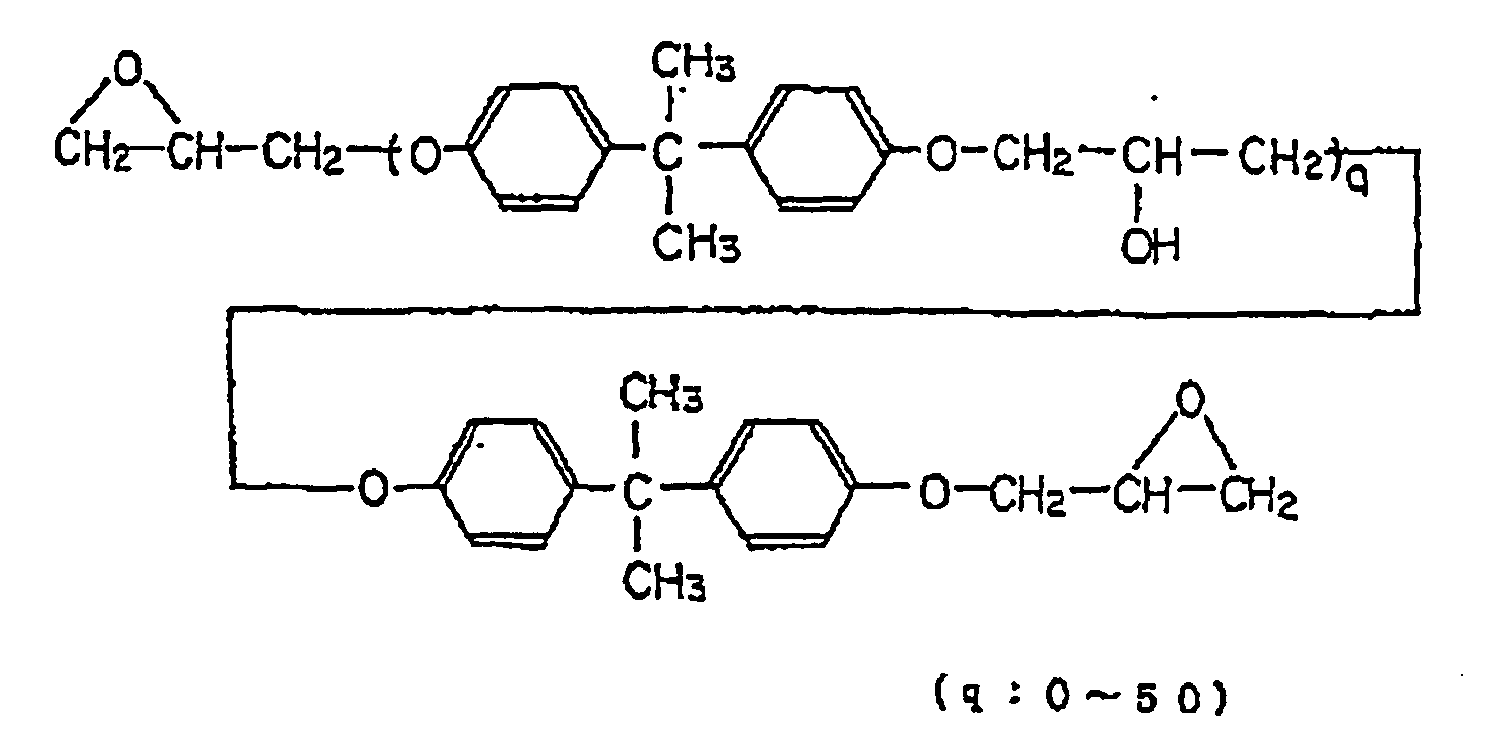
- The method for manufacturing that kind of bisphenol A type epoxy resin is widely known in the industry concerned. In the above-given chemical formula, q value is in a range of from 0 to 50, preferably from 1 to 40, more preferably from 2 to 20.
- The film-forming organic resin (A) may be either organic solvent dissolving type, organic solvent dispersing type, water dissolving type, or water dispersing type.
- According to the present invention, a hydrazine derivative is introduced into the molecules of the film-forming organic resin (A). To do this, at least a part of the active-hydrogen-laden compound (B), (preferably whole thereof), is necessary to be a hydrazine derivative (C) containing active hydrogen.
- When the film-forming organic resin (A) is an epoxy-group-laden resin, examples of the active-hydrogen-laden compound (B) reacting with the epoxy group are listed below. One or more of these compounds (B) may be applied. Also in that case, at least a part of the active-hydrogen-laden compound (B), (preferably whole thereof), is necessary to be a hydrazine derivative (C) containing active hydrogen.
- A hydrazine derivative containing active hydrogen
- A primary or secondary amine compound containing active hydrogen
- An organic acid such as ammonia and carboxylic acid
- A halogenated hydrogen such as hydrogen chloride
- An alcohol, a thiol
- A hydrazine derivative containing no active hydrogen or a quaternary chlorinating agent which is a mixture with a ternary amine.
- Examples of the above-described hydrazine derivative (C) containing active hydrogen are the following.
- 1) hydrazide compound such as carbohydrazide, propionic acid hydrazide, salicylic acid hydrazide, adipic acid hydrazide, sebacic acid hydrazide, dodecanic acid hydrazide, isophtharic acid hydrazide, thiocarbo-hydrazide, 4,4'-oxy-bis-benzenesulfonyl hydrazide,benzophenone hydrazone, amino-polyacrylamide hydrazide;
- 2) pyrazole compound such as pyrazole, 3,5-dimethylpyrazole, 3-methyl-5-pyrazolone, 3-amino-5-methylpyrazole;
- 3) triazole compound such as 1,2,4-triazole, 3-amino-1,2,4-triazole, 4-amino-1,2,4-triazole, 3-mercapto-1,2,4-triazole, 5-amino-3-mercapto-1,2,4-triazole, 2,3-dihydro-3-oxo-1,2,4-triazole, 1H-benzotriazole, 1-hydroxybenzotriazole (mono hydrate), 6-methyl-8-hydroxytriazolopyridazine, 6-phenyl-8-hydroxytriazolopyrydazine, 5-hydroxy-7-methyl-1,3,8-triazaindolizine;
- 4) tetrazole compound such as 5-phenyl-1,2,3,4-tetrazole, 5-mercapto-1-phenyl-1,2,3,4-tetrazole;
- 5) thiadiazole compound such as 5-amino-2-mercapto-1,3,4-thiadiazole, 2,5-dimercapto-1,3,4-thiadiazole;
- 6) pyridazine compound such as maleic acid hydrazide, 6-methyl-3-pyridazone, 4,5-dichloro-3-pyridazone, 4,5-dibromo-3-pyridazone, 6-methyl-4,5-dihydro-3-pyridazone.
- Among these compounds, particularly preferred ones are pyrazole compound and triazole compound which have cyclic structure of five- or six-membered ring and which have nitrogen atom in the cyclic structure.
- These hydrazine derivatives may be applied separately or blending two or more of them together.
- Examples of above-described amine compound having active hydrogen, which can be used as a part of the active-hydrogen-laden compound (B) are the following.
- 1) a compound prepared by heating to react a primary amino group of an amine compound containing a single secondary amino group of diethylenetriamine, hydroxylaminoethylamine, ethylaminoethylamine, methylaminopropylamine, or the like and one or more of primary amino group, with ketone, aldehyde, or carboxylic acid, at, for example, approximate temperatures of from 100 to 230ºC to modify them to aldimine, ketimine, oxazoline, or imidazoline;
- 2) a secondary monoamine such as diethylamine, diethanolamine, di-n- or -iso-propanolamine, N-methylethanolamine, N-ethylethanolamine;
- 3) a secondary-amine-laden compound prepared by Michael addition reaction through the addition of monoalkanolamine such as monoethanolamine to dialkyl(meth)acrylamide;
- 4) a compound prepared by modifying a primary amino group of alkanolamine such as monoethanolamine, neopentanolamine, 2-aminopropanol, 3-aminopropanol, 2-hydroxy-2'(aminopropoxy)ethylether to ketimine.
- As for the above-described quaternary chlorinating agents which are able to be used as a part of the active-hydrogen-laden compound (B), the hydrazine derivative having active hydrogen or ternary amine has no reactivity with epoxy group as it is. Accordingly, they are mixed with an acid to make them reactive with epoxy group. The quaternary chlorinating agent reacts with epoxy group with the presence of water, at need, to form a quaternary salt with the epoxy-group-laden resin.
- The acid used to obtain the quaternary chlorinating agent may be organic acid such as acetic acid and lactic acid, or inorganic acid such as hydrochloric acid. The hydrazine derivative containing no active hydrogen, which is used to obtain quaternary chlorinating agent may be 3,6-dichloropyridazine. The ternary amine may be dimethylethanolamine, triethylamine, trimethylamine, tri-isopropylamine, methyldiethanolamine.
- The product of the reaction between the film-forming organic resin (A) and the active-hydrogen-laden compound (B) a part of or whole of which consists of a hydrazine derivative (C) containing active hydrogen, may be prepared by reacting the film-forming organic resin (A) with the active-hydrogen-laden compound (B) at temperatures of from 10 to 300ºC, preferably from 50 to 150ºC, for about 1 to about 8 hours.
- The reaction may be carried out adding an organic solvent. The kind of adding organic solvent is not specifically limited. Examples of the organic solvent are: ketone such as acetone, methyethylketone, methylisobutylketone, dibutylketone, cyclohexanone: alcohol or ether having hydroxyl group, such as ethanol, butanol, 2-ethylhexylalcohol, benzylalcohol, ethyleneglycol, ethyleneglycol mono-isopropylether, ethyleneglycol monobutylether, ethyleneglycol monohexylether, propyleneglycol, propyleneglycol monomethylether, diethyleneglycol, diethyleneglycol monoethylether, diethyleneglycol monobutylether; ester such as ethylacetate, butylacetate, ethyleneglycol monobutylether acetate; and aromatic hydrocarbon such as toluene and xylene. These compounds may be applied separately or blending two or more of them together. Among them, from the viewpoint of solubility and coating film-forming performance with epoxy resin, ketone group or ether group solvents are particularly preferred.
- The blending ratio of the film-forming organic resin (A) and the active-hydrogen-laden compound (B), a part or whole of which compound consists of a hydrazine derivative (C) containing active hydrogen, is in a range of from 0.5 to 20 part by weight of the active-hydrogen-laden compound (B), more preferably from 1.0 to 10 parts by weight, to 100 parts by weight of the film-forming organic resin (A).
- When the film-forming organic resin (A) is an epoxy-group-laden resin (D), the blending ratio of the epoxy-group-laden resin (D) to the active-hydrogen-laden compound (B) is preferably, from the viewpoint of corrosion resistance and other performance, in a range of from 0.01 to 10 as the ratio of the number of active hydrogen groups in the active-hydrogen-laden compound (B) to the number of epoxy groups in the epoxy-group- laden resin (D), or [the number of active hydrogen groups / the number of epoxy groups], more preferably from 0.1 to 8, most preferably from 0.2 to 4.
- A preferred range of hydrazine derivative (C) containing active hydrogen in the active-hydrogen-laden compound (B) is from 10 to 100 mole%, more preferably from 30 to 100 mole%, and most preferably from 40 to 100 mole%. If the rate of hydrazine derivative (C) containing active hydrogen is less than 10 mole%, the organic coating fails to have satisfactory rust-preventive function, thus the obtained rust-preventive effect becomes similar with the case of simple blending of a film-forming organic resin with a hydrazine derivative.
- To form a dense barrier coating according to the present invention, it is preferable that a curing agent is blended into the resin composition, and that the organic coating is heated to cure.
- Suitable methods for curing to form a resin composition coating include (1) a curing method utilizing a urethanation reaction between isocyanate and hydroxide group in the base resin, and (2) a curing method utilizing an ether reaction between hydroxide group in the base resin and an alkyletherified amino resin which is prepared by reacting between a part of or whole of a methylol compound which is prepared by reacting formaldehyde with one or more of melamine, urea, and benzoguanamine, and a C1-5 primary alcohol. As of these methods, particularly preferred one is to adopt a urethanation reaction between isocyanate and hydroxyl group in the base resin as the main reaction.
- The polyisocyanate compound used in the curing method (1) described above is a compound prepared by partially reacting an aliphatic, alicyclic (including heterocyclic), or aromatic isocyanate compound, or a compound thereof using a polyhydric alcohol. Examples of that kind of polyisocyanate compound are the following.
- 1) m- or p-phenylene diisocyanate, 2,4- or 2,6- trilene diisocyanate, o- or p-xylylene diisocyanate, hexamethylene diisocyanate, dimer acid diisocyanate, isophorone diisocyanate;
- 2) a compound of product of reaction between separate or mixture of the compounds given in 1) with a polyhydric alcohol (for example, a dihydric alcohol such as ethyleneglycol and propyleneglycol, a trihydric alcohol such as glycerin and trimethylolpropane, a tetrahydric alcohol such as pentaerythritol, and hexahydric alcohol such as sorbitol and dipentaerythritol) leaving at least two isocyanate within a molecule.
- These isocyanate compounds may be used separately or mixing two or more of them together.
- Examples of protective agent (blocking agent) of the polyisocyanate compound are the following.
- 1) Aliphatic monoalcohol such as methanol, ethanol, propanol, butanol, octylalcohol;
- 2) Monoether of ethyleneglycol and/or diethyleneglycol, for example, monoether of methyl, ethyl, propyl (n-, iso-), butyl (n-, iso-, sec-);
- 3) Aromatic alcohol such as phenol and cresol;
- 4) Oxime such as acetoxime and methylethylketone oxime. Through reaction between one or more of these compounds with above-described polyisocyanate compound, a polyisocyanate compound thus obtained is stably protected at least at normal temperature.
- It is preferable to blend that kind of polyisocyanate compound (E) with a film-forming organic resin (A) as the curing agent at a range of (A)/(E)= 95/5 to 55/45 (weight ratio of non-volatile matter), more preferably (A)/(E) = 90/10 to 65/35. Since polyisocyanate compounds have water-absorbing property, blending of the compound at ratios above (A)/(E) = 55/45 degrades the adhesiveness of the organic coating. If top coating is given on the organic coating, unreacted polyisocyanate compound migrates into the coating film to induce hindrance of curing or insufficient adhesiveness of the coating film. Accordingly, the blending ratio of the polyisocyanate compound (E) is preferably not more than (A)/(E) = 55/45.
- The film-forming organic resin (A) is fully cross-linked by the addition of above-described cross-linking agent (curing agent). For further increasing the cross-linking performance at a low temperature, it is preferable to use a known catalyst for enhancing curing. Examples of the curing-enhancing catalyst are N-ethylmorpholine, dibutyltin dilaurate, cobalt naphthenate, tin(II)chloride, zinc naphthenate, and bismuth nitrate.
- When an epoxy-group-laden resin is used as the film-forming organic resin (A), the epoxy-group-laden resin may be blended with a known resin such as that of acrylic, alkyd, and polyester to improve the physical properties such as adhesiveness to some extent.
- According to the present invention, the organic coating is blended with ion-exchanged silica (a) and may further contain fine particle silica (b) as the rust-preventive additive.
- The ion-exchanged silica is prepared by fixing metallic ion such as calcium and magnesium ions on the surface of porous silica gel powder. Under a corrosive environment, the metallic ion is released to form a deposit film. Among these ion-exchanged silicas, Ca ion-exchanged silica is most preferable.
- Any type of Ca ion-exchanged silica may be applied. A preferred range of average particle size of Ca ion-exchanged silica is 6 µm or less, more preferably 4 µm or less. For example, Ca ion-exchanged silica having average particle sizes of from 2 to 4 µm may be used. If the average particle size of Ca ion-exchanged silica exceeds 6 µm, the corrosion resistance degrades and the dispersion stability in the coating composition degrades.
- A preferred range of Ca concentration in the Ca ion-exchanged silica is 1 wt.% or more, more preferably from 2 to 8 wt.%. If the Ca concentration is below 1 wt.%, the rust-preventive effect by the Ca release becomes insufficient.
- Surface area, pH, and oil-absorbance of the Ca ion-exchanged silica are not specifically limited.
- Examples of the above-described Ca ion-exchanged silica are: SHIELDEX C303 (trade name) (average particle sizes of from 2.5 to 3.5 µm; Ca concentration of 3 wt.%; manufactured by W. R. Grace & Co.), SHIELDEX AC3 (trade name) (average particle sizes of from 2.3 to 3.1 µm; Ca concentration of 6 wt.%), SHIELDEX AC5 (trade name) (average particle sizes of from 3.8 to 5.2 µm; Ca concentration of 6 wt.%); SHIELDEX (trade name) (average particle size of 3 µm; Ca concentrations of from 6 to 8 wt.%), SHIELDEX SY710 (trade name) (average particle sizes of from 2.2 to 2.5 µm; Ca concentrations of from 6.6 to 7.5 wt.%, manufactured by Fuji Silisia Chemical Co., Ltd.) The rust-preventive mechanism in the case of addition of ion-exchanged silica (a) to organic coating is described above. Particularly according to the present invention, markedly excellent corrosion preventive effect is attained by combining a specific chelate-modified resin which is the film-forming organic resin with an ion-exchanged silica, thus inducing the combined effect of the corrosion-suppression effect of the chelate-modified resin at the anodic reaction section with the corrosion-suppression effect of the ion-exchanged silica at the cathodic reaction section.
- A preferred range of blending ratio of the ion-exchanged silica (a) in the organic resin coating is 1 to 100 parts by weight (solid matter) to 100 parts by weight (solid matter) of the reaction product as the resin composition for film-forming (that is, the product of reaction between the film-forming organic resin (A) and the active-hydrogen-laden compound (B) a part of or whole of which consists of a hydrazine derivative (C) containing active hydrogen), more preferably from 5 to 80 parts by weight (solid matter), and most preferably from 10 to 50 parts by weight (solid matter). If the blending ratio of the ion-exchanged silica (a) becomes less than 1 part by weight, the effect of improved corrosion resistance after alkaline degreasing becomes small. If the blending ratio of the ion-exchanged silica (a) exceeds 100 parts by weight, the corrosion resistance degrades, which is unfavorable.
- The fine particle silica (b) may be either colloidal silica or fumed silica. When a water-type film-forming resin is used as the base resin, examples of applicable colloidal silica are: SNOWTEX O, SNOWTEX N,
SNOWTEX 20, SNOWTEX 30, SNOWTEX 40, SNOWTEX C, SNOWTEX S (trade names) manufactured by Nissan Chemical Industries, Ltd.; CATALOID S, CATALOID SI-35, CATALOID SI-40, CATALOID SA, CATALOID SN (trade names) manufactured by Catalysts & Chemicals Industries Co., Ltd.; ADELITE AT-20-50, ADELITE AT-20N, ADELITE AT-300, ADELITE AT-300S, ADELITE AT-20Q (trade names) manufactured by Asahi Denka Kogyo, KK. - When a solvent-type film-forming resin is used as the base resin, examples of applicable colloidal silica are: ORGANOSILICA SOL MA-ST-M, ORGANOSILICA SOL IPA-ST, ORGANOSILICA SOL EG-ST, ORGANOSILICA SOL E-ST-ZL, ORGANOSILICA SOL NPC-ST, ORGANOSILICA SOL DMAC-ST, ORGANOSILICA SOL DMAC-ST-ZL, ORGANOSILICA SOL XBA-ST, ORGANOSILICA SOL MIBK-ST (trade names) manufactured by Nissan Chemical Industries, Ltd.; OSCAL-1132, OSCAL-1232, OSCAL-1332, OSCAL-1432, OSCAL-1532, OSCAL-1632, OSCAL-1722 (trade names) manufactured by Catalysts & Chemicals Industries Co., Ltd.
- In particular, organic solvent dispersion silica sol is superior in corrosion resistance to fumed silica.
- Examples of applicable fumed silica are: AEROSIL R971, AEROSIL R812, AEROSIL R811, AEROSIL R974, AEROSIL R202, AEROSIL R805, AEROSIL 130, AEROSIL 200, AEROSIL 300, AEROSIL 300CF (trade names) manufactured by Japan Aerosil Co., Ltd.
- The fine particle silica contributes to forming dense and stable zinc corrosion products under a corrosive environment. Thus formed corrosion products cover the plating surface in a dense mode, thus presumably suppressing the development of corrosion.
- From the viewpoint of corrosion resistance, the fine particle silica preferably has particle sizes of from 5 to 50 nm, more preferably from 5 to 20 nm, and most preferably from 5 to 15 nm.
- A preferred range of blending ratio of the fine particle silica (b) in the organic resin coating is 1 to 100 parts by weight (solid matter) to 100 parts by weight (solid matter) of the reaction product as the resin composition for film-forming (that is, the product of reaction between the film-forming organic resin (A) and the active-hydrogen-laden compound (B) a part of or whole of which consists of a hydrazine derivative (C) containing active hydrogen), more preferably from 5 to 80 parts by weight (solid matter), and most preferably from 10 to 30 parts by weight (solid matter). If the blending ratio of the fine particle silica (b) becomes less than 1 part by weight, the effect of improved corrosion resistance after alkaline degreasing becomes small. If the blending ratio of the fine particle silica (b) exceeds 100 parts by weight, the corrosion resistance and the workability degrade, which is unfavorable.
- According to the present invention, markedly high corrosion resistance is attained by combined addition of an ion-exchanged silica (a) and a fine particle silica (b) to the organic coating. That is, the combined addition of ion-exchanged silica (a) and fine particle silica (b) induces above-described combined rust-preventive mechanism which gives markedly excellent corrosion-preventive effect.
- The blending ratio of combined addition of ion-exchanged silica (a) and fine particle silica (b) to the organic coating is in a range of from 1 to 100 parts by weight (solid matter) of the sum of the ion-exchanged silica (a) and the fine particle silica (b), to 100 parts by weight (solid matter) of the reaction product as the resin composition for film-forming (that is, the product of reaction between the film-forming organic resin (A) and an active-hydrogen-laden compound (B) a part of or whole of which consists of a hydrazine derivative (C) containing active hydrogen), preferably from 5 to 80 parts by weight (solid matter) . Further the weight ratio of blending amount (solid matter) of the ion-exchanged silica (a) to the fine particle silica (b), (a)/(b), is selected to a range of from 99/1 to 1/99, preferably from 95/5 to 40/60, more preferably from 90/10 to 60/40.
- If the blending ratio of sum of the ion-exchanged silica (a) and the fine particle silica (b) is less than 1 part by weight, the effect of improved corrosion resistance after alkaline degreasing becomes small. If the blending ratio of sum of the ion-exchanged silica (a) and the fine particle silica (b) exceeds 100 parts by weight, the coatability and the weldability degrade, which is unfavorable.
- If the weight ratio of the ion-exchanged silica (a) to the fine particle silica (b), (a)/(b), is less than 1/99, the corrosion resistance degrades. If the weight ratio of the ion-exchanged silica (a) to the fine particle silica (b), (a)/(b), exceeds 99/1, the effect of combined addition of the ion-exchanged silica (a) and the fine particle silica (b) cannot fully be attained.
- Adding to the above-described rust-preventive agents, the organic coating may contain other corrosion-suppressing agent such as polyphosphate (for example, aluminum polyphosphate such as TEIKA K-WHITE 82, TEIKA K-WHITE 105, TEIKA K-WHITE G105 , TEIKA K-WHITE Ca650 (trade marks) manufactured by TEIKOKU KAKO CO.), phosphate (for example, zinc phosphate, aluminum dihydrogenphosphate, zinc phosphite), molybdenate, phosphomolybdenate (for example, aluminum phosphomolybdenate), organic phosphoric acid and its salt (for example, phytic acid, phytiate, phosphonic acid, phosphonate, their metal salt and alkali metal salt, alkali earth metal salt), organic inhibitor (for example, hydrazine derivative, thiol compound).
- The organic coating may, at need, further include a solid lubricant (c) to improve the workability of the coating.
- Examples of applicable solid lubricant according to the present invention are the following.
- (1) Polyolefin wax, paraffin wax: for example, polyethylene wax, synthetic paraffin, natural paraffin, microwax, chlorinated hydrocarbon;
- (2) Fluororesin fine particles: for example, polyfluoroethylene resin (such as polytetrafluoroethylene resin), polyvinylfluoride resin, polyvinylidenefluoride resin.
- In addition, there may be applied fatty acid amide base compound (such as stearic acid amide, palmitic acid amide, methylene bis-stearoamide, ethylene bis-stearoamide, oleic acid amide, ethyl acid amide, alkylene bis-fatty acid amide), metallic soap (such as calcium stearate, lead stearate, calcium laurate, calcium palmate), metallic sulfide (molybdenum disulfide, tungsten disulfide), graphite, graphite fluoride, boron nitride, polyalkyleneglycol, and alkali metal sulfate.
- Among those solid lubricants, particularly preferred ones are polyethylene wax, fluororesin fine particles (particularly poly-tetrafluoroethylene resin fine particles).
- Applicable polyethylene wax include: SHERIDUST 9615A, SHERIDUST 3715, SHERIDUST 3620, SHERIDUST 3910 (trade names) manufactured by Hoechst Co., Ltd.; SUNWAX 131-P, SUNWAX 161-P (trade names) manufactured by Sanyo Chemical Industries, Ltd.; CHEMIPEARL W-100, CHEMIPEARL W-200, CHEMIPEARL W-500, CHEMIPEARL W-800, CHEMIPEARL W-950 (trade names) manufactured by Mitsui Petrochemical Industries, Ltd.
- A most preferred fluororesin fine particle is tetrafluoroethylene fine particle. Examples of the fine particles are LUBRON L-2, LUBRON L-5 (trade names) manufactured by Daikin Industries, Ltd.; MP 1100, MP 1200 (trade names; manufactured by Du Pont-Mitsui Company, Ltd.); FLUON DISPERSION AD1, FLUON DISPERSION AD2, FLUON L141J, FLUON L150J, FLUON L155J (trade names) manufactured by Asahi ICI Fluoropolymers Co., Ltd.
- As of these compounds, combined use of polyolefin wax and tetrafluoroethylene fine particles is expected to provide particularly excellent lubrication effect.
- A preferred range of blending ratio of the solid lubricant (c) in the organic resin coating is from 1 to 80 parts by weight (solid matter) to 100 parts by weight (solid matter) of the reaction product as the resin composition for film-forming (that is, the product of reaction between the film-forming organic resin (A) and the active-hydrogen-laden compound (B) a part of or whole of which consists of a hydrazine derivative (C) containing active hydrogen), more preferably from 3 to 40 parts by weight (solid matter). If the blending ratio of the solid lubricant (c) becomes less than 1 part by weight, the effect of lubrication is small. If the blending ratio of the solid lubricant (c) exceeds 80 parts by weight, the painting performance degrade, which is unfavorable.
- The organic coating of the organic coating steel sheet according to the present invention normally consists mainly of a product (resin composition) of reaction between a film-forming organic resin (A) and an active-hydrogen-laden compound (B) a part of or whole of which consists of a hydrazine derivative (C) containing active hydrogen). And, at need, an ion-exchanged silica (a), a fine particle silica (b), a solid lubricant (c), and a curing agent may further be added to the organic coating. Furthermore, at need, there may be added other additives such as organic coloring pigment (for example, condensing polycyclic organic pigment, phthalocyanine base organic pigment), coloring dye (for example, azo dye soluble in organic solvent, azo metal dye soluble in water), inorganic pigment (for example, titanium oxide), chelating agent (for example, thiol), conductive pigment (for example, metallic powder of zinc, aluminum, nickel, or the like, iron phosphide, antimony-dope type tin oxide), coupling agent (for example, silane coupling agent and titanium coupling agent), melamine-cyanuric acid additive.
- The paint composition for film-formation containing above-described main component and additive components normally contains solvent (organic solvent and/or water), and, at need, further a neutralizer or the like is added.
- Applicable organic solvent described above has no specific limitation if only it dissolves or disperses the product of reaction between the above-described film-forming organic resin (A) and the active-hydrogen-laden compound (B), and adjusts the product as the painting composition. Examples of the organic solvent are the organic solvents given above as examples.
- The above-described neutralizers are blended, at need, to neutralize the film-forming organic resin (A) to bring it to water-type. When the film-forming organic resin (A) is a cationic resin, acid such as acetic acid, lactic acid, and formic acid may be used as the neutralizer.
- The organic coatings described above are formed on the above-described composite oxide coating.
- The dry thickness of the organic coating is in a range of from 0.1 to 5 µm, preferably from 0.3 to 3 µm, and most preferably from 0.5 to 2 µm. If the thickness of the organic coating is less than 0.1 µm, the corrosion resistance becomes insufficient. If the thickness of the organic coating exceeds 5 µm, the conductivity and the workability degrade.
- The following is the description about the method for manufacturing an organic coating steel sheet according to the present invention.
- The organic coating steel sheet according to the present invention is manufactured by the steps of: treating the surface (applying a treatment liquid to the surface) of a zinc base plated steel sheet or an aluminum base plated steel sheet using a treatment liquid containing the components of above-described composite oxide coating; heating and drying the plate; applying a paint composition which contains the product of reaction between above-described film-forming organic resin (A) and an active-hydrogen-laden compound (B) a part of or whole of which consists of a hydrazine derivative (C) containing active hydrogen, and an ion-exchanged silica (a) which product of reaction is preferably the main component, and at need, further contains, a fine particle silica (b), and a solid lubricant (c), and the like; heating to dry the product.
- The surface of the plated steel sheet may be, at need, subjected to alkaline degreasing before applying the above-described treatment liquid, and may further be subjected to preliminary treatment such as surface adjustment treatment for further improving the adhesiveness and corrosion resistance.
- For treating the surface of the zinc base plated steel sheet or the aluminum base plated steel sheet with a treatment liquid and for forming a composite oxide coating thereon, it is preferred that the plate is treated by an acidic aqueous solution, at pH ranging from 0.5 to 5, containing:
- (aa) oxide fine particles ranging from 0.001 to 3.0 mole/liter;
- (ab) one or more of the substances selected from the group consisting of either one metallic ion of Mg, Ca, Sr, Ba; a compound containing at least one metal given above; a composite compound containing at least one metal given above; ranging from 0.001 to 3.0 mole/liter as metal given above;
- (ac) phosphoric acid and/or phosphoric acid compound ranging from 0.001 to 6.0 mole/liter as P2O5:
further adding, at need, above-described additive components (organic resin components, iron group metal ions, corrosion-suppression agents, other additives);then heating and drying the product. - The added components (ab) in the treatment liquid is in a range of from 0.001 to 3.0 mole/liter as metal, preferably from 0.01 to 0.5 mole/liter. If the sum of the added amount of these components is less than 0.001 mole/liter, the effect of addition cannot be fully attained. If the sum of the added amount of these components exceeds 3.0 mole/liter, these components interfere the network of coating, thus failing in forming dense coating. Furthermore, excess amount of addition of these components makes the metallic components likely elute from the coating, which results in defects such as discoloration of appearance under some environmental conditions.
- As of above-given additive components (ab), Mg most significantly increases the corrosion resistance. The form of Mg in the treatment liquid may be compound or composite compound. To attain particularly excellent corrosion resistance, however, a metallic ion or a water-soluble ion form containing Mg is particularly preferred.
- For supplying ion of the additive components (ab) in a form of metallic salt, the treatment liquid may contain anion such as chlorine ion, nitric acid ion, sulfuric acid ion, acetic acid ion, and boric acid ion.
- It should be emphasized that the treatment liquid is an acidic aqueous solution. That is, by bringing the treatment liquid to acidic, the plating components such as zinc are readily dissolved. As a result, at the interface between the chemical conversion treatment film and the plating, a phosphoric acid compound layer containing plating components such as zinc is presumably formed, which layer strengthens the interface bonding of both sides to structure a coating having excellent corrosion resistance.
- As the oxide fine particles as an additive component (aa), silicon oxide (SiO2) fine particles are most preferred. The silicon oxide may be commercially available silica sol and water-dispersion type silicic acid oligomer or the like if only the silicon oxide is water-dispersion type SiO2 fine particles which are stable in an acidic aqueous solution. Since, however, fluoride such as hexafluoro silicic acid is strongly corrosive and gives strong effect to human body, that kind of compound should be avoided from the point of influence to work environment.
- A preferred range of blending ratio of the fine particle oxide (the blending ratio as SiO2 in the case of silicon oxide) in the treating liquid is from 0.001 to 3.0 mole/liter, more preferably from 0.05 to 1.0 mole/liter, and most preferably from 0.1 to 0.5 mole/liter. If the blending ratio of the fine particle oxide becomes less than 0.001 mole/liter, the effect of addition is not satisfactory. If the blending ratio of the fine particle oxide exceeds 3.0 mole/liter, the water-resistance of coating degrades, resulting in degradation of corrosion resistance.
- The phosphoric acid and/or phosphoric acid compound as the additive component (ac) includes: a mode of aqueous solution in which a compound specific to phosphoric acid, such as polyphosphoric acid such as orthophosphoric acid, pyrophosphoric acid, and tripolyphosphoric acid, methaphosphoric acid, inorganic salt of these acids (for example, primary aluminum phosphate), phosphorous acid, phosphite, phosphinic acid, phosphinate, exists in a form of anion or complex ion combined with a metallic cation which are generated by dissolving the compound in the aqueous solution; and a mode of aqueous solution in which that kind of compound exists in a form of inorganic salt dispersed therein. The amount of phosphoric acid component according to the present invention is specified by the sum of all these modes of acidic aqueous solution thereof as converted to P2O5 amount.
- A preferred range of blending ratio of the phosphoric acid and/or phosphoric acid compound as P2O5 is from 0.001 to 6.0 mole/liter, more preferably from 0.02 to 1.0 mole/liter, and most preferably from 0.1 to 0.8 mole/liter. If the blending ratio of the phosphoric acid and/or phosphoric acid compound becomes less than 0.001 mole/liter, the effect of addition is not satisfactory and the corrosion resistance degrades. If the blending ratio of the phosphoric acid and/or phosphoric acid compound exceeds 6.0 mole/liter, excess amount of phosphoric acid ion reacts with the plating film under a humid environment, which enhances the corrosion of plating base material to cause discoloration and stain-rusting under some corrosive environments.
- For obtaining a composite oxide coating providing particularly excellent corrosion resistance, or for preparing a composite oxide coating comprising components (α), (β), and (γ) given below, and having the coating weight of the sum of these components (α), (β), and (γ) in a range of from 6 to 3,600 mg/m2, it is preferable that the above-described composite oxide coating contains the additive components (aa), (ab), and (ac) in the acidic aqueous solution, further, the composite oxide coating is treated by an acidic aqueous solution of pH of from 0.5 to 5 containing, at need, above-described additive components (organic resin component, iron group metallic ion, corrosion-suppression agent, and other additives), followed by heating and drying. The above-given composite oxide coating components (α), (β), and (γ), and the above-given additive components (a), (b), and (c) are specified below.
- (α) SiO2 fine particles in a range of from 0.01 to 3,000 mg/m2 as SiO2,
- (β) One or more of Mg, compound containing Mg, and composite compound containing Mg in a range of from 0.01 to 1,000 mg/m2 as Mg,
- (γ) Phosphoric acid and/or phosphoric acid compound in a range of from 0.01 to 3,000 mg/m2 as P2O5;
- (aa) SiO2 fine particles in a range of from 0.001 to 3.0 mole/liter as SiO2, preferably from 0. 05 to 1.0 mole/liter, more preferably from 0.1 to 0.5 mole/liter,
- (ab) One or more of the substances selected from the group consisting of Mg ion, water-soluble ion containing Mg, compound containing Mg, composite compound containing Mg in a range of from 0.001 to 3.0 mole/liter as Mg, preferably from 0.01 to 0.5 mole/liter,
- (ac) phosphoric acid and/or phosphoric acid compound in a range of from 0.001 to 6.0 mole/liter as P2O5, preferably from 0.02 to 1.0 mole/liter, more preferably from 0.1 to 0.8 mole/liter.
- The reason to specify the conditions and amount of the above-given additives (aa), (ab), and (ac) is described before.
- To prepare the range of the ratio of the component (β) to the component (α) in the composite oxide coating, molar ratio [Mg/SiO2], or the component (β) as Mg to the component (α) as SiO2, from 1/100 to 100/1, the ratio of the additive component (ab) to the additive component (aa) in the acidic aqueous solution for forming the composite oxide coating may be adjusted to a range of from 1/100 to 100/1 as the molar ratio [Mg/SiO2], or the additive component (ab) as Mg to the additive component (aa) as SiO2.
- To adjust the ratio of the component (β) to the component (α) in the composite oxide coating to a preferred range of from 1/10 to 10/1, more preferably from 1/2 to 5/1, as the molar ratio [Mg/SiO2], or the ratio of the component (β) as Mg to the component (α) as SiO2, it is adequate to adjust the ratio of the additive component (ab) to the additive component (aa) in the acidic aqueous solution for forming the composite oxide coating to a range of from 1/10 to 10/1, more preferably from 1/2 to 5/1, as the molar ratio [Mg/SiO2], or the ratio of the additive component (ab) as Mg to the additive component (aa) as SiO2.
- To adjust the ratio of the component (γ) to the component (β) in the composite oxide coating to a range of from 1/100 to 100/1 as the molar ratio [P2O5/Mg], or the ratio of the component (γ) as P2O5 to the component (β) as Mg, it is adequate to adjust the ratio of additive component (ac) to the additive component (ab) in the acidic aqueous solution for forming the composite oxide coating to a range of from 1/100 to 100/1 as the molar ratio [P2O5/Mg] represented by the ratio of the additive component (ac) as P2O5 to the additive component (ab) as Mg.
- To adjust the ratio of the component (γ) to the component (β) in the composite oxide coating to a further preferable range of from 1/10 to 10/1 as the molar ratio [P2O5/Mg], or the ratio of the component (γ) as P2O5 to the component (β) as Mg, more preferably from 1/2 to 2/1, it is adequate to adjust the ratio of additive component (ac) to the additive component (ab) in the acidic aqueous solution for forming the composite oxide coating to a range of from 1/10 to 10/1, more preferably from 1/2 to 2/1, as the molar ratio [P2O5/Mg], or the ratio of the additive component (ac) as P2O5 to the additive component (ab) as Mg.
- For adjusting the ratio of the additive component (ac) to the additive component (ab) in the acidic aqueous solution for forming the composite oxide coating, it is preferable to use an aqueous solution of primary magnesium phosphate or the like which is prepared by limiting the molar ratio of the magnesium component to the phosphoric acid component, in advance, because other anionic components are prevented from existing in the treatment liquid.
- On applying the aqueous solution of primary magnesium phosphate, however, lowered molar ratio [P2O5/Mg] degrades the stability of the compound in the aqueous solution. Accordingly, a suitable molar ratio [P2O5/Mg] is not less than 1/2.
- On the other hand, increased molar ratio [P2O5/Mg] in the aqueous solution of primary magnesium phosphate decreases the pH of treatment liquid, which increases the reactivity with the plating base material, which then induces irregular coating caused by non-uniform reaction to give an influence to corrosion resistance. Consequently, when an aqueous solution of primary magnesium phosphate which is prepared by limiting the molar ratio of the magnesium component to the phosphoric acid component, the molar ratio [P2O5/Mg] is preferably set to not more than 2/1.
- To attain the most excellent corrosion resistance, it is preferred that the ratio of the component (β) to the component (α) in the composite oxide coating is adjusted to a range of from 1/100 to 100/1 as the molar ratio [Mg/SiO2], or the component (β) as Mg to the component (α) as SiO2, more preferably from 1/10 to 10/1, most preferably from 1/2 to 5/1. And, to adjust the ratio of the component (γ) to the component (β) in the composite oxide coating to a range of from 1/100 to 100/1 as the molar ratio [P2O5/Mg], or the component (γ) as P2O5 to the component (β) as Mg in the composite oxide coating, more preferably from 1/10 to 10/1, and most preferably from 1/2 to 2/1, it is preferred that the ratio of the additive component (ab) to the additive component (aa) in the acidic aqueous solution for forming the composite oxide coating is adjusted to a range of from 1/100 to 100/1 as the molar ratio [Mg/SiO2], or the additive component (ab) as Mg to the additive component (aa) as SiO2, more preferably from 1/10 to 10/1, and most preferably from 1/2 to 5/1, and further the ratio of the additive component (ac) to the additive component (ab) is adjusted to a range of from 1/100 to 100/1 as the molar ratio [P2O5/Mg], or the additive component (ac) as P2O5 to the additive component (ab) as Mg, preferably from 1/10 to 10/1, more preferably from 1/2 to 2/1.
- The treatment liquid may further include an adequate amount of an additive component (ad) which is one or more ions selected from the group consisting of: either one metallic ion of Ni, Fe, and Co; and water-soluble ion containing at least one of the above-listed metals. By adding that kind of iron group metal, blackening phenomenon is avoided. The blackening phenomenon occurs in the case of non-addition of iron group metals caused from corrosion on the plating polar surface layer under a humid environment. Among these iron group metals, Ni provides particularly strong effect even with a slight amount thereof. Since, however, excessive addition of iron group metals such as Ni and Co induces degradation of corrosion resistance, the added amount should be kept at an adequate level.
- A preferred range of the added amount of the above-described additive component (ad) is from 1/10,000 to 1 mole as metal per one mole of the additive component (ac), more preferably from 1/10,000 to 1/100. If the added amount of the additive component (ad) is less than 1/10,000 mole to one mole of the additive component (ac), the effect of the addition is not satisfactory. If the added amount of the additive component (ad) exceeds 1 mole, the corrosion resistance degrades as described above.
- Adding to the above-described additive components (aa) through (ad), the treatment liquid may further contain an adequate amount of additive components to the coating, which are described before.
- A preferable range of pH of the treatment liquid is from 0.5 to 5, more preferably from 2 to 4. If the pH of treatment liquid is less than 0.5, the reactivity of the treatment liquid becomes excessively strong so that micro-defects appear on the surface of the coating to degrade the corrosion resistance. If the pH of the treatment liquid exceeds 5, the reactivity of the treatment liquid becomes poor, and the bonding at interface between the plating face and the coating becomes insufficient, as described above, thus degrading the corrosion resistance.
- The methods for applying the treatment liquid onto the plated steel sheet may be either one of coating method, dipping method, and spray method. The coating method may adopt any type such as roll coater (three-roll type, two-roll type, etc.), squeeze coater, die coater. After the coating step using squeeze coater and the like, the dipping step, or the spray step, it is possible to adjust the coating weight, the uniformizing appearance, and the uniformizing the film-thickness using air-knife method and roll-squeezing method.
- Although there is no specific limitation on the temperature of the treatment liquid, a preferable range thereof is from normal temperature to around 60ºC. Below the normal temperature is uneconomical because a cooling unit or other additional facilities are required. On the other hand, temperatures above 60ºC enhances the vaporization of water, which makes the control of the treatment liquid difficult.
- After the coating of treatment liquid as described above, generally the plate is heated to dry without rinsing with water. The treatment liquid according to the present invention forms a slightly soluble salt by a reaction with the substrate plated steel sheet, so that rinsing with water may be applied after the treatment.
- Method for heating to dry the coated treatment liquid is not limited. For example, dryer, hot air oven, high frequency induction heating furnace, infrared heating furnace may be applied.
- The heating and drying treatment is preferably conducted at reaching temperatures of from 50 to 300ºC, more preferably from 80 to 200ºC, and most preferably from 80 to 160ºC. If the heating temperature is less than 50ºC, excess amount of water is left in the coating, which results in insufficient corrosion resistance. If the heating temperature exceeds 300°C, the operation becomes uneconomical and defects likely appear in the coating to degrade the corrosion resistance.
- After forming the composite oxide coating on the surface of the zinc base plated steel sheet or the aluminum base plated steel sheet, as described above, a paint composition for forming an organic coating is applied on the composite oxide coating. Method for applying the paint composition is not limited, and examples of the method are coating method, dipping method, and spray method. The coating method may adopt any type such as roll coater (three-roll type, two-roll type, etc.), squeeze coater, die coater. After the coating step using squeeze coater and the like, the dipping step, or the spray step, it is possible to adjust the coating weight, the uniformizing appearance, and the uniformizing the film-thickness using air-knife method and roll-squeezing method.
- After applying the paint composition, generally the plate is heated to dry without rinsing with water. After applying the paint composition, however, water-rinse step may be given.
- Method for heating to dry the paint composition is not limited. For example, dryer, hot air oven, high frequency induction heating furnace, infrared heating furnace may be applied. The heating treatment is preferably conducted at reaching temperatures of from 50 to 350ºC, more preferably from 80 to 250ºC. If the heating temperature is less than 50ºC, excess amount of water is left in the coating, which results in insufficient corrosion resistance. If the heating temperature exceeds 350ºC, the operation becomes uneconomical and defects likely appear in the coating to degrade the corrosion resistance.
- As described above, the present invention includes a steel sheet having an organic coating on both sides or on side thereof. Accordingly, modes of the steel sheet according to the present invention include, for example, the followings.
- (1) "Plating film - Composite oxide coating - Organic coating" on one side of the steel sheet, and "Plating film" on other side of the steel sheet;
- (2) "Plating film - Composite oxide coating - Organic coating" on one side of the steel sheet, and "Plating film - Known coating treated by phosphoric acid, or the like" on other side of the steel sheet;
- (3) "Plating film - Composite oxide coating - Organic coating" on both sides of the steel sheet;
- (4) "Plating film - Composite oxide coating - Organic coating" on one side of the steel sheet, and "Plating film - Composite oxide coating" on other side of the steel sheet;
- (5) "Plating film - Composite oxide coating - Organic coating" on one side of the steel sheet, and "Plating film - Organic coating" on other side of the steel sheet.
- Treatment liquids (coating compositions) for forming the primary layer coating, which are listed in Tables 2 through 17, were prepared.
- Resin compositions (reaction products) for forming the secondary layer coating were synthesized in the following-described procedure.
- A 1870 parts of EP828 (epoxy equivalent 187, manufactured by Yuka Shell Epoxy Co. , Ltd.), 912 parts of bisphenol A, 2 parts of tetraethylammonium bromide, and 300 parts of methylethylketone were charged in a flask with four necks, which mixture was then heated to 140ºC to let them react for 4 hours. Thus, an epoxy resin having an epoxy equivalent of 1391 and a solid content of 90% was obtained. A 1500 parts of ethyleneglycol monobutylether was added to the epoxy resin, which were then cooled to 100ºC. A 96 parts of 3,5-dimethylpyrazole (molecular weight 96) and 129 parts of dibutylamine (molecular weight 129) were added to the cooled resin, and they were reacted for 6 hours to eliminate the epoxy group. Then, a 205 parts of methylisobutylketone was added while the mixture was cooling, to obtain a pyrazole-modified epoxy resin having 60% of solid matter. The epoxy resin is defined as the resin composition (1). The resin composition (1) is a product of the reaction between the film-forming organic resin (A) and the active-hydrogen-laden compound that contains 50 mole % of hydrazine derivative (C) containing active hydrogen.
- A 4000 parts of EP1007 (epoxy equivalent 2000, manufactured by Yuka Shell Epoxy Co., Ltd.) and 2239 parts of ethyleneglycol monobutylether were charged into a flask with four necks, which mixture was then heated to 120ºC to let them react for 1 hour to fully dissolve the epoxy resin. The mixture was cooled to 100ºC. A 168 parts of 3-amino-1,2,4-triazole (molecular weight 84) was added to the mixture, and they were reacted for 6 hours to eliminate the epoxy group. Then, a 540 parts of methylisobutylketone was added while the mixture was cooling, to obtain a triazole-modified epoxy resin having 60% of solid matter. The epoxy resin is defined as the resin composition (2). The resin composition (2) is a product of the reaction between the film-forming organic resin (A) and the active-hydrogen-laden compound that contains 100 mole % of hydrazine derivative (C) containing active hydrogen.
- A 222 parts of isophorone diisocyanate (epoxy equivalent 111) and 34 parts of methylisobutylketone were charged into a flask with four necks. A 87 parts of methylethylketoxime (molecular weight 87) was added to the mixture dropwise for 3 hours while keeping the mixture at temperatures ranging from 30 to 40ºC, then the mixture was kept to 40ºC for 2 hours. Thus, a block isocyanate having isocyanate equivalent of 309 and solid content of 90% was obtained.
- A 1489 parts of EP828 (epoxy equivalent 187, manufactured by Yuka Shell Epoxy Co., Ltd.), 684 parts of bisphenol A, 1 part of tetraethylammonium bromide, and 241 parts of methylisobutylketone were charged into a flask with four necks, which mixture was then heated to 140ºC to let them react for 4 hours. Thus, an epoxy resin having epoxy equivalent of 1090 and solid content of 90% was obtained. To the epoxy resin, 1000 parts of methylisobutylketone was added, then the mixture was cooled to 100° C, and 202 parts of 3-mercapto-1,2,4-triazole (molecular weight 101) was added to the mixture, and let the mixture react for 6 hours to fully eliminate the epoxy group. After that, the part-block isocyanate of the above-described 90% solid portion was added to the reaction product to let the mixture react at 100ºC for 3 hours, and the vanish of isocyanate group was confirmed. Further, 461 parts of ethyleneglycol monobutylether was added to the product to obtain a triazole-modified epoxy resin having 60% solid content. The product is defined as the resin composition (3). The resin composition (3) is a product of the reaction between the film-forming organic resin (A) and the active-hydrogen-laden compound that contains 100 mole % of hydrazine derivative (C) containing active hydrogen.
- A 1870 parts of EP828 (epoxy equivalent 187, manufactured by Yuka Shell Epoxy Co., Ltd.), 912 parts of bisphenol A, 2 parts of tetraethylammonium bromide, and 300 parts of methylisobutylketone were charged into a flask with four necks, which mixture was then heated to 140ºC to let them react for 4 hours. Thus, an epoxy resin having epoxy equivalent of 1391 and solid content of 90% was obtained. To the epoxy resin, 1500 parts of ethyleneglycol monobutylether was added, then the mixture was cooled to 100ºC, and 258 parts of dibutylamine (molecular weight 129) was added to the mixture, and let the mixture react for 6 hours to fully eliminate the epoxy group. While cooling the mixture, 225 parts of methylisobutylketone was further added to the mixture to obtain an epoxyamine adduct having 60% solid content. The product is defined as the resin composition (4). The resin composition (4) is a product of the reaction between the film-forming organic resin (A) and the active-hydrogen-laden compound of hydrazine derivative (C) containing no active hydrogen.
- A curing agent was blended to each of the synthesized resin compositions (1) through (4) to prepare the resin compositions (paint compositions) listed in Table 18. To each of these paint compositions, ion-exchanged silica, fine particle silica given in Table 19, and solid lubricant given in Table 20 were added at specified amounts, and they were dispersed in the composition using a paint dispersion machine (sand grinder) for a necessary time. For the above-described ion-exchanged silica, SHILDEX C303 (average particle sizes of from 2.5 to 3.5 µm and Ca concentration of 3 wt.%) manufactured by W. R. Grace & Co., which is a Ca-exchanged silica, was used.
- To obtain organic coating steel sheets for household electric appliances, building materials, and automobile parts, the plated steel sheets shown in Table 1 were used as the target base plates, which plates were prepared by applying zinc base plating or aluminum base plating on the cold-rolled steel sheets having a plate thickness of 0.8 mm and a surface roughness Ra of 1.0 µm. The surface of the plated steel sheet was treated by alkaline degreasing and water washing, then the treatment liquids (coating compositions) shown in Tables 2 through 17 was applied to the surface using a roll coater, followed by heating to dry to form the first layer coating. The thickness of the first layer coating was adjusted by the solid content in the treatment liquid (heating residue) or applying conditions (roll pressing force, rotational speed, and other variables). Then, the paint composition given in Table 18 was applied using a roll coater, which was then heated to dry to form the secondary layer coating, thus manufactured the organic coating steel sheets as Examples and Comparative Examples. The thickness of the second layer coating was adjusted by the solid content in the treatment liquid (heating residue) or applying conditions (roll pressing force, rotational speed, and other variables).
- To each of thus obtained organic coating steel sheets, evaluation was given in terms of quality performance (appearance of coating, white-rust resistance, white-rust resistance after alkaline degreasing, paint adhesiveness, and workability). The results are given in Tables 21 through 87 along with the structure of primary layer coating and of secondary layer coating.
- The quality performance evaluation on the organic coating steel sheets was carried out in the following-described manner.
- For each sample, visual observation was given on the uniformity of coating appearance (presence/absence of irregular appearance). The criteria for evaluation are the following.
- ○ : Uniform appearance without no irregularity
- Δ : Appearance showing some irregularity
- × : Appearance showing significant irregularity
- For each sample, the salt spray test (JIS Z2371) was applied, and the evaluation was given by the area percentage of white-rust.
- The criteria for evaluation are the following.
- ⊚ : No white-rust appeared
- ○+ : White-rust area less than 5%
- ○ : White-rust area not less than 5% and less than 10%
- ○- : White-rust area not less than 10% and less than 25%
- Δ : White-rust area not less than 25% and less than 50%
- × : White-rust area not less than 50%
- For each sample, alkaline degreasing was applied using the alkali treatment liquid CLN-364S (60°C, spraying for 2 min) produced by Nihon Parkerizing Co., followed by salt spray test (JIS Z2371). The result was evaluated by the white-rust area percentage after a specified time has past.
- The criteria for evaluation are the following.
- ⊚ : No white-rust appeared
- ○+ : White-rust area less than 5%
- ○ : White-rust area not less than 5% and less than 10%
- ○- : White-rust area not less than 10% and less than 25%
- Δ : White-rust area not less than 25% and less than 50%
- × : White-rust area not less than 50%
- For each sample, a melamine base baking paint (film thickness of 30 µm) was applied, and the sample was dipped in a boiling water for 2 hours. Immediately after 2 hours of dipping, cross-cut (10 x 10 squares with 10 mm of spacing) was given to the surface of the sample. Then the test of attaching and peeling of adhesive tapes was given to the sample to evaluate the paint adhesiveness by the peeled paint film area percentage.
- The criteria for evaluation are the following.
- ⊚ : No peeling occurred
- ○ : Peeled area less than 5%
- Δ : Peeled area not less than 5% and less than 20%
- × : Peeled area not less than 20%
- For each sample, a deep-drawing test (under oil-free condition) was given using a blank diameter of 120 mm and a die diameter of 50 mm. The drawing height to generate crack on the sample was determined.
- The criteria for evaluation are the following.
- ⊚ : Draw-off occurred
- ○ : Drawn height not less than 30 mm
- Δ : Drawn height not less than 20 mm and less than 30 mm
- × : Drawn height less than 20 m
- In the following-given Tables 21 through 87, each of *1 through *13 appeared in the tables expresses the following.
- *1 : Corresponding to No. given in Table 1.
- *2 : Corresponding to No. given in Tables 2 through 17.
- *3 : Corresponding to No. given in Table 18.
- *4 : Coating weight of SiO2 fine particles (α) = Coating weight of one ore more substances selected from the group consisting of Mg, compound containing Mg, composite compound containing Mg, converted to Mg.
: Coating weight of P2O5 component (γ) = Coating weight of phosphoric acid and/or phosphoric acid compound, converted to P2O5.
: Total coating weight = (α) + (β) + (γ). - *5 : Molar ratio of Mg component (β) as Mg to SiO2 fine particles (α) as SiO2.
- *6 : Molar ratio of P2O5 component (γ) as P2O5 to Mg component (β) as Mg.
- *7 : Blending ratio (weight parts) of solid portion of ion-exchanged silica to 100 parts by weight of solid portion of resin composition.
- *8 : Corresponding to No. given in Table 19.
- *9 : Blending ratio (weight parts) of solid portion of fine particle silica to 100 parts by weight of solid portion of resin composition.
- *10 : Blending ratio (weight parts) of solid portion of the sum of ion-exchanged silica (a) and fine particle silica (b) to 100 parts by weight of solid portion of resin composition.
- *11: Weight ratio of solid portion of ion-exchanged silica (a) to fine particle silica (b).
- *12 : Corresponding to No. given in Table 20.
- *13 : Blending ratio (weight parts) of solid portion of solid lubricant to 100 parts by weight of solid portion of resin composition.
- As the conventional reaction type chromate steel sheet treatment liquid, a solution containing 30 g/l of anhydrous chromic acid, 10 g/l of phosphoric acid, 0.5 g/l of NaF, and 4 g/l of K2TiF6 was used. After spray treatment at a bath temperature of 40ºC, the steel sheet was washed with water and was dried, thus a chromated steel sheet having a chromium coating weight of 20 mg/m2 as metallic chromium as prepared. Thus obtained steel sheet was subjected to the salt spray test under the same condition that applied to Examples, and the plate generated white-rust within about 24 hours. Consequently, the results of Examples show that the organic coating steel sheets according to the present invention provide remarkably superior corrosion resistance to the conventional type chromate treated steel sheets.
Table 1 No. Kind Coating weight (g/m2) 1 Electrolytically galvanized steel sheet 20 2 Hot dip galvanized steel sheet 60 3 Alloyed hot dip galvanized steel sheet (Fe: 10wt. %) 60 4 Zn-Ni alloy plating steel sheet (Ni: 12wt. %) 20 5 Zn-Co alloy plating steel plat (Co: 0.5wt. %) 20 6 Zn-Cr alloy plating steel sheet (Cr: 12wt. %) 20 7 Hot dip Zn-Al alloy plating steel sheet (Al: 55wt. %) 90 8 Hot dip Zn-5wt. % Al-0.5wt. % Mg alloy plating steel sheet 90 9 Electrolytically Zn-SiO2 composite plating steel sheet 20 10 Hot dip aluminized steel sheet (Al-6wt. % Si alloy plating) 60 11 Electrolytically Al-Mn alloy plating steel sheet (Mn: 30wt. %) 40 12 Electrolytically aluminized steel sheet 40 13 Hot dip Zn-Mg alloy plating steel sheet (Mg: 0.5wt. %) 150 Table 2 [Composition for Primary Layer Coating] No. Oxide fine particles (aa) Alkali earth metal (ab) Phosphoric acid, phosphoric acid compound (ac) Organic resin Type Trade name Particle size (nm) Concentration (M/L) Type Concentration (M/L) Type Concentration (M/L) *1 Type Concentration (g/l) 1 Colloidal silica Nissan Chemical Industries, Ltd. SNOWITEX-O 12 to 14 0.11 Mg 2+ 0.20 Orthophosphoric acid 0.42 - - 2 Colloidal silica Nissan Chemical Industries, Ltd. SNOWTEX-O 12 to 14 0.18 Mg 2+ 0.17 Orthophosphoric acid 0.36 - - 3 Colloidal silica Nissan Chemical Industries, Ltd. SNOWTEX-O 12 to 14 0.40 Mg 2+ 0.40 Orthophosphoric acid 0.80 - - 4 Colloidal silica Nissan Chemical Industries, Ltd. SNOWREX-OS 8 to 10 0.18 Mg2+ 0.17 Orthophosphoric acid 0.36 - - 5 Colloidal silica Nissan Chemical Industries, Ltd. SNOWTEX-OXS 6 to 8 0.11 Mg2+ 0.20 Orthophosphoric acid 0.42 - - 6 Alumina sol Nissan Chemical Industries, Ltd. SNOWTEX-OS 
0.20 Mg 2+ 0.30 Orthophosphoric acid 0.60 - - 7 Zirconia sol Nissan Chemical Industries, Ltd. NZS- 30A 60 to 70 0.40 Mg 2+ 0.40 Orthophosphoric acid 0.80 - - 8 Colloidal silica Nissan Chemical Industries, Ltd. SNOWTEX-O 12 to 14 0.30 Mg 2+ 0.10 Orthophosphoric acid 0.20 Acrylic-ethylene base water-dispersible resin 180 *1 Converted to P2O5
feather-shape particle (10nm x 100nm)Table 3 No. Molar Ratio (ab)/(aa) Molar Ratio (ac)/(ab) pH of composition Adaptability to the condition of the invention *2 1 1.82 2.10 3.1 ○ 2 0.94 2.12 3.1 ○ 3 1.00 2.00 2.7 ○ 4 0.94 2.12 3.1 ○ 5 1.82 2.10 3.0 ○ 6 1.50 2.00 3.5 ○ 7 1.00 2.00 3.2 ○ 8 0.33 2.00 2.5 ○ *2 ○ : Satisfies the conditions of the invention
× : Dissatisfies the condition of the inventionTable 4 [Composition for Primary Layer Coating] No. Oxide fine particles (aa) Alkali earth metal (ab) Phosphoric acid, phosphoric acid compound (ac) Organic resin Type Trade name Particle size (nm) Concentration (M/L) Type Concentration (M/L) Type Concentration (M/L) *1 Type Concentration (g/l) 9 Colloidal silica Nissan Chemical Industries, Ltd. SNOWTEX-O 12 to 14 0.20 Ca2+ 0.20 Orthophosphoric acid 0.40 - - 10 Colloidal silica Nissan Chemical Industries, Ltd. SNOWTEX-O 12 to 14 0.10 Sr2+ 0.10 Orthophosphoric acid 0.20 - - 11 Colloidal silica Nissan Chemical Industries, Ltd. SNOWTEX-O 12 to 14 0.05 Ba2+ 0.10 Orthophosphoric acid 0.20 - - 12 - - - - Mg2+ 0.30 Orthophosphoric acid 0.60 - - 13 Colloidal silica Nissan Chemical Industries, Ltd. SNOWTEX-O 12 to 14 0.40 - - Orthophosphoric acid 0.30 - - 14 Colloidal silica Nissan Chemical Industries, Ltd. SNOWTEX-O 12 to 14 0.40 Mg 2+ 0.20 - - - - 15 Lithium silicate Nissan Chemical Industries, Ltd. LSS-35 - 1.00 - - - - - - *1 Converted to P2O5 Table 5 No. Molar Ratio (ab) / (aa) Molar Ratio (ac) / (ab) pH of composition Adaptability to the condition of the invention *2 9 1.00 2.00 3.0 ○ 10 1.00 2.00 3.1 ○ 11 2.00 2.00 3.2 ○ 12 - 2.00 2.8 × 13 - - 3.0 × 14 0.50 - 2.1 × 15 - - 11 × *2 ○ : Satisfies the conditions of the invention
× : Dissatisfies the condition of the inventionTable 6 [Composition for Primary Layer Coating] No. Oxide fine particles (aa) Alkali earth metal (ab) Phosphoric acid, phosphoric acid compound (ac) Organic resin Type Trade name Particle size (nm) Concentration (M/L) Type Concentration (M/L) Type Concentration (M/L) *1 Type Concentration (g/l) 16 Colloidal silica Nissan Chemical Industries, Ltd. SNOWTEX-OS 8 to 10 0.2 Mg 2+ 0.4 Orthophosphoric acid 0.46 - - 17 Colloidal silica Nissan Chemical Industries, Ltd. SNOWREX-OS 8 to 10 0.1 Mg 2- 0.2 Orthophosphoric acid 0.23 - - 18 Colloidal silica Nissan Chemical Industries, Ltd. SNOWTEX-OS 8 to 10 0.3 Mg 2+ 0.3 Orthophosphoric acid 0.31 - - 19 Colloidal silica Nissan Chemical Industries, Ltd. SNOWTEX-OS 8 to 10 0.15 Mg 2+ 0.2 Orthophosphoric acid 0.4 - - 20 Colloidal silica Nissan Chemical Industries, Ltd. SNOWTEX-OS 8 to 10 0.3 Mg 2+ 0.35 Orthophosphoric acid 0.4 - - 21 Alumina sol Nissan Chemical Industries, Ltd. SNOWTEX-OS 8 to 10 0.1 Mg 2- 0.5 Orthophosphoric acid 0.5 - - 22 Zirconia sol Nissan Chemical Industries, Ltd. SNOWTEX-OS 8 to 10 0.3 Mg 2- 0.15 Orthophosphoric acid 0.16 - - 23 Colloidal silica Nissan Chemical Industries, Ltd. SNOWTEX-OS 8 to 10 0.3 Mg 2+ 0.4 Orthophosphoric acid 0.2 - - *1 Converted to P2O5 Table 7 No. Molar Ratio (ab)/(aa) Molar Ratio (ac)/(ab) pH of composition Adaptability to the condition of the invention *2 16 2.00 1.2 2.7 O 17 2.00 1.2 2.8 O 18 1.00 1.0 3.0 ○ 19 1.33 2.0 1.9 O 20 1.17 1.1 2.8 ○ 21 5.00 1.0 3.1 O 22 0.50 1.1 3.3 O 23 1.33 0.5 3.0 O *2 ○ : Satisfies the conditions of the invention
× : Dissatisfies the condition of the inventionTable 8 [Composition for Primary Layer Coating] No. Oxide fine particles (aa) Alkali earth metal (ab) Phosphoric acid, phosphoric acid compound (ac) Organic resin Type Trade name Particle size (nm) Concentration (M/L) Type Concentration (M/L) Type Concentration (M/L) *1 Type Concentration (g/l) 24 Colloidal silica Nissan Chemical Industries, Ltd. SNOWTEX-OXS 6 to 8 0.2 Mg 2+ 0.4 Orthophosphoric acid 0.4 - - 25 Colloidal silica Nissan Chemical Industries, Ltd. SNOWTEX-OXS 6 to 8 0.2 Mg2- 0.4 Orthophosphoric acid 0.4 - - 26 Colloidal silica Nissan Chemical Industries, Ltd. SNOWTEX-O 12 to 14 0.2 Mg 2+ 0.4 Orthophosphoric acid 0.4 - - 27 Colloidal silica Nissan Chemical Industries, Ltd. SNOWTEX-OS 8 to 10 0.5 Mg 2+ 0.05 Orthophosphoric acid 0.1 - - 28 Colloidal silica Nissan Chemical Industries, Ltd. SNOWTEX-OS 8 to 10 0.05 Mg 2- 0.5 Orthophosphoric acid 0.6 - - 29 Colloidal silica Nissan Chemical Industries, Ltd. SNOWTEX-OS 8 to 10 0.2 Mg 2+ 0.3 Orthophosphoric acid 0.03 - - 30 Colloidal silica Nissan Chemical Industries, Ltd.SNOWMX-OS 8 to 10 0.1 Mg 2+ 0.1 Orthophosphoric acid 1.0 - - 31 Colloidal silica Nissan Chemical Industries, Ltd. SNOWREX-OS 8 to 10 0.04 Mg 2- 0.3 Orthophosphoric acid 0.32 - - *1 Converted to P2O5 Table 9 No. Molar Ratio (ab) / (aa) Molar Ratio (ac) / (ab) pH of composition Adaptability to the condition of the invention *2 24 2.00 1.0 2.9 ○ 25 2.00 1.0 2.9 ○ 26 2.00 1.0 2.9 ○ 27 0.10 2.0 2.5 ○ 28 10.00 1.2 1.8 ○ 29 1.50 0.1 3.0 ○ 30 1.00 10.0 1.5 ○ 31 7.50 1.1 2.6 ○ *2 ○ : Satisfies the conditions of the invention
× : Dissatisfies the condition of the inventionTable 10 [Composition for Primary Layer Coating] No. Oxide fine particles (aa) Alkali earth metal (ab) Phosphoric acid, phosphoric acid compound (ac) Organic resin Type Trade name Particle size (nm) Concentration (M/L) Type Concentration (M/L) Type Concentration (M/L) *1 Type Concentration (g/l) 32 Colloidal silica Nissan Chemical Industries, Ltd. SNOWTEX-OS 8 to 10 0.01 Mg 2+ 0.5 Orthophosphoric acid 0.51 - - 33 Colloidal silica Nissan Chemical Industries, Ltd. SNOWTEX-OS 8 to 10 0.5 Mg 2+ 0.01 Orthophosphoric acid 0.3 - - 34 Colloidal silica Nissan Chemical Industries, Ltd. SNOWTEX-OS 8 to 10 1.0 Mg 2+ 0.01 Orthophosphoric acid 0.5 - - 35 Colloidal silica Nissan Chemical Industries, Ltd. SNOWTEX-OS 8 to 10 0.02 Mg 2- 2.0 Orthophosphoric acid 0.5 - - 36 Colloidal silica Nissan Chemical Industries, Ltd. SNOWTEX-OS 8 to 10 0.01 Mg 2+ 2.0 Orthophosphoric acid 0.5 - - 37 Colloidal silica Nissan Chemical Industries, Ltd. SNOWTEX-OS 8 to 10 2.0 Mg 2+ 0.01 Orthophosphoric acid 0.5 - - 38 Colloidal silica Nissan Chemical Industries, Ltd. SNOWTEX-OS 8 to 10 2.0 Mg 2+ 0.01 Orthophosphoric acid 2.5 - - 39 Colloidal silica Nissan Chemical Industries, Ltd. SNOWTEX-OS 8 to 10 0.02 Mg 2+ 2.5 Orthophosphoric acid 0.01 - - *1 Converted to P2O5 Table 11 No. Molar Ratio (ab) / (aa) Molar Ratio (ac) / (ab) pH of composition Adaptability to the condition of the invention *2 32 50 1.0 2.0 ○ 33 0.02 30.0 2.5 ○ 34 0.01 50.0 2.2 ○ 35 100 0.3 2.0 ○ 36 200 0.3 1.9 ○ 37 0.005 50.0 2.1 ○ 38 0.005 250.0 1.6 ○ 39 125 0.004 2.5 ○ *2 ○ : Satisfies the conditions of the invention
× : Dissatisfies the condition of the inventionTable 12 [Composition for Primary Layer Coating] No. Oxide fine particles (aa) Alkali earth metal (ab) Phosphoric acid, phosphoric acid compound (ac) Organic resin Type Trade name Particle size (nm) Concentration (M/L) Type Concentration (M/L) Type Concentration (M/L) *1 Type Concentration (g/l) 40 Colloidal silica Nissan Chemical Industries, Ltd. SNOWTEX-OS 8 to 10 0.001 Mg2+ 2.0 Orthophosphoric acid 0.5 - - 41 Colloidal silica Nissan Chemical Industries, Ltd. SNOWTEX-OS 8 to 10 0.002 Mg 2+ 3.0 Orthophosphoric acid 0.5 - - 42 Colloidal silica Nissan Chemical Industries, Ltd. SNOWTEX-OS 8 to 10 2.5 Mg 2+ 0.02 Orthophosphoric acid 0.5 - - 43 Colloidal silica Nissan Chemical Industries, Ltd. SNOWTEX-OS 8 to 10 3.0 Mg2+ 0.05 Orthophosphoric acid 0.3 - - 44 Colloidal silica Nissan Chemical Industries, Ltd. SNOWTEX-OS 8 to 10 0.5 Mg2+ 0.001 Orthophosphoric acid 0.6 - - 45 Colloidal silica Nissan Chemical Industries, Ltd. SNOWTEX-OS 8 to 10 0.2 Mg2+ 0.6 Orthophosphoric acid 0 001 - - 46 Colloidal silica Nissan Chemical Industries, Ltd. SNOWTEX-OS Ltd. 8 to 10 0.5 Mg2+ 2.0 Orthophosphoric acid 4.0 - - 47 Colloidal silica Nissan Chemical Industries, Ltd. SNOWTEX-OS Ltd. 8 to 10 0.001 Mg 2+ 3.0 Orthophosphoric acid 6.0 - - *1 Converted to P2O3 Table 13 No. Molar Ratio (ab)/(aa) Molar Ratio (ac)/(ab) pH of composition Adaptability to the condition of the invention *2 40 2000 0.3 1.9 ○ 41 1500 0.2 1.9 ○ 42 0.008 25.0 2.0 ○ 43 0.017 6.0 2.2 ○ 44 0.002 600.0 1.9 ○ 45 3 0.002 3.2 ○ 46 4 2.0 0.51 ○ 47 3000 2.0 0.5 ○ *2 ○ : Satisfies the conditions of the invention
× : Dissatisfies the condition of the inventionTable 14 [Composition for Primary Layer Coating] No. Oxide fine particles (aa) Alkali earth metal (ab) Phosphoric acid, phosphoric acid compound (ac) Organic resin Type Trade name Particle size (nm) Concentration (M/L) Type Concentration (M/L) Type Concentration (M/L) *1 Type Concentration (g/l) 48 Colloidal silica Nissan Chemical Industries, Ltd. SNOWTEX-OS 8 to 10 0.001 Mg 2+ 0.02 Orthophosphoric acid 0.02 - - 49 Colloidal silica Nissan Chemical Industries, Ltd. SNOWTEX-OS 8 to 10 0.05 Mg 2+ 0.1 Orthophosphoric acid 0.1 - - 50 Colloidal silica Nissan Chemical Industries, Ltd. SNOWTEX-OS 8 to 10 2.0 Mg 2- 3.0 Orthophosphoric acid 4.2 - - 51 Colloidal silica Nissan Chemical Industries, Ltd. SNOWTEX-OS 8 to 10 0.3 Mg 2+ 0.001 Orthophosphoric acid 0.2 Acrylic-ethylene base water-dispersible resin 180 52 Colloidal silica Nissan Chemical Industries, Ltd. SNOWTEX-OS 8 to 10 0.3 Mg 2+ 0.4 Orthophosphoric acid 0.42 Acrylic-ethylene base water-dispersible resin 180 53 Colloidal silica Nissan Chemical Industries, Ltd. SNOWTEX-OS 8 to 10 0.3 Mg2- 0.02 Orthophosphoric 0.2 Acrylic-ethylene base water-dispersible resin 180 °1 Converted to P2O5 Table 15 No. Molar Ratio (ab) / (aa) Molar Ratio (ac) / (ab) pH of composition Adaptability to the condition of the invention *2 48 2 1.0 4.0 ○ 49 2 1.0 3.3 ○ 50 1.5 1.4 0.8 ○ 51 0.003 200 2.5 ○ 52 1.3 1.1 2.2 ○ 53 0.1 10 2.5 ○ *2 ○ : Satisfies the conditions of the invention
× : Dissatisfies the condition of the inventionTable 16 [Composition for Primary Layer Coating] No. Oxide fine particles (aa) Alkali earth metal (ab) Phosphoric acid. phosphoric acid compound (ac) Organic resin Type Trade name Particle size (nm) Concentration (M/L) Type Concentration (M/L) Type Concentration (M/L)*1 Type Concentration (g/l) 54 Colloidal silica Nissan Chemical Industries, Ltd. SNOWTEX-OS 8 to 10 3.2 Mg 2- 0.1 Orthophosphoric acid 0.3 - - 55 _ _ _ _ Mg 2+ 0.5 Orthophosphoric acid 2,0 - _ 56 Colloidal silica Nissan Chemical Industries, Ltd. SNOWTEX-OS 8 to 10 0.2 Mg 2+ 4.0 Orthophosphoric acid 0.5 - - 57 Colloidal silica Nissan Chemical Industries, Ltd. SNOWTEX-OS 8 to 10 3.0 Mg2+ - Orthophosphoric acid 0.5 - - 58 Colloidal silica Nissan Chemical Industries. Ltd. SNOWTEX-OS 8 to 10 0.02 Mg2+ 3.0 Orthophosphoric acid 6,5 - - 59 Colloidal silica Nissan Chemical Industries, Ltd. SNOWTEX-OS 8 to 10 0.5 Mg 2+ 0.2 Orthophosphoric acid - - 60 Colloidal silica Nissan Chemical Industries, Ltd. SNOWTEX-OS 8 to 10 0.001 Mg 2+ 0.02 Orthophosphoric acid 0.001 - - 61 Colloidal silica Nissan Chemical Industries, Ltd. SNOWTEX-OS 8 to 10 0.5 Mg 2+ 3.0 Orthophosphoric acid 6.0 - - *1 Converted to P2O3 Table 17 No. Molar Ratio (ab) / (aa) Molar Ratio (ac) / (ab) pH of composition Adaptability to the condition of the invention *2 54 0.03 3.0 3.5 × 55 - 4.0 1.5 × 56 20 0.1 2.0 × 57 - - 2.2 × 58 150 2.2 0.4 × 59 0.4 - 2.2 × 60 20 0.1 5.2 × 61 6 2.0 0.4 × *2 ○ : Satisfies the conditions of the invention
× : Dissatisfies the condition of the inventionTable 18 [Resin Composition of Secondary Layer Coating] No. Base resin Curing agent Catalyst Adaptability to the conditions of the invention Type *1 Blending rate Type *2 Blending rate 1 (1) 100 parts A 5 parts Dibutyltin dilaurate (0.2 part) Satisfies 2 (1) 100 parts B 25 parts Dibutyltin dilaurate (1.0 part) Satisfies 3 (1) 100 parts C 25 parts - Satisfies 4 (2) 100 parts A 50 parts Dibutyltin dilaurate (2.0 part) Satisfies 5 (2) 100 parts B 50 parts Dibutyltin dilaurate (3.0 part) Satisfies 6 (2) 100 parts C 80 parts Dibutyltin dilaurate (4.0 part) Satisfies 7 (3) 100 parts A 25 parts Cobalt naphthenate (1.0 part) Satisfies 8 (3) 100 parts B 10 parts Tin (II) chloride (1.0 part) Satisfies 9 (3) 100 parts C 50 parts N-ethylmorpholine (1.0 part) Satisfies 10 (1) 100 parts D 25 parts - Satisfies 11 (3) 100 parts D 30 parts - Satisfies 12 (4) 100 parts B 25 parts Dibutyltin dilaurate (0.2 part) Dissatisfies 13 Aqueous solution of a hydrazine derivative (aqueous solution of 5 wt.% 3,5-dimethylpyrazole) Dissatisfies 14 Mixture of an epoxyamine additive and a hydrazine derivative (3 parts by weight of 3,5-dimethylpyrazole is added to 100 parts by weight of base resin in the composition No. 12, followed by agitating the mixture.) Dissatisfies * 1 The resin compositions (1) through (4) which were synthesized In Synthesis Examples 1 through 4 described in the body of this specification.
*2 A : An MEK oxime block body of IPDI, "TAKENATE B-870N" produced by Takeda Chemical Industries, Ltd.
B : Isocyanurate type: "DESMODUR BL-3175" produced by Bayer A.G.
C : An MEK oxime block body of HMDI, "DURANATE MF-B80M" produced by Asahi Chemical Industry Co., Ltd.
D : A melamine resin of imino-base: "CYMEL 325" produced by Mitsui Cytech Co., Ltd.Table 19 No. Type Trade name 1 Dry silica "AEROSIL R972" produced by Japan Aerosil Co., Ltd. 2 Dry silica "AEROSIL R812" produced by Japan Aerosil Co., Ltd. 3 Dry silica "AEROSIL R805" produced by Japan Aerosil Co., Ltd. 4 Dry silica "AEROSIL R974" produced by Japan Aerosil Co., Ltd. 5 Dry silica "AEROSIL R811" produced by Japan Aerosil Co., Ltd. 6 Dry silica "AEROSIL RX200" produced by Japan Aerosil Co., Ltd. 7 Dry silica "AEROSIL 130" produced by Japan Aerosil Co., Ltd. 8 Dry silica "AEROSIL 200" produced by Japan Aerosil Co., Ltd. 9 Dry silica "AEROSIL 300" produced by Japan Aerosil Co., Ltd. 10 Colloidal silica "ORGANOSILCASOL EG-ST" (containing 20% solid matter), produced by Nissan Chemical Industries, Ltd. 11 Colloidal silica "OSCAL 1632" (containing 30% solid matter), produced by Catalysts & Chemicals Industries Co., Ltd. Table 20 No. Type Trade name 1 Polyethylene wax "LUVAX1151" produced by Nippon Seiro Co., Ltd. 2 Polyethylene wax "3620" produced by Sheridust Co., Ltd. 3 Polyethylene wax "CHEMIPEARL W-100" produced by Mitsui Petrochemical Industries, Ltd. 4 Polytetrafluoroethylene resin "MP1100", produced by Du Pont-Mitsui Company, Ltd. 5 Polytetrafluoroethylene resin "L-2" ,produced by Daikin Industries, Ltd. 6 Mixture of No.1 and No. 4 (blend ratio of 1:1) - 
Table 22 No. Performance Classification Appearance White-rust resistance: SST 96 hrs White-rust resistance after alkaline degreasing: SST 96 hrs Paint adhesiveness 1 ○ ⊚ ⊚ ⊚ Example 2 ○ ⊚ ⊚ ⊚ Example 3 ○ ⊚ ⊚ ⊚ Example 4 ○ ⊚ ⊚ ⊚ Example 5 ○ ⊚ ⊚ ⊚ Example 6 ○ ⊚ ⊚ ⊚ Example 7 ○ ⊚ ⊚ ⊚ Example 8 ○ ⊚ ⊚ ⊚ Example 9 ○ ⊚ ⊚ ⊚ Example 10 ○ ⊚ ⊚ ⊚ Example 11 ○ ⊚ ⊚ ⊚ Example 12 ○ ○- Δ ⊚ Comparative example 13 ○ × × × Comparative example 14 ○ ○- Δ ⊚ Comparative example 
Table 24 No. Performance Classification Appearance White-rust resistance: SST 96 hrs White-rust resistance after alkaline degreasing: SST 96 hrs Paint adhesiveness 15 ○ ⊚ ⊚ ⊚ Example 16 ○ ⊚ ⊚ ⊚ Example 17 ○ ⊚ ⊚ ⊚ Example 18 ○ ⊚ ⊚ ⊚ Example 19 ○ ○ ○ ⊚ Example 20 ○ ○ ○ ⊚ Example 21 ○ ⊚ ⊚ ⊚ Example 22 ○ ○+ ○+ ⊚ Example 23 ○ ○ ○ ⊚ Example 24 ○ ○ ○ ⊚ Example 25 ○ Δ Δ ⊚ Comparative example 26 ○ Δ Δ ⊚ Comparative example 27 ○ Δ Δ ⊚ Comparative example 28 ○ × Δ ⊚ Comparative example 
Table 26 No. Performance Classification Appearance White-rust resistance: SST 120 hrs White-rust resistance after alkaline degreasing: SST 120 hrs Paint adhesiveness 29 ○ ⊚ ⊚ ⊚ Example 30 ○ ⊚ ⊚ ⊚ Example 31 ○ ⊚ ⊚ ⊚ Example 32 ○ ⊚ ⊚ ⊚ Example 33 ○ ⊚ ⊚ ⊚ Example 34 ○ ⊚ ⊚ ⊚ Example 35 ○ ⊚ ⊚ ⊚ Example 36 ○ ⊚ ⊚ ⊚ Example 37 ○ ⊚ ⊚ ⊚ Example 38 ○ ⊚ ⊚ ⊚ Example 39 ○ ⊚ ⊚ ⊚ Example 
Table 28 No. Performance Classification Appearance White-rust resistance: SST 120 hrs White-rust resistance after alkaline degreasing: SST 120 hrs Paint adhesiveness 40 ○ ○- ○- ⊚ Example 41 ○ ○ ○ ⊚ Example 42 ○ ○+ ○+ ⊚ Example 43 ○ ⊚ ⊚ ⊚ Example 44 ○ ⊚ ⊚ ⊚ Example 45 ○ ⊚ ⊚ ⊚ Example 46 ○ ⊚ ⊚ ⊚ Example 47 ○ ○+ ○+ ⊚ Example 48 ○ ○ ○ ⊚ Example 49 ○ ○- ○ - ⊚ Example 50 ○ Δ Δ ⊚ Comparative example 
Table 30 No. Performance Classification Appearance White-rust resistance: SST 120 hrs White-rust resistance after alkaline degreasing: SST 120 hrs Paint adhesiveness Workability 51 ○ ⊚ ⊚ ⊚ ⊚ Example 52 ○ ⊚ ⊚ ⊚ ⊚ Example 53 ○ ⊚ ⊚ ⊚ ⊚ Example 54 ○ ⊚ ⊚ ⊚ ⊚ Example 55 ○ ⊚ ⊚ ⊚ ⊚ Example 56 ○ ⊚ ⊚ ⊚ ⊚ Example 57 ○ ⊚ ⊚ ⊚ ⊚ Example 58 ○ ⊚ ⊚ ⊚ ⊚ Example 59 ○ ⊚ ⊚ ⊚ ⊚ Example 60 ○ ⊚ ⊚ ⊚ ⊚ Example 61 ○ ⊚ ⊚ ⊚ ⊚ Example 62 ○ ⊚ ⊚ ⊚ ⊚ Example 
Table 32 No. Performance Classification Appearance White-rust resistance: SST 120 hrs White-rust resistance after alkaline degreasing: SST 120 hrs Paint adhesiveness 63 ○ × × ⊚ Comparative example 64 ○ ○- ○ - ⊚ Example 65 ○ ○ ○ ⊚ Example 66 ○ ⊚ ⊚ ⊚ Example 67 ○ ⊚ ⊚ ⊚ Example 68 ○ ⊚ ⊚ ⊚ Example 69 ○ ⊚ ⊚ ⊚ Example 70 ○ ⊚ ⊚ ⊚ Example 71 ○ ⊚ ⊚ ⊚ Example 72 ○ ⊚ ⊚ ⊚ Comparative example 11 : Unable to weld
Table 34 No. Performance Classification Appearance White-rust resistance: SST 120 hrs White-rust resistance after alkaline degreasing: SST 120 hrs Paint adhesiveness 73 ○ × × × Comparative example 74 ○ ○- ○- ○ Example 75 ○ ○ ○- ○+ Example 76 ○ ⊚ ○ ⊚ Example 77 ○ ⊚ ⊚ ⊚ Example 78 ○ ⊚ ⊚ ⊚ Example 79 ○ ⊚ ⊚ ⊚ Example 80 ○ ⊚ ⊚ ⊚ Example 81 ○ ○ ○ ⊚ Example 82 ○ Δ Δ ⊚ Comparative example 
Table 36 No. Secondary layer coating Classification Resin composition Fine particles silica (b) Solid lubricant (c) Drying temperature Coating thickness Type Blending rate Type Blending rate *3 *8 *9 *12 *13 (°C) (µm) 83 1 1 10 1 5 230 1 Example 84 1 1 10 2 5 230 1 Example 85 1 1 10 3 5 230 1 Example 86 1 1 10 4 5 230 1 Example 87 1 1 10 5 5 230 1 Example 88 1 1 10 6 5 230 1 Example 89 1 1 10 1 1 230 1 Example 90 1 1 10 1 10 230 1 Example 91 1 1 10 1 30 230 1 Example 92 1 1 10 1 80 230 1 Example 93 1 1 10 1 100 230 1 Comparative example 94 1 1 10 1 5 230 1 Comparative example 95 1 1 10 1 5 230 1 Example 96 1 1 10 1 5 230 1 Example Table 37 No. Performance Classification Appearance White-rust resistance: SST 120 hrs White-rust resistance after alkaline degreasing: SST 120 hrs Paint adhesiveness Workability 83 ○ ○+ ○ + ⊚ ⊚ Example 84 ○ ⊚ ⊚ ⊚ ⊚ Example 85 ○ ⊚ ⊚ ⊚ ⊚ Example 86 ○ ⊚ ⊚ ⊚ ⊚ Example 87 ○ ⊚ ⊚ ⊚ ⊚ Example 88 ○ ⊚ ⊚ ⊚ ⊚ Example 89 ○ ⊚ ⊚ ⊚ ○ Example 90 ○ ⊚ ⊚ ⊚ ⊚ Example 91 ○ ⊚ ⊚ ⊚ ⊚ Example 92 ○ ⊚ ⊚ ○ ⊚ Example 93 ○ ⊚ ⊚ × ⊚ Comparative example 94 ○ × × ⊚ ⊚ Comparative example 95 ○ ○- ○- ⊚ ⊚ Example 96 ○ ○ ○ ⊚ ⊚ Example 1: Unable to weld
Table 39 No. Secondary layer coating Classification Resin composition Fine particles silica (b) Solid lubricant (c) Drying temperature Coating thickness Type Blending rate Type Blending rate *3 *8 *9 *12 *13 (°C) (µm) 97 1 1 10 1 5 230 1 Example 98 1 1 10 1 5 230 1 Example 99 1 1 10 1 5 230 1 Example 100 1 1 10 1 5 230 1 Example 101 1 1 10 1 5 230 1 Example 102 1 1 10 1 5 230 1 Comparative example 103 1 1 10 1 5 230 1 Comparative example 104 1 1 10 1 5 230 1 Example 105 1 1 10 1 5 230 1 Example 106 1 1 10 1 5 230 1 Example 107 1 1 10 1 5 230 1 Example 108 1 1 10 1 5 230 1 Example 109 1 1 10 1 5 230 1 Example 110 1 1 10 1 5 230 1 Comparative example Table 40 No. Performance Classification Appearance White-rust resistance: SST 120 hrs White-rust resistance after alkaline degreasing: SST 120 hrs Paint adhesiveness Workability 97 ○ ○ + ○ + ⊚ ⊚ Example 98 ○ ⊚ ⊚ ⊚ ⊚ Example 99 ○ ⊚ ⊚ ⊚ ⊚ Example 100 ○ ⊚ ⊚ ⊚ ⊚ Example 101 ○ ⊚ ⊚ ⊚ ⊚ Example 102 ○ ⊚ ⊚ ⊚ ⊚ Comparative example 1103 ○ × × × ⊚ Comparative example 104 ○ ○- ○- ○ ⊚ Example 105 ○ ⊚ ⊚ ⊚ ⊚ Example 106 ○ ⊚ ⊚ ⊚ ⊚ Example 107 ○ ⊚ ⊚ ⊚ ⊚ Example 108 ○ ⊚ ⊚ ⊚ ⊚ Example 109 ○ ⊚ ⊚ ⊚ ⊚ Example 110 ○ × × ⊚ ⊚ Comparative example 1 : Unable to weld
Table 42 No. Performance Classification Appearance White-rust resistance: SST 150 hrs White-rust resistance after alkaline degreasing: SST 150 hrs Paint adhesiveness 111 O ⊚ ⊚ ⊚ Example 112 O ⊚ ⊚ ⊚ Example 113 ○ ⊚ ⊚ ⊚ Example 114 O ⊚ ⊚ ⊚ Example 115 O ⊚ ⊚ ⊚ Example 116 O ⊚ ⊚ ⊚ Example 117 O ⊚ ⊚ ⊚ Example 118 ○ ⊚ ⊚ ⊚ Example 119 O ⊚ ⊚ ⊚ Example 120 O ⊚ ⊚ ⊚ Example 121 O ⊚ ⊚ ⊚ Example 122 ○ Δ × ⊚ Comparative example 123 ○ × × × Comparative example 124 ○ Δ × ⊚ Comparative example 
Table 44 No. Performance Classification Appearance White-rust resistance: SST 150 hrs White-rust resistance after alkaline degreasing: SST 150 hrs Paint adhesiveness 125 ○ ⊚ ⊚ ⊚ Example 126 ○ ⊚ ⊚ ⊚ Example 127 ○ ⊚ ⊚ ⊚ Example 128 ○ ⊚ ⊚ ⊚ Example 129 ○ ○ ○ ⊚ Example 130 ○ ○ ○ ⊚ Example 131 ○ ⊚ ⊚ ⊚ Example 132 ○ ○+ ○+ ⊚ Example 133 ○ ○ ○ ⊚ Example 134 ○ ○ ○ ⊚ Example 135 ○ Δ Δ ⊚ Comparative example 136 ○ Δ Δ ⊚ Comparative example 137 ○ Δ Δ ⊚ Comparative example 138 ○ × Δ ⊚ Comparative example 
Table 46 No. Performance Classification Appearance White-rust resistance: SST 150 hrs White-rust resistance after alkaline degreasing: SST 150 hrs Paint adhesiveness 139 ○ Δ Δ ⊚ Example 140 ○ ○ ○ ⊚ Example 141 ○ ○+ ○+ ⊚ Example 142 ○ ⊚ ⊚ ⊚ Example 143 ○ ⊚ ⊚ ⊚ Example 144 ○ ⊚ ⊚ ⊚ Example 145 ○ ⊚ ⊚ ⊚ Example 146 ○ ○+ ○+ ⊚ Example 147 ○ ○ ○ ⊚ Example 148 ○ Δ Δ ⊚ Comparative example 
Table 48 No. Performance Classification Appearance White-rust resistance: SST 150 hrs White-rust resistance after alkaline degreasing: SST 150 hrs Paint adhesiveness Workability 149 O ⊚ ○ ⊚ ⊚ Example 150 ○ ⊚ ⊚ ⊚ ⊚ Example 151 ○ ⊚ ⊚ ⊚ ⊚ Example 152 ○ ⊚ ⊚ ⊚ ⊚ Example 153 ○ ⊚ ⊚ ⊚ ⊚ Example 154 ○ ⊚ ⊚ ⊚ ⊚ Example 155 ○ ⊚ ⊚ ⊚ ⊚ Example 156 ○ ⊚ ⊚ ⊚ ⊚ Example 157 ○ ⊚ ⊚ ⊚ ⊚ Example 158 ○ ⊚ ⊚ ⊚ ⊚ Example 159 ○ ⊚ ⊚ ⊚ ⊚ Example 160 ○ ⊚ ⊚ ⊚ ⊚ Example 
Table 50 No. Performance Classification Appearance White-rust resistance: SST 150 hrs White-rust resistance after alkaline degreasing: SST 150 hrs Paint adhesiveness 161 ○ × × ⊚ Comparative example 162 ○ ○- ○- ⊚ Example 163 ○ ○+ ○+ ⊚ Example 164 ○ ⊚ ⊚ ⊚ Example 165 ○ ⊚ ⊚ ⊚ Example 166 ○ ⊚ ⊚ ⊚ Example 167 ○ ⊚ ⊚ ⊚ Example 168 ○ ⊚ ⊚ ⊚ Example 169 ○ ⊚ ⊚ ⊚ Example 170 ○ ⊚ ⊚ ⊚ Comparative example 11: Unable to weld
Table 52 No. Performance Classification Appearance White-rust resistance: SST 150 hrs White-rust resistance after alkaline degreasing: SST 150 hrs Paint adhesiveness 171 ○ × × × Comparative example 172 ○ ○- ○- ○ Example 173 ○ ○ ○- ○+ Example 174 O ⊚ ○ ⊚ Example 175 O ⊚ ⊚ ⊚ Example 176 O ⊚ ⊚ ⊚ Example 177 O ⊚ ⊚ ⊚ Example 178 ○ ⊚ ⊚ ⊚ Example 179 ○ ○ ○ ⊚ Example 180 ○ Δ Δ ⊚ Comparative example 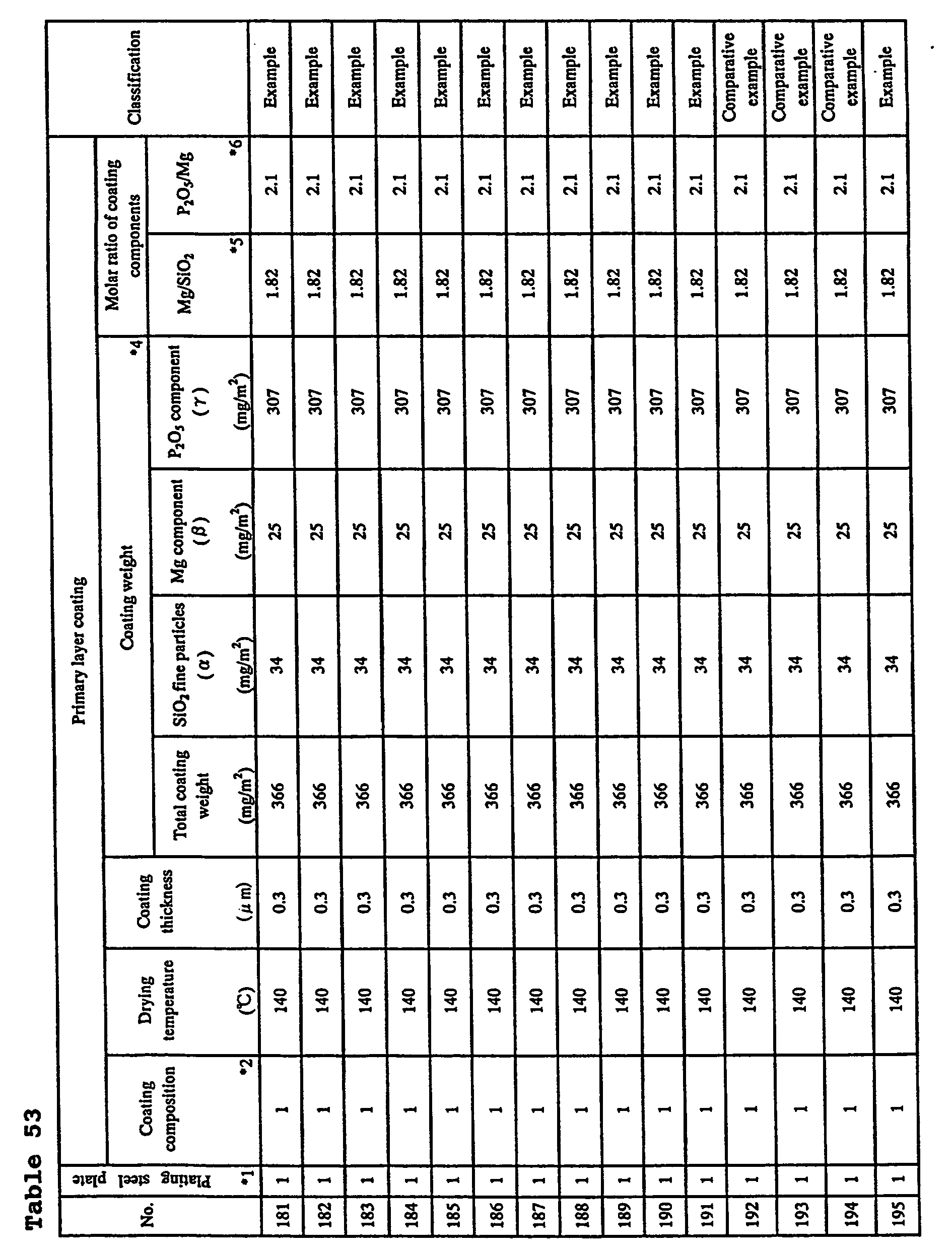
Table 54 No. Secondary layer coating Classification Resin composition Ion-exchanged silica (a) content Fine particles silica (b) (a) + (b) Blending rate (a) / (b) Weight ratio Drying temperature Coating thickness Type Blending rate *3 *7 *8 *9 *10 *11 (°C) (µm) 181 1 30 5 35 6/1 230 1 Example 182 2 30 5 5 35 6/1 230 1 Example 183 3 30 5 5 35 6/1 230 1 Example 184 4 30 5 5 35 6/1 230 1 Example 185 5 30 5 5 35 6/1 230 1 Example 186 6 30 5 5 35 6/1 230 1 Example 187 7 30 5 5 35 6/1 230 1 Example 188 8 30 5 5 35 6/1 230 1 Example 189 9 30 5 5 35 6/1 230 1 Example 190 10 30 5 5 35 6/1 230 1 Example 191 11 30 5 5 35 6/1 230 1 Example 192 12 30 5 5 35 6/1 230 1 Comparative example 193 13 30 5 5 35 6/1 230 1 Comparative example 194 14 30 5 5 35 6/1 230 1 Comparative example 195 1 30 - - 30 30/0 230 1 Example Table 55 No. Performance Classification Appearance White-rust resistance: SST 180 hrs White-rust resistance after alkaline degreasing: SST 180 hrs Paint adhesiveness 181 ○ ⊚ ⊚ ⊚ Example 182 ○ ⊚ ⊚ ⊚ Example 183 ○ ⊚ ⊚ ⊚ Example 184 ○ ⊚ ⊚ ⊚ Example 185 ○ ⊚ ⊚ ⊚ Example 186 ○ ⊚ ⊚ ⊚ Example 187 ○ ⊚ ⊚ ⊚ Example 188 ○ ⊚ ⊚ ⊚ Example 189 ○ ⊚ ⊚ ⊚ Example 190 ○ ⊚ ⊚ ⊚ Example 191 ○ ⊚ ⊚ ⊚ Example 192 ○ Δ × ⊚ Comparative example 193 ○ × × × Comparative example 194 ○ Δ × ⊚ Comparative example 195 ○ ○ ○ ⊚ Example 
Table 57 No. Secondary layer coating Classification Resin composition Ion-exchanged silica (a) content Fine particles silica (b) (a) + (b) Content (a) / (b) Weight ratio Drying temperature Coating thickness Type Blending rate *3 *7 *8 *9 *10 *11 (°C) (µm) 196 1 29.9 5 0.1 30 299/1 230 1 Example 197 1 29 5 1 30 29/1 230 1 Example 198 1 20 5 10 30 2/1 230 1 Example 199 1 15 5 15 30 1/1 230 1 Example 200 1 10 5 20 30 1/2 230 1 Example 201 1 1 5 29 30 1/29 230 1 Example 202 1 0.1 5 29.9 30 1/299 230 1 Example 203 1 50 - - 50 50/0 230 1 Example 204 1 49 5 1 50 49/1 230 1 Example 205 1 45 5 5 50 9/1 230 1 Example 206 1 40 5 10 50 4/1 230 1 Example 207 1 30. 5 20 50 3/2 230 1 Example 208 1 25 5 25 50 1/1 230 1 Example 209 1 10 5 40 50 1/4 230 1 Example 210 1 1 5 49 50 1/50 230 1 Example 211 1 0.45 5 0.05 0.5 9/1 230 1 Example Table 58 No. Performance Classification Appearance White-rust resistance: SST 180 hrs White-rust resistance after alkaline degreasing: SST 180 hrs Paint adhesiveness 196 ○ O O ⊚ Example 197 ○ ○+ ○ + ⊚ Example 198 ○ ⊚ ⊚ ⊚ Example 199 O ⊚ ⊚ ⊚ Example 200 O O O ⊚ Example 201 ○ O O ⊚ Example 202 O ○- ○- ⊚ Example 203 O O O ⊚ Example 204 O ○+ ○+ ⊚ Example 205 ○ ⊚ ⊚ ⊚ Example 206 ○ ⊚ ⊚ ⊚ Example 207 ○ ⊚ ⊚ ⊚ Example 208 ○ ⊚ ⊚ ⊚ Example 209 ○ ○ ○ ⊚ Example 210 ○ ○ ○ ⊚ Example 211 ○ × × ⊚ Example 
Table 60 No. Secondary layer coating Classification Resin composition Ion-exchanged silica (a) content Fine particles silica (b) (a) + (b) Blending rate (a) / (b) Weight ratio Drying temperature Coating thickness Type Blending rate *3 *7 *8 *9 *10 *11 (°C) (µm) 212 1 9 5 1 10 9/1 230 1 Example 213 1 27 5 3 30 9/1 230 1 Example 214 1 72 5 8 80 9/1 230 1 Example 215 1 90 5 10 100 9/1 230 1 Example 216 1 135 5 15 150 9/1 230 1 Comparative example 217 1 30 1 5 35 6/1 230 1 Example 218 1 30 2 5 35 6/1 230 1 Example 219 1 30 3 5 35 6/1 230 1 Example 220 1 30 4 5 35 6/1 230 1 Example 221 1 30 6 5 35 6/1 230 1 Example 222 1 30 7 5 35 6/1 230 1 Example 223 1 30 8 5 35 6/1 230 1 Example 224 1 30 9 5 35 6/1 230 1 Example 225 1 30 11 5 35 6/1 230 1 Example Table 61 No. Performance Classification Appearance White-rust resistance: SST 180 hrs White-rust resistance after alkaline degreasing: SST 180 hrs Paint adhesiveness 212 ○ ○+ ○+ ⊚ Example 213 ○ ⊚ ⊚ ⊚ Example 214 ○ ⊚ ⊚ ⊚ Example 215 ○ ○+ ○+ ⊚ Example 216 ○ × × ⊚ Comparative example 217 ○ ⊚ ⊚ ⊚ Example 218 ○ ⊚ ⊚ ⊚ Example 219 ○ ⊚ ⊚ ⊚ Example 220 ○ ⊚ ⊚ ⊚ Example 221 ○ ⊚ ⊚ ⊚ Example 222 ○ ⊚ ⊚ ⊚ Example 223 ○ ⊚ ⊚ ⊚ Example 224 ○ ⊚ ⊚ ⊚ Example 225 ○ ⊚ ⊚ ⊚ Example 
Table 63 No. Secondary layer coating Classification Resin composition Ion-exchanged silica (a) content Solid lubricant (c) Drying temperature Coating thickness Type Blending rate *3 *7 *12 *13 (°C) (µm) 226 1 30 1 10 230 1 Example 227 1 30 2 10 230 1 Example 228 1 30 3 10 230 1 Example 229 1 30 4 10 230 1 Example 230 1 30 5 10 230 1 Example 231 1 30 6 10 230 1 Example 232 1 30 1 1 230 1 Example 233 1 30 1 3 230 1 Example 234 1 30 1 40 230 1 Example 235 1 30 1 80 230 1 Example 236 1 30 1 100 230 1 Comparative example Table 64 No. Performance Classification Appearance White-rust resistance: SST 150 hrs White-rust resistance after alkaline degreasing: SST 150 hrs Paint adhesiveness Workability 226 ○ ⊚ ⊚ ⊚ ⊚ Example 227 ○ ⊚ ⊚ ⊚ ⊚ Example 228 ○ ⊚ ⊚ ⊚ ⊚ Example 229 ○ ⊚ ⊚ ⊚ ⊚ Example 230 ○ ⊚ ⊚ ⊚ ⊚ Example 231 ○ ⊚ ⊚ ⊚ ⊚ Example 232 ○ ⊚ ⊚ ⊚ ○ Example 233 ○ ⊚ ⊚ ⊚ ⊚ Example 234 ○ ⊚ ⊚ ⊚ ⊚ Example 235 ○ ⊚ ⊚ ⊚ ⊚ Example 236 ○ ⊚ ⊚ × ⊚ Comparative example 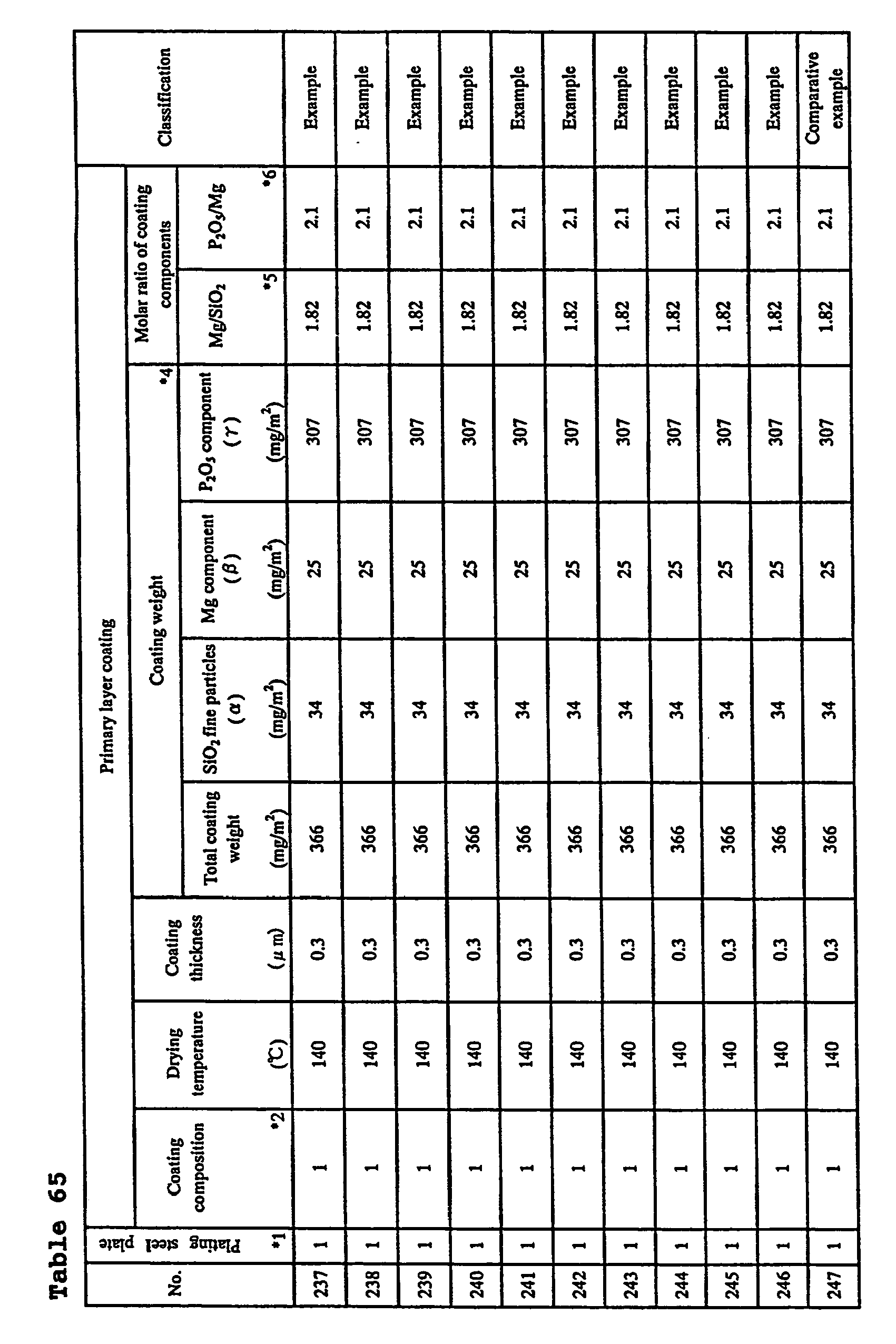
Table 66 No. Secondary layer coating Classification Resin composition Ion-exchanged silica (a) content Fine particles silica (b) (a) + (b) Blending rate (a) / (b) Weight ratio Solid lubricant (c) Drying temperature Coating thickness Type Blending rate Type Blending rate *3 07 *8 *9 *10 *11 *12 *13 (°C) (µm) 237 1 30 1 5 35 6/1 1 10 230 1 Example 238 1 30 2 5 35 6/1 2 10 230 1 Example 239 1 30 3 5 35 6/1 3 10 230 1 Example 240 1 30 4 5 35 6/1 4 10 230 1 Example 241 1 30 6 5 35 6/1 5 10 230 1 Example 242 1 30 7 5 35 6/1 6 10 230 1 Example 243 1 30 8 5 35 6/1 1 1 230 1 Example 244 1 30 9 5 35 6/1 1 3 230 1 Example 245 1 30 11 5 35 6/1 1 40 230 1 Example 246 1 30 11 5 35 6/1 1 80 230 1 Example 247 1 30 11 5 35 6/1 1 100 230 1 Comparative example Table 67 No. Performance Classification Appearance White-rust resistance: SST 180 hrs White-rust resistance after alkaline degreasing: SST 180 hrs Paint adhesiveness Workability 237 ○ ⊚ ⊚ ⊚ ⊚ Example 238 ○ ⊚ ⊚ ⊚ ⊚ Example 239 ○ ⊚ ⊚ ⊚ ⊚ Example 240 ○ ⊚ ⊚ ⊚ ⊚ Example 241 ○ ⊚ ⊚ ⊚ ⊚ Example 242 ○ ⊚ ⊚ ⊚ ⊚ Example 243 ○ ⊚ ⊚ ⊚ ○ Example 244 ○ ⊚ ⊚ ⊚ ⊚ Example 245 ○ ⊚ ⊚ ⊚ ⊚ Example 246 ○ ⊚ ⊚ ○ ⊚ Example 247 ○ ⊚ ⊚ × ⊚ Comparative example 
Table 69 No. Performance Classification Appearance White-rust resistance: SST 150 hrs White-rust resistance after alkaline degreasing: SST 150 hrs Paint adhesiveness 248 ○ × × ⊚ Comparative example 249 O O ○- ⊚ Example 250 O O O ⊚ Example 251 ○ ○ + ○+ ⊚ Example 252 O ⊚ ⊚ ⊚ Example 253 ○ ⊚ ⊚ ⊚ Example 254 ○ ⊚ ⊚ ⊚ Example 255 ○ ⊚ ⊚ ⊚ Example 256 ○ ⊚ ⊚ ⊚ Comparative example 11 : Unable to weld
Table 71 No. Performance Classification Appearance White-rust resistance: SST 150 hrs White-rust resistance after alkaline degreasing: SST 150 hrs Paint adhesiveness 257 ○ × × × Comparative example 258 ○ ○- ○- ○ Example 259 ○ ⊚ ⊚ ⊚ Example 260 ○ ⊚ ⊚ ⊚ Example 261 ○ ⊚ ⊚ ⊚ Example 262 ○ ⊚ ⊚ ⊚ Example 263 ○ ⊚ ⊚ ⊚ Example 264 ○ × × ⊚ Comparative example 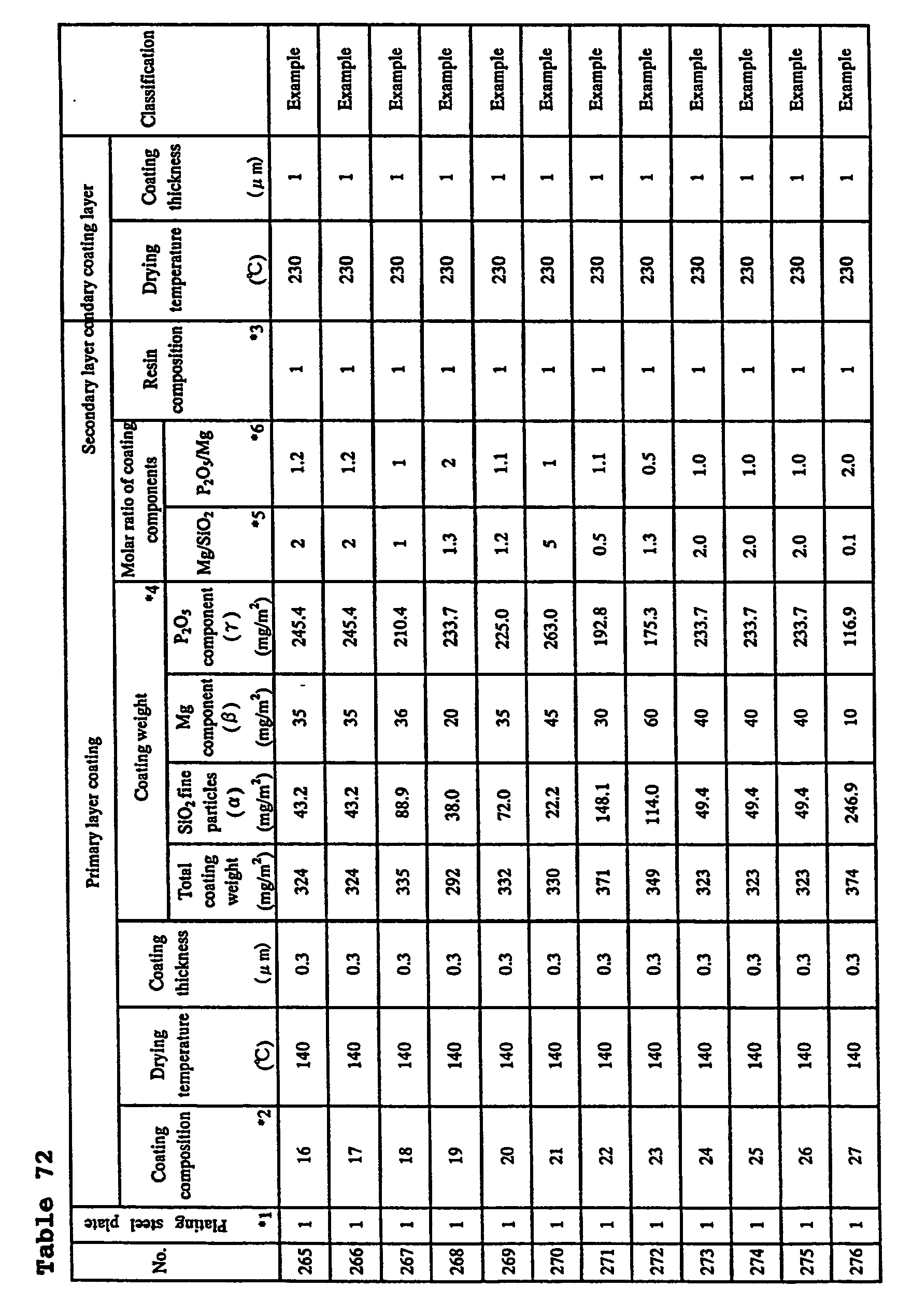
Table 73 No. Performance Classification Appearance White-rust resistance: SST 96 hrs White-rust resistance after alkaline degreasing: SST 96 hrs Paint adhesiveness 265 ○ ⊚ ⊚ ⊚ Example 266 ○ ⊚ ⊚ ⊚ Example 267 ○ ⊚ ⊚ ⊚ Example 268 ○ ⊚ ⊚ ⊚ Example 269 ○ ⊚ ⊚ ⊚ Example 270 ○ ⊚ ⊚ ⊚ Example 271 ○ ⊚ ⊚ ⊚ Example 272 ○ ⊚ ⊚ ⊚ Example 273 ○ ⊚ ⊚ ⊚ Example 274 ○ ⊚ ⊚ ⊚ Example 275 ○ ⊚ ○ + ⊚ Example 276 ○ ⊚ ○ + ⊚ Example 
Table 75 No. Performance Classification Appearance White-rust resistance: SST 96 hrs White-rust resistance after alkaline degreasing: SST 96 hrs Paint adhesiveness 277 ○ ⊚ ○ + ⊚ Example 278 ○ ⊚ ○ + ⊚ Example 279 ○ ⊚ ○ + ⊚ Example 280 ○ ⊚ ○ + ⊚ Example 281 ○ ⊚ ○ ⊚ Example 282 ○ ⊚ ○ ⊚ Example 283 ○ ⊚ ○ ⊚ Example 284 ○ ⊚ ○ ⊚ Example 285 ○ ⊚ ○- ⊚ Example 286 ○ ⊚ ○- ⊚ Example 287 ○ ○+ ○+ ⊚ Example 288 ○ ○+ ○+ ⊚ Example 
Table 77 No. Performance Classification Appearance White-rust resistance: SST 96 hrs White-rust resistance after alkaline degreasing: SST 96 hrs Paint adhesiveness 289 ○ ○ + ○+ ⊚ Example 290 ○ ○+ ○+ ⊚ Example 291 ○ ○+ ○+ ⊚ Example 292 ○ ○+ ○+ ⊚ Example 293 ○ ○+ ○+ ⊚ Example 294 ○ ○ + ○+ ⊚ Example 295 ○ ○+ ○+ ⊚ Example 296 ○ ○+ ○+ ⊚ Example 297 ○ ⊚ ○+ ⊚ Example 298 ○ ⊚ ○+ ⊚ Example 299 ○ ⊚ ⊚ ⊚ Example 
Table 79 No. Performance Classification Appearance White-rust resistance: SST 96 hrs White-rust resistance after alkaline degreasing: SST 96 hrs Paint adhesiveness 300 ○ ⊚ ⊚ ⊚ Example 301 ○ ⊚ ⊚ ⊚ Example 302 ○ ⊚ ⊚ ⊚ Example 303 ○ ○ Δ Δ Comparative example 304 ○ × × ⊚ Comparative example 305 × Δ ○ ⊚ Comparative example 306 ○ Δ × ⊚ Comparative example 307 × Δ Δ ⊚ Comparative example 308 O Δ Δ ⊚ Comparative example 309 ○ × Δ ⊚ Comparative example 310 ○ ○ ○ × Comparative example 
Table 81 No. Performance Classification Appearance White-rust resistance: SST 150 hrs White-rust resistance after alkaline degreasing: SST 150 hrs Paint adhesiveness 311 O ⊚ ⊚ ⊚ Example 312 O ⊚ ⊚ ⊚ Example 313 O ⊚ ⊚ ⊚ Example 314 ○ ⊚ ⊚ ⊚ Example 315 ○ ⊚ ⊚ ⊚ Example 316 ○ ⊚ ⊚ ⊚ Example 317 O ⊚ ⊚ ⊚ Example 318 O ⊚ ⊚ ⊚ Example 319 O ⊚ ⊚ ⊚ Example 320 O ⊚ ⊚ ⊚ Example 321 O ⊚ ○+ ⊚ Example 322 O ⊚ ○+ ⊚ Example 
Table 83 No. Performance Classification Appearance White-rust resistance: SST 150 hrs White-rust resistance after alkaline degreasing: SST 150 hrs Paint adhesiveness 323 ○ ⊚ ○+ ⊚ Example 324 ○ ⊚ ○+ ⊚ Example 325 ○ ⊚ ○+ ⊚ Example 326 ○ ⊚ ○+ ⊚ Example 327 ○ ⊚ ○ ⊚ Example 328 ○ ⊚ ○ ⊚ Example 329 ○ ⊚ ○ ⊚ Example 330 ○ ⊚ ○ ⊚ Example 331 ○ ⊚ ○- ⊚ Example 332 ○ ⊚ ○- ⊚ Example 333 ○ ○+ ○+ ⊚ Example 334 ○ ○+ ○+ ⊚ Example 
Table 85 No. Performance Classification Appearance White-rust resistance: SST 150 hrs White-rust resistance after alkaline degreasing: SST 150 hrs Paint adhesiveness 335 ○ ○+ ○+ ⊚ Example 336 ○ ○+ ○+ ⊚ Example 337 ○ ○+ ○+ ⊚ Example 338 ○ ○+ ○+ ⊚ Example 339 ○ ○+ ○+ ⊚ Example 340 ○ ○+ ○+ ⊚ Example 341 ○ ○+ ○+ ⊚ Example 342 ○ ○+ ○+ ⊚ Example 343 ○ ⊚ ○+ ⊚ Example 344 ○ ⊚ ○+ ⊚ Example 345 ○ ⊚ ⊚ ⊚ Example 
Table 87 No. Performance Classification Appearance White-rust resistance: SST 150 hrs White-rust resistance after alkaline degreasing: SST 150 hrs Paint adhesiveness 346 ○ ⊚ ⊚ ⊚ Example 347 ○ ⊚ ⊚ ⊚ Example 348 ○ ⊚ ⊚ ⊚ Example 349 ○ ○ Δ Δ Comparative example 350 ○ × × ⊚ Comparative example 351 × Δ ○ ⊚ Comparative example 352 ○ Δ × ⊚ Comparative example 353 × Δ Δ ⊚ Comparative example 354 ○ Δ Δ ⊚ Comparative example 355 O × Δ ⊚ Comparative example 356 ○ ○ ○ × Comparative example
Claims (3)
- A coated steel sheet having excellent corrosion resistance, comprising:a zinc or a zinc alloy plated steel sheet or an aluminum or an aluminum alloy plated steel sheet;a composite oxide coating formed on the surface of the plated steel sheet;an organic coating formed on the composite oxide coating;said composite oxide coating containing:said organic coating containing a product of reaction between a film-forming organic resin (A) and an active-hydrogen-laden compound (B), a part or whole of which compound (B) comprises a hydrazine derivative (C) containing active hydrogen, and an ion-exchanged silica, and the content of the ion-exchanged silica is in a range of from 1 to 100 parts by weight solid matter to 100 parts by weight of solid matter of the reaction product; and(α) fine particles of oxide;(β) at least one metal selected from the group consisting of Mg, Ca, Sr, and Ba, including the case that the metal is in a form of compound and/or composite compound; and(γ) a phosphoric acid and/or a phosphoric acid compound, the composite oxide coating has a thickness in a range of from 0.005 to 3µm, or has a total coating weight of the component (α), the component (β) converted to metal concerned, and the component (γ) converted to P2O5, in a range of from 6 to 3,600 mg/m2;
the organic coating having a thickness in a range of from 0.1 to 5µm. - The coated steel sheet of claim 1, wherein the organic coating further contains a fine particle silica, the content of the sum of the ion-exchanged silica and the fine particle silica is in a range of from 1 to 100 parts by weight of solid matter to 100 parts by weight solid matter of the reaction product, and the weight ratio of the content of solid matter of the ion-exchanged silica to the content of solid matter of the fine particle silica is in a range of from 1/99 to 99/1.
- The coated steel sheet of claim 1 or 2, wherein the organic coating further contains a solid lubricant, and the content of the solid lubricant is in a range of from 1 to 80 parts by weight of solid matter to 100 parts by weight solid matter of the reaction product.
Applications Claiming Priority (5)
| Application Number | Priority Date | Filing Date | Title |
|---|---|---|---|
| JP33204998 | 1998-11-08 | ||
| JP33204998 | 1998-11-08 | ||
| JP12360099 | 1999-04-30 | ||
| JP12360099 | 1999-04-30 | ||
| PCT/JP1999/006169 WO2000028109A1 (en) | 1998-11-08 | 1999-11-05 | Surface treated steel sheet having excellent corrosion resistance and method for producing the same |
Publications (3)
| Publication Number | Publication Date |
|---|---|
| EP1050603A1 EP1050603A1 (en) | 2000-11-08 |
| EP1050603A4 EP1050603A4 (en) | 2004-12-29 |
| EP1050603B1 true EP1050603B1 (en) | 2007-01-10 |
Family
ID=26460480
Family Applications (1)
| Application Number | Title | Priority Date | Filing Date |
|---|---|---|---|
| EP19990954400 Expired - Lifetime EP1050603B1 (en) | 1998-11-08 | 1999-11-05 | Surface treated steel sheet having excellent corrosion resistance |
Country Status (5)
| Country | Link |
|---|---|
| US (1) | US6562474B1 (en) |
| EP (1) | EP1050603B1 (en) |
| KR (1) | KR100347449B1 (en) |
| DE (1) | DE69934780T2 (en) |
| WO (1) | WO2000028109A1 (en) |
Cited By (2)
| Publication number | Priority date | Publication date | Assignee | Title |
|---|---|---|---|---|
| DE102007021602A1 (en) | 2007-05-08 | 2008-11-20 | Voestalpine Stahl Gmbh | Corrosion protection system for metals and pigment for this purpose |
| EP2222793B1 (en) | 2007-11-19 | 2017-10-11 | Grace GmbH & Co. KG | Anti-corrosive particles |
Families Citing this family (63)
| Publication number | Priority date | Publication date | Assignee | Title |
|---|---|---|---|---|
| TW487741B (en) * | 1999-06-03 | 2002-05-21 | Kansai Paint Co Ltd | Surface treatment compositions for galvanized sheet steel |
| US6890648B2 (en) * | 2000-02-03 | 2005-05-10 | Nisshin Steel Co., Ltd. | CR-free paint compositions and painted metal sheets |
| KR100551583B1 (en) * | 2000-05-30 | 2006-02-13 | 제이에프이 스틸 가부시키가이샤 | Organic coated steel sheet and its manufacturing method |
| CN100462481C (en) * | 2000-12-04 | 2009-02-18 | 杰富意钢铁株式会社 | Galvanized steel sheet and manufacturing method thereof |
| KR100584756B1 (en) * | 2001-12-24 | 2006-05-30 | 주식회사 포스코 | Manufacturing method of resin coating solution for automobile and surface treatment method of automotive zinc alloy plated steel sheet using same |
| CN1524133A (en) * | 2002-03-06 | 2004-08-25 | 杰富意钢铁株式会社 | Surface-treated steel sheet and manufacturing method thereof |
| DE10223531A1 (en) | 2002-05-27 | 2003-12-11 | Inst Neue Mat Gemein Gmbh | Substrate with a titanium oxide / cerium oxide protective layer |
| TWI259216B (en) * | 2002-07-23 | 2006-08-01 | Kansai Paint Co Ltd | Surface-treated steel sheet excellent in resistance to white rust and method for production thereof |
| US7354047B2 (en) * | 2002-09-13 | 2008-04-08 | Nichias Corporation | Gasket material |
| EP1618229A2 (en) * | 2003-04-25 | 2006-01-25 | Elisha Holding LLC | Method for preparing and using silicate systems to treat electrically conductive surfaces and products obtained therefrom |
| JP4500113B2 (en) * | 2003-06-16 | 2010-07-14 | Jfeスチール株式会社 | High corrosion resistance surface-treated steel sheet and method for producing the same |
| TW200502432A (en) * | 2003-07-08 | 2005-01-16 | Nippon Paint Co Ltd | Inorganic-organic composite-treated zinc-plated steel sheet |
| EP1650327A4 (en) * | 2003-07-29 | 2009-11-25 | Jfe Steel Corp | Surface-treated steel sheet and method for producing same |
| US20050255648A1 (en) * | 2004-05-13 | 2005-11-17 | Tania Bhatia | Silicon based substrate hafnium oxide top environmental/thermal top barrier layer and method for preparing |
| US7144637B2 (en) * | 2004-07-12 | 2006-12-05 | Thomae Kurt J | Multilayer, corrosion-resistant finish and method |
| US20060032555A1 (en) * | 2004-08-16 | 2006-02-16 | Dennis Klein | Anti-rust treatment using KLEIN™ gas flame |
| US7763359B2 (en) | 2004-08-30 | 2010-07-27 | Bunge Fertilizantes S.A. | Aluminum phosphate, polyphosphate and metaphosphate particles and their use as pigments in paints and method of making same |
| BRPI0403713B1 (en) | 2004-08-30 | 2021-01-12 | Universidade Estadual De Campinas - Unicamp | manufacturing process of a white pigment based on the synthesis of hollow particles of aluminum orthophosphate or polyphosphate |
| CN101906238B (en) * | 2004-11-02 | 2011-11-23 | 住友电木株式会社 | Epoxy resin composition and semiconductor device |
| US10041176B2 (en) | 2005-04-07 | 2018-08-07 | Momentive Performance Materials Inc. | No-rinse pretreatment methods and compositions |
| WO2007035432A2 (en) * | 2005-09-15 | 2007-03-29 | Board Of Regents, The University Of Texas System | Reduction of the loss of zinc by its reaction with oxygen in galvanized steel and batteries |
| US8691028B2 (en) * | 2006-05-10 | 2014-04-08 | The Boeing Company | Article having a hexavalent-chromium-free, corrosion-inhibiting organic conversion coating thereon, and its preparation |
| JP4774442B2 (en) * | 2005-12-27 | 2011-09-14 | ポスコ | Chromium-free surface-treated steel sheet for fuel tank and manufacturing method thereof |
| JP5507245B2 (en) * | 2006-08-11 | 2014-05-28 | ブンゲ フェルチリザンテス エス.エー. | Production of aluminum phosphate or polyphosphate aluminum particles |
| US7476445B2 (en) * | 2006-10-02 | 2009-01-13 | Nippon Steel Corporation | Surface-treated metal sheet |
| DE102006061380A1 (en) * | 2006-12-23 | 2008-06-26 | Evonik Degussa Gmbh | Silica and dispersant-containing radiation-curable formulations with increased corrosion protection on metal substrates |
| JP5211622B2 (en) * | 2007-01-31 | 2013-06-12 | 凸版印刷株式会社 | Lithium battery packaging material and method for producing the same |
| US8137804B2 (en) * | 2007-04-13 | 2012-03-20 | Valspar Sourcing, Inc. | Epoxy-based electrocoating composition |
| EP2153985A4 (en) * | 2007-05-28 | 2010-07-14 | Taisei Plas Co Ltd | Steel product composite and process for producing the steel product composite |
| RU2353707C1 (en) * | 2007-09-17 | 2009-04-27 | Общество с ограниченной ответственностью "ВИКА-ГАЛ" | Protective coating of metal work surface |
| EP2202823B1 (en) * | 2007-09-26 | 2013-05-22 | Toppan Printing Co., Ltd. | Packing material for lithium battery and method for manufacturing the same |
| PL2240628T3 (en) * | 2007-12-27 | 2014-08-29 | Posco | Resin coated steel sheet and its use in a display panel |
| US9023145B2 (en) * | 2008-02-12 | 2015-05-05 | Bunge Amorphic Solutions Llc | Aluminum phosphate or polyphosphate compositions |
| US9039845B2 (en) | 2009-11-04 | 2015-05-26 | Bulk Chemicals, Inc. | Trivalent chromium passivation and pretreatment composition and method for zinc-containing metals |
| JP5600416B2 (en) * | 2009-11-25 | 2014-10-01 | Jfeスチール株式会社 | Surface treatment composition and surface treated steel sheet |
| JP5600417B2 (en) * | 2009-11-25 | 2014-10-01 | Jfeスチール株式会社 | Surface treatment composition and surface treated steel sheet |
| US20110139141A1 (en) * | 2009-12-16 | 2011-06-16 | Timothy Scott Shaffer | cleanability of ovens and cooktops |
| US8595988B2 (en) * | 2010-03-25 | 2013-12-03 | Rodrigo GRAF FERNANDEZ | Construction method and system with containers |
| CN103025917B (en) * | 2010-07-23 | 2014-12-31 | 新日铁住金株式会社 | Electromagnetic steel sheet and manufacturing method thereof |
| CN101906347A (en) * | 2010-08-05 | 2010-12-08 | 安徽工业大学 | A water-based high temperature resistant solid lubricating coating cured at room temperature and preparation method thereof |
| US9371454B2 (en) | 2010-10-15 | 2016-06-21 | Bunge Amorphic Solutions Llc | Coating compositions with anticorrosion properties |
| US9005355B2 (en) | 2010-10-15 | 2015-04-14 | Bunge Amorphic Solutions Llc | Coating compositions with anticorrosion properties |
| US9303171B2 (en) | 2011-03-18 | 2016-04-05 | Tesla Nanocoatings, Inc. | Self-healing polymer compositions |
| WO2013033562A2 (en) * | 2011-08-31 | 2013-03-07 | Jorma Virtanen | Composition for corrosion prevention |
| US10570296B2 (en) | 2012-03-19 | 2020-02-25 | Tesla Nanocoatings, Inc. | Self-healing polymer compositions |
| US9611147B2 (en) | 2012-04-16 | 2017-04-04 | Bunge Amorphic Solutions Llc | Aluminum phosphates, compositions comprising aluminum phosphate, and methods for making the same |
| US9078445B2 (en) | 2012-04-16 | 2015-07-14 | Bunge Amorphic Solutions Llc | Antimicrobial chemical compositions |
| US9155311B2 (en) | 2013-03-15 | 2015-10-13 | Bunge Amorphic Solutions Llc | Antimicrobial chemical compositions |
| US9238860B2 (en) * | 2012-12-17 | 2016-01-19 | Fujigiken Co., Ltd. | Method of carrying out post-treatment to sprayed coating and agent used for the same |
| KR20210119586A (en) * | 2013-03-16 | 2021-10-05 | 피알시-데소토 인터내쇼날, 인코포레이티드 | Azole compounds as corrosion inhibitors |
| CN103254755B (en) * | 2013-05-27 | 2016-01-27 | 宝山钢铁股份有限公司 | There is hot-dip aluminizing zincium steel plate of excellent weather resistance, solidity to corrosion and alkali resistance and preparation method thereof and surface treatment agent |
| TWI613324B (en) * | 2015-03-31 | 2018-02-01 | Nippon Steel & Sumitomo Metal Corp | Zinc plated steel plate |
| WO2016178210A1 (en) | 2015-05-07 | 2016-11-10 | Phosfan Ltd | Method for applying ultrafine phosphate conversion crystal coatings |
| JP2017082266A (en) * | 2015-10-26 | 2017-05-18 | 株式会社神戸製鋼所 | Surface-treated aluminum alloy, and surface-treated aluminum alloy clad material |
| US11505868B2 (en) | 2015-11-05 | 2022-11-22 | Phosfan Ltd. | Composite phosphate coatings |
| JP6821399B2 (en) * | 2016-11-10 | 2021-01-27 | 関西ペイント株式会社 | Matte clear paint composition for aluminum parts |
| US10907255B2 (en) * | 2017-03-30 | 2021-02-02 | Jfe Steel Corporation | Galvanized steel sheet and manufacturing method therefor |
| JP6447800B1 (en) | 2017-06-16 | 2019-01-09 | 新日鐵住金株式会社 | Plated steel |
| MX2020009043A (en) | 2018-03-01 | 2020-12-03 | Nucor Corp | Zinc alloy coated press-hardenable steels and method of manufacturing the same. |
| US10822506B2 (en) * | 2019-03-20 | 2020-11-03 | Michael Podstawa | Methods and formulations for paint deposit removal |
| WO2021039971A1 (en) | 2019-08-29 | 2021-03-04 | 日本製鉄株式会社 | Hot-stamped article |
| WO2021154240A1 (en) * | 2020-01-29 | 2021-08-05 | Nucor Corporation | Zinc alloy coating layer of press-hardenable steel |
| AU2023390543A1 (en) * | 2022-12-09 | 2025-07-03 | Championx Llc | Corrosion inhibitor having silica nanoparticles |
Family Cites Families (17)
| Publication number | Priority date | Publication date | Assignee | Title |
|---|---|---|---|---|
| US3954825A (en) | 1973-08-09 | 1976-05-04 | E. I. Du Pont De Nemours And Company | Biuret polyisocyanates |
| JPS5171233A (en) | 1974-12-18 | 1976-06-19 | Nippon Steel Corp | Aenmetsukikozaino boseishitajishoriho |
| JPS5610386A (en) | 1979-07-06 | 1981-02-02 | Shikishima Kinzoku Kogyosho Yu | Method of drying vessel in metal |
| JPS57198267A (en) | 1981-05-28 | 1982-12-04 | Nippon Steel Corp | Corrosion preventing method for iron and steel products |
| JPS6056434B2 (en) | 1982-01-29 | 1985-12-10 | 株式会社大和化成研究所 | Rust preventive manufacturing method |
| GB8310366D0 (en) * | 1983-04-16 | 1983-05-18 | Verdugt Bv | Corrosion inhibitors |
| JPS627883A (en) * | 1985-07-03 | 1987-01-14 | Taiyo Ink Seizo Kk | Surface treating agent for metal |
| JPS6390581A (en) | 1986-10-04 | 1988-04-21 | Kawakami Toryo Kk | Thermosetting antirust paint |
| US4822685A (en) * | 1987-12-10 | 1989-04-18 | Ppg Industries, Inc. | Method for preparing multi-layered coated articles and the coated articles prepared by the method |
| US5525431A (en) * | 1989-12-12 | 1996-06-11 | Nippon Steel Corporation | Zinc-base galvanized sheet steel excellent in press-formability, phosphatability, etc. and process for producing the same |
| JPH0671579B2 (en) * | 1990-11-28 | 1994-09-14 | 株式会社神戸製鋼所 | Resin coated steel sheet with excellent electrodeposition and weldability |
| JP2792324B2 (en) * | 1992-04-30 | 1998-09-03 | 日本鋼管株式会社 | Multi-layer galvanized steel sheet |
| JP4073047B2 (en) * | 1994-11-25 | 2008-04-09 | 旭化成ケミカルズ株式会社 | Method for producing aqueous semicarbazide compound |
| JPH08325760A (en) | 1995-05-25 | 1996-12-10 | Nippon Parkerizing Co Ltd | Surface treatment agent for zinc-containing metal-plated steel sheet with excellent corrosion resistance |
| FR2736935B1 (en) * | 1995-07-21 | 1997-08-14 | Lorraine Laminage | AQUEOUS TREATMENT AGAINST CORROSION OF STEEL SHEETS COATED ON A ZINC OR ZINC ALLOY SIDE |
| US6040054A (en) * | 1996-02-01 | 2000-03-21 | Toyo Boseki Kabushiki Kaisha | Chromium-free, metal surface-treating composition and surface-treated metal sheet |
| KR100453387B1 (en) * | 1996-07-31 | 2004-10-15 | 신닛뽄세이테쯔 카부시키카이샤 | Preservative steel plate having high resistance weldability, corrosion resistance and press formability for automobile fuel tanks |
-
1999
- 1999-11-05 KR KR1020007007481A patent/KR100347449B1/en not_active Expired - Fee Related
- 1999-11-05 WO PCT/JP1999/006169 patent/WO2000028109A1/en not_active Ceased
- 1999-11-05 EP EP19990954400 patent/EP1050603B1/en not_active Expired - Lifetime
- 1999-11-05 DE DE1999634780 patent/DE69934780T2/en not_active Expired - Lifetime
-
2000
- 2000-06-26 US US09/603,889 patent/US6562474B1/en not_active Expired - Fee Related
Cited By (3)
| Publication number | Priority date | Publication date | Assignee | Title |
|---|---|---|---|---|
| DE102007021602A1 (en) | 2007-05-08 | 2008-11-20 | Voestalpine Stahl Gmbh | Corrosion protection system for metals and pigment for this purpose |
| DE102007021602A9 (en) | 2007-05-08 | 2009-03-12 | Voestalpine Stahl Gmbh | Corrosion protection system for metals and pigment for this purpose |
| EP2222793B1 (en) | 2007-11-19 | 2017-10-11 | Grace GmbH & Co. KG | Anti-corrosive particles |
Also Published As
| Publication number | Publication date |
|---|---|
| DE69934780T2 (en) | 2007-10-18 |
| KR20010033906A (en) | 2001-04-25 |
| EP1050603A4 (en) | 2004-12-29 |
| WO2000028109A1 (en) | 2000-05-18 |
| DE69934780D1 (en) | 2007-02-22 |
| US6562474B1 (en) | 2003-05-13 |
| EP1050603A1 (en) | 2000-11-08 |
| KR100347449B1 (en) | 2002-11-30 |
Similar Documents
| Publication | Publication Date | Title |
|---|---|---|
| EP1050603B1 (en) | Surface treated steel sheet having excellent corrosion resistance | |
| EP1629969B1 (en) | Surface treated steel plate excellent in corrosion resistance, electroconductivity and appearance of coating film | |
| US20030072962A1 (en) | Steel sheet having organic coating and method for manufacturing the same | |
| EP1634932B1 (en) | Highly corrosion-resistant surface-treated steel sheet and method for producing same | |
| JP3903739B2 (en) | Organic coated steel plate with excellent corrosion resistance | |
| JP3665046B2 (en) | Surface-treated steel sheet excellent in white rust resistance and method for producing the same | |
| JP3968955B2 (en) | Organic coated steel plate with excellent corrosion resistance | |
| JP3977756B2 (en) | Surface-treated steel sheet excellent in white rust resistance and method for producing the same | |
| JP3903740B2 (en) | Organic coated steel plate with excellent corrosion resistance | |
| JP4110750B2 (en) | Organic coated steel sheet with excellent corrosion resistance and conductivity | |
| JP4419532B2 (en) | Surface-treated steel sheet with excellent corrosion resistance, conductivity, and coating appearance | |
| JP2001011645A (en) | Organic coated steel sheet excellent in corrosion resistance and method for producing the same | |
| JP4096524B2 (en) | Organic coated steel sheet with excellent corrosion resistance in high temperature and high humidity environment | |
| JP3381647B2 (en) | Organic coated steel sheet with excellent corrosion resistance | |
| JP4844128B2 (en) | High corrosion resistance surface-treated steel sheet and manufacturing method thereof | |
| JP4457820B2 (en) | High corrosion resistance surface-treated steel sheet and method for producing the same | |
| JP4123702B2 (en) | Organic coated steel plate with excellent corrosion resistance | |
| JP3578018B2 (en) | Organic coated steel sheet excellent in corrosion resistance and method for producing the same | |
| JP3412538B2 (en) | Organic coated steel sheet with excellent corrosion resistance | |
| JP2007009232A (en) | Surface-treated steel sheet and manufacturing method thereof | |
| JP3397149B2 (en) | Organic coated steel sheet with excellent corrosion resistance | |
| JP2006176845A (en) | Surface-treated steel sheet and manufacturing method thereof | |
| JP2007204770A (en) | Surface-treated steel sheet excellent in corrosion resistance, scratch resistance, discoloration resistance and water resistance, and production method thereof |
Legal Events
| Date | Code | Title | Description |
|---|---|---|---|
| PUAI | Public reference made under article 153(3) epc to a published international application that has entered the european phase |
Free format text: ORIGINAL CODE: 0009012 |
|
| 17P | Request for examination filed |
Effective date: 20000804 |
|
| AK | Designated contracting states |
Kind code of ref document: A1 Designated state(s): AT BE CH CY DE DK ES FI FR GB GR IE IT LI LU MC NL PT SE |
|
| RAP1 | Party data changed (applicant data changed or rights of an application transferred) |
Owner name: JFE STEEL CORPORATION |
|
| RBV | Designated contracting states (corrected) |
Designated state(s): DE |
|
| RIC1 | Information provided on ipc code assigned before grant |
Ipc: 7B 05D 7/14 B Ipc: 7B 05D 7/00 B Ipc: 7C 09D 201/02 B Ipc: 7C 09D 7/12 B Ipc: 7C 09D 1/00 B Ipc: 7B 05D 5/00 B Ipc: 7C 23C 22/40 A |
|
| A4 | Supplementary search report drawn up and despatched |
Effective date: 20041112 |
|
| 17Q | First examination report despatched |
Effective date: 20050221 |
|
| RTI1 | Title (correction) |
Free format text: SURFACE TREATED STEEL SHEET HAVING EXCELLENT CORROSION RESISTANCE |
|
| GRAP | Despatch of communication of intention to grant a patent |
Free format text: ORIGINAL CODE: EPIDOSNIGR1 |
|
| GRAS | Grant fee paid |
Free format text: ORIGINAL CODE: EPIDOSNIGR3 |
|
| GRAA | (expected) grant |
Free format text: ORIGINAL CODE: 0009210 |
|
| AK | Designated contracting states |
Kind code of ref document: B1 Designated state(s): DE |
|
| REF | Corresponds to: |
Ref document number: 69934780 Country of ref document: DE Date of ref document: 20070222 Kind code of ref document: P |
|
| PLBE | No opposition filed within time limit |
Free format text: ORIGINAL CODE: 0009261 |
|
| STAA | Information on the status of an ep patent application or granted ep patent |
Free format text: STATUS: NO OPPOSITION FILED WITHIN TIME LIMIT |
|
| 26N | No opposition filed |
Effective date: 20071011 |
|
| PGFP | Annual fee paid to national office [announced via postgrant information from national office to epo] |
Ref country code: DE Payment date: 20101104 Year of fee payment: 12 |
|
| REG | Reference to a national code |
Ref country code: DE Ref legal event code: R119 Ref document number: 69934780 Country of ref document: DE Effective date: 20130601 |
|
| PG25 | Lapsed in a contracting state [announced via postgrant information from national office to epo] |
Ref country code: DE Free format text: LAPSE BECAUSE OF NON-PAYMENT OF DUE FEES Effective date: 20130601 |