EP1048744A1 - Bearing steel excellent in rolling fatigue life - Google Patents
Bearing steel excellent in rolling fatigue life Download PDFInfo
- Publication number
- EP1048744A1 EP1048744A1 EP99951124A EP99951124A EP1048744A1 EP 1048744 A1 EP1048744 A1 EP 1048744A1 EP 99951124 A EP99951124 A EP 99951124A EP 99951124 A EP99951124 A EP 99951124A EP 1048744 A1 EP1048744 A1 EP 1048744A1
- Authority
- EP
- European Patent Office
- Prior art keywords
- mass
- less
- fatigue life
- rolling contact
- contact fatigue
- Prior art date
- Legal status (The legal status is an assumption and is not a legal conclusion. Google has not performed a legal analysis and makes no representation as to the accuracy of the status listed.)
- Withdrawn
Links
Images
Classifications
-
- C—CHEMISTRY; METALLURGY
- C22—METALLURGY; FERROUS OR NON-FERROUS ALLOYS; TREATMENT OF ALLOYS OR NON-FERROUS METALS
- C22C—ALLOYS
- C22C38/00—Ferrous alloys, e.g. steel alloys
- C22C38/18—Ferrous alloys, e.g. steel alloys containing chromium
-
- C—CHEMISTRY; METALLURGY
- C22—METALLURGY; FERROUS OR NON-FERROUS ALLOYS; TREATMENT OF ALLOYS OR NON-FERROUS METALS
- C22C—ALLOYS
- C22C38/00—Ferrous alloys, e.g. steel alloys
- C22C38/60—Ferrous alloys, e.g. steel alloys containing lead, selenium, tellurium, or antimony, or more than 0.04% by weight of sulfur
Definitions
- the present invention relates to bearing steels which are used as components for rolling bearings, such as roller bearings and ball bearings. More particularly, the invention relates to a bearing steel used as a component for bearings having superior rolling contact fatigue life.
- Bearing steels used for rolling bearings and the like are required to have a long rolling contact fatigue life. It is well known that, in general, hard oxide non-metallic inclusions in the steel adversely affect the rolling contact fatigue life of the bearing.
- Japanese Unexamined Patent Application Publication No. 3-126839 discloses a method of adjusting the number of oxide non-metallic inclusions per unit area or per unit volume, namely, a method of adjusting the distribution thereof.
- Japanese Unexamined Patent Application Publication No. 5-25587 discloses a method of adjusting the predicted maximum diameter of the oxide non-metallic inclusions calculated based on statistics of extreme value , namely, a method of adjusting the shape thereof. In either case, the influence of the oxide non-metallic inclusions is reduced by adjusting the distribution or shape of the oxide non-metallic inclusions, not by adjusting the amount thereof.
- the present invention has been carried out to achieve the object described above. Owing to recent steelmaking techniques, when approximately 1 mass% of C is incorporated, it is possible to reduce the O content to approximately 0.0010 mass% even without adding Si or Al as the deoxidizing agent. The improvement in hardenability and in rolling contact fatigue life can be achieved by the addition of a large amount of Cr instead of by the addition of Si or Al. Accordingly, the present inventors have carried out researches on the influences of impurity elements, using a material which contains approximately 1 mass% of C and a large amount of Cr, and does not contain Si or Al, in which the O content is reduced to approximately 10 ppm. As a result, it has been found that Sb which is mixed into the steel as the impurity element adversely affects the rolling contact fatigue life.
- the rolling contact fatigue life was investigated using a specimen which contains 0.98 to 1.05 mass% of C, 1.65 to 3.45 mass% of Cr, 0.0008 to 0.0012 mass% of O, 0.0001 to 0.0100 mass% of Sb, and the balance being substantially Fe.
- the number of oxide non-metallic inclusions was 100 to 200 pieces/320 mm 2 , and the maximum diameter thereof was 8 to 12 ⁇ m in an observation area of 320 mm 2 .
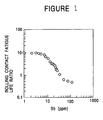
- FIG. 1 shows the influence of the Sb content in steel on the rolling contact fatigue life. When the Sb content in the steel was decreased to 0.0015 mass% or less, the rolling contact fatigue life improved. At approximately 0.0010 mass%, the improvement effect was saturated. Although the reason for such a phenomenon is not always clear, when the Sb content in steel exceeds a certain limit, excessive Sb is believed to segregate in grain boundaries, thus promoting fatigue cracks propagation and accelerating the occurrence of fracture.
- the present invention has been achieved based on the knowledge described above.
- a bearing steel having superior rolling contact fatigue life contains 0.95 to 1.10 mass% of C, more than 1.60 to 3.50 mass% of Cr, 0.0015 mass% or less of O, 0.0010 mass% or less of Sb, and the balance being Fe and incidental impurities.
- the bearing steel may further contain at least one element selected from the group consisting of 2.5 mass% or less of Si, 2.5 mass% or less of Mn, 2.5 mass% or less of Mo, 3.0 mass% or less of Ni, 1.5 mass% or less of Nb, 1.5 mass% or less of V, 2.0 mass% or less of Cu, and 0.08 mass% or less of Al.
- Carbon is an element that dissolves in the matrix and effectively strengthens martensite. Carbon is incorporated in order to secure strength after quenching and tempering and to improve rolling contact fatigue life. If the carbon content is less than 0.95 mass%, the above effects are not achieved. If the carbon content exceeds 1.10 mass%, giant carbides are formed in the casting process, resulting in a decrease in workability and in rolling contact fatigue life. Therefore, the carbon content is set in the range of 0.95% to 1.10 mass%.
- Chromium stabilizes carbides and makes the carbides remain after quenching, thus being effective in improving wear resistance. Chromium also improves hardenability and improves cold workability by promoting spheroidization of structure. If the chromium content is 1.60 mass% or less, the above effects are not achieved. If the chromium content exceeds 3.50 mass%, the amount of carbides remaining due to quenching increases. As a result, the amount of carbon dissolved in the matrix is decreased, resulting in a decrease in strength and in rolling contact fatigue life. Therefore, the chromium content is set in the range of more than 1.60% to 3.50 mass%, and preferably, in the range of more than 1.60 to 2.50 mass%.
- the oxygen content is set in the range of 0.0015 mass% or less, and preferably, at 0.0010 mass% or less. Sb: 0.0010 mass% or less
- Antimony is a particularly important element in the present invention. Antimony suppresses the formation of a decarburized layer and improves the productivity in heat treatment, which is advantageous. However, antimony decreases hot workability and toughness and significantly decreases rolling contact fatigue life. Therefore, the antimony content must be limited to 0.0010 mass% or less.
- Silicon is an element that retards softening during tempering. Consequently, strength after quenching and tempering is increased and rolling contact fatigue life is improved. Silicon is an element that also acts as a deoxidizing agent in the melting process to reduce oxygen in the steel. However, if the amount of silicon added exceeds 2.5 mass%, workability and toughness are decreased. Therefore, the silicon content is set in the range of 2.5 mass% or less, and preferably, in the range of 0.15% to 2.0 mass%.
- Manganese is an element that improves the hardenability of steel. Consequently, manganese improves the toughness and strength of matrix martensite and improves rolling contact fatigue life. However, if the manganese content exceeds 2.5 mass%, machinability and toughness are decreased. Therefore, the manganese content is set in the range of 2.5 mass% or less, and preferably, in the range of 0.10 to 2.0 mass%.
- Molybdenum is an element that improves hardenability. Consequently, molybdenum improves strength as well as rolling contact fatigue life. However, if the amount of molybdenum added exceeds 2.5 mass%, carbides are stabilized. As a result, the strength is decreased and the rolling contact fatigue life is decreased. Molybdenum is also an expensive element. Therefore, the molybdenum content is set in the range of 2.5 mass% or less, and preferably, in the range of 0.10 to 1.5 mass%.
- Nickel is an element that improves hardenability. Consequently, nickel improves strength as well as rolling contact fatigue life. However, the effects of addition in the amount exceeding 3.0 mass% are saturated. Nickel is also an expensive element. Therefore, in view of the effect gained and cost, the nickel content is set in the range of 3.0 mass% or less, and preferably, in the range of 0.10 to 2.0 mass%.
- Niobium is an element that improves hardenability. Consequently, niobium improves strength as well as rolling contact fatigue life. However, if the amount of niobium added exceeds 1.5 mass%, carbides are stabilized. As a result, the strength is decreased and the rolling contact fatigue life is decreased. Niobium is also an expensive element. Therefore, the niobium content is set in the range of 1.5 mass% or less, and preferably, in the range of 0.05 to 1.0 mass%.
- Vanadium is an element that improves hardenability. Consequently, vanadium improves strength as well as rolling contact fatigue life. However, if the amount of vanadium added exceeds 1.5 mass%, carbides are stabilized. As a result, the strength is decreased and the rolling contact fatigue life is decreased. Vanadium is also an expensive element. Therefore, the vanadium content is set at 1.5 mass%or less, and preferably, in the range of 0.05% to 1.0mass%.
- Aluminum is an element that increases resistance to temper softening. Consequently, strength after quenching and tempering is increased and rolling contact fatigue life is improved. Aluminum is an element that also acts as a deoxidizing agent in the melting process to reduce oxygen in the steel. If the amount of silicon added exceeds 0.08 mass%, workability and toughness are decreased. Therefore, the aluminum content is set in the range of 0.08 mass% or less, and preferably, in the range of 0.005 to 0.05 mass%.
- phosphorus, sulfur, titanium, and nitrogen, as impurity elements are desirably restricted within the ranges described below.
- Phosphorus decreases the toughness and rolling contact fatigue life of the steel. Therefore, it is desirable that the phosphorus content be as low as possible.
- the permissible upper limit of the phosphorus content is set at 0.025 mass%, and preferably, at 0.015 mass%.
- Sulfur combines with manganese to form MnS and improves machinability. However, rolling contact fatigue life is decreased when a large amount of sulfur is incorporated.
- the permissible upper limit of the sulfur content is set at 0.025 mass%, and preferably, at 0.010 mass%.
- Titanium forms hard nitrides and decreases rolling contact fatigue life. Therefore, it is desirable that the titanium content be as low as possible.
- the permissible upper limit of the titanium content is set at 0.010 mass%, and preferably, at 0.005 mass%.
- Nitrogen forms hard nitrides and decreases rolling contact fatigue life. Therefore, it is desirable that the nitrogen content be as low as possible.
- the permissible upper limit of the nitrogen content is set at 0.015 mass%, and preferably, at 0.008 mass%.
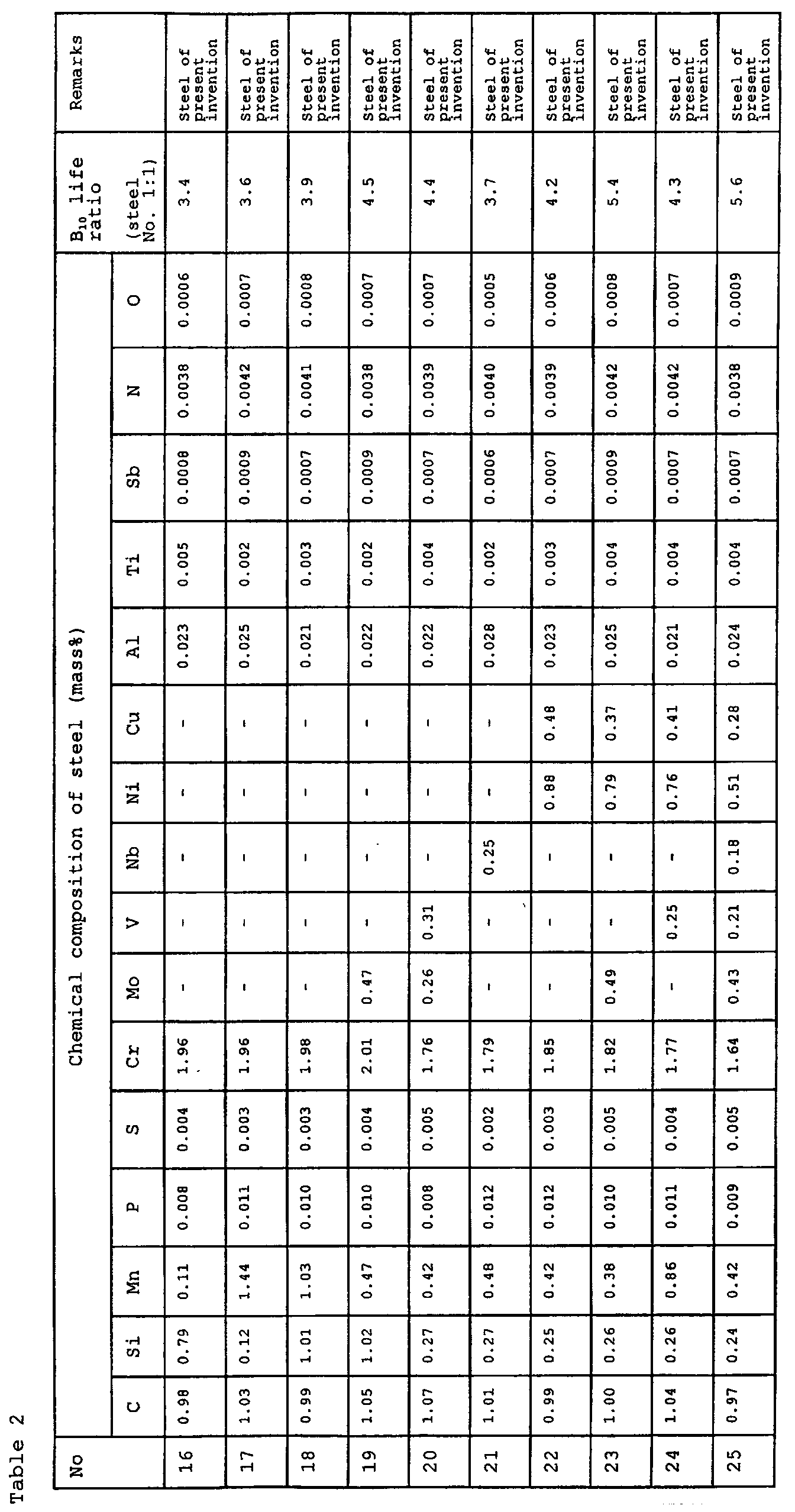
- Each of the steels having the chemical composition shown in Tables 1 and 2 were melted in a converter, and then a bloom having a size of 400 ⁇ 560 mm was produced by continuous casting.
- the bloom was subjected to soaking at 1,200°C for 30 hours, and hot rolled to a steel bar with a diameter of 65 mm.
- the steel bar was subjected to normalizing at 860°C and spheroidizing annealing in the range of 760 to 800°C, and was maintained at 830°C for 30 minutes, followed by quenching, and then tempering was performed at 180°C for 2 hours.
- the tempered material was cut and lapped, and 12 specimens for a rolling contact fatigue test, which were shaped like a disk having a size of 60 mm in diameter by 5 mm thick, were obtained for each steel.
- the rolling contact fatigue test was performed with a Mori thrust-type rolling contact fatigue tester under operating conditions of a maximum Hertzian contact stress of 5,260 MPa and a stress cycle frequency of 30 Hz, using #68 turbine oil as a lubricant oil.
- the test results were plotted onto a probability paper in accordance with a Weibull distribution, and the B 10 life (the total number of load cycles which were repeatedly applied until flaking occurred at an accumulated failure probability of 10%) was obtained. Evaluation was performed based on the relative ratio to the life of Steel No. 1 (JIS steel type: SUJ2) as a conventional steel being set as 1.
- a bearing steel having significantly superior rolling contact fatigue life can be obtained by merely adjusting the composition, such as by adding a large amount of Cr, and in particular, by limiting the Sb content in the steel to 0.0010 mass% or less.
- the Sb content can be easily limited by controlling scraps, which is advantageous in view of productivity, and industrial contributions are great.
Landscapes
- Chemical & Material Sciences (AREA)
- Engineering & Computer Science (AREA)
- Materials Engineering (AREA)
- Mechanical Engineering (AREA)
- Metallurgy (AREA)
- Organic Chemistry (AREA)
- Rolling Contact Bearings (AREA)
- Heat Treatment Of Articles (AREA)
- Paper (AREA)
Abstract
Description

Claims (2)
- A bearing steel having superior rolling contact fatigue life comprising:0.95 to 1.10 mass% of C;more than 1.60 to 3.50 mass% of Cr;0.0015 mass% or less of O;0.0010 mass% or less of Sb; andthe balance being Fe and incidental impurities.
- A bearing steel having superior rolling contact fatigue life comprising:0.95 to 1.10 mass% of C;more than 1.60 to 3.50 mass% of Cr;0.0015 mass% or less of O;0.0010 mass% or less of Sb;at least one element selected from the group consisting of:the balance being Fe and incidental impurities.2.5 mass% or less of Si,2.5 mass% or less of Mn,2.5 mass% or less of Mo,3.0 mass% or less of Ni,1.5 mass% or less of Nb,1.5 mass% or less of V,2.0 mass% or less of Cu, and0.08 mass% or less of Al; and
Applications Claiming Priority (3)
| Application Number | Priority Date | Filing Date | Title |
|---|---|---|---|
| JP31879598 | 1998-11-10 | ||
| JP31879598A JP3779078B2 (en) | 1998-11-10 | 1998-11-10 | Bearing steel with excellent rolling fatigue life |
| PCT/JP1999/005986 WO2000028100A1 (en) | 1998-11-10 | 1999-10-28 | Bearing steel excellent in rolling fatigue life |
Publications (2)
| Publication Number | Publication Date |
|---|---|
| EP1048744A1 true EP1048744A1 (en) | 2000-11-02 |
| EP1048744A4 EP1048744A4 (en) | 2001-02-28 |
Family
ID=18103038
Family Applications (1)
| Application Number | Title | Priority Date | Filing Date |
|---|---|---|---|
| EP99951124A Withdrawn EP1048744A4 (en) | 1998-11-10 | 1999-10-28 | Bearing steel excellent in rolling fatigue life |
Country Status (6)
| Country | Link |
|---|---|
| EP (1) | EP1048744A4 (en) |
| JP (1) | JP3779078B2 (en) |
| KR (1) | KR100508463B1 (en) |
| CA (1) | CA2317658A1 (en) |
| TW (1) | TW454042B (en) |
| WO (1) | WO2000028100A1 (en) |
Cited By (8)
| Publication number | Priority date | Publication date | Assignee | Title |
|---|---|---|---|---|
| EP1354971A4 (en) * | 2001-01-26 | 2006-01-04 | Jfe Steel Corp | Bearing material |
| EP1614761A4 (en) * | 2003-04-16 | 2007-02-28 | Jfe Steel Corp | STEEL MATERIAL HAVING EXCELLENT LONGEVITY TO THE FATIGUE DUE TO BEARING AND METHOD OF PRODUCING THE SAME |
| CN102399533A (en) * | 2011-09-26 | 2012-04-04 | 宁国市东方碾磨材料有限责任公司 | Wear-resistant corrosion-resistant nano grinding material and preparation method thereof |
| EP2794175A4 (en) * | 2011-12-20 | 2015-11-11 | Skf Ab | PROCESS, RING & BEARING |
| US9593389B2 (en) | 2007-12-20 | 2017-03-14 | Posco | Steel wire rod for bearing steel, manufacturing method of steel wire rod for bearing steel, heat treatment method of steel bearing, steel bearing and soaking method of bearing steel |
| CN108559913A (en) * | 2018-05-16 | 2018-09-21 | 浙江健力股份有限公司 | A kind of GCr15 Steel Pipe For Bearings and its preparation process |
| CN112111696A (en) * | 2020-09-29 | 2020-12-22 | 钢铁研究总院 | High carbon bearing steel with high tropism and long contact fatigue life and manufacturing method |
| US11788579B2 (en) | 2020-02-17 | 2023-10-17 | Nsk Ltd. | Rolling bearing and method for producing same |
Families Citing this family (9)
| Publication number | Priority date | Publication date | Assignee | Title |
|---|---|---|---|---|
| JP4586313B2 (en) * | 2001-07-31 | 2010-11-24 | Jfeスチール株式会社 | Manufacturing method of high carbon seamless steel pipe with excellent secondary workability |
| JP5857433B2 (en) * | 2011-04-14 | 2016-02-10 | 日本精工株式会社 | Method for manufacturing rolling guide device |
| JP5810867B2 (en) * | 2011-11-25 | 2015-11-11 | 新日鐵住金株式会社 | Bearing steel |
| JP2015510452A (en) * | 2011-12-20 | 2015-04-09 | アクティエボラゲット・エスコーエッフ | Method for producing steel components by flash butt welding, and components created using this method |
| JP6056647B2 (en) * | 2012-06-28 | 2017-01-11 | Jfeスチール株式会社 | Bearing steel manufacturing method and bearing steel obtained by the manufacturing method |
| CN103045957B (en) * | 2013-01-06 | 2015-07-22 | 奉化市金燕钢球有限公司 | High-carbon-chromium stainless bearing steel |
| CN104087866B (en) * | 2014-07-31 | 2016-04-06 | 宁国市宁武耐磨材料有限公司 | A kind of ball mill high heat-resistant and wear-resistant ball |
| CN104109794B (en) * | 2014-08-01 | 2016-06-01 | 宁国市宁武耐磨材料有限公司 | Chromium complex alloyed resistance to abrading-ball in a kind of |
| CN105296838A (en) * | 2015-10-22 | 2016-02-03 | 宁国市南方耐磨材料有限公司 | High-hardness and high-toughness abrasion-resisting ball |
Family Cites Families (10)
| Publication number | Priority date | Publication date | Assignee | Title |
|---|---|---|---|---|
| JPH0649589A (en) * | 1992-07-29 | 1994-02-22 | Nkk Corp | Bearing steel for cold forming |
| JPH06271982A (en) * | 1993-03-23 | 1994-09-27 | Kawasaki Steel Corp | Bearing steel excellent in property of retarding change in microstructure due to repeated stress load |
| JP3233725B2 (en) * | 1993-03-30 | 2001-11-26 | 川崎製鉄株式会社 | Bearing steel with excellent microstructure change delay characteristics due to repeated stress loading |
| JP3243330B2 (en) * | 1993-03-30 | 2002-01-07 | 川崎製鉄株式会社 | Bearing steel with excellent microstructure change delay characteristics due to cyclic stress loading and heat treatment productivity |
| JP3383347B2 (en) * | 1993-03-30 | 2003-03-04 | 川崎製鉄株式会社 | Bearing steel with excellent heat treatment productivity and delayed microstructure change due to repeated stress loading |
| JPH0711386A (en) * | 1993-06-25 | 1995-01-13 | Nkk Corp | Cold forming bearing steel |
| JP3411388B2 (en) * | 1994-05-27 | 2003-05-26 | 川崎製鉄株式会社 | Bearing member with excellent heat treatment productivity and delay characteristics of microstructure change due to repeated stress load |
| JPH0892689A (en) * | 1994-09-21 | 1996-04-09 | Kawasaki Steel Corp | Bearing steel with excellent delay characteristics for microstructural changes due to repeated stress loading |
| JP3338761B2 (en) * | 1996-02-29 | 2002-10-28 | 川崎製鉄株式会社 | Bearing material |
| JP3308836B2 (en) * | 1996-12-06 | 2002-07-29 | 川崎製鉄株式会社 | Bearing steel |
-
1998
- 1998-11-10 JP JP31879598A patent/JP3779078B2/en not_active Expired - Lifetime
-
1999
- 1999-10-28 EP EP99951124A patent/EP1048744A4/en not_active Withdrawn
- 1999-10-28 WO PCT/JP1999/005986 patent/WO2000028100A1/en not_active Ceased
- 1999-10-28 KR KR10-2000-7007005A patent/KR100508463B1/en not_active Expired - Lifetime
- 1999-10-28 CA CA002317658A patent/CA2317658A1/en not_active Abandoned
- 1999-11-02 TW TW088119071A patent/TW454042B/en not_active IP Right Cessation
Cited By (9)
| Publication number | Priority date | Publication date | Assignee | Title |
|---|---|---|---|---|
| EP1354971A4 (en) * | 2001-01-26 | 2006-01-04 | Jfe Steel Corp | Bearing material |
| EP1614761A4 (en) * | 2003-04-16 | 2007-02-28 | Jfe Steel Corp | STEEL MATERIAL HAVING EXCELLENT LONGEVITY TO THE FATIGUE DUE TO BEARING AND METHOD OF PRODUCING THE SAME |
| US7763124B2 (en) | 2003-04-16 | 2010-07-27 | Jfe Steel Corporation | Steel material with excellent rolling fatigue life and method of producing the same |
| US9593389B2 (en) | 2007-12-20 | 2017-03-14 | Posco | Steel wire rod for bearing steel, manufacturing method of steel wire rod for bearing steel, heat treatment method of steel bearing, steel bearing and soaking method of bearing steel |
| CN102399533A (en) * | 2011-09-26 | 2012-04-04 | 宁国市东方碾磨材料有限责任公司 | Wear-resistant corrosion-resistant nano grinding material and preparation method thereof |
| EP2794175A4 (en) * | 2011-12-20 | 2015-11-11 | Skf Ab | PROCESS, RING & BEARING |
| CN108559913A (en) * | 2018-05-16 | 2018-09-21 | 浙江健力股份有限公司 | A kind of GCr15 Steel Pipe For Bearings and its preparation process |
| US11788579B2 (en) | 2020-02-17 | 2023-10-17 | Nsk Ltd. | Rolling bearing and method for producing same |
| CN112111696A (en) * | 2020-09-29 | 2020-12-22 | 钢铁研究总院 | High carbon bearing steel with high tropism and long contact fatigue life and manufacturing method |
Also Published As
| Publication number | Publication date |
|---|---|
| JP3779078B2 (en) | 2006-05-24 |
| EP1048744A4 (en) | 2001-02-28 |
| CA2317658A1 (en) | 2000-05-18 |
| TW454042B (en) | 2001-09-11 |
| WO2000028100A1 (en) | 2000-05-18 |
| JP2000144326A (en) | 2000-05-26 |
| KR20010033504A (en) | 2001-04-25 |
| KR100508463B1 (en) | 2005-08-17 |
Similar Documents
| Publication | Publication Date | Title |
|---|---|---|
| CN100439540C (en) | Steel material having good rolling fatigue life and manufacturing method thereof | |
| JP2956324B2 (en) | Bearing steel with excellent workability and rolling fatigue | |
| WO2013046678A1 (en) | Ingot for bearing and production process | |
| KR100508463B1 (en) | Bearing steel excellent in rolling fatigue life | |
| US20180066344A1 (en) | Wire rod for use in bolts that has excellent acid pickling properties and resistance to delayed fracture after quenching and tempering, and bolt | |
| US5960250A (en) | Bearing material | |
| KR20020083529A (en) | Bearing material | |
| EP1197571A1 (en) | Steel product for oil well having high strength and being excellent in resistance to sulfide stress cracking | |
| JP2001026836A (en) | Induction hardened steel and machine structural parts with excellent cold workability, rolling fatigue strength and torsional fatigue strength | |
| KR100629217B1 (en) | Surface hardened bearing steel with excellent rolling contact fatigue life in toughness and semi-high temperature range | |
| US20200063246A1 (en) | Steel and part | |
| JP2008088484A (en) | Steel parts for bearings with excellent fatigue characteristics and method for producing the same | |
| JP3476097B2 (en) | Carburizing steel and carburizing members | |
| JP7552959B1 (en) | Non-tempered steel for hot forging, hot forging material and manufacturing method thereof | |
| CN111334708B (en) | High-strength spring steel with tensile strength of more than or equal to 2250MPa and excellent fatigue performance and production method thereof | |
| JP2021172875A (en) | Manufacturing method of abrasion resistant steel | |
| JP4515347B2 (en) | Method for determining fatigue resistance of spring steel wires and spring steel wires | |
| JP7368697B2 (en) | Steel for carburized gears, carburized gears, and method for manufacturing carburized gears | |
| JPH07126804A (en) | Steel for carburized bearings | |
| JPH0633190A (en) | Long-life bearing steel | |
| KR101536405B1 (en) | Steel for high carbon chromium bearing having excellent fatigue resistance properties and method for manufacturing the same | |
| JP2025115069A (en) | Steel materials and machine structural parts | |
| JP2025009000A (en) | Steel and carburized machine structural parts | |
| JPH0873988A (en) | Bearing steel with excellent microstructure change delay characteristics due to repeated stress loading and heat treatment productivity | |
| JPH08188849A (en) | Case hardening steel for bearing |
Legal Events
| Date | Code | Title | Description |
|---|---|---|---|
| PUAI | Public reference made under article 153(3) epc to a published international application that has entered the european phase |
Free format text: ORIGINAL CODE: 0009012 |
|
| AK | Designated contracting states |
Kind code of ref document: A1 Designated state(s): AT BE CH CY DE DK ES FI FR GB GR IE IT LI LU MC NL PT SE |
|
| 17P | Request for examination filed |
Effective date: 20001113 |
|
| RIC1 | Information provided on ipc code assigned before grant |
Free format text: 7C 22C 38/00 A, 7F 16C 33/62 B |
|
| A4 | Supplementary search report drawn up and despatched |
Effective date: 20010116 |
|
| AK | Designated contracting states |
Kind code of ref document: A4 Designated state(s): AT BE CH CY DE DK ES FI FR GB GR IE IT LI LU MC NL PT SE |
|
| 17Q | First examination report despatched |
Effective date: 20030128 |
|
| RAP1 | Party data changed (applicant data changed or rights of an application transferred) |
Owner name: KOYO SEIKO CO., LTD. Owner name: JFE STEEL CORPORATION |
|
| STAA | Information on the status of an ep patent application or granted ep patent |
Free format text: STATUS: THE APPLICATION IS DEEMED TO BE WITHDRAWN |
|
| RBV | Designated contracting states (corrected) |
Designated state(s): DE FR GB IT |
|
| 18D | Application deemed to be withdrawn |
Effective date: 20031209 |