EP1048676A2 - Polymer compositions - Google Patents
Polymer compositions Download PDFInfo
- Publication number
- EP1048676A2 EP1048676A2 EP00303225A EP00303225A EP1048676A2 EP 1048676 A2 EP1048676 A2 EP 1048676A2 EP 00303225 A EP00303225 A EP 00303225A EP 00303225 A EP00303225 A EP 00303225A EP 1048676 A2 EP1048676 A2 EP 1048676A2
- Authority
- EP
- European Patent Office
- Prior art keywords
- weight
- acrylate
- monomer
- meth
- mixture
- Prior art date
- Legal status (The legal status is an assumption and is not a legal conclusion. Google has not performed a legal analysis and makes no representation as to the accuracy of the status listed.)
- Granted
Links
Classifications
-
- C—CHEMISTRY; METALLURGY
- C08—ORGANIC MACROMOLECULAR COMPOUNDS; THEIR PREPARATION OR CHEMICAL WORKING-UP; COMPOSITIONS BASED THEREON
- C08F—MACROMOLECULAR COMPOUNDS OBTAINED BY REACTIONS ONLY INVOLVING CARBON-TO-CARBON UNSATURATED BONDS
- C08F220/00—Copolymers of compounds having one or more unsaturated aliphatic radicals, each having only one carbon-to-carbon double bond, and only one being terminated by only one carboxyl radical or a salt, anhydride ester, amide, imide or nitrile thereof
- C08F220/02—Monocarboxylic acids having less than ten carbon atoms; Derivatives thereof
- C08F220/10—Esters
- C08F220/12—Esters of monohydric alcohols or phenols
-
- C—CHEMISTRY; METALLURGY
- C04—CEMENTS; CONCRETE; ARTIFICIAL STONE; CERAMICS; REFRACTORIES
- C04B—LIME, MAGNESIA; SLAG; CEMENTS; COMPOSITIONS THEREOF, e.g. MORTARS, CONCRETE OR LIKE BUILDING MATERIALS; ARTIFICIAL STONE; CERAMICS; REFRACTORIES; TREATMENT OF NATURAL STONE
- C04B24/00—Use of organic materials as active ingredients for mortars, concrete or artificial stone, e.g. plasticisers
- C04B24/24—Macromolecular compounds
- C04B24/26—Macromolecular compounds obtained by reactions only involving carbon-to-carbon unsaturated bonds
- C04B24/2641—Polyacrylates; Polymethacrylates
-
- C—CHEMISTRY; METALLURGY
- C04—CEMENTS; CONCRETE; ARTIFICIAL STONE; CERAMICS; REFRACTORIES
- C04B—LIME, MAGNESIA; SLAG; CEMENTS; COMPOSITIONS THEREOF, e.g. MORTARS, CONCRETE OR LIKE BUILDING MATERIALS; ARTIFICIAL STONE; CERAMICS; REFRACTORIES; TREATMENT OF NATURAL STONE
- C04B24/00—Use of organic materials as active ingredients for mortars, concrete or artificial stone, e.g. plasticisers
- C04B24/24—Macromolecular compounds
- C04B24/26—Macromolecular compounds obtained by reactions only involving carbon-to-carbon unsaturated bonds
- C04B24/2652—Nitrogen containing polymers, e.g. polyacrylamides, polyacrylonitriles
-
- C—CHEMISTRY; METALLURGY
- C04—CEMENTS; CONCRETE; ARTIFICIAL STONE; CERAMICS; REFRACTORIES
- C04B—LIME, MAGNESIA; SLAG; CEMENTS; COMPOSITIONS THEREOF, e.g. MORTARS, CONCRETE OR LIKE BUILDING MATERIALS; ARTIFICIAL STONE; CERAMICS; REFRACTORIES; TREATMENT OF NATURAL STONE
- C04B24/00—Use of organic materials as active ingredients for mortars, concrete or artificial stone, e.g. plasticisers
- C04B24/24—Macromolecular compounds
- C04B24/26—Macromolecular compounds obtained by reactions only involving carbon-to-carbon unsaturated bonds
- C04B24/2688—Copolymers containing at least three different monomers
-
- C—CHEMISTRY; METALLURGY
- C04—CEMENTS; CONCRETE; ARTIFICIAL STONE; CERAMICS; REFRACTORIES
- C04B—LIME, MAGNESIA; SLAG; CEMENTS; COMPOSITIONS THEREOF, e.g. MORTARS, CONCRETE OR LIKE BUILDING MATERIALS; ARTIFICIAL STONE; CERAMICS; REFRACTORIES; TREATMENT OF NATURAL STONE
- C04B28/00—Compositions of mortars, concrete or artificial stone, containing inorganic binders or the reaction product of an inorganic and an organic binder, e.g. polycarboxylate cements
- C04B28/02—Compositions of mortars, concrete or artificial stone, containing inorganic binders or the reaction product of an inorganic and an organic binder, e.g. polycarboxylate cements containing hydraulic cements other than calcium sulfates
- C04B28/04—Portland cements
-
- C—CHEMISTRY; METALLURGY
- C04—CEMENTS; CONCRETE; ARTIFICIAL STONE; CERAMICS; REFRACTORIES
- C04B—LIME, MAGNESIA; SLAG; CEMENTS; COMPOSITIONS THEREOF, e.g. MORTARS, CONCRETE OR LIKE BUILDING MATERIALS; ARTIFICIAL STONE; CERAMICS; REFRACTORIES; TREATMENT OF NATURAL STONE
- C04B2103/00—Function or property of ingredients for mortars, concrete or artificial stone
- C04B2103/0045—Polymers chosen for their physico-chemical characteristics
- C04B2103/0065—Polymers characterised by their glass transition temperature (Tg)
-
- C—CHEMISTRY; METALLURGY
- C04—CEMENTS; CONCRETE; ARTIFICIAL STONE; CERAMICS; REFRACTORIES
- C04B—LIME, MAGNESIA; SLAG; CEMENTS; COMPOSITIONS THEREOF, e.g. MORTARS, CONCRETE OR LIKE BUILDING MATERIALS; ARTIFICIAL STONE; CERAMICS; REFRACTORIES; TREATMENT OF NATURAL STONE
- C04B2111/00—Mortars, concrete or artificial stone or mixtures to prepare them, characterised by specific function, property or use
- C04B2111/00474—Uses not provided for elsewhere in C04B2111/00
- C04B2111/00663—Uses not provided for elsewhere in C04B2111/00 as filling material for cavities or the like
- C04B2111/00672—Pointing or jointing materials
-
- C—CHEMISTRY; METALLURGY
- C04—CEMENTS; CONCRETE; ARTIFICIAL STONE; CERAMICS; REFRACTORIES
- C04B—LIME, MAGNESIA; SLAG; CEMENTS; COMPOSITIONS THEREOF, e.g. MORTARS, CONCRETE OR LIKE BUILDING MATERIALS; ARTIFICIAL STONE; CERAMICS; REFRACTORIES; TREATMENT OF NATURAL STONE
- C04B2111/00—Mortars, concrete or artificial stone or mixtures to prepare them, characterised by specific function, property or use
- C04B2111/70—Grouts, e.g. injection mixtures for cables for prestressed concrete
-
- C—CHEMISTRY; METALLURGY
- C04—CEMENTS; CONCRETE; ARTIFICIAL STONE; CERAMICS; REFRACTORIES
- C04B—LIME, MAGNESIA; SLAG; CEMENTS; COMPOSITIONS THEREOF, e.g. MORTARS, CONCRETE OR LIKE BUILDING MATERIALS; ARTIFICIAL STONE; CERAMICS; REFRACTORIES; TREATMENT OF NATURAL STONE
- C04B2111/00—Mortars, concrete or artificial stone or mixtures to prepare them, characterised by specific function, property or use
- C04B2111/72—Repairing or restoring existing buildings or building materials
-
- C—CHEMISTRY; METALLURGY
- C08—ORGANIC MACROMOLECULAR COMPOUNDS; THEIR PREPARATION OR CHEMICAL WORKING-UP; COMPOSITIONS BASED THEREON
- C08F—MACROMOLECULAR COMPOUNDS OBTAINED BY REACTIONS ONLY INVOLVING CARBON-TO-CARBON UNSATURATED BONDS
- C08F220/00—Copolymers of compounds having one or more unsaturated aliphatic radicals, each having only one carbon-to-carbon double bond, and only one being terminated by only one carboxyl radical or a salt, anhydride ester, amide, imide or nitrile thereof
- C08F220/02—Monocarboxylic acids having less than ten carbon atoms; Derivatives thereof
- C08F220/10—Esters
- C08F220/12—Esters of monohydric alcohols or phenols
- C08F220/16—Esters of monohydric alcohols or phenols of phenols or of alcohols containing two or more carbon atoms
- C08F220/18—Esters of monohydric alcohols or phenols of phenols or of alcohols containing two or more carbon atoms with acrylic or methacrylic acids
- C08F220/1804—C4-(meth)acrylate, e.g. butyl (meth)acrylate, isobutyl (meth)acrylate or tert-butyl (meth)acrylate
Definitions
- This invention is concerned with polymer compositions. More particularly, though not exclusively, the invention is concerned with polymer compositions suitable for use as binders for cementitious grouts.
- Ceramic tile adhesives are used extensively for adhering ceramic tiles to substrates, such as the walls, floors and ceilings of bathrooms and kitchens. Once the tiles are adhered to the relevant substrate, a grout is often used to fill the spaces between the tiles and so provide an appropriate finish.
- Grouts may be either non-cementitious or cementitious and may be purchased as a ready-to-use, formulated one-pack system (non-cementitious) or a two-pack system (cementitious), which comprises a wet part including a polymer, water and defoamer and a dry part including the cementitious component.
- a variation of the two-pack system involves the use of re-dispersible powder polymer. In this case, the polymer, defoamer and cement comprise the dry component, while the wet component is water only.
- a cementitious grout soon begins to cure, typically within 45 minutes of first mixing the cementitious component with the water. It is the curing of the grout which leads to a hard, waterproof seal between the tiles.
- the process of applying the grout is a manual process, performed by professionals or DIY enthusiasts. Whether a professional or a DIY enthusiast, such artisans will, at least from time to time, experience the necessity of having to dispose of unused cementitious grout, which grout had gone-off before the artisan had had opportunity to use it. This is particularly so, for example, where the artisan had either left the prepared grout unused for an extended period of time, such as over lunch, or left the grout applied to a substrate for too long before completing the appropriate task, such as in the case of a grout, before it is smoothed to be flush with the tile surface.
- the time a grout takes to cure to a point where it is no longer workable is a measure of it's open time.
- a grout with an open time of 45 minutes may be worked for up to 45 minutes after its preparation before its performance becomes impaired due to it's cure.
- the grout may be used for up to 45 minutes after it's preparation before the grout becomes unworkable and must be disposed of.
- a grout it is desirable for a grout to have a very long open time, thereby reducing unnecessary waste, but this must be tempered by the requirement for the grout to cure sufficiently quickly for the bathroom or kitchen to be available for use within a short period of time after the tiling has been completed.
- the kitchen or bathroom must be usable within 24 hours of completing the tiling. Accordingly, within 24 hours of application, the grout must be sufficiently hard and waterproof.
- Binders used in ceramic tile adhesives and grouts are typically based on polymer compositions wherein the polymer is a copolymer formed from a mixture of monomers comprising at least two monomers selected from the group consisting of (C 1 to C 8 ) alkyl (meth)acrylates, (meth)acrylic acid, and styrene.
- aqueous polymer compositions which are formed from a monomer mix as described above and which are promoted for use in ceramic tile adhesives and grouts, include Rhoplex FM-8814K, Rhoplex E-330, Rhoplex-2200, Rhoplex MC-76 and Rhoplex MC-1834 from Rohm and Haas Company, and Acronal S-400 from BASF AG.
- Cementitious grouts formulated with these binders tend to have an open time in the order of 40 to 50 minutes and are sufficiently cured after 24 hours from application.
- a new polymer primarily produced for use in a cementitious grout can also be used in or as a binder in a cementitious or non-cementitious ceramic tile adhesive, a coating, such as a cementitious or non-cementitious paint, or a mastic.
- a coating such as a cementitious or non-cementitious paint, or a mastic.
- the new polymer will not only equal the performance of the old polymer, but will also somehow improve on that performance.
- EP-A-0810274 discloses binders useful in low-emission coatings, such as plasters, tile grouts and paints, especially low-emission dispersion paints, and offer improved wet abrasion resistance.
- the binders comprise at least one aqueous polymer dispersion having a minimum film forming temperature less than 10°C and prepared by free-radical aqueous emulsion polymerisation of a monomer mixture comprising a) 45 to 70 parts by weight of at least one monomer whose homopolymer has a Tg (glass transition temperature) less than 20°C, b) 30-55 parts by weight of at least one monomer whose homopolymer has a Tg greater than 50°C, c) 0 to 1 part by weight of at least one monomer with acidic groups, and d) 0 to 2 parts by weight of at least one extra monomer chosen from amides of alpha, beta - unsaturated C 3 - C 6 carboxylic acids, their hydroxy- (C 2
- the polymer compositions can be used in other fields of application.
- a polymer composition comprising a film-forming copolymer, preferably having a Tg of from -40°C to +30°C, formed by polymerisation of a monomer mixture comprising:
- a method for increasing the open time of a cementitious composition comprising an aqueous polymer composition comprising a film-forming copolymer, preferably having a Tg of from -40°C to +30°C, formed by polymerisation of a monomer mixture comprising:
- a formulated aqueous cementitious composition of a polymer composition comprising a film-forming copolymer, preferably having a Tg of from -40°C to +30°C, formed by polymerisation of a monomer mixture comprising:
- the film-forming copolymer is formed by polymerisation of a monomer mixture, comprising at least one monomer selected from the group of monomers consisting of (C 1 to C 18 ) alkyl (meth)acrylates, preferably (C 4 to C 18 )alkyl (meth)acrylates, (C 5 to C 10 ) cyclo-alkyl (meth)acrylates, styrene, substituted styrenes preferably halogenated or non-halogenated (C 1 -C 4 )alkyl-substituted styrenes, acrylonitrile, butadiene, isoprene, isobutylene, ethylene, propylene and vinyl acetate and other vinyl esters of (C 1 -C 12 ) carboxylic acids such as VV-9 and VV-10 from Shell Chemical Company and Vinate 2-EH from Union Carbide.
- a monomer mixture comprising at least one monomer selected from the group of monomers consisting of (C
- said group of monomers consists of, butyl acrylate, n-octyl acrylate, 2-ethyl hexyl acrylate, n-decyl acrylate, lauryl acrylate, stearyl acrylate, iso-bornyl acrylate, methyl methacrylate, ethyl methacrylate, butyl methacrylate, isobutyl methacrylate, 2-ethyl hexyl methacrylate, n-decyl methacrylate, lauryl methacrylate, stearyl methacrylate, iso-bornyl methacrylate, dibutyl maleate, monobutyl maleate, phosphoethyl methacrylate, sulphoethyl methacrylate, styrene, (C 1 -C 4 )alkyl-substituted styrenes, acrylonitrile, methacrylonitrile,
- said group of monomers consists of, butyl acrylate, 2-ethylhexyl acrylate, lauryl acrylate, stearyl acrylate, iso-bornyl acrylate, methyl methacrylate, ethyl methacrylate, butyl methacrylate, isobutyl methacrylate, 2-ethylhexyl methacrylate, lauryl methacrylate, stearyl methacrylate, iso-bornyl methacrylate, styrene, vinyltoluene, alpha-methyl styrene, acrylonitrile, and methacrylonitrile.
- said group of monomers consists of butyl acrylate, 2-ethylhexyl acrylate, methyl methacrylate, styrene and acrylonitrile.
- the above monomers must be present in said monomer mixture preferably in an amount of up to 98%, more preferably 50 to 98%, and yet more preferably 70 to 98%, by weight of said mixture.
- acrylonitrile is present in said monomer mixture in an amount of up to 5 %, preferably 0 to 3.5%, by weight of said mixture.
- the film-forming copolymer is formed by polymerisation of a monomer mixture comprising 1 to 3%, by weight of said mixture of at least one monomer selected from the group of monomers consisting of amides of ⁇ , ⁇ -unsaturated C 3 to C 6 carboxylic acids and N-vinyl lactams.
- said group of monomers consists of amides of ⁇ , ⁇ -unsaturated C 3 to C 6 carboxylic acids and N-vinyl pyrrolidone, more preferably (meth)acrylamide, N-methylol (meth)acrylamide, and N-vinyl pyrrolidone.
- Acrylamide is the most preferred monomer.
- the film-forming copolymer is formed by polymerisation of a monomer mixture comprising at least 1%, preferably from 1 to 4%, more preferably 1 to 3%, by weight of said mixture of at least one hydroxy-(C 1 to C 8 )alkyl (meth)acrylate. More preferably, said group of monomers consists of 2-hydroxyethyl (meth)acrylate and 2-hydroxypropyl (meth)acrylate. The most preferred monomer is 2-hydroxyethyl methacrylate.
- the film-forming copolymer is formed by polymerisation of a monomer mixture comprising from 0 or up to 1%, preferably 0.05 to 0.75%, more preferably 0.1 to 0.5%, by weight of said mixture of at least one polymerizable compound comprising acid groups.
- said compound comprises at least one ethylenically unsaturated group and at least one acid group.
- said compound is at least monomer is selected from the group of monomers consisting of ⁇ , ⁇ -unsaturated C 3 to C 6 carboxylic acids, ⁇ , ⁇ -unsaturated C 4 to C 8 dicarboxylic acids, anhydrides of ⁇ , ⁇ -unsaturated C 3 to C 6 carboxylic acids and ⁇ , ⁇ -unsaturated C 4 to C 8 dicarboxylic acids, and monoethylenically unsaturated (C 2 to C 8 )alkyl- or aryl-sulphonic acids.
- said group of monomers consists of acrylic acid, methacrylic acid, itaconic acid, maleic acid, fumaric acid, crotonic acid, methacrylic anhydride, maleic anhydride, itaconic anhydride, vinyl sulphonic acid, methallyl sulphonic acid, vinylbenzene sulphonic acid, styrene sulphonic acid, acrylamidoethane sulphonic acid acrylamido-2-methylpropansulphonic acid, 2-sulfoethyl (meth)acrylate and 2-sulfopropyl (meth)acrylate.
- Acrylic acid and methacrylic acid are the most preferred monomers.
- the monomer mixture which is polymerized to produce the film forming copolymer may comprise other polymerizable monomers, (e). These additional monomers may, once polymerized, contribute functionality to promote crosslinking, adhesion, water-resistance, dirt pick-up resistance, or higher strength of the film.
- Examples of monomers which may contribute towards functionality include polymerizable siloxane-group containing monomers, such as vinyl trialkoxysilane, e.g., vinyl trimethoxysilane or vinyl triethoxysilane, alkylvinyl dialkoxysilanes, (meth)acryloxyalkyl trialkoxysilanes, e.g., (meth)acryloxypropyl trimethoxysilane, vinyl trichlorosilane, (meth)acryloxyethyl methyldialkoxysilanes, (meth)acryloxypropyl methyldialkoxysilanes and vinyl tris(betamethoxyethoxy)silane, and/or acetoacetoxy-(C 1 -C 4 )alkyl-(meth)acrylates, such as acetoacetoxyethylmethacrylate.
- vinyl trialkoxysilane e.g., vinyl trimethoxysilane or vinyl trie
- the monomers which may contribute functionality may be present in the monomer mixture in a total amount of from 0.05 to 20%, preferably 0.05 to 10%, more preferably 0.01 to 5%, by weight of said monomer mixture.
- the monomers which contribute no functionality may be present in a total amount of up to 20%, preferably up to 10%, by weight of said monomer mixture.
- the polymer composition of the present invention may be an aqueous dispersion or solution of the copolymer described above.
- the composition is an aqueous dispersion of copolymer particles, which dispersion is preferably formed by emulsion polymerisation of the relevant monomers.
- the polymer composition may be in the form of a dry powder.
- the film-forming copolymer may be a polymer formed by aqueous emulsion polymerisation of a monomer mix consisting of 68.3% butyl acrylate, 25.9% styrene, 1.5% acrylamide, 2% hydroxyethyl methacrylate, 2% acrylonitrile and 0.3% methacrylic acid.
- the film-forming copolymer may be a polymer formed by aqueous emulsion polymerisation of a monomer mix consisting of 74.1% butyl acrylate, 20.1% isobornyl methacrylate, 1.5% acrylamide, 2% hydroxyethyl methacrylate, 2% acrylonitrile and 0.3% methacrylic acid.
- the film-forming copolymer may be a polymer formed by aqueous emulsion polymerisation of 68.3% butyl acrylate, 25.9% ethyl acrylate, 1.5% acrylamide, 2% hydroxyethyl methacrylate, 2% acrylonitrile and 0.3% acrylic acid.
- the polymer compositions are useful in or as binders for cementitious ceramic tile adhesives and grouts. They may also be useful in or as binders for other formulated compositions, which other formulations may or may not comprise a cementitious component.
- Such other formulated compositions include coatings, such as interior and exterior topcoats, basecoats and primers, other adhesives, such as construction adhesives, pressure sensitive adhesives and wood glues, mastics, caulks, sealants, concrete patching mortars, self-leveling mortars, waterproofing membranes, exterior insulation and finish systems (EIFS), and slurries and coatings for rooftiles, and as binders for textiles, non-wovens and paper.
- the polymer compositions of the present invention may also demonstrate improved adhesion properties in certain formulated compositions.
- ceramic tile adhesives comprising the aqueous polymer composition of the present invention may demonstrate improved adhesion on concrete, ceramic or wooden substrates
- mastics comprising the polymer composition of the present invention may demonstrate improved adhesion on concrete and metal substrates.
- the copolymer preferably has a Tg in the range of from about -50°C to +30°C, more preferably -40 to +30°C.
- the copolymer preferably has a Tg in the range of -50 to +25°C.
- the copolymer preferably has a Tg in the range of from about -30°C to 10°C.
- the copolymer preferably has a Tg in the range -50 to -20°C.
- the copolymer When the formulated composition is a paint or primer, the copolymer preferably has a Tg in the range from about -10°C to +30°C.
- the film forming copolymer When the polymer composition is a binder for paper applications the film forming copolymer will typically have a Tg in the range of 0 to +25 °C, and when it is a binder for textile and non-woven applications the film forming copolymer will typically have a Tg in the range of -40 to +20 °C.
- the film forming copolymer will typically have a Tg in the range -20 to +15 °C.
- the Tg is determined by differential scanning calorimetry (DSC), measured at a rate of heating of 3°C per minute, with the Tg taken at the midpoint of the transition.
- a stirred reactor containing 490 grains of de-ionized water was heated to 87°C.
- a monomer emulsion made up of 230.0 grams of de-ionized water, 21.2 grams of a 23% solution of sodium dodecylbenzene sulfonic acid, 602.4 grams of styrene, 1324.1 grams of butyl acrylate and 29.35 grams of acrylamide, was added, while maintaining a kettle reaction temperature of 86°C. A solution of 2.88 grams of sodium persulfate in 250 grams water was simultaneously added to the reactor. After 60% of the monomer emulsion had been added, 95.4 grams of a 41% solid content, polymer preform emulsion with a 60 nm particle size was added to the reactor.
- the reactor was then cooled to 50°C and 20.95 grams of a 70% solution of an alkyl alcohol ethoxylate with 40 ethylene oxide units in 50 grams of water was added to the reactor followed by 6 grams of a 50% solution of sodium hydroxide in 50 grams of water.
- Kathon LX Rohm and Haas biocide was added followed by dilution with water to give a 56.0% solids content emulsion, with a pH of 8.5, a viscosity of 132 centipoise and a Tg of -7°C.
- aqueous polymer compositions 2 to 9 were prepared comprising copolymers of the following compositions:
- each of the polymer compositions prepared in Examples 1 to 9 were formulated into the formulations described below:
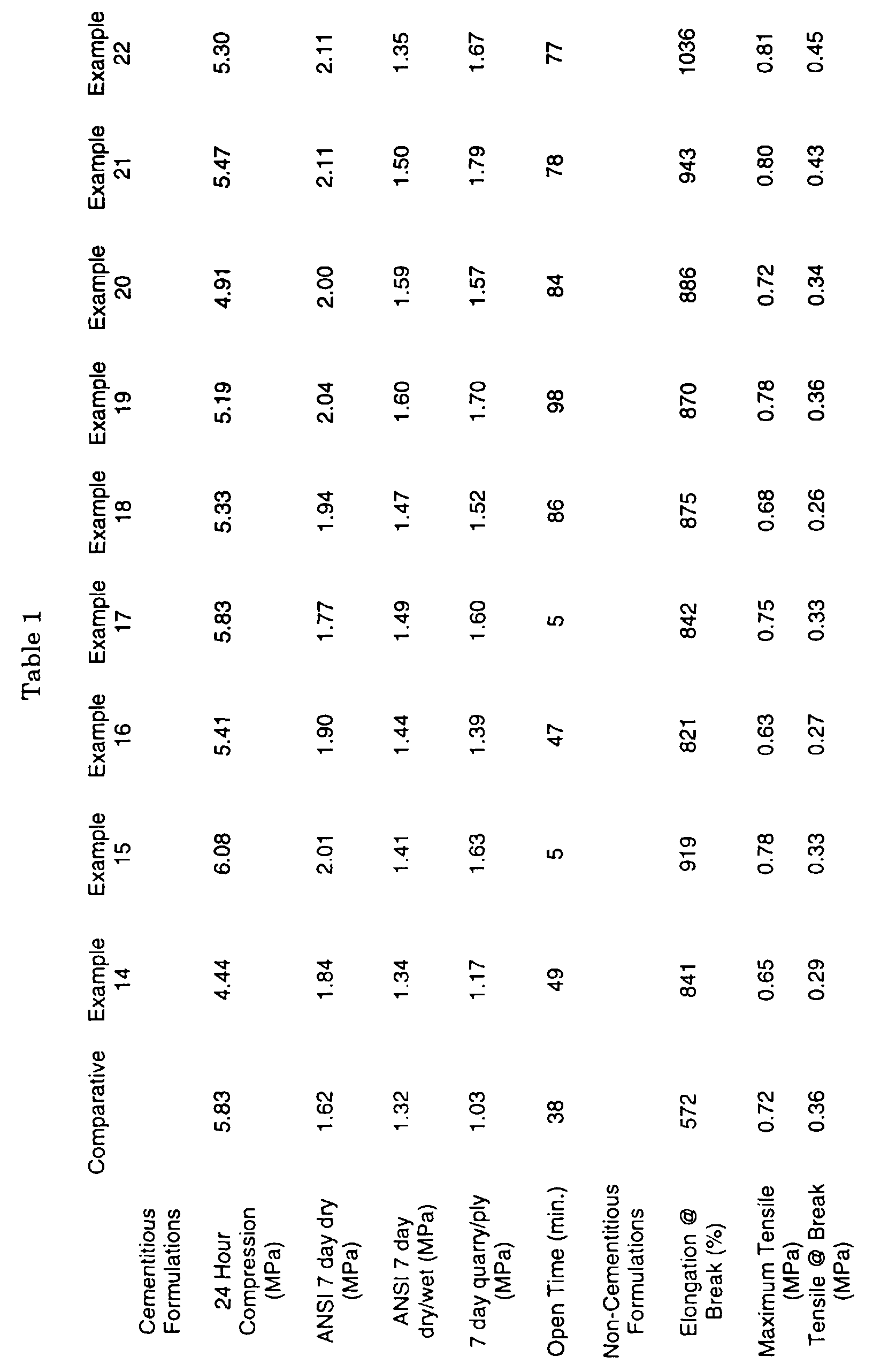
- Example 18 to 22 each of which comprises the polymer compositions of the present invention Example 5 to 9
- Example 5 to 9 demonstrate a significantly improved open time when compared to the cementitious grout formulations based on the comparative and the other copolymers of Examples 1 to 4. This is achieved without significantly affecting the other properties expected of the cementitious grout.
- Table 1 it is shown in Table 1 that other cementitious and non-cementitious formulations based on the polymer compositions of the present invention demonstrate a good balance of performance characteristics enabling a broad application base for said polymers.
Landscapes
- Chemical & Material Sciences (AREA)
- Engineering & Computer Science (AREA)
- Ceramic Engineering (AREA)
- Chemical Kinetics & Catalysis (AREA)
- Organic Chemistry (AREA)
- Structural Engineering (AREA)
- Materials Engineering (AREA)
- Inorganic Chemistry (AREA)
- Health & Medical Sciences (AREA)
- Medicinal Chemistry (AREA)
- Polymers & Plastics (AREA)
- Addition Polymer Or Copolymer, Post-Treatments, Or Chemical Modifications (AREA)
- Paints Or Removers (AREA)
- Curing Cements, Concrete, And Artificial Stone (AREA)
- Compositions Of Macromolecular Compounds (AREA)
Abstract
Description
wherein the total quantity of b) and c) constitutes from 2 to 7.5%, preferably 2 to 6%, more preferably 2 to 5%, by weight of said monomer mixture, and
which method comprises incorporating into said monomer mixture prior to it's polymerisation:
wherein the total quantity of c) and d) constitutes from 2 to 7.5%, preferably 2 to 6%, more preferably 2 to 5%, by weight of said monomer mixture.
wherein the total quantity of b) and c) constitutes from 2 to 7.5%, preferably 2 to 6%, more preferably 2 to 5%, by weight of said monomer mixture, and d) 0 or up to 1% by weight of said monomer mixture of at least one polymerizable compound comprising acid groups.
- 200 g
- 60 mesh sand (local sand)
- 100 g
- Portland Cement Type I (gray)
- 20 g
- Emulsion polymer (dry weight basis)
- 43 g
- Water
- 0.2g
- Nopco NXZ defoamer available from Henkel Corp
- 750 g
- ASTM C-109 Sand
- 300 g
- Portland Cement Type I (gray)
- 30 g
- Emulsion Polymer (dry weight basis)
- 145.5 g
- Water
- 0.3 g
- Nopco NXZ defoamer
- 180 g
- 60 mesh sand
- 120 g
- Portland Cement Type I (gray)
- 1.2g
- Cellulosic Thickener
- 24 g
- Emulsion Polymer (dry basis)
- 60 g
- Water
- 0.24g
- Nopco NXZ
- 180 g
- 60 mesh sand
- 120 g
- Portland Cement Type I (gray)
- 1.2 g
- Cellulosic Thickener
- 60 g
- Emulsion Polymer (dry basis)
- 60 g
- Water
- 0.35g
- Nopco NXZ
Claims (9)
- A polymer composition comprising a film-forming copolymer formed by polymerisation of a monomer mixture comprising:a) at least one monomer selected from the group of monomers consisting of (C1 to C18) alkyl (meth)acrylates, (C5 to C10) cyclo-alkyl (meth)acrylates, styrene, substituted styrene, acrylonitrile, butadiene, isoprene, isobutylene, ethylene, propylene, and vinyl acetate and other vinyl esters of (C1-C12) carboxylic acids,b) 1 to 3% by weight of said mixture of at least one monomer selected from the group of monomers consisting of amides of α,β-unsaturated C3 to C6 carboxylic acids and N-vinyl lactams,c) at least 1% by weight of said mixture of at least one hydroxy-(C1 to C8)alkyl (meth)acrylate,
wherein the total quantity of b) and c) constitutes from 2 to 7.5% by weight of said monomer mixture, andd) 0 or up to 1% by weight of said monomer mixture of at least one polymerizable compound comprising acid groups - A composition as claimed in claim 1, wherein said monomer mixture comprises up to 98% by weight of monomers a)
- A composition as claimed in claim 1, wherein said monomer mixture comprises a) at least one monomer selected from the group of monomers consisting of butyl acrylate, n-octyl acrylate, 2-ethyl hexyl acrylate, n-decyl acrylate, lauryl acrylate, stearyl acrylate, iso-bornyl acrylate, methyl methacrylate, ethyl methacrylate, butyl methacrylate, isobutyl methacrylate, 2-ethyl hexyl methacrylate, n-decyl methacrylate, lauryl methacrylate, stearyl methacrylate, iso-bornyl methacrylate, dibutyl maleate, monobutyl maleate, phosphoethyl methacrylate, sulphoethyl methacrylate, styrene, (C1-C4)alkyl-substituted styrenes, acrylonitrile, methacrylonitrile, and vinyl acetate and other vinyl esters of (C1-C12) carboxylic acids.
- A composition as claimed in claim 3, wherein said monomer mixture comprises a) up to 98% by weight of said mixture of at least one monomer selected from the group of monomers consisting of butyl acrylate, 2-ethylhexyl acrylate, methyl methacrylate, and styrene, and 0 or upto 3.5% by weight of said mixture acrylonitrile.
- A composition as claimed in claim 1, wherein said monomer mixture comprises b) 1 to 3% by weight of said mixture of at least one monomer selected from the group consisting of (meth)acrylamide, N-methylol (meth)acrylamide, and N-vinyl pyrrolidone.
- A composition as claimed in claim 1, wherein said monomer mixture comprises c) 1 to 3% by weight of said mixture of at least one monomer selected from the group consisting of 2-hydroxyethyl (meth)acrylate and 2-hydroxypropyl (meth)acrylate.
- A composition as claimed in claim 1, wherein said monomer mixture comprises d) 0.1 to 0.5% by weight of said mixture of at least one monomer selected from the group consisting of (meth)acrylic acid.
- A method for increasing the open time of an aqueous cementitious composition comprising a polymer composition comprising a film-forming copolymer formed by polymerisation of a monomer mixture comprising:a) at least one monomer selected from the group of monomers consisting of (C1 to C18) alkyl (meth)acrylates, (C5 to C10) cyclo-alkyl (meth)acrylates, styrene, substituted styrene, acrylonitrile, butadiene, isoprene, isobutylene, ethylene, propylene, and vinyl acetate and other vinyl esters of (C1-C12) carboxylic acids,b) 0 or up to 1% by weight of said monomer mixture of at least one polymerizable compound comprising acid groups,
which method comprises incorporating into said monomer mixture prior to it's polymerisation:c) 1 to 3% by weight of said mixture of at least one monomer selected from the group of monomers consisting of amides of α,β-unsaturated C3 to C6 carboxylic acids and N-vinyl lactams; andd) at least 1% by weight of said mixture of at least one hydroxy-(C1 to C8)alkyl (meth)acrylate,
wherein the total quantity of c) and d) constitutes from 2 to 7.5% by weight of said monomer mixture. - Use of a polymer composition as claimed in claim 1 to increase the open time of a cementitious composition.
Applications Claiming Priority (2)
| Application Number | Priority Date | Filing Date | Title |
|---|---|---|---|
| US13142499P | 1999-04-28 | 1999-04-28 | |
| US131424P | 1999-04-28 |
Publications (4)
| Publication Number | Publication Date |
|---|---|
| EP1048676A2 true EP1048676A2 (en) | 2000-11-02 |
| EP1048676A3 EP1048676A3 (en) | 2000-12-06 |
| EP1048676B1 EP1048676B1 (en) | 2005-06-29 |
| EP1048676B2 EP1048676B2 (en) | 2009-07-22 |
Family
ID=22449409
Family Applications (1)
| Application Number | Title | Priority Date | Filing Date |
|---|---|---|---|
| EP00303225A Expired - Lifetime EP1048676B2 (en) | 1999-04-28 | 2000-04-17 | Polymer compositions |
Country Status (10)
| Country | Link |
|---|---|
| US (1) | US6423805B1 (en) |
| EP (1) | EP1048676B2 (en) |
| JP (1) | JP2000344837A (en) |
| AR (1) | AR024860A1 (en) |
| AT (1) | ATE298769T1 (en) |
| AU (1) | AU772893B2 (en) |
| BR (1) | BR0002138A (en) |
| CA (1) | CA2306020C (en) |
| DE (1) | DE60021018T3 (en) |
| ZA (1) | ZA200001591B (en) |
Cited By (11)
| Publication number | Priority date | Publication date | Assignee | Title |
|---|---|---|---|---|
| EP1182235A1 (en) * | 2000-08-24 | 2002-02-27 | Rohm And Haas Company | Exterior finishing composition, grout, and trowel paste |
| EP1182179A3 (en) * | 2000-08-21 | 2003-11-12 | Basf Aktiengesellschaft | Use of ammonia-free polymer dispersions as an additive for building materials based on hydraulic binders |
| US7402623B1 (en) | 2004-10-06 | 2008-07-22 | Chemmasters Inc. | Composition and process for treating concrete |
| CN101885800A (en) * | 2010-07-17 | 2010-11-17 | 天津市化学试剂研究所 | Method for preparing acrylic ester macromolecule photopolymer emulsion |
| US8962714B2 (en) | 2011-06-30 | 2015-02-24 | Dow Global Technologies Llc | Hydraulic setting adhesive with improved open time |
| US9206082B2 (en) | 2011-06-29 | 2015-12-08 | Dow Global Technologies Llc | Hydrophobic cementitious composition |
| WO2017083078A1 (en) * | 2015-11-10 | 2017-05-18 | Dow Global Technologies Llc | Emulsion polymer two-component compositions for fast curing, flexible cementitious waterproofing membranes |
| CN109311754A (en) * | 2016-06-21 | 2019-02-05 | 竹本油脂株式会社 | Concrete composition and concrete cured product |
| CN109476786A (en) * | 2016-08-05 | 2019-03-15 | 东丽株式会社 | Copolymers and separation membranes, medical devices and blood purifiers using the same |
| WO2019205121A1 (en) * | 2018-04-28 | 2019-10-31 | Dow Global Technologies Llc | Polymer-modified cementitious composition |
| EP4385964A1 (en) * | 2022-12-15 | 2024-06-19 | Sika Technology AG | Cementitious hybrid primer composition |
Families Citing this family (21)
| Publication number | Priority date | Publication date | Assignee | Title |
|---|---|---|---|---|
| US7572852B1 (en) * | 2002-02-19 | 2009-08-11 | Ware Don H | Concrete crack filler composition and method |
| US6927267B1 (en) * | 2002-03-07 | 2005-08-09 | Basf Ag | High solids dispersion for wide temperature, pressure sensitive adhesive applications |
| DE10229733A1 (en) * | 2002-07-02 | 2004-01-22 | Basf Ag | Pressure sensitive adhesives for carriers made of soft PVC |
| EP1426428A1 (en) * | 2002-12-06 | 2004-06-09 | Ucb S.A. | Aqueous polymer dispersions as pressure sensitive adhesives |
| EP1464656A1 (en) * | 2003-04-04 | 2004-10-06 | Ucb S.A. | Emulsifier composition |
| US7169462B1 (en) | 2004-03-01 | 2007-01-30 | Laticrete International, Inc. | Waterproofing membrane |
| US8362135B2 (en) * | 2005-08-02 | 2013-01-29 | Rory E. Brennan | Compositions and methods for adhesion |
| JP5287555B2 (en) * | 2009-07-03 | 2013-09-11 | 東亞合成株式会社 | Emulsion composition |
| EP2605972A4 (en) * | 2010-08-16 | 2014-09-17 | Dryvit Systems Inc | Non-cementitious dry finish compositions comprising a combination of film forming polymers |
| US8334346B2 (en) * | 2011-01-16 | 2012-12-18 | Quentin Lewis Hibben | Low temperature curable adhesive compositions |
| TWI537355B (en) * | 2011-05-13 | 2016-06-11 | 羅門哈斯公司 | Water-borne adhesives |
| WO2013086722A1 (en) | 2011-12-15 | 2013-06-20 | Dow Global Technologies Llc | Dry mix formulations containing carboxylated styrene-butadiene redispersible polymer powders and alumina rich containing cements |
| US9169382B2 (en) | 2012-03-09 | 2015-10-27 | Dow Global Technologies Llc | Carboxyl group containing acrylic RDP and dry mix cement formulations containing them |
| US10053597B2 (en) | 2013-01-18 | 2018-08-21 | Basf Se | Acrylic dispersion-based coating compositions |
| CN105658602B (en) * | 2013-10-30 | 2019-04-05 | Dic株式会社 | concrete repair material |
| KR101428984B1 (en) * | 2014-02-14 | 2014-08-13 | 대로이엔씨(주) | Early strength cement concrete composite with improved strength and durability, and repairing method of concrete structures using the composite |
| US9988307B2 (en) | 2014-06-25 | 2018-06-05 | Rohm And Haas Company | Emulsion polymer two-component compositions for fast curing cementitious waterproofing membranes |
| CN109401746B (en) * | 2018-10-23 | 2021-05-14 | 中国石油化工股份有限公司 | Emulsion self-dispersion phase permeation regulator and preparation method thereof |
| CN109705260A (en) * | 2019-01-16 | 2019-05-03 | 肖连发 | A kind of acrylic acid synthetic resin base-material lotion, preparation method and applications |
| JP2023507478A (en) * | 2019-12-20 | 2023-02-22 | ベーアーエスエフ・エスエー | High solids emulsion polymer stabilized with seed resin |
| EP4393970A1 (en) | 2022-12-28 | 2024-07-03 | Arkema France | Composition comprising an aqueous polymer dispersion and a hydraulic binder |
Family Cites Families (12)
| Publication number | Priority date | Publication date | Assignee | Title |
|---|---|---|---|---|
| US3345203A (en) * | 1964-01-30 | 1967-10-03 | Rohm & Haas | Finished tannin-containing substrates |
| US3937680A (en) * | 1973-05-29 | 1976-02-10 | Global Vision, Inc. | Hydrophilic gel terpolymers from hydrophilic n-vinyl monomers, hydroxyalkyl acrylates or methacrylates and polymerizable unsaturated carboxylic acids |
| CS173846B1 (en) * | 1974-04-23 | 1977-03-31 | ||
| US4145511A (en) * | 1977-09-01 | 1979-03-20 | The B. F. Goodrich Company | Hydroxyl-containing liquid polymers and pressure-sensitive adhesives and laminates prepared therefrom |
| JPS63266101A (en) † | 1987-04-23 | 1988-11-02 | Mazda Motor Corp | Side housing for rotary piston engine |
| JPH07110775B2 (en) * | 1987-06-30 | 1995-11-29 | 昭和電工株式会社 | Elastic mortar composition |
| JP2640765B2 (en) † | 1988-10-13 | 1997-08-13 | 三菱化学ビーエーエスエフ株式会社 | Method for producing polymer cement mortar composition and cured product thereof |
| US5326644A (en) * | 1993-02-05 | 1994-07-05 | Avery Dennison Corporation | Repulpable pressure-sensitive adhesive compositions |
| FR2703061B1 (en) * | 1993-03-24 | 1995-06-30 | Cray Valley Sa | Latex for solvent-free paints with improved leachability. |
| DE4316379A1 (en) † | 1993-05-17 | 1994-11-24 | Basf Ag | Low-odor dispersion pressure sensitive adhesive |
| DE4405621A1 (en) * | 1994-02-22 | 1995-08-24 | Basf Ag | Process for the preparation of copolymers of vinyl esters and monoethylenically unsaturated carboxylic acids and their use |
| DE19621574A1 (en) | 1996-05-29 | 1997-12-04 | Basf Ag | Binder for low-emission coating materials |
-
2000
- 2000-03-29 ZA ZA200001591A patent/ZA200001591B/en unknown
- 2000-04-14 AU AU27776/00A patent/AU772893B2/en not_active Ceased
- 2000-04-17 DE DE60021018T patent/DE60021018T3/en not_active Expired - Lifetime
- 2000-04-17 US US09/550,658 patent/US6423805B1/en not_active Expired - Lifetime
- 2000-04-17 AT AT00303225T patent/ATE298769T1/en not_active IP Right Cessation
- 2000-04-17 EP EP00303225A patent/EP1048676B2/en not_active Expired - Lifetime
- 2000-04-18 CA CA002306020A patent/CA2306020C/en not_active Expired - Fee Related
- 2000-04-19 AR ARP000101873A patent/AR024860A1/en unknown
- 2000-04-27 BR BR0002138-5A patent/BR0002138A/en not_active IP Right Cessation
- 2000-04-28 JP JP2000129051A patent/JP2000344837A/en active Pending
Cited By (18)
| Publication number | Priority date | Publication date | Assignee | Title |
|---|---|---|---|---|
| EP1182179A3 (en) * | 2000-08-21 | 2003-11-12 | Basf Aktiengesellschaft | Use of ammonia-free polymer dispersions as an additive for building materials based on hydraulic binders |
| EP1182235A1 (en) * | 2000-08-24 | 2002-02-27 | Rohm And Haas Company | Exterior finishing composition, grout, and trowel paste |
| US6630533B2 (en) | 2000-08-24 | 2003-10-07 | Rohm And Haas Company | Exterior finishing composition |
| US7402623B1 (en) | 2004-10-06 | 2008-07-22 | Chemmasters Inc. | Composition and process for treating concrete |
| CN101885800A (en) * | 2010-07-17 | 2010-11-17 | 天津市化学试剂研究所 | Method for preparing acrylic ester macromolecule photopolymer emulsion |
| CN101885800B (en) * | 2010-07-17 | 2012-11-28 | 天津市化学试剂研究所 | Method for preparing acrylic ester macromolecule photopolymer emulsion |
| US9206082B2 (en) | 2011-06-29 | 2015-12-08 | Dow Global Technologies Llc | Hydrophobic cementitious composition |
| US8962714B2 (en) | 2011-06-30 | 2015-02-24 | Dow Global Technologies Llc | Hydraulic setting adhesive with improved open time |
| WO2017083078A1 (en) * | 2015-11-10 | 2017-05-18 | Dow Global Technologies Llc | Emulsion polymer two-component compositions for fast curing, flexible cementitious waterproofing membranes |
| CN108473374A (en) * | 2015-11-10 | 2018-08-31 | 陶氏环球技术有限责任公司 | For quick-setting emulsion polymer two-component composition, flexible cement matter waterproof membrane |
| CN108473374B (en) * | 2015-11-10 | 2021-04-27 | 陶氏环球技术有限责任公司 | A two-component composition for preparing waterproof membrane |
| CN109311754A (en) * | 2016-06-21 | 2019-02-05 | 竹本油脂株式会社 | Concrete composition and concrete cured product |
| CN109311754B (en) * | 2016-06-21 | 2021-07-16 | 竹本油脂株式会社 | Concrete composition and concrete cured product |
| CN109476786A (en) * | 2016-08-05 | 2019-03-15 | 东丽株式会社 | Copolymers and separation membranes, medical devices and blood purifiers using the same |
| WO2019205121A1 (en) * | 2018-04-28 | 2019-10-31 | Dow Global Technologies Llc | Polymer-modified cementitious composition |
| EP4385964A1 (en) * | 2022-12-15 | 2024-06-19 | Sika Technology AG | Cementitious hybrid primer composition |
| WO2024125859A1 (en) * | 2022-12-15 | 2024-06-20 | Sika Technology Ag | Cementitious hybrid primer composition |
| MA71354A1 (en) * | 2022-12-15 | 2025-12-31 | Sika Technology Ag | CEMENTITIOUS HYBRID PRIMER COMPOSITION |
Also Published As
| Publication number | Publication date |
|---|---|
| DE60021018D1 (en) | 2005-08-04 |
| DE60021018T2 (en) | 2006-05-18 |
| AU772893B2 (en) | 2004-05-13 |
| CA2306020C (en) | 2004-09-21 |
| EP1048676B2 (en) | 2009-07-22 |
| AR024860A1 (en) | 2002-10-30 |
| ATE298769T1 (en) | 2005-07-15 |
| EP1048676A3 (en) | 2000-12-06 |
| EP1048676B1 (en) | 2005-06-29 |
| AU2777600A (en) | 2000-11-02 |
| CA2306020A1 (en) | 2000-10-28 |
| BR0002138A (en) | 2000-10-31 |
| ZA200001591B (en) | 2000-10-25 |
| DE60021018T3 (en) | 2010-01-07 |
| US6423805B1 (en) | 2002-07-23 |
| JP2000344837A (en) | 2000-12-12 |
Similar Documents
| Publication | Publication Date | Title |
|---|---|---|
| EP1048676B1 (en) | Polymer compositions | |
| AU2007240340B2 (en) | Elastomeric emulsion polymers for masonry coatings | |
| US8461247B2 (en) | Dispersion compositions for tile adhesives | |
| JP2017521519A (en) | Dispersion of (meth) acrylate copolymer containing hydroxyalkyl (meth) acrylate functional monomer units for flexible cement waterproofing | |
| JP2003155303A (en) | Polymer composition | |
| JPS6372781A (en) | Mastic and coking composition and composite article | |
| EP0256144B1 (en) | Alkaline curing emulsions for use in cement admixtures | |
| CN108473374A (en) | For quick-setting emulsion polymer two-component composition, flexible cement matter waterproof membrane | |
| US6573326B2 (en) | Thickeners based on vinyl alcohol copolymers | |
| JP2004262748A (en) | Polymer cement composition for waterproofing | |
| JP4449586B2 (en) | Polymer cement composition | |
| HK1001063B (en) | Aqueous composition | |
| US6472024B1 (en) | Process of coating a mineral molding with an aqueous preparation comprising, as film-forming constituent, at least one polymer P | |
| CN104693654A (en) | Non-cementitious organic render formulation with improved workability | |
| JP2886662B2 (en) | Polymer cement mortar composition | |
| JP2020001962A (en) | Polymer cement composition, hardened matter, and concrete structure | |
| MXPA00004073A (en) | Polymer compositions | |
| US4507454A (en) | Acrylic polymers solutions for use in forming a membrane for curing concrete and the like | |
| JPS63156048A (en) | Resin composition for admixing water dispersion type cement | |
| US20250276937A1 (en) | Dispersion of (meth)acrylate copolymer and use thereof as a binder for cementitious materials | |
| JPH04114943A (en) | Polymer cement composition | |
| JPH0761888B2 (en) | Cement composition | |
| JPS6329900B2 (en) | ||
| JPH028986B2 (en) | ||
| JP2003192412A (en) | Lime-based plaster modifier and composition |
Legal Events
| Date | Code | Title | Description |
|---|---|---|---|
| PUAI | Public reference made under article 153(3) epc to a published international application that has entered the european phase |
Free format text: ORIGINAL CODE: 0009012 |
|
| PUAL | Search report despatched |
Free format text: ORIGINAL CODE: 0009013 |
|
| 17P | Request for examination filed |
Effective date: 20000511 |
|
| AK | Designated contracting states |
Kind code of ref document: A2 Designated state(s): AT BE CH CY DE DK ES FI FR GB GR IE IT LI LU MC NL PT SE |
|
| AX | Request for extension of the european patent |
Free format text: AL;LT;LV;MK;RO;SI |
|
| RIN1 | Information on inventor provided before grant (corrected) |
Inventor name: MORGAN, MEREDITH ANN Inventor name: MCCOLL, FERGUS STUART Inventor name: PFAHLER, LORI BRANHAM Inventor name: HINZ, FREDERICK PAUL Inventor name: BACHO, ANNE MARGARET Inventor name: KESSELMAYER, MARK ALAN Inventor name: KOZISKI, KATHLEEN ANNE, APT 304 |
|
| AK | Designated contracting states |
Kind code of ref document: A3 Designated state(s): AT BE CH CY DE DK ES FI FR GB GR IE IT LI LU MC NL PT SE |
|
| AX | Request for extension of the european patent |
Free format text: AL;LT;LV;MK;RO;SI |
|
| AKX | Designation fees paid |
Free format text: AT BE CH CY DE DK ES FI FR GB GR IE IT LI LU MC NL PT SE |
|
| 17Q | First examination report despatched |
Effective date: 20030702 |
|
| GRAP | Despatch of communication of intention to grant a patent |
Free format text: ORIGINAL CODE: EPIDOSNIGR1 |
|
| GRAS | Grant fee paid |
Free format text: ORIGINAL CODE: EPIDOSNIGR3 |
|
| GRAA | (expected) grant |
Free format text: ORIGINAL CODE: 0009210 |
|
| AK | Designated contracting states |
Kind code of ref document: B1 Designated state(s): AT BE CH CY DE DK ES FI FR GB GR IE IT LI LU MC NL PT SE |
|
| PG25 | Lapsed in a contracting state [announced via postgrant information from national office to epo] |
Ref country code: NL Free format text: LAPSE BECAUSE OF FAILURE TO SUBMIT A TRANSLATION OF THE DESCRIPTION OR TO PAY THE FEE WITHIN THE PRESCRIBED TIME-LIMIT Effective date: 20050629 Ref country code: FI Free format text: LAPSE BECAUSE OF FAILURE TO SUBMIT A TRANSLATION OF THE DESCRIPTION OR TO PAY THE FEE WITHIN THE PRESCRIBED TIME-LIMIT Effective date: 20050629 Ref country code: BE Free format text: LAPSE BECAUSE OF FAILURE TO SUBMIT A TRANSLATION OF THE DESCRIPTION OR TO PAY THE FEE WITHIN THE PRESCRIBED TIME-LIMIT Effective date: 20050629 Ref country code: CH Free format text: LAPSE BECAUSE OF FAILURE TO SUBMIT A TRANSLATION OF THE DESCRIPTION OR TO PAY THE FEE WITHIN THE PRESCRIBED TIME-LIMIT Effective date: 20050629 Ref country code: LI Free format text: LAPSE BECAUSE OF FAILURE TO SUBMIT A TRANSLATION OF THE DESCRIPTION OR TO PAY THE FEE WITHIN THE PRESCRIBED TIME-LIMIT Effective date: 20050629 Ref country code: AT Free format text: LAPSE BECAUSE OF FAILURE TO SUBMIT A TRANSLATION OF THE DESCRIPTION OR TO PAY THE FEE WITHIN THE PRESCRIBED TIME-LIMIT Effective date: 20050629 |
|
| REG | Reference to a national code |
Ref country code: GB Ref legal event code: FG4D |
|
| REG | Reference to a national code |
Ref country code: CH Ref legal event code: EP |
|
| REF | Corresponds to: |
Ref document number: 60021018 Country of ref document: DE Date of ref document: 20050804 Kind code of ref document: P |
|
| REG | Reference to a national code |
Ref country code: IE Ref legal event code: FG4D |
|
| PG25 | Lapsed in a contracting state [announced via postgrant information from national office to epo] |
Ref country code: GR Free format text: LAPSE BECAUSE OF FAILURE TO SUBMIT A TRANSLATION OF THE DESCRIPTION OR TO PAY THE FEE WITHIN THE PRESCRIBED TIME-LIMIT Effective date: 20050929 Ref country code: SE Free format text: LAPSE BECAUSE OF FAILURE TO SUBMIT A TRANSLATION OF THE DESCRIPTION OR TO PAY THE FEE WITHIN THE PRESCRIBED TIME-LIMIT Effective date: 20050929 Ref country code: DK Free format text: LAPSE BECAUSE OF FAILURE TO SUBMIT A TRANSLATION OF THE DESCRIPTION OR TO PAY THE FEE WITHIN THE PRESCRIBED TIME-LIMIT Effective date: 20050929 |
|
| PG25 | Lapsed in a contracting state [announced via postgrant information from national office to epo] |
Ref country code: ES Free format text: LAPSE BECAUSE OF FAILURE TO SUBMIT A TRANSLATION OF THE DESCRIPTION OR TO PAY THE FEE WITHIN THE PRESCRIBED TIME-LIMIT Effective date: 20051010 |
|
| NLV1 | Nl: lapsed or annulled due to failure to fulfill the requirements of art. 29p and 29m of the patents act | ||
| PG25 | Lapsed in a contracting state [announced via postgrant information from national office to epo] |
Ref country code: PT Free format text: LAPSE BECAUSE OF FAILURE TO SUBMIT A TRANSLATION OF THE DESCRIPTION OR TO PAY THE FEE WITHIN THE PRESCRIBED TIME-LIMIT Effective date: 20051207 |
|
| REG | Reference to a national code |
Ref country code: CH Ref legal event code: PL |
|
| PLBI | Opposition filed |
Free format text: ORIGINAL CODE: 0009260 |
|
| ET | Fr: translation filed | ||
| PLAX | Notice of opposition and request to file observation + time limit sent |
Free format text: ORIGINAL CODE: EPIDOSNOBS2 |
|
| 26 | Opposition filed |
Opponent name: BASF AKTIENGESELLSCHAFT GLOBAL INTELLECTUAL PROPER Effective date: 20060324 |
|
| PLAF | Information modified related to communication of a notice of opposition and request to file observations + time limit |
Free format text: ORIGINAL CODE: EPIDOSCOBS2 |
|
| PLBB | Reply of patent proprietor to notice(s) of opposition received |
Free format text: ORIGINAL CODE: EPIDOSNOBS3 |
|
| PLAB | Opposition data, opponent's data or that of the opponent's representative modified |
Free format text: ORIGINAL CODE: 0009299OPPO |
|
| PG25 | Lapsed in a contracting state [announced via postgrant information from national office to epo] |
Ref country code: CY Free format text: LAPSE BECAUSE OF FAILURE TO SUBMIT A TRANSLATION OF THE DESCRIPTION OR TO PAY THE FEE WITHIN THE PRESCRIBED TIME-LIMIT Effective date: 20050629 |
|
| PUAH | Patent maintained in amended form |
Free format text: ORIGINAL CODE: 0009272 |
|
| STAA | Information on the status of an ep patent application or granted ep patent |
Free format text: STATUS: PATENT MAINTAINED AS AMENDED |
|
| 27A | Patent maintained in amended form |
Effective date: 20090722 |
|
| AK | Designated contracting states |
Kind code of ref document: B2 Designated state(s): AT BE CH CY DE DK ES FI FR GB GR IE IT LI LU MC NL PT SE |
|
| PGFP | Annual fee paid to national office [announced via postgrant information from national office to epo] |
Ref country code: MC Payment date: 20090401 Year of fee payment: 10 Ref country code: IE Payment date: 20090427 Year of fee payment: 10 |
|
| REG | Reference to a national code |
Ref country code: ES Ref legal event code: FD2A Effective date: 20060418 |
|
| PGFP | Annual fee paid to national office [announced via postgrant information from national office to epo] |
Ref country code: LU Payment date: 20090505 Year of fee payment: 10 |
|
| PG25 | Lapsed in a contracting state [announced via postgrant information from national office to epo] |
Ref country code: MC Free format text: LAPSE BECAUSE OF NON-PAYMENT OF DUE FEES Effective date: 20100430 |
|
| PG25 | Lapsed in a contracting state [announced via postgrant information from national office to epo] |
Ref country code: IE Free format text: LAPSE BECAUSE OF NON-PAYMENT OF DUE FEES Effective date: 20100419 |
|
| PG25 | Lapsed in a contracting state [announced via postgrant information from national office to epo] |
Ref country code: LU Free format text: LAPSE BECAUSE OF NON-PAYMENT OF DUE FEES Effective date: 20100417 |
|
| REG | Reference to a national code |
Ref country code: FR Ref legal event code: PLFP Year of fee payment: 17 |
|
| REG | Reference to a national code |
Ref country code: FR Ref legal event code: PLFP Year of fee payment: 18 |
|
| REG | Reference to a national code |
Ref country code: FR Ref legal event code: PLFP Year of fee payment: 19 |
|
| PGFP | Annual fee paid to national office [announced via postgrant information from national office to epo] |
Ref country code: FR Payment date: 20190313 Year of fee payment: 20 |
|
| PGFP | Annual fee paid to national office [announced via postgrant information from national office to epo] |
Ref country code: DE Payment date: 20190402 Year of fee payment: 20 Ref country code: IT Payment date: 20190419 Year of fee payment: 20 |
|
| PGFP | Annual fee paid to national office [announced via postgrant information from national office to epo] |
Ref country code: GB Payment date: 20190417 Year of fee payment: 20 |
|
| REG | Reference to a national code |
Ref country code: DE Ref legal event code: R071 Ref document number: 60021018 Country of ref document: DE |
|
| REG | Reference to a national code |
Ref country code: GB Ref legal event code: PE20 Expiry date: 20200416 |
|
| PG25 | Lapsed in a contracting state [announced via postgrant information from national office to epo] |
Ref country code: GB Free format text: LAPSE BECAUSE OF EXPIRATION OF PROTECTION Effective date: 20200416 |