EP1047064A2 - Waveform equalizing apparatus, method of optimizing waveform equalizing apparatus and data reproducing apparatus - Google Patents
Waveform equalizing apparatus, method of optimizing waveform equalizing apparatus and data reproducing apparatus Download PDFInfo
- Publication number
- EP1047064A2 EP1047064A2 EP00303250A EP00303250A EP1047064A2 EP 1047064 A2 EP1047064 A2 EP 1047064A2 EP 00303250 A EP00303250 A EP 00303250A EP 00303250 A EP00303250 A EP 00303250A EP 1047064 A2 EP1047064 A2 EP 1047064A2
- Authority
- EP
- European Patent Office
- Prior art keywords
- waveform
- optimizing
- equalizer
- partial response
- equalizing
- Prior art date
- Legal status (The legal status is an assumption and is not a legal conclusion. Google has not performed a legal analysis and makes no representation as to the accuracy of the status listed.)
- Ceased
Links
Images


Classifications
-
- G—PHYSICS
- G11—INFORMATION STORAGE
- G11B—INFORMATION STORAGE BASED ON RELATIVE MOVEMENT BETWEEN RECORD CARRIER AND TRANSDUCER
- G11B20/00—Signal processing not specific to the method of recording or reproducing; Circuits therefor
- G11B20/10—Digital recording or reproducing
- G11B20/10009—Improvement or modification of read or write signals
- G11B20/10046—Improvement or modification of read or write signals filtering or equalising, e.g. setting the tap weights of an FIR filter
- G11B20/10055—Improvement or modification of read or write signals filtering or equalising, e.g. setting the tap weights of an FIR filter using partial response filtering when writing the signal to the medium or reading it therefrom
- G11B20/10175—PR4, PR(1,0,-1), i.e. partial response class 4, polynomial (1+D)(1-D)=(1-D2)
-
- G—PHYSICS
- G11—INFORMATION STORAGE
- G11B—INFORMATION STORAGE BASED ON RELATIVE MOVEMENT BETWEEN RECORD CARRIER AND TRANSDUCER
- G11B20/00—Signal processing not specific to the method of recording or reproducing; Circuits therefor
- G11B20/10—Digital recording or reproducing
- G11B20/10009—Improvement or modification of read or write signals
-
- G—PHYSICS
- G11—INFORMATION STORAGE
- G11B—INFORMATION STORAGE BASED ON RELATIVE MOVEMENT BETWEEN RECORD CARRIER AND TRANSDUCER
- G11B20/00—Signal processing not specific to the method of recording or reproducing; Circuits therefor
- G11B20/10—Digital recording or reproducing
- G11B20/10009—Improvement or modification of read or write signals
- G11B20/10046—Improvement or modification of read or write signals filtering or equalising, e.g. setting the tap weights of an FIR filter
- G11B20/10212—Improvement or modification of read or write signals filtering or equalising, e.g. setting the tap weights of an FIR filter compensation for data shift, e.g. pulse-crowding effects
-
- H—ELECTRICITY
- H04—ELECTRIC COMMUNICATION TECHNIQUE
- H04L—TRANSMISSION OF DIGITAL INFORMATION, e.g. TELEGRAPHIC COMMUNICATION
- H04L25/00—Baseband systems
- H04L25/02—Details ; arrangements for supplying electrical power along data transmission lines
- H04L25/03—Shaping networks in transmitter or receiver, e.g. adaptive shaping networks
- H04L25/03878—Line equalisers; line build-out devices
Definitions
- the present invention relates to waveform equalizing apparatus, methods of optimizing waveform equalizing apparatus and data reproducing apparatus.
- binary data comprising 0 and 1 is expressed in a square form.
- data is reproduced by using a rise pulse and a fall pulse of a square wave by differentiating a signal read from a magnetic head.
- the rise and the fall pulse waves are accompanied by waveform rounding.
- a recording density is promoted, an interval between the pulse waves becomes narrow by that amount and the pulse waveforms interere with each other to thereby make difficult reproduction of data.
- so-to-speak PRML Partial Response Maximum Likelihood
- PRML Partial Response Maximum Likelihood
- the partial response system provides equalization, that is, operation of neatly arranging a waveform of a reproduced signal.
- the Viterbi decoding system is provided with maximum likelihood, that is, operation of reproducing data string which is mostly probable in view of the probability.
- the partial response is provided with a plurality of classes indicating equalization reference of PR4 (Partial Response Class 4) and PR1 (Partial Response Class 1) .
- PR4 is provided with an equalized frequency characteristic of (1-D) (1+D) and is expressed in an equivalent block diagram as shown by Fig. 6A.
- PR1 is provided with an equalized frequency characteristic of (1+D) and is expressed in an equivalent block diagram as shown by Fig. 6B.
- D shown in Figs.
- PR4 equalizer It is general to constitute a PR4 equalizer by using a 7 pole 2 null equiripple filter. This is derived from that the equiripple filter is provided with a flat phase characteristic and setting of parameters is comparatively easy.
- PR4 equalizer for example, there is a description in "A 27 MHz Programmable Bipolar 0.05; Equiripple Linear-Phase Lowpass Filter” by Greet A. De Veirman et al, (1992 IEEE International Solid-State Circuits Conference).
- PR1 equalization can arrange a waveform by reducing a degree of exalting a frequency component and is suitable for a magnetic disk having a high linear density, that is, high record density. Since PR1 executes a low frequency region emphasizing type equalization, conventionally, a PR1 equalizer is often constituted by combining an integral equalizer with a filter for emphasizing a high frequency region as well as attenuating a component at a vicinity of a Nyquist frequency, a filter for correcting group delay or the like.
- the PR1 equalizer is constituted by a combination of such many filters, it is not easy to flatten a phase at a high frequency region and accordingly, it is difficult to promote the equalization characteristic. Further, although a degree of freedom is enhanced by an amount of increasing parameters, on the other hand, it is very difficult to set optimum parameters.
- the PR1 equalizer is constituted by a combination of a highpass filter and a 6-th order lowpass filter.
- an amount of calculation for setting parameters of a circuit is expanded exponentially in accordance with an order degree provided to the circuit and it is very difficult to calculate an optimum solution of such an high order PR1 equalizer.
- a circuit for constituting the equalizer becomes large-scaled in accordance with the order degree and power consumption is increased by that amount.
- the present invention has been carried out in consideration of the above-described problem and a first aspect thereof is a waveform equalizing apparatus for equalizing an input waveform to an equalization reference of Partial Response Class 1, wherein a phase variation at a high frequency region is prevented by executing emphasis of the high frequency region and steep attenuation at a vicinity of a Nyquist frequency by using a phase flat filter.
- Embodiments of the present invention relate to a technology of reproducing data which is digitally recorded or digitally transmitted, particularly to a data reproducing system using PRML (Partial Response Maximum Likelihood) for executing partial response equalization suitable for a characteristic of a transmission path.
- PRML Partial Response Maximum Likelihood
- embodiments of the present invention relate to an apparatus and a method of equalizing a waveform for reducing an equalization distortion by equalizing the waveform in a desired frequency characteristic, particularly to an apparatus and a method of equalizing a waveform for executing equalization by using a PR1 (Partial Response Class 1) of a low frequency region emphasizing type to thereby realize accurate data detection.
- PR1 Partial Response Class 1
- Embodiments of the present invention can provide an excellent or at least improved data reproducing system using PRML (Partial Response Maximum Likelihood) for executing partial response equalization suitable for a characteristic of a transmission path.
- PRML Partial Response Maximum Likelihood
- Embodiments of the present invention can also provide an excellent or at least improved waveform equalizing apparatus and method for enabling accurate data detection by reducing equalization distortion by equalizing a waveform to a desired frequency characteristic.
- Embodiments of the present invention can also provide an excellent or at least improved waveform equalizing apparatus and method for executing equalization by using PR1 (Partial Response Class 1) of a low frequency region emphasizing type.
- PR1 Partial Response Class 1
- Embodiments of the present invention can also provide an excellent or at least improved waveform equalizing apparatus and method for reducing a circuit scale and realizing a PR1 equalizer by reducing power consumption.
- phase flattening filter which is one of constituent elements of the waveform equalizing apparatus
- a second aspect of the present invention is a phase equalizing apparatus which equalizes an input. waveform to an equalization reference of Partial Response Class 1 by a combination of an integrator for emphasizing a low frequency region and an equalizer for equalizing to an equalization reference of Partial Response Class 4.
- the waveform equalizing apparatus satisfying the PR1 equalization reference is constituted by the combination of the integrator for emphasizing the low frequency region and the filter constituted for PR4.
- a third aspect of the present invention is a method of optimizing a waveform equalizing apparatus having an equalization reference of Partial Response Class 1 constituted by a combination of an integrator for emphasizing a low frequency region and an equalizer for equalizing to an equalization reference of Partial Response Class 4, which individually optimizes respective parameters of the integrator and the equalizer, and a waveform equalizing apparatus optimized by the optimizing method.
- the conventional Partial Response Class 1 (PR1) equalizing apparatus is constituted by a combination of many filters and therefore, a number of parameters to be set is large and optimization is difficult. Further, flattening of high frequency phase is not easy and it is difficult to promote equalization characteristic.
- PR1 equalizing apparatus by facilitating flattening of the high frequency phase by using the PR4 equalizer and individually optimizing the respective parameters of the integrator and the equalizer, calculation load for setting the parameters can be alleviated.
- a fourth aspect of the present invention is a method of optimizing a waveform equalizing apparatus having an equalization reference of Partial Response Class 1 constituted by a combination of an integrator for emphasizing a low frequency region and an equalizer for equalizing to an equalization reference of Partial Response Class 4, comprising:
- a total of the waveform equalizing apparatus is optimized in accordance with a procedure of firstly optimizing the parameter provided to the PR4 equalizer and successively optimizing the parameter provided to the integrator and accordingly, the calculation load for setting the parameters can be alleviated.
- the waveform equalizing apparatus is constituted by five parameters of a cutoff frequency of the low frequency region removing filter, gain and a cutoff frequency of the integrator and a boost amount and a cutoff frequency of the equiripple equalizer for PR4.
- the equalizing apparatus having a desired characteristic can be provided by a comparatively small calculation amount.
- a fifth aspect of the present invention is a method of optimizing a waveform equalizing apparatus having an equalization reference of Partial Response Class 1 constituted by a combination of an integrator for emphasizing a low frequency region and an equalizer for equalizing to an equalization reference of Partial Response Class 4, comprising:
- the parameter provided to the PR equalizer is optimized, successively, the parameter provided to the integrator is optimized and thereafter, the parameter provided to the PR4 equalizer is further optimized.
- higher equalization characteristic can be realized.
- a sixth aspect of the present invention is a orogram providing medium which is a program providing medium for materially providing a computer program operated on a computer system, comprising:
- the sixth aspect of the present invention is the program providing medium for materially providing the computer program for realizing the method of optimizing a waveform equalizing apparatus according to the fourth aspect to the computer system. That is, there is defined a cooperative relationship between the computer program and the provided medium in view of structure or in view of function, in other words, by introducing the computer program to the computer system, the cooperative relationship is achieved on the computer system and operation and effect similar to that in the fourth aspect of the present invention can be achieved.
- a seventh aspect of the present invention is a program providing medium which is a program providing medium for materially providing a computer program operated on a computer system, comprising:
- the seventh aspect of the present invention is the program providing medium materially providing the computer program for realizing the method of optimizing the waveform equalizing apparatus according to the fifth aspect to the computer system. That is, there is defined a cooperative relationship between the computer program and the provided medium in view of structure or in view of function and by introducing the computer program to the computer system, operation and effect similar to that in the fifth aspect of the present invention can be achieved.
- an eighth aspect of the present invention is a data reproducing apparatus constituted by inputting means for inputting a waveform data to be reproduced, waveform equalizing means for equalizing an input waveform to an equalization reference of Partial Response Class 1 and data detecting means for detecting data from an equalized waveform, wherein:
- the eighth aspect of the present invention is the data reproducing apparatus constituted by using the waveform equalizing apparatus according to the first aspect and higher equalization characteristic is realized.
- a ninth aspect of the present invention is a data reproducing apparatus constituted by inputting means for inputting a waveform data to be reproduced, waveform equalizing means for equalizing an input waveform to an equalization reference of Partial Response Class 1 and data detecting means for detecting data from an equalized waveform, wherein:
- the ninth aspect of the present invention is the data reproducing apparatus constituted by using the waveform equalizing apparatus according to the second aspect and higher equalization characteristic is realized.
- Fig. 1 schematically shows a hardware constitution of a digital magnetic disk recording/reproducing apparatus as an embodiment to which the present invention is applied.
- the recording/reproducing apparatus 100 is constituted by a magnetic disk 10, a magnetic head 11, an amplifier 12, a PR1 analog equalizer 13, a sampler 14, PLL 15, FIR 16 and a data detecting unit 17.
- a magnetic disk 10 a magnetic disk 10
- a magnetic head 11 a magnetic head 11
- an amplifier 12 a PR1 analog equalizer 13
- sampler 14 PLL
- FIR 16 FIR 16
- data detecting unit 17 a data detecting unit
- Data is magnetically recorded on the magnetic disk 10 in a bit string style.
- the magnetic head 11 reads data from above the magnetic disk 10 and inputs the data to the amplifier 12 as a reproduced signal in an analog waveform shape.
- the amplifier 12 amplifies the analog signal and supplies the analog signal to the equalizer 13.
- the equalizer 13 carries out equalization of PR1 (Partial Response Class 1).
- PR1 Partial Response Class 1
- the equalizer 13 is constituted as a steep high frequency cut filter for satisfying the Nyquist second reference by emphasizing a low frequency component of the waveform reproduced by the magnetic head 11 and emphasizing a high frequency region component to a certain degree. Incidentally, a description will be given later of the details of the equalizer 13.
- PLL Phase Lock Loop
- FIR 16 carries out further equalization in order to promote a data detecting function.
- the equalizing processing at FIR 16 does not constitute the gist of the present invention.
- the data detector 17 outputs bit string data by detecting the recorded bit string.
- One example of the data detector 17 is a Viterbi detector.
- the equalizer 13 is constituted as the steep high frequency region cutoff filter for satisfying the Nyquist second reference by emphasizing the low frequency region component of the waveform reproduced by the magnetic head 11 and emphasizing the high frequency region component to a certain degree (as mentioned above) .
- the phase characteristic is as flat as possible, the group delay is disturbed and the equalization characteristic of the waveform is deteriorated.
- the equalizer 13 of the embodiment the low frequency phase is influenced since the low frequency region component is emphasized by using a first order analog integrator, the low frequency region emphasizing component restrains disturbance of the group delay at the high frequency region by a phase flat filter.
- the equalizer 13 carries out equalization satisfying the PR1 equalization reference and is featured mainly in being constituted by utilizing the PR4 equalizer.
- Fig. 2 schematically shows the constitution of the PR1 analog equalizer 13 according to the embodiment. As shown by the drawing, the equalizer 13 is constituted by connecting in series a first order highpass filter 21, a first order lowpass filter 22 and a PR4 equalizer 23. An explanation will be given of respective portions as follows.
- the first order highpass filter 21 carries out low frequency removal in the reproduced waveform and restrains a low frequency component which is not outputted from the magnetic head 11 from being emphasized unnecessarily in the successive processing.
- the first order lowpass filter 22 is provided with operation of restraining a high frequency emphasizing amount in an equalized component outputted from the successive PR4 equalizer 23 by emphasizing a low frequency region component which needs PR1 equalization and is constituted by an integrator for emphasizing a low frequency region.
- the PR4 equalizer 23 is a circuit for realizing equalization of a so-to-speak class 4 and is constituted by a 7 pole 2 null equiripple filter according to the embodiment.
- the transfer function of the 7 pole 2 null equiripple PR4 analog equalizer 23 is shown by following Equation 1 in Laplace-transformed expression.
- the cutoff frequency of the first order highpass filter 21 for removing the low frequency region is suitable to be about one thirty-second of the Nyquist frequency in consideration of application to PR1. Therefore, the gain is set to 1.0.
- the calculation load of the processing of optimizing the parameter provided to the first order lowpass filter 22 constituted by the integrator when the parameter of the PR4 equalizer 23 which has once being optimized is fixed. That is, when only two parameters of gain and cutoff frequency of the integrator 22 are searched, the frequency characteristic with regard to a total of the PR1 equalizer 13 can be optimized to be proximate to the desired frequency characteristic of PR1.
- the optimized parameter of the integrator 22 may be fixed and two parameters of the cutoff frequency and K may be searched again with regard to the PR4 equalizer 23.
- phase characteristic and amplitude characteristic are made to conform to ideal equalization characteristics by using three degree polynomial interpolation.
- dipulse response is expressed by Lorenz function shown by following Equation 2 and a value provided by dividing a half value width a by a frequency Ts of the channel clock is set to an index of a density and is defined as NLD (Normalized Linear Density).
- Equation 3 F'( ⁇ ) designates an object amplitude function and F( ⁇ ) designates an amplitude function of an analog equalizer to be optimized. That is, Equation 3 signifies to conform to an ideal characteristic to a certain degree.
- Fig. 4 shows a group delay characteristic of the optimized PR1 equalizing apparatus. As shown by the drawing, it can be understood that although the group delay at the low frequency region is disturbed, a flat characteristic is provided at a high frequency region.
- Fig. 5 shows a simulation result of SDNR (Signal and Distortion to Noise Ratio) in the case of optimizing the total of the waveform equalizing apparatus 13 in accordance with a procedure of firstly optimizing the parameter provided to the PR4 equalizer 23 and successively optimizing the parameter provided to the integrator 22.
- the Lorenz waveform is superposed with white Gaussian noise of 25 dB.
- Fig. 5 shows charts of setting the cutoff frequency of the lowpass removing filter to one thirty-second and one sixty-fourth of the Nyquist frequency. Further, for reference, there is also shown a chart of a result of PR4 equalization of the optimized PR4 equalizer 23.
Landscapes
- Engineering & Computer Science (AREA)
- Signal Processing (AREA)
- Physics & Mathematics (AREA)
- Algebra (AREA)
- Pure & Applied Mathematics (AREA)
- Power Engineering (AREA)
- Computer Networks & Wireless Communication (AREA)
- Signal Processing For Digital Recording And Reproducing (AREA)
- Digital Magnetic Recording (AREA)
- Cable Transmission Systems, Equalization Of Radio And Reduction Of Echo (AREA)
- Dc Digital Transmission (AREA)
Abstract
Description
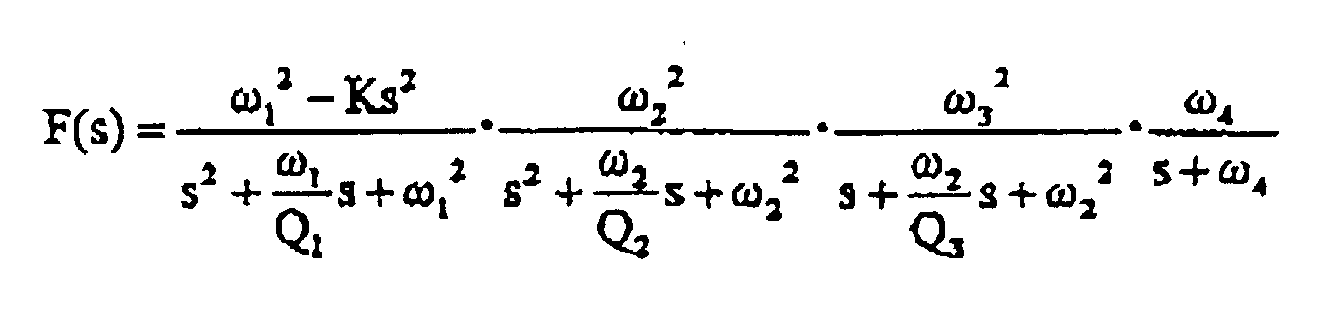
| ω1 | 1.14762 | Q1 | 0.6811 |
| ω2 | 1.71796 | Q2 | 1.11409 |
| ω3 | 2.31740 | Q3 | 2.02290 |
| ω4 | 0.86133 |


Claims (12)
- A waveform equalizing apparatus for equalizing an input waveform to an equalization reference of Partial Response Class 1, wherein a phase variation at a high frequency region is prevented by executing emphasis of the high frequency region and steep attenuation at a vicinity of a Nyquist frequency by using a phase flat filter.
- A phase equalizing apparatus which equalizes an input waveform to an equalization reference of Partial Response Class 1 by a combination of an integrator for emphasizing a low frequency region and an equalizer for equalizing to an equalization reference of Partial Response Class 4.
- A method of optimizing a waveform equalizing apparatus having an equalization reference of Partial Response Class 1 constituted by a combination of an integrator for emphasizing a low frequency region and an equalizer for equalizing to an equalization reference of Partial Response Class 4, which individually optimizes respective parameters of the integrator and the equalizer.
- A waveform equalizing apparatus which is optimized by the method of optimizing a waveform equalizing apparatus according to Claim 3.
- A method of optimizing a waveform equalizing apparatus having an equalization reference of Partial Response Class 1 constituted by a combination of an integrator for emphasizing a low frequency region and an equalizer for equalizing to an equalization reference of Partial Response Class 4, which comprises:a first step of optimizing a parameter provided to the equalizer to satisfy the equalization reference of Partial Response Class 4; anda second step of optimizing a parameter provided to the integrator by using the parameter optimized by the first step.
- A waveform equalizing apparatus which is optimized by the method of optimizing a waveform equalizing apparatus according to claim 5.
- A method of optimizing a waveform equalizing apparatus having an equalization reference of Partial Response class 1 constituted by a combination of an integrator for emphasizing a low frequency region and an equalizer for equalizing to an equalization reference of Partial Response Class 4, which comprises:a first step of optimizing a parameter provided to the equalizer to satisfy the equalization reference of Partial Response Class 4;a second step of optimizing a parameter provided to the integrator by using the parameter optimized by the first step; anda third step of further optimizing the parameter provided to the equalizer by using the parameter optimized by the second step.
- A waveform equalizing apparatus which is optimized by the method of optimizing a waveform equalizing apparatus according to Claim 7.
- A program providing medium which is a program providing medium for materially providing a computer program operated on a computer system, comprising:a first step of optimizing a parameter provided to the equalizer to satisfy the equalization reference of Partial Response Class 4; anda second step of optimizing a parameter provided to the integrator by using the parameter optimized by the first step;for optimizing a waveform equalizing apparatus having an equalization reference of Partial Response Class 1 constituted by a combination of an integrator for emphasizing a low frequency region and an equalizer for equalizing to an equalization reference of Partial Response Class 4.
- A program providing medium which is a program providing medium for materially providing a computer program operated on a computer system, comprising:a first step of optimizing a parameter provided to the equalizer to satisfy the equalization reference of Partial Response Class 4;a second step of optimizing a parameter provided to the integrator by using the parameter optimized by the first step; anda third step of further optimizing the parameter provided to the equalizer by using the parameter optimized by the second step;for optimizing a waveform equalizing apparatus having an equalization reference of Partial Response Class 1 constituted by a combination of an integrator for emphasizing a low frequency region and an equalizer for equalizing to an equalization reference of Partial Response Class 4.
- A data reproducing apparatus constituted by inputting means for inputting a waveform data to be reproduced, waveform equalizing means for equalizing an input waveform to an equalization reference of Partial Response Class 1 and data detecting means for detecting data from an equalized waveform, wherein:the waveform equalizing means prevents a phase variation at a high frequency region by executing emphasis of the high frequency region and steep attenuation at a vicinity of a Nyquist frequency by using a phase flat filter.
- A data reproducing apparatus constituted by inputting means for inputting a waveform data to be reproduced, waveform equalizing means for equalizing an input waveform to an equalization reference of Partial Response Class 1 and data detecting means for detecting data from an equalized waveform, wherein:the waveform equalizing means is constituted by a combination of an integrator for emphasizing a low frequency region and an equalizer for equalizing to an equalization reference of Partial Response Class 4.
Applications Claiming Priority (2)
| Application Number | Priority Date | Filing Date | Title |
|---|---|---|---|
| JP11111222A JP2000306336A (en) | 1999-04-19 | 1999-04-19 | Waveform equalizer, method of optimizing waveform equalizer, and data reproducing apparatus |
| JP11122299 | 1999-04-19 |
Publications (2)
| Publication Number | Publication Date |
|---|---|
| EP1047064A2 true EP1047064A2 (en) | 2000-10-25 |
| EP1047064A3 EP1047064A3 (en) | 2005-12-07 |
Family
ID=14555643
Family Applications (1)
| Application Number | Title | Priority Date | Filing Date |
|---|---|---|---|
| EP00303250A Ceased EP1047064A3 (en) | 1999-04-19 | 2000-04-18 | Waveform equalizing apparatus, method of optimizing waveform equalizing apparatus and data reproducing apparatus |
Country Status (4)
| Country | Link |
|---|---|
| US (1) | US6788739B1 (en) |
| EP (1) | EP1047064A3 (en) |
| JP (1) | JP2000306336A (en) |
| KR (1) | KR100712378B1 (en) |
Families Citing this family (3)
| Publication number | Priority date | Publication date | Assignee | Title |
|---|---|---|---|---|
| US7126700B2 (en) * | 2003-12-12 | 2006-10-24 | Timbre Technologies, Inc. | Parametric optimization of optical metrology model |
| US8098054B2 (en) * | 2007-10-10 | 2012-01-17 | John Alexander Verschuur | Optimal load controller method and device |
| US8937990B2 (en) * | 2012-08-31 | 2015-01-20 | Fujitsu Limited | Low-frequency equalizer circuit for a high-speed broadband signal |
Family Cites Families (14)
| Publication number | Priority date | Publication date | Assignee | Title |
|---|---|---|---|---|
| US4694468A (en) * | 1986-04-25 | 1987-09-15 | Eastman Kodak Company | Apparatus useful in channel equalization adjustment |
| US5220466A (en) * | 1991-05-21 | 1993-06-15 | International Business Machines Corporation | Method and apparatus for digital filter control in a partial-response maximum-likelihood disk drive system |
| TW222029B (en) * | 1991-12-18 | 1994-04-01 | Philips Nv | |
| DE69321427T2 (en) * | 1992-08-06 | 1999-05-12 | Koninklijke Philips Electronics N.V., Eindhoven | Receiving arrangement for receiving a digital signal from a transmission medium with variable equalization means |
| US5550683A (en) * | 1992-12-11 | 1996-08-27 | Eastman Kodak Company | Magnetic recording channel employing a non-ideal d.c.-free equalizer and a d.c.-free modulation code |
| JP3298240B2 (en) * | 1993-06-29 | 2002-07-02 | 富士通株式会社 | Waveform equalizer |
| JPH07192398A (en) * | 1993-12-27 | 1995-07-28 | Sharp Corp | Playback waveform equalization circuit |
| DE69421071T2 (en) * | 1994-05-23 | 2000-04-20 | Stmicroelectronics S.R.L. | PRML device in parallel architecture for processing signals during a reading step by a magnetic head |
| US5774290A (en) * | 1994-08-09 | 1998-06-30 | Canon Kabushiki Kaisha | Reproducing apparatus for varying clock frequencies based upon azimuth angles of a plurality of heads |
| JPH08255435A (en) * | 1995-01-30 | 1996-10-01 | Hewlett Packard Co <Hp> | Signal processing system with partial response output characteristic |
| JP3129156B2 (en) * | 1995-07-04 | 2001-01-29 | 株式会社日立製作所 | Phase detection method and its implementation device |
| US5781699A (en) * | 1996-10-21 | 1998-07-14 | Maxtor Corporation | Method for optimization of channel parameters in a data storage device |
| KR100253735B1 (en) * | 1997-06-25 | 2000-06-01 | 전주범 | Synchronous partial response iv channel data detector in a digital vcr |
| US6563889B1 (en) * | 1998-10-01 | 2003-05-13 | Lsi Logic Corporation | Method and apparatus for adapting the boost of a read channel filter |
-
1999
- 1999-04-19 JP JP11111222A patent/JP2000306336A/en active Pending
-
2000
- 2000-04-18 US US09/552,484 patent/US6788739B1/en not_active Expired - Fee Related
- 2000-04-18 EP EP00303250A patent/EP1047064A3/en not_active Ceased
- 2000-04-18 KR KR1020000020362A patent/KR100712378B1/en not_active Expired - Fee Related
Also Published As
| Publication number | Publication date |
|---|---|
| JP2000306336A (en) | 2000-11-02 |
| KR100712378B1 (en) | 2007-05-02 |
| KR20000071724A (en) | 2000-11-25 |
| US6788739B1 (en) | 2004-09-07 |
| EP1047064A3 (en) | 2005-12-07 |
Similar Documents
| Publication | Publication Date | Title |
|---|---|---|
| JP2999759B1 (en) | Digital playback signal processor | |
| EP0750306B1 (en) | A method of maximum likelihood decoding and a digital information playback apparatus | |
| KR100453778B1 (en) | Digital reproduced signal processing device | |
| US6249398B1 (en) | Class of fixed partial response targets in a PRML sampled data detection channel | |
| JP2010531524A (en) | Feedforward DC regeneration method and circuit in perpendicular magnetic read channel | |
| US5606464A (en) | Cancellation of precursor intersymbol interference in magnetic recording channels | |
| JP2000228064A (en) | Decoding device of optical disk | |
| US6980385B2 (en) | Apparatus for information recording and reproducing | |
| JP3996601B2 (en) | Signal processing apparatus and signal processing method | |
| GB2344730A (en) | Adapting the boost of a read channel equaliser filter | |
| US6219387B1 (en) | Metric circuit and method for use in a viterbi detector | |
| US5163003A (en) | Apparatus and method for reading from and writing to a magnetic recording medium | |
| US6788739B1 (en) | Waveform equalizing apparatus, method of optimizing waveform equalizing apparatus and data reproducing apparatus | |
| WO2005071680A1 (en) | Signal processing device and signal processing method | |
| US7024447B2 (en) | Time continuous FIR filter to implement a hilbert transform and corresponding filtering method | |
| US5923708A (en) | Decoding circuit for a read signal from a magnetic recording and reading system using partial response | |
| US20040151104A1 (en) | Waveform equalizer for obtaining a corrected signal and apparatus for reproducing information | |
| JP2763454B2 (en) | Data detection device | |
| US20020146070A1 (en) | Fixed delay tree search/decision feedback equalizer using absolute value calculation and data restoring method using the same | |
| JP3006683B2 (en) | Reproduction signal waveform control device for MR head | |
| JP2001084702A (en) | Offset adjustment circuit and reading device using the same | |
| JP3087342B2 (en) | Adaptive filter | |
| JP2623638B2 (en) | Decryption device | |
| JPH06124405A (en) | Equalizer | |
| US8537883B1 (en) | Detector for low frequency offset distortion |
Legal Events
| Date | Code | Title | Description |
|---|---|---|---|
| PUAI | Public reference made under article 153(3) epc to a published international application that has entered the european phase |
Free format text: ORIGINAL CODE: 0009012 |
|
| AK | Designated contracting states |
Kind code of ref document: A2 Designated state(s): AT BE CH CY DE DK ES FI FR GB GR IE IT LI LU MC NL PT SE |
|
| AX | Request for extension of the european patent |
Free format text: AL;LT;LV;MK;RO;SI |
|
| PUAL | Search report despatched |
Free format text: ORIGINAL CODE: 0009013 |
|
| AK | Designated contracting states |
Kind code of ref document: A3 Designated state(s): AT BE CH CY DE DK ES FI FR GB GR IE IT LI LU MC NL PT SE |
|
| AX | Request for extension of the european patent |
Extension state: AL LT LV MK RO SI |
|
| 17P | Request for examination filed |
Effective date: 20060519 |
|
| AKX | Designation fees paid |
Designated state(s): DE FR GB |
|
| 17Q | First examination report despatched |
Effective date: 20080516 |
|
| STAA | Information on the status of an ep patent application or granted ep patent |
Free format text: STATUS: THE APPLICATION HAS BEEN REFUSED |
|
| 18R | Application refused |
Effective date: 20100504 |