EP1046712A2 - Method of resolving 2-oxobicyclo (3.1.0) hexane-6-carboxylic acid derivatives - Google Patents
Method of resolving 2-oxobicyclo (3.1.0) hexane-6-carboxylic acid derivatives Download PDFInfo
- Publication number
- EP1046712A2 EP1046712A2 EP00108383A EP00108383A EP1046712A2 EP 1046712 A2 EP1046712 A2 EP 1046712A2 EP 00108383 A EP00108383 A EP 00108383A EP 00108383 A EP00108383 A EP 00108383A EP 1046712 A2 EP1046712 A2 EP 1046712A2
- Authority
- EP
- European Patent Office
- Prior art keywords
- group
- hexane
- oxobicyclo
- nitro
- carboxylate
- Prior art date
- Legal status (The legal status is an assumption and is not a legal conclusion. Google has not performed a legal analysis and makes no representation as to the accuracy of the status listed.)
- Withdrawn
Links
Images


Classifications
-
- C—CHEMISTRY; METALLURGY
- C12—BIOCHEMISTRY; BEER; SPIRITS; WINE; VINEGAR; MICROBIOLOGY; ENZYMOLOGY; MUTATION OR GENETIC ENGINEERING
- C12P—FERMENTATION OR ENZYME-USING PROCESSES TO SYNTHESISE A DESIRED CHEMICAL COMPOUND OR COMPOSITION OR TO SEPARATE OPTICAL ISOMERS FROM A RACEMIC MIXTURE
- C12P7/00—Preparation of oxygen-containing organic compounds
- C12P7/40—Preparation of oxygen-containing organic compounds containing a carboxyl group including Peroxycarboxylic acids
-
- C—CHEMISTRY; METALLURGY
- C12—BIOCHEMISTRY; BEER; SPIRITS; WINE; VINEGAR; MICROBIOLOGY; ENZYMOLOGY; MUTATION OR GENETIC ENGINEERING
- C12N—MICROORGANISMS OR ENZYMES; COMPOSITIONS THEREOF; PROPAGATING, PRESERVING, OR MAINTAINING MICROORGANISMS; MUTATION OR GENETIC ENGINEERING; CULTURE MEDIA
- C12N9/00—Enzymes; Proenzymes; Compositions thereof; Processes for preparing, activating, inhibiting, separating or purifying enzymes
- C12N9/14—Hydrolases (3)
- C12N9/16—Hydrolases (3) acting on ester bonds (3.1)
- C12N9/18—Carboxylic ester hydrolases (3.1.1)
-
- C—CHEMISTRY; METALLURGY
- C12—BIOCHEMISTRY; BEER; SPIRITS; WINE; VINEGAR; MICROBIOLOGY; ENZYMOLOGY; MUTATION OR GENETIC ENGINEERING
- C12P—FERMENTATION OR ENZYME-USING PROCESSES TO SYNTHESISE A DESIRED CHEMICAL COMPOUND OR COMPOSITION OR TO SEPARATE OPTICAL ISOMERS FROM A RACEMIC MIXTURE
- C12P41/00—Processes using enzymes or microorganisms to separate optical isomers from a racemic mixture
- C12P41/003—Processes using enzymes or microorganisms to separate optical isomers from a racemic mixture by ester formation, lactone formation or the inverse reactions
- C12P41/005—Processes using enzymes or microorganisms to separate optical isomers from a racemic mixture by ester formation, lactone formation or the inverse reactions by esterification of carboxylic acid groups in the enantiomers or the inverse reaction
Definitions
- the present invention relates to a method of resolving 2-oxobicyclo [3.1.0] hexane-6-carboxylic ester into an optically active acid or ester derivative thereof.
- Optically 2-oxobicyclo[3.1.0]hexane-6-carboxylic acids and ester compounds thereof are useful intermediate compounds for pharmaceutical preparations etc.
- optically active 2-oxobicyclo[3.1.0]hexane-6-carboxylic acids As the method of preparing said optically active 2-oxobicyclo[3.1.0]hexane-6-carboxylic acids, a method of optical resolution and a method of derivatizing them from optically active substances have been known in the art.
- optical resolution for example a method of optical resolution of racemic (1SR, 5RS, 6SR)-2-oxobicyclo[3.1.0]hexane-6-carboxylic acids by using an optically active amine such as optically active phenylethylamine as an optically resolving agent has been known (JP-A 08-188561, WO 96/04900).
- the method of optical resolution requires a recycling step of recovering the optically resolving agent, thus increasing the number of steps, while the method of derivatizing them from optically active substances makes use of the optically active compound as the starting material, thus raising the cost of the starting material.
- An object of the invention is to provide a method of resolving 2-oxobicyclo[3.1.0]hexane-6-carboxylate into acid and ester derivatives thereof, without using any optically resolving agent, by selectively hydrolyzing an optional optical isomer of 2-oxobicyclo (3.1.0] hexane-6-carboxylates, thereby efficiently producing the desired compound with an enzyme.
- the present invention provides:
- the 2-oxobicyclo [3.1.0] hexane-6-carboxylate of formula (1) used as the starting material in the method of the present invention, are synthesized by various methods such as the method of James A. Monn et al. (Journal of Medicinal Chemistry, 1997, Vol. 40, No. 4, 528-537).
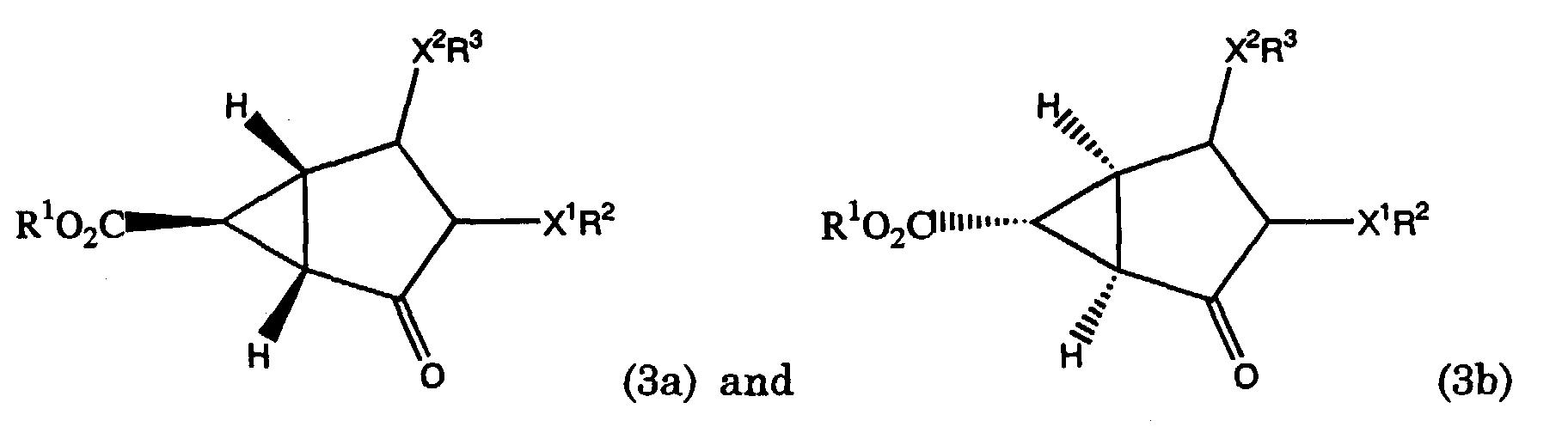
- the 2-oxobicyclo[3.1.0]hexane-6-carboxylates having the relative configuration of formula (1) include two enantiomer esters (3a) and (3b) having the following absolute configurations with respect to the asymmetric carbon atoms at the 1-, 5- and 6-positions: wherein X 1 , X 2 , R 1 , R 2 and R 3 have the same meanings as defined above.
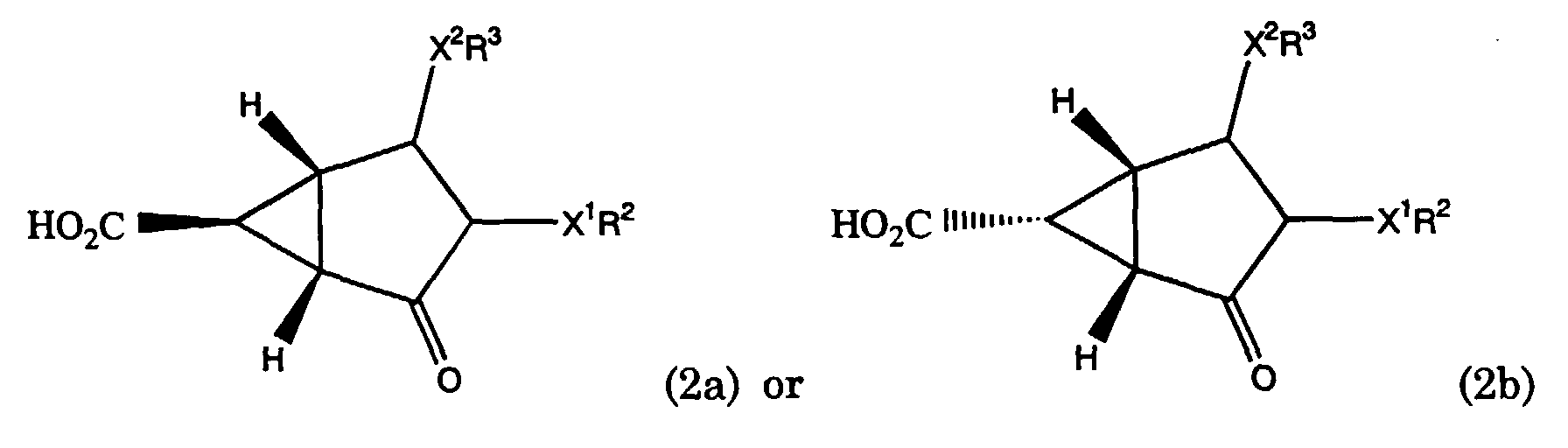
- one of the above-described enantiomers are selectively hydrolyzed to the corresponding enantiomer acid having an absolute configuration of formulae: wherein X 1 , X 2 , R 2 and R 3 have the same meanings as defined above, respectively, according to the enzyme employed.
- 2-oxobicyclo[3.1.0]hexane-6-carboxylate of formula (1'): wherein X 1 , X 2 , R 1 , R 2 and R 3 have the same meanings as defined above, which usually includes 4 optically active isomers based on the asymmetric carbon atoms at the 1-, 5- and 6-positions may be subjected to contacting with the present enzyme as described above for the compound of formula (1) above.
- the optical isomers include (3a), (3b), (4a) and (4b), the last two of which have the following formulae: wherein X 1 , X 2 , R 1 , R 2 and R 3 have the same meanings as defined above.
- Preferential hydrolysis with the present enzyme usually produces one acid of formula(2a) or (2b) and a diastereomeric mixture of esters of formulae (4a) , (4b) and one selected from the compound of formula (3a) or (3b).
- One compound of formula (3a) or (3b) that was not hydrolyzed can be separated readily by column chromatography or the like from the resulting diastereomeric mixture.
- the 2-oxobicyclo[3.1.0]hexane-6-carboxylates of formula (1) or (1'), which can be used in the method of the present invention, may be a mixture containing these optically active isomers in an equal amount respectively, or in a optional ratio.
- One of the optically active isomer may be contained in excess.
- C 1 to C 10 alkyl refers to a straight-chain, branched or cyclic alkyl chain containing 1 to 10 carbon atoms.
- specific examples of the straight-chain or branched C 1 to C 10 alkyl include
- the cyclic alkyl group includes e.g. monocyclic alkyl groups such as
- C 2 to C 10 alkenyl group refers to a straight-chain or branched unsaturated hydrocarbon chain containing 2 to 10 carbon atoms, having one or more carbon-carbon double bonds (diene, triene etc.). This group includes both E-isomer(s) and Z-isomer(s).
- Typical examples thereof include vinyl, allyl, allenyl, 1-butenyl, 2-butenyl, 2-methyl-1-propenyl, butadienyl, 1-pentenyl, 2-pentenyl, 2-methyl-2-butenyl, 4-pentenyl, 3-methyl-2-butenyl, 3-methyl-1,2-butadienyl, 3-hexenyl, 2-hexenyl, 4-methyl-3-pentenyl, 4-hexenyl, 5-hexenyl, 3-methyl-1-pentene-3-yl, 6-methyl-5-heptene-2-yl, 7-octenyl, 1-octene-3-yl, 3-nonenyl, 2,4-dimethyl-2,6-heptadienyl, 3,7-dimethyl-6-octenyl, 5-decenyl, 9-decenyl and 2,6-dimethyl-7-octenyl.
- Examples of the C 1 to C 4 alkoxy includes e.g. methoxy, ethoxy, n-propoxy, isopropyl, n-butoxy, sec-butoxy and t-butoxy.
- halogen atom means a fluorine, chlorine, bromine or iodine atom.
- aryl group examples include an (C 6 -C 12 ) aromatic group such as a phenyl, naphthyl and biphenyl group.
- Typical examples thereof include
- arylalkyl refers to a C 1 to C 4 alkyl group having one or more (C 6 -C 12 )aryl groups. Typical examples thereof include
- aromatic heterocyclic ring includes an aromatic 5- to 6-memberred ring containing 1 to 4 heteroatoms selected from oxygen, sulfur and nitrogen, and also a bicyclic ring composed of an aromatic 5- to 6-memberred ring containing 1 to 4 heteroatoms selected from oxygen, sulfur and nitrogen and either a benzene ring or an aromatic 5- to 6-memberred ring containing 1 to 4 heteroatoms selected from oxygen, sulfur and nitrogen.
- Typical examples thereof include furyl, thiophenyl, oxazolyl, isoxazolyl, thiazolyl, isothiazolyl, imidazolyl, pyrimidyl, benzofuryl, benzothiophenyl, benzimidazolyl, benzoxazolyl, benzothiazolyl and indolyl groups.
- non-aromatic heterocyclic ring includes a 4- to 7-memberred ring containing 1 or 2 heteroatoms selected from oxygen, sulfur and nitrogen.
- Typical examples thereof include an azetidine-1-yl or -2-yl group,
- non-aromatic hydrocarbon ring condensed with 1 or 2 aromatic hydrocarbon rings or aromatic heterocyclic rings includes a group wherein a C 3 to C 10 cyclic alkyl group has been condensed with a benzene ring or with an aromatic 5- to 6-memberred aromatic ring containing 1 to 4 heteroatoms selected from oxygen, sulfur and nitrogen.
- Typical examples thereof include an indanyl group
- non-aromatic heterocyclic ring being condensed with 1 or 2 aromatic hydrocarbon rings or aromatic heterocyclic rings includes a group wherein a non-aromatic 4- to 7-memberred cyclic group containing 1 or 2 heteroatoms selected from oxygen, sulfur and nitrogen has been condensed with a benzene ring or with an aromatic 5- to 6-memberred ring containing 1 to 4 heteroatoms selected from oxygen, sulfur and nitrogen.
- Typical examples thereof include
- the "thioalkyl” group include a thio(C 1 -C 8 )alkyl group.
- Examples of the C 1 to C 10 alkyl group which may be substituted with at least one group selected from a C 1 to C 8 alkoxy, halogen or nitro include a methyl group, ethyl group, n-propyl group, isopropyl group, n-butyl group, isobutyl group, sec-butyl group, t-butyl group, n-pentyl group, isopentyl group, neopentyl group, n-hexyl group, n-heptyl group, n-octyl group, cyclohexyl group and cycloheptyl group.
- arylalkyl group which aryl may be substituted with at least one group selected from a C 1 to C 8 alkyl, C 1 to C 8 alkoxy, halogen or nitro, for example, include
- aryl group which may be substituted with at least one group selected from a C 1 to C 8 alkyl, C 1 to C 8 alkoxy, halogen or nitro on the aromatic ring thereof, for example, include
- More preferable examples include a C 1 to C 4 alkyl group such as methyl group, ethyl group, propyl group, n-butyl group or isobutyl group.
- R 1 may have asymmetric carbon atom(s).
- X 1 and X 2 include a single bond, S, SO, SO 2 , NH and NHCO, among which a single bond is preferred.
- R 2 and R 3 examples include
- Examples of the C 1 to C 10 alkyl group which may be substituted with at least one group selected from a C 1 to C 8 alkoxy, hydroxy, halogen, amino, nitro, thiol or thioalkyl include a methyl group, ethyl group, n-propyl group, isopropyl group, n-butyl group, isobutyl group, sec-butyl group, t-butyl group, n-pentyl group, isopentyl group, neopentyl group, n-hexyl group, n-heptyl group, n-octyl group, cyclohexyl group and cycloheptyl group.
- Examples of the C 2 to C 10 alkenyl group which may be substituted with at least one group selected from a C 1 to C 8 alkoxy, hydroxy, halogen, amino, nitro, thiol or thioalkyl include, for example, an allyl group.
- Examples of the C 2 to C 10 alkynyl group which may be substituted with at least one group selected from a C 1 to C 8 alkoxy, hydroxy, halogen, amino, nitro, thiol or thioalkyl, for example, a propynyl group.
- aryl group which may be substituted with at least one group selected from a C 1 to C 8 alkyl, C 1 to C 8 alkoxy, hydroxy, halogen, amino, nitro, thiol, thioalkyl or phenyl on the aromatic ring thereof include, for example, 2-naphthyl group, phenyl group, 2-fluorophenyl group, 3-fluorophenyl group, 4-fluorophenyl group, 3,4-difluorophenyl group, pentafluorophenyl group, 2-chlorophenyl group, 3-chlorophenyl group, 4-chlorophenyl group, 3,4-dichlorophenyl group, 2,5-dichlorophenyl group, 2-bromophenyl group, 3-bromophenyl group, 4-bromophenyl group, 2-methylphenyl group, 3-methylphenyl group, 4-methylphenyl group, 2-methoxyphenyl group, 3-me
- arylalkyl group which may be substituted with at least one group selected from a C 1 to C 8 alkyl, C 1 to C 8 alkoxy, hydroxy, halogen, amino, nitro, thiol, thioalkyl or phenyl on the aromatic ring thereof include, for example, a benzyl group, 2-fluorobenzyl group, 3-fluorobenzyl group, 4-fluorobenzyl group, 2,3-difluorobenzyl group, 2,4-difluorobenzyl group, 2,5-difluorobenzyl group, 3,5-difluorobenzyl group, 3,4-difluorobenzyl group, 2,3,4-trifluorobenzyl group, 2-chlorobenzyl group, 3-chlorobenzyl group, 4-chlorobenzyl group, 2,3-dichlorobenzyl group, 3-chloro-4-fluorobenzyl group, 2-methylbenzyl group, 3-methyl
- Examples of the aromatic heterocyclic group which may be substituted with at least one group selected from a C 1 to C 8 alkyl, C 2 to C 8 alkenyl, C 2 to C 8 alkynyl, C 1 to C 8 alkoxy, hydroxy, halogen, amino, nitro, thiol or thioalkyl, include, for example, a 2-pyrimidyl group.
- non-aromatic heterocyclic group which may be substituted with at least one group selected from a C 1 to C 8 alkyl, C 2 to C 8 alkenyl, C 2 to C 8 alkynyl, C 1 to C 8 alkoxy, hydroxy, halogen, amino, nitro, thiol or thioalkyl, include, for example,
- non-aromatic hydrocarbon cyclic group condensed with 1 or 2 aromatic hydrocarbon rings or aromatic heterocyclic rings which may be substituted with at least one group selected from a C 1 to C 8 alkyl, C 2 to C 8 alkenyl, C 2 to C 8 alkynyl, C 1 to C 8 alkoxy, hydroxy, halogen, amino, nitro, thiol or thioalkyl, include, for example, an indanyl group and a 1,2,3,4-tetrahydronaphtho-1-yl group.
- non-aromatic heterocyclic group condensed with 1 or 2 aromatic hydrocarbon rings or aromatic heterocyclic rings which may be substituted with at least one group selected from a C 1 to C 8 alkyl, C 2 to C 8 alkenyl, C 2 to C 8 alkynyl, C 1 to C 8 alkoxy, hydroxy, halogen, amino, nitro, thiol or thioalkyl, include, for example, 2,3-dihydrobenzopyran-2-yl and xanthene-9-yl.
- R 2 and R 3 are a hydrogen atom, halogen atom, nitro group, methyl group or allyl group, and a hydrogen atom is more preferred
- Examples of the 2-oxobicyclo[3.1.0]hexane-6-carboxylates of formula (1) include e.g. methyl 2-oxobicyclo[3.1.0]hexane-6-carboxylate,
- the enzyme (referred to hereinafter as the present enzyme) having an ability to asymmetrically hydrolyze 2-oxobicyclo[3.1.0]hexane-6-carboxylate of formula (1) which can be used in the present invention may be either an enzyme derived from microorganisms or an enzyme from animals.
- Examples of the present enzyme derived from microorganisms includes e.g. a hydrolase derived from microorganisms such as the genus Achromobacter , Alcaligenes , Arthrobacter , Aspergillus , Bacillus , Burkholderia , Candida , Chromobacterium , Humicola , Mucor , Pseudomonas or Rhizomucor . Enzymes derived from Arthrobacter , Aspergillus , Bacillus , Burkholderia , Candida , Chromobacterium , Humicola and Pseudomonas are preferred. Enzyme from the genus Bacillus , Candida , Chromobacterium and Pseudomonas are particularly preferred.
- Examples of the present enzyme include
- examples of the present enzyme include
- the method of preparing a recombinant microorganism transformed by introducing a gene coding for the present enzyme into the microorganism includes usual genetic engineering techniques according to e.g. J. Sambrook, E. F. Fritsch, T. Maniatis: Molecular Cloning 2nd edition, Cold Spring Harbor Laboratory (1989). More specific examples include methods according to those described in JP-A 7-163364, JP-A 5-56787 or JP-A 10-210975.
- Specific examples of the present enzyme produced by recombinant microorganisms include an esterase derived from Arthrobacter SC-6-98-28 (FERM BP-3658) (JP-A 5-56787), an esterase derived from Chromobacterium SC-YM-1 (FERM BP-6703 transferred from FERM P-14009) (JP-A 7-163364) or a lipase derived from Burkholderia cepacia SC-20 (JP-A 10-210975).
- the method of preparing the mutant enzyme by genetic engineering techniques includes e.g. the method of Olfert Landt et al. (Gene, 96, 125-128, 1990). More specific examples include a method according to that described in JP-A 7-213280.
- mutant enzyme examples include a mutant esterase or lipase which is prepared from an esterase derived from Chromobacterium SC-YM-1, an esterase derived from Arthrobacter SC-6-98-28 (FERM BP-3658) or a lipase derived from Burkholderia cepacia .
- the medium used may be any kind of medium suitably containing a carbon source, a nitrogen source, inorganic materials used in usual culture of microorganisms.
- the carbon source includes glucose, glycerin, organic acids, molasses etc.
- the nitrogen source includes peptone, yeast extract, malt extract, soybean powder, corn steep liquor, cotton seed powder, dried yeast, casamino acid, ammonium chloride, ammonium nitrate, ammonium sulfate, urea etc.
- the inorganic materials include salts, sulfates and phosphates of potassium, sodium, magnesium, iron, manganese, cobalt, zinc etc., and specifically, it is possible to use potassium chloride, sodium chloride, magnesium sulfate, ferrous sulfate, manganese sulfate, cobalt chloride, zinc sulfate, potassium phosphate and sodium phosphate.
- triglyceride such as olive oil or tributyrin or 2-oxobicyclo[3.1.0]hexane-6-carboxylates of formula (1) may be added to the medium, if necessary, in order to raise the ability of the above-described microorganisms to asymmetrically hydrolyze 2-oxobicyclo[3.1.0]hexane-6-carboxylates of formula (1).
- Culture is conducted usually aerobically, and shake culture or aeration stirring culture is preferable.
- the culture temperature is usually about 20 to 40°C, preferably about 25 to 35°C, and the pH value is preferably about 6 to 8. Though varying depending on conditions, the culture time is preferably about 1 to 7 days.
- Purification of the present enzyme from a culture of the microorganism cultured in the manner described above may be conducted by a usual method used in purification of enzymes.
- the microorganism in the microbial culture is first disrupted by sonication or with a dynomill or a French press. From the resulting solution after disruption, insolubles are removed by e.g. centrifugation, and the desired enzyme can be purified from the supernatant by cation-exchange column chromatography, anion-exchange column chromatography, hydrophobic column chromatography or gel filtration column chromatography or by a suitable combination thereof.
- carriers used in these column chromatographic techniques include DEAE-Sepharose fastflow (Amersham Pharmacia Biotech) and Butyl-Toyopearl 650S (Tosoh Corporation).
- Examples of the present enzyme derived from animals includes an enzyme derived from porcine internal organs, bovine internal organs or sheep internal organs, more specifically a hydrolase derived from the porcine kidney or bovine pancreas.
- the present enzyme may be used in various forms such as purified enzyme, crude enzyme, microbial culture, microorganisms themselves and treated materials thereof.
- the treated materials refer to lyophilized microorgamsms, acetone-dried microorganisms, disrupted microorganisms, autolyzed microorganisms, sonicated microorganisms, extracts from the microorganisms and alkali-treated materials of microorganisms.
- the enzyme with various degrees of purity or in various forms described above may be immobilized by known techniques such as a method of adsorption onto inorganic carriers (silica gel, ceramics etc.), cellulose or ion-exchange resin, a polyacrylamide method, a sulfuric polysaccharide-gel method (e.g. carrageenan-gel method), an alginic acid-gel method and an agar-gel method.
- the enzyme may be suitably selected depending on the desired optically active 2-oxobicyclo[3.1.0]hexane-6-carboxylate of formula (3) or the desired optically active 2-oxobicyclo[3.1.0]hexane-6-carboxylic acids of formula (2).
- the amount of the enzyme is suitably set so as not to permit a delay in the reaction or a reduction in selectivity.
- the amount of the enzyme used is usually 0.001 to 2 parts by weight, preferably 0.002 to 0.5 part by weight per 1 part by weight of the 2-oxobicyclo[3.1.0]hexane-6-carboxylates of formula (1), and when the culture of the microorganisms, the microorganisms themselves or treated materials thereof are used, the amount of such materials is usually about 0.01 to 200 parts by weight, preferably about 0.1 to 50 parts by weight per 1 part by weight of the 2-oxobicyclo[3.1.0]hexane-6-carboxylates of formula (1).
- Water may be used in the asymmetric hydrolysis reaction and may be an aqueous buffer.
- the aqueous buffer includes e.g. aqueous buffers of inorganic salts such as aqueous alkali-metal phosphates, for example aqueous sodium phosphate and aqueous potassium phosphate, and aqueous buffers of organic acid salts such as alkali-metal acetates, for example aqueous sodium acetate and aqueous potassium acetate.
- the amount of water used in such buffers may be usually 0.5 mole or more (or usually not more than 200 parts by weight) per 1 mol of 2-oxobicyclo[3.1.0]hexane-6-carboxylates of formula (1), or may be used as a solvent.
- the asymmetrical hydrolysis reaction may be conducted in the presence of organic solvent such as hydrophobic organic solvent or hydrophilic organic solvent.
- organic solvent such as hydrophobic organic solvent or hydrophilic organic solvent.
- organic solvent is used preferably for improving the optical purity of the optically active 2-oxobicyclo[3.1.0]hexane-6-carboxylate of formula (3a) or (3b) and the optically active 2-oxobicyclo[3.1.0]hexane-6-carboxylic acids of formula (2a) or (2b).
- the hydrophobic organic solvent includes e.g. ethers such as t-butyl methyl ether, isopropyl ether and hydrocarbons such as toluene, hexane, cyclohexane, heptane, octane and isooctane, and the hydrophilic organic solvent includes e.g.
- hydrophobic or hydrophilic organic solvents are used alone or in combination thereof, and the hydrophobic organic solvent and the hydrophilic organic solvent may be used in combination.
- the weight of the solvent used is usually not more than 200 parts by weight, preferably about 0.1 to 100 parts by weight per 1 part by weight of 2-oxobicyclo[3.1.0]hexane-6-carboxylate of formula (1).
- the asymmetric hydrolysis reaction is conducted by a method in which e.g. water, 2-oxobicyclo[3.1.0]hexane-6-carboxylate of formula (1), and the present enzyme are mixed with one another, and when the organic solvent is used, the organic solvent, water, 2-oxobicyclo[3.1.0]hexane-6-carboxylate of formula (1) and the present enzyme may be mixed with one another.
- the pH value in the reaction system which is usually in the range of about pH 4 to 10, is selected suitably without particular limitation so that asymmetrical hydrolysis proceeds selectively with the present enzyme.
- the reaction temperature is usually in the range of about 5 to 65°C, preferably about 20 to 50°C, because a too high reaction temperature tends to lower the stability of the enzyme, while a too low temperature causes a reduction in the reaction rate.
- optically active 2-oxobicyclo[3.1.0]hexane-6-carboxylate of formula (1) are hydrolyzed selectively while maintaining the steric configuration around the asymmetric carbon atoms at 1-, 5- and 6-positions, to form the desired optically active 2-oxobicyclo[3.1.0]hexane-6-carboxylic acid of formula (2a) or (2b).
- reaction mixture after completion of the reaction is separated into aqueous and organic layers to give an aqueous solution of the optically active 2-oxobicyclo[3.1.0]hexane-6-carboxylic acid of formula (2a) or (2b).
- the hydrophobic organic solvent is used in the enzymatic hydrolysis, the resulting reaction mixture can be separated by phase separation as such. However, if no or little hydrophobic organic solvent is used in the hydrolysis reaction or when the amount of water used is not enough for the phase separation of the product, then the product may be separated after the hydrophobic organic solvent or water is added, if necessary.
- the hydrophobic organic solvent includes e.g. ethers such as t-butyl methyl ether and isopropyl ether, hydrocarbons such as toluene, hexane, cyclohexane, heptane, octane and isooctane, halogenated hydrocarbons such as dichloromethane, dichloroethane, chloroform, chlorobenzene and o-dichlorobenzene and esters such as ethyl acetate, methyl acetate and butyl acetate.
- ethers such as t-butyl methyl ether and isopropyl ether
- hydrocarbons such as toluene, hexane, cyclohexane, heptane, octane and isooctane
- halogenated hydrocarbons such as dichloromethane, dichloroethane, chloroform, chlorobenz
- the water may be distilled off from the resulting aqueous solution of the optically active 2-oxobicyclo[3.1.0]hexane-6-carboxylic acid of formula (2a) or (2b) whereby the desired optically active 2-oxobicyclo [3.1.0] hexane-6-carboxylic acids of formula (2a) or (2b) can be recovered.
- the product is extracted with a suitable organic solvent, and the organic solvent is distilled off whereby the product can also be recovered and separated.
- the obtained optically active 2-oxobicyclo[3.1.0]hexane-6-carboxylic acid of formula (2a) or (2b) may be further purified by e.g. recrystallization and/or column chromatography.
- optically active 2-oxobicyclo[3.1.0] hexane-6-carboxylic acid of formula (2) includes
- the other enantiomer ester that has not been hydrolyzed by the enzyme such as the 2-oxobicyclo[3.1.0]hexane-6-carboxylate of formula (3a) or (3b) is contained in an organic layer after phase separation, and this product can be easily recovered from the organic layer for example by distilling the solvent off.
- the resulting optically active 2-oxobicyclo[3.1.0]hexane-6-carboxylate of formula (3a) or (3b) may be further purified by recrystallization and/or column chromatography.
- optically active 2-oxobicyclo[3.1.0]hexane-6-carboxylate of formula (3) includes e.g.
- the optically active 2-oxobicyclo[3.1.0]hexane-6-carboxylic acids of formula (2a) or (2b) and the optically active 2-oxobicyclo[3.1.0]hexane-6-carboxylates of formula (3a) or (3b) can be resolved easily and efficiently by the present method.
- racemic ethyl (1SR, 5RS, 6SR)-2-oxobicyclo [3.1.0]hexane-6-carboxylate usually means a mixture containing an equal amount of ethyl (1S, 5R, 6S)-2-oxobicyclo[3.1.0]hexane-6-carboxylate and ethyl (1R, 5S, 6R)-2-oxobicyclo[3.1.0]hexane-6-carboxylate.
- each of the various commercial enzymes shown in Table 1 was added in an amount shown in Table 2 to 1 ml of 100 mM phosphate buffer (pH 7.0) and dissolved therein.
- 10 mg of racemic ethyl (1SR, 5RS, 6SR)-2-oxobicyclo [3.1.0] hexane-6-carboxylate was dissolved in 1 ml n-hexane, then added to the enzyme solution, and heated to 40°C and the mixture was stirred.
- a recombinant microorganism transformed by introducing a gene of the present enzyme derived from Chromobacterium SC-YM-1 was prepared according to a method described in JP-A 7-213280. That is, plasmids carrying an esterase gene derived from Chromobacterium SC-YM-1 (FERM BP-6703 transferred from FERM P-14009) and subjected to site-directed mutagenesis, that is, plasmids pCCA363term, pCCN43SA363term, pCC160S189Y363term and pCC160S189F363term, were constructed and introduced respectively into E. coli JM 109 whereby recombinant microorganisms were prepared.
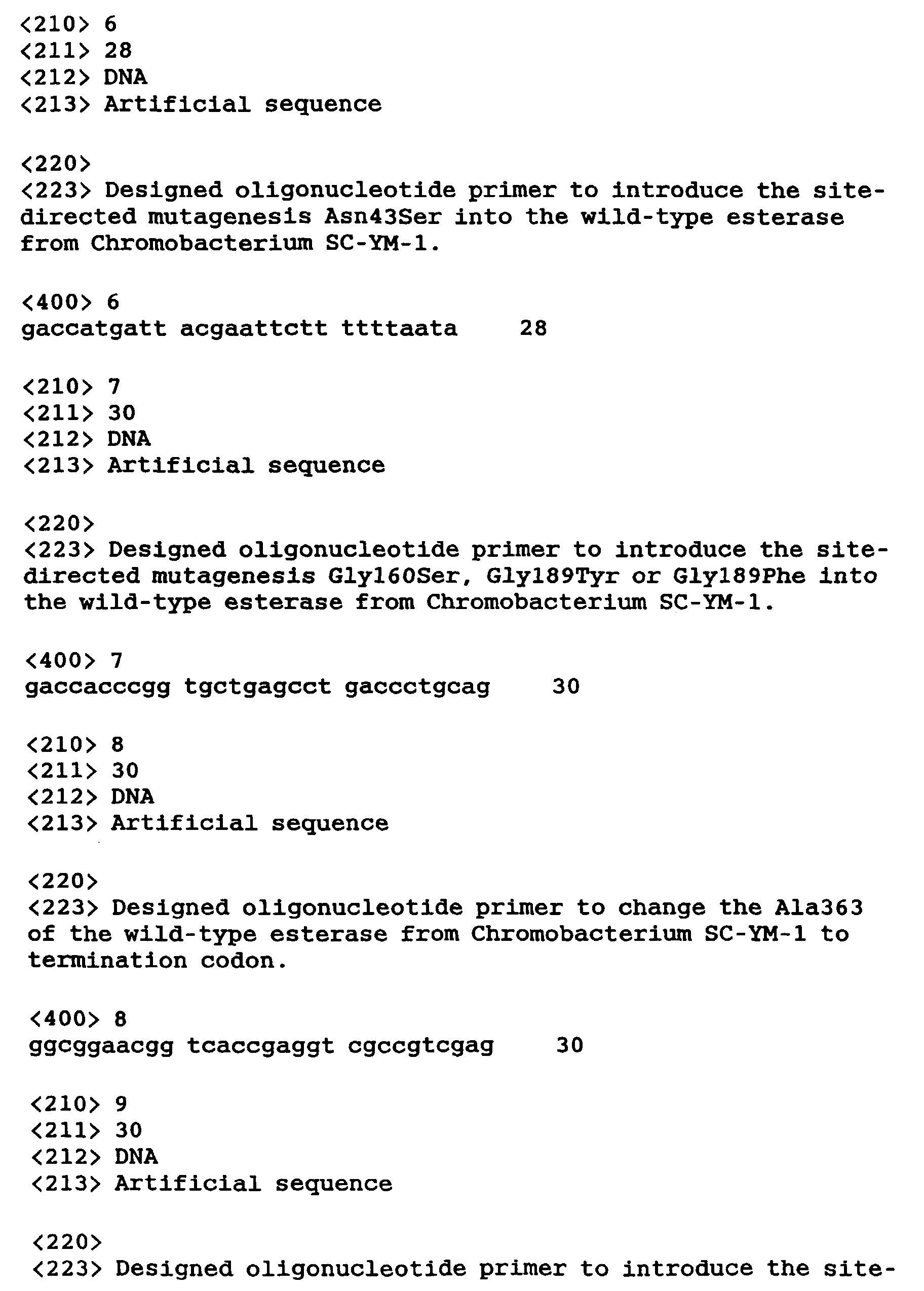
- mutation primers for amino acid substitution i.e. Asn43Ser, Gly160Ser, Gly189Tyr, Gly189Phe, or Ala363 Term (termination codon)
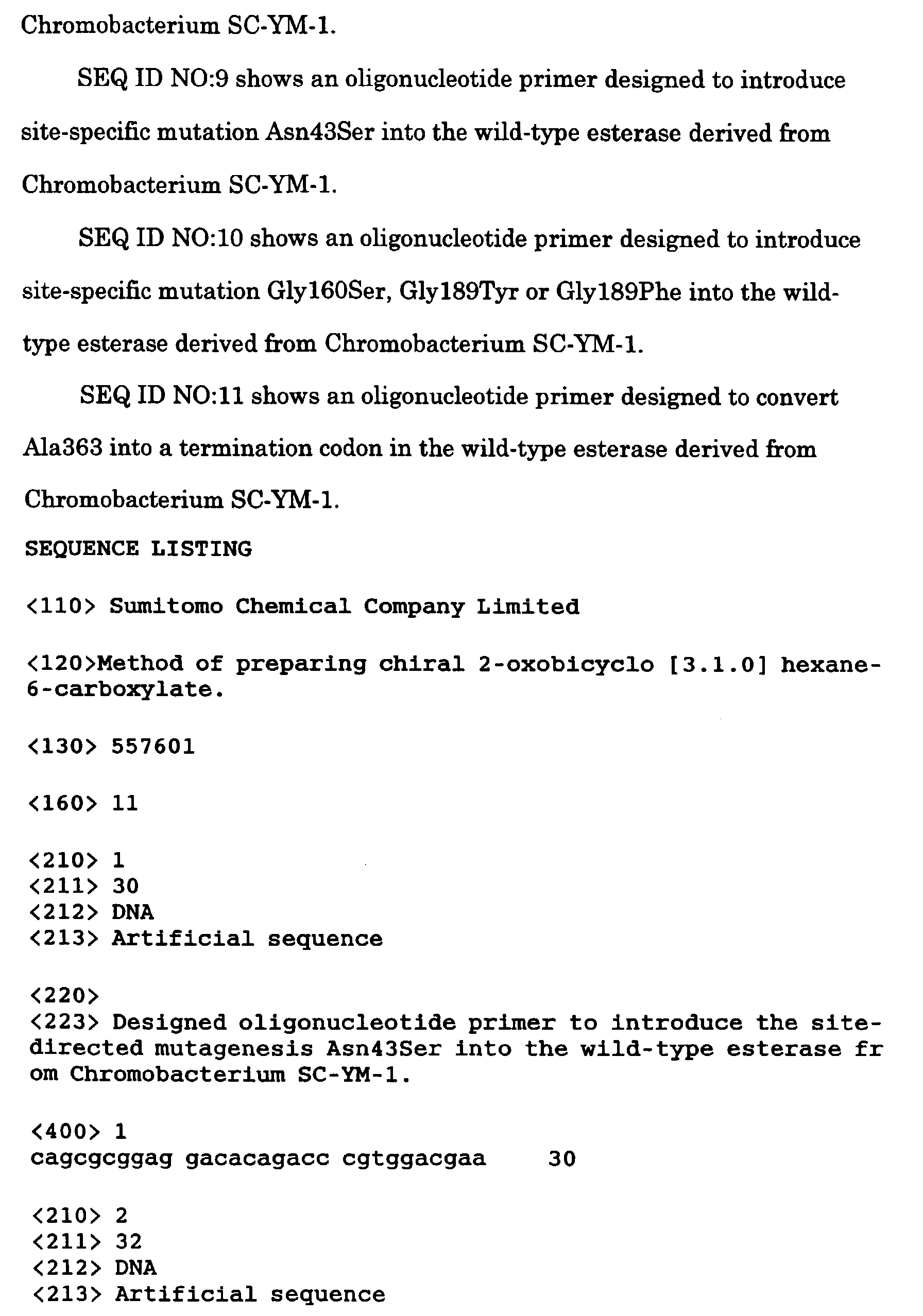
- oligonucleotides having a nucleotide sequence corresponding to each amino acid (mutation primers: N43S (SEQ ID NO:1), 160S (SEQ ID NO:2), 189Y (SEQ ID NO:3), 189F (SEQ ID NO:4), A363 Term (SEQ ID NO:5), RV-G (SEQ ID NO:6), RV-C (SEQ ID NO:7), RV-D (SEQ ID NO:8), MY-3 (SEQ ID NO:9), MY-1 (SEQ ID NO:10) and MY-2 (SEQ ID NO:11) were synthesized.
- These mutation primers were synthesized in a DNA synthesizer, model 394 (Applied Biosystems) and then purified with an oligonucleotide purification cartridge (
- a mutant esterase was prepared according to the method of Olfert Landt et al. (Gene, 96, 125-128, 1990).
- Plasmid pCC101 (FIG. 1) containing a wild-type esterase gene derived from Chromobacterium SC-YM-1 was constructed according to a method described in Examples 1 to 5 in JP-A 7-213280. PCR was conducted using 500 ng of the resulting pCC101 as template DNA, mutation primer RV-G (SEQ ID NO:6) (100 pmol), mutation primer N43S (SEQ ID NO:1) (100 pmol) and GeneAmpTM PCR Reagent Kit (Takara Shuzo Co., Ltd.) thereby amplifying the DNA fragment. The resulting PCR product (190 bp fragment) was purified by use of a SUPREC-02 (Takara Shuzo Co., Ltd.) column.
- PCR was conducted in a similar manner using 500 ng of pCC101 as template DNA, mutation primer MY-3 (SEQ ID NO:9) (50 pmol) and the previously prepared 190 bp DNA fragment (50 pmol) as primer and GeneAmpTM PCR Reagent Kit thereby amplifying the DNA fragment.
- the amplified DNA fragment was digested with restriction enzymes NdeI and Bpu1102I, and the sample was electrophoresed in 4% agarose gel (NuSieve 3 : 1 Agarose (Takara Shuzo Co., Ltd.)), and about 370 bp DNA fragment was recovered and purified by use of a Gene Clean DNA purification kit (BIO101).
- pCC101 3 ⁇ g was digested with NdeI and Bpu1102I and treated with alkaline phosphatase. Then, the resulting NdeI-Bpu1102I fragment (4.2 kbp) from pCC101 was ligated by use of a DNA ligation kit (Takara Shuzo Co., Ltd.) to the mutated NdeI-Bpu11021 fragment (240 bp) previously prepared, and the resulting construct was introduced into E. coli JM109 to prepare pCCN43S (FIG. 2).
- PCR was conducted using plasmid pCC101 (0.5 ⁇ g) as template DNA, mutation primer MY-1 (SEQ ID NO:10) (100 pmol), mutation primer 160S (SEQ ID NO:2) (100 pmol) and GeneAmp PCR Reagent Kit (Takara Shuzo Co., Ltd.), thus amplifying the DNA fragment.
- the resulting PCR product (270 bp DNA fragment) was purified by use of a SUPREC-02 (Takara Shuzo Co., Ltd.) column.
- PCR was conducted similarly using pCC101 (0.5 ⁇ g) as template DNA, mutation primer RV-C (SEQ ID NO:7) (50 pmol) and the previously prepared 270 bp DNA fragment (50 pmol) as primer and GeneAmp PCR Reagent Kit, thus amplifying the DNA fragment.
- the amplified DNA fragment was digested with restriction enzymes CelIII and ClaI, and the sample was electrophoresed in 4% agarose gel (NuSieve 3 : 1 Agarose (Takara Shuzo Co., Ltd.)), and about 240 bp DNA fragment was recovered and purified by use of a Gene Clean DNA purification kit (BIO101).
- pCC101 (3 ⁇ g) was digested with CelIII and ClaI and treated with alkaline phosphatase. Then, the resulting DNA fragment (4.2 kbp) was ligated by use of a DNA ligation kit (Takara Shuzo Co., Ltd.) to the about 240 bp mutated DNA fragment previously prepared, and the resulting construct was introduced into E. coli JM109 to prepare pCC160S.
- Plasmid pCC189Y was constructed in the same manner as in construction of plasmid pCC160S except that mutation primer 189Y (SEQ ID NO:3) was used in place of mutation primer 160S used in construction of pCC160S.
- Plasmid pCC189F was constructed in the same manner as in construction of plasmid pCC160S except that mutation primer 189F (SEQ ID NO:4) was used in place of mutation primer 160S used in construction of pCC160S.
- PCR was conducted using 500 ng of pCC101 as template DNA, mutation primer MY-2 (SEQ ID:11) (100 pmol), mutation primer A363term (SEQ ID NO:5) (100 pmol) and GeneAmpTM PCR Reagent Kit (Takara Shuzo Co., Ltd.) to amplify the DNA fragment.
- the resulting PCR product (150 bp fragment) was purified by a SUPREC-02 (Takara Shuzo Co., Ltd.) column.
- PCR was conducted using 500 ng of pCC101 as template DNA, mutation primer RV-D (SEQ ID:5) (50 pmol), the previously purified 150 bp DNA fragment (50 mol) as a primer and GeneAmpTM PCR Reagent Kit (Takara Shuzo Co., Ltd.) to amplify the DNA fragment.
- the amplified DNA fragment was digested with restriction enzymes BstPI and XbaI and then electrophoresed in 4% agarose gel (NuSieve 3 : 1 Agarose (Takara Shuzo Co., Ltd.)) to separate an about 220 bp DNA fragment which was then purified by a Gene Clean DNA purification kit.
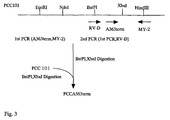
- pCC101 3 ⁇ g was digested with BstPI and XbaI and treated with alkaline phosphatase. Then, the resulting BstPI-XbaI fragment (4.2 kbp) from pCC101 was ligated to the previously constructed mutated BstPI-XbaI fragment (220 bp) by use of a DNA ligation kit (Takara Shuzo Co., Ltd.) and then introduced in a usual manner into E. coli JM 109 to construct pCCA363term (FIG. 3).
- Three kinds of DNA fragments that is, 0.6 kbp DNA fragment obtained by digesting the mutant plasmid pCC160S (10 ⁇ g) obtained in 2-2) with restriction enzymes EcoRI and FspI, 0.4 kbp fragment obtained by digesting the mutant plasmid pCC189Y (10 ⁇ g) obtained in 2-3) with FspI and BstPI, and 3.4 kbp DNA fragment obtained by digesting plasmid pCCA363term (3 ⁇ g) with restriction enzymes BstPI and EcoRI, were ligated to one another by use of a DNA ligation kit (Takara Shuzo Co., Ltd.) and then introduced into E. coli JM 109, whereby plasmid pCC160S189YA36Sterm containing a multiple-mutant esterase gene was obtained.
- Three kinds of DNA fragments that is, 0.6 kbp DNA fragment obtained by digesting the mutant plasmid pCC160S (10 ⁇ g) obtained in 2-2) with restriction enzymes EcoRI and FspI, 0.4 kbp fragment obtained by digesting the mutant plasmid pCC189F (10 ⁇ g) obtained in 2-4) with FspI and BstPI, and 3.4 kbp DNA fragment obtained by digesting plasmid pCCA363term (3 ⁇ g) obtained in 2-5) with restriction enzymes BstPI and EcoRI, were ligated to one another by use of a DNA ligation kit (Takara Shuzo Co., Ltd.) and then introduced into E. coli JM 109, whereby plasmid pCC160S189FA363term containing a multiple-mutant esterase gene was obtained.
- Plasmids pCCN43SA363term, pCC160S189YA363term, pCC160S189FA363term and pCCA363term were introduced into E. coli JM 109 respectively to prepare recombinant microorganisms JM109/pCCN43SA363term, JM109/pCC160S189YA363term, JM109/pCC160S189FA363term and JM 109/pCCA363term, respectively.
- liquid medium prepared by dissolving 15 g glycerol, 25 g yeast extract, 0.4 g monopotassium phosphate, 2 g magnesium sulfate and 0.1 g ferrous sulfate in 1 L water and adjusting it to pH 7.0
- a 3-L small culture chamber MDL model, Mitsubishi Bioenzi Co., Ltd.
- the microorganism was cultured at 30°C with stirring under aeration, and IPTG (isopropylthio- ⁇ -D-galactoside) was added thereto at a final concentration of 1 mM at a middle stage in the logarithmic growth phase (10 to 15 hours of culture). After an additional sterilized medium was added thereto, the microorganism was cultured for 40 hours in total whereby a culture of the microorganism was obtained.
- IPTG isopropylthio- ⁇ -D-galactoside
- a microbial culture obtained from the recombinant microorganism JM109/pCCN43SA363term in the same manner as in Reference Example 2 was centrifuged (12000 ⁇ g, 30 minutes, 4°C) to give the wet microorganism.
- This wet microorganism was sonicated (20 KHz, 15 minutes, 4°C) and centrifuged (12000 ⁇ g, 30 minutes, 4°C) to give its supernatant.
- 150 ml of the resulting supernatant was passed though a column charged with 200 ml anion-exchange column (DEAE-Sepharose fast flow, Pharmacia).
- the desired enzyme was eluted with a linear gradient of from 0.15 to 0.35 M NaCl.
- the activity of the eluted fractions was measured using p-nitrophenyl acetate (pNPA) which is a general substrate for esterase. Specifically, the substrate dissolved in acetonitrile was added to give a final concentration of 5 mM to 1.0 ml of 10 mM phosphate buffer (pH 7.5) containing the eluted fraction and then kept at 37°C, and the increase in absorbance at 410 nm was measured.
- pNPA p-nitrophenyl acetate
- a recombinant microorganism transformed with a gene of the present enzyme derived from Arthrobacter SC-6-98-28 was prepared according to a method described in JP-A 5-56787.
- plasmid pAGE-1 containing an esterase gene derived from Arthrobacter SC-6-98-28 was prepared according to a method described in the Examples in JP-A 5-56787.
- a region coding for esterase was cleaved off by digestion with restriction enzymes NspV and HindIII and then ligated to a DNA fragment synthesized for converting the initiation codon GTG in the esterase gene into ATG and then to expression vector pUC118 (Takara Shuzo Co., Ltd.) digested with restriction enzymes BamHI and HindIII.
- An expression vector for E was prepared according to a method described in the Examples in JP-A 5-56787.
- a region coding for esterase was cleaved off by digestion with restriction enzymes NspV and HindIII and then ligated to a DNA fragment synthesized for converting the initiation codon GTG in the esterase gene into ATG and then to expression vector pUC118 (Takara Shuzo Co.
- liquid medium prepared by dissolving 5 g glycerol, 6 g yeast extract, 9 g monopotassium phosphate and 4 g dipotassium phosphate in 1 L water and adjusting it to pH 7.0
- ampicillin was added thereto at a concentration of 50 ⁇ g/ml.
- the recombinant microorganism prepared in Reference Example 12 was inoculated from a slant culture via one loop of platinum into the medium and cultured at 30°C for 24 hours under shaking.
- liquid medium prepared by dissolving 15 g glycerol, 25 g yeast extract, 0.4 g monopotassium phosphate, 2 g magnesium sulfate and 0.1 g ferrous sulfate in 1 L water and adjusting it to pH 7.0
- a 3-L small culture chamber MDL model, Mitsubishi Bioenzi Co., Ltd.
- the microorganism was cultured at 30°C with stirring under aeration, and IPTG (isopropylthio- ⁇ -D-galactoside) was added thereto at a final concentration of 1 mM at a middle stage in the logarithmic growth phase (10 to 15 hours of culture). After an additional sterilized medium was added thereto, the microorganism was cultured for 40 hours in total whereby a culture of the microorganism was obtained.
- IPTG isopropylthio- ⁇ -D-galactoside
- the recombinant microorganism JM109/pAL612 (FERM-BP 5740) transformed by introducing a gene of the present enzyme derived from Burkholderia cepacia SC-20 was cultured at 37°C for 16 hours in 100 ml LB medium (Difco) containing 50 mg/L ampicillin and 1 mM IPTG (isopropylthio- ⁇ -D-galactoside) and recovered by centrifugation (6000 rpm, 10 minutes).
- the recovered microorganism was suspended in 10 ml of 100 mM phosphate buffer (pH 7.0), sonicated (10 minutes) and centrifuged whereby a crude enzyme extract was obtained.
- the resulting crude enzyme extract was lyophilized whereby a crude enzyme powder was obtained.
- Each of the purified enzymes obtained in Reference Examples 7 to 11 was added to, and suspended in, 1 ml of 100 mM phosphate buffer (pH 7.0). 10 mg of racemic ethyl (1SR, 5RS, 6SR)-2-oxobicyclo[3.1.0]hexane-6-carboxylate was dissolved in 1 ml n-hexane, then added to each enzyme solution, and heated to 40°C, and the mixture was stirred. After the time shown as the reaction time in Table 5 elapsed, an aliquot of the reaction solution was removed and analyzed in the same manner as in Examples 1 to 8, and the formed 2-oxobicyclo[3.1.0]hexane-6-carboxylic acid was measured for its optical purity and reaction yield.
- the reaction solution was partitioned, and the aqueous layer was analyzed in the same manner as in Examples 1 to 8 to determine the optical purity and reaction yield of the formed 2-oxobicyclo[3.1.0]hexane-6-carboxylic acid. Further, the organic layer was analyzed by GC [column: CP-Cyclodextrin ⁇ -2,3,6-M-19, 0.25 mm ⁇ ⁇ 50 m, 0.25 ⁇ m (Chrompack Ltd.)] to determine the optical purity and reaction yield of the remaining unreacted ethyl 2-oxobicyclo[3.1.0]hexane-6-carboxylate.
Landscapes
- Chemical & Material Sciences (AREA)
- Organic Chemistry (AREA)
- Life Sciences & Earth Sciences (AREA)
- Engineering & Computer Science (AREA)
- Zoology (AREA)
- Wood Science & Technology (AREA)
- Health & Medical Sciences (AREA)
- Genetics & Genomics (AREA)
- Bioinformatics & Cheminformatics (AREA)
- General Health & Medical Sciences (AREA)
- Biochemistry (AREA)
- General Engineering & Computer Science (AREA)
- Microbiology (AREA)
- Biotechnology (AREA)
- Chemical Kinetics & Catalysis (AREA)
- General Chemical & Material Sciences (AREA)
- Medicinal Chemistry (AREA)
- Molecular Biology (AREA)
- Biomedical Technology (AREA)
- Analytical Chemistry (AREA)
- Preparation Of Compounds By Using Micro-Organisms (AREA)
- Organic Low-Molecular-Weight Compounds And Preparation Thereof (AREA)
Abstract
Description

which comprises:
wherein R1 represents
wherein n is 0 or 1, and
which comprises:


- a halogen atom, nitro group,
- methyl group, ethyl group, n-propyl group, isopropyl group, n-butyl group, isobutyl group, sec-butyl group, t-butyl group, n-pentyl group, isopentyl group, neopentyl group, n-hexyl group, n-heptyl group, n-octyl group, cyclohexyl group, cycloheptyl group;
- allyl group,
- propynyl group,
- 2-naphthyl group, phenyl group, 2-fluorophenyl group, 3-fluorophenyl group, 4-fluorophenyl group, 3,4-difluorophenyl group, pentafluorophenyl group, 2-chlorophenyl group, 3-chlorophenyl group, 4-chlorophenyl group, 3,4-dichlorophenyl group, 2,5-dichlorophenyl group, 2-bromophenyl group, 3-bromophenyl group, 4-bromophenyl group, 2-methylphenyl group, 3-methylphenyl group, 4-methylphenyl group, 2-methoxyphenyl group, 3-methoxyphenyl group, 4-methoxyphenyl group, 4-nitrophenyl group, benzyl group, 2-fluorobenzyl group, 3-fluorobenzyl group, 4-fluorobenzyl group, 2,3-difluorobenzyl group, 2,4-difluorobenzyl group, 2,5-difluorobenzyl group, 3,5-difluorobenzyl group, 3,4-difluorobenzyl group, 2,3,4-trifluorobenzyl group, 2-chlorobenzyl group, 3-chlorobenzyl group, 4-chlorobenzyl group, 2,3-dichlorobenzyl group, 3-chloro-4-fluorobenzyl group, 2-methylbenzyl group, 3-methylbenzyl group, 4-methylbenzyl group, 4-fluoro-3-methylbenzyl group, 3-fluoro-2-methylbenzyl group, 3,5-dimethylbenzyl group, 4-isopropylbenzyl group, 2,4-dimethylbenzyl group, 2,5-dimethylbenzyl group, 2,4,6-trimethylbenzyl group, 2-methoxybenzyl group, 3-methoxybenzyl group, 4-methoxybenzyl group, 2,4-dimethoxybenzyl group, 3-fluoro-4-methoxybenzyl group, 3-methyl-4-methoxybenzyl group, 4-phenylbenzyl group, 4-nitrobenzyl group, α-phenylethyl group, β-phenylethyl group, phenylpropyl group, benzhydryl group, triphenylmethyl group,
- 2-pyrimidyl group,
- azetidine-1-yl group, azetidine-2-yl group, pyrrolidine-2-yl group, piperidine-3-yl group, and
- an indanyl, 1,2,3,4-tetrahydronaphtho-1-yl, 2,3-dihydrobenzopyran-2-yl and xanthene-9-yl group.
| Examples | Enzyme name | Origin of the | Enzyme maker | |
| 1 | CHIRAZYME E-4 | thermophilic | Roche Diagnostics | |
| 2 | Lipase OF360 | Candida cylindracea | Meito Sangyo K.K | |
| 3 | Esterase 46054 | Bacillus thermoglucosidasius | Fluka | |
| 4 | CHIRAZYME E-3 | thermophilic microorganism | Roche Diagnostics | |
| 5 | Cholesterol Esterase | Candida rugosa | Roche Diagnostics | |
| 6 | α-Chymotrypsin | Bovine Pancreas | SIGMA | |
| 7 | γ-Chymotrypsin | Bovine Pancreas | SIGMA | |
| 8 | δ-Chymotrypsin | Bovine Pancreas | SIGMA |
| Examples | Amount of the enzyme (mg) | Reaction time (hr) | Reaction yield (%) | Optical purity (%ee) | Optical isomer in |
| 1 | 2.0 | 24 | 29.0 | 72.9 | (―)- |
| 2 | 2.0 | 24 | 18.5 | 68.5 | (―)- |
| 3 | 2.0 | 2 | 26.9 | 65.1 | (―)-isomer |
| 4 | 2.0 | 4 | 30.4 | 58.6 | (―)-isomer |
| 5 | 2.0 | 24 | 6.7 | 58.8 | (―)-isomer |
| 6 | 2.1 | 24 | 4.8 | 40.5 | (―)-isomer |
| 7 | 2.1 | 24 | 4.6 | 32.0 | (―)-isomer |
| 8 | 10.1 | 24 | 9.4 | 29.1 | (―)-isomer |
| Examples | Enzyme name | Origin of the enzyme | Enzyme maker |
| 9 | CHIRAZYME L-5 | Candida antarctica | Roche Diagnostics |
| 10 | CHIRAZYME L-6 | Pseudomonas sp. | Roche Diagnostics |
| 11 | Cholesterol Esterase | Pseudomonas sp. | Wako Pure Chemical Industries, Ltd. |
| 12 | CHIRAZYME L-2 | Candida antarctica | Roche Diagnostics |
| 13 | Toyozyme | Pseudomonas aerugmosa | Toyobo Co., Ltd. |
| 14 | Lipase 62285 | Aspergillus oryzae | Fluka |
| 15 | LIPOSAM | Pseudomonas sp. | Showa Denko, K. K. |
| 16 | Lipase (immobilized product) | Pseudomonas sp. | Wako Pure Chemical Industries, Ltd. |
| 17 | CHIRAZYME L-8 | Humicola sp. | Roche Diagnostics |
| 18 | CHIRAZYME E-5 | thermophilic microorganism | Roche Diagnostics |
| 19 | Lipase AL | Achromobacter sp. | Meito Sangyo K.K. |
| 20 | Kitopearl Cholesterol Esterase CEN | Pseudomonas sp. | Fuji Spinning Co., Ltd. |
| 21 | Kitopearl Lipase-AP | Bacteria | Fuji Spinning Co., Ltd. |
| 22 | Kitopearl Lipase-CV | Cromobacterium viscosum | Fuji Spinning Co., Ltd. |
| 23 | Lipase | Cromobacterium viscosum | Asahi Chemical Industry Co., Ltd. |
| 24 | Lipase QL | Alcaligenes sp. | Meito Sangyo K.K. |
| 25 | Lipase AH | Pseudomonas cepacia | Amano Pharmaceutical Co., Ltd. |
| 26 | Lipase AK 20 | Pseudomonas fluorescens | Amano Pharmaceutical Co., Ltd. |
| 27 | Lipase | Mucor miehei | Biocatalysts Ltd. |
| 28 | | Aspergillus melleus | Amano Pharmaceutical Co., Ltd. |
| 29 | Lipase 62291 | Rhizomucor miehei | Fluka |
| 30 | CHIRAZYME P-1 | B. licheniformis | Roche Diagnostics |
| 31 | Prolazer | Bacillus sp. | Amano Pharmaceutical Co., Ltd. |
| 32 | Acylase I | Pig kidney | Wako Pure Chemical Industries, Ltd. |
| 33 | Lipase PL | Alcaligenes sp. | Meito Sangyo K.K. |
| 34 | CHIRAZYME L-9 | Mucor miehei | Roche Diagnostics |
| 35 | Protease N | Bacillus subtilis | Amano Pharmaceutical Co., Ltd. |
| 36 | CHIRAZYME L-10 | Alcaligines sp. | Roche Diagnostics |
| Examples | Amount of the enzyme (mg) | Reaction time (hr) | Reaction yield (%) | Optical purity (%ee) | Optical isomer in excess |
| 9 | 2 .0 | 24 | 23.2 | 98.0 | (+)-isomer |
| 10 | 0.1 | 4 | 7.3 | 82.9 | (+)-isomer |
| 11 | 0.1 | 4 | 10.1 | 78.2 | (+)-isomer |
| 12 | 0.1 | 4 | 55.0 | 59.7 | (+)-isomer |
| 13 | 5.1 | 24 | 17.9 | 75.0 | (+)-isomer |
| 14 | 10 | 24 | 10.7 | 75.4 | (+)-isomer |
| 15 | 0.1 | 4 | 7.5 | 74.9 | (+)-isomer |
| 16 | 10.2 | 24 | 42.2 | 64.8 | (+)-isomer |
| 17 | 2.1 | 24 | 13.3 | 72.3 | (+)-isomer |
| 18 | 10 | 24 | 20.2 | 62.1 | (+)-isomer |
| 19 | 5.2 | 24 | 14.9 | 56.0 | (+)-isomer |
| 20 | 2.0 | 24 | 11.9 | 52.1 | (+)-isomer |
| 21 | 2.0 | 24 | 5.6 | 51.7 | (+)-isomer |
| 22 | 2.1 | 24 | 5.0 | 49.7 | (+)-isomer |
| 23 | 2.1 | 24 | 46.5 | 37.9 | (+)-isomer |
| 24 | 2.0 | 24 | 3.6 | 49.3 | (+)-isomer |
| 25 | 10.1 | 24 | 45.2 | 34.6 | (+)-isomer |
| 26 | 10.2 | 24 | 14.0 | 37.1 | (+)-isomer |
| 27 | 2.2 | 24 | 55.8 | 26.1 | (+)-isomer |
| 28 | 2.1 | 24 | 5.9 | 37.2 | (+)-isomer |
| 29 | 2.6 | 24 | 38.2 | 29.7 | (+)-isomer |
| 30 | 2.3 | 24 | 54.0 | 24.9 | (+)-isomer |
| 31 | 2.5 | 24 | 11.1 | 34.3 | (+)-isomer |
| 32 | 0.1 | 4 | 60.3 | 20.6 | (+)-isomer |
| 33 | 2.0 | 24 | 7.0 | 27.5 | (+)-isomer |
| 34 | 1.0 | 4 | 5.4 | 24.1 | (+)-isomer |
| 35 | 2.3 | 24 | 7.8 | 18.2 | (+)-isomer |
| 36 | 2.0 | 24 | 4.8 | 17.3 | (+)-isomer |
| Examples | The present enzyme | Amount of purified enzyme culture (µl) | Reaction time (hr) | Reaction yield (%) | Optical purity (%ee) | Optical isomer in excess |
| 37 | 160A189YA363term | 10 | 2 | 34.3 | 80.5 | (―)-isomer |
| 38 | N43SA363term | 40 | 2 | 33.5 | 92.8 | (―)-isomer |
| 39 | 160S189YA363term | 10 | 6 | 36.7 | 86.5 | (―)-isomer |
| 40 | 160S189FA363term | 10 | 2 | 31.4 | 85.0 | (―)-isomer |
| 41 | A363term | 10 | 6 | 24.6 | 81.0 | (―)-isomer |



Claims (12)
- A method of resolving 2-oxobicyclo[3.1.0]hexane-6-carboxylates having the following relative configuration of formula (1):wherein X1, X2, R1, R2 and R3 have the same meanings as defined below, into one enantiomer ester thereof and the other enantiomer acid,
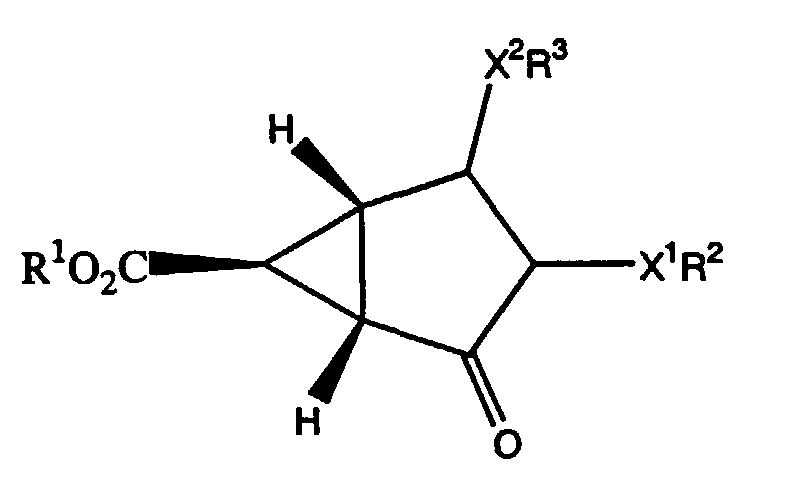
which comprises:contacting an enzyme having an ability to preferentially hydrolyze one enantiomer ester contained in 2-oxobicyclo[3.1.0]hexane-6-carboxylate of formula (1) as defined above, with 2-oxobicyclo[3.1.0]hexane-6-carboxylate of formula (1) as defined above to obtain one enantiomer as an acid and the other enantiomer as an ester,
wherein R1 representsa C1 to C10 alkyl group which may be substituted with at least one group selected from a C1 to C8 alkoxy, halogen or nitro;an allyl group;an arylalkyl group which aryl may be substituted with at least one group selected from a C1 to C8 alkyl, C1 to C8 alkoxy, halogen or nitro group; oran aryl group which may be substituted with at least one group selected from a C1 to C8 alkyl, C1 to C8 alkoxy, halogen or nitro;X1 and X2 independently represent a single bond, S, O, SO, SO2 or NR4 wherein R4 represents a hydrogen or a group of formula: (CO)nR5
wherein n is 0 or 1, andR5 represents hydrogen or a halogen atom;a C1 to C10 alkyl group which may be substituted with at least one group selected from a C1 to C8 alkoxy, hydroxy, halogen, amino, nitro, thiol or thioalkyl;a C2 to C10 alkenyl group which may be substituted with at least one group selected from a C1 to C8 alkoxy, hydroxy, halogen, amino, nitro, thiol or thioalkyl;a C2 to C10 alkynyl group which may be substituted with at least one group selected from a C1 to C8 alkoxy, hydroxy, halogen, amino, nitro, thiol or thioalkyl;an aryl group which may be substituted with at least one group selected from a C1 to C8 alkyl, C2 to C8 alkenyl, C2 to C8 alkynyl, C1 to C8 alkoxy, hydroxy, halogen, amino, nitro, thiol or thioalkyl;an arylalkyl group which aryl may be substituted with at least one group selected from a C1 to C8 alkyl, C2 to C8 alkenyl, C2 to C8 alkynyl, C1 to C8 alkoxy, hydroxy, halogen, amino, nitro, thiol or thioalkyl;an aromatic heterocyclic ring which may be substituted with at least one group selected from a C1 to C8 alkyl, C2 to C8 alkenyl, C2 to C8 alkynyl, C1 to C8 alkoxy, hydroxy, halogen, amino, nitro, thiol or thioalkyl; ora non-aromatic heterocyclic ring which may be substituted with at least one group selected from a C1 to C8 alkyl, C2 to C8 alkenyl, C2 to C8 alkynyl, C1 to C8 alkoxy, hydroxy, halogen, amino, nitro, thiol or thioalkyl;R2 and R3 independently representhydrogen, a halogen atom or a nitro group;a C1 to C10 alkyl group which may be substituted with at least one group selected from a C1 to C8 alkoxy, hydroxy, halogen, amino, nitro, thiol or thioalkyl;a C2 to C10 alkenyl group which may be substituted with at least one group selected from a C1 to C8 alkoxy, hydroxy, halogen, amino, nitro, thiol or thioalkyl;a C2 to C10 alkynyl group which may be substituted with at least one group selected from a C1 to C8 alkoxy, hydroxy, halogen, amino, nitro, thiol or thioalkyl;an aryl group which may be substituted with at least one group selected from a C1 to C8 alkyl, C2 to C8 alkcenyl, C2 to C8 alkynyl, C1 to C8 alkoxy, hydroxy, halogen, amino, nitro, thiol or thioalkyl;an arylalkyl group which aryl may be substituted with at least one group selected from a C1 to C8 alkyl, C2 to C8 alkenyl, C2 to C8 alkynyl, C1 to C8 alkoxy, hydroxy, halogen, amino, nitro, thiol or thioalkyl;an aromatic heterocyclic ring which may be substituted with at least one group selected from a C1 to C8 alkyl, C2 to C8 alkenyl, C2 to C8 alkynyl, C1 to C8 alkoxy, hydroxy, halogen, amino, nitro, thiol or thioalkyl;a non-aromatic heterocyclic ring which may be substituted with at least one group selected from a C1 to C8 alkyl, C2 to C8 alkenyl, C2 to C8 alkynyl, C1 to C8 alkoxy, hydroxy, halogen, amino, nitro, thiol or thioalkyl;a non-aromatic hydrocarbon ring which may be substituted with at least one group selected from a C1 to C8 alkyl, C2 to C8 alkenyl, C2 to C8 alkynyl, C1 to C8 alkoxy, hydroxy, halogen, amino, nitro, thiol or thioalkyl, said non-aromatic hydrocarbon ring being condensed with 1 or 2 aromatic hydrocarbon rings or aromatic heterocyclic rings; ora non-aromatic heterocyclic ring which may be substituted with at least one group selected from a C1 to C8 alkyl, C2 to C8 alkenyl, C2 to C8 alkynyl, C1 to C8 alkoxy, hydroxy, halogen, amino, nitro, thiol or thioalkyl, said non-aromatic heterocyclic ring being condensed with 1 or 2 aromatic hydrocarbon rings or aromatic heterocyclic rings. - The method according to claim 1, wherein 2-oxobicyclo[3.1.0]hexane-6-carboxylates having a relative configuration of formula (1'):wherein X1, X2, R1, R2 and R3 have the same meanings as defined in claim 1, is subjected to a reaction with the said enzyme to obtain one enantiomer acid resulting from one enantiomer ester contained in 2-oxobicyclo[3.1.0]hexane-6-carboxylate of formula (1) as defined in claim 1, and
 separating the other enantiomer ester of said resulting acid from the resulting mixture of diastereomeric esters.
 - The method according to claim 1 or 2, wherein X1 and X2 are single bonds, and R2 and R3 are hydrogen atoms in the 2-oxobicyclo[3.1.0]hexane-6-carboxylate of formula (1).
- The method according to claim 1 or 2, wherein R1 is a C1 to C5 alkyl group in the 2-oxobicyclo[3.1.0]hexane-6-carboxylate of formula (1).
- The method according to claim 1 or 2, wherein said resulting enantiomer acid has an absolute configuration of formula (2b):and said the other enantiomer ester has an absolute configuration of formula (3a):
 wherein R1, R2, R3, X1 and X2 are the same as defined as defined in claim 1 or 2.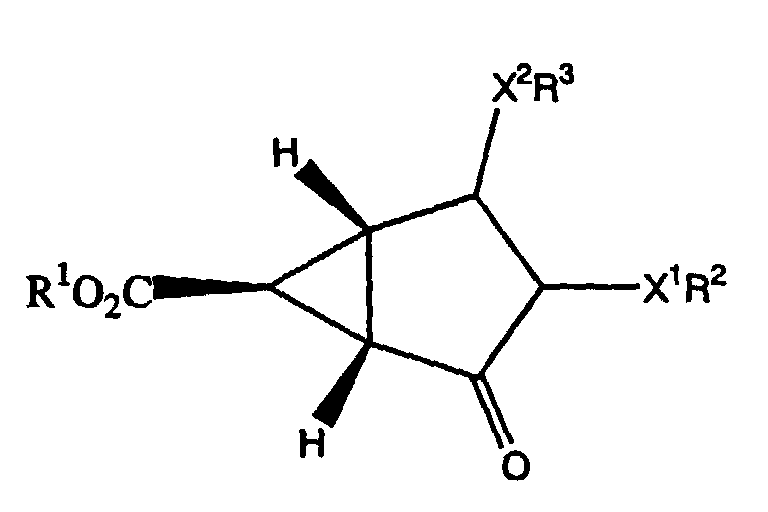
- The method according to claim 1 or 2, wherein the enzyme is a hydrolase derived from microorganisms or a hydrolase derived from animals.
- The method according to claim 6, wherein the enzyme is a hydrolase derived from microorganisms of the genus Achromobacter, Alcaligenes, Arthrobacter, Aspergillus, Bacillus, Burkholderia, Candida, Chromobacterium, Humicola, Mucor, Pseudomonas, or Rhizomucor.
- The method according to claim 7, wherein the enzyme is a hydrolase derived from the microorganism Achromobacter sp., Alcaligenes sp., Aspergillus melleus, Aspergillus oryzae, Bacillus sp., Bacillus licheniformis, Bacillus subtilis, Bacillus thermoglucosidasius, Burkholderia cepacia, Candida antarctica, Candida cylindracea, Candida rugosa, Chromobacterium viscosum, Humicola sp., Mucor miehei, Pseudomonas sp., Pseudomonas aeruginosa, Pseudomonas cepacia, Pseudomonas fluorescens, or Rhizomucor miehei.
- The method according to claim 8, wherein the enzyme is an esterase derived from Chromobacterium SC-YM-1 or Arthrobacter SC-6-98-28.
- The method according to claim 8, wherein the enzyme is a lipase derived from Burkholderia cepacia SC-20.
- The method according to claim 1 or 2, wherein the enzyme is a hydrolase from the porcine kidney or bovine pancreas.
- The method according to claim 8, 9 or 10, wherein said enzyme is a mutant enzyme, wherein one or a plurality of specific amino acids have been deleted, added or replaced.
Applications Claiming Priority (2)
| Application Number | Priority Date | Filing Date | Title |
|---|---|---|---|
| JP10964599 | 1999-04-16 | ||
| JP10964599A JP4192331B2 (en) | 1999-04-16 | 1999-04-16 | Process for producing optically active 2-oxobicyclo [3.1.0] hexane-6-carboxylic acid derivative |
Publications (2)
| Publication Number | Publication Date |
|---|---|
| EP1046712A2 true EP1046712A2 (en) | 2000-10-25 |
| EP1046712A3 EP1046712A3 (en) | 2002-06-12 |
Family
ID=14515546
Family Applications (1)
| Application Number | Title | Priority Date | Filing Date |
|---|---|---|---|
| EP00108383A Withdrawn EP1046712A3 (en) | 1999-04-16 | 2000-04-17 | Method of resolving 2-oxobicyclo (3.1.0) hexane-6-carboxylic acid derivatives |
Country Status (3)
| Country | Link |
|---|---|
| US (1) | US6407284B1 (en) |
| EP (1) | EP1046712A3 (en) |
| JP (1) | JP4192331B2 (en) |
Families Citing this family (3)
| Publication number | Priority date | Publication date | Assignee | Title |
|---|---|---|---|---|
| JP2006061112A (en) * | 2004-08-30 | 2006-03-09 | Sumitomo Chemical Co Ltd | Process for producing optically active 2- (cyclopentylmethyl) -malonic acid monoester |
| EP2298755A4 (en) | 2008-05-21 | 2012-12-05 | Taisho Pharmaceutical Co Ltd | PROCESS FOR THE PREPARATION OF BICYCLO [3.1.0] HEXENE DERIVATIVES USING AN ENZYME |
| EP3064589A1 (en) * | 2015-07-29 | 2016-09-07 | F.I.S.- Fabbrica Italiana Sintetici S.p.A. | Enzymatic process for the preparation of testosterone and esters thereof |
Citations (1)
| Publication number | Priority date | Publication date | Assignee | Title |
|---|---|---|---|---|
| JPH07213280A (en) | 1994-02-02 | 1995-08-15 | Sumitomo Chem Co Ltd | Thermostable esterase |
Family Cites Families (12)
| Publication number | Priority date | Publication date | Assignee | Title |
|---|---|---|---|---|
| DE3752086T2 (en) * | 1986-04-16 | 1998-02-26 | Sumitomo Chemical Co | Process for the production of optically active cyclopropanecarboxylic acid |
| GB8715476D0 (en) * | 1987-07-01 | 1987-08-05 | Shell Int Research | Preparation of ibuprofen |
| US5229280A (en) * | 1988-02-25 | 1993-07-20 | Istituto Guido Donegani S.P.A. | Process for the continuous biotechnological preparation of optical isomer s(+) of 2-(6-methoxy-2-naphthyl) propionic acid |
| JPH088879B2 (en) * | 1989-09-13 | 1996-01-31 | 田辺製薬株式会社 | Process for producing optically active 3-phenylglycidate compounds |
| DE69225009T2 (en) * | 1991-01-10 | 1998-11-19 | Sumitomo Chemical Co | A gene encoding asymmetrically active esterase |
| US5476965A (en) * | 1994-02-18 | 1995-12-19 | Genencor International, Inc. | Enzymatic resolution of substituted 2-methyl-propionic acid |
| PL182285B1 (en) | 1994-08-12 | 2001-12-31 | Lilly Co Eli | Synthetic amino acids and their esters and pharmaceutical preparations containing them. PL PL PL PL PL PL PL |
| US5750566A (en) * | 1994-08-12 | 1998-05-12 | Eli Lilly And Company | Synthetic excitatory amino acids |
| AU3325095A (en) | 1994-08-12 | 1996-03-07 | Eli Lilly And Company | Composition and method for protection against drug dependency |
| IL118727A (en) | 1995-06-29 | 2003-01-12 | Lilly Co Eli | (-)-2-spiro-5-hydantoinbicyclo [3.1.0] hexane-6-carboxylic acid, salts thereof and use thereof for the preparation of (+)-(2) aminobicyclo [3.1.0] hexane-2,6-dicarboxylic acid |
| US5948645A (en) * | 1996-12-04 | 1999-09-07 | Eli Lilly And Company | Biosynthetic gene muri from Streptococcus pneumoniae |
| DE69834276T2 (en) * | 1997-01-24 | 2007-04-12 | Sumitomo Chemical Co. Ltd. | Process for improving the optical purity of azetidine-2-carboxylic acid |
-
1999
- 1999-04-16 JP JP10964599A patent/JP4192331B2/en not_active Expired - Fee Related
-
2000
- 2000-04-14 US US09/549,564 patent/US6407284B1/en not_active Expired - Fee Related
- 2000-04-17 EP EP00108383A patent/EP1046712A3/en not_active Withdrawn
Patent Citations (1)
| Publication number | Priority date | Publication date | Assignee | Title |
|---|---|---|---|---|
| JPH07213280A (en) | 1994-02-02 | 1995-08-15 | Sumitomo Chem Co Ltd | Thermostable esterase |
Also Published As
| Publication number | Publication date |
|---|---|
| EP1046712A3 (en) | 2002-06-12 |
| US6407284B1 (en) | 2002-06-18 |
| JP2000300285A (en) | 2000-10-31 |
| JP4192331B2 (en) | 2008-12-10 |
Similar Documents
| Publication | Publication Date | Title |
|---|---|---|
| US20020034776A1 (en) | Alteration of the substrate specificity of enzymes | |
| EP0299558B1 (en) | Process for the preparation of ibuprofen | |
| EP0264457A1 (en) | Process for preparing optically active cyclopropanecarboxylic acids | |
| US6407284B1 (en) | Method of resolving 2-oxobicyclo [3.1.0] hexane-6-carboxylic acid derivatives | |
| JP5157576B2 (en) | Process for producing optically active 2-alkyl-1,1,3-trialkoxycarbonylpropane | |
| EP1313860B1 (en) | Butinol i esterase | |
| HU214125B (en) | Biotechnological process for preparing s-(+)-2,2-dimethyl cyclopropane-carboxamide | |
| US6706500B2 (en) | Process for the preparation of L-menthol | |
| JP4319260B2 (en) | Esterase gene and use thereof | |
| JP4042454B2 (en) | Process for producing optically active 3-methylglutaric acid monoester | |
| US6537790B1 (en) | Esterase genes and uses of the same | |
| JP2000014397A (en) | Production of optically active 2-hydroxy-2- trifluoromethylacetic acids | |
| JP2712331B2 (en) | Acylamino acid racemase, its production and use | |
| Ozaki et al. | Purification and characterization of recombinant esterase from Pseudomonas putida MR-2068 and its application to the optical resolution of dimethyl methylsuccinate | |
| JP2557614B2 (en) | Microbial esterase for enantioselective cleavage of 1-arylalkyl esters | |
| US6395535B1 (en) | Optical resolution of 4-halogeno-3-alkanoyloxy-butyronitrile | |
| US5986095A (en) | Enantioselective preparation of halophenyl alcohols and acylates | |
| JP3218772B2 (en) | Method for producing acetylene alcohols | |
| JP3866357B2 (en) | Thermostable, solvent-resistant esterase | |
| US6960460B2 (en) | Esterase gene and its use | |
| US20030186410A1 (en) | Novel (r)-2-hydroxy-3-phenylpropionate (d-phenyllactate) dehydrogenase and gene encoding the same | |
| DE10042892A1 (en) | New butynol I esterase, for stereospecific hydrolysis or transesterification of esters, to produce optically active reaction products | |
| DE10131544A1 (en) | New butynol I esterase, for stereospecific hydrolysis or transesterification of esters, to produce optically active reaction products | |
| JPH1080298A (en) | Method for producing optically active form of 2-halo-2-fluorocyclopropanecarboxylic acid | |
| JPH1198981A (en) | New esterase |
Legal Events
| Date | Code | Title | Description |
|---|---|---|---|
| PUAI | Public reference made under article 153(3) epc to a published international application that has entered the european phase |
Free format text: ORIGINAL CODE: 0009012 |
|
| AK | Designated contracting states |
Kind code of ref document: A2 Designated state(s): AT BE CH CY DE DK ES FI FR GB GR IE IT LI LU MC NL PT SE |
|
| AX | Request for extension of the european patent |
Free format text: AL;LT;LV;MK;RO;SI |
|
| PUAL | Search report despatched |
Free format text: ORIGINAL CODE: 0009013 |
|
| AK | Designated contracting states |
Kind code of ref document: A3 Designated state(s): AT BE CH CY DE DK ES FI FR GB GR IE IT LI LU MC NL PT SE |
|
| AX | Request for extension of the european patent |
Free format text: AL;LT;LV;MK;RO;SI |
|
| 17P | Request for examination filed |
Effective date: 20021203 |
|
| AKX | Designation fees paid |
Designated state(s): CH DE FR GB IT LI |
|
| RAP1 | Party data changed (applicant data changed or rights of an application transferred) |
Owner name: SUMITOMO CHEMICAL COMPANY, LIMITED |
|
| 17Q | First examination report despatched |
Effective date: 20060202 |
|
| GRAP | Despatch of communication of intention to grant a patent |
Free format text: ORIGINAL CODE: EPIDOSNIGR1 |
|
| GRAJ | Information related to disapproval of communication of intention to grant by the applicant or resumption of examination proceedings by the epo deleted |
Free format text: ORIGINAL CODE: EPIDOSDIGR1 |
|
| GRAP | Despatch of communication of intention to grant a patent |
Free format text: ORIGINAL CODE: EPIDOSNIGR1 |
|
| STAA | Information on the status of an ep patent application or granted ep patent |
Free format text: STATUS: THE APPLICATION IS DEEMED TO BE WITHDRAWN |
|
| 18D | Application deemed to be withdrawn |
Effective date: 20100605 |