EP1046484A2 - Method of forming shaped body of brittle ultra fine particle at low temperature - Google Patents
Method of forming shaped body of brittle ultra fine particle at low temperature Download PDFInfo
- Publication number
- EP1046484A2 EP1046484A2 EP00106805A EP00106805A EP1046484A2 EP 1046484 A2 EP1046484 A2 EP 1046484A2 EP 00106805 A EP00106805 A EP 00106805A EP 00106805 A EP00106805 A EP 00106805A EP 1046484 A2 EP1046484 A2 EP 1046484A2
- Authority
- EP
- European Patent Office
- Prior art keywords
- ultra fine
- bristle
- fine particles
- particles
- substrate
- Prior art date
- Legal status (The legal status is an assumption and is not a legal conclusion. Google has not performed a legal analysis and makes no representation as to the accuracy of the status listed.)
- Granted
Links
Images



Classifications
-
- C—CHEMISTRY; METALLURGY
- C23—COATING METALLIC MATERIAL; COATING MATERIAL WITH METALLIC MATERIAL; CHEMICAL SURFACE TREATMENT; DIFFUSION TREATMENT OF METALLIC MATERIAL; COATING BY VACUUM EVAPORATION, BY SPUTTERING, BY ION IMPLANTATION OR BY CHEMICAL VAPOUR DEPOSITION, IN GENERAL; INHIBITING CORROSION OF METALLIC MATERIAL OR INCRUSTATION IN GENERAL
- C23C—COATING METALLIC MATERIAL; COATING MATERIAL WITH METALLIC MATERIAL; SURFACE TREATMENT OF METALLIC MATERIAL BY DIFFUSION INTO THE SURFACE, BY CHEMICAL CONVERSION OR SUBSTITUTION; COATING BY VACUUM EVAPORATION, BY SPUTTERING, BY ION IMPLANTATION OR BY CHEMICAL VAPOUR DEPOSITION, IN GENERAL
- C23C24/00—Coating starting from inorganic powder
- C23C24/02—Coating starting from inorganic powder by application of pressure only
- C23C24/04—Impact or kinetic deposition of particles
-
- C—CHEMISTRY; METALLURGY
- C04—CEMENTS; CONCRETE; ARTIFICIAL STONE; CERAMICS; REFRACTORIES
- C04B—LIME, MAGNESIA; SLAG; CEMENTS; COMPOSITIONS THEREOF, e.g. MORTARS, CONCRETE OR LIKE BUILDING MATERIALS; ARTIFICIAL STONE; CERAMICS; REFRACTORIES; TREATMENT OF NATURAL STONE
- C04B35/00—Shaped ceramic products characterised by their composition; Ceramics compositions; Processing powders of inorganic compounds preparatory to the manufacturing of ceramic products
- C04B35/622—Forming processes; Processing powders of inorganic compounds preparatory to the manufacturing of ceramic products
- C04B35/64—Burning or sintering processes
- C04B35/645—Pressure sintering
Definitions
- the present invention relates to techniques of forming Shaped body such as a film or a micro structure on a substrate by applying ultra fine particles of bristle material such as ceramics to the substrate.
- Such heat treatment is necessary, it is impossible to apply ceramics directly to a substrate having a low heat resistance such as a plastic substrate, and also it is necessary to prepare a sintering furnace which makes the manufacture process complicated.
- Such heat treatment may change the size precision or physical properties of a film or micro structure from those before sintering.
- the invention has been made under such circumstances and aims at providing a method of forming a film or a micro structure without any heat treatment, which film or micro structure has high density and strength and other desired characteristics and is made of bristle ultra fine particles bonded at a desired bonding strength.
- the invention provides a method of forming a bristle ultra fine particle shaped body at a low temperature, wherein a mechanical impact force is applied to bristle ultra fine particles supplied to a substrate to break the particles and bond them together.
- a substrate 3 and a ultra fine particle supply apparatus 4 are mounted in a chamber 2 of a ultra fine particle film forming system 1a.
- a nozzle is used as the ultra fine particle supply apparatus 4.
- a film is to be formed on this substrate 3.
- a mechanical impact force loading apparatus 5 is disposed along a motion direction of the substrate 3.
- the nozzle 4 is used for applying bristle ultra fine particles to the substrate 3 to form a ultra fine particle deposit 11 or a ultra fine particle pressed body 16.
- the ultra fine particle deposit 11 is a deposit of ultra fine particles on the substrate 3 supplied from the nozzle 4 and not bonded each other.
- the ultra fine particle pressed body 16 is a body of ultra fine particles blown from the nozzle 4 and bonded together by a mechanical impact force caused by the blowing force of the nozzle 4.
- the substrate 3 is mounted on a substrate driver apparatus 6 so that it can be moved in the chamber 2 along the horizontal plane.
- the nozzle 4 may be made movable in the chamber 2 relative to the substrate 3.
- the mechanical impact force loading apparatus 5 is used for applying a mechanical impact force to the ultra fine particle deposit 11 on the substrate to break the bristle ultra fine particles 7 and form a ultra fine particle film 12.
- Ultra fine particles 7 are mixed with carrier gas in the nozzle 4 and blown to the substrate 3 while the substrate 3 is moved relative to the nozzle 4 to form the ultra fine particle deposit 11.
- ultra fine particles 7 are collided with the substrate to break and bond them to form the ultra fine particle pressed body 16. If this ultra fine particle pressed body 16 has physical properties sufficient for a target ultra fine particle film 12, this pressed body 16 may be used as the final ultra fine particle film 12 to terminate the film forming process.
- a mechanical impact force may be applied to the ultra fine particle pressed body 16 formed on the substrate to further break the ultra fine particles of the pressed body 16 to form a ultra fine particle film 12 having a greater bonding strength.
- a ultra fine particle film will not be formed unless a mechanical impact force is applied to the ultra fine particle deposit 11.
- the mechanical impact force to be applied to the ultra fine particle deposit 11 or ultra fine particle pressed body 16 in order to break ultra fine particles may be realized: by accelerating bristle ultra fine particles by applying an electrostatic field or by using gas carrier to blow them to a substrate; by using a high rigidity brush or roller rotating at high speed, pressure needles moving up and down, or a piston moving at high speed utilizing explosion compression force; or by using ultrasonic waves.
- the carrier gas may be dry air without using specific gas such as inert gas.
- raw material of ultra fine particles are pre-processed: to adjust by changing the pre-sintering temperature of the bristle ultra fine particles; to form secondary cohesive particles of about several hundreds nm in diameter by heating bristle ultra fine particles of several tens nm or smaller in diameter which are formed by chemical methods such as alkoxide colloid, pyrolysis, or by physical methods such as using vapor deposition and sputtering; or to form particles with cracks by processing them for a long time to a smasher such as a ball mill a jet mill , a beads mill and a vibration mill.
- a smasher such as a ball mill a jet mill , a beads mill and a vibration mill.
- Films were formed by using bristle ultra fine particles of lead zirconate titanate oxide (PZT) or titanium dioxide (TiO 2 ) prepared in the above manner. Dense films having a theoretical density of 95% were able to be formed, and the adhesion force to a silicon or stainless substrate was 50 MPa or higher.
- PZT lead zirconate titanate oxide
- TiO 2 titanium dioxide
- a process of forming a bristle ultra fine particle film will be described by using as an example a process of colliding bristle ultra fine particles mixed with carrier gas with a substrate to break the particles.
- the ultra fine particles collided with the substrate first anchor with the substrate (anchoring effect) to form an underlying layer.
- the ultra fine particles may be partially bonded depending upon a combination of the materials of the particles and the substrate.
- this partial bonding is not necessarily required but it is sufficient if the underlying layer has such an adhesion force that the layer is not peeled off while bristle ultra fine particles collide with it thereafter.
- Ultra fine particles colliding the underlying layer break themselves and those particles on the surface of the underlying layer. These broken particles are bonded together at a low temperature to form strong deposit.
- the thickness of a film of bristle ultra fine particles to be formed on the substrate is determined based upon whether or not the breakage impact force can be maintained effective.
- the method of applying the mechanical impact force includes in addition to a method of blowing bristle ultra fine particles from a nozzle toward a substrate, a method of using a brush or roller rotating at high speed or using pressure needles.
- a method of blowing bristle ultra fine particles from a nozzle toward a substrate a method of using a brush or roller rotating at high speed or using pressure needles.
- they may be pushed against the substrate by using the roller to press them without breakage, without necessarily using the nozzle. In some case, they may be only gently dropped down and deposited.
- ultrasonic waves may be applied in a contact or non-contact manner.
- ultrasonic waves strong enough to break the particles are applied to a bristle ultra fine particle pressed body thinly developed on or mechanically pressed against a substrate to break the particles by the impact force induced in the pressed body by the ultrasonic waves.
- ultrasonic waves can be applied in a contact or non-contact manner, sound energy can be transmitted more efficiently if the ultrasound source is made in direct contact with the pressed body or via an impedance matching medium.
- the ultrasonic wave may be spatially converged by using a ultrasonic lens to apply it to one point and break this point.
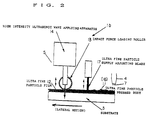
- a ultra fine particle film forming system 1b according to another embodiment shown in Fig. 2 has a ultra fine particle supply adjusting blade 17 and a mechanical impact force loading apparatus 5.
- the ultra fine particle supply adjusting blade 17 adjusts the supply amount of bristle ultra fine particles 7 to a substrate 3 by scraping and planarizing the surface of a ultra fine particle deposit 11 or a ultra fine particle pressed body 16. The supply amount is controlled by adjusting the height of the blade 17.
- the mechanical impact force loading apparatus 5 has, as shown in Fig. 2, an impact force loading roller 13 and a high intensity ultrasonic wave applying apparatus 14.
- the impact force loading roller 13 is used for forming a ultra fine particle film 12 by directly applying a mechanical impact force to the supply amount adjusted ultra fine particle deposit 11 on the substrate 3.
- the high intensity ultrasonic wave applying apparatus 14 drives the impact force loading roller 13.
- the impact force loading roller 13 may be any other body so long as it can load the mechanical impact force to the ultra fine particle deposit 11 or ultra fine particle pressed body 16.
- a number of impact force loading needles 15 are used in a ultra fine particle film forming apparatus of another embodiment shown in Fig. 3.
- the embodiment of the invention described above may be applied not only to forming a dense film but also to a porous film, by adjusting row material particles and film forming conditions such as a film forming speed.
- a porous film is effective for applications requiring a large specific surface area, such as electrodes of a fuel battery and a super capacitor.
- PZT Lead zirconate titanate oxide
- the electrical characteristics of a film formed by this method are greatly influenced by the heat treatment conditions and the structure change in ultra fine particles such as PZT particles to be caused when they collide with a substrate.
- the microscopic structure of films were investigated in order to clarify the film forming mechanism and improve the film characteristics.
- PZT ultra fine particles were ejected from a nozzle having an opening size of 5 mm x 0.3 mm and deposited on a substrate by using an aerosol gas deposition method.
- the substrate used included a silicon substrate, a SUS 304 substrate, and a PT/Ti/SiO 2 /Si substrate.
- the PZT particles had a composition of Zr/Ti : 52/48, a specific surface area of 2.8 m 2 /g, and an average particle diameter of 0.3 ⁇ m, and were heated and dried in a low pressure of 10 -2 Torr.
- Carrier gas was He and dried high purity air, and the particle speed was controlled by the carrier gas flow rate.
- the microscopic structure of a PZT film having a thickness of 20 ⁇ m formed in the above manner was observed as TEM images and electron beam diffraction images.
- Fig. 4 is a TEM image showing the cross section of a film formed on an Si substrate at a room temperature.
- a damage layer of about 0.15 ⁇ m at an interface between the Si substrate and a PZT layer, the damage layer being formed through collision of PZT ultra fine particles with the substrate. It can therefore be presumed that a mechanical impact force was generated by the collision of PZT ultra fine particles, the impact force exceeding the plastic flow pressure (Vickers hardness: 5 to 12 GPa) of Si. Since the brittle fracture strength of PZT ultra fine particles is 2.3 to 4 GPa, it can be expected that such a large mechanical impact force sufficiently broke PZT ultra fine particles and generated a new surface.
- Fig. 5 is a TEM image in cross section of rawmaterial particles
- rig. 6 is a TEM image in plan view of a film deposited at a room temperature on a Pt/Ti/SiO 2 /Si substrate.
- Raw material particles were partially cohesive and had inner strain and defects.
- Particles were almost single crystals as determined from an electron beam diffraction image when considering the particle diameter near to that observed by SEM.
- the crystal grain size was concentrated in a range of about 0.1 to 0.5 ⁇ m.
- an as-deposited film at the room temperature had a polycrystalline structure that there was no significant change in the composition of the film both in the cross sectional direction and in-plane direction, with large crystal particles of about 0.1 to 0.2 ⁇ m approximately of the original size being embedded and surrounded with small crystal particles of about 10 to 40 nm, and also that a number of fine contrasts were observed which might be generated by strain. From these studies, it can be understood that some of PZT ultra fins particles of raw material are broken finely and form fine crystals of about several tens ⁇ m because of collision with the substrate during the film forming process.
- a mechanical strength (brittle fracture strength) of bristle ultra tine particles is adjusted in accordance with a mechanical impact force to be applied to the bristle ultra fine particles so that the impact breakage occurs, or the mechanical impact force is applied in accordance with the mechanical strength of the bristle ultra fine particles.
- a clean new surface is formed and the bristle ultra fine particles are bonded together so that a ultra fine particle film having high density and high strength can be formed at the room temperature.
- the new surface formed through breakage of the bristle ultra fine particles is again bonded in a very short time on site by the pressure applied to the bristle ultra fine particles.
- the film forming atmosphere may be the atmospheric air without using a specific atmosphere such as an inert gas atmosphere.
- an inert gas atmosphere As the size of the bristle ultra fine particles becomes about several tens nm, the surface energy increases to enhance bonding, and generation of voids can be prevented which are otherwise formed because of undefined shapes of particles. A dense film or micro structure in the order of several tens nm in diameter can be obtained.
- bristle material such as ceramics having a high melting point can be formed on a substrate at the room temperature
- the surface of a substrate made of material having a low melting point such as plastics can be coated with ceramics.
- a vinyl film was attached to a stainless steel substrate, and bristle ultra fine particles of PZT was blown to the surface of the vinyl film. It was possible to form at the room temperature a very rigid shaped body having a density of 97 % and an adhesion force of 15 MPa. It was able to form ceramic material having a nanometer size crystal structure finer than raw material ultra fine particles, through breakage impact. The density of the shaped body was higher than the theoretical density of 95 %. Therefore, the temperature of heat treatment for grain growth was able to be lowered. For example, in the case of lead zirconate titanate (PZT), the temperature was able to be lowered by about 300°C as compared to a usual sintering temperature. A lowered grain growth temperature was thus confirmed.
- PZT lead zi
- the surface energy of the bristle ultra fine particles increase to enhance bonding of them.
- the fine crystallite in the body don't grow and is keeped in fine broken size and it brings improving elasticity and strength of the body and then it brings improved characteristics toughness.
- bristle ultra fine particles such as ceramics are broken to particles of about several tens nm by applying a mechanical impact force. A clean new surface can be formed on site, and by utilizing this surface, ultra fine particles are bonded together. In this manner, a shaped body such as a film and a micro structure of high density and high strength can be formed without heating.
Landscapes
- Chemical & Material Sciences (AREA)
- Engineering & Computer Science (AREA)
- Organic Chemistry (AREA)
- Materials Engineering (AREA)
- Manufacturing & Machinery (AREA)
- Ceramic Engineering (AREA)
- Mechanical Engineering (AREA)
- Metallurgy (AREA)
- Chemical Kinetics & Catalysis (AREA)
- Inorganic Chemistry (AREA)
- Structural Engineering (AREA)
- Other Surface Treatments For Metallic Materials (AREA)
- Application Of Or Painting With Fluid Materials (AREA)
Abstract
Description
Claims (5)
- A method of forming a bristle ultra fine particle shaped body at a low temperature, wherein a mechanical impact force is applied to bristle ultra fine particles supplied to a substrate to break the particles and bond together the particles or to bond together the particles and the particles and the substrate.
- A method of forming a bristle ultra fine particle shaped body at a low temperature, according to claim 1, wherein the mechanical impact force to be applied to the ultra fine particles supplied to the substrate is realized: by accelerating the bristle ultra fine particles by applying an electrostatic field or by using gas carrier to blow them to the substrate; by using a high rigidity brush or roller rotating at high speed, pressure needles moving up and down, or a piston moving at high speed utilizing explosion compression force; or by using ultrasonic waves.
- A method of forming a bristle ultra fine particle shaped body at a low temperature, according to claim 1, wherein the bristle ultra fine particles are subjected to a pre-process in accordance with the mechanical impact force to be applied to the bristle ultra fine particles so that the mechanical impact force becomes dominant over a bristle fracture strength of the ultra fine particles.
- A method of forming a bristle ultra fine particle shaped body at a low temperature, according to claim 3, wherein the pre-process is realized: through adjustment by changing a pre-sintering temperature of the bristle ultra fine particles; through formation of secondary cohesive particles of about 50 µm to 5 µm in diameter by heating the bristle ultra fine particles of several, tens nm or smaller in diameter; or through formation of bristle ultra fine particles with cracks by processing the particles for a long time by a smasher such as a ball mill and a jet mill.
- A method of forming a bristle ultra fine particle shaped body at a low temperature, according to claim 1, wherein at least a part of the ultra fine particles supplied to the substrate is broken by applied mechanical impact force into the particles of size of 80 nano meter or less.
Applications Claiming Priority (2)
| Application Number | Priority Date | Filing Date | Title |
|---|---|---|---|
| JP11732899 | 1999-04-23 | ||
| JP11732899 | 1999-04-23 |
Publications (3)
| Publication Number | Publication Date |
|---|---|
| EP1046484A2 true EP1046484A2 (en) | 2000-10-25 |
| EP1046484A3 EP1046484A3 (en) | 2003-01-02 |
| EP1046484B1 EP1046484B1 (en) | 2010-05-19 |
Family
ID=14709030
Family Applications (1)
| Application Number | Title | Priority Date | Filing Date |
|---|---|---|---|
| EP00106805A Expired - Lifetime EP1046484B1 (en) | 1999-04-23 | 2000-03-30 | Method of forming shaped body of brittle ultra fine particle at low temperature |
Country Status (5)
| Country | Link |
|---|---|
| US (1) | US6531187B2 (en) |
| EP (1) | EP1046484B1 (en) |
| AU (1) | AU740235B2 (en) |
| CA (1) | CA2303515C (en) |
| DE (1) | DE60044412D1 (en) |
Cited By (2)
| Publication number | Priority date | Publication date | Assignee | Title |
|---|---|---|---|---|
| WO2003100131A1 (en) | 2002-05-28 | 2003-12-04 | National Institute Of Advanced Industrial Science And Technology | Method for forming ultrafine particle brittle material at low temperature and ultrafine particle brittle material for use therein |
| EP1583162B1 (en) * | 2004-03-30 | 2009-07-15 | Brother Kogyo Kabushiki Kaisha | Method for manufacturing piezoelectric film, laminate structure of substrate and piezoelectric film, piezoelectric actuator and method for manufacturing same |
Families Citing this family (27)
| Publication number | Priority date | Publication date | Assignee | Title |
|---|---|---|---|---|
| US6827634B2 (en) * | 2000-05-22 | 2004-12-07 | Agency Of Industrial Science And Technology | Ultra fine particle film forming method and apparatus |
| DE60045037D1 (en) * | 1999-10-12 | 2010-11-11 | Nat Inst Of Advanced Ind Scien | HRES AND DEVICE FOR PRODUCTION |
| EP1280193B1 (en) * | 2000-05-02 | 2011-06-29 | JGC Catalysts and Chemicals Ltd. | Method of manufacturing integrated circuit, and substrate with integrated circuit formed by the method of manufacturing integrated circuit |
| US7346184B1 (en) | 2000-05-02 | 2008-03-18 | Digimarc Corporation | Processing methods combining multiple frames of image data |
| US8986829B2 (en) * | 2000-05-22 | 2015-03-24 | National Institute Of Advanced Industrial Science And Technology | Layered body |
| CN1251809C (en) * | 2000-10-17 | 2006-04-19 | 尼奥弗托尼克斯公司 | Apparatus and method for forming a coating by reactive deposition |
| US7255934B2 (en) * | 2000-10-23 | 2007-08-14 | National Institute Of Advanced Industrial Science And Technology | Composite structure body and method and apparatus for manufacturing thereof |
| US7565723B2 (en) * | 2004-03-30 | 2009-07-28 | Brother Kogyo Kabushik Kaisha | Piezoelectric actuator and method of fabricating piezoelectric actuator |
| US20060255692A1 (en) * | 2005-03-22 | 2006-11-16 | Motohiro Yasui | Piezoelectric Actuator, Ink-Jet Head, Method Of Producing Piezoelectric Actuator, And Method Of Producing Ink-Jet Head |
| JP4675821B2 (en) * | 2006-04-28 | 2011-04-27 | 株式会社豊田中央研究所 | Brazing method |
| JP5159634B2 (en) * | 2006-12-07 | 2013-03-06 | 独立行政法人物質・材料研究機構 | Warm spray coating method and its particles |
| JP5057457B2 (en) * | 2007-01-05 | 2012-10-24 | 独立行政法人産業技術総合研究所 | Magneto-optical material and manufacturing method thereof |
| US8114473B2 (en) * | 2007-04-27 | 2012-02-14 | Toto Ltd. | Composite structure and production method thereof |
| US8544408B2 (en) * | 2011-03-23 | 2013-10-01 | Kevin Wayne Ewers | System for applying metal particulate with hot pressurized air using a venturi chamber and a helical channel |
| WO2012161161A1 (en) * | 2011-05-20 | 2012-11-29 | 独立行政法人産業技術総合研究所 | Film forming method, body having film formed thereon, and dye-sensitized solar cell |
| FR2983217B1 (en) | 2011-11-25 | 2015-05-01 | Centre De Transfert De Tech Ceramiques C T T C | METHOD AND DEVICE FOR FORMING A DEPOSITION OF FRAGILE (X) MATERIAL (S) ON A POWDER PROJECTION SUBSTRATE |
| JP6134106B2 (en) * | 2012-08-20 | 2017-05-24 | 積水化学工業株式会社 | Method for producing porous membrane |
| JP6255222B2 (en) | 2013-11-27 | 2017-12-27 | 日東電工株式会社 | Metal oxide-polymer laminate and method for producing the same |
| CN104190584B (en) * | 2014-09-19 | 2016-06-22 | 苏州承源光电科技有限公司 | A kind of LED lamp heat sink is with being coated with heat-conducting silicone grease device |
| KR102585447B1 (en) | 2015-05-20 | 2023-10-06 | 시온 파워 코퍼레이션 | Protective layer for electrodes |
| RU171295U1 (en) * | 2016-02-01 | 2017-05-29 | Федеральное государственное казенное военное образовательное учреждение высшего образования "ВОЕННАЯ АКАДЕМИЯ МАТЕРИАЛЬНО-ТЕХНИЧЕСКОГО ОБЕСПЕЧЕНИЯ имени генерала армии А.В. Хрулева" | DEVICE FOR ULTRASONIC COATING BASED ON MINERAL MATERIALS |
| CA3024463C (en) | 2016-05-16 | 2021-08-10 | National Institute Of Advanced Industrial Science And Technology | Organic-inorganic composite layered structure having high adhesive properties, and high hardness or excellent transparency |
| JP7049269B2 (en) | 2016-05-20 | 2022-04-06 | シオン・パワー・コーポレーション | Protective layer for electrodes and electrochemical battery |
| EP3743224A4 (en) | 2017-11-21 | 2021-06-30 | New Mexico Tech University Research Park Corporation | AEROSOL PROCESS FOR COATING |
| CN109129854A (en) * | 2018-09-13 | 2019-01-04 | 肇庆乐华陶瓷洁具有限公司 | A kind of ceramic tile glaze automatic filling system |
| CN112570085A (en) * | 2020-11-24 | 2021-03-30 | 安徽桑瑞斯环保新材料有限公司 | Reducing mechanism is used in powder coating production |
| CN121105167A (en) * | 2025-04-23 | 2025-12-12 | 海南昀隆防水保温科技有限公司 | Refractory material forming device |
Family Cites Families (12)
| Publication number | Priority date | Publication date | Assignee | Title |
|---|---|---|---|---|
| US3100724A (en) * | 1958-09-22 | 1963-08-13 | Microseal Products Inc | Device for treating the surface of a workpiece |
| US4172558A (en) * | 1977-04-19 | 1979-10-30 | Bondarenko Alexandr S | Apparatus for explosive application of coatings |
| US4801411A (en) * | 1986-06-05 | 1989-01-31 | Southwest Research Institute | Method and apparatus for producing monosize ceramic particles |
| JPH02133377A (en) * | 1988-11-14 | 1990-05-22 | Isuzu Ceramics Kenkyusho:Kk | Impact sintering and automobile part production device using it |
| DE68921971T2 (en) * | 1988-12-28 | 1995-08-03 | Matsushita Electric Ind Co Ltd | Composite ferrite material. |
| JP2890599B2 (en) * | 1990-02-06 | 1999-05-17 | ソニー株式会社 | Processing method |
| EP0539804B1 (en) | 1991-10-15 | 1998-03-04 | Canon Kabushiki Kaisha | A substrate for a liquid jet recording head, a manufacturing method for such a substrate, a liquid jet recording head, and a liquid jet recording apparatus |
| WO1994025641A1 (en) * | 1993-04-26 | 1994-11-10 | Roger John Wedlake | Forming a hard layer on a substrate |
| US5795626A (en) * | 1995-04-28 | 1998-08-18 | Innovative Technology Inc. | Coating or ablation applicator with a debris recovery attachment |
| EP0860516A3 (en) * | 1997-02-04 | 1999-05-19 | Fuji Kihan Co., Ltd. | Method for forming metallic coat |
| JPH11152582A (en) * | 1997-11-14 | 1999-06-08 | Vacuum Metallurgical Co Ltd | Gas deposition method and device therefor |
| DE60045037D1 (en) * | 1999-10-12 | 2010-11-11 | Nat Inst Of Advanced Ind Scien | HRES AND DEVICE FOR PRODUCTION |
-
2000
- 2000-03-29 US US09/538,332 patent/US6531187B2/en not_active Expired - Lifetime
- 2000-03-30 EP EP00106805A patent/EP1046484B1/en not_active Expired - Lifetime
- 2000-03-30 CA CA002303515A patent/CA2303515C/en not_active Expired - Lifetime
- 2000-03-30 DE DE60044412T patent/DE60044412D1/en not_active Expired - Lifetime
- 2000-03-31 AU AU25210/00A patent/AU740235B2/en not_active Expired
Cited By (4)
| Publication number | Priority date | Publication date | Assignee | Title |
|---|---|---|---|---|
| WO2003100131A1 (en) | 2002-05-28 | 2003-12-04 | National Institute Of Advanced Industrial Science And Technology | Method for forming ultrafine particle brittle material at low temperature and ultrafine particle brittle material for use therein |
| EP1510598A4 (en) * | 2002-05-28 | 2009-01-07 | Nat Inst Of Advanced Ind Scien | METHOD FOR FORMING ULTRA-SPECTIVE SPRING MATERIAL AT LOW TEMPERATURE AND ULTRA-INFUSED SPROUTS MATERIAL FOR USE THEREIN |
| US7658996B2 (en) | 2002-05-28 | 2010-02-09 | National Institute Of Advanced Industrial Science And Technology | Ultrafine particle brittle material having polycrystal structure obtained by mechanical and thermal treatment |
| EP1583162B1 (en) * | 2004-03-30 | 2009-07-15 | Brother Kogyo Kabushiki Kaisha | Method for manufacturing piezoelectric film, laminate structure of substrate and piezoelectric film, piezoelectric actuator and method for manufacturing same |
Also Published As
| Publication number | Publication date |
|---|---|
| AU740235B2 (en) | 2001-11-01 |
| AU2521000A (en) | 2000-11-16 |
| US20020071905A1 (en) | 2002-06-13 |
| EP1046484B1 (en) | 2010-05-19 |
| CA2303515A1 (en) | 2000-10-23 |
| CA2303515C (en) | 2005-05-17 |
| DE60044412D1 (en) | 2010-07-01 |
| EP1046484A3 (en) | 2003-01-02 |
| US6531187B2 (en) | 2003-03-11 |
Similar Documents
| Publication | Publication Date | Title |
|---|---|---|
| EP1046484B1 (en) | Method of forming shaped body of brittle ultra fine particle at low temperature | |
| JP3265481B2 (en) | Low temperature molding of brittle material ultrafine particles | |
| CN1227388C (en) | Composite composition and method of making the same | |
| JP4949668B2 (en) | Manufacturing method of ceramic film and structure including ceramic film | |
| CN1225570C (en) | Composite structure and method and appts. mfg. thereof | |
| Akedo | Aerosol deposition method for fabrication of nano crystal ceramic layer | |
| CN1243848C (en) | Composite structure and its manufacturing method and manufacturing device | |
| JP5289710B2 (en) | Piezoelectric element and inkjet head | |
| JP2005344171A (en) | Raw material powder for film deposition, and film deposition method using the same | |
| JP2003277948A (en) | Composite structure and method of manufacturing the same | |
| JP2007023379A (en) | Film forming method and structure | |
| JP2005279953A (en) | Ceramic structure and its manufacturing method | |
| JP2009013472A (en) | Sputtering target, and manufacturing method and recycling method thereof | |
| JP5649023B2 (en) | Method for forming zirconia film | |
| US7179718B2 (en) | Structure and method of manufacturing the same | |
| JP2003277949A (en) | Composite structure, method of manufacturing the same, and manufacturing apparatus | |
| JP5066682B2 (en) | Low temperature molding method for brittle material fine particle film | |
| JP5561743B2 (en) | Brittle material fine particle film | |
| TW200536959A (en) | Method for producing coating film with the use of aerosol, particulate mixture therefor, coating film and composite material | |
| JP2005161703A (en) | Composite structure in which fragile material structure is mounted on resin substrate having backing layer and method for producing the structure | |
| EP1583163B1 (en) | Method for manufacturing film or piezoelectric film | |
| JP2004043893A (en) | Ceramic film deposition method, and ceramic film | |
| JP2007185572A (en) | Powder, manufacturing method thereof, film forming method, and structure | |
| JP5649028B2 (en) | Method for forming zirconia film | |
| Akedo | An Aerosol Deposition Method and its Application to Make Mems Devices |
Legal Events
| Date | Code | Title | Description |
|---|---|---|---|
| PUAI | Public reference made under article 153(3) epc to a published international application that has entered the european phase |
Free format text: ORIGINAL CODE: 0009012 |
|
| AK | Designated contracting states |
Kind code of ref document: A2 Designated state(s): AT BE CH CY DE DK ES FI FR GB GR IE IT LI LU MC NL PT SE |
|
| AX | Request for extension of the european patent |
Free format text: AL;LT;LV;MK;RO;SI |
|
| PUAL | Search report despatched |
Free format text: ORIGINAL CODE: 0009013 |
|
| AK | Designated contracting states |
Kind code of ref document: A3 Designated state(s): AT BE CH CY DE DK ES FI FR GB GR IE IT LI LU MC NL PT SE |
|
| AX | Request for extension of the european patent |
Free format text: AL;LT;LV;MK;RO;SI |
|
| RIC1 | Information provided on ipc code assigned before grant |
Free format text: 7C 23C 24/04 A |
|
| 17P | Request for examination filed |
Effective date: 20030516 |
|
| AKX | Designation fees paid |
Designated state(s): CH DE FR GB LI |
|
| 17Q | First examination report despatched |
Effective date: 20080102 |
|
| GRAP | Despatch of communication of intention to grant a patent |
Free format text: ORIGINAL CODE: EPIDOSNIGR1 |
|
| GRAS | Grant fee paid |
Free format text: ORIGINAL CODE: EPIDOSNIGR3 |
|
| GRAA | (expected) grant |
Free format text: ORIGINAL CODE: 0009210 |
|
| AK | Designated contracting states |
Kind code of ref document: B1 Designated state(s): CH DE FR GB LI |
|
| REG | Reference to a national code |
Ref country code: GB Ref legal event code: FG4D |
|
| REG | Reference to a national code |
Ref country code: CH Ref legal event code: EP |
|
| REF | Corresponds to: |
Ref document number: 60044412 Country of ref document: DE Date of ref document: 20100701 Kind code of ref document: P |
|
| REG | Reference to a national code |
Ref country code: CH Ref legal event code: NV Representative=s name: E. BLUM & CO. AG PATENT- UND MARKENANWAELTE VSP |
|
| PLBE | No opposition filed within time limit |
Free format text: ORIGINAL CODE: 0009261 |
|
| STAA | Information on the status of an ep patent application or granted ep patent |
Free format text: STATUS: NO OPPOSITION FILED WITHIN TIME LIMIT |
|
| 26N | No opposition filed |
Effective date: 20110222 |
|
| REG | Reference to a national code |
Ref country code: DE Ref legal event code: R097 Ref document number: 60044412 Country of ref document: DE Effective date: 20110221 |
|
| REG | Reference to a national code |
Ref country code: FR Ref legal event code: PLFP Year of fee payment: 17 |
|
| REG | Reference to a national code |
Ref country code: FR Ref legal event code: PLFP Year of fee payment: 18 |
|
| REG | Reference to a national code |
Ref country code: FR Ref legal event code: PLFP Year of fee payment: 19 |
|
| PGFP | Annual fee paid to national office [announced via postgrant information from national office to epo] |
Ref country code: DE Payment date: 20190104 Year of fee payment: 20 Ref country code: FR Payment date: 20190108 Year of fee payment: 20 Ref country code: CH Payment date: 20190208 Year of fee payment: 20 Ref country code: GB Payment date: 20190107 Year of fee payment: 20 |
|
| REG | Reference to a national code |
Ref country code: DE Ref legal event code: R071 Ref document number: 60044412 Country of ref document: DE |
|
| REG | Reference to a national code |
Ref country code: CH Ref legal event code: PL |
|
| REG | Reference to a national code |
Ref country code: GB Ref legal event code: PE20 Expiry date: 20200329 |
|
| PG25 | Lapsed in a contracting state [announced via postgrant information from national office to epo] |
Ref country code: GB Free format text: LAPSE BECAUSE OF EXPIRATION OF PROTECTION Effective date: 20200329 |