EP1044579B1 - Database updating in a mobile communication system - Google Patents
Database updating in a mobile communication system Download PDFInfo
- Publication number
- EP1044579B1 EP1044579B1 EP98962607A EP98962607A EP1044579B1 EP 1044579 B1 EP1044579 B1 EP 1044579B1 EP 98962607 A EP98962607 A EP 98962607A EP 98962607 A EP98962607 A EP 98962607A EP 1044579 B1 EP1044579 B1 EP 1044579B1
- Authority
- EP
- European Patent Office
- Prior art keywords
- primary
- database
- function
- functions
- data
- Prior art date
- Legal status (The legal status is an assumption and is not a legal conclusion. Google has not performed a legal analysis and makes no representation as to the accuracy of the status listed.)
- Expired - Lifetime
Links
- 238000010295 mobile communication Methods 0.000 title 1
- 230000001360 synchronised effect Effects 0.000 claims abstract description 13
- 230000006870 function Effects 0.000 claims description 150
- 238000000034 method Methods 0.000 claims description 4
- 230000011664 signaling Effects 0.000 description 6
- 238000012545 processing Methods 0.000 description 4
- 101150084332 VPS16 gene Proteins 0.000 description 2
- 238000004578 scanning tunneling potentiometry Methods 0.000 description 2
- 235000019832 sodium triphosphate Nutrition 0.000 description 2
- 210000004271 bone marrow stromal cell Anatomy 0.000 description 1
- 238000004891 communication Methods 0.000 description 1
- 239000002131 composite material Substances 0.000 description 1
- 238000012790 confirmation Methods 0.000 description 1
- 238000013500 data storage Methods 0.000 description 1
- 238000010586 diagram Methods 0.000 description 1
- 238000012546 transfer Methods 0.000 description 1
Images

Classifications
-
- H—ELECTRICITY
- H04—ELECTRIC COMMUNICATION TECHNIQUE
- H04W—WIRELESS COMMUNICATION NETWORKS
- H04W24/00—Supervisory, monitoring or testing arrangements
- H04W24/02—Arrangements for optimising operational condition
-
- Y—GENERAL TAGGING OF NEW TECHNOLOGICAL DEVELOPMENTS; GENERAL TAGGING OF CROSS-SECTIONAL TECHNOLOGIES SPANNING OVER SEVERAL SECTIONS OF THE IPC; TECHNICAL SUBJECTS COVERED BY FORMER USPC CROSS-REFERENCE ART COLLECTIONS [XRACs] AND DIGESTS
- Y10—TECHNICAL SUBJECTS COVERED BY FORMER USPC
- Y10S—TECHNICAL SUBJECTS COVERED BY FORMER USPC CROSS-REFERENCE ART COLLECTIONS [XRACs] AND DIGESTS
- Y10S707/00—Data processing: database and file management or data structures
- Y10S707/99951—File or database maintenance
- Y10S707/99952—Coherency, e.g. same view to multiple users
- Y10S707/99953—Recoverability
Definitions
- the present invention relates to a telecommunication system.
- the present invention is particularly, but not exclusively, concerned with a telecommunications system for mobile telephones.
- a call to a mobile telephone is not to a fixed point, and therefore the system must determine the location of the destination.
- the simplest arrangement is for a call to a mobile telephone to result in a signal being transmitted to a data storage unit in the form of a Home Location Register unit (HLR) which determines the location of the mobile telephone, and so permits routing of the call to occur.
- HLR Home Location Register unit
- HLRs have a limited capacity, and some arrangement is therefore necessary to enable telecommunication systems to access multiple HLRs.
- users may need multiple MSISDN numbers, for example if a user is to have the possibility of both voice and data communication, in existing systems, any second MSISDN number with a common identity number (IMSI) must be a MSISDN number of the same HLR as the previous MSISDN number. This could be impossible to achieve if, for example, the HLR containing the original information is full. Then the only way that additional services could be provided would require the user to change telephone number, which would be undesirable. This becomes a particular problem if it is desirable that users are able to select their numbers, rather than be provided with them.
- IMSI common identity number
- WO 96/11557 (corresponding to US 08/809767) proposed that the switch network which connects users to other users, HLRs, and system services, had a register unit associated therewith, which register unit contained information relating each telephone number to a corresponding one of a plurality of HLRs. The relationship between telephone numbers and HLRs should then be freely selectable within the register unit, so that the register unit acted as a converter between the number and the information identifying the HLR.
- register unit By providing such a register unit, the fixed relationship between numbers and HLRs was broken, and any number can be assigned to any HLR, assuming space permits.
- WO 96/11557 also proposed that the register unit stored further information associated with the mobile telephones which permits the switch network to enable calls from mobile telephones to be routed to different services, depending on the calling mobile telephone itself, in addition to the number dialled.
- the present invention develops further the ideas proposed in WO 96/11557 by considering the location within which information is stored in the network. In WO 96/11557, the question of the location of the register unit was not considered.
- the first is the storage of the data itself, and the second is data control, being the means of handling queries, updates, results in synchronisation messages and similar controls.
- the arrangement described in WO 96/11557 can be considered to be of this type in that the register needs to store data, and also needs to store control information for acting on that data.
- both the data and the data control functions may be located at a single site, and stored on a single physical device such as a server which responds to queries and updates.
- the information stored may be considered to comprise a data function and a data control function, with the data function representing sets of data relating to respective telephone numbers, telephone control operations, etc.
- the data function and data control function may be considered to form a database of functions.
- EP 0702496 discusses the update of multiple databases containing replicated customer records, and verifying the data consistency between those databases, but does not discuss failure recover, nor propose a solution.
- the present invention proposes a telecommunication network having at least one database of functions for controlling the network, said database comprising at least a data function and a data control function; characterised in that: the database is replicated a plurality of times, the database of one of said replicated databases is a primary database, the data control function of which is arranged to generate signals for synchronised updating of all of said replicated databases, and at least a second database is a primary standby database, the data control function of which is arranged to generate signals for synchronised updating of all of said replicated databases in the event of a failure of said primary database.
- the replicated databases may physically be located. in a single location, or may ⁇ be at a plurality of physically separate locations. In either case, each replicated database may be considered to be a service data function with each such function being a notional site in the network.
- the sites of the functions are thus virtual sites, rather than being necessarily physically separate.
- each service data function may be stored on a separate storage device. That storage device may also store other information needed by the network, or may control only the service data function.
- That storage device may also store other information needed by the network, or may control only the service data function.
- the relationships between the service data functions are more important than their physical locations.
- the service data functions represent a distributed database, that distributed database must form a logically singular entity, even when physically distributed. Otherwise, the network will not operate correctly. Therefore, control must be applied across the distributed database.
- This synchronisation includes not only the need for the information about any particular telephone number to be the same at each function, but also for the facilities associated with that telephone number to the same at each function.
- the present invention therefore relates to the synchronisation of those functions.
- the present invention has been developed in connection with the register unit of WO 96/11557, the present invention is not limited to the operation of that register unit, and relates to arrangements in any network in which functions are distributed. Where the present invention is used in connection with the register unit of WO 96/11557, the register unit may be embodied in any of the distributed service data functions, or the actions of the register unit may be distributed across more than one service data function.
- a switched network 10 interconnects land-based and mobile telephones. If a call to a mobile telephone is made from a land-based telephone, the call is routed via the public switched telephone network (PSTN) 11 to the switch network, and from that switch network 10 to the mobile telephone (BSS) 12. To do this, the switch network 10 must determine routing information, and to determine that routing information it must determine the location of the mobile telephone 12, which it does via a HLR to which the mobile telephone 12 is associated. When there are multiple HLRs 13,14, it is necessary for the switch network 10 to determine which HLR 13,14 must be accessed, on the basis of the telephone number (MSISDN number) of the mobile telephone input by the originator of the call.
- MSISDN number telephone number
- the switched network 10 accesses a register unit 15, which identifies the called number and addresses it to a particular HLR 13,14 with which the mobile telephone 12 is associated.
- the register unit 15 permits the relationship between any given mobile telephone number and the HLRs 13,14 to be determined freely, so that the number is unaffected by the particular HLR 13,14 with which it is associated.
- the register unit 15 removes the need for a particular mobile telephone number to be associated with a fixed HLR 13,14.
- the switch network 10 must again determine the routing of that call. If the call is to a land-based telephone, connected to the switch network 10 via the PSTN 11, then this routing can be on the basis of the telephone number of the destination telephone, in the normal way.
- a call is made from a mobile telephone 12 to one of a plurality of voice processing systems 16,17 or to services 18 associated with the switch network using a short code (e.g. 123) the relationship between the mobile telephone 12 and the corresponding service must be determined by the register unit 15 before the switch network can determine the appropriate voice processing system 16,17 or services 18 to be accessed.
- a short code e.g. 123
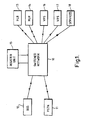
- Fig. 2 shows the switch network 10 in more detail. It has a plurality of mobile switching centres (MSC) 20,21 and 22, and a call destined to any given mobile telephone results in signalling between that MSC 20-22 and one of a plurality of signalling transfer points (STP) 30,31, which signal to the register unit 15 to determine the HLR 13,14 which is appropriate to the mobile telephone 12.
- the register unit 15 of Fig. 1 derives that information from the telephone number (MSISDN number) of the mobile telephone 12. It would then be possible for the register unit 15 to forward the signal directly to the appropriate HLR 13,14 but, it is preferable that the information is passed back to the corresponding STP 30,31 which then passes the signalling to the correct HLR 13,14.
- MSISDN number telephone number
- a similar signalling flow occurs when the user of the mobile telephone 12 tries to access a voice processing system (VPS) 16 or a service node (SN) 17.
- the call is received by one of the MSCs 20,21 and 22 which passes the dialled digits and the identity of the mobile telephone to one of the STPs 30,31,32.
- This relays the information to the register unit 15, which uses this information to construct the correct address of the appropriate voice processing service (VPS) 16 or service node (SN) 17. That information is relayed back from the register unit via one of the STPs 30,31,32 to the original MSC 20,21,22.
- This address is then used to route the call by the switch network 10. That routing passes the call from the appropriate MSC 20,21,22 via the switch network to the VPS 16 or the SN 17.
- the register unit 15 is not a single component, but comprises a plurality of units hereinafter referred to as service control points (SCP) 40.
- SCP service control points
- N SCP 40 wherein N is an integer being 2 or greater. At least two SCP 40 are needed in order to provide a replicated database for load sharing and fault tolerance.
- the SCPs 40 are interconnected by a data connection 41, and the system also has a controller (NMS) 42 that monitors the service control points (SCP) 40.
- NMS controller
- SCP service control points
- Fig. 2 illustrates the arrangement of the network in structural terms. However, it is also possible to think of the arrangement in functional terms, and the significant functions of the arrangement of Fig 2 are illustrated in Fig. 3.
- the SCPs 40 may, collectively, be considered as a plurality of functions, primarily data functions, which collectively provide a centralised repository for service/subscriber related data. Each of these functions will be referred to as a service data function or SDF.
- SDFs service data function
- SCF 55 which is a logical element (in the same way as the SDFs 50-54 are logical elements) corresponding to VPS 16, service node 19 etc. in Fig 2.
- the SCF 55 can be thought of as a "client" within the network which requests data from, updates to, etc the SDFs 50-54.
- One of the SDFs 50 is designated a primary function, and has primary responsibility for synchronising updating of the other SDFs 51-54.
- the link between the SCF 55 and the data connection 41 is a path for data being retrieved by an SCF 55, and also of update information to the SDF 50.
- At least one other SDF 51 is designated a primary standby function and has a similar link 57 to the connection 41.
- the primary standby function 51 operates to take over the control of updating carried out by the primary function 50 if the primary function 50 is unable to carry out that operation correctly.
- all the other SDFs 52,53,54 are secondary functions.
- Those secondary functions 52,53,54 are also connected by suitable connection 58, 59, 60 to the data connection 41.
- Those connections 58, 59, 60 are involved in retrieval of data for an SCF, synchronisation of updates from the primary function SDFs, but not directly in updating from an SCF.
- all the SDFs 50-54 are interconnected for updating controlled by the primary function 50, or the primary standby function 51.
- those interconnecting are normally via connections 56 to 60 and data connection 41, but for functional purposes may be considered to be direct as shown in fig. 3.
- functions (SDFs) 50-54 provide a composite memory in which, in a mobile telephone system, information about users, network functions, etc may be stored as discussed in more detail in WO 96/11557.
- the present invention is particularly concerned with the updating of the function network thus created.
- a request for updating of data stored in the SDFs 50-54 is received at the primary function 50.
- the primary function 50 signals the update to all other functions 51-54.
- those functions 51-54 have recorded the update, they signal back to the primary function 50 that the update has been completed.
- the primary function 50 can store information confirming that all the other functions 51-54 have been successfully updated.
- the primary function 50 may then signal to the SCF 55 to confirm that the update operation has been completed, and also confirm to the other functions 51-54 that it has recorded the completion of the update and that the SCF has been notified.
- the functions 50-54 are synchronised.
- any secondary function 50-54 fails successfully to record an update, this will be detected by the primary function 50 and that secondary function will then be considered unsynchronised, and thus not a reliable source for data.
- the primary function 50 will not attempt to send further update signals to such an unsynchronised secondary function.
- the primary function may determine that the attempted update of the network of functions has wholly failed, in which case a suitable signal will be sent to the SCF 55, and the update operation rejected.
- an unsynchronised secondary function can subsequently return itself to the synchronised state.
- An unsynchronised secondary function may signal to the primary function 50 an indication of the last update which it successfully completed. The primary function 50 may then determine all subsequent updates and transmit all those updates to the unsynchronised secondary function. If the unsynchronised secondary function successfully records all those updates, it may be considered to have returned to synchronisation. Once synchronised, the primary function 50 will continue to update that secondary function in the normal way.
- the primary function 50 may need to be closed down. For example, this may be because the hardware on which the primary function 50 is resident needs to be maintained.
- the actions of the primary function 50 are transferred to the primary standby function 51. This hand-over of operations is signalled between the primary function 50 and the primary standby function 51, and also with the SCF 55. Any existing updates should be completed before this hand-over occurs, so that all SDFs are synchronised prior to the primary standby function 51 taking over.
- This procedure can also apply in an unexpected failure of the primary function 50.
- the primary function 50 when the primary function 50 has received confirmation from all the other functions 51 - 54 that updating had occurred, it notifies the requesting SCF and then signals.an acknowledgement to those other functions. If that acknowledgement is not received by the primary standby function 51 within a predetermined time and the primary standby function 51 is informed by the switched network 10 that the primary function is unavailable, the system may be arranged so that the primary standby function 51 then automatically takes over control of the network functions 50-54 under the assumption that the primary function is no longer available.
- Fig. 3 illustrates an embodiment with five functions (SDFs) 50-54, the minimum number of functions to achieve the present invention is two. In such an arrangement, one function acts as a primary function, and the other acts as a primary stand-by function. Further secondary functions then increase redundancy and load sharing.
- SDFs functions
- each service control point (SCP) 40 was associated with a corresponding SDF 50 to 54. It should be noted that any single SCP 40 may act as the storage site for only the corresponding SDF 50-54, or may store other information, such as data or control operations.
Landscapes
- Engineering & Computer Science (AREA)
- Computer Networks & Wireless Communication (AREA)
- Signal Processing (AREA)
- Mobile Radio Communication Systems (AREA)
- Exchange Systems With Centralized Control (AREA)
- Information Retrieval, Db Structures And Fs Structures Therefor (AREA)
- Telephonic Communication Services (AREA)
Priority Applications (1)
| Application Number | Priority Date | Filing Date | Title |
|---|---|---|---|
| SI9830116T SI1044579T1 (en) | 1997-12-30 | 1998-12-22 | Database updating in a mobile communication system |
Applications Claiming Priority (3)
| Application Number | Priority Date | Filing Date | Title |
|---|---|---|---|
| GB9727463 | 1997-12-30 | ||
| GBGB9727463.3A GB9727463D0 (en) | 1997-12-30 | 1997-12-30 | Telecommunications system |
| PCT/GB1998/003881 WO1999035867A1 (en) | 1997-12-30 | 1998-12-22 | Database updating in a mobile communication system |
Publications (2)
| Publication Number | Publication Date |
|---|---|
| EP1044579A1 EP1044579A1 (en) | 2000-10-18 |
| EP1044579B1 true EP1044579B1 (en) | 2001-11-21 |
Family
ID=10824307
Family Applications (1)
| Application Number | Title | Priority Date | Filing Date |
|---|---|---|---|
| EP98962607A Expired - Lifetime EP1044579B1 (en) | 1997-12-30 | 1998-12-22 | Database updating in a mobile communication system |
Country Status (11)
| Country | Link |
|---|---|
| US (1) | US6871068B1 (enExample) |
| EP (1) | EP1044579B1 (enExample) |
| JP (1) | JP4319349B2 (enExample) |
| AT (1) | ATE209424T1 (enExample) |
| AU (1) | AU738158B2 (enExample) |
| DE (1) | DE69803315T2 (enExample) |
| DK (1) | DK1044579T3 (enExample) |
| ES (1) | ES2168805T3 (enExample) |
| GB (2) | GB9727463D0 (enExample) |
| PT (1) | PT1044579E (enExample) |
| WO (1) | WO1999035867A1 (enExample) |
Cited By (2)
| Publication number | Priority date | Publication date | Assignee | Title |
|---|---|---|---|---|
| RU2251497C2 (ru) * | 2002-11-19 | 2005-05-10 | ГУП РТ "ПО ЕлАЗ" | Автопередвижная дезинфекционная установка |
| WO2007028249A1 (en) * | 2005-09-09 | 2007-03-15 | Avokia Inc. | Method and apparatus for sequencing transactions globally in a distributed database cluster with collision monitoring |
Families Citing this family (19)
| Publication number | Priority date | Publication date | Assignee | Title |
|---|---|---|---|---|
| GB0002972D0 (en) | 2000-02-09 | 2000-03-29 | Orange Personal Comm Serv Ltd | Data handling system |
| CN1240244C (zh) | 2001-05-11 | 2006-02-01 | 诺基亚公司 | 网络环境内的数据单元信息管理 |
| JP2003110576A (ja) * | 2001-09-26 | 2003-04-11 | Toshiba Corp | 無線ネットワークシステム、無線ネットワークの管理方法、及び、コンピュータで実行可能な無線ネットワークの管理プログラム |
| US7653389B2 (en) | 2001-12-21 | 2010-01-26 | Orange Personal Telecommunications Services Limited | Call processing in mobile telecommunications networks |
| GB2395629B (en) * | 2002-11-20 | 2006-06-21 | Motorola Inc | Wireless communications systems and methods |
| GB2429874B (en) * | 2005-09-02 | 2007-09-19 | Motorola Inc | Network element manager resynchronization |
| US20070061379A1 (en) | 2005-09-09 | 2007-03-15 | Frankie Wong | Method and apparatus for sequencing transactions globally in a distributed database cluster |
| US20080256142A1 (en) * | 2007-04-10 | 2008-10-16 | Apertio Limited | Journaling in network data architectures |
| US20080256112A1 (en) * | 2007-04-10 | 2008-10-16 | Apertio Limited | Indirect methods in network data repositories |
| US9112873B2 (en) * | 2007-04-10 | 2015-08-18 | Apertio Limited | Alias hiding in network data repositories |
| US7664866B2 (en) | 2007-04-10 | 2010-02-16 | Apertio Limited | Sub-tree access control in network architectures |
| US20080253402A1 (en) * | 2007-04-10 | 2008-10-16 | Apertio Limited | Timing device and method |
| EP2145456B1 (en) * | 2007-04-10 | 2016-12-07 | Apertio Limited | Variant entries in network data repositories |
| US8402147B2 (en) * | 2007-04-10 | 2013-03-19 | Apertio Limited | Nomadic subscriber data system |
| US8782085B2 (en) * | 2007-04-10 | 2014-07-15 | Apertio Limited | Variant entries in network data repositories |
| US20080256095A1 (en) * | 2007-04-10 | 2008-10-16 | Apertio Limited | Adaptation in network data repositories |
| US8140676B2 (en) * | 2007-04-10 | 2012-03-20 | Apertio Limited | Data access in distributed server systems |
| US9367806B1 (en) | 2013-08-08 | 2016-06-14 | Jasmin Cosic | Systems and methods of using an artificially intelligent database management system and interfaces for mobile, embedded, and other computing devices |
| US10255302B1 (en) | 2015-02-27 | 2019-04-09 | Jasmin Cosic | Systems, methods, apparatuses, and/or interfaces for associative management of data and inference of electronic resources |
Family Cites Families (14)
| Publication number | Priority date | Publication date | Assignee | Title |
|---|---|---|---|---|
| SE516772C2 (sv) * | 1993-03-31 | 2002-02-26 | Ericsson Telefon Ab L M | Återupprättande av en hemmadatabas i mobiltelefonsystem |
| SE501088C2 (sv) * | 1993-03-31 | 1994-11-07 | Ericsson Telefon Ab L M | Återupprättande av en hemmadatabas i mobilradiosystem |
| US5579318A (en) * | 1994-06-30 | 1996-11-26 | Bellsouth Corporation | Processes and apparatus for maintaining data concurrence between databases in telecommunications networks |
| US5937343A (en) * | 1994-09-13 | 1999-08-10 | At&T Corp. | Method and system for updating replicated databases in a telecommunication network system |
| US5799323A (en) * | 1995-01-24 | 1998-08-25 | Tandem Computers, Inc. | Remote duplicate databased facility with triple contingency protection |
| US5706286A (en) * | 1995-04-19 | 1998-01-06 | Mci Communications Corporation | SS7 gateway |
| SE507482C2 (sv) * | 1995-10-09 | 1998-06-15 | Ericsson Telefon Ab L M | System och förfarande för kommunikationshantering med redundans |
| US5890156A (en) * | 1996-05-02 | 1999-03-30 | Alcatel Usa, Inc. | Distributed redundant database |
| JPH10161916A (ja) * | 1996-11-28 | 1998-06-19 | Hitachi Ltd | データベースの複製に伴う更新競合の検出方法 |
| JP4187178B2 (ja) * | 1997-05-09 | 2008-11-26 | アルカテル・ユー・エス・エイ・ソーシング、エル・ピー | 迅速なデータベース同期の通信システム |
| SE9702015L (sv) * | 1997-05-28 | 1998-11-29 | Ericsson Telefon Ab L M | Metod vid distribuerad databas, samt ett system anpassat att verka enligt metoden |
| US6199069B1 (en) * | 1997-08-25 | 2001-03-06 | International Business Machines Corporation | System and method for switching between databases without disruption to applications |
| JP3534596B2 (ja) * | 1997-12-05 | 2004-06-07 | 富士通株式会社 | インテリジェントネットワーク内のデータベースの同期方法と装置 |
| US6188695B1 (en) * | 1997-12-18 | 2001-02-13 | Ericsson Inc. | System and method for multi-node data synchronization |
-
1997
- 1997-12-30 GB GBGB9727463.3A patent/GB9727463D0/en not_active Ceased
-
1998
- 1998-12-22 WO PCT/GB1998/003881 patent/WO1999035867A1/en not_active Ceased
- 1998-12-22 DK DK98962607T patent/DK1044579T3/da active
- 1998-12-22 ES ES98962607T patent/ES2168805T3/es not_active Expired - Lifetime
- 1998-12-22 DE DE69803315T patent/DE69803315T2/de not_active Expired - Lifetime
- 1998-12-22 AU AU17737/99A patent/AU738158B2/en not_active Expired
- 1998-12-22 JP JP2000528117A patent/JP4319349B2/ja not_active Expired - Lifetime
- 1998-12-22 GB GB0011701A patent/GB2347594B/en not_active Expired - Lifetime
- 1998-12-22 EP EP98962607A patent/EP1044579B1/en not_active Expired - Lifetime
- 1998-12-22 US US09/582,721 patent/US6871068B1/en not_active Expired - Lifetime
- 1998-12-22 AT AT98962607T patent/ATE209424T1/de not_active IP Right Cessation
- 1998-12-22 PT PT98962607T patent/PT1044579E/pt unknown
Cited By (2)
| Publication number | Priority date | Publication date | Assignee | Title |
|---|---|---|---|---|
| RU2251497C2 (ru) * | 2002-11-19 | 2005-05-10 | ГУП РТ "ПО ЕлАЗ" | Автопередвижная дезинфекционная установка |
| WO2007028249A1 (en) * | 2005-09-09 | 2007-03-15 | Avokia Inc. | Method and apparatus for sequencing transactions globally in a distributed database cluster with collision monitoring |
Also Published As
| Publication number | Publication date |
|---|---|
| DK1044579T3 (da) | 2002-04-02 |
| JP2002501354A (ja) | 2002-01-15 |
| US6871068B1 (en) | 2005-03-22 |
| WO1999035867A1 (en) | 1999-07-15 |
| EP1044579A1 (en) | 2000-10-18 |
| PT1044579E (pt) | 2002-05-31 |
| ES2168805T3 (es) | 2002-06-16 |
| HK1031801A1 (en) | 2001-06-22 |
| DE69803315D1 (de) | 2002-02-21 |
| GB2347594A (en) | 2000-09-06 |
| DE69803315T2 (de) | 2002-07-18 |
| AU1773799A (en) | 1999-07-26 |
| ATE209424T1 (de) | 2001-12-15 |
| GB2347594B (en) | 2001-03-07 |
| JP4319349B2 (ja) | 2009-08-26 |
| GB0011701D0 (en) | 2000-07-05 |
| AU738158B2 (en) | 2001-09-13 |
| GB9727463D0 (en) | 1998-02-25 |
Similar Documents
| Publication | Publication Date | Title |
|---|---|---|
| EP1044579B1 (en) | Database updating in a mobile communication system | |
| JP3974652B2 (ja) | 通信システムにおけるノードのためのハードウェアおよびデータ冗長アーキテクチャ | |
| CA2253266C (en) | Duplicated home location registers in a mobile radio system | |
| EP1256255B1 (en) | Data handling system | |
| EP1240790B1 (en) | A wireless mobility services platform | |
| US8559940B1 (en) | Redundancy mechanisms in a push-to-talk realtime cellular network | |
| EP1391131B1 (en) | Data element information management in a network environment | |
| MXPA97005122A (en) | Redundant architecture of hardware and paranod data in a communication system | |
| IE20001067A1 (en) | A wireless mobility services platform |
Legal Events
| Date | Code | Title | Description |
|---|---|---|---|
| PUAI | Public reference made under article 153(3) epc to a published international application that has entered the european phase |
Free format text: ORIGINAL CODE: 0009012 |
|
| 17P | Request for examination filed |
Effective date: 20000529 |
|
| AK | Designated contracting states |
Kind code of ref document: A1 Designated state(s): AT BE CH CY DE DK ES FI FR GR IE IT LI LU MC NL PT SE |
|
| AX | Request for extension of the european patent |
Free format text: AL PAYMENT 20000529;LT PAYMENT 20000529;LV PAYMENT 20000529;MK PAYMENT 20000529;RO PAYMENT 20000529;SI PAYMENT 20000529 |
|
| GRAG | Despatch of communication of intention to grant |
Free format text: ORIGINAL CODE: EPIDOS AGRA |
|
| GRAG | Despatch of communication of intention to grant |
Free format text: ORIGINAL CODE: EPIDOS AGRA |
|
| GRAH | Despatch of communication of intention to grant a patent |
Free format text: ORIGINAL CODE: EPIDOS IGRA |
|
| 17Q | First examination report despatched |
Effective date: 20010419 |
|
| GRAH | Despatch of communication of intention to grant a patent |
Free format text: ORIGINAL CODE: EPIDOS IGRA |
|
| RBV | Designated contracting states (corrected) |
Designated state(s): AT BE CH CY DE DK ES FI FR GR IE IT LI LU MC NL PT SE |
|
| GRAA | (expected) grant |
Free format text: ORIGINAL CODE: 0009210 |
|
| AK | Designated contracting states |
Kind code of ref document: B1 Designated state(s): AT BE CH CY DE DK ES FI FR GR IE IT LI LU MC NL PT SE |
|
| AX | Request for extension of the european patent |
Free format text: AL PAYMENT 20000529;LT PAYMENT 20000529;LV PAYMENT 20000529;MK PAYMENT 20000529;RO PAYMENT 20000529;SI PAYMENT 20000529 |
|
| REF | Corresponds to: |
Ref document number: 209424 Country of ref document: AT Date of ref document: 20011215 Kind code of ref document: T |
|
| REG | Reference to a national code |
Ref country code: CH Ref legal event code: EP |
|
| REG | Reference to a national code |
Ref country code: IE Ref legal event code: FG4D |
|
| REF | Corresponds to: |
Ref document number: 69803315 Country of ref document: DE Date of ref document: 20020221 |
|
| REG | Reference to a national code |
Ref country code: DK Ref legal event code: T3 |
|
| ET | Fr: translation filed | ||
| REG | Reference to a national code |
Ref country code: PT Ref legal event code: SC4A Free format text: AVAILABILITY OF NATIONAL TRANSLATION Effective date: 20020220 |
|
| REG | Reference to a national code |
Ref country code: ES Ref legal event code: FG2A Ref document number: 2168805 Country of ref document: ES Kind code of ref document: T3 |
|
| REG | Reference to a national code |
Ref country code: GR Ref legal event code: EP Ref document number: 20020400621 Country of ref document: GR |
|
| PLBE | No opposition filed within time limit |
Free format text: ORIGINAL CODE: 0009261 |
|
| STAA | Information on the status of an ep patent application or granted ep patent |
Free format text: STATUS: NO OPPOSITION FILED WITHIN TIME LIMIT |
|
| 26N | No opposition filed | ||
| PGFP | Annual fee paid to national office [announced via postgrant information from national office to epo] |
Ref country code: GR Payment date: 20040806 Year of fee payment: 7 |
|
| PGFP | Annual fee paid to national office [announced via postgrant information from national office to epo] |
Ref country code: CY Payment date: 20040810 Year of fee payment: 7 |
|
| PGFP | Annual fee paid to national office [announced via postgrant information from national office to epo] |
Ref country code: MC Payment date: 20041021 Year of fee payment: 7 |
|
| PGFP | Annual fee paid to national office [announced via postgrant information from national office to epo] |
Ref country code: LU Payment date: 20041222 Year of fee payment: 7 |
|
| REG | Reference to a national code |
Ref country code: SI Ref legal event code: IF |
|
| PG25 | Lapsed in a contracting state [announced via postgrant information from national office to epo] |
Ref country code: CY Free format text: LAPSE BECAUSE OF NON-PAYMENT OF DUE FEES Effective date: 20051222 |
|
| PG25 | Lapsed in a contracting state [announced via postgrant information from national office to epo] |
Ref country code: MC Free format text: LAPSE BECAUSE OF NON-PAYMENT OF DUE FEES Effective date: 20051231 Ref country code: LU Free format text: LAPSE BECAUSE OF NON-PAYMENT OF DUE FEES Effective date: 20051231 |
|
| LTLA | Lt: lapse of european patent or patent extension |
Effective date: 20051222 |
|
| REG | Reference to a national code |
Ref country code: SI Ref legal event code: KO00 Effective date: 20061009 |
|
| REG | Reference to a national code |
Ref country code: HK Ref legal event code: WD Ref document number: 1032315 Country of ref document: HK |
|
| PGFP | Annual fee paid to national office [announced via postgrant information from national office to epo] |
Ref country code: NL Payment date: 20071029 Year of fee payment: 10 Ref country code: DK Payment date: 20071024 Year of fee payment: 10 |
|
| PGFP | Annual fee paid to national office [announced via postgrant information from national office to epo] |
Ref country code: CH Payment date: 20071024 Year of fee payment: 10 Ref country code: AT Payment date: 20071024 Year of fee payment: 10 |
|
| PGFP | Annual fee paid to national office [announced via postgrant information from national office to epo] |
Ref country code: BE Payment date: 20071031 Year of fee payment: 10 |
|
| PG25 | Lapsed in a contracting state [announced via postgrant information from national office to epo] |
Ref country code: GR Free format text: LAPSE BECAUSE OF NON-PAYMENT OF DUE FEES Effective date: 20011121 |
|
| REG | Reference to a national code |
Ref country code: PT Ref legal event code: MM4A Free format text: LAPSE DUE TO NON-PAYMENT OF FEES Effective date: 20090622 |
|
| BERE | Be: lapsed |
Owner name: *ORANGE PERSONAL COMMUNICATIONS SERVICES LTD Effective date: 20081231 |
|
| REG | Reference to a national code |
Ref country code: CH Ref legal event code: PL |
|
| REG | Reference to a national code |
Ref country code: DK Ref legal event code: EBP |
|
| PG25 | Lapsed in a contracting state [announced via postgrant information from national office to epo] |
Ref country code: PT Free format text: LAPSE BECAUSE OF NON-PAYMENT OF DUE FEES Effective date: 20090622 Ref country code: AT Free format text: LAPSE BECAUSE OF NON-PAYMENT OF DUE FEES Effective date: 20081222 |
|
| PGFP | Annual fee paid to national office [announced via postgrant information from national office to epo] |
Ref country code: IE Payment date: 20071025 Year of fee payment: 10 |
|
| NLV4 | Nl: lapsed or anulled due to non-payment of the annual fee |
Effective date: 20090701 |
|
| REG | Reference to a national code |
Ref country code: IE Ref legal event code: MM4A |
|
| PG25 | Lapsed in a contracting state [announced via postgrant information from national office to epo] |
Ref country code: BE Free format text: LAPSE BECAUSE OF NON-PAYMENT OF DUE FEES Effective date: 20081231 |
|
| PG25 | Lapsed in a contracting state [announced via postgrant information from national office to epo] |
Ref country code: LI Free format text: LAPSE BECAUSE OF NON-PAYMENT OF DUE FEES Effective date: 20081231 Ref country code: IE Free format text: LAPSE BECAUSE OF NON-PAYMENT OF DUE FEES Effective date: 20081222 Ref country code: CH Free format text: LAPSE BECAUSE OF NON-PAYMENT OF DUE FEES Effective date: 20081231 |
|
| PG25 | Lapsed in a contracting state [announced via postgrant information from national office to epo] |
Ref country code: NL Free format text: LAPSE BECAUSE OF NON-PAYMENT OF DUE FEES Effective date: 20090701 |
|
| PGFP | Annual fee paid to national office [announced via postgrant information from national office to epo] |
Ref country code: PT Payment date: 20070803 Year of fee payment: 10 |
|
| PG25 | Lapsed in a contracting state [announced via postgrant information from national office to epo] |
Ref country code: DK Free format text: LAPSE BECAUSE OF NON-PAYMENT OF DUE FEES Effective date: 20090105 |
|
| REG | Reference to a national code |
Ref country code: FR Ref legal event code: TP |
|
| REG | Reference to a national code |
Ref country code: FR Ref legal event code: PLFP Year of fee payment: 18 |
|
| REG | Reference to a national code |
Ref country code: FR Ref legal event code: PLFP Year of fee payment: 19 |
|
| REG | Reference to a national code |
Ref country code: FR Ref legal event code: PLFP Year of fee payment: 20 |
|
| PGFP | Annual fee paid to national office [announced via postgrant information from national office to epo] |
Ref country code: DE Payment date: 20171120 Year of fee payment: 20 Ref country code: FI Payment date: 20171121 Year of fee payment: 20 Ref country code: FR Payment date: 20171121 Year of fee payment: 20 |
|
| PGFP | Annual fee paid to national office [announced via postgrant information from national office to epo] |
Ref country code: IT Payment date: 20171120 Year of fee payment: 20 Ref country code: SE Payment date: 20171123 Year of fee payment: 20 |
|
| PGFP | Annual fee paid to national office [announced via postgrant information from national office to epo] |
Ref country code: ES Payment date: 20180103 Year of fee payment: 20 |
|
| REG | Reference to a national code |
Ref country code: DE Ref legal event code: R071 Ref document number: 69803315 Country of ref document: DE |
|
| REG | Reference to a national code |
Ref country code: SE Ref legal event code: EUG |
|
| REG | Reference to a national code |
Ref country code: ES Ref legal event code: FD2A Effective date: 20200804 |
|
| PG25 | Lapsed in a contracting state [announced via postgrant information from national office to epo] |
Ref country code: ES Free format text: LAPSE BECAUSE OF EXPIRATION OF PROTECTION Effective date: 20181223 |