EP1043174A2 - Mit einem Flächendekor versehener Trägerflächenabschnitt - Google Patents
Mit einem Flächendekor versehener Trägerflächenabschnitt Download PDFInfo
- Publication number
- EP1043174A2 EP1043174A2 EP00106018A EP00106018A EP1043174A2 EP 1043174 A2 EP1043174 A2 EP 1043174A2 EP 00106018 A EP00106018 A EP 00106018A EP 00106018 A EP00106018 A EP 00106018A EP 1043174 A2 EP1043174 A2 EP 1043174A2
- Authority
- EP
- European Patent Office
- Prior art keywords
- bis
- adhesive film
- peelable
- section according
- lacquer
- Prior art date
- Legal status (The legal status is an assumption and is not a legal conclusion. Google has not performed a legal analysis and makes no representation as to the accuracy of the status listed.)
- Withdrawn
Links
Classifications
-
- C—CHEMISTRY; METALLURGY
- C08—ORGANIC MACROMOLECULAR COMPOUNDS; THEIR PREPARATION OR CHEMICAL WORKING-UP; COMPOSITIONS BASED THEREON
- C08G—MACROMOLECULAR COMPOUNDS OBTAINED OTHERWISE THAN BY REACTIONS ONLY INVOLVING UNSATURATED CARBON-TO-CARBON BONDS
- C08G18/00—Polymeric products of isocyanates or isothiocyanates
- C08G18/06—Polymeric products of isocyanates or isothiocyanates with compounds having active hydrogen
- C08G18/08—Processes
- C08G18/0804—Manufacture of polymers containing ionic or ionogenic groups
- C08G18/0819—Manufacture of polymers containing ionic or ionogenic groups containing anionic or anionogenic groups
- C08G18/0823—Manufacture of polymers containing ionic or ionogenic groups containing anionic or anionogenic groups containing carboxylate salt groups or groups forming them
-
- B—PERFORMING OPERATIONS; TRANSPORTING
- B44—DECORATIVE ARTS
- B44D—PAINTING OR ARTISTIC DRAWING, NOT OTHERWISE PROVIDED FOR; PRESERVING PAINTINGS; SURFACE TREATMENT TO OBTAIN SPECIAL ARTISTIC SURFACE EFFECTS OR FINISHES
- B44D3/00—Accessories or implements for use in connection with painting or artistic drawing, not otherwise provided for; Methods or devices for colour determination, selection, or synthesis, e.g. use of colour tables
- B44D3/18—Boards or sheets with surfaces prepared for painting or drawing pictures; Stretching frames for canvases
-
- C—CHEMISTRY; METALLURGY
- C09—DYES; PAINTS; POLISHES; NATURAL RESINS; ADHESIVES; COMPOSITIONS NOT OTHERWISE PROVIDED FOR; APPLICATIONS OF MATERIALS NOT OTHERWISE PROVIDED FOR
- C09D—COATING COMPOSITIONS, e.g. PAINTS, VARNISHES OR LACQUERS; FILLING PASTES; CHEMICAL PAINT OR INK REMOVERS; INKS; CORRECTING FLUIDS; WOODSTAINS; PASTES OR SOLIDS FOR COLOURING OR PRINTING; USE OF MATERIALS THEREFOR
- C09D175/00—Coating compositions based on polyureas or polyurethanes; Coating compositions based on derivatives of such polymers
- C09D175/04—Polyurethanes
-
- C—CHEMISTRY; METALLURGY
- C09—DYES; PAINTS; POLISHES; NATURAL RESINS; ADHESIVES; COMPOSITIONS NOT OTHERWISE PROVIDED FOR; APPLICATIONS OF MATERIALS NOT OTHERWISE PROVIDED FOR
- C09D—COATING COMPOSITIONS, e.g. PAINTS, VARNISHES OR LACQUERS; FILLING PASTES; CHEMICAL PAINT OR INK REMOVERS; INKS; CORRECTING FLUIDS; WOODSTAINS; PASTES OR SOLIDS FOR COLOURING OR PRINTING; USE OF MATERIALS THEREFOR
- C09D5/00—Coating compositions, e.g. paints, varnishes or lacquers, characterised by their physical nature or the effects produced; Filling pastes
- C09D5/20—Coating compositions, e.g. paints, varnishes or lacquers, characterised by their physical nature or the effects produced; Filling pastes for coatings strippable as coherent films, e.g. temporary coatings strippable as coherent films
-
- Y—GENERAL TAGGING OF NEW TECHNOLOGICAL DEVELOPMENTS; GENERAL TAGGING OF CROSS-SECTIONAL TECHNOLOGIES SPANNING OVER SEVERAL SECTIONS OF THE IPC; TECHNICAL SUBJECTS COVERED BY FORMER USPC CROSS-REFERENCE ART COLLECTIONS [XRACs] AND DIGESTS
- Y10—TECHNICAL SUBJECTS COVERED BY FORMER USPC
- Y10T—TECHNICAL SUBJECTS COVERED BY FORMER US CLASSIFICATION
- Y10T428/00—Stock material or miscellaneous articles
- Y10T428/14—Layer or component removable to expose adhesive
-
- Y—GENERAL TAGGING OF NEW TECHNOLOGICAL DEVELOPMENTS; GENERAL TAGGING OF CROSS-SECTIONAL TECHNOLOGIES SPANNING OVER SEVERAL SECTIONS OF THE IPC; TECHNICAL SUBJECTS COVERED BY FORMER USPC CROSS-REFERENCE ART COLLECTIONS [XRACs] AND DIGESTS
- Y10—TECHNICAL SUBJECTS COVERED BY FORMER USPC
- Y10T—TECHNICAL SUBJECTS COVERED BY FORMER US CLASSIFICATION
- Y10T428/00—Stock material or miscellaneous articles
- Y10T428/14—Layer or component removable to expose adhesive
- Y10T428/1414—Ceramic, glass, glasslike, vitreous
-
- Y—GENERAL TAGGING OF NEW TECHNOLOGICAL DEVELOPMENTS; GENERAL TAGGING OF CROSS-SECTIONAL TECHNOLOGIES SPANNING OVER SEVERAL SECTIONS OF THE IPC; TECHNICAL SUBJECTS COVERED BY FORMER USPC CROSS-REFERENCE ART COLLECTIONS [XRACs] AND DIGESTS
- Y10—TECHNICAL SUBJECTS COVERED BY FORMER USPC
- Y10T—TECHNICAL SUBJECTS COVERED BY FORMER US CLASSIFICATION
- Y10T428/00—Stock material or miscellaneous articles
- Y10T428/14—Layer or component removable to expose adhesive
- Y10T428/1419—Wax containing
-
- Y—GENERAL TAGGING OF NEW TECHNOLOGICAL DEVELOPMENTS; GENERAL TAGGING OF CROSS-SECTIONAL TECHNOLOGIES SPANNING OVER SEVERAL SECTIONS OF THE IPC; TECHNICAL SUBJECTS COVERED BY FORMER USPC CROSS-REFERENCE ART COLLECTIONS [XRACs] AND DIGESTS
- Y10—TECHNICAL SUBJECTS COVERED BY FORMER USPC
- Y10T—TECHNICAL SUBJECTS COVERED BY FORMER US CLASSIFICATION
- Y10T428/00—Stock material or miscellaneous articles
- Y10T428/14—Layer or component removable to expose adhesive
- Y10T428/1438—Metal containing
-
- Y—GENERAL TAGGING OF NEW TECHNOLOGICAL DEVELOPMENTS; GENERAL TAGGING OF CROSS-SECTIONAL TECHNOLOGIES SPANNING OVER SEVERAL SECTIONS OF THE IPC; TECHNICAL SUBJECTS COVERED BY FORMER USPC CROSS-REFERENCE ART COLLECTIONS [XRACs] AND DIGESTS
- Y10—TECHNICAL SUBJECTS COVERED BY FORMER USPC
- Y10T—TECHNICAL SUBJECTS COVERED BY FORMER US CLASSIFICATION
- Y10T428/00—Stock material or miscellaneous articles
- Y10T428/14—Layer or component removable to expose adhesive
- Y10T428/1467—Coloring agent
-
- Y—GENERAL TAGGING OF NEW TECHNOLOGICAL DEVELOPMENTS; GENERAL TAGGING OF CROSS-SECTIONAL TECHNOLOGIES SPANNING OVER SEVERAL SECTIONS OF THE IPC; TECHNICAL SUBJECTS COVERED BY FORMER USPC CROSS-REFERENCE ART COLLECTIONS [XRACs] AND DIGESTS
- Y10—TECHNICAL SUBJECTS COVERED BY FORMER USPC
- Y10T—TECHNICAL SUBJECTS COVERED BY FORMER US CLASSIFICATION
- Y10T428/00—Stock material or miscellaneous articles
- Y10T428/14—Layer or component removable to expose adhesive
- Y10T428/1486—Ornamental, decorative, pattern, or indicia
-
- Y—GENERAL TAGGING OF NEW TECHNOLOGICAL DEVELOPMENTS; GENERAL TAGGING OF CROSS-SECTIONAL TECHNOLOGIES SPANNING OVER SEVERAL SECTIONS OF THE IPC; TECHNICAL SUBJECTS COVERED BY FORMER USPC CROSS-REFERENCE ART COLLECTIONS [XRACs] AND DIGESTS
- Y10—TECHNICAL SUBJECTS COVERED BY FORMER USPC
- Y10T—TECHNICAL SUBJECTS COVERED BY FORMER US CLASSIFICATION
- Y10T428/00—Stock material or miscellaneous articles
- Y10T428/14—Layer or component removable to expose adhesive
- Y10T428/149—Sectional layer removable
-
- Y—GENERAL TAGGING OF NEW TECHNOLOGICAL DEVELOPMENTS; GENERAL TAGGING OF CROSS-SECTIONAL TECHNOLOGIES SPANNING OVER SEVERAL SECTIONS OF THE IPC; TECHNICAL SUBJECTS COVERED BY FORMER USPC CROSS-REFERENCE ART COLLECTIONS [XRACs] AND DIGESTS
- Y10—TECHNICAL SUBJECTS COVERED BY FORMER USPC
- Y10T—TECHNICAL SUBJECTS COVERED BY FORMER US CLASSIFICATION
- Y10T428/00—Stock material or miscellaneous articles
- Y10T428/31504—Composite [nonstructural laminate]
- Y10T428/31551—Of polyamidoester [polyurethane, polyisocyanate, polycarbamate, etc.]
-
- Y—GENERAL TAGGING OF NEW TECHNOLOGICAL DEVELOPMENTS; GENERAL TAGGING OF CROSS-SECTIONAL TECHNOLOGIES SPANNING OVER SEVERAL SECTIONS OF THE IPC; TECHNICAL SUBJECTS COVERED BY FORMER USPC CROSS-REFERENCE ART COLLECTIONS [XRACs] AND DIGESTS
- Y10—TECHNICAL SUBJECTS COVERED BY FORMER USPC
- Y10T—TECHNICAL SUBJECTS COVERED BY FORMER US CLASSIFICATION
- Y10T428/00—Stock material or miscellaneous articles
- Y10T428/31504—Composite [nonstructural laminate]
- Y10T428/31551—Of polyamidoester [polyurethane, polyisocyanate, polycarbamate, etc.]
- Y10T428/31591—Next to cellulosic
-
- Y—GENERAL TAGGING OF NEW TECHNOLOGICAL DEVELOPMENTS; GENERAL TAGGING OF CROSS-SECTIONAL TECHNOLOGIES SPANNING OVER SEVERAL SECTIONS OF THE IPC; TECHNICAL SUBJECTS COVERED BY FORMER USPC CROSS-REFERENCE ART COLLECTIONS [XRACs] AND DIGESTS
- Y10—TECHNICAL SUBJECTS COVERED BY FORMER USPC
- Y10T—TECHNICAL SUBJECTS COVERED BY FORMER US CLASSIFICATION
- Y10T428/00—Stock material or miscellaneous articles
- Y10T428/31504—Composite [nonstructural laminate]
- Y10T428/31551—Of polyamidoester [polyurethane, polyisocyanate, polycarbamate, etc.]
- Y10T428/31598—Next to silicon-containing [silicone, cement, etc.] layer
- Y10T428/31601—Quartz or glass
-
- Y—GENERAL TAGGING OF NEW TECHNOLOGICAL DEVELOPMENTS; GENERAL TAGGING OF CROSS-SECTIONAL TECHNOLOGIES SPANNING OVER SEVERAL SECTIONS OF THE IPC; TECHNICAL SUBJECTS COVERED BY FORMER USPC CROSS-REFERENCE ART COLLECTIONS [XRACs] AND DIGESTS
- Y10—TECHNICAL SUBJECTS COVERED BY FORMER USPC
- Y10T—TECHNICAL SUBJECTS COVERED BY FORMER US CLASSIFICATION
- Y10T428/00—Stock material or miscellaneous articles
- Y10T428/31504—Composite [nonstructural laminate]
- Y10T428/31551—Of polyamidoester [polyurethane, polyisocyanate, polycarbamate, etc.]
- Y10T428/31605—Next to free metal
Definitions
- the present invention relates to a carrier surface section provided with a surface decoration.
- markings or decors can be advertising information, Commissioning instructions, sales information (such as prices) or notes act on product properties, furthermore information signs (such as road traffic signs) with temporarily changed content or for temporary use of external and internal surfaces of means of transport for advertising purposes.
- printed adhesive films or labels are often used, e.g. made of PVC or paper with a viscous adhesive film.
- the distance such films or labels is not without problems, since the viscous adhesive film often on the support surface of the marked or decorated object sticks and can only be completely removed by using solvents can. Furthermore, it may be due to the solvents present in the adhesive film Changes to the surface of the marked item are coming.
- the invention accordingly relates to a surface decoration Carrier surface sections, the one arranged between the carrier surface and the decorative surface, have peelable lacquer layer from the carrier surface.
- Suitable support surfaces are, for example, glass, metal, wood or plastic surfaces or lacquered or enamelled surfaces, paper, cardboard, leather.
- Objects of such surfaces can be: window panes, Mirrors, furniture, household appliances, motor vehicles, traffic signs, billboards, Floppy disks, books, suitcases etc.
- Suitable paints for producing the peelable paint layer are those that are adhesive adhere to the support surface and are free of organic solvents and therefore do not attack the carrier surface.
- suitable paints for producing the peelable paint layers are in EP-A 849 298.
- the peelable lacquer which can be used according to the invention can be dipped, knife-coated, poured, Spraying, brushing and then drying at 20 to 100 ° C, preferably 20 to 80 ° C, can be applied by heat or infrared light.
- Aliphatic and / or cycloaliphatic are preferred as component a) i) of the release coating
- Diisocyanates used such as. B. isophorone diisocyanate (IPDI), 4,4'-dicyclohexylmethane diisocyanate, 1-methyl-2,4-diisocyanatocyclohexane and 1-methyl-2,6-diisocyanatocyclohexane in any mixing ratio, 1,6-hexamethylene diisocyanate and / or 1,3-cyclohexane diisocyanate.
- IPDI isophorone diisocyanate
- 4'-dicyclohexylmethane diisocyanate 4,4'-dicyclohexylmethane diisocyanate, 1-methyl-2,4-diisocyanatocyclohexane and 1-methyl-2,6-diisocyanatocyclohexane in any mixing ratio, 1,6-hexamethylene
- ii) macrodiols with a molecular weight of 500 to 10,000 used.
- These are preferably polyester diols by reaction of dicarboxylic acids with diols, if appropriate with the aid of conventional ones Esterification catalysts, preferably based on the principle of a melting or Azeotropic condensation at temperatures of 140 - 240 ° C.
- acids or anhydrides examples include adipic acid, succinic acid (anhydride), Maleic acid (anhydride), sebacic acid, azelaic acids, the most varied commercial dimer fatty acids (in hydrogenated and non-hydrogenated form), phthalic acid (anhydride), Isophthalic acid, tetrahydrophthalic acid (anhydride), 1,4-cyclohexanedicarboxylic acid, Hexahydrophthalic acid (anhydride).
- Polyester diols from adipic acid are preferred, Hexanediol and neopentyl glycol.
- Polycarbonate diols, polycaprolactone diols, hydroxypolytetrahydrofurans are also suitable or hydroxypolyether based on propylene oxide.
- Suitable polycarbonate diols are e.g. B. obtained by carbonic acid derivatives, such as e.g. Diphenyl carbonate or phosgene, with alcohols, preferably diols, of the above Kind of be implemented.
- the average molecular weight of these polyols is between 500 and 10,000, preferably between 700 and 4000, macrodiols with molecular weights between are particularly preferred 1000 and 2500.
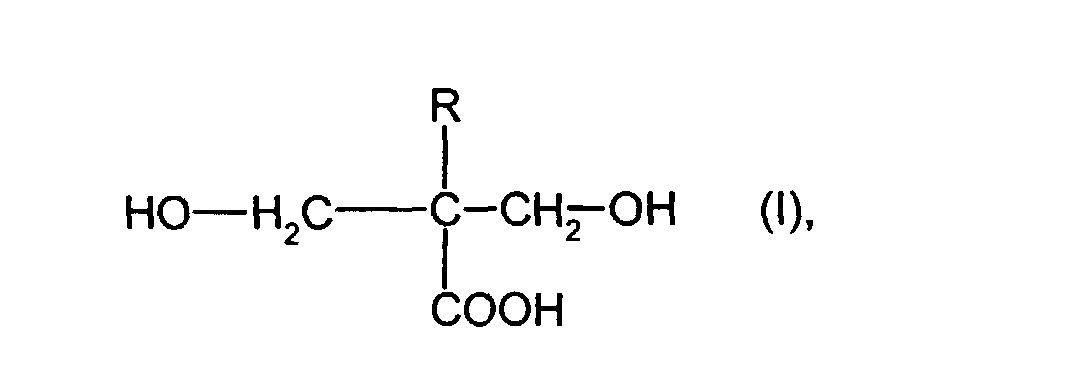
- the starting components a) iii) are preferably 2,2-bis (hydroxymethyl) alkane monocarboxylic acids with a total of 5-8 carbon atoms, ie compounds of the general formula (I) in which R represents an alkyl radical with 1-4 carbon atoms.
- 2,2-Dimethylolpropionic acid is very particularly preferred.
- the short-chain diols described come from as the starting component a) iv) Molecular weight 62-400 into consideration. 1,4-Butanediol is particularly preferred.
- Suitable starting components a) v) are methanol, ethanol, butanol, Hexanol, 2-ethylhexanol, octanol and dodecanol and any alcohol of molecular weight 32 to 350.
- All aliphatic and / or cycloaliphatic compounds which carry at least two amino groups reactive towards isocyanates can be used as component b).
- ethylenediamine, propylenediamine, hexamethylenediamine, isophoronediamine, p-xylylenediamine, 4,4'-diaminodicyclohexylmethane, and 4,4'-diamino-3,3 are suitable for this -dimethyldicyclohexylmethane.
- component c) come, for example, ammonia, monofunctional amines, such as Methylamine, ethylamine, n-propylamine, isopropylamine, cyclohexylamine, octylamine, Diethylamine, dibutylamine, and amino alcohols, such as ethanolamine, diethanolamine and propanolamine.
- monofunctional amines such as Methylamine, ethylamine, n-propylamine, isopropylamine, cyclohexylamine, octylamine, Diethylamine, dibutylamine, and amino alcohols, such as ethanolamine, diethanolamine and propanolamine.
- neutralizing agents e) are ammonia, N-methylmorpholine, dimethylisopropanolamine, Triethylamine, dimethylethanolamine, methyldiethanolamine, Triethanolamine, morpholine, tripropylamine, ethanolamine, diethanolamine, triisopropanolamine and mixtures thereof.
- components a) i), ii) and iii) are in submitted to a reactor and under anhydrous conditions in a temperature range of 50-150 ° C, preferably 50-110 ° C, implemented, then cooled and the approach technically common acetone and the short-chain diol (iv) from MG 62-400 and optionally monofunctional alcohols (v) are added and the mixture is heated until the NCO content of the mixture to a value of 65 to 85% of the calculated NCO content fell. In this way the NCO prepolymer is created. Then the Batch diluted with further acetone and with the calculated amount of a mixture from diamine and chain terminator - dissolved in water - added. In this way 90% of the NCO groups are set with the chain extender, the diamine and the Chain breaker around. The remaining isocyanate is left with the existing one React water to the polyurethane polyurea according to the invention.
- the polymer build-up reaction is preferred without the use of catalysts carried out, but it is also possible to use the catalysts known in isocyanate chemistry to be used (e.g. tertiary amines such as triethylamine, tin compounds such as tin II octoate, Dibutyltin dilaurate and others common catalysts).
- catalysts known in isocyanate chemistry e.g. tertiary amines such as triethylamine, tin compounds such as tin II octoate, Dibutyltin dilaurate and others common catalysts.
- the approach is given the calculated amount of neutralizing agent, preferably ammonia solution, so that 50-60% of the carboxyl groups present are neutralized by the ammonia.
- neutralizing agent preferably ammonia solution
- Polyurethane-polyurea dispersions which are obtained by the process according to the invention have 20-60% by weight solid, preferably 30-40% by weight solid, in Water; their average particle diameters are 20-1,000 nm, preferred 50-500 nm.
- the pH values of the white, storage-stable polyurethane-polyurea dispersions according to the invention are in the range of 6-9, preferably around 7.
- the polyurea dispersions according to the invention provide the physical Drying at 20 - 100 ° C, preferably 20 - 80 ° C, transparent, high-gloss, UV-resistant, temperature resistant (-35 to 80 ° C), against precipitation (organic or inorganic nature) resistant varnishes that adhere well on the one hand through Peeling can be easily removed.
- the tensile strength and elongation of the paint layers is reasonably high.
- the auxiliaries customary in lacquer chemistry such as. Pigments, light stabilizers, anti-settling agents, thickeners, surface-active Connections, defoamers, etc. are used.
- the stripping lacquer layers can be applied to the carrier surface and Drying can be stuck with self-adhesive labels or adhesive film or directly with Spray paints can be decorated. You can also use permanent ink pens, such as under the names Edding pens or Lumocolor pens are known to be labeled without the permanent ink on the support surface penetrates. To achieve special effects, the highly transparent Peelable lacquer also with pigments to achieve colored or opaque peelable lacquer films be colored.
Landscapes
- Chemical & Material Sciences (AREA)
- Engineering & Computer Science (AREA)
- Organic Chemistry (AREA)
- Life Sciences & Earth Sciences (AREA)
- Materials Engineering (AREA)
- Wood Science & Technology (AREA)
- Chemical Kinetics & Catalysis (AREA)
- Health & Medical Sciences (AREA)
- Manufacturing & Machinery (AREA)
- Medicinal Chemistry (AREA)
- Polymers & Plastics (AREA)
- Paints Or Removers (AREA)
- Laminated Bodies (AREA)
- Application Of Or Painting With Fluid Materials (AREA)
- Polyurethanes Or Polyureas (AREA)
- Adhesives Or Adhesive Processes (AREA)
Abstract
Description
wobei sich die genannten Prozentangaben zu 100 % ergänzen,
mit der Maßgabe, daß man in der Prepolymerstufe a) einen Wert von 65 bis 85 %, vorzugsweise 75 bis 80 %, des berechneten NCO-Gehaltes einstellt.

Claims (4)
- Mit einem Flächendekor versehener Trägerflächenabschnitt, gekennzeichnet durch eine zwischen Trägerfläche und Dekorfläche angeordnete, von der Trägerfläche abziehbare Lackschicht aus colöserfreien, wäßrigen anionischen Polyurethan-Polyharnstoffdispersionen.
- Flächenabschnitt nach Anspruch 1, wobei die Trägerfläche aus Glas, Metall, Papier, Pappe, Leder, Holz, Kunststoff, Lack oder Email besteht.
- Flächenabschnitt nach Anspruch 1 oder 2, wobei das Flächendekor eine Klebefolie, eine farbige Lackierung oder eine Permanent-Tintenzeichnung darstellt.
- Flächenabschnitt nach Anspruch 1 oder 2, wobei das Flächendekor eine Klebefolie ist, die die abziehbare Lackschicht im Randbereich überragt.
Applications Claiming Priority (2)
| Application Number | Priority Date | Filing Date | Title |
|---|---|---|---|
| DE19916062 | 1999-04-09 | ||
| DE19916062A DE19916062A1 (de) | 1999-04-09 | 1999-04-09 | Mit einem Flächendekor versehener Trägerflächenabschnitt |
Publications (2)
| Publication Number | Publication Date |
|---|---|
| EP1043174A2 true EP1043174A2 (de) | 2000-10-11 |
| EP1043174A3 EP1043174A3 (de) | 2000-12-20 |
Family
ID=7904027
Family Applications (1)
| Application Number | Title | Priority Date | Filing Date |
|---|---|---|---|
| EP00106018A Withdrawn EP1043174A3 (de) | 1999-04-09 | 2000-03-28 | Mit einem Flächendekor versehener Trägerflächenabschnitt |
Country Status (5)
| Country | Link |
|---|---|
| US (1) | US6458441B1 (de) |
| EP (1) | EP1043174A3 (de) |
| JP (1) | JP2000356953A (de) |
| CA (1) | CA2304422A1 (de) |
| DE (1) | DE19916062A1 (de) |
Cited By (3)
| Publication number | Priority date | Publication date | Assignee | Title |
|---|---|---|---|---|
| WO2010069467A1 (de) * | 2008-12-19 | 2010-06-24 | Dürr Systems GmbH | Verfahren und vorrichtung zum aufbringen einer lackfolie als flüssigfolie |
| CN111873685A (zh) * | 2020-08-03 | 2020-11-03 | 中国建筑第二工程局有限公司 | 一种高效的建筑彩绘施工方法 |
| EP4370590A1 (de) * | 2022-04-14 | 2024-05-22 | Larmar Gmbh | Oberflächenbeschichtung sowie herstellungsverfahren |
Families Citing this family (12)
| Publication number | Priority date | Publication date | Assignee | Title |
|---|---|---|---|---|
| US20120037304A1 (en) * | 2006-04-03 | 2012-02-16 | Saint Andre M | Retail shelf edge label media sheet |
| AU2008254809B2 (en) * | 2007-05-17 | 2013-06-27 | Diversey, Inc. | Surface coating system and method |
| AT509672B1 (de) * | 2010-03-25 | 2016-03-15 | Lengheim Hubert | Folienbildendes beschichtungsmittel |
| US9868862B2 (en) | 2011-05-25 | 2018-01-16 | Diversey, Inc. | Surface coating system and method of using surface coating system |
| AU2013281097B2 (en) | 2012-06-25 | 2016-06-02 | 3M Innovative Properties Company | Devices for coating contoured surfaces |
| JP6693720B2 (ja) * | 2015-09-30 | 2020-05-13 | 株式会社ネオス | 塗料剥離用水性プライマー組成物および塗料剥離方法 |
| EP3495403A1 (de) | 2017-12-08 | 2019-06-12 | Covestro Deutschland AG | Beschichtungszusammensetzung und beschichtungssystem damit |
| CN111108134B (zh) | 2017-09-30 | 2022-06-17 | 科思创德国股份有限公司 | 涂层体系 |
| CN108676483B (zh) * | 2018-05-29 | 2020-07-10 | 广州市鼎茂新材料科技有限公司 | 一种用于可撕标签的水性涂料及一种可撕标签 |
| CN111217538B (zh) * | 2020-01-16 | 2022-10-11 | 恒基(中国)投资有限公司 | 自发泡可剥离保护涂层及其制备与应用方法 |
| WO2023006474A1 (en) | 2021-07-26 | 2023-02-02 | Basf Coatings Gmbh | Peelable coating system and methods for forming the peelable coating system |
| WO2023031096A1 (en) | 2021-09-03 | 2023-03-09 | Basf Coatings Gmbh | Aqueous peelable coating composition, peelable coating system and method for forming the peelable coating system |
Family Cites Families (2)
| Publication number | Priority date | Publication date | Assignee | Title |
|---|---|---|---|---|
| US4554214A (en) * | 1982-01-08 | 1985-11-19 | Seikoh Chemicals Co., Ltd. | Casting coating |
| DE19653585A1 (de) | 1996-12-20 | 1998-06-25 | Bayer Ag | Colöserfreie, wäßrige, anionische Polyurethandispersionen, ein Verfahren zu ihrer Herstellung und Verwendung |
-
1999
- 1999-04-09 DE DE19916062A patent/DE19916062A1/de not_active Withdrawn
-
2000
- 2000-03-28 EP EP00106018A patent/EP1043174A3/de not_active Withdrawn
- 2000-04-03 US US09/541,246 patent/US6458441B1/en not_active Expired - Fee Related
- 2000-04-04 CA CA002304422A patent/CA2304422A1/en not_active Abandoned
- 2000-04-06 JP JP2000104944A patent/JP2000356953A/ja active Pending
Cited By (3)
| Publication number | Priority date | Publication date | Assignee | Title |
|---|---|---|---|---|
| WO2010069467A1 (de) * | 2008-12-19 | 2010-06-24 | Dürr Systems GmbH | Verfahren und vorrichtung zum aufbringen einer lackfolie als flüssigfolie |
| CN111873685A (zh) * | 2020-08-03 | 2020-11-03 | 中国建筑第二工程局有限公司 | 一种高效的建筑彩绘施工方法 |
| EP4370590A1 (de) * | 2022-04-14 | 2024-05-22 | Larmar Gmbh | Oberflächenbeschichtung sowie herstellungsverfahren |
Also Published As
| Publication number | Publication date |
|---|---|
| US6458441B1 (en) | 2002-10-01 |
| CA2304422A1 (en) | 2000-10-09 |
| JP2000356953A (ja) | 2000-12-26 |
| DE19916062A1 (de) | 2000-10-12 |
| EP1043174A3 (de) | 2000-12-20 |
Similar Documents
| Publication | Publication Date | Title |
|---|---|---|
| EP0849298B1 (de) | Colöserfreie, wässrige, anionische Polyurethandispersionen, ein Verfahren zu ihrer Herstellung und Verwendung | |
| EP1072652B1 (de) | Beschichtungsmittel | |
| EP0242731B1 (de) | Verfahren zur Herstellung von wässrigen Dispersionen von Polyurethan-Polyharnstoffen und ihre Verwendung als oder zur Herstellung von Beschichtungsmitteln | |
| DE4344063C1 (de) | Wäßrige Bindemitteldispersion für physikalisch trocknende Überzugsmittel und deren Verwendung | |
| KR0169110B1 (ko) | 결합제로서 수분산성 폴리우레탄 폴리우레아를 함유하는 수성 도료 및 이로부터 제조되는 도막 | |
| DE19916062A1 (de) | Mit einem Flächendekor versehener Trägerflächenabschnitt | |
| EP1132413A1 (de) | Abziehlacke | |
| EP0379007B1 (de) | Verfahren zur Herstellung von wässrigen, oxidativ trocknenden Alkydharzen und ihre Verwendung in oder als wässrige Lacke und Beschichtungsmassen | |
| US20080146748A1 (en) | Polyurethane-modified alkyd resin dispersions | |
| EP0654052B1 (de) | Wasserverdünnbares überzugsmittel auf polyol- und polyisocyanatbasis, verfahren zu dessen herstellung und seine verwendung | |
| JPH10183060A5 (de) | ||
| EP0355682A2 (de) | Verwendung von Polyurethanharzen für wässrige Füllerzusammensetzungen | |
| EP0978549B1 (de) | Wasserverdünnbare Bindemittel für "Soft-Feel"-Lacke | |
| EP0436941A1 (de) | Wässrige Überzugsmasse, deren Herstellung und Verwendung | |
| DE10004726A1 (de) | Thermisch und/oder mit aktinischer Strahlung härtbarer wäßriger Beschichtungsstoff und seine Verwendung | |
| US20120289650A1 (en) | Processes for the preparation of aqueous dispersions based on polyurethaneureas | |
| EP2361938A1 (de) | Lichtechte Beschichtungsmittel | |
| MXPA97010152A (en) | Dispersions of anionic aqueous polyurethane exemptions of codisolvent, a procedure for your obtaining and your |
Legal Events
| Date | Code | Title | Description |
|---|---|---|---|
| PUAI | Public reference made under article 153(3) epc to a published international application that has entered the european phase |
Free format text: ORIGINAL CODE: 0009012 |
|
| AK | Designated contracting states |
Kind code of ref document: A2 Designated state(s): AT BE CH CY DE DK ES FI FR GB GR IE IT LI LU MC NL PT SE |
|
| AX | Request for extension of the european patent |
Free format text: AL;LT;LV;MK;RO;SI |
|
| PUAL | Search report despatched |
Free format text: ORIGINAL CODE: 0009013 |
|
| AK | Designated contracting states |
Kind code of ref document: A3 Designated state(s): AT BE CH CY DE DK ES FI FR GB GR IE IT LI LU MC NL PT SE |
|
| AX | Request for extension of the european patent |
Free format text: AL;LT;LV;MK;RO;SI |
|
| RIC1 | Information provided on ipc code assigned before grant |
Free format text: 7B 44C 1/10 A, 7C 09J 7/02 B, 7C 09D 175/12 B, 7C 08G 18/08 B, 7B 44D 3/18 B |
|
| 17P | Request for examination filed |
Effective date: 20010620 |
|
| AKX | Designation fees paid |
Free format text: AT BE CH CY DE DK ES FI FR GB GR IE IT LI LU MC NL PT SE |
|
| 17Q | First examination report despatched |
Effective date: 20031103 |
|
| RAP1 | Party data changed (applicant data changed or rights of an application transferred) |
Owner name: BAYER MATERIALSCIENCE AG |
|
| STAA | Information on the status of an ep patent application or granted ep patent |
Free format text: STATUS: THE APPLICATION IS DEEMED TO BE WITHDRAWN |
|
| 18D | Application deemed to be withdrawn |
Effective date: 20040316 |