EP1043065B1 - Exhaust gas cleaning catalyst, process for producing the same, and exhaust gas cleaning method - Google Patents
Exhaust gas cleaning catalyst, process for producing the same, and exhaust gas cleaning method Download PDFInfo
- Publication number
- EP1043065B1 EP1043065B1 EP98957210A EP98957210A EP1043065B1 EP 1043065 B1 EP1043065 B1 EP 1043065B1 EP 98957210 A EP98957210 A EP 98957210A EP 98957210 A EP98957210 A EP 98957210A EP 1043065 B1 EP1043065 B1 EP 1043065B1
- Authority
- EP
- European Patent Office
- Prior art keywords
- noble metal
- catalyst
- loaded
- catalysts
- porous oxide
- Prior art date
- Legal status (The legal status is an assumption and is not a legal conclusion. Google has not performed a legal analysis and makes no representation as to the accuracy of the status listed.)
- Expired - Lifetime
Links
Images








Classifications
-
- B—PERFORMING OPERATIONS; TRANSPORTING
- B01—PHYSICAL OR CHEMICAL PROCESSES OR APPARATUS IN GENERAL
- B01D—SEPARATION
- B01D53/00—Separation of gases or vapours; Recovering vapours of volatile solvents from gases; Chemical or biological purification of waste gases, e.g. engine exhaust gases, smoke, fumes, flue gases, aerosols
- B01D53/34—Chemical or biological purification of waste gases
- B01D53/92—Chemical or biological purification of waste gases of engine exhaust gases
- B01D53/94—Chemical or biological purification of waste gases of engine exhaust gases by catalytic processes
- B01D53/9445—Simultaneously removing carbon monoxide, hydrocarbons or nitrogen oxides making use of three-way catalysts [TWC] or four-way-catalysts [FWC]
- B01D53/945—Simultaneously removing carbon monoxide, hydrocarbons or nitrogen oxides making use of three-way catalysts [TWC] or four-way-catalysts [FWC] characterised by a specific catalyst
-
- B—PERFORMING OPERATIONS; TRANSPORTING
- B01—PHYSICAL OR CHEMICAL PROCESSES OR APPARATUS IN GENERAL
- B01D—SEPARATION
- B01D53/00—Separation of gases or vapours; Recovering vapours of volatile solvents from gases; Chemical or biological purification of waste gases, e.g. engine exhaust gases, smoke, fumes, flue gases, aerosols
- B01D53/34—Chemical or biological purification of waste gases
- B01D53/92—Chemical or biological purification of waste gases of engine exhaust gases
- B01D53/94—Chemical or biological purification of waste gases of engine exhaust gases by catalytic processes
-
- B—PERFORMING OPERATIONS; TRANSPORTING
- B01—PHYSICAL OR CHEMICAL PROCESSES OR APPARATUS IN GENERAL
- B01J—CHEMICAL OR PHYSICAL PROCESSES, e.g. CATALYSIS OR COLLOID CHEMISTRY; THEIR RELEVANT APPARATUS
- B01J23/00—Catalysts comprising metals or metal oxides or hydroxides, not provided for in group B01J21/00
- B01J23/38—Catalysts comprising metals or metal oxides or hydroxides, not provided for in group B01J21/00 of noble metals
- B01J23/40—Catalysts comprising metals or metal oxides or hydroxides, not provided for in group B01J21/00 of noble metals of the platinum group metals
- B01J23/46—Ruthenium, rhodium, osmium or iridium
- B01J23/464—Rhodium
-
- B—PERFORMING OPERATIONS; TRANSPORTING
- B01—PHYSICAL OR CHEMICAL PROCESSES OR APPARATUS IN GENERAL
- B01J—CHEMICAL OR PHYSICAL PROCESSES, e.g. CATALYSIS OR COLLOID CHEMISTRY; THEIR RELEVANT APPARATUS
- B01J35/00—Catalysts, in general, characterised by their form or physical properties
- B01J35/20—Catalysts, in general, characterised by their form or physical properties characterised by their non-solid state
- B01J35/23—Catalysts, in general, characterised by their form or physical properties characterised by their non-solid state in a colloidal state
-
- B—PERFORMING OPERATIONS; TRANSPORTING
- B01—PHYSICAL OR CHEMICAL PROCESSES OR APPARATUS IN GENERAL
- B01J—CHEMICAL OR PHYSICAL PROCESSES, e.g. CATALYSIS OR COLLOID CHEMISTRY; THEIR RELEVANT APPARATUS
- B01J35/00—Catalysts, in general, characterised by their form or physical properties
- B01J35/40—Catalysts, in general, characterised by their form or physical properties characterised by dimensions, e.g. grain size
- B01J35/45—Nanoparticles
-
- B—PERFORMING OPERATIONS; TRANSPORTING
- B01—PHYSICAL OR CHEMICAL PROCESSES OR APPARATUS IN GENERAL
- B01J—CHEMICAL OR PHYSICAL PROCESSES, e.g. CATALYSIS OR COLLOID CHEMISTRY; THEIR RELEVANT APPARATUS
- B01J23/00—Catalysts comprising metals or metal oxides or hydroxides, not provided for in group B01J21/00
- B01J23/38—Catalysts comprising metals or metal oxides or hydroxides, not provided for in group B01J21/00 of noble metals
-
- B—PERFORMING OPERATIONS; TRANSPORTING
- B01—PHYSICAL OR CHEMICAL PROCESSES OR APPARATUS IN GENERAL
- B01J—CHEMICAL OR PHYSICAL PROCESSES, e.g. CATALYSIS OR COLLOID CHEMISTRY; THEIR RELEVANT APPARATUS
- B01J37/00—Processes, in general, for preparing catalysts; Processes, in general, for activation of catalysts
- B01J37/02—Impregnation, coating or precipitation
- B01J37/0201—Impregnation
- B01J37/0213—Preparation of the impregnating solution
-
- Y—GENERAL TAGGING OF NEW TECHNOLOGICAL DEVELOPMENTS; GENERAL TAGGING OF CROSS-SECTIONAL TECHNOLOGIES SPANNING OVER SEVERAL SECTIONS OF THE IPC; TECHNICAL SUBJECTS COVERED BY FORMER USPC CROSS-REFERENCE ART COLLECTIONS [XRACs] AND DIGESTS
- Y02—TECHNOLOGIES OR APPLICATIONS FOR MITIGATION OR ADAPTATION AGAINST CLIMATE CHANGE
- Y02T—CLIMATE CHANGE MITIGATION TECHNOLOGIES RELATED TO TRANSPORTATION
- Y02T10/00—Road transport of goods or passengers
- Y02T10/10—Internal combustion engine [ICE] based vehicles
- Y02T10/12—Improving ICE efficiencies
-
- Y—GENERAL TAGGING OF NEW TECHNOLOGICAL DEVELOPMENTS; GENERAL TAGGING OF CROSS-SECTIONAL TECHNOLOGIES SPANNING OVER SEVERAL SECTIONS OF THE IPC; TECHNICAL SUBJECTS COVERED BY FORMER USPC CROSS-REFERENCE ART COLLECTIONS [XRACs] AND DIGESTS
- Y10—TECHNICAL SUBJECTS COVERED BY FORMER USPC
- Y10S—TECHNICAL SUBJECTS COVERED BY FORMER USPC CROSS-REFERENCE ART COLLECTIONS [XRACs] AND DIGESTS
- Y10S502/00—Catalyst, solid sorbent, or support therefor: product or process of making
- Y10S502/514—Process applicable either to preparing or to regenerating or to rehabilitating catalyst or sorbent
Definitions
- catalysts for purifying exhaust gases from automotive engines have been widely used in which such a noble metal as platinum (Pt), rhodium (Rh) and palladium (Pd) is loaded on a support formed of such a porous oxide as alumina (Al 2 O 3 ).
- a 3-way catalyst is formed by loading Pt and/or Rh on such a porous oxide as ⁇ -Al 2 O 3 , and oxidizes HC and CO in the exhaust gases into innocuous entities and at the same time reduces NO x in the exhaust gases into innocuous entities.
- Pt which is especially active, is mainly used as a noble metal.
- the conventional 3-way catalysts and the NO x storage and reduction type catalysts exhibit superb catalytic activity in the initial stage of its use, they suffer from a drawback in that the catalytic activity gradually deteriorates as time passes. This degradation is particularly remarkable with the NO x storage and reduction type catalysts for purifying the exhaust gases from lean-burn engines.
- Our studies so far have clarified that the catalytic activity degradation with the passage of time is caused by the fact that since grains of noble metals, particularly Pt grow in fuel-lean oxygen-excessive atmospheres at high temperatures, the surface area of the noble metals decreases and consequently catalytic-activity sites decrease.
- a plurality of water-soluble noble metal compounds and alcohol are mixed in an aqueous solution of a water-soluble high polymer such as polyvinyl pyrrolidone, polyvinyl alcohol and heated, thereby forming a polymer-protected noble metal composite colloid.
- a water-soluble high polymer such as polyvinyl pyrrolidone
- polyvinyl alcohol polyvinyl alcohol
- porous support powder formed of such an oxide as alumina is dispersed in this aqueous solution of the polymer-protected noble metal composite colloid, and then dried and calcined, thereby producing noble metal composite colloid-loaded catalyst powder.
- a catalyst for purifying exhaust gases can be produced by coating this catalyst powder on a honeycomb supporting base material, etc.
- the exhaust-gases-purifying catalyst recited in claim 2 can be produced by loading an NO x storage component on the porous oxide support by the aforementioned method, after this exhaust-gases-purifying catalyst production method is carried out, or before or after the porous oxide support is brought in contact with the surfactant-protected noble metal composite colloidal solution.
- the catalyst recited in claim 2 is placed in exhaust gases in oxygen-excessive fuel-lean atmospheres so that the NO x storage component adsorbs NO x in the exhaust gases. Then the exhaust gas atmospheres can be at the stoichiometric point or on the fuel-rich side so that the NO x storage component releases the NO x , and the released NO x are reduced into innocuous entities by HC and CO in the exhaust gases or H 2 generated by Rh.
- PtCl 4 5H 2 O
- 7.39g of sodium dodecyl sulfate were mixed in 500g of water and stirred so as to prepare a uniform aqueous solution.
- 10g of citrate dihydrate was added to this aqueous solution and the mixture was treated at reflux at 100 °C for two hours, thereby obtaining a Pt colloidal solution.
- 24g of ⁇ -Al 2 O 3 powder was introduced into this colloidal solution.
- the mixture was stirred for 15 minutes and then filtered. After dried at 110 °C for two hours, this material was calcined at 450 °C for two hours, thereby obtaining a Pt colloid-loaded catalyst.
- the amount of Pt loaded was 6.4 x 10 -5 mol with respect to 1 g of ⁇ -Al 2 O 3 powder.
- this colloidal solution was cooled to 20 °C, and 0.4236g of PtCl 4 (5H 2 O) was added. After stirred for one hour, this solution was treated at reflux at 90 °C for two hours. This colloidal solution was concentrated by using a rotary evaporator so as to prepare a solution at a Pt concentration of 5 % by weight.
- a catalyst was produced in a similar method to that of Reference Example 6 except that PtCl 4 (5H 2 O) for the second addition was in an amount of 0.5767g instead of 0.4236g.
- the amount of Pt loaded was 6.4x10 -5 mol with respect to 1g of ⁇ -Al 2 O 3 powder.
- a catalyst was produced in a similar method to that of Reference Example 6 except that PtCl 4 (5H 2 O) for the second addition was in an amount of 1.1723g instead of 0.4236g.
- the amount of Pt loaded was 6.4 x 10 -5 mol with respect to 1g of ⁇ -Al 2 O 3 powder.
- a catalyst was produced in a similar method to that of Reference Example 3 except that the amount of polyvinyl pyrrolidone was 9.05g instead of 0.89g.
- the amount of Pt loaded was 6.4 x 10 -5 mol with respect to 1g of ⁇ -Al 2 O 3 powder.
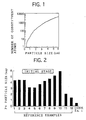
- the initial particle size of the Pt colloid is desirably in the range from 1 to 5 nm because the initial 50% conversion temperatures exceeded 300 °C when the initial Pt particle size was over 5 nm.
- the particle size of the noble metal composite colloid in the initial stage was controlled to be about 3 nm in the following reference examples.
- PtCl 4 5H 2 O
- PdCl 2 0.89g of polyvinyl pyrrolidone with a number average molecular weight of 25,000
- 100g of ethanol was added to this aqueous solution and the mixture was treated at reflux at 90 °C for two hours, thereby obtaining a Pt-Pd composite colloidal solution (Pt: 90mol%, Pd: 10mol%).
- This colloidal solution was concentrated by using a rotary evaporator so as to obtain a solution at the total noble metal concentration of 2.73 % by weight (Pt: 2.57% by weight, Pd: 0.16% by weight).
- ⁇ -Al 2 O 3 powder was dispersed in 300g of water and 13.17g of the above solution was added to this and stirred for 30 minutes and filtered. After dried at 110°C for two hours, this material was calcined at 450 °C for two hours, thereby obtaining a Pt-Rh composite colloid-loaded catalyst.
- the amounts of noble metals loaded were 6.4 x 10 -5 mol in total of Pt and Rh with respect to 1g of ⁇ -Al 2 O 3 powder.
- a Pt-Rh composite colloidal solution (Pt: 80mol%, Rh: 20mol%) was obtained in the same way as that of Reference Example 14 except that the amounts of PtCl 4 (5H 2 O) and RhCl 3 (3H 2 O) added were different from those of Reference Example 14.
- This colloidal solution was concentrated by using a rotary evaporator in the same way as in Reference Example 14, and the colloid was loaded in the same way as in Reference Example 14, thereby obtaining a Pt-Rh composite colloid-loaded catalyst.
- the amounts of noble metals loaded were 6.4x10 -5 mol in total of Pt and Rh with respect to 1g of ⁇ -Al 2 O 3 powder.
- a Pt-Rh composite colloidal solution (Pt: 70mol%, Rh: 30mol%) was obtained in the same way as that of Reference Example 14 except that the amounts of PtCl 4 (5H 2 O) and RhCl 3 (3H 2 O) added were different from those of Reference Example 14.
- This colloidal solution was concentrated by using a rotary evaporator in the same way as in Reference Example 14, and the colloid was loaded in the same way as in Reference Example 14, thereby obtaining a Pt-Rh composite colloid-loaded catalyst.
- the amounts of noble metals loaded were 6.4 x 10 -5 mol in total of Pt and Rh with respect to 1g of ⁇ -Al 2 O 3 powder.
- a Pt-Rh composite colloidal solution (Pt: 60mol%, Rh: 40mol%) was obtained in the same way as that of Reference Example 14 except that the amounts of PtCl 4 (5H 2 O) and RhCl 3 (3H 2 O) added were different from those of Reference Example 14.
- This colloidal solution was concentrated by using a rotary evaporator in the same way as in Reference Example 14, and the colloid was loaded in the same way as in Reference Example 14, thereby obtaining a Pt-Rh composite colloid-loaded catalyst.
- the amounts of noble metals loaded were 6.4x10 -5 mol in total of Pt and Rh with respect to 1g of ⁇ -Al 2 O 3 powder.
- a Pt-Rh composite colloidal solution (Pt: 50mol%, Rh: 50mol%) was obtained in the same way as that of Reference Example 14, except that the amounts of PtCl 4 (5H 2 O) and RhCl 3 (3H 2 O) added were different from those of Reference Example 14.
- This colloidal solution was concentrated by using a rotary evaporator in the same way as in Reference Example 14, and the colloid was loaded in the same way as in Reference Example 14, thereby obtaining a Pt-Rh composite colloid-loaded catalyst.
- the amounts of noble metals loaded were 6.4x10 -5 mol in total of Pt and Rh with respect to 1g of ⁇ -Al 2 O 3 powder.
- a Pt-Rh composite colloidal solution (Pt: 40mol%, Rh: 60mol%) was obtained in the same way as that of Reference Example 14, except that the amounts of PtCl 4 (5H 2 O) and RhCl 3 (3H 2 O) added were different from those of Reference Example 14.
- This colloidal solution was concentrated by using a rotary evaporator in the same way as in Reference Example 14, and the colloid was loaded in the same way as in Reference Example 14, thereby obtaining a Pt-Rh composite colloid-loaded catalyst.
- the amounts of noble metals loaded were 6.4x10 -5 mol in total of Pt and Rh with respect to 1g of ⁇ -Al 2 O 3 powder.
- a Pt-Rh composite colloidal solution (Pt: 30mol%, Rh: 70mol%) was obtained in the same way as that of Reference Example 14, except that the amounts of PtCl 4 (5H 2 O) and RhCl 3 (3H 2 O) added were different from those of Reference Example 14.
- This colloidal solution was concentrated by using a rotary evaporator in the same way as in Reference Example 14, and the colloid was loaded in the same way as in Reference Example 14, thereby obtaining a Pt-Rh composite colloid-loaded catalyst.
- the amounts of noble metals loaded were 6.4x10 -5 mol with respect to 1g of ⁇ -Al 2 O 3 powder.
- a Pt-Rh composite colloidal solution (Pt: 20mol%, Rh: 80mol%) was obtained in the same way as that of Reference Example 14, except that the amounts of PtCl 4 (5H 2 O) and RhCl 3 (3H 2 O) added were different from those of Reference Example 14.
- This colloidal solution was concentrated by using a rotary evaporator in the same way as in Reference Example 14 and the colloid was loaded in the same way as in Reference Example 14, thereby obtaining a Pt-Rh composite colloid-loaded catalyst.
- the amounts of noble metals loaded were 6.4x10 -5 mol with respect to 1g of ⁇ -Al 2 O 3 powder.
- a Pt-Rh composite colloidal solution (Pt: 10mol%, Rh: 90mol%) was obtained in the same way as that of Reference Example 14, except that the amounts of PtCl 4 (5H 2 O) and RhCl 3 (3H 2 O) added were different from those of Reference Example 14.
- This colloidal solution was concentrated by using a rotary evaporator in the same way as in Reference Example 14 and the colloid was loaded in the same way as in Reference Example 14, thereby obtaining a Pt-Rh composite colloid-loaded catalyst.
- the amounts of noble metals loaded were 6.4 x 10 -5 mol in total of Pt and Rh with respect to 1g of ⁇ -Al 2 O 3 powder.
- a nitric acid solution including platinum dinitrodiamine complex and rhodium nitrate was prepared so that the total mole of Pt and Rh was 0.00154mol and the molar ratios of Pt and Rh in the respective comparative examples were those shown in Table 2.
- 24g of ⁇ -Al 2 O 3 powder was introduced therein. The mixtures were stirred for fifteen minutes and filtered. After dried at 110 °C for two hours, these materials were calcined at 450 °C for two hours, thereby obtaining catalysts of Comparative Examples 2 to 10.
- Pt Rh Comparative Example 3 10mol% 90mol% 4 20mol% 80mol% 5 30mol% 70mol% 6 40mol% 60mol% 7 50mol% 50mol% 8 60mol% 40mol% 9 70mol% 30mol% 10 80mol% 20mol% 11 90mol% 10mol%
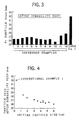
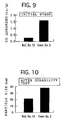
- the catalyst of Reference Example 13 in the initial stage had a smaller amount of CO adsorbed and a lower dispersion degree of noble metal particles, that is to say, a larger noble metal particle size, when compared with the catalyst of Conventional Example 2 in the initial stage.
- the catalysts of Reference Example 13 and Conventional Example 2 in the initial stage were analyzed by the X-ray diffraction method, the catalyst of Reference Example 13 had a noble metal particle size of 3.2nm and on the other hand, it was difficult to measure the noble metal particle size of Conventional Example 2 because the noble metals were loaded in the atomic state.
- Figure 10 demonstrates that after the durability test the catalyst of Reference Example 13 had a smaller noble metal particle size than the catalyst of Conventional Example 2 and that the grain growth of noble metals by the durability test was suppressed in the catalyst of Reference Example 13.
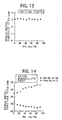
- the noble metal particle size of the catalysts of Reference Examples 14 to 22 in the initial stage were measured by the X-ray diffraction method.
- the results are summarized in Figure 13 with the mol% of Rh on the axis of abscissas.
- the catalysts of Reference Examples 14 to 22 and the catalysts of Conventional Examples 3 to 11 were subjected to a durability test in the same way as in Experiment 1, and the noble metal particle size of the respective catalysts after the durability test were measured by the X-ray diffraction method. The results are shown in Figure 14.
- the initial noble metal particle size of the catalysts of Reference Examples 14 to 22 were constantly about 3 nm regardless of the amount of Rh loaded.
- the initial noble metal particle sizes of Conventional Examples 3 to 11 were too small to be measured by the X-ray diffraction method and the noble metals were loaded in the atomic state.
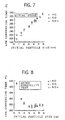
- the catalysts of Reference Examples 14 to 22 had smaller noble metal particle size after the durability test than the catalysts of Conventional Examples 3 to 11; that is to say, grain growth of noble metals were suppressed and the effect of Rh was gradually stronger as the amount of Rh loaded was larger.
- the catalysts of Reference Examples 14 to 22 had superior conversion ability after the durability test than those of Conventional Examples 3 to 11. This is supposed to be the effect of the suppression of the noble metals grain growth.
- the 50% conversion temperatures were less than 300 °C even after the durability test, which means excellent durability.
- Figure 18 shows schematic explanatory views showing the change of colloidal particles in the production method of this Reference example.
- 93.9g of polyvinyl pyrrolidone was dissolved into 7700g of water to prepare a uniform solution.
- 159.40g of a chloroplatinic acid aqueous solution at a Pt concentration of 15.056% by weight, 117.80g of a rhodium chloride aqueous solution at a Rh concentration of 4.606% by weight and 2000g of ethanol were added to this solution and stirred for one hour, thereby preparing a uniform solution.
- This solution was heated and after ethanol started reflux, the reflux was continued by heating for eight hours, thereby obtaining a dark brown solution.
- This solution was concentrated by using a rotary evaporator, thereby obtaining paste.
- Water was added to this paste to dissolve the paste again, thereby preparing a solution in which a polymer-protected noble metal composite 1 was uniformly dispersed in water.
- the respective noble metal concentrations of this aqueous solution were measured by ICP (introductively coupled plasma spectrometry).
- the Pt was 5.12 % by weight and the Rh was 1.16 % by weight (Pt: 70.0 mol%, Rh: 30.0 mol%).
- a surfactant-protected noble metal composite colloidal solution was prepared in the same way as that of Reference Example 23 except that 0.97g of lauryl trimethyl ammonium chloride ([CH 3 (CH 2 ) 11 N(CH 3 ) 3 ]Cl) as a cationic surfactant was used instead of sodium lauryl sulfate.
- the respective noble metal concentrations of this solution were measured by the ICP. Pt was 0.74% by weight and Rh was 0.17% by weight. This solution was a pure uniform solution which didn't give sediment even after left for one month at room temperature.
- a surfactant-protected noble metal composite colloidal solution was prepared in the same way as that of Reference Example 23 except that 1.40g of polyethylene glycol lauryl ether (CH 3 (CH 2 ) 11 (OCH 2 CH 2 ) n )OH, n ⁇ 9) as a nonionic surfactant was employed instead of sodium lauryl sulfate.
- the respective noble metal concentrations of this solution were measured by the IPC. Pt was 0.71 % by weight and Rh was 0.16% by weight. This solution was a pure uniform solution which didn't give sediment even after left for one month at room temperature.
- a surfactant-protected noble metal composite colloidal solution was prepared in the same way as that of Reference Example 23, except that 0.63g of ⁇ -N-lauryl amino propionic acid (CH 3 (CH 2 ) 11 NH 2 CH 2 CH 2 COOH) as an amphoteric surfactant was employed instead of sodium lauryl sulfate.
- the respective noble metal concentrations of this solution were measured by the IPC. Pt was 0.68% by weight and Rh was 0.15% by weight. This solution was a pure uniform solution which didn't give sediment even after left for one month at room temperature.
- the Pt-Rh composite colloidal solution (Pt: 90mol%, Rh: 10mol%) synthesized in Reference Example 14 was regarded as Reference Example 27.
- This colloidal solution was a polymer-protected noble metal composite colloidal solution.
- the colloidal solutions of Reference Examples 23 to 27 were diluted with water to contain 0.050g of Pt and 0.011g of Rh.
- the pH of the solutions were controlled as shown in Table 3 by using nitric acid or aqueous ammonia, if necessary.
- test pieces were prepared by coating 0.43g of each porous oxide support powder of ⁇ -Al 2 O 3 powder, TiO 2 power and ZrO 2 powder on a honeycomb-shaped monolith supporting base material formed of cordierite and having a diameter of 30mm, a height of 50mm and a capacity of 35.5ml.
- the test pieces were respectively immersed in 70ml of the above solutions.
- time to decrease the noble metal concentration of the supernatant to one hundredth of the initial values was respectively measured and the results are shown in Table 3. The measurement was done at one hour intervals from 0 to 12 hours and 12 hours intervals after 12 hours.
- the solutions were synthesized again by the respective methods of Examples and Comparative Examples.
- the barium carbonate-loaded alumina was dispersed in 300g of water.
- a Pt-Rh composite colloidal solution (Pt: 90mol%, Rh: 10mol%) separately prepared was added to this so that the total mole of Pt and Rh became 3.42 x 10 -3 mol.
- the mixture was stirred for 30 minutes and then filtered to collect powder.
- This powder was dried at 110 °C for two hours and calcined at 450 °C for two hours, thereby preparing catalyst powder of this example.
- the total concentration of Pt and Rh loaded was 9.40x10 -5 mol with respect to 1g of alumina powder, and the concentration of Ba loaded was 1.67 x 10 -3 mol with respect to 1g of alumina powder.
- This catalyst powder was shaped into pellets having particle size of 1 to 3mm and subjected to experiments mentioned later.
- a pellet catalyst of Example 2 was prepared in the same way as that of Example 1, except for the use of a Pt-Rh composite colloidal solution having a different Pt-Rh ratio (Pt: 70mol%, Rh: 30mol%).
- a pellet catalyst of Example 3 was prepared in the same way as that of Example 1, except for the use of a Pt-Rh composite colloidal solution having a different Pt-Rh ratio (Pt: 50mol%, Rh: 50mol%).
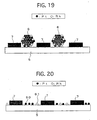
- FIG 20 schematically shows a catalyst of Comparative Example 1.
- This catalyst comprises alumina 5 as a porous oxide support, Pt 60 and Rh 61 which were loaded on the alumina 5 and highly dispersed on an atomic level, and barium carbonate 7 as an NO x storage component loaded on the alumina 5.
- This catalyst was produced in the same way as that of Example 1, except that a mixed solution of platinum dinitrodiamine complex and rhodium nitrate was used instead of the Pt-Rh composite colloidal solution (Pt: 90mol%, Rh: 10mol%).
- concentrations of Pt and Rh loaded were the same as those of Example 1.
- a pellet catalyst of Comparative Example 2 was prepared in the same way as that of Example 2, except that a mixed solution of platinum dinitrodiamine complex and rhodium nitrate was used instead of the Pt-Rh composite colloidal solution (Pt: 70mol%, Rh: 30mol%).
- the concentrations of Pt and Rh loaded were the same as those of Example 2.
- a pellet catalyst of Comparative Example 3 was prepared in the same way as that of Example 3, except that a mixed solution of platinum dinitrodiamine complex and rhodium nitrate was used instead of the Pt-Rh composite colloidal solution (Pt: 50mol%, Rh: 50mol%).
- the concentrations of Pt and Rh loaded were the same as those of Example 17.
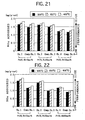
- the pellet catalysts of Examples 1 to 3 and Comparative Examples 1 to 3 were respectively placed in laboratory reactors and a model exhaust gas with the composition shown in Table 4 was introduced at a space velocity of 100,000h -1 .
- the constant fuel-lean gas supply was switched to the fuel-rich gas supply for five seconds, and then returned to the fuel-lean gas supply.
- Three kinds of catalyst bed temperatures, 300 °C , 350 °C and 400°C were selected, and at each temperature the amount of NO x adsorbed was measured after a fuel-rich spike (the fuel-rich gas was introduced for five seconds and then the fuel-lean gas was introduced again). The results are shown in Figure 21.
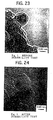
- FIG. 23 shows a photograph of the catalyst of Example 1 before the durability test.
- Figure 24 shows a photograph of the catalyst of Example 1 after the durability test.
- Figure 25 shows a photograph of the catalyst of Comparative Example 1 after the durability test.
- a photograph of the catalyst of Comparative Example 1 before the durability test is not shown here, because Pt and Rh particles were so small that particle shapes could not be observed.
- the catalyst of Example 1 had a Pt-Rh particle size as small as about 4nm. As apparent from the fact that the particle size after the durability test was only about 5nm, grain growth during the durability test was very little.
- the projection in the upper right direction is a noble metal composite colloidal particle, and the striped pattern seen in the noble metal composite colloidal particle was the arrangement of the Pt atoms and the Rh atoms, and the blurred portion around the noble metal composite colloidal particle is the distortion of an electronic image.
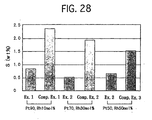
- the pellet catalysts of Examples 1 to 3 and Comparative Examples 1 to 3 were placed in laboratory reactors respectively, and a gas prepared by adding 100ppm of SO 2 to each model exhaust gas having the composition shown in Table 4 was introduced at a catalyst bed temperature of 640°C and a gas space velocity of 100,000h -1 .
- a sulfur poisoning durability test was carried out by repeating a cycle comprising 55 seconds of fuel-lean gas supply and 5 seconds of fuel-rich gas supply for four hours. Then elemental analysis was performed on the catalysts after the sulfur poisoning durability test to measure the amount of S in the catalysts. The results are shown in Figure 28.
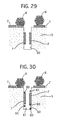
- Figure 29 shows the micro structure of the exhaust-gases-purifying catalyst of Example 1. Since the Pt-Rh composite colloid 6 of this catalyst had a diameter of about 3nm, when the micro pores of alumina 5 had diameters as small as on the angstrom order, it was difficult to load the Pt-Rh composite colloid 6 in the micro pores 50. Therefore, only barium carbonate 7 was loaded in the micro pores 50.
- the exhaust-gases-purifying catalyst of the present example additionally had a noble metal in the atomic state in the micro pores of the alumina.
- the schematic diagram is shown in Figure 30.
- This catalyst for purifying exhaust gases comprises alumina 5 as a porous oxide support, a Pt-Rh composite colloid 6 loaded on the surface of the alumina 5, atomic-state Pt 60 and Rh 61 loaded in the micro pores 50 of the alumina 5, and barium carbonate 7 as an NO x storage component loaded on the surface and in the micro pores 50 of the alumina 5.
- the method of producing this exhaust-gases-purifying catalyst will be described instead of describing the arrangement in detail.
- This barium carbonate-loaded alumina powder was dispersed in 300g of water.
- a Pt-Rh composite colloidal aqueous solution (Pt: 90mol%, Rh: 10mol%) produced in the same way as that of Example 1 was added to this so that the total mole of Pt and Rh was 1.54 x 10 -3 mol and stirred for thirty minutes.
- 50g of a pyromellitic acid anhydride aqueous solution at a concentration of 0.2 % by weight was added to this dispersed solution and stirred for fifteen minutes.
- This powder was dried at 110 °C for two hours and calcined at 450 °C for two hours, thereby preparing catalyst powder of the present example.
- the amount of noble metals loaded was 8.54 x 10 -5 mol with respect to 1g of ⁇ -Al 2 O 3 powder, and the amount of Ba loaded was 1.67 x 10 -3 mol with respect to 1g of ⁇ -Al 2 O 3 .
- the barium carbonate-loaded alumina powder produced in the same way as that of Example 4 was dispersed in 300g of water.
- a Pt-Rh composite colloidal aqueous solution (Pt: 90mol%, Rh: 10mol%) produced in the same way as that of Example 4 was added to this so that the total mole of Pt and Rh was 3.08 x 10 -3 mol.
- the mixture was stirred for thirty minutes and filtered under reduced pressure to collect powder.
Landscapes
- Chemical & Material Sciences (AREA)
- Engineering & Computer Science (AREA)
- Chemical Kinetics & Catalysis (AREA)
- Materials Engineering (AREA)
- Organic Chemistry (AREA)
- Health & Medical Sciences (AREA)
- Combustion & Propulsion (AREA)
- Biomedical Technology (AREA)
- Environmental & Geological Engineering (AREA)
- Analytical Chemistry (AREA)
- General Chemical & Material Sciences (AREA)
- Oil, Petroleum & Natural Gas (AREA)
- Catalysts (AREA)
- Exhaust Gas Treatment By Means Of Catalyst (AREA)
- Exhaust Gas After Treatment (AREA)
Description
| GAS | C3H6 (ppm) | CO (ppm) | NO (ppm) | H2 (ppm) | O2 (%) | CO2 (%) | H2O (%) | N2 |
| COMP. | 7200 | 1200 | 2400 | 400 | 0.50 | 14.4 | 3 | balance |
| Pt | Rh | |||
| Comparative Example | 3 | 10mol | 90mol% | |
| 4 | 20mol | 80mol% | ||
| 5 | 30mol | 70mol% | ||
| 6 | 40mol | 60mol% | ||
| 7 | 50mol | 50mol% | ||
| 8 | 60mol | 40mol% | ||
| 9 | 70mol | 30mol% | ||
| 10 | 80mol | 20mol% | ||
| 11 | 90mol% | 10mol% |
| pH | TIME TO DECREASE CONCENTRATION TO 1/100 OR LESS (hr) | |||
| ALUMINA SUPPORT | TITANIA SUPPORT | ZIRCONIA SUPPORT | ||
| Ref.Ex.23 | 4 | 3 | 4 | 4 |
| Ref.Ex.24 | 10 | 4 | 5 | 5 |
| Ref.Ex.25 | 4 | 7 | 8 | 8 |
| Ref.Ex.25 | 7 | 7 | 8 | 8 |
| Ref.Ex.25 | 10 | 7 | 8 | 8 |
| Ref.Ex.26 | 4 | 3 | 4 | 4 |
| Ref.Ex.26 | 7 | 6 | 7 | 7 |
| Ref.Ex.26 | 10 | 3 | 4 | 4 |
| Ref.Ex.27 | 4 | 60 | 72 | 72 |
| Ref.Ex.27 | 7 | 60 | 72 | 72 |
| Ref.Ex.27 | 10 | 60 | 72 | 72 |
| H2 (%) | NO (ppm) | C3H6 (ppm) | CO2 (%) | CO (ppm) | O2 (%) | H2O (%) | N2 | |
| FUEL- | 0 | 800 | 1800 | 11.0 | 0 | 7 | 3 | balance |
| FUEL-RICH GAS | 0.15 | 10 | 1000 | 11.0 | 6000 | 0 | 3 | balance |
| NO (ppm) | C3H6 (ppm) | CO2 (%) | CO (ppm) | H2 (ppm) | O2 (%) | H2O (%) | N2 |
| 2400 | 7200 | 14.4 | 1200 | 400 | 0.5 | 3 | balance |
Claims (7)
- A catalyst for purifying exhaust gases obtainable by loading on a porous oxide support a noble metal composite colloid composed of a plurality of noble metals and having a particle size of from 1 to 5 nm.
- Catalyst according to claim 1, obtainable by loading the noble metal composite colloid on the surface of said porous oxide support and further loading an atomic-state noble metal in micro pores of said porous oxide support.
- Catalyst according to claim 1 or claim 2, obtainable by further loading on said porous oxide support an NOx storage component selected from the group consisting of alkali metals, alkaline-earth metals and rare-earth elements.
- Catalyst according to claim 3, wherein the NOX storage component is loaded in micro pores of said porous oxide support.
- A method of producing an exhaust-gases-purifying catalyst, characterized in comprising:a separation step of taking a noble metal composite colloid composed of a plurality of noble metals and having a particle size of from 1 to 5 nm out of a polymer-protected noble metal composite colloid which is composed of a plurality of noble metals and protected by a polymeric material;a solution preparation step of dispersing said noble metal composite colloid in water by using a surfactant so as to prepare a surfactant-protected noble metal composite colloidal solution; anda noble-metal-colloid-loading step of bringing a porous oxide support in contact with said surfactant-protected noble metal composite colloidal solution so as to load a surfactant-protected noble metal composite colloid on said porous oxide support.
- A method of producing an exhaust-gases-purifying catalyst, according to claim 5, further comprising:an atomic-state-noble-metal-loading step of bringing said porous oxide support in contact with an aqueous solution of pyromellitic acid and a noble metal compound so as to load an atomic-state noble metal on said porous oxide support.
- A method of purifying exhaust gases characterized in placing, in exhaust gases in oxygen-excessive atmospheres, a catalyst obtainable by loading on a porous oxide support a noble metal composite colloid composed of a plurality of noble metals and having a particle size of from 1 to 5 nm and an NOx storage component selected from the group consisting of alkali metals, alkaline-earth metals and rare-earth elements so as to adsorb NOx in said exhaust gases on said NOx storage component, and changing the exhaust gas atmospheres to the stoichiometric point or on the fuel-rich side so as to release said NOx from said NOx storage component and reduce said NOx.
Applications Claiming Priority (7)
| Application Number | Priority Date | Filing Date | Title |
|---|---|---|---|
| JP35389097 | 1997-12-22 | ||
| JP35389097 | 1997-12-22 | ||
| JP13862098 | 1998-05-20 | ||
| JP13862098 | 1998-05-20 | ||
| JP24748298 | 1998-09-01 | ||
| JP24748298 | 1998-09-01 | ||
| PCT/JP1998/005526 WO1999032223A1 (en) | 1997-12-22 | 1998-12-04 | Exhaust gas cleaning catalyst, process for producing the same, and exhaust gas cleaning method |
Publications (3)
| Publication Number | Publication Date |
|---|---|
| EP1043065A1 EP1043065A1 (en) | 2000-10-11 |
| EP1043065A4 EP1043065A4 (en) | 2001-05-23 |
| EP1043065B1 true EP1043065B1 (en) | 2004-09-01 |
Family
ID=27317706
Family Applications (1)
| Application Number | Title | Priority Date | Filing Date |
|---|---|---|---|
| EP98957210A Expired - Lifetime EP1043065B1 (en) | 1997-12-22 | 1998-12-04 | Exhaust gas cleaning catalyst, process for producing the same, and exhaust gas cleaning method |
Country Status (5)
| Country | Link |
|---|---|
| US (1) | US6440378B1 (en) |
| EP (1) | EP1043065B1 (en) |
| JP (1) | JP3956273B2 (en) |
| DE (1) | DE69826030T2 (en) |
| WO (1) | WO1999032223A1 (en) |
Families Citing this family (34)
| Publication number | Priority date | Publication date | Assignee | Title |
|---|---|---|---|---|
| JP3551364B2 (en) * | 2000-04-26 | 2004-08-04 | トヨタ自動車株式会社 | Nitrogen oxide adsorbent |
| JP3783530B2 (en) * | 2000-06-22 | 2006-06-07 | ヤマハ株式会社 | Photo-oxidation catalyst |
| EP1371415B1 (en) * | 2001-02-19 | 2006-12-06 | Toyota Jidosha Kabushiki Kaisha | Catalyst for hydrogen generation and catalyst for purification of exhaust gas |
| KR100946214B1 (en) * | 2001-09-14 | 2010-03-08 | 로스맨즈 벤손 엔드 헤지스 인코퍼레이티드 | Method for producing rare earth metal oxide coating microporous material |
| KR100469066B1 (en) * | 2003-04-14 | 2005-02-02 | 에스케이 주식회사 | A catalytic filter for the removal of soot particulates from diesel engine and method of making the same |
| US7263433B2 (en) | 2003-12-02 | 2007-08-28 | Ford Global Technologies, Llc | Computer device to calculate emission control device functionality |
| US7181905B2 (en) * | 2003-12-02 | 2007-02-27 | Ford Global Technologies, Llc | Lean-burn engine exhaust air-fuel and temperature management strategy for improved catalyst durability |
| JP3912377B2 (en) * | 2003-12-25 | 2007-05-09 | 日産自動車株式会社 | Method for producing exhaust gas purification catalyst powder |
| JP2005185969A (en) * | 2003-12-25 | 2005-07-14 | Nissan Motor Co Ltd | High heat resistant catalyst and process for producing the same |
| JP4547930B2 (en) | 2004-02-17 | 2010-09-22 | 日産自動車株式会社 | Catalyst, catalyst preparation method and exhaust gas purification catalyst |
| JP4547935B2 (en) | 2004-02-24 | 2010-09-22 | 日産自動車株式会社 | Exhaust gas purification catalyst, exhaust gas purification catalyst, and catalyst manufacturing method |
| JP4513372B2 (en) | 2004-03-23 | 2010-07-28 | 日産自動車株式会社 | Exhaust gas purification catalyst and exhaust gas purification catalyst |
| JP3795895B2 (en) | 2004-03-25 | 2006-07-12 | 田中貴金属工業株式会社 | Catalyst production method |
| JP4513384B2 (en) * | 2004-03-31 | 2010-07-28 | 日産自動車株式会社 | High heat-resistant exhaust gas purification catalyst and method for producing the same |
| JP4426379B2 (en) | 2004-05-24 | 2010-03-03 | Tanakaホールディングス株式会社 | Catalyst precursor and catalyst, and catalyst precursor and catalyst production method |
| JP5200315B2 (en) * | 2004-12-22 | 2013-06-05 | 日産自動車株式会社 | Exhaust gas purification catalyst and method for producing exhaust gas purification catalyst |
| US20080176742A1 (en) * | 2005-03-04 | 2008-07-24 | Mitsubishi Heavy Industries, Ltd. | Method For Producing Catalyst For Treating Exhaust Gas |
| JP4778724B2 (en) * | 2005-05-02 | 2011-09-21 | 株式会社キャタラー | Hydrogen sulfide generation suppression catalyst |
| JP4826207B2 (en) * | 2005-10-28 | 2011-11-30 | 日産自動車株式会社 | Exhaust gas purification catalyst and method for producing exhaust gas purification catalyst |
| KR100783620B1 (en) | 2006-04-05 | 2007-12-07 | 희성촉매 주식회사 | Improvement of Mass Transfer in Catalyst Matrix |
| JP2008114107A (en) | 2006-11-01 | 2008-05-22 | Toyota Motor Corp | Catalyst for purifying automobile exhaust gas and method for producing the same |
| JP4793316B2 (en) * | 2007-04-20 | 2011-10-12 | トヨタ自動車株式会社 | Sulfur storage catalyst |
| JP4888470B2 (en) * | 2007-11-08 | 2012-02-29 | 日産自動車株式会社 | Method for producing noble metal-supported powder and exhaust gas purifying catalyst |
| JP4816694B2 (en) * | 2008-07-31 | 2011-11-16 | トヨタ自動車株式会社 | Manufacturing method of automobile exhaust gas purification catalyst |
| US20110033353A1 (en) * | 2009-08-05 | 2011-02-10 | Basf Corporation | Preparation of Diesel Oxidation Catalyst Via Deposition of Colloidal Nanoparticles |
| JP5937067B2 (en) | 2011-04-28 | 2016-06-22 | エヌ・イーケムキャット株式会社 | Exhaust gas purification device |
| CN102908889A (en) * | 2012-10-23 | 2013-02-06 | 鞍钢股份有限公司 | Sintering flue gas desulfurization and denitrification system and desulfurization and denitrification method thereof |
| JP5880412B2 (en) * | 2012-12-03 | 2016-03-09 | トヨタ自動車株式会社 | Method for supporting catalytic metal particles and method for producing exhaust gas removing catalyst |
| FR3011486B1 (en) * | 2013-10-03 | 2017-03-10 | Ifp Energies Now | NANOSTRUCTURING NITROGEN OXIDE STORAGE MATERIAL (NOX) |
| JP6325009B2 (en) * | 2014-02-04 | 2018-05-16 | タツタ電線株式会社 | Method for producing nano colloidal particle carrier and carrier |
| EP3204154B1 (en) | 2014-10-07 | 2026-07-01 | BASF Mobile Emissions Catalysts LLC | Synthesis of colloidal precious metal nanoparticles with controlled size and morphology |
| JP6719363B2 (en) * | 2015-11-24 | 2020-07-08 | 大阪瓦斯株式会社 | Method for producing catalyst for methane oxidation removal and catalyst for methane oxidation removal |
| JP7444762B2 (en) * | 2020-07-28 | 2024-03-06 | トヨタ自動車株式会社 | Catalyst and exhaust gas purification device |
| US12053762B2 (en) * | 2020-12-15 | 2024-08-06 | Alliance For Sustainable Energy, Llc | Atomically dispersed catalysts to promote low temperature biogas upgrading |
Family Cites Families (24)
| Publication number | Priority date | Publication date | Assignee | Title |
|---|---|---|---|---|
| US4082699A (en) * | 1974-12-20 | 1978-04-04 | Prototech Company | Method of preparing catalytic structures from colloidal platinum compounds and such catalytic structures |
| JPS59160536A (en) * | 1983-03-04 | 1984-09-11 | Hitachi Ltd | Combustion catalyst and its manufacturing method |
| US4757045A (en) * | 1983-02-14 | 1988-07-12 | Engelhard Corporation | Catalysts with support coatings having increased macroporosity and method for producing the catalysts |
| JPH088996B2 (en) * | 1986-10-15 | 1996-01-31 | 田中貴金属工業株式会社 | Highly dispersed platinum / ruthenium binary cluster-Method for producing catalyst |
| JPH0386240A (en) * | 1989-08-30 | 1991-04-11 | Toda Kogyo Corp | Catalyst for purification of exhaust gas |
| JPH04122452A (en) * | 1990-09-11 | 1992-04-22 | Hidefumi Hirai | Metal particle and/or metal compound particle carrier and production thereof |
| JPH05317625A (en) | 1992-05-18 | 1993-12-03 | Mitsubishi Electric Corp | Filter maintenance warning output device |
| JP3221142B2 (en) * | 1993-03-22 | 2001-10-22 | ダイソー株式会社 | Loading method of metal fine particles |
| KR960005493B1 (en) * | 1993-03-25 | 1996-04-25 | 주식회사유공 | Process for the preparation of catalyst to remove particle from diesel engine |
| JP3224054B2 (en) * | 1993-05-27 | 2001-10-29 | トヨタ自動車株式会社 | Exhaust gas purification method |
| JPH0768174A (en) * | 1993-09-01 | 1995-03-14 | Sekiyu Sangyo Kasseika Center | Nitrogen oxide catalytic reduction catalyst |
| JP3409894B2 (en) * | 1993-11-17 | 2003-05-26 | トヨタ自動車株式会社 | Exhaust gas purification catalyst and exhaust gas purification method |
| JP4098835B2 (en) * | 1993-12-07 | 2008-06-11 | トヨタ自動車株式会社 | Exhaust gas purification catalyst |
| JP3363564B2 (en) | 1994-02-04 | 2003-01-08 | トヨタ自動車株式会社 | Exhaust gas purification catalyst |
| JP3391878B2 (en) | 1994-02-23 | 2003-03-31 | トヨタ自動車株式会社 | Exhaust gas purification catalyst |
| WO1995032790A1 (en) | 1994-06-01 | 1995-12-07 | Asec Manufacturing Company | ALLOYED METAL CATALYSTS FOR THE REDUCTION OF NOx IN THE EXHAUST GASES FROM INTERNAL COMBUSTION ENGINES CONTAINING EXCESS OXYGEN |
| JP3314897B2 (en) | 1994-08-03 | 2002-08-19 | トヨタ自動車株式会社 | Method for producing exhaust gas purifying catalyst |
| JP3664182B2 (en) * | 1994-12-19 | 2005-06-22 | トヨタ自動車株式会社 | High heat-resistant exhaust gas purification catalyst and production method thereof |
| JP3374569B2 (en) * | 1995-01-10 | 2003-02-04 | 株式会社日立製作所 | Exhaust gas purification catalyst and purification method |
| JPH09103651A (en) * | 1995-10-11 | 1997-04-22 | Toyota Central Res & Dev Lab Inc | Exhaust gas purification device and exhaust gas purification method |
| US6165429A (en) * | 1997-01-10 | 2000-12-26 | Toyota Jidosha Kabushiki Kaisha | Exhaust gas purifying catalyst and exhaust gas purifying method |
| JP3777696B2 (en) * | 1997-02-07 | 2006-05-24 | トヨタ自動車株式会社 | Metal fine particle supported oxide catalyst |
| JPH10216518A (en) | 1997-02-10 | 1998-08-18 | Toyota Motor Corp | Gold alloy catalyst |
| DE59808069D1 (en) * | 1997-02-27 | 2003-05-28 | Basf Ag | METHOD FOR PRODUCING SHELL CATALYSTS FOR THE CATALYTIC GAS PHASE OXIDATION OF AROMATIC HYDROCARBONS |
-
1998
- 1998-12-04 US US09/581,673 patent/US6440378B1/en not_active Expired - Fee Related
- 1998-12-04 WO PCT/JP1998/005526 patent/WO1999032223A1/en not_active Ceased
- 1998-12-04 JP JP2000525205A patent/JP3956273B2/en not_active Expired - Lifetime
- 1998-12-04 DE DE69826030T patent/DE69826030T2/en not_active Expired - Lifetime
- 1998-12-04 EP EP98957210A patent/EP1043065B1/en not_active Expired - Lifetime
Also Published As
| Publication number | Publication date |
|---|---|
| EP1043065A1 (en) | 2000-10-11 |
| WO1999032223A1 (en) | 1999-07-01 |
| DE69826030D1 (en) | 2004-10-07 |
| DE69826030T2 (en) | 2005-09-22 |
| EP1043065A4 (en) | 2001-05-23 |
| JP3956273B2 (en) | 2007-08-08 |
| US6440378B1 (en) | 2002-08-27 |
Similar Documents
| Publication | Publication Date | Title |
|---|---|---|
| US6440378B1 (en) | Catalyst for purifying exhaust gases, a method of producing the same, and a method of purifying exhaust gases | |
| JP4056629B2 (en) | Exhaust gas purification catalyst for internal combustion engine and method for producing the same | |
| US5989507A (en) | Catalyst composition | |
| JPWO1999032223A1 (en) | Catalyst for purifying exhaust gas, its manufacturing method and method for purifying exhaust gas | |
| US8241579B2 (en) | Diesel exhaust gas treatment system | |
| US5814576A (en) | Catalyst for purifying exhaust gas and method of producing same | |
| JP4590733B2 (en) | Exhaust gas purification catalyst and exhaust gas purification method using the catalyst | |
| CA2223458C (en) | Catalyst for purifying exhaust gas and a process for purifying exhaust gas | |
| EP0931590A1 (en) | Catalyst for purifying exhaust gas and manufacturing method thereof | |
| KR20030090728A (en) | SOx Tolerant NOx Trap Catalysts and Methods of Making and Using the Same | |
| EP1358933A1 (en) | Emission gas purification catalyst and internal combustion engine provided with the catalyst | |
| KR20020002227A (en) | Catalyst for purifying exhaust gas and exhaust gas purifying apparatus | |
| JP3855426B2 (en) | Method for producing exhaust gas purifying catalyst | |
| JP2001079402A (en) | Exhaust gas purification catalyst and method for producing the same | |
| JPH08229394A (en) | Method for producing oxide-supported catalyst carrier | |
| JP3430823B2 (en) | Exhaust gas purification catalyst | |
| JP3766568B2 (en) | Exhaust gas purification catalyst and exhaust gas purification method | |
| CN1311893C (en) | Catalyst for purifying exhaust gases | |
| JP2000296339A (en) | Composite metal colloid, its production method, exhaust gas purifying catalyst and its production method | |
| JP3860929B2 (en) | Exhaust gas purification catalyst, method for producing the same, and exhaust gas purification method | |
| JP2001009279A (en) | Exhaust gas purification catalyst, method for producing the same, and exhaust gas purification method | |
| JP2004176589A (en) | Exhaust gas purification device | |
| JP3835436B2 (en) | Exhaust gas purification method and exhaust gas purification catalyst | |
| JP3861489B2 (en) | Exhaust gas purification catalyst and method for producing the same | |
| JP3800200B2 (en) | Exhaust gas purification method and exhaust gas purification catalyst |
Legal Events
| Date | Code | Title | Description |
|---|---|---|---|
| PUAI | Public reference made under article 153(3) epc to a published international application that has entered the european phase |
Free format text: ORIGINAL CODE: 0009012 |
|
| 17P | Request for examination filed |
Effective date: 20000619 |
|
| AK | Designated contracting states |
Kind code of ref document: A1 Designated state(s): DE FR GB |
|
| A4 | Supplementary search report drawn up and despatched |
Effective date: 20010411 |
|
| AK | Designated contracting states |
Kind code of ref document: A4 Designated state(s): DE FR GB |
|
| RIC1 | Information provided on ipc code assigned before grant |
Free format text: 7B 01J 23/38 A, 7B 01J 37/02 B, 7B 01D 53/94 B, 7B 01J 35/00 B, 7F 01N 3:20 Z |
|
| 17Q | First examination report despatched |
Effective date: 20020605 |
|
| GRAP | Despatch of communication of intention to grant a patent |
Free format text: ORIGINAL CODE: EPIDOSNIGR1 |
|
| GRAS | Grant fee paid |
Free format text: ORIGINAL CODE: EPIDOSNIGR3 |
|
| GRAA | (expected) grant |
Free format text: ORIGINAL CODE: 0009210 |
|
| AK | Designated contracting states |
Kind code of ref document: B1 Designated state(s): DE FR GB |
|
| REG | Reference to a national code |
Ref country code: GB Ref legal event code: FG4D |
|
| REF | Corresponds to: |
Ref document number: 69826030 Country of ref document: DE Date of ref document: 20041007 Kind code of ref document: P |
|
| ET | Fr: translation filed | ||
| PLBE | No opposition filed within time limit |
Free format text: ORIGINAL CODE: 0009261 |
|
| STAA | Information on the status of an ep patent application or granted ep patent |
Free format text: STATUS: NO OPPOSITION FILED WITHIN TIME LIMIT |
|
| 26N | No opposition filed |
Effective date: 20050602 |
|
| PGFP | Annual fee paid to national office [announced via postgrant information from national office to epo] |
Ref country code: DE Payment date: 20121128 Year of fee payment: 15 |
|
| PGFP | Annual fee paid to national office [announced via postgrant information from national office to epo] |
Ref country code: GB Payment date: 20121128 Year of fee payment: 15 |
|
| PGFP | Annual fee paid to national office [announced via postgrant information from national office to epo] |
Ref country code: FR Payment date: 20130107 Year of fee payment: 15 |
|
| REG | Reference to a national code |
Ref country code: GB Ref legal event code: 746 Effective date: 20130923 |
|
| REG | Reference to a national code |
Ref country code: DE Ref legal event code: R084 Ref document number: 69826030 Country of ref document: DE Effective date: 20130919 |
|
| REG | Reference to a national code |
Ref country code: DE Ref legal event code: R119 Ref document number: 69826030 Country of ref document: DE |
|
| GBPC | Gb: european patent ceased through non-payment of renewal fee |
Effective date: 20131204 |
|
| REG | Reference to a national code |
Ref country code: FR Ref legal event code: ST Effective date: 20140829 |
|
| REG | Reference to a national code |
Ref country code: DE Ref legal event code: R119 Ref document number: 69826030 Country of ref document: DE Effective date: 20140701 |
|
| PG25 | Lapsed in a contracting state [announced via postgrant information from national office to epo] |
Ref country code: DE Free format text: LAPSE BECAUSE OF NON-PAYMENT OF DUE FEES Effective date: 20140701 |
|
| PG25 | Lapsed in a contracting state [announced via postgrant information from national office to epo] |
Ref country code: GB Free format text: LAPSE BECAUSE OF NON-PAYMENT OF DUE FEES Effective date: 20131204 Ref country code: FR Free format text: LAPSE BECAUSE OF NON-PAYMENT OF DUE FEES Effective date: 20131231 |