EP1042960A2 - Cappuccino creamer with improved foaming characteristics - Google Patents
Cappuccino creamer with improved foaming characteristics Download PDFInfo
- Publication number
- EP1042960A2 EP1042960A2 EP00302647A EP00302647A EP1042960A2 EP 1042960 A2 EP1042960 A2 EP 1042960A2 EP 00302647 A EP00302647 A EP 00302647A EP 00302647 A EP00302647 A EP 00302647A EP 1042960 A2 EP1042960 A2 EP 1042960A2
- Authority
- EP
- European Patent Office
- Prior art keywords
- creamer
- protein
- whey protein
- denatured
- weight
- Prior art date
- Legal status (The legal status is an assumption and is not a legal conclusion. Google has not performed a legal analysis and makes no representation as to the accuracy of the status listed.)
- Granted
Links
Classifications
-
- A—HUMAN NECESSITIES
- A23—FOODS OR FOODSTUFFS; TREATMENT THEREOF, NOT COVERED BY OTHER CLASSES
- A23C—DAIRY PRODUCTS, e.g. MILK, BUTTER OR CHEESE; MILK OR CHEESE SUBSTITUTES; PREPARATION THEREOF
- A23C13/00—Cream; Cream preparations; Making thereof
-
- A—HUMAN NECESSITIES
- A23—FOODS OR FOODSTUFFS; TREATMENT THEREOF, NOT COVERED BY OTHER CLASSES
- A23C—DAIRY PRODUCTS, e.g. MILK, BUTTER OR CHEESE; MILK OR CHEESE SUBSTITUTES; PREPARATION THEREOF
- A23C11/00—Milk substitutes, e.g. coffee whitener compositions
- A23C11/02—Milk substitutes, e.g. coffee whitener compositions containing at least one non-milk component as source of fats or proteins
- A23C11/04—Milk substitutes, e.g. coffee whitener compositions containing at least one non-milk component as source of fats or proteins containing non-milk fats but no non-milk proteins
-
- A—HUMAN NECESSITIES
- A23—FOODS OR FOODSTUFFS; TREATMENT THEREOF, NOT COVERED BY OTHER CLASSES
- A23F—COFFEE; TEA; THEIR SUBSTITUTES; MANUFACTURE, PREPARATION, OR INFUSION THEREOF
- A23F5/00—Coffee; Coffee substitutes; Preparations thereof
- A23F5/24—Extraction of coffee; Coffee extracts; Making instant coffee
- A23F5/36—Further treatment of dried coffee extract; Preparations produced thereby, e.g. instant coffee
- A23F5/40—Further treatment of dried coffee extract; Preparations produced thereby, e.g. instant coffee using organic additives, e.g. milk, sugar
-
- A—HUMAN NECESSITIES
- A23—FOODS OR FOODSTUFFS; TREATMENT THEREOF, NOT COVERED BY OTHER CLASSES
- A23C—DAIRY PRODUCTS, e.g. MILK, BUTTER OR CHEESE; MILK OR CHEESE SUBSTITUTES; PREPARATION THEREOF
- A23C2260/00—Particular aspects or types of dairy products
- A23C2260/20—Dry foaming beverage creamer or whitener, e.g. gas injected or containing carbonation or foaming agents, for causing foaming when reconstituted
Definitions
- Particulate creamers i.e. particulate products for whitening coffee, tea and other beverages
- Particulate creamers include a lipid, a carrier, and protein and are usually made by spray drying an aqueous slurry.
- Particulate creamers are also used for whitening of beverages, such as hot cappuccino, which are characterized by a surface foam.
- Particulate non-foaming creamers produced by conventional spray drying methods when dissolved in hot water, coffee, or the like, will cause the formation of negligible surface foam.
- the amount of foam produced by dissolution of the creamer particles can be increased by injecting an inert gas during spray drying.
- Foam may also be obtained by utilizing chemical carbonation reagents with the particulate creamer.
- Gas-injected particulate creamers are described, for example, in Hedrick, U.S. Patent No. 4,438,147, Kuypers, U.S. Patent No. 4,746,257, and Kuypers, U.S. Patent No. 4,748,040.
- Chemical carbonation systems suitable for use with particulate creamers are described, for example, in Agbo et al., U.S. Patent No. 5,780,092 and Zeller et al., U.S. Patent No. 5,721,003.
- a chemical carbonation system may also be employed with a gas-injected creamer.
- Hot cappuccino beverages may be prepared from brewed coffee or from instant hot cappuccino dry-mix compositions containing instant coffee such as those described in the Agbo et al. and Zeller et al. patents mentioned above.
- a particulate creamer in accordance with the invention includes, as essential constituents, protein, lipid, and carrier.
- the major constituent of the protein component of the present creamers is whey protein. More than 50% by weight, preferably at least 67% by weight, and more preferably at least 75% by weight, of the protein is whey protein.
- the whey protein is from 40-90% denatured, preferably 50-80% denatured, and more preferably 60-75% denatured. If the whey protein denaturation is less than 40%, the semi-solid foam texture is not realized. Denaturation in excess of 90% will produce an amount of functional undenatured whey protein which is insufficient to adequately emulsify and incorporate the oil in the creamer slurry.
- the total protein content of the creamer is suitably about 3-30%, preferably 5-20% and more preferably 10-15% by weight. These percentages and others set forth hereinafter are on a dry weight basis and are based on the solids content of the composition in question.
- the extent of protein denaturation may be determined by the well established technique of differential scanning calorimetry (DSC) in which the amount of heat absorption during complete thermal denaturing of a whey protein creamer is compared with heat absorption during complete thermal denaturing of a completely undenatured reference.
- a suitable reference is freeze-dried whole milk (FDWM) having the same lipid and moisture content as the whey protein creamer.
- FDWM freeze-dried whole milk
- the whole milk reference is appropriate because whey protein powders which do not contain encapsulated lipid do not have the mobility to be properly and completely denatured during the DSC scan.
- the DSC technique is further described in connection with Example 1.
- the partially denatured whey protein component of the creamer can be obtained from any source of whey protein, but is preferably obtained from a whey protein concentrate or a whey protein isolate.
- Whey protein concentrate (WPC) powder is prepared from liquid whole milk by separating the fat from the milk, acid-precipitating casein from solution, subjecting the solution to ultrafiltration to remove a portion of the lactose from solution, and spray-drying.
- WPC powders generally contain 25 to 80% protein by dry weight.
- Whey protein isolate (WPI) is WPC from which a greater amount of lactose has been removed by ultrafiltration.
- WPI powders contain over 80% protein by dry weight.
- WPC and WPI are both prepared under mild conditions to prevent protein denaturation. Any denatured proteins which do form during processing are excluded from the product during ultrafiltration. The result is an undenatured whey protein powder which retains excellent water solubility, protein functionality, and nutritional quality.
- a wide variety of whey protein powders are commercially available which have been designed to provide special characteristics such as improved damage from high temperature thermal processing or from acidic environments.
- the heat-sensitive globular protein ⁇ -lactoglobulin accounts for more than 60% of the protein in whey powders.
- ⁇ -lactoglobulin can undergo time- and temperature-dependent denaturation when solutions of whey protein are heated to over 65° C. During denaturation, its structure partially unfolds, exposing hydrophobic groups and reactive sulfhydryl groups which can enter into polymerization reactions resulting in gelation and reduced solubility.
- Other protein fractions in whey protein also undergo denaturation, but most of the functionality of whey protein is derived from ⁇ -lactoglobulin.
- the objective of the present invention is to utilize in the creamer slurry whey protein which has been partially denatured to an extent sufficient to reduce its solubility and such that it will provide a considerable amount of hydrated uniformly dispersed insoluble protein to act as an effective gas entrapping medium, foam texturizer, and stabilizer when the spray-dried creamer is reconstituted in a beverage, particularly when combined with a chemical carbonation system.
- the product of the invention contains buoyant, hydrated, insoluble, non-colloidal, irregularly shaped, whey protein particles, approximately 10-200 microns in size, with an average particle size of about 60 microns, which would not provide coffee whitening or creamy mouthfeel without inclusion of a significant amount of encapsulated fat.
- the large particle size of the denatured protein in the present creamer surprisingly does not impart an objectionable mouthfeel likely due to a combination of several factors: the denatured protein is extensively hydrated; it contains encapsulated fat and air bubbles; and it is concentrated in the foam to an extent which imparts a desirable semi-solid texture.
- whey protein could be extensively denatured and its solubility greatly reduced without resulting in either destabilization of the oil-in-water emulsion formed after thorough mixing of the creamer components, or precipitation of protein aggregates in a reconstituted beverage.
- the partially denatured protein is easily suspended in the beverage and is preferentially suspended in the foam, especially when chemical carbonation reagents are used to supplement foam volume. It appears that gas bubbles easily become attached to and provide buoyancy to the somewhat hydrophobic, suspended partially denatured protein to carry it to the surface of the beverage where it builds and stabilizes the foam.
- creamers spray-dried without gas injection under conditions which produce a moderate to high density powder possess a sufficient amount of entrapped gas and/or inherent whey buoyancy to provide a smaller, but continuous and stable, foam layer in a beverage reconstituted without the use of chemical carbonation reagents.
- Denaturation is most conveniently carried out by heating the whey protein at a temperature of over 140° F (60°C) for a time sufficient to alter its structure and reduce its solubility to an extent that provides a considerable amount of hydrated insoluble protein that acts as an effective gas entrapping medium, foam texturizer, and stabilizer when the foamed creamer is reconstituted in a beverage.
- This heating step is preferably conducted by heating a slurry of undenatured whey protein at a temperature of 140° to 160°F (60°C to 71.11°C) for a time sufficient to effect a desired extent of denaturation in accordance with the invention.
- a time period within the range of 15 minutes to two hours will be suitable, depending on the temperature and desired extent of denaturation. Higher temperatures can be used to shorten heating time, such as would prevail in established HTST or UHT methods.
- the denaturation of the whey protein can be conducted before preparing the creamer and the denatured whey protein thereafter mixed with the other components of the creamer. Most advantageously, however, the denaturation is effected by first preparing the creamer slurry and then heating the slurry, preferably at a pH of 6.5 to 7.5.
- the partially denatured whey protein component is suitably present in the dry mix or precursor creamer of the invention in an amount of about 3 to 30% by weight, preferably 5 to 20% by weight and most preferably 10 to 15% by weight on a dry weight basis.
- the creamer of the invention is particularly effective when dry mixed with chemical carbonation reagents, and optionally with other ingredients such as sweeteners, and flavors, for reconstitution in a hot beverage, especially brewed coffee, to produce a whitened beverage which is characterized by a creamy semi-solid surface foam comprising gas bubbles trapped within a hydrated insoluble protein suspension.
- the foam is closer in appearance and texture to steamed milk foam than to conventional instant cappuccino foam.
- the suspended hydrated partially denatured whey protein particles in the creamer provide a thick blanket which effectively coats and traps the gas bubbles in the foam. Not only is greater volume of foam generated, but an opaque, rich, creamy appearance more characteristic of steamed milk is provided due to virtual disappearance of the gas bubbles.
- foams produced from conventional instant cappuccino powders typically appear much more watery and less creamy since the gas bubbles in the foam are coated by thinner, fairly transparent films which can give the foam an appearance more like soap bubbles than steamed milk.
- the creamer provides a greater volume of foam having a creamier texture when used in brewed coffee than in instant cappuccino. It is believed that because brewed coffee is an acidic beverage, the bicarbonate in the creamer powder reacts instantly to produce a greater number of smaller bubbles which are more uniformly dispersed throughout the beverage. Also it is believed that the acidity causes formation of a greater amount of insoluble whey protein in brewed coffee. Unlike casein, undenatured whey protein is not pH-sensitive and readily dissolves in acidic solution. However, whey protein is rendered increasingly pH-sensitive with denaturation, resulting in lowered solubility in acidic solution. Therefore, adding the creamer to brewed coffee (pH ⁇ 5) should produce a greater amount of hydrated insoluble protein than when the creamer is added to water.
- the creamer of the invention may contain no casein.
- Use of conventional creamers containing casein in combination with citric or other strong acids results in formation of floating protein aggregates on the surface of the beverage which become visible after the foam dissipates.
- the formation of such aggregates is easily avoided by providing a casein-free creamer in accordance with the invention.
- a creamer according to the invention which also contains a limited amount of casein, either dry-mixed or inherent in the creamer, without producing undesirable rafts of floating casein aggregates.
- the semi-solid hydrated partially denatured whey protein will hide the denatured casein.
- NFDM Non-fat dry milk
- the denatured whey creamer of the present invention contains a countless number (probably millions) of evenly dispersed partially denatured protein particles having an average particle size of from 20 to 100 microns which give the foam a uniform appearance. If the beverage contains a minor amount of denatured casein, it can be dispersed throughout the semi-solid foam, masking its appearance and preventing aggregation into large particles. Thus, the present creamer can tolerate some amount of casein provided that the whey is sufficiently partially denatured in accordance with the invention.
- the creamer may include casein or other protein to enhance beverage whitening while still retaining desirable foaming performance.
- the denatured whey:casein ratio of the protein of the creamer of the invention is greater than 1:1, preferably at least 2:1, and more preferably at least 3:1.
- the creamer may be casein-free.
- the lipid component of the foaming creamer particles can be a dairy or non-dairy fat, preferably having a melting point of at least 100° F (37.78°C).
- Suitable non-dairy fats include partially hydrogenated vegetable oil having a melting point of about 100° to 120° F (37.78°C to 48.89°C).
- Preferred non-dairy lipids include partially hydrogenated soybean oil, coconut oil, and palm kernel oil.
- Total lipid content of the creamer including any lipid that is present as such or which my be present with the proteinaceous component or the carrier component of the creamer, is suitably 5 to 50%, preferably 10 to 35% and more preferably 25 to 35%, based on the weight of the dry mix creamer.
- Suitable carriers are spray-drying carriers and include gum arabic and water soluble carbohydrates, such as maltodextrin, lactose, corn syrup solids, and sugars.
- Preferred water soluble carbohydrates include corn syrup solids or lactose or, for a sugar-free product, maltodextrin.
- the total amount of carrier in the creamer particles is generally about 20 to 92%, preferably 30 to 55%, based on the weight of the creamer.
- Carrier may be added separately or may be present along with the protein constituent of the creamer.
- whey protein powders may contain lactose.
- the carrier content of the creamer particles the content is intended to include all of the carrier that is present in the creamer particles, and not just carrier which may be present in the creamer particles as such. The same is true with respect to the protein content and the lipid content of the creamer.
- emulsifiers such as a modified starch or a surfactant commonly added to creamers may also be included.
- a preferred modified starch component is a water-soluble emulsion-stabilizing lipophilic food starch such as N-Creamer-46 starch (National Starch and Chemical Company) in an amount of about 5 to 20% by weight of the creamer.
- the preferred surfactant is a high HLB emulsifier, such as sodium stearoyl lactylate or polysorbate.
- undenatured whey protein, lipid, carrier, and optional ingredients are slurried with water, and the slurry is heated in a manner discussed above to partially denature the whey protein.
- the resulting mixture is then preferably homogenized before spray drying.
- the whey protein may be partially denatured beforehand and mixed with the other creamer components to form an aqueous slurry therewith.
- the aqueous composition which forms the precursor of the creamers comprises solids in an amount sufficient to permit the slurry to be spray dried in conventional equipment.
- the solids content of such slurries will be from 30-70%, preferably 45-60% by weight, based on the weight of the slurry.
- Spray drying may be carried out with or without gas injection.
- density of the creamer particles is generally about 0.25-0.55 g/cc and preferably about 0.3-0.4 g/cc.
- density is generally about 0.1 to 0.25 g/cc and preferably about 0.15-0.2 g/cc.
- Suitable gasification techniques are disclosed in U.S. Patent No. 4,438,147; U.S. Patent No. 4,746,257; and U.S. Patent No. 4,748,040. It is a particular advantage of the invention that the creamer particles can be dry-mixed with chemical carbonation reagents without causing the formation of visible floating casein aggregates. High density creamers, i.e. those having a density of about 0.25 to 0.55 g/cc are preferred for such products.
- the creamers may be used alone to whiten coffee beverages and at least in a brewed coffee beverage will create a significant but generally low amount of a creamy and solid foam which is similar to that of steamed milk foam and which has a high degree of consumer liking, particularly with respect to foam appearance and texture.
- the partially denatured whey creamers of the invention can be dry mixed with chemical carbonation reagents to provide foaming creamers which produce large amounts of foam, particularly when used to whiten brewed coffee, without forming undesirable floating casein aggregates.
- Particulate chemical carbonation reagents may be dry-mixed with the spray dried creamer particles to form the preferred foaming creamer compositions of the invention.
- the creamer particles of the preferred compositions may be gasified, but are preferably non-gasified.
- Suitable chemical carbonation components include a food grade acidulant and an alkali metal bicarbonate or carbonate.
- the food grade acid is in particulate form, and can be any food grade acid or acids capable of rapidly neutralizing the bicarbonate or carbonate component.
- Preferred food grade acids include citric acid.
- Less preferred food grade acids include organic acids such as malic, fumaric, lactic, and tartaric acid, glucono-delta-lactone, acidic food grade gums such as alginic acid, gum arabic, low methoxy pectin and modified cellulose gums, and leavening acids.
- the term "acid" as used herein to describe the acidic chemical carbonation reagent is intended to include acid salts or anhydrides.
- the bicarbonate or carbonate component of the chemical foam-generating system is soluble in hot water, is preferably provided in particulate form, and is preferably a bicarbonate, more preferably an alkali metal bicarbonate, and most preferably potassium bicarbonate.
- a sodium salt may also be used but the potassium salt can be used in a greater amount without an adverse effect on beverage flavor.
- the amount of the bicarbonate or carbonate to be included in the creamer is dependent on the amount of foam which is intended to be produced.
- a preferred amount of the bicarbonate or carbonate, when present, is from 1 to 7% and more preferably from 2 to 5%, based on the creamer weight.
- the amount of acid reagent to be included in the creamer preferably depends on the acidity of the coffee beverage to be whitened. In order to reduce cost, it is preferred to use as little of the acid reagent as possible, while at the same time causing full neutralization of the bicarbonate or carbonate in order to maximize the amount of CO 2 generated.
- the coffee beverage will have some acidity, it is therefore preferred to use less acid reagent than would be required to fully neutralize the bicarbonate or carbonate in the absence of the acidity of the coffee beverage.
- the amount of acid will suitably be from 50 to 100%, and preferably from 75 to 100%, of the amount of acid that would be required, by itself, to fully neutralize the bicarbonate or carbonate.
- the creamers may be packaged and used as such or they may be dry-mixed with chemical carbonation reagents, sweeteners, flavors, and other ingredients conventional in spray dried powder creamers.
- the creamers may also be used in particulate, instant hot cappuccino compositions. It is preferred, however, to dry mix the creamer with chemical carbonation reagents, preferably with a sweetener and optional flavor, for providing a foaming creamer for a brewed coffee beverage.
- a sweetener When a sweetener is present with the creamer, it is present in an amount such that the coffee beverage is appropriately sweetened when an amount of the sweetened creamer is used which will whiten a coffee beverage to a generally acceptable amount and/or which will provide a coffee beverage with a generally acceptable amount of surface foam.
- sucrose is the sweetener
- an amount of from 50 to 200%, based on the weight of the creamer is generally suitable.
- Other sweeteners both natural and artificial and either alone or in combination may be employed, preferably in an amount to give essentially the same amount of sweetness as sucrose in the amount stated.
- a bulking agent such as maltodextrin may be substituted for substantially the same amount of sugar.
- Thickening agents such as food grade gums, may also be employed to enhance mouthfeel of the beverage.
- the creamers of the present invention may also be employed in particulate dry mix instant hot cappuccino compositions which generally include a soluble coffee component, a foaming creamer component (which may be a gas-injected creamer, a non-gas-injected creamer combined with chemical carbonation reagents, or both) a sweetener component, and optional ingredients such as bulking agents, flavor, and the like.
- a foaming creamer component which may be a gas-injected creamer, a non-gas-injected creamer combined with chemical carbonation reagents, or both
- sweetener component optional ingredients such as bulking agents, flavor, and the like.
- the present denatured whey creamers may be substituted for some or all of the creamer component of such compositions.
- This example demonstrates the difference in foaming performance between creamers having the same composition but different degrees of denaturation.
- a batch tank was filled with water and the water heated to 120°F (48.89°).
- a dry mix of 15 parts by weight New Zealand Milk Products, Inc. Alacen 855 Whey Protein Concentrate (WPC) and 55 parts by weight 24 DE corn syrup solids (CSS) was added to the heated water and mixed for 15 minutes.
- 30 parts by weight of melted partially hydrogenated soybean oil (PHSBO) was added and mixed for 15 minutes while raising the temperature to 160°F (71.11°C) for 45 minutes.
- a portion of the slurry was homogenized using a two-stage homogenizer, set to 2200 psi (15168.47KPa) for the first stage and 500 psi (3447.38 KPa) for the second stage, and spray-dried through a high-pressure nozzle at 600 psi (4136.86KPa) to make Creamer A.
- Creamer C The remaining slurry was maintained at 160°F (71.11°C) for an additional 45 minutes (90 minutes total) and another portion then homogenized and spray-dried to make Creamer B. The final remaining slurry was maintained at 160°F (71.11°C) for an additional 30 minutes (120 minutes total) and then homogenized and spray-dried to make Creamer C. All three dried creamers had a moisture content of less than 3% and were composed of 15% WPC, 30% PHSBO, and 55% CSS on a dry weight basis. Dried Creamer A had on off-white color, Creamer B a light yellow color, and Creamer C a darker yellow color similar to that of butter.
- the extent of whey protein denaturation in each spray-dried creamer was measured using Differential Scanning Calorimetry (DSC). For each creamer, two distinct regions of heat absorption corresponding to melting of the encapsulated PHSBO, centered at 95°F (35.0°C), and denaturation of whey protein, centered at approximately 160°F (71.11°C), were identified. A re-scan of the same samples produced only the PHSBO melting region since the whey protein was completely and irreversibly denatured as a result of the first scan. The more the whey protein is denatured during creamer production, the less heat it absorbs during the DSC scan.
- DSC Differential Scanning Calorimetry
- the hydrated insoluble protein particles in the present creamer have sufficient buoyancy to float and build on the surface of the beverage, when reconstituted, to create a small head of semi-solid foam, even without gas injection during spray-drying or the use of chemical carbonation reagents. Microscopy also revealed the presence of numerous protein-encapsulated air bubbles in the creamer which surely contribute to buoyancy.
- Creamer foaming performance was measured by dry blending with sugar and chemical carbonation reagents and reconstituting the mixture with 250 mL of 160°F (71.11°C) brewed coffee in a graduated 60mm-wide cylindrical column and measuring the thickness of the foam head versus time.
- the mixture was comprised of 9.8g of creamer containing 1.5g WPC containing 1.2g whey protein, 10.0g sugar, 0.225g citric acid, and 0.375g potassium bicarbonate.
- a solid foam texture was obtained for each creamer.
- the initial foam height and foam height after one, two, three and five minutes, for each of the creamers are reported in Table 1.
- Creamer D having the same composition as creamers A, B and C was prepared by the general procedure as for creamers A, B and C but employed a milder thermal denaturation to produce only 15% denaturation of the whey protein. In this case the creamer slurry was held at 160°F(71.11°C) for only 10 minutes after addition of the Alacen 855 WPC. The creamer slurry was homogenized using a single-stage homogenizer at 500 psi (3447.38 Kpa) and spray-dried using a high-pressure nozzle. Creamer D was tested as in Example 1. As reported in Table 1, creamer D produced a much smaller volume of foam having a gaseous texture.
- a batch tank was filled with water and heated to 160°F (71.11°C).
- a dry mixture of 10 parts by weight National Starch, Inc. N-Creamer-46 starch and 55 parts by weight 24 DE CSS was added and mixed for 15 minutes.
- 5 parts by weight Alacen 855 WPC was added and mixed for 15 minutes followed by addition of 30 parts PHSBO.
- the resulting 45%-solids slurry was held with continuous mixing at 160°F (71.11°C) for an additional 45 minutes and then homogenized and spray-dried to make Creamer E .
- the extent of whey protein denaturation was 70%.
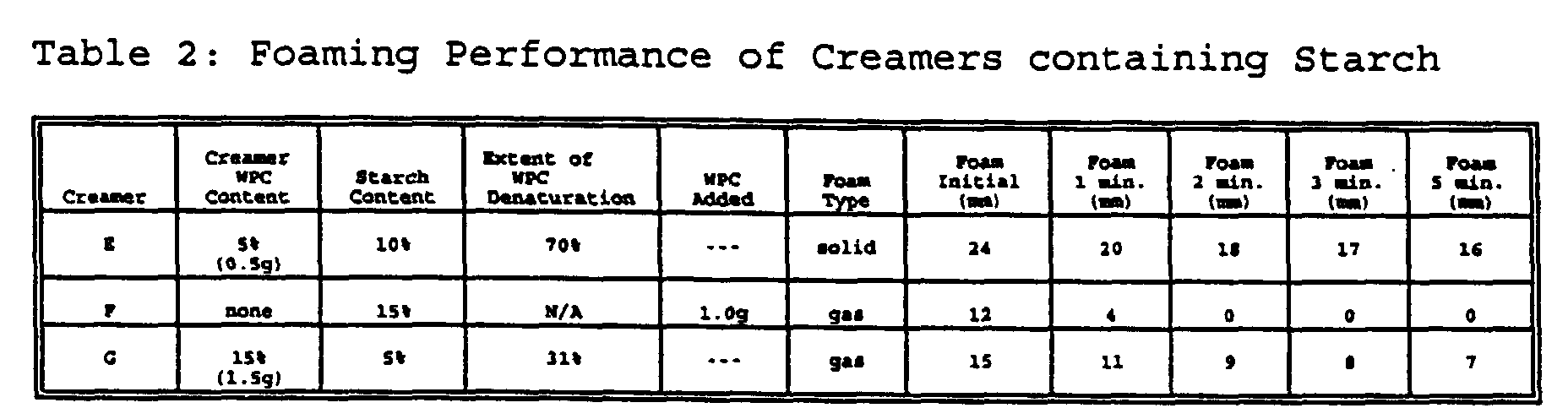
- Creamer E The foaming performance of Creamer E was measured by dry blending it with chemical carbonation reagents and reconstituting the mixture with 240 mL of 160°F (71.11°C) brewed coffee in a graduated 60mm-wide cylindrical column and measuring the thickness of the foam head versus time.
- the mixture used was comprised of 9.8g of creamer containing 0.5g WPC containing 0.4g whey protein, 0.225g citric acid, and 0.375g potassium bicarbonate. A solid foam texture was obtained. The results are reported in Table 2.
- Creamer F was prepared using the procedure of Example 2 using 15 parts by N-Creamer-46, 55 parts by weight 24 DE CSS, 30 parts by weight PHSBO, and no WPC. 8.8g creamer was dry blended with 1.0g Alacen 855 WPC containing 0.8g whey protein, 0.225g citric acid, and 0.375g potassium bicarbonate and the foaming performance measured using the method described in Example 2. As reported in Table 2, gaseous foam texture was obtained. Even though the mixture contained twice the level of whey protein as formulated in Creamer E, Creamer F exhibited very poor performance because the whey protein was undenatured.
- Creamer G was prepared using the procedure of Example 2 above except that the slurry was held for only 15 minutes after addition of the WPC.
- the creamer was formulated using 5 parts by weight N-Creamer-46, 15 parts by weight WPC, 50 parts by weight 24 DE CSS, and 30 parts by weight PHSBO.
- the extent of whey protein denaturation was 31%.
- 9.8g creamer was dry blended with 0.225g citric acid, and 0.375g potassium bicarbonate and the foaming performance was measured as described in Example 2. A gaseous foam texture was obtained. The results are reported in Table 2. Even though the mixture contained the same amount of WPC as the creamers of Example 1, the extent of denaturation was insufficient to produce a solid foam.
- This example demonstrates that a mixture of creamers having different extents of whey protein denaturation can be used to obtain intermediate foaming performance.
- the highly denatured Creamer B from Example I was mixed with the minimally denatured Creamer D of Comparison Example A in varying proportions.
- the foam type and foaming performance was evaluated by reconstituting a dry blend containing 9.8g creamer, 0.225g citric acid, and 0.375g potassium bicarbonate in 240 mL of 160°F(71.11°C) brewed coffee using the column described in Example 2.
- the results are summarized in Table 3. When the combined level of denaturation reached about 30% a slightly solid foam texture was obtained but the foam was still primarily gaseous. A solid foam texture was obtained when the combined level of denaturation reached about 40%.
- Creamer H was prepared according to the general methods described in Comparison Example A using an amount of slurry heating sufficient to effect 77% denaturation of the whey protein.
- the slurry containing the Alacen 855 WPC was held at 160°F (71.11°C) for 35 minutes and then heated to 180°F (82.22°C) prior to homogenizing and spray-drying.
- the creamer has the same composition as Example 1 creamers with the exception that 1 part by weight of trisodium citrate, an alkaline buffer, was added to the slurry after dissolution of the WPC.
- 0.8g creamer was dry blended with 10g sugar, 0.225g citric acid, and 0.375g potassium bocarbonate.
- a solid foam was obtained upon reconstitution in 240 mL 160°F (71.11°C) coffee using the column described in Example 2.
- the presence of the buffer in the creamer somewhat reduced the volume of foam expected. Based on the level of denaturation, an initial foam height of at least 25 mm would be expected, but only 18 mm was obtained. It was found that addition of buffer to the creamer increases its solution pH and has the effect of reducing the amount of carbon dioxide generated from the reaction of the carbonation reagents. Increasing the amount of carbonation reagents can be used to increase foamability but may adversely affect the flavor of the coffee beverage.
- Creamers A and C were used to formulate instant cappuccino products including instant coffee as an ingredient.
- the cappuccino mixes comprised of 10.0g sugar, 9.8g creamer, 2.0g instant coffee, 0.225g citric acid, and 0.375g potassium bicarbonate, were reconstituted in 250 mL of 180°F (82.22°C) water and the foaming performance measured as in the previous examples.
- the results are summarized in Table 4.
- Foam Type Foam Initial (mm) Foam 1 min. (mm) Foam 2 min. (mm) Foam 3 min. (mm) Foam 5 min. (mm)
- the creamer provided a lower volume of foam in a reconstituted instant cappuccino mix than when used in brewed coffee applications. It is believed that the acids in brewed coffee can react instantly with the bicarbonate in the mix to produce a greater volume of carbon dioxide and a greater number of smaller bubbles which are more resistant to rupture in the foam. By comparison, the reactivity of the acids in the instant coffee formulation is delayed since the coffee powder must first dissolve in the water.
- This example demonstrates improvement in consumer liking which can be attained when whey protein creamer is adequately denatured.
- Another cappuccino powder was prepared using 9.5g Creamer B, 10.0g sugar, 0.5g natural and artificial vanilla flavor, and 3.0g non-fat dried milk (NFDM) powder without chemical carbonation reagents for similar reconstitution and evaluation.
- NFDM non-fat dried milk
- Creamers B and D were identical in composition and differed only in their extent of whey protein denaturation, 66% and 15%, respectively.
- the cappuccino mix containing Creamer B (66% whey protein denaturation) and chemical carbonation was statistically preferred over the mix containing Creamer D (15% whey protein denaturation) with respect to "overall liking" and "appearance of foam”.
- Creamers D and G differed somewhat with respect to formulation and extent of denaturation. Creamer G was formulated with 5% starch and had twice the extent of denaturation resulting in 50% more foam generation which produced a statistical preference for "appearance of foam" relative to Creamer D, but essentially the same "overall liking".
- the enhanced appearance and texture of the lower-volume solid-texture foam of Creamer B was sufficient to match the liking of the much greater volume of Creamer D foam having the typical gaseous appearance and texture of foams characteristic of conventional instant cappuccino mixes.
Landscapes
- Life Sciences & Earth Sciences (AREA)
- Chemical & Material Sciences (AREA)
- Engineering & Computer Science (AREA)
- Food Science & Technology (AREA)
- Polymers & Plastics (AREA)
- Dairy Products (AREA)
- Tea And Coffee (AREA)
- Grain Derivatives (AREA)
- General Preparation And Processing Of Foods (AREA)
- Semiconductor Lasers (AREA)
- Preparation Of Compounds By Using Micro-Organisms (AREA)
- Beans For Foods Or Fodder (AREA)
Abstract
Description
When the creamer contains a sufficient amount of a partially denatured whey protein in accordance with the invention, the addition of such emulsifiers will not be required since the partially denatured whey protein inherently provides this function. When used, a preferred modified starch component is a water-soluble emulsion-stabilizing lipophilic food starch such as N-Creamer-46 starch (National Starch and Chemical Company) in an amount of about 5 to 20% by weight of the creamer. The preferred surfactant is a high HLB emulsifier, such as sodium stearoyl lactylate or polysorbate.
| Foaming Performance versus Extent of Whey Protein Denaturation | ||||||||
| Creamer | WPC Content | Whey Protein Denaturation | Foam Type | Foam Initial (mm) | Foam 1 min. (mm) | Foam 2 min. (mm) | Foam 3 min. (mm) | Foam 5 min. (mm) |
| A | 15% | 49% | solid | 22 | 18 | 15 | 13 | 12 |
| B | 15% | 66% | solid | 24 | 20 | 18 | 16 | 14 |
| C | 15% | 74% | solid | 25 | 21 | 19 | 18 | 17 |
| D | 15% | 15% | gas | 10 | 7 | 6 | 5 | 4 |
| Foaming Performance of Creamer Mixtures having Different Extents of Denaturation | ||||||
| Creamer D | Creamer B | Net Extent of Denaturation | Foam Initial (mm) | Foam 5 min. (mm) | Foam Texture | Beverage Whitening |
| 100% | --- | 15% | 8 | 4 | gas | most white |
| 75% | 25% | 28% | 12 | 7 | gas/solid | more white |
| 50% | 50% | 40% | 16 | 9 | solid | moderate |
| 25% | 75% | 53% | 19 | 11 | more solid | less white |
| --- | 100% | 66% | 23 | 13 | most solid | least white |
| Foaming Performance Comparison - Brewed Coffee versus Instant Cappuccino Mix | |||||||
| Creamer | Product Application | Foam Type | Foam Initial (mm) | Foam 1 min. (mm) | Foam 2 min. (mm) | Foam 3 min. (mm) | Foam 5 min. (mm) |
| A | Brewed Coffee | solid | 22 | 18 | 15 | 13 | 12 |
| C | Brewed Coffee | solid | 25 | 21 | 19 | 18 | 17 |
| A | Instant Cappuccino Mix | solid | 14 | 11 | 9 | 8 | 7 |
| C | Instant Cappuccino Mix | solid | 19 | 17 | 15 | 14 | 13 |
| Consumer Test Preference Results | |||||
| Cappuccino Mix Creamer | Chemical Carbonation | Extent of WPC Denaturation | Foam Texture | Overall Liking | Appearance of Foam Liking |
| B | yes | 66% | solid | 7.1 | 8.3 |
| D | yes | 15% | gas | 6.5 | 6.4 |
| G | yes | 31% | gas | 6.8 | 7.6 |
| B | no | 66% | solid | 6.7 | 6.4 |
| Consumer Test Attribute Data Summary | ||||||
| Finished Product Attribute | Cappuccino Mix Creamer | Not Enough (%) | Just Right (%) | Too Much (%) | JR/NE Ratio | Relative Effectiveness |
| Amount of Foam | B | 23 | 73 | 4 | 3.2 | 1 |
| D | 73 | 25 | 1 | 0.3 | 1/9th | |
| G | 47 | 51 | 3 | 1.1 | 1/3rd | |
| B-no carb. | 72 | 27 | 1 | 0.4 | 1/8th | |
| Foam Duration | B | 13 | 79 | 8 | 6.1 | 1 |
| D | 87 | 13 | 0 | 0.1 | 1/41th | |
| G | 71 | 28 | 1 | 0.4 | 1/15th | |
| B-no carb. | 31 | 68 | 1 | 2.2 | 1/3rd | |
| Creaminess | B | 17 | 76 | 7 | 4.5 | 1 |
| D | 61 | 36 | 3 | 0.6 | 1/8th | |
| G | 45 | 48 | 7 | 1.1 | 1/4th | |
| B-no carb. | 35 | 57 | 8 | 1.6 | 1/3rd | |
| Too Small | Just Right | Too Large | JR/TS Ratio | Relative Effectiveness | ||
| Bubble Size | B | 7 | 79 | 15 | 11.3 | 1 |
| D | 53 | 44 | 3 | 0.8 | 1/14th | |
| G | 23 | 69 | 8 | 3.0 | 1/4th | |
| B-no carb. | 31 | 56 | 13 | 1.8 | 1/3rd |
| Creamer Denaturation and Foaming Performance Summary | ||||
| Creamer | % Whey Protein | Extent of Denaturation | Initial Foam Height (mm) | Foam Texture |
| A | 12.0 | 49% | 22 | solid |
| B | 12.0 | 66% | 24 | solid |
| C | 12.0 | 74% | 25 | solid |
| D | 12.0 | 15% | 10 | gas |
| E | 4.0 | 70% | 24 | solid |
| F | 0 | N/A | 12 | gas |
| G | 12.0 | 31 | 15 | gas |
| H | 12.0 | 77% | 18 | solid |
Claims (31)
- A particulate creamer comprising protein, lipid, and carrier, wherein more than 50% by weight of said protein is partially denatured whey protein, said partially denatured whey protein being from 40 to 90% denatured.
- A creamer according to claim 1, wherein the partially denatured whey protein is from 50 to 80% denatured.
- A creamer according to claim 1 or claim 2, wherein the partially denatured whey protein is from 60 to 75% denatured.
- A creamer according to any one of claims 1 to 3, wherein at least 67% by weight of said protein is partially denatured whey protein.
- A creamer according to any one of claims 1 to 4, wherein at least 75% by weight of said protein is said partially denatured whey protein.
- A creamer according to any of claims 1 to 5, further comprising chemical carbonation reagents.
- A creamer according to claim 6, wherein said reagents comprise an acid and a bicarbonate or carbonate.
- A creamer according to any of claims 1 to 7, wherein said protein comprises casein and wherein the weight ratio of denatured whey:casein is greater than 1:1.
- A creamer according to claim 8, wherein said protein comprises casein and wherein the weight ratio of denatured whey:casein is greater than 2:1.
- A creamer according to claim 8 or claim 9, wherein said protein comprises casein and wherein the weight ratio of denatured whey:casein is greater than 3:1.
- A creamer according to any of claims 1 to 7, wherein said protein consists essentially of said partially denatured whey protein.
- A creamer according to any of claims 1 to 7, wherein said protein is casein-free.
- A creamer according to any of claims 1 to 12, comprising from 3 to 30% by weight protein, 5 to 50% by weight lipid, and 20 to 92% by weight carrier, based on the weight of the creamer.
- A creamer according to any of claims 1 to 13, further comprising a sweetener.
- A creamer according to any of claims 1 to 14, having a bulk density of from 0.25 to 0.55 g/cc.
- A creamer according to any of claims 1 to 14, having a bulk density of 0.1 to 0.25 g/cc.
- A particulate, dry mix, instant hot cappuccino composition comprising a water soluble coffee component and a particulate creamer component according to any one of claims 1 to 16.
- A method of preparing a particulate creamer which comprises:providing an aqueous spray-dryable slurry which comprises protein, lipid and carrier, more than 50% by weight of said protein being whey protein;heating said aqueous slurry at a temperature and for a time sufficient to partially denature said whey protein such that the partially denatured whey protein is 40 to 90% denatured;and spray drying said aqueous slurry to provide a particulate creamer comprising protein, lipid, and carrier, wherein more than 50% of the protein of said creamer is partially denatured whey protein which is from 40 to 90% denatured.
- A method according to claim 18, wherein said whey protein of said slurry comprises whey protein concentrate.
- A method according to claim 18, wherein said whey protein of said slurry comprises whey protein isolate.
- A method according to any of claims 18 to 20, wherein said partially denatured whey protein of said creamer is from 50 to 80% denatured.
- A method according to claim 21, wherein said partially denatured whey protein of said creamer is from 60 to 75% denatured.
- A method according to any of claims 18 to 22, wherein at least 67% of said protein of said creamer comprises said partially denatured whey protein.
- A method according to any of claims 18 to 23, wherein at least 75% of said protein of said creamer comprises said partially denatured whey protein.
- A method according to any of claims 18 to 24, wherein said protein of said creamer comprises casein and wherein the weight ratio of denatured whey:casein is greater than 1:1.
- A method according to any of claims 18 to 25, wherein said protein of said creamer comprises casein and wherein the weight ratio of denatured whey:casein is greater than 2:1.
- A method according to any of claims 18 to 26, wherein said protein of said creamer comprises casein and wherein the weight ratio of denatured whey:casein is greater than 3:1.
- A method according to any of claims 18 to 24, wherein said protein of said creamer consists essentially of said partially denatured whey protein.
- A method according to any of claims 18 to 24, wherein said protein of said creamer is casein-free.
- A method according to any of claims 18 to 29, wherein said creamer comprises from 3 to 30% by weight protein, 5 to 50% by weight lipid, and 20 to 92% by weight carrier, based on the weight of the creamer.
- A method according to any of claims 18 to 30, wherein said creamer has a bulk density of 0.1 to 0.25 g/cc.
Priority Applications (1)
| Application Number | Priority Date | Filing Date | Title |
|---|---|---|---|
| DK00302647T DK1042960T3 (en) | 1999-04-06 | 2000-03-30 | Cappuccinocreamer with improved foaming properties |
Applications Claiming Priority (2)
| Application Number | Priority Date | Filing Date | Title |
|---|---|---|---|
| US286705 | 1999-04-06 | ||
| US09/286,705 US6168819B1 (en) | 1999-04-06 | 1999-04-06 | Cappuccino creamer with improved foaming characteristics |
Publications (3)
| Publication Number | Publication Date |
|---|---|
| EP1042960A2 true EP1042960A2 (en) | 2000-10-11 |
| EP1042960A3 EP1042960A3 (en) | 2003-11-12 |
| EP1042960B1 EP1042960B1 (en) | 2005-05-25 |
Family
ID=23099814
Family Applications (1)
| Application Number | Title | Priority Date | Filing Date |
|---|---|---|---|
| EP00302647A Expired - Lifetime EP1042960B1 (en) | 1999-04-06 | 2000-03-30 | Cappuccino creamer with improved foaming characteristics |
Country Status (12)
| Country | Link |
|---|---|
| US (1) | US6168819B1 (en) |
| EP (1) | EP1042960B1 (en) |
| JP (1) | JP3649988B2 (en) |
| KR (1) | KR100474617B1 (en) |
| CN (1) | CN1190140C (en) |
| AT (1) | ATE296035T1 (en) |
| CA (1) | CA2304319C (en) |
| CO (1) | CO5221090A1 (en) |
| DE (1) | DE60020291T2 (en) |
| DK (1) | DK1042960T3 (en) |
| ES (1) | ES2243201T3 (en) |
| PT (1) | PT1042960E (en) |
Cited By (19)
| Publication number | Priority date | Publication date | Assignee | Title |
|---|---|---|---|---|
| WO2002049442A1 (en) * | 2000-12-19 | 2002-06-27 | Heriot-Watt University | Fat replacement material and method of manufacture thereof |
| WO2007064225A1 (en) * | 2005-12-01 | 2007-06-07 | Tine Ba | Compositions comprising whey proteins and lipids and processes of their preparation |
| WO2007136263A1 (en) * | 2006-05-22 | 2007-11-29 | Nizo Food Research B.V. | Protein encapsulated partocles |
| WO2007110411A3 (en) * | 2006-03-27 | 2008-07-10 | Nestec Sa | Whey protein micelles |
| WO2012146777A1 (en) * | 2011-04-29 | 2012-11-01 | Nestec S.A. | Creamers and methods of making same |
| WO2013006045A1 (en) | 2011-07-01 | 2013-01-10 | Friesland Brands B.V. | Acid-stable creamer or whitener composition |
| RU2489028C2 (en) * | 2006-11-01 | 2013-08-10 | Нестек С.А. | Soluble foaming powder for beverage preparation |
| US9386784B2 (en) | 2010-11-17 | 2016-07-12 | Intercontinental Great Brands Llc | Method and system for entrapping pressurized gas in powdered food or beverage products |
| WO2017063943A1 (en) * | 2015-10-16 | 2017-04-20 | Nestec S.A. | Kit for delivering a multi-layered beverage |
| EP3171716A1 (en) * | 2014-07-21 | 2017-05-31 | Abbott Laboratories | Nutritional powder pod with extruded nutritional powder |
| EP3171743A1 (en) * | 2014-07-21 | 2017-05-31 | Abbott Laboratories | Nutritional powder pods comprising dry blended carbohydrates |
| EP3171742A1 (en) * | 2014-07-21 | 2017-05-31 | Abbott Laboratories | Nutritional powder pods containing nutritional powders with volume flowability properties |
| EP3171745A1 (en) * | 2014-07-21 | 2017-05-31 | Abbott Laboratories | Nutritional powder pods and related methods |
| WO2018224537A1 (en) * | 2017-06-07 | 2018-12-13 | Nestec S.A. | Beverage powder comprising porous particles and partially aggregated protein |
| CN110573020A (en) * | 2017-06-07 | 2019-12-13 | 雀巢产品有限公司 | Beverage powder containing porous particles and partially aggregated protein |
| US10709146B2 (en) | 2013-10-23 | 2020-07-14 | Arla Foods Amba | CMP-containing, high protein denatured whey protein compositions, products containing them, and uses thereof |
| US10729150B2 (en) | 2013-10-23 | 2020-08-04 | Arla Foods Amba | High protein, fruit flavoured beverage; high protein, fruit and vegetable preparation; and related methods and food products |
| US10834934B2 (en) | 2013-10-23 | 2020-11-17 | Arla Foods Amba | High protein denatured whey protein composition, related products, method of production and uses thereof |
| WO2023046845A1 (en) | 2021-09-22 | 2023-03-30 | Koninklijke Douwe Egberts B.V. | A non-fat creamer powder, and a method of making the same |
Families Citing this family (49)
| Publication number | Priority date | Publication date | Assignee | Title |
|---|---|---|---|---|
| EP1074181A1 (en) * | 1999-08-03 | 2001-02-07 | Societe Des Produits Nestle S.A. | Foaming creamer ingredient and powders containing it |
| US6605311B2 (en) * | 2000-06-22 | 2003-08-12 | The Procter & Gamble Company | Insoluble protein particles |
| US6426110B1 (en) * | 2000-08-11 | 2002-07-30 | Global Health Sciences, Inc. | Low-carbohydrate high-protein creamer powder |
| ES2226678T3 (en) * | 2000-10-20 | 2005-04-01 | Societe Des Produits Nestle S.A. | SOLUBLE MATTER IN DUST FORM, FOR A DRINK OF THE "ESPRESSO" TYPE. |
| US20030026845A1 (en) * | 2001-06-18 | 2003-02-06 | Etzel Lisa R. | Process for preparing protein isolate from milk, whey, colostrum, and the like |
| US6838110B2 (en) * | 2002-05-22 | 2005-01-04 | Kraft Foods Holdings, Inc. | Instant dry mix composition for providing a beverage having a two-toned foam on its surface |
| AU2003288036A1 (en) * | 2002-11-29 | 2004-06-23 | Unilever Plc | Beverage with foam maintaining system |
| AU2003302675A1 (en) * | 2002-11-29 | 2004-06-23 | Unilever Plc | Beverage product with modified starch and nitrogen |
| US20050163904A1 (en) * | 2004-01-22 | 2005-07-28 | Durafizz, Llc | Foam forming particles and methods |
| RU2007101294A (en) * | 2004-06-15 | 2008-07-20 | Нестек С.А. (Ch) | AEROUS CHURCHES AND METHODS |
| US7713565B2 (en) * | 2004-08-17 | 2010-05-11 | Kraft Foods Holdings, Inc. | Method of preparing a foaming soluble coffee powder |
| US7736683B2 (en) * | 2004-08-17 | 2010-06-15 | Kraft Food Global Brands Llc | Method to increase the foaming capacity of spray-dried powders |
| US7534461B2 (en) * | 2004-08-17 | 2009-05-19 | Kraft Foods Holdings, Inc. | Non-protein foaming compositions and methods of making the same |
| US20060040033A1 (en) | 2004-08-17 | 2006-02-23 | Zeller Bary L | Non-carbohydrate foaming compositions and methods of making the same |
| EP1796485B1 (en) * | 2004-08-25 | 2015-10-21 | Intercontinental Great Brands LLC | Liquid-filled chewing gum composition |
| WO2006115420A1 (en) * | 2005-04-26 | 2006-11-02 | Massey University | Lipid encapsulation |
| EP1726536B1 (en) * | 2005-05-24 | 2008-10-22 | Nestec S.A. | Kit for and method of preparing a coffee beverage |
| US20070009636A1 (en) * | 2005-07-11 | 2007-01-11 | Sher Alexander A | Methods and systems to enhance foam generation and quality through dispenser |
| FR2892269B1 (en) * | 2005-10-26 | 2007-12-21 | Gervais Danone Sa | MICROFOISONNE FRESH DAIRY PACKAGE AND PROCESS FOR PREPARING THE SAME |
| PT1797772E (en) * | 2005-12-13 | 2009-03-10 | Nestec Sa | Self-foaming liquid culinary aids and processes |
| DE602007012426D1 (en) * | 2006-04-18 | 2011-03-24 | Ajinomoto Kk | METHOD FOR PRODUCING BREASTED SAUCE MILK ENRICHED WITH WHEY PROTEINS |
| US20080032025A1 (en) * | 2006-05-22 | 2008-02-07 | Amerilab Technologies, Inc. | Effervescent creamer composition |
| DE102007039322B4 (en) | 2007-08-20 | 2011-07-21 | Krüger GmbH & Co. KG, 51469 | Instant coffee preparation with improved foaming |
| GB2452953B (en) * | 2007-09-20 | 2010-03-10 | Kraft Foods R & D Inc | Coffee Composition |
| UA103993C2 (en) * | 2007-09-28 | 2013-12-25 | Нестек С.А. | Instant drink powder |
| US20090162489A1 (en) * | 2007-12-19 | 2009-06-25 | Harjit Singh | Effervescent tablet for use as an additive in hot coffee or hot water and method of making same |
| GB2458450B (en) * | 2008-03-12 | 2012-08-29 | Krafts Food R & D Inc | Foaming coffee composition |
| RU2526503C2 (en) * | 2008-06-16 | 2014-08-20 | Кампина Недерланд Холдинг Б.В. | Foaming composition |
| US8043645B2 (en) | 2008-07-09 | 2011-10-25 | Starbucks Corporation | Method of making beverages with enhanced flavors and aromas |
| US20100285200A1 (en) * | 2009-01-22 | 2010-11-11 | Multi Protein Incorporated | High-Protein Beverages and Methods of Manufacture |
| MX2013001377A (en) * | 2010-08-05 | 2013-04-03 | Nestec Sa | LIQUID DRINK PRODUCTS CONTAINING MILK PROTEIN. |
| MY160967A (en) * | 2010-08-05 | 2017-03-31 | Nestec Sa | Non-dairy protein beverage products |
| WO2012016816A1 (en) | 2010-08-05 | 2012-02-09 | Nestec S.A. | Frozen confectionery product with a natural stabiliser |
| US20140044855A1 (en) * | 2011-04-21 | 2014-02-13 | Nestec S.A. | Creamers and methods of making same |
| WO2013167452A1 (en) | 2012-05-08 | 2013-11-14 | Nestec S.A. | Composition for preparation of a food or beverage product |
| US9809619B2 (en) * | 2014-01-14 | 2017-11-07 | Pulse Holdings, LLC | Pulse combustion drying of proteins |
| JP6608217B2 (en) * | 2015-08-10 | 2019-11-20 | 花王株式会社 | Solid composition |
| JP6823446B2 (en) * | 2015-12-16 | 2021-02-03 | 花王株式会社 | Solid composition |
| EP3474680A1 (en) * | 2016-06-28 | 2019-05-01 | Nestec S.A. | Beverages, beverage capsules and processes of preparation of bevarages |
| EP3300606A1 (en) * | 2016-09-28 | 2018-04-04 | DMK Deutsches Milchkontor GmbH | Foamable milk composition |
| CN106578145A (en) * | 2016-12-14 | 2017-04-26 | 山东天骄生物技术有限公司 | Preparation method of foaming non-dairy creamer |
| CA3068367A1 (en) * | 2017-07-27 | 2019-01-31 | Societe Des Produits Nestle S.A. | Foaming creamer composition |
| FI3727002T3 (en) * | 2017-12-22 | 2024-12-12 | Nestle Sa | Creamer composition |
| TWI820145B (en) | 2018-07-16 | 2023-11-01 | 荷蘭商弗里斯蘭康必奶荷蘭有限公司 | Instant milk topping for beverages |
| KR102308324B1 (en) * | 2018-12-06 | 2021-10-05 | 동서식품주식회사 | A method for preparing functional coffee creamer with increased surface stability |
| CA3140510A1 (en) * | 2019-06-05 | 2020-12-10 | Societe Des Produits Nestle S.A. | Instant coffee powder |
| DE102020001086A1 (en) | 2020-02-20 | 2021-08-26 | Mehmet Tuzcu | Foam coffee |
| CN112602808A (en) * | 2020-12-14 | 2021-04-06 | 普洱金树咖啡产业有限公司 | Mango coffee mate and preparation method thereof |
| CA3210589A1 (en) * | 2021-03-09 | 2022-09-15 | Isaak BROTT | Sensory modifiers for effervescent compositions |
Family Cites Families (32)
| Publication number | Priority date | Publication date | Assignee | Title |
|---|---|---|---|---|
| US3615662A (en) * | 1968-07-15 | 1971-10-26 | Stauffer Chemical Co | Replacement of sodium caseinate |
| US3852506A (en) | 1973-05-21 | 1974-12-03 | Gen Foods Corp | Dispersible improved whey protein composition and method |
| US4043990A (en) | 1974-03-20 | 1977-08-23 | Stauffer Chemical Company | Process for the recovery of whey protein having improved solution clarity using polyphosphates |
| US4186218A (en) * | 1976-04-27 | 1980-01-29 | Ajinomoto Company, Incorporated | Process for preparing improved soy protein materials |
| US4089987A (en) | 1976-09-23 | 1978-05-16 | Stauffer Chemical Company | Whipping composition of modified whey protein and additives |
| US4107334A (en) * | 1976-10-13 | 1978-08-15 | Pfizer Inc. | Modified protein |
| DK157053B (en) | 1982-06-14 | 1989-11-06 | Niro Atomizer As | PROCEDURE FOR THE PREPARATION OF AN AGGLOMERATED POWDER-MILK PRODUCT |
| US4438147A (en) | 1982-06-25 | 1984-03-20 | Societe D'assistance Technique Pour Produits Nestle S.A. | Foaming creamer and method of making same |
| IN163753B (en) | 1984-02-20 | 1988-11-05 | Nestle Sa | |
| US4734287A (en) | 1986-06-20 | 1988-03-29 | John Labatt Limited | Protein product base |
| FR2583267B1 (en) | 1985-06-17 | 1990-10-19 | Bridel Laiteries | PROCESS FOR THE SEPARATION OF WHEY PROTEINS |
| US4790998A (en) | 1986-12-22 | 1988-12-13 | New Zealand Milk Products, Inc. | Beverage cloud based on a whey protein-stabilized lipid |
| US4985270A (en) | 1988-01-26 | 1991-01-15 | The Nutrasweet Company | Cream substitute ingredient and food products |
| CA1333471C (en) * | 1988-04-29 | 1994-12-13 | Gustavo Bounous | Whey protein concentrate as food supplement |
| US5230902A (en) * | 1988-04-29 | 1993-07-27 | Immunotec Research Corporation | Undenatured whey protein concentrate to improve active systemic humoral immune response |
| EP0412590A1 (en) | 1989-08-10 | 1991-02-13 | Quest International B.V. | Edible compositions of denatured whey proteins |
| US5217741A (en) * | 1991-01-25 | 1993-06-08 | Snow Brand Milk Products Co., Ltd. | Solution containing whey protein, whey protein gel, whey protein powder and processed food product produced by using the same |
| FR2672471B1 (en) * | 1991-02-08 | 2000-12-01 | PROCESS FOR INSTANT THERMAL COAGULATION OF A COAGULABLE PROTEIN AT ISOELECTRIC PH, SUCH AS A CASEIN, BY LOWERING THE ALKALINE ION CONTENT. | |
| KR930004455A (en) * | 1991-08-09 | 1993-03-22 | 민병우 | Yeast extract preparation method by promoting self-extinguishing action of baker's yeast |
| JP2727809B2 (en) * | 1991-08-26 | 1998-03-18 | 日本電気株式会社 | Semiconductor integrated circuit |
| DE4313014A1 (en) * | 1992-06-10 | 1993-12-16 | Danmark Protein A S Videbaek | Partly denatured whey protein product |
| US5322702A (en) * | 1992-06-15 | 1994-06-21 | Fmc Corporation | Microgranular protein opacifying material |
| US5350590A (en) * | 1992-12-15 | 1994-09-27 | Beatreme Foods Inc. | Protein fat replacer and method of manufacture thereof |
| EP0631730A3 (en) * | 1993-06-30 | 1995-08-02 | Herrmann Martin | Whipped cream and method for preparing same. |
| DE69419404T2 (en) | 1994-04-02 | 1999-10-28 | Societe Des Produits Nestle S.A., Vevey | Method of making a beverage composition |
| WO1996008153A1 (en) * | 1994-09-16 | 1996-03-21 | Kraft Foods, Inc. | Foaming coffee creamer and instant hot cappuccino |
| JP3118155B2 (en) | 1994-12-01 | 2000-12-18 | アサヒフーズ株式会社 | Whipping cream composition having low fat content, acid resistance and freezing resistance and method for producing the same |
| EP0779035B1 (en) * | 1995-07-04 | 2002-09-11 | Snow Brand Milk Products Co., Ltd. | Modified whey protein |
| US5721003A (en) * | 1996-03-18 | 1998-02-24 | Kraft Foods, Inc. | Foaming coffee creamer and instant hot cappuccino |
| CA2205773A1 (en) * | 1996-06-21 | 1997-12-21 | Kraft Foods, Inc. | Creamy, thick, hot beverage foam |
| PT885566E (en) * | 1997-06-19 | 2003-02-28 | Nestle Sa | SOLUBLE DRINK CREAM |
| EP0891715A1 (en) | 1997-07-14 | 1999-01-20 | Societe Des Produits Nestle S.A. | Soluble beverage powder |
-
1999
- 1999-04-06 US US09/286,705 patent/US6168819B1/en not_active Expired - Lifetime
-
2000
- 2000-03-30 ES ES00302647T patent/ES2243201T3/en not_active Expired - Lifetime
- 2000-03-30 DE DE60020291T patent/DE60020291T2/en not_active Expired - Lifetime
- 2000-03-30 PT PT00302647T patent/PT1042960E/en unknown
- 2000-03-30 AT AT00302647T patent/ATE296035T1/en not_active IP Right Cessation
- 2000-03-30 EP EP00302647A patent/EP1042960B1/en not_active Expired - Lifetime
- 2000-03-30 DK DK00302647T patent/DK1042960T3/en active
- 2000-03-31 CA CA2304319A patent/CA2304319C/en not_active Expired - Fee Related
- 2000-04-04 KR KR10-2000-0017506A patent/KR100474617B1/en not_active Expired - Lifetime
- 2000-04-05 CO CO00024733A patent/CO5221090A1/en not_active Application Discontinuation
- 2000-04-06 CN CNB00118170XA patent/CN1190140C/en not_active Expired - Fee Related
- 2000-04-06 JP JP2000104825A patent/JP3649988B2/en not_active Expired - Fee Related
Cited By (31)
| Publication number | Priority date | Publication date | Assignee | Title |
|---|---|---|---|---|
| GB2385769A (en) * | 2000-12-19 | 2003-09-03 | Univ Heriot Watt | Fat replacement material and method of manufacture thereof |
| GB2385769B (en) * | 2000-12-19 | 2005-07-06 | Univ Heriot Watt | Fat and sodium caseinate replacement material |
| US7166316B2 (en) | 2000-12-19 | 2007-01-23 | Nandi Proteins Limited | Fat replacement material and method of manufacture thereof |
| WO2002049442A1 (en) * | 2000-12-19 | 2002-06-27 | Heriot-Watt University | Fat replacement material and method of manufacture thereof |
| RU2432086C2 (en) * | 2005-12-01 | 2011-10-27 | Тине Ба | Food composition including whey proteins and lipids, food composition production method and application |
| WO2007064225A1 (en) * | 2005-12-01 | 2007-06-07 | Tine Ba | Compositions comprising whey proteins and lipids and processes of their preparation |
| AU2006321056B2 (en) * | 2005-12-01 | 2013-02-28 | Tine Ba | Compositions comprising whey proteins and lipids and processes of their preparation |
| WO2007110411A3 (en) * | 2006-03-27 | 2008-07-10 | Nestec Sa | Whey protein micelles |
| RU2417622C2 (en) * | 2006-03-27 | 2011-05-10 | Нестек С.А. | Milk whey protein micelles |
| WO2007136263A1 (en) * | 2006-05-22 | 2007-11-29 | Nizo Food Research B.V. | Protein encapsulated partocles |
| RU2489028C2 (en) * | 2006-11-01 | 2013-08-10 | Нестек С.А. | Soluble foaming powder for beverage preparation |
| US9386784B2 (en) | 2010-11-17 | 2016-07-12 | Intercontinental Great Brands Llc | Method and system for entrapping pressurized gas in powdered food or beverage products |
| WO2012146777A1 (en) * | 2011-04-29 | 2012-11-01 | Nestec S.A. | Creamers and methods of making same |
| WO2013006045A1 (en) | 2011-07-01 | 2013-01-10 | Friesland Brands B.V. | Acid-stable creamer or whitener composition |
| US10729150B2 (en) | 2013-10-23 | 2020-08-04 | Arla Foods Amba | High protein, fruit flavoured beverage; high protein, fruit and vegetable preparation; and related methods and food products |
| USRE50462E1 (en) | 2013-10-23 | 2025-06-24 | Arla Foods Amba | CMP-containing, high protein denatured whey protein compositions, products containing them, and uses thereof |
| USRE50312E1 (en) | 2013-10-23 | 2025-02-25 | Arla Foods Amba | High protein, fruit flavoured beverage; high protein, fruit and vegetable preparation; and related methods and food products |
| US10834934B2 (en) | 2013-10-23 | 2020-11-17 | Arla Foods Amba | High protein denatured whey protein composition, related products, method of production and uses thereof |
| US10709146B2 (en) | 2013-10-23 | 2020-07-14 | Arla Foods Amba | CMP-containing, high protein denatured whey protein compositions, products containing them, and uses thereof |
| EP3171716A1 (en) * | 2014-07-21 | 2017-05-31 | Abbott Laboratories | Nutritional powder pod with extruded nutritional powder |
| EP3171743A1 (en) * | 2014-07-21 | 2017-05-31 | Abbott Laboratories | Nutritional powder pods comprising dry blended carbohydrates |
| EP3171742A1 (en) * | 2014-07-21 | 2017-05-31 | Abbott Laboratories | Nutritional powder pods containing nutritional powders with volume flowability properties |
| EP3171745A1 (en) * | 2014-07-21 | 2017-05-31 | Abbott Laboratories | Nutritional powder pods and related methods |
| WO2017063943A1 (en) * | 2015-10-16 | 2017-04-20 | Nestec S.A. | Kit for delivering a multi-layered beverage |
| RU2730639C2 (en) * | 2015-10-16 | 2020-08-24 | Сосьете Де Продюи Нестле С.А. | Multilayer beverage preparation set |
| AU2016336792B2 (en) * | 2015-10-16 | 2021-02-04 | Société des Produits Nestlé S.A. | Kit for delivering a multi-layered beverage |
| CN108135204B (en) * | 2015-10-16 | 2022-01-21 | 雀巢产品有限公司 | Kit for delivering a multi-layered beverage |
| CN108135204A (en) * | 2015-10-16 | 2018-06-08 | 雀巢产品技术援助有限公司 | Kit for delivering multi-layer beverages |
| CN110573020A (en) * | 2017-06-07 | 2019-12-13 | 雀巢产品有限公司 | Beverage powder containing porous particles and partially aggregated protein |
| WO2018224537A1 (en) * | 2017-06-07 | 2018-12-13 | Nestec S.A. | Beverage powder comprising porous particles and partially aggregated protein |
| WO2023046845A1 (en) | 2021-09-22 | 2023-03-30 | Koninklijke Douwe Egberts B.V. | A non-fat creamer powder, and a method of making the same |
Also Published As
| Publication number | Publication date |
|---|---|
| CA2304319A1 (en) | 2000-10-06 |
| EP1042960A3 (en) | 2003-11-12 |
| DK1042960T3 (en) | 2005-09-26 |
| CN1277807A (en) | 2000-12-27 |
| DE60020291D1 (en) | 2005-06-30 |
| JP3649988B2 (en) | 2005-05-18 |
| US6168819B1 (en) | 2001-01-02 |
| ES2243201T3 (en) | 2005-12-01 |
| KR100474617B1 (en) | 2005-03-08 |
| PT1042960E (en) | 2005-10-31 |
| DE60020291T2 (en) | 2006-04-27 |
| CO5221090A1 (en) | 2002-11-28 |
| EP1042960B1 (en) | 2005-05-25 |
| ATE296035T1 (en) | 2005-06-15 |
| KR20010029616A (en) | 2001-04-06 |
| CA2304319C (en) | 2010-05-25 |
| CN1190140C (en) | 2005-02-23 |
| JP2001017079A (en) | 2001-01-23 |
Similar Documents
| Publication | Publication Date | Title |
|---|---|---|
| EP1042960B1 (en) | Cappuccino creamer with improved foaming characteristics | |
| JP3495690B2 (en) | Foamed cappuccino creamer containing gasified carbohydrates | |
| US8790732B2 (en) | Non carbohydrate foaming compositions and methods of making the same | |
| EP1793686B1 (en) | Non-protein foaming compositions and methods of making the same | |
| EP0813815B1 (en) | Creamy, thick, hot beverage foam | |
| PL208669B1 (en) | Foaming ingredient and products containing the ingredient | |
| US6277429B1 (en) | Self-whitening coffee and method of manufacture thereof | |
| JPH104878A (en) | Expandable creamer composition and instant hot cappuccino composition | |
| EP1791438B1 (en) | Powdered, cold-water soluble/dispersible, foamable composition | |
| MXPA00003312A (en) | Cappuccino creamer with improved foaming characteristics |
Legal Events
| Date | Code | Title | Description |
|---|---|---|---|
| PUAI | Public reference made under article 153(3) epc to a published international application that has entered the european phase |
Free format text: ORIGINAL CODE: 0009012 |
|
| AK | Designated contracting states |
Kind code of ref document: A2 Designated state(s): AT BE CH CY DE DK ES FI FR GB GR IE IT LI LU MC NL PT SE |
|
| AX | Request for extension of the european patent |
Free format text: AL;LT;LV;MK;RO;SI |
|
| RIN1 | Information on inventor provided before grant (corrected) |
Inventor name: MCGARVEY, RAYMOND MARTIN Inventor name: SCHULOK, JAMES ANTHONY Inventor name: ZELLER, BARY LYN |
|
| RAP1 | Party data changed (applicant data changed or rights of an application transferred) |
Owner name: KRAFT FOODS NORTH AMERICA, INC. |
|
| PUAL | Search report despatched |
Free format text: ORIGINAL CODE: 0009013 |
|
| AK | Designated contracting states |
Kind code of ref document: A3 Designated state(s): AT BE CH CY DE DK ES FI FR GB GR IE IT LI LU MC NL PT SE |
|
| AX | Request for extension of the european patent |
Extension state: AL LT LV MK RO SI |
|
| 17P | Request for examination filed |
Effective date: 20040510 |
|
| AKX | Designation fees paid |
Designated state(s): AT BE CH CY DE DK ES FI FR GB GR IE IT LI LU MC NL PT SE |
|
| AXX | Extension fees paid |
Extension state: RO Payment date: 20040512 Extension state: AL Payment date: 20040512 Extension state: SI Payment date: 20040512 Extension state: MK Payment date: 20040510 Extension state: LT Payment date: 20040510 Extension state: LV Payment date: 20040510 |
|
| GRAP | Despatch of communication of intention to grant a patent |
Free format text: ORIGINAL CODE: EPIDOSNIGR1 |
|
| GRAS | Grant fee paid |
Free format text: ORIGINAL CODE: EPIDOSNIGR3 |
|
| GRAA | (expected) grant |
Free format text: ORIGINAL CODE: 0009210 |
|
| AK | Designated contracting states |
Kind code of ref document: B1 Designated state(s): AT BE CH CY DE DK ES FI FR GB GR IE IT LI LU MC NL PT SE |
|
| AX | Request for extension of the european patent |
Extension state: AL LT LV MK RO SI |
|
| REG | Reference to a national code |
Ref country code: GB Ref legal event code: FG4D |
|
| REG | Reference to a national code |
Ref country code: CH Ref legal event code: EP |
|
| REG | Reference to a national code |
Ref country code: IE Ref legal event code: FG4D |
|
| REF | Corresponds to: |
Ref document number: 60020291 Country of ref document: DE Date of ref document: 20050630 Kind code of ref document: P |
|
| REG | Reference to a national code |
Ref country code: SE Ref legal event code: TRGR |
|
| REG | Reference to a national code |
Ref country code: DK Ref legal event code: T3 |
|
| REG | Reference to a national code |
Ref country code: GR Ref legal event code: EP Ref document number: 20050402600 Country of ref document: GR |
|
| REG | Reference to a national code |
Ref country code: PT Ref legal event code: SC4A Effective date: 20050824 Ref country code: CH Ref legal event code: NV Representative=s name: WILLIAM BLANC & CIE CONSEILS EN PROPRIETE INDUSTRI Ref country code: CH Ref legal event code: PFA Owner name: KRAFT FOODS GLOBAL, INC. Free format text: KRAFT FOODS NORTH AMERICA, INC.#THREE LAKES DRIVE#NORTHFIELD, ILLINOIS 60093 (US) -TRANSFER TO- KRAFT FOODS GLOBAL, INC.#THREE LAKES DRIVE#NORTHFIELD ILLIONOIS 60093 (US) |
|
| LTIE | Lt: invalidation of european patent or patent extension |
Effective date: 20050525 |
|
| REG | Reference to a national code |
Ref country code: ES Ref legal event code: FG2A Ref document number: 2243201 Country of ref document: ES Kind code of ref document: T3 |
|
| PGFP | Annual fee paid to national office [announced via postgrant information from national office to epo] |
Ref country code: NL Payment date: 20060228 Year of fee payment: 7 |
|
| PGFP | Annual fee paid to national office [announced via postgrant information from national office to epo] |
Ref country code: AT Payment date: 20060303 Year of fee payment: 7 Ref country code: MC Payment date: 20060303 Year of fee payment: 7 |
|
| PGFP | Annual fee paid to national office [announced via postgrant information from national office to epo] |
Ref country code: PT Payment date: 20060306 Year of fee payment: 7 |
|
| PGFP | Annual fee paid to national office [announced via postgrant information from national office to epo] |
Ref country code: IE Payment date: 20060330 Year of fee payment: 7 |
|
| PLBE | No opposition filed within time limit |
Free format text: ORIGINAL CODE: 0009261 |
|
| STAA | Information on the status of an ep patent application or granted ep patent |
Free format text: STATUS: NO OPPOSITION FILED WITHIN TIME LIMIT |
|
| PGFP | Annual fee paid to national office [announced via postgrant information from national office to epo] |
Ref country code: LU Payment date: 20060403 Year of fee payment: 7 |
|
| ET | Fr: translation filed | ||
| PGFP | Annual fee paid to national office [announced via postgrant information from national office to epo] |
Ref country code: BE Payment date: 20060427 Year of fee payment: 7 |
|
| 26N | No opposition filed |
Effective date: 20060228 |
|
| REG | Reference to a national code |
Ref country code: ES Ref legal event code: PC2A |
|
| PGFP | Annual fee paid to national office [announced via postgrant information from national office to epo] |
Ref country code: CY Payment date: 20060821 Year of fee payment: 7 |
|
| PGFP | Annual fee paid to national office [announced via postgrant information from national office to epo] |
Ref country code: ES Payment date: 20070326 Year of fee payment: 8 |
|
| PGFP | Annual fee paid to national office [announced via postgrant information from national office to epo] |
Ref country code: SE Payment date: 20070328 Year of fee payment: 8 |
|
| PGFP | Annual fee paid to national office [announced via postgrant information from national office to epo] |
Ref country code: DK Payment date: 20070329 Year of fee payment: 8 Ref country code: FI Payment date: 20070329 Year of fee payment: 8 |
|
| REG | Reference to a national code |
Ref country code: PT Ref legal event code: MM4A Free format text: LAPSE DUE TO NON-PAYMENT OF FEES Effective date: 20071001 |
|
| PG25 | Lapsed in a contracting state [announced via postgrant information from national office to epo] |
Ref country code: AT Free format text: LAPSE BECAUSE OF NON-PAYMENT OF DUE FEES Effective date: 20070330 |
|
| NLV4 | Nl: lapsed or anulled due to non-payment of the annual fee |
Effective date: 20071001 |
|
| REG | Reference to a national code |
Ref country code: IE Ref legal event code: MM4A |
|
| BECN | Be: change of holder's name |
Owner name: *KRAFT FOODS GLOBAL INC. Effective date: 20050525 |
|
| BERE | Be: lapsed |
Owner name: *KRAFT FOODS GLOBAL INC. Effective date: 20070331 |
|
| PG25 | Lapsed in a contracting state [announced via postgrant information from national office to epo] |
Ref country code: BE Free format text: LAPSE BECAUSE OF NON-PAYMENT OF DUE FEES Effective date: 20070331 |
|
| PGFP | Annual fee paid to national office [announced via postgrant information from national office to epo] |
Ref country code: IT Payment date: 20070518 Year of fee payment: 8 |
|
| PG25 | Lapsed in a contracting state [announced via postgrant information from national office to epo] |
Ref country code: PT Free format text: LAPSE BECAUSE OF NON-PAYMENT OF DUE FEES Effective date: 20071001 Ref country code: NL Free format text: LAPSE BECAUSE OF NON-PAYMENT OF DUE FEES Effective date: 20071001 Ref country code: IE Free format text: LAPSE BECAUSE OF NON-PAYMENT OF DUE FEES Effective date: 20070330 Ref country code: MC Free format text: LAPSE BECAUSE OF NON-PAYMENT OF DUE FEES Effective date: 20070331 |
|
| PGFP | Annual fee paid to national office [announced via postgrant information from national office to epo] |
Ref country code: GR Payment date: 20070329 Year of fee payment: 8 |
|
| PG25 | Lapsed in a contracting state [announced via postgrant information from national office to epo] |
Ref country code: CY Free format text: LAPSE BECAUSE OF NON-PAYMENT OF DUE FEES Effective date: 20070330 |
|
| PG25 | Lapsed in a contracting state [announced via postgrant information from national office to epo] |
Ref country code: FI Free format text: LAPSE BECAUSE OF NON-PAYMENT OF DUE FEES Effective date: 20080330 |
|
| REG | Reference to a national code |
Ref country code: DK Ref legal event code: EBP |
|
| EUG | Se: european patent has lapsed | ||
| PG25 | Lapsed in a contracting state [announced via postgrant information from national office to epo] |
Ref country code: SE Free format text: LAPSE BECAUSE OF NON-PAYMENT OF DUE FEES Effective date: 20080331 |
|
| PG25 | Lapsed in a contracting state [announced via postgrant information from national office to epo] |
Ref country code: DK Free format text: LAPSE BECAUSE OF NON-PAYMENT OF DUE FEES Effective date: 20080331 |
|
| REG | Reference to a national code |
Ref country code: ES Ref legal event code: FD2A Effective date: 20080331 |
|
| PG25 | Lapsed in a contracting state [announced via postgrant information from national office to epo] |
Ref country code: GR Free format text: LAPSE BECAUSE OF NON-PAYMENT OF DUE FEES Effective date: 20081002 |
|
| PG25 | Lapsed in a contracting state [announced via postgrant information from national office to epo] |
Ref country code: ES Free format text: LAPSE BECAUSE OF NON-PAYMENT OF DUE FEES Effective date: 20080331 |
|
| PG25 | Lapsed in a contracting state [announced via postgrant information from national office to epo] |
Ref country code: IT Free format text: LAPSE BECAUSE OF NON-PAYMENT OF DUE FEES Effective date: 20080330 Ref country code: LU Free format text: LAPSE BECAUSE OF NON-PAYMENT OF DUE FEES Effective date: 20070330 |
|
| REG | Reference to a national code |
Ref country code: CH Ref legal event code: NV Representative=s name: ISLER & PEDRAZZINI AG |
|
| REG | Reference to a national code |
Ref country code: CH Ref legal event code: PUE Owner name: KRAFT FOODS GLOBAL BRANDS LLC Free format text: KRAFT FOODS GLOBAL BRANDS, INC.#THREE LAKES DRIVE#NORTHFIELD, IL 60093 (US) -TRANSFER TO- KRAFT FOODS GLOBAL BRANDS LLC#THREE LAKES DRIVE#NORTHFIELD, IL 60093 (US) Ref country code: CH Ref legal event code: PUE Owner name: KRAFT FOODS GLOBAL BRANDS, INC. Free format text: KRAFT FOODS GLOBAL, INC.#THREE LAKES DRIVE#NORTHFIELD ILLIONOIS 60093 (US) -TRANSFER TO- KRAFT FOODS GLOBAL BRANDS, INC.#THREE LAKES DRIVE#NORTHFIELD, IL 60093 (US) |
|
| REG | Reference to a national code |
Ref country code: FR Ref legal event code: TP |
|
| REG | Reference to a national code |
Ref country code: GB Ref legal event code: 732E Free format text: REGISTERED BETWEEN 20100422 AND 20100428 |
|
| REG | Reference to a national code |
Ref country code: DE Ref legal event code: R082 Ref document number: 60020291 Country of ref document: DE Representative=s name: W.P.THOMPSON & CO., GB |
|
| REG | Reference to a national code |
Ref country code: DE Ref legal event code: R082 Ref document number: 60020291 Country of ref document: DE Representative=s name: W.P.THOMPSON & CO., GB |
|
| REG | Reference to a national code |
Ref country code: CH Ref legal event code: PFA Owner name: INTERCONTINENTAL GREAT BRANDS LLC, US Free format text: FORMER OWNER: KRAFT FOODS GLOBAL BRANDS LLC, US |
|
| REG | Reference to a national code |
Ref country code: DE Ref legal event code: R082 Ref document number: 60020291 Country of ref document: DE Representative=s name: W.P.THOMPSON & CO., GB Effective date: 20131112 Ref country code: DE Ref legal event code: R081 Ref document number: 60020291 Country of ref document: DE Owner name: INTERCONTINENTAL GREAT BRANDS LLC, US Free format text: FORMER OWNER: KRAFT FOODS GLOBAL BRANDS LLC (N. D. GES. D. STAATES DELAWARE), NORTHFIELD, US Effective date: 20131112 Ref country code: DE Ref legal event code: R082 Ref document number: 60020291 Country of ref document: DE Representative=s name: W.P.THOMPSON & CO., GB Effective date: 20120426 Ref country code: DE Ref legal event code: R081 Ref document number: 60020291 Country of ref document: DE Owner name: INTERCONTINENTAL GREAT BRANDS LLC, EAST HANOVE, US Free format text: FORMER OWNER: KRAFT FOODS GLOBAL BRANDS LLC (N. D. GES. D. STAATES DELAWARE), NORTHFIELD, ILL., US Effective date: 20131112 Ref country code: DE Ref legal event code: R081 Ref document number: 60020291 Country of ref document: DE Owner name: KONINKLIJKE DOUWE EGBERTS B.V., NL Free format text: FORMER OWNER: KRAFT FOODS GLOBAL BRANDS LLC (N. D. GES. D. STAATES DELAWARE), NORTHFIELD, ILL., US Effective date: 20131112 |
|
| REG | Reference to a national code |
Ref country code: FR Ref legal event code: CD Owner name: INTERCONTINENTAL GREAT BRANDS LLC, US Effective date: 20140110 |
|
| REG | Reference to a national code |
Ref country code: FR Ref legal event code: PLFP Year of fee payment: 16 |
|
| REG | Reference to a national code |
Ref country code: FR Ref legal event code: PLFP Year of fee payment: 17 |
|
| REG | Reference to a national code |
Ref country code: DE Ref legal event code: R082 Ref document number: 60020291 Country of ref document: DE Representative=s name: W.P.THOMPSON & CO., GB Ref country code: DE Ref legal event code: R081 Ref document number: 60020291 Country of ref document: DE Owner name: KONINKLIJKE DOUWE EGBERTS B.V., NL Free format text: FORMER OWNER: INTERCONTINENTAL GREAT BRANDS LLC, EAST HANOVER, N.J., US |
|
| REG | Reference to a national code |
Ref country code: GB Ref legal event code: 732E Free format text: REGISTERED BETWEEN 20170105 AND 20170111 |
|
| REG | Reference to a national code |
Ref country code: CH Ref legal event code: PK Free format text: RECTIFICATION TITULAIRE Ref country code: CH Ref legal event code: PUE Owner name: KONINKLIIJKE DOUWE EGBERTS B.V., NL Free format text: FORMER OWNER: INTERCONTINENTAL GREAT BRANDS LLC, US |
|
| REG | Reference to a national code |
Ref country code: FR Ref legal event code: PLFP Year of fee payment: 18 |
|
| REG | Reference to a national code |
Ref country code: FR Ref legal event code: TP Owner name: KONINKLIJKE DOUWE EGBERTS B.V., NL Effective date: 20170315 |
|
| PGFP | Annual fee paid to national office [announced via postgrant information from national office to epo] |
Ref country code: FR Payment date: 20170327 Year of fee payment: 18 Ref country code: CH Payment date: 20170327 Year of fee payment: 18 |
|
| PGFP | Annual fee paid to national office [announced via postgrant information from national office to epo] |
Ref country code: GB Payment date: 20170327 Year of fee payment: 18 |
|
| PGFP | Annual fee paid to national office [announced via postgrant information from national office to epo] |
Ref country code: DE Payment date: 20170329 Year of fee payment: 18 |
|
| REG | Reference to a national code |
Ref country code: DE Ref legal event code: R119 Ref document number: 60020291 Country of ref document: DE |
|
| REG | Reference to a national code |
Ref country code: CH Ref legal event code: PL |
|
| GBPC | Gb: european patent ceased through non-payment of renewal fee |
Effective date: 20180330 |
|
| PG25 | Lapsed in a contracting state [announced via postgrant information from national office to epo] |
Ref country code: DE Free format text: LAPSE BECAUSE OF NON-PAYMENT OF DUE FEES Effective date: 20181002 |
|
| PG25 | Lapsed in a contracting state [announced via postgrant information from national office to epo] |
Ref country code: LI Free format text: LAPSE BECAUSE OF NON-PAYMENT OF DUE FEES Effective date: 20180331 Ref country code: CH Free format text: LAPSE BECAUSE OF NON-PAYMENT OF DUE FEES Effective date: 20180331 Ref country code: GB Free format text: LAPSE BECAUSE OF NON-PAYMENT OF DUE FEES Effective date: 20180330 |
|
| PG25 | Lapsed in a contracting state [announced via postgrant information from national office to epo] |
Ref country code: FR Free format text: LAPSE BECAUSE OF NON-PAYMENT OF DUE FEES Effective date: 20180331 |