EP1039656A2 - A method of power control for a wireless communication system having multiple information rates - Google Patents
A method of power control for a wireless communication system having multiple information rates Download PDFInfo
- Publication number
- EP1039656A2 EP1039656A2 EP00301872A EP00301872A EP1039656A2 EP 1039656 A2 EP1039656 A2 EP 1039656A2 EP 00301872 A EP00301872 A EP 00301872A EP 00301872 A EP00301872 A EP 00301872A EP 1039656 A2 EP1039656 A2 EP 1039656A2
- Authority
- EP
- European Patent Office
- Prior art keywords
- power control
- scaling factor
- rate
- information
- quality measurement
- Prior art date
- Legal status (The legal status is an assumption and is not a legal conclusion. Google has not performed a legal analysis and makes no representation as to the accuracy of the status listed.)
- Withdrawn
Links
Images


Classifications
-
- H—ELECTRICITY
- H04—ELECTRIC COMMUNICATION TECHNIQUE
- H04W—WIRELESS COMMUNICATION NETWORKS
- H04W52/00—Power management, e.g. Transmission Power Control [TPC] or power classes
- H04W52/04—Transmission power control [TPC]
- H04W52/18—TPC being performed according to specific parameters
- H04W52/26—TPC being performed according to specific parameters using transmission rate or quality of service QoS [Quality of Service]
- H04W52/265—TPC being performed according to specific parameters using transmission rate or quality of service QoS [Quality of Service] taking into account the quality of service QoS
-
- A—HUMAN NECESSITIES
- A47—FURNITURE; DOMESTIC ARTICLES OR APPLIANCES; COFFEE MILLS; SPICE MILLS; SUCTION CLEANERS IN GENERAL
- A47G—HOUSEHOLD OR TABLE EQUIPMENT
- A47G25/00—Household implements used in connection with wearing apparel; Dress, hat or umbrella holders
- A47G25/14—Clothing hangers, e.g. suit hangers
- A47G25/20—Clothing hangers, e.g. suit hangers with devices for preserving the shape of the clothes
-
- B—PERFORMING OPERATIONS; TRANSPORTING
- B26—HAND CUTTING TOOLS; CUTTING; SEVERING
- B26D—CUTTING; DETAILS COMMON TO MACHINES FOR PERFORATING, PUNCHING, CUTTING-OUT, STAMPING-OUT OR SEVERING
- B26D1/00—Cutting through work characterised by the nature or movement of the cutting member or particular materials not otherwise provided for; Apparatus or machines therefor; Cutting members therefor
- B26D1/01—Cutting through work characterised by the nature or movement of the cutting member or particular materials not otherwise provided for; Apparatus or machines therefor; Cutting members therefor involving a cutting member which does not travel with the work
- B26D1/12—Cutting through work characterised by the nature or movement of the cutting member or particular materials not otherwise provided for; Apparatus or machines therefor; Cutting members therefor involving a cutting member which does not travel with the work having a cutting member moving about an axis
- B26D1/14—Cutting through work characterised by the nature or movement of the cutting member or particular materials not otherwise provided for; Apparatus or machines therefor; Cutting members therefor involving a cutting member which does not travel with the work having a cutting member moving about an axis with a circular cutting member, e.g. disc cutter
- B26D1/143—Cutting through work characterised by the nature or movement of the cutting member or particular materials not otherwise provided for; Apparatus or machines therefor; Cutting members therefor involving a cutting member which does not travel with the work having a cutting member moving about an axis with a circular cutting member, e.g. disc cutter rotating about a stationary axis
-
- B—PERFORMING OPERATIONS; TRANSPORTING
- B31—MAKING ARTICLES OF PAPER, CARDBOARD OR MATERIAL WORKED IN A MANNER ANALOGOUS TO PAPER; WORKING PAPER, CARDBOARD OR MATERIAL WORKED IN A MANNER ANALOGOUS TO PAPER
- B31F—MECHANICAL WORKING OR DEFORMATION OF PAPER, CARDBOARD OR MATERIAL WORKED IN A MANNER ANALOGOUS TO PAPER
- B31F1/00—Mechanical deformation without removing material, e.g. in combination with laminating
- B31F1/36—Moistening and heating webs to facilitate mechanical deformation and drying deformed webs
-
- D—TEXTILES; PAPER
- D21—PAPER-MAKING; PRODUCTION OF CELLULOSE
- D21H—PULP COMPOSITIONS; PREPARATION THEREOF NOT COVERED BY SUBCLASSES D21C OR D21D; IMPREGNATING OR COATING OF PAPER; TREATMENT OF FINISHED PAPER NOT COVERED BY CLASS B31 OR SUBCLASS D21G; PAPER NOT OTHERWISE PROVIDED FOR
- D21H23/00—Processes or apparatus for adding material to the pulp or to the paper
- D21H23/02—Processes or apparatus for adding material to the pulp or to the paper characterised by the manner in which substances are added
- D21H23/22—Addition to the formed paper
- D21H23/52—Addition to the formed paper by contacting paper with a device carrying the material
- D21H23/54—Rubbing devices, e.g. brush, pad, felt
-
- H—ELECTRICITY
- H04—ELECTRIC COMMUNICATION TECHNIQUE
- H04W—WIRELESS COMMUNICATION NETWORKS
- H04W52/00—Power management, e.g. Transmission Power Control [TPC] or power classes
- H04W52/04—Transmission power control [TPC]
- H04W52/18—TPC being performed according to specific parameters
- H04W52/24—TPC being performed according to specific parameters using SIR [Signal to Interference Ratio] or other wireless path parameters
- H04W52/241—TPC being performed according to specific parameters using SIR [Signal to Interference Ratio] or other wireless path parameters taking into account channel quality metrics, e.g. SIR, SNR, CIR or Eb/lo
-
- H—ELECTRICITY
- H04—ELECTRIC COMMUNICATION TECHNIQUE
- H04W—WIRELESS COMMUNICATION NETWORKS
- H04W52/00—Power management, e.g. Transmission Power Control [TPC] or power classes
- H04W52/04—Transmission power control [TPC]
- H04W52/18—TPC being performed according to specific parameters
- H04W52/26—TPC being performed according to specific parameters using transmission rate or quality of service QoS [Quality of Service]
- H04W52/267—TPC being performed according to specific parameters using transmission rate or quality of service QoS [Quality of Service] taking into account the information rate
-
- H—ELECTRICITY
- H04—ELECTRIC COMMUNICATION TECHNIQUE
- H04W—WIRELESS COMMUNICATION NETWORKS
- H04W52/00—Power management, e.g. Transmission Power Control [TPC] or power classes
- H04W52/04—Transmission power control [TPC]
- H04W52/06—TPC algorithms
- H04W52/12—Outer and inner loops
-
- H—ELECTRICITY
- H04—ELECTRIC COMMUNICATION TECHNIQUE
- H04W—WIRELESS COMMUNICATION NETWORKS
- H04W52/00—Power management, e.g. Transmission Power Control [TPC] or power classes
- H04W52/04—Transmission power control [TPC]
- H04W52/30—Transmission power control [TPC] using constraints in the total amount of available transmission power
- H04W52/36—Transmission power control [TPC] using constraints in the total amount of available transmission power with a discrete range or set of values, e.g. step size, ramping or offsets
-
- H—ELECTRICITY
- H04—ELECTRIC COMMUNICATION TECHNIQUE
- H04W—WIRELESS COMMUNICATION NETWORKS
- H04W52/00—Power management, e.g. Transmission Power Control [TPC] or power classes
- H04W52/04—Transmission power control [TPC]
- H04W52/38—TPC being performed in particular situations
- H04W52/40—TPC being performed in particular situations during macro-diversity or soft handoff
Definitions
- the present invention relates generally to wireless communications systems and, in particular, to power control in wireless communications systems having multiple information rates.
- Wireless communications systems use power control to improve system performance and increase system capacity.
- Power control involves tracking possible fading of communication channels and using that tracked fading to manage the power at which signals are being transmitted from base stations (in order to compensate for the fading).
- Conventional Code Division Multiple Access (CDMA) wireless communications systems based on the well-known IS-95 standard use error indicator bits to assist in controlling transmission power at the base station. Power control is implemented in the following manner.
- a base station and a mobile station communicate over a forward and a reverse link.
- the forward link includes communication channels for transmitting signals from the base station to the mobile station and the reverse link includes communication channels for transmitting signals from the mobile station to the base station.
- the base station transmits control information to the mobile station over a communication channel referred to herein as a forward control channel, and the mobile station transmits control information to the base station over a communication channel referred to herein as a reverse control channel.
- the base station transmits voice or data to the mobile station over a communication channel referred to herein as a forward traffic channel, and the mobile station transmits voice or data to the base station over a communication channel referred to herein as a reverse traffic channel.
- voice or data is transmitted over 20 milli-seconds (ms) time intervals referred to herein as frames.
- a set number of voice or data bits are transmitted within each frame, typically reported as the number of bits transmitted per second, referred to herein as a channel rate.
- the channel rate does not change and is typically dependent on the rate of the coder in the system, i.e. the rate of the speech or data coder.
- the amount of information within each frame of the signal does change, particularly for voice signals. Therefore the number of bits of information transmitted per second, referred to herein as the information rate, can change.
- the information rate of the forward traffic channel is at the full rate when a large amount of information is being transmitted from the base station to the mobile.
- the information rate of the forward traffic channel is at the 1/8 rate when a small amount of information is being transmitted from the base station to the mobile.
- the 1 ⁇ 2 and the 1 ⁇ 4 rate are transitional rates. For example, in a telephone conversation between a mobile station user and a second user communicating with the mobile station user, a voice signal from the second user is transmitted to the base station, which transmits it to the mobile station over the forward traffic channel. During a part of the conversation, the second user is talking.
- the information rate of the forward traffic channel would be high because a large amount of information is being transmitted on the forward traffic channel. In this case, the information rate would be the full rate.
- the second user is listening. Therefore, the information rate of the forward traffic channel would be low because a small amount of information is being transmitted on the forward traffic channel. In this case, the information rate would be equal to the 1/8 rate.
- the channel rate is higher than the information rate, and the information is repeated several times per frame. For example, with the 1 ⁇ 2 rate information is repeated twice each frame; with the 1 ⁇ 4 rate the information is repeated four times per frame; and with the 1/8 rate the information is repeated eight times per frame. Repeating the information several times per frame permits the information to be transmitted at a correspondingly lower power.
- the power is scaled by an information rate scaling factor, which is equal to the information rate. For a frame whose information rate is equal to the 1/8 rate, the information rate scaling factor is 1/8, and the power can be reduced to 1/8 of the power of the frame at the full rate.
- the bits in the frame are spread in time, referred to herein as interleaved. Interleaving typically spreads out important bits in time so that if there is a deep fade or noise burst the important bits are not corrupted by one deep fade or noise burst. This reduces the number of frames containing errors, referred herein as a frame error rate.
- frames that have an information rate lower than the channel rate have a lower frame error rate than frames whose information rate is equal to the full rate. This is due to the synergistic effects of combining interleaving with the repeating of the bits in the frame.
- the lower frame error rate of the frames having the lower information rate allows these frames to be transmitted at an even lower power. For example, for a frame whose information rate is 1/8, the power can be reduced to below 1/8 the power of a frame whose information rate is the full rate.
- the base station can adjust the power of a frame having an information rate lower than the full rate.
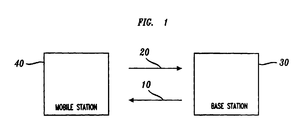
- each forward traffic frame 10 i.e., frames transmitted over the forward traffic channel
- each reverse traffic frame 20 i.e., frames transmitted over the reverse traffic channel
- EIB voice or data and error indicator bits
- base station 30 When base station 30 transmits forward traffic frame 10, mobile station 40 receiving forward traffic frame 10 will check the CRC to determine whether forward traffic frame 10 is good or not. Mobile station 40 will indicate such determination to base station 30 using the EIB in the next reverse traffic frame the mobile station will transmit. For example, a zero error indicator bit indicates no error in the forward traffic frame, and a positive error indicator bit indicates the forward traffic frame is a bad frame.
- the base station Upon receiving reverse traffic frames from the mobile station, the base station examines the EIB and determines whether its forward link to the mobile station is in fading, and adjusts the power of its forward link accordingly.
- the base station may determine that its forward link is in fading and increase the power of its forward link. This is to ensure that the frame error rate is kept to an acceptable percentage, typically between 1% and 3%, depending on the desired system performance.
- a power control decision to either adjust the power or keep the power at its current level occurs once every frame, when the EIB is received.
- CDMA 2000 the forward link power control is much faster.
- the forward link power control is at 800 Hz rate, which means that power control information, referred to herein as a power control bit, is sent every 1.25 ms, or once for every power control group. Therefore, the base station cannot wait until the end of the forward traffic frame to determine if the power should be adjusted.
- power control is effected using slow outer loop 100 and fast inner loop 110.
- target signal to noise ratio uses target frame error rate 124, which is typically between 1% and 3%, depending on the desired system performance.
- Signal to noise ratios are often expressed as the ratio E b /N 0 , where E b is the energy per information bit and N 0 is the power spectral density of the interference seen by the receiver.
- target E b /N 0 130 can be used for the target signal to noise ratio.
- Target E b /N 0 130 is determined for each frame. Thus, for a 20 ms frame the speed of the outer loop is 50 Hz. After target E b /N 0 130 is determined, it is passed to inner loop 110.
- target E b /N 0 130 is compared to measured E b /N 0 160 of the received signal, which is measured for the 1.25 ms since the last comparison.
- measured E b /N 0 160 is smaller than target E b /N 0 130 the mobile station 120 requests an increase in power.
- measured E b /N 0 160 is larger than target E b /N 0 130 the mobile station 120 requests a decrease in power.
- a problem with this system is that it does not allow frames whose information rate is lower than the channel rate to be transmitted at lower power than the full rate power scaled by the information rate scaling factor.
- a frame having an information rate equal to the 1/8 rate transmitted at 1/16 the power of a frame at full rate may have an acceptable frame error rate, and because the information rate is 1/8 the target E b /N 0 130 will be 1/8 of a target E b /N 0 130 when the information rate is equal to the full rate.
- Base station 180 will transmit a frame having an information rate of 1/8 at 1/16 the power of a frame at a full rate, which will produce a measured E b /N 0 of about 1/2 the target E b /N 0 130.
- Mobile station 120 receives the bits in the first 1.25 ms of the frame, and measures the E b /N 0 of these bits. Mobile station 120 then compares this measured E b /N 0 to the target E b /N 0 130. Because target E b /N 0 130 is larger than the measured E b /N 0 , the mobile station will continue requesting an increase in power until the frame is being transmitted at 1/8 the power of a frame at full rate, therefore eliminating the reduction in power that was available due to the synergistic effects of combining interleaving with the repeating of the bits in the frame.
- the invention solves the above problems by providing a variable power control scaling factor to the mobile station.
- the mobile station determines a target signal quality measurement for transmitting a signal, and scales this target signal quality measurement by the variable power control scaling factor.
- Providing the variable power control scaling factor to the mobile station allows frames having an information rate lower than full rate to be transmitted at a power even lower than the information scaling factor times the power of the frame having an information rate equal to the full rate.
- the base station determines an information transmission rate of a signal to be transmitted.
- the base station then obtains a variable power control scaling factor based on the information transmission rate, and transmits the variable power control scaling factor.
- FIG. 3 illustrates a wireless communication system 200 having base station 210 and mobile station 220 used in accordance with the present invention.
- Base station 210 and mobile station 220 communicate using forward link 230 and reverse link 240 employing well-known Code Division Multiple Access (CDMA) 2000 techniques.
- CDMA Code Division Multiple Access
- the present invention may equally be applicable to base stations and mobile stations employing other CDMA techniques and other multiple access techniques.
- Each forward traffic frame (i.e., frames transmitted over the forward traffic channel) includes voice or data, and error control information, typically in the form of a cyclical redundancy code (CRC).
- Variable power control scaling factor 245 can also be transmitted on the forward traffic channel.
- the information content of the forward traffic frames can have different information rates. Typically, there are four information rates full rate, 1 ⁇ 2 rate, 1 ⁇ 4 rate, and 1/8 rate.
- the frame can be transmitted at a power that is even lower than the power of a frame having an information rate equal to the full rate times the information rate scaling factor.
- the factor by which the power of the frame having the lower information rate can be reduced and still have an acceptable frame error rate is the variable power control scaling factor.
- variable power control scaling factor is based on system conditions such as the mobility of the system, the typical number of users in the system, the size of areas covered by base stations in the system referred to hereinafter as cells, the interference in the system from buildings or other objects, and any other factors that determine the amount of power needed to maintain an acceptable frame error rate. Furthermore, because these conditions can vary from cell to cell, each base station can determine its own variable power control scaling factor.
- the variable power control scaling factor 245 can be empirically obtained in drive test.
- variable power control scaling factor 245 can be: about 1 for frames having an information rate equal to the full rate; about 7/8 for frames having an information rate equal to the 1 ⁇ 2 rate; about 3 ⁇ 4 for frames having an information rate equal to the 1 ⁇ 4 rate; and about 1 ⁇ 2 for frames having an information rate equal to the 1/8 rate.
- variable power control scaling factor can be transmitted as part of any of the messages of the forward traffic channel, such as a handoff direction message or a power control parameter message.
- the base station can transmit the variable power control scaling factor as a message on any of the control channels, for example as a message on the paging channel.
- variable power control scaling factor 245 is in a system parameter message or channel assignment message of the paging channel.
- Each reverse traffic frame (i.e., frames transmitted over the reverse traffic channel) includes voice. However, the power control bits are now transmitted on the reverse pilot channel.
- Each frame of the reverse pilot channel comprises sixteen 1.25 ms time intervals referred to herein as power control groups, each including power control bits for indicating whether the transmit power should be increase or decreased based on the last forward traffic power control group.
- power control of the forward link is effected using slow outer loop 100 and fast inner loop 250.
- mobile station 220 determines a target signal quality measurement, preferably target E b /N 0 130, using target frame error rate 124, which is typically between 1% and 3%, depending on the desired system performance.
- the signal quality measurement can be any measurement that indicates the quality of the signal received from base station 210 by mobile station 220.
- the signal quality measurement is either the signal to noise ratio or the E b /N 0 , which is often used to express the signal to noise ratio.
- Target E b /N 0 130 is determined for each frame. After target E b /N 0 130 is determined, it is passed to inner loop 250.
- target E b /N 0 130 is scaled by variable power scaling factor 245 to produce scaled target E b /N 0 260.
- Scaled target E b /N 0 260 is compared to measured E b /N 0 160 of the received signal, which is measured for the 1.25 ms since the last comparison.
- the mobile station 220 transmits information indicating that power should be increased.
- Base station 210 responds to this request by increasing the power of the forward traffic channel.
- measured E b /N 0 160 is larger than scaled target E b /N 0 260 the mobile station 220 transmits information indicating that power should be decreased.
- Base station 210 responds to this request by decreasing the power of the forward traffic channel.
- Wireless communication system 200 allows frames whose information rate is lower than the channel rate to be transmitted at lower power than the power of a frame having an information rate equal to the full rate, scaled by the information rate scaling factor. For example, when the variable power scaling factor is 1 ⁇ 2 for a frame having an information rate of 1/8, the base station transmits the frame at 1/16 the power of a frame having an information rate equal to the full rate. This will produce a measured E b /N 0 of about 1/2 the target E b /N 0 130.
- Mobile station 220 receives the bits in the first 1.25 ms of the frame, and measures the E b /N 0 of these bits.
- Mobile station 220 then compares this measured E b /N 0 to the scaled target E b /N 0 260. Because information rate scaling factor 140 is 1/8 the target E b /N 0 130 is 1/8 of the E b /N 0 130 of a frame whose information rate is equal to the full rate. Since variable power control scaling factor 245 is 1 ⁇ 2, the scaled target E b /N 0 260 is 1/2 of target E b /N 0 130. When there is no fading or noise bursts the measured E b /N 0 and the scaled E b /N 0 are about equal. The mobile station will not request a change in power, therefore allowing the system to use the reduction in power available due to the synergistic effects of combining interleaving with the repeating of the bits in the frame.
- Variable power control scaling factor can also be used in the power control of the reverse link.
- the base station determines a target signal quality measurement for a received signal on the reverse link.
- the base station would also obtain a variable power control scaling factor, and then scale the target signal quality measurement by the variable power control scaling factor.
- Scaled target signal quality measurement is compared to measured signal quality measurement of the received signal. When measured signal quality measurement is smaller than scaled target signal quality measurement the base station request that the mobile station increase the transmit power. When measured signal quality measurement is larger than scaled target signal quality measurement the base station requests that the mobile station decrease the transmit power.
Landscapes
- Engineering & Computer Science (AREA)
- Quality & Reliability (AREA)
- Computer Networks & Wireless Communication (AREA)
- Signal Processing (AREA)
- Mechanical Engineering (AREA)
- Life Sciences & Earth Sciences (AREA)
- Forests & Forestry (AREA)
- Mobile Radio Communication Systems (AREA)
- Transmitters (AREA)
Abstract
Description
Claims (9)
- A method for controlling the power in a wireless communication system (200), the method CHARACTERIZED BY the steps of:determining a target signal quality measurement (130) for a received signal (270);obtaining a variable power control scaling factor (245);scaling the target signal quality measurement (130) by the variable power control scaling factor (245).
- The method of claim 1, CHARACTERIZED IN THAT the signal quality measurement is a signal to noise ratio, or is an Eb/N0.
- The method of claim 1, further CHARACTERIZED BY the steps of:measuring a signal quality measurement (160) of the received signal (270);comparing the measured signal quality measurement (160) of the received signal (270) to the scaled target signal quality measurement (260);requesting an increase in power of the received signal (270) responsive to the measured signal quality measurement (160) of the received signal (270) being smaller than the scaled target signal quality measurement (260); andrequesting a decrease in power of the received signal (270) responsive to the measured signal quality measurement (160) of the received signal (270) being larger than the scaled target signal quality measurement (260).
- The method of claim 1, CHARACTERIZED IN THAT the obtaining step comprises receiving the variable power control scaling factor (245).
- The method of claim 4, CHARACTERIZED IN THAT the variable power control scaling factor (245) is received either in a message of the paging channel, or in a message of the traffic channel, or in a message of the reverse pilot channel.
- A method for controlling transmitter power in a wireless system (200), the method CHARACTERIZED BY the steps of:determining an information rate of a signal to be transmitted (270);obtaining a variable power control scaling factor (245) based on the information rate;transmitting the variable power control scaling factor (245).
- The method of claim 6, CHARACTERIZED IN THAT the step of transmitting the variable power control scaling factor (245) comprises transmitting the variable power control scaling factor (245) either in a message of the forward control channel, or in a message of the paging channel, or in a message of the forward traffic channel.
- The method of claim 7, CHARACTERIZED IN THAT the forward traffic channel is a handoff direction message.
- The method of claim 6, further CHARACTERIZED BY the step of scaling the transmitter power by the variable power control scaling factor (245).
Applications Claiming Priority (2)
| Application Number | Priority Date | Filing Date | Title |
|---|---|---|---|
| US267998 | 1999-03-15 | ||
| US09/267,998 US6535723B1 (en) | 1999-03-15 | 1999-03-15 | Method of power control for a wireless communication system having multiple information rates |
Publications (2)
| Publication Number | Publication Date |
|---|---|
| EP1039656A2 true EP1039656A2 (en) | 2000-09-27 |
| EP1039656A3 EP1039656A3 (en) | 2003-10-29 |
Family
ID=23021035
Family Applications (1)
| Application Number | Title | Priority Date | Filing Date |
|---|---|---|---|
| EP00301872A Withdrawn EP1039656A3 (en) | 1999-03-15 | 2000-03-07 | A method of power control for a wireless communication system having multiple information rates |
Country Status (8)
| Country | Link |
|---|---|
| US (1) | US6535723B1 (en) |
| EP (1) | EP1039656A3 (en) |
| JP (1) | JP3943792B2 (en) |
| KR (1) | KR100718476B1 (en) |
| CN (1) | CN1267147A (en) |
| AU (1) | AU2066600A (en) |
| BR (1) | BR0001277A (en) |
| CA (1) | CA2299771A1 (en) |
Cited By (2)
| Publication number | Priority date | Publication date | Assignee | Title |
|---|---|---|---|---|
| WO2007035181A2 (en) | 2004-09-24 | 2007-03-29 | Qualcomm Incorporated | Method and system for power control in a communication system having variable data rate |
| US7657277B2 (en) | 2004-09-24 | 2010-02-02 | Qualcomm Incorporated | Method and system for power control in a communication system |
Families Citing this family (39)
| Publication number | Priority date | Publication date | Assignee | Title |
|---|---|---|---|---|
| US6639934B1 (en) * | 1999-04-26 | 2003-10-28 | Telefonaktiebolaget Lm Ericsson (Publ) | Power control in a CDMA mobile communication system |
| ATE372610T1 (en) * | 2000-02-21 | 2007-09-15 | Alcatel Lucent | METHOD FOR SETTING A SIGNAL QUALITY SET POINT DURING TRANSMIT POWER CONTROL IN A CDMA RADIO COMMUNICATIONS NETWORK |
| JP2001249471A (en) * | 2000-03-07 | 2001-09-14 | Fuji Denki Gazo Device Kk | Electrophotographic photoreceptor |
| KR100678150B1 (en) * | 2000-06-29 | 2007-02-01 | 삼성전자주식회사 | Link adaptation system and method for code division multiple access system |
| US8605686B2 (en) | 2001-02-12 | 2013-12-10 | Qualcomm Incorporated | Method and apparatus for power control in a wireless communication system |
| US7006483B2 (en) | 2001-02-23 | 2006-02-28 | Ipr Licensing, Inc. | Qualifying available reverse link coding rates from access channel power setting |
| US7046640B2 (en) * | 2001-06-29 | 2006-05-16 | Telefonaktiebolaget Lm Ericsson (Publ) | Software analysis tool for CDMA system |
| KR100915275B1 (en) | 2001-11-05 | 2009-09-03 | 가부시키가이샤 히타치세이사쿠쇼 | Wireless communication system and communication control method therefor and wireless communication station |
| US6879840B2 (en) * | 2001-11-30 | 2005-04-12 | M2 Networks, Inc. | Method and apparatus for adaptive QoS-based joint rate and power control algorithm in multi-rate wireless systems |
| US6996763B2 (en) * | 2003-01-10 | 2006-02-07 | Qualcomm Incorporated | Operation of a forward link acknowledgement channel for the reverse link data |
| US8081598B2 (en) * | 2003-02-18 | 2011-12-20 | Qualcomm Incorporated | Outer-loop power control for wireless communication systems |
| US8391249B2 (en) * | 2003-02-18 | 2013-03-05 | Qualcomm Incorporated | Code division multiplexing commands on a code division multiplexed channel |
| US7660282B2 (en) * | 2003-02-18 | 2010-02-09 | Qualcomm Incorporated | Congestion control in a wireless data network |
| US7286846B2 (en) * | 2003-02-18 | 2007-10-23 | Qualcomm, Incorporated | Systems and methods for performing outer loop power control in wireless communication systems |
| US8150407B2 (en) * | 2003-02-18 | 2012-04-03 | Qualcomm Incorporated | System and method for scheduling transmissions in a wireless communication system |
| US8023950B2 (en) | 2003-02-18 | 2011-09-20 | Qualcomm Incorporated | Systems and methods for using selectable frame durations in a wireless communication system |
| US7505780B2 (en) * | 2003-02-18 | 2009-03-17 | Qualcomm Incorporated | Outer-loop power control for wireless communication systems |
| US20040160922A1 (en) | 2003-02-18 | 2004-08-19 | Sanjiv Nanda | Method and apparatus for controlling data rate of a reverse link in a communication system |
| US7155236B2 (en) * | 2003-02-18 | 2006-12-26 | Qualcomm Incorporated | Scheduled and autonomous transmission and acknowledgement |
| US7215930B2 (en) | 2003-03-06 | 2007-05-08 | Qualcomm, Incorporated | Method and apparatus for providing uplink signal-to-noise ratio (SNR) estimation in a wireless communication |
| US8705588B2 (en) | 2003-03-06 | 2014-04-22 | Qualcomm Incorporated | Systems and methods for using code space in spread-spectrum communications |
| US8477592B2 (en) * | 2003-05-14 | 2013-07-02 | Qualcomm Incorporated | Interference and noise estimation in an OFDM system |
| US8489949B2 (en) | 2003-08-05 | 2013-07-16 | Qualcomm Incorporated | Combining grant, acknowledgement, and rate control commands |
| CN1951055A (en) * | 2004-03-04 | 2007-04-18 | 高通股份有限公司 | Early termination of low data rate traffic in a wireless network |
| US7715866B2 (en) * | 2004-10-12 | 2010-05-11 | Pauli Seppinen | Power control |
| US20050195849A1 (en) * | 2005-03-03 | 2005-09-08 | Amol Rajkotia | Early termination of low data rate traffic in a wireless network |
| US7480517B2 (en) * | 2005-04-27 | 2009-01-20 | Motorola, Inc. | Method of power control in a wireless communication system |
| US7756543B2 (en) * | 2005-09-09 | 2010-07-13 | Telefonaktiebolaget Lm Ericsson (Publ) | High speed shared radio channel transmit power control |
| US7583625B2 (en) * | 2006-04-06 | 2009-09-01 | Broadcom Corporation | Access point multi-level transmission power and protocol control based on the exchange of characteristics |
| WO2007127911A2 (en) * | 2006-04-28 | 2007-11-08 | University Of Pittsburgh Of The Commonwealth System Of Higher Education | Determining the three-dimensional read accuracy of an rfid tag using a power scaling factor |
| CN101136675B (en) * | 2007-06-26 | 2011-03-02 | 中兴通讯股份有限公司 | Power backspacing based power calibrating method and apparatus |
| US8676201B2 (en) * | 2007-08-10 | 2014-03-18 | Telefonaktiebolaget L M Ericsson (Publ) | E-UTRAN and handover |
| US8467464B2 (en) | 2008-03-28 | 2013-06-18 | Qualcomm Incorporated | Apparatus, methods, and articles of manufacture for adaptive power control |
| US20130114433A1 (en) | 2011-11-07 | 2013-05-09 | Qualcomm Incorporated | Scaling for fractional systems in wireless communication |
| US9516531B2 (en) | 2011-11-07 | 2016-12-06 | Qualcomm Incorporated | Assistance information for flexible bandwidth carrier mobility methods, systems, and devices |
| US9848339B2 (en) | 2011-11-07 | 2017-12-19 | Qualcomm Incorporated | Voice service solutions for flexible bandwidth systems |
| US20130114571A1 (en) | 2011-11-07 | 2013-05-09 | Qualcomm Incorporated | Coordinated forward link blanking and power boosting for flexible bandwidth systems |
| CN102723968B (en) * | 2012-05-30 | 2017-01-18 | 中兴通讯股份有限公司 | Method and device for increasing capacity of empty hole |
| US9379789B2 (en) * | 2013-07-03 | 2016-06-28 | Qualcomm Incorporated | Antenna selection adjustment |
Family Cites Families (15)
| Publication number | Priority date | Publication date | Assignee | Title |
|---|---|---|---|---|
| US5103459B1 (en) * | 1990-06-25 | 1999-07-06 | Qualcomm Inc | System and method for generating signal waveforms in a cdma cellular telephone system |
| CA2072582C (en) * | 1990-12-20 | 1996-04-09 | Thomas J. Walczak | Power control circuitry for a tdma radio frequency transmitter |
| US5345598A (en) * | 1992-04-10 | 1994-09-06 | Ericsson-Ge Mobile Communications Holding, Inc. | Duplex power control system in a communication network |
| GB9214107D0 (en) * | 1992-07-03 | 1992-08-12 | Ncr Int Inc | Power control method in a wireless communication system |
| WO1994018756A1 (en) * | 1993-02-11 | 1994-08-18 | Motorola, Inc. | Method and apparatus for controlling a power level of a subscriber unit of a wireless communication system |
| US5396516A (en) * | 1993-02-22 | 1995-03-07 | Qualcomm Incorporated | Method and system for the dynamic modification of control paremeters in a transmitter power control system |
| US5551057A (en) * | 1994-06-08 | 1996-08-27 | Lucent Technologies Inc. | Cellular mobile radio system power control |
| US5603096A (en) * | 1994-07-11 | 1997-02-11 | Qualcomm Incorporated | Reverse link, closed loop power control in a code division multiple access system |
| US5634195A (en) * | 1995-03-27 | 1997-05-27 | Telefonaktiebolaget Lm Ericsson | System and method for setting of output power parameters in a cellular mobile telecommunication system |
| US5710981A (en) * | 1995-05-23 | 1998-01-20 | Ericsson Inc. | Portable radio power control device and method using incrementally degraded received signals |
| US5634206A (en) * | 1995-05-25 | 1997-05-27 | Motorola, Inc. | Method and apparatus for estimating a signal fading characteristic |
| US5715526A (en) * | 1995-09-08 | 1998-02-03 | Qualcomm Incorporated | Apparatus and method for controlling transmission power in a cellular communications system |
| US5842113A (en) * | 1996-04-10 | 1998-11-24 | Lucent Technologies Inc. | Method and apparatus for controlling power in a forward link of a CDMA telecommunications system |
| US5987333A (en) * | 1997-09-30 | 1999-11-16 | Nortel Networks Corporation/Corporation Nortel Networks | Communications power control |
| US6181738B1 (en) * | 1998-02-13 | 2001-01-30 | Northern Telecom Limited | Reverse link power control using a frame quality metric |
-
1999
- 1999-03-15 US US09/267,998 patent/US6535723B1/en not_active Expired - Lifetime
-
2000
- 2000-02-28 CA CA002299771A patent/CA2299771A1/en not_active Abandoned
- 2000-03-06 AU AU20666/00A patent/AU2066600A/en not_active Abandoned
- 2000-03-07 EP EP00301872A patent/EP1039656A3/en not_active Withdrawn
- 2000-03-10 BR BR0001277-7A patent/BR0001277A/en not_active Application Discontinuation
- 2000-03-13 JP JP2000069354A patent/JP3943792B2/en not_active Expired - Fee Related
- 2000-03-14 KR KR1020000012721A patent/KR100718476B1/en not_active Expired - Fee Related
- 2000-03-14 CN CN00104122A patent/CN1267147A/en active Pending
Cited By (3)
| Publication number | Priority date | Publication date | Assignee | Title |
|---|---|---|---|---|
| WO2007035181A2 (en) | 2004-09-24 | 2007-03-29 | Qualcomm Incorporated | Method and system for power control in a communication system having variable data rate |
| WO2007035181A3 (en) * | 2004-09-24 | 2007-10-18 | Qualcomm Inc | Method and system for power control in a communication system having variable data rate |
| US7657277B2 (en) | 2004-09-24 | 2010-02-02 | Qualcomm Incorporated | Method and system for power control in a communication system |
Also Published As
| Publication number | Publication date |
|---|---|
| US6535723B1 (en) | 2003-03-18 |
| JP2000286793A (en) | 2000-10-13 |
| BR0001277A (en) | 2000-12-26 |
| CN1267147A (en) | 2000-09-20 |
| EP1039656A3 (en) | 2003-10-29 |
| JP3943792B2 (en) | 2007-07-11 |
| AU2066600A (en) | 2000-09-21 |
| KR100718476B1 (en) | 2007-05-16 |
| CA2299771A1 (en) | 2000-09-15 |
| KR20000062867A (en) | 2000-10-25 |
Similar Documents
| Publication | Publication Date | Title |
|---|---|---|
| US6535723B1 (en) | Method of power control for a wireless communication system having multiple information rates | |
| US6374085B1 (en) | Method and apparatus for adjusting thresholds and measurements of received signals by anticipating power control commands yet to be executed | |
| EP1289167B1 (en) | Reporting absolute and relative downlink channel quality information in a mobile communication system | |
| US5893035A (en) | Centralized forward link power control | |
| EP2582066B1 (en) | Power control for wireless communication systems | |
| US5872775A (en) | Method and apparatus for performing rate determination | |
| EP1360779B1 (en) | Method and apparatus for power control in a wireless communication system | |
| US6687510B2 (en) | Methods and apparatus for power allocation on a reverse link power control channel of a communication system | |
| JP3115608B2 (en) | Rapid power control in variable data rate mobile CDMA communication systems | |
| EP1256190B1 (en) | Method and apparatus for power control of multiple channels in a wireless communication system | |
| JP4607589B2 (en) | Power allocation for power control bits in cellular networks | |
| US6678257B1 (en) | Methods and apparatus for allocation of power to base station channels | |
| JP4394277B2 (en) | Method and apparatus for providing ternary power control in a communication system | |
| JP3737350B2 (en) | Method for adjusting transmission power level during soft handoff in a wireless communication system | |
| US20080194286A1 (en) | Systems and methods for performing outer loop power control in wireless communication systems | |
| JP2002537676A (en) | Power control apparatus and method for handoff between frequencies in a code division multiple access communication system | |
| US20130040647A1 (en) | Power control and handoff with power control commands and erasure indications | |
| JP2011030236A (en) | Method of combining power control command received from a plurality of base stations | |
| US6879577B2 (en) | Method and apparatus for determining frame quality in mobile communication system | |
| JP3543759B2 (en) | Transmission power control method, transmitting / receiving apparatus, base station and mobile station | |
| US20020147025A1 (en) | Systems and methods for base station signal transmission power control | |
| US20060293075A1 (en) | Method to improve outer loop power control | |
| US20080051126A1 (en) | Method for allocating transmit power in a wireless communication system | |
| US7174181B2 (en) | Power control method and telecommunications system | |
| RU2347329C2 (en) | Systems and methods for realisation of external power control circuit in wireless communication system |
Legal Events
| Date | Code | Title | Description |
|---|---|---|---|
| PUAI | Public reference made under article 153(3) epc to a published international application that has entered the european phase |
Free format text: ORIGINAL CODE: 0009012 |
|
| AK | Designated contracting states |
Kind code of ref document: A2 Designated state(s): AT BE CH CY DE DK ES FI FR GB GR IE IT LI LU MC NL PT SE |
|
| AX | Request for extension of the european patent |
Free format text: AL;LT;LV;MK;RO;SI |
|
| PUAL | Search report despatched |
Free format text: ORIGINAL CODE: 0009013 |
|
| AK | Designated contracting states |
Kind code of ref document: A3 Designated state(s): AT BE CH CY DE DK ES FI FR GB GR IE IT LI LU MC NL PT SE |
|
| AX | Request for extension of the european patent |
Extension state: AL LT LV MK RO SI |
|
| 17P | Request for examination filed |
Effective date: 20040419 |
|
| AKX | Designation fees paid |
Designated state(s): DE FI FR GB SE |
|
| GRAP | Despatch of communication of intention to grant a patent |
Free format text: ORIGINAL CODE: EPIDOSNIGR1 |
|
| GRAS | Grant fee paid |
Free format text: ORIGINAL CODE: EPIDOSNIGR3 |
|
| STAA | Information on the status of an ep patent application or granted ep patent |
Free format text: STATUS: THE APPLICATION IS DEEMED TO BE WITHDRAWN |
|
| 18D | Application deemed to be withdrawn |
Effective date: 20081001 |