BACKGROUND OF THE INVENTION
1. FIELD OF THE INVENTION
The present invention relates to a lithographic printing plate useful as a so-called
computer-to-plate (CTP) plate that is applicable to direct plate making based on digital signals
from a computer or the like, as a lithographic printing plate used in the field of offset printing,
and more particularly to a lithographic printing plate having a photosensitive layer wherein a
latent image is obtained by irradiation of a high power laser having the maximum strength in a
near infrared or infrared region, and the latent image is wet developed to thereby form an
image.
2. DESCRIPTION OF RELATED ART
With the development of the computer image processing technology, there has been
recently developed a method for inscribing an image directly on a photosensitive layer by
means of photoirradiation corresponding to digital signals. A computer-to-plate (CTP) system
which utilizes the method for a lithographic printing plate and forms an image directly on the
printing plate without outputting the image to a silver salt mask film has attracted much
attention.
The CTP system having the maximum strength in a near infrared or infrared region
and using high power lasers has attracted attention because of the availability of compact and
high power lasers, and because it provides a high resolution image with a short period of
exposure and the printing plate used for the method may be handled in a lighted room.
As a lithographic printing plate used for the CTP system that uses such a light source,
there is disclosed a lithographic printing plate having a photosensitive layer containing a
substance which generates acid due to heat (acid generating agent), an infrared absorption
agent, a crosslinking agent which crosslinks due to heat, and a resin having a functional group
capable of cross-linking reactions with the crosslinking agent, in Japanese Patent Unexamined
Publications No. 10-228109. The lithographic printing plate, however, has a problem in the
preservation stability of the acid generating agent, and a practical problem in that it requires
heat processing prior to development after the laser irradiation, in order to accomplish a cation
polymerization reaction accompanying the acid generation, hence causing a problem in the
reproducibility of halftone dots.
On the other hand, as a lithographic printing plate which does not require heat
processing prior to development, after the laser irradiation, in Japanese Patent Unexamined
Publications No. 9-171249, there is disclosed a lithographic printing plate in which
hydrophobic thermoplastic polymer particles dispersed in a hydrophilic resin are formed on a
hydrophilic substrate. With this lithographic printing plate, an image is formed by utilizing a
difference in the solubility with respect to the developer between resin fine particles fusion-bonded
due to heat and resin fine particles not fusion-bonded. However, this system has
problems in that since hydrophobic fine particles that are insoluble in the developer has to be
developed together with the hydrophilic resin, the sensitivity, preservation stability and
printing resistance are low, and in order to actually utilize it as a printing plate, heat processing
is essential after the development. Moreover, in Japanese Patent Unexamined Publication No.
9-171250, there is disclosed a lithographic printing plate in which a hydrophilic resin is
crosslinked by means of heat in order to improve the printing resistance, however, since the
resin fine particles are not involved in the crosslink, sufficient printing resistance cannot be
exerted, and there is also a problem in the preservation stability.
Furthermore, in Japanese Patent Unexamined Publications No. 9-127683, there is
disclosed a lithographic printing plate in which a self water-dispersible thermoplastic resin
particle layer which can be made lipophilic by means of heat is formed on the surface of a
hydrophilic substrate. Since this lithographic printing plate does not contain an infrared
absorption agent, the sensitivity is low, and in some cases, it is necessary to form a film for
prevention of drying out that can be peeled off, such as PET or the like on the resin particle
layer, in order to increase the preservation stability. Moreover, when a polyvalent metal ion is
used as a crosslinking agent in order to improve the printing resistance, there is a tendency that
the development property decreases with the lapse of time.
BRIEF SUMMARY OF THE INVENTION
For obviating the above-described problems, it is an object of the present invention to
provide a computer-to-plate (CTP) plate in which an image can be inscribed by a laser beam
having the maximum strength in a near infrared or infrared region, and heat processing is not
necessary prior to developing a latent image, and which allows the use of a conventional
printing apparatus as it is upon printing.
The present inventors made investigations with a view to attaining the above
objectives. As a result, the present invention has been completed based on the finding of a
novel process of obtaining a printing plate which uses, as a mechanism for forming an
inscribed image on a photosensitive layer with high density energy light, formation of a latent
image comprising a portion where resin fine particles in the image portion are mutually melted
and/or fused due to the heat generated by absorption of light energy and subjected to a
polycondensation reaction or polyaddition reaction with the crosslinking agent by means of
heat, and subsequent development of the latent image by dissolution and removal of a non-image
portion by dipping the lithographic printing plate in a processing solvent, as opposed to
a conventional mechanism utilizing only a chemical reaction such as polymerization reaction
on a so-called PS plate or the like involving light energy and a monomer that uses a
photoinitiator or an acid generating agent (negative type PS plate), or modification
accompanying partial decomposition reaction of a polymer with light energy (positive type PS
plate).
That is to say, to attain the above described object, the present invention provides (I) a
lithographic printing plate having on a substrate, a photosensitive layer comprising a
photosensitive composition containing a crosslinking agent, a water dispersion of resin fine
particles having a functional group capable of performing cross-linking reactions with the
crosslinking agent, and an infrared absorption agent.
Moreover, to attain the above described object, the present invention provides (II) an
image forming method characterized in that after an image has been formed on a
photosensitive layer of the lithographic printing plate set forth in the above (I) by using a laser
beam, the image is subjected to wet development.
With the lithographic printing plate of the present invention, a plate can be made up
without preheating, after the laser inscription. Moreover, the resin fine particles are soluble in
an alkaline developer, and are mutually capable of performing cross-linking reactions by
means of heat. Hence, the results of sensitivity and preservation stability tests (at 60°C, for 15
hours) are excellent, and show a printing resistance such that the plates can be used sufficiently
even just after development. Moreover, it is possible to provide a practical printing plate
having an excellent printing resistance by means of burning.
DETAILED DESCRIPTION OF THE INVENTION
The crosslinking agent used in the present invention refers to a crosslinking agent that
crosslinks particles with each other by means of heat. For example, there can be used one
having a carbodiimide group as a functional group, one having an oxazoline group, one having
an amino group or a methylol or alkoxymethyl group, or one generally and widely used as a
crosslinking agent. The particles of the present invention are used as water dispersion bodies.
Therefore, an aqueous-type crosslinking agent is preferably used.
As the crosslinking agent having an amino group, a methylol group or an
alkoxymethyl group, it is preferable to use amino compounds or amino resins, for example,
phenol derivatives, melamine derivatives, benzoguanamine derivatives or the like obtained by
reacting formaldehyde and, according to need, alcohol with phenol, melamine,
benzoguanamine or the like, respectively, in a known method.
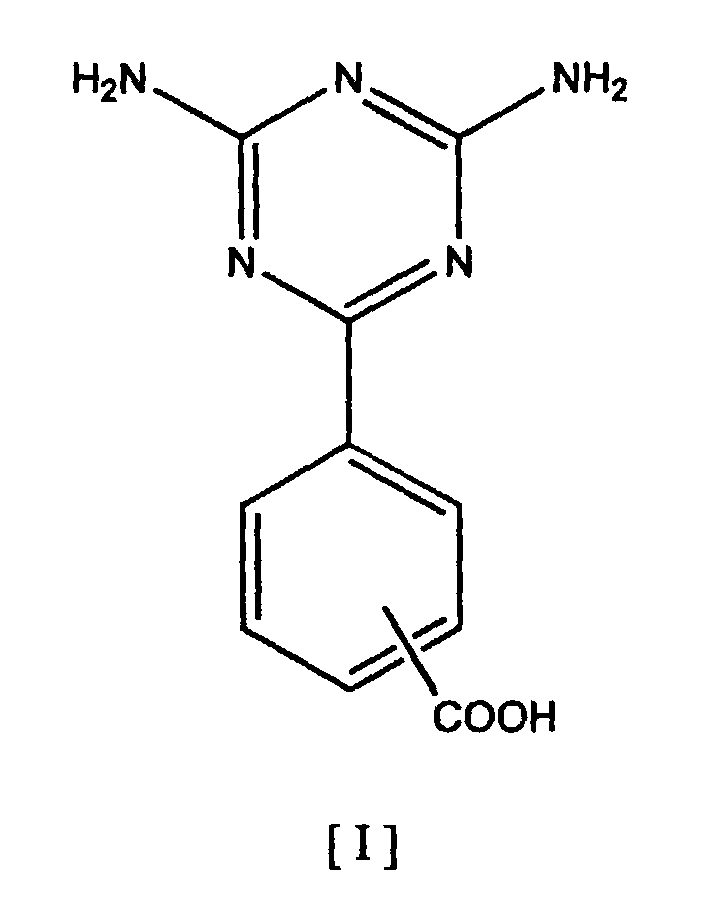
As the benzoguanamine derivatives, for example, amino compounds or amino resins
derived from 2-, 3- or 4-(4,6,diamino-1,3,5-triazine-2-yl) benzoic acid represented by the
general formula [1]:
are preferable. In addition, among compounds represented by the general formula [I], 2-(4,6,diamino-1,3,5-triazine-2-yl)
benzoic acid disclosed in Japanese Patent Unexamined
Publication No. 9-143169 is preferably used, because it can be obtained at high yield and high
purity.
Amino compounds or amino resins derived from 2-(4,6,diamino-1,3,5-triazine-2-yl)
benzoic acid can be prepared by reacting 2-(4,6,diamino-1,3,5-triazine-2-yl) benzoic acid
singly, or a mixture with at least one kind of urea, melamine, benzoguanamine or the like, with
an aldehyde compound and an alcohol compound. The methylolation reaction and
alkyletherification (acetalization) reaction can be performed based on known methylolation
reaction and alkyletherification (acetalization) reaction of melamine described in
"Yuria/Meramin Jushi" (Urea/Melamine Resin) (published by Nikkan Kogyo Shimbunsha,
1969), "Koubunshi Jikkengaku Kouza 11 Jushukugou to Jufuka Hannou" (Polymer
Experimentation Seminar 11 - Polycondensation and Polyaddition Reaction) (published by
Kyoritsu Shuppan, 1958), "Koubunshi Jikkengaku 5 Jushukugou to Jufuka" (Polymer
Experimental Science 5 - Polycondensation and Polyaddition) (published by Kyoritsu
Shuppan, 1980), "Toryou Jushi no Kagaku" (Chemistry of Paint Resin") (published by
Shoukodo, 1972), "Purasuchikku Zairyou Kouza 3 Meramin Jushi" (Plastic Materials Seminar
3 - Melamine Resin) (published by Nikkan Kogyo Shimbunsha, 1961), and "Koubunshi
Gousei Jikkennhou" (Polymer Synthesis Experimentation) (published by Tokyo Kagaku Dojin,
1966).
As the aldehyde compounds, for example, there can be mentioned formaldehyde,
paraformaldehyde, acetoaldehyde, propionaldehyde, butylaldehyde, glyoxal, glyoxylic acid,
and semialdehyde succinate. Among them, formaldehyde and paraformaldehyde are
preferably used in view of reactivity.
As the alcohol compounds, it is preferable to use an aliphatic alcohol containing not
more than 4 carbon chains, and for example, there can be mentioned methanol, ethanol, n-propyl
alcohol, isopropyl alcohol, n-butyl alcohol, i-butyl alcohol and the like. These alcohol
compounds may be used singly, or in combination thereof.
The amino compounds or amino resins derived from 2-(4,6,diamino-1,3,5-triazine-2-yl)
benzoic acid can be prepared by mixing 2-(4,6,diamino-1,3,5-triazine-2-yl) benzoic acid
singly, or a mixture with at least one kind of urea, melamine, benzoguanamine or the like, with
an aldehyde compound and an alcohol compound, and reacting them at about 40 to 120°C.
In the photosensitive composition of the present invention, when the preservation
stability is required, it is required that the photosensitive composition has low reactivity at a
low temperature. Also, when the photosensitive composition is utilized as a lithographic
printing plate, it is also required that it has excellent ink acceptability. Therefore, it is
preferable to use amino compounds or amino resins having an alkoxymethyl group that has
fewer amino groups or methylol groups, i.e., that is highly alkyletherifled (acetalized).
The rate of these crosslinking agents to be used in total solids of the photosensitive
material in the present invention is preferably from 0.1 to 60% by weight, and more preferably,
from 1 to 40% by weight. If the rate of the crosslinking agent to be used is less than 1% by
weight, the effects of crosslink cannot be obtained, and if the rate of the crosslinking agent to be
used exceeds 40% by weight, the photosensitive composition layer of the present invention
becomes brittle, which is not desirable.
The water dispersion bodies of resin fine particles used in the present invention means
fine particles comprising a resin of an average particle diameter of from 0.005 to 1 micrometers
(µm), having a functional group contained in the crosslinking agent and a functional group
capable of performing crosslinking reactions. The functional groups contained in the fine
particles include, for example, carboxyl group, hydroxyl group, glycidyl group, amino group
and the like.
As the method of preparing resin fine particles, for example, there can be mentioned a
method in which fine particles are formed in a process of synthesizing the resin, or a method in
which a synthesized or existing resin is finely granulated. The former method includes an
emulsion polymerization method, a soap-free emulsion polymerization method and the like.
The latter method includes a pulverization method which obtains fine particles by pulverizing
massive polymers, an emulsification method which emulsifies a resin using an emulsifier, or
like methods. With the pulverization method, since it is difficult to obtain uniform particles of
less than 1 µm, it is not suitable for use for the photosensitive composition of the present
invention. On the other hand, with the emulsion polymerization method or the emulsification
method, the emulsifier remains, and depending upon the kinds and used amount of the
emulsifier, it affects the sensitivity and ink acceptability. Hence, sufficient care should be
taken in selecting the emulsifier.
In addition, resin fine particles can be obtained by providing the resin with a
functional group which imparts a self water-dispersing ability and dispersing the resin into
water by a phase inversion emulsification method. This method is excellent as the preparation
method for the resin fine particles used in the present invention, because an emulsifier is not
used, various functional groups can be introduced into the resin prior to water dispersion, and
the particle diameter of the resin fine particles can be easily changed. The resin fine particles
used in the present invention are required to have a functional group capable of reacting with a
crosslinking agent, hence this method which can introduce various functional groups is quite
advantageous. Generally, the resin fine particles obtained by the emulsification method and the
phase inversion emulsification method may have a film formation property with the resin fine
particles only, and in the present invention, such resin fine particles are preferably used.
Below is a description of a method for obtaining resin fine particles having a
functional group capable of performing cross-linking reactions with a crosslinking agent by the
phase inversion emulsification method. The self water-dispersible resin used for the phase
inversion emulsification method is a general term for resins that can be dispersed in water
without using an emulsifier, and includes such resins that change to a slightly turbid and
transparent state and ones that change to a whitened and suspended state, if the resin is
dispersed singly in water, and generally refers to a resin that can be dispersed so as to have an
average particle diameter of from 0.005 to 1 micrometer (µm) of the dispersed particle. In
order to impart water dispersibility to the resin, hydrophilic groups in an amount required for
dispersing the resin in water have only to be introduced into the resin. The hydrophilic groups
include anionic groups, cationic groups and nonionic groups. The kind of the hydrophilic
groups is determined by the selection of the developer, and for example, when an alkaline
developer is used, anionic resins are used, and when an acidic developer is used, cationic resins
are used. When water is used as the developer, any of anionic groups, cationic groups and
nonionic groups may be used. As the developer, an alkaline developer is generally used, and in
this case, the anionic resin may be used.
The self water-dispersible resin used for the phase inversion emulsification method is
not particularly limited, so far as it is a resin having self water dispersibility, and for example,
polymerization-type resins such as acrylic resin or the like, and condensation-type resins such
as polyester resin, urethane resin or the like can be used.
When an anionic acrylic resin is used as the self water-dispersible resin, a
polymerizable monomer having acid groups is used for at least one kind of the polymerizable
compositions serving as a material, and after copolymerizing the material with a polymerizable
monomer having other polymerizable vinyl groups, according to need, by a known
conventional method, a necessary amount of the copolymerized material may be neutralized
with a base. When a functional group capable of performing cross-linking reactions with a
crosslinking agent is introduced into the resin at the time of polymerization, after
copolymerizing in a similar manner, a composition containing a polymerizable monomer
having a functional group capable of performing cross-linking reactions with a crosslinking
agent, a polymerizable monomer having an acid group, and according to need, a polymerizable
monomer having other polymerizable vinyl groups, a necessary amount of the copolymerized
material may be neutralized with a base. It is a matter of course that when the functional group
capable of performing cross-linking reactions with a crosslinking agent is the same, with the
functional group in the polymerizable monomer, a composition containing a polymerizable
monomer having an acid group, and according to need, a polymerizable monomer having other
polymerizable vinyl groups may be used to prepare the resin in the similar manner as described
above.
The polymerizable monomer having an acid group includes, for example, vinyl
monomers having carboxyl groups such as (meth) acrylic acid, crotonic acid, itaconic acid,
maleic acid (anhydride), fumaric acid, monobutyl itaconate and monobutyl maleate; vinyl
monomers having carboxyl groups such as acid phosphoxyethyl methacrylate; vinyl
monomers having sulfonic groups such as 2-chloro-acrylamide-2-methylpropane sulfonate;
and vinyl monomers having sulfate groups such as 2-sulfoethyl (meth) acrylate.
The polymerizable monomer having a functional group capable of performing cross-linking
reactions with a crosslinking agent has a different functional group capable of
performing cross-linking reactions depending upon the crosslinking agent to be used. As the
crosslinking agent, when amino compounds such as phenol derivatives, melamine derivatives
and benzoguanamine derivatives are used, functional groups capable of performing cross-linking
reactions include hydroxyl groups, amino groups, amide groups, carboxyl groups and
glycidyl groups. Considering polymerization with a polymerizable monomer having acid
groups, usage of monomers containing glycidyl groups that react with acid groups or amino
groups that forms salt with the acid groups may cause gelation. Therefore, it is preferable to
use polymerizable monomers having hydroxyl groups, amide groups and carboxyl groups as
the polymerizable monomer having a functional group capable of performing cross-linking
reactions with a crosslinking agent.
Polymerizable monomers having hydroxyl groups include, for example,
hydroxymethyl (meth) acrylate, 2- hydroxyethyl (meth) acrylate and 2- hydroxypropyl (meth)
acrylate. Polymerizable monomers having amide groups include, for example,
(meth)acrylamide. Polymerizable monomers having carboxyl groups include, for example,
vinyl monomers having carboxyl groups described in the above polymerizable monomers
having acid groups.
As the crosslinking agent, this is not limited to the amino compounds, and in that case,
a polymerizable monomer having a functional group that reacts with a crosslinking agent
which does not cause a problem of gelation or the like at the time of polymerization can be
optionally used.
Polymerizable monomers having other polymerizable vinyl groups which can be used
according to need, as the monomer constituting the self water-dispersible resin include, for
example, acrylic esters such as methyl (meth) acrylate, ethyl (meth) acrylate, isopropyl (meth)
acrylate, n-propyl (meth) acrylate, n-butyl (meth) acrylate, i-butyl (meth) acrylate, t-butyl
(meth) acrylate, 2-ethylhexyl (meth) acrylate, n-octyl (meth) acrylate, lauryl (meth) acrylate,
stearyl (meth) acrylate, tridecyl (meth) acrylate, cyclohexyl (meth) acrylate, butoxymethyl
(meth) acrylate, ethoxydiethylene glycol (meth) acrylate, tetrahydrofurfuryl (meth) acrylate,
isobornyl (meth) acrylate, benzyl (meth) acrylate, hydroxymethyl (meth) acrylate, 2-hydroxyethyl
(meth) acrylate and 2-hydroxypropyl (meth) acrylate;
styrene derivatives such as styrene, α-methylstyrene, o- methylstyrene, m-methylstyrene, p-methylstyrene,
p-t-butylstyrene and p-hydroxystyrene; itaconic esters such as benzyl itaconate;
maleic esters such as dimethyl maleate; fumaric esters such as dimethyl fumarate; vinyl esters
such as vinyl acetate, vinyl benzoate, vinyl versate and vinyl propionate; polymerizable nitriles
such as (meth)acrylonitrile; (meth)acrylamide; and allyl alcohol.
As the polymerization method of the above described polymerizable monomer
compositions, various methods such as block polymerization, solution polymerization and the
like can be used, but the simple solution polymerization is preferable, and as the solvent to be
used, an organic solvent is preferable. The organic solvent is not particularly limited so far as it
can dissolve polymerizable monomers and obtained polymers, and includes, for example,
aromatic hydrocarbons such as benzene, toluene and xylene; ketones such as acetone, methyl
ethyl ketone and methyl isobutyl ketone and cyclohexanone; esters such as ethyl acetate and
butyl acetate; alcohols such as methanol, ethanol and isopropyl alcohol. These organic
solvents may be used by mixing two kinds or more. Among them, the solvent that makes phase
inversion emulsification easy and relatively has compatibility with water is preferable, and the
solvent having a low boiling point that is easy to remove the organic solvent after the phase
inversion emulsification is preferably used. Such solvents include acetone, methyl ethyl
ketone and ethyl acetate.
As the polymerization initiator used at the time of solution polymerization, any known
radical polymerization initiator may be used, and for example there can be mentioned, azo
compounds such as 2,2-azobisisobutyronitrile and 2,2-azobis(2,4-dimethylvaleronitrile; and
peroxide compounds such as benzoyl peroxide, lauryl peroxide and t-butyl peroxy-2-ethylhexanoate.
As a synthesis method of anionic acrylic resins, in addition to the above described
method in which acid groups are introduced at the time of polymerization, anionic groups can
be introduced to the acrylic resin after polymerization, by for example, adding acid anhydride
to a polymer having hydroxyl groups, and then neutralizing a necessary amount thereof with a
base. Similarly, functional groups capable of reacting with a crosslinking agent may be
introduced into the resin after polymerization. That is to say, any anionic acrylic resin having
functional groups capable of reacting with a crosslinking agent may be optionally used as the
self water-dispersible resin.
When an anionic polyester resin is used as the self water-dispersible resin, after
polyester having acid groups is obtained by performing dehydration of dibasic acid and diol
compound so that acid groups increase stoichiometrically, a necessary amount of this can be
neutralized with a base, to thereby obtain the self water-dispersible resin. Alternatively, after
polyester having acid groups is obtained by performing dehydration of dibasic acid and diol
compound so that hydroxyl groups increase stoichiometrically, and adding acid anhydride
thereto, the self water-dispersible resin can be obtained by neutralizing a necessary amount
thereof with a base.
The dibasic acid serving as a material of the polyester resin includes, for example,
succinic acid, adipic acid, azelaic acid, sebacic acid, dimer acid, terephthalic acid, dimethyl
terephthalate, isophthalic acid, hexahydro terephthalate, hexahydro isophthalate,
tetrohydrophthalic acid and 2,6-naphthalenedicarboxylic acid.
In addition, diol compounds serving as a material of the polyester resin includes, for
example, ethylene glycol, neopentyl glycol, propylene glycol, diethylene glycol, dipropylene
glycol, 2-methyl-1,3-propanediol, 2,2-diethyl-1,3-propanediol, 1,4-butanediol, 1,3-butanediol,
1,5-pentanediol, 1,6-hexanediol, 1,4-cyclohexandimethanol, alkylene oxide adduct of
bisphenol A, alkylene oxide adduct of hydrogenated bisphenol A, polyethylene glycol,
polypropylene glycol, polytetramethylene glycol, polycarbonate diol and polycaprolactone
diol.
Moreover, acid anhydride serving as a material of the polyester resin includes, for
example, dibasic anhydrides such as phthalic anhydride, maleic anhydride, glutaric anhydride,
tetrahydrophthalic anhydride, hexahydrophthalic anhydride, methyltetrahydrophthalic
anhydride; and tribasic or tetrabasic anhydrides such as trimellitic anhydride and pyromellitic
anhydride.
When polyester is obtained by means of dehydration of dibasic acid and diol
compound, trihydric or more polybasic acids such as trimellitic acid and pyromellitic acid, or
trihydric or more polyhydric alcohol compounds such as glycerine, trimethylolpropane and
pentaerythritol may be used together, in a range that does not cause gelation.
Moreover, at the time of dehydration, if a known conventional esterification catalyst
such as dibutyl tin oxide or the like is used, the intended reaction can be performed more
smoothly.
If the functional group capable of performing cross-linking reactions with a
crosslinking agent is a carboxyl group or a hydroxyl group, by neutralizing a necessary amount
thereof with a base having a carboxyl group or having a carboxyl group and a hydroxyl group
together, anionic polyester having a functional group capable of reacting with a crosslinking
agent can be obtained. However, a functional group capable of reacting with a crosslinking
agent may be introduced into the polyester obtained by means of dehydration. That is to say,
any anionic polyester resin having a functional group capable of reacting with a crosslinking
agent may be optionally used as the self water-dispersible resin used in the present invention.
When an anionic urethane resin is used as the self water-dispersible resin, after a
urethane resin having acid groups is obtained by a condensation reaction of a diisocyanate
compound, a diol compound and a diol compound having acid groups, a necessary amount of
this may be neutralized with a base, to thereby obtain the self water-dispersible resin. When
the functional group capable of performing cross-linking reactions with a crosslinking agent is
a carboxyl group, a diol compound having a carboxyl group may be used as the diol compound
having acid groups. When the functional group capable of performing cross-linking reactions
with a crosslinking agent is a hydroxyl group, after a condensation reaction has been performed
under a condition that the amount (mol) of the hydroxyl group of the diol compound and the
diol compound having acid groups exceeds the amount (mol) of the isocyanate group in the
diisocyanate compound, the necessary amount of this may be neutralized with a base, to
thereby obtain an anionic urethane resin having a hydroxyl group.
The diisocyanate compound serving as a material of the urethane resin includes, for
example, aromatic diisocyanates such as 2,4-tolylenediisocyanate, 2,6-tolylenediisocyanate,
m-phenylenediisocyanate, p- phenylenediisocyanate, 4,4-diphenylmethanediisocyanate, 2,4-diphenylmethanediisocyanate,
2,2- diphenylmethanediisocyanate, 3,3-dimethyl-4,4-biphenylenediisocyanate
diphenylmethanediisocyanate, 3,3-dimethoxy-4,4-biphenylenediisocyanate,
3,3-dichloro-4,4-biphenylenediisocyanate, and 1,5-naphthalenediisocyanate;
aliphatic diisocyanates or alicyclic diisocyanates such as 5-tetrahydronaphthalenediisocyanate,
tetramethylenediisocyanate, 1,6-hexamethylenediisocyanate,
dodecamethylenediisocyanate, lysinediisocyanate, 1,3-cyclohexylenediisocyanate,
1,4-cyclohexylenediisocyanate, isophoronediisocyanate, 4,4-dicyclohexylmethanediisocyanate,
xylylenediisocyanate, tetramethylxylylenediisocyanate,
trimethylhexamethylenediisocyanate, hydrogenated xylylenediisocyanate, and 3,3-dimethyl-4,4-dicyclohexylmethanediisocyanate.
When the isocyanate group is left at the terminal of the resin for internal crosslinking
of the resin fine particles as described above, it is preferable to use aliphatic diisocyanates and
alicyclic diisocyanates in which the reaction of the isocyanate group and water is relatively
slow.
Moreover, the diol compounds serving as a material of the urethane resin include, for
example, ethylene glycol, 1,2-propanediol (1,2-propylene glycol), 1,3-propanediol (1,3-propylene
glycol), 1,3-butanediol, 1,4-butanediol (1,4-butylene glycol), neopentyl glycol,
1,6-hexanediol, 3-methyl-1,5-pentanediol, 1,8-octanediol, diethylene glycol, triethylene glycol,
dipropane glycol, tripropylene glycol, cyclohexane-1,4-diol, and cyclohexane-1,4-dimethanol.
Furthermore, as the diol compounds serving as a material of the urethane resin, there
can be used in addition to various diols, polyesterdiols which are a condensate with dibasic acid
or dibasic anhydride such as succinic acid, adipic acid, glutaric acid, suberic acid, azelaic acid,
sebacic acid, phthalic acid, isophthalric acid, terephthalic acid, glutaric anhydride, maleic acid,
maleic anhydride and hexahydroisophthalic acid; polyester diols obtained by means of ring-opening
polymerization of γ-butyrolactone or ε-caprolactone, using various diols as an
initiator; polycarbonate diols such as poly(hexamethylene carbonate) diol; and polyetherdiols
that are a ring-opened polymer of ethylene oxide, propylene oxide, butylenes oxide, styrene
oxide or tetrahydrofuran singly or in combination of two or more of them, using one kind or at
least two kinds of various diols as an initiator.
Copolymers of these diols may be used as the diol compound serving as a material of
the urethane resin. These diol compounds may be used singly or in combination of various
kinds thereof.
Moreover, the diol compounds having acid groups serving as a material of the
urethane resin include, for example, 2,2-bis (hydroxymethyl) propionate and tartaric acid.
A small amount of polyol compound whose average functionality degree exceeds 2
may be used in the range that the urethane polymer is not gelated. Moreover, a small amount of
polyisocyanate compound whose average functionality degree exceeds 2 may be used together.
Since the condensation reaction of the diisocyanate compound, the diol compound
and the diol compound having acid groups increases viscosity, the solution reaction is
preferable. The solvent to be used is not particularly limited, so long as it does not react with an
isocyanate group. However, a solvent having a relatively high polarity which can favorably
dissolve the obtained urethane resin is preferred, and considering that the solvent is removed in
the post process, a solvent having higher vapor pressure than water is preferred. As such a
solvent, there can be mentioned, for example, acetone, methyl ethyl ketone, ethyl acetate or the
like.
Urethane condensation reaction can be performed without using any catalyst, but to
promote the reaction and obtain the intended urethane resin in a short period of time, it is
preferable to add a known conventional organic metallic catalyst.
The organic metallic catalyst includes, for example, cobalt naphthenate, zinc
naphthenate, stannous chloride, stannic chloride, tetra-n-butyltin, tri-n-butyltin acetate, n-butyltin
trichloride, trimethyltin hydroxide, dimethyltin dichloride, dibutyltin acetate,
dibutyltin dilaurate or tin octenoate.
The functional group capable of performing cross-linking reactions with a
crosslinking agent may be introduced, not at the same time with the resin synthesis, but after
the synthesis, in the same manner as the anionic self water-dispersible acrylic resin and the
anionic self water-dispersible polyester resin, and any anionic self water-dispersible resin
having a functional group capable of performing cross-linking reactions with a crosslinking
agent may be optionally used.
The resin into which these acid groups are introduced has preferably an acid value of
from 5 to 300 (mg-KOH/resin 1 g). If the acid value is less than 5, even if the resin is
neutralized completely, it does not have self water-dispersibility, and if the acid value exceeds
300, synthesis is substantially impossible.
The photosensitive composition of the present invention is coated on a substrate and
dried in a drying step. In this drying step, it is preferred that the glass-transition temperature of
the resin fine particles of the present invention be not lower than 40°C so that the resin fine
particles do not cause heat denaturation such as fusion or the like with each other. Moreover,
when it is necessary to preserve the resin for a long period of time at a high temperature, it is
preferred that the glass-transition temperature of the resin fine particles of the present invention
be not lower than 50°C so that heat denaturation such as fusion or the like of the resin fine
particles with each other is not involved.
A resin having acid groups becomes a resin having self water-dispersibility by being
neutralized with a base. In general, by neutralizing the resin in the range of the acid value of
from 5 to 150, the resin becomes one having the self water-dispersibility. If the acid value for
neutralizing with a base is less than 5, the dispersion stability in water is not sufficient, and if
the acid value roughly exceeds 150, the resin is not dispersed in water and dissolved.
The base used for neutralization includes, for example, hydroxides of alkali metals
such as sodium hydroxide and potassium hydroxide; amines such as triethylamine,
tributylamine, triethanolamine and dimethylethanolamine; and aqueous ammoma.
The self water-dispersible resin having a functional group capable of performing
cross-linking reactions with a crosslinking agent obtained in this manner is dispersed in water,
to thereby obtain a dispersion of resin fine particles. At the time of phase inversion
emulsification, since the viscosity of the system generally increases, and in view of the
workability, it is preferred to use the self water-dispersible resin by diluting it with an organic
solvent so that the solids become 5 to 60%. The organic solvent is not particularly limited so
long as it dissolves the self water-dispersible resin. However, it is preferred to use an organic
solvent having a relatively high compatibility with water, because it can disperse the resin
stably. When the organic solvent is to be removed in the post process, it is preferred to use an
organic solvent having a higher vapor pressure than water.
Such organic solvents include, for example, ketone-type solvents such as acetone and
methyl ethyl ketone; ether-type solvents such as diethyl ether, dioxane and tetrahydrofuran;
alcohol type solvents such as methanol, ethanol and isopropyl alcohol; ester-type solvents such
as ethyl acetate; and halogen-type solvents such as dichloromethane. These organic solvents
may be used singly or by mixing two kinds or more.
When the self water-dispersible resin is dispersed in water, a method in which water is
added gradually to the self water-dispersible resin, to thereby obtain the dispersion of the resin
fine particles through phase inversion emulsification is generally used, but depending on the
case, the self water-dispersible resin solution may be added to water. In addition, water
containing a neutralizer may be added to a resin having acid groups which is a precursor of the
self water-dispersible resin, or a resin solution having acid groups which is a precursor of the
self water-dispersible resin may be added to the water containing a neutralizer.
As a stirrer used at the time of dispersion, any known conventional device may be
used, and the resin may be stirred with a normal stirrer, or with a disperser which gives a shear
force such as an emulsifying disperser or the like. Generally, when fine particles of a small
diameter of the order of sub-microns are prepared, it is preferred to use an emulsifying
disperser having a high shear force, and when an encapsuling agent having a relatively large
particle size of the order of microns is prepared, it is preferred to use a stirrer which can stir
gradually.
The resin fine particles obtained by the present method are those initially obtained as
an aqueous dispersion containing an organic solvent, and may be used as they are, or may be
used as an aqueous dispersion by decompressing and distilling the organic solvent or may be
used as a powder by removing the organic solvent and water content.
Crosslinking resin fine particles can be obtained by introducing a functional group for
internal crosslink of particles into the self water-dispersible resin beforehand, and/or adding a
crosslinking compound serving as a third component, and can be utilized for improving
printing resistance and preservation stability, and for adjusting the sensitivity.
As a method for obtaining the crosslinking resin fine particles, for example, a urethane
resin terminated by an isocyanate group is used as the self water-dispersible resin, and
dispersed in water, to which a polyamine compound such as ethylenediamine,
diethylenetriamine, triethylenetetramine, tetraethylenepentamine or the like is added to three-dimensionally
crosslink the particles, to thereby obtain the crosslinking resin fine particles.
Alternatively, a multifunctional glycidyl compound such as N,N,N',N'-tetraglycidyl-m-xylylenediamine,
bisphenol A-type epoxy resin, phenol-type epoxy resin, glycidyl
methacrylate copolymer, glycidylester resin of carboxylic acid and alicyclic epoxy is used as
the third component, and dispersed in water together with the self water-dispersible resin, after
which heat is added thereto to three-dimensionally crosslink the particles, to thereby obtain the
crosslinking resin fine particles. In this case, it is further preferable to remove the organic
solvent before heat is added, since it can prevent fusion of the resin fine particles with each
other. Alternatively, a urethane resin to which an isocyanate group is introduced beforehand is
used as the self water-dispersible resin, and dispersed in water together with a hydrophobic
polyisocyanate compound serving as a third component, after which a polyamine compound is
added thereto to three-dimensionally crosslink the particles, to thereby obtain the crosslinking
resin fine particles in which the crosslink density in the resin is enhanced. The method of
crosslinking in the particles exemplified here covers only a part, and any known method of
crosslinking in water may be used.
The suitable amount of the crosslinking functional group for crosslinking the particles
is from 1.5 to 300 millimol (mmol) per 100g of resin. If this is less than 1.5 millimol (mmol),
the effect of crosslink cannot be obtained, and if this exceeds 300 millimol (mmol), the
synthesis is substantially impossible.
The infrared absorption agent used in the present invention stands for a substance
which absorbs light in the photosensitive composition layer and generates heat, and as such a
substance, there can be mentioned, for example, various pigments or dyes.
As the pigment which can be used in the present invention, there can be used
commercially available pigments and those pigments described in the Color Index Manual
"Saishin Ganryou Binran" (Latest Pigment Manual) (edited by the Japan Pigment Technology
Association, 1977), "Saishin Ganryou Ouyou Gijutsu" (Latest Pigment Applied Technology)
(CMC Publishing, 1986), "Insatsu Inki Gijutsu" (Printing Ink Technology) (CMC Publishing,
1984), etc. The types of pigment include black pigments, yellow pigments, orange pigments,
brown pigments, red pigments, violet pigments, blue pigments, green pigments, fluorescent
pigments, and in addition, polymer bound coloring pigments. More specifically, there can be
used insoluble azo pigments, azo lake pigments, condensed azo pigments, chelate azo pigments,
phthalocyanine base pigments, anthraquinone base pigments, perylene and perinone base
pigments, thioindigo base pigments, quinacridone base pigments, dioxazine base pigments,
isoindolinone base pigments, quinophthalone base pigments, dye lake pigments, azine
pigments, nitroso pigments, nitro pigments, natural pigments, fluorescent pigments, inorganic
pigments, carbon black, etc. Among these specific examples, carbon black is particularly
preferred as a substance which absorbs near infrared to infrared region light to efficiently
generate heat, and is economically competitive. Moreover, grafted carbon blacks having
excellent dispersibility and having various functional groups are commercially available, and
there can be mentioned those described in, for example, "Carbon Black Manual, 3rd edition,
(edited by the Carbon Black Association) 1995, p.167", "Characteristics of Carbon Black and
Optimal Formulation and Applied Technology (Technical Information Association) 1997, p.
111", etc. Any of these can be advantageously used in the present invention.
These pigments may be used without surface treatment or may be subjected to a
known surface treatment. As the known surface treating method, there can be used a method
including surface-coating a resin or wax, a method which attaches a surfactant, a method in
which a reactive substance such as a silane coupling agent, an epoxy compound or
polyisocyanate is bonded to the surface of a pigment, and so on. These surface treating
methods are described in "Kinzoku Sekken no Seishitsu to Ouyou" (Properties of Metal Soaps
and Their Application) (Saiwai Shobo), "Saishin Ganryou Ouyou Gijutsu" (Latest Pigment
Applied Technology) (CMC Publishing, 1986), and "Insatsu Inki Gijutsu" (Printing Ink
Technology) (CMC Publishing, 1984).
The particle diameter of the pigment used in the present invention is preferably in the
range of from 0.01 to 15 µm, and more preferably in the range of from 0.01 to 5 µm.
As the dye which can be used in the present invention, there can be used any known
conventional dyes and there can be mentioned, for example, those described in "Senryou
Binran" (Dye Manual) (edited by the Organic Synthesis Chemistry Association, 1970),
"Shikizai Kougaku Handobukku" (Coloring Material Engineering Handbook) (edited by the
Coloring Material Association, Asakura Shoten, 1989), "Kougyouyou Shikiso no Gijutsu to
Shijyou" (Technology and Market of Industrial Coloring Matter) (edited by CMC, 1983), and
"Kagaku Binran Ouyou Kagaku Hen" (Chemistry Manual - Applied Chemistry Version)
(edited by Japan Chemistry Society, Maruzen Shoten, 1986). More specifically, there can be
mentioned azo dyes, metal complex azo dyes, pyrazolone azo dyes, anthraquinone dyes,
phthalocyanine dyes, carbonium dyes, quinoneimine dyes, methine dyes, cyanine dyes, indigo
dyes, quinoline dyes, nitro dyes, xanthene dyes, thiazine dyes, azine dyes, and oxazine dyes.
Among these specific examples, ones which absorb light of from a near infrared to infrared
region are particularly preferred. The dyes which absorb near infrared light to infrared light
include, for example, cyanine dyes described in Japanese Patent Unexamined Publications Nos.
58-125246, 59-84356, 59-202829, 60-78787, etc.; methane dyes described in Japanese Patent
Unexamined Publications Nos. 58-173696, 58-181690, and 58-194595, etc.; naphthoquinone
dyes described in Japanese Patent Unexamined Publications Nos. 58-112793, 58-224793, 59-48187,
59-73996, 60-52940, 60-63744, etc.; squarylium dyes described in Japanese Patent
Unexamined Publications No. 58-112792; cyanine dyes described in United Kingdom Patent
No. 434,875; infrared absorption agents described in U.S. Patent No 5,156,938 and the like.
Furthermore, there can be mentioned: substituted arylbenzo (thio)pyridinium salt described in
U.S. Patent No. 3,881,924; trimethinethiapyrylium salt described in Japanese Patent
Unexamined Publications No. 57-142645; pyrylium compounds described in Japanese Patent
Unexamined Publications Nos. 58-181051, 58-220143, 59-146063, and 59-146061; cyanine
dyes described in Japanese Patent Unexamined Publications No. 59-216146; penamethinethio
pyrylium salt described in U.S. Patent No. 4,283,475; pyrylium compounds described in
Japanese Patent Unexamined Publications Nos. 5-13514 and 5-19702; and infrared absorption
dyes described in U.S. Patent No. 4,756,993.
Among the above described pigments or dyes, at least one kind of a suitable pigment
or dye that can absorb a specific wavelength from the high power light source described below
and convert this to heat can be selected, and added to the photosensitive composition layer for
use.
When a pigment is used as the infrared absorption agent, the amount of pigment to be
used is preferably in a range of from 1 to 70% by weight, and more preferably in a range of
from 3 to 50% by weight, with respect to the total solids in the photosensitive composition
layer. If the added amount is less than 1% by weight, even if light is absorbed to thereby
generate heat, sufficient heat quantity for fusing and crosslinking the co-existing fine particles
cannot be obtained, and if the added amount is larger than 70% by weight, the heat quantity to
be generated is too much, thereby causing a phenomena such as burning or rupture, and there is
a tendency that it is difficult to form a fused latent image suitable for forming an image, which
is not desirable.
When a dye is used as the infrared absorption agent, the amount of dye to be used is
preferably in a range of from 0.1 to 30% by weight, and more preferably in a range of from 0.5
to 20% by weight, with respect to the total solids in the photosensitive composition layer. If the
added amount is less than 0.1% by weight, even if light is absorbed to thereby generate heat,
sufficient heat quantity for fusing the co-existing resin cannot be obtained, and if the added
amount is larger than 30% by weight, the heat quantity to be generated reaches saturation, and
there is a tendency that the effect of addition is not exerted, which is not desirable.
The lithographic printing plate of the present invention can be produced by applying a
coating solution of the photosensitive composition layer on a substrate, and then by drying the
substrate. The coating solution of the photosensitive composition layer can be prepared by
dispersing a pigment or a dye in a fine-particles dispersion and by mixing the dispersion with a
crosslinking agent. The coating solution of the photosensitive composition layer can be also
prepared by dispersing a pigment or a dye in water or a mixture solvent of water and an organic
solvent, and then by mixing it with a fine-particles dispersion and a crosslinking agent. Also,
the coating solution of the photosensitive composition layer can be prepared by dispersing a
pigment or a dye in a self water-dispersible resin, and subjecting these to a phase inversion
emulsification to thereby make fine particles containing a pigment or a dye therein (fine
particles encapsulating a dye or a pigment), and mixing the fine particles with a crosslinking
agent.
As a disperser used for dispersing a pigment or dye, any known conventional device
may be used, and there can be mentioned, for example, an ultrasonic disperser, a sand mill, an
attriter, a barrel mill, a super mill, a ball mill, an impeller, a disperser, a KD mill, a colloid mill,
a dynatron, a three-roll mill, a pressure kneader and the like. In addition, at this time, an
organic solvent may be used together, and in this case, an organic solvent having a low melting
point which can be dissolved uniformly with water is particularly preferable. More specifically,
there can be mentioned alcohols such as methanol, ethanol, n-propyl alcohol, isopropyl alcohol,
n-butanol, s-butanol and t-butanol; ketones such as acetone, methyl ethyl ketone and methyl
isobutyl ketone; esters such as ethyl acetate and butyl acetate; and aromatic hydrocarbons such
as toluene and xylene.
Moreover, resins that are soluble in alkaline aqueous solution, such as a phenol
novolak resin or a (meth)acrylic resin, acid-generating agents and solubility-adjusting agents
may be added according to need.
The coating solution of the photosensitive composition layer prepared in this manner
may further contain various assistants for improving coatability. For example, in order to
adjust the viscosity, there can be added various natural water-soluble polymers or synthetic
water-soluble polymers, water-soluble organic solvents such as methanol, ethanol, isopropyl
alcohol, acetone, methyl ethyl ketone, ethyl acetate, ethylene glycol, propylene glycol, etc.,
and various surfactants.
The coating solution of the photosensitive composition is applied on a substrate by a
known conventional method, preferably after the solids ratio in the coating solution has been
adjusted to 1 to 50% by weight. As the coating method, there can be cited a rotary coating
method by means of a spin coater or the like, a dip coating method, a roll coating method, a
curtain coating method, a blade coating method, an air knife coating method, a spray coating
method, a bar coater coating method, etc.
The coating solution of the photosensitive composition layer coated on the substrate in
the above described manner is dried at a normal temperature, to thereby form the
photosensitive composition layer. In order to dry this in a short period of time, it is preferred to
dry the coating solution at 30 to 150°C for 10 seconds to 10 minutes using a hot air drier,
infrared drier, etc.
The photosensitive layer of the lithographic printing plate of the present invention is
stripped of its non-image portion by a wet method, after images are inscribed with a high power
laser of the near infrared to infrared region. The developer used for the development treatment
is an acid aqueous solution or an alkaline aqueous solution. Considering corrosion of the base
materials, it is generally preferred to use an alkaline aqueous solution using an alkali agent. As
the high power laser of the near infrared to infrared region, there can be mentioned various
lasers having the maximum strength in the near infrared to infrared region of from 760 nm to
3000 nm, for example, a semiconductor laser, YAG laser, etc.
Below is a description of a case where the present invention is applied to a
lithographic printing plate.
When the present invention is applied to a lithographic printing plate, a photosensitive
layer has only to be provided on a substrate having a hydrophilic surface. That is to say, by
applying a coating solution of the photosensitive composition layer on a substrate having a
hydrophilic surface and drying the coating solution, as described above, a lithographic printing
plate can be prepared.
As such a substrate, there can be mentioned, for example, plates of metal such as
aluminum, zinc, copper, stainless steel, iron, etc.; films of plastics such as polyethylene
terephthalate (PET), polycarbonate, polyvinyl acetal, polyethylene, etc.; a composite material
such as paper or plastic film which has been solution coated with a synthetic resin or which has
been coated with a synthetic resin solution and which is provided with a metal layer by vacuum
deposition, lamination or similar technology; and the like. Of these, particularly preferred are
an aluminum substrate and a composite substrate covered with aluminum.
The surface of the aluminum substrate is desirably surface-treated for the purpose of
increasing water retention and improving the adhesion with the photosensitive layer. As such a
surface treatment method, for example, surface roughening methods include a brush polishing
method, a ball polishing method, electrolytic etching, chemical etching, liquid honing, sand
blasting and combinations of these. A surface roughening method including the use of
electrolytic etching is particularly preferred.
The electrolytic bath used upon electrolytic etching includes aqueous solutions
containing an acid, an alkali or their salts or an aqueous solution containing an organic solvent.
Of these, particularly preferred are those electrolytes containing hydrochloric acid, nitric acid
or their salts. Further, aluminum plates subjected to surface roughening treatment, if desired,
may be subjected to desmutting treatment with an aqueous solution of acid or alkali. The
aluminum plate thus obtained is desirably anodized and a method is desirable which uses for
the treatment a bath containing sulfuric acid or phosphoric acid.
Further, if desired, there can be carried out various treatments, for example, a silicate
treatment (sodium silicate, potassium silicate) as described in U. S. Patents Nos. 2,714,066 and
3,181,461, a potassium zirconium fluoride treatment as described in U. S. Patent No. 2,946,638,
a phosphomolybdate treatment as described in U. S. Patent No. 3,201,247, alkyl titanate
treatment as described in United Kingdom Patent No. 1,108,559, a polyacrylic acid treatment
as described in German Patent No. 1,091,433, a polyvinylphosphonic acid treatment as
described in German Patent No. 1,134,093 and United Kingdom Patent No. 1,230,447, a
phosphonic acid treatment as described in Japanese Patent Publication No. 44-6409, a phytic
acid treatment as described in U. S. Patent No. 3,307,951, a treatment with a salt of a
hydrophilic organic high molecular compound and a divalent metal as described in Japanese
Patent Unexamined Publication Nos. 58-16839, 58-18291, a hydrophilic treatment by
undercoating a water-soluble polymer having a sulfonic acid group as described in Japanese
Patent Unexamined Publication No. 59-101651, a coloring treatment with an acid dye as
described in Japanese Patent Unexamined Publication No. 60-64352, a silicate
electrodeposition treatment as described in U. S. Patent No. 3,658,662, etc.
It is also preferred that the substrates are subjected to sealing treatment for sealing
pore cavities after sand blasting and anodizing. The sealing treatment can be carried out by
dipping in a hot aqueous solution containing hot water and inorganic salt or organic salt and
steam bath, etc..
Next, the method for preparing a printing plate using the lithographic printing plate of
the present invention will be described.
The lithographic printing plate of the present invention is a so-called computer-to-plate
(CTP) plate, which allows direct image inscription onto the plate using a high power laser
based on digital image information from a computer or the like. The high power laser which
can form images on the lithographic printing plate of the present invention includes various
semiconductor lasers, YAG laser, etc. In each case, such an optical source can be used by
selecting a pigment which can absorb light with a specified wavelength of the optical source to
be used and convert it to heat, from among the above-described pigments or dyes and adding
the selected pigment or dye to the photosensitive composition layer.
The photosensitive composition layer in the lithographic printing plate of the present
invention is stripped of its non-image portion by a wet method in the development treatment
after images are inscribed with the high power laser. The developer used at this time is an
alkaline aqueous solution containing an alkali agent, when the resin constituting the resin fine
particles having a functional group capable of performing cross-linking reactions with a
crosslinking agent contained in the photosensitive composition layer has an anionic group.
The alkali agent used in the developer for the lithographic printing plate of the present
invention includes, for example, an inorganic alkali compound such as sodium silicate,
potassium silicate, sodium hydroxide, potassium hydroxide, lithium hydroxide, sodium
secondary or tertiary phosphate, potassium or ammonium salt, sodium metasilicate, sodium
carbonate, ammonium, etc.; and an organic alkali compound such as monomethylamine,
dimethylamine, trimethylamine, monoethylamine, diethylamine, triethylamine,
monoisopropylamine, diisopropylamine, n-butylamine, di-n- butylamine, monoethanolamine,
diethanolamine, triethanolamine, ethyleneimine, ethylenediamine, etc..
The content of the alkali agent in the developer is preferably in a range of from 0.005
to 10% by weight, and more preferably in a range of from 0.05 to 5% by weight. If the content
of the alkali agent in the developer is less than 0.005% by weight, development fails while a
content above 10% by weight adversely affects the image forming layer, such as by corrosion
upon development and is thus not desirable.
The developer of the lithographic printing plate of the present invention may contain
an organic solvent specific examples of which include ethyl acetate, butyl acetate, amyl
acetate, benzyl acetate, ethylene glycol monobutyl acetate, butyl lactate, butyl levulinate,
methyl ethyl ketone, ethyl butyl ketone, methyl isobutyl ketone, cyclohexanone, ethylene
glycol monobutyl ether, ethylene glycol benzyl ether, ethylene glycol monophenyl ether,
benzyl alcohol, methyl phenyl carbitol, n-amyl alcohol, methylamyl alcohol, xylene,
methylene dichloride, ethylene dichloride, monochlorobenzene, etc..
The amount of the organic solvent to be added at the time of adding the organic
solvent to the developer is preferably not higher than 20% by weight, and more preferably, not
higher than 10% by weight.
Furthermore, according to need, the developer may contain water-soluble sulfite such
as lithium sulfite, sodium sulfite, potassium sulfite, magnesium sulfite, etc.; hydroxy aromatic
compounds such as alkali-soluble pyrazolone compound, alkali-soluble thiol compound and
methyl resorcin.; water softeners such as polyphosphate and amino polycarboxylic acid;
various surfactants such as anionic surfactant, nonionic surfactant, cationic surfactant,
ampholytic surfactant and fluorochemical surfactant, including sodium
isopropylnaphthalenesulphonate, sodium n-butylnaphthalenesulphonate, sodium N-methyl-N-pentadecylaminoacetate,
and sodium laurylsulfate; and various defoaming agents.
As for the developer used for the image forming method of the present invention, one
having the above described composition is used, and practically, commercially available
developers for negative-type PS plates or positive-type PS plates can be used. The
commercially available concentrated type developers for negatives or positives can be used as
the developer for the lithographic printing plate of the present invention after 1 to 1000 fold
dilution.
The lithographic printing plate of the present invention is dipped in the developer, and
washed with water, after an image has been formed thereon by using a laser beam. The
temperature of the developer is preferably from 15 to 40°C, and the dipping time is preferably
from 1 second to 2 minutes. The surface may be rubbed off during development, according to
need.
The lithographic printing plate of the present invention after the development, is
subjected to washing with water and/or treatment with an aqueous desensitizer. As the aqueous
desensitizer, there can be cited water-soluble natural polymers such as gum Arabic, dextrin,
and carboxymethylcellulose; water-soluble synthetic polymers such as polyvinyl alcohol,
polyvinylpyrrolidone, and polyacrylic acid. If desired, acids, surfactants, etc. may be added to
the aqueous desensitizers. After being subjected to the treatment by means of the desensitizer,
the lithographic printing plate is dried and used for printing as a printing plate.
The above printing plate may be subjected to a burning treatment to prepare the
printing plate for the purpose of increasing the printing resistance of the obtained printing plate.
The burning treatment is performed according to the following steps. (1) First, the printing
plate obtained by the treatment process described above is washed with water, and squeegeed
after the rinse solution and rubber solution have been removed. (2) Then, a surface smoothing
solution is uniformly spread over the plate, and dried. (3) The plate is then burned in an oven at
a temperature of from 180 to 300°C for 1 to 30 minutes. (4) After the plate is cooled, the
surface smoothing solution is removed by washing with water, and gummed and dried, to
thereby prepare a printing plate.
The surface smoothing solution is solely used as an aqueous solution for processing
prior to the burning processing, so that greasing is not caused after the burning processing.
Various acids, alkali or salts are added thereto in order to maintain as the main component, a
surfactant, particularly preferably being an anionic surfactant and/or a fluorochemical
surfactant, in the range of from 0.005 to 30% by weight and with a pH in the range of from 2 to
11, and preferably 3 to 10.
The anionic surfactant used in the surface smoothing solution includes, for example,
surfactants having a sulfonic group such as alkylbenzene sulfonate, alkyldiphenyl ether
disulfonate, alkylnaphthalene sulfonate, aldehyde condensate of alkylnaphthalene sulfonate,
α-olefin sulfonate and alkyl sulfonate; and sulfate based surfactant such as lauryl sulfate,
polyoxyethylene alkylether sulfate and polyoxyethylene alkylphenylether sulfate.
The fluorochemical surfactant used in the surface smoothing solution includes, for
example, anionic fluorochemical surfactant such as carboxylate having a perfluoroalkyl group,
sulfonate having a perfluoroalkyl group, sulfate having a perfluoroalkyl group and phosphate
having a perfluoroalkyl group; cationic fluorochemical surfactant such as amine salt having a
perfluoroalkyl group and quarternary ammonium salt having a perfluoroalkyl group;
ampholytic fluorochemical surfactant such as perfluoroalkylcarboxy betaine, and
aminocarboxylate having a perfluoroalkyl group; and nonionic fluorochemical surfactant such
as oligomer having a perfluoroalkyl group, polymer having a perfluoroalkyl group, and
sulfonamide polyethylene glycol adduct having a perfluoroalkyl group.
The acid used in the surface smoothing solution includes, for example, mineral acids
such as nitric acid, sulfuric acid and phosphoric acid, citric acid, succinic acid, oxalic acid,
tartaric acid, acetic acid, malic acid, phytic acid, organic phosphonic acid, p-toluene sulfonate,
and xylene sulfonate. Moreover, lithium salt, sodium salt, potassium salt and ammonium salt
of these acids, or hydroxides, carbonates and hydrogen carbonates of alkali metals can be also
used for the surface smoothing solution.
Furthermore, the surface smoothing solution may contain a high molecular compound
having a film forming ability, which is a natural product, denaturation of a natural product or a
synthetic high molecular polymer, in an amount of 0.0001 to 3% by weight. Moreover,
preservatives, an antifoaming agent, a coloring agent or the like may be added to the surface
smoothing solution.
A preferred method for preparing a good printing plate using the lithographic printing
plate of the present invention is to first attach the lithographic printing plate of the present
invention to an image exposure machine using a high power laser such as YAG laser, infrared
semiconductor laser, etc., as an optical source and directly inscribe images based on digital
information from a computer on the lithographic printing plate of the present invention. After
this a developing processing with a developer is performed to remove a non-image portion.
Thereafter, the lithographic printing plate is subjected to washing with water and/or treatment
with an aqueous desensitizer, and then dried to thereby obtain a printing plate. The series of
development processing steps may be performed step by step, but practically, it is easier and
more preferable to use an automatic developing machine that can perform these steps
continuously. On this occasion, the lithographic printing plate of the present invention has the
feature that it does not require any special safety light for handling it before or after exposure
but can be operated under normal room light. Moreover, with a conventional lithographic
printing plate, after an image has been inscribed, heating processing is performed prior to
development to thereby form a latent image. However, the lithographic printing plate of the
present invention also has a feature in that heating processing is not required after inscribing
the image. The photosensitive composition of the present invention can be used for various
applications in addition to the printing plate.
Examples
The present invention will be described in more detail by way of examples. However,
the present invention is not construed as being limited thereto.
In the following examples, the dry solids ratio was expressed by measuring a weight
ratio of a sample of 1g before and after the sample was dried at 130°C for 1 hour. The number
average molecular weight was measured by gel permeation chromatography (hereinafter
referred to as "GPC"), and expressed in molecular weight terms of polystyrene. The acid value
was determined by weighing a predetermined amount of a sample solution and titrating with a
methanol solution of potassium hydroxide at a known concentration. Moreover, the particle
diameter of the resin fine particles was measured by a laser Doppler type particle size analyzer
MICROTRAC UPA-150.
〈Synthesis Example 1〉 (Synthesis example of an acrylic resin)
In a 1L four-necked flask equipped with a stirrer, a condenser, a dry nitrogen
introduction pipe with a thermometer, and a dripping apparatus was charged 400g of methyl
ethyl ketone and the temperature was elevated to 80°C. A well mixed solution of 80g of
styrene, 253.44g of methyl methacrylate, 51.32g of acrylic acid, 15.24g of butyl methacrylate,
and 8g of PERBUTYL-O (trade name for a polymerization initiator manufactured by Nippon
Oil & Fats Co., Ltd.) was then dripped into this over 2 hours. After dripping, stirring was
continued for another 15 hours, to thereby obtain an acrylic resin having a dry solids ratio of
49.5%, an acid value of 50.1, and a number average molecular weight of 18,000. Hereinafter,
this acrylic resin is referred to as "acrylic resin (1)".
〈Synthesis Example 2〉 (Synthesis example of an acrylic resin)
In a 1L four-necked flask equipped with a stirrer, a condenser, a dry nitrogen
introduction pipe with a thermometer, and a dripping apparatus was charged 400g of methyl
ethyl ketone and the temperature was elevated to 80°C. A well mixed solution of 80g of
styrene, 205.92g of methyl methacrylate, 41.04g of acrylic acid, 45.04g of butyl acrylate, 28g
of 2-hydroxyethyl methacrylate and 8g of PERBUTYL-O (trade name for a polymerization
initiator manufactured by Nippon Oil & Fats Co., Ltd.) was then dripped into this over 2 hours.
After dripping, stirring was continued for another 15 hours, to thereby obtain an acrylic resin
having a dry solids ratio of 49.8%, an acid value of 40.2, and a number avenge molecular
weight of 21,000. Hereinafter, this acrylic resin is referred to as "acrylic resin (2)".
〈Synthesis Example 3〉 (Synthesis example of acrylic resin fine particles)
100g of a solution of the above-described acrylic resin (1) was neutralized with 26.7g
of aqueous solution of 1.0M sodium hydroxide, and water was dripped. The resin solution
increased its viscosity slowly and when about 150g of water was dripped, the viscosity
decreased abruptly, which indicated that the phase inversion was completed. After further
addition of 150g of water, the resulting dispersion was heated to 30°C and the organic solvent
and excess water were removed under reduced pressure to obtain a concentrate. Water was
added to the concentrated resin solution to thereby adjust the dry solids ratio to 30%.
Hereinafter, this is designated as water dispersion of acrylic resin fine particles (A). The
average particle diameter thereof was 0.2 µm.
〈Synthesis Example 4〉 (Synthesis example of acrylic resin fine particles)
100g of a solution of the above-described acrylic resin (2) was neutralized with 26.7g
of aqueous solution of 1.0M sodium hydroxide, and water was dripped. The resin solution
increased its viscosity slowly and when about 150g of water was dripped, the viscosity
decreased abruptly, which indicated that the phase inversion was completed. After further
addition of 150g of water, the resulting dispersion was heated to 30°C and the organic solvent
and excess water were removed under reduced pressure to obtain a concentrate. Water was
added to the concentrated resin solution to thereby adjust the dry solids ratio to 30%.
Hereinafter, this is designated as water dispersion of acrylic resin fine particles (B). The
average particle diameter thereof was 0.07 µm.
〈Synthesis Example 5〉 (Synthesis example of acrylic resin fine particles)
To a solution obtained by mixing well 100g of a solution of the above-described
acrylic resin (1), 0.89g of "TETRAD-X" (trade name for a polyglycidyl compound
manufactured by Mitsubishi Gas Chemical Co. Inc.) and 26.7g of aqueous solution of 1.0M
sodium hydroxide, water was dripped slowly. The resin solution increased its viscosity slowly
and when about 150g of water was dripped, the viscosity decreased abruptly, which indicated
tat the phase inversion was completed. After further addition of 150g of water, the resulting
dispersion was heated to 30°C and the organic solvent and excess water were removed under
reduced pressure, and the dispersion was heated again to 80°C and stirring was continued for 4
hours. Water was added thereto to thereby adjust the dry solids ratio to 30% to thereby obtain
an aqueous dispersion of acrylic crosslinking resin fine particles (C) having an average particle
diameter of 0.25 µm.
〈Synthesis Example 6〉 (Synthesis example of polyester resin fine particles)
In a 2L four-necked flask equipped with a stirrer, a rectifying tube, a dry nitrogen
introduction pipe and a thermometer were charged 397.6g of terephthalic acid, 397.6g of
isophthalic acid, 144.9g of ethylene glycol and 243.6g of neopentyl glycol, and the temperature
was elevated to 160°C. 0.5g of dibutyltin oxide was added thereto, and the mixture was
subjected to a dehydration reaction, while elevating the temperature to 260°C over 6 hours.
Thereafter, the rectifying tube was changed to a decanter and 30g of xylene was added thereto.
While water was removed by azeotropic distillation, stirring was continued for another 4 hours.
After subjecting to radiational cooling, the content was diluted with 500g of methyl ethyl
ketone to thereby obtain a polyester resin having an acid value of 19.3, and a dry solids ratio of
65.5%.
To 100g of the above described polyester solution was added 30g of methyl ethyl
ketone, and after the mixture was neutralized with 2.36g of triethylamine, and while stirring,
water was dripped. The resin solution increased its viscosity gradually, and when about 150g
of water was dripped, the viscosity decreased abruptly, which indicated that the phase inversion
was completed. After further addition of 150g of water, the resulting dispersion was heated to
30°C and the organic solvent and excess water were removed under reduced pressure to obtain
an aqueous dispersion of polyester resin fine particles (D) having a dry solids ratio of 30% and
an average particle diameter of 0.30 µm.
〈Synthesis Example 7〉 (Synthesis example of urethane crosslinking resin fine particles)
In a 1L four-necked flask equipped with a stirrer, a condenser, a dry nitrogen
introduction pipe and a thermometer were charged 533g of "BURNOCK DN-980" (trade name
for polyisocyanate manufactured by Dainippon Ink and Chemicals, Inc.), 33.5g of 2,2-bis(hydroxymethyl)propionic
acid, 0.05g of dibutyltin dilaurate, and 300g of ethyl acetate and
stirred at 80°C for 3 hours to obtain a solution of a polyurethane prepolymer having a dry solids
ratio of 50.0%, and an NCO content of 6.80%.
To 100g of the above-described polyurethane prepolymer solution was added 30g of
methyl ethyl ketone, the mixture was neutralized with 3.50g of triethylamine, and while
stirring, water was dripped. The prepolymer solution increased its viscosity slowly and when
about 150g of water was dripped, the viscosity decreased abruptly, which indicated that the
phase reversal was completed. After further addition of 150g of water, an aqueous solution of
2.51g of diethylenetriamine in 50g of water was slowly added while stirring. Then, the
resulting dispersion was heated to 30°C and the organic solvent and excess water were
removed under reduced pressure to obtain an aqueous dispersion of polyurethane fine particles
having a dry solids ratio of 33.5% and an average particle diameter of 0.078 µm. This aqueous
solution was diluted with water so as to have a dry solids ratio of 30%. Hereinafter, this
solution is designated as an aqueous dispersion of urethane resin fine particles (E).
〈Synthesis Example 8〉 (Synthesis example of alkali-soluble crosslinking agent)
In a 500mL four-necked flask equipped with a stirrer, a thermometer, a reflux
condenser pipe and a dry nitrogen introduction pipe were charged 71.2g of 2-(4,6-diamino-1,3,5-triazine-2-yl)
benzoic acid, 154.3g of 37% formaldehyde aqueous solution and 133.2g of
n-butanol, and the mixture was heated at 80°C for 30 minutes. Then, the reflux condenser pipe
was changed to a decanter, and water was removed over 4 hours, while water and n-butanol
were subjected to azeotropic distillation under reduced pressure. Then, 100g of methylisobutyl
ketone (hereinafter, abbreviated to MIBK) was added thereto, and the solvent was removed
under reduced pressure to obtain an alkali-soluble crosslinking agent. This crosslinking agent
was diluted with methyl ethyl ketone (hereinafter, abbreviated to MEK), to thereby obtain a
solution of alkali-soluble crosslinking agent having a dry solids ratio of 40%. Hereinafter, this
crosslinking agent is designated as alkali-soluble crosslinking agent (a).
〈Synthesis Example 9〉 (Synthesis example of alkali-soluble crosslinking agent)
In a 500mL four-necked flask equipped with a stirrer, a thermometer, a reflux
condenser pipe and a dry nitrogen introduction pipe were charged 23.8g of 2-(4,6-diamino-1,3,5-triazine-2-yl)
benzoic acid, 18.7g of benzoguanamine, 68.6g of 37% formaldehyde
aqueous solution and 88.8g of n-butanol, and the mixture was heated at 80°C for 30 minutes.
Then, the reflux condenser pipe was changed to a decanter, and water was removed over 4
hours, while water and n-butanol were subjected to azeotropic distillation under reduced
pressure. Then, 50g of MIBK was added thereto, and the solvent was removed under reduced
pressure to obtain an alkali-soluble crosslinking agent. This crosslinking agent was diluted
with MEK, to thereby obtain a solution of alkali-soluble crosslinking agent having a dry solids
ratio of 40%. Hereinafter, this crosslinking agent is designated as alkali-soluble crosslinking
agent (b).
〈Synthesis Example 10〉 (Synthesis example of alkali-soluble crosslinking agent)
In a 500mL four-necked flask equipped with a stirrer, a thermometer, a reflux
condenser pipe and a dry nitrogen introduction pipe were charged 7.1g of 2-(4,6-diamino-1,3,5-triazine-2-yl)
benzoic acid, 31.8g of benzoguanamine, 68.6g of 37% formaldehyde
aqueous solution and 88.8g of n-butanol, and the mixture was heated at 80°C for 30 minutes.
Then, the reflux condenser pipe was changed to a decanter, and water was removed over 4
hours, while water and n-butanol were subjected to azeotropic distillation under reduced
pressure. Then, 50g of MIBK was added thereto, and the solvent was removed under reduced
pressure to obtain an alkali-soluble crosslinking agent. This crosslinking agent was diluted
with MEK, to thereby obtain a solution of alkali-soluble crosslinking agent having a dry solids
ratio of 40%. Hereinafter, this crosslinking agent is designated as alkali-soluble crosslinking
agent (c).
〈Synthesis Example 11〉 (Synthesis example of alkali-soluble crosslinking agent)
In a 500mL four-necked flask equipped with a stirrer, a thermometer, a reflux
condenser pipe and a dry nitrogen introduction pipe were charged 37.4g of benzoguanamine,
2.8g of glyoxylic acid monohydrate and 88.8g of n-butanol, and the mixture was heated at
80°C for 30 minutes. Then, the reflux condenser pipe was changed to a decanter, and water
was removed over 4 hours, while water and n-butanol were subjected to azeotropic distillation
under reduced pressure. Then, 50g of MIBK was added thereto, and the solvent was removed
under reduced pressure to obtain an alkali-soluble crosslinking agent. This crosslinking agent
was diluted with MEK, to thereby obtain a solution of alkali-soluble crosslinking agent having
a dry solids ratio of 40%. Hereinafter, this crosslinking agent is designated as alkali-soluble
crosslinking agent (d).
〈Synthesis Example 12〉 (Synthesis example of alkali-soluble crosslinking agent)
In a 500mL four-necked flask equipped with a stirrer, a thermometer, a reflux
condenser pipe and a dry nitrogen introduction pipe were charged 25.2g of melamine, 3.0g of
glyoxylic acid monohydrate and 118.4g of n-butanol, and the mixture was heated at 80°C for
30 minutes. Then, 100.3g of 37% formaldehyde aqueous solution was added thereto and
heated for 30 minutes. Thereafter, the reflux condenser pipe was changed to a decanter, and
water was removed over 4 hours, while water and n-butanol were subjected to azeotropic
distillation under reduced pressure. Then, 50g of MIBK was added thereto, and the solvent
was removed under reduced pressure to obtain an alkali-soluble crosslinking agent. This
crosslinking agent was diluted with MEK, to thereby obtain a solution of alkali-soluble
crosslinking agent having a dry solids ratio of 40%. Hereinafter, this crosslinking agent is
designated as alkali-soluble crosslinking agent (e).
〈Synthesis Example 13〉 (Synthesis example of polymethyl methacrylate fine particles)
In a 500mL four-necked flask equipped with a stirrer, a thermometer, a reflux
condenser pipe and a dry nitrogen introduction pipe were charged 200g of water, 0.2g of
Newcol-560SF (trade name for emulsifier manufactured by Nippon Nyukazai Co., Ltd.), and
0.2g of methyl methacrylate, and the mixture was stirred at 80°C for 30 minutes. Then, a
mixture of 100g of methyl methacrylate and 0.8g of Newcol-560SF was dripped over 2 hours.
Thereafter, the mixture was stirred at 80°C for 6 hours. This mixture was diluted with water, to
thereby obtain an aqueous dispersion of polymethyl methacrylate fine particles (F) having an
average particle diameter of 0.1 µm and a dry solids ratio of 20%.
〈Example 1〉
40g of the aqueous dispersion of acrylic resin fine particles (C) obtained in the
Synthesis Example 5, 3g of "Carbon Black MA-100" (carbon black manufactured by
Mitsubishi Chemical Corp.), 37g of water and 20g of isopropyl alcohol were mixed well. 180g
of 1mm glass beads was added thereto and dispersed therein by a paint conditioner for 1 hour.
Then, the glass beads were filtered and removed, to thereby obtain a solution of acrylic resin
fine particles containing carbon black dispersed therein. 20g of this solution, 0.75g of
"NIKALAC NW-30" (trade name for methylated melamine manufactured by Sanwa Chemical
Co., Ltd.), 43g of water and 11g of isopropyl alcohol were then mixed well, to thereby obtain a
coating solution.
The surface of an aluminum plate in a B4 wide size having a thickness of 0.3 mm was
sand blasted by using a nylon brush and an aqueous suspension of pumice stone of 400 meshes,
and then anodized in an electrolyte containing 20% sulfuric acid at a current density of 2A/dm2.
After an oxide film of 2.7 g/m2 was formed, the aluminum plate was washed with water and
dried to thereby obtain a substrate.
The substrate was coated with the aforementioned coating solution by using a No. 14
bar coater, and dried at 60°C for 4 minutes, to thereby obtain a lithographic printing plate of the
present invention.
By using this lithographic printing plate, an image exposure was performed, while
changing the exposure dose by means of a test exposure machine mounted with a new
infrared-ray semiconductor laser (wavelength: 808 nm, power: 1W, manufactured by Line
Electron Co., Ltd.). The bore diameter of the laser at an intensity 1/e2 of the peak was 20 µm.
After the image exposure, the plate was dipped, using a 1:99 diluted solution of a developer for
positive PS plates "PD-1" (manufactured by Polychrome Japan Co., Ltd.) at 30°C for 30
seconds to effect development, and washed with water and dried. The sensitivity thereof was
180 mJ/cm2, and a non-image portion was peeled off clearly. After the lithographic printing
plate was heated at 60°C for 15 hours, no change was seen in the sensitivity after the
accelerated preservation stability test, and blurs in the non-image portion were not seen.
〈Examples 2 to 7〉
A lithographic printing plate was prepared in the same manner as in Example 1, except
that the resin fine particles and the crosslinking agent in Example 1 were changed to those
shown in Table 1, and evaluated in the similar manner. The results are shown in Table 2
collectively. Incidentally, in Table 1, MW-30 stands for "NIKALAC MW-30" (trade name for
methylated melamine manufactured by Sanwa Chemical Co., Ltd.), and MX-45 stands for
"NIKALAC MX-45" (trade name for methyl-butyl mixed etherified melamine manufactured
by Sanwa Chemical Co., Ltd.).
| | Resin fine particles | MW-30 | MX-45 |
| Example 1 | A | 0.75g | - |
| Example 2 | A | - | 0.75g |
| Example 3 | B | 0.75g | - |
| Example 4 | B | - | 0.75g |
| Example 5 | C | 0.75g | - |
| Example 6 | D | 0.75g | - |
| Example 7 | E | 0.75g | - |
To 100g of the solution of the acrylic resin (1) obtained in the Synthesis Example 1
was added 2.5g of "YKR-3070" (trade name for the infrared absorption coloring matter
manufactured by Yamamoto Kasei Co., Ltd.) and mixed well. This mixture solution was
neutralized with 26.7g of aqueous solution of 1.0M sodium hydroxide, and then water was
dripped thereto. The resin solution increased its viscosity slowly and when about 150g of
water was dripped, the viscosity decreased abruptly, which indicated that the phase inversion
was completed. After further addition of 150g of water, the resulting dispersion was heated to
30°C and the organic solvent and excess water were removed under reduced pressure to obtain
an aqueous dispersion of acrylic resin fine particles containing an infrared absorption coloring
matter having an average particle diameter of 0.2 µm. Water was further added thereto, to
adjust the dry solids ratio to 30%.
To 10g of this aqueous dispersion were mixed well 0.75g of "NIKALAC NW-30"
(trade name for methylated melamine manufactured by Sanwa Chemical Co., Ltd.), 49g of
water and 15g of isopropyl alcohol to thereby obtain a coating solution. The coating solution
was coated on the substrate obtained in a similar step as in Example 1 by using a No. 18 bar
coater, and dried at 60°C for 4 minutes, to thereby obtain a lithographic printing plate of the
present invention.
By using this lithographic printing plate, an image exposure was performed, while
changing the exposure dose by means of a test exposure machine mounted with a near
infrared-ray semiconductor laser (wavelength: 808 nm, power: 1W, manufactured by Line
Electron Co., Ltd.). After the image exposure, the plate was dipped, using a 1:99 diluted
solution of a developer for positive PS plates "PD-1" (manufactured by Polychrome Japan Co.,
Ltd.) at 30°C for 30 seconds to effect development, and washed with water and dried. The
sensitivity thereof was 190 mJ/cm2, and a non-image portion was peeled off clearly. After the
lithographic printing plate was heated at 60°C for 15 hours, no change was seen in the
sensitivity after the accelerated preservation stability test, and blurs in the non-image portion
were not seen.
〈Comparative Examples 1〉
24g of acrylic resin (1) obtained in the Synthesis Example 1, 3g of "Carbon Black
MA-100" (carbon black manufactured by Mitsubishi Chemical Corp.), and 23g of methyl ethyl
ketone were mixed well. 90g of 1mm glass beads was added thereto and dispersed therein by a
paint conditioner for 1 hour. Then, the glass beads were filtered and removed, to thereby obtain
a solution of acrylic resin containing carbon black dispersed therein. 10g of this solution and
0.75g of "NIKALAC NW-30" (trade name for methylated melamine manufactured by Sanwa
Chemical Co., Ltd.) were mixed well, and diluted with 49g of methyl ethyl ketone to thereby
obtain a coating solution. The substrate obtained in a similar step as in Example 1 was coated
with the coating solution by using a No. 20 bar coater, and dried at 60°C for 4 minutes, to
thereby obtain a lithographic printing plate. The dried coating quantity was 2.0 g/m2. The
lithographic printing plate was dipped in a 1:9 diluted solution of the developer for positive PS
plates "PD-1" (manufactured by Polychrome Japan Co., Ltd.) at 30°C for 30 seconds, but no
peeling was effected.
〈Comparative Example 2〉
24g of acrylic resin (2) obtained in the Synthesis Example 2, 3g of "Carbon Black
MA-100" (carbon black manufactured by Mitsubishi Chemical Corp.), and 23g of methyl ethyl
ketone were mixed well. 90g of 1mm glass beads was added thereto and dispersed therein by a
paint conditioner for 1 hour. Then, the glass beads were filtered and removed, to thereby obtain
a solution of acrylic resin containing carbon black dispersed therein. 10g of this solution and
0.75g of "NIKALAC NW-30" (trade name for methylated melamine manufactured by Sanwa
Chemical Co., Ltd.) were mixed well, and diluted with 50g of methyl ethyl ketone to thereby
obtain a coating solution. The substrate obtained in a similar step as in Example 1 was coated
with the coating solution by using a No. 18 bar coater, and dried at 60°C for 4 minutes, to
thereby obtain a lithographic printing plate. The dried coating quantity was 2.0 g/m2.
By using this lithographic printing plate, an image exposure was performed, while
changing the exposure dose by means of a test exposure machine mounted with a near
infrared-ray semiconductor laser (wavelength: 808 nm, power: 1W, manufactured by Line
Electron Co., Ltd.). After the image exposure, the plate was dipped, using a 1:99 diluted
solution of a developer for positive PS plates "PD-1" (manufactured by Polychrome Japan Co.,
Ltd.) at 30°C for 30 seconds to effect development, and washed with water and dried. With this
plate, both the image portion and the non-image portion were not peeled off, and an image
could not be formed. Moreover, the plate was dipped, using a 1:9 diluted solution of a
developer for positive PS plates "PD-1" at 30°C for 30 seconds to effect development, but
again an image could not be formed.
(Printing Test)
An image was inscribed on the lithographic printing plates obtained by Examples 1 to
8, at an energy quantity of sensitivity required by respective lithographic printing plates, by
using a test exposure machine (the wavelength: 808 nm, power: 1W, manufactured by Line
Electron Co., Ltd.), and thereafter, respective plates were subjected to development processing
under the same conditions as in the Examples, washed with water and dried to thereby obtain a
printing plate.
The printing plates obtained in this manner were mounted on a printing machine
(TOKO 820L: Tokyo Kouku Keiki Co.), respectively, to perform printing tests. Under
conditions of printing speed: 3000 sheets/hour, printing paper: Jujyo Diacoat B4, ink: GEOS-G
Beni S (manufactured by Dainippon Ink and Chemicals, Inc.), dampening solution:
NA108W (1:50 dilution, manufactured by Dainippon Ink and Chemicals, Inc.), as the printing
conditions, 6,000 sheets were printed as a printing test. The results are shown in Table 2,
collectively. 6,000 sheets of prints obtained respectively did not have any quality problem, and
were excellent. Moreover, after burning at 230°C for 20 minutes, the printing test was
performed in a similar manner. As a result, 20,000 sheets having no quality problems could be
obtained, and any damage could not be seen on the printing face.
| | Sensitivity (mJ/cm2) | Preservation Stability (60°C, 15 hours) | Printing Test |
| Example 1 | 180 | Good | Good |
| Example 2 | 180 | Good | Good |
| Example 3 | 170 | Good | Good |
| Example 4 | 170 | Good | Good |
| Example 5 | 150 | Good | Good |
| Example 6 | 180 | Good | Good |
| Example 7 | 150 | Good | Good |
| Example 8 | 190 | Good | Good |
| Comp. Example 1 | X | Defective | - |
| Comp. Example 2 | X | Defective | - |
40g of the aqueous dispersion of acrylic resin fine particles (A) obtained in the
Synthesis Example 3, 3g of "Carbon Black MA-100" (carbon black manufactured by
Mitsubishi Chemical Corp.), 37g of water and 20g of isopropyl alcohol were mixed well. 180g
of 1mm glass beads was added thereto and dispersed therein by a paint conditioner for 1 hour.
Then, the glass beads were filtered and removed, to thereby obtain a solution of acrylic resin
fine particles containing carbon black dispersed therein. 20g of this solution was added to a
mixture comprising 1.88g of alkali-soluble crosslinking agent (a), 1.6g of an aqueous solution
of 1M sodium hydroxide, 3g of water and 10g of isopropyl alcohol, to thereby obtain a coating
solution.
A substrate treated in the same manner as in Example 1 was coated with the
aforementioned coating solution by using a No. 14 bar coater, and dried at 60°C for 4 minutes,
to thereby obtain a lithographic printing plate of the present invention.
By using this lithographic printing plate, an image was exposed in the same manner as
in Example 1, developed, washed with water and dried. The sensitivity thereof was 200
mJ/cm2, and a non-image portion was peeled off clearly. After the lithographic printing plate
was heated at 60°C for 15 hours, no change was seen in the sensitivity after the accelerated
preservation stability test, and blurs in the non-image portion were not seen.
〈Examples 10 to 17〉
A lithographic printing plate was prepared in the same manner as in Example 9, except
that the resin fine particles and the alkali-soluble crosslinking agent in Example 9 were
changed to those shown in Table 3, and evaluated in a similar manner. The results are shown in
Table 4 collectively.
| | Resin Fine Particles | Kinds and Used Amount of Alkali-soluble Crosslinking agent | Used Amount of Aqueous Solution of 1M Sodium Hydroxide |
| Example 9 | A | (a) 1.88g | 1.6g |
| Example 10 | A | (b) 1.88g | 0.8g |
| Example 11 | A | (c) 1.88g | 0.3g |
| Example 12 | B | (c) 1.88g | 0.3g |
| Example 13 | C | (c) 1.88g | 0.3g |
| Example 14 | D | (c) 1.88g | 0.3g |
| Example 15 | E | (c) 1.88g | 0.3g |
| Example 16 | C | (d) 1.88g | 0.3g |
| Example 17 | C | (e) 1.88g | 0.3g |
To 100g of the solution of the acrylic resin (1) obtained in the Synthesis Example 1
was added 2.5g of "YKR-3070" (trade name for the infrared absorption coloring matter
manufactured by Yamamoto Kasei Co., Ltd.) and mixed well. This mixture solution was
neutralized with 26.7g of aqueous solution of 1.0M sodium hydroxide, and then water was
dripped thereto. The resin solution increased its viscosity slowly and when about 150g of
water was dripped, the viscosity decreased abruptly, which indicated that the phase inversion
was completed. After further addition of 150g of water, the resulting dispersion was heated to
30°C and the organic solvent and excess water were removed under reduced pressure. After
being concentrated, water was added to obtain an aqueous dispersion having a dry solids ratio
of 30%. The average particle diameter thereof was 0.2 µm.
To 10g of this aqueous dispersion were mixed well 1.88g of alkali-soluble
crosslinking agent (c), 0.3g of aqueous solution of 1.0M sodium hydroxide, 50g of water and
15g of isopropyl alcohol to thereby obtain a coating solution. The coating solution was coated
on the substrate obtained in a similar step as in Example 9 by using a No. 14 bar coater, and
dried at 60°C for 4 minutes, to thereby obtain a lithographic printing plate of the present
invention.
By using this lithographic printing plate, an image exposure was performed, while
changing the exposure dose by means of a test exposure machine mounted with a near
infrared-ray semiconductor laser (wavelength: 808 nm, power: 1W, manufactured by Line
Electron Co., Ltd.). After the image exposure, the plate was dipped, using a 1:99 diluted
solution of a developer for positive PS plates "PD-1" (manufactured by Polychrome Japan Co.,
Ltd.) at 30°C for 30 seconds to effect development, and washed with water and dried. The
sensitivity thereof was 200 mJ/cm2, and a non-image portion was peeled off clearly. After the
lithographic printing plate was heated at 60°C for 15 hours, no change was seen in the
sensitivity after the accelerated preservation stability test, and blurs in the non-image portion
were not seen.
(Comparative Example 3)
24g of acrylic resin (1) obtained in the Synthesis Example 1, 3g of "Carbon Black
MA-100" (carbon black manufactured by Mitsubishi Chemical Corp.), and 23g of methyl ethyl
ketone were mixed well. 90g of 1mm glass beads was added thereto and dispersed therein by a
paint conditioner for 1 hour. Then, the glass beads were filtered and removed, to thereby obtain
a solution of acrylic resin containing carbon black dispersed therein. 10g of this solution and
1.88g of alkali-soluble crosslinking agent (a) were mixed well, and diluted with 50g of methyl
ethyl ketone to thereby obtain a coating solution. The substrate obtained in a similar step as in
Example 9 was coated with the coating solution by using a No.20 bar coater, and dried at 60°C
for 4 minutes, to thereby obtain a lithographic printing plate. The dried coating quantity was
2.0 g/m2. The lithographic printing plate was dipped in a 1:9 diluted solution of the developer
for positive PS plates "PD-1" (manufactured by Polychrome Japan Co., Ltd.) at 30°C for 30
seconds, but no peeling was effected.
(Comparative Example 4)
24g of acrylic resin (2) obtained in the Synthesis Example 2, 3g of "Carbon Black
MA-100" (carbon black manufactured by Mitsubishi Chemical Corp.), and 23g of methyl ethyl
ketone were mixed well. 90g of 1mm glass beads was added thereto and dispersed therein by a
paint conditioner for 1 hour. Then, the glass beads were filtered and removed, to thereby obtain
a solution of acrylic resin containing carbon black dispersed therein. 10g of this solution and
1.88g of alkali-soluble crosslinking agent (a) were mixed well, and diluted with 50g of methyl
ethyl ketone to thereby obtain a coating solution. The substrate obtained in a similar step as in
Example 9 was coated with the coating solution by using a No. 20 bar coater, and dried at 60°C
for 4 minutes, to thereby obtain a lithographic printing plate. The dried coating quantity was
2.0 g/m2.
By using this lithographic printing plate, an image exposure was performed, while
changing the exposure dose by means of a test exposure machine mounted with a near
infrared-ray semiconductor laser (wavelength: 808 nm, power: 1W, manufactured by Line
Electron Co., Ltd.). After the image exposure, the plate was dipped, using a 1:99 diluted
solution of a developer for positive PS plates "PD-1" (manufactured by Polychrome Japan Co.,
Ltd.) at 30°C for 30 seconds to effect development, and washed with water and dried. With this
plate, both the image portion and the non-image portion were not peeled off, and an image
could not be formed. Moreover, the plate was dipped, using a 1:9 diluted solution of a
developer for positive PS plates "PD-1" (manufactured by Polychrome Japan Co., Ltd.) at
30°C for 30 seconds to effect development, but again an image could not be formed.
(Comparative Example 5)
To 10.8g of an aqueous solution of polymethyl methacrylate fine particles (F)
obtained in the Synthesis Example 15 were mixed well 3.4g of "CW-1" (trade name for carbon
black aqueous dispersion, manufactured by Orient Kagaku Co., Ltd., dry solids ratio: 20%),
60.9g of water, 25g of 2% aqueous solution of Kuraray Poval PVA-120 (trade name for
polyvinyl alcohol manufactured by Kuraray Co., Ltd.), and 2.5g of 1% aqueous solution of
"NIKALAC NW-30" (trade name for methylated melamine manufactured by Sanwa Chemical
Co., Ltd.). The substrate obtained in a similar step as in Example 9 was coated with the coating
solution by using a No. 32 bar coater, and dried at 35°C for a whole day and night, to thereby
obtain a lithographic printing plate. The dried coating quantity was 2.0 g/m2.
By using this lithographic printing plate, an image exposure was performed, while
changing the exposure dose by means of a test exposure machine mounted with a near
infrared-ray semiconductor laser (wavelength: 808 nm, power: 1W, manufactured by Line
Electron Co., Ltd.). After the image exposure, the plate was dipped, using a mixture of water
and IPA (weight ratio: 1/9) at 30°C for 30 seconds to effect development, and washed with
water and dried. The sensitivity thereof was 1,000 mJ/cm2. After the lithographic printing
plate was heated at 60°C for 15 hours, and subjected to the accelerated preservation stability
test, development could not be effected with the developer comprising the aforesaid mixture of
water and IPA, and a sensitivity change was clearly recognized.
(Printing Test)
An image was inscribed on the lithographic printing plates obtained by Examples 9 to
16, and Comparative Example 5 at an energy quantity of sensitivity required by respective
lithographic printing plates, and respective plates were subjected to development processing,
washed with water and dried to thereby obtain a printing plate.
With the printing plates obtained in Examples 9 to 16, and Comparative Example 5,
printing tests were performed in the same manner as in Examples 1 to 8. The results are shown
in Table 4, collectively. 6,000 sheets of prints obtained respectively did not have any quality
problem, and were excellent. Moreover, after burning at 230°C for 20 minutes, the printing test
was performed in a similar manner. With the lithographic printing plates obtained in Examples
9 to 16, 20,000 sheets of prints having no quality problem could be obtained, and any damage
was not recognized on the printing face. However, with the lithographic printing plate obtained
in Comparative Example 5, blurs were seen in the prints after about 15,000 sheets were printed.
| | Sensitivity (mJ/cm2) | Preservation Stability (60°C, 15 hours) | Printing Test |
| Example 9 | 200 | Good | Good |
| Example 10 | 190 | Good | Good |
| Example 11 | 180 | Good | Good |
| Example 12 | 180 | Good | Good |
| Example 13 | 160 | Good | Good |
| Example 14 | 190 | Good | Good |
| Example 15 | 160 | Good | Good |
| Example 16 | 180 | Good | Good |
| Example 17 | 180 | Good | Good |
| Example 18 | 200 | Good | Good |
| Comp. Example 3 | X | Defective | - |
| Comp. Example 4 | X | Defective | - |
| Comp. Example 5 | 1000 | Defective | Slightly defective |