EP1037495A2 - "success-to-the-top" Dienstklassen-Leitweglenkung - Google Patents
"success-to-the-top" Dienstklassen-Leitweglenkung Download PDFInfo
- Publication number
- EP1037495A2 EP1037495A2 EP00300497A EP00300497A EP1037495A2 EP 1037495 A2 EP1037495 A2 EP 1037495A2 EP 00300497 A EP00300497 A EP 00300497A EP 00300497 A EP00300497 A EP 00300497A EP 1037495 A2 EP1037495 A2 EP 1037495A2
- Authority
- EP
- European Patent Office
- Prior art keywords
- switch
- call
- originating
- service
- accordance
- Prior art date
- Legal status (The legal status is an assumption and is not a legal conclusion. Google has not performed a legal analysis and makes no representation as to the accuracy of the status listed.)
- Withdrawn
Links
Images

Classifications
-
- H—ELECTRICITY
- H04—ELECTRIC COMMUNICATION TECHNIQUE
- H04Q—SELECTING
- H04Q3/00—Selecting arrangements
- H04Q3/64—Distributing or queueing
- H04Q3/66—Traffic distributors
-
- H—ELECTRICITY
- H04—ELECTRIC COMMUNICATION TECHNIQUE
- H04Q—SELECTING
- H04Q2213/00—Indexing scheme relating to selecting arrangements in general and for multiplex systems
- H04Q2213/13141—Hunting for free outlet, circuit or channel
-
- H—ELECTRICITY
- H04—ELECTRIC COMMUNICATION TECHNIQUE
- H04Q—SELECTING
- H04Q2213/00—Indexing scheme relating to selecting arrangements in general and for multiplex systems
- H04Q2213/13145—Rerouting upon failure
-
- H—ELECTRICITY
- H04—ELECTRIC COMMUNICATION TECHNIQUE
- H04Q—SELECTING
- H04Q2213/00—Indexing scheme relating to selecting arrangements in general and for multiplex systems
- H04Q2213/13164—Traffic (registration, measurement,...)
-
- H—ELECTRICITY
- H04—ELECTRIC COMMUNICATION TECHNIQUE
- H04Q—SELECTING
- H04Q2213/00—Indexing scheme relating to selecting arrangements in general and for multiplex systems
- H04Q2213/1322—PBX
-
- H—ELECTRICITY
- H04—ELECTRIC COMMUNICATION TECHNIQUE
- H04Q—SELECTING
- H04Q2213/00—Indexing scheme relating to selecting arrangements in general and for multiplex systems
- H04Q2213/13251—Restricted service, class of service
-
- H—ELECTRICITY
- H04—ELECTRIC COMMUNICATION TECHNIQUE
- H04Q—SELECTING
- H04Q2213/00—Indexing scheme relating to selecting arrangements in general and for multiplex systems
- H04Q2213/1329—Asynchronous transfer mode, ATM
-
- H—ELECTRICITY
- H04—ELECTRIC COMMUNICATION TECHNIQUE
- H04Q—SELECTING
- H04Q2213/00—Indexing scheme relating to selecting arrangements in general and for multiplex systems
- H04Q2213/13296—Packet switching, X.25, frame relay
Definitions
- This invention relates to a technique for routing telephone calls and other types of connections in a packet-based network.
- Switches Traditional telecommunications networks typically use dedicated circuits to carry telephone traffic between facilities.
- switching systems such as the 4ESS switching systems used by AT&T, route calls by setting up a circuit that lasts the entire duration of the call and then tearing down the circuit thereafter.
- circuit-switched networks are commonly referred to as “circuit-switched” networks.
- ATM Asynchronous Transport Mode
- core ATM switches route packetized calls to and from switches at the edge of the network that exchange traffic with sources such as local exchange carriers, international carriers and direct nodal subscribers.
- ATM switches afford the advantage of allocating resources (e.g., time slots) only at packet transfer, rather than for the entire duration of a call.
- packet-based networks can more easily make use of a relatively small number of high bandwidth paths, as compared to the larger number of circuits needed to make connections between switches in conventional circuit-switched networks.
- Switches to the Top Traditional switches in circuit-switched networks employ one or more of several well-known techniques for routing calls.
- One such technique is “Success to the Top” (STT) routing whereby an originating switch initially attempts to route a call to a terminating switch over a direct link (if it exists) between the switches. When a direct link is unavailable, the originating switch looks for a link through an intermediate (via) switch. The originating switch initially selects the via switch that most recently carried a call successfully between the originating and terminating switches. The originating switch selects the most recently successful via switch on the premise that such a via switch, once previously successful, can successfully route a subsequent call in the same manner as before.
- STT Successess to the Top
- the originating switch searches for a next successful via switch. If the originating switch receives a crankback message from a via switch in this search, the originating switch continues its hunt for a next successful via switch. As may be appreciated, the Success to the Top (STT) routing method gets its name from the use made by the originating switch of the most recently successful via switch.
- STT Success to the Top
- While the STT routing method is applied within conventional circuit-switched networks, packet-based networks do not generally use this type of routing.
- the routing decisions generally depend on the transport capacity of the paths between switches.
- the virtual paths that link switches in packet-based networks typically possess sufficient capacity so utilizing transport capacity as the criterion for selecting the most recently successful via switch for routing has not proven useful in efforts to apply STT routing in packet networks.
- COS Class-of-Service
- STT routing COS routing techniques are extended to packet-based networks.
- an originating switch i.e., a switch receiving a call within the network destined for another switch, hereinafter, a "terminating" switch
- the originating switch determines whether a direct path exists to the terminating switch, and whether that direct path possesses an available bandwidth sufficient to carry the call in accordance with its particular class of service.
- the originating switch establishes a measure of the existing traffic on the path to establish its load state. From the load state of the path, the originating switch determines whether the direct path possess the requisite bandwidth to carry a particular call in accordance with its class of service. If so, the originating switch routes the call on the direct path to the terminating switch.
- the originating switch searches for a path through a via switch by searching for the via switch that most recently successfully carried a call from the originating switch. Having identified the most recently successful switch, the originating switch determines whether its path to that via switch has an available bandwidth to carry the call in accordance with the class of service of that call. If the path to the most recently successful via switch has sufficient bandwidth to carry the call, then that via switch determines whether its path to the terminating switch has the available bandwidth to carry the call in accordance with the class of service of that call. If so, then that via switch passes the call from the originating switch to the terminating switch.
- the via switch sends a message, which may be a release or crankback message, to the originating switch.
- a message which may be a release or crankback message
- the originating switch Upon receipt of the message, or upon determining the lack of an available path from the originating switch to the most recently successful via switch, the originating switch hunts for a next successful via switch. The originating switch determines whether a path exists to a next candidate via switch and has sufficient available bandwidth. If so, then that via switch determines whether it has a path to the terminating switch with available bandwidth. Should the next candidate via switch lack the ability to route the call to the terminating switch, the originating switch will continue searching for a successful via switch through which to route the call until the list of possible via switches is exhausted.
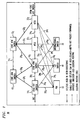
- FIGURE 1 illustrates a packet-based network 10 for carrying telephone calls and other types of connections.
- the network 10 includes one or more packet switches, illustratively represented as ATM switches 12 1 -12 2 , although the network could include a larger number of such switches.
- the ATM core switches 12 1 and 12 2 communicate packetized information (i.e., packets of data representing telephone calls) between themselves across at least one virtual path 14 1 .
- each of core ATM switches 12 1 and 12 2 comprises an ATM switch available from a variety of vendors, including Lucent Technologies, Ascend Communications, Cisco, and others.
- the network 10 includes a plurality of edge switches, depicted as edge switches 16 1 and 16 2 , each passing traffic between itself and one or more other networks.
- the edge switches 16 1 and 16 2 may send traffic to, as well as receive traffic from any or all of the following: (a) a local service provider, as represented by local switch 18, (b) an international network, represented by international switch 20, (c) a nodal customer, represented by PBX 22, and (d) an Inter-exchange network (not shown).
- the edge switches 16 1 and 16 2 may take the form of conventional circuit switches, such as the 4ESS or 5 ESS switch available from Lucent Technologies, or alternatively, may comprise ATM switches.
- the edge switch 16 1 comprises a circuit switch linked to the ATM core switch 12 1 , the edge switch 16 2 , the PBX 22, and the local switch 18 via paths 20 1 , 20 2 , 20 3 , and 20 4 , respectively.
- the edge switch 16 2 comprises an ATM switch having paths 20 2 , 20 5 , 20 6 , 20 7 , 20 8 , and 20 9 that link the switch to edge switch 16 1 , the PBX 22, the local switch 18, the international switch 20 and the core ATM switches 16 1 and 16 2 , respectively.
- each of the edge switches 16 1 and 16 2 routes a call to another edge switch or a conventional circuit switch on an associated one of the paths 20 1 , 20 8 and 20 9 via the core switches 12 1 and 12 2 using the STT/COS routing of the invention.
- the local switch 18, and the international switch 20 are routed in one direction only using the STT/COS routing.
- the edge switches 16 1 and 16 2 route calls to the PBX 22, local service provider switch 18, and the international switch 20 using STT/COS muting in accordance with the invention.
- the PBX 22, local switch 18 and international switch 20 use conventional techniques to route calls to one or more of the edge switches 16 1 and 16 2 .
- the network 10 may include other circuit switches, such as switches 22 1 and 22 2 which typically comprise 4ESS switches as are known in the art.
- a communication channel (trunk) 24 1 interconnects the switches 22 1 and 22 1 while trunks 24 2 -24 4 and 24 5 -24 7 link the switches 22 1 and 22 2 to the PBX 22, local service provider switch 18 and the international switch 20, respectively.
- the switches 22 1 and 22 1 also have trunks 25 1 and 25 2 that link them to the core switch 12 2 .
- the switches 22 1 and 22 1 do not necessarily need to utilize the STT/COS routing technique of the invention.
- circuit switches 22 1 and 22 2 may utilize conventional routing techniques to route calls to and from the PBX 22, local service provider switch 18 and the international switch 20.
- various routing techniques can co-exist and interwork within the same network as a feature of the invention.
- FIGURE 2 illustrates a simple network 100 to depict an exemplary call flow using the STT/COS routing technique of the invention.
- the network 100 includes an originating switch 110 and a terminating switch 112 linked by at least one virtual path 116.
- the originating switch 110 is defined as a switch which receives a call, either from another switch, or even a nodal customer (e.g., PBX 22 of FIG. 1) for routing to the terminating switch.
- the originating switch may comprise one of ATM edge switches 16 1 -16 2
- the terminating switch may comprise an edge switch, the local switch 18, the international switch 20, or the PBX 22, all of FIG. 1
- the network 100 of FIG. 2 includes a plurality of intermediate (via) switches 118 1 -118 n (where n is an integer > 0).
- Each via switch may comprise an edge switch or core switch as depicted in FIG. 1.
- a corresponding one of virtual paths 120 1 -120 n links each of via switches 118 1 -118 n , respectively, to the originating switch 110, while one of virtual paths 122 1 -122 n links a corresponding one of the via switches, respectively, to the terminating switch 112.
- the originating switch 110 routes a connection request comprised of a plurality of packets to the terminating switch 112 using the STT/COS routing technique of the invention in the following manner.
- the originating switch 110 determines whether the path has available bandwidth in accordance with the class of service of the call in question.
- the originating switch 110 typically receives calls of different types or classes.
- the originating switch 110 may receive international calls, toll-free calls, Software-Defined Network (SDN) calls, just to name a few.
- SDN Software-Defined Network
- Each different type of call has an associated particular routing priority (e.g., key, normal, or best effort) to meet the grade of service objective for that particular class.
- the originating switch 110 utilizes the class of service of the call to determine whether a call can be admitted on a particular path, given the Load State of that path.
- the originating switch 110 determines whether the allowable load state of each link in a virtual path is lightly loaded (LL), heavily loaded (HL) or reserved (R) by comparing the idle bandwidth (IBW) as described hereinafter, to a blocking rate threshold established by the grade of service requirement for each class of service.
- LL lightly loaded
- HL heavily loaded
- R reserved
- IBW idle bandwidth
- an international call may have a different blocking rate threshold as compared to a domestic long distance call, or an SDN call, based on the differences in class of service.
- the originating switch determines a Depth of Search (DoS) value for the call to determine if the call can pass on a path having a LL, HL, or R Load State (that is, each link in the path has a Load State of the DoS value or better).
- DoS depends on several factors, including: bandwidth in progress on a virtual network, call priority, the avenge virtual network load, the virtual network bandwidth required to meet the grade of service objective and whether the path is direct path or the path is through a via switch
- the originating switch 110 In order to establish the DoS load state threshold of a path, the originating switch 110 establishes for that path, two separate measures of bandwidth, or two Depth Parameters for each originating-terminating switch pair. These depth parameters are:
- BWavg vk and BWmax vk are computed at prescribed intervals, typically weekly. Different values of BWavg vk and BWmax vk may be used for different periods of the day (business peak, residence peak).
- each switch keeps track of two quantities: Bandwidth Peg Count (BWPC) and a Bandwidth Overflow Count (BWOV).
- BWPC Bandwidth Peg Count
- BWOV Bandwidth Overflow Count
- N N Condition 0 NN (originating switch /terminating switch linking path) ⁇ BR1 1 BR1 ⁇ NN (originating switch /terminating switch linking path) ⁇ BR2 2 BR2 ⁇ NN (originating switch /terminating switch linking path) ⁇ BR3 3 BR3 ⁇ NN (originating switch /terminating switch linking path) ⁇ BR4 4 BR4 ⁇ NN (originating switch /terminating switch linking path)
- a link, such as link 116, between an originating switch /terminating switch pair is considered in a reserved (R) state if the Idle Bandwidth (ILBW) less than or equal to a Reserved Threshold (Rthr), as defined below.
- the path between the originating switch/terminating switch pair is considered in the Heavily Loaded (HL) state if the Idle Bandwidth for each link in the path is less than or equal to a Heavily Loaded threshold (HLthr) for the link but more than Rthr.
- HLthr Heavily Loaded threshold
- LL Lightly Loaded
- DoS Depth-of-Search
- BWIP Bandwidth-In-Progress
- the priority of the call and the number of links in the path, as illustrated in Table III (here again we have omitted, for simplicity, the subscripts k denoting the node-pair for each variable):
- the originating switch determines the allowed DoS for the call according to Table III.
- the originating switch 110 of FIG. 2 first attempts to route the call on the direct path 116 to the terminating switch 112 in the following manner.
- the originating switch 110 of FIG. 1 cannot route the call on the direct path 116, then the originating switch will attempt to route the call on a 2-link path through the most recently successful one of via switches 118 1 -118 n to the terminating switch 112.
- the originating switch 112 uses the load state information of the first link to determine the first link to select as follows:
- the originating switch 110 When the originating switch 110 routes the call to a via switch, then the originating switch passes the bandwidth requirement and the Depth-of-Search (DoS) information (i.e., the path load state threshold) to the via switch in the initial address message (IAM) or Setup signaling message.
- DoS Depth-of-Search
- the via switch routes the call to the terminating switch if the path therebetween possesses the required bandwidth and load state. Otherwise, the via switch returns call control to the originating switch using a release (crankback) message.
- the originating switch Upon receipt of the message, the originating switch accomplishes route advance or routes the call on to other eligible paths.
- the edge switches 16 1 and 16 2 route calls among themselves in both directions using the STT/COS routing technique of the invention described above.
- the edge switches 16 1 and 16 2 could use a single-ended version of the STT/COS routing technique, with each edge switch acting like the originating switch 110 of FIG. 2 to determine the egress route. However, once a next link is selected, the edge switch would not pass forward the Depth-of-Search (DoS) to a subsequent switch.
- DoS Depth-of-Search
- Such single-ended STT/COS routing provides COS and direct route reservation for the network 10 and the outlying network receiving the call therefrom.
- each switch routing traffic to a subsequent switch will typically utilize a priority queuing as part of the Quality of Service (QoS) capability during the call.
- QoS Quality of Service
- each sending switch maintains a prescribed queuing discipline such that the cells (packets) receive priority, for example, in the following order
- the foregoing describes a technique for routing connection requests such a required by telephone calls in a packet network that utilizes a combination of Success-to-the Top and Class-of-Service principles.
Landscapes
- Engineering & Computer Science (AREA)
- Computer Networks & Wireless Communication (AREA)
- Data Exchanges In Wide-Area Networks (AREA)
- Small-Scale Networks (AREA)
- Telephonic Communication Services (AREA)
Applications Claiming Priority (2)
| Application Number | Priority Date | Filing Date | Title |
|---|---|---|---|
| US271473 | 1999-03-17 | ||
| US09/271,473 US6496480B1 (en) | 1999-03-17 | 1999-03-17 | Success-to-the-top class of service routing |
Publications (2)
| Publication Number | Publication Date |
|---|---|
| EP1037495A2 true EP1037495A2 (de) | 2000-09-20 |
| EP1037495A3 EP1037495A3 (de) | 2003-01-02 |
Family
ID=23035728
Family Applications (1)
| Application Number | Title | Priority Date | Filing Date |
|---|---|---|---|
| EP00300497A Withdrawn EP1037495A3 (de) | 1999-03-17 | 2000-01-24 | "success-to-the-top" Dienstklassen-Leitweglenkung |
Country Status (4)
| Country | Link |
|---|---|
| US (1) | US6496480B1 (de) |
| EP (1) | EP1037495A3 (de) |
| JP (1) | JP3470079B2 (de) |
| CA (1) | CA2299885C (de) |
Cited By (1)
| Publication number | Priority date | Publication date | Assignee | Title |
|---|---|---|---|---|
| EP1139618A3 (de) * | 2000-03-29 | 2003-10-01 | AT&T Corp. | PNNI orientiertes "multi-link shortest path class of service" Routen |
Families Citing this family (4)
| Publication number | Priority date | Publication date | Assignee | Title |
|---|---|---|---|---|
| US6954739B1 (en) * | 1999-11-16 | 2005-10-11 | Lucent Technologies Inc. | Measurement-based management method for packet communication networks |
| US7827284B2 (en) * | 2002-12-20 | 2010-11-02 | Netsocket, Inc. | Method and arrangement in a communication system |
| US20050198361A1 (en) * | 2003-12-29 | 2005-09-08 | Chandra Prashant R. | Method and apparatus for meeting a given content throughput using at least one memory channel |
| US7769018B2 (en) * | 2006-07-11 | 2010-08-03 | International Business Machines Corporation | Establishing two or more simultaneous channels of communication with a user |
Family Cites Families (6)
| Publication number | Priority date | Publication date | Assignee | Title |
|---|---|---|---|---|
| CA2015248C (en) | 1989-06-30 | 1996-12-17 | Gerald R. Ash | Fully shared communications network |
| US5392344A (en) | 1991-10-03 | 1995-02-21 | At&T Corp. | Communications network class-of-service routing |
| JP2856050B2 (ja) * | 1993-11-30 | 1999-02-10 | 日本電気株式会社 | ルーティング制御方法 |
| US5559877A (en) | 1995-03-21 | 1996-09-24 | At&T | Automatic provisioning of trunking and routing parameters in a telecommunications network |
| US5544161A (en) * | 1995-03-28 | 1996-08-06 | Bell Atlantic Network Services, Inc. | ATM packet demultiplexer for use in full service network having distributed architecture |
| US6304546B1 (en) * | 1996-12-19 | 2001-10-16 | Cisco Technology, Inc. | End-to-end bidirectional keep-alive using virtual circuits |
-
1999
- 1999-03-17 US US09/271,473 patent/US6496480B1/en not_active Expired - Fee Related
-
2000
- 2000-01-24 EP EP00300497A patent/EP1037495A3/de not_active Withdrawn
- 2000-02-24 CA CA002299885A patent/CA2299885C/en not_active Expired - Fee Related
- 2000-03-16 JP JP2000073719A patent/JP3470079B2/ja not_active Expired - Fee Related
Cited By (2)
| Publication number | Priority date | Publication date | Assignee | Title |
|---|---|---|---|---|
| EP1139618A3 (de) * | 2000-03-29 | 2003-10-01 | AT&T Corp. | PNNI orientiertes "multi-link shortest path class of service" Routen |
| US6778535B1 (en) | 2000-03-29 | 2004-08-17 | At&T Corp. | PNNI-based multi-link shortest path Class-of Service routing technique |
Also Published As
| Publication number | Publication date |
|---|---|
| US6496480B1 (en) | 2002-12-17 |
| JP2000295250A (ja) | 2000-10-20 |
| JP3470079B2 (ja) | 2003-11-25 |
| CA2299885C (en) | 2004-09-28 |
| EP1037495A3 (de) | 2003-01-02 |
| CA2299885A1 (en) | 2000-09-17 |
Similar Documents
| Publication | Publication Date | Title |
|---|---|---|
| US6590867B1 (en) | Internet protocol (IP) class-of-service routing technique | |
| EP0999674B1 (de) | Verfahren zur Bereitstellung von Dienstgüte in IP-Netzwerken für verzögerungsempfindliche Verkehr | |
| US6778535B1 (en) | PNNI-based multi-link shortest path Class-of Service routing technique | |
| US5450482A (en) | Dynamic network automatic call distribution | |
| US5130982A (en) | Fully shared communications network | |
| US7200110B1 (en) | Method and apparatus for prioritized release of connections in a communications network | |
| USRE40398E1 (en) | ATM telecommunications systems and method for routing narrow band traffic | |
| US6122272A (en) | Call size feedback on PNNI operation | |
| EP1190538A1 (de) | System und verfahren zur erzielung eines geforderten dienstgüte (qos)-niveaus für einen durch ein paketvermitteltes netz gelenkten von einem mobilen endgerät abgehenden ruf | |
| US6496480B1 (en) | Success-to-the-top class of service routing | |
| Watanabe et al. | Dynamic routing schemes for international networks | |
| US8547849B2 (en) | ATM telecommunications systems and method for routing narrow band traffic | |
| US6021191A (en) | Automatic routing technique | |
| US6771650B1 (en) | Hybrid routed ATM paths | |
| US6816454B1 (en) | Method and system for manipulating the order permanent connections are released | |
| US20040105443A1 (en) | Distributed virtual path | |
| MXPA00004921A (en) | Internet protocol (ip) class-of-service routing technique | |
| CA2266262A1 (en) | Method and apparatus for prioritized release of connections in a communications network | |
| Farber | Ming Chit Tam David J. Farber Distributed Systems Lab. University of Pennsylvania | |
| MXPA98001677A (en) | Automat addressing technique |
Legal Events
| Date | Code | Title | Description |
|---|---|---|---|
| PUAI | Public reference made under article 153(3) epc to a published international application that has entered the european phase |
Free format text: ORIGINAL CODE: 0009012 |
|
| AK | Designated contracting states |
Kind code of ref document: A2 Designated state(s): AT BE CH CY DE DK ES FI FR GB GR IE IT LI LU MC NL PT SE |
|
| AX | Request for extension of the european patent |
Free format text: AL;LT;LV;MK;RO;SI |
|
| PUAL | Search report despatched |
Free format text: ORIGINAL CODE: 0009013 |
|
| AK | Designated contracting states |
Kind code of ref document: A3 Designated state(s): AT BE CH CY DE DK ES FI FR GB GR IE IT LI LU MC NL PT SE |
|
| AX | Request for extension of the european patent |
Free format text: AL;LT;LV;MK;RO;SI |
|
| RIC1 | Information provided on ipc code assigned before grant |
Free format text: 7H 04Q 11/04 A, 7H 04L 12/56 B |
|
| 17P | Request for examination filed |
Effective date: 20030404 |
|
| 17Q | First examination report despatched |
Effective date: 20030723 |
|
| AKX | Designation fees paid |
Designated state(s): DE FR GB |
|
| STAA | Information on the status of an ep patent application or granted ep patent |
Free format text: STATUS: THE APPLICATION IS DEEMED TO BE WITHDRAWN |
|
| 18D | Application deemed to be withdrawn |
Effective date: 20120904 |