EP1037105A1 - Low replenishment color development using chloride ion-free color developer concentrate - Google Patents
Low replenishment color development using chloride ion-free color developer concentrate Download PDFInfo
- Publication number
- EP1037105A1 EP1037105A1 EP00200771A EP00200771A EP1037105A1 EP 1037105 A1 EP1037105 A1 EP 1037105A1 EP 00200771 A EP00200771 A EP 00200771A EP 00200771 A EP00200771 A EP 00200771A EP 1037105 A1 EP1037105 A1 EP 1037105A1
- Authority
- EP
- European Patent Office
- Prior art keywords
- color developing
- color
- concentrate
- water
- photographic
- Prior art date
- Legal status (The legal status is an assumption and is not a legal conclusion. Google has not performed a legal analysis and makes no representation as to the accuracy of the status listed.)
- Withdrawn
Links
- 239000012141 concentrate Substances 0.000 title claims abstract description 56
- VEXZGXHMUGYJMC-UHFFFAOYSA-M Chloride anion Chemical compound [Cl-] VEXZGXHMUGYJMC-UHFFFAOYSA-M 0.000 title claims abstract description 25
- 238000011161 development Methods 0.000 title description 16
- 239000000203 mixture Substances 0.000 claims abstract description 107
- 238000012545 processing Methods 0.000 claims abstract description 40
- 239000003795 chemical substances by application Substances 0.000 claims abstract description 29
- XLYOFNOQVPJJNP-UHFFFAOYSA-N water Substances O XLYOFNOQVPJJNP-UHFFFAOYSA-N 0.000 claims abstract description 28
- 239000003960 organic solvent Substances 0.000 claims abstract description 24
- 239000003963 antioxidant agent Substances 0.000 claims abstract description 17
- 239000006172 buffering agent Substances 0.000 claims abstract description 10
- 238000010790 dilution Methods 0.000 claims abstract description 9
- 239000012895 dilution Substances 0.000 claims abstract description 9
- 230000003078 antioxidant effect Effects 0.000 claims abstract description 8
- 239000012458 free base Substances 0.000 claims abstract description 5
- 239000000243 solution Substances 0.000 claims description 25
- 238000000034 method Methods 0.000 claims description 22
- -1 silver halide Chemical class 0.000 claims description 19
- MTHSVFCYNBDYFN-UHFFFAOYSA-N diethylene glycol Chemical compound OCCOCCO MTHSVFCYNBDYFN-UHFFFAOYSA-N 0.000 claims description 18
- 229910052709 silver Inorganic materials 0.000 claims description 16
- 239000004332 silver Substances 0.000 claims description 16
- 125000004432 carbon atom Chemical group C* 0.000 claims description 13
- LYCAIKOWRPUZTN-UHFFFAOYSA-N Ethylene glycol Chemical compound OCCO LYCAIKOWRPUZTN-UHFFFAOYSA-N 0.000 claims description 11
- WVDDGKGOMKODPV-UHFFFAOYSA-N Benzyl alcohol Chemical compound OCC1=CC=CC=C1 WVDDGKGOMKODPV-UHFFFAOYSA-N 0.000 claims description 9
- 238000004061 bleaching Methods 0.000 claims description 8
- 239000007844 bleaching agent Substances 0.000 claims description 8
- 239000000126 substance Substances 0.000 claims description 8
- LFQSCWFLJHTTHZ-UHFFFAOYSA-N Ethanol Chemical compound CCO LFQSCWFLJHTTHZ-UHFFFAOYSA-N 0.000 claims description 7
- 239000002904 solvent Substances 0.000 claims description 7
- 230000000087 stabilizing effect Effects 0.000 claims description 5
- 235000019445 benzyl alcohol Nutrition 0.000 claims description 3
- ZIBGPFATKBEMQZ-UHFFFAOYSA-N triethylene glycol Chemical compound OCCOCCOCCO ZIBGPFATKBEMQZ-UHFFFAOYSA-N 0.000 claims description 3
- AVXURJPOCDRRFD-UHFFFAOYSA-N hydroxylamine group Chemical group NO AVXURJPOCDRRFD-UHFFFAOYSA-N 0.000 claims description 2
- 230000003381 solubilizing effect Effects 0.000 claims description 2
- 125000003158 alcohol group Chemical group 0.000 claims 1
- 150000007824 aliphatic compounds Chemical group 0.000 claims 1
- WGCNASOHLSPBMP-UHFFFAOYSA-N hydroxyacetaldehyde Natural products OCC=O WGCNASOHLSPBMP-UHFFFAOYSA-N 0.000 claims 1
- 235000008504 concentrate Nutrition 0.000 description 42
- 235000006708 antioxidants Nutrition 0.000 description 13
- 239000000839 emulsion Substances 0.000 description 11
- 239000010410 layer Substances 0.000 description 11
- 239000000463 material Substances 0.000 description 10
- 238000009472 formulation Methods 0.000 description 9
- 230000008569 process Effects 0.000 description 9
- 238000002156 mixing Methods 0.000 description 8
- 239000012071 phase Substances 0.000 description 8
- BQCADISMDOOEFD-UHFFFAOYSA-N Silver Chemical compound [Ag] BQCADISMDOOEFD-UHFFFAOYSA-N 0.000 description 7
- 239000002244 precipitate Substances 0.000 description 7
- 238000011160 research Methods 0.000 description 7
- HEMHJVSKTPXQMS-UHFFFAOYSA-M Sodium hydroxide Chemical compound [OH-].[Na+] HEMHJVSKTPXQMS-UHFFFAOYSA-M 0.000 description 6
- 239000002253 acid Substances 0.000 description 6
- 239000000975 dye Substances 0.000 description 6
- 125000002887 hydroxy group Chemical group [H]O* 0.000 description 6
- 239000000843 powder Substances 0.000 description 6
- 238000013019 agitation Methods 0.000 description 5
- 150000001875 compounds Chemical class 0.000 description 5
- 230000000694 effects Effects 0.000 description 5
- 239000007788 liquid Substances 0.000 description 5
- 125000000217 alkyl group Chemical group 0.000 description 4
- 150000002443 hydroxylamines Chemical class 0.000 description 4
- 239000003446 ligand Substances 0.000 description 4
- IOLCXVTUBQKXJR-UHFFFAOYSA-M potassium bromide Chemical compound [K+].[Br-] IOLCXVTUBQKXJR-UHFFFAOYSA-M 0.000 description 4
- BWHMMNNQKKPAPP-UHFFFAOYSA-L potassium carbonate Chemical compound [K+].[K+].[O-]C([O-])=O BWHMMNNQKKPAPP-UHFFFAOYSA-L 0.000 description 4
- 238000003860 storage Methods 0.000 description 4
- GTOOAPLRWMOITA-UHFFFAOYSA-N 2-(4-amino-n-ethyl-3-methylanilino)ethyl hydrogen sulfate Chemical compound OS(=O)(=O)OCCN(CC)C1=CC=C(N)C(C)=C1 GTOOAPLRWMOITA-UHFFFAOYSA-N 0.000 description 3
- KWYUFKZDYYNOTN-UHFFFAOYSA-M Potassium hydroxide Chemical compound [OH-].[K+] KWYUFKZDYYNOTN-UHFFFAOYSA-M 0.000 description 3
- 150000007513 acids Chemical class 0.000 description 3
- 150000001298 alcohols Chemical class 0.000 description 3
- 239000002585 base Substances 0.000 description 3
- 238000002474 experimental method Methods 0.000 description 3
- 230000003287 optical effect Effects 0.000 description 3
- 230000009467 reduction Effects 0.000 description 3
- 239000002002 slurry Substances 0.000 description 3
- FVAUCKIRQBBSSJ-UHFFFAOYSA-M sodium iodide Chemical compound [Na+].[I-] FVAUCKIRQBBSSJ-UHFFFAOYSA-M 0.000 description 3
- 239000007787 solid Substances 0.000 description 3
- 150000003467 sulfuric acid derivatives Chemical class 0.000 description 3
- 238000005406 washing Methods 0.000 description 3
- CIWBSHSKHKDKBQ-JLAZNSOCSA-N Ascorbic acid Chemical compound OC[C@H](O)[C@H]1OC(=O)C(O)=C1O CIWBSHSKHKDKBQ-JLAZNSOCSA-N 0.000 description 2
- IJGRMHOSHXDMSA-UHFFFAOYSA-N Atomic nitrogen Chemical compound N#N IJGRMHOSHXDMSA-UHFFFAOYSA-N 0.000 description 2
- 229920001174 Diethylhydroxylamine Polymers 0.000 description 2
- MHAJPDPJQMAIIY-UHFFFAOYSA-N Hydrogen peroxide Chemical compound OO MHAJPDPJQMAIIY-UHFFFAOYSA-N 0.000 description 2
- CDBYLPFSWZWCQE-UHFFFAOYSA-L Sodium Carbonate Chemical compound [Na+].[Na+].[O-]C([O-])=O CDBYLPFSWZWCQE-UHFFFAOYSA-L 0.000 description 2
- UIIMBOGNXHQVGW-UHFFFAOYSA-M Sodium bicarbonate Chemical compound [Na+].OC([O-])=O UIIMBOGNXHQVGW-UHFFFAOYSA-M 0.000 description 2
- QAOWNCQODCNURD-UHFFFAOYSA-L Sulfate Chemical compound [O-]S([O-])(=O)=O QAOWNCQODCNURD-UHFFFAOYSA-L 0.000 description 2
- GSEJCLTVZPLZKY-UHFFFAOYSA-N Triethanolamine Chemical compound OCCN(CCO)CCO GSEJCLTVZPLZKY-UHFFFAOYSA-N 0.000 description 2
- 239000000654 additive Substances 0.000 description 2
- 230000002411 adverse Effects 0.000 description 2
- 125000001931 aliphatic group Chemical group 0.000 description 2
- 229910001413 alkali metal ion Inorganic materials 0.000 description 2
- 125000003118 aryl group Chemical group 0.000 description 2
- 239000003638 chemical reducing agent Substances 0.000 description 2
- 239000000356 contaminant Substances 0.000 description 2
- FVCOIAYSJZGECG-UHFFFAOYSA-N diethylhydroxylamine Chemical compound CCN(O)CC FVCOIAYSJZGECG-UHFFFAOYSA-N 0.000 description 2
- 238000007865 diluting Methods 0.000 description 2
- 150000002334 glycols Chemical class 0.000 description 2
- 239000001257 hydrogen Substances 0.000 description 2
- 229910052739 hydrogen Inorganic materials 0.000 description 2
- 125000004435 hydrogen atom Chemical group [H]* 0.000 description 2
- 125000002768 hydroxyalkyl group Chemical group 0.000 description 2
- 238000004519 manufacturing process Methods 0.000 description 2
- 125000004430 oxygen atom Chemical group O* 0.000 description 2
- 238000004806 packaging method and process Methods 0.000 description 2
- 238000005191 phase separation Methods 0.000 description 2
- 229920005862 polyol Polymers 0.000 description 2
- 229910000027 potassium carbonate Inorganic materials 0.000 description 2
- 150000003839 salts Chemical class 0.000 description 2
- JHJLBTNAGRQEKS-UHFFFAOYSA-M sodium bromide Chemical compound [Na+].[Br-] JHJLBTNAGRQEKS-UHFFFAOYSA-M 0.000 description 2
- GEHJYWRUCIMESM-UHFFFAOYSA-L sodium sulfite Chemical compound [Na+].[Na+].[O-]S([O-])=O GEHJYWRUCIMESM-UHFFFAOYSA-L 0.000 description 2
- 238000001228 spectrum Methods 0.000 description 2
- 125000001424 substituent group Chemical group 0.000 description 2
- 230000007306 turnover Effects 0.000 description 2
- VKZRWSNIWNFCIQ-WDSKDSINSA-N (2s)-2-[2-[[(1s)-1,2-dicarboxyethyl]amino]ethylamino]butanedioic acid Chemical compound OC(=O)C[C@@H](C(O)=O)NCCN[C@H](C(O)=O)CC(O)=O VKZRWSNIWNFCIQ-WDSKDSINSA-N 0.000 description 1
- GVEYRUKUJCHJSR-UHFFFAOYSA-N (4-azaniumyl-3-methylphenyl)-ethyl-(2-hydroxyethyl)azanium;sulfate Chemical compound OS(O)(=O)=O.OCCN(CC)C1=CC=C(N)C(C)=C1 GVEYRUKUJCHJSR-UHFFFAOYSA-N 0.000 description 1
- AYLDJQABCMPYEN-UHFFFAOYSA-N (4-azaniumylphenyl)-diethylazanium;sulfate Chemical compound OS(O)(=O)=O.CCN(CC)C1=CC=C(N)C=C1 AYLDJQABCMPYEN-UHFFFAOYSA-N 0.000 description 1
- KRXBXCNTGQFLEN-UHFFFAOYSA-N 2-[(1,3-dihydroxy-4-phenylbutan-2-yl)-hydroxyamino]-4-phenylbutane-1,3-diol Chemical compound C=1C=CC=CC=1CC(O)C(CO)N(O)C(CO)C(O)CC1=CC=CC=C1 KRXBXCNTGQFLEN-UHFFFAOYSA-N 0.000 description 1
- CLTJWARXZZUZLT-UHFFFAOYSA-N 2-[4-(2-ethylhydrazinyl)phenyl]ethanol;sulfuric acid Chemical compound OS(O)(=O)=O.CCNNC1=CC=C(CCO)C=C1 CLTJWARXZZUZLT-UHFFFAOYSA-N 0.000 description 1
- XWSGEVNYFYKXCP-UHFFFAOYSA-N 2-[carboxymethyl(methyl)amino]acetic acid Chemical compound OC(=O)CN(C)CC(O)=O XWSGEVNYFYKXCP-UHFFFAOYSA-N 0.000 description 1
- CDAWCLOXVUBKRW-UHFFFAOYSA-N 2-aminophenol Chemical class NC1=CC=CC=C1O CDAWCLOXVUBKRW-UHFFFAOYSA-N 0.000 description 1
- NEAQRZUHTPSBBM-UHFFFAOYSA-N 2-hydroxy-3,3-dimethyl-7-nitro-4h-isoquinolin-1-one Chemical class C1=C([N+]([O-])=O)C=C2C(=O)N(O)C(C)(C)CC2=C1 NEAQRZUHTPSBBM-UHFFFAOYSA-N 0.000 description 1
- GIJYZWJXXKQHME-UHFFFAOYSA-N 3-[(2,3-dihydroxy-2-methylpropyl)-hydroxyamino]-2-methylpropane-1,2-diol Chemical compound OCC(O)(C)CN(O)CC(C)(O)CO GIJYZWJXXKQHME-UHFFFAOYSA-N 0.000 description 1
- IDLCGKHZBNSVKN-UHFFFAOYSA-N 3-[2,3-dihydroxypropyl(hydroxy)amino]propane-1,2-diol Chemical compound OCC(O)CN(O)CC(O)CO IDLCGKHZBNSVKN-UHFFFAOYSA-N 0.000 description 1
- ZFXPBTZXYNIAJW-UHFFFAOYSA-N 4-[2-(2-phenylethenyl)phenyl]triazine Chemical class C=1C=CC=CC=1C=CC1=CC=CC=C1C1=CC=NN=N1 ZFXPBTZXYNIAJW-UHFFFAOYSA-N 0.000 description 1
- FJNCXZZQNBKEJT-UHFFFAOYSA-N 8beta-hydroxymarrubiin Natural products O1C(=O)C2(C)CCCC3(C)C2C1CC(C)(O)C3(O)CCC=1C=COC=1 FJNCXZZQNBKEJT-UHFFFAOYSA-N 0.000 description 1
- OKTJSMMVPCPJKN-UHFFFAOYSA-N Carbon Chemical compound [C] OKTJSMMVPCPJKN-UHFFFAOYSA-N 0.000 description 1
- KCXVZYZYPLLWCC-UHFFFAOYSA-N EDTA Chemical compound OC(=O)CN(CC(O)=O)CCN(CC(O)=O)CC(O)=O KCXVZYZYPLLWCC-UHFFFAOYSA-N 0.000 description 1
- VTLYFUHAOXGGBS-UHFFFAOYSA-N Fe3+ Chemical class [Fe+3] VTLYFUHAOXGGBS-UHFFFAOYSA-N 0.000 description 1
- 108010010803 Gelatin Proteins 0.000 description 1
- WHXSMMKQMYFTQS-UHFFFAOYSA-N Lithium Chemical compound [Li] WHXSMMKQMYFTQS-UHFFFAOYSA-N 0.000 description 1
- FYYHWMGAXLPEAU-UHFFFAOYSA-N Magnesium Chemical compound [Mg] FYYHWMGAXLPEAU-UHFFFAOYSA-N 0.000 description 1
- 229910019142 PO4 Inorganic materials 0.000 description 1
- PMZURENOXWZQFD-UHFFFAOYSA-L Sodium Sulfate Chemical compound [Na+].[Na+].[O-]S([O-])(=O)=O PMZURENOXWZQFD-UHFFFAOYSA-L 0.000 description 1
- DWAQJAXMDSEUJJ-UHFFFAOYSA-M Sodium bisulfite Chemical compound [Na+].OS([O-])=O DWAQJAXMDSEUJJ-UHFFFAOYSA-M 0.000 description 1
- QAOWNCQODCNURD-UHFFFAOYSA-N Sulfuric acid Chemical compound OS(O)(=O)=O QAOWNCQODCNURD-UHFFFAOYSA-N 0.000 description 1
- XSQUKJJJFZCRTK-UHFFFAOYSA-N Urea Chemical class NC(N)=O XSQUKJJJFZCRTK-UHFFFAOYSA-N 0.000 description 1
- 235000010724 Wisteria floribunda Nutrition 0.000 description 1
- 230000002378 acidificating effect Effects 0.000 description 1
- 230000009471 action Effects 0.000 description 1
- 229910052783 alkali metal Inorganic materials 0.000 description 1
- 229910000288 alkali metal carbonate Inorganic materials 0.000 description 1
- 150000008041 alkali metal carbonates Chemical class 0.000 description 1
- 229910001508 alkali metal halide Inorganic materials 0.000 description 1
- 150000008045 alkali metal halides Chemical class 0.000 description 1
- 150000001340 alkali metals Chemical class 0.000 description 1
- 125000002947 alkylene group Chemical group 0.000 description 1
- 229940024606 amino acid Drugs 0.000 description 1
- 150000001413 amino acids Chemical class 0.000 description 1
- 230000003321 amplification Effects 0.000 description 1
- 238000004458 analytical method Methods 0.000 description 1
- 239000002518 antifoaming agent Substances 0.000 description 1
- 239000008346 aqueous phase Substances 0.000 description 1
- 239000007864 aqueous solution Substances 0.000 description 1
- 235000010323 ascorbic acid Nutrition 0.000 description 1
- 229960005070 ascorbic acid Drugs 0.000 description 1
- 239000011668 ascorbic acid Substances 0.000 description 1
- 125000004429 atom Chemical group 0.000 description 1
- 239000011230 binding agent Substances 0.000 description 1
- 150000001642 boronic acid derivatives Chemical class 0.000 description 1
- 150000001649 bromium compounds Chemical class 0.000 description 1
- QQIRJGBXQREIFL-UHFFFAOYSA-N butanedioic acid;ethane-1,2-diamine Chemical compound NCCN.OC(=O)CCC(O)=O QQIRJGBXQREIFL-UHFFFAOYSA-N 0.000 description 1
- 125000002837 carbocyclic group Chemical group 0.000 description 1
- 229910052799 carbon Inorganic materials 0.000 description 1
- 150000004649 carbonic acid derivatives Chemical class 0.000 description 1
- 150000001768 cations Chemical class 0.000 description 1
- 238000005119 centrifugation Methods 0.000 description 1
- 230000008859 change Effects 0.000 description 1
- 238000006243 chemical reaction Methods 0.000 description 1
- 150000001805 chlorine compounds Chemical class 0.000 description 1
- 238000000576 coating method Methods 0.000 description 1
- 230000003750 conditioning effect Effects 0.000 description 1
- 125000004122 cyclic group Chemical group 0.000 description 1
- 125000000753 cycloalkyl group Chemical group 0.000 description 1
- 238000010908 decantation Methods 0.000 description 1
- 238000013461 design Methods 0.000 description 1
- 230000006866 deterioration Effects 0.000 description 1
- 235000014113 dietary fatty acids Nutrition 0.000 description 1
- ZBCBWPMODOFKDW-UHFFFAOYSA-N diethanolamine Chemical compound OCCNCCO ZBCBWPMODOFKDW-UHFFFAOYSA-N 0.000 description 1
- 239000003085 diluting agent Substances 0.000 description 1
- 239000000539 dimer Substances 0.000 description 1
- 238000004090 dissolution Methods 0.000 description 1
- 238000009826 distribution Methods 0.000 description 1
- 238000001035 drying Methods 0.000 description 1
- 239000000428 dust Substances 0.000 description 1
- 238000001704 evaporation Methods 0.000 description 1
- 230000008020 evaporation Effects 0.000 description 1
- 239000000194 fatty acid Substances 0.000 description 1
- 229930195729 fatty acid Natural products 0.000 description 1
- 150000004665 fatty acids Chemical class 0.000 description 1
- 238000001914 filtration Methods 0.000 description 1
- 239000003205 fragrance Substances 0.000 description 1
- 229920000159 gelatin Polymers 0.000 description 1
- 235000019322 gelatine Nutrition 0.000 description 1
- 235000011852 gelatine desserts Nutrition 0.000 description 1
- 150000004676 glycans Chemical class 0.000 description 1
- 150000002332 glycine derivatives Chemical class 0.000 description 1
- 125000005842 heteroatom Chemical group 0.000 description 1
- 239000012456 homogeneous solution Substances 0.000 description 1
- 229940042795 hydrazides for tuberculosis treatment Drugs 0.000 description 1
- 150000002429 hydrazines Chemical class 0.000 description 1
- XLYOFNOQVPJJNP-UHFFFAOYSA-M hydroxide Chemical compound [OH-] XLYOFNOQVPJJNP-UHFFFAOYSA-M 0.000 description 1
- 125000004356 hydroxy functional group Chemical group O* 0.000 description 1
- NBZBKCUXIYYUSX-UHFFFAOYSA-N iminodiacetic acid Chemical compound OC(=O)CNCC(O)=O NBZBKCUXIYYUSX-UHFFFAOYSA-N 0.000 description 1
- 230000003993 interaction Effects 0.000 description 1
- 239000011229 interlayer Substances 0.000 description 1
- 235000014666 liquid concentrate Nutrition 0.000 description 1
- 239000007791 liquid phase Substances 0.000 description 1
- 229910052744 lithium Inorganic materials 0.000 description 1
- 239000011777 magnesium Substances 0.000 description 1
- 229910052749 magnesium Inorganic materials 0.000 description 1
- 230000014759 maintenance of location Effects 0.000 description 1
- 229910052751 metal Inorganic materials 0.000 description 1
- 239000002184 metal Substances 0.000 description 1
- 150000002772 monosaccharides Chemical class 0.000 description 1
- HZLWFIJOVZGQGO-UHFFFAOYSA-N n-[2-(4-amino-3-methylanilino)ethyl]methanesulfonamide Chemical compound CC1=CC(NCCNS(C)(=O)=O)=CC=C1N HZLWFIJOVZGQGO-UHFFFAOYSA-N 0.000 description 1
- PHUSZTNVOIISNY-UHFFFAOYSA-N n-[2-(4-amino-3-methylanilino)ethyl]methanesulfonamide;sulfuric acid Chemical compound OS(O)(=O)=O.CC1=CC(NCCNS(C)(=O)=O)=CC=C1N PHUSZTNVOIISNY-UHFFFAOYSA-N 0.000 description 1
- NJHNNLREFCWCRT-UHFFFAOYSA-N n-[2-(4-amino-n-ethyl-3-methylanilino)ethyl]methanesulfonamide;sulfuric acid;hydrate Chemical compound O.OS(O)(=O)=O.OS(O)(=O)=O.OS(O)(=O)=O.CS(=O)(=O)NCCN(CC)C1=CC=C(N)C(C)=C1.CS(=O)(=O)NCCN(CC)C1=CC=C(N)C(C)=C1 NJHNNLREFCWCRT-UHFFFAOYSA-N 0.000 description 1
- 229910052757 nitrogen Inorganic materials 0.000 description 1
- 238000003199 nucleic acid amplification method Methods 0.000 description 1
- 150000002894 organic compounds Chemical class 0.000 description 1
- 230000003647 oxidation Effects 0.000 description 1
- 238000007254 oxidation reaction Methods 0.000 description 1
- 150000002923 oximes Chemical class 0.000 description 1
- 150000004989 p-phenylenediamines Chemical class 0.000 description 1
- KHIWWQKSHDUIBK-UHFFFAOYSA-N periodic acid Chemical class OI(=O)(=O)=O KHIWWQKSHDUIBK-UHFFFAOYSA-N 0.000 description 1
- JRKICGRDRMAZLK-UHFFFAOYSA-L persulfate group Chemical group S(=O)(=O)([O-])OOS(=O)(=O)[O-] JRKICGRDRMAZLK-UHFFFAOYSA-L 0.000 description 1
- CMCWWLVWPDLCRM-UHFFFAOYSA-N phenidone Chemical class N1C(=O)CCN1C1=CC=CC=C1 CMCWWLVWPDLCRM-UHFFFAOYSA-N 0.000 description 1
- WVDDGKGOMKODPV-ZQBYOMGUSA-N phenyl(114C)methanol Chemical compound O[14CH2]C1=CC=CC=C1 WVDDGKGOMKODPV-ZQBYOMGUSA-N 0.000 description 1
- 235000021317 phosphate Nutrition 0.000 description 1
- 150000003013 phosphoric acid derivatives Chemical class 0.000 description 1
- 229920000768 polyamine Polymers 0.000 description 1
- 150000003077 polyols Chemical class 0.000 description 1
- 229920001282 polysaccharide Polymers 0.000 description 1
- 239000005017 polysaccharide Substances 0.000 description 1
- RWPGFSMJFRPDDP-UHFFFAOYSA-L potassium metabisulfite Chemical compound [K+].[K+].[O-]S(=O)S([O-])(=O)=O RWPGFSMJFRPDDP-UHFFFAOYSA-L 0.000 description 1
- 229940043349 potassium metabisulfite Drugs 0.000 description 1
- 235000010263 potassium metabisulphite Nutrition 0.000 description 1
- BHZRJJOHZFYXTO-UHFFFAOYSA-L potassium sulfite Chemical compound [K+].[K+].[O-]S([O-])=O BHZRJJOHZFYXTO-UHFFFAOYSA-L 0.000 description 1
- 235000019252 potassium sulphite Nutrition 0.000 description 1
- 238000002360 preparation method Methods 0.000 description 1
- 238000003672 processing method Methods 0.000 description 1
- 239000000047 product Substances 0.000 description 1
- JEXVQSWXXUJEMA-UHFFFAOYSA-N pyrazol-3-one Chemical compound O=C1C=CN=N1 JEXVQSWXXUJEMA-UHFFFAOYSA-N 0.000 description 1
- MCSKRVKAXABJLX-UHFFFAOYSA-N pyrazolo[3,4-d]triazole Chemical compound N1=NN=C2N=NC=C21 MCSKRVKAXABJLX-UHFFFAOYSA-N 0.000 description 1
- 150000003242 quaternary ammonium salts Chemical class 0.000 description 1
- 238000011084 recovery Methods 0.000 description 1
- 239000011347 resin Substances 0.000 description 1
- 229920005989 resin Polymers 0.000 description 1
- YGSDEFSMJLZEOE-UHFFFAOYSA-N salicylic acid Chemical class OC(=O)C1=CC=CC=C1O YGSDEFSMJLZEOE-UHFFFAOYSA-N 0.000 description 1
- 229920006395 saturated elastomer Polymers 0.000 description 1
- ADZWSOLPGZMUMY-UHFFFAOYSA-M silver bromide Chemical compound [Ag]Br ADZWSOLPGZMUMY-UHFFFAOYSA-M 0.000 description 1
- 238000004513 sizing Methods 0.000 description 1
- 239000010802 sludge Substances 0.000 description 1
- 229910000030 sodium bicarbonate Inorganic materials 0.000 description 1
- 235000017557 sodium bicarbonate Nutrition 0.000 description 1
- 229910000029 sodium carbonate Inorganic materials 0.000 description 1
- 235000010267 sodium hydrogen sulphite Nutrition 0.000 description 1
- 235000009518 sodium iodide Nutrition 0.000 description 1
- 159000000000 sodium salts Chemical class 0.000 description 1
- 229910052938 sodium sulfate Inorganic materials 0.000 description 1
- 235000011152 sodium sulphate Nutrition 0.000 description 1
- 235000010265 sodium sulphite Nutrition 0.000 description 1
- ODBPOHVSVJZQRX-UHFFFAOYSA-M sodium;[2-[2-[bis(phosphonomethyl)amino]ethyl-(phosphonomethyl)amino]ethyl-(phosphonomethyl)amino]methyl-hydroxyphosphinate Chemical compound [Na+].OP(=O)(O)CN(CP(O)(O)=O)CCN(CP(O)(=O)O)CCN(CP(O)(O)=O)CP(O)([O-])=O ODBPOHVSVJZQRX-UHFFFAOYSA-M 0.000 description 1
- 239000008247 solid mixture Substances 0.000 description 1
- 239000007790 solid phase Substances 0.000 description 1
- 239000007858 starting material Substances 0.000 description 1
- 238000003756 stirring Methods 0.000 description 1
- 238000005728 strengthening Methods 0.000 description 1
- LSNNMFCWUKXFEE-UHFFFAOYSA-L sulfite Chemical class [O-]S([O-])=O LSNNMFCWUKXFEE-UHFFFAOYSA-L 0.000 description 1
- 239000004094 surface-active agent Substances 0.000 description 1
- 238000012360 testing method Methods 0.000 description 1
- 150000003567 thiocyanates Chemical class 0.000 description 1
- DHCDFWKWKRSZHF-UHFFFAOYSA-L thiosulfate(2-) Chemical compound [O-]S([S-])(=O)=O DHCDFWKWKRSZHF-UHFFFAOYSA-L 0.000 description 1
- 238000001429 visible spectrum Methods 0.000 description 1
- 239000002699 waste material Substances 0.000 description 1
- 239000000080 wetting agent Substances 0.000 description 1
Images
Classifications
-
- G—PHYSICS
- G03—PHOTOGRAPHY; CINEMATOGRAPHY; ANALOGOUS TECHNIQUES USING WAVES OTHER THAN OPTICAL WAVES; ELECTROGRAPHY; HOLOGRAPHY
- G03C—PHOTOSENSITIVE MATERIALS FOR PHOTOGRAPHIC PURPOSES; PHOTOGRAPHIC PROCESSES, e.g. CINE, X-RAY, COLOUR, STEREO-PHOTOGRAPHIC PROCESSES; AUXILIARY PROCESSES IN PHOTOGRAPHY
- G03C7/00—Multicolour photographic processes or agents therefor; Regeneration of such processing agents; Photosensitive materials for multicolour processes
- G03C7/30—Colour processes using colour-coupling substances; Materials therefor; Preparing or processing such materials
- G03C7/44—Regeneration; Replenishers
-
- G—PHYSICS
- G03—PHOTOGRAPHY; CINEMATOGRAPHY; ANALOGOUS TECHNIQUES USING WAVES OTHER THAN OPTICAL WAVES; ELECTROGRAPHY; HOLOGRAPHY
- G03C—PHOTOSENSITIVE MATERIALS FOR PHOTOGRAPHIC PURPOSES; PHOTOGRAPHIC PROCESSES, e.g. CINE, X-RAY, COLOUR, STEREO-PHOTOGRAPHIC PROCESSES; AUXILIARY PROCESSES IN PHOTOGRAPHY
- G03C5/00—Photographic processes or agents therefor; Regeneration of such processing agents
- G03C5/26—Processes using silver-salt-containing photosensitive materials or agents therefor
- G03C5/264—Supplying of photographic processing chemicals; Preparation or packaging thereof
- G03C5/266—Supplying of photographic processing chemicals; Preparation or packaging thereof of solutions or concentrates
-
- G—PHYSICS
- G03—PHOTOGRAPHY; CINEMATOGRAPHY; ANALOGOUS TECHNIQUES USING WAVES OTHER THAN OPTICAL WAVES; ELECTROGRAPHY; HOLOGRAPHY
- G03C—PHOTOSENSITIVE MATERIALS FOR PHOTOGRAPHIC PURPOSES; PHOTOGRAPHIC PROCESSES, e.g. CINE, X-RAY, COLOUR, STEREO-PHOTOGRAPHIC PROCESSES; AUXILIARY PROCESSES IN PHOTOGRAPHY
- G03C5/00—Photographic processes or agents therefor; Regeneration of such processing agents
- G03C5/26—Processes using silver-salt-containing photosensitive materials or agents therefor
- G03C5/29—Development processes or agents therefor
- G03C5/305—Additives other than developers
-
- G—PHYSICS
- G03—PHOTOGRAPHY; CINEMATOGRAPHY; ANALOGOUS TECHNIQUES USING WAVES OTHER THAN OPTICAL WAVES; ELECTROGRAPHY; HOLOGRAPHY
- G03C—PHOTOSENSITIVE MATERIALS FOR PHOTOGRAPHIC PURPOSES; PHOTOGRAPHIC PROCESSES, e.g. CINE, X-RAY, COLOUR, STEREO-PHOTOGRAPHIC PROCESSES; AUXILIARY PROCESSES IN PHOTOGRAPHY
- G03C7/00—Multicolour photographic processes or agents therefor; Regeneration of such processing agents; Photosensitive materials for multicolour processes
- G03C7/30—Colour processes using colour-coupling substances; Materials therefor; Preparing or processing such materials
- G03C7/407—Development processes or agents therefor
- G03C7/413—Developers
-
- G—PHYSICS
- G03—PHOTOGRAPHY; CINEMATOGRAPHY; ANALOGOUS TECHNIQUES USING WAVES OTHER THAN OPTICAL WAVES; ELECTROGRAPHY; HOLOGRAPHY
- G03C—PHOTOSENSITIVE MATERIALS FOR PHOTOGRAPHIC PURPOSES; PHOTOGRAPHIC PROCESSES, e.g. CINE, X-RAY, COLOUR, STEREO-PHOTOGRAPHIC PROCESSES; AUXILIARY PROCESSES IN PHOTOGRAPHY
- G03C2200/00—Details
- G03C2200/21—Developer or developing
-
- G—PHYSICS
- G03—PHOTOGRAPHY; CINEMATOGRAPHY; ANALOGOUS TECHNIQUES USING WAVES OTHER THAN OPTICAL WAVES; ELECTROGRAPHY; HOLOGRAPHY
- G03C—PHOTOSENSITIVE MATERIALS FOR PHOTOGRAPHIC PURPOSES; PHOTOGRAPHIC PROCESSES, e.g. CINE, X-RAY, COLOUR, STEREO-PHOTOGRAPHIC PROCESSES; AUXILIARY PROCESSES IN PHOTOGRAPHY
- G03C2200/00—Details
- G03C2200/57—Replenishment rate or conditions
Definitions
- the present invention relates to method of photographic color paper processing using low replenishment of the color developing solution. Replenishment is carried out using a chloride ion-free, single-part, homogeneous photographic color developing concentrate.
- the basic processes for obtaining useful color images from exposed color photographic silver halide materials include several steps of photochemical processing such as color development, silver bleaching, silver halide fixing (or combined bleaching and fixing) and water washing or dye image stabilizing using appropriate photochemical compositions.
- Photographic color developing compositions are used to process color photographic materials such as color photographic papers to provide the desired dye images early in the photoprocessing method.
- Such compositions generally contain color developing agents, for example 4-amino-3-methyl-N-(2-methane sulfonamidoethyl)aniline, as reducing agents to react with suitable color forming couplers to form the desired dyes.
- color developing agents for example 4-amino-3-methyl-N-(2-methane sulfonamidoethyl)aniline, as reducing agents to react with suitable color forming couplers to form the desired dyes.
- US-A-4,892,804 (Vincent et al) describes conventional color developing compositions that have found considerable commercial success in the photographic industry.
- Color developing compositions are commonly supplied in three or more "parts” (or solutions) that are mixed immediately before use. Multiple parts are often required in order to separate and preserve the chemical activity and solubility of components that may otherwise deteriorate or react with each other when they are stored together for long periods of time under alkaline conditions.
- one part might include a color developing agent, and another part might contain agents to preserve the alkalinity of the mixed color developing composition.
- Still another part may include an optical brightener.
- a homogeneous color developing composition can usually be obtained for the working strength solution in the processing machine.
- Some color developing compositions are commercially available in single-part formulations that overcome some of the noted problems, but because of the presence of precipitates (such as in slurries) or multiple solvent phases, they require vigorous agitation or mixing before use. Such compositions are generally limited to small volumes. In addition, the presence of the precipitates or "sludge" may be unattractive to users, and some users may not have suitable equipment for proper agitation of multi-phase compositions.
- compositions are described in US-A-5,273,865 (Loiacono et al). These compositions are said to be free of bromides, hydroxylamines and benzyl alcohol, to include a polyol compound having 4 to 8 hydroxy groups, and to be useful for rapid access processing of photographic elements having high silver bromide emulsions only.
- a continuing need in the photographic industry is to reduce the replenishment rate of photographic processing solutions so less solution is needed, and less volume is discharged to the environment.
- "Replenishment” refers to the process of adding or restoring the activity of a processing solution that has become too “seasoned” from use.
- the conventional multi-part color developing compositions are replenished by a similar composition at a lower rate, usually the resulting images are undesirable for one reason or another.
- This invention provides an advance in the art with a homogeneous, single-part, chloride ion-free color developing concentrate having a pH of from 7 to 13, and comprising:
- This invention also provides a photographic processing chemical kit comprising:
- this invention includes a method for providing an image in a photographic silver halide color paper comprising contacting the color paper with, upon dilution at least four times, the homogeneous, single-part, chloride ion-free color developing concentrate described above.
- This color developing step can be followed by desilvering the developed color paper, as well as any other useful photoprocessing steps known in the art.
- the invention provides a method for providing an image in a photographic color paper comprising contacting the color paper with a color developing composition, the color developing composition being prepared by diluting the homogeneous, single-part, chloride ion-free color developing concentrate described above at least four times, the color developing composition being replenished at a rate of from 50 to 150 ml/m 2 of processed color paper, using the same color developing concentrate at the same dilution rate.
- the single-part color developing concentrate of this invention offers a number of advantages over the photochemical compositions currently available or known. Besides the advantages of minimal water, resulting in considerable savings in manufacturing, shipping and storage costs, it is a homogeneous composition, meaning that it is free of precipitates, slurries or multiple solvent phases. It does not require vigorous agitation prior to use, and can be immediately and readily metered into a photographic processing tank or bath with minimal instruction or possibility of mistake. Importantly, it provides a single-part composition so the mixing of multiple parts, whether liquid or solid, is avoided.
- the concentrate can be diluted and used as the replenisher for the color developing compositions at generally low rates, i.e. from 50 to 150 ml/m 2 of processed color paper.
- certain sensitometric properties are adversely affected.
- One such property is the blue shoulder density.
- the blue shoulder density and photographic speed were both unexpectedly improved at low replenishment rates.
- the homogeneous, single-part, chloride ion-free color developing concentrate of this invention is prepared using a critical sequence of steps and the following components.
- an aqueous solution of a suitable color developing agent is prepared.
- This color developing agent is generally in the form of a sulfate salt.
- Other components of the solution can include an antioxidant for the color developing agent, a suitable number of alkali metal ions (in an at least stoichiometric proportion to the sulfate ions) provided by an alkali metal base, and a photographically inactive water-miscible or water-soluble hydroxy-containing organic solvent.
- This solvent is present in the final concentrate at a concentration such that the weight ratio of water to the organic solvent is from 15:85 to 50:50, and preferably from 25:75 to 50:50.
- alkali metal ions and sulfate ions form a sulfate salt that is precipitated in the presence of the hydroxy-containing organic solvent.
- the precipitated sulfate salt can then be readily removed using any suitable liquid/solid phase separation technique (including filtration, centrifugation or decantation). If the antioxidant is a liquid organic compound, two phases may be formed and the precipitate may be removed by discarding the aqueous phase.
- the color developing concentrates of this invention include one or more color developing agents that are well known in the art that, in oxidized form, will react with dye forming color couplers in the processed materials.
- color developing agents include, but are not limited to, aminophenols, p -phenylenediamines (especially N,N-dialkyl- p -phenylenediamines) and others which are well known in the art, such as EP 0 434 097A1 (published June 26, 1991) and EP 0 530 921A1 (published March 10, 1993). It may be useful for the color developing agents to have one or more water-solubilizing groups as are known in the art. Further details of such materials are provided in Research Disclosure , publication 38957, pages 592-639 (September 1996). Research Disclosure is a publication of Kenneth Mason Publications Ltd., Dudley House, 12 North Street, Emsworth, Hampshire PO10 7DQ England. This reference will be referred to hereinafter as " Research Disclosure ".
- Preferred color developing agents include, but are not limited to, N,N-diethyl p -phenylenediamine sulfate (KODAK Color Developing Agent CD-2), 4-amino-3-methyl-N-(2-methane sulfonamidoethyl)aniline sulfate, 4-(N-ethyl-N- ⁇ -hydroxyethylamino)-2-methylaniline sulfate (KODAK Color Developing Agent CD-4), p -hydroxyethylethylaminoaniline sulfate, 4-(N-ethyl-N-2-methanesulfonylaminoethyl)-2-methylphenylenediamine sesquisulfate (KODAK Color Developing Agent CD-3), 4-(N-ethyl-N-2-methanesulfonylaminoethyl)-2-methylphenylenediamine sesquisulfate, and others readily apparent to one skilled in the
- one or more antioxidants are generally included in the color developing compositions.
- Either inorganic or organic antioxidants can be used.
- Many classes of useful antioxidants are known, including but not limited to, sulfites (such as sodium sulfite, potassium sulfite, sodium bisulfite and potassium metabisulfite), hydroxylamine (and derivatives thereof), hydrazines, hydrazides, amino acids, ascorbic acid (and derivatives thereof), hydroxamic acids, aminoketones, mono- and polysaccharides, mono- and polyamines, quaternary ammonium salts, nitroxy radicals, alcohols, and oximes.
- antioxidants are 1,4-cyclohexadiones as described in copending and commonly assigned U.S. Serial No. 09/123,976 (filed July 29, 1998 by Qiao and McGarry). Mixtures of compounds from the same or different classes of antioxidants can also be used if desired.
- antioxidants are hydroxylamine derivatives as described for example, in US-A-US-A-4,892,804, US-A-4,876,174, US-A-5,354,646, and US-A-5,660,974, all noted above, and US-A-5,646,327 (Burns et al). Many of these antioxidants are mono- and dialkylhydroxylamines having one or more substituents on one or both alkyl groups. Particularly useful alkyl substituents include sulfo, carboxy, amino, sulfonamido, carbonamido, hydroxy and other solubilizing substituents.
- the noted hydroxylamine derivatives can be mono- or dialkylhydroxylamines having one or more hydroxy substituents on the one or more alkyl groups.
- Representative compounds of this type are described for example in US-A-5,709,982 (Marrese et al), as having the structure I: wherein R is hydrogen, a substituted or unsubstituted alkyl group of 1 to 10 carbon atoms, a substituted or unsubstituted hydroxyalkyl group of 1 to 10 carbon atoms, a substituted or unsubstituted cycloalkyl group of 5 to 10 carbon atoms, or a substituted or unsubstituted aryl group having 6 to 10 carbon atoms in the aromatic nucleus.
- n, n and p are independently 0 or 1.
- each of m and n is 1, and p is 0.
- Specific di-substituted hydroxylamine antioxidants include, but are not limited to: N,N-bis(2,3-dihydroxypropyl)hydroxylamine, N,N-bis(2-methyl-2,3-dihydroxypropyl)hydroxylamine and N,N-bis(1-hydroxymethyl-2-hydroxy-3-phenylpropyl)hydroxylamine.
- the first compound is preferred.
- antioxidants organic or inorganic are either commercially available or prepared using starting materials and procedures described in the references noted above in describing hydroxylamines.
- Buffering agents are generally present in the color developing compositions of this invention to provide or maintain desired alkaline pH of from 7 to 13, and preferably from 8 to 12. These buffering agents must be soluble in the organic solvent described herein and have a pKa of from 9 to 13.
- Such useful buffering agents include, but are not limited to, carbonates, borates, tetraborates, glycine salts, triethanolamine, diethanolamine, phosphates and hydroxybenzoates.
- Alkali metal carbonates such as sodium carbonate, sodium bicarbonate and potassium carbonate
- Mixtures of buffering agents can be used if desired.
- pH can also be raised or lowered to a desired value using one or more acids or bases. It may be particularly desirable to raise the pH by adding a base, such as a hydroxide (for example sodium hydroxide or potassium hydroxide).
- a base such as a hydroxide (for example sodium hydroxide or potassium hydroxide).
- An essential component of the color developing concentrates of this invention is a photographically inactive, water-miscible or water-soluble, straight-chain organic solvent that is capable of dissolving color developing agents in their free base forms.
- organic solvents can be used singly or in combination, and preferably each has a molecular weight of at least 50, and preferably at least 100, and generally 200 or less and preferably 150 or less.
- Such preferred solvents generally have from 2 to 10 carbon atoms (preferably from 2 to 6 carbon atoms, and more preferably from 4 to 6 carbon atoms), and can additionally contain at least two nitrogen or oxygen atoms, or at least one of each heteroatom.
- the organic solvents are substituted with at least one hydroxy functional group, and preferably at least two of such groups. They are straight-chain molecules, not cyclic molecules.
- photographically inactive is meant that the organic solvents provide no substantial positive or negative effect upon the color developing function of the concentrate.
- Useful organic solvents include, but are not limited to, polyols including glycols (such as ethylene glycol, diethylene glycol and triethylene glycol), polyhydroxyamines (including polyalcoholamines), and alcohols (such as ethanol and benzyl alcohol). Glycols are preferred with ethylene glycol, diethylene glycol and triethylene glycol being most preferred. Of the alcohols, ethanol and benzyl alcohol are most preferred. The most preferred organic solvent is diethylene glycol.
- the color developing concentrates of this invention can also include one or more of a variety of other addenda that are commonly used in color developing compositions, including alkali metal halides other than chlorides (such as potassium bromide, sodium bromide and sodium iodide), metal sequestering compositions (such as polycarboxylic or aminopolycarboxylic acids or polyphosphonates with or without lithium, magnesium or other small cations), auxiliary co-developing agents (such as phenidone type compounds particularly for black and white developing compositions), antifoggants, alkanolamines, development accelerators, optical brighteners (such as triazinylstilbene compounds), wetting agents, fragrances, stain reducing agents, surfactants, defoaming agents, and water-soluble or water-dispersible color couplers, as would be readily understood by one skilled in the art [see for example, Research Disclosure , noted above]. The amounts of such additives are well known in the art also. Representative color developing concentrates of this invention are described below in
- the concentrate of this invention include substantially no chloride ions which means a concentration of chloride ions of less than 0.02 mol/l.
- the working strength color developing composition prepared from this concentrate initially also contains substantially no chloride ions, but as it becomes seasoned with use, chloride ions leach out of the processed color paper.
- low amounts of chloride ions may be present as contaminants with other photoprocessing chemicals in the composition. No chloride ions are purposely added to the concentrate or the working strength composition. Replenishment of the color developing composition using the concentrate (with or without dilution), however, keeps the working strength chloride ion concentration relatively low.
- the color developing concentrates of this invention have utility to provide color development in an imagewise exposed photographic silver halide color paper comprising a support and one or more silver halide emulsion layers containing an imagewise distribution of developable silver halide emulsion grains.
- the invention can be used to process color photographic papers of all types of emulsions including so-called “high chloride” and “low chloride” type emulsions, and so-called tabular grain emulsions as well.
- the present invention is particularly useful to process high chloride (greater than 70 mole % chloride and preferably greater than 90 mole % chloride, based on total silver) emulsions in color photographic papers.
- Such color photographic papers can have any useful amount of silver coated in the one or more emulsions layers, and in some embodiments, low silver (that is, up to 0.8 g silver/m 2 ) elements are processed with the present invention.
- the layers of the color papers can have any useful binder material or vehicle as it known in the art, including various gelatins and other colloidal materials.
- Color development of an imagewise exposed photographic silver halide element is carried out by contacting the imagewise exposed color paper with a color developing composition prepared according to this invention under suitable time and temperature conditions, in suitable processing equipment, to produce the desired developed image (i.e. color print). Additional processing steps can then be carried out using conventional procedures, including but not limited to, one or more development stop, bleaching, fixing, bleach/fixing, washing (or rinsing), stabilizing and drying steps, in any particular desired order as would be known in the art. Useful processing steps, conditions and materials useful therefor are well known for the various processing protocols including the conventional Process RA-4 (see for example, Research Disclosure , noted above). Digital scanning to modify or correct the color image in any fashion can also be carried out in conjunction with the method of the present invention.
- the color papers processed in the practice of this invention can be single or multilayer color elements.
- Multilayer color papers typically contain dye image-forming units sensitive to each of the three primary regions of the visible spectrum. Each unit can be comprised of a single emulsion layer or multiple emulsion layers sensitive to a given region of the spectrum.
- the layers of the color paper can be arranged in any of the various orders known in the art.
- the emulsions sensitive to each of the three primary regions of the spectrum can be disposed as a single segmented layer.
- the color papers can also contain other conventional layers such as filter layers, interlayers, subbing layers, overcoats and other layers readily apparent to one skilled in the art.
- the color developing concentrate of this invention can also be used in what are known as redox amplification processes, as described for example, in US-A-5,723,268 (Fyson) and US-A-5,702,873 (Twist).
- Processing according to the present invention can be carried out using conventional deep tanks holding processing solutions. Alternatively, it can be carried out using what is known in the art as "low volume thin tank” processing systems, or LVTT, which have either a rack and tank or automatic tray design.
- LVTT low volume thin tank processing systems
- Such processing methods and equipment are described, for example, in US-A-5,436,118 (Carli et al) and publications noted therein.
- bleaching and fixing steps or a combined bleach/fixing step using a suitable silver bleaching and fixing agents.
- bleaching agents are known in the art, including hydrogen peroxide and other peracid compounds, persulfates, periodates and ferric ion salts or complexes with polycarboxylic acid chelating ligands.
- Particularly useful chelating ligands include conventional polyaminopolycarboxylic acids including ethylenediaminetetraacetic acid and others described in Research Disclosure , noted above, US-A-5,582,958 (Buchanan et al) and US-A-5,753,423 (Buongiorne et al).
- Biodegradable chelating ligands are also desirable because the impact on the environment is reduced.
- Useful biodegradable chelating ligands include, but are not limited to, iminodiacetic acid or an alkyliminodiacetic acid (such as methyliminodiacetic acid), ethylenediaminedisuccinic acid and similar compounds as described in EP-A-0 532,003, and ethylenediamine monosuccinic acid and similar compounds as described in US-A-5,691,120 (Wilson et al).
- Conventional fixing agents such a thiosulfate and thiocyanates, can be used in the invention.
- the processing time and temperature used for each processing step of the present invention are generally those conventionally used in the art, but even shorter "rapid processing" may be used in practicing the present invention.
- color development is generally carried out at a temperature of from 20 to 60 °C (preferably from 35 to 55 °C).
- the overall color development time can be up to 4 minutes, and preferably from 75 to 450 seconds.
- Shorter overall color development times are desired for processing color photographic papers in the industry especially in what are known as minilabs. Such color development times may be as short as 5 seconds and as high as 60 seconds.
- Overall processing time (including color development, bleach-fixing and any rinsing steps) of color papers using the present invention can be as long as 120 seconds, and as short as 30 seconds, and preferably from 45 to 90 seconds.
- the color developing concentrate of this invention can be formulated into a working strength solution or replenisher by suitable dilution of up to 12 times.
- the dilution rate is from 4 to 10 times, using water as a common diluent. Dilution can occur during or prior to processing.
- Replenishment of the color developing composition is accomplished by adding a diluted form of the concentrate to the working strength solution. Dilution of the concentrate to form the replenishing solution is generally at the same rate as that used to provide the working strength solution.
- the rate of replenishment is generally from 50 to 150 ml/m 2 , and preferably from 70 to 120 ml/m 2 , of processed color paper.
- the color developing concentrate is one chemical formulation in a photographic processing chemical kit that can include one or more other photographic processing compositions (dry or liquid) including, but not limited to, a photographic bleaching composition, a photographic bleach/fixing composition, a photographic fixing composition, and a photographic stabilizing or rinsing composition.
- additional compositions can be formulated in concentrated or working strength solutions, or provided in dry form (for example, as a powder or tablet).
- Other processing compositions that can be included in such kits for either black and white or color photographic processing are reversal compositions, conditioning compositions, prebleach compositions, acidic stop compositions, and others readily apparent to one skilled in the photographic art.
- the processing kits can also include various processing equipment, metering devices, processing instructions, silver recovery devices and other conventional materials as would be readily apparent to one skilled in the art.
- Example 1 Color Paper Color Developing Concentrate
- a color developing concentrate of this invention (about 100 ml) was formulated in the following manner:
- a solution of sodium hydroxide (50% solution, 4 g) was added to a solution of 4-(N-ethyl-N-2-methanesulfonylaminoethyl)-2-methylphenylenediamine sesquisulfate (CD-3, 6.8 g) and diethylhydroxylamine (5.4 g) in water (6 g). Because diethylhydroxylamine is an organic liquid, two phases resulted. With stirring, diethylene glycol (50 g) was then added, and a precipitate of sodium sulfate was observed. This precipitate was filtered out of the solution, washed with 20 g of diethylene glycol and discarded.
- a color developing composition useful for photoprocessing was prepared by diluting the concentrate described in Example 1 ten times with water. The use of this composition was compared to the use of commercially available EKTACOLOR Prime Color Developer, and the effects of replenishment rates were evaluated.
- Each color developing composition was used for color development in a commercially available Noritsu minilab processor during the processing of imagewise exposed samples of commercially available KODAK EKTACOLOR EDGE 7 Color Paper using the following processing protocol and conditions to obtain acceptable color images: Color Development 38 °C 45 seconds Bleach/fixing 35 °C 45 seconds Washing (water) 35 °C 90 seconds
- Typical replenishment rates for the color developing compositions are 10-15 ml/ft 2 (108-162 ml/m 2 ) of processed conventional color paper.
- the samples of color papers were used in the experiments to show the effects of changing replenishment rate beyond the conventional range, and to show that the present invention is less susceptible to variations.
- the color paper samples were processed until the color developing composition had become "seasoned” at a replenishment rate of 15 ml/ft 2 (162 ml/m 2 ).
- Both color developing compositions were used to process the color paper samples at 3 and 4 tank turnovers to establish a baseline performance for the Blue shoulder density.
- Blue shoulder density is the sensitometric parameter that is most sensitive to reductions in replenishment rate.
- each color developing composition was replenished at a reduced rate of 7 ml/ft 2 (about 76 ml/m 2 ).
- the color paper samples were processed until the compositions had become "seasoned”.
- Sensitometric check strips for the color paper were also processed at 3 and 4 tank turnovers.
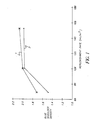
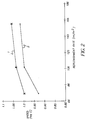
- FIGS. 1 and 2 show the increase in blue shoulder density and photographic speed, respectively, achieved with the practice of the present invention compared to the use of the Control color developing composition for processing the color paper samples using various replenishment rates.
- curve 1 represents data from practice of the Invention
- curve 2 represents data from use of the Control color developing composition.
Landscapes
- Physics & Mathematics (AREA)
- General Physics & Mathematics (AREA)
- Chemical & Material Sciences (AREA)
- Chemical Kinetics & Catalysis (AREA)
- General Chemical & Material Sciences (AREA)
- Silver Salt Photography Or Processing Solution Therefor (AREA)
Abstract
Description
- The present invention relates to method of photographic color paper processing using low replenishment of the color developing solution. Replenishment is carried out using a chloride ion-free, single-part, homogeneous photographic color developing concentrate.
- The basic processes for obtaining useful color images from exposed color photographic silver halide materials include several steps of photochemical processing such as color development, silver bleaching, silver halide fixing (or combined bleaching and fixing) and water washing or dye image stabilizing using appropriate photochemical compositions.
- Photographic color developing compositions are used to process color photographic materials such as color photographic papers to provide the desired dye images early in the photoprocessing method. Such compositions generally contain color developing agents, for example 4-amino-3-methyl-N-(2-methane sulfonamidoethyl)aniline, as reducing agents to react with suitable color forming couplers to form the desired dyes. US-A-4,892,804 (Vincent et al) describes conventional color developing compositions that have found considerable commercial success in the photographic industry. Other known color developing compositions are described in US-A-4,876, 174 (Ishikawa et al), US-A-5,354,646 (Kobayashi et al) and US-A-5,660,974 (Marrese et al).
- It is common practice to add a "replenishing" solution to the color developing composition in the processing machine in order to replace photochemicals that are depleted during reaction or carried away by the processed materials. Such replenishment insures uniform development and maximum stability of the color developing agent.
- Color developing compositions are commonly supplied in three or more "parts" (or solutions) that are mixed immediately before use. Multiple parts are often required in order to separate and preserve the chemical activity and solubility of components that may otherwise deteriorate or react with each other when they are stored together for long periods of time under alkaline conditions. For example, one part might include a color developing agent, and another part might contain agents to preserve the alkalinity of the mixed color developing composition. Still another part may include an optical brightener. Upon combination of all parts and water, a homogeneous color developing composition can usually be obtained for the working strength solution in the processing machine.
- There has been a desire in the industry to reduce the number of parts used to prepare color developing compositions, including replenishing solutions. A wide range of compositions are described in the art or commercially available as "ready to use" solutions, concentrates or dry formulations. Liquid concentrates have only to be diluted with water to provide a working strength solution. Dry formulations need only be dissolved in water. For example, EP-A-0 793,141 (Chugai Photo) describes a two-part color developing composition that can be supplied in either solid or liquid form.
- It is generally known that the concentrations of various photochemicals used in a photographic processing bath must lie within certain narrow limits in order to provide optimal performance. The most important solvent for such photoprocessing is water. Most inorganic salts can be readily dissolved in water while the organic photochemicals in such processing baths usually have suitable solubility in water at the desired operating concentrations.
- However, water is both an asset and a major problem of ready-to-use and some concentrated photographic compositions because of its presence in high quantity. As a result, the costs of manufacturing, transport and storage of such compositions are steadily growing. Normally, the user of photochemical compositions has water available in which individual photochemicals could be mixed or diluted, but this is usually not practical for a number of reasons. The exact composition of the photochemicals is not readily determined by a common user and manufacturers are not likely to readily provide their formulations for such a purpose. Moreover, even if the formulations are known, mixing mistakes may result in poor photoprocessing results.
- For these reasons, there is a trend in the photographic industry to provide photoprocessing compositions (including color developing compositions) in concentrated form so that the manufacturer and user need not pay for use, transport or storage of large volumes of water, and to enable use of smaller containers. Moreover, there has been a desire in the industry to provide compositions that can be used right out of their containers without the need for mixing various components (thereby reducing mixing errors) in what are known as "automatic replenishing" processors.
- The industry has investigated the use of both concentrates and solid mixtures (including powders and tablets). In most cases, concentrates are convenient to use but may have high packaging costs compared to powders. Powders permit high concentration, but not every photochemical composition can be dried into a stable powder. In addition, powders present problems with dust, separate packaging needs and more troublesome metering or mixing procedures. Not all dry formulations are readily dissolved in water.
- Another concentrated form known in the art is a chemical paste or slurry, as described for example in EP-A-0 204,372 (Chemco) and EP-A-0 800,111 (Fuji Photo). These formulations have other disadvantages, namely lack of homogeneity and slow dissolution rate of solid components.
- The casual observer might consider that all of the conventional "parts" used to provide color developing compositions might be readily combined to form a single-part homogeneous composition. This is not as easy as one may think. Interactions among and deterioration of photochemicals are magnified in concentrated form, and the resulting action on processed photographic materials may provide poor images.
- Some color developing compositions are commercially available in single-part formulations that overcome some of the noted problems, but because of the presence of precipitates (such as in slurries) or multiple solvent phases, they require vigorous agitation or mixing before use. Such compositions are generally limited to small volumes. In addition, the presence of the precipitates or "sludge" may be unattractive to users, and some users may not have suitable equipment for proper agitation of multi-phase compositions.
- Additional small volume, ready to use color developing compositions are described in US-A-5,273,865 (Loiacono et al). These compositions are said to be free of bromides, hydroxylamines and benzyl alcohol, to include a polyol compound having 4 to 8 hydroxy groups, and to be useful for rapid access processing of photographic elements having high silver bromide emulsions only.
- An advance in the art is provided with a homogeneous, single-part color developer concentrate described in EP Application 99 202525.4. This concentrate avoids many of the problems evident with previous concentrates or multi-part color developing compositions because of its homogeneity and ease of use.
- A continuing need in the photographic industry is to reduce the replenishment rate of photographic processing solutions so less solution is needed, and less volume is discharged to the environment. "Replenishment" refers to the process of adding or restoring the activity of a processing solution that has become too "seasoned" from use. When the conventional multi-part color developing compositions are replenished by a similar composition at a lower rate, usually the resulting images are undesirable for one reason or another.
- Because many commercial single-part color developing compositions are not homogeneous, they are not readily useful for replenishment without sufficient mixing or agitation to achieve desired homogeneity.
- Thus, there is a continuing need in the industry to use single-part color developing composition that is homogeneous, concentrated and stable, but that can be replenished at a lower rate. Such compositions would reduce the cost of shipping and storage of diluted solutions, avoid the need for mixing multiple parts or agitation of multi-phase compositions, offer the user a more attractive product, and reduce the discharge of waste to the environment. The present invention is directed to meeting this long felt need.
- This invention provides an advance in the art with a homogeneous, single-part, chloride ion-free color developing concentrate having a pH of from 7 to 13, and comprising:
- a) at least 0.06 mol/l of a color developing agent in free base form,
- b) at least 0.05 mol/l of an antioxidant for the color developing agent,
- c) water,
- d) a photographically inactive water-miscible or water-soluble hydroxy-containing, straight-chain organic solvent for the color developing agent in free base form, the organic solvent having a molecular weight of from 50 to 200 and being present in the concentrate at a concentration such that the weight ratio of water to the solvent is from 15:85 to 50:50, and
- e) a buffering agent that is miscible in the organic solvent,
the color developing concentrate characterized as being free of chloride ions. -
- This invention also provides a photographic processing chemical kit comprising:
- a) the homogeneous, single-part, chloride ion-free color developing concentrate described above, and
- b) one or more of the following compositions:
- a photographic bleaching composition,
- a photographic bleach/fixing composition,
- a photographic fixing composition, and
- a photographic stabilizing or final rinsing composition.
-
- Further, this invention includes a method for providing an image in a photographic silver halide color paper comprising contacting the color paper with, upon dilution at least four times, the homogeneous, single-part, chloride ion-free color developing concentrate described above. This color developing step can be followed by desilvering the developed color paper, as well as any other useful photoprocessing steps known in the art.
- Still further, the invention provides a method for providing an image in a photographic color paper comprising contacting the color paper with a color developing composition, the color developing composition being prepared by diluting the homogeneous, single-part, chloride ion-free color developing concentrate described above at least four times, the color developing composition being replenished at a rate of from 50 to 150 ml/m2 of processed color paper, using the same color developing concentrate at the same dilution rate.
- The single-part color developing concentrate of this invention offers a number of advantages over the photochemical compositions currently available or known. Besides the advantages of minimal water, resulting in considerable savings in manufacturing, shipping and storage costs, it is a homogeneous composition, meaning that it is free of precipitates, slurries or multiple solvent phases. It does not require vigorous agitation prior to use, and can be immediately and readily metered into a photographic processing tank or bath with minimal instruction or possibility of mistake. Importantly, it provides a single-part composition so the mixing of multiple parts, whether liquid or solid, is avoided.
- In addition, the concentrate can be diluted and used as the replenisher for the color developing compositions at generally low rates, i.e. from 50 to 150 ml/m2 of processed color paper. This cannot be readily accomplished with known color developing compositions, whether they are single-part or multi-part. For example, when conventional color developing compositions are replenished at lower rates, certain sensitometric properties are adversely affected. One such property is the blue shoulder density. In the present invention, the blue shoulder density and photographic speed were both unexpectedly improved at low replenishment rates. These results are achieved with the present invention, it is believed, because of a combination of features in the composition, including the absence of chloride ions in the replenishing stream. Generally, the only chloride ions in the seasoned color developing composition are those that leach out of the processed color paper or are introduced as contaminants.
-
- FIG. 1 is a graphical plot of blue shoulder density versus replenishment rate for the experiments described in Example 2 below.
- FIG. 2 is a graphical plot of photographic speed versus replenishment rate for the experiments described in Example 2 below.
-
- The homogeneous, single-part, chloride ion-free color developing concentrate of this invention is prepared using a critical sequence of steps and the following components.
- In the first step, an aqueous solution of a suitable color developing agent is prepared. This color developing agent is generally in the form of a sulfate salt. Other components of the solution can include an antioxidant for the color developing agent, a suitable number of alkali metal ions (in an at least stoichiometric proportion to the sulfate ions) provided by an alkali metal base, and a photographically inactive water-miscible or water-soluble hydroxy-containing organic solvent. This solvent is present in the final concentrate at a concentration such that the weight ratio of water to the organic solvent is from 15:85 to 50:50, and preferably from 25:75 to 50:50.
- In this environment, especially at high alkalinity, alkali metal ions and sulfate ions form a sulfate salt that is precipitated in the presence of the hydroxy-containing organic solvent. The precipitated sulfate salt can then be readily removed using any suitable liquid/solid phase separation technique (including filtration, centrifugation or decantation). If the antioxidant is a liquid organic compound, two phases may be formed and the precipitate may be removed by discarding the aqueous phase.
- The color developing concentrates of this invention include one or more color developing agents that are well known in the art that, in oxidized form, will react with dye forming color couplers in the processed materials. Such color developing agents include, but are not limited to, aminophenols, p-phenylenediamines (especially N,N-dialkyl-p-phenylenediamines) and others which are well known in the art, such as EP 0 434 097A1 (published June 26, 1991) and EP 0 530 921A1 (published March 10, 1993). It may be useful for the color developing agents to have one or more water-solubilizing groups as are known in the art. Further details of such materials are provided in Research Disclosure, publication 38957, pages 592-639 (September 1996). Research Disclosure is a publication of Kenneth Mason Publications Ltd., Dudley House, 12 North Street, Emsworth, Hampshire PO10 7DQ England. This reference will be referred to hereinafter as "Research Disclosure".
- Preferred color developing agents include, but are not limited to, N,N-diethyl p-phenylenediamine sulfate (KODAK Color Developing Agent CD-2), 4-amino-3-methyl-N-(2-methane sulfonamidoethyl)aniline sulfate, 4-(N-ethyl-N-β-hydroxyethylamino)-2-methylaniline sulfate (KODAK Color Developing Agent CD-4), p-hydroxyethylethylaminoaniline sulfate, 4-(N-ethyl-N-2-methanesulfonylaminoethyl)-2-methylphenylenediamine sesquisulfate (KODAK Color Developing Agent CD-3), 4-(N-ethyl-N-2-methanesulfonylaminoethyl)-2-methylphenylenediamine sesquisulfate, and others readily apparent to one skilled in the art.
- In order to protect the color developing agents from oxidation, one or more antioxidants are generally included in the color developing compositions. Either inorganic or organic antioxidants can be used. Many classes of useful antioxidants are known, including but not limited to, sulfites (such as sodium sulfite, potassium sulfite, sodium bisulfite and potassium metabisulfite), hydroxylamine (and derivatives thereof), hydrazines, hydrazides, amino acids, ascorbic acid (and derivatives thereof), hydroxamic acids, aminoketones, mono- and polysaccharides, mono- and polyamines, quaternary ammonium salts, nitroxy radicals, alcohols, and oximes. Also useful as antioxidants are 1,4-cyclohexadiones as described in copending and commonly assigned U.S. Serial No. 09/123,976 (filed July 29, 1998 by Qiao and McGarry). Mixtures of compounds from the same or different classes of antioxidants can also be used if desired.
- Especially useful antioxidants are hydroxylamine derivatives as described for example, in US-A-US-A-4,892,804, US-A-4,876,174, US-A-5,354,646, and US-A-5,660,974, all noted above, and US-A-5,646,327 (Burns et al). Many of these antioxidants are mono- and dialkylhydroxylamines having one or more substituents on one or both alkyl groups. Particularly useful alkyl substituents include sulfo, carboxy, amino, sulfonamido, carbonamido, hydroxy and other solubilizing substituents.
- More preferably, the noted hydroxylamine derivatives can be mono- or dialkylhydroxylamines having one or more hydroxy substituents on the one or more alkyl groups. Representative compounds of this type are described for example in US-A-5,709,982 (Marrese et al), as having the structure I:wherein R is hydrogen, a substituted or unsubstituted alkyl group of 1 to 10 carbon atoms, a substituted or unsubstituted hydroxyalkyl group of 1 to 10 carbon atoms, a substituted or unsubstituted cycloalkyl group of 5 to 10 carbon atoms, or a substituted or unsubstituted aryl group having 6 to 10 carbon atoms in the aromatic nucleus.

- X1 is -CR2(OH)CHR1- and X2 is -CHR1CR2(OH)- wherein R1 and R2 are independently hydrogen, hydroxy, a substituted or unsubstituted alkyl group or 1 or 2 carbon atoms, a substituted or unsubstituted hydroxyalkyl group of 1 or 2 carbon atoms, or R1 and R2 together represent the carbon atoms necessary to complete a substituted or unsubstituted 5- to 8-membered saturated or unsaturated carbocyclic ring structure.
- Y is a substituted or unsubstituted alkylene group having at least 4 carbon atoms, and has an even number of carbon atoms, or Y is a substituted or unsubstituted divalent aliphatic group having an even total number of carbon and oxygen atoms in the chain, provided that the aliphatic group has a least 4 atoms in the chain.
-
- Also in Structure I, m, n and p are independently 0 or 1. Preferably, each of m and n is 1, and p is 0.
- Specific di-substituted hydroxylamine antioxidants include, but are not limited to: N,N-bis(2,3-dihydroxypropyl)hydroxylamine, N,N-bis(2-methyl-2,3-dihydroxypropyl)hydroxylamine and N,N-bis(1-hydroxymethyl-2-hydroxy-3-phenylpropyl)hydroxylamine. The first compound is preferred.
- Many of the noted antioxidants (organic or inorganic) are either commercially available or prepared using starting materials and procedures described in the references noted above in describing hydroxylamines.
- Buffering agents are generally present in the color developing compositions of this invention to provide or maintain desired alkaline pH of from 7 to 13, and preferably from 8 to 12. These buffering agents must be soluble in the organic solvent described herein and have a pKa of from 9 to 13. Such useful buffering agents include, but are not limited to, carbonates, borates, tetraborates, glycine salts, triethanolamine, diethanolamine, phosphates and hydroxybenzoates. Alkali metal carbonates (such as sodium carbonate, sodium bicarbonate and potassium carbonate) are preferred. Mixtures of buffering agents can be used if desired.
- In addition to buffering agents, pH can also be raised or lowered to a desired value using one or more acids or bases. It may be particularly desirable to raise the pH by adding a base, such as a hydroxide (for example sodium hydroxide or potassium hydroxide).
- An essential component of the color developing concentrates of this invention is a photographically inactive, water-miscible or water-soluble, straight-chain organic solvent that is capable of dissolving color developing agents in their free base forms. Such organic solvents can be used singly or in combination, and preferably each has a molecular weight of at least 50, and preferably at least 100, and generally 200 or less and preferably 150 or less. Such preferred solvents generally have from 2 to 10 carbon atoms (preferably from 2 to 6 carbon atoms, and more preferably from 4 to 6 carbon atoms), and can additionally contain at least two nitrogen or oxygen atoms, or at least one of each heteroatom. The organic solvents are substituted with at least one hydroxy functional group, and preferably at least two of such groups. They are straight-chain molecules, not cyclic molecules.
- By "photographically inactive" is meant that the organic solvents provide no substantial positive or negative effect upon the color developing function of the concentrate.
- Useful organic solvents include, but are not limited to, polyols including glycols (such as ethylene glycol, diethylene glycol and triethylene glycol), polyhydroxyamines (including polyalcoholamines), and alcohols (such as ethanol and benzyl alcohol). Glycols are preferred with ethylene glycol, diethylene glycol and triethylene glycol being most preferred. Of the alcohols, ethanol and benzyl alcohol are most preferred. The most preferred organic solvent is diethylene glycol.
- The amounts of water and organic solvent in the concentrate are carefully controlled to achieve all of the desired results and to insure a single phase homogeneous concentrate. If there is too much water, phase separation may occur. If there is too much organic solvent, the buffering agent and other salts will precipitate.
- The color developing concentrates of this invention can also include one or more of a variety of other addenda that are commonly used in color developing compositions, including alkali metal halides other than chlorides (such as potassium bromide, sodium bromide and sodium iodide), metal sequestering compositions (such as polycarboxylic or aminopolycarboxylic acids or polyphosphonates with or without lithium, magnesium or other small cations), auxiliary co-developing agents (such as phenidone type compounds particularly for black and white developing compositions), antifoggants, alkanolamines, development accelerators, optical brighteners (such as triazinylstilbene compounds), wetting agents, fragrances, stain reducing agents, surfactants, defoaming agents, and water-soluble or water-dispersible color couplers, as would be readily understood by one skilled in the art [see for example, Research Disclosure, noted above]. The amounts of such additives are well known in the art also. Representative color developing concentrates of this invention are described below in Example 1.
- It is essential that the concentrate of this invention include substantially no chloride ions which means a concentration of chloride ions of less than 0.02 mol/l. The working strength color developing composition prepared from this concentrate initially also contains substantially no chloride ions, but as it becomes seasoned with use, chloride ions leach out of the processed color paper. In addition, low amounts of chloride ions may be present as contaminants with other photoprocessing chemicals in the composition. No chloride ions are purposely added to the concentrate or the working strength composition. Replenishment of the color developing composition using the concentrate (with or without dilution), however, keeps the working strength chloride ion concentration relatively low.
- The following TABLE I shows the general and preferred amounts of essential components of the color developing concentrates of this invention. The preferred ranges are listed in parentheses ( ). During color development, the actual concentrations can vary depending upon extracted chemicals in the composition, replenishment rates, water losses due to evaporation and carryover from any preceding processing bath and carryover to the next processing bath.
COMPONENT CONCENTRATE CONCENTRATIONS Color developing agent 0.06 - 0.3 mol/l (0.1-0.2 mol/l) Antioxidant 0.05-1 mol/l (0.1-0.6 mol/l) Water to organic solvent (weight ratio) 25:75 - 50:50 (25:75 - 40:60) Buffering agent 0.1 -2 mol/l (0.15 - 1.8 mol/l) - The color developing concentrates of this invention have utility to provide color development in an imagewise exposed photographic silver halide color paper comprising a support and one or more silver halide emulsion layers containing an imagewise distribution of developable silver halide emulsion grains. In particular, the invention can be used to process color photographic papers of all types of emulsions including so-called "high chloride" and "low chloride" type emulsions, and so-called tabular grain emulsions as well.
- The present invention is particularly useful to process high chloride (greater than 70 mole % chloride and preferably greater than 90 mole % chloride, based on total silver) emulsions in color photographic papers. Such color photographic papers can have any useful amount of silver coated in the one or more emulsions layers, and in some embodiments, low silver (that is, up to 0.8 g silver/m2) elements are processed with the present invention. The layers of the color papers can have any useful binder material or vehicle as it known in the art, including various gelatins and other colloidal materials.
- Color development of an imagewise exposed photographic silver halide element is carried out by contacting the imagewise exposed color paper with a color developing composition prepared according to this invention under suitable time and temperature conditions, in suitable processing equipment, to produce the desired developed image (i.e. color print). Additional processing steps can then be carried out using conventional procedures, including but not limited to, one or more development stop, bleaching, fixing, bleach/fixing, washing (or rinsing), stabilizing and drying steps, in any particular desired order as would be known in the art. Useful processing steps, conditions and materials useful therefor are well known for the various processing protocols including the conventional Process RA-4 (see for example, Research Disclosure, noted above). Digital scanning to modify or correct the color image in any fashion can also be carried out in conjunction with the method of the present invention.
- The color papers processed in the practice of this invention can be single or multilayer color elements. Multilayer color papers typically contain dye image-forming units sensitive to each of the three primary regions of the visible spectrum. Each unit can be comprised of a single emulsion layer or multiple emulsion layers sensitive to a given region of the spectrum. The layers of the color paper can be arranged in any of the various orders known in the art. In an alternative format, the emulsions sensitive to each of the three primary regions of the spectrum can be disposed as a single segmented layer. The color papers can also contain other conventional layers such as filter layers, interlayers, subbing layers, overcoats and other layers readily apparent to one skilled in the art.
- Considerably more details of the element structure and components, and suitable methods of processing various types of color papers are described in Research Disclosure, noted above. Included within such teachings in the art is the use of various classes of cyan, yellow and magenta color couplers that can be used with the present invention (including pyrazolone and pyrazolotriazole type magenta dye forming couplers). In addition, the present invention can be used to process color photographic papers having pigmented resin-coated paper supports which are prepared with the usual internal and external sizing agents (including alkylketene dimers and higher fatty acids), strengthening agents and other known paper additives and coatings.
- The color developing concentrate of this invention can also be used in what are known as redox amplification processes, as described for example, in US-A-5,723,268 (Fyson) and US-A-5,702,873 (Twist).
- Processing according to the present invention can be carried out using conventional deep tanks holding processing solutions. Alternatively, it can be carried out using what is known in the art as "low volume thin tank" processing systems, or LVTT, which have either a rack and tank or automatic tray design. Such processing methods and equipment are described, for example, in US-A-5,436,118 (Carli et al) and publications noted therein.
- Color development is generally followed by bleaching and fixing steps (or a combined bleach/fixing step) using a suitable silver bleaching and fixing agents. Numerous bleaching agents are known in the art, including hydrogen peroxide and other peracid compounds, persulfates, periodates and ferric ion salts or complexes with polycarboxylic acid chelating ligands. Particularly useful chelating ligands include conventional polyaminopolycarboxylic acids including ethylenediaminetetraacetic acid and others described in Research Disclosure, noted above, US-A-5,582,958 (Buchanan et al) and US-A-5,753,423 (Buongiorne et al). Biodegradable chelating ligands are also desirable because the impact on the environment is reduced. Useful biodegradable chelating ligands include, but are not limited to, iminodiacetic acid or an alkyliminodiacetic acid (such as methyliminodiacetic acid), ethylenediaminedisuccinic acid and similar compounds as described in EP-A-0 532,003, and ethylenediamine monosuccinic acid and similar compounds as described in US-A-5,691,120 (Wilson et al). Conventional fixing agents, such a thiosulfate and thiocyanates, can be used in the invention.
- The processing time and temperature used for each processing step of the present invention are generally those conventionally used in the art, but even shorter "rapid processing" may be used in practicing the present invention. For example, color development is generally carried out at a temperature of from 20 to 60 °C (preferably from 35 to 55 °C). The overall color development time can be up to 4 minutes, and preferably from 75 to 450 seconds. Shorter overall color development times are desired for processing color photographic papers in the industry especially in what are known as minilabs. Such color development times may be as short as 5 seconds and as high as 60 seconds. Overall processing time (including color development, bleach-fixing and any rinsing steps) of color papers using the present invention can be as long as 120 seconds, and as short as 30 seconds, and preferably from 45 to 90 seconds.
- The color developing concentrate of this invention can be formulated into a working strength solution or replenisher by suitable dilution of up to 12 times. Generally, the dilution rate is from 4 to 10 times, using water as a common diluent. Dilution can occur during or prior to processing.
- Replenishment of the color developing composition is accomplished by adding a diluted form of the concentrate to the working strength solution. Dilution of the concentrate to form the replenishing solution is generally at the same rate as that used to provide the working strength solution. The rate of replenishment is generally from 50 to 150 ml/m2, and preferably from 70 to 120 ml/m2, of processed color paper.
- In one embodiment of this invention, the color developing concentrate is one chemical formulation in a photographic processing chemical kit that can include one or more other photographic processing compositions (dry or liquid) including, but not limited to, a photographic bleaching composition, a photographic bleach/fixing composition, a photographic fixing composition, and a photographic stabilizing or rinsing composition. Such additional compositions can be formulated in concentrated or working strength solutions, or provided in dry form (for example, as a powder or tablet). Other processing compositions that can be included in such kits for either black and white or color photographic processing are reversal compositions, conditioning compositions, prebleach compositions, acidic stop compositions, and others readily apparent to one skilled in the photographic art. The processing kits can also include various processing equipment, metering devices, processing instructions, silver recovery devices and other conventional materials as would be readily apparent to one skilled in the art.
- The following examples are provided to illustrate the practice of this invention and not to limit it in any way. Unless otherwise indicated, percentages are by weight.
- A color developing concentrate of this invention (about 100 ml) was formulated in the following manner:
- A solution of sodium hydroxide (50% solution, 4 g) was added to a solution of 4-(N-ethyl-N-2-methanesulfonylaminoethyl)-2-methylphenylenediamine sesquisulfate (CD-3, 6.8 g) and diethylhydroxylamine (5.4 g) in water (6 g). Because diethylhydroxylamine is an organic liquid, two phases resulted. With stirring, diethylene glycol (50 g) was then added, and a precipitate of sodium sulfate was observed. This precipitate was filtered out of the solution, washed with 20 g of diethylene glycol and discarded.
- The following components were then added to the single-phase formulation:
Triethanolamine (85% solution) 3 g Substituted triazinylstilbene optical brightener 1.17 g DEQUEST 2066 diethylenetriaminepentaphosphonic acid, sodium salt (Solutia Co.) 5.2 g Potassium bromide 0.025 g Potassium carbonate (47% solution) 46 g pH 12.1-12.45 - After addition of these components, the mixture was stirred until a homogeneous solution was obtained, filtered to remove a slight haze, and packaged as a color developing concentrate. This concentrate was essentially free of all sulfate and chloride ions.
- A color developing composition useful for photoprocessing was prepared by diluting the concentrate described in Example 1 ten times with water. The use of this composition was compared to the use of commercially available EKTACOLOR Prime Color Developer, and the effects of replenishment rates were evaluated.
- Each color developing composition was used for color development in a commercially available Noritsu minilab processor during the processing of imagewise exposed samples of commercially available KODAK EKTACOLOR EDGE 7 Color Paper using the following processing protocol and conditions to obtain acceptable color images:
Color Development 38 °C 45 seconds Bleach/fixing 35 °C 45 seconds Washing (water) 35 °C 90 seconds - Bleach/fixing in all tests was carried out using commercially available EKTACOLOR RA Bleach Fix NR.
- Typical replenishment rates for the color developing compositions are 10-15 ml/ft2 (108-162 ml/m2) of processed conventional color paper. The samples of color papers were used in the experiments to show the effects of changing replenishment rate beyond the conventional range, and to show that the present invention is less susceptible to variations. The color paper samples were processed until the color developing composition had become "seasoned" at a replenishment rate of 15 ml/ft2 (162 ml/m2). Both color developing compositions were used to process the color paper samples at 3 and 4 tank turnovers to establish a baseline performance for the Blue shoulder density. Blue shoulder density is the sensitometric parameter that is most sensitive to reductions in replenishment rate.
- Then, each color developing composition was replenished at a reduced rate of 7 ml/ft2 (about 76 ml/m2). The color paper samples were processed until the compositions had become "seasoned". Sensitometric check strips for the color paper were also processed at 3 and 4 tank turnovers.
- Analysis of the blue shoulder densities in the resulting color paper images clearly indicated that a reduction of replenishment rate from 15 ml/ft2 (162 ml/m2) to 7 ml/ft2 (76 ml/m2) more adversely affects the performance of the conventional color developing composition (Control) than that of the composition of this invention (Invention). The data in the following TABLE III clearly indicate that the blue shoulder density is substantially less susceptible to reduction at lowered replenishment rates in the practice of the present invention. The presented data is the change in blue shoulder density (ΔBlue shoulder density) observed from the two replenishment rates. The closer the numbers in TABLE III to zero, the more effective the color developing composition is at lowered replenishment rates.
COLOR PAPER CONTROL INVENTION EKTACOLOR EDGE 7 -0.50 -0.35 - In addition, FIGS. 1 and 2 show the increase in blue shoulder density and photographic speed, respectively, achieved with the practice of the present invention compared to the use of the Control color developing composition for processing the color paper samples using various replenishment rates. In both FIGS. 1 and 2, curve 1 represents data from practice of the Invention, and
curve 2 represents data from use of the Control color developing composition.
Claims (10)
- A homogeneous, single-part, color developing concentrate having a pH of from 7 to 13 and comprising:a) at least 0.06 mol/l of a color developing agent in free base form,b) at least 0.05 mol/l of an antioxidant for the color developing agent,c) water,d) a water-miscible or water-soluble hydroxy-substituted, straight-chain organic solvent that has a molecular weight of from 50 to 200, and is present in the concentrate at a concentration such that the weight ratio of water to said solvent is from 15:85 to 50:50, ande) a buffering agent that is soluble in said organic solvent,
the color developing concentrate characterized as being free of chloride ions.. - The color developing concentrate of claim 1 wherein the color developing agent is present in an amount of from 0.06 to 0.3 mol/l, the antioxidant is present in an amount of from 0.05 to 1 mol/l, and the weight ratio of water to the organic solvent is from 25:75 to 40:60.
- The color developing concentrate of claim 1 or 2 wherein the antioxidant is a hydroxylamine derivative having a solubilizing group.
- The color developing concentrate of claims 1 to 3 wherein the organic solvent is an aliphatic compound having a molecular weight of from 100 to 200, and has from 2 to 10 carbon atoms.
- The color developing concentrate of claims 1 to 4 wherein the organic solvent is an alcohol or glycol.
- The color developing concentrate of claims 1 to 5 wherein the organic solvent is ethylene glycol, diethylene glycol, triethylene glycol, ethanol or benzyl alcohol.
- A method for providing an image in a photographic silver halide color paper comprising contacting an imagewise exposed photographic silver halide color paper with, upon dilution at least four times, the homogeneous, single-part color developing concentrate of claims 1 to 6.
- The method of claim 7 that is carried out for from 45 to 90 seconds.
- The method of claim 7 or 8 wherein the homogeneous, single-part concentrate is diluted with water to provide a replenishing solution that is used at a replenishment rate of from 50 to 150 ml/m2 of processed color paper.
- A photographic processing chemical kit comprising:a) the single-part color developing concentrate of claims 1 to 6, andb) one or more of the following compositions:a photographic bleaching composition,a photographic bleach/fixing composition,a photographic fixing composition, ora photographic stabilizing or final rinsing composition.
Applications Claiming Priority (2)
| Application Number | Priority Date | Filing Date | Title |
|---|---|---|---|
| US09/268,227 US6017687A (en) | 1999-03-15 | 1999-03-15 | Low replenishment color development using chloride ion-free color developer concentrate |
| US268227 | 1999-03-15 |
Publications (1)
| Publication Number | Publication Date |
|---|---|
| EP1037105A1 true EP1037105A1 (en) | 2000-09-20 |
Family
ID=23022034
Family Applications (1)
| Application Number | Title | Priority Date | Filing Date |
|---|---|---|---|
| EP00200771A Withdrawn EP1037105A1 (en) | 1999-03-15 | 2000-03-03 | Low replenishment color development using chloride ion-free color developer concentrate |
Country Status (4)
| Country | Link |
|---|---|
| US (1) | US6017687A (en) |
| EP (1) | EP1037105A1 (en) |
| JP (1) | JP2000275806A (en) |
| CN (1) | CN1269528A (en) |
Cited By (2)
| Publication number | Priority date | Publication date | Assignee | Title |
|---|---|---|---|---|
| DE10208230A1 (en) * | 2002-02-26 | 2003-09-18 | Walter Stadelmann | Novel storage-stable monoconcentrates are dilutable with water to give developers for processing analogue photography color materials |
| DE10232903A1 (en) * | 2002-07-19 | 2004-02-12 | Agfa-Gevaert Ag | Color photographic developer concentrate |
Families Citing this family (20)
| Publication number | Priority date | Publication date | Assignee | Title |
|---|---|---|---|---|
| US6077651A (en) | 1998-08-11 | 2000-06-20 | Eastman Kodak Company | Homogeneous single-part photographic color developing concentrate and method of making |
| EP1085375A1 (en) * | 1999-09-13 | 2001-03-21 | Agfa-Gevaert N.V. | Colour photographic developer concentrate |
| US6159670A (en) * | 1999-11-10 | 2000-12-12 | Eastman Kodak Company | Calcium ion stable photographic color developing concentrate and method of manufacture |
| US6416940B2 (en) | 1999-11-10 | 2002-07-09 | Eastman Kodak Company | Calcium ion stable photographic color developing composition and method of use |
| US6136518A (en) * | 2000-02-18 | 2000-10-24 | Eastman Kodak Company | Multi-part photographic color developing composition and methods of manufacture and use |
| DE10024263A1 (en) * | 2000-05-17 | 2001-11-29 | Agfa Gevaert Ag | p-phenylenediamine derivative concentrate |
| US6387607B1 (en) | 2000-09-12 | 2002-05-14 | Fuji Hunt Photographic Chemicals, Inc. | Compact color photographic developer concentrate and solid component therefor |
| EP1332405A4 (en) * | 2000-09-21 | 2004-09-15 | Fuji Hunt Photo Chem | Single part color photographic developer concentrate |
| US6548235B2 (en) | 2000-10-19 | 2003-04-15 | Eastman Chemical Company | Stabilized solution of an alkali metal or alkaline earth metal salt of p-phenylenediamine color developer and method of making same |
| WO2002063393A2 (en) * | 2000-10-19 | 2002-08-15 | Eastman Chemical Company | Aqueous metal salts of p-phenylenediamine free base color developer and method of making same |
| US20020072017A1 (en) * | 2000-10-19 | 2002-06-13 | Hudnall Phillip Montgomery | Stabilized p-phenylenediamine-type photographic color developers in free base form |
| US6492099B1 (en) | 2001-06-28 | 2002-12-10 | Eastman Chemical Company | Method for purifying free-base p-phenylenediamine-type photographic color developers |
| JP2003050451A (en) * | 2001-08-08 | 2003-02-21 | Konica Corp | Color developing solution and concentrated composition for silver halide color photographic sensitive material and processing method |
| US6551767B1 (en) | 2001-10-13 | 2003-04-22 | Eastman Chemical Company | Process for preparing p-phenylenediamine color developers in a concentrated free-base form |
| US6520694B1 (en) | 2002-01-18 | 2003-02-18 | Eastman Kodak Company | System and method for processing photographic film images |
| US6645709B1 (en) * | 2002-08-12 | 2003-11-11 | Eastman Kodak Company | Photographic color developing composition containing calcium ion sequestering agent combination and method of use |
| US7014373B2 (en) * | 2003-11-25 | 2006-03-21 | Eastman Kodak Company | Photographic processing arrangement and a processing solution supply cartridge for the processing arrangement |
| US20060093970A1 (en) * | 2004-11-03 | 2006-05-04 | Eastman Kodak Company | Combinations of preservatives and sequestrants to avoid formation of isonitrile malodor |
| US7125178B2 (en) | 2004-12-22 | 2006-10-24 | Eastman Kodak Company | Photographic processing arrangement and a processing solution supply cartridge for the processing arrangement |
| CN110161811B (en) * | 2017-12-25 | 2022-11-15 | 上海诗淇信息技术有限公司 | Recyclable color developing solution |
Citations (3)
| Publication number | Priority date | Publication date | Assignee | Title |
|---|---|---|---|---|
| EP0762199A1 (en) * | 1995-08-11 | 1997-03-12 | Kodak-Pathe | Concentrated solution for colour photographic development |
| JPH10333302A (en) * | 1997-05-27 | 1998-12-18 | Chiyuugai Shashin Yakuhin Kk | Color developer for silver halide color photographic materials |
| EP0980024A2 (en) * | 1998-08-11 | 2000-02-16 | Eastman Kodak Company | Homogeneous single-part photographic color developing concentrate and method of making |
Family Cites Families (8)
| Publication number | Priority date | Publication date | Assignee | Title |
|---|---|---|---|---|
| US3574619A (en) * | 1968-04-10 | 1971-04-13 | Eastman Kodak Co | Concentrated liquid color developers containing benzyl alcohol |
| JPS5125143B1 (en) * | 1971-01-26 | 1976-07-29 | ||
| NL8501659A (en) * | 1985-06-07 | 1987-01-02 | Chemco Inc | METHOD FOR PREPARING PHOTOBAD CONCENTRATES IN SLIMMING PROCESS, PROCESS FOR PROCESSING SUCH CONCENTRATES TO USE PHOTOGRAPHIC PROCESSING POOLS, AN APPARATUS SUITABLE FOR THIS PROCESSING AND A PROPERTY THROUGH THIS PROCESS. |
| IT1240677B (en) * | 1990-04-24 | 1993-12-17 | Minnesota Mining And Manufacturing Company | COLOR PHOTOGRAPHIC DEVELOPMENT COMPOSITION AND METHOD TO TREAT A COLOR PHOTOGRAPHIC ELEMENT WITH SILVER HALIDES |
| US5660974A (en) * | 1994-06-09 | 1997-08-26 | Eastman Kodak Company | Color developer containing hydroxylamine antioxidants |
| JP3544238B2 (en) * | 1995-02-24 | 2004-07-21 | 富士写真フイルム株式会社 | Liquid color developer for silver halide color photographic light-sensitive material and processing method using the same |
| EP0793141B1 (en) * | 1996-02-29 | 2002-07-17 | Chugai Photo Chemical Co. Ltd. | Color developing agent composition and method of processing silver halide color photographic material |
| US5891608A (en) * | 1996-04-02 | 1999-04-06 | Fuji Photo Film Co., Ltd. | Photographic processing composition in slurry-form |
-
1999
- 1999-03-15 US US09/268,227 patent/US6017687A/en not_active Expired - Lifetime
-
2000
- 2000-03-03 EP EP00200771A patent/EP1037105A1/en not_active Withdrawn
- 2000-03-15 CN CN00104163A patent/CN1269528A/en active Pending
- 2000-03-15 JP JP2000077804A patent/JP2000275806A/en active Pending
Patent Citations (3)
| Publication number | Priority date | Publication date | Assignee | Title |
|---|---|---|---|---|
| EP0762199A1 (en) * | 1995-08-11 | 1997-03-12 | Kodak-Pathe | Concentrated solution for colour photographic development |
| JPH10333302A (en) * | 1997-05-27 | 1998-12-18 | Chiyuugai Shashin Yakuhin Kk | Color developer for silver halide color photographic materials |
| EP0980024A2 (en) * | 1998-08-11 | 2000-02-16 | Eastman Kodak Company | Homogeneous single-part photographic color developing concentrate and method of making |
Non-Patent Citations (1)
| Title |
|---|
| DATABASE WPI Derwent World Patents Index; AN 1999-110257, XP002130333 * |
Cited By (2)
| Publication number | Priority date | Publication date | Assignee | Title |
|---|---|---|---|---|
| DE10208230A1 (en) * | 2002-02-26 | 2003-09-18 | Walter Stadelmann | Novel storage-stable monoconcentrates are dilutable with water to give developers for processing analogue photography color materials |
| DE10232903A1 (en) * | 2002-07-19 | 2004-02-12 | Agfa-Gevaert Ag | Color photographic developer concentrate |
Also Published As
| Publication number | Publication date |
|---|---|
| US6017687A (en) | 2000-01-25 |
| CN1269528A (en) | 2000-10-11 |
| JP2000275806A (en) | 2000-10-06 |
Similar Documents
| Publication | Publication Date | Title |
|---|---|---|
| EP0980024B1 (en) | Homogeneous single-part photographic color developing concentrate and method of making | |
| US6017687A (en) | Low replenishment color development using chloride ion-free color developer concentrate | |
| US6436618B2 (en) | Multi-part photographic color developing composition and methods of manufacture and use | |
| EP1099980B1 (en) | Calcium ion stable photographic color developing concentrate and method of manufacture | |
| EP1099979B1 (en) | Calcium ion stable photographic color developing composition and method of use | |
| EP1209520A1 (en) | Ferrous photographic bleach-fixing precursor compositions and methods for their use | |
| EP0999471B1 (en) | Lithium and magnesium ion free color developing composition and method of photoprocessing | |
| US6518003B1 (en) | Three-part concentrated photographic color developing kit and methods of use | |
| EP1312980A1 (en) | Direct photographic bleach-fixing replenishment using ferrous bleach-fixing precursor composition | |
| EP1394607B1 (en) | Homogeneous single-part color developer concentrate for color film processing and method of using same | |
| US6998227B2 (en) | Color developer concentrate for color film processing | |
| US6599688B1 (en) | Stable photographic color developing composition and method of use | |
| EP1336896A1 (en) | Stable multi-part photographic color developing composition and method of use | |
| EP1431818A1 (en) | Partially oxidized polyalkyleneimine antioxidant for photographic developers | |
| MXPA99007381A (en) | Concentrate developer of homogeneo photographic color of a single part and my manufacturing method |
Legal Events
| Date | Code | Title | Description |
|---|---|---|---|
| PUAI | Public reference made under article 153(3) epc to a published international application that has entered the european phase |
Free format text: ORIGINAL CODE: 0009012 |
|
| AK | Designated contracting states |
Kind code of ref document: A1 Designated state(s): DE FR GB |
|
| AX | Request for extension of the european patent |
Free format text: AL;LT;LV;MK;RO;SI |
|
| 17P | Request for examination filed |
Effective date: 20010216 |
|
| 17Q | First examination report despatched |
Effective date: 20010418 |
|
| AKX | Designation fees paid |
Free format text: DE FR GB |
|
| GRAJ | Information related to disapproval of communication of intention to grant by the applicant or resumption of examination proceedings by the epo deleted |
Free format text: ORIGINAL CODE: EPIDOSDIGR1 |
|
| GRAP | Despatch of communication of intention to grant a patent |
Free format text: ORIGINAL CODE: EPIDOSNIGR1 |
|
| GRAP | Despatch of communication of intention to grant a patent |
Free format text: ORIGINAL CODE: EPIDOSNIGR1 |
|
| STAA | Information on the status of an ep patent application or granted ep patent |
Free format text: STATUS: THE APPLICATION IS DEEMED TO BE WITHDRAWN |
|
| 18D | Application deemed to be withdrawn |
Effective date: 20051216 |