EP1035663A2 - Zweiweg Kommunikationsanordnung für mobilen Endgeräten mit einem Satelliten System - Google Patents
Zweiweg Kommunikationsanordnung für mobilen Endgeräten mit einem Satelliten System Download PDFInfo
- Publication number
- EP1035663A2 EP1035663A2 EP00107683A EP00107683A EP1035663A2 EP 1035663 A2 EP1035663 A2 EP 1035663A2 EP 00107683 A EP00107683 A EP 00107683A EP 00107683 A EP00107683 A EP 00107683A EP 1035663 A2 EP1035663 A2 EP 1035663A2
- Authority
- EP
- European Patent Office
- Prior art keywords
- satellite
- satellites
- frequency
- radio
- constellation
- Prior art date
- Legal status (The legal status is an assumption and is not a legal conclusion. Google has not performed a legal analysis and makes no representation as to the accuracy of the status listed.)
- Withdrawn
Links
- 238000004891 communication Methods 0.000 title claims abstract description 55
- 230000005540 biological transmission Effects 0.000 claims description 26
- 238000001228 spectrum Methods 0.000 description 32
- 238000000034 method Methods 0.000 description 18
- 230000008859 change Effects 0.000 description 15
- 238000010586 diagram Methods 0.000 description 9
- 238000005516 engineering process Methods 0.000 description 7
- 230000002452 interceptive effect Effects 0.000 description 7
- 230000001174 ascending effect Effects 0.000 description 6
- 230000001413 cellular effect Effects 0.000 description 5
- 238000010295 mobile communication Methods 0.000 description 5
- 238000000926 separation method Methods 0.000 description 5
- 230000008901 benefit Effects 0.000 description 4
- 230000001965 increasing effect Effects 0.000 description 3
- 238000004364 calculation method Methods 0.000 description 2
- 238000011161 development Methods 0.000 description 2
- 238000012545 processing Methods 0.000 description 2
- 230000036528 appetite Effects 0.000 description 1
- 235000019789 appetite Nutrition 0.000 description 1
- 230000015572 biosynthetic process Effects 0.000 description 1
- 239000000969 carrier Substances 0.000 description 1
- 230000015556 catabolic process Effects 0.000 description 1
- 230000007423 decrease Effects 0.000 description 1
- 230000003247 decreasing effect Effects 0.000 description 1
- 238000006731 degradation reaction Methods 0.000 description 1
- 230000001419 dependent effect Effects 0.000 description 1
- 230000008030 elimination Effects 0.000 description 1
- 238000003379 elimination reaction Methods 0.000 description 1
- 230000002708 enhancing effect Effects 0.000 description 1
- 239000000835 fiber Substances 0.000 description 1
- 230000003116 impacting effect Effects 0.000 description 1
- 238000012986 modification Methods 0.000 description 1
- 230000004048 modification Effects 0.000 description 1
- 230000010287 polarization Effects 0.000 description 1
- 230000008569 process Effects 0.000 description 1
- 230000009467 reduction Effects 0.000 description 1
- 230000001105 regulatory effect Effects 0.000 description 1
- 238000011160 research Methods 0.000 description 1
- 238000010845 search algorithm Methods 0.000 description 1
Images


Classifications
-
- H—ELECTRICITY
- H04—ELECTRIC COMMUNICATION TECHNIQUE
- H04B—TRANSMISSION
- H04B7/00—Radio transmission systems, i.e. using radiation field
- H04B7/14—Relay systems
- H04B7/15—Active relay systems
- H04B7/185—Space-based or airborne stations; Stations for satellite systems
- H04B7/1851—Systems using a satellite or space-based relay
- H04B7/18513—Transmission in a satellite or space-based system
-
- H—ELECTRICITY
- H04—ELECTRIC COMMUNICATION TECHNIQUE
- H04B—TRANSMISSION
- H04B7/00—Radio transmission systems, i.e. using radiation field
- H04B7/14—Relay systems
- H04B7/15—Active relay systems
- H04B7/185—Space-based or airborne stations; Stations for satellite systems
- H04B7/195—Non-synchronous stations
-
- Y—GENERAL TAGGING OF NEW TECHNOLOGICAL DEVELOPMENTS; GENERAL TAGGING OF CROSS-SECTIONAL TECHNOLOGIES SPANNING OVER SEVERAL SECTIONS OF THE IPC; TECHNICAL SUBJECTS COVERED BY FORMER USPC CROSS-REFERENCE ART COLLECTIONS [XRACs] AND DIGESTS
- Y02—TECHNOLOGIES OR APPLICATIONS FOR MITIGATION OR ADAPTATION AGAINST CLIMATE CHANGE
- Y02D—CLIMATE CHANGE MITIGATION TECHNOLOGIES IN INFORMATION AND COMMUNICATION TECHNOLOGIES [ICT], I.E. INFORMATION AND COMMUNICATION TECHNOLOGIES AIMING AT THE REDUCTION OF THEIR OWN ENERGY USE
- Y02D30/00—Reducing energy consumption in communication networks
- Y02D30/70—Reducing energy consumption in communication networks in wireless communication networks
Definitions
- the present invention relates to the field of satellite communications and telecommunications systems. More particularly, this invention provides methods of frequency sharing for non-geostationary, store-and-forward, satellite communication systems.
- wireless communications have undergone a rapid increase in subscriber growth in the past several years.
- the result is that new enhanced wireless services tend to gain market acceptance more rapidly than did earlier wireless technologies.
- This phenomenon is attributable to the increasing functionality, value relative to price, and awareness among the population of each successive technology.
- Paging was introduced with only one-way, non-voice communications at a relatively high price.
- SMR provided two-way communications, but only within a closed user-group.
- cellular offered two-way interconnected voice with increasingly wide area coverage. The result of the rapid growth in wireless services worldwide builds an awareness and future demand for the benefits of advanced wireless communications.
- Mobile satellite services are uniquely positioned to complete the evolution of wireless services. These services offer ubiquitous coverage, interconnection with other networks and a variety of services.
- Mobile satellites will be able to support both voice and data terminals, depending upon the particular need of the user.
- voice service will be expensive relative to data, due to the greater infrastructure required for voice communications and the generally greater efficiency of data communications.
- Robert R. Newton discloses a Multipurpose Satellite System in his U.S. Patent No. 3,497,807. Newton describes a system in which "any point on Earth is always within the line of sight of some satellite and any satellite is always within line of sight of an adjacent satellite in the same orbital plane.” Col. 2, Lines 4-7.
- U.S. Patent No. 4,135,156 by Sanders et al. entitled Satellite Communications System Incorporating Ground Relay Station Through Which Messages Between Terminal Stations Are Routed, contains a description of a "satellite relay communications system" that "includes a ground relay station arranged so that each message from one subscriber to another is relayed by the satellite relay to the ground relay, processed by the ground relay and then transmitted to the second subscriber by way of the satellite relay.” See Sanders et al., Abstract, Lines 1-6.
- the references cited above disclose telecommunication systems that include satellites deployed in polar, Equatorial and inclined low Earth orbits (LEO).
- LEO polar, Equatorial and inclined low Earth orbits
- the systems provide for transmitting a message between two low-power fixed or mobile terminals on the ground through a store-and-forward network.
- the store-and-forward relay method takes advantage of the geometry of a system which allows the satellites to fly over different parts of the globe frequently.
- These LEO systems do not provide access to a satellite one hundred per cent of the time. In the most populated areas of the globe, a user may have to wait for many minutes until a satellite flies into view.
- the U.S. Federal Communications System (FCC) and the International Telecommunications Union (ITU) have historically based assigned frequency spectrum to non-geostationary satellites on an exclusive use basis. That is, once assigned to a system, the frequency spectrum is unavailable for assignment to others wishing to operate in the same service region. In some cases, assignment of frequency spectrum to a system comprising a single satellite would preclude further use of that spectrum world wide.
- FCC Federal Communications System
- ITU International Telecommunications Union
- the current invention provides new methods for frequency spectrum sharing among satellites of a new constellation and satellites of an already existing constellation of non-geostationary satellites. For such satellites, potential radio frequency interference occurs at varying, but predictable times when satellite radio beams overlap on the Earth or satellites otherwise have conflicting regions of their coverage footprints. Two constellations of non-geostationary satellites have potentially interfering, overlapping coverage in many regions of the Earth simultaneously.
- a new constellation of satellites can share frequency spectrum with several existing constellations which currently operate in mutually-exclusive frequency spectra. This is possible with a minimum of complexity and no impact to the existing constellation. Provision of a schedule of frequency use and orbital element data for the existing satellites is required. Sharing among more constellations provides additional frequency spectrum to allocate to satellites having potential conflicts. Therefore, the simultaneous coverage conjunction (areas where one or more satellites must be "turned off" to prevent frequency interference) of satellites of all constellations becomes smaller.
- One of the embodiments of the present invention supports a novel satellite, non-voice, non-geosynchronous communication system that includes a constellation of forty-eight satellites equally deployed in four pairs of low Earth orbits. These orbits are inclined at 50 degrees to the Equator.
- the satellites orbit in approximately orthogonal planes. A satellite leaves the Equator in one plane on an ascending node while a satellite in the orthogonal plane leaves the Equator on a descending node.
- the present invention is not limited to such a constellation and is equally applicable to larger or smaller constellations. It is applicable to satellites in polar, inclined, or Equatorial orbits and circular, elliptical with varying foci, or highly elliptical orbits such as the Molnya orbit.
- the invention is independent of the type of communication service offered.
- the invention may be employed whenever the radio beams of one satellite in a constellation overlap those of another satellite in the same or in a different constellation. While this invention may be used for interference protection by satellites in geosynchronous (including geostationary) orbits, it is primarily concerned with preventing radio frequency interference (RFI) by new constellations of satellites in non-geosynchronous orbits with satellites in existing constellations.
- RFID radio frequency interference
- a preferred method of communication provides a system for transmitting a message between two terminals on the ground through a store-and-forward network.
- communication may be virtually instantaneous unless there are interfering signals from other satellites in different services which could block or cause retransmission of the message.
- the present invention will allow two or more satellite systems to utilize the same band of radio frequencies for communication between ground stations and satellites. This is accomplished by timing transmissions of each satellite in one constellation on one frequency or sets of frequencies so the transmissions visible at a point on the Earth do not occur simultaneously with transmissions by a satellite in a second constellation visible at the same point on the Earth on the same frequencies.
- a first satellite constellation, newly launched, will be referred to as “System A” and a second, existing satellite constellation will be referred to as “System B.”
- System A a first satellite constellation
- System B a second, existing satellite constellation
- Newly launched System A must not interfere with existing System B.
- a System A satellite is required to change frequency to avoid interference with a System B satellite.
- the System A satellite must not use a frequency already in use by a second System A satellite which overlaps the first satellite's coverage.
- the System A first satellite must operate on a frequency assigned to a System A third orbital plane satellite that also does not overlap at the time.
- such a choice is generally available in LEO constellations so that required frequency changes do not ripple trough the constellation.
- Radio frequencies of System A satellites are allocated so that overlapping visibility contours are not assigned the same frequency.
- “Visible” refers to the fact that transmissions on very high frequency (VHF) or ultra high frequency (UHF) are essentially line of sight.
- Timing of transmissions by a satellite residing in System A is determined with reference to calculations of the ground visibility contours (radio beam footprints) of all of the satellites in System A and in those of satellites residing in System B and others if necessary.
- a search algorithm as used to determine the choice of time and frequency in an automated fashion and scheduled days in advance.
- An ephemeris data set is constructed including orbital parameter data of all of the satellites in System A and System B.
- the orbital parameter data includes a continuous description of the position of the radio beam footprints wish time for each satellite. It also may include the operating radio frequencies assigned for each satellite in System B.
- a radio frequency use schedule is then constructed using a radio frequency use schedule algorithm in a conventional central processing unit (CPU).
- the algorithm is used to implement a frequency avoidance plan.
- the algorithm determines mutual visibility of a System A satellites and a System B satellites by a terminal on the Earth by calculating the distance between satellites based on the orbital data ephemeris.
- the algorithm determines which satellite in the System B is impacted by a satellite in System A. Only a satellite in System A which impacts another satellite is required to change frequency.
- the radio frequency use schedule is frequently updated to correct for satellite drift and other changes in satellite constellation topology.
- the radio frequency use schedule is periodically communicated by a ground relay station-to-satellite uplink to each satellite in System A where it is stored on board. Each satellite is then operated in accordance with the radio frequency use schedule. Frequency changes are made to avoid interfering with other satellites in the System A or System B.
- a preferred radio frequency use schedule algorithm that minimizes (or prohibits) System A satellites from causing interference to System B satellites also minimizes the system outages of System A.
- System A outages can be caused at times when no unused frequencies are available. Different frequencies are assigned to System A satellites in each orbit plane. Frequencies at the low end and high end of the frequency bands are interleaved to minimize the number of satellites that must change frequency for any overlapping footprint conflict. Any required frequency change is made by changing to the frequency assignment of a satellite in the System A constellation to a frequency assigned to satellites in an "orthogonal" orbit plane. If such a frequency is unavailable, then any available frequency is chosen.
- the frequency assignments to each of the eight orbital planes of System A are interleaved such that every odd numbered orbit plane 1, 3, 5, 7 is assigned a frequency from a first half of the frequency spectrum and every even numbered orbit plane 2, 4, 6 and 8 is assigned a frequency from the opposite half of the spectrum. So, for example, if the Space-to-Earth spectrum ranges from 137.000 MHz to 138.000 MHz, then the odd numbered orbital planes are assigned a frequency in the band between 137.000 MHz and 137.500 MHz and the even numbered orbital planes are assigned a frequency in the band between 137.500 MHz and 138.000 MHz.
- the order of frequency assignment and portion of the band assigned to odd or even numbered planes may be reversed.
- the frequency used in the paired, orthogonal plane, if available is adopted by that satellite. If the selected frequency is not available then any available frequency may be used.
- the invention is not limited by the number of orbital planes comprising System B.
- the method described above is used with packet transmission store and forward protocols so that infrequent interference between satellites in the System A can be tolerated due to minimal degradation caused by burst packet transmissions and packet re-transmissions.
- timing of the transmissions and frequency assignments is based on a satellite in System A detecting the use of a frequency by a satellite in System B and relaying that information between satellites in System A. Avoiding transmission on the same frequency by the two constellations requires all satellites in System A to detect transmissions in their field of view and change their transmitting frequency to a non-interfering frequency based on the frequency use information relayed between satellites in System A.
- the radio frequency reuse schedule is computed on board each satellite based on the know position and frequencies of other satellites which is periodically furnished from a ground station.
- FIG. 1 is a schematic view of a constellation 10 of forty-eight satellites (A ) operating in four conjugate pairs of orbits 22 supported by a preferred embodiment of the present invention. For the sake of clarity, only two conjugate pairs of orbits 22 are shown.
- the term “constellation” refers to the entire group of satellites.
- a complete implementation of the invention which incorporates the constellation 10 as well as equipment such as relay stations 18 or user terminals 20 on or near the surface of the Earth E is described by the term "system.”
- a first satellite constellation 10, newly launched will be referred to as "System A” and a second, existing satellite constellation will be referred to as "System B.”
- the satellites 12 shown in Figure 1 operate in one preferred embodiment, in a circular orbit 14, 15 about the Earth E, which is inclined at 50 degrees to the Earth's Equator 16.
- the satellites (A ) are equally spaced in orthogonal pairs of orbits 22 at an altitude of 950 km.
- the pairs of orbits 22 are positioned so that die ascending node of one orbit 14 is displaced 180 degrees in right ascension (longitude) from the ascending node of the orthogonal, conjugate orbit 15.
- the ascending node of one orbit 14 must therefore occur at the same angle of right ascension as does the descending node of the orthogonal, conjugate orbit 15.
- Ascending nodes of adjacent orbital planes are placed at 0, 45, 90, 135, 180, 225, 270 and 315 degrees right ascension.
- the interplane phase angle between any two adjacent orbital planes in one embodiment is zero degrees. In another embodiment, the interplane phase angle is 7.5 degrees.
- the interplane phase angle is the angle between two satellites A , A in adjacent planes when one satellite is at the Equator 16.
- the relay stations 18 are located on the ground and distributed internationally in a pattern of locations on the Earth which maximize coverage and minimize time to forward messages and data between any two user terminals. In a preferred embodiment of the System A, there are approximately ten to one hundred "distributed" relay stations 18.
- the relay stations 18 are capable of communicating with the satellites A in orbit via uplinks and downlinks.
- the relay stations 18 may be connected to terrestrial based networks such as public telephone networks.
- User terminals 20 are randomly distributed over the Earth's surface and are also capable of communicating with the satellites A .
- the user terminals 20 may be fixed, mobile or portable. They may be located on land, at sea or in the air.
- While this invention may be used for interference protection by satellites in geosynchronous (including geostationary) orbits, it is primarily concerned with preventing radio frequency interference (RFI) by new constellations of satellites A in non-geosynchronous orbits with satellites B in existing systems.
- RFI radio frequency interference
- the attitude of the satellites may be other than 950 km so long as it is greater than 100 km and substantially less than geostationary altitude.
- the altitudes of satellites in differing orbits may be different.
- the inclination of the orbit planes 14, 15 may vary from 0 degrees to 180 degrees and the inclination of a plane may differ from other planes.
- the interplane phase angle between satellites in adjacent orbits may vary between 0 degrees and 360 degrees and may be different between adjacent orbit planes.
- the number of satellites per orbital plane 14, 15 may be any positive integer, and the total number of satellites is given by the number of orbital planes 14, 15 multiplied by the number of satellites per plane.
- a constellation 10 may be created in which the number of orbital planes (N) is an even, positive integer and the ascending nodes of the planes are positioned at right ascension angles of 0,180,360/N, 360/N+180,...,k*360/N, k*360/N+180,...,(N/2-1)*360/N, (N/2-1)*360/N+180 degrees.
- the present invention has been designed from the outset to make efficient use of the scarce spectrum that is currently available.
- Table One summarizes the total spectrum available in the U.S. for a typical non-voice non-geosynchronous (NVNG) type of service, resulting from the allocations made at WARC-92 and in the Federal Communication Commission's Order allocating spectrum for the NVNG Mobile Satellite Systems.
- the table shows a total of 2.2 MHz available for the Earth-to-space links (uplink) and 1.85 MHz for the Space-to-Earth links (downlink).
- parts of this available spectrum are only allocated on a secondary basis to the MSS service, and even the primary MSS allocations are allocated on a co-primary basis to other services, such as Fixed, Mobile, Meteorological-Satellite, Space Operation, Space Research and Meteorological Aids.
- Fixed, Mobile, Meteorological-Satellite, Space Operation, Space Research and Meteorological Aids such as Fixed, Mobile, Meteorological-Satellite, Space Operation, Space Research and Meteorological Aids.
- the ability of the system to effectively and efficiently share the spectrum in this type of environment is therefore of paramount importance.
- Figure 2a is a diagram showing how a satellite A1 residing in a first constellation (System A) can transmit radio signals which unless on a different frequency, can interfere with radio signals from another satellite B1 residing in a second constellation (System B).
- Satellite B1 is flying in orbit 12. Satellites A1 and A2 are positioned in different orbits from the one satellite B1 is flying in. In its current position, satellite A1 is visible to the same terrestrial relay station 18 or user terminal 20 as is visible to satellite B1.
- "Visible” refers to the fact that transmissions at very high frequency (VHF) or ultra high frequency (UHF) and above are essentially line of sight.
- VHF very high frequency
- UHF ultra high frequency
- Satellite A2 In its current position, satellite A2 is not visible to the same terrestrial relay station 18 or user terminal 20 as is either satellite A1 or satellite B1. Therefore, at their present positions, satellite A1 may not simultaneously transmit signals on the same frequency f2 as satellite B since the signal from satellite A1 will interfere with that of satellite B1 at the terrestrial relay station 18 or user terminal 20 nearest satellite B1. Satellite A1 may transmit on the same frequency f1 as satellite A2 because the spatial separation of the two satellites prevents interference between the two signals at the terrestrial station 18 or user terminal 20. Satellite A2 may also transmit simultaneously with satellite B1 on frequency f2 because the spatial separation of the two satellites A2, B1 prevents interference between the two signals at the terrestrial station 18 nearest satellite B1.
- Figure 2b is a diagram which depicts a satellite in System A which has a radio beam footprint 30 overlapping the footprint 35 of each of two System B satellites B1, B2. Satellites B1 and B2 may be operating on the same frequency because spatial separation permits them to do so. Radio beams 36 to and from System A satellite A1 in the overlapping regions 34 of the footprints 30, 35 will interfere with the signals to and from the System B satellites B1, B2 if simultaneously transmitted. Satellite A1 must therefore operate at a frequency different from that used by satellites B1 or B2 to avoid interfering with any System B users within the overlapping regions 34.
- Figure 3 is a Mercator projection 37a of the Earth's surface showing radio beam footprints 30, 35 of two satellites A1, B1 in different Systems A, B which at their present positions do not overlap and hence there is no interference if both satellites operate simultaneously on the same radio frequency f1.
- the radio beam footprints 30, 35 overlap and one satellite must operate on a different frequency in order to prevent interference between simultaneous signals to or from the two satellites A1, B1 as shown in Figure 2b.
- FIG 4 is a Mercator projection 37b of the Earth's surface showing a plurality of satellites in two different Systems A, B whose radio beam footprints 30, 35 overlap in the shaded areas 34.
- the projection has been limited to satellites having footprints 30, 35 between latitudes 38 of sixty degrees North and thirty degrees South.
- RFID radio frequency interference
- Figure 5 is a chart of signal energy versus frequency for communication signals usable by satellites in System A (f All ...f Aln ) which occupy the first frequency band used by satellites in System B (f Bl ).
- Figure 6 is a chart of signal energy versus frequency for communication signals used by the satellites in System A (fA ml ...f Amn ) which occupy the mth band used by satellites in System B (f Bmn ). Satellites in System B operate using frequency bands f Bl ...f Bm . Satellites in System A operate using frequency bands f All ...f Anm .
- These charts depict graphically how the limited signal frequencies available are shared by satellites in System A and System B.
- Radio frequencies of System A satellites are allocated so that overlapping visibility contours are not assigned the same frequency. Timing of transmissions by a satellite residing in System A is determined with reference to calculations of the ground visibility contours (radio beam footprints) of all of the satellites in System A and in those of satellites residing in System B and others if necessary.
- the present invention will allow two or more satellite Systems A, B to utilize the same band of radio frequencies for communication between ground stations 18, 20 and satellites A , B .
- the invention prevents or minimizes interference between the satellite radio signals at terrestrial terminals 18, 20 which are in the overlap area 34 of radio beams 32, 36 of two satellites of different systems A, B or of the same System A directly saved by the invention. This is accomplished when the available frequencies are shared and when the satellite footprints 30, 35 overlap, by timing transmissions of each System A satellite A on a frequency fi or sets of frequencies selected from f All ...f Anm so the transmissions do not occur simultaneously with transmissions on identical frequencies by a System B satellite B within any overlapping regions 34.
- Figure 7 is a schematic diagram of a preferred embodiment of the Radio Frequency Sharing Methods for Satellite Systems . It depicts how orbital ephemeris data 46 is used to create a radio frequency use schedule 49 which is transmitted from a ground relay station 18 via uplink to a satellite for use in timing transmissions of the System A satellite Ai which would otherwise interfere with one or more System B satellites.
- Orbital data and radio frequency assignments for satellites A in System A and satellites B in other Systems B are collected in the orbital data ephemeris 46.
- the position of satellite footprints 30, 35 and the distances between them are computed and continually updated.
- This data is used by a radio frequency use schedule algorithm 48 to produce a frequency use schedule 49.
- Storage of the ephemeris data 46 and computation of the radio frequency use schedule 49 is accomplished by conventional computing means.
- the radio frequency use schedule 49 is transmitted periodically as necessary to each satellite Ai residing in System A by an uplink 50 from a ground relay station 18.
- FIG 8 is a schematic view of System A satellites using an alternative embodiment of Radio Frequency Sharing Methods for Satellite Systems .
- Satellites residing in System A listen for transmissions of satellites residing in System B to determine when to change transmission frequency.
- the frequency intercepted by satellite Ai is sent to all satellites in the system.
- the orbital parameter ephemeris 46 is maintained on board each satellite A and the radio frequency use schedule 49 is computed on board the satellites A by use of the radio frequency use schedule algorithm 48.
- the ephemeris 46 and algorithm 48 may be also maintained and computed on the Earth in the event cost and power use are to be conserved. In that event, the satellite which intercepts the frequency being used by the System B satellite B1 transmits the information to the nearest ground relay station 18 for processing.
- a frequency assignment plan for System A satellites A is dependent on the topology of System A.
- System A For purposes of illustrating an embodiment of the invention as applied to one type of constellation, consider a newly launched, 48-satellite system, System A, having eight inclined orbital planes. The planes are numbered 1 through 8 for convenience. Each satellite A in the same plane is assigned the same communication frequency (eight frequencies used in this case). By spacing the satellites A in each plane so that their radio coverage footprints 30 on the Earth E do not overlap except where the orbits 14, 15 cross, there is no interference among any of System A satellites A .
- System B which will share radio frequencies with System A, is an existing constellation having no more than four communication frequencies which are the same as those used by System A.
- Newly launched System A must not interfere with existing System B.
- the System A satellite A When a System A satellite A is required to change frequency to avoid interference with a System B satellite B , the System A satellite A must not use a frequency already in use by a second System A satellite A which overlaps the first satellite's coverage.
- the first System A satellite A must operate on a frequency assigned to a third System A orbital plane that also does not overlap at the time.
- such a choice is generally available in LEO constellations so that required frequency changes do not ripple through the constellation.
- the schedule of these events can be stored on board each satellite. Frequency changes can be executed by on-board command at the appropriate time or commanded in real time by a ground control station, using cross-links between satellites A if necessary.
- FIG. 9 For the system of 48 satellites A in inclined, orthogonal, conjugate orbits 14, 15 described above, a plan for pairing of assigned frequencies f1-n is shown in Figure 9.
- This figure reveals a diagram of the Earth E and the orbital planes 14, 15 of System A satellites shown in one preferred embodiment as polar orbits.
- a polar orbit is a special case of inclined orbit wherein the angle of inclination with the Equator EQ is ninety degrees.
- It shows a plan for pairing frequency assignments among satellites A in orthogonal orbital planes 14, 15. The pairing minimizes the number of satellites A that must change frequency f l-m when a potential interference is caused by overlapping of a System A radio-beam footprint 30 by a footprint 35 of System B satellites B .
- the paired frequency is assigned to satellites in orthogonal, conjugate planes 14, 15.
- satellites in plane 1 are assigned to frequency f1.
- Satellites in plane 2 are assigned to frequency f6, satellites in plane 3 are assigned to frequency f3, and so forth as shown in Figure 9.
- the frequency is changed to that of the frequency assigned to satellites in the orthogonal orbit plane, if available.
- a satellite in plane 1 would shift to f5, the frequency assigned to plane 5; a satellite in plane 2 would shift to f2, the frequency assigned to plane 5; a satellite in plane 3 would shift to f7; a satellite in plane 4 would shift to f4; a satellite in plane 5 would shift to f1; a satellite in plane 6 would shift to f2; a satellite in plane 7 would shift to f3; and a satellite in plane 8 would shift to f8.
- such pairing minimizes the probability of a System B overlapping footprint 35 requiring a change in more than two frequencies.
- the radio frequency use algorithm implements such pairings and choices for frequency changes. For a time when an interference is predicted, the algorithm will require a frequency change from that first assigned to that of an orthogonal plane 15. If a selected frequency is unavailable then any available frequency is selected. At least one frequency is always available.
- the frequency assignments to each of the eight orbital planes of System A are interleaved such that every odd numbered orbit plane 1, 3, 5, 7 is assigned a frequency from a first half of the frequency spectrum and every even numbered orbit plane 2, 4, 6 and 8 is assigned a frequency from a second half of the spectrum. So, for example, if the Space-to-Earth spectrum ranges from 137.000 MHz to 138.000 MHz, then the odd numbered orbital planes 14, 15 we assigned a frequency in the band between 137.000 MHz and 137.500 MHz and the even numbered orbital planes 14, 15 are assigned a frequency in the band between 137.500 MHz and 138.000 MHZ.
- the frequency used in the paired, orthogonal plane 15, if available, is adopted by that satellite. If the selected frequency is not available then any available frequency may be used. Of course, the order of frequency assignment, from lowest to highest, and the portion of the band assigned to odd or even numbered planes 14, 15 may be reversed or randomized.
- the invention is not limited by the number of orbital planes comprising System B.
- a typical Walker constellation for System A might comprise 48 satellites in eight orbit planes, inclined at 50 degrees, the satellites being spaced 60 degrees apart along the plane of orbit.
- the satellites are phased at 7.5 degrees (a satellite in one plane has advanced 7.5 degrees from the equator EQ when a satellite in an adjacent plane is just crossing the equator EQ).
- At 950 km altitude there is no interference between satellites in the same plane since their radio horizons, and hence their footprints do not overlap.
- frequency sharing plans do not exhaust all of the possibilities but serve to illustrate the process of selecting and assigning communication frequencies which will prevent or at least minimize frequency conflicts between satellites in newly launched constellations and existing ones, without impacting the existing constellations.
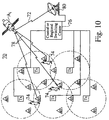
- Figure 10 represents a terrestrial two-way wireless (radio) communications system 70 which reuses frequencies on a cellular basis and uses LEO or MEO satellite links 72, 78 to connect remote receiver stations RT to a central or regional switching center 76 which is in turn connected to higher power service transmitters Tx.
- the system uses fixed location service transmitters Tx to transmit toward lower power mobile or portable subscriber units 74. Within the service area of a transmitter Tx, the subscriber units 74 are able to receive signals from the higher powered fixed location service transmitter Tx but they do not have enough power to transmit back to the fixed location service transmitter Tx. Satellite transceivers RT are deployed around the fixed location service transmitters to pick up the low power signals from the subscriber units 74 and relay the signal to a central or regional switching center 76.
- the central or regional switching center 76 is then able to complete a two way path for communications (for example, through the public switched telephone system) and is able to determine the general location of the subscriber unit 74 for the purpose of optimizing network traffic and service quality.
- the switching center 76 communicates to the satellite Ai through link 72 via the switching center antenna 80.
- the transceivers RT are coupled to the switching center 76 through links 78 to a satellite Ai and from the satellite Ai through link 72.
- the Radio Frequency Sharing Methods for Satellite System described above will provide frequency sharing among satellites of a new constellation and satellites that are already in orbit.
- the present invention will offer a wide range of communications services while enhancing the use of currently available spectrum.
Landscapes
- Engineering & Computer Science (AREA)
- Physics & Mathematics (AREA)
- Astronomy & Astrophysics (AREA)
- Aviation & Aerospace Engineering (AREA)
- General Physics & Mathematics (AREA)
- Computer Networks & Wireless Communication (AREA)
- Signal Processing (AREA)
- Radio Relay Systems (AREA)
- Mobile Radio Communication Systems (AREA)
Applications Claiming Priority (3)
| Application Number | Priority Date | Filing Date | Title |
|---|---|---|---|
| US08/703,228 US5926758A (en) | 1996-08-26 | 1996-08-26 | Radio frequency sharing methods for satellite systems |
| US703228 | 1996-08-26 | ||
| EP97938264A EP0929950A1 (de) | 1996-08-26 | 1997-08-18 | Funkfrequenzteilungsverfahren für satellitenkommunikationsanordnung |
Related Parent Applications (1)
| Application Number | Title | Priority Date | Filing Date |
|---|---|---|---|
| EP97938264A Division EP0929950A1 (de) | 1996-08-26 | 1997-08-18 | Funkfrequenzteilungsverfahren für satellitenkommunikationsanordnung |
Publications (2)
| Publication Number | Publication Date |
|---|---|
| EP1035663A2 true EP1035663A2 (de) | 2000-09-13 |
| EP1035663A3 EP1035663A3 (de) | 2001-12-19 |
Family
ID=24824555
Family Applications (2)
| Application Number | Title | Priority Date | Filing Date |
|---|---|---|---|
| EP00107683A Withdrawn EP1035663A3 (de) | 1996-08-26 | 1997-08-18 | Zweiweg Kommunikationsanordnung für mobilen Endgeräten mit einem Satelliten System |
| EP97938264A Withdrawn EP0929950A1 (de) | 1996-08-26 | 1997-08-18 | Funkfrequenzteilungsverfahren für satellitenkommunikationsanordnung |
Family Applications After (1)
| Application Number | Title | Priority Date | Filing Date |
|---|---|---|---|
| EP97938264A Withdrawn EP0929950A1 (de) | 1996-08-26 | 1997-08-18 | Funkfrequenzteilungsverfahren für satellitenkommunikationsanordnung |
Country Status (5)
| Country | Link |
|---|---|
| US (1) | US5926758A (de) |
| EP (2) | EP1035663A3 (de) |
| AU (1) | AU4063997A (de) |
| CA (1) | CA2264161A1 (de) |
| WO (1) | WO1998009386A1 (de) |
Cited By (2)
| Publication number | Priority date | Publication date | Assignee | Title |
|---|---|---|---|---|
| WO2016053389A1 (en) * | 2014-09-30 | 2016-04-07 | Google Inc. | Satellite constellation |
| WO2024137068A1 (en) * | 2022-12-19 | 2024-06-27 | Dish Wireless L.L.C. | Managing interference for coexistence of terrestrial and non-terrestrial wireless networks |
Families Citing this family (123)
| Publication number | Priority date | Publication date | Assignee | Title |
|---|---|---|---|---|
| US6650898B2 (en) * | 1992-03-06 | 2003-11-18 | Aircell, Inc. | Signal translating repeater for enabling a terrestrial mobile subscriber station to be operable in a non-terrestrial environment |
| US6108539A (en) * | 1992-03-06 | 2000-08-22 | Aircell, Incorporated | Non-terrestrial cellular mobile telecommunication station |
| US6725035B2 (en) * | 1992-03-06 | 2004-04-20 | Aircell Inc. | Signal translating repeater for enabling a terrestrial mobile subscriber station to be operable in a non-terrestrial environment |
| US6101385A (en) * | 1997-10-09 | 2000-08-08 | Globalstar L.P. | Satellite communication service with non-congruent sub-beam coverage |
| US6434384B1 (en) | 1997-10-17 | 2002-08-13 | The Boeing Company | Non-uniform multi-beam satellite communications system and method |
| US6198907B1 (en) * | 1998-02-02 | 2001-03-06 | Motorola, Inc. | Satellite communications systems using satellites in a zero-drift constellation |
| US6240074B1 (en) * | 1998-02-19 | 2001-05-29 | Motorola, Inc. | Secure communication hub and method of secure data communication |
| DE19836145A1 (de) * | 1998-08-10 | 2000-02-17 | Siemens Ag | Mobile Telekommunikationsvorrichtung |
| US7327698B1 (en) * | 1999-06-03 | 2008-02-05 | The Directv Group, Inc. | Method and system for providing satellite communications using on-orbit payload configuration and reconfiguration |
| GB2352363A (en) * | 1999-07-21 | 2001-01-24 | Ico Services Ltd | Satellite communications system with broadcast channel switching |
| US7174127B2 (en) | 1999-08-10 | 2007-02-06 | Atc Technologies, Llc | Data communications systems and methods using different wireless links for inbound and outbound data |
| US20030149986A1 (en) * | 1999-08-10 | 2003-08-07 | Mayfield William W. | Security system for defeating satellite television piracy |
| WO2001020788A1 (en) * | 1999-09-14 | 2001-03-22 | Globalstar L.P. | Dynamic satellite filter controller for leo satellites |
| US8265637B2 (en) | 2000-08-02 | 2012-09-11 | Atc Technologies, Llc | Systems and methods for modifying antenna radiation patterns of peripheral base stations of a terrestrial network to allow reduced interference |
| US7149526B2 (en) * | 2000-08-02 | 2006-12-12 | Atc Technologies, Llc | Coordinated satellite-terrestrial frequency reuse |
| US6859652B2 (en) | 2000-08-02 | 2005-02-22 | Mobile Satellite Ventures, Lp | Integrated or autonomous system and method of satellite-terrestrial frequency reuse using signal attenuation and/or blockage, dynamic assignment of frequencies and/or hysteresis |
| US7558568B2 (en) * | 2003-07-28 | 2009-07-07 | Atc Technologies, Llc | Systems and methods for modifying antenna radiation patterns of peripheral base stations of a terrestrial network to allow reduced interference |
| US6810249B1 (en) * | 2000-09-19 | 2004-10-26 | The Directv Group, Inc. | Method and system of efficient spectrum utilization by communications satellites |
| US7792488B2 (en) | 2000-12-04 | 2010-09-07 | Atc Technologies, Llc | Systems and methods for transmitting electromagnetic energy over a wireless channel having sufficiently weak measured signal strength |
| US8270898B2 (en) | 2001-09-14 | 2012-09-18 | Atc Technologies, Llc | Satellite-band spectrum utilization for reduced or minimum interference |
| US7603081B2 (en) | 2001-09-14 | 2009-10-13 | Atc Technologies, Llc | Radiotelephones and operating methods that use a single radio frequency chain and a single baseband processor for space-based and terrestrial communications |
| US7181161B2 (en) * | 2001-09-14 | 2007-02-20 | Atc Technologies, Llc | Multi-band/multi-mode satellite radiotelephone communications systems and methods |
| US7623859B2 (en) * | 2001-09-14 | 2009-11-24 | Atc Technologies, Llc | Additional aggregate radiated power control for multi-band/multi-mode satellite radiotelephone communications systems and methods |
| US7062267B2 (en) * | 2001-09-14 | 2006-06-13 | Atc Technologies, Llc | Methods and systems for modifying satellite antenna cell patterns in response to terrestrial reuse of satellite frequencies |
| US7155340B2 (en) * | 2001-09-14 | 2006-12-26 | Atc Technologies, Llc | Network-assisted global positioning systems, methods and terminals including doppler shift and code phase estimates |
| US7890098B2 (en) * | 2001-09-14 | 2011-02-15 | Atc Technologies, Llc | Staggered sectorization for terrestrial reuse of satellite frequencies |
| US7447501B2 (en) * | 2001-09-14 | 2008-11-04 | Atc Technologies, Llc | Systems and methods for monitoring selected terrestrially used satellite frequency signals to reduce potential interference |
| US6999720B2 (en) * | 2001-09-14 | 2006-02-14 | Atc Technologies, Llc | Spatial guardbands for terrestrial reuse of satellite frequencies |
| US7593724B2 (en) * | 2001-09-14 | 2009-09-22 | Atc Technologies, Llc | Systems and methods for terrestrial reuse of cellular satellite frequency spectrum in a time-division duplex mode |
| US7218931B2 (en) * | 2001-09-14 | 2007-05-15 | Atc Technologies, Llc | Satellite radiotelephone systems providing staggered sectorization for terrestrial reuse of satellite frequencies and related methods and radiotelephone systems |
| US7006789B2 (en) * | 2001-09-14 | 2006-02-28 | Atc Technologies, Llc | Space-based network architectures for satellite radiotelephone systems |
| US7603117B2 (en) | 2001-09-14 | 2009-10-13 | Atc Technologies, Llc | Systems and methods for terrestrial use of cellular satellite frequency spectrum |
| US7113778B2 (en) * | 2001-09-14 | 2006-09-26 | Atc Technologies, Llc | Aggregate radiated power control for multi-band/multi-mode satellite radiotelephone communications systems and methods |
| US6785543B2 (en) | 2001-09-14 | 2004-08-31 | Mobile Satellite Ventures, Lp | Filters for combined radiotelephone/GPS terminals |
| US7792069B2 (en) * | 2001-09-14 | 2010-09-07 | Atc Technologies, Llc | Systems and methods for terrestrial reuse of cellular satellite frequency spectrum using different channel separation technologies in forward and reverse links |
| US7664460B2 (en) | 2001-09-14 | 2010-02-16 | Atc Technologies, Llc | Systems and methods for terrestrial reuse of cellular satellite frequency spectrum in a time-division duplex and/or frequency-division duplex mode |
| US6653975B2 (en) * | 2001-11-21 | 2003-11-25 | Northrop Grumman Corporation | Method of configuring satellite constellation design using multiple discrete switchable spot beams |
| US8027637B1 (en) * | 2002-01-11 | 2011-09-27 | Broadcom Corporation | Single frequency wireless communication system |
| US6856787B2 (en) | 2002-02-12 | 2005-02-15 | Mobile Satellite Ventures, Lp | Wireless communications systems and methods using satellite-linked remote terminal interface subsystems |
| US7593691B2 (en) * | 2002-02-12 | 2009-09-22 | Atc Technologies, Llc | Systems and methods for controlling a level of interference to a wireless receiver responsive to a power level associated with a wireless transmitter |
| US6937857B2 (en) | 2002-05-28 | 2005-08-30 | Mobile Satellite Ventures, Lp | Systems and methods for reducing satellite feeder link bandwidth/carriers in cellular satellite systems |
| US7092708B2 (en) * | 2002-12-12 | 2006-08-15 | Atc Technologies, Llc | Systems and methods for increasing capacity and/or quality of service of terrestrial cellular and satellite systems using terrestrial reception of satellite band frequencies |
| US7421342B2 (en) * | 2003-01-09 | 2008-09-02 | Atc Technologies, Llc | Network-assisted global positioning systems, methods and terminals including doppler shift and code phase estimates |
| US7203490B2 (en) * | 2003-03-24 | 2007-04-10 | Atc Technologies, Llc | Satellite assisted push-to-send radioterminal systems and methods |
| US7444170B2 (en) * | 2003-03-24 | 2008-10-28 | Atc Technologies, Llc | Co-channel wireless communication methods and systems using nonsymmetrical alphabets |
| US6879829B2 (en) * | 2003-05-16 | 2005-04-12 | Mobile Satellite Ventures, Lp | Systems and methods for handover between space based and terrestrial radioterminal communications, and for monitoring terrestrially reused satellite frequencies at a radioterminal to reduce potential interference |
| US20040240525A1 (en) * | 2003-05-29 | 2004-12-02 | Karabinis Peter D. | Wireless communications methods and apparatus using licensed-use system protocols with unlicensed-use access points |
| US8670705B2 (en) * | 2003-07-30 | 2014-03-11 | Atc Technologies, Llc | Additional intra-and/or inter-system interference reducing systems and methods for satellite communications systems |
| US7340213B2 (en) * | 2003-07-30 | 2008-03-04 | Atc Technologies, Llc | Intra- and/or inter-system interference reducing systems and methods for satellite communications systems |
| US20050041619A1 (en) * | 2003-08-22 | 2005-02-24 | Karabinis Peter D. | Wireless systems, methods and devices employing forward- and/or return-link carriers having different numbers of sub-band carriers |
| US7113743B2 (en) * | 2003-09-11 | 2006-09-26 | Atc Technologies, Llc | Systems and methods for inter-system sharing of satellite communications frequencies within a common footprint |
| CN1857022B (zh) | 2003-09-23 | 2011-07-06 | Atc科技有限责任公司 | 在重叠的卫星和陆地通信系统中用于移动性管理的系统和方法 |
| US8380186B2 (en) | 2004-01-22 | 2013-02-19 | Atc Technologies, Llc | Satellite with different size service link antennas and radioterminal communication methods using same |
| US7418236B2 (en) * | 2004-04-20 | 2008-08-26 | Mobile Satellite Ventures, Lp | Extraterrestrial communications systems and methods including ancillary extraterrestrial components |
| US8655398B2 (en) | 2004-03-08 | 2014-02-18 | Atc Technologies, Llc | Communications systems and methods including emission detection |
| US7453920B2 (en) | 2004-03-09 | 2008-11-18 | Atc Technologies, Llc | Code synchronization in CDMA satellite wireless communications system using uplink channel detection |
| US7933552B2 (en) * | 2004-03-22 | 2011-04-26 | Atc Technologies, Llc | Multi-band satellite and/or ancillary terrestrial component radioterminal communications systems and methods with combining operation |
| US7606590B2 (en) | 2004-04-07 | 2009-10-20 | Atc Technologies, Llc | Satellite/hands-free interlock systems and/or companion devices for radioterminals and related methods |
| US7636566B2 (en) | 2004-04-12 | 2009-12-22 | Atc Technologies, Llc | Systems and method with different utilization of satellite frequency bands by a space-based network and an ancillary terrestrial network |
| US20050239399A1 (en) * | 2004-04-21 | 2005-10-27 | Karabinis Peter D | Mobile terminals and set top boxes including multiple satellite band service links, and related systems and methods |
| US8265549B2 (en) * | 2004-05-18 | 2012-09-11 | Atc Technologies, Llc | Satellite communications systems and methods using radiotelephone |
| US20050260984A1 (en) * | 2004-05-21 | 2005-11-24 | Mobile Satellite Ventures, Lp | Systems and methods for space-based use of terrestrial cellular frequency spectrum |
| US7706748B2 (en) * | 2004-06-25 | 2010-04-27 | Atc Technologies, Llc | Methods of ground based beamforming and on-board frequency translation and related systems |
| EP1776778A2 (de) | 2004-08-11 | 2007-04-25 | ATC Technologies, LLC | System zur reduzierung von störungen zwischen verschiedenen kommunikationssystemen |
| US7639981B2 (en) * | 2004-11-02 | 2009-12-29 | Atc Technologies, Llc | Apparatus and methods for power control in satellite communications systems with satellite-linked terrestrial stations |
| US20060094420A1 (en) * | 2004-11-02 | 2006-05-04 | Karabinis Peter D | Multi frequency band/multi air interface/multi spectrum reuse cluster size/multi cell size satellite radioterminal communicaitons systems and methods |
| US7653348B2 (en) * | 2004-11-16 | 2010-01-26 | Atc Technologies, Llc | Satellite communications systems, components and methods for operating shared satellite gateways |
| US7747229B2 (en) * | 2004-11-19 | 2010-06-29 | Atc Technologies, Llc | Electronic antenna beam steering using ancillary receivers and related methods |
| US7454175B2 (en) * | 2004-12-07 | 2008-11-18 | Atc Technologies, Llc | Broadband wireless communications systems and methods using multiple non-contiguous frequency bands/segments |
| US8594704B2 (en) * | 2004-12-16 | 2013-11-26 | Atc Technologies, Llc | Location-based broadcast messaging for radioterminal users |
| EP2254264A3 (de) | 2005-01-05 | 2013-11-13 | ATC Technologies, LLC | Adaptive Strahlformung mit Mehrbenutzerdetektion und Interferenzreduktion bei Satellitenkommunikationsystemen und Verfahren |
| WO2006081454A2 (en) * | 2005-01-26 | 2006-08-03 | Internet Broadcasting Corporation | Layered multicast and fair bandwidth allocation and packet prioritization |
| US7596111B2 (en) | 2005-01-27 | 2009-09-29 | Atc Technologies, Llc | Satellite/terrestrial wireless communications systems and methods using disparate channel separation codes |
| EP1851877A2 (de) * | 2005-02-22 | 2007-11-07 | ATC Technologies, LLC | Wiederverwendung der frequenzen eines stationären und/oder mobilen kommunikationssystems |
| US7738837B2 (en) * | 2005-02-22 | 2010-06-15 | Atc Technologies, Llc | Satellites using inter-satellite links to create indirect feeder link paths |
| US7636546B2 (en) * | 2005-02-22 | 2009-12-22 | Atc Technologies, Llc | Satellite communications systems and methods using diverse polarizations |
| US7756490B2 (en) * | 2005-03-08 | 2010-07-13 | Atc Technologies, Llc | Methods, radioterminals, and ancillary terrestrial components for communicating using spectrum allocated to another satellite operator |
| US7587171B2 (en) * | 2005-03-09 | 2009-09-08 | Atc Technologies, Llc | Reducing interference in a wireless communications signal in the frequency domain |
| US7796986B2 (en) | 2005-03-11 | 2010-09-14 | Atc Technologies, Llc | Modification of transmission values to compensate for interference in a satellite down-link communications |
| US7627285B2 (en) * | 2005-03-14 | 2009-12-01 | Atc Technologies, Llc | Satellite communications systems and methods with distributed and/or centralized architecture including ground-based beam forming |
| WO2006099443A1 (en) | 2005-03-15 | 2006-09-21 | Atc Technologies, Llc | Intra-system and/or inter-system reuse of feeder link frequencies including interference suppression systems and methods |
| WO2006099501A1 (en) * | 2005-03-15 | 2006-09-21 | Atc Technologies, Llc | Methods and systems providing adaptive feeder links for ground based beam forming and related systems and satellites |
| US7453396B2 (en) * | 2005-04-04 | 2008-11-18 | Atc Technologies, Llc | Radioterminals and associated operating methods that alternate transmission of wireless communications and processing of global positioning system signals |
| DE102005027453A1 (de) * | 2005-06-14 | 2006-12-28 | Fraunhofer-Gesellschaft zur Förderung der angewandten Forschung e.V. | Terrestrische Sendestation zum Aussenden eines terrestrischen Rundfunksignals, satellitengestütztes Rundfunksystem und Empfänger für ein satellitengestütztes Rundfunksystem |
| US7817967B2 (en) | 2005-06-21 | 2010-10-19 | Atc Technologies, Llc | Communications systems including adaptive antenna systems and methods for inter-system and intra-system interference reduction |
| US7970345B2 (en) | 2005-06-22 | 2011-06-28 | Atc Technologies, Llc | Systems and methods of waveform and/or information splitting for wireless transmission of information to one or more radioterminals over a plurality of transmission paths and/or system elements |
| US7907944B2 (en) | 2005-07-05 | 2011-03-15 | Atc Technologies, Llc | Methods, apparatus and computer program products for joint decoding of access probes in a CDMA communications system |
| US8190114B2 (en) | 2005-07-20 | 2012-05-29 | Atc Technologies, Llc | Frequency-dependent filtering for wireless communications transmitters |
| US7623867B2 (en) | 2005-07-29 | 2009-11-24 | Atc Technologies, Llc | Satellite communications apparatus and methods using asymmetrical forward and return link frequency reuse |
| US7461756B2 (en) * | 2005-08-08 | 2008-12-09 | Plastipak Packaging, Inc. | Plastic container having a freestanding, self-supporting base |
| EP1913709B1 (de) | 2005-08-09 | 2010-04-28 | ATC Technologies, LLC | Satellitenkommunikationssysteme und verfahren mit verwendung von im wesentlichen benachbarten funkverbindungsantennen |
| US20070123252A1 (en) * | 2005-10-12 | 2007-05-31 | Atc Technologies, Llc | Systems, methods and computer program products for mobility management in hybrid satellite/terrestrial wireless communications systems |
| WO2007084682A1 (en) * | 2006-01-20 | 2007-07-26 | Atc Technologies, Llc | Systems and methods for forward link closed loop beamforming |
| US8705436B2 (en) * | 2006-02-15 | 2014-04-22 | Atc Technologies, Llc | Adaptive spotbeam broadcasting, systems, methods and devices for high bandwidth content distribution over satellite |
| US7751823B2 (en) * | 2006-04-13 | 2010-07-06 | Atc Technologies, Llc | Systems and methods for controlling a level of interference to a wireless receiver responsive to an activity factor associated with a wireless transmitter |
| US8923850B2 (en) | 2006-04-13 | 2014-12-30 | Atc Technologies, Llc | Systems and methods for controlling base station sectors to reduce potential interference with low elevation satellites |
| JP4899637B2 (ja) * | 2006-05-29 | 2012-03-21 | 株式会社日立製作所 | 無線通信システムおよび無線通信方法 |
| US9014619B2 (en) | 2006-05-30 | 2015-04-21 | Atc Technologies, Llc | Methods and systems for satellite communications employing ground-based beam forming with spatially distributed hybrid matrix amplifiers |
| US8169955B2 (en) | 2006-06-19 | 2012-05-01 | Atc Technologies, Llc | Systems and methods for orthogonal frequency division multiple access (OFDMA) communications over satellite links |
| WO2008027109A2 (en) * | 2006-06-29 | 2008-03-06 | Atc Technologies, Llc | Apparatus and methods for mobility management in hybrid terrestrial-satellite mobile communications systems |
| US7792070B1 (en) * | 2007-04-13 | 2010-09-07 | Douglas Burr | Multi-beam satellite network to maximize bandwidth utilization |
| US8031646B2 (en) * | 2007-05-15 | 2011-10-04 | Atc Technologies, Llc | Systems, methods and devices for reusing spectrum of another operator |
| US8064824B2 (en) * | 2007-07-03 | 2011-11-22 | Atc Technologies, Llc | Systems and methods for reducing power robbing impact of interference to a satellite |
| WO2009015093A1 (en) | 2007-07-20 | 2009-01-29 | Viasat, Inc. | Capacity maximization for a unicast spot beam satellite system |
| BRPI0818369B1 (pt) | 2007-10-09 | 2020-03-03 | Viasat, Inc. | Sistema de comunicação de satélite geoestacionário e método para operar um sistema de satélite geoestacionário |
| US7978135B2 (en) | 2008-02-15 | 2011-07-12 | Atc Technologies, Llc | Antenna beam forming systems/methods using unconstrained phase response |
| WO2009151863A2 (en) * | 2008-06-10 | 2009-12-17 | Myers Wolin, Llc | A network gateway for time-critical and mission-critical networks |
| US8433241B2 (en) | 2008-08-06 | 2013-04-30 | Atc Technologies, Llc | Systems, methods and devices for overlaid operations of satellite and terrestrial wireless communications systems |
| US8193975B2 (en) | 2008-11-12 | 2012-06-05 | Atc Technologies | Iterative antenna beam forming systems/methods |
| US8339308B2 (en) | 2009-03-16 | 2012-12-25 | Atc Technologies Llc | Antenna beam forming systems, methods and devices using phase adjusted least squares beam forming |
| US8520561B2 (en) | 2009-06-09 | 2013-08-27 | Atc Technologies, Llc | Systems, methods and network components that provide different satellite spot beam return carrier groupings and reuse patterns |
| US8576769B2 (en) | 2009-09-28 | 2013-11-05 | Atc Technologies, Llc | Systems and methods for adaptive interference cancellation beamforming |
| US9236934B1 (en) | 2009-10-16 | 2016-01-12 | Viasat, Inc. | Satellite system architecture for coverage areas of disparate demand |
| US10110288B2 (en) * | 2009-11-04 | 2018-10-23 | Atc Technologies, Llc | Frequency division duplex (FDD) return link transmit diversity systems, methods and devices using forward link side information |
| US8355676B2 (en) * | 2009-11-17 | 2013-01-15 | Franklin Technologies, Llc | System and method for reducing radio frequency interference |
| US8274925B2 (en) * | 2010-01-05 | 2012-09-25 | Atc Technologies, Llc | Retaining traffic channel assignments for satellite terminals to provide lower latency communication services |
| US10277309B2 (en) * | 2015-11-19 | 2019-04-30 | Planet Labs, Inc. | Predicting radio frequency interference events |
| US10397920B2 (en) | 2016-01-22 | 2019-08-27 | Space Systems/Loral, Llc | Satellite diversity |
| US10149200B2 (en) * | 2016-06-07 | 2018-12-04 | Iridium Satellite Llc | Interference mitigation for a satellite network |
| FR3099673B1 (fr) * | 2019-07-31 | 2021-08-27 | Thales Sa | Procede de determination des contraintes d'un systeme non-geostationnaire vis a vis d'un autre systeme non-geostationnaire |
| CN113364507B (zh) * | 2020-03-04 | 2022-11-18 | 大唐移动通信设备有限公司 | 一种信息处理方法、装置、设备及计算机可读存储介质 |
| WO2024226183A1 (en) * | 2023-04-24 | 2024-10-31 | Raytheon Company | Prediction and avoidance of radio frequency interference |
| WO2025058411A1 (ko) * | 2023-09-14 | 2025-03-20 | 스페이스맵 주식회사 | 지상국과 통신 위성 간의 무선 통신 간섭 예측 및 회피 시스템 및 방법 |
Family Cites Families (13)
| Publication number | Priority date | Publication date | Assignee | Title |
|---|---|---|---|---|
| US5327572A (en) * | 1990-03-06 | 1994-07-05 | Motorola, Inc. | Networked satellite and terrestrial cellular radiotelephone systems |
| US5276908A (en) * | 1990-10-25 | 1994-01-04 | Northern Telecom Limited | Call set-up and spectrum sharing in radio communication on systems with dynamic channel allocation |
| US5526404A (en) * | 1991-10-10 | 1996-06-11 | Space Systems/Loral, Inc. | Worldwide satellite telephone system and a network coordinating gateway for allocating satellite and terrestrial gateway resources |
| DE69228859T2 (de) * | 1991-12-12 | 1999-08-26 | Nec Corp. | Mobiles Kommunikationssystem mit zentraler Funkrufstation zum Anruf von mobilen Teilnehmern durch Basisstationen |
| US5343512A (en) * | 1992-03-27 | 1994-08-30 | Motorola, Inc. | Call setup method for use with a network having mobile end users |
| US5367304A (en) * | 1992-07-06 | 1994-11-22 | Motorola, Inc. | Communication system employing spectrum reuse on a spherical surface |
| CA2105710A1 (en) * | 1992-11-12 | 1994-05-13 | Raymond Joseph Leopold | Network of hierarchical communication systems and method therefor |
| US5511233A (en) * | 1994-04-05 | 1996-04-23 | Celsat America, Inc. | System and method for mobile communications in coexistence with established communications systems |
| US5566354A (en) * | 1994-09-26 | 1996-10-15 | Sehloemer; Jerry R. | System and method for channel assignment in a satellite telephone system |
| WO1996012356A2 (en) * | 1994-10-12 | 1996-04-25 | Leo One Ip, L.L.C. | Optimal coverage satellite system for a low earth orbit store-and-forward telecommunication network |
| WO1996013911A1 (en) * | 1994-10-27 | 1996-05-09 | Motorola Inc. | Methods of demand-based adaptive channel reuse for telecommunication systems |
| US5641134A (en) * | 1994-12-27 | 1997-06-24 | Motorola, Inc. | Satellite cellular telephone and data communication system at an inclined orbit |
| FR2729025B1 (fr) * | 1995-01-02 | 1997-03-21 | Europ Agence Spatiale | Procede et systeme de transmission de signaux radioelectriques via un reseau de satellites entre une station terrestre fixe et des terminaux mobiles d'usagers |
-
1996
- 1996-08-26 US US08/703,228 patent/US5926758A/en not_active Expired - Fee Related
-
1997
- 1997-08-18 CA CA002264161A patent/CA2264161A1/en not_active Abandoned
- 1997-08-18 AU AU40639/97A patent/AU4063997A/en not_active Abandoned
- 1997-08-18 EP EP00107683A patent/EP1035663A3/de not_active Withdrawn
- 1997-08-18 WO PCT/US1997/014206 patent/WO1998009386A1/en not_active Ceased
- 1997-08-18 EP EP97938264A patent/EP0929950A1/de not_active Withdrawn
Cited By (8)
| Publication number | Priority date | Publication date | Assignee | Title |
|---|---|---|---|---|
| WO2016053389A1 (en) * | 2014-09-30 | 2016-04-07 | Google Inc. | Satellite constellation |
| CN106464343A (zh) * | 2014-09-30 | 2017-02-22 | 谷歌公司 | 卫星群 |
| US9647749B2 (en) | 2014-09-30 | 2017-05-09 | Google Inc. | Satellite constellation |
| US9973267B2 (en) | 2014-09-30 | 2018-05-15 | Google Llc | Satellite constellation |
| CN106464343B (zh) * | 2014-09-30 | 2019-09-13 | 谷歌有限责任公司 | 卫星群 |
| CN110545137A (zh) * | 2014-09-30 | 2019-12-06 | 谷歌有限责任公司 | 卫星群 |
| CN110545137B (zh) * | 2014-09-30 | 2022-05-03 | 谷歌有限责任公司 | 通信系统及其方法 |
| WO2024137068A1 (en) * | 2022-12-19 | 2024-06-27 | Dish Wireless L.L.C. | Managing interference for coexistence of terrestrial and non-terrestrial wireless networks |
Also Published As
| Publication number | Publication date |
|---|---|
| WO1998009386A1 (en) | 1998-03-05 |
| AU4063997A (en) | 1998-03-19 |
| EP1035663A3 (de) | 2001-12-19 |
| US5926758A (en) | 1999-07-20 |
| CA2264161A1 (en) | 1998-03-05 |
| EP0929950A1 (de) | 1999-07-21 |
Similar Documents
| Publication | Publication Date | Title |
|---|---|---|
| US5926758A (en) | Radio frequency sharing methods for satellite systems | |
| US5490087A (en) | Radio channel access control | |
| Maral et al. | Low earth orbit satellite systems for communications | |
| US5574969A (en) | Method and apparatus for regional cell management in a satellite communication system | |
| EP1316233B1 (de) | Koordinierte Wiederverwendung von Frequenzen von einem irdischen System und einem Satellitensystem. | |
| US6088341A (en) | Method for reducing co-channel of cross-polarization interference in a satellite data communication system by offsetting channel frequencies | |
| US5826190A (en) | Emergency handoff method of redirecting calls in a satellite communication system | |
| EP1230749B1 (de) | Frequenzwiederholung in einem geosynchronen satellitenkommunikationssystem | |
| US10243648B2 (en) | Satellite system having increased communications capacity and methods for increasing the capacity of satellite systems | |
| AU2001284688A1 (en) | Coordinated satellite-terrestrial frequency reuse | |
| EP0737388A1 (de) | Verfahren zur adaptiven nachfragebasierten kanalwiederverwendung für telekommunikationsanordnungen | |
| US6725013B1 (en) | Communication system having frequency reuse in non-blocking manner | |
| EP0728386B1 (de) | Anordnung mit satelliten auf aquatorialen und geneigten umlaufbahnen wobei informationen uber satelliten oder erdstationen ubertragen werden | |
| EP0787387B1 (de) | Übertragungsanordnung mit satelliten niedriger höhe und optimaler erdbeleuchtung für ein telekommunikationsnetz mit speicherung und durchschaltung | |
| EP1030467A1 (de) | Satelliten Kommunikationsanordnung mit einem Aufbauwerk für Antennastrahlen und Frequenzsprungdaten dem Benutzer übertragen | |
| EP0844746A2 (de) | Verfahren und Gerät zur Mittelzuteilung um Interferenzen vorzukommen | |
| JP3836135B2 (ja) | 衛星通信システムにおける地域的セル管理のための方法および装置 | |
| Ilcev | Space division multiple access (SDMA) applicable for mobile satellite communications | |
| Younes et al. | Multiple access techniques for a hierarchical network of satellites for mobile communications | |
| EVANS et al. | LOW EARTH ORBIT SATELLITE SYSTEMS FOR COMMUNICATIONS |
Legal Events
| Date | Code | Title | Description |
|---|---|---|---|
| PUAI | Public reference made under article 153(3) epc to a published international application that has entered the european phase |
Free format text: ORIGINAL CODE: 0009012 |
|
| 17P | Request for examination filed |
Effective date: 20000502 |
|
| AC | Divisional application: reference to earlier application |
Ref document number: 929950 Country of ref document: EP |
|
| AK | Designated contracting states |
Kind code of ref document: A2 Designated state(s): AT BE CH DE DK ES FI FR GB GR IE IT LI LU MC NL PT SE |
|
| AX | Request for extension of the european patent |
Free format text: AL;LT;LV;RO;SI |
|
| PUAL | Search report despatched |
Free format text: ORIGINAL CODE: 0009013 |
|
| AK | Designated contracting states |
Kind code of ref document: A3 Designated state(s): AT BE CH DE DK ES FI FR GB GR IE IT LI LU MC NL PT SE |
|
| AX | Request for extension of the european patent |
Free format text: AL;LT;LV;RO;SI |
|
| AKX | Designation fees paid |
Free format text: AT BE CH DE DK ES FI FR GB GR IE IT LI LU MC NL PT SE |
|
| STAA | Information on the status of an ep patent application or granted ep patent |
Free format text: STATUS: THE APPLICATION IS DEEMED TO BE WITHDRAWN |
|
| 18D | Application deemed to be withdrawn |
Effective date: 20020620 |