EP1035601A1 - Positive active material for rechargeable lithium battery and method of preparing same - Google Patents
Positive active material for rechargeable lithium battery and method of preparing same Download PDFInfo
- Publication number
- EP1035601A1 EP1035601A1 EP99402595A EP99402595A EP1035601A1 EP 1035601 A1 EP1035601 A1 EP 1035601A1 EP 99402595 A EP99402595 A EP 99402595A EP 99402595 A EP99402595 A EP 99402595A EP 1035601 A1 EP1035601 A1 EP 1035601A1
- Authority
- EP
- European Patent Office
- Prior art keywords
- active material
- vanadium pentoxide
- mno
- solution
- positive active
- Prior art date
- Legal status (The legal status is an assumption and is not a legal conclusion. Google has not performed a legal analysis and makes no representation as to the accuracy of the status listed.)
- Granted
Links
- 229910052744 lithium Inorganic materials 0.000 title claims abstract description 17
- WHXSMMKQMYFTQS-UHFFFAOYSA-N Lithium Chemical compound [Li] WHXSMMKQMYFTQS-UHFFFAOYSA-N 0.000 title claims abstract description 15
- 239000007774 positive electrode material Substances 0.000 title claims abstract description 15
- 238000000034 method Methods 0.000 title claims description 19
- GNTDGMZSJNCJKK-UHFFFAOYSA-N divanadium pentaoxide Chemical compound O=[V](=O)O[V](=O)=O GNTDGMZSJNCJKK-UHFFFAOYSA-N 0.000 claims abstract description 106
- 239000011149 active material Substances 0.000 claims abstract description 24
- 229910017206 LixMn1-yMy Inorganic materials 0.000 claims abstract description 22
- 229910017203 LixMn1−yMy Inorganic materials 0.000 claims abstract description 22
- 229910015214 LixMn2-yMy Inorganic materials 0.000 claims abstract description 22
- 229910015277 LixMn2−yMy Inorganic materials 0.000 claims abstract description 22
- 239000011572 manganese Substances 0.000 claims abstract description 22
- PWHULOQIROXLJO-UHFFFAOYSA-N Manganese Chemical compound [Mn] PWHULOQIROXLJO-UHFFFAOYSA-N 0.000 claims abstract description 17
- 229910052748 manganese Inorganic materials 0.000 claims abstract description 17
- 229910017205 LixMn2 Inorganic materials 0.000 claims abstract description 12
- 229910015349 LixMn2O4-z Inorganic materials 0.000 claims abstract description 12
- 229910015310 LixMn2O4−z Inorganic materials 0.000 claims abstract description 12
- 229910015674 LixMnO2-z Inorganic materials 0.000 claims abstract description 12
- 229910015670 LixMnO2−z Inorganic materials 0.000 claims abstract description 12
- 150000001875 compounds Chemical class 0.000 claims abstract description 9
- -1 LixMnS2 Inorganic materials 0.000 claims abstract description 7
- 229910052684 Cerium Inorganic materials 0.000 claims abstract description 6
- 229910015220 LixMn2-yMyO4 Inorganic materials 0.000 claims abstract description 6
- 229910015329 LixMn2O4 Inorganic materials 0.000 claims abstract description 6
- 229910015283 LixMn2−yMyO4 Inorganic materials 0.000 claims abstract description 6
- 229910003007 LixMnO2 Inorganic materials 0.000 claims abstract description 6
- 229910021570 Manganese(II) fluoride Inorganic materials 0.000 claims abstract description 6
- 229910004209 O2−zFz Inorganic materials 0.000 claims abstract description 6
- 229910052804 chromium Inorganic materials 0.000 claims abstract description 6
- 229910052742 iron Inorganic materials 0.000 claims abstract description 6
- 229910052746 lanthanum Inorganic materials 0.000 claims abstract description 6
- 229910052749 magnesium Inorganic materials 0.000 claims abstract description 6
- 229910052712 strontium Inorganic materials 0.000 claims abstract description 6
- 229910017199 LixMn1-yMyO2 Inorganic materials 0.000 claims abstract description 5
- 239000000243 solution Substances 0.000 claims description 23
- 239000000843 powder Substances 0.000 claims description 20
- 238000000576 coating method Methods 0.000 claims description 8
- 239000011248 coating agent Substances 0.000 claims description 7
- 230000001476 alcoholic effect Effects 0.000 claims description 6
- 239000007864 aqueous solution Substances 0.000 claims description 6
- 239000000463 material Substances 0.000 claims description 4
- 229910052720 vanadium Inorganic materials 0.000 claims description 3
- LEONUFNNVUYDNQ-UHFFFAOYSA-N vanadium atom Chemical compound [V] LEONUFNNVUYDNQ-UHFFFAOYSA-N 0.000 claims description 3
- 150000003623 transition metal compounds Chemical class 0.000 abstract description 2
- 229910002097 Lithium manganese(III,IV) oxide Inorganic materials 0.000 description 7
- 230000000052 comparative effect Effects 0.000 description 7
- LFQSCWFLJHTTHZ-UHFFFAOYSA-N Ethanol Chemical compound CCO LFQSCWFLJHTTHZ-UHFFFAOYSA-N 0.000 description 6
- 239000003792 electrolyte Substances 0.000 description 5
- XLYOFNOQVPJJNP-UHFFFAOYSA-N water Substances O XLYOFNOQVPJJNP-UHFFFAOYSA-N 0.000 description 5
- PXHVJJICTQNCMI-UHFFFAOYSA-N Nickel Chemical compound [Ni] PXHVJJICTQNCMI-UHFFFAOYSA-N 0.000 description 4
- 229910003002 lithium salt Inorganic materials 0.000 description 4
- 159000000002 lithium salts Chemical class 0.000 description 4
- 239000012266 salt solution Substances 0.000 description 4
- 239000002002 slurry Substances 0.000 description 4
- 239000002904 solvent Substances 0.000 description 4
- OKKJLVBELUTLKV-UHFFFAOYSA-N Methanol Chemical compound OC OKKJLVBELUTLKV-UHFFFAOYSA-N 0.000 description 3
- 229910052751 metal Inorganic materials 0.000 description 3
- 239000002184 metal Substances 0.000 description 3
- OKTJSMMVPCPJKN-UHFFFAOYSA-N Carbon Chemical compound [C] OKTJSMMVPCPJKN-UHFFFAOYSA-N 0.000 description 2
- KMTRUDSVKNLOMY-UHFFFAOYSA-N Ethylene carbonate Chemical compound O=C1OCCO1 KMTRUDSVKNLOMY-UHFFFAOYSA-N 0.000 description 2
- 229910032387 LiCoO2 Inorganic materials 0.000 description 2
- 229910003005 LiNiO2 Inorganic materials 0.000 description 2
- 229910001290 LiPF6 Inorganic materials 0.000 description 2
- SECXISVLQFMRJM-UHFFFAOYSA-N N-Methylpyrrolidone Chemical compound CN1CCCC1=O SECXISVLQFMRJM-UHFFFAOYSA-N 0.000 description 2
- 239000002033 PVDF binder Substances 0.000 description 2
- 238000004458 analytical method Methods 0.000 description 2
- 239000011230 binding agent Substances 0.000 description 2
- 229910052799 carbon Inorganic materials 0.000 description 2
- 238000005229 chemical vapour deposition Methods 0.000 description 2
- 229910017052 cobalt Inorganic materials 0.000 description 2
- 239000010941 cobalt Substances 0.000 description 2
- GUTLYIVDDKVIGB-UHFFFAOYSA-N cobalt atom Chemical compound [Co] GUTLYIVDDKVIGB-UHFFFAOYSA-N 0.000 description 2
- 239000006258 conductive agent Substances 0.000 description 2
- IEJIGPNLZYLLBP-UHFFFAOYSA-N dimethyl carbonate Chemical compound COC(=O)OC IEJIGPNLZYLLBP-UHFFFAOYSA-N 0.000 description 2
- 238000003618 dip coating Methods 0.000 description 2
- 239000012153 distilled water Substances 0.000 description 2
- 239000011363 dried mixture Substances 0.000 description 2
- 239000011888 foil Substances 0.000 description 2
- 239000010410 layer Substances 0.000 description 2
- 229910052759 nickel Inorganic materials 0.000 description 2
- 229920002981 polyvinylidene fluoride Polymers 0.000 description 2
- 238000010992 reflux Methods 0.000 description 2
- 238000001004 secondary ion mass spectrometry Methods 0.000 description 2
- 229910012701 LiCo1-xMxO2 Inorganic materials 0.000 description 1
- 229910012938 LiCo1−xMxO2 Inorganic materials 0.000 description 1
- 229910002993 LiMnO2 Inorganic materials 0.000 description 1
- 229910014114 LiNi1-xMxO2 Inorganic materials 0.000 description 1
- 229910014907 LiNi1−xMxO2 Inorganic materials 0.000 description 1
- HBBGRARXTFLTSG-UHFFFAOYSA-N Lithium ion Chemical compound [Li+] HBBGRARXTFLTSG-UHFFFAOYSA-N 0.000 description 1
- 229910017193 LixMn1 − yMyO2 Inorganic materials 0.000 description 1
- 229910015160 LixMn2-y Inorganic materials 0.000 description 1
- XHCLAFWTIXFWPH-UHFFFAOYSA-N [O-2].[O-2].[O-2].[O-2].[O-2].[V+5].[V+5] Chemical compound [O-2].[O-2].[O-2].[O-2].[O-2].[V+5].[V+5] XHCLAFWTIXFWPH-UHFFFAOYSA-N 0.000 description 1
- 150000004703 alkoxides Chemical class 0.000 description 1
- QVGXLLKOCUKJST-UHFFFAOYSA-N atomic oxygen Chemical compound [O] QVGXLLKOCUKJST-UHFFFAOYSA-N 0.000 description 1
- 238000007664 blowing Methods 0.000 description 1
- 238000006243 chemical reaction Methods 0.000 description 1
- 239000011247 coating layer Substances 0.000 description 1
- 238000004891 communication Methods 0.000 description 1
- 239000002131 composite material Substances 0.000 description 1
- 238000007323 disproportionation reaction Methods 0.000 description 1
- 230000000694 effects Effects 0.000 description 1
- 238000010828 elution Methods 0.000 description 1
- 229910052747 lanthanoid Inorganic materials 0.000 description 1
- 229910001416 lithium ion Inorganic materials 0.000 description 1
- 238000012986 modification Methods 0.000 description 1
- 230000004048 modification Effects 0.000 description 1
- 230000003647 oxidation Effects 0.000 description 1
- 238000007254 oxidation reaction Methods 0.000 description 1
- 229910052760 oxygen Inorganic materials 0.000 description 1
- 239000001301 oxygen Substances 0.000 description 1
- 238000009700 powder processing Methods 0.000 description 1
- 239000002243 precursor Substances 0.000 description 1
- 238000011160 research Methods 0.000 description 1
- 238000004544 sputter deposition Methods 0.000 description 1
- 238000006467 substitution reaction Methods 0.000 description 1
- 230000007704 transition Effects 0.000 description 1
- 229910000314 transition metal oxide Inorganic materials 0.000 description 1
- 229910001935 vanadium oxide Inorganic materials 0.000 description 1
Images


Classifications
-
- H—ELECTRICITY
- H01—ELECTRIC ELEMENTS
- H01M—PROCESSES OR MEANS, e.g. BATTERIES, FOR THE DIRECT CONVERSION OF CHEMICAL ENERGY INTO ELECTRICAL ENERGY
- H01M4/00—Electrodes
- H01M4/02—Electrodes composed of, or comprising, active material
- H01M4/36—Selection of substances as active materials, active masses, active liquids
-
- H—ELECTRICITY
- H01—ELECTRIC ELEMENTS
- H01M—PROCESSES OR MEANS, e.g. BATTERIES, FOR THE DIRECT CONVERSION OF CHEMICAL ENERGY INTO ELECTRICAL ENERGY
- H01M4/00—Electrodes
- H01M4/02—Electrodes composed of, or comprising, active material
- H01M4/36—Selection of substances as active materials, active masses, active liquids
- H01M4/48—Selection of substances as active materials, active masses, active liquids of inorganic oxides or hydroxides
- H01M4/50—Selection of substances as active materials, active masses, active liquids of inorganic oxides or hydroxides of manganese
- H01M4/505—Selection of substances as active materials, active masses, active liquids of inorganic oxides or hydroxides of manganese of mixed oxides or hydroxides containing manganese for inserting or intercalating light metals, e.g. LiMn2O4 or LiMn2OxFy
-
- H—ELECTRICITY
- H01—ELECTRIC ELEMENTS
- H01M—PROCESSES OR MEANS, e.g. BATTERIES, FOR THE DIRECT CONVERSION OF CHEMICAL ENERGY INTO ELECTRICAL ENERGY
- H01M10/00—Secondary cells; Manufacture thereof
- H01M10/05—Accumulators with non-aqueous electrolyte
- H01M10/052—Li-accumulators
- H01M10/0525—Rocking-chair batteries, i.e. batteries with lithium insertion or intercalation in both electrodes; Lithium-ion batteries
-
- H—ELECTRICITY
- H01—ELECTRIC ELEMENTS
- H01M—PROCESSES OR MEANS, e.g. BATTERIES, FOR THE DIRECT CONVERSION OF CHEMICAL ENERGY INTO ELECTRICAL ENERGY
- H01M4/00—Electrodes
- H01M4/02—Electrodes composed of, or comprising, active material
- H01M4/04—Processes of manufacture in general
-
- H—ELECTRICITY
- H01—ELECTRIC ELEMENTS
- H01M—PROCESSES OR MEANS, e.g. BATTERIES, FOR THE DIRECT CONVERSION OF CHEMICAL ENERGY INTO ELECTRICAL ENERGY
- H01M4/00—Electrodes
- H01M4/02—Electrodes composed of, or comprising, active material
- H01M4/36—Selection of substances as active materials, active masses, active liquids
- H01M4/58—Selection of substances as active materials, active masses, active liquids of inorganic compounds other than oxides or hydroxides, e.g. sulfides, selenides, tellurides, halogenides or LiCoFy; of polyanionic structures, e.g. phosphates, silicates or borates
- H01M4/581—Chalcogenides or intercalation compounds thereof
-
- Y—GENERAL TAGGING OF NEW TECHNOLOGICAL DEVELOPMENTS; GENERAL TAGGING OF CROSS-SECTIONAL TECHNOLOGIES SPANNING OVER SEVERAL SECTIONS OF THE IPC; TECHNICAL SUBJECTS COVERED BY FORMER USPC CROSS-REFERENCE ART COLLECTIONS [XRACs] AND DIGESTS
- Y02—TECHNOLOGIES OR APPLICATIONS FOR MITIGATION OR ADAPTATION AGAINST CLIMATE CHANGE
- Y02E—REDUCTION OF GREENHOUSE GAS [GHG] EMISSIONS, RELATED TO ENERGY GENERATION, TRANSMISSION OR DISTRIBUTION
- Y02E60/00—Enabling technologies; Technologies with a potential or indirect contribution to GHG emissions mitigation
- Y02E60/10—Energy storage using batteries
Definitions
- the present invention relates to a positive active material for rechargeable lithium batteries and a method of preparing the same and, more particularly, to a manganese-based positive active material for rechargeable lithium batteries which has a good cycle life characteristic.
- manganese-based compounds such as LiMn 2 O 4 and LiMnO 2 are the positive active material of choice for rechargeable lithium batteries because of their low cost, abundance and environmentally friendly characteristics.
- LiMn 2 O 4 is particularly stable for the battery use and thus attractive for the electric vehicle application.
- LiMn 2 O 4 has a relatively low discharge capacity. Furthermore, when high rate of charge and discharge operations are cycled, the discharge capacity is excessively reduced. In particular, when the charge and discharge operations are continuously performed at high temperatures, manganese distributed in the surface of LiMn 2 O 4 readily elutes to the electrolyte, causing a disproportionation reaction. This reaction seriously deteriorates the cycle life characteristic of the battery.
- a positive active material for rechargeable lithium batteries including an active material component processed from a manganese-based compound.
- the manganese-based compound is selected from Li x MnO 2 , Li x MnF 2 , Li x MnS 2 , Li x MnO 2-z F z , Li x MnO 2-z S z , Li x mn 1-y M y O 2 , Li x Mn 1-y M y F 2 , Li x Mn 1-y M y S 2 , Li x Mn 1-y M y O 2-z F z , Li x Mn 1-y M y O 2-z S z , Li x Mn 2 O 4 , Li x Mn 2 F 4 , Li x Mn 2 S 4 , Li x Mn 2 O 4-z F z , Li x Mn 2-y M y O 4 , Li x Mn 2-y O 4 , Li x Mn 2-y M y O 4 , Li
- a method of preparing the positive active material is performed by obtaining a powder from a source material.
- the source material is selected from Li x MnO 2 , Li x MnF 2 , Li x MnS 2 , Li x MnO 2-z F z , Li x MnO 2-z S z , Li x Mn 1-y M y O 2 , Li x Mn 1- y M y F 2 , Li x Mn 1-y M y S 2 , Li x Mn 1-y M y O 2-z F z , Li x Mn 1-y M y O 2-z S z , Li x Mn 2 O 4 , Li x Mn 2 F 4 , Li x Mn 2 S 4 , Li x Mn 2 O 4-z F z , Li x Mn 2 O 4-z S z , Li x Mn 2-y M y O 4 , Li x Mn 2-y M y F 4 , Li x Mn
- V 2 O 5 vanadium pentoxide
- the powder is then coated with a vanadium pentoxide (V 2 O 5 ) aqueous solution or a V 2 O 5 alcoholic solution to make a V 2 O 5 solution-coated powder.
- V 2 O 5 solution-coated powder is heat-treated to thereby prepare a V 2 O 5 -coated active material.
- a powder being an active material precursor, is first processed from a manganese-based compound.
- the manganese-based compound is selected from Li x MnO 2 , Li x MnF 2 , Li x MnS 2 , Li x MnO 2-z F z , Li x MnO 2-z S z , Li x Mn 1-y M y O 2 , Li x Mn 1-y M y F 2 , Li x Mn 1-y M y S 2 , Li x Mn 1-y M y O 2-z F z , Li x Mn 1-y M y O 2-z S z , Li x Mn 2 O 4 , Li x Mn 2 F 4 , Li x Mn 2 S 4 , Li x Mn 2 O 4-z F z , Li x Mn 2 O 4-z S z , Li x Mn 2-y M y O 4 , Li
- the powder is coated with a vanadium pentoxide (V 2 O 5 ) aqueous solution or a vanadium pentoxide alcoholic solution.
- the vanadium pentoxide aqueous solution or the vanadium pentoxide alcoholic solution preferably contains 0.1 to 30 weight percent of vanadium pentoxide.
- the vanadium pentoxide aqueous solution may be formed by mixing and refluxing water and vanadium oxide.
- the vanadium pentoxide alcoholic solution may be formed by mixing and refluxing alcohol and vanadium pentoxide.
- the alcohol is preferably selected from methanol or ethanol.
- vanadium pentoxide When vanadium pentoxide is less than 0.1 weight percent of water or alcohol, the coating effect of the vanadium pentoxide solution onto the powder is not induced. In contrast, when vanadium pentoxide is more than 30 weight percent of water or alcohol, the coating layer of the vanadium pentoxide solution becomes undesirably thick.
- a sputtering technique, a chemical vapor deposition (CVD) technique, a dip coating technique and other general-purpose coating techniques may be employed for the coating use.
- the dip coating technique may be preferably used for coating the metallic alkoxide solution onto the powder.
- the vanadium pentoxide solution-coated powder is then heat-treated at temperatures ranged from 100 to 1000°C for 1 to 20 hours under an oxidation atmosphere where dry air or oxygen is blowing. As a result, a vanadium pentoxide-coated active material is prepared. When the heat-treating temperature is lower than 100°C, the vanadium pentoxide solution coated on the powder is not crystallized so that it prohibits free movement of lithium ions in the active material.
- the vanadium pentoxide formed on the surface of the power may be derived from a single source of the vanadium pentoxide solution or composite sources of manganese of lithiated transition metal compound and the vanadium pentoxide solution. It is preferable that the thickness of the vanadium pentoxide layer reaches up to 1 to 100nm.
- This vanadium pentoxide coating method may be also applied to cobalt-based active material such as LiCoO 2 and LiCo 1-x M x O 2 where x ⁇ 0 and M is metal, and nickel-based active material such as LiNiO 2 , LiNi 1-x M x O 2 where x ⁇ 0 and M is metal.
- cobalt or nickel is liable to elute to an electrolyte.
- V 2 O 5 vanadium pentoxide (V 2 O 5 ) solution was prepared by dissolving a 1g of vanadium pentoxide powder in per 100g of distilled water. The 50 ml of vanadium pentoxide solution was then mixed with per a 100g of LiMn 2 O 4 powder such that an overall surface of the power became wet sufficiently by the solution, and dried. Thereafter, the dried mixture was heat-treated at about 600°C for about 10 hours under a dry air atmosphere to thereby prepare a vanadium pentoxide-coated active material.
- the active material was mixed with Super P carbon for a conductive agent, KF-1300 polyvinylidene fluoride for a binder and N-methylpyrrolidone for a solvent to prepare an active material slurry.
- the slurry is cast into a tape shape to act as a positive electrode.
- the positive electrode is then assembled with a lithium metal foil for an opposite pole by using a lithium salt solution for an electrolyte to thereby fabricate a coin cell-type half cell.
- the lithium salt solution contained 1:1 volume ratio of ethylene carbonate and dimethyl carbonate for a solvent and LiPF 6 for a solute.
- the positive electrode preparing procedure was performed in the same way as in Example 1 with the exception that the heat-treating operation was performed at about 200°C.
- a coin-type half cell was fabricated with the resulting positive electrode in combination with other components as described in Example 1.
- a vanadium pentoxide (V 2 O 5 ) solution was prepared by dissolving a 1g of vanadium pentoxide powder in per 100g of distilled water.
- the 50 ml of vanadium pentoxide solution was then mixed with per a 100g of Li x Mn 2-yA l y O 4- z F z powder where 0 ⁇ x ⁇ 1.5, 0.05 ⁇ y ⁇ 0.3, z ⁇ 1.0 (Bell Communication Research, Inc.) such that an overall surface of the power became wet sufficiently by the solution, and dried. Thereafter, the dried mixture was heat-treated at about 200°C for about 10 hours under a dry air atmosphere to thereby prepare a vanadium pentoxide-coated active material.
- the active material was mixed with Super P carbon for a conductive agent, KF-1300 polyvinylidene fluoride for a binder and N-methylpyrrolidone for a solvent to prepare an active material slurry.
- the slurry is cast into a tape shape to act as a positive electrode.
- the positive electrode is then assembled with a lithium metal foil for an opposite pole by using a lithium salt solution for an electrolyte to thereby fabricate a coin cell-type half cell.
- the lithium salt solution contained 1:1 volume ratio of ethylene carbonate and dimethyl carbonate for a solvent and LiPF 6 for a solute.
- the positive electrode preparing procedure was performed in the same way as in Example 3 with the exception that the heat-treating operation was performed at about 600°C.
- a coin-type half cell was fabricated with the resulting positive electrode in combination with other components as described in Example 3.
- the positive electrode preparing procedure was performed in the same way as in Example 1 with the exception that the LiMn 2 O 4 powder was directly used for the active material without the vanadium pentoxide coating operation.
- a coin-type half cell was fabricated with the resulting positive electrode in combination with other components as described in Example 1.
- the positive electrode preparing procedure was performed in the same way as in Example 3 with the exception that the Li x Mn 2-y Al y O 4-z F z powder was directly used for the active material without the vanadium pentoxide coating operation.
- a coin-type half cell was fabricated with the resulting positive electrode in combination with other components as described in Example 3.
- the coin type cells fabricated according to Example 1 and Comparative Example 1 were charged and discharged at 25°C from 0.1C to 1C rate over the voltage window between 4.3V and 3.0V.
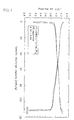
- the charge and discharge characteristics of the cells in the early cycles were illustrated in Fig. 1.
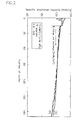
- the cycle life characteristics of the cells were illustrated in Fig. 2.
- the charge and discharge characteristic of the cell according to Example 1 is indicated by a parenthesized alphabetic symbol "(a)” and that of the cell according to Comparative Example 1 is indicated by another symbol "(b)".
- the cell according to Example 1 exhibited a slightly lower specific capacity but a better cycle life characteristic at ambient temperatures than the cell according to Comparative Example 1.
- the cell according to Example 1 even when the charge and discharge operations of the cells are cycled at a high temperature of about 50°C, the cell according to Example 1, as shown in Fig. 3, exhibited a far better cycle life characteristic than the cell according to Comparative Example 1. It is presumed that the good cycle life characteristic of the cell is resulted because the vanadium pentoxide layer coated on the surface of the manganese-based active material component prevents elution of manganese to the electrolyte.
- the cells fabricated according to Examples 2 to 4 also exhibited the desired performance characteristic similar to that of Example 1.
- a secondary ion mass spectrometry (SIMS) analysis was performed with respect to the positive active material prepared according to Example 1 to measure the component distribution ratio.
- the result was illustrated in Fig. 4.
- the relative intensity of the vanadium component is indicated by a parenthesized alphabetic symbol "(a)” and that of the manganese component is indicated by another symbol "(b)”.
- Fig. 4 it could be known that the vanadium component existed more in the surface portion of the active material and the manganese component existed more in the center portion of the active material. This proved that the overall surface of LiMn 2 O 4 was completely coated with vanadium pentoxide.
- the positive active material for rechargeable lithium batteries has a good high-temperature cycle life characteristic.
Landscapes
- Chemical & Material Sciences (AREA)
- Chemical Kinetics & Catalysis (AREA)
- Electrochemistry (AREA)
- General Chemical & Material Sciences (AREA)
- Inorganic Chemistry (AREA)
- Engineering & Computer Science (AREA)
- Manufacturing & Machinery (AREA)
- Materials Engineering (AREA)
- Battery Electrode And Active Subsutance (AREA)
- Secondary Cells (AREA)
Abstract
Description
- The present invention relates to a positive active material for rechargeable lithium batteries and a method of preparing the same and, more particularly, to a manganese-based positive active material for rechargeable lithium batteries which has a good cycle life characteristic.
- Generally, manganese-based compounds such as LiMn2O4 and LiMnO2 are the positive active material of choice for rechargeable lithium batteries because of their low cost, abundance and environmentally friendly characteristics. Among such manganese-based compounds, LiMn2O4 is particularly stable for the battery use and thus attractive for the electric vehicle application.
- However, as compared to other lithiated transition metal oxides such as LiCoO2 and LiNiO2, LiMn2O4 has a relatively low discharge capacity. Furthermore, when high rate of charge and discharge operations are cycled, the discharge capacity is excessively reduced. In particular, when the charge and discharge operations are continuously performed at high temperatures, manganese distributed in the surface of LiMn2O4 readily elutes to the electrolyte, causing a disproportionation reaction. This reaction seriously deteriorates the cycle life characteristic of the battery.
- It is an object of the present invention to provide a manganese-based positive active material for rechargeable lithium batteries which exhibits a good cycle life characteristic at high temperatures.
- This and other objects may be achieved by a positive active material for rechargeable lithium batteries including an active material component processed from a manganese-based compound. The manganese-based compound is selected from LixMnO2, LixMnF2, LixMnS2, LixMnO2-zFz, LixMnO2-zSz, Lixmn1-yMyO2, LixMn1-yMyF2, LixMn1-yMyS2, LixMn1-yMyO2-zFz, LixMn1-yMyO2-zSz, LixMn2O4, LixMn2F4, LixMn2S4, LixMn2O4-zFz, LixMn2O4-zSz, LixMn2-yMyO4, LixMn2- yMyF4, LixMn2-yMyS4, LixMn2-yMyO4-zFz, or LixMn2-yMyO4-zSz where 0<x≤1.5, 0.05≤y≤0.3, z≤1.0 and M is selected from Al, Co, Cr, Mg, Fe, La, Sr or Ce. A vanadium pentoxide is coated on the active material component.
- A method of preparing the positive active material is performed by obtaining a powder from a source material. The source material is selected from LixMnO2, LixMnF2, LixMnS2, LixMnO2-zFz, LixMnO2-zSz, LixMn1-yMyO2, LixMn1- yMyF2, LixMn1-yMyS2, LixMn1-yMyO2-zFz, LixMn1-yMyO2-zSz, LixMn2O4, LixMn2F4, LixMn2S4, LixMn2O4-zFz, LixMn2O4-zSz, LixMn2-yMyO4, LixMn2-yMyF4, LixMn2-yMyS4, LixMn2-yMyO4-zFz, or LixMn2-yMyO4-zSz, where 0<x≤1.5, 0.05≤y≤0.3, z≤1.0 and M is selected from Al, Co, Cr, Mg, Fe, La, Sr or Ce. The powder is then coated with a vanadium pentoxide (V2O5) aqueous solution or a V2O5 alcoholic solution to make a V2O5 solution-coated powder. Thereafter, the V2O5 solution-coated powder is heat-treated to thereby prepare a V2O5-coated active material.
- A more complete appreciation of the invention, and many of the attendant advantages thereof, will be readily apparent as the same becomes better understood by reference to the following detailed description when considered in conjunction with the accompanying drawings, wherein:
- Fig. 1 is a graph illustrating charge and discharge characteristics of rechargeable lithium cells according to an example of the present invention and a comparative example;
- Fig. 2 is a graph illustrating ambient-temperature cycle life characteristics of the rechargeable lithium cells of Fig. 1;
- Fig. 3 is a graph illustrating high-temperature cycle life characteristics of the rechargeable lithium cells of Fig. 1; and
- Fig. 4 is a graph illustrating SIMS analysis results with respect to the rechargeable lithium cell of Fig. 1 according to the example.
-
- In a method of preparing a positive active material for rechargeable lithium batteries, a powder, being an active material precursor, is first processed from a manganese-based compound. The manganese-based compound is selected from LixMnO2, LixMnF2, LixMnS2, LixMnO2-zFz, LixMnO2-zSz, LixMn1-yMyO2, LixMn1-yMyF2, LixMn1-yMyS2, LixMn1-yMyO2-zFz, LixMn1-yMyO2-zSz, LixMn2O4, LixMn2F4, LixMn2S4, LixMn2O4-zFz, LixMn2O4-zSz, LixMn2-yMyO4, LixMn2- yMyF4, LixMn2-yMyS4, LixMn2-yMyO4-zFz, or LixMn2-yMyO4-zSz, where 0<x≤1.5, 0.05≤y≤0.3, z≤1.0 and M is selected from Al, Co, Cr, Mg, Fe, La, Sr, Ce or other transition or lanthanide metals. The powder processing step can be performed with a technique known in the related art.
- Thereafter, the powder is coated with a vanadium pentoxide (V2O5) aqueous solution or a vanadium pentoxide alcoholic solution. The vanadium pentoxide aqueous solution or the vanadium pentoxide alcoholic solution preferably contains 0.1 to 30 weight percent of vanadium pentoxide. The vanadium pentoxide aqueous solution may be formed by mixing and refluxing water and vanadium oxide. In contrast, the vanadium pentoxide alcoholic solution may be formed by mixing and refluxing alcohol and vanadium pentoxide. The alcohol is preferably selected from methanol or ethanol. When vanadium pentoxide is less than 0.1 weight percent of water or alcohol, the coating effect of the vanadium pentoxide solution onto the powder is not induced. In contrast, when vanadium pentoxide is more than 30 weight percent of water or alcohol, the coating layer of the vanadium pentoxide solution becomes undesirably thick. A sputtering technique, a chemical vapor deposition (CVD) technique, a dip coating technique and other general-purpose coating techniques may be employed for the coating use. Among the techniques, the dip coating technique may be preferably used for coating the metallic alkoxide solution onto the powder.
- The vanadium pentoxide solution-coated powder is then heat-treated at temperatures ranged from 100 to 1000°C for 1 to 20 hours under an oxidation atmosphere where dry air or oxygen is blowing. As a result, a vanadium pentoxide-coated active material is prepared. When the heat-treating temperature is lower than 100°C, the vanadium pentoxide solution coated on the powder is not crystallized so that it prohibits free movement of lithium ions in the active material.
- The vanadium pentoxide formed on the surface of the power may be derived from a single source of the vanadium pentoxide solution or composite sources of manganese of lithiated transition metal compound and the vanadium pentoxide solution. It is preferable that the thickness of the vanadium pentoxide layer reaches up to 1 to 100nm.
- This vanadium pentoxide coating method may be also applied to cobalt-based active material such as LiCoO2 and LiCo1-xMxO2 where x≥0 and M is metal, and nickel-based active material such as LiNiO2, LiNi1-xMxO2 where x≥0 and M is metal. However, in these applications, cobalt or nickel is liable to elute to an electrolyte.
- The following examples further illustrate the present invention.
- A vanadium pentoxide (V2O5) solution was prepared by dissolving a 1g of vanadium pentoxide powder in per 100g of distilled water. The 50 ml of vanadium pentoxide solution was then mixed with per a 100g of LiMn2O4 powder such that an overall surface of the power became wet sufficiently by the solution, and dried. Thereafter, the dried mixture was heat-treated at about 600°C for about 10 hours under a dry air atmosphere to thereby prepare a vanadium pentoxide-coated active material. Then, the active material was mixed with Super P carbon for a conductive agent, KF-1300 polyvinylidene fluoride for a binder and N-methylpyrrolidone for a solvent to prepare an active material slurry. The slurry is cast into a tape shape to act as a positive electrode. The positive electrode is then assembled with a lithium metal foil for an opposite pole by using a lithium salt solution for an electrolyte to thereby fabricate a coin cell-type half cell. The lithium salt solution contained 1:1 volume ratio of ethylene carbonate and dimethyl carbonate for a solvent and LiPF6 for a solute.
- The positive electrode preparing procedure was performed in the same way as in Example 1 with the exception that the heat-treating operation was performed at about 200°C. A coin-type half cell was fabricated with the resulting positive electrode in combination with other components as described in Example 1.
- A vanadium pentoxide (V2O5) solution was prepared by dissolving a 1g of vanadium pentoxide powder in per 100g of distilled water. The 50 ml of vanadium pentoxide solution was then mixed with per a 100g of LixMn2-yAlyO4- zFz powder where 0<x≤1.5, 0.05≤y≤0.3, z≤1.0 (Bell Communication Research, Inc.) such that an overall surface of the power became wet sufficiently by the solution, and dried. Thereafter, the dried mixture was heat-treated at about 200°C for about 10 hours under a dry air atmosphere to thereby prepare a vanadium pentoxide-coated active material. Then, the active material was mixed with Super P carbon for a conductive agent, KF-1300 polyvinylidene fluoride for a binder and N-methylpyrrolidone for a solvent to prepare an active material slurry. The slurry is cast into a tape shape to act as a positive electrode. The positive electrode is then assembled with a lithium metal foil for an opposite pole by using a lithium salt solution for an electrolyte to thereby fabricate a coin cell-type half cell. The lithium salt solution contained 1:1 volume ratio of ethylene carbonate and dimethyl carbonate for a solvent and LiPF6 for a solute.
- The positive electrode preparing procedure was performed in the same way as in Example 3 with the exception that the heat-treating operation was performed at about 600°C. A coin-type half cell was fabricated with the resulting positive electrode in combination with other components as described in Example 3.
- The positive electrode preparing procedure was performed in the same way as in Example 1 with the exception that the LiMn2O4 powder was directly used for the active material without the vanadium pentoxide coating operation. A coin-type half cell was fabricated with the resulting positive electrode in combination with other components as described in Example 1.
- The positive electrode preparing procedure was performed in the same way as in Example 3 with the exception that the LixMn2-yAlyO4-zFz powder was directly used for the active material without the vanadium pentoxide coating operation. A coin-type half cell was fabricated with the resulting positive electrode in combination with other components as described in Example 3.
- The coin type cells fabricated according to Example 1 and Comparative Example 1 were charged and discharged at 25°C from 0.1C to 1C rate over the voltage window between 4.3V and 3.0V. The charge and discharge characteristics of the cells in the early cycles were illustrated in Fig. 1. Further, the cycle life characteristics of the cells were illustrated in Fig. 2. In each of the figures, the charge and discharge characteristic of the cell according to Example 1 is indicated by a parenthesized alphabetic symbol "(a)" and that of the cell according to Comparative Example 1 is indicated by another symbol "(b)". As shown in Figs. 1 and 2, the cell according to Example 1 exhibited a slightly lower specific capacity but a better cycle life characteristic at ambient temperatures than the cell according to Comparative Example 1. In addition, even when the charge and discharge operations of the cells are cycled at a high temperature of about 50°C, the cell according to Example 1, as shown in Fig. 3, exhibited a far better cycle life characteristic than the cell according to Comparative Example 1. It is presumed that the good cycle life characteristic of the cell is resulted because the vanadium pentoxide layer coated on the surface of the manganese-based active material component prevents elution of manganese to the electrolyte. The cells fabricated according to Examples 2 to 4 also exhibited the desired performance characteristic similar to that of Example 1.
- Meanwhile, a secondary ion mass spectrometry (SIMS) analysis was performed with respect to the positive active material prepared according to Example 1 to measure the component distribution ratio. The result was illustrated in Fig. 4. In the figure, the relative intensity of the vanadium component is indicated by a parenthesized alphabetic symbol "(a)" and that of the manganese component is indicated by another symbol "(b)". As shown in Fig. 4, it could be known that the vanadium component existed more in the surface portion of the active material and the manganese component existed more in the center portion of the active material. This proved that the overall surface of LiMn2O4 was completely coated with vanadium pentoxide.
- As described above, the positive active material for rechargeable lithium batteries has a good high-temperature cycle life characteristic.
- While the present invention has been described in detail with reference to the preferred embodiments, those skilled in the art will appreciate that various modifications and substitutions can be made thereto without departing from the spirit and scope of the present invention as set forth in the appended claims.
Claims (5)
- A positive active material for rechargeable lithium batteries, the positive active material comprising:an active material component processed from a manganese-based compound, the manganese-based compound being selected from the group consisting of LixMnO2, LixMnF2, LixMnS2, LixMnO2-zFz, LixMnO2-zSz, LixMn1-yMyO2, LixMn1-yMyF2, LixMn1-yMyS2, LixMn1-yMyO2-zFz, LixMn1-yMyO2-zSz, LixMn2O4, LixMn2F4, LixMn2S4, LixMn2O4-zFz, LixMn2O4-zSz, LixMn2-yMyO4, LixMn2-yMyF4, LixMn2-yMyS4, LixMn2-yMyO4-zFz, and LixMn2-yMyO4-zSz where 0<x≤1.5, 0.05≤y≤0.3, z≤1.0 and M is selected from the group consisting of Al, Co, Cr, Mg, Fe, La, Sr and Ce; anda vanadium pentoxide (V2O5) coated on the active material component.
- The positive active material of claim 1 wherein the vanadium pentoxide has a thickness ranged from 1 to 100nm.
- A method of preparing a positive active material for rechargeable lithium batteries, the method comprising the steps of:obtaining a powder from a source material, the source material being selected from the group consisting of LixMnO2, LixMnF2, LixMnS2, LixMnO2-zFz, LixMnO2-zSz, LixMn1-yMyO2, LixMn1-yMyF2, LixMn1-yMyS2, LixMn1-yMyO2-zFz, LixMn1- yMyO2-zSz, LixMn2O4, LixMn2F4, LixMn2S4, LixMn2O4-zFz, LixMn2O4-zSz, LixMn2-yMyO4, LixMn2-yMyF4, LixMn2-yMyS4, LixMn2-yMyO4-zFz, and LixMn2-yMyO4-zSz where 0<x≤1.5, 0.05≤y≤0.3, z≤1.0 and M is selected from the group consisting of Al, Co, Cr, Mg, Fe, La, Sr and Ce;coating the powder with a vanadium pentoxide aqueous solution or a vanadium pentoxide alcoholic solution to make an vanadium pentoxide solution-coated powder; andheat-treating the vanadium pentoxide solution-coated powder to prepare a vanadium pentoxide-coated active material.
- The method of claim 3 wherein the vanadium pentoxide aqueous solution or the vanadium pentoxide alcoholic solution contains a 0.1 to 30 weight percent of vanadium component.
- The method of claim 3 wherein the heat-treating step is performed at temperatures ranged from 100 to 1000°C for 1 to 20 hours.
Applications Claiming Priority (2)
| Application Number | Priority Date | Filing Date | Title |
|---|---|---|---|
| KR1019990007973A KR100326457B1 (en) | 1999-03-10 | 1999-03-10 | A positive active material for a lithium secondary battery and a method of preparing the same |
| KR9907973 | 1999-03-10 |
Publications (2)
| Publication Number | Publication Date |
|---|---|
| EP1035601A1 true EP1035601A1 (en) | 2000-09-13 |
| EP1035601B1 EP1035601B1 (en) | 2011-05-18 |
Family
ID=19576152
Family Applications (1)
| Application Number | Title | Priority Date | Filing Date |
|---|---|---|---|
| EP99402595A Expired - Lifetime EP1035601B1 (en) | 1999-03-10 | 1999-10-20 | Positive active material for rechargeable lithium battery and method of preparing same |
Country Status (5)
| Country | Link |
|---|---|
| US (1) | US6183911B1 (en) |
| EP (1) | EP1035601B1 (en) |
| JP (1) | JP3917793B2 (en) |
| KR (1) | KR100326457B1 (en) |
| CN (1) | CN1150645C (en) |
Cited By (2)
| Publication number | Priority date | Publication date | Assignee | Title |
|---|---|---|---|---|
| CN102569870A (en) * | 2011-12-05 | 2012-07-11 | 深圳市中星动力电池技术有限公司 | Multi-element nano vanadium power battery |
| CN102637871A (en) * | 2012-04-19 | 2012-08-15 | 中南大学 | A kind of preparation method of lithium ion active oxide V2O5 coated lithium ion positive electrode material |
Families Citing this family (47)
| Publication number | Priority date | Publication date | Assignee | Title |
|---|---|---|---|---|
| KR100309773B1 (en) * | 1999-06-17 | 2001-11-01 | 김순택 | Positive active material for lithium secondary battery and method of preparing the same |
| US7138209B2 (en) * | 2000-10-09 | 2006-11-21 | Samsung Sdi Co., Ltd. | Positive active material for rechargeable lithium battery and method of preparing same |
| US7276314B2 (en) * | 2000-12-22 | 2007-10-02 | Fmc Corporation | Lithium metal dispersion in secondary battery anodes |
| US8980477B2 (en) * | 2000-12-22 | 2015-03-17 | Fmc Corporation | Lithium metal dispersion in secondary battery anodes |
| KR100420050B1 (en) * | 2001-10-19 | 2004-02-25 | 삼성에스디아이 주식회사 | Manganese-based positive active material for lithium secondary battery and method of preparing same |
| FR2831993A1 (en) * | 2001-11-08 | 2003-05-09 | Cit Alcatel | HIGH VOLTAGE LITHIUM INSERTION COMPOUND FOR USE AS A CATHODIC ACTIVE SUBSTANCE OF RECHARGEABLE LITHIUM ELECTROCHEMICAL GENERATOR |
| US20030108790A1 (en) * | 2001-12-05 | 2003-06-12 | Arumugam Manthiram | Surface/chemically modified oxide cathodes for lithium-ion batteries |
| KR100437340B1 (en) * | 2002-05-13 | 2004-06-25 | 삼성에스디아이 주식회사 | Method of preparing positive active material for rechargeable lithium battery |
| KR100533095B1 (en) * | 2003-04-09 | 2005-12-01 | 주식회사 엘지화학 | The cathode active material comprising the overdischarge retardant and the lithium secondary battery using the same |
| US20050130043A1 (en) * | 2003-07-29 | 2005-06-16 | Yuan Gao | Lithium metal dispersion in electrodes |
| GB0318942D0 (en) * | 2003-08-13 | 2003-09-17 | Aea Technology Battery Systems | Process for producing an electrode |
| KR100666821B1 (en) | 2004-02-07 | 2007-01-09 | 주식회사 엘지화학 | Electrode with organic / inorganic composite porous coating layer and electrochemical device comprising the same |
| US7476467B2 (en) * | 2004-03-29 | 2009-01-13 | Lg Chem, Ltd. | Lithium secondary battery with high power |
| US8231810B2 (en) | 2004-04-15 | 2012-07-31 | Fmc Corporation | Composite materials of nano-dispersed silicon and tin and methods of making the same |
| US7960057B2 (en) * | 2004-05-17 | 2011-06-14 | Toyota Motor Engineering & Manufacturing North America, Inc. | Battery with molten salt electrolyte and phosphorus-containing cathode |
| KR20050114516A (en) * | 2004-06-01 | 2005-12-06 | 브이케이 주식회사 | Positive electrode active material for lithium ion secondary cell coated hetero metal oxide on the surface and lithium ion secondary cell comprising it |
| GB0414161D0 (en) * | 2004-06-24 | 2004-07-28 | Aea Technology Battery Systems | Anode for lithium ion cell |
| EP1784876B1 (en) | 2004-09-02 | 2018-01-24 | LG Chem, Ltd. | Organic/inorganic composite porous film and electrochemical device prepared thereby |
| CN100373671C (en) * | 2005-01-19 | 2008-03-05 | 湖南瑞翔新材料有限公司 | Lithium-ion battery cathode material lithium manganese cobalt oxide and preparation method thereof |
| US7771874B2 (en) * | 2005-06-29 | 2010-08-10 | Fmc Corporation | Lithium manganese compounds and methods of making the same |
| US7588623B2 (en) * | 2005-07-05 | 2009-09-15 | Fmc Corporation Lithium Division | Stabilized lithium metal powder for li-ion application, composition and process |
| US20070190422A1 (en) * | 2006-02-15 | 2007-08-16 | Fmc Corporation | Carbon nanotube lithium metal powder battery |
| KR101264332B1 (en) * | 2006-09-20 | 2013-05-14 | 삼성에스디아이 주식회사 | Cathode active material and lithium battery using the same |
| US20090035663A1 (en) | 2006-10-13 | 2009-02-05 | Fmc Corporation, Lithium Division | Stabilized lithium metal powder for li-ion application, composition and process |
| KR100966024B1 (en) | 2007-04-24 | 2010-06-24 | 주식회사 엘지화학 | Electrochemical device with heterogeneous separator |
| US8021496B2 (en) * | 2007-05-16 | 2011-09-20 | Fmc Corporation | Stabilized lithium metal powder for Li-ion application, composition and process |
| US20090061321A1 (en) * | 2007-08-31 | 2009-03-05 | Fmc Corporation, Lithium Division | Stabilized lithium metal powder for li-ion application, composition and process |
| KR101430615B1 (en) | 2007-09-19 | 2014-08-14 | 삼성에스디아이 주식회사 | Cathode and lithium battery employing it |
| KR100927244B1 (en) * | 2007-10-13 | 2009-11-16 | 주식회사 엘지화학 | Cathode Active Material for Lithium Secondary Battery |
| KR100889622B1 (en) * | 2007-10-29 | 2009-03-20 | 대정이엠(주) | Highly stable positive electrode active material for lithium secondary battery, manufacturing method thereof and lithium secondary battery comprising same |
| JP2010027482A (en) * | 2008-07-23 | 2010-02-04 | Sony Corp | Method for manufacturing positive electrode active material and positive electrode active material |
| US20110135810A1 (en) * | 2009-12-03 | 2011-06-09 | Marina Yakovleva | Finely deposited lithium metal powder |
| KR101124238B1 (en) * | 2009-12-07 | 2012-03-27 | 문무 주식회사 | A positive active material for lithium secondarybattery and a method of preparing the same |
| JP5382061B2 (en) | 2010-06-22 | 2014-01-08 | 日亜化学工業株式会社 | Positive electrode composition for non-aqueous electrolyte secondary battery and positive electrode slurry using the positive electrode composition |
| CN102145329B (en) * | 2011-03-14 | 2012-12-19 | 中航锂电(洛阳)有限公司 | Slurry mixing process of lithium ion battery electrode slurry |
| KR101275789B1 (en) * | 2011-07-05 | 2013-06-17 | 삼성에스디아이 주식회사 | Positive electrode for rechargeable lithium battery and rechargeable lithium battery |
| US8920925B2 (en) | 2012-11-09 | 2014-12-30 | Corning Incorporated | Stabilized lithium composite particles |
| US9183994B2 (en) | 2012-11-28 | 2015-11-10 | Corning Incorporated | Lithium ion capacitors and methods of production |
| KR20140089244A (en) | 2013-01-04 | 2014-07-14 | 삼성에스디아이 주식회사 | Positive electrode composition for rechargable lithium battery, positive electrode prepared from the composition, and recharable lithium battery including the positive electrode |
| CN105050960A (en) | 2013-02-01 | 2015-11-11 | 特罗诺克斯有限公司 | Improved lithium manganese oxide compositions |
| KR20140109698A (en) * | 2013-03-06 | 2014-09-16 | 삼성에스디아이 주식회사 | Positive active material composition for rechargeable lithium battery, positive electrode for rechargeable lithium battery including same and rechargeable lithium battery including same |
| KR101601917B1 (en) | 2014-02-11 | 2016-03-09 | 울산과학기술원 | Positive active material for rechargeable lithium battery, method for manufacturing the same, and rechargeable lithium battery including the same |
| CN103794753B (en) * | 2014-03-12 | 2016-03-30 | 合肥国轩高科动力能源有限公司 | A kind of lithium-ion battery composite cathode material and preparation method thereof |
| CN106058166B (en) * | 2015-04-02 | 2021-08-10 | 松下知识产权经营株式会社 | Battery and positive electrode material for battery |
| RU2702785C1 (en) * | 2018-08-29 | 2019-10-14 | Автономная некоммерческая образовательная организация высшего образования "Сколковский институт науки и технологий" | PROTECTIVE SPINEL COATING FOR Ni-Mn-Co (NMC) CATHODE WITH HIGH Li CONTENT FOR LITHIUM-ION BATTERIES, METHOD OF APPLYING SAID COATING ON CATHODE AND CATHODE WITH SAID COATING |
| EP4203104B1 (en) * | 2021-10-13 | 2025-06-04 | Contemporary Amperex Technology (Hong Kong) Limited | Secondary battery, battery module, battery pack and electrical apparatus having same |
| CN121816641A (en) * | 2023-09-01 | 2026-04-07 | 株式会社Lg化学 | Positive electrode active materials, their preparation methods, and positive electrodes and lithium secondary batteries containing them. |
Citations (3)
| Publication number | Priority date | Publication date | Assignee | Title |
|---|---|---|---|---|
| JPS62119867A (en) * | 1985-11-20 | 1987-06-01 | Matsushita Electric Ind Co Ltd | Manufacture of active material for positive electrode of battery with organic electrolytic solution |
| JPH09293508A (en) * | 1996-04-25 | 1997-11-11 | Sony Corp | Positive electrode material for lithium secondary battery, method for producing the same, and non-aqueous electrolyte secondary battery using the same |
| JPH1171114A (en) * | 1997-06-24 | 1999-03-16 | Kao Corp | Method for producing positive electrode active material for secondary battery |
Family Cites Families (6)
| Publication number | Priority date | Publication date | Assignee | Title |
|---|---|---|---|---|
| JPS52137640A (en) * | 1976-05-14 | 1977-11-17 | Seiko Instr & Electronics | Alkaline battery |
| JPS5391333A (en) * | 1977-01-20 | 1978-08-11 | Hitachi Maxell | Silver*ii* oxide battery |
| JPS53107625A (en) * | 1977-03-02 | 1978-09-19 | Kanshiyou Kikinzoku Kakou Kk | Method of manufacturing positive electrode active material for silver peroxide battery |
| JP2575993B2 (en) * | 1992-03-31 | 1997-01-29 | 新技術事業団 | Non-aqueous electrolyte secondary battery |
| EP0851515A3 (en) * | 1996-12-27 | 2004-10-27 | Canon Kabushiki Kaisha | Powdery material, electrode member, method for manufacturing same and secondary cell |
| US6037095A (en) * | 1997-03-28 | 2000-03-14 | Fuji Photo Film Co., Ltd. | Non-aqueous lithium ion secondary battery |
-
1999
- 1999-03-10 KR KR1019990007973A patent/KR100326457B1/en not_active Expired - Fee Related
- 1999-10-20 EP EP99402595A patent/EP1035601B1/en not_active Expired - Lifetime
- 1999-10-28 CN CNB991231996A patent/CN1150645C/en not_active Expired - Fee Related
- 1999-10-29 US US09/429,259 patent/US6183911B1/en not_active Expired - Lifetime
-
2000
- 2000-03-10 JP JP2000067665A patent/JP3917793B2/en not_active Expired - Fee Related
Patent Citations (3)
| Publication number | Priority date | Publication date | Assignee | Title |
|---|---|---|---|---|
| JPS62119867A (en) * | 1985-11-20 | 1987-06-01 | Matsushita Electric Ind Co Ltd | Manufacture of active material for positive electrode of battery with organic electrolytic solution |
| JPH09293508A (en) * | 1996-04-25 | 1997-11-11 | Sony Corp | Positive electrode material for lithium secondary battery, method for producing the same, and non-aqueous electrolyte secondary battery using the same |
| JPH1171114A (en) * | 1997-06-24 | 1999-03-16 | Kao Corp | Method for producing positive electrode active material for secondary battery |
Non-Patent Citations (3)
| Title |
|---|
| PATENT ABSTRACTS OF JAPAN vol. 011, no. 338 (E - 553) 5 November 1987 (1987-11-05) * |
| PATENT ABSTRACTS OF JAPAN vol. 1998, no. 03 27 February 1998 (1998-02-27) * |
| PATENT ABSTRACTS OF JAPAN vol. 1999, no. 08 30 June 1999 (1999-06-30) * |
Cited By (2)
| Publication number | Priority date | Publication date | Assignee | Title |
|---|---|---|---|---|
| CN102569870A (en) * | 2011-12-05 | 2012-07-11 | 深圳市中星动力电池技术有限公司 | Multi-element nano vanadium power battery |
| CN102637871A (en) * | 2012-04-19 | 2012-08-15 | 中南大学 | A kind of preparation method of lithium ion active oxide V2O5 coated lithium ion positive electrode material |
Also Published As
| Publication number | Publication date |
|---|---|
| CN1150645C (en) | 2004-05-19 |
| KR20000059999A (en) | 2000-10-16 |
| EP1035601B1 (en) | 2011-05-18 |
| JP2000268812A (en) | 2000-09-29 |
| CN1267096A (en) | 2000-09-20 |
| JP3917793B2 (en) | 2007-05-23 |
| KR100326457B1 (en) | 2002-02-28 |
| US6183911B1 (en) | 2001-02-06 |
Similar Documents
| Publication | Publication Date | Title |
|---|---|---|
| EP1035601B1 (en) | Positive active material for rechargeable lithium battery and method of preparing same | |
| EP1035600B1 (en) | Method of preparing a positive active material for rechargeable lithium battery | |
| US10424792B2 (en) | Lipon coatings for high voltage and high temperature Li-ion battery cathodes | |
| US6756155B1 (en) | Positive active material for rechargeable lithium batteries and method of preparing same | |
| USRE42433E1 (en) | Positive active material for rechargeable lithium battery and method of preparing same | |
| US6984469B2 (en) | Positive active material for rechargeable lithium batteries and method of preparing same | |
| EP2541654B1 (en) | High-capacity positive electrode active material and lithium secondary battery comprising same | |
| JP5232631B2 (en) | Non-aqueous electrolyte battery | |
| US20080070122A1 (en) | Cathode active material and lithium battery employing the same | |
| US20030003352A1 (en) | Positive electrode for rechargeable lithium batteries and method of the same | |
| JP4458232B2 (en) | Positive electrode for lithium ion secondary battery and lithium ion secondary battery | |
| KR20240037782A (en) | Lithium secondary battery and method of operation thereof | |
| JP3530174B2 (en) | Positive electrode active material and lithium ion secondary battery | |
| KR101667967B1 (en) | Cathode slurry for electrochemical device, cathode manufactured using the slurry, and a method of making the cathode | |
| KR20020036283A (en) | Lithium secondary battery | |
| US10804527B2 (en) | Positive electrode active material for rechargeable lithium battery, method for manufacturing same, and rechargeable lithium battery including same | |
| KR101640277B1 (en) | Positive electrode for lithium rechargeable battery and lithium rechargeable battery comprising the same | |
| KR100420050B1 (en) | Manganese-based positive active material for lithium secondary battery and method of preparing same | |
| CN111106340A (en) | A kind of lithium ion battery cathode material and its preparation and application | |
| KR20060119382A (en) | Cathode active material for lithium secondary battery coated with dissimilar metal oxide and lithium secondary battery comprising same | |
| JPH04181660A (en) | Nonaqueous secondary battery | |
| JP2006173096A (en) | Organic electrolyte battery |
Legal Events
| Date | Code | Title | Description |
|---|---|---|---|
| PUAI | Public reference made under article 153(3) epc to a published international application that has entered the european phase |
Free format text: ORIGINAL CODE: 0009012 |
|
| AK | Designated contracting states |
Kind code of ref document: A1 Designated state(s): DE FR GB |
|
| AX | Request for extension of the european patent |
Free format text: AL;LT;LV;MK;RO;SI |
|
| 17P | Request for examination filed |
Effective date: 20010119 |
|
| AKX | Designation fees paid |
Free format text: DE FR GB |
|
| 17Q | First examination report despatched |
Effective date: 20040607 |
|
| APBN | Date of receipt of notice of appeal recorded |
Free format text: ORIGINAL CODE: EPIDOSNNOA2E |
|
| APBR | Date of receipt of statement of grounds of appeal recorded |
Free format text: ORIGINAL CODE: EPIDOSNNOA3E |
|
| APAF | Appeal reference modified |
Free format text: ORIGINAL CODE: EPIDOSCREFNE |
|
| APAF | Appeal reference modified |
Free format text: ORIGINAL CODE: EPIDOSCREFNE |
|
| APBT | Appeal procedure closed |
Free format text: ORIGINAL CODE: EPIDOSNNOA9E |
|
| GRAP | Despatch of communication of intention to grant a patent |
Free format text: ORIGINAL CODE: EPIDOSNIGR1 |
|
| GRAS | Grant fee paid |
Free format text: ORIGINAL CODE: EPIDOSNIGR3 |
|
| GRAA | (expected) grant |
Free format text: ORIGINAL CODE: 0009210 |
|
| REG | Reference to a national code |
Ref country code: GB Ref legal event code: FG4D |
|
| REG | Reference to a national code |
Ref country code: DE Ref legal event code: R096 Ref document number: 69943439 Country of ref document: DE Effective date: 20110630 |
|
| PLBE | No opposition filed within time limit |
Free format text: ORIGINAL CODE: 0009261 |
|
| STAA | Information on the status of an ep patent application or granted ep patent |
Free format text: STATUS: NO OPPOSITION FILED WITHIN TIME LIMIT |
|
| 26N | No opposition filed |
Effective date: 20120221 |
|
| REG | Reference to a national code |
Ref country code: DE Ref legal event code: R097 Ref document number: 69943439 Country of ref document: DE Effective date: 20120221 |
|
| REG | Reference to a national code |
Ref country code: FR Ref legal event code: PLFP Year of fee payment: 17 |
|
| PGFP | Annual fee paid to national office [announced via postgrant information from national office to epo] |
Ref country code: FR Payment date: 20150923 Year of fee payment: 17 |
|
| PGFP | Annual fee paid to national office [announced via postgrant information from national office to epo] |
Ref country code: GB Payment date: 20151014 Year of fee payment: 17 Ref country code: DE Payment date: 20151013 Year of fee payment: 17 |
|
| REG | Reference to a national code |
Ref country code: DE Ref legal event code: R119 Ref document number: 69943439 Country of ref document: DE |
|
| GBPC | Gb: european patent ceased through non-payment of renewal fee |
Effective date: 20161020 |
|
| REG | Reference to a national code |
Ref country code: FR Ref legal event code: ST Effective date: 20170630 |
|
| PG25 | Lapsed in a contracting state [announced via postgrant information from national office to epo] |
Ref country code: GB Free format text: LAPSE BECAUSE OF NON-PAYMENT OF DUE FEES Effective date: 20161020 Ref country code: FR Free format text: LAPSE BECAUSE OF NON-PAYMENT OF DUE FEES Effective date: 20161102 Ref country code: DE Free format text: LAPSE BECAUSE OF NON-PAYMENT OF DUE FEES Effective date: 20170503 |