EP1033621A1 - Silver halide color photosensitive material and color image forming method using the same - Google Patents
Silver halide color photosensitive material and color image forming method using the same Download PDFInfo
- Publication number
- EP1033621A1 EP1033621A1 EP00102281A EP00102281A EP1033621A1 EP 1033621 A1 EP1033621 A1 EP 1033621A1 EP 00102281 A EP00102281 A EP 00102281A EP 00102281 A EP00102281 A EP 00102281A EP 1033621 A1 EP1033621 A1 EP 1033621A1
- Authority
- EP
- European Patent Office
- Prior art keywords
- group
- carbon
- alkyl group
- hydrogen atom
- formula
- Prior art date
- Legal status (The legal status is an assumption and is not a legal conclusion. Google has not performed a legal analysis and makes no representation as to the accuracy of the status listed.)
- Granted
Links
- -1 Silver halide Chemical class 0.000 title claims abstract description 176
- 239000000463 material Substances 0.000 title claims abstract description 65
- 229910052709 silver Inorganic materials 0.000 title claims abstract description 56
- 239000004332 silver Substances 0.000 title claims abstract description 56
- 238000000034 method Methods 0.000 title claims description 21
- 125000000217 alkyl group Chemical group 0.000 claims abstract description 100
- 239000000839 emulsion Substances 0.000 claims abstract description 79
- 125000004435 hydrogen atom Chemical group [H]* 0.000 claims abstract description 75
- 125000003118 aryl group Chemical group 0.000 claims abstract description 40
- 125000001997 phenyl group Chemical group [H]C1=C([H])C([H])=C(*)C([H])=C1[H] 0.000 claims abstract description 28
- 125000004432 carbon atom Chemical group C* 0.000 claims abstract description 24
- 125000001424 substituent group Chemical group 0.000 claims abstract description 22
- 125000005843 halogen group Chemical group 0.000 claims abstract description 11
- 229910052799 carbon Inorganic materials 0.000 claims description 129
- 150000001875 compounds Chemical class 0.000 claims description 119
- 238000011161 development Methods 0.000 claims description 31
- 238000012545 processing Methods 0.000 claims description 21
- YZCKVEUIGOORGS-IGMARMGPSA-N Protium Chemical compound [1H] YZCKVEUIGOORGS-IGMARMGPSA-N 0.000 claims description 10
- 229910006074 SO2NH2 Inorganic materials 0.000 claims description 10
- 125000004453 alkoxycarbonyl group Chemical group 0.000 claims description 8
- 229910052801 chlorine Inorganic materials 0.000 claims description 7
- 125000001495 ethyl group Chemical group [H]C([H])([H])C([H])([H])* 0.000 claims description 7
- 125000002496 methyl group Chemical group [H]C([H])([H])* 0.000 claims description 7
- 125000003178 carboxy group Chemical group [H]OC(*)=O 0.000 claims description 6
- 125000000753 cycloalkyl group Chemical group 0.000 claims description 6
- WKBOTKDWSSQWDR-UHFFFAOYSA-N Bromine atom Chemical group [Br] WKBOTKDWSSQWDR-UHFFFAOYSA-N 0.000 claims description 5
- 125000001309 chloro group Chemical group Cl* 0.000 claims description 5
- 125000001449 isopropyl group Chemical group [H]C([H])([H])C([H])(*)C([H])([H])[H] 0.000 claims description 5
- 125000004123 n-propyl group Chemical group [H]C([H])([H])C([H])([H])C([H])([H])* 0.000 claims description 4
- 125000002947 alkylene group Chemical group 0.000 claims description 3
- 150000001721 carbon Chemical group 0.000 claims description 2
- 239000010410 layer Substances 0.000 description 89
- XLYOFNOQVPJJNP-UHFFFAOYSA-N water Substances O XLYOFNOQVPJJNP-UHFFFAOYSA-N 0.000 description 66
- XEKOWRVHYACXOJ-UHFFFAOYSA-N Ethyl acetate Chemical compound CCOC(C)=O XEKOWRVHYACXOJ-UHFFFAOYSA-N 0.000 description 57
- 238000006243 chemical reaction Methods 0.000 description 50
- WEVYAHXRMPXWCK-UHFFFAOYSA-N Acetonitrile Chemical compound CC#N WEVYAHXRMPXWCK-UHFFFAOYSA-N 0.000 description 48
- 238000009835 boiling Methods 0.000 description 37
- 230000015572 biosynthetic process Effects 0.000 description 33
- BQCADISMDOOEFD-UHFFFAOYSA-N Silver Chemical compound [Ag] BQCADISMDOOEFD-UHFFFAOYSA-N 0.000 description 32
- 238000003786 synthesis reaction Methods 0.000 description 32
- 239000003960 organic solvent Substances 0.000 description 31
- 239000013078 crystal Substances 0.000 description 26
- 108010010803 Gelatin Proteins 0.000 description 25
- 239000008273 gelatin Substances 0.000 description 25
- 229920000159 gelatin Polymers 0.000 description 25
- 235000019322 gelatine Nutrition 0.000 description 25
- 235000011852 gelatine desserts Nutrition 0.000 description 25
- YMWUJEATGCHHMB-UHFFFAOYSA-N Dichloromethane Chemical compound ClCCl YMWUJEATGCHHMB-UHFFFAOYSA-N 0.000 description 24
- HEMHJVSKTPXQMS-UHFFFAOYSA-M Sodium hydroxide Chemical compound [OH-].[Na+] HEMHJVSKTPXQMS-UHFFFAOYSA-M 0.000 description 23
- 239000002904 solvent Substances 0.000 description 23
- OKKJLVBELUTLKV-UHFFFAOYSA-N Methanol Chemical compound OC OKKJLVBELUTLKV-UHFFFAOYSA-N 0.000 description 21
- IAZDPXIOMUYVGZ-WFGJKAKNSA-N Dimethyl sulfoxide Chemical compound [2H]C([2H])([2H])S(=O)C([2H])([2H])[2H] IAZDPXIOMUYVGZ-WFGJKAKNSA-N 0.000 description 20
- CSNNHWWHGAXBCP-UHFFFAOYSA-L magnesium sulphate Substances [Mg+2].[O-][S+2]([O-])([O-])[O-] CSNNHWWHGAXBCP-UHFFFAOYSA-L 0.000 description 17
- 239000003921 oil Substances 0.000 description 17
- VEXZGXHMUGYJMC-UHFFFAOYSA-N Hydrochloric acid Chemical compound Cl VEXZGXHMUGYJMC-UHFFFAOYSA-N 0.000 description 16
- ZMXDDKWLCZADIW-UHFFFAOYSA-N N,N-Dimethylformamide Chemical compound CN(C)C=O ZMXDDKWLCZADIW-UHFFFAOYSA-N 0.000 description 16
- YXFVVABEGXRONW-UHFFFAOYSA-N Toluene Chemical compound CC1=CC=CC=C1 YXFVVABEGXRONW-UHFFFAOYSA-N 0.000 description 15
- 239000000975 dye Substances 0.000 description 15
- 125000000623 heterocyclic group Chemical group 0.000 description 15
- 239000012074 organic phase Substances 0.000 description 15
- QTBSBXVTEAMEQO-UHFFFAOYSA-N Acetic acid Chemical compound CC(O)=O QTBSBXVTEAMEQO-UHFFFAOYSA-N 0.000 description 14
- 239000000203 mixture Substances 0.000 description 14
- CSCPPACGZOOCGX-UHFFFAOYSA-N Acetone Chemical compound CC(C)=O CSCPPACGZOOCGX-UHFFFAOYSA-N 0.000 description 12
- 229910052943 magnesium sulfate Inorganic materials 0.000 description 12
- 235000019341 magnesium sulphate Nutrition 0.000 description 12
- VLKZOEOYAKHREP-UHFFFAOYSA-N n-Hexane Chemical compound CCCCCC VLKZOEOYAKHREP-UHFFFAOYSA-N 0.000 description 12
- 238000004040 coloring Methods 0.000 description 11
- 239000012071 phase Substances 0.000 description 11
- 230000035945 sensitivity Effects 0.000 description 11
- 238000001228 spectrum Methods 0.000 description 11
- 238000005160 1H NMR spectroscopy Methods 0.000 description 10
- MCSKRVKAXABJLX-UHFFFAOYSA-N pyrazolo[3,4-d]triazole Chemical compound N1=NN=C2N=NC=C21 MCSKRVKAXABJLX-UHFFFAOYSA-N 0.000 description 10
- 239000006185 dispersion Substances 0.000 description 9
- WSFSSNUMVMOOMR-UHFFFAOYSA-N Formaldehyde Chemical compound O=C WSFSSNUMVMOOMR-UHFFFAOYSA-N 0.000 description 8
- 239000011229 interlayer Substances 0.000 description 8
- 238000010992 reflux Methods 0.000 description 8
- GEHJYWRUCIMESM-UHFFFAOYSA-L sodium sulfite Chemical compound [Na+].[Na+].[O-]S([O-])=O GEHJYWRUCIMESM-UHFFFAOYSA-L 0.000 description 8
- 238000003756 stirring Methods 0.000 description 8
- 239000000654 additive Substances 0.000 description 7
- 125000003342 alkenyl group Chemical group 0.000 description 7
- WFDIJRYMOXRFFG-UHFFFAOYSA-N Acetic anhydride Chemical compound CC(=O)OC(C)=O WFDIJRYMOXRFFG-UHFFFAOYSA-N 0.000 description 6
- KWYUFKZDYYNOTN-UHFFFAOYSA-M Potassium hydroxide Chemical compound [OH-].[K+] KWYUFKZDYYNOTN-UHFFFAOYSA-M 0.000 description 6
- UIIMBOGNXHQVGW-UHFFFAOYSA-M Sodium bicarbonate Chemical compound [Na+].OC([O-])=O UIIMBOGNXHQVGW-UHFFFAOYSA-M 0.000 description 6
- QAOWNCQODCNURD-UHFFFAOYSA-N Sulfuric acid Chemical compound OS(O)(=O)=O QAOWNCQODCNURD-UHFFFAOYSA-N 0.000 description 6
- 239000002250 absorbent Substances 0.000 description 6
- 230000002745 absorbent Effects 0.000 description 6
- 150000001602 bicycloalkyls Chemical group 0.000 description 6
- XHXFXVLFKHQFAL-UHFFFAOYSA-N phosphoryl trichloride Chemical compound ClP(Cl)(Cl)=O XHXFXVLFKHQFAL-UHFFFAOYSA-N 0.000 description 6
- IOLCXVTUBQKXJR-UHFFFAOYSA-M potassium bromide Chemical compound [K+].[Br-] IOLCXVTUBQKXJR-UHFFFAOYSA-M 0.000 description 6
- BWHMMNNQKKPAPP-UHFFFAOYSA-L potassium carbonate Chemical compound [K+].[K+].[O-]C([O-])=O BWHMMNNQKKPAPP-UHFFFAOYSA-L 0.000 description 6
- FYSNRJHAOHDILO-UHFFFAOYSA-N thionyl chloride Chemical compound ClS(Cl)=O FYSNRJHAOHDILO-UHFFFAOYSA-N 0.000 description 6
- 229960000583 acetic acid Drugs 0.000 description 5
- 230000000996 additive effect Effects 0.000 description 5
- 125000003545 alkoxy group Chemical group 0.000 description 5
- 125000004414 alkyl thio group Chemical group 0.000 description 5
- 125000003917 carbamoyl group Chemical group [H]N([H])C(*)=O 0.000 description 5
- 239000003795 chemical substances by application Substances 0.000 description 5
- 238000011156 evaluation Methods 0.000 description 5
- NLKNQRATVPKPDG-UHFFFAOYSA-M potassium iodide Chemical compound [K+].[I-] NLKNQRATVPKPDG-UHFFFAOYSA-M 0.000 description 5
- 238000003860 storage Methods 0.000 description 5
- 239000004094 surface-active agent Substances 0.000 description 5
- 0 C*=C(*)C(*)=C(C)[C@@](C*(C)=C(C)*)N* Chemical compound C*=C(*)C(*)=C(C)[C@@](C*(C)=C(C)*)N* 0.000 description 4
- 125000004644 alkyl sulfinyl group Chemical group 0.000 description 4
- 125000004390 alkyl sulfonyl group Chemical group 0.000 description 4
- 125000004656 alkyl sulfonylamino group Chemical group 0.000 description 4
- 125000003277 amino group Chemical group 0.000 description 4
- 125000005161 aryl oxy carbonyl group Chemical group 0.000 description 4
- 125000005135 aryl sulfinyl group Chemical group 0.000 description 4
- 125000004391 aryl sulfonyl group Chemical group 0.000 description 4
- 125000005110 aryl thio group Chemical group 0.000 description 4
- 125000004104 aryloxy group Chemical group 0.000 description 4
- 238000004061 bleaching Methods 0.000 description 4
- 238000001816 cooling Methods 0.000 description 4
- 125000004122 cyclic group Chemical group 0.000 description 4
- 125000000392 cycloalkenyl group Chemical group 0.000 description 4
- 150000004683 dihydrates Chemical class 0.000 description 4
- 239000000706 filtrate Substances 0.000 description 4
- 239000007789 gas Substances 0.000 description 4
- 125000000449 nitro group Chemical group [O-][N+](*)=O 0.000 description 4
- 125000001820 oxy group Chemical group [*:1]O[*:2] 0.000 description 4
- 125000005328 phosphinyl group Chemical group [PH2](=O)* 0.000 description 4
- 150000003839 salts Chemical class 0.000 description 4
- 235000010265 sodium sulphite Nutrition 0.000 description 4
- 239000007962 solid dispersion Substances 0.000 description 4
- KEQGZUUPPQEDPF-UHFFFAOYSA-N 1,3-dichloro-5,5-dimethylimidazolidine-2,4-dione Chemical compound CC1(C)N(Cl)C(=O)N(Cl)C1=O KEQGZUUPPQEDPF-UHFFFAOYSA-N 0.000 description 3
- ZWEHNKRNPOVVGH-UHFFFAOYSA-N 2-Butanone Chemical compound CCC(C)=O ZWEHNKRNPOVVGH-UHFFFAOYSA-N 0.000 description 3
- ZAMASFSDWVSMSY-UHFFFAOYSA-N 5-[[4-[3-chloro-5-(trifluoromethyl)pyridin-2-yl]oxy-2-methylphenyl]methyl]-1,3-thiazolidine-2,4-dione Chemical compound C=1C=C(CC2C(NC(=O)S2)=O)C(C)=CC=1OC1=NC=C(C(F)(F)F)C=C1Cl ZAMASFSDWVSMSY-UHFFFAOYSA-N 0.000 description 3
- KCXVZYZYPLLWCC-UHFFFAOYSA-N EDTA Chemical compound OC(=O)CN(CC(O)=O)CCN(CC(O)=O)CC(O)=O KCXVZYZYPLLWCC-UHFFFAOYSA-N 0.000 description 3
- FXHOOIRPVKKKFG-UHFFFAOYSA-N N,N-Dimethylacetamide Chemical compound CN(C)C(C)=O FXHOOIRPVKKKFG-UHFFFAOYSA-N 0.000 description 3
- KEAYESYHFKHZAL-UHFFFAOYSA-N Sodium Chemical compound [Na] KEAYESYHFKHZAL-UHFFFAOYSA-N 0.000 description 3
- ZMANZCXQSJIPKH-UHFFFAOYSA-N Triethylamine Chemical compound CCN(CC)CC ZMANZCXQSJIPKH-UHFFFAOYSA-N 0.000 description 3
- 125000002252 acyl group Chemical group 0.000 description 3
- 125000004442 acylamino group Chemical group 0.000 description 3
- 125000004423 acyloxy group Chemical group 0.000 description 3
- 125000006193 alkinyl group Chemical group 0.000 description 3
- 125000004466 alkoxycarbonylamino group Chemical group 0.000 description 3
- 125000005194 alkoxycarbonyloxy group Chemical group 0.000 description 3
- 125000006598 aminocarbonylamino group Chemical group 0.000 description 3
- 125000004397 aminosulfonyl group Chemical group NS(=O)(=O)* 0.000 description 3
- 125000002490 anilino group Chemical group [H]N(*)C1=C([H])C([H])=C([H])C([H])=C1[H] 0.000 description 3
- 125000005162 aryl oxy carbonyl amino group Chemical group 0.000 description 3
- 125000005200 aryloxy carbonyloxy group Chemical group 0.000 description 3
- 125000000751 azo group Chemical group [*]N=N[*] 0.000 description 3
- XTHPWXDJESJLNJ-UHFFFAOYSA-N chlorosulfonic acid Substances OS(Cl)(=O)=O XTHPWXDJESJLNJ-UHFFFAOYSA-N 0.000 description 3
- 239000011248 coating agent Substances 0.000 description 3
- 238000000576 coating method Methods 0.000 description 3
- 230000000052 comparative effect Effects 0.000 description 3
- 239000010779 crude oil Substances 0.000 description 3
- 125000004093 cyano group Chemical group *C#N 0.000 description 3
- 238000000605 extraction Methods 0.000 description 3
- 229910052731 fluorine Inorganic materials 0.000 description 3
- 238000010438 heat treatment Methods 0.000 description 3
- 125000002887 hydroxy group Chemical group [H]O* 0.000 description 3
- QWXYZCJEXYQNEI-OSZHWHEXSA-N intermediate I Chemical compound COC(=O)[C@@]1(C=O)[C@H]2CC=[N+](C\C2=C\C)CCc2c1[nH]c1ccccc21 QWXYZCJEXYQNEI-OSZHWHEXSA-N 0.000 description 3
- 229910052757 nitrogen Inorganic materials 0.000 description 3
- 150000002989 phenols Chemical class 0.000 description 3
- 229910000027 potassium carbonate Inorganic materials 0.000 description 3
- 239000000047 product Substances 0.000 description 3
- 239000011241 protective layer Substances 0.000 description 3
- 230000001235 sensitizing effect Effects 0.000 description 3
- 238000010898 silica gel chromatography Methods 0.000 description 3
- ZUNKMNLKJXRCDM-UHFFFAOYSA-N silver bromoiodide Chemical compound [Ag].IBr ZUNKMNLKJXRCDM-UHFFFAOYSA-N 0.000 description 3
- 125000003808 silyl group Chemical group [H][Si]([H])([H])[*] 0.000 description 3
- 229910000030 sodium bicarbonate Inorganic materials 0.000 description 3
- 239000012312 sodium hydride Substances 0.000 description 3
- 229910000104 sodium hydride Inorganic materials 0.000 description 3
- 125000000020 sulfo group Chemical group O=S(=O)([*])O[H] 0.000 description 3
- 125000000999 tert-butyl group Chemical group [H]C([H])([H])C(*)(C([H])([H])[H])C([H])([H])[H] 0.000 description 3
- 125000004149 thio group Chemical group *S* 0.000 description 3
- 125000003396 thiol group Chemical group [H]S* 0.000 description 3
- 238000005406 washing Methods 0.000 description 3
- WNWHHMBRJJOGFJ-UHFFFAOYSA-N 16-methylheptadecan-1-ol Chemical compound CC(C)CCCCCCCCCCCCCCCO WNWHHMBRJJOGFJ-UHFFFAOYSA-N 0.000 description 2
- WMVJWKURWRGJCI-UHFFFAOYSA-N 2,4-bis(2-methylbutan-2-yl)phenol Chemical compound CCC(C)(C)C1=CC=C(O)C(C(C)(C)CC)=C1 WMVJWKURWRGJCI-UHFFFAOYSA-N 0.000 description 2
- NGNBDVOYPDDBFK-UHFFFAOYSA-N 2-[2,4-di(pentan-2-yl)phenoxy]acetyl chloride Chemical compound CCCC(C)C1=CC=C(OCC(Cl)=O)C(C(C)CCC)=C1 NGNBDVOYPDDBFK-UHFFFAOYSA-N 0.000 description 2
- 125000001340 2-chloroethyl group Chemical group [H]C([H])(Cl)C([H])([H])* 0.000 description 2
- 125000001731 2-cyanoethyl group Chemical group [H]C([H])(*)C([H])([H])C#N 0.000 description 2
- WRMNZCZEMHIOCP-UHFFFAOYSA-N 2-phenylethanol Chemical compound OCCC1=CC=CC=C1 WRMNZCZEMHIOCP-UHFFFAOYSA-N 0.000 description 2
- PLIKAWJENQZMHA-UHFFFAOYSA-N 4-aminophenol Chemical compound NC1=CC=C(O)C=C1 PLIKAWJENQZMHA-UHFFFAOYSA-N 0.000 description 2
- GYXGGHPMGUITOT-IAGOWNOFSA-N 5-(3,4-dichlorophenyl)-n-[(1r,2r)-2-hydroxycyclohexyl]-6-(2,2,2-trifluoroethoxy)pyridine-3-carboxamide Chemical compound O[C@@H]1CCCC[C@H]1NC(=O)C1=CN=C(OCC(F)(F)F)C(C=2C=C(Cl)C(Cl)=CC=2)=C1 GYXGGHPMGUITOT-IAGOWNOFSA-N 0.000 description 2
- ZCYVEMRRCGMTRW-UHFFFAOYSA-N 7553-56-2 Chemical compound [I] ZCYVEMRRCGMTRW-UHFFFAOYSA-N 0.000 description 2
- ZAMOUSCENKQFHK-UHFFFAOYSA-N Chlorine atom Chemical compound [Cl] ZAMOUSCENKQFHK-UHFFFAOYSA-N 0.000 description 2
- UFHFLCQGNIYNRP-UHFFFAOYSA-N Hydrogen Chemical compound [H][H] UFHFLCQGNIYNRP-UHFFFAOYSA-N 0.000 description 2
- QIGBRXMKCJKVMJ-UHFFFAOYSA-N Hydroquinone Chemical compound OC1=CC=C(O)C=C1 QIGBRXMKCJKVMJ-UHFFFAOYSA-N 0.000 description 2
- CWNSVVHTTQBGQB-UHFFFAOYSA-N N,N-Diethyldodecanamide Chemical compound CCCCCCCCCCCC(=O)N(CC)CC CWNSVVHTTQBGQB-UHFFFAOYSA-N 0.000 description 2
- UDFSJHJKINSRFV-UHFFFAOYSA-N N1N=CN2N=CC=C21 Chemical compound N1N=CN2N=CC=C21 UDFSJHJKINSRFV-UHFFFAOYSA-N 0.000 description 2
- KDLHZDBZIXYQEI-UHFFFAOYSA-N Palladium on carbon Substances [Pd] KDLHZDBZIXYQEI-UHFFFAOYSA-N 0.000 description 2
- ISWSIDIOOBJBQZ-UHFFFAOYSA-N Phenol Chemical compound OC1=CC=CC=C1 ISWSIDIOOBJBQZ-UHFFFAOYSA-N 0.000 description 2
- NBIIXXVUZAFLBC-UHFFFAOYSA-N Phosphoric acid Chemical compound OP(O)(O)=O NBIIXXVUZAFLBC-UHFFFAOYSA-N 0.000 description 2
- JUJWROOIHBZHMG-UHFFFAOYSA-N Pyridine Chemical compound C1=CC=NC=C1 JUJWROOIHBZHMG-UHFFFAOYSA-N 0.000 description 2
- ZFOZVQLOBQUTQQ-UHFFFAOYSA-N Tributyl citrate Chemical compound CCCCOC(=O)CC(O)(C(=O)OCCCC)CC(=O)OCCCC ZFOZVQLOBQUTQQ-UHFFFAOYSA-N 0.000 description 2
- MCMNRKCIXSYSNV-UHFFFAOYSA-N Zirconium dioxide Chemical compound O=[Zr]=O MCMNRKCIXSYSNV-UHFFFAOYSA-N 0.000 description 2
- 239000002253 acid Substances 0.000 description 2
- 150000001298 alcohols Chemical class 0.000 description 2
- 125000003282 alkyl amino group Chemical group 0.000 description 2
- MTHSVFCYNBDYFN-UHFFFAOYSA-N anhydrous diethylene glycol Natural products OCCOCCO MTHSVFCYNBDYFN-UHFFFAOYSA-N 0.000 description 2
- 230000002421 anti-septic effect Effects 0.000 description 2
- 125000001204 arachidyl group Chemical group [H]C([*])([H])C([H])([H])C([H])([H])C([H])([H])C([H])([H])C([H])([H])C([H])([H])C([H])([H])C([H])([H])C([H])([H])C([H])([H])C([H])([H])C([H])([H])C([H])([H])C([H])([H])C([H])([H])C([H])([H])C([H])([H])C([H])([H])C([H])([H])[H] 0.000 description 2
- 125000006615 aromatic heterocyclic group Chemical group 0.000 description 2
- 125000004657 aryl sulfonyl amino group Chemical group 0.000 description 2
- 239000011324 bead Substances 0.000 description 2
- QMKYBPDZANOJGF-UHFFFAOYSA-N benzene-1,3,5-tricarboxylic acid Chemical compound OC(=O)C1=CC(C(O)=O)=CC(C(O)=O)=C1 QMKYBPDZANOJGF-UHFFFAOYSA-N 0.000 description 2
- DMSMPAJRVJJAGA-UHFFFAOYSA-N benzo[d]isothiazol-3-one Chemical compound C1=CC=C2C(=O)NSC2=C1 DMSMPAJRVJJAGA-UHFFFAOYSA-N 0.000 description 2
- BJQHLKABXJIVAM-UHFFFAOYSA-N bis(2-ethylhexyl) phthalate Chemical compound CCCCC(CC)COC(=O)C1=CC=CC=C1C(=O)OCC(CC)CCCC BJQHLKABXJIVAM-UHFFFAOYSA-N 0.000 description 2
- 125000002915 carbonyl group Chemical group [*:2]C([*:1])=O 0.000 description 2
- 239000000460 chlorine Substances 0.000 description 2
- JHIVVAPYMSGYDF-UHFFFAOYSA-N cyclohexanone Chemical compound O=C1CCCCC1 JHIVVAPYMSGYDF-UHFFFAOYSA-N 0.000 description 2
- 125000000113 cyclohexyl group Chemical group [H]C1([H])C([H])([H])C([H])([H])C([H])(*)C([H])([H])C1([H])[H] 0.000 description 2
- 125000001511 cyclopentyl group Chemical group [H]C1([H])C([H])([H])C([H])([H])C([H])(*)C1([H])[H] 0.000 description 2
- 230000006866 deterioration Effects 0.000 description 2
- DOIRQSBPFJWKBE-UHFFFAOYSA-N dibutyl phthalate Chemical compound CCCCOC(=O)C1=CC=CC=C1C(=O)OCCCC DOIRQSBPFJWKBE-UHFFFAOYSA-N 0.000 description 2
- 230000000694 effects Effects 0.000 description 2
- 238000004945 emulsification Methods 0.000 description 2
- FKRCODPIKNYEAC-UHFFFAOYSA-N ethyl propionate Chemical compound CCOC(=O)CC FKRCODPIKNYEAC-UHFFFAOYSA-N 0.000 description 2
- 125000000524 functional group Chemical group 0.000 description 2
- 125000005842 heteroatom Chemical group 0.000 description 2
- 150000003840 hydrochlorides Chemical class 0.000 description 2
- 229910052739 hydrogen Inorganic materials 0.000 description 2
- 125000005462 imide group Chemical group 0.000 description 2
- 239000011147 inorganic material Substances 0.000 description 2
- 229910052740 iodine Inorganic materials 0.000 description 2
- 125000001624 naphthyl group Chemical group 0.000 description 2
- 239000011368 organic material Substances 0.000 description 2
- CTSLXHKWHWQRSH-UHFFFAOYSA-N oxalyl chloride Chemical compound ClC(=O)C(Cl)=O CTSLXHKWHWQRSH-UHFFFAOYSA-N 0.000 description 2
- 229910052760 oxygen Inorganic materials 0.000 description 2
- 150000003014 phosphoric acid esters Chemical class 0.000 description 2
- 229920000642 polymer Polymers 0.000 description 2
- 238000002360 preparation method Methods 0.000 description 2
- 239000011541 reaction mixture Substances 0.000 description 2
- 125000004469 siloxy group Chemical group [SiH3]O* 0.000 description 2
- 239000002002 slurry Substances 0.000 description 2
- 239000011877 solvent mixture Substances 0.000 description 2
- 125000000547 substituted alkyl group Chemical group 0.000 description 2
- 125000003107 substituted aryl group Chemical group 0.000 description 2
- 238000006467 substitution reaction Methods 0.000 description 2
- TXUICONDJPYNPY-UHFFFAOYSA-N (1,10,13-trimethyl-3-oxo-4,5,6,7,8,9,11,12,14,15,16,17-dodecahydrocyclopenta[a]phenanthren-17-yl) heptanoate Chemical compound C1CC2CC(=O)C=C(C)C2(C)C2C1C1CCC(OC(=O)CCCCCC)C1(C)CC2 TXUICONDJPYNPY-UHFFFAOYSA-N 0.000 description 1
- NWZSZGALRFJKBT-KNIFDHDWSA-N (2s)-2,6-diaminohexanoic acid;(2s)-2-hydroxybutanedioic acid Chemical compound OC(=O)[C@@H](O)CC(O)=O.NCCCC[C@H](N)C(O)=O NWZSZGALRFJKBT-KNIFDHDWSA-N 0.000 description 1
- 229940116368 1,2-benzisothiazoline-3-one Drugs 0.000 description 1
- IAUKWGFWINVWKS-UHFFFAOYSA-N 1,2-di(propan-2-yl)naphthalene Chemical compound C1=CC=CC2=C(C(C)C)C(C(C)C)=CC=C21 IAUKWGFWINVWKS-UHFFFAOYSA-N 0.000 description 1
- 150000005206 1,2-dihydroxybenzenes Chemical class 0.000 description 1
- 150000005208 1,4-dihydroxybenzenes Chemical class 0.000 description 1
- RWKSBJVOQGKDFZ-UHFFFAOYSA-N 16-methylheptadecyl 2-hydroxypropanoate Chemical compound CC(C)CCCCCCCCCCCCCCCOC(=O)C(C)O RWKSBJVOQGKDFZ-UHFFFAOYSA-N 0.000 description 1
- YQTCQNIPQMJNTI-UHFFFAOYSA-N 2,2-dimethylpropan-1-one Chemical group CC(C)(C)[C]=O YQTCQNIPQMJNTI-UHFFFAOYSA-N 0.000 description 1
- ATCRIUVQKHMXSH-UHFFFAOYSA-M 2,4-dichlorobenzoate Chemical compound [O-]C(=O)C1=CC=C(Cl)C=C1Cl ATCRIUVQKHMXSH-UHFFFAOYSA-M 0.000 description 1
- PAWQVTBBRAZDMG-UHFFFAOYSA-N 2-(3-bromo-2-fluorophenyl)acetic acid Chemical compound OC(=O)CC1=CC=CC(Br)=C1F PAWQVTBBRAZDMG-UHFFFAOYSA-N 0.000 description 1
- VTIMKVIDORQQFA-UHFFFAOYSA-N 2-Ethylhexyl-4-hydroxybenzoate Chemical compound CCCCC(CC)COC(=O)C1=CC=C(O)C=C1 VTIMKVIDORQQFA-UHFFFAOYSA-N 0.000 description 1
- PDHFSBXFZGYBIP-UHFFFAOYSA-N 2-[2-(2-hydroxyethylsulfanyl)ethylsulfanyl]ethanol Chemical compound OCCSCCSCCO PDHFSBXFZGYBIP-UHFFFAOYSA-N 0.000 description 1
- LDLCZOVUSADOIV-UHFFFAOYSA-N 2-bromoethanol Chemical compound OCCBr LDLCZOVUSADOIV-UHFFFAOYSA-N 0.000 description 1
- BJCIHMAOTRVTJI-UHFFFAOYSA-N 2-butoxy-n,n-dibutyl-5-(2,4,4-trimethylpentan-2-yl)aniline Chemical compound CCCCOC1=CC=C(C(C)(C)CC(C)(C)C)C=C1N(CCCC)CCCC BJCIHMAOTRVTJI-UHFFFAOYSA-N 0.000 description 1
- SVONRAPFKPVNKG-UHFFFAOYSA-N 2-ethoxyethyl acetate Chemical compound CCOCCOC(C)=O SVONRAPFKPVNKG-UHFFFAOYSA-N 0.000 description 1
- UADWUILHKRXHMM-UHFFFAOYSA-N 2-ethylhexyl benzoate Chemical compound CCCCC(CC)COC(=O)C1=CC=CC=C1 UADWUILHKRXHMM-UHFFFAOYSA-N 0.000 description 1
- 229940106004 2-ethylhexyl benzoate Drugs 0.000 description 1
- 125000002941 2-furyl group Chemical group O1C([*])=C([H])C([H])=C1[H] 0.000 description 1
- OGJDIJKJFYOENF-UHFFFAOYSA-N 2-hexyldecyl tetradecanoate Chemical compound CCCCCCCCCCCCCC(=O)OCC(CCCCCC)CCCCCCCC OGJDIJKJFYOENF-UHFFFAOYSA-N 0.000 description 1
- QCDWFXQBSFUVSP-UHFFFAOYSA-N 2-phenoxyethanol Chemical compound OCCOC1=CC=CC=C1 QCDWFXQBSFUVSP-UHFFFAOYSA-N 0.000 description 1
- FTCOWMWIZNVSPP-UHFFFAOYSA-N 2-phenyl-4h-pyrazol-3-one Chemical compound O=C1CC=NN1C1=CC=CC=C1 FTCOWMWIZNVSPP-UHFFFAOYSA-N 0.000 description 1
- 125000003903 2-propenyl group Chemical group [H]C([*])([H])C([H])=C([H])[H] 0.000 description 1
- 125000001494 2-propynyl group Chemical group [H]C#CC([H])([H])* 0.000 description 1
- 125000000175 2-thienyl group Chemical group S1C([*])=C([H])C([H])=C1[H] 0.000 description 1
- 125000004179 3-chlorophenyl group Chemical group [H]C1=C([H])C(*)=C([H])C(Cl)=C1[H] 0.000 description 1
- BRUJXXBWUDEKCK-UHFFFAOYSA-N 3h-pyrazolo[5,1-c][1,2,4]triazole Chemical class C1=NN2CN=NC2=C1 BRUJXXBWUDEKCK-UHFFFAOYSA-N 0.000 description 1
- YLNKRLLYLJYWEN-UHFFFAOYSA-N 4-(2,2-dibutoxyethoxy)-4-oxobutanoic acid Chemical compound CCCCOC(OCCCC)COC(=O)CCC(O)=O YLNKRLLYLJYWEN-UHFFFAOYSA-N 0.000 description 1
- OBHJFVGYIQKBGY-UHFFFAOYSA-N 4-(4-dodecoxyphenyl)sulfonylphenol Chemical compound C1=CC(OCCCCCCCCCCCC)=CC=C1S(=O)(=O)C1=CC=C(O)C=C1 OBHJFVGYIQKBGY-UHFFFAOYSA-N 0.000 description 1
- DSVIHYOAKPVFEH-UHFFFAOYSA-N 4-(hydroxymethyl)-4-methyl-1-phenylpyrazolidin-3-one Chemical compound N1C(=O)C(C)(CO)CN1C1=CC=CC=C1 DSVIHYOAKPVFEH-UHFFFAOYSA-N 0.000 description 1
- FHXJDKPJCDJBEM-UHFFFAOYSA-N 4-dodecoxyphenol Chemical compound CCCCCCCCCCCCOC1=CC=C(O)C=C1 FHXJDKPJCDJBEM-UHFFFAOYSA-N 0.000 description 1
- 125000004203 4-hydroxyphenyl group Chemical group [H]OC1=C([H])C([H])=C(*)C([H])=C1[H] 0.000 description 1
- 125000004172 4-methoxyphenyl group Chemical group [H]C1=C([H])C(OC([H])([H])[H])=C([H])C([H])=C1* 0.000 description 1
- NTDQQZYCCIDJRK-UHFFFAOYSA-N 4-octylphenol Chemical compound CCCCCCCCC1=CC=C(O)C=C1 NTDQQZYCCIDJRK-UHFFFAOYSA-N 0.000 description 1
- UJUCBOIXAMPUQL-UHFFFAOYSA-N 7-aminothieno[2,3-b]pyrazine-6-carboxylic acid Chemical compound C1=CN=C2C(N)=C(C(O)=O)SC2=N1 UJUCBOIXAMPUQL-UHFFFAOYSA-N 0.000 description 1
- QGZKDVFQNNGYKY-UHFFFAOYSA-O Ammonium Chemical compound [NH4+] QGZKDVFQNNGYKY-UHFFFAOYSA-O 0.000 description 1
- VHUUQVKOLVNVRT-UHFFFAOYSA-N Ammonium hydroxide Chemical compound [NH4+].[OH-] VHUUQVKOLVNVRT-UHFFFAOYSA-N 0.000 description 1
- DKPFZGUDAPQIHT-UHFFFAOYSA-N Butyl acetate Natural products CCCCOC(C)=O DKPFZGUDAPQIHT-UHFFFAOYSA-N 0.000 description 1
- BQBLGJJWJUTPCH-UHFFFAOYSA-N CCC([n]1nc(C(C)(C)C)cc1N)=N Chemical compound CCC([n]1nc(C(C)(C)C)cc1N)=N BQBLGJJWJUTPCH-UHFFFAOYSA-N 0.000 description 1
- CSGQJHQYWJLPKY-UHFFFAOYSA-N CITRAZINIC ACID Chemical compound OC(=O)C=1C=C(O)NC(=O)C=1 CSGQJHQYWJLPKY-UHFFFAOYSA-N 0.000 description 1
- 101100203596 Caenorhabditis elegans sol-1 gene Proteins 0.000 description 1
- 229920002284 Cellulose triacetate Polymers 0.000 description 1
- 239000004803 Di-2ethylhexylphthalate Substances 0.000 description 1
- PGIBJVOPLXHHGS-UHFFFAOYSA-N Di-n-decyl phthalate Chemical compound CCCCCCCCCCOC(=O)C1=CC=CC=C1C(=O)OCCCCCCCCCC PGIBJVOPLXHHGS-UHFFFAOYSA-N 0.000 description 1
- MQIUGAXCHLFZKX-UHFFFAOYSA-N Di-n-octyl phthalate Natural products CCCCCCCCOC(=O)C1=CC=CC=C1C(=O)OCCCCCCCC MQIUGAXCHLFZKX-UHFFFAOYSA-N 0.000 description 1
- VOWAEIGWURALJQ-UHFFFAOYSA-N Dicyclohexyl phthalate Chemical compound C=1C=CC=C(C(=O)OC2CCCCC2)C=1C(=O)OC1CCCCC1 VOWAEIGWURALJQ-UHFFFAOYSA-N 0.000 description 1
- ASMQGLCHMVWBQR-UHFFFAOYSA-N Diphenyl phosphate Chemical compound C=1C=CC=CC=1OP(=O)(O)OC1=CC=CC=C1 ASMQGLCHMVWBQR-UHFFFAOYSA-N 0.000 description 1
- 229920005682 EO-PO block copolymer Polymers 0.000 description 1
- VTLYFUHAOXGGBS-UHFFFAOYSA-N Fe3+ Chemical compound [Fe+3] VTLYFUHAOXGGBS-UHFFFAOYSA-N 0.000 description 1
- PXGOKWXKJXAPGV-UHFFFAOYSA-N Fluorine Chemical compound FF PXGOKWXKJXAPGV-UHFFFAOYSA-N 0.000 description 1
- QNAYBMKLOCPYGJ-REOHCLBHSA-N L-alanine Chemical compound C[C@H](N)C(O)=O QNAYBMKLOCPYGJ-REOHCLBHSA-N 0.000 description 1
- CERQOIWHTDAKMF-UHFFFAOYSA-N Methacrylic acid Chemical compound CC(=C)C(O)=O CERQOIWHTDAKMF-UHFFFAOYSA-N 0.000 description 1
- VVQNEPGJFQJSBK-UHFFFAOYSA-N Methyl methacrylate Chemical compound COC(=O)C(C)=C VVQNEPGJFQJSBK-UHFFFAOYSA-N 0.000 description 1
- QPCDCPDFJACHGM-UHFFFAOYSA-N N,N-bis{2-[bis(carboxymethyl)amino]ethyl}glycine Chemical compound OC(=O)CN(CC(O)=O)CCN(CC(=O)O)CCN(CC(O)=O)CC(O)=O QPCDCPDFJACHGM-UHFFFAOYSA-N 0.000 description 1
- GRYLNZFGIOXLOG-UHFFFAOYSA-N Nitric acid Chemical compound O[N+]([O-])=O GRYLNZFGIOXLOG-UHFFFAOYSA-N 0.000 description 1
- CGSLYBDCEGBZCG-UHFFFAOYSA-N Octicizer Chemical compound C=1C=CC=CC=1OP(=O)(OCC(CC)CCCC)OC1=CC=CC=C1 CGSLYBDCEGBZCG-UHFFFAOYSA-N 0.000 description 1
- ABLZXFCXXLZCGV-UHFFFAOYSA-N Phosphorous acid Chemical compound OP(O)=O ABLZXFCXXLZCGV-UHFFFAOYSA-N 0.000 description 1
- LGRFSURHDFAFJT-UHFFFAOYSA-N Phthalic anhydride Natural products C1=CC=C2C(=O)OC(=O)C2=C1 LGRFSURHDFAFJT-UHFFFAOYSA-N 0.000 description 1
- 229920002025 Pluronic® F 88 Polymers 0.000 description 1
- RVGRUAULSDPKGF-UHFFFAOYSA-N Poloxamer Chemical compound C1CO1.CC1CO1 RVGRUAULSDPKGF-UHFFFAOYSA-N 0.000 description 1
- ZLMJMSJWJFRBEC-UHFFFAOYSA-N Potassium Chemical compound [K] ZLMJMSJWJFRBEC-UHFFFAOYSA-N 0.000 description 1
- DWAQJAXMDSEUJJ-UHFFFAOYSA-M Sodium bisulfite Chemical compound [Na+].OS([O-])=O DWAQJAXMDSEUJJ-UHFFFAOYSA-M 0.000 description 1
- NINIDFKCEFEMDL-UHFFFAOYSA-N Sulfur Chemical compound [S] NINIDFKCEFEMDL-UHFFFAOYSA-N 0.000 description 1
- YSMRWXYRXBRSND-UHFFFAOYSA-N TOTP Chemical compound CC1=CC=CC=C1OP(=O)(OC=1C(=CC=CC=1)C)OC1=CC=CC=C1C YSMRWXYRXBRSND-UHFFFAOYSA-N 0.000 description 1
- LJTFFORYSFGNCT-UHFFFAOYSA-N Thiocarbohydrazide Chemical compound NNC(=S)NN LJTFFORYSFGNCT-UHFFFAOYSA-N 0.000 description 1
- 229910021626 Tin(II) chloride Inorganic materials 0.000 description 1
- 235000010724 Wisteria floribunda Nutrition 0.000 description 1
- NNLVGZFZQQXQNW-ADJNRHBOSA-N [(2r,3r,4s,5r,6s)-4,5-diacetyloxy-3-[(2s,3r,4s,5r,6r)-3,4,5-triacetyloxy-6-(acetyloxymethyl)oxan-2-yl]oxy-6-[(2r,3r,4s,5r,6s)-4,5,6-triacetyloxy-2-(acetyloxymethyl)oxan-3-yl]oxyoxan-2-yl]methyl acetate Chemical compound O([C@@H]1O[C@@H]([C@H]([C@H](OC(C)=O)[C@H]1OC(C)=O)O[C@H]1[C@@H]([C@@H](OC(C)=O)[C@H](OC(C)=O)[C@@H](COC(C)=O)O1)OC(C)=O)COC(=O)C)[C@@H]1[C@@H](COC(C)=O)O[C@@H](OC(C)=O)[C@H](OC(C)=O)[C@H]1OC(C)=O NNLVGZFZQQXQNW-ADJNRHBOSA-N 0.000 description 1
- 238000010521 absorption reaction Methods 0.000 description 1
- 125000002777 acetyl group Chemical group [H]C([H])([H])C(*)=O 0.000 description 1
- 150000007513 acids Chemical class 0.000 description 1
- 125000001931 aliphatic group Chemical group 0.000 description 1
- 125000005115 alkyl carbamoyl group Chemical group 0.000 description 1
- 125000003806 alkyl carbonyl amino group Chemical group 0.000 description 1
- 125000004448 alkyl carbonyl group Chemical group 0.000 description 1
- 125000005196 alkyl carbonyloxy group Chemical group 0.000 description 1
- 125000005153 alkyl sulfamoyl group Chemical group 0.000 description 1
- HSFWRNGVRCDJHI-UHFFFAOYSA-N alpha-acetylene Natural products C#C HSFWRNGVRCDJHI-UHFFFAOYSA-N 0.000 description 1
- 229910000147 aluminium phosphate Inorganic materials 0.000 description 1
- 150000001408 amides Chemical class 0.000 description 1
- 235000011114 ammonium hydroxide Nutrition 0.000 description 1
- XYXNTHIYBIDHGM-UHFFFAOYSA-N ammonium thiosulfate Chemical compound [NH4+].[NH4+].[O-]S([O-])(=O)=S XYXNTHIYBIDHGM-UHFFFAOYSA-N 0.000 description 1
- 150000001448 anilines Chemical class 0.000 description 1
- 125000005116 aryl carbamoyl group Chemical group 0.000 description 1
- 125000004658 aryl carbonyl amino group Chemical group 0.000 description 1
- 125000005129 aryl carbonyl group Chemical group 0.000 description 1
- 125000005199 aryl carbonyloxy group Chemical group 0.000 description 1
- 125000004429 atom Chemical group 0.000 description 1
- UADWUILHKRXHMM-ZDUSSCGKSA-N benzoflex 181 Natural products CCCC[C@H](CC)COC(=O)C1=CC=CC=C1 UADWUILHKRXHMM-ZDUSSCGKSA-N 0.000 description 1
- 150000001558 benzoic acid derivatives Chemical class 0.000 description 1
- 125000003236 benzoyl group Chemical group [H]C1=C([H])C([H])=C(C([H])=C1[H])C(*)=O 0.000 description 1
- WMNULTDOANGXRT-UHFFFAOYSA-N bis(2-ethylhexyl) butanedioate Chemical compound CCCCC(CC)COC(=O)CCC(=O)OCC(CC)CCCC WMNULTDOANGXRT-UHFFFAOYSA-N 0.000 description 1
- SEBKNCYVSZUHCC-UHFFFAOYSA-N bis(3-ethylpentan-3-yl) benzene-1,2-dicarboxylate Chemical compound CCC(CC)(CC)OC(=O)C1=CC=CC=C1C(=O)OC(CC)(CC)CC SEBKNCYVSZUHCC-UHFFFAOYSA-N 0.000 description 1
- UEJPXAVHAFEXQR-UHFFFAOYSA-N bis[2,4-bis(2-methylbutan-2-yl)phenyl] benzene-1,3-dicarboxylate Chemical compound CCC(C)(C)C1=CC(C(C)(C)CC)=CC=C1OC(=O)C1=CC=CC(C(=O)OC=2C(=CC(=CC=2)C(C)(C)CC)C(C)(C)CC)=C1 UEJPXAVHAFEXQR-UHFFFAOYSA-N 0.000 description 1
- GDTBXPJZTBHREO-UHFFFAOYSA-N bromine Substances BrBr GDTBXPJZTBHREO-UHFFFAOYSA-N 0.000 description 1
- 229910052794 bromium Inorganic materials 0.000 description 1
- JHIWVOJDXOSYLW-UHFFFAOYSA-N butyl 2,2-difluorocyclopropane-1-carboxylate Chemical compound CCCCOC(=O)C1CC1(F)F JHIWVOJDXOSYLW-UHFFFAOYSA-N 0.000 description 1
- 239000006227 byproduct Substances 0.000 description 1
- 150000001735 carboxylic acids Chemical class 0.000 description 1
- UOCJDOLVGGIYIQ-PBFPGSCMSA-N cefatrizine Chemical group S([C@@H]1[C@@H](C(N1C=1C(O)=O)=O)NC(=O)[C@H](N)C=2C=CC(O)=CC=2)CC=1CSC=1C=NNN=1 UOCJDOLVGGIYIQ-PBFPGSCMSA-N 0.000 description 1
- 230000000295 complement effect Effects 0.000 description 1
- 239000012141 concentrate Substances 0.000 description 1
- 229920001577 copolymer Polymers 0.000 description 1
- 239000006184 cosolvent Substances 0.000 description 1
- 230000008878 coupling Effects 0.000 description 1
- 238000010168 coupling process Methods 0.000 description 1
- 238000005859 coupling reaction Methods 0.000 description 1
- 239000012043 crude product Substances 0.000 description 1
- SEGLCEQVOFDUPX-UHFFFAOYSA-N di-(2-ethylhexyl)phosphoric acid Chemical compound CCCCC(CC)COP(O)(=O)OCC(CC)CCCC SEGLCEQVOFDUPX-UHFFFAOYSA-N 0.000 description 1
- 229960002380 dibutyl phthalate Drugs 0.000 description 1
- ZBCBWPMODOFKDW-UHFFFAOYSA-N diethanolamine Chemical compound OCCNCCO ZBCBWPMODOFKDW-UHFFFAOYSA-N 0.000 description 1
- USIUVYZYUHIAEV-UHFFFAOYSA-N diphenyl ether Chemical compound C=1C=CC=CC=1OC1=CC=CC=C1 USIUVYZYUHIAEV-UHFFFAOYSA-N 0.000 description 1
- ASMQGLCHMVWBQR-UHFFFAOYSA-M diphenyl phosphate Chemical compound C=1C=CC=CC=1OP(=O)([O-])OC1=CC=CC=C1 ASMQGLCHMVWBQR-UHFFFAOYSA-M 0.000 description 1
- 239000000986 disperse dye Substances 0.000 description 1
- 239000004815 dispersion polymer Substances 0.000 description 1
- 238000009826 distribution Methods 0.000 description 1
- BAYSQTBAJQRACX-UHFFFAOYSA-N dodecyl 4-hydroxybenzoate Chemical compound CCCCCCCCCCCCOC(=O)C1=CC=C(O)C=C1 BAYSQTBAJQRACX-UHFFFAOYSA-N 0.000 description 1
- DLAHAXOYRFRPFQ-UHFFFAOYSA-N dodecyl benzoate Chemical compound CCCCCCCCCCCCOC(=O)C1=CC=CC=C1 DLAHAXOYRFRPFQ-UHFFFAOYSA-N 0.000 description 1
- 229940106055 dodecyl benzoate Drugs 0.000 description 1
- KWKXNDCHNDYVRT-UHFFFAOYSA-N dodecylbenzene Chemical compound CCCCCCCCCCCCC1=CC=CC=C1 KWKXNDCHNDYVRT-UHFFFAOYSA-N 0.000 description 1
- 150000002148 esters Chemical class 0.000 description 1
- 125000003754 ethoxycarbonyl group Chemical group C(=O)(OCC)* 0.000 description 1
- VGYZSIMAKGWWOP-UHFFFAOYSA-N ethyl 2-bromododecanoate Chemical compound CCCCCCCCCCC(Br)C(=O)OCC VGYZSIMAKGWWOP-UHFFFAOYSA-N 0.000 description 1
- 125000006125 ethylsulfonyl group Chemical group 0.000 description 1
- 125000002534 ethynyl group Chemical group [H]C#C* 0.000 description 1
- 238000001914 filtration Methods 0.000 description 1
- 239000011737 fluorine Substances 0.000 description 1
- 125000002485 formyl group Chemical group [H]C(*)=O 0.000 description 1
- 125000002350 geranyl group Chemical group [H]C([*])([H])/C([H])=C(C([H])([H])[H])/C([H])([H])C([H])([H])C([H])=C(C([H])([H])[H])C([H])([H])[H] 0.000 description 1
- 239000012362 glacial acetic acid Substances 0.000 description 1
- FUZZWVXGSFPDMH-UHFFFAOYSA-N hexanoic acid Chemical compound CCCCCC(O)=O FUZZWVXGSFPDMH-UHFFFAOYSA-N 0.000 description 1
- 238000004128 high performance liquid chromatography Methods 0.000 description 1
- IKDUDTNKRLTJSI-UHFFFAOYSA-N hydrazine monohydrate Substances O.NN IKDUDTNKRLTJSI-UHFFFAOYSA-N 0.000 description 1
- 150000002429 hydrazines Chemical class 0.000 description 1
- 239000011630 iodine Substances 0.000 description 1
- 239000004816 latex Substances 0.000 description 1
- 229920000126 latex Polymers 0.000 description 1
- HNQIVZYLYMDVSB-UHFFFAOYSA-N methanesulfonimidic acid Chemical compound CS(N)(=O)=O HNQIVZYLYMDVSB-UHFFFAOYSA-N 0.000 description 1
- 125000001160 methoxycarbonyl group Chemical group [H]C([H])([H])OC(*)=O 0.000 description 1
- 125000006216 methylsulfinyl group Chemical group [H]C([H])([H])S(*)=O 0.000 description 1
- 125000004170 methylsulfonyl group Chemical group [H]C([H])([H])S(*)(=O)=O 0.000 description 1
- 150000004682 monohydrates Chemical class 0.000 description 1
- PJUIMOJAAPLTRJ-UHFFFAOYSA-N monothioglycerol Chemical compound OCC(O)CS PJUIMOJAAPLTRJ-UHFFFAOYSA-N 0.000 description 1
- NPKFETRYYSUTEC-UHFFFAOYSA-N n-[2-(4-amino-n-ethyl-3-methylanilino)ethyl]methanesulfonamide Chemical compound CS(=O)(=O)NCCN(CC)C1=CC=C(N)C(C)=C1 NPKFETRYYSUTEC-UHFFFAOYSA-N 0.000 description 1
- 125000001280 n-hexyl group Chemical group C(CCCCC)* 0.000 description 1
- 229910017604 nitric acid Inorganic materials 0.000 description 1
- NOPZJEGEHWRZSE-UHFFFAOYSA-N octadecyl formate Chemical group CCCCCCCCCCCCCCCCCCOC=O NOPZJEGEHWRZSE-UHFFFAOYSA-N 0.000 description 1
- 125000001117 oleyl group Chemical group [H]C([*])([H])C([H])([H])C([H])([H])C([H])([H])C([H])([H])C([H])([H])C([H])([H])C([H])([H])/C([H])=C([H])\C([H])([H])C([H])([H])C([H])([H])C([H])([H])C([H])([H])C([H])([H])C([H])([H])C([H])([H])[H] 0.000 description 1
- 150000002894 organic compounds Chemical class 0.000 description 1
- 125000005740 oxycarbonyl group Chemical group [*:1]OC([*:2])=O 0.000 description 1
- 125000003854 p-chlorophenyl group Chemical group [H]C1=C([H])C(*)=C([H])C([H])=C1Cl 0.000 description 1
- 125000001037 p-tolyl group Chemical group [H]C1=C([H])C(=C([H])C([H])=C1*)C([H])([H])[H] 0.000 description 1
- 229960003330 pentetic acid Drugs 0.000 description 1
- 230000002093 peripheral effect Effects 0.000 description 1
- 229960003742 phenol Drugs 0.000 description 1
- 125000006678 phenoxycarbonyl group Chemical group 0.000 description 1
- 229960005323 phenoxyethanol Drugs 0.000 description 1
- 125000003170 phenylsulfonyl group Chemical group C1(=CC=CC=C1)S(=O)(=O)* 0.000 description 1
- 150000003021 phthalic acid derivatives Chemical class 0.000 description 1
- 230000000704 physical effect Effects 0.000 description 1
- 229920003229 poly(methyl methacrylate) Polymers 0.000 description 1
- 239000004848 polyfunctional curative Substances 0.000 description 1
- 229920001444 polymaleic acid Polymers 0.000 description 1
- 238000006116 polymerization reaction Methods 0.000 description 1
- 239000004926 polymethyl methacrylate Substances 0.000 description 1
- 239000011591 potassium Substances 0.000 description 1
- 229910052700 potassium Inorganic materials 0.000 description 1
- ZNNZYHKDIALBAK-UHFFFAOYSA-M potassium thiocyanate Chemical compound [K+].[S-]C#N ZNNZYHKDIALBAK-UHFFFAOYSA-M 0.000 description 1
- 229940116357 potassium thiocyanate Drugs 0.000 description 1
- 125000001844 prenyl group Chemical group [H]C([*])([H])C([H])=C(C([H])([H])[H])C([H])([H])[H] 0.000 description 1
- JEXVQSWXXUJEMA-UHFFFAOYSA-N pyrazol-3-one Chemical compound O=C1C=CN=N1 JEXVQSWXXUJEMA-UHFFFAOYSA-N 0.000 description 1
- UMJSCPRVCHMLSP-UHFFFAOYSA-N pyridine Natural products COC1=CC=CN=C1 UMJSCPRVCHMLSP-UHFFFAOYSA-N 0.000 description 1
- 125000000246 pyrimidin-2-yl group Chemical group [H]C1=NC(*)=NC([H])=C1[H] 0.000 description 1
- 238000011160 research Methods 0.000 description 1
- DCKVNWZUADLDEH-UHFFFAOYSA-N sec-butyl acetate Chemical compound CCC(C)OC(C)=O DCKVNWZUADLDEH-UHFFFAOYSA-N 0.000 description 1
- 238000000926 separation method Methods 0.000 description 1
- 229920002545 silicone oil Polymers 0.000 description 1
- 235000017557 sodium bicarbonate Nutrition 0.000 description 1
- 235000010267 sodium hydrogen sulphite Nutrition 0.000 description 1
- 239000001488 sodium phosphate Substances 0.000 description 1
- UOULCEYHQNCFFH-UHFFFAOYSA-M sodium;hydroxymethanesulfonate Chemical compound [Na+].OCS([O-])(=O)=O UOULCEYHQNCFFH-UHFFFAOYSA-M 0.000 description 1
- 239000007787 solid Substances 0.000 description 1
- 230000006641 stabilisation Effects 0.000 description 1
- 238000011105 stabilization Methods 0.000 description 1
- 239000003381 stabilizer Substances 0.000 description 1
- 230000000087 stabilizing effect Effects 0.000 description 1
- 239000001119 stannous chloride Substances 0.000 description 1
- 235000011150 stannous chloride Nutrition 0.000 description 1
- 125000003696 stearoyl group Chemical group O=C([*])C([H])([H])C([H])([H])C([H])([H])C([H])([H])C([H])([H])C([H])([H])C([H])([H])C([H])([H])C([H])([H])C([H])([H])C([H])([H])C([H])([H])C([H])([H])C([H])([H])C([H])([H])C([H])([H])C([H])([H])[H] 0.000 description 1
- 229960002317 succinimide Drugs 0.000 description 1
- 238000000967 suction filtration Methods 0.000 description 1
- 229910052717 sulfur Inorganic materials 0.000 description 1
- 239000011593 sulfur Substances 0.000 description 1
- ILMRJRBKQSSXGY-UHFFFAOYSA-N tert-butyl(dimethyl)silicon Chemical group C[Si](C)C(C)(C)C ILMRJRBKQSSXGY-UHFFFAOYSA-N 0.000 description 1
- 238000012360 testing method Methods 0.000 description 1
- LMYRWZFENFIFIT-UHFFFAOYSA-N toluene-4-sulfonamide Chemical compound CC1=CC=C(S(N)(=O)=O)C=C1 LMYRWZFENFIFIT-UHFFFAOYSA-N 0.000 description 1
- IELLVVGAXDLVSW-UHFFFAOYSA-N tricyclohexyl phosphate Chemical compound C1CCCCC1OP(OC1CCCCC1)(=O)OC1CCCCC1 IELLVVGAXDLVSW-UHFFFAOYSA-N 0.000 description 1
- OHRVKCZTBPSUIK-UHFFFAOYSA-N tridodecyl phosphate Chemical compound CCCCCCCCCCCCOP(=O)(OCCCCCCCCCCCC)OCCCCCCCCCCCC OHRVKCZTBPSUIK-UHFFFAOYSA-N 0.000 description 1
- 150000003639 trimesic acids Chemical class 0.000 description 1
- 125000000026 trimethylsilyl group Chemical group [H]C([H])([H])[Si]([*])(C([H])([H])[H])C([H])([H])[H] 0.000 description 1
- XZZNDPSIHUTMOC-UHFFFAOYSA-N triphenyl phosphate Chemical compound C=1C=CC=CC=1OP(OC=1C=CC=CC=1)(=O)OC1=CC=CC=C1 XZZNDPSIHUTMOC-UHFFFAOYSA-N 0.000 description 1
- RYFMWSXOAZQYPI-UHFFFAOYSA-K trisodium phosphate Chemical compound [Na+].[Na+].[Na+].[O-]P([O-])([O-])=O RYFMWSXOAZQYPI-UHFFFAOYSA-K 0.000 description 1
- 229910000406 trisodium phosphate Inorganic materials 0.000 description 1
- 235000019801 trisodium phosphate Nutrition 0.000 description 1
- 125000000391 vinyl group Chemical group [H]C([*])=C([H])[H] 0.000 description 1
- 229920002554 vinyl polymer Polymers 0.000 description 1
Images


Classifications
-
- C—CHEMISTRY; METALLURGY
- C07—ORGANIC CHEMISTRY
- C07D—HETEROCYCLIC COMPOUNDS
- C07D487/00—Heterocyclic compounds containing nitrogen atoms as the only ring hetero atoms in the condensed system, not provided for by groups C07D451/00 - C07D477/00
- C07D487/02—Heterocyclic compounds containing nitrogen atoms as the only ring hetero atoms in the condensed system, not provided for by groups C07D451/00 - C07D477/00 in which the condensed system contains two hetero rings
- C07D487/04—Ortho-condensed systems
-
- G—PHYSICS
- G03—PHOTOGRAPHY; CINEMATOGRAPHY; ANALOGOUS TECHNIQUES USING WAVES OTHER THAN OPTICAL WAVES; ELECTROGRAPHY; HOLOGRAPHY
- G03C—PHOTOSENSITIVE MATERIALS FOR PHOTOGRAPHIC PURPOSES; PHOTOGRAPHIC PROCESSES, e.g. CINE, X-RAY, COLOUR, STEREO-PHOTOGRAPHIC PROCESSES; AUXILIARY PROCESSES IN PHOTOGRAPHY
- G03C7/00—Multicolour photographic processes or agents therefor; Regeneration of such processing agents; Photosensitive materials for multicolour processes
- G03C7/30—Colour processes using colour-coupling substances; Materials therefor; Preparing or processing such materials
- G03C7/32—Colour coupling substances
- G03C7/36—Couplers containing compounds with active methylene groups
- G03C7/38—Couplers containing compounds with active methylene groups in rings
- G03C7/381—Heterocyclic compounds
- G03C7/382—Heterocyclic compounds with two heterocyclic rings
- G03C7/3825—Heterocyclic compounds with two heterocyclic rings the nuclei containing only nitrogen as hetero atoms
- G03C7/3835—Heterocyclic compounds with two heterocyclic rings the nuclei containing only nitrogen as hetero atoms four nitrogen atoms
-
- G—PHYSICS
- G03—PHOTOGRAPHY; CINEMATOGRAPHY; ANALOGOUS TECHNIQUES USING WAVES OTHER THAN OPTICAL WAVES; ELECTROGRAPHY; HOLOGRAPHY
- G03C—PHOTOSENSITIVE MATERIALS FOR PHOTOGRAPHIC PURPOSES; PHOTOGRAPHIC PROCESSES, e.g. CINE, X-RAY, COLOUR, STEREO-PHOTOGRAPHIC PROCESSES; AUXILIARY PROCESSES IN PHOTOGRAPHY
- G03C7/00—Multicolour photographic processes or agents therefor; Regeneration of such processing agents; Photosensitive materials for multicolour processes
- G03C7/30—Colour processes using colour-coupling substances; Materials therefor; Preparing or processing such materials
- G03C7/32—Colour coupling substances
- G03C2007/3263—Four-equivalent coupler
-
- G—PHYSICS
- G03—PHOTOGRAPHY; CINEMATOGRAPHY; ANALOGOUS TECHNIQUES USING WAVES OTHER THAN OPTICAL WAVES; ELECTROGRAPHY; HOLOGRAPHY
- G03C—PHOTOSENSITIVE MATERIALS FOR PHOTOGRAPHIC PURPOSES; PHOTOGRAPHIC PROCESSES, e.g. CINE, X-RAY, COLOUR, STEREO-PHOTOGRAPHIC PROCESSES; AUXILIARY PROCESSES IN PHOTOGRAPHY
- G03C7/00—Multicolour photographic processes or agents therefor; Regeneration of such processing agents; Photosensitive materials for multicolour processes
- G03C7/30—Colour processes using colour-coupling substances; Materials therefor; Preparing or processing such materials
- G03C7/32—Colour coupling substances
- G03C7/3212—Couplers characterised by a group not in coupling site, e.g. ballast group, as far as the coupling rest is not specific
-
- G—PHYSICS
- G03—PHOTOGRAPHY; CINEMATOGRAPHY; ANALOGOUS TECHNIQUES USING WAVES OTHER THAN OPTICAL WAVES; ELECTROGRAPHY; HOLOGRAPHY
- G03C—PHOTOSENSITIVE MATERIALS FOR PHOTOGRAPHIC PURPOSES; PHOTOGRAPHIC PROCESSES, e.g. CINE, X-RAY, COLOUR, STEREO-PHOTOGRAPHIC PROCESSES; AUXILIARY PROCESSES IN PHOTOGRAPHY
- G03C7/00—Multicolour photographic processes or agents therefor; Regeneration of such processing agents; Photosensitive materials for multicolour processes
- G03C7/30—Colour processes using colour-coupling substances; Materials therefor; Preparing or processing such materials
- G03C7/44—Regeneration; Replenishers
Definitions
- the present invention relates a novel color coupler compound, a silver halide color photosensitive material using the same and an image forming method using the same and, more particularly, to a silver halide color reversal photosensitive material and an image forming method using the same.
- silver halide color sensitive materials are strongly required to have good color reproduction in addition to high sensitivity, high sharpness, and high graininess.
- a 1-phenyl-5-pyrazolone coupler has been extensively used as a magenta coupler.
- compounds having little secondary absorption and good hue and preferable as image forming dyes have been searched for, and a pyrazolotriazole magenta coupler is also beginning to be used widely.
- a pyrazolotriazole magenta coupler is an attractive compound having good hue.
- a 4-equivalent coupler in which a position where the coupler couples to an oxidized form of an aromatic primary amine developing agent is a hydrogen atom undesirably causes yellow coloring with time after development.
- a 2-equivalent coupler in which the coupling position is substituted by a split-off group (e.g., a halogen atom) instead of a hydrogen atom does not easily cause yellow coloring.
- a split-off group e.g., a halogen atom
- a color reversal photosensitive material is subjected to first development, reversal processing, and color development in this order. Since a 2-equivalent coupler has a high degree of color generation per mol of silver, this coupler has an essential problem that the coupler lowers the sensitivity compared to a 4-equivalent coupler. Accordingly, when a pyrazolotriazole magenta coupler is to be used in a color reversal photosensitive material, a 4-equivalent coupler is desirable from the viewpoint of sensitivity.
- the use of a 4-equivalent pyrazolotriazole magenta coupler in a color reversal photosensitive material is disclosed in, e.g., Jpn. Pat. Appln.
- JP-A- KOKAI Publication No.
- US U.S. Patent No.
- JP-A-63-153548 US 4,994,351
- the present inventors have extensively studied a structure which does not easily cause yellow coloring among other 4-equivalent pyrazolotriazole couplers, and found that some of the 1H-pyrazolo-[5,1-c]-1,2,4-triazole type couplers described above do not relatively easily cause yellow coloring, thereby completing the present invention.
- the objects of the present invention are achieved by the following photosensitive material.
- R 1 represents a tertiary alkyl group.
- the tertiary alkyl group represented by R 1 is preferably a 4- to 20-carbon substituted or unsubstituted tertiary alkyl group.
- Examples of a substituent for substituting this tertiary alkyl group are an aryl group, heterocyclic group, acyl group, acyloxy group, acylamino group, alkoxy group, aryloxy group, heterocyclic oxy group, alkoxycarbonyl group, aryloxycarbonyl group, heterocyclic oxy carbonyl group, alkylcarbamoyl group, arylcarbamoyl group, alkylsulfonyl group, arylsulfonyl group, alkylsulfamoyl group, arylsulfamoyl group, alkylsulfonylamino group, alkylamino group, anilino group, amino group, alkylsulfinyl group, arylsulfinyl group, alkylthio group, arylthio group, mercapto group, hydroxy group, cyano group, nitro group, hydroxylamino group,
- R 1 is preferably tertiary alkyl containing no hetero atom and preferably has 4 to 10 carbon atoms.
- a hetero atom means an atom other than a carbon atom and a hydrogen atom.
- R 2 , R 3 , R 4 , R 5 , R 6 , and R 7 will be described below.
- Each of R 2 , R 3 , R 4 , R 5 , R 6 , and R 7 independently represents a hydrogen atom, halogen atom, alkyl group, or aryl group, and these groups can have a substituent. Examples of this substituent are the substituents substitutable to R 1 mentioned above. Also, any two of R 2 , R 3 , R 4 , R 5 , R 6 , and R 7 can combine to form a ring structure together with C-C or C-C-C.
- Examples are a hydrogen atom, halogen atom (fluorine, chlorine, bromine, and iodine), an alkyl group [this alkyl group represents a straight-chain, branched, cyclic, substituted or unsubstituted alkyl group.
- alkyl group preferably a 1- to 30-carbon alkyl group, e.g., methyl, ethyl, n-propyl, isopropyl, t-butyl, n-octyl, eicosyl, 2-chloroethyl, 2-cyanoethyl, and 2-ethylhexyl
- a cycloalkyl group preferably a 3- to 30-carbon substituted or unsubstituted cycloalkyl group, e.g., cyclohexyl, cyclopentyl, and 4-n-dodecylcyclohexyl
- bicycloalkyl group preferably a 5- to 30-carbon substituted or unsubstituted bicycloalkyl group, i.e., a monovalent group obtained by removing one hydrogen atom from 5- to 30-carbon bicycloalkane.
- bicyclo[1,2,2]heptane-2-yl and bicyclo[2,2,2]octane-3-yl)] examples thereof are bicyclo[1,2,2]heptane-2-yl and bicyclo[2,2,2]octane-3-yl)], and aryl group (a substituted or unsubstituted 6- to 20-carbon aryl group, e.g., phenyl, 4-chlorophenyl, 4-methoxyphenyl, 4-hydroxyphenyl, and naphthyl).
- Each of R 2 , R 3 , R 4 , R 5 , R 6 , and R 7 is preferably a hydrogen atom, alkyl group, or aryl group. More preferably, at least one of R 2 and R 3 is an alkyl group or aryl group, and the rest of R 2 and R 3 , if any, and each of R 4 , R 5 , R 6 , and R 7 are a hydrogen atom, alkyl group, or aryl group.
- R 2 and R 3 is a group selected from a methyl group, ethyl group, and isopropyl group, and the rest of R 2 and R 3 , if any, and each of R 4 , R 5 , R 6 , and R 7 are a hydrogen atom, alkyl group, or aryl group.
- Each of s, m, and n independently represents 0 or 1.
- each of s and m is 1 and n is 0, or s is 1 and each of m and n is 0.
- L represents a divalent group selected from -NR 8 SO 2 -, -SO 2 NR 8 -, -SO 2 NR 8 CO-, -NR 8 COO-, -NR 8 CONR 9 -, and -COO-, wherein the right side of each formula bonds to the phenyl group in formula (MC-1).
- R 8 and R 9 represents a hydrogen atom, alkyl group, or aryl group.
- L is preferably -NR 8 SO 2 -, -SO 2 NR 8 -, or -SO 2 NR 8 CO- wherein R 8 is more preferably a hydrogen atom.
- J represents a divalent group selected from -CO-, -COO-, -O-,-S-, -CONR 10 -, -NR 10 CO-, -NR 10 COO-, -NR 10 NR 11 -, -SO 2 -, -SO 2 NR 10 -, and -CONR 10 SO 2 -, wherein the left side of each formula bonds to the phenyl group in formula (MC-1).
- Each of R 10 and R 11 represents a hydrogen atom, alkyl group, or aryl group.
- J is preferably -COO-, -O-, -CONR 10 -, -NR 10 CO-, -NR 10 COO-, -NR 10 NR 11 -, -SO 2 NR 10 -, or -CONR 10 SO 2 -wherein R 10 is preferably a hydrogen atom.
- R 11 is preferably a hydrogen atom or an alkyl group.
- J is more preferably -SO 2 NR 10 -, -CONR 10 SO 2 - or -O-.
- B represents an alkyl group with a total of 1- to 70-carbon or an aryl group with a total of 6- to 70-carbon.
- a "total of n-carbon” is the total sum of the number of carbon atoms of an alkyl or aryl group as a substituent and the number of carbon atoms of a substituent which further substitutes the former substituent.
- the n-carbon substituent without “total” or “the number of carbon atoms” means the number of carbon atoms in a skeleton of the substituent, which does not include the number of carbon atoms of a substituent which further substitutes the former substituent. This holds for substituents other than an alkyl group and an aryl group.
- B is most preferably a group known as a ballast group in the field of photographic organic compounds. Examples are n-hexyl, 2-ethyl-hexyl, n-octyl, n-decyl, n-dodecyl, n-pentadecyl, n-octadecyl, 2,4-di-t-amylphenyl, and 2,4-di-t-amylphenyloxypropyl.
- the total number of carbon atoms is preferably 6 to 50, more preferably 6 to 30, particularly preferably 10 to 25, and most preferably 15 to 25.
- p represents a natural number from 1 to 5. When p is 2 or more, a plurality of -J-B's can be the same or different. p is preferably 1 or 2, and most preferably 1.
- G represents a substituent
- G examples are a halogen atom, an alkyl group (including a cycloalkyl group and a bicycloalkyl group), an alkenyl group (including a cycloalkenyl group and a bicycloalkenyl group), an alkinyl group, an aryl group, a heterocyclic group, a cyano group, a hydroxyl group, a nitro group, a carboxyl group, an alkoxy group, an aryloxy group, a silyloxy group, a heterocyclic oxy group, an acyloxy group, a carbamoyloxy group, an alkoxycarbonyloxy group, aryloxycarbonyloxy, an amino group (including an anilino group), an acylamino group, an aminocarbonylamino group, an alkoxycarbonylamino group, an aryloxycarbonylamino group, a sulfamoylamino group, alkylsulfon
- G represents a halogen atom (e.g., a chlorine atom, bromine atom, or iodine atom) or an alkyl group [this alkyl group represents a straight-chain, branched, cyclic, substituted or unsubstituted alkyl group.
- halogen atom e.g., a chlorine atom, bromine atom, or iodine atom
- alkyl group represents a straight-chain, branched, cyclic, substituted or unsubstituted alkyl group.
- alkyl groups are an alkyl group (preferably a 1- to 30-carbon alkyl group, e.g., methyl, ethyl, n-propyl, isopropyl, t-butyl, n-octyl, eicosyl, 2-chloroethyl, 2-cyanoethyl, and 2-ethylhexyl), a cycloalkyl group (preferably a 3- to 30-carbon substituted or unsubstituted cycloalkyl group, e.g., cyclohexyl, cyclopentyl, and 4-n-dodecylcyclohexyl), and a bicycloalkyl group (preferably a 5- to 30-carbon substituted or unsubstituted bicycloalkyl group, i.e., a monovalent group obtained by removing one hydrogen atom from 5- to 30-carbon bicycloalkane.
- alkyl group preferably a 1- to 30-carbon al
- bicycloalkyl groups are bicyclo[1,2,2]heptane-2-yl and bicyclo[2,2,2]octane-3-yl).
- This alkyl group further includes a tricyclo structure having more cyclic structures.
- An alkyl group e.g., an alkyl group of an alkylthio group
- an alkenyl group represents a straight-chain, branched, cyclic, substituted or unsubstituted alkenyl group.
- alkenyl groups are an alkenyl group (preferably a 2- to 30-carbon substituted or unsubstituted alkenyl group, e.g., vinyl, allyl, prenyl, geranyl, and oleyl), a cycloalkenyl group (preferably a 3- to 30-carbon substituted or unsubstituted cycloalkenyl group, i.e., a monovalent group obtained by removing one hydrogen atom from 3- to 30-carbon cycloalkene.
- alkenyl group preferably a 2- to 30-carbon substituted or unsubstituted alkenyl group, e.g., vinyl, allyl, prenyl, geranyl, and oleyl
- a cycloalkenyl group preferably a 3- to 30-carbon substituted or unsubstituted cycloalkenyl group, i.e., a monovalent group obtained by removing one hydrogen atom from 3- to 30-carbon cycloalken
- cycloalkenyl groups are 2-cyclopentene-1-yl and 2-cyclohexene-1-yl), and a bicycloalkenyl group (a substituted or unsubstituted bicycloalkenyl group, preferably a 5- to 30-carbon substituted or unsubstituted bicycloalkenyl group, i.e., a monovalent group obtained by removing one hydrogen atom from bicycloalkene having one double bond.
- a bicycloalkenyl group a substituted or unsubstituted bicycloalkenyl group, preferably a 5- to 30-carbon substituted or unsubstituted bicycloalkenyl group, i.e., a monovalent group obtained by removing one hydrogen atom from bicycloalkene having one double bond.
- bicycloalkenyl groups are bicyclo[2,2,1]hepto-2-ene-1-yl and bicyclo[2,2,2]octo-2-ene-4-yl)], an alkinyl group (preferably a 2- to 30-carbon substituted or unsubstituted alkinyl group, e.g., ethynyl, propargyl, and a trimethylsilylethynyl group), an aryl group (preferably a 6- to 30-carbon substituted or unsubstituted aryl group, e.g., phenyl, p-tolyl, naphthyl, m-chlorophenyl, and o-hexadecanoylaminophenyl), a heterocyclic group (preferably a monovalent group obtained by removing one hydrogen atom form a 5- or 6-membered, substituted or unsubstituted, aromatic or non-aromatic heterocyclic compound, and more preferably, a
- heterocyclic groups examples include 2-furyl, 2-thienyl, 2-pyrimidinyl, and 2-benzothiazolyl), a cyano group, a hydroxyl group, a nitro group, a carboxyl group, an alkoxy group (preferably a 1- to 30-carbon substituted or unsubstituted alkoxy group, e.g., methoxy, ethoxy, isopropoxy, t-butoxy, n-octyloxy, and 2-methoxyethoxy), an aryloxy group (preferably a 6- to 30-carbon substituted or unsubstituted aryloxy group, e.g., phenoxy, 2-methylphenoxy, 4-t-butylphenoxy, 3-nitrophenoxy, and 2-tetradecanoylaminophenoxy), a silyloxy group (preferably a 3- to 20-carbon silyloxy group, e.g., trimethylsilyloxy and t-butyldimethylsilyloxy),
- those having a hydrogen atom can be further substituted by the above groups after the hydrogen atom is removed.
- Examples of such functional groups are an alkylcarbonylaminosulfonyl group, an arylcarbonylaminosulfonyl group, an alkylsulfonylaminocarbonyl group, and an arylsulfonylaminocarbonyl group. More specific examples are methylsulfonylaminocarbonyl, p-methylphenylsulfonylaminocarbonyl, acetylaminosulfonyl, and a benzoylaminosulfonyl group.
- G is preferably a substituent selected from a group consisting of an alkyl group, an aryl group halogen atom, and alkoxy group.
- q represents an integer from 0 to 4.
- G is preferably a tertiary alkyl (e.g., t-butyl, t-octyl, t-amyl, or any of those enumerated above as examples of R 1 ). Most preferably, G is tertiary alkyl, and q is 1.
- the compound represented by formula (MC-1) is preferably a compound in which R 1 is a tertiary alkyl group not containing any elements except for hydrogen atoms and carbon atoms, s is 1, m is 1 or 0, n is 0, each of R 2 , R 3 , R 4 , R 5 , R 6 , and R 7 is a hydrogen atom, halogen atom, alkyl group, or aryl group, at least one of R 2 and R 3 is an alkyl group containing 4 or less carbon atoms, at least one of R 4 and R 5 is a hydrogen atom when m is 1, L is a group selected from -NHSO 2 -, -SO 2 NH-, and -SO 2 NHCO-, J is a group selected from -O-, -COO-, -CONH-, -NHCO-, -NHCOO-, -SO 2 NH-, and -CONHSO 2 -, B is a group having a total number
- the portion represented by -J-B is preferably substituted by a group selected from -CR 12 OH-, -SO 2 NH 2 , -SO 2 NHCOR 13 , and -CONH 2 as characteristic groups of formula (MC-2) described below.
- the portion represented by -J-B is also preferably substituted by -COOH group.
- each of R 12 and R 13 represents a substituted or unsubstituted alkyl group or substituted or unsubstituted aryl group.
- R 1 , R 2 , R 3 , R 4 , R 5 , R 6 , and R 7 have the same meanings as defined in formula (MC-1) and are preferably those mentioned preferable for formula (MC-1).
- s and m be 1 and n be 0, all of s, m, and n be 1, or all of s, m, and n be 0.
- T is preferably -SO 2 -, -NHCO-, or a phenyl group.
- T is preferably -SO 2 -, -O-, or -NHCO-.
- T is preferably a phenyl group.
- W represents a group containing a 1- to 70-carbon substituted or unsubstituted alkyl group or a 6- to 70-carbon aryl group and containing a group selected from the group consisting of -CR 12 HOH, -SO 2 NH 2 , -SO 2 NHCOR 13 , and -CONH 2 at the same time, wherein each of R 12 and R 13 independently represents a hydrogen atom, a substituted or unsubstituted alkyl group or substituted or unsubstituted aryl group.
- W is preferably a group containing a 1- to 30-carbon alkyl group or a 6 to 30-carbon aryl group.
- t represents 1 when T is a divalent group selected from -SO 2 -, -O-, and NR 8 CO-, t represents O when T is an unsubstituted phenyl group, and t represents a natural number from 1 to 5 when T is a substituted phenyl group.
- t is preferably 1 or 2.
- the substitution position of W can be any of the 2-, 3-, and 4-positions of the phenyl group.
- the substitution position is preferably the 3- or 5-position.
- a plurality of W's can be the same or different.
- T is a phenyl group
- this phenyl group can have a substituent except for groups represented by W.
- substituents are those for the substituent G mentioned above with regard to formula (MC-1).
- the compound represented by formula (MC-2) is preferably a compound in which R 1 is a tertiary alkyl group, preferably a tertiary alkyl group having 4 to 10 carbon atoms, not containing any elements except for hydrogen atoms and carbon atoms, each of s, m, and n is 1, T is a group selected from -SO 2 - and -NHCO-, at least one of R 2 and R 3 is an alkyl group having 4 or less carbon atoms, the rest of R 2 and R 3 , if any, and all of R 4 , R 5 , R 6 , and R 7 are hydrogen atoms, and W is a group containing a group selected from -CHR 12 OH, -SO 2 NH 2 , and -SO 2 NHCOR 13 and containing a 6- to 30-carbon alkyl group or aryl group, at the same time, wherein R 12 and R 13 each independently represent a hydrogen atom or a 1- to 20-carbon alky
- R 1 is a tertiary alkyl group not containing any elements except for hydrogen atoms and carbon atoms, all of s, m, and n are 0,
- T is a phenyl group
- W is a group containing a group selected from -CHR 12 OH, -SO 2 NH 2 , and -SO 2 NHCOR 13 and containing a 1- to 30-carbon alkyl group or a 6 to 30-carbon aryl group at the same time.
- W is preferably a substituted alkyl group or substituted aryl group, to which a group selected from -CHR 12 OH, -SO 2 NH 2 , and -SO 2 NHCOR 13 is substituted, or a substituted alkyl group or substituted aryl group whose substituent is further substituted by a group selected from -CHR 12 OH, -SO 2 NH 2 , and -SO 2 NHCOR 13 , wherein R 12 and R 13 each independently represent a hydrogen atom or a 1- to 20-carbon alkyl group.
- a compound represented by formula (MC-3) is more preferable.
- the magenta coupler of the invention is preferably represented by formula (MC-3) below: wherein R 1 represents a 4- to 8-carbon unsubstituted tertiary alkyl group; each of R 2 , R 3 , R 4 , and R 5 independently represents a hydrogen atom or 1- to 4-carbon unsubstituted alkyl group, provided that at least one of R 2 and R 3 is not a hydrogen atom; m represents 0 or 1; R 11 represents a 4- to 8-carbon tertiary alkyl group or 5- to 10-carbon cycloalkyl group; each of R 24 and R 25 independently represents a hydrogen atom or 1- to 20-carbon alkyl group; r represents a natural number from 1 to 3, provided that when r is 2 or 3, the two or three R 24 's and R 25 's each may be the same or different; and V 1 represents a carboxyl group, 1- to 20-carbon substituted or unsubstituted carbamoly group, 2- to 20-carbon substituted
- each of R 2 and R 3 independently represent a hydrogen atom or 1- to 3-carbon unsubstituted alkyl group
- R 11 represents a hydrogen atom, 1- to 8-carbon unsubstituted alkyl group, or 5- to 10-carbon cycloalkyl group
- each of R 24 and R 25 independently represents a hydrogen atom or 1- to 20-carbon alkyl group
- n represents a natural number from 1 to 3
- V 2 represents a group selected from the following groups, provided that when r is 2 or 3, the two or three R 24 's and R 25 's each may be the same or different:
- each of R 14 , R 15 , R 16 , and R 17 independently represents a hydrogen atom or a 1- to 3-carbon unsubstituted alkyl group.
- Each of s and u independently represents 2 or 3.
- a plurality of R 14 's, R 15 's, R 16 's, and R 17 's can be the same or different.
- R 18 represents a 1- to 20-carbon unsubstituted alkyl group or a 6- to 20-carbon substituted or unsubstituted aryl group.
- w is 1 or 2. If w is 2, two R 20 's and two R 21 's can be the same or different.
- R 19 represents a hydrogen atom or a 1- to 20-carbon unsubstituted alkyl group.
- Each of R 20 and R 21 represents a hydrogen atom or a 1- to 3-carbon unsubstituted alkyl group.
- Each of R 22 and R 23 independently represents a chlorine atom or a bromine atom.
- Each of x and y independently represents an integer from 0 to 2.
- L 2 represents a 2- to 10-carbon substituted or unsubstituted alkylene group
- R 18 is preferably a 6- to 20-carbon substituted or unsubstituted aryl group or a 1- to 8-carbon unsubstituted alkyl group.
- R 2 is preferably methyl, ethyl, n-propyl or iso-propyl;
- R 3 is preferably a hydrogen atom, methyl or ethyl;
- R 11 is preferably a hydrogen atom or a 1- to 8-carbon unsubstituted alkyl group;
- R 24 is preferably a hydrogen atom;
- R 25 is preferably a hydrogen atom or a 1- to 16-carbon unsubstituted alkyl group;
- V 2 is preferably represented by the following group: wherein R 18 represents a 1- to 8-carbon unsubstituted alkyl group or 6- to 20-carbon aryl group.
- Rb is a normal alkyl group unless otherwise indicated.
- the coupler represented by formula (MC-1) or formula (MC-2) of the present invention can be synthesized by know methods. Examples are described in U.S.P. Nos. 4,540,654, 4,705,863, and 5,451,501, JP-A-61-65245, JP-A-62-209457, JP-A-62-249155, JP-A-63-41851, Jpn. Pat. Appln. KOKOKU Publication No. (hereinafter referred to as JP-B-)7-122744, JP-B-5-105682, JP-B-7-13309, JP-B-7-82252, U.S.P. Nos. 3,725,067 and 4,777,121, JP-A-2-201442, JP-A-2-101077, JP-A-3-125143, and JP-A-4-242249, the disclosures of which are herein incorporated by reference.
- reaction was continued for additional 2 hr at an internal temperature of 10°C or below, 850 mL of acetonitrile was added to the reaction solution, followed by addition of 150 mL of N,N-dimethylacetamide drop-wise for 1 hr at a temperature of 10°C or below.
- reaction solution was cooled to an internal temperature of 0°C, 93.2 mL (1 mol) of phosphorus oxychloride was added drop-wise for 20 min. The solution was stirred for 1 hr while the temperature was maintained at 40°C by a water bath, then methylene chloride and acetonitrile were removed under a normal pressure while gradually raising the external temperature to 70°C.
- reaction solution was cooled to 0°C, and 18.6 mL (0.2 mol) of phosphorus oxychloride was added drop-wise for 20 min.
- methylene chloride and acetonitrile were removed under a normal pressure while the external temperature was gradually raised to 70°C.
- the concentrated residue was dissolved into 350 mL of ethyl acetate, and washed with 400 mL of water twice (200 mL ⁇ 2), separated phases and the organic phase was dried over magnesium sulfate anhydride.
- the extracted solution was filtered and concentrated under a reduce pressure to remove the solvent, thereby 58g (yield was quantitative) of Intermediate H of oil was obtained.
- reaction solution was cooled to 0°C or below, and 9.32 mL (0.1 mol) of phosphorus oxychloride was added drop-wise for 20 min.
- methylene chloride and acetonitrile were removed under a normal pressure while the external temperature was gradually raised to 70°C.
- the concentrated residue was dissolved into 400 mL of ethyl acetate, and washed with 400 mL of water twice (200 mL ⁇ 2), separated phases, and the organic phase was dried over magnesium sulfate anhydrate.
- the extracted solution was filtered and concentrated under a reduce pressure to remove the solvent, thereby 32.5g (yield was quantitative) of Intermediate J of oil was obtained.
- the step 11 is schematized below.
- Step 17 Synthesis of exemplified compound M-75
- the organic phase was washed with 200 mL of water twice (100 mL ⁇ 2) and dried over magnesium sulfate anhydrate. After the extracted solution was filtered, concentration under a reduced pressure was performed to remove the solvent, thereby to obtain 66.5g of the exemplified compound M-75 of oil.
- Exemplified compound M-109 was synthesized in the same manner as in the synthesis of the exemplified compound M-75, except that Intermediate D used in Step 16 was changed to Intermediate H.
- Exemplified compound M-125 was synthesized in the same manner as in the synthesis of the exemplified compound M-75, except that Intermediate D used in Step 16 was changed to Intermediate J.
- the extracted solution was filtered, and concentrated under a reduced pressure to remove the solvent, thereby to obtain 7.7g of crude oil of exemplified compound M-92.
- the content of the coupler represented by formula (MC-1) or formula (MC-2) of the present invention in the sensitive material is 0.01 to 10g, preferably 0.1g to 2g per m 2 of a sensitive material.
- the content is appropriately 1 ⁇ 10 -3 to 1 mol, preferably 2 ⁇ 10 -3 to 3 ⁇ 10 -1 mol per mol of the silver halide in the same sensitive emulsion layer as the layer in which the coupler represented by formula (MC-1) or formula (MC-2) is contained.
- Couplers represented by formula (MC-1) can be added to the sensitive material. If this is the case, a plurality of couplers can be added to the same layer or different layers. The same can be applied to the coupler represented by formula (MC-2). Also, a coupler represented by formula (MC-1) and a coupler represented by formula (MC-2) can be used together in the sensitive material.
- the content per mol of a silver halide is preferably 2 ⁇ 10 -3 to 1 ⁇ 10 -1 mol in a low-speed sub-layer, preferably 3 ⁇ 10 -2 to 3 ⁇ 10 -1 mol in a medium-speed sub-layer, and preferably 3 ⁇ 10 -2 to 3 ⁇ 10 -1 mol in a high-speed sub-layer.
- the coupler represented by formula (MC-1) or formula (MC-2) of the present invention can be introduced to the sensitive material by various known dispersion methods.
- an oil-in-water dispersion method is preferable in which a coupler is dissolved in a high-boiling organic solvent, used in combination with a low-boiling solvent where necessary, the solution is dispersed by emulsification in an aqueous gelatin solution by using a surfactant, and the dispersion is added to a silver halide emulsion.
- phthalic acid esters e.g., dibutylphthalate, dioctylphthalate, dicyclohexylphthalate, di-2-ethylhexylphthalate, decylphthalate, bis(2,4-di-tert-amylphenyl)isophthalate, and bis(1,1-diethylpropyl)phthalate
- esters of phosphoric acid and phosphonic acid e.g., diphenylphosphate, triphenylphosphate, tricresylphosphate, 2-ethylhexyldiphenylphosphate, dioctylbutylphosphate, tricyclohexylphosphate, tri-2-ethylhexylphosphate, tridodecylphosphate, and di-2-ethylhexylphenylphosphate
- benzoic acid esters e.g., dibutylphthalate, dioctylphthalate, dicyclohe
- phosphoric acid esters are preferable, and the combination of phosphoric acid esters and alcohols or phenols is also preferable.
- the weight ratio of a high-boiling organic solvent to a coupler represented by formula (MC-1) or formula (MC-2) of the present invention is preferably 0 to 2.0, more preferably 0.01 to 1.0, and most preferably 0.01 to 0.5.
- an organic solvent e.g., ethyl acetate, butyl acetate, ethyl propionate, methylethylketone, cyclohexanone, 2-ethoxyethylacetate, and dimethylformamide
- an organic solvent e.g., ethyl acetate, butyl acetate, ethyl propionate, methylethylketone, cyclohexanone, 2-ethoxyethylacetate, and dimethylformamide
- the sensitive material of the present invention need only have at least one green-sensitive emulsion layer and contain a coupler represented by formula (MC-1) or formula (MC-2) of the present invention is contained, on a support.
- a common sensitive material can be formed by coating a support with at least one blue-sensitive silver halide emulsion layer, at least one green-sensitive silver halide emulsion layer, and at least one red-sensitive silver halide emulsion layer in the order named. However, the order of layers can be different from this one.
- red-, green-, and blue-sensitive silver halide emulsion layers are preferably formed by coating in this order from the side closest to a support.
- each sensitive layer has a unit structure including two or more sensitive emulsion sub-layers having different sensitivities.
- Each sensitive layer particularly preferably has a three-layered unit structure including three sensitive emulsion sub-layers, i.e., low-, medium-, and high-speed sub-layers from the side closest to a support.
- a coupler represented by formula (MC-1) or formula (MC-2) of the present invention can be added to any of low-, medium-, and high-speed sub-layers and is preferably added to a low-speed sub-layer.
- the sensitive material of the present invention is spectrally sensitized to blue, green, and red.
- a wavelength by which the maximum value of the sensitivity of each sensitive layer is given is preferably 430 to 460 nm for a blue-sensitive layer, 520 to 560 nm for a green-sensitive layer, and 600 to 650 nm for a red-sensitive layer.
- the sensitive material of the present invention can also have a sensitive emulsion layer having sensitivity in a wavelength region other than the blue, green, and red regions described above.
- the faithfulness of color reproduction can be improved by forming a fourth sensitive layer whose maximum sensitivity is given at a wavelength of 480 to 530 nm and by suppressing development of a red-sensitive layer as a function of development of this fourth sensitive layer.
- This fourth layer is preferably applicable to the sensitive material of the present invention.
- a coupler for generating a different color from the color of an emulsion can be mixed in addition to a coupler for forming a dye which generates a complementary color of the color of the emulsion.
- a cyan generating coupler or black generating coupler can be added to high- and medium-speed sub-layers of a green-sensitive emulsion unit in addition to a coupler represented by formula (MC-1) of the present invention. This improves the shadow expression.
- a coupler represented by formula (MC-1) or formula (MC-2) of the present invention can be used together with another magenta coupler.
- This magenta coupler is preferably a 1-phenyl-3-acylamino-5-pyrazolone magenta coupler, and more preferably selected from C-4, C-7, and C-8 described in examples of this specification.
- the molar ratio of a coupler represented by formula (MC-1) or formula (MC-2) of the present invention is preferably 30% or more, and more preferably 50% or more.
- the content in the sensitive material is 0.01 to 10g, preferably 0.1 to 2g per m 2 of the sensitive material.
- the content is appropriately 1 ⁇ 10 -3 to 1 mol, preferably 2 ⁇ 10 -3 to 3 ⁇ 10 -1 mol per mol of a silver halide in the same sensitive emulsion layer as the layer in which the coupler represented by formula (MC-1) or formula (MC-2) is contained.
- the sensitive material of the present invention can also contain a competing compound, i.e., a compound which competes with an image forming coupler to react with an oxidized form of a color developing agent and which does not form any dye image.
- a competing compound i.e., a compound which competes with an image forming coupler to react with an oxidized form of a color developing agent and which does not form any dye image.
- this competing coupler are reducing compounds such as hydroquinones, catechols, hydrazines, and sulfonamidophenols, and compounds which couple with an oxidized form of a color developing agent but do not essentially form a color image (e.g., colorless compound forming couplers disclosed in German Patent No. 1,155,675, British Patent No. 861,138, and U.S.P. Nos. 3,876,428 and 3,912,513, and flow-out couplers disclosed in JP-A-6-83002, the disclosures of which are herein incorporated by reference).
- the competing compound is preferably added to a sensitive emulsion layer or a non-sensitive layer containing a magenta coupler represented by formula (MC-1) or formula (MC-2) of the present invention.
- a completing compound is particularly preferably added to a sensitive emulsion layer containing a coupler represented by formula (MC-1) or formula (MC-2) of the present invention.
- the content of a competing compound is 0.01 to 10g, preferably 0.10 to 5.0g per m 2 of the sensitive material.
- the content is 1 to 1,000 mol%, preferably 20 to 500 mol% with respect to a coupler represented by formula (MC-1) or formula (MC-2) of the present invention.
- a sensitive unit sensitive to the same color can have a non-color-forming interlayer. Additionally, this interlayer preferably contains a compound selectable as the aforementioned competing compound.
- the sensitive material of the present invention preferably contains a compound described in U.S.P. No. 4,411,987 or 4,435,503, the disclosure of which is herein incorporated by reference, which can react with and fix formaldehyde gas.
- a multilayered color sensitive material including layers having the following compositions was formed on a 127- ⁇ m thick undercoated cellulose triacetate film support to make a sample 101. Numbers represent addition amounts per m 2 . Note that the effects of added compounds are not restricted to the described purposes.
- additives F-1 to F-10 were added to all emulsion layers. Also, a gelatin hardener H-1 and surfactants W-3, W-4, W-5, and W-6 for coating and emulsification were added to each layer.
- the dye E-1 was dispersed by the following method. That is, water and 200g of Pluronic F88 (ethylene oxide-propylene oxide block copolymer) manufactured by BASF CORP. were added to 1,430g of a dye wet cake containing 30% of methanol, and the resultant material was stirred to form a slurry having a dye concentration of 6%. Next, Ultra Visco Mill (UVM-2) manufactured by Imex K.K. was filled with 1,700 mL of zirconia beads with an average grain size of 0.5 mm, and the slurry was milled through UVM-2 at a peripheral speed of approximately 10 m/sec and a discharge rate of 0.5 L/min for 8 hr.
- Pluronic F88 ethylene oxide-propylene oxide block copolymer manufactured by BASF CORP.
- the beads were filtered away, and water was added to dilute the material to a dye concentration of 3%. After that, the material was heated to 90°C for 10 hr for a stabilization purpose. After that, the average grain size of the obtained fine dye grains was 0.60 ⁇ m. The grain size distribution (grain size standard deviation ⁇ 100/average grain size) was 18%.
- Samples 102 to 144 were prepared following the same procedures as for the sample 101, except that the couplers 4, 7, and 8 in the 9th, 10th, and 11th layers were changed as shown in Table 3. Note that in replacing with a pyrazolotriazole coupler, the coupler amount in each layer was replaced such that the magenta color densities in 9th to 11th layers of each of the samples 102 to 135 were equal to the magenta densities of 9th to 11th layers of the sample 101, respectively, when the following processing (development A) is performed.
- the ratios of each pyrazolotriazole coupler to be used were obtained by previously separately forming another sample. Note also that the high-boiling organic solvent Oil-2 was added at weight ratio to the coupler of 0.7, unless otherwise indicated in the parenthesis in Table 3 below.
- compositions of the processing solutions were as follows. ⁇ 1st developer ⁇ ⁇ Tank solution ⁇ ⁇ Replenisher ⁇ Nitrilo-N,N,N-trimethylene phosphonic acid pentasodium salt 1.5g 1.5g Diethylenetriamine pentaacetic acid ⁇ pentasodium salt 2.0g 2.0g Sodium sulfite 30g 30g Hydroquinone ⁇ potassium monosulfonate 20g 20g Potassium carbonate 15g 20g Sodium bicarbonate 12g 15g 1-phenyl-4-methyl-4-hydroxymethyl-3-pyrazolidone 1.5g 2.0g Potassium bromide 2.5g 1.4g Potassium thiocyanate 1.2g 1.2g Potassium iodide 2.0 mg - Diethyleneglycol 13g 15g Water to make 1,000 mL 1,000 mL pH 9.60 9.60
- the pH was adjust by sulfuric acid or potassium hydroxide.
- ⁇ Reversal solution ⁇ Tank solution ⁇ ⁇ Replenisher ⁇ Nitrilo-N,N,N-trimethylene phosphonic acid ⁇ pentasodium salt 3.0g the same as tank solution
- Stannous chloride 1.0g p-aminophenol 0.1g
- Sodium hydroxide 8g Glacial acetic acid 15 mL Water to make 1,000 mL pH 6.00
- the pH was adjust by acetic acid or sodium hydroxide.
- the pH was adjust by sulfuric acid or potassium hydroxide.
- ⁇ Pre-bleaching solution ⁇ Tank solution ⁇ ⁇ Replenisher ⁇ Ethylenediaminetetraacetic acid ⁇ disodium salt ⁇ dihydrate 8.0g 8.0g Sodium sulfite 6.0g 8.0g 1-thioglycerol 0.4g 0.4g Formaldehyde sodium bisulfite adduct 30g 35g Water to make 1,000 mL 1,000 mL pH 6.3 6.10
- the pH was adjust by acetic acid or sodium hydroxide.
- ⁇ Bleaching solution ⁇ Tank solution ⁇ ⁇ Replenisher ⁇ Ethylenediaminetetraacetic acid ⁇ disodium salt ⁇ dihydrate 2.0g 4.0g Ethylenediaminetetraacetic acid ⁇ Fe(III) ⁇ ammonium ⁇ dihydrate 120g 240g Potassium bromide 100g 200g Ammonium nitrate 10g 20g Water to make 1,000 mL 1,000 mL pH 5.70 5.50
- the pH was adjust by nitric acid or sodium hydroxide.
- ⁇ Fixing solution ⁇ Tank solution ⁇ ⁇ Replenisher ⁇ Ammonium thiosulfate 80g the same as tank solution Sodium sulfite 5.0g Sodium bisulfite 5.0g Water to make 1,000 mL pH 6.60
- the pH was adjust by acetic acid or ammonia water.
- a set of the samples 101 to 144 were exposed to white light at a color temperature of 4,800 K through a wedge having continuously changing density and subjected to the above development. After the densities of these processed samples were measured, the samples were stored at a temperature of 60°C and a humidity of 70% for seven days, and their densities were again measured. Table 4 shows a rise in yellow density in a white portion as evaluation of the image storage characteristics.
- Another two sets of the samples 101 to 144 were prepared. One set thereof was stored at a temperature of 50°C and a humidity of 70% for seven days. The other set was stored in a freezer for the same period. The thus stored sets of samples were exposed to light together. After these processed samples were subjected to "development A" described above, their densities were measured.
- Table 4 shows a sensitivity difference, at a point which gives magenta density of 1.0, between a sample stored in a freezer and a sample stored at 50°C-60%.
- the sample 104 using a comparative coupler C in which the 6-position of pyrazolotriazole was not a tertiary alkyl group was unpreferable because yellow coloring in a white portion when an image was stored was large.
- deterioration of yellow coloring was little in each of the samples 102, 103, and 105 to 116 using comparative couplers in which the 6-position was tertiary alkyl.
- the yellow coloring greatly improved, and the raw stock storability also improved even when the replenishment rate of the color developer was reduced.
- the coupler M-1 of the present invention used in the sample 117 was replaced with a comparative coupler M which was a chlorine atom split-off 2-equivalent coupler (sample 114).
- the 4-equivalent coupler used in the present invention caused less yellow coloring than that of its corresponding 2-equivalent coupler. Also, compared to a known similar tertiary alkyl-substituted pyrazolo-[5,1-c]-1,2,4-triazole coupler, this 4-equivalent coupler changed its characteristics little and had high raw stock storability even when the replenishment rate of the color developer was reduced. This is surprising and unexpectable from the prior art.
- Samples 201 to 299 were formed by using 1 : 1 mixtures of one of compounds SOL-1 to SOL-10 and SOL-12 to SOL-100 shown below and the high-boiling solvent Oil-2 instead of the high-boiling organic solvent Oil-1 in the sample 101 in Example-1. Also, samples 301 to 399 were similarly formed from the sample 137.
- Two sets of samples 501 to 583 were prepared in the same manner as Sample 117, except that the exemplified coupler M-1 was replaced by the exemplified couplers M-66 to M-147, respectively.
- the thus prepared samples were exposed to light and one set of the samples was processed with Processing A and the other set of the samples was processed with Processing B to evaluate dependency on the changes in processing conditions.
- Samples 501 to 583 showed excellent resistance to changes in processing conditions.
- Samples 601 to 644 were prepared in the same manner as Samples 101 to 144, respectively, except that 15th to 17th layers were changed to those set forth below, and Emulsions B, C, D, F, H, I, J, K, L, N, O and P were changed to B2, C2, D2, F2, H2, I2, J2, K2, L2, N2, O2 and P2 set forth in Table 5 below, respectively.
- Emulsion Characteristics Av. equivalent spherical diameter ( ⁇ m) COV of diameter (%) AgI Content (%) B2 Monodispersed (100) tabular grains av.as.rt : 10.0 0.25 15 3.8 C2 Monodispersed (111) tabular internally-fogged grains av.as.rt : 12.0 0.30 15 3.8 D2 Monodispersed (111) tabular grains av.as.rt : 10.0 0.33 18 4.8 F2 Monodispersed (111) tabular grains av.as.rt : 20.0 0.50 13 1.8 H2 Monodispersed (100) tabular grains av.as.rt : 10.0 0.24 12 3.5 I2 Monodispersed (111) tabular grains av.as.rt : 10.0 0.32 17 3.5 J2 Monodispersed (111) tabular grains av.as.rt : 15.0 0.45 16 3.0 K2 Monodispersed (111
- the addition amounts of the sensitizing dyes used for Emulsions B2, C2, D2, F2, H2, I2, J2, K2, L2, N2, O2, and P2 were increased without changing the ratio of the sensitizing dyes, so that the amounts of the sensitizing dyes per surface area of the emulsion grains becomes the same as those of Emulsions B, C, D, F, H, I, J, K, L, N, O, and P, respectively.
- Three sets of samples 601 to 683 were prepared and exposed to light. The first set of the samples was processed with Processing A, the second set of the samples was processed with Processing B, and the third set of the samples was processed with Processing C, to evaluate dependency on the changes in processing conditions.
- Samples 601 to 644 showed excellent resistance to changes in processing conditions. Especially, changes in sensitivity and maximum density were small when the samples were processed with the color developers whose pH's were different.
Landscapes
- Chemical & Material Sciences (AREA)
- Organic Chemistry (AREA)
- Physics & Mathematics (AREA)
- General Physics & Mathematics (AREA)
- Silver Salt Photography Or Processing Solution Therefor (AREA)
- Non-Silver Salt Photosensitive Materials And Non-Silver Salt Photography (AREA)
Abstract

Description
- The present invention relates a novel color coupler compound, a silver halide color photosensitive material using the same and an image forming method using the same and, more particularly, to a silver halide color reversal photosensitive material and an image forming method using the same.
- Recently, silver halide color sensitive materials are strongly required to have good color reproduction in addition to high sensitivity, high sharpness, and high graininess.
- In the field of silver halide color photosensitive materials, a 1-phenyl-5-pyrazolone coupler has been extensively used as a magenta coupler. However, compounds having little secondary absorption and good hue and preferable as image forming dyes have been searched for, and a pyrazolotriazole magenta coupler is also beginning to be used widely.
- A pyrazolotriazole magenta coupler is an attractive compound having good hue. However, a 4-equivalent coupler in which a position where the coupler couples to an oxidized form of an aromatic primary amine developing agent is a hydrogen atom, undesirably causes yellow coloring with time after development.
- Compared to this 4-equivalent coupler, a 2-equivalent coupler in which the coupling position is substituted by a split-off group (e.g., a halogen atom) instead of a hydrogen atom does not easily cause yellow coloring.
- A color reversal photosensitive material is subjected to first development, reversal processing, and color development in this order. Since a 2-equivalent coupler has a high degree of color generation per mol of silver, this coupler has an essential problem that the coupler lowers the sensitivity compared to a 4-equivalent coupler. Accordingly, when a pyrazolotriazole magenta coupler is to be used in a color reversal photosensitive material, a 4-equivalent coupler is desirable from the viewpoint of sensitivity. The use of a 4-equivalent pyrazolotriazole magenta coupler in a color reversal photosensitive material is disclosed in, e.g., Jpn. Pat. Appln. KOKAI Publication No. (hereinafter referred to as JP-A-)5-100382 (U.S. Patent No. (US) 5,272,049) and JP-A-63-153548 (US 4,994,351). However, the above mentioned problem of yellow coloring occurring with time after processing remains unsolved.
- Of such 4-equivalent pyrazolotriazole couplers, compounds belonging to the category of a 1H-pyrazolo-[5,1-c]-1,2,4-triazole type coupler are already disclosed in, e.g., JP-A-5-100382 (US 5,272,049), JP-A-63-153548 (US 4,994,351), JP-A-6-208209, JP-A-6-214360 (US 5,368,998), and JP-A-7-261348. However, when the present inventors applied these know compounds to color reversal photosensitive materials, the photographic properties largely varied when the replenishment rate of a color developer was lowered. Additionally, unpreferable sensitivity reduction occurred when the sensitive materials were stored.
- It is an object of the present invention to provide a silver halide color photosensitive material which has good color reproduction and high image fastness and produces little stain.
- It is another object of the present invention to provide a silver halide color photosensitive material which has improved in the storage stability and the resistance to composition variations in developers.
- It is still another object of the present invention to provide a color reversal photosensitive material which has good color reproduction and high fastness and has improved in the storage stability and the resistance to composition variations in developers.
- It is still another object of the present invention to provide a method for forming a color image which is good in color reproduction, image fastness, storage stability, and resistance to composition variations in developers and improved in stain formation.
- It is still another object of the present invention to provide a color coupler that can be used in such photographic materials as those mentioned above.
- The present inventors have extensively studied a structure which does not easily cause yellow coloring among other 4-equivalent pyrazolotriazole couplers, and found that some of the 1H-pyrazolo-[5,1-c]-1,2,4-triazole type couplers described above do not relatively easily cause yellow coloring, thereby completing the present invention.
- That is, the objects of the present invention are achieved by the following photosensitive material.
- (1) A silver halide color photosensitive material
comprising at least one blue-sensitive emulsion layer,
at least one green-sensitive emulsion layer, and at
least one red-sensitive emulsion layer on a support,
wherein the material contains a magenta coupler
represented by formula (MC-1) below:
wherein R1 represents a tertiary alkyl group; each of s, m, and n independently represents 0 or 1; each of R2, R3, R4, R5, R6, and R7 independently represents a hydrogen atom, halogen atom, alkyl group, or aryl group; L represents a divalent group selected from the group consisting of -NR8SO2-, -SO2NR8-, -SO2NR8CO-, -NR8COO-, -NR8CONR9-, and -COO-, wherein the right side of each formula bonds to the phenyl group in formula (MC-1); each of R8 and R9 independently represents a hydrogen atom, alkyl group, or aryl group; J represents a divalent group selected from the group consisting of -CO-, -COO-, -O-, -S-, -CONR10-, -NR10CO-, -NR10COO-, -NR10NR11-, -SO2-, -SO2NR10-, and -CONR10SO2-, wherein the left side of each formula bonds to the phenyl group in formula (MC-1); each of R10 and R11 independently represents a hydrogen atom, alkyl group, or aryl group; B represents an alkyl group having the total number of carbon atoms of 1 to 70 or an aryl group having the total number of carbon atoms of 6 to 70; p represents an integer from 1 to 5, a plurality of -J-B's being able to be the same or different when p is 2 or more; G represents a substituent; and q represents an integer from 0 to 4, a plurality of G's being able to be the same or different when q is 2 or more.

- (2) A silver halide color photosensitive material
comprising at least one blue-sensitive emulsion layer,
at least one green-sensitive emulsion layer, and at
least one red-sensitive emulsion layer on a support,
wherein the material contains a magenta coupler
represented by formula (MC-2) below:
wherein R1, s, m, n, R2, R3, R4, R5, R6, and R7 each represent the same meanings as defined in formula (MC-1) of (1) mentioned above; T represents a divalent group selected from the group consisting of -SO2-, -O-, and -NR8CO-, wherein the right side of each formula bonds to W, or a phenyl group, wherein t = 1 when T is the divalent group selected from the group consisting of -SO2-, -O-, and -NR8CO-, wherein R8 represents the same meaning as defined in formula (MC-1) of (1) mentioned above, t = 0 when T is an unsubstituted phenyl group; t is an integer from 1 to 5 when T is a substituted phenyl group; W represents a group containing a total of 1- to 70-carbon alkyl group and containing, at the same time, a group selected from the group consisting of -CR12HOH, -SO2NH2, -SO2NHCOR13, and -CONH2, or a group containing a total of 6- to 70-carbon aryl group and containing, at the same time, a group selected form the group consisting of -CR12HOH, -SO2NH2, -SO2NHCOR13, and -CONH2, a plurality of W's being able to be the same or different when t is 2 or more; and each of R12 and R13 represents a hydrogen atom or an alkyl group or aryl group.
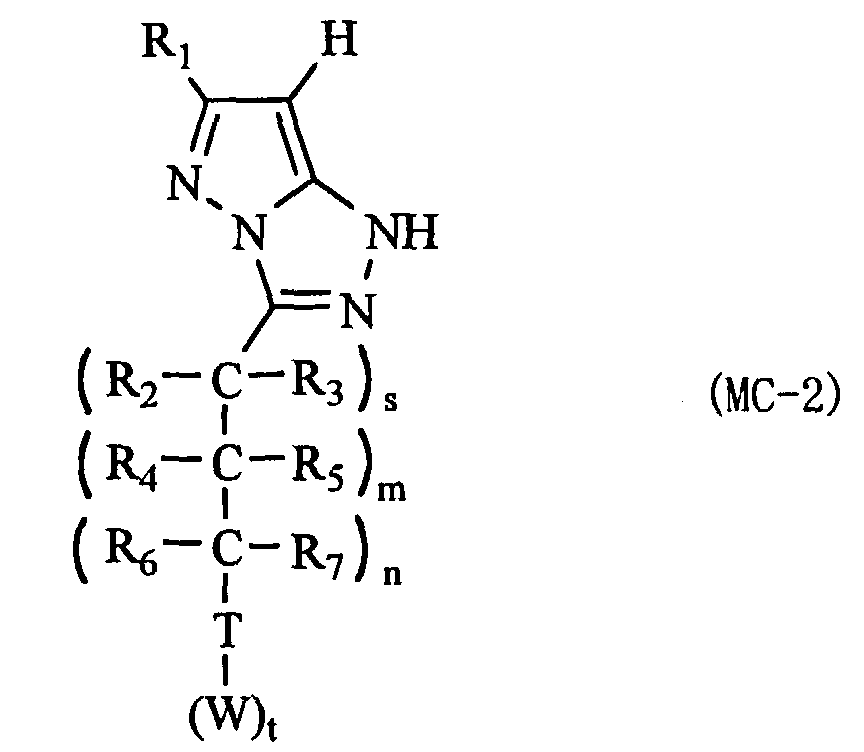
- (3) A method for forming a color image on a silver halide color photosensitive material comprising a step of performing black-and-white development followed by a step of reversal processing for the material and a step of performing color development for the reversal processed material by using a color developer having a pH of 11.5 or more, wherein the material subjected to the black-and-white development is the material described in item (1) or (2) above, and a replenishment amount of the color developer is less than 1.6 liters per m2 of the material.
- (4) A compound represented by formula (MC-4)
below:
wherein each of R2 and R3 independently represent a hydrogen atom or 1- to 3-carbon unsubstituted alkyl group; R11 represents a hydrogen atom, 1- to 8-carbon unsubstituted alkyl group, or 5- to 10-carbon cycloalkyl group; each of R24 and R25 independently represents a hydrogen atom or 1- to 20-carbon alkyl group; n represents a natural number from 1 to 3, provided that when n is 2 or 3, two or three R24's and two or three R25's each may be the same or different; and V2 represents a group selected from the following groups:
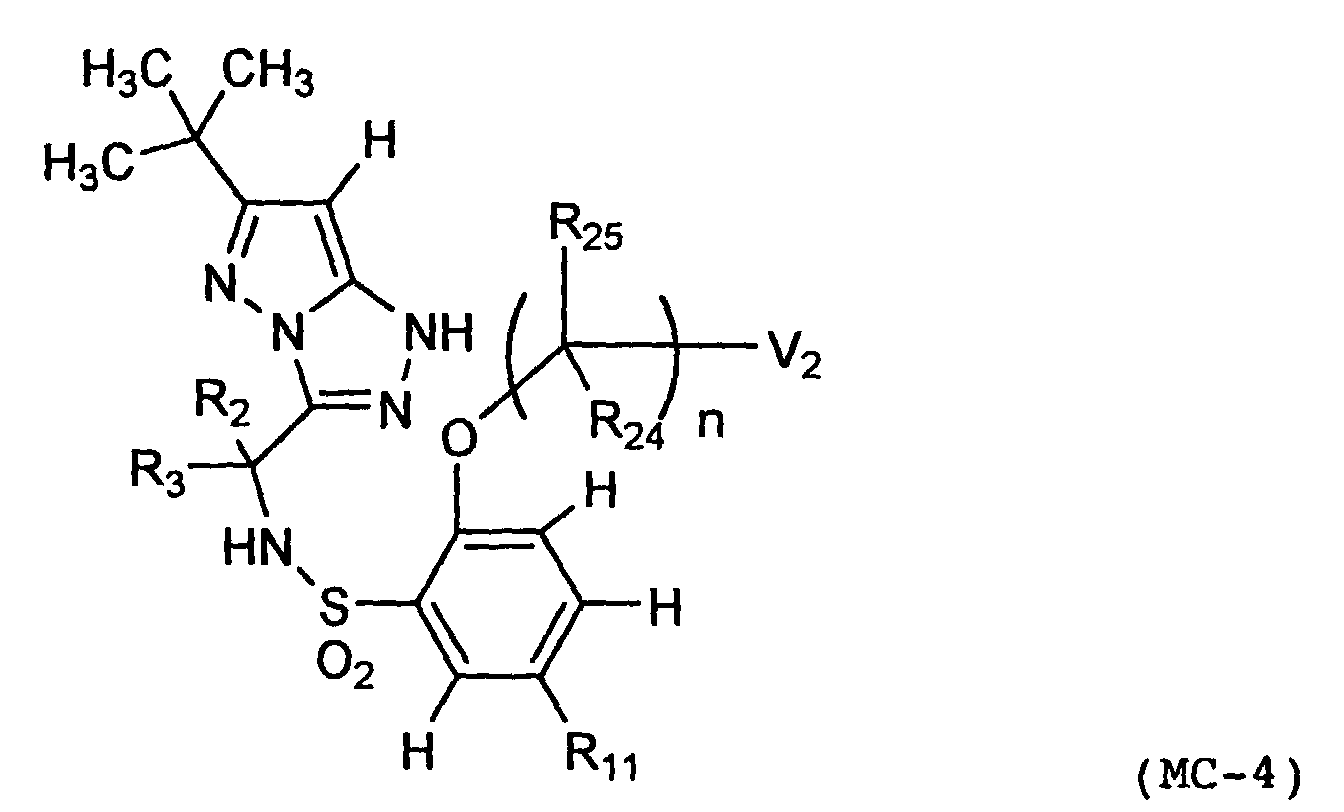 wherein each of R14, R15, R16 and R17 independently represents a hydrogen atom or a 1- to 3-carbon unsubstituted alkyl group. Each of s and u independently represents 2 or 3. A plurality of R14's, R15's, R16's, and R17's can be the same or different. R18 represents a 1- to 20-carbon unsubstituted alkyl group or a 6- to 20-carbon substituted or unsubstituted aryl group. w is 1 or 2. If w is 2, two R20's and two R21's can be the same or different. R19 represents a hydrogen atom or a 1- to 20-carbon unsubstituted alkyl group. Each of R20 and R21 represents a hydrogen atom or a 1- to 3-carbon unsubstituted alkyl group. Each of R22 and R23 independently represents a chlorine atom or a bromine atom. Each of x and y independently represents an integer from 0 to 20. L2 represents a 2- to 10-carbon substituted or unsubstituted alkylene group.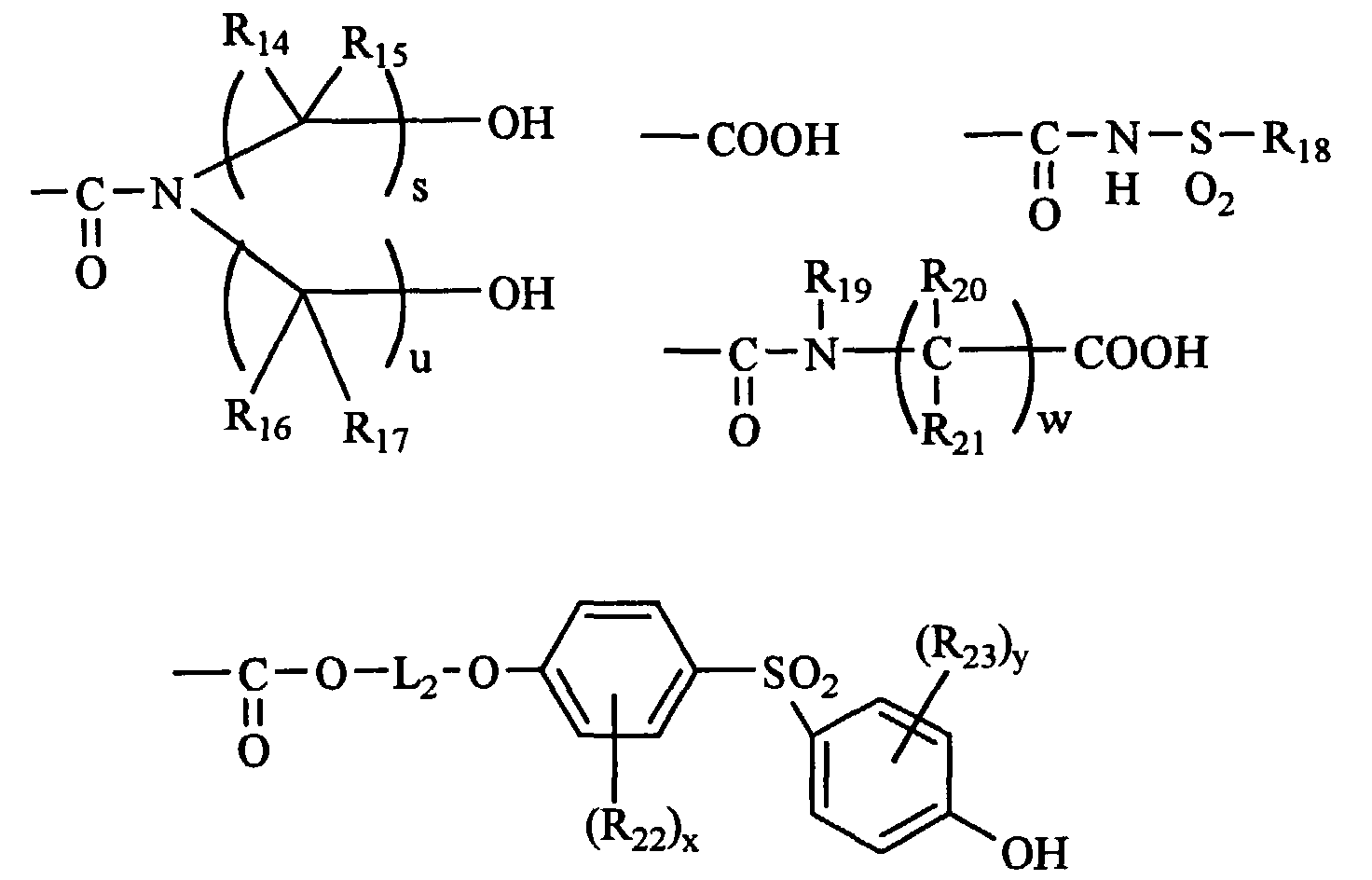
-
- This summary of the invention does not necessarily describe all necessary features so that the invention may also be a sub-combination of these described features.
- The invention can be more fully understood from the following detailed description when taken in conjunction with the accompanying drawings, in which:
- FIG. 1 is 1H NMR (300 MHz, DMSO-d6, ppm) spectrum of the exemplified compound M-75.
- FIG. 2 is 1H NMR (300 MHz, DMSO-d6, ppm) spectrum of the exemplified compound M-92.
- FIG. 3 is 1H NMR (300 MHz, DMSO-d6, ppm) spectrum of the exemplified compound M-109.
- FIG. 4 is 1H NMR (300 MHz, DMSO-d6, ppm) spectrum of the exemplified compound M-125.
- FIG. 5 is 1H NMR (300 MHz, DMSO-d6, ppm) spectrum of the exemplified compound M-150.
-
- All the spectra of FIGS. 1 to 5 were measured by using ARX-300 (300 MHz) manufactured by Japan Bruker.
- The present invention will be described in detail below.
- Formula (MC-1) will be described below.
- In formula (MC-1), R1 represents a tertiary alkyl group. The tertiary alkyl group represented by R1 is preferably a 4- to 20-carbon substituted or unsubstituted tertiary alkyl group. Examples of a substituent for substituting this tertiary alkyl group are an aryl group, heterocyclic group, acyl group, acyloxy group, acylamino group, alkoxy group, aryloxy group, heterocyclic oxy group, alkoxycarbonyl group, aryloxycarbonyl group, heterocyclic oxy carbonyl group, alkylcarbamoyl group, arylcarbamoyl group, alkylsulfonyl group, arylsulfonyl group, alkylsulfamoyl group, arylsulfamoyl group, alkylsulfonylamino group, alkylamino group, anilino group, amino group, alkylsulfinyl group, arylsulfinyl group, alkylthio group, arylthio group, mercapto group, hydroxy group, cyano group, nitro group, hydroxylamino group, nitro group, carbonyl group, sulfo group, and halogen atom. Practical examples of R1 are formulas (A-1) to (A-10) below, but the present invention is not limited to these examples.
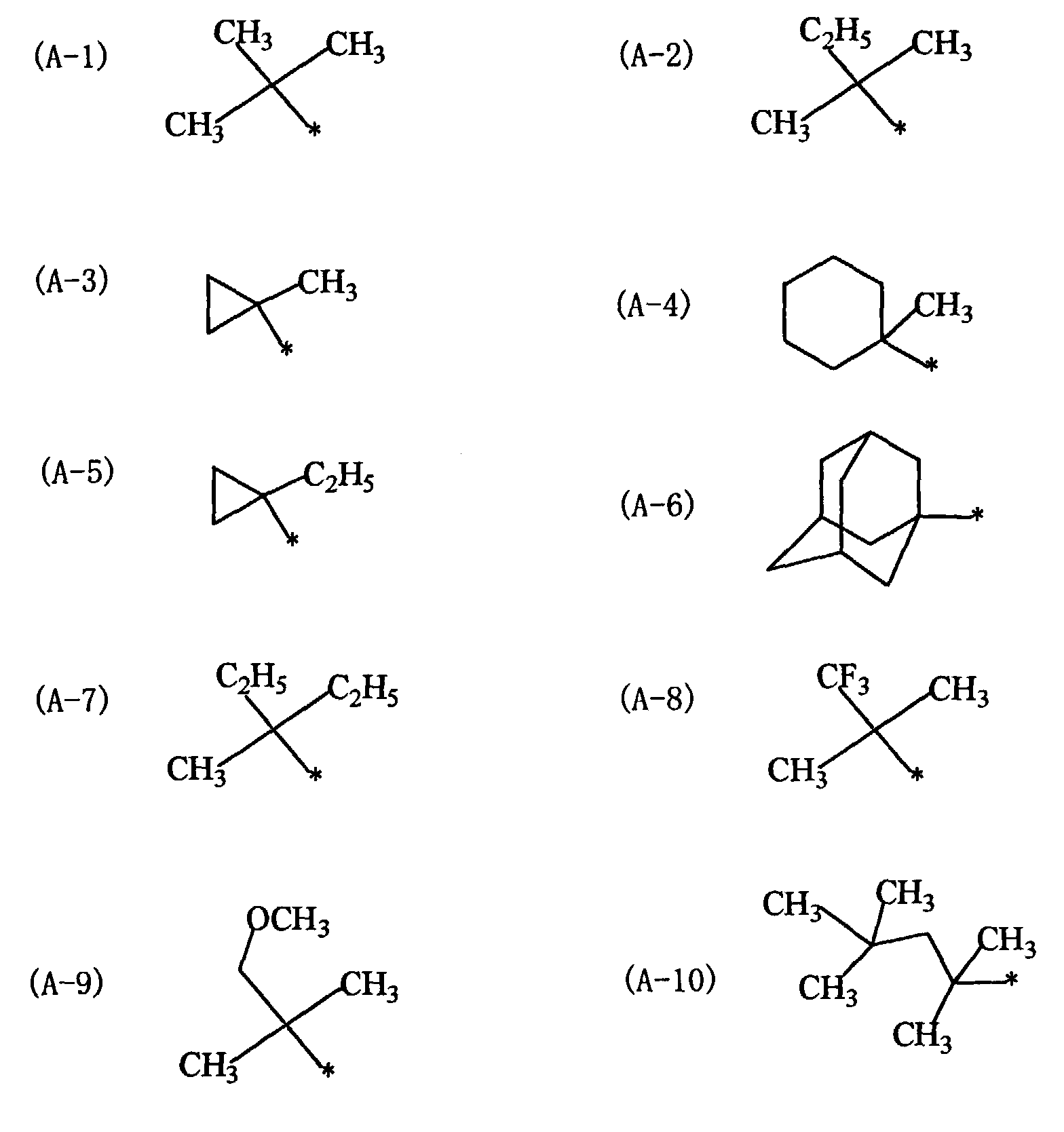
- In formulas (A-1) to (A-10), * represents a position where the group bonds to a pyrazolotriazole ring. R1 is preferably tertiary alkyl containing no hetero atom and preferably has 4 to 10 carbon atoms. Herein, a hetero atom means an atom other than a carbon atom and a hydrogen atom.
- R2, R3, R4, R5, R6, and R7 will be described below.
- Each of R2, R3, R4, R5, R6, and R7 independently represents a hydrogen atom, halogen atom, alkyl group, or aryl group, and these groups can have a substituent. Examples of this substituent are the substituents substitutable to R1 mentioned above. Also, any two of R2, R3, R4, R5, R6, and R7 can combine to form a ring structure together with C-C or C-C-C. Examples are a hydrogen atom, halogen atom (fluorine, chlorine, bromine, and iodine), an alkyl group [this alkyl group represents a straight-chain, branched, cyclic, substituted or unsubstituted alkyl group. Examples thereof are an alkyl group (preferably a 1- to 30-carbon alkyl group, e.g., methyl, ethyl, n-propyl, isopropyl, t-butyl, n-octyl, eicosyl, 2-chloroethyl, 2-cyanoethyl, and 2-ethylhexyl), a cycloalkyl group (preferably a 3- to 30-carbon substituted or unsubstituted cycloalkyl group, e.g., cyclohexyl, cyclopentyl, and 4-n-dodecylcyclohexyl), and a bicycloalkyl group (preferably a 5- to 30-carbon substituted or unsubstituted bicycloalkyl group, i.e., a monovalent group obtained by removing one hydrogen atom from 5- to 30-carbon bicycloalkane. Examples thereof are bicyclo[1,2,2]heptane-2-yl and bicyclo[2,2,2]octane-3-yl)], and aryl group (a substituted or unsubstituted 6- to 20-carbon aryl group, e.g., phenyl, 4-chlorophenyl, 4-methoxyphenyl, 4-hydroxyphenyl, and naphthyl).
- Each of R2, R3, R4, R5, R6, and R7 is preferably a hydrogen atom, alkyl group, or aryl group. More preferably, at least one of R2 and R3 is an alkyl group or aryl group, and the rest of R2 and R3, if any, and each of R4, R5, R6, and R7 are a hydrogen atom, alkyl group, or aryl group. Most preferably, at least one of R2 and R3 is a group selected from a methyl group, ethyl group, and isopropyl group, and the rest of R2 and R3, if any, and each of R4, R5, R6, and R7 are a hydrogen atom, alkyl group, or aryl group.
- Each of s, m, and n independently represents 0 or 1. Preferably, each of s and m is 1 and n is 0, or s is 1 and each of m and n is 0.
- L represents a divalent group selected from -NR8SO2-, -SO2NR8-, -SO2NR8CO-, -NR8COO-, -NR8CONR9-, and -COO-, wherein the right side of each formula bonds to the phenyl group in formula (MC-1). Each of R8 and R9 represents a hydrogen atom, alkyl group, or aryl group. L is preferably -NR8SO2-, -SO2NR8-, or -SO2NR8CO- wherein R8 is more preferably a hydrogen atom.
- J represents a divalent group selected from -CO-, -COO-, -O-,-S-, -CONR10-, -NR10CO-, -NR10COO-, -NR10NR11-, -SO2-, -SO2NR10-, and -CONR10SO2-, wherein the left side of each formula bonds to the phenyl group in formula (MC-1). Each of R10 and R11 represents a hydrogen atom, alkyl group, or aryl group.
- J is preferably -COO-, -O-, -CONR10-, -NR10CO-, -NR10COO-, -NR10NR11-, -SO2NR10-, or -CONR10SO2-wherein R10 is preferably a hydrogen atom. R11 is preferably a hydrogen atom or an alkyl group. J is more preferably -SO2NR10-, -CONR10SO2- or -O-.
- B represents an alkyl group with a total of 1- to 70-carbon or an aryl group with a total of 6- to 70-carbon. A "total of n-carbon" is the total sum of the number of carbon atoms of an alkyl or aryl group as a substituent and the number of carbon atoms of a substituent which further substitutes the former substituent. The n-carbon substituent" without "total" or "the number of carbon atoms" means the number of carbon atoms in a skeleton of the substituent, which does not include the number of carbon atoms of a substituent which further substitutes the former substituent. This holds for substituents other than an alkyl group and an aryl group. B is most preferably a group known as a ballast group in the field of photographic organic compounds. Examples are n-hexyl, 2-ethyl-hexyl, n-octyl, n-decyl, n-dodecyl, n-pentadecyl, n-octadecyl, 2,4-di-t-amylphenyl, and 2,4-di-t-amylphenyloxypropyl. The total number of carbon atoms is preferably 6 to 50, more preferably 6 to 30, particularly preferably 10 to 25, and most preferably 15 to 25.
- p represents a natural number from 1 to 5. When p is 2 or more, a plurality of -J-B's can be the same or different. p is preferably 1 or 2, and most preferably 1.
- G represents a substituent.
- Examples of G are a halogen atom, an alkyl group (including a cycloalkyl group and a bicycloalkyl group), an alkenyl group (including a cycloalkenyl group and a bicycloalkenyl group), an alkinyl group, an aryl group, a heterocyclic group, a cyano group, a hydroxyl group, a nitro group, a carboxyl group, an alkoxy group, an aryloxy group, a silyloxy group, a heterocyclic oxy group, an acyloxy group, a carbamoyloxy group, an alkoxycarbonyloxy group, aryloxycarbonyloxy, an amino group (including an anilino group), an acylamino group, an aminocarbonylamino group, an alkoxycarbonylamino group, an aryloxycarbonylamino group, a sulfamoylamino group, alkylsulfonylamino and arylsulfonylamino groups, a mercapto group, an alkylthio group, an arylthio group, a heterocyclic thio group, a sulfamoyl group, a sulfo group, alkylsulfinyl and arylsulfinyl groups, alkylsulfonyl and arylsulfonyl groups, an acyl group, an aryloxycarbonyl group, an alkoxycarbonyl group, a carbamoyl group, arylazo and heterocyclic azo groups, an imide group, a phosphino group, a phosphinyl group, a phosphinyloxy group, a phosphinylamino group, and a silyl group.
- More specifically, G represents a halogen atom (e.g., a chlorine atom, bromine atom, or iodine atom) or an alkyl group [this alkyl group represents a straight-chain, branched, cyclic, substituted or unsubstituted alkyl group. Examples of the alkyl groups are an alkyl group (preferably a 1- to 30-carbon alkyl group, e.g., methyl, ethyl, n-propyl, isopropyl, t-butyl, n-octyl, eicosyl, 2-chloroethyl, 2-cyanoethyl, and 2-ethylhexyl), a cycloalkyl group (preferably a 3- to 30-carbon substituted or unsubstituted cycloalkyl group, e.g., cyclohexyl, cyclopentyl, and 4-n-dodecylcyclohexyl), and a bicycloalkyl group (preferably a 5- to 30-carbon substituted or unsubstituted bicycloalkyl group, i.e., a monovalent group obtained by removing one hydrogen atom from 5- to 30-carbon bicycloalkane. Examples of the bicycloalkyl groups are bicyclo[1,2,2]heptane-2-yl and bicyclo[2,2,2]octane-3-yl). This alkyl group further includes a tricyclo structure having more cyclic structures. An alkyl group (e.g., an alkyl group of an alkylthio group) in substituents explained below also represents an alkyl group of this concept], an alkenyl group [this alkenyl group represents a straight-chain, branched, cyclic, substituted or unsubstituted alkenyl group. Examples of the alkenyl groups are an alkenyl group (preferably a 2- to 30-carbon substituted or unsubstituted alkenyl group, e.g., vinyl, allyl, prenyl, geranyl, and oleyl), a cycloalkenyl group (preferably a 3- to 30-carbon substituted or unsubstituted cycloalkenyl group, i.e., a monovalent group obtained by removing one hydrogen atom from 3- to 30-carbon cycloalkene. Examples of the cycloalkenyl groups are 2-cyclopentene-1-yl and 2-cyclohexene-1-yl), and a bicycloalkenyl group (a substituted or unsubstituted bicycloalkenyl group, preferably a 5- to 30-carbon substituted or unsubstituted bicycloalkenyl group, i.e., a monovalent group obtained by removing one hydrogen atom from bicycloalkene having one double bond. Examples of the bicycloalkenyl groups are bicyclo[2,2,1]hepto-2-ene-1-yl and bicyclo[2,2,2]octo-2-ene-4-yl)], an alkinyl group (preferably a 2- to 30-carbon substituted or unsubstituted alkinyl group, e.g., ethynyl, propargyl, and a trimethylsilylethynyl group), an aryl group (preferably a 6- to 30-carbon substituted or unsubstituted aryl group, e.g., phenyl, p-tolyl, naphthyl, m-chlorophenyl, and o-hexadecanoylaminophenyl), a heterocyclic group (preferably a monovalent group obtained by removing one hydrogen atom form a 5- or 6-membered, substituted or unsubstituted, aromatic or non-aromatic heterocyclic compound, and more preferably, a 3- to 30-carbon, 5- or 6-membered aromatic heterocyclic group. Examples of the heterocyclic groups are 2-furyl, 2-thienyl, 2-pyrimidinyl, and 2-benzothiazolyl), a cyano group, a hydroxyl group, a nitro group, a carboxyl group, an alkoxy group (preferably a 1- to 30-carbon substituted or unsubstituted alkoxy group, e.g., methoxy, ethoxy, isopropoxy, t-butoxy, n-octyloxy, and 2-methoxyethoxy), an aryloxy group (preferably a 6- to 30-carbon substituted or unsubstituted aryloxy group, e.g., phenoxy, 2-methylphenoxy, 4-t-butylphenoxy, 3-nitrophenoxy, and 2-tetradecanoylaminophenoxy), a silyloxy group (preferably a 3- to 20-carbon silyloxy group, e.g., trimethylsilyloxy and t-butyldimethylsilyloxy), a heterocyclic oxy group (preferably a 2- to 30-carbon substituted or unsubstituted heterocyclic oxy group, 1-phenyltetrazole-5-oxy, or 2-tetrahydropyranyloxy), an acyloxy group (preferably a formyloxy group, a 2- to 30-carbon substituted or unsubstituted alkylcarbonyloxy group, or a 6- to 30-carbon substituted or unsubstituted arylcarbonyloxy group, e.g., formyloxy, acetyloxy, pivaloyloxy, stearoyloxy, benzoyloxy, and p-methoxyphenylcarbonyloxy), a carbamoyloxy group (preferably a 1- to 30-carbon substituted or unsubstituted carbamoyloxy group, e.g., N,N-dimethylcarbamoyloxy, N,N-diethylcarbamoyloxy, morpholinocarbonyloxy, N,N-di-n-octylaminocarbonyloxy, and N-n-octylcarbamoyloxy), an alkoxycarbonyloxy group (preferably a 2- to 30-carbon substituted or unsubstituted alkoxycarbonyloxy group, e.g., methoxycarbonyloxy, ethoxycarbonyloxy, t-butoxycarbonyloxy, and n-octylcarbonyloxy), an aryloxycarbonyloxy group (preferably a 7- to 30-carbon substituted or unsubstituted aryloxycarbonyloxy group, e.g., phenoxycarbonyloxy, p-methoxyphenoxycarbonyloxy, and p-(n-hexadecyloxy)phenoxycarbonyloxy), an amino group (preferably an amino group, a 1- to 30-carbon substituted or unsubstituted alkylamino group, or a 6- to 30-carbon substituted or unsubstituted anilino group, e.g., amino, methylamino, dimethylamino, anilino, N-methyl-anilino, and diphenylamino), an acylamino group (preferably a formylamino group, a 1- to 30-carbon substituted or unsubstituted alkylcarbonylamino group, or a 6- to 30-carbon substituted or unsubstituted arylcarbonylamino group, e.g., formylamino, acetylamino, pivaloylamino, lauroylamino, benzoylamino, and 3,4,5-tri-n-octyloxyphenylcarbonylamino), an aminocarbonylamino group (preferably a 1- to 30-carbon substituted or unsubstituted aminocarbonylamino, e.g., carbamoylamino, N,N-dimethylaminocarbonylamino, N,N-diethylaminocarbonylamino, and morpholinocarbonylamino), an alkoxycarbonylamino group (preferably a 2- to 30-carbon substituted or unsubstituted alkoxycarbonylamino group, e.g., methoxycarbonylamino, ethoxycarbonylamino, t-butoxycarbonylamino, n-octadecyloxycarbonylamino, and N-methyl-methoxycarbonylamino), an aryloxycarbonylamino group (preferably a 7- to 30-carbon substituted or unsubstituted aryloxycarbonylamino group, e.g., phenoxycarbonylamino, p-chlorophenoxycarbonylamino, and m-(n-octyloxy)phenoxycarbonylamino), a sulfamoylamino group (preferably a 0- to 30-carbon substituted or unsubstituted sulfamoylamino group, e.g., sulfamoylamino, N,N-dimethylaminosulfonylamino, and N-n-octylaminosulfonylamino), alkylsulfonylamino and arylsulfonylamino groups (preferably 1- to 30-carbon substituted or unsubstituted alkylsulfonylamino and 6- to 30-substituted or unsubstituted arylsufonylamino, e.g., methylsulfonylamino, butylsulfonylamino, phenylsulfonylamino, 2,3,5-trichlorophenylsulfonylamino, and p-methylphenylsulfonylamino), a mercapto group, an alkylthio group (preferably a 1- to 30-carbon substituted or unsubstituted alkylthio group, e.g., methylthio, ethylthio, and n-hexadecylthio), an arylthio group (preferably a 6- to 30-carbon substituted or unsubstituted arylthio, e.g., phenylthio, p-chlorophenylthio, and m-methoxyphenylthio), a heterocyclic thio group (preferably a 2- to 30-carbon substituted or unsubstituted heterocyclic thio group, e.g., 2-benzothiazolylthio and 1-phenyltetrazole-5-ylthio), a sulfamoyl group (preferably a 0- to 30-carbon substituted or unsubstituted sulfamoyl group, e.g., N-ethylsulfamoyl, N-(3-dodecyloxypropyl)sulfamoyl, N,N-dimethylsulfamoyl, N-acetylsulfamoyl, N-benzoylsulfamoyl, and N-(N'-phenylcarbamoyl)sulfamoyl), a sulfo group, alkylsulfinyl and arylsulfinyl groups (preferably a 1- to 30-carbon substituted or unsubstituted alkylsulfinyl group and a 6- to 30-carbon substituted or unsubstituted arylsulfinyl group, e.g., methylsulfinyl, ethylsulfinyl, phenylsulfinyl, and p-methylphenylsulfinyl), alkylsulfonyl and arylsulfonyl groups (preferably a 1- to 30-carbon substituted or unsubstituted alkylsulfonyl group and a 6- to 30-carbon substituted or unsubstituted arylsulfonyl group, e.g., methylsulfonyl, ethylsulfonyl, phenylsulfonyl, and p-methyphenylsulfonyl), an acyl group (preferably a formyl group, a 2- to 30-carbon substituted or unsubstituted alkylcarbonyl group, or a 7- to 30-carbon substituted or unsubstituted arylcarbonyl group, e.g., acetyl, pivaloyl, 2-chloroacetyl, stearoyl, benzoyl, and p-(n-octyloxyphenyl)carbonyl), an aryloxycarbonyl group (preferably a 7- to 30-carbon substituted or unsubstituted aryloxycarbonyl group, e.g., phenoxycarbonyl, o-chlorophenoxycarbonyl, m-nitrophenoxycarbonyl, and p-t-butylphenoxycarbonyl), an alkoxycarbonyl group (preferably a 2- to 30-carbon substituted or unsubstituted alkoxycarbonyl group, e.g., methoxycarbonyl, ethoxycarbonyl, t-butoxycarbonyl, and n-octadecyloxycarbonyl), a carbamoyl group (preferably 1- to 30-carbon substituted or unsubstituted carbamoyl, e.g., carbamoyl, N-methylcarbamoyl, N,N-dimethylcarbamoyl, N,N-di-n-octylcarbamoyl, and N-(methylsulfonyl)carbamoyl), arylazo and heterocyclic azo groups (preferably a 6- to 30-carbon substituted or unsubstituted arylazo group and a 3- to 30-carbon substituted or unsubstituted heterocyclic azo group, e.g., phenylazo, p-chlorophenylazo, and 5-ethylthio-1,3,4-thiadiazole-2-ylazo), an imide group (preferably N-succinimide and N-phthalimide), a phosphino group (preferably a 2- to 30-carbon substituted or unsubstituted phosphino group, e.g., dimethylphosphino, diphenylphosphino, and methylphenoxyphosphino), a phosphinyl group (preferably a 2- to 30-carbon substituted or unsubstituted phosphinyl group, e.g., phosphinyl, dioctyloxyphosphinyl, and diethoxyphosphinyl), a phosphinyloxy group (preferably a 2- to 30-carbon substituted or unsubstituted phosphinyloxy group, e.g., diphenoxyphosphinyloxy and dioctyloxyphosphinyloxy), a phosphinylamino group (preferably a 2- to 30-carbon substituted or unsubstituted phosphinylamino group, e.g., dimethoxyphosphinylamino and dimethylaminophosphinylamino), and a silyl group (preferably a 3- to 30-carbon substituted or unsubstituted silyl group, e.g., trimethylsilyl, t-butyldimethylsilyl, and phenyldimethylsilyl).
- Of the functional groups described above, those having a hydrogen atom can be further substituted by the above groups after the hydrogen atom is removed. Examples of such functional groups are an alkylcarbonylaminosulfonyl group, an arylcarbonylaminosulfonyl group, an alkylsulfonylaminocarbonyl group, and an arylsulfonylaminocarbonyl group. More specific examples are methylsulfonylaminocarbonyl, p-methylphenylsulfonylaminocarbonyl, acetylaminosulfonyl, and a benzoylaminosulfonyl group.
- G is preferably a substituent selected from a group consisting of an alkyl group, an aryl group halogen atom, and alkoxy group.
- q represents an integer from 0 to 4.
- G is preferably a tertiary alkyl (e.g., t-butyl, t-octyl, t-amyl, or any of those enumerated above as examples of R1). Most preferably, G is tertiary alkyl, and q is 1.
- The compound represented by formula (MC-1) is preferably a compound in which R1 is a tertiary alkyl group not containing any elements except for hydrogen atoms and carbon atoms, s is 1, m is 1 or 0, n is 0, each of R2, R3, R4, R5, R6, and R7 is a hydrogen atom, halogen atom, alkyl group, or aryl group, at least one of R2 and R3 is an alkyl group containing 4 or less carbon atoms, at least one of R4 and R5 is a hydrogen atom when m is 1, L is a group selected from -NHSO2-, -SO2NH-, and -SO2NHCO-, J is a group selected from -O-, -COO-, -CONH-, -NHCO-, -NHCOO-, -SO2NH-, and -CONHSO2-, B is a group having a total number of carbon atoms of 6 to 30, p is 1 or 2, G is a tertiary alkyl group, and q is 1.
- Additionally, the portion represented by -J-B is preferably substituted by a group selected from -CR12OH-, -SO2NH2, -SO2NHCOR13, and -CONH2 as characteristic groups of formula (MC-2) described below. The portion represented by -J-B is also preferably substituted by -COOH group. In these formulas, each of R12 and R13 represents a substituted or unsubstituted alkyl group or substituted or unsubstituted aryl group.
- Formula (MC-2) will be described below.
- R1, R2, R3, R4, R5, R6, and R7 have the same meanings as defined in formula (MC-1) and are preferably those mentioned preferable for formula (MC-1). In formula (MC-2), it is preferable that s and m be 1 and n be 0, all of s, m, and n be 1, or all of s, m, and n be 0.
- T represents a divalent group selected from a group consisting of -SO2-, -O-, and -NR8CO-, wherein the right side of each formula bonds to W, substituted phenyl group, or unsubstituted phenyl group, i.e., t = 0, wherein R8 is the same as R8 of formula (MC-1), and preferable R8's are also the same as those defined in formula (MC-1). T is preferably -SO2-, -NHCO-, or a phenyl group.
- When at least one of s, m, and n is 1, T is preferably -SO2-, -O-, or -NHCO-. When all of s, m, and n are 0, T is preferably a phenyl group.
- W represents a group containing a 1- to 70-carbon substituted or unsubstituted alkyl group or a 6- to 70-carbon aryl group and containing a group selected from the group consisting of -CR12HOH, -SO2NH2, -SO2NHCOR13, and -CONH2 at the same time, wherein each of R12 and R13 independently represents a hydrogen atom, a substituted or unsubstituted alkyl group or substituted or unsubstituted aryl group. W is preferably a group containing a 1- to 30-carbon alkyl group or a 6 to 30-carbon aryl group.
- t represents 1 when T is a divalent group selected from -SO2-, -O-, and NR8CO-, t represents O when T is an unsubstituted phenyl group, and t represents a natural number from 1 to 5 when T is a substituted phenyl group. When T is a substituted phenyl group, t is preferably 1 or 2.
- When T is a phenyl group, the substitution position of W can be any of the 2-, 3-, and 4-positions of the phenyl group. When t is 2, however, the substitution position is preferably the 3- or 5-position.
- When t is 2 or more, a plurality of W's can be the same or different.
- When T is a phenyl group, this phenyl group can have a substituent except for groups represented by W. Examples of this substituent are those for the substituent G mentioned above with regard to formula (MC-1).
- The compound represented by formula (MC-2) is preferably a compound in which R1 is a tertiary alkyl group, preferably a tertiary alkyl group having 4 to 10 carbon atoms, not containing any elements except for hydrogen atoms and carbon atoms, each of s, m, and n is 1, T is a group selected from -SO2- and -NHCO-, at least one of R2 and R3 is an alkyl group having 4 or less carbon atoms, the rest of R2 and R3, if any, and all of R4, R5, R6, and R7 are hydrogen atoms, and W is a group containing a group selected from -CHR12OH, -SO2NH2, and -SO2NHCOR13 and containing a 6- to 30-carbon alkyl group or aryl group, at the same time, wherein R12 and R13 each independently represent a hydrogen atom or a 1- to 20-carbon alkyl group.
- In another preferable compound, R1 is a tertiary alkyl group not containing any elements except for hydrogen atoms and carbon atoms, all of s, m, and n are 0, T is a phenyl group, and W is a group containing a group selected from -CHR12OH, -SO2NH2, and -SO2NHCOR13 and containing a 1- to 30-carbon alkyl group or a 6 to 30-carbon aryl group at the same time. In this preferable compound, W is preferably a substituted alkyl group or substituted aryl group, to which a group selected from -CHR12OH, -SO2NH2, and -SO2NHCOR13 is substituted, or a substituted alkyl group or substituted aryl group whose substituent is further substituted by a group selected from -CHR12OH, -SO2NH2, and -SO2NHCOR13, wherein R12 and R13 each independently represent a hydrogen atom or a 1- to 20-carbon alkyl group.
- Of the compounds represented by formulas (MC-1) and (MC-2), a compound represented by formula (MC-3) is more preferable.
- The magenta coupler of the invention is preferably represented by formula (MC-3) below:wherein R1 represents a 4- to 8-carbon unsubstituted tertiary alkyl group; each of R2, R3, R4, and R5 independently represents a hydrogen atom or 1- to 4-carbon unsubstituted alkyl group, provided that at least one of R2 and R3 is not a hydrogen atom; m represents 0 or 1; R11 represents a 4- to 8-carbon tertiary alkyl group or 5- to 10-carbon cycloalkyl group; each of R24 and R25 independently represents a hydrogen atom or 1- to 20-carbon alkyl group; r represents a natural number from 1 to 3, provided that when r is 2 or 3, the two or three R24's and R25's each may be the same or different; and V1 represents a carboxyl group, 1- to 20-carbon substituted or unsubstituted carbamoly group, 2- to 20-carbon substituted or unsubstituted sulfonylaminocarbonyl group, or 1- to 20-carbon substituted or unsubstituted alkoxycarbonyl group, provided that when V1 represents a carbamoyl group or alkoxycarbonyl group, each of the carbamoly group and alkoxycarbonyl group preferably has a carboxyl group or a hydroxypheny group as its substituent.

- Among the compounds represented by formula (MC-3), compounds represented by formula (MC-4) below is more preferable:wherein each of R2 and R3 independently represent a hydrogen atom or 1- to 3-carbon unsubstituted alkyl group; R11 represents a hydrogen atom, 1- to 8-carbon unsubstituted alkyl group, or 5- to 10-carbon cycloalkyl group; each of R24 and R25 independently represents a hydrogen atom or 1- to 20-carbon alkyl group; n represents a natural number from 1 to 3; and V2 represents a group selected from the following groups, provided that when r is 2 or 3, the two or three R24's and R25's each may be the same or different:
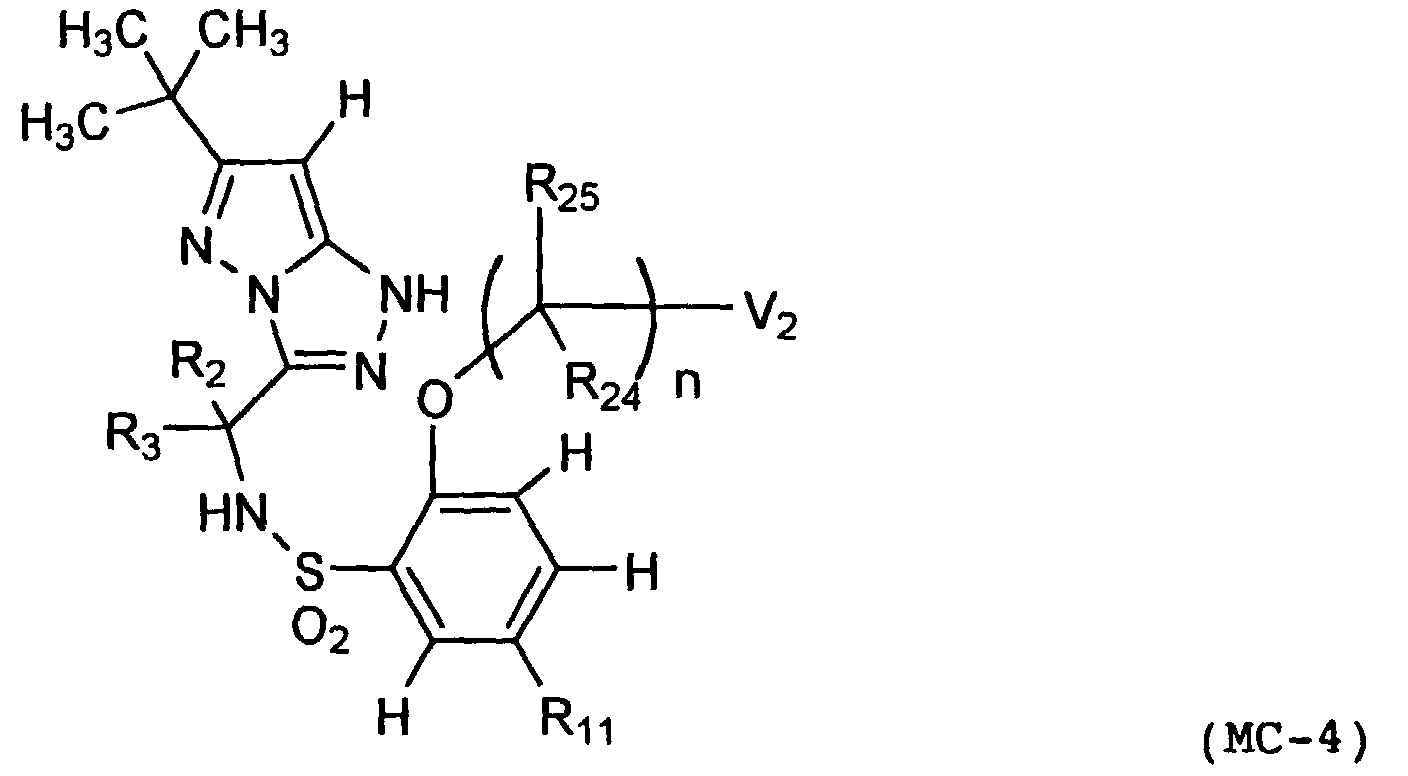 wherein, each of R14, R15, R16, and R17 independently represents a hydrogen atom or a 1- to 3-carbon unsubstituted alkyl group. Each of s and u independently represents 2 or 3. A plurality of R14's, R15's, R16's, and R17's can be the same or different. R18 represents a 1- to 20-carbon unsubstituted alkyl group or a 6- to 20-carbon substituted or unsubstituted aryl group. w is 1 or 2. If w is 2, two R20's and two R21's can be the same or different. R19 represents a hydrogen atom or a 1- to 20-carbon unsubstituted alkyl group. Each of R20 and R21 represents a hydrogen atom or a 1- to 3-carbon unsubstituted alkyl group. Each of R22 and R23 independently represents a chlorine atom or a bromine atom. Each of x and y independently represents an integer from 0 to 2. L2 represents a 2- to 10-carbon substituted or unsubstituted alkylene group.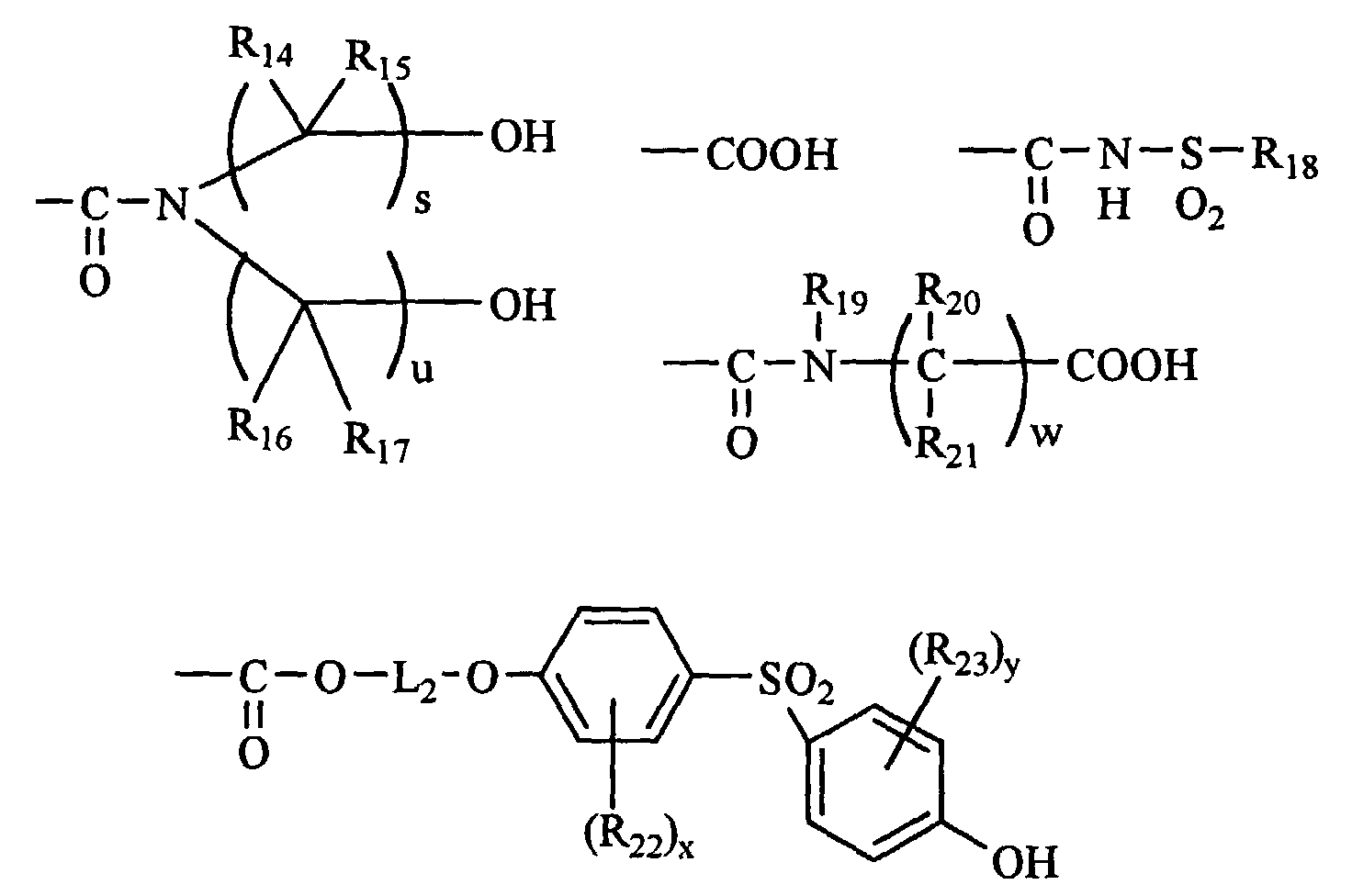
- R18 is preferably a 6- to 20-carbon substituted or unsubstituted aryl group or a 1- to 8-carbon unsubstituted alkyl group.
- Among the compounds represented by formula (MC-4), R2 is preferably methyl, ethyl, n-propyl or iso-propyl; R3 is preferably a hydrogen atom, methyl or ethyl; R11 is preferably a hydrogen atom or a 1- to 8-carbon unsubstituted alkyl group; R24 is preferably a hydrogen atom; and R25 is preferably a hydrogen atom or a 1- to 16-carbon unsubstituted alkyl group; and V2 is preferably represented by the following group: wherein R18 represents a 1- to 8-carbon unsubstituted alkyl group or 6- to 20-carbon aryl group.
- Practical compound examples of the present invention are presented below. However, the present invention is not limited to these examples.
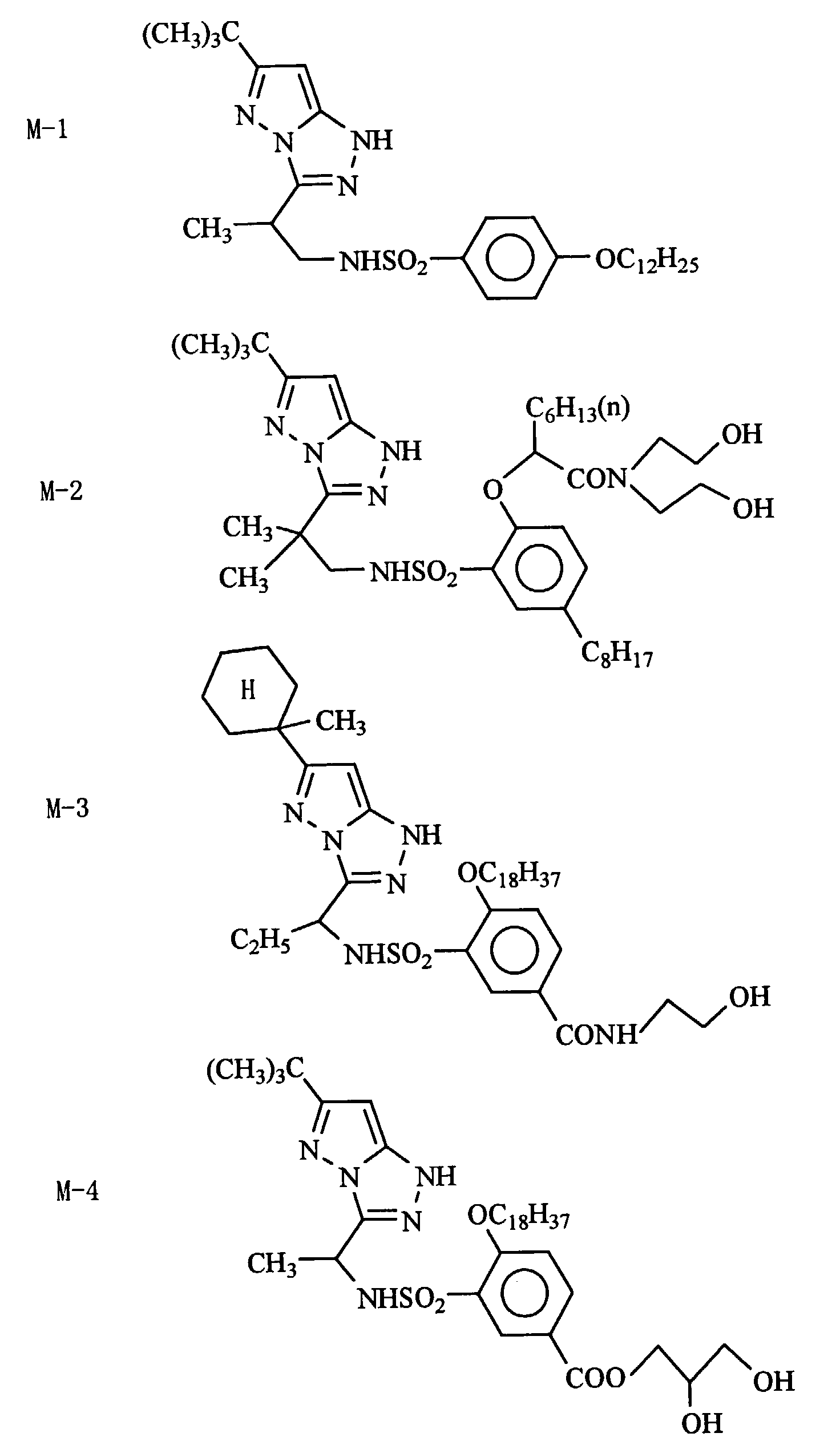


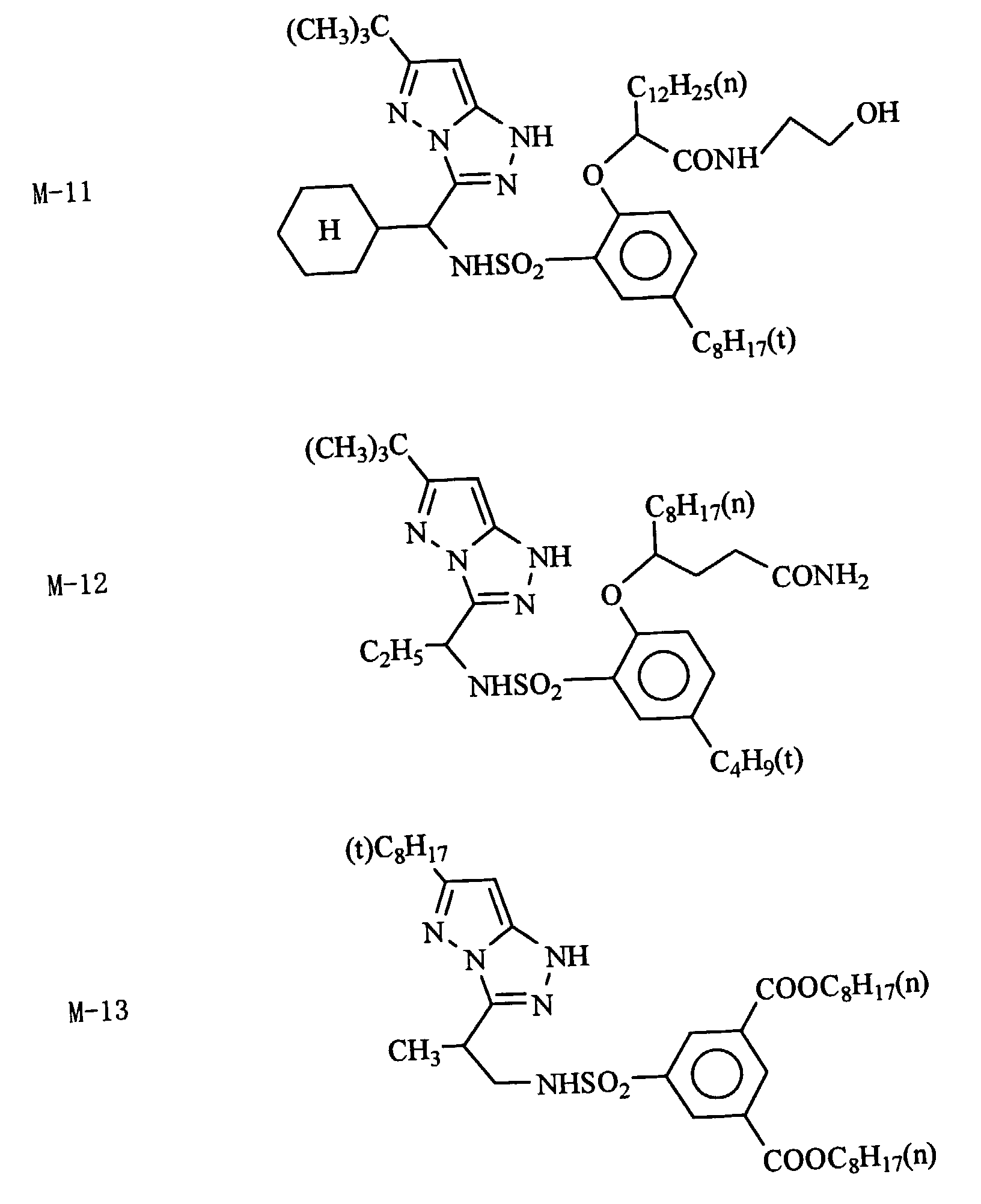

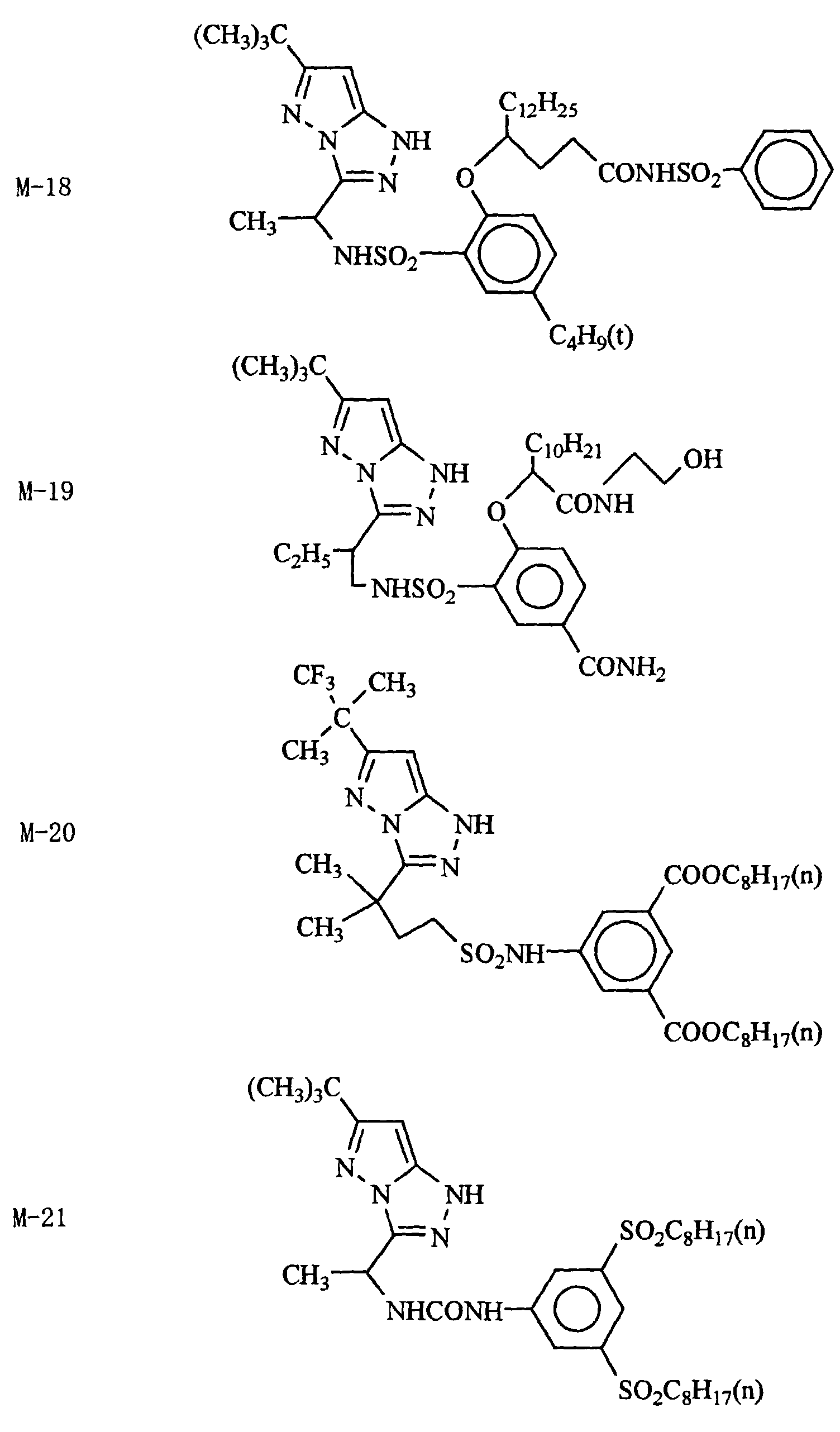
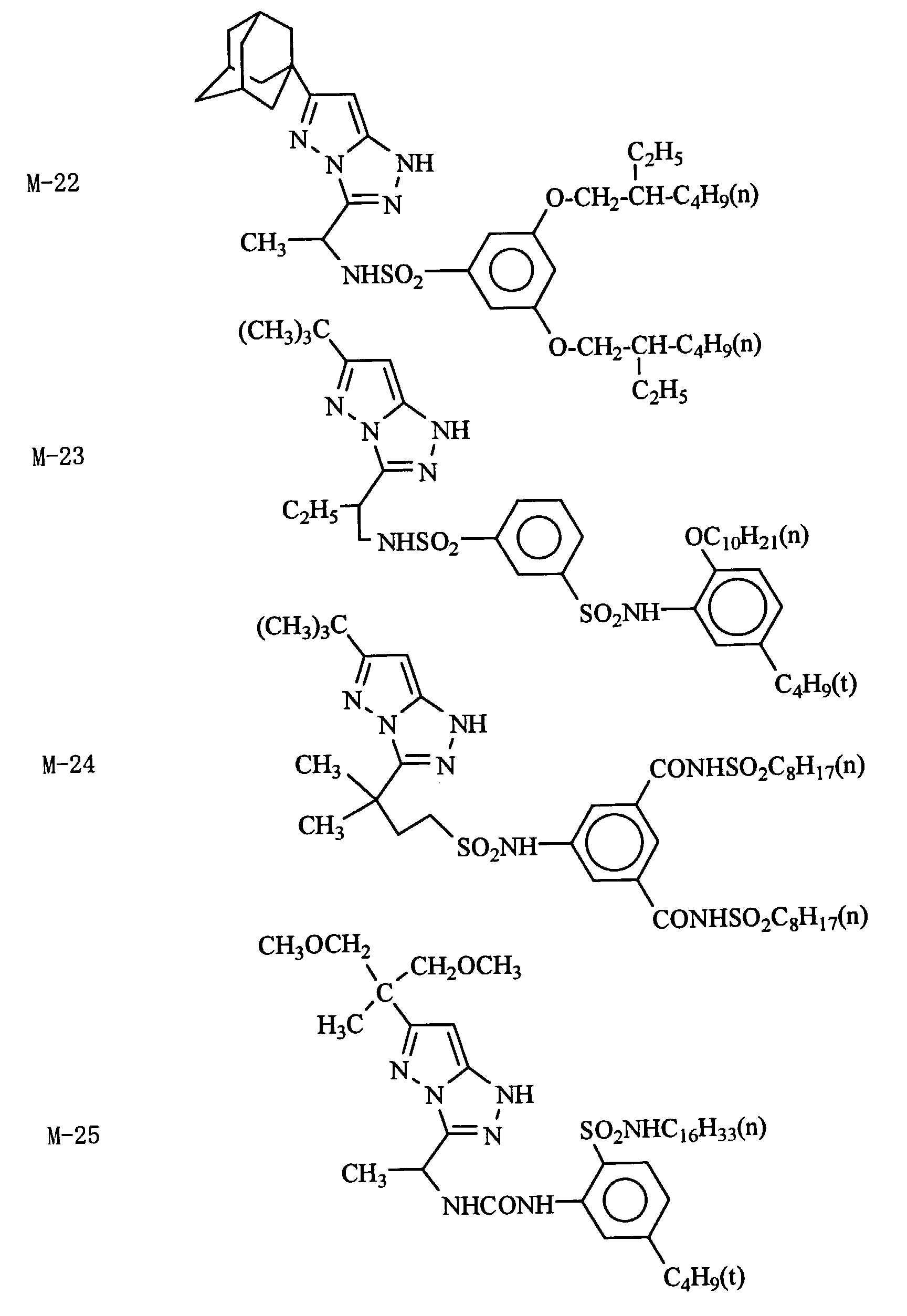
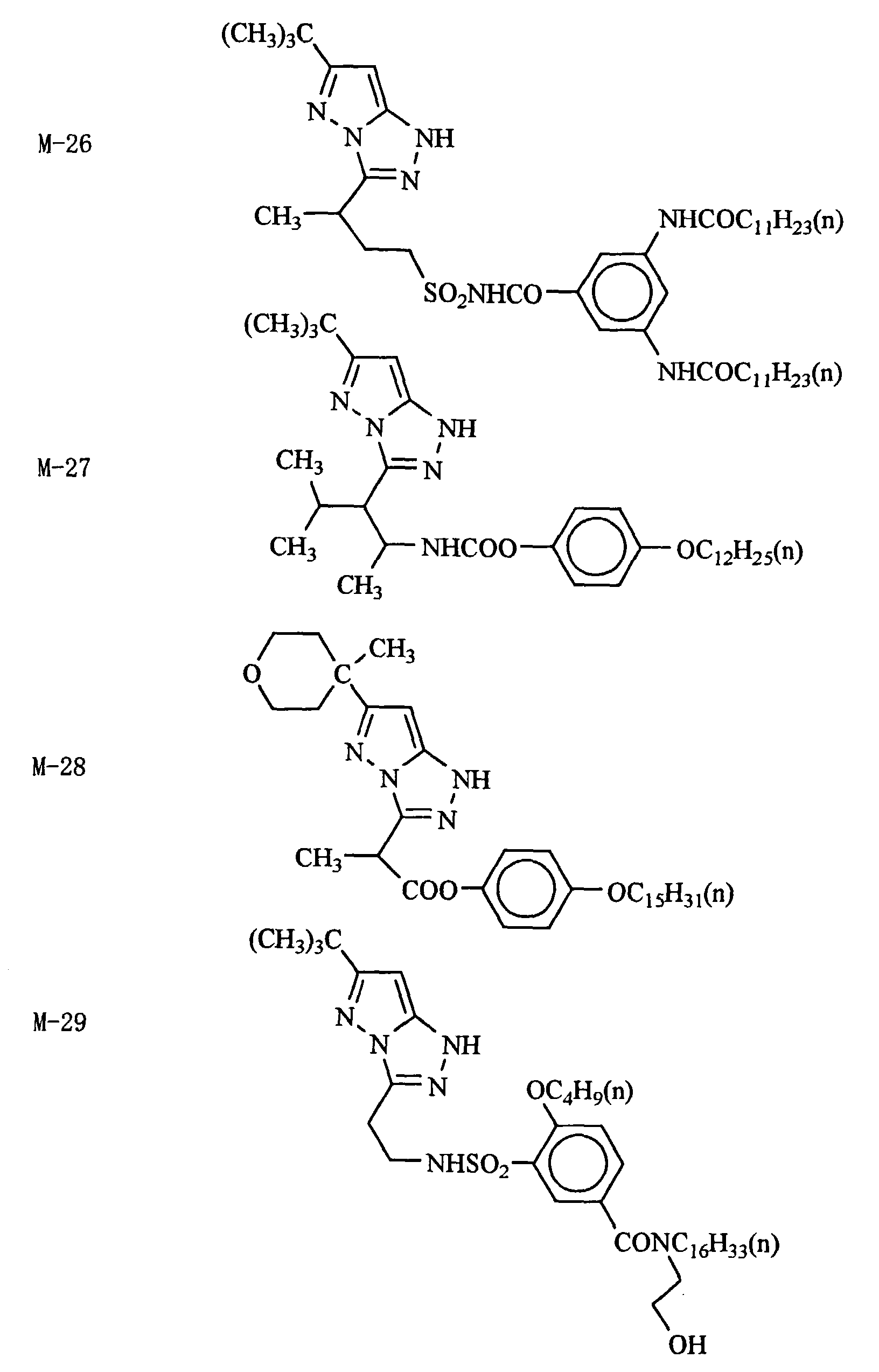
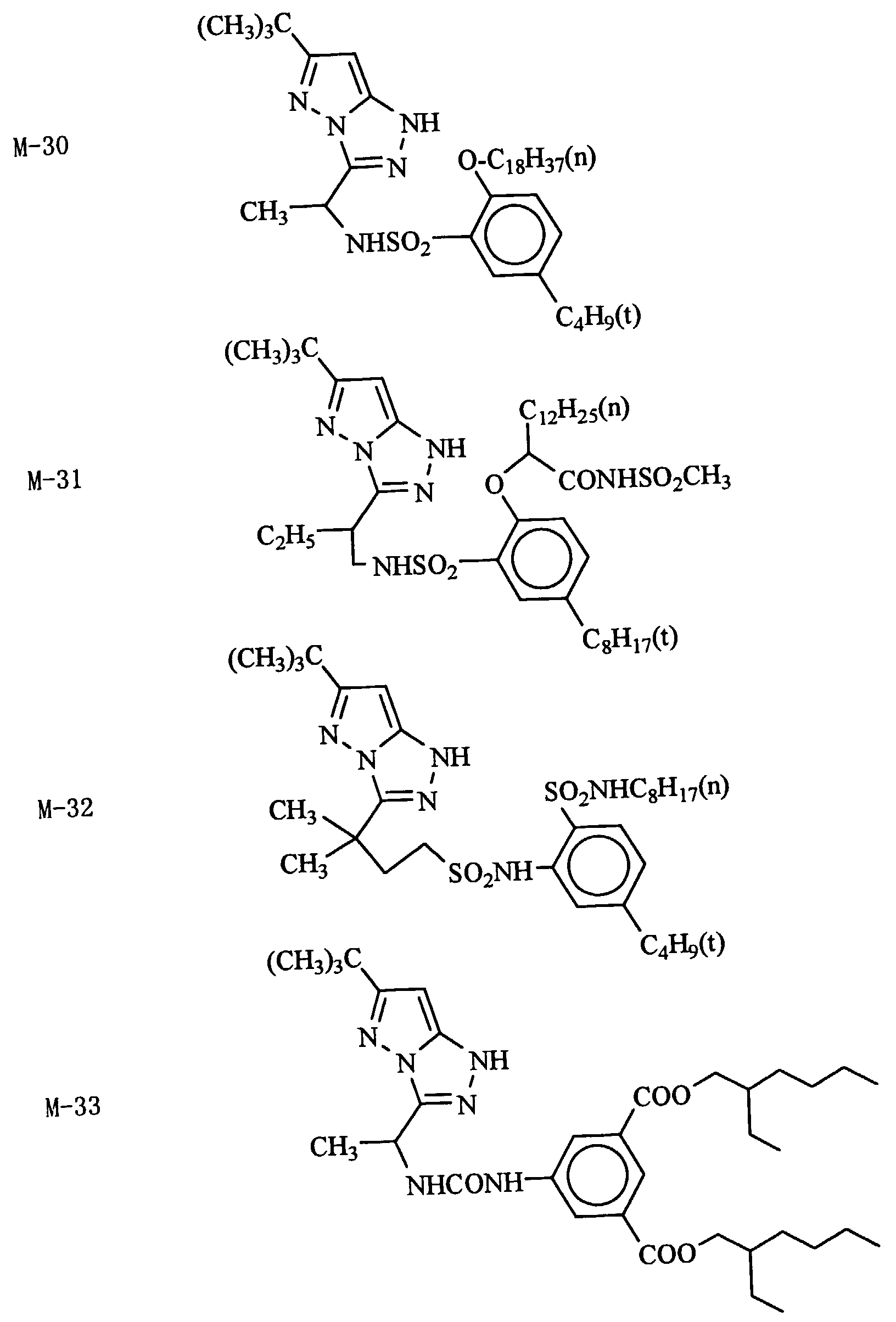
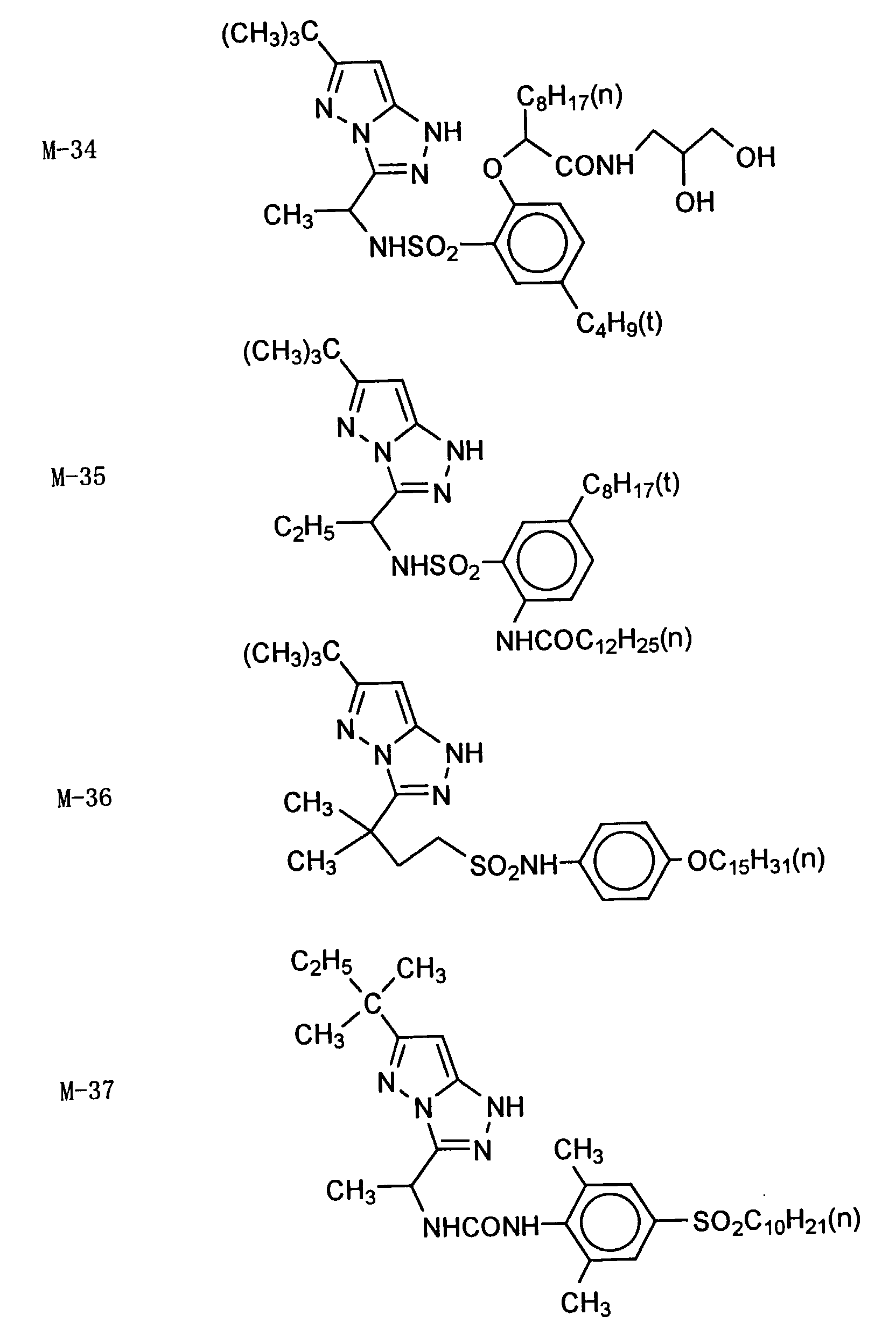


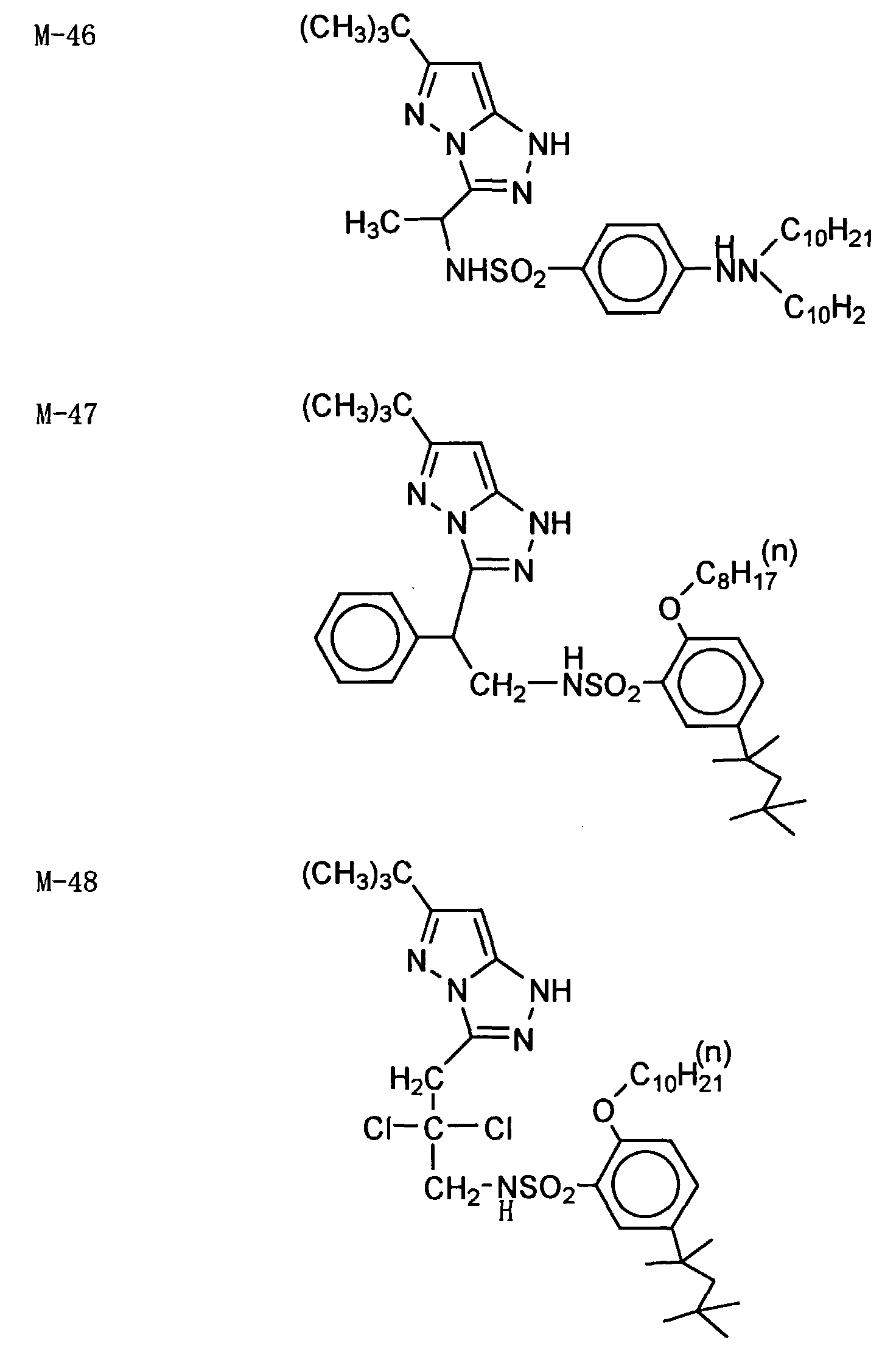
- Practical compound examples of formula (MC-2) are presented below. However, the present invention is not limited to these examples.
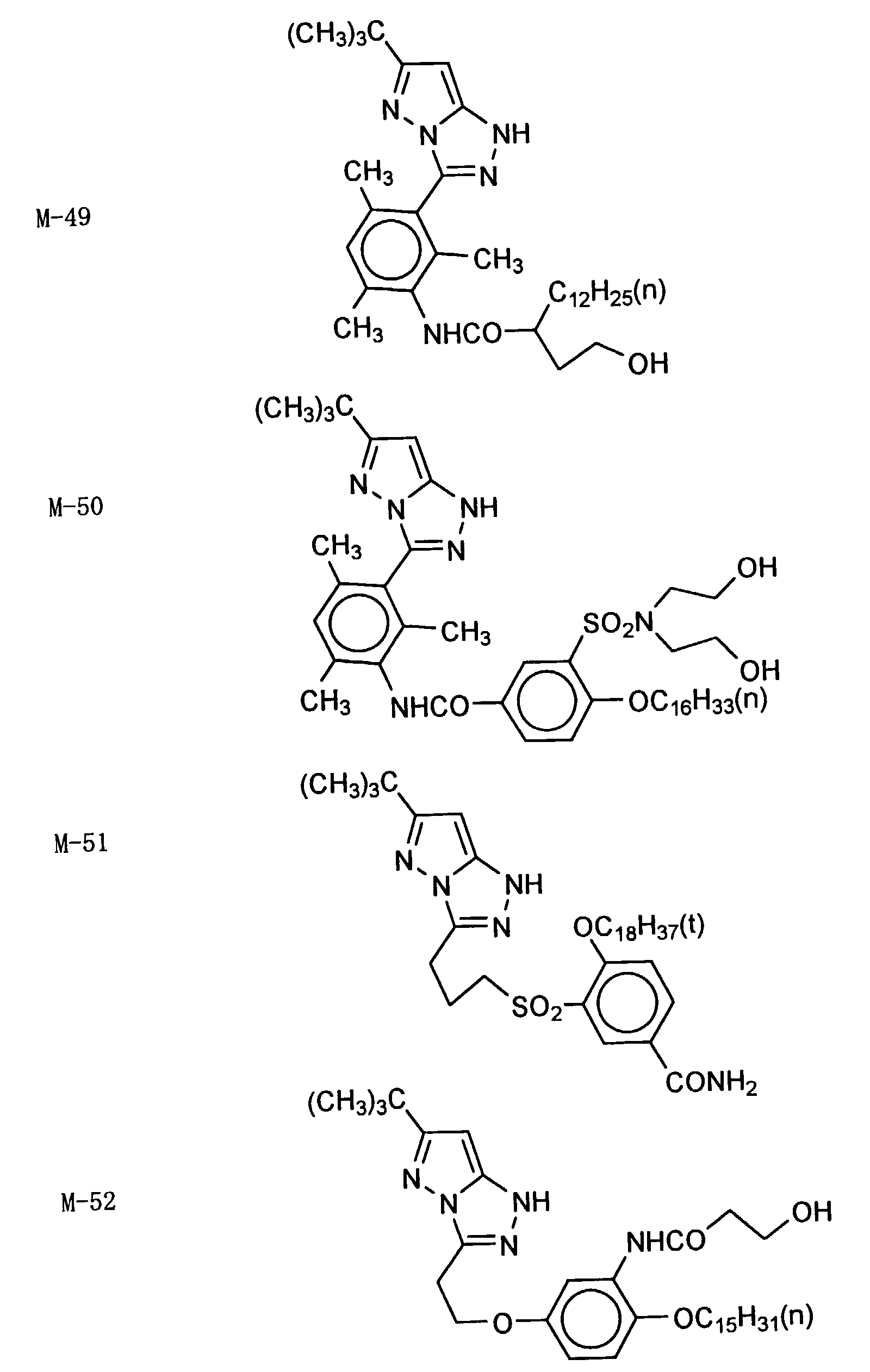

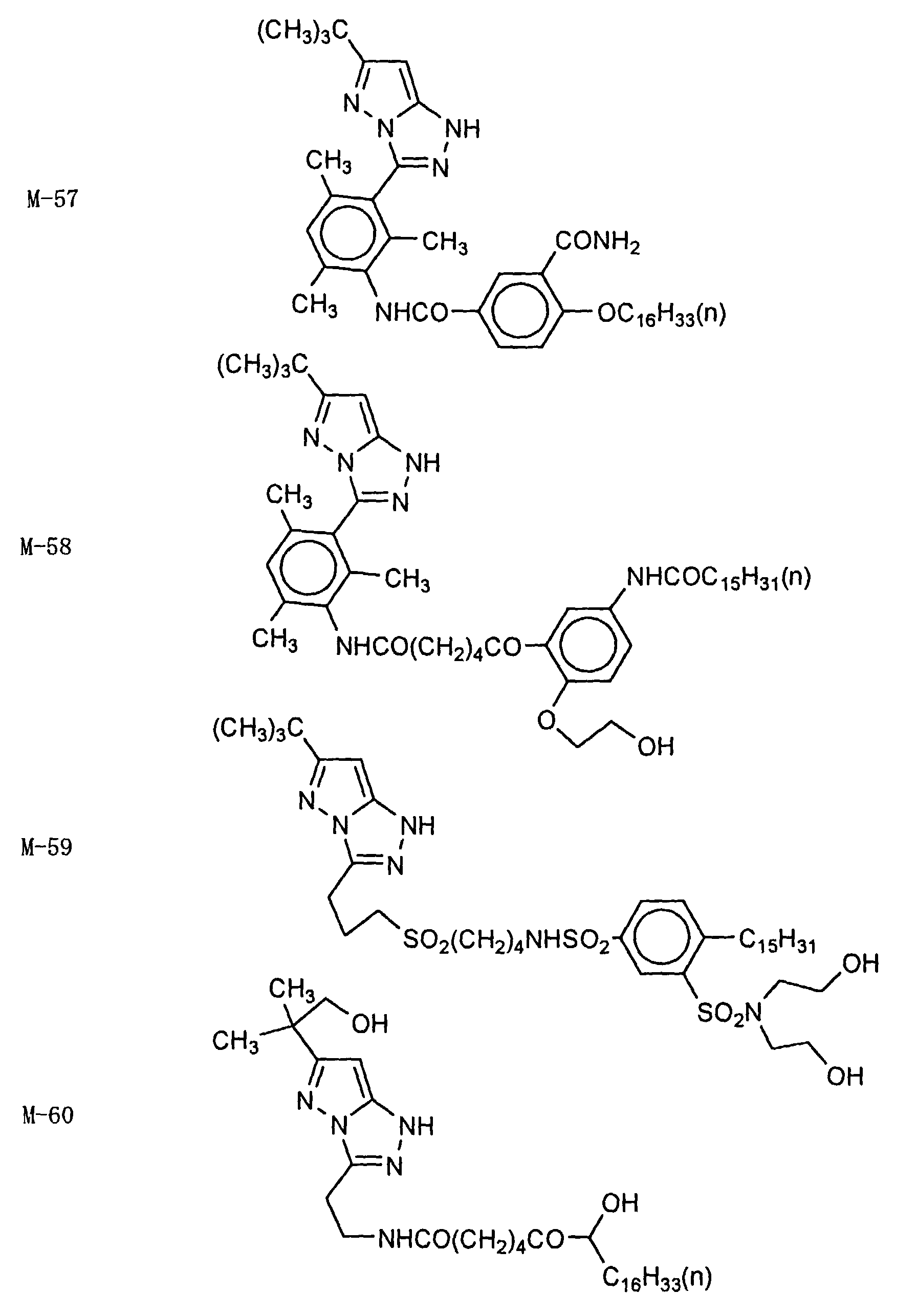


- The following compounds are within the scope of formula (M-4). *: Rb is a normal alkyl group unless otherwise indicated.
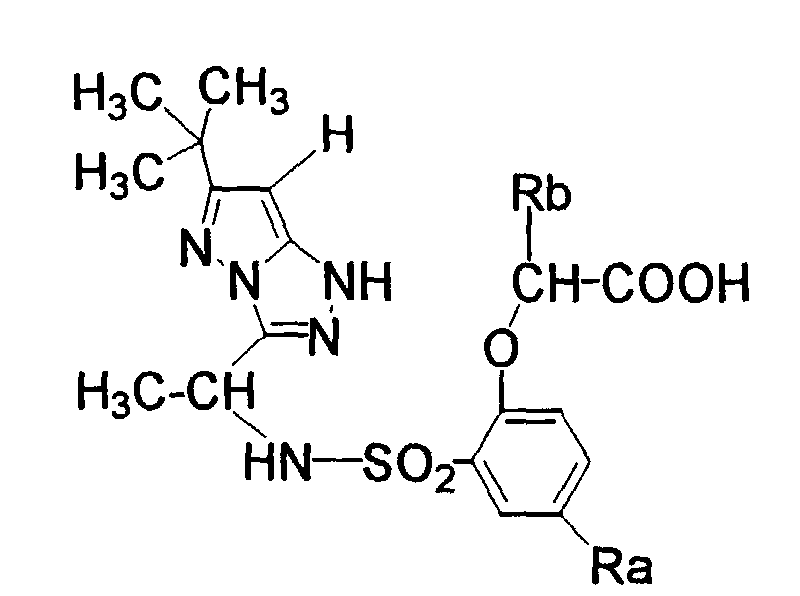


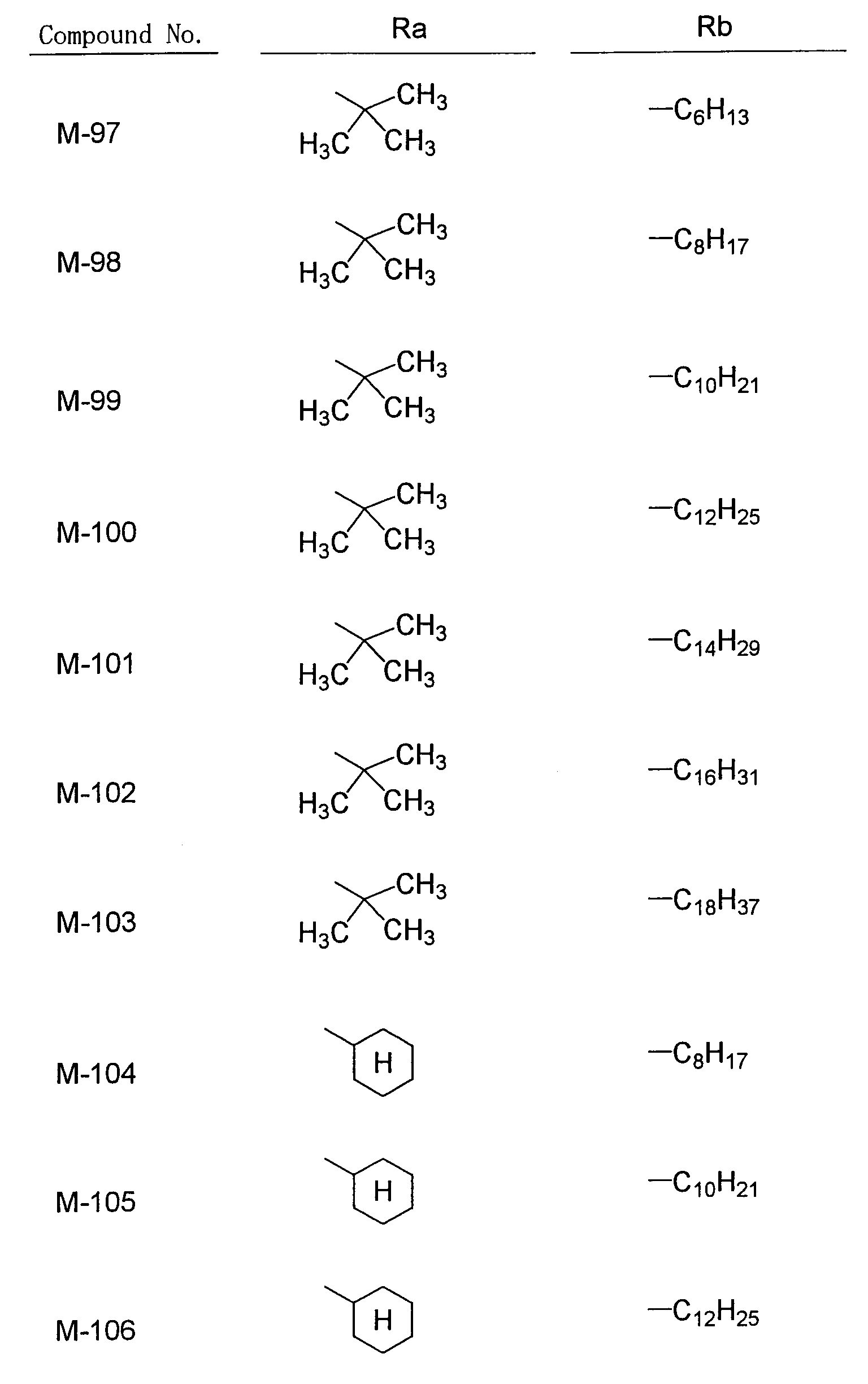


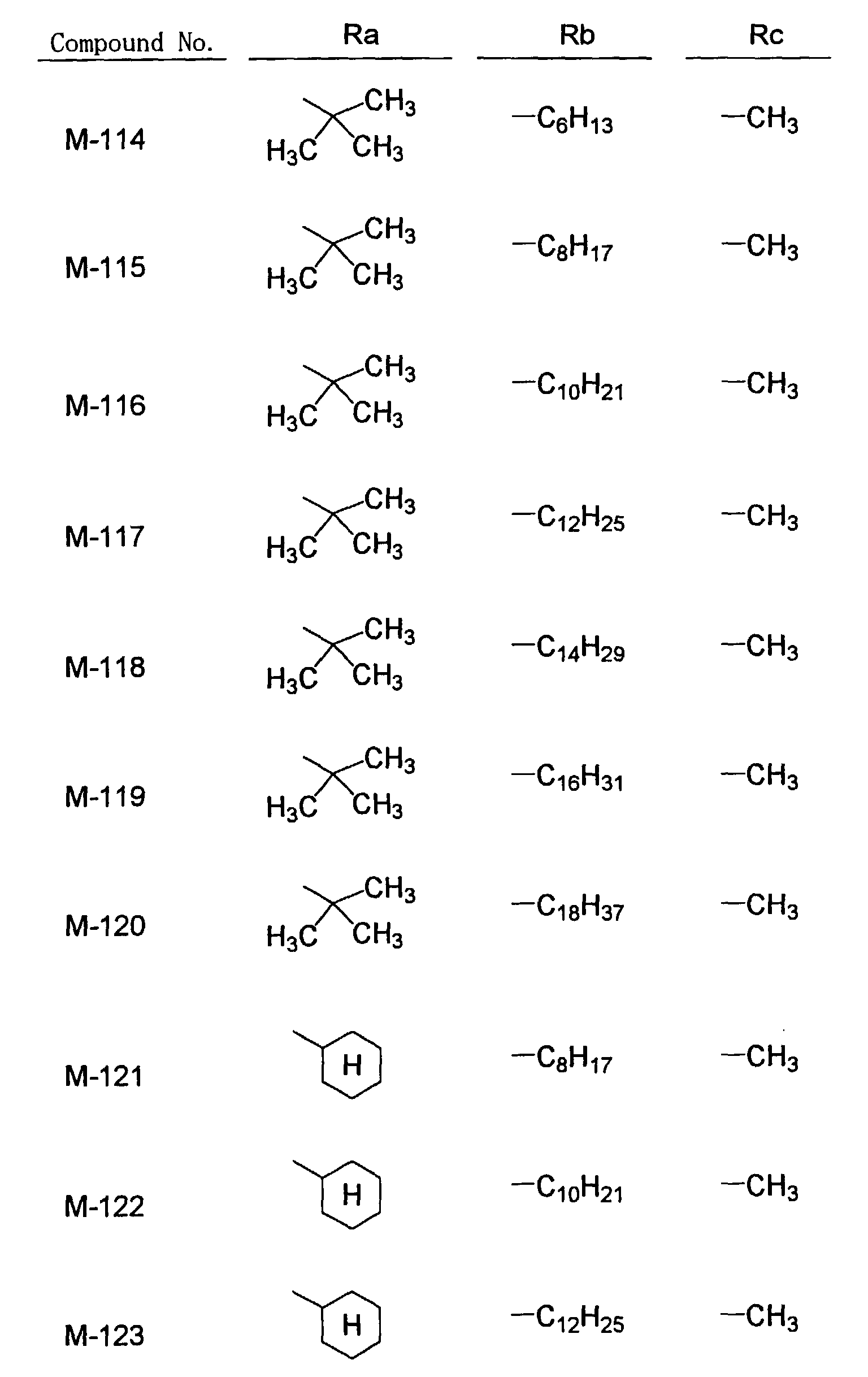

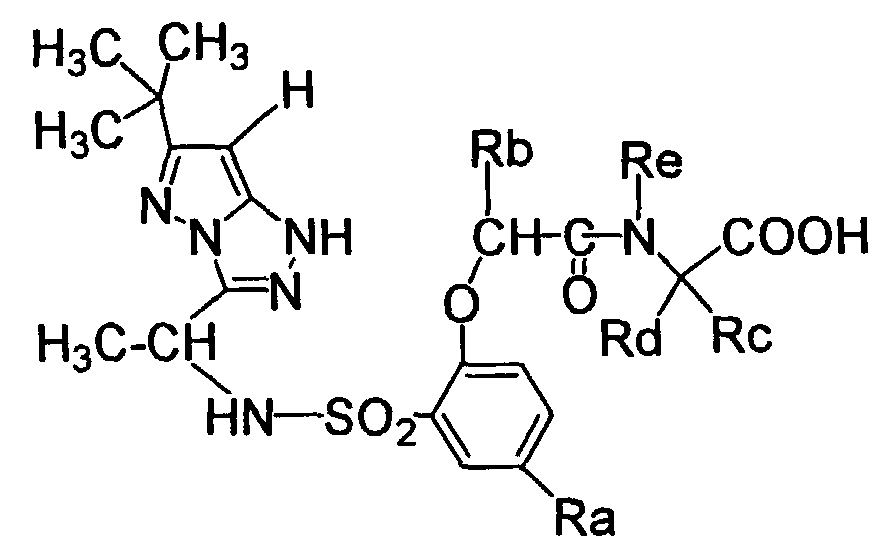
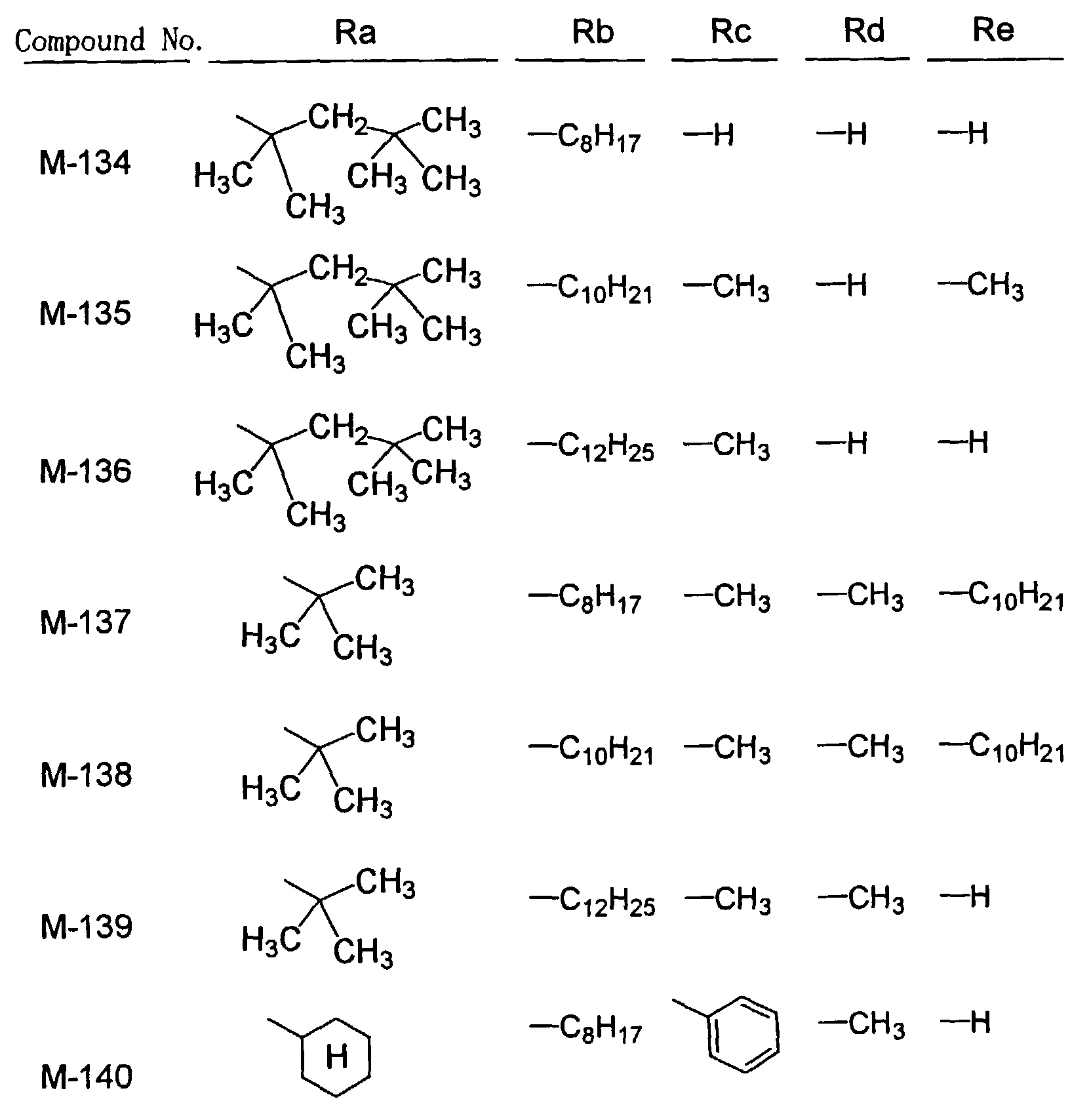
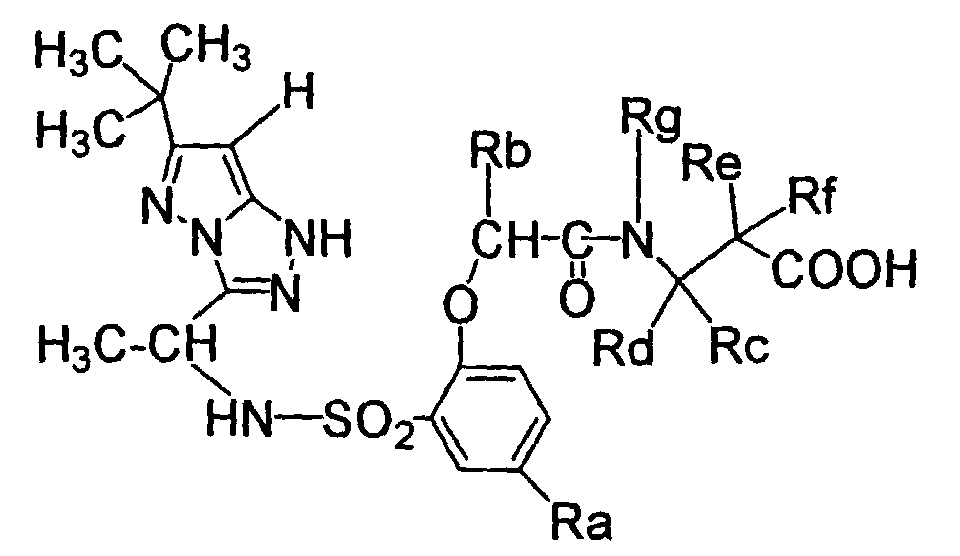
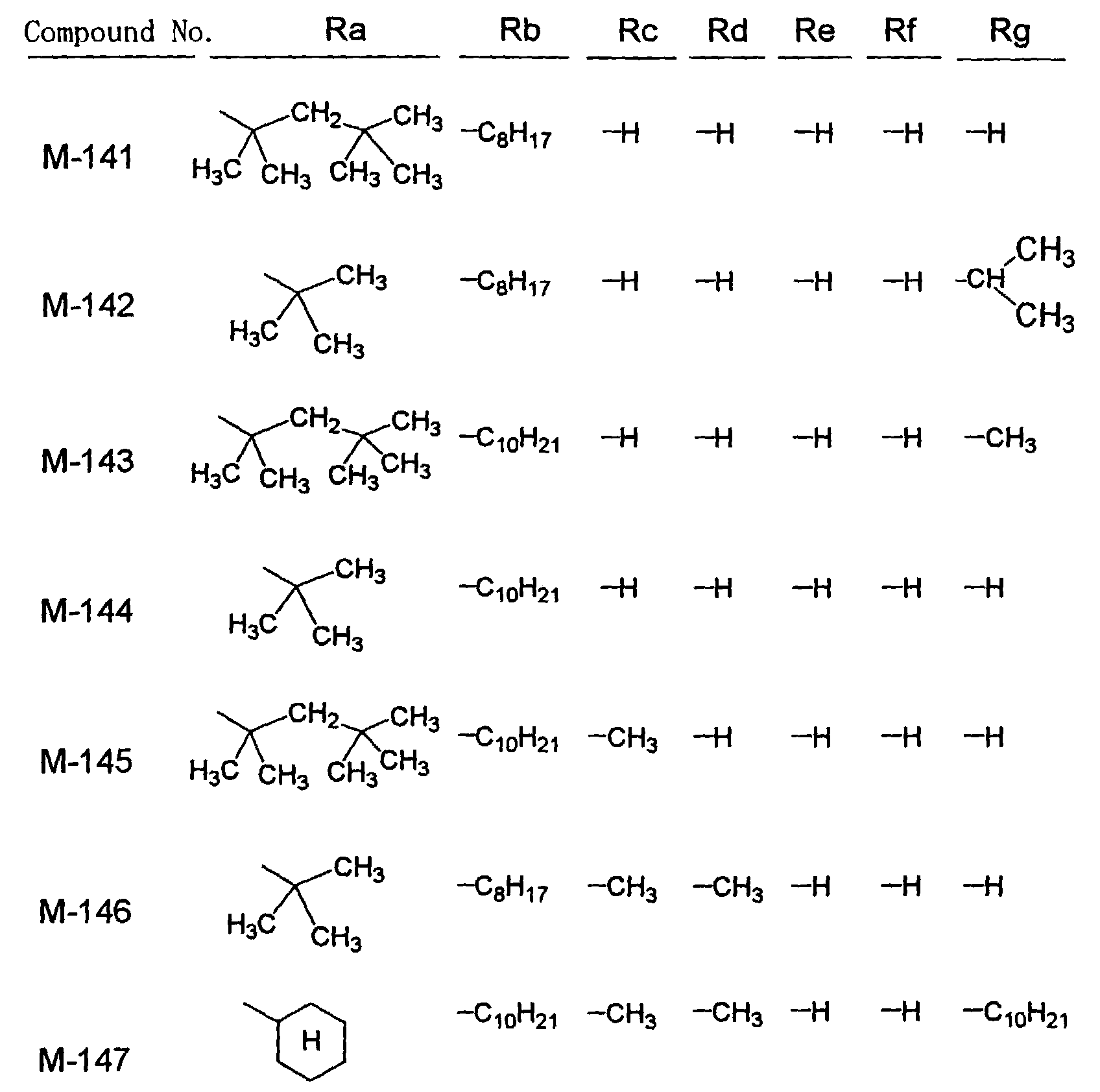
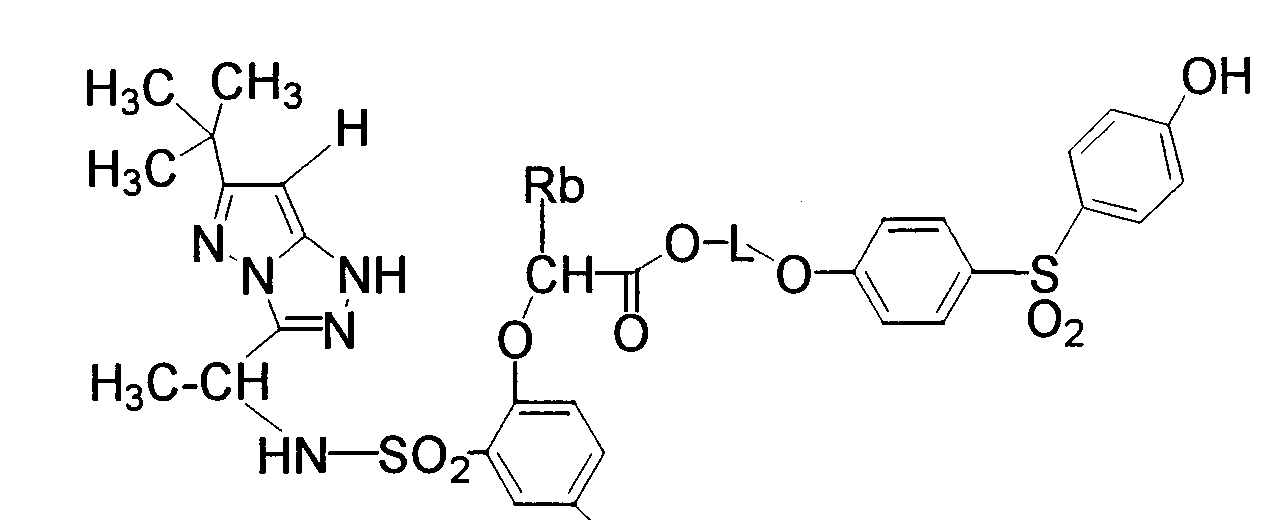

- The following compounds are within the scope of formula (M-3).


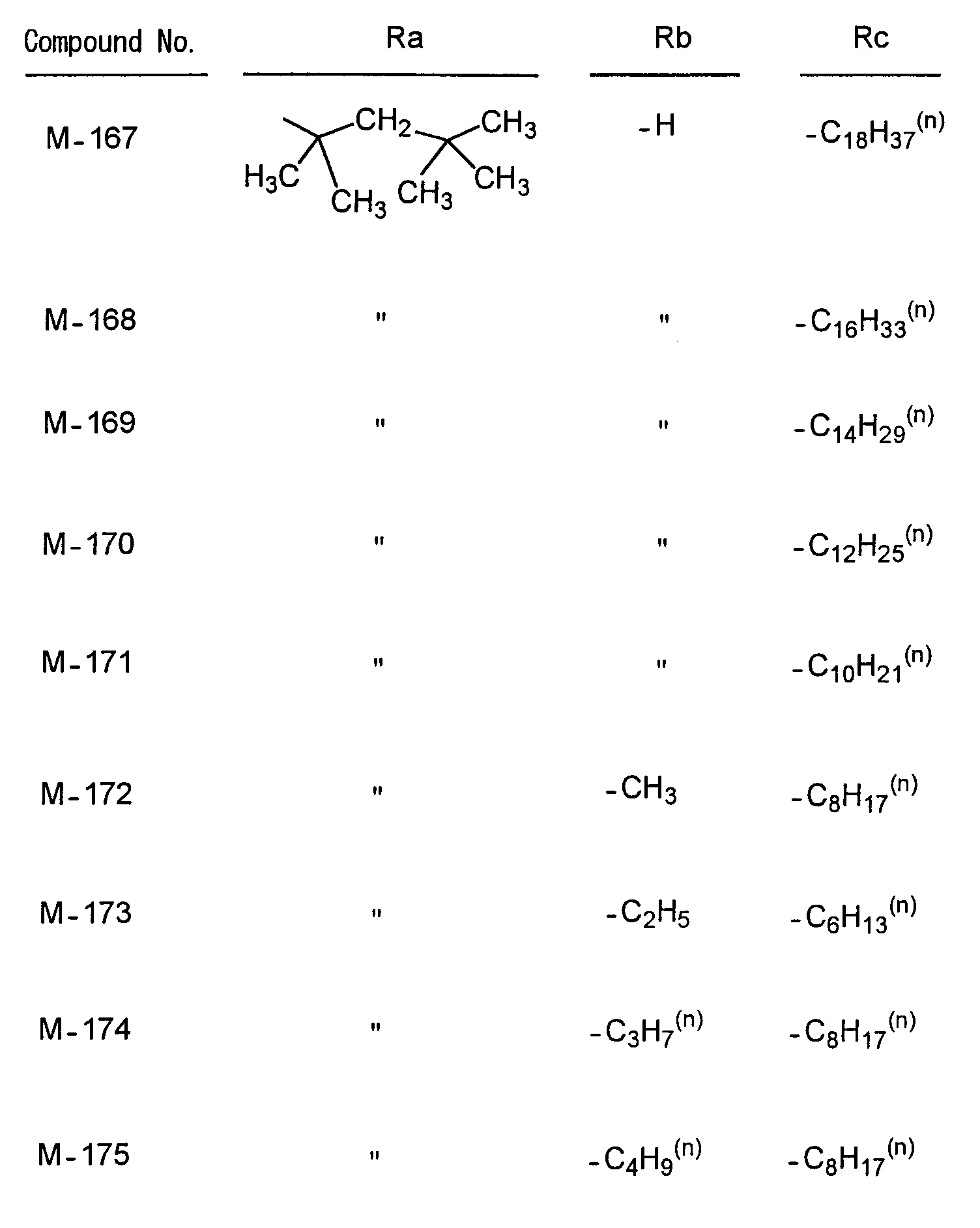


- The coupler represented by formula (MC-1) or formula (MC-2) of the present invention can be synthesized by know methods. Examples are described in U.S.P. Nos. 4,540,654, 4,705,863, and 5,451,501, JP-A-61-65245, JP-A-62-209457, JP-A-62-249155, JP-A-63-41851, Jpn. Pat. Appln. KOKOKU Publication No. (hereinafter referred to as JP-B-)7-122744, JP-B-5-105682, JP-B-7-13309, JP-B-7-82252, U.S.P. Nos. 3,725,067 and 4,777,121, JP-A-2-201442, JP-A-2-101077, JP-A-3-125143, and JP-A-4-242249, the disclosures of which are herein incorporated by reference.
- Synthesis examples of the compounds of the invention are set forth below.
- Into a 500 mL-three neck flask, provided with a thermometer, a stirrer and a cooler, 148.1g (1 mol) of phthalic anhydride, 93.5g (1.05 mol) of α-alanine, and 200 mL of acetic acid were added and stirred at an internal temperature of 120°C for 5 hr. The reaction solution was cooled to 80°C and the reaction solution was pored drop-wise into 500 mL of iced water for 5 min. After the addition, the reaction solution was stirred for 30 min at a room temperature, and the precipitated crystal was suction-filtrated. The crystal was washed with 100 mL of water, dried, thereby to obtain 204g (yield = 93%) of Intermediate A of white crystal.
- Into a 500 mL-three neck flask, provided with a thermometer, a stirrer and a cooler, 109.6g (0.5 mol) of Intermediate A, 150 mL of toluene, and 0.1g of N,N-dimethylformamide were added and stirred at an external temperature of 90 to 100°C. Then, 101.3g (0.75 mol) of thionyl chloride was added drop-wise for 30 min. After the addition, the reaction solution was further stirred with heating for additional 30 min, toluene and excess thionyl chloride were removed under a reduced pressure, thereby to obtain 116g of Intermediate B of oil (m.p. 68-70°C, yield = 97.6%).
- Into a 1 L-three neck flask, provided with a thermometer, a stirrer and a cooler, 103.2g (0.5 mol) of p-octylphenol, 153.7g (0.5 mol) of ethyl 2-bromododecanoate, 103.6g (0.75 mol) of potassium carbonate, and 400 mL of N,N-dimethylformamide were added and stirred at an internal temperature of 120°C for 5 hr. The reaction solution was cooled to 40t, suction-filtered, and the reaction vessel and the crystals were washed by pouring 600 mL of ethyl acetate. The filtrate was extracted with 500 mL of water twice (250 mL × 2), separated the phases and the organic phase was dried over magnesium sulfate anhydride. The extracted solution was filtered and then concentrated under a reduced pressure to remove the solvent, thereby to obtain 216g (yield was qualitative) of Intermediate C of oil.
- Into a 2 L-three neck flask, provided with a thermometer, a stirrer and a cooler, 216g (0.5 mol) of Intermediate C obtained by Step 3, 600 mL of methylene chloride were added, and cooled to 0°C or below by setting the reaction vessel on an ice/acetone bath. Then, 139.8g (1.2 mol) of chlorosulfonic acid was added drop-wise for 45 min. During the addition, the internal temperature was maintained at 10°C or below. After the addition, the reaction was continued for additional 2 hr at an internal temperature of 10°C or below, 850 mL of acetonitrile was added to the reaction solution, followed by addition of 150 mL of N,N-dimethylacetamide drop-wise for 1 hr at a temperature of 10°C or below. After the termination of the addition, the reaction solution was cooled to an internal temperature of 0°C, 93.2 mL (1 mol) of phosphorus oxychloride was added drop-wise for 20 min. The solution was stirred for 1 hr while the temperature was maintained at 40°C by a water bath, then methylene chloride and acetonitrile were removed under a normal pressure while gradually raising the external temperature to 70°C. The condensed residue was dissolved to 850 mL of ethyl acetate, extracted with 1L of water twice (500 mL × 2), separated the phases, and the organic phase was dried over magnesium sulfate anhydride. The extracted solution was filtered and then concentrated under a reduced pressure to remove the solvent, thereby to obtain 260g (yield = 97.9%) of Intermediate D of oil.
- The steps 1 to 4 are schematized below.
- Into a 500 mL-three neck flask, provided with a thermometer, a stirrer and a cooler, 43.3g (0.1 mol) of Intermediate C obtained by Step 3 and 200 mL of methanol were added and stirred at 40°C. Then, a sodium hydride (8.0g, 0.2 mol)/water (40 mL) solution was added drop-wise for 15 min. After stirring at 40°C for 30 min, the solution was cooled to 20°C with a water bath, a conc. hydrochloric acid (18 mL)/water (150 mL) solution was added. To the reaction solution, 250 mL of ethyl acetate was added, the reaction solution was stirred and left to stand, and then the water phase was removed. Then, 100 mL of water was added, and extraction and separation of phases were conducted, and the organic phase was dried over magnesium sulfate anhydrate. The extracted solution was filtered and concentrated under a reduced pressure to remove the solvent, thereby to obtain 40.5g (yield was quantitative) of Intermediate E of oil.
- Into a 500 mL-three neck flask, provided with a thermometer, a stirrer and a cooler, 40.5g (0.5 mol) of Intermediate E obtained by Step 5, 1g of N,N-dimethylformamide, and 80 mL of toluene were added and stirred at an internal temperature of 100°C. Then, 16.2g (0.12 mol) of thionyl chloride was added drop-wise for 20 min and stirred for 1 hr at 100°C. The reaction solution was concentrated under a reduced pressure to remove the solvent, thereby 42.5g (yield was quantitative) of Intermediate F of oil was obtained.
- Into a 500 mL-three neck flask, provided with a thermometer, a stirrer and a cooler, 8.4g (0.21 mol) of sodium hydride (60% lipophilic) and 100 mL of THF were added and stirred at a room temperature. Then, 10.0g (0.105 mol) of methanesulfonamide was added and stirred at 40°C for 2 hr. The reaction solution was cooled to an internal temperature of 15°C or below with a water bath, and 43g of the acid chloride obtained by
Step 6, i.e., Intermediate F, was added drop-wise for 30 min. After 2 hr's reaction at 40°C, the reaction solution was cooled with iced water, and a conc. hydrochloric acid (11 mL)/water (200 mL) solution and 250 mL of ethyl acetate were added. The mixture was stirred, left to stand, then the water phase was removed and 200 mL of water was added, stirred and left to stand again to separate the organic phase and dried over magnesium sulfate anhydride. The extracted solution was filtered, followed by concentration under a reduced pressure to remove the solvent, thereby 48.2g (yield was quantitative) of Intermediate G of oil was obtained. - Into a 1 L-three neck flask, provided with a thermometer, a stirrer and a cooler, 48.2g (0.1 mol) of Intermediate G obtained by Step 7 and 200 mL of methylene chloride were added, and cooled to 0°C or below by setting an ice/acetone bath. Then, 28g (0.24 mol) of chlorosulfonic acid was added drop-wise for 30 min. During the addition, the temperature was maintained at 10°C or below. After the addition, the reaction was continued for additional 2 hr at a temperature of 10°C or below, then 100 mL of acetonitrile was added to the reaction solution followed by 25 mL of N,N-dimethylacetamide at 10°C or below. After the termination of the addition, the reaction solution was cooled to 0°C, and 18.6 mL (0.2 mol) of phosphorus oxychloride was added drop-wise for 20 min. After stirring the reaction mixture for 1 hr while maintaining the temperature at 40°C with a water bath, methylene chloride and acetonitrile were removed under a normal pressure while the external temperature was gradually raised to 70°C. The concentrated residue was dissolved into 350 mL of ethyl acetate, and washed with 400 mL of water twice (200 mL × 2), separated phases and the organic phase was dried over magnesium sulfate anhydride. The extracted solution was filtered and concentrated under a reduce pressure to remove the solvent, thereby 58g (yield was quantitative) of Intermediate H of oil was obtained.
- Into a 500 mL-three neck flask, provided with a thermometer, a stirrer and a cooler, 8.4g (0.21 mol) of sodium hydride (60% lipophilic) and 100 mL of THF were added and stirred at a room temperature. Then 18.0g (0.105 mol) of p-toluenesulfonamide was added and stirred at 40°C for 2 hr. The reaction solution was cooled with water to 15°C or below, and 42.5g (0.1 mol) of the acid chloride obtained by
Step 6, i.e., Intermediate F, was added drop-wise for 30 min. After 2 hr's reaction at 50°C, the reaction solution was cooled with iced water, and a conc. hydrochloric acid (11 mL)/water (200 mL) solution and 250 mL of ethyl acetate were added. The mixture was stirred, left to stand, then the water phase was removed and 200 mL of water was added, stirred and left to stand again to separate the organic phase and the organic phase was dried over magnesium sulfate anhydride. The extracted solution was filtrated, then concentrated under a reduced pressure to remove the solvent, and recrystallized with acetonitrile, thereby to obtain 43.5g (yield = 78%) of Intermediate I of white crystals. - Into a 500 mL-three neck flask, provided with a thermometer, a stirrer and a cooler, 27.9g (0.05 mol) of Intermediate I obtained by
Step 9 and 100 mL of methylene chloride were added, and cooled to 0°C or below by setting an ice/acetone bath. Then, 13.98g (0.12 mol) of chlorosulfonic acid was added drop-wise for 30 min. During the addition, the temperature was maintained at 10°C or below. After the addition, the reaction was continued for additional 2 hr at 10°C or below, then 100 mL of acetonitrile was added to the reaction solution followed by 15 mL of N,N-dimethylacetamide at 10°C of below. After the termination of the addition, the reaction solution was cooled to 0°C or below, and 9.32 mL (0.1 mol) of phosphorus oxychloride was added drop-wise for 20 min. After stirring the reaction mixture for 1 hr while maintaining the reaction temperature at 40°C with a water bath, methylene chloride and acetonitrile were removed under a normal pressure while the external temperature was gradually raised to 70°C. The concentrated residue was dissolved into 400 mL of ethyl acetate, and washed with 400 mL of water twice (200 mL × 2), separated phases, and the organic phase was dried over magnesium sulfate anhydrate. The extracted solution was filtered and concentrated under a reduce pressure to remove the solvent, thereby 32.5g (yield was quantitative) of Intermediate J of oil was obtained. - The steps 5 to 10 are schematized below.
- Into a 500 mL-three neck flask, provided with a thermometer, a stirrer and a cooler, 51g (0.15 mol) of Intermediate K, 28.2g (0.225 mol) of ethylene bromohydrin, 41.5 (0.3 mol) of potassium carbonate, and 200 mL of DMF were added and stirred with heating at 100°C for 4 hr. The reaction solution was cooled to 40°C, inorganic salts were removed by suction-filtration, then the reaction vessel and crystals were washed with 300 mL of ethyl acetate. The filtrate was washed with 200 mL of water twice (100 mL × 2), separated phases and the organic phase was dried over magnesium sulfate anhydride. The extracted solution was filtered, then concentrated under a reduced pressure to remove the solvent, and recrystallized with 200 mL of acetonitrile, thereby to obtain 45.4g (yield = 78.7%) of Intermediate L of white crystals.
- The step 11 is schematized below.
- Into a 500 mL-three neck flask, provided with a thermometer, a stirrer and a cooler, 53.1g (0.5 mol) of thiocarbohydrazide and 250 mL of methanol were added and stirred at an internal temperature of 10 to 15°C by cooling with an iced water bath. While maintaining the internal temperature of 10 to 15°C, 69g (0.5125 mol) of 1-chloropinacoline was added drop-wise for 30 min. After additional stirring for 30 min, the iced water bath was removed, and the reaction solution was stirred for 1 hr at a room temperature. During the stirring, the reaction solution gradually generated heat and the internal temperature rose up to 40°C. Then, the reaction solution was heated to reflux, and the solvent was removed under a reduced pressure. The concentrated residue was dissolved to 400 mL of acetonitrile and crystallized by cooling with ice. The precipitated crystal was suction-filtered, thereby to obtain 97.6g (yield = 87.6%) of Intermediate 1 of crystals.
- Into a 500 mL-three neck flask, provided with a thermometer, a stirrer and a cooler, 55.7g (0.25 mol) of Intermediate 1 and 300 mL of acetonitrile were added and heated to reflux on a water bath. To the mixture, a Intermediate B 59.4g (0.25 mol)/acetonitrile (30 mL) solution was added drop-wise for 2 hr. After the completion of the addition, the mixture was additionally heated to reflux for 30 min, and cooled with water. The precipitated crystals were suction-filtered, poured with acetonitrile, and 84.3g (yield 83.1%) of crystallized HCl salt of Intermediate 2 was obtained. The HCl salt of Intermediate 2 was dispersed into 250 mL of water, a sodium hydroxide (7.9g)/water (70 mL) solution was added drop-wise for 30 min at an internal temperature of 40°C. After stirring for 1 hr, pH of the reaction solution was adjusted to 7 to 8 with NaHCO3 and stirred for additional 30 min. The reaction solution was cooled with water and the crystals were suction-filtered, washed with water and dried at 50°C, thereby to obtain 72.9g (yield = 78.9%) of Intermediate 2 of crystals.
- Into a 500 mL-three neck flask, provided with a thermometer, a stirrer and a cooler, 73.9g (0.2 mol) of Intermediate 2 and 180 mL of acetic anhydride were added and heated to reflux for 5 hr with an oil bath set at 150°C. Then, acetic anhydride was removed under a reduced pressure with an aspirator while maintaining the internal temperature at 100°C, 200 mL of acetonitrile was added drop-wise to the concentrate for 10 min, followed by adding 10 mL of methanol and heating to reflux. To the reaction solution, 15.3 mL of conc. hydrochloric acid was added drop-wise for 15 min, and then, heated to reflux for 2 hr. The reaction solution was cooled with water, followed by with iced water to 5 to 10°C for 1 hr. The precipitated crystals were suction-filtered, poured with acetonitrile, thereby to obtain 71g (yield = 95%) of Intermediate 3 of crystals.
- Purity of the crystals was measured with HPLC to reveal that the purity was 93% with a reaction by-product of sulfur.
- Into a 500 mL-three neck flask, provided with a thermometer, a stirrer and a cooler, 71.0g (0.176 mol) of Intermediate 3 and 350 mL of water were added and stirred at 40°C. Then, a sodium hydroxide (6.6g)/water (50 mL) solution was added drop-wise for 30 min. After stirring for 1 hr, pH of the reaction solution was adjusted to 7 to 8 with NaHCO3 and stirred for additional 30 min. After the reaction solution was cooled with water, crystals were suction-filtered, washed with water, thereby to obtain Intermediate 3 in a free form. All of the Intermediate 3 in a free form was dispersed into 350 mL of IPA, heated to reflux. To the solution, 11g of hydrazine hydrate was added drop-wise for 20 min. After the addition, the solution was heated to reflux for 1 hr. The reaction solution was cooled with water to 20°C, the precipitated crystals were suction-filtered, and the filtrate was concentrated to obtain crude Intermediate 4 of oil. The crude product was dissolved into 200 mL of ethyl acetate, 6.5g of hydrochloric acid gas was blew into the reaction vessel, and the precipitated crystals were suction-filtered. The crystals were washed with 30 mL of ethyl acetate and 30 mL of acetone, thereby to obtain 42g (yield = 96%) of Intermediate 4 hydrochloride.
- Into a 500 mL-three neck flask, provided with a thermometer, a stirrer and a cooler, 24.4g (0.1 mol) of Intermediate 4, 53.1g (0.1 mol) of Intermediate D, and 200 mL of acetonitrile were added and stirred at 15°C. To the reaction solution, 35 mL of triethylamine was added drop-wise for 30 min, the reaction solution was stirred for 1 hr at a room temperature, then 250 mL of ethyl acetate was added. Extraction with a conc. hydrochloric acid (15 mL)/water (150 mL) solution was performed, and phases were separated. The organic phase was washed with 200 mL of water twice (100 mL × 2) and separated, dried over magnesium sulfate anhydrate. The extracted solution was filtered, concentrated under a reduced pressure to remove the solvent, thereby to obtain 68.3g (yield = 97.3%) of Intermediate 5 of oil.
- Into a 500 mL-three neck flask, provided with a thermometer, a stirrer and a cooler, 68.3g (0.0973 mol) of oil of Intermediate 5 obtained by Step 16, 100 mL of methanol, and 100 mL of THF were added at a room temperature and stirred to dissolve. Then, a sodium hydroxide (8.8g)/water (35 mL) solution was added drop-wise to the reaction solution. The reaction solution was stirred for 1 hr at a room temperature, then 300 mL of ethyl acetate and a conc. hydrochloric acid (20 mL)/water (200 mL) solution were added for extraction and separated phases. The organic phase was washed with 200 mL of water twice (100 mL × 2) and dried over magnesium sulfate anhydrate. After the extracted solution was filtered, concentration under a reduced pressure was performed to remove the solvent, thereby to obtain 66.5g of the exemplified compound M-75 of oil. The oil product was dissolved into 550 mL of a solvent mixture of hexane/toluene = 10/1, left to stand at a room temperature, and the precipitated crystals were suction-filtered. The crystals were washed with 100 mL of a solvent mixture of cold hexane/toluene = 10/1, thereby to obtain 37.1g (yield = 56.5%) of the exemplified compound M-75 as white crystals was obtained.
- The
steps 12 to 17 are schematized below. - 1H NMR (DMSO-d6, ppm) spectrum of the exemplified compound M-75 is set forth in FIG. 1.
- Exemplified compound M-109 was synthesized in the same manner as in the synthesis of the exemplified compound M-75, except that Intermediate D used in Step 16 was changed to Intermediate H. The thus obtained exemplified compound M-109 in oil was purified by silica gel column chromatography with an eluting solvent of a hexane/ethyl acetate = 5/1 mixture, concentrated thereby to obtain 43.1g (yield = 57.3%) of the exemplified compound M-109 as amorphous.
- 1H NMR (DMSO-d6, ppm) spectrum of the exemplified compound M-109 is set forth in FIG. 3.
- Exemplified compound M-125 was synthesized in the same manner as in the synthesis of the exemplified compound M-75, except that Intermediate D used in Step 16 was changed to Intermediate J. The thus obtained exemplified compound M-125 of oil was dissolved into 350 mL of methanol, recrystallized under cooling with ice, thereby to obtain 51.3g of the exemplified compound M-125 as white crystal (yield = 62%, m.p. 87°C).
- 1H NMR (DMSO-d6, ppm) spectrum of the exemplified compound M-125 is set forth in FIG. 4.
- Into a 500 mL-three neck flask, provided with a thermometer, a stirrer and a cooler, 6.7g (0.01 mol) of the exemplified compound M-75, 0.25 mL of DMF and 100 mL of dichloromethane were added and stirred by cooling with water at 10°C or below. Then 3.17g of oxalyl dichloride was added drop-wise for 30 min. The reaction solution was stirred for 1 hr at a room temperature, concentrated under a reduced pressure with an aspirator, thereby to obtain 7.1g of
Intermediate 6 of oil (yield was quantitative). - Into a 500 mL-three neck flask, provided with a thermometer, a stirrer and a cooler, 21g of diethanolamine, 100 mL of ethyl acetate, and 100 mL of iced water were added and stirred vigorously at an internal temperature of 5°C. Then, 7.1g (0.01 mol) of
Intermediate 6 synthesized by Step 20 was dissolved into 100 mL of ethyl acetate and the thus obtained solution was added drop-wise to the reaction solution for 15 min. After stirring was continued for 30 min, the reaction solution was separated, and the organic phase was washed with diluted hydrochloric acid solution once and with water once. The organic phase was separated and dried over magnesium sulfate anhydrate. The extracted solution was filtered, and concentrated under a reduced pressure to remove the solvent, thereby to obtain 7.7g of crude oil of exemplified compound M-92. The crude oil product was purified by silica gel column chromatography with an eluting solvent of a methylene chloride/methanol = 20/1 mixture, and concentrated thereby to obtain 6.0g (yield = 78.8%) of the exemplified compound M-92 as amorphous. - The steps 18 to 21 are schematized below.
- 1H NMR (DMSO-d6, ppm) spectrum of the exemplified compound M-92 is set forth in FIG. 2.
-
- i) Into a 500 mL-three neck flask, provided with
a thermometer, a stirrer and a cooler, 7.1g (0.01 mol)
of
Intermediate 6, 5.76g (0.015 mol) of Intermediate L, and 50 mL of acetonitrile were added, and 1.6g (0.02 mol) of pyridine was added drop-wise for 15 min while maintaining the internal temperature at 15°C or below. After reaction of 1 hr at a room temperature, 100 mL of ethyl acetate was added to the reaction solution. The organic phase was washed with diluted hydrochloric acid once and with water once. The organic phase was separated, and dried over magnesium sulfate anhydride. The extracted solution was filtered, concentrated under a reduced pressure to remove the solvent thereby to obtain crude oil Intermediate 7. The crude oily product was purified by silica gel column chromatography with an eluting solvent of a hexane/ethyl acetate = 2/1 mixture and concentrated thereby to obtain 5.62g (yield = 54%) of Intermediate 7 as amorphous. - ii) Step 23: Synthesis of exemplified compound M-150 Into a 500 mL-three neck flask, provided with a thermometer, a stirrer and a gas inlet, 5.62g (0.0054 mol) of Intermediate 7 obtained by Step 22, 100 mL of ethyl acetate, and 0.5g of 10%Pd-C were added and hydrogen gas at a normal pressure was introduced through the gas inlet. After the system was exchanged with hydrogen gas, the reaction solution was stirred for 6 hr at a normal pressure. Pd-C was removed by Celite-filtration, and the filtrate was concentrated to obtain 5.03g (yield = 98%) of the exemplified compound M-150 as amorphous.
-
- The steps 22 and 23 are schematized below.
- 1H NMR (DMSO-d6, ppm) spectrum of the exemplified compound M-150 is set forth in FIG. 5.
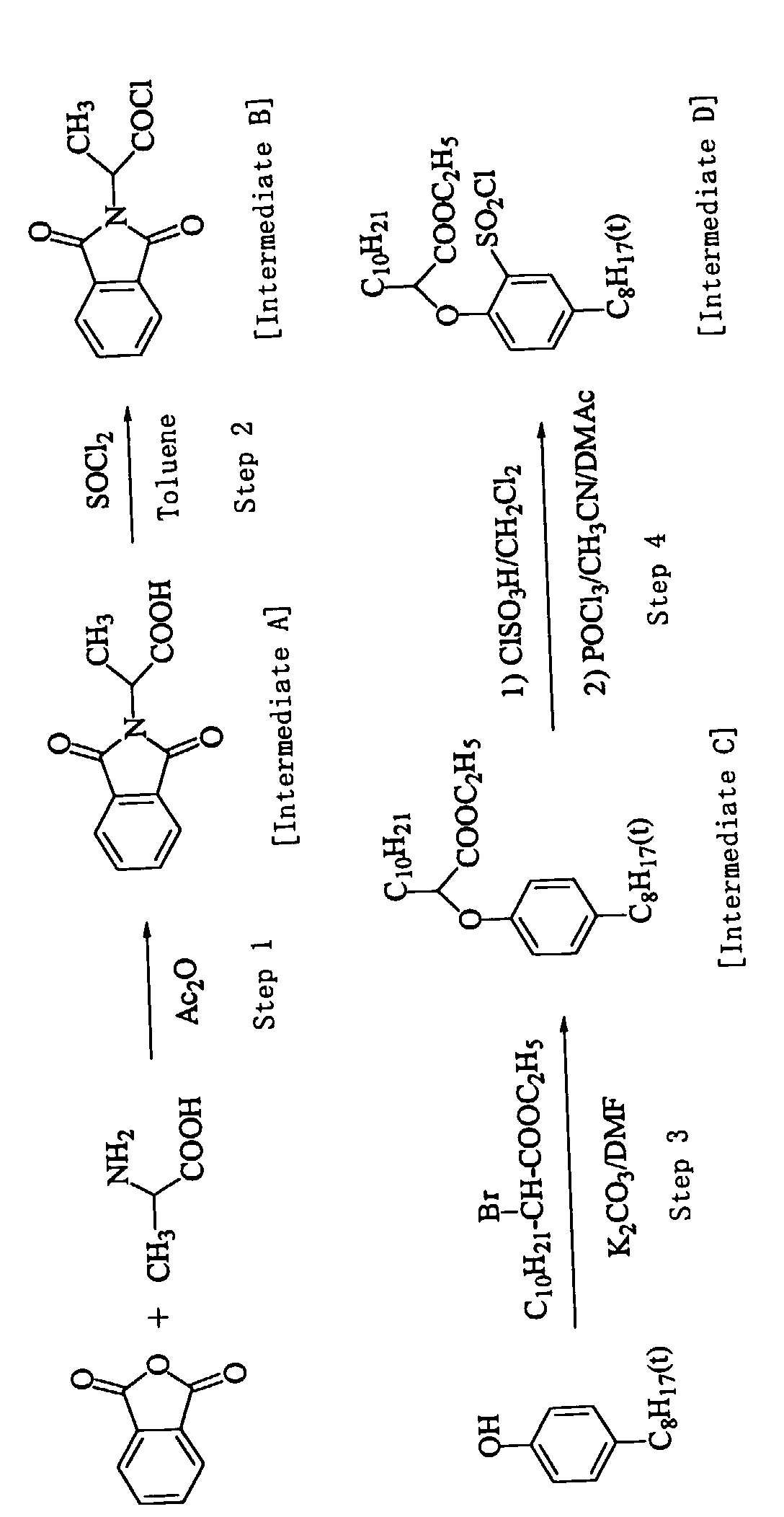
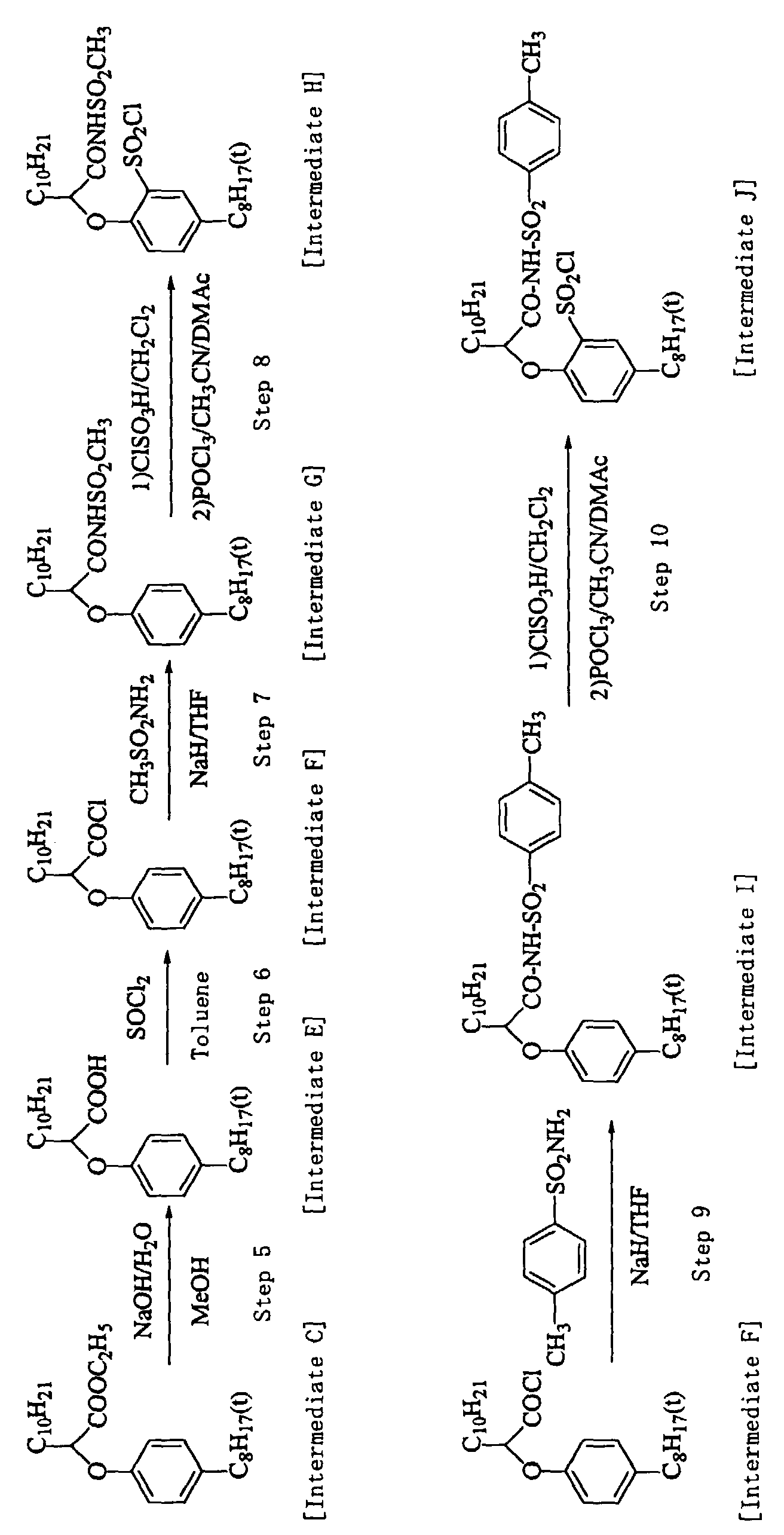

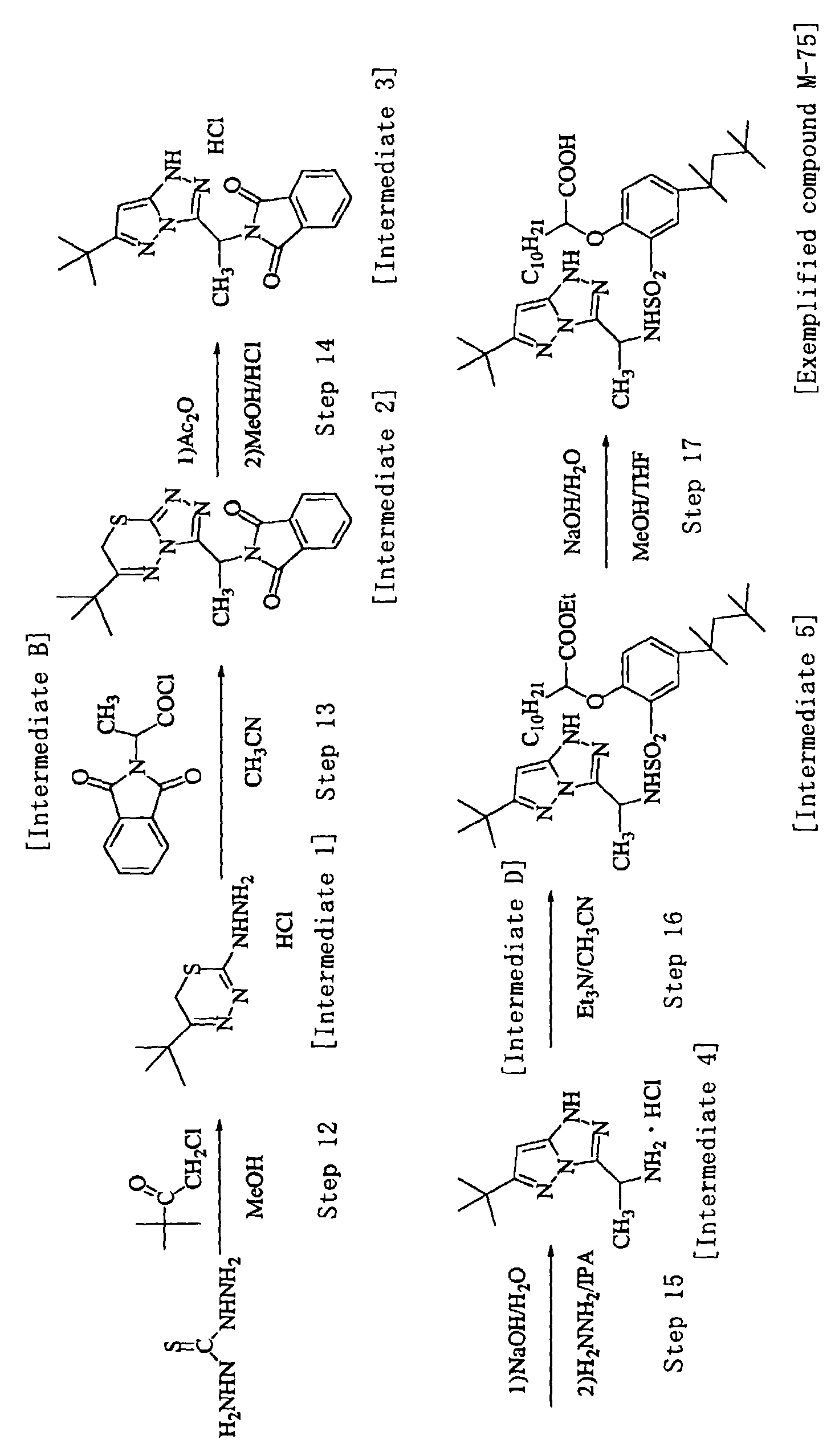

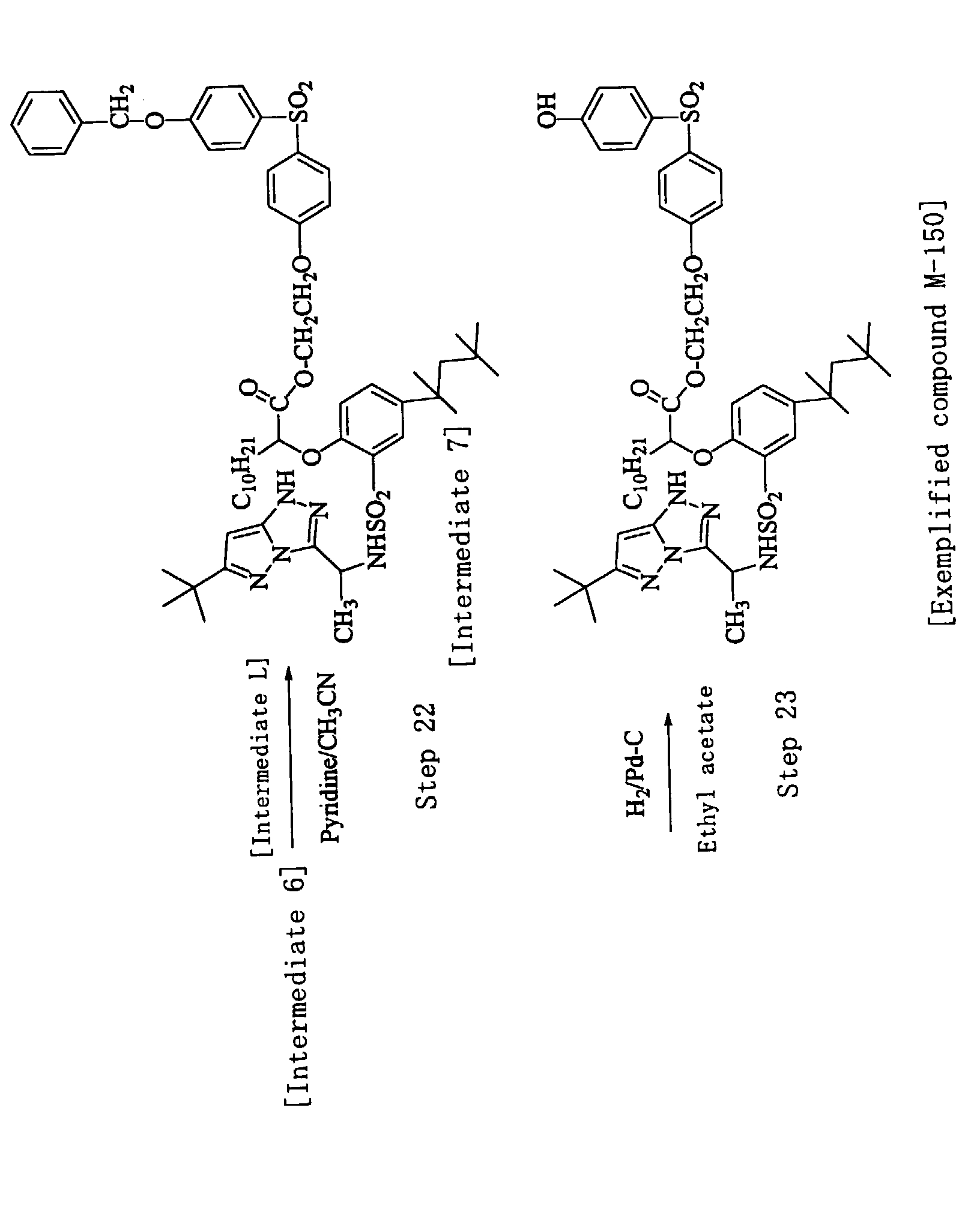
- The content of the coupler represented by formula (MC-1) or formula (MC-2) of the present invention in the sensitive material is 0.01 to 10g, preferably 0.1g to 2g per m2 of a sensitive material. The content is appropriately 1 × 10⁻³ to 1 mol, preferably 2 × 10⁻³ to 3 × 10⁻¹ mol per mol of the silver halide in the same sensitive emulsion layer as the layer in which the coupler represented by formula (MC-1) or formula (MC-2) is contained.
- One or more types of couplers represented by formula (MC-1) can be added to the sensitive material. If this is the case, a plurality of couplers can be added to the same layer or different layers. The same can be applied to the coupler represented by formula (MC-2). Also, a coupler represented by formula (MC-1) and a coupler represented by formula (MC-2) can be used together in the sensitive material.
- When the sensitive layer has a unit structure, i.e., includes two or more sensitive emulsion sub-layers sensitive to the same color and having different speeds, the content per mol of a silver halide is preferably 2 × 10⁻³ to 1 × 10⁻¹ mol in a low-speed sub-layer, preferably 3 × 10⁻² to 3 × 10⁻¹ mol in a medium-speed sub-layer, and preferably 3 × 10⁻² to 3 × 10⁻¹ mol in a high-speed sub-layer.
- The coupler represented by formula (MC-1) or formula (MC-2) of the present invention can be introduced to the sensitive material by various known dispersion methods. Among other methods, an oil-in-water dispersion method is preferable in which a coupler is dissolved in a high-boiling organic solvent, used in combination with a low-boiling solvent where necessary, the solution is dispersed by emulsification in an aqueous gelatin solution by using a surfactant, and the dispersion is added to a silver halide emulsion.
- Examples of the high-boiling solvent used in this oil-in-water dispersion method are described in, e.g., U.S.P. No. 2,322,027, the disclosure of which is herein incorporated by reference. Practical examples of steps, effects, and impregnating latexes of a latex dispersion method as one polymer dispersion method are described in, e.g., U.S.P. No. 4,199,363, West German Patent Application (OLS) Nos. 2,541,274 and 2,541,230, JP-B-53-41091, and EP029104, the disclosures of which are herein incorporated by reference. Dispersion using an organic solvent-soluble polymer is described in PCT International Publication WO88/00723, the disclosure of which is herein incorporated by reference.
- Examples of the high-boiling solvent usable in the abovementioned oil-in-water dispersion method are phthalic acid esters (e.g., dibutylphthalate, dioctylphthalate, dicyclohexylphthalate, di-2-ethylhexylphthalate, decylphthalate, bis(2,4-di-tert-amylphenyl)isophthalate, and bis(1,1-diethylpropyl)phthalate), esters of phosphoric acid and phosphonic acid (e.g., diphenylphosphate, triphenylphosphate, tricresylphosphate, 2-ethylhexyldiphenylphosphate, dioctylbutylphosphate, tricyclohexylphosphate, tri-2-ethylhexylphosphate, tridodecylphosphate, and di-2-ethylhexylphenylphosphate), benzoic acid esters (e.g., 2-ethylhexylbenzoate, 2,4-dichlorobenzoate, dodecylbenzoate, 2-ethylhexyl-p-hydroxybenzoate), amides (e.g., N,N-diethyldodecaneamide and N,N-diethyllaurylamide), alcohols and phenols (e.g., isostearylalcohol, 2,4-di-tert-amylphenol, and glycerinmonooleyl), aliphatic esters (e.g., dibutoxyethyl succinate, di-2-ethylhexyl succinate, 2-hexyldecyl tetradecanate, tributyl citrate, diethylazelate, isostearyllactate, and trioctyltosylate), aniline derivatives (e.g., N,N-dibutyl-2-butoxy-5-tert-octylaniline), chlorinated paraffins (paraffins containing 10% to 80% of chlorine), trimesic acid esters (e.g., trimesic acid tributyl), dodecylbenzene, diisopropylnaphthalene, phenols (e.g., 2,4-di-tert-amylphenol, 4-dodecyloxyphenol, 4-dodecyloxycarbonylphenol, and 4-(4-dodecyloxyphenylsulfonyl)phenol), carboxylic acids (e.g., 2-(2,4-di-tert-amylphenoxy butyric acid and 2-ethoxyoctanedecanic acid), alkylphosphoric acids (e.g., di-(2-ethylhexyl)phosphoric acid and diphenylphosphoric acid). In addition to the above high-boiling solvents, compounds described in, e.g., JP-A-6-258803, the disclosure of which is herein incorporated by reference, can also be preferably used as high-boiling solvents.
- Of these compounds, phosphoric acid esters are preferable, and the combination of phosphoric acid esters and alcohols or phenols is also preferable.
- The weight ratio of a high-boiling organic solvent to a coupler represented by formula (MC-1) or formula (MC-2) of the present invention is preferably 0 to 2.0, more preferably 0.01 to 1.0, and most preferably 0.01 to 0.5.
- As a co-solvent, it is also possible to use an organic solvent (e.g., ethyl acetate, butyl acetate, ethyl propionate, methylethylketone, cyclohexanone, 2-ethoxyethylacetate, and dimethylformamide) having a boiling point of 30°C to about 160°C.
- The sensitive material of the present invention need only have at least one green-sensitive emulsion layer and contain a coupler represented by formula (MC-1) or formula (MC-2) of the present invention is contained, on a support. A common sensitive material can be formed by coating a support with at least one blue-sensitive silver halide emulsion layer, at least one green-sensitive silver halide emulsion layer, and at least one red-sensitive silver halide emulsion layer in the order named. However, the order of layers can be different from this one.
- In the present invention, red-, green-, and blue-sensitive silver halide emulsion layers are preferably formed by coating in this order from the side closest to a support. Also, each sensitive layer has a unit structure including two or more sensitive emulsion sub-layers having different sensitivities. Each sensitive layer particularly preferably has a three-layered unit structure including three sensitive emulsion sub-layers, i.e., low-, medium-, and high-speed sub-layers from the side closest to a support. A coupler represented by formula (MC-1) or formula (MC-2) of the present invention can be added to any of low-, medium-, and high-speed sub-layers and is preferably added to a low-speed sub-layer.
- The sensitive material of the present invention is spectrally sensitized to blue, green, and red. A wavelength by which the maximum value of the sensitivity of each sensitive layer is given, is preferably 430 to 460 nm for a blue-sensitive layer, 520 to 560 nm for a green-sensitive layer, and 600 to 650 nm for a red-sensitive layer.
- The sensitive material of the present invention can also have a sensitive emulsion layer having sensitivity in a wavelength region other than the blue, green, and red regions described above. In particular, the faithfulness of color reproduction can be improved by forming a fourth sensitive layer whose maximum sensitivity is given at a wavelength of 480 to 530 nm and by suppressing development of a red-sensitive layer as a function of development of this fourth sensitive layer. This fourth layer is preferably applicable to the sensitive material of the present invention.
- In the present invention, a coupler for generating a different color from the color of an emulsion can be mixed in addition to a coupler for forming a dye which generates a complementary color of the color of the emulsion. For example, a cyan generating coupler or black generating coupler can be added to high- and medium-speed sub-layers of a green-sensitive emulsion unit in addition to a coupler represented by formula (MC-1) of the present invention. This improves the shadow expression.
- A coupler represented by formula (MC-1) or formula (MC-2) of the present invention can be used together with another magenta coupler. This magenta coupler is preferably a 1-phenyl-3-acylamino-5-pyrazolone magenta coupler, and more preferably selected from C-4, C-7, and C-8 described in examples of this specification. When a coupler represented by formula (MC-1) or formula (MC-2) is used together with another magenta coupler, the molar ratio of a coupler represented by formula (MC-1) or formula (MC-2) of the present invention is preferably 30% or more, and more preferably 50% or more.
- When a coupler represented by formula (MC-1) or formula (MC-2) of the present invention is used in combination with another magenta coupler, the content in the sensitive material is 0.01 to 10g, preferably 0.1 to 2g per m2 of the sensitive material. The content is appropriately 1 × 10⁻³ to 1 mol, preferably 2 × 10⁻³ to 3 × 10⁻¹ mol per mol of a silver halide in the same sensitive emulsion layer as the layer in which the coupler represented by formula (MC-1) or formula (MC-2) is contained.
- The sensitive material of the present invention can also contain a competing compound, i.e., a compound which competes with an image forming coupler to react with an oxidized form of a color developing agent and which does not form any dye image. Examples of this competing coupler are reducing compounds such as hydroquinones, catechols, hydrazines, and sulfonamidophenols, and compounds which couple with an oxidized form of a color developing agent but do not essentially form a color image (e.g., colorless compound forming couplers disclosed in German Patent No. 1,155,675, British Patent No. 861,138, and U.S.P. Nos. 3,876,428 and 3,912,513, and flow-out couplers disclosed in JP-A-6-83002, the disclosures of which are herein incorporated by reference).
- The competing compound is preferably added to a sensitive emulsion layer or a non-sensitive layer containing a magenta coupler represented by formula (MC-1) or formula (MC-2) of the present invention. A completing compound is particularly preferably added to a sensitive emulsion layer containing a coupler represented by formula (MC-1) or formula (MC-2) of the present invention. The content of a competing compound is 0.01 to 10g, preferably 0.10 to 5.0g per m2 of the sensitive material. The content is 1 to 1,000 mol%, preferably 20 to 500 mol% with respect to a coupler represented by formula (MC-1) or formula (MC-2) of the present invention.
- In the sensitive material of the present invention, a sensitive unit sensitive to the same color can have a non-color-forming interlayer. Additionally, this interlayer preferably contains a compound selectable as the aforementioned competing compound.
- To prevent deterioration of the photographic properties caused by formaldehyde gas, the sensitive material of the present invention preferably contains a compound described in U.S.P. No. 4,411,987 or 4,435,503, the disclosure of which is herein incorporated by reference, which can react with and fix formaldehyde gas.
- In silver halide photographic emulsions used in the sensitive material of the present invention and silver halide photosensitive materials of the invention, it is generally possible to use various techniques and inorganic and organic materials described in Research Disclosure Nos. 308119 (1989), 37038 (1995), and 40145 (1997), the disclosure of which is herein incorporated by reference.
- In addition, techniques and inorganic and organic materials usable in color photosensitive materials of the invention are described in portions of EP436,938A2 and patents cited below, the disclosures of which are herein incorporated by reference.
Items Corresponding portions 1) Layer arrangements page 146, line 34 to page 147, lie 25 2) Silver halide emulsions usable page 147, line 26 to page 148 line 12 together 3) Yellow couplers usable together page 137, line 35 to page 146, line 33, and page 149, lines 21 to 23 4) Magenta couplers page usable together 149, lines 24 to 28; EP421,453A1, page 3, line 5 to page 25, line 55 5) Cyan couplers usable together page 149, lines 29 to 33; EP432,804A2, page 3, line 28 to page 40, line 2 6) Polymer couplers page 149, lines 34 to 38; EP435,334A2, page 113, line 39 to page 123, line 37 7) Colored couplers page 53, line 42 to page 137, line 34, and page 149, lines 39 to 45 8) Functional couplers usable together page 7, line 1 to page 53, line 41, and page 149, line 46 to page 150, line 3; EP435,334A2, page 3, line 1 to page 29, line 50 9) Antiseptic and mildewproofing agents page 150, lines 25 to 28 10) Formalin scavengers page 149, lines 15 to 17 11) Other additives usable together page 153, lines 38 to 47; EP421,453A1, page 75, line 21 to page 84, line 56, and page 27, line 40 to page 37, line 40 12) Dispersion methods page 150, lines 4 to 24 13) Supports page 150, lines 32 to 34 14) Film thickness film physical properties page 150, lines 35 to 49 15) Color development step page 150, line 50 to page 151, line 47 16) Desilvering step page 151, line 48 to page 152, line 53 17) Automatic processor page 152, line 54 to page 153, line 2 18) Washing·stabilizing step page 153, lines 3 to 37 - The present invention will be described in detail below by way of its examples, but the invention is not limited to these examples. Preparation of sample 101
- A multilayered color sensitive material including layers having the following compositions was formed on a 127-µm thick undercoated cellulose triacetate film support to make a sample 101. Numbers represent addition amounts per m2. Note that the effects of added compounds are not restricted to the described purposes.
1st layer: Antihalation layer Black colloidal silver 0.10g Gelatin 2.00g Ultraviolet absorbent U-1 0.20g Ultraviolet absorbent U-3 0.040g Ultraviolet absorbent U-4 0.15g High-boiling organic solvent Oil-1 0.10g Dye D-4 1.0 mg Dye D-8 1.5 mg Fine crystal solid dispersion of dye E-1 0.10g 2nd layer: Interlayer Gelatin 0.40g Compound Cpd-C 0.5 mg Compound Cpd-J 1.5 mg Compound Cpd-K 4.0 mg High-boiling organic solvent Oil-3 0.010g High-boiling organic solvent Oil-4 0.020g High-boiling organic solvent Oil-5 2.0 mg High-boiling organic solvent Oil-7 2.0 mg High-boiling organic solvent Oil-8 5.0 mg Dye D-7 2.5 mg 3rd layer: Interlayer Yellow colloidal silver silver 0.010g Gelatin 0.40g Compound Cpd-M 0.015g High-boiling organic solvent Oil-3 0.020g 4th layer: Low-speed red-sensitive emulsion layer Emulsion A silver 0.20g Emulsion B silver 0.20g Emulsion C silver 0.15g Gelatin 0.70g Coupler C-1 0.10g Coupler C-2 0.050g Coupler C-3 0.050g Coupler C-9 0.010g Coupler C-11 0.050g Compound Cpd-C 5.0 mg Compound Cpd-I 0.020g Compound Cpd-J 5.0 mg High-boiling organic solvent Oil-2 0.10g Additive P-1 0.10g 5th layer: Medium-speed red-sensitive emulsion layer Emulsion C silver 0.25g Emulsion D silver 0.25g Gelatin 0.70g Coupler C-1 0.15g Coupler C-2 0.050g Coupler C-3 0.020g Coupler C-11 0.070g High-boiling organic solvent Oil-2 0.10g Additive P-1 0.10g 6th layer: High-speed red-sensitive emulsion layer Emulsion E silver 0.20g Emulsion F silver 0.25g Gelatin 1.20g Coupler C-1 0.10g Coupler C-2 0.050g Coupler C-3 0.20g Coupler C-11 0.30g High-boiling organic solvent Oil-2 0.10g High-boiling organic solvent Oil-9 0.20g Compound Cpd-K 2.0 mg Compound Cpd-F 0.050g Additive P-1 0.10g 7th layer: Interlayer Gelatin 0.60g Additive M-1 0.30g Compound Cpd-I 2.6 mg Dye D-5 0.020g Dye D-6 0.010g Compound Cpd-M 0.040g Compound Cpd-O 3.0 mg Compound Cpd-P 2.5 mg High-boiling organic solvent Oil-1 0.020g High-boiling organic solvent Oil-6 0.050g 8th layer: Interlayer Yellow colloidal silver silver 0.010g Gelatin 0.60g Additive P-1 0.05g Compound Cpd-A 0.10g Compound Cpd-M 0.10g High-boiling organic solvent Oil-6 0.10g 9th layer: Low-speed green-sensitive emulsion layer Emulsion G silver 0.25g Emulsion H silver 0.30g Emulsion I silver 0.25g Gelatin 1.00g Coupler C-7 0.10g Coupler C-8 0.17g Compound Cpd-B 0.030g Compound Cpd-D 0.020g Compound Cpd-E 0.020g Compound Cpd-G 2.5 mg Compound Cpd-F 0.040g Compound Cpd-K 2.0 mg Compound Cpd-L 0.020g High-boiling organic solvent Oil-1 0.05g High-boiling organic solvent Oil-2 0.10g 10th layer: Medium-speed green-sensitive emulsion layer Emulsion I silver 0.20g Emulsion J silver 0.20g Gelatin 0.70g Coupler C-4 0.25g Compound Cpd-B 0.030g Compound Cpd-D 0.020g Compound Cpd-F 0.050g Compound Cpd-G 2.0 mg High-boiling organic solvent Oil-2 0.10g 11th layer: High-speed green-sensitive emulsion layer Emulsion K silver 0.55g Gelatin 0.80g Coupler C-4 0.35g Compound Cpd-B 0.080g Compound Cpd-D 0.020g Compound Cpd-F 0.040g Compound Cpd-K 5.0 mg High-boiling organic solvent Oil-2 0.15g 12th layer: Interlayer Gelatin 0.30g Compound Cpd-M 0.05g High-boiling organic solvent Oil-3 0.025g High-boiling organic solvent Oil-6 0.025g 13th layer: Yellow filter layer Yellow colloidal silver silver 5.0 mg Gelatin 1.00g Compound Cpd-C 0.010g Compound Cpd-M 0.030g Compound Cpd-L 0.010g High-boiling organic solvent Oil-1 0.020g Fine crystal solid dispersion of dye E-2 0.030g Fine crystal solid dispersion of dye E-3 0.020g 14th layer: Interlayer Gelatin 0.40g 15th layer: Low-speed blue-sensitive emulsion layer Emulsion L silver 0.20g Emulsion M silver 0.20g Gelatin 0.80g Coupler C-5 0.20g Coupler C-6 0.10g Coupler C-10 0.10g Compound Cpd-I 0.010g Compound Cpd-M 0.010g 16th layer: Medium-speed blue-sensitive emulsion layer Emulsion N silver 0.20g Emulsion O silver 0.20g Gelatin 0.90g Coupler C-5 0.10g Coupler C-6 0.10g Coupler C-10 0.10g Compound Cpd-N 2.0 mg Compound Cpd-K 2.0 mg High-boiling organic solvent Oil-2 0.050g 17th layer: High-speed blue-sensitive emulsion layer Emulsion O silver 0.20g Emulsion P silver 0.25g Gelatin 1.20g Coupler C-5 0.10g Coupler C-6 0.10g Coupler C-10 0.80g High-boiling organic solvent Oil-2 0.10g Compound Cpd-N 5.0 mg Compound Cpd-Q 0.20g 18th layer: 1st protective layer Gelatin 0.70g Ultraviolet absorbent U-1 0.20g Ultraviolet absorbent U-2 0.050g Ultraviolet absorbent U-5 0.30g Compound Cpd-O 5.0 mg Compound Cpd-A 0.030g Compound Cpd-H 0.20g Dye D-1 0.10g Dye D-2 0.050g Dye D-3 0.07g High-boiling organic solvent Oil-3 0.10g 19th layer: 2nd protective layer Colloidal silver silver 0.10 mg Fine grain silver iodobromide emulsion (average grain size 0.06 µm, AgI content 1 mol%) silver 0.10g Gelatin 0.50g 20th layer: 3rd protective layer Gelatin 0.80g Polymethylmethacrylate (average grain size 1.5 µm) 0.10g 6 : 4 copolymer of methylmethacrylate and methacrylic acid (average grain size 1.5 µm) 0.10g Silicone oil SO-1 0.030g Surfactant W-1 3.0 mg Surfactant W-2 0.030g Surfactant W-7 2.5 mg - In addition to the above compositions, additives F-1 to F-10 were added to all emulsion layers. Also, a gelatin hardener H-1 and surfactants W-3, W-4, W-5, and W-6 for coating and emulsification were added to each layer.
- Furthermore, phenol, 1,2-benzisothiazoline-3-one, 2-phenoxyethanol, phenethylalcohol, and p-benzoic butylester were added as antiseptic and mildewproofing agents.
Silver iodobromide emulsions used in Sample 101 are as follows. Emulsion Characteristics Av. equivalent spherical diameter (µm) COV of diameter (%) AgI Content (%) A Monodispersed tetradecahedral grains 0.13 10 4.0 B Monodispersed cubic internally-fogged grains 0.25 10 4.8 C Monodispersed (111) tabular grains having an av.as.rt of 2.0 0.30 15 3.8 D Monodispersed (111) tabular grains having an av.as.rt of 3.0 0.35 18 4.8 E Monodispersed (111) tabular grains having an av.as.rtof 3.0 0.40 15 2.0 F Monodispersed (111) tabular grains having an av.as.rt of 4.5 0.50 12 1.8 G Monodispersed cubic grains 0.15 9 3.5 H Monodispersed cubic internally-fogged grains 0.24 12 3.5 I Monodispersed (111) tabular grains having an av.as.rt of 4.0 0.30 17 3.5 J Monodispersed (111) tabular grains having an av.as.rtof 5.0 0.45 16 3.0 K Monodispersed (111) tabular grains having an av.as.rt of 5.5 0.60 13 3.3 L Monodispersed tetradecahedral grains 0.33 10 4.5 M Monodispersed cubic grains 0.33 9 4.5 N Monodispersed (111) tabular grains having an av.as.rt of 3.0 0.43 10 2.5 O Monodispersed (111) tabular grains having an av.as.rt of 6.0 0.75 9 2.0 P Monodispersed (111) tabular grains having an av.as.rt of 6.0 0.90 8 1.8 


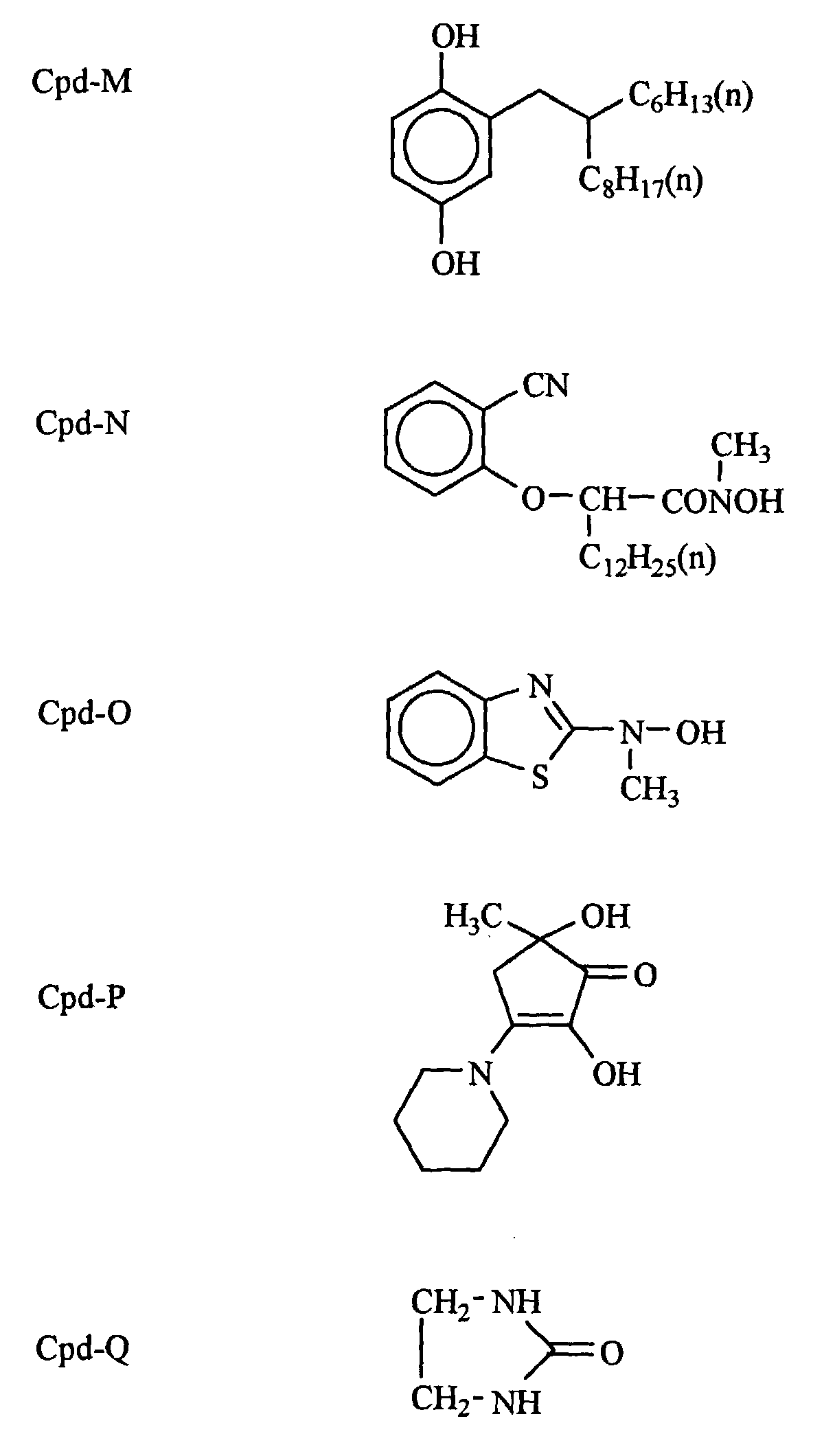
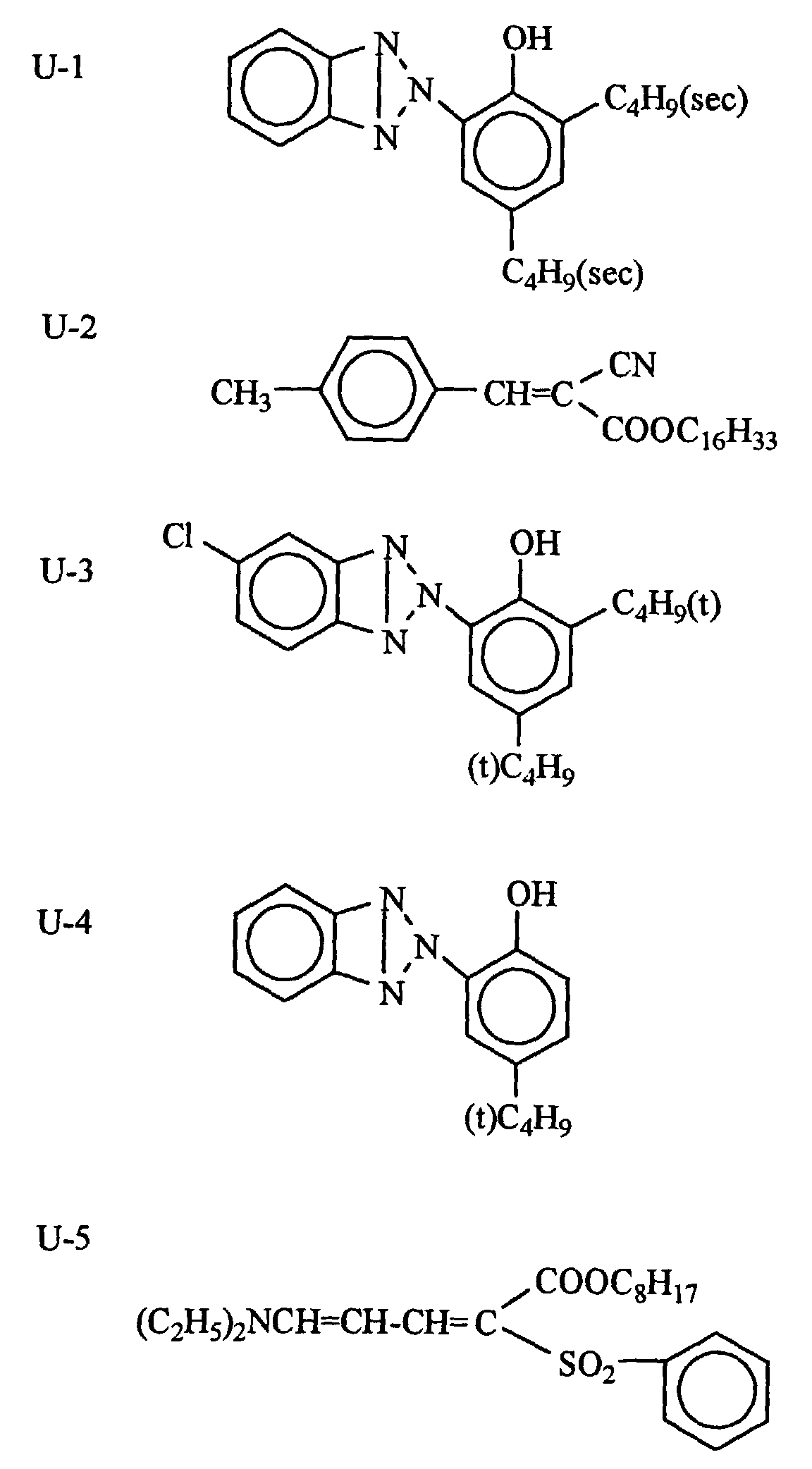


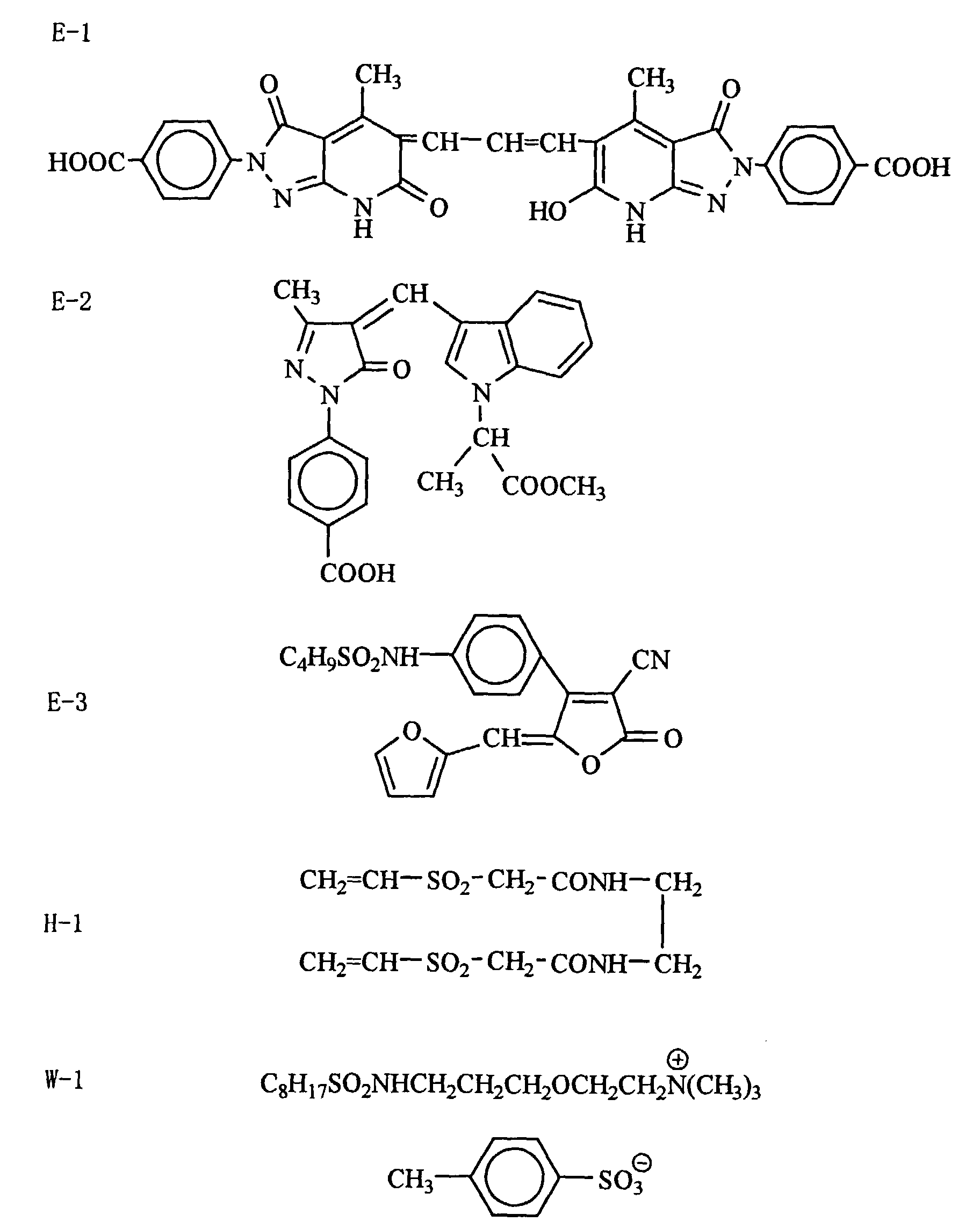


- The dye E-1 was dispersed by the following method. That is, water and 200g of Pluronic F88 (ethylene oxide-propylene oxide block copolymer) manufactured by BASF CORP. were added to 1,430g of a dye wet cake containing 30% of methanol, and the resultant material was stirred to form a slurry having a dye concentration of 6%. Next, Ultra Visco Mill (UVM-2) manufactured by Imex K.K. was filled with 1,700 mL of zirconia beads with an average grain size of 0.5 mm, and the slurry was milled through UVM-2 at a peripheral speed of approximately 10 m/sec and a discharge rate of 0.5 L/min for 8 hr. The beads were filtered away, and water was added to dilute the material to a dye concentration of 3%. After that, the material was heated to 90°C for 10 hr for a stabilization purpose. After that, the average grain size of the obtained fine dye grains was 0.60 µm. The grain size distribution (grain size standard deviation × 100/average grain size) was 18%.
- Following the same procedure as above, solid dispersions of the dyes E-2 and E-3 were obtained. The average grain sizes were found to be 0.54 and 0.56 µm, respectively.
- Samples 102 to 144 were prepared following the same procedures as for the sample 101, except that the couplers 4, 7, and 8 in the 9th, 10th, and 11th layers were changed as shown in Table 3. Note that in replacing with a pyrazolotriazole coupler, the coupler amount in each layer was replaced such that the magenta color densities in 9th to 11th layers of each of the samples 102 to 135 were equal to the magenta densities of 9th to 11th layers of the sample 101, respectively, when the following processing (development A) is performed. The ratios of each pyrazolotriazole coupler to be used were obtained by previously separately forming another sample. Note also that the high-boiling organic solvent Oil-2 was added at weight ratio to the coupler of 0.7, unless otherwise indicated in the parenthesis in Table 3 below.


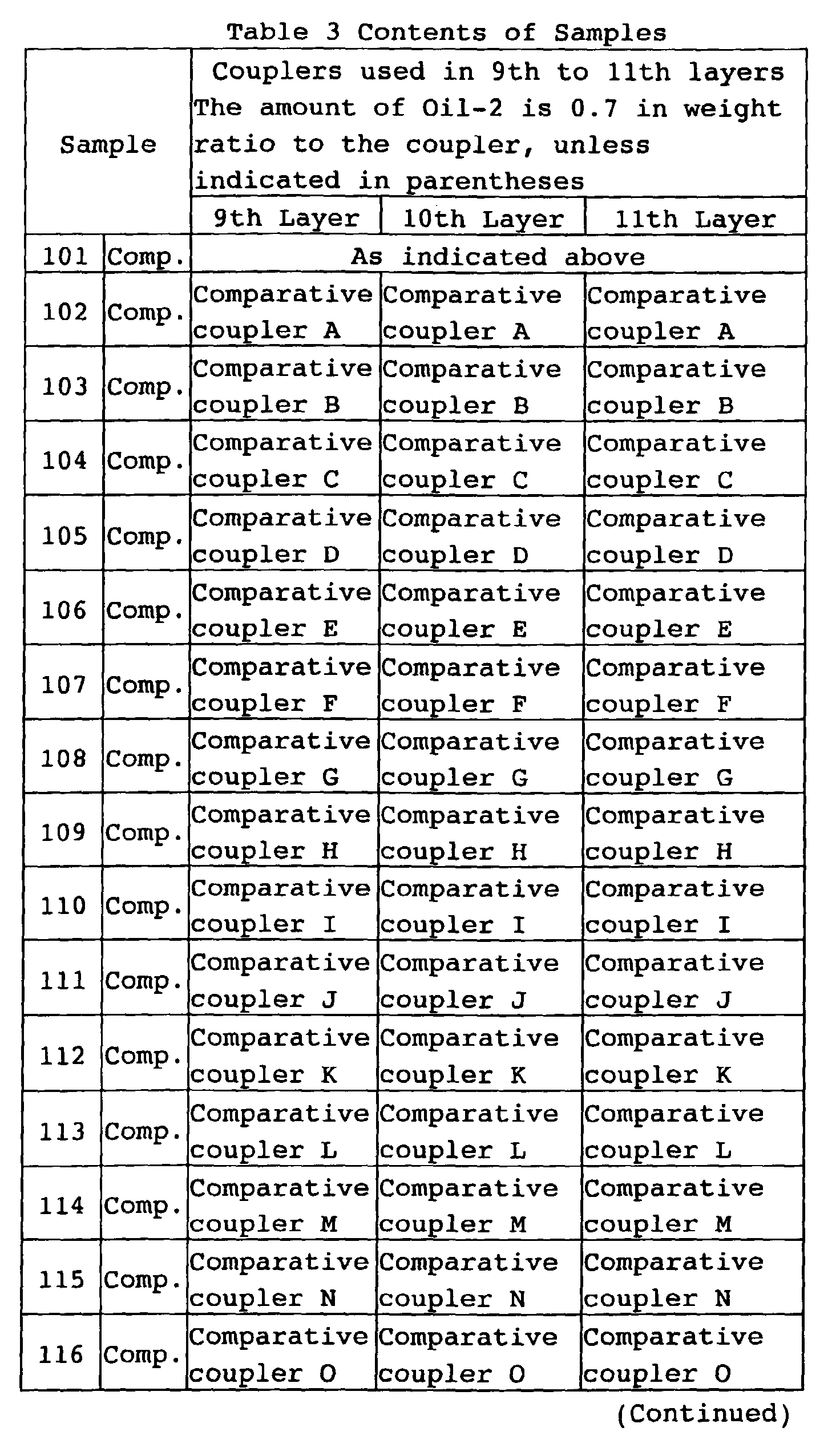
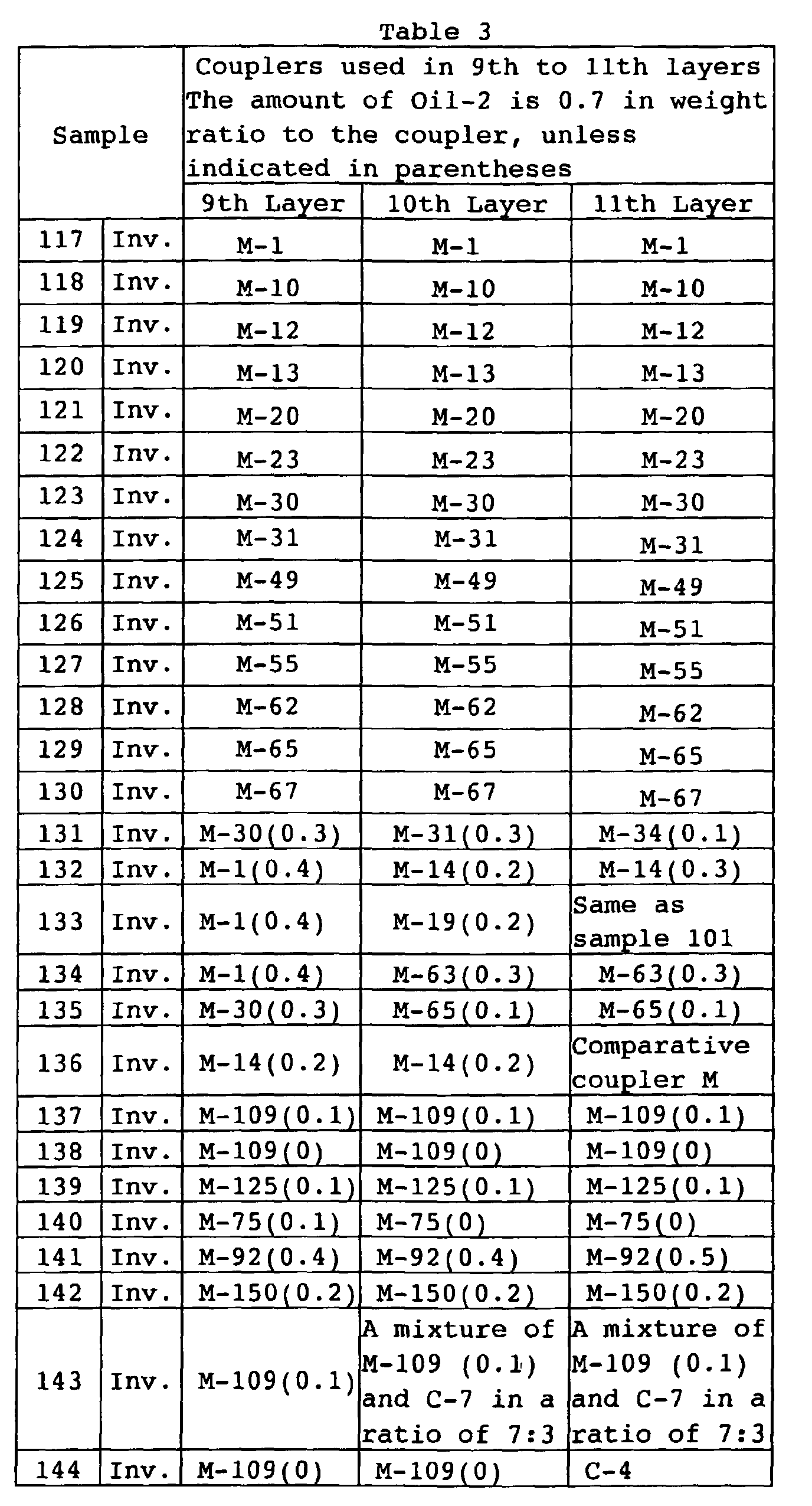
- The following development was performed in this example. In this processing, 60% of each of FUJICHROME RVP and FUJICHROME RAP both of which are manufactured by Fuji Photo Film Co. Ltd., and ECTACHROME EPR and ECTACHROME E100S, both of which are manufactured by Eastman Kodak Company and the samples 101 and 118 were completely exposed to white light, and the resultant materials were processed at a ratio of 1 : 3 : 2 : 1 : 1 : 2 until the replenishment amount was five times the tank volume, thereby providing the processing solutions for the samples to be tested. This processing is called "development A".
Processing Step Time Temperature Tank volume Replenishment rate 1st development 6 min 38°C 12L 2,200 mL/m2 1st washing 2 min 38°C 4L 7,500 mL/m2 Reversal 2 min 38°C 4L 1,100 mL/m2 Color development 6 min 38°C 12L 2,200 mL/m2 Pre-bleaching 2 min 38°C 4L 1,100 mL/m2 Bleaching 6 min 38°C 12L 220 mL/m2 Fixing 4 min 38°C 8L 1,100 mL/m2 2nd washing 4 min 38°C 8L 7,500 mL/m2 Final rinsing 1 min 25°C 2L 1,100 mL/m2 - The compositions of the processing solutions were as follows.
〈1st developer〉 〈Tank solution〉 〈Replenisher〉 Nitrilo-N,N,N-trimethylene phosphonic acid pentasodium salt 1.5g 1.5g Diethylenetriamine pentaacetic acid· pentasodium salt 2.0g 2.0g Sodium sulfite 30g 30g Hydroquinone·potassium monosulfonate 20g 20g Potassium carbonate 15g 20g Sodium bicarbonate 12g 15g 1-phenyl-4-methyl-4-hydroxymethyl-3-pyrazolidone 1.5g 2.0g Potassium bromide 2.5g 1.4g Potassium thiocyanate 1.2g 1.2g Potassium iodide 2.0 mg - Diethyleneglycol 13g 15g Water to make 1,000 mL 1,000 mL pH 9.60 9.60 - The pH was adjust by sulfuric acid or potassium hydroxide.
〈Reversal solution〉 〈Tank solution〉 〈Replenisher〉 Nitrilo-N,N,N-trimethylene phosphonic acid· pentasodium salt 3.0g the same as tank solution Stannous chloride·dihydrate 1.0g p-aminophenol 0.1g Sodium hydroxide 8g Glacial acetic acid 15 mL Water to make 1,000 mL pH 6.00 - The pH was adjust by acetic acid or sodium hydroxide.
〈Color developer〉 〈Tank solution〉 〈Replenisher〉 Nitrilo-N,N,N-trimethylene phosphonic acid· pentasodium salt 2.0g 2.0g Sodium sulfite 7.0g 7.0g Trisodium phosphate· dodecahydrate 36g 36g Potassium bromide 1.0g - Potassium iodide 90 mg - Sodium hydroxide 3.0g 3.0g Citrazinic acid 1.5g 1.5g N-ethyl-N-(β-methanesulfon amidoethyl)-3-methyl-4 aminoaniline·3/2 sulfuric acid·monohydrate 11g 11g 3,6-dithiaoctane-1,8-diol 1.0g 1.0g Water to make 1,000 mL 1,000 mL pH 11.80 12.00 - The pH was adjust by sulfuric acid or potassium hydroxide.
〈Pre-bleaching solution〉 〈Tank solution〉 〈Replenisher〉 Ethylenediaminetetraacetic acid·disodium salt· dihydrate 8.0g 8.0g Sodium sulfite 6.0g 8.0g 1-thioglycerol 0.4g 0.4g Formaldehyde sodium bisulfite adduct 30g 35g Water to make 1,000 mL 1,000 mL pH 6.3 6.10 - The pH was adjust by acetic acid or sodium hydroxide.
〈Bleaching solution〉 〈Tank solution〉 〈Replenisher〉 Ethylenediaminetetraacetic acid·disodium salt· dihydrate 2.0g 4.0g Ethylenediaminetetraacetic acid·Fe(III)·ammonium· dihydrate 120g 240g Potassium bromide 100g 200g Ammonium nitrate 10g 20g Water to make 1,000 mL 1,000 mL pH 5.70 5.50 - The pH was adjust by nitric acid or sodium hydroxide.
〈Fixing solution〉 〈Tank solution〉 〈Replenisher〉 Ammonium thiosulfate 80g the same as tank solution Sodium sulfite 5.0g Sodium bisulfite 5.0g Water to make 1,000 mL pH 6.60 - The pH was adjust by acetic acid or ammonia water.
〈Stabilizer〉 〈Tank solution〉 〈Replenisher〉 1,2-benzoisothiazoline-3-one 0.02g 0.03g Polyoxyethylene-p-monononyl phenylether (average polymerization degree = 10) 0.3g 0.3g Polymaleic acid (average molecular weight = 2,000) 0.1g 0.15 g Water to make 1,000 mL 1,000 mL pH 7.0 7.0 - A set of the samples 101 to 144 were exposed to white light at a color temperature of 4,800 K through a wedge having continuously changing density and subjected to the above development. After the densities of these processed samples were measured, the samples were stored at a temperature of 60°C and a humidity of 70% for seven days, and their densities were again measured. Table 4 shows a rise in yellow density in a white portion as evaluation of the image storage characteristics.
- Another two sets of the samples 101 to 144 exposed as described above were provided. One set of the samples were subjected to a developing step, i.e., "development B", which was the same development as above except for the replenishment rate of the color developer was 1.6L. The other set of the samples were subjected to a developing step i.e., "development C", which was the same development as above except for the replenishment rate of the color developer was 1.1L. The densities of the processed samples were measured. Table 6 shows the difference between the maximum magenta density in "development A" and the magenta density in "development B", and the difference between the maximum magenta density in "development A" and "development C". In a direction in which the densities in "development B" and "development C" increase with respect to the density in "development A" is indicated by a positive value. The closer the value to 0, the less the influence on processing variations, and the more preferable the result.
- Another two sets of the samples 101 to 144 were prepared. One set thereof was stored at a temperature of 50°C and a humidity of 70% for seven days. The other set was stored in a freezer for the same period. The thus stored sets of samples were exposed to light together. After these processed samples were subjected to "development A" described above, their densities were measured.
- Table 4 below shows a sensitivity difference, at a point which gives magenta density of 1.0, between a sample stored in a freezer and a sample stored at 50°C-60%.
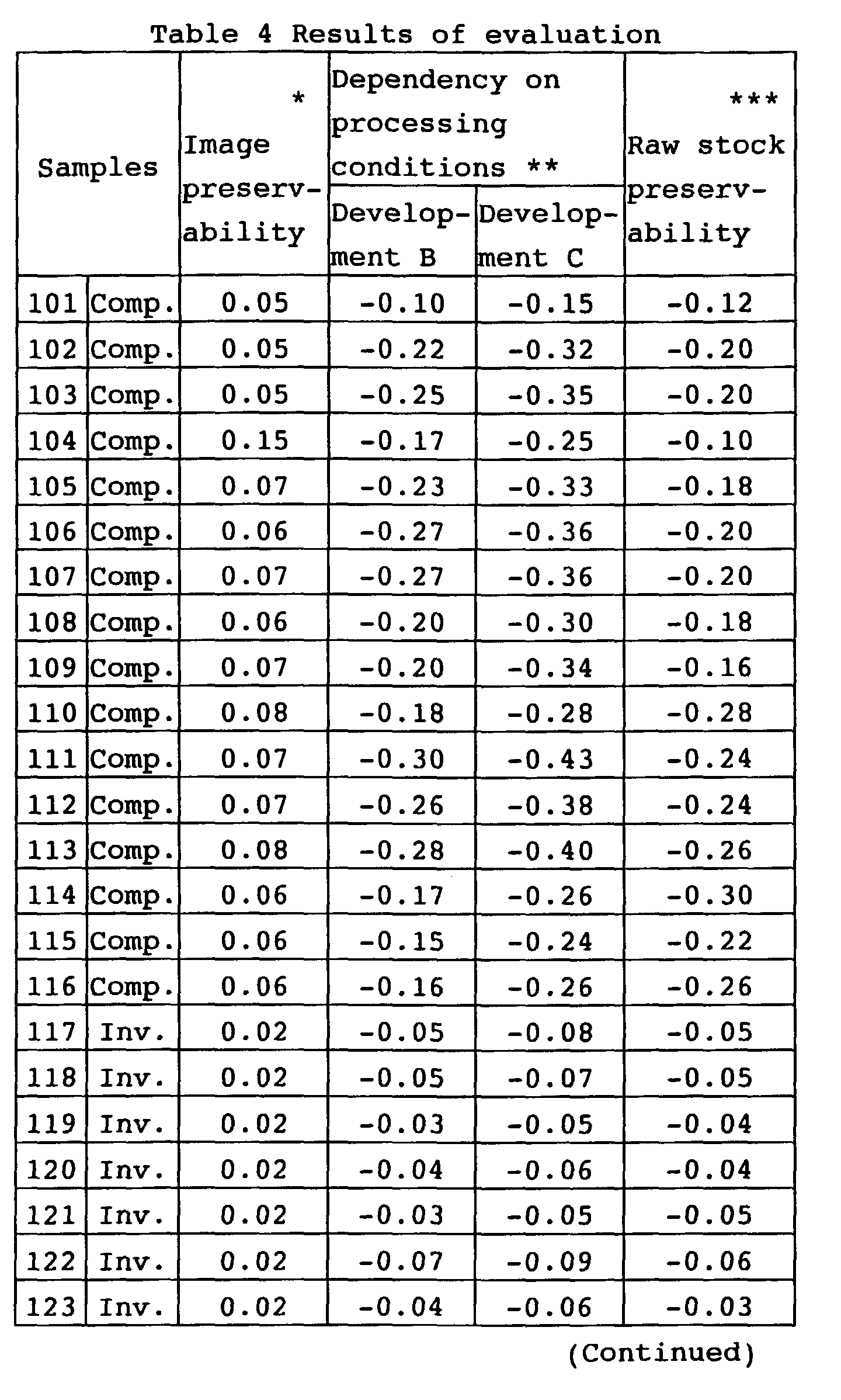

- Compared to the sample 101 using a pyrazolone magenta coupler, the sample 104 using a comparative coupler C in which the 6-position of pyrazolotriazole was not a tertiary alkyl group was unpreferable because yellow coloring in a white portion when an image was stored was large. In contrast, deterioration of yellow coloring was little in each of the samples 102, 103, and 105 to 116 using comparative couplers in which the 6-position was tertiary alkyl.
- When, however, the replenishment rate of the color developer was reduced in, e.g., the sample 102, the density greatly changed, and the sensitivity lowered in the row stock storability test.
- By contrast, in the sample 117 of the present invention, for example, the yellow coloring greatly improved, and the raw stock storability also improved even when the replenishment rate of the color developer was reduced. For comparison, the coupler M-1 of the present invention used in the sample 117 was replaced with a comparative coupler M which was a chlorine atom split-off 2-equivalent coupler (sample 114). As a consequence, the yellow coloring, process dependence, and raw stock storability deteriorated.
- That is, the 4-equivalent coupler used in the present invention caused less yellow coloring than that of its corresponding 2-equivalent coupler. Also, compared to a known similar tertiary alkyl-substituted pyrazolo-[5,1-c]-1,2,4-triazole coupler, this 4-equivalent coupler changed its characteristics little and had high raw stock storability even when the replenishment rate of the color developer was reduced. This is surprising and unexpectable from the prior art.
- Samples 201 to 299 were formed by using 1 : 1 mixtures of one of compounds SOL-1 to SOL-10 and SOL-12 to SOL-100 shown below and the high-boiling solvent Oil-2 instead of the high-boiling organic solvent Oil-1 in the sample 101 in Example-1. Also, samples 301 to 399 were similarly formed from the sample 137.
- These samples 201 to 299 and Samples 301 to 399 were exposed and processed by "development A" described above, Consequently, as described in Example-1, the samples 301 to 399 caused less yellow coloring with time than in the samples 201 to 299, so the results were preferable.

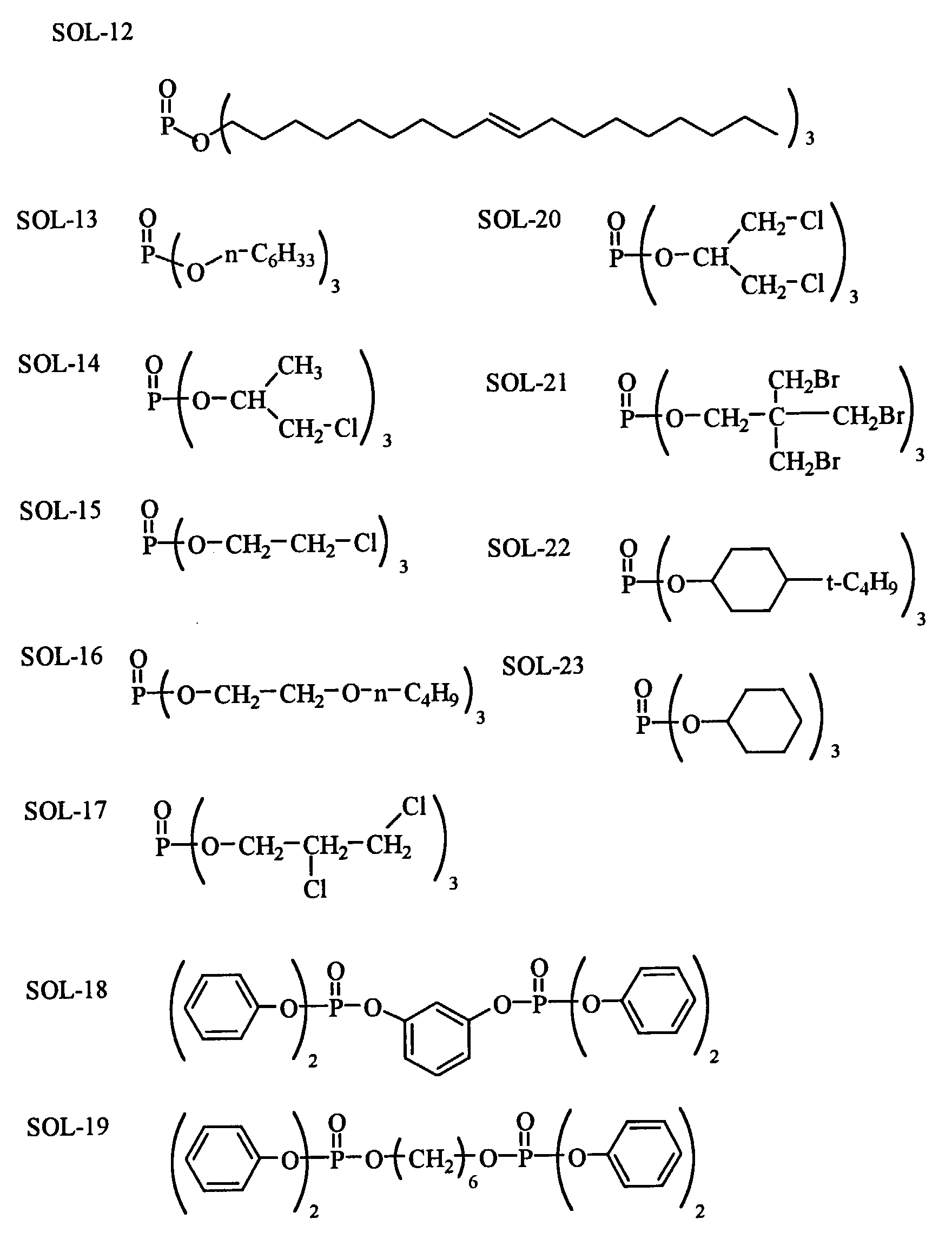
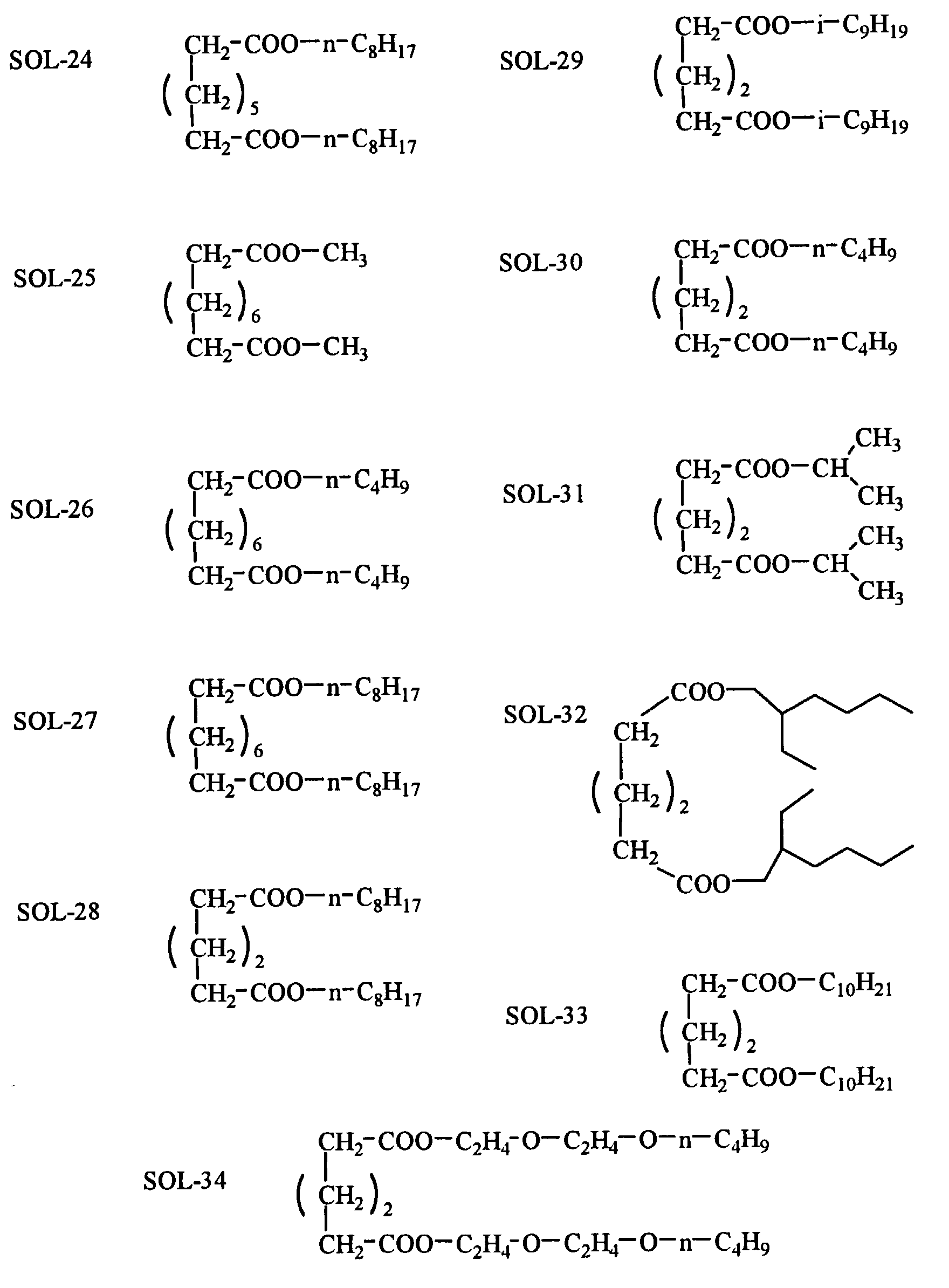

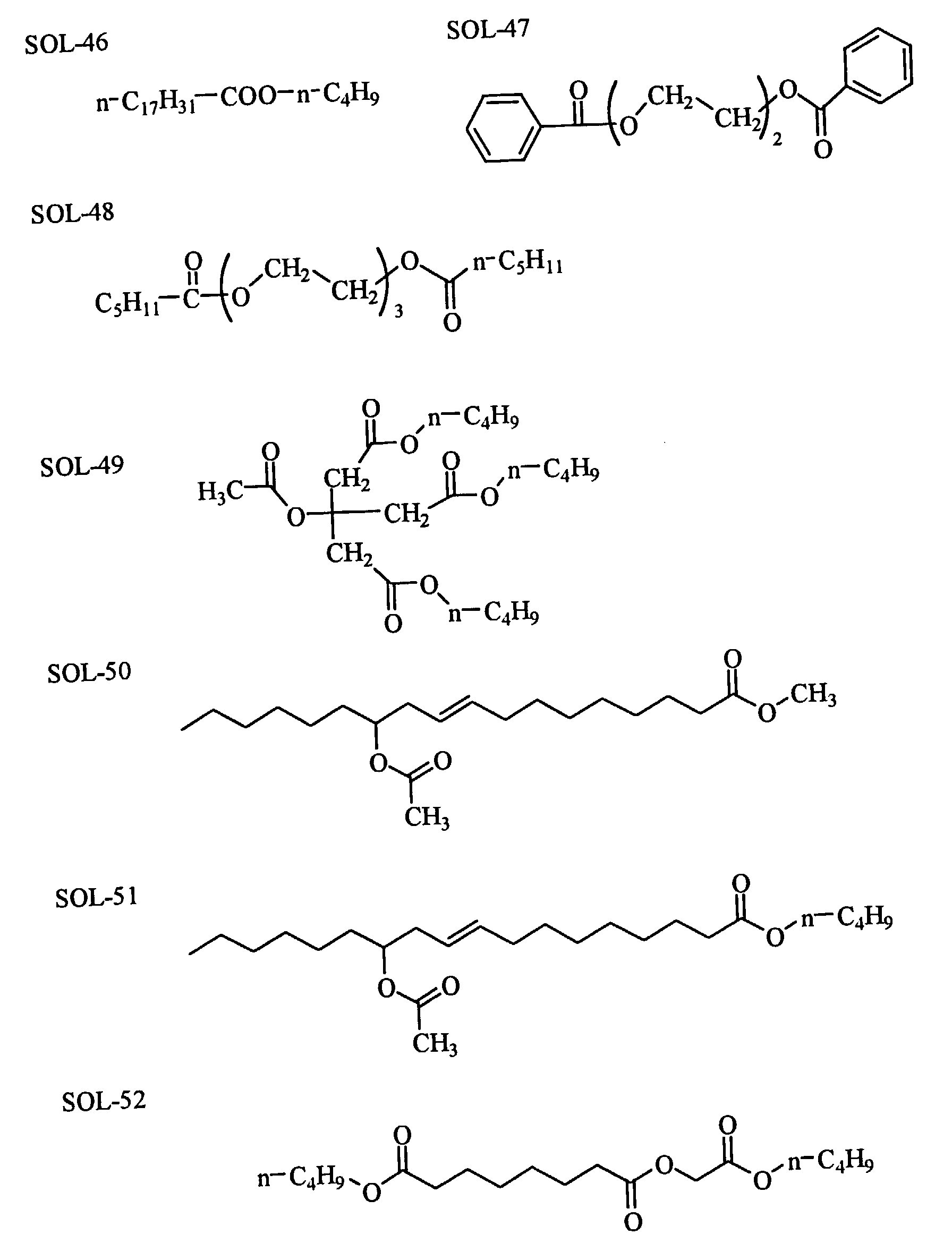


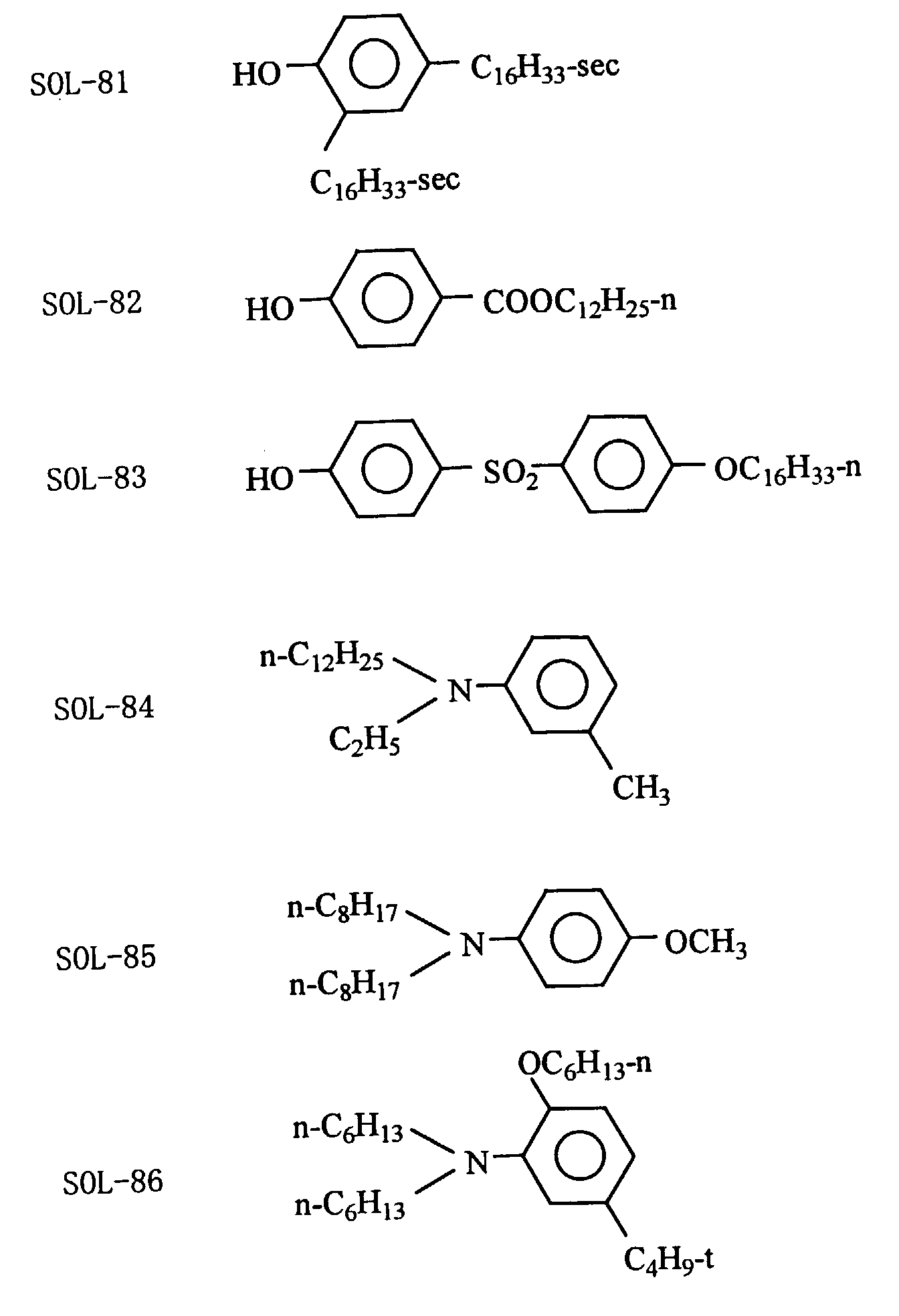
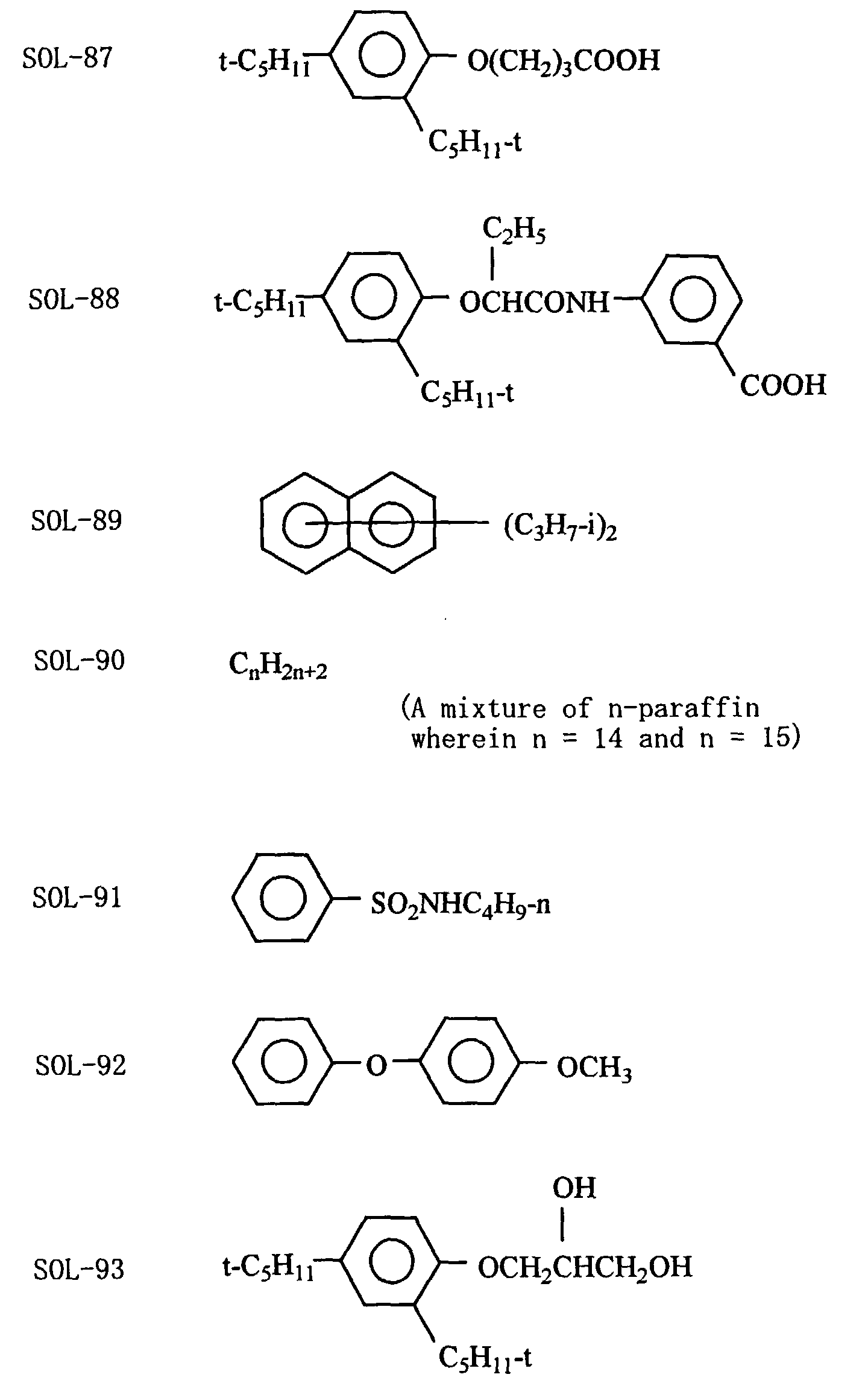

- Two sets of samples 501 to 583 were prepared in the same manner as Sample 117, except that the exemplified coupler M-1 was replaced by the exemplified couplers M-66 to M-147, respectively. The thus prepared samples were exposed to light and one set of the samples was processed with Processing A and the other set of the samples was processed with Processing B to evaluate dependency on the changes in processing conditions.
- As a result, Samples 501 to 583 showed excellent resistance to changes in processing conditions.
- Samples 601 to 644 were prepared in the same manner as Samples 101 to 144, respectively, except that 15th to 17th layers were changed to those set forth below, and Emulsions B, C, D, F, H, I, J, K, L, N, O and P were changed to B2, C2, D2, F2, H2, I2, J2, K2, L2, N2, O2 and P2 set forth in Table 5 below, respectively.
15th layer (Low-speed blue-sensitive emulsion layer) Emulsion L2 silver 0.18g Emulsion M silver 0.16g Gelatin 0.70g Coupler C-10 0.30g Compound Cpd-I 0.010g Compound Cpd-M 0.010g 16th layer (Medium-speed blue-sensitive emulsion layer) Emulsion N2 silver 0.16g Emulsion O2 silver 0.15g Gelatin 0.80g Coupler C-10 0.28g Compound Cpd-N 2.0 mg Compound Cpd-K 2.0 mg High-boiling organic solvent Oil-3 0.050g 17th layer (High-speed blue-sensitive emulsion layer) Emulsion O2 silver 0.20g Emulsion P2 silver 0.25g Gelatin 1.20g Coupler C-10 1.00g High-boiling organic solvent Oil-3 0.10g Compound Cpd-N 5.0 mg Compound Cpd-Q 0.20g The silver iodobromide emulsions used in Example 4. Emulsion Characteristics Av. equivalent spherical diameter (µm) COV of diameter (%) AgI Content (%) B2 Monodispersed (100) tabular grains av.as.rt : 10.0 0.25 15 3.8 C2 Monodispersed (111) tabular internally-fogged grains av.as.rt : 12.0 0.30 15 3.8 D2 Monodispersed (111) tabular grains av.as.rt : 10.0 0.33 18 4.8 F2 Monodispersed (111) tabular grains av.as.rt : 20.0 0.50 13 1.8 H2 Monodispersed (100) tabular grains av.as.rt : 10.0 0.24 12 3.5 I2 Monodispersed (111) tabular grains av.as.rt : 10.0 0.32 17 3.5 J2 Monodispersed (111) tabular grains av.as.rt : 15.0 0.45 16 3.0 K2 Monodispersed (111) tabular grains av.as.rt : 20.0 0.58 13 3.3 L2 Monodispersed (100) tabular grains av.as.rt : 10.0 0.35 10 4.5 N2 Monodispersed (111) tabular grains av.as.rt : 15.0 0.48 10 2.5 O2 Monodispersed (111) tabular grains av.as.rt : 20.0 0.70 9 2.0 P2 Monodispersed (111) tabular grains av.as.rt : 25.0 0.90 8 1.8 - The addition amounts of the sensitizing dyes used for Emulsions B2, C2, D2, F2, H2, I2, J2, K2, L2, N2, O2, and P2 were increased without changing the ratio of the sensitizing dyes, so that the amounts of the sensitizing dyes per surface area of the emulsion grains becomes the same as those of Emulsions B, C, D, F, H, I, J, K, L, N, O, and P, respectively.
- Three sets of samples 601 to 683 were prepared and exposed to light. The first set of the samples was processed with Processing A, the second set of the samples was processed with Processing B, and the third set of the samples was processed with Processing C, to evaluate dependency on the changes in processing conditions.
- As a result, Samples 601 to 644 showed excellent resistance to changes in processing conditions. Especially, changes in sensitivity and maximum density were small when the samples were processed with the color developers whose pH's were different.
Claims (8)
- A silver halide color photosensitive material comprising at least one blue-sensitive emulsion layer, at least one green-sensitive emulsion layer, and at least one red-sensitive emulsion layer on a support, characterized in that the material contains a magenta coupler represented by formula (MC-1) below:wherein R1 represents a tertiary alkyl group; each of s, m, and n independently represents 0 or 1; each of R2, R3, R4, R5, R6, and R7 represents a hydrogen atom, halogen atom, alkyl group, or aryl group; L represents a divalent group selected from the group consisting of -NR8SO2-, -SO2NR8-, -SO2NR8CO-, -NR8COO-, -NR8CONR9-, and -COO-, wherein the right side of each formula bonds to the phenyl group in formula (MC-1); each of R8 and R9 represents a hydrogen atom, alkyl group, or aryl group; J represents a divalent group selected from the group consisting of -CO-, -COO-, -O-, -S-, -CONR10-, -NR10CO-, -NR10COO-, -NR10NR11-, -SO2-, -SO2NR10-, and -CONR10SO2-, wherein the left side of each formula bonds to the phenyl group in formula (MC-1); each of R10 and R11 independently represents a hydrogen atom, alkyl group, or aryl group; B represents an alkyl group having the total number of carbon atoms of 1 to 70 or an aryl group having the total number of carbon atoms of 6 to 70; p represents an integer from 1 to 5, a plurality of -J-B's being able to be the same or different when p is 2 or more; G represents a substituent; and q represents an integer from 0 to 4, a plurality, of G's being able to be the same or different when q is 2 or more.
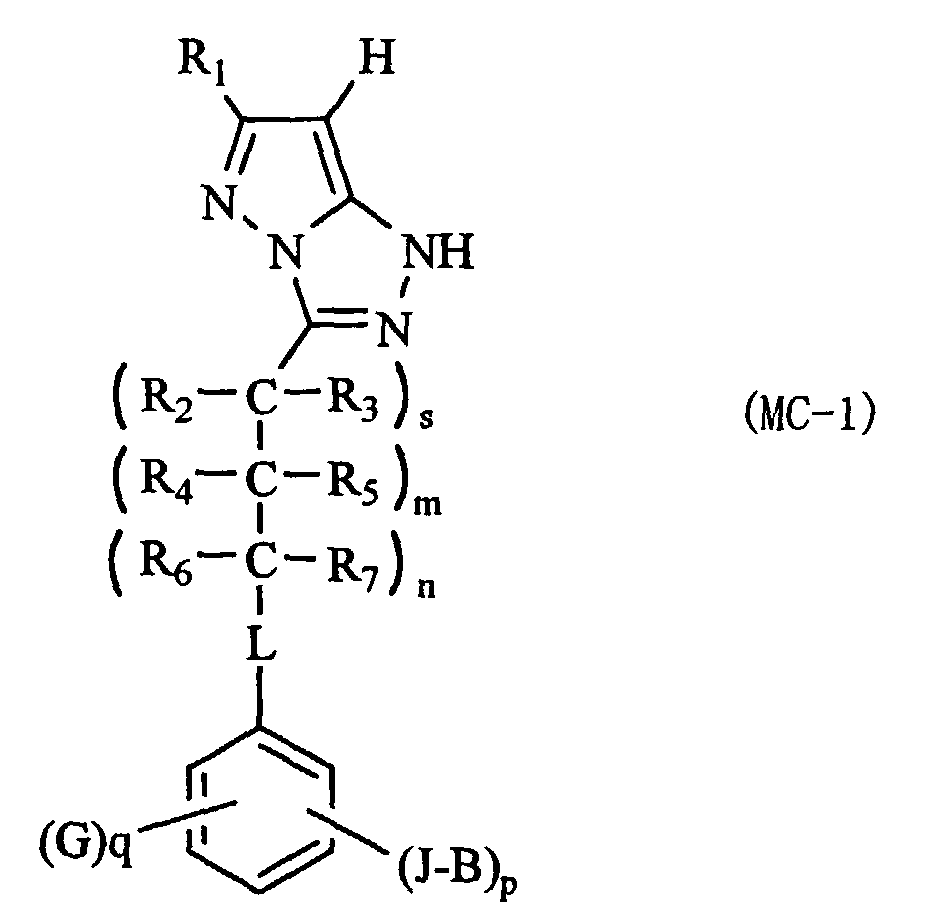
- A silver halide color photosensitive material comprising at least one blue-sensitive emulsion layer, at least one green-sensitive emulsion layer, and at least one red-sensitive emulsion layer on a support, characterized in that the material contains a magenta coupler represented by formula (MC-2) below:wherein R1, s, m, n, R2, R3, R4, R5, R6, and R7 each represent the same meanings as defined in formula (MC-1) of claim 1; T represents a divalent group selected from the group consisting of -SO2-, -O-, and -NR8CO- (R8 represents the same meaning as defined in formula (MC-1) of claim 1), wherein the right side of each formula bonds to W, or a phenyl group, provided that t = 1 when T is a divalent group selected from the group consisting of -SO2-, -O-, and -NR8CO- and t = 0 when T is an unsubstituted phenyl group; t is an integer from 1 to 5 when T is a substituted phenyl group, a plurality of W's being able to be the same or different when t is 2 or more; W represents an alkyl group containing the total number of carbon atoms of 1 to 70 and containing, at the same time, a group selected from the group consisting of -CR12HOH, -SO2NH2, -SO2NHCOR13, and -CONH2, or an aryl group having the total number of carbon atoms of 6 to 70 and containing, at the same time, a group selected form the group consisting of -CR12HOH, -SO2NH2, -SO2NHCOR13, and -CONH2; and each of R12 and R13 independently represents a hydrogen atom, an alkyl group or aryl group.

- A method for forming a color image on a silver halide color photosensitive material comprising a step of performing black-and-white development followed by a step of reversal processing for a material and a step of performing color development for the reversal processed material by using a color developer having a pH of 11.5 or more, characterized in that the material that is subjected to the black-and-white development is the material described in claim 1 or 2, and a replenishment rate of the color developer is less than 1.6 liters per m2 of the material.
- A compound represented by formula (MC-4) below:wherein each of R2 and R3 independently represent a hydrogen atom or 1- to 3-carbon unsubstituted alkyl group; R11 represents a hydrogen atom, 1- to 8-carbon unsubstituted alkyl group, or 5- to 10-carbon cycloalkyl group; each of R24 and R25 independently represents a hydrogen atom or 1- to 20-carbon alkyl group; n represents a natural number from 1 to 3; and V2 represents a group selected from the following groups, provided that when n is 2 or 3, the two or three R24's and the two or three R25's each may be the same or different:
 wherein each of R14, R15, R16 and R17 independently represents a hydrogen atom or a 1- to 3-carbon unsubstituted alkyl group; each of s and u independently represents 2 or 3, wherein a plurality of R14's, R15's, R16's, and R17's can be the same or different; R18 represents a 1- to 20-carbon unsubstituted alkyl group or a 6- to 20-carbon substituted or unsubstituted aryl group; w is 1 or 2, wherein when w is 2, two R20's and two R21's can be the same or different; R19 represents a hydrogen atom or a 1- to 20-carbon unsubstituted alkyl group; each of R20 and R21 represents a hydrogen atom or a 1- to 3-carbon unsubstituted alkyl group; each of R22 and R23 independently represents a chlorine atom or a bromine atom; each of x and y independently represents an integer from 0 to 20; and L2 represents a 2- to 10-carbon substituted or unsubstituted alkylene group.
- The material according to claim 1, characterized in that R1 represents a tertiary alkyl group not containing any elements except for a hydrogen atom and a carbon atom; s represents 1; m represents 1 or 0; n represents 0; each of R2, R3, R4, R5, R6 and R7 independently represents a hydrogen atom, halogen atom, alkyl group, or aryl group, provided that at least one of R2 and R3 represents an alkyl group containing 4 or less carbon atoms, and at least one of R4 and R5 represents a hydrogen atom, when m is 1; L represents a divalent group selected from -NHSO2-, -SO2NH-, and -SO2NHCO-; J represents a group selected from -O-, -COO-, -CONH-, -NHCO-, -NHCONH-, -SO2NH-, and -CONHSO2-; B represents a group having the total number of carbon atoms of 6 to 30; p represents 1 or 2; G represents a tertiary alkyl group; and q represents 1.
- The material according to claim 1, characterized in that the magenta coupler represented by formula (MC-1) is represented by formula (MC-3) below:wherein R1 represents a 4- to 8-carbon unsubstituted tertiary alkyl group; each of R2, R3, R4, and R5 independently represents a hydrogen atom or 1- to 4-carbon unsubstituted alkyl group, provided that at least one of R2 and R3 is not a hydrogen atom; m represents 0 or 1; R11 represents a 4- to 8-carbon tertiary alkyl group or 5- to 10-carbon cycloalkyl group; each of R24 and R25 independently represents a hydrogen atom or 1- to 20-carbon alkyl group; r represents a natural number from 1 to 3; and V1 represents a carboxyl group, 1- to 20-carbon substituted or unsubstituted carbamoly group, 2- to 20-carbon substituted or unsubstituted sulfonylaminocarbonyl group, or 1- to 20-carbon substituted or unsubstituted alkoxycarbonyl group.

- The material according to claim 6, characterized in that the magenta coupler represented by formula (MC-3) is represented by formula (MC-4) of claim 4.
- The material according to claim 7, characterized in that R2 represents a methyl, ethyl, n-propyl or iso-propyl group; R3 represents a hydrogen atom, a methyl or ethyl group; R11 represents a hydrogen atom or a 1- to 8-carbon unsubstituted alkyl group; R12 represents a hydrogen atom; and R13 represents a hydrogen atom or a 1- to 16-carbon unsubstituted alkyl group; n represents a natural number from 1 to 3; and V2 represents the following group:wherein R18 represents a 1- to 8-carbon unsubstituted alkyl group or 6- to 20-carbon aryl group.
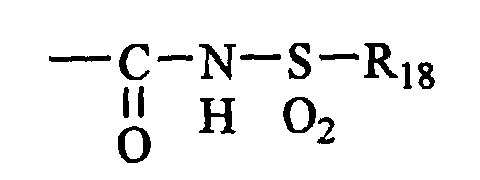
Applications Claiming Priority (4)
| Application Number | Priority Date | Filing Date | Title |
|---|---|---|---|
| JP4026899 | 1999-02-18 | ||
| JP4026899 | 1999-02-18 | ||
| JP13624999 | 1999-05-17 | ||
| JP13624999 | 1999-05-17 |
Publications (2)
| Publication Number | Publication Date |
|---|---|
| EP1033621A1 true EP1033621A1 (en) | 2000-09-06 |
| EP1033621B1 EP1033621B1 (en) | 2008-08-06 |
Family
ID=26379718
Family Applications (1)
| Application Number | Title | Priority Date | Filing Date |
|---|---|---|---|
| EP00102281A Expired - Lifetime EP1033621B1 (en) | 1999-02-18 | 2000-02-17 | Silver halide color photosensitive material and color image forming method using the same |
Country Status (3)
| Country | Link |
|---|---|
| EP (1) | EP1033621B1 (en) |
| AT (1) | ATE403889T1 (en) |
| DE (1) | DE60039740D1 (en) |
Cited By (3)
| Publication number | Priority date | Publication date | Assignee | Title |
|---|---|---|---|---|
| EP1132770A3 (en) * | 2000-03-07 | 2002-07-10 | Fuji Photo Film Co., Ltd. | Silver halide photographic light-sensitive material |
| US6770431B2 (en) | 2001-12-28 | 2004-08-03 | Fuji Photo Film Co., Ltd. | Silver halide color photosensitive material |
| WO2022110821A1 (en) * | 2020-11-24 | 2022-06-02 | 苏州博萃循环科技有限公司 | Carboxylic acid compound, preparation method therefor and use thereof |
Citations (3)
| Publication number | Priority date | Publication date | Assignee | Title |
|---|---|---|---|---|
| US5272049A (en) * | 1991-10-09 | 1993-12-21 | Fuji Photo Film Co., Ltd. | Silver halide color photographic light-sensitive material and image forming method |
| US5688964A (en) * | 1996-02-13 | 1997-11-18 | Eastman Kodak Company | Process for preparing a acylhyrazino pyrazole derivative |
| JPH11119393A (en) * | 1997-10-14 | 1999-04-30 | Fuji Photo Film Co Ltd | Silver halide color photographic sensitive material |
-
2000
- 2000-02-17 DE DE60039740T patent/DE60039740D1/en not_active Expired - Lifetime
- 2000-02-17 EP EP00102281A patent/EP1033621B1/en not_active Expired - Lifetime
- 2000-02-17 AT AT00102281T patent/ATE403889T1/en not_active IP Right Cessation
Patent Citations (3)
| Publication number | Priority date | Publication date | Assignee | Title |
|---|---|---|---|---|
| US5272049A (en) * | 1991-10-09 | 1993-12-21 | Fuji Photo Film Co., Ltd. | Silver halide color photographic light-sensitive material and image forming method |
| US5688964A (en) * | 1996-02-13 | 1997-11-18 | Eastman Kodak Company | Process for preparing a acylhyrazino pyrazole derivative |
| JPH11119393A (en) * | 1997-10-14 | 1999-04-30 | Fuji Photo Film Co Ltd | Silver halide color photographic sensitive material |
Non-Patent Citations (1)
| Title |
|---|
| PATENT ABSTRACTS OF JAPAN vol. 1999, no. 09 30 July 1999 (1999-07-30) * |
Cited By (4)
| Publication number | Priority date | Publication date | Assignee | Title |
|---|---|---|---|---|
| EP1132770A3 (en) * | 2000-03-07 | 2002-07-10 | Fuji Photo Film Co., Ltd. | Silver halide photographic light-sensitive material |
| US6468729B2 (en) | 2000-03-07 | 2002-10-22 | Fuji Photo Film Co., Ltd. | Silver halide photographic light-sensitive material |
| US6770431B2 (en) | 2001-12-28 | 2004-08-03 | Fuji Photo Film Co., Ltd. | Silver halide color photosensitive material |
| WO2022110821A1 (en) * | 2020-11-24 | 2022-06-02 | 苏州博萃循环科技有限公司 | Carboxylic acid compound, preparation method therefor and use thereof |
Also Published As
| Publication number | Publication date |
|---|---|
| EP1033621B1 (en) | 2008-08-06 |
| ATE403889T1 (en) | 2008-08-15 |
| DE60039740D1 (en) | 2008-09-18 |
Similar Documents
| Publication | Publication Date | Title |
|---|---|---|
| EP0287265A1 (en) | Silver halide color photographic light-sensitive material | |
| EP1033621B1 (en) | Silver halide color photosensitive material and color image forming method using the same | |
| US6492100B2 (en) | Silver halide color photographic lightsensitive material and compound used therein | |
| JP2535529B2 (en) | Silver halide color photographic light-sensitive material containing novel cyan coupler | |
| JP2955902B2 (en) | Silver halide color photographic materials | |
| US6468729B2 (en) | Silver halide photographic light-sensitive material | |
| JP4171153B2 (en) | Silver halide color photographic light-sensitive material and color image forming method using the same | |
| US6391533B1 (en) | Silver halide color photosensitive material and color image forming method using the same | |
| JP2537374B2 (en) | Silver halide photographic material | |
| JPS63281161A (en) | Silver halide color photographic sensitive material containing novel cyan coupler | |
| US6379878B1 (en) | Silver halide color photosensitive material | |
| JPH06250357A (en) | Silver halide color photographic sensitive material | |
| US6656673B2 (en) | Silver halide color photographic light-sensitive material and color image formation method using the same | |
| JP3469015B2 (en) | Silver halide color photographic materials | |
| JP3243662B2 (en) | Silver halide color photographic light-sensitive material | |
| US6548237B2 (en) | Silver halide color photographic lightsensitive material and method of forming color image using the same | |
| JP3060344B2 (en) | Silver halide color photographic materials | |
| US6514680B2 (en) | Silver halide color photographic light-sensitive material | |
| JP2711709B2 (en) | New cyan coupler | |
| JPH10198012A (en) | Silver halide color photographic sensitive material | |
| JPH02193147A (en) | Silver halide color photographic sensitive material having superior color reproducibility | |
| JPS63167360A (en) | Silver halide photographic sensitive material | |
| US20020168595A1 (en) | Silver halide color photographic lightsensitive material and processing method thereof | |
| JP2002169256A (en) | Silver halide color photographic sensitive material | |
| JP2001281814A (en) | Silver halide color reversal photographic sensitive material |
Legal Events
| Date | Code | Title | Description |
|---|---|---|---|
| PUAI | Public reference made under article 153(3) epc to a published international application that has entered the european phase |
Free format text: ORIGINAL CODE: 0009012 |
|
| AK | Designated contracting states |
Kind code of ref document: A1 Designated state(s): AT BE CH CY DE DK ES FI FR GB GR IE IT LI LU MC NL PT SE |
|
| AX | Request for extension of the european patent |
Free format text: AL;LT;LV;MK;RO;SI |
|
| 17P | Request for examination filed |
Effective date: 20010119 |
|
| AKX | Designation fees paid |
Free format text: AT BE CH CY DE DK ES FI FR GB GR IE IT LI LU MC NL PT SE |
|
| 17Q | First examination report despatched |
Effective date: 20021127 |
|
| RAP1 | Party data changed (applicant data changed or rights of an application transferred) |
Owner name: FUJIFILM CORPORATION |
|
| GRAP | Despatch of communication of intention to grant a patent |
Free format text: ORIGINAL CODE: EPIDOSNIGR1 |
|
| GRAS | Grant fee paid |
Free format text: ORIGINAL CODE: EPIDOSNIGR3 |
|
| GRAA | (expected) grant |
Free format text: ORIGINAL CODE: 0009210 |
|
| AK | Designated contracting states |
Kind code of ref document: B1 Designated state(s): AT BE CH CY DE DK ES FI FR GB GR IE IT LI LU MC NL PT SE |
|
| REG | Reference to a national code |
Ref country code: GB Ref legal event code: FG4D |
|
| REG | Reference to a national code |
Ref country code: CH Ref legal event code: EP |
|
| REG | Reference to a national code |
Ref country code: IE Ref legal event code: FG4D |
|
| REF | Corresponds to: |
Ref document number: 60039740 Country of ref document: DE Date of ref document: 20080918 Kind code of ref document: P |
|
| PG25 | Lapsed in a contracting state [announced via postgrant information from national office to epo] |
Ref country code: NL Free format text: LAPSE BECAUSE OF FAILURE TO SUBMIT A TRANSLATION OF THE DESCRIPTION OR TO PAY THE FEE WITHIN THE PRESCRIBED TIME-LIMIT Effective date: 20080806 Ref country code: ES Free format text: LAPSE BECAUSE OF FAILURE TO SUBMIT A TRANSLATION OF THE DESCRIPTION OR TO PAY THE FEE WITHIN THE PRESCRIBED TIME-LIMIT Effective date: 20081117 |
|
| PG25 | Lapsed in a contracting state [announced via postgrant information from national office to epo] |
Ref country code: FI Free format text: LAPSE BECAUSE OF FAILURE TO SUBMIT A TRANSLATION OF THE DESCRIPTION OR TO PAY THE FEE WITHIN THE PRESCRIBED TIME-LIMIT Effective date: 20080806 Ref country code: AT Free format text: LAPSE BECAUSE OF FAILURE TO SUBMIT A TRANSLATION OF THE DESCRIPTION OR TO PAY THE FEE WITHIN THE PRESCRIBED TIME-LIMIT Effective date: 20080806 |
|
| PG25 | Lapsed in a contracting state [announced via postgrant information from national office to epo] |
Ref country code: BE Free format text: LAPSE BECAUSE OF FAILURE TO SUBMIT A TRANSLATION OF THE DESCRIPTION OR TO PAY THE FEE WITHIN THE PRESCRIBED TIME-LIMIT Effective date: 20080806 |
|
| PG25 | Lapsed in a contracting state [announced via postgrant information from national office to epo] |
Ref country code: DK Free format text: LAPSE BECAUSE OF FAILURE TO SUBMIT A TRANSLATION OF THE DESCRIPTION OR TO PAY THE FEE WITHIN THE PRESCRIBED TIME-LIMIT Effective date: 20080806 |
|
| PG25 | Lapsed in a contracting state [announced via postgrant information from national office to epo] |
Ref country code: PT Free format text: LAPSE BECAUSE OF FAILURE TO SUBMIT A TRANSLATION OF THE DESCRIPTION OR TO PAY THE FEE WITHIN THE PRESCRIBED TIME-LIMIT Effective date: 20090106 |
|
| PLBE | No opposition filed within time limit |
Free format text: ORIGINAL CODE: 0009261 |
|
| STAA | Information on the status of an ep patent application or granted ep patent |
Free format text: STATUS: NO OPPOSITION FILED WITHIN TIME LIMIT |
|
| 26N | No opposition filed |
Effective date: 20090507 |
|
| PG25 | Lapsed in a contracting state [announced via postgrant information from national office to epo] |
Ref country code: IT Free format text: LAPSE BECAUSE OF FAILURE TO SUBMIT A TRANSLATION OF THE DESCRIPTION OR TO PAY THE FEE WITHIN THE PRESCRIBED TIME-LIMIT Effective date: 20080806 |
|
| PG25 | Lapsed in a contracting state [announced via postgrant information from national office to epo] |
Ref country code: MC Free format text: LAPSE BECAUSE OF NON-PAYMENT OF DUE FEES Effective date: 20090228 |
|
| REG | Reference to a national code |
Ref country code: CH Ref legal event code: PL |
|
| GBPC | Gb: european patent ceased through non-payment of renewal fee |
Effective date: 20090217 |
|
| PG25 | Lapsed in a contracting state [announced via postgrant information from national office to epo] |
Ref country code: CH Free format text: LAPSE BECAUSE OF NON-PAYMENT OF DUE FEES Effective date: 20090228 Ref country code: LI Free format text: LAPSE BECAUSE OF NON-PAYMENT OF DUE FEES Effective date: 20090228 |
|
| REG | Reference to a national code |
Ref country code: IE Ref legal event code: MM4A |
|
| REG | Reference to a national code |
Ref country code: FR Ref legal event code: ST Effective date: 20091030 |
|
| PG25 | Lapsed in a contracting state [announced via postgrant information from national office to epo] |
Ref country code: SE Free format text: LAPSE BECAUSE OF FAILURE TO SUBMIT A TRANSLATION OF THE DESCRIPTION OR TO PAY THE FEE WITHIN THE PRESCRIBED TIME-LIMIT Effective date: 20081106 Ref country code: IE Free format text: LAPSE BECAUSE OF NON-PAYMENT OF DUE FEES Effective date: 20090217 |
|
| PG25 | Lapsed in a contracting state [announced via postgrant information from national office to epo] |
Ref country code: FR Free format text: LAPSE BECAUSE OF NON-PAYMENT OF DUE FEES Effective date: 20090302 Ref country code: GB Free format text: LAPSE BECAUSE OF NON-PAYMENT OF DUE FEES Effective date: 20090217 |
|
| PGFP | Annual fee paid to national office [announced via postgrant information from national office to epo] |
Ref country code: DE Payment date: 20100121 Year of fee payment: 11 |
|
| PG25 | Lapsed in a contracting state [announced via postgrant information from national office to epo] |
Ref country code: GR Free format text: LAPSE BECAUSE OF FAILURE TO SUBMIT A TRANSLATION OF THE DESCRIPTION OR TO PAY THE FEE WITHIN THE PRESCRIBED TIME-LIMIT Effective date: 20081107 |
|
| PG25 | Lapsed in a contracting state [announced via postgrant information from national office to epo] |
Ref country code: LU Free format text: LAPSE BECAUSE OF NON-PAYMENT OF DUE FEES Effective date: 20090217 |
|
| PG25 | Lapsed in a contracting state [announced via postgrant information from national office to epo] |
Ref country code: CY Free format text: LAPSE BECAUSE OF FAILURE TO SUBMIT A TRANSLATION OF THE DESCRIPTION OR TO PAY THE FEE WITHIN THE PRESCRIBED TIME-LIMIT Effective date: 20080806 |
|
| REG | Reference to a national code |
Ref country code: DE Ref legal event code: R119 Ref document number: 60039740 Country of ref document: DE Effective date: 20110901 |
|
| PG25 | Lapsed in a contracting state [announced via postgrant information from national office to epo] |
Ref country code: DE Free format text: LAPSE BECAUSE OF NON-PAYMENT OF DUE FEES Effective date: 20110901 |