EP1031583B1 - A process for preparing polybutadiene using catalyst with high activity - Google Patents
A process for preparing polybutadiene using catalyst with high activity Download PDFInfo
- Publication number
- EP1031583B1 EP1031583B1 EP99307572A EP99307572A EP1031583B1 EP 1031583 B1 EP1031583 B1 EP 1031583B1 EP 99307572 A EP99307572 A EP 99307572A EP 99307572 A EP99307572 A EP 99307572A EP 1031583 B1 EP1031583 B1 EP 1031583B1
- Authority
- EP
- European Patent Office
- Prior art keywords
- neodymium
- compound
- formula
- borontrifluoride
- catalyst
- Prior art date
- Legal status (The legal status is an assumption and is not a legal conclusion. Google has not performed a legal analysis and makes no representation as to the accuracy of the status listed.)
- Expired - Lifetime
Links
- 239000003054 catalyst Substances 0.000 title claims abstract description 33
- 239000005062 Polybutadiene Substances 0.000 title claims abstract description 27
- 229920002857 polybutadiene Polymers 0.000 title claims abstract description 22
- 238000004519 manufacturing process Methods 0.000 title claims abstract description 8
- 230000000694 effects Effects 0.000 title description 2
- KAKZBPTYRLMSJV-UHFFFAOYSA-N Butadiene Chemical compound C=CC=C KAKZBPTYRLMSJV-UHFFFAOYSA-N 0.000 claims abstract description 32
- WTEOIRVLGSZEPR-UHFFFAOYSA-N boron trifluoride Chemical compound FB(F)F WTEOIRVLGSZEPR-UHFFFAOYSA-N 0.000 claims abstract description 28
- 150000001875 compounds Chemical class 0.000 claims abstract description 23
- 229910015900 BF3 Inorganic materials 0.000 claims abstract description 21
- -1 diene compound Chemical class 0.000 claims abstract description 19
- 230000032683 aging Effects 0.000 claims abstract description 17
- 150000002798 neodymium compounds Chemical class 0.000 claims abstract description 15
- 239000000203 mixture Substances 0.000 claims abstract description 10
- 239000012454 non-polar solvent Substances 0.000 claims abstract description 10
- 125000004432 carbon atom Chemical group C* 0.000 claims abstract description 8
- 125000000217 alkyl group Chemical group 0.000 claims abstract description 7
- 125000003710 aryl alkyl group Chemical group 0.000 claims abstract description 4
- 125000003118 aryl group Chemical group 0.000 claims abstract description 4
- 125000000753 cycloalkyl group Chemical group 0.000 claims abstract description 4
- 125000003903 2-propenyl group Chemical group [H]C([*])([H])C([H])=C([H])[H] 0.000 claims abstract description 3
- 125000001424 substituent group Chemical group 0.000 claims abstract description 3
- 238000000034 method Methods 0.000 claims description 18
- 229910052779 Neodymium Inorganic materials 0.000 claims description 15
- QEFYFXOXNSNQGX-UHFFFAOYSA-N neodymium atom Chemical compound [Nd] QEFYFXOXNSNQGX-UHFFFAOYSA-N 0.000 claims description 11
- MCULRUJILOGHCJ-UHFFFAOYSA-N triisobutylaluminium Chemical compound CC(C)C[Al](CC(C)C)CC(C)C MCULRUJILOGHCJ-UHFFFAOYSA-N 0.000 claims description 4
- 230000000379 polymerizing effect Effects 0.000 claims description 3
- SIPUZPBQZHNSDW-UHFFFAOYSA-N bis(2-methylpropyl)aluminum Chemical compound CC(C)C[Al]CC(C)C SIPUZPBQZHNSDW-UHFFFAOYSA-N 0.000 claims description 2
- ZVGOMKSOQWZEFP-UHFFFAOYSA-N ethyl hexanoate;neodymium Chemical compound [Nd].CCCCCC(=O)OCC ZVGOMKSOQWZEFP-UHFFFAOYSA-N 0.000 claims description 2
- CFTUQJXKBQKTHA-UHFFFAOYSA-K heptanoate;neodymium(3+) Chemical compound [Nd+3].CCCCCCC([O-])=O.CCCCCCC([O-])=O.CCCCCCC([O-])=O CFTUQJXKBQKTHA-UHFFFAOYSA-K 0.000 claims description 2
- KQFYWTSRWKUWMJ-UHFFFAOYSA-K hexanoate;neodymium(3+) Chemical compound [Nd+3].CCCCCC([O-])=O.CCCCCC([O-])=O.CCCCCC([O-])=O KQFYWTSRWKUWMJ-UHFFFAOYSA-K 0.000 claims description 2
- SIINVGJQWZKNSJ-UHFFFAOYSA-K neodymium(3+);octadecanoate Chemical compound [Nd+3].CCCCCCCCCCCCCCCCCC([O-])=O.CCCCCCCCCCCCCCCCCC([O-])=O.CCCCCCCCCCCCCCCCCC([O-])=O SIINVGJQWZKNSJ-UHFFFAOYSA-K 0.000 claims description 2
- ARWCRSVRKCNEDI-UHFFFAOYSA-K neodymium(3+);octanoate Chemical compound [Nd+3].CCCCCCCC([O-])=O.CCCCCCCC([O-])=O.CCCCCCCC([O-])=O ARWCRSVRKCNEDI-UHFFFAOYSA-K 0.000 claims description 2
- CHNLPLHJUPMEOI-UHFFFAOYSA-N oxolane;trifluoroborane Chemical compound FB(F)F.C1CCOC1 CHNLPLHJUPMEOI-UHFFFAOYSA-N 0.000 claims description 2
- SQBBHCOIQXKPHL-UHFFFAOYSA-N tributylalumane Chemical compound CCCC[Al](CCCC)CCCC SQBBHCOIQXKPHL-UHFFFAOYSA-N 0.000 claims description 2
- VOITXYVAKOUIBA-UHFFFAOYSA-N triethylaluminium Chemical compound CC[Al](CC)CC VOITXYVAKOUIBA-UHFFFAOYSA-N 0.000 claims description 2
- ORYGRKHDLWYTKX-UHFFFAOYSA-N trihexylalumane Chemical compound CCCCCC[Al](CCCCCC)CCCCCC ORYGRKHDLWYTKX-UHFFFAOYSA-N 0.000 claims description 2
- JLTRXTDYQLMHGR-UHFFFAOYSA-N trimethylaluminium Chemical compound C[Al](C)C JLTRXTDYQLMHGR-UHFFFAOYSA-N 0.000 claims description 2
- LFXVBWRMVZPLFK-UHFFFAOYSA-N trioctylalumane Chemical compound CCCCCCCC[Al](CCCCCCCC)CCCCCCCC LFXVBWRMVZPLFK-UHFFFAOYSA-N 0.000 claims description 2
- CNWZYDSEVLFSMS-UHFFFAOYSA-N tripropylalumane Chemical compound CCC[Al](CCC)CCC CNWZYDSEVLFSMS-UHFFFAOYSA-N 0.000 claims description 2
- 238000006243 chemical reaction Methods 0.000 abstract description 14
- 238000006116 polymerization reaction Methods 0.000 description 18
- YXFVVABEGXRONW-UHFFFAOYSA-N Toluene Chemical compound CC1=CC=CC=C1 YXFVVABEGXRONW-UHFFFAOYSA-N 0.000 description 12
- 239000000243 solution Substances 0.000 description 12
- KZMGYPLQYOPHEL-UHFFFAOYSA-N Boron trifluoride etherate Chemical compound FB(F)F.CCOCC KZMGYPLQYOPHEL-UHFFFAOYSA-N 0.000 description 11
- VLKZOEOYAKHREP-UHFFFAOYSA-N n-Hexane Chemical compound CCCCCC VLKZOEOYAKHREP-UHFFFAOYSA-N 0.000 description 9
- 230000000052 comparative effect Effects 0.000 description 6
- IJGRMHOSHXDMSA-UHFFFAOYSA-N Atomic nitrogen Chemical compound N#N IJGRMHOSHXDMSA-UHFFFAOYSA-N 0.000 description 4
- XDTMQSROBMDMFD-UHFFFAOYSA-N Cyclohexane Chemical compound C1CCCCC1 XDTMQSROBMDMFD-UHFFFAOYSA-N 0.000 description 4
- IMNFDUFMRHMDMM-UHFFFAOYSA-N N-Heptane Chemical compound CCCCCCC IMNFDUFMRHMDMM-UHFFFAOYSA-N 0.000 description 4
- 150000001993 dienes Chemical class 0.000 description 4
- 238000002360 preparation method Methods 0.000 description 4
- 239000002904 solvent Substances 0.000 description 4
- UHOVQNZJYSORNB-UHFFFAOYSA-N Benzene Chemical compound C1=CC=CC=C1 UHOVQNZJYSORNB-UHFFFAOYSA-N 0.000 description 3
- OKKJLVBELUTLKV-UHFFFAOYSA-N Methanol Chemical compound OC OKKJLVBELUTLKV-UHFFFAOYSA-N 0.000 description 3
- PXHVJJICTQNCMI-UHFFFAOYSA-N Nickel Chemical compound [Ni] PXHVJJICTQNCMI-UHFFFAOYSA-N 0.000 description 3
- 230000003247 decreasing effect Effects 0.000 description 3
- 239000002815 homogeneous catalyst Substances 0.000 description 3
- 229910052751 metal Inorganic materials 0.000 description 3
- 239000002184 metal Substances 0.000 description 3
- OFBQJSOFQDEBGM-UHFFFAOYSA-N n-pentane Natural products CCCCC OFBQJSOFQDEBGM-UHFFFAOYSA-N 0.000 description 3
- 239000002245 particle Substances 0.000 description 3
- 229920000642 polymer Polymers 0.000 description 3
- NLZUEZXRPGMBCV-UHFFFAOYSA-N Butylhydroxytoluene Chemical compound CC1=CC(C(C)(C)C)=C(O)C(C(C)(C)C)=C1 NLZUEZXRPGMBCV-UHFFFAOYSA-N 0.000 description 2
- RGSFGYAAUTVSQA-UHFFFAOYSA-N Cyclopentane Chemical compound C1CCCC1 RGSFGYAAUTVSQA-UHFFFAOYSA-N 0.000 description 2
- LFQSCWFLJHTTHZ-UHFFFAOYSA-N Ethanol Chemical compound CCO LFQSCWFLJHTTHZ-UHFFFAOYSA-N 0.000 description 2
- YNQLUTRBYVCPMQ-UHFFFAOYSA-N Ethylbenzene Chemical compound CCC1=CC=CC=C1 YNQLUTRBYVCPMQ-UHFFFAOYSA-N 0.000 description 2
- 239000011954 Ziegler–Natta catalyst Substances 0.000 description 2
- 230000003197 catalytic effect Effects 0.000 description 2
- IIEWJVIFRVWJOD-UHFFFAOYSA-N ethylcyclohexane Chemical compound CCC1CCCCC1 IIEWJVIFRVWJOD-UHFFFAOYSA-N 0.000 description 2
- 230000002431 foraging effect Effects 0.000 description 2
- 238000010528 free radical solution polymerization reaction Methods 0.000 description 2
- 239000002638 heterogeneous catalyst Substances 0.000 description 2
- QWTDNUCVQCZILF-UHFFFAOYSA-N isopentane Chemical compound CCC(C)C QWTDNUCVQCZILF-UHFFFAOYSA-N 0.000 description 2
- 150000002603 lanthanum Chemical class 0.000 description 2
- UAEPNZWRGJTJPN-UHFFFAOYSA-N methylcyclohexane Chemical compound CC1CCCCC1 UAEPNZWRGJTJPN-UHFFFAOYSA-N 0.000 description 2
- GDOPTJXRTPNYNR-UHFFFAOYSA-N methylcyclopentane Chemical compound CC1CCCC1 GDOPTJXRTPNYNR-UHFFFAOYSA-N 0.000 description 2
- 239000000178 monomer Substances 0.000 description 2
- 229910052757 nitrogen Inorganic materials 0.000 description 2
- 239000012299 nitrogen atmosphere Substances 0.000 description 2
- 230000000704 physical effect Effects 0.000 description 2
- 239000003381 stabilizer Substances 0.000 description 2
- WYURNTSHIVDZCO-UHFFFAOYSA-N tetrahydrofuran Substances C1CCOC1 WYURNTSHIVDZCO-UHFFFAOYSA-N 0.000 description 2
- 239000010936 titanium Substances 0.000 description 2
- 229910052684 Cerium Inorganic materials 0.000 description 1
- 239000004593 Epoxy Substances 0.000 description 1
- 229910052688 Gadolinium Inorganic materials 0.000 description 1
- 241001441571 Hiodontidae Species 0.000 description 1
- NHTMVDHEPJAVLT-UHFFFAOYSA-N Isooctane Chemical compound CC(C)CC(C)(C)C NHTMVDHEPJAVLT-UHFFFAOYSA-N 0.000 description 1
- 239000002841 Lewis acid Substances 0.000 description 1
- 239000002879 Lewis base Substances 0.000 description 1
- CTQNGGLPUBDAKN-UHFFFAOYSA-N O-Xylene Chemical compound CC1=CC=CC=C1C CTQNGGLPUBDAKN-UHFFFAOYSA-N 0.000 description 1
- RTAQQCXQSZGOHL-UHFFFAOYSA-N Titanium Chemical compound [Ti] RTAQQCXQSZGOHL-UHFFFAOYSA-N 0.000 description 1
- 150000001338 aliphatic hydrocarbons Chemical class 0.000 description 1
- 125000003545 alkoxy group Chemical group 0.000 description 1
- 150000004945 aromatic hydrocarbons Chemical class 0.000 description 1
- 125000004429 atom Chemical group 0.000 description 1
- QVGXLLKOCUKJST-UHFFFAOYSA-N atomic oxygen Chemical compound [O] QVGXLLKOCUKJST-UHFFFAOYSA-N 0.000 description 1
- 239000001273 butane Substances 0.000 description 1
- QGJOPFRUJISHPQ-NJFSPNSNSA-N carbon disulfide-14c Chemical compound S=[14C]=S QGJOPFRUJISHPQ-NJFSPNSNSA-N 0.000 description 1
- ZMIGMASIKSOYAM-UHFFFAOYSA-N cerium Chemical compound [Ce][Ce][Ce][Ce][Ce][Ce][Ce][Ce][Ce][Ce][Ce][Ce][Ce][Ce][Ce][Ce][Ce][Ce][Ce][Ce][Ce][Ce][Ce][Ce][Ce][Ce][Ce][Ce][Ce][Ce][Ce][Ce][Ce][Ce][Ce][Ce][Ce][Ce] ZMIGMASIKSOYAM-UHFFFAOYSA-N 0.000 description 1
- 229910017052 cobalt Inorganic materials 0.000 description 1
- 239000010941 cobalt Substances 0.000 description 1
- GUTLYIVDDKVIGB-UHFFFAOYSA-N cobalt atom Chemical compound [Co] GUTLYIVDDKVIGB-UHFFFAOYSA-N 0.000 description 1
- YNLAOSYQHBDIKW-UHFFFAOYSA-M diethylaluminium chloride Chemical compound CC[Al](Cl)CC YNLAOSYQHBDIKW-UHFFFAOYSA-M 0.000 description 1
- AFABGHUZZDYHJO-UHFFFAOYSA-N dimethyl butane Natural products CCCC(C)C AFABGHUZZDYHJO-UHFFFAOYSA-N 0.000 description 1
- JVSWJIKNEAIKJW-UHFFFAOYSA-N dimethyl-hexane Natural products CCCCCC(C)C JVSWJIKNEAIKJW-UHFFFAOYSA-N 0.000 description 1
- 238000004090 dissolution Methods 0.000 description 1
- UIWYJDYFSGRHKR-UHFFFAOYSA-N gadolinium atom Chemical compound [Gd] UIWYJDYFSGRHKR-UHFFFAOYSA-N 0.000 description 1
- 239000011521 glass Substances 0.000 description 1
- 150000004820 halides Chemical class 0.000 description 1
- DMEGYFMYUHOHGS-UHFFFAOYSA-N heptamethylene Natural products C1CCCCCC1 DMEGYFMYUHOHGS-UHFFFAOYSA-N 0.000 description 1
- 229930195733 hydrocarbon Natural products 0.000 description 1
- 150000002430 hydrocarbons Chemical class 0.000 description 1
- 125000004435 hydrogen atom Chemical group [H]* 0.000 description 1
- 125000002887 hydroxy group Chemical group [H]O* 0.000 description 1
- 230000002401 inhibitory effect Effects 0.000 description 1
- 239000012948 isocyanate Substances 0.000 description 1
- 150000002513 isocyanates Chemical class 0.000 description 1
- 229910052746 lanthanum Inorganic materials 0.000 description 1
- FZLIPJUXYLNCLC-UHFFFAOYSA-N lanthanum atom Chemical compound [La] FZLIPJUXYLNCLC-UHFFFAOYSA-N 0.000 description 1
- 238000002356 laser light scattering Methods 0.000 description 1
- 150000007517 lewis acids Chemical class 0.000 description 1
- 150000007527 lewis bases Chemical class 0.000 description 1
- 239000003446 ligand Substances 0.000 description 1
- 238000005259 measurement Methods 0.000 description 1
- GYNNXHKOJHMOHS-UHFFFAOYSA-N methyl-cycloheptane Natural products CC1CCCCCC1 GYNNXHKOJHMOHS-UHFFFAOYSA-N 0.000 description 1
- IJDNQMDRQITEOD-UHFFFAOYSA-N n-butane Chemical compound CCCC IJDNQMDRQITEOD-UHFFFAOYSA-N 0.000 description 1
- 229910052759 nickel Inorganic materials 0.000 description 1
- TVMXDCGIABBOFY-UHFFFAOYSA-N octane Chemical compound CCCCCCCC TVMXDCGIABBOFY-UHFFFAOYSA-N 0.000 description 1
- 150000002894 organic compounds Chemical class 0.000 description 1
- 239000001301 oxygen Substances 0.000 description 1
- 229910052760 oxygen Inorganic materials 0.000 description 1
- 239000002685 polymerization catalyst Substances 0.000 description 1
- 229910052761 rare earth metal Inorganic materials 0.000 description 1
- 150000002910 rare earth metals Chemical class 0.000 description 1
- 239000000376 reactant Substances 0.000 description 1
- 229910052710 silicon Inorganic materials 0.000 description 1
- 239000010703 silicon Substances 0.000 description 1
- 229910052719 titanium Inorganic materials 0.000 description 1
- 150000003623 transition metal compounds Chemical class 0.000 description 1
- OBAJXDYVZBHCGT-UHFFFAOYSA-N tris(pentafluorophenyl)borane Chemical compound FC1=C(F)C(F)=C(F)C(F)=C1B(C=1C(=C(F)C(F)=C(F)C=1F)F)C1=C(F)C(F)=C(F)C(F)=C1F OBAJXDYVZBHCGT-UHFFFAOYSA-N 0.000 description 1
- XLYOFNOQVPJJNP-UHFFFAOYSA-N water Substances O XLYOFNOQVPJJNP-UHFFFAOYSA-N 0.000 description 1
- 239000008096 xylene Substances 0.000 description 1
Classifications
-
- C—CHEMISTRY; METALLURGY
- C08—ORGANIC MACROMOLECULAR COMPOUNDS; THEIR PREPARATION OR CHEMICAL WORKING-UP; COMPOSITIONS BASED THEREON
- C08F—MACROMOLECULAR COMPOUNDS OBTAINED BY REACTIONS ONLY INVOLVING CARBON-TO-CARBON UNSATURATED BONDS
- C08F4/00—Polymerisation catalysts
- C08F4/06—Metallic compounds other than hydrides and other than metallo-organic compounds; Boron halide or aluminium halide complexes with organic compounds containing oxygen
- C08F4/12—Metallic compounds other than hydrides and other than metallo-organic compounds; Boron halide or aluminium halide complexes with organic compounds containing oxygen of boron, aluminium, gallium, indium, thallium or rare earths
- C08F4/14—Boron halides or aluminium halides; Complexes thereof with organic compounds containing oxygen
-
- C—CHEMISTRY; METALLURGY
- C08—ORGANIC MACROMOLECULAR COMPOUNDS; THEIR PREPARATION OR CHEMICAL WORKING-UP; COMPOSITIONS BASED THEREON
- C08F—MACROMOLECULAR COMPOUNDS OBTAINED BY REACTIONS ONLY INVOLVING CARBON-TO-CARBON UNSATURATED BONDS
- C08F136/00—Homopolymers of compounds having one or more unsaturated aliphatic radicals, at least one having two or more carbon-to-carbon double bonds
- C08F136/02—Homopolymers of compounds having one or more unsaturated aliphatic radicals, at least one having two or more carbon-to-carbon double bonds the radical having only two carbon-to-carbon double bonds
- C08F136/04—Homopolymers of compounds having one or more unsaturated aliphatic radicals, at least one having two or more carbon-to-carbon double bonds the radical having only two carbon-to-carbon double bonds conjugated
- C08F136/06—Butadiene
Definitions
- This invention relates to a process for preparing polybutadiene using a catalyst having high activity in stereoregularity and in conversion, and more particularly, to the process for preparing polybutadiene with high 1,4-cis content over 97% and high conversion over 90% in such a manner that 1,3-butadiene is polymerized using a catalyst prepared by aging a mixture of neodymium compound, organoaluminum compound and borontrifluoride complex in the presence or absence of a small portion of conjugated diene compound.
- the method of using lanthanum series metal catalyst i.e., the elements from atom number 57 (La) to 71 (Lu)
- cerium(Ce), lanthanum(La), neodymium(Nd) and gadolinium(Gd) are known to have an excellent catalytic activity; among them, neodymium has the most excellent catalytic activity.
- high cis-BR high 1,4-cis polybutadiene
- the PCT No. 93-05083 has disclosed a process for the preparation of "high cis-BR” using a catalyst prepared by mixing (a) neodymium compound, (b) silicon halide or organosilicon halide, (c) organoaluminum compound and (d) diene compound, and then aging;
- the U.S. Pat. Nos. 4,906,706 and 5,064,910 have disclosed a process for the polymerization of 1,3-butadiene using a catalyst which is prepared by aging a mixture of a rare earth metal, a Lewis acid and/or a Lewis base and an organoaluminum compound in the presence or absence of diene compounds. Also, the improvement of the physical properties of the resulting polybutadiene has been achieved by treating it with a modifying compound selected from the group consisting of an isocyanate, a carbon disulfide, an epoxy compound and an organotin halide compound;
- the U.S. Pat. No. 4,699,962 has disclosed a process for the preparation of "high cis-BR" using a catalyst comprising a neodymium hydride, a chlorine-donor compound, an electron donor ligand and an organoaluminum compound;
- the European Pat. No. 127,236 has disclosed a process for the polymerization of 1,3-butadiene using a catalyst containing (a) a neodymium compoupd, (b) an organohalide compound, (c) an organic compound having a hydroxy group and (d) an organoaluminum compound;
- the European Pat. No. 375,421 and the U.S. Pat. No. 5,017,539 have disclosed a process for the preparation of "high cis-BR" using a catalyst comprising (a) a neodymium compound, (b) an organohalide compound and (c) an organoaluminum compound;
- the European Pat. No. 667,357 has disclosed a process for preparing "high cis-BR" using a catalyst which is prepared by aging a mixture of a neodymium compound, an organoaluminum compound and tris(pentafluorophenyl)boron compound in the presence or absence of diene compound.
- solution polymerization of diene monomer using heterogeneous catalyst system forming suspended matter due to incomplete dissolution to non-polar solvent, comparing to solution polymerization using homogeneous catalyst system, usually produces some gel.
- the resulting gel causes increasing solution viscosity of polymer as well as inhibiting flow of reactant or product due to accumulating of the gel at the wall of reactor or pipe line.
- heterogeneous catalyst system comparing to homogeneous catalyst one, gives some difficulty in controlling the amount of catalyst quantitatively which is essentially needed for smooth polymerization and for easy control of the physical properties of polybutadiene.
- This invention has been accomplished in order to solve the above-mentioned problems of the known techniques.
- This invention aims at providing a process for preparing polybutadiene with high 1,4-cis content over 97% and high conversion over 90% by introducing a catalyst comprising a borontrifluoride complex together with a neodymium compound and an organoaluminum compound.
- object of this invention is to provide a homogeneous catalyst soluble in non-polar solvents to give polybutadiene having low gel content, thereby decreasing solution viscosity and to facilitate a quantitative measurement of catalyst.
- a process for producing polybutadiene which comprises the steps of polymerizing 1,3-butadiene in a non-polar solvent using a catalyst prepared by aging a mixture of (a) a neodymium carboxylate, (b) an organoaluminum compound and (c) a borontrifluoride complex represented by formula I or formula II in the presence or absence of a small portion of conjugated diene compound; in which complexes of Formula I have the structure: BF 3 OR 1 R 2 wherein, R 1 and R 2 , which can be the same or different, and are independent substituents, respectively, are alkyl, cycloalkyl, allyl, aryl or arylalkyl groups containing from 1 to 10 carbon atoms; and complexes of Formula II have the structure: wherein, R 3 is an alkyl group containing from 2 to 10 carbon atoms.
- the neodymium compound used in this invention is a carboxylate compound, having a good solubility in non-polar solvents, selected from the group of neodymium hexanoate, neodymium heptanoate, neodymium octanoate, neodymium 2-ethyl hexanoate, neodymium naphthenate, neodymium stearate and neodymium versatate, which consists of carboxylate salts having more than 6 carbon atoms.
- the borontrifluoride complex represented by the formula I or the formula II includes compound selected from the group of borontrifluoride-dimethylether, borontrifluoride-diethylether, borontrifluoride-dibutylether and borontrifluoride-tetrahydrofuran.
- the organoaluminum compound is conventional, which is represented by the following formula III.
- Formula III AlR 4 R 5 R 6 wherein, R 4 , R 5 and R 6 , which can be the same or different, are alkyl, cycloalkyl, aryl, arylalkyl, alkoxy groups containing from 1 to 10 carbon atoms or hydrogen atom.
- the organoaluminum compound includes compound selected from the group of trimethylaluminum, triethylaluminum, tripropylaluminum, tributylaluminum, triisobutylaluminum, trihexylaluminum, trioctylaluminum and diisobutylaluminum hydride.
- a polymerization catalyst for producing polybutadiene is produced by mixing the neodymium compound, the organoaluminum compound and the borontrifluoride complex, followed by aging process.
- a solvent for aging the catalyst is a non polar sovent which is non-reactive with the catalyst, preferably cyclohexane, hexane, heptane or toluene.
- the appropriate molar ratio of the organoaluminum compound to the neodymium compound for aging the catalyst is 1:1 to 200:1, preferably in the molar ratio of 10:1 to 150:1. If the molar ratio is less than or exceeds the above range, the conversion is decreased or polymer having low molecular weight is formed.
- the molar ratio of the borontrifluoride complex represented by the formula I or the formula II to the neodymium compound is 0.1:1 to 10:1, preferably 0.5:1 to 5:1. If the molar ratio is less than or exceeds the above range, the conversion is decreased.
- the molar ratio of conjugated diene to the neodymium compound is 1:1 to 30:1, preferably 2:1 to 10:1. If the molar ratio exceeds the above range, the viscosity of catalyst solution is increased.
- the procedure for preparing an aging catalyst is that a neodymium compound solution in the presence or absence of a small portion of 1,3-butadiene is placed in a catalyst reactor under nitrogen atmosphere, followed by the addition of the organoaluminum compound represented by the formula III and the borontrifluoride complex represented by the formula I or the formula II.
- the aging of catalyst can be made in such order of addition or in modifying order.
- the appropriate aging time is in a period of 5 minutes to 10 hours, while the aging temperature is preferably at -20 to 60°C, more preferably 0 to 50°C.
- the catalyst generated under the above conditions is used for the polymerization of 1,3-butadiene to obtain polybutadiene with high 1,4-cis content and high conversion.
- the non-polar solvent used for the polymerization of 1,3-butadiene should contain at least one or more of aliphatic hydrocarbons (e.g., butane, pentane, hexane, isopentane, heptane, octane and isooctane); cycloaliphatic hydrocarbons (e.g., cyclopentane, methylcyclopentane, cyclohexane, methylcyclohexane and ethylcyclohexane); aromatic hydrocarbons (e.g., benzene, toluene, ethylbenzene or xylene).
- aliphatic hydrocarbons e.g., butane, pentane, hexane, isopentane
- the polymerization solvent which can significantly affect the polymerization, is used after removal of oxygen and water.
- the polymerization is initiated under high-purity nitrogen atmosphere and the polymerization temperature is preferably room temperature to 100°C. Under the appropriate catalyst conditions, two-hour polymerization is preferred with a conversion of more than 90%.
- the polymerization is completed by introducing polyoxyethyleneglycolether organophosphate as a reaction terminator and 2,6-di- t -butyl- p -cresol as a stabilizer.
- the resulting polybutadiene is precipitated with methanol or ethanol.
- the Ziegler-Natta catalyst used for polymerization comprised neodymium versatate(in 1% cyclohexane solution) in the presence or absence of a small portion of 1,3-butadiene, triisobutylaluminum(in 15% hexane solution) and borontrifluoride-diethylether(in 1.5% toluene solution), while 5.7 ⁇ 10 -4 mol of neodymium versatate was employed per 100g of monomer.
- the aging of the catalyst was performed as follows: Neodymium versatate, triisobutylaluminum and borontrifluoride-diethylether in a given amount (the molar ratio of each component was 1:30:2, respectively) were successively added to an 100ml of roundbottomed flask and aged at 20°C for 1 hour under nitrogen.
- the polymerization of 1,3-butadiene was performed using the catalyst generated from the aging process.
- the polymerization process was performed as follows: Cyclohexane as a polymerization solvent, the Ziegler-Natta catalyst, aged as above, and 1,3-butadiene were added to a glass reactor which was sufficiently purged with nitrogen and reacted at 40 °C for 2 hours. The weight ratio of the polymerization solvent and 1,3-butadiene was 5:1. Then, the polymerization was completed by introducing polyoxyethyleneglycolether organophosphate as a reaction terminator and 2,6-di- t -butyl- p -cresol as a stabilizer.
- Polybutadiens were prepared in the same manner as Example 1, except that instead of borontrifluoride complex, diethylaluminum chloride was used, as shown in the following table 2.
- the 1,4-cis content was measured by the Morero method ( Chim. Indust., Vol 41 , p758, 1959). 1,4-Cis content(%) Conversion(%)
- Comparative Example 1 96.4 100 2 97.3 95 3 97.4 90 4 97.3 88
- this invention can provide a process for preparing polybutadiene with high 1,4-cis content over 97% and high conversion over 90% in such a manner that 1,3-butadiene is polymerized in a non-polar solvent using an aging catalyst, which has high homogeneity due to its excellent solubility in non-polar solvents resulting in producing polybutadiene having low gel content and low solution viscosity, comprising a mixture of a neodymium compound, an organoaluminum compound and a borontrifluoride complex in the presence or absence of a small portion of conjugated diene compound.
Landscapes
- Chemical & Material Sciences (AREA)
- Health & Medical Sciences (AREA)
- Chemical Kinetics & Catalysis (AREA)
- Medicinal Chemistry (AREA)
- Polymers & Plastics (AREA)
- Organic Chemistry (AREA)
- Engineering & Computer Science (AREA)
- Materials Engineering (AREA)
- Transition And Organic Metals Composition Catalysts For Addition Polymerization (AREA)
- Polymerization Catalysts (AREA)
Abstract
Description
- This invention relates to a process for preparing polybutadiene using a catalyst having high activity in stereoregularity and in conversion, and more particularly, to the process for preparing polybutadiene with high 1,4-cis content over 97% and high conversion over 90% in such a manner that 1,3-butadiene is polymerized using a catalyst prepared by aging a mixture of neodymium compound, organoaluminum compound and borontrifluoride complex in the presence or absence of a small portion of conjugated diene compound.
- When polybutadiene is intended to be prepared via polymerization of 1,3-butadiene, the method of using lanthanum series metal catalyst, i.e., the elements from atom number 57 (La) to 71 (Lu), can provide diene polymer containing higher 1,4-cis content than other methods which comprise polymerizing one or more of conjugated diene in the presence of transition metal compound such as nickel (Ni), titanium (Ti) and cobalt (Co).
- Among lanthanum series metals, cerium(Ce), lanthanum(La), neodymium(Nd) and gadolinium(Gd) are known to have an excellent catalytic activity; among them, neodymium has the most excellent catalytic activity.
- The preparations of high 1,4-cis polybutadiene(hereinafter referred to as "high cis-BR") in the known methods containing a lanthanum series metal catalyst are as follows: The PCT No. 93-05083 has disclosed a process for the preparation of "high cis-BR" using a catalyst prepared by mixing (a) neodymium compound, (b) silicon halide or organosilicon halide, (c) organoaluminum compound and (d) diene compound, and then aging;
- The U.S. Pat. Nos. 4,906,706 and 5,064,910 have disclosed a process for the polymerization of 1,3-butadiene using a catalyst which is prepared by aging a mixture of a rare earth metal, a Lewis acid and/or a Lewis base and an organoaluminum compound in the presence or absence of diene compounds. Also, the improvement of the physical properties of the resulting polybutadiene has been achieved by treating it with a modifying compound selected from the group consisting of an isocyanate, a carbon disulfide, an epoxy compound and an organotin halide compound;
- The U.S. Pat. No. 4,699,962 has disclosed a process for the preparation of "high cis-BR" using a catalyst comprising a neodymium hydride, a chlorine-donor compound, an electron donor ligand and an organoaluminum compound;
- The European Pat. No. 127,236 has disclosed a process for the polymerization of 1,3-butadiene using a catalyst containing (a) a neodymium compoupd, (b) an organohalide compound, (c) an organic compound having a hydroxy group and (d) an organoaluminum compound;
- The European Pat. No. 375,421 and the U.S. Pat. No. 5,017,539 have disclosed a process for the preparation of "high cis-BR" using a catalyst comprising (a) a neodymium compound, (b) an organohalide compound and (c) an organoaluminum compound;
- The European Pat. No. 667,357 has disclosed a process for preparing "high cis-BR" using a catalyst which is prepared by aging a mixture of a neodymium compound, an organoaluminum compound and tris(pentafluorophenyl)boron compound in the presence or absence of diene compound.
- But, the known techniques have the following problems; (a) preparing of polybutadiene with high yield and high 1,4-cis content is difficult, (b) some gellation is occurred due to the heterogeneity of catalyst in non-polar solvent.
- Further, solution polymerization of diene monomer using heterogeneous catalyst system, forming suspended matter due to incomplete dissolution to non-polar solvent, comparing to solution polymerization using homogeneous catalyst system, usually produces some gel. The resulting gel causes increasing solution viscosity of polymer as well as inhibiting flow of reactant or product due to accumulating of the gel at the wall of reactor or pipe line. In addition, heterogeneous catalyst system, comparing to homogeneous catalyst one, gives some difficulty in controlling the amount of catalyst quantitatively which is essentially needed for smooth polymerization and for easy control of the physical properties of polybutadiene.
- This invention has been accomplished in order to solve the above-mentioned problems of the known techniques. This invention aims at providing a process for preparing polybutadiene with high 1,4-cis content over 97% and high conversion over 90% by introducing a catalyst comprising a borontrifluoride complex together with a neodymium compound and an organoaluminum compound.
- Other object of this invention is to provide a homogeneous catalyst soluble in non-polar solvents to give polybutadiene having low gel content, thereby decreasing solution viscosity and to facilitate a quantitative measurement of catalyst.
- According to this invention, there is provided a process for producing polybutadiene which comprises the steps of polymerizing 1,3-butadiene in a non-polar solvent using a catalyst prepared by aging a mixture of (a) a neodymium carboxylate, (b) an organoaluminum compound and (c) a borontrifluoride complex represented by formula I or formula II in the presence or absence of a small portion of conjugated diene compound; in which complexes of Formula I have the structure:wherein, R3 is an alkyl group containing from 2 to 10 carbon atoms.
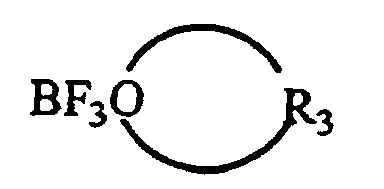
- The neodymium compound used in this invention is a carboxylate compound, having a good solubility in non-polar solvents, selected from the group of neodymium hexanoate, neodymium heptanoate, neodymium octanoate, neodymium 2-ethyl hexanoate, neodymium naphthenate, neodymium stearate and neodymium versatate, which consists of carboxylate salts having more than 6 carbon atoms.
- The borontrifluoride complex represented by the formula I or the formula II includes compound selected from the group of borontrifluoride-dimethylether, borontrifluoride-diethylether, borontrifluoride-dibutylether and borontrifluoride-tetrahydrofuran.
- The organoaluminum compound is conventional, which is represented by the following formula III.
AlR4R5R6 - The organoaluminum compound includes compound selected from the group of trimethylaluminum, triethylaluminum, tripropylaluminum, tributylaluminum, triisobutylaluminum, trihexylaluminum, trioctylaluminum and diisobutylaluminum hydride.
- A polymerization catalyst for producing polybutadiene is produced by mixing the neodymium compound, the organoaluminum compound and the borontrifluoride complex, followed by aging process.
- A solvent for aging the catalyst is a non polar sovent which is non-reactive with the catalyst, preferably cyclohexane, hexane, heptane or toluene.
- Meantime, the appropriate molar ratio of the organoaluminum compound to the neodymium compound for aging the catalyst is 1:1 to 200:1, preferably in the molar ratio of 10:1 to 150:1. If the molar ratio is less than or exceeds the above range, the conversion is decreased or polymer having low molecular weight is formed.
- And the molar ratio of the borontrifluoride complex represented by the formula I or the formula II to the neodymium compound is 0.1:1 to 10:1, preferably 0.5:1 to 5:1. If the molar ratio is less than or exceeds the above range, the conversion is decreased.
- The molar ratio of conjugated diene to the neodymium compound is 1:1 to 30:1, preferably 2:1 to 10:1. If the molar ratio exceeds the above range, the viscosity of catalyst solution is increased.
- The procedure for preparing an aging catalyst is that a neodymium compound solution in the presence or absence of a small portion of 1,3-butadiene is placed in a catalyst reactor under nitrogen atmosphere, followed by the addition of the organoaluminum compound represented by the formula III and the borontrifluoride complex represented by the formula I or the formula II. The aging of catalyst can be made in such order of addition or in modifying order.
- The appropriate aging time is in a period of 5 minutes to 10 hours, while the aging temperature is preferably at -20 to 60°C, more preferably 0 to 50°C.
- The catalyst generated under the above conditions is used for the polymerization of 1,3-butadiene to obtain polybutadiene with high 1,4-cis content and high conversion. The non-polar solvent used for the polymerization of 1,3-butadiene should contain at least one or more of aliphatic hydrocarbons (e.g., butane, pentane, hexane, isopentane, heptane, octane and isooctane); cycloaliphatic hydrocarbons (e.g., cyclopentane, methylcyclopentane, cyclohexane, methylcyclohexane and ethylcyclohexane); aromatic hydrocarbons (e.g., benzene, toluene, ethylbenzene or xylene).
- The polymerization solvent, which can significantly affect the polymerization, is used after removal of oxygen and water. The polymerization is initiated under high-purity nitrogen atmosphere and the polymerization temperature is preferably room temperature to 100°C. Under the appropriate catalyst conditions, two-hour polymerization is preferred with a conversion of more than 90%. The polymerization is completed by introducing polyoxyethyleneglycolether organophosphate as a reaction terminator and 2,6-di-t-butyl-p-cresol as a stabilizer. The resulting polybutadiene is precipitated with methanol or ethanol.
- This invention is explained in more detail by the following examples.
- The Ziegler-Natta catalyst used for polymerization comprised neodymium versatate(in 1% cyclohexane solution) in the presence or absence of a small portion of 1,3-butadiene, triisobutylaluminum(in 15% hexane solution) and borontrifluoride-diethylether(in 1.5% toluene solution), while 5.7 × 10⁻⁴ mol of neodymium versatate was employed per 100g of monomer.
- The aging of the catalyst was performed as follows: Neodymium versatate, triisobutylaluminum and borontrifluoride-diethylether in a given amount (the molar ratio of each component was 1:30:2, respectively) were successively added to an 100mℓ of roundbottomed flask and aged at 20°C for 1 hour under nitrogen.
- The polymerization of 1,3-butadiene was performed using the catalyst generated from the aging process.
- The polymerization process was performed as follows: Cyclohexane as a polymerization solvent, the Ziegler-Natta catalyst, aged as above, and 1,3-butadiene were added to a glass reactor which was sufficiently purged with nitrogen and reacted at 40 °C for 2 hours. The weight ratio of the polymerization solvent and 1,3-butadiene was 5:1. Then, the polymerization was completed by introducing polyoxyethyleneglycolether organophosphate as a reaction terminator and 2,6-di-t-butyl-p-cresol as a stabilizer.
- Polybutadienes with high 1,4-cis contents and high conversions were prepared in the same manner as Example 1, except for using different borontrifluoride complex, component ratio and content of each component, as shown in the following table 1.
Example Order of addition Molar ratio Content of Neodymium/100g of BD(× 10-4 mol) 1 NV/Al(i-Bu)3/BF3OEt2 1:30:2 5.7 2 NV/Al(i-Bu)3/BF3OEt2 1:30:1.5 5.7 3 NV/Al(i-Bu)3/BF3OEt2 1:30:1 5.7 4 NV/Al(i-Bu)3/BF3OEt2 1:30:2 4.0 5 NV/Al(i-Bu)3/BF3OEt2 1:30:2 3.5 6 NV/Al(i-Bu)3/BF3OEt2 1:30:2 3.0 7 NV/Al(i-Bu)3/BF3OEt2 1:30:1.5 2.8 8 Al(i-Bu)3/NV/BF3OEt2 30:1:1 2.8 9 Al(i-Bu)3/NV/BF3OMe2 30:1:1 2.8 10 NV/BF3OMe2/Al(i-Bu)3 1:1.5:30 2.8 11 NV/Al(i-Bu)3/BF3THF 1:30:3 5.7 12 NV/Al(i-Bu)3/BF3THF 1:30:1 2.8 13 NV/Al(i-Bu)3/BF3OBu2 1:30:1 2.8 Notes) NV : Neodymium versatate, BD : 1,3-Butadiene - Polybutadiens were prepared in the same manner as Example 1, except that instead of borontrifluoride complex, diethylaluminum chloride was used, as shown in the following table 2.
Comparative Example Order of addition Molar ratio Content of Neodymium/100g of BD(× 10-4mol) 1 NV/AlEt2Cl/Al(i-Bu)3 1:3:30 5.7 2 NV/AlEt2Cl/Al(i-Bu)3 1:3:30 4.2 3 NV/AIEt2Cl/Al(i-Bu)3 1:3:30 3.5 4 NV/AlEt2Cl/Al(i-Bu)3 1:1:30 2.8 5 NV/Al(i-Bu)3/AlEt2Cl 1:30:3 4.2 6 NV/Al(i-Bu)3/AIEt2CI 1:30:3 3.5 - The 1,4-cis content and the conversion for the prepared polybutadiene in Examples 1 to 13 and Comparative Examples 1 to 4 were measured, and the results were shown in the following table 3.
- The 1,4-cis content was measured by the Morero method (Chim. Indust., Vol 41, p758, 1959).
1,4-Cis content(%) Conversion(%) Example 1 97.4 100 2 97.8 100 3 97.0 100 4 97.7 100 5 98.4 100 6 98.3 100 7 97.6 90 8 98.5 95 9 98.0 99 10 97.9 98.3 11 98.5 100 12 98.1 96.7 13 98.6 93.3 Comparative Example 1 96.4 100 2 97.3 95 3 97.4 90 4 97.3 88 - The Mooney and the solution viscosities were measured for the prepared polybutadiene in Examples 4 to 6 and Comparative Examples 2 to 3, and the results were shown in the following table 4.
- The solution viscosity was measured at 25°C by a Ubbelohde viscometer using a solution of 4.75g of "high cis-BR" in 86g of toluene.
Mooney viscosity
(ML1+4 100 °C)Solution viscosity(cps) Exam. 4 40.4 259 Exam. 5 53.2 445 Exam. 6 54.2 461 Comp. Exam. 2 50.2 620 Comp. Exam. 3 57.4 1000 - In order to compare the degree of the homogeneity of the catalyst used in Examples 4 to 6 and Comparative Examples 2, 3, 5 and 6, the number of insoluble particles was measured and the results were shown in the following table 5.
- The number of insoluble particles was measured at 25 °C using the Wide Angle Laser Light Scattering System(WALLSS, Malvern Co.).
Catalyst Number of insoluble particles(Kilocounts/sec) Exam. 4 3.2 Exam. 5 3.1 Exam. 6 3.4 Comp. Exam 2 345.2 Comp. Exam 3 318.4 Comp. Exam 5 224.8 Comp. Exam. 6 187.9 - As described above in more detail, this invention can provide a process for preparing polybutadiene with high 1,4-cis content over 97% and high conversion over 90% in such a manner that 1,3-butadiene is polymerized in a non-polar solvent using an aging catalyst, which has high homogeneity due to its excellent solubility in non-polar solvents resulting in producing polybutadiene having low gel content and low solution viscosity, comprising a mixture of a neodymium compound, an organoaluminum compound and a borontrifluoride complex in the presence or absence of a small portion of conjugated diene compound.
Claims (6)
- A process for preparing polybutadiene which comprises the step of polymerizing 1,3-butadiene in a non-polar solvent using an aging catalyst prepared by ageing a mixture of a neodymium carboxylate compound selected from the group consisting of neodymium hexanoate, neodymium heptanoate, neodymium octanoate, neodymium 2-ethyl hexanoate, neodymium naphthenate, neodymium stearate, neodymium versatate and mixtures thereof, an organoaluminum compound and a borontrifluoride complex represented by formula I or formula II in the presence or absence of a small portion of conjugated diene compound; in which complexes of Formula I have the strusture:wherein, R3 is an alkyl group containing from 2 to 10 carbon atoms.

- The process according to claim 1, wherein said organoaluminum compound is selected from the group of trimethylaluminum, triethylaluminum, tripropylaluminum, tributylaluminum, triisobutylaluminum, trihexylaluminum, trioctylaluminum, diisobutylaluminum hydride and mixture thereof.
- The process according to claim 1, wherein said borontrifluoride complex represented by formula I or formula II is selected from the group of borontrifluoride-dimethylether, borontrifluoride-diethylehter, borontrifluoride-dibutylether, borontrifluoride-tetrahydrofuran and mixture thereof.
- The process according to claim 1, wherein the molar ratio of said borontrifluoride complex to neodymium compound is 0.1:1 to 10:1.
- The process according to claim 1, wherein the aging process of said catalyst is performed at -20 to 60°C for 5 minutes to 10 hours.
- The process according to claim 1, wherein the molar ratio of said conjugated diene compound to neodymium compound is 1:1 to 30:1.
Applications Claiming Priority (2)
| Application Number | Priority Date | Filing Date | Title |
|---|---|---|---|
| KR6209899 | 1999-02-25 | ||
| KR10-1999-0006298A KR100365581B1 (en) | 1999-02-25 | 1999-02-25 | A preparing process for high 1,4-cis polybutadiene |
Publications (2)
| Publication Number | Publication Date |
|---|---|
| EP1031583A1 EP1031583A1 (en) | 2000-08-30 |
| EP1031583B1 true EP1031583B1 (en) | 2005-03-23 |
Family
ID=19575051
Family Applications (1)
| Application Number | Title | Priority Date | Filing Date |
|---|---|---|---|
| EP99307572A Expired - Lifetime EP1031583B1 (en) | 1999-02-25 | 1999-09-24 | A process for preparing polybutadiene using catalyst with high activity |
Country Status (5)
| Country | Link |
|---|---|
| US (1) | US6136931A (en) |
| EP (1) | EP1031583B1 (en) |
| KR (1) | KR100365581B1 (en) |
| AT (1) | ATE291595T1 (en) |
| ES (1) | ES2239832T3 (en) |
Families Citing this family (20)
| Publication number | Priority date | Publication date | Assignee | Title |
|---|---|---|---|---|
| KR100298571B1 (en) * | 1999-06-17 | 2001-09-13 | 박찬구 | A process for preparation of high 1,4-cis polybutadiene |
| MXPA03010095A (en) * | 2001-05-04 | 2004-03-16 | Dow Global Technologies Inc | Random or block co-or terpolymers produced by using of metal complex catalysts. |
| US6712715B2 (en) | 2001-05-30 | 2004-03-30 | Bridgestone Sports Co., Ltd. | Golf ball |
| JP2002355337A (en) * | 2001-05-30 | 2002-12-10 | Bridgestone Sports Co Ltd | Golf ball |
| EP1436332A2 (en) * | 2001-10-12 | 2004-07-14 | Dow Global Technologies Inc. | Metal complex compositions and their use as catalysts to produce polydienes |
| US6780948B2 (en) | 2002-03-28 | 2004-08-24 | The Goodyear Tire & Rubber Company | Synthesis of polyisoprene with neodymium catalyst |
| KR100462664B1 (en) * | 2002-09-27 | 2004-12-20 | 금호석유화학 주식회사 | Method for preparing 1,4-cis polybutadiene |
| KR100472649B1 (en) * | 2002-11-22 | 2005-03-11 | 금호석유화학 주식회사 | Manufacturing method of high 1,4-cis polybutadiene |
| US6727330B1 (en) | 2003-02-07 | 2004-04-27 | Firestone Polymers, Llc | Termination and reduced gel in high cis polybutadiene |
| ES2427626T3 (en) * | 2003-02-21 | 2013-10-31 | Styron Europe Gmbh | Procedure for homo- or copolymerization of conjugated olefins |
| JP4467258B2 (en) * | 2003-06-25 | 2010-05-26 | 株式会社ブリヂストン | Butadiene polymer, process for producing the same, and rubber composition and tire using the same |
| US7091150B2 (en) * | 2003-12-19 | 2006-08-15 | The Goodyear Tire & Rubber Company | Synthetic polyisoprene rubber |
| US6972309B1 (en) * | 2004-06-17 | 2005-12-06 | The Goodyear Tire & Rubber Company | Cure system for polyisoprene rubber |
| US7741418B2 (en) * | 2007-12-31 | 2010-06-22 | Bridgestone Corporation | Process for producing polydienes |
| US7825201B2 (en) * | 2007-12-31 | 2010-11-02 | Bridgestone Corporation | Process for producing polydienes |
| US8623975B2 (en) | 2009-06-24 | 2014-01-07 | Bridgestone Corporation | Process for producing polydienes |
| US9856337B2 (en) | 2016-03-25 | 2018-01-02 | Iowa State University Research Foundation, Inc. | Polymerization catalysts |
| KR102193437B1 (en) * | 2017-10-30 | 2020-12-21 | 주식회사 엘지화학 | Method of preparation for catalyst for the polymerization of conjugated diene, catalyst prerared by the same method and method of preparation for modified conjugated diene polymer using the same |
| US11767388B1 (en) | 2019-09-18 | 2023-09-26 | The Goodyear Tire & Rubber Company | Silicon-functionalized rubber |
| EP3838932B1 (en) | 2019-12-20 | 2022-08-10 | The Goodyear Tire & Rubber Company | Synthesis of isoprene-butadiene copolymer rubbers |
Family Cites Families (13)
| Publication number | Priority date | Publication date | Assignee | Title |
|---|---|---|---|---|
| US3985677A (en) * | 1972-10-27 | 1976-10-12 | The Goodyear Tire & Rubber Company | Preparation of polymerization catalyst and polymerization therewith |
| JPS5624412A (en) * | 1979-08-07 | 1981-03-09 | Japan Synthetic Rubber Co Ltd | Production of low-molecular-weight cis-polybutadiene |
| JPS56109204A (en) * | 1980-01-31 | 1981-08-29 | Japan Synthetic Rubber Co Ltd | Preparation of polybutadiene |
| IT1164238B (en) * | 1983-05-25 | 1987-04-08 | Anic Spa | PROCEDURE FOR THE POLYMERIZATION OF BUTADIENE |
| US4699962A (en) * | 1984-01-30 | 1987-10-13 | Phillips Petroleum Company | Olefin polymerization |
| IT1186747B (en) * | 1985-07-01 | 1987-12-16 | Enichem Elastomers | IMPROVED PROCEDURE FOR POLYMERIZATION OR COPOLYMERIZATION OF BUTADIENE |
| US4906706A (en) * | 1986-09-05 | 1990-03-06 | Japan Synthetic Rubber Co., Ltd. | Modified conjugated diene polymer and process for production thereof |
| US5064910A (en) * | 1986-09-05 | 1991-11-12 | Japan Synthetic Rubber Co., Ltd. | Preparation of conjugated diene polymers modified with an organo-tin or germanium halide |
| GB8830007D0 (en) * | 1988-12-22 | 1989-02-15 | Enichem Elastomers | Polymerization of butadiene |
| IT1230756B (en) * | 1989-02-17 | 1991-10-29 | Enichem Elastomers | METHOD FOR THE PREPARATION OF POLYBUTADIENE FOR IMPROVED WORKABILITY. |
| US5428119A (en) * | 1993-11-09 | 1995-06-27 | Polysar Rubber Corporation | Process for polybutadiene production using catalyst with high activity |
| IT1273753B (en) * | 1994-02-11 | 1997-07-10 | Eniriceche Spa | CATALYTIC SYSTEM AND PROCESS FOR THE PRODUCTION OF POLYDIOLEFINS |
| US5412045A (en) * | 1994-09-16 | 1995-05-02 | Polysar Rubber Corporation | Preparation of high cis-1,4-polybutadiene with reduced gel |
-
1999
- 1999-02-25 KR KR10-1999-0006298A patent/KR100365581B1/en not_active Expired - Lifetime
- 1999-09-24 ES ES99307572T patent/ES2239832T3/en not_active Expired - Lifetime
- 1999-09-24 EP EP99307572A patent/EP1031583B1/en not_active Expired - Lifetime
- 1999-09-24 AT AT99307572T patent/ATE291595T1/en not_active IP Right Cessation
- 1999-11-03 US US09/433,073 patent/US6136931A/en not_active Expired - Lifetime
Also Published As
| Publication number | Publication date |
|---|---|
| EP1031583A1 (en) | 2000-08-30 |
| ATE291595T1 (en) | 2005-04-15 |
| KR100365581B1 (en) | 2003-01-15 |
| ES2239832T3 (en) | 2005-10-01 |
| KR20000056722A (en) | 2000-09-15 |
| US6136931A (en) | 2000-10-24 |
Similar Documents
| Publication | Publication Date | Title |
|---|---|---|
| US6136931A (en) | Process for preparing polybutadiene using catalyst with high activity | |
| US6506865B2 (en) | Monomeric neodymium carboxylate and its use in polymerization of conjugated diene | |
| KR100207347B1 (en) | Catalyst for the synthesis of crystalline 3,4-polyisoprene | |
| US4168357A (en) | Preparation of high cis-1,4-polypentadiene | |
| JPH11255813A (en) | Nonviscous hydrocarbon solution of rare earth compound using lewis acid and preparation thereof | |
| US6451934B1 (en) | Process for preparation of high 1,4-CIS polybutadiene | |
| US6177603B1 (en) | Organo zinc and rare earth catalyst system in the polymerization of conjugated dienes | |
| US6586542B2 (en) | Process for controlling degree of branch of high 1,4-cis polybutadiene | |
| KR20020062490A (en) | Synthesis method of siloxane-functionalized high 1,4-cis polybutadiene | |
| EP1092735B1 (en) | Process for manufacturing high 1,4-CIS polybutadiene containing hydroxyl groups at ends thereof using molecular oxygen | |
| JP2002030107A5 (en) | ||
| US6013746A (en) | Process for controlling the molecular weight distribution of high 1,4-cis polybutadiene | |
| RU2267355C2 (en) | Method of preparing butadiene polymerization and butadiene-conjugated diene copolymerization catalyst | |
| KR100295600B1 (en) | Process for producing polybutadiene with high 1,4-cis content | |
| KR100336519B1 (en) | Polymerization of 1,3-butadiene | |
| US20120165485A1 (en) | Method for Control of the Degree of Branch of Polybutadiene with High 1,4-CIS Content | |
| KR100403090B1 (en) | A process for preparation of high 1,4-cis polybutadiene | |
| KR19990071124A (en) | How to adjust the branching degree of polybutadiene with high 1,4-cis content | |
| KR100384813B1 (en) | Polymerization method of high 1,4-cis polybutadine and its derivatives | |
| RU2426748C1 (en) | Method of producing catalyst for (co) | |
| KR100308781B1 (en) | Method for regulating the molecular weight of polybutadiene | |
| KR100462664B1 (en) | Method for preparing 1,4-cis polybutadiene | |
| KR100462663B1 (en) | Method of manufacturing polybutadiene having high 1,4-cis content | |
| DE69924351T2 (en) | Process for the preparation of polybutadiene with highly active catalysts | |
| CN121064254A (en) | Complex with cage-type silsesquioxane structure and preparation method thereof, iron catalyst and application thereof, and preparation method of polyolefin |
Legal Events
| Date | Code | Title | Description |
|---|---|---|---|
| PUAI | Public reference made under article 153(3) epc to a published international application that has entered the european phase |
Free format text: ORIGINAL CODE: 0009012 |
|
| AK | Designated contracting states |
Kind code of ref document: A1 Designated state(s): AT BE CH CY DE DK ES FI FR GB GR IE IT LI LU MC NL PT SE |
|
| AX | Request for extension of the european patent |
Free format text: AL;LT;LV;MK;RO;SI |
|
| 17P | Request for examination filed |
Effective date: 20010221 |
|
| AKX | Designation fees paid |
Free format text: AT BE CH CY DE DK ES FI FR GB GR IE IT LI LU MC NL PT SE |
|
| 17Q | First examination report despatched |
Effective date: 20030724 |
|
| GRAP | Despatch of communication of intention to grant a patent |
Free format text: ORIGINAL CODE: EPIDOSNIGR1 |
|
| GRAS | Grant fee paid |
Free format text: ORIGINAL CODE: EPIDOSNIGR3 |
|
| GRAA | (expected) grant |
Free format text: ORIGINAL CODE: 0009210 |
|
| AK | Designated contracting states |
Kind code of ref document: B1 Designated state(s): AT BE CH CY DE DK ES FI FR GB GR IE IT LI LU MC NL PT SE |
|
| PG25 | Lapsed in a contracting state [announced via postgrant information from national office to epo] |
Ref country code: NL Free format text: LAPSE BECAUSE OF FAILURE TO SUBMIT A TRANSLATION OF THE DESCRIPTION OR TO PAY THE FEE WITHIN THE PRESCRIBED TIME-LIMIT Effective date: 20050323 Ref country code: LI Free format text: LAPSE BECAUSE OF FAILURE TO SUBMIT A TRANSLATION OF THE DESCRIPTION OR TO PAY THE FEE WITHIN THE PRESCRIBED TIME-LIMIT Effective date: 20050323 Ref country code: FI Free format text: LAPSE BECAUSE OF FAILURE TO SUBMIT A TRANSLATION OF THE DESCRIPTION OR TO PAY THE FEE WITHIN THE PRESCRIBED TIME-LIMIT Effective date: 20050323 Ref country code: CH Free format text: LAPSE BECAUSE OF FAILURE TO SUBMIT A TRANSLATION OF THE DESCRIPTION OR TO PAY THE FEE WITHIN THE PRESCRIBED TIME-LIMIT Effective date: 20050323 Ref country code: BE Free format text: LAPSE BECAUSE OF FAILURE TO SUBMIT A TRANSLATION OF THE DESCRIPTION OR TO PAY THE FEE WITHIN THE PRESCRIBED TIME-LIMIT Effective date: 20050323 Ref country code: AT Free format text: LAPSE BECAUSE OF FAILURE TO SUBMIT A TRANSLATION OF THE DESCRIPTION OR TO PAY THE FEE WITHIN THE PRESCRIBED TIME-LIMIT Effective date: 20050323 |
|
| REG | Reference to a national code |
Ref country code: GB Ref legal event code: FG4D |
|
| REG | Reference to a national code |
Ref country code: CH Ref legal event code: EP |
|
| REG | Reference to a national code |
Ref country code: IE Ref legal event code: FG4D |
|
| REF | Corresponds to: |
Ref document number: 69924351 Country of ref document: DE Date of ref document: 20050428 Kind code of ref document: P |
|
| PG25 | Lapsed in a contracting state [announced via postgrant information from national office to epo] |
Ref country code: GR Free format text: LAPSE BECAUSE OF FAILURE TO SUBMIT A TRANSLATION OF THE DESCRIPTION OR TO PAY THE FEE WITHIN THE PRESCRIBED TIME-LIMIT Effective date: 20050623 Ref country code: DK Free format text: LAPSE BECAUSE OF FAILURE TO SUBMIT A TRANSLATION OF THE DESCRIPTION OR TO PAY THE FEE WITHIN THE PRESCRIBED TIME-LIMIT Effective date: 20050623 |
|
| NLV1 | Nl: lapsed or annulled due to failure to fulfill the requirements of art. 29p and 29m of the patents act | ||
| PG25 | Lapsed in a contracting state [announced via postgrant information from national office to epo] |
Ref country code: PT Free format text: LAPSE BECAUSE OF FAILURE TO SUBMIT A TRANSLATION OF THE DESCRIPTION OR TO PAY THE FEE WITHIN THE PRESCRIBED TIME-LIMIT Effective date: 20050907 |
|
| PG25 | Lapsed in a contracting state [announced via postgrant information from national office to epo] |
Ref country code: CY Free format text: LAPSE BECAUSE OF FAILURE TO SUBMIT A TRANSLATION OF THE DESCRIPTION OR TO PAY THE FEE WITHIN THE PRESCRIBED TIME-LIMIT Effective date: 20050924 |
|
| PG25 | Lapsed in a contracting state [announced via postgrant information from national office to epo] |
Ref country code: IE Free format text: LAPSE BECAUSE OF NON-PAYMENT OF DUE FEES Effective date: 20050926 |
|
| PG25 | Lapsed in a contracting state [announced via postgrant information from national office to epo] |
Ref country code: MC Free format text: LAPSE BECAUSE OF NON-PAYMENT OF DUE FEES Effective date: 20050930 Ref country code: LU Free format text: LAPSE BECAUSE OF NON-PAYMENT OF DUE FEES Effective date: 20050930 |
|
| REG | Reference to a national code |
Ref country code: CH Ref legal event code: PL |
|
| REG | Reference to a national code |
Ref country code: ES Ref legal event code: FG2A Ref document number: 2239832 Country of ref document: ES Kind code of ref document: T3 |
|
| ET | Fr: translation filed | ||
| PLBE | No opposition filed within time limit |
Free format text: ORIGINAL CODE: 0009261 |
|
| STAA | Information on the status of an ep patent application or granted ep patent |
Free format text: STATUS: NO OPPOSITION FILED WITHIN TIME LIMIT |
|
| 26N | No opposition filed |
Effective date: 20051227 |
|
| REG | Reference to a national code |
Ref country code: IE Ref legal event code: MM4A |
|
| PG25 | Lapsed in a contracting state [announced via postgrant information from national office to epo] |
Ref country code: SE Free format text: LAPSE BECAUSE OF FAILURE TO SUBMIT A TRANSLATION OF THE DESCRIPTION OR TO PAY THE FEE WITHIN THE PRESCRIBED TIME-LIMIT Effective date: 20050623 |
|
| REG | Reference to a national code |
Ref country code: FR Ref legal event code: PLFP Year of fee payment: 18 |
|
| PGFP | Annual fee paid to national office [announced via postgrant information from national office to epo] |
Ref country code: DE Payment date: 20160920 Year of fee payment: 18 Ref country code: IT Payment date: 20160921 Year of fee payment: 18 Ref country code: GB Payment date: 20160921 Year of fee payment: 18 |
|
| PGFP | Annual fee paid to national office [announced via postgrant information from national office to epo] |
Ref country code: FR Payment date: 20160816 Year of fee payment: 18 |
|
| PGFP | Annual fee paid to national office [announced via postgrant information from national office to epo] |
Ref country code: ES Payment date: 20160810 Year of fee payment: 18 |
|
| REG | Reference to a national code |
Ref country code: DE Ref legal event code: R119 Ref document number: 69924351 Country of ref document: DE |
|
| GBPC | Gb: european patent ceased through non-payment of renewal fee |
Effective date: 20170924 |
|
| REG | Reference to a national code |
Ref country code: FR Ref legal event code: ST Effective date: 20180531 |
|
| PG25 | Lapsed in a contracting state [announced via postgrant information from national office to epo] |
Ref country code: GB Free format text: LAPSE BECAUSE OF NON-PAYMENT OF DUE FEES Effective date: 20170924 Ref country code: DE Free format text: LAPSE BECAUSE OF NON-PAYMENT OF DUE FEES Effective date: 20180404 |
|
| PG25 | Lapsed in a contracting state [announced via postgrant information from national office to epo] |
Ref country code: IT Free format text: LAPSE BECAUSE OF NON-PAYMENT OF DUE FEES Effective date: 20170924 Ref country code: FR Free format text: LAPSE BECAUSE OF NON-PAYMENT OF DUE FEES Effective date: 20171002 |
|
| REG | Reference to a national code |
Ref country code: ES Ref legal event code: FD2A Effective date: 20181018 |
|
| PG25 | Lapsed in a contracting state [announced via postgrant information from national office to epo] |
Ref country code: ES Free format text: LAPSE BECAUSE OF NON-PAYMENT OF DUE FEES Effective date: 20170925 |