EP1030889B1 - Polymeric compositions, and the preparation and use thereof - Google Patents
Polymeric compositions, and the preparation and use thereof Download PDFInfo
- Publication number
- EP1030889B1 EP1030889B1 EP98959428A EP98959428A EP1030889B1 EP 1030889 B1 EP1030889 B1 EP 1030889B1 EP 98959428 A EP98959428 A EP 98959428A EP 98959428 A EP98959428 A EP 98959428A EP 1030889 B1 EP1030889 B1 EP 1030889B1
- Authority
- EP
- European Patent Office
- Prior art keywords
- polymer
- functional groups
- groups per
- reactive functional
- composition according
- Prior art date
- Legal status (The legal status is an assumption and is not a legal conclusion. Google has not performed a legal analysis and makes no representation as to the accuracy of the status listed.)
- Expired - Lifetime
Links
- 239000000203 mixture Substances 0.000 title claims abstract description 149
- 238000002360 preparation method Methods 0.000 title description 24
- 229920000642 polymer Polymers 0.000 claims abstract description 327
- 125000000524 functional group Chemical group 0.000 claims abstract description 86
- 239000000843 powder Substances 0.000 claims abstract description 53
- 239000007787 solid Substances 0.000 claims abstract description 40
- 238000000034 method Methods 0.000 claims abstract description 39
- 239000011347 resin Substances 0.000 claims abstract description 38
- 229920005989 resin Polymers 0.000 claims abstract description 38
- 238000000576 coating method Methods 0.000 claims abstract description 37
- 239000011248 coating agent Substances 0.000 claims abstract description 15
- 239000007795 chemical reaction product Substances 0.000 claims abstract description 9
- 238000004519 manufacturing process Methods 0.000 claims abstract description 3
- PPBRXRYQALVLMV-UHFFFAOYSA-N Styrene Natural products C=CC1=CC=CC=C1 PPBRXRYQALVLMV-UHFFFAOYSA-N 0.000 claims description 62
- -1 isocyanato, carboxyl anhydride Chemical class 0.000 claims description 49
- 125000002887 hydroxy group Chemical group [H]O* 0.000 claims description 43
- NIXOWILDQLNWCW-UHFFFAOYSA-N 2-Propenoic acid Natural products OC(=O)C=C NIXOWILDQLNWCW-UHFFFAOYSA-N 0.000 claims description 40
- 239000004593 Epoxy Substances 0.000 claims description 32
- 125000003178 carboxy group Chemical group [H]OC(*)=O 0.000 claims description 32
- 229920000728 polyester Polymers 0.000 claims description 30
- SMZOUWXMTYCWNB-UHFFFAOYSA-N 2-(2-methoxy-5-methylphenyl)ethanamine Chemical compound COC1=CC=C(C)C=C1CCN SMZOUWXMTYCWNB-UHFFFAOYSA-N 0.000 claims description 19
- 238000009833 condensation Methods 0.000 claims description 19
- 230000005494 condensation Effects 0.000 claims description 19
- 125000002924 primary amino group Chemical group [H]N([H])* 0.000 claims description 19
- 239000008199 coating composition Substances 0.000 claims description 18
- 239000004952 Polyamide Substances 0.000 claims description 17
- XYLMUPLGERFSHI-UHFFFAOYSA-N alpha-Methylstyrene Chemical compound CC(=C)C1=CC=CC=C1 XYLMUPLGERFSHI-UHFFFAOYSA-N 0.000 claims description 17
- 229920002647 polyamide Polymers 0.000 claims description 17
- 229920002635 polyurethane Polymers 0.000 claims description 12
- 239000004814 polyurethane Substances 0.000 claims description 12
- 229920000570 polyether Polymers 0.000 claims description 11
- 239000004925 Acrylic resin Substances 0.000 claims description 9
- 125000005968 oxazolinyl group Chemical group 0.000 claims description 8
- 125000000020 sulfo group Chemical group O=S(=O)([*])O[H] 0.000 claims description 8
- GOXQRTZXKQZDDN-UHFFFAOYSA-N 2-Ethylhexyl acrylate Chemical compound CCCCC(CC)COC(=O)C=C GOXQRTZXKQZDDN-UHFFFAOYSA-N 0.000 claims description 7
- WOBHKFSMXKNTIM-UHFFFAOYSA-N Hydroxyethyl methacrylate Chemical compound CC(=C)C(=O)OCCO WOBHKFSMXKNTIM-UHFFFAOYSA-N 0.000 claims description 7
- 125000001261 isocyanato group Chemical group *N=C=O 0.000 claims description 7
- 125000005740 oxycarbonyl group Chemical group [*:1]OC([*:2])=O 0.000 claims description 7
- 239000003086 colorant Substances 0.000 claims description 6
- 150000002148 esters Chemical class 0.000 claims description 6
- 229920000178 Acrylic resin Polymers 0.000 claims description 5
- 238000002156 mixing Methods 0.000 claims description 5
- 239000003431 cross linking reagent Substances 0.000 claims description 4
- 239000003822 epoxy resin Substances 0.000 claims description 3
- 229920000647 polyepoxide Polymers 0.000 claims description 3
- 229920001296 polysiloxane Polymers 0.000 claims description 2
- 125000003011 styrenyl group Chemical group [H]\C(*)=C(/[H])C1=C([H])C([H])=C([H])C([H])=C1[H] 0.000 claims 10
- 239000002253 acid Substances 0.000 description 30
- 238000006243 chemical reaction Methods 0.000 description 25
- IJGRMHOSHXDMSA-UHFFFAOYSA-N Atomic nitrogen Chemical compound N#N IJGRMHOSHXDMSA-UHFFFAOYSA-N 0.000 description 22
- 229920001400 block copolymer Polymers 0.000 description 19
- LYCAIKOWRPUZTN-UHFFFAOYSA-N Ethylene glycol Chemical compound OCCO LYCAIKOWRPUZTN-UHFFFAOYSA-N 0.000 description 17
- 229920001451 polypropylene glycol Polymers 0.000 description 13
- 239000000976 ink Substances 0.000 description 12
- 239000000178 monomer Substances 0.000 description 12
- 239000002904 solvent Substances 0.000 description 12
- XLYOFNOQVPJJNP-UHFFFAOYSA-N water Substances O XLYOFNOQVPJJNP-UHFFFAOYSA-N 0.000 description 12
- 125000004432 carbon atom Chemical group C* 0.000 description 11
- 229910052757 nitrogen Inorganic materials 0.000 description 11
- CERQOIWHTDAKMF-UHFFFAOYSA-N Methacrylic acid Chemical compound CC(=C)C(O)=O CERQOIWHTDAKMF-UHFFFAOYSA-N 0.000 description 8
- PAFZNILMFXTMIY-UHFFFAOYSA-N cyclohexylamine Chemical compound NC1CCCCC1 PAFZNILMFXTMIY-UHFFFAOYSA-N 0.000 description 8
- 239000000126 substance Substances 0.000 description 8
- 230000015572 biosynthetic process Effects 0.000 description 7
- 150000004985 diamines Chemical class 0.000 description 7
- 239000000049 pigment Substances 0.000 description 7
- VVQNEPGJFQJSBK-UHFFFAOYSA-N Methyl methacrylate Chemical compound COC(=O)C(C)=C VVQNEPGJFQJSBK-UHFFFAOYSA-N 0.000 description 6
- CTQNGGLPUBDAKN-UHFFFAOYSA-N O-Xylene Chemical compound CC1=CC=CC=C1C CTQNGGLPUBDAKN-UHFFFAOYSA-N 0.000 description 6
- 239000000654 additive Substances 0.000 description 6
- 150000001412 amines Chemical class 0.000 description 6
- 125000003118 aryl group Chemical group 0.000 description 6
- ISAOCJYIOMOJEB-UHFFFAOYSA-N benzoin Chemical compound C=1C=CC=CC=1C(O)C(=O)C1=CC=CC=C1 ISAOCJYIOMOJEB-UHFFFAOYSA-N 0.000 description 6
- MTHSVFCYNBDYFN-UHFFFAOYSA-N diethylene glycol Chemical compound OCCOCCO MTHSVFCYNBDYFN-UHFFFAOYSA-N 0.000 description 6
- 239000000539 dimer Chemical class 0.000 description 6
- CATSNJVOTSVZJV-UHFFFAOYSA-N heptan-2-one Chemical compound CCCCCC(C)=O CATSNJVOTSVZJV-UHFFFAOYSA-N 0.000 description 6
- NAQMVNRVTILPCV-UHFFFAOYSA-N hexane-1,6-diamine Chemical compound NCCCCCCN NAQMVNRVTILPCV-UHFFFAOYSA-N 0.000 description 6
- 239000000047 product Substances 0.000 description 6
- 239000008096 xylene Substances 0.000 description 6
- RRQYJINTUHWNHW-UHFFFAOYSA-N 1-ethoxy-2-(2-ethoxyethoxy)ethane Chemical compound CCOCCOCCOCC RRQYJINTUHWNHW-UHFFFAOYSA-N 0.000 description 5
- JZUHIOJYCPIVLQ-UHFFFAOYSA-N 2-methylpentane-1,5-diamine Chemical compound NCC(C)CCCN JZUHIOJYCPIVLQ-UHFFFAOYSA-N 0.000 description 5
- QWGRWMMWNDWRQN-UHFFFAOYSA-N 2-methylpropane-1,3-diol Chemical compound OCC(C)CO QWGRWMMWNDWRQN-UHFFFAOYSA-N 0.000 description 5
- RNLHGQLZWXBQNY-UHFFFAOYSA-N 3-(aminomethyl)-3,5,5-trimethylcyclohexan-1-amine Chemical compound CC1(C)CC(N)CC(C)(CN)C1 RNLHGQLZWXBQNY-UHFFFAOYSA-N 0.000 description 5
- 150000007513 acids Chemical class 0.000 description 5
- 125000002843 carboxylic acid group Chemical group 0.000 description 5
- 229920001577 copolymer Polymers 0.000 description 5
- 150000004665 fatty acids Chemical class 0.000 description 5
- 238000006116 polymerization reaction Methods 0.000 description 5
- 239000011541 reaction mixture Substances 0.000 description 5
- 239000011342 resin composition Substances 0.000 description 5
- 239000000243 solution Substances 0.000 description 5
- 239000000758 substrate Substances 0.000 description 5
- 238000003786 synthesis reaction Methods 0.000 description 5
- CIYMULYYXFTYFR-UHFFFAOYSA-N 1-(2-fluorophenyl)-1-(4-fluorophenyl)-2-(1,2,4-triazol-1-yl)ethanol;methyl n-(1h-benzimidazol-2-yl)carbamate Chemical compound C1=CC=C2NC(NC(=O)OC)=NC2=C1.C=1C=C(F)C=CC=1C(C=1C(=CC=CC=1)F)(O)CN1C=NC=N1 CIYMULYYXFTYFR-UHFFFAOYSA-N 0.000 description 4
- NIXOWILDQLNWCW-UHFFFAOYSA-M Acrylate Chemical compound [O-]C(=O)C=C NIXOWILDQLNWCW-UHFFFAOYSA-M 0.000 description 4
- VZCYOOQTPOCHFL-OWOJBTEDSA-N Fumaric acid Chemical compound OC(=O)\C=C\C(O)=O VZCYOOQTPOCHFL-OWOJBTEDSA-N 0.000 description 4
- 239000004831 Hot glue Substances 0.000 description 4
- OFOBLEOULBTSOW-UHFFFAOYSA-N Malonic acid Chemical compound OC(=O)CC(O)=O OFOBLEOULBTSOW-UHFFFAOYSA-N 0.000 description 4
- GLUUGHFHXGJENI-UHFFFAOYSA-N Piperazine Chemical compound C1CNCCN1 GLUUGHFHXGJENI-UHFFFAOYSA-N 0.000 description 4
- 229920003171 Poly (ethylene oxide) Polymers 0.000 description 4
- 239000000853 adhesive Substances 0.000 description 4
- 230000001070 adhesive effect Effects 0.000 description 4
- WNLRTRBMVRJNCN-UHFFFAOYSA-N adipic acid Chemical compound OC(=O)CCCCC(O)=O WNLRTRBMVRJNCN-UHFFFAOYSA-N 0.000 description 4
- XXROGKLTLUQVRX-UHFFFAOYSA-N allyl alcohol Chemical compound OCC=C XXROGKLTLUQVRX-UHFFFAOYSA-N 0.000 description 4
- 125000003277 amino group Chemical group 0.000 description 4
- WERYXYBDKMZEQL-UHFFFAOYSA-N butane-1,4-diol Chemical compound OCCCCO WERYXYBDKMZEQL-UHFFFAOYSA-N 0.000 description 4
- 239000003054 catalyst Substances 0.000 description 4
- 230000000052 comparative effect Effects 0.000 description 4
- 235000014113 dietary fatty acids Nutrition 0.000 description 4
- 229930195729 fatty acid Natural products 0.000 description 4
- 239000000194 fatty acid Substances 0.000 description 4
- WGCNASOHLSPBMP-UHFFFAOYSA-N hydroxyacetaldehyde Natural products OCC=O WGCNASOHLSPBMP-UHFFFAOYSA-N 0.000 description 4
- 229920000587 hyperbranched polymer Polymers 0.000 description 4
- QQVIHTHCMHWDBS-UHFFFAOYSA-N isophthalic acid Chemical compound OC(=O)C1=CC=CC(C(O)=O)=C1 QQVIHTHCMHWDBS-UHFFFAOYSA-N 0.000 description 4
- 229920003023 plastic Polymers 0.000 description 4
- 239000004033 plastic Substances 0.000 description 4
- 229920001225 polyester resin Polymers 0.000 description 4
- 239000004645 polyester resin Substances 0.000 description 4
- 238000012360 testing method Methods 0.000 description 4
- VZCYOOQTPOCHFL-UHFFFAOYSA-N trans-butenedioic acid Natural products OC(=O)C=CC(O)=O VZCYOOQTPOCHFL-UHFFFAOYSA-N 0.000 description 4
- 229960000834 vinyl ether Drugs 0.000 description 4
- PUPZLCDOIYMWBV-UHFFFAOYSA-N (+/-)-1,3-Butanediol Chemical compound CC(O)CCO PUPZLCDOIYMWBV-UHFFFAOYSA-N 0.000 description 3
- KWKAKUADMBZCLK-UHFFFAOYSA-N 1-octene Chemical compound CCCCCCC=C KWKAKUADMBZCLK-UHFFFAOYSA-N 0.000 description 3
- MKBBSFGKFMQPPC-UHFFFAOYSA-N 2-propyl-1h-imidazole Chemical compound CCCC1=NC=CN1 MKBBSFGKFMQPPC-UHFFFAOYSA-N 0.000 description 3
- PIICEJLVQHRZGT-UHFFFAOYSA-N Ethylenediamine Chemical compound NCCN PIICEJLVQHRZGT-UHFFFAOYSA-N 0.000 description 3
- CERQOIWHTDAKMF-UHFFFAOYSA-M Methacrylate Chemical compound CC(=C)C([O-])=O CERQOIWHTDAKMF-UHFFFAOYSA-M 0.000 description 3
- 239000004721 Polyphenylene oxide Substances 0.000 description 3
- 239000004793 Polystyrene Substances 0.000 description 3
- DNIAPMSPPWPWGF-UHFFFAOYSA-N Propylene glycol Chemical compound CC(O)CO DNIAPMSPPWPWGF-UHFFFAOYSA-N 0.000 description 3
- 244000028419 Styrax benzoin Species 0.000 description 3
- 235000000126 Styrax benzoin Nutrition 0.000 description 3
- 235000008411 Sumatra benzointree Nutrition 0.000 description 3
- YXFVVABEGXRONW-UHFFFAOYSA-N Toluene Chemical compound CC1=CC=CC=C1 YXFVVABEGXRONW-UHFFFAOYSA-N 0.000 description 3
- YIMQCDZDWXUDCA-UHFFFAOYSA-N [4-(hydroxymethyl)cyclohexyl]methanol Chemical compound OCC1CCC(CO)CC1 YIMQCDZDWXUDCA-UHFFFAOYSA-N 0.000 description 3
- UKLDJPRMSDWDSL-UHFFFAOYSA-L [dibutyl(dodecanoyloxy)stannyl] dodecanoate Chemical compound CCCCCCCCCCCC(=O)O[Sn](CCCC)(CCCC)OC(=O)CCCCCCCCCCC UKLDJPRMSDWDSL-UHFFFAOYSA-L 0.000 description 3
- 238000013019 agitation Methods 0.000 description 3
- 125000001931 aliphatic group Chemical group 0.000 description 3
- KKEYFWRCBNTPAC-UHFFFAOYSA-N benzene-dicarboxylic acid Natural products OC(=O)C1=CC=C(C(O)=O)C=C1 KKEYFWRCBNTPAC-UHFFFAOYSA-N 0.000 description 3
- 229960002130 benzoin Drugs 0.000 description 3
- 150000001875 compounds Chemical class 0.000 description 3
- 150000001991 dicarboxylic acids Chemical class 0.000 description 3
- 150000002009 diols Chemical class 0.000 description 3
- 238000009472 formulation Methods 0.000 description 3
- 230000009477 glass transition Effects 0.000 description 3
- 235000019382 gum benzoic Nutrition 0.000 description 3
- FPYJFEHAWHCUMM-UHFFFAOYSA-N maleic anhydride Chemical compound O=C1OC(=O)C=C1 FPYJFEHAWHCUMM-UHFFFAOYSA-N 0.000 description 3
- 229920006122 polyamide resin Polymers 0.000 description 3
- 229920002223 polystyrene Polymers 0.000 description 3
- AZIQALWHRUQPHV-UHFFFAOYSA-N prop-2-eneperoxoic acid Chemical group OOC(=O)C=C AZIQALWHRUQPHV-UHFFFAOYSA-N 0.000 description 3
- 229920001909 styrene-acrylic polymer Polymers 0.000 description 3
- 229920002554 vinyl polymer Chemical group 0.000 description 3
- SZCWBURCISJFEZ-UHFFFAOYSA-N (3-hydroxy-2,2-dimethylpropyl) 3-hydroxy-2,2-dimethylpropanoate Chemical compound OCC(C)(C)COC(=O)C(C)(C)CO SZCWBURCISJFEZ-UHFFFAOYSA-N 0.000 description 2
- PXGZQGDTEZPERC-UHFFFAOYSA-N 1,4-cyclohexanedicarboxylic acid Chemical class OC(=O)C1CCC(C(O)=O)CC1 PXGZQGDTEZPERC-UHFFFAOYSA-N 0.000 description 2
- ZGEGCLOFRBLKSE-UHFFFAOYSA-N 1-Heptene Chemical compound CCCCCC=C ZGEGCLOFRBLKSE-UHFFFAOYSA-N 0.000 description 2
- IANQTJSKSUMEQM-UHFFFAOYSA-N 1-benzofuran Chemical compound C1=CC=C2OC=CC2=C1 IANQTJSKSUMEQM-UHFFFAOYSA-N 0.000 description 2
- AFFLGGQVNFXPEV-UHFFFAOYSA-N 1-decene Chemical compound CCCCCCCCC=C AFFLGGQVNFXPEV-UHFFFAOYSA-N 0.000 description 2
- CRSBERNSMYQZNG-UHFFFAOYSA-N 1-dodecene Chemical compound CCCCCCCCCCC=C CRSBERNSMYQZNG-UHFFFAOYSA-N 0.000 description 2
- LIKMAJRDDDTEIG-UHFFFAOYSA-N 1-hexene Chemical compound CCCCC=C LIKMAJRDDDTEIG-UHFFFAOYSA-N 0.000 description 2
- JLIDVCMBCGBIEY-UHFFFAOYSA-N 1-penten-3-one Chemical compound CCC(=O)C=C JLIDVCMBCGBIEY-UHFFFAOYSA-N 0.000 description 2
- YBYIRNPNPLQARY-UHFFFAOYSA-N 1H-indene Chemical compound C1=CC=C2CC=CC2=C1 YBYIRNPNPLQARY-UHFFFAOYSA-N 0.000 description 2
- JAHNSTQSQJOJLO-UHFFFAOYSA-N 2-(3-fluorophenyl)-1h-imidazole Chemical compound FC1=CC=CC(C=2NC=CN=2)=C1 JAHNSTQSQJOJLO-UHFFFAOYSA-N 0.000 description 2
- OMIGHNLMNHATMP-UHFFFAOYSA-N 2-hydroxyethyl prop-2-enoate Chemical compound OCCOC(=O)C=C OMIGHNLMNHATMP-UHFFFAOYSA-N 0.000 description 2
- BKOOMYPCSUNDGP-UHFFFAOYSA-N 2-methylbut-2-ene Chemical compound CC=C(C)C BKOOMYPCSUNDGP-UHFFFAOYSA-N 0.000 description 2
- ZGHFDIIVVIFNPS-UHFFFAOYSA-N 3-Methyl-3-buten-2-one Chemical compound CC(=C)C(C)=O ZGHFDIIVVIFNPS-UHFFFAOYSA-N 0.000 description 2
- WSSSPWUEQFSQQG-UHFFFAOYSA-N 4-methyl-1-pentene Chemical compound CC(C)CC=C WSSSPWUEQFSQQG-UHFFFAOYSA-N 0.000 description 2
- HGINCPLSRVDWNT-UHFFFAOYSA-N Acrolein Chemical compound C=CC=O HGINCPLSRVDWNT-UHFFFAOYSA-N 0.000 description 2
- 229920002126 Acrylic acid copolymer Polymers 0.000 description 2
- KAKZBPTYRLMSJV-UHFFFAOYSA-N Butadiene Chemical compound C=CC=C KAKZBPTYRLMSJV-UHFFFAOYSA-N 0.000 description 2
- SOGAXMICEFXMKE-UHFFFAOYSA-N Butylmethacrylate Chemical compound CCCCOC(=O)C(C)=C SOGAXMICEFXMKE-UHFFFAOYSA-N 0.000 description 2
- 229920004511 Dow Corning® 200 Fluid Polymers 0.000 description 2
- 239000004908 Emulsion polymer Substances 0.000 description 2
- UEXCJVNBTNXOEH-UHFFFAOYSA-N Ethynylbenzene Chemical group C#CC1=CC=CC=C1 UEXCJVNBTNXOEH-UHFFFAOYSA-N 0.000 description 2
- PEDCQBHIVMGVHV-UHFFFAOYSA-N Glycerine Chemical compound OCC(O)CO PEDCQBHIVMGVHV-UHFFFAOYSA-N 0.000 description 2
- IWYRWIUNAVNFPE-UHFFFAOYSA-N Glycidaldehyde Chemical compound O=CC1CO1 IWYRWIUNAVNFPE-UHFFFAOYSA-N 0.000 description 2
- VQTUBCCKSQIDNK-UHFFFAOYSA-N Isobutene Chemical compound CC(C)=C VQTUBCCKSQIDNK-UHFFFAOYSA-N 0.000 description 2
- RRHGJUQNOFWUDK-UHFFFAOYSA-N Isoprene Chemical compound CC(=C)C=C RRHGJUQNOFWUDK-UHFFFAOYSA-N 0.000 description 2
- 229920005733 JONCRYL® 682 Polymers 0.000 description 2
- BAPJBEWLBFYGME-UHFFFAOYSA-N Methyl acrylate Chemical compound COC(=O)C=C BAPJBEWLBFYGME-UHFFFAOYSA-N 0.000 description 2
- UFWIBTONFRDIAS-UHFFFAOYSA-N Naphthalene Chemical compound C1=CC=CC2=CC=CC=C21 UFWIBTONFRDIAS-UHFFFAOYSA-N 0.000 description 2
- 239000004677 Nylon Substances 0.000 description 2
- REYJJPSVUYRZGE-UHFFFAOYSA-N Octadecylamine Chemical compound CCCCCCCCCCCCCCCCCCN REYJJPSVUYRZGE-UHFFFAOYSA-N 0.000 description 2
- 239000005062 Polybutadiene Substances 0.000 description 2
- 229920002614 Polyether block amide Polymers 0.000 description 2
- ATUOYWHBWRKTHZ-UHFFFAOYSA-N Propane Chemical compound CCC ATUOYWHBWRKTHZ-UHFFFAOYSA-N 0.000 description 2
- QYKIQEUNHZKYBP-UHFFFAOYSA-N Vinyl ether Chemical compound C=COC=C QYKIQEUNHZKYBP-UHFFFAOYSA-N 0.000 description 2
- 239000001361 adipic acid Substances 0.000 description 2
- 235000011037 adipic acid Nutrition 0.000 description 2
- WPYMKLBDIGXBTP-UHFFFAOYSA-N benzoic acid Chemical compound OC(=O)C1=CC=CC=C1 WPYMKLBDIGXBTP-UHFFFAOYSA-N 0.000 description 2
- 239000011230 binding agent Substances 0.000 description 2
- IAQRGUVFOMOMEM-UHFFFAOYSA-N but-2-ene Chemical compound CC=CC IAQRGUVFOMOMEM-UHFFFAOYSA-N 0.000 description 2
- FUSUHKVFWTUUBE-UHFFFAOYSA-N buten-2-one Chemical compound CC(=O)C=C FUSUHKVFWTUUBE-UHFFFAOYSA-N 0.000 description 2
- HGCIXCUEYOPUTN-UHFFFAOYSA-N cyclohexene Chemical compound C1CCC=CC1 HGCIXCUEYOPUTN-UHFFFAOYSA-N 0.000 description 2
- ZSWFCLXCOIISFI-UHFFFAOYSA-N cyclopentadiene Chemical compound C1C=CC=C1 ZSWFCLXCOIISFI-UHFFFAOYSA-N 0.000 description 2
- 239000012975 dibutyltin dilaurate Substances 0.000 description 2
- 150000001993 dienes Chemical class 0.000 description 2
- 229940019778 diethylene glycol diethyl ether Drugs 0.000 description 2
- 239000006185 dispersion Substances 0.000 description 2
- POULHZVOKOAJMA-UHFFFAOYSA-N dodecanoic acid Chemical compound CCCCCCCCCCCC(O)=O POULHZVOKOAJMA-UHFFFAOYSA-N 0.000 description 2
- 125000003700 epoxy group Chemical group 0.000 description 2
- SUPCQIBBMFXVTL-UHFFFAOYSA-N ethyl 2-methylprop-2-enoate Chemical compound CCOC(=O)C(C)=C SUPCQIBBMFXVTL-UHFFFAOYSA-N 0.000 description 2
- 229920005570 flexible polymer Polymers 0.000 description 2
- 239000001530 fumaric acid Substances 0.000 description 2
- 229920001002 functional polymer Polymers 0.000 description 2
- 238000007499 fusion processing Methods 0.000 description 2
- 150000002334 glycols Chemical class 0.000 description 2
- UQEAIHBTYFGYIE-UHFFFAOYSA-N hexamethyldisiloxane Chemical compound C[Si](C)(C)O[Si](C)(C)C UQEAIHBTYFGYIE-UHFFFAOYSA-N 0.000 description 2
- VZCYOOQTPOCHFL-UPHRSURJSA-N maleic acid Chemical compound OC(=O)\C=C/C(O)=O VZCYOOQTPOCHFL-UPHRSURJSA-N 0.000 description 2
- 239000011976 maleic acid Substances 0.000 description 2
- VNWKTOKETHGBQD-UHFFFAOYSA-N methane Chemical compound C VNWKTOKETHGBQD-UHFFFAOYSA-N 0.000 description 2
- LVHBHZANLOWSRM-UHFFFAOYSA-N methylenebutanedioic acid Natural products OC(=O)CC(=C)C(O)=O LVHBHZANLOWSRM-UHFFFAOYSA-N 0.000 description 2
- 239000003607 modifier Substances 0.000 description 2
- 150000002763 monocarboxylic acids Chemical class 0.000 description 2
- SLCVBVWXLSEKPL-UHFFFAOYSA-N neopentyl glycol Chemical compound OCC(C)(C)CO SLCVBVWXLSEKPL-UHFFFAOYSA-N 0.000 description 2
- 239000012299 nitrogen atmosphere Substances 0.000 description 2
- BDJRBEYXGGNYIS-UHFFFAOYSA-N nonanedioic acid Chemical class OC(=O)CCCCCCCC(O)=O BDJRBEYXGGNYIS-UHFFFAOYSA-N 0.000 description 2
- 229920001778 nylon Polymers 0.000 description 2
- 239000002245 particle Substances 0.000 description 2
- YWAKXRMUMFPDSH-UHFFFAOYSA-N pentene Chemical compound CCCC=C YWAKXRMUMFPDSH-UHFFFAOYSA-N 0.000 description 2
- 239000004597 plastic additive Substances 0.000 description 2
- 229920002857 polybutadiene Polymers 0.000 description 2
- YPFDHNVEDLHUCE-UHFFFAOYSA-N propane-1,3-diol Chemical compound OCCCO YPFDHNVEDLHUCE-UHFFFAOYSA-N 0.000 description 2
- KIDHWZJUCRJVML-UHFFFAOYSA-N putrescine Chemical compound NCCCCN KIDHWZJUCRJVML-UHFFFAOYSA-N 0.000 description 2
- 150000003254 radicals Chemical class 0.000 description 2
- 238000010992 reflux Methods 0.000 description 2
- 229920006395 saturated elastomer Polymers 0.000 description 2
- CXMXRPHRNRROMY-UHFFFAOYSA-N sebacic acid Chemical compound OC(=O)CCCCCCCCC(O)=O CXMXRPHRNRROMY-UHFFFAOYSA-N 0.000 description 2
- TYFQFVWCELRYAO-UHFFFAOYSA-N suberic acid Chemical compound OC(=O)CCCCCCC(O)=O TYFQFVWCELRYAO-UHFFFAOYSA-N 0.000 description 2
- 239000012974 tin catalyst Substances 0.000 description 2
- XFNJVJPLKCPIBV-UHFFFAOYSA-N trimethylenediamine Chemical compound NCCCN XFNJVJPLKCPIBV-UHFFFAOYSA-N 0.000 description 2
- JOYRKODLDBILNP-UHFFFAOYSA-N urethane group Chemical group NC(=O)OCC JOYRKODLDBILNP-UHFFFAOYSA-N 0.000 description 2
- 239000002966 varnish Substances 0.000 description 2
- 125000000391 vinyl group Chemical group [H]C([*])=C([H])[H] 0.000 description 2
- UIYCHXAGWOYNNA-UHFFFAOYSA-N vinyl sulfide Chemical compound C=CSC=C UIYCHXAGWOYNNA-UHFFFAOYSA-N 0.000 description 2
- KIJJAQMJSXOBIE-UHFFFAOYSA-N (2-methylcyclohexyl) 2-methylprop-2-enoate Chemical compound CC1CCCCC1OC(=O)C(C)=C KIJJAQMJSXOBIE-UHFFFAOYSA-N 0.000 description 1
- MUTGBJKUEZFXGO-OLQVQODUSA-N (3as,7ar)-3a,4,5,6,7,7a-hexahydro-2-benzofuran-1,3-dione Chemical compound C1CCC[C@@H]2C(=O)OC(=O)[C@@H]21 MUTGBJKUEZFXGO-OLQVQODUSA-N 0.000 description 1
- KMOUUZVZFBCRAM-OLQVQODUSA-N (3as,7ar)-3a,4,7,7a-tetrahydro-2-benzofuran-1,3-dione Chemical compound C1C=CC[C@@H]2C(=O)OC(=O)[C@@H]21 KMOUUZVZFBCRAM-OLQVQODUSA-N 0.000 description 1
- JAMNSIXSLVPNLC-UHFFFAOYSA-N (4-ethenylphenyl) acetate Chemical compound CC(=O)OC1=CC=C(C=C)C=C1 JAMNSIXSLVPNLC-UHFFFAOYSA-N 0.000 description 1
- CLECMSNCZUMKLM-UHFFFAOYSA-N (4-ethenylphenyl)methanol Chemical compound OCC1=CC=C(C=C)C=C1 CLECMSNCZUMKLM-UHFFFAOYSA-N 0.000 description 1
- AFVDZBIIBXWASR-AATRIKPKSA-N (E)-1,3,5-hexatriene Chemical compound C=C\C=C\C=C AFVDZBIIBXWASR-AATRIKPKSA-N 0.000 description 1
- 239000001124 (E)-prop-1-ene-1,2,3-tricarboxylic acid Substances 0.000 description 1
- WBYWAXJHAXSJNI-VOTSOKGWSA-M .beta-Phenylacrylic acid Natural products [O-]C(=O)\C=C\C1=CC=CC=C1 WBYWAXJHAXSJNI-VOTSOKGWSA-M 0.000 description 1
- UOCLXMDMGBRAIB-UHFFFAOYSA-N 1,1,1-trichloroethane Chemical compound CC(Cl)(Cl)Cl UOCLXMDMGBRAIB-UHFFFAOYSA-N 0.000 description 1
- BQCIDUSAKPWEOX-UHFFFAOYSA-N 1,1-Difluoroethene Chemical compound FC(F)=C BQCIDUSAKPWEOX-UHFFFAOYSA-N 0.000 description 1
- CNBJZSFCTQILHU-UHFFFAOYSA-N 1,2-dichloropropan-2-yl prop-2-enoate Chemical compound ClCC(Cl)(C)OC(=O)C=C CNBJZSFCTQILHU-UHFFFAOYSA-N 0.000 description 1
- XSQYYLSXKMCPJQ-UHFFFAOYSA-N 1,2-dimethyl-4-prop-1-en-2-ylbenzene Chemical compound CC(=C)C1=CC=C(C)C(C)=C1 XSQYYLSXKMCPJQ-UHFFFAOYSA-N 0.000 description 1
- BPXVHIRIPLPOPT-UHFFFAOYSA-N 1,3,5-tris(2-hydroxyethyl)-1,3,5-triazinane-2,4,6-trione Chemical compound OCCN1C(=O)N(CCO)C(=O)N(CCO)C1=O BPXVHIRIPLPOPT-UHFFFAOYSA-N 0.000 description 1
- IZMZREOTRMMCCB-UHFFFAOYSA-N 1,4-dichloro-2-ethenylbenzene Chemical compound ClC1=CC=C(Cl)C(C=C)=C1 IZMZREOTRMMCCB-UHFFFAOYSA-N 0.000 description 1
- PRBHEGAFLDMLAL-UHFFFAOYSA-N 1,5-Hexadiene Natural products CC=CCC=C PRBHEGAFLDMLAL-UHFFFAOYSA-N 0.000 description 1
- LEWMUNHKWOGMOP-UHFFFAOYSA-N 1-(1-phenylprop-2-enyl)piperidine Chemical compound C=1C=CC=CC=1C(C=C)N1CCCCC1 LEWMUNHKWOGMOP-UHFFFAOYSA-N 0.000 description 1
- OATJAVOPQXQREB-UHFFFAOYSA-N 1-(1-phenylprop-2-enyl)pyrrolidine Chemical compound C=1C=CC=CC=1C(C=C)N1CCCC1 OATJAVOPQXQREB-UHFFFAOYSA-N 0.000 description 1
- TXECTBGVEUDNSL-UHFFFAOYSA-N 1-acetyloxyprop-2-enyl acetate Chemical compound CC(=O)OC(C=C)OC(C)=O TXECTBGVEUDNSL-UHFFFAOYSA-N 0.000 description 1
- JHCAASGQBQNAKN-UHFFFAOYSA-N 1-bicyclo[2.2.1]hept-2-enyl prop-2-enoate Chemical compound C(C=C)(=O)OC12C=CC(CC1)C2 JHCAASGQBQNAKN-UHFFFAOYSA-N 0.000 description 1
- UTMCUHCXICHJIA-UHFFFAOYSA-N 1-chloro-1-ethenylsulfanylethane Chemical compound CC(Cl)SC=C UTMCUHCXICHJIA-UHFFFAOYSA-N 0.000 description 1
- RPWJXFPSRAUGLN-UHFFFAOYSA-N 1-chloro-2-ethenoxybenzene Chemical compound ClC1=CC=CC=C1OC=C RPWJXFPSRAUGLN-UHFFFAOYSA-N 0.000 description 1
- IJZHKJHDVMOBND-UHFFFAOYSA-N 1-chloro-2-ethenylsulfinylbenzene Chemical compound ClC1=CC=CC=C1S(=O)C=C IJZHKJHDVMOBND-UHFFFAOYSA-N 0.000 description 1
- KTZVZZJJVJQZHV-UHFFFAOYSA-N 1-chloro-4-ethenylbenzene Chemical compound ClC1=CC=C(C=C)C=C1 KTZVZZJJVJQZHV-UHFFFAOYSA-N 0.000 description 1
- NYUXIFDLNGQOLF-UHFFFAOYSA-N 1-chloro-4-ethenylnaphthalene Chemical compound C1=CC=C2C(Cl)=CC=C(C=C)C2=C1 NYUXIFDLNGQOLF-UHFFFAOYSA-N 0.000 description 1
- SEVIEHFDUHCSCV-UHFFFAOYSA-N 1-chlorobut-3-en-2-one Chemical compound ClCC(=O)C=C SEVIEHFDUHCSCV-UHFFFAOYSA-N 0.000 description 1
- XHAFIUUYXQFJEW-UHFFFAOYSA-N 1-chloroethenylbenzene Chemical compound ClC(=C)C1=CC=CC=C1 XHAFIUUYXQFJEW-UHFFFAOYSA-N 0.000 description 1
- GXZPMXGRNUXGHN-UHFFFAOYSA-N 1-ethenoxy-2-methoxyethane Chemical compound COCCOC=C GXZPMXGRNUXGHN-UHFFFAOYSA-N 0.000 description 1
- UZKWTJUDCOPSNM-UHFFFAOYSA-N 1-ethenoxybutane Chemical class CCCCOC=C UZKWTJUDCOPSNM-UHFFFAOYSA-N 0.000 description 1
- UENCBLICVDCSAB-UHFFFAOYSA-N 1-ethenyl-3-iodobenzene Chemical compound IC1=CC=CC(C=C)=C1 UENCBLICVDCSAB-UHFFFAOYSA-N 0.000 description 1
- SYZVQXIUVGKCBJ-UHFFFAOYSA-N 1-ethenyl-3-nitrobenzene Chemical compound [O-][N+](=O)C1=CC=CC(C=C)=C1 SYZVQXIUVGKCBJ-UHFFFAOYSA-N 0.000 description 1
- JWVTWJNGILGLAT-UHFFFAOYSA-N 1-ethenyl-4-fluorobenzene Chemical compound FC1=CC=C(C=C)C=C1 JWVTWJNGILGLAT-UHFFFAOYSA-N 0.000 description 1
- WPMHMYHJGDAHKX-UHFFFAOYSA-N 1-ethenylpyrene Chemical compound C1=C2C(C=C)=CC=C(C=C3)C2=C2C3=CC=CC2=C1 WPMHMYHJGDAHKX-UHFFFAOYSA-N 0.000 description 1
- VGESNZXKMUWWIT-UHFFFAOYSA-N 1-ethenylsulfanyl-2-ethoxyethane Chemical compound CCOCCSC=C VGESNZXKMUWWIT-UHFFFAOYSA-N 0.000 description 1
- RNVDLDAMMFSMIG-UHFFFAOYSA-N 1-ethenylsulfanyl-4-methylbenzene Chemical compound CC1=CC=C(SC=C)C=C1 RNVDLDAMMFSMIG-UHFFFAOYSA-N 0.000 description 1
- HNXMKNMCALMEPP-UHFFFAOYSA-N 1-ethenylsulfinylethane Chemical compound CCS(=O)C=C HNXMKNMCALMEPP-UHFFFAOYSA-N 0.000 description 1
- HQSMEHLVLOGBCK-UHFFFAOYSA-N 1-ethenylsulfinylethene Chemical compound C=CS(=O)C=C HQSMEHLVLOGBCK-UHFFFAOYSA-N 0.000 description 1
- BJEWLOAZFAGNPE-UHFFFAOYSA-N 1-ethenylsulfonylethane Chemical compound CCS(=O)(=O)C=C BJEWLOAZFAGNPE-UHFFFAOYSA-N 0.000 description 1
- LHBQGXZUVXFJRH-UHFFFAOYSA-N 1-hydroxybut-3-en-2-one Chemical compound OCC(=O)C=C LHBQGXZUVXFJRH-UHFFFAOYSA-N 0.000 description 1
- RTBFRGCFXZNCOE-UHFFFAOYSA-N 1-methylsulfonylpiperidin-4-one Chemical compound CS(=O)(=O)N1CCC(=O)CC1 RTBFRGCFXZNCOE-UHFFFAOYSA-N 0.000 description 1
- IGGDKDTUCAWDAN-UHFFFAOYSA-N 1-vinylnaphthalene Chemical compound C1=CC=C2C(C=C)=CC=CC2=C1 IGGDKDTUCAWDAN-UHFFFAOYSA-N 0.000 description 1
- HECLRDQVFMWTQS-RGOKHQFPSA-N 1755-01-7 Chemical compound C1[C@H]2[C@@H]3CC=C[C@@H]3[C@@H]1C=C2 HECLRDQVFMWTQS-RGOKHQFPSA-N 0.000 description 1
- QHDADHHODABHLK-UHFFFAOYSA-N 2,2-dimethylpentane-1,3-diol Chemical compound CCC(O)C(C)(C)CO QHDADHHODABHLK-UHFFFAOYSA-N 0.000 description 1
- OOHZIRUJZFRULE-UHFFFAOYSA-N 2,2-dimethylpropyl 2-methylprop-2-enoate Chemical compound CC(=C)C(=O)OCC(C)(C)C OOHZIRUJZFRULE-UHFFFAOYSA-N 0.000 description 1
- FXNDIJDIPNCZQJ-UHFFFAOYSA-N 2,4,4-trimethylpent-1-ene Chemical compound CC(=C)CC(C)(C)C FXNDIJDIPNCZQJ-UHFFFAOYSA-N 0.000 description 1
- KEVOENGLLAAIKA-UHFFFAOYSA-N 2-(2-butoxyethoxy)ethyl prop-2-enoate Chemical compound CCCCOCCOCCOC(=O)C=C KEVOENGLLAAIKA-UHFFFAOYSA-N 0.000 description 1
- BWTPZNAZVBTPIP-UHFFFAOYSA-N 2-(2-methylphenoxy)ethyl prop-2-enoate Chemical compound CC1=CC=CC=C1OCCOC(=O)C=C BWTPZNAZVBTPIP-UHFFFAOYSA-N 0.000 description 1
- IBDVWXAVKPRHCU-UHFFFAOYSA-N 2-(2-methylprop-2-enoyloxy)ethyl 3-oxobutanoate Chemical compound CC(=O)CC(=O)OCCOC(=O)C(C)=C IBDVWXAVKPRHCU-UHFFFAOYSA-N 0.000 description 1
- OEPOKWHJYJXUGD-UHFFFAOYSA-N 2-(3-phenylmethoxyphenyl)-1,3-thiazole-4-carbaldehyde Chemical compound O=CC1=CSC(C=2C=C(OCC=3C=CC=CC=3)C=CC=2)=N1 OEPOKWHJYJXUGD-UHFFFAOYSA-N 0.000 description 1
- FALRKNHUBBKYCC-UHFFFAOYSA-N 2-(chloromethyl)pyridine-3-carbonitrile Chemical compound ClCC1=NC=CC=C1C#N FALRKNHUBBKYCC-UHFFFAOYSA-N 0.000 description 1
- JKNCOURZONDCGV-UHFFFAOYSA-N 2-(dimethylamino)ethyl 2-methylprop-2-enoate Chemical compound CN(C)CCOC(=O)C(C)=C JKNCOURZONDCGV-UHFFFAOYSA-N 0.000 description 1
- ULIKDJVNUXNQHS-UHFFFAOYSA-N 2-Propene-1-thiol Chemical compound SCC=C ULIKDJVNUXNQHS-UHFFFAOYSA-N 0.000 description 1
- XYGPYFGHCOEWQF-UHFFFAOYSA-N 2-[2-cyclohexyloxyethyl(2-ethenoxyethyl)amino]ethanol Chemical compound C=COCCN(CCO)CCOC1CCCCC1 XYGPYFGHCOEWQF-UHFFFAOYSA-N 0.000 description 1
- FVHFDNYRMIWPRS-UHFFFAOYSA-N 2-[4-(2-aminoethyl)phenyl]ethanamine Chemical compound NCCC1=CC=C(CCN)C=C1 FVHFDNYRMIWPRS-UHFFFAOYSA-N 0.000 description 1
- IEYBUCRSXWOAKZ-UHFFFAOYSA-N 2-bromo-1-methyl-4-prop-1-en-2-ylbenzene Chemical compound CC(=C)C1=CC=C(C)C(Br)=C1 IEYBUCRSXWOAKZ-UHFFFAOYSA-N 0.000 description 1
- AOUSBQVEVZBMNI-UHFFFAOYSA-N 2-bromoethyl 2-methylprop-2-enoate Chemical compound CC(=C)C(=O)OCCBr AOUSBQVEVZBMNI-UHFFFAOYSA-N 0.000 description 1
- DSKYSDCYIODJPC-UHFFFAOYSA-N 2-butyl-2-ethylpropane-1,3-diol Chemical compound CCCCC(CC)(CO)CO DSKYSDCYIODJPC-UHFFFAOYSA-N 0.000 description 1
- SZTBMYHIYNGYIA-UHFFFAOYSA-N 2-chloroacrylic acid Chemical compound OC(=O)C(Cl)=C SZTBMYHIYNGYIA-UHFFFAOYSA-N 0.000 description 1
- WMDBQMYVAIBBDH-UHFFFAOYSA-N 2-chlorobut-2-enoic acid Chemical compound CC=C(Cl)C(O)=O WMDBQMYVAIBBDH-UHFFFAOYSA-N 0.000 description 1
- OYUNTGBISCIYPW-UHFFFAOYSA-N 2-chloroprop-2-enenitrile Chemical compound ClC(=C)C#N OYUNTGBISCIYPW-UHFFFAOYSA-N 0.000 description 1
- IELQNQLDZIHBPK-UHFFFAOYSA-N 2-ethenoxy-1-ethoxy-1-methoxyethane Chemical compound CCOC(OC)COC=C IELQNQLDZIHBPK-UHFFFAOYSA-N 0.000 description 1
- CEYHHQSTMVVZQP-UHFFFAOYSA-N 2-ethenoxyethanamine Chemical compound NCCOC=C CEYHHQSTMVVZQP-UHFFFAOYSA-N 0.000 description 1
- VUIWJRYTWUGOOF-UHFFFAOYSA-N 2-ethenoxyethanol Chemical compound OCCOC=C VUIWJRYTWUGOOF-UHFFFAOYSA-N 0.000 description 1
- OUELSYYMNDBLHV-UHFFFAOYSA-N 2-ethenoxyethylbenzene Chemical compound C=COCCC1=CC=CC=C1 OUELSYYMNDBLHV-UHFFFAOYSA-N 0.000 description 1
- AACJJTBDGOLJLL-UHFFFAOYSA-N 2-ethenoxyphenol Chemical compound OC1=CC=CC=C1OC=C AACJJTBDGOLJLL-UHFFFAOYSA-N 0.000 description 1
- GNUGVECARVKIPH-UHFFFAOYSA-N 2-ethenoxypropane Chemical compound CC(C)OC=C GNUGVECARVKIPH-UHFFFAOYSA-N 0.000 description 1
- FDRCIXUKBBBOPH-UHFFFAOYSA-N 2-ethenyl-1,3-benzoxazole Chemical compound C1=CC=C2OC(C=C)=NC2=C1 FDRCIXUKBBBOPH-UHFFFAOYSA-N 0.000 description 1
- KURPPWHPIYBYBS-UHFFFAOYSA-N 2-ethenylaniline Chemical compound NC1=CC=CC=C1C=C KURPPWHPIYBYBS-UHFFFAOYSA-N 0.000 description 1
- RZZCKJDOUKMGBM-UHFFFAOYSA-N 2-ethenyldibenzofuran Chemical compound C1=CC=C2C3=CC(C=C)=CC=C3OC2=C1 RZZCKJDOUKMGBM-UHFFFAOYSA-N 0.000 description 1
- TUBVZEPYQZWWNG-UHFFFAOYSA-N 2-ethenylpiperidine Chemical compound C=CC1CCCCN1 TUBVZEPYQZWWNG-UHFFFAOYSA-N 0.000 description 1
- XUGNJOCQALIQFG-UHFFFAOYSA-N 2-ethenylquinoline Chemical compound C1=CC=CC2=NC(C=C)=CC=C21 XUGNJOCQALIQFG-UHFFFAOYSA-N 0.000 description 1
- AAJCNWZHADBSJS-UHFFFAOYSA-N 2-ethenylsulfanylnaphthalene Chemical compound C1=CC=CC2=CC(SC=C)=CC=C21 AAJCNWZHADBSJS-UHFFFAOYSA-N 0.000 description 1
- FWWXYLGCHHIKNY-UHFFFAOYSA-N 2-ethoxyethyl prop-2-enoate Chemical compound CCOCCOC(=O)C=C FWWXYLGCHHIKNY-UHFFFAOYSA-N 0.000 description 1
- CBECDWUDYQOTSW-UHFFFAOYSA-N 2-ethylbut-3-enal Chemical compound CCC(C=C)C=O CBECDWUDYQOTSW-UHFFFAOYSA-N 0.000 description 1
- IEVADDDOVGMCSI-UHFFFAOYSA-N 2-hydroxybutyl 2-methylprop-2-enoate Chemical compound CCC(O)COC(=O)C(C)=C IEVADDDOVGMCSI-UHFFFAOYSA-N 0.000 description 1
- NJRHMGPRPPEGQL-UHFFFAOYSA-N 2-hydroxybutyl prop-2-enoate Chemical compound CCC(O)COC(=O)C=C NJRHMGPRPPEGQL-UHFFFAOYSA-N 0.000 description 1
- VHSHLMUCYSAUQU-UHFFFAOYSA-N 2-hydroxypropyl methacrylate Chemical compound CC(O)COC(=O)C(C)=C VHSHLMUCYSAUQU-UHFFFAOYSA-N 0.000 description 1
- GWZMWHWAWHPNHN-UHFFFAOYSA-N 2-hydroxypropyl prop-2-enoate Chemical compound CC(O)COC(=O)C=C GWZMWHWAWHPNHN-UHFFFAOYSA-N 0.000 description 1
- HFCUBKYHMMPGBY-UHFFFAOYSA-N 2-methoxyethyl prop-2-enoate Chemical compound COCCOC(=O)C=C HFCUBKYHMMPGBY-UHFFFAOYSA-N 0.000 description 1
- TVONJMOVBKMLOM-UHFFFAOYSA-N 2-methylidenebutanenitrile Chemical compound CCC(=C)C#N TVONJMOVBKMLOM-UHFFFAOYSA-N 0.000 description 1
- FCYVWWWTHPPJII-UHFFFAOYSA-N 2-methylidenepropanedinitrile Chemical compound N#CC(=C)C#N FCYVWWWTHPPJII-UHFFFAOYSA-N 0.000 description 1
- RZVINYQDSSQUKO-UHFFFAOYSA-N 2-phenoxyethyl prop-2-enoate Chemical compound C=CC(=O)OCCOC1=CC=CC=C1 RZVINYQDSSQUKO-UHFFFAOYSA-N 0.000 description 1
- AZKJFVAKAWLCMH-UHFFFAOYSA-N 2-prop-1-en-2-ylfuran Chemical compound CC(=C)C1=CC=CO1 AZKJFVAKAWLCMH-UHFFFAOYSA-N 0.000 description 1
- FTMGWGRYZSQTMF-UHFFFAOYSA-N 2-prop-1-en-2-ylthiophene Chemical compound CC(=C)C1=CC=CS1 FTMGWGRYZSQTMF-UHFFFAOYSA-N 0.000 description 1
- YHSYGCXKWUUKIK-UHFFFAOYSA-N 2-prop-2-enoyloxyethyl 3-oxobutanoate Chemical compound CC(=O)CC(=O)OCCOC(=O)C=C YHSYGCXKWUUKIK-UHFFFAOYSA-N 0.000 description 1
- KGIGUEBEKRSTEW-UHFFFAOYSA-N 2-vinylpyridine Chemical compound C=CC1=CC=CC=N1 KGIGUEBEKRSTEW-UHFFFAOYSA-N 0.000 description 1
- ORNUPNRNNSVZTC-UHFFFAOYSA-N 2-vinylthiophene Chemical compound C=CC1=CC=CS1 ORNUPNRNNSVZTC-UHFFFAOYSA-N 0.000 description 1
- PKXHXOTZMFCXSH-UHFFFAOYSA-N 3,3-dimethylbut-1-ene Chemical compound CC(C)(C)C=C PKXHXOTZMFCXSH-UHFFFAOYSA-N 0.000 description 1
- DSSAWHFZNWVJEC-UHFFFAOYSA-N 3-(ethenoxymethyl)heptane Chemical compound CCCCC(CC)COC=C DSSAWHFZNWVJEC-UHFFFAOYSA-N 0.000 description 1
- REEBWSYYNPPSKV-UHFFFAOYSA-N 3-[(4-formylphenoxy)methyl]thiophene-2-carbonitrile Chemical compound C1=CC(C=O)=CC=C1OCC1=C(C#N)SC=C1 REEBWSYYNPPSKV-UHFFFAOYSA-N 0.000 description 1
- YNGIFMKMDRDNBQ-UHFFFAOYSA-N 3-ethenylphenol Chemical compound OC1=CC=CC(C=C)=C1 YNGIFMKMDRDNBQ-UHFFFAOYSA-N 0.000 description 1
- ZVYGIPWYVVJFRW-UHFFFAOYSA-N 3-methylbutyl prop-2-enoate Chemical compound CC(C)CCOC(=O)C=C ZVYGIPWYVVJFRW-UHFFFAOYSA-N 0.000 description 1
- OFNISBHGPNMTMS-UHFFFAOYSA-N 3-methylideneoxolane-2,5-dione Chemical class C=C1CC(=O)OC1=O OFNISBHGPNMTMS-UHFFFAOYSA-N 0.000 description 1
- WWDWPSQOAUMNDT-UHFFFAOYSA-N 3-prop-1-en-2-ylpyridine Chemical compound CC(=C)C1=CC=CN=C1 WWDWPSQOAUMNDT-UHFFFAOYSA-N 0.000 description 1
- PMZJDOCBCSXMTH-UHFFFAOYSA-N 3-trimethoxysilyloxypropyl prop-2-enoate Chemical compound CO[Si](OC)(OC)OCCCOC(=O)C=C PMZJDOCBCSXMTH-UHFFFAOYSA-N 0.000 description 1
- JLBJTVDPSNHSKJ-UHFFFAOYSA-N 4-Methylstyrene Chemical compound CC1=CC=C(C=C)C=C1 JLBJTVDPSNHSKJ-UHFFFAOYSA-N 0.000 description 1
- GVGQXTJQMNTHJX-UHFFFAOYSA-N 4-ethenyl-1-methoxy-2-methylbenzene Chemical compound COC1=CC=C(C=C)C=C1C GVGQXTJQMNTHJX-UHFFFAOYSA-N 0.000 description 1
- GQWAOUOHRMHSHL-UHFFFAOYSA-N 4-ethenyl-n,n-dimethylaniline Chemical compound CN(C)C1=CC=C(C=C)C=C1 GQWAOUOHRMHSHL-UHFFFAOYSA-N 0.000 description 1
- IRQWEODKXLDORP-UHFFFAOYSA-N 4-ethenylbenzoic acid Chemical compound OC(=O)C1=CC=C(C=C)C=C1 IRQWEODKXLDORP-UHFFFAOYSA-N 0.000 description 1
- SNTUCKQYWGHZPK-UHFFFAOYSA-N 4-ethenylbenzonitrile Chemical compound C=CC1=CC=C(C#N)C=C1 SNTUCKQYWGHZPK-UHFFFAOYSA-N 0.000 description 1
- WEDBYQIVNADCLM-UHFFFAOYSA-N 4-ethenylcyclohexa-1,5-diene-1,4-diol Chemical compound OC1=CCC(O)(C=C)C=C1 WEDBYQIVNADCLM-UHFFFAOYSA-N 0.000 description 1
- RMDKEBZUCHXUER-UHFFFAOYSA-N 4-methylbicyclo[2.2.1]hept-2-ene Chemical compound C1CC2C=CC1(C)C2 RMDKEBZUCHXUER-UHFFFAOYSA-N 0.000 description 1
- KDVYCTOWXSLNNI-UHFFFAOYSA-N 4-t-Butylbenzoic acid Chemical compound CC(C)(C)C1=CC=C(C(O)=O)C=C1 KDVYCTOWXSLNNI-UHFFFAOYSA-N 0.000 description 1
- VQVIHDPBMFABCQ-UHFFFAOYSA-N 5-(1,3-dioxo-2-benzofuran-5-carbonyl)-2-benzofuran-1,3-dione Chemical class C1=C2C(=O)OC(=O)C2=CC(C(C=2C=C3C(=O)OC(=O)C3=CC=2)=O)=C1 VQVIHDPBMFABCQ-UHFFFAOYSA-N 0.000 description 1
- VJOWMORERYNYON-UHFFFAOYSA-N 5-ethenyl-2-methylpyridine Chemical compound CC1=CC=C(C=C)C=N1 VJOWMORERYNYON-UHFFFAOYSA-N 0.000 description 1
- QUAMMXIRDIIGDJ-UHFFFAOYSA-N 5-ethenyl-4-methyl-1,3-thiazole Chemical compound CC=1N=CSC=1C=C QUAMMXIRDIIGDJ-UHFFFAOYSA-N 0.000 description 1
- PRQREXSTQVWUGV-UHFFFAOYSA-N 6-ethenoxy-6-oxohexanoic acid Chemical compound OC(=O)CCCCC(=O)OC=C PRQREXSTQVWUGV-UHFFFAOYSA-N 0.000 description 1
- LVGFPWDANALGOY-UHFFFAOYSA-N 8-methylnonyl prop-2-enoate Chemical compound CC(C)CCCCCCCOC(=O)C=C LVGFPWDANALGOY-UHFFFAOYSA-N 0.000 description 1
- AMOKUAKXKXBFIW-WJDWOHSUSA-N 9-[(z)-non-3-enyl]-10-octylnonadecanedioic acid Chemical compound OC(=O)CCCCCCCCC(CCCCCCCC)C(CCCCCCCC(O)=O)CC\C=C/CCCCC AMOKUAKXKXBFIW-WJDWOHSUSA-N 0.000 description 1
- RSWGJHLUYNHPMX-UHFFFAOYSA-N Abietic-Saeure Natural products C12CCC(C(C)C)=CC2=CCC2C1(C)CCCC2(C)C(O)=O RSWGJHLUYNHPMX-UHFFFAOYSA-N 0.000 description 1
- HRPVXLWXLXDGHG-UHFFFAOYSA-N Acrylamide Chemical compound NC(=O)C=C HRPVXLWXLXDGHG-UHFFFAOYSA-N 0.000 description 1
- NLHHRLWOUZZQLW-UHFFFAOYSA-N Acrylonitrile Chemical compound C=CC#N NLHHRLWOUZZQLW-UHFFFAOYSA-N 0.000 description 1
- 239000005711 Benzoic acid Substances 0.000 description 1
- DKPFZGUDAPQIHT-UHFFFAOYSA-N Butyl acetate Natural products CCCCOC(C)=O DKPFZGUDAPQIHT-UHFFFAOYSA-N 0.000 description 1
- VEXZGXHMUGYJMC-UHFFFAOYSA-M Chloride anion Chemical compound [Cl-] VEXZGXHMUGYJMC-UHFFFAOYSA-M 0.000 description 1
- WBYWAXJHAXSJNI-SREVYHEPSA-N Cinnamic acid Chemical compound OC(=O)\C=C/C1=CC=CC=C1 WBYWAXJHAXSJNI-SREVYHEPSA-N 0.000 description 1
- XDTMQSROBMDMFD-UHFFFAOYSA-N Cyclohexane Chemical compound C1CCCCC1 XDTMQSROBMDMFD-UHFFFAOYSA-N 0.000 description 1
- IEPRKVQEAMIZSS-UHFFFAOYSA-N Di-Et ester-Fumaric acid Natural products CCOC(=O)C=CC(=O)OCC IEPRKVQEAMIZSS-UHFFFAOYSA-N 0.000 description 1
- IEPRKVQEAMIZSS-WAYWQWQTSA-N Diethyl maleate Chemical compound CCOC(=O)\C=C/C(=O)OCC IEPRKVQEAMIZSS-WAYWQWQTSA-N 0.000 description 1
- LCGLNKUTAGEVQW-UHFFFAOYSA-N Dimethyl ether Chemical compound COC LCGLNKUTAGEVQW-UHFFFAOYSA-N 0.000 description 1
- JIGUQPWFLRLWPJ-UHFFFAOYSA-N Ethyl acrylate Chemical compound CCOC(=O)C=C JIGUQPWFLRLWPJ-UHFFFAOYSA-N 0.000 description 1
- 241000287828 Gallus gallus Species 0.000 description 1
- 244000068988 Glycine max Species 0.000 description 1
- 235000010469 Glycine max Nutrition 0.000 description 1
- 238000012695 Interfacial polymerization Methods 0.000 description 1
- HETCEOQFVDFGSY-UHFFFAOYSA-N Isopropenyl acetate Chemical compound CC(=C)OC(C)=O HETCEOQFVDFGSY-UHFFFAOYSA-N 0.000 description 1
- 239000005639 Lauric acid Substances 0.000 description 1
- 240000006240 Linum usitatissimum Species 0.000 description 1
- 235000004431 Linum usitatissimum Nutrition 0.000 description 1
- STNJBCKSHOAVAJ-UHFFFAOYSA-N Methacrolein Chemical compound CC(=C)C=O STNJBCKSHOAVAJ-UHFFFAOYSA-N 0.000 description 1
- GYCMBHHDWRMZGG-UHFFFAOYSA-N Methylacrylonitrile Chemical compound CC(=C)C#N GYCMBHHDWRMZGG-UHFFFAOYSA-N 0.000 description 1
- IIGAAOXXRKTFAM-UHFFFAOYSA-N N=C=O.N=C=O.CC1=C(C)C(C)=C(C)C(C)=C1C Chemical compound N=C=O.N=C=O.CC1=C(C)C(C)=C(C)C(C)=C1C IIGAAOXXRKTFAM-UHFFFAOYSA-N 0.000 description 1
- FQORROGUIFBEFC-UHFFFAOYSA-N OC(=O)C1=CC([Na])=CC(C(O)=O)=C1S(O)(=O)=O Chemical compound OC(=O)C1=CC([Na])=CC(C(O)=O)=C1S(O)(=O)=O FQORROGUIFBEFC-UHFFFAOYSA-N 0.000 description 1
- ALQSHHUCVQOPAS-UHFFFAOYSA-N Pentane-1,5-diol Chemical compound OCCCCCO ALQSHHUCVQOPAS-UHFFFAOYSA-N 0.000 description 1
- GMPDOIGGGXSAPL-UHFFFAOYSA-N Phenyl vinyl sulfide Chemical compound C=CSC1=CC=CC=C1 GMPDOIGGGXSAPL-UHFFFAOYSA-N 0.000 description 1
- LGRFSURHDFAFJT-UHFFFAOYSA-N Phthalic anhydride Natural products C1=CC=C2C(=O)OC(=O)C2=C1 LGRFSURHDFAFJT-UHFFFAOYSA-N 0.000 description 1
- 239000005700 Putrescine Substances 0.000 description 1
- KHPCPRHQVVSZAH-HUOMCSJISA-N Rosin Natural products O(C/C=C/c1ccccc1)[C@H]1[C@H](O)[C@@H](O)[C@@H](O)[C@@H](CO)O1 KHPCPRHQVVSZAH-HUOMCSJISA-N 0.000 description 1
- 229920002125 Sokalan® Polymers 0.000 description 1
- 235000021355 Stearic acid Nutrition 0.000 description 1
- KDYFGRWQOYBRFD-UHFFFAOYSA-N Succinic acid Natural products OC(=O)CCC(O)=O KDYFGRWQOYBRFD-UHFFFAOYSA-N 0.000 description 1
- UWHCKJMYHZGTIT-UHFFFAOYSA-N Tetraethylene glycol, Natural products OCCOCCOCCOCCO UWHCKJMYHZGTIT-UHFFFAOYSA-N 0.000 description 1
- ZJCCRDAZUWHFQH-UHFFFAOYSA-N Trimethylolpropane Chemical compound CCC(CO)(CO)CO ZJCCRDAZUWHFQH-UHFFFAOYSA-N 0.000 description 1
- XSQUKJJJFZCRTK-UHFFFAOYSA-N Urea Chemical compound NC(N)=O XSQUKJJJFZCRTK-UHFFFAOYSA-N 0.000 description 1
- XTXRWKRVRITETP-UHFFFAOYSA-N Vinyl acetate Chemical compound CC(=O)OC=C XTXRWKRVRITETP-UHFFFAOYSA-N 0.000 description 1
- BZHJMEDXRYGGRV-UHFFFAOYSA-N Vinyl chloride Chemical compound ClC=C BZHJMEDXRYGGRV-UHFFFAOYSA-N 0.000 description 1
- XZKRXPZXQLARHH-XVNBXDOJSA-N [(1e)-buta-1,3-dienyl]benzene Chemical compound C=C\C=C\C1=CC=CC=C1 XZKRXPZXQLARHH-XVNBXDOJSA-N 0.000 description 1
- ORLQHILJRHBSAY-UHFFFAOYSA-N [1-(hydroxymethyl)cyclohexyl]methanol Chemical compound OCC1(CO)CCCCC1 ORLQHILJRHBSAY-UHFFFAOYSA-N 0.000 description 1
- HVVWZTWDBSEWIH-UHFFFAOYSA-N [2-(hydroxymethyl)-3-prop-2-enoyloxy-2-(prop-2-enoyloxymethyl)propyl] prop-2-enoate Chemical compound C=CC(=O)OCC(CO)(COC(=O)C=C)COC(=O)C=C HVVWZTWDBSEWIH-UHFFFAOYSA-N 0.000 description 1
- FDLQZKYLHJJBHD-UHFFFAOYSA-N [3-(aminomethyl)phenyl]methanamine Chemical compound NCC1=CC=CC(CN)=C1 FDLQZKYLHJJBHD-UHFFFAOYSA-N 0.000 description 1
- ISKQADXMHQSTHK-UHFFFAOYSA-N [4-(aminomethyl)phenyl]methanamine Chemical compound NCC1=CC=C(CN)C=C1 ISKQADXMHQSTHK-UHFFFAOYSA-N 0.000 description 1
- WIYXHLAEHGYFDR-UHFFFAOYSA-N [Li]C1=CC(C(O)=O)=C(S(O)(=O)=O)C(C(O)=O)=C1 Chemical compound [Li]C1=CC(C(O)=O)=C(S(O)(=O)=O)C(C(O)=O)=C1 WIYXHLAEHGYFDR-UHFFFAOYSA-N 0.000 description 1
- 239000006096 absorbing agent Substances 0.000 description 1
- 229940091181 aconitic acid Drugs 0.000 description 1
- 229920006243 acrylic copolymer Polymers 0.000 description 1
- 229920006397 acrylic thermoplastic Polymers 0.000 description 1
- 238000012644 addition polymerization Methods 0.000 description 1
- 125000003158 alcohol group Chemical group 0.000 description 1
- 150000001298 alcohols Chemical class 0.000 description 1
- 125000004453 alkoxycarbonyl group Chemical group 0.000 description 1
- 125000000217 alkyl group Chemical group 0.000 description 1
- 125000005263 alkylenediamine group Chemical group 0.000 description 1
- 150000001361 allenes Chemical class 0.000 description 1
- 150000004808 allyl alcohols Chemical class 0.000 description 1
- 150000001408 amides Chemical class 0.000 description 1
- 150000008064 anhydrides Chemical class 0.000 description 1
- JFCQEDHGNNZCLN-UHFFFAOYSA-N anhydrous glutaric acid Natural products OC(=O)CCCC(O)=O JFCQEDHGNNZCLN-UHFFFAOYSA-N 0.000 description 1
- 239000003963 antioxidant agent Substances 0.000 description 1
- 239000007864 aqueous solution Substances 0.000 description 1
- 150000004984 aromatic diamines Chemical class 0.000 description 1
- 125000005098 aryl alkoxy carbonyl group Chemical group 0.000 description 1
- 125000003710 aryl alkyl group Chemical group 0.000 description 1
- 125000005161 aryl oxy carbonyl group Chemical group 0.000 description 1
- 235000010233 benzoic acid Nutrition 0.000 description 1
- AOJOEFVRHOZDFN-UHFFFAOYSA-N benzyl 2-methylprop-2-enoate Chemical compound CC(=C)C(=O)OCC1=CC=CC=C1 AOJOEFVRHOZDFN-UHFFFAOYSA-N 0.000 description 1
- ROPXFXOUUANXRR-YPKPFQOOSA-N bis(2-ethylhexyl) (z)-but-2-enedioate Chemical compound CCCCC(CC)COC(=O)\C=C/C(=O)OCC(CC)CCCC ROPXFXOUUANXRR-YPKPFQOOSA-N 0.000 description 1
- IISBACLAFKSPIT-UHFFFAOYSA-N bisphenol A Chemical class C=1C=C(O)C=CC=1C(C)(C)C1=CC=C(O)C=C1 IISBACLAFKSPIT-UHFFFAOYSA-N 0.000 description 1
- KDYFGRWQOYBRFD-NUQCWPJISA-N butanedioic acid Chemical compound O[14C](=O)CC[14C](O)=O KDYFGRWQOYBRFD-NUQCWPJISA-N 0.000 description 1
- JHIWVOJDXOSYLW-UHFFFAOYSA-N butyl 2,2-difluorocyclopropane-1-carboxylate Chemical compound CCCCOC(=O)C1CC1(F)F JHIWVOJDXOSYLW-UHFFFAOYSA-N 0.000 description 1
- CQEYYJKEWSMYFG-UHFFFAOYSA-N butyl acrylate Chemical compound CCCCOC(=O)C=C CQEYYJKEWSMYFG-UHFFFAOYSA-N 0.000 description 1
- 239000004202 carbamide Substances 0.000 description 1
- 239000004359 castor oil Substances 0.000 description 1
- 238000006555 catalytic reaction Methods 0.000 description 1
- 125000002091 cationic group Chemical group 0.000 description 1
- 238000007156 chain growth polymerization reaction Methods 0.000 description 1
- YACLQRRMGMJLJV-UHFFFAOYSA-N chloroprene Chemical compound ClC(=C)C=C YACLQRRMGMJLJV-UHFFFAOYSA-N 0.000 description 1
- 229930016911 cinnamic acid Natural products 0.000 description 1
- 235000013985 cinnamic acid Nutrition 0.000 description 1
- GTZCVFVGUGFEME-IWQZZHSRSA-N cis-aconitic acid Chemical compound OC(=O)C\C(C(O)=O)=C\C(O)=O GTZCVFVGUGFEME-IWQZZHSRSA-N 0.000 description 1
- 239000004927 clay Substances 0.000 description 1
- 239000007859 condensation product Substances 0.000 description 1
- 239000000470 constituent Substances 0.000 description 1
- 238000001816 cooling Methods 0.000 description 1
- 230000007797 corrosion Effects 0.000 description 1
- 238000005260 corrosion Methods 0.000 description 1
- LDHQCZJRKDOVOX-NSCUHMNNSA-N crotonic acid Chemical compound C\C=C\C(O)=O LDHQCZJRKDOVOX-NSCUHMNNSA-N 0.000 description 1
- OIWOHHBRDFKZNC-UHFFFAOYSA-N cyclohexyl 2-methylprop-2-enoate Chemical compound CC(=C)C(=O)OC1CCCCC1 OIWOHHBRDFKZNC-UHFFFAOYSA-N 0.000 description 1
- 125000000113 cyclohexyl group Chemical group [H]C1([H])C([H])([H])C([H])([H])C([H])(*)C([H])([H])C1([H])[H] 0.000 description 1
- KBLWLMPSVYBVDK-UHFFFAOYSA-N cyclohexyl prop-2-enoate Chemical compound C=CC(=O)OC1CCCCC1 KBLWLMPSVYBVDK-UHFFFAOYSA-N 0.000 description 1
- 238000000354 decomposition reaction Methods 0.000 description 1
- 239000013530 defoamer Substances 0.000 description 1
- LDCRTTXIJACKKU-ONEGZZNKSA-N dimethyl fumarate Chemical compound COC(=O)\C=C\C(=O)OC LDCRTTXIJACKKU-ONEGZZNKSA-N 0.000 description 1
- 229960004419 dimethyl fumarate Drugs 0.000 description 1
- LDCRTTXIJACKKU-ARJAWSKDSA-N dimethyl maleate Chemical compound COC(=O)\C=C/C(=O)OC LDCRTTXIJACKKU-ARJAWSKDSA-N 0.000 description 1
- XNMQEEKYCVKGBD-UHFFFAOYSA-N dimethylacetylene Natural products CC#CC XNMQEEKYCVKGBD-UHFFFAOYSA-N 0.000 description 1
- NFCMRHDORQSGIS-MDZDMXLPSA-N dipentyl (e)-but-2-enedioate Chemical compound CCCCCOC(=O)\C=C\C(=O)OCCCCC NFCMRHDORQSGIS-MDZDMXLPSA-N 0.000 description 1
- DSTWFRCNXMNXTR-AATRIKPKSA-N dipropyl (e)-but-2-enedioate Chemical compound CCCOC(=O)\C=C\C(=O)OCCC DSTWFRCNXMNXTR-AATRIKPKSA-N 0.000 description 1
- SZXQTJUDPRGNJN-UHFFFAOYSA-N dipropylene glycol Chemical compound OCCCOCCCO SZXQTJUDPRGNJN-UHFFFAOYSA-N 0.000 description 1
- 238000009826 distribution Methods 0.000 description 1
- AFOSIXZFDONLBT-UHFFFAOYSA-N divinyl sulfone Chemical compound C=CS(=O)(=O)C=C AFOSIXZFDONLBT-UHFFFAOYSA-N 0.000 description 1
- 229940069096 dodecene Drugs 0.000 description 1
- 238000004070 electrodeposition Methods 0.000 description 1
- 238000007720 emulsion polymerization reaction Methods 0.000 description 1
- 230000032050 esterification Effects 0.000 description 1
- 238000005886 esterification reaction Methods 0.000 description 1
- JOXWSDNHLSQKCC-UHFFFAOYSA-N ethenesulfonamide Chemical compound NS(=O)(=O)C=C JOXWSDNHLSQKCC-UHFFFAOYSA-N 0.000 description 1
- AZDCYKCDXXPQIK-UHFFFAOYSA-N ethenoxymethylbenzene Chemical compound C=COCC1=CC=CC=C1 AZDCYKCDXXPQIK-UHFFFAOYSA-N 0.000 description 1
- LPUZTLKYAOOFDX-QXMHVHEDSA-N ethenyl (z)-octadec-9-enoate Chemical compound CCCCCCCC\C=C/CCCCCCCC(=O)OC=C LPUZTLKYAOOFDX-QXMHVHEDSA-N 0.000 description 1
- XJELOQYISYPGDX-UHFFFAOYSA-N ethenyl 2-chloroacetate Chemical compound ClCC(=O)OC=C XJELOQYISYPGDX-UHFFFAOYSA-N 0.000 description 1
- AFIQVBFAKUPHOA-UHFFFAOYSA-N ethenyl 2-methoxyacetate Chemical compound COCC(=O)OC=C AFIQVBFAKUPHOA-UHFFFAOYSA-N 0.000 description 1
- MEGHWIAOTJPCHQ-UHFFFAOYSA-N ethenyl butanoate Chemical compound CCCC(=O)OC=C MEGHWIAOTJPCHQ-UHFFFAOYSA-N 0.000 description 1
- GFJVXXWOPWLRNU-UHFFFAOYSA-N ethenyl formate Chemical compound C=COC=O GFJVXXWOPWLRNU-UHFFFAOYSA-N 0.000 description 1
- LZWYWAIOTBEZFN-UHFFFAOYSA-N ethenyl hexanoate Chemical compound CCCCCC(=O)OC=C LZWYWAIOTBEZFN-UHFFFAOYSA-N 0.000 description 1
- UIWXSTHGICQLQT-UHFFFAOYSA-N ethenyl propanoate Chemical compound CCC(=O)OC=C UIWXSTHGICQLQT-UHFFFAOYSA-N 0.000 description 1
- AFGACPRTZOCNIW-UHFFFAOYSA-N ethenylsulfanylethane Chemical compound CCSC=C AFGACPRTZOCNIW-UHFFFAOYSA-N 0.000 description 1
- MZMJHXFYLRTLQX-UHFFFAOYSA-N ethenylsulfinylbenzene Chemical compound C=CS(=O)C1=CC=CC=C1 MZMJHXFYLRTLQX-UHFFFAOYSA-N 0.000 description 1
- 235000012438 extruded product Nutrition 0.000 description 1
- 238000001125 extrusion Methods 0.000 description 1
- 239000000835 fiber Substances 0.000 description 1
- 239000012467 final product Substances 0.000 description 1
- 235000004426 flaxseed Nutrition 0.000 description 1
- XUCNUKMRBVNAPB-UHFFFAOYSA-N fluoroethene Chemical compound FC=C XUCNUKMRBVNAPB-UHFFFAOYSA-N 0.000 description 1
- 238000010528 free radical solution polymerization reaction Methods 0.000 description 1
- 238000012685 gas phase polymerization Methods 0.000 description 1
- 239000007863 gel particle Substances 0.000 description 1
- 238000005227 gel permeation chromatography Methods 0.000 description 1
- 235000011187 glycerol Nutrition 0.000 description 1
- 238000000227 grinding Methods 0.000 description 1
- 238000010438 heat treatment Methods 0.000 description 1
- FLBJFXNAEMSXGL-UHFFFAOYSA-N het anhydride Chemical class O=C1OC(=O)C2C1C1(Cl)C(Cl)=C(Cl)C2(Cl)C1(Cl)Cl FLBJFXNAEMSXGL-UHFFFAOYSA-N 0.000 description 1
- AUBDSFLQOBEOPX-UHFFFAOYSA-N hexa-1,5-dien-3-yne Chemical group C=CC#CC=C AUBDSFLQOBEOPX-UHFFFAOYSA-N 0.000 description 1
- PYGSKMBEVAICCR-UHFFFAOYSA-N hexa-1,5-diene Chemical compound C=CCCC=C PYGSKMBEVAICCR-UHFFFAOYSA-N 0.000 description 1
- XXMIOPMDWAUFGU-UHFFFAOYSA-N hexane-1,6-diol Chemical compound OCCCCCCO XXMIOPMDWAUFGU-UHFFFAOYSA-N 0.000 description 1
- FUZZWVXGSFPDMH-UHFFFAOYSA-N hexanoic acid Chemical compound CCCCCC(O)=O FUZZWVXGSFPDMH-UHFFFAOYSA-N 0.000 description 1
- LNCPIMCVTKXXOY-UHFFFAOYSA-N hexyl 2-methylprop-2-enoate Chemical compound CCCCCCOC(=O)C(C)=C LNCPIMCVTKXXOY-UHFFFAOYSA-N 0.000 description 1
- LNMQRPPRQDGUDR-UHFFFAOYSA-N hexyl prop-2-enoate Chemical compound CCCCCCOC(=O)C=C LNMQRPPRQDGUDR-UHFFFAOYSA-N 0.000 description 1
- 239000012535 impurity Substances 0.000 description 1
- 239000004615 ingredient Substances 0.000 description 1
- 239000003999 initiator Substances 0.000 description 1
- 150000002531 isophthalic acids Chemical class 0.000 description 1
- 238000005304 joining Methods 0.000 description 1
- PBOSTUDLECTMNL-UHFFFAOYSA-N lauryl acrylate Chemical compound CCCCCCCCCCCCOC(=O)C=C PBOSTUDLECTMNL-UHFFFAOYSA-N 0.000 description 1
- 239000007788 liquid Substances 0.000 description 1
- 238000001459 lithography Methods 0.000 description 1
- 238000002844 melting Methods 0.000 description 1
- 230000008018 melting Effects 0.000 description 1
- FQPSGWSUVKBHSU-UHFFFAOYSA-N methacrylamide Chemical compound CC(=C)C(N)=O FQPSGWSUVKBHSU-UHFFFAOYSA-N 0.000 description 1
- 125000000956 methoxy group Chemical group [H]C([H])([H])O* 0.000 description 1
- YDKNBNOOCSNPNS-UHFFFAOYSA-N methyl 1,3-benzoxazole-2-carboxylate Chemical compound C1=CC=C2OC(C(=O)OC)=NC2=C1 YDKNBNOOCSNPNS-UHFFFAOYSA-N 0.000 description 1
- AWJZTPWDQYFQPQ-UHFFFAOYSA-N methyl 2-chloroprop-2-enoate Chemical compound COC(=O)C(Cl)=C AWJZTPWDQYFQPQ-UHFFFAOYSA-N 0.000 description 1
- OIGSXRLVIQGTAV-UHFFFAOYSA-N methyl ethenesulfonate Chemical compound COS(=O)(=O)C=C OIGSXRLVIQGTAV-UHFFFAOYSA-N 0.000 description 1
- WBYWAXJHAXSJNI-UHFFFAOYSA-N methyl p-hydroxycinnamate Natural products OC(=O)C=CC1=CC=CC=C1 WBYWAXJHAXSJNI-UHFFFAOYSA-N 0.000 description 1
- XJRBAMWJDBPFIM-UHFFFAOYSA-N methyl vinyl ether Chemical compound COC=C XJRBAMWJDBPFIM-UHFFFAOYSA-N 0.000 description 1
- LUCXVPAZUDVVBT-UHFFFAOYSA-N methyl-[3-(2-methylphenoxy)-3-phenylpropyl]azanium;chloride Chemical compound Cl.C=1C=CC=CC=1C(CCNC)OC1=CC=CC=C1C LUCXVPAZUDVVBT-UHFFFAOYSA-N 0.000 description 1
- 150000003956 methylamines Chemical class 0.000 description 1
- 230000004048 modification Effects 0.000 description 1
- 238000012986 modification Methods 0.000 description 1
- WFKDPJRCBCBQNT-UHFFFAOYSA-N n,2-dimethylprop-2-enamide Chemical compound CNC(=O)C(C)=C WFKDPJRCBCBQNT-UHFFFAOYSA-N 0.000 description 1
- ZETYUTMSJWMKNQ-UHFFFAOYSA-N n,n',n'-trimethylhexane-1,6-diamine Chemical compound CNCCCCCCN(C)C ZETYUTMSJWMKNQ-UHFFFAOYSA-N 0.000 description 1
- OVHHHVAVHBHXAK-UHFFFAOYSA-N n,n-diethylprop-2-enamide Chemical compound CCN(CC)C(=O)C=C OVHHHVAVHBHXAK-UHFFFAOYSA-N 0.000 description 1
- 229940088644 n,n-dimethylacrylamide Drugs 0.000 description 1
- YLGYACDQVQQZSW-UHFFFAOYSA-N n,n-dimethylprop-2-enamide Chemical compound CN(C)C(=O)C=C YLGYACDQVQQZSW-UHFFFAOYSA-N 0.000 description 1
- TVMXDCGIABBOFY-UHFFFAOYSA-N n-Octanol Natural products CCCCCCCC TVMXDCGIABBOFY-UHFFFAOYSA-N 0.000 description 1
- YNDRMAAWTXUJPV-UHFFFAOYSA-N n-cyclohexyl-2-methylidenecyclohexan-1-amine Chemical compound C=C1CCCCC1NC1CCCCC1 YNDRMAAWTXUJPV-UHFFFAOYSA-N 0.000 description 1
- PMJFVKWBSWWAKT-UHFFFAOYSA-N n-cyclohexylprop-2-enamide Chemical compound C=CC(=O)NC1CCCCC1 PMJFVKWBSWWAKT-UHFFFAOYSA-N 0.000 description 1
- XHLDCMPNOQBZQH-UHFFFAOYSA-N n-ethenylbenzamide Chemical compound C=CNC(=O)C1=CC=CC=C1 XHLDCMPNOQBZQH-UHFFFAOYSA-N 0.000 description 1
- BPCNEKWROYSOLT-UHFFFAOYSA-N n-phenylprop-2-enamide Chemical compound C=CC(=O)NC1=CC=CC=C1 BPCNEKWROYSOLT-UHFFFAOYSA-N 0.000 description 1
- JTHNLKXLWOXOQK-UHFFFAOYSA-N n-propyl vinyl ketone Natural products CCCC(=O)C=C JTHNLKXLWOXOQK-UHFFFAOYSA-N 0.000 description 1
- KKFHAJHLJHVUDM-UHFFFAOYSA-N n-vinylcarbazole Chemical compound C1=CC=C2N(C=C)C3=CC=CC=C3C2=C1 KKFHAJHLJHVUDM-UHFFFAOYSA-N 0.000 description 1
- SJYNFBVQFBRSIB-UHFFFAOYSA-N norbornadiene Chemical compound C1=CC2C=CC1C2 SJYNFBVQFBRSIB-UHFFFAOYSA-N 0.000 description 1
- JFNLZVQOOSMTJK-KNVOCYPGSA-N norbornene Chemical compound C1[C@@H]2CC[C@H]1C=C2 JFNLZVQOOSMTJK-KNVOCYPGSA-N 0.000 description 1
- 235000021313 oleic acid Nutrition 0.000 description 1
- 150000002889 oleic acids Chemical class 0.000 description 1
- 230000003287 optical effect Effects 0.000 description 1
- 239000004482 other powder Substances 0.000 description 1
- 150000002924 oxiranes Chemical class 0.000 description 1
- HDBWAWNLGGMZRQ-UHFFFAOYSA-N p-Vinylbiphenyl Chemical compound C1=CC(C=C)=CC=C1C1=CC=CC=C1 HDBWAWNLGGMZRQ-UHFFFAOYSA-N 0.000 description 1
- WXZMFSXDPGVJKK-UHFFFAOYSA-N pentaerythritol Chemical compound OCC(CO)(CO)CO WXZMFSXDPGVJKK-UHFFFAOYSA-N 0.000 description 1
- PNJWIWWMYCMZRO-UHFFFAOYSA-N pent‐4‐en‐2‐one Natural products CC(=O)CC=C PNJWIWWMYCMZRO-UHFFFAOYSA-N 0.000 description 1
- QIWKUEJZZCOPFV-UHFFFAOYSA-N phenyl 2-methylprop-2-enoate Chemical compound CC(=C)C(=O)OC1=CC=CC=C1 QIWKUEJZZCOPFV-UHFFFAOYSA-N 0.000 description 1
- WRAQQYDMVSCOTE-UHFFFAOYSA-N phenyl prop-2-enoate Chemical compound C=CC(=O)OC1=CC=CC=C1 WRAQQYDMVSCOTE-UHFFFAOYSA-N 0.000 description 1
- 229930015698 phenylpropene Natural products 0.000 description 1
- XNGIFLGASWRNHJ-UHFFFAOYSA-N phthalic acid Chemical compound OC(=O)C1=CC=CC=C1C(O)=O XNGIFLGASWRNHJ-UHFFFAOYSA-N 0.000 description 1
- 230000000704 physical effect Effects 0.000 description 1
- 239000004014 plasticizer Substances 0.000 description 1
- 229920001983 poloxamer Polymers 0.000 description 1
- 229920003229 poly(methyl methacrylate) Polymers 0.000 description 1
- 229920000768 polyamine Polymers 0.000 description 1
- 238000012643 polycondensation polymerization Methods 0.000 description 1
- 238000006068 polycondensation reaction Methods 0.000 description 1
- 229920000151 polyglycol Polymers 0.000 description 1
- 239000010695 polyglycol Substances 0.000 description 1
- 239000002952 polymeric resin Substances 0.000 description 1
- 230000000379 polymerizing effect Effects 0.000 description 1
- HXHCOXPZCUFAJI-UHFFFAOYSA-N prop-2-enoic acid;styrene Chemical compound OC(=O)C=C.C=CC1=CC=CC=C1 HXHCOXPZCUFAJI-UHFFFAOYSA-N 0.000 description 1
- HJWLCRVIBGQPNF-UHFFFAOYSA-N prop-2-enylbenzene Chemical compound C=CCC1=CC=CC=C1 HJWLCRVIBGQPNF-UHFFFAOYSA-N 0.000 description 1
- BOQSSGDQNWEFSX-UHFFFAOYSA-N propan-2-yl 2-methylprop-2-enoate Chemical compound CC(C)OC(=O)C(C)=C BOQSSGDQNWEFSX-UHFFFAOYSA-N 0.000 description 1
- 239000001294 propane Substances 0.000 description 1
- 238000010926 purge Methods 0.000 description 1
- 238000011084 recovery Methods 0.000 description 1
- 238000000518 rheometry Methods 0.000 description 1
- BWYYYTVSBPRQCN-UHFFFAOYSA-M sodium;ethenesulfonate Chemical compound [Na+].[O-]S(=O)(=O)C=C BWYYYTVSBPRQCN-UHFFFAOYSA-M 0.000 description 1
- 125000004079 stearyl group Chemical group [H]C([*])([H])C([H])([H])C([H])([H])C([H])([H])C([H])([H])C([H])([H])C([H])([H])C([H])([H])C([H])([H])C([H])([H])C([H])([H])C([H])([H])C([H])([H])C([H])([H])C([H])([H])C([H])([H])C([H])([H])C([H])([H])[H] 0.000 description 1
- 238000007155 step growth polymerization reaction Methods 0.000 description 1
- 229920005792 styrene-acrylic resin Polymers 0.000 description 1
- 229940014800 succinic anhydride Drugs 0.000 description 1
- 238000010557 suspension polymerization reaction Methods 0.000 description 1
- 229920003002 synthetic resin Polymers 0.000 description 1
- 239000003760 tallow Substances 0.000 description 1
- ISXSCDLOGDJUNJ-UHFFFAOYSA-N tert-butyl prop-2-enoate Chemical compound CC(C)(C)OC(=O)C=C ISXSCDLOGDJUNJ-UHFFFAOYSA-N 0.000 description 1
- 229920001169 thermoplastic Polymers 0.000 description 1
- 239000004416 thermosoftening plastic Substances 0.000 description 1
- 239000002562 thickening agent Substances 0.000 description 1
- GTZCVFVGUGFEME-UHFFFAOYSA-N trans-aconitic acid Natural products OC(=O)CC(C(O)=O)=CC(O)=O GTZCVFVGUGFEME-UHFFFAOYSA-N 0.000 description 1
- KHPCPRHQVVSZAH-UHFFFAOYSA-N trans-cinnamyl beta-D-glucopyranoside Natural products OC1C(O)C(O)C(CO)OC1OCC=CC1=CC=CC=C1 KHPCPRHQVVSZAH-UHFFFAOYSA-N 0.000 description 1
- LDHQCZJRKDOVOX-UHFFFAOYSA-N trans-crotonic acid Natural products CC=CC(O)=O LDHQCZJRKDOVOX-UHFFFAOYSA-N 0.000 description 1
- ZIBGPFATKBEMQZ-UHFFFAOYSA-N triethylene glycol Chemical compound OCCOCCOCCO ZIBGPFATKBEMQZ-UHFFFAOYSA-N 0.000 description 1
- SRPWOOOHEPICQU-UHFFFAOYSA-N trimellitic anhydride Chemical compound OC(=O)C1=CC=C2C(=O)OC(=O)C2=C1 SRPWOOOHEPICQU-UHFFFAOYSA-N 0.000 description 1
- 239000013638 trimer Substances 0.000 description 1
- QXJQHYBHAIHNGG-UHFFFAOYSA-N trimethylolethane Chemical compound OCC(C)(CO)CO QXJQHYBHAIHNGG-UHFFFAOYSA-N 0.000 description 1
- 229920006305 unsaturated polyester Polymers 0.000 description 1
- KOZCZZVUFDCZGG-UHFFFAOYSA-N vinyl benzoate Chemical compound C=COC(=O)C1=CC=CC=C1 KOZCZZVUFDCZGG-UHFFFAOYSA-N 0.000 description 1
- NLVXSWCKKBEXTG-UHFFFAOYSA-N vinylsulfonic acid Chemical compound OS(=O)(=O)C=C NLVXSWCKKBEXTG-UHFFFAOYSA-N 0.000 description 1
- 239000000080 wetting agent Substances 0.000 description 1
- 239000004711 α-olefin Substances 0.000 description 1
Classifications
-
- C—CHEMISTRY; METALLURGY
- C09—DYES; PAINTS; POLISHES; NATURAL RESINS; ADHESIVES; COMPOSITIONS NOT OTHERWISE PROVIDED FOR; APPLICATIONS OF MATERIALS NOT OTHERWISE PROVIDED FOR
- C09J—ADHESIVES; NON-MECHANICAL ASPECTS OF ADHESIVE PROCESSES IN GENERAL; ADHESIVE PROCESSES NOT PROVIDED FOR ELSEWHERE; USE OF MATERIALS AS ADHESIVES
- C09J153/00—Adhesives based on block copolymers containing at least one sequence of a polymer obtained by reactions only involving carbon-to-carbon unsaturated bonds; Adhesives based on derivatives of such polymers
-
- C—CHEMISTRY; METALLURGY
- C08—ORGANIC MACROMOLECULAR COMPOUNDS; THEIR PREPARATION OR CHEMICAL WORKING-UP; COMPOSITIONS BASED THEREON
- C08F—MACROMOLECULAR COMPOUNDS OBTAINED BY REACTIONS ONLY INVOLVING CARBON-TO-CARBON UNSATURATED BONDS
- C08F293/00—Macromolecular compounds obtained by polymerisation on to a macromolecule having groups capable of inducing the formation of new polymer chains bound exclusively at one or both ends of the starting macromolecule
-
- C—CHEMISTRY; METALLURGY
- C08—ORGANIC MACROMOLECULAR COMPOUNDS; THEIR PREPARATION OR CHEMICAL WORKING-UP; COMPOSITIONS BASED THEREON
- C08G—MACROMOLECULAR COMPOUNDS OBTAINED OTHERWISE THAN BY REACTIONS ONLY INVOLVING UNSATURATED CARBON-TO-CARBON BONDS
- C08G18/00—Polymeric products of isocyanates or isothiocyanates
- C08G18/06—Polymeric products of isocyanates or isothiocyanates with compounds having active hydrogen
- C08G18/08—Processes
- C08G18/10—Prepolymer processes involving reaction of isocyanates or isothiocyanates with compounds having active hydrogen in a first reaction step
-
- C—CHEMISTRY; METALLURGY
- C08—ORGANIC MACROMOLECULAR COMPOUNDS; THEIR PREPARATION OR CHEMICAL WORKING-UP; COMPOSITIONS BASED THEREON
- C08G—MACROMOLECULAR COMPOUNDS OBTAINED OTHERWISE THAN BY REACTIONS ONLY INVOLVING UNSATURATED CARBON-TO-CARBON BONDS
- C08G18/00—Polymeric products of isocyanates or isothiocyanates
- C08G18/06—Polymeric products of isocyanates or isothiocyanates with compounds having active hydrogen
- C08G18/70—Polymeric products of isocyanates or isothiocyanates with compounds having active hydrogen characterised by the isocyanates or isothiocyanates used
- C08G18/72—Polyisocyanates or polyisothiocyanates
- C08G18/74—Polyisocyanates or polyisothiocyanates cyclic
- C08G18/76—Polyisocyanates or polyisothiocyanates cyclic aromatic
- C08G18/7614—Polyisocyanates or polyisothiocyanates cyclic aromatic containing only one aromatic ring
- C08G18/7628—Polyisocyanates or polyisothiocyanates cyclic aromatic containing only one aromatic ring containing at least one isocyanate or isothiocyanate group linked to the aromatic ring by means of an aliphatic group
- C08G18/765—Polyisocyanates or polyisothiocyanates cyclic aromatic containing only one aromatic ring containing at least one isocyanate or isothiocyanate group linked to the aromatic ring by means of an aliphatic group alpha, alpha, alpha', alpha', -tetraalkylxylylene diisocyanate or homologues substituted on the aromatic ring
-
- C—CHEMISTRY; METALLURGY
- C08—ORGANIC MACROMOLECULAR COMPOUNDS; THEIR PREPARATION OR CHEMICAL WORKING-UP; COMPOSITIONS BASED THEREON
- C08G—MACROMOLECULAR COMPOUNDS OBTAINED OTHERWISE THAN BY REACTIONS ONLY INVOLVING UNSATURATED CARBON-TO-CARBON BONDS
- C08G81/00—Macromolecular compounds obtained by interreacting polymers in the absence of monomers, e.g. block polymers
- C08G81/02—Macromolecular compounds obtained by interreacting polymers in the absence of monomers, e.g. block polymers at least one of the polymers being obtained by reactions involving only carbon-to-carbon unsaturated bonds
- C08G81/024—Block or graft polymers containing sequences of polymers of C08C or C08F and of polymers of C08G
-
- C—CHEMISTRY; METALLURGY
- C08—ORGANIC MACROMOLECULAR COMPOUNDS; THEIR PREPARATION OR CHEMICAL WORKING-UP; COMPOSITIONS BASED THEREON
- C08L—COMPOSITIONS OF MACROMOLECULAR COMPOUNDS
- C08L101/00—Compositions of unspecified macromolecular compounds
- C08L101/02—Compositions of unspecified macromolecular compounds characterised by the presence of specified groups, e.g. terminal or pendant functional groups
-
- C—CHEMISTRY; METALLURGY
- C08—ORGANIC MACROMOLECULAR COMPOUNDS; THEIR PREPARATION OR CHEMICAL WORKING-UP; COMPOSITIONS BASED THEREON
- C08L—COMPOSITIONS OF MACROMOLECULAR COMPOUNDS
- C08L71/00—Compositions of polyethers obtained by reactions forming an ether link in the main chain; Compositions of derivatives of such polymers
- C08L71/02—Polyalkylene oxides
-
- C—CHEMISTRY; METALLURGY
- C09—DYES; PAINTS; POLISHES; NATURAL RESINS; ADHESIVES; COMPOSITIONS NOT OTHERWISE PROVIDED FOR; APPLICATIONS OF MATERIALS NOT OTHERWISE PROVIDED FOR
- C09D—COATING COMPOSITIONS, e.g. PAINTS, VARNISHES OR LACQUERS; FILLING PASTES; CHEMICAL PAINT OR INK REMOVERS; INKS; CORRECTING FLUIDS; WOODSTAINS; PASTES OR SOLIDS FOR COLOURING OR PRINTING; USE OF MATERIALS THEREFOR
- C09D11/00—Inks
- C09D11/02—Printing inks
- C09D11/10—Printing inks based on artificial resins
-
- C—CHEMISTRY; METALLURGY
- C09—DYES; PAINTS; POLISHES; NATURAL RESINS; ADHESIVES; COMPOSITIONS NOT OTHERWISE PROVIDED FOR; APPLICATIONS OF MATERIALS NOT OTHERWISE PROVIDED FOR
- C09D—COATING COMPOSITIONS, e.g. PAINTS, VARNISHES OR LACQUERS; FILLING PASTES; CHEMICAL PAINT OR INK REMOVERS; INKS; CORRECTING FLUIDS; WOODSTAINS; PASTES OR SOLIDS FOR COLOURING OR PRINTING; USE OF MATERIALS THEREFOR
- C09D153/00—Coating compositions based on block copolymers containing at least one sequence of a polymer obtained by reactions only involving carbon-to-carbon unsaturated bonds; Coating compositions based on derivatives of such polymers
-
- C—CHEMISTRY; METALLURGY
- C09—DYES; PAINTS; POLISHES; NATURAL RESINS; ADHESIVES; COMPOSITIONS NOT OTHERWISE PROVIDED FOR; APPLICATIONS OF MATERIALS NOT OTHERWISE PROVIDED FOR
- C09D—COATING COMPOSITIONS, e.g. PAINTS, VARNISHES OR LACQUERS; FILLING PASTES; CHEMICAL PAINT OR INK REMOVERS; INKS; CORRECTING FLUIDS; WOODSTAINS; PASTES OR SOLIDS FOR COLOURING OR PRINTING; USE OF MATERIALS THEREFOR
- C09D5/00—Coating compositions, e.g. paints, varnishes or lacquers, characterised by their physical nature or the effects produced; Filling pastes
- C09D5/03—Powdery paints
- C09D5/032—Powdery paints characterised by a special effect of the produced film, e.g. wrinkle, pearlescence, matt finish
Definitions
- This invention relates to polymeric compositions that are highly functional polymers with a relatively high molecular weight and are substantially free of gelling. Moreover, when used in aqueous solution they provide a relatively low solution viscosity.
- the invention also relates to the preparation of such polymeric compositions.
- the polymeric compositions of this invention are particularly useful as polymeric support resins or compatabilizing additives, or for use in overprint varnishes, inks, pigment dispersions, powder coatings, adhesives and the like.
- the invention also relates to a deglossed acrylic epoxy hybrid powder coating and method of preparing the same, a powder coating composition comprising the polymeric compositions of this invention, as well as 100% solids resin inks.
- polymeric compositions that are block copolymers having an A(BA) n structure are well known.
- U.S. Patent No. 5,362,819 describes an ABA curable block copolymer with an A block that is an unsaturated polyester, preferably having a mono-, or less desirably a di-, hydroxyl, carboxylic or amine end group, and a B block that is a flexible polymer having a glass transition temperature (Tg) of 0°C or less.
- Tg glass transition temperature
- the flexible polymers are said to include those prepared from conjugated diene monomers, as well as polyethers or saturated polyester, which are linked to the A block by an ester, amide, urea or urethane group.
- U.S. Patent No. 4,347,339 describes a water soluble cationic block copolymer having a first polymer block having amino functional groups, a majority of which are quaternary amino groups, and a second polymer block having amino functional groups, a majority of which are not quaternary amino groups.
- the polymer blocks may be linked with bridges of other polymers, but are preferably linked by including a functional group such as a chloride or epoxide in the first polymer block that reacts with the amino functional groups of the second polymer block.
- U.S. Patent No. 4,851,474 describes a block copolymer comprising at least one polyester block and an elastomeric polymer block such as a polymer of one or more conjugated dienes.
- the elastomeric block is functionalized to incorporate only terminal functional groups, i.e. , no more than 2 functional groups per polymeric block.
- U.S. Patent No. 5,008,334 describes resins containing an ABA block copolymer having an A block which is a reaction product of a diol and one or more diepoxides and a B block of an epoxy-capped, carboxyl-terminated polybutadiene or polybutadiene/acrylonitrile copolymer.
- Amine resins which are prepared from a resin that is a mixture of (i) the reaction product of a diol and at least one diepoxide and (ii) the ABA block copolymer are used in electrocoating formulations.
- U.S. Patent No. 5,314,954 describes aromatic polyester-polystyrene block copolymers produced by the polycondensation of styrene polymers having terminal functional groups, e.g. hydroxy, amino or carboxyl groups, with an excess of aromatic dicarboxylic acid dihalides and then subjecting the resulting condensation product to interfacial polymerization with aromatic dihydroxy compounds.
- aromatic polyester-polystyrene block copolymers are said to have a minimum of uncopolymerized styrene and to be useful for the preparation of optical instruments.
- polyester block copolymers that provide an elastic yarn having a high elastic recovery and a high heat resistance are disclosed by U.S. Patent No. 5,384,184.
- the polyester block copolymer comprises (A) 30 to 90% by weight of polyester segments comprising a benzenedicarboxylic acid as the main acid component and a diol having 5 to 12 carbon atoms between the hydroxyl groups as the main glycol component and (B) 70 to 10% by weight of polyester segments comprising an aromatic dicarboxylic acid as the main acid component and ethylene glycol, trimethylene glycol, tetramethylene glycol or 1,4-cyclohexane dimethanol as the main glycol component.
- U.S. Patent No. 5,496,876 describes a polyetheramide block copolymer constituted by the copolycondensation of polyamide polymers having reactive end groups with polyether sequences having reactive end groups. These polyetheramide block copolymers are blended with a styrene/diene copolymer to form thermoplastic polymeric compositions.
- U.S. Patent No. 4,180,528 describes an ABA type block copolymer having an A block that is an addition polymer and a B block that is a linear saturated polyester. The A block and B block are joined by addition polymerization.
- European Patent Application Publication No. 0687690/A describes a high temperature polymerization process to produce terminally unsaturated oligomers having relatively low molecular weights. It is further disclosed that the terminally unsaturated oligomers having a carboxylic acid group can be reacted with polyfunctional alcohols having two or more alcohol functionalities to form polyesters. There is, however, no disclosure of terminally unsaturated oligomers having relatively high functionality.
- 100% solids resin compositions have many possible applications.
- powder coating processes are well known and are typically fusion-coating processes in that powder particles are fused or melted at some point in the process. Powder coating processes are often advantageous because of their essentially nonvolatile nature.
- the powder (“coating powder") used in the powder coating process is coated onto a substrate surface, melted or fused to form a continuous coating, and cooled to harden the resultant coating.
- the heat can melt the powder to consolidate the powder to a coating film, or can cause the powder to react together, as in a polymerization or curing process, to consolidate the powder to a coating film.
- acrylic resins are commonly formulated with epoxy to make what is known as acrylic epoxy hybrid powder coatings.
- An example of such an acrylic resin being used for this purpose is SCX-819, available from S.C. Johnson Polymer, Sturtevant, Wisconsin, which has found wide use in the appliance market.
- SCX-819 available from S.C. Johnson Polymer, Sturtevant, Wisconsin, which has found wide use in the appliance market.
- SCX-819 available from S.C. Johnson Polymer, Sturtevant, Wisconsin, which has found wide use in the appliance market.
- the use of acrylics could be extended into other powder coating applications with the development of 100% solids resin polymers that have improved flexibility, and improved polyester compatibility, and by finding ways to degloss acrylic hybrids without sacrificing mechanical properties.
- Plastic additives additives are commonly used in the polymer industry. Additives are used as compatibilizers, thickeners, plasticizers, coextrusion additives to improve extrusion rheology and extruded product properties. Solid resins have also been used as hot-melt adhesives.
- 100% solids resin inks are mixtures of pigment components dispersed or dissolved in 100% solids resin carrier components. 100% solids resin inks are commonly used in applications such as letterpress, dry offset, lithography and as toners for xerography.
- Polymeric compositions e.g., block copolymers, that are highly functional, preferably having high acid functionality, as well as a high molecular weight, but which do not readily gel would be highly desirable, particularly for the uses described above.
- This invention is related to a polymeric composition
- a polymeric composition comprising the reaction product of an A polymer which is an addition polymer having 3.5 or more reactive functional groups per polymer chain and a B polymer having about 2 to about 3 functional groups per polymer chain that are co-reactive with the reactive functional groups of the A polymer.
- Substantially all of the co-reactive functional groups of the B polymer are co-reacted.
- the reactive functional groups of the A polymer are condensation reactive functional groups.
- the molar ratio of A polymer to B polymer is about 3:1 to about 2:1.7.
- the molar ratio of the A polymer to B polymer based on the number average molecular weight (Mn) of the two polymers, is about 2:1 to about 2:1.7.
- Mn number average molecular weight
- the preferable molar ratio of the A polymer to B polymer is about 3:1.
- the condensation-reactive functional group is preferably selected from the group consisting of carboxyl, hydroxyl, epoxy, isocyanato, carboxyl anhydride, sulfo, esterified oxycarbonyl or amino.
- the A polymer has 3.5 or more carboxylic acid functional groups per polymer chain. Most preferably, this A polymer is a low molecular weight styrene/acrylic acid/ ⁇ -methylstyrene polymer.
- the A polymer has 3.5 or more hydroxyl functional groups per polymer chain.
- the A polymer is most preferably a low molecular weight styrene/2-ethylhexyl acrylate/2-hydroxyethyl methacrylate polymer.
- the B polymer is a condensation polymer selected from the group consisting of polyamide, polyester, epoxy, polyurethane, polyorganosiloxane and poly(ether). It is also preferable that the co-reactive functional groups of the B polymer are hydroxyl, epoxy, oxazolinyl or amino.
- polymeric compositions of this invention are high functional polymers with a relatively high molecular weight that are unexpectedly free of gelling or gel particles. These polymeric compositions have a broad molecular weight distribution which enhances their utility and performance characteristics.
- Another embodiment of this invention is directed to the use of the polymeric compositions of this invention as 100% solids resin compositions.
- 100% solids resin compositions include, without limitation, powder coatings, plastics additives, hot-melt adhesives, 100% solids resin inks and the like.
- Yet another embodiment of this invention is directed to a method of reducing gloss of a film prepared from an acrylic epoxy hybrid powder coating by the inclusion of the solid resin composition of this invention in the powder coating.
- the A polymer of the polymeric composition of this invention is an addition polymer having 3.5 or more reactive functional groups per polymer.
- the preparation of functionalized addition polymers is well known to those skilled in the art.
- the reactive functional groups of the A polymer are condensation reactive functional groups.
- Preferred condensation-reactive functional groups include carboxyl, hydroxyl, epoxy, isocyanato, carboxyl anhydride, sulfo, esterified oxycarbonyl or amino. Carboxyl and hydroxyl functional groups are most preferred.
- the addition polymer which is the product of a chain-growth polymerization reaction, is prepared from ethylenically unsaturated monomers.
- These compounds are well known and include, for example, C 2 to C 20 alkenes, C 3 to C 20 alkadienes, C 5 to C 20 alkatrienes, C 5 to C 20 cycloolefins, vinyl substituted aromatics, acrylic or methacrylic acid, C 1 to C 20 alkyl esters of acrylic acid or methacrylic acid, C 6 to C 20 aryl esters of acrylic or methacrylic acid, C 7 to C 20 aralkyl esters of acrylic or methacrylic acid and the like.
- such ethylenically unsaturated monomers include, without limitation, ethylene, propylene, 1-butene, 2-butene, isobutene, 1-pentene, 2-methyl-2-butene, 1-hexene, 4-methyl-1-pentene, 3,3-dimethyl-1-butene, 2,4,4-trimethyl-1-pentene, 6-ethyl-1-hexene, 1-heptene, 1-octene, 1-decene, 1-dodecene, allene, butadiene, isoprene, chloroprene, 1,5-hexadiene, 1,3,5-hexatriene, divinylacetylene, cyclopentadiene, dicyclopentadiene, norbornene, norbornadiene, methylnorbornene, cyclohexene, styrene, alpha-chlorostyrene, alpha-methylstyrene, allylbenzene,
- At least one of the ethylenically unsaturated monomeric units of the addition polymer must have a reactive functional group such as a condensation reactive functional group, preferably a carboxyl group, hydroxyl group, or epoxy group, most preferably a carboxyl group or hydroxyl group.
- a reactive functional group such as a condensation reactive functional group, preferably a carboxyl group, hydroxyl group, or epoxy group, most preferably a carboxyl group or hydroxyl group.
- Exemplary acid-functional ethylenically unsaturated monomers include but are not limited to aconitic acid, acrylic acid, beta-carboxymethyl acrylate, cinnamic acid, crotonic acid, fumaric acid, itaconic acid, maleic acid, methacrylic acid, and mixtures thereof. Also suitable are certain monomers that are said to contain so-called "latent” acid moieties, such as cyclic anhydrides.
- a suitable cyclic anhydrides include but are not limited to itaconic anhydrides, maleic anhydride, and mixtures thereof. Monomers of acrylic or methacrylic acid are most preferred.
- the condensation reactive functional group is preferably a part of the ethylenically unsaturated monomer, although it may, if desired, be added to the addition polymer after formation of the polymer.
- the addition polymer used as the A polymer in the present invention is an acrylic copolymer or a styrene/acrylic acid or styrene/(meth)acrylic acid copolymer, more preferably a styrene/ ⁇ -methylstyrene/acrylic acid copolymer.
- the preferred styrene/acrylic acid addition polymer is comprised of from 10 to 90% w/w styrene, and 10 to 90% w/w acrylic acid.
- the styrene may be replaced or admixed with ⁇ -methyl styrene if desired.
- % w/w is percent by weight of the total polymer weight unless stated to the contrary.
- Another preferred addition polymer used as the A polymer is a hydroxy acrylate or methacrylate copolymer or a styrene/hydroxy acrylate or styrene/hydroxy 5 methacrylate copolymer, more preferably a styrene/hydroxy acrylate (or methacrylate)/acrylate (or methacrylate) copolymer.
- hyperbranched polymers such as disclosed in copending U.S. Patent Application [Docket No. J-2583] entitled “Process for Producing Hyperbranched Polymers", the disclosure of which is incorporated by reference herein.
- Such hyperbranched polymers having 5 terminal ethylenic unsaturation would preferably have 3.5 of more condensation reactive functional groups per hyperbranched polymer.
- the addition polymer is a low molecular weight polymer between about 500 to about 50,000 Mn, preferably about 900 to about 3,000 Mn.
- the condensation-reactive functionality of the addition polymer must be at least 3.5 or greater, and is preferably between about 3.5 and about 20, most preferably between about 3.5 and about 10.
- addition polymers are well known to those skilled in the art, and includes gas phase polymerization, solution polymerization, batch polymerization, continuous reactor or tube polymerization, suspension polymerization and emulsion polymerization. Methods of preparing such addition polymers are described in U.S. Patent No. 4,413,370, U.S. Patent No. 4,529,787 and U.S. Patent No. 4,546,160, the disclosure of each of which is incorporated by reference herein.
- the B polymer of the polymeric compositions of this invention has about 2 to about 3 functional groups that are co-reactive with the reactive functional groups of the A polymer.
- the preferred functional groups of the B polymer include: hydroxyl, carboxyl, epoxy, oxazolinyl and amino groups, although any group that is co-reactive with the reactive functional group of the A polymer is contemplated within the scope of this invention.
- the B polymer may be an addition polymer or condensation polymer, but preferably is a condensation polymer.
- the condensation polymer may be a polyamide, polyester, poly(ether), polyurethane or the like.
- the preparation of condensation polymers, like that of addition polymers, is well known to those skilled in the art. For example, polyesters may be prepared using common techniques of fusion processes with a glycol excess along with a tin catalyst. Polyamides may be readily prepared using a fusion process, without catalysis.
- polyesters or polyamides generally requires the use of polycarboxylic acids.
- exemplary polycarboxylic acids include, without limitation, adipic, azelaic, benzophenone tetracarboxylic dianhydride, 1,4-cyclohexane dicarboxylate, chlorendic anhydride, dimer acids, fumaric acid, glutaric acid, hexahydrophthalic anhydride, itaconic acid, isophthalic acid, maleic acid or anhydride, phthalic anhydride, sebacic acid, suberic acid, succinic acid, terephthalic acid, tetrahydrophthalic anhydride, trimellitic anhydride, alkanyl succinic anhydride, 5-sodiosulfoisophthalic acid, or 5-lithiosulfoisophthalic acid.
- polyester glycols will employ components such as 1,3-butanediol, 1,4-butanediol, cyclohexanedimethanol, diethylene glycol, dipropylene glycol, 2,2-dimethyl-1,3-pentane diol, 2-butyl-2-ethyl-1,3-propane diol, ethylene glycol, propylene glycol, pentaerythritol, trimethylol ethane, trimethylol propane, tris(hydroxy ethyl)isocyanurate, 1,6-hexanediol, 1,5-pentanediol, triethylene glycol, tetraethylene glycol, hydrogenated Bisphenol A, glycerin, 2 methyl-1,3-propane diol or the like.
- the polyamine functional components typically may be chosen from ethylene diamine, hexamethylene diamine, 2-methyl-1, 5 pentane diamine, isophorone diamine, methylene dicyclohexyl amine, trimethyl hexamethylene diamine or the like.
- the starting acids are polymerized fatty acids, which are mixtures of monobasic acids (C18), dibasic fatty acids (C36) and trimer or polybasic fatty acids (C54 or higher), dicarboxylic acids including aliphatic, cycloaliphatic, and aromatic dicarboxylic acids such as oxalic, glutaric, malonic, adipic, succinic, sebacic, azelaic, suberic, pimelic, terephthalic, 1,4 or 1,3-cyclohexane, naphthalene, phthalic, isophthalic, dodecanedioic dicarboxylic acids.
- dicarboxylic acids including aliphatic, cycloaliphatic, and aromatic dicarboxylic acids such as oxalic, glutaric, malonic, adipic, succinic, sebacic, azelaic, suberic, pimelic, terephthalic, 1,4 or 1,3-cyclo
- Preferred dicarboxylic acids are straight chain aliphatic diacids having at least 6 carbon atoms and more preferably 6 to about 22 carbon atoms such as sebacic, dodecanedioic, and azelaic dicarboxylic acids.
- Mono carboxylic acids may be added to control the molecular weight.
- Preferred monocarboxylic acids are linear and have 2 to 22 carbon atoms. Most preferred are stearic and oleic acids.
- the diamines used in the preparation of the polyamide may be one or more of the known aliphatic, cycloaliphatic or aromatic diamines having from about 2 to about 20 carbon atoms.
- the preferred diamines are straight chained aliphatic diamines of 2 to about 20 carbon atoms, especially ethylene diamine and hexamethylene diamine, and cycloaliphatic diamines, especially 4-4'-methylenebis(cyclohexylamine) and piperazine.
- Mono amines may be added to control the molecular weight.
- Preferred mono amines are linear and have 2 to 22 carbon atoms. Most preferred are stearyl and oleyl amines.
- the condensation polymers may also include mono functional compounds to control functionality.
- a mono acid such as benzoic acid, p-tertbutyl benzoic acid, veratic acid, rosin, lauric acid, fatty acids such as those made from soya, linseed, tall and dehydrated castor oils may be employed in the preparation of polyesters while mono amines such as stearyl amine, tallow amine and cyclohexyl amine may be employed in the preparation of polyamides.
- Preferred polyamide compositions employ nylon type monomers such as adipic acid and 2-methyl-1,5-pentane diamine or dimer acid based monomers using dimer acid with isophorone diamine.
- Preferred polyester monomers include isophthalic acids and cyclohexyl dicarboxylates along with common glycols such as 3-methyl-1,3-propanediol, 2,2-dimethyl-1,3-propanediol, and cyclohexane dimethylol.
- the polymeric compositions of this invention may be prepared by the polymerization of the previously described A and B polymers at a reaction temperate and for a time sufficient to form the polymeric composition.
- the reaction is a step growth polymerization reaction, i.e., a condensation polymerization reaction.
- Yet another embodiment of this invention is directed to the process of preparing the polymeric composition by reacting an A polymer which is an addition polymer having 3.5 or more reactive functional groups (preferably condensation reactive functional groups) per polymer chain with a B polymer having about 2 to about 3 functional groups per polymer chain that are co-reactive with the reactive functional groups of the A polymer.
- the reaction is conducted at a temperature and for a time sufficient to form the polymeric compositions by reacting substantially all the co-reactive functionality on the B polymer.
- the molar ratio of A polymer blended with the B polymer is about 2:1 to about 2:1.7.
- the molar ratio of A polymer blended with B polymer is preferably about 3:1.
- the preferred blending ratio when a mixture of difunctional and trifunctional B polymer is employed can be readily ascertained by those skilled in the art.
- the temperature and time of the reaction will depend on the A and B polymers. For example, if condensation of A and B is by esterification then the reaction temperature may reach 240°C or higher, while if condensation is through the formation of urethane linkages, then room temperature may be all that is necessary.
- the reaction temperature of the process for preparing the polymeric compositions is generally between about -50 °C to about 300 °C, preferably from about 150 °C to about 240 °C.
- the reaction temperature should not exceed the decomposition temperature of either the A polymer or the B polymer. Typically the reaction temperature is maintained from 0.5 to about 6 hours.
- solvents and catalysts may be employed in the preparation of the polymeric composition of this invention.
- solvents and catalysts are well known to those of ordinary skill in the art. It is important that the A and B polymers be compatible with each other to provide adequate mixing. If the polymers are not compatible, then solvent or staged addition of the polymers may be employed to overcome this. Solvents that are well known to those skilled in the art are also useful in controlling viscosity and permitting appropriate mixing when high temperatures can not be used. In addition, small amounts of solvent may be used for products of reaction such as xylene to azeotrope off water.
- the molecular weight of the polymeric compositions of this invention are generally broad. Both high weight average molecular weight (Mw) and z-average molecular weight (Mz) are possible, while the number average molecular weight (Mn) is typically not as high.
- the polymeric compositions of this invention are preferably high molecular weight polymeric compositions prepared from low molecular weight polymers in the substantial absence of gel. Without being bound to the theory, it is believed that the functionality of the reacting polymers is responsible for the absence of gel.
- the resulting polymeric compositions of this invention may take the form of block copolymer, e.g. ABA block copolymers.
- block copolymer e.g. ABA block copolymers.
- the polymeric compositions of this invention are not restricted to block copolymers, but may result, for example in highly branched or complex polymers that may not be considered block copolymers.
- the weight average molecular weight of the polymeric compositions of this invention range from about 4,000 to about 250,000, more preferably between about 5,000 to about 50,000 as measured by gel permeation chromatography using polystyrene standards.
- the preferred polymeric compositions having acid functionality typically have an acid number between about 40 to about 200.
- Tg glass transition temperature
- the glass transition temperature (Tg) of the polymeric compositions of this invention can be readily varied by altering the monomeric make up of the A and B polymers. Typically the average Tg is -50°C to 120°C, although the end use generally dictates the type of Tg that will be sought.
- This invention is related to the preparation of industrially useful polymeric compositions.
- the polymeric compositions of this invention may provide improved properties over those exhibited by the A or B polymers alone or blends of the A and B polymers.
- the polymeric compositions of this invention may be used neat, in solvent, in water or, with appropriate levels of residual functional groups such as carboxyl groups, as polymeric supports for emulsion polymers, any of which may be useful as components of coatings, e.g. overprint varnishes or floor finishes, pigment dispersions, inks, adhesives or emulsion polymers.
- the polymeric compositions of this invention may also be used as plastic additives.
- yet another embodiment of this invention is directed to a method of compatabilizing one or more plastics by the addition of a compatabilizing amount of the polymeric composition of this invention thereto.
- the polymeric compositions of this invention may also be employed in a method of adhering two or more substrates by the application of the polymeric compositions to at least one surface of at least one substrate and joining the surface to a surface of a second substrate.
- the polymeric compositions may also be used as 100% solids resins. There may be used, for example, as powder coating compositions, hot melt adhesives, plastics additives, solid resin inks, for xerography and the like. Other related uses of the polymeric composition of this invention will be readily apparent to those of ordinary skill in the art.
- the powder coating composition of this invention comprises at least one polymeric composition as described herein, optionally a colorant or pigment and optionally a cross-linking agent.
- a colorant or pigment Preferably the pigment and cross-linking agent are present.
- Such colorants and cross-linking agents are readily available and known to those of ordinary skill in the art, as is their application in powder coating compositions.
- the powder coating composition of this invention may also include wetting agents, defoamers, UV absorbers, antioxidants and the like.
- 100% solids resin inks of this invention comprise the polymeric composition as described herein and a colorant or pigment.
- the colorant or pigments that are useful in the 100% solids resin inks of this invention are well known to those of ordinary skill in the art, as is their application in 100% solids resin inks.
- the 100% solids resin ink of this invention may be used by application of the resin to a substrate and melting said resin thereon. A particular use of such inks includes xerography.
- a low molecular weight styrene/ ⁇ -Methylstyrene/acrylic acid resin was prepared by polymerizing 22% styrene, 45% ⁇ -methyl styrene and 33 % acrylic acid in 20% xylene with 3 mole per cent initiator at 490°F (254°) in a continuous stirred tank reactor (CSTR) with a 12 min. residence time, followed by stripping out the solvent and any unreacted monomers.
- CSTR continuous stirred tank reactor
- the resulting styrene/ ⁇ -methylstyrene/acrylic acid resin had a number average molecular weight (Mn), a weight average molecular weight (Mw),and a z average molecular weight (Mz) of 1170, 1770 and 2590, respectively.
- Mn number average molecular weight
- Mw weight average molecular weight
- Mz z average molecular weight
- the number average carboxylic acid functionality (Fn), the weight average carboxylic acid functionality (Fw), the acid number (solid), the glass transition temperature (Tg) (onset and midpoint) of the polymer are set forth in Table 1.
- Styrene/ ⁇ -methylstyrene/acrylic acid resins were prepared in a manner similar to A Polymer 1.
- the components and characteristics of those resins, as well as those of A Polymer 1 are set forth in Table 1.
- Methylmethacrylate (27%), butyl acrylate (15%) and 2-hydroxy ethyl acrylate (58%) were dissolved in 20% butyl acetate and were polymerized at 450°F for 15 minutes under in the manner substantially similar to that described in U.S. Patent No. 4,546,160.
- the reaction product was then reduced to 51% solids in ethyl diglyme.
- the resulting hydroxy functional acrylic had a number average molecular weight of 1180 and a hydroxy functionality per chain of 5.28
- a polyester was prepared by charging 2-methyl-1,3-propane diol (43.06 parts; 21.53 lbs; 9.77 kgs), isophthalic acid (47.65 parts; 23.83 lbs; 10.81 kgs) and Fascat 4100 (a tin catalyst available from Elf atochem chemical) (0.08 parts; 0.04 lbs; 0.20 kgs) to a reactor with a nitrogen atmosphere.
- the charge was heated to 210°C while maintaining the top of the column at 100°C or less.
- the reaction was held until the acid number was less than 5, then cooled to 150°C and held overnight.
- the reaction contents were reheated to 150°C followed by the addition of 1,4-cyclohexane dicarboxylate (24.69 parts; 12.35 lbs; 5.60 kgs) and Fascat 4100 (0.02 parts; 0.01 lbs; 0.005 kgs) to the reactor contents.
- the reactor contents were then heated to 220°C while maintaining a nitrogen blanket.
- the top of the column was held at 100°C or less and the reaction was held to an acid value of 5 or less was reached.
- the resulting polyester resin had a number average molecular weight of (Mn) 3023, weight average molecular weight (Mw) of 6486 and a z average molecular weight (Mz) of 10,720.
- the Tg was determined to be 8°C at onset and 14°C at midpoint.
- Polyester resins were prepared in a manner similar to B Polymer 1 with the exception that the components of the polyester and/or the mole ratio of the components differed.
- the components, mole ratio, Mn, Mw, Mz and Tg (onset/midpoint) of the B polyesters (1-6) are set forth in Table 2 below.
- Sylvodym® T-18 dimer acid C 36 dimer acid available from Arizona Chemical (77.198 parts), Kemamine® P-990D (Stearyl amine available from Witco Chemical) (4.150 parts) and Dow Corning 200 (a silicone defoamer) (0.002 parts) were charged to a reactor and heated to 130°C under a nitrogen atmosphere. Next, a mixture of isophorone diamine (16.140 parts) and Dytek® A (available from E.I. DuPont de Nemours) (2-methyl-1,5-pentane diamine) (7.340 parts) was added to the reaction mixture while holding the temperature between 130 and 135°C.
- Sylvodym® T-18 dimer acid (76.598 parts), cyclohexyl amine (1.500 parts) and Dow Corning 200 (0.002 parts) were charged to a reactor and heated to 130°C.
- isophorone diamine 26.700 parts was added to the reactor while holding the temperature between 130 to 135°C.
- the reaction mixture was then slowly heated to 220°C using a nitrogen sparge to remove the water. The reaction temperature was held until substantially all of the water was removed and the polyamide was recovered.
- Ethyl diglyme (EDG) 600.3g
- MPD 2-methyl-1,3-propanediol
- Mn 2582 (theoretical).
- a polyester resin, B polymer (1), (963.0 g) was added to a reaction flask and heated to 150°C.
- the A polymer (1), a styrene/ ⁇ -methylstyrene/acrylic acid resin, (541.7 g) was gradually added over 15 minutes followed by the addition of xylene (45 g).
- the trap was filled with xylene to keep 3% xylene in the reaction flask while heating the reaction mixture to 230°C to draw off water.
- the reaction was conducted for 6.5 hours.
- the resulting polymeric compositions had an Mw of 26,180, an Mn of 3,444, an Mz of 109,700 and a Tg of 25/36°C (onset/midpoint).
- a polymeric composition was prepared from the A polymer (5), a hydroxy functional acrylic, and the B polymer (9), a polyurethane oligomer.
- B polymer a polymer
- DBTDL dibutyl tin dilaurate
- a polymeric composition was prepared from the A polymer (4), i.e., a styrene/acrylic resin and B Polymer (8), a polyamide resin.
- the A polymer resin 38.85 parts
- the A polymer resin was charged to a reactor and then heated to 180°C with agitation under nitrogen. This was followed by the addition of the B polymer (8) (61.85 parts) at 180°C.
- the mixture was then heated to 220°C and held until the water was removed. The temperature was then raised to 230°C and the polymeric composition was collected.
- a polymeric composition was prepared in a manner similar to Example 14, except that the styrene/acrylic resin, i.e., the A polymer was 39.03 parts and the B polymer was B polymer (7).
- a polymeric composition was prepared from A polymer (4) and a B polymer of polypropylene oxide (PPO 425 available from Dow Chemical, Midland, Michigan) having a number average molecular weight (Mn) of 639 and a functionality of 2 hydroxy groups per mole.
- the A polymer and B polymer were reacted at a molar ratio of 2 to 1 in the absence of a solvent and catalyst at a temperature of about 210 to 238°C to form the desired polymeric composition.
- the resulting polymeric composition had a Mn of 1688, a Mw of 5945, a Mz of 17,120, an acid number (solid) of 164 and a Tg of 45/55°C (onset/midpoint).
- a polymeric composition was prepared in a manner similar to Example 16, except the B polymer was a polypropylene oxide (PPO 1000 available from Dow Chemical) having a number average molecular weight (Mn) of 1256.
- the functionality of the B polymer was 2 hydroxy groups per mole and the block copolymer synthesis temperature ranged from about 215 to 234°C.
- the resulting polymeric composition had a Mn of 1861, a Mw of 8251, a Mz of 24510, an acid number (solid) of 131 and a Tg of -2/10°C (onset/midpoint).
- a polymeric composition was prepared in a manner similar to Example 16, except the B polymer was a polypropylene oxide (PPO 4000 available from Dow Chemical) having a number average molecular weight of 3479.
- the functionality of the B polymer was 2 hydroxy groups per mole.
- the polymeric composition synthesis temperature ranged from about 220 to 240°C and toluene was employed as a solvent.
- the resulting polymeric composition had a Mn of 2520, a Mw of 17,340, a Mz of 45,190, an acid number (solid) of 62.89 and a Tg of-54/-46°C (onset/midpoint).
- a polymeric composition was prepared in a manner similar to Example 16, except the B polymer was a poly(ethylene oxide) (PEO 200 available from Dow Chemical) having a number average molecular weight of 377. The functionality of the B polymer was 2 hydroxy groups per mole.
- the polymeric composition synthesis temperature was between about 200 to 220°C.
- the resulting polymeric composition had a Mn of 1601, a Mw of 5219, a Mz of 15350, an acid number (solid) of 180.8 and a Tg of 59/67°C (onset/midpoint).
- a polymeric composition was prepared in a manner similar to Example 16, except the B polymer was a poly(ethylene oxide) (PEO 600 available from Dow Chemical) having a number average molecular weight of 882. The functionality of the B polymer was 2 hydroxy groups per mole.
- the polymeric composition was prepared at a synthesis temperature between about 200 to 220°C. The resulting polymeric composition had a Mn of 1819, a Mw of 6784, a Mz of 17,730, an acid number (solid) of 156.7 and as Tg of 18/27°C (onset/midpoint).
- a polymeric composition was prepared in a manner similar to Example 16, except the B polymer was a poly(propylene- ⁇ -ethylene oxide) (Pluronic 123, available from BASF) having a number average molecular weight of 4333. The functionality of the B polymer was about 2 hydroxy groups per mole.
- the polymeric composition synthesis temperature was between about 200 to about 230°C.
- the resulting polymeric composition had a Mn of 3074, a Mw of 23,710, a Mz of 46,970, an acid number (solid) of 50.2 and a Tg of -61/-53°C (onset/midpoint).
- a number of additional polymeric composition were prepared using the A polymers described in Table A and the B polymers described in Table B below.
- a 1000ml four necked flask equipped with a stirrer, a nitrogen sparge tube, and a Dean Stark trap fitted with a condenser reactor was charged with 468g of a styrene acrylic polymer having carboxyl functionality (A polymer I). This was heated to melt at 150-180°C. Then 140.4g of a branched polyester polymer having a primary (1°) hydroxyl (B polymer II) was added to achieve a mole ratio of 3A:1B. The temperature was then raised to 220°C and held till 8.4g of water was removed. The product was then poured into a pan to cool. The final product is described in Table C.
- a 1000 ml four necked flask equipped with a stirrer, a nitrogen sparge tube, and a Dean Stark trap fitted with a condenser was charged with 518.3g with a methylmethacrylate polymer having carboxyl functionality (A polymer V). This was then heated to 150-180°C to melt and agitation was started. Then 96.9g of a linear polypropylene oxide having secondary (2°) hydroxyl functionality (B polymer VIII) and 13.6g of methyl n-amyl ketone (MAK) were added. The reactor was then stage heated for 1 hour at 180°C, then one hour at 200°C and finally one hour at 220°C. The product was then poured into a tray to cool. Using the water-MAK reflux, 10.6g of water was removed.
- B polymer VIII secondary (2°) hydroxyl functionality
- MAK methyl n-amyl ketone
- a 1000ml four necked flask equipped with a stirrer, a nitrogen blanket and a condenser was charged with 222.2g of a solution of 50% of a styrene/acrylic acid polymer having carboxyl functionality (A polymer III) and 50% diethylene glycol diethyl ether. After agitation was started, 277.8g of a solution of 50% of a linear polyurethane polymer having isocyanato functionality (B polymer IV) and 50% diethylene glycol diethyl ether was added. After mixing 5 minutes, 0.25g of Metacure T12 available from Air Products catalyst was added and the temperature raised to 65°C and held there for 4 hours. The product was then poured into a quart jar and cooled.
- PC-1 to PC-5 were formualted with the polymeric compositions of this invention used as a modifier of an acrylic/epoxy hybrid coating powder.
- Comparative Exampels PC-CM-1 to PC-CM-5 were also prepared.
- the exemplary and comparative powder coatings are described in Tables D1 and D2, respectively, below.
- Polymeric Compositions as Modifiers for Powder Coatings Components PC-1 PC-2 PC-3 PC-4 PC-5 Polym. Comp. (Ex. 17) 3.20 Polym. Comp. (Ex. 16) 3.26 Polym. Comp. (Ex.
- the powder coating compositions were prepared in the following manner: First, all resins were preground in a Vitamix blender to reduce the particle size. Next, all ingredients were weighed together into a bag and vigorously hand shaken to mix. The premixed powders were extruded on a Buss PLK-46 extruder at a zone 1 setting of 60°C, and a zone 2 setting of 110°C. The extrudate was flaked in chill rolls, and broken up with a mallet. The flake was ground using a Bantam mill, .027 screen, equipped with liquid nitrogen cooling. After grinding, the powder was sieved using a 140 mesh screen. The powder was applied to Bonderite 1000 panels at varied film builds, and cured for 20 minutes at 190°C.
- the 60° and 20° gloss of the resulting coatings was measured using a Byk Chemie gloss meter. Impact was measured by direct “D” and reverse “R” impact techniques well known to those skilled in the art.
- PC-CM-4 and PC-CM-5) made with only Joncryl 682 (an acrylic/styrene/ ⁇ -methyl styrene resin available from S.C. Johnson Polymer, Sturtevant, Wisconsin) showed lower gloss but did not retain as much impact resistance, as the inventive compositions.
- Joncryl 682 an acrylic/styrene/ ⁇ -methyl styrene resin available from S.C. Johnson Polymer, Sturtevant, Wisconsin
- PC-CM-1 and PC-CM-2) made with only polypropylene oxide did not degloss the acrylic hybrid.
- the results show that the polymeric compositions of the present invention are useful for deglossing acrylic epoxy hybrid powder coatings, particularly those compositions having a polymeric composition with a high acid number.
- polymeric compositions of this invention were also used as a stand-alone binder for the preparation of powder coating compositions.
- Examples PC-6 to PC-9 are described below in Table E. Polymeric Compositions In Powder Coatings Components PC-6 PC-7 PC-8 PC-9 Polym. Comp. A 28.94 Polym. Comp. B 27.74 Polym. Comp.
- the 100% solids resin polymeric composition of this invention may be used as a hot melt adhesive.
- the 100% solid resin adhesive compositions of the present invention were applied to the clay coated side of 18 point blister board. Tests of the coatings showed 100% fiber tear when the bond was pulled. A comparison polyester was so brittle that it would occasionally fracture when the bond was pulled.
Landscapes
- Chemical & Material Sciences (AREA)
- Organic Chemistry (AREA)
- Chemical Kinetics & Catalysis (AREA)
- Health & Medical Sciences (AREA)
- Polymers & Plastics (AREA)
- Medicinal Chemistry (AREA)
- Wood Science & Technology (AREA)
- Life Sciences & Earth Sciences (AREA)
- Materials Engineering (AREA)
- Engineering & Computer Science (AREA)
- Paints Or Removers (AREA)
- Inks, Pencil-Leads, Or Crayons (AREA)
- Other Resins Obtained By Reactions Not Involving Carbon-To-Carbon Unsaturated Bonds (AREA)
- Addition Polymer Or Copolymer, Post-Treatments, Or Chemical Modifications (AREA)
- Pharmaceuticals Containing Other Organic And Inorganic Compounds (AREA)
- Compositions Of Macromolecular Compounds (AREA)
Abstract
Description
- This invention relates to polymeric compositions that are highly functional polymers with a relatively high molecular weight and are substantially free of gelling. Moreover, when used in aqueous solution they provide a relatively low solution viscosity. The invention also relates to the preparation of such polymeric compositions. The polymeric compositions of this invention are particularly useful as polymeric support resins or compatabilizing additives, or for use in overprint varnishes, inks, pigment dispersions, powder coatings, adhesives and the like. The invention also relates to a deglossed acrylic epoxy hybrid powder coating and method of preparing the same, a powder coating composition comprising the polymeric compositions of this invention, as well as 100% solids resin inks.
- Polymeric compositions that are block copolymers having an A(BA)n structure are well known. For example, U.S. Patent No. 5,362,819 describes an ABA curable block copolymer with an A block that is an unsaturated polyester, preferably having a mono-, or less desirably a di-, hydroxyl, carboxylic or amine end group, and a B block that is a flexible polymer having a glass transition temperature (Tg) of 0°C or less. The flexible polymers are said to include those prepared from conjugated diene monomers, as well as polyethers or saturated polyester, which are linked to the A block by an ester, amide, urea or urethane group.
- U.S. Patent No. 4,347,339 describes a water soluble cationic block copolymer having a first polymer block having amino functional groups, a majority of which are quaternary amino groups, and a second polymer block having amino functional groups, a majority of which are not quaternary amino groups. The polymer blocks may be linked with bridges of other polymers, but are preferably linked by including a functional group such as a chloride or epoxide in the first polymer block that reacts with the amino functional groups of the second polymer block.
- U.S. Patent No. 4,851,474 describes a block copolymer comprising at least one polyester block and an elastomeric polymer block such as a polymer of one or more conjugated dienes. The elastomeric block is functionalized to incorporate only terminal functional groups, i.e., no more than 2 functional groups per polymeric block.
- U.S. Patent No. 5,008,334 describes resins containing an ABA block copolymer having an A block which is a reaction product of a diol and one or more diepoxides and a B block of an epoxy-capped, carboxyl-terminated polybutadiene or polybutadiene/acrylonitrile copolymer. Amine resins which are prepared from a resin that is a mixture of (i) the reaction product of a diol and at least one diepoxide and (ii) the ABA block copolymer are used in electrocoating formulations.
- U.S. Patent No. 5,314,954 describes aromatic polyester-polystyrene block copolymers produced by the polycondensation of styrene polymers having terminal functional groups, e.g. hydroxy, amino or carboxyl groups, with an excess of aromatic dicarboxylic acid dihalides and then subjecting the resulting condensation product to interfacial polymerization with aromatic dihydroxy compounds. These aromatic polyester-polystyrene block copolymers are said to have a minimum of uncopolymerized styrene and to be useful for the preparation of optical instruments.
- Polyester block copolymers that provide an elastic yarn having a high elastic recovery and a high heat resistance are disclosed by U.S. Patent No. 5,384,184. The polyester block copolymer comprises (A) 30 to 90% by weight of polyester segments comprising a benzenedicarboxylic acid as the main acid component and a diol having 5 to 12 carbon atoms between the hydroxyl groups as the main glycol component and (B) 70 to 10% by weight of polyester segments comprising an aromatic dicarboxylic acid as the main acid component and ethylene glycol, trimethylene glycol, tetramethylene glycol or 1,4-cyclohexane dimethanol as the main glycol component.
- U.S. Patent No. 5,496,876 describes a polyetheramide block copolymer constituted by the copolycondensation of polyamide polymers having reactive end groups with polyether sequences having reactive end groups. These polyetheramide block copolymers are blended with a styrene/diene copolymer to form thermoplastic polymeric compositions.
- U.S. Patent No. 4,180,528 describes an ABA type block copolymer having an A block that is an addition polymer and a B block that is a linear saturated polyester. The A block and B block are joined by addition polymerization.
- European Patent Application Publication No. 0687690/A describes a high temperature polymerization process to produce terminally unsaturated oligomers having relatively low molecular weights. It is further disclosed that the terminally unsaturated oligomers having a carboxylic acid group can be reacted with polyfunctional alcohols having two or more alcohol functionalities to form polyesters. There is, however, no disclosure of terminally unsaturated oligomers having relatively high functionality.
- One particular use of polymeric compositions is as 100% solids resin. 100% solids resin compositions have many possible applications. For example, powder coating processes are well known and are typically fusion-coating processes in that powder particles are fused or melted at some point in the process. Powder coating processes are often advantageous because of their essentially nonvolatile nature. The powder ("coating powder") used in the powder coating process is coated onto a substrate surface, melted or fused to form a continuous coating, and cooled to harden the resultant coating. The heat can melt the powder to consolidate the powder to a coating film, or can cause the powder to react together, as in a polymerization or curing process, to consolidate the powder to a coating film.
- One type of coating powder uses acid functional acrylic resins in its formulation. Such acrylic formulations are commonly formulated with epoxy to make what is known as acrylic epoxy hybrid powder coatings. An example of such an acrylic resin being used for this purpose is SCX-819, available from S.C. Johnson Polymer, Sturtevant, Wisconsin, which has found wide use in the appliance market. However, the use of acrylics could be extended into other powder coating applications with the development of 100% solids resin polymers that have improved flexibility, and improved polyester compatibility, and by finding ways to degloss acrylic hybrids without sacrificing mechanical properties.
- Another possible use of 100% solids resin compositions is as plastic additives. Plastics additives are commonly used in the polymer industry. Additives are used as compatibilizers, thickeners, plasticizers, coextrusion additives to improve extrusion rheology and extruded product properties. Solid resins have also been used as hot-melt adhesives.
- 100% solids resin inks are mixtures of pigment components dispersed or dissolved in 100% solids resin carrier components. 100% solids resin inks are commonly used in applications such as letterpress, dry offset, lithography and as toners for xerography.
- Polymeric compositions, e.g., block copolymers, that are highly functional, preferably having high acid functionality, as well as a high molecular weight, but which do not readily gel would be highly desirable, particularly for the uses described above.
- This invention is related to a polymeric composition comprising the reaction product of an A polymer which is an addition polymer having 3.5 or more reactive functional groups per polymer chain and a B polymer having about 2 to about 3 functional groups per polymer chain that are co-reactive with the reactive functional groups of the A polymer. Substantially all of the co-reactive functional groups of the B polymer are co-reacted. Preferably, the reactive functional groups of the A polymer are condensation reactive functional groups.
- The molar ratio of A polymer to B polymer is about 3:1 to about 2:1.7. Preferably when the B polymer is difunctional then the molar ratio of the A polymer to B polymer, based on the number average molecular weight (Mn) of the two polymers, is about 2:1 to about 2:1.7. When the B polymer is trifunctional then the preferable molar ratio of the A polymer to B polymer is about 3:1.
- The condensation-reactive functional group is preferably selected from the group consisting of carboxyl, hydroxyl, epoxy, isocyanato, carboxyl anhydride, sulfo, esterified oxycarbonyl or amino. In a preferred embodiment, the A polymer has 3.5 or more carboxylic acid functional groups per polymer chain. Most preferably, this A polymer is a low molecular weight styrene/acrylic acid/α-methylstyrene polymer.
- In another preferred embodiment, the A polymer has 3.5 or more hydroxyl functional groups per polymer chain. In this case, the A polymer is most preferably a low molecular weight styrene/2-ethylhexyl acrylate/2-hydroxyethyl methacrylate polymer.
- Preferably, the B polymer is a condensation polymer selected from the group consisting of polyamide, polyester, epoxy, polyurethane, polyorganosiloxane and poly(ether). It is also preferable that the co-reactive functional groups of the B polymer are hydroxyl, epoxy, oxazolinyl or amino.
- The polymeric compositions of this invention are high functional polymers with a relatively high molecular weight that are unexpectedly free of gelling or gel particles. These polymeric compositions have a broad molecular weight distribution which enhances their utility and performance characteristics.
- Another embodiment of this invention is directed to the use of the polymeric compositions of this invention as 100% solids resin compositions. Such 100% solids resin compositions include, without limitation, powder coatings, plastics additives, hot-melt adhesives, 100% solids resin inks and the like. Yet another embodiment of this invention is directed to a method of reducing gloss of a film prepared from an acrylic epoxy hybrid powder coating by the inclusion of the solid resin composition of this invention in the powder coating.
- The A polymer of the polymeric composition of this invention is an addition polymer having 3.5 or more reactive functional groups per polymer. The preparation of functionalized addition polymers is well known to those skilled in the art.
- Preferably, the reactive functional groups of the A polymer are condensation reactive functional groups. Preferred condensation-reactive functional groups include carboxyl, hydroxyl, epoxy, isocyanato, carboxyl anhydride, sulfo, esterified oxycarbonyl or amino. Carboxyl and hydroxyl functional groups are most preferred. Carboxyl anhydride means a divalent functional group represented by -C(=O)OC(=O)- in which both free valences are bonded or linked to the addition polymer backbone or a single valent radical represented by R-C(=O)OC(=O)- wherein R is an alkyl group having 1-30 carbon atoms, an aryl group having 6 to 20 carbon atoms, an aralkyl group having 7 to 20 carbon atoms or an alkyaryl group having 7 to 20 carbon atoms. Sulfo is the radical represented by -SO2OH and esterified oxycarbonyl is an group represented by -C(=O)O-R wherein R has the same meaning as described above, e.g., alkyloxycarbonyl, aryloxycarbonyl, aralkyloxycarbonyl, or alkaryloxycarbonyl.
- The addition polymer, which is the product of a chain-growth polymerization reaction, is prepared from ethylenically unsaturated monomers. These compounds are well known and include, for example, C2 to C20 alkenes, C3 to C20 alkadienes, C5 to C20 alkatrienes, C5 to C20 cycloolefins, vinyl substituted aromatics, acrylic or methacrylic acid, C1 to C20 alkyl esters of acrylic acid or methacrylic acid, C6 to C20 aryl esters of acrylic or methacrylic acid, C7 to C20 aralkyl esters of acrylic or methacrylic acid and the like.
- More particularly, such ethylenically unsaturated monomers include, without limitation, ethylene, propylene, 1-butene, 2-butene, isobutene, 1-pentene, 2-methyl-2-butene, 1-hexene, 4-methyl-1-pentene, 3,3-dimethyl-1-butene, 2,4,4-trimethyl-1-pentene, 6-ethyl-1-hexene, 1-heptene, 1-octene, 1-decene, 1-dodecene, allene, butadiene, isoprene, chloroprene, 1,5-hexadiene, 1,3,5-hexatriene, divinylacetylene, cyclopentadiene, dicyclopentadiene, norbornene, norbornadiene, methylnorbornene, cyclohexene, styrene, alpha-chlorostyrene, alpha-methylstyrene, allylbenzene, phenylacetylene, 1-phenyl-1,3-butadiene, vinylnaphthalene, 4-methylstyrene, 4-methoxy-3-methylstyrene, 4-chlorostyrene, 3,4-dimethyl-alphamethylstyrene, 3-bromo-4-methyl-alpha-methylstyrene, 2,5-dichlorostyrene, 4-fluorostyrene, 3-iodostyrene, 4-cyanostyrene, 4-vinylbenzoic acid, 4-acetoxystyrene, 4-vinyl benzyl alcohol, 3-hydroxystyrene, 1,4-dihydroxystyrene, 3-nitrostyrene, 2-aminostyrene, 4-N,N-dimethylaminostyrene, 4-phenylstyrene, 4-chloro-1-vinylnaphthalene, acrylic acid, methacrylic acid, acrolein, methacrolein, acrylonitrile, methacrylonitrile, acrylamide, methacrylamide, methyl acrylate, methyl methacrylate, norbornenyl acrylate, norbornyl diacrylate, 2-hydroxyethyl acrylate, 2-hydroxyethyl methacrylate, 2-hydroxypropyl acrylate, 2-hydroxypropyl methacrylate, 2-hydroxybutyl acrylate, 2-hydroxybutyl methacrylate, allyl alcohol, propoxylated allyl alcohol, ethoxylated allyl alcohol, glycidal acrylate, glycidal methacrylate, 2-phenoxyethyl acrylate, trimethoxysilyloxypropyl acrylate, dicyclopentenyl acrylate, cyclohexyl acrylate, 2-tolyloxyethyl acrylate, N,N-dimethylacrylamide, isopropyl methacrylate, ethyl acrylate, methyl alpha-chloroacrylate, beta-dimethylaminoethyl methacrylate, N-methyl methacrylamide, ethyl methacrylate, 2-ethylhexyl acrylate, neopentyl glycol diacrylate, cyclohexyl methacrylate, hexyl methacrylate, 2-methylcyclohexyl methacrylate, beta-bromoethyl methacrylate, benzyl methacrylate, phenyl methacrylate, neopentyl methacrylate, butyl methacrylate, chloroacrylic acid, methyl chloroacrylic acid, hexyl acrylate, dodecyl acrylate, 3-methyl-1-butyl acrylate, 2-ethoxyethyl acrylate, phenyl acrylate, butoxyethoxyethyl acrylate, 2-methoxyethyl acrylate, isodecyl acrylate, pentaerythritol triacrylate, methoxy poly(ethyleneoxy)12 acrylate, tridecoxy poly(ethyleneoxy)12 acrylate, chloroacrylonitrile, dichloroisopropyl acrylate, ethacrylonitrile, N-phenyl acrylamide, N,N-diethylacrylamide, N-cyclohexyl acrylamide, vinyl chloride, vinylidene chloride, vinylidene cyanide, vinyl fluoride, vinylidene fluoride, trichloroethane, vinyl acetate, vinyl propionate, vinyl butyrate, vinyl benzoate, vinyl butyral, vinyl chloroacetate, isopropenyl acetate, vinyl formate, vinyl methoxyacetate, vinyl caproate, vinyl oleate, vinyl adipate, methyl vinyl ketone, methyl isopropenyl ketone, methyl alpha-chlorovinyl ketone, ethyl vinyl ketone, hydroxymethyl vinyl ketone, chloromethyl vinyl ketone, allylidene diacetate, methyl vinyl ether, isopropyl vinyl ether, butyl vinyl ethers, 2-ethylhexyl vinyl ether, 2-methoxyethyl vinyl ether, 2-chloroethyl vinyl ether, methoxyethoxy ethyl vinyl ether, hydroxyethyl vinyl ether, aminoethyl vinyl ether, alpha-methylvinyl methyl ether, divinyl ether, divinylether of ethylene glycol or diethylene glycol or triethanolamine cyclohexyl vinyl ether, benzyl vinyl ether, phenethyl vinyl ether, cresyl vinyl ether, hydroxyphenyl vinyl ether, chlorophenyl vinyl ether, naphthyl vinyl ether, dimethyl maleate, diethyl maleate, di(2-ethylhexyl) maleate, maleic anhydride, dimethyl fumarate, dipropyl fumarate, diamyl fumarate, vinyl ethyl sulfide, divinyl sulfide, vinyl p-tolyl sulfide, divinyl sulfone, vinyl ethyl sulfone, vinyl ethyl sulfoxide, vinyl sulfonic acid, sodium vinyl sulfonate, vinyl sulfonamide, vinyl benzamide, vinyl pyridine, N-vinyl pyrollidone, N-vinyl carbazole, N-(vinyl benzyl)-pyrrolidine, N-(vinyl benzyl) piperidine, 1-vinyl pyrene, 2 isopropenyl furan, 2-vinyl dibenzofuran, 2-methyl-5-vinyl pyridine, 3-isopropenyl pyridine, 2-vinyl piperidine, 2-vinyl quinoline, 2-vinyl benzoxazole, 4-methyl-5-vinyl thiazole, vinyl thiophene, 2-isopropenyl thiophene, indene, coumarone, 1-chloroethyl vinyl sulfide, vinyl 2-ethoxyethyl sulfide, vinyl phenyl sulfide, vinyl 2-naphthyl sulfide, allyl mercaptan, divinyl sulfoxide, vinyl phenyl sulfoxide, vinyl chlorophenyl sulfoxide, methyl vinyl sulfonate, vinyl sulfoanilide, unblocked and blocked acetoacetoxy functional monomers (e.g., acetoacetoxyethyl methacrylate and acetoacetoxyethyl acrylate), unblocked and blocked meta-tetramethylisocyante, unblocked and blocked isocyanto ethyl methacrylate and the like.
- At least one of the ethylenically unsaturated monomeric units of the addition polymer must have a reactive functional group such as a condensation reactive functional group, preferably a carboxyl group, hydroxyl group, or epoxy group, most preferably a carboxyl group or hydroxyl group. Exemplary acid-functional ethylenically unsaturated monomers include but are not limited to aconitic acid, acrylic acid, beta-carboxymethyl acrylate, cinnamic acid, crotonic acid, fumaric acid, itaconic acid, maleic acid, methacrylic acid, and mixtures thereof. Also suitable are certain monomers that are said to contain so-called "latent" acid moieties, such as cyclic anhydrides. Accordingly, a suitable cyclic anhydrides include but are not limited to itaconic anhydrides, maleic anhydride, and mixtures thereof. Monomers of acrylic or methacrylic acid are most preferred. The condensation reactive functional group is preferably a part of the ethylenically unsaturated monomer, although it may, if desired, be added to the addition polymer after formation of the polymer.
- Preferably, the addition polymer used as the A polymer in the present invention is an acrylic copolymer or a styrene/acrylic acid or styrene/(meth)acrylic acid copolymer, more preferably a styrene/α-methylstyrene/acrylic acid copolymer. Generally, the preferred styrene/acrylic acid addition polymer is comprised of from 10 to 90% w/w styrene, and 10 to 90% w/w acrylic acid. The styrene may be replaced or admixed with α-methyl styrene if desired. As used herein "% w/w" is percent by weight of the total polymer weight unless stated to the contrary. Another preferred addition polymer used as the A polymer is a hydroxy acrylate or methacrylate copolymer or a styrene/hydroxy acrylate or styrene/hydroxy 5 methacrylate copolymer, more preferably a styrene/hydroxy acrylate (or methacrylate)/acrylate (or methacrylate) copolymer.
- Yet another addition polymer that may be employed as the A polymer in the polymeric composition of this invention are hyperbranched polymers such as disclosed in copending U.S. Patent Application [Docket No. J-2583] entitled "Process for Producing Hyperbranched Polymers", the disclosure of which is incorporated by reference herein. Such hyperbranched polymers having 5 terminal ethylenic unsaturation would preferably have 3.5 of more condensation reactive functional groups per hyperbranched polymer.
- Typically the addition polymer is a low molecular weight polymer between about 500 to about 50,000 Mn, preferably about 900 to about 3,000 Mn. As noted previously, the condensation-reactive functionality of the addition polymer must be at least 3.5 or greater, and is preferably between about 3.5 and about 20, most preferably between about 3.5 and about 10.
- The preparation of addition polymers is well known to those skilled in the art, and includes gas phase polymerization, solution polymerization, batch polymerization, continuous reactor or tube polymerization, suspension polymerization and emulsion polymerization. Methods of preparing such addition polymers are described in U.S. Patent No. 4,413,370, U.S. Patent No. 4,529,787 and U.S. Patent No. 4,546,160, the disclosure of each of which is incorporated by reference herein.
- The B polymer of the polymeric compositions of this invention has about 2 to about 3 functional groups that are co-reactive with the reactive functional groups of the A polymer. The preferred functional groups of the B polymer include: hydroxyl, carboxyl, epoxy, oxazolinyl and amino groups, although any group that is co-reactive with the reactive functional group of the A polymer is contemplated within the scope of this invention. The B polymer may be an addition polymer or condensation polymer, but preferably is a condensation polymer. The condensation polymer may be a polyamide, polyester, poly(ether), polyurethane or the like. The preparation of condensation polymers, like that of addition polymers, is well known to those skilled in the art. For example, polyesters may be prepared using common techniques of fusion processes with a glycol excess along with a tin catalyst. Polyamides may be readily prepared using a fusion process, without catalysis.
- The preparation of polyesters or polyamides generally requires the use of polycarboxylic acids. Exemplary polycarboxylic acids include, without limitation, adipic, azelaic, benzophenone tetracarboxylic dianhydride, 1,4-cyclohexane dicarboxylate, chlorendic anhydride, dimer acids, fumaric acid, glutaric acid, hexahydrophthalic anhydride, itaconic acid, isophthalic acid, maleic acid or anhydride, phthalic anhydride, sebacic acid, suberic acid, succinic acid, terephthalic acid, tetrahydrophthalic anhydride, trimellitic anhydride, alkanyl succinic anhydride, 5-sodiosulfoisophthalic acid, or 5-lithiosulfoisophthalic acid. Generally, the preparation of polyester glycols will employ components such as 1,3-butanediol, 1,4-butanediol, cyclohexanedimethanol, diethylene glycol, dipropylene glycol, 2,2-dimethyl-1,3-pentane diol, 2-butyl-2-ethyl-1,3-propane diol, ethylene glycol, propylene glycol, pentaerythritol, trimethylol ethane, trimethylol propane, tris(hydroxy ethyl)isocyanurate, 1,6-hexanediol, 1,5-pentanediol, triethylene glycol, tetraethylene glycol, hydrogenated Bisphenol A, glycerin, 2 methyl-1,3-propane diol or the like.
- In the preparation of polyamides, the polyamine functional components typically may be chosen from ethylene diamine, hexamethylene diamine, 2-methyl-1, 5 pentane diamine, isophorone diamine, methylene dicyclohexyl amine, trimethyl hexamethylene diamine or the like.
- The starting acids are polymerized fatty acids, which are mixtures of monobasic acids (C18), dibasic fatty acids (C36) and trimer or polybasic fatty acids (C54 or higher), dicarboxylic acids including aliphatic, cycloaliphatic, and aromatic dicarboxylic acids such as oxalic, glutaric, malonic, adipic, succinic, sebacic, azelaic, suberic, pimelic, terephthalic, 1,4 or 1,3-cyclohexane, naphthalene, phthalic, isophthalic, dodecanedioic dicarboxylic acids. Preferred dicarboxylic acids are straight chain aliphatic diacids having at least 6 carbon atoms and more preferably 6 to about 22 carbon atoms such as sebacic, dodecanedioic, and azelaic dicarboxylic acids. Mono carboxylic acids may be added to control the molecular weight. Preferred monocarboxylic acids are linear and have 2 to 22 carbon atoms. Most preferred are stearic and oleic acids.
- The diamines used in the preparation of the polyamide may be one or more of the known aliphatic, cycloaliphatic or aromatic diamines having from about 2 to about 20 carbon atoms. Preferred are the alkylene diamines such as ethylene diamine, 1,3-diaminopropane, 1,4-diaminobutane, p-xylene diamine, 1,6-hexamethylene diamine, cyclohexyl amine, bis(4-cyclohexylamine)methane, 2,2'-bis(4-cyclohexylamine)propane, polyglycol diamines, isophorone diamine, m-xylene diamine, cyclohexylbis(methylamines), polyoxyalkylenediamine (sold by Huntsman under the trade name Jeffamine), 2-methyl-1,5-pentane diamine, 1,4-bis-(2-aminoethyl)benzene, dimer diamine, polyether diamines, methylpentamethylene diamine, and piperazine. The preferred diamines are straight chained aliphatic diamines of 2 to about 20 carbon atoms, especially ethylene diamine and hexamethylene diamine, and cycloaliphatic diamines, especially 4-4'-methylenebis(cyclohexylamine) and piperazine. Mono amines may be added to control the molecular weight. Preferred mono amines are linear and have 2 to 22 carbon atoms. Most preferred are stearyl and oleyl amines.
- The condensation polymers may also include mono functional compounds to control functionality. For example, a mono acid such as benzoic acid, p-tertbutyl benzoic acid, veratic acid, rosin, lauric acid, fatty acids such as those made from soya, linseed, tall and dehydrated castor oils may be employed in the preparation of polyesters while mono amines such as stearyl amine, tallow amine and cyclohexyl amine may be employed in the preparation of polyamides.
- Preferred polyamide compositions employ nylon type monomers such as adipic acid and 2-methyl-1,5-pentane diamine or dimer acid based monomers using dimer acid with isophorone diamine. Preferred polyester monomers include isophthalic acids and cyclohexyl dicarboxylates along with common glycols such as 3-methyl-1,3-propanediol, 2,2-dimethyl-1,3-propanediol, and cyclohexane dimethylol.
- The polymeric compositions of this invention may be prepared by the polymerization of the previously described A and B polymers at a reaction temperate and for a time sufficient to form the polymeric composition. Preferably the reaction is a step growth polymerization reaction, i.e., a condensation polymerization reaction. Yet another embodiment of this invention is directed to the process of preparing the polymeric composition by reacting an A polymer which is an addition polymer having 3.5 or more reactive functional groups (preferably condensation reactive functional groups) per polymer chain with a B polymer having about 2 to about 3 functional groups per polymer chain that are co-reactive with the reactive functional groups of the A polymer. The reaction is conducted at a temperature and for a time sufficient to form the polymeric compositions by reacting substantially all the co-reactive functionality on the B polymer. Preferably, when the B polymer is difunctional, then the molar ratio of A polymer blended with the B polymer is about 2:1 to about 2:1.7. When the B polymer is trifunctional, then the molar ratio of A polymer blended with B polymer is preferably about 3:1. The preferred blending ratio when a mixture of difunctional and trifunctional B polymer is employed can be readily ascertained by those skilled in the art.
- The temperature and time of the reaction will depend on the A and B polymers. For example, if condensation of A and B is by esterification then the reaction temperature may reach 240°C or higher, while if condensation is through the formation of urethane linkages, then room temperature may be all that is necessary. The reaction temperature of the process for preparing the polymeric compositions is generally between about -50 °C to about 300 °C, preferably from about 150 °C to about 240 °C. The reaction temperature should not exceed the decomposition temperature of either the A polymer or the B polymer. Typically the reaction temperature is maintained from 0.5 to about 6 hours.
- If desired, solvents and catalysts may be employed in the preparation of the polymeric composition of this invention. The use of such solvents and catalysts is well known to those of ordinary skill in the art. It is important that the A and B polymers be compatible with each other to provide adequate mixing. If the polymers are not compatible, then solvent or staged addition of the polymers may be employed to overcome this. Solvents that are well known to those skilled in the art are also useful in controlling viscosity and permitting appropriate mixing when high temperatures can not be used. In addition, small amounts of solvent may be used for products of reaction such as xylene to azeotrope off water.
- The molecular weight of the polymeric compositions of this invention are generally broad. Both high weight average molecular weight (Mw) and z-average molecular weight (Mz) are possible, while the number average molecular weight (Mn) is typically not as high.
- The polymeric compositions of this invention are preferably high molecular weight polymeric compositions prepared from low molecular weight polymers in the substantial absence of gel. Without being bound to the theory, it is believed that the functionality of the reacting polymers is responsible for the absence of gel.
- The resulting polymeric compositions of this invention may take the form of block copolymer, e.g. ABA block copolymers. However, the polymeric compositions of this invention are not restricted to block copolymers, but may result, for example in highly branched or complex polymers that may not be considered block copolymers.
- Generally, the weight average molecular weight of the polymeric compositions of this invention range from about 4,000 to about 250,000, more preferably between about 5,000 to about 50,000 as measured by gel permeation chromatography using polystyrene standards.
- In addition, the preferred polymeric compositions having acid functionality typically have an acid number between about 40 to about 200. As will be apparent to one of ordinary skill in the art, the glass transition temperature (Tg) of the polymeric compositions of this invention can be readily varied by altering the monomeric make up of the A and B polymers. Typically the average Tg is -50°C to 120°C, although the end use generally dictates the type of Tg that will be sought.
- This invention is related to the preparation of industrially useful polymeric compositions. The polymeric compositions of this invention may provide improved properties over those exhibited by the A or B polymers alone or blends of the A and B polymers. The polymeric compositions of this invention may be used neat, in solvent, in water or, with appropriate levels of residual functional groups such as carboxyl groups, as polymeric supports for emulsion polymers, any of which may be useful as components of coatings, e.g. overprint varnishes or floor finishes, pigment dispersions, inks, adhesives or emulsion polymers.
- The polymeric compositions of this invention may also be used as plastic additives. Thus, yet another embodiment of this invention is directed to a method of compatabilizing one or more plastics by the addition of a compatabilizing amount of the polymeric composition of this invention thereto. The polymeric compositions of this invention may also be employed in a method of adhering two or more substrates by the application of the polymeric compositions to at least one surface of at least one substrate and joining the surface to a surface of a second substrate. The polymeric compositions may also be used as 100% solids resins. There may be used, for example, as powder coating compositions, hot melt adhesives, plastics additives, solid resin inks, for xerography and the like. Other related uses of the polymeric composition of this invention will be readily apparent to those of ordinary skill in the art.
- The powder coating composition of this invention comprises at least one polymeric composition as described herein, optionally a colorant or pigment and optionally a cross-linking agent. Preferably the pigment and cross-linking agent are present. Such colorants and cross-linking agents are readily available and known to those of ordinary skill in the art, as is their application in powder coating compositions. The powder coating composition of this invention may also include wetting agents, defoamers, UV absorbers, antioxidants and the like.
- 100% solids resin inks of this invention comprise the polymeric composition as described herein and a colorant or pigment. The colorant or pigments that are useful in the 100% solids resin inks of this invention are well known to those of ordinary skill in the art, as is their application in 100% solids resin inks. The 100% solids resin ink of this invention may be used by application of the resin to a substrate and melting said resin thereon. A particular use of such inks includes xerography.
- This invention will be better understood from the Experimental Details which follow. However, one skilled in the art will readily appreciate that the specific methods and results discussed are merely illustrative of the invention and no limitation of the invention is implied.
- A low molecular weight styrene/α-Methylstyrene/acrylic acid resin was prepared by polymerizing 22% styrene, 45% α-methyl styrene and 33 % acrylic acid in 20% xylene with 3 mole per cent initiator at 490°F (254°) in a continuous stirred tank reactor (CSTR) with a 12 min. residence time, followed by stripping out the solvent and any unreacted monomers.
- The resulting styrene/α-methylstyrene/acrylic acid resin had a number average molecular weight (Mn), a weight average molecular weight (Mw),and a z average molecular weight (Mz) of 1170, 1770 and 2590, respectively. The number average carboxylic acid functionality (Fn), the weight average carboxylic acid functionality (Fw), the acid number (solid), the glass transition temperature (Tg) (onset and midpoint) of the polymer are set forth in Table 1.
- Styrene/α-methylstyrene/acrylic acid resins were prepared in a manner similar to A Polymer 1. The components and characteristics of those resins, as well as those of A Polymer 1 are set forth in Table 1.
- Methylmethacrylate (27%), butyl acrylate (15%) and 2-hydroxy ethyl acrylate (58%) were dissolved in 20% butyl acetate and were polymerized at 450°F for 15 minutes under in the manner substantially similar to that described in U.S. Patent No. 4,546,160. The reaction product was then reduced to 51% solids in ethyl diglyme. The resulting hydroxy functional acrylic had a number average molecular weight of 1180 and a hydroxy functionality per chain of 5.28

- A polyester was prepared by charging 2-methyl-1,3-propane diol (43.06 parts; 21.53 lbs; 9.77 kgs), isophthalic acid (47.65 parts; 23.83 lbs; 10.81 kgs) and Fascat 4100 (a tin catalyst available from Elf atochem chemical) (0.08 parts; 0.04 lbs; 0.20 kgs) to a reactor with a nitrogen atmosphere. The charge was heated to 210°C while maintaining the top of the column at 100°C or less. The reaction was held until the acid number was less than 5, then cooled to 150°C and held overnight. The following day the reaction contents were reheated to 150°C followed by the addition of 1,4-cyclohexane dicarboxylate (24.69 parts; 12.35 lbs; 5.60 kgs) and Fascat 4100 (0.02 parts; 0.01 lbs; 0.005 kgs) to the reactor contents. The reactor contents were then heated to 220°C while maintaining a nitrogen blanket. The top of the column was held at 100°C or less and the reaction was held to an acid value of 5 or less was reached. The resulting polyester resin had a number average molecular weight of (Mn) 3023, weight average molecular weight (Mw) of 6486 and a z average molecular weight (Mz) of 10,720. The Tg was determined to be 8°C at onset and 14°C at midpoint.
- Polyester resins were prepared in a manner similar to B Polymer 1 with the exception that the components of the polyester and/or the mole ratio of the components differed. The components, mole ratio, Mn, Mw, Mz and Tg (onset/midpoint) of the B polyesters (1-6) are set forth in Table 2 below.
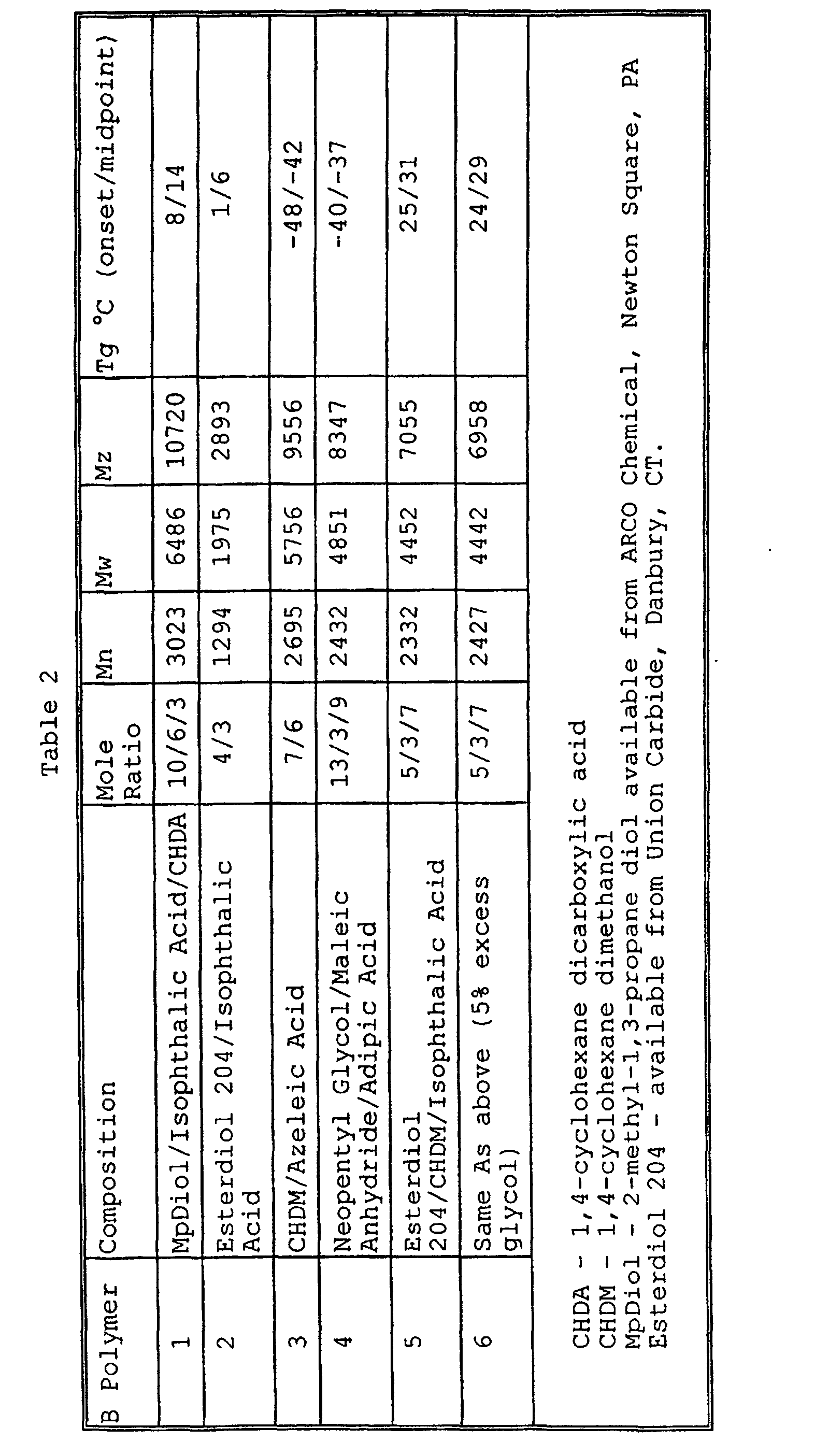
- Sylvodym® T-18 dimer acid (C36 dimer acid available from Arizona Chemical) (77.198 parts), Kemamine® P-990D (Stearyl amine available from Witco Chemical) (4.150 parts) and Dow Corning 200 (a silicone defoamer) (0.002 parts) were charged to a reactor and heated to 130°C under a nitrogen atmosphere. Next, a mixture of isophorone diamine (16.140 parts) and Dytek® A (available from E.I. DuPont de Nemours) (2-methyl-1,5-pentane diamine) (7.340 parts) was added to the reaction mixture while holding the temperature between 130 and 135°C. While under a nitrogen purge, the reaction mixture was slowly heated to about 220°C and the temperature held until substantially all the theoretical water was removed. An amine functional polyamide resin was obtained. Mn = 3160 (theoretical); Base value = 31; Tg = 6/12°C.
- Sylvodym® T-18 dimer acid (76.598 parts), cyclohexyl amine (1.500 parts) and Dow Corning 200 (0.002 parts) were charged to a reactor and heated to 130°C. Next, isophorone diamine (26.700 parts) was added to the reactor while holding the temperature between 130 to 135°C. The reaction mixture was then slowly heated to 220°C using a nitrogen sparge to remove the water. The reaction temperature was held until substantially all of the water was removed and the polyamide was recovered. Mn = 3184 (theoretical); Base value = 29.; Tg = 29/38°C.
- Ethyl diglyme (EDG) (600.3g) and 2-methyl-1,3-propanediol (MPD) (146.4g) were added to a 2 Liter 4-necked reaction flask. The flask was equipped with an agitator, N2 inlet, thermocouple and condenser with a trap to collect water. The mixture was heated to 150°C under nitrogen to remove any excess water or solvent impurities. After approximately 1 hour the reaction was allowed to cool to 30°C and the nitrogen was removed. Tetramethylxylenediisocyanate (TMXDI)(454.2g) was then added to the reaction mixture through an addition funnel at a rate of approximately 1 drop per second for a 3 hour period during which the reaction temperature was maintained at 80°C. A polyurethane oligomer was recovered. Mn = 2582 (theoretical).
- A polyester resin, B polymer (1), (963.0 g) was added to a reaction flask and heated to 150°C. The A polymer (1), a styrene/α-methylstyrene/acrylic acid resin, (541.7 g) was gradually added over 15 minutes followed by the addition of xylene (45 g). The trap was filled with xylene to keep 3% xylene in the reaction flask while heating the reaction mixture to 230°C to draw off water. The reaction was conducted for 6.5 hours. The resulting polymeric compositions had an Mw of 26,180, an Mn of 3,444, an Mz of 109,700 and a Tg of 25/36°C (onset/midpoint).
- Various polymeric compositions were prepared from an A polymer of a styrene/α-methylstyrene/acrylic acid resin and a B polymer of a polyester resin in a manner similar to Example 1. The components and various characteristics of those polymeric compositions are set forth in Table 3 below.

- A polymeric composition was prepared from the A polymer (5), a hydroxy functional acrylic, and the B polymer (9), a polyurethane oligomer. To a one liter 4-necked reaction flask equipped with a nitrogen inlet, condenser, agitator and thermocouple was added 263.7g of B polymer (9). Then 6 drops of dibutyl tin dilaurate (DBTDL) was charged to the flask. The solution was preheated to 70°C, after which the A polymer (5) was slowly added dropwise to the reaction. After all the A polymer (5) had been added, the temperature of the reaction was increased to 85°C and allowed to react for about 4.5 hours. The resulting solution had a deep yellow color. Mn = 2646; Mw = 6411; Mz = 17290; OH Value = 58.
- A polymeric composition was prepared from the A polymer (4), i.e., a styrene/acrylic resin and B Polymer (8), a polyamide resin. The A polymer resin (38.85 parts) was charged to a reactor and then heated to 180°C with agitation under nitrogen. This was followed by the addition of the B polymer (8) (61.85 parts) at 180°C. The mixture was then heated to 220°C and held until the water was removed. The temperature was then raised to 230°C and the polymeric composition was collected. Mn = 2799; Mw = 26990; Mz = 93660; Tg = 42/62°C; AV = 80.
- A polymeric composition was prepared in a manner similar to Example 14, except that the styrene/acrylic resin, i.e., the A polymer was 39.03 parts and the B polymer was B polymer (7). Mn = 2939; Mw = 24,300; Mz = 87,920; Tg = 30/46°C; AV = 38.
- A polymeric composition was prepared from A polymer (4) and a B polymer of polypropylene oxide (PPO 425 available from Dow Chemical, Midland, Michigan) having a number average molecular weight (Mn) of 639 and a functionality of 2 hydroxy groups per mole. The A polymer and B polymer were reacted at a molar ratio of 2 to 1 in the absence of a solvent and catalyst at a temperature of about 210 to 238°C to form the desired polymeric composition. The resulting polymeric composition had a Mn of 1688, a Mw of 5945, a Mz of 17,120, an acid number (solid) of 164 and a Tg of 45/55°C (onset/midpoint).
- A polymeric composition was prepared in a manner similar to Example 16, except the B polymer was a polypropylene oxide (PPO 1000 available from Dow Chemical) having a number average molecular weight (Mn) of 1256. The functionality of the B polymer was 2 hydroxy groups per mole and the block copolymer synthesis temperature ranged from about 215 to 234°C. The resulting polymeric composition had a Mn of 1861, a Mw of 8251, a Mz of 24510, an acid number (solid) of 131 and a Tg of -2/10°C (onset/midpoint).
- A polymeric composition was prepared in a manner similar to Example 16, except the B polymer was a polypropylene oxide (PPO 4000 available from Dow Chemical) having a number average molecular weight of 3479. The functionality of the B polymer was 2 hydroxy groups per mole. The polymeric composition synthesis temperature ranged from about 220 to 240°C and toluene was employed as a solvent. The resulting polymeric composition had a Mn of 2520, a Mw of 17,340, a Mz of 45,190, an acid number (solid) of 62.89 and a Tg of-54/-46°C (onset/midpoint).
- A polymeric composition was prepared in a manner similar to Example 16, except the B polymer was a poly(ethylene oxide) (PEO 200 available from Dow Chemical) having a number average molecular weight of 377. The functionality of the B polymer was 2 hydroxy groups per mole. The polymeric composition synthesis temperature was between about 200 to 220°C. The resulting polymeric composition had a Mn of 1601, a Mw of 5219, a Mz of 15350, an acid number (solid) of 180.8 and a Tg of 59/67°C (onset/midpoint).
- A polymeric composition was prepared in a manner similar to Example 16, except the B polymer was a poly(ethylene oxide) (PEO 600 available from Dow Chemical) having a number average molecular weight of 882. The functionality of the B polymer was 2 hydroxy groups per mole. The polymeric composition was prepared at a synthesis temperature between about 200 to 220°C. The resulting polymeric composition had a Mn of 1819, a Mw of 6784, a Mz of 17,730, an acid number (solid) of 156.7 and as Tg of 18/27°C (onset/midpoint).
- A polymeric composition was prepared in a manner similar to Example 16, except the B polymer was a poly(propylene-β-ethylene oxide) (Pluronic 123, available from BASF) having a number average molecular weight of 4333. The functionality of the B polymer was about 2 hydroxy groups per mole. The polymeric composition synthesis temperature was between about 200 to about 230°C. The resulting polymeric composition had a Mn of 3074, a Mw of 23,710, a Mz of 46,970, an acid number (solid) of 50.2 and a Tg of -61/-53°C (onset/midpoint).
- A number of additional polymeric composition were prepared using the A polymers described in Table A and the B polymers described in Table B below.
A Polymer Composition Functionality AV Mn Mw Tg FN I Styrene Acrylic carboxyl 277 923 1637 45 4.56 II Styrene Acrylic carboxyl 269 1116 1779 67 5.35 III STY/AA carboxyl 289 1000 1526 65 5.15 IV STY/AMS/AA carboxyl 264 1003 1512 71 4.72 V MMA/AA carboxyl 339 1121 1753 36 6.77 VI C-14 α-olefin MAn anhydride - 2327 - - 7.9 VII STY/MMA/GMA epoxy - 2200 - - 3.8 VIII Acrylic hydroxy - 1400 - - 3.5 IX MMA/BA/HEA hydroxy - 1180 - - 5.28 B Polymer Composition Functionality Mn FN I Linear Polyester 1° Hydroxyl 1000 2 II Branched Polyester 1° Hydroxyl 900 3 III Linear Polyester carboxyl 1700 2 IV Linear Polyurethane isocyanato 2500 2 V Linear Dimer Acid Polyamide 1° Amino 4028 2 VI Linear Dimer Acid Polyamide oxazolinyl 3776 2 VII Linear Adipic Acid Nylon 1° Amino 1020 2 VIII Linear Polypropylene glycol 2° Hydroxyl 425 2 IX Epoxy Resin Epoxy 600 2 X Polyether Diamine 1° Amino 600 2 - A 1000ml four necked flask equipped with a stirrer, a nitrogen sparge tube, and a Dean Stark trap fitted with a condenser reactor was charged with 468g of a styrene acrylic polymer having carboxyl functionality (A polymer I). This was heated to melt at 150-180°C. Then 140.4g of a branched polyester polymer having a primary (1°) hydroxyl (B polymer II) was added to achieve a mole ratio of 3A:1B. The temperature was then raised to 220°C and held till 8.4g of water was removed. The product was then poured into a pan to cool. The final product is described in Table C.
- A number of polymeric compositions were made in a manner substantially similar to Example I with a reaction temperature between 220-240°C using A and B polymers as indicated in Table C below.
- A 1000 ml four necked flask equipped with a stirrer, a nitrogen sparge tube, and a Dean Stark trap fitted with a condenser was charged with 518.3g with a methylmethacrylate polymer having carboxyl functionality (A polymer V). This was then heated to 150-180°C to melt and agitation was started. Then 96.9g of a linear polypropylene oxide having secondary (2°) hydroxyl functionality (B polymer VIII) and 13.6g of methyl n-amyl ketone (MAK) were added. The reactor was then stage heated for 1 hour at 180°C, then one hour at 200°C and finally one hour at 220°C. The product was then poured into a tray to cool. Using the water-MAK reflux, 10.6g of water was removed.
- Two polymeric compositions were made in a manner substantially similar to Example VII with the exception that MAK was replaced by xylene and the A and B polymers indicated in Table C were used.
- A 1000ml four necked flask equipped with a stirrer, a nitrogen blanket and a condenser was charged with 222.2g of a solution of 50% of a styrene/acrylic acid polymer having carboxyl functionality (A polymer III) and 50% diethylene glycol diethyl ether. After agitation was started, 277.8g of a solution of 50% of a linear polyurethane polymer having isocyanato functionality (B polymer IV) and 50% diethylene glycol diethyl ether was added. After mixing 5 minutes, 0.25g of Metacure T12 available from Air Products catalyst was added and the temperature raised to 65°C and held there for 4 hours. The product was then poured into a quart jar and cooled.
- Several polymeric composition were prepared in a manner substantially similar to Example X with reaction temperatures ranging from 125°C to 190°C using A and B polymers as indicated in Table C below.
- The A polymer and B polymer constituents and properties of the resulting polymeric compositions for Examples I-XIV are set forth in Table C below.
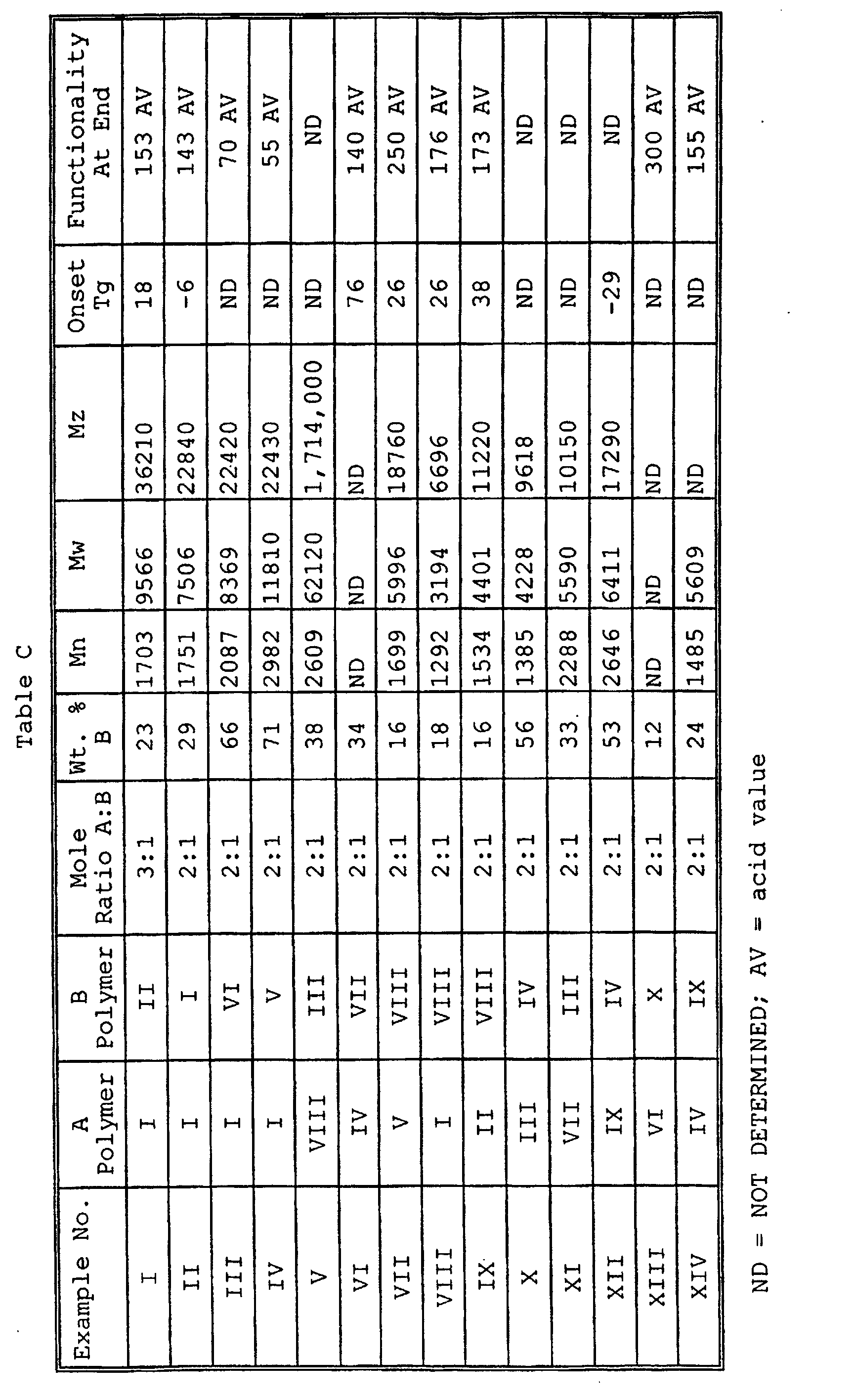
- As shown below, when the polymeric compositions of the present invention were added to acrylic epoxy hybrid powder coatings the resulting powder coatings exhibited advantageous characteristics. In particular, such powder coatings prepared with polymeric compositions comprised of PPO (polypropylene oxide) as the B component were advantageous. The powder coating of this invention demonstrated an unexpected unique property of reducing gloss yet maintaining complete coating flexibility. Other methods commonly used to lower gloss tend to compromise flexibility. Existing gloss reducing techniques used in powder coating processes are unable to maintain flexibility without causing detriment to some other film property. With the polymeric compositions of the present invention, gloss can be lowered without compromising flexibility, hardness, corrosion, and U.V. resistance.
- Examples PC-1 to PC-5 were formualted with the polymeric compositions of this invention used as a modifier of an acrylic/epoxy hybrid coating powder. In addtion Comparative Exampels PC-CM-1 to PC-CM-5 were also prepared. The exemplary and comparative powder coatings are described in Tables D1 and D2, respectively, below.
Polymeric Compositions as Modifiers for Powder Coatings Components PC-1 PC-2 PC-3 PC-4 PC-5 Polym. Comp. (Ex. 17) 3.20 Polym. Comp. (Ex. 16) 3.26 Polym. Comp. (Ex. VII) 3.27 4.62 6.16 SCX-8191 26.98 26.18 26.18 24.06 21.60 Shell 20022 31.32 32.05 32.03 32.81 33.71 Modaflow III3 1.01 1.01 1.00 1.00 1.00 Benzoin 0.30 0.30 0.30 0.30 0.30 R-9604 36.99 37.00 36.98 36.97 37.00 NXJ-605 0.20 0.20 0.24 0.24 0.24 Total Weight 100 100 100 100 100 Testing Gloss 60 (deg) 42 42 56 27 24 Gloss 20 (deg) 9 9 18 6 5 Impact-D (in-lb) 160 160 160 160 160 Impact-R (in-lb) 40 60 20 80 80 Gel Time (secs) 46 43 - - - Comparative Examples Components PC-CM-1 PC-CM-2 PC-CM-3 PC-CM-4 PC-CM-5 Polypropylene Oxide (Mn 425) 0.50 0.75 0.49 - - SXC-819 31.20 31.12 30.72 22.17 26.01 Shell 2002 30.00 29.93 29.53 34.75 32.42 Modaflow III 1.00 1.00 0.98 1.00 1.00 Benzoin 0.30 0.30 0.30 0.30 0.30 R-960 36.80 36.70 36.23 36.94 37.02 NXJ-60 0.20 0.20 0.20 0.25 0.25 - - 1.55 - - Joncryl 682 - - - 4.59 3.00 Total Weight 100.00 100.00 100.00 100.00 100.00 Testing Gloss 60 (deg) 90 90 71 29 73 Gloss 20 (deg) 63 60 32 6 35 Impact-D (in-Ib) 160 160 50 80 160 Impact-R (in-Ib) 40 30 < 10 < 10 40 Gel Time (secs) 54 53 53 45 44 - The powder coating compositions were prepared in the following manner: First, all resins were preground in a Vitamix blender to reduce the particle size. Next, all ingredients were weighed together into a bag and vigorously hand shaken to mix. The premixed powders were extruded on a Buss PLK-46 extruder at a zone 1 setting of 60°C, and a zone 2 setting of 110°C. The extrudate was flaked in chill rolls, and broken up with a mallet. The flake was ground using a Bantam mill, .027 screen, equipped with liquid nitrogen cooling. After grinding, the powder was sieved using a 140 mesh screen. The powder was applied to Bonderite 1000 panels at varied film builds, and cured for 20 minutes at 190°C.
- The 60° and 20° gloss of the resulting coatings was measured using a Byk Chemie gloss meter. Impact was measured by direct "D" and reverse "R" impact techniques well known to those skilled in the art.
- Use of the polymeric compositions of this invention in the acrylic epoxy hybrid powder coatings was found to degloss, yet maintain physical properties in the coatings. The results show that levels in excess of about 4% were preferred, although lower levels may be used.
- The comparative examples (PC-CM-4 and PC-CM-5) made with only Joncryl 682 (an acrylic/styrene/α-methyl styrene resin available from S.C. Johnson Polymer, Sturtevant, Wisconsin) showed lower gloss but did not retain as much impact resistance, as the inventive compositions.
- Examples (PC-CM-1 and PC-CM-2) made with only polypropylene oxide did not degloss the acrylic hybrid.
- The example (PC-CM-3) made with both polypropylene oxide, and a styrene acrylic resin (Resin L) added separately showed slightly lower gloss, and reduced impact resistance. The results show that the polymeric compositions of the present invention are useful for deglossing acrylic epoxy hybrid powder coatings, particularly those compositions having a polymeric composition with a high acid number.
- The polymeric compositions of this invention were also used as a stand-alone binder for the preparation of powder coating compositions. Examples PC-6 to PC-9 are described below in Table E.
Polymeric Compositions In Powder Coatings Components PC-6 PC-7 PC-8 PC-9 Polym. Comp. A 28.94 Polym. Comp. B 27.74 Polym. Comp. C 31.51 31.48 Shell 2002 32.56 33.77 29.97 29.94 Modaflow III 1.01 1.01 1.00 1.00 Benzoin 0.30 0.30 0.30 0.30 R-960 0.20 0.20 26.97 36.93 NXJ-60 36.99 36.98 0.25 0.35 Total Weight 100.00 100.00 100.00 100.00 Testing Gloss 60 (deg) 95 93 97 95 Gloss 20 (deg) 75 71 78 74 Impact-D (in-Ib) 60 160 20 20 Impact-R (in-Ib) < 10 < 10 < 10 < 10 Gel Time (secs) 60 51 68 48 Polym. Comp. A. - A polymer Ex. 1 and B polymer of Esterdiol 204/CHDM/IPA with a molar ratio of 5/3/7 (42% Acrylic) Polym. Comp. B. - A polymer Ex. 1 and B polymer of MPD/IPA/CHDA with a molar ratio of 10/6/3 (47% Acrylic) Polym. Comp. C - A polymer I and B polymer of NPG/IPA/Adipic with a molar ratio of 12/8/3 (39% Acrylic) CHDM - cyclohexane dimethanol; IPA-isophthalic acid; CHDA-cyclohexane dicarboxylic acid; NPG-neopentyl glycol; MPD-2-methyl-1,3-propane diol; Esterdiol 204 is a glycol available from Union Carbide, Danbury, Connecticut - The results show that the polymeric compositions of this invention may be used in an epoxy hybrid powder coating composition as a stand alone binder. This is particularly surprising even with about 40% acrylic A polymer used in the polymer composition since it would be expected that a simple blend having that much acrylic A polymer would give very low gloss and very poor impact.
- As previously discussed, the 100% solids resin polymeric composition of this invention may be used as a hot melt adhesive. The 100% solid resin adhesive compositions of the present invention were applied to the clay coated side of 18 point blister board. Tests of the coatings showed 100% fiber tear when the bond was pulled. A comparison polyester was so brittle that it would occasionally fracture when the bond was pulled.
- Other variations and modifications of this invention will be obvious to those skilled in the art. This invention is not limited except as set forth in the following claims.
Claims (51)
- A polymeric composition comprising the reaction product of an A polymer which is an addition polymer having 3.5 or more reactive functional groups per polymer chain and a B polymer having about 2 to about 3 functional groups per polymer chain that are co-reactive with said reactive functional groups of the A polymer, wherein substantially all of the co-reactive functional groups of the B polymer have been co-reacted and a molar ratio of A polymer to B polymer is about 3:1 to about 2:1.7, said polymeric composition being essentially non-gelled.
- A polymeric composition according to claim 1, wherein the B polymer has about 2 functional groups per polymer chain and the molar ratio of A polymer to B polymer is about 2:1 to about 2:1.7.
- A polymeric composition according to claim 1, wherein the B polymer has about 3 functional groups per polymer chain and the molar ratio of A polymer to B polymer is about 3:1.
- A polymeric composition according to any one of claims 2 or 3, wherein said reactive functional group of the A polymer is a condensation-reactive functional group selected from the group consisting of carboxyl, hydroxy, epoxy, isocyanato, carboxyl anhydride, sulfo, esterified oxycarbonyl, amino or mixtures thereof.
- A polymeric composition according to any one of claims 2 or 3, wherein said B polymer is a condensation polymer selected from the group consisting of polyamide, polyester, epoxy, polyurethane, polyorganosiloxane and poly(ether).
- A polymeric composition according to claim 5, wherein said co-reactive functional groups of said B polymer are hydroxyl, carboxyl, epoxy, oxazolinyl, ester, amino, isocyanato or mixtures thereof.
- A polymeric composition according to claim 6, wherein said A polymer has 3.5 or more carboxyl functional groups per polymer chain.
- A polymeric composition according to claim 7, wherein said A polymer is a styrene/acrylic acid/α-methyl-styrene polymer having a Mn in a range from about 500 to about 50,000.
- A polymeric composition according to claim 6, wherein said A polymer has 3.5 or more hydroxyl functional groups per polymer chain.
- A polymeric composition according to claim 9, wherein said A polymer is a styrene/2-ethylhexyl acrylate/2-hydroxyethyl methacrylate polymer having a Mn in a range from about 500 to about 50,000.
- A process for preparing a polymeric composition, said process comprising the step of reacting an A polymer which is an addition polymer having 3.5 or more reactive functional groups per polymer chain with a B polymer having about 2 to about 3 functional groups per polymer chain that are co-reactive with the reactive functional groups of the A polymer at a temperature and for a time sufficient to from the substantially non-gelled polymeric composition, wherein substantially all of the co-reactive functional groups of the B polymer have been co-reacted and a molar ratio of A polymer to B polymer is about 3:1 to about 2:1.7, said polymeric composition being substantially non-gelled.
- A process according to claim 11, wherein the B polymer has about 2 functional groups per polymer chain and the molar ratio of A polymer to B polymer is about 2:1 to about 2:1.7
- A process according to claim 11, wherein the B polymer has about 3 functional groups per polymer chain and the molar ratio of A polymer to B polymer is about 3:1.
- A process according to any one of claims 12 or 13, wherein said temperature is between about -50° C to about 300° C.
- A process according to claim 14, wherein said reactive functional group of the A polymer is a condensation-reactive functional group selected from the group consisting of carboxyl, hydroxyl, epoxy, isocyanato, carboxyl anhydride, sulfo, esterified oxycarboxyl, amino or mixtures thereof.
- A process according to claim 15, wherein said B polymer is a condensation polymer selected from the group consisting of polyamide, polyester, epoxy, polyurethane, silicone and poly(ether).
- A process according to claim 16, wherein said co-reactive functional groups of said B polymer are hydroxyl, carboxyl, epoxy, oxazolinyl, ester, amino, isocyanato or mixtures thereof.
- A process according to claim 17, wherein said A polymer has 3.5 or more carboxyl functional groups per polymer chain.
- A process according to claim 18, wherein said A polymer is a styrene/acrylic acid/α-methylstyrene polymer having an Mn in a range of about 500 to about 50,000.
- A process according to claim 17, wherein said A polymer has 3.5 or more hydroxyl functional groups per polymer chain.
- A process according to claim 20, wherein said A polymer is a styrene/2-ethyl hexyl acrylate/2-hydroxyl ethyl methacrylate polymer having a Mn in a range from about 500 to about 50,000.
- A powder coating composition comprising: (i) a substantially non-gelled polymeric composition that is the reaction product of an A polymer which is an addition polymer having 3.5 or more reactive functional groups per polymer chain and a B polymer having about 2 to about 3 functional groups peripolymer chain that are co-reactive with said reactive functional groups of the A polymer; (ii) optionally a cross-linking agent; (iii) optionally a colorant; and (iv) optionally an epoxy resin, wherein substantially all of the co-reactive functional groups of the B polymer have been co-reacted and a molar ratio of A polymer to B polymer is about 3:1 to about 2:1.7.
- A powder coating composition according to claim 22, wherein the B polymer has about 2 functional groups per polymer chain and the molar ratio of A polymer to B polymer is about 2:1 to about 2:1.7.
- A powder coating composition according to claim 22, wherein the B polymer has about 3 functional groups per polymer chain and the molar ratio of A polymer to B polymer is about 3:1.
- A powder coating composition according to any one of claims 23 or 24, wherein said reactive functional group of the A polymer is a condensation-reactive functional group selected from the group consisting of carboxyl, hydroxyl, epoxy, isocyanato, carboxyl anhydride, sulfo, esterified oxycarbonyl, amino or mixtures thereof.
- A powder coating composition according to any one of claims 23 or 24, wherein said B polymer is a condensation polymer selected from the group consisting of polyamide, polyester, epoxy, polyurethane, polyorganosiloxane and poly(ether).
- A powder coating composition according to claim 26, wherein said co-reactive functional groups of said B polymer are hydroxyl, carboxyl, epoxy, oxazolinyl, ester, amino, isocyanato or mixtures thereof.
- A powder coating composition according to claim 27, wherein said A polymer has 3.5 or more carboxyl functional groups per polymer chain.
- A powder coating composition according to claim 28, wherein said A polymer is a styrene/acrylic acid/α-methyl-styrene polymer having a Mn in a range from about 500 to about 50,000.
- A powder coating composition according to claim 27, wherein said A polymer has 3.5 or more hydroxyl functional groups per polymer chain.
- A powder coating composition according to claim 30, wherein said A polymer is a styrene/2-ethylhexyl acrylate/2-hydroxyethyl methacrylate polymer having a Mn in a range from about 500 to about 50,000.
- A 100% solids resin ink composition comprising: (i) a substantially non-gelled polymeric composition that is the reaction product of an A polymer which is an addition polymer having 3.5 or more reactive functional groups per polymer chain and a B polymer having about 2 to about 3 functional groups per polymer chain that are co-reactive with said reactive functional groups of the A polymer; and (ii) a colorant, wherein substantially all of the co-reactive functional groups of the B polymer have been co-reacted and a molar ratio of A polymer to B polymer is about 3:1 to about 2:1.7.
- A 100% solids resin ink composition according to claim 32, wherein the B polymer has about 2 functional groups per polymer chain and the molar ratio of A polymer to B polymer is about 2:1 to about 2:1.7.
- A 100% solids resin ink composition according to claim 32, wherein the B polymer has about 3 functional groups per polymer chain and the molar ratio of A polymer to B polymer is about 3:1.
- A 100% solids resin ink composition according to any one of claims 33 or 34, wherein said reactive functional group of the A polymer is a condensation-reactive functional group selected from the group consisting of carboxyl, hydroxyl, epoxy, isocyanato, carboxyl anhydride, sulfo, esterified oxycarbonyl, amino or mixtures thereof.
- A 100% solids resin ink composition according to any one of claims 33 or 34, wherein said B polymer is a condensation polymer selected from the group consisting of polyamide, polyester, epoxy, polyurethane, polyorganosiloxane and poly(ether).
- A 100% solids resin ink composition according to claim 36, wherein said co-reactive functional groups of said B polymer are hydroxyl, carboxyl, epoxy, oxazolinyl, ester, amino, isocyanato or mixtures thereof.
- A 100% solids resin ink composition according to claim 37, wherein said A polymer has 3.5 or more carboxyl functional groups per polymer chain.
- A 100% solids resin ink composition according to claim 38, wherein said A polymer is a styrene/acrylic acid/α-methyl-styrene polymer having a Mn in a range from about 500 to about 50,000.
- A 100% solids resin ink composition according to claim 37, wherein said A polymer has 3.5 or more hydroxyl functional groups per polymer chain.
- A 100% solids resin ink composition according to claim 40, wherein said A polymer is a styrene/2-ethylhexyl acrylate/2-hydroxyethyl methacrylate polymer having a Mn in a range from about 500 to about 50,000.
- A method of preparing a reduced gloss acrylic epoxy hybrid powder coating comprising the step of mixing (a) a polymeric composition comprising a substantially non-gelled polymeric composition that is the reaction product of an A polymer which is an addition polymer having 3.5 or more reactive functional groups per polymer chain and a B polymer having about 2 to about 3 functional groups per polymer chain that are co-reactive with said reactive functional groups of the A polymer; (ii) an epoxy resin and (iii) an acrylic resin, wherein substantially all of the co-reactive functional groups of the B polymer have been co-reacted and a molar ratio of A polymer to B polymer is about 3:1 to about 2:1.7.
- A method according to claim 42, wherein the B polymer has about 2 functional groups per polymer chain and the molar ratio of A polymer to B polymer is about 2:1 to about 2:1.7.
- A method according to claim 42, wherein the B polymer has about 3 functional groups per polymer chain and the molar ratio of A polymer to B polymer is about 3:1.
- A method according to any one of claims 43 or 44, wherein said reactive functional group of the A polymer is a condensation-reactive functional group selected from the group consisting of carboxyl, hydroxyl, epoxy, isocyanato, carboxyl anhydride, sulfo, esterified oxycarbonyl, amino or mixtures thereof.
- A method according to any one of claims 43 or 44 wherein said B polymer is a condensation polymer selected from the group consisting of polyamide, polyester, epoxy, polyurethane, polyorganosiloxane and poly(ether).
- A method according to claim 46, wherein said co-reactive functional groups of said B polymer are hydroxyl, carboxyl, epoxy, oxazolinyl, ester, amino, isocyanato or mixtures thereof.
- A method according to claim 47, wherein said A polymer has 3.5 or more carboxyl functional groups per polymer chain.
- A method according to claim 48, wherein said A polymer is a styrene/acrylic acid/α-methyl-styrene polymer having an Mn in a range from about 500 to about 50,000.
- A method according to claim 47, wherein said A polymer has 3,5 or more hydroxyl functional groups per polymer chain.
- A method according to claim 50, wherein said A polymer is a styrene/2-ethylhexyl acrylate/2-hydroxyethyl methacrylate polymer having a Mn in a range from about 500 to about 50,000.
Applications Claiming Priority (3)
| Application Number | Priority Date | Filing Date | Title |
|---|---|---|---|
| US96784897A | 1997-11-12 | 1997-11-12 | |
| US967848 | 1997-11-12 | ||
| PCT/US1998/024170 WO1999024485A2 (en) | 1997-11-12 | 1998-11-12 | Polymeric compositions, and the preparation and use thereof |
Publications (2)
| Publication Number | Publication Date |
|---|---|
| EP1030889A2 EP1030889A2 (en) | 2000-08-30 |
| EP1030889B1 true EP1030889B1 (en) | 2003-07-23 |
Family
ID=25513419
Family Applications (1)
| Application Number | Title | Priority Date | Filing Date |
|---|---|---|---|
| EP98959428A Expired - Lifetime EP1030889B1 (en) | 1997-11-12 | 1998-11-12 | Polymeric compositions, and the preparation and use thereof |
Country Status (13)
| Country | Link |
|---|---|
| US (2) | US6696522B2 (en) |
| EP (1) | EP1030889B1 (en) |
| JP (1) | JP2001522907A (en) |
| CN (1) | CN100369976C (en) |
| AT (1) | ATE245679T1 (en) |
| AU (1) | AU741255B2 (en) |
| BR (1) | BR9814129A (en) |
| CA (1) | CA2308448C (en) |
| DE (1) | DE69816649T2 (en) |
| MX (1) | MX220926B (en) |
| NZ (1) | NZ504117A (en) |
| TW (1) | TW570946B (en) |
| WO (1) | WO1999024485A2 (en) |
Cited By (1)
| Publication number | Priority date | Publication date | Assignee | Title |
|---|---|---|---|---|
| WO2012102737A1 (en) * | 2011-01-29 | 2012-08-02 | Hewlett-Packard Development Company, L.P. | Compositions and their use |
Families Citing this family (18)
| Publication number | Priority date | Publication date | Assignee | Title |
|---|---|---|---|---|
| WO2000002932A1 (en) * | 1998-07-10 | 2000-01-20 | S. C. Johnson Commercial Markets, Inc. | Process for producing polymers by free radical polymerization and condensation reaction, and apparatus and products related thereto |
| US6710121B2 (en) * | 2000-05-19 | 2004-03-23 | Arizona Chemical Company | Nitrocellulose-compatible laminating ink resins |
| AU782834B2 (en) * | 2000-11-28 | 2005-09-01 | Rohm And Haas Company | Pigment dispersant composition |
| CZ20033323A3 (en) * | 2001-06-08 | 2004-06-16 | E.I. Du Pont De Nemours And Company | Low gloss free radical curable powder coating composition |
| ITMI20012827A1 (en) * | 2001-12-28 | 2003-06-28 | Fidia Farmaceutici | TRANSDERMAL ADHESIVE FORMULATIONS OF DICLOFENAC SODIUM |
| DK1470175T3 (en) * | 2002-02-01 | 2007-05-21 | Clariant Int Ltd | Oligomeric chain extenders for the treatment, finishing and recycling of condensation polymers, synthesis, compositions and applications |
| US20040147678A1 (en) | 2003-01-29 | 2004-07-29 | Clariant International, Ltd. | Solid concentrate composition for polymeric chain extension |
| EP1443059A1 (en) * | 2003-02-02 | 2004-08-04 | Solutia Italy S.r.l. | Resins for powder coating compositions |
| US7279174B2 (en) * | 2003-05-08 | 2007-10-09 | Advanced Cardiovascular Systems, Inc. | Stent coatings comprising hydrophilic additives |
| US20070066777A1 (en) * | 2004-09-03 | 2007-03-22 | Bzowej Eugene I | Methods for producing crosslinkable oligomers |
| JP5354207B2 (en) * | 2007-03-26 | 2013-11-27 | Jsr株式会社 | Curable resin composition, protective film and method for forming protective film |
| DE102008009481A1 (en) | 2008-02-15 | 2009-08-20 | Basf Coatings Ag | Aqueous coating composition, process for its preparation and its use |
| JP4533443B2 (en) | 2008-03-24 | 2010-09-01 | シャープ株式会社 | Image forming apparatus |
| WO2012047203A1 (en) | 2010-10-05 | 2012-04-12 | Hewlett-Packard Development Company, L.P. | Ink-printable compositions |
| MX352375B (en) * | 2011-04-15 | 2017-11-22 | Basf Se | Hyperbranched polyesters in printing inks. |
| EP3448942B1 (en) * | 2016-10-14 | 2020-05-13 | HP Indigo B.V. | Electrostatic ink composition |
| JP6969349B2 (en) * | 2017-12-18 | 2021-11-24 | 東洋インキScホールディングス株式会社 | Printing ink composition |
| CN114057984B (en) * | 2021-12-20 | 2023-03-14 | 广东鸿昌化工有限公司 | Low-VOCs alcohol-water-soluble PVP modified polyurethane resin and preparation method and application thereof |
Family Cites Families (51)
| Publication number | Priority date | Publication date | Assignee | Title |
|---|---|---|---|---|
| US3300543A (en) * | 1957-09-23 | 1967-01-24 | Avery Products Corp | Stabilized pressure sensitive adhesive consisting of saturated polyester and vinyl chloride polymer |
| US3562355A (en) | 1968-03-20 | 1971-02-09 | Shell Oil Co | Block copolymer blends with certain polyurethanes or ethylene-unsaturated ester copolymers |
| US3739792A (en) * | 1971-07-14 | 1973-06-19 | J Holland | Umbrella with heat generating means |
| DE2237954C3 (en) | 1972-08-02 | 1981-08-13 | Basf Ag, 6700 Ludwigshafen | Process for the production of low molecular weight block copolymers from vinyl or diene monomers and alkylene oxides |
| US3835200A (en) | 1972-08-23 | 1974-09-10 | Gen Electric | Composition of a polyphenylene ether, a rubber styrene graft copolymer and normally rigid block copolymer of a vinyl aromatic compound and a conjugated diene |
| DE2434848C2 (en) | 1973-08-13 | 1986-09-04 | General Electric Co., Schenectady, N.Y. | Thermoplastic mass |
| US3904623A (en) * | 1973-12-26 | 1975-09-09 | Sherwin Williams Co | Phenol-triazine addition products |
| JPS568873B2 (en) * | 1974-07-31 | 1981-02-26 | ||
| US4041103A (en) | 1976-06-07 | 1977-08-09 | Shell Oil Company | Blends of certain hydrogenated block copolymers |
| US4246369A (en) * | 1977-07-05 | 1981-01-20 | Scm Corporation | Compositions containing carbamothioate curing agents and their uses |
| US4585813A (en) * | 1978-06-12 | 1986-04-29 | Scm Corporation | Aqueous coating composition comprising self-emulsifiable ester of epoxy and acid containing addition polymer and method of its preparation |
| US4180528A (en) | 1978-06-26 | 1979-12-25 | Eastman Kodak Company | Block copolymer composed of an addition polymer and a linear saturated polyester |
| US4250272A (en) | 1979-05-11 | 1981-02-10 | Shell Oil Company | Adhesive compositions |
| US4285849A (en) * | 1979-11-27 | 1981-08-25 | Ppg Industries, Inc. | Amidation reaction products of polyamines and polycarboxyl containing materials and coating compositions containing same |
| DE3035587A1 (en) * | 1980-09-20 | 1982-05-06 | Basf Ag, 6700 Ludwigshafen | METHOD FOR THE PRODUCTION OF POLYMERS CONTAINING POLYPHENYLENE ETHER GROUPS |
| US4480058A (en) * | 1980-12-04 | 1984-10-30 | Scm Corporation | Aqueous epoxy ester emulsions |
| US4341682A (en) * | 1980-12-23 | 1982-07-27 | Mobil Oil Corporation | Composition comprising ester of epoxy, carbonyl containing polybutadiene polymer and acid containing addition polymer, and aqueous coating compositions prepared therefrom |
| US4347339A (en) | 1981-05-08 | 1982-08-31 | Nalco Chemical Company | Cationic block copolymers |
| JPS5921559A (en) * | 1982-07-26 | 1984-02-03 | 株式会社豊田中央研究所 | Inorganic material and manufacture |
| US4529787A (en) | 1982-06-15 | 1985-07-16 | S. C. Johnson & Son, Inc. | Bulk polymerization process for preparing high solids and uniform copolymers |
| JPS59142242A (en) * | 1983-02-04 | 1984-08-15 | Toray Ind Inc | Resin composition having excellent antistatic property |
| US4481331A (en) | 1983-03-22 | 1984-11-06 | Gen Electric | Polycarbonate resin mixture |
| US5194499A (en) | 1983-08-29 | 1993-03-16 | Bridgestone/Firestone, Inc. | Polymerizing diene block copolymer in presence of rubber |
| US4546160A (en) | 1984-02-29 | 1985-10-08 | S. C. Johnson & Son, Inc. | Bulk polymerization process for preparing high solids and uniform copolymers |
| FR2591607B1 (en) | 1985-12-16 | 1988-03-18 | Atochem | THERMOPLASTIC COMPOSITIONS BASED ON POLYETHERAMIDES AND STYRENE-DIENE COPOLYMERS AND THEIR MANUFACTURING METHOD. |
| CA1313433C (en) | 1986-02-22 | 1993-02-02 | Yuji Takayama | Hardenable unsaturated polyester resin compositions |
| US5314962A (en) | 1987-04-07 | 1994-05-24 | Mitsubishi Petrochemical Company Limited | ABA type block copolymers |
| JP2533121B2 (en) * | 1987-05-29 | 1996-09-11 | 三井東圧化学株式会社 | Resin composition for paint |
| US4851474A (en) | 1987-09-29 | 1989-07-25 | Shell Oil Company | Block copolymer and method of preparing same |
| JPH0717844B2 (en) * | 1989-01-27 | 1995-03-01 | 三洋化成工業株式会社 | Resin modifier |
| US5008334A (en) | 1989-02-28 | 1991-04-16 | Basf Corporation | Resins of epoxy/aromatic diol copolymer and block copolymer of epoxy/aromatic diol copolymer and a epoxy-capped polybutadiene (co)polymer |
| JP2787467B2 (en) * | 1989-04-20 | 1998-08-20 | チッソ株式会社 | Method for producing modified polystyrene resin and impact-resistant polystyrene resin composition |
| DE4009413A1 (en) * | 1990-03-23 | 1991-09-26 | Basf Ag | AQUEOUS BINDER DISPERSION |
| US5631329A (en) | 1990-08-27 | 1997-05-20 | Dendritech, Inc. | Process for producing hyper-comb-branched polymers |
| US5314954A (en) | 1990-10-24 | 1994-05-24 | Unitika Ltd. | Process for preparing aromatic polyester-polystyrene block copolymers |
| FI933593A7 (en) * | 1991-02-14 | 1993-09-03 | S C Johnson Commercial Markets Inc | Mixed polymer compositions |
| US5384184A (en) | 1991-11-22 | 1995-01-24 | Teijin Limited | Polyester block copolymer and elastic yarn composed thereof |
| US5362819A (en) | 1992-01-30 | 1994-11-08 | Gencorp Inc. | Polyester-flexible polymer block copolymers and mixtures thereof |
| JPH05279482A (en) * | 1992-04-02 | 1993-10-26 | Unitika Ltd | Method for producing polyarylate / polystyrene copolymer |
| JPH0621559A (en) | 1992-07-06 | 1994-01-28 | Tdk Corp | Polymer micro sphere laser |
| JP3205784B2 (en) * | 1992-08-03 | 2001-09-04 | 関西ペイント株式会社 | Self-crosslinking resin |
| DE4227030A1 (en) * | 1992-08-14 | 1994-02-17 | Basf Lacke & Farben | Polymers suitable as binders |
| CA2151112A1 (en) | 1994-06-13 | 1995-12-14 | Michael Bennett Freeman | High temperature polymerization process and products therefrom |
| SE509240C2 (en) * | 1996-05-28 | 1998-12-21 | Perstorp Ab | Thermoplastic compound consisting of a thermoplastic polymer bonded to a dendritic or hyper-branched macromolecule and composition and product thereof |
| JP3972409B2 (en) * | 1997-05-22 | 2007-09-05 | チッソ株式会社 | Coating resin composition and method for curing the same |
| FR2764677B1 (en) * | 1997-06-16 | 1999-09-03 | Jean Collet | TERRACE HEATING DEVICE |
| US6162860A (en) * | 1997-11-12 | 2000-12-19 | S. C. Johnson Commercial Markets, Inc. | Solvent based interactive polymeric compositions containing a substantially non-gelled composition |
| US6194510B1 (en) * | 1997-11-12 | 2001-02-27 | S. C. Johnson Commercial Markets, Inc. | Aqueous dispersions of non-gelled polymeric compositions having designated amounts of reactive groups |
| US5964233A (en) * | 1998-08-12 | 1999-10-12 | Clark; Walter B | Patio umbrella with radiant heater |
| US6102031A (en) * | 1998-09-18 | 2000-08-15 | Waters; Michael | Heating apparatus |
| US6446623B1 (en) * | 2000-09-15 | 2002-09-10 | Cfm-Rmc International, A Division Of The Vermont Castings Majestics Products Company | Miniature patio heater |
-
1998
- 1998-11-12 EP EP98959428A patent/EP1030889B1/en not_active Expired - Lifetime
- 1998-11-12 JP JP2000520491A patent/JP2001522907A/en active Pending
- 1998-11-12 MX MXPA00004612 patent/MX220926B/en unknown
- 1998-11-12 AT AT98959428T patent/ATE245679T1/en not_active IP Right Cessation
- 1998-11-12 DE DE69816649T patent/DE69816649T2/en not_active Expired - Lifetime
- 1998-11-12 NZ NZ504117A patent/NZ504117A/en not_active Application Discontinuation
- 1998-11-12 CA CA002308448A patent/CA2308448C/en not_active Expired - Fee Related
- 1998-11-12 AU AU15227/99A patent/AU741255B2/en not_active Ceased
- 1998-11-12 WO PCT/US1998/024170 patent/WO1999024485A2/en not_active Ceased
- 1998-11-12 BR BR9814129-5A patent/BR9814129A/en not_active Application Discontinuation
- 1998-11-12 CN CNB988110180A patent/CN100369976C/en not_active Expired - Fee Related
-
1999
- 1999-02-02 TW TW088101581A patent/TW570946B/en not_active IP Right Cessation
-
2001
- 2001-08-16 US US09/930,912 patent/US6696522B2/en not_active Expired - Lifetime
-
2003
- 2003-11-19 US US10/718,173 patent/US6894117B2/en not_active Expired - Lifetime
Cited By (1)
| Publication number | Priority date | Publication date | Assignee | Title |
|---|---|---|---|---|
| WO2012102737A1 (en) * | 2011-01-29 | 2012-08-02 | Hewlett-Packard Development Company, L.P. | Compositions and their use |
Also Published As
| Publication number | Publication date |
|---|---|
| WO1999024485A3 (en) | 1999-07-29 |
| US20040138385A1 (en) | 2004-07-15 |
| JP2001522907A (en) | 2001-11-20 |
| ATE245679T1 (en) | 2003-08-15 |
| US6894117B2 (en) | 2005-05-17 |
| DE69816649T2 (en) | 2004-04-15 |
| WO1999024485A2 (en) | 1999-05-20 |
| AU741255B2 (en) | 2001-11-29 |
| US20020156188A1 (en) | 2002-10-24 |
| NZ504117A (en) | 2002-11-26 |
| BR9814129A (en) | 2000-10-03 |
| CN100369976C (en) | 2008-02-20 |
| CA2308448A1 (en) | 1999-05-20 |
| EP1030889A2 (en) | 2000-08-30 |
| US6696522B2 (en) | 2004-02-24 |
| DE69816649D1 (en) | 2003-08-28 |
| MX220926B (en) | 2004-06-11 |
| CA2308448C (en) | 2005-01-25 |
| AU1522799A (en) | 1999-05-31 |
| TW570946B (en) | 2004-01-11 |
| MXPA00004612A (en) | 2000-11-30 |
| CN1278846A (en) | 2001-01-03 |
Similar Documents
| Publication | Publication Date | Title |
|---|---|---|
| US6894117B2 (en) | Non-gelled product of addition and condensation polymers with mutually reactive groups | |
| EP1030891B1 (en) | Solvent based compositions containing a substantially non-gelled polymeric composition | |
| US6316538B1 (en) | Water dispersible polymeric compositions | |
| EP1877464A2 (en) | Resins, low temperature formulations, and coatings derived therefrom | |
| WO1993003066A1 (en) | Production of polymer hydroxylated at both terminals, composition containing said polymer and its use, and polymer derived from said composition and its use | |
| US5157073A (en) | Ionomerice coatings neutralized with zinc carbonate | |
| US5034452A (en) | Ionomeric coatings neutralized with zinc carbonate | |
| WO2023233133A1 (en) | Powder coating materials |
Legal Events
| Date | Code | Title | Description |
|---|---|---|---|
| PUAI | Public reference made under article 153(3) epc to a published international application that has entered the european phase |
Free format text: ORIGINAL CODE: 0009012 |
|
| 17P | Request for examination filed |
Effective date: 20000524 |
|
| AK | Designated contracting states |
Kind code of ref document: A2 Designated state(s): AT BE CH CY DE DK ES FI FR GB GR IE IT LI LU MC NL PT SE |
|
| RIN1 | Information on inventor provided before grant (corrected) |
Inventor name: TOKAS, EDWARD Inventor name: PEKARIK, ALAN, J. Inventor name: ANDERSON, JEFFREY, L. |
|
| 17Q | First examination report despatched |
Effective date: 20011123 |
|
| GRAH | Despatch of communication of intention to grant a patent |
Free format text: ORIGINAL CODE: EPIDOS IGRA |
|
| RAP1 | Party data changed (applicant data changed or rights of an application transferred) |
Owner name: JOHNSONDIVERSEY, INC. |
|
| GRAH | Despatch of communication of intention to grant a patent |
Free format text: ORIGINAL CODE: EPIDOS IGRA |
|
| GRAA | (expected) grant |
Free format text: ORIGINAL CODE: 0009210 |
|
| AK | Designated contracting states |
Designated state(s): AT BE CH CY DE DK ES FI FR GB GR IE IT LI LU MC NL PT SE |
|
| PG25 | Lapsed in a contracting state [announced via postgrant information from national office to epo] |
Ref country code: LI Free format text: LAPSE BECAUSE OF FAILURE TO SUBMIT A TRANSLATION OF THE DESCRIPTION OR TO PAY THE FEE WITHIN THE PRESCRIBED TIME-LIMIT Effective date: 20030723 Ref country code: FI Free format text: LAPSE BECAUSE OF FAILURE TO SUBMIT A TRANSLATION OF THE DESCRIPTION OR TO PAY THE FEE WITHIN THE PRESCRIBED TIME-LIMIT Effective date: 20030723 Ref country code: CH Free format text: LAPSE BECAUSE OF FAILURE TO SUBMIT A TRANSLATION OF THE DESCRIPTION OR TO PAY THE FEE WITHIN THE PRESCRIBED TIME-LIMIT Effective date: 20030723 Ref country code: AT Free format text: LAPSE BECAUSE OF FAILURE TO SUBMIT A TRANSLATION OF THE DESCRIPTION OR TO PAY THE FEE WITHIN THE PRESCRIBED TIME-LIMIT Effective date: 20030723 |
|
| REG | Reference to a national code |
Ref country code: GB Ref legal event code: FG4D |
|
| REG | Reference to a national code |
Ref country code: CH Ref legal event code: EP |
|
| REG | Reference to a national code |
Ref country code: IE Ref legal event code: FG4D |
|
| REF | Corresponds to: |
Ref document number: 69816649 Country of ref document: DE Date of ref document: 20030828 Kind code of ref document: P |
|
| PG25 | Lapsed in a contracting state [announced via postgrant information from national office to epo] |
Ref country code: SE Free format text: LAPSE BECAUSE OF FAILURE TO SUBMIT A TRANSLATION OF THE DESCRIPTION OR TO PAY THE FEE WITHIN THE PRESCRIBED TIME-LIMIT Effective date: 20031023 Ref country code: GR Free format text: LAPSE BECAUSE OF FAILURE TO SUBMIT A TRANSLATION OF THE DESCRIPTION OR TO PAY THE FEE WITHIN THE PRESCRIBED TIME-LIMIT Effective date: 20031023 Ref country code: DK Free format text: LAPSE BECAUSE OF FAILURE TO SUBMIT A TRANSLATION OF THE DESCRIPTION OR TO PAY THE FEE WITHIN THE PRESCRIBED TIME-LIMIT Effective date: 20031023 |
|
| PG25 | Lapsed in a contracting state [announced via postgrant information from national office to epo] |
Ref country code: ES Free format text: LAPSE BECAUSE OF FAILURE TO SUBMIT A TRANSLATION OF THE DESCRIPTION OR TO PAY THE FEE WITHIN THE PRESCRIBED TIME-LIMIT Effective date: 20031103 |
|
| PG25 | Lapsed in a contracting state [announced via postgrant information from national office to epo] |
Ref country code: LU Free format text: LAPSE BECAUSE OF NON-PAYMENT OF DUE FEES Effective date: 20031112 Ref country code: IE Free format text: LAPSE BECAUSE OF NON-PAYMENT OF DUE FEES Effective date: 20031112 Ref country code: CY Free format text: LAPSE BECAUSE OF FAILURE TO SUBMIT A TRANSLATION OF THE DESCRIPTION OR TO PAY THE FEE WITHIN THE PRESCRIBED TIME-LIMIT Effective date: 20031112 |
|
| PG25 | Lapsed in a contracting state [announced via postgrant information from national office to epo] |
Ref country code: MC Free format text: LAPSE BECAUSE OF NON-PAYMENT OF DUE FEES Effective date: 20031130 |
|
| PG25 | Lapsed in a contracting state [announced via postgrant information from national office to epo] |
Ref country code: PT Free format text: LAPSE BECAUSE OF FAILURE TO SUBMIT A TRANSLATION OF THE DESCRIPTION OR TO PAY THE FEE WITHIN THE PRESCRIBED TIME-LIMIT Effective date: 20031223 |
|
| REG | Reference to a national code |
Ref country code: CH Ref legal event code: PL |
|
| ET | Fr: translation filed | ||
| PLBE | No opposition filed within time limit |
Free format text: ORIGINAL CODE: 0009261 |
|
| STAA | Information on the status of an ep patent application or granted ep patent |
Free format text: STATUS: NO OPPOSITION FILED WITHIN TIME LIMIT |
|
| 26N | No opposition filed |
Effective date: 20040426 |
|
| REG | Reference to a national code |
Ref country code: GB Ref legal event code: 732E |
|
| REG | Reference to a national code |
Ref country code: IE Ref legal event code: MM4A |
|
| PGFP | Annual fee paid to national office [announced via postgrant information from national office to epo] |
Ref country code: BE Payment date: 20041216 Year of fee payment: 7 |
|
| REG | Reference to a national code |
Ref country code: FR Ref legal event code: TP |
|
| PG25 | Lapsed in a contracting state [announced via postgrant information from national office to epo] |
Ref country code: BE Free format text: LAPSE BECAUSE OF NON-PAYMENT OF DUE FEES Effective date: 20051130 |
|
| NLS | Nl: assignments of ep-patents |
Owner name: JOHNSON POLYMER, LLC Effective date: 20051215 |
|
| BERE | Be: lapsed |
Owner name: *JOHNSON POLYMER LLC Effective date: 20051130 |
|
| REG | Reference to a national code |
Ref country code: FR Ref legal event code: PLFP Year of fee payment: 18 |
|
| REG | Reference to a national code |
Ref country code: FR Ref legal event code: PLFP Year of fee payment: 19 |
|
| PGFP | Annual fee paid to national office [announced via postgrant information from national office to epo] |
Ref country code: FR Payment date: 20161128 Year of fee payment: 19 Ref country code: NL Payment date: 20161125 Year of fee payment: 19 Ref country code: GB Payment date: 20161130 Year of fee payment: 19 |
|
| PGFP | Annual fee paid to national office [announced via postgrant information from national office to epo] |
Ref country code: IT Payment date: 20161123 Year of fee payment: 19 |
|
| PGFP | Annual fee paid to national office [announced via postgrant information from national office to epo] |
Ref country code: DE Payment date: 20170131 Year of fee payment: 19 |
|
| REG | Reference to a national code |
Ref country code: DE Ref legal event code: R119 Ref document number: 69816649 Country of ref document: DE |
|
| REG | Reference to a national code |
Ref country code: NL Ref legal event code: MM Effective date: 20171201 |
|
| GBPC | Gb: european patent ceased through non-payment of renewal fee |
Effective date: 20171112 |
|
| REG | Reference to a national code |
Ref country code: FR Ref legal event code: ST Effective date: 20180731 |
|
| PG25 | Lapsed in a contracting state [announced via postgrant information from national office to epo] |
Ref country code: IT Free format text: LAPSE BECAUSE OF NON-PAYMENT OF DUE FEES Effective date: 20171112 Ref country code: DE Free format text: LAPSE BECAUSE OF NON-PAYMENT OF DUE FEES Effective date: 20180602 Ref country code: FR Free format text: LAPSE BECAUSE OF NON-PAYMENT OF DUE FEES Effective date: 20171130 Ref country code: NL Free format text: LAPSE BECAUSE OF NON-PAYMENT OF DUE FEES Effective date: 20171201 |
|
| PG25 | Lapsed in a contracting state [announced via postgrant information from national office to epo] |
Ref country code: GB Free format text: LAPSE BECAUSE OF NON-PAYMENT OF DUE FEES Effective date: 20171112 |