EP1029938A2 - Rolled steel having few inclusion defects - Google Patents
Rolled steel having few inclusion defects Download PDFInfo
- Publication number
- EP1029938A2 EP1029938A2 EP00102280A EP00102280A EP1029938A2 EP 1029938 A2 EP1029938 A2 EP 1029938A2 EP 00102280 A EP00102280 A EP 00102280A EP 00102280 A EP00102280 A EP 00102280A EP 1029938 A2 EP1029938 A2 EP 1029938A2
- Authority
- EP
- European Patent Office
- Prior art keywords
- mass
- principal component
- crystallized
- crystallized phase
- steel
- Prior art date
- Legal status (The legal status is an assumption and is not a legal conclusion. Google has not performed a legal analysis and makes no representation as to the accuracy of the status listed.)
- Withdrawn
Links
Classifications
-
- C—CHEMISTRY; METALLURGY
- C22—METALLURGY; FERROUS OR NON-FERROUS ALLOYS; TREATMENT OF ALLOYS OR NON-FERROUS METALS
- C22C—ALLOYS
- C22C38/00—Ferrous alloys, e.g. steel alloys
- C22C38/004—Very low carbon steels, i.e. having a carbon content of less than 0,01%
-
- C—CHEMISTRY; METALLURGY
- C22—METALLURGY; FERROUS OR NON-FERROUS ALLOYS; TREATMENT OF ALLOYS OR NON-FERROUS METALS
- C22C—ALLOYS
- C22C38/00—Ferrous alloys, e.g. steel alloys
- C22C38/04—Ferrous alloys, e.g. steel alloys containing manganese
-
- C—CHEMISTRY; METALLURGY
- C22—METALLURGY; FERROUS OR NON-FERROUS ALLOYS; TREATMENT OF ALLOYS OR NON-FERROUS METALS
- C22C—ALLOYS
- C22C38/00—Ferrous alloys, e.g. steel alloys
- C22C38/06—Ferrous alloys, e.g. steel alloys containing aluminium
-
- C—CHEMISTRY; METALLURGY
- C22—METALLURGY; FERROUS OR NON-FERROUS ALLOYS; TREATMENT OF ALLOYS OR NON-FERROUS METALS
- C22C—ALLOYS
- C22C38/00—Ferrous alloys, e.g. steel alloys
- C22C38/14—Ferrous alloys, e.g. steel alloys containing titanium or zirconium
Definitions
- the present invention relates to rolled steel having few inclusion defects suitable for producing steel sheets for automobile use, steel sheets for making deeply drawn cans, and steel pipes.
- pieces of rolled steel such as steel sheets and steel pipes are made of aluminum killed steel obtained when molten steel made by a converter, which has not been deoxidized yet, is deoxidized by aluminum.
- surface defects and internal defects such as sliver flaws (linear flaws) caused in the process of cold rolling, cracks and pin holes caused in the case of deep drawing and defects detected in weld zones of steel pipes by the ultrasonic test are caused by inclusions in some cases. It is known that those inclusion defects are caused by the inclusion of oxides, such as alumina, created in the process of deoxidation conducted in molten steel in refining.
- particles of CaO-Al 2 O 3 which are created when Ca is added into molten steel, are enlarged, and the thus created particles of CaO-Al 2 O 3 can not be raised to the surface of molten steel, that is, the thus created particles of CaO-Al 2 O 3 remain in molten steel. In this case, defects are caused by the particles of CaO-Al 2 O 3 .
- the present invention has been accomplished to solve the above conventional problems. It is an object of the present invention to provide rolled steel having few inclusion defects in which particles of oxide inclusions are kept fine and capable of being dispersed in rolled steel.
- the present invention provides rolled steel having few inclusion defects, the basic composition of which is C: 0.0002 to 0.7 mass %, Si: 0.001 to 0.5 mass %, Mn: 0.005 to 2.0 mass %, P: 0.001 to 0.05 mass %, S: 0.0005 to 0.15 mass %, Ti: 0.001 to 0.25 mass % and dissolved Al: 0.001 to 0.1 mass %, wherein created oxide inclusions are mainly composed of a crystallized phase, the principal component of which is titanium-oxide, and a crystallized phase, the principal component of which is alumina, and the crystallized phases of oxide inclusions exist in steel.
- the present invention provides rolled steel having few inclusion defects, the basic composition of which is C: 0.0002 to 0.7 mass %, Si: 0.001 to 0.5 mass %, Mn: 0.005 to 2.0 mass %, P: 0.001 to 0.05 mass %, S: 0.0005 to 0.15 mass %, Ti: 0.001 to 0.25 mass % and dissolved Al: 0.001 to 0.1 mass %, the selective composition of which is Ca: not more than 50 ppm and Mg: not more than 50 ppm, at least one of Ca and Mg being contained, wherein created oxide inclusions are mainly composed of a crystallized phase, the principal component of which is titanium-oxide, and a crystallized phase, the principal component of which is alumina, and further composed of at least one of a crystallized phase, the principal component of which is CaO, and a crystallized phase, the principal component of which is MgO, and the crystallized phases of oxide inclusions exist
- the crystallized phases of oxide inclusions are dispersed in rows in the direction of rolling near the center of a piece of rolled steel. It is preferable that Micro-Vickers hardness of the oxide inclusions at the room temperature is in a range from 600 to 1300 Hv. Further, it is preferable that the maximum diameter of the particles of oxide inclusions obtained by slime extraction is not more than 300 ⁇ m. Furthermore, it is preferable that the number of the particles of oxide inclusions obtained by slime extraction, the diameter of which is not less than 38 ⁇ m, is not more than 50 pieces/kg.
- rolled steel includes steel sheets, steel pipes, shape steel, bar steel and wire rods.
- the basic composition of the rolled steel is C: 0.0002 to 0.7 mass %, Si: 0.001 to 0.5 mass %, Mn: 0.005 to 2.0 mass %, P: 0.001 to 0.05 mass %, S: 0.0005 to 0.15 mass %, Ti: 0.001 to 0.25 mass % and dissolved Al: 0.001 to 0.1 mass %.
- rolled steel includes steel sheets, steel pipes, shape steel, bar steel and wire rods.
- the basic composition of the rolled steel is C: 0.0002 to 0.7 mass %, Si: 0.001 to 0.5 mass %, Mn: 0.005 to 2.0 mass %, P: 0.001 to 0.05 mass %, S: 0.0005 to 0.15 mass %, Ti: 0.001 to 0.25 mass % and dissolved Al: 0.001 to 0.1 mass %, and the selective composition of the rolled steel is Ca: not more than 50 ppm and Mg: not more than 50 ppm, wherein at least one of Ca and Mg is contained.
- Carbon is an essential element to stably enhance the mechanical strength of steel. Therefore, the content of carbon is adjusted in a range from 0.0002 to 0.7% according to the desired mechanical strength of material. In order to ensure the mechanical strength or hardness, it is necessary that rolled steel contains carbon at not less than 0.0002%, however, when the content of carbon is higher than 0.7%, the workability is lowered. Therefore, the content of carbon is kept so that it cannot exceed 0.7%.
- the reason why the content of Si is kept in a range from 0.001 to 0.5% is described below.
- the content of Si is in a range lower than 0.001%, it becomes necessary to conduct pretreatment of material, and the cost of refining is increased, that is, it is not economical to keep the content of Si in a range lower than 0.001%.
- the content of Si is higher than 0.5%, defects are caused in the process of plating, and the surface property and the corrosion resistance are impaired.
- the reason why the content of Ti is kept in a range from 0.001 to 0.25% is described below.
- the content of Ti is lower than 0.001%, it becomes difficult to cast molten steel.
- the content of Ti is higher than 0.25%, only titanium oxide, which tends to become clusters, is created, and the diameters of inclusion particles are enlarged. As a result, sliver flaws are caused in the same manner as that of alumina.
- the present invention provides rolled steel, the basic composition of which is described above, and the oxide inclusions created in the processes of deoxidation and coagulation are mainly composed of a crystallized phase, the principal component of which is Ti oxide, and a crystallized phase, the principal component of which is alumina, and the crystallized phases of oxide inclusions are dispersed in steel.
- the present invention provides rolled steel, the basic composition and the selective composition of which are described above, and the oxide inclusions created in the processes of deoxidation and coagulation are mainly composed of a crystallized phase, the principal component of which is Ti oxide, and a crystallized phase, the principal component of which is alumina, and also composed of at least one of a crystallized phase, the principal component of which is CaO, and a crystallized phase, the principal component of which is MgO, and the crystallized phases of oxide inclusions are dispersed in steel.
- the crystallized phase is a crystal phase in a solid state, that is, the crystallized phase does not include a glass phase in a solid state.
- a crystallized phase composed of at least two phases of the crystallized phase, the principal component of which is Ti oxide, and the crystallized phase, the principal component of which is alumina
- a crystallized phase composed of at least three phases of the crystallized phase, the principal component of which is Ti oxide, the crystallized phase, the principal component of which is alumina, and at least one of the crystallized phase, the principal component of which is CaO
- the crystallized phase, the principal component of which is MgO the crystallized phase itself is made to be fine, and further the crystallized phase is easily crushed to more fine particles.
- the crystallized phases of oxide inclusions are dispersed in rows in the direction of rolling near the center with respect to the thickness of a piece of rolled steel. Since the oxide inclusions seldom exist on the surface of the piece of rolled steel, it is possible to obtain rolled steel having few inclusion defects.
- Micro-Vickers hardness of oxide inclusions at the room temperature is in a range from 600 to 1300 Hv.
- the reason why the hardness is kept in the above range is described as follows.
- the hardness is lower than 600 Hv, the inclusions are excessively elongated.
- the hardness is higher than 1300 Hv, the inclusions are seldom elongated, and it becomes difficult to crush and disperse the inclusions by rolling.
- the maximum diameter of the particles of oxide inclusions obtained by slime extraction is not larger than 300 ⁇ m and further the number of the particles of oxide inclusions, the diameters of which are not less than 38 ⁇ m, is kept to be not more than 50 pieces/kg, there is little possibility that the particles of oxide inclusions on the surface of rolled steel are drawn out in rows, and it is possible to obtain rolled steel having few inclusion defects.
- the present invention provides rolled steel, the characteristics of which are described as follows.
- Oxide inclusions created in the processes of deoxidation and coagulation are mainly composed of a crystallized phase, the principal component of which is Ti oxide, and a crystallized phase, the principal component of which is alumina.
- oxide inclusions are made to be oxides composed of the two phases of the crystallized phase, the principal component of which is Ti oxide, and the crystallized phase, the principal component of which is alumina, and the crystallized phases of the oxides are made to be fine.
- the oxide inclusions are further crushed and dispersed by rolling in rows on an interface of the crystallized phase, the particles of which are made to be fine.
- the inclusion when the inclusion is made to be inclusion of the crystallized phase, the principal component of which is fine particles of Ti oxide, and/or the crystallized phase, the principal component of which is alumina, the product defects, which are caused by oxide inclusions, such as sliver flaws in the process of cold rolling, cracks, pin holes and defects detected in the process of UST, can be greatly reduced.
- oxide inclusions created in the processes of deoxidation and coagulation are mainly composed of a crystallized phase, the principal component of which is Ti oxide, and a crystallized phase, the principal component of which is alumina. Further, oxide inclusions created in the processes of deoxidation and coagulation are mainly composed of at least one of the crystallized phase, the principal component of which is CaO, and the crystallized phase, the principal component of which is MgO.
- oxide inclusions are made to be oxides composed of at least three phases of the crystallized phase, the principal component of which is Ti oxide, the crystallized phase, the principal component of which is alumina, and at least one of the crystallized phase, the principal component of which is CaO, and the crystallized phase, the principal component of which is MgO.
- oxide inclusions are further crushed and dispersed by rolling in rows on the interface of the crystallized phase, the particles of which are made to be fine.
- the inclusions are made to be inclusions of the crystallized phase, the principal component of which is fine particles of Ti oxide, and/or the crystallized phase, the principal component of which is alumina, and also when the inclusions are made to be inclusions of at least one of the crystallized phase, the principal component of which is CaO, and the crystallized phase, the principal component of which is MgO, the product defects, which are caused by oxide inclusions, such as sliver flaws in the process of cold rolling, cracks, pin holes and defects detected in the process of UST, can be greatly reduced.
- Pieces of rolled steel were produced by a vertical bend-type continuous casting machine under the condition that the slab size was 245 mm thickness ⁇ 1200 to 1600 mm width, the casting speed was 1.4 to 1.7 m/min, and the temperature of molten steel in the tundish was 1560°C. After that, the slabs were hot-rolled, and then the pieces of hot-rolled steel were subjected to acid pickling, cold rolling, annealing and secondary cold rolling when necessary. In this way, products shown on Table 1 were produced.
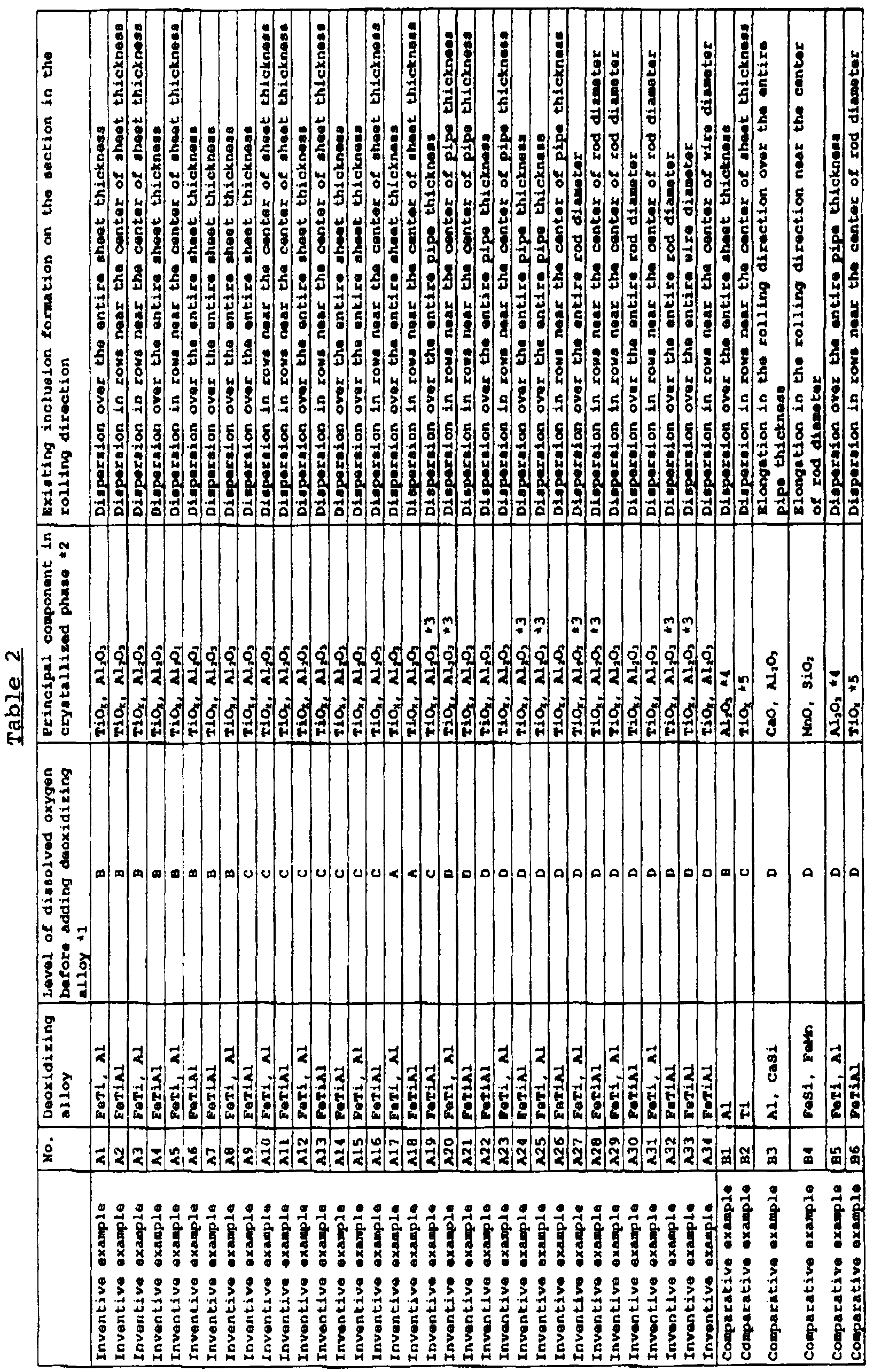
- Deoxidizing alloy used in the production process and the principal components contained in the crystallized phase of oxide inclusions are shown in Table 2.
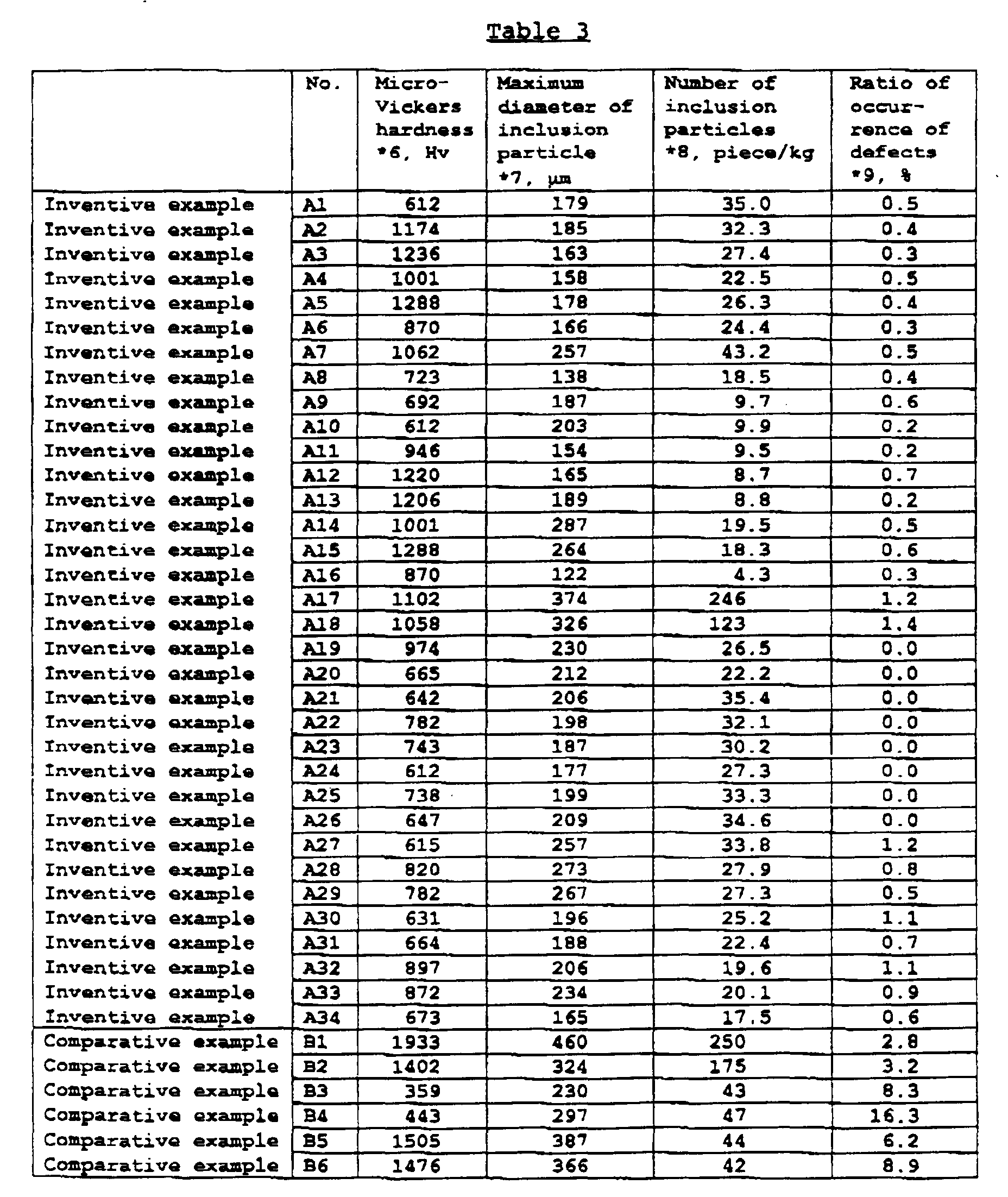
- the hardness of oxide inclusions, the existing formation and the ratio of occurrence of defects are shown in Table 3. It can be seen from these tables that the present invention can greatly reduce the defects of products caused by oxide inclusions so that the productivity can be enhanced.
- the components of the crystallized phase of inclusions shown in Table 2 were identified in such a manner that the inclusions extracted from a piece of rolled steel of full thickness by means of slime electrolytic extraction (the minimum mesh was 38 ⁇ m) was subjected to component identification by SEM (Scanning Electron Microscope) having EDX (Energy Dispersive X-ray Spectrometer). Further, concerning the additional component detected in the above component identification, the content was found by the integral intensity of the peak of the characteristic X-rays.
- the full thickness of a section parallel to the rolling direction was observed by an optical microscope, and the existing inclusion formation was determined by an optical microscopic photograph (the magnification was 400 and the total number of field of view was 50) which was taken at a position where the inclusion exists.
- the full thickness of a section parallel to the drawing direction was observed by an optical microscope, and the existing inclusion formation was determined by an optical microscopic photograph (the magnification was 400 and the total number of field of view was 50) which was taken at a position where the inclusion exists.
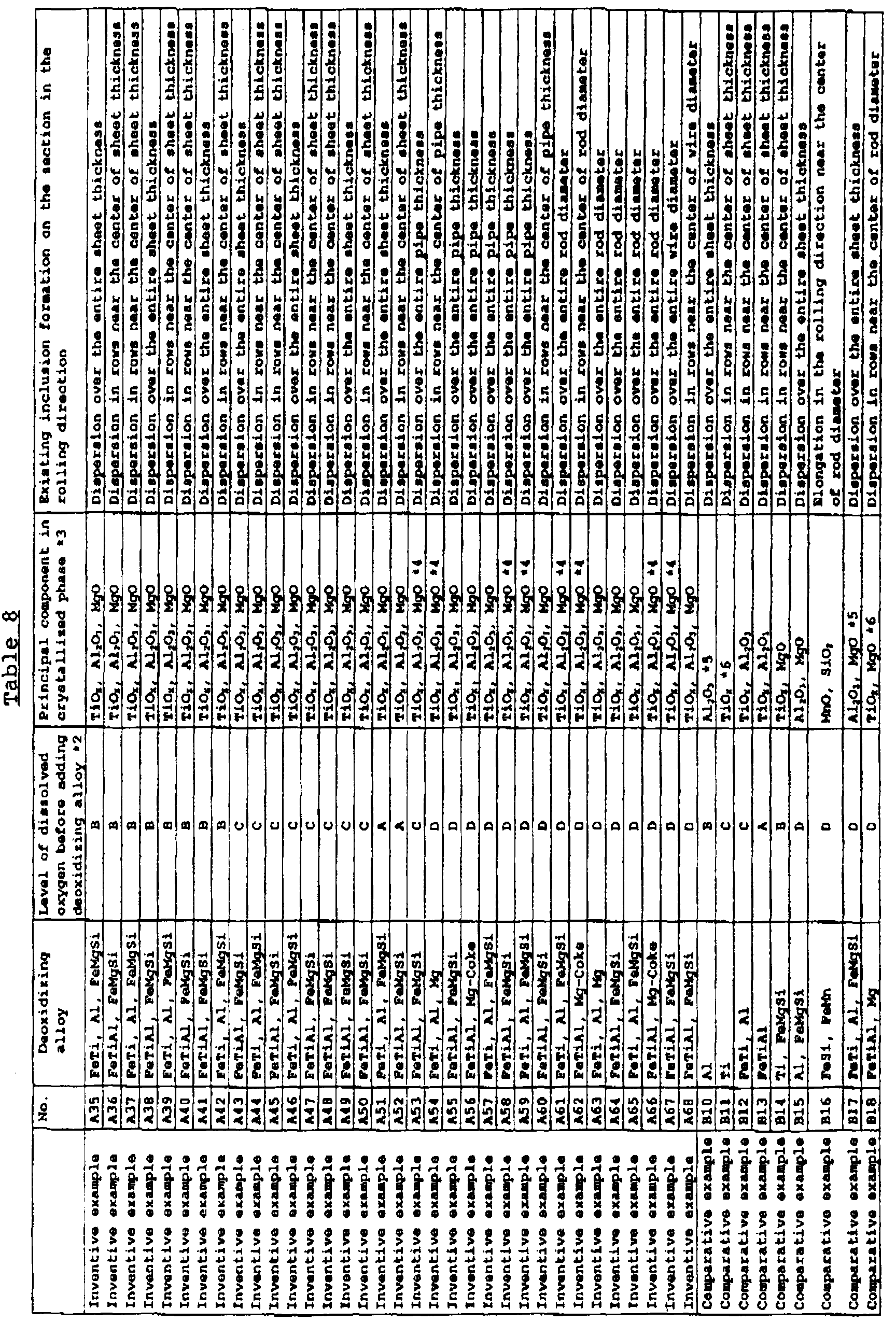
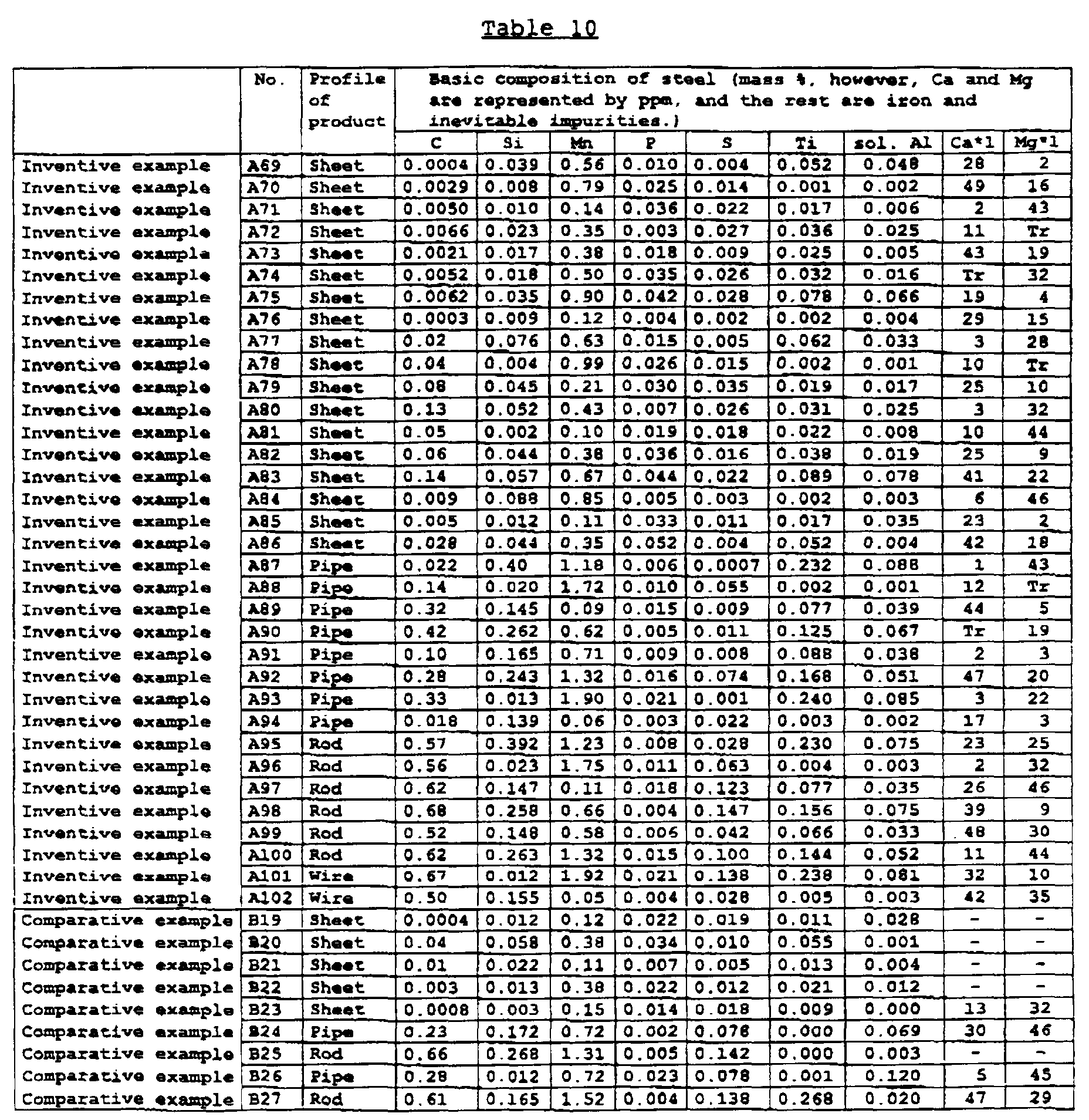
- Pieces of rolled steel were produced by a vertical bend-type continuous casting machine under the condition that the slab size was 245 mm thickness ⁇ 1200 to 1600 mm width, the casting speed was 1.4 to 1.7 m/min, and the temperature of molten steel in the tundish was 1560°C. After that, the slabs were hot-rolled, and then the pieces of hot-rolled steel were subjected to acid pickling, cold rolling, annealing and secondary cold rolling when necessary. In this way, products shown in Tables 4, 7 and 10 were produced.
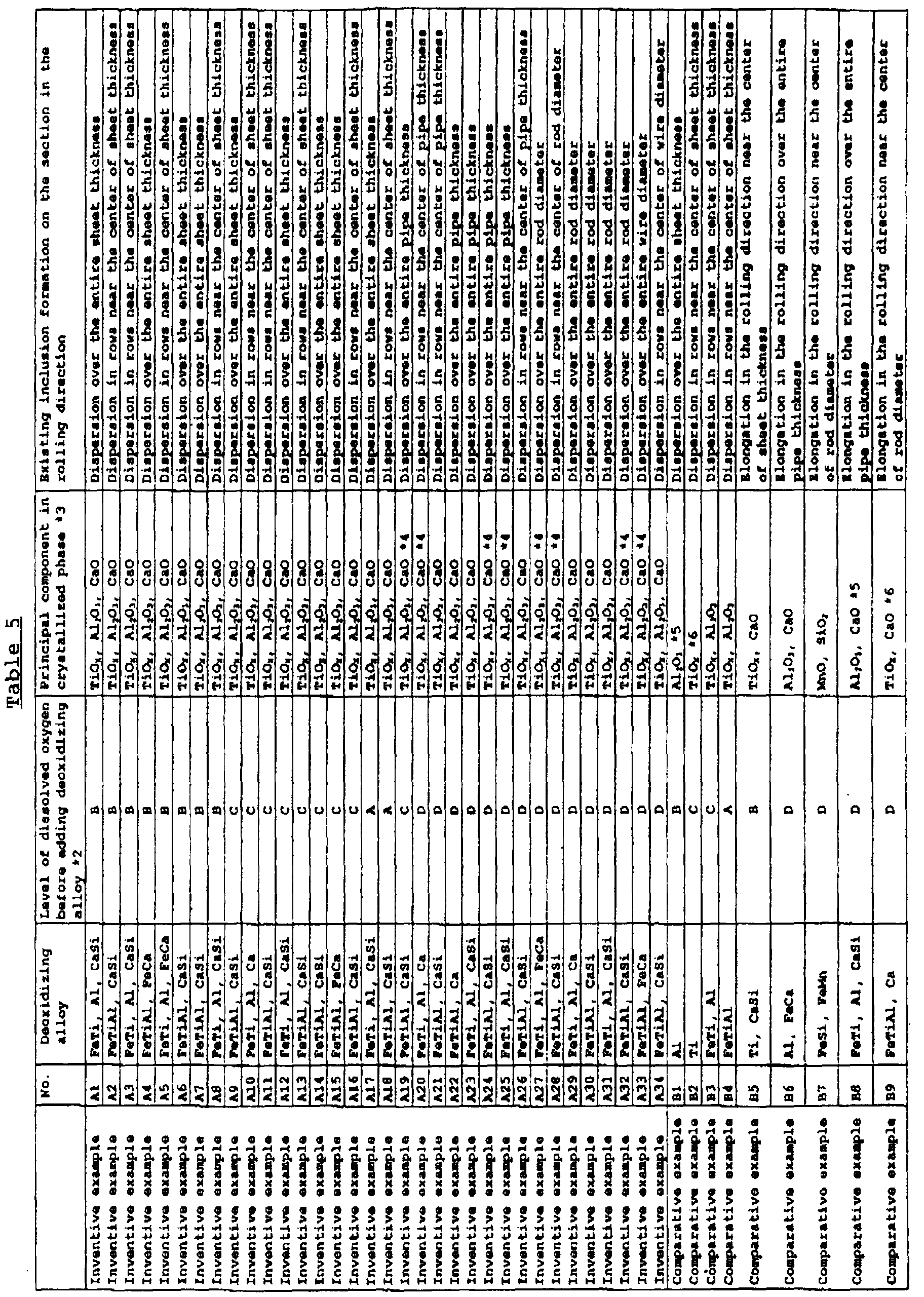
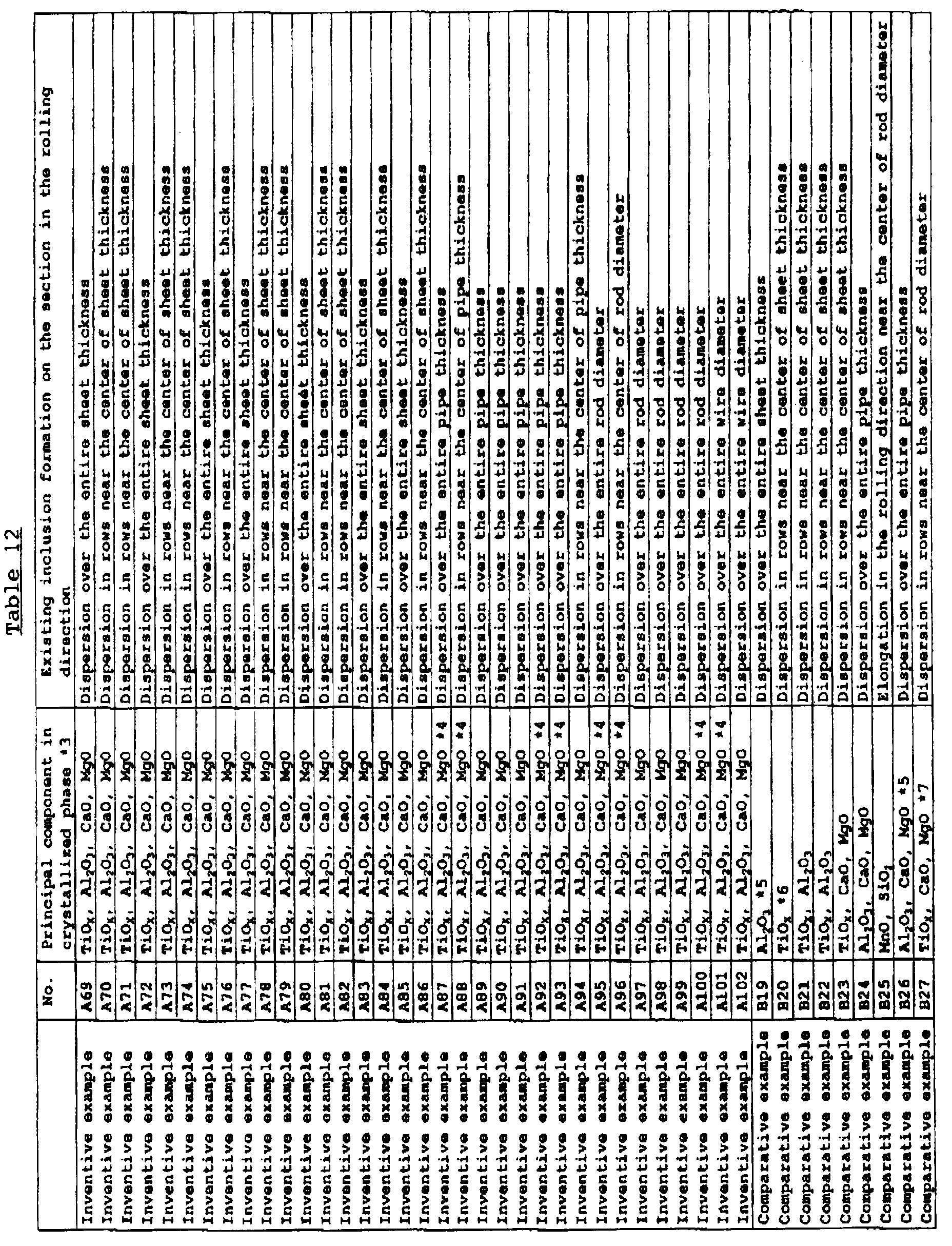
- Deoxidizing alloy used in the production process and the principal components contained in the crystallized phase of oxide inclusions are shown in Tables 5, 8, 11 and 12.
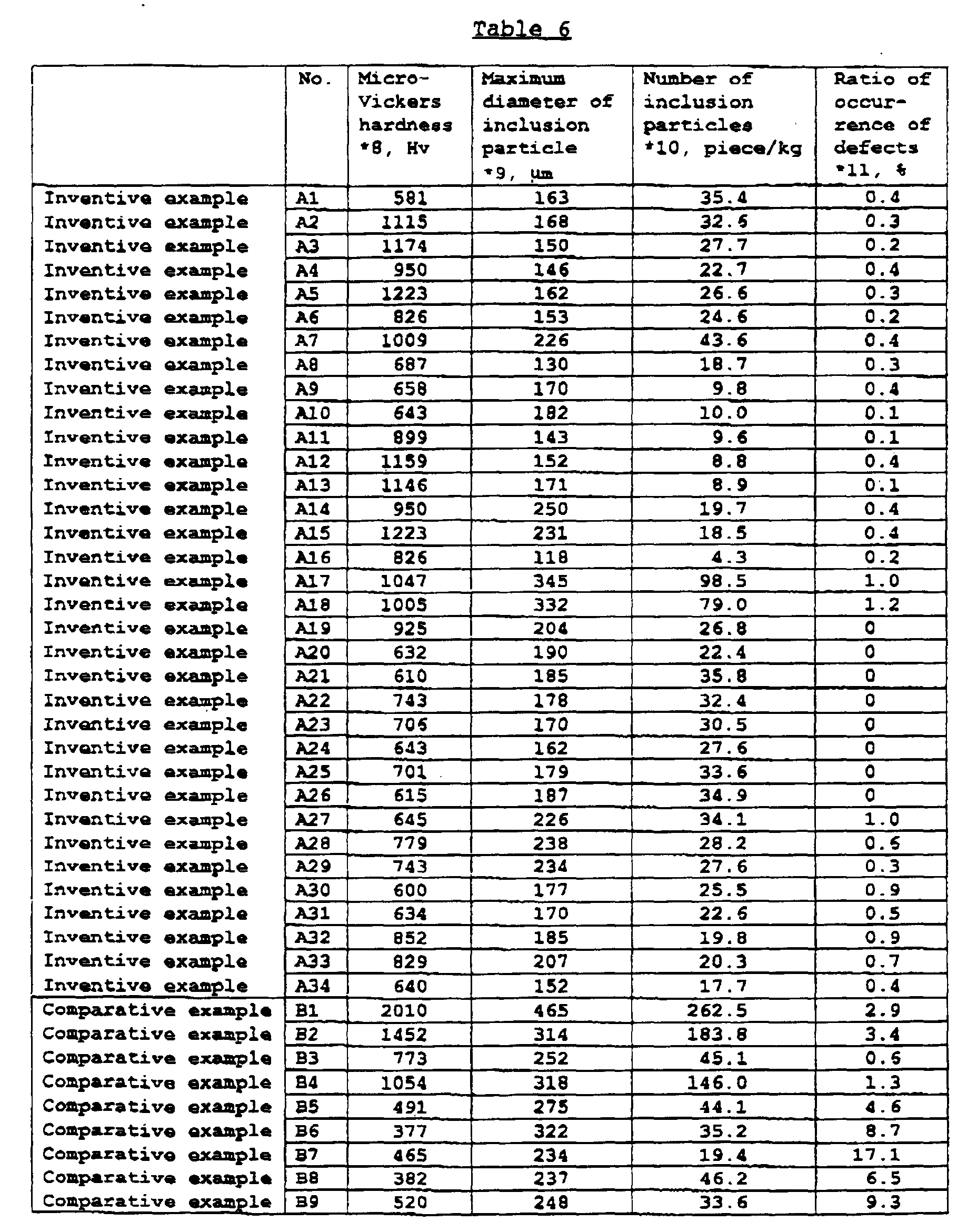
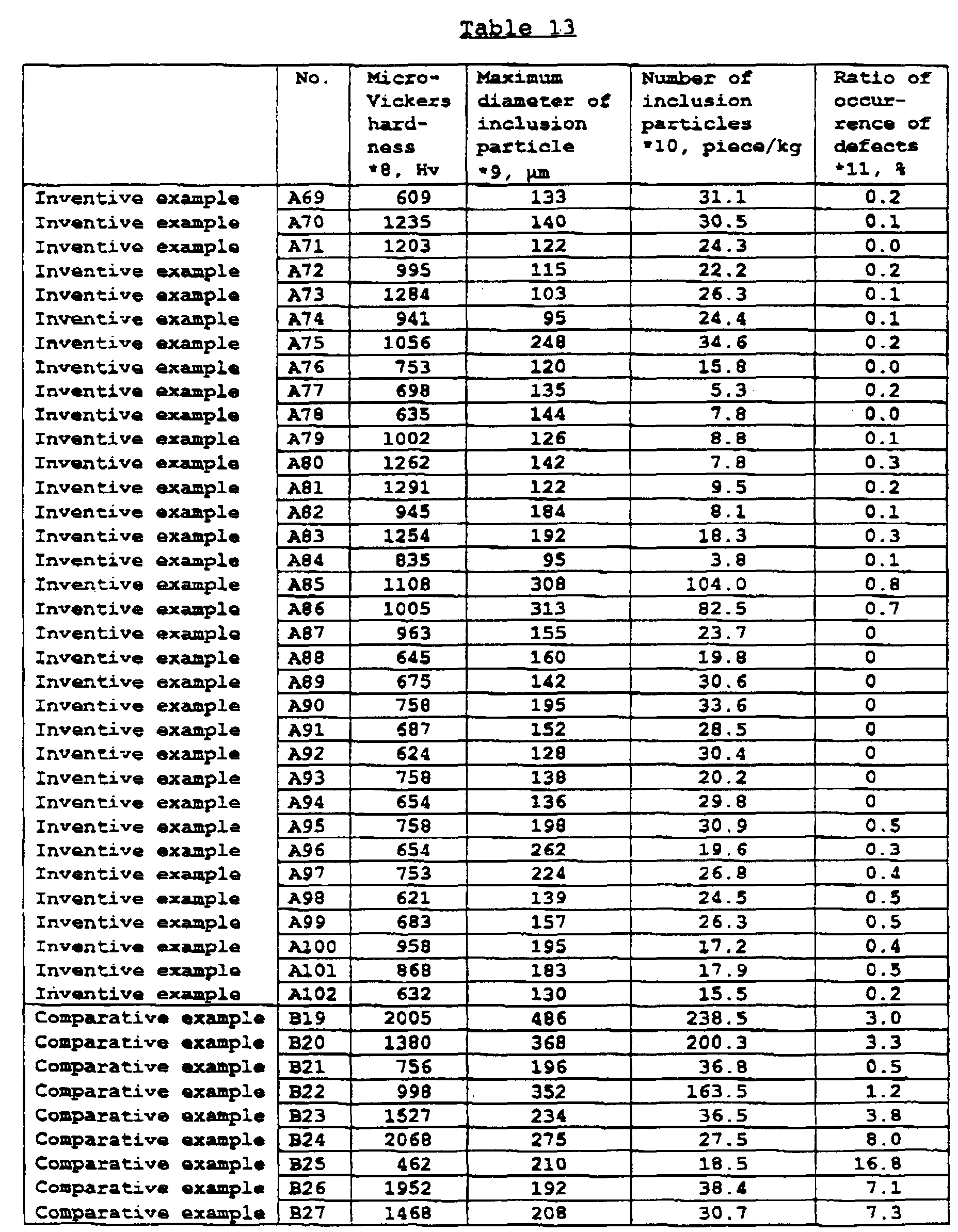
- the hardness of oxide inclusions, the existing formation and the ratio of occurrence of defects are shown in Tables 6, 9 and 13. It can be seen from these tables that the present invention can greatly reduce the defects of products caused by oxide inclusions so that the productivity can be enhanced.
- the components of the crystallized phases of inclusions shown in Tables 5, 8 and 12 were identified in such a manner that the inclusions extracted from pieces of rolled steel of full thickness, the weight of which was 1 ⁇ 0.1 kg, by means of slime electrolytic extraction (the minimum mesh was 38 ⁇ m) were identified by SEM having EDX. Further, concerning the detected additional component, the content was found from the integral intensity of the peak of the characteristic X-rays.
- the full thickness of a section parallel to the rolling direction was observed by an optical microscope, and the existing inclusion formation was determined by an optical microscopic photograph (the magnification was 400 and the total number of field of view was 50) which was taken at a position where the inclusion exists.
- the full thickness of a section parallel to the drawing direction was observed by an optical microscope, and the existing inclusion formation was determined by an optical microscopic photograph (the magnification was 400 and the total number of field of view was 50) which was taken at a position where the inclusion exists.
- the present invention provides rolled steel having few inclusion defects in which fine particles of oxide inclusions are dispersed.
- the present invention to contribute to the development of industry by providing rolled steel having few inclusion defects in which the conventional problems are completely solved.
Landscapes
- Chemical & Material Sciences (AREA)
- Engineering & Computer Science (AREA)
- Materials Engineering (AREA)
- Mechanical Engineering (AREA)
- Metallurgy (AREA)
- Organic Chemistry (AREA)
- Treatment Of Steel In Its Molten State (AREA)
Abstract
Description





Claims (10)
- Rolled steel having few inclusion defects, the basic composition of which is C: 0.0002 to 0.7 mass %, Si: 0.001 to 0.5 mass %, Mn: 0.005 to 2.0 mass %, P: 0.001 to 0.05 mass %, S: 0.0005 to 0.15 mass %, Ti: 0.001 to 0.25 mass % and dissolved Al: 0.001 to 0.1 mass %, wherein created oxide inclusions are mainly composed of a crystallized phase, the principal component of which is titanium oxide, and a crystallized phase, the principal component of which is alumina, and the crystallized phases of oxide inclusions exist in steel.
- Rolled steel having few inclusion defects, the basic composition of which is C: 0.0002 to 0.7 mass %, Si: 0.001 to 0.5 mass %, Mn: 0.005 to 2.0 mass %, P: 0.001 to 0.05 mass %, S: 0.0005 to 0.15 mass %, Ti: 0.001 to 0.25 mass % and dissolved Al: 0.001 to 0.1 mass %, wherein created oxide inclusions are mainly composed of a crystallized phase, the principal component of which is titanium oxide, and a crystallized phase, the principal component of which is alumina, and the crystallized phases of oxide inclusions exist in steel being dispersed in rows in the rolling direction near the center of rolled steel.
- Rolled steel having few inclusion defects, the basic composition of which is C: 0.0002 to 0.7 mass %, Si: 0.001 to 0.5 mass %, Mn: 0.005 to 2.0 mass %, P: 0.001 to 0.05 mass %, S: 0.0005 to 0.15 mass %, Ti: 0.001 to 0.25 mass % and dissolved Al: 0.001 to 0.1 mass %, wherein created oxide inclusions are mainly composed of a crystallized phase, the principal component of which is titanium oxide, and a crystallized phase, the principal component of which is alumina, Micro-Vickers hardness at the room temperature of the oxide inclusions is 600 to 1300 Hv, and the crystallized phases of oxide inclusions exist in steel.
- Rolled steel having few inclusion defects, the basic composition of which is C: 0.0002 to 0.7 mass %, Si: 0.001 to 0.5 mass %, Mn: 0.005 to 2.0 mass %, P: 0.001 to 0.05 mass %, S: 0.0005 to 0.15 mass %, Ti: 0.001 to 0.25 mass % and dissolved Al: 0.001 to 0.1 mass %, wherein created oxide inclusions are mainly composed of a crystallized phase, the principal component of which is titanium oxide, and a crystallized phase, the principal component of which is alumina, Micro-Vickers hardness at the room temperature of the oxide inclusions is 600 to 1300 Hv, and the crystallized phases of oxide inclusions exist in steel being dispersed in rows in the rolling direction near the center of rolled steel.
- Rolled steel having few defects of inclusion, the basic composition of which is C: 0.0002 to 0.7 mass %, Si: 0.001 to 0.5 mass %, Mn: 0.005 to 2.0 mass %, P: 0.001 to 0.05 mass %, S: 0.0005 to 0.15 mass %, Ti: 0.001 to 0.25 mass % and dissolved Al: 0.001 to 0.1 mass %, the selective composition of which is Ca: not more than 50 ppm and Mg: not more than 50 ppm, at least one of Ca and Mg being contained, wherein created oxide inclusions are mainly composed of a crystallized phase, the principal component of which is titanium oxide, and a crystallized phase, the principal component of which is alumina, and further composed of at least one of a crystallized phase, the principal component of which is CaO, and a crystallized phase, the principal component of which is MgO, and the crystallized phases of oxide inclusions exist in steel.
- Rolled steel having few inclusion defects, the basic composition of which is C: 0.0002 to 0.7 mass %, Si: 0.001 to 0.5 mass %, Mn: 0.005 to 2.0 mass %, P: 0.001 to 0.05 mass %, S: 0.0005 to 0.15 mass %, Ti: 0.001 to 0.25 mass % and dissolved Al: 0.001 to 0.1 mass %, the selective composition of which is Ca: not more than 50 ppm and Mg: not more than 50 ppm, at least one of Ca and Mg being contained, wherein created oxide inclusions are mainly composed of a crystallized phase, the principal component of which is titanium oxide, and a crystallized phase, the principal component of which is alumina, and further composed of at least one of a crystallized phase, the principal component of which is CaO, and a crystallized phase, the principal component of which is MgO, and the crystallized phases of oxide inclusions exist in steel being dispersed in rows in the rolling direction near the center of steel.
- Rolled steel having few inclusion defects, the basic composition of which is C: 0.0002 to 0.7 mass %, Si: 0.001 to 0.5 mass %, Mn: 0.005 to 2.0 mass %, P: 0.001 to 0.05 mass %, S: 0.0005 to 0.15 mass %, Ti: 0.001 to 0.25 mass % and dissolved Al: 0.001 to 0.1 mass %, the selective composition of which is Ca: not more than 50 ppm and Mg: not more than 50 ppm, at least one of Ca and Mg being contained, wherein created oxide inclusions are mainly composed of a crystallized phase, the principal component of which is titanium oxide, and a crystallized phase, the principal component of which is alumina, and further composed of at least one of a crystallized phase, the principal component of which is CaO, and a crystallized phase, the principal component of which is MgO, Micro-Vickers hardness of the oxide inclusions at the room temperature is 600 to 1300 Hv, and the crystallized phases of oxide inclusions exist in steel.
- Rolled steel having few inclusion defects, the basic composition of which is C: 0.0002 to 0.7 mass %, Si: 0.001 to 0.5 mass %, Mn: 0.005 to 2.0 mass %, P: 0.001 to 0.05 mass %, S: 0.0005 to 0.15 mass %, Ti: 0.001 to 0.25 mass % and dissolved Al: 0.001 to 0.1 mass %, the selective composition of which is Ca: not more than 50 ppm and Mg: not more than 50 ppm, at least one of Ca and Mg being contained, wherein created oxide inclusions are mainly composed of a crystallized phase, the principal component of which is titanium oxide, and a crystallized phase, the principal component of which is alumina, and further composed of at least one of a crystallized phase, the principal component of which is CaO, and a crystallized phase, the principal component of which is MgO, Micro-Vickers hardness of the oxide inclusions at the room temperature is 600 to 1300 Hv, and the crystallized phases of oxide inclusions exist in steel being dispersed in rows in the rolling direction near the center of steel.
- Rolled steel according to any one of claims 1 to 8, wherein the maximum diameter of particles of oxide inclusions obtained by slime extraction is not more than 300 µm.
- Rolled steel having few inclusion defects according to claim 9 wherein the number of particles of oxide inclusions obtained by slime extraction, the diameters of which are not less than 38 µm, is not more than 50 pieces/kg.
Applications Claiming Priority (4)
| Application Number | Priority Date | Filing Date | Title |
|---|---|---|---|
| JP03964799A JP3462779B2 (en) | 1999-02-18 | 1999-02-18 | Rolled steel with few inclusion defect |
| JP3964799 | 1999-02-18 | ||
| JP10980599A JP3462790B2 (en) | 1999-04-16 | 1999-04-16 | Rolled steel with few inclusion defect |
| JP10980599 | 1999-04-16 |
Publications (2)
| Publication Number | Publication Date |
|---|---|
| EP1029938A2 true EP1029938A2 (en) | 2000-08-23 |
| EP1029938A3 EP1029938A3 (en) | 2003-10-15 |
Family
ID=26379031
Family Applications (1)
| Application Number | Title | Priority Date | Filing Date |
|---|---|---|---|
| EP00102280A Withdrawn EP1029938A3 (en) | 1999-02-18 | 2000-02-17 | Rolled steel having few inclusion defects |
Country Status (1)
| Country | Link |
|---|---|
| EP (1) | EP1029938A3 (en) |
Cited By (5)
| Publication number | Priority date | Publication date | Assignee | Title |
|---|---|---|---|---|
| EP1669471A1 (en) * | 2004-12-09 | 2006-06-14 | Kabushiki Kaisha Kobe Seiko Sho | Highly ductile steel sheet and method of manufacturing the same |
| DE10314476B4 (en) * | 2002-04-29 | 2006-07-27 | Salzgitter Mannesmann Gmbh | Fabrication of an aluminum-killed steel for the continuous casting of semi-products for deep drawing applications without the addition of calcium |
| US7776162B2 (en) * | 2002-07-23 | 2010-08-17 | Nippon Steel Corporation | Steels with few alumina clusters |
| CN105583235A (en) * | 2015-12-28 | 2016-05-18 | 钢铁研究总院 | Method for controlling iron scale structures of hot-rolled steel bars by stepped cooling |
| EP3221485A1 (en) * | 2014-11-18 | 2017-09-27 | L'Air Liquide Société Anonyme pour l'Etude et l'Exploitation des Procédés Georges Claude | Materials of construction for use in high pressure hydrogen storage in a salt cavern |
Family Cites Families (9)
| Publication number | Priority date | Publication date | Assignee | Title |
|---|---|---|---|---|
| JP2956324B2 (en) * | 1991-10-24 | 1999-10-04 | 株式会社神戸製鋼所 | Bearing steel with excellent workability and rolling fatigue |
| JP2944842B2 (en) * | 1993-04-06 | 1999-09-06 | 新日本製鐵株式会社 | Method for producing low-temperature welding steel having excellent toughness in welds in which Ti-Al composite oxide is dispersed |
| JPH0924448A (en) * | 1995-07-12 | 1997-01-28 | Nippon Steel Corp | Method for manufacturing steel sheet with excellent toughness in heat-affected zone |
| JP3422612B2 (en) * | 1996-01-19 | 2003-06-30 | Jfeスチール株式会社 | Manufacturing method of ultra low carbon cold rolled steel sheet |
| JPH10152755A (en) * | 1996-11-25 | 1998-06-09 | Nippon Steel Corp | Steel material for steel plate for cans with few defects and manufacturing method |
| JP3603513B2 (en) * | 1996-12-18 | 2004-12-22 | Jfeスチール株式会社 | Method for deoxidizing low carbon steel |
| JP3436857B2 (en) * | 1997-02-19 | 2003-08-18 | 新日本製鐵株式会社 | Thin steel sheet excellent in press formability with few defects and method for producing the same |
| TW408184B (en) * | 1997-09-29 | 2000-10-11 | Kawasaki Steel Co | Manufacturing method for producing Titanium killed steel with smooth surface texture |
| JP3474432B2 (en) * | 1998-03-18 | 2003-12-08 | 新日本製鐵株式会社 | Steel sheet for cans with few defects and small in-plane anisotropy and method for producing the same |
-
2000
- 2000-02-17 EP EP00102280A patent/EP1029938A3/en not_active Withdrawn
Cited By (6)
| Publication number | Priority date | Publication date | Assignee | Title |
|---|---|---|---|---|
| DE10314476B4 (en) * | 2002-04-29 | 2006-07-27 | Salzgitter Mannesmann Gmbh | Fabrication of an aluminum-killed steel for the continuous casting of semi-products for deep drawing applications without the addition of calcium |
| US7776162B2 (en) * | 2002-07-23 | 2010-08-17 | Nippon Steel Corporation | Steels with few alumina clusters |
| EP1669471A1 (en) * | 2004-12-09 | 2006-06-14 | Kabushiki Kaisha Kobe Seiko Sho | Highly ductile steel sheet and method of manufacturing the same |
| EP3221485A1 (en) * | 2014-11-18 | 2017-09-27 | L'Air Liquide Société Anonyme pour l'Etude et l'Exploitation des Procédés Georges Claude | Materials of construction for use in high pressure hydrogen storage in a salt cavern |
| CN105583235A (en) * | 2015-12-28 | 2016-05-18 | 钢铁研究总院 | Method for controlling iron scale structures of hot-rolled steel bars by stepped cooling |
| CN105583235B (en) * | 2015-12-28 | 2017-06-23 | 钢铁研究总院 | The method of the piece-wise step type cooling control scale structure of hot-rolled reinforced bar |
Also Published As
| Publication number | Publication date |
|---|---|
| EP1029938A3 (en) | 2003-10-15 |
Similar Documents
| Publication | Publication Date | Title |
|---|---|---|
| EP1538224B1 (en) | Steel product reduced in amount of alumina cluster | |
| KR20220147126A (en) | Steel plate and its manufacturing method | |
| CN100357471C (en) | Ferritic stainless steel castings and steel plates and methods for their preparation | |
| JP2020002406A (en) | Manufacturing method of steel | |
| EP4112753A1 (en) | Stainless steel, stainless steel material, and stainless steel production method | |
| JP2001254153A (en) | Ferritic stainless steel with excellent weldability | |
| Paul et al. | Effect of rare earth additions on the inclusions and properties of a Ca-AI deoxidized steel | |
| Grajcar et al. | Non-metallic inclusions in high manganese austenitic alloys | |
| JP2005307234A (en) | Ferritic stainless steel sheet having excellent ridging resistance and surface characteristic and method for manufacturing the same | |
| EP1669471B1 (en) | Highly ductile steel sheet and method of manufacturing the same | |
| JP3852118B2 (en) | Steel material with excellent toughness of weld heat affected zone | |
| WO2004111277A1 (en) | Steel product reduced in alumina cluster | |
| JP2025514728A (en) | Aluminum alloy sheet for can body and its manufacturing method | |
| JP2001026812A (en) | Deoxidized alloy for molten steel | |
| JP6684081B2 (en) | Fe-Ni alloy sheet and method for producing the same | |
| JP3462790B2 (en) | Rolled steel with few inclusion defect | |
| JP2008266706A (en) | Method for continuously casting ferritic stainless steel slab | |
| JP3462779B2 (en) | Rolled steel with few inclusion defect | |
| EP3006137A1 (en) | STEEL IN WHICH Cu-Sn COEXIST, AND METHOD FOR MANUFACTURING SAME | |
| JP3421942B2 (en) | Slab for producing cold-rolled steel sheet for cans | |
| WO2006088223A1 (en) | Method for producing extremely low carbon steel sheet and extremely low carbon cast piece having excellent surface characteristics, workability and formability | |
| JP3677994B2 (en) | Steel plate for cans and steel plate for cans with excellent cleanability | |
| JP2005272865A (en) | Ferritic stainless steel sheet having superior ridging resistance, formability and brittleness resistance in secondary forming, and manufacturing method therefor | |
| JP2003119546A (en) | Steel for sheet metal with few inclusion defect | |
| JP3714190B2 (en) | Method of deoxidizing thin steel sheet and molten steel for thin steel sheet |
Legal Events
| Date | Code | Title | Description |
|---|---|---|---|
| PUAI | Public reference made under article 153(3) epc to a published international application that has entered the european phase |
Free format text: ORIGINAL CODE: 0009012 |
|
| 17P | Request for examination filed |
Effective date: 20000316 |
|
| AK | Designated contracting states |
Kind code of ref document: A2 Designated state(s): AT BE CH CY DE DK ES FI FR GB GR IE IT LI LU MC NL PT SE |
|
| AX | Request for extension of the european patent |
Free format text: AL;LT;LV;MK;RO;SI |
|
| PUAL | Search report despatched |
Free format text: ORIGINAL CODE: 0009013 |
|
| AK | Designated contracting states |
Kind code of ref document: A3 Designated state(s): AT BE CH CY DE DK ES FI FR GB GR IE IT LI LU MC NL PT SE |
|
| AX | Request for extension of the european patent |
Extension state: AL LT LV MK RO SI |
|
| STAA | Information on the status of an ep patent application or granted ep patent |
Free format text: STATUS: THE APPLICATION IS DEEMED TO BE WITHDRAWN |
|
| 18D | Application deemed to be withdrawn |
Effective date: 20030224 |