EP1028840B1 - Method of making an acrylic article - Google Patents
Method of making an acrylic article Download PDFInfo
- Publication number
- EP1028840B1 EP1028840B1 EP98952863A EP98952863A EP1028840B1 EP 1028840 B1 EP1028840 B1 EP 1028840B1 EP 98952863 A EP98952863 A EP 98952863A EP 98952863 A EP98952863 A EP 98952863A EP 1028840 B1 EP1028840 B1 EP 1028840B1
- Authority
- EP
- European Patent Office
- Prior art keywords
- sheet
- composite
- acrylic
- backing sheet
- article
- Prior art date
- Legal status (The legal status is an assumption and is not a legal conclusion. Google has not performed a legal analysis and makes no representation as to the accuracy of the status listed.)
- Expired - Lifetime
Links
- NIXOWILDQLNWCW-UHFFFAOYSA-N acrylic acid group Chemical group C(C=C)(=O)O NIXOWILDQLNWCW-UHFFFAOYSA-N 0.000 title claims abstract description 57
- 238000004519 manufacturing process Methods 0.000 title claims abstract description 12
- 239000000463 material Substances 0.000 claims abstract description 43
- 239000002131 composite material Substances 0.000 claims abstract description 35
- 238000007666 vacuum forming Methods 0.000 claims abstract description 19
- 239000012815 thermoplastic material Substances 0.000 claims abstract description 14
- 238000010438 heat treatment Methods 0.000 claims abstract description 6
- 238000000034 method Methods 0.000 claims description 40
- 239000004676 acrylonitrile butadiene styrene Substances 0.000 claims description 17
- 229920000915 polyvinyl chloride Polymers 0.000 claims description 4
- 239000004800 polyvinyl chloride Substances 0.000 claims description 4
- 239000004743 Polypropylene Substances 0.000 claims description 3
- 229920000515 polycarbonate Polymers 0.000 claims description 3
- 239000004417 polycarbonate Substances 0.000 claims description 3
- 229920000379 polypropylene carbonate Polymers 0.000 claims description 3
- XECAHXYUAAWDEL-UHFFFAOYSA-N acrylonitrile butadiene styrene Chemical compound C=CC=C.C=CC#N.C=CC1=CC=CC=C1 XECAHXYUAAWDEL-UHFFFAOYSA-N 0.000 description 16
- 229920000122 acrylonitrile butadiene styrene Polymers 0.000 description 16
- 229920003229 poly(methyl methacrylate) Polymers 0.000 description 6
- 239000004926 polymethyl methacrylate Substances 0.000 description 6
- 239000003086 colorant Substances 0.000 description 4
- 239000002537 cosmetic Substances 0.000 description 4
- 238000003475 lamination Methods 0.000 description 4
- 238000000465 moulding Methods 0.000 description 4
- 238000003856 thermoforming Methods 0.000 description 4
- 230000015572 biosynthetic process Effects 0.000 description 3
- 239000011152 fibreglass Substances 0.000 description 3
- 238000005266 casting Methods 0.000 description 2
- 238000005516 engineering process Methods 0.000 description 2
- 239000003365 glass fiber Substances 0.000 description 2
- 239000002184 metal Substances 0.000 description 2
- -1 polytetrafluoroethylene Polymers 0.000 description 2
- 230000003134 recirculating effect Effects 0.000 description 2
- 238000004064 recycling Methods 0.000 description 2
- SMZOUWXMTYCWNB-UHFFFAOYSA-N 2-(2-methoxy-5-methylphenyl)ethanamine Chemical compound COC1=CC=C(C)C=C1CCN SMZOUWXMTYCWNB-UHFFFAOYSA-N 0.000 description 1
- 239000004925 Acrylic resin Substances 0.000 description 1
- 229920000178 Acrylic resin Polymers 0.000 description 1
- NLHHRLWOUZZQLW-UHFFFAOYSA-N Acrylonitrile Chemical compound C=CC#N NLHHRLWOUZZQLW-UHFFFAOYSA-N 0.000 description 1
- CERQOIWHTDAKMF-UHFFFAOYSA-N Methacrylic acid Chemical compound CC(=C)C(O)=O CERQOIWHTDAKMF-UHFFFAOYSA-N 0.000 description 1
- VVQNEPGJFQJSBK-UHFFFAOYSA-N Methyl methacrylate Chemical group COC(=O)C(C)=C VVQNEPGJFQJSBK-UHFFFAOYSA-N 0.000 description 1
- 239000004952 Polyamide Substances 0.000 description 1
- 239000002253 acid Substances 0.000 description 1
- 150000007513 acids Chemical class 0.000 description 1
- 239000000853 adhesive Substances 0.000 description 1
- 230000001070 adhesive effect Effects 0.000 description 1
- 238000010923 batch production Methods 0.000 description 1
- 230000001413 cellular effect Effects 0.000 description 1
- 239000004020 conductor Substances 0.000 description 1
- 238000010924 continuous production Methods 0.000 description 1
- 238000001816 cooling Methods 0.000 description 1
- 229920001577 copolymer Polymers 0.000 description 1
- 238000004132 cross linking Methods 0.000 description 1
- 230000002939 deleterious effect Effects 0.000 description 1
- 230000000694 effects Effects 0.000 description 1
- 230000008030 elimination Effects 0.000 description 1
- 238000003379 elimination reaction Methods 0.000 description 1
- 150000002148 esters Chemical class 0.000 description 1
- 230000007717 exclusion Effects 0.000 description 1
- 239000000835 fiber Substances 0.000 description 1
- 239000000945 filler Substances 0.000 description 1
- 239000012467 final product Substances 0.000 description 1
- 238000007667 floating Methods 0.000 description 1
- 239000008187 granular material Substances 0.000 description 1
- 238000009434 installation Methods 0.000 description 1
- 238000002156 mixing Methods 0.000 description 1
- 239000012811 non-conductive material Substances 0.000 description 1
- 239000002245 particle Substances 0.000 description 1
- 230000000149 penetrating effect Effects 0.000 description 1
- 230000000704 physical effect Effects 0.000 description 1
- 229920003023 plastic Polymers 0.000 description 1
- 239000004033 plastic Substances 0.000 description 1
- 238000007747 plating Methods 0.000 description 1
- 229920002647 polyamide Polymers 0.000 description 1
- 229920000728 polyester Polymers 0.000 description 1
- 229920000642 polymer Polymers 0.000 description 1
- 229920001343 polytetrafluoroethylene Polymers 0.000 description 1
- 239000004810 polytetrafluoroethylene Substances 0.000 description 1
- 239000000047 product Substances 0.000 description 1
- 230000002787 reinforcement Effects 0.000 description 1
- 230000003014 reinforcing effect Effects 0.000 description 1
- 239000011347 resin Substances 0.000 description 1
- 229920005989 resin Polymers 0.000 description 1
- 239000005060 rubber Substances 0.000 description 1
- 238000000926 separation method Methods 0.000 description 1
- 238000007493 shaping process Methods 0.000 description 1
- 239000002904 solvent Substances 0.000 description 1
- 238000007655 standard test method Methods 0.000 description 1
- 239000000126 substance Substances 0.000 description 1
- 229920001169 thermoplastic Polymers 0.000 description 1
- 229920005992 thermoplastic resin Polymers 0.000 description 1
- 229920002554 vinyl polymer Polymers 0.000 description 1
- 239000002023 wood Substances 0.000 description 1
Images
Classifications
-
- B—PERFORMING OPERATIONS; TRANSPORTING
- B32—LAYERED PRODUCTS
- B32B—LAYERED PRODUCTS, i.e. PRODUCTS BUILT-UP OF STRATA OF FLAT OR NON-FLAT, e.g. CELLULAR OR HONEYCOMB, FORM
- B32B38/00—Ancillary operations in connection with laminating processes
-
- B—PERFORMING OPERATIONS; TRANSPORTING
- B29—WORKING OF PLASTICS; WORKING OF SUBSTANCES IN A PLASTIC STATE IN GENERAL
- B29C—SHAPING OR JOINING OF PLASTICS; SHAPING OF MATERIAL IN A PLASTIC STATE, NOT OTHERWISE PROVIDED FOR; AFTER-TREATMENT OF THE SHAPED PRODUCTS, e.g. REPAIRING
- B29C51/00—Shaping by thermoforming, i.e. shaping sheets or sheet like preforms after heating, e.g. shaping sheets in matched moulds or by deep-drawing; Apparatus therefor
- B29C51/02—Combined thermoforming and manufacture of the preform
-
- B—PERFORMING OPERATIONS; TRANSPORTING
- B29—WORKING OF PLASTICS; WORKING OF SUBSTANCES IN A PLASTIC STATE IN GENERAL
- B29C—SHAPING OR JOINING OF PLASTICS; SHAPING OF MATERIAL IN A PLASTIC STATE, NOT OTHERWISE PROVIDED FOR; AFTER-TREATMENT OF THE SHAPED PRODUCTS, e.g. REPAIRING
- B29C51/00—Shaping by thermoforming, i.e. shaping sheets or sheet like preforms after heating, e.g. shaping sheets in matched moulds or by deep-drawing; Apparatus therefor
- B29C51/14—Shaping by thermoforming, i.e. shaping sheets or sheet like preforms after heating, e.g. shaping sheets in matched moulds or by deep-drawing; Apparatus therefor using multilayered preforms or sheets
-
- B—PERFORMING OPERATIONS; TRANSPORTING
- B32—LAYERED PRODUCTS
- B32B—LAYERED PRODUCTS, i.e. PRODUCTS BUILT-UP OF STRATA OF FLAT OR NON-FLAT, e.g. CELLULAR OR HONEYCOMB, FORM
- B32B37/00—Methods or apparatus for laminating, e.g. by curing or by ultrasonic bonding
- B32B37/0007—Methods or apparatus for laminating, e.g. by curing or by ultrasonic bonding involving treatment or provisions in order to avoid deformation or air inclusion, e.g. to improve surface quality
-
- B—PERFORMING OPERATIONS; TRANSPORTING
- B29—WORKING OF PLASTICS; WORKING OF SUBSTANCES IN A PLASTIC STATE IN GENERAL
- B29C—SHAPING OR JOINING OF PLASTICS; SHAPING OF MATERIAL IN A PLASTIC STATE, NOT OTHERWISE PROVIDED FOR; AFTER-TREATMENT OF THE SHAPED PRODUCTS, e.g. REPAIRING
- B29C2791/00—Shaping characteristics in general
- B29C2791/001—Shaping in several steps
-
- B—PERFORMING OPERATIONS; TRANSPORTING
- B29—WORKING OF PLASTICS; WORKING OF SUBSTANCES IN A PLASTIC STATE IN GENERAL
- B29C—SHAPING OR JOINING OF PLASTICS; SHAPING OF MATERIAL IN A PLASTIC STATE, NOT OTHERWISE PROVIDED FOR; AFTER-TREATMENT OF THE SHAPED PRODUCTS, e.g. REPAIRING
- B29C2791/00—Shaping characteristics in general
- B29C2791/004—Shaping under special conditions
- B29C2791/006—Using vacuum
-
- B—PERFORMING OPERATIONS; TRANSPORTING
- B29—WORKING OF PLASTICS; WORKING OF SUBSTANCES IN A PLASTIC STATE IN GENERAL
- B29C—SHAPING OR JOINING OF PLASTICS; SHAPING OF MATERIAL IN A PLASTIC STATE, NOT OTHERWISE PROVIDED FOR; AFTER-TREATMENT OF THE SHAPED PRODUCTS, e.g. REPAIRING
- B29C51/00—Shaping by thermoforming, i.e. shaping sheets or sheet like preforms after heating, e.g. shaping sheets in matched moulds or by deep-drawing; Apparatus therefor
- B29C51/10—Forming by pressure difference, e.g. vacuum
-
- B—PERFORMING OPERATIONS; TRANSPORTING
- B29—WORKING OF PLASTICS; WORKING OF SUBSTANCES IN A PLASTIC STATE IN GENERAL
- B29K—INDEXING SCHEME ASSOCIATED WITH SUBCLASSES B29B, B29C OR B29D, RELATING TO MOULDING MATERIALS OR TO MATERIALS FOR MOULDS, REINFORCEMENTS, FILLERS OR PREFORMED PARTS, e.g. INSERTS
- B29K2023/00—Use of polyalkenes or derivatives thereof as moulding material
- B29K2023/10—Polymers of propylene
- B29K2023/12—PP, i.e. polypropylene
-
- B—PERFORMING OPERATIONS; TRANSPORTING
- B29—WORKING OF PLASTICS; WORKING OF SUBSTANCES IN A PLASTIC STATE IN GENERAL
- B29K—INDEXING SCHEME ASSOCIATED WITH SUBCLASSES B29B, B29C OR B29D, RELATING TO MOULDING MATERIALS OR TO MATERIALS FOR MOULDS, REINFORCEMENTS, FILLERS OR PREFORMED PARTS, e.g. INSERTS
- B29K2055/00—Use of specific polymers obtained by polymerisation reactions only involving carbon-to-carbon unsaturated bonds, not provided for in a single one of main groups B29K2023/00 - B29K2049/00, e.g. having a vinyl group, as moulding material
- B29K2055/02—ABS polymers, i.e. acrylonitrile-butadiene-styrene polymers
-
- B—PERFORMING OPERATIONS; TRANSPORTING
- B29—WORKING OF PLASTICS; WORKING OF SUBSTANCES IN A PLASTIC STATE IN GENERAL
- B29K—INDEXING SCHEME ASSOCIATED WITH SUBCLASSES B29B, B29C OR B29D, RELATING TO MOULDING MATERIALS OR TO MATERIALS FOR MOULDS, REINFORCEMENTS, FILLERS OR PREFORMED PARTS, e.g. INSERTS
- B29K2069/00—Use of PC, i.e. polycarbonates or derivatives thereof, as moulding material
-
- B—PERFORMING OPERATIONS; TRANSPORTING
- B29—WORKING OF PLASTICS; WORKING OF SUBSTANCES IN A PLASTIC STATE IN GENERAL
- B29L—INDEXING SCHEME ASSOCIATED WITH SUBCLASS B29C, RELATING TO PARTICULAR ARTICLES
- B29L2031/00—Other particular articles
- B29L2031/769—Sanitary equipment
-
- B—PERFORMING OPERATIONS; TRANSPORTING
- B32—LAYERED PRODUCTS
- B32B—LAYERED PRODUCTS, i.e. PRODUCTS BUILT-UP OF STRATA OF FLAT OR NON-FLAT, e.g. CELLULAR OR HONEYCOMB, FORM
- B32B2309/00—Parameters for the laminating or treatment process; Apparatus details
- B32B2309/06—Angles
-
- B—PERFORMING OPERATIONS; TRANSPORTING
- B32—LAYERED PRODUCTS
- B32B—LAYERED PRODUCTS, i.e. PRODUCTS BUILT-UP OF STRATA OF FLAT OR NON-FLAT, e.g. CELLULAR OR HONEYCOMB, FORM
- B32B38/00—Ancillary operations in connection with laminating processes
- B32B38/12—Deep-drawing
Definitions
- This invention relates to a method of making an article of sanitary ware from a composite of a facing sheet of an acrylic material and a backing sheet of a thermoplastic material, such as for example a sink, bowl, basin or bath.
- acrylic vacuum formed articles such as sanitary ware in the form of sinks, bowls, basins, baths, spas, and shower trays, are manufactured by vacuum forming an acrylic sheet and subsequently re-enforcing the back of the vacuum formed acrylic sheet with fibreglass, in order to achieve the required dimensional stability, impact resistance and stiffness.
- the fibreglass tends to give off skin penetrating glass fibres.
- One method of overcoming this method is to co-extrude ABS (an acrylonitrile-butadiene-styrene resin) onto a band cast acrylic sheet or extruded acrylic sheet to produce a flat laminate of ABS/acrylic. This laminate may then be vacuum formed into a desired article.
- ABS an acrylonitrile-butadiene-styrene resin
- This laminate may then be vacuum formed into a desired article.
- the disadvantages of this method are as follows. Firstly, band cast or extruded acrylic sheets are of fairly low molecular weight and consequently do not have the inherent solvent chemical resistance of cross-linked cell cast acrylic sheets. or all of the desirable physical properties and surface finish of cell cast acrylic sheets.
- band casting is a large scale continuous process
- band cast acrylic sheets are only available in a limited range of basic colours
- cell casting being a batch process
- Colours tend to be a matter of fashion and may change regularly as a consequence.
- the bond between the ABS and acrylic is difficult to break, and as the two plastics need to be separated for fully effective recycling, sanitary ware made from such laminates are not truly recyclable.
- European Patent No 369207 teaches a method of thermoforming laminated structures by perforating all layers to be formed, except the layer outermost from the mould. Thus, the non-perforated layer is attracted to the mould, serving as a diaphragm for the other layers or consolidating therewith to form the desired article.
- This method is applicable to multiple layers of any thermoformable material, including thermoplastic resins of all types, illustrated by vinyl polymers, polyamides and polyesters.
- EP-A-0150979 discloses a method of preparing laminated containers for food and the like by thermoforming different overlying polymeric sheets in a web without using adhesive, by heat fusing the web in the thermoforming areas to facilitate separation of the scrap material of the web into separate layers.
- a method of making an article of sanitary ware from a composite of a facing sheet of an acrylic material and a backing sheet of a thermoplastic material other than an acrylic material which method includes the steps of:
- an acrylic material there is meant a thermoplastic polymer or copolymer of acrylic acid, methacrylic acid, esters of these acids, or acrylonitrile.
- thermoplastic material there is meant a high polymer that softens when exposed to heat and returns to its original condition when cooled to room temperature.
- the facing sheet of an acrylic material may be a band cast acrylic material or more preferably a cell cast acrylic material.
- the backing sheet of a thermoplastic material may be a sheet of ABS, PVC (polyvinyl chloride), polypropylene, or polycarbonate, the preferred material being ABS.
- PVC polyvinyl chloride
- polypropylene or polycarbonate
- acrylic material for the backing sheet is specifically excluded.
- the backing sheet may be internally filled with a reinforcing fibre such as glass fibre, or a particulate filler.
- each sheet is preferably heated to a temperature of from 135°C to 195°C inclusive, more preferably to a temperature of from 155°C to 175°C inclusive, for example in an oven such as a recirculating hot air oven, or by means of radiant heat or in any other suitable way.
- step (b) the facing sheet and the backing sheet are preferably brought together between a nip, for example between two rollers or between a roller and a flat bed, at an angle of between 35° and 45° inclusive, to ensure that any gasses trapped or formed between the two sheets are excluded.
- the angle may be up to 90°.
- This step also has the effect of bonding the two sheets together to form the composite.
- step (c) the composite is placed in a vacuum forming mould and suitable conditions of temperature and pressure are applied to mould the article from the composite. These conditions are the conditions conventionally used in vacuum forming.
- the crux of the invention is that an article is formed from a composite of a facing sheet of an acrylic material and a backing sheet of a thermoplastic material other than an acrylic material in a single moulding operation. In certain cases the resulting product is fully separable into its component parts for recycling.
- a facing sheet of an acrylic material and a similar size sheet of a thermoplastic material other than an acrylic material are both heated to a temperature within the vacuum forming range, preferably a temperature of from 135°C to 195°C inclusive, more preferably at a temperature of from 155°C to 175°C inclusive, in, for example, a recirculating hot air oven. or by radiant heat or any other method.
- the facing sheet and the backing sheet are brought together between a nip, for example between a pair of rollers or between a roller and a flat bed, at an angle such that any air or gas trapped or evolved between the two sheets is excluded.
- a first variation of the method of the invention is illustrated in which a heated facing sheet 10 is fed along a support surface 12 and a heated backing sheet 14 is fed along a support surface 16 to a nip 18 between a first roller 20 and a second roller 22 to bring the sheets 10, 14 together and to bond them to form the composite.
- the angle of lamination indicated by the arrow A is between 35° and 45°. This angle ensures that any air or gas trapped or evolved between the two sheets 10. 14 is excluded.
- FIG. 2 there is shown a second variation of the method of the invention in which a heated facing sheet 10 supported on a support surface 12 and a heated backing sheet 14 supported on a flat bed 24 are brought together between a nip 26 between the flat bed 24 and a roller 28. Again the angle of lamination indicated by the arrow A is between 35° and 45°.
- the rollers 20 and 22, and the roller 28 and flat bed 24 may be hand fed or motorised. Only a low pressure is required at the nip 18, 26, although higher pressures are also satisfactory, for example 20 kg mass on a roller 100 mm diameter x 700 mm long.
- the nip 18, 26 may be fixed or variable with the variability being provided either by spring loading or air or hydraulic cylinder or by the roller 20, 28 being a floating roller of suitable mass.
- the lower roller 22 or the flat bed 24 must be formed of a material to which the backing sheet of a thermoplastic material will not stick, for example metal plating, polytetrafluoroethylene, or a bed of a wood based particle board.
- the upper roller 20, 28 may be made of any suitable material, for example timber, rubber or metal.
- An unexpected feature of the method of the invention is that the finish and nature of the upper roller 20, 22 is not critical, as even a rough surface. against all expectations, does not permanently mark the surface of the acrylic facing sheet or mar its cosmetic appearance. Any marks generated by the roller 20, 28 immediately deform back to an optically true surface. This is due to the strong thermo-elastic memory of an acrylic material at thermoforming temperatures, coupled with immediate vacuum forming.
- the rollers and/or flat bed are made of a thermally conductive material
- the rollers and flat bed may also be provided with heating to minimise heat loss from the facing sheet and the backing sheet. Temperatures of from 30°C to about 100°C may be used. It is however not necessary to heat the rollers or flat bed and thus these may be made of thermally non-conductive materials such as for example timber.
- the angle of lamination i.e the angle at which the facing sheet and the backing sheet are brought together at the nip must be sufficient to permit the exclusion of any air or gas trapped or evolved between the two sheets.
- an angle of from 35° to 45° inclusive has been found to be suitable, but an angle of up to 90° may be used.
- the composite is placed in a vacuum forming mould and suitable conditions of pressure are applied to mould the article from the composite.
- suitable conditions of pressure utilised are those which are conventional for vacuum forming.
- the pressure or vacuum to be used is a pressure or vacuum conventionally used in vacuum forming or moulding, preferably a vacuum of 30kPa.g. upwards, more preferably a vacuum of about 77kPa.g.
- the formation of the moulding results from the vacuum created on the underside of the sheets, at the atmospheric pressure, pushing the softened sheets down into the mould.
- a positive air pressure may be used rather than a vacuum. In such cases, pressures are up to 3 kg/cm 2 for a free blown dome. If the moulding is to be forced into a specific mould shape, there is potential to use higher pressures up to about 7 kg/cm 2 .
- the method of the invention may be used to make articles from a facing sheet of an acrylic material of a wide range of thicknesses, typically, but not limited to from 2mm to 10mm inclusive, and from a backing sheet again with a wide range of thicknesses, typically, but not limited to from 2mm to 10mm inclusive.
- Such differing thicknesses may be utilised in specific formed articles to meet the requirements of differing standard test methods or service requirements.
- the method of the invention allows great flexibility of production. A combination of differing colours and textures is easily and flexibly possible so as to provide for cosmetic variation of the final product.
- the method of the invention may also be used with an acrylic material with a wide range of molecular weights, both with and without crosslinking, so that the articles may be made faced with for example sanitaryware grade high molecular weight cross-linked acrylic material or an easy shaping grade low molecular weight acrylic material. Bonding of such acrylic materials to the backing sheet is satisfactory over the range of materials.
- the composite may he vacuum formed by conventional means to produce, in essentially a single operation, a finished article of acrylic, reinforced with a backing sheet.
- the method of the invention is not limited to the use of two layers of material.
- three or more layers may he simultaneously bonded by the same method, to produce an article consisting of a composite of for example a sheet of an acrylic material, then a sheet of a thermoplastic material other than an acrylic material, and then a further sheet of an acrylic material, so that both sides of the article have a show face of an acrylic material, with an internal reinforcement of a thermoplastic material.
- thermoplastic materials are ABS, PVC, polypropylene and polycarbonate, with the preferred material being ABS.
- acrylic materials are cell cast polymethylmethacrylate, both crosslinked and non-crosslinked, extruded polymethylmethacrylate. band cast polymethylmethacrylate, both crosslinked and non-crosslinked.
- Typical articles which may be made by the method of the invention includes shower trays, sinks, bowls, basins, baths and other items of sanitaryware.
- Other items which may be manufactured by the method of the invention include vanity tops.
- An important feature of the method of the invention is that when an article made by the method of the invention is reheated to a temperature of approximately 175°C to 185°C at the end of its lifespan the facing sheet and the backing sheet deform to revert back to essentially a flat sheet form because of the thermo-elastic memory of the acrylic material.
- the two sheets may then be mechanically parted and individually recycled by existing technology.
- the backing sheet is ABS
- a cellular layer is formed at the acrylic/ABS interface, thus giving a weak point "parting line" when the sheets are mechanically peeled apart.
- the acrylic material may he recycled to methylmethacrylate monomer for reconversion back into an acrylic material and. when the hacking material is ABS, the ABS may be reground as granules for blending with virgin ABS.
- the method of the invention has various advantages. These include the fact that the method is environmentally friendly and exhibits high level of recyclability; unexpectedly, the method produces a cosmetically acceptable finish on the acrylic facing of the article with no roller marking; the method is versatile and flexible; the method utilises low cost technology and uses existing sheet production machinery and plant and existing vacuum forming tooling; the method permits the elimination of environmentally unfriendly GRP as a backing material; the method results in articles with an improved cosmetic appearance; and the method results in the production of articles as an essentially one step operation, reducing production costs and plant requirements.
- a double howl sink unit was made, utilising a 3mm sanitaryware crosslinked cell cast acrylic with a satin finish cosmetic facing and 7mm ABS.
- the two sheets were heated to 175°C for 20 minutes in a radiant heat oven set at 185°C. Upon removal from the oven, the sheets were passed between a set of two rollers powered by a reduction geared electric motor and set at a nip gap of 8.8mm.
- the bonded composite On emerging from the rollers the bonded composite was clamped to a vacuum forming mould and vacuum applied to 30k Pa.g.
- the composite sheet formed into the mould, giving a full form into the mould corners and excellent definition.
- On cooling (assisted by fans) to 80°C the forming was removed from the mould, edge trimmed and drain holes drilled, thus completing the manufacture of the sink unit.
- a plug assist to the formation of a sink bowl or bath gives particular advantage when vacuum forming these composites as it results in a greatly enhanced composite thickness in the base of the bowl or bath compared to unassisted vacuum forming. Increases of 50-70%, have been noted. In addition, against expectations, this plug assist proved not to cosmetically mar the acrylic surface, even when made from a rough. unheated timber composite, and for the same reason that the original roller bonding operation does not mark the acrylic surface - the acrylic's thermo-elastic memory combined with the vacuum operation.
Landscapes
- Engineering & Computer Science (AREA)
- Mechanical Engineering (AREA)
- Manufacturing & Machinery (AREA)
- Quality & Reliability (AREA)
- Blow-Moulding Or Thermoforming Of Plastics Or The Like (AREA)
- Addition Polymer Or Copolymer, Post-Treatments, Or Chemical Modifications (AREA)
- Graft Or Block Polymers (AREA)
- Processing And Handling Of Plastics And Other Materials For Molding In General (AREA)
- Organic Low-Molecular-Weight Compounds And Preparation Thereof (AREA)
Abstract
Description
- This invention relates to a method of making an article of sanitary ware from a composite of a facing sheet of an acrylic material and a backing sheet of a thermoplastic material, such as for example a sink, bowl, basin or bath.
- Currently, acrylic vacuum formed articles such as sanitary ware in the form of sinks, bowls, basins, baths, spas, and shower trays, are manufactured by vacuum forming an acrylic sheet and subsequently re-enforcing the back of the vacuum formed acrylic sheet with fibreglass, in order to achieve the required dimensional stability, impact resistance and stiffness.
In certain markets, the presence of fibreglass on the hack of an acrylic unit, particularly an acrylic sink unit where the underside is visible after installation, is disliked, as it is not cosmetically acceptable and has connotations of cheapness. In addition, the fibreglass tends to give off skin penetrating glass fibres. - One method of overcoming this method is to co-extrude ABS (an acrylonitrile-butadiene-styrene resin) onto a band cast acrylic sheet or extruded acrylic sheet to produce a flat laminate of ABS/acrylic. This laminate may then be vacuum formed into a desired article. The disadvantages of this method are as follows. Firstly, band cast or extruded acrylic sheets are of fairly low molecular weight and consequently do not have the inherent solvent chemical resistance of cross-linked cell cast acrylic sheets. or all of the desirable physical properties and surface finish of cell cast acrylic sheets. Secondly, as band casting is a large scale continuous process, band cast acrylic sheets are only available in a limited range of basic colours, whereas cell casting, being a batch process, is able to offer a wide range of custom tailored colours to match other, non-acrylic sanitaryware. Colours tend to be a matter of fashion and may change regularly as a consequence. Thirdly, the bond between the ABS and acrylic is difficult to break, and as the two plastics need to be separated for fully effective recycling, sanitary ware made from such laminates are not truly recyclable.
- European Patent No 369207 teaches a method of thermoforming laminated structures by perforating all layers to be formed, except the layer outermost from the mould. Thus, the non-perforated layer is attracted to the mould, serving as a diaphragm for the other layers or consolidating therewith to form the desired article. This method is applicable to multiple layers of any thermoformable material, including thermoplastic resins of all types, illustrated by vinyl polymers, polyamides and polyesters.
- Reference is also made to EP-A-0150979 which discloses a method of preparing laminated containers for food and the like by thermoforming different overlying polymeric sheets in a web without using adhesive, by heat fusing the web in the thermoforming areas to facilitate separation of the scrap material of the web into separate layers.
- In US-A-5069851 continuous lamination of ABS and PMMA is achieved by employing a continuous sheet of PMMA optionally preheated on one side, and extruding a web of ABS onto the PMMA at the nip of a roll stack, where the two layers are compressed and gradually cooled.
- Despite all the various methods known for manufacturing of articles from a composite of a facing sheet of an acrylic material and a backing sheet of a thermoplastic material, there is always a need for a new method for the production of such articles.
- According to the invention there is provided a method of making an article of sanitary ware from a composite of a facing sheet of an acrylic material and a backing sheet of a thermoplastic material other than an acrylic material, which method includes the steps of:
- (a) heating each of the facing sheet and the backing sheet to a temperature within the vacuum forming range;
- (b) after step (a) bringing the facing sheet and the backing sheet together between a nip to exclude any gasses trapped or formed between the two sheets and to bond the two sheets together to form the composite; and
- (c) placing the composite in a vacuum forming mould and applying suitable conditions of pressure to mould the article from the composite.
-
- By an acrylic material there is meant a thermoplastic polymer or copolymer of acrylic acid, methacrylic acid, esters of these acids, or acrylonitrile.
- By a thermoplastic material there is meant a high polymer that softens when exposed to heat and returns to its original condition when cooled to room temperature.
- The facing sheet of an acrylic material may be a band cast acrylic material or more preferably a cell cast acrylic material.
- The backing sheet of a thermoplastic material may be a sheet of ABS, PVC (polyvinyl chloride), polypropylene, or polycarbonate, the preferred material being ABS. The use of an acrylic material for the backing sheet is specifically excluded.
- The backing sheet may be internally filled with a reinforcing fibre such as glass fibre, or a particulate filler.
- In step (a) each sheet is preferably heated to a temperature of from 135°C to 195°C inclusive, more preferably to a temperature of from 155°C to 175°C inclusive, for example in an oven such as a recirculating hot air oven, or by means of radiant heat or in any other suitable way.
- In step (b) the facing sheet and the backing sheet are preferably brought together between a nip, for example between two rollers or between a roller and a flat bed, at an angle of between 35° and 45° inclusive, to ensure that any gasses trapped or formed between the two sheets are excluded. Optionally, the angle may be up to 90°. This step also has the effect of bonding the two sheets together to form the composite.
- In step (c) the composite is placed in a vacuum forming mould and suitable conditions of temperature and pressure are applied to mould the article from the composite. These conditions are the conditions conventionally used in vacuum forming.
- Also disclosed is a composite of a facing sheet of an acrylic material and a backing sheet of a thermoplastic material other than an acrylic material for use in making an article of sanitary ware, according to the method described above.
-
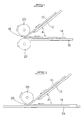
- Figure 1
- is a schematic view of a first variation of the method of the invention; and
- Figure 2
- is a schematic view of a second variation of the method of the invention.
- The crux of the invention is that an article is formed from a composite of a facing sheet of an acrylic material and a backing sheet of a thermoplastic material other than an acrylic material in a single moulding operation. In certain cases the resulting product is fully separable into its component parts for recycling.
- The method of the invention will now be described in more detail.
- A facing sheet of an acrylic material and a similar size sheet of a thermoplastic material other than an acrylic material are both heated to a temperature within the vacuum forming range, preferably a temperature of from 135°C to 195°C inclusive, more preferably at a temperature of from 155°C to 175°C inclusive, in, for example, a recirculating hot air oven. or by radiant heat or any other method.
- Thereafter, the facing sheet and the backing sheet are brought together between a nip, for example between a pair of rollers or between a roller and a flat bed, at an angle such that any air or gas trapped or evolved between the two sheets is excluded.
- Referring to Figure 1, a first variation of the method of the invention is illustrated in which a heated facing
sheet 10 is fed along asupport surface 12 and a heatedbacking sheet 14 is fed along asupport surface 16 to anip 18 between afirst roller 20 and asecond roller 22 to bring thesheets sheets 10. 14 is excluded. - Referring to Figure 2 there is shown a second variation of the method of the invention in which a heated facing
sheet 10 supported on asupport surface 12 and a heatedbacking sheet 14 supported on aflat bed 24 are brought together between anip 26 between theflat bed 24 and aroller 28. Again the angle of lamination indicated by the arrow A is between 35° and 45°. - The
rollers roller 28 andflat bed 24 may be hand fed or motorised. Only a low pressure is required at thenip nip roller - Generally, the
lower roller 22 or theflat bed 24 must be formed of a material to which the backing sheet of a thermoplastic material will not stick, for example metal plating, polytetrafluoroethylene, or a bed of a wood based particle board. - The
upper roller - An unexpected feature of the method of the invention is that the finish and nature of the
upper roller roller - When the rollers and/or flat bed are made of a thermally conductive material, the rollers and flat bed may also be provided with heating to minimise heat loss from the facing sheet and the backing sheet. Temperatures of from 30°C to about 100°C may be used. It is however not necessary to heat the rollers or flat bed and thus these may be made of thermally non-conductive materials such as for example timber.
- The angle of lamination, i.e the angle at which the facing sheet and the backing sheet are brought together at the nip must be sufficient to permit the exclusion of any air or gas trapped or evolved between the two sheets. Typically an angle of from 35° to 45° inclusive has been found to be suitable, but an angle of up to 90° may be used.
- It is preferred that touching of the facing sheet and the backing sheet prior to the nip is avoided, and the support surfaces or
beds - Once the composite has been formed, the composite is placed in a vacuum forming mould and suitable conditions of pressure are applied to mould the article from the composite. The conditions of pressure utilised are those which are conventional for vacuum forming.
- For example, the pressure or vacuum to be used is a pressure or vacuum conventionally used in vacuum forming or moulding, preferably a vacuum of 30kPa.g. upwards, more preferably a vacuum of about 77kPa.g.
- The formation of the moulding results from the vacuum created on the underside of the sheets, at the atmospheric pressure, pushing the softened sheets down into the mould.
- In some cases a positive air pressure may be used rather than a vacuum. In such cases, pressures are up to 3 kg/cm2 for a free blown dome. If the moulding is to be forced into a specific mould shape, there is potential to use higher pressures up to about 7 kg/cm2.
- There is no need for further heating of the composite and in fact further heating may be deleterious as there would be a danger of gas evolution between the sheets of the composite.
- The method of the invention may be used to make articles from a facing sheet of an acrylic material of a wide range of thicknesses, typically, but not limited to from 2mm to 10mm inclusive, and from a backing sheet again with a wide range of thicknesses, typically, but not limited to from 2mm to 10mm inclusive. Such differing thicknesses may be utilised in specific formed articles to meet the requirements of differing standard test methods or service requirements.
- Further, as the facing sheet and the backing sheet are separate prior to formation of the composite, the method of the invention allows great flexibility of production. A combination of differing colours and textures is easily and flexibly possible so as to provide for cosmetic variation of the final product.
- The method of the invention may also be used with an acrylic material with a wide range of molecular weights, both with and without crosslinking, so that the articles may be made faced with for example sanitaryware grade high molecular weight cross-linked acrylic material or an easy shaping grade low molecular weight acrylic material. Bonding of such acrylic materials to the backing sheet is satisfactory over the range of materials.
- The composite may he vacuum formed by conventional means to produce, in essentially a single operation, a finished article of acrylic, reinforced with a backing sheet.
- The method of the invention is not limited to the use of two layers of material. Thus, for example, three or more layers may he simultaneously bonded by the same method, to produce an article consisting of a composite of for example a sheet of an acrylic material, then a sheet of a thermoplastic material other than an acrylic material, and then a further sheet of an acrylic material, so that both sides of the article have a show face of an acrylic material, with an internal reinforcement of a thermoplastic material.
- Examples of suitable thermoplastic materials are ABS, PVC, polypropylene and polycarbonate, with the preferred material being ABS.
- Examples of suitable acrylic materials are cell cast polymethylmethacrylate, both crosslinked and non-crosslinked, extruded polymethylmethacrylate. band cast polymethylmethacrylate, both crosslinked and non-crosslinked.
- Typical articles which may be made by the method of the invention includes shower trays, sinks, bowls, basins, baths and other items of sanitaryware. Other items which may be manufactured by the method of the invention include vanity tops.
- An important feature of the method of the invention is that when an article made by the method of the invention is reheated to a temperature of approximately 175°C to 185°C at the end of its lifespan the facing sheet and the backing sheet deform to revert back to essentially a flat sheet form because of the thermo-elastic memory of the acrylic material. The two sheets may then be mechanically parted and individually recycled by existing technology. For example when the backing sheet is ABS, a cellular layer is formed at the acrylic/ABS interface, thus giving a weak point "parting line" when the sheets are mechanically peeled apart. Further, for example, the acrylic material may he recycled to methylmethacrylate monomer for reconversion back into an acrylic material and. when the hacking material is ABS, the ABS may be reground as granules for blending with virgin ABS.
- The method of the invention has various advantages. These include the fact that the method is environmentally friendly and exhibits high level of recyclability; unexpectedly, the method produces a cosmetically acceptable finish on the acrylic facing of the article with no roller marking; the method is versatile and flexible; the method utilises low cost technology and uses existing sheet production machinery and plant and existing vacuum forming tooling; the method permits the elimination of environmentally unfriendly GRP as a backing material; the method results in articles with an improved cosmetic appearance; and the method results in the production of articles as an essentially one step operation, reducing production costs and plant requirements.
- An example of the invention will now be given.
- A double howl sink unit was made, utilising a 3mm sanitaryware crosslinked cell cast acrylic with a satin finish cosmetic facing and 7mm ABS. The two sheets were heated to 175°C for 20 minutes in a radiant heat oven set at 185°C. Upon removal from the oven, the sheets were passed between a set of two rollers powered by a reduction geared electric motor and set at a nip gap of 8.8mm. On emerging from the rollers the bonded composite was clamped to a vacuum forming mould and vacuum applied to 30k Pa.g. The composite sheet formed into the mould, giving a full form into the mould corners and excellent definition. On cooling (assisted by fans) to 80°C the forming was removed from the mould, edge trimmed and drain holes drilled, thus completing the manufacture of the sink unit.
- Subsequent service tests, for example to the requirements of ANSI Z 124,6 - 1990, showed excellent results.
- It is noted that a plug assist to the formation of a sink bowl or bath gives particular advantage when vacuum forming these composites as it results in a greatly enhanced composite thickness in the base of the bowl or bath compared to unassisted vacuum forming. Increases of 50-70%, have been noted. In addition, against expectations, this plug assist proved not to cosmetically mar the acrylic surface, even when made from a rough. unheated timber composite, and for the same reason that the original roller bonding operation does not mark the acrylic surface - the acrylic's thermo-elastic memory combined with the vacuum operation.
Claims (6)
- A method of making an article of sanitary ware from a composite of a facing sheet (10) of an acrylic material and a backing sheet (14) of a thermoplastic material other than an acrylic material, the method including the steps of:(a) heating each of the facing sheet (10) and the backing sheet (14) to a temperature within the vacuum forming range;(b) after step (a) bringing the facing sheet (10) and the backing sheet (14) together between a nip (18) to exclude any gasses trapped or formed between the two sheets (10, 14) and to bond the two sheets (10, 14) together to form the composite; and(c) placing the composite in a vacuum forming mould and applying suitable conditions of pressure to mould the article from the composite.
- A method according to claim 1 wherein the backing sheet (14) is a sheet of ABS.
- A method according to claim 1 wherein the backing sheet (14) is a sheet of polyvinyl chloride, polypropylene or polycarbonate.
- A method according to any one of claims 1 to 3 wherein in step (a) the facing sheet (10) and the backing sheet (14) are both heated to a temperature of from 135°C to 195°C inclusive.
- A method according to any one of claims 1 to 4 wherein in step (b) the facing sheet (10) and the backing sheet (14) are brought together between a nip (18) between two rollers (20,22) or between a roller (28) and a flat bed (24), at an angle between 35 ° and 45 ° inclusive.
- A method according to any one of claims 1 to 5 wherein in step (c) the composite is placed in a vacuum forming mould and a vacuum of 30kPa.g or greater is applied to mould the article from the composite.
Applications Claiming Priority (3)
| Application Number | Priority Date | Filing Date | Title |
|---|---|---|---|
| ZA979987 | 1997-11-06 | ||
| ZA9709987 | 1997-11-06 | ||
| PCT/GB1998/003323 WO1999024237A1 (en) | 1997-11-06 | 1998-11-05 | Method of making an acrylic article |
Publications (2)
| Publication Number | Publication Date |
|---|---|
| EP1028840A1 EP1028840A1 (en) | 2000-08-23 |
| EP1028840B1 true EP1028840B1 (en) | 2002-10-02 |
Family
ID=25586694
Family Applications (1)
| Application Number | Title | Priority Date | Filing Date |
|---|---|---|---|
| EP98952863A Expired - Lifetime EP1028840B1 (en) | 1997-11-06 | 1998-11-05 | Method of making an acrylic article |
Country Status (7)
| Country | Link |
|---|---|
| EP (1) | EP1028840B1 (en) |
| AT (1) | ATE225247T1 (en) |
| AU (1) | AU1041199A (en) |
| CA (1) | CA2308562A1 (en) |
| DE (1) | DE69808504T2 (en) |
| ES (1) | ES2184329T3 (en) |
| WO (1) | WO1999024237A1 (en) |
Cited By (1)
| Publication number | Priority date | Publication date | Assignee | Title |
|---|---|---|---|---|
| EP2653282A1 (en) * | 2012-04-20 | 2013-10-23 | New Bath | Method for producing a sheet of composite material |
Family Cites Families (9)
| Publication number | Priority date | Publication date | Assignee | Title |
|---|---|---|---|---|
| GB2153287B (en) * | 1984-01-25 | 1988-10-26 | Unilever Plc | Containers |
| JPS60157838A (en) * | 1984-01-27 | 1985-08-19 | Meiwa Sangyo Kk | Method for producing molded body of thermoformable material sheet |
| US4931121A (en) * | 1985-05-23 | 1990-06-05 | The Dow Chemical Company | Process for forming a plastic article from a plurality of layers of thermoplastic material |
| JPS63233824A (en) * | 1987-03-23 | 1988-09-29 | Nippon Steel Corp | Method for preventing air from being entrapped during manufacture of laminated steel plate |
| US4892700A (en) * | 1987-10-07 | 1990-01-09 | Polycast Technology Corporation | Process for making multilayered, formable laminates |
| FR2661364B1 (en) * | 1990-04-27 | 1992-07-24 | Technoplast | PROCESS FOR PRODUCING A SHEET OF A COMPOSITE MATERIAL COMPRISING A PLATE OF MOLTEN METHYL POLYMETHACRYLATE JOINED WITH A THERMOPLASTIC SUPPORT LAYER AND PRODUCTS OBTAINED. |
| US5069851A (en) * | 1990-07-09 | 1991-12-03 | Aristech Chemical Corporation | ABS/Acrylic lamination process |
| DE9210508U1 (en) * | 1992-08-06 | 1992-11-26 | Targor GmbH, 55116 Mainz | Composite panel |
| US5308425A (en) * | 1992-10-22 | 1994-05-03 | Aristech Chemical Corporation | Method of making crosslinked acrylic sheet with enhanced vacuum molding attributes |
-
1998
- 1998-11-05 AU AU10411/99A patent/AU1041199A/en not_active Abandoned
- 1998-11-05 AT AT98952863T patent/ATE225247T1/en not_active IP Right Cessation
- 1998-11-05 CA CA002308562A patent/CA2308562A1/en not_active Abandoned
- 1998-11-05 DE DE69808504T patent/DE69808504T2/en not_active Expired - Lifetime
- 1998-11-05 ES ES98952863T patent/ES2184329T3/en not_active Expired - Lifetime
- 1998-11-05 WO PCT/GB1998/003323 patent/WO1999024237A1/en not_active Ceased
- 1998-11-05 EP EP98952863A patent/EP1028840B1/en not_active Expired - Lifetime
Cited By (2)
| Publication number | Priority date | Publication date | Assignee | Title |
|---|---|---|---|---|
| EP2653282A1 (en) * | 2012-04-20 | 2013-10-23 | New Bath | Method for producing a sheet of composite material |
| FR2989616A1 (en) * | 2012-04-20 | 2013-10-25 | New Bath | METHOD FOR MANUFACTURING A SHEET OF A COMPOSITE MATERIAL |
Also Published As
| Publication number | Publication date |
|---|---|
| WO1999024237A1 (en) | 1999-05-20 |
| ES2184329T3 (en) | 2003-04-01 |
| AU1041199A (en) | 1999-05-31 |
| ATE225247T1 (en) | 2002-10-15 |
| CA2308562A1 (en) | 1999-05-20 |
| DE69808504D1 (en) | 2002-11-07 |
| EP1028840A1 (en) | 2000-08-23 |
| DE69808504T2 (en) | 2003-06-26 |
Similar Documents
| Publication | Publication Date | Title |
|---|---|---|
| US4263247A (en) | Resin-foam laminate | |
| EP0380587B1 (en) | Multilayered formable composite laminates and method of making same | |
| JP3022926B2 (en) | ABS / acrylic lamination method | |
| JP2004534667A (en) | Manufacturing method of plastic glass | |
| EP0466179B1 (en) | Multilayer molded article and method for producing the same | |
| AU598719B1 (en) | Thermoformable decorative rigid lamina for interiors of transportation vehicles | |
| US3454457A (en) | Fabricated caul plate | |
| DK162513B (en) | LAMINATED PLATE OF POLYMETHYL METHACRYLATE AND ARTICLES MANUFACTURED THEREOF | |
| CA2308562A1 (en) | Method of making an acrylic article | |
| US6280836B1 (en) | Multilayer molded article | |
| JP2004098343A (en) | Decorative sheet and manufacturing method for decorative frp molded product | |
| JP2612731B2 (en) | Manufacturing method of laminated skin material | |
| JP2000043094A (en) | Injection molding simultaneous painting transfer sheet and injection molding simultaneous painting method | |
| GB2041292A (en) | Formed parts made of a combination of thermo-formable double sheet and a thermo-formable sheet of cross-linked polyethylene foam | |
| JPH1120017A (en) | Multilayer molded article having fiber reinforced thermoplastic resin layer and molding method | |
| CA2086246C (en) | Multilayer molded article and method for producing the same | |
| JPH0222031A (en) | Vacuum molding of both sides of laminated sheet | |
| JPH06114877A (en) | Molded article manufacturing method | |
| JP2556533Y2 (en) | Resin skin material | |
| JPS60157838A (en) | Method for producing molded body of thermoformable material sheet | |
| JP2747478B2 (en) | Paintless film | |
| KR20000071799A (en) | Method for producing multi-layer resin molded article | |
| JPH0380610B2 (en) | ||
| JPH1024497A (en) | Housing installation member and manufacture thereof | |
| JPH08156084A (en) | Molded article manufacturing method |
Legal Events
| Date | Code | Title | Description |
|---|---|---|---|
| PUAI | Public reference made under article 153(3) epc to a published international application that has entered the european phase |
Free format text: ORIGINAL CODE: 0009012 |
|
| 17P | Request for examination filed |
Effective date: 20000511 |
|
| AK | Designated contracting states |
Kind code of ref document: A1 Designated state(s): AT BE CH CY DE DK ES FI FR GB GR IE IT LI LU MC NL PT SE |
|
| 17Q | First examination report despatched |
Effective date: 20010227 |
|
| GRAG | Despatch of communication of intention to grant |
Free format text: ORIGINAL CODE: EPIDOS AGRA |
|
| GRAG | Despatch of communication of intention to grant |
Free format text: ORIGINAL CODE: EPIDOS AGRA |
|
| GRAH | Despatch of communication of intention to grant a patent |
Free format text: ORIGINAL CODE: EPIDOS IGRA |
|
| GRAH | Despatch of communication of intention to grant a patent |
Free format text: ORIGINAL CODE: EPIDOS IGRA |
|
| GRAA | (expected) grant |
Free format text: ORIGINAL CODE: 0009210 |
|
| RAP1 | Party data changed (applicant data changed or rights of an application transferred) |
Owner name: LUCITE INTERNATIONAL UK LIMITED |
|
| AK | Designated contracting states |
Kind code of ref document: B1 Designated state(s): AT BE CH CY DE DK ES FI FR GB GR IE IT LI LU MC NL PT SE |
|
| PG25 | Lapsed in a contracting state [announced via postgrant information from national office to epo] |
Ref country code: NL Free format text: LAPSE BECAUSE OF FAILURE TO SUBMIT A TRANSLATION OF THE DESCRIPTION OR TO PAY THE FEE WITHIN THE PRESCRIBED TIME-LIMIT Effective date: 20021002 Ref country code: LI Free format text: LAPSE BECAUSE OF FAILURE TO SUBMIT A TRANSLATION OF THE DESCRIPTION OR TO PAY THE FEE WITHIN THE PRESCRIBED TIME-LIMIT Effective date: 20021002 Ref country code: GR Free format text: LAPSE BECAUSE OF FAILURE TO SUBMIT A TRANSLATION OF THE DESCRIPTION OR TO PAY THE FEE WITHIN THE PRESCRIBED TIME-LIMIT Effective date: 20021002 Ref country code: FI Free format text: LAPSE BECAUSE OF FAILURE TO SUBMIT A TRANSLATION OF THE DESCRIPTION OR TO PAY THE FEE WITHIN THE PRESCRIBED TIME-LIMIT Effective date: 20021002 Ref country code: CH Free format text: LAPSE BECAUSE OF FAILURE TO SUBMIT A TRANSLATION OF THE DESCRIPTION OR TO PAY THE FEE WITHIN THE PRESCRIBED TIME-LIMIT Effective date: 20021002 Ref country code: BE Free format text: LAPSE BECAUSE OF FAILURE TO SUBMIT A TRANSLATION OF THE DESCRIPTION OR TO PAY THE FEE WITHIN THE PRESCRIBED TIME-LIMIT Effective date: 20021002 Ref country code: AT Free format text: LAPSE BECAUSE OF FAILURE TO SUBMIT A TRANSLATION OF THE DESCRIPTION OR TO PAY THE FEE WITHIN THE PRESCRIBED TIME-LIMIT Effective date: 20021002 |
|
| REF | Corresponds to: |
Ref document number: 225247 Country of ref document: AT Date of ref document: 20021015 Kind code of ref document: T |
|
| REG | Reference to a national code |
Ref country code: GB Ref legal event code: FG4D |
|
| REG | Reference to a national code |
Ref country code: CH Ref legal event code: EP |
|
| REG | Reference to a national code |
Ref country code: IE Ref legal event code: FG4D |
|
| PG25 | Lapsed in a contracting state [announced via postgrant information from national office to epo] |
Ref country code: LU Free format text: LAPSE BECAUSE OF NON-PAYMENT OF DUE FEES Effective date: 20021105 Ref country code: IE Free format text: LAPSE BECAUSE OF NON-PAYMENT OF DUE FEES Effective date: 20021105 |
|
| REF | Corresponds to: |
Ref document number: 69808504 Country of ref document: DE Date of ref document: 20021107 |
|
| PG25 | Lapsed in a contracting state [announced via postgrant information from national office to epo] |
Ref country code: CY Free format text: LAPSE BECAUSE OF FAILURE TO SUBMIT A TRANSLATION OF THE DESCRIPTION OR TO PAY THE FEE WITHIN THE PRESCRIBED TIME-LIMIT Effective date: 20021130 |
|
| PG25 | Lapsed in a contracting state [announced via postgrant information from national office to epo] |
Ref country code: SE Free format text: LAPSE BECAUSE OF FAILURE TO SUBMIT A TRANSLATION OF THE DESCRIPTION OR TO PAY THE FEE WITHIN THE PRESCRIBED TIME-LIMIT Effective date: 20030102 Ref country code: PT Free format text: LAPSE BECAUSE OF FAILURE TO SUBMIT A TRANSLATION OF THE DESCRIPTION OR TO PAY THE FEE WITHIN THE PRESCRIBED TIME-LIMIT Effective date: 20030102 Ref country code: DK Free format text: LAPSE BECAUSE OF FAILURE TO SUBMIT A TRANSLATION OF THE DESCRIPTION OR TO PAY THE FEE WITHIN THE PRESCRIBED TIME-LIMIT Effective date: 20030102 |
|
| NLV1 | Nl: lapsed or annulled due to failure to fulfill the requirements of art. 29p and 29m of the patents act | ||
| REG | Reference to a national code |
Ref country code: ES Ref legal event code: FG2A Ref document number: 2184329 Country of ref document: ES Kind code of ref document: T3 |
|
| ET | Fr: translation filed | ||
| REG | Reference to a national code |
Ref country code: CH Ref legal event code: PL |
|
| PG25 | Lapsed in a contracting state [announced via postgrant information from national office to epo] |
Ref country code: MC Free format text: LAPSE BECAUSE OF NON-PAYMENT OF DUE FEES Effective date: 20030601 |
|
| PLBI | Opposition filed |
Free format text: ORIGINAL CODE: 0009260 |
|
| PLBQ | Unpublished change to opponent data |
Free format text: ORIGINAL CODE: EPIDOS OPPO |
|
| 26 | Opposition filed |
Opponent name: ROEHM GMBH Effective date: 20030623 |
|
| PLAX | Notice of opposition and request to file observation + time limit sent |
Free format text: ORIGINAL CODE: EPIDOSNOBS2 |
|
| REG | Reference to a national code |
Ref country code: IE Ref legal event code: MM4A |
|
| PLAX | Notice of opposition and request to file observation + time limit sent |
Free format text: ORIGINAL CODE: EPIDOSNOBS2 |
|
| PLBB | Reply of patent proprietor to notice(s) of opposition received |
Free format text: ORIGINAL CODE: EPIDOSNOBS3 |
|
| PLCK | Communication despatched that opposition was rejected |
Free format text: ORIGINAL CODE: EPIDOSNREJ1 |
|
| PLBN | Opposition rejected |
Free format text: ORIGINAL CODE: 0009273 |
|
| STAA | Information on the status of an ep patent application or granted ep patent |
Free format text: STATUS: OPPOSITION REJECTED |
|
| 27O | Opposition rejected |
Effective date: 20060110 |
|
| REG | Reference to a national code |
Ref country code: FR Ref legal event code: PLFP Year of fee payment: 18 |
|
| PGFP | Annual fee paid to national office [announced via postgrant information from national office to epo] |
Ref country code: GB Payment date: 20151118 Year of fee payment: 18 Ref country code: DE Payment date: 20151119 Year of fee payment: 18 Ref country code: IT Payment date: 20151124 Year of fee payment: 18 |
|
| PGFP | Annual fee paid to national office [announced via postgrant information from national office to epo] |
Ref country code: ES Payment date: 20151111 Year of fee payment: 18 Ref country code: FR Payment date: 20151119 Year of fee payment: 18 |
|
| REG | Reference to a national code |
Ref country code: DE Ref legal event code: R119 Ref document number: 69808504 Country of ref document: DE |
|
| GBPC | Gb: european patent ceased through non-payment of renewal fee |
Effective date: 20161105 |
|
| REG | Reference to a national code |
Ref country code: FR Ref legal event code: ST Effective date: 20170731 |
|
| PG25 | Lapsed in a contracting state [announced via postgrant information from national office to epo] |
Ref country code: FR Free format text: LAPSE BECAUSE OF NON-PAYMENT OF DUE FEES Effective date: 20161130 Ref country code: IT Free format text: LAPSE BECAUSE OF NON-PAYMENT OF DUE FEES Effective date: 20161105 |
|
| PG25 | Lapsed in a contracting state [announced via postgrant information from national office to epo] |
Ref country code: GB Free format text: LAPSE BECAUSE OF NON-PAYMENT OF DUE FEES Effective date: 20161105 Ref country code: DE Free format text: LAPSE BECAUSE OF NON-PAYMENT OF DUE FEES Effective date: 20170601 |
|
| PG25 | Lapsed in a contracting state [announced via postgrant information from national office to epo] |
Ref country code: ES Free format text: LAPSE BECAUSE OF FAILURE TO SUBMIT A TRANSLATION OF THE DESCRIPTION OR TO PAY THE FEE WITHIN THE PRESCRIBED TIME-LIMIT Effective date: 20021002 |
|
| REG | Reference to a national code |
Ref country code: ES Ref legal event code: FD2A Effective date: 20181114 |
|
| RIC2 | Information provided on ipc code assigned after grant |
Ipc: B32B 31/20 19680901ALI19990528BHEP Ipc: B29K 33/04 20060101ALN19990528BHEP Ipc: B29C 51/14 20060101AFI19990528BHEP |
|
| PG25 | Lapsed in a contracting state [announced via postgrant information from national office to epo] |
Ref country code: ES Free format text: LAPSE BECAUSE OF FAILURE TO SUBMIT A TRANSLATION OF THE DESCRIPTION OR TO PAY THE FEE WITHIN THE PRESCRIBED TIME-LIMIT Effective date: 20161106 |