EP1027479B1 - Method for cathodic protection of reinforced concrete - Google Patents
Method for cathodic protection of reinforced concrete Download PDFInfo
- Publication number
- EP1027479B1 EP1027479B1 EP98949254A EP98949254A EP1027479B1 EP 1027479 B1 EP1027479 B1 EP 1027479B1 EP 98949254 A EP98949254 A EP 98949254A EP 98949254 A EP98949254 A EP 98949254A EP 1027479 B1 EP1027479 B1 EP 1027479B1
- Authority
- EP
- European Patent Office
- Prior art keywords
- concrete
- mat
- conductive
- bands
- wires
- Prior art date
- Legal status (The legal status is an assumption and is not a legal conclusion. Google has not performed a legal analysis and makes no representation as to the accuracy of the status listed.)
- Expired - Lifetime
Links
- 238000000034 method Methods 0.000 title claims abstract description 16
- 238000004210 cathodic protection Methods 0.000 title claims abstract description 14
- 239000011150 reinforced concrete Substances 0.000 title claims abstract description 5
- 239000004567 concrete Substances 0.000 claims abstract description 40
- 239000004020 conductor Substances 0.000 claims abstract description 21
- 230000002787 reinforcement Effects 0.000 claims abstract description 13
- VEXZGXHMUGYJMC-UHFFFAOYSA-M Chloride anion Chemical compound [Cl-] VEXZGXHMUGYJMC-UHFFFAOYSA-M 0.000 claims abstract description 11
- 238000000605 extraction Methods 0.000 claims abstract description 8
- 238000003825 pressing Methods 0.000 claims abstract 3
- 238000007664 blowing Methods 0.000 claims abstract 2
- 238000009940 knitting Methods 0.000 claims abstract 2
- 238000009941 weaving Methods 0.000 claims abstract 2
- OKTJSMMVPCPJKN-UHFFFAOYSA-N Carbon Chemical compound [C] OKTJSMMVPCPJKN-UHFFFAOYSA-N 0.000 claims description 10
- 229910052751 metal Inorganic materials 0.000 claims description 10
- 239000002184 metal Substances 0.000 claims description 10
- 229910052799 carbon Inorganic materials 0.000 claims description 5
- 229910002804 graphite Inorganic materials 0.000 claims description 5
- 239000010439 graphite Substances 0.000 claims description 5
- RTAQQCXQSZGOHL-UHFFFAOYSA-N Titanium Chemical compound [Ti] RTAQQCXQSZGOHL-UHFFFAOYSA-N 0.000 claims description 4
- 239000010936 titanium Substances 0.000 claims description 4
- 229910052719 titanium Inorganic materials 0.000 claims description 4
- 239000011378 shotcrete Substances 0.000 claims description 2
- 239000004568 cement Substances 0.000 claims 1
- 239000003973 paint Substances 0.000 claims 1
- 239000002002 slurry Substances 0.000 claims 1
- 239000000463 material Substances 0.000 abstract description 9
- 230000002265 prevention Effects 0.000 abstract description 2
- 239000000835 fiber Substances 0.000 abstract 2
- 229920000049 Carbon (fiber) Polymers 0.000 abstract 1
- 239000004917 carbon fiber Substances 0.000 abstract 1
- 230000003405 preventing effect Effects 0.000 abstract 1
- 238000009826 distribution Methods 0.000 description 10
- 238000000576 coating method Methods 0.000 description 8
- 239000010410 layer Substances 0.000 description 6
- 239000011248 coating agent Substances 0.000 description 5
- 239000010405 anode material Substances 0.000 description 4
- 238000005260 corrosion Methods 0.000 description 4
- 230000007797 corrosion Effects 0.000 description 4
- 239000004744 fabric Substances 0.000 description 4
- 238000009415 formwork Methods 0.000 description 3
- 230000003449 preventive effect Effects 0.000 description 3
- 239000002253 acid Substances 0.000 description 2
- 230000015572 biosynthetic process Effects 0.000 description 2
- 238000005336 cracking Methods 0.000 description 2
- 238000002848 electrochemical method Methods 0.000 description 2
- 150000002500 ions Chemical class 0.000 description 2
- 239000007791 liquid phase Substances 0.000 description 2
- 238000012423 maintenance Methods 0.000 description 2
- 230000035515 penetration Effects 0.000 description 2
- 239000004593 Epoxy Substances 0.000 description 1
- 238000009825 accumulation Methods 0.000 description 1
- 230000009286 beneficial effect Effects 0.000 description 1
- 238000003763 carbonization Methods 0.000 description 1
- 230000015556 catabolic process Effects 0.000 description 1
- 239000001913 cellulose Substances 0.000 description 1
- 229920002678 cellulose Polymers 0.000 description 1
- 150000001805 chlorine compounds Chemical class 0.000 description 1
- 238000001035 drying Methods 0.000 description 1
- 230000005684 electric field Effects 0.000 description 1
- 230000005611 electricity Effects 0.000 description 1
- 239000000945 filler Substances 0.000 description 1
- 238000009434 installation Methods 0.000 description 1
- 230000007774 longterm Effects 0.000 description 1
- 238000004519 manufacturing process Methods 0.000 description 1
- 238000013508 migration Methods 0.000 description 1
- 230000005012 migration Effects 0.000 description 1
- 239000012071 phase Substances 0.000 description 1
- 229920002635 polyurethane Polymers 0.000 description 1
- 239000004814 polyurethane Substances 0.000 description 1
- 238000005096 rolling process Methods 0.000 description 1
- 229920006395 saturated elastomer Polymers 0.000 description 1
- 230000003068 static effect Effects 0.000 description 1
- 239000000126 substance Substances 0.000 description 1
- 239000002344 surface layer Substances 0.000 description 1
- 238000004381 surface treatment Methods 0.000 description 1
- XLYOFNOQVPJJNP-UHFFFAOYSA-N water Substances O XLYOFNOQVPJJNP-UHFFFAOYSA-N 0.000 description 1
Images

Classifications
-
- C—CHEMISTRY; METALLURGY
- C23—COATING METALLIC MATERIAL; COATING MATERIAL WITH METALLIC MATERIAL; CHEMICAL SURFACE TREATMENT; DIFFUSION TREATMENT OF METALLIC MATERIAL; COATING BY VACUUM EVAPORATION, BY SPUTTERING, BY ION IMPLANTATION OR BY CHEMICAL VAPOUR DEPOSITION, IN GENERAL; INHIBITING CORROSION OF METALLIC MATERIAL OR INCRUSTATION IN GENERAL
- C23F—NON-MECHANICAL REMOVAL OF METALLIC MATERIAL FROM SURFACE; INHIBITING CORROSION OF METALLIC MATERIAL OR INCRUSTATION IN GENERAL; MULTI-STEP PROCESSES FOR SURFACE TREATMENT OF METALLIC MATERIAL INVOLVING AT LEAST ONE PROCESS PROVIDED FOR IN CLASS C23 AND AT LEAST ONE PROCESS COVERED BY SUBCLASS C21D OR C22F OR CLASS C25
- C23F13/00—Inhibiting corrosion of metals by anodic or cathodic protection
- C23F13/02—Inhibiting corrosion of metals by anodic or cathodic protection cathodic; Selection of conditions, parameters or procedures for cathodic protection, e.g. of electrical conditions
- C23F13/06—Constructional parts, or assemblies of cathodic-protection apparatus
- C23F13/08—Electrodes specially adapted for inhibiting corrosion by cathodic protection; Manufacture thereof; Conducting electric current thereto
- C23F13/16—Electrodes characterised by the combination of the structure and the material
-
- C—CHEMISTRY; METALLURGY
- C04—CEMENTS; CONCRETE; ARTIFICIAL STONE; CERAMICS; REFRACTORIES
- C04B—LIME, MAGNESIA; SLAG; CEMENTS; COMPOSITIONS THEREOF, e.g. MORTARS, CONCRETE OR LIKE BUILDING MATERIALS; ARTIFICIAL STONE; CERAMICS; REFRACTORIES; TREATMENT OF NATURAL STONE
- C04B41/00—After-treatment of mortars, concrete, artificial stone or ceramics; Treatment of natural stone
- C04B41/009—After-treatment of mortars, concrete, artificial stone or ceramics; Treatment of natural stone characterised by the material treated
-
- C—CHEMISTRY; METALLURGY
- C04—CEMENTS; CONCRETE; ARTIFICIAL STONE; CERAMICS; REFRACTORIES
- C04B—LIME, MAGNESIA; SLAG; CEMENTS; COMPOSITIONS THEREOF, e.g. MORTARS, CONCRETE OR LIKE BUILDING MATERIALS; ARTIFICIAL STONE; CERAMICS; REFRACTORIES; TREATMENT OF NATURAL STONE
- C04B41/00—After-treatment of mortars, concrete, artificial stone or ceramics; Treatment of natural stone
- C04B41/45—Coating or impregnating, e.g. injection in masonry, partial coating of green or fired ceramics, organic coating compositions for adhering together two concrete elements
- C04B41/4505—Coating or impregnating, e.g. injection in masonry, partial coating of green or fired ceramics, organic coating compositions for adhering together two concrete elements characterised by the method of application
- C04B41/4564—Electrolytic or electrophoretic processes, e.g. electrochemical re-alkalisation of reinforced concrete
- C04B41/4566—Electrochemical re-alcalisation
-
- C—CHEMISTRY; METALLURGY
- C04—CEMENTS; CONCRETE; ARTIFICIAL STONE; CERAMICS; REFRACTORIES
- C04B—LIME, MAGNESIA; SLAG; CEMENTS; COMPOSITIONS THEREOF, e.g. MORTARS, CONCRETE OR LIKE BUILDING MATERIALS; ARTIFICIAL STONE; CERAMICS; REFRACTORIES; TREATMENT OF NATURAL STONE
- C04B41/00—After-treatment of mortars, concrete, artificial stone or ceramics; Treatment of natural stone
- C04B41/53—After-treatment of mortars, concrete, artificial stone or ceramics; Treatment of natural stone involving the removal of at least part of the materials of the treated article, e.g. etching, drying of hardened concrete
- C04B41/5369—Desalination, e.g. of reinforced concrete
- C04B41/5376—Electrochemical desalination
-
- C—CHEMISTRY; METALLURGY
- C04—CEMENTS; CONCRETE; ARTIFICIAL STONE; CERAMICS; REFRACTORIES
- C04B—LIME, MAGNESIA; SLAG; CEMENTS; COMPOSITIONS THEREOF, e.g. MORTARS, CONCRETE OR LIKE BUILDING MATERIALS; ARTIFICIAL STONE; CERAMICS; REFRACTORIES; TREATMENT OF NATURAL STONE
- C04B41/00—After-treatment of mortars, concrete, artificial stone or ceramics; Treatment of natural stone
- C04B41/60—After-treatment of mortars, concrete, artificial stone or ceramics; Treatment of natural stone of only artificial stone
- C04B41/61—Coating or impregnation
-
- C—CHEMISTRY; METALLURGY
- C04—CEMENTS; CONCRETE; ARTIFICIAL STONE; CERAMICS; REFRACTORIES
- C04B—LIME, MAGNESIA; SLAG; CEMENTS; COMPOSITIONS THEREOF, e.g. MORTARS, CONCRETE OR LIKE BUILDING MATERIALS; ARTIFICIAL STONE; CERAMICS; REFRACTORIES; TREATMENT OF NATURAL STONE
- C04B41/00—After-treatment of mortars, concrete, artificial stone or ceramics; Treatment of natural stone
- C04B41/60—After-treatment of mortars, concrete, artificial stone or ceramics; Treatment of natural stone of only artificial stone
- C04B41/72—After-treatment of mortars, concrete, artificial stone or ceramics; Treatment of natural stone of only artificial stone involving the removal of part of the materials of the treated articles, e.g. etching
-
- C—CHEMISTRY; METALLURGY
- C23—COATING METALLIC MATERIAL; COATING MATERIAL WITH METALLIC MATERIAL; CHEMICAL SURFACE TREATMENT; DIFFUSION TREATMENT OF METALLIC MATERIAL; COATING BY VACUUM EVAPORATION, BY SPUTTERING, BY ION IMPLANTATION OR BY CHEMICAL VAPOUR DEPOSITION, IN GENERAL; INHIBITING CORROSION OF METALLIC MATERIAL OR INCRUSTATION IN GENERAL
- C23F—NON-MECHANICAL REMOVAL OF METALLIC MATERIAL FROM SURFACE; INHIBITING CORROSION OF METALLIC MATERIAL OR INCRUSTATION IN GENERAL; MULTI-STEP PROCESSES FOR SURFACE TREATMENT OF METALLIC MATERIAL INVOLVING AT LEAST ONE PROCESS PROVIDED FOR IN CLASS C23 AND AT LEAST ONE PROCESS COVERED BY SUBCLASS C21D OR C22F OR CLASS C25
- C23F2201/00—Type of materials to be protected by cathodic protection
- C23F2201/02—Concrete, e.g. reinforced
Definitions
- the present invention relates to a method for cathodic protection, electrochemical chloride extraction and realkalisation of reinforced concrete, comprising the impressing of a direct voltage between the reinforcement in the concrete and a conductive device which is placed on the concrete surface.
- An additional beneficial effect of crack prevention is achieved by embedding the device in fresh concrete.
- Electrochemical methods are used ever-increasingly to protect the reinforcement against further corrosion.
- Methods used today include cathodic protection, chloride extraction and realkalisation.
- the principle common to these methods is that a direct voltage is impressed between the reinforcement, the cathode (negative pole), and various conductive devices which serve as the anode. This results in migration of ions in the concrete, formation of OH ions on the surface of the reinforcement or, in the case of cathodic protection, the potential is pressed into the passive area.
- the anode may, for instance, be made of metal wire, metal mesh or conductive coatings which are placed on the surface of the concrete and incorporated therein to varying degrees. It is also possible to drill holes in which anode rods are inserted.
- NO B 162427 describes an anode comprising several wires which are connected to each other to form a flexible open cloth or netting At least some of these wires are electrically conductive.
- the wires may be connected to each other in a variety of ways.
- this cloth or netting has a mesh size of at least 1.3 cm, preferably 5 cm, and that its fibres are not placed functionally in all directions. It also appears to be rather rigid in comparison with the present invention.
- this anode yields a clearly limited capacity as regards current distribution and long-term durability. Tests have shown that when a coarse-meshed netting is used, the carbon wires become visible on the surface at a relatively early stage due to acid formation. As is commonly known, a system of this kind is broken down when acid is formed, and in particular when substantial current density is required.
- GB A 2 175 609 describes an electrode having an enlarged area comprising one or more wires of valve metal in the form of a mesh, where the wires on the surface are provided with an anodic active layer. It is disclosed that the cloth may be woven or knitted, or that the wires may even be welded together.
- the material discussed in this publication is of a completely different type than the material used in the present invention. The material selection according to this publication results in a far more rigid product than that of the present invention.
- NO 960841 describes 1-10% dispersed carbon fibres in a saturated epoxy/polyurethane mass (in the liquid phase). Flocking of the fibres results in an inhomogeneous distribution of the fibres, even at a content noticeably lower than 10%.
- the present invention differs substantially from this in that the amount, thickness and distribution may be designed in a premanufactured mat. Reference is also made to tests where the mat is incorporated in conductive coatings of dispersed fibres (see below). In this case, the current flow increased by a factor of seven or more.
- the present invention provides a method of cathodic protection, electrochemical chloride extraction and realkalisation in reinforced concrete as defined in claim 1.
- the mat used according to the present invention may, for instance, be embedded in the concrete surface of a new structure in an exposed environment (see Figs. 2 and 3). It is then possible to choose whether the system will later be used, if necessary, as a preventive system or as cathodic protection (CP) and where the costs involved will be minimal.
- CP cathodic protection
- the term "preventive CP” is used to mean the use of a lower impressed voltage than in normal CP where the electrical field acts as a shield against chloride penetration. The system will also to a great extent prevent shrinkage cracks, which is a major problem in structures of newly placed concrete.
- the mat may also be used on existing structures where an electrically conductive material is placed on the surface of the structure (see Fig. 1).
- the solution according to the present invention will also prevent the outbreak of fire in the anode material, which, for example, is a problem when using cellulose pulp in realkalisation and chloride extraction.
- Embedment in fresh concrete allows the mat to be embedded so as to act as additional reinforcement in the surface layer of the concrete.
- the system is so thin and flexible that it is easy to shape according to the surface and incorporate in an electrically conductive material.
- the mat may also be embedded close to the surface in new structures which are built of fresh concrete or shotcrete and connected to serve as cathodic protection, should the need arise. It is also possible to use a lower voltage between the reinforcement and anode than in cathodic protection in order to produce a "shield" against chloride penetration for structures in particularly exposed areas. As is commonly known, the negatively charged chloride ions are repelled by the cathode and attracted to the anode, even at low voltages.
- the system would also be suitable for water drainage in concrete and for the removal of static electricity, as well as for surfaces where anti-static properties are required.
- the current distribution is extremely homogeneous on the surface in comparison with known systems. In practice the same potential will be measured between randomly selected points on the surface.
- the mat has such good conductivity on account of the short distance between the individual conductors allows a conductive anode material of much lower conductivity to be used. As a result, it is also possible to obtain a far higher current strength than in other systems with the same impressed voltage.
- Another remarkable advantage with the system is that there is no need for mechanical connections of intersecting current distribution bands on the structure.
- the intersecting fibres are highly stable in the face of chemical breakdown.
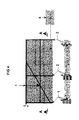
- Figure 1 shows an example of the use of the mat (3) having electric conductors (4) wherein a layer of conductive material (2) is first applied to existing surfaces (1) after the old concrete surface has been pretreated as necessary. The mat is then pressed into this layer. A spiked roller resembling a rolling wire brush may be used to ensure that the mat is well incorporated. Lastly, material is laid on top so as to obtain the necessary cover (5).
- Figure 2 shows the mat placed directly on the formwork (7) after this has been cleaned and finished. It can be secured to the formwork at several points by means of, for example, a stapling machine so that it does not float up to the reinforcement (6) during the placing and vibration of fresh concrete (1).
- Figure 3 shows the use of the mat on the surface of fresh concrete.
- the mat (3) may either be pressed into the fresh concrete prior to surface treatment or encased in a layer of concrete (5) in the finishing stages of the concreting, and in this case the aforementioned roller may also be used.
- the wet cover (5) may also consist of another conductive material.
- the mat may be placed in a material of good electrical conductivity, for example, a gel.
- a material of good electrical conductivity for example, a gel.
- the filler material is then alkaline.
- Figure 4 shows an example of how the electric conductors may be placed. These may consist of graphite strips or metal strips (titanium) (1), or pure graphite bands or bands having metal wires consisting of, for example, titanium or other conductive material (1), (2), (3) woven or spun therein. The bands and the wires may be placed over or under the mat or placed in the mat during the manufacture thereof. A normally resistant, insulated conductor may be used as the main electric conductor. Figure 4 also shows a section through the mat.
- the thickness and position of the mat on different elements in the same structure may vary according to need.
- the mat may be used as earth anode and may also be placed in many layers.
- Power supply to the mat may take place through metal/graphite bands or wires of the same materials or another material which may be over/under or in the mat. Distance and direction of the electric conductors will be determined on the basis of power requirements.
- the weight thereof will normally be at least 3 g, preferably 15g and most preferably 100 g/m 2 .
- Tests have also been carried out by placing the mat in fresh concrete which is liable to crack.
- the mat had an impressive crack preventive effect compared with references that had no mat.
Landscapes
- Chemical & Material Sciences (AREA)
- Engineering & Computer Science (AREA)
- Ceramic Engineering (AREA)
- Materials Engineering (AREA)
- Organic Chemistry (AREA)
- Structural Engineering (AREA)
- Electrochemistry (AREA)
- Metallurgy (AREA)
- Mechanical Engineering (AREA)
- Chemical Kinetics & Catalysis (AREA)
- Water Supply & Treatment (AREA)
- Prevention Of Electric Corrosion (AREA)
- Curing Cements, Concrete, And Artificial Stone (AREA)
- On-Site Construction Work That Accompanies The Preparation And Application Of Concrete (AREA)
- Road Paving Structures (AREA)
- Building Environments (AREA)
Applications Claiming Priority (3)
| Application Number | Priority Date | Filing Date | Title |
|---|---|---|---|
| NO974654 | 1997-10-09 | ||
| NO974654A NO305842B1 (no) | 1997-10-09 | 1997-10-09 | FremgangsmÕte for katodisk beskyttelse, elektrokjemisk kloriduttrekk og realkalisering i armert betong eller lignende materialer samt forsterkning og rissforebyggelse i betong |
| PCT/NO1998/000284 WO1999019540A1 (en) | 1997-10-09 | 1998-09-30 | Method for cathodic protection of reinforced concrete |
Publications (2)
| Publication Number | Publication Date |
|---|---|
| EP1027479A1 EP1027479A1 (en) | 2000-08-16 |
| EP1027479B1 true EP1027479B1 (en) | 2002-09-04 |
Family
ID=19901185
Family Applications (1)
| Application Number | Title | Priority Date | Filing Date |
|---|---|---|---|
| EP98949254A Expired - Lifetime EP1027479B1 (en) | 1997-10-09 | 1998-09-30 | Method for cathodic protection of reinforced concrete |
Country Status (11)
| Country | Link |
|---|---|
| US (1) | US6383364B1 (da) |
| EP (1) | EP1027479B1 (da) |
| AT (1) | ATE223519T1 (da) |
| AU (1) | AU739084B2 (da) |
| CA (1) | CA2305759C (da) |
| DE (1) | DE69807728T2 (da) |
| DK (1) | DK1027479T3 (da) |
| ES (1) | ES2181279T3 (da) |
| NO (1) | NO305842B1 (da) |
| PT (1) | PT1027479E (da) |
| WO (1) | WO1999019540A1 (da) |
Families Citing this family (13)
| Publication number | Priority date | Publication date | Assignee | Title |
|---|---|---|---|---|
| EP1318247A1 (de) * | 2001-12-07 | 2003-06-11 | Sika Schweiz AG | Betonstruktur |
| GB0129431D0 (en) * | 2001-12-08 | 2002-01-30 | Achilles Tech Ltd | Electrode structure for protection of structural bodies |
| CA2444638C (en) * | 2003-10-10 | 2008-11-25 | David W. Whitmore | Cathodic protection of steel within a covering material |
| AU2004279903B2 (en) * | 2003-10-10 | 2010-04-01 | David Whitmore | Cathodic protection of steel within a covering material |
| US9074288B2 (en) | 2011-07-12 | 2015-07-07 | Jarden Zinc Products, LLC | Galvanic panel with compliant construction |
| DE102015203398A1 (de) * | 2015-02-25 | 2016-08-25 | Koch GmbH | Verfahren zum Herstellen eines kathodischen Korrosionsschutzes zum Schutz von Bewehrungsstahl in einem Stahlbetonbauwerk |
| DE102015115297A1 (de) * | 2015-09-10 | 2017-03-16 | Koch GmbH | Verfahren zur Verlegung eines Anodensystems für einen kathodischen Korrosionsschutz |
| CN106637232B (zh) * | 2016-12-09 | 2018-11-02 | 北京工业大学 | 一种电化学萃取混凝土中氯离子的改进方法 |
| KR101988247B1 (ko) * | 2017-11-03 | 2019-06-12 | 한국건설기술연구원 | 양극금속선이 구비된 탄소섬유 텍스타일 보강재 및 이를 이용한 철근콘크리트 구조물의 보수보강 방법 |
| EP3640370A1 (de) * | 2018-10-17 | 2020-04-22 | Koch GmbH | Gelege mit primäranode |
| US11261530B2 (en) * | 2019-03-11 | 2022-03-01 | Prorbar, Inc. | Cathodic protection system and miniaturized constant current rectifier |
| GB2598800B (en) * | 2020-09-15 | 2025-02-12 | Ganjian Eshmaiel | Conductive coating anode for impressed current cathodic protection of reinforced concrete structures |
| CN115976523B (zh) * | 2022-12-28 | 2023-06-20 | 哈尔滨工业大学 | 一种钢混结构腐蚀电化学控制用多功能无线节点 |
Family Cites Families (3)
| Publication number | Priority date | Publication date | Assignee | Title |
|---|---|---|---|---|
| GB9015743D0 (en) * | 1990-07-17 | 1990-09-05 | Pithouse Kenneth B | The protection of cementitious material |
| GB9102892D0 (en) | 1991-02-12 | 1991-03-27 | Ici America Inc | Reinforced concrete system |
| GB9215502D0 (en) * | 1992-07-21 | 1992-09-02 | Ici Plc | Cathodic protection system and a coating and coating composition therefor |
-
1997
- 1997-10-09 NO NO974654A patent/NO305842B1/no not_active Application Discontinuation
-
1998
- 1998-09-30 US US09/529,001 patent/US6383364B1/en not_active Expired - Fee Related
- 1998-09-30 CA CA002305759A patent/CA2305759C/en not_active Expired - Fee Related
- 1998-09-30 ES ES98949254T patent/ES2181279T3/es not_active Expired - Lifetime
- 1998-09-30 DE DE69807728T patent/DE69807728T2/de not_active Expired - Fee Related
- 1998-09-30 EP EP98949254A patent/EP1027479B1/en not_active Expired - Lifetime
- 1998-09-30 PT PT98949254T patent/PT1027479E/pt unknown
- 1998-09-30 AT AT98949254T patent/ATE223519T1/de not_active IP Right Cessation
- 1998-09-30 DK DK98949254T patent/DK1027479T3/da active
- 1998-09-30 WO PCT/NO1998/000284 patent/WO1999019540A1/en not_active Ceased
- 1998-09-30 AU AU95611/98A patent/AU739084B2/en not_active Ceased
Also Published As
| Publication number | Publication date |
|---|---|
| DK1027479T3 (da) | 2003-01-06 |
| CA2305759A1 (en) | 1999-04-22 |
| US6383364B1 (en) | 2002-05-07 |
| NO974654L (no) | 1999-04-12 |
| DE69807728D1 (de) | 2002-10-10 |
| CA2305759C (en) | 2007-01-09 |
| DE69807728T2 (de) | 2003-08-14 |
| EP1027479A1 (en) | 2000-08-16 |
| AU9561198A (en) | 1999-05-03 |
| NO974654D0 (no) | 1997-10-09 |
| PT1027479E (pt) | 2003-01-31 |
| NO305842B1 (no) | 1999-08-02 |
| ES2181279T3 (es) | 2003-02-16 |
| AU739084B2 (en) | 2001-10-04 |
| ATE223519T1 (de) | 2002-09-15 |
| WO1999019540A1 (en) | 1999-04-22 |
Similar Documents
| Publication | Publication Date | Title |
|---|---|---|
| EP1027479B1 (en) | Method for cathodic protection of reinforced concrete | |
| US4600486A (en) | Electro-osmotic movement of polar liquid in a porous structural material | |
| US4319854A (en) | Moisture control method and means for pavements and bridge deck constructions | |
| JPS60149791A (ja) | 陰極防食 | |
| EP1144764A1 (en) | An electro kinetic geosynthetic structure | |
| CA2031123C (en) | Grid electrode having a tailored surface for cathodic protection of steel reinforced concrete structures | |
| IL104837A (en) | A method of electrochemical treatment for reinforcing steel in concrete in which steel reinforcements are planted | |
| US5538619A (en) | Electro-chemical method for minimizing or preventing corrosion of reinforcement in concrete | |
| US7763155B2 (en) | Electro-osmotic pulse (EOP) system for de-watering around manmade structures and method of use therefor | |
| DE4329219A1 (de) | Vorrichtung und Verfahren zur Entfeuchtung von Bauwerken | |
| GB2175609A (en) | Electrode | |
| WO1993021130A1 (en) | Method for inhibiting concrete cancer | |
| US5104502A (en) | Cathodic protection system and its preparation | |
| WO1992001824A1 (en) | The protection of cementitious material | |
| CA2469391A1 (en) | Electrode structure for protection of structural bodies | |
| KR100493901B1 (ko) | 콘크리트 접지전극 및 그 시공방법 | |
| US5200259A (en) | Fiber-filled concrete overlay in cathodic protection | |
| De Peuter et al. | New conductive overlay for CP in concrete: Results of long term testing | |
| CN221398065U (zh) | 一种海砂钢筋混凝土结构外加电流阴极防护系统阳极单元 | |
| JP2010222653A (ja) | コンクリート構造物の補強防食シートおよび補強防食施工方法 | |
| JP3280945B2 (ja) | 劣化コンクリートの修復方法および該方法に使用する電極パネル | |
| EP0564546A1 (de) | Verfahren zum sanieren von bauwerken mit in diesen eingebetteten metallteilen | |
| RU2151820C1 (ru) | Способ комплексной защиты от коррозии заглубленного изолированного сооружения | |
| KR0175102B1 (ko) | 현장 타설 콘크리트 말뚝의 지지력 보강방법 | |
| EP3640370A1 (de) | Gelege mit primäranode |
Legal Events
| Date | Code | Title | Description |
|---|---|---|---|
| PUAI | Public reference made under article 153(3) epc to a published international application that has entered the european phase |
Free format text: ORIGINAL CODE: 0009012 |
|
| 17P | Request for examination filed |
Effective date: 20000417 |
|
| AK | Designated contracting states |
Kind code of ref document: A1 Designated state(s): AT BE CH CY DE DK ES FI FR GB GR IE IT LI LU MC NL PT SE |
|
| 17Q | First examination report despatched |
Effective date: 20010402 |
|
| GRAG | Despatch of communication of intention to grant |
Free format text: ORIGINAL CODE: EPIDOS AGRA |
|
| GRAG | Despatch of communication of intention to grant |
Free format text: ORIGINAL CODE: EPIDOS AGRA |
|
| GRAH | Despatch of communication of intention to grant a patent |
Free format text: ORIGINAL CODE: EPIDOS IGRA |
|
| RAP1 | Party data changed (applicant data changed or rights of an application transferred) |
Owner name: OPTIROC AS |
|
| RIN1 | Information on inventor provided before grant (corrected) |
Inventor name: OPTIROC AS |
|
| GRAH | Despatch of communication of intention to grant a patent |
Free format text: ORIGINAL CODE: EPIDOS IGRA |
|
| GRAA | (expected) grant |
Free format text: ORIGINAL CODE: 0009210 |
|
| AK | Designated contracting states |
Kind code of ref document: B1 Designated state(s): AT BE CH CY DE DK ES FI FR GB GR IE IT LI LU MC NL PT SE |
|
| PG25 | Lapsed in a contracting state [announced via postgrant information from national office to epo] |
Ref country code: GR Free format text: LAPSE BECAUSE OF FAILURE TO SUBMIT A TRANSLATION OF THE DESCRIPTION OR TO PAY THE FEE WITHIN THE PRESCRIBED TIME-LIMIT Effective date: 20020904 |
|
| REF | Corresponds to: |
Ref document number: 223519 Country of ref document: AT Date of ref document: 20020915 Kind code of ref document: T |
|
| REG | Reference to a national code |
Ref country code: GB Ref legal event code: FG4D |
|
| REG | Reference to a national code |
Ref country code: CH Ref legal event code: NV Representative=s name: ISLER & PEDRAZZINI AG Ref country code: CH Ref legal event code: EP |
|
| PG25 | Lapsed in a contracting state [announced via postgrant information from national office to epo] |
Ref country code: LU Free format text: LAPSE BECAUSE OF NON-PAYMENT OF DUE FEES Effective date: 20020930 Ref country code: CY Free format text: LAPSE BECAUSE OF FAILURE TO SUBMIT A TRANSLATION OF THE DESCRIPTION OR TO PAY THE FEE WITHIN THE PRESCRIBED TIME-LIMIT Effective date: 20020930 |
|
| REG | Reference to a national code |
Ref country code: IE Ref legal event code: FG4D |
|
| REF | Corresponds to: |
Ref document number: 69807728 Country of ref document: DE Date of ref document: 20021010 |
|
| ET | Fr: translation filed | ||
| REG | Reference to a national code |
Ref country code: DK Ref legal event code: T3 |
|
| REG | Reference to a national code |
Ref country code: PT Ref legal event code: SC4A Free format text: AVAILABILITY OF NATIONAL TRANSLATION Effective date: 20021119 |
|
| REG | Reference to a national code |
Ref country code: ES Ref legal event code: FG2A Ref document number: 2181279 Country of ref document: ES Kind code of ref document: T3 |
|
| PG25 | Lapsed in a contracting state [announced via postgrant information from national office to epo] |
Ref country code: MC Free format text: LAPSE BECAUSE OF NON-PAYMENT OF DUE FEES Effective date: 20030401 |
|
| PLBE | No opposition filed within time limit |
Free format text: ORIGINAL CODE: 0009261 |
|
| STAA | Information on the status of an ep patent application or granted ep patent |
Free format text: STATUS: NO OPPOSITION FILED WITHIN TIME LIMIT |
|
| 26N | No opposition filed |
Effective date: 20030605 |
|
| PGFP | Annual fee paid to national office [announced via postgrant information from national office to epo] |
Ref country code: ES Payment date: 20060918 Year of fee payment: 9 |
|
| REG | Reference to a national code |
Ref country code: CH Ref legal event code: PCAR Free format text: ISLER & PEDRAZZINI AG;POSTFACH 1772;8027 ZUERICH (CH) |
|
| PGFP | Annual fee paid to national office [announced via postgrant information from national office to epo] |
Ref country code: PT Payment date: 20080904 Year of fee payment: 11 Ref country code: DK Payment date: 20080925 Year of fee payment: 11 Ref country code: CH Payment date: 20080916 Year of fee payment: 11 |
|
| PGFP | Annual fee paid to national office [announced via postgrant information from national office to epo] |
Ref country code: NL Payment date: 20080922 Year of fee payment: 11 Ref country code: IT Payment date: 20080922 Year of fee payment: 11 Ref country code: IE Payment date: 20080918 Year of fee payment: 11 Ref country code: FI Payment date: 20080918 Year of fee payment: 11 Ref country code: AT Payment date: 20080924 Year of fee payment: 11 |
|
| REG | Reference to a national code |
Ref country code: ES Ref legal event code: FD2A Effective date: 20071001 |
|
| PGFP | Annual fee paid to national office [announced via postgrant information from national office to epo] |
Ref country code: GB Payment date: 20080923 Year of fee payment: 11 |
|
| PGFP | Annual fee paid to national office [announced via postgrant information from national office to epo] |
Ref country code: DE Payment date: 20080917 Year of fee payment: 11 |
|
| REG | Reference to a national code |
Ref country code: ES Ref legal event code: FD2A Effective date: 20071001 |
|
| PGFP | Annual fee paid to national office [announced via postgrant information from national office to epo] |
Ref country code: SE Payment date: 20080918 Year of fee payment: 11 Ref country code: BE Payment date: 20080923 Year of fee payment: 11 |
|
| PG25 | Lapsed in a contracting state [announced via postgrant information from national office to epo] |
Ref country code: ES Free format text: LAPSE BECAUSE OF NON-PAYMENT OF DUE FEES Effective date: 20071001 |
|
| BERE | Be: lapsed |
Owner name: *OPTIROC A/S Effective date: 20090930 |
|
| REG | Reference to a national code |
Ref country code: PT Ref legal event code: MM4A Free format text: LAPSE DUE TO NON-PAYMENT OF FEES Effective date: 20100331 |
|
| REG | Reference to a national code |
Ref country code: NL Ref legal event code: V1 Effective date: 20100401 |
|
| PG25 | Lapsed in a contracting state [announced via postgrant information from national office to epo] |
Ref country code: PT Free format text: LAPSE BECAUSE OF NON-PAYMENT OF DUE FEES Effective date: 20100331 Ref country code: FI Free format text: LAPSE BECAUSE OF NON-PAYMENT OF DUE FEES Effective date: 20090930 |
|
| REG | Reference to a national code |
Ref country code: CH Ref legal event code: PL |
|
| REG | Reference to a national code |
Ref country code: DK Ref legal event code: EBP |
|
| GBPC | Gb: european patent ceased through non-payment of renewal fee |
Effective date: 20090930 |
|
| EUG | Se: european patent has lapsed | ||
| REG | Reference to a national code |
Ref country code: IE Ref legal event code: MM4A |
|
| PG25 | Lapsed in a contracting state [announced via postgrant information from national office to epo] |
Ref country code: AT Free format text: LAPSE BECAUSE OF NON-PAYMENT OF DUE FEES Effective date: 20090930 |
|
| PG25 | Lapsed in a contracting state [announced via postgrant information from national office to epo] |
Ref country code: NL Free format text: LAPSE BECAUSE OF NON-PAYMENT OF DUE FEES Effective date: 20100401 Ref country code: IE Free format text: LAPSE BECAUSE OF NON-PAYMENT OF DUE FEES Effective date: 20090930 Ref country code: DE Free format text: LAPSE BECAUSE OF NON-PAYMENT OF DUE FEES Effective date: 20100401 |
|
| PG25 | Lapsed in a contracting state [announced via postgrant information from national office to epo] |
Ref country code: BE Free format text: LAPSE BECAUSE OF NON-PAYMENT OF DUE FEES Effective date: 20090930 |
|
| PG25 | Lapsed in a contracting state [announced via postgrant information from national office to epo] |
Ref country code: LI Free format text: LAPSE BECAUSE OF NON-PAYMENT OF DUE FEES Effective date: 20090930 Ref country code: CH Free format text: LAPSE BECAUSE OF NON-PAYMENT OF DUE FEES Effective date: 20090930 |
|
| PG25 | Lapsed in a contracting state [announced via postgrant information from national office to epo] |
Ref country code: GB Free format text: LAPSE BECAUSE OF NON-PAYMENT OF DUE FEES Effective date: 20090930 |
|
| PG25 | Lapsed in a contracting state [announced via postgrant information from national office to epo] |
Ref country code: DK Free format text: LAPSE BECAUSE OF NON-PAYMENT OF DUE FEES Effective date: 20090930 |
|
| PG25 | Lapsed in a contracting state [announced via postgrant information from national office to epo] |
Ref country code: IT Free format text: LAPSE BECAUSE OF NON-PAYMENT OF DUE FEES Effective date: 20090930 |
|
| PG25 | Lapsed in a contracting state [announced via postgrant information from national office to epo] |
Ref country code: SE Free format text: LAPSE BECAUSE OF NON-PAYMENT OF DUE FEES Effective date: 20091001 |
|
| REG | Reference to a national code |
Ref country code: FR Ref legal event code: ST Effective date: 20110531 |
|
| PG25 | Lapsed in a contracting state [announced via postgrant information from national office to epo] |
Ref country code: FR Free format text: LAPSE BECAUSE OF NON-PAYMENT OF DUE FEES Effective date: 20100930 |
|
| PGFP | Annual fee paid to national office [announced via postgrant information from national office to epo] |
Ref country code: FR Payment date: 20090916 Year of fee payment: 12 |