EP1027409B2 - Blended compression-ignition fuel containing light synthetic crude and blending stock - Google Patents
Blended compression-ignition fuel containing light synthetic crude and blending stock Download PDFInfo
- Publication number
- EP1027409B2 EP1027409B2 EP98956227A EP98956227A EP1027409B2 EP 1027409 B2 EP1027409 B2 EP 1027409B2 EP 98956227 A EP98956227 A EP 98956227A EP 98956227 A EP98956227 A EP 98956227A EP 1027409 B2 EP1027409 B2 EP 1027409B2
- Authority
- EP
- European Patent Office
- Prior art keywords
- mass
- syncrude
- pour point
- diesel
- ethanol
- Prior art date
- Legal status (The legal status is an assumption and is not a legal conclusion. Google has not performed a legal analysis and makes no representation as to the accuracy of the status listed.)
- Expired - Lifetime
Links
Images
Classifications
-
- C—CHEMISTRY; METALLURGY
- C10—PETROLEUM, GAS OR COKE INDUSTRIES; TECHNICAL GASES CONTAINING CARBON MONOXIDE; FUELS; LUBRICANTS; PEAT
- C10L—FUELS NOT OTHERWISE PROVIDED FOR; NATURAL GAS; SYNTHETIC NATURAL GAS OBTAINED BY PROCESSES NOT COVERED BY SUBCLASSES C10G OR C10K; LIQUIFIED PETROLEUM GAS; USE OF ADDITIVES TO FUELS OR FIRES; FIRE-LIGHTERS
- C10L1/00—Liquid carbonaceous fuels
- C10L1/10—Liquid carbonaceous fuels containing additives
- C10L1/14—Organic compounds
-
- C—CHEMISTRY; METALLURGY
- C10—PETROLEUM, GAS OR COKE INDUSTRIES; TECHNICAL GASES CONTAINING CARBON MONOXIDE; FUELS; LUBRICANTS; PEAT
- C10L—FUELS NOT OTHERWISE PROVIDED FOR; NATURAL GAS; SYNTHETIC NATURAL GAS OBTAINED BY PROCESSES NOT COVERED BY SUBCLASSES C10G OR C10K; LIQUIFIED PETROLEUM GAS; USE OF ADDITIVES TO FUELS OR FIRES; FIRE-LIGHTERS
- C10L1/00—Liquid carbonaceous fuels
- C10L1/02—Liquid carbonaceous fuels essentially based on components consisting of carbon, hydrogen, and oxygen only
- C10L1/026—Liquid carbonaceous fuels essentially based on components consisting of carbon, hydrogen, and oxygen only for compression ignition
-
- C—CHEMISTRY; METALLURGY
- C10—PETROLEUM, GAS OR COKE INDUSTRIES; TECHNICAL GASES CONTAINING CARBON MONOXIDE; FUELS; LUBRICANTS; PEAT
- C10L—FUELS NOT OTHERWISE PROVIDED FOR; NATURAL GAS; SYNTHETIC NATURAL GAS OBTAINED BY PROCESSES NOT COVERED BY SUBCLASSES C10G OR C10K; LIQUIFIED PETROLEUM GAS; USE OF ADDITIVES TO FUELS OR FIRES; FIRE-LIGHTERS
- C10L1/00—Liquid carbonaceous fuels
- C10L1/04—Liquid carbonaceous fuels essentially based on blends of hydrocarbons
- C10L1/08—Liquid carbonaceous fuels essentially based on blends of hydrocarbons for compression ignition
-
- C—CHEMISTRY; METALLURGY
- C10—PETROLEUM, GAS OR COKE INDUSTRIES; TECHNICAL GASES CONTAINING CARBON MONOXIDE; FUELS; LUBRICANTS; PEAT
- C10L—FUELS NOT OTHERWISE PROVIDED FOR; NATURAL GAS; SYNTHETIC NATURAL GAS OBTAINED BY PROCESSES NOT COVERED BY SUBCLASSES C10G OR C10K; LIQUIFIED PETROLEUM GAS; USE OF ADDITIVES TO FUELS OR FIRES; FIRE-LIGHTERS
- C10L1/00—Liquid carbonaceous fuels
- C10L1/10—Liquid carbonaceous fuels containing additives
-
- C—CHEMISTRY; METALLURGY
- C10—PETROLEUM, GAS OR COKE INDUSTRIES; TECHNICAL GASES CONTAINING CARBON MONOXIDE; FUELS; LUBRICANTS; PEAT
- C10L—FUELS NOT OTHERWISE PROVIDED FOR; NATURAL GAS; SYNTHETIC NATURAL GAS OBTAINED BY PROCESSES NOT COVERED BY SUBCLASSES C10G OR C10K; LIQUIFIED PETROLEUM GAS; USE OF ADDITIVES TO FUELS OR FIRES; FIRE-LIGHTERS
- C10L10/00—Use of additives to fuels or fires for particular purposes
- C10L10/02—Use of additives to fuels or fires for particular purposes for reducing smoke development
-
- C—CHEMISTRY; METALLURGY
- C10—PETROLEUM, GAS OR COKE INDUSTRIES; TECHNICAL GASES CONTAINING CARBON MONOXIDE; FUELS; LUBRICANTS; PEAT
- C10L—FUELS NOT OTHERWISE PROVIDED FOR; NATURAL GAS; SYNTHETIC NATURAL GAS OBTAINED BY PROCESSES NOT COVERED BY SUBCLASSES C10G OR C10K; LIQUIFIED PETROLEUM GAS; USE OF ADDITIVES TO FUELS OR FIRES; FIRE-LIGHTERS
- C10L10/00—Use of additives to fuels or fires for particular purposes
- C10L10/12—Use of additives to fuels or fires for particular purposes for improving the cetane number
-
- C—CHEMISTRY; METALLURGY
- C10—PETROLEUM, GAS OR COKE INDUSTRIES; TECHNICAL GASES CONTAINING CARBON MONOXIDE; FUELS; LUBRICANTS; PEAT
- C10L—FUELS NOT OTHERWISE PROVIDED FOR; NATURAL GAS; SYNTHETIC NATURAL GAS OBTAINED BY PROCESSES NOT COVERED BY SUBCLASSES C10G OR C10K; LIQUIFIED PETROLEUM GAS; USE OF ADDITIVES TO FUELS OR FIRES; FIRE-LIGHTERS
- C10L10/00—Use of additives to fuels or fires for particular purposes
- C10L10/14—Use of additives to fuels or fires for particular purposes for improving low temperature properties
- C10L10/16—Pour-point depressants
-
- C—CHEMISTRY; METALLURGY
- C10—PETROLEUM, GAS OR COKE INDUSTRIES; TECHNICAL GASES CONTAINING CARBON MONOXIDE; FUELS; LUBRICANTS; PEAT
- C10L—FUELS NOT OTHERWISE PROVIDED FOR; NATURAL GAS; SYNTHETIC NATURAL GAS OBTAINED BY PROCESSES NOT COVERED BY SUBCLASSES C10G OR C10K; LIQUIFIED PETROLEUM GAS; USE OF ADDITIVES TO FUELS OR FIRES; FIRE-LIGHTERS
- C10L1/00—Liquid carbonaceous fuels
- C10L1/10—Liquid carbonaceous fuels containing additives
- C10L1/12—Inorganic compounds
- C10L1/1233—Inorganic compounds oxygen containing compounds, e.g. oxides, hydroxides, acids and salts thereof
- C10L1/125—Inorganic compounds oxygen containing compounds, e.g. oxides, hydroxides, acids and salts thereof water
-
- C—CHEMISTRY; METALLURGY
- C10—PETROLEUM, GAS OR COKE INDUSTRIES; TECHNICAL GASES CONTAINING CARBON MONOXIDE; FUELS; LUBRICANTS; PEAT
- C10L—FUELS NOT OTHERWISE PROVIDED FOR; NATURAL GAS; SYNTHETIC NATURAL GAS OBTAINED BY PROCESSES NOT COVERED BY SUBCLASSES C10G OR C10K; LIQUIFIED PETROLEUM GAS; USE OF ADDITIVES TO FUELS OR FIRES; FIRE-LIGHTERS
- C10L1/00—Liquid carbonaceous fuels
- C10L1/10—Liquid carbonaceous fuels containing additives
- C10L1/14—Organic compounds
- C10L1/16—Hydrocarbons
- C10L1/1608—Well defined compounds, e.g. hexane, benzene
-
- C—CHEMISTRY; METALLURGY
- C10—PETROLEUM, GAS OR COKE INDUSTRIES; TECHNICAL GASES CONTAINING CARBON MONOXIDE; FUELS; LUBRICANTS; PEAT
- C10L—FUELS NOT OTHERWISE PROVIDED FOR; NATURAL GAS; SYNTHETIC NATURAL GAS OBTAINED BY PROCESSES NOT COVERED BY SUBCLASSES C10G OR C10K; LIQUIFIED PETROLEUM GAS; USE OF ADDITIVES TO FUELS OR FIRES; FIRE-LIGHTERS
- C10L1/00—Liquid carbonaceous fuels
- C10L1/10—Liquid carbonaceous fuels containing additives
- C10L1/14—Organic compounds
- C10L1/16—Hydrocarbons
- C10L1/1616—Hydrocarbons fractions, e.g. lubricants, solvents, naphta, bitumen, tars, terpentine
-
- C—CHEMISTRY; METALLURGY
- C10—PETROLEUM, GAS OR COKE INDUSTRIES; TECHNICAL GASES CONTAINING CARBON MONOXIDE; FUELS; LUBRICANTS; PEAT
- C10L—FUELS NOT OTHERWISE PROVIDED FOR; NATURAL GAS; SYNTHETIC NATURAL GAS OBTAINED BY PROCESSES NOT COVERED BY SUBCLASSES C10G OR C10K; LIQUIFIED PETROLEUM GAS; USE OF ADDITIVES TO FUELS OR FIRES; FIRE-LIGHTERS
- C10L1/00—Liquid carbonaceous fuels
- C10L1/10—Liquid carbonaceous fuels containing additives
- C10L1/14—Organic compounds
- C10L1/18—Organic compounds containing oxygen
- C10L1/182—Organic compounds containing oxygen containing hydroxy groups; Salts thereof
- C10L1/1822—Organic compounds containing oxygen containing hydroxy groups; Salts thereof hydroxy group directly attached to (cyclo)aliphatic carbon atoms
- C10L1/1824—Organic compounds containing oxygen containing hydroxy groups; Salts thereof hydroxy group directly attached to (cyclo)aliphatic carbon atoms mono-hydroxy
-
- C—CHEMISTRY; METALLURGY
- C10—PETROLEUM, GAS OR COKE INDUSTRIES; TECHNICAL GASES CONTAINING CARBON MONOXIDE; FUELS; LUBRICANTS; PEAT
- C10L—FUELS NOT OTHERWISE PROVIDED FOR; NATURAL GAS; SYNTHETIC NATURAL GAS OBTAINED BY PROCESSES NOT COVERED BY SUBCLASSES C10G OR C10K; LIQUIFIED PETROLEUM GAS; USE OF ADDITIVES TO FUELS OR FIRES; FIRE-LIGHTERS
- C10L1/00—Liquid carbonaceous fuels
- C10L1/10—Liquid carbonaceous fuels containing additives
- C10L1/14—Organic compounds
- C10L1/18—Organic compounds containing oxygen
- C10L1/185—Ethers; Acetals; Ketals; Aldehydes; Ketones
- C10L1/1852—Ethers; Acetals; Ketals; Orthoesters
-
- C—CHEMISTRY; METALLURGY
- C10—PETROLEUM, GAS OR COKE INDUSTRIES; TECHNICAL GASES CONTAINING CARBON MONOXIDE; FUELS; LUBRICANTS; PEAT
- C10L—FUELS NOT OTHERWISE PROVIDED FOR; NATURAL GAS; SYNTHETIC NATURAL GAS OBTAINED BY PROCESSES NOT COVERED BY SUBCLASSES C10G OR C10K; LIQUIFIED PETROLEUM GAS; USE OF ADDITIVES TO FUELS OR FIRES; FIRE-LIGHTERS
- C10L1/00—Liquid carbonaceous fuels
- C10L1/10—Liquid carbonaceous fuels containing additives
- C10L1/14—Organic compounds
- C10L1/18—Organic compounds containing oxygen
- C10L1/188—Carboxylic acids; metal salts thereof
- C10L1/1881—Carboxylic acids; metal salts thereof carboxylic group attached to an aliphatic carbon atom
-
- C—CHEMISTRY; METALLURGY
- C10—PETROLEUM, GAS OR COKE INDUSTRIES; TECHNICAL GASES CONTAINING CARBON MONOXIDE; FUELS; LUBRICANTS; PEAT
- C10L—FUELS NOT OTHERWISE PROVIDED FOR; NATURAL GAS; SYNTHETIC NATURAL GAS OBTAINED BY PROCESSES NOT COVERED BY SUBCLASSES C10G OR C10K; LIQUIFIED PETROLEUM GAS; USE OF ADDITIVES TO FUELS OR FIRES; FIRE-LIGHTERS
- C10L1/00—Liquid carbonaceous fuels
- C10L1/10—Liquid carbonaceous fuels containing additives
- C10L1/14—Organic compounds
- C10L1/22—Organic compounds containing nitrogen
- C10L1/23—Organic compounds containing nitrogen containing at least one nitrogen-to-oxygen bond, e.g. nitro-compounds, nitrates, nitrites
- C10L1/231—Organic compounds containing nitrogen containing at least one nitrogen-to-oxygen bond, e.g. nitro-compounds, nitrates, nitrites nitro compounds; nitrates; nitrites
Definitions
- the present invention relates to a composition of a fuel for compression-ignition engines. More particularly, the present invention relates to such a composition comprising a synthetic hydrocarbon liquid in a mixture with a blending stock.
- Fischer-Tropsch synthesis involves the production of hydrocarbons by the catalyzed reaction of CO and hydrogen. Research involving the Fischer-Tropsch process has been conducted since the 1920's, and commercial plants have operated in Germany, South Africa and other parts of the world based on the use of particular catalysts.
- U.S. Pat. No. 4,046,829 to Ireland et al. appears to disclose a process, wherein (in the process as modified) the product of Fischer-Tropsch synthesis is separated to recover a product boiling above and below about 400 degrees F., which is thereafter separately processed over different beds of ZSM-5 crystalline zeolite under conditions promoting the formation of fuel oil products and gasoline of higher octane rating.
- the unmodified process performed a separation of the Fischer-Tropsch synthesis product into various fractions: C2-, C3-C4, gasoline, fuel oil (diesel) and waxy oil.
- U.S. Pat. No. 4,652,538 to Rabo et al. appears to disclose the use of a dual catalyst composition in a single stage, wherein the composition is said to be capable of ensuring the production of only relatively minor amounts of heavy products boiling beyond the diesel oil range.
- the catalyst composition employed a Fischer-Tropsch catalyst together with a steam-stabilized zeolite Y catalyst of hydrophobic character, desirably in acid extracted form.
- composition of the Fischer-Tropsch catalyst was modified to enhance diesel fuel boiling point range product.
- U.S. Pat. Nos. 4,413,064 and 4,493,905 to Beuther et al. appear to disclose a catalyst useful in the conversion of synthesis gas to diesel fuel in a fluidized bed.
- the catalyst is prepared by contacting finely divided alumina with an aqueous impregnation solution of a cobalt salt, drying the impregnated support and thereafter contacting the support with a non-aqueous, organic impregnation solution of salts of ruthenium and a Group IIIB or IVB metal.
- the diesel fuel fraction (C9-C20) ranged from about 25 to about 57 % by weight, with the C21+ fraction ranging from about 1 to about 9 % by weight.
- U.S. Pat. No. 4,605,680 to Beuther et al. appears to disclose the conversion of synthesis gas to diesel fuel and a high octane gasoline in two stages.
- the synthesis gas is converted to straight chain paraffins mainly boiling in the diesel fuel range.
- the diesel range fraction (C9-C20) ranged from about 44 to about 62 % by weight, with the C21+ fraction ranging from about 4 to about 9 % by weight.
- This first stage utilizes a catalyst consisting essentially of cobalt, preferably promoted with a Group IIIB or IVB metal oxide, on a support of gamma-alumina, eta-alumina or mixtures thereof.
- a portion of the straight chain paraffins in the C5-C8 range is separated and then converted in a second stage to a highly aromatic and branched chain paraffinic gasoline using a platinum group metal catalyst.
- U.S. Pat. No. 4,613,624 to Beuther et al. appears to disclose the conversion of synthesis gas to straight chain paraffins in the diesel fuel boiling point range.
- the diesel range fraction ranged from about 33 to about 65 % by weight, with the C21+ fraction ranging from nil to about 25 % by weight.
- the catalyst consisted essentially of cobalt and a Group IIIB or IVB metal oxide on an alumina support of gamma-alumina, eta-alumina or mixtures thereof where the catalyst has a hydrogen chemisorption value of between about 100 and about 300 micromol per gram.
- U.S. Pat. Nos. 4,568,663 and 4,670,475 to Mauldin appear to disclose a rhenium promoted cobalt catalyst, especially rhenium and thoria promoted cobalt catalyst, used in a process for the conversion of synthesis gas to an admixture of C10+ linear paraffins and olefins. These hydrocarbons can then be refined particularly to premium middle distillate fuels of carbon number ranging from about C10 to about C20.
- This Fischer-Tropsch synthesis product contains C10+ hydrocarbons in the amount of at least about 60 % by weight (Examples thereof disclose about 80+ % by weight). However, no distinction is made between the diesel and wax fractions thereof.
- U.S. Pat. No. 5,506,272 to Benhain et al. appears to disclose several Fischer-Tropsch schemes using a promoted iron catalyst in a slurry reactor to produce oxygenated diesel and naphtha fractions on distillation that reduce particulate emissions in diesel engines.
- the Fischer-Tropsch synthesis product is separated into various fractions: tail gas, C5-C20 hydrocarbon product, water and alcohols, light wax and heavy wax.
- the C5-C20 product is generally a mixture of saturated and unsaturated aliphatic hydrocarbons.
- the C5-C20 hydrocarbon product can be employed as a substitute for diesel fuel and the like and hava high cetane numbers (about 62) thereof.
- the synthetic diesel fuel appeared to contain a distribution of C3-C19 alcohols and other oxygenates as a result of the Fischer-Tropsch synthesis.
- the alcohols and oxygenates were each present in an amount of about 6 % by weight.
- an oxygen-containing additive could be formulated which would produce improved performance.
- Additional diesel fuel may be prepared by cracking the wax portion of the Fischer-Tropsch synthesis product. This diesel product had a cetane number of about 73, but a low oxygen content (about 0.16 %).
- the reference discloses that the two types of synthetic diesel produced thereby may be blended to increase the oxygen content of the mixture over the cracked product.
- the naphtha product thereof appeared to contain several oxygen-containing specie including C8-C12 alcohols (about 30 %).
- U.S. Pat. Nos. 5,645,613 and 5,324,335 are related to and have disclosures essentially identical to U.S. Pat. No. 5,506,272 .
- U.S. Pat. No. 5,807,413 to Wittenbrink et al. appears to disclose a synthetic diesel fuel with reduced particulate emissions.
- the diesel engine fuel is produced from Fischer-Tropsch wax by separating a light density fraction, e.g., C5-C15, preferably C7-C14, having at least 80+ % by weight n-paraffins.
- the fuel composition appears to have comprised (1) predominantly C5-C15 paraffin hydrocarbons of which at least 80 % by weight are n-paraffins, (2) no more than 5000 ppm alcohols as oxygen, (3) no more than 10 % by weight olefins, (4) no more than 0.05 % by weight aromatics, (5) no more than 0.001 % by weight sulfur, (6) no more than 0.001 % by weight nitrogen and (7) a cetane number of at least 60.
- Fumigation and dual injection require additional and separate fuel handling systems including additional injectors for either manifold injection (for fumigation) or direct injection. Accordingly, these alternatives represent both a significant incremental cost for vehicle production and increased operational inconvenience related to refilling two fuel tanks rather than one.
- the prominent embodiments of the present invention do not include fumigation or dual injection.
- Hsu (SAE Paper 860300) reports decreased NO x and smoke but increased hydrocarbon emissions with diesel-water emulsions.
- Likos et al (SAE Paper 821039) reports increased NO x and hydrocarbon emissions for diesel-ethanol emulsions.
- Khan and Gollahalli (SAE Paper 811210) report decreased NO x and hydrocarbon emissions with increased particulate emissions for diesel-ethanol emulsions.
- Lawson et al (SAE Paper 810346) report increased NO x and decreased particulate emissions with diesel-methanol emulsions.
- the prominent embodiments of the present invention are not emulsions and thus have the advantage of not relying on the use of large amounts of expensive emulsifiers or mixing equipment.
- Alcohol-diesel fuel solutions form a homogenous phase rather than two liquid phases as with emulsions.
- Methanol is not soluble in petroleum-based diesel, and so, most solution work has been performed with ethanol.
- a disadvantage of solutions is that two liquid phases form when the alcohol-diesel mixture is contacted with water. Although this can manifest into operating difficulties, similar problems occur with straight petroleum-based diesel is contacted with water.
- the prominent embodiments of the present invention are not mixtures with petroleum-based diesel. Furthermore, advantages of preferred mixtures of the present invention provide significant reductions in both NO x and particulate emissions. The preferred embodiments of this invention may also lead to increased hydrocarbon emissions; however, this is not considered a significant obstacle and such emissions may be reduced through optimization of the diesel fuel composition of the present invention.
- a method of preparing compression-ignition fuel composition is provided in accordance with claim 1.
- the composition may optionally also contain a pour point depressant, a cetane improver, a carbon-containing compound which reacts with water, and/or an emulsifier.
- the pour point depressant is present in amount less than 0.5 mass %.
- the light syncrude is present as a major portion of the composition and the blend stock is present as a minor portion of the composition.
- the light syncrude ranges from about 60 to about 95 mass % of the composition and the blend stock ranges from about 5 to about 40 mass % of the composition.
- the light syncrude preferably has an average carbon number from about 8 to about 20 and a standard deviation around that carbon number of greater than 1.5 carbon numbers.
- the blend stock has preferably has an average molecular weight less than 200, and more preferably less than 160.
- the oxygenate is selected from ethanol, diethyl ether and combinations of ether and alcohol.
- the alcohols and ethers preferably each have a carbon number less than 10.
- the ethers are any of those commonly used in gasoline formulations.
- a preferred ether is diethyl ether.
- the alcohol or ether is preferably present in an amount ranging from about 5 to about 35 mass %. When the alcohol and ether are both present, they are preferably present in substantially equal mass amounts, with the total amounts thereof ranging from about 5 to about 40 mass %.
- the pour point depressant is preferably present in an amount ranging from about 0.01 to about 0.05 mass %.
- the cetane number of the composition is preferably greater than 35 and more preferably greater than 45.
- a cetane improver may be added to achieve the desired cetane number.
- the cetane improver is preferably present in an amount ranging from about 0.01 to about 0.5 mass %.
- the cetane improver preferably has a greater solubility in ethanol than in hexane.
- an emulsifier may be added.
- the emulsifier is preferably present in an amount ranging from about 0.01 to about 0.5 mass %.
- a carbon-containing compound which reacts with water may be added.
- the carbon-containing compound is preferably an anhydride, more preferably acetic anhydride.
- the anhydride is preferably present in an amount ranging from about 0.01 to about 0.5 mass %.
- a method of preparing a compression-ignition fuel composition is provided in accordance with claim 1.
- the composition may optionally also contain a pour point depressant, a cetane improver, a carbon-containing compound which reacts with water, and/or an emulsifier.
- Light syncrude may be defined as a mixture containing hydrocarbons produced from the polymerization of monomers produced for resources such as coal, biomass, natural gas, and carbon-containing refuse. More specifically, light sycrude is a mixture containing hydrocarbons having an aromatic carbon content less than 5% by mass.
- the light syncrude is a homogeneous liquid at about 15 to about 30°C and one atmosphere of pressure.
- the method of producing light syncrude is the Fischer-Tropsch polymerization of carbon monoxide and hydrogen.
- light syncrude is liquid down to less than 5°C.
- the light syncrude preferably has an average carbon number from about 8 to about 20 and a standard deviation around that carbon number of greater than 1.5 carbon numbers.
- the light syncrude may contain oxygenates.
- Fischer-Tropsch synthesis is a method of polymerizing synthesis gas (primarily carbon monoxide and hydrogen) into a mixture comprised mostly of hydrocarbon chains of varying length.
- Coal, biomass, and natural gas feedstocks can be converted to liquid fuels via processes including conversion of the feedstocks to synthesis gas followed by Fischer-Tropsch synthesis.
- Syncrude production from natural gas is generally a two step procedure. First, natural gas is converted to synthesis gas (predominantly carbon monoxide, hydrogen, and sometimes nitrogen). In the second step, the synthesis gas is polymerized to hydrocarbon chains through Fischer-Tropsch reactions. This typically produces a waxy syncrude comprised mostly of saturated hydrocarbons with carbon numbers between 1 and 100.
- the light hydrocarbons can be stripped out of the mixture as a vapor stream and recycled in the Fischer-Tropsch process leaving a product comprised mostly of C 4 to C 20 hydrocarbons ⁇ a paraffin range leading to excellent compression-ignition (CI) fuel properties.
- CI compression-ignition
- Up to about one third of the product can be >C 20 and is considered to have poor CI or spark-ignition (SI) fuel qualities.
- SI spark-ignition
- Fischer-Tropsch syncrude Due to the waxy nature of Fischer-Tropsch syncrude, pour point temperatures can be a problem. Such syncrude may be sent through a third step where it is hydrocracked, reformed, and/or fractionated to diesel, kerosene, and naphtha. Published data has shown that this refined Fischer-Tropsch diesel has good performance properties including the generation of lower emissions than petroleum-based diesel fuel.
- composition of the present invention has many of the advantages of the refined Fischer-Tropsch diesel. Further, this invention allows a large fraction of the product (often having greater than 50% of its composition with carbon numbers between 10 and 16) of a Fischer-Tropsch synthesis process to be mixed with blend stocks and other additives for direct utilization as a compression-ignition fuel.
- the light syncrude may be obtained by isolating the non-vapor portion of Fischer-Tropsch synthesis product, which is then separated into a fraction which is liquid at, for example, 20°C (and ambient pressure) and a fraction which is largely not liquid a 20°C (and ambient pressure). This liquid fraction is referred to herein as light syncrude. If the entire non-vapor portion of the Fischer-Tropsch product is liquid at 20°C and one atmosphere of pressure, this liquid in its entirety may be used as light syncrude herein and separation of waxy components is not necessary. As noted above, the light syncrude is preferably a liquid at about 5 °C. In this case, the waxy components are preferably removed.
- the light syncrude useful as a component of the composition of the present invention may be obtained from the Fischer-Tropsch synthesis products such as those described in U.S. Pat. Nos. 4,088,671 ; 4,413,064 ; 4,493,905 ; 4,568,663 ; 4,605,680 ; 4,613,624 ; 4,652,538 ; 4,833,170 ; 4,906,671 ; 5,506,272 ; and 5,807,413 .
- Blend stocks are believed to function by mechanisms different from that of pour point depressants.
- the effectiveness of blend stocks for reducing pour points are attributed to at least two mechanisms.
- the blend stock increases the volume of liquid relative to precipitated solids and thus improves flow. Any liquid that mixes with the light syncrude will promote this type of pour point depression.
- Equation 1 shows the relation between freezing point depression and the activity ( ⁇ i x i ) of the "waxy component" that precipitates from solution at lower temperatures. All blend stocks decrease the x i , mole fraction, component of the activity. Since this activity ( ⁇ i x i ) is a function of the liquid phase composition, the addition of a blend stock can change the activity ( ⁇ i x i ).
- Preferred blend stocks of this invention remain liquid in their entirety when mixed with light syncrude at temperatures down to -20°C. If the blend stocks precipitate from solution, the blend stocks undesirably would add to the pour point problem.
- blend stocks also provide reductions in pour point temperatures as necessary to meet market demands.
- the blend stock has an average molecular weight less than the average molecular weight of the light syncrude, preferably less than 200, and more preferably less than 160.
- Improved freezing point depression can be obtained by using blend stocks with lower average molecular weights and with structures that lead to lower activity coefficients for the "waxy component" having a tendency to precipitate from solution.
- Example 3 provides data on the performance of several blend stocks.
- Preferred blend stocks provide both the required freezing point depression and good engine performance with low emissions, including low particulate emissions, in CI engines.
- Preferred mixtures have a cetane number >35 and most preferably >45.
- Example 4 reports cetane numbers for several mixtures.
- Hydrocarbons of C 5 to C 9 are most effective for pour point depression of light syncrude both because they largely do not change activity coefficients when added to hydrocarbon mixtures and because their low molecular weight leads to relatively large reductions in the mole fractions of the waxy components for a given mass fraction of these blend stocks. Higher carbon number hydrocarbons are not as effective for diluting mole fractions of waxy components. Lower carbon number hydrocarbons lead to increased volatility which is undesirable.
- Sources of hydrocarbon blend stocks include products and intermediates of petroleum refineries and refined syncrude. Others include C5-C9 alkanes, e.g., hexane, gasoline, biodiesel and naphtha. C5 to C13 branched hydrocarbons are also very effective as blend stocks to lower the pour point temperature.
- oxygenates are preferably compounds comprised of carbon, oxygen, and hydrogen where the ratio of carbon atoms to oxygen atoms is >1.5 and the ratio of hydrogen atoms to carbon atoms is >1.5.
- These oxygenates provide highly desirable performance characterized by a reduction in both NO x and particulate matter relative to US 1-D (diesel) fuel.
- preferred oxygenates include ethers comprised solely of carbon, oxygen, and hydrogen and having a carbon number less than 10. These preferred ethers include diethyl ether as well as other ethers commonly added to gasoline. These ethers are both effective at reducing pour point temperatures and reducing particulate emissions. Most preferred mixtures, from a performance perspective, contain from 5% to 35% ether by mass.
- ether blend stocks A disadvantage of ether blend stocks is their cost. From an economic perspective, preferred oxygenates include alcohols comprised solely of carbon, oxygen, and hydrogen and having a carbon number less than 10. A preferred alcohol is ethanol. Ethanol is effective at reducing particulate emissions, but is not as effective as the ethers for reducing pour point temperatures. Most preferred mixtures, from an economic perspective, contain from 5% to 35% ethanol by mass.
- the ethanol or ether is preferably present in an amount ranging from about 5 to about 35 mass %.
- alcohol and ether are both present, they are preferably present in substantially equal mass amounts, with the total amounts thereof ranging from about 5 to about 40 mass %.
- the pour point depressant is preferably present in an amount ranging from about 0.01 to about 0.05 mass %.
- pour point depressants that are designed for applications with petroleum-based diesel are also effective for reducing pour point temperatures of the compositions of the present invention.
- examples of such commercially available pour point depressants include MCC 8092 and MCC 8094 available from Midcontintental Chemical Company.
- the pour point depressant is present in amount less than 0.5 mass % (5000 ppm) can be added to reduce the pour point temperature of the composition. More preferred embodiments of the present invention use from about 200 to about 1000 ppm of the pour point depressant to reduce the pour point temperatures of the composition. In a mixture of 30% gasoline with light syncrude, adding from about 900 to about 1000 ppm of a pour point depressant reduced the pour point temperature of the composition by about 15°C (see Example 3).
- Cloud points and pour points are evaluated using ASTM standards D-2500 and D-97.
- the cloud point temperature is believed to indicate the temperature at which solid crystals from precipitating "waxy" hydrocarbons become visible.
- the pour point temperature is believed to be the temperature where sufficient solids have precipitated to prevent flow as based on the definition by ASTM standard D-97.
- Pour point depressants reduce pour points by changing the morphology of the crystals precipitating from the liquid phase. In some cases, pour point depressants promote the formation of smaller crystals that flow better than larger needle-shaped crystals that form in the absence of pour point depressants.
- a carbon-containing compound which reacts with water may be added to the composition.
- the carbon-containing compound is preferably an anhydride, more preferably acetic anhydride.
- the anhydride is preferably present in an amount ranging from about 0.01 to about 0.5 mass %.
- the cetane number of the composition is preferably greater than 35 and more preferably greater than 45.
- a cetane improver may be added to achieve the desired cetane number.
- the cetane improver is preferably present in an amount ranging from about 0.01 to about 0.5 mass %.
- the cetane improver preferably has a greater solubility in ethanol than in hexane.
- an emulsifier may be added to the composition.
- the emulsifier is preferably present in an amount ranging from about 0.01 to about 0.5 mass %.
- compositions of matter to meet performance needs based on these three criteria.
- the composition may optionally also contain a pour point depressant, a cetane improver, a carbon-containing compound which reacts with water, and/or an emulsifier.
- the pour point depressant is present in amount less than 0.5 mass %.
- the light syncrude is present as a major portion of the composition and the blend stock is present as a minor portion of the composition.
- the light syncrude ranges from about 60 to about 95 mass % of the composition and the blend stock ranges from about 5 to about 40 mass % of the composition.
- the light syncrude preferably has an average carbon number from about 8 to about 20 and a standard deviation around that carbon number of greater than 1.5 carbon numbers.
- the blend stock preferably has an average molecular weight less than 200, and more preferably less than 160.
- the oxygenate is selected from ethanol, ethers and combinations of alcohols and other.
- the alcohols and ethers preferably each have a carbon number less than 10.
- a preferred alcohol is ethanol.
- the ethers are any of those commonly used in gasoline formulations.
- a preferred ether is diethyl ether.
- the ethanol or ether is preferably present in an amount ranging from about 5 to about 35 mass %.
- alcohol and ether are both present, they are preferably present in substantially equal mass amounts, with the total amounts thereof ranging from about 5 to about 40 mass %.
- the pour point depressant is preferably present in an amount ranging from about 0.01 to about 0.05 mass %.
- the cetane number of the composition is preferably greater than 35 and more preferably greater than 45.
- a cetane improver may be added to achieve the desired cetane number.
- the cetane improver is preferably present in an amount ranging from about 0.01 to about 0.5 mass %.
- the cetane improver preferably has a greater solubility in ethanol than in hexane.
- the composition contains greater than 50 mass % of a light syncrude and less than 50 mass % of an oxygenate, wherein the oxygenate has a lower average molecular weight than the light syncrude.
- the composition contains substantially equal masses of ethanol and diethyl ether and the light syncrude is present in an amount ranging from about 60 to about 90 mass %.
- the composition contains from about 60 to about 80 mass % of a light syncrude, from about 7.5 to about 30 mass % of ethanol, and from 0 to about 20 mass % of an ether, wherein the ether is preferably diethyl ether.
- Preferred mixtures with ethanol or other alcohols resist formation of two separable liquid phases when small amounts ( ⁇ 1:100 of mass of water to mass of fuel mixture) of water are contacted with the mixture.
- an emulsifier may be added.
- the emulsifier is a proactive additive that has little or no impact when the fuel is in a preferred homogeneous phase and is activated when water is contacted with the fuel.
- the emulsifier reduces the average size of aqueous phases formed and therein slows down or largely prevents the formation of a water-rich phase that can be isolated from the fuel-rich phase.
- the emulsifier is preferably present in an amount ranging from about 0.01 to about 0.5 mass %.
- a carbon-containing compound which reacts with water may be added.
- the carbon-containing compound is preferably an anhydride, more preferably acetic anhydride.
- the anhydride is preferably present in an amount ranging from about 0.01 to about 0.5 mass %.
- acceptable performance can be obtained with mixtures that form two liquid phases where both liquids are compatible with diesel engine operation.
- the alcohol and water rich liquid is the liquid likely to cause problems with engine operation.
- a preferred method of overcoming these engine operation problems is to add cetane improvers to the mixture.
- Preferred cetane improvers exhibit partition coefficients that distribute the cetane improver selectively into the alcohol and water rich phase.
- Preferred cetane improvers with this performance include but are not limited to polyethylene glycol dinitrates, fatty acid nitrates, triglyceride nitrates, biodiesel nitrates, and water-soluble adducts of polyol.
- Most preferred cetane improvers have both cetane improving capabilities and emulsifying capabilities.
- Preferred mixtures contain ethanol and cetane improvers such that the mass ratio of ethanol to cetane improvers is between 10 and 500.
- liquid-liquid phase behavior problems are not limited to fuels containing mostly light syncrude.
- Use of emulsifiers, compounds that react with water, and cetane improvers having greater solubilities in ethanol than in hexanes may also be used in mixtures of petroleum-based diesel and ethanol.
- the hydrocarbon content is preferably between 60 and 95 mass % (% by mass)
- the oxygenate content is preferably between 5 and 40 mass %
- said additives are preferably 0.05 to 1 mass%.
- the most preferred embodiments of this invention are fuel compositions containing from about 70 to about 95 mass % of a light syncrude that has improved chemical diversity, from about 5 to about 30 mass % of a blend stock (preferably ethanol), from about 150 to about 800 ppm of a pour point depressant, and from about 1000 to about 5000 ppm of a cetane improver, wherein the cetane improver partitions into an ethanol-rich phase over a hydrocarbon-rich phase.
- the cetane improver is a difunctional additive which has both cetane-improving and emulsifying capabilities.
- Advantages of this fuel composition include smooth operation in compression-ignition engines, low particulate emissions relative to US 1-D fuel, and production capabilities from a variety of resources including natural gas, coal, biomass, and organic refuse.
- Examples 1 and 2 describe engine tests on a Detroit Diesel 453T, off-road engine where the light syncrude successfully powered the diesel engine with hydrocarbon emissions slightly higher than US 1-D fuel and with particulate matter and NO x emissions 0-20% lower than US 1-D fuel.
- the cetane number is a measure of a fuel's ignition quality. A high cetane number corresponds to low ignition delay times (better ignition quality). Ignition delay times are known to correlate well with cetane numbers and were directly measured alternative to using a cetane engine. Ignition delay time data also provide a more fundamental basis for interpreting trends in the data. A detailed description of the equipment can be found elsewhere (Suppes et. al., 1997a and 1997b). Allard et. al. (1996, 1997) details preferred operating procedures for constant volume combustors.
- the kinematic viscosities of test fuels were tested by the ASTM D 445 method. For this test a Cannon-Fenske Routine size 50 capillary viscometer was used. The kinematic viscosity of each fuel was measured at 40 °C.
- the test requires that the viscometer must be placed in a temperature-controlled bath with the sample being no closer than 20 mm from the top or bottom of the bath.
- the test fuels were placed in the viscometer with the fluid level 7 mm above the first timing mark.
- the test fuel was then allowed to flow down the capillary tube being timed between the first timing mark and the final timing mark. Two runs of this experiment were made with the reported time being the average.
- the calibration constant of the viscometer was found by using two certified viscosity standards and by comparison with the measured values of ethanol and water. This gave an accurate calibration equation for the determination of the test fuel's viscosities.
- the cloud point is related to the temperature when the fuel begins to form wax crystals, causing a cloudy appearance in the mixture.
- a FTS Systems chiller capable of controlled bath temperatures down to -80°C was used to gradually lower the temperature of the test fuel until the cloud point was reached.
- ASTM D 2500 cloud point and ASTM D 97 pour point procedures were followed with the exception that 5 ml vials were used rather than 100 ml beakers due to the limited supply of syncrude.
- the test fuel was placed in a small clear vial and brought to within 14°C of the expected cloud point in the temperature-controlled chiller.
- the chiller was cooled in one-degree intervals.
- the sample was then carefully and quickly removed at each interval and inspected for the cloud point transition. Care must be taken not to disturb the sample since perturbations could lead to low, inaccurate cloud point temperature observations.
- the cloud points were reported to the nearest 1°C.
- the samples were then further cooled to measure pour point temperatures.
- the pour point is the temperature at which the fuel no longer flows.
- This test method requires the same testing procedure as described for cloud point determination. At every interval of 1°C, the sample was quickly and carefully removed and inspected. When inspecting the sample, the test vial was tilted just far enough to detect movement of the fluid. When the sample cooled to the point where it no longer showed movement, the test jar was then tilted horizontally and held for 5s. If the sample moved the procedure was continued. If no movement was observed the pour point had been reached. The pour point was then reported to the nearest 1°C. Since the relatively small test samples would experience greater wall effects than the recommended 100 ml samples, the pour point values may be slightly high.
- GC-MS mass spectrometer detector
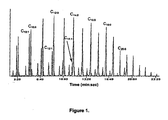
- the largest peak of the light syncrude is at 238 s and corresponds to a straight chain, C 12:0 paraffin. Immediately to the left and approximately one third in magnitude of the C 12:0 paraffin peak is the corresponding C 12:1 olefin peak. This pairing is consistent throughout the chromatograph starting at about 90 s for C 9:0 and C 9:1 and rapidly tapering off at 590 s with the C 24:0 peak.
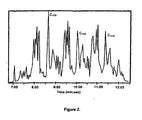
- the chromatograph of the distillate is more difficult to interpret, possibly due to oxidation which occurred during fractionation (such oxidation would be largely eliminated upon scaleup).
- the maximum masses of species corresponding to peaks at 234, 273, and 307 s are 170, 184, and 198 respectively indicating that these peaks are the C 12:0 , C 13:0 , and C 14:0 paraffins.
- the other peaks are believed to be olefins and oxygenates of the syncrude with would fractionate at the same temperatures as the C 12:0 to C 14:0 paraffins.
- Ethanol, diethyl ether, biodiesel, hexanes, and gasoline were used as fuels to dilute light syncrude. Ethanol and diethyl were obtained at purities >99.8%.
- the biodiesel used was a methyl ester of soybean oil and was obtained from the National Biodiesel Board. HPLC grade hexanes were obtained from Aldrich. The 87-octane gasoline was obtained locally. The diesel was obtained in a summer grade of low cetane quality.
- the pour point depressants, MCC 8092 (UI-8092) and MCC 8094 (UI-8094), were obtained from the Mid-Continental Chemical Company.
- Example 1 Engine Demonstration and Emissions Monitoring
- This light syncrude had a pour point temperature near 0°C, an average carbon number of about 12, a composition comprised of about 70% n-paraffins and about 29% 1-alkenes with >90% of the hydrocarbons having carbon numbers between C 8 and C 22 .
- Table 1 summarizes data of this light syncrude (designated syncrude or SC) as well as mixtures of light syncrude containing 25% gasoline, 25% hexane, or 25% of an equal mass mixture of ethanol and diethyl ether.
- the light syncrude mixtures had lower NO emissions.
- Light syncrude mixtures with oxygenates (ethanol and diethyl ether) had substantially lower particulate emissions.
- Tables 2 and 3 present supplementary data on the performance of Mixtures of Fischer-Tropsch fuels with blend stocks. Particulate emissions decreased by as much as 70% in mixtures with ethanol blend stock.
- SC is light syncrude
- “gas” is 87-octane gasoline
- Et is ethanol
- DE is diethyl ether
- Et/DE is a substantially equal mass mixture of ethanol and diethyl ether.
- Syncrude is light syncrude
- “gasoline” is 87-octane gasoline
- EtOH is ethanol
- DEE diethyl ether
- EtOH/DEE is a substantially equal mass mixture of ethanol and diethyl ether.
- Table 4 summarizes pour point and cloud point data for mixtures with light syncrude as well as reference fuels.
- Typical cold flow requirements include cold-flow performance down to a maximum of 2°C above the ASTM D 975 tenth percentile minimum ambient air temperature charts and maps. Even at 0°C, light syncrude has sufficient flow characteristics for many parts of the world for most of the year.
- pour point depressants and blend stocks can be used to improve flow properties as needed depending upon location.
- Table 5 summarizes cetane number estimates for mixtures of light syncrude with several blends.
- the high cetane number of light syncrude allows blending with several different blend stocks while maintaining cetane numbers above 40 which is preferred in the United States. These additives reduce pour points ⁇ it is important that the cetane numbers are not compromised while using blend stocks to achieve pour point goals.
- Table 5. Calculated numbers of test fuels based on T and U reference fuels. All mixtures are with light syncrude and percentages in mass %. Standard deviations (std) are based on 800 K data. T (K) delay t (ms) std (ms) CN Calc. Calc.
- a curve correlating cetane number with ignition delay time was prepared by preparing mixtures of Phillips' U-13 and T-20 test fuels as specified by Phillips Petroleum. Such correlations are considered valid for a period of about two weeks when the data are evaluated by the same researcher. It is common for reproducibility errors to be >2.8 cetane numbers (Henly, 1997) when using ASTM D-613 evaluation methods ⁇ for this reason, periodic comparison to reference fuels is recommended when evaluating cetane numbers.
- the synthetic diesel distillate (syncrude dist.) has a cetane number of 65.3 ⁇ 2.4, which is slightly lower than the syncrude which has a cetane number of 69 ⁇ 4.8.
- the synthetic fuels displayed impressively high cetane numbers, sufficiently high to allow blending with low cetane fuels to obtain a better combination of cetane number and pour point. When light syncrude is blended with fuels of lower cetane number it would be expected to lower the cetane number of the mixture; this is what happened with the addition of ethanol to the syncrude. In general, the trends of cetane numbers versus composition was consistent for all mixtures although some of the biodiesel mixtures performed better than expected.
- biodiesel mixtures showed an almost linear impact of concentration on cetane number at concentrations of 10%, 20%, and 30% ethanol ⁇ similar to ethanol but the reductions were of lower magnitude.
- the increase in cetane number due to the addition of 10% biodiesel to the light syncrude was unexpected.
- Neat biodiesel will typically have a cetane number between 40 and 55, depending upon the extent of peroxide buildup that can occur during storage. It is possible that biodiesel exhibits a cetane-related synergy at lower concentrations when mixed with light syncrude due to interactions between the peroxides and light syncrude; however, definite trends cannot be discerned when considering the standard deviations of the cetane number estimates. In any case, little performance advantage is realized when increasing the cetane number from 65 to 70 (unlike the real benefits associated with increasing the cetane number from 45 to 50).
Landscapes
- Chemical & Material Sciences (AREA)
- Oil, Petroleum & Natural Gas (AREA)
- Engineering & Computer Science (AREA)
- Organic Chemistry (AREA)
- Chemical Kinetics & Catalysis (AREA)
- General Chemical & Material Sciences (AREA)
- Combustion & Propulsion (AREA)
- Liquid Carbonaceous Fuels (AREA)
- Solid Fuels And Fuel-Associated Substances (AREA)
- Fuel-Injection Apparatus (AREA)
- Compositions Of Macromolecular Compounds (AREA)
Abstract
Description
- This Non-Provisional Patent Application claims benefit from (1) the Provisional Patent Application Serial No.
60/063,310 60/067,554 60/085,937 - The present invention relates to a composition of a fuel for compression-ignition engines. More particularly, the present invention relates to such a composition comprising a synthetic hydrocarbon liquid in a mixture with a blending stock.
- The growing importance of alternative energy sources and issues raised by stranded gas have brought a renewed interest in the Fischer-Tropsch synthesis, which is one of the more attractive direct and environmentally acceptable paths to high quality transportation fuels. Fischer-Tropsch synthesis involves the production of hydrocarbons by the catalyzed reaction of CO and hydrogen. Research involving the Fischer-Tropsch process has been conducted since the 1920's, and commercial plants have operated in Germany, South Africa and other parts of the world based on the use of particular catalysts.
-
U.S. Pat. No. 4,046,829 to Ireland et al. appears to disclose a process, wherein (in the process as modified) the product of Fischer-Tropsch synthesis is separated to recover a product boiling above and below about 400 degrees F., which is thereafter separately processed over different beds of ZSM-5 crystalline zeolite under conditions promoting the formation of fuel oil products and gasoline of higher octane rating. As disclosed therein, the unmodified process performed a separation of the Fischer-Tropsch synthesis product into various fractions: C2-, C3-C4, gasoline, fuel oil (diesel) and waxy oil. -
U.S. Pat. No. 4,088,671 to Kobylinski appears to disclose the use of a ruthenium promoted cobalt catalyst on a support such as alumina or kielsguhr, in the synthesis of hydrocarbons from the reaction of CO and hydrogen at substantially atmospheric pressure. It was found that the addition of small amounts of ruthenium to a cobalt synthesis catalyst resulted in substantial elimination of methane from the product, together with the production of a more saturated, higher average carbon number. Aqueous solutions of metal salts were used to impregnate the support to prepare the catalyst thereof. The C9+ fraction was about 88% by weight, with the C19+ fraction being about 45% by weight. This fraction contains the portion of the synthetic crude, (or syncrude) which is normally solid at ambient temperatures (C20+) and is commonly referred to a wax, which leaves about 43% by weight in the diesel range. - Research was performed to reduce the waxy portion of the diesel fraction to minimize the effects of the wax coating the catalyst and thereby deactivating the catalyst and reducing the efficiency thereof. In one approach, dual catalysts were used in a single stage.
U.S. Pat. No. 4,906,671 to Haag et al. appears to disclose a Fischer-Tropsch catalyst used in combination with a zeolite catalyst, wherein the zeolite catalyst selectively converted enough of the waxy product to prevent adhesion between catalyst particles which might interfere with catalyst flow thereby permitting maximization of diesel oil and heavy hydrocarbon yield. The diesel oil yield is disclosed to range from about 15 to about 45 % by weight. -
U.S. Pat. No. 4,652,538 to Rabo et al. appears to disclose the use of a dual catalyst composition in a single stage, wherein the composition is said to be capable of ensuring the production of only relatively minor amounts of heavy products boiling beyond the diesel oil range. The catalyst composition employed a Fischer-Tropsch catalyst together with a steam-stabilized zeolite Y catalyst of hydrophobic character, desirably in acid extracted form. - In another approach, the composition of the Fischer-Tropsch catalyst was modified to enhance diesel fuel boiling point range product.
-
U.S. Pat. Nos. 4,413,064 and4,493,905 to Beuther et al. appear to disclose a catalyst useful in the conversion of synthesis gas to diesel fuel in a fluidized bed. The catalyst is prepared by contacting finely divided alumina with an aqueous impregnation solution of a cobalt salt, drying the impregnated support and thereafter contacting the support with a non-aqueous, organic impregnation solution of salts of ruthenium and a Group IIIB or IVB metal. The diesel fuel fraction (C9-C20) ranged from about 25 to about 57 % by weight, with the C21+ fraction ranging from about 1 to about 9 % by weight. -
U.S. Pat. No. 4,605,680 to Beuther et al. appears to disclose the conversion of synthesis gas to diesel fuel and a high octane gasoline in two stages. In the first stage, the synthesis gas is converted to straight chain paraffins mainly boiling in the diesel fuel range. The diesel range fraction (C9-C20) ranged from about 44 to about 62 % by weight, with the C21+ fraction ranging from about 4 to about 9 % by weight. This first stage utilizes a catalyst consisting essentially of cobalt, preferably promoted with a Group IIIB or IVB metal oxide, on a support of gamma-alumina, eta-alumina or mixtures thereof. A portion of the straight chain paraffins in the C5-C8 range is separated and then converted in a second stage to a highly aromatic and branched chain paraffinic gasoline using a platinum group metal catalyst. -
U.S. Pat. No. 4,613,624 to Beuther et al. appears to disclose the conversion of synthesis gas to straight chain paraffins in the diesel fuel boiling point range. The diesel range fraction ranged from about 33 to about 65 % by weight, with the C21+ fraction ranging from nil to about 25 % by weight. The catalyst consisted essentially of cobalt and a Group IIIB or IVB metal oxide on an alumina support of gamma-alumina, eta-alumina or mixtures thereof where the catalyst has a hydrogen chemisorption value of between about 100 and about 300 micromol per gram. -
U.S. Pat. Nos. 4,568,663 and4,670,475 to Mauldin appear to disclose a rhenium promoted cobalt catalyst, especially rhenium and thoria promoted cobalt catalyst, used in a process for the conversion of synthesis gas to an admixture of C10+ linear paraffins and olefins. These hydrocarbons can then be refined particularly to premium middle distillate fuels of carbon number ranging from about C10 to about C20. This Fischer-Tropsch synthesis product contains C10+ hydrocarbons in the amount of at least about 60 % by weight (Examples thereof disclose about 80+ % by weight). However, no distinction is made between the diesel and wax fractions thereof. - Among other things, the foregoing references do not disclose or teach how these hydrocarbons produced via Fischer-Tropsch synthesis would be formulated as a fuel nor how well they would perform.
-
U.S. Pat. No. 5,506,272 to Benhain et al. appears to disclose several Fischer-Tropsch schemes using a promoted iron catalyst in a slurry reactor to produce oxygenated diesel and naphtha fractions on distillation that reduce particulate emissions in diesel engines. The Fischer-Tropsch synthesis product is separated into various fractions: tail gas, C5-C20 hydrocarbon product, water and alcohols, light wax and heavy wax. The C5-C20 product is generally a mixture of saturated and unsaturated aliphatic hydrocarbons. The C5-C20 hydrocarbon product can be employed as a substitute for diesel fuel and the like and hava high cetane numbers (about 62) thereof. The synthetic diesel fuel appeared to contain a distribution of C3-C19 alcohols and other oxygenates as a result of the Fischer-Tropsch synthesis. In one composition, the alcohols and oxygenates were each present in an amount of about 6 % by weight. It was further disclosed that the enhanced emissions performance suggested that an oxygen-containing additive could be formulated which would produce improved performance. Additional diesel fuel may be prepared by cracking the wax portion of the Fischer-Tropsch synthesis product. This diesel product had a cetane number of about 73, but a low oxygen content (about 0.16 %). The reference discloses that the two types of synthetic diesel produced thereby may be blended to increase the oxygen content of the mixture over the cracked product. The naphtha product thereof appeared to contain several oxygen-containing specie including C8-C12 alcohols (about 30 %). -
U.S. Pat. Nos. 5,645,613 and5,324,335 are related to and have disclosures essentially identical toU.S. Pat. No. 5,506,272 . -
U.S. Pat. No. 5,807,413 to Wittenbrink et al. appears to disclose a synthetic diesel fuel with reduced particulate emissions. The diesel engine fuel is produced from Fischer-Tropsch wax by separating a light density fraction, e.g., C5-C15, preferably C7-C14, having at least 80+ % by weight n-paraffins. The fuel composition appears to have comprised (1) predominantly C5-C15 paraffin hydrocarbons of which at least 80 % by weight are n-paraffins, (2) no more than 5000 ppm alcohols as oxygen, (3) no more than 10 % by weight olefins, (4) no more than 0.05 % by weight aromatics, (5) no more than 0.001 % by weight sulfur, (6) no more than 0.001 % by weight nitrogen and (7) a cetane number of at least 60. - The addition of ethanol or similar blend stocks to petroleum-based diesel has been investigated by several researchers. Unlike mixtures of oxygenates with gasoline, mixtures of oxygenates with diesel appears to have not been accepted as providing performance advantages that justify commercialization.
- Eckland et al (SAE Paper 840118) present a "State-of-the-Art Report on the Use of Alcohols in Diesel Engines". Techniques that have been evaluated for concurrent use of petroleum-based diesel and alcohols in a compression-ignition engine include (1) alcohol fumigation, (2) dual injection (3) alcohol/diesel fuel emulsions, and (4) alcohol/diesel fuel solutions.
- Fumigation and dual injection require additional and separate fuel handling systems including additional injectors for either manifold injection (for fumigation) or direct injection. Accordingly, these alternatives represent both a significant incremental cost for vehicle production and increased operational inconvenience related to refilling two fuel tanks rather than one.
- In the case of fumigation, Heisey and Lestz (SAE Paper 811208) report significant reductions in particulate generation; however, NOx generation increases. The incremental vehicular costs and increased NOx associated with fumigation have limited its acceptance.
- The prominent embodiments of the present invention do not include fumigation or dual injection.
- To maintain stable fuel emulsions of alcohol and diesel, large amounts of costly emulsifiers are required. Baker of the Southwest Research Institute (SAE Paper 810254) reported that 9:10 and 3:2 parts by volume of alcohol to emulsifier were required by methanol and ethanol, respectively to create stable emulsions. Emulsifiers are needed with methanol. They are needed with ethanol when the water content of ethanol is greater than about 0.5%.
- Hsu (SAE Paper 860300) reports decreased NOx and smoke but increased hydrocarbon emissions with diesel-water emulsions. Likos et al (SAE Paper 821039) reports increased NOx and hydrocarbon emissions for diesel-ethanol emulsions. Khan and Gollahalli (SAE Paper 811210) report decreased NOx and hydrocarbon emissions with increased particulate emissions for diesel-ethanol emulsions. Lawson et al (SAE Paper 810346) report increased NOx and decreased particulate emissions with diesel-methanol emulsions.
- The prominent embodiments of the present invention are not emulsions and thus have the advantage of not relying on the use of large amounts of expensive emulsifiers or mixing equipment.
- Alcohol-diesel fuel solutions form a homogenous phase rather than two liquid phases as with emulsions. Methanol is not soluble in petroleum-based diesel, and so, most solution work has been performed with ethanol. A disadvantage of solutions is that two liquid phases form when the alcohol-diesel mixture is contacted with water. Although this can manifest into operating difficulties, similar problems occur with straight petroleum-based diesel is contacted with water.
- Baker of the Southwest Research Institute (SAE Paper 810254) reports diesel-ethanol emulsions produce similar NOx, hydrocarbon, and particulate emulsions as compared to baseline runs with straight diesel. Khan and Gollahalli (SAE Paper 811210) report increased particulate emissions with ethanol-diesel mixtures. Test results of ethanol-diesel solutions are inconclusive and mixed.
- Many experienced automotive engineers associate a direct correlation between increases in alcohol fractions with increases in NOx and recognize that the chemically bound oxygen can lead to reductions in particulate emissions at the proper operating conditions. Since NOx emissions increase, advantages of ethanol-diesel emissions are limited, and such mixtures have not been generally accepted for widespread use by the market.
- The prominent embodiments of the present invention are not mixtures with petroleum-based diesel. Furthermore, advantages of preferred mixtures of the present invention provide significant reductions in both NOx and particulate emissions. The preferred embodiments of this invention may also lead to increased hydrocarbon emissions; however, this is not considered a significant obstacle and such emissions may be reduced through optimization of the diesel fuel composition of the present invention.
- Accordingly, there is a need for synthetic diesel fuels having the required physical, chemical and performance properties for use as a transportation fuel in diesel engines.
- A method of preparing compression-ignition fuel composition is provided in accordance with
claim 1. The composition may optionally also contain a pour point depressant, a cetane improver, a carbon-containing compound which reacts with water, and/or an emulsifier. When present, the pour point depressant is present in amount less than 0.5 mass %. - In one embodiment of the present invention, the light syncrude is present as a major portion of the composition and the blend stock is present as a minor portion of the composition. In a preferred embodiment, the light syncrude ranges from about 60 to about 95 mass % of the composition and the blend stock ranges from about 5 to about 40 mass % of the composition. The light syncrude preferably has an average carbon number from about 8 to about 20 and a standard deviation around that carbon number of greater than 1.5 carbon numbers. The blend stock has preferably has an average molecular weight less than 200, and more preferably less than 160.
- The oxygenate is selected from ethanol, diethyl ether and combinations of ether and alcohol. The alcohols and ethers preferably each have a carbon number less than 10. The ethers are any of those commonly used in gasoline formulations. A preferred ether is diethyl ether. The alcohol or ether is preferably present in an amount ranging from about 5 to about 35 mass %. When the alcohol and ether are both present, they are preferably present in substantially equal mass amounts, with the total amounts thereof ranging from about 5 to about 40 mass %. When an oxygenate and a pour point depressant are both present, the pour point depressant is preferably present in an amount ranging from about 0.01 to about 0.05 mass %.
- The cetane number of the composition is preferably greater than 35 and more preferably greater than 45. A cetane improver may be added to achieve the desired cetane number. When present, the cetane improver is preferably present in an amount ranging from about 0.01 to about 0.5 mass %. The cetane improver preferably has a greater solubility in ethanol than in hexane.
- In order to minimize the adverse performance effects of a phase separation when water is present in the composition, an emulsifier may be added. In such a situation, the emulsifier is preferably present in an amount ranging from about 0.01 to about 0.5 mass %. In the alternative or in addition to the use of an emulsifier, a carbon-containing compound which reacts with water may be added. The carbon-containing compound is preferably an anhydride, more preferably acetic anhydride. When present, the anhydride is preferably present in an amount ranging from about 0.01 to about 0.5 mass %.
-
-
Figure 1 is a GC-MS of a light syncrude used in the Examples hereof. -
Figure 2 is a GC-MS of a syncrude distillate (also referred to as syncrude diesel distillate) used in the Examples hereof. - A method of preparing a compression-ignition fuel composition is provided in accordance with
claim 1. The composition may optionally also contain a pour point depressant, a cetane improver, a carbon-containing compound which reacts with water, and/or an emulsifier. - Light syncrude may be defined as a mixture containing hydrocarbons produced from the polymerization of monomers produced for resources such as coal, biomass, natural gas, and carbon-containing refuse. More specifically, light sycrude is a mixture containing hydrocarbons having an aromatic carbon content less than 5% by mass. The light syncrude is a homogeneous liquid at about 15 to about 30°C and one atmosphere of pressure. The method of producing light syncrude is the Fischer-Tropsch polymerization of carbon monoxide and hydrogen. Preferably, light syncrude is liquid down to less than 5°C. The light syncrude preferably has an average carbon number from about 8 to about 20 and a standard deviation around that carbon number of greater than 1.5 carbon numbers. The light syncrude may contain oxygenates.
- Fischer-Tropsch synthesis is a method of polymerizing synthesis gas (primarily carbon monoxide and hydrogen) into a mixture comprised mostly of hydrocarbon chains of varying length. Coal, biomass, and natural gas feedstocks can be converted to liquid fuels via processes including conversion of the feedstocks to synthesis gas followed by Fischer-Tropsch synthesis. Syncrude production from natural gas is generally a two step procedure. First, natural gas is converted to synthesis gas (predominantly carbon monoxide, hydrogen, and sometimes nitrogen). In the second step, the synthesis gas is polymerized to hydrocarbon chains through Fischer-Tropsch reactions. This typically produces a waxy syncrude comprised mostly of saturated hydrocarbons with carbon numbers between 1 and 100. The light hydrocarbons can be stripped out of the mixture as a vapor stream and recycled in the Fischer-Tropsch process leaving a product comprised mostly of C4 to C20 hydrocarbons―a paraffin range leading to excellent compression-ignition (CI) fuel properties. Up to about one third of the product can be >C20 and is considered to have poor CI or spark-ignition (SI) fuel qualities. These higher carbon-number hydrocarbons tend to solidify at ambient temperatures.
- Due to the waxy nature of Fischer-Tropsch syncrude, pour point temperatures can be a problem. Such syncrude may be sent through a third step where it is hydrocracked, reformed, and/or fractionated to diesel, kerosene, and naphtha. Published data has shown that this refined Fischer-Tropsch diesel has good performance properties including the generation of lower emissions than petroleum-based diesel fuel.
- The composition of the present invention has many of the advantages of the refined Fischer-Tropsch diesel. Further, this invention allows a large fraction of the product (often having greater than 50% of its composition with carbon numbers between 10 and 16) of a Fischer-Tropsch synthesis process to be mixed with blend stocks and other additives for direct utilization as a compression-ignition fuel.
- The light syncrude may be obtained by isolating the non-vapor portion of Fischer-Tropsch synthesis product, which is then separated into a fraction which is liquid at, for example, 20°C (and ambient pressure) and a fraction which is largely not liquid a 20°C (and ambient pressure). This liquid fraction is referred to herein as light syncrude. If the entire non-vapor portion of the Fischer-Tropsch product is liquid at 20°C and one atmosphere of pressure, this liquid in its entirety may be used as light syncrude herein and separation of waxy components is not necessary. As noted above, the light syncrude is preferably a liquid at about 5 °C. In this case, the waxy components are preferably removed.
- The light syncrude useful as a component of the composition of the present invention may be obtained from the Fischer-Tropsch synthesis products such as those described in
U.S. Pat. Nos. 4,088,671 ;4,413,064 ;4,493,905 ;4,568,663 ;4,605,680 ;4,613,624 ;4,652,538 ;4,833,170 ;4,906,671 ;5,506,272 ; and5,807,413 . - In addition to the use of pour point depressants, some embodiments of the present invention use blend stocks to reduce pour point temperatures. Blend stocks are believed to function by mechanisms different from that of pour point depressants. The effectiveness of blend stocks for reducing pour points are attributed to at least two mechanisms.
- Firstly, in the absence of reducing the amount of precipitating solids, the blend stock increases the volume of liquid relative to precipitated solids and thus improves flow. Any liquid that mixes with the light syncrude will promote this type of pour point depression.
- Secondly, when activity coefficients of the precipitating components are not substantially increased due to the addition of the blend stock to the liquid phase, the blend stock causes freezing point depression and reduces the amount of precipitating solids.
Equation 1 shows the relation between freezing point depression and the activity (γi xi) of the "waxy component" that precipitates from solution at lower temperatures. All blend stocks decrease the xi, mole fraction, component of the activity. Since this activity (γi xi) is a function of the liquid phase composition, the addition of a blend stock can change the activity (γi xi).
- γi is the activity coefficient of component i (waxy component)
- xi is the mole fraction of component i
- ΔHfus is the heat of fusion for the waxy component i
- ΔCp is the heat capacity of liquid i less the heat capacity of solid i
- Tm is the normal melting point of pure component i
- Tf is the temperature where i solidifies in the mixture
- Preferred blend stocks of this invention remain liquid in their entirety when mixed with light syncrude at temperatures down to -20°C. If the blend stocks precipitate from solution, the blend stocks undesirably would add to the pour point problem.
- Preferred blend stocks also provide reductions in pour point temperatures as necessary to meet market demands. The blend stock has an average molecular weight less than the average molecular weight of the light syncrude, preferably less than 200, and more preferably less than 160.
- Improved freezing point depression can be obtained by using blend stocks with lower average molecular weights and with structures that lead to lower activity coefficients for the "waxy component" having a tendency to precipitate from solution. Example 3 provides data on the performance of several blend stocks.
- Preferred blend stocks provide both the required freezing point depression and good engine performance with low emissions, including low particulate emissions, in CI engines. Preferred mixtures have a cetane number >35 and most preferably >45. Example 4 reports cetane numbers for several mixtures.
- Hydrocarbons of C5 to C9 are most effective for pour point depression of light syncrude both because they largely do not change activity coefficients when added to hydrocarbon mixtures and because their low molecular weight leads to relatively large reductions in the mole fractions of the waxy components for a given mass fraction of these blend stocks. Higher carbon number hydrocarbons are not as effective for diluting mole fractions of waxy components. Lower carbon number hydrocarbons lead to increased volatility which is undesirable. Sources of hydrocarbon blend stocks include products and intermediates of petroleum refineries and refined syncrude. Others include C5-C9 alkanes, e.g., hexane, gasoline, biodiesel and naphtha. C5 to C13 branched hydrocarbons are also very effective as blend stocks to lower the pour point temperature.
- For the embodiments of this invention, oxygenates are preferably compounds comprised of carbon, oxygen, and hydrogen where the ratio of carbon atoms to oxygen atoms is >1.5 and the ratio of hydrogen atoms to carbon atoms is >1.5. These oxygenates provide highly desirable performance characterized by a reduction in both NOx and particulate matter relative to US 1-D (diesel) fuel.
- From a performance perspective, preferred oxygenates include ethers comprised solely of carbon, oxygen, and hydrogen and having a carbon number less than 10. These preferred ethers include diethyl ether as well as other ethers commonly added to gasoline. These ethers are both effective at reducing pour point temperatures and reducing particulate emissions. Most preferred mixtures, from a performance perspective, contain from 5% to 35% ether by mass.
- A disadvantage of ether blend stocks is their cost. From an economic perspective, preferred oxygenates include alcohols comprised solely of carbon, oxygen, and hydrogen and having a carbon number less than 10. A preferred alcohol is ethanol. Ethanol is effective at reducing particulate emissions, but is not as effective as the ethers for reducing pour point temperatures. Most preferred mixtures, from an economic perspective, contain from 5% to 35% ethanol by mass.
- When either ethanol or ether is present, the ethanol or ether is preferably present in an amount ranging from about 5 to about 35 mass %. When alcohol and ether are both present, they are preferably present in substantially equal mass amounts, with the total amounts thereof ranging from about 5 to about 40 mass %. When an oxygenate and a pour point depressant are both present, the pour point depressant is preferably present in an amount ranging from about 0.01 to about 0.05 mass %.
- Examples 1 and 2 provide data on the impact of several blend stocks on emissions with the following trends:
- Blend stocks with increased volatility generally result in increased hydrocarbon emissions.
- Light syncrude as well as mixtures comprised mostly of light syncrude resulted in decreased NOx emissions.
- Addition of oxygenated blend stocks leads to reduced particulate matter emissions.
- In addition to using the blend stocks for depressing the pour point of the composition, commercially available pour point depressants that are designed for applications with petroleum-based diesel are also effective for reducing pour point temperatures of the compositions of the present invention. Examples of such commercially available pour point depressants include MCC 8092 and MCC 8094 available from Midcontintental Chemical Company. When present, the pour point depressant is present in amount less than 0.5 mass % (5000 ppm) can be added to reduce the pour point temperature of the composition. More preferred embodiments of the present invention use from about 200 to about 1000 ppm of the pour point depressant to reduce the pour point temperatures of the composition. In a mixture of 30% gasoline with light syncrude, adding from about 900 to about 1000 ppm of a pour point depressant reduced the pour point temperature of the composition by about 15°C (see Example 3).
- Cloud points and pour points are evaluated using ASTM standards D-2500 and D-97. The cloud point temperature is believed to indicate the temperature at which solid crystals from precipitating "waxy" hydrocarbons become visible. The pour point temperature is believed to be the temperature where sufficient solids have precipitated to prevent flow as based on the definition by ASTM standard D-97. Pour point depressants reduce pour points by changing the morphology of the crystals precipitating from the liquid phase. In some cases, pour point depressants promote the formation of smaller crystals that flow better than larger needle-shaped crystals that form in the absence of pour point depressants.
- In the alternative or in addition to the use of an emulsifier, a carbon-containing compound which reacts with water may be added to the composition. The carbon-containing compound is preferably an anhydride, more preferably acetic anhydride. When present, the anhydride is preferably present in an amount ranging from about 0.01 to about 0.5 mass %.
- The cetane number of the composition is preferably greater than 35 and more preferably greater than 45. A cetane improver may be added to achieve the desired cetane number. When present, the cetane improver is preferably present in an amount ranging from about 0.01 to about 0.5 mass %. The cetane improver preferably has a greater solubility in ethanol than in hexane.
- In order to minimize the adverse performance effects of a phase separation when water is present in the composition, an emulsifier may be added to the composition. In such a situation, the emulsifier is preferably present in an amount ranging from about 0.01 to about 0.5 mass %.
- For purposes of analyzing the suitability of the fuels of this invention, three performance criteria were evaluated, including:
- 1. Pour Point Temperature ― Since vehicles are typically not equipped with heaters for the fuel delivery system, a diesel fuel preferably should flow under the force of gravity to the pump intake in the fuel tank. The pour point temperature is representative of the temperature where this flow stops. Reductions in pour point temperatures translate to larger potential fuel markets by inclusion of markets at cooler geographical regions and markets during cooler periods of the year. It is desirable to have fuels with low pour point temperatures, preferably lower than - 20°C.
- 2. Cetane Number ― Cetane numbers correlate directly with engine operability.
Preferred fuels have cetane numbers greater than 35. - 3. Engine Operability and Emissions ― Engine operability is the ultimate test for a fuel. Operability with low emissions is preferred. However, these alone are not sufficient ― the fuel should also meet minimum pour point criteria. Preferred fuels would have lower NOx and particulate emissions than US 1-D fuel.
- The prominent embodiments of this invention provide compositions of matter to meet performance needs based on these three criteria.
- Accordingly, there is provided a method of blending compression-ignition fuel composition according to claim 7. The composition may optionally also contain a pour point depressant, a cetane improver, a carbon-containing compound which reacts with water, and/or an emulsifier. When present, the pour point depressant is present in amount less than 0.5 mass %.
- In one embodiment of the present invention, the light syncrude is present as a major portion of the composition and the blend stock is present as a minor portion of the composition. In a preferred embodiment, the light syncrude ranges from about 60 to about 95 mass % of the composition and the blend stock ranges from about 5 to about 40 mass % of the composition. The light syncrude preferably has an average carbon number from about 8 to about 20 and a standard deviation around that carbon number of greater than 1.5 carbon numbers. The blend stock preferably has an average molecular weight less than 200, and more preferably less than 160.
- The oxygenate is selected from ethanol, ethers and combinations of alcohols and other. The alcohols and ethers preferably each have a carbon number less than 10. A preferred alcohol is ethanol. The ethers are any of those commonly used in gasoline formulations. A preferred ether is diethyl ether. When either an ethanol or ether is present, the ethanol or ether is preferably present in an amount ranging from about 5 to about 35 mass %. When alcohol and ether are both present, they are preferably present in substantially equal mass amounts, with the total amounts thereof ranging from about 5 to about 40 mass %. When an oxygenate and a pour point depressant are both present, the pour point depressant is preferably present in an amount ranging from about 0.01 to about 0.05 mass %.
- The cetane number of the composition is preferably greater than 35 and more preferably greater than 45. A cetane improver may be added to achieve the desired cetane number. When present, the cetane improver is preferably present in an amount ranging from about 0.01 to about 0.5 mass %. The cetane improver preferably has a greater solubility in ethanol than in hexane.
- In another embodiment, the composition contains greater than 50 mass % of a light syncrude and less than 50 mass % of an oxygenate, wherein the oxygenate has a lower average molecular weight than the light syncrude. Preferably, the composition contains substantially equal masses of ethanol and diethyl ether and the light syncrude is present in an amount ranging from about 60 to about 90 mass %.
- In another embodiment, the composition contains from about 60 to about 80 mass % of a light syncrude, from about 7.5 to about 30 mass % of ethanol, and from 0 to about 20 mass % of an ether, wherein the ether is preferably diethyl ether.
- Preferred mixtures with ethanol or other alcohols resist formation of two separable liquid phases when small amounts (<1:100 of mass of water to mass of fuel mixture) of water are contacted with the mixture. In order to minimize the adverse performance effects of a phase separation when water is present in the composition, an emulsifier may be added. The emulsifier is a proactive additive that has little or no impact when the fuel is in a preferred homogeneous phase and is activated when water is contacted with the fuel. The emulsifier reduces the average size of aqueous phases formed and therein slows down or largely prevents the formation of a water-rich phase that can be isolated from the fuel-rich phase. In such a situation, the emulsifier is preferably present in an amount ranging from about 0.01 to about 0.5 mass %. In the alternative or in addition to the use of an emulsifier, a carbon-containing compound which reacts with water may be added. The carbon-containing compound is preferably an anhydride, more preferably acetic anhydride. When present, the anhydride is preferably present in an amount ranging from about 0.01 to about 0.5 mass %.
- Alternatively, acceptable performance can be obtained with mixtures that form two liquid phases where both liquids are compatible with diesel engine operation. Upon liquid-liquid phase separation, the alcohol and water rich liquid is the liquid likely to cause problems with engine operation. A preferred method of overcoming these engine operation problems is to add cetane improvers to the mixture. Preferred cetane improvers exhibit partition coefficients that distribute the cetane improver selectively into the alcohol and water rich phase. Preferred cetane improvers with this performance include but are not limited to polyethylene glycol dinitrates, fatty acid nitrates, triglyceride nitrates, biodiesel nitrates, and water-soluble adducts of polyol. Most preferred cetane improvers have both cetane improving capabilities and emulsifying capabilities.
- Preferred mixtures contain ethanol and cetane improvers such that the mass ratio of ethanol to cetane improvers is between 10 and 500.
- These methods of overcoming liquid-liquid phase behavior problems are not limited to fuels containing mostly light syncrude. Use of emulsifiers, compounds that react with water, and cetane improvers having greater solubilities in ethanol than in hexanes may also be used in mixtures of petroleum-based diesel and ethanol. For this alternative embodiment, the hydrocarbon content is preferably between 60 and 95 mass % (% by mass), the oxygenate content is preferably between 5 and 40 mass %, and said additives are preferably 0.05 to 1 mass%.
- The most preferred embodiments of this invention are fuel compositions containing from about 70 to about 95 mass % of a light syncrude that has improved chemical diversity, from about 5 to about 30 mass % of a blend stock (preferably ethanol), from about 150 to about 800 ppm of a pour point depressant, and from about 1000 to about 5000 ppm of a cetane improver, wherein the cetane improver partitions into an ethanol-rich phase over a hydrocarbon-rich phase. Preferably, the cetane improver is a difunctional additive which has both cetane-improving and emulsifying capabilities. Advantages of this fuel composition include smooth operation in compression-ignition engines, low particulate emissions relative to US 1-D fuel, and production capabilities from a variety of resources including natural gas, coal, biomass, and organic refuse.
- Examples 1 and 2 describe engine tests on a Detroit Diesel 453T, off-road engine where the light syncrude successfully powered the diesel engine with hydrocarbon emissions slightly higher than US 1-D fuel and with particulate matter and NOx emissions 0-20% lower than US 1-D fuel.
- The experimental methods used in the Examples hereof are described in the following paragraphs.
- The cetane number is a measure of a fuel's ignition quality. A high cetane number corresponds to low ignition delay times (better ignition quality). Ignition delay times are known to correlate well with cetane numbers and were directly measured alternative to using a cetane engine. Ignition delay time data also provide a more fundamental basis for interpreting trends in the data. A detailed description of the equipment can be found elsewhere (Suppes et. al., 1997a and 1997b). Allard et. al. (1996, 1997) details preferred operating procedures for constant volume combustors.
- To determine the cetane number of the test fuels, ignition delay time results were compared to data for U-13 and T-20 test fuels. Three mixtures were used corresponding to cetane numbers of 30.0, 45.3, and 60.1. The tests were carried out at temperatures of 750, 800, and 833 or 850 K. Approximately six ignition delay times were measured at each temperature.
- Thompson et. al. (1997) conducted an extensive study of cetane number estimation methods. They found that the recommended ASTM D-613 cetane number method had repeatabilities and reproducibilities that steadily increased with the value of the cetane number being measured. At a cetane number of 40 would typically have a repeatability and reproducibility of 0.8 and 2.8 while a cetane number of 56 would have respective values of 0.9 and 4.8.
- Although ignition delay times were measured at three temperatures, only the 800 K data were used to estimate cetane numbers. Standard deviations are reported for the 800 K data. Since six measurements typically were taken at 800 K, the 95% confidence interval is about 0.8 times the reported standard deviations. These 95% confidence intervals were typically between corresponding repeatability and reproducibility values reported by Thompson et. al. (1997).
- The kinematic viscosities of test fuels were tested by the ASTM D 445 method. For this test a Cannon-Fenske Routine size 50 capillary viscometer was used. The kinematic viscosity of each fuel was measured at 40 °C.
- The test requires that the viscometer must be placed in a temperature-controlled bath with the sample being no closer than 20 mm from the top or bottom of the bath. The test fuels were placed in the viscometer with the fluid level 7 mm above the first timing mark. The test fuel was then allowed to flow down the capillary tube being timed between the first timing mark and the final timing mark. Two runs of this experiment were made with the reported time being the average.
- The kinematic viscosity (v) was then calculated by the following equation:

- ν = kinematic viscosity, mm2/s
- C = calibration constant of the viscometer, (mm2/s)/s
- t = mean flow time, s.
- The calibration constant of the viscometer was found by using two certified viscosity standards and by comparison with the measured values of ethanol and water. This gave an accurate calibration equation for the determination of the test fuel's viscosities.
- The cloud point is related to the temperature when the fuel begins to form wax crystals, causing a cloudy appearance in the mixture. A FTS Systems chiller capable of controlled bath temperatures down to -80°C was used to gradually lower the temperature of the test fuel until the cloud point was reached. ASTM D 2500 cloud point and ASTM D 97 pour point procedures were followed with the exception that 5 ml vials were used rather than 100 ml beakers due to the limited supply of syncrude.
- The test fuel was placed in a small clear vial and brought to within 14°C of the expected cloud point in the temperature-controlled chiller. The chiller was cooled in one-degree intervals. The sample was then carefully and quickly removed at each interval and inspected for the cloud point transition. Care must be taken not to disturb the sample since perturbations could lead to low, inaccurate cloud point temperature observations. The cloud points were reported to the nearest 1°C. The samples were then further cooled to measure pour point temperatures.
- The pour point is the temperature at which the fuel no longer flows. This test method requires the same testing procedure as described for cloud point determination. At every interval of 1°C, the sample was quickly and carefully removed and inspected. When inspecting the sample, the test vial was tilted just far enough to detect movement of the fluid. When the sample cooled to the point where it no longer showed movement, the test jar was then tilted horizontally and held for 5s. If the sample moved the procedure was continued. If no movement was observed the pour point had been reached. The pour point was then reported to the nearest 1°C. Since the relatively small test samples would experience greater wall effects than the recommended 100 ml samples, the pour point values may be slightly high.
- Fischer-Tropsch Samples - The light syncrude used was a fraction of a Fischer-Tropsch product that was separated from the waxy components. The syncrude distillate (also referred to as syncrude diesel distillate) used was a fraction of the light syncrude. Neither product has been hydrocracked.
- A gas chromatography equipped with a mass spectrometer detector (GC-MS) was used to determine product distributions for both the light syncrude and the distillate, see
Figures 1 and2 , respectively. - The largest peak of the light syncrude is at 238 s and corresponds to a straight chain, C12:0 paraffin. Immediately to the left and approximately one third in magnitude of the C12:0 paraffin peak is the corresponding C12:1 olefin peak. This pairing is consistent throughout the chromatograph starting at about 90 s for C9:0 and C9:1 and rapidly tapering off at 590 s with the C24:0 peak.
- The chromatograph of the distillate is more difficult to interpret, possibly due to oxidation which occurred during fractionation (such oxidation would be largely eliminated upon scaleup). The maximum masses of species corresponding to peaks at 234, 273, and 307 s are 170, 184, and 198 respectively indicating that these peaks are the C12:0, C13:0, and C14:0 paraffins. The other peaks are believed to be olefins and oxygenates of the syncrude with would fractionate at the same temperatures as the C12:0 to C14:0 paraffins.
- Ethanol, diethyl ether, biodiesel, hexanes, and gasoline were used as fuels to dilute light syncrude. Ethanol and diethyl were obtained at purities >99.8%. The biodiesel used was a methyl ester of soybean oil and was obtained from the National Biodiesel Board. HPLC grade hexanes were obtained from Aldrich. The 87-octane gasoline was obtained locally. The diesel was obtained in a summer grade of low cetane quality. The pour point depressants, MCC 8092 (UI-8092) and MCC 8094 (UI-8094), were obtained from the Mid-Continental Chemical Company.
- This light syncrude had a pour point temperature near 0°C, an average carbon number of about 12, a composition comprised of about 70% n-paraffins and about 29% 1-alkenes with >90% of the hydrocarbons having carbon numbers between C8 and C22. Table 1 summarizes data of this light syncrude (designated syncrude or SC) as well as mixtures of light syncrude containing 25% gasoline, 25% hexane, or 25% of an equal mass mixture of ethanol and diethyl ether. The light syncrude mixtures had lower NO emissions. Light syncrude mixtures with oxygenates (ethanol and diethyl ether) had substantially lower particulate emissions. For these tests, fuels were changed while the Detroit Diesel 453T engine was operating at constant loads of 40% and 80% of maximum torque at 1500 rpm.
Table 1. Summary of emissions from first two tests at 40% and 80% loads and 1500 rpm. Carbon monoxide emissions are reported in percent, carbon dioxide emissions are reported in mass fraction, hydrocarbon (HC) emissions are reported in ppm, nitrogen oxide emissions are reported in ppm, oxygen emissions are reported in percent, temperature is reported in degrees Kelvin, and particulate matter (PM) is reported in percent based on milligrams collected using the test fuel relative to diesel as collected on a 47 mm laminated 1.0 micron filter for the same time and flow rate as the diesel sample. CO CO2 HC NO O2 T PM April 22nd 40% Diesel XX 0.060 47 615 17.1 280 Syncrude(SC) XX 0.058 77 555 17.1 282 100.0% SC + 25% Gasoline XX 0.058 115 557 17.0 282 90.0% Diesel XX 0.061 50 628 17.0 XX 100.0% SC+25% EtHO/DEE XX 0.056 116 577 17.3 287 70.0% 80% Diesel 0.12 0.084 72 750 14.5 284 93.4% Diesel 0.11 0.078 56 768 15.0 289 106.6% Syncrude(SC) 0.11 0.072 98 647 15.4 289 80.7% SC + 25% Hexanes 0.10 0.068 133 621 15.6 288 68.0% SC+25% EtHO/DEE 0.09 0.075 132 655 14.9 287 55.3% April 15th 40% Diesel 0.011 0.060 55 584 16.8 Syncrude (SC) 0.013 0.057 85 516 16.9 SC + 25% Hexanes 0.011 0.057 131 520 16.8 SC + 25% Gasoline 0.014 0.056 135 526 16.9 SC+25% EtHO/DEE 0.011 0.058 135 539 16.9 Diesel 0.009 0.059 61 583 16.9 - Tables 2 and 3 present supplementary data on the performance of Mixtures of Fischer-Tropsch fuels with blend stocks. Particulate emissions decreased by as much as 70% in mixtures with ethanol blend stock. In Table 2, SC is light syncrude, "gas" is 87-octane gasoline, Et is ethanol, DE is diethyl ether, and Et/DE is a substantially equal mass mixture of ethanol and diethyl ether. In Table 3, Syncrude is light syncrude, "gasoline" is 87-octane gasoline, EtOH is ethanol, DEE is diethyl ether, and EtOH/DEE is a substantially equal mass mixture of ethanol and diethyl ether.
Table 2. Summary of impact of fuel on particulate emissions. LOAD LOAD 50% 80% 50% 80% mg mg % % US 2-D 0.67 1.46 151.4% 87.8% US 1-D 0.44 1.66 100.0% 100.0% 25% gas/SC 0.53 1.29 119.8% 77.3% SC 0.42 1.36 94.9% 81.5% 20% Et/SC 0.26 0.84 59.9% 50.8% 25% Et/SC 0.22 0.62 50.8% 37.3% 33% Et/DE/SC 0.32 0.52 72.3% 31.0% 20% Et/DE/SC 0.31 0.81 70.1% 48.7% - Table 4 summarizes pour point and cloud point data for mixtures with light syncrude as well as reference fuels. Typical cold flow requirements include cold-flow performance down to a maximum of 2°C above the ASTM D 975 tenth percentile minimum ambient air temperature charts and maps. Even at 0°C, light syncrude has sufficient flow characteristics for many parts of the world for most of the year. As illustrated by the data of Table 1, pour point depressants and blend stocks can be used to improve flow properties as needed depending upon location.
Table 3. Summary of gas phase analysis of engine exhaust. Target Speed Load % CO2 % HC (ppm) NO (ppm) O2 % Speed (rpm) Torque (ft/lb) T (C) Start Calibration, zero ga: (rpm) 0.1 0 0 0.0 -5 -1 21.2 Start Calibration, span gas 30.1 902 897 21.0 21 End Calibration, zero gas 0.3 4 0 0.1 -4 -1 End Calibration, span gas 30.1 882 876 20.0 0.3 1 1 - US 2D diesel rated 100% 10.0 87 872 12.8 2140 389 287 1 - US 2D diesel rated 100% 10.0 79 928 12.9 2076 397 288 1 - US 2D diesel rated 75% 8.6 69 757 14.6 2305 291 289 1 - US 2D diesel rated 50% 7.0 61 617 16.4 2320 190 289 1 - US 2D diesel rated 10% 3.4 66 198 20.6 2385 41 223 1 - US 2D diesel 1500 80% 7.3 51 692 16.0 1465 313 289 1 - US 2D diesel 1500 50% 6.4 48 677 17.2 1507 202 289 1 - US 2D diesel 1500 0% 1.5 57 113 22.9 1613 9 155 2 - US 1D diesel 1500 80% 7.3 79 622 16.1 1454 308 289 2 - US 1D diesel 1500 50% 6.2 75 609 17.4 1502 200 289 2 - US 1D diesel 1500 0% 2.0 92 133 22.3 1618 8 154 3 - Syncrude + 25% gasoline 1500 80% 6.9 178 548 16.3 1468 302 289 3 - Syncrude + 25% gasoline 1500 50% 6.0 171 576 17.5 1500 199 290 3 - Syncrude + 25% gasoline 1500 0% 1.8 189 125 22.4 1639 8 162 4 - Syncrude 1500 80% 6.9 122 550 16.2 1440 307 290 4 - Syncrude 1500 50% 6.6 124 544 16.5 1448 301 290 4 - Syncrude 1500 50% 5.9 124 523 17.5 1485 199 290 4 - Syncrude 1500 0% 1.9 136 144 22.4 1600 8 161 5 - Syncrude + 20% EtOH 1500 80% 6.4 164 545 16.6 1469 303 290 5 - Syncrude + 20% EtOH 1500 50% 5.5 177 564 17.8 1520 195 290 5 - Syncrude + 20% EtOH 1500 0% 1.6 217 99 22.5 1619 8 151 6 - Syncrude + 33% EtOH/DEE 1500 80% 6.3 218 567 16.9 1497 301 290 6 - Syncrude + 33% EtOH/DEE 1500 50% 5.5 272 559 17.9 1529 195 289 6 - Syncrude + 33% EtOH/DEE 1500 0% 1.7 267 84 22.4 1650 7 153 7 - Syncrude + 20% EtOH/DEE 1500 80% 6.3 159 560 16.9 1465 301 286 7 - Syncrude + 20% EtOH/DEE 1500 50% 5.5 166 586 17.9 1513 199 264 7 - Syncrude + 20% EtOH/DEE 1500 0% 1.7 187 102 22.4 1101 7 140 8 - Syncrude + 25% Ethanol 1500 80% 6.6 154 553 16.6 1467 307 289 8 - Syncrude + 25% Ethanol 1500 50% 5.6 168 576 18.0 1516 196 290 8 - Syncrude + 25% Ethanol 1500 0% 1.8 145 106 22.8 569 5 131 9 - Syncrude 1500 80% 6.2 130 546 17.0 1485 303 290 9 - Syncrude (NO) 1500 50% 5.5 119 555 18.0 1530 197 290 9 - Syncrude (NOx) 1500 50% 5.4 122 584 18.1 1528 195 290 9 - Syncrude 1500 0% 1.9 122 133 22.4 1660 7 153 10 - US 1D diesel 1500 80% 6.5 91 597 16.9 1479 310 290 10 - US 1D diesel 1500 50% 5.6 82 608 18.1 1510 196 290 10 - US 1 D diesel 1500 0% 1.9 93 128 22.4 1637 8 150 Table 4. Cloud and pour point temperatures of test fuels. All temperatures are in °C. Cloud Point Pour Point Cloud Point Pour Point Regular Diesel -10 -13 Light Syncrude/Gasoline Gasoline (87 octane) Synthetic Diesel -50 -54 % Gasoline Distillate 30 -2 -6 Light Syncrude 6.5 2 30% Gas.with Pour Point Depressant Light Syncrude/EtOH % EtOH UI8092 130ppm -2 -9 10 6.5 3 UI8092 320ppm -2 -17 20 6.5 2 UI8092 520ppm -2 -19 30 6.5 3 UI8092 950ppm -2 -21 Biodiesel -4 -6 UI8094 150ppm -2 -8 UI8094 240ppm -2 -12 Light UI8094 460ppm -2 -18 Syncrude/Biodiesel % Biodiesel UI8094 850ppm -2 -21 10 5 1 20 4 0 Light Syncrude/Hexanes 30 4 0 % Hexanes Light Syncrude 30 -3 -12 /Biodiesel/EtOH 80/10/10 5 1 Light Syncrude/Diethyl ether 70/10/20 5 2 % Diethyl ether 70/20/10 5 2 30 -2 At - 10°C solids settled - Table 5 summarizes cetane number estimates for mixtures of light syncrude with several blends. The high cetane number of light syncrude allows blending with several different blend stocks while maintaining cetane numbers above 40 which is preferred in the United States. These additives reduce pour points―it is important that the cetane numbers are not compromised while using blend stocks to achieve pour point goals.
Table 5. Calculated numbers of test fuels based on T and U reference fuels. All mixtures are with light syncrude and percentages in mass %. Standard deviations (std) are based on 800 K data. T (K) delay t (ms) std (ms) CN Calc. Calc. std (CN) Standards and Test Fuels 30 CN 800 11.5 0.47 30.0 1.2 45.3 CN 799 7.3 0.51 45.3 2.6 60.1 CN 800 5.2 0.17 60.2 1.5 Diesel 800 9.3 0.86 36.9 2.9 Syncrude Dist. 800 4.8 0.20 64.3 2.0 L Syncrude 800 4.5 0.37 67.4 4.0 Ethanol Mixtures (% ethanol indicated) 10% 801 5.5 0.31 57.9 2.5 20% 800 7.4 0.82 45.1 3.9 30% 800 10.6 1.23 32.5 3.3 Biodiesel Mixtures (% biodiesel indicated) 10% 800 4.4 0.54 68.6 5.9 20% 800 4.9 0.72 63.5 6.6 30% 799 5.6 0.52 57.0 4.0 Gasoline Mixture (%gasoline indicated) 30% 800 4.9 0.26 63.3 2.5 Light Syncrude / Biodiesel / Ethanol 80/10/10 800 4.0 0.24 73.4 3.2 70/20/10 800 4.3 0.27 69.6 3.2 70/10/20 800 5.4 0.37 58.4 3.0 - A curve correlating cetane number with ignition delay time was prepared by preparing mixtures of Phillips' U-13 and T-20 test fuels as specified by Phillips Petroleum. Such correlations are considered valid for a period of about two weeks when the data are evaluated by the same researcher. It is common for reproducibility errors to be >2.8 cetane numbers (Henly, 1997) when using ASTM D-613 evaluation methods―for this reason, periodic comparison to reference fuels is recommended when evaluating cetane numbers.
- The synthetic diesel distillate (syncrude dist.) has a cetane number of 65.3 ±2.4, which is slightly lower than the syncrude which has a cetane number of 69 ±4.8. The synthetic fuels displayed impressively high cetane numbers, sufficiently high to allow blending with low cetane fuels to obtain a better combination of cetane number and pour point. When light syncrude is blended with fuels of lower cetane number it would be expected to lower the cetane number of the mixture; this is what happened with the addition of ethanol to the syncrude. In general, the trends of cetane numbers versus composition was consistent for all mixtures although some of the biodiesel mixtures performed better than expected.
- As expected, the addition of ethanol markedly lowers the cetane numbers of the light syncrude. Even at 20% ethanol, the cetane number barely meets performance expectations for diesel fuels. The impact of ethanol on mixture cetane numbers would be expected to level off and asymptotically approach a value of about 12 for neat ethanol
- The biodiesel mixtures showed an almost linear impact of concentration on cetane number at concentrations of 10%, 20%, and 30% ethanol―similar to ethanol but the reductions were of lower magnitude. The increase in cetane number due to the addition of 10% biodiesel to the light syncrude was unexpected. Neat biodiesel will typically have a cetane number between 40 and 55, depending upon the extent of peroxide buildup that can occur during storage. It is possible that biodiesel exhibits a cetane-related synergy at lower concentrations when mixed with light syncrude due to interactions between the peroxides and light syncrude; however, definite trends cannot be discerned when considering the standard deviations of the cetane number estimates. In any case, little performance advantage is realized when increasing the cetane number from 65 to 70 (unlike the real benefits associated with increasing the cetane number from 45 to 50).
- Kinematic viscosities of various test fuels were measured at 40°C. Table 6 shows that the synthetic fuels have viscosities similar to conventional CI fuels. Both the synthetic diesel and the synthetic crude are within ASTM guidelines with viscosities of 1.9 mm2/s and 2.3 mm2/s respectively. Trends exhibited by the.addition of ethanol suggest that mixtures of 30% ethanol with light syncrude would be at the lower limit of the viscosity specification.
Table 5. Kinematic viscosities (mm2/s) of test fuels at 40°C. Fuel Kinematic Viscosity (mm2/s) Regular Diesel 3.05 Synthetic Diesel Distillate 1.92 Light Syncrude 2.32 Light Syncrude/EtOH % EtOH 10 2.21 20 2.06 - Having thus generally described the invention and provided specific examples thereof, it is apparent that various modifications and changes can be made without departing from the scope of the present invention. It is to be understood that no undue restrictions are to be imposed by reason thereof except as defined by the following claims.
Claims (25)
- A method of preparing a compression-ignition fuel composition comprising mixing a Fischer-Tropsch light syncrude with a blend stock wherein the blend stock has an average molecular weight less than the average molecular weight of the light syncrude and wherein the resulting compression-ignition fuel composition comprises from 30 to 95 mass % light syncrude and from 70 to 5 mass % of blend stock; wherein the blend stock is an oxygenate consisting of one of ethanol, diethyl ether, or a mixture of an alcohol and an ether.
- A method according to claim 1 wherein the light syncrude has an average carbon number from 8 to 20 and a standard deviation around that carbon number of 1.5 carbon numbers.
- A method according to claim 1 or 2 wherein the blend stock has an average molecular weight less than 200.
- A method according to any preceding claim, further comprising addition of a pour point depressant.
- A method according to claim 4 wherein the pour point depressant is present in amount less than 0.5 mass %.
- A method according to any preceding claim wherein the light syncrude is present as a major portion of the composition and the blend stock is present as a minor portion of the composition.
- A method according to claim 6 wherein a major portion varies from substantially 60 to 95 mass % of light syncrude, and a minor portion ranges from substantially 40 to 5 mass % of blend stock.
- A method according to claim 1, wherein the ether is diethyl ether.
- A method according to claim 1, such that the resulting compression-ignition fuel composition comprises from 65 to 90 mass % of the light syncrude, from 5 to 20 mass % of ethanol and from 3 to 20 mass % of diethyl ether.
- A method according to claim 9, further comprising adding a pour point depressant.
- A method according to claim 10 wherein the pour point depressant is present in an amount ranging from 0.01 to 0.05 mass %.
- A method according to claim 1, such that the resulting compression-ignition fuel composition comprises: from 65 to 95 mass % of the light syncrude and from 5 to 35 mass % ethanol.
- A method according to claim 12, further comprising addition of a pour point depressant.
- A method according to claim 13, wherein the pour point depressant is present in an amount ranging from 0.01 to 0.05 mass %.
- A method according to claim 12, further comprising addition of a cetane improver.
- A method according to claim 15, wherein the cetane improver is present in an amount ranging from 0.01 to 0.5 mass %.
- A method according to claim 15, wherein the cetane improver has a greater solubility in ethanol than in hexane.
- A method according to claim 12, further comprising addition of an emulsifier.
- A method according to claim 18, wherein the emulsifier is present in an amount ranging from 0.01 to 0.5 mass %.
- A method according to claim 12, further comprising addition of a carbon-containing compound which reacts with water.
- A method according to claim 20, wherein the carbon containing compound is an anhydride.
- A method according to claim 21, wherein the anhydride is acetic anhydride.
- A method according to claim 22, wherein the acetic anhydride is present in an amount ranging from 0.01 to 0.5 mass %.
- A method according to claim 1, wherein the light syncrude has an oxygenate content of at least 1%.
- A method according to claim 1, wherein the light syncrude has a branched paraffin content of at least 2%.
Applications Claiming Priority (7)
| Application Number | Priority Date | Filing Date | Title |
|---|---|---|---|
| US6331097P | 1997-10-28 | 1997-10-28 | |
| US63310 | 1997-10-28 | ||
| US6755497P | 1997-12-05 | 1997-12-05 | |
| US67554 | 1997-12-05 | ||
| US8593798P | 1998-05-19 | 1998-05-19 | |
| US85937 | 1998-05-19 | ||
| PCT/US1998/022703 WO1999021943A1 (en) | 1997-10-28 | 1998-10-26 | Blended compression-ignition fuel containing light synthetic crude and blending stock |
Publications (4)
| Publication Number | Publication Date |
|---|---|
| EP1027409A1 EP1027409A1 (en) | 2000-08-16 |
| EP1027409A4 EP1027409A4 (en) | 2002-01-23 |
| EP1027409B1 EP1027409B1 (en) | 2005-08-17 |
| EP1027409B2 true EP1027409B2 (en) | 2011-07-06 |
Family
ID=27370452
Family Applications (1)
| Application Number | Title | Priority Date | Filing Date |
|---|---|---|---|
| EP98956227A Expired - Lifetime EP1027409B2 (en) | 1997-10-28 | 1998-10-26 | Blended compression-ignition fuel containing light synthetic crude and blending stock |
Country Status (7)
| Country | Link |
|---|---|
| US (1) | US6056793A (en) |
| EP (1) | EP1027409B2 (en) |
| AT (1) | ATE302257T1 (en) |
| AU (1) | AU1280299A (en) |
| CA (1) | CA2307725C (en) |
| DE (1) | DE69831261D1 (en) |
| WO (1) | WO1999021943A1 (en) |
Families Citing this family (54)
| Publication number | Priority date | Publication date | Assignee | Title |
|---|---|---|---|---|
| US5689031A (en) * | 1995-10-17 | 1997-11-18 | Exxon Research & Engineering Company | Synthetic diesel fuel and process for its production |
| US6325833B1 (en) * | 1997-09-12 | 2001-12-04 | Exxon Research And Engineering Company | Emulsion blends |
| US6180842B1 (en) * | 1998-08-21 | 2001-01-30 | Exxon Research And Engineering Company | Stability fischer-tropsch diesel fuel and a process for its production |
| GB9925971D0 (en) * | 1999-11-03 | 1999-12-29 | Exxon Chemical Patents Inc | Reduced particulate froming distillate fuels |
| US6447557B1 (en) | 1999-12-21 | 2002-09-10 | Exxonmobil Research And Engineering Company | Diesel fuel composition |
| US6458176B2 (en) | 1999-12-21 | 2002-10-01 | Exxonmobil Research And Engineering Company | Diesel fuel composition |
| US6447558B1 (en) | 1999-12-21 | 2002-09-10 | Exxonmobil Research And Engineering Company | Diesel fuel composition |
| US6716258B2 (en) | 1999-12-21 | 2004-04-06 | Exxonmobil Research And Engineering Company | Fuel composition |
| US6663767B1 (en) * | 2000-05-02 | 2003-12-16 | Exxonmobil Research And Engineering Company | Low sulfur, low emission blends of fischer-tropsch and conventional diesel fuels |
| WO2002030553A2 (en) * | 2000-10-13 | 2002-04-18 | Oroboros Ab | A process for reducing net greenhouse gas emissions from carbon-bearing industrial off-gases and a compression engine fuel produced from said off-gases |
| CN1522294B (en) * | 2001-07-02 | 2014-02-19 | Sasol技术股份有限公司 | Biodiesel-fischer-tropsch hydrocarbon blend |
| DE50102061D1 (en) * | 2001-08-01 | 2004-05-27 | Zn Vision Technologies Ag | Hierarchical image model adjustment |
| US6637381B2 (en) | 2001-10-09 | 2003-10-28 | Southwest Research Institute | Oxygenated fuel plus water injection for emissions control in compression ignition engines |
| EP1525290A1 (en) * | 2001-11-05 | 2005-04-27 | International Fuel Technology, Inc. | Fuel composition containing heavy fraction |
| GB0127953D0 (en) * | 2001-11-21 | 2002-01-16 | Shell Int Research | Diesel fuel compositions |
| US6979426B2 (en) * | 2002-03-15 | 2005-12-27 | Biodiesel Industries | Biodiesel production unit |
| BR0308905A (en) * | 2002-04-15 | 2005-01-04 | Shell Int Research | Method for increasing the cetane number of a diesel product and a diesel product |
| JP3735594B2 (en) * | 2002-06-28 | 2006-01-18 | 株式会社東芝 | Optical disk device and standby method of optical disk device |
| US7199088B2 (en) | 2002-07-01 | 2007-04-03 | Shell Oil Company | Lubricating oil for a diesel powered engine and method of operating a diesel powered engine |
| US20050244764A1 (en) * | 2002-07-19 | 2005-11-03 | Frank Haase | Process for combustion of a liquid hydrocarbon |
| US7354462B2 (en) * | 2002-10-04 | 2008-04-08 | Chevron U.S.A. Inc. | Systems and methods of improving diesel fuel performance in cold climates |
| US7402187B2 (en) * | 2002-10-09 | 2008-07-22 | Chevron U.S.A. Inc. | Recovery of alcohols from Fischer-Tropsch naphtha and distillate fuels containing the same |
| US6824574B2 (en) * | 2002-10-09 | 2004-11-30 | Chevron U.S.A. Inc. | Process for improving production of Fischer-Tropsch distillate fuels |
| MY140297A (en) | 2002-10-18 | 2009-12-31 | Shell Int Research | A fuel composition comprising a base fuel, a fischer-tropsch derived gas oil and an oxygenate |
| AR041930A1 (en) | 2002-11-13 | 2005-06-01 | Shell Int Research | DIESEL FUEL COMPOSITIONS |
| WO2004090078A1 (en) * | 2003-04-11 | 2004-10-21 | Sasol Technology (Pty) Ltd | Low sulphur diesel fuel and aviation turbine fuel |
| CN1882675B (en) * | 2003-10-17 | 2010-09-29 | Sasol技术股份有限公司 | Method for producing compression ignition engine, gas turbine and fuel cell fuel and compression ignition engine, gas turbine and fuel cell fuel produced by said method |
| GB2422842B (en) * | 2003-10-17 | 2008-08-13 | Sasol Technology | Process for the production of multipurpose energy sources and multipurpose energy sources produced by said process |
| FR2864532B1 (en) | 2003-12-31 | 2007-04-13 | Total France | PROCESS FOR TRANSFORMING A SYNTHETIC GAS TO HYDROCARBONS IN THE PRESENCE OF SIC BETA AND EFFLUTING THE SAME |
| WO2005087903A1 (en) * | 2004-03-09 | 2005-09-22 | Conocophillips Company | Blends of synthetic distillate and biodiesel for low nitrogen oxide emissions from diesel engines |
| US7345210B2 (en) * | 2004-06-29 | 2008-03-18 | Conocophillips Company | Blending for density specifications using Fischer-Tropsch diesel fuel |
| US20060156619A1 (en) * | 2004-12-24 | 2006-07-20 | Crawshaw Elizabeth H | Altering properties of fuel compositions |
| RU2297442C2 (en) * | 2005-07-18 | 2007-04-20 | Общество с ограниченной ответственностью "Ойлтрейд" | Heavy petroleum fuel |
| RU2297443C2 (en) * | 2005-07-18 | 2007-04-20 | Общество с ограниченной ответственностью "Ойлтрейд" | Light petroleum fuel |
| WO2007036678A1 (en) * | 2005-09-30 | 2007-04-05 | International Fuel Technology, Inc. | Fuel compositions containing fuel additive |
| DE102005058534A1 (en) | 2005-12-08 | 2007-06-14 | Choren Industries Gmbh | Fuel preparation |
| FR2895418B1 (en) * | 2005-12-23 | 2011-05-20 | Inst Francais Du Petrole | DIESEL FUEL COMPOSITION WITH HIGH ETHANOL CONTENT |
| US7563915B2 (en) * | 2006-05-30 | 2009-07-21 | The Penn State Research Foundation | Green biodiesel |
| US20080005957A1 (en) * | 2006-07-05 | 2008-01-10 | Marathon Petroleum Company Llc | Handling and blending of biodiesel |
| EP1908815A3 (en) * | 2006-10-04 | 2008-08-27 | Last Point Ltd. | Fuels and fuel mixes with synthetic hydrocarbons with a high isoparaffin percentage |
| NL1034160C2 (en) * | 2007-07-19 | 2009-01-20 | Univ Eindhoven Tech | Fuel mixture and method for its application. |
| WO2008104929A1 (en) * | 2007-02-26 | 2008-09-04 | The Petroleum Oil And Gas Corporation Of South Africa (Pty) Ltd | Biodiesel fuels |
| WO2008135602A2 (en) * | 2007-05-08 | 2008-11-13 | Shell Internationale Research Maatschappij B.V. | Diesel fuel compositions comprising a gas oil base fuel and a fatty acid alkyl ester |
| US8101921B2 (en) * | 2007-06-04 | 2012-01-24 | Carl Zeiss Sms Ltd | Apparatus and method for inducing controllable jets in liquids |
| US20090267349A1 (en) | 2008-04-23 | 2009-10-29 | Spitzauer Michael P | Production Processes, Systems, Methods, and Apparatuses |
| EP2204433A1 (en) * | 2008-12-30 | 2010-07-07 | SEKAB BioFuels & Chemicals AB | Ethanol-based fuel for compression engines |
| US8679204B2 (en) | 2009-11-17 | 2014-03-25 | Shell Oil Company | Fuel formulations |
| WO2011082037A2 (en) * | 2009-12-31 | 2011-07-07 | Chevron U.S.A. Inc. | Process and system for blending synthetic and natural crude oils derived from offshore produced fluids |
| CA2793899A1 (en) * | 2010-03-31 | 2011-10-06 | Haldor Topsoee A/S | Diesel fuel composition based on diethyl ether |
| CN105441142B (en) * | 2010-06-21 | 2017-09-15 | 周向进 | A kind of gasoline products of clean and effective environmental protection |
| CA2810567A1 (en) * | 2010-09-07 | 2012-03-15 | Sasol Technology (Pty) Ltd. | Diesel engine efficiency improvement |
| US9187385B1 (en) | 2011-10-07 | 2015-11-17 | InnoVerdant, LLC | Charcoal ignition fluid |
| WO2016141327A1 (en) | 2015-03-04 | 2016-09-09 | Innoverdant Llc | Charcoal ignition fluid |
| CN114674780B (en) * | 2022-03-16 | 2025-02-11 | 中国石油化工股份有限公司 | A method for blending light crude oil |
Citations (2)
| Publication number | Priority date | Publication date | Assignee | Title |
|---|---|---|---|---|
| US4603662A (en) † | 1979-05-14 | 1986-08-05 | Aeci Limited | Fuels |
| US5720784A (en) † | 1993-07-26 | 1998-02-24 | Victorian Chemical International Pty. Ltd. | Fuel blends |
Family Cites Families (102)
| Publication number | Priority date | Publication date | Assignee | Title |
|---|---|---|---|---|
| US2660032A (en) * | 1947-10-04 | 1953-11-24 | Rosenthal Henry | Gas turbine cycle employing secondary fuel as a coolant |
| US3620961A (en) * | 1969-02-05 | 1971-11-16 | Mobil Oil Corp | Method of producing a jet fuel |
| US3926785A (en) * | 1971-11-01 | 1975-12-16 | Chevron Res | Integrated distillation and hydrodesulfurization process for jet fuel production |
| US3784364A (en) * | 1971-11-04 | 1974-01-08 | Texaco Inc | Production of fuel gas |
| US3968999A (en) * | 1973-10-11 | 1976-07-13 | The Keller Corporation | Method of making available fuels from arctic environments |
| DE2457468A1 (en) * | 1973-12-07 | 1975-07-17 | Rio Tinto Rhodesia Ltd | PROCESS FOR THE PRODUCTION OF HYDROCARBON HEATING OIL FROM COAL |
| US3866411A (en) * | 1973-12-27 | 1975-02-18 | Texaco Inc | Gas turbine process utilizing purified fuel and recirculated flue gases |
| US3868817A (en) * | 1973-12-27 | 1975-03-04 | Texaco Inc | Gas turbine process utilizing purified fuel gas |
| US3928000A (en) * | 1973-12-28 | 1975-12-23 | Texaco Inc | Production of a clean methane-rich fuel gas from high-sulfur containing hydrocarbonaceous materials |
| IT1028318B (en) * | 1974-01-30 | 1979-01-30 | Mannesmann Roehren Werke Ag | PROCEDURE FOR THE DISTANCE TRANSPORT OF IDLE ENERGY MATERIALS |
| US3932288A (en) * | 1974-07-29 | 1976-01-13 | The Lubrizol Corporation | Aminosulfonic acid-heterocyclo propane-amine reaction products and fuels and lubricants containing same |
| US4110082A (en) * | 1975-02-25 | 1978-08-29 | Michaels Christopher Van | Reformed hydrocarbons and alcohols from fuel alloys and reforming agents |
| US3993458A (en) * | 1975-03-28 | 1976-11-23 | The United States Of America As Represented By The United States Energy Research And Development Administration | Method for producing synthetic fuels from solid waste |
| US4046829A (en) * | 1975-08-04 | 1977-09-06 | Mobil Oil Corporation | Method for improving the Fischer-Tropsch synthesis product distribution |
| US4140602A (en) * | 1975-09-02 | 1979-02-20 | Texas Gas Transmission Corporation | Method for obtaining carbon dioxide from the atmosphere and for production of fuels |
| US4005996A (en) * | 1975-09-04 | 1977-02-01 | El Paso Natural Gas Company | Methanation process for the production of an alternate fuel for natural gas |
| US4046831A (en) * | 1975-09-18 | 1977-09-06 | Mobil Oil Corporation | Method for upgrading products of Fischer-Tropsch synthesis |
| US4041097A (en) * | 1975-09-18 | 1977-08-09 | Mobil Oil Corporation | Method for altering the product distribution of Fischer-Tropsch synthesis product |
| US4041095A (en) * | 1975-09-18 | 1977-08-09 | Mobil Oil Corporation | Method for upgrading C3 plus product of Fischer-Tropsch Synthesis |
| US4049741A (en) * | 1975-09-18 | 1977-09-20 | Mobil Oil Corporation | Method for upgrading Fischer-Tropsch synthesis products |
| US4041096A (en) * | 1975-09-18 | 1977-08-09 | Mobil Oil Corporation | Method for upgrading C5 plus product of Fischer-Tropsch Synthesis |
| US4044063A (en) * | 1975-09-18 | 1977-08-23 | Mobil Oil Corporation | Method for altering the product distribution of water washed, Fischer-Tropsch synthesis hydrocarbon product to improve gasoline octane and diesel fuel yield |
| US4088671A (en) * | 1976-03-19 | 1978-05-09 | Gulf Research & Development Company | Conversion of synthesis gas using a cobalt-ruthenium catalyst |
| DD128777A1 (en) * | 1976-03-26 | 1977-12-07 | Inst Francais Du Petrole | METHOD FOR PROCESSING FROZEN-TROPSCH SYNTHESIS METHODS OR SIMILAR SYNTHESIS METHODS |
| US4071574A (en) * | 1976-03-29 | 1978-01-31 | Mobil Oil Corporation | Conversion of Fischer-Tropsch heavy product to high quality jet fuel |
| US4044064A (en) * | 1976-03-29 | 1977-08-23 | Mobil Oil Corporation | Conversion of Fischer-Tropsch heavy product to high quality jet fuel |
| US4059648A (en) * | 1976-07-09 | 1977-11-22 | Mobil Oil Corporation | Method for upgrading synthetic oils boiling above gasoline boiling material |
| US4050908A (en) * | 1976-07-20 | 1977-09-27 | The Ralph M. Parsons Company | Process for the production of fuel values from coal |
| US4304871A (en) * | 1976-10-15 | 1981-12-08 | Mobil Oil Corporation | Conversion of synthesis gas to hydrocarbon mixtures utilizing a dual catalyst bed |
| US4075831A (en) * | 1976-10-27 | 1978-02-28 | Texaco Inc. | Process for production of purified and humidified fuel gas |
| DE2703921C3 (en) * | 1977-01-31 | 1980-09-11 | Basf Ag, 6700 Ludwigshafen | Process for commissioning or making a reactor operational for the partial oxidation of non-volatile liquid or solid fuels |
| US4191700A (en) * | 1977-05-23 | 1980-03-04 | Electric Power Research Institute, Inc. | Synthetic liquid fuels |
| US4134907A (en) * | 1977-07-21 | 1979-01-16 | Hazen Research, Inc. | Process for enhancing the fuel value of low BTU gas |
| US4159897A (en) * | 1977-10-13 | 1979-07-03 | Fluid Coal Corporation | Producing fluid fuel from coal |
| US4239499A (en) * | 1977-11-15 | 1980-12-16 | Engelhard Minerals And Chemicals Corporation | Production of a fuel gas and synthetic natural gas from methanol |
| US4147456A (en) * | 1978-02-23 | 1979-04-03 | Institute Of Gas Technology | Storage of fuel gas |
| US4159237A (en) * | 1978-05-12 | 1979-06-26 | Gulf Oil Corporation | Coal liquefaction process employing fuel from a combined gasifier |
| DE2822862C2 (en) * | 1978-05-26 | 1984-01-05 | Ruhrchemie Ag, 4200 Oberhausen | Process for the production of gas mixtures containing hydrogen and carbon monoxide by gasifying carbon-containing, ash-forming fuels |
| US4251227A (en) * | 1978-08-02 | 1981-02-17 | Othmer Donald F | Method for producing SNG or SYN-gas from wet solid waste and low grade fuels |
| US4197421A (en) * | 1978-08-17 | 1980-04-08 | The United States Of America As Represented By The United States Department Of Energy | Synthetic carbonaceous fuels and feedstocks |
| US4211540A (en) * | 1978-12-29 | 1980-07-08 | Fluor Corporation | Process for the manufacture of fuel gas |
| US4336125A (en) * | 1979-07-20 | 1982-06-22 | Institute Of Gas Technology | Production of synthetic hydrocarbon fuels from peat |
| US4263125A (en) * | 1979-07-20 | 1981-04-21 | Institute Of Gas Technology | Production of synthetic hydrocarbon fuels from peat |
| US4260841A (en) * | 1979-09-04 | 1981-04-07 | Mobil Oil Corporation | Conversion of oxygenated products of Fischer-Tropsch synthesis |
| US4743354A (en) * | 1979-10-15 | 1988-05-10 | Union Oil Company Of California | Process for producing a product hydrocarbon having a reduced content of normal paraffins |
| IT1140947B (en) * | 1980-05-16 | 1986-10-10 | Snam Progetti | PROCESS FOR THE PRODUCTION OF A MIXTURE OF METHANOL AND HIGHER ALCOHOL "FUEL DEGREE" |
| IT1148864B (en) * | 1980-05-16 | 1986-12-03 | Snam Progetti | PROCESS FOR THE PRODUCTION OF A MIXTURE OF METHANOL AND HIGHER ALCOHOLS FUEL DEGREE |
| US4356001A (en) * | 1980-06-02 | 1982-10-26 | Texaco Inc. | Method of extending hydrocarbon fuels including gasolines and fuels heavier than gasoline |
| US4294586A (en) * | 1980-06-05 | 1981-10-13 | Cox Jr Charles P | Gasoline and diesel fuel additive |
| US4493905A (en) * | 1981-10-13 | 1985-01-15 | Gulf Research & Development Company | Fluid bed catalyst for synthesis gas conversion and utilization thereof for preparation of diesel fuel |
| US4613624A (en) * | 1981-10-13 | 1986-09-23 | Chevron Research Company | Conversion of synthesis gas to diesel fuel and catalyst therefor |
| US4413064A (en) * | 1981-10-13 | 1983-11-01 | Gulf Research & Development Company | Fluid bed catalyst for synthesis gas conversion and utilization thereof for preparation of diesel fuel |
| US4605680A (en) * | 1981-10-13 | 1986-08-12 | Chevron Research Company | Conversion of synthesis gas to diesel fuel and gasoline |
| US4410334A (en) * | 1981-10-30 | 1983-10-18 | Parkinson Harold B | Hydrocarbon fuel composition |
| US4518485A (en) * | 1982-05-18 | 1985-05-21 | Mobil Oil Corporation | Hydrotreating/isomerization process to produce low pour point distillate fuels and lubricating oil stocks |
| JPS58208391A (en) * | 1982-05-31 | 1983-12-05 | Komatsu Ltd | Alcohol blend fuel for diesel engines |
| US4413153A (en) * | 1982-10-22 | 1983-11-01 | Mobil Oil Corporation | Integrated process for making transportation fuels and lubes from wet natural gas |
| DE3490353T1 (en) * | 1983-07-15 | 1985-08-08 | The Broken Hill Proprietary Co. Ltd., Melbourne, Victoria | Manufacture of fuels, in particular jet and diesel fuels, and components thereof |
| US4652538A (en) * | 1983-11-01 | 1987-03-24 | Union Carbide Corporation | Catalysts for conversion of syngas to liquid motor fuels |
| CA1243690A (en) * | 1984-03-27 | 1988-10-25 | Duncan Seddon | Production of gasoline |
| NL8401253A (en) * | 1984-04-18 | 1985-11-18 | Shell Int Research | PROCESS FOR PREPARING HYDROCARBONS. |
| US4663355A (en) * | 1984-06-27 | 1987-05-05 | Union Carbide Corporation | Catalyst and process for converting synthesis gas to liquid motor fuels |
| US4556645A (en) * | 1984-06-27 | 1985-12-03 | Union Carbide Corporation | Enhanced catalyst for conversion of syngas to liquid motor fuels |
| US4617320A (en) * | 1984-06-27 | 1986-10-14 | Union Carbide Corporation | Enhanced conversion of syngas to liquid motor fuels |
| US4617283A (en) * | 1984-06-27 | 1986-10-14 | Union Carbide Corporation | Catalyst for converting synthesis gas to liquid motor fuels |
| US4579830A (en) * | 1984-06-27 | 1986-04-01 | Union Carbide Corporation | Enhanced catalyst for converting synthesis gas to liquid motor fuels |
| US4670475A (en) * | 1984-06-29 | 1987-06-02 | Exxon Research And Engineering Company | Improved cobalt catalysts, and use thereof for Fischer-Tropsch synthesis |
| US4568663A (en) * | 1984-06-29 | 1986-02-04 | Exxon Research And Engineering Co. | Cobalt catalysts for the conversion of methanol to hydrocarbons and for Fischer-Tropsch synthesis |
| US4585897A (en) * | 1984-08-24 | 1986-04-29 | Standard Oil Company (Indiana) | Process for preparation of fuel additives from acetylene |
| US4960504A (en) * | 1984-12-18 | 1990-10-02 | Uop | Dewaxing catalysts and processes employing silicoaluminophosphate molecular sieves |
| CA1275400C (en) * | 1984-12-18 | 1990-10-23 | Frank Peter Gortsema | Dewaxing catalysts and processes employing non- zeolitic molecular sieves |
| AU576030B2 (en) * | 1984-12-31 | 1988-08-11 | Mobil Oil Corporation | Process for producing high boiling jet fuel |
| US4717702A (en) * | 1985-04-26 | 1988-01-05 | Shell Internationale Research Maatschappij Bv | Catalyst for conversion of synthesis gas to diesel fuel and process for preparation of such catalyst |
| US4705532A (en) * | 1985-07-15 | 1987-11-10 | The Standard Oil Company | Alcohol compositions for blending with gasoline |
| US4906671A (en) * | 1985-08-29 | 1990-03-06 | Mobil Oil Corporation | Fischer-tropsch process |
| US5324335A (en) * | 1986-05-08 | 1994-06-28 | Rentech, Inc. | Process for the production of hydrocarbons |
| US5645613A (en) * | 1992-04-13 | 1997-07-08 | Rentech, Inc. | Process for the production of hydrocarbons |
| US5504118A (en) * | 1986-05-08 | 1996-04-02 | Rentech, Inc. | Process for the production of hydrocarbons |
| US5048284A (en) * | 1986-05-27 | 1991-09-17 | Imperial Chemical Industries Plc | Method of operating gas turbines with reformed fuel |
| US4772634A (en) * | 1986-07-31 | 1988-09-20 | Energy Research Corporation | Apparatus and method for methanol production using a fuel cell to regulate the gas composition entering the methanol synthesizer |
| US4678723A (en) * | 1986-11-03 | 1987-07-07 | International Fuel Cells Corporation | High pressure low heat rate phosphoric acid fuel cell stack |
| US5425789A (en) * | 1986-12-22 | 1995-06-20 | Exxon Chemical Patents Inc. | Chemical compositions and their use as fuel additives |
| GB8705275D0 (en) * | 1987-03-06 | 1987-04-08 | Foster Wheeler Energy Ltd | Production of fuel gas |
| US5021148A (en) * | 1988-11-29 | 1991-06-04 | Carbon Fuels Corporation | Method of refining coal by short residence time partial liquefaction to produce petroleum substitutes and chemical feedstocks |
| US4846959A (en) * | 1987-08-18 | 1989-07-11 | Mobil Oil Corporation | Manufacture of premium fuels |
| US4923841A (en) * | 1987-12-18 | 1990-05-08 | Exxon Research And Engineering Company | Catalyst for the hydroisomerization and hydrocracking of waxes to produce liquid hydrocarbon fuels and process for preparing the catalyst |
| US4833170A (en) * | 1988-02-05 | 1989-05-23 | Gtg, Inc. | Process and apparatus for the production of heavier hydrocarbons from gaseous light hydrocarbons |
| US5316558A (en) * | 1990-11-02 | 1994-05-31 | Frank Gonzalez | Catalytic clean-combustion-promoter compositions for liquid hydrocarbon fuels used in internal combustion engines |
| US5189232A (en) * | 1991-06-27 | 1993-02-23 | University Of Utah | Method of making jet fuel compositions via a dehydrocondensation reaction process |
| US5191142A (en) * | 1991-12-23 | 1993-03-02 | Amoco Corporation | Process for converting methanol to olefins or gasoline |
| US5295350A (en) * | 1992-06-26 | 1994-03-22 | Texaco Inc. | Combined power cycle with liquefied natural gas (LNG) and synthesis or fuel gas |
| US5378348A (en) * | 1993-07-22 | 1995-01-03 | Exxon Research And Engineering Company | Distillate fuel production from Fischer-Tropsch wax |
| US5488191A (en) * | 1994-01-06 | 1996-01-30 | Mobil Oil Corporation | Hydrocarbon lube and distillate fuel additive |
| US5689031A (en) * | 1995-10-17 | 1997-11-18 | Exxon Research & Engineering Company | Synthetic diesel fuel and process for its production |
| US5833839A (en) | 1995-12-08 | 1998-11-10 | Exxon Research And Engineering Company | High purity paraffinic solvent compositions, and process for their manufacture |
| US5733941A (en) * | 1996-02-13 | 1998-03-31 | Marathon Oil Company | Hydrocarbon gas conversion system and process for producing a synthetic hydrocarbon liquid |
| IT1293180B1 (en) * | 1996-06-11 | 1999-02-16 | Globe S P A | ADDITIVE FOR AUTOMOTIVE DIESEL OIL ABLE TO IMPROVE THE QUALITY OF EXHAUST GASES IN DIESEL CYCLE ENGINES. |
| US5750759A (en) * | 1996-07-08 | 1998-05-12 | Amoco Corporation | Continuous catalytic process for preparation of organic carbonates |
| US5807413A (en) | 1996-08-02 | 1998-09-15 | Exxon Research And Engineering Company | Synthetic diesel fuel with reduced particulate matter emissions |
| US5766274A (en) | 1997-02-07 | 1998-06-16 | Exxon Research And Engineering Company | Synthetic jet fuel and process for its production |
| US5814109A (en) | 1997-02-07 | 1998-09-29 | Exxon Research And Engineering Company | Diesel additive for improving cetane, lubricity, and stability |
| US5782936A (en) | 1997-04-23 | 1998-07-21 | Suburban Propane, L.P. | Additive compositions for LPG fuel |
-
1998
- 1998-10-26 WO PCT/US1998/022703 patent/WO1999021943A1/en not_active Ceased
- 1998-10-26 DE DE69831261T patent/DE69831261D1/en not_active Expired - Lifetime
- 1998-10-26 US US09/179,238 patent/US6056793A/en not_active Expired - Lifetime
- 1998-10-26 AT AT98956227T patent/ATE302257T1/en not_active IP Right Cessation
- 1998-10-26 AU AU12802/99A patent/AU1280299A/en not_active Abandoned
- 1998-10-26 CA CA002307725A patent/CA2307725C/en not_active Expired - Lifetime
- 1998-10-26 EP EP98956227A patent/EP1027409B2/en not_active Expired - Lifetime
Patent Citations (2)
| Publication number | Priority date | Publication date | Assignee | Title |
|---|---|---|---|---|
| US4603662A (en) † | 1979-05-14 | 1986-08-05 | Aeci Limited | Fuels |
| US5720784A (en) † | 1993-07-26 | 1998-02-24 | Victorian Chemical International Pty. Ltd. | Fuel blends |
Non-Patent Citations (2)
| Title |
|---|
| K. TSURUTANI ET AL.: "The effects of fuel properties and oxygenates on diesel exhaust emissions", SAE TECHNICAL PAPER SERIES 952349, 1995 - 1995, pages 1 - 12 † |
| PAUL W. SCHABERG ET AL.: "Diesel exhaust emissions using sasol slurry phase distillate process fuels", SAE TECHNICAL PAPER SERIES 97288, 1997 - 1997, pages 123 - 138 † |
Also Published As
| Publication number | Publication date |
|---|---|
| CA2307725C (en) | 2010-03-09 |
| EP1027409A4 (en) | 2002-01-23 |
| EP1027409B1 (en) | 2005-08-17 |
| US6056793A (en) | 2000-05-02 |
| EP1027409A1 (en) | 2000-08-16 |
| CA2307725A1 (en) | 1999-05-06 |
| AU1280299A (en) | 1999-05-17 |
| WO1999021943A1 (en) | 1999-05-06 |
| DE69831261D1 (en) | 2005-09-22 |
| ATE302257T1 (en) | 2005-09-15 |
Similar Documents
| Publication | Publication Date | Title |
|---|---|---|
| EP1027409B2 (en) | Blended compression-ignition fuel containing light synthetic crude and blending stock | |
| JP5137399B2 (en) | Low sulfur diesel fuel and aircraft turbine fuel | |
| AU717092B2 (en) | Synthetic diesel fuel with reduced particulate matter emissions | |
| US10344235B2 (en) | Alternative fuel and fuel additive compositions | |
| AU2008342650B2 (en) | Liquid fuel compositions | |
| US7229481B2 (en) | Diesel fuel compositions | |
| AU2003301273A1 (en) | Fuel compositions | |
| JP5619354B2 (en) | Fuel composition | |
| AU2004200235A1 (en) | Stable olefinic, low sulfur diesel fuels | |
| EP1371715A1 (en) | Fuel compositions | |
| EP1578892B1 (en) | Use of a fischer-tropsch derived fuel | |
| RU2321618C2 (en) | Hydrocarbon compositions for fuel applications, their use, and a method for improving lubricating properties of motor fuel | |
| WO2001059034A2 (en) | Multipurpose fuel/additive | |
| MXPA00004224A (en) | Blended compression-ignition fuel containing light synthetic crude and blending stock | |
| JP4778270B2 (en) | Production method of gasoline | |
| JP3565232B2 (en) | Unleaded gasoline | |
| WO2024141399A1 (en) | Fuel compositions |
Legal Events
| Date | Code | Title | Description |
|---|---|---|---|
| PUAI | Public reference made under article 153(3) epc to a published international application that has entered the european phase |
Free format text: ORIGINAL CODE: 0009012 |
|
| 17P | Request for examination filed |
Effective date: 20000524 |
|
| AK | Designated contracting states |
Kind code of ref document: A1 Designated state(s): AT BE CH CY DE DK ES FI FR GB GR IE IT LI LU MC NL PT SE |
|
| A4 | Supplementary search report drawn up and despatched |
Effective date: 20011210 |
|
| AK | Designated contracting states |
Kind code of ref document: A4 Designated state(s): AT BE CH CY DE DK ES FI FR GB GR IE IT LI LU MC NL PT SE |
|
| RIC1 | Information provided on ipc code assigned before grant |
Free format text: 7C 10L 1/18 A, 7C 10L 1/16 B, 7C 10L 1/02 B, 7C 10L 1/08 B |
|
| 17Q | First examination report despatched |
Effective date: 20030522 |
|
| GRAP | Despatch of communication of intention to grant a patent |
Free format text: ORIGINAL CODE: EPIDOSNIGR1 |
|
| GRAS | Grant fee paid |
Free format text: ORIGINAL CODE: EPIDOSNIGR3 |
|
| GRAA | (expected) grant |
Free format text: ORIGINAL CODE: 0009210 |
|
| AK | Designated contracting states |
Kind code of ref document: B1 Designated state(s): AT BE CH CY DE DK ES FI FR GB GR IE IT LI LU MC NL PT SE |
|
| PG25 | Lapsed in a contracting state [announced via postgrant information from national office to epo] |
Ref country code: NL Free format text: LAPSE BECAUSE OF FAILURE TO SUBMIT A TRANSLATION OF THE DESCRIPTION OR TO PAY THE FEE WITHIN THE PRESCRIBED TIME-LIMIT Effective date: 20050817 Ref country code: LI Free format text: LAPSE BECAUSE OF FAILURE TO SUBMIT A TRANSLATION OF THE DESCRIPTION OR TO PAY THE FEE WITHIN THE PRESCRIBED TIME-LIMIT Effective date: 20050817 Ref country code: IT Free format text: LAPSE BECAUSE OF FAILURE TO SUBMIT A TRANSLATION OF THE DESCRIPTION OR TO PAY THE FEE WITHIN THE PRESCRIBED TIME-LIMIT;WARNING: LAPSES OF ITALIAN PATENTS WITH EFFECTIVE DATE BEFORE 2007 MAY HAVE OCCURRED AT ANY TIME BEFORE 2007. THE CORRECT EFFECTIVE DATE MAY BE DIFFERENT FROM THE ONE RECORDED. Effective date: 20050817 Ref country code: FI Free format text: LAPSE BECAUSE OF FAILURE TO SUBMIT A TRANSLATION OF THE DESCRIPTION OR TO PAY THE FEE WITHIN THE PRESCRIBED TIME-LIMIT Effective date: 20050817 Ref country code: ES Free format text: LAPSE BECAUSE OF FAILURE TO SUBMIT A TRANSLATION OF THE DESCRIPTION OR TO PAY THE FEE WITHIN THE PRESCRIBED TIME-LIMIT Effective date: 20050817 Ref country code: CH Free format text: LAPSE BECAUSE OF FAILURE TO SUBMIT A TRANSLATION OF THE DESCRIPTION OR TO PAY THE FEE WITHIN THE PRESCRIBED TIME-LIMIT Effective date: 20050817 Ref country code: BE Free format text: LAPSE BECAUSE OF FAILURE TO SUBMIT A TRANSLATION OF THE DESCRIPTION OR TO PAY THE FEE WITHIN THE PRESCRIBED TIME-LIMIT Effective date: 20050817 Ref country code: AT Free format text: LAPSE BECAUSE OF FAILURE TO SUBMIT A TRANSLATION OF THE DESCRIPTION OR TO PAY THE FEE WITHIN THE PRESCRIBED TIME-LIMIT Effective date: 20050817 |
|
| REG | Reference to a national code |
Ref country code: GB Ref legal event code: FG4D |
|
| REG | Reference to a national code |
Ref country code: CH Ref legal event code: EP |
|
| REG | Reference to a national code |
Ref country code: IE Ref legal event code: FG4D |
|
| REF | Corresponds to: |
Ref document number: 69831261 Country of ref document: DE Date of ref document: 20050922 Kind code of ref document: P |
|
| PG25 | Lapsed in a contracting state [announced via postgrant information from national office to epo] |
Ref country code: IE Free format text: LAPSE BECAUSE OF NON-PAYMENT OF DUE FEES Effective date: 20051026 Ref country code: CY Free format text: LAPSE BECAUSE OF FAILURE TO SUBMIT A TRANSLATION OF THE DESCRIPTION OR TO PAY THE FEE WITHIN THE PRESCRIBED TIME-LIMIT Effective date: 20051026 |
|
| PG25 | Lapsed in a contracting state [announced via postgrant information from national office to epo] |
Ref country code: MC Free format text: LAPSE BECAUSE OF NON-PAYMENT OF DUE FEES Effective date: 20051031 Ref country code: LU Free format text: LAPSE BECAUSE OF NON-PAYMENT OF DUE FEES Effective date: 20051031 |
|
| PG25 | Lapsed in a contracting state [announced via postgrant information from national office to epo] |
Ref country code: SE Free format text: LAPSE BECAUSE OF FAILURE TO SUBMIT A TRANSLATION OF THE DESCRIPTION OR TO PAY THE FEE WITHIN THE PRESCRIBED TIME-LIMIT Effective date: 20051117 Ref country code: GR Free format text: LAPSE BECAUSE OF FAILURE TO SUBMIT A TRANSLATION OF THE DESCRIPTION OR TO PAY THE FEE WITHIN THE PRESCRIBED TIME-LIMIT Effective date: 20051117 Ref country code: DK Free format text: LAPSE BECAUSE OF FAILURE TO SUBMIT A TRANSLATION OF THE DESCRIPTION OR TO PAY THE FEE WITHIN THE PRESCRIBED TIME-LIMIT Effective date: 20051117 |
|
| PG25 | Lapsed in a contracting state [announced via postgrant information from national office to epo] |
Ref country code: DE Free format text: LAPSE BECAUSE OF FAILURE TO SUBMIT A TRANSLATION OF THE DESCRIPTION OR TO PAY THE FEE WITHIN THE PRESCRIBED TIME-LIMIT Effective date: 20051118 |
|
| PG25 | Lapsed in a contracting state [announced via postgrant information from national office to epo] |
Ref country code: PT Free format text: LAPSE BECAUSE OF FAILURE TO SUBMIT A TRANSLATION OF THE DESCRIPTION OR TO PAY THE FEE WITHIN THE PRESCRIBED TIME-LIMIT Effective date: 20060117 |
|
| NLV1 | Nl: lapsed or annulled due to failure to fulfill the requirements of art. 29p and 29m of the patents act | ||
| REG | Reference to a national code |
Ref country code: CH Ref legal event code: PL |
|
| PLBI | Opposition filed |
Free format text: ORIGINAL CODE: 0009260 |
|
| 26 | Opposition filed |
Opponent name: SASOL TECHNOLOGY (PTY) LTD. Effective date: 20060516 |
|
| PLAX | Notice of opposition and request to file observation + time limit sent |
Free format text: ORIGINAL CODE: EPIDOSNOBS2 |
|
| REG | Reference to a national code |
Ref country code: IE Ref legal event code: MM4A |
|
| PG25 | Lapsed in a contracting state [announced via postgrant information from national office to epo] |
Ref country code: FR Free format text: LAPSE BECAUSE OF FAILURE TO SUBMIT A TRANSLATION OF THE DESCRIPTION OR TO PAY THE FEE WITHIN THE PRESCRIBED TIME-LIMIT Effective date: 20060818 |
|
| EN | Fr: translation not filed | ||
| PLAF | Information modified related to communication of a notice of opposition and request to file observations + time limit |
Free format text: ORIGINAL CODE: EPIDOSCOBS2 |
|
| PLBB | Reply of patent proprietor to notice(s) of opposition received |
Free format text: ORIGINAL CODE: EPIDOSNOBS3 |
|
| APAH | Appeal reference modified |
Free format text: ORIGINAL CODE: EPIDOSCREFNO |
|
| APBP | Date of receipt of notice of appeal recorded |
Free format text: ORIGINAL CODE: EPIDOSNNOA2O |
|
| PG25 | Lapsed in a contracting state [announced via postgrant information from national office to epo] |
Ref country code: FR Free format text: LAPSE BECAUSE OF FAILURE TO SUBMIT A TRANSLATION OF THE DESCRIPTION OR TO PAY THE FEE WITHIN THE PRESCRIBED TIME-LIMIT Effective date: 20051031 |
|
| APBQ | Date of receipt of statement of grounds of appeal recorded |
Free format text: ORIGINAL CODE: EPIDOSNNOA3O |
|
| PG25 | Lapsed in a contracting state [announced via postgrant information from national office to epo] |
Ref country code: FR Free format text: LAPSE BECAUSE OF FAILURE TO SUBMIT A TRANSLATION OF THE DESCRIPTION OR TO PAY THE FEE WITHIN THE PRESCRIBED TIME-LIMIT Effective date: 20050817 |
|
| APBU | Appeal procedure closed |
Free format text: ORIGINAL CODE: EPIDOSNNOA9O |
|
| PUAH | Patent maintained in amended form |
Free format text: ORIGINAL CODE: 0009272 |
|
| STAA | Information on the status of an ep patent application or granted ep patent |
Free format text: STATUS: PATENT MAINTAINED AS AMENDED |
|
| 27A | Patent maintained in amended form |
Effective date: 20110706 |
|
| AK | Designated contracting states |
Kind code of ref document: B2 Designated state(s): AT BE CH CY DE DK ES FI FR GB GR IE IT LI LU MC NL PT SE |
|
| REG | Reference to a national code |
Ref country code: DE Ref legal event code: R102 Ref document number: 69831261 Country of ref document: DE |
|
| PGFP | Annual fee paid to national office [announced via postgrant information from national office to epo] |
Ref country code: GB Payment date: 20171017 Year of fee payment: 20 |
|
| REG | Reference to a national code |
Ref country code: GB Ref legal event code: PE20 Expiry date: 20181025 |
|
| PG25 | Lapsed in a contracting state [announced via postgrant information from national office to epo] |
Ref country code: GB Free format text: LAPSE BECAUSE OF EXPIRATION OF PROTECTION Effective date: 20181025 |