EP1027397B1 - Electrochrome polymer systems - Google Patents
Electrochrome polymer systems Download PDFInfo
- Publication number
- EP1027397B1 EP1027397B1 EP98933640A EP98933640A EP1027397B1 EP 1027397 B1 EP1027397 B1 EP 1027397B1 EP 98933640 A EP98933640 A EP 98933640A EP 98933640 A EP98933640 A EP 98933640A EP 1027397 B1 EP1027397 B1 EP 1027397B1
- Authority
- EP
- European Patent Office
- Prior art keywords
- alkyl
- red
- aryl
- electrochromic
- monomers
- Prior art date
- Legal status (The legal status is an assumption and is not a legal conclusion. Google has not performed a legal analysis and makes no representation as to the accuracy of the status listed.)
- Expired - Lifetime
Links
- 229920000642 polymer Polymers 0.000 title claims abstract description 70
- 239000000178 monomer Substances 0.000 claims abstract description 70
- 238000006116 polymerization reaction Methods 0.000 claims abstract description 15
- 238000006068 polycondensation reaction Methods 0.000 claims abstract description 8
- -1 (C7-C15)-aralkyl Chemical group 0.000 claims description 75
- 125000004178 (C1-C4) alkyl group Chemical group 0.000 claims description 26
- 238000006243 chemical reaction Methods 0.000 claims description 25
- 125000000041 C6-C10 aryl group Chemical group 0.000 claims description 24
- 238000000034 method Methods 0.000 claims description 24
- 125000001424 substituent group Chemical group 0.000 claims description 23
- UFHFLCQGNIYNRP-UHFFFAOYSA-N Hydrogen Chemical compound [H][H] UFHFLCQGNIYNRP-UHFFFAOYSA-N 0.000 claims description 22
- 229910052736 halogen Inorganic materials 0.000 claims description 18
- 150000002367 halogens Chemical class 0.000 claims description 17
- 239000001257 hydrogen Substances 0.000 claims description 15
- 229910052739 hydrogen Inorganic materials 0.000 claims description 15
- 125000004400 (C1-C12) alkyl group Chemical group 0.000 claims description 13
- 125000006272 (C3-C7) cycloalkyl group Chemical group 0.000 claims description 13
- 125000004093 cyano group Chemical group *C#N 0.000 claims description 13
- 238000002360 preparation method Methods 0.000 claims description 12
- 125000000229 (C1-C4)alkoxy group Chemical group 0.000 claims description 10
- 125000004433 nitrogen atom Chemical group N* 0.000 claims description 10
- 229910052760 oxygen Inorganic materials 0.000 claims description 10
- 230000008569 process Effects 0.000 claims description 10
- 150000001450 anions Chemical class 0.000 claims description 9
- 125000003178 carboxy group Chemical group [H]OC(*)=O 0.000 claims description 9
- 125000005842 heteroatom Chemical group 0.000 claims description 9
- 125000004434 sulfur atom Chemical group 0.000 claims description 9
- WPPDXAHGCGPUPK-UHFFFAOYSA-N red 2 Chemical compound C1=CC=CC=C1C(C1=CC=CC=C11)=C(C=2C=3C4=CC=C5C6=CC=C7C8=C(C=9C=CC=CC=9)C9=CC=CC=C9C(C=9C=CC=CC=9)=C8C8=CC=C(C6=C87)C(C=35)=CC=2)C4=C1C1=CC=CC=C1 WPPDXAHGCGPUPK-UHFFFAOYSA-N 0.000 claims description 8
- 238000001228 spectrum Methods 0.000 claims description 7
- 125000004209 (C1-C8) alkyl group Chemical group 0.000 claims description 6
- 125000006710 (C2-C12) alkenyl group Chemical group 0.000 claims description 6
- 238000002835 absorbance Methods 0.000 claims description 6
- 150000001875 compounds Chemical class 0.000 claims description 6
- 229910052757 nitrogen Inorganic materials 0.000 claims description 6
- 125000004430 oxygen atom Chemical group O* 0.000 claims description 6
- 125000004648 C2-C8 alkenyl group Chemical group 0.000 claims description 5
- 125000005843 halogen group Chemical group 0.000 claims description 5
- 125000002887 hydroxy group Chemical group [H]O* 0.000 claims description 5
- 125000000449 nitro group Chemical group [O-][N+](*)=O 0.000 claims description 5
- 125000000391 vinyl group Chemical group [H]C([*])=C([H])[H] 0.000 claims description 5
- 125000006702 (C1-C18) alkyl group Chemical group 0.000 claims description 3
- OFOBLEOULBTSOW-UHFFFAOYSA-N Malonic acid Chemical compound OC(=O)CC(O)=O OFOBLEOULBTSOW-UHFFFAOYSA-N 0.000 claims description 3
- 229910052799 carbon Inorganic materials 0.000 claims description 3
- 150000007824 aliphatic compounds Chemical class 0.000 claims description 2
- 125000001931 aliphatic group Chemical group 0.000 claims description 2
- 125000000217 alkyl group Chemical group 0.000 claims description 2
- 150000001491 aromatic compounds Chemical class 0.000 claims description 2
- IPZJQDSFZGZEOY-UHFFFAOYSA-N dimethylmethylene Chemical compound C[C]C IPZJQDSFZGZEOY-UHFFFAOYSA-N 0.000 claims description 2
- 238000010526 radical polymerization reaction Methods 0.000 claims description 2
- 229920006395 saturated elastomer Polymers 0.000 claims description 2
- 238000012644 addition polymerization Methods 0.000 claims 2
- RFEBDZANCVHDLP-UHFFFAOYSA-N 3-[(4-cyanophenyl)methylamino]-6-(trifluoromethyl)quinoxaline-2-carboxylic acid Chemical compound OC(=O)C1=NC2=CC=C(C(F)(F)F)C=C2N=C1NCC1=CC=C(C#N)C=C1 RFEBDZANCVHDLP-UHFFFAOYSA-N 0.000 claims 1
- WQUBEIMCFHCJCO-AWCRTANDSA-N 4-amino-n-{4-[2-(2,6-dimethyl-phenoxy)-acetylamino]-3-hydroxy-1-isobutyl-5-phenyl-pentyl}-benzamide Chemical compound C([C@@H]([C@@H](O)C[C@H](CC(C)C)NC(=O)C=1C=C(N)C=CC=1)NC(=O)COC=1C(=CC=CC=1C)C)C1=CC=CC=C1 WQUBEIMCFHCJCO-AWCRTANDSA-N 0.000 claims 1
- 150000002431 hydrogen Chemical class 0.000 claims 1
- 230000005670 electromagnetic radiation Effects 0.000 abstract description 4
- OKKJLVBELUTLKV-UHFFFAOYSA-N Methanol Chemical compound OC OKKJLVBELUTLKV-UHFFFAOYSA-N 0.000 description 84
- ZMXDDKWLCZADIW-UHFFFAOYSA-N N,N-Dimethylformamide Chemical compound CN(C)C=O ZMXDDKWLCZADIW-UHFFFAOYSA-N 0.000 description 78
- 239000000243 solution Substances 0.000 description 52
- YXFVVABEGXRONW-UHFFFAOYSA-N Toluene Chemical compound CC1=CC=CC=C1 YXFVVABEGXRONW-UHFFFAOYSA-N 0.000 description 42
- WEVYAHXRMPXWCK-UHFFFAOYSA-N Acetonitrile Chemical compound CC#N WEVYAHXRMPXWCK-UHFFFAOYSA-N 0.000 description 30
- SECXISVLQFMRJM-UHFFFAOYSA-N N-Methylpyrrolidone Chemical compound CN1CCCC1=O SECXISVLQFMRJM-UHFFFAOYSA-N 0.000 description 29
- 238000000921 elemental analysis Methods 0.000 description 29
- XLYOFNOQVPJJNP-UHFFFAOYSA-N water Substances O XLYOFNOQVPJJNP-UHFFFAOYSA-N 0.000 description 29
- 239000002904 solvent Substances 0.000 description 23
- WYURNTSHIVDZCO-UHFFFAOYSA-N Tetrahydrofuran Chemical compound C1CCOC1 WYURNTSHIVDZCO-UHFFFAOYSA-N 0.000 description 22
- 239000012300 argon atmosphere Substances 0.000 description 22
- 239000000047 product Substances 0.000 description 22
- RYHBNJHYFVUHQT-UHFFFAOYSA-N 1,4-Dioxane Chemical compound C1COCCO1 RYHBNJHYFVUHQT-UHFFFAOYSA-N 0.000 description 20
- CSCPPACGZOOCGX-UHFFFAOYSA-N Acetone Chemical compound CC(C)=O CSCPPACGZOOCGX-UHFFFAOYSA-N 0.000 description 20
- 239000010410 layer Substances 0.000 description 19
- 239000011521 glass Substances 0.000 description 16
- 239000002244 precipitate Substances 0.000 description 15
- 239000000126 substance Substances 0.000 description 14
- CTQNGGLPUBDAKN-UHFFFAOYSA-N O-Xylene Chemical compound CC1=CC=CC=C1C CTQNGGLPUBDAKN-UHFFFAOYSA-N 0.000 description 13
- 230000015572 biosynthetic process Effects 0.000 description 12
- MTHSVFCYNBDYFN-UHFFFAOYSA-N diethylene glycol Chemical compound OCCOCCO MTHSVFCYNBDYFN-UHFFFAOYSA-N 0.000 description 12
- 239000011541 reaction mixture Substances 0.000 description 12
- MWVTWFVJZLCBMC-UHFFFAOYSA-N 4,4'-bipyridine Chemical compound C1=NC=CC(C=2C=CN=CC=2)=C1 MWVTWFVJZLCBMC-UHFFFAOYSA-N 0.000 description 11
- RTZKZFJDLAIYFH-UHFFFAOYSA-N Diethyl ether Chemical compound CCOCC RTZKZFJDLAIYFH-UHFFFAOYSA-N 0.000 description 11
- VEXZGXHMUGYJMC-UHFFFAOYSA-N Hydrochloric acid Chemical compound Cl VEXZGXHMUGYJMC-UHFFFAOYSA-N 0.000 description 11
- 238000000576 coating method Methods 0.000 description 11
- 239000000203 mixture Substances 0.000 description 11
- LZDKZFUFMNSQCJ-UHFFFAOYSA-N 1,2-diethoxyethane Chemical compound CCOCCOCC LZDKZFUFMNSQCJ-UHFFFAOYSA-N 0.000 description 10
- HEDRZPFGACZZDS-UHFFFAOYSA-N Chloroform Chemical compound ClC(Cl)Cl HEDRZPFGACZZDS-UHFFFAOYSA-N 0.000 description 10
- XDTMQSROBMDMFD-UHFFFAOYSA-N Cyclohexane Chemical compound C1CCCCC1 XDTMQSROBMDMFD-UHFFFAOYSA-N 0.000 description 10
- YMWUJEATGCHHMB-UHFFFAOYSA-N Dichloromethane Chemical compound ClCCl YMWUJEATGCHHMB-UHFFFAOYSA-N 0.000 description 10
- JHIVVAPYMSGYDF-UHFFFAOYSA-N cyclohexanone Chemical compound O=C1CCCCC1 JHIVVAPYMSGYDF-UHFFFAOYSA-N 0.000 description 10
- 238000010992 reflux Methods 0.000 description 10
- 238000010521 absorption reaction Methods 0.000 description 9
- 239000000460 chlorine Substances 0.000 description 9
- 150000002170 ethers Chemical class 0.000 description 9
- 230000007717 exclusion Effects 0.000 description 9
- VLTRZXGMWDSKGL-UHFFFAOYSA-M perchlorate Chemical compound [O-]Cl(=O)(=O)=O VLTRZXGMWDSKGL-UHFFFAOYSA-M 0.000 description 9
- RUOJZAUFBMNUDX-UHFFFAOYSA-N propylene carbonate Chemical compound CC1COC(=O)O1 RUOJZAUFBMNUDX-UHFFFAOYSA-N 0.000 description 9
- 238000003786 synthesis reaction Methods 0.000 description 9
- VEPOHXYIFQMVHW-XOZOLZJESA-N 2,3-dihydroxybutanedioic acid (2S,3S)-3,4-dimethyl-2-phenylmorpholine Chemical compound OC(C(O)C(O)=O)C(O)=O.C[C@H]1[C@@H](OCCN1C)c1ccccc1 VEPOHXYIFQMVHW-XOZOLZJESA-N 0.000 description 8
- DGAQECJNVWCQMB-PUAWFVPOSA-M Ilexoside XXIX Chemical compound C[C@@H]1CC[C@@]2(CC[C@@]3(C(=CC[C@H]4[C@]3(CC[C@@H]5[C@@]4(CC[C@@H](C5(C)C)OS(=O)(=O)[O-])C)C)[C@@H]2[C@]1(C)O)C)C(=O)O[C@H]6[C@@H]([C@H]([C@@H]([C@H](O6)CO)O)O)O.[Na+] DGAQECJNVWCQMB-PUAWFVPOSA-M 0.000 description 8
- CSNNHWWHGAXBCP-UHFFFAOYSA-L Magnesium sulfate Chemical compound [Mg+2].[O-][S+2]([O-])([O-])[O-] CSNNHWWHGAXBCP-UHFFFAOYSA-L 0.000 description 8
- PCNDJXKNXGMECE-UHFFFAOYSA-N Phenazine Natural products C1=CC=CC2=NC3=CC=CC=C3N=C21 PCNDJXKNXGMECE-UHFFFAOYSA-N 0.000 description 8
- 125000004432 carbon atom Chemical group C* 0.000 description 8
- 239000011248 coating agent Substances 0.000 description 8
- 239000013078 crystal Substances 0.000 description 8
- 238000007789 sealing Methods 0.000 description 8
- 229910052708 sodium Inorganic materials 0.000 description 8
- 239000011734 sodium Substances 0.000 description 8
- LFQSCWFLJHTTHZ-UHFFFAOYSA-N Ethanol Chemical compound CCO LFQSCWFLJHTTHZ-UHFFFAOYSA-N 0.000 description 7
- VYPSYNLAJGMNEJ-UHFFFAOYSA-N Silicium dioxide Chemical compound O=[Si]=O VYPSYNLAJGMNEJ-UHFFFAOYSA-N 0.000 description 7
- 239000000010 aprotic solvent Substances 0.000 description 7
- 238000004587 chromatography analysis Methods 0.000 description 7
- 238000001816 cooling Methods 0.000 description 7
- 238000011049 filling Methods 0.000 description 7
- 238000001556 precipitation Methods 0.000 description 7
- 150000003839 salts Chemical class 0.000 description 7
- UHOVQNZJYSORNB-UHFFFAOYSA-N Benzene Chemical compound C1=CC=CC=C1 UHOVQNZJYSORNB-UHFFFAOYSA-N 0.000 description 6
- 0 CC(C(SC1=C2*)=NC#N)=C1SC2=NC#N Chemical compound CC(C(SC1=C2*)=NC#N)=C1SC2=NC#N 0.000 description 6
- IAZDPXIOMUYVGZ-UHFFFAOYSA-N Dimethylsulphoxide Chemical compound CS(C)=O IAZDPXIOMUYVGZ-UHFFFAOYSA-N 0.000 description 6
- FMRHJJZUHUTGKE-UHFFFAOYSA-N Ethylhexyl salicylate Chemical compound CCCCC(CC)COC(=O)C1=CC=CC=C1O FMRHJJZUHUTGKE-UHFFFAOYSA-N 0.000 description 6
- FXHOOIRPVKKKFG-UHFFFAOYSA-N N,N-Dimethylacetamide Chemical compound CN(C)C(C)=O FXHOOIRPVKKKFG-UHFFFAOYSA-N 0.000 description 6
- ZMANZCXQSJIPKH-UHFFFAOYSA-N Triethylamine Chemical compound CCN(CC)CC ZMANZCXQSJIPKH-UHFFFAOYSA-N 0.000 description 6
- 239000000853 adhesive Substances 0.000 description 6
- 230000001070 adhesive effect Effects 0.000 description 6
- NIKBCKTWWPVAIC-UHFFFAOYSA-N butyl benzenesulfonate Chemical compound CCCCOS(=O)(=O)C1=CC=CC=C1 NIKBCKTWWPVAIC-UHFFFAOYSA-N 0.000 description 6
- 239000004020 conductor Substances 0.000 description 6
- GUVUOGQBMYCBQP-UHFFFAOYSA-N dmpu Chemical compound CN1CCCN(C)C1=O GUVUOGQBMYCBQP-UHFFFAOYSA-N 0.000 description 6
- YRIUSKIDOIARQF-UHFFFAOYSA-N dodecyl benzenesulfonate Chemical compound CCCCCCCCCCCCOS(=O)(=O)C1=CC=CC=C1 YRIUSKIDOIARQF-UHFFFAOYSA-N 0.000 description 6
- 229920003023 plastic Polymers 0.000 description 6
- 239000004033 plastic Substances 0.000 description 6
- 238000003756 stirring Methods 0.000 description 6
- 239000008096 xylene Substances 0.000 description 6
- UPMLOUAZCHDJJD-UHFFFAOYSA-N 4,4'-Diphenylmethane Diisocyanate Chemical compound C1=CC(N=C=O)=CC=C1CC1=CC=C(N=C=O)C=C1 UPMLOUAZCHDJJD-UHFFFAOYSA-N 0.000 description 5
- 150000004945 aromatic hydrocarbons Chemical class 0.000 description 5
- 230000008859 change Effects 0.000 description 5
- 239000007788 liquid Substances 0.000 description 5
- 239000000463 material Substances 0.000 description 5
- 239000012299 nitrogen atmosphere Substances 0.000 description 5
- VLTRZXGMWDSKGL-UHFFFAOYSA-N perchloric acid Chemical compound OCl(=O)(=O)=O VLTRZXGMWDSKGL-UHFFFAOYSA-N 0.000 description 5
- 238000005956 quaternization reaction Methods 0.000 description 5
- 150000003254 radicals Chemical class 0.000 description 5
- 239000000741 silica gel Substances 0.000 description 5
- 229910002027 silica gel Inorganic materials 0.000 description 5
- LDMOEFOXLIZJOW-UHFFFAOYSA-N 1-dodecanesulfonic acid Chemical compound CCCCCCCCCCCCS(O)(=O)=O LDMOEFOXLIZJOW-UHFFFAOYSA-N 0.000 description 4
- FZQMJOOSLXFQSU-UHFFFAOYSA-N 3-[3,5-bis[3-(dimethylamino)propyl]-1,3,5-triazinan-1-yl]-n,n-dimethylpropan-1-amine Chemical compound CN(C)CCCN1CN(CCCN(C)C)CN(CCCN(C)C)C1 FZQMJOOSLXFQSU-UHFFFAOYSA-N 0.000 description 4
- OKTJSMMVPCPJKN-UHFFFAOYSA-N Carbon Chemical compound [C] OKTJSMMVPCPJKN-UHFFFAOYSA-N 0.000 description 4
- KDLHZDBZIXYQEI-UHFFFAOYSA-N Palladium Chemical compound [Pd] KDLHZDBZIXYQEI-UHFFFAOYSA-N 0.000 description 4
- URLKBWYHVLBVBO-UHFFFAOYSA-N Para-Xylene Chemical group CC1=CC=C(C)C=C1 URLKBWYHVLBVBO-UHFFFAOYSA-N 0.000 description 4
- JUJWROOIHBZHMG-UHFFFAOYSA-N Pyridine Chemical compound C1=CC=NC=C1 JUJWROOIHBZHMG-UHFFFAOYSA-N 0.000 description 4
- XLOMVQKBTHCTTD-UHFFFAOYSA-N Zinc monoxide Chemical compound [Zn]=O XLOMVQKBTHCTTD-UHFFFAOYSA-N 0.000 description 4
- 239000006096 absorbing agent Substances 0.000 description 4
- 125000003710 aryl alkyl group Chemical group 0.000 description 4
- 239000003054 catalyst Substances 0.000 description 4
- 229940071161 dodecylbenzenesulfonate Drugs 0.000 description 4
- ZTOMUSMDRMJOTH-UHFFFAOYSA-N glutaronitrile Chemical compound N#CCCCC#N ZTOMUSMDRMJOTH-UHFFFAOYSA-N 0.000 description 4
- SSILHZFTFWOUJR-UHFFFAOYSA-N hexadecane-1-sulfonic acid Chemical compound CCCCCCCCCCCCCCCCS(O)(=O)=O SSILHZFTFWOUJR-UHFFFAOYSA-N 0.000 description 4
- 238000002955 isolation Methods 0.000 description 4
- 229910052943 magnesium sulfate Inorganic materials 0.000 description 4
- 235000019341 magnesium sulphate Nutrition 0.000 description 4
- 125000002496 methyl group Chemical group [H]C([H])([H])* 0.000 description 4
- 229940078552 o-xylene Drugs 0.000 description 4
- 125000001997 phenyl group Chemical group [H]C1=C([H])C([H])=C(*)C([H])=C1[H] 0.000 description 4
- 229920000728 polyester Polymers 0.000 description 4
- 125000006850 spacer group Chemical group 0.000 description 4
- ULTHEAFYOOPTTB-UHFFFAOYSA-N 1,4-dibromobutane Chemical compound BrCCCCBr ULTHEAFYOOPTTB-UHFFFAOYSA-N 0.000 description 3
- SLBOQBILGNEPEB-UHFFFAOYSA-N 1-chloroprop-2-enylbenzene Chemical compound C=CC(Cl)C1=CC=CC=C1 SLBOQBILGNEPEB-UHFFFAOYSA-N 0.000 description 3
- AHWGWVDOZZYPAR-UHFFFAOYSA-N 11-[4-[1-(11-hydroxyundecyl)pyridin-1-ium-4-yl]pyridin-1-ium-1-yl]undecan-1-ol Chemical compound C1=C[N+](CCCCCCCCCCCO)=CC=C1C1=CC=[N+](CCCCCCCCCCCO)C=C1 AHWGWVDOZZYPAR-UHFFFAOYSA-N 0.000 description 3
- LBLYYCQCTBFVLH-UHFFFAOYSA-M 2-methylbenzenesulfonate Chemical compound CC1=CC=CC=C1S([O-])(=O)=O LBLYYCQCTBFVLH-UHFFFAOYSA-M 0.000 description 3
- VYZAMTAEIAYCRO-UHFFFAOYSA-N Chromium Chemical compound [Cr] VYZAMTAEIAYCRO-UHFFFAOYSA-N 0.000 description 3
- 239000004831 Hot glue Substances 0.000 description 3
- HEMHJVSKTPXQMS-UHFFFAOYSA-M Sodium hydroxide Chemical compound [OH-].[Na+] HEMHJVSKTPXQMS-UHFFFAOYSA-M 0.000 description 3
- 125000001797 benzyl group Chemical group [H]C1=C([H])C([H])=C(C([H])=C1[H])C([H])([H])* 0.000 description 3
- 125000004218 chloromethyl group Chemical group [H]C([H])(Cl)* 0.000 description 3
- 229910052804 chromium Inorganic materials 0.000 description 3
- 239000011651 chromium Substances 0.000 description 3
- 238000010276 construction Methods 0.000 description 3
- 238000005520 cutting process Methods 0.000 description 3
- 239000000975 dye Substances 0.000 description 3
- 238000004043 dyeing Methods 0.000 description 3
- 229920006332 epoxy adhesive Polymers 0.000 description 3
- 238000002474 experimental method Methods 0.000 description 3
- 238000001914 filtration Methods 0.000 description 3
- IXCSERBJSXMMFS-UHFFFAOYSA-N hydrogen chloride Substances Cl.Cl IXCSERBJSXMMFS-UHFFFAOYSA-N 0.000 description 3
- 229910000041 hydrogen chloride Inorganic materials 0.000 description 3
- 238000005342 ion exchange Methods 0.000 description 3
- 150000002576 ketones Chemical class 0.000 description 3
- WOFDVDFSGLBFAC-UHFFFAOYSA-N lactonitrile Chemical compound CC(O)C#N WOFDVDFSGLBFAC-UHFFFAOYSA-N 0.000 description 3
- 238000004519 manufacturing process Methods 0.000 description 3
- VLKZOEOYAKHREP-UHFFFAOYSA-N n-Hexane Chemical compound CCCCCC VLKZOEOYAKHREP-UHFFFAOYSA-N 0.000 description 3
- 239000003960 organic solvent Substances 0.000 description 3
- 230000003647 oxidation Effects 0.000 description 3
- 238000007254 oxidation reaction Methods 0.000 description 3
- NHKJPPKXDNZFBJ-UHFFFAOYSA-N phenyllithium Chemical compound [Li]C1=CC=CC=C1 NHKJPPKXDNZFBJ-UHFFFAOYSA-N 0.000 description 3
- 229920002120 photoresistant polymer Polymers 0.000 description 3
- 229920002635 polyurethane Polymers 0.000 description 3
- 239000004814 polyurethane Substances 0.000 description 3
- FVSKHRXBFJPNKK-UHFFFAOYSA-N propionitrile Chemical compound CCC#N FVSKHRXBFJPNKK-UHFFFAOYSA-N 0.000 description 3
- 150000005837 radical ions Chemical class 0.000 description 3
- YLQBMQCUIZJEEH-UHFFFAOYSA-N tetrahydrofuran Natural products C=1C=COC=1 YLQBMQCUIZJEEH-UHFFFAOYSA-N 0.000 description 3
- XOLBLPGZBRYERU-UHFFFAOYSA-N tin dioxide Chemical compound O=[Sn]=O XOLBLPGZBRYERU-UHFFFAOYSA-N 0.000 description 3
- 229910001887 tin oxide Inorganic materials 0.000 description 3
- 229910052724 xenon Inorganic materials 0.000 description 3
- FHNFHKCVQCLJFQ-UHFFFAOYSA-N xenon atom Chemical compound [Xe] FHNFHKCVQCLJFQ-UHFFFAOYSA-N 0.000 description 3
- WSLDOOZREJYCGB-UHFFFAOYSA-N 1,2-Dichloroethane Chemical compound ClCCCl WSLDOOZREJYCGB-UHFFFAOYSA-N 0.000 description 2
- CBQBPHBGFCZSGG-UHFFFAOYSA-N 1,2-dihydrophenazine;sodium Chemical compound [Na].[Na].C1=CC=C2N=C(C=CCC3)C3=NC2=C1 CBQBPHBGFCZSGG-UHFFFAOYSA-N 0.000 description 2
- IVSZLXZYQVIEFR-UHFFFAOYSA-N 1,3-Dimethylbenzene Natural products CC1=CC=CC(C)=C1 IVSZLXZYQVIEFR-UHFFFAOYSA-N 0.000 description 2
- HJNHUFQGDJLQRS-UHFFFAOYSA-N 2-(3-bromopropoxy)oxane Chemical compound BrCCCOC1CCCCO1 HJNHUFQGDJLQRS-UHFFFAOYSA-N 0.000 description 2
- HTQFQWJJHDJUOU-UHFFFAOYSA-N 3-[10-(3-hydroxypropyl)phenazin-5-yl]propan-1-ol Chemical compound C1=CC=C2N(CCCO)C3=CC=CC=C3N(CCCO)C2=C1 HTQFQWJJHDJUOU-UHFFFAOYSA-N 0.000 description 2
- OOWFYDWAMOKVSF-UHFFFAOYSA-N 3-methoxypropanenitrile Chemical compound COCCC#N OOWFYDWAMOKVSF-UHFFFAOYSA-N 0.000 description 2
- CMJLMPKFQPJDKP-UHFFFAOYSA-N 3-methylthiolane 1,1-dioxide Chemical compound CC1CCS(=O)(=O)C1 CMJLMPKFQPJDKP-UHFFFAOYSA-N 0.000 description 2
- YEJRWHAVMIAJKC-UHFFFAOYSA-N 4-Butyrolactone Chemical compound O=C1CCCO1 YEJRWHAVMIAJKC-UHFFFAOYSA-N 0.000 description 2
- BODSVJALBQPJQA-UHFFFAOYSA-N 4-[2-(4-hydroxyphenyl)propan-2-yl]phenol;potassium Chemical compound [K].[K].C=1C=C(O)C=CC=1C(C)(C)C1=CC=C(O)C=C1 BODSVJALBQPJQA-UHFFFAOYSA-N 0.000 description 2
- 125000000339 4-pyridyl group Chemical group N1=C([H])C([H])=C([*])C([H])=C1[H] 0.000 description 2
- XKVQOPLKMBUCCC-UHFFFAOYSA-N 5-(4-bromobutyl)-10-phenylphenazine Chemical compound C12=CC=CC=C2N(CCCCBr)C2=CC=CC=C2N1C1=CC=CC=C1 XKVQOPLKMBUCCC-UHFFFAOYSA-N 0.000 description 2
- ZAMOUSCENKQFHK-UHFFFAOYSA-N Chlorine atom Chemical compound [Cl] ZAMOUSCENKQFHK-UHFFFAOYSA-N 0.000 description 2
- LYCAIKOWRPUZTN-UHFFFAOYSA-N Ethylene glycol Chemical compound OCCO LYCAIKOWRPUZTN-UHFFFAOYSA-N 0.000 description 2
- PXGOKWXKJXAPGV-UHFFFAOYSA-N Fluorine Chemical compound FF PXGOKWXKJXAPGV-UHFFFAOYSA-N 0.000 description 2
- LRHPLDYGYMQRHN-UHFFFAOYSA-N N-Butanol Chemical compound CCCCO LRHPLDYGYMQRHN-UHFFFAOYSA-N 0.000 description 2
- JCXJVPUVTGWSNB-UHFFFAOYSA-N Nitrogen dioxide Chemical class O=[N]=O JCXJVPUVTGWSNB-UHFFFAOYSA-N 0.000 description 2
- 239000004698 Polyethylene Substances 0.000 description 2
- BQCADISMDOOEFD-UHFFFAOYSA-N Silver Chemical compound [Ag] BQCADISMDOOEFD-UHFFFAOYSA-N 0.000 description 2
- UKLDJPRMSDWDSL-UHFFFAOYSA-L [dibutyl(dodecanoyloxy)stannyl] dodecanoate Chemical compound CCCCCCCCCCCC(=O)O[Sn](CCCC)(CCCC)OC(=O)CCCCCCCCCCC UKLDJPRMSDWDSL-UHFFFAOYSA-L 0.000 description 2
- 239000002253 acid Substances 0.000 description 2
- 150000007513 acids Chemical class 0.000 description 2
- 239000000654 additive Substances 0.000 description 2
- 229910052782 aluminium Inorganic materials 0.000 description 2
- XAGFODPZIPBFFR-UHFFFAOYSA-N aluminium Chemical compound [Al] XAGFODPZIPBFFR-UHFFFAOYSA-N 0.000 description 2
- 125000003118 aryl group Chemical group 0.000 description 2
- 125000001231 benzoyloxy group Chemical group C(C1=CC=CC=C1)(=O)O* 0.000 description 2
- 239000011230 binding agent Substances 0.000 description 2
- 239000003795 chemical substances by application Substances 0.000 description 2
- 229910052801 chlorine Inorganic materials 0.000 description 2
- MVPPADPHJFYWMZ-UHFFFAOYSA-N chlorobenzene Chemical compound ClC1=CC=CC=C1 MVPPADPHJFYWMZ-UHFFFAOYSA-N 0.000 description 2
- 230000000295 complement effect Effects 0.000 description 2
- 125000004122 cyclic group Chemical group 0.000 description 2
- 238000004042 decolorization Methods 0.000 description 2
- 238000013461 design Methods 0.000 description 2
- JQZRVMZHTADUSY-UHFFFAOYSA-L di(octanoyloxy)tin Chemical compound [Sn+2].CCCCCCCC([O-])=O.CCCCCCCC([O-])=O JQZRVMZHTADUSY-UHFFFAOYSA-L 0.000 description 2
- 239000012975 dibutyltin dilaurate Substances 0.000 description 2
- 238000001035 drying Methods 0.000 description 2
- 239000012039 electrophile Substances 0.000 description 2
- 230000008030 elimination Effects 0.000 description 2
- 238000003379 elimination reaction Methods 0.000 description 2
- 238000000605 extraction Methods 0.000 description 2
- 229910052731 fluorine Inorganic materials 0.000 description 2
- 239000011737 fluorine Substances 0.000 description 2
- 150000004820 halides Chemical class 0.000 description 2
- 150000008282 halocarbons Chemical class 0.000 description 2
- 229930192419 itoside Natural products 0.000 description 2
- 239000011159 matrix material Substances 0.000 description 2
- 229910052751 metal Inorganic materials 0.000 description 2
- 239000002184 metal Substances 0.000 description 2
- LYGJENNIWJXYER-UHFFFAOYSA-N nitromethane Chemical compound C[N+]([O-])=O LYGJENNIWJXYER-UHFFFAOYSA-N 0.000 description 2
- QUAMTGJKVDWJEQ-UHFFFAOYSA-N octabenzone Chemical compound OC1=CC(OCCCCCCCC)=CC=C1C(=O)C1=CC=CC=C1 QUAMTGJKVDWJEQ-UHFFFAOYSA-N 0.000 description 2
- FMJSMJQBSVNSBF-UHFFFAOYSA-N octocrylene Chemical compound C=1C=CC=CC=1C(=C(C#N)C(=O)OCC(CC)CCCC)C1=CC=CC=C1 FMJSMJQBSVNSBF-UHFFFAOYSA-N 0.000 description 2
- KJIFKLIQANRMOU-UHFFFAOYSA-N oxidanium;4-methylbenzenesulfonate Chemical compound O.CC1=CC=C(S(O)(=O)=O)C=C1 KJIFKLIQANRMOU-UHFFFAOYSA-N 0.000 description 2
- 229910052763 palladium Inorganic materials 0.000 description 2
- TWBKZBJAVASNII-UHFFFAOYSA-N pentadecane-1-sulfonic acid Chemical compound CCCCCCCCCCCCCCCS(O)(=O)=O TWBKZBJAVASNII-UHFFFAOYSA-N 0.000 description 2
- 239000004417 polycarbonate Substances 0.000 description 2
- 229920000570 polyether Polymers 0.000 description 2
- 229920000573 polyethylene Polymers 0.000 description 2
- 159000000001 potassium salts Chemical class 0.000 description 2
- LLLCSBYSPJHDJX-UHFFFAOYSA-M potassium;2-methylprop-2-enoate Chemical compound [K+].CC(=C)C([O-])=O LLLCSBYSPJHDJX-UHFFFAOYSA-M 0.000 description 2
- 238000012545 processing Methods 0.000 description 2
- UMJSCPRVCHMLSP-UHFFFAOYSA-N pyridine Natural products COC1=CC=CN=C1 UMJSCPRVCHMLSP-UHFFFAOYSA-N 0.000 description 2
- 229910052703 rhodium Inorganic materials 0.000 description 2
- 239000010948 rhodium Substances 0.000 description 2
- MHOVAHRLVXNVSD-UHFFFAOYSA-N rhodium atom Chemical compound [Rh] MHOVAHRLVXNVSD-UHFFFAOYSA-N 0.000 description 2
- 238000007790 scraping Methods 0.000 description 2
- 239000003566 sealing material Substances 0.000 description 2
- 238000005204 segregation Methods 0.000 description 2
- 229910052709 silver Inorganic materials 0.000 description 2
- 239000004332 silver Substances 0.000 description 2
- 239000007787 solid Substances 0.000 description 2
- 239000000725 suspension Substances 0.000 description 2
- 125000001412 tetrahydropyranyl group Chemical group 0.000 description 2
- 239000002562 thickening agent Substances 0.000 description 2
- 239000002966 varnish Substances 0.000 description 2
- 239000011787 zinc oxide Substances 0.000 description 2
- JYCZANGPRHNMQU-UHFFFAOYSA-N (6-hydroxy-6-methoxycyclohexa-2,4-dien-1-yl)-phenylmethanone Chemical compound COC1(O)C=CC=CC1C(=O)C1=CC=CC=C1 JYCZANGPRHNMQU-UHFFFAOYSA-N 0.000 description 1
- 125000004191 (C1-C6) alkoxy group Chemical group 0.000 description 1
- 125000004454 (C1-C6) alkoxycarbonyl group Chemical group 0.000 description 1
- 125000004169 (C1-C6) alkyl group Chemical group 0.000 description 1
- JGTNAGYHADQMCM-UHFFFAOYSA-M 1,1,2,2,3,3,4,4,4-nonafluorobutane-1-sulfonate Chemical compound [O-]S(=O)(=O)C(F)(F)C(F)(F)C(F)(F)C(F)(F)F JGTNAGYHADQMCM-UHFFFAOYSA-M 0.000 description 1
- YFSUTJLHUFNCNZ-UHFFFAOYSA-M 1,1,2,2,3,3,4,4,5,5,6,6,7,7,8,8,8-heptadecafluorooctane-1-sulfonate Chemical compound [O-]S(=O)(=O)C(F)(F)C(F)(F)C(F)(F)C(F)(F)C(F)(F)C(F)(F)C(F)(F)C(F)(F)F YFSUTJLHUFNCNZ-UHFFFAOYSA-M 0.000 description 1
- GTQHJCOHNAFHRE-UHFFFAOYSA-N 1,10-dibromodecane Chemical compound BrCCCCCCCCCCBr GTQHJCOHNAFHRE-UHFFFAOYSA-N 0.000 description 1
- ZIZMDHZLHJBNSQ-UHFFFAOYSA-N 1,2-dihydrophenazine Chemical compound C1=CC=C2N=C(C=CCC3)C3=NC2=C1 ZIZMDHZLHJBNSQ-UHFFFAOYSA-N 0.000 description 1
- ZZHIDJWUJRKHGX-UHFFFAOYSA-N 1,4-bis(chloromethyl)benzene Chemical group ClCC1=CC=C(CCl)C=C1 ZZHIDJWUJRKHGX-UHFFFAOYSA-N 0.000 description 1
- BFRQLVKJMZSDCJ-UHFFFAOYSA-N 1-[10-(2-hydroxypropyl)phenazin-5-yl]propan-2-ol Chemical compound C1=CC=C2N(CC(O)C)C3=CC=CC=C3N(CC(C)O)C2=C1 BFRQLVKJMZSDCJ-UHFFFAOYSA-N 0.000 description 1
- VRBKXXJRWTUTCY-UHFFFAOYSA-L 1-[[4-(chloromethyl)phenyl]methyl]-4-[1-[[4-(chloromethyl)phenyl]methyl]pyridin-1-ium-4-yl]pyridin-1-ium;dichloride Chemical compound [Cl-].[Cl-].C1=CC(CCl)=CC=C1C[N+]1=CC=C(C=2C=C[N+](CC=3C=CC(CCl)=CC=3)=CC=2)C=C1 VRBKXXJRWTUTCY-UHFFFAOYSA-L 0.000 description 1
- FTQPQTAGEWDBLJ-UHFFFAOYSA-L 1-benzyl-4-[1-(1-phenylprop-2-enyl)pyridin-1-ium-4-yl]pyridin-1-ium;dichloride Chemical compound [Cl-].[Cl-].C=1C=C(C=2C=C[N+](CC=3C=CC=CC=3)=CC=2)C=C[N+]=1C(C=C)C1=CC=CC=C1 FTQPQTAGEWDBLJ-UHFFFAOYSA-L 0.000 description 1
- ZKZBSHHYGYNADI-UHFFFAOYSA-N 1-benzyl-4-[1-(1-phenylprop-2-enyl)pyridin-1-ium-4-yl]pyridin-1-ium;difluoroborinate Chemical compound [O-]B(F)F.[O-]B(F)F.C=1C=C(C=2C=C[N+](CC=3C=CC=CC=3)=CC=2)C=C[N+]=1C(C=C)C1=CC=CC=C1 ZKZBSHHYGYNADI-UHFFFAOYSA-N 0.000 description 1
- FXLJHFCTYDFUER-UHFFFAOYSA-N 1-bromoprop-2-enylbenzene Chemical compound C=CC(Br)C1=CC=CC=C1 FXLJHFCTYDFUER-UHFFFAOYSA-N 0.000 description 1
- ZQRANPMEQCFOBX-UHFFFAOYSA-N 1-phenyl-5,10-dihydrophenazine Chemical class N1C2=CC=CC=C2NC2=C1C=CC=C2C1=CC=CC=C1 ZQRANPMEQCFOBX-UHFFFAOYSA-N 0.000 description 1
- JRYROKDFKZGWRQ-UHFFFAOYSA-N 11-(10-phenylphenazin-5-yl)undecan-1-ol Chemical compound C12=CC=CC=C2N(CCCCCCCCCCCO)C2=CC=CC=C2N1C1=CC=CC=C1 JRYROKDFKZGWRQ-UHFFFAOYSA-N 0.000 description 1
- DKCLBFZPVATRSE-UHFFFAOYSA-N 11-[1-(11-hydroxyundecyl)-4-pyridin-4-yl-2H-pyridin-1-ium-1-yl]undecan-1-ol Chemical compound C1=C[N+](CCCCCCCCCCCO)(CCCCCCCCCCCO)CC=C1C1=CC=NC=C1 DKCLBFZPVATRSE-UHFFFAOYSA-N 0.000 description 1
- GQXMVZLPWXDJCD-UHFFFAOYSA-N 11-[10-(11-hydroxyundecyl)phenazin-5-yl]undecan-1-ol Chemical compound C1=CC=C2N(CCCCCCCCCCCO)C3=CC=CC=C3N(CCCCCCCCCCCO)C2=C1 GQXMVZLPWXDJCD-UHFFFAOYSA-N 0.000 description 1
- VPTNGHAKKXIFKD-UHFFFAOYSA-N 11-[4-(1-benzylpyridin-1-ium-4-yl)pyridin-1-ium-1-yl]undecan-1-ol Chemical compound C1=C[N+](CCCCCCCCCCCO)=CC=C1C(C=C1)=CC=[N+]1CC1=CC=CC=C1 VPTNGHAKKXIFKD-UHFFFAOYSA-N 0.000 description 1
- YPGRTXWDPBAVER-UHFFFAOYSA-L 11-[4-(1-benzylpyridin-1-ium-4-yl)pyridin-1-ium-1-yl]undecan-1-ol;dibromide Chemical compound [Br-].[Br-].C1=C[N+](CCCCCCCCCCCO)=CC=C1C(C=C1)=CC=[N+]1CC1=CC=CC=C1 YPGRTXWDPBAVER-UHFFFAOYSA-L 0.000 description 1
- MBEGECREPHFHIG-UHFFFAOYSA-N 11-[4-(1-benzylpyridin-1-ium-4-yl)pyridin-1-ium-1-yl]undecan-1-ol;difluoroborinate Chemical compound [O-]B(F)F.[O-]B(F)F.C1=C[N+](CCCCCCCCCCCO)=CC=C1C(C=C1)=CC=[N+]1CC1=CC=CC=C1 MBEGECREPHFHIG-UHFFFAOYSA-N 0.000 description 1
- SJIBDHWOOIYGKZ-UHFFFAOYSA-L 11-[4-[1-(11-hydroxyundecyl)pyridin-1-ium-4-yl]pyridin-1-ium-1-yl]undecan-1-ol;dibromide Chemical compound [Br-].[Br-].C1=C[N+](CCCCCCCCCCCO)=CC=C1C1=CC=[N+](CCCCCCCCCCCO)C=C1 SJIBDHWOOIYGKZ-UHFFFAOYSA-L 0.000 description 1
- XFGANBYCJWQYBI-UHFFFAOYSA-N 11-bromoundecan-1-ol Chemical compound OCCCCCCCCCCCBr XFGANBYCJWQYBI-UHFFFAOYSA-N 0.000 description 1
- MEZZCSHVIGVWFI-UHFFFAOYSA-N 2,2'-Dihydroxy-4-methoxybenzophenone Chemical compound OC1=CC(OC)=CC=C1C(=O)C1=CC=CC=C1O MEZZCSHVIGVWFI-UHFFFAOYSA-N 0.000 description 1
- ZGZXYZZHXXTTJN-UHFFFAOYSA-N 2,3-dichlorobenzenesulfonic acid Chemical compound OS(=O)(=O)C1=CC=CC(Cl)=C1Cl ZGZXYZZHXXTTJN-UHFFFAOYSA-N 0.000 description 1
- ZXDDPOHVAMWLBH-UHFFFAOYSA-N 2,4-Dihydroxybenzophenone Chemical compound OC1=CC(O)=CC=C1C(=O)C1=CC=CC=C1 ZXDDPOHVAMWLBH-UHFFFAOYSA-N 0.000 description 1
- OZAIFHULBGXAKX-UHFFFAOYSA-N 2-(2-cyanopropan-2-yldiazenyl)-2-methylpropanenitrile Chemical compound N#CC(C)(C)N=NC(C)(C)C#N OZAIFHULBGXAKX-UHFFFAOYSA-N 0.000 description 1
- JLZIIHMTTRXXIN-UHFFFAOYSA-N 2-(2-hydroxy-4-methoxybenzoyl)benzoic acid Chemical compound OC1=CC(OC)=CC=C1C(=O)C1=CC=CC=C1C(O)=O JLZIIHMTTRXXIN-UHFFFAOYSA-N 0.000 description 1
- VQMHSKWEJGIXGA-UHFFFAOYSA-N 2-(benzotriazol-2-yl)-6-dodecyl-4-methylphenol Chemical compound CCCCCCCCCCCCC1=CC(C)=CC(N2N=C3C=CC=CC3=N2)=C1O VQMHSKWEJGIXGA-UHFFFAOYSA-N 0.000 description 1
- LBLYYCQCTBFVLH-UHFFFAOYSA-N 2-Methylbenzenesulfonic acid Chemical compound CC1=CC=CC=C1S(O)(=O)=O LBLYYCQCTBFVLH-UHFFFAOYSA-N 0.000 description 1
- JPEQNPGBEDCDNZ-UHFFFAOYSA-N 2-[10-(2-hydroxyethyl)phenazin-5-yl]ethanol Chemical compound C1=CC=C2N(CCO)C3=CC=CC=C3N(CCO)C2=C1 JPEQNPGBEDCDNZ-UHFFFAOYSA-N 0.000 description 1
- FPPLREPCQJZDAQ-UHFFFAOYSA-N 2-methylpentanedinitrile Chemical compound N#CC(C)CCC#N FPPLREPCQJZDAQ-UHFFFAOYSA-N 0.000 description 1
- RIOSJKSGNLGONI-UHFFFAOYSA-N 2-phenylbenzenesulfonic acid Chemical compound OS(=O)(=O)C1=CC=CC=C1C1=CC=CC=C1 RIOSJKSGNLGONI-UHFFFAOYSA-N 0.000 description 1
- 125000004105 2-pyridyl group Chemical group N1=C([*])C([H])=C([H])C([H])=C1[H] 0.000 description 1
- UFZQGSNHCSKFKJ-UHFFFAOYSA-N 3-(10-phenylphenazin-5-yl)propan-1-ol Chemical compound C12=CC=CC=C2N(CCCO)C2=CC=CC=C2N1C1=CC=CC=C1 UFZQGSNHCSKFKJ-UHFFFAOYSA-N 0.000 description 1
- DYQZHVMSGDRWKE-UHFFFAOYSA-N 3-[10-[3-(3-hydroxypropoxy)propyl]phenazin-5-yl]propan-1-ol Chemical compound C1=CC=C2N(CCCOCCCO)C3=CC=CC=C3N(CCCO)C2=C1 DYQZHVMSGDRWKE-UHFFFAOYSA-N 0.000 description 1
- WOWFGZLCKNNPIV-UHFFFAOYSA-N 3-phenylbenzene-1,2-disulfonic acid Chemical compound OS(=O)(=O)C1=CC=CC(C=2C=CC=CC=2)=C1S(O)(=O)=O WOWFGZLCKNNPIV-UHFFFAOYSA-N 0.000 description 1
- VPWNQTHUCYMVMZ-UHFFFAOYSA-N 4,4'-sulfonyldiphenol Chemical class C1=CC(O)=CC=C1S(=O)(=O)C1=CC=C(O)C=C1 VPWNQTHUCYMVMZ-UHFFFAOYSA-N 0.000 description 1
- UMKHSYPDKQRTLI-UHFFFAOYSA-N 4-(10-phenylphenazin-5-yl)butyl 2-methylprop-2-enoate Chemical compound C12=CC=CC=C2N(CCCCOC(=O)C(=C)C)C2=CC=CC=C2N1C1=CC=CC=C1 UMKHSYPDKQRTLI-UHFFFAOYSA-N 0.000 description 1
- DQRKTVIJNCVZAX-UHFFFAOYSA-N 4-(2-pyridin-4-ylethyl)pyridine Chemical compound C=1C=NC=CC=1CCC1=CC=NC=C1 DQRKTVIJNCVZAX-UHFFFAOYSA-N 0.000 description 1
- IBTSMCYDILIONF-UHFFFAOYSA-N 5,10-bis(5-bromopentyl)phenazine Chemical compound C1=CC=C2N(CCCCCBr)C3=CC=CC=C3N(CCCCCBr)C2=C1 IBTSMCYDILIONF-UHFFFAOYSA-N 0.000 description 1
- BKBIYNQIPWVUSE-UHFFFAOYSA-N 5,10-bis[2-(2-chloroethoxy)ethyl]phenazine Chemical compound C1=CC=C2N(CCOCCCl)C3=CC=CC=C3N(CCOCCCl)C2=C1 BKBIYNQIPWVUSE-UHFFFAOYSA-N 0.000 description 1
- ZKRPFMNRPZMPAM-UHFFFAOYSA-N 5,10-bis[3-(oxan-2-yloxy)propyl]phenazine Chemical compound C12=CC=CC=C2N(CCCOC2OCCCC2)C2=CC=CC=C2N1CCCOC1CCCCO1 ZKRPFMNRPZMPAM-UHFFFAOYSA-N 0.000 description 1
- IVURTNNWJAPOML-UHFFFAOYSA-N 5,10-dihydrophenazine Chemical class C1=CC=C2NC3=CC=CC=C3NC2=C1 IVURTNNWJAPOML-UHFFFAOYSA-N 0.000 description 1
- GVTGSIMRZRYNEI-UHFFFAOYSA-N 5,10-dimethylphenazine Chemical compound C1=CC=C2N(C)C3=CC=CC=C3N(C)C2=C1 GVTGSIMRZRYNEI-UHFFFAOYSA-N 0.000 description 1
- GWXZDGUXPQHONG-UHFFFAOYSA-N 5-(5-bromopentyl)-10-[5-[10-(5-bromopentyl)phenazin-5-yl]pentyl]phenazine Chemical compound C12=CC=CC=C2N(CCCCCBr)C2=CC=CC=C2N1CCCCCN1C2=CC=CC=C2N(CCCCCBr)C2=CC=CC=C21 GWXZDGUXPQHONG-UHFFFAOYSA-N 0.000 description 1
- JGXDVZCVDYIGRB-UHFFFAOYSA-N 5-[10-[5-(2-methylprop-2-enoyloxy)pentyl]phenazin-5-yl]pentyl 2-methylprop-2-enoate Chemical compound C1=CC=C2N(CCCCCOC(=O)C(=C)C)C3=CC=CC=C3N(CCCCCOC(=O)C(C)=C)C2=C1 JGXDVZCVDYIGRB-UHFFFAOYSA-N 0.000 description 1
- XUFVOEVRKMZCRN-UHFFFAOYSA-N 5-[3-(oxan-2-yloxy)propyl]-10-phenylphenazine Chemical compound C12=CC=CC=C2N(C=2C=CC=CC=2)C2=CC=CC=C2N1CCCOC1CCCCO1 XUFVOEVRKMZCRN-UHFFFAOYSA-N 0.000 description 1
- KTZIOUGBVFRTNA-UHFFFAOYSA-N 6-[10-(6-hydroxyhexyl)phenazin-5-yl]hexan-1-ol Chemical compound C1=CC=C2N(CCCCCCO)C3=CC=CC=C3N(CCCCCCO)C2=C1 KTZIOUGBVFRTNA-UHFFFAOYSA-N 0.000 description 1
- 229910018072 Al 2 O 3 Inorganic materials 0.000 description 1
- 241001136792 Alle Species 0.000 description 1
- 239000004342 Benzoyl peroxide Substances 0.000 description 1
- OMPJBNCRMGITSC-UHFFFAOYSA-N Benzoylperoxide Chemical compound C=1C=CC=CC=1C(=O)OOC(=O)C1=CC=CC=C1 OMPJBNCRMGITSC-UHFFFAOYSA-N 0.000 description 1
- 229930185605 Bisphenol Natural products 0.000 description 1
- WKBOTKDWSSQWDR-UHFFFAOYSA-N Bromine atom Chemical compound [Br] WKBOTKDWSSQWDR-UHFFFAOYSA-N 0.000 description 1
- 241001631457 Cannula Species 0.000 description 1
- VEXZGXHMUGYJMC-UHFFFAOYSA-M Chloride anion Chemical compound [Cl-] VEXZGXHMUGYJMC-UHFFFAOYSA-M 0.000 description 1
- RYGMFSIKBFXOCR-UHFFFAOYSA-N Copper Chemical compound [Cu] RYGMFSIKBFXOCR-UHFFFAOYSA-N 0.000 description 1
- XZMCDFZZKTWFGF-UHFFFAOYSA-N Cyanamide Chemical compound NC#N XZMCDFZZKTWFGF-UHFFFAOYSA-N 0.000 description 1
- 239000005057 Hexamethylene diisocyanate Substances 0.000 description 1
- WHXSMMKQMYFTQS-UHFFFAOYSA-N Lithium Chemical compound [Li] WHXSMMKQMYFTQS-UHFFFAOYSA-N 0.000 description 1
- AFVFQIVMOAPDHO-UHFFFAOYSA-N Methanesulfonic acid Chemical compound CS(O)(=O)=O AFVFQIVMOAPDHO-UHFFFAOYSA-N 0.000 description 1
- KWYHDKDOAIKMQN-UHFFFAOYSA-N N,N,N',N'-tetramethylethylenediamine Chemical compound CN(C)CCN(C)C KWYHDKDOAIKMQN-UHFFFAOYSA-N 0.000 description 1
- 229910002651 NO3 Inorganic materials 0.000 description 1
- NHNBFGGVMKEFGY-UHFFFAOYSA-N Nitrate Chemical compound [O-][N+]([O-])=O NHNBFGGVMKEFGY-UHFFFAOYSA-N 0.000 description 1
- YBGZDTIWKVFICR-JLHYYAGUSA-N Octyl 4-methoxycinnamic acid Chemical compound CCCCC(CC)COC(=O)\C=C\C1=CC=C(OC)C=C1 YBGZDTIWKVFICR-JLHYYAGUSA-N 0.000 description 1
- 229910019142 PO4 Inorganic materials 0.000 description 1
- 239000004952 Polyamide Substances 0.000 description 1
- 239000004642 Polyimide Substances 0.000 description 1
- 239000004721 Polyphenylene oxide Substances 0.000 description 1
- 229920002396 Polyurea Polymers 0.000 description 1
- GOOHAUXETOMSMM-UHFFFAOYSA-N Propylene oxide Chemical compound CC1CO1 GOOHAUXETOMSMM-UHFFFAOYSA-N 0.000 description 1
- 239000006004 Quartz sand Substances 0.000 description 1
- CDBYLPFSWZWCQE-UHFFFAOYSA-L Sodium Carbonate Chemical compound [Na+].[Na+].[O-]C([O-])=O CDBYLPFSWZWCQE-UHFFFAOYSA-L 0.000 description 1
- QAOWNCQODCNURD-UHFFFAOYSA-L Sulfate Chemical compound [O-]S([O-])(=O)=O QAOWNCQODCNURD-UHFFFAOYSA-L 0.000 description 1
- DGOBMKYRQHEFGQ-UHFFFAOYSA-L acid green 5 Chemical compound [Na+].[Na+].C=1C=C(C(=C2C=CC(C=C2)=[N+](CC)CC=2C=C(C=CC=2)S([O-])(=O)=O)C=2C=CC(=CC=2)S([O-])(=O)=O)C=CC=1N(CC)CC1=CC=CC(S([O-])(=O)=O)=C1 DGOBMKYRQHEFGQ-UHFFFAOYSA-L 0.000 description 1
- 239000011149 active material Substances 0.000 description 1
- PWAXUOGZOSVGBO-UHFFFAOYSA-N adipoyl chloride Chemical compound ClC(=O)CCCCC(Cl)=O PWAXUOGZOSVGBO-UHFFFAOYSA-N 0.000 description 1
- 150000001298 alcohols Chemical class 0.000 description 1
- 125000003545 alkoxy group Chemical group 0.000 description 1
- HSFWRNGVRCDJHI-UHFFFAOYSA-N alpha-acetylene Natural products C#C HSFWRNGVRCDJHI-UHFFFAOYSA-N 0.000 description 1
- 229910052786 argon Inorganic materials 0.000 description 1
- 150000005840 aryl radicals Chemical class 0.000 description 1
- QVGXLLKOCUKJST-UHFFFAOYSA-N atomic oxygen Chemical compound [O] QVGXLLKOCUKJST-UHFFFAOYSA-N 0.000 description 1
- 239000011324 bead Substances 0.000 description 1
- 230000008901 benefit Effects 0.000 description 1
- MIAUJDCQDVWHEV-UHFFFAOYSA-N benzene-1,2-disulfonic acid Chemical compound OS(=O)(=O)C1=CC=CC=C1S(O)(=O)=O MIAUJDCQDVWHEV-UHFFFAOYSA-N 0.000 description 1
- SRSXLGNVWSONIS-UHFFFAOYSA-M benzenesulfonate Chemical compound [O-]S(=O)(=O)C1=CC=CC=C1 SRSXLGNVWSONIS-UHFFFAOYSA-M 0.000 description 1
- 229940077388 benzenesulfonate Drugs 0.000 description 1
- 235000019400 benzoyl peroxide Nutrition 0.000 description 1
- AGEZXYOZHKGVCM-UHFFFAOYSA-N benzyl bromide Chemical compound BrCC1=CC=CC=C1 AGEZXYOZHKGVCM-UHFFFAOYSA-N 0.000 description 1
- KCXMKQUNVWSEMD-UHFFFAOYSA-N benzyl chloride Chemical compound ClCC1=CC=CC=C1 KCXMKQUNVWSEMD-UHFFFAOYSA-N 0.000 description 1
- 229940073608 benzyl chloride Drugs 0.000 description 1
- 230000008033 biological extinction Effects 0.000 description 1
- GDTBXPJZTBHREO-UHFFFAOYSA-N bromine Substances BrBr GDTBXPJZTBHREO-UHFFFAOYSA-N 0.000 description 1
- 229910052794 bromium Inorganic materials 0.000 description 1
- 239000006227 byproduct Substances 0.000 description 1
- 239000007795 chemical reaction product Substances 0.000 description 1
- JOYKCMAPFCSKNO-UHFFFAOYSA-N chloro benzenesulfonate Chemical compound ClOS(=O)(=O)C1=CC=CC=C1 JOYKCMAPFCSKNO-UHFFFAOYSA-N 0.000 description 1
- 229920001940 conductive polymer Polymers 0.000 description 1
- 229910052802 copper Inorganic materials 0.000 description 1
- 239000010949 copper Substances 0.000 description 1
- 238000002425 crystallisation Methods 0.000 description 1
- 230000008025 crystallization Effects 0.000 description 1
- 238000000354 decomposition reaction Methods 0.000 description 1
- SJHHCYHAUCMGNW-UHFFFAOYSA-N difluoroborinate;11-[4-[1-(11-hydroxyundecyl)pyridin-1-ium-4-yl]pyridin-1-ium-1-yl]undecan-1-ol Chemical compound [O-]B(F)F.[O-]B(F)F.C1=C[N+](CCCCCCCCCCCO)=CC=C1C1=CC=[N+](CCCCCCCCCCCO)C=C1 SJHHCYHAUCMGNW-UHFFFAOYSA-N 0.000 description 1
- OKVJWADVFPXWQD-UHFFFAOYSA-N difluoroborinic acid Chemical compound OB(F)F OKVJWADVFPXWQD-UHFFFAOYSA-N 0.000 description 1
- 125000005442 diisocyanate group Chemical group 0.000 description 1
- 239000006185 dispersion Substances 0.000 description 1
- 238000009826 distribution Methods 0.000 description 1
- 238000003487 electrochemical reaction Methods 0.000 description 1
- 239000003792 electrolyte Substances 0.000 description 1
- 238000005530 etching Methods 0.000 description 1
- CCIVGXIOQKPBKL-UHFFFAOYSA-M ethanesulfonate Chemical compound CCS([O-])(=O)=O CCIVGXIOQKPBKL-UHFFFAOYSA-M 0.000 description 1
- IAJNXBNRYMEYAZ-UHFFFAOYSA-N ethyl 2-cyano-3,3-diphenylprop-2-enoate Chemical compound C=1C=CC=CC=1C(=C(C#N)C(=O)OCC)C1=CC=CC=C1 IAJNXBNRYMEYAZ-UHFFFAOYSA-N 0.000 description 1
- 239000004744 fabric Substances 0.000 description 1
- 238000005562 fading Methods 0.000 description 1
- 239000011888 foil Substances 0.000 description 1
- 125000000524 functional group Chemical group 0.000 description 1
- 238000010438 heat treatment Methods 0.000 description 1
- 150000004761 hexafluorosilicates Chemical class 0.000 description 1
- RRAMGCGOFNQTLD-UHFFFAOYSA-N hexamethylene diisocyanate Chemical compound O=C=NCCCCCCN=C=O RRAMGCGOFNQTLD-UHFFFAOYSA-N 0.000 description 1
- GNOIPBMMFNIUFM-UHFFFAOYSA-N hexamethylphosphoric triamide Chemical compound CN(C)P(=O)(N(C)C)N(C)C GNOIPBMMFNIUFM-UHFFFAOYSA-N 0.000 description 1
- AMGQUBHHOARCQH-UHFFFAOYSA-N indium;oxotin Chemical compound [In].[Sn]=O AMGQUBHHOARCQH-UHFFFAOYSA-N 0.000 description 1
- 239000011261 inert gas Substances 0.000 description 1
- 239000012442 inert solvent Substances 0.000 description 1
- 229910052740 iodine Inorganic materials 0.000 description 1
- 239000004922 lacquer Substances 0.000 description 1
- 239000004973 liquid crystal related substance Substances 0.000 description 1
- 229910052744 lithium Inorganic materials 0.000 description 1
- 150000002642 lithium compounds Chemical class 0.000 description 1
- MHCFAGZWMAWTNR-UHFFFAOYSA-M lithium perchlorate Chemical compound [Li+].[O-]Cl(=O)(=O)=O MHCFAGZWMAWTNR-UHFFFAOYSA-M 0.000 description 1
- 229910001486 lithium perchlorate Inorganic materials 0.000 description 1
- 238000004949 mass spectrometry Methods 0.000 description 1
- QSHDDOUJBYECFT-UHFFFAOYSA-N mercury Chemical compound [Hg] QSHDDOUJBYECFT-UHFFFAOYSA-N 0.000 description 1
- 229910052753 mercury Inorganic materials 0.000 description 1
- 229910021645 metal ion Inorganic materials 0.000 description 1
- 239000007769 metal material Substances 0.000 description 1
- 238000003801 milling Methods 0.000 description 1
- 238000002156 mixing Methods 0.000 description 1
- SYSQUGFVNFXIIT-UHFFFAOYSA-N n-[4-(1,3-benzoxazol-2-yl)phenyl]-4-nitrobenzenesulfonamide Chemical class C1=CC([N+](=O)[O-])=CC=C1S(=O)(=O)NC1=CC=C(C=2OC3=CC=CC=C3N=2)C=C1 SYSQUGFVNFXIIT-UHFFFAOYSA-N 0.000 description 1
- YZMHQCWXYHARLS-UHFFFAOYSA-N naphthalene-1,2-disulfonic acid Chemical compound C1=CC=CC2=C(S(O)(=O)=O)C(S(=O)(=O)O)=CC=C21 YZMHQCWXYHARLS-UHFFFAOYSA-N 0.000 description 1
- PSZYNBSKGUBXEH-UHFFFAOYSA-M naphthalene-1-sulfonate Chemical compound C1=CC=C2C(S(=O)(=O)[O-])=CC=CC2=C1 PSZYNBSKGUBXEH-UHFFFAOYSA-M 0.000 description 1
- UJJUJHTVDYXQON-UHFFFAOYSA-N nitro benzenesulfonate Chemical compound [O-][N+](=O)OS(=O)(=O)C1=CC=CC=C1 UJJUJHTVDYXQON-UHFFFAOYSA-N 0.000 description 1
- QJGQUHMNIGDVPM-UHFFFAOYSA-N nitrogen group Chemical group [N] QJGQUHMNIGDVPM-UHFFFAOYSA-N 0.000 description 1
- 239000012038 nucleophile Substances 0.000 description 1
- 229960001679 octinoxate Drugs 0.000 description 1
- 239000012044 organic layer Substances 0.000 description 1
- 239000012074 organic phase Substances 0.000 description 1
- 229920000620 organic polymer Polymers 0.000 description 1
- AHHWIHXENZJRFG-UHFFFAOYSA-N oxetane Chemical compound C1COC1 AHHWIHXENZJRFG-UHFFFAOYSA-N 0.000 description 1
- 239000001301 oxygen Substances 0.000 description 1
- 239000012071 phase Substances 0.000 description 1
- NBIIXXVUZAFLBC-UHFFFAOYSA-K phosphate Chemical compound [O-]P([O-])([O-])=O NBIIXXVUZAFLBC-UHFFFAOYSA-K 0.000 description 1
- 239000010452 phosphate Substances 0.000 description 1
- 229920001197 polyacetylene Polymers 0.000 description 1
- 229920000058 polyacrylate Polymers 0.000 description 1
- 229920002647 polyamide Polymers 0.000 description 1
- 229920000768 polyamine Polymers 0.000 description 1
- 229920000767 polyaniline Polymers 0.000 description 1
- 229920000515 polycarbonate Polymers 0.000 description 1
- 229920001692 polycarbonate urethane Polymers 0.000 description 1
- 229920001721 polyimide Polymers 0.000 description 1
- 239000003505 polymerization initiator Substances 0.000 description 1
- 229920000193 polymethacrylate Polymers 0.000 description 1
- 229920000128 polypyrrole Polymers 0.000 description 1
- 229920000123 polythiophene Polymers 0.000 description 1
- 238000007639 printing Methods 0.000 description 1
- 230000002035 prolonged effect Effects 0.000 description 1
- BDERNNFJNOPAEC-UHFFFAOYSA-N propan-1-ol Chemical compound CCCO BDERNNFJNOPAEC-UHFFFAOYSA-N 0.000 description 1
- 238000000746 purification Methods 0.000 description 1
- BBFCIBZLAVOLCF-UHFFFAOYSA-N pyridin-1-ium;bromide Chemical compound Br.C1=CC=NC=C1 BBFCIBZLAVOLCF-UHFFFAOYSA-N 0.000 description 1
- 238000010791 quenching Methods 0.000 description 1
- 239000007870 radical polymerization initiator Substances 0.000 description 1
- 230000035484 reaction time Effects 0.000 description 1
- 238000006479 redox reaction Methods 0.000 description 1
- 238000006722 reduction reaction Methods 0.000 description 1
- 238000001226 reprecipitation Methods 0.000 description 1
- 229920005989 resin Polymers 0.000 description 1
- 239000011347 resin Substances 0.000 description 1
- 230000027756 respiratory electron transport chain Effects 0.000 description 1
- 239000004576 sand Substances 0.000 description 1
- 238000006748 scratching Methods 0.000 description 1
- 230000002393 scratching effect Effects 0.000 description 1
- 238000000926 separation method Methods 0.000 description 1
- KYKFCSHPTAVNJD-UHFFFAOYSA-L sodium adipate Chemical class [Na+].[Na+].[O-]C(=O)CCCCC([O-])=O KYKFCSHPTAVNJD-UHFFFAOYSA-L 0.000 description 1
- DAJSVUQLFFJUSX-UHFFFAOYSA-M sodium;dodecane-1-sulfonate Chemical compound [Na+].CCCCCCCCCCCCS([O-])(=O)=O DAJSVUQLFFJUSX-UHFFFAOYSA-M 0.000 description 1
- 241000894007 species Species 0.000 description 1
- 238000004528 spin coating Methods 0.000 description 1
- 238000004544 sputter deposition Methods 0.000 description 1
- 238000010186 staining Methods 0.000 description 1
- 230000003068 static effect Effects 0.000 description 1
- HXJUTPCZVOIRIF-UHFFFAOYSA-N sulfolane Chemical compound O=S1(=O)CCCC1 HXJUTPCZVOIRIF-UHFFFAOYSA-N 0.000 description 1
- PVEFEIWVJKUCLJ-UHFFFAOYSA-N sulfuric acid;toluene Chemical compound OS(O)(=O)=O.CC1=CC=CC=C1 PVEFEIWVJKUCLJ-UHFFFAOYSA-N 0.000 description 1
- 150000005621 tetraalkylammonium salts Chemical class 0.000 description 1
- DZLFLBLQUQXARW-UHFFFAOYSA-N tetrabutylammonium Chemical class CCCC[N+](CCCC)(CCCC)CCCC DZLFLBLQUQXARW-UHFFFAOYSA-N 0.000 description 1
- MYOWBHNETUSQPA-UHFFFAOYSA-N tetradecane-1-sulfonic acid Chemical compound CCCCCCCCCCCCCCS(O)(=O)=O MYOWBHNETUSQPA-UHFFFAOYSA-N 0.000 description 1
- 125000003831 tetrazolyl group Chemical group 0.000 description 1
- 230000008719 thickening Effects 0.000 description 1
- 238000012546 transfer Methods 0.000 description 1
- ITMCEJHCFYSIIV-UHFFFAOYSA-M triflate Chemical compound [O-]S(=O)(=O)C(F)(F)F ITMCEJHCFYSIIV-UHFFFAOYSA-M 0.000 description 1
- UZPUXLRDLVOKTB-UHFFFAOYSA-N trifluoromethyl benzenesulfonate Chemical compound FC(F)(F)OS(=O)(=O)C1=CC=CC=C1 UZPUXLRDLVOKTB-UHFFFAOYSA-N 0.000 description 1
Images


Classifications
-
- C—CHEMISTRY; METALLURGY
- C09—DYES; PAINTS; POLISHES; NATURAL RESINS; ADHESIVES; COMPOSITIONS NOT OTHERWISE PROVIDED FOR; APPLICATIONS OF MATERIALS NOT OTHERWISE PROVIDED FOR
- C09K—MATERIALS FOR MISCELLANEOUS APPLICATIONS, NOT PROVIDED FOR ELSEWHERE
- C09K9/00—Tenebrescent materials, i.e. materials for which the range of wavelengths for energy absorption is changed as a result of excitation by some form of energy
- C09K9/02—Organic tenebrescent materials
-
- G—PHYSICS
- G02—OPTICS
- G02F—OPTICAL DEVICES OR ARRANGEMENTS FOR THE CONTROL OF LIGHT BY MODIFICATION OF THE OPTICAL PROPERTIES OF THE MEDIA OF THE ELEMENTS INVOLVED THEREIN; NON-LINEAR OPTICS; FREQUENCY-CHANGING OF LIGHT; OPTICAL LOGIC ELEMENTS; OPTICAL ANALOGUE/DIGITAL CONVERTERS
- G02F1/00—Devices or arrangements for the control of the intensity, colour, phase, polarisation or direction of light arriving from an independent light source, e.g. switching, gating or modulating; Non-linear optics
- G02F1/01—Devices or arrangements for the control of the intensity, colour, phase, polarisation or direction of light arriving from an independent light source, e.g. switching, gating or modulating; Non-linear optics for the control of the intensity, phase, polarisation or colour
- G02F1/15—Devices or arrangements for the control of the intensity, colour, phase, polarisation or direction of light arriving from an independent light source, e.g. switching, gating or modulating; Non-linear optics for the control of the intensity, phase, polarisation or colour based on an electrochromic effect
- G02F1/1503—Devices or arrangements for the control of the intensity, colour, phase, polarisation or direction of light arriving from an independent light source, e.g. switching, gating or modulating; Non-linear optics for the control of the intensity, phase, polarisation or colour based on an electrochromic effect caused by oxidation-reduction reactions in organic liquid solutions, e.g. viologen solutions
-
- G—PHYSICS
- G02—OPTICS
- G02F—OPTICAL DEVICES OR ARRANGEMENTS FOR THE CONTROL OF LIGHT BY MODIFICATION OF THE OPTICAL PROPERTIES OF THE MEDIA OF THE ELEMENTS INVOLVED THEREIN; NON-LINEAR OPTICS; FREQUENCY-CHANGING OF LIGHT; OPTICAL LOGIC ELEMENTS; OPTICAL ANALOGUE/DIGITAL CONVERTERS
- G02F1/00—Devices or arrangements for the control of the intensity, colour, phase, polarisation or direction of light arriving from an independent light source, e.g. switching, gating or modulating; Non-linear optics
- G02F1/01—Devices or arrangements for the control of the intensity, colour, phase, polarisation or direction of light arriving from an independent light source, e.g. switching, gating or modulating; Non-linear optics for the control of the intensity, phase, polarisation or colour
- G02F1/15—Devices or arrangements for the control of the intensity, colour, phase, polarisation or direction of light arriving from an independent light source, e.g. switching, gating or modulating; Non-linear optics for the control of the intensity, phase, polarisation or colour based on an electrochromic effect
- G02F1/1514—Devices or arrangements for the control of the intensity, colour, phase, polarisation or direction of light arriving from an independent light source, e.g. switching, gating or modulating; Non-linear optics for the control of the intensity, phase, polarisation or colour based on an electrochromic effect characterised by the electrochromic material, e.g. by the electrodeposited material
- G02F2001/15145—Devices or arrangements for the control of the intensity, colour, phase, polarisation or direction of light arriving from an independent light source, e.g. switching, gating or modulating; Non-linear optics for the control of the intensity, phase, polarisation or colour based on an electrochromic effect characterised by the electrochromic material, e.g. by the electrodeposited material the electrochromic layer comprises a mixture of anodic and cathodic compounds
Definitions
- the present invention relates to electrochromic systems, electrochromic monomers and polymers, to processes for their preparation and to the use of the electrochromic systems in devices for variable transmissivity of electromagnetic radiation.
- electrochromism There are redox-active materials that are differently colored in their different oxidation states. This phenomenon is called electrochromism and the associated substances have electrochromic properties. This property can be exploited for the modulation of electromagnetic radiation, if at least one oxidation state is colorless and at least one other is colored.
- Devices in which these properties are exploited are, for example, displays, self-dimming rearview mirrors in vehicles or cutting discs with variable translucency. They are in principle electrochemical cells.
- a system is electrolyzed, which consists of the substances RED 1 and OX 2 dissolved in a solvent.
- the substance pair should be colorless in the de-energized state of the cell. If a current flows, it goes into the deepest possible form OX 1 / RED 2 .
- the two substances are thus chosen so that both the oxidation and the reduction reaction are complementary to each other colored or colorless.
- one species always becomes the counterelectrode of the other, so that the lifetimes of the radical ions become very short.
- the current is switched off, the cell quickly becomes light again.
- the possibility b) uses the great tendency to associate the radical ions of the viologens, which, however, have no groups with which they can be anchored to surfaces. They can be precipitated on their own by their poor solubility. These coatings, however, have a very low cyclic strength.
- Cycle strength is understood to mean the frequency with which the order of the cell's switching can be carried out colorless / colorless, without any change in the absorption aspects or the time behavior. But even in this case, it has been possible by the combination of different substance pairs to achieve significant improvements. (WO-A 94/23333, Igen Inc.)
- the present invention relates to systems which can be operated selectively according to the principles a) or c) and which are characterized in that at least one of the substituents RED 1 or OX 2 is part of a soluble, electrochromic polymer.
- Polymers containing OX 2 are known as polymeric viologens (PMSMonk, RJMortimer, DRRosseinsky “Elektrochromism”, VCH, 1995).
- the polymers according to the invention are readily soluble in organic solvents and do not fail even when the charge state changes.
- the invention also relates to the soluble polymer of the formula I having the above-mentioned meaning of the variables.
- both substituents RED 1 and OX 2 are contained in a polymer chain of two covalently bonded blocks.
- an electrochromic system and a soluble polymer in which both substituents RED 1 and OX 2 are alternately bonded in a polymer chain and of the general formula (VI) e - ( - B - Z - B - Y - ) c - B - e are satisfied, the variables being as defined above.
- an electrochromic system and a soluble polymer are preferred in which both substituents RED 1 and OX 2 are linked in a polymer chain, the blocks of the substituents being bridged with individual units of the other substituents, i. h the electrochromic polymers have the general formulas VII or VIII are satisfied, the variables being as defined above.
- alkyl radicals are also modified, for example alkoxy or aralkyl radicals, preferably those having 1 to 12 C atoms, in particular having 1 to 8 C atoms, unless stated otherwise. They may be straight-chain or branched and optionally bear further substituents, for example (C 1 -C 4 ) -alkoxy, fluorine, chlorine, hydroxyl, cyano, (C 1 -C 4 ) -alkoxycarbonyl or COOH.
- substituents for example (C 1 -C 4 ) -alkoxy, fluorine, chlorine, hydroxyl, cyano, (C 1 -C 4 ) -alkoxycarbonyl or COOH.
- Cycloalkyl radicals are preferably understood as meaning those having 3 to 7 C atoms, in particular 5 or 6 C atoms.
- Alkenyl radicals are preferably those having 2 to 8 C atoms, in particular 2 to 4 C atoms.
- Aryl radicals including those in aralkyl radicals, are preferably phenyl or naphthyl radicals, in particular phenyl radicals. They may be substituted by 1 to 3 of the following radicals: (C 1 -C 6 ) -alkyl, (C 1 -C 6 ) -alkoxy, fluorine, chlorine, bromine, cyano, hydroxyl, (C 1 -C 6 ) - Alkoxycarbonyl or nitro. Two adjacent remnants can also form a ring.
- the polymerization of the monomers proceeds in suitable solvents, for example aromatic hydrocarbons such as toluene or xylene, aromatic halogenated hydrocarbons such as chlorobenzene, ethers such as tetrahydrofuran and dioxane, ketones such as Acetone and cyclohexanone, alcohols such as methanol and ethanol, and / or dimethylformamide, N-methyl-2-pyrrolidone, 1,2-propylene carbonate in the presence of polymerization initiators, in particular radical polymerization initiators, for example azodiisobutyronitrile or benzoyl peroxide, at elevated temperatures, generally at 30 to 130 ° C, preferably at 40 to 70 ° C, if possible with exclusion of water and air.
- polyester preparation of the above-mentioned electrochromic monomers having two OH groups is particularly preferred.
- the reaction between these monomers and any dicarboxylic acid dichlorides, e.g. Adipic acid dichloride runs in the solution upon removal of the hydrogen chloride with the appropriate binder, e.g. Triethylamine or pyridine, in the temperature range between 20 ° and 120 ° C, preferably at 30 to 70 ° C.
- the solvents used are generally aromatic hydrocarbons such as toluene or xylene, ethers such as dioxane, halogenated hydrocarbons such as chloroform and 1,2-dichloroethane and / or dimethylformamide, N-methyl-2-pyrrolidone, 1,2-propylene carbonate.
- the isolation can be accomplished by precipitation by suitable means, e.g. Water, methanol, cyclohexane or dioxane take place.
- polyester and polyether production from the electrochromic monomers having two primary halogen groups is the polyester and polyether production from the electrochromic monomers having two primary halogen groups.
- the reaction between these monomers and any dicarboxylic acid metal salts, eg adipic acid sodium salt, or any metal salts of the bisphenols, eg 4,4'-isopropylidenediphenol dipotassium salt proceeds in aprotic anhydrous solvents, such as dimethylformamide, dimethylsulfoxide, N-methyl-2-pyrrolidone, Hexamethylphosphoric triamide, 1,3-dimethyltetrahydro-2 (1H) -pyrimidinone, at elevated temperatures, usually at 30 to 130 ° C, preferably at 40 to 80 ° C, and with exclusion of air and water.
- the isolation can be carried out by precipitation with suitable agents, for example water, methanol or dioxane.
- Particularly preferred method is the production of polyurethane from the electrochromic monomers having two primary or secondary OH groups.
- the reaction between these monomers and any aliphatic or aromatic diisocyanates e.g. Hexamethylene diisocyanate or 4,4'-methylene bis (phenyl isocyanate)
- suitable solvents e.g. aromatic hydrocarbons such as toluene or xylene, ethers such as tetrahydrofuran and dioxane, ketones such as acetone and cyclohexanone, and / or dimethylformamide, N-methyl-2-pyrrolidone, 1,2-propylene carbonate without the catalyst or in the presence of a catalyst, e.g.
- Tin (II) octoate (®Desmorapid 10) or dibutyltin dilaurate (®Desmorapid 7), at elevated temperatures, usually at 30 to 150 ° C, preferably at 60 to 130 ° C, with exclusion of water and air.
- Another particularly preferred method is the preparation of polyammonium compounds from the electrochromic monomers having two primary halogen groups.
- This reaction proceeds without additional solvent or in suitable solvents, for example in aromatic hydrocarbons such as toluene or xylene, ethers such as tetrahydrofuran or dioxane, ketones such as acetone and cyclohexanone, and / or dimethylformamide, N-methyl-2-pyrrolidone, 1,2-propylene carbonate without the catalyst or in the presence of a catalyst, eg Tin (II) octoate (®Desmorapid 10) or dibutyltin dilaurate (Desmorapid 7), at elevated temperatures, usually at 30 to 150 ° C, preferably at 60 to 130 ° C, with exclusion of water and air.
- aromatic hydrocarbons such as toluene or xylene
- ethers such as tetrahydrofuran or di
- Another particularly preferred method is the polymer-analogous reaction of the polymers bearing -COCl groups with the monomers bearing -OH groups.
- This reaction proceeds in solution in the removal of the hydrogen chloride with a suitable binder, for example a triethylamine or pyridine, in the temperature range between 20 ° and 120 ° C, preferably 30 to 70 ° C.
- a suitable binder for example a triethylamine or pyridine
- Solvents are usually used aromatic hydrocarbons such as toluene or xylene, ethers such as dioxane, halogenated hydrocarbons such as chloroform and 1,2-dichloroethane and / or dimethylformamide, N-methyl-2-pyrrolidone, 1,2-propylene carbonate.
- suitable means for example water, methanol, cyclohexane or dioxane.
- a particularly preferred method is also the polymer-analogous reaction of the polymers, the -NH 2 , a secondary or tertiary nitrogen atom, the same or different (C 1 -C 12 ) -alkyl, (C 7 -C 15 ) -aralkyl, ( C 6 -C 10 ) -aryl substituent or is a member of the 4- to 7-atomic ring, which may also contain other heteroatoms, with the monomers which carry halogen groups.
- This reaction proceeds in suitable solvents, for example acetone, cyclohexanone, dimethylformamide, N-methyl-2-pyrrolidone, acetonitrile, propionitrile, 3-methoxypropionitrile, hydroxypropionitrile, glutaronitrile, nitromethane, 1,2-ethanediol, diethylene glycol, at elevated temperatures Usually at 50 to 190 ° C, preferably at 70 to 150 ° C, with exclusion of water and air.
- suitable solvents for example acetone, cyclohexanone, dimethylformamide, N-methyl-2-pyrrolidone, acetonitrile, propionitrile, 3-methoxypropionitrile, hydroxypropionitrile, glutaronitrile, nitromethane, 1,2-ethanediol, diethylene glycol, at elevated temperatures Usually at 50 to 190 ° C, preferably at 70 to 150 ° C, with exclusion of water and air.
- These monomers are prepared in the direct quaternization of 4,4'-bipyridine with ⁇ -halo-1-alkanol, preferably with ⁇ -bromo-1-alkanol, in an aprotic solvent, preferably N, N-dimethylformamide, N, N Dimethylacetamide, N-methyl-2-pyrrolidone, at elevated temperatures, usually at 120 to 200 ° C, preferably at 150 to 180 ° C, with the subsequent ion exchange ago, by precipitation in alcohol or by extraction from water with an organic solvent such as toluene or methylene chloride occurs.
- an aprotic solvent preferably N, N-dimethylformamide, N, N Dimethylacetamide, N-methyl-2-pyrrolidone
- These monomers are prepared in the direct quaternization of 4,4'-bipyridine with the excess ⁇ , ⁇ '-halogen-o, m or p-xylene, preferably with ⁇ , ⁇ '-chloro-m or p-xylene, in one aprotic solvents, preferably acetonitrile, N, N-dimethylformamide, N, N-dimethylacetamide, N-methyl-2-pyrrolidone, particularly preferably acetonitrile, at elevated temperatures, usually at 40 to 150 ° C, preferably at 70 to 100 ° C, with the subsequent ion exchange ago, which takes place by precipitation in alcohol, preferably in methanol, ethanol or propanol.
- aprotic solvents preferably acetonitrile, N, N-dimethylformamide, N, N-dimethylacetamide, N-methyl-2-pyrrolidone, particularly preferably acetonitrile, at elevated temperatures, usually at 40 to 150
- First quaternization is carried out with ⁇ -halo-1-alcohol in aromatic Kohliganstoffen, preferably toluene and o-xylene, usually at 100 to 200 ° C, preferably at 120 to 160 ° C.
- the second quaternization is carried out with a primary halide, preferably with benzyl halide in an aprotic solvent, preferably N, N-dimethylformamide, N, N-dimethylacetamide, N-methyl-2-pyrrolydone, at elevated temperatures, usually at 120 to 200 ° C, preferably at 150 to 180 ° C.
- Ion exchange then occurs by precipitation in alcohol or by extraction from water with an organic solvent such as toluene or methylene chloride.
- Omega.-haloalkyl) - or (.alpha.'-haloxylyl) -10-phenyl-5,10-dihydrophenazine is obtained .
- the reaction proceeds in anhydrous ethers, such as diethyl ether, THF, 1,2-dimeth- and 1,2-diethoxyethane, preferably in THF, at the temperatures between -10 ° and 40 ° C, preferably at 0 ° to 30 ° C. argon atmosphere.
- the preparation is carried out by the reaction of the phenazine with sodium in the anhydrous ethers, such as 1,2-dimeth- and 1,2-diethoxyethane, Diethylenglikoldimethylether, at temperatures between 40 ° and 140 ° C, preferably at 70 ° to 130 ° C. under argon atmosphere and the subsequent reaction with a 2 to 5-fold excess of a corresponding dihalide at temperatures between 10 ° and 100 ° C, preferably at 20 ° to 70 ° C.
- the anhydrous ethers such as 1,2-dimeth- and 1,2-diethoxyethane, Diethylenglikoldimethylether
- the preparation is carried out by reacting the abovementioned monomer dihalides with the sodium or potassium salts of the corresponding acids in an anhydrous aprotic solvent, such as N, N-dimethylformamide, N, N-dimethylacetamide, Dimethyl sulfoxide, N-methyl-2-pyrrolidone, 1,3-dimethyl-tetrahydro-2 (1H) -pyrimidinone, at elevated temperatures, usually at 30 to 130 ° C, preferably at 40 to 80 ° C, and under atmospheric and exclusion of water.
- anhydrous aprotic solvent such as N, N-dimethylformamide, N, N-dimethylacetamide, Dimethyl sulfoxide, N-methyl-2-pyrrolidone, 1,3-dimethyl-tetrahydro-2 (1H) -pyrimidinone
- These monomers are prepared by the reaction between the above ( ⁇ -haloalkyl) -10-phenyl-5,10-dihydrophenazine and the sodium or potassium salts of the corresponding acids in an anhydrous aprotic solvent such as N, N-dimethylformamide, N, N Dimethylacetamide, dimethylsulfoxide, N-methyl-2-pyrrolidone, 1,3-dimethyltetrahydro-2 (1H) -pyrimidinone, at elevated temperatures, usually at 30 to 130 ° C, preferably at 40 to 80 ° C, and below Air and water exclusion ago.
- an anhydrous aprotic solvent such as N, N-dimethylformamide, N, N Dimethylacetamide, dimethylsulfoxide, N-methyl-2-pyrrolidone, 1,3-dimethyltetrahydro-2 (1H) -pyrimidinone
- the preparation of these monomers is carried out first by reacting the phenazine with appropriate lithium compound, e.g. with phenyllithium and subsequently with 1-bromo- ⁇ -Tetrahydropyranyloxyalkanen at temperatures between -10 ° and 40 ° C, preferably at 0 ° to 30 ° C under argon atmosphere to 5- ( ⁇ -tetrahydropyranyloxy-n-alkyl) -10 phenyl-5,10-dihydrophenazines.
- the reaction proceeds in anhydrous ethers such as diethyl ether, THF, 1,2-dimethano and 1,2-diethoxyethane, preferably in THF.
- the elimination of the tetrahydropyranyl group is carried out by working with hydrochloric acid, benzene and toluene sulfuric acid in a solvent such as methanol, THF, dioxane, and in the mixtures of these solvents with water at 10 ° to 30 ° C under an argon atmosphere.
- the electrochromic system according to the invention may contain a solvent, preferably a dipolar aprotic solvent.
- Suitable solvents are all redox-inert solvents under the chosen tensions which can not cleave electrophiles or nucleophiles or which themselves can react as sufficiently strong electrophiles or nukeophiles and thus react with the colored radical ions.
- Examples are propylene carbonate, ⁇ -butyrolactone, acetonitrile, propionitrile, glutaronitrile, methylglutaronitrile, 3,3'-oxydiproanitrile, hydroxypropionitrile, dimethylformamide, N-methylpyrrolidone, sulfolane, 3-methylsulfolane or mixtures thereof. Preference is given to propylene carbonate and mixtures thereof with glutaronitrile or 3-methylsulfolane.
- the polymers according to the invention are preferably soluble in at least one dipolar aprotic solvent, in particular soluble at room temperature.
- the polymers according to the invention are dissolved in the solvent contained in the electrochromic system.
- the electrochromic system according to the invention may contain at least one inert conductive salt.
- Suitable inert conducting salts are lithium, sodium and tetraalkylammonium salts, in particular the latter.
- the alkyl groups may have 1 to 18 carbon atoms and be the same or different. Preference is given to tetrabutylammonium salts.
- As anions to these salts, but also as anions G in the formulas (IX) - (XV) are all redox-inert, colorless anions in question.
- Examples are tetrafluoroborate, tetraphenylborate, cyano-triphenylborate, tetramethoxyborate, tetraphenoxyborate, perchlorate, chloride, nitrate, sulfate, phosphate, methanesulfonate, ethanesulfonate, tetradecanesulfonate, pentadecanesulfonate, trifluoromethanesulfonate, perfluorobutanesulfonate, perfluorooctanesulfonate, benzenesulfonate, chlorobenzenesulfonate, toluenesulfonate, butylbenzenesulfonate, tert.
- Preferred anions are tetrafluoroborate, pentadecanesulfonate, dodecylbenzenesulfonate, cyanotriphenylborate, 7,8-dicarba-nido undecaborate (1-).
- the conductive salts are preferably used in the range 0 to 1 molar.
- the electrochromic system may contain thickener to control the viscosity. This may be important to avoid segregation, i. the formation of streaky or spotty color formation during prolonged operation of an electrochromic device containing the electrochromic system of the invention in the on state and for controlling the fading rate after switching off the current.
- Suitable thickeners are all compounds customary for this purpose, e.g. Polyacrylate, polymethacrylate (Luctite L®), polycarbonate and polyurethane.
- UV absorbers for improving the light fastness in question.
- UV absorbers for improving the light fastness in question. Examples are Uvinul® 3000 (2,4-dihydroxybenzophenone, BASF), SANDUVOR® 3035 (2-hydroxy-4-n-octyloxybenzophenone, Clariant), Tinuvin® 571 (2- (2H-benzotriazol-2-yl) -6- dodecyl-4-methylphenol, Ciba), Cyasorb 24® (2,2'-dihydroxy-4-methoxybenzophenone, American Cyanamid Company), UVINUL® 3035 (ethyl-2-cyano-3,3-diphenylacrylate, BASF), Uvinul® 3039 (2-ethylhexyl-2-cyano-3,3-diphenylacrylate, BASF), UVINUL® 3088 (2-ethylhexyl-2-cyano-3,3-diphenylacrylate, BASF), UVINUL® 3088 (2-ethyl
- the UV absorbers are used in the range 0.01 to 2 mol / l, preferably 0.04 to 1 mol / l. They can also be used as mixtures, for example UVINUL®3939 and CHIMASSORB®90.
- the electrochromic system according to the invention contains the substances of the formula (I), in particular of the formulas (II) - (VIII), in each case in a concentration of at least 10 -4 mol / l, preferably 0.001 mol / l. Mixtures of several electrochromic substances of the formula (I) can also be used.
- the electrochromic system according to the invention is ideally suited as part of an electrochromic device.
- Another object of the present invention are therefore electrochromic devices containing the electrochromic system according to the invention.
- the construction of an electrochromic device e.g. can be configured as a window, car sunroof, automobile rearview mirror or display is known in principle.
- the electrochromic device according to the invention consists of two facing, translucent glass or plastic discs, of which optionally one is mirrored and their sides facing each other are coated electrically conductive, z. B. with indium tin oxide (ITO), between which the electrochromic system according to the invention is located.
- ITO indium tin oxide
- conductive materials are: antimony-doped tin oxide, fluorine-doped tin oxide, antimony-doped zinc oxide, aluminum-doped zinc oxide, tin oxide; also conductive organic polymers such as optionally substituted polythienyls, polypyrroles, polyanilines, polyacetylene. In the case that one of the discs is mirrored, this can also be used as a conductive layer.
- Type 2 glass or plastic discs are used, which are coated on one side of the entire surface with a transparent conductive layer.
- type 2 discs are used as for type 1.
- one of the two panes is mirrored.
- This reflective coating can be applied to the second, non-conductive coated side of one of the two plates.
- it may also be applied to one of the two plates instead of the mentioned conductive coatings and thus fulfill the function of the conductive layer and the mirror coating simultaneously.
- silvering silver, chromium, aluminum, palladium or rhodium or even palladium on chromium or rhodium on chromium or other known materials can be used. This gives a reflective electrochromic device.
- the construction can be chosen as for type 1 or 2. This gives a transmissive or a reflective electrochromic display device.
- at least one of the two conductive layers is divided into electrically separate segments, which are contacted individually.
- only one of the two plates can be conductively coated and divided into segments.
- the separation of the segments can be carried out, for example, by mechanical removal of the conductive layer, for example by scratching, scraping, scraping or milling or by chemical means, for example by etching using, for example, a hydrochloric acid solution of FeCl 2 and SnCl 2 .
- This removal of the conductive layer can be locally controlled via masks, for example those made of photoresist.
- the electrically separated segments can be produced by targeted, for example by means of masks, application, for example sputtering or printing, of the conductive layer.
- the contacting of the segments takes place for example by means of fine strips of conductive material, whereby the segment is electrically connected to a contact on the edge of the electrochromic device.
- These fine contact strips can either be made of the same material as the conductive layer itself and, for example, when it is divided into segments as described above. But you can also, for example, to improve the conductivity of other material such as fine metallic conductors, such as copper or silver exist.
- a combination of metallic material and the material of the conductive coating is possible. These metallic conductors can be applied, for example, either in fine wire form, for example glued on, or printed. All of the techniques just described are generally known in the manufacture of liquid crystal displays (LCD).
- the displays can be viewed in transmitted light or also reflectively via a mirror coating.
- the two plates are stacked with the facing conductive coated and divided into segments, separated by, for example, a sealing ring and glued together at the edge.
- the sealing ring can for example consist of plastic or thin glass or another material that is inert to the electrochromic liquid.
- the distance between the plates can also be prepared by means of other spacers, such as small plastic or glass beads or certain sand fractions, in which case these spacers are applied together with an adhesive and then together form the sealing ring.
- the sealing ring contains one or two recesses which serve to fill the electrochromic device.
- the distance between the two plates is between 0.005 and 2 mm, preferably 0.01 to 0.5 mm. In the case of large-area display devices, in particular those made of plastic, it may be advantageous to keep the spacing of the plates constant by means of spacers, for example plastic spheres of the same diameter, which are distributed over the surface of the display device.
- This display device is filled with the electrochromic system through the opening in the sealing ring, which always has to be done with exclusion of moisture and oxygen.
- the filling can take place, for example, by means of fine cannulas or else via the vacuum filling technique, in which the device and the liquid, introduced into a shallow dish, are introduced into an evacuable container. This is evacuated. Then, the display device, which contains only one filling opening, is immersed with this opening in the liquid. When removing the vacuum, the liquid is now pressed into the display device.
- the electrochromic system is applied, for example, as a solution or melt as a coating on a conductive coated plate or film, for example with a doctor blade or by spin coating. Then, if necessary, the solvent is partially or completely removed. Now the second plate or foil with its conductive side is pressed onto the electrochromic system and glued the stand in a suitable manner.
- a conductive, for example metallic, coating can also be vapor-deposited, sputtered on or applied by means of, for example, a dispersion to the electrochromic system. Examples are aluminum or conductive polymers, for example based on polythiophene.
- the edge must be sealed, for example, with an adhesive or a resin here as well.
- the self-quenching unicellular electrochromic device according to the invention may contain, in addition to the above-described electrochromic polymers of the formulas (I), in particular the formulas (II) - (VIII), others as disclosed, for example, in US-A-4 902 108, Topics in Current Chemistry , Vol. 92, pp. 1-44 (1980) and Angew. Chem. 90 , 927 (1978).
- Other suitable electrochromic mixing components are, for example, tetrazolium salts or complexes or salts of metal ions, for example [Fe (C 5 H 5 ) 2 ] 0/1 + .
- An admixing of such redox systems may be advantageous, for example, in order to correct or intensify the color shade, for example of the display, in the switched-on state in the case of the electrochromic device according to the invention.
- the polymers according to the invention can be used to prepare solutions of high color density, which are advantageous for producing thin display layers. These solutions continue to allow the construction of electrochromic systems that are leak-proof and yet easily fill.
- the systems of the present invention do not segregate even with large dimensions of the devices when subjected to continuous heavy field operation (e.g., convection). Furthermore, the electrochromic polymers of the invention have the advantage that they can be easily prepared.
- the synthesis proceeds analogously to 1.6a, with 1-bromo-3-tetrahydropyranyloxypropane being added instead of 1,4-dibromobutane.
- the yield of light green crystals 5- (3-tetrahydropyranyloxy-n-propyl) -10-phenyl-5,10-dihydrophenazine is 42% of theory.
- Disodium dihydrophenazine which is prepared analogously to 1.7 from 20 g of phenazine and 7 g of sodium, is reacted with 53 g of 1-bromo-3-tetrahydropyranyloxypropane.
- Example 10 In an electrochromic device according to Example 10, a gray-blue dyeing with absorption maxima at 453, 482, 565, 606, 662 nm is achieved for the polymer 2.4. All other polymers of Example 3 exhibit similar cyan dyeing with several absorption maxima under these conditions, the two most severe of which are in the ranges 455-490 nm and 590-620 nm.
- An electrochromic cell was constructed from two ITO-coated glass plates and a sealing ring (thickness 0.2 mm), as described in US-A 4,902,108 in Examples 1 to 3. It was filled through an opening in the sealing ring with a solution of 94 mg of the polymeric electrochromic compound 3.1 and 42 mg of the dihydrophenazine of the formula in 10 ml of anhydrous propylene carbonate. The color of the solution in the cell was pale yellow. After applying a voltage of 0.9 V, the solution rapidly deepened blue green, after switching off the power supply, the cell content decolorized within about 30 s and resulted in the original pale yellow. More than 100,000 such cycles were survived without any changes.
- the blue-green color showed absorption maxima at 435, 450, 462, 570, 604, 660 nm.
- the filling of the cell with a solution which was 0.02 molar on the polymeric electrochromic compound 2.7 in anhydrous dimethylformamide (DMF) was carried out under a nitrogen atmosphere in a glovebox.
- the sealing of the cell was also carried out in the glovebox with a suitable sealing material.
- the cell contents were pale yellow to colorless before voltage application. After applying a DC voltage of 0.9 V, the cell contents quickly turned intense greenish blue. This color disappeared after switching off the voltage, with a short circuit of the Cell led to a faster decolorization. The final state of the cell staining was then pale yellow again, as at the beginning.
- Example 7 An experiment was carried out as described in Example 7, taking polymer 2.6 instead of the polymer 2.7.
- the color change of the cell contents is after application and after switching off a DC voltage of 0.9 V as in Example 7.
- Example 7 An experiment was made as described in Example 7, taking instead of 0.02 molar solution of polymer 2.7 a solution of two polymers 3.3 and 4.2 (each in 0.01 molar). The color change of the cell contents is after application and after switching off a DC voltage of 0.9 V as in Example 7.
- ITO-coated glass plate (resistance 12 ⁇ / ⁇ ) was sprayed with a commercially available photoresist, eg ®Positiv 20 (Kontakt Chemie, Iffezheim) on the coated side and dried in the dark at 50 to 70 ° C for 1 h. Then, the varnish layer was covered with a film containing black segments in a transparent environment as shown in FIG. This film was printed on a laser printer using a computer-generated original.
- a commercially available photoresist eg ®Positiv 20 (Kontakt Chemie, Iffezheim)
- the photoresist layer was then exposed to UV light (from a mercury lamp, eg, ®HBO 200W / 2 (Osram) or from a xenon high pressure lamp ®XBO 75W / 2 (Osram) for 1 to 5 min.)
- the film was removed and the varnish layer was treated in a soda bath (7 g of sodium hydroxide per liter of water) so that the unexposed areas were rinsed off in a bath of 67 g FeCl 2 x 4 H 2 O, 6 g SnCl 2 x 2 H 2 O, 104 ml of water and 113 ml of 37 percent strength by weight.
- the cell was then filled under nitrogen atmosphere with a solution of 572 mg of the polymeric electrochromic substance 2.4 in 10 ml of anhydrous propylene carbonate through the opening (6), for example by means of a fine pipette or by drawing the solution in vacuo.
- the filling opening (6) was now filled with a suitable piece of polyethylene film and sealed with two-component adhesive.
- Example 5 was repeated except that the electrochromic solution became 1.44 g of the UV absorber of formula added. The behavior of the cell when switching on and off the current remained unchanged. While the cell was already brown discolored after Example 5 after 14 days exposure in the xenon tester in the off state, this cell remained colored under the same conditions and completely unchanged in their function.
- Example 10 was repeated, but the electrochromic solution, 1.16 g of the UV absorber of the formula added.
- the behavior of the display device when switching the power on and off remained unchanged. While the cell was already brown discolored after Example 10 after 14 days exposure in the xenon tester in the off state, this cell remained colored under the same conditions and completely unchanged in its function.
- Example 6 An ITO-coated glass plate was etched as described in Example 6. This gave a glass plate (1), the segments (4), conductor connections (3) and contacts (2) wore.
- a second ITO coated glass plate (7) was placed under nitrogen atmosphere in a glove box with a 30 wt. Solution of the electrochromic polymers used in Example 6 in dimethylformamide on the coated with ITO side evenly coated on about 3 ⁇ 4 of the surface. Also in the glove box, the plate (1) was placed with its etched side on this solution order, so that the two plates came to rest as shown in Fig. 2. The two plates were then vigorously pressed together by hand and rubbed against each other slightly, so that any trapped air bubbles could escape. In this case, a portion of the viscous solution was squeezed out and carefully wiped with a tissue paper. The layer thickness of the solution layer between the two plates was now 30 ⁇ m.
- the four edges of the solution layer between the plates (1) and (7) were sealed with a hot glue gun ®Pattex Supermatic (Henkel KGaA, Dusseldorf). Subsequently, the cured hot-melt adhesive seam was coated with an epoxy adhesive ®Körapox 735 (Kömmerling, Pirmasenz) and thus mechanically stabilized. The curing of the epoxy adhesive took place at room temperature overnight.
- the second plate was placed with its coated side on this solution so that the surfaces coated with the polymer came to lie one above the other and the uncoated surfaces protrude freely on one side.
- the plates were then compressed and the exiting solution wiped with a tissue cloth.
- the distance between the two ITO coated glass plates was now 10 ⁇ m.
- the device was now sealed at the four edges with hot melt adhesive and secured with epoxy adhesive.
Landscapes
- Chemical & Material Sciences (AREA)
- Physics & Mathematics (AREA)
- Nonlinear Science (AREA)
- Engineering & Computer Science (AREA)
- Materials Engineering (AREA)
- Organic Chemistry (AREA)
- Chemical Kinetics & Catalysis (AREA)
- General Physics & Mathematics (AREA)
- Optics & Photonics (AREA)
- Addition Polymer Or Copolymer, Post-Treatments, Or Chemical Modifications (AREA)
- Plural Heterocyclic Compounds (AREA)
- Electrochromic Elements, Electrophoresis, Or Variable Reflection Or Absorption Elements (AREA)
- Polyesters Or Polycarbonates (AREA)
- Polyoxymethylene Polymers And Polymers With Carbon-To-Carbon Bonds (AREA)
- Compositions Of Macromolecular Compounds (AREA)
- Liquid Crystal Substances (AREA)
- Processes Of Treating Macromolecular Substances (AREA)
- Polymers With Sulfur, Phosphorus Or Metals In The Main Chain (AREA)
- Pyridine Compounds (AREA)
- Macromolecular Compounds Obtained By Forming Nitrogen-Containing Linkages In General (AREA)
- Polymerisation Methods In General (AREA)
Abstract
Description
Die vorliegende Erfindung betrifft elektrochrome Systeme, elektrochrome Monomere und Polymere, Verfahren zu deren Herstellung und die Verwendung der elektrochromen Systeme in Vorrichtungen zur veränderlichen Durchlässigkeit elektromagnetischer Strahlung.The present invention relates to electrochromic systems, electrochromic monomers and polymers, to processes for their preparation and to the use of the electrochromic systems in devices for variable transmissivity of electromagnetic radiation.
Es gibt redox-aktive Materialien, die in ihren verschiedenen Oxydationszuständen unterschiedlich gefärbt sind. Diese Erscheinung nennt man Elektrochromie und die zugehörigen Stoffe haben elektrochrome Eigenschaften. Diese Eigenschaft läßt sich zur Modulation elektromagnetischer Strahlung ausnutzen, wenn wenigstens ein Oxidationszustand farblos und wenigstens ein anderer gefärbt ist. Vorrichtungen, in denen diese Eigenschaften ausgenützt werden sind bspw. Displays, selbstabblendende Rückspiegel in Fahrzeugen oder Trennscheiben mit variabler Durchsichtigkeit. Sie sind prinzipiell elektrochemische Zellen.There are redox-active materials that are differently colored in their different oxidation states. This phenomenon is called electrochromism and the associated substances have electrochromic properties. This property can be exploited for the modulation of electromagnetic radiation, if at least one oxidation state is colorless and at least one other is colored. Devices in which these properties are exploited are, for example, displays, self-dimming rearview mirrors in vehicles or cutting discs with variable translucency. They are in principle electrochemical cells.
Es sind derzeit 3 verschiedene Möglichkeiten bekannt, um derartige Vorrichtungen zu realisieren:
- a) Im Lösungstyp wird im Elektrolyten ein löslicher Farbstoff durch eine elektrochemische Redoxreaktion erzeugt. Die an der einen Elektrode gebildeten Farbstoffmoleküle wandern im Feld an die Gegenelektrode, um dort entladen zu werden. Ein solches Medium wird immer niedrig viskos sein, um den Stofftransport nicht zu beeinträchtigen.
- b) Wählt man die Redox-Komponenten derart, daß sie in der einen Form in Lösung, in der anderen aber unlöslich sind, so erzeugt man elektrochemisch auf einer Elektrode einen Niederschlag, der sich bei Umkehrung der Stromrichtung wieder auflöst.
- c) Schließlich kann man einen Elektrodenüberzug gleich vorgeben und diese feste Schicht durch die elektrochemische Reaktion reversibel anfärben.
- a) In the solution type, a soluble dye is generated in the electrolyte by an electrochemical redox reaction. The dye molecules formed on the one electrode migrate in the field to the counter electrode to be discharged there. Such a medium will always be low in viscosity so as not to interfere with mass transfer.
- b) If one chooses the redox components in such a way that they are in solution in one mold, but insoluble in the other, so it generates electrochemically on an electrode a precipitate which dissolves again upon reversal of the current direction.
- c) Finally, it is possible to predetermine an electrode coating and to reversibly stain this solid layer by the electrochemical reaction.
Die Möglichkeit a) ist heute technisch in einer besonderen Variante verbreitet. Hierbei wird ein System elektrolysiert, das aus den Stoffen RED1 und OX2 in einem Lösungsmittel gelöst besteht. Das Substanzpaar sollte im stromlosen Zustand der Zelle farblos sein. Fließt ein Strom, dann geht es in die möglichst tief gefärbte Form OX1/RED2 über. Die beiden Stoffe werden also so gewählt, daß sowohl die Oxydations- als auch die Reduktionsreaktion komplementär zu einander farbig oder farblos werden. Damit wird die eine Spezies immer zur Gegenelektrode der anderen, so daß die Lebensdauern der Radikalionen sehr kurz werden. Beim Abschalten des Stroms wird also die Zelle schnell wieder hell. Für dieses Verfahren mit einer komplementären Gegenelektrode wurde von Shelepin et al. ein geeignetes Substanzpaar (Elektrokhimiya, 13, 32-37 (1977); 13, 404 - 408 (1977); 14, 319 - 322 (1978)) beschrieben, wobei dessen technische Anwendung zur Modulation elektromagnetischer Strahlung in Autorückspiegeln in den Patentschriften US-A 4 902 108 (Gentex) und US-A 5 140 455 (Donnelly) offenbart ist.The possibility a) is today technically widespread in a special variant. Here, a system is electrolyzed, which consists of the substances RED 1 and OX 2 dissolved in a solvent. The substance pair should be colorless in the de-energized state of the cell. If a current flows, it goes into the deepest possible form OX 1 / RED 2 . The two substances are thus chosen so that both the oxidation and the reduction reaction are complementary to each other colored or colorless. Thus, one species always becomes the counterelectrode of the other, so that the lifetimes of the radical ions become very short. When the current is switched off, the cell quickly becomes light again. For this method with a complementary counterelectrode, Shelepin et al. a suitable substance pair (Elektrokhimiya, 13, 32-37 (1977); 13, 404-408 (1977); 14, 319-322 (1978)), the technical application thereof for modulating electromagnetic radiation in auto-reflecting mirrors in the patents US Pat. A 4,902,108 (Gentex) and US-A 5,140,455 (Donnelly).
Die Möglichkeit b) verwendet die große Assoziationsneigung der Radikalionen der Viologene, die jedoch keinerlei Gruppen besitzen, mit denen sie auf Oberflächen verankert werden können. Sie lassen sich allein durch ihre Schwerlöslichkeit auf den Elektroden niederschlagen. Diese Überzüge haben indessen eine sehr geringe Cyclenfestigkeit.The possibility b) uses the great tendency to associate the radical ions of the viologens, which, however, have no groups with which they can be anchored to surfaces. They can be precipitated on their own by their poor solubility. These coatings, however, have a very low cyclic strength.
Die Möglichkeit c) ist weniger technisch genutzt als vielfältig beschrieben worden. Als besondere Schwierigkeit erwies sich hier die Erzeugung einer ausreichenden Cyclenfestigkeit. Unter Cyclenfestigkeit versteht man die Häufigkeit, mit der die Reihenfolge der Schaltung der Zelle farblos/farbig durchgeführt werden kann, ohne daß sich eine Änderung in den Absorptionsspekten oder des Zeitverhaltens ergibt. Aber auch in diesem Falle ist es durch die Kombination verschiedener Substanzpaare gelungen, erhebliche Verbesserungen zu erzielen. (WO-A 94/23333, Igen Inc.)The possibility c) has been less technically used as diverse described. A particular difficulty proved to be the generation of sufficient cyclic strength. Cycle strength is understood to mean the frequency with which the order of the cell's switching can be carried out colorless / colorless, without any change in the absorption aspects or the time behavior. But even in this case, it has been possible by the combination of different substance pairs to achieve significant improvements. (WO-A 94/23333, Igen Inc.)
Vorrichtungen, die nach dem Prinzip der löslichen Farbstoffe arbeiten, werden in großem Umfang als Rückspiegel für Automobile verwendet (Methode a). Hierbei ist nun von Bedeutung, daß die Lösungen aus technischen Gründen möglichst dünnflüssig, aus Sicherheitserwägungen aber möglichst viskos und zäh sein sollten. Denn im Falle eines Glasbruchs sollten sowohl die Splitter als auch die Zellenfüllung festgehalten werden. Dieser Forderung wird Rechnung getragen durch das Verdicken der Lösungen durch Zugabe geeigneter, die Viskosität der Lösungen erhöhender Polymerer, wie es z.B. in der US-Patentschrift Nr. 4 902 108 beschrieben ist. Weiterhin ist die hohe Viskosität erwünscht, weil die Zellen, die in der Regel so betrieben werden, daß die Spiegelfläche parallel zum Schwerefeld der Erde steht, aufgrund von Konvektion zu einer "Farbentmischung" neigen. Dies begünstigt insbesondere bei großen Abmessungen (LKW-Spiegel) die Ausbildung von Konvektionen, die zur Entmischung der kathodischen und anodischen Reaktionsprodukte führen können.Devices operating on the principle of soluble dyes are widely used as rearview mirrors for automobiles (method a). It is now important that the solutions should be as thin as possible for technical reasons, but should be as viscous and tough as possible for safety reasons. Because in the In the event of a glass break, both the splinters and the cell filling should be recorded. This requirement is taken into account by thickening the solutions by adding suitable polymers which increase the viscosity of the solutions, as described, for example, in US Pat. No. 4,902,108. Furthermore, the high viscosity is desirable because the cells, which are typically operated so that the mirror surface is parallel to the gravitational field of the earth, tend to "color detonify" due to convection. This favors the formation of convections, in particular for large dimensions (truck mirrors), which can lead to segregation of the cathodic and anodic reaction products.
Hierbei tritt aber in der Praxis ein erhebliches Problem auf, weil die viskosen Lösungen sich nur unter großen Schwierigkeiten in die Zellen einfüllen lassen. Dies ist allein vom Zeitaufwand her unerwünscht und bedeutet immer einen Kompromiß zwischen der Füllbarkeit und der angestrebten möglichst hohen Viskosität in der Zelle. Es ist deswegen wiederholt vorgeschlagen worden, z. B. in EP-A 0 612 826 (Donnelly) oder WO-A 96/03475 (Gentex), die Zellen mit Monomeren zu füllen und die Polymerisation erst in der Zelle durchzuführen.In practice, however, a significant problem arises because the viscous solutions can only be filled into the cells with great difficulty. This is undesirable only because of the time required and always means a compromise between the fillability and the desired highest possible viscosity in the cell. It has therefore been repeatedly proposed, for. For example, in EP-A 0 612 826 (Donnelly) or WO-A 96/03475 (Gentex) to fill the cells with monomers and carry out the polymerization only in the cell.
Die vorliegende Erfindung betrifft Systeme, die wählbar nach den Prinzipien a) oder c) betrieben werden können und die dadurch gekennzeichnet sind, daß wenigstens einer der Substituenten RED1 oder OX2 Bestandteil eines löslichen, elektrochromen Polymeren ist.The present invention relates to systems which can be operated selectively according to the principles a) or c) and which are characterized in that at least one of the substituents RED 1 or OX 2 is part of a soluble, electrochromic polymer.
Polymere, die OX2 enthalten, sind als polymere Viologene bekannt (P.M.S.Monk, R.J.Mortimer, D.R.Rosseinsky "Elektrochromism", VCH, 1995)

Polymere auf der Basis der acylierten 5,10-Dihydrophenazinen (RED1) wurden in der DE-A 4 325 591 beschrieben.

Diese Stoffe sind aber schwerlöslich und für den vorgesehenen Zweck nicht einsetzbar. Überraschenderweise sind die erfindungsgemäßen Polymere in organischen Solventien gut löslich und fallen auch bei einer Änderung des Ladungszustandes nicht aus.However, these substances are sparingly soluble and can not be used for the intended purpose. Surprisingly, the polymers according to the invention are readily soluble in organic solvents and do not fail even when the charge state changes.
Gegenstand der vorliegenden Erfindung ist ein elektrochromes System, enthaltend
- mindestens einen reversibel elektrochemisch oxidierbaren Substituenten RED1, der durch Elektronenabgabe an einer Anode in OX1 übergeht, und
- mindestens einen reversibel elektrochemisch reduzierbaren Substituenten OX2, der durch Elektronenaufnahme an einer Kathode in RED2 übergeht,
dadurch gekennzeichnet, daß mindestens einer der Substituenten RED1 oder OX2 in einem löslichen Polymer kovalent gebunden ist.The present invention is an electrochromic system containing
- at least one reversibly electrochemically oxidizable substituent RED 1 , which passes by electron donation at an anode in OX 1 , and
- at least one reversibly electrochemically reducible substituent OX 2 , which passes through electron uptake at a cathode in RED 2 ,
characterized in that at least one of the substituents RED 1 or OX 2 is covalently bound in a soluble polymer.
Vorzugsweise betrifft die vorliegende Erfindung ein elektrochromes System, enthaltend
- mindestens einen reversibel elektrochemisch oxidierbaren Substituenten RED1, der durch Elektronenabgabe an einer Anode unter Zunahme der Extinktion im sichtbaren Bereich des Spektrums von einer farblosen oder schwach gefärbten Form in eine gefärbte Form OX1 übergeht, und
- mindestens einen reversibel elektrochemisch reduzierbaren Substituenten OX2, der durch Elektronenaufnahme an einer Kathode unter Zunahme der Extinktion im sichtbaren Bereich des Spektrums von einer farblosen oder schwach gefärbten Form in eine gefärbte Form RED2 übergeht,
dadurch gekennzeichnet, daß mindestens jeweils einer der Substituenten RED1 und OX2 in einem löslichen Polymer kovalent gebunden sind.Preferably, the present invention relates to an electrochromic system containing
- at least one reversibly electrochemically oxidizable substituent RED 1 , which by electron donation at an anode with increase in the absorbance in the visible Range of the spectrum of a colorless or weakly colored form in a colored form OX 1 passes, and
- at least one reversibly electrochemically reducible substituent OX 2 , which changes from a colorless or slightly colored form to a colored form RED 2 as a result of electron absorption at a cathode with an increase in the absorbance in the visible region of the spectrum
characterized in that at least one of the substituents RED 1 and OX 2 are covalently bound in a soluble polymer.
Vorzugsweise genügt das löslische Polymer der Formel I
E-[··· (B1-Z-)a ··· (B2-Y-)b ···]c-B-E (I)
worin
die Einheiten -B1-Z- und -B2-Y- alternierend, statistisch oder blockweise miteinander verknüpft sind,
- Y und Z
- unabhängig voneinander ein Substituent RED1 oder OX2 ist, wobei
- OX2
- für einen reversibel elektrochemisch reduzierbaren Substituenten steht, der durch Elektronenaufnahme an einer Kathode in RED2 übergeht, wobei mit der Elektronenaufnahme eine Zunahme der Extinktion im sichtbaren Bereich des Spektrums von einer farblosen oder schwach gefärbten Form in eine gefärbte Form verbunden ist und wobei nach Ladungsausgleich die farblose bzw. schwach gefärbte Form zurückgebildet wird,
- RED1
- für einen reversibel elektrochemisch oxidierbaren Substituenten steht, der durch Elektronenabgabe an einer Anode in OX1 übergeht, wobei mit der Elektronenabgabe eine Zunahme der Extinktion im sichtbaren Bereich des Spektrums von einer farblosen oder schwach gefärbten Form in eine gefärbte Form verbunden ist und wobei nach Ladungsausgleich die farblose bzw. schwach gefärbte Form zurückgebildet wird, und
- B
- für B1 oder B2 steht,
- B1 und B2
- gleiche oder unterschiedliche Brückenglieder sind,
- E
- eine Endgruppe der Polymerkette ist,
- a und b
- für die Molenbrüche der Monomereinnheiten -B1-Z- und -B2-Y- stehen, die beliebige Werte zwischen 0 und 1 aufweisen, wobei a = 1-b ist,
- c
- für einen zahlenmittleren Polymerisationsgrad cn steht und 3 bis 200 000 beträgt, wobei das Verhältnis zwischen cn und dem gewichtsmittleren Polymerisationsgrad cw (Polymolaritätsindex) Q = cw/cn zwischen 1,1 und 100,
vorzugsweise zwischen
E- [··· (B 1 -Z-) a ··· (B 2 -Y-) b ···] c -BE (I)
wherein
the units -B 1 -Z- and -B 2 -Y- are linked with each other in an alternating, random or block manner,
- Y and Z
- independently of one another is a substituent RED 1 or OX 2 , where
- OX 2
- represents a reversibly electrochemically reducible substituent which passes through electron uptake at a cathode in RED 2 , with electron uptake being associated with an increase in absorbance in the visible region of the spectrum from a colorless or pale colored form to a colored form, and after charge equalization colorless or weakly colored form is reformed,
- RED 1
- is a reversibly electrochemically oxidizable substituent which undergoes electron transfer to OX 1 at an anode, electron donation being associated with an increase in absorbance in the visible region of the spectrum from a colorless or pale colored form to a colored form, and after charge equalization colorless or pale colored form is reformed, and
- B
- is B 1 or B 2 ,
- B 1 and B 2
- are the same or different bridge members,
- e
- is an end group of the polymer chain,
- a and b
- represent the mole fractions of the monomer units -B 1 -Z- and -B 2 -Y-, which have arbitrary values between 0 and 1, where a = 1-b,
- c
- is a number average degree of polymerization c n and 3 to 200 000, wherein the ratio between c n and the weight average degree of polymerization c w (polymolarity index) Q = c w / c n between 1.1 and 100, preferably between 1.2 and 20 lies.
Gegenstand der Erfindung ist auch das lösliche Polymer der Formel I mit der oben angegebenen Bedeutung der Variablen.The invention also relates to the soluble polymer of the formula I having the above-mentioned meaning of the variables.
Bevorzugt ist ein elektrochromes System sowie ein löslicher Polymer, in dem beide Substituenten RED1 und OX2 in einer Polymerkette blockweise kovalent gebunden sind und der allgemeinen Formel (IV)

In einer weiteren bevorzugten Ausfübrungsform des elektrochromen Systems sowie des löslichen Polymers sind beide Substituenten RED1 und OX2 in einer Polymerkette aus zwei kovalent verbundenen Blöcken enthalten. Das lösliche Polymer weist dabei die allgemeine Formel (V)

Weiterhin bevorzugt ist ein elektrochromes System sowie ein lösliches Polymer, in dem beide Substituenten RED1 und OX2 in einer Polymerkette alternierend gebunden sind und der allgemeinen Formel (VI) 
Schließlich ist ein elektrochromes System sowie ein löslicher Polymer bevorzugt, in dem beide Substituenten RED1 und OX2 in einer Polymerkette verbunden sind, wobei die Blöcke der Substituenten mit einzelnen Einheiten der andereren Substituenten überbrückt werden, d. h die elektrochromen Polymere den allgemeinen Formeln VII bzw. VIII


In den Formeln (I) bis (VIII) ist B1 und B2 unabhängig voneinander O, -CH2- oder -(CH2)n-
- n
- eine ganze
Zahl von 1bis 16 ist,
- n
- is an integer from 1 to 16,
Bevorzugt steht in den Formeln I - VIII OX2 für einen Rest der Formeln


- R1 bis R4
- unabhängig voneinander Wasserstoff, (C1-C8)-Alkyl, (C2-C12)-Alkenyl, (C3-C7)-Cycloalkyl, (C7-C15)-Aralkyl oder (C6-C10)-Aryl sind,
- R5 und R6
- oder R7 und R8 Wasserstoff oder gemeinsam eine -(CH2)2- oder -(CH2)3-Brücke sind,
- R9 und R10
- unabhängig voneinander Wasserstoff oder paarweise eine -(CH2)2-, -(CH2)3- oder -CH=CH-Brücke sind,
- R11, R12, R17
- und R18 unabhängig voneinander Wasserstoff, (C1-C4)-Alkyl, (C1-C4)-Alkoxy, Halogen, Cyano, Nitro oder (C1-C4)-Alkoxycarbonyl sind,
- R13 und R14
- unabhängig voneinander O, N-CN, C(CN)2 oder N-(C6-C10)-Aryl- sind,
- R15 und R16
- eine -CH=CH-CH=CH-Brücke ist,
- E1
- ein O- oder S-Atom ist,
- Z1
- eine direkte Bindung, -CH=CH-, -C(CH3)=CH-, -C(CN)=CH-, -CCl=CCl-, -C(OH)=CH-, -CCl=CH-, -CH≡CH-, -CH=N-N=CH-, -C(CH3)=N-N=C(CH3)- oder -CCl=N-N=CCl- ist,
- Z2
- -(CH2)r-, p oder m- CH2-C6H4-CH2- ist,
- r
- eine ganze
Zahl von 1 bis 10 ist und - G-
- ein unter den Bedingungen redox-inertes, farbloses Anion ist.
- R 1 to R 4
- independently of one another are hydrogen, (C 1 -C 8 ) -alkyl, (C 2 -C 12 ) -alkenyl, (C 3 -C 7 ) -cycloalkyl, (C 7 -C 15 ) -aralkyl or (C 6 -C 10) ) Aryl,
- R 5 and R 6
- or R 7 and R 8 are hydrogen or together a - (CH 2 ) 2 - or - (CH 2 ) 3 bridge,
- R 9 and R 10
- are independently of each other hydrogen or in pairs a - (CH 2 ) 2 -, - (CH 2 ) 3 - or -CH = CH-bridge,
- R 11 , R 12 , R 17
- and R 18 independently of one another are hydrogen, (C 1 -C 4 ) -alkyl, (C 1 -C 4 ) -alkoxy, halogen, cyano, nitro or (C 1 -C 4 ) -alkoxycarbonyl,
- R 13 and R 14
- independently of one another are O, N-CN, C (CN) 2 or N- (C 6 -C 10 ) -aryl,
- R 15 and R 16
- a -CH = CH-CH = CH bridge,
- E 1
- is an O or S atom,
- Z 1
- a direct bond, -CH = CH-, -C (CH 3 ) = CH-, -C (CN) = CH-, -CCl = CCl-, -C (OH) = CH-, -CCl = CH-, -CH≡CH-, -CH = NN = CH-, -C (CH 3 ) = NN = C (CH 3 ) - or -CCl = NN = CCl-,
- Z 2
- - (CH 2 ) r -, p or m - is CH 2 -C 6 H 4 -CH 2 -,
- r
- is an integer from 1 to 10 and
- G -
- is a redox inert, colorless anion under the conditions.
In den Formeln (I) bis (VIII) steht für die Gruppe RED1 bevorzugt ein Rest der Formeln


- R21 und R22
- (C1-C8)-Alkyl, (C2-C12)-Alkenyl, (C3-C7)-Cycloalkyl, (C7-C15)-Aralkyl oder (C6-C10)-Aryl sind,
- R23 bis R28
- unabhängig voneinander Wasserstoff, (C1-C4)-Alkyl, (C1-C4)-Alkoxy, Halogen, Cyano, Nitro oder (C1-C4)-Alkoxycarbonyl oder (C6-C10)-Aryl sind, und
- R26
- zusätzlich NR37R37 bedeuten,
- R29 bis R35
- unabhängig voneinander Wasserstoff, (C1-C4)-Alkyl, (C1-C4)-Alkoxy, Cyano, (C1-C4)-Alkoxycarbonyl oder (C6-C10)-Aryl sind, oder
- R29 , R30 und R34 , R35
- unabhängig voneinander gemeinsam eine -(CH2)3-, -(CH2)4- oder -CH=CH-CH=CH-Brücke sind,
- E2
- ein O- oder S-Atom oder die Gruppen N-B4, C(CH3)2, C=O oder SO2 ist,
- E3 und E4
- ein O- oder S-Atom oder die Gruppe NR36 sind,
- R36 und R37
- unabhängig voneinander- (C1-C12)-Alkyl, (C2-C8)-Alkenyl, (C3-C7)-Cycloalkyl, (C7-C15)-Aralkyl oder (C6-C10)-Aryl bedeuten und R36 zusätzlich Wasserstoff bedeutet oder
- R36 und R37
- in der Bedeutung von NR36R37 gemeinsam mit dem N-Atom, an das sie gebunden sind, einen fünf- oder sechsgliedrigen, gesättigten Ring bilden, der weitere Heteroatome enthalten kann, und
- R36
- (C1-C-12)-Alkyl, (C2-C8)-Alkenyl, (C3-C7)-Cycloalkyl, (C7-C15)-Aralkyl oder (C6-C10)-Aryl ist,
- v
- eine ganze
Zahl von 1 bis 20 ist,
- B1 und B2
- die bei den Formeln I bis VIII angegebene Bedeutung haben.
- E
- steht in den Formeln I - VIII für die Endgruppen der Polymerkette. Diese Gruppen werden von dem Herstellungsverfahren des Polymers bestimmt und können unabhängig voneinander Wasserstoff, -CR3 36,=CR2 36, (C3-C7)-Cycloalkyl, Phenyl, (C1-C18)-Alkoxy und Arolkoxy, Benzoyloxy, -OH, Halogen, -COOH, (C1-C4)-Alkoxycarbonyl, -N=C=O, -N-C(=O)O-, (C1-C4)-Alkyl, 2- oder 4-Pyridyl, -NR3 36 sein.
- R 21 and R 22
- (C 1 -C 8 ) alkyl, (C 2 -C 12 ) alkenyl, (C 3 -C 7 ) cycloalkyl, (C 7 -C 15 ) aralkyl or (C 6 -C 10 ) aryl .
- R 23 to R 28
- independently of one another are hydrogen, (C 1 -C 4 ) -alkyl, (C 1 -C 4 ) -alkoxy, halogen, cyano, nitro or (C 1 -C 4 ) -alkoxycarbonyl or (C 6 -C 10 ) -aryl , and
- R 26
- additionally NR 37 R 37 mean
- R 29 to R 35
- independently of one another are hydrogen, (C 1 -C 4 ) -alkyl, (C 1 -C 4 ) -alkoxy, cyano, (C 1 -C 4 ) -alkoxycarbonyl or (C 6 -C 10 ) -aryl, or
- R 29 , R 30 and R 34 , R 35
- independently of one another are together a - (CH 2 ) 3 -, - (CH 2 ) 4 - or -CH = CH-CH = CH bridge,
- E 2
- is an O or S atom or the groups NB 4 , C (CH 3 ) 2 , C = O or SO 2 ,
- E 3 and E 4
- an O or S atom or the NR 36 group,
- R 36 and R 37
- independently of one another (C 1 -C 12 ) -alkyl, (C 2 -C 8 ) -alkenyl, (C 3 -C 7 ) -cycloalkyl, (C 7 -C 15 ) -aralkyl or (C 6 -C 10 ) -Aryl and R 36 is additionally hydrogen or
- R 36 and R 37
- in the meaning of NR 36 R 37 together with the N-atom to which they are attached form a five- or six-membered, saturated ring which may contain further heteroatoms, and
- R 36
- (C1 -12) alkyl, (C 2 -C 8) -alkenyl, (C 3 -C 7) -cycloalkyl, (C 7 -C 15) -aralkyl or (C 6 -C 10) -aryl is
- v
- is an integer from 1 to 20,
- B 1 and B 2
- have the meaning given in the formulas I to VIII.
- e
- is in the formulas I - VIII for the end groups of the polymer chain. These groups are determined by the method of preparation of the polymer and may be independently hydrogen, -CR 3 36 , = CR 2 36 , (C 3 -C 7 ) -cycloalkyl, phenyl, (C 1 -C 18 ) -alkoxy and aralkoxy, benzoyloxy , -OH, halogen, -COOH, (C 1 -C 4 ) -alkoxycarbonyl, -N = C =O, -NC (OO) O-, (C 1 -C 4 ) -alkyl, 2- or 4- Pyridyl, -NR 3 36 .
In den oben genannten Substituentenbedeutungen sind Alkylreste, auch abgewandelte, z.B. Alkoxy- oder Aralkylreste, vorzugsweise solche mit 1 bis 12 C-Atomen, insbesondere mit 1 bis 8 C-Atomen, sofern nichts anderes angegeben ist. Sie können geradkettig oder verzweigt sein und gegebenenfalls weitere Substituenten tragen, z.B. (C1-C4)-Alkoxy, Fluor, Chlor, Hydroxy, Cyano, (C1-C4)-Alkoxycarbonyl oder COOH.In the abovementioned substituent meanings, alkyl radicals are also modified, for example alkoxy or aralkyl radicals, preferably those having 1 to 12 C atoms, in particular having 1 to 8 C atoms, unless stated otherwise. They may be straight-chain or branched and optionally bear further substituents, for example (C 1 -C 4 ) -alkoxy, fluorine, chlorine, hydroxyl, cyano, (C 1 -C 4 ) -alkoxycarbonyl or COOH.
Unter Cycloalkylresten werden vorzugsweise solche mit 3 bis 7 C-Atomen, insbesondere 5 oder 6 C-Atomen verstanden.Cycloalkyl radicals are preferably understood as meaning those having 3 to 7 C atoms, in particular 5 or 6 C atoms.
Alkenylreste sind vorzugsweise solche mit 2 bis 8 C-Atomen, insbesondere 2 bis 4 C-Atomen.Alkenyl radicals are preferably those having 2 to 8 C atoms, in particular 2 to 4 C atoms.
Arylreste, auch solche in Aralkylresten, sind vorzugsweise Phenyl- oder Naphtyhlreste, insbesondere Phenylreste. Sie können durch 1 bis 3 der folgenden Reste substituiert sein: (C1-C6)-Alkyl, (C1-C6)-Alkoxy, Fluor, Chlor, Brom, Cyano, Hydroxy, (C1-C6)-Alkoxycarbonyl oder Nitro. Zwei benachbarte Reste können auch einen Ring bilden.Aryl radicals, including those in aralkyl radicals, are preferably phenyl or naphthyl radicals, in particular phenyl radicals. They may be substituted by 1 to 3 of the following radicals: (C 1 -C 6 ) -alkyl, (C 1 -C 6 ) -alkoxy, fluorine, chlorine, bromine, cyano, hydroxyl, (C 1 -C 6 ) - Alkoxycarbonyl or nitro. Two adjacent remnants can also form a ring.
Gegenstand der Erfindung ist auch ein Verfahren zur Herstellung der löslichen Polymere der Formel I, in dem ein oder mehrere RED1 und/oder OX2 enthaltende Monomere der Formel XXVI - XXVIII
X1-B6-OX2-B7-X2 (XXVI),
X1-B6-RED1-B7-X2 (XXVII),
X1-B6-OX2-B8-RED1-B7-X2 (XXVIII),
worin
- OX2
- für den Rest eines reversibel elektrochemisch reduzierbaren Redoxsystem steht, und
- RED
- 1 für den Rest eines reversibel elektrichemisch oxidierbaren Redoxsystem steht,
- B6, B7, B8
- die Brückenglieder sind
- X1 und X2
- jeweils für mindestens eine zur Polymerisation, Polykondensation oder Polyaddition befähigte Gruppe steht,
X 1 -B 6 -OX 2 -B 7 -X 2 (XXVI),
X 1 -B 6 -RED 1 -B 7 -X 2 (XXVII),
X 1 -B 6 -OX 2 -B 8 -RED 1 -B 7 -X 2 (XXVIII),
wherein
- OX 2
- stands for the rest of a reversibly electrochemically reducible redox system, and
- RED
- 1 represents the remainder of a reversibly electrochemically oxidizable redox system,
- B 6 , B 7 , B 8
- the bridge members are
- X 1 and X 2
- is in each case at least one group capable of polymerization, polycondensation or polyaddition,
Bei der Herstellung der Polymeren der Formeln (I) bis (VIII) handelt es sich um die Polymerisations-, Polykondensations-, Polyadditions- und polymeranologe Reaktionen der RED1 und/oder OX2 enthaltenden Monomeren. Es ist auch möglich, daß mindestens eine elektrochrome Komponente (RED1 und/oder OX2) unmittelbar bei dem Aufbau der Polymerkette entsteht.In the preparation of the polymers of the formulas (I) to (VIII) are the polymerization, polycondensation, polyaddition and polymerization reactions of the polymer containing RED 1 and / or OX 2 . It is also possible that at least one electrochromic component (RED 1 and / or OX 2 ) is formed directly in the structure of the polymer chain.
Bevorzugtes Verfahren ist die Kettenpolymerisation, insbesondere bevorzugt ist die radikalische Polymerisation, der RED1 und/oder OX2 enthaltenden Monomeren, die in ihrer Struktur mindestens eine polymerisationsfahige C=C-Doppelbindung haben. Die Polymerisation der Monomere läuft in geeigneten Lösungsmitteln, z.B. aromatischen Kohlenwasserstoffen wie Toluol oder Xylol, aromatischen Halogenkohlenwasserstoffen wie Chlorbenzol, Ethern wie Tetrahydrofuran und Dioxan, Ketonen wie Aceton und Cyclohexanon, Alkoholen wie Methanol und Ethanol, und/oder Dimethylformamid, N-Methyl-2-Pyrrolidon, 1,2-Propylencarbonat in Gegenwart Polymerisationsinitiatoren, insbesonders radikalliefernder Polymerisationsinitiatoren, z.B. Azodiisobutyronitril oder Benzoylperoxid, bei erhöhten Temperaturen, in der Regel bei 30 bis 130°C, vorzugsweise bei 40 bis 70°C, möglichst unter Wasser- und Luftausschluß. Die Isolierung kann durch Ausfällen mit geeigneten Mitteln, z.B. Wasser, Methanol, Cyclohexan oder Dioxan erfolgen. Die Produkte können durch Umfällen gereinigt werden.Preferred method is the chain polymerization, particularly preferred is the radical polymerization of the monomers containing RED 1 and / or OX 2 , which have in their structure at least one polymerizable C = C double bond. The polymerization of the monomers proceeds in suitable solvents, for example aromatic hydrocarbons such as toluene or xylene, aromatic halogenated hydrocarbons such as chlorobenzene, ethers such as tetrahydrofuran and dioxane, ketones such as Acetone and cyclohexanone, alcohols such as methanol and ethanol, and / or dimethylformamide, N-methyl-2-pyrrolidone, 1,2-propylene carbonate in the presence of polymerization initiators, in particular radical polymerization initiators, for example azodiisobutyronitrile or benzoyl peroxide, at elevated temperatures, generally at 30 to 130 ° C, preferably at 40 to 70 ° C, if possible with exclusion of water and air. The isolation can be carried out by precipitation with suitable agents, for example water, methanol, cyclohexane or dioxane. The products can be cleaned by reprecipitation.
Ein ebenfalls bevorzugtes Verfahren ist die Polykondensation zu Polyamiden, Polyimiden, Polyaminen, Polyestern, Polyethern, Polycarbonaten aus den RED1 und/oder OX2 enthaltenden Monomeren, die in ihrer Struktur mindestens zwei entsprechende reaktionsfähige Gruppen haben, wie Halogen, -OH, -O-, -COOH, -COO-(C1-C4)-Alkyl, -O-C(=O)-(C1-C4)-Alkyl, -COO-, -NH2-, -NH-(C1-C4)-Alkyl.A likewise preferred process is the polycondensation to polyamides, polyimides, polyamines, polyesters, polyethers, polycarbonates from the monomers containing RED 1 and / or OX 2 , which have in their structure at least two corresponding reactive groups, such as halogen, -OH, -O -, -COOH, -COO- (C 1 -C 4 ) -alkyl, -OC (= O) - (C 1 -C 4 ) -alkyl, -COO - , -NH 2 -, -NH- (C 1 -C 4 ) -alkyl.
Besonders bevorzugt ist die Polyesterherstellung aus den oben genannten elektrochromen Monomeren, die zwei OH-Gruppen haben. Die Reaktion zwischen diesen Monomeren und beliebigen Dicarbonsäuredichloriden, z.B. Adipinsäuredichlorid, läuft in der Lösung bei der Entfernung des Wasserstoffchlorides mit dem entsprechenden Bindemittel, z.B. Triethylamin oder Pyridin, in dem Temperaturbereich zwischen 20° und 120°C, vorzugsweise bei 30 bis 70°C. Als Lösungsmittel benutzt man in der Regel aromatische Kohlenwasserstoffe wie Toluol oder Xylol, Ethern wie Dioxan, Halogenkohlenwasserstoffe wie Chloroform und 1,2-Dichlorethan und/oder Dimethylformamid, N-Methyl-2-Pyrrolidon, 1,2-Propylencarbonat. Die Isolierung kann durch Ausfällen mit geeigneten Mitteln, z.B. Wasser, Methanol, Cyclohexan oder Dioxan erfolgen.Particularly preferred is the polyester preparation of the above-mentioned electrochromic monomers having two OH groups. The reaction between these monomers and any dicarboxylic acid dichlorides, e.g. Adipic acid dichloride runs in the solution upon removal of the hydrogen chloride with the appropriate binder, e.g. Triethylamine or pyridine, in the temperature range between 20 ° and 120 ° C, preferably at 30 to 70 ° C. The solvents used are generally aromatic hydrocarbons such as toluene or xylene, ethers such as dioxane, halogenated hydrocarbons such as chloroform and 1,2-dichloroethane and / or dimethylformamide, N-methyl-2-pyrrolidone, 1,2-propylene carbonate. The isolation can be accomplished by precipitation by suitable means, e.g. Water, methanol, cyclohexane or dioxane take place.
Ein anderes besonders bevorzugtes Verfahren ist die Polyester- und Polyetherherstellung aus den elektrochromen Monomeren, die zwei primäre Halogen-Gruppen haben. Die Reaktion zwischen diesen Monomeren und beliebigen Dicarbonsäure Metallsalze, z.B. Adipinsäure Natriumsalz, oder beliebigen Metallsalzen der Bisphenole, z.B. 4,4'-Isopropylidenediphenol Dikaliumsalz, läuft in aprotischen wasserfreien Lösemitteln, wie Dimethylformamid, Dimethylsulfoxid, N-Methyl-2-Pyrrolidon, Hexamethylphosphorsäuretriamid, 1,3-Dimethyltetrahydro-2(1H)-pyrimidinon, bei erhöhten Temperaturen, in der Regel bei 30 bis 130°C, vorzugsweise bei 40 bis 80°C, und unter Luft- und Wasserausschluß. Die Isolierung kann durch Ausfällen mit geeigneten Mitteln, z.B. Wasser, Methanol oder Dioxan erfolgen.Another particularly preferred method is the polyester and polyether production from the electrochromic monomers having two primary halogen groups. The reaction between these monomers and any dicarboxylic acid metal salts, eg adipic acid sodium salt, or any metal salts of the bisphenols, eg 4,4'-isopropylidenediphenol dipotassium salt, proceeds in aprotic anhydrous solvents, such as dimethylformamide, dimethylsulfoxide, N-methyl-2-pyrrolidone, Hexamethylphosphoric triamide, 1,3-dimethyltetrahydro-2 (1H) -pyrimidinone, at elevated temperatures, usually at 30 to 130 ° C, preferably at 40 to 80 ° C, and with exclusion of air and water. The isolation can be carried out by precipitation with suitable agents, for example water, methanol or dioxane.
Ein weiteres bevorzugtes Verfahren ist die Polyaddition zu Polyurethanen, Polyharnstoffen, Polyammonium-Verbindungen aus den RED1 und/oder OX2 enthaltenden Monomeren, die in ihrer Struktur auch mindestens zwei entsprechende reaktionsfähige Gruppen haben, wie Halogen, -OH, -N=C=O, -NH2, oder das tertiäre Stickstoffatom, das drei gleiche oder verschiedene (C1-C12)-Alkyl-, (C7-C15)-Aralkyl-, (C6-C10)-Aryl-Substituenten trägt oder ein Glied des 4- bis 7-atomaren Ringes ist, der auch weitere Heteroatome enthalten darf.Another preferred method is the polyaddition to polyurethanes, polyureas, polyammonium compounds from the monomers containing RED 1 and / or OX 2 , which also have in their structure at least two corresponding reactive groups, such as halogen, -OH, -N = C = O, -NH 2 , or the tertiary nitrogen atom carrying three identical or different (C 1 -C 12 ) -alkyl, (C 7 -C 15 ) -aralkyl, (C 6 -C 10 ) -aryl substituents or is a member of the 4- to 7-atom ring which may also contain other heteroatoms.
Besonders bevorzugtes Verfahren ist die Polyurethanherstellung aus den elektrochromen Monomeren, die zwei primäre oder sekundäre OH-Gruppen haben. Die Reaktion zwischen diesen Monomeren und beliebigen aliphatischen oder aromatischen Diisocyanaten, z.B. Hexamethylendiisocyanat oder 4,4'-Methylen-bis(phenyisocyanat), läuft ohne zusätzliches Lösungsmittel oder in geeigneten Lösungsmitteln, z.B. aromatische Kohlenwasserstoffe wie Toluol oder Xylol, Ethern wie Tetrahydrofuran und Dioxan, Ketonen wie Aceton und Cyclohexanon, und/oder Dimethylformamid, N-Methyl-2-Pyrrolidon, 1,2-Propylencarbonat ohne den Katalysator oder in Gegenwart eines Katalysators, z.B. Zinn(II)octoat (®Desmorapid 10) oder Dibutylzinndilaurat (®Desmorapid 7), bei erhöhten Temperaturen, in der Regel bei 30 bis 150°C, vorzugsweise bei 60 bis 130°C, unter Wasser- und Luftausschluß.Particularly preferred method is the production of polyurethane from the electrochromic monomers having two primary or secondary OH groups. The reaction between these monomers and any aliphatic or aromatic diisocyanates, e.g. Hexamethylene diisocyanate or 4,4'-methylene bis (phenyl isocyanate), runs without additional solvent or in suitable solvents, e.g. aromatic hydrocarbons such as toluene or xylene, ethers such as tetrahydrofuran and dioxane, ketones such as acetone and cyclohexanone, and / or dimethylformamide, N-methyl-2-pyrrolidone, 1,2-propylene carbonate without the catalyst or in the presence of a catalyst, e.g. Tin (II) octoate (®Desmorapid 10) or dibutyltin dilaurate (®Desmorapid 7), at elevated temperatures, usually at 30 to 150 ° C, preferably at 60 to 130 ° C, with exclusion of water and air.
Ein anderes besonders bevorzugtes Verfahren ist die Herstellung von Polyammonium-Verbindungen aus den elektrochromen Monomeren, die zwei primäre Halogen-Gruppen haben. Die Reaktion zwischen diesen Monomeren und beliebigen aliphatischen oder aromatischen Verbindungen, die zwei tertiären Stickstoffatome haben, die drei gleiche oder verschiedene (C1-C12)-Alkyl-, (C7-C15)-Aralkyl-, (C6-C10)-ArylSubstituenten tragen oder die Glieder der 4- bis 7-atomaren Ringe sind, die auch weitere Heteroatome enthalten dürfen, z.B. N,N,N',N'-Tetramethylethylendiamin oder 4,4'-Bipyridil, läuft in geeigneten Lösungsmitteln, wie z.B. Aceton, Cyclohexanon, Dimethylformamid, N-Methyl-2-Pyrrolydon, Acetonitril, Propionitril, 3-Methoxypropionitril, Hydroxypropionitril, Glutaronitril, Nitromethan, 1,2-Ethandiol, Diethylenglykol, bei erhöhten Temperaturen, in der Regel bei 50 bis 190°C, vorzugsweise bei 70 bis 150°C, unter Wasser- und Luftausschluß.Another particularly preferred method is the preparation of polyammonium compounds from the electrochromic monomers having two primary halogen groups. The reaction between these monomers and any aliphatic or aromatic compounds having two tertiary nitrogens, the three identical or different (C 1 -C 12 ) alkyl, (C 7 -C 15 ) aralkyl, (C 6 -C 10 ) -aryl substituents or are the members of the 4- to 7-atomic rings, which may also contain other heteroatoms, for example N, N, N ', N'-tetramethylethylenediamine or 4,4'-bipyridil, runs in suitable solvents, such as acetone, cyclohexanone, Dimethylformamide, N-methyl-2-pyrrolydone, acetonitrile, propionitrile, 3-methoxypropionitrile, hydroxypropionitrile, glutaronitrile, nitromethane, 1,2-ethanediol, diethylene glycol, at elevated temperatures, usually at 50 to 190 ° C, preferably at 70 to 150 ° C, with exclusion of water and air.
Ein weiteres bevorzugtes Verfahren ist die polymeranaloge Reaktion der Polymere, die funktionelle Gruppen tragen, wie -OH, Halogen, -COOH, -COCl, -C(=O)-O-C(=O)-, -N=C=O, -NH2, ein sekundäres oder tertiäres Stickstoffatom, das gleiche oder verschiedene (C1-C12)-Alkyl-, (C7-C15)-Aralkyl-, (C6-C10)-ArylSubstituenten trägt oder ein Glied eines 4- bis 7-atomaren Ringes ist, der auch weitere Heteroatome enthalten kann, mit den RED1 und/oder OX2 enthaltenden Monomeren, die in ihrer Struktur dann mindestens eine entsprechende reaktionsfähige Gruppe tragen, wie Halogen, -OH, -COOH, -COCl, -N=C=O, -NH2, ein sekundäres oder tertiäres Stickstoffatom, das gleiche oder verschiedene (C1-C12)-Alkyl-, (C7-C15)-Aralkyl-, (C6-C10)-Aryl-Substituenten trägt oder ein Glied eines 4- bis 7-atomaren Ringes ist, der auch weitere Heteroatome enthalten kann.Another preferred method is the polymer-analogous reaction of the polymers bearing functional groups such as -OH, halogen, -COOH, -COCl, -C (= O) -OC (= O) -, -N = C = O, - NH 2 , a secondary or tertiary nitrogen atom carrying the same or different (C 1 -C 12 ) -alkyl, (C 7 -C 15 ) -aralkyl, (C 6 -C 10 ) -aryl substituent or a member of a 4 is to 7-atomic ring, which may also contain other heteroatoms, with the monomers containing RED 1 and / or OX 2 , which then carry in their structure at least one corresponding reactive group, such as halogen, -OH, -COOH, -COCl , -N = C = O, -NH 2 , a secondary or tertiary nitrogen atom, the same or different (C 1 -C 12 ) alkyl, (C 7 -C 15 ) aralkyl, (C 6 -C 10 ) -Aryl substituent or is a member of a 4- to 7-atomic ring, which may also contain other heteroatoms.
Ein besonders bevorzugtes Verfahren ist die polymeranaloge Reaktion der Polymeren, die -N=C=O Gruppen tragen, mit den Monomeren, die -OH Gruppen tragen. Diese Reaktion läuft ohne zusätzliches Lösungsmittel oder in geeigneten Lösungsmitteln, beispielsweise in aromatischen Kohlenwasserstoffen wie Toluol oder Xylol, Ethern wie Tetrahydrofuran oder Dioxan, Ketonen wie Aceton und Cyclohexanon, und/oder Dimethylformamid, N-Methyl-2-Pyrrolidon, 1,2-Propylencarbonat ohne den Katalysator oder in Gegenwart eines Katalysators, z.B. Zinn(II)octoat (®Desmorapid 10) oder Dibutylzinndilaurat (Desmorapid 7), bei erhöhten Temperaturen, in der Regel bei 30 bis 150°C, vorzugsweise bei 60 bis 130°C, unter Wasser- und Luftausschluß ab.A particularly preferred method is the polymer-analogous reaction of the polymers bearing -N = C = O groups with the monomers bearing -OH groups. This reaction proceeds without additional solvent or in suitable solvents, for example in aromatic hydrocarbons such as toluene or xylene, ethers such as tetrahydrofuran or dioxane, ketones such as acetone and cyclohexanone, and / or dimethylformamide, N-methyl-2-pyrrolidone, 1,2-propylene carbonate without the catalyst or in the presence of a catalyst, eg Tin (II) octoate (®Desmorapid 10) or dibutyltin dilaurate (Desmorapid 7), at elevated temperatures, usually at 30 to 150 ° C, preferably at 60 to 130 ° C, with exclusion of water and air.
Ein anderes besonders bevorzugtes Verfahren ist die polymeranaloge Reaktion der Polymeren, die -COCl Gruppen tragen, mit den Monomeren, die -OH Gruppen tragen. Diese Reaktion läuft in Lösung bei der Entfernung des Chlorwasserstoffs mit einem entsprechenden Bindemittel, z.B. ein Triethylamin oder Pyridin, im Temperaturbereich zwischen 20° und 120°C, vorzugsweise 30 bis 70°C ab. Als Lösungsmittel benutzt man in der Regel aromatische Kohlenwasserstoffe wie Toluol oder Xylol, , Ether wie Dioxan, Halogenkohlenwasserstoffe wie Chloroform und 1,2-Dichlorethan und/oder Dimethylformamid, N-Methyl-2-Pyrrolidon, 1,2-Propylencarbonat. Die Isolierung kann durch Ausfällen mit geeigneten Mitteln, beispielsweise Wasser, Methanol, Cyclohexan oder Dioxan erfolgen.Another particularly preferred method is the polymer-analogous reaction of the polymers bearing -COCl groups with the monomers bearing -OH groups. This reaction proceeds in solution in the removal of the hydrogen chloride with a suitable binder, for example a triethylamine or pyridine, in the temperature range between 20 ° and 120 ° C, preferably 30 to 70 ° C. When Solvents are usually used aromatic hydrocarbons such as toluene or xylene, ethers such as dioxane, halogenated hydrocarbons such as chloroform and 1,2-dichloroethane and / or dimethylformamide, N-methyl-2-pyrrolidone, 1,2-propylene carbonate. The isolation can be carried out by precipitation with suitable means, for example water, methanol, cyclohexane or dioxane.
Ein besonders bevorzugtes Verfahren ist auch die polymeranaloge Reaktion der Polymeren, die -NH2, ein sekundäres oder tertiäres Stickstoffatom, das gleiche oder verschiedene (C1-C12)-Alkyl-, (C7-C15)-Aralkyl-, (C6-C10)-Aryl-Substituenten trägt oder ein Glied des 4- bis 7-atomaren Ringes ist, der auch weitere Heteroatome enthalten kann, mit den Monomeren, die Halogen- Gruppen tragen. Diese Reaktion läuft in geeigneten Lösungsmitteln, z.B. Aceton, Cyclohexanon, Dimethylformamid, N-Methyl-2-Pyrrolidon, Acetonitril, Propionitril, 3-Methoxypropionitril, Hydroxypropionitril, Glutaronitril, Nitromethan, 1,2-Ethandiol, Diethylenglykol, bei erhöhten Temperaturen, in der Regel bei 50 bis 190°C, vorzugsweise bei 70 bis 150°C, unter Wasser- und Luftausschluß ab.A particularly preferred method is also the polymer-analogous reaction of the polymers, the -NH 2 , a secondary or tertiary nitrogen atom, the same or different (C 1 -C 12 ) -alkyl, (C 7 -C 15 ) -aralkyl, ( C 6 -C 10 ) -aryl substituent or is a member of the 4- to 7-atomic ring, which may also contain other heteroatoms, with the monomers which carry halogen groups. This reaction proceeds in suitable solvents, for example acetone, cyclohexanone, dimethylformamide, N-methyl-2-pyrrolidone, acetonitrile, propionitrile, 3-methoxypropionitrile, hydroxypropionitrile, glutaronitrile, nitromethane, 1,2-ethanediol, diethylene glycol, at elevated temperatures Usually at 50 to 190 ° C, preferably at 70 to 150 ° C, with exclusion of water and air.
Bei der Herstellung der Polymeren der Formeln (I) bis (VIII) kann man auch die Kombination der oben genannten Verfahren benutzen, z.B. die Synthese des Polyesterprepolymers, das OH-Endgruppen trägt, mit der nachfolgenden Kettenverlängerung mit Diisocyanate.In the preparation of the polymers of formulas (I) to (VIII) it is also possible to use the combination of the above-mentioned processes, e.g. the synthesis of the polyester prepolymer bearing OH end groups followed by chain extension with diisocyanates.
Unter dem Begriff "Monomere" sind solche Substanzen gemeint, die durch oben genannte Polymerisationsverfahren in ein lösliches Polymer überführt werden können und den Formeln XXVI- XXVIII entsprechen:
X1-B6-OX2-B7-X2 (XXVI),
X1-B6-RED1-B7-X2 (XXVII),
X1-B6-OX2-B8-RED1-B7-X2 (XXVIII),
worin
- OX2
- für einen reversibel elektrochemisch reduzierbaren Substituenten steht, und
- RED1
- für einen reversibel elektrochemisch oxidierbaren Substituenten steht,
- B6, B7, B8
- die Brückenglieder sind,
- X1 und X2
- jeweils für eine zur Polymerisation, Polykondensation oder Polyaddition befähigte Gruppen stehen.
X 1 -B 6 -OX 2 -B 7 -X 2 (XXVI),
X 1 -B 6 -RED 1 -B 7 -X 2 (XXVII),
X 1 -B 6 -OX 2 -B 8 -RED 1 -B 7 -X 2 (XXVIII),
wherein
- OX 2
- represents a reversibly electrochemically reducible substituent, and
- RED 1
- represents a reversibly electrochemically oxidizable substituent,
- B 6 , B 7 , B 8
- the bridge links are,
- X 1 and X 2
- each represent a group capable of polymerization, polycondensation or polyaddition.
Bevorzugt sind die Monomere, die den Formeln XXVI- XXVIII entsprechen,
worin
- OX2
- für einen Rest der Formeln IX - XVIII und
- RED1
- für einen Rest der Formeln XIX - XXV steht,
auf den Plätzen von B3 und B4 die Brückenglieder B6, B7 und B8 stehen,
- X1 und X2
- für Halogen, -OH, -O-, -COOH, -COO-(C1-C4)-Alkyl,-O-C(=O)-(C1-C4)-Alkyl, -COO-, -NH2, -NH-(C1-C4)-Alkyl, -N=C=O, oder das tertiäre Stickstoffatom, das drei gleiche oder verschiedene (C1-C12)-Alkyl-, (C7-C15)-Aralkyl-, (C6-C10)-Aryl-Substituenten trägt oder ein Glied des 4- bis 7-atomaren Ringes ist, der auch weitere Heteroatome enthalten darf, oder
- X1 oder X2
- für eine C=C-Doppelbindung, eine -O-C(=O)-CH=CH2 oder -O-C(=O)-C(CH3)=CH2-Gruppe stehen.
wherein
- OX 2
- for a radical of the formulas IX - XVIII and
- RED 1
- is a radical of the formulas XIX - XXV,
on the places of B 3 and B 4 are the bridge links B 6 , B 7 and B 8 ,
- X 1 and X 2
- for halogen, -OH, -O-, -COOH, -COO- (C 1 -C 4 ) -alkyl, -OC (= O) - (C 1 -C 4 ) -alkyl, -COO - , -NH 2 , -NH- (C 1 -C 4 ) -alkyl, -N = C = O, or the tertiary nitrogen atom containing three identical or different (C 1 -C 12 ) -alkyl, (C 7 -C 15 ) - Aralkyl, (C 6 -C 10 ) -aryl substituents or is a member of the 4- to 7-atomic ring, which may also contain other heteroatoms, or
- X 1 or X 2
- is a C = C double bond, an -OC (= O) -CH = CH 2 or -OC (= O) -C (CH 3 ) = CH 2 group.
Besonders bevorzugt sind die Monomere, die der Formel XXIX entsprechen

B6 = B7 = -(CH2)n-,
X1 = X2 = -OH,
n=2- 11,
- G-
- Halogenid, Tetrafluoroborat, Tetraphenylborat, Cyano-triphenylborat, Perchlorat, Dodecylsulfonat, Hexadecylsulfonat, Toluolsulfonat, Butylbenzolsulfonat, Dodecylbenzolsulfonat, Hexafluorophosphat, 7,8- oder 7,9-Dicarbanido-undecaborat (1-) ist.
B 6 = B 7 = - (CH 2 ) n-,
X 1 = X 2 = -OH,
n = 2-11,
- G -
- Halide, tetrafluoroborate, tetraphenylborate, cyano-triphenylborate, perchlorate, dodecylsulfonate, hexadecylsulfonate, toluenesulfonate, butylbenzenesulfonate, dodecylbenzenesulfonate, hexafluorophosphate, 7,8- or 7,9-dicarbanido undecaborate (1-).
Diese Monomere stellt man bei der direkten Quarternierung des 4,4'-Bipyridins mit ω-Halogen-1-alkanol, bevorzugt mit ω-Brom-1-alkanol, in einem aprotischen Lösungsmittel, bevorzugt sind N,N-Dimethylformamid, N,N-Dimethylacetamid, N-Methyl-2-Pyrrolidon, bei erhöhten Temperaturen, in der Regel bei 120 bis 200°C, vorzugsweise bei 150 bis 180°C, mit dem nachträglichen Ionenaustausch her, der durch Ausfallen in Alkohol oder durch Extraktion aus Wasser mit einem organischen Lösungsmittel, wie Toluol oder Methylenchlorid, erfolgt.These monomers are prepared in the direct quaternization of 4,4'-bipyridine with ω-halo-1-alkanol, preferably with ω-bromo-1-alkanol, in an aprotic solvent, preferably N, N-dimethylformamide, N, N Dimethylacetamide, N-methyl-2-pyrrolidone, at elevated temperatures, usually at 120 to 200 ° C, preferably at 150 to 180 ° C, with the subsequent ion exchange ago, by precipitation in alcohol or by extraction from water with an organic solvent such as toluene or methylene chloride occurs.
Besonders bevorzugt sind auch die Monomere, die der Formel XXIX entsprechen,
in der
B6 = B7 = o, m oder p-CH2-C6H4-CH2-,
X1 = X2 = Halogen, vorzugsweise -Cl,
- G-
- Halogenid, Tetrafluoroborat, Tetraphenylborat, Cyano-triphenylborat, Perchlorat, Hexafluorophosphat, 7,8- oder 7,9-Dicarba-nido-undecaborat (1-) ist.
in the
B 6 = B 7 = o, m or p-CH 2 -C 6 H 4 -CH 2 -,
X 1 = X 2 = halogen, preferably -Cl,
- G -
- Halide, tetrafluoroborate, tetraphenylborate, cyano-triphenylborate, perchlorate, hexafluorophosphate, 7,8- or 7,9-dicarba-nido-undecaborate (1-).
Diese Monomere stellt man bei der direkten Quarternierung des 4,4'-Bipyridins mit dem Überschuß α,α'- Halogen-o,m oder p-Xylol, bevorzugt mit α,α'- Chlor-m oder p-Xylol, in einem aprotischen Lösungsmittel, bevorzugt sind Acetonitril, N,N-Dimethylformamid, N,N-Dimethylacetamid, N-Methyl-2-Pyrrolidon, besonders bevorzugt ist Acetonitril, bei erhöhten Temperaturen, in der Regel bei 40 bis 150°C, vorzugsweise bei 70 bis 100°C, mit dem nachträglichen Ionenaustausch her, der durch Ausfallen in Alkohol, vorzugsweise in Methanol, Ethanol oder Propanol erfolgt.These monomers are prepared in the direct quaternization of 4,4'-bipyridine with the excess α, α'-halogen-o, m or p-xylene, preferably with α, α'-chloro-m or p-xylene, in one aprotic solvents, preferably acetonitrile, N, N-dimethylformamide, N, N-dimethylacetamide, N-methyl-2-pyrrolidone, particularly preferably acetonitrile, at elevated temperatures, usually at 40 to 150 ° C, preferably at 70 to 100 ° C, with the subsequent ion exchange ago, which takes place by precipitation in alcohol, preferably in methanol, ethanol or propanol.
Besonders bevorzugt sind die Monomere, die Formeln XXIX entsprechen,
in der
B6 = -(CH2)n mit n = 2 - 11 ist,
B7 = -(C6-C10)-Aryl, substituiertes -(C6-C10)-Aryl, (C1-C18)-Alkyl, (C1-C18)-Alkenyl, (C7-C24)-Aralkyl, und
X1 = -OH ist und
X2 fehlt und
- G-
- ausgewählt ist aus der Gruppe Halogenid, Tetrafluoroborat, Tetraphenylborat, Cyanotriphenylborat, Perchlorat, Dodecylsulfonat, Hexadecylsulfonat, Toluolsulfonat, Butylbenzolsulfonat, Dodecylbenzolsulfonat, Hexafluorophosphat, 7,8- oder 7,9-Dicarba-nido-undecaborat (1-).
in the
B 6 = - (CH 2 ) n with n = 2 - 11,
B 7 = - (C 6 -C 10 ) -aryl, substituted - (C 6 -C 10 ) -aryl, (C 1 -C 18 ) -alkyl, (C 1 -C 18 ) -alkenyl, (C 7 - C 24 ) aralkyl, and
X 1 = -OH is and
X 2 is missing and
- G-
- is selected from the group halide, tetrafluoroborate, tetraphenylborate, cyanotriphenylborate, perchlorate, dodecylsulfonate, hexadecylsulfonate, toluenesulfonate, butylbenzenesulfonate, dodecylbenzenesulfonate, hexafluorophosphate, 7,8- or 7,9-dicarba-nido undecaborate (1-).
Diese Monomere erhält man bei der zweistufigen direkten Quarterisnierung des 4,4'-Bipyridins. Erste Quarternierung erfolgt mit ω-Halogen-1-alkohol in aromatischen Kohlwasserstoffen, bevorzugt Toluol und o-Xylol, in der Regel bei 100 bis 200°C, vorzugsweise bei 120 bis 160°C. Die zweite Quarternierung erfolgt mit einem primären Halogenid, vorzugsweise mit Benzylhalogenid in einem aprotischen Lösungsmittel, bevorzugt N,N-Dimethylformamid, N,N-Dimethylacetamid, N-Methyl-2-Pyrrolydon, bei erhöhten Temperaturen, in der Regel bei 120 bis 200°C, vorzugsweise bei 150 bis 180°C. Ein Ionenaustausch erfolgt anschließend durch Ausfällen in Alkohol oder durch Extraktion aus Wasser mit einem organischen Lösungsmittel, wie Toluol oder Methylenchlorid.These monomers are obtained in the two-stage direct quarterization of 4,4'-bipyridine. First quaternization is carried out with ω-halo-1-alcohol in aromatic Kohlwasserstoffen, preferably toluene and o-xylene, usually at 100 to 200 ° C, preferably at 120 to 160 ° C. The second quaternization is carried out with a primary halide, preferably with benzyl halide in an aprotic solvent, preferably N, N-dimethylformamide, N, N-dimethylacetamide, N-methyl-2-pyrrolydone, at elevated temperatures, usually at 120 to 200 ° C, preferably at 150 to 180 ° C. Ion exchange then occurs by precipitation in alcohol or by extraction from water with an organic solvent such as toluene or methylene chloride.
Besonders bevorzugt sind auch die Monomere, die der Formel XXIX entsprechen,
in der
B6 = o, m, p- C6H4-CH2- oder ein Gemisch der Isomeren,
X1 = -CH=CH2,

und
B8 = -(CH2)n-,
n = 2 - 18 oder
B8 = o, m oder p-CH2-C6H4-CH2-,
- G-
- Halogenid, Tetrafluoroborat, Tetraphenylborat, Cyano-triphenylborat, Perchlorat, Hexafluorophosphat, 7,8- oder 7,9-Dicarba-nido-undecaborat (1-) ist.
in the
B 6 = o, m, p-C 6 H 4 -CH 2 - or a mixture of isomers,
X 1 = -CH = CH 2 ,
and
B 8 = - (CH 2 ) n -,
n = 2 - 18 or
B 8 = o, m or p-CH 2 -C 6 H 4 -CH 2 -,
- G -
- Halide, tetrafluoroborate, tetraphenylborate, cyano-triphenylborate, perchlorate, hexafluorophosphate, 7,8- or 7,9-dicarba-nido-undecaborate (1-).
Die Herstellung dieser Monomere erfolgt auf folgende Weise. Durch die Umsetzung des Phenazins mit Phenyllithium und nachträglich mit α,ω-Dihalogenalkan oder mit α,α'-Halogen-Xylol bekommt man (ω-Halogenalkyl)- oder (α'-Halogenxylyl)-10-Phenyl-5,10-dihydrophenazin. Die Reaktion läuft in wasserfreien Ethern, wie Diethylether, THF, 1,2-Dimeth- und 1,2-Diethoxyethan, bevorzugt in THF, bei den Temperaturen zwischen -10° und 40°C, vorzugsweise bei 0° bis 30°C unter Argonatmosphäre. Die Quarternierung des 4,4'-Bipyridins mit diesen Produkten in Acetonitril bei 70°C bringt 1-[ω-(10-Phenyl-5,10-dihydro-5-phenazyl)-alkyl]-4-(4'-pyridyl)-pyridiniun halogenid oder 1-[α'-(10-Phenyl-5,10-dihydro-5-phenazyl)-α-xylyl]-4-(4'-pyridyl)-pyridiniun halogenid. Diese Substanzen setzt man letztendlich in N,N-Dimethylformamid, N,N-Dimethylacetamid, N-Methyl-2-Pyrrolydon, besonders bevorzugt in N-Methyl-2-Pyrrolydon, bei 50 bis 120°C vorzugsweise bei 60° bis 80°C unter Argonatmosphäre mit Vinylbenzylhalogenid, bevorzugt mit Vinylbenzylchlorid und Vinylbenzylbromid um.The preparation of these monomers is carried out in the following manner. By reacting the phenazine with phenyllithium and subsequently with .alpha.,. Omega.-dihaloalkane or with .alpha.,. Alpha .'-halogeno-xylene, (. Omega.-haloalkyl) - or (.alpha.'-haloxylyl) -10-phenyl-5,10-dihydrophenazine is obtained , The reaction proceeds in anhydrous ethers, such as diethyl ether, THF, 1,2-dimeth- and 1,2-diethoxyethane, preferably in THF, at the temperatures between -10 ° and 40 ° C, preferably at 0 ° to 30 ° C. argon atmosphere. Quaternization of the 4,4'-bipyridine with these products in acetonitrile at 70 ° C affords 1- [ω- (10-phenyl-5,10-dihydro-5-phenazyl) -alkyl] -4- (4'-pyridyl ) -pyridinium halide or 1- [α '- (10-phenyl-5,10-dihydro-5-phenazyl) -α -xylyl] -4- (4'-pyridyl) -pyridinium halide. These substances are finally used in N, N-dimethylformamide, N, N-dimethylacetamide, N-methyl-2-pyrrolydone, more preferably in N-methyl-2-pyrrolydone, at 50 to 120 ° C, preferably at 60 ° to 80 ° C under argon atmosphere with vinylbenzyl halide, preferably with vinylbenzyl chloride and vinylbenzyl bromide order.
Besonders bevorzugt sind die Monomere, die der Formel XXX entsprechen

B6 = B7 = -(CH2)n-,
n=2- 18,
B6 = B7 = -(CH2)2-O-(CH2)2-,
o, m oder p-CH2-C6H4-CH2-,
X1 = X2 = Halogen, vorzugsweise -Cl und -Br ist.Particularly preferred are the monomers corresponding to the formula XXX
B 6 = B 7 = - (CH 2 ) n -,
n = 2-18,
B 6 = B 7 = - (CH 2 ) 2 -O- (CH 2 ) 2 -,
o, m or p-CH 2 -C 6 H 4 -CH 2 -,
X 1 = X 2 = halogen, preferably -Cl and -Br.
Die Herstellung erfolgt durch die Reaktion des Phenazins mit Natrium in den wasserfreien Ethern, wie 1,2-Dimeth- und 1,2-Diethoxyethan, Diethylenglikoldimethylether, bei den Temperaturen zwischen 40° und 140°C, vorzugsweise bei 70° bis 130°C unter Argonatmosphäre und der nachfolgenden Umsetzung mit einem 2 bis 5-maligen Überschuß eines entsprechenden Dihalogenides bei den Temperaturen zwischen 10° und 100°C, vorzugsweise bei 20° bis 70°C.The preparation is carried out by the reaction of the phenazine with sodium in the anhydrous ethers, such as 1,2-dimeth- and 1,2-diethoxyethane, Diethylenglikoldimethylether, at temperatures between 40 ° and 140 ° C, preferably at 70 ° to 130 ° C. under argon atmosphere and the subsequent reaction with a 2 to 5-fold excess of a corresponding dihalide at temperatures between 10 ° and 100 ° C, preferably at 20 ° to 70 ° C.
Besonders bevorzugt sind auch die Monomere, die der Formel XXX entsprechen,
in der
B6= B7= -(CH2)n-,
n=2- 18,
B6 = B7 = -(CH2)2-O-(CH2)2-,
o, m oder p-CH2-C6H4-CH2-;
- X1 = X2 =
- -O-C(=O)-(C1-C4)-Alkyl, -O-C(=O)-CH=CH2, oder -O-C(=O)-C(CH3)=CH2 ist.
in the
B 6 = B 7 = - (CH 2 ) n -,
n = 2-18,
B 6 = B 7 = - (CH 2 ) 2 -O- (CH 2 ) 2 -,
o, m or p-CH 2 -C 6 H 4 -CH 2 -;
- X 1 = X 2 =
- -OC (= O) - (C 1 -C 4 ) -alkyl, -OC (= O) -CH = CH 2 , or -OC (= O) -C (CH 3 ) = CH 2 .
Die Herstellung erfolgt durch die Umsetzung der oben genannten Monomeren-Dihalogeniden mit den Natrium- oder Kaliumsalzen der entsprechenden Säuren in einem wasserfreien aprotischen Lösungsmittel, wie N,N-Dimethylformamid, N,N-Dimethylacetamid, Dimethylsulfoxid, N-Methyl-2-pyrrolidon, 1,3-Dimethyltetrahydro-2(1H)-pyrimidinon, bei erhöhten Temperaturen, in der Regel bei 30 bis 130°C, vorzugsweise bei 40 bis 80°C, und unter Luft- und Wasserausschluß.The preparation is carried out by reacting the abovementioned monomer dihalides with the sodium or potassium salts of the corresponding acids in an anhydrous aprotic solvent, such as N, N-dimethylformamide, N, N-dimethylacetamide, Dimethyl sulfoxide, N-methyl-2-pyrrolidone, 1,3-dimethyl-tetrahydro-2 (1H) -pyrimidinone, at elevated temperatures, usually at 30 to 130 ° C, preferably at 40 to 80 ° C, and under atmospheric and exclusion of water.
Besonders bevorzugt sind auch die Monomere, die der Formel XXX entsprechen,
in der
B6 = -(CH2)n-,
n=2- 18,
B7 = -Ph, substituiertes Ph, CnH2n+1,
X1 = -O-C(=O)-CH=CH2, -O-C(=O)-C(CH3)=CH2 ist und
X2 fehlt.Particular preference is also given to the monomers which correspond to the formula XXX,
in the
B 6 = - (CH 2 ) n -,
n = 2-18,
B 7 = -Ph, substituted Ph, C n H 2n + 1 ,
X 1 = -OC (= O) -CH = CH 2 , -OC (= O) -C (CH 3 ) = CH 2 and
X 2 is missing.
Diese Monomere stellt man durch die Reaktion zwischen den oben genannten (ω-Halogenalkyl)-10-Phenyl-5,10 dihydrophenazin und den Natrium- oder Kaliumsalzen der entsprechenden Säuren in einem wasserfreien aprotischen Lösungsmittel, wie N,N-Dimethylformamid, N,N-Dimethylacetamid, Dimethylsulfoxid, N-Methyl-2-Pyrrolidon, 1,3-Dimethyltetrahydro-2(1H)-pyrimidinon, bei erhöhten Temperaturen, in der Regel bei 30 bis 130°C, vorzugsweise bei 40 bis 80°C, und unter Luft- und Wasserausschluß her.These monomers are prepared by the reaction between the above (ω-haloalkyl) -10-phenyl-5,10-dihydrophenazine and the sodium or potassium salts of the corresponding acids in an anhydrous aprotic solvent such as N, N-dimethylformamide, N, N Dimethylacetamide, dimethylsulfoxide, N-methyl-2-pyrrolidone, 1,3-dimethyltetrahydro-2 (1H) -pyrimidinone, at elevated temperatures, usually at 30 to 130 ° C, preferably at 40 to 80 ° C, and below Air and water exclusion ago.
Besonders bevorzugt sind auch die Monomere, deren Formeln XXX entsprechen,
in der
B6 = -(CH2)n- mit n = 2 - 11 ist,
B7 = -(C6-C10)-Aryl, substituiertes -(C6-C10)-Aryl, (C1-C18)-Alkyl, (C7-C24)-Aralkyl,
X1 = -OH ist und
X2 fehlt.Particular preference is also given to the monomers whose formulas XXX correspond to
in the
B 6 = - (CH 2 ) n - with n = 2 - 11,
B 7 = - (C 6 -C 10 ) -aryl, substituted - (C 6 -C 10 ) -aryl, (C 1 -C 18 ) -alkyl, (C 7 -C 24 ) -aralkyl,
X 1 = -OH is and
X 2 is missing.
Die Herstellung dieser Monomere erfolgt zunächst durch Umsetzung des Phenazins mit entsprechenden Lithium-Verbindung, z.B. mit Phenyllithium und nachträglich mit 1-Bromo-ω-Tetrahydropyranyloxyalkanen bei den Temperaturen zwischen -10° und 40°C, vorzugsweise bei 0° bis 30°C unter Argon-Atmosphäre zu 5-(ω-Tetrahydropyranyloxy-n-alkyl)-10-Phenyl-5,10-dihydrophenazine. Die Reaktion läuft in wasserfreien Ethern, wie Diethylether, THF, 1,2-Dimeth- und 1,2-Diethoxyethan, bevorzugt in THF. Die Abspaltung der Tetrahydropyranylgruppe erfolgt anschließend durch die Behandlung mit Salzsäure, Benzol- und Toluolsulfonsäure in einem Lösungsmittel, wie Methanol, THF, Dioxan, und in den Mischungen dieser Lösungsmitteln mit Wasser bei 10° bis 100°C unter Argon-Atmosphäre.The preparation of these monomers is carried out first by reacting the phenazine with appropriate lithium compound, e.g. with phenyllithium and subsequently with 1-bromo-ω-Tetrahydropyranyloxyalkanen at temperatures between -10 ° and 40 ° C, preferably at 0 ° to 30 ° C under argon atmosphere to 5- (ω-tetrahydropyranyloxy-n-alkyl) -10 phenyl-5,10-dihydrophenazines. The reaction proceeds in anhydrous ethers such as diethyl ether, THF, 1,2-dimethano and 1,2-diethoxyethane, preferably in THF. The elimination of the tetrahydropyranyl group is then carried out by treatment with hydrochloric acid, benzene and toluenesulfonic acid in a solvent such as methanol, THF, dioxane, and in the mixtures of these solvents with water at 10 ° to 100 ° C under an argon atmosphere.
Besonders bevorzugt sind auch die Monomere, die der Formel XXX entsprechen,
in der
B6 = B7 = -(CH2)n-,
n=3-11,
X1 = X2 = -OH ist.Particular preference is also given to the monomers which correspond to the formula XXX,
in the
B 6 = B 7 = - (CH 2 ) n -,
n = 3-11,
X 1 = X 2 = -OH.
Diese Monomere wurden auf folgende Weise synthetisiert. Durch die Reaktion des Phenazins mit Natrium in den wasserfreien Ethern, wie 1,2-Dimeth- und 1,2-Diethoxyethan, Diethylenglikoldimethylether, bei den Temperaturen zwischen 40° und 140°C, vorzugsweise bei 70° bis 130°C unter Argonatmosphäre und der nachfolgenden Umsetzung mit 1-Bromo-ω-Tetrahydropyranyloxyalkanen bei den Temperaturen zwischen 10° und 100°C, vorzugsweise bei 20° bis 70°C stellt man 5,10-Bis(ω-Tetrahydropyranyloxy-n-alkyl)-5,10-dihydrophenazine her. Die Abspaltung der Tetrahydropyranylgruppe erfolgt durch die Bearbeitung mit Salzsäure, Benzol- und Toluolschwefelsäure in einem Lösungsmittel, wie Methanol, THF, Dioxan, und in den Mischungen dieser Lösungsmitteln mit Wasser bei 10° bis 30°C unter Argon-Atmosphäre. Den Homolog mit n = 3 stellt man auch her, wenn man anstatt des 5,10-Bis(ω-Tetrahydropyranyloxy-n-alkyl)-5,10-dihydrophenazins direkt Trimethylenoxid einsetzt.These monomers were synthesized in the following manner. By the reaction of the phenazine with sodium in the anhydrous ethers, such as 1,2-dimeth- and 1,2-diethoxyethane, Diethylenglikoldimethylether, at temperatures between 40 ° and 140 ° C, preferably at 70 ° to 130 ° C under argon atmosphere and the subsequent reaction with 1-bromo-ω-tetrahydropyranyloxyalkanes at temperatures between 10 ° and 100 ° C, preferably at 20 ° to 70 ° C to make 5,10-bis (ω-tetrahydropyranyloxy-n-alkyl) -5,10-dihydrophenazine ago. The elimination of the tetrahydropyranyl group is carried out by working with hydrochloric acid, benzene and toluene sulfuric acid in a solvent such as methanol, THF, dioxane, and in the mixtures of these solvents with water at 10 ° to 30 ° C under an argon atmosphere. The homolog with n = 3 is also produced by using trimethylene oxide directly instead of the 5,10-bis (ω-tetrahydropyranyloxy-n-alkyl) -5,10-dihydrophenazine.
Analog - durch direkte Umsetzung Dinatriumdihydrophenazins mit α-Oxiranen - stellt man die anderen besonders bevorzugten Monomere her, die der Formel XXX entsprechen,
in der
B6 = B7 = -CH2-CH(CnH2n+1)-,
n=1-18,
X1 = X2 = -OH ist.Analogously - by direct reaction of disodium dihydrophenazine with α-oxiranes - one produces the other particularly preferred monomers which correspond to the formula XXX,
in the
B 6 = B 7 = -CH 2 -CH (C n H 2n + 1 ) -,
n = 1-18,
X 1 = X 2 = -OH.
Das erfindungsgemäße elektrochrome System kann ein Lösungsmittel enthalten, vorzugsweise ein dipolar aprotisches Lösemittel.The electrochromic system according to the invention may contain a solvent, preferably a dipolar aprotic solvent.
Geeignete Lösungsmittel sind alle unter den gewählten Spannungen redox-inerten Lösungsmittel, die keine Elektrophile oder Nukleophile abspalten können oder selber als ausreichend starke Elektrophile oder Nukeophile reagieren und so mit den farbigen Radikalionen reagieren könnten. Beispiele sind Propylencarbonat, γ-Butyrolacton, Acetonitril, Propionitril, Glutaronitril, Methylglutarnitril, 3,3'-Oxydiproptionitril, Hydroxypropionitril, Dimethylformamid, N-Methylpyrrolidon, Sulfolan, 3-Methylsulfolan oder Mischungen davon. Bevorzugt sind Propylencarbonat und Mischungen davon mit Glutaronitril oder 3-Methylsulfolan.Suitable solvents are all redox-inert solvents under the chosen tensions which can not cleave electrophiles or nucleophiles or which themselves can react as sufficiently strong electrophiles or nukeophiles and thus react with the colored radical ions. Examples are propylene carbonate, γ-butyrolactone, acetonitrile, propionitrile, glutaronitrile, methylglutaronitrile, 3,3'-oxydiproanitrile, hydroxypropionitrile, dimethylformamide, N-methylpyrrolidone, sulfolane, 3-methylsulfolane or mixtures thereof. Preference is given to propylene carbonate and mixtures thereof with glutaronitrile or 3-methylsulfolane.
Vorzugsweise sind die erfindungsgemäßen Polymeren in mindestens einem dipolar aprotischen Lösemittel löslich, insbesondere bei Raumtemperatur löslich.The polymers according to the invention are preferably soluble in at least one dipolar aprotic solvent, in particular soluble at room temperature.
In einer besonders bevorzugten Ausführungsform sind die erfindungsgemäßen Polymeren in dem im elektrochromen System enthaltenen Lösemittel gelöst.In a particularly preferred embodiment, the polymers according to the invention are dissolved in the solvent contained in the electrochromic system.
Das erfindungsgemäße elektrochrome System kann mindestens ein inertes Leitsalz enthalten.The electrochromic system according to the invention may contain at least one inert conductive salt.
Als inerte Leitsalze sind Lithium-, Natrium- und Tetraalkylammoniumsalze geeignet, insbesondere letztere. Die Alkylgruppen können 1 bis 18 C-Atome aufweisen und gleich oder verschieden sein. Bevorzugt sind Tetrabutylammoniumsalze. Als Anionen zu diesen Salzen, aber auch als Anionen G in den Formeln (IX)-(XV) kommen alle redox-inerten, farblosen Anionen in Frage.Suitable inert conducting salts are lithium, sodium and tetraalkylammonium salts, in particular the latter. The alkyl groups may have 1 to 18 carbon atoms and be the same or different. Preference is given to tetrabutylammonium salts. As anions to these salts, but also as anions G in the formulas (IX) - (XV) are all redox-inert, colorless anions in question.
Beispiele sind Tetrafluoroborat, Tetraphenylborat, Cyano-triphenylborat, Tetramethoxyborat, Tetraphenoxyborat, Perchlorat, Chlorid, Nitrat, Sulfat, Phosphat, Methansulfonat, Ethansulfonat, Tetradecansulfonat, Pentadecansulfonat, Trifluormethansulfonat, Perfluorbutansulfonat, Perfluoroctansulfonat, Benzolsulfonat, Chlorbenzolsulfonat, Toluolsulfonat, Butylbenzolsulfonat, tert. Butylbenzolsulfonat, Dodecylbenzolsulfonat, Naphthalinsulfonat, Biphenylsulfonat, Benzoldisulfonat, Naphthalindisulfonat, Biphenyldisulfonat, Nitrobenzolsulfonat, Dichlorbenzolsulfonat, Trifluormethylbenzolsulfonat, Hexafluorophosphat, Hexafluoroarsenat, Hexafluorosilicat, 7,8-or 7,9-Dicarba-nido-undecaborat(1-) or (2-), die gegebenenfalls an den B- und/oder C-Atomen durch eine oder zwei Methyl-, Ethyl- Butyl- or Phenyl-Gruppen substituiert sind, Dodecahydro-dicarbadodecoborat(2-) oder B-Methyl-C-phenyl-dodecahydrodicarbadodecarborat(1-). Bei mehrwertigen Anionen steht G- für ein Äquivalent dieses Anions, z.B. für 1/2 SiF6.Examples are tetrafluoroborate, tetraphenylborate, cyano-triphenylborate, tetramethoxyborate, tetraphenoxyborate, perchlorate, chloride, nitrate, sulfate, phosphate, methanesulfonate, ethanesulfonate, tetradecanesulfonate, pentadecanesulfonate, trifluoromethanesulfonate, perfluorobutanesulfonate, perfluorooctanesulfonate, benzenesulfonate, chlorobenzenesulfonate, toluenesulfonate, butylbenzenesulfonate, tert. Butylbenzenesulfonate, dodecylbenzenesulfonate, naphthalenesulfonate, biphenylsulfonate, benzenedisulfonate, naphthalenedisulfonate, biphenyldisulfonate, nitrobenzenesulfonate, dichlorobenzenesulfonate, trifluoromethylbenzenesulfonate, hexafluorophosphate, hexafluoroarsenate, hexafluorosilicate, 7,8-or 7,9-dicarba-nido-undecaborate (1-) or (2-), which are optionally substituted at the B and / or C atoms by one or two methyl, ethyl-butyl or phenyl groups, dodecahydro-dicarbadodecoborate (2-) or B-methyl-C-phenyl-dodecahydrodicarbadodecarborate (1) ). In the case of polyvalent anions, G - represents one equivalent of this anion, for example 1/2 SiF 6 .
Bevorzugte Anionen sind Tetrafluoroborat, Pentadecansulfonat, Dodecylbenzolsulfonat, Cyanotriphenylborat, 7,8-Dicarba-nido-undecaborat(1-).Preferred anions are tetrafluoroborate, pentadecanesulfonate, dodecylbenzenesulfonate, cyanotriphenylborate, 7,8-dicarba-nido undecaborate (1-).
Die Leitsalze werden vorzugsweise im Bereich 0 bis 1 molar eingesetzt.The conductive salts are preferably used in the range 0 to 1 molar.
Als weitere Zusätze kann das elektrochrome System Verdicker enthalten zur Steuerung der Viskosität. Das kann Bedeutung haben zur Vermeidung von Segregation, d.h. der Bildung von streifiger oder fleckiger Farbbildung bei längerem Betrieb einer das erfindungsgemäße elektrochrome System enthaltenden elektrochromen Vorrichtung im eingeschalteten Zustand und zur Steuerung der Ausbleichgeschwindigkeit nach Abschalten des Stroms.As further additives, the electrochromic system may contain thickener to control the viscosity. This may be important to avoid segregation, i. the formation of streaky or spotty color formation during prolonged operation of an electrochromic device containing the electrochromic system of the invention in the on state and for controlling the fading rate after switching off the current.
Als Verdicker eignen sich alle für diese Zwecke üblichen Verbindungen, z.B. Polyacrylat, Polymethacrylat (Luctite L®), Polycarbonat und Polyurethan.Suitable thickeners are all compounds customary for this purpose, e.g. Polyacrylate, polymethacrylate (Luctite L®), polycarbonate and polyurethane.
Als weitere Zusätze für das elektrochrome System kommen UV-Absorber zur Verbesserung der Lichtechtheit in Frage. Beispiele sind Uvinul® 3000 (2,4-Dihydroxybenzophenon, BASF), SANDUVOR® 3035 (2-Hydroxy-4-n-octyloxybenzophenon, Clariant), Tinuvin® 571 (2-(2H-Benzotriazol-2-yl)-6-dodecyl-4-methylphenol, Ciba), Cyasorb 24® (2,2'-Dihydroxy-4-methoxybenzophenon, American Cyanamid Company), UVINUL® 3035 (Ethyl-2-cyano-3,3-diphenylacrylat, BASF), Uvinul® 3039 (2-Ethylhexyl-2-cyano-3,3-diphenylacrylat, BASF), UVINUL® 3088 (2-Ethylhexyl-2-cyano-3,3-diphenylacrylat, BASF), UVINUL® 3088 (2-Ethylhexyl-p-methoxycinnamat, BASF), CHIMASSORB®90 (2-Hydroxy-2-methoxybenzophenon, Ciba).Further additives for the electrochromic system are UV absorbers for improving the light fastness in question. Examples are Uvinul® 3000 (2,4-dihydroxybenzophenone, BASF), SANDUVOR® 3035 (2-hydroxy-4-n-octyloxybenzophenone, Clariant), Tinuvin® 571 (2- (2H-benzotriazol-2-yl) -6- dodecyl-4-methylphenol, Ciba), Cyasorb 24® (2,2'-dihydroxy-4-methoxybenzophenone, American Cyanamid Company), UVINUL® 3035 (ethyl-2-cyano-3,3-diphenylacrylate, BASF), Uvinul® 3039 (2-ethylhexyl-2-cyano-3,3-diphenylacrylate, BASF), UVINUL® 3088 (2-ethylhexyl-2-cyano-3,3-diphenylacrylate, BASF), UVINUL® 3088 (2-ethylhexyl-p-butyl) methoxycinnamate, BASF), CHIMASSORB®90 (2-hydroxy-2-methoxybenzophenone, Ciba).
Die UV-Absorber werden im Bereich 0,01 bis 2 mol/l, vorzugsweise 0,04 bis 1 mol/l eingesetzt. Sie können auch als Mischungen eingesetzt werden, beispielsweise UVINUL®3939 und CHIMASSORB®90.The UV absorbers are used in the range 0.01 to 2 mol / l, preferably 0.04 to 1 mol / l. They can also be used as mixtures, for example UVINUL®3939 and CHIMASSORB®90.
Das erfindungsgemäße elektrochrome System enthält die Substanzen der Formel (I), insbesondere der Formeln (II) - (VIII) jeweils in einer Konzentration von mindestens 10-4 mol/l, vorzugsweise 0,001 mol/l. Es können auch Mischungen meherer elektrochromer Substanzen der Formel (I) eingesetzt werden.The electrochromic system according to the invention contains the substances of the formula (I), in particular of the formulas (II) - (VIII), in each case in a concentration of at least 10 -4 mol / l, preferably 0.001 mol / l. Mixtures of several electrochromic substances of the formula (I) can also be used.
Das erfindungsgemäße elektrochrome System ist bestens als Bestandteil einer elektrochromen Vorrichtung geeignet. Ein weiterer Gegenstand der vorliegenden Erfindung sind demnach elektrochrome Vorrichtungen, enthaltend das erfindungsgemäße elektrochrome System. Der Aufbau einer elektrochromen Vorrichtung, die z.B. als Fensterscheibe, Autosonnendach, Automobil-Rückspiegel oder Display ausgebildet sein kann, ist im Prinzip bekannt. Die erfindungsgemäße elektrochrome Vorrichtung besteht aus zwei einander zugewandten, lichtdurchlässigen Glas- oder Kunststoffscheiben, von denen gegebenenfalls eine verspiegelt ist und deren einander zugewandten Seiten elektrisch leitfähig beschichtet sind, z. B. mit Indium-Zinn-Oxid (ITO), zwischen denen sich das erfindungsgemäße elektrochrome System befindet. Als leitfähige Materialien sind auch geeignet: Antimon-dotiertes Zinnoxid, Fluordotiertes Zinnoxid, Antimon-dotiertes Zinkoxid, Aluminium-dotiertes Zinkoxid, Zinnoxid; auch leitfähige organische Polymere wie gegebenenfalls substituierte Polythienyle, Polypyrrole, Polyaniline, Polyacetylen. Im Falle, daß eine der Scheiben verspiegelt ist, kann auch diese als leitfähige Schicht genutzt werden.The electrochromic system according to the invention is ideally suited as part of an electrochromic device. Another object of the present invention are therefore electrochromic devices containing the electrochromic system according to the invention. The construction of an electrochromic device, e.g. can be configured as a window, car sunroof, automobile rearview mirror or display is known in principle. The electrochromic device according to the invention consists of two facing, translucent glass or plastic discs, of which optionally one is mirrored and their sides facing each other are coated electrically conductive, z. B. with indium tin oxide (ITO), between which the electrochromic system according to the invention is located. Also suitable as conductive materials are: antimony-doped tin oxide, fluorine-doped tin oxide, antimony-doped zinc oxide, aluminum-doped zinc oxide, tin oxide; also conductive organic polymers such as optionally substituted polythienyls, polypyrroles, polyanilines, polyacetylene. In the case that one of the discs is mirrored, this can also be used as a conductive layer.
Die erfindungsgemäße elektrochrome Vorrichtung wird beispielsweise folgendermaßen gebaut. Dabei ist zwischen drei Grundtypen zu unterscheiden:
- Typ 1:
- vollflächige elektrochrome Vorrichtung, beispielsweise für Fensterscheiben,
- Typ 2:
- elektrisch abblendbare verspiegelte Vorrichtungen, beispielsweise Autospiegel,
- Typ 3:
- elektrochrome Anzeigenvorrichtungen, beispielsweise Segment- oder Matrixanzeigen.
- Type 1:
- full-surface electrochromic device, for example for window panes,
- Type 2:
- electrically dimming mirrored devices, such as car mirrors,
- Type 3:
- electrochromic display devices, for example segment or matrix displays.
Bei Typ 2 werden Glas- oder Kunststoffscheiben verwendet, die auf einer Seite vollflächig mit einer transparenten leitfähigen Schicht beschichtet sind.
Bei Typ 2 werden Scheiben wie bei Typ 1 verwendet. Zusätzlich ist eine der beiden Scheiben verspiegelt. Diese Verspiegelung kann auf der zweiten, nicht leitfähig beschichteten Seite einer der beiden Platten aufgebracht sein. Sie kann jedoch auch statt der erwähnten leitfähigen Beschichtungen auf eine der beiden Platten aufgebracht sein und somit die Funktion der leitfähigen Schicht und der Verspiegelung gleichzeitig erfüllen. zur Verspiegelung können Silbeer, Chrom, Aluminium, Palladium oder Rhodium oder auch Palladium auf Chrom oder Rhodium auf Chrom oder andere bekannte Materialien verwendet werden. Man erhält so eine reflektierende elektrochrome Vorrichtung.For
Bei Typ 3 kann die Bauweise wie bei Typ 1 oder 2 gewählt werden. Man erhält so eine transmissive oder eine reflektierende elektrochrome Anzeigevorrichtung. In jedem Fall ist jedoch mindestens eine der beiden leitfähigen Schichten in elektrisch voneinander getrennte Segmente aufgeteilt, die einzeln kontaktiert sind. Es kann aber auch nur eine der beiden Platten leitfähig beschichtet und in Segmente aufgeteilt sein. Die Trennung der Segmente kann beispielsweise erfolgen durch mechanisches Entfernen der leitfähigen Schicht beispielsweise durch Ritzen, Kratzen, Schaben oder Fräsen oder auf chemischem Wege beispielsweise durch ätzen mittels beispielsweise einer salzsauren Lösung von FeCl2 und SnCl2. Diese Entfernung der leitfähigen Schicht kann über Masken, z.B. solchen aus Photolack, örtlich gesteuert werden. Es können aber auch die elektrisch getrennten Segmente durch gezieltes, z.B. mittels Masken, Aufbringen, z.B. Sputtern oder Drucken, der leitfähigen Schicht hergestellt werden. Die Kontaktierung der Segmente erfolgt beispielsweise mittels feiner Streifen aus leitfähigem Material, womit das Segment mit einem Kontakt am Rande der elektrochromen Vorrichtung elektrisch leitend verbunden ist. Diese feinen Kontaktstreifen können entweder aus dem gleichen Material bestehen wie die leitfähige Schicht selbst und beispielsweise bei deren Aufteilung in Segmente wie oben beschrieben mit hergestellt werden. Sie können aber auch z.B. zur Verbesserung der Leitfähigkeit aus anderem Material wie feinen metallischen Leitern, beispielsweise aus Kupfer oder Silber, bestehen. Auch eine Kombination aus metallischem Material und dem Material der leitfähigen Beschichtung ist möglich. Diese metallischen Leiter können beispielsweise entweder in feiner Drahtform aufgebracht, z.B. aufgeklebt, werden oder aber aufgedruckt werden. Alle diese eben beschriebenen Techniken sind im allgemeinen aus der Herstellung von Flüssigkristalldisplays (LCD) bekannt.For
Die Anzeigen können im Durchlicht oder auch reflektiv über eine Verspiegelung betrachtet werden.The displays can be viewed in transmitted light or also reflectively via a mirror coating.
Die beiden Platten werden mit den einander zugewandten leitfähig beschichteten und in Segmente aufgeteilten Seiten, getrennt durch beispielsweise einen Dichtungsring aufeinandergelegt und am Rand miteinander verklebt. Der Dichtungsring kann beispielsweise aus Kunststoff oder Dünnglas oder einem anderen gegenüber der elektrochromen Flüssigkeit inerten Material bestehen. Der Abstand zwischen den Platten kann aber auch hergestellt werden mittels anderer Abstandshalter, beispielsweise kleiner Kunststoff- oder Glaskügelchen oder bestimmter Sandfraktionen, wobei dann diese Abstandshalter zusammen mit einem Kleber aufgetragen werden und dann gemeinsam den Dichtungsring bilden. Der Dichtungsring enthält eine oder zwei Aussparungen, die zum Befüllen der elektrochromen Vorrichtung dienen. Der Abstand zwischen den beiden Platten liegt zwischen 0,005 und 2 mm, vorzugsweise 0,01 bis 0,5 mm. Bei großflächigen Anzeigevorrichtungen, insbesondere solchen aus Kunststoff, kann es vorteilhaft sein, mittels Abstandshaltern, beispielsweise Kunststoffkügelchen gleichen Durchmessers, die über die Fläche der Anzeigenvorrichtung verteilt sind, den Abstand der Platten konstant zu halten.The two plates are stacked with the facing conductive coated and divided into segments, separated by, for example, a sealing ring and glued together at the edge. The sealing ring can for example consist of plastic or thin glass or another material that is inert to the electrochromic liquid. The distance between the plates can also be prepared by means of other spacers, such as small plastic or glass beads or certain sand fractions, in which case these spacers are applied together with an adhesive and then together form the sealing ring. The sealing ring contains one or two recesses which serve to fill the electrochromic device. The distance between the two plates is between 0.005 and 2 mm, preferably 0.01 to 0.5 mm. In the case of large-area display devices, in particular those made of plastic, it may be advantageous to keep the spacing of the plates constant by means of spacers, for example plastic spheres of the same diameter, which are distributed over the surface of the display device.
Diese Anzeigevorrichtung wird mit dem elektrochromen System befüllt über die Öffnung im Dichtungsring, wobei stets unter Feuchtigkeits- und Sauerstoffausschluß gearbeitet werden muß. Das Befüllen kann beispielsweise mittels feiner Kanülen oder aber über die Vakuumbefülltechnik erfolgen, bei der die Vorrichtung und die Flüssigkeit, eingefüllt in eine flache Schale, in einen evakuierbaren Behälter eingebracht werden. Dieser wird evakuiert. Dann wird die Anzeigevorrichtung, die nur eine Befüllöffnung enthält, mit dieser Öffnung in die Flüssigkeit getaucht. Beim Entfernen des Vakuums wird nun die Flüssigkeit in die Anzeigevorrichtung gedrückt.This display device is filled with the electrochromic system through the opening in the sealing ring, which always has to be done with exclusion of moisture and oxygen. The filling can take place, for example, by means of fine cannulas or else via the vacuum filling technique, in which the device and the liquid, introduced into a shallow dish, are introduced into an evacuable container. This is evacuated. Then, the display device, which contains only one filling opening, is immersed with this opening in the liquid. When removing the vacuum, the liquid is now pressed into the display device.
Anschließend werden die Befüllöffnungen dicht verschlossen und verklebt.Subsequently, the filling openings are sealed and glued.
Man kann jedoch auch so vorgehen, daß das elektrochrome System beispielsweise als Lösung oder Schmelze als Beschichtung auf eine leitfähig beschichtete Platte oder Folie aufgetragen wird, beispielsweise mit einer Rakel oder durch Spincoaten. Dann wird gegebenenfalls das Lösungsmittel teilweise oder ganz entfernt. Nun wird die zweite Platte oder Folie mit ihrer leitfähigen Seite auf das elektrochrome System aufgepreßt und der Stand in geeigneter Weise verklebt. Es kann aber auch auf das elektrochrome System eine leitfähige, beispielsweise metallische Beschichtung aufgedampft, aufgesputtert oder mittels beispielsweise einer Dispersion aufgetragen werden. Beispiele sind Aluminium oder leitfähige Polymere, beispielsweise auf Basis Polythiophen.However, one can also proceed in such a way that the electrochromic system is applied, for example, as a solution or melt as a coating on a conductive coated plate or film, for example with a doctor blade or by spin coating. Then, if necessary, the solvent is partially or completely removed. Now the second plate or foil with its conductive side is pressed onto the electrochromic system and glued the stand in a suitable manner. However, a conductive, for example metallic, coating can also be vapor-deposited, sputtered on or applied by means of, for example, a dispersion to the electrochromic system. Examples are aluminum or conductive polymers, for example based on polythiophene.
Gegebenenfalls muß auch hier der Rand beispielsweise mit einem Kleber oder einem Harz versiegelt werden.If necessary, the edge must be sealed, for example, with an adhesive or a resin here as well.
Alle diese Arbeitsgänge müssen unter Inertgas, z.B. N2 oder Ar, sowie unter Ausschluß von Feuchtigkeit durchgeführt werden.All these operations must be carried out under inert gas, eg N 2 or Ar, and in the absence of moisture.
Spezielle Ausführungsformen der obengenannten Typen 1 bis 3 können beispielsweise die folgenden sein, die ebenfalls Gegenstand der Erfindung sind:
- Typ 1: aus dem Bereich Lichtschutz/Lichtfilter: Fensterscheiben für z.B. Gebäude, Straßenfahrzeuge, Flugzeuge, Eisenbahnen, Schiffe, Dachverglasungen, Autosonnendächer, Verglasung von Gewächshäusern und Wintergärten, Lichtfilter beliebiger Art.
Aus dem Bereich Sicherheit/Geheimhaltung: Trennscheiben für z.B. Raumteiler in z.B. Büros, Straßenfahrzeugen, Flugzeugen, Eisenbahnen, Sichtschutzscheiben an z.B. Bankschaltern, Türverglasungen, Scheiben für z.B. Motorrad- und Pilotenhelme.
Aus dem Bereich Design: Verglasung von Backöfen, Mikrowellengeräten, anderen Haushaltsgeräten, Möbeln. - Typ 2: Spiegel jeglicher Art, z.B. für Straßenfahrzeuge, Eisenbahnen, insbesondere plane, sphärische, asphärische Spiegel und Kombinationen daraus, z.B. sphärisch/asphärisch, Spiegelverglasung in Möbeln.
- Typ 3: Anzeigevorrichtungen jeglicher Art, z.B. Segment- oder Matrixanzeigen, z.B. für Uhren, Computer, Elektrogeräte, Elektronikgeräte wie Radios, Verstärker, Fernseher, CD-Player etc., Zielanzeige in Bussen und Zügen, Abfahrts- oder Abiluganzeigen in Bahnhöfen und Flughäfen, Flachbildschirme, alle Anwendungen, die unter Typ 1 und 2 genannt sind, die mindestens eine schaltbare, statische oder variable Anzeigevorrichtung enthalten, z.B. Trennscheiben, die Anzeigen wie z.B. "Bitte nicht stören", "Schalter nicht besetzt" enthalten, z.B. Auto-Spiegel, die Anzeigen beliebiger Art enthalten, z.B. Anzeige der Temperatur, Störungen im Fahrzeug (z.B. Öltemperatur, offene Türen), Zeit, Himmelsrichtung.
- Type 1: from the field of light protection / light filters: window panes for eg buildings, road vehicles, aircraft, railways, ships, roof glazing, car sunroofs, glazing of greenhouses and conservatories, light filters of any kind.
From the field of security / confidentiality: Cutting discs for eg room dividers in eg offices, road vehicles, airplanes, railways, screens on eg bank counters, door glazings, panes for eg motorcycle and pilot helmets.
In the field of design: glazing of ovens, microwave ovens, other household appliances, furniture. - Type 2: mirrors of any kind, eg for road vehicles, railways, in particular plane, spherical, aspherical mirrors and combinations thereof, eg spherical / aspherical, mirror glazing in furniture.
- Type 3: Display devices of any kind, eg segment or matrix displays, eg for watches, computers, electrical appliances, electronic devices such as radios, amplifiers, televisions, CD players, etc., target display in buses and trains, departure or subscription ads in stations and airports, flat screens, all applications mentioned under
types
Die erfindungsgemäße selbstlöschende einzellige elektrochrome Vorrichtung kann zusätzlich zu den oben beschriebenen elektrochromen Polymeren der Formeln (I), insbesondere den Formeln (II) - (VIII) auch andere enthalten, wie sie beispielsweise in US-A-4 902 108, Topics in Current Chemistry, Vol. 92, S. 1 - 44 (1980) und Angew. Chem. 90, 927 (1978) beschrieben sind. Andere geeignete elektrochrome Mischkomponenten sind beispielsweise Tetrazoliumsalze oder Komplexe oder Salze von Metallionen, z.B. [Fe(C5H5)2]0/1+. Eine Zumischung solcher Redoxsysteme kann beispielsweise vorteilhaft sein, um bei der Erfindungsgemäßen elektrochromen Vorrichtung den Farbton, z.B. des Displays, im eingeschalteten Zustand zu korrigieren oder zu intensivieren.The self-quenching unicellular electrochromic device according to the invention may contain, in addition to the above-described electrochromic polymers of the formulas (I), in particular the formulas (II) - (VIII), others as disclosed, for example, in US-A-4 902 108, Topics in Current Chemistry , Vol. 92, pp. 1-44 (1980) and Angew. Chem. 90 , 927 (1978). Other suitable electrochromic mixing components are, for example, tetrazolium salts or complexes or salts of metal ions, for example [Fe (C 5 H 5 ) 2 ] 0/1 + . An admixing of such redox systems may be advantageous, for example, in order to correct or intensify the color shade, for example of the display, in the switched-on state in the case of the electrochromic device according to the invention.
Mit den erfindungsgemäßen Polymeren lassen sich Lösungen hoher Farbdichte herstellen, die zur Erzeugung dünner Displayschichten von Vorteil sind. Diese Lösungen ermöglichen weiterhin den Bau von elektrochromen Systemen, die auslaufsicher sind und sich dennoch problemlos füllen lassen.The polymers according to the invention can be used to prepare solutions of high color density, which are advantageous for producing thin display layers. These solutions continue to allow the construction of electrochromic systems that are leak-proof and yet easily fill.
Die Systeme der vorliegenden Erfindung entmischen sich auch bei großen Abmessungen der Vorrichtungen bei andauerndem Betrieb im Schwerefeld (z.B. Konvektion) nicht. Weiterhin haben die erfindungsgemäßen elektrochromen Polymere den Vorteil, daß sie sich einfach herstellen lassen.The systems of the present invention do not segregate even with large dimensions of the devices when subjected to continuous heavy field operation (e.g., convection). Furthermore, the electrochromic polymers of the invention have the advantage that they can be easily prepared.
Die Erfindung der vorliegenden Anmeldung wird anhand der nachfolgenden Beispiele näher erläutert.The invention of the present application will be explained in more detail with reference to the following examples.


F.p. = 105°C
F.p. = 180°C (mit Zersetzung)
F.p. = 148-149°C


a) 29,9 g Phenazin werden unter Argonatmosphäre in 195 ml wasserfreiem THF suspendiert. 100 ml 20 gew.-%ige Phenyllithium-Lösung in Cyclohexan/Diethylether (7:3) werden in ca 90 min zugetropft, wobei die Temperatur bei max 35°C gehalten wird. Die Reaktionsmischung wird 30 min bei Raumtemperatur nachgerührt. Bei 15°C werden in einer Portion 98,2 ml 1,4-Dibrombutan zugegeben. Nach 6 h bei Raumtemperatur wird die Mischung mit 600 ml Wasser versetzt und bis pH 7,0 angesäurt. Die organische Phase wird abgetrennt, mit Wasser gewaschen und in Vakuum eingeengt. Schließlich wird überschüssiges 1,4-Dibrombutan bei einem Druck von 17 mbar abdestilliert. Der Rückstand wird chromatographisch gereinigt (Kieseigel-Säule; Cyclohexan/ Dioxan = 9/1). Die Ausbeute der gelbgrünen Kristallen 5-(4-Brombutyl)-10-Phenyl-5,10 dihydrophenazin beträgt 23,6 g. F.p. = 115°C
b) 12,0 g (0,0305 mol) von diesem Produkt und 7,57 g (0,0610 mol) Kaliummethacrylat werden in 40 ml DMPU 2h bei 100°C in der Argon-Atmosphäre gerührt und weiter analog 1.5 bearbeitet. Man erhält 6,4 g gelbgrüner Kristallen.
F.p. = 73°C
a) 29.9 g of phenazine are suspended under argon atmosphere in 195 ml of anhydrous THF. 100 ml of 20% strength by weight phenyllithium solution in cyclohexane / diethyl ether (7: 3) are added dropwise in about 90 minutes, the temperature being kept at 35 ° C. max. The reaction mixture is stirred for 30 minutes at room temperature. At 15 ° C 98.2 ml of 1,4-dibromobutane are added in one portion. After 6 h at room temperature, the mixture is mixed with 600 ml of water and acidified to pH 7.0. The organic phase is separated, washed with water and concentrated in vacuo. Eventually, there will be excess Distilled off 1,4-dibromobutane at a pressure of 17 mbar. The residue is purified by chromatography (silica gel column, cyclohexane / dioxane = 9/1). The yield of the yellow-green crystals 5- (4-bromobutyl) -10-phenyl-5,10-dihydrophenazine is 23.6 g. Mp = 115 ° C
b) 12.0 g (0.0305 mol) of this product and 7.57 g (0.0610 mol) of potassium methacrylate are stirred in 40 ml of DMPU for 2 h at 100 ° C in the argon atmosphere and further processed analogously 1.5. This gives 6.4 g of yellow-green crystals.
Mp = 73 ° C

Die Synthese verläuft analog 1.6a, wobei 1-Brom-3-tetrahydropyranyloxypropan anstatt 1,4-Dibrombutan zugegeben wird. Reinigung erfolgt chromatographisch (Al2O3-Säule; Cyclohexan/ Dioxan = 9/1) mit anschließender Kristallisation aus Methanol. Die Ausbeute an hellgrünen Kristallen 5-(3-Tetrahydropyranyloxy-n-propyl)-10-Phenyl-5,10 dihydrophenazin beträgt 42% d.Th..The synthesis proceeds analogously to 1.6a, with 1-bromo-3-tetrahydropyranyloxypropane being added instead of 1,4-dibromobutane. Purification is carried out by chromatography (Al 2 O 3 column, cyclohexane / dioxane = 9/1) with subsequent crystallization from methanol. The yield of light green crystals 5- (3-tetrahydropyranyloxy-n-propyl) -10-phenyl-5,10-dihydrophenazine is 42% of theory.
36 g von diesem Produkt und 25,7g p-Toluolsulfonsäure-Monohydrat werden in 300 ml Methanol 2 h am Rückfluß gerührt. Die Reaktionsmischung wird mit NaHCO3 neutralisiert, mit Chloroform versetzt, mit Wasser zweimal ausgewaschen und mit Magnesiumsulfat getrocknet. Nach dem Abdestillieren des Lösungsmittels wird das Produkt chromatographisch gereinigt (Kieselgel-Säule; Cyclohexan/Dioxan = 7/3) und aus Methanol kristallisiert. Die Ausbeute der leichtgrünen Kristallen beträgt 14,2 g.
Fp. = 135°C
Mp = 135 ° C
Fp. = 70°C

Fp. = 156°C
Mp = 156 ° C
Fp. = 179°C
* enthält nach Angaben der Massenspektroskopie und Elementaranalyse ca. 30% von 5-(3-Hydroxypropyl)-10-[3-(3-Hydroxypropyloxy)propyl]-5,10 dihydrophenazin Fp. = 158°C* contains, according to mass spectrometry and elemental analysis, about 30% of 5- (3-hydroxypropyl) -10- [3- (3-hydroxypropyloxy) propyl] -5,10-dihydrophenazine M.p. = 158 ° C

Fp. = 80°C
Mp = 80 ° C
5 g von diesem Produkt werden in 36 ml einer Mischung aus 2N HCl und THF (1:10) bei Raumtemperatur 24 h gerührt. Die Reaktionsmischung wird mit NaHCO3 neutralisiert, mit Chloroform versetzt, mit Wasser zweimal ausgewaschen und mit Magnesiumsulfat getrocknet. Die weitere Verarbeitung erfolgt analog 1.7. Die Ausbeute der leichtgrünen Kristalle beträgt 0,7 g.
Fp. = 154°C
Analog werden5 g of this product are stirred in 36 ml of a mixture of 2N HCl and THF (1:10) at room temperature for 24 h. The reaction mixture is neutralized with NaHCO 3 , mixed with chloroform, washed with water twice and dried with magnesium sulfate. Further processing is analogous to 1.7. The yield of the light green crystals is 0.7 g.
Mp = 154 ° C
Be analogous
Fp. = 95°C
Fp. = 86°C

a) 34,3 g (0,22 mol) 4,4'-Dipyridyl und 106 g (0,66 mol) α,α'-Dichloro-p-xylol werden in 500 ml Acetonitril 4h bei 90°C unter Argon-Atmosphäre gerührt. Nach dem Abkühlen wird der Niederschlag abfiltriert und mit Acetonitril ausreichend gewaschen. Nach dem Trocken erhält man 88,1 g 1,1'-Di[p(Chlormethyl)-benzyl]-4,4'-bipyridinium dichlorid.
b) 50,6 g von diesem Substanz werden in 200 ml Methanol gelöst. Eine konzentrierte Lösung von 131 g (0,4 mol) Tetrabutylammoniumtetrafluoroborat in Methanol wird zugegeben. Nach eine Stunde wird weißer Niederschlag abfiltriert, mit Methanol gewaschen und getrocknet. Die Ausbeute an Monomer 1.10 beträgt 40 g.
a) 34.3 g (0.22 mol) of 4,4'-dipyridyl and 106 g (0.66 mol) of α, α'-dichloro-p-xylene are dissolved in 500 ml of acetonitrile for 4 h at 90 ° C. under argon Atmosphere stirred. After cooling, the precipitate is filtered off and washed sufficiently with acetonitrile. Drying gives 88.1 g of 1,1'-di [p (chloromethyl) benzyl] -4,4'-bipyridinium dichloride.
b) 50.6 g of this substance are dissolved in 200 ml of methanol. A concentrated solution of 131 g (0.4 mol) of tetrabutylammonium tetrafluoroborate in methanol is added. After 1 hour, white precipitate is filtered off, washed with methanol and dried. The yield of monomer 1.10 is 40 g.

20 g (0,03 mol) des Monomers 1.9 und 19,8g (0,072 mol) Natriumdodecylsulfonat werden beim Rühren unter Rückfluß in 150 ml einer Mischung aus Methanol/Wasser (1:2) gelöst. Diese Lösung wird zu einem Zweiphasensystem aus 600 ml Methylenchlorid und 200 ml Wasser zugegeben und 2 h mit Rückfluß intensiv gerührt. Nach dem Abkülen wird die organische Schicht abgetrennt und im Vakuum zur Trockene eingedampft. Den Rückstand wäscht man mit Aceton, trocknet im Vakuum bei Raumtemperatur und im Hochvakuum (10-3 mbar) 5 h bei 150°C. Die Ausbeute beträgt 20,6 g.

a) 15,6 g 4,4'-Dipyridyl und 12,7 g Benzylchlorid werden in 300 ml Toluol mit Rückfluß 4 h gerührt. Der Niederschlag wird von der heißen Lösung abfiltriert, mit heißem Toluol reichlich gewaschen und im Vakuum getrocknet. Die Ausbeute an 1-Benzyl-4-(4-pyridyl)-pyridinium chlorid beträgt 25,2 g.
b) 20 g (0,056 mol) dieses Produktes werden in 200 ml DMF bei 150°C gelöst, 10,3 g (0,067 mol) Vinylbenzylchlorid wird zugegeben, und die Reaktionsmischung wird 4 h gerührt. Nach dem Abkühlen auf 100°C wird der Niederschlag abfiltriert, mit DMF und Toluol gewaschen und getrocknet. Das rosafarbige Produkt wird in Wasser mit Aktivkohle 15 min aufgerührt, von der Aktivkohle durch Filtration befreit und im Vakuum zur Trockene eingedampft. Die Ausbeute an hellgelbem 1-(Vinyl-benzyl)- 1'-benzyl -4-4'-bipyridinium dichlorid beträgt 15,3 g.
Auf der Basis von diesem Produkt werden analog 1.10b die folgenden Monomere hergestellt:
a) 15.6 g of 4,4'-dipyridyl and 12.7 g of benzyl chloride are stirred in 300 ml of toluene with reflux for 4 h. The precipitate is filtered from the hot solution, washed well with hot toluene and dried in vacuo. The yield of 1-benzyl-4- (4-pyridyl) -pyridinium chloride is 25.2 g.
b) 20 g (0.056 mol) of this product are dissolved in 200 ml of DMF at 150 ° C, 10.3 g (0.067 mol) of vinylbenzyl chloride is added, and the reaction mixture is stirred for 4 h. After cooling to 100 ° C, the precipitate is filtered off, washed with DMF and toluene and dried. The pink product is stirred in water with activated carbon for 15 min, freed from the activated carbon by filtration and evaporated to dryness in vacuo. The yield of light yellow 1- (vinylbenzyl) -1'-benzyl -4-4'-bipyridinium dichloride is 15.3 g. On the basis of this product, the following monomers are prepared analogously to 1.10b:

a) 20,3 g 4,4'-Dipyridyl und 24,9 g 5-(4-Brombutyl)-10-Phenyl-5,10 dihydrophenazin (1.6.a) werden in 330 ml 24h bei 70°C unter Argon-Atmosphäre gerührt. Nach dem Abkühlen wird abgesaugt und mit 150 ml Aceton gewaschen. Nach dem Trocken erhält man 28,6 g 1-[4-(10-Phenyl-5,10-dihydro-5-phenazyl)-butyl]-4-(4'-pyridyl)-pyridinium-bromid
b) 27 g dieses Produktes und 38 ml Vinylbenzylchlorid werden in 310 ml N-Methyl-2-pyrrolidon 15 h bei 70°C unter Argon-Atmosphäre gerührt. Nach dem Abkühlen wird mit 600 ml Toluol verdünnt. Das ausgefallende Produkt wird abfiltriert, mit Toluol und Hexan gewaschen, im Vakuum getrocknet. Man erhält 21,2 g eines dunkelgrünen Produktes. 3,95 g davon werden in 100 ml Methanol gelöst und mit einer Methanol-Lösung von 18,2 g Tetrabutylammoniumtetrafluoroborat versetzt. Das ausfallende hell-grüne Produkt wird abfiltriert, mit Methanol ausreichend gewaschen und getrocknet. Die Ausbeute beträgt 1,35 g.
a) 20.3 g of 4,4'-dipyridyl and 24.9 g of 5- (4-bromobutyl) -10-phenyl-5,10-dihydrophenazine (1.6.a) are dissolved in 330 ml for 24 h at 70 ° C. under argon Atmosphere stirred. After cooling, the product is filtered off with suction and washed with 150 ml of acetone. After drying, 28.6 g of 1- [4- (10-phenyl-5,10-dihydro-5-phenazyl) -butyl] -4- (4'-pyridyl) -pyridinium bromide are obtained
b) 27 g of this product and 38 ml of vinyl benzyl chloride are stirred in 310 ml of N-methyl-2-pyrrolidone for 15 h at 70 ° C under an argon atmosphere. After cooling, it is diluted with 600 ml of toluene. The precipitated product is filtered off, washed with toluene and hexane, dried in vacuo. This gives 21.2 g of a dark green product. 3.95 g of it are dissolved in 100 ml of methanol and treated with a methanol solution of 18.2 g of tetrabutylammonium tetrafluoroborate. The precipitated light-green product is filtered off, washed sufficiently with methanol and dried. The yield is 1.35 g.
hergestellt.produced.

a) 70 g 11-Bromundecanol in 50 ml o-Xylol werden beim Rühren unter Rückfluß zu einer Lösung 56,6 g (30% Überschuß) 4,4'-Dipyridyl in 100 ml o-Xylol zugegeben, und die Reaktionsmischung wird 2 h weiter gerührt. Nach dem Abkühlen auf 100°C wird der Niederschlag von der heißen Lösung abfiltriert, mit heißem o-Xylol und nachträglich mit heißem Toluol reichlich gewaschen und im Vakuum getrocknet. Die Ausbeute an 1-(11-Hydroxyundecyl)-4-(4'-pyridyl)pyridinium bromid beträgt 83 g.
b) 35g von diesem Produkt werden in 100 ml N-Methyl-2-pyrrolidon bei 150°C gelöst. 17,7 g Benzylbromid werden tropfenweise zu dieser Lösung zugegeben. Die Reaktionsmischung wird 0,5 h weiter gerührt. Nach dem Abkühlen bis 100°C wird der Niederschlag von der heißen Lösung abfiltriert, mit heißem NMP und nachträglich mit heißem Dioxan reichlich gewaschen und im Vakuum getrocknet. Die Ausbeute von dem hellgelben Produkt beträgt 50 g.
Auf der Basis dieses Produktes 1.10b werden analog die folgenden Monomere hergestellt:
a) 70 g of 11-bromoundecanol in 50 ml of o-xylene are added while stirring under reflux to a solution 56.6 g (30% excess) of 4,4'-dipyridyl in 100 ml of o-xylene, and the reaction mixture is 2 h further stirred. After cooling to 100 ° C., the precipitate is filtered off from the hot solution, washed extensively with hot o-xylene and subsequently with hot toluene and dried in vacuo. The yield of 1- (11-hydroxyundecyl) -4- (4'-pyridyl) pyridinium bromide is 83 g.
b) 35 g of this product are dissolved in 100 ml of N-methyl-2-pyrrolidone at 150 ° C. 17.7 g of benzyl bromide are added dropwise to this solution. The reaction mixture is stirred for a further 0.5 h. After cooling to 100 ° C, the precipitate is filtered off from the hot solution, washed abundantly with hot NMP and subsequently with hot dioxane and dried in vacuo. The yield of the pale yellow product is 50 g. On the basis of this product 1.10b, the following monomers are prepared analogously:


3,25 g (0,0208 mol) 4,4'-Bipyridin und 10 g (0,0208 mol) Monomer 1.1 werden in 30 ml Diethylenglykol bei 180°C unter Argon-Atmosphäre 4 h gerührt, abgekühlt, mit 300 ml Dioxan versetzt und 30 min unter Rückfluß gekocht. Der Niederschlag wird von der Lösung abgetrennt und in 50 ml Methanol gelöst. Diese Lösung wird in eine Lösung von 30 g Tetrabutylammoniumtetrafluoroborat in 300 ml Methanol unter gutem Rühren getropft.3.25 g (0.0208 mol) of 4,4'-bipyridine and 10 g (0.0208 mol) of monomer 1.1 are stirred in 30 ml of diethylene glycol at 180 ° C under argon atmosphere for 4 h, cooled, with 300 ml of dioxane added and boiled under reflux for 30 min. The precipitate is separated from the solution and dissolved in 50 ml of methanol. This solution is added dropwise to a solution of 30 g of tetrabutylammonium tetrafluoroborate in 300 ml of methanol with good stirring.
Ein grüner Niederschlag wird abgesaugt, mehrmals mit Methanol gewaschen und im Vakuum getrocknet. Ausbeute: 8,2 g.
Analog wird das PolymerA green precipitate is filtered off, washed several times with methanol and dried in vacuo. Yield: 8.2 g.
The polymer becomes analogous
3,4 g (0,0218 mol) 4,4'-Bipyridin und 10 g (0,0218 mol) Monomer 1.3 werden in 30 ml DMF bei 50°C unter Argon-Atmosphäre 24 h gerührt. Der weitere Lauf der Synthese ist analog 2.1. Ausbeute: 12,7 g.
Analog wird das Polymer3.4 g (0.0218 mol) of 4,4'-bipyridine and 10 g (0.0218 mol) of monomer 1.3 are stirred in 30 ml of DMF at 50 ° C. under an argon atmosphere for 24 h. The further course of the synthesis is analogous to 2.1. Yield: 12.7 g.
The polymer becomes analogous
In einer elektrochromen Vorrichtung gemäß Beispiel 10 wird für das Polymer 2.4 eine graublaue Färbung mit Absorptionsmaxima bei 453, 482, 565, 606, 662 nm erzielt.
Alle anderen Polymere des Beispiels 3 zeigen bei diesen Bedingungen ähnliche blaugrüne Färbung mit mehreren Absorptionmaxima, die zwei stärkste von denen liegen in den Bereichen 455-490 nm und 590-620 nm.In an electrochromic device according to Example 10, a gray-blue dyeing with absorption maxima at 453, 482, 565, 606, 662 nm is achieved for the polymer 2.4.
All other polymers of Example 3 exhibit similar cyan dyeing with several absorption maxima under these conditions, the two most severe of which are in the ranges 455-490 nm and 590-620 nm.

Die Reaktionsmischung wird im Vakuum zur Trockene eingeengt und weiter 2.1 analog bearbeitet. Ausbeute 0,9 g.The reaction mixture is concentrated to dryness in vacuo and further processed analogously 2.1. Yield 0.9 g.

Die Reaktionsmischung wird im Vakuum zur Trockene eingeengt. Der Rückstand wird dreimal mit Methanol aufgeckocht, abfiltriert und im Vakuum getrocknet. Ausbeute beträgt 7,78 g.The reaction mixture is concentrated to dryness in vacuo. The residue is aufgeckocht three times with methanol, filtered off and dried in vacuo. Yield is 7.78 g.

In einer elektrochromen Vorrichtung gemäß Beispiel 5 wird für das Polymer 3.1 in einer Lösung mit 5,10-Dimethyl-5,10-Dihydrophenazin eine blaugrüne Färbung mit Absorptionmaxima bei 435, 450, 462, 570, 604, 660 nm erzielt.In an electrochromic device according to Example 5, a blue-green coloration with absorption maxima at 435, 450, 462, 570, 604, 660 nm is achieved for the polymer 3.1 in a solution with 5,10-dimethyl-5,10-dihydrophenazine.
Alle anderen Polymere des Beispiels 3 zeigen bei diesen,Bedingungen ähnliche blaugrüne Färbung mit mehreren Absorptionmaxima, die beiden intensivsten liegen in den Bereichen 455-490 mn und 590-620 nm.All other polymers of Example 3 exhibit similar cyan dyeing with several absorption maxima under these conditions, the two most intense are in the ranges 455-490 mn and 590-620 nm.


Es wurde eine elektrochrome Zelle aus zwei ITO-beschichteten Glasplatten und einem Dichtungsring (Dicke 0.2 mm) gebaut, wie sie in US-A 4,902,108 in den Beispielen 1 bis 3 beschrieben ist. Sie wurde über eine Öffnung in dem Dichtungsring befüllt mit einer Lösung von 94 mg der polymeren elektrochromen Verbindung 3.1 und von 42 mg des Dihydrophenazins der Formel

Die blaugrüne Färbung zeigte Absorptionmaxima bei 435, 450, 462, 570, 604, 660 nm.The blue-green color showed absorption maxima at 435, 450, 462, 570, 604, 660 nm.
Wenn die Glasscheibe gegenüber der ITO-beschichteten Seite versilbert war, erhielt man einen verdunkelbaren Spiegel.When the glass panel was silvered opposite the ITO-coated side, a darkened mirror was obtained.
Es wurde wie in Beispiel 5 beschrieben ein Versuch gemacht, wobei anstelle von Polymer 3.1 Polymer 3.3 genommen wurde. Nach dem Anlegen einer Gleichspannung von 0,9 V färbte sich der blaßgelbe Zellinhalt rasch intensiv grünlich blau. Diese Farbe verschwand nach dem Abschalten der Spannung wieder, wobei ein Kurzschließen der Zelle zu einer rascheren Entfärbung führte.An experiment was carried out as described in Example 5, using polymer 3.3 instead of polymer 3.1. After applying a DC voltage of 0.9 V, the pale yellow cell contents quickly turned intense greenish blue. This color disappeared after the voltage was switched off, with short-circuiting of the cell resulting in faster decolorization.
Es wurde eine elektrochrome Zelle aus zwei ITO-beschichteten Glasplatten gebaut. Dies geschah mit einem geeigneten Kleber als Dichtmaterial, in den der Abstandhalter (fein gemahlener Quarzsand mit definierter Verteilung des Korndurchmessers d(max.) = 200 µm) eingerührt war.An electrochromic cell was built from two ITO-coated glass plates. This was done with a suitable adhesive as a sealing material, in which the spacer (finely ground quartz sand with a defined distribution of the grain diameter d (max.) = 200 microns) was stirred.
Die Befüllung der Zelle mit einer Lösung, die 0,02 molar an der polymeren elektrochromen Verbindung 2.7 in wasserfreiem Dimethylformamid (DMF) war, erfolgte unter Stickstoff-Atmosphäre in einer Glovebox. Der Verscluß der Zelle erfolgte ebenfalls in der Glovebox mit einem geeigneten Dichtmaterial. Der Zellinhalt war vor dem Anlegen einer Spannung blaßgelb bis farblos. Nach dem Anlegen einer Gleichspannung von 0,9 V färbte sich der Zellinhalt rasch intensiv grünlich blau. Diese Farbe verschwand nach dem Abschalten der Spannung wieder, wobei ein Kurzschließen der Zelle zu einer rascheren Entfärbung führte. Der Endzustand der Zellfärbung war dann wieder blaßgelb, wie zu Beginn.The filling of the cell with a solution which was 0.02 molar on the polymeric electrochromic compound 2.7 in anhydrous dimethylformamide (DMF) was carried out under a nitrogen atmosphere in a glovebox. The sealing of the cell was also carried out in the glovebox with a suitable sealing material. The cell contents were pale yellow to colorless before voltage application. After applying a DC voltage of 0.9 V, the cell contents quickly turned intense greenish blue. This color disappeared after switching off the voltage, with a short circuit of the Cell led to a faster decolorization. The final state of the cell staining was then pale yellow again, as at the beginning.
Es wurde wie in Beispiel 7 beschrieben ein Versuch gemacht, wobei anstatt des Polymers 2.7 Polymer 2.6 genommen wurde. Die Farbänderung des Zellinhaltes ist nach dem Anlegen und nach dem Abschalten einer Gleichspannung von 0,9 V analog Beispiel 7.An experiment was carried out as described in Example 7, taking polymer 2.6 instead of the polymer 2.7. The color change of the cell contents is after application and after switching off a DC voltage of 0.9 V as in Example 7.
Es wurde wie in Beispiel 7 beschrieben ein Versuch gemacht, wobei anstatt 0,02 molarer Lösung des Polymers 2.7 eine Lösung von zwei Polymeren 3.3 und 4.2 (jedes in 0,01 molar) genommen wurde. Die Farbänderung des Zellinhaltes ist nach dem Anlegen und nach dem Abschalten einer Gleichspannung von 0,9 V analog Beispiel 7.An experiment was made as described in Example 7, taking instead of 0.02 molar solution of polymer 2.7 a solution of two polymers 3.3 and 4.2 (each in 0.01 molar). The color change of the cell contents is after application and after switching off a DC voltage of 0.9 V as in Example 7.
Es wurde eine elektrochrome Anzeigevorrichtung (Display) gebaut.An electrochromic display was built.
Eine mit ITO beschichtete Glasplatte (Widerstand 12 Ω/□) wurde mit einem handelsüblichen Photolack, z.B. ®Positiv 20 (Kontakt Chemie, Iffezheim) auf der beschichteten Seite besprüht und im Dunkeln bei 50 bis 70°C während 1 h getrocknet. Dann wurde die Lackschicht mit einer Folie bedeckt, die gemäß Fig. 1 schwarze Segmente in einer transparenten Umgebung enthielt. Diese Folie wurde gemäß einer am Computer hergestellten Vorlage mit einem Laserdrucker bedruckt. Durch diese Folie wurde nun die Photolackschicht mit UV-Licht (aus einer Quecksilberlampe, z.B. ®HBO 200W/2 (Osram) oder aus einer Xenon-Hochdrucklampe ®XBO 75W/2 (Osram) während 1 bis 5 min belichtet. Die Folie wurde entfernt und die Lackschicht in einem Natronlaugebad (7 g Natriumhydroxid pro Liter Wasser) so behandelt, daß die unbelichteten Stellen abgespült wurden. Nun wurde die so vorbereitete Glasplatte in ein Bad aus 67 g FeCl2 x 4 H2O, 6 g SnCl2 x 2 H2O, 104 ml Wasser und 113 ml 37-gew.-proz. Salzsäure gelegt, wodurch die ITO-Schicht an den lackfreien, ehemals unbelichteten Stellen abgelöst wurde. Die verbliebene Lackschicht wurde mit Aceton entfernt. Man erhielt eine Glasplatte (1), die Segmente (4), Leiterverbindungen (3) und Kontakte (2) trug.An ITO-coated glass plate (
Aus einer 0.05 mm dicken Polyethylenfolie wurde ein rechteckiger Ring ausgeschnitten. An einer seiner Längsseiten wurde ein etwa 1-2 cm langes Stück entfernt (5). Diese Folie wurde nun auf die mit ITO beschichtete Seite einer zweiten Glasplatte (7) gelegt. Außerhalb der Folie - mit Ausnahme der Öffnung (6) - wurde ein Zweikomponentenkleber, beispielsweise UHU® plus endfest 300 (UHU GmbH, Bühl) aufgestrichen. Nun wurde die wie oben beschrieben hergestellte geätzte Glasplatte (1) so auf die Folie gelegt, daß die ITO-Schicht auf der Seite der Folie lag (s. Abbildung 2). Man ließ nun den Zweikomponentenkleber aushärten, eventuell durch leichtes Erwärmen auf ca. 40 °C.From a 0.05 mm thick polyethylene film, a rectangular ring was cut out. On one of its long sides, a piece about 1-2 cm long was removed (5). This film was now placed on the ITO coated side of a second glass plate (7). Outside the film - with the exception of the opening (6) - a two-component adhesive, for example UHU® plus endfest 300 (UHU GmbH, Bühl) was painted. Next, the etched glass plate (1) prepared as described above was placed on the film so that the ITO layer lay on the side of the film (see Figure 2). The two-component adhesive was then allowed to harden, possibly by gentle heating to about 40 ° C.
Nun wurde die Zelle unter Stickstoffatmosphäre mit einer Lösung aus 572 mg der polymeren elektrochromen Substanz 2.4 in 10 ml wasserfreiem Propylencarbonat über die Öffnung (6) befüllt, beispielsweise mit Hilfe einer feinen Pipette oder durch Einziehen der Lösung im Vakuum. Die Einfüllöffnung (6) wurde nun mit einem passenden Stück Polyethylenfolie gefüllt und mit Zweikomponentenkleber dicht verschlossen.The cell was then filled under nitrogen atmosphere with a solution of 572 mg of the polymeric electrochromic substance 2.4 in 10 ml of anhydrous propylene carbonate through the opening (6), for example by means of a fine pipette or by drawing the solution in vacuo. The filling opening (6) was now filled with a suitable piece of polyethylene film and sealed with two-component adhesive.
Durch Anlegen einer Spannung von 0.9 V an die Kontakte (2) der Segmente (Minuspol) und die nichtgeätzte zweite Platte (7) (Pluspol) bildete sich während 2 s ein tief graublaues Bild der kontaktierten Segmente aus. Es konnten so alle mittels 7 Segmenten darstellbaren Buchstaben und Ziffern graublau auf blaßgelbem Untergrund dargestellt werden. Durch Abschalten der Spannung und Kurzschließen der Kontakte verschwand das Bild während einiger Sekunden wieder. Die Segmente wurden kantenscharf abgebildet. Auch nach mehrstündigem Dauerbetrieb in senkrechter Stellung der elektrochromen Anzeigevorrichtung waren die Segmente gleichmäßig gefärbt und zeigten scharfe Kanten.By applying a voltage of 0.9 V to the contacts (2) of the segments (negative pole) and the unetched second plate (7) (positive pole), a deep gray-blue image of the contacted segments formed for 2 seconds. All letters and numbers represented by 7 segments could be displayed in gray-blue on a pale yellow background. By switching off the power and shorting the contacts, the image disappeared for a few seconds. The segments were shown with sharp edges. Even after several hours of continuous operation in the vertical position of the electrochromic display device, the segments were uniformly colored and showed sharp edges.
Mehr als 100 000 solcher Schaltcyclen wurden ohne Veränderung überstanden. Die graublaue Färbung zeigte Absorptionsmaxima bei 453, 482, 565, 606, 662 nm.More than 100,000 such switching cycles were survived without change. The gray-blue color showed absorption maxima at 453, 482, 565, 606, 662 nm.
Beispiel 5 wurde wiederholt, jedoch wurden der elektrochromen Lösung 1,44 g des UV-Absorbers der Formel

Beispiel 10 wurde wiederholt, jedoch wurden der elektrochromen Lösung 1,16 g des UV-Absorbers der Formel

Es wurde wie in Beispiel 6 beschrieben eine mit ITO beschichtete Glasplatte geätzt. Man erhielt eine Glasplatte (1), die Segmente (4), Leiterverbindungen (3) und Kontakte (2) trug.An ITO-coated glass plate was etched as described in Example 6. This gave a glass plate (1), the segments (4), conductor connections (3) and contacts (2) wore.
Eine zweite mit ITO beschichtete Glasplatte (7) wurde unter Stickstoff-Atmosphäre in einer Glovebox mit einer 30 gew.-proz. Lösung des in Beispiel 6 benutzten elektrochromen Polymeren in Dimethylformamid auf der mit ITO beschichteten Seite auf etwa ¾ der Fläche gleichmäßig bestrichen. Ebenfalls in der Glovebox wurde die Platte (1) mit ihrer geätzten Seite auf diesen Lösungsauftrag aufgelegt, so daß die beiden Platten wie in Fig. 2 gezeigt aufeinander zu liegen kamen. Die beiden Platten wurden nun mit der Hand kräftig aufeinander gepreßt und leicht gegeneinander verrieben, so daß eventuell eingeschlossene Luftblasen entweichen konnten. Dabei wurde ein Teil der viskosen Lösung herausgepreßt und sorgsam mit einem Tissue-Papier abgewischt. Die Schichtdicke der Lösungsschicht zwischen den beiden Platten betrug nun 30 µm. In der Glovebox wurden nun mit einer Heißklebepistole ®Pattex Supermatic (Henkel KGaA, Düsseldorf) die vier Kanten der zwischen den Platten (1) und (7) eingesperrten Lösungsschicht versiegelt. Anschließend wurde die ausgehärtete Heißklebernaht mit einem Epoxi-Kleber ®Körapox 735 (Kömmerling, Pirmasenz) umhüllt und somit mechanisch stabilisiert. Die Aushärtung des Epoxi-Klebers erfolgte bei Raumtemperatur über Nacht.A second ITO coated glass plate (7) was placed under nitrogen atmosphere in a glove box with a 30 wt. Solution of the electrochromic polymers used in Example 6 in dimethylformamide on the coated with ITO side evenly coated on about ¾ of the surface. Also in the glove box, the plate (1) was placed with its etched side on this solution order, so that the two plates came to rest as shown in Fig. 2. The two plates were then vigorously pressed together by hand and rubbed against each other slightly, so that any trapped air bubbles could escape. In this case, a portion of the viscous solution was squeezed out and carefully wiped with a tissue paper. The layer thickness of the solution layer between the two plates was now 30 μm. In the glove box, the four edges of the solution layer between the plates (1) and (7) were sealed with a hot glue gun ®Pattex Supermatic (Henkel KGaA, Dusseldorf). Subsequently, the cured hot-melt adhesive seam was coated with an epoxy adhesive ®Körapox 735 (Kömmerling, Pirmasenz) and thus mechanically stabilized. The curing of the epoxy adhesive took place at room temperature overnight.
Man erhielt so eine Zelle, die der des Beispiels 10 ähnlich war, aber mit geringerem Schichtabstand.Thus, a cell similar to that of Example 10 was obtained but with a smaller pitch.
Durch Anlegen einer Spannung von 1.2 V an die Kontakte (2) der Segmente (Minuspol) und die nichtgeätzte zweite Platte (7) (Pluspol) bildete sich innerhalb 1 s ein tief blaugraues Bild der kontaktierten Segmente aus. Es konnten so alle mittels 7 Segmenten darstellbaren Buchstaben und Ziffern blaugrau auf blaßgelbem Untergrund dargestellt werden. Durch Abschalten der Spannung und Kurzschließen der Kontakte verschwand das Bild innerhalb 1 s wieder. Die Segmente wurden kantenscharf abgebildet. Auch nach mehrstündigem Dauerbetrieb in senkrechter Stellung der elektrochromen Anzeigevorrichtung waren die Segmente gleichmäßig gefärbt und zeigten scharfe Kanten.By applying a voltage of 1.2 V to the contacts (2) of the segments (negative pole) and the unetched second plate (7) (positive pole), a deep blue-gray image of the contacted segments formed within 1 s. It could all so by 7 Segments representable letters and digits blue gray on pale yellow background. By switching off the voltage and short-circuiting the contacts, the image disappeared within 1 second. The segments were shown with sharp edges. Even after several hours of continuous operation in the vertical position of the electrochromic display device, the segments were uniformly colored and showed sharp edges.
Mehr als 10 000 solcher Schaltcyclen wurden ohne Veränderung überstanden. Die blaugraue Färbung zeigte Absorptionsmaxima bei 453, 482, 565, 606, 662 nm.More than 10,000 such switching cycles were survived without change. The blue-gray color showed absorption maxima at 453, 482, 565, 606, 662 nm.
Zwei mit ITO beschichtete Platten (Widerstand 12 Ω/□) im Format 5x5 cm2 wurden unter Stickstoff-Atmosphäre in der Glovebox mit einer 0.075-molaren Lösung des in Beispiel 6 verwendeten elektrochromen Polymeren in Dimethylformamid auf der ITO-Seite auf etwa ¾ der Fläche gleichmäßig bestrichen und exakt waagrecht gelagert. Während 4-5 h verdunstete das Lösungsmittel in der Stickstoffatmosphäre komplett und man erhielt einen blaßgelben, transparenten Überzug des elektrochromen Polymeren auf den Platten. Nun wurden in der Glovebox auf eine dieser Beschichtungen 5 Tropfen einer 25 gew.-proz. Lithiumperchloratlösung in Acetonitril aufgetragen. Die zweite Platte wurde mit ihrer beschichteten Seite so auf diese Lösung aufgelegt, daß die mit dem Polymeren beschichteten Flächen übereinander zu liegen kamen und die nicht beschichteten Flächen nach je einer Seite frei abstehen. Die Platten wurden nun zusammengedrückt und die austretende Lösung mit einem Tissue-Tuch abgewischt. Der Abstand zwischen den beiden mit ITO beschichteten Glasplatten betrug nun 10 µm. Wie in Beispiel 13 beschrieben wurde nun die Vorrichtung an den vier Kanten mit Heißkleber abgedichtet und mit Epoxi-Kleber gesichert.Two ITO-coated plates (12 Ω / □ resistor) in the 5x5 cm2 format were uniformed to approximately ¾ of the area under a nitrogen atmosphere in the glove box with a 0.075 molar solution of the electrochromic polymers used in Example 6 in dimethylformamide on the ITO side coated and stored exactly horizontal. For 4-5 hours, the solvent completely evaporated in the nitrogen atmosphere to give a pale yellow, transparent coating of the electrochromic polymer on the plates. Now in the glove box on one of these coatings 5 drops of a 25 wt. Lithium perchlorate solution in acetonitrile applied. The second plate was placed with its coated side on this solution so that the surfaces coated with the polymer came to lie one above the other and the uncoated surfaces protrude freely on one side. The plates were then compressed and the exiting solution wiped with a tissue cloth. The distance between the two ITO coated glass plates was now 10 μm. As described in Example 13, the device was now sealed at the four edges with hot melt adhesive and secured with epoxy adhesive.
Man erhielt so eine elektrochrome Vorrichtung. Durch Anlegen einer Spannung von 1.5 V an die beiden abstehenden, nicht beschichteten Flächen der beiden Platten erhielt man während 1-2 s eine intensive flächige blaugraue Einfärbung, die nach Abschalten der Spannung und Kurzschluß während 1-2 s wieder vollständig verschwandThis gave an electrochromic device. By applying a voltage of 1.5 V to the two protruding, uncoated surfaces of the two plates was obtained for 1-2 s an intense area blue-gray coloration, which completely disappeared after switching off the voltage and short circuit for 1-2 s
Claims (9)
- Polymer of the formula I
E-[··· (B1-Z-)a ··· (B2-Y-)b ···]c-B-E (I),
in which
the units -B1-Z- and -B2-Y- are linked to one another alternatingly, randomly or in blocks,Y and Z, independently of one another, are a radical RED1 or OX2, whereOX2 is a reversibly electrochemically reducible substituent which is converted into RED2 by electron take-up at a cathode, where an increase in the absorbance in the visible region of the spectrum from a colourless or weakly coloured form into a coloured form is associated with the electron take-up, and where in each case the colourless or weakly coloured form is re-formed after charge equalization,RED1 is a reversibly electrochemically oxidizable substituent which is converted into OX1 by electron release at an anode, where an increase in the absorbance in the visible region of the spectrum from a colourless or weakly coloured form into a coloured form is associated with the electron release, and where the colourless or weakly coloured form is re-formed after charge equalization, andB is B1 or B2,B1 and B2 are identical or different bridging units, which, independently of one another, are -O-, -CH2- or (CH2)n, where n = 1 to 16,E is an end group of the polymer chain,a and b are the molar fractions of the monomer units -B1-Z- and -B2-Y-, which have any desired values between 0 and 1, where a = 1-b,c is a number-average degree of polymerization cn and is from 3 to 200,000, where the ratio between cn and the weight-average degree of polymerization cw (polymolarity index) Q = cw/cn is between 1.1 and 100, with the proviso that, at the same time, at least one RED and at least one OX2 are covalently bonded in the polymer chain. - Process for the preparation of the soluble polymers according to Claim 1, characterized in that one or more RED1- and/or OX2-containing monomers of the formulae XXVI - XXVIII
X1-B6-OX2-B7-X2 (XXVI),
X1-B6-RED1-B7-X2 (XXVII),
X1-B6-OX2-B8-RED1-B7-X2 (XXVIII),
in whichOX2 is the radical of a reversibly electrochemically reducible redox system, andRED1 is the radical of a reversibly electrochemically oxidizable redox system,B6, B7 and B8 are the bridging units,X1 and X2 are each a group which is capable of addition polymerization, polycondensation or polyaddition or a group which is capable of polymer-analogous reaction,are subjected to an addition polymerization, polycondensation or polyaddition reaction or a polymer-analogous reaction. - Process according to Claim 2, characterized in that, in the monomers of the formulae XXVI bis XXVIII,OX2 is a radical of the formulae IX to XVIII,in which

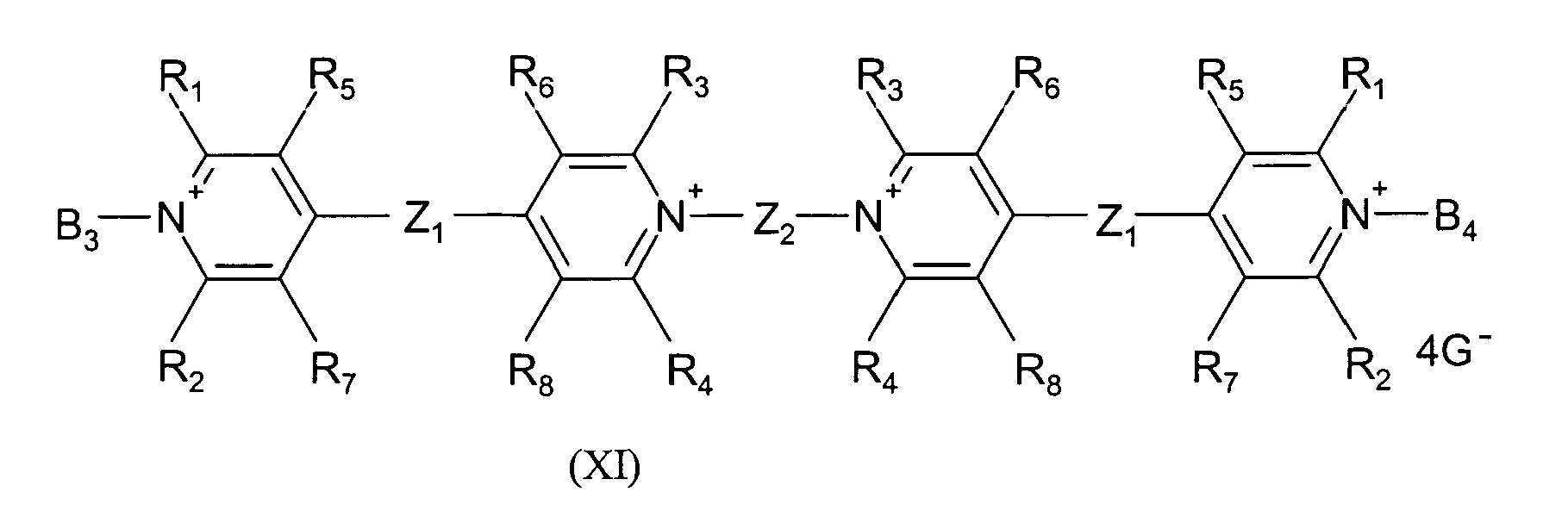


 R1 to R4, independently of one another, are hydrogen, (C1-C8)-alkyl, (C2-C12)-alkenyl, (C3-C7)-cycloalkyl, (C7-C15)-aralkyl or (C6-C10)-aryl,R5 and R6 or R7 and R8 are hydrogen or together are a -(CH2)2- or -(CH2)3-bridge,R9 and R10, independently of one another, are hydrogen or in pairs are a -(CH2)2-, -(CH2)3- or -CH=CH- bridge,R11, R12, R17 and R18, independently of one another, are hydrogen, (C1-C4)-alkyl, (C1-C4)-alkoxy, halogen, cyano, nitro or (C1-C4)-alkoxycarbonyl,R13 and R14, independently of one another, are O, N-CN, C(CN)2 or N-(C6-C10)-aryl-,R15 and R16 are a -CH=CH-CH=CH- bridge,E1 is an O or S atom,Z1 is a direct bond, -CH=CH-, -C(CH3)=CH-, -C(CN)=CH-, -CCl=CCl-, -C(OH)=CH-, -CCl=CH-, -C≡C-, -CH=N-N=CH-,
-C(CH3)=N-N=C(CH3)- or -CCl=N-N=CCl-,Z2 is -(CH2)r- , p- or m-CH2-C6H4-CH2-,r is an integer from 1 to 10, andG- is a colourless anion which is redox-inert under the conditions,andRED1 is a radical from compounds of the formulae XIX to XXVin which


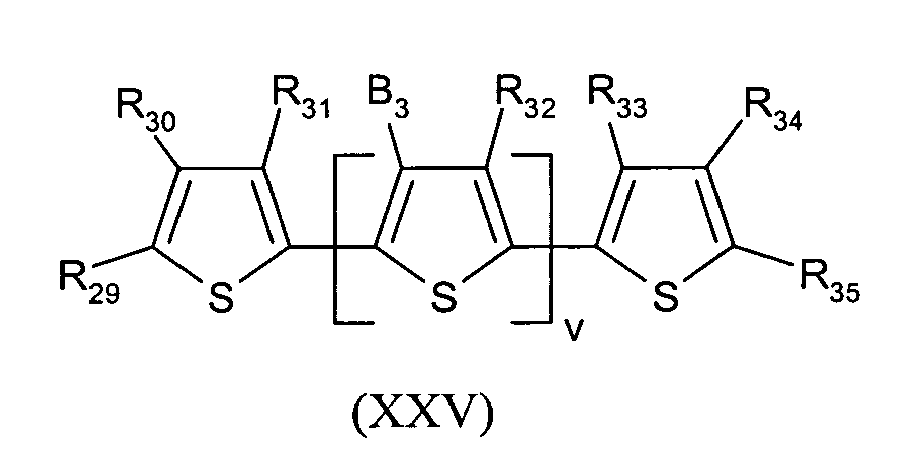 R21 and R22 are (C1-C8)-alkyl, (C2-C12)-alkenyl, (C3-C7)-cycloalkyl, (C7-C15)-aralkyl or (C6-C10)-aryl,R23 to R28, independently of one another, are hydrogen, (C1-C4)-alkyl, (C1-C4)-alkoxy, halogen, cyano, nitro, (C1-C4)-alkoxycarbonyl or (C6-C10)-aryl, andR26 is additionally NR37R37,R29 to R35, independently of one another, are hydrogen, (C1-C4)-alkyl, (C1-C4)-alkoxy, cyano, (C1-C4)-alkoxycarbonyl or (C6-C10)-aryl, orR29 and R30, and R34 and R35, independently of one another, together are a -(CH2)3-, -(CH2)4- or -CH=CH-CH=CH- bridge,E2 is an O or S atom or the groups N-B4, C(CH3)2, C=O or SO2,E3 and E4 is an O or S atom or the group NR36,R36 and R37, independently of one another, are (C1-C12)-alkyl, (C2-C8)-alkenyl, (C3-C7)-cycloalkyl, (C7-C15)-aralkyl or (C6-C10)-aryl, and R36 is additionally hydrogen, orR37 in the meaning of NR37R37 together with the N atom to which they are bonded, form a five- or six-membered, saturated ring, which may contain further heteroatoms,v is an integer from 1 to 20,if B3 is identical to B4, B3 and B4 are identical to B1 or B2, andB1 and B2 are as defined in Claim 1,B3 and B4 are replaced by the bridging units B6, B7 and B8,X1 and X2 are halogen, -OH, -O-, -COOH, -COO-(C1-C4)-alkyl, -O-C(=O)-(C1-C4)alkyl, -COO-, -NH2, -NH-(C1-C4)-alkyl, -N=C=O, or a tertiary nitrogen atom which carries three identical or different (C1-C12)-alkyl, (C7-C15)-aralkyl or (C6-C10)-aryl substituents or is a member of the 4- to 7-atom ring, which may also contain further heteroatoms, orX1 or X2 is a C=C- double bond, an -O-C(=O)-CH=CH2 group or an -O-C(=O)-C(CH3)=CH2- group.
 - Process according to Claim 2, characterized in that the electrochromic monomers of the formulae (XXVI) to (XXVIII) in which X1 and X2 are primary or secondary OH groups are polycondensed with aliphatic or aromatic diisocyanates.
- Process according to Claim 2, characterized in that the electrochromic monomers of the formulae (XXVI) to (XXVIII) in which X1 and X2 are primary halogen groups are subjected to a polyaddition reaction with aliphatic or aromatic compounds which have two tertiary nitrogen atoms which themselves carry three identical or different (C1-C12)-alkyl, (C7-C15)-aralkyl, (C6-C10)-aryl substituents or are members of the 4- to 7-atom ring.
- Process according to Claim 2, characterized in that the electrochromic monomers of the formulae (XXVI) to (XXVIII) in which X1 and X2 or both are a C=C double bond are polymerized by free-radical polymerization.
- Process according to Claim 2, characterized in that the electrochromic monomers of the formulae (XXVI) to (XXVIII) in which X1 and X2 are OH groups are polycondensed with dicarboxylic acid dichlorides.
- Electrochromic monomers which conform to the formula XXX

B6 = B7 = -(CH2)n-, where n = 2 - 18,
B6 = B7= -(CH2)2-O-(CH2)2- or o-, m- or p-CH2-C6H4-CH2-,
and X1 = X2 = halogen,
or
B6 = B7 = -(CH2)n-, where n = 2 - 18, or
B6 = B7 = -(CH2)2-O-(CH2)2- or o-, m- or p-CH2-C6H4-CH2-,
X1 = X2 = -O-C(=O)-(C1-C4)-alkyl or -O-C(=O)-CH=CH2 or -O-C(=O)-C(CH3)=CH2,
or
B6 = -(CH2)n-, where n = 2 - 18,
B7 = -Ph,
X1 = -O-C(=O)-CH=CH2 or -O-C(=O)-C(CH3)=CH2 and
X2 is absent, or
B6 = -(CH2)n, where n = 2 -11,
B7= -(C6-C10)-aryl, substituted -(C6-C10)-aryl, (C1-C18)-alkyl or (C7-C24)-aralkyl,
X1 = -OH, and
X2 is absent, or
B6 = B7 = -(CH2)n-, where n = 3 - 11,
and X1 = X2 = -OH, or
B6 = B7 = -CH2-CH(CnH2n+1)-, where n = 1 - 18,
and X1= X2 = -OH. - Electrochromic system comprising a polymer according to Claim 1.
Applications Claiming Priority (5)
| Application Number | Priority Date | Filing Date | Title |
|---|---|---|---|
| DE19728876 | 1997-07-07 | ||
| DE19728876 | 1997-07-07 | ||
| DE19801638 | 1998-01-17 | ||
| DE19801638A DE19801638A1 (en) | 1998-01-17 | 1998-01-17 | Electrochromic polymer systems |
| PCT/EP1998/003862 WO1999002621A1 (en) | 1997-07-07 | 1998-06-24 | Electrochrome polymer systems |
Publications (2)
| Publication Number | Publication Date |
|---|---|
| EP1027397A1 EP1027397A1 (en) | 2000-08-16 |
| EP1027397B1 true EP1027397B1 (en) | 2006-10-18 |
Family
ID=26038069
Family Applications (1)
| Application Number | Title | Priority Date | Filing Date |
|---|---|---|---|
| EP98933640A Expired - Lifetime EP1027397B1 (en) | 1997-07-07 | 1998-06-24 | Electrochrome polymer systems |
Country Status (11)
| Country | Link |
|---|---|
| US (1) | US6569361B1 (en) |
| EP (1) | EP1027397B1 (en) |
| JP (1) | JP2002511096A (en) |
| KR (1) | KR100564863B1 (en) |
| AT (1) | ATE342947T1 (en) |
| AU (1) | AU735970B2 (en) |
| BR (1) | BR9811668A (en) |
| CA (1) | CA2294795A1 (en) |
| DE (1) | DE59813775D1 (en) |
| ES (1) | ES2275308T3 (en) |
| WO (1) | WO1999002621A1 (en) |
Cited By (1)
| Publication number | Priority date | Publication date | Assignee | Title |
|---|---|---|---|---|
| EP2979926A1 (en) | 2014-07-28 | 2016-02-03 | Zizala Lichtsysteme GmbH | Cover for a light device |
Families Citing this family (65)
| Publication number | Priority date | Publication date | Assignee | Title |
|---|---|---|---|---|
| DE19906655A1 (en) * | 1999-02-18 | 2000-11-16 | Bayer Ag | Electrochromic device with improved light fastness |
| DE19914304A1 (en) * | 1999-03-29 | 2000-10-05 | Bayer Ag | Electrochrome contrast plate |
| DE60017440T2 (en) * | 1999-10-11 | 2006-03-02 | University College Dublin | ELECTROCHROME DEVICE |
| US6614578B2 (en) | 1999-12-03 | 2003-09-02 | Gentex Corporation | Ultraviolet stabilizing materials having a solublizing moiety |
| US6710906B2 (en) | 1999-12-03 | 2004-03-23 | Gentex Corporation | Controlled diffusion coefficient electrochromic materials for use in electrochromic mediums and associated electrochromic devices |
| CA2434693A1 (en) | 2001-01-18 | 2002-10-17 | Genzyme Corporation | Ionene polymers and their use as antimicrobial agents |
| US6635194B2 (en) | 2001-08-28 | 2003-10-21 | Gentex Corporation | Electrochromic medium having a self-healing cross-linked polymer gel and associated electrochromic device |
| US7595011B2 (en) | 2004-07-12 | 2009-09-29 | Ciba Specialty Chemicals Corporation | Stabilized electrochromic media |
| US7428091B2 (en) * | 2004-11-15 | 2008-09-23 | Gentex Corporation | Electrochromic compounds and associated media and devices |
| US7855821B2 (en) * | 2004-11-15 | 2010-12-21 | Gentex Corporation | Electrochromic compounds and associated media and devices |
| DE102005032081A1 (en) * | 2005-05-31 | 2007-02-15 | Siemens Ag | Electrochromic material, use thereof and display |
| JP2009500677A (en) * | 2005-07-11 | 2009-01-08 | シーメンス アクチエンゲゼルシヤフト | Polymer 4,4'-bipyridinium structure, formulation for electrochromic active layer and use therefor |
| KR100701646B1 (en) * | 2005-11-10 | 2007-04-06 | 한양대학교 산학협력단 | Reflective electrochromic display device combining non-olivine with surface functional group of monodisperse polymer particles and manufacturing method thereof |
| US7414770B2 (en) | 2006-05-03 | 2008-08-19 | Gentex Corporation | Contollably dissolving spacing member and associated electrochromic device and method for manufacturing the same |
| RU2464607C2 (en) * | 2007-03-13 | 2012-10-20 | Государственное Учебно-Научное Учреждение Физический Факультет Московского Государственного Университета Им.М.В.Ломоносова | Single-layer partitioned electrochromic device having electrochromic polymer material |
| US8345345B2 (en) | 2007-06-27 | 2013-01-01 | Gentex Corporation | Electrochromic device having an improved fill port plug |
| WO2014022681A1 (en) | 2012-08-01 | 2014-02-06 | Gentex Corporation | Assembly with laser induced channel edge and method thereof |
| US8928966B1 (en) | 2012-08-08 | 2015-01-06 | Gentex Corporation | Electrochromic polyelectrolyte gel medium having improved creep resistance and associated electrochromic device |
| US9758099B2 (en) | 2013-03-15 | 2017-09-12 | Gentex Corporation | Display system and method thereof |
| US9057925B2 (en) | 2013-03-15 | 2015-06-16 | Gentex Corporation | Fill port plugs for electrochromic devices |
| US9354470B2 (en) | 2013-09-24 | 2016-05-31 | Gentex Corporation | Electro-optic device |
| JP6221686B2 (en) * | 2013-11-27 | 2017-11-01 | 株式会社リコー | Electrochromic compound and display element |
| EP3177962B1 (en) | 2014-08-04 | 2020-07-08 | Gentex Corporation | Electrochromic devices |
| KR20170134472A (en) | 2015-03-09 | 2017-12-06 | 젠텍스 코포레이션 | Electrochemical device with plastic substrate |
| WO2016209323A1 (en) | 2015-06-25 | 2016-12-29 | Gentex Corporation | Electrochromic thermoplastics, devices, and composites |
| CN108025675A (en) | 2015-09-18 | 2018-05-11 | 金泰克斯公司 | Toggle mechanism for mirror assembly |
| WO2017062698A1 (en) | 2015-10-09 | 2017-04-13 | Gentex Corporation | Electro-optic mirror having user-adjustable dimming with visual feedback |
| US10189408B2 (en) | 2015-11-02 | 2019-01-29 | Gentex Corporation | Display mirror assembly incorporating heatsink |
| WO2017087019A1 (en) | 2015-11-20 | 2017-05-26 | Gentex Corporation | Protic-soluble organic electrochromic compounds |
| US10505301B2 (en) | 2015-12-03 | 2019-12-10 | Gentex Corporation | Conductive connection device for vehicle display |
| US10766422B2 (en) | 2015-12-11 | 2020-09-08 | Gentex Corporation | IR transmitting coating for electro-optic element |
| CN108367712B (en) | 2015-12-14 | 2022-04-29 | 金泰克斯公司 | Dual Mode Mechanism with Optical Switch |
| US10769434B2 (en) | 2015-12-22 | 2020-09-08 | Gentex Corporation | Mirror assembly incorporating a scanning apparatus |
| US10105006B2 (en) | 2016-04-07 | 2018-10-23 | Electrolux Home Products, Inc. | Cooking appliance with indicators formed using electrochromic material |
| US10459307B2 (en) | 2016-04-22 | 2019-10-29 | Gentex Corporation | Flame retardancy of electrochromic devices |
| US10684471B2 (en) | 2016-04-27 | 2020-06-16 | Gentex Corporation | Vehicle display comprising focal distance correction feature |
| US9694042B1 (en) * | 2016-05-23 | 2017-07-04 | Kaeco Group, Inc. | Mastic gum top dressing for the prevention of gastrointestinal distress in horses and other species |
| CN109690395B (en) | 2016-09-30 | 2021-06-15 | 金泰克斯公司 | Color shift mitigation in electrochromic devices |
| EP3485327B1 (en) | 2016-10-10 | 2021-11-24 | Gentex Corporation | Polarized window assembly |
| US10745613B2 (en) * | 2016-10-17 | 2020-08-18 | Gentex Corporation | Near-IR absorptive compounds and devices incorporating the same |
| WO2018075881A1 (en) | 2016-10-21 | 2018-04-26 | Gentex Corporation | Antireflection coatings |
| CN110326293A (en) | 2017-03-22 | 2019-10-11 | 金泰克斯公司 | Merge to image the display component of sensor |
| CN110582721B (en) | 2017-05-01 | 2022-09-20 | 金泰克斯公司 | Imaging device with switchable day and night modes |
| US10739661B2 (en) | 2017-09-25 | 2020-08-11 | Gentex Corporation | IR transmitting coating for electro-optic element |
| US10686181B2 (en) | 2017-10-17 | 2020-06-16 | Gentex Corporation | Isolated cell design in electro-optic devices |
| WO2019130275A1 (en) | 2017-12-29 | 2019-07-04 | Gentex Corporation | Polarized electrochromic device |
| WO2020012340A1 (en) | 2018-07-12 | 2020-01-16 | Gentex Corporation | Mirror assembly incorporating a scanning apparatus |
| US11066046B2 (en) | 2018-09-25 | 2021-07-20 | Getex Corporation | Authentication concealment and alignment systems |
| WO2020109975A1 (en) | 2018-11-26 | 2020-06-04 | Gentex Corporation | Vehicle display system with reflection control |
| US11283985B2 (en) | 2018-12-05 | 2022-03-22 | Gentex Corporation | Imaging system for iris authentication and driver monitoring |
| WO2020115718A1 (en) | 2018-12-07 | 2020-06-11 | Gentex Corporation | Electro-optic apparatus and seal system |
| CN113168515A (en) | 2018-12-10 | 2021-07-23 | 金泰克斯公司 | Scanning device for reducing search space of field of view |
| WO2020121201A1 (en) | 2018-12-13 | 2020-06-18 | Gentex Corporation | Alignment apparatus for vehicle authentication system |
| US10929698B2 (en) | 2018-12-17 | 2021-02-23 | Gentex Corporation | Advanced features for vehicle authentication system |
| US11479185B2 (en) | 2019-02-01 | 2022-10-25 | Gentex Corporation | Active infrared illumination for enhancing rear vision from a vehicle |
| EP3948414B1 (en) | 2019-03-29 | 2025-05-07 | Gentex Corporation | Electro-optic sub-assemblies and assemblies having an electrochromic gel layer |
| US11692065B2 (en) * | 2019-03-29 | 2023-07-04 | Cornell University | Phenazine copolymers and uses thereof |
| US11906866B2 (en) | 2019-06-27 | 2024-02-20 | Gentex Corporation | Electrochromic films and methods of forming and using |
| US12134351B2 (en) | 2020-09-18 | 2024-11-05 | Gentex Corporation | Concealment panel with asymmetric reflectance |
| US12135490B2 (en) | 2022-01-19 | 2024-11-05 | Gentex Corporation | Rearview assembly incorporating high-transmittance NIR film |
| US12547039B2 (en) | 2022-02-18 | 2026-02-10 | Gentex Corporation | Electro-optic element electrode |
| US12503047B2 (en) | 2022-02-28 | 2025-12-23 | Gentex Corporation | Display mirror assembly |
| US12600300B2 (en) | 2022-03-22 | 2026-04-14 | Gentex Corporation | Full display mirror assembly with through bezel infrared illumination |
| CN223919212U (en) | 2022-03-28 | 2026-02-17 | 金泰克斯公司 | Full display mirror assembly with blind spot detection system |
| WO2024074987A1 (en) | 2022-10-03 | 2024-04-11 | Gentex Corporation | Rearview mirror assembly |
Family Cites Families (12)
| Publication number | Priority date | Publication date | Assignee | Title |
|---|---|---|---|---|
| JPS59217789A (en) * | 1983-05-25 | 1984-12-07 | Japan Electronic Ind Dev Assoc<Jeida> | Electrochromic material |
| JPS59217791A (en) * | 1983-05-25 | 1984-12-07 | Japan Electronic Ind Dev Assoc<Jeida> | Electrochromic material |
| JPS61204224A (en) * | 1985-03-08 | 1986-09-10 | Sumitomo Electric Ind Ltd | Functional elastomer |
| US4902108A (en) | 1986-03-31 | 1990-02-20 | Gentex Corporation | Single-compartment, self-erasing, solution-phase electrochromic devices, solutions for use therein, and uses thereof |
| US4841021A (en) * | 1987-11-30 | 1989-06-20 | Minnesota Mining And Manufacturing Company | Polypyridinium |
| US5140455A (en) | 1989-11-29 | 1992-08-18 | Donnelly Corporation | High performance electrochemichromic solutions and devices thereof |
| US5457564A (en) * | 1990-02-26 | 1995-10-10 | Molecular Displays, Inc. | Complementary surface confined polymer electrochromic materials, systems, and methods of fabrication therefor |
| US5818636A (en) * | 1990-02-26 | 1998-10-06 | Molecular Displays, Inc. | Complementary surface confined polmer electrochromic materials, systems, and methods of fabrication therefor |
| EP1004649A3 (en) * | 1993-02-26 | 2000-07-26 | Donnelly Corporation | Electrochromic polymeric solid films, manufacturing electrochromic devices using such solid films, and processes for making such solid films and devices |
| DE4325591A1 (en) | 1993-07-30 | 1995-02-02 | Hoechst Ag | Dihydrophenazine polymers |
| US5679283A (en) * | 1994-07-22 | 1997-10-21 | Gentex Corporation | Electrochromic layer and devices comprising same |
| EP1041425A4 (en) * | 1997-12-19 | 2007-05-02 | Nippon Mitsubishi Oil Corp | ELECTROCHEMICAL ELEMENT |
-
1998
- 1998-06-24 WO PCT/EP1998/003862 patent/WO1999002621A1/en not_active Ceased
- 1998-06-24 CA CA002294795A patent/CA2294795A1/en not_active Abandoned
- 1998-06-24 AT AT98933640T patent/ATE342947T1/en not_active IP Right Cessation
- 1998-06-24 JP JP50805499A patent/JP2002511096A/en not_active Ceased
- 1998-06-24 DE DE59813775T patent/DE59813775D1/en not_active Expired - Fee Related
- 1998-06-24 AU AU83390/98A patent/AU735970B2/en not_active Ceased
- 1998-06-24 EP EP98933640A patent/EP1027397B1/en not_active Expired - Lifetime
- 1998-06-24 ES ES98933640T patent/ES2275308T3/en not_active Expired - Lifetime
- 1998-06-24 BR BR9811668-1A patent/BR9811668A/en not_active IP Right Cessation
- 1998-06-24 US US09/462,045 patent/US6569361B1/en not_active Expired - Fee Related
- 1998-06-24 KR KR1020007000084A patent/KR100564863B1/en not_active Expired - Fee Related
Cited By (1)
| Publication number | Priority date | Publication date | Assignee | Title |
|---|---|---|---|---|
| EP2979926A1 (en) | 2014-07-28 | 2016-02-03 | Zizala Lichtsysteme GmbH | Cover for a light device |
Also Published As
| Publication number | Publication date |
|---|---|
| ATE342947T1 (en) | 2006-11-15 |
| US6569361B1 (en) | 2003-05-27 |
| CA2294795A1 (en) | 1999-01-21 |
| JP2002511096A (en) | 2002-04-09 |
| EP1027397A1 (en) | 2000-08-16 |
| KR100564863B1 (en) | 2006-03-28 |
| WO1999002621A1 (en) | 1999-01-21 |
| AU735970B2 (en) | 2001-07-19 |
| ES2275308T3 (en) | 2007-06-01 |
| KR20010021526A (en) | 2001-03-15 |
| AU8339098A (en) | 1999-02-08 |
| DE59813775D1 (en) | 2006-11-30 |
| BR9811668A (en) | 2000-09-19 |
Similar Documents
| Publication | Publication Date | Title |
|---|---|---|
| EP1027397A1 (en) | Electrochrome polymer systems | |
| EP0880568B1 (en) | Electrochromic system | |
| EP1007602B1 (en) | Uv-protected electrochromic solution | |
| US6288825B1 (en) | Electrochromic media for producing a preselected color and devices comprising same | |
| EP2270116B1 (en) | Color-stabilized electrochromic devices | |
| DE69426040T2 (en) | Electrochromic polymeric solid films, manufacture of electrochromic devices with such films, and processes for the manufacture of such solid films and devices | |
| EP2350232B1 (en) | Electrochromic compounds and associated media and devices | |
| EP0917556B1 (en) | Electrochromic indicating device | |
| EP1285040B1 (en) | Electrochromic device | |
| EP1029256B1 (en) | Electrochromic system | |
| AU733812B2 (en) | Electrochromic system featuring coupled red-ox system and specific anions | |
| EP1116767B1 (en) | Electrochromic device | |
| DE19906655A1 (en) | Electrochromic device with improved light fastness | |
| US20030137713A1 (en) | Color-stabilized electrochromic devices | |
| EP1156098A2 (en) | Electrochromic display device with high edge sharpening | |
| DE19801638A1 (en) | Electrochromic polymer systems | |
| DE10148438B4 (en) | Electrochromic device | |
| MXPA00000282A (en) | Electrochrome polymer systems | |
| HK1124069A (en) | An electro-optic device, an electro-optic automotive mirror comprising ionic liquids and the electrolyte used by them | |
| CZ20001628A3 (en) | Electrochrome system |
Legal Events
| Date | Code | Title | Description |
|---|---|---|---|
| PUAI | Public reference made under article 153(3) epc to a published international application that has entered the european phase |
Free format text: ORIGINAL CODE: 0009012 |
|
| 17P | Request for examination filed |
Effective date: 20000207 |
|
| AK | Designated contracting states |
Kind code of ref document: A1 Designated state(s): AT DE ES FR GB IE IT NL SE |
|
| RAP1 | Party data changed (applicant data changed or rights of an application transferred) |
Owner name: BAYER CHEMICALS AG |
|
| 17Q | First examination report despatched |
Effective date: 20031203 |
|
| RAP1 | Party data changed (applicant data changed or rights of an application transferred) |
Owner name: BAYER INNOVATION GMBH |
|
| GRAP | Despatch of communication of intention to grant a patent |
Free format text: ORIGINAL CODE: EPIDOSNIGR1 |
|
| GRAS | Grant fee paid |
Free format text: ORIGINAL CODE: EPIDOSNIGR3 |
|
| GRAA | (expected) grant |
Free format text: ORIGINAL CODE: 0009210 |
|
| AK | Designated contracting states |
Kind code of ref document: B1 Designated state(s): AT DE ES FR GB IE IT NL SE |
|
| PG25 | Lapsed in a contracting state [announced via postgrant information from national office to epo] |
Ref country code: IT Free format text: LAPSE BECAUSE OF FAILURE TO SUBMIT A TRANSLATION OF THE DESCRIPTION OR TO PAY THE FEE WITHIN THE PRESCRIBED TIME-LIMIT;WARNING: LAPSES OF ITALIAN PATENTS WITH EFFECTIVE DATE BEFORE 2007 MAY HAVE OCCURRED AT ANY TIME BEFORE 2007. THE CORRECT EFFECTIVE DATE MAY BE DIFFERENT FROM THE ONE RECORDED. Effective date: 20061018 |
|
| REG | Reference to a national code |
Ref country code: GB Ref legal event code: FG4D Free format text: NOT ENGLISH |
|
| REG | Reference to a national code |
Ref country code: IE Ref legal event code: FG4D Free format text: LANGUAGE OF EP DOCUMENT: GERMAN |
|
| REF | Corresponds to: |
Ref document number: 59813775 Country of ref document: DE Date of ref document: 20061130 Kind code of ref document: P |
|
| REG | Reference to a national code |
Ref country code: SE Ref legal event code: TRGR |
|
| GBT | Gb: translation of ep patent filed (gb section 77(6)(a)/1977) |
Effective date: 20070111 |
|
| ET | Fr: translation filed | ||
| REG | Reference to a national code |
Ref country code: ES Ref legal event code: FG2A Ref document number: 2275308 Country of ref document: ES Kind code of ref document: T3 |
|
| PLBE | No opposition filed within time limit |
Free format text: ORIGINAL CODE: 0009261 |
|
| STAA | Information on the status of an ep patent application or granted ep patent |
Free format text: STATUS: NO OPPOSITION FILED WITHIN TIME LIMIT |
|
| 26N | No opposition filed |
Effective date: 20070719 |
|
| PGFP | Annual fee paid to national office [announced via postgrant information from national office to epo] |
Ref country code: NL Payment date: 20090603 Year of fee payment: 12 Ref country code: IE Payment date: 20090618 Year of fee payment: 12 |
|
| PGFP | Annual fee paid to national office [announced via postgrant information from national office to epo] |
Ref country code: SE Payment date: 20090605 Year of fee payment: 12 Ref country code: IT Payment date: 20090622 Year of fee payment: 12 Ref country code: AT Payment date: 20090615 Year of fee payment: 12 |
|
| PGFP | Annual fee paid to national office [announced via postgrant information from national office to epo] |
Ref country code: ES Payment date: 20090709 Year of fee payment: 12 |
|
| PGFP | Annual fee paid to national office [announced via postgrant information from national office to epo] |
Ref country code: GB Payment date: 20090624 Year of fee payment: 12 Ref country code: DE Payment date: 20090520 Year of fee payment: 12 |
|
| REG | Reference to a national code |
Ref country code: NL Ref legal event code: V1 Effective date: 20110101 |
|
| EUG | Se: european patent has lapsed | ||
| GBPC | Gb: european patent ceased through non-payment of renewal fee |
Effective date: 20100624 |
|
| REG | Reference to a national code |
Ref country code: FR Ref legal event code: ST Effective date: 20110228 |
|
| PG25 | Lapsed in a contracting state [announced via postgrant information from national office to epo] |
Ref country code: IT Free format text: LAPSE BECAUSE OF NON-PAYMENT OF DUE FEES Effective date: 20100624 |
|
| PG25 | Lapsed in a contracting state [announced via postgrant information from national office to epo] |
Ref country code: IE Free format text: LAPSE BECAUSE OF NON-PAYMENT OF DUE FEES Effective date: 20100624 Ref country code: DE Free format text: LAPSE BECAUSE OF NON-PAYMENT OF DUE FEES Effective date: 20110101 |
|
| PG25 | Lapsed in a contracting state [announced via postgrant information from national office to epo] |
Ref country code: AT Free format text: LAPSE BECAUSE OF NON-PAYMENT OF DUE FEES Effective date: 20100624 Ref country code: FR Free format text: LAPSE BECAUSE OF NON-PAYMENT OF DUE FEES Effective date: 20100630 Ref country code: NL Free format text: LAPSE BECAUSE OF NON-PAYMENT OF DUE FEES Effective date: 20110101 |
|
| REG | Reference to a national code |
Ref country code: ES Ref legal event code: FD2A Effective date: 20110718 |
|
| PG25 | Lapsed in a contracting state [announced via postgrant information from national office to epo] |
Ref country code: GB Free format text: LAPSE BECAUSE OF NON-PAYMENT OF DUE FEES Effective date: 20100624 Ref country code: ES Free format text: LAPSE BECAUSE OF NON-PAYMENT OF DUE FEES Effective date: 20110706 |
|
| PG25 | Lapsed in a contracting state [announced via postgrant information from national office to epo] |
Ref country code: ES Free format text: LAPSE BECAUSE OF NON-PAYMENT OF DUE FEES Effective date: 20100625 |
|
| PG25 | Lapsed in a contracting state [announced via postgrant information from national office to epo] |
Ref country code: SE Free format text: LAPSE BECAUSE OF NON-PAYMENT OF DUE FEES Effective date: 20100625 |
|
| PGFP | Annual fee paid to national office [announced via postgrant information from national office to epo] |
Ref country code: FR Payment date: 20090611 Year of fee payment: 12 |