EP1027142B1 - Schichtenbildungsresistente emulsionen - Google Patents
Schichtenbildungsresistente emulsionen Download PDFInfo
- Publication number
- EP1027142B1 EP1027142B1 EP98937349A EP98937349A EP1027142B1 EP 1027142 B1 EP1027142 B1 EP 1027142B1 EP 98937349 A EP98937349 A EP 98937349A EP 98937349 A EP98937349 A EP 98937349A EP 1027142 B1 EP1027142 B1 EP 1027142B1
- Authority
- EP
- European Patent Office
- Prior art keywords
- emulsion
- coupling agent
- emulsifier
- styrene
- dispersed phase
- Prior art date
- Legal status (The legal status is an assumption and is not a legal conclusion. Google has not performed a legal analysis and makes no representation as to the accuracy of the status listed.)
- Expired - Lifetime
Links
Images
Classifications
-
- C—CHEMISTRY; METALLURGY
- C10—PETROLEUM, GAS OR COKE INDUSTRIES; TECHNICAL GASES CONTAINING CARBON MONOXIDE; FUELS; LUBRICANTS; PEAT
- C10L—FUELS NOT OTHERWISE PROVIDED FOR; NATURAL GAS; SYNTHETIC NATURAL GAS OBTAINED BY PROCESSES NOT COVERED BY SUBCLASSES C10G OR C10K; LIQUIFIED PETROLEUM GAS; USE OF ADDITIVES TO FUELS OR FIRES; FIRE-LIGHTERS
- C10L1/00—Liquid carbonaceous fuels
- C10L1/32—Liquid carbonaceous fuels consisting of coal-oil suspensions or aqueous emulsions or oil emulsions
- C10L1/328—Oil emulsions containing water or any other hydrophilic phase
-
- C—CHEMISTRY; METALLURGY
- C08—ORGANIC MACROMOLECULAR COMPOUNDS; THEIR PREPARATION OR CHEMICAL WORKING-UP; COMPOSITIONS BASED THEREON
- C08L—COMPOSITIONS OF MACROMOLECULAR COMPOUNDS
- C08L53/00—Compositions of block copolymers containing at least one sequence of a polymer obtained by reactions only involving carbon-to-carbon unsaturated bonds; Compositions of derivatives of such polymers
-
- C—CHEMISTRY; METALLURGY
- C09—DYES; PAINTS; POLISHES; NATURAL RESINS; ADHESIVES; COMPOSITIONS NOT OTHERWISE PROVIDED FOR; APPLICATIONS OF MATERIALS NOT OTHERWISE PROVIDED FOR
- C09K—MATERIALS FOR MISCELLANEOUS APPLICATIONS, NOT PROVIDED FOR ELSEWHERE
- C09K23/00—Use of substances as emulsifying, wetting, dispersing, or foam-producing agents
- C09K23/42—Ethers, e.g. polyglycol ethers of alcohols or phenols
Definitions
- the present invention relates to emulsions containing alcohol and/or water in a dispersed phase and a hydrocarbon liquid in the continuous phase as described in claim 1. More particularly the present invention relates to such emulsions that are resistant to stratification on relatively long term undisturbed storage at ambient temperature.
- emulsions containing alcohol and/or water in one phase and a hydrocarbon liquid in the other may be formed using an emulsifier that is a block copolymer of ethylene oxide and styrene type monomers.
- emulsifier that is a block copolymer of ethylene oxide and styrene type monomers.
- emulsions are of particular utility as liquid transport fuel in which hydrated methanol or hydrated ethanol is dispersed in diesel oil or gasoline.
- Hydrated alcohol in diesel oil (termed AW/D) emulsions represent a new and potentially cost effective option for significantly reducing particulate and NOx emissions from diesel engines.
- Emulsions of hydrated alcohol in gasoline exhibit reduced vapour pressure, increased water tolerance and reduced NOx emission on combustion as compared with anhydrous alcohol solutions in gasoline.
- the alcohol is ethanol produced from biomass there can be a reduction in the net emission of carbon dioxide ("greenhouse gas") as compared with the use of unblended petroleum fuel.
- the arrangement described in the above mentioned specification utilised not only a block copolymer as the emulsifier but also a block copolymer as a coupling agent.
- the coupling agent typically comprised a block copolymer of butadiene and styrene type monomers and was described as containing butadiene and styrene in weight ratios of at least 2:1, preferably at least 3:1.
- the emulsifier and the coupling agent are described in that specification as being present in the emulsion in a ratio of from 1:3 to 3:1. In these ratios solutions of the two copolymers are compatible.
- the present invention relates to emulsions containing in a continuous phase a hydrocarbon liquid and in a dispersed phase alcohol and/or water in the presence of:-
- the absolute amounts of the emulsifier and the coupling agent can be determined for any given emulsifier and coupling agent by quantitative testing. It is apparent to the present inventor that the amount of the coupling agent in the emulsion is important and typically approaches the solubility limit of the coupling agent in the continuous phase. If the amount of the coupling agent is lower than the critical amount it will not couple effectively with the micelles of the emulsifier and therefor stratification of the dispersed phase of the emulsion will not be inhibited. If the amount of the coupling agent is higher than the critical amount it will form micelles of the styrene containing polymeric blocks of the coupling agent which will in turn cause flocculation of the dispersed phase to occur.
- the solubility of the coupling agent in the continuous phase can be adjusted by an alteration of the amount of the styrene moiety relative to the hydrocarbon moiety in the coupling agent.
- the solubility will also depend to some extent upon the aromaticity of the hydrocarbon liquid comprising the continuous phase. The more aromatic is the hydrocarbon liquid the higher will be the solubility of any given coupling agent.
- the maximum amount of emulsifier is not as critical as the maximum amount of the coupling agent as, within reasonable limits, the presence of an excess of emulsifier has only an economic disadvantage and not a technical one.
- the emulsifier should be present in an amount of at least 3.5 times the amount of the coupling agent as is described in more detail later in this; specification.
- Preferred amounts of the coupling agent in the emulsion are in the range of from 0.75 to 1.5 gm/l.
- the coupling agent is present in the emulsion in the range of from 0.75 to 1.0 gm/l whereas in the case of the dispersed phase comprising hydrated ethanol the preferred range is from 1.0 to 1.5 gm/l.
- the copolymer content of the emulsion i.e. the combined amount of the emulsifier and of the coupling agent, is preferably in the range of from 4 to 10 gm/l.
- the preferred amount of copolymers is 4 to 6 gm/l, more preferably 5 gm/l, and in the case of emulsions containing hydrated ethanol in an amount of 15% by volume in the dispersed phase the preferred concentration of copolymers is 5 to 8 gm/l, more preferably 6 gm/l.
- the preferred amount of the copolymers will typically remain less than 10 gm/l, however in this case the ratio of the emulsifier to the coupling agent will rise. This is because, as the amount of the dispersed phase increases so the quantity of emulsifier required increases in proportion to the increase in the surface area of the dispersed phase of the emulsion; by contrast, the quantity of coupling agent stays substantially constant as the amount of the dispersed phase increases.
- the hydrocarbon liquid is preferably selected from the group comprising gasolines, kerosenes, diesel oils, gas oils and fuel oils.
- the gasolines are liquid hydrocarbons boiling below 190°C.
- the kerosenes, diesel oils and gas oils boil between 170° and 480°C, while the fuel oils boil above 450°C.
- the hydrocarbon liquid is preferably selected from the gasolines , the kerosenes which boil between 170 and 230°C, the diesel oils which boil from 170 to 315°C and the gas oils that boil from 315 to 480°C.
- the invention is particularly applicable to the high boiling point kerosenes, the diesel oils and the low boiling point gas oils when the dispersed phase comprises a hydrated alcohol.
- the preferred hydrocarbon liquid is selected from the diesel oils, the gas oils, the fuel oils and the hydrocarbon liquids boiling above 480°C.
- the dispersed phase of the emulsions preferably comprises a hydrated alcohol, which preferably contains from 0.1 to 10% by volume of water.
- the dispersed phase is preferably methanol or ethanol, or mixtures thereof, together with water.
- the proportions of alcohol and/or water to hydrocarbon liquid may vary over wide limits.
- a hydrated alcohol content of between 10 and 30% by volume is preferred.
- the emulsifier is preferably a copolymer containing at least one polymeric block of at least one monomer selected from the group comprising styrene and ring substituted styrenes and at least one polymeric block of at least one monomer selected from the group having the formula H(O-R) n OH, where R is an aliphatic bivalent hydrocarbon radical containing from 1 to 4 carbon atoms and n is a number between 20 and 300, more preferably between 22 and 130.
- the emulsifier is preferably a pure di-block copolymer or a reaction mixture containing principally di-block copolymer and tri-block copolymer having two blocks of the styrene monomer , together with some unreacted homopolyzner of the H(O-R) n OH monomer.
- the emulsifier is a polyethylene oxide-polystyrene copolymer.
- the polyethylene oxide block is preferably formed first with a molecular weight of between 1,000 and 10.000.
- the polyethylene oxide and the polystyrene are preferably present in a weight ratio of 1 part of polyethylene oxide to from 0.8 to 1.5 parts of polystyrene, more preferably from 1.0 to 1.25 parts of polystyrene.
- the emulsifier is produced by the reaction of styrene monomer with polyethylene oxide homopolymer in the presence of a free radical initiator.
- the reaction product formed without chain transfer agents comprising polyethylene oxide-polystyrene di-block copolymer, , polystyrene-polyethylene oxide-polystyrene tri-block copolymer, unreacted polyethylene oxide homopolymer and a minor proportion of various other higher molecular weight dimeric and trimeric species and polystyrene homopolymer, is particularly suitable for use in the present invention.
- the coupling agent is preferably a copolymer containing at least one polymeric block of at least one monomer selected from the group comprising styrene and ring substituted styrenes and at least one polymeric block of at least one compound selected from the group comprising saturated or unsaturated aliphatic hydrocarbons, preferably butadiene or isoprene.
- the hydrocarbon may comprise a single long chain hydrocarbon moiety rather than a polymer made up of a plurality of recurring monomeric entities.
- the coupling agent is preferably a pure diblock copolymer or a tapered block copolymer.
- Such copolymers are preferably produced by anionic solution polymerisation as this technique produces copolymers with a defined structure and a narrow molecular weight distribution.
- the coupling agent contains styrene and the aliphatic hydrocarbon in the weight ratio of from 1:0.3 to 1:1, most preferably from 1:0.42 to 1:0.66. These ratios are outside the range of at least 1:2 and most preferably 1:3 stated to be desirable in Australian patent specification 544,728 and lead in an opposite direction from the teaching of that specification.
- the coupling agent preferably has a molecular weight of from 13,000 to 400,000, more preferably from 100,000 to 170,000, most preferably from 120,000 to 150,000. It is preferred that styrene comprises from 50 to 77% by weight of the coupling agent, most preferably 50 to 70% depending on the aromatic content of the continuous phase of the emulsion. It has been found that when the aromatic content of the continuous phase is less than 22% it is preferable for the styrene content of the coupling agent to be in the range of from 50 to 60% by weight. By contrast when the aromatic content of the continuous phase is more than 23% it is preferable for the styrene content of the coupling agent to be in the range of from 60 to 70% by weight.
- the solubility of the coupling agent is limited in the continuous phase of the emulsion. This limited solubility encourages coupling of the styrene moieties on the emulsifier with those of the coupling agent thus preventing coalescence of the droplets in the dispersed phase of the emulsion.
- the emulsifier and the coupling agent are desirably included in the emulsion in quite specific amounts.
- the emulsifier should preferably be present in such an amount that the emulsifier is able to form micelles of its relatively hydrophilic polymer (typically polyethylene oxide) block(s) in a concentration sufficient to contain the alcohol and/or water dispersed phase.
- the coupling agent should be present in an amount that enables it to couple with, or to form polystyrene micelles only with, the styrene moieties on the emulsifier and to thereby substantially prevent the dispersed phase droplets from coalescing, while not being present in an amount sufficient to form polystyrene micelles of the styrene containing polymeric blocks of the coupling agent itself in the continuous phase of the emulsion.
- the emulsifier and the coupling agent will be present in a weight ratio of at least 3.5:1, and more preferably at least 4:1. It is surprising that, at these preferred ratios, solutions of the emulsifier and of the coupling agent are not compatible. These ratios are outside the range of 1:3 to 3:1 stated to be desirable in Australian patent specification 544,728 and lead in an opposite direction from the teaching of that specification.
- the mechanism of the present emulsification is one of steric stabilisation. It is considered that the emulsifier will form hydrophilic (typically polyethylene oxide) micelles in the continuous phase of the emulsion.
- the alcohol and/or water is contained within these micelles, the quantity of the alcohol and/or water that can be accommodated in the emulsion is therefor dependent upon the concentration of these micelles in the emulsion.
- the styrene block or blocks of the emulsifier have a limited solubility in the continuous phase but will project into the continuous phase from the micelles as their solubility is higher in the continuous phase than in the discontinuous or dispersed phase.
- the coupling agent has blocks of styrene containing polymer which are only of limited solubility in the continuous phase and a hydrocarbon moiety which is of much greater solubility in the continuous phase of the emulsion. It is believed that the styrene containing polymer blocks of the coupling agent will couple with the corresponding styrene containing polymer blocks of the emulsifier to form a zone of coupling agent surrounding each micelle. If, however, the amount of coupling agent is increased above a certain concentration, then, as has been discovered by the present inventor, in addition to coupling with the emulsifier the coupling agent molecules will couple with themselves to form polystyrene micelles.
- the coupling agent unexpectedly acts to flocculate the dispersed phase, forming comparatively large sized droplets.
- the presence of the coupling agent is however essential to the maintainance of the sub-micron size dispersion of alcohol and/or water droplets.
- the micelles of emulsifier flocculate, as the styrene containing polymer blocks of the emulsifier in adjacent micelles couple together.
- the dispersed phase droplets behave in accordance with Stokes Law and may stratify in the emulsion in accordance with the number of droplets, the droplet diameter, the relative density of the dispersed and continuous phases of the emulsion and the viscosity of the continuous phase.
- the stratification which is manifest either as creaming, where the dispersed phase rises in the continuous phase, or settling, where the dispersed phase sinks in the continuous phase, may be prevented, or at least reduced, by the establishment of a suitable sub-micron size distribution of the dispersed phase droplets.
- the emulsifier will form hydrophilic (typically polyethylene oxide) micelles in the continuous phase of the emulsion and, provided the concentration of these micelles is above the necessary minimum concentration for the volume of alcohol and/or water to be incorporated into the emulsion, will contain the alcohol and/or water inside the micelles to form the dispersed phase. It is believed that these initially formed dispersed phase droplets are of a sufficiently small size that they are not susceptible to stratification. It is further believed that if that these initially formed dispersed phase droplets can be prevented from coalescing or agglomerating the emulsion will remain resistant to stratification.
- hydrophilic typically polyethylene oxide
- the coupling agent is present in a sufficient amount to couple with the styrene polymer blocks of the emulsifier, but without the formation of micelles of its own, then the initially formed dispersed phase droplets will be held apart and will not be able to couple with one another and coalesce the dispersed phase droplets.
- the micelles of the emulsifier will thus be stabilised by coupling agent molecules with their styrene polymer blocks coupled to the emulsifier and their hydrocarbon blocks solvated by the continuous phase of the emulsion.
- the emulsifier is preferably first dissolved in the alcohol and/or water. In order to induce dissolution of the emulsifier it may be necessary to adjust the reaction conditions used to form the emulsifier to render it more hydrophilic and/or to use an aqueous solution of an alcohol to dissolve the emulsifier.
- the coupling agent is preferably first dissolved in the hydrocarbon liquid. The alcohol and/or water containing the dissolved emulsifier is then added to the hydrocarbon liquid containing the dissolved coupling agent. It is preferred that the solution of the coupling agent in the hydrocarbon liquid be subjected to agitation both before and after the addition of the alcohol and/or water containing the dissolved emulsifier.
- the agitation of the components to the emulsion is preferably carried out using static in-line mixers.
- the agitation following the addition of the alcohol and/or water containing the emulsifier to the hydrocarbon liquid containing the dissolved coupling agent it is desirable that the mixing be carried out with high shear.
- the agitation, combined with the selected emulsifier and coupling agent, and the use of the process according to the present invention produces emulsions with dispersed droplets having diameters in the range of from 0.1 to 2.0 microns, more preferably from 0.1 to 0.9 microns with an average diameter of about 0.5 microns.
- the following method was used for the production of a 3.27 tonne batch of an emulsifier which is a copolymer of polyethylene oxide and styrene.
- the method comprised the steps of:- a) A suitably sized reactor vessel which is compatible with the emulsifier was cleaned and dried b) The following materials were charged into the reactor vessel:- Polyethylene oxide, molecular weight 1500 804.0 kg Xylene solvent 1120.0 kg The polyethylene oxide had been heated to 50-60°C overnight and was added to the reactor vessel through the manhole. c) Styrene monomer 804.0 kg was charged into the reactor monomer feed headtank.
- This emulsifier solution had its solids content adjusted to about 50% by weight through the addition of xylene solvent and was then used directly in the production of emulsions.
- the majority of the xylene may be stripped off by vacuum distillation and recovered for reuse.
- the reactor contents would be analysed for solids and the solids content adjusted to about 75% by weight through the addition of hydrated methanol to the reactor. j) The product was then run-off to drums.
- the preferred coupling agent is produced by a method known as anionic solution polymerisation. This method is widely used in commercial practice for the production of copolymers of styrene and butadiene.
- the styrene-butadiene copolymer is usually produced in a solvent of mixed hexanes, then precipitated by the addition of water, dried and sold in solid form.
- the solids content of the reaction mixture is preferably maintained at about 15% by weight. This coupling agent solution may then be used directly in the production of emulsions.
- the coupling agent may be prepared by dissolving solid styrene-butadiene copolymer in the manner described in the following steps used to produce a six tonne batch of coupling agent:- a) A suitably sized reactor vessel which is compatible with the coupling agent was cleaned and dried. b) The reactor vessel was charged with:- Xylene solvent 2100.0 kg c) With the reactor vessel cool the solvent was stirred at 60 rpm. The following was then charged into the reactor vessel through the manhole:- Styrene-butadiene copolymer solid crumb 900.0 kg d) The manhole cover was sealed and the reactor vessel heated with the jacket temperature initially set at 120°C.
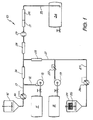
- the blending facility 10 shown in Fig. 1 is designed to blend together diesel oils and alcohol and/or water to form an AW/D emulsion.
- the emulsion is maintained by the emulsifier and a coupling agent already described.
- Diesel oil is held in storage tank 11 and is pumped through line 12 by a pump 13 to a first static in-line mixer 14.
- the coupling agent is a block copolymer of styrene and butadiene dissolved in a reaction solvent, it is stored in a stirred container 15.
- a metering pump 16 meters the coupling agent through line 17 into the diesel oil conveying line 12 up-stream of the first static in-line mixer 14.
- the first static in-line mixer 14 serves to ensure a homogeneous solution of the coupling agent in the diesel oil.
- Alcohol and/or water is stored in a tank 18.
- the alcohol and/or water is pumped from the tank 18 by pump 19 through line 21, including a flow control valve 22, to a second static in-line mixer 23 and then to the line 12 down-stream of the first static in-line mixer 14 and up-stream of a third static in-line mixer 28.
- the emulsifier is a polyethylene oxide-polystyrene copolymer dissolved in a reaction solvent (or in hydrated alcohol) and is stored in a stirred tank 24 which is maintained at between 35 and 40°C by heating coil 25.
- the emulsifier is pumped by metering pump 26 along line 27 into line 21, which it enters down-stream of the second mixer 23.
- the mixer 23 serves to ensure a homogeneous solution of the emulsifier in the alcohol and/or water.
- the combined flow of line 12 is then passed through the third static in-line mixer 28.
- the homogeneous liquid mixture in line 12 emerging from the third in-line mixer 28 is passed through a fixed displacement pump 29 which has a pressure rise of about 15 bar.
- the pump 29 conveys the liquid mixture to an in-line static high shear disperser 31 where the emulsion is formed.
- the emulsion is then passed through a final static in-line mixer 32 and directed through line 33 to a storage tank 34.
- the pump 13 is operated to pump the diesel oil at approximately 44 cubic meters per hour.
- the solution of the coupling agent is metered into the diesel at from 0.30 to 0.58 cubic meters per hour by the metering pump 16.
- the hydrated ethanol flow is controlled by the flow control valve to 5 cubic meters per hour.
- Metering pump 26 pumps the solution of the emulsifier, as a 50% solids solution in xylene reaction solvent, into the alcohol and/or water at a rate of from 0.42 to 0.48 cubic meters per hour.
- Emulsions comprising 15% by volume of hydrated ethanol, being the dispersed phase, and diesel oil, being the continuous phase, were tested for stratification.
- the emulsions were stabilised with an emulsifier comprising a polyethylene oxide-polystyrene copolymer (PEOPS) and a coupling agent comprising a polystyrene-polybutadiene copolymer (PSPB).
- POPS polyethylene oxide-polystyrene copolymer
- PSPB polystyrene-polybutadiene copolymer
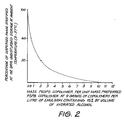
- the propensity of the emulsions to stratify was determined by measuring the percentage of dispersed phase that had stratified at 112 days of undisturbed storage at ambient temperature. The results are shown in fig. 2 . It can be seen that the propensity of the emulsions to stratify reduces significantly above a weight ratio of PEOPS to PSPB of at least 3.5:1. Similar results are obtained with total amounts of the emulsifier and coupling agent in the range of 5 to 8 gm/l.
Landscapes
- Chemical & Material Sciences (AREA)
- Organic Chemistry (AREA)
- Engineering & Computer Science (AREA)
- Chemical Kinetics & Catalysis (AREA)
- Oil, Petroleum & Natural Gas (AREA)
- Health & Medical Sciences (AREA)
- General Chemical & Material Sciences (AREA)
- Medicinal Chemistry (AREA)
- Polymers & Plastics (AREA)
- Materials Engineering (AREA)
- Colloid Chemistry (AREA)
- Emulsifying, Dispersing, Foam-Producing Or Wetting Agents (AREA)
- Liquid Carbonaceous Fuels (AREA)
- Compositions Of Macromolecular Compounds (AREA)
Claims (27)
- Emulsion enthaltend in einer kontinuierlichen Phase eine Kohlenwasserstoff-Flüssigkeit und in einer dispergierten Phase Alkohol und/oder Wasser, in Gegenwart von:(a) einem Emulgator, der ein Copolymer ist, das mindestens einen relativ hydrophoben Polymerblock mindestens eines Monomers, das aus einer Gruppe ausgewählt ist, die Styrol und ringsubstituierte Styrole umfasst, und mindestens einem relativ hydrophilen Polymerblock mindestens eines Monomers enthält, das aus einer Gruppe mit der Formel H(O-R)nOH ausgewählt ist, wobei R ein aliphatischer Rest ist, der 1 bis 4 Kohlenstoffatome enthält und n eine Zahl zwischen 20 und 300 ist, und(b) einem Kupplungsmittel, das ein Copolymer ist, das mindestens einen Polymerblock mindestens eines Monomers, das aus einer Gruppe ausgewählt ist, die Styrol und ringsubstituierte Styrole aufweist, und mindestens einen Block, der eine gesättigte oder ungesättigte aliphatische Kohlenwasserstoffeinheit ist, enthält, wobei der Emulgator und das Kupplungsmittel in der Emulsion in einem Gewichtsverhältnis von mindestens 3,5:1 vorliegen, wobeider Emulgator in einer Menge vorliegt, die ausreicht, um Mizellen des relativ hydrophilen Polymerblocks zu bilden, die ausreichen, um die dispergierte Phase zu enthalten, und wobei das Kupplungsmittel in einer Menge vorliegt, die ausreicht, um im Wesentlichen zu verhindern, dass die Tropfen der dispergierten Phase sich vereinigen, jedoch nicht in einer ausreichend großen Menge, um Mizellen der Styrol enthaltenden Polymerblöcke des Kupplungsmittels in der kontinuierlichen Phase der Emulsion zu bilden.
- Emulsion nach Anspruch 1, wobei die Menge des Kupplungsmittels in der Emulsion im Bereich von 0,75 bis 1,5 g/l liegt.
- Emulsion nach Anspruch 2, wobei die dispergierte Phase hydratisiertes Methanol enthält und wobei die Menge des Kupplungsmittels in der Emulsion im Bereich von 0,75 bis 1,0 g/l liegt.
- Emulsion nach Anspruch 2, wobei die dispergierte Phase hydratisiertes Ethanol enthält, und wobei die Menge des Kupplungsmittels in der Emulsion im Bereich von 1,0 bis 1,5 g/l liegt.
- Emulsion nach Anspruch 1, wobei der gesamte Copolymergehalt der Emulsion im Bereich von 4 bis 10 g/l liegt.
- Emulsion nach Anspruch 5, wobei die dispergierte Phase hydratisiertes Methanol enthält, und wobei der gesamte Copolymergehalt der Emulsion im Bereich von 4 bis 6 g/l liegt.
- Emulsion nach Anspruch 5, wobei die dispergierte Phase hydratisiertes Ethanol enthält, und wobei der gesamte Copolymergehalt der Emulsion im Bereich von 5 bis 8 g/l liegt.
- Emulsion nach Anspruch 1, wobei der Emulgator und das Kupplungsmittel in der Emulsion in einem Gewichtsverhältnis zwischen 3,5:1 und 10:1 vorliegen.
- Emulsion nach Anspruch 8, wobei der Emulgator und das Kupplungsmittel in der Emulsion in einem Gewichtsverhältnis zwischen 4:1 und 10:1 vorliegen.
- Emulsion nach Anspruch 1, wobei die Kohlenwasserstoff-Flüssigkeit aus der Gruppe, die Benzine, Kerosine, Dieselöle, Gasöle und Heizöle umfasst, ausgewählt ist.
- Emulsion nach Anspruch 10, wobei die Kohlenwasserstoff-Flüssigkeit ein Dieselöl ist.
- Emulsion nach Anspruch 1, wobei die dispergierte Phase der Emulsion einen hydratisierten Alkohol umfasst, der 0,1 bis 10 Vol.-% Wasser enthält.
- Emulsion nach Anspruch 1, wobei die dispergierte Phase der Emulsion einen hydratisierten Alkohol enthält und zwischen 10 und 30 Vol.-% der Emulsion bildet.
- Emulsion nach Anspruch 1, wobei der Emulgator ein Copolymer ist, das mindestens einen Polymerblock mindestens eines Monomers, das ausgewählt ist aus der Gruppe, die Styrol und ringsubstituierte Styrole aufweist, und mindestens ein Polymerblock mindestens eines Monomers enthält, das aus der Gruppe mit der Formel H(O-R)nOH ausgewählt ist, wobei R ein aliphatischer, zweiwertiger Kohlenwasserstoff-Rest mit 1 bis 4 Kohlenstoffatomen und n eine Zahl zwischen 22 und 130 ist.
- Emulsion nach Anspruch 1, wobei der Emulgator ein reines Diblock-Copolymer oder ein Reaktionsgemisch ist, das im Wesentlichen ein Diblock-Copolymer und ein Triblock-Copolymer mit zwei Blöcken des Styrolmonomers enthält, zusammen mit einigen nicht reagierten Homopolymeren des H(O-R)nOH Monomers.
- Emulsion nach Anspruch 1, wobei der Emulgator ein Polyethylenoxid-Polystyrol-Copolymer ist.
- Emulsion nach Anspruch 16, wobei der Polyethylenoxidblock ein Molekulargewicht zwischen 1.000 und 10.000 aufweist.
- Emulsion nach Anspruch 16, wobei das Polyethylenoxid und das Polystyrol in einem Gewichtsverhältnis von 1 Teil Polyethylenoxid zu 0,8 bis 1,5 Teile Polystyrol vorliegen, vorzugsweise von 1,0 bis 1,25 Teile Polystyrol.
- Emulsion nach Anspruch 16, wobei der Emulgator durch Reaktion des Styrolmonomers mit Polyethylenoxid-Homopolymer in Gegenwart eines freien Radikalstarters hergestellt wird.
- Emulsion nach Anspruch 1, wobei das Kupplungsmittel ein Copolymer ist, das mindestens einen Polymerblock mindestens eines Monomers, das aus der Gruppe ausgewählt ist, die Styrol und ringsubstituierte Styrole aufweist, und mindestens einen Polymerblock mindestens einer Verbindung enthält, die aus der Gruppe Butadien und Isopren ausgewählt ist.
- Emulsion nach Anspruch 1, wobei das Kupplungsmittel ein reines Diblock-Copolymer oder ein kegelförmiges (tapered) Block-Copolymer ist.
- Emulsion nach Anspruch 1, wobei das Kupplungsmittel Styrol und den aliphatischen Kohlenwasserstoff in einem Gewichtsverhältnis von 1:0,3 bis 1:1, am meisten bevorzugt von 1:0,42 bis 1:0,66 enthält.
- Emulsion nach Anspruch 1, wobei das Kupplungsmittel ein Molekulargewicht von 13.000 bis 400.000, stärker bevorzugt von 100.000 bis 170.000, und am meisten bevorzugt von 120.000 bis 150.000 aufweist.
- Emulsion nach Anspruch 1, wobei das Styrol 50 bis 77 Gew.-% des Kupplungsmittels, am meisten bevorzugt 50 bis 70 Gew.-% aufweist.
- Emulsion nach Anspruch 24, wobei der aromatische Anteil der kontinuierlichen Phase weniger als 22% ausmacht und wobei Styrol 50 bis 60 Gew.-% des Kupplungsmittels bildet.
- Emulsion nach Anspruch 24, wobei der aromatische Anteil der kontinuierlichen Phase mehr als 23% ausmacht und wobei Styrol 60 bis 70 Gew.-% des Kupplungsmittels bildet.
- Emulsion nach Anspruch 1, enthaltend in der kontinuierlichen Phase Dieselöl und in der dispergierten Phase einen hydratisierten Alkohol, in Gegenwart von:(a) einen Emulgator, der ein Copolymer ist, enthaltend mindestens einen relativ hydrophoben Polymerblock eines Styrolmonomers, und mindestens einen relativ hydrophilen Polymerblock von Ethylenoxid mit einem Molekulargewicht zwischen 1.000 und 10.000, wobei das Polyethylenoxid und das Polystyrol in einem Gewichtsverhältnis von 1:0,8 bis 1:1,5 vorliegt, und(b) einem Kupplungsmittel, das ein Copolymer ist, enthaltend mindestens einen Polymerblock eines Styrolmonomers und mindestens einen Block, der ein Polybutadien ist, wobei Polystyrol und Polybutadien in einem Gewichtsverhältnis von 1:0,3 bis 1:1 vorliegt,wobei der Emulgator in einer Menge vorliegt, die ausreicht, um Mizellen des relativ hydrophilen Polymerblocks zu bilden, die ausreichen, um die dispergierte Phase zu enthalten, und wobei das Kupplungsmittel in einer Menge von 0,75 bis 1,5 g/L vorliegt, was ausreicht, um im Wesentlichen zu verhindern, dass die dispergierten Phasentropfen sich vereinigen, wohingegen es nicht in einer ausreichend hohen Menge vorliegt, um Mizellen der Styrol enthaltenden Polymerblöcke des Kupplungsmittels in der kontinuierlichen Phase der Emulsion zu bilden, wobei der Emulgator und das Kupplungsmittel in der Emulsion in einem Gewichtsverhältnis von 3,5:1 bis 10:1 vorliegen.
Applications Claiming Priority (3)
| Application Number | Priority Date | Filing Date | Title |
|---|---|---|---|
| AUPO841097 | 1997-08-05 | ||
| AUPO8410A AUPO841097A0 (en) | 1997-08-05 | 1997-08-05 | Stratification resistant emulsions |
| PCT/AU1998/000614 WO1999007464A1 (en) | 1997-08-05 | 1998-08-05 | Stratification resistant emulsions |
Publications (3)
| Publication Number | Publication Date |
|---|---|
| EP1027142A1 EP1027142A1 (de) | 2000-08-16 |
| EP1027142A4 EP1027142A4 (de) | 2000-10-11 |
| EP1027142B1 true EP1027142B1 (de) | 2008-11-12 |
Family
ID=3802699
Family Applications (1)
| Application Number | Title | Priority Date | Filing Date |
|---|---|---|---|
| EP98937349A Expired - Lifetime EP1027142B1 (de) | 1997-08-05 | 1998-08-05 | Schichtenbildungsresistente emulsionen |
Country Status (10)
| Country | Link |
|---|---|
| US (1) | US6368368B1 (de) |
| EP (1) | EP1027142B1 (de) |
| AR (1) | AR016791A1 (de) |
| AT (1) | ATE413917T1 (de) |
| AU (1) | AUPO841097A0 (de) |
| BR (1) | BR9811852A (de) |
| CA (1) | CA2299331C (de) |
| DE (1) | DE69840215D1 (de) |
| NO (1) | NO20000541L (de) |
| WO (1) | WO1999007464A1 (de) |
Families Citing this family (7)
| Publication number | Priority date | Publication date | Assignee | Title |
|---|---|---|---|---|
| US7279017B2 (en) | 2001-04-27 | 2007-10-09 | Colt Engineering Corporation | Method for converting heavy oil residuum to a useful fuel |
| US20030121413A1 (en) * | 2001-12-28 | 2003-07-03 | Pitla Srinivas S. | Piston anti-rotation mechanism for a swash plate compressor |
| US7341102B2 (en) | 2005-04-28 | 2008-03-11 | Diamond Qc Technologies Inc. | Flue gas injection for heavy oil recovery |
| EP1816314B1 (de) | 2006-02-07 | 2010-12-15 | Diamond QC Technologies Inc. | Mit Kohlendioxid angereicherte Rauchgaseinspritzung zur Kohlenwasserstoffgewinnung |
| CN101743295B (zh) * | 2006-09-29 | 2012-03-07 | 周毕华 | 醇型乳化柴油 |
| US12521306B2 (en) * | 2019-03-01 | 2026-01-13 | Hytto Pte. Ltd. | System, apparatus, and method for synchronously controlling devices |
| CN110801743B (zh) * | 2019-10-30 | 2021-10-01 | 遵义医学院附属医院 | 一种多梯度酒精可定量配制瓶 |
Family Cites Families (4)
| Publication number | Priority date | Publication date | Assignee | Title |
|---|---|---|---|---|
| US4482666A (en) * | 1982-03-12 | 1984-11-13 | Apace Research Limited | Emulsions of liquid hydrocarbons with water and/or alcohols |
| AU544728B2 (en) * | 1982-03-12 | 1985-06-13 | Apace Research Limited | Distillate/alcohol emulsions |
| IT1223119B (it) * | 1987-11-13 | 1990-09-12 | Eniricerche Spa Snamprogetti S | Additivi fluidificanti per dispersioni di carbone in acqua |
| DE4134967C1 (de) | 1991-10-23 | 1992-12-10 | Th. Goldschmidt Ag, 4300 Essen, De |
-
1997
- 1997-08-05 AU AUPO8410A patent/AUPO841097A0/en not_active Abandoned
-
1998
- 1998-08-04 AR ARP980103860A patent/AR016791A1/es active IP Right Grant
- 1998-08-05 AT AT98937349T patent/ATE413917T1/de not_active IP Right Cessation
- 1998-08-05 EP EP98937349A patent/EP1027142B1/de not_active Expired - Lifetime
- 1998-08-05 WO PCT/AU1998/000614 patent/WO1999007464A1/en not_active Ceased
- 1998-08-05 DE DE69840215T patent/DE69840215D1/de not_active Expired - Lifetime
- 1998-08-05 CA CA002299331A patent/CA2299331C/en not_active Expired - Fee Related
- 1998-08-05 US US09/485,158 patent/US6368368B1/en not_active Expired - Lifetime
- 1998-08-05 BR BR9811852-8A patent/BR9811852A/pt not_active IP Right Cessation
-
2000
- 2000-02-02 NO NO20000541A patent/NO20000541L/no unknown
Also Published As
| Publication number | Publication date |
|---|---|
| EP1027142A4 (de) | 2000-10-11 |
| AR016791A1 (es) | 2001-08-01 |
| ATE413917T1 (de) | 2008-11-15 |
| NO20000541D0 (no) | 2000-02-02 |
| US6368368B1 (en) | 2002-04-09 |
| EP1027142A1 (de) | 2000-08-16 |
| WO1999007464A1 (en) | 1999-02-18 |
| AUPO841097A0 (en) | 1997-08-28 |
| CA2299331C (en) | 2008-02-05 |
| CA2299331A1 (en) | 1999-02-18 |
| NO20000541L (no) | 2000-02-02 |
| BR9811852A (pt) | 2000-08-08 |
| DE69840215D1 (de) | 2008-12-24 |
Similar Documents
| Publication | Publication Date | Title |
|---|---|---|
| DE3686716T2 (de) | Verfahren zur ermaessigung der abgase unter verwendung vor-atomisierter brennstoffe. | |
| US5834539A (en) | Multiple phase emulsions in burner fuel, combustion, emulsion and explosives applications | |
| US6100221A (en) | Aqueous external crystal modifier dispersion | |
| CA1225001A (en) | Emulsions of liquid hydrocarbon with water and/or alcohols | |
| DE4042206A1 (de) | Terpolymerisate des ethylens, ihre herstellung und ihre verwendung als additive fuer mineraloeldestillate | |
| JPH0134532B2 (de) | ||
| US6368368B1 (en) | Stratification resistant emulsions | |
| Atta et al. | Application of new modified poly (ethylene oxide)-block-poly (propylene oxide)-block-poly (ethylene oxide) copolymers as demulsifier for petroleum crude oil emulsion | |
| US4022741A (en) | Continuous process for the preparation of a cationically modified acrylamide polymer | |
| US10793783B2 (en) | Water/crude oil removers based on alkylacrylic-carboxyalkylacrylic random copolymers of controlled molecular mass | |
| US4021394A (en) | Continuous process for the preparation of a cationically modified acrylamide polymer | |
| US4661120A (en) | Diesel fuel additive | |
| US6444738B1 (en) | Heat stable emulsions | |
| Al‐Sabagh et al. | Demulsification efficiency of some novel styrene/maleic anhydride ester copolymers | |
| CN118344589A (zh) | 一种聚琥珀酰亚胺改性制备的双功能低温破乳剂的制备与应用 | |
| EP0436151A1 (de) | Kältestabile Erdölmitteldestillate, enthaltend Polymere als Paraffindispergatoren | |
| AU746429B2 (en) | Stratification resistant emulsions | |
| AU746259B2 (en) | Heat stable emulsions | |
| US3976609A (en) | Process for the preparation of distributions | |
| US20250270452A1 (en) | Highly random addition bypolymers for destabilization of complex emulsions in crude oil blends | |
| EP0892012A2 (de) | Fliessverbesserer für Mineralöle | |
| US4731096A (en) | Hydrocarbon compositions of high elongational viscosity and process for making the same | |
| US4127138A (en) | Fuel oil blending to improve pour reduction | |
| Bash | Inverse emulsion polymerization of acrylamide in a tubular reactor | |
| CA2279874A1 (en) | Oil production composition and its preparation method |
Legal Events
| Date | Code | Title | Description |
|---|---|---|---|
| PUAI | Public reference made under article 153(3) epc to a published international application that has entered the european phase |
Free format text: ORIGINAL CODE: 0009012 |
|
| 17P | Request for examination filed |
Effective date: 20000302 |
|
| AK | Designated contracting states |
Kind code of ref document: A1 Designated state(s): AT BE CH CY DE DK ES FI FR GB GR IE IT LI LU MC NL PT SE |
|
| A4 | Supplementary search report drawn up and despatched |
Effective date: 20000828 |
|
| AK | Designated contracting states |
Kind code of ref document: A4 Designated state(s): AT BE CH CY DE DK ES FI FR GB GR IE IT LI LU MC NL PT SE |
|
| RIC1 | Information provided on ipc code assigned before grant |
Free format text: 7B 01F 17/52 A, 7B 01F 17/42 B, 7C 10L 1/18 B, 7C 10L 1/32 B, 7C 08L 53/00 B, 7C 08L 53/02 B |
|
| 17Q | First examination report despatched |
Effective date: 20070831 |
|
| R17C | First examination report despatched (corrected) |
Effective date: 20070913 |
|
| GRAP | Despatch of communication of intention to grant a patent |
Free format text: ORIGINAL CODE: EPIDOSNIGR1 |
|
| GRAS | Grant fee paid |
Free format text: ORIGINAL CODE: EPIDOSNIGR3 |
|
| GRAA | (expected) grant |
Free format text: ORIGINAL CODE: 0009210 |
|
| AK | Designated contracting states |
Kind code of ref document: B1 Designated state(s): AT BE CH CY DE DK ES FI FR GB GR IE IT LI LU MC NL PT SE |
|
| REG | Reference to a national code |
Ref country code: GB Ref legal event code: FG4D |
|
| REG | Reference to a national code |
Ref country code: CH Ref legal event code: EP |
|
| REG | Reference to a national code |
Ref country code: IE Ref legal event code: FG4D |
|
| REF | Corresponds to: |
Ref document number: 69840215 Country of ref document: DE Date of ref document: 20081224 Kind code of ref document: P |
|
| REG | Reference to a national code |
Ref country code: SE Ref legal event code: TRGR |
|
| PG25 | Lapsed in a contracting state [announced via postgrant information from national office to epo] |
Ref country code: ES Free format text: LAPSE BECAUSE OF FAILURE TO SUBMIT A TRANSLATION OF THE DESCRIPTION OR TO PAY THE FEE WITHIN THE PRESCRIBED TIME-LIMIT Effective date: 20090223 Ref country code: AT Free format text: LAPSE BECAUSE OF FAILURE TO SUBMIT A TRANSLATION OF THE DESCRIPTION OR TO PAY THE FEE WITHIN THE PRESCRIBED TIME-LIMIT Effective date: 20081112 |
|
| NLV1 | Nl: lapsed or annulled due to failure to fulfill the requirements of art. 29p and 29m of the patents act | ||
| PG25 | Lapsed in a contracting state [announced via postgrant information from national office to epo] |
Ref country code: NL Free format text: LAPSE BECAUSE OF FAILURE TO SUBMIT A TRANSLATION OF THE DESCRIPTION OR TO PAY THE FEE WITHIN THE PRESCRIBED TIME-LIMIT Effective date: 20081112 Ref country code: FI Free format text: LAPSE BECAUSE OF FAILURE TO SUBMIT A TRANSLATION OF THE DESCRIPTION OR TO PAY THE FEE WITHIN THE PRESCRIBED TIME-LIMIT Effective date: 20081112 |
|
| PG25 | Lapsed in a contracting state [announced via postgrant information from national office to epo] |
Ref country code: DK Free format text: LAPSE BECAUSE OF FAILURE TO SUBMIT A TRANSLATION OF THE DESCRIPTION OR TO PAY THE FEE WITHIN THE PRESCRIBED TIME-LIMIT Effective date: 20081112 Ref country code: BE Free format text: LAPSE BECAUSE OF FAILURE TO SUBMIT A TRANSLATION OF THE DESCRIPTION OR TO PAY THE FEE WITHIN THE PRESCRIBED TIME-LIMIT Effective date: 20081112 |
|
| PG25 | Lapsed in a contracting state [announced via postgrant information from national office to epo] |
Ref country code: PT Free format text: LAPSE BECAUSE OF FAILURE TO SUBMIT A TRANSLATION OF THE DESCRIPTION OR TO PAY THE FEE WITHIN THE PRESCRIBED TIME-LIMIT Effective date: 20090413 |
|
| PLBE | No opposition filed within time limit |
Free format text: ORIGINAL CODE: 0009261 |
|
| STAA | Information on the status of an ep patent application or granted ep patent |
Free format text: STATUS: NO OPPOSITION FILED WITHIN TIME LIMIT |
|
| 26N | No opposition filed |
Effective date: 20090813 |
|
| PG25 | Lapsed in a contracting state [announced via postgrant information from national office to epo] |
Ref country code: MC Free format text: LAPSE BECAUSE OF NON-PAYMENT OF DUE FEES Effective date: 20090831 |
|
| REG | Reference to a national code |
Ref country code: CH Ref legal event code: PL |
|
| PG25 | Lapsed in a contracting state [announced via postgrant information from national office to epo] |
Ref country code: LI Free format text: LAPSE BECAUSE OF NON-PAYMENT OF DUE FEES Effective date: 20090831 Ref country code: CH Free format text: LAPSE BECAUSE OF NON-PAYMENT OF DUE FEES Effective date: 20090831 |
|
| REG | Reference to a national code |
Ref country code: IE Ref legal event code: MM4A |
|
| PG25 | Lapsed in a contracting state [announced via postgrant information from national office to epo] |
Ref country code: IE Free format text: LAPSE BECAUSE OF NON-PAYMENT OF DUE FEES Effective date: 20090805 |
|
| PG25 | Lapsed in a contracting state [announced via postgrant information from national office to epo] |
Ref country code: GR Free format text: LAPSE BECAUSE OF FAILURE TO SUBMIT A TRANSLATION OF THE DESCRIPTION OR TO PAY THE FEE WITHIN THE PRESCRIBED TIME-LIMIT Effective date: 20090213 |
|
| PG25 | Lapsed in a contracting state [announced via postgrant information from national office to epo] |
Ref country code: IT Free format text: LAPSE BECAUSE OF FAILURE TO SUBMIT A TRANSLATION OF THE DESCRIPTION OR TO PAY THE FEE WITHIN THE PRESCRIBED TIME-LIMIT Effective date: 20081112 |
|
| PG25 | Lapsed in a contracting state [announced via postgrant information from national office to epo] |
Ref country code: LU Free format text: LAPSE BECAUSE OF NON-PAYMENT OF DUE FEES Effective date: 20090805 |
|
| PG25 | Lapsed in a contracting state [announced via postgrant information from national office to epo] |
Ref country code: CY Free format text: LAPSE BECAUSE OF FAILURE TO SUBMIT A TRANSLATION OF THE DESCRIPTION OR TO PAY THE FEE WITHIN THE PRESCRIBED TIME-LIMIT Effective date: 20081112 |
|
| PGFP | Annual fee paid to national office [announced via postgrant information from national office to epo] |
Ref country code: DE Payment date: 20140730 Year of fee payment: 17 |
|
| PGFP | Annual fee paid to national office [announced via postgrant information from national office to epo] |
Ref country code: SE Payment date: 20140826 Year of fee payment: 17 Ref country code: FR Payment date: 20140808 Year of fee payment: 17 Ref country code: GB Payment date: 20140730 Year of fee payment: 17 |
|
| REG | Reference to a national code |
Ref country code: DE Ref legal event code: R119 Ref document number: 69840215 Country of ref document: DE |
|
| REG | Reference to a national code |
Ref country code: SE Ref legal event code: EUG |
|
| GBPC | Gb: european patent ceased through non-payment of renewal fee |
Effective date: 20150805 |
|
| PG25 | Lapsed in a contracting state [announced via postgrant information from national office to epo] |
Ref country code: SE Free format text: LAPSE BECAUSE OF NON-PAYMENT OF DUE FEES Effective date: 20150806 |
|
| REG | Reference to a national code |
Ref country code: FR Ref legal event code: ST Effective date: 20160429 |
|
| PG25 | Lapsed in a contracting state [announced via postgrant information from national office to epo] |
Ref country code: GB Free format text: LAPSE BECAUSE OF NON-PAYMENT OF DUE FEES Effective date: 20150805 Ref country code: DE Free format text: LAPSE BECAUSE OF NON-PAYMENT OF DUE FEES Effective date: 20160301 |
|
| PG25 | Lapsed in a contracting state [announced via postgrant information from national office to epo] |
Ref country code: FR Free format text: LAPSE BECAUSE OF NON-PAYMENT OF DUE FEES Effective date: 20150831 |