EP1025814A1 - Prothèse fémorale céramique/céramique de petit diamètre. - Google Patents
Prothèse fémorale céramique/céramique de petit diamètre. Download PDFInfo
- Publication number
- EP1025814A1 EP1025814A1 EP00400142A EP00400142A EP1025814A1 EP 1025814 A1 EP1025814 A1 EP 1025814A1 EP 00400142 A EP00400142 A EP 00400142A EP 00400142 A EP00400142 A EP 00400142A EP 1025814 A1 EP1025814 A1 EP 1025814A1
- Authority
- EP
- European Patent Office
- Prior art keywords
- femoral prosthesis
- prosthesis according
- femoral
- head
- cup
- Prior art date
- Legal status (The legal status is an assumption and is not a legal conclusion. Google has not performed a legal analysis and makes no representation as to the accuracy of the status listed.)
- Withdrawn
Links
- 239000000919 ceramic Substances 0.000 title claims abstract description 17
- 229910010293 ceramic material Inorganic materials 0.000 claims abstract description 5
- 210000004197 pelvis Anatomy 0.000 claims abstract description 5
- RKTYLMNFRDHKIL-UHFFFAOYSA-N copper;5,10,15,20-tetraphenylporphyrin-22,24-diide Chemical compound [Cu+2].C1=CC(C(=C2C=CC([N-]2)=C(C=2C=CC=CC=2)C=2C=CC(N=2)=C(C=2C=CC=CC=2)C2=CC=C3[N-]2)C=2C=CC=CC=2)=NC1=C3C1=CC=CC=C1 RKTYLMNFRDHKIL-UHFFFAOYSA-N 0.000 claims abstract description 4
- SIWVEOZUMHYXCS-UHFFFAOYSA-N oxo(oxoyttriooxy)yttrium Chemical compound O=[Y]O[Y]=O SIWVEOZUMHYXCS-UHFFFAOYSA-N 0.000 claims abstract description 4
- MCMNRKCIXSYSNV-UHFFFAOYSA-N Zirconium dioxide Chemical compound O=[Zr]=O MCMNRKCIXSYSNV-UHFFFAOYSA-N 0.000 claims description 36
- 239000000463 material Substances 0.000 claims description 13
- PNEYBMLMFCGWSK-UHFFFAOYSA-N aluminium oxide Inorganic materials [O-2].[O-2].[O-2].[Al+3].[Al+3] PNEYBMLMFCGWSK-UHFFFAOYSA-N 0.000 claims description 8
- 210000000689 upper leg Anatomy 0.000 claims description 6
- 239000004698 Polyethylene Substances 0.000 claims description 3
- -1 polyethylene Polymers 0.000 claims description 3
- 229920000573 polyethylene Polymers 0.000 claims description 3
- 238000005245 sintering Methods 0.000 claims description 3
- 238000013001 point bending Methods 0.000 claims description 2
- 229910052845 zircon Inorganic materials 0.000 abstract 2
- GFQYVLUOOAAOGM-UHFFFAOYSA-N zirconium(iv) silicate Chemical compound [Zr+4].[O-][Si]([O-])([O-])[O-] GFQYVLUOOAAOGM-UHFFFAOYSA-N 0.000 abstract 2
- POIUWJQBRNEFGX-XAMSXPGMSA-N cathelicidin Chemical compound C([C@@H](C(=O)N[C@@H](CCCNC(N)=N)C(=O)N[C@@H](CCCCN)C(=O)N[C@@H](CO)C(=O)N[C@@H](CCCCN)C(=O)N[C@@H](CCC(O)=O)C(=O)N[C@@H](CCCCN)C(=O)N[C@@H]([C@@H](C)CC)C(=O)NCC(=O)N[C@@H](CCCCN)C(=O)N[C@@H](CCC(O)=O)C(=O)N[C@@H](CC=1C=CC=CC=1)C(=O)N[C@@H](CCCCN)C(=O)N[C@@H](CCCNC(N)=N)C(=O)N[C@@H]([C@@H](C)CC)C(=O)N[C@@H](C(C)C)C(=O)N[C@@H](CCC(N)=O)C(=O)N[C@@H](CCCNC(N)=N)C(=O)N[C@@H]([C@@H](C)CC)C(=O)N[C@@H](CCCCN)C(=O)N[C@@H](CC(O)=O)C(=O)N[C@@H](CC=1C=CC=CC=1)C(=O)N[C@@H](CC(C)C)C(=O)N[C@@H](CCCNC(N)=N)C(=O)N[C@@H](CC(N)=O)C(=O)N[C@@H](CC(C)C)C(=O)N[C@@H](C(C)C)C(=O)N1[C@@H](CCC1)C(=O)N[C@@H](CCCNC(N)=N)C(=O)N[C@@H]([C@@H](C)O)C(=O)N[C@@H](CCC(O)=O)C(=O)N[C@@H](CO)C(O)=O)NC(=O)[C@H](CC=1C=CC=CC=1)NC(=O)[C@H](CC(O)=O)NC(=O)CNC(=O)[C@H](CC(C)C)NC(=O)[C@@H](N)CC(C)C)C1=CC=CC=C1 POIUWJQBRNEFGX-XAMSXPGMSA-N 0.000 description 3
- 229910001069 Ti alloy Inorganic materials 0.000 description 2
- 229910045601 alloy Inorganic materials 0.000 description 2
- 239000000956 alloy Substances 0.000 description 2
- 238000002955 isolation Methods 0.000 description 2
- 229910052727 yttrium Inorganic materials 0.000 description 2
- VWQVUPCCIRVNHF-UHFFFAOYSA-N yttrium atom Chemical compound [Y] VWQVUPCCIRVNHF-UHFFFAOYSA-N 0.000 description 2
- 229910000684 Cobalt-chrome Inorganic materials 0.000 description 1
- 238000005452 bending Methods 0.000 description 1
- 230000003247 decreasing effect Effects 0.000 description 1
- 235000021183 entrée Nutrition 0.000 description 1
- 229920001903 high density polyethylene Polymers 0.000 description 1
- 239000004700 high-density polyethylene Substances 0.000 description 1
- 210000001624 hip Anatomy 0.000 description 1
- 239000007943 implant Substances 0.000 description 1
- 239000010935 stainless steel Substances 0.000 description 1
- 229910001220 stainless steel Inorganic materials 0.000 description 1
- 229920002994 synthetic fiber Polymers 0.000 description 1
Images
Classifications
-
- A—HUMAN NECESSITIES
- A61—MEDICAL OR VETERINARY SCIENCE; HYGIENE
- A61L—METHODS OR APPARATUS FOR STERILISING MATERIALS OR OBJECTS IN GENERAL; DISINFECTION, STERILISATION OR DEODORISATION OF AIR; CHEMICAL ASPECTS OF BANDAGES, DRESSINGS, ABSORBENT PADS OR SURGICAL ARTICLES; MATERIALS FOR BANDAGES, DRESSINGS, ABSORBENT PADS OR SURGICAL ARTICLES
- A61L27/00—Materials for grafts or prostheses or for coating grafts or prostheses
- A61L27/02—Inorganic materials
- A61L27/10—Ceramics or glasses
-
- A—HUMAN NECESSITIES
- A61—MEDICAL OR VETERINARY SCIENCE; HYGIENE
- A61F—FILTERS IMPLANTABLE INTO BLOOD VESSELS; PROSTHESES; DEVICES PROVIDING PATENCY TO, OR PREVENTING COLLAPSING OF, TUBULAR STRUCTURES OF THE BODY, e.g. STENTS; ORTHOPAEDIC, NURSING OR CONTRACEPTIVE DEVICES; FOMENTATION; TREATMENT OR PROTECTION OF EYES OR EARS; BANDAGES, DRESSINGS OR ABSORBENT PADS; FIRST-AID KITS
- A61F2/00—Filters implantable into blood vessels; Prostheses, i.e. artificial substitutes or replacements for parts of the body; Appliances for connecting them with the body; Devices providing patency to, or preventing collapsing of, tubular structures of the body, e.g. stents
- A61F2/02—Prostheses implantable into the body
- A61F2/30—Joints
- A61F2/32—Joints for the hip
-
- A—HUMAN NECESSITIES
- A61—MEDICAL OR VETERINARY SCIENCE; HYGIENE
- A61F—FILTERS IMPLANTABLE INTO BLOOD VESSELS; PROSTHESES; DEVICES PROVIDING PATENCY TO, OR PREVENTING COLLAPSING OF, TUBULAR STRUCTURES OF THE BODY, e.g. STENTS; ORTHOPAEDIC, NURSING OR CONTRACEPTIVE DEVICES; FOMENTATION; TREATMENT OR PROTECTION OF EYES OR EARS; BANDAGES, DRESSINGS OR ABSORBENT PADS; FIRST-AID KITS
- A61F2/00—Filters implantable into blood vessels; Prostheses, i.e. artificial substitutes or replacements for parts of the body; Appliances for connecting them with the body; Devices providing patency to, or preventing collapsing of, tubular structures of the body, e.g. stents
- A61F2/02—Prostheses implantable into the body
- A61F2/30—Joints
- A61F2002/30001—Additional features of subject-matter classified in A61F2/28, A61F2/30 and subgroups thereof
- A61F2002/30003—Material related properties of the prosthesis or of a coating on the prosthesis
- A61F2002/3006—Properties of materials and coating materials
- A61F2002/30084—Materials having a crystalline structure
-
- A—HUMAN NECESSITIES
- A61—MEDICAL OR VETERINARY SCIENCE; HYGIENE
- A61F—FILTERS IMPLANTABLE INTO BLOOD VESSELS; PROSTHESES; DEVICES PROVIDING PATENCY TO, OR PREVENTING COLLAPSING OF, TUBULAR STRUCTURES OF THE BODY, e.g. STENTS; ORTHOPAEDIC, NURSING OR CONTRACEPTIVE DEVICES; FOMENTATION; TREATMENT OR PROTECTION OF EYES OR EARS; BANDAGES, DRESSINGS OR ABSORBENT PADS; FIRST-AID KITS
- A61F2/00—Filters implantable into blood vessels; Prostheses, i.e. artificial substitutes or replacements for parts of the body; Appliances for connecting them with the body; Devices providing patency to, or preventing collapsing of, tubular structures of the body, e.g. stents
- A61F2/02—Prostheses implantable into the body
- A61F2/30—Joints
- A61F2002/30001—Additional features of subject-matter classified in A61F2/28, A61F2/30 and subgroups thereof
- A61F2002/30316—The prosthesis having different structural features at different locations within the same prosthesis; Connections between prosthetic parts; Special structural features of bone or joint prostheses not otherwise provided for
- A61F2002/30329—Connections or couplings between prosthetic parts, e.g. between modular parts; Connecting elements
- A61F2002/30331—Connections or couplings between prosthetic parts, e.g. between modular parts; Connecting elements made by longitudinally pushing a protrusion into a complementarily-shaped recess, e.g. held by friction fit
- A61F2002/30332—Conically- or frustoconically-shaped protrusion and recess
-
- A—HUMAN NECESSITIES
- A61—MEDICAL OR VETERINARY SCIENCE; HYGIENE
- A61F—FILTERS IMPLANTABLE INTO BLOOD VESSELS; PROSTHESES; DEVICES PROVIDING PATENCY TO, OR PREVENTING COLLAPSING OF, TUBULAR STRUCTURES OF THE BODY, e.g. STENTS; ORTHOPAEDIC, NURSING OR CONTRACEPTIVE DEVICES; FOMENTATION; TREATMENT OR PROTECTION OF EYES OR EARS; BANDAGES, DRESSINGS OR ABSORBENT PADS; FIRST-AID KITS
- A61F2/00—Filters implantable into blood vessels; Prostheses, i.e. artificial substitutes or replacements for parts of the body; Appliances for connecting them with the body; Devices providing patency to, or preventing collapsing of, tubular structures of the body, e.g. stents
- A61F2/02—Prostheses implantable into the body
- A61F2/30—Joints
- A61F2002/30001—Additional features of subject-matter classified in A61F2/28, A61F2/30 and subgroups thereof
- A61F2002/30316—The prosthesis having different structural features at different locations within the same prosthesis; Connections between prosthetic parts; Special structural features of bone or joint prostheses not otherwise provided for
- A61F2002/30329—Connections or couplings between prosthetic parts, e.g. between modular parts; Connecting elements
- A61F2002/30331—Connections or couplings between prosthetic parts, e.g. between modular parts; Connecting elements made by longitudinally pushing a protrusion into a complementarily-shaped recess, e.g. held by friction fit
- A61F2002/30332—Conically- or frustoconically-shaped protrusion and recess
- A61F2002/30349—Conically- or frustoconically-shaped protrusion and recess the male and female complementary cones being of different conicities, i.e. for reducing the contact area
-
- A—HUMAN NECESSITIES
- A61—MEDICAL OR VETERINARY SCIENCE; HYGIENE
- A61F—FILTERS IMPLANTABLE INTO BLOOD VESSELS; PROSTHESES; DEVICES PROVIDING PATENCY TO, OR PREVENTING COLLAPSING OF, TUBULAR STRUCTURES OF THE BODY, e.g. STENTS; ORTHOPAEDIC, NURSING OR CONTRACEPTIVE DEVICES; FOMENTATION; TREATMENT OR PROTECTION OF EYES OR EARS; BANDAGES, DRESSINGS OR ABSORBENT PADS; FIRST-AID KITS
- A61F2/00—Filters implantable into blood vessels; Prostheses, i.e. artificial substitutes or replacements for parts of the body; Appliances for connecting them with the body; Devices providing patency to, or preventing collapsing of, tubular structures of the body, e.g. stents
- A61F2/02—Prostheses implantable into the body
- A61F2/30—Joints
- A61F2002/30001—Additional features of subject-matter classified in A61F2/28, A61F2/30 and subgroups thereof
- A61F2002/30316—The prosthesis having different structural features at different locations within the same prosthesis; Connections between prosthetic parts; Special structural features of bone or joint prostheses not otherwise provided for
- A61F2002/30535—Special structural features of bone or joint prostheses not otherwise provided for
- A61F2002/30593—Special structural features of bone or joint prostheses not otherwise provided for hollow
-
- A—HUMAN NECESSITIES
- A61—MEDICAL OR VETERINARY SCIENCE; HYGIENE
- A61F—FILTERS IMPLANTABLE INTO BLOOD VESSELS; PROSTHESES; DEVICES PROVIDING PATENCY TO, OR PREVENTING COLLAPSING OF, TUBULAR STRUCTURES OF THE BODY, e.g. STENTS; ORTHOPAEDIC, NURSING OR CONTRACEPTIVE DEVICES; FOMENTATION; TREATMENT OR PROTECTION OF EYES OR EARS; BANDAGES, DRESSINGS OR ABSORBENT PADS; FIRST-AID KITS
- A61F2/00—Filters implantable into blood vessels; Prostheses, i.e. artificial substitutes or replacements for parts of the body; Appliances for connecting them with the body; Devices providing patency to, or preventing collapsing of, tubular structures of the body, e.g. stents
- A61F2/02—Prostheses implantable into the body
- A61F2/30—Joints
- A61F2002/30001—Additional features of subject-matter classified in A61F2/28, A61F2/30 and subgroups thereof
- A61F2002/30621—Features concerning the anatomical functioning or articulation of the prosthetic joint
- A61F2002/30649—Ball-and-socket joints
- A61F2002/30654—Details of the concave socket
- A61F2002/30655—Non-spherical concave inner surface
- A61F2002/30657—Non-spherical concave inner surface made of different partially-spherical concave portions
-
- A—HUMAN NECESSITIES
- A61—MEDICAL OR VETERINARY SCIENCE; HYGIENE
- A61F—FILTERS IMPLANTABLE INTO BLOOD VESSELS; PROSTHESES; DEVICES PROVIDING PATENCY TO, OR PREVENTING COLLAPSING OF, TUBULAR STRUCTURES OF THE BODY, e.g. STENTS; ORTHOPAEDIC, NURSING OR CONTRACEPTIVE DEVICES; FOMENTATION; TREATMENT OR PROTECTION OF EYES OR EARS; BANDAGES, DRESSINGS OR ABSORBENT PADS; FIRST-AID KITS
- A61F2/00—Filters implantable into blood vessels; Prostheses, i.e. artificial substitutes or replacements for parts of the body; Appliances for connecting them with the body; Devices providing patency to, or preventing collapsing of, tubular structures of the body, e.g. stents
- A61F2/02—Prostheses implantable into the body
- A61F2/30—Joints
- A61F2002/30001—Additional features of subject-matter classified in A61F2/28, A61F2/30 and subgroups thereof
- A61F2002/30621—Features concerning the anatomical functioning or articulation of the prosthetic joint
- A61F2002/30649—Ball-and-socket joints
- A61F2002/30654—Details of the concave socket
- A61F2002/30655—Non-spherical concave inner surface
- A61F2002/30657—Non-spherical concave inner surface made of different partially-spherical concave portions
- A61F2002/30658—Non-spherical concave inner surface made of different partially-spherical concave portions having a central conforming area surrounded by a peripheral annular non-conforming area
-
- A—HUMAN NECESSITIES
- A61—MEDICAL OR VETERINARY SCIENCE; HYGIENE
- A61F—FILTERS IMPLANTABLE INTO BLOOD VESSELS; PROSTHESES; DEVICES PROVIDING PATENCY TO, OR PREVENTING COLLAPSING OF, TUBULAR STRUCTURES OF THE BODY, e.g. STENTS; ORTHOPAEDIC, NURSING OR CONTRACEPTIVE DEVICES; FOMENTATION; TREATMENT OR PROTECTION OF EYES OR EARS; BANDAGES, DRESSINGS OR ABSORBENT PADS; FIRST-AID KITS
- A61F2/00—Filters implantable into blood vessels; Prostheses, i.e. artificial substitutes or replacements for parts of the body; Appliances for connecting them with the body; Devices providing patency to, or preventing collapsing of, tubular structures of the body, e.g. stents
- A61F2/02—Prostheses implantable into the body
- A61F2/30—Joints
- A61F2/3094—Designing or manufacturing processes
- A61F2002/30968—Sintering
-
- A—HUMAN NECESSITIES
- A61—MEDICAL OR VETERINARY SCIENCE; HYGIENE
- A61F—FILTERS IMPLANTABLE INTO BLOOD VESSELS; PROSTHESES; DEVICES PROVIDING PATENCY TO, OR PREVENTING COLLAPSING OF, TUBULAR STRUCTURES OF THE BODY, e.g. STENTS; ORTHOPAEDIC, NURSING OR CONTRACEPTIVE DEVICES; FOMENTATION; TREATMENT OR PROTECTION OF EYES OR EARS; BANDAGES, DRESSINGS OR ABSORBENT PADS; FIRST-AID KITS
- A61F2/00—Filters implantable into blood vessels; Prostheses, i.e. artificial substitutes or replacements for parts of the body; Appliances for connecting them with the body; Devices providing patency to, or preventing collapsing of, tubular structures of the body, e.g. stents
- A61F2/02—Prostheses implantable into the body
- A61F2/30—Joints
- A61F2/32—Joints for the hip
- A61F2002/3225—Joints for the hip the diameter of the inner concave femoral head-receiving cavity of the inner acetabular shell being essentially greater than the diameter of the convex femoral head
-
- A—HUMAN NECESSITIES
- A61—MEDICAL OR VETERINARY SCIENCE; HYGIENE
- A61F—FILTERS IMPLANTABLE INTO BLOOD VESSELS; PROSTHESES; DEVICES PROVIDING PATENCY TO, OR PREVENTING COLLAPSING OF, TUBULAR STRUCTURES OF THE BODY, e.g. STENTS; ORTHOPAEDIC, NURSING OR CONTRACEPTIVE DEVICES; FOMENTATION; TREATMENT OR PROTECTION OF EYES OR EARS; BANDAGES, DRESSINGS OR ABSORBENT PADS; FIRST-AID KITS
- A61F2/00—Filters implantable into blood vessels; Prostheses, i.e. artificial substitutes or replacements for parts of the body; Appliances for connecting them with the body; Devices providing patency to, or preventing collapsing of, tubular structures of the body, e.g. stents
- A61F2/02—Prostheses implantable into the body
- A61F2/30—Joints
- A61F2/32—Joints for the hip
- A61F2/34—Acetabular cups
- A61F2002/3445—Acetabular cups having a number of shells different from two
- A61F2002/3448—Multiple cups made of three or more concentric shells fitted or nested into one another
-
- A—HUMAN NECESSITIES
- A61—MEDICAL OR VETERINARY SCIENCE; HYGIENE
- A61F—FILTERS IMPLANTABLE INTO BLOOD VESSELS; PROSTHESES; DEVICES PROVIDING PATENCY TO, OR PREVENTING COLLAPSING OF, TUBULAR STRUCTURES OF THE BODY, e.g. STENTS; ORTHOPAEDIC, NURSING OR CONTRACEPTIVE DEVICES; FOMENTATION; TREATMENT OR PROTECTION OF EYES OR EARS; BANDAGES, DRESSINGS OR ABSORBENT PADS; FIRST-AID KITS
- A61F2/00—Filters implantable into blood vessels; Prostheses, i.e. artificial substitutes or replacements for parts of the body; Appliances for connecting them with the body; Devices providing patency to, or preventing collapsing of, tubular structures of the body, e.g. stents
- A61F2/02—Prostheses implantable into the body
- A61F2/30—Joints
- A61F2/32—Joints for the hip
- A61F2/36—Femoral heads ; Femoral endoprostheses
- A61F2/3609—Femoral heads or necks; Connections of endoprosthetic heads or necks to endoprosthetic femoral shafts
- A61F2002/3611—Heads or epiphyseal parts of femur
-
- A—HUMAN NECESSITIES
- A61—MEDICAL OR VETERINARY SCIENCE; HYGIENE
- A61F—FILTERS IMPLANTABLE INTO BLOOD VESSELS; PROSTHESES; DEVICES PROVIDING PATENCY TO, OR PREVENTING COLLAPSING OF, TUBULAR STRUCTURES OF THE BODY, e.g. STENTS; ORTHOPAEDIC, NURSING OR CONTRACEPTIVE DEVICES; FOMENTATION; TREATMENT OR PROTECTION OF EYES OR EARS; BANDAGES, DRESSINGS OR ABSORBENT PADS; FIRST-AID KITS
- A61F2/00—Filters implantable into blood vessels; Prostheses, i.e. artificial substitutes or replacements for parts of the body; Appliances for connecting them with the body; Devices providing patency to, or preventing collapsing of, tubular structures of the body, e.g. stents
- A61F2/02—Prostheses implantable into the body
- A61F2/30—Joints
- A61F2/32—Joints for the hip
- A61F2/36—Femoral heads ; Femoral endoprostheses
- A61F2/3609—Femoral heads or necks; Connections of endoprosthetic heads or necks to endoprosthetic femoral shafts
- A61F2002/3625—Necks
-
- A—HUMAN NECESSITIES
- A61—MEDICAL OR VETERINARY SCIENCE; HYGIENE
- A61F—FILTERS IMPLANTABLE INTO BLOOD VESSELS; PROSTHESES; DEVICES PROVIDING PATENCY TO, OR PREVENTING COLLAPSING OF, TUBULAR STRUCTURES OF THE BODY, e.g. STENTS; ORTHOPAEDIC, NURSING OR CONTRACEPTIVE DEVICES; FOMENTATION; TREATMENT OR PROTECTION OF EYES OR EARS; BANDAGES, DRESSINGS OR ABSORBENT PADS; FIRST-AID KITS
- A61F2/00—Filters implantable into blood vessels; Prostheses, i.e. artificial substitutes or replacements for parts of the body; Appliances for connecting them with the body; Devices providing patency to, or preventing collapsing of, tubular structures of the body, e.g. stents
- A61F2/02—Prostheses implantable into the body
- A61F2/30—Joints
- A61F2/32—Joints for the hip
- A61F2/36—Femoral heads ; Femoral endoprostheses
- A61F2/3609—Femoral heads or necks; Connections of endoprosthetic heads or necks to endoprosthetic femoral shafts
- A61F2002/365—Connections of heads to necks
-
- A—HUMAN NECESSITIES
- A61—MEDICAL OR VETERINARY SCIENCE; HYGIENE
- A61F—FILTERS IMPLANTABLE INTO BLOOD VESSELS; PROSTHESES; DEVICES PROVIDING PATENCY TO, OR PREVENTING COLLAPSING OF, TUBULAR STRUCTURES OF THE BODY, e.g. STENTS; ORTHOPAEDIC, NURSING OR CONTRACEPTIVE DEVICES; FOMENTATION; TREATMENT OR PROTECTION OF EYES OR EARS; BANDAGES, DRESSINGS OR ABSORBENT PADS; FIRST-AID KITS
- A61F2220/00—Fixations or connections for prostheses classified in groups A61F2/00 - A61F2/26 or A61F2/82 or A61F9/00 or A61F11/00 or subgroups thereof
- A61F2220/0025—Connections or couplings between prosthetic parts, e.g. between modular parts; Connecting elements
- A61F2220/0033—Connections or couplings between prosthetic parts, e.g. between modular parts; Connecting elements made by longitudinally pushing a protrusion into a complementary-shaped recess, e.g. held by friction fit
-
- A—HUMAN NECESSITIES
- A61—MEDICAL OR VETERINARY SCIENCE; HYGIENE
- A61F—FILTERS IMPLANTABLE INTO BLOOD VESSELS; PROSTHESES; DEVICES PROVIDING PATENCY TO, OR PREVENTING COLLAPSING OF, TUBULAR STRUCTURES OF THE BODY, e.g. STENTS; ORTHOPAEDIC, NURSING OR CONTRACEPTIVE DEVICES; FOMENTATION; TREATMENT OR PROTECTION OF EYES OR EARS; BANDAGES, DRESSINGS OR ABSORBENT PADS; FIRST-AID KITS
- A61F2310/00—Prostheses classified in A61F2/28 or A61F2/30 - A61F2/44 being constructed from or coated with a particular material
- A61F2310/00005—The prosthesis being constructed from a particular material
- A61F2310/00011—Metals or alloys
- A61F2310/00017—Iron- or Fe-based alloys, e.g. stainless steel
-
- A—HUMAN NECESSITIES
- A61—MEDICAL OR VETERINARY SCIENCE; HYGIENE
- A61F—FILTERS IMPLANTABLE INTO BLOOD VESSELS; PROSTHESES; DEVICES PROVIDING PATENCY TO, OR PREVENTING COLLAPSING OF, TUBULAR STRUCTURES OF THE BODY, e.g. STENTS; ORTHOPAEDIC, NURSING OR CONTRACEPTIVE DEVICES; FOMENTATION; TREATMENT OR PROTECTION OF EYES OR EARS; BANDAGES, DRESSINGS OR ABSORBENT PADS; FIRST-AID KITS
- A61F2310/00—Prostheses classified in A61F2/28 or A61F2/30 - A61F2/44 being constructed from or coated with a particular material
- A61F2310/00005—The prosthesis being constructed from a particular material
- A61F2310/00011—Metals or alloys
- A61F2310/00023—Titanium or titanium-based alloys, e.g. Ti-Ni alloys
-
- A—HUMAN NECESSITIES
- A61—MEDICAL OR VETERINARY SCIENCE; HYGIENE
- A61F—FILTERS IMPLANTABLE INTO BLOOD VESSELS; PROSTHESES; DEVICES PROVIDING PATENCY TO, OR PREVENTING COLLAPSING OF, TUBULAR STRUCTURES OF THE BODY, e.g. STENTS; ORTHOPAEDIC, NURSING OR CONTRACEPTIVE DEVICES; FOMENTATION; TREATMENT OR PROTECTION OF EYES OR EARS; BANDAGES, DRESSINGS OR ABSORBENT PADS; FIRST-AID KITS
- A61F2310/00—Prostheses classified in A61F2/28 or A61F2/30 - A61F2/44 being constructed from or coated with a particular material
- A61F2310/00005—The prosthesis being constructed from a particular material
- A61F2310/00011—Metals or alloys
- A61F2310/00029—Cobalt-based alloys, e.g. Co-Cr alloys or Vitallium
-
- A—HUMAN NECESSITIES
- A61—MEDICAL OR VETERINARY SCIENCE; HYGIENE
- A61F—FILTERS IMPLANTABLE INTO BLOOD VESSELS; PROSTHESES; DEVICES PROVIDING PATENCY TO, OR PREVENTING COLLAPSING OF, TUBULAR STRUCTURES OF THE BODY, e.g. STENTS; ORTHOPAEDIC, NURSING OR CONTRACEPTIVE DEVICES; FOMENTATION; TREATMENT OR PROTECTION OF EYES OR EARS; BANDAGES, DRESSINGS OR ABSORBENT PADS; FIRST-AID KITS
- A61F2310/00—Prostheses classified in A61F2/28 or A61F2/30 - A61F2/44 being constructed from or coated with a particular material
- A61F2310/00005—The prosthesis being constructed from a particular material
- A61F2310/00179—Ceramics or ceramic-like structures
- A61F2310/00185—Ceramics or ceramic-like structures based on metal oxides
- A61F2310/00203—Ceramics or ceramic-like structures based on metal oxides containing alumina or aluminium oxide
-
- A—HUMAN NECESSITIES
- A61—MEDICAL OR VETERINARY SCIENCE; HYGIENE
- A61F—FILTERS IMPLANTABLE INTO BLOOD VESSELS; PROSTHESES; DEVICES PROVIDING PATENCY TO, OR PREVENTING COLLAPSING OF, TUBULAR STRUCTURES OF THE BODY, e.g. STENTS; ORTHOPAEDIC, NURSING OR CONTRACEPTIVE DEVICES; FOMENTATION; TREATMENT OR PROTECTION OF EYES OR EARS; BANDAGES, DRESSINGS OR ABSORBENT PADS; FIRST-AID KITS
- A61F2310/00—Prostheses classified in A61F2/28 or A61F2/30 - A61F2/44 being constructed from or coated with a particular material
- A61F2310/00005—The prosthesis being constructed from a particular material
- A61F2310/00179—Ceramics or ceramic-like structures
- A61F2310/00185—Ceramics or ceramic-like structures based on metal oxides
- A61F2310/00239—Ceramics or ceramic-like structures based on metal oxides containing zirconia or zirconium oxide ZrO2
Definitions
- the invention relates to a small diameter femoral prosthesis.
- the subject of the invention is a femoral prosthesis, comprising a head. femoral on the one hand and a cup on the other hand, the combination of which can be make according to a spherical surface of the order of 22.22 mm, while reaching a breaking strength at least equal to 46 kN.
- the invention provides a femoral prosthesis comprising a femoral head adapted to be fitted onto a femoral stem intended to be secured to a femur of a patient, and a cup intended to be secured to the pelvis of this patient, the head being mounted so that it can slide in rotation in a cavity formed inside the cup, this femoral head being at less in its outer part made of a ceramic material and having a spherical outer surface of diameter substantially equal to 22 mm, and this cup being at least in its internal part made of a material ceramic and having a substantially spherical internal surface of diameter equal to 22 mm.
- the insert is secured to the cap outer by an intermediate cap, which is advantageously made made of polyethylene.
- the ceramic insert is forcibly engaged in the outer cap, by conical fitting.
- This fitting taper preferably has a taper between 4 and 25 °; she is by example of about 20 °.
- the material of which the cup is formed at least in its internal portion is advantageously an alumina.
- other ceramics are possible, especially among oxides.
- the materials used are grade materials biomedical, respecting the standards in force, whether it is zirconia or alumina.
- the materials used are indeed materials known per se, a isolated title, in the field of prostheses or implants.
- the head cooperates with a femoral stem of the type 12/14, with a frustoconical part bounded by extreme circles of diameters of the order of 12 and 14 mm respectively.
- a femoral stem of the type 12/14 with a frustoconical part bounded by extreme circles of diameters of the order of 12 and 14 mm respectively.
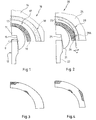
- Figures 1 and 2 show two embodiments of a prosthesis femoral according to the invention.
- the femoral prosthesis designated by the general reference 10
- the rod 12 is a femoral rod, in the sense that, at its end lower, it is intended to be forcibly engaged in the upper end of the femur of a patient intended to receive such a femoral prosthesis.
- Such a femoral stem is conventionally metallic, for example made of titanium alloy, chrome-cobalt alloy, or a type alloy stainless steel.
- This rod has, in its upper part a frustoconical portion which enters a also frustoconical cavity formed in the head 11; that cavity, marked 15, has a taper preferably equal to or very slightly greater than the taper of the upper part of the rod.
- the cup 13, in the example of FIG. 1, is formed of 3 layers (but there may be more).
- This insert 16 is itself engaged in an intermediate cap 17, also of substantially constant thickness.
- This intermediate cap 17 is itself engaged inside a third part 18, or outer cap, intended to be secured to the basin 14 of a user.
- the spherical external surface of the head 11, as well as the internal surface spherical of the insert 16, have radii substantially equal to 22 mm (the diameter of the head is preferably substantially equal to 22.22 mm).
- the head 11 on the one hand and the insert 16 on the other hand are both made of ceramic materials.
- the intermediate cap 17 is a synthetic material, preferably high density polyethylene (P E H D).
- the outer cap 18 it is advantageously metallic, for example made of titanium alloy.
- the head 11 is made of a zirconia, of preferably stabilized with yttrium, preferably carried out by isostatic sintering high pressure.
- the ceramic insert 16 is, for its part, advantageously made of alumina.
- the zirconia from which the femoral head 11 is produced advantageously has the properties of zirconia sold under the trademark "PROZYR” ® as sold by the company NORTON DESMARQUEST.
- the alumina which constitutes it is advantageously a material having properties close to alumina sold under the INCERAL ® brand also sold by NORTON DESMARQUEST.
- the outer cap 18 can be given a shape complex geometric to choose according to needs; so it’s only simply illustrative that this outer cap 18 is represented as having a constant thickness at all points.
- FIG. 2 represents a hip prosthesis, shown diagrammatically under the general reference 20, which includes, like prosthesis 10 in FIG. 1, a head 21, engaged on a femoral stem 22, and engaged in friction in a cup 23 secured to a base 24, for example constituted by the basin of a patient.
- connection between the insert 26 of a part and the outer cap 28 on the other hand is preferably made by a conical type press fitting.
- the external surface of the insert 26 of this Figure 2 has in the lower part, so towards the femur, a portion tapered flared towards this femur.
- This frustoconical portion, marked 28A, connects to the rest of the outer surface of the insert 28, which may be spherical.
- the outer surface of the insert 16 of Figure 1 has as has just been specified a spherical outer surface; however she may have other shapes, including a shape of the outer surface type which has just been described in connection with this figure 2.
- the femoral head is advantageously made in zirconia, preferably of the PROZYR type, while the ceramic insert 26 is advantageously made of alumina, preferably of the INCERAL type.
- FIGS 3 and 4 show, in isolation, the ceramic insert of the Figures 1 and 2 respectively.
- FIG. 4 there are 3 zones of significant stress, namely, at the top of the insert on the upper side, on the internal side of the insert substantially at 45 degrees from the center of the internal surface and finally in the area the deeper in which the conical fitting takes place.
- the material chosen had a breaking stress in bending ⁇ 3 points of 600 MPa.
- the 20 degree angle just mentioned about the conical fitting between the ceramic insert and the outer cap can, depending on the case, be increased or decreased within an angular range of which the thresholds are advantageously of the order of 4 and 25 degrees.
Landscapes
- Health & Medical Sciences (AREA)
- Chemical & Material Sciences (AREA)
- Orthopedic Medicine & Surgery (AREA)
- Animal Behavior & Ethology (AREA)
- Engineering & Computer Science (AREA)
- Veterinary Medicine (AREA)
- Public Health (AREA)
- Oral & Maxillofacial Surgery (AREA)
- Transplantation (AREA)
- General Health & Medical Sciences (AREA)
- Life Sciences & Earth Sciences (AREA)
- Inorganic Chemistry (AREA)
- Epidemiology (AREA)
- Medicinal Chemistry (AREA)
- Dermatology (AREA)
- Ceramic Engineering (AREA)
- Cardiology (AREA)
- Biomedical Technology (AREA)
- Heart & Thoracic Surgery (AREA)
- Vascular Medicine (AREA)
- Prostheses (AREA)
- Materials For Medical Uses (AREA)
Abstract
Une prothèse fémorale (10) comporte une tête fémorale (11) adaptée à être emmanchée sur une tige fémorale (12) destinée à être solidarisée à un fémur d'un patient, et une cupule (13) destinée à être solidarisée au bassin (14) de ce patient, la tête (11) étant montée en sorte de pouvoir glisser en rotation dans une cavité ménagée à l'intérieur de la cupule (13), cette tête fémorale (11) étant au moins dans sa partie extérieure réalisée en un matériau céramique et ayant une surface extérieure sphérique de diamètre sensiblement égal à 22mm, et cette cupule (13) étant au moins dans sa partie interne réalisée en un matériau céramique et ayant une surface interne sphérique de diamètre sensiblement égal à 22mm. <IMAGE>
Description
L'invention concerne une prothèse fémorale de petit diamètre.
Ainsi qu'on le sait, une prothèse fémorale comporte :
- une tête destinée à être engagée sur une tige solidaire d'un fémur ,
- et une cupule destinée à être solidarisée au bassin de l'utilisateur, et comportant une cavité destinée a recevoir pour des mouvement de frottement en rotation la tête fémorale.
L' invention a pour objet une prothèse fémorale, comportant une tête
fémorale d'une part et une cupule d'autre part, dont la combinaison puisse se
faire selon une surface sphérique de l'ordre de 22,22 mm, tout en atteignant
une résistance à la rupture au moins égale à 46 kN.
L'invention propose à cet effet une prothèse fémorale comportant une
tête fémorale adaptée à être emmanchée sur une tige fémorale destinée à être
solidarisée à un fémur d'un patient, et une cupule destinée à être solidarisée au
bassin de ce patient, la tête étant montée en sorte de pouvoir glisser en rotation
dans une cavité ménagée à l'intérieur de la cupule, cette tête fémorale étant au
moins dans sa partie extérieure réalisée en un matériau céramique et ayant une
surface extérieure sphérique de diamètre sensiblement égal à 22 mm, et cette
cupule étant au moins dans sa partie interne réalisée en un matériau
céramique et ayant une surface interne sphérique de diamètre sensiblement
égal à 22 mm.
Selon des dispositions avantageuses de l'invention, avantageusement
combinées :
- le diamètre de la tête est sensiblement égal à 22,22 mm.
- le diamètre de la surface interne de la cupule est supérieur à celui de la surface extérieure de la tête fémorale.
- la tête fémorale comporte au moins 95% de zircone.
- cette zircone est de la zircone tétragonale polycristalline stabilisée à l'oxyde d'yttrium.
- cette tête a une densité d'au moins 98% de la densité maximale théorique et est réalisée par frittage isostatique haute pression.
- la zircone a une taille moyenne de grain au plus égale à un micron.
- la zircone a un module de flexion 3-points supérieur à 920 Mpa.
- le diamètre d'entrée de la cavité de la tête est compris entre 7 et 16 mm.
- la cupule comporte un insert céramique à l'intérieur d'une coiffe extérieure.
Selon une première option possible, l'insert est solidarisé à la coiffe
extérieure par une coiffe intermédiaire, laquelle est avantageusement réalisée
en polyéthyléne.
Selon une seconde option possible, l'insert céramique est engagé à force
dans la coiffe extérieure, par emmanchement conique. Cet emmanchement
conique a de préférence une conicité comprise entre 4 et 25° ; elle est par
exemple de 20° environ.
Le matériau dont la cupule est formée au moins dans sa portion interne
est avantageusement une alumine. Toutefois, d'autres céramiques sont
possibles, notamment parmi les oxydes.
En pratique les matériaux utilisés sont des matériaux de grade
biomédical, respectant les normes en vigueur, qu'il s'agisse de la zircone ou de
l'alumine. Les matériaux utilisés sont en effet des matériaux connus en soi, a
titre isolé, dans le domaine des prothèses ou des implants.
De manière préférée, la tête coopère avec une tige fémorale de type
12/14, avec une partie tronconique délimitée par des cercles extrêmes de
diamètres de l'ordre de 12 et 14 mm respectivement. Celle coopération est
avantageusement conforme aux enseignements du document WO98/14141.
Des objets, caractéristiques et avantages de l'invention ressortent de la
description donnée ci dessous, en regard du dessin annexé sur lequel:
- la figure 1 est une vue schématique en demi coupe axiale, d'une prothèse fémorale selon un premier mode de réalisation de l'invention,
- la figure 2 est une demi-vue axiale d'une autre prothèse fémorale selon un second mode de réalisation de l'invention,
- la figure 3 montre de manière isolée une demi vue en coupe axiale de l'insert de la figure 1, et
- la figure 4 est une vue en demi coupe axiale de l'insert de la figure 2.
Les figures 1 et 2 représentent deux modes de réalisation d'une prothèse
fémorale conforme à l'invention.
Dans le mode de réalisation de la figure 1, la prothèse fémorale,
désignée sous la référence générale 10, comporte une tête 11, engagée sur
une tige 12, ainsi qu'une cupule 13 solidaire d'un socle schématisé en 14.
La tige 12 est une tige fémorale , en ce sens que, en son extrémité
inférieure, elle est destinée à être engagée à force dans l'extrémité supérieure
du fémur d'un patient destiné à recevoir une telle prothèse fémorale.
Une telle tige fémorale est classiquement métallique, par exemple
réalisée en alliage de titane, en alliage chrome-cobalt, ou en un alliage de type
inox.
Celle tige comporte, en sa partie supérieure une portion tronconique qui
rentre dans une cavité également tronconique ménagée dans la tête 11 ; celle
cavité, repérée 15, a une conicité de préférence égale ou très légèrement
supérieure a la conicité de la partie supérieure de la tige.
On remarque en outre que celle tige, engagée normalement à force dans
la cavité 15 de la tête 11, ne pénètre pas jusqu'au fond de la cavité, mais reste
en deçà de ce fond.
La cupule 13, dans celle exemple de la figure 1, est formée de 3
couches (mais il peut y en avoir plus).
La surface interne de celle cupule, contre laquelle vient frotter sa surface
extérieure sensiblement sphérique de la tête 11 est ménagée sur un insert 16,
d'épaisseur sensiblement constante.
On peut remarquer sur cette figure 1 que le diamètre interne de cette
surface interne de l'insert 16 est légèrement supérieur au diamètre de la
surface externe de la tête 11.
Cet insert 16 est lui même engagé dans une coiffe intermédiaire 17,
d'épaisseur elle aussi, sensiblement constante.
Cette coiffe intermédiaire 17 est elle même engagée à l'intérieur d'une
troisième pièce 18, ou coiffe extérieure, destinée a être solidarisée au bassin 14
d'un utilisateur.
La surface externe sphérique de la tête 11, ainsi que la surface interne
sphérique de l'insert 16, ont des rayons sensiblement égaux à 22 mm (le
diamètre de la tête est de préférence sensiblement égal à 22,22 mm).
Par ailleurs, la tête 11 d'une part et l'insert 16 d'autre part sont tous deux
réalisés dans des matériaux céramiques.
La coiffe intermédiaire 17 est un matériau synthétique, de préférence
polyéthylène à haute densité (P E H D).
Quant à la coiffe externe 18, elle est avantageusement métallique, par
exemple réalisée en alliage de titane.
De manière préférée, la tête 11 est réalisée en une zircone, de
préférence stabilisée à l'yttrium, de préférence réalisée par frittage isostatique
haute pression.
L'insert céramique 16 est, quant à lui, avantageusement réalisé en
alumine.
La zircone dont est réalisée la tête fémorale 11 a avantageusement les
propriétés de la zircone vendue sous la marque commerciale "PROZYR" ®
telle que vendue par la société NORTON DESMARQUEST.
En ce qui concerne l'insert 16 de la cupule, l'alumine qui le constitue est
avantageusement un matériau ayant des propriétés proches de l'alumine
vendue sous la marque INCERAL ® vendue également par NORTON
DESMARQUEST.
Il est apparu de manière tout a fait surprenante que la combinaison de la
résistance mécanique de la zircone surtout lorsqu'il s'agit d'une zircone de type
PROZYR, et de l'usure minimale du couple des matériaux zircone (de
préférence PROZYR) et alumine (de préférence INCERAL) offre une solution
optimale pour les couples céramique/céramique utilisés pour réaliser une
prothèse fémorale type représenté figure 1.
En pratique, on peut donner à la coiffe extérieure 18 une forme
géométrique complexe à choisir selon les besoins; ce n'est donc qu'à titre
simplement illustratif que cette coiffe extérieure18 est représentée comme
ayant une épaisseur constante en tous points.
La figure 2 représente une prothèse de hanche, schématisée sous la
référence générale 20, qui comporte, comme la prothèse 10 de la figure 1, une
tête 21, engagée sur une tige fémorale 22, et engagée à frottement dans une
cupule 23 solidaire d'un socle 24, par exemple constitué par le bassin d'un
patient.
Les indications qui précédent, données à propos de la tige fémorale et
de la tête fémorale sont également valables pour la prothèse fémorale 20 de la
figure 2.
En fait, la différence essentielle entre la prothèse fémorale 20 et celle qui
a été décrite à propose de la figure 1, réside dans le fait que la cupule comporte
2 matériaux uniquement; il 'y a pas de coiffe intermédiaire, par exemple en
polyéthylène.
Dans le cas de celle prothèse 20, la solidarisation entre l'insert 26 d'une
part et la coiffe externe 28 d'autre part est de préférence réalisée par un
emmanchement à force de type conique. On observe ainsi, sur cette figure 2,
que, à la différence de la figure 1 où la surface externe de l'insert céramique est
représentée comme étant sphérique, la surface externe de l'insert 26 de cette
figure 2 comporte en partie basse, donc en direction du fémur, une portion
tronconique évasée en direction de ce fémur.
Celle portion tronconique, repérée 28A, se raccorde au reste de la
surface extérieure de l'insert 28, qui peut être sphérique.
Bien entendu, la surface extérieure de l'insert 16 de la figure 1 présente
comme cela vient d'être précisé une surface extérieure sphérique ; toutefois elle
peut avoir d'autres formes, y compris une forme du type de la surface externe
qui vient d'être décrite a propos de cette figure 2.
Comme précédemment, la tête fémorale est avantageusement réalisée
en zircone, de préférence de type PROZYR, tandis que l'insert céramique 26
est avantageusement réalise en alumine, de préférence de type INCERAL .
Ces matériaux, connus en soi, ont des qualités chirurgicales et sont
définis par les normes qu'ils satisfont.
Les figures 3 et 4 représentent, de manière isolée, l'insert céramique des
figures 1 et 2 respectivement.
Sur ces figures des zones foncées visualisent les endroits de ces inserts
où les contraintes de tension sont maximales.
Sur la figure 3, une zone de contrainte maximum est observée au
sommet de l'insert, du coté externe. En outre, une zone de forte contrainte est
observée du coté interne de l'insert, sensiblement à 45 degrés par rapport au
centre de cette surface interne.
Sur la figure 4, on observe 3 zones de contrainte importante, à savoir,
au sommet de l'insert du coté supérieur, du coté interne de l'insert sensiblement
à 45 degrés par rapport au centre de la surface interne et enfin en la zone la
plus profonde en laquelle se fait l'emmanchement conique.
A titre d exemple, pour une épaisseur d'insert de l'ordre de 4 mm, et un
angle de 20 degrés dans la cas de l'emmanchement conique, les efforts
constatés peuvent atteindre 185 MPa au sommet , sur la figure 4 , tandis qu'elle
n'est que de l'ordre de 70 MPa dans la zone proche de l'emmanchement
conique. Les valeurs constatées pour les zones figure 2 sont situées entre ces
extrêmes.
Le matériau choisi avait une contrainte à la rupture en flexion ―3 points
de 600 MPa.
L'angle de 20 degrés qui vient d'être mentionné a propos de
l'emmanchement conique entre l'insert céramique et la coiffe extérieurs peut,
selon les cas, être augmenté ou diminué à l'intérieur d'une plage angulaire dont
les seuils sont avantageusement de l'ordre de 4 et 25 degrés.
Claims (16)
- Prothèse fémorale comportant une tête fémorale (11, 21) adaptée à être emmanchée sur une tige fémorale (12, 22) destinée à être solidarisée à un fémur d'un patient, et une cupule (13, 23) destinée à être solidarisée au bassin de ce patient, la tête étant montée en sorte de pouvoir glisser en rotation dans une cavité ménagée à l'intérieur de la cupule, cette tête fémorale étant au moins dans sa partie extérieure réalisée en un matériau céramique et ayant une surface extérieure sphérique de diamètre sensiblement égal à 22 mm, et cette cupule étant au moins dans sa partie interne réalisée en un matériau céramique et ayant une surface interne sphérique de diamètre sensiblement égal à 22 mm.
- Prothèse fémorale selon la revendication 1, caractérisée en ce que le diamètre de la tête est sensiblement égal à 22,22 mm.
- Prothèse fémorale selon la revendication 1 ou la revendication 2, caractérisée en ce que le diamètre de la surface interne de la cupule est supérieur à celui de la surface extérieure de la tête fémorale.
- Prothèse fémorale selon l'une quelconque des revendications 1 à 3, caractérisée en ce que la tête fémorale comporte au moins 95% de zircone.
- Prothèse fémorale selon la revendication 4, caractérisée en ce que cette zircone est de la zircone tétragonale polycristalline stabilisée à l'oxyde d'yttrium.
- Prothèse fémorale selon la revendication 4 ou la revendication 5, caractérisée en ce que celle tête a une densité d'au moins 98% de la densité maximale théorique et est réalisée par frittage isostatique haute pression.
- Prothèse fémorale selon l'une quelconque des revendications 4 à 6, caractérisée en ce que la zircone a une taille moyenne de grain au plus égale à un micron.
- Prothèse fémorale selon l'une quelconque des revendications 4 à 7, caractérisée en ce que la zircone a un module de flexion 3-points supérieur à 920 Mpa.
- Prothèse fémorale selon l'une quelconque des revendications 1 à 8, caractérisée en ce que le diamètre d'entrée de la cavité de la tête est compris entre 7 et 16 mm environ.
- Prothèse fémorale selon l'une quelconque des revendications 1 à 9, caractérisée en ce que la cupule comporte un insert céramique à l'intérieur d'une coiffe extérieure.
- Prothèse fémorale selon la revendication 10, caractérisée en ce que l'insert (16) est solidarisé à la coiffe extérieure (18) par une coiffe intermédiaire (17).
- Prothèse fémorale selon la revendication 11, caractérisée en ce que cette coiffe intermédiaire (17) est réalisée en polyéthylène.
- Prothèse fémorale selon la revendication 10, caractérisée en ce que l'insert (26) céramique est engagé à force dans la coiffe extérieure (28), par emmanchement conique.
- Prothèse fémorale selon la revendication 13, caractérisée en ce que l'emmanchement conique a une conicité comprise entre 4° et 25°.
- Prothèse fémorale selon la revendication 14, caractérisée en ce que la conicité est de 20° environ.
- Prothèse fémorale selon l'une quelconque des revendications 1 à 15, caractérisée en ce que le matériau dont la cupule est formée au moins dans sa portion interne est une alumine.
Applications Claiming Priority (2)
| Application Number | Priority Date | Filing Date | Title |
|---|---|---|---|
| FR9901315 | 1999-02-04 | ||
| FR9901315A FR2789295B1 (fr) | 1999-02-04 | 1999-02-04 | Prothese femorale ceramique/ceramique de petit diametre |
Publications (1)
| Publication Number | Publication Date |
|---|---|
| EP1025814A1 true EP1025814A1 (fr) | 2000-08-09 |
Family
ID=9541614
Family Applications (1)
| Application Number | Title | Priority Date | Filing Date |
|---|---|---|---|
| EP00400142A Withdrawn EP1025814A1 (fr) | 1999-02-04 | 2000-01-20 | Prothèse fémorale céramique/céramique de petit diamètre. |
Country Status (3)
| Country | Link |
|---|---|
| EP (1) | EP1025814A1 (fr) |
| JP (1) | JP2000225132A (fr) |
| FR (1) | FR2789295B1 (fr) |
Cited By (5)
| Publication number | Priority date | Publication date | Assignee | Title |
|---|---|---|---|---|
| WO2001076511A1 (fr) * | 2000-04-06 | 2001-10-18 | Societe D'etudes, De Recherches Et De Fabrication S.E.R.F. | Insert cotyloidien pour prothese totale de hanche |
| GB2367496A (en) * | 2000-06-28 | 2002-04-10 | Univ London | Hip replacement prosthesis |
| WO2002043626A1 (fr) * | 2000-12-01 | 2002-06-06 | Depuy International Limited | Prothese articulaire orthopedique |
| WO2011135074A1 (fr) * | 2010-04-30 | 2011-11-03 | Ceramtec Gmbh | Augmentation de la charge de rupture d'inserts de cavité cotyloïde en céramique pour des prothèses d'articulation de la hanche par contact arrière défini entre l'insert de cavité cotyloïde et la cavité cotyloïde |
| CN106604700A (zh) * | 2014-09-01 | 2017-04-26 | 乔希控股股份公司 | 人工关节臼杯 |
Families Citing this family (1)
| Publication number | Priority date | Publication date | Assignee | Title |
|---|---|---|---|---|
| JP5965121B2 (ja) * | 2011-09-15 | 2016-08-03 | 京セラメディカル株式会社 | 人工股関節用コンポーネント |
Citations (5)
| Publication number | Priority date | Publication date | Assignee | Title |
|---|---|---|---|---|
| FR2628314A1 (fr) * | 1988-03-11 | 1989-09-15 | Osteal Medical Laboratoires | Prothese d'articulation coxo-femorale |
| EP0389392A1 (fr) * | 1989-03-23 | 1990-09-26 | Ceramiques Techniques Desmarquest | Prothèse fémorale utilisant une rotule en céramique de petit diamètre |
| EP0453694A1 (fr) * | 1989-04-05 | 1991-10-30 | HIGH TECH INDUSTRIES - H.T.I., Société Anonyme dite: | Cupule destinée à être fixée sans ciment pour prothèse totale de la hanche |
| WO1997031592A2 (fr) * | 1996-03-01 | 1997-09-04 | Saint-Gobain Industrial Ceramics, Inc. | Prothese de la hanche ayant une tete en zircone et une emboiture en ceramique |
| WO1998014141A1 (fr) * | 1996-10-01 | 1998-04-09 | Norton Desmarquest Fine Ceramics | Kit de tetes de femur au zirconium pour prothese de la hanche |
-
1999
- 1999-02-04 FR FR9901315A patent/FR2789295B1/fr not_active Expired - Fee Related
-
2000
- 2000-01-20 EP EP00400142A patent/EP1025814A1/fr not_active Withdrawn
- 2000-02-03 JP JP2000026247A patent/JP2000225132A/ja active Pending
Patent Citations (5)
| Publication number | Priority date | Publication date | Assignee | Title |
|---|---|---|---|---|
| FR2628314A1 (fr) * | 1988-03-11 | 1989-09-15 | Osteal Medical Laboratoires | Prothese d'articulation coxo-femorale |
| EP0389392A1 (fr) * | 1989-03-23 | 1990-09-26 | Ceramiques Techniques Desmarquest | Prothèse fémorale utilisant une rotule en céramique de petit diamètre |
| EP0453694A1 (fr) * | 1989-04-05 | 1991-10-30 | HIGH TECH INDUSTRIES - H.T.I., Société Anonyme dite: | Cupule destinée à être fixée sans ciment pour prothèse totale de la hanche |
| WO1997031592A2 (fr) * | 1996-03-01 | 1997-09-04 | Saint-Gobain Industrial Ceramics, Inc. | Prothese de la hanche ayant une tete en zircone et une emboiture en ceramique |
| WO1998014141A1 (fr) * | 1996-10-01 | 1998-04-09 | Norton Desmarquest Fine Ceramics | Kit de tetes de femur au zirconium pour prothese de la hanche |
Cited By (13)
| Publication number | Priority date | Publication date | Assignee | Title |
|---|---|---|---|---|
| WO2001076511A1 (fr) * | 2000-04-06 | 2001-10-18 | Societe D'etudes, De Recherches Et De Fabrication S.E.R.F. | Insert cotyloidien pour prothese totale de hanche |
| GB2367496A (en) * | 2000-06-28 | 2002-04-10 | Univ London | Hip replacement prosthesis |
| GB2367496B (en) * | 2000-06-28 | 2004-05-05 | Univ London | Replacement of bearing surfaces for hip prosthesis |
| WO2002043626A1 (fr) * | 2000-12-01 | 2002-06-06 | Depuy International Limited | Prothese articulaire orthopedique |
| US7815685B2 (en) | 2000-12-01 | 2010-10-19 | Depuy International Ltd. | Orthopaedic joint prosthesis |
| CN102858279A (zh) * | 2010-04-30 | 2013-01-02 | 陶瓷技术有限责任公司 | 通过球窝嵌件和髋球窝的限定的背面碰撞提高用于髋关节假体的陶瓷的球窝嵌件的断裂负荷 |
| WO2011135074A1 (fr) * | 2010-04-30 | 2011-11-03 | Ceramtec Gmbh | Augmentation de la charge de rupture d'inserts de cavité cotyloïde en céramique pour des prothèses d'articulation de la hanche par contact arrière défini entre l'insert de cavité cotyloïde et la cavité cotyloïde |
| AU2011247570B2 (en) * | 2010-04-30 | 2015-09-17 | Ceramtec Gmbh | Increasing the breaking load of ceramic cup inserts for hip joint prostheses by a defined back side collision of the cup insert and acetabular cup |
| RU2573335C2 (ru) * | 2010-04-30 | 2016-01-20 | Керамтек Гмбх | Повышение предельной нагрузки керамических вкладышей для чашек протезов тазобедренных суставов путем заданного столкновения с тыльной стороны вкладыша и чашки вертлужной впадины |
| US9820854B2 (en) | 2010-04-30 | 2017-11-21 | Ceramtec Gmbh | Increasing the breaking load of ceramic cup inserts for hip joint prostheses by a defined back side collision of the cup insert and acetabular cup |
| CN107569302A (zh) * | 2010-04-30 | 2018-01-12 | 陶瓷技术有限责任公司 | 通过球窝嵌件和髋球窝的限定的背面碰撞提高用于髋关节假体的陶瓷的球窝嵌件的断裂负荷 |
| CN106604700A (zh) * | 2014-09-01 | 2017-04-26 | 乔希控股股份公司 | 人工关节臼杯 |
| CN106604700B (zh) * | 2014-09-01 | 2019-10-11 | 乔希控股股份公司 | 人工关节臼杯 |
Also Published As
| Publication number | Publication date |
|---|---|
| FR2789295A1 (fr) | 2000-08-11 |
| FR2789295B1 (fr) | 2001-07-27 |
| JP2000225132A (ja) | 2000-08-15 |
Similar Documents
| Publication | Publication Date | Title |
|---|---|---|
| EP0630624B1 (fr) | Prothèse cotyloidienne, notamment pour articulation coxofémorale | |
| EP0879031B1 (fr) | Prothese de hanche non luxable et peu usable | |
| EP0190981B1 (fr) | Prothèse totale de hanche à fixation primaire | |
| EP0389392B1 (fr) | Prothèse fémorale utilisant une rotule en céramique de petit diamètre | |
| EP1263352B1 (fr) | Prothese discale pour vertebres cervicales | |
| EP0202141B1 (fr) | Tête fémorale pour prothèse de hanche | |
| FR2633179A1 (fr) | Assemblage ameliore d'une tete ceramique sur une tige metallique pour prothese de hanche | |
| CH631342A5 (fr) | Prothese articulaire pour articulation artificielle. | |
| FR2644342A1 (fr) | Dispositif ou coupleur d'interposition prothesique | |
| EP2257244B1 (fr) | Élément cotyloïdien de prothèse de hanche, et prothèse totale de hanche le comportant | |
| FR2849769A1 (fr) | Implant et prothese articulaire le comprenant | |
| FR2789295A1 (fr) | Prothese femorale ceramique/ceramique de petit diametre | |
| EP2276427B1 (fr) | Prothèse d'articulation trapézo-métacarpienne | |
| FR2626766A1 (fr) | Prothese totale de hanche | |
| WO1993002632A1 (fr) | Implant dentaire et son accessoire de pose et d'equipement | |
| FR2757764A1 (fr) | Prothese humerale a tete mobile | |
| WO2020178494A1 (fr) | Gamme de systemes d'implants articulaires a double mobilite | |
| FR2903882A1 (fr) | Insert pour implant cotyloidien a double mobilite, implant cotyloidien correspondant et prothese de hanche correspondante | |
| EP0474571B1 (fr) | Implant pour fixation de prothèse | |
| FR3004921A3 (fr) | Prothese d'articulation pour petits os, a cupule et a tete s'articulant dans la cavite delimitee par cette cupule | |
| FR2851456A1 (fr) | Implant femoral a stabilite mecanique optimisee | |
| WO2021176148A1 (fr) | Implant acetabulaire pour prothese de hanche | |
| FR2631544A1 (fr) | Dispositif d'assemblage entre un element en matiere ceramique et un element metallique, notamment pour protheses d'articulation | |
| FR2800269A1 (fr) | Tige femorale pour prothese de hanche | |
| FR2698782A1 (fr) | Cotyle pour prothèse totale de hanche. |
Legal Events
| Date | Code | Title | Description |
|---|---|---|---|
| PUAI | Public reference made under article 153(3) epc to a published international application that has entered the european phase |
Free format text: ORIGINAL CODE: 0009012 |
|
| AK | Designated contracting states |
Kind code of ref document: A1 Designated state(s): CH DE ES GB IE IT LI |
|
| AX | Request for extension of the european patent |
Free format text: AL;LT;LV;MK;RO;SI |
|
| 17P | Request for examination filed |
Effective date: 20001004 |
|
| AKX | Designation fees paid |
Free format text: CH DE ES GB IE IT LI |
|
| 17Q | First examination report despatched |
Effective date: 20020718 |
|
| STAA | Information on the status of an ep patent application or granted ep patent |
Free format text: STATUS: THE APPLICATION IS DEEMED TO BE WITHDRAWN |
|
| 18D | Application deemed to be withdrawn |
Effective date: 20030819 |