EP1024917B1 - A steel and a heat treated tool thereof manufactured by an integrated powder metallurgical process and use of the steel for tools - Google Patents
A steel and a heat treated tool thereof manufactured by an integrated powder metallurgical process and use of the steel for tools Download PDFInfo
- Publication number
- EP1024917B1 EP1024917B1 EP98909896A EP98909896A EP1024917B1 EP 1024917 B1 EP1024917 B1 EP 1024917B1 EP 98909896 A EP98909896 A EP 98909896A EP 98909896 A EP98909896 A EP 98909896A EP 1024917 B1 EP1024917 B1 EP 1024917B1
- Authority
- EP
- European Patent Office
- Prior art keywords
- steel
- max
- temperature
- tool
- tempering
- Prior art date
- Legal status (The legal status is an assumption and is not a legal conclusion. Google has not performed a legal analysis and makes no representation as to the accuracy of the status listed.)
- Expired - Lifetime
Links
- 229910000831 Steel Inorganic materials 0.000 title claims abstract description 99
- 239000010959 steel Substances 0.000 title claims abstract description 99
- 239000000843 powder Substances 0.000 title claims description 15
- 238000010310 metallurgical process Methods 0.000 title 1
- 238000005496 tempering Methods 0.000 claims abstract description 38
- 238000010438 heat treatment Methods 0.000 claims abstract description 31
- 229910052757 nitrogen Inorganic materials 0.000 claims abstract description 21
- 229910052799 carbon Inorganic materials 0.000 claims abstract description 19
- XEEYBQQBJWHFJM-UHFFFAOYSA-N Iron Chemical compound [Fe] XEEYBQQBJWHFJM-UHFFFAOYSA-N 0.000 claims abstract description 17
- 229910045601 alloy Inorganic materials 0.000 claims abstract description 17
- 239000000956 alloy Substances 0.000 claims abstract description 17
- 229910000734 martensite Inorganic materials 0.000 claims abstract description 17
- 239000011159 matrix material Substances 0.000 claims abstract description 16
- 229910052721 tungsten Inorganic materials 0.000 claims abstract description 14
- 239000000203 mixture Substances 0.000 claims abstract description 13
- 229910052750 molybdenum Inorganic materials 0.000 claims abstract description 13
- 229910052720 vanadium Inorganic materials 0.000 claims abstract description 11
- 150000001247 metal acetylides Chemical class 0.000 claims abstract description 10
- LEONUFNNVUYDNQ-UHFFFAOYSA-N vanadium atom Chemical group [V] LEONUFNNVUYDNQ-UHFFFAOYSA-N 0.000 claims abstract description 10
- 239000012535 impurity Substances 0.000 claims abstract description 8
- 229910052742 iron Inorganic materials 0.000 claims abstract description 8
- 239000002245 particle Substances 0.000 claims abstract description 7
- 238000005520 cutting process Methods 0.000 claims abstract description 5
- 239000000463 material Substances 0.000 claims description 18
- 229910052804 chromium Inorganic materials 0.000 claims description 14
- 238000001816 cooling Methods 0.000 claims description 10
- 238000000034 method Methods 0.000 claims description 10
- 238000004519 manufacturing process Methods 0.000 claims description 8
- 229910052751 metal Inorganic materials 0.000 claims description 7
- 239000002184 metal Substances 0.000 claims description 7
- 238000005452 bending Methods 0.000 claims description 6
- 150000002739 metals Chemical group 0.000 claims description 3
- 238000000137 annealing Methods 0.000 claims description 2
- 239000000155 melt Substances 0.000 claims description 2
- 229910000851 Alloy steel Inorganic materials 0.000 claims 1
- 238000005056 compaction Methods 0.000 claims 1
- 238000000280 densification Methods 0.000 claims 1
- 238000005242 forging Methods 0.000 claims 1
- 238000005096 rolling process Methods 0.000 claims 1
- 239000000161 steel melt Substances 0.000 claims 1
- IJGRMHOSHXDMSA-UHFFFAOYSA-N Atomic nitrogen Chemical compound N#N IJGRMHOSHXDMSA-UHFFFAOYSA-N 0.000 description 30
- 235000019589 hardness Nutrition 0.000 description 17
- 239000011651 chromium Substances 0.000 description 15
- OKTJSMMVPCPJKN-UHFFFAOYSA-N Carbon Chemical compound [C] OKTJSMMVPCPJKN-UHFFFAOYSA-N 0.000 description 12
- VYZAMTAEIAYCRO-UHFFFAOYSA-N Chromium Chemical compound [Cr] VYZAMTAEIAYCRO-UHFFFAOYSA-N 0.000 description 8
- 229910001566 austenite Inorganic materials 0.000 description 8
- 239000002775 capsule Substances 0.000 description 8
- ZOKXTWBITQBERF-UHFFFAOYSA-N Molybdenum Chemical compound [Mo] ZOKXTWBITQBERF-UHFFFAOYSA-N 0.000 description 7
- 239000011733 molybdenum Substances 0.000 description 7
- 238000001556 precipitation Methods 0.000 description 7
- WFKWXMTUELFFGS-UHFFFAOYSA-N tungsten Chemical compound [W] WFKWXMTUELFFGS-UHFFFAOYSA-N 0.000 description 7
- 239000010937 tungsten Substances 0.000 description 7
- 239000011572 manganese Substances 0.000 description 6
- 150000004767 nitrides Chemical class 0.000 description 6
- 229910052710 silicon Inorganic materials 0.000 description 6
- 238000011282 treatment Methods 0.000 description 6
- XUIMIQQOPSSXEZ-UHFFFAOYSA-N Silicon Chemical compound [Si] XUIMIQQOPSSXEZ-UHFFFAOYSA-N 0.000 description 5
- NINIDFKCEFEMDL-UHFFFAOYSA-N Sulfur Chemical compound [S] NINIDFKCEFEMDL-UHFFFAOYSA-N 0.000 description 5
- 239000005864 Sulphur Substances 0.000 description 5
- 239000012925 reference material Substances 0.000 description 5
- 239000010703 silicon Substances 0.000 description 5
- 229910000997 High-speed steel Inorganic materials 0.000 description 4
- -1 chromium carbides Chemical class 0.000 description 4
- 229910052748 manganese Inorganic materials 0.000 description 4
- PWHULOQIROXLJO-UHFFFAOYSA-N Manganese Chemical compound [Mn] PWHULOQIROXLJO-UHFFFAOYSA-N 0.000 description 3
- 239000000470 constituent Substances 0.000 description 3
- 238000004090 dissolution Methods 0.000 description 3
- 238000002474 experimental method Methods 0.000 description 3
- 239000007789 gas Substances 0.000 description 3
- 238000001513 hot isostatic pressing Methods 0.000 description 3
- XKRFYHLGVUSROY-UHFFFAOYSA-N Argon Chemical compound [Ar] XKRFYHLGVUSROY-UHFFFAOYSA-N 0.000 description 2
- VYPSYNLAJGMNEJ-UHFFFAOYSA-N Silicium dioxide Chemical compound O=[Si]=O VYPSYNLAJGMNEJ-UHFFFAOYSA-N 0.000 description 2
- 230000015572 biosynthetic process Effects 0.000 description 2
- 239000010941 cobalt Substances 0.000 description 2
- 229910017052 cobalt Inorganic materials 0.000 description 2
- GUTLYIVDDKVIGB-UHFFFAOYSA-N cobalt atom Chemical compound [Co] GUTLYIVDDKVIGB-UHFFFAOYSA-N 0.000 description 2
- 230000000694 effects Effects 0.000 description 2
- 239000011261 inert gas Substances 0.000 description 2
- RYGMFSIKBFXOCR-UHFFFAOYSA-N Copper Chemical compound [Cu] RYGMFSIKBFXOCR-UHFFFAOYSA-N 0.000 description 1
- ATJFFYVFTNAWJD-UHFFFAOYSA-N Tin Chemical compound [Sn] ATJFFYVFTNAWJD-UHFFFAOYSA-N 0.000 description 1
- RTAQQCXQSZGOHL-UHFFFAOYSA-N Titanium Chemical compound [Ti] RTAQQCXQSZGOHL-UHFFFAOYSA-N 0.000 description 1
- QCWXUUIWCKQGHC-UHFFFAOYSA-N Zirconium Chemical compound [Zr] QCWXUUIWCKQGHC-UHFFFAOYSA-N 0.000 description 1
- 239000004411 aluminium Substances 0.000 description 1
- 229910052782 aluminium Inorganic materials 0.000 description 1
- XAGFODPZIPBFFR-UHFFFAOYSA-N aluminium Chemical compound [Al] XAGFODPZIPBFFR-UHFFFAOYSA-N 0.000 description 1
- 229910052786 argon Inorganic materials 0.000 description 1
- 229910001563 bainite Inorganic materials 0.000 description 1
- 229910001567 cementite Inorganic materials 0.000 description 1
- 239000007795 chemical reaction product Substances 0.000 description 1
- 229910052681 coesite Inorganic materials 0.000 description 1
- 238000000641 cold extrusion Methods 0.000 description 1
- 229910052802 copper Inorganic materials 0.000 description 1
- 239000010949 copper Substances 0.000 description 1
- 229910052906 cristobalite Inorganic materials 0.000 description 1
- 230000002349 favourable effect Effects 0.000 description 1
- 239000004615 ingredient Substances 0.000 description 1
- KSOKAHYVTMZFBJ-UHFFFAOYSA-N iron;methane Chemical compound C.[Fe].[Fe].[Fe] KSOKAHYVTMZFBJ-UHFFFAOYSA-N 0.000 description 1
- 229910052758 niobium Inorganic materials 0.000 description 1
- 239000010955 niobium Substances 0.000 description 1
- GUCVJGMIXFAOAE-UHFFFAOYSA-N niobium atom Chemical compound [Nb] GUCVJGMIXFAOAE-UHFFFAOYSA-N 0.000 description 1
- 238000005121 nitriding Methods 0.000 description 1
- 229910001562 pearlite Inorganic materials 0.000 description 1
- 238000004881 precipitation hardening Methods 0.000 description 1
- 238000003825 pressing Methods 0.000 description 1
- 239000000047 product Substances 0.000 description 1
- 238000004080 punching Methods 0.000 description 1
- 239000002994 raw material Substances 0.000 description 1
- 238000005204 segregation Methods 0.000 description 1
- 238000010008 shearing Methods 0.000 description 1
- 239000000377 silicon dioxide Substances 0.000 description 1
- 239000007790 solid phase Substances 0.000 description 1
- 238000007711 solidification Methods 0.000 description 1
- 230000008023 solidification Effects 0.000 description 1
- 229910001220 stainless steel Inorganic materials 0.000 description 1
- 229910052682 stishovite Inorganic materials 0.000 description 1
- 229910052715 tantalum Inorganic materials 0.000 description 1
- GUVRBAGPIYLISA-UHFFFAOYSA-N tantalum atom Chemical compound [Ta] GUVRBAGPIYLISA-UHFFFAOYSA-N 0.000 description 1
- 239000010936 titanium Substances 0.000 description 1
- 229910052719 titanium Inorganic materials 0.000 description 1
- 230000001131 transforming effect Effects 0.000 description 1
- 229910052905 tridymite Inorganic materials 0.000 description 1
- 239000011800 void material Substances 0.000 description 1
Images


Classifications
-
- C—CHEMISTRY; METALLURGY
- C22—METALLURGY; FERROUS OR NON-FERROUS ALLOYS; TREATMENT OF ALLOYS OR NON-FERROUS METALS
- C22C—ALLOYS
- C22C33/00—Making ferrous alloys
- C22C33/02—Making ferrous alloys by powder metallurgy
- C22C33/0257—Making ferrous alloys by powder metallurgy characterised by the range of the alloying elements
- C22C33/0264—Making ferrous alloys by powder metallurgy characterised by the range of the alloying elements the maximum content of each alloying element not exceeding 5%
-
- B—PERFORMING OPERATIONS; TRANSPORTING
- B22—CASTING; POWDER METALLURGY
- B22F—WORKING METALLIC POWDER; MANUFACTURE OF ARTICLES FROM METALLIC POWDER; MAKING METALLIC POWDER; APPARATUS OR DEVICES SPECIALLY ADAPTED FOR METALLIC POWDER
- B22F1/00—Metallic powder; Treatment of metallic powder, e.g. to facilitate working or to improve properties
-
- C—CHEMISTRY; METALLURGY
- C21—METALLURGY OF IRON
- C21D—MODIFYING THE PHYSICAL STRUCTURE OF FERROUS METALS; GENERAL DEVICES FOR HEAT TREATMENT OF FERROUS OR NON-FERROUS METALS OR ALLOYS; MAKING METAL MALLEABLE, e.g. BY DECARBURISATION OR TEMPERING
- C21D6/00—Heat treatment of ferrous alloys
- C21D6/002—Heat treatment of ferrous alloys containing Cr
-
- C—CHEMISTRY; METALLURGY
- C22—METALLURGY; FERROUS OR NON-FERROUS ALLOYS; TREATMENT OF ALLOYS OR NON-FERROUS METALS
- C22C—ALLOYS
- C22C38/00—Ferrous alloys, e.g. steel alloys
- C22C38/02—Ferrous alloys, e.g. steel alloys containing silicon
-
- C—CHEMISTRY; METALLURGY
- C22—METALLURGY; FERROUS OR NON-FERROUS ALLOYS; TREATMENT OF ALLOYS OR NON-FERROUS METALS
- C22C—ALLOYS
- C22C38/00—Ferrous alloys, e.g. steel alloys
- C22C38/04—Ferrous alloys, e.g. steel alloys containing manganese
-
- C—CHEMISTRY; METALLURGY
- C22—METALLURGY; FERROUS OR NON-FERROUS ALLOYS; TREATMENT OF ALLOYS OR NON-FERROUS METALS
- C22C—ALLOYS
- C22C38/00—Ferrous alloys, e.g. steel alloys
- C22C38/18—Ferrous alloys, e.g. steel alloys containing chromium
- C22C38/22—Ferrous alloys, e.g. steel alloys containing chromium with molybdenum or tungsten
-
- C—CHEMISTRY; METALLURGY
- C22—METALLURGY; FERROUS OR NON-FERROUS ALLOYS; TREATMENT OF ALLOYS OR NON-FERROUS METALS
- C22C—ALLOYS
- C22C38/00—Ferrous alloys, e.g. steel alloys
- C22C38/18—Ferrous alloys, e.g. steel alloys containing chromium
- C22C38/24—Ferrous alloys, e.g. steel alloys containing chromium with vanadium
-
- C—CHEMISTRY; METALLURGY
- C21—METALLURGY OF IRON
- C21D—MODIFYING THE PHYSICAL STRUCTURE OF FERROUS METALS; GENERAL DEVICES FOR HEAT TREATMENT OF FERROUS OR NON-FERROUS METALS OR ALLOYS; MAKING METAL MALLEABLE, e.g. BY DECARBURISATION OR TEMPERING
- C21D1/00—General methods or devices for heat treatment, e.g. annealing, hardening, quenching or tempering
- C21D1/18—Hardening; Quenching with or without subsequent tempering
-
- C—CHEMISTRY; METALLURGY
- C21—METALLURGY OF IRON
- C21D—MODIFYING THE PHYSICAL STRUCTURE OF FERROUS METALS; GENERAL DEVICES FOR HEAT TREATMENT OF FERROUS OR NON-FERROUS METALS OR ALLOYS; MAKING METAL MALLEABLE, e.g. BY DECARBURISATION OR TEMPERING
- C21D2211/00—Microstructure comprising significant phases
- C21D2211/008—Martensite
-
- C—CHEMISTRY; METALLURGY
- C21—METALLURGY OF IRON
- C21D—MODIFYING THE PHYSICAL STRUCTURE OF FERROUS METALS; GENERAL DEVICES FOR HEAT TREATMENT OF FERROUS OR NON-FERROUS METALS OR ALLOYS; MAKING METAL MALLEABLE, e.g. BY DECARBURISATION OR TEMPERING
- C21D9/00—Heat treatment, e.g. annealing, hardening, quenching or tempering, adapted for particular articles; Furnaces therefor
- C21D9/18—Heat treatment, e.g. annealing, hardening, quenching or tempering, adapted for particular articles; Furnaces therefor for knives, scythes, scissors, or like hand cutting tools
Definitions
- the invention relates to a powder-metallurgically manufactured steel for tools, particularly for so called cold work tools, for forming and/or cutting operations.
- the invention also relates to the tool that is made of the steel and which has attained specific, desired features through a heat treatment which has been adapted the alloy composition and to the powder-metallurgical manufacturing technique.
- the invention also relates to the integrated process for the manufacturing of the steel, the tool, and the heat treatment of the tool, wherein the expression "integrated" shall mean that the powder-metallurgical manufacturing technique as well as the heat treatment of the tool contribute to the achievement of the desired combination of features of the finished tool.
- Cold work steels Steels of the type indicated in the preamble usually are referred to as cold work steels. Dies for cold extrusion of metals; deep drawing and powder pressing counter dies; knives and other tools for shearing and cutting, etc., are typical applications of cold work steels.
- a drawback of this steel is that it does not have a toughness that satisfies highest demands.
- Another powder-metallurgically manufactured steel known in the art has the composition 1.5C, 1.0 Si, 0.4 Mn, 8.0 Cr, 1.5 Mo, 4.0 V, balance Fe and impurities.
- This steel also after tempering has a comparatively high content of rest austenite, which is attributed to the high chromium content, which reduces the hardness. Therefore it is a long felt demand of a material which combines the best features of the said steels.
- Carbon and nitrogen shall exist in an amount of at least 1.4 % and not more than 1 6 %, preferably at least 1.44 % and not more than 1.56 %; typically 1.5 %. Normally, the nitrogen content amounts to not more than 0.1 %, but the powder-metallurgical manufacturing technique makes it possible to dissolve as much as about I % nitrogen, if the carbon content is so low that the total amount of carbon and nitrogen is 1.4-1.6 %.
- a variant of the steel therefore is characterized in that the steel contains a high content of nitrogen, max. 1.0 %, e.g. 0.3-1.0 % N, which can be achieved through solid phase nitriding of produced powder, wherein the nitrogen can replace carbon in those hard components which shall exist in the steel in the final tool.
- Manganese is present in amounts which are normal for these types of steel, i.e. from at least 0.1 % up to not more than about 0.6 %.
- the typical manganese content is about 0.3 %
- Silicon is present in an amount of at least 0.1 % and can exist in amounts up to about 1 % or not more than 1.2 % in a silicon alloyed variant, but normally the steel does not contain more than 0.60 % silicon or typically about 0.5 % silicon.
- Sulphur normally is not present more than as an impurity in the steel, i.e. in an amount not more than 0.03 %. In order to improve the cutability of the steel, however, up to 0.3 sulphur can be added in a sulphur alloyed variant. In this case, the steel contains 0.1-0.3 % sulphur.
- Chromium shall be present in an amount of at least 3.5 % in order to afford a sufficient hardness to the steel.
- the content of chromium however, most not exceed 4.3 %. If the chromium content is higher, there is a risk, especially at comparatively low solution temperatures, that existing chromium carbides in the steel will not be dissolved.
- the chromium carbides which are concerned in this connection are of M 7 C 3 - and M 23 C 6 -type, which are not desired.
- the precipitation of M 2 C-carbides or corresponding in the martensite which is formed at the cooling from the tempering temperature which precipitation is desired according to the invention, will be detrimentally influenced by the chromium content when rest austenite is transformed to martensite.
- Each of molybdenum and tungsten shall exist in the steel in an amount of at least 1.5 % but not more than 3 %.
- each of the said elements shall exist in an amount of 1.8-2.8 %, suitably 2.1-2.7 %, typically 2.5 %.
- W eq % W + 2 x % Mo shall be at least 6 and not more than 9, preferably at least 6.5 and not more than 8.5, suitably at least 7 and not more than 8, typically 7.5.
- Vanadium shall exist in an amount of at least 3.5 % in order that the steel shall get a desired wear resistance through a high content of MC-carbides or corresponding carbo-nitrides.
- the maximum content may amount to 4.5 %.
- the toughness will be too low if the vanadium content is higher.
- the steel of the invention does not contain any intentionally added carbide or nitride formers besides the mentioned carbide and nitride formers and iron.
- the total amount of niobium, tantalum, titanium, zirkonium, and aluminium, and possible further strong carbide and/or nitride formers amounts to totally max. 1.0 %.
- the cobalt is an element which generally increases the steel's hardness. It is not intentionally added to the steel of the invention but can exist as a component in used raw materials and this particularly may be the case when the steel is manufactured in plants having a main production of high speed steels, and can be tolerated in amounts up to max. 1 %.
- the steel of the invention should not contain any further, intentionally added alloy elements. Copper may exist in an amount up to max. 0.3 %, tin in an amount up to max. 0.1 %, lead up to 0.005 %. The total content of these elements and impurities in the steel, except iron, may amount to max. 0.5 %.
- a melt having the alloy composition of the invention is prepared.
- a stream of molten metal is disintegrated to very small droplets by means of an inert gas which can be argon or nitrogen. Nitrogen is particularly used if the steel shall be intentionally alloyed with nitrogen.
- the droplets are cooled as they fall though the inert gas and solidify to a fine powder.
- the composition in each individual powder grain will be very homogenous, because segregation do not have time to establish during the course of solidification. In the powder grains, however, there exist precipitated primary MC-carbides, or carbo-nitrides when the powder grains contain a high content of nitrogen.
- MC-carbides or corresponding carbo-nitrides.
- M vanadium.
- carbides or carbo-nitrides have a particle size which does not exceed 3 ⁇ m, and at least 90 % of the total amount of these hard products have sizes in the size range 0.1-3 ⁇ m.
- the powder is sieved and charged in metal sheet capsules which are gas evacuated and then sealed, whereupon the capsules with their content first is cold compacted and then subjected to hot isostatic pressing, so called HIP-ing, at a temperature above 900°C, normally in the range 900-1200°C, and at a pressure over 90 MPa, normally in the range 90-150 MPa.
- HIP-ing hot isostatic pressing
- the material then is forged and rolled to desired shape and dimension in a conventional way. After finished hot working, the material is soft annealed at a temperature of about 900°C and is then slowly cooled.
- the material is delivered in the soft annealed condition to tool makers of different direction.
- Tool makers namely is a heterogeneous group of manufacturers. It is in the first place the facilities for the heat treatment of the finished tools that differ very much, which has to do with such factors as the degree of specialisation of the tool makers, the age of the plant, etc.
- the manufactured tools are hardened through solution heat treatment at a temperature between 1000 and 1225°C followed by rapid cooling to below 500°C in order to prevent formation of pearlite and/or bainite, whereafter the cooling can proceed at a slower rate by cooling in air to room temperature or at least to below 50°C.
- the material then is tempered at a temperature between 190 and 580°C at least twice, each time for at least half an hour but normally not for a longer period of time than 4 h in connection with each tempering operation.
- the result in terms of the micro-structure of the material and hence also in terms of the mechanical characteristics of the material depends on within which part of the said temperature ranges for the solution heat treatment, and for the tempering, that the tool maker operates.
- the high temperature alternative it is possible to choose a hardening temperature (solution heat treatment temperature) within a comparatively broad temperature range, usually within the range 1050-1250°C depending on which hardness of the end product that is desired after tempering.
- a more narrow temperature range is applied in order that an aimed secondary hardening effect shall be achieved, namely a temperature between 520 and 580°C.
- the MC-carbides and/or corresponding carbo-nitrides are only partially but essentially all other carbides and nitrides are completely dissolved during the solution heat treatment.
- the degree of dissolution of the MC-carbides depends on the solution heat treatment temperature. At the intensified cooling there is formed martensite. which is the dominating constituent of the matrix. In the latter there is 2-15, preferably 5-10 vol-% undissolved MC-carbides or corresponding carbo-nitrides. However, also after the cooling operation there remains a certain amount of rest austenite.
- the tempering at 520-580°C.
- the tempering is carried out twice or more times.
- the precipitated M 2 C-carbides or corresponding have a size smaller than 100 nm.
- the typical size lies. according to previously made and published studies, in the size range 5-10 nm. They are in other words sub-microscopic and can therefor not be observed by means of conventional microscopes. They are, however, recognised through the secondary hardening that is achieved by the tempering operation, which secondary hardening is something that is characteristic for this type of precipitation.
- M 2 C-carbides do exist in large amounts in the martensitic matrix of the material of the invention. It is, however, not within the frame of the development work of the invention to quantify the amount of precipitated M 2 C-carbides, where M can represent any carbide forming metal in the alloy, such as tungsten, molybdenum, chromium, iron and vanadium, but generally speaking can be stated that the number of small M 2 C-carbides widely exceeds e.g. 1000 carbides/ ⁇ m 2 . Even if other metals than tungsten and molybdenum are parts of the M 2 C-carbides, the said elements are essential ingredients.
- W eq shall be at least 6, preferably at least 6.5 and suitably at least 7 % in the steel.
- the tempered material does not contain any other carbides to any substantial degree
- the material is void of chromium carbides, and M 6 C-carbides do not either exist in any noticeable degree.
- the solution heat treatment is performed at a temperature between 1000 and 1100°C. while the tempering typically is performed at a temperature between 190 and 250°C, more particularly between 190 and 220°C.
- the solution heat treatment corresponds to the solution heat treatment at the high temperature alternative, within the lower part of the wider range as mentioned above, which implies that a minor dissolution of the MC-carbides and a substantially total dissolution of all other carbides are achieved.
- the cooling is carried out in the same mode as according to the foregoing alternative.
- the tempering is carried out twice or more times for at least half an hour each time. M 2 C-carbides are not precipitated and nor is there achieved the same pronounced secondary hardening effect at this low temperature tempering.
- M 3 C-carbides are precipitated, which substantially consist of cementite.
- a certain amount of rest austenite, max. 20 %, preferably max. 15 %, is not transformed to martensite but exists as part of the matrix in the finished tool according to this alternative. This to some degree reduces the hardness of the material, but on the other hand, the amount of remaining, undissolved MC-carbides is greater than after the high temperature tempering, which improves the wear resistance.
- the alternative which includes the lower solution heat treatment temperature and the lower tempering temperature therefor may be a more advantageous heat treatment for certain types of tools, depending on their field of use, or desirable depending on limited access to furnaces with about 1100°C as highest possible temperature.
- Hardness and grain sizes of the hardened and tempered samples were measured.
- the grain size varied between 7 and 10 ⁇ m for those samples which had been hardened from at the lowest 1150°C.
- the hardnesses varied depending on the carbon content. By choosing the carbon content 1.5 % C there was achieved a maximal hardness of about 64 HRC after tempering. It was, however, estimated that the total amount of molybdenum and tungsten was a little too low in order that secondary hardening should be achieved to a desirable degree through precipitation of M 2 C-carbides after high temperature treatments at a tempering temperature of about 560°C which is optimal for such precipitation hardening.
- test specimens were hardened from different solution heat treatment temperatures, varying between 1000 and 1200°C, and tempered 3 x 1 h at 560°C
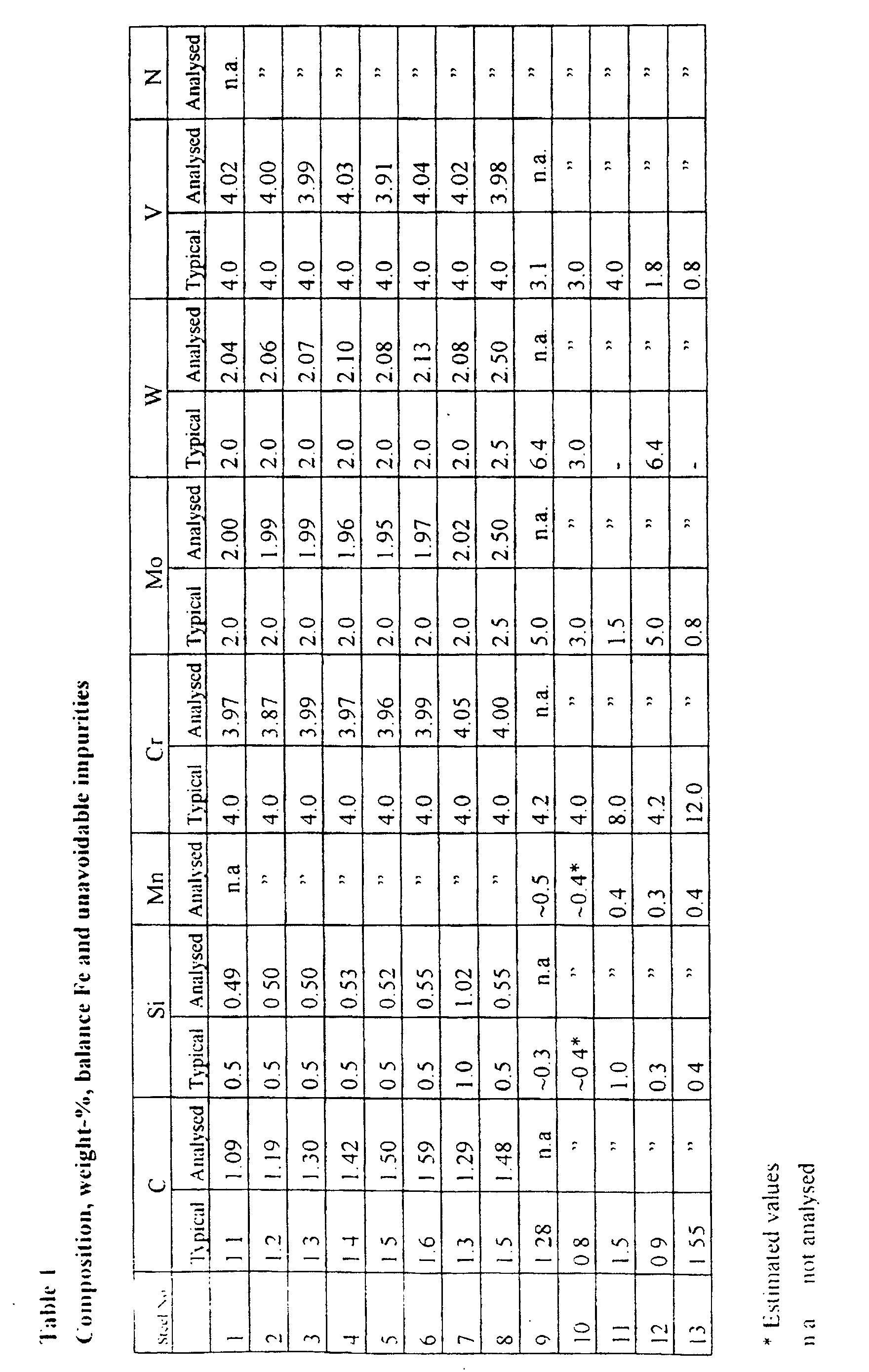
- Fig. 1 shows that the substantially higher alloyed reference material No. 9 had the highest hardness but also that steel No. 8 of the invention achieved a hardness which is sufficient for the intended applications.
- test specimens were used, size ⁇ 15 mm. The tests were carried out according to the method which is known in the art as the "Pin on disc, dry SiO 2 flint paper"-test, grain size 150 mesh, load 20 N, 2 min. Also the steels which in Table 1 are denominated steel Nos. 11, 12, and 13 were tested besides steel No 8 of the invention and the reference steel No. 9. Steel No. 11 was a powder-metallurgically manufactured cold work steel; steel No.
- the wear resistance is proportional to the height of the bar. Best result was achieved for steel No. 8 after hardening from 1060°C and tempering 2 x 2 h at 200°C, and next best was steel No. 8 of the invention when hardened from 1150°C and tempered 3 ⁇ I h at 560°C. Equal wear resistance had the cold work steel No. 13, which is a conventionally manufactured high chromium steel with a high amount of large chromium carbides which promote the wear resistance but which on the other hand impair other important features, particularly the toughness.
- Fig. 7 shows the micro-structure of steel No. 8 of the invention after hardening from 1100°C, tempering 3 x 1 h, 560°C.
- the bright, round or more or less oval particles consist of undissolved MC-carbides.
- the matrix consists of tempered martensite. Secondarily precipitated M 2 C-carbides, which exist in a large amount in the martensitic matrix are not visible at the actual magnification because of their smallness; sizes in the order 5 à 10 nm.
- Fig. 8 there is shown a tool, an upper-die a , intended to form part of a punching tool for which the steel of the invention advantageously can be used.
Landscapes
- Chemical & Material Sciences (AREA)
- Engineering & Computer Science (AREA)
- Materials Engineering (AREA)
- Mechanical Engineering (AREA)
- Metallurgy (AREA)
- Organic Chemistry (AREA)
- Physics & Mathematics (AREA)
- Thermal Sciences (AREA)
- Crystallography & Structural Chemistry (AREA)
- Powder Metallurgy (AREA)
- Manufacture Of Metal Powder And Suspensions Thereof (AREA)
Abstract
Description
- Fig. 1
- shows the hardness versus the hardening temperature after high temperature tempering of a steel according to the invention and of a reference material;
- Fig. 2
- shows the bending strength - tensile strength - versus the hardening temperature of the steel of the invention for two alternative tempering temperatures and also for a reference material;
- Fig. 3
- shows the bending strength - deflection - versus the hardening temperature for the same materials and during the same conditions as for Fig. 2;
- Fig. 4
- shows the wear resistance of a number of examined steels;
- Fig. 5
- shows the toughness in terms of impact strength for a number of tested steels,
- Fig. 6
- illustrates the content of MC-carbides in a steel of the invention and the content of MC-carbides and M6C-carbides in an other material after tempering at different solution heat treatment temperatures;
- Fig 7
- shows the micro-structure of a steel of the invention after heat treatment, and
- Fig 8
- shows a typical tool tor which the steel of the invention can be used

| Impact strength tests, VW-method | ||||
| Steel No | Austenitising temperature, °C | Tempering temperature, °C, number of tempering operations, and duration | Hardness, HRC | Impact Strength, |
| 8 | 1020 | 200, 2 x 2 | 61,8 | 111 |
| 8 | 1020 | 525, 2 x 2 | 60,5 | 100 |
| 8 | 1020 | 560, 2 x 1 | 58,7 | 120 |
| 8 | 1100 | 560, 3 x 1 | 61,3 | 90 |
| 9 | 1075 | 560, 3 x 1 | 61,1 | 61 |
| 11 | 1020 | 200, 2 x 2 h | 59,7 | 88 |
| 11 | 1020 | 525, 2 x 2 | 58,2 | 74 |
| 12 | 1050 | 560, 2 x 1 h | 57,7 | 36 |
| 13 | 1020 | 200, 2 x 2 | 59,4 | 34 |
Claims (14)
- A powder-metallurgically manufactured steel for tools for forming and/or cutting operations, characterized in that it has the following alloy composition in weight-%:a total amount of max. 1.0 of Nb + Ta + Ti + Zr + Al1.4-1.6(C + N)max. 0.6 Mnmax. 1.2 Si3.5-4.3 Cr1.5-3 Mo1.5-3 W, wherein 6 < Weq < 9, and Weq = % W + 2 x % Mo3.5-4.5 Vmax. 0 3 Smax. 1 Co
a total amount of 0.5 of other elements, including unavoidable impurities and up to 0.1 Sn, up to 0.005 Pb, max. 0.3 Cu, balance iron. - A steel according to claim 1, characterized in that it contains at least 1.44 and at most 1.56 C + N.
- A steel according to claim or 2, characterized in that 40-60 % of C and N exist in undissolved hard products of MX-type, which means primary carbides or carbo-nitrides, where M is V and X is C and/or N.
- A steel according to any of claims 1-3, characterized in that it contains max. 0.03 S.
- A steel according to any of claims 1-3, characterized in that it contains 0.1-0.3 S.
- A steel according to any of claims 1-5, characterized in that it contains 3.8-4.2 Cr.
- A steel according to any of claims 1-6, characterized in that 6.5 ≤ Weq ≤ 8.5, preferably that 7≤Weq≤8
- A steel according to any of claims 1-7, characterized in that it contains 3.8-4.2 V.
- A tool made of a steel having a composition according to any of claims 1-8, characterized in that the tool material has a micro-structure substantially consisting of a martensitic matrix and in the matrix 2-15, preferably 5-10 volume-% undissolved hard products having the particle size 0.1-3 µm, said hard products being of MX-type, where M is V and X is C and/or N, wherein 40-60 % of the C and N content of the alloy is bound to vanadium as carbides and/or as carbo-nitrides, and a functional amount of hard products precipitated in the martensitic matrix after solution heat treatment of the steel at a temperature between 1000 and 1225°C and tempering at least twice for at least 0.5 h at a temperature between 190 and 580°C
- A tool according to claim 9, characterized in that the martensitic matrix contains a functional amount of hard products of M2X-type, where M is metals belonging to the group consisting of Cr, Mo, W, V, and Fe, particularly Mo and W, and X is C and N, said hard products having a size smaller than 100 nm, obtainable by tempering the steel at a temperature between 520 and 570°C.
- A tool according to claim 9, characterized in that the tool material contains a functional amount of hard products of M3X-type, where M substantially is Fe and Cr, and X is C and/or N, obtainable by tempering the steel at a temperature between 190 and 250°C after solution heat treatment at a temperature between 1000 and 1100°C.
- A tool according to any of claims 9-11,characterized in that the tool material has a hardness of at least 62 HRC and a bending strength of at least 5.5 kN/mm2 after hardening from a temperature between 1100 and 1200°C and tempering at a temperature between 520 and 570°C.
- An integrated process for the manufacturing of a steel and a tool thereof, characterized inthat a steel melt is prepared having an alloy composition according to any of claims 1-8,that droplets are formed of the melt, which droplets are cooled to form a powder of said steel alloy, in which existing hard products of type MX, where M substantially is V, and X is C and/or N, consist of particles, in which at least 90% of the total amount of said hard products has a particle size between 0 1 and 3 µm,that the powder is densified to a body with complete density through a densification process which comprises hot isostatic compaction,that the body is hot worked through forging and/or rolling,that the tool with desired shape is made of the forged and/or hot rolled product after soft annealing of it, andthat the tool is hardened through solution heat treatment (austenitisation) at a temperature between 1000 and 1225°C, intensified cooling to below 500°C and continued cooling to below 50°C, and tempering at a temperature between 190 and 580°C, such that the tool material will obtain a micro-structure according to the characterizing part of any of claims 9-12.
- Use of a steel having the following alloy composition in weight-%:a total amount of max. 1.0 of Nb + Ta + Ti + Zr + Al1.4-1.6(C + N)max. 0.6 Mnmax. 1.2 Si3.5-4.3 Cr1.5-3 Mo1.5-3 W, wherein 6 < Weq < 9, and Weq = % W + 2 x % Mo3.5-4.5 Vmax. 0.3 Smax. 1 Co
a total amount of 0.5 of other elements, including unavoidable impurities and up to 0.1 Sn, up to 0.005 Pb, max. 0 3 Cu, balance iron, and a micro-structure substantially consisting of a martensitic matrix and in the matrix 2-15, preferably 5-10 volume-% undissolved hard products having the particle size 0.1-3 µm, said hard products being of MX-type, where M is V and X is C and/or N, wherein 40-60 % of the C and N content of the alloy is bound to vanadium as carbides and/or as carbo-nitrides, and a functional amount of hard products precipitated in the martensitic matrix after solution heat treatment of the steel at a temperature between 1000 and 1225°C and tempering at least twice for at least 0.5 h at a temperature between 190 and 580°C, for tools for forming and/or cutting operations
Applications Claiming Priority (3)
| Application Number | Priority Date | Filing Date | Title |
|---|---|---|---|
| SE9700862A SE508872C2 (en) | 1997-03-11 | 1997-03-11 | Powder metallurgically made steel for tools, tools made therefrom, process for making steel and tools and use of steel |
| SE9700862 | 1997-03-11 | ||
| PCT/SE1998/000334 WO1998040180A1 (en) | 1997-03-11 | 1998-02-25 | A steel and a heat treated tool thereof manufactured by an integrated powder metallurgical process and use of the steel for tools |
Publications (2)
| Publication Number | Publication Date |
|---|---|
| EP1024917A1 EP1024917A1 (en) | 2000-08-09 |
| EP1024917B1 true EP1024917B1 (en) | 2003-05-21 |
Family
ID=20406099
Family Applications (1)
| Application Number | Title | Priority Date | Filing Date |
|---|---|---|---|
| EP98909896A Expired - Lifetime EP1024917B1 (en) | 1997-03-11 | 1998-02-25 | A steel and a heat treated tool thereof manufactured by an integrated powder metallurgical process and use of the steel for tools |
Country Status (11)
| Country | Link |
|---|---|
| US (1) | US6162275A (en) |
| EP (1) | EP1024917B1 (en) |
| JP (1) | JP4652490B2 (en) |
| KR (1) | KR100500772B1 (en) |
| AT (1) | ATE240810T1 (en) |
| AU (1) | AU6426598A (en) |
| DE (1) | DE69814896T2 (en) |
| DK (1) | DK1024917T3 (en) |
| ES (1) | ES2198049T3 (en) |
| SE (1) | SE508872C2 (en) |
| WO (1) | WO1998040180A1 (en) |
Families Citing this family (22)
| Publication number | Priority date | Publication date | Assignee | Title |
|---|---|---|---|---|
| SE512970C2 (en) * | 1998-10-30 | 2000-06-12 | Erasteel Kloster Ab | Steel, the use of the steel, the product made of the steel and the way of making the steel |
| SE514410C2 (en) | 1999-06-16 | 2001-02-19 | Erasteel Kloster Ab | Powder metallurgically made steel |
| DE10019042A1 (en) * | 2000-04-18 | 2001-11-08 | Edelstahl Witten Krefeld Gmbh | Nitrogen alloyed steel produced by spray compacting used in the production of composite materials contains alloying additions of manganese and molybdenum |
| AT411580B (en) * | 2001-04-11 | 2004-03-25 | Boehler Edelstahl | METHOD FOR THE POWDER METALLURGICAL PRODUCTION OF OBJECTS |
| SE519278C2 (en) | 2001-06-21 | 2003-02-11 | Uddeholm Tooling Ab | Cold Work |
| US7909906B2 (en) | 2001-06-21 | 2011-03-22 | Uddeholms Ab | Cold work steel and manufacturing method thereof |
| DE102004034905A1 (en) * | 2004-07-19 | 2006-04-13 | Böhler-Uddeholm Precision Strip GmbH & Co. KG | Steel strip for doctor blades, applicator blades and creping blades and powder metallurgical process for their production |
| ES2719592T3 (en) * | 2005-09-08 | 2019-07-11 | Erasteel Kloster Ab | High speed steel made by powder metallurgy |
| BRPI0601679B1 (en) * | 2006-04-24 | 2014-11-11 | Villares Metals S/A | FAST STEEL FOR SAW BLADES |
| BRPI0603856A (en) * | 2006-08-28 | 2008-04-15 | Villares Metals Sa | hard alloys of lean composition |
| US10351922B2 (en) | 2008-04-11 | 2019-07-16 | Questek Innovations Llc | Surface hardenable stainless steels |
| US8808471B2 (en) * | 2008-04-11 | 2014-08-19 | Questek Innovations Llc | Martensitic stainless steel strengthened by copper-nucleated nitride precipitates |
| EP2123377A1 (en) | 2008-05-23 | 2009-11-25 | Rovalma, S.A. | Method for manufacturing a workpiece, in particular a forming tool or a forming tool component |
| EP2896714B1 (en) * | 2014-01-17 | 2016-04-13 | voestalpine Precision Strip AB | Creping blade and method for its manufacturing |
| DE102014103555A1 (en) * | 2014-03-14 | 2015-09-17 | Rwe Power Ag | Mold made of powder metallurgical material |
| EP2975146A1 (en) * | 2014-07-16 | 2016-01-20 | Uddeholms AB | Cold work tool steel |
| CN104878305B (en) * | 2015-05-15 | 2017-10-10 | 安泰科技股份有限公司 | Wear-resistant corrosion-resisting alloy steel |
| CN104894482B (en) * | 2015-05-15 | 2017-05-03 | 河冶科技股份有限公司 | Spray formed tool steel |
| CN104878304B (en) * | 2015-05-15 | 2017-05-03 | 河冶科技股份有限公司 | Wear resistant and corrosion resistant tool steel for spray forming |
| CN104878306B (en) * | 2015-05-15 | 2017-05-03 | 河冶科技股份有限公司 | Wearproof tool steel for spray forming |
| CN104878300B (en) * | 2015-05-15 | 2017-08-04 | 河冶科技股份有限公司 | Injection shaping high tenacity tool steel |
| SE544123C2 (en) * | 2020-06-12 | 2022-01-04 | Uddeholms Ab | Hot work tool steel |
Family Cites Families (8)
| Publication number | Priority date | Publication date | Assignee | Title |
|---|---|---|---|---|
| US3809541A (en) * | 1972-10-24 | 1974-05-07 | G Steven | Vanadium-containing tool steel article |
| SE456650C (en) * | 1987-03-19 | 1989-10-16 | Uddeholm Tooling Ab | POWDER METAL SURGICAL PREPARED STEEL STEEL |
| WO1993002819A1 (en) * | 1991-08-07 | 1993-02-18 | Kloster Speedsteel Aktiebolag | High-speed steel manufactured by powder metallurgy |
| DE69217960T2 (en) * | 1991-08-07 | 1997-06-26 | Erasteel Kloster Ab | POWDER METALLURGICALLY PRODUCED FAST WORK STEEL |
| SE500008C2 (en) * | 1991-08-07 | 1994-03-21 | Erasteel Kloster Ab | High speed steel with good hot hardness and durability made of powder |
| EP0598814B1 (en) * | 1991-08-07 | 1997-04-02 | Erasteel Kloster Aktiebolag | High-speed steel manufactured by powder metallurgy |
| CA2131652C (en) * | 1993-09-27 | 2004-06-01 | William Stasko | Sulfur-containing powder-metallurgy tool steel article |
| US5522914A (en) * | 1993-09-27 | 1996-06-04 | Crucible Materials Corporation | Sulfur-containing powder-metallurgy tool steel article |
-
1997
- 1997-03-11 SE SE9700862A patent/SE508872C2/en not_active IP Right Cessation
-
1998
- 1998-02-25 KR KR10-1999-7008181A patent/KR100500772B1/en not_active Expired - Lifetime
- 1998-02-25 EP EP98909896A patent/EP1024917B1/en not_active Expired - Lifetime
- 1998-02-25 AU AU64265/98A patent/AU6426598A/en not_active Abandoned
- 1998-02-25 DK DK98909896T patent/DK1024917T3/en active
- 1998-02-25 AT AT98909896T patent/ATE240810T1/en active
- 1998-02-25 JP JP53949598A patent/JP4652490B2/en not_active Expired - Lifetime
- 1998-02-25 US US09/331,117 patent/US6162275A/en not_active Expired - Lifetime
- 1998-02-25 WO PCT/SE1998/000334 patent/WO1998040180A1/en not_active Ceased
- 1998-02-25 DE DE69814896T patent/DE69814896T2/en not_active Expired - Lifetime
- 1998-02-25 ES ES98909896T patent/ES2198049T3/en not_active Expired - Lifetime
Also Published As
| Publication number | Publication date |
|---|---|
| ATE240810T1 (en) | 2003-06-15 |
| SE508872C2 (en) | 1998-11-09 |
| ES2198049T3 (en) | 2004-01-16 |
| EP1024917A1 (en) | 2000-08-09 |
| JP4652490B2 (en) | 2011-03-16 |
| SE9700862D0 (en) | 1997-03-11 |
| US6162275A (en) | 2000-12-19 |
| SE9700862L (en) | 1998-09-12 |
| AU6426598A (en) | 1998-09-29 |
| KR100500772B1 (en) | 2005-07-12 |
| JP2001514703A (en) | 2001-09-11 |
| WO1998040180A1 (en) | 1998-09-17 |
| KR20000076093A (en) | 2000-12-26 |
| DE69814896T2 (en) | 2003-11-27 |
| DK1024917T3 (en) | 2003-07-14 |
| DE69814896D1 (en) | 2003-06-26 |
Similar Documents
| Publication | Publication Date | Title |
|---|---|---|
| US6162275A (en) | Steel and a heat treated tool thereof manufactured by an integrated powder metalurgical process and use of the steel for tools | |
| EP0875588B1 (en) | Wear resistant, powder metallurgy cold work tool steel articles having high impact toughness and a method for producing the same | |
| JP2009534536A (en) | High speed steel for saw blade | |
| US7297177B2 (en) | Cold work steel | |
| CA2324603C (en) | Steel material and method for its manufacturing | |
| EP1200637B1 (en) | Powder metallurgy manufactured high speed steel | |
| AU2007239111A1 (en) | Cold-working steel | |
| CA2381236C (en) | Steel material, its use and its manufacture | |
| EP1381702B1 (en) | Steel article | |
| JP3497387B2 (en) | Molds and tools made of high hardness cold tool steel | |
| US20040103959A1 (en) | Steel article | |
| US7909906B2 (en) | Cold work steel and manufacturing method thereof | |
| WO2026106531A1 (en) | A wear resistant vanadium alloyed powder metallurgy produced cold work tool steel and method of producing said steel, use of said steel | |
| WO2023080832A1 (en) | A wear resistant alloy | |
| JPH0711377A (en) | Sintered tool steel manufacturing method | |
| WO2026106530A1 (en) | A method for improving the wear resistance of vanadium alloyed powder metallurgy produced cold work tool steels and a vanadium alloyed cold work steel | |
| HK1033965B (en) | Steel material and method for its manufacturing |
Legal Events
| Date | Code | Title | Description |
|---|---|---|---|
| PUAI | Public reference made under article 153(3) epc to a published international application that has entered the european phase |
Free format text: ORIGINAL CODE: 0009012 |
|
| 17P | Request for examination filed |
Effective date: 19990610 |
|
| AK | Designated contracting states |
Kind code of ref document: A1 Designated state(s): AT BE CH DE DK ES FI FR GB IE IT LI NL SE |
|
| AX | Request for extension of the european patent |
Free format text: SI PAYMENT 19990610 |
|
| GRAH | Despatch of communication of intention to grant a patent |
Free format text: ORIGINAL CODE: EPIDOS IGRA |
|
| GRAH | Despatch of communication of intention to grant a patent |
Free format text: ORIGINAL CODE: EPIDOS IGRA |
|
| GRAA | (expected) grant |
Free format text: ORIGINAL CODE: 0009210 |
|
| AK | Designated contracting states |
Designated state(s): AT BE CH DE DK ES FI FR GB IE IT LI NL SE |
|
| AX | Request for extension of the european patent |
Extension state: SI |
|
| REG | Reference to a national code |
Ref country code: GB Ref legal event code: FG4D |
|
| REG | Reference to a national code |
Ref country code: CH Ref legal event code: EP |
|
| REG | Reference to a national code |
Ref country code: IE Ref legal event code: FG4D |
|
| REF | Corresponds to: |
Ref document number: 69814896 Country of ref document: DE Date of ref document: 20030626 Kind code of ref document: P |
|
| REG | Reference to a national code |
Ref country code: DK Ref legal event code: T3 |
|
| PG25 | Lapsed in a contracting state [announced via postgrant information from national office to epo] |
Ref country code: SE Free format text: LAPSE BECAUSE OF FAILURE TO SUBMIT A TRANSLATION OF THE DESCRIPTION OR TO PAY THE FEE WITHIN THE PRESCRIBED TIME-LIMIT Effective date: 20030821 |
|
| REG | Reference to a national code |
Ref country code: CH Ref legal event code: NV Representative=s name: R. A. EGLI & CO. PATENTANWAELTE |
|
| REG | Reference to a national code |
Ref country code: ES Ref legal event code: FG2A Ref document number: 2198049 Country of ref document: ES Kind code of ref document: T3 |
|
| ET | Fr: translation filed | ||
| PLBE | No opposition filed within time limit |
Free format text: ORIGINAL CODE: 0009261 |
|
| STAA | Information on the status of an ep patent application or granted ep patent |
Free format text: STATUS: NO OPPOSITION FILED WITHIN TIME LIMIT |
|
| 26N | No opposition filed |
Effective date: 20040224 |
|
| PGFP | Annual fee paid to national office [announced via postgrant information from national office to epo] |
Ref country code: IE Payment date: 20100222 Year of fee payment: 13 Ref country code: DK Payment date: 20100225 Year of fee payment: 13 |
|
| PGFP | Annual fee paid to national office [announced via postgrant information from national office to epo] |
Ref country code: FI Payment date: 20100219 Year of fee payment: 13 |
|
| PGFP | Annual fee paid to national office [announced via postgrant information from national office to epo] |
Ref country code: BE Payment date: 20100218 Year of fee payment: 13 |
|
| PGFP | Annual fee paid to national office [announced via postgrant information from national office to epo] |
Ref country code: NL Payment date: 20100222 Year of fee payment: 13 |
|
| BERE | Be: lapsed |
Owner name: *ERASTEEL KLOSTER A.B. Effective date: 20110228 |
|
| REG | Reference to a national code |
Ref country code: NL Ref legal event code: V1 Effective date: 20110901 |
|
| REG | Reference to a national code |
Ref country code: DK Ref legal event code: EBP |
|
| REG | Reference to a national code |
Ref country code: IE Ref legal event code: MM4A |
|
| PG25 | Lapsed in a contracting state [announced via postgrant information from national office to epo] |
Ref country code: BE Free format text: LAPSE BECAUSE OF NON-PAYMENT OF DUE FEES Effective date: 20110228 Ref country code: FI Free format text: LAPSE BECAUSE OF NON-PAYMENT OF DUE FEES Effective date: 20110225 |
|
| PG25 | Lapsed in a contracting state [announced via postgrant information from national office to epo] |
Ref country code: NL Free format text: LAPSE BECAUSE OF NON-PAYMENT OF DUE FEES Effective date: 20110901 |
|
| PG25 | Lapsed in a contracting state [announced via postgrant information from national office to epo] |
Ref country code: IE Free format text: LAPSE BECAUSE OF NON-PAYMENT OF DUE FEES Effective date: 20110225 |
|
| REG | Reference to a national code |
Ref country code: FR Ref legal event code: PLFP Year of fee payment: 19 |
|
| REG | Reference to a national code |
Ref country code: FR Ref legal event code: PLFP Year of fee payment: 20 |
|
| PGFP | Annual fee paid to national office [announced via postgrant information from national office to epo] |
Ref country code: CH Payment date: 20170217 Year of fee payment: 20 Ref country code: DE Payment date: 20170210 Year of fee payment: 20 Ref country code: FR Payment date: 20170220 Year of fee payment: 20 |
|
| PGFP | Annual fee paid to national office [announced via postgrant information from national office to epo] |
Ref country code: GB Payment date: 20170223 Year of fee payment: 20 Ref country code: AT Payment date: 20170227 Year of fee payment: 20 |
|
| PGFP | Annual fee paid to national office [announced via postgrant information from national office to epo] |
Ref country code: ES Payment date: 20170214 Year of fee payment: 20 Ref country code: IT Payment date: 20170223 Year of fee payment: 20 |
|
| REG | Reference to a national code |
Ref country code: DE Ref legal event code: R071 Ref document number: 69814896 Country of ref document: DE |
|
| REG | Reference to a national code |
Ref country code: CH Ref legal event code: PL |
|
| REG | Reference to a national code |
Ref country code: GB Ref legal event code: PE20 Expiry date: 20180224 |
|
| REG | Reference to a national code |
Ref country code: AT Ref legal event code: MK07 Ref document number: 240810 Country of ref document: AT Kind code of ref document: T Effective date: 20180225 |
|
| PG25 | Lapsed in a contracting state [announced via postgrant information from national office to epo] |
Ref country code: GB Free format text: LAPSE BECAUSE OF EXPIRATION OF PROTECTION Effective date: 20180224 |
|
| REG | Reference to a national code |
Ref country code: ES Ref legal event code: FD2A Effective date: 20220126 |
|
| PG25 | Lapsed in a contracting state [announced via postgrant information from national office to epo] |
Ref country code: ES Free format text: LAPSE BECAUSE OF EXPIRATION OF PROTECTION Effective date: 20180226 |