EP1024180B1 - Frosting composition and frosted glass container - Google Patents
Frosting composition and frosted glass container Download PDFInfo
- Publication number
- EP1024180B1 EP1024180B1 EP98937794A EP98937794A EP1024180B1 EP 1024180 B1 EP1024180 B1 EP 1024180B1 EP 98937794 A EP98937794 A EP 98937794A EP 98937794 A EP98937794 A EP 98937794A EP 1024180 B1 EP1024180 B1 EP 1024180B1
- Authority
- EP
- European Patent Office
- Prior art keywords
- fine
- particles
- weight
- coating
- meth
- Prior art date
- Legal status (The legal status is an assumption and is not a legal conclusion. Google has not performed a legal analysis and makes no representation as to the accuracy of the status listed.)
- Expired - Lifetime
Links
- 239000005338 frosted glass Substances 0.000 title claims abstract description 16
- 239000000203 mixture Substances 0.000 title claims abstract description 15
- VYPSYNLAJGMNEJ-UHFFFAOYSA-N Silicium dioxide Chemical compound O=[Si]=O VYPSYNLAJGMNEJ-UHFFFAOYSA-N 0.000 claims abstract description 107
- 239000002245 particle Substances 0.000 claims abstract description 77
- 230000002209 hydrophobic effect Effects 0.000 claims abstract description 60
- 150000001875 compounds Chemical class 0.000 claims abstract description 49
- 229920000642 polymer Polymers 0.000 claims abstract description 22
- 238000000576 coating method Methods 0.000 claims description 73
- 239000011248 coating agent Substances 0.000 claims description 69
- NIXOWILDQLNWCW-UHFFFAOYSA-M Acrylate Chemical compound [O-]C(=O)C=C NIXOWILDQLNWCW-UHFFFAOYSA-M 0.000 claims description 36
- 239000011521 glass Substances 0.000 claims description 36
- -1 silane compound Chemical class 0.000 claims description 34
- 229920001296 polysiloxane Polymers 0.000 claims description 23
- 239000000377 silicon dioxide Substances 0.000 claims description 9
- 229920002635 polyurethane Polymers 0.000 claims description 7
- 239000004814 polyurethane Substances 0.000 claims description 7
- NIXOWILDQLNWCW-UHFFFAOYSA-N acrylic acid group Chemical group C(C=C)(=O)O NIXOWILDQLNWCW-UHFFFAOYSA-N 0.000 claims description 3
- 229920000728 polyester Polymers 0.000 claims description 3
- 229910000077 silane Inorganic materials 0.000 claims description 3
- 239000003513 alkali Substances 0.000 abstract description 32
- 239000008199 coating composition Substances 0.000 description 36
- 238000000034 method Methods 0.000 description 29
- 239000000243 solution Substances 0.000 description 23
- 150000001252 acrylic acid derivatives Chemical class 0.000 description 14
- QNODIIQQMGDSEF-UHFFFAOYSA-N (1-hydroxycyclohexyl)-phenylmethanone Chemical compound C=1C=CC=CC=1C(=O)C1(O)CCCCC1 QNODIIQQMGDSEF-UHFFFAOYSA-N 0.000 description 13
- 229920005989 resin Polymers 0.000 description 13
- 239000011347 resin Substances 0.000 description 13
- HEMHJVSKTPXQMS-UHFFFAOYSA-M Sodium hydroxide Chemical compound [OH-].[Na+] HEMHJVSKTPXQMS-UHFFFAOYSA-M 0.000 description 12
- FFUAGWLWBBFQJT-UHFFFAOYSA-N hexamethyldisilazane Chemical compound C[Si](C)(C)N[Si](C)(C)C FFUAGWLWBBFQJT-UHFFFAOYSA-N 0.000 description 10
- 239000006224 matting agent Substances 0.000 description 10
- 239000000126 substance Substances 0.000 description 10
- OKKJLVBELUTLKV-UHFFFAOYSA-N Methanol Chemical compound OC OKKJLVBELUTLKV-UHFFFAOYSA-N 0.000 description 9
- 239000007822 coupling agent Substances 0.000 description 9
- 239000010419 fine particle Substances 0.000 description 9
- 229910052739 hydrogen Inorganic materials 0.000 description 9
- 238000005406 washing Methods 0.000 description 9
- IISBACLAFKSPIT-UHFFFAOYSA-N bisphenol A Chemical compound C=1C=C(O)C=CC=1C(C)(C)C1=CC=C(O)C=C1 IISBACLAFKSPIT-UHFFFAOYSA-N 0.000 description 8
- 125000000118 dimethyl group Chemical group [H]C([H])([H])* 0.000 description 8
- 239000001257 hydrogen Substances 0.000 description 8
- 239000006096 absorbing agent Substances 0.000 description 7
- 239000003999 initiator Substances 0.000 description 7
- 239000000178 monomer Substances 0.000 description 7
- ZWEHNKRNPOVVGH-UHFFFAOYSA-N 2-Butanone Chemical compound CCC(C)=O ZWEHNKRNPOVVGH-UHFFFAOYSA-N 0.000 description 6
- KBQVDAIIQCXKPI-UHFFFAOYSA-N 3-trimethoxysilylpropyl prop-2-enoate Chemical compound CO[Si](OC)(OC)CCCOC(=O)C=C KBQVDAIIQCXKPI-UHFFFAOYSA-N 0.000 description 6
- LYCAIKOWRPUZTN-UHFFFAOYSA-N Ethylene glycol Chemical compound OCCO LYCAIKOWRPUZTN-UHFFFAOYSA-N 0.000 description 6
- KRHYYFGTRYWZRS-UHFFFAOYSA-N Fluorane Chemical compound F KRHYYFGTRYWZRS-UHFFFAOYSA-N 0.000 description 6
- PEDCQBHIVMGVHV-UHFFFAOYSA-N Glycerine Chemical compound OCC(O)CO PEDCQBHIVMGVHV-UHFFFAOYSA-N 0.000 description 6
- 150000001253 acrylic acids Chemical class 0.000 description 6
- 125000003647 acryloyl group Chemical group O=C([*])C([H])=C([H])[H] 0.000 description 6
- MTHSVFCYNBDYFN-UHFFFAOYSA-N diethylene glycol Chemical compound OCCOCCO MTHSVFCYNBDYFN-UHFFFAOYSA-N 0.000 description 6
- 235000013870 dimethyl polysiloxane Nutrition 0.000 description 6
- 125000003700 epoxy group Chemical group 0.000 description 6
- 229920000435 poly(dimethylsiloxane) Polymers 0.000 description 6
- 239000003505 polymerization initiator Substances 0.000 description 5
- 230000003746 surface roughness Effects 0.000 description 5
- LFQSCWFLJHTTHZ-UHFFFAOYSA-N Ethanol Chemical compound CCO LFQSCWFLJHTTHZ-UHFFFAOYSA-N 0.000 description 4
- XSTXAVWGXDQKEL-UHFFFAOYSA-N Trichloroethylene Chemical group ClC=C(Cl)Cl XSTXAVWGXDQKEL-UHFFFAOYSA-N 0.000 description 4
- 239000002253 acid Substances 0.000 description 4
- 230000002411 adverse Effects 0.000 description 4
- 239000003795 chemical substances by application Substances 0.000 description 4
- 238000007865 diluting Methods 0.000 description 4
- 239000004205 dimethyl polysiloxane Substances 0.000 description 4
- 238000001035 drying Methods 0.000 description 4
- 125000004051 hexyl group Chemical group [H]C([H])([H])C([H])([H])C([H])([H])C([H])([H])C([H])([H])C([H])([H])* 0.000 description 4
- 239000010954 inorganic particle Substances 0.000 description 4
- 239000000463 material Substances 0.000 description 4
- SLCVBVWXLSEKPL-UHFFFAOYSA-N neopentyl glycol Chemical compound OCC(C)(C)CO SLCVBVWXLSEKPL-UHFFFAOYSA-N 0.000 description 4
- 238000006748 scratching Methods 0.000 description 4
- 230000002393 scratching effect Effects 0.000 description 4
- 150000004756 silanes Chemical class 0.000 description 4
- 239000007787 solid Substances 0.000 description 4
- 150000005846 sugar alcohols Polymers 0.000 description 4
- UBOXGVDOUJQMTN-UHFFFAOYSA-N trichloroethylene Natural products ClCC(Cl)Cl UBOXGVDOUJQMTN-UHFFFAOYSA-N 0.000 description 4
- XLYOFNOQVPJJNP-UHFFFAOYSA-N water Substances O XLYOFNOQVPJJNP-UHFFFAOYSA-N 0.000 description 4
- 229920003067 (meth)acrylic acid ester copolymer Polymers 0.000 description 3
- XDLMVUHYZWKMMD-UHFFFAOYSA-N 3-trimethoxysilylpropyl 2-methylprop-2-enoate Chemical compound CO[Si](OC)(OC)CCCOC(=O)C(C)=C XDLMVUHYZWKMMD-UHFFFAOYSA-N 0.000 description 3
- XEKOWRVHYACXOJ-UHFFFAOYSA-N Ethyl acetate Chemical compound CCOC(C)=O XEKOWRVHYACXOJ-UHFFFAOYSA-N 0.000 description 3
- KFZMGEQAYNKOFK-UHFFFAOYSA-N Isopropanol Chemical compound CC(C)O KFZMGEQAYNKOFK-UHFFFAOYSA-N 0.000 description 3
- 229920002845 Poly(methacrylic acid) Polymers 0.000 description 3
- YXFVVABEGXRONW-UHFFFAOYSA-N Toluene Chemical compound CC1=CC=CC=C1 YXFVVABEGXRONW-UHFFFAOYSA-N 0.000 description 3
- ISAOCJYIOMOJEB-UHFFFAOYSA-N benzoin Chemical compound C=1C=CC=CC=1C(O)C(=O)C1=CC=CC=C1 ISAOCJYIOMOJEB-UHFFFAOYSA-N 0.000 description 3
- 238000005336 cracking Methods 0.000 description 3
- 239000002270 dispersing agent Substances 0.000 description 3
- 230000000694 effects Effects 0.000 description 3
- 238000010438 heat treatment Methods 0.000 description 3
- CZWLNMOIEMTDJY-UHFFFAOYSA-N hexyl(trimethoxy)silane Chemical compound CCCCCC[Si](OC)(OC)OC CZWLNMOIEMTDJY-UHFFFAOYSA-N 0.000 description 3
- 238000007654 immersion Methods 0.000 description 3
- 230000001678 irradiating effect Effects 0.000 description 3
- 125000002496 methyl group Chemical group [H]C([H])([H])* 0.000 description 3
- 238000005507 spraying Methods 0.000 description 3
- 238000003756 stirring Methods 0.000 description 3
- 230000002087 whitening effect Effects 0.000 description 3
- DTGKSKDOIYIVQL-WEDXCCLWSA-N (+)-borneol Chemical group C1C[C@@]2(C)[C@@H](O)C[C@@H]1C2(C)C DTGKSKDOIYIVQL-WEDXCCLWSA-N 0.000 description 2
- HJIAMFHSAAEUKR-UHFFFAOYSA-N (2-hydroxyphenyl)-phenylmethanone Chemical compound OC1=CC=CC=C1C(=O)C1=CC=CC=C1 HJIAMFHSAAEUKR-UHFFFAOYSA-N 0.000 description 2
- TXBCBTDQIULDIA-UHFFFAOYSA-N 2-[[3-hydroxy-2,2-bis(hydroxymethyl)propoxy]methyl]-2-(hydroxymethyl)propane-1,3-diol Chemical compound OCC(CO)(CO)COCC(CO)(CO)CO TXBCBTDQIULDIA-UHFFFAOYSA-N 0.000 description 2
- LZMNXXQIQIHFGC-UHFFFAOYSA-N 3-[dimethoxy(methyl)silyl]propyl 2-methylprop-2-enoate Chemical compound CO[Si](C)(OC)CCCOC(=O)C(C)=C LZMNXXQIQIHFGC-UHFFFAOYSA-N 0.000 description 2
- DDFHBQSCUXNBSA-UHFFFAOYSA-N 5-(5-carboxythiophen-2-yl)thiophene-2-carboxylic acid Chemical compound S1C(C(=O)O)=CC=C1C1=CC=C(C(O)=O)S1 DDFHBQSCUXNBSA-UHFFFAOYSA-N 0.000 description 2
- KWOLFJPFCHCOCG-UHFFFAOYSA-N Acetophenone Chemical compound CC(=O)C1=CC=CC=C1 KWOLFJPFCHCOCG-UHFFFAOYSA-N 0.000 description 2
- 239000004593 Epoxy Substances 0.000 description 2
- LRHPLDYGYMQRHN-UHFFFAOYSA-N N-Butanol Chemical compound CCCCO LRHPLDYGYMQRHN-UHFFFAOYSA-N 0.000 description 2
- 239000004793 Polystyrene Substances 0.000 description 2
- 239000006087 Silane Coupling Agent Substances 0.000 description 2
- 244000028419 Styrax benzoin Species 0.000 description 2
- 235000000126 Styrax benzoin Nutrition 0.000 description 2
- QAOWNCQODCNURD-UHFFFAOYSA-N Sulfuric acid Chemical compound OS(O)(=O)=O QAOWNCQODCNURD-UHFFFAOYSA-N 0.000 description 2
- 235000008411 Sumatra benzointree Nutrition 0.000 description 2
- ZJCCRDAZUWHFQH-UHFFFAOYSA-N Trimethylolpropane Chemical compound CCC(CO)(CO)CO ZJCCRDAZUWHFQH-UHFFFAOYSA-N 0.000 description 2
- 230000001476 alcoholic effect Effects 0.000 description 2
- WNROFYMDJYEPJX-UHFFFAOYSA-K aluminium hydroxide Chemical compound [OH-].[OH-].[OH-].[Al+3] WNROFYMDJYEPJX-UHFFFAOYSA-K 0.000 description 2
- 229910021502 aluminium hydroxide Inorganic materials 0.000 description 2
- PNEYBMLMFCGWSK-UHFFFAOYSA-N aluminium oxide Inorganic materials [O-2].[O-2].[O-2].[Al+3].[Al+3] PNEYBMLMFCGWSK-UHFFFAOYSA-N 0.000 description 2
- 229910000323 aluminium silicate Inorganic materials 0.000 description 2
- 125000003277 amino group Chemical group 0.000 description 2
- 239000008346 aqueous phase Substances 0.000 description 2
- 229960002130 benzoin Drugs 0.000 description 2
- RWCCWEUUXYIKHB-UHFFFAOYSA-N benzophenone Chemical compound C=1C=CC=CC=1C(=O)C1=CC=CC=C1 RWCCWEUUXYIKHB-UHFFFAOYSA-N 0.000 description 2
- 239000012965 benzophenone Substances 0.000 description 2
- 235000013361 beverage Nutrition 0.000 description 2
- 238000006243 chemical reaction Methods 0.000 description 2
- YGZSVWMBUCGDCV-UHFFFAOYSA-N chloro(methyl)silane Chemical compound C[SiH2]Cl YGZSVWMBUCGDCV-UHFFFAOYSA-N 0.000 description 2
- GTPDFCLBTFKHNH-UHFFFAOYSA-N chloro(phenyl)silicon Chemical compound Cl[Si]C1=CC=CC=C1 GTPDFCLBTFKHNH-UHFFFAOYSA-N 0.000 description 2
- KOPOQZFJUQMUML-UHFFFAOYSA-N chlorosilane Chemical class Cl[SiH3] KOPOQZFJUQMUML-UHFFFAOYSA-N 0.000 description 2
- 230000000052 comparative effect Effects 0.000 description 2
- 125000002704 decyl group Chemical group [H]C([H])([H])C([H])([H])C([H])([H])C([H])([H])C([H])([H])C([H])([H])C([H])([H])C([H])([H])C([H])([H])C([H])([H])* 0.000 description 2
- HNPSIPDUKPIQMN-UHFFFAOYSA-N dioxosilane;oxo(oxoalumanyloxy)alumane Chemical compound O=[Si]=O.O=[Al]O[Al]=O HNPSIPDUKPIQMN-UHFFFAOYSA-N 0.000 description 2
- 239000006185 dispersion Substances 0.000 description 2
- 238000005530 etching Methods 0.000 description 2
- 125000000524 functional group Chemical group 0.000 description 2
- 239000005350 fused silica glass Substances 0.000 description 2
- 235000019382 gum benzoic Nutrition 0.000 description 2
- XXMIOPMDWAUFGU-UHFFFAOYSA-N hexane-1,6-diol Chemical compound OCCCCCCO XXMIOPMDWAUFGU-UHFFFAOYSA-N 0.000 description 2
- 125000001165 hydrophobic group Chemical group 0.000 description 2
- 125000002887 hydroxy group Chemical group [H]O* 0.000 description 2
- 230000006872 improvement Effects 0.000 description 2
- 238000012690 ionic polymerization Methods 0.000 description 2
- 125000000959 isobutyl group Chemical group [H]C([H])([H])C([H])(C([H])([H])[H])C([H])([H])* 0.000 description 2
- 239000012948 isocyanate Substances 0.000 description 2
- VTHJTEIRLNZDEV-UHFFFAOYSA-L magnesium dihydroxide Chemical compound [OH-].[OH-].[Mg+2] VTHJTEIRLNZDEV-UHFFFAOYSA-L 0.000 description 2
- 239000000347 magnesium hydroxide Substances 0.000 description 2
- 229910001862 magnesium hydroxide Inorganic materials 0.000 description 2
- 239000000395 magnesium oxide Substances 0.000 description 2
- CPLXHLVBOLITMK-UHFFFAOYSA-N magnesium oxide Inorganic materials [Mg]=O CPLXHLVBOLITMK-UHFFFAOYSA-N 0.000 description 2
- AXZKOIWUVFPNLO-UHFFFAOYSA-N magnesium;oxygen(2-) Chemical compound [O-2].[Mg+2] AXZKOIWUVFPNLO-UHFFFAOYSA-N 0.000 description 2
- 239000010445 mica Substances 0.000 description 2
- 229910052618 mica group Inorganic materials 0.000 description 2
- 239000011259 mixed solution Substances 0.000 description 2
- 238000002156 mixing Methods 0.000 description 2
- 125000002347 octyl group Chemical group [H]C([*])([H])C([H])([H])C([H])([H])C([H])([H])C([H])([H])C([H])([H])C([H])([H])C([H])([H])[H] 0.000 description 2
- 239000003960 organic solvent Substances 0.000 description 2
- 125000001997 phenyl group Chemical group [H]C1=C([H])C([H])=C(*)C([H])=C1[H] 0.000 description 2
- 239000004033 plastic Substances 0.000 description 2
- 229920003023 plastic Polymers 0.000 description 2
- 229920005906 polyester polyol Polymers 0.000 description 2
- 150000007519 polyprotic acids Polymers 0.000 description 2
- 229920002223 polystyrene Polymers 0.000 description 2
- 239000000843 powder Substances 0.000 description 2
- 238000001556 precipitation Methods 0.000 description 2
- 230000008569 process Effects 0.000 description 2
- 239000007870 radical polymerization initiator Substances 0.000 description 2
- 230000009257 reactivity Effects 0.000 description 2
- 230000000717 retained effect Effects 0.000 description 2
- YGSDEFSMJLZEOE-UHFFFAOYSA-N salicylic acid Chemical compound OC(=O)C1=CC=CC=C1O YGSDEFSMJLZEOE-UHFFFAOYSA-N 0.000 description 2
- 150000003839 salts Chemical class 0.000 description 2
- 125000005372 silanol group Chemical group 0.000 description 2
- 229920002545 silicone oil Polymers 0.000 description 2
- 239000000344 soap Substances 0.000 description 2
- 230000035882 stress Effects 0.000 description 2
- 239000004094 surface-active agent Substances 0.000 description 2
- 239000000454 talc Substances 0.000 description 2
- 229910052623 talc Inorganic materials 0.000 description 2
- ARVUDIQYNJVQIW-UHFFFAOYSA-N (4-dodecoxy-2-hydroxyphenyl)-phenylmethanone Chemical compound OC1=CC(OCCCCCCCCCCCC)=CC=C1C(=O)C1=CC=CC=C1 ARVUDIQYNJVQIW-UHFFFAOYSA-N 0.000 description 1
- OMWSZDODENFLSV-UHFFFAOYSA-N (5-chloro-2-hydroxyphenyl)-phenylmethanone Chemical compound OC1=CC=C(Cl)C=C1C(=O)C1=CC=CC=C1 OMWSZDODENFLSV-UHFFFAOYSA-N 0.000 description 1
- ZXDDPOHVAMWLBH-UHFFFAOYSA-N 2,4-Dihydroxybenzophenone Chemical compound OC1=CC(O)=CC=C1C(=O)C1=CC=CC=C1 ZXDDPOHVAMWLBH-UHFFFAOYSA-N 0.000 description 1
- ZMWRRFHBXARRRT-UHFFFAOYSA-N 2-(benzotriazol-2-yl)-4,6-bis(2-methylbutan-2-yl)phenol Chemical compound CCC(C)(C)C1=CC(C(C)(C)CC)=CC(N2N=C3C=CC=CC3=N2)=C1O ZMWRRFHBXARRRT-UHFFFAOYSA-N 0.000 description 1
- LHPPDQUVECZQSW-UHFFFAOYSA-N 2-(benzotriazol-2-yl)-4,6-ditert-butylphenol Chemical compound CC(C)(C)C1=CC(C(C)(C)C)=CC(N2N=C3C=CC=CC3=N2)=C1O LHPPDQUVECZQSW-UHFFFAOYSA-N 0.000 description 1
- IYAZLDLPUNDVAG-UHFFFAOYSA-N 2-(benzotriazol-2-yl)-4-(2,4,4-trimethylpentan-2-yl)phenol Chemical compound CC(C)(C)CC(C)(C)C1=CC=C(O)C(N2N=C3C=CC=CC3=N2)=C1 IYAZLDLPUNDVAG-UHFFFAOYSA-N 0.000 description 1
- AQROEYPMNFCJCK-UHFFFAOYSA-N 2-(benzotriazol-2-yl)-6-tert-butyl-4-methylphenol Chemical compound CC(C)(C)C1=CC(C)=CC(N2N=C3C=CC=CC3=N2)=C1O AQROEYPMNFCJCK-UHFFFAOYSA-N 0.000 description 1
- KXGFMDJXCMQABM-UHFFFAOYSA-N 2-methoxy-6-methylphenol Chemical compound [CH]OC1=CC=CC([CH])=C1O KXGFMDJXCMQABM-UHFFFAOYSA-N 0.000 description 1
- NMAGCVWUISAHAP-UHFFFAOYSA-N 3,5-ditert-butyl-2-(2,4-ditert-butylphenyl)-4-hydroxybenzoic acid Chemical compound CC(C)(C)C1=CC(C(C)(C)C)=CC=C1C1=C(C(O)=O)C=C(C(C)(C)C)C(O)=C1C(C)(C)C NMAGCVWUISAHAP-UHFFFAOYSA-N 0.000 description 1
- MCDBEBOBROAQSH-UHFFFAOYSA-N 3-[dimethoxy(methyl)silyl]propyl prop-2-enoate Chemical compound CO[Si](C)(OC)CCCOC(=O)C=C MCDBEBOBROAQSH-UHFFFAOYSA-N 0.000 description 1
- URDOJQUSEUXVRP-UHFFFAOYSA-N 3-triethoxysilylpropyl 2-methylprop-2-enoate Chemical compound CCO[Si](OCC)(OCC)CCCOC(=O)C(C)=C URDOJQUSEUXVRP-UHFFFAOYSA-N 0.000 description 1
- XDQWJFXZTAWJST-UHFFFAOYSA-N 3-triethoxysilylpropyl prop-2-enoate Chemical compound CCO[Si](OCC)(OCC)CCCOC(=O)C=C XDQWJFXZTAWJST-UHFFFAOYSA-N 0.000 description 1
- GZVHEAJQGPRDLQ-UHFFFAOYSA-N 6-phenyl-1,3,5-triazine-2,4-diamine Chemical compound NC1=NC(N)=NC(C=2C=CC=CC=2)=N1 GZVHEAJQGPRDLQ-UHFFFAOYSA-N 0.000 description 1
- OKTJSMMVPCPJKN-UHFFFAOYSA-N Carbon Chemical compound [C] OKTJSMMVPCPJKN-UHFFFAOYSA-N 0.000 description 1
- 229920001651 Cyanoacrylate Polymers 0.000 description 1
- MWCLLHOVUTZFKS-UHFFFAOYSA-N Methyl cyanoacrylate Chemical compound COC(=O)C(=C)C#N MWCLLHOVUTZFKS-UHFFFAOYSA-N 0.000 description 1
- CTQNGGLPUBDAKN-UHFFFAOYSA-N O-Xylene Chemical compound CC1=CC=CC=C1C CTQNGGLPUBDAKN-UHFFFAOYSA-N 0.000 description 1
- OFSAUHSCHWRZKM-UHFFFAOYSA-N Padimate A Chemical compound CC(C)CCOC(=O)C1=CC=C(N(C)C)C=C1 OFSAUHSCHWRZKM-UHFFFAOYSA-N 0.000 description 1
- 239000004952 Polyamide Substances 0.000 description 1
- 239000004698 Polyethylene Substances 0.000 description 1
- 239000004743 Polypropylene Substances 0.000 description 1
- 239000004820 Pressure-sensitive adhesive Substances 0.000 description 1
- 229920001807 Urea-formaldehyde Polymers 0.000 description 1
- 238000010521 absorption reaction Methods 0.000 description 1
- 150000008062 acetophenones Chemical class 0.000 description 1
- 230000002378 acidificating effect Effects 0.000 description 1
- 230000001070 adhesive effect Effects 0.000 description 1
- 239000003945 anionic surfactant Substances 0.000 description 1
- PYKYMHQGRFAEBM-UHFFFAOYSA-N anthraquinone Chemical class CCC(=O)c1c(O)c2C(=O)C3C(C=CC=C3O)C(=O)c2cc1CC(=O)OC PYKYMHQGRFAEBM-UHFFFAOYSA-N 0.000 description 1
- 150000004056 anthraquinones Chemical class 0.000 description 1
- 150000004982 aromatic amines Chemical class 0.000 description 1
- 239000011324 bead Substances 0.000 description 1
- WURBFLDFSFBTLW-UHFFFAOYSA-N benzil Chemical compound C=1C=CC=CC=1C(=O)C(=O)C1=CC=CC=C1 WURBFLDFSFBTLW-UHFFFAOYSA-N 0.000 description 1
- WPYMKLBDIGXBTP-UHFFFAOYSA-N benzoic acid Chemical compound OC(=O)C1=CC=CC=C1 WPYMKLBDIGXBTP-UHFFFAOYSA-N 0.000 description 1
- 150000008366 benzophenones Chemical class 0.000 description 1
- QRUDEWIWKLJBPS-UHFFFAOYSA-N benzotriazole Chemical compound C1=CC=C2N[N][N]C2=C1 QRUDEWIWKLJBPS-UHFFFAOYSA-N 0.000 description 1
- 125000001797 benzyl group Chemical group [H]C1=C([H])C([H])=C(C([H])=C1[H])C([H])([H])* 0.000 description 1
- 230000005540 biological transmission Effects 0.000 description 1
- WXNRYSGJLQFHBR-UHFFFAOYSA-N bis(2,4-dihydroxyphenyl)methanone Chemical compound OC1=CC(O)=CC=C1C(=O)C1=CC=C(O)C=C1O WXNRYSGJLQFHBR-UHFFFAOYSA-N 0.000 description 1
- 229910052799 carbon Inorganic materials 0.000 description 1
- 239000003093 cationic surfactant Substances 0.000 description 1
- 238000007796 conventional method Methods 0.000 description 1
- 229920001577 copolymer Polymers 0.000 description 1
- 239000002537 cosmetic Substances 0.000 description 1
- 125000005520 diaryliodonium group Chemical group 0.000 description 1
- 238000007598 dipping method Methods 0.000 description 1
- MCPKSFINULVDNX-UHFFFAOYSA-N drometrizole Chemical compound CC1=CC=C(O)C(N2N=C3C=CC=CC3=N2)=C1 MCPKSFINULVDNX-UHFFFAOYSA-N 0.000 description 1
- 229920001971 elastomer Polymers 0.000 description 1
- 239000000806 elastomer Substances 0.000 description 1
- 150000002148 esters Chemical class 0.000 description 1
- FWDBOZPQNFPOLF-UHFFFAOYSA-N ethenyl(triethoxy)silane Chemical compound CCO[Si](OCC)(OCC)C=C FWDBOZPQNFPOLF-UHFFFAOYSA-N 0.000 description 1
- NKSJNEHGWDZZQF-UHFFFAOYSA-N ethenyl(trimethoxy)silane Chemical compound CO[Si](OC)(OC)C=C NKSJNEHGWDZZQF-UHFFFAOYSA-N 0.000 description 1
- 230000006355 external stress Effects 0.000 description 1
- 239000000945 filler Substances 0.000 description 1
- 235000013305 food Nutrition 0.000 description 1
- 230000007246 mechanism Effects 0.000 description 1
- QSHDDOUJBYECFT-UHFFFAOYSA-N mercury Chemical compound [Hg] QSHDDOUJBYECFT-UHFFFAOYSA-N 0.000 description 1
- 125000005641 methacryl group Chemical group 0.000 description 1
- 239000004005 microsphere Substances 0.000 description 1
- 239000002736 nonionic surfactant Substances 0.000 description 1
- QUAMTGJKVDWJEQ-UHFFFAOYSA-N octabenzone Chemical compound OC1=CC(OCCCCCCCC)=CC=C1C(=O)C1=CC=CC=C1 QUAMTGJKVDWJEQ-UHFFFAOYSA-N 0.000 description 1
- DXGLGDHPHMLXJC-UHFFFAOYSA-N oxybenzone Chemical compound OC1=CC(OC)=CC=C1C(=O)C1=CC=CC=C1 DXGLGDHPHMLXJC-UHFFFAOYSA-N 0.000 description 1
- FJKROLUGYXJWQN-UHFFFAOYSA-N papa-hydroxy-benzoic acid Natural products OC(=O)C1=CC=C(O)C=C1 FJKROLUGYXJWQN-UHFFFAOYSA-N 0.000 description 1
- FZUGPQWGEGAKET-UHFFFAOYSA-N parbenate Chemical compound CCOC(=O)C1=CC=C(N(C)C)C=C1 FZUGPQWGEGAKET-UHFFFAOYSA-N 0.000 description 1
- 229920001568 phenolic resin Polymers 0.000 description 1
- 239000005011 phenolic resin Substances 0.000 description 1
- 229920003229 poly(methyl methacrylate) Polymers 0.000 description 1
- 229920002647 polyamide Polymers 0.000 description 1
- 229920000573 polyethylene Polymers 0.000 description 1
- 238000006116 polymerization reaction Methods 0.000 description 1
- 239000004926 polymethyl methacrylate Substances 0.000 description 1
- 229920001155 polypropylene Polymers 0.000 description 1
- 229960004889 salicylic acid Drugs 0.000 description 1
- 239000004576 sand Substances 0.000 description 1
- 238000010008 shearing Methods 0.000 description 1
- 239000002904 solvent Substances 0.000 description 1
- 230000002195 synergetic effect Effects 0.000 description 1
- 229920001187 thermosetting polymer Polymers 0.000 description 1
- YRHRIQCWCFGUEQ-UHFFFAOYSA-N thioxanthen-9-one Chemical class C1=CC=C2C(=O)C3=CC=CC=C3SC2=C1 YRHRIQCWCFGUEQ-UHFFFAOYSA-N 0.000 description 1
- 125000005409 triarylsulfonium group Chemical group 0.000 description 1
- WFKWXMTUELFFGS-UHFFFAOYSA-N tungsten Chemical compound [W] WFKWXMTUELFFGS-UHFFFAOYSA-N 0.000 description 1
- 239000010937 tungsten Substances 0.000 description 1
- 229910052721 tungsten Inorganic materials 0.000 description 1
- 239000002351 wastewater Substances 0.000 description 1
- 229910052724 xenon Inorganic materials 0.000 description 1
- FHNFHKCVQCLJFQ-UHFFFAOYSA-N xenon atom Chemical compound [Xe] FHNFHKCVQCLJFQ-UHFFFAOYSA-N 0.000 description 1
- 239000008096 xylene Substances 0.000 description 1
Classifications
-
- C—CHEMISTRY; METALLURGY
- C03—GLASS; MINERAL OR SLAG WOOL
- C03C—CHEMICAL COMPOSITION OF GLASSES, GLAZES OR VITREOUS ENAMELS; SURFACE TREATMENT OF GLASS; SURFACE TREATMENT OF FIBRES OR FILAMENTS MADE FROM GLASS, MINERALS OR SLAGS; JOINING GLASS TO GLASS OR OTHER MATERIALS
- C03C17/00—Surface treatment of glass, not in the form of fibres or filaments, by coating
- C03C17/006—Surface treatment of glass, not in the form of fibres or filaments, by coating with materials of composite character
- C03C17/008—Surface treatment of glass, not in the form of fibres or filaments, by coating with materials of composite character comprising a mixture of materials covered by two or more of the groups C03C17/02, C03C17/06, C03C17/22 and C03C17/28
- C03C17/009—Mixtures of organic and inorganic materials, e.g. ormosils and ormocers
-
- C—CHEMISTRY; METALLURGY
- C03—GLASS; MINERAL OR SLAG WOOL
- C03C—CHEMICAL COMPOSITION OF GLASSES, GLAZES OR VITREOUS ENAMELS; SURFACE TREATMENT OF GLASS; SURFACE TREATMENT OF FIBRES OR FILAMENTS MADE FROM GLASS, MINERALS OR SLAGS; JOINING GLASS TO GLASS OR OTHER MATERIALS
- C03C17/00—Surface treatment of glass, not in the form of fibres or filaments, by coating
- C03C17/006—Surface treatment of glass, not in the form of fibres or filaments, by coating with materials of composite character
- C03C17/007—Surface treatment of glass, not in the form of fibres or filaments, by coating with materials of composite character containing a dispersed phase, e.g. particles, fibres or flakes, in a continuous phase
-
- C—CHEMISTRY; METALLURGY
- C03—GLASS; MINERAL OR SLAG WOOL
- C03C—CHEMICAL COMPOSITION OF GLASSES, GLAZES OR VITREOUS ENAMELS; SURFACE TREATMENT OF GLASS; SURFACE TREATMENT OF FIBRES OR FILAMENTS MADE FROM GLASS, MINERALS OR SLAGS; JOINING GLASS TO GLASS OR OTHER MATERIALS
- C03C2217/00—Coatings on glass
- C03C2217/40—Coatings comprising at least one inhomogeneous layer
- C03C2217/43—Coatings comprising at least one inhomogeneous layer consisting of a dispersed phase in a continuous phase
- C03C2217/44—Coatings comprising at least one inhomogeneous layer consisting of a dispersed phase in a continuous phase characterized by the composition of the continuous phase
- C03C2217/445—Organic continuous phases
-
- C—CHEMISTRY; METALLURGY
- C03—GLASS; MINERAL OR SLAG WOOL
- C03C—CHEMICAL COMPOSITION OF GLASSES, GLAZES OR VITREOUS ENAMELS; SURFACE TREATMENT OF GLASS; SURFACE TREATMENT OF FIBRES OR FILAMENTS MADE FROM GLASS, MINERALS OR SLAGS; JOINING GLASS TO GLASS OR OTHER MATERIALS
- C03C2217/00—Coatings on glass
- C03C2217/40—Coatings comprising at least one inhomogeneous layer
- C03C2217/43—Coatings comprising at least one inhomogeneous layer consisting of a dispersed phase in a continuous phase
- C03C2217/46—Coatings comprising at least one inhomogeneous layer consisting of a dispersed phase in a continuous phase characterized by the dispersed phase
- C03C2217/47—Coatings comprising at least one inhomogeneous layer consisting of a dispersed phase in a continuous phase characterized by the dispersed phase consisting of a specific material
- C03C2217/475—Inorganic materials
- C03C2217/478—Silica
-
- Y—GENERAL TAGGING OF NEW TECHNOLOGICAL DEVELOPMENTS; GENERAL TAGGING OF CROSS-SECTIONAL TECHNOLOGIES SPANNING OVER SEVERAL SECTIONS OF THE IPC; TECHNICAL SUBJECTS COVERED BY FORMER USPC CROSS-REFERENCE ART COLLECTIONS [XRACs] AND DIGESTS
- Y10—TECHNICAL SUBJECTS COVERED BY FORMER USPC
- Y10T—TECHNICAL SUBJECTS COVERED BY FORMER US CLASSIFICATION
- Y10T428/00—Stock material or miscellaneous articles
- Y10T428/13—Hollow or container type article [e.g., tube, vase, etc.]
- Y10T428/1352—Polymer or resin containing [i.e., natural or synthetic]
-
- Y—GENERAL TAGGING OF NEW TECHNOLOGICAL DEVELOPMENTS; GENERAL TAGGING OF CROSS-SECTIONAL TECHNOLOGIES SPANNING OVER SEVERAL SECTIONS OF THE IPC; TECHNICAL SUBJECTS COVERED BY FORMER USPC CROSS-REFERENCE ART COLLECTIONS [XRACs] AND DIGESTS
- Y10—TECHNICAL SUBJECTS COVERED BY FORMER USPC
- Y10T—TECHNICAL SUBJECTS COVERED BY FORMER US CLASSIFICATION
- Y10T428/00—Stock material or miscellaneous articles
- Y10T428/13—Hollow or container type article [e.g., tube, vase, etc.]
- Y10T428/1352—Polymer or resin containing [i.e., natural or synthetic]
- Y10T428/1397—Single layer [continuous layer]
Definitions
- the present invention relates to the use of a frost-coating composition. More specifically, the present invention relates to the use of a frost-coating composition which forms on a glass container a frosted coating having excellent alkali-washing resistance, further, relates to the use of a frost-coating composition which forms on a glass container a frosted coating having not only excellent alkali-washing resistance but also excellent impact resistance.
- glass containers involve glass bottles, glassware such as cups and dishes, and vases.
- frosted glass containers are extensively used as containers, for foods, beverages, alcoholic liquors, cosmetics and other materials because it prevents UV transmission and improves the design of a container so as to impart to the viewer an impression of high quality.
- a method is used in which the surface is etched with a hydrofluoric acid solution with added salts such as ammonium fluoride, or a mixed solution of hydrofluoric acid and sulfuric acid with added salts such as ammonium fluoride.
- Photocurable resins similar to those disclosed in JP-B-05-068418 are also employed in pressure sensitive adhesive compositions as disclosed in EP-A-0736585, EP-A-0213737 and EP-A-0349216.
- These pressure sensitive compositions additionally include, as a filler component, fine silica particles which, in contrast to the silica particles disclosed in JP-B-05-068418, have been rendered hydrophobic, as described, for example, at column 2 line 36 to column 3 line 15 of EP-A-0213737.
- the compositions of EP-A-0349216 additionally include polymeric microspheres having an average diameter of 10 to 200 micrometres.
- the present invention addresses the above problems presented by such a coating composition.
- the first object of the present invention is to provide a coating composition which can be used to form a frosted coating having excellent alkali resistance on a glass container.
- the second object of the present invention is to provide a coating composition which can be used to form a frosted coating having excellent impact resistance as well as excellent alkali resistance on a glass container.
- Another object of the present invention is to provide a frosted glass container coated with such a coating composition.
- the present inventors considered that known frosted coatings were adversely affected so as to be whitened in a step of alkali washing due to the poor alkali resistance of fine silica particles incorporated as a matting agent.
- the present invention provides the use, in forming a frost coating on a glass container, of a composition comprising 5-50 parts by weight of hydrophobic fine silica particles based on 100 parts by weight of a component which is photocurable to provide the frost coating.
- a frosted coating having excellent alkali resistance can be formed by mixing a photocurable component and hydrophobic fine silica particles without using any strong acid as an etching agent.
- the present invention provides the use, in forming a frost coating on a glass container, of a composition comprising 5-50 parts by weight of hydrophobic fine silica particles and 3-30 parts by weight of fine polymer particles based on 100 parts by weight of a component which is photocurable to provide the frost coating.
- the properties of excellent impact resistance due to the fine polymer particles can be manifested in addition to the properties of excellent alkali resistance possessed by the above frosted coating formed by mixing the photocurable component and hydrophobic fine silica particles.
- a synergistic effect is obtained between the respective fine particles of hydrophobic silica and polymer without impairing the respective characteristics of each other.
- a coating composition can be provided, which forms a frosted coating having excellent impact resistance as well as excellent alkali resistance on a glass container.
- the photocurable component used in the first aspect of the present invention is not limited to specified components and may be any component which is curable on irradiation thereof with an active energy ray such as visible light or UV light to give a conventional resin used for coating of a glass container with a plastics material.
- the above photocurable component is, for example, mainly a reactive compound having two or more (meth)acryloyl groups in the molecule, and a compound containing, as needed, a monofunctional monomer containing one (meth)acryloyl group in the molecule.
- a monomer is referred to as a "diluting monomer” and "(meth)acryl” is a shorthand reference meaning both "acryl” and "methacryl”.
- the weight proportion of the reactive compound in the photocurable component used in the first aspect of the present invention may be 100%, but is usually 95-5% and, preferably 90-10% having regard to the toughness of the cured resin coating and the curability of the coating.
- Examples of the above reactive compound are (1) polyhydric (meth)acrylates resulting from bonding of two or more (meth)acrylic acids to polyhydric alcohols, (2) polyester (meth)acrylates resulting from bonding of two or more (meth)acrylic acids to polyester polyols obtained by the reaction of polyhydric alcohols and polybasic acids, (3) epoxy-modified (meth)acrylates obtained by esterifying the epoxy groups of epoxy compounds having two or more epoxy groups in the molecule with (meth)acrylic acids to form (meth)acryloyl groups as functional groups, and (4) polyurethane (meth)acrylates obtained by reacting polyvalent isocyanate compounds with hydroxyl group-containing (meth)acrylates.
- polyhydric (meth)acrylates and epoxy-modified (meth)acrylates are preferably used having regard to the strength of the cured resin coating.
- polyhydric (meth)acrylate examples include diethylene glycol di(meth)acrylate, neopentyl glycol di(meth)acrylate, 1,6-hexanediol di(meth)acrylate, bisphenol A di(meth)acrylate, trimethylolpropane tri(meth)acrylate, dipentaerythritol hexa(meth)acrylate, and compounds represented by the general formula (1): (wherein R represents H, F or CH 3 ).
- Examples of the above epoxy-modified (meth)acrylate are not limited to but include bisphenol A epoxy-modified (meth)acrylate, glycerol diglycidyl ether-modified (meth)acrylate, neopentyl glycol diglycidyl ether-modified (meth)acrylate and ethylene glycol diglycidyl ether-modified (meth)acrylate.
- Examples of the above diluting monomer are 2-hydroxypropyl (meth)acrylate, dicyclopentenyl-oxyethyl (meth)acrylate, tetrahydrofurfuryl (meth)acrylate and isobornyl (meth)acrylate.
- the hydrophobic fine silica particles used as a matting agent are not limited to those specified and, for example, hydrophilic fine silica particles which have been hydrophobization-treated with a hydrophobic compound may be used. More particularly, there are fine particles obtained by coating the surface of a hydrophilic fine silica particle with a hydrophobic compound, and fine particles obtained by chemically binding a hydrophobic compound having hydrophobic groups in the molecule to silanol groups on the surface of fine silica particles.
- the method for hydrophobization-treating hydrophilic fine silica particles is not particularly limited, and methods known in the art may be performed, such as a method of immersing hydrophilic fine silica particles into a solution of a hydrophobic compound, subsequently drying and heat-treating, a method of spraying a solution of a hydrophobic compound while stirring a powder of hydrophilic fine silica particles, followed by drying and heat-treating.
- hydrophilic fine silica particles to be subjected to the hydrophobization-treatment conventional hydrophilic fine silica particles such as fused silica, white carbon obtained by a dry or wet process and others can be used.
- silicone compounds there are silicone compounds, silane compounds, metallic soap, and wax and, inter alia , silicone compounds and silane compounds are preferably used.
- silicone compound are silicone oils such as methyl hydrogen polysiloxane and modified dimethyl polysiloxanes in which amino groups or epoxy groups are introduced at their side chains or ends.
- silane compound examples include chlorosilane compounds such as methyl chlorosilane and phenyl chlorosilane, alkoxysilane compounds such as methyl alkoxysilane, phenyl alkoxysilane, isobutyl alkoxysilane, hexyl alkoxysilane, octyl alkoxysilane, decyl alkoxysilane and dimethyl polysiloxy alkoxysilane, and silazane compounds such as hexamethyl disilazane.
- methyl hydrogen polysiloxane, modified dimethyl polysiloxane, hexyl alkoxysilane, dimethyl polysiloxy alkoxysilane and hexamethyl disilazane are used.
- the degree of hydrophobicity of the hydrophobic fine silica particles is represented herein as a volume % of methanol (hereinafter, referred to as "M value") at which the fine silica particles start to disperse in an aqueous methanol solution when the hydrophobization-treated fine silica particles are floated on water, and then methanol is gradually added into the aqueous phase while gently stirring the aqueous phase.
- M value possessed by the hydrophobic fine silica particles is 5 or more, more preferably 20 or more and, still more preferably 40 or more. It is not preferable that the value is less than 5 because the degree of hydrophobicity of the fine silica particles is not sufficient, leading to poor alkali resistance.
- the mean particle size of the hydrophobic fine silica particles used in accordance with the first aspect of the present invention is usually in the range of 0.1-25 ⁇ m, more preferably in the range of 1-5 ⁇ m from the viewpoint of manifesting good frostiness.
- the mean particle size of the fine silica particles is less than 0.1 ⁇ m, since inequalities of the surface (surface roughness) of the coating are so low that the coating becomes more transparent, it is difficult to manifest frostiness even if a large amount of fine silica particles is used.
- it is not preferable that the mean particle size is more than 25 ⁇ m, since inequalities of the surface (surface roughness) are conversely so high that the whiteness becomes high, the design is spoiled and the surface finish feels rough.
- fine particles other than fine silica particles may be used together with the fine silica particles in order to improve frostiness and feeling, and to prevent precipitation of the fine silica particles, as far as the alkali resistance is not adversely affected.
- the fine particles other than the fine silica particles which can be employed are fine inorganic particles such as alumina, aluminium hydroxide, magnesium hydroxide, magnesium oxide, talc, mica and aluminosilicate, and the above fine inorganic particles, the surface of which has been hydrophobization-treated.
- the frost-coating composition used in accordance with the first aspect of the present invention is obtained by incorporating therein 5-50 parts by weight, preferably 10-30 parts by weight of the hydrophobic fine silica particles based on 100 parts by weight of a photocurable component.
- the proportion of the hydrophobic fine silica particles is less than 5 parts by weight, it is difficult to manifest frostiness.
- the proportion is more than 50 parts by weight because the whiteness is so high as to spoil the design and, in some cases the mechanical strength of the coating deteriorates such that the coating becomes brittle.
- the photocurable component used in the second aspect of the present invention is not limited to specified components and may be any component which is curable by irradiation thereof with an active energy ray such as visible light or UV light to give a conventional resin used for coating of a glass container with a plastics material, as in accordance with the first aspect.
- the above photocurable component is, for example, mainly a reactive compound having two or more (meth)acryloyl groups in the molecule, and a compound containing, as needed, a monofunctional monomer containing one (meth)acryloyl group in the molecule.
- the weight proportion of the reactive compound in the photocurable component used in the second aspect of the present invention may be 100%, but is usually 95-5% and, preferably 90-10% having regard to the toughness of the cured resin coating and the curability of the coating.
- Examples of the above reactive compound are (1) polyhydric (meth)acrylates resulting from bonding of two or more (meth)acrylic acids to polyhydric alcohols, (2) polyester (meth)acrylates resulting from bonding of two or more (meth)acrylic acids to polyester polyols obtained by the reaction of polyhydric alcohols and polybasic acids, (3) epoxy-modified (meth)acrylates obtained by esterifying the epoxy groups of epoxy compounds having two or more epoxy groups in the molecule with (meth)acrylic acids to form (meth)acryloyl groups as functional groups, and (4) polyurethane (meth)acrylates obtained by reacting polyvalent isocyanate compounds with hydroxyl group-containing (meth)acrylates.
- polyhydric (meth)acrylates and epoxy-modified (meth)acrylates are preferably used having regard to the strength of the cured resin coating.
- polyhydric (meth)acrylate examples include diethylene glycol di(meth)acrylate, neopentyl glycol di(meth)acrylate, 1,6-hexanediol di(meth)acrylate, bisphenol A di(meth)acrylate, trimethylolpropane tri(meth)acrylate, dipentaerythritol hexa(meth)acrylate, and compounds represented by the general formula (1): (wherein R is as defined in the first aspect).
- Examples of the above epoxy-modified (meth)acrylate are not limited to but include bisphenol A epoxy-modified (meth)acrylate, glycerol diglycidyl ether-modified (meth)acrylate, neopentyl glycol diglycidyl ether-modified (meth)acrylate and ethylene glycol diglycidyl ether-modified (meth)acrylate.
- Examples of the above diluting monomer are 2-hydroxypropyl (meth)acrylate, dicyclopentenyloxyethyl (meth)acrylate, tetrahydrofurfuryl (meth)acrylate and isobornyl (meth)acrylate.
- the hydrophobic fine silica particles used as a matting agent are not particularly limited, and, for example, hydrophilic fine silica particles which have been hydrophobization-treated with a hydrophobic compound may be used as in accordance with the first aspect. More particularly, there are fine particles obtained by coating the surface of the hydrophilic fine silica particles with a hydrophobic compound, and fine particles obtained by chemically binding a hydrophobic compound having hydrophobic groups in the molecule to silanol groups on the surface of the fine silica particles.
- the method for hydrophobization-treating of the hydrophilic fine silica particles is not particularly limited, and methods known in the art may be performed, such as a method of immersing hydrophilic fine silica particles into a solution of a hydrophobic compound, subsequently drying and heat-treating, and a method of spraying a solution of a hydrophobic compound while stirring a powder of hydrophilic fine silica particles, followed by drying and heat-treating.
- hydrophilic fine silica particles to be subjected to the hydrophobization-treatment conventional hydrophilic fine silica particles such as fused silica, white carbon obtained by a dry or wet process, and others can be used.
- silicone compounds such as methyl hydrogen polysiloxane and modified dimethyl polysiloxanes in which amino groups or epoxy groups are introduced at their side chains or ends.
- silane compound examples include chlorosilane compounds such as methyl chlorosilane and phenyl chlorosilane, alkoxysilane compounds such as methyl alkoxysilane, phenyl alkoxysilane, isobutyl alkoxysilane, hexyl alkoxysilane, octyl alkoxysilane, decyl alkoxysilane and dimethyl polysiloxy alkoxysilane and silazane compounds such as hexamethyl disilazane.
- methyl hydrogen polysiloxane, modified dimethyl polysiloxane, hexyl alkoxysilane, dimethyl polysiloxy alkoxysilane and hexamethyl disilazane are used.
- the M value possessed by the hydrophobic fine silica particles is 5 or more, more preferably 20 or more and, still more preferably 40 or more, as in accordance with the first aspect. It is not preferable that the value is less than 5 because the degree of hydrophobicity of the fine silica particles is not sufficient, leading to poor alkali resistance.
- the mean particle size of the hydrophobic fine silica particles used in accordance with the second aspect of the present invention is usually in the range of 0.1-25 ⁇ m, more preferably in the range of 1-5 ⁇ m from the viewpoint of manifesting fine frostiness.
- the mean particle size of the fine silica particles is less than 0.1 ⁇ m, since inequalities of the surface (surface roughness) of the coating are so low that the coating becomes more transparent, it is difficult to manifest frostiness even if a large amount of fine silica particles is used.
- it is not preferable that the mean particle size is more than 25 ⁇ m, since inequalities of the surface (surface roughness) are conversely so high that the whiteness becomes high, the design is spoiled, and the surface finish feels rough.
- the polymer particles incorporated in order to improve impact resistance are, for example, fine acrylic particles such as fine poly(meth)acrylic acid ester particles, fine (meth)acrylic acid ester copolymer particles, fine cross-linked poly(meth)acrylic acid ester particles and fine cross-linked (meth)acrylic acid ester copolymer particles, fine silicone particles, fine polystyrene particles, fine cross-linked polystyrene particles, fine polyamide particles, fine polyurethane particles, fine polyethylene particles, fine polypropylene particles, fine elastomer particles, fine benzoguanamine particles, fine urea resin particles and fine phenolic resin particle.
- fine acrylic particles such as a fine cross-linked poly(meth)acrylic acid ester particle, fine cross-linked (meth)acrylic acid ester copolymer particles, fine polyurethane particle and fine silicone particles are used.
- the impact resistance of the coating is improved because the fine polymer particles are uniformly dispersed in the coating and work as focusing points of stress to relax internal stress at the time of curing and consequently, the adhesion of the coating is improved and, furthermore, the particles also work as focusing points of external stress exerted on the coating.
- the mean particle size of the polymer particles used in accordance with the second aspect of the present invention is usually in the range of 0.1-25 ⁇ m, more preferably in the range of 1-10 ⁇ m from the viewpoint of achieving an improvement in the impact resistance and the appearance of the coating.
- the mean particle size of the fine polymer particles is less than 0.1 ⁇ m, it is difficult to manifest the impact resistance.
- the mean particle size is more than 25 ⁇ m, regardless of the improvement in impact resistance, since inequalities of the surface (surface roughness) of the coating become large, and the surface finish feels rough.
- fine particles other than the fine silica particles and the fine polymer particles may be used together with the fine silica and polymer particles in order to improve frostiness and feeling, and to prevent precipitation of the fine silica particles, as far as the alkali resistance is not adversely affected.
- the fine particles, other than the fine silica particle and the fine polymer particles, which can be employed are fine inorganic particles such as alumina, aluminium hydroxide, magnesium hydroxide, magnesium oxide, talc, mica and aluminosilicate, and the above fine inorganic particles the surface of which has been hydrophobization-treated.
- the frost-coating composition used in accordance with the second aspect of the present invention is obtained by incorporating therein 5-50 parts by weight, preferably 10-30 parts by weight of the hydrophobic fine silica particles, and 3-30 parts by weight, preferably 5-15 parts by weight of the fine polymer particles based on 100 parts by weight of a photocurable component.
- the proportion of the hydrophobic fine silica particles is less than 5 parts by weight, it is difficult to manifest frostiness.
- the proportion is more than 50 parts by weight because the whiteness is so high to spoil the design and, in some cases the mechanical strength of the coating deteriorates such that the coating becomes brittle.
- the proportion of the fine polymer particles is less than 3 parts by weight, since the improving effect on impact resistance is low, and, on the other hand, when the proportion is more than 30 parts by weight, it is wasteful and, furthermore, the properties of the coatings such as alkali resistance are adversely affected.
- the hydrophobic fine silica particles and the fine polymer particles may be directly mixed into a photocurable component to form a dispersion, or they may be dispersed in a photocurable component which is diluted in advance with an organic solvent such as toluene, xylene, isopropyl alcohol, butyl alcohol, ethyl acetate and ethyl methyl ketone (provided that the solvent does not dissolve the polymer particles).
- organic solvent such as toluene, xylene, isopropyl alcohol, butyl alcohol, ethyl acetate and ethyl methyl ketone (provided that the solvent does not dissolve the polymer particles).
- they may be mixed with a photocurable component to form a dispersion therein after having been dispersed in a diluting monomer or the above organic solvent.
- a method for dispersing methods known in the art can be used, such as a method of dispersing with a high-speed stirrer such as a disperser, a method of using a ball mill, a sand mill, or a bead medium mill, and a method of dispersing with an ultrasonic homogenizer or a homomixer having a high shearing force.
- a high-speed stirrer such as a disperser
- a method of using a ball mill, a sand mill, or a bead medium mill a method of dispersing with an ultrasonic homogenizer or a homomixer having a high shearing force.
- frost-coating compositions used in accordance with the first and second aspects of the present invention can be coated on a glass container by a method known in the art, such as spraying and dipping.
- the thickness of the coating is usually in the range of 1-50 ⁇ m, preferably in the range of 3-25 ⁇ m having regard to costs, properties of coatings and other considerations.
- a frosted glass container having excellent alkali resistance or further having excellent impact resistance can be obtained by curing a resin by irradiating a glass container coated with the frost-coating composition used in accordance with the present invention with visible light or UV light using a xenon lamp, a low-, middle-, or high-pressure mercury-vapor lamp, a UV fluorescent lamp, a carbon arc lamp, a tungsten lamp and the like.
- a polymerization initiator is usually used to initiate or promote polymerization.
- the polymerization initiator depending on the kinds of the photocurable compound used, both an ionic polymerization initiator and a radical polymerization initiator can be used.
- the ionic polymerization initiator are aryl diazonium compounds, diaryl iodonium compounds, triaryl sulfonium compounds and triaryl serenonium compounds.
- radical polymerization initiator examples include benzoin, benzoin alkyl ethers, benzyl ketals, acetophenone, ⁇ -hydroxycyclohexyl phenyl ketone, acetophenone derivatives, benzil, benzophenone, benzophenone derivatives, ⁇ -acyloxime esters, thioxanthone derivatives, anthraquinone derivatives and aromatic peroxide esters. These are used alone or as a mixture of 2 or more of them. In addition, they may be used together with aromatic amines such as ethyl p -dimethylaminobenzoate and isoamyl p -dimethylaminobenzoate.
- the amount of the polymerization initiator to be used may be in the range of 0.1-20 parts by weight based on 100 parts by weight of the photocurable component.
- a coupling agent may be added, as needed, to the frost-coating compositions used in accordance with the first and second aspects of the present invention in order to improve adhesion between the coating and the glass container and adhesive properties between the resin and the matting agent of hydrophobic fine silica particle.
- the coupling agent usually, a silane coupling agent is preferably used.
- silane coupling agent examples include ⁇ -acryloxypropyl trimethoxysilane, ⁇ -acryloxypropyl methyl dimethoxysilane, ⁇ -acryloxypropyl triethoxysilane, ⁇ -methacryloxypropyl trimethoxysilane, ⁇ -methacryloxypropyl triethoxysilane, ⁇ -methacryloxypropyl methyl dimethoxysilane, vinyl trimethoxysilane and vinyl triethoxysilane.
- a UV absorber may be added, as needed, to the frost-coating compositions used in accordance with the first and the second aspect of the present invention.
- the UV absorber is well miscible with resins, and may be appropriately selected from, for example, a benzophenone UV absorber such as 2-hydroxybenzophenone, 5-chloro-2-hydroxybenzophenone, 2,4-dihydroxybenzophenone, 2-hydroxy-4-methoxybenzophenone, 2-hydroxy-4-octyloxybenzophenone, 4-dodecyloxy-2-hydroxybenzophenone and 2,2',4,4'-tetrahydroxybenzophenone; a benzotriazol UV absorber such as 2-(2-hydroxy-5-methylphenyl)benzotriazol, 2-(2-hydroxy-3- t -butyl-5-methylphenyl)benzotriazol, 2-(2-hydroxy-3,5-di- t -butylphenyl)benzotriazol, 2-(2-hydroxy-5- t -octylphenyl)-benzotriazol and 2-(2-hydroxy-3,5-di- t -amyl
- a dispersing agent may be further added to the frost-coating compositions used in accordance with the first and second aspects of the present invention in order to enhance the effect of dispersing the fine silica particles (in the second aspect, the fine silica particles and the fine polymer particles) in a resin.
- the dispersing agent there are a surfactant such as a nonionic surfactant, an anionic surfactant and a cationic surfactant, a reactive surfactant having (meth)acryloxy groups in the molecule, and a polymeric dispersing agent such as polycarbonic acid.
- a solution obtained by dissolving 2 parts by weight of methyl hydrogen polysiloxane (Trade name: Shin-Etsu silicone KF99, manufactured by Shin-Etsu Chemical) in 15 parts by weight of trichloroethylene was added to 100 parts by weight of hydrophilic fine silica particles (Trade name: Nipsil E200A, manufactured by Nippon Silica Industrial), which were stirred and mixed to adhere methyl hydrogen polysiloxane uniformly on the surface of the fine silica particles.
- hydrophilic fine silica particles Traffic-Etsu silicone KF99, manufactured by Shin-Etsu Chemical
- the photocurable component shown in Table 1 was dissolved in ethyl methyl ketone, and the proportion of the effective component (solid content) was adjusted to 40% by weight. Twenty-five parts by weight of the above hydrophobic fine silica particles were uniformly dispersed in 250 parts by weight (in terms of solid content: 100 parts by weight) of the obtained solution of the photocurable component using an ultrasonic disperser.
- ⁇ -hydroxycyclohexyl phenyl ketone (Trade name: Irgacure 184, manufactured by CIBA-GEIGY (Japan)) as a photopolymerization initiator and 4 parts by weight of ⁇ -methacryloxypropyl trimethoxysilane (Trade name: KBM503, manufactured by Shin-Etsu Chemical) as a coupling agent to give the frost-coating composition used in accordance with the first aspect of the present invention.
- a glass container washed with an aqueous alkali solution was dipped into the above composition and then heated to dry at 80°C for 90 seconds.
- the thickness of the obtained coating was 25 ⁇ m.
- the coating was cured by irradiating it with UV light at an energy quantity of about 3,000mJ/cm 2 to obtain a frosted glass container.
- a solution obtained by dissolving 2 parts by weight of epoxy-modified dimethylpolysiloxane (Trade name: Shin-Etsu silicone KF101, manufactured by Shin-Etsu Chemical) in 15 parts by weight of trichloroethylene was added to 100 parts by weight of hydrophilic fine silica particles (Trade name: Nipsil E200A, manufactured by Nippon Silica Industrial), which were stirred and mixed to adhere epoxy-modified dimethylpolysiloxane uniformly on the surfaces of the fine silica particles.
- hydrophilic fine silica particles (Trade name: Nipsil E200A, manufactured by Nippon Silica Industrial)
- the M value of the resulting hydrophobic fine silica particles was 55, and the mean particle size was 1.8 ⁇ m.
- a frosted glass container was obtained using the frost-coating composition as in Example 1, and the alkali resistance was evaluated. The results are shown in Table 2.
- a solution obtained by dissolving 2 parts by weight of hexyl trimethoxysilane (Trade name: TSL8241, manufactured by Toshiba Silicone) in 20 parts by weight of a mixed solution of ethanol/water was added to 100 parts by weight of hydrophilic fine silica particles (Trade name: Nipsil E200A, manufactured by Nippon Silica Industrial), which were stirred and mixed to adhere hexyl trimethoxysilane uniformly on the surfaces of the fine silica particles.
- hydrophilic fine silica particles (Trade name: Nipsil E200A, manufactured by Nippon Silica Industrial)
- the M value of the resulting hydrophobic fine silica particles was 50, and the mean particle size was 2.5 ⁇ m.
- a frosted glass container was obtained using the obtained frost-coating composition as in Example 1, and the alkali resistance was evaluated. The results are shown in Table 2.
- Example 3 The same procedures as those in Example 3 were performed except that hexamethyl disilazan (Trade name: SZ-6079, manufactured by Toray Dow Corning) was used instead of the hexyl trimethoxysilane used in Example 3, to give hydrophobic fine silica particles having the M value of 45 and the mean particle size of 2.0 ⁇ m.
- hexamethyl disilazan (Trade name: SZ-6079, manufactured by Toray Dow Corning) was used instead of the hexyl trimethoxysilane used in Example 3, to give hydrophobic fine silica particles having the M value of 45 and the mean particle size of 2.0 ⁇ m.
- ⁇ -hydroxycyclohexyl phenyl ketone (Trade name: Irgacure 184, manufactured by CIBA-GEIGY (Japan)) as a photopolymerization initiator and 4 parts by weight of ⁇ -methacryloxypropyl methyl dimethoxysilane (Trade name: KBM502, Shin-Etsu Chemical) as a coupling agent to give the frost-coating composition used in accordance with the first aspect of the present invention.
- a frosted glass container was obtained using the obtained frost-coating composition as in Example 1, and the alkali resistance was evaluated. The results are shown in Table 2.
- Example 2 The same procedures as those in Example 1 were performed except for using hydrophobic fine silica particles, the surfaces of which had been hydrophobization-treated with methyl hydrogen polysiloxane, having an M value of 20 and a mean particle size of 2.5 ⁇ m. The results are shown in Table 2.
- Example 2 The same procedures as those in Example 1 were performed except for using hydrophobic fine silica particles, the surfaces of which had been hydrophobization-treated with methyl hydrogen polysiloxane, having an M value of 10 and a mean particle size of 2.5 ⁇ m. The results are shown in Table 2.
- a frost-coating composition was obtained according to the same procedures as those in Example 1 except for using hydrophilic fine silica particles without hydrophobization-treatment, having a mean particle size of 2.5 ⁇ m (M value is zero).
- a frosted glass container was obtained using the obtained frost-coating composition according to the same procedures as those in Example 1, and the alkali resistance was evaluated. The results are shown in Table 2. The obtained glass container showed gradual whitening of the coating immediately after the immersion and the coating was peeled from the glass container after 15 minutes.
- the photocurable component shown in Table 1 was dissolved in ethyl methyl ketone, and the proportion of the effective component (solid content) was adjusted to 40% by weight. Twenty parts by weight of the hydrophobic fine silica particles obtained in Example 1, and 7 parts by weight of fine cross-linked polymethyl methacrylate particles (Trade name: MR2G, manufactured by Soken Kagaku, Mean particle size 2 ⁇ m) were uniformly dispersed in 250 parts by weight of the obtained solution of the photocurable component (containing 100 parts by weight of the photocurable compound) using an ultrasonic disperser.
- MR2G fine cross-linked polymethyl methacrylate particles
- ⁇ -hydroxycyclohexyl phenyl ketone (Trade name: Irgacure 184, manufactured by CIBA-GEIGY (Japan)) as a photopolymerization initiator and 4 parts by weight of ⁇ -acryloxypropyl trimethoxysilane (Trade name: KBM5103, manufactured by Shin-Etsu Chemical) as a coupling agent to give a frost-coating composition used in accordance with the second aspect of the present invention.
- a glass container washed with an aqueous alkali solution was dipped into the above composition and then heated to dry at 80°C for 90 seconds.
- the thickness of the obtained coating was 25 ⁇ m.
- the coating was cured by irradiating it with UV light at an energy quantity of about 3,000mJ/cm 2 to obtain a frosted glass container.
- Specular glossiness at 60° for the obtained glass container was measured according to JIS Z8741 Specular Glossiness Measuring Method to assess frostiness.
- the alkali resistance was evaluated based on the state of peeling of the coating and the assessment of the frostiness after the obtained glass container was immersed into a 4% aqueous NaOH solution at 80°C for 15 minutes, 30 minutes, or 60 minutes. Further, after immersing into a 4% aqueous NaOH solution at 80°C for 5 minutes, a 15-minute scratching test with a line simulator manufactured by ARG (LS scratching test) was performed to examine cracking and peeling of the coating, and thereby the impact resistance was evaluated. The results are shown in Table 3.
- the glass container coated with the frost-coating composition used in accordance with the second aspect of the present invention showed neither whitening of the coating nor peeling of the coating from the container even after one-hour immersion, and the coating retained its fine frostiness and was excellent in alkali resistance. Furthermore, neither cracking nor peeling of the coating occurred even after scratching for 15 minutes in the LS scratching test; thus, the impact resistance was also excellent.
- Example 1 Twenty parts by weight of the hydrophobic fine silica particles obtained in Example 1 and 12 parts by weight of fine acrylic acid ester copolymer particles (Trade name: Staphyroid AC3355, manufactured by Takeda Chemical Industries, Mean particle size 0.5 ⁇ m) were uniformly dispersed in 250 parts by weight of a solution of a photocurable component, which was prepared as in Example 7 (containing 100 parts by weight of the photocurable compound), using an ultrasonic disperser.
- Staphyroid AC3355 manufactured by Takeda Chemical Industries, Mean particle size 0.5 ⁇ m
- ⁇ -hydroxycyclohexyl phenyl ketone (Trade name: Irgacure 184, manufactured by CIBA-GEIGY (Japan)) as a photopolymerization initiator and 4 parts by weight of ⁇ -acryloxypropyl trimethoxysilane (Trade name: KBM5103, manufactured by Shin-Etsu Chemical) as a coupling agent to give the frost-coating composition used in accordance with the second aspect of the present invention.
- a frosted glass container was obtained using the obtained frost-coating composition as in Example 7, and the alkali resistance and the impact resistance were evaluated. The results are shown in Table 3.
- Example 1 Twenty parts by weight of the hydrophobic fine silica particles obtained in Example 1 and 12 parts by weight of fine silicone particles (Trade name: Tospearl 130, manufactured by Toshiba Silicone, Mean particle size 3 ⁇ m) were uniformly dispersed in 250 parts by weight of the solution of the photocurable component, which was prepared as in Example 7 (containing 100 parts by weight of the photocurable compound), using an ultrasonic disperser.
- fine silicone particles Trade name: Tospearl 130, manufactured by Toshiba Silicone, Mean particle size 3 ⁇ m
- ⁇ -hydroxycyclohexyl phenyl ketone (Trade name: Irgacure 184, manufactured by CIBA-GEIGY (Japan)) as a photopolymerization initiator and 4 parts by weight of ⁇ -acryloxypropyl trimethoxysilane (Trade name: KBM5103, manufactured by Shin-Etsu Chemical) as a coupling agent to give the frost-coating composition used in accordance with the second aspect of the present invention.
- a frosted glass container was obtained using the obtained frost-coating composition as in Example 7, and the alkali resistance and the impact resistance were evaluated. The results are shown in Table 3.
- ⁇ -hydroxycyclohexyl phenyl ketone (Trade name: Irgacure 184, manufactured by CIBA-GEIGY (Japan)) as a photopolymerization initiator and 4 parts by weight of ⁇ -acryloxypropyl trimethoxysilane (Trade name: KBM5103, manufactured by Shin-Etsu Chemical) as a coupling agent to give the frost-coating composition used in accordance with the second aspect of the present invention.
- a frosted glass container was obtained using the obtained frost-coating composition according to the same manner as that in Example 7, and the alkali resistance and the impact resistance were evaluated. The results are shown in Table 3.
- a frosted coating having excellent alkali-washing resistance can be obtained by using, as a matting agent, hydrophobic fine silica particles whose surface is hydrophobization-treated. Additionally, according to the present invention, a frosted coating having excellent alkali-washing resistance and excellent impact resistance can be obtained by using, as a matting agent, hydrophobic fine silica particles whose surface is hydrophobization-treated and polymer particles. Since use in accordance with the present invention of the frost-coating composition as defined is safer and more economically excellent in comparison with the conventional methods, it can be extensively and practically utilized for glass containers for alcoholic liquors, beverages and other materials.
Landscapes
- Chemical & Material Sciences (AREA)
- Materials Engineering (AREA)
- Geochemistry & Mineralogy (AREA)
- Life Sciences & Earth Sciences (AREA)
- Engineering & Computer Science (AREA)
- Chemical Kinetics & Catalysis (AREA)
- General Chemical & Material Sciences (AREA)
- Composite Materials (AREA)
- Organic Chemistry (AREA)
- Inorganic Chemistry (AREA)
- Dispersion Chemistry (AREA)
- Paints Or Removers (AREA)
- Details Of Rigid Or Semi-Rigid Containers (AREA)
- Surface Treatment Of Glass (AREA)
- Wrappers (AREA)
- Compositions Of Macromolecular Compounds (AREA)
Abstract
Description
- The present invention relates to the use of a frost-coating composition. More specifically, the present invention relates to the use of a frost-coating composition which forms on a glass container a frosted coating having excellent alkali-washing resistance, further, relates to the use of a frost-coating composition which forms on a glass container a frosted coating having not only excellent alkali-washing resistance but also excellent impact resistance. Herein, glass containers involve glass bottles, glassware such as cups and dishes, and vases.
- Glass containers with a frostily finished surface, hereinafter referred to as "frosted glass containers" are extensively used as containers, for foods, beverages, alcoholic liquors, cosmetics and other materials because it prevents UV transmission and improves the design of a container so as to impart to the viewer an impression of high quality. Generally, in order to impart a frosted finish to a surface of a glass container, a method is used in which the surface is etched with a hydrofluoric acid solution with added salts such as ammonium fluoride, or a mixed solution of hydrofluoric acid and sulfuric acid with added salts such as ammonium fluoride. Although this method provides a fine frosted surface, the use of a strong acid, such as hydrofluoric acid as an etching agent, makes the handling of agents difficult and requires many steps of washing with an acid and water. Thus, there are problems associated with this method such as the need to treat acidic waste water and other problems in relation, for example, to safety, environment, productivity and costs. A method for providing a frosted finish to a surface of a glass container without using such harmful agents is disclosed in JP-A-53-002518 and JP-B-05-068418. In this method, fine silica particles, as a matting agent, are mixed into a thermosetting resin or a photocurable resin to form a frosted coating on the surface of the glass container.
- However, when a frosted glass container is immersed into a washing solution such as an aqueous sodium hydroxide solution in a step of alkali washing, such a frosted coating obtained by the above method presents significant and practical problems in that the coating turns white and, sometimes, peels from the container.
- In addition, when a glass container passes through an alkali washing line or a bottling line, cracking and peeling of the coating sometimes occur by collision between glass bottles. Thus, there has been a desire to enhance the impact resistance of the coating.
- Photocurable resins similar to those disclosed in JP-B-05-068418 (supra) are also employed in pressure sensitive adhesive compositions as disclosed in EP-A-0736585, EP-A-0213737 and EP-A-0349216. These pressure sensitive compositions additionally include, as a filler component, fine silica particles which, in contrast to the silica particles disclosed in JP-B-05-068418, have been rendered hydrophobic, as described, for example, at column 2 line 36 to column 3 line 15 of EP-A-0213737. The compositions of EP-A-0349216 additionally include polymeric microspheres having an average diameter of 10 to 200 micrometres.
- The present invention addresses the above problems presented by such a coating composition. The first object of the present invention is to provide a coating composition which can be used to form a frosted coating having excellent alkali resistance on a glass container.
- The second object of the present invention is to provide a coating composition which can be used to form a frosted coating having excellent impact resistance as well as excellent alkali resistance on a glass container.
- Furthermore, another object of the present invention is to provide a frosted glass container coated with such a coating composition.
- The present inventors considered that known frosted coatings were adversely affected so as to be whitened in a step of alkali washing due to the poor alkali resistance of fine silica particles incorporated as a matting agent. Thus, we conducted an extensive study of the kinds and nature of matting agents. Consequently, we found that the alkali resistance of a frosted coating could be significantly improved by using hydrophobic fine silica particles as a matting agent and that the impact resistance could be significantly improved by using, as a matting agent, hydrophobic fine silica particles having excellent alkali resistance and at the same time by using additionally fine polymer particles within a range where the alkali resistance did not deteriorate.
- That is, according to a first aspect, the present invention provides the use, in forming a frost coating on a glass container, of a composition comprising 5-50 parts by weight of hydrophobic fine silica particles based on 100 parts by weight of a component which is photocurable to provide the frost coating.
- According to the first aspect of the present invention, a frosted coating having excellent alkali resistance can be formed by mixing a photocurable component and hydrophobic fine silica particles without using any strong acid as an etching agent.
- In addition, according to a second aspect, the present invention provides the use, in forming a frost coating on a glass container, of a composition comprising 5-50 parts by weight of hydrophobic fine silica particles and 3-30 parts by weight of fine polymer particles based on 100 parts by weight of a component which is photocurable to provide the frost coating.
- According to the second aspect of the present invention, the properties of excellent impact resistance due to the fine polymer particles can be manifested in addition to the properties of excellent alkali resistance possessed by the above frosted coating formed by mixing the photocurable component and hydrophobic fine silica particles. Thus, it is considered that a synergistic effect is obtained between the respective fine particles of hydrophobic silica and polymer without impairing the respective characteristics of each other.
- According to the second aspect of the present invention, a coating composition can be provided, which forms a frosted coating having excellent impact resistance as well as excellent alkali resistance on a glass container.
- The first and second aspects of the present invention will now be successively described in more detail below.
- The photocurable component used in the first aspect of the present invention is not limited to specified components and may be any component which is curable on irradiation thereof with an active energy ray such as visible light or UV light to give a conventional resin used for coating of a glass container with a plastics material. The above photocurable component is, for example, mainly a reactive compound having two or more (meth)acryloyl groups in the molecule, and a compound containing, as needed, a monofunctional monomer containing one (meth)acryloyl group in the molecule. Hereinafter, such a monomer is referred to as a "diluting monomer" and "(meth)acryl" is a shorthand reference meaning both "acryl" and "methacryl".
- The weight proportion of the reactive compound in the photocurable component used in the first aspect of the present invention may be 100%, but is usually 95-5% and, preferably 90-10% having regard to the toughness of the cured resin coating and the curability of the coating.
- Examples of the above reactive compound are (1) polyhydric (meth)acrylates resulting from bonding of two or more (meth)acrylic acids to polyhydric alcohols, (2) polyester (meth)acrylates resulting from bonding of two or more (meth)acrylic acids to polyester polyols obtained by the reaction of polyhydric alcohols and polybasic acids, (3) epoxy-modified (meth)acrylates obtained by esterifying the epoxy groups of epoxy compounds having two or more epoxy groups in the molecule with (meth)acrylic acids to form (meth)acryloyl groups as functional groups, and (4) polyurethane (meth)acrylates obtained by reacting polyvalent isocyanate compounds with hydroxyl group-containing (meth)acrylates. Among them, polyhydric (meth)acrylates and epoxy-modified (meth)acrylates are preferably used having regard to the strength of the cured resin coating.
- Examples of the above polyhydric (meth)acrylate are not limited to but include diethylene glycol di(meth)acrylate, neopentyl glycol di(meth)acrylate, 1,6-hexanediol di(meth)acrylate, bisphenol A di(meth)acrylate, trimethylolpropane tri(meth)acrylate, dipentaerythritol hexa(meth)acrylate, and compounds represented by the general formula (1):(wherein R represents H, F or CH3).

Examples of the above epoxy-modified (meth)acrylate are not limited to but include bisphenol A epoxy-modified (meth)acrylate, glycerol diglycidyl ether-modified (meth)acrylate, neopentyl glycol diglycidyl ether-modified (meth)acrylate and ethylene glycol diglycidyl ether-modified (meth)acrylate. - Examples of the above diluting monomer are 2-hydroxypropyl (meth)acrylate, dicyclopentenyl-oxyethyl (meth)acrylate, tetrahydrofurfuryl (meth)acrylate and isobornyl (meth)acrylate.
- In order to control the viscosity, reactivity and hardness after curing of the photocurable compound, these are used together with the above reactive compound as needed.
- According to the first aspect of the present invention, the hydrophobic fine silica particles used as a matting agent are not limited to those specified and, for example, hydrophilic fine silica particles which have been hydrophobization-treated with a hydrophobic compound may be used. More particularly, there are fine particles obtained by coating the surface of a hydrophilic fine silica particle with a hydrophobic compound, and fine particles obtained by chemically binding a hydrophobic compound having hydrophobic groups in the molecule to silanol groups on the surface of fine silica particles.
- The method for hydrophobization-treating hydrophilic fine silica particles is not particularly limited, and methods known in the art may be performed, such as a method of immersing hydrophilic fine silica particles into a solution of a hydrophobic compound, subsequently drying and heat-treating, a method of spraying a solution of a hydrophobic compound while stirring a powder of hydrophilic fine silica particles, followed by drying and heat-treating.
- As the hydrophilic fine silica particles to be subjected to the hydrophobization-treatment, conventional hydrophilic fine silica particles such as fused silica, white carbon obtained by a dry or wet process and others can be used.
- As the above hydrophobic compound, there are silicone compounds, silane compounds, metallic soap, and wax and, inter alia, silicone compounds and silane compounds are preferably used. Examples of the silicone compound are silicone oils such as methyl hydrogen polysiloxane and modified dimethyl polysiloxanes in which amino groups or epoxy groups are introduced at their side chains or ends. Examples of the silane compound are chlorosilane compounds such as methyl chlorosilane and phenyl chlorosilane, alkoxysilane compounds such as methyl alkoxysilane, phenyl alkoxysilane, isobutyl alkoxysilane, hexyl alkoxysilane, octyl alkoxysilane, decyl alkoxysilane and dimethyl polysiloxy alkoxysilane, and silazane compounds such as hexamethyl disilazane. Preferably, methyl hydrogen polysiloxane, modified dimethyl polysiloxane, hexyl alkoxysilane, dimethyl polysiloxy alkoxysilane and hexamethyl disilazane are used.
- The degree of hydrophobicity of the hydrophobic fine silica particles is represented herein as a volume % of methanol (hereinafter, referred to as "M value") at which the fine silica particles start to disperse in an aqueous methanol solution when the hydrophobization-treated fine silica particles are floated on water, and then methanol is gradually added into the aqueous phase while gently stirring the aqueous phase. In accordance with the present invention, it is preferred that the M value possessed by the hydrophobic fine silica particles is 5 or more, more preferably 20 or more and, still more preferably 40 or more. It is not preferable that the value is less than 5 because the degree of hydrophobicity of the fine silica particles is not sufficient, leading to poor alkali resistance.
- The mean particle size of the hydrophobic fine silica particles used in accordance with the first aspect of the present invention, depending on the thickness of the coating to be coated on a glass container, is usually in the range of 0.1-25µm, more preferably in the range of 1-5µm from the viewpoint of manifesting good frostiness. When the mean particle size of the fine silica particles is less than 0.1µm, since inequalities of the surface (surface roughness) of the coating are so low that the coating becomes more transparent, it is difficult to manifest frostiness even if a large amount of fine silica particles is used. On the other hand, it is not preferable that the mean particle size is more than 25µm, since inequalities of the surface (surface roughness) are conversely so high that the whiteness becomes high, the design is spoiled and the surface finish feels rough.
- In the frost-coating composition used in accordance with the first aspect of the present invention, fine particles other than fine silica particles may be used together with the fine silica particles in order to improve frostiness and feeling, and to prevent precipitation of the fine silica particles, as far as the alkali resistance is not adversely affected. Examples of the fine particles other than the fine silica particles, which can be employed are fine inorganic particles such as alumina, aluminium hydroxide, magnesium hydroxide, magnesium oxide, talc, mica and aluminosilicate, and the above fine inorganic particles, the surface of which has been hydrophobization-treated.
- The frost-coating composition used in accordance with the first aspect of the present invention is obtained by incorporating therein 5-50 parts by weight, preferably 10-30 parts by weight of the hydrophobic fine silica particles based on 100 parts by weight of a photocurable component. When the proportion of the hydrophobic fine silica particles is less than 5 parts by weight, it is difficult to manifest frostiness. In addition, it is not preferable that the proportion is more than 50 parts by weight because the whiteness is so high as to spoil the design and, in some cases the mechanical strength of the coating deteriorates such that the coating becomes brittle.
- The photocurable component used in the second aspect of the present invention is not limited to specified components and may be any component which is curable by irradiation thereof with an active energy ray such as visible light or UV light to give a conventional resin used for coating of a glass container with a plastics material, as in accordance with the first aspect. The above photocurable component is, for example, mainly a reactive compound having two or more (meth)acryloyl groups in the molecule, and a compound containing, as needed, a monofunctional monomer containing one (meth)acryloyl group in the molecule.
- The weight proportion of the reactive compound in the photocurable component used in the second aspect of the present invention may be 100%, but is usually 95-5% and, preferably 90-10% having regard to the toughness of the cured resin coating and the curability of the coating.
- Examples of the above reactive compound are (1) polyhydric (meth)acrylates resulting from bonding of two or more (meth)acrylic acids to polyhydric alcohols, (2) polyester (meth)acrylates resulting from bonding of two or more (meth)acrylic acids to polyester polyols obtained by the reaction of polyhydric alcohols and polybasic acids, (3) epoxy-modified (meth)acrylates obtained by esterifying the epoxy groups of epoxy compounds having two or more epoxy groups in the molecule with (meth)acrylic acids to form (meth)acryloyl groups as functional groups, and (4) polyurethane (meth)acrylates obtained by reacting polyvalent isocyanate compounds with hydroxyl group-containing (meth)acrylates. Among them, polyhydric (meth)acrylates and epoxy-modified (meth)acrylates are preferably used having regard to the strength of the cured resin coating.
- Examples of the above polyhydric (meth)acrylate are not limited to but include diethylene glycol di(meth)acrylate, neopentyl glycol di(meth)acrylate, 1,6-hexanediol di(meth)acrylate, bisphenol A di(meth)acrylate, trimethylolpropane tri(meth)acrylate, dipentaerythritol hexa(meth)acrylate, and compounds represented by the general formula (1):(wherein R is as defined in the first aspect).

Examples of the above epoxy-modified (meth)acrylate are not limited to but include bisphenol A epoxy-modified (meth)acrylate, glycerol diglycidyl ether-modified (meth)acrylate, neopentyl glycol diglycidyl ether-modified (meth)acrylate and ethylene glycol diglycidyl ether-modified (meth)acrylate. - Examples of the above diluting monomer are 2-hydroxypropyl (meth)acrylate, dicyclopentenyloxyethyl (meth)acrylate, tetrahydrofurfuryl (meth)acrylate and isobornyl (meth)acrylate.
- In order to control the viscosity, reactivity and hardness after curing of the photocurable compound, these are used together with the above reactive compound as needed.
- According to the second aspect of the present invention, the hydrophobic fine silica particles used as a matting agent are not particularly limited, and, for example, hydrophilic fine silica particles which have been hydrophobization-treated with a hydrophobic compound may be used as in accordance with the first aspect. More particularly, there are fine particles obtained by coating the surface of the hydrophilic fine silica particles with a hydrophobic compound, and fine particles obtained by chemically binding a hydrophobic compound having hydrophobic groups in the molecule to silanol groups on the surface of the fine silica particles.
- The method for hydrophobization-treating of the hydrophilic fine silica particles is not particularly limited, and methods known in the art may be performed, such as a method of immersing hydrophilic fine silica particles into a solution of a hydrophobic compound, subsequently drying and heat-treating, and a method of spraying a solution of a hydrophobic compound while stirring a powder of hydrophilic fine silica particles, followed by drying and heat-treating.
- As the hydrophilic fine silica particles to be subjected to the hydrophobization-treatment, conventional hydrophilic fine silica particles such as fused silica, white carbon obtained by a dry or wet process, and others can be used.
- As the above hydrophobic compound, there are silicone compounds, silane compounds, metallic soap and wax, and, inter alia, silicone compounds and silane compounds are preferably used. Examples of the silicone compound are silicone oils such as methyl hydrogen polysiloxane and modified dimethyl polysiloxanes in which amino groups or epoxy groups are introduced at their side chains or ends. Examples of the silane compound are chlorosilane compounds such as methyl chlorosilane and phenyl chlorosilane, alkoxysilane compounds such as methyl alkoxysilane, phenyl alkoxysilane, isobutyl alkoxysilane, hexyl alkoxysilane, octyl alkoxysilane, decyl alkoxysilane and dimethyl polysiloxy alkoxysilane and silazane compounds such as hexamethyl disilazane. Preferably, methyl hydrogen polysiloxane, modified dimethyl polysiloxane, hexyl alkoxysilane, dimethyl polysiloxy alkoxysilane and hexamethyl disilazane are used.
- In accordance with the second aspect of the present invention, it is preferred that the M value possessed by the hydrophobic fine silica particles is 5 or more, more preferably 20 or more and, still more preferably 40 or more, as in accordance with the first aspect. It is not preferable that the value is less than 5 because the degree of hydrophobicity of the fine silica particles is not sufficient, leading to poor alkali resistance.
- The mean particle size of the hydrophobic fine silica particles used in accordance with the second aspect of the present invention, depending on the thickness of the coating to be coated on a glass container, is usually in the range of 0.1-25µm, more preferably in the range of 1-5µm from the viewpoint of manifesting fine frostiness. When the mean particle size of the fine silica particles is less than 0.1µm, since inequalities of the surface (surface roughness) of the coating are so low that the coating becomes more transparent, it is difficult to manifest frostiness even if a large amount of fine silica particles is used. On the other hand, it is not preferable that the mean particle size is more than 25µm, since inequalities of the surface (surface roughness) are conversely so high that the whiteness becomes high, the design is spoiled, and the surface finish feels rough.
- In addition, in accordance with the second aspect of the present invention, the polymer particles incorporated in order to improve impact resistance, are, for example, fine acrylic particles such as fine poly(meth)acrylic acid ester particles, fine (meth)acrylic acid ester copolymer particles, fine cross-linked poly(meth)acrylic acid ester particles and fine cross-linked (meth)acrylic acid ester copolymer particles, fine silicone particles, fine polystyrene particles, fine cross-linked polystyrene particles, fine polyamide particles, fine polyurethane particles, fine polyethylene particles, fine polypropylene particles, fine elastomer particles, fine benzoguanamine particles, fine urea resin particles and fine phenolic resin particle. Preferably, fine acrylic particles such as a fine cross-linked poly(meth)acrylic acid ester particle, fine cross-linked (meth)acrylic acid ester copolymer particles, fine polyurethane particle and fine silicone particles are used.
- Although the mechanism by which the impact resistance is improved by the addition of these fine polymer particles is not clear, it is considered that the impact resistance of the coating is improved because the fine polymer particles are uniformly dispersed in the coating and work as focusing points of stress to relax internal stress at the time of curing and consequently, the adhesion of the coating is improved and, furthermore, the particles also work as focusing points of external stress exerted on the coating.
- The mean particle size of the polymer particles used in accordance with the second aspect of the present invention, depending on the thickness of the coating on a glass container, is usually in the range of 0.1-25µm, more preferably in the range of 1-10µm from the viewpoint of achieving an improvement in the impact resistance and the appearance of the coating. When the mean particle size of the fine polymer particles is less than 0.1µm, it is difficult to manifest the impact resistance. On the other hand, it is not preferable that the mean particle size is more than 25µm, regardless of the improvement in impact resistance, since inequalities of the surface (surface roughness) of the coating become large, and the surface finish feels rough.
- In addition in the frost-coating composition used in accordance with the second aspect of the present invention, fine particles other than the fine silica particles and the fine polymer particles may be used together with the fine silica and polymer particles in order to improve frostiness and feeling, and to prevent precipitation of the fine silica particles, as far as the alkali resistance is not adversely affected. Examples of the fine particles, other than the fine silica particle and the fine polymer particles, which can be employed are fine inorganic particles such as alumina, aluminium hydroxide, magnesium hydroxide, magnesium oxide, talc, mica and aluminosilicate, and the above fine inorganic particles the surface of which has been hydrophobization-treated.
- The frost-coating composition used in accordance with the second aspect of the present invention is obtained by incorporating therein 5-50 parts by weight, preferably 10-30 parts by weight of the hydrophobic fine silica particles, and 3-30 parts by weight, preferably 5-15 parts by weight of the fine polymer particles based on 100 parts by weight of a photocurable component. When the proportion of the hydrophobic fine silica particles is less than 5 parts by weight, it is difficult to manifest frostiness. In addition, it is not preferable that the proportion is more than 50 parts by weight because the whiteness is so high to spoil the design and, in some cases the mechanical strength of the coating deteriorates such that the coating becomes brittle. It is not preferable that the proportion of the fine polymer particles is less than 3 parts by weight, since the improving effect on impact resistance is low, and, on the other hand, when the proportion is more than 30 parts by weight, it is wasteful and, furthermore, the properties of the coatings such as alkali resistance are adversely affected.
- The hydrophobic fine silica particles and the fine polymer particles may be directly mixed into a photocurable component to form a dispersion, or they may be dispersed in a photocurable component which is diluted in advance with an organic solvent such as toluene, xylene, isopropyl alcohol, butyl alcohol, ethyl acetate and ethyl methyl ketone (provided that the solvent does not dissolve the polymer particles). In addition, they may be mixed with a photocurable component to form a dispersion therein after having been dispersed in a diluting monomer or the above organic solvent. As a method for dispersing, methods known in the art can be used, such as a method of dispersing with a high-speed stirrer such as a disperser, a method of using a ball mill, a sand mill, or a bead medium mill, and a method of dispersing with an ultrasonic homogenizer or a homomixer having a high shearing force.
- The frost-coating compositions used in accordance with the first and second aspects of the present invention, which are obtained as described as above, can be coated on a glass container by a method known in the art, such as spraying and dipping. The thickness of the coating is usually in the range of 1-50µm, preferably in the range of 3-25µm having regard to costs, properties of coatings and other considerations.
- A frosted glass container having excellent alkali resistance or further having excellent impact resistance can be obtained by curing a resin by irradiating a glass container coated with the frost-coating composition used in accordance with the present invention with visible light or UV light using a xenon lamp, a low-, middle-, or high-pressure mercury-vapor lamp, a UV fluorescent lamp, a carbon arc lamp, a tungsten lamp and the like.
- In the frost-coating compositions used in accordance with the first and second aspects of the present invention, a polymerization initiator is usually used to initiate or promote polymerization. As the polymerization initiator, depending on the kinds of the photocurable compound used, both an ionic polymerization initiator and a radical polymerization initiator can be used. Examples of the ionic polymerization initiator are aryl diazonium compounds, diaryl iodonium compounds, triaryl sulfonium compounds and triaryl serenonium compounds. Examples of the radical polymerization initiator are benzoin, benzoin alkyl ethers, benzyl ketals, acetophenone, α-hydroxycyclohexyl phenyl ketone, acetophenone derivatives, benzil, benzophenone, benzophenone derivatives, α-acyloxime esters, thioxanthone derivatives, anthraquinone derivatives and aromatic peroxide esters. These are used alone or as a mixture of 2 or more of them. In addition, they may be used together with aromatic amines such as ethyl p-dimethylaminobenzoate and isoamyl p-dimethylaminobenzoate. The amount of the polymerization initiator to be used may be in the range of 0.1-20 parts by weight based on 100 parts by weight of the photocurable component.
- A coupling agent may be added, as needed, to the frost-coating compositions used in accordance with the first and second aspects of the present invention in order to improve adhesion between the coating and the glass container and adhesive properties between the resin and the matting agent of hydrophobic fine silica particle. As the coupling agent, usually, a silane coupling agent is preferably used. Examples of the above silane coupling agent are γ-acryloxypropyl trimethoxysilane, γ-acryloxypropyl methyl dimethoxysilane, γ-acryloxypropyl triethoxysilane, γ-methacryloxypropyl trimethoxysilane, γ-methacryloxypropyl triethoxysilane, γ-methacryloxypropyl methyl dimethoxysilane, vinyl trimethoxysilane and vinyl triethoxysilane.
- Furthermore, in order to impart the UV absorption effect to the coatings, a UV absorber may be added, as needed, to the frost-coating compositions used in accordance with the first and the second aspect of the present invention.
- It is preferred that the UV absorber is well miscible with resins, and may be appropriately selected from, for example, a benzophenone UV absorber such as 2-hydroxybenzophenone, 5-chloro-2-hydroxybenzophenone, 2,4-dihydroxybenzophenone, 2-hydroxy-4-methoxybenzophenone, 2-hydroxy-4-octyloxybenzophenone, 4-dodecyloxy-2-hydroxybenzophenone and 2,2',4,4'-tetrahydroxybenzophenone; a benzotriazol UV absorber such as 2-(2-hydroxy-5-methylphenyl)benzotriazol, 2-(2-hydroxy-3-t-butyl-5-methylphenyl)benzotriazol, 2-(2-hydroxy-3,5-di-t-butylphenyl)benzotriazol, 2-(2-hydroxy-5-t-octylphenyl)-benzotriazol and 2-(2-hydroxy-3,5-di-t-amylphenyl)benzotriazol; a benzoate UV absorber such as 2,4-di-t-butylphenyl-3,5-di-t-butyl-4-hydroxybenzoate; a salicylic acid UV absorber; and a cyanoacrylate UV absorber.
- A dispersing agent may be further added to the frost-coating compositions used in accordance with the first and second aspects of the present invention in order to enhance the effect of dispersing the fine silica particles (in the second aspect, the fine silica particles and the fine polymer particles) in a resin. As the dispersing agent, there are a surfactant such as a nonionic surfactant, an anionic surfactant and a cationic surfactant, a reactive surfactant having (meth)acryloxy groups in the molecule, and a polymeric dispersing agent such as polycarbonic acid.
- Embodiments of the invention will now be described in more detail with reference to the following Examples and Comparative Examples.
- A solution obtained by dissolving 2 parts by weight of methyl hydrogen polysiloxane (Trade name: Shin-Etsu silicone KF99, manufactured by Shin-Etsu Chemical) in 15 parts by weight of trichloroethylene was added to 100 parts by weight of hydrophilic fine silica particles (Trade name: Nipsil E200A, manufactured by Nippon Silica Industrial), which were stirred and mixed to adhere methyl hydrogen polysiloxane uniformly on the surface of the fine silica particles. After trichloroethylene had been evaporated, heat-treatment at 150°C for 2 hours afforded hydrophobic fine silica particles. The M value of the resulting hydrophobic fine silica particles was 75, and the mean particle size was 2.5µm.
- Then, the photocurable component shown in Table 1 was dissolved in ethyl methyl ketone, and the proportion of the effective component (solid content) was adjusted to 40% by weight. Twenty-five parts by weight of the above hydrophobic fine silica particles were uniformly dispersed in 250 parts by weight (in terms of solid content: 100 parts by weight) of the obtained solution of the photocurable component using an ultrasonic disperser. To this were added 8 parts by weight of α-hydroxycyclohexyl phenyl ketone (Trade name: Irgacure 184, manufactured by CIBA-GEIGY (Japan)) as a photopolymerization initiator and 4 parts by weight of γ-methacryloxypropyl trimethoxysilane (Trade name: KBM503, manufactured by Shin-Etsu Chemical) as a coupling agent to give the frost-coating composition used in accordance with the first aspect of the present invention.
- A glass container washed with an aqueous alkali solution was dipped into the above composition and then heated to dry at 80°C for 90 seconds. The thickness of the obtained coating was 25µm. Next, the coating was cured by irradiating it with UV light at an energy quantity of about 3,000mJ/cm2 to obtain a frosted glass container.
- Specular glossiness at 60° for the obtained glass container was measured according to JIS Z8741 Specular Glossiness Measuring Method, to assess frostiness. In addition, the alkali resistance was evaluated based on the state of peeling of the coating and the assessment of the frostiness after the obtained glass container was immersed into a 4% aqueous NaOH solution at 80°C for 15 minutes, 30 minutes, or 60 minutes. The results are shown in Table 2. The glass container coated with the composition used in accordance with the first aspect of the present invention showed neither whitening of the coating nor peeling of the coating from the container even after one-hour immersion, and the coating retained its fine frostiness and was excellent in alkali resistance.
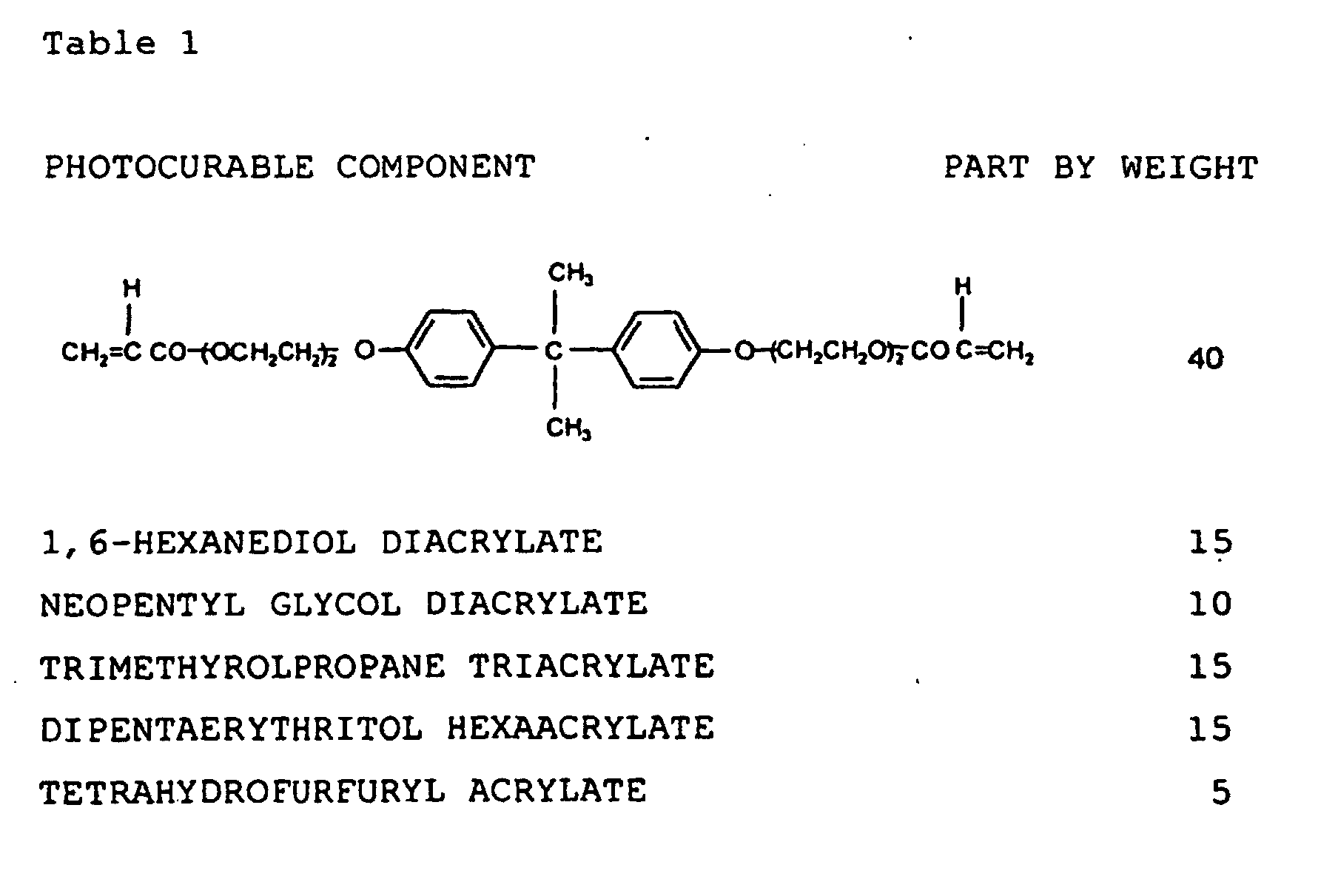
- A solution obtained by dissolving 2 parts by weight of epoxy-modified dimethylpolysiloxane (Trade name: Shin-Etsu silicone KF101, manufactured by Shin-Etsu Chemical) in 15 parts by weight of trichloroethylene was added to 100 parts by weight of hydrophilic fine silica particles (Trade name: Nipsil E200A, manufactured by Nippon Silica Industrial), which were stirred and mixed to adhere epoxy-modified dimethylpolysiloxane uniformly on the surfaces of the fine silica particles. After trichloroethylene had been evaporated, heat-treatment at 150°C for 2 hours afforded hydrophobic fine silica particles. The M value of the resulting hydrophobic fine silica particles was 55, and the mean particle size was 1.8µm.
- Then, 30 parts by weight of the above hydrophobic fine silica particles were uniformly dispersed in 250 parts by weight (in terms of solid content: 100 parts by weight) of a solution of the photocurable component which had been prepared as in Example 1, using an ultrasonic disperser. To this were added 5 parts by weight of benzyl dimethyl ketal as a photopolymerization initiator and 4 parts by weight of γ-acryloxypropyl trimethoxysilane (Trade name: KBM5103, manufactured by Shin-Etsu Chemical) as a coupling agent to give the frost-coating composition used in accordance with the first aspect of the present invention.
- A frosted glass container was obtained using the frost-coating composition as in Example 1, and the alkali resistance was evaluated. The results are shown in Table 2.
- A solution obtained by dissolving 2 parts by weight of hexyl trimethoxysilane (Trade name: TSL8241, manufactured by Toshiba Silicone) in 20 parts by weight of a mixed solution of ethanol/water was added to 100 parts by weight of hydrophilic fine silica particles (Trade name: Nipsil E200A, manufactured by Nippon Silica Industrial), which were stirred and mixed to adhere hexyl trimethoxysilane uniformly on the surfaces of the fine silica particles. After ethanol/water had been evaporated, heat-treatment at 130°C for 1 hour afforded hydrophobic fine silica particles. The M value of the resulting hydrophobic fine silica particles was 50, and the mean particle size was 2.5µm.
- Then, the frost-coating composition used in accordance with the first aspect of the present invention was obtained as in Example 1.
- A frosted glass container was obtained using the obtained frost-coating composition as in Example 1, and the alkali resistance was evaluated. The results are shown in Table 2.
- The same procedures as those in Example 3 were performed except that hexamethyl disilazan (Trade name: SZ-6079, manufactured by Toray Dow Corning) was used instead of the hexyl trimethoxysilane used in Example 3, to give hydrophobic fine silica particles having the M value of 45 and the mean particle size of 2.0µm.
- Then, 30 parts by weight of the above hydrophobic fine silica particles were uniformly dispersed in 250 parts by weight of a solution of the photocurable component which had been prepared as in Example 1 (containing 100 parts by weight of the photocurable component), using an ultrasonic disperser. To this were added 8 parts by weight of α-hydroxycyclohexyl phenyl ketone (Trade name: Irgacure 184, manufactured by CIBA-GEIGY (Japan)) as a photopolymerization initiator and 4 parts by weight of γ-methacryloxypropyl methyl dimethoxysilane (Trade name: KBM502, Shin-Etsu Chemical) as a coupling agent to give the frost-coating composition used in accordance with the first aspect of the present invention.
- A frosted glass container was obtained using the obtained frost-coating composition as in Example 1, and the alkali resistance was evaluated. The results are shown in Table 2.
- The same procedures as those in Example 1 were performed except for using hydrophobic fine silica particles, the surfaces of which had been hydrophobization-treated with methyl hydrogen polysiloxane, having an M value of 20 and a mean particle size of 2.5µm. The results are shown in Table 2.
- The same procedures as those in Example 1 were performed except for using hydrophobic fine silica particles, the surfaces of which had been hydrophobization-treated with methyl hydrogen polysiloxane, having an M value of 10 and a mean particle size of 2.5µm. The results are shown in Table 2.
- A frost-coating composition was obtained according to the same procedures as those in Example 1 except for using hydrophilic fine silica particles without hydrophobization-treatment, having a mean particle size of 2.5µm (M value is zero). A frosted glass container was obtained using the obtained frost-coating composition according to the same procedures as those in Example 1, and the alkali resistance was evaluated. The results are shown in Table 2. The obtained glass container showed gradual whitening of the coating immediately after the immersion and the coating was peeled from the glass container after 15 minutes.

- The photocurable component shown in Table 1 was dissolved in ethyl methyl ketone, and the proportion of the effective component (solid content) was adjusted to 40% by weight. Twenty parts by weight of the hydrophobic fine silica particles obtained in Example 1, and 7 parts by weight of fine cross-linked polymethyl methacrylate particles (Trade name: MR2G, manufactured by Soken Kagaku, Mean particle size 2µm) were uniformly dispersed in 250 parts by weight of the obtained solution of the photocurable component (containing 100 parts by weight of the photocurable compound) using an ultrasonic disperser. To this were added 8 parts by weight of α-hydroxycyclohexyl phenyl ketone (Trade name: Irgacure 184, manufactured by CIBA-GEIGY (Japan)) as a photopolymerization initiator and 4 parts by weight of γ-acryloxypropyl trimethoxysilane (Trade name: KBM5103, manufactured by Shin-Etsu Chemical) as a coupling agent to give a frost-coating composition used in accordance with the second aspect of the present invention.
- A glass container washed with an aqueous alkali solution was dipped into the above composition and then heated to dry at 80°C for 90 seconds. The thickness of the obtained coating was 25µm. Next, the coating was cured by irradiating it with UV light at an energy quantity of about 3,000mJ/cm2 to obtain a frosted glass container.
- Specular glossiness at 60° for the obtained glass container was measured according to JIS Z8741 Specular Glossiness Measuring Method to assess frostiness. In addition, the alkali resistance was evaluated based on the state of peeling of the coating and the assessment of the frostiness after the obtained glass container was immersed into a 4% aqueous NaOH solution at 80°C for 15 minutes, 30 minutes, or 60 minutes. Further, after immersing into a 4% aqueous NaOH solution at 80°C for 5 minutes, a 15-minute scratching test with a line simulator manufactured by ARG (LS scratching test) was performed to examine cracking and peeling of the coating, and thereby the impact resistance was evaluated. The results are shown in Table 3. The glass container coated with the frost-coating composition used in accordance with the second aspect of the present invention showed neither whitening of the coating nor peeling of the coating from the container even after one-hour immersion, and the coating retained its fine frostiness and was excellent in alkali resistance. Furthermore, neither cracking nor peeling of the coating occurred even after scratching for 15 minutes in the LS scratching test; thus, the impact resistance was also excellent.
- Twenty parts by weight of the hydrophobic fine silica particles obtained in Example 1 and 12 parts by weight of fine acrylic acid ester copolymer particles (Trade name: Staphyroid AC3355, manufactured by Takeda Chemical Industries, Mean particle size 0.5µm) were uniformly dispersed in 250 parts by weight of a solution of a photocurable component, which was prepared as in Example 7 (containing 100 parts by weight of the photocurable compound), using an ultrasonic disperser. To this were added 8 parts by weight of α-hydroxycyclohexyl phenyl ketone (Trade name: Irgacure 184, manufactured by CIBA-GEIGY (Japan)) as a photopolymerization initiator and 4 parts by weight of γ-acryloxypropyl trimethoxysilane (Trade name: KBM5103, manufactured by Shin-Etsu Chemical) as a coupling agent to give the frost-coating composition used in accordance with the second aspect of the present invention.
- A frosted glass container was obtained using the obtained frost-coating composition as in Example 7, and the alkali resistance and the impact resistance were evaluated. The results are shown in Table 3.
- Twenty parts by weight of the hydrophobic fine silica particles obtained in Example 1 and 12 parts by weight of fine silicone particles (Trade name: Tospearl 130, manufactured by Toshiba Silicone, Mean particle size 3µm) were uniformly dispersed in 250 parts by weight of the solution of the photocurable component, which was prepared as in Example 7 (containing 100 parts by weight of the photocurable compound), using an ultrasonic disperser. To this were added 8 parts by weight of α-hydroxycyclohexyl phenyl ketone (Trade name: Irgacure 184, manufactured by CIBA-GEIGY (Japan)) as a photopolymerization initiator and 4 parts by weight of γ-acryloxypropyl trimethoxysilane (Trade name: KBM5103, manufactured by Shin-Etsu Chemical) as a coupling agent to give the frost-coating composition used in accordance with the second aspect of the present invention.
- A frosted glass container was obtained using the obtained frost-coating composition as in Example 7, and the alkali resistance and the impact resistance were evaluated. The results are shown in Table 3.
- Twenty parts by weight of the hydrophobic fine silica particles obtained in Example 1 and 20 parts by weight of fine polyurethane particles (Trade name: Artpearl, manufactured by Negami Kogyo, Mean particle size 7µm) were uniformly dispersed in 250 parts by weight of the solution of the photocurable component, which was prepared according to the same manner as that in Example 7 (containing 100 parts by weight of the photocurable compound), using an ultrasonic disperser. To this were added 8 parts by weight of α-hydroxycyclohexyl phenyl ketone (Trade name: Irgacure 184, manufactured by CIBA-GEIGY (Japan)) as a photopolymerization initiator and 4 parts by weight of γ-acryloxypropyl trimethoxysilane (Trade name: KBM5103, manufactured by Shin-Etsu Chemical) as a coupling agent to give the frost-coating composition used in accordance with the second aspect of the present invention.
- A frosted glass container was obtained using the obtained frost-coating composition according to the same manner as that in Example 7, and the alkali resistance and the impact resistance were evaluated. The results are shown in Table 3.

- According to the present invention, a frosted coating having excellent alkali-washing resistance can be obtained by using, as a matting agent, hydrophobic fine silica particles whose surface is hydrophobization-treated. Additionally, according to the present invention, a frosted coating having excellent alkali-washing resistance and excellent impact resistance can be obtained by using, as a matting agent, hydrophobic fine silica particles whose surface is hydrophobization-treated and polymer particles. Since use in accordance with the present invention of the frost-coating composition as defined is safer and more economically excellent in comparison with the conventional methods, it can be extensively and practically utilized for glass containers for alcoholic liquors, beverages and other materials.
Claims (10)
- Use, in forming a frost coating on a glass container, of a composition comprising 5-50 parts by weight of hydrophobic fine silica particles based on 100 parts by weight of a component which is photocurable to provide the frost coating.
- Use, in forming a frost coating on a glass container, of a composition comprising 5-50 parts by weight of hydrophobic fine silica particles and 3-30 parts by weight of fine polymer particles based on 100 parts by weight of a component which is photocurable to provide the frost coating.
- Use according to claim 1 or 2, wherein the photocurable component comprises at least one reactive compound selected from polyhydric (meth)acrylate, polyester (meth)acrylate, epoxy-modified (meth)acrylate and polyurethane (meth)acrylate.
- Use according to any preceding claim, wherein the hydrophobic fine silica particles are hydrophilic fine silica particles treated with a hydrophobic compound to render the particles hydrophobic.
- Use according to claim 4, wherein the hydrophobic compound is a silicone compound or a silane compound.
- Use, according to any preceding claim, wherein the M value of the hydrophobic fine silica particle is 5 or more.
- Use according to any preceding claim, wherein the mean particle size of the hydrophobic fine silica particles is 0.1-25µm.
- Use according to claim 2, wherein the fine polymer particles are selected from at least one of fine acrylic particles, fine silicone particles and fine polyurethane particles.
- Use according to claim 2 or 8, wherein the mean particle size of the fine polymer particles is 0.1-25µm.
- A frosted glass container coated with a composition, for forming a frost-coating, as defined in any one of claims 1 to 9.
Applications Claiming Priority (5)
| Application Number | Priority Date | Filing Date | Title |
|---|---|---|---|
| JP23083297 | 1997-08-27 | ||
| JP23083297 | 1997-08-27 | ||
| JP01385298A JP4249815B2 (en) | 1997-08-27 | 1998-01-27 | Frost coating composition and frosted glass container |
| JP1385298 | 1998-01-27 | ||
| PCT/JP1998/003593 WO1999010437A1 (en) | 1997-08-27 | 1998-08-12 | Frosting composition and frosted glass container |
Publications (3)
| Publication Number | Publication Date |
|---|---|
| EP1024180A1 EP1024180A1 (en) | 2000-08-02 |
| EP1024180A4 EP1024180A4 (en) | 2001-08-22 |
| EP1024180B1 true EP1024180B1 (en) | 2004-04-21 |
Family
ID=26349700
Family Applications (1)
| Application Number | Title | Priority Date | Filing Date |
|---|---|---|---|
| EP98937794A Expired - Lifetime EP1024180B1 (en) | 1997-08-27 | 1998-08-12 | Frosting composition and frosted glass container |
Country Status (6)
| Country | Link |
|---|---|
| US (1) | US6476093B1 (en) |
| EP (1) | EP1024180B1 (en) |
| JP (1) | JP4249815B2 (en) |
| AU (1) | AU8647598A (en) |
| DE (1) | DE69823377T2 (en) |
| WO (1) | WO1999010437A1 (en) |
Families Citing this family (19)
| Publication number | Priority date | Publication date | Assignee | Title |
|---|---|---|---|---|
| AU4024101A (en) * | 1999-09-28 | 2001-04-30 | Cabot Corporation | Surface coating composition |
| EP1317517A1 (en) * | 2000-09-14 | 2003-06-11 | Dsm N.V. | Coating compositions for plastic substrates |
| US7276181B2 (en) * | 2000-12-27 | 2007-10-02 | Hiroshi Miwa | Method for preparing decorative glass using glass etching composition |
| KR20050091733A (en) * | 2002-12-18 | 2005-09-15 | 데구사 악티엔게젤샤프트 | Surface-modified, aerogel-type, structured silica |
| US6998425B2 (en) * | 2003-12-23 | 2006-02-14 | General Electric Company | UV curable coating compositions and uses thereof |
| US7183353B2 (en) * | 2004-04-29 | 2007-02-27 | Hewlett-Packard Development Company, L.P. | UV curable coating composition |
| JP4763980B2 (en) * | 2004-07-06 | 2011-08-31 | オリジン電気株式会社 | Designable paint composition and paint film that give ground glass appearance |
| US7244508B2 (en) * | 2005-05-25 | 2007-07-17 | Int'l Cellulose Corp. | Frosting coating materials, articles, and methods |
| US20080241567A1 (en) * | 2005-05-25 | 2008-10-02 | Sarfraz Ahmed Siddiqui | Frosting methods, frosted articles, & frosting liquids |
| DE102010029945A1 (en) * | 2010-06-10 | 2011-12-15 | Evonik Degussa Gmbh | Novel matting agents for UV overprint varnishes |
| JP4668352B1 (en) * | 2010-07-07 | 2011-04-13 | 昭和電工パッケージング株式会社 | Contents adhesion prevention lid material and manufacturing method thereof |
| JP5722639B2 (en) * | 2011-01-12 | 2015-05-27 | 昭和電工パッケージング株式会社 | Content adhesion prevention lid |
| PL2841510T3 (en) | 2012-04-24 | 2022-01-10 | At Promotions Ltd | Anti-microbial drinking or eating vessel |
| GB2525624A (en) * | 2014-04-29 | 2015-11-04 | At Promotions Ltd | Drinking or eating vessel |
| US10947011B2 (en) * | 2014-12-22 | 2021-03-16 | At Promotions Ltd | Drinking or eating vessel |
| GB201700408D0 (en) | 2017-01-10 | 2017-02-22 | A T Promotions Ltd | Vacuum decoration of a drinking or eating vessel |
| EP3673017B1 (en) * | 2017-07-04 | 2024-01-24 | Saint-Gobain Glass France | A frosted glass article |
| US20190241747A1 (en) * | 2018-02-08 | 2019-08-08 | Evonik Corporation | Uv-curable compositions and methods related thereto |
| CN109052980B (en) * | 2018-05-25 | 2025-06-06 | 秦皇岛开普玻璃制品有限公司 | A high-temperature frosting process for glass bottles |
Family Cites Families (10)
| Publication number | Priority date | Publication date | Assignee | Title |
|---|---|---|---|---|
| JPS59204669A (en) * | 1983-05-06 | 1984-11-20 | Asahi Glass Co Ltd | Composition for abrasion-resistant coating film |
| EP0213737B1 (en) * | 1985-08-07 | 1990-09-05 | Minnesota Mining And Manufacturing Company | Pressure-sensitive adhesive tape containing hydrophobic silica |
| CA1341126C (en) | 1988-06-28 | 2000-10-24 | Albert I. Everaerts | Pressure-sensitive adhesive |
| JPH03220268A (en) * | 1989-06-21 | 1991-09-27 | Nippon Oil & Fats Co Ltd | Matte coating composition |
| JPH0568418A (en) | 1991-09-17 | 1993-03-23 | Iseki & Co Ltd | Suspension device of front mower |
| JP3220268B2 (en) | 1993-01-27 | 2001-10-22 | 泉工医科工業株式会社 | Heart-lung machine |
| EP0736585B1 (en) * | 1995-04-03 | 1999-09-01 | Minnesota Mining And Manufacturing Company | Pressure sensitive adhesive |
| JPH09157545A (en) * | 1995-12-08 | 1997-06-17 | Nippon Paint Co Ltd | Matting agent for paint, matte coating composition and matte coating film |
| JPH09286929A (en) * | 1996-04-19 | 1997-11-04 | Koei Chem Co Ltd | Photocurable composition for matte coating and molded article of synthetic resin using the same |
| US7190424B2 (en) * | 2003-06-10 | 2007-03-13 | Samsung Electronics Co., Ltd. | Lamp wires of a liquid crystal display secured in trenches extending at an angle to a plate sidewall |
-
1998
- 1998-01-27 JP JP01385298A patent/JP4249815B2/en not_active Expired - Fee Related
- 1998-08-12 EP EP98937794A patent/EP1024180B1/en not_active Expired - Lifetime
- 1998-08-12 WO PCT/JP1998/003593 patent/WO1999010437A1/en not_active Ceased
- 1998-08-12 DE DE69823377T patent/DE69823377T2/en not_active Expired - Fee Related
- 1998-08-12 AU AU86475/98A patent/AU8647598A/en not_active Abandoned
- 1998-08-12 US US09/485,671 patent/US6476093B1/en not_active Expired - Fee Related
Also Published As
| Publication number | Publication date |
|---|---|
| EP1024180A4 (en) | 2001-08-22 |
| JP4249815B2 (en) | 2009-04-08 |
| WO1999010437A1 (en) | 1999-03-04 |
| AU8647598A (en) | 1999-03-16 |
| JPH11130469A (en) | 1999-05-18 |
| DE69823377D1 (en) | 2004-05-27 |
| US6476093B1 (en) | 2002-11-05 |
| DE69823377T2 (en) | 2004-09-02 |
| EP1024180A1 (en) | 2000-08-02 |
Similar Documents
| Publication | Publication Date | Title |
|---|---|---|
| US6476093B1 (en) | Frosting composition and frosted glass container | |
| EP2436736B1 (en) | Organosiloxane resin composition and laminate comprising same | |
| JP5525152B2 (en) | UV-curable coating composition, method for producing the same, and resin-coated article coated therewith | |
| KR101774067B1 (en) | Process for production of silica-alumina sol, silica-alumina sol, coating agent for formation of transparent coating film which comprises the sol, and substrate having transparent coating film attached thereto | |
| EP3378902B1 (en) | Anti-reflective film | |
| MX2008015077A (en) | Coated glass articles. | |
| EP0463747B1 (en) | Coated plastic molded articles and processes for their preparation | |
| JP5700903B2 (en) | Base material with hard coat film and coating liquid for forming hard coat film | |
| US9765224B2 (en) | Anti-fogging film-forming material, coating liquid for forming anti-fogging film, anti-fogging article, and methods for producing these | |
| WO2015152171A1 (en) | Coating liquid for forming transparent coating and method for producing said coating liquid, organic resin-dispersed sol, and substrate with transparent coating and method for producing said substrate | |
| KR101067534B1 (en) | Optical film | |
| JPH0546394B2 (en) | ||
| JP2009160755A (en) | Transparently coated base material | |
| JPH11287902A5 (en) | ||
| JP4480408B2 (en) | Coating composition for silver plating and method for producing the same | |
| JP2000290535A (en) | Active energy ray-curable coating composition | |
| JP5877708B2 (en) | Base material with hard coat film and coating liquid for forming hard coat film | |
| JP2002348534A (en) | Hard-coating composition and hard-coated product | |
| EP0604677B1 (en) | Method of making coated shaped articles | |
| JP5148846B2 (en) | Paint for forming transparent film and substrate with transparent film | |
| JP2009108123A (en) | Method of manufacturing surface-treated metal oxide particles, coating liquid for forming transparent film including the same, and substrate with transparent coating film | |
| JP2009119780A (en) | Substrate with transparent film and coating liquid for forming transparent film | |
| KR100409160B1 (en) | Non-metallic surface coating agent composition | |
| JP2004212791A (en) | Optical member and method of manufacturing the same | |
| JP2002107503A (en) | Hard coat film and hard coat film with functional film |
Legal Events
| Date | Code | Title | Description |
|---|---|---|---|
| PUAI | Public reference made under article 153(3) epc to a published international application that has entered the european phase |
Free format text: ORIGINAL CODE: 0009012 |
|
| 17P | Request for examination filed |
Effective date: 20000320 |
|
| AK | Designated contracting states |
Kind code of ref document: A1 Designated state(s): DE FR GB IT |
|
| A4 | Supplementary search report drawn up and despatched |
Effective date: 20010705 |
|
| AK | Designated contracting states |
Kind code of ref document: A4 Designated state(s): DE FR GB IT |
|
| 17Q | First examination report despatched |
Effective date: 20020726 |
|
| GRAP | Despatch of communication of intention to grant a patent |
Free format text: ORIGINAL CODE: EPIDOSNIGR1 |
|
| GRAS | Grant fee paid |
Free format text: ORIGINAL CODE: EPIDOSNIGR3 |
|
| GRAA | (expected) grant |
Free format text: ORIGINAL CODE: 0009210 |
|
| RAP1 | Party data changed (applicant data changed or rights of an application transferred) |
Owner name: NIHON YAMAMURA GLASS CO. LTD. Owner name: SUMITOMO SEIKA CHEMICALS CO., LTD. |
|
| AK | Designated contracting states |
Kind code of ref document: B1 Designated state(s): DE FR GB IT |
|
| REG | Reference to a national code |
Ref country code: GB Ref legal event code: FG4D |
|
| RIN1 | Information on inventor provided before grant (corrected) |
Inventor name: FUKUNAMI, MOTOFUMI, NIHON YAMAMURA GLASS CO., LTD. Inventor name: KURODA, YOSHIKAZU, NIHON YAMAMURA GLASS CO., LTD. Inventor name: MANABE, HIROSHI,SUMITOMO SEIKA CHEM. CO., LTD. Inventor name: SUGIHARA, NORIHIRO,SUMITOMO SEIKA CHEM. CO., LTD. Inventor name: ARAKI, EIICHI,SUMITOMO SEIKA CHEMICALS CO., LTD. |
|
| REF | Corresponds to: |
Ref document number: 69823377 Country of ref document: DE Date of ref document: 20040527 Kind code of ref document: P |
|
| ET | Fr: translation filed | ||
| PLBE | No opposition filed within time limit |
Free format text: ORIGINAL CODE: 0009261 |
|
| STAA | Information on the status of an ep patent application or granted ep patent |
Free format text: STATUS: NO OPPOSITION FILED WITHIN TIME LIMIT |
|
| 26N | No opposition filed |
Effective date: 20050124 |
|
| PGFP | Annual fee paid to national office [announced via postgrant information from national office to epo] |
Ref country code: DE Payment date: 20070828 Year of fee payment: 10 |
|
| PGFP | Annual fee paid to national office [announced via postgrant information from national office to epo] |
Ref country code: GB Payment date: 20070820 Year of fee payment: 10 |
|
| PGFP | Annual fee paid to national office [announced via postgrant information from national office to epo] |
Ref country code: IT Payment date: 20070828 Year of fee payment: 10 |
|
| PGFP | Annual fee paid to national office [announced via postgrant information from national office to epo] |
Ref country code: FR Payment date: 20070712 Year of fee payment: 10 |
|
| GBPC | Gb: european patent ceased through non-payment of renewal fee |
Effective date: 20080812 |
|
| REG | Reference to a national code |
Ref country code: FR Ref legal event code: ST Effective date: 20090430 |
|
| PG25 | Lapsed in a contracting state [announced via postgrant information from national office to epo] |
Ref country code: IT Free format text: LAPSE BECAUSE OF NON-PAYMENT OF DUE FEES Effective date: 20080812 Ref country code: FR Free format text: LAPSE BECAUSE OF NON-PAYMENT OF DUE FEES Effective date: 20080901 Ref country code: DE Free format text: LAPSE BECAUSE OF NON-PAYMENT OF DUE FEES Effective date: 20090303 |
|
| PG25 | Lapsed in a contracting state [announced via postgrant information from national office to epo] |
Ref country code: GB Free format text: LAPSE BECAUSE OF NON-PAYMENT OF DUE FEES Effective date: 20080812 |