EP1023918A2 - Herzschrittmachersystem mit durch das tägliche Muster gesteuerter Schnellgang zur Vorbeugung einer Tachykardie - Google Patents
Herzschrittmachersystem mit durch das tägliche Muster gesteuerter Schnellgang zur Vorbeugung einer Tachykardie Download PDFInfo
- Publication number
- EP1023918A2 EP1023918A2 EP00101601A EP00101601A EP1023918A2 EP 1023918 A2 EP1023918 A2 EP 1023918A2 EP 00101601 A EP00101601 A EP 00101601A EP 00101601 A EP00101601 A EP 00101601A EP 1023918 A2 EP1023918 A2 EP 1023918A2
- Authority
- EP
- European Patent Office
- Prior art keywords
- patient
- awakening
- rate
- dispersion
- ventricular
- Prior art date
- Legal status (The legal status is an assumption and is not a legal conclusion. Google has not performed a legal analysis and makes no representation as to the accuracy of the status listed.)
- Granted
Links
Images





Classifications
-
- A—HUMAN NECESSITIES
- A61—MEDICAL OR VETERINARY SCIENCE; HYGIENE
- A61N—ELECTROTHERAPY; MAGNETOTHERAPY; RADIATION THERAPY; ULTRASOUND THERAPY
- A61N1/00—Electrotherapy; Circuits therefor
- A61N1/18—Applying electric currents by contact electrodes
- A61N1/32—Applying electric currents by contact electrodes alternating or intermittent currents
- A61N1/36—Applying electric currents by contact electrodes alternating or intermittent currents for stimulation
- A61N1/362—Heart stimulators
- A61N1/3621—Heart stimulators for treating or preventing abnormally high heart rate
- A61N1/3622—Heart stimulators for treating or preventing abnormally high heart rate comprising two or more electrodes co-operating with different heart regions
Definitions
- This invention relates to cardiac pacemaker systems and, more particularly, cardiac pacemaker systems with techniques for anticipating tachycardia and the capacity to automatically switch to a pacing modality designed to prevent Ventricular Tachycardia.
- VT Ventricular tachycardia
- VF ventricular fibrillation
- QT interval and in particular abnormalities of the QT interval, are associated with ventricular arrhythmias, e.g., in long QT syndromes and after myocardia infarction. See “Diurnal Variation of the QT Interval - Influence of the Autonomic Nervous System,” Bexton et al., British Heart J., 1986; 55:253-8.
- the QT interval of the surface EKG is accepted as an indirect measure of patient myocardial depolarization and repolarization. It is known that QT is longer during sleep, and in fact QT corrected for rate (QTc) is also longer during sleep.
- QTc interval and QTc variability reach peak shortly after awakening hours, which may reflect increased automatic instability during early waking hours; and further that the time of the peak value corresponds to the period of reported increased vulnerability to ventricular tachycardia and sudden cardiac death.
- Molnar et al. J. Am. Coll. Cardiology, 1996 Jan., 27:1, 76-83.
- PACE Vol. 19, September 1996, 1296-1393, stating that QTc exhibits significant diurnal variability.
- the literature suggests that there are significant changes in the autonomic system during sleep, with either an increase in para-sympathetic tone, or an increase in sympathetic activity, or both.
- QTd QT dispersion
- This invention is responsive to the need to address the increased vulnerability to attacks of VT during or just after the waking period, and utilize the fact that the awakening period is characterized by observable variabilities of the depolarization and repolarization waves and the QT duration.
- the invention meets the need for a pacemaker which incorporates the capacity to monitor the diurnal heart pattern, particularly changes of the QRS-T waveform during the awakening period, so as to provide an indication of a risk of VT.
- a pacemaker in accordance with this invention also automatically provides for a controlled pacing response designed to prevent the onset of VT during the vulnerable awakening period.
- a cardiac pacemaker system for pacing a patient, having ventricular pacing (VP) means for generating and delivering ventricular pacing pulses to a patient's ventricle, ventricular sensing (VS) means for sensing ventricular QRS and T waves, rate means for determining the patient's spontaneous heart rate, and control means for controlling when said VP means generates and delivers ventricular pacing pulses and the pacing rate of such pulses, wherein said control means further comprises VT prevention means for controlling said VP means to deliver pacing pulses at a rate overriding the patient's spontaneous rate when a threshold of refractory dispersion is detected during patient awakening, said VT prevention means comprising:
- cardiac pacemaker system for pacing a patient, having VP means for generating and delivering ventricular pacing pulses to a patient's ventricle, VS means for sensing ventricular QRS and T waves, rate means for determining the patient's spontaneous heart rate, and control means for controlling when said VP means generates and delivers ventricular pacing pulses and the pacing rate of such pulses, wherein said control means further comprises VT prevention means for controlling said VP means to deliver pacing pulses at a rate overriding the patient's spontaneous rate when a threshold of refractory dispersion is detected during patient awakening, said VT prevention means comprising:
- a pacemaker system for pacing a patient's heart having VP means for generating and delivering pacing pulses to a patient's ventricle, rate control means for controlling the rate of said pacing pulses, and said rate control means having VT prevention means for controlling said rate to an intervention rate when said patient has a detected measure of refractory dispersion during awakening, said VT prevention means comprising:
- FIG. 1 is a block diagram illustrating the primary functional components of a pacemaker system in accordance with this invention.
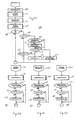
- Figure 2A is a simplified main flow diagram showing the steps pertinent to this invention which are taken each pacemaker cycle, and the relation of the VT prevention feature to the main operation routine;
- Figure 2B is a timing diagram illustrating determination of night, end of night, and the awakening period by a circadian pattern routine.
- FIG. 3 is an overview flow diagram illustrating the cyclical operations of the VT Prevention routine in accordance with this invention.
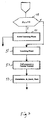
- Figure 4 is a simplified flow diagram illustrating the primary steps taken in carrying out the Learning Phase portion of the VT Prevention routine.
- Figure 5 is a simplified flow diagram illustrating the primary steps taken in carrying out the Ventricular Extra Systole analysis portion of the VT Prevention Routine.
- Figure 6 is a simplified flow diagram illustrating the primary steps taken in carrying out the Determine Intervention portion of the VT Prevention routine.
- a VP generator 15 provides pacing pulses, generated under control of block 20, for delivery through lead 16 to one or more ventricular electrodes 16E located in the patient's right ventricle.
- AP generator 18 provides atrial pacing pulses, also generated under control of block 20, for delivery through lead 19 to one or more atrial electrodes 19E located in the patient's right atrium. While not shown, it is understood that the invention is equally applicable to single chamber and to other multi-chamber configurations.
- Signals sensed by electrodes 16E are connected to QRS Sense circuit 24 which amplifies, the signals and provides V-Sense, or VS signals to signal processing block 27.
- Signals from ventricular electrodes 16E are also passed to T-Wave sense circuit 26, which provides T-Sense signals to block 27.
- Signals from atrial electrodes 19E are connected to P-Wave sense circuit 25, which outputs A-Sense, or AS signals to block 27.
- Block 27 suitably contains dedicated signal processing hardware; and includes an A-D converter for converting the signals into digital form.
- the QRS and T-wave template generation and comparison steps, referred to below, are performed wholly or in part in this circuitry.
- the digital signals from block 27 are transferred to block 20 for further processing and/or storage.
- Block 20 controls the pacemaker functions, e.g., the cyclical functions of setting and timing out escape intervals; receiving sensed signals from the patient's heart and resetting escape intervals based on those signals; and carrying out special functions such as the VT Prevention function of this invention.
- Block 20 preferably comprises a microprocessor and associated memory, shown at 21, for storing the required software routines.
- the memory 21 suitably includes dedicated RAM and ROM. Control parameters and values can be programmed from an external programmer through program receiver 29, in a known manner.
- the pacemaker can be programmed to operate in different modes.
- Sensor 28 may be used to provide a rate responsive parameter, e.g. activity, to be used alone or in combination with another parameter such as QT, in a manner known in the art.
- FIG. 2A there is provided a block diagram showing the place of the VT Prevention routine 34 within the overall main flow which is carried out cyclically.
- the main flow is entered cyclically at 30, where the pacemaker performs various bookkeeping and other steps.
- the spontaneous rate is determined; for a dual chamber system, decision rates are updated, in a manner as disclosed in U.S. Patent No. 5,247,930, assigned to the assignee of this invention.
- the pacemaker carries out a routine for determining the patient's circadian pattern, in order to determine "daytime” and "nighttime” for the patient, and to determine the patient's awakening period.
- the VT Prevention routine of this invention is performed, as discussed in detail below.
- the intervention rate controls the setting of the ventricular escape interval.
- These atrial and ventricular escape intervals are set at 35, and at 36 the pacemaker carries out the rest of the main flow, including ventricular event handling. QRS and T-wave sensing is also done at block 36.
- FIG. 2B there is shown a timing diagram for determining the patient's circadian pattern, and in particular for determining the awakening period.
- the referenced disclosure sets forth several embodiments of pacemaker routines for determining when the patient enters nighttime and when the patient enters daytime, by monitoring and evaluating changes in QT interval. Transition from nighttime to daytime is shown as representing the start of the awakening period.
- the awakening period may suitably be determined in several ways. For example, the awakening period may be determined as extending from the nighttime/daytime transition for a period of, e.g., one hour.
- the end of nighttime is suitably determined as the time when the QT interval drops below the variable QT_sleep, as shown in Figure 2B.
- nighttime may be of a fixed duration, with the start of night being determined when the QT interval stays above the QT_sleep variable for a night_criterion duration.
- the awakening period may be set so as to straddle the nighttime/daytime transition, e.g., from half an hour before to half an hour after. It is noted that other embodiments may be used for determining the end of night, e.g., by determining when the activity rate rises above a nighttime level.
- FIG. 3 there is shown a flow diagram of the specific steps taken in accordance with the VT prevention feature of this invention.
- the routine is run for determining the awakening period.
- the pacemaker determines whether the patient is in fact in the awakening period. If no, at 44 the intervention state is deactivated, and at 45 the pacemaker goes into the learning phase, the details of which are set forth in connection with Figure 4.
- the pacemaker goes on to process current information concerning the depolarization (QRS) and repolarization (T wave) waveforms.
- the pacemaker obtains the depolarization template for the current cycle, and compares it to the depolarization template which was generated during the learning phase. The difference is computed and stored as ⁇ 1.
- the pacemaker gets the current repolarization template and compares it with the stored repolarization template from the learning phase, and generates a ⁇ 2, which is representative of the difference.
- the pacemaker goes through a VES analysis, to obtain a measure ( ⁇ 3) of whether there has been a ventricular extra systole, and how close the coupling interval was to the patient's mean QT interval.
- the VES analysis is set forth in particular detail in Figure 5.
- the pacemaker goes to block 50, and determines whether intervention is indicated, based upon data gathered and generated at blocks 47, 48, and 49 above.
- the Determine Intervention routine is set forth in detail at Figure 6.
- the pacemaker determines whether intervention has been activated. If no, the routine exits, and the pacemaker continues to set the pacing escape intervals in a normal way. However, if yes, the routine branches to block 55, and determines whether the variable D is equal to or greater than a predetermined threshold.
- D is calculated in the Determine Intervention routine 50, and represents a summation of the respective ⁇ values calculated at blocks 47, 48, which are representative of refractorines dispersion; and also the ⁇ value calculated at 49, which represents the presence of a dangerous VES. The calculation of D is discussed in more detail in connection with Figure 6. If D is equal to or greater than threshold, at 57 the pacemaker determines whether the intervention rate remains less than the maximum intervention rate.
- intervention rate is incremented at 58; if no, intervention rate is at its maximum allowable value and the routine exits. If, at 55, D is not up to threshold, then at 60 it is determined whether the intervention rate is higher than the minimum intervention rate. If yes, at 61 intervention rate is decremented by subtracting a programmable drift value; if no, the intervention rate is as low as is allowed, and the routine exits.
- FIG. 4 there is shown a flow diagram of the learning phase routine 45, in accordance with this invention.
- this phase is entered when the patient is not in the awakening period.
- the pacemaker calculates a variable ⁇ 1 which constitutes the depolarization template then stored in memory, minus the current depolarization template for the just detected R wave.
- the wave signal data is placed into digital form by an A-D converter, which is part of the function provided by signal processor block 27.
- Obtaining waveform templates is well known in the art, and any suitable hardware or software arrangement can be used in this invention.
- digital samples are obtained representing the waveform amplitude along successive time increments, from the beginning of the wave to the end, and are stored.
- the respective waveform amplitude values are subtracted, and the difference is integrated over the time domain.
- the template generation and template difference calculations are performed by dedicated hardware, as shown at 27. However, any combination of hardware and software can be utilized.
- the depolarization template is adapted so as to be changed toward the most recently detected depolarization template.
- the functions are suitably carried out by the microprocessor of block 20.
- blocks 71, 72 and 74-76 represent corresponding steps for the repolarization template, which reflects the sensed T wave.
- the deviation ⁇ 2 is determined, by subtracting the just obtained repolarization wave from the stored repolarization template.
- the repolarization template is then adapted and stored at 76.
- FIG. 5 there is shown a flow diagram of the routine 49 for carrying out VES analysis. This is done, as discussed above, because VT is often initiated or preceded by one or more ventricular extra-systoles if the patient heart rate is low enough and the coupling interval is critical, i.e., VES occurs near or in the vulnerable phase. In this situation likewise, intervention may be indicated, so the pacemaker of this invention collects VES data which is included in the Determine Intervention routine.
- the routine branches to block 83, and sets ⁇ 3 (the deviation value corresponding to VES analysis) to zero. However, if there has been a VES, then it has to be determined how critical the VES is deemed, i.e., the deviation needs to be weighted.
- the pacemaker compares the coupling interval (the interval from the prior R wave to the VES) to the mean QT interval as stored. If the coupling interval minus the mean QT interval is less than or equal to a stored critical phase value, then the VES is deemed very critical, and at 90 ⁇ 3 is given a weighted VERY_CRITICAL value.
- the routine goes to 86 and determines whether there have been a predetermined number n VES occurrences in the last m intervals, where n and m are programmable numbers. If yes, the VES occurrences is deemed critical, and at block 87 ⁇ 3 is given a weighted CRITICAL value which is somewhat less than the VERY_CRITICAL value. If the answer at 86 is no, at 88 ⁇ 3 is given a LOW_CRITICAL weighting.
- the values assigned to ⁇ 3 include the weighting factor, such that the stored deviation is assumed to be accompanied by a weighting factor of 1 for the calculation which is carried out at block 77.
- intervention is activated at step 80, suitably by setting a flag to store the fact that intervention has been activated.
- intervention is activated at step 80, suitably by setting a flag to store the fact that intervention has been activated.
- the Intervention rate is decremented toward a lower limit.
- each cycle a direct measure of QTc or QT c can be obtained and a value of QT dispersion calculated and weighted; this weighted QT dispersion value is then added to the calculation made for determining intervention.
- each weighting factor can be programmed to vary within predetermined limits, so that weighting can be adapted in terms of known patient history.
Landscapes
- Health & Medical Sciences (AREA)
- Cardiology (AREA)
- Radiology & Medical Imaging (AREA)
- Engineering & Computer Science (AREA)
- Biomedical Technology (AREA)
- Nuclear Medicine, Radiotherapy & Molecular Imaging (AREA)
- Heart & Thoracic Surgery (AREA)
- Life Sciences & Earth Sciences (AREA)
- Animal Behavior & Ethology (AREA)
- General Health & Medical Sciences (AREA)
- Public Health (AREA)
- Veterinary Medicine (AREA)
- Electrotherapy Devices (AREA)
- Measurement And Recording Of Electrical Phenomena And Electrical Characteristics Of The Living Body (AREA)
- Mobile Radio Communication Systems (AREA)
Applications Claiming Priority (2)
| Application Number | Priority Date | Filing Date | Title |
|---|---|---|---|
| US09/237,815 US6370431B1 (en) | 1998-10-26 | 1999-01-27 | Pacemaker system for preventing ventricular tachycardia |
| US237815 | 1999-01-27 |
Publications (3)
| Publication Number | Publication Date |
|---|---|
| EP1023918A2 true EP1023918A2 (de) | 2000-08-02 |
| EP1023918A3 EP1023918A3 (de) | 2001-09-12 |
| EP1023918B1 EP1023918B1 (de) | 2006-11-22 |
Family
ID=22895315
Family Applications (1)
| Application Number | Title | Priority Date | Filing Date |
|---|---|---|---|
| EP00101601A Expired - Lifetime EP1023918B1 (de) | 1999-01-27 | 2000-01-27 | Herzschrittmachersystem mit durch das tägliche Muster gesteuerter Schnellgang zur Vorbeugung einer Tachykardie |
Country Status (4)
| Country | Link |
|---|---|
| US (1) | US6370431B1 (de) |
| EP (1) | EP1023918B1 (de) |
| AT (1) | ATE345836T1 (de) |
| DE (1) | DE60031900T2 (de) |
Cited By (1)
| Publication number | Priority date | Publication date | Assignee | Title |
|---|---|---|---|---|
| WO2005056107A1 (en) * | 2003-12-03 | 2005-06-23 | Medtronic, Inc. | Method and apparatus for predicting arrhythmias using diurnal heart rate |
Families Citing this family (31)
| Publication number | Priority date | Publication date | Assignee | Title |
|---|---|---|---|---|
| US6223078B1 (en) | 1999-03-12 | 2001-04-24 | Cardiac Pacemakers, Inc. | Discrimination of supraventricular tachycardia and ventricular tachycardia events |
| US6312388B1 (en) | 1999-03-12 | 2001-11-06 | Cardiac Pacemakers, Inc. | Method and system for verifying the integrity of normal sinus rhythm templates |
| US6449503B1 (en) * | 1999-07-14 | 2002-09-10 | Cardiac Pacemakers, Inc. | Classification of supraventricular and ventricular cardiac rhythms using cross channel timing algorithm |
| US7349734B2 (en) * | 2000-05-15 | 2008-03-25 | Cardiac Pacemakers, Inc. | Method and apparatus for delivering defibrillation shock therapy while reducing electrical dispersion due to ventricular conduction disorder |
| US7076299B2 (en) * | 2002-03-28 | 2006-07-11 | Tran Thong | Method and apparatus for preventing heart tachyarrhythmia |
| US7047067B2 (en) * | 2002-05-31 | 2006-05-16 | Uab Research Foundation | Apparatus, methods, and computer program products for evaluating a risk of cardiac arrhythmias from restitution properties |
| US7130686B1 (en) * | 2002-07-01 | 2006-10-31 | Pacesetter, Inc. | Selection of preventative arrhythmia therapy based on patient specific histogram data |
| US6970743B2 (en) * | 2002-08-30 | 2005-11-29 | Pacesetter, Inc. | System and method for treating abnormal ventricular activation-recovery time |
| US7031764B2 (en) * | 2002-11-08 | 2006-04-18 | Cardiac Pacemakers, Inc. | Cardiac rhythm management systems and methods using multiple morphology templates for discriminating between rhythms |
| EP1581102A4 (de) * | 2002-12-11 | 2006-12-20 | Proteus Biomedical Inc | Verfahren und system zur überwachung und behandlung von hämodynamischen parametern |
| JP4528766B2 (ja) * | 2003-01-24 | 2010-08-18 | プロテウス バイオメディカル インコーポレイテッド | 遠隔血行力学的モニタリングのためのシステム |
| US7200439B2 (en) * | 2003-01-24 | 2007-04-03 | Proteus Biomedical, Inc. | Method and apparatus for enhancing cardiac pacing |
| US7204798B2 (en) * | 2003-01-24 | 2007-04-17 | Proteus Biomedical, Inc. | Methods and systems for measuring cardiac parameters |
| US7328066B1 (en) * | 2003-03-28 | 2008-02-05 | Pacesetter, Inc. | Implantable cardiac stimulation device, system and method that identifies and prevents impending arrhythmias of the atria |
| US6993388B2 (en) * | 2003-07-03 | 2006-01-31 | New York University | System and method for assessment of cardiac electrophysiologic stability and modulation of cardiac oscillations |
| US8027722B1 (en) * | 2003-10-17 | 2011-09-27 | Pacesetter, Inc. | Multifocal PVC detection for prevention of arrhythmias |
| US7214189B2 (en) * | 2004-09-02 | 2007-05-08 | Proteus Biomedical, Inc. | Methods and apparatus for tissue activation and monitoring |
| WO2006105474A2 (en) * | 2005-03-31 | 2006-10-05 | Proteus Biomedical, Inc. | Automated optimization of multi-electrode pacing for cardiac resynchronization |
| US7881786B2 (en) * | 2005-04-29 | 2011-02-01 | Medtronic, Inc. | Suppression of high rate pacing for reducing myocardial ischemic irritability |
| WO2007005641A2 (en) * | 2005-07-01 | 2007-01-11 | Proteus Biomedical, Inc. | Deployable epicardial electrode and sensor array |
| WO2007021804A2 (en) * | 2005-08-12 | 2007-02-22 | Proteus Biomedical, Inc. | Evaluation of depolarization wave conduction velocity |
| WO2007075974A2 (en) * | 2005-12-22 | 2007-07-05 | Proteus Biomedical, Inc. | Implantable integrated circuit |
| US7765002B2 (en) * | 2006-12-08 | 2010-07-27 | Cardiac Pacemakers, Inc. | Rate aberrant beat selection and template formation |
| WO2009131749A2 (en) * | 2008-02-28 | 2009-10-29 | Proteus Biomedical, Inc. | Integrated circuit implementation and fault control system, device, and method |
| US20110022113A1 (en) * | 2008-12-02 | 2011-01-27 | Mark Zdeblick | Analyzer Compatible Communication Protocol |
| JP2012522605A (ja) * | 2009-04-02 | 2012-09-27 | プロテウス バイオメディカル インコーポレイテッド | 埋め込み型リード線のための方法及び装置 |
| JP2012525206A (ja) | 2009-04-29 | 2012-10-22 | プロテウス バイオメディカル インコーポレイテッド | 移植可能なデバイスのためのリード線のための方法および装置 |
| JP5730872B2 (ja) | 2009-07-23 | 2015-06-10 | プロテウス デジタル ヘルス, インコーポレイテッド | 固体薄膜コンデンサ |
| US8718770B2 (en) | 2010-10-21 | 2014-05-06 | Medtronic, Inc. | Capture threshold measurement for selection of pacing vector |
| US8355784B2 (en) | 2011-05-13 | 2013-01-15 | Medtronic, Inc. | Dynamic representation of multipolar leads in a programmer interface |
| US9597525B2 (en) * | 2015-05-06 | 2017-03-21 | Medtronic, Inc. | T-wave oversensing rejection |
Citations (2)
| Publication number | Priority date | Publication date | Assignee | Title |
|---|---|---|---|---|
| US5247930A (en) | 1992-02-04 | 1993-09-28 | Vitatron Medical, B.V. | Dual chamber pacing system with dynamic physiological tracking and method of timing delivered stimulus for optimized synchronous pacing |
| US5861011A (en) | 1997-02-14 | 1999-01-19 | Vitatron Medical, B.V. | Pacemaker with automatic lower rate limit drop |
Family Cites Families (10)
| Publication number | Priority date | Publication date | Assignee | Title |
|---|---|---|---|---|
| US5042497A (en) * | 1990-01-30 | 1991-08-27 | Cardiac Pacemakers, Inc. | Arrhythmia prediction and prevention for implanted devices |
| FR2669523B1 (fr) * | 1990-11-23 | 1997-06-06 | Fred Zacouto | Dispositif de prevention des defaillances cardiaques |
| US5271393A (en) | 1991-05-06 | 1993-12-21 | Telectronics Pacing Systems, Inc. | Pacemaker employing antitachyarrhythmia prevention based on ventricular gradient |
| US5560368A (en) * | 1994-11-15 | 1996-10-01 | Berger; Ronald D. | Methodology for automated QT variability measurement |
| US6058328A (en) * | 1996-08-06 | 2000-05-02 | Pacesetter, Inc. | Implantable stimulation device having means for operating in a preemptive pacing mode to prevent tachyarrhythmias and method thereof |
| US5782887A (en) * | 1997-03-26 | 1998-07-21 | Vitatron Medical, B.V. | Pacemaker system with PAC tracking based on QT data |
| US5978711A (en) * | 1998-02-23 | 1999-11-02 | Vivatron Medical, B.V. | Pacemaker system with improved learning capability for adapting rate response function |
| US5967995A (en) * | 1998-04-28 | 1999-10-19 | University Of Pittsburgh Of The Commonwealth System Of Higher Education | System for prediction of life-threatening cardiac arrhythmias |
| US5991659A (en) * | 1998-09-30 | 1999-11-23 | Vitatron Medical, B.V. | Pacing system with full range sudden rate drop detection and responsive pacing intervention |
| US6161041A (en) * | 1998-10-26 | 2000-12-12 | Vitatron Medical B. V. | Pacemaker system with diurnal pattern controlled overdrive for prevention of tachycardia |
-
1999
- 1999-01-27 US US09/237,815 patent/US6370431B1/en not_active Expired - Fee Related
-
2000
- 2000-01-27 AT AT00101601T patent/ATE345836T1/de not_active IP Right Cessation
- 2000-01-27 DE DE60031900T patent/DE60031900T2/de not_active Expired - Lifetime
- 2000-01-27 EP EP00101601A patent/EP1023918B1/de not_active Expired - Lifetime
Patent Citations (2)
| Publication number | Priority date | Publication date | Assignee | Title |
|---|---|---|---|---|
| US5247930A (en) | 1992-02-04 | 1993-09-28 | Vitatron Medical, B.V. | Dual chamber pacing system with dynamic physiological tracking and method of timing delivered stimulus for optimized synchronous pacing |
| US5861011A (en) | 1997-02-14 | 1999-01-19 | Vitatron Medical, B.V. | Pacemaker with automatic lower rate limit drop |
Cited By (2)
| Publication number | Priority date | Publication date | Assignee | Title |
|---|---|---|---|---|
| WO2005056107A1 (en) * | 2003-12-03 | 2005-06-23 | Medtronic, Inc. | Method and apparatus for predicting arrhythmias using diurnal heart rate |
| US7313439B2 (en) | 2003-12-03 | 2007-12-25 | Medtronic, Inc. | Method and apparatus for predicting arrhythmias using diurnal heart rate |
Also Published As
| Publication number | Publication date |
|---|---|
| EP1023918B1 (de) | 2006-11-22 |
| US6370431B1 (en) | 2002-04-09 |
| EP1023918A3 (de) | 2001-09-12 |
| DE60031900D1 (de) | 2007-01-04 |
| DE60031900T2 (de) | 2007-09-20 |
| ATE345836T1 (de) | 2006-12-15 |
Similar Documents
| Publication | Publication Date | Title |
|---|---|---|
| EP1023918B1 (de) | Herzschrittmachersystem mit durch das tägliche Muster gesteuerter Schnellgang zur Vorbeugung einer Tachykardie | |
| US6161041A (en) | Pacemaker system with diurnal pattern controlled overdrive for prevention of tachycardia | |
| EP1494582B1 (de) | Verfahren zur vorhersage von wiederkehrenden ventrikulären arrhythmien | |
| US8437842B2 (en) | Method and apparatus for detecting and discriminating tachycardia | |
| US8271073B2 (en) | Method and apparatus for detecting and discriminating tachycardia | |
| EP2563468B1 (de) | Vorrichtung für nachweis und unterscheidung von tachykardie | |
| EP2563467B1 (de) | Vorrichtung für duale egm-messung und herzfrequenzberechnung bei implantierten kardialen vorrichtungen | |
| US8406872B2 (en) | Method and apparatus for detecting and discriminating tachycardia | |
| US20040064062A1 (en) | Method for determining a metric of non-sustained arrhythmia occurrence for use in arrhythmia prediction and automatic adjustment of arrhythmia detection parameters | |
| US6238422B1 (en) | Pacemaker system with therapy for minimizing risk of morning myocardial infarctions or arrhythmias | |
| US8543198B2 (en) | Method and apparatus for detecting and discriminating tachycardia | |
| EP2563472A1 (de) | Verfahren und vorrichtung für nachweis und unterscheidung von tachykardie | |
| WO2011136951A1 (en) | Method and apparatus for detecting and discriminating tachycardia | |
| US7313439B2 (en) | Method and apparatus for predicting arrhythmias using diurnal heart rate | |
| US20010007948A1 (en) | Placemaker system for preventing ventricular tachycardia | |
| EP2563473B1 (de) | Vorrichtung für erkennung und unterscheidung von tachykardie | |
| US8301235B2 (en) | Method and apparatus for detecting and discriminating tachycardia | |
| WO2011136950A1 (en) | Apparatus for detecting and discriminating tachycardia | |
| WO2011136926A1 (en) | Method and apparatus for detecting and discriminating tachycardia | |
| WO2011136920A1 (en) | Method and apparatus for detecting and discriminating tachycardia |
Legal Events
| Date | Code | Title | Description |
|---|---|---|---|
| PUAI | Public reference made under article 153(3) epc to a published international application that has entered the european phase |
Free format text: ORIGINAL CODE: 0009012 |
|
| AK | Designated contracting states |
Kind code of ref document: A2 Designated state(s): AT BE CH CY DE DK ES FI FR GB GR IE IT LI LU MC NL PT SE |
|
| AX | Request for extension of the european patent |
Free format text: AL;LT;LV;MK;RO;SI |
|
| PUAL | Search report despatched |
Free format text: ORIGINAL CODE: 0009013 |
|
| AK | Designated contracting states |
Kind code of ref document: A3 Designated state(s): AT BE CH CY DE DK ES FI FR GB GR IE IT LI LU MC NL PT SE |
|
| AX | Request for extension of the european patent |
Free format text: AL;LT;LV;MK;RO;SI |
|
| RIC1 | Information provided on ipc code assigned before grant |
Free format text: 7A 61N 1/368 A, 7A 61N 1/362 B |
|
| 17P | Request for examination filed |
Effective date: 20011217 |
|
| AKX | Designation fees paid |
Free format text: AT BE CH CY DE DK ES FI FR GB GR IE IT LI LU MC NL PT SE |
|
| RAP1 | Party data changed (applicant data changed or rights of an application transferred) |
Owner name: MEDTRONIC, INC. |
|
| 17Q | First examination report despatched |
Effective date: 20040909 |
|
| GRAP | Despatch of communication of intention to grant a patent |
Free format text: ORIGINAL CODE: EPIDOSNIGR1 |
|
| GRAS | Grant fee paid |
Free format text: ORIGINAL CODE: EPIDOSNIGR3 |
|
| GRAA | (expected) grant |
Free format text: ORIGINAL CODE: 0009210 |
|
| AK | Designated contracting states |
Kind code of ref document: B1 Designated state(s): AT BE CH CY DE DK ES FI FR GB GR IE IT LI LU MC NL PT SE |
|
| PG25 | Lapsed in a contracting state [announced via postgrant information from national office to epo] |
Ref country code: IT Free format text: LAPSE BECAUSE OF FAILURE TO SUBMIT A TRANSLATION OF THE DESCRIPTION OR TO PAY THE FEE WITHIN THE PRE;WARNING: LAPSES OF ITALIAN PATENTS WITH EFFECTIVE DATE BEFORE 2007 MAY HAVE OCCURRED AT ANY TIME BEFORE 2007. THE CORRECT EFFECTIVE DATE MAY BE DIFFERENT FROM THE ONE RECORDED.SCRIBED TIME-LIMIT Effective date: 20061122 Ref country code: AT Free format text: LAPSE BECAUSE OF FAILURE TO SUBMIT A TRANSLATION OF THE DESCRIPTION OR TO PAY THE FEE WITHIN THE PRESCRIBED TIME-LIMIT Effective date: 20061122 Ref country code: CH Free format text: LAPSE BECAUSE OF FAILURE TO SUBMIT A TRANSLATION OF THE DESCRIPTION OR TO PAY THE FEE WITHIN THE PRESCRIBED TIME-LIMIT Effective date: 20061122 Ref country code: FI Free format text: LAPSE BECAUSE OF FAILURE TO SUBMIT A TRANSLATION OF THE DESCRIPTION OR TO PAY THE FEE WITHIN THE PRESCRIBED TIME-LIMIT Effective date: 20061122 Ref country code: LI Free format text: LAPSE BECAUSE OF FAILURE TO SUBMIT A TRANSLATION OF THE DESCRIPTION OR TO PAY THE FEE WITHIN THE PRESCRIBED TIME-LIMIT Effective date: 20061122 Ref country code: BE Free format text: LAPSE BECAUSE OF FAILURE TO SUBMIT A TRANSLATION OF THE DESCRIPTION OR TO PAY THE FEE WITHIN THE PRESCRIBED TIME-LIMIT Effective date: 20061122 |
|
| REG | Reference to a national code |
Ref country code: GB Ref legal event code: FG4D |
|
| PGFP | Annual fee paid to national office [announced via postgrant information from national office to epo] |
Ref country code: GB Payment date: 20061213 Year of fee payment: 8 |
|
| REG | Reference to a national code |
Ref country code: CH Ref legal event code: EP |
|
| PGFP | Annual fee paid to national office [announced via postgrant information from national office to epo] |
Ref country code: NL Payment date: 20061222 Year of fee payment: 8 |
|
| REG | Reference to a national code |
Ref country code: IE Ref legal event code: FG4D |
|
| REF | Corresponds to: |
Ref document number: 60031900 Country of ref document: DE Date of ref document: 20070104 Kind code of ref document: P |
|
| PG25 | Lapsed in a contracting state [announced via postgrant information from national office to epo] |
Ref country code: MC Free format text: LAPSE BECAUSE OF NON-PAYMENT OF DUE FEES Effective date: 20070131 |
|
| PG25 | Lapsed in a contracting state [announced via postgrant information from national office to epo] |
Ref country code: SE Free format text: LAPSE BECAUSE OF FAILURE TO SUBMIT A TRANSLATION OF THE DESCRIPTION OR TO PAY THE FEE WITHIN THE PRESCRIBED TIME-LIMIT Effective date: 20070222 Ref country code: DK Free format text: LAPSE BECAUSE OF FAILURE TO SUBMIT A TRANSLATION OF THE DESCRIPTION OR TO PAY THE FEE WITHIN THE PRESCRIBED TIME-LIMIT Effective date: 20070222 |
|
| PG25 | Lapsed in a contracting state [announced via postgrant information from national office to epo] |
Ref country code: ES Free format text: LAPSE BECAUSE OF FAILURE TO SUBMIT A TRANSLATION OF THE DESCRIPTION OR TO PAY THE FEE WITHIN THE PRESCRIBED TIME-LIMIT Effective date: 20070305 |
|
| PG25 | Lapsed in a contracting state [announced via postgrant information from national office to epo] |
Ref country code: PT Free format text: LAPSE BECAUSE OF FAILURE TO SUBMIT A TRANSLATION OF THE DESCRIPTION OR TO PAY THE FEE WITHIN THE PRESCRIBED TIME-LIMIT Effective date: 20070423 |
|
| REG | Reference to a national code |
Ref country code: CH Ref legal event code: PL |
|
| ET | Fr: translation filed | ||
| PLBE | No opposition filed within time limit |
Free format text: ORIGINAL CODE: 0009261 |
|
| STAA | Information on the status of an ep patent application or granted ep patent |
Free format text: STATUS: NO OPPOSITION FILED WITHIN TIME LIMIT |
|
| 26N | No opposition filed |
Effective date: 20070823 |
|
| PG25 | Lapsed in a contracting state [announced via postgrant information from national office to epo] |
Ref country code: GR Free format text: LAPSE BECAUSE OF FAILURE TO SUBMIT A TRANSLATION OF THE DESCRIPTION OR TO PAY THE FEE WITHIN THE PRESCRIBED TIME-LIMIT Effective date: 20070223 |
|
| PGFP | Annual fee paid to national office [announced via postgrant information from national office to epo] |
Ref country code: IE Payment date: 20080123 Year of fee payment: 9 |
|
| GBPC | Gb: european patent ceased through non-payment of renewal fee |
Effective date: 20080127 |
|
| NLV4 | Nl: lapsed or anulled due to non-payment of the annual fee |
Effective date: 20080801 |
|
| PG25 | Lapsed in a contracting state [announced via postgrant information from national office to epo] |
Ref country code: NL Free format text: LAPSE BECAUSE OF NON-PAYMENT OF DUE FEES Effective date: 20080801 |
|
| PG25 | Lapsed in a contracting state [announced via postgrant information from national office to epo] |
Ref country code: GB Free format text: LAPSE BECAUSE OF NON-PAYMENT OF DUE FEES Effective date: 20080127 |
|
| PG25 | Lapsed in a contracting state [announced via postgrant information from national office to epo] |
Ref country code: CY Free format text: LAPSE BECAUSE OF FAILURE TO SUBMIT A TRANSLATION OF THE DESCRIPTION OR TO PAY THE FEE WITHIN THE PRESCRIBED TIME-LIMIT Effective date: 20061122 Ref country code: LU Free format text: LAPSE BECAUSE OF NON-PAYMENT OF DUE FEES Effective date: 20070127 |
|
| PG25 | Lapsed in a contracting state [announced via postgrant information from national office to epo] |
Ref country code: IE Free format text: LAPSE BECAUSE OF NON-PAYMENT OF DUE FEES Effective date: 20090127 |
|
| PGFP | Annual fee paid to national office [announced via postgrant information from national office to epo] |
Ref country code: FR Payment date: 20120130 Year of fee payment: 13 |
|
| PGFP | Annual fee paid to national office [announced via postgrant information from national office to epo] |
Ref country code: DE Payment date: 20120127 Year of fee payment: 13 |
|
| REG | Reference to a national code |
Ref country code: FR Ref legal event code: ST Effective date: 20130930 |
|
| PG25 | Lapsed in a contracting state [announced via postgrant information from national office to epo] |
Ref country code: DE Free format text: LAPSE BECAUSE OF NON-PAYMENT OF DUE FEES Effective date: 20130801 |
|
| REG | Reference to a national code |
Ref country code: DE Ref legal event code: R119 Ref document number: 60031900 Country of ref document: DE Effective date: 20130801 |
|
| PG25 | Lapsed in a contracting state [announced via postgrant information from national office to epo] |
Ref country code: FR Free format text: LAPSE BECAUSE OF NON-PAYMENT OF DUE FEES Effective date: 20130131 |