EP1021167B1 - High and low load formulations of igf-i in multivesicular liposomes - Google Patents
High and low load formulations of igf-i in multivesicular liposomes Download PDFInfo
- Publication number
- EP1021167B1 EP1021167B1 EP98945974A EP98945974A EP1021167B1 EP 1021167 B1 EP1021167 B1 EP 1021167B1 EP 98945974 A EP98945974 A EP 98945974A EP 98945974 A EP98945974 A EP 98945974A EP 1021167 B1 EP1021167 B1 EP 1021167B1
- Authority
- EP
- European Patent Office
- Prior art keywords
- igf
- aqueous component
- lipid
- osmolarity
- mosm
- Prior art date
- Legal status (The legal status is an assumption and is not a legal conclusion. Google has not performed a legal analysis and makes no representation as to the accuracy of the status listed.)
- Expired - Lifetime
Links
- 239000000203 mixture Substances 0.000 title claims abstract description 103
- 239000002502 liposome Substances 0.000 title claims abstract description 90
- 238000009472 formulation Methods 0.000 title abstract description 84
- 108090000723 Insulin-Like Growth Factor I Proteins 0.000 claims abstract description 177
- 102000004218 Insulin-Like Growth Factor I Human genes 0.000 claims abstract description 177
- 229940079593 drug Drugs 0.000 claims abstract description 107
- 239000003814 drug Substances 0.000 claims abstract description 107
- 150000002632 lipids Chemical class 0.000 claims abstract description 77
- 238000011068 loading method Methods 0.000 claims abstract description 71
- 239000000546 pharmaceutical excipient Substances 0.000 claims abstract description 51
- 238000000034 method Methods 0.000 claims abstract description 38
- 239000013543 active substance Substances 0.000 claims abstract description 36
- 239000003795 chemical substances by application Substances 0.000 claims abstract description 11
- 230000008569 process Effects 0.000 claims abstract description 11
- KRKNYBCHXYNGOX-UHFFFAOYSA-N citric acid group Chemical group C(CC(O)(C(=O)O)CC(=O)O)(=O)O KRKNYBCHXYNGOX-UHFFFAOYSA-N 0.000 claims description 63
- 230000003204 osmotic effect Effects 0.000 claims description 55
- 239000005720 sucrose Substances 0.000 claims description 43
- 229930006000 Sucrose Natural products 0.000 claims description 42
- CZMRCDWAGMRECN-UGDNZRGBSA-N Sucrose Chemical compound O[C@H]1[C@H](O)[C@@H](CO)O[C@@]1(CO)O[C@@H]1[C@H](O)[C@@H](O)[C@H](O)[C@@H](CO)O1 CZMRCDWAGMRECN-UGDNZRGBSA-N 0.000 claims description 41
- YMAWOPBAYDPSLA-UHFFFAOYSA-N glycylglycine Chemical group [NH3+]CC(=O)NCC([O-])=O YMAWOPBAYDPSLA-UHFFFAOYSA-N 0.000 claims description 33
- FAPWRFPIFSIZLT-UHFFFAOYSA-M Sodium chloride Chemical compound [Na+].[Cl-] FAPWRFPIFSIZLT-UHFFFAOYSA-M 0.000 claims description 22
- 239000002904 solvent Substances 0.000 claims description 18
- 108010008488 Glycylglycine Proteins 0.000 claims description 16
- 229940043257 glycylglycine Drugs 0.000 claims description 16
- 239000003960 organic solvent Substances 0.000 claims description 14
- WQZGKKKJIJFFOK-GASJEMHNSA-N Glucose Natural products OC[C@H]1OC(O)[C@H](O)[C@@H](O)[C@@H]1O WQZGKKKJIJFFOK-GASJEMHNSA-N 0.000 claims description 13
- DHMQDGOQFOQNFH-UHFFFAOYSA-N Glycine Chemical compound NCC(O)=O DHMQDGOQFOQNFH-UHFFFAOYSA-N 0.000 claims description 12
- 239000004472 Lysine Substances 0.000 claims description 12
- KDXKERNSBIXSRK-UHFFFAOYSA-N Lysine Natural products NCCCCC(N)C(O)=O KDXKERNSBIXSRK-UHFFFAOYSA-N 0.000 claims description 12
- 239000003002 pH adjusting agent Substances 0.000 claims description 11
- YXVFQADLFFNVDS-UHFFFAOYSA-N diammonium citrate Chemical group [NH4+].[NH4+].[O-]C(=O)CC(O)(C(=O)O)CC([O-])=O YXVFQADLFFNVDS-UHFFFAOYSA-N 0.000 claims description 10
- 239000008103 glucose Substances 0.000 claims description 10
- 239000002609 medium Substances 0.000 claims description 10
- 239000012528 membrane Substances 0.000 claims description 10
- 230000007935 neutral effect Effects 0.000 claims description 10
- OKTJSMMVPCPJKN-UHFFFAOYSA-N Carbon Chemical group [C] OKTJSMMVPCPJKN-UHFFFAOYSA-N 0.000 claims description 9
- 239000011780 sodium chloride Substances 0.000 claims description 9
- 239000007762 w/o emulsion Substances 0.000 claims description 8
- 239000004471 Glycine Substances 0.000 claims description 6
- KRKNYBCHXYNGOX-UHFFFAOYSA-K Citrate Chemical compound [O-]C(=O)CC(O)(CC([O-])=O)C([O-])=O KRKNYBCHXYNGOX-UHFFFAOYSA-K 0.000 claims description 4
- WQZGKKKJIJFFOK-VFUOTHLCSA-N beta-D-glucose Chemical compound OC[C@H]1O[C@@H](O)[C@H](O)[C@@H](O)[C@@H]1O WQZGKKKJIJFFOK-VFUOTHLCSA-N 0.000 claims description 4
- CURLTUGMZLYLDI-UHFFFAOYSA-N Carbon dioxide Chemical class O=C=O CURLTUGMZLYLDI-UHFFFAOYSA-N 0.000 claims description 3
- FBPFZTCFMRRESA-KVTDHHQDSA-N D-Mannitol Chemical compound OC[C@@H](O)[C@@H](O)[C@H](O)[C@H](O)CO FBPFZTCFMRRESA-KVTDHHQDSA-N 0.000 claims description 3
- 229930195725 Mannitol Natural products 0.000 claims description 3
- BAECOWNUKCLBPZ-HIUWNOOHSA-N Triolein Natural products O([C@H](OCC(=O)CCCCCCC/C=C\CCCCCCCC)COC(=O)CCCCCCC/C=C\CCCCCCCC)C(=O)CCCCCCC/C=C\CCCCCCCC BAECOWNUKCLBPZ-HIUWNOOHSA-N 0.000 claims description 3
- PHYFQTYBJUILEZ-UHFFFAOYSA-N Trioleoylglycerol Natural products CCCCCCCCC=CCCCCCCCC(=O)OCC(OC(=O)CCCCCCCC=CCCCCCCCC)COC(=O)CCCCCCCC=CCCCCCCCC PHYFQTYBJUILEZ-UHFFFAOYSA-N 0.000 claims description 3
- 239000012736 aqueous medium Substances 0.000 claims description 3
- 239000000594 mannitol Substances 0.000 claims description 3
- 235000010355 mannitol Nutrition 0.000 claims description 3
- PHYFQTYBJUILEZ-IUPFWZBJSA-N triolein Chemical compound CCCCCCCC\C=C/CCCCCCCC(=O)OCC(OC(=O)CCCCCCC\C=C/CCCCCCCC)COC(=O)CCCCCCC\C=C/CCCCCCCC PHYFQTYBJUILEZ-IUPFWZBJSA-N 0.000 claims description 3
- 229940117972 triolein Drugs 0.000 claims description 3
- HDTRYLNUVZCQOY-UHFFFAOYSA-N α-D-glucopyranosyl-α-D-glucopyranoside Natural products OC1C(O)C(O)C(CO)OC1OC1C(O)C(O)C(O)C(CO)O1 HDTRYLNUVZCQOY-UHFFFAOYSA-N 0.000 claims description 2
- YYGNTYWPHWGJRM-UHFFFAOYSA-N (6E,10E,14E,18E)-2,6,10,15,19,23-hexamethyltetracosa-2,6,10,14,18,22-hexaene Chemical compound CC(C)=CCCC(C)=CCCC(C)=CCCC=C(C)CCC=C(C)CCC=C(C)C YYGNTYWPHWGJRM-UHFFFAOYSA-N 0.000 claims description 2
- OWEGMIWEEQEYGQ-UHFFFAOYSA-N 100676-05-9 Natural products OC1C(O)C(O)C(CO)OC1OCC1C(O)C(O)C(O)C(OC2C(OC(O)C(O)C2O)CO)O1 OWEGMIWEEQEYGQ-UHFFFAOYSA-N 0.000 claims description 2
- 239000004475 Arginine Substances 0.000 claims description 2
- 229920000858 Cyclodextrin Polymers 0.000 claims description 2
- FBPFZTCFMRRESA-FSIIMWSLSA-N D-Glucitol Natural products OC[C@H](O)[C@H](O)[C@@H](O)[C@H](O)CO FBPFZTCFMRRESA-FSIIMWSLSA-N 0.000 claims description 2
- FBPFZTCFMRRESA-JGWLITMVSA-N D-glucitol Chemical compound OC[C@H](O)[C@@H](O)[C@H](O)[C@H](O)CO FBPFZTCFMRRESA-JGWLITMVSA-N 0.000 claims description 2
- WQZGKKKJIJFFOK-QTVWNMPRSA-N D-mannopyranose Chemical compound OC[C@H]1OC(O)[C@@H](O)[C@@H](O)[C@@H]1O WQZGKKKJIJFFOK-QTVWNMPRSA-N 0.000 claims description 2
- 229920002307 Dextran Polymers 0.000 claims description 2
- 102100037852 Insulin-like growth factor I Human genes 0.000 claims description 2
- ODKSFYDXXFIFQN-BYPYZUCNSA-P L-argininium(2+) Chemical compound NC(=[NH2+])NCCC[C@H]([NH3+])C(O)=O ODKSFYDXXFIFQN-BYPYZUCNSA-P 0.000 claims description 2
- KDXKERNSBIXSRK-YFKPBYRVSA-N L-lysine Chemical compound NCCCC[C@H](N)C(O)=O KDXKERNSBIXSRK-YFKPBYRVSA-N 0.000 claims description 2
- GUBGYTABKSRVRQ-PICCSMPSSA-N Maltose Natural products O[C@@H]1[C@@H](O)[C@H](O)[C@@H](CO)O[C@@H]1O[C@@H]1[C@@H](CO)OC(O)[C@H](O)[C@H]1O GUBGYTABKSRVRQ-PICCSMPSSA-N 0.000 claims description 2
- BHEOSNUKNHRBNM-UHFFFAOYSA-N Tetramethylsqualene Natural products CC(=C)C(C)CCC(=C)C(C)CCC(C)=CCCC=C(C)CCC(C)C(=C)CCC(C)C(C)=C BHEOSNUKNHRBNM-UHFFFAOYSA-N 0.000 claims description 2
- HDTRYLNUVZCQOY-WSWWMNSNSA-N Trehalose Natural products O[C@@H]1[C@@H](O)[C@@H](O)[C@@H](CO)O[C@@H]1O[C@@H]1[C@H](O)[C@@H](O)[C@@H](O)[C@@H](CO)O1 HDTRYLNUVZCQOY-WSWWMNSNSA-N 0.000 claims description 2
- HDTRYLNUVZCQOY-LIZSDCNHSA-N alpha,alpha-trehalose Chemical compound O[C@@H]1[C@@H](O)[C@H](O)[C@@H](CO)O[C@@H]1O[C@@H]1[C@H](O)[C@@H](O)[C@H](O)[C@@H](CO)O1 HDTRYLNUVZCQOY-LIZSDCNHSA-N 0.000 claims description 2
- WQZGKKKJIJFFOK-PHYPRBDBSA-N alpha-D-galactose Chemical compound OC[C@H]1O[C@H](O)[C@H](O)[C@@H](O)[C@H]1O WQZGKKKJIJFFOK-PHYPRBDBSA-N 0.000 claims description 2
- ODKSFYDXXFIFQN-UHFFFAOYSA-N arginine Natural products OC(=O)C(N)CCCNC(N)=N ODKSFYDXXFIFQN-UHFFFAOYSA-N 0.000 claims description 2
- GUBGYTABKSRVRQ-QUYVBRFLSA-N beta-maltose Chemical compound OC[C@H]1O[C@H](O[C@H]2[C@H](O)[C@@H](O)[C@H](O)O[C@@H]2CO)[C@H](O)[C@@H](O)[C@@H]1O GUBGYTABKSRVRQ-QUYVBRFLSA-N 0.000 claims description 2
- PRAKJMSDJKAYCZ-UHFFFAOYSA-N dodecahydrosqualene Natural products CC(C)CCCC(C)CCCC(C)CCCCC(C)CCCC(C)CCCC(C)C PRAKJMSDJKAYCZ-UHFFFAOYSA-N 0.000 claims description 2
- 229930182830 galactose Natural products 0.000 claims description 2
- FZWBNHMXJMCXLU-BLAUPYHCSA-N isomaltotriose Chemical compound O[C@@H]1[C@@H](O)[C@H](O)[C@@H](CO)O[C@@H]1OC[C@@H]1[C@@H](O)[C@H](O)[C@@H](O)[C@@H](OC[C@@H](O)[C@@H](O)[C@H](O)[C@@H](O)C=O)O1 FZWBNHMXJMCXLU-BLAUPYHCSA-N 0.000 claims description 2
- 239000008194 pharmaceutical composition Substances 0.000 claims description 2
- HFHDHCJBZVLPGP-UHFFFAOYSA-N schardinger α-dextrin Chemical compound O1C(C(C2O)O)C(CO)OC2OC(C(C2O)O)C(CO)OC2OC(C(C2O)O)C(CO)OC2OC(C(O)C2O)C(CO)OC2OC(C(C2O)O)C(CO)OC2OC2C(O)C(O)C1OC2CO HFHDHCJBZVLPGP-UHFFFAOYSA-N 0.000 claims description 2
- 239000000600 sorbitol Substances 0.000 claims description 2
- 229940031439 squalene Drugs 0.000 claims description 2
- TUHBEKDERLKLEC-UHFFFAOYSA-N squalene Natural products CC(=CCCC(=CCCC(=CCCC=C(/C)CCC=C(/C)CC=C(C)C)C)C)C TUHBEKDERLKLEC-UHFFFAOYSA-N 0.000 claims description 2
- KDYFGRWQOYBRFD-UHFFFAOYSA-L succinate(2-) Chemical compound [O-]C(=O)CCC([O-])=O KDYFGRWQOYBRFD-UHFFFAOYSA-L 0.000 claims description 2
- 229940093609 tricaprylin Drugs 0.000 claims description 2
- VLPFTAMPNXLGLX-UHFFFAOYSA-N trioctanoin Chemical compound CCCCCCCC(=O)OCC(OC(=O)CCCCCCC)COC(=O)CCCCCCC VLPFTAMPNXLGLX-UHFFFAOYSA-N 0.000 claims description 2
- 150000002170 ethers Chemical class 0.000 claims 2
- QGZKDVFQNNGYKY-UHFFFAOYSA-N Ammonia Chemical class N QGZKDVFQNNGYKY-UHFFFAOYSA-N 0.000 claims 1
- 150000002148 esters Chemical class 0.000 claims 1
- 150000008282 halocarbons Chemical class 0.000 claims 1
- 229930195733 hydrocarbon Natural products 0.000 claims 1
- 150000002430 hydrocarbons Chemical class 0.000 claims 1
- 125000000185 sucrose group Chemical group 0.000 claims 1
- 238000004519 manufacturing process Methods 0.000 abstract description 29
- 238000005538 encapsulation Methods 0.000 abstract description 17
- 230000001965 increasing effect Effects 0.000 abstract description 6
- 239000000725 suspension Substances 0.000 description 47
- 239000000839 emulsion Substances 0.000 description 27
- 239000000243 solution Substances 0.000 description 27
- 239000007864 aqueous solution Substances 0.000 description 26
- VEXZGXHMUGYJMC-UHFFFAOYSA-N Hydrochloric acid Chemical compound Cl VEXZGXHMUGYJMC-UHFFFAOYSA-N 0.000 description 18
- 239000002253 acid Substances 0.000 description 18
- 239000002245 particle Substances 0.000 description 18
- 239000008188 pellet Substances 0.000 description 14
- 102000004169 proteins and genes Human genes 0.000 description 13
- 108090000623 proteins and genes Proteins 0.000 description 13
- SNKAWJBJQDLSFF-NVKMUCNASA-N 1,2-dioleoyl-sn-glycero-3-phosphocholine Chemical compound CCCCCCCC\C=C/CCCCCCCC(=O)OC[C@H](COP([O-])(=O)OCC[N+](C)(C)C)OC(=O)CCCCCCC\C=C/CCCCCCCC SNKAWJBJQDLSFF-NVKMUCNASA-N 0.000 description 11
- 241000700159 Rattus Species 0.000 description 11
- 239000000872 buffer Substances 0.000 description 10
- 150000001875 compounds Chemical class 0.000 description 10
- 230000000694 effects Effects 0.000 description 10
- 238000000338 in vitro Methods 0.000 description 10
- 239000000126 substance Substances 0.000 description 10
- 239000006228 supernatant Substances 0.000 description 10
- 230000001225 therapeutic effect Effects 0.000 description 10
- 238000001727 in vivo Methods 0.000 description 9
- 210000004027 cell Anatomy 0.000 description 8
- 239000012467 final product Substances 0.000 description 8
- 238000002156 mixing Methods 0.000 description 8
- IJGRMHOSHXDMSA-UHFFFAOYSA-N Atomic nitrogen Chemical compound N#N IJGRMHOSHXDMSA-UHFFFAOYSA-N 0.000 description 7
- KFZMGEQAYNKOFK-UHFFFAOYSA-N Isopropanol Chemical compound CC(C)O KFZMGEQAYNKOFK-UHFFFAOYSA-N 0.000 description 7
- -1 cytosine arabinoside Chemical class 0.000 description 7
- 210000002966 serum Anatomy 0.000 description 7
- XLYOFNOQVPJJNP-UHFFFAOYSA-N water Substances O XLYOFNOQVPJJNP-UHFFFAOYSA-N 0.000 description 7
- WEVYAHXRMPXWCK-UHFFFAOYSA-N Acetonitrile Chemical compound CC#N WEVYAHXRMPXWCK-UHFFFAOYSA-N 0.000 description 6
- HEDRZPFGACZZDS-UHFFFAOYSA-N Chloroform Chemical compound ClC(Cl)Cl HEDRZPFGACZZDS-UHFFFAOYSA-N 0.000 description 6
- DTQVDTLACAAQTR-UHFFFAOYSA-N Trifluoroacetic acid Chemical compound OC(=O)C(F)(F)F DTQVDTLACAAQTR-UHFFFAOYSA-N 0.000 description 6
- HVYWMOMLDIMFJA-DPAQBDIFSA-N cholesterol Chemical compound C1C=C2C[C@@H](O)CC[C@]2(C)[C@@H]2[C@@H]1[C@@H]1CC[C@H]([C@H](C)CCCC(C)C)[C@@]1(C)CC2 HVYWMOMLDIMFJA-DPAQBDIFSA-N 0.000 description 6
- NOESYZHRGYRDHS-UHFFFAOYSA-N insulin Chemical compound N1C(=O)C(NC(=O)C(CCC(N)=O)NC(=O)C(CCC(O)=O)NC(=O)C(C(C)C)NC(=O)C(NC(=O)CN)C(C)CC)CSSCC(C(NC(CO)C(=O)NC(CC(C)C)C(=O)NC(CC=2C=CC(O)=CC=2)C(=O)NC(CCC(N)=O)C(=O)NC(CC(C)C)C(=O)NC(CCC(O)=O)C(=O)NC(CC(N)=O)C(=O)NC(CC=2C=CC(O)=CC=2)C(=O)NC(CSSCC(NC(=O)C(C(C)C)NC(=O)C(CC(C)C)NC(=O)C(CC=2C=CC(O)=CC=2)NC(=O)C(CC(C)C)NC(=O)C(C)NC(=O)C(CCC(O)=O)NC(=O)C(C(C)C)NC(=O)C(CC(C)C)NC(=O)C(CC=2NC=NC=2)NC(=O)C(CO)NC(=O)CNC2=O)C(=O)NCC(=O)NC(CCC(O)=O)C(=O)NC(CCCNC(N)=N)C(=O)NCC(=O)NC(CC=3C=CC=CC=3)C(=O)NC(CC=3C=CC=CC=3)C(=O)NC(CC=3C=CC(O)=CC=3)C(=O)NC(C(C)O)C(=O)N3C(CCC3)C(=O)NC(CCCCN)C(=O)NC(C)C(O)=O)C(=O)NC(CC(N)=O)C(O)=O)=O)NC(=O)C(C(C)CC)NC(=O)C(CO)NC(=O)C(C(C)O)NC(=O)C1CSSCC2NC(=O)C(CC(C)C)NC(=O)C(NC(=O)C(CCC(N)=O)NC(=O)C(CC(N)=O)NC(=O)C(NC(=O)C(N)CC=1C=CC=CC=1)C(C)C)CC1=CN=CN1 NOESYZHRGYRDHS-UHFFFAOYSA-N 0.000 description 6
- 238000002360 preparation method Methods 0.000 description 6
- 239000000047 product Substances 0.000 description 6
- 238000003556 assay Methods 0.000 description 5
- 230000004071 biological effect Effects 0.000 description 5
- 238000005119 centrifugation Methods 0.000 description 5
- 230000006870 function Effects 0.000 description 5
- 238000002347 injection Methods 0.000 description 5
- 239000007924 injection Substances 0.000 description 5
- 238000004007 reversed phase HPLC Methods 0.000 description 5
- 125000006850 spacer group Chemical group 0.000 description 5
- 238000001228 spectrum Methods 0.000 description 5
- PXIPVTKHYLBLMZ-UHFFFAOYSA-N Sodium azide Chemical compound [Na+].[N-]=[N+]=[N-] PXIPVTKHYLBLMZ-UHFFFAOYSA-N 0.000 description 4
- 239000007983 Tris buffer Substances 0.000 description 4
- 238000002835 absorbance Methods 0.000 description 4
- 230000003247 decreasing effect Effects 0.000 description 4
- 238000010790 dilution Methods 0.000 description 4
- 239000012895 dilution Substances 0.000 description 4
- 238000000605 extraction Methods 0.000 description 4
- 230000002297 mitogenic effect Effects 0.000 description 4
- 238000010254 subcutaneous injection Methods 0.000 description 4
- 239000007929 subcutaneous injection Substances 0.000 description 4
- YWYZEGXAUVWDED-UHFFFAOYSA-N triammonium citrate Chemical compound [NH4+].[NH4+].[NH4+].[O-]C(=O)CC(O)(CC([O-])=O)C([O-])=O YWYZEGXAUVWDED-UHFFFAOYSA-N 0.000 description 4
- LENZDBCJOHFCAS-UHFFFAOYSA-N tris Chemical compound OCC(N)(CO)CO LENZDBCJOHFCAS-UHFFFAOYSA-N 0.000 description 4
- 239000003981 vehicle Substances 0.000 description 4
- 102100028780 AP-1 complex subunit sigma-2 Human genes 0.000 description 3
- QTBSBXVTEAMEQO-UHFFFAOYSA-N Acetic acid Chemical compound CC(O)=O QTBSBXVTEAMEQO-UHFFFAOYSA-N 0.000 description 3
- 101100055680 Homo sapiens AP1S2 gene Proteins 0.000 description 3
- 102000004877 Insulin Human genes 0.000 description 3
- 108090001061 Insulin Proteins 0.000 description 3
- DNIAPMSPPWPWGF-UHFFFAOYSA-N Propylene glycol Chemical compound CC(O)CO DNIAPMSPPWPWGF-UHFFFAOYSA-N 0.000 description 3
- 238000004458 analytical method Methods 0.000 description 3
- 230000009286 beneficial effect Effects 0.000 description 3
- 210000004369 blood Anatomy 0.000 description 3
- 239000008280 blood Substances 0.000 description 3
- 238000012512 characterization method Methods 0.000 description 3
- 235000012000 cholesterol Nutrition 0.000 description 3
- 239000008121 dextrose Substances 0.000 description 3
- 238000009826 distribution Methods 0.000 description 3
- 239000013583 drug formulation Substances 0.000 description 3
- 239000003792 electrolyte Substances 0.000 description 3
- 238000001704 evaporation Methods 0.000 description 3
- 238000002474 experimental method Methods 0.000 description 3
- 239000000499 gel Substances 0.000 description 3
- 238000004128 high performance liquid chromatography Methods 0.000 description 3
- 229940125396 insulin Drugs 0.000 description 3
- 229910052757 nitrogen Inorganic materials 0.000 description 3
- 239000003921 oil Substances 0.000 description 3
- 108090000765 processed proteins & peptides Proteins 0.000 description 3
- 239000000523 sample Substances 0.000 description 3
- 238000002415 sodium dodecyl sulfate polyacrylamide gel electrophoresis Methods 0.000 description 3
- 230000002459 sustained effect Effects 0.000 description 3
- 238000013268 sustained release Methods 0.000 description 3
- 239000012730 sustained-release form Substances 0.000 description 3
- 238000011282 treatment Methods 0.000 description 3
- SDEURMLKLAEUAY-JFSPZUDSSA-N (2-{[(2r)-2,3-bis[(13z)-docos-13-enoyloxy]propyl phosphonato]oxy}ethyl)trimethylazanium Chemical compound CCCCCCCC\C=C/CCCCCCCCCCCC(=O)OC[C@H](COP([O-])(=O)OCC[N+](C)(C)C)OC(=O)CCCCCCCCCCC\C=C/CCCCCCCC SDEURMLKLAEUAY-JFSPZUDSSA-N 0.000 description 2
- SKGWNZXOCSYJQL-BUTYCLJRSA-N 1,2,3-tripalmitoleoylglycerol Chemical compound CCCCCC\C=C/CCCCCCCC(=O)OCC(OC(=O)CCCCCCC\C=C/CCCCCC)COC(=O)CCCCCCC\C=C/CCCCCC SKGWNZXOCSYJQL-BUTYCLJRSA-N 0.000 description 2
- KILNVBDSWZSGLL-KXQOOQHDSA-N 1,2-dihexadecanoyl-sn-glycero-3-phosphocholine Chemical compound CCCCCCCCCCCCCCCC(=O)OC[C@H](COP([O-])(=O)OCC[N+](C)(C)C)OC(=O)CCCCCCCCCCCCCCC KILNVBDSWZSGLL-KXQOOQHDSA-N 0.000 description 2
- DSNRWDQKZIEDDB-SQYFZQSCSA-N 1,2-dioleoyl-sn-glycero-3-phospho-(1'-sn-glycerol) Chemical compound CCCCCCCC\C=C/CCCCCCCC(=O)OC[C@H](COP(O)(=O)OC[C@@H](O)CO)OC(=O)CCCCCCC\C=C/CCCCCCCC DSNRWDQKZIEDDB-SQYFZQSCSA-N 0.000 description 2
- NRJAVPSFFCBXDT-HUESYALOSA-N 1,2-distearoyl-sn-glycero-3-phosphocholine Chemical compound CCCCCCCCCCCCCCCCCC(=O)OC[C@H](COP([O-])(=O)OCC[N+](C)(C)C)OC(=O)CCCCCCCCCCCCCCCCC NRJAVPSFFCBXDT-HUESYALOSA-N 0.000 description 2
- AZKSAVLVSZKNRD-UHFFFAOYSA-M 3-(4,5-dimethylthiazol-2-yl)-2,5-diphenyltetrazolium bromide Chemical compound [Br-].S1C(C)=C(C)N=C1[N+]1=NC(C=2C=CC=CC=2)=NN1C1=CC=CC=C1 AZKSAVLVSZKNRD-UHFFFAOYSA-M 0.000 description 2
- XKRFYHLGVUSROY-UHFFFAOYSA-N Argon Chemical compound [Ar] XKRFYHLGVUSROY-UHFFFAOYSA-N 0.000 description 2
- 241001227713 Chiron Species 0.000 description 2
- 238000008157 ELISA kit Methods 0.000 description 2
- 101100280298 Homo sapiens FAM162A gene Proteins 0.000 description 2
- 101000599951 Homo sapiens Insulin-like growth factor I Proteins 0.000 description 2
- 101100257194 Homo sapiens SMIM8 gene Proteins 0.000 description 2
- 101100537375 Homo sapiens TMEM107 gene Proteins 0.000 description 2
- 208000002720 Malnutrition Diseases 0.000 description 2
- NBIIXXVUZAFLBC-UHFFFAOYSA-N Phosphoric acid Chemical compound OP(O)(O)=O NBIIXXVUZAFLBC-UHFFFAOYSA-N 0.000 description 2
- 102100023788 Protein FAM162A Human genes 0.000 description 2
- 102100024789 Small integral membrane protein 8 Human genes 0.000 description 2
- 102100036728 Transmembrane protein 107 Human genes 0.000 description 2
- 150000007513 acids Chemical class 0.000 description 2
- 125000000129 anionic group Chemical group 0.000 description 2
- 239000007900 aqueous suspension Substances 0.000 description 2
- 238000004166 bioassay Methods 0.000 description 2
- 229940088623 biologically active substance Drugs 0.000 description 2
- 230000015572 biosynthetic process Effects 0.000 description 2
- 125000002091 cationic group Chemical group 0.000 description 2
- 238000013270 controlled release Methods 0.000 description 2
- 230000007423 decrease Effects 0.000 description 2
- 206010012601 diabetes mellitus Diseases 0.000 description 2
- BIABMEZBCHDPBV-UHFFFAOYSA-N dipalmitoyl phosphatidylglycerol Chemical compound CCCCCCCCCCCCCCCC(=O)OCC(COP(O)(=O)OCC(O)CO)OC(=O)CCCCCCCCCCCCCCC BIABMEZBCHDPBV-UHFFFAOYSA-N 0.000 description 2
- 231100000673 dose–response relationship Toxicity 0.000 description 2
- 230000008020 evaporation Effects 0.000 description 2
- 239000013020 final formulation Substances 0.000 description 2
- 239000012530 fluid Substances 0.000 description 2
- 238000005534 hematocrit Methods 0.000 description 2
- 238000011534 incubation Methods 0.000 description 2
- 238000007918 intramuscular administration Methods 0.000 description 2
- 238000001990 intravenous administration Methods 0.000 description 2
- 239000003446 ligand Substances 0.000 description 2
- 238000012423 maintenance Methods 0.000 description 2
- 230000001071 malnutrition Effects 0.000 description 2
- 235000000824 malnutrition Nutrition 0.000 description 2
- 230000008747 mitogenic response Effects 0.000 description 2
- 230000004048 modification Effects 0.000 description 2
- 238000012986 modification Methods 0.000 description 2
- 239000012457 nonaqueous media Substances 0.000 description 2
- 208000015380 nutritional deficiency disease Diseases 0.000 description 2
- 238000011369 optimal treatment Methods 0.000 description 2
- 201000008968 osteosarcoma Diseases 0.000 description 2
- 102000004196 processed proteins & peptides Human genes 0.000 description 2
- 230000001105 regulatory effect Effects 0.000 description 2
- 230000000717 retained effect Effects 0.000 description 2
- 238000000926 separation method Methods 0.000 description 2
- 238000009987 spinning Methods 0.000 description 2
- 230000003068 static effect Effects 0.000 description 2
- 238000003860 storage Methods 0.000 description 2
- 238000007920 subcutaneous administration Methods 0.000 description 2
- 238000012360 testing method Methods 0.000 description 2
- 210000001519 tissue Anatomy 0.000 description 2
- 231100000331 toxic Toxicity 0.000 description 2
- 230000002588 toxic effect Effects 0.000 description 2
- VMPHSYLJUKZBJJ-UHFFFAOYSA-N trilaurin Chemical compound CCCCCCCCCCCC(=O)OCC(OC(=O)CCCCCCCCCCC)COC(=O)CCCCCCCCCCC VMPHSYLJUKZBJJ-UHFFFAOYSA-N 0.000 description 2
- SKGWNZXOCSYJQL-UHFFFAOYSA-N tripalmitoleoyl-sn-glycerol Natural products CCCCCCC=CCCCCCCCC(=O)OCC(OC(=O)CCCCCCCC=CCCCCCC)COC(=O)CCCCCCCC=CCCCCCC SKGWNZXOCSYJQL-UHFFFAOYSA-N 0.000 description 2
- 235000015112 vegetable and seed oil Nutrition 0.000 description 2
- 239000008158 vegetable oil Substances 0.000 description 2
- 238000005406 washing Methods 0.000 description 2
- HRTBOPUWPUXROO-VCZQVZGSSA-N (2-{[(2r)-2,3-bis(docosanoyloxy)propyl phosphonato]oxy}ethyl)trimethylazanium Chemical compound CCCCCCCCCCCCCCCCCCCCCC(=O)OC[C@H](COP([O-])(=O)OCC[N+](C)(C)C)OC(=O)CCCCCCCCCCCCCCCCCCCCC HRTBOPUWPUXROO-VCZQVZGSSA-N 0.000 description 1
- YKIOPDIXYAUOFN-YACUFSJGSA-N (2-{[(2r)-2,3-bis(icosanoyloxy)propyl phosphonato]oxy}ethyl)trimethylazanium Chemical compound CCCCCCCCCCCCCCCCCCCC(=O)OC[C@H](COP([O-])(=O)OCC[N+](C)(C)C)OC(=O)CCCCCCCCCCCCCCCCCCC YKIOPDIXYAUOFN-YACUFSJGSA-N 0.000 description 1
- HBOQXIRUPVQLKX-BBWANDEASA-N 1,2,3-trilinoleoylglycerol Chemical compound CCCCC\C=C/C\C=C/CCCCCCCC(=O)OCC(OC(=O)CCCCCCC\C=C/C\C=C/CCCCC)COC(=O)CCCCCCC\C=C/C\C=C/CCCCC HBOQXIRUPVQLKX-BBWANDEASA-N 0.000 description 1
- LZLVZIFMYXDKCN-QJWFYWCHSA-N 1,2-di-O-arachidonoyl-sn-glycero-3-phosphocholine Chemical compound CCCCC\C=C/C\C=C/C\C=C/C\C=C/CCCC(=O)OC[C@H](COP([O-])(=O)OCC[N+](C)(C)C)OC(=O)CCC\C=C/C\C=C/C\C=C/C\C=C/CCCCC LZLVZIFMYXDKCN-QJWFYWCHSA-N 0.000 description 1
- CITHEXJVPOWHKC-UUWRZZSWSA-N 1,2-di-O-myristoyl-sn-glycero-3-phosphocholine Chemical compound CCCCCCCCCCCCCC(=O)OC[C@H](COP([O-])(=O)OCC[N+](C)(C)C)OC(=O)CCCCCCCCCCCCC CITHEXJVPOWHKC-UUWRZZSWSA-N 0.000 description 1
- AEUCYCQYAUFAKH-DITNKEBASA-N 1,2-di-[(11Z)-eicosenoyl]-sn-glycero-3-phosphocholine Chemical compound CCCCCCCC\C=C/CCCCCCCCCC(=O)OC[C@H](COP([O-])(=O)OCC[N+](C)(C)C)OC(=O)CCCCCCCCC\C=C/CCCCCCCC AEUCYCQYAUFAKH-DITNKEBASA-N 0.000 description 1
- FVXDQWZBHIXIEJ-LNDKUQBDSA-N 1,2-di-[(9Z,12Z)-octadecadienoyl]-sn-glycero-3-phosphocholine Chemical compound CCCCC\C=C/C\C=C/CCCCCCCC(=O)OC[C@H](COP([O-])(=O)OCC[N+](C)(C)C)OC(=O)CCCCCCC\C=C/C\C=C/CCCCC FVXDQWZBHIXIEJ-LNDKUQBDSA-N 0.000 description 1
- 229940083937 1,2-diarachidoyl-sn-glycero-3-phosphocholine Drugs 0.000 description 1
- BIABMEZBCHDPBV-BEBVUIBBSA-N 1,2-dihexadecanoyl-sn-glycero-3-phosphoglycerol Chemical compound CCCCCCCCCCCCCCCC(=O)OC[C@H](COP(O)(=O)OCC(O)CO)OC(=O)CCCCCCCCCCCCCCC BIABMEZBCHDPBV-BEBVUIBBSA-N 0.000 description 1
- IJFVSSZAOYLHEE-SSEXGKCCSA-N 1,2-dilauroyl-sn-glycero-3-phosphocholine Chemical compound CCCCCCCCCCCC(=O)OC[C@H](COP([O-])(=O)OCC[N+](C)(C)C)OC(=O)CCCCCCCCCCC IJFVSSZAOYLHEE-SSEXGKCCSA-N 0.000 description 1
- AFSHUZFNMVJNKX-LLWMBOQKSA-N 1,2-dioleoyl-sn-glycerol Chemical compound CCCCCCCC\C=C/CCCCCCCC(=O)OC[C@H](CO)OC(=O)CCCCCCC\C=C/CCCCCCCC AFSHUZFNMVJNKX-LLWMBOQKSA-N 0.000 description 1
- GPWHCUUIQMGELX-VHQDNGOZSA-N 1,2-dipalmitoleoyl-sn-glycero-3-phosphocholine Chemical compound CCCCCC\C=C/CCCCCCCC(=O)OC[C@H](COP([O-])(=O)OCC[N+](C)(C)C)OC(=O)CCCCCCC\C=C/CCCCCC GPWHCUUIQMGELX-VHQDNGOZSA-N 0.000 description 1
- BIABMEZBCHDPBV-MPQUPPDSSA-N 1,2-palmitoyl-sn-glycero-3-phospho-(1'-sn-glycerol) Chemical compound CCCCCCCCCCCCCCCC(=O)OC[C@H](COP(O)(=O)OC[C@@H](O)CO)OC(=O)CCCCCCCCCCCCCCC BIABMEZBCHDPBV-MPQUPPDSSA-N 0.000 description 1
- UUCZIVACHUFMPO-VMNXYWKNSA-N 1,3-dipalmitoleoylglycerol Chemical compound CCCCCC\C=C/CCCCCCCC(=O)OCC(O)COC(=O)CCCCCCC\C=C/CCCCCC UUCZIVACHUFMPO-VMNXYWKNSA-N 0.000 description 1
- LRYZPFWEZHSTHD-HEFFAWAOSA-O 2-[[(e,2s,3r)-2-formamido-3-hydroxyoctadec-4-enoxy]-hydroxyphosphoryl]oxyethyl-trimethylazanium Chemical class CCCCCCCCCCCCC\C=C\[C@@H](O)[C@@H](NC=O)COP(O)(=O)OCC[N+](C)(C)C LRYZPFWEZHSTHD-HEFFAWAOSA-O 0.000 description 1
- 102100028175 Abasic site processing protein HMCES Human genes 0.000 description 1
- VHUUQVKOLVNVRT-UHFFFAOYSA-N Ammonium hydroxide Chemical compound [NH4+].[OH-] VHUUQVKOLVNVRT-UHFFFAOYSA-N 0.000 description 1
- NLZUEZXRPGMBCV-UHFFFAOYSA-N Butylhydroxytoluene Chemical compound CC1=CC(C(C)(C)C)=C(O)C(C(C)(C)C)=C1 NLZUEZXRPGMBCV-UHFFFAOYSA-N 0.000 description 1
- 108010075254 C-Peptide Proteins 0.000 description 1
- BHPQYMZQTOCNFJ-UHFFFAOYSA-N Calcium cation Chemical compound [Ca+2] BHPQYMZQTOCNFJ-UHFFFAOYSA-N 0.000 description 1
- UHDGCWIWMRVCDJ-CCXZUQQUSA-N Cytarabine Chemical compound O=C1N=C(N)C=CN1[C@H]1[C@@H](O)[C@H](O)[C@@H](CO)O1 UHDGCWIWMRVCDJ-CCXZUQQUSA-N 0.000 description 1
- GZDFHIJNHHMENY-UHFFFAOYSA-N Dimethyl dicarbonate Chemical compound COC(=O)OC(=O)OC GZDFHIJNHHMENY-UHFFFAOYSA-N 0.000 description 1
- LVGKNOAMLMIIKO-UHFFFAOYSA-N Elaidinsaeure-aethylester Natural products CCCCCCCCC=CCCCCCCCC(=O)OCC LVGKNOAMLMIIKO-UHFFFAOYSA-N 0.000 description 1
- 102000004190 Enzymes Human genes 0.000 description 1
- 108090000790 Enzymes Proteins 0.000 description 1
- 241001427367 Gardena Species 0.000 description 1
- 206010053759 Growth retardation Diseases 0.000 description 1
- 241000282412 Homo Species 0.000 description 1
- 101001006387 Homo sapiens Abasic site processing protein HMCES Proteins 0.000 description 1
- 101000823778 Homo sapiens Y-box-binding protein 2 Proteins 0.000 description 1
- UFHFLCQGNIYNRP-UHFFFAOYSA-N Hydrogen Chemical compound [H][H] UFHFLCQGNIYNRP-UHFFFAOYSA-N 0.000 description 1
- 238000012404 In vitro experiment Methods 0.000 description 1
- 206010022489 Insulin Resistance Diseases 0.000 description 1
- 239000000232 Lipid Bilayer Substances 0.000 description 1
- 101001055320 Myxine glutinosa Insulin-like growth factor Proteins 0.000 description 1
- 208000001132 Osteoporosis Diseases 0.000 description 1
- 102000016979 Other receptors Human genes 0.000 description 1
- 239000002202 Polyethylene glycol Substances 0.000 description 1
- 208000027418 Wounds and injury Diseases 0.000 description 1
- 230000001154 acute effect Effects 0.000 description 1
- 239000000654 additive Substances 0.000 description 1
- 230000002411 adverse Effects 0.000 description 1
- 229910000147 aluminium phosphate Inorganic materials 0.000 description 1
- 239000000908 ammonium hydroxide Substances 0.000 description 1
- 239000004599 antimicrobial Substances 0.000 description 1
- 239000003963 antioxidant agent Substances 0.000 description 1
- 235000006708 antioxidants Nutrition 0.000 description 1
- 238000013459 approach Methods 0.000 description 1
- 239000008365 aqueous carrier Substances 0.000 description 1
- 229910052786 argon Inorganic materials 0.000 description 1
- QVGXLLKOCUKJST-UHFFFAOYSA-N atomic oxygen Chemical compound [O] QVGXLLKOCUKJST-UHFFFAOYSA-N 0.000 description 1
- 230000008901 benefit Effects 0.000 description 1
- 102000023732 binding proteins Human genes 0.000 description 1
- 108091008324 binding proteins Proteins 0.000 description 1
- 230000008033 biological extinction Effects 0.000 description 1
- 239000013060 biological fluid Substances 0.000 description 1
- 239000012472 biological sample Substances 0.000 description 1
- 230000036765 blood level Effects 0.000 description 1
- 238000009835 boiling Methods 0.000 description 1
- 239000007853 buffer solution Substances 0.000 description 1
- 229910001424 calcium ion Inorganic materials 0.000 description 1
- BPKIGYQJPYCAOW-FFJTTWKXSA-I calcium;potassium;disodium;(2s)-2-hydroxypropanoate;dichloride;dihydroxide;hydrate Chemical compound O.[OH-].[OH-].[Na+].[Na+].[Cl-].[Cl-].[K+].[Ca+2].C[C@H](O)C([O-])=O BPKIGYQJPYCAOW-FFJTTWKXSA-I 0.000 description 1
- 239000001569 carbon dioxide Substances 0.000 description 1
- 229910002092 carbon dioxide Inorganic materials 0.000 description 1
- 239000000969 carrier Substances 0.000 description 1
- 230000015556 catabolic process Effects 0.000 description 1
- 238000004113 cell culture Methods 0.000 description 1
- 230000008727 cellular glucose uptake Effects 0.000 description 1
- 210000001175 cerebrospinal fluid Anatomy 0.000 description 1
- 230000008859 change Effects 0.000 description 1
- 239000002738 chelating agent Substances 0.000 description 1
- 150000001841 cholesterols Chemical class 0.000 description 1
- 230000001684 chronic effect Effects 0.000 description 1
- 230000001609 comparable effect Effects 0.000 description 1
- 230000001276 controlling effect Effects 0.000 description 1
- GVJHHUAWPYXKBD-UHFFFAOYSA-N d-alpha-tocopherol Natural products OC1=C(C)C(C)=C2OC(CCCC(C)CCCC(C)CCCC(C)C)(C)CCC2=C1C GVJHHUAWPYXKBD-UHFFFAOYSA-N 0.000 description 1
- 230000006378 damage Effects 0.000 description 1
- 230000018044 dehydration Effects 0.000 description 1
- 238000006297 dehydration reaction Methods 0.000 description 1
- 239000003398 denaturant Substances 0.000 description 1
- 230000001419 dependent effect Effects 0.000 description 1
- 229910001873 dinitrogen Inorganic materials 0.000 description 1
- LOKCTEFSRHRXRJ-UHFFFAOYSA-I dipotassium trisodium dihydrogen phosphate hydrogen phosphate dichloride Chemical compound P(=O)(O)(O)[O-].[K+].P(=O)(O)([O-])[O-].[Na+].[Na+].[Cl-].[K+].[Cl-].[Na+] LOKCTEFSRHRXRJ-UHFFFAOYSA-I 0.000 description 1
- 201000010099 disease Diseases 0.000 description 1
- 208000037265 diseases, disorders, signs and symptoms Diseases 0.000 description 1
- 150000002019 disulfides Chemical class 0.000 description 1
- 239000002934 diuretic Substances 0.000 description 1
- 230000001882 diuretic effect Effects 0.000 description 1
- 238000012377 drug delivery Methods 0.000 description 1
- 230000001804 emulsifying effect Effects 0.000 description 1
- 230000002708 enhancing effect Effects 0.000 description 1
- 238000011067 equilibration Methods 0.000 description 1
- LVGKNOAMLMIIKO-QXMHVHEDSA-N ethyl oleate Chemical compound CCCCCCCC\C=C/CCCCCCCC(=O)OCC LVGKNOAMLMIIKO-QXMHVHEDSA-N 0.000 description 1
- 229940093471 ethyl oleate Drugs 0.000 description 1
- 230000002349 favourable effect Effects 0.000 description 1
- 239000007789 gas Substances 0.000 description 1
- 238000007429 general method Methods 0.000 description 1
- 239000011521 glass Substances 0.000 description 1
- 231100000001 growth retardation Toxicity 0.000 description 1
- 239000001307 helium Substances 0.000 description 1
- 229910052734 helium Inorganic materials 0.000 description 1
- SWQJXJOGLNCZEY-UHFFFAOYSA-N helium atom Chemical compound [He] SWQJXJOGLNCZEY-UHFFFAOYSA-N 0.000 description 1
- 102000044162 human IGF1 Human genes 0.000 description 1
- 235000003642 hunger Nutrition 0.000 description 1
- 239000001257 hydrogen Substances 0.000 description 1
- 229910052739 hydrogen Inorganic materials 0.000 description 1
- 230000002209 hydrophobic effect Effects 0.000 description 1
- 238000002513 implantation Methods 0.000 description 1
- 239000011261 inert gas Substances 0.000 description 1
- 208000014674 injury Diseases 0.000 description 1
- 230000003993 interaction Effects 0.000 description 1
- 238000007912 intraperitoneal administration Methods 0.000 description 1
- 238000007913 intrathecal administration Methods 0.000 description 1
- 230000002601 intratumoral effect Effects 0.000 description 1
- 238000010253 intravenous injection Methods 0.000 description 1
- 150000002500 ions Chemical class 0.000 description 1
- 238000010829 isocratic elution Methods 0.000 description 1
- 230000003907 kidney function Effects 0.000 description 1
- 238000002356 laser light scattering Methods 0.000 description 1
- HBOQXIRUPVQLKX-UHFFFAOYSA-N linoleic acid triglyceride Natural products CCCCCC=CCC=CCCCCCCCC(=O)OCC(OC(=O)CCCCCCCC=CCC=CCCCCC)COC(=O)CCCCCCCC=CCC=CCCCCC HBOQXIRUPVQLKX-UHFFFAOYSA-N 0.000 description 1
- 238000004811 liquid chromatography Methods 0.000 description 1
- 229920002521 macromolecule Polymers 0.000 description 1
- 238000000386 microscopy Methods 0.000 description 1
- 210000005036 nerve Anatomy 0.000 description 1
- 235000015097 nutrients Nutrition 0.000 description 1
- 235000019198 oils Nutrition 0.000 description 1
- 238000006384 oligomerization reaction Methods 0.000 description 1
- 239000004006 olive oil Substances 0.000 description 1
- 235000008390 olive oil Nutrition 0.000 description 1
- 210000000056 organ Anatomy 0.000 description 1
- 150000007524 organic acids Chemical class 0.000 description 1
- 235000005985 organic acids Nutrition 0.000 description 1
- 150000002895 organic esters Chemical class 0.000 description 1
- 230000001590 oxidative effect Effects 0.000 description 1
- 239000001301 oxygen Substances 0.000 description 1
- 229910052760 oxygen Inorganic materials 0.000 description 1
- 239000012466 permeate Substances 0.000 description 1
- 230000000144 pharmacologic effect Effects 0.000 description 1
- 239000002953 phosphate buffered saline Substances 0.000 description 1
- 150000008103 phosphatidic acids Chemical class 0.000 description 1
- 150000008105 phosphatidylcholines Chemical class 0.000 description 1
- 150000008104 phosphatidylethanolamines Chemical class 0.000 description 1
- 229940067605 phosphatidylethanolamines Drugs 0.000 description 1
- 229940067626 phosphatidylinositols Drugs 0.000 description 1
- 150000003905 phosphatidylinositols Chemical class 0.000 description 1
- 150000008106 phosphatidylserines Chemical class 0.000 description 1
- 150000003904 phospholipids Chemical class 0.000 description 1
- 235000002378 plant sterols Nutrition 0.000 description 1
- 229920001223 polyethylene glycol Polymers 0.000 description 1
- 239000003755 preservative agent Substances 0.000 description 1
- 229940002612 prodrug Drugs 0.000 description 1
- 239000000651 prodrug Substances 0.000 description 1
- 230000002035 prolonged effect Effects 0.000 description 1
- 239000012460 protein solution Substances 0.000 description 1
- 238000011084 recovery Methods 0.000 description 1
- 230000008929 regeneration Effects 0.000 description 1
- 238000011069 regeneration method Methods 0.000 description 1
- BOLDJAUMGUJJKM-LSDHHAIUSA-N renifolin D Natural products CC(=C)[C@@H]1Cc2c(O)c(O)ccc2[C@H]1CC(=O)c3ccc(O)cc3O BOLDJAUMGUJJKM-LSDHHAIUSA-N 0.000 description 1
- 238000011160 research Methods 0.000 description 1
- 230000004044 response Effects 0.000 description 1
- 238000002390 rotary evaporation Methods 0.000 description 1
- 229920006395 saturated elastomer Polymers 0.000 description 1
- 238000013341 scale-up Methods 0.000 description 1
- 238000004513 sizing Methods 0.000 description 1
- 150000003384 small molecules Chemical class 0.000 description 1
- 235000012424 soybean oil Nutrition 0.000 description 1
- 239000003549 soybean oil Substances 0.000 description 1
- 239000003381 stabilizer Substances 0.000 description 1
- 230000037351 starvation Effects 0.000 description 1
- 239000011550 stock solution Substances 0.000 description 1
- 235000011044 succinic acid Nutrition 0.000 description 1
- 150000003444 succinic acids Chemical class 0.000 description 1
- 208000024891 symptom Diseases 0.000 description 1
- 210000001179 synovial fluid Anatomy 0.000 description 1
- 238000007910 systemic administration Methods 0.000 description 1
- 230000009885 systemic effect Effects 0.000 description 1
- 238000002560 therapeutic procedure Methods 0.000 description 1
- 229960001295 tocopherol Drugs 0.000 description 1
- 229930003799 tocopherol Natural products 0.000 description 1
- 235000010384 tocopherol Nutrition 0.000 description 1
- 239000011732 tocopherol Substances 0.000 description 1
- 150000003626 triacylglycerols Chemical class 0.000 description 1
- 229940081852 trilinolein Drugs 0.000 description 1
- 208000001072 type 2 diabetes mellitus Diseases 0.000 description 1
- 210000003462 vein Anatomy 0.000 description 1
- 239000002699 waste material Substances 0.000 description 1
- 239000003643 water by type Substances 0.000 description 1
- 230000029663 wound healing Effects 0.000 description 1
- GVJHHUAWPYXKBD-IEOSBIPESA-N α-tocopherol Chemical compound OC1=C(C)C(C)=C2O[C@@](CCC[C@H](C)CCC[C@H](C)CCCC(C)C)(C)CCC2=C1C GVJHHUAWPYXKBD-IEOSBIPESA-N 0.000 description 1
Images


Classifications
-
- A—HUMAN NECESSITIES
- A61—MEDICAL OR VETERINARY SCIENCE; HYGIENE
- A61K—PREPARATIONS FOR MEDICAL, DENTAL OR TOILETRY PURPOSES
- A61K9/00—Medicinal preparations characterised by special physical form
- A61K9/10—Dispersions; Emulsions
- A61K9/127—Synthetic bilayered vehicles, e.g. liposomes or liposomes with cholesterol as the only non-phosphatidyl surfactant
- A61K9/1277—Preparation processes; Proliposomes
-
- A—HUMAN NECESSITIES
- A61—MEDICAL OR VETERINARY SCIENCE; HYGIENE
- A61K—PREPARATIONS FOR MEDICAL, DENTAL OR TOILETRY PURPOSES
- A61K38/00—Medicinal preparations containing peptides
- A61K38/16—Peptides having more than 20 amino acids; Gastrins; Somatostatins; Melanotropins; Derivatives thereof
- A61K38/17—Peptides having more than 20 amino acids; Gastrins; Somatostatins; Melanotropins; Derivatives thereof from animals; from humans
- A61K38/22—Hormones
- A61K38/30—Insulin-like growth factors, i.e. somatomedins, e.g. IGF-1, IGF-2
-
- A—HUMAN NECESSITIES
- A61—MEDICAL OR VETERINARY SCIENCE; HYGIENE
- A61P—SPECIFIC THERAPEUTIC ACTIVITY OF CHEMICAL COMPOUNDS OR MEDICINAL PREPARATIONS
- A61P3/00—Drugs for disorders of the metabolism
- A61P3/08—Drugs for disorders of the metabolism for glucose homeostasis
- A61P3/10—Drugs for disorders of the metabolism for glucose homeostasis for hyperglycaemia, e.g. antidiabetics
-
- A—HUMAN NECESSITIES
- A61—MEDICAL OR VETERINARY SCIENCE; HYGIENE
- A61P—SPECIFIC THERAPEUTIC ACTIVITY OF CHEMICAL COMPOUNDS OR MEDICINAL PREPARATIONS
- A61P43/00—Drugs for specific purposes, not provided for in groups A61P1/00-A61P41/00
Definitions
- the present invention relates to slow release vehicles for delivering a biologically active agent More particularly, the present invention relates to multivesicular liposomes containing IGF-I.
- IGF-1 Insulin-like Growth Factor I
- Native IGF-I contains three disulfide bonds involving the following residues: CysB6-CysB7, CysA6-CysAll, and CysB18-CysA20. Under reducing conditions, these disulfide bonds are broken and can become "scrambled" during oxidative refolding in denaturant solutions to yield two alternative disulfide isomers with distinct tertiary structures ( L. O. Narhi et al., Biochemistry 32/5214-5221, 1993 ).
- IGF-I is known to have multiple biological activities. Those with therapeutic potential are its activity in reversing catabolism in states of starvation, severe illness, or injury, in enhancing wound healing and nerve regeneration, and in reducing insulin resistance in diabetics. IGF-I is also known to generally stimulate the growth and maintenance of nervous tissue, increase glucose uptake of cells, and stimulate renal function. Chronic malnutrition and poorly controlled diabetes in the young are associated with lower circulating IGF-I levels and growth retardation.
- Optimal treatment with IGF-I may require that the drug level be maintained at a specified level for a prolonged period of time. For example, optimal treatment of insulin dependency in diabetics may require maintenance of a relatively high level of IGF-I for a period of several days.
- liposome encapsulation One approach which has been used to provide controlled release compositions for drug delivery is liposome encapsulation.
- multivesicular liposomes Kim, et al., Biochim. Biophys. Acta; 728:339-348, 1983
- unilamellar liposomes Huang, Biochemistry; 8:334-352, 1969
- multilamellar liposomes Bangham, et al., J. Mol. Bio., 13:238-252, 1965
- stable plurilamellar liposomes U.S. Patent No. 4,522,803 ).
- multivesicular liposomes In contrast to unilamellar liposomes, multivesicular liposomes contain multiple aqueous chambers. In contrast to multilamellar liposomes, the multiple aqueous chambers of multivesicular liposomes are non-concentric with membrane distributed as a network throughout.
- EP 0 280 503 B1 discloses coencapsulation of a hydrochloride such as hydrochloric acid, with an active agent to control the rate of release of the active agent.
- IGF-I has the bioactivity of free drug in a vehicle suitable as a slow release drug depot. Since IGF-I is an expensive drug, whether purified from biological samples or produced recombinantly, a need also exists to achieve these goals while keeping the encapsulation efficiency as high as possible to avoid waste of the expensive active agents.
- the present invention provides a method for obtaining high loading and low loading formulations of IGF-I in multivesicular liposomes (MVLs) in an aqueous suspending medium and MVL formulations containing them.
- the low loading formulations are obtained by utilizing during manufacture a first aqueous component comprising a concentration of dissolved IGF-I from about 1 mg/mL to about 33 mg/mL, for example, about 5 mg/mL to about 20 mg/mL.
- the first aqueous component used in making the low loading formulations further can contain one or more osmotic excipients, such as sucrose, and sufficient of one or more pH adjusting agent, such as ammonium citrate dibasic, to maintain the pH in the range from about 1 to about 5.
- the high loading formulations generally are obtained by utilizing during manufacture a first aqueous component containing a concentration of dissolved IGF-I from about 40 mg/mL to about 300 mg/mL, for example from about 100 mg/mL to about 160 mg/mL.
- the first aqueous component in the high load formulation further contain a pH adjusting agent, such as citric acid or ammonium citrate dibasic, sufficient to maintain the pH in the range from about 2 to about 4.8, and an osmotic excipient, such as sucrose.
- Both the high load and low load formulations can be further diluted by addition of suspending medium or other biologically acceptable carrier to obtain injectable or implantable slow release depot formulations of any therapeutically effective total dosage.
- MVLs Methods for making MVLs are well known in the art and are described in U.S. Patent Nos. 5,455,044 , 5,576,018 , 5,993,850 , 5,807,572 , 6,132,766 , and 5,931,809 .
- the general procedure for making multivesicular liposomes imparts to them their characteristic properties, including the properties of modulated release of encapsulated biologically active substances.
- a "water-in-oil" emulsion containing the biologically active substance to be encapsulated is first made by dissolving at least one amphipathic lipid and at least one neutral lipid in a volatile organic solvent for the lipid component, adding to the lipid component an immiscible first aqueous component and emulsifying the mixture.
- a hydrochloride or non-hydrochloride acid can be added to either or both of the first aqueous component and the lipid component to control release of the active agent from the MVLs.
- the biologically active substance to be encapsulated can be contained in the first aqueous component or in the lipid component, or both.
- the entire water-in-oil emulsion is then mixed with the second aqueous component, and agitated mechanically, as above, to form solvent spherules suspended in the second aqueous component.
- the solvent spherules contain multiple aqueous droplets with the substance to be encapsulated dissolved therein.
- the volatile organic solvent is removed from the spherules, for instance by evaporation.
- multivesicular liposomes are formed.
- Representative gases satisfactory for use in evaporating the solvent include nitrogen, helium, argon, oxygen, hydrogen and carbon dioxide.
- the organic solvent can be removed by sparging, rotary evaporation, or solvent selective membranes.
- the multivesicular liposome particles are then suspended in an aqueous medium for storage and use.
- this general procedure is modified in certain key instances to obtain the high load and low load MVL formulations of IGF-I.
- the composition of the first aqueous component is modulated to control loading of the IGF-I in the final product.
- the IGF-I is dissolved in the first aqueous component, rather than being dissolved in the lipid component, and, of greater importance, the osmolarity of the aqueous component into which the active agent is dissolved for encapsulation is adjusted to control loading of the biologically active agent, therein.
- the key parameter that is manipulated in making MVLs with either high or low loading of IGF-I is the osmolarity of the drug-containing first aqueous solution used during the process of manufacture.
- the osmolarity of the aqueous solution is adjusted by dissolving an osmotic excipient, such as sucrose or glycylglycine, therein, with a higher concentration of osmotic excipient leading to a lower loading of the active agent, and vice versa.
- sucrose When sucrose is used as an osmotic excipient, for the low load formulations, the concentration of sucrose in the first aqueous component during manufacture is about 5 to about 7 percent on a weight by volume basis (%w/v), while for the high load formulations, the concentration of sucrose is in the range from zero to about 2.5 percent on a weight by volume basis.
- Applicants have also discovered a second parameter that must be taken into consideration in determining the composition of the first aqueous component during manufacture of the IGF-I formulations of this invention.
- concentration of IGF-I in solution in the first aqueous component during manufacture is directly proportional to the amount of IGF-I that can be loaded in any given formulation.
- solubility of IGF-I in aqueous solution drops precipitously at a pH of about 5.
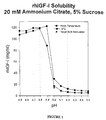
- Figure 1 shows the solubility of about 120 mg/mL concentration of IGF-I in 20 mM ammonium citrate in 5 weight by volume percent sucrose in the pH range from 4.5 to 5.5. Further studies have shown that up to about 300 mg/mL of IGF-I can be solubilized at a pH below 5.
- a buffer or acid is also added to it during manufacture to assure a high enough concentration of dissolved IGF-I in the first aqueous component to obtain a final MVL product containing the desired loading of the drug.
- the pH of the first aqueous component is generally adjusted to a value within the range of 1 to about 5, while for high load formulations the pH range is between 2 and 4.8.
- the amount of the osmotic excipient and pH adjusting agent must be balanced to maintain solubility of the drug in the final product while allowing for loading of the desired concentration of the drug.
- some portion of the osmotic excipients, including the buffer will pass through the permeable vesicle membranes, so the osmolarity of aqueous component in the final product is not generally the same as the osmolarity of the first aqueous component used at the time of manufacture.
- low load IGF-I MVL formulations are obtained by using a first aqueous component that contains from about 9 mg/mL to about 16 mg/mL of IGF-I, 3 to 7 % w/v of sucrose as osmotic excipient, and 20mM ammonium citrate dibasic pH 4.5-5.5 as a buffer to maintain the pH of the aqueous component in the range necessary to assure that the IGF-I will remain in solution, but without risk of denaturing the protein.
- the corresponding osmolarity of the first aqueous component is in the range from about 130 to about 290 mOsm.
- the first aqueous component in the pH range from about 1 to about 5, when the concentration of IGF-I is in the range from about 1 mg/mL to about 33 mg/mL, the first aqueous component contains sufficient of an osmotic excipient to bring its osmolarity within the range from about 160 mOsm to about 320 mOsm. In all cases the lower end of the osmolarity range corresponds to the upper end of the drug concentration range.
- the high load MVL formulations of IGF-I are obtained by using a first aqueous component during manufacture that comprises from about 40 to about 300 mg/mL, for example, about 20 to about 80 mg/mL of IGF-I, sufficient of a pH adjusting agent to keep the pH in the range from about 2 to about 4.8, and sufficient of an osmotic excipient to bring the osmolarity within the range from about 5 to about 150 mOsm, with the lower end of the osmolarity range corresponding to the higher end of the drug concentration range.
- the osmotic excipient is from zero to about 2.5 weight by volume percent of sucrose and 25 mM citric acid is used as the pH adjusting agent.
- the lipid component contains one or more amphipathic lipid having from about 13 to about 28, for example, about 18 to 22 carbons in its carbon chain.
- a high load multivesicular liposome formulation containing from about 50 mg/mL to about 80 mg/mL of IGF-I.
- the formulation comprises an aqueous suspension of a multivesicular liposome comprising IGF-I in an aqueous component, an amphipathic lipid containing from about 18 to 22 carbons in the carbon chain; and a neutral lipid lacking a hydrophilic head group.
- the formulation can contain less than 2 percent of the IGF-I in the aqueous suspension on a weight by volume basis.
- compositions which comprise a multivesicular liposome made by the method of this invention, wherein the suspending medium further comprises a physiologically acceptable carrier, and the total amount of the IGF-I in the composition is a therapeutically effective dosage.
- MVLs multivesicular liposomes
- Drug loading in MVLs is modulated by controlling the osmolarity of the first aqueous component used during manufacture of the MVLs.
- Osmolarity is the sum of the molar concentrations of solutes present in an aqueous solution. If the solute is present in a dissociated, ionized or aggregated form, osmolarity is defined as the sum of the molar concentrations of the dissociated, ionized or aggregated forms.
- the solutes that contribute to the osmolarity of an aqueous solution include the IGF-I, and osmotic excipients that are to be encapsulated during manufacture of MVLs.
- the contribution to the osmolarity of a solution made by any solute in the solution is approximately equivalent to the weight concentration of the solute in the solution (e.g., mg/mL) divided by its molecular weight.
- the larger the molecular weight of a solute the smaller the osmolarity of the solute, and the smaller the contribution of that solute to the overall osmolarity of the solution.
- Drug loading is the concentration of drug per unit of encapsulated volume of liposomes.
- An inverse correlation has been discovered between the osmolarity of the first aqueous solution used in manufacture of MVL, and the amount of IGF-I that can be loaded into the vesicles. Therefore, solutes other than IGF-I present in the first aqueous solution used during manufacture of the liposomes tend to reduce the amount of IGF-I that can be loaded into the liposomes.
- helper osmotic excipients such as the buffer used to maintain solubility of the IGF-I during manufacture and in the product MVLs, must be balanced against the adverse effect upon drug loading attributable to the osmotic excipients. This problem is particularly acute in making of high loading formulations.
- osmolarity of the first aqueous solution is adjusted to obtain a therapeutically effective level of drug loading for an intended use as follows.
- a lipid component containing at least one amphipathic lipid and one neutral lipid dissolved in one or more organic solvents is mixed with an immiscible first aqueous component.
- the first aqueous component contains the IGF-I, an optional osmotic excipient, and a pH adjusting amount of an acid or buffer.
- the buffer in the high load formulations, may be citric acid, generally 25 mM citric acid, while in the low load formulations the buffer may be ammonium citrate dibasic, generally, 20mM ammonium citrate dibasic, adjusted to about pH 5 with citric acid.
- the loading of the active agent in the final formulation depends upon the concentration of dissolved drug as well as the overall osmolarity of this first aqueous component, which is the sum of the osmolarity contributed by each of the solutes dissolved in the first aqueous component, including the IGF-I, the osmotic excipient, and the pH adjusting agent.
- a water-in-oil emulsion is formed by mixing of the two immiscible components.
- the water-in-oil emulsion is then mixed into a second immiscible aqueous component to form solvent spherules.
- the organic solvent is finally removed from the solvent spherules, for example by evaporation, to cause them to aggregate into MVLs.
- the MVLs are suspended in an aqueous medium, such as normal saline.
- the overall amount of active agent in the formulation on a weight by volume of formulation basis can be adjusted to any desired level by increasing or decreasing the volume of the medium in which the MVLs are suspended.
- multivesicular liposomes means man-made, microscopic lipid vesicles comprising lipid membranes enclosing multiple non-concentric aqueous chambers with membranes distributed as a network throughout. (See Kim et al., Biochem. Biophys. Acta, 728:339-348, 1983 ).
- solvent spherule as used throughout the specification and claims means a microscopic spheroid droplet of organic solvent, within which are multiple smaller droplets of aqueous solution. The solvent spherules are suspended and totally immersed in a second aqueous solution.
- neutral lipid means an oil or fat that has no membrane-forming capability by itself and lacks a hydrophilic "head” group.
- amphipathic lipid means a molecule that has a hydrophilic "head” group and hydrophobic "tail” group and has membrane-forming capability.
- zwitterionic lipid means an amphipathic lipid with a net charge of zero at pH 7.4.
- anionic lipid means an amphipathic lipid with a net negative charge at pH 7.4.
- cationic lipid means an amphipathic lipid with a net positive charge at pH 7.4.
- the amphipathic lipids can be zwitterionic, anionic, or cationic lipids.
- zwitterionic amphipathic lipids are phosphatidylcholines, phosphatidylethanolamines, sphingomyelins etc.
- anionic amphipathic lipids are phosphatidylglycerols, phosphatidylserines, phosphatidylinositols, phosphatidic acids, etc .
- Examples of cationic amphipathic lipids are diacyl trimethylammoniumpropane and ethyl phosphatidylcholine.
- Examples of neutral lipids include diglycerides, such as diolein, dipalmitolein, and mixed caprylin-caprin diglycerides; triglycerides, such as triolein, tripalmitolein, trilinolein, tricaprylin, and trilaurin; vegetable oils, such as soybean oil; squalene; tocopherol; and combinations thereof. Additionally, cholesterol or plant sterols can be used in making multivesicular liposomes.
- biologically active when used to describe IGF-I or any other agent present in the chambers of the multivesicular liposome, includes agents which possess biological activity targeted in treatment of a particular disease state, either in the form released from the MVL vesicles, or in a form that becomes active after release from the vesicle chamber, such as a pro-drug that is converted upon interaction with an enzyme into an active moiety with therapeutic activity.
- osmotic excipient means any biologically compatible solute molecule, in an aqueous solution, that is not the biologically active agent. Both electrolytes and non-electrolytes function as osmotic excipients. In determining whether any particular molecule will function as an osmotic excipient or in determining the concentration of osmotic excipient encapsulated within a multivesicular liposome, consideration must be given to whether, under conditions within the multivesicular liposome (for example, pH), the molecule is wholly or partially ionized and whether such ions will permeate the lipid membrane ( The Bimolecular Lipid Bilayer Membrane, Mahendra K.
- the osmotic excipient must be selected so as to avoid agents that would prove toxic or otherwise harmful to a subject undergoing therapy by use of the MVL of this invention. Those of skill in the art can readily evaluate the suitability of a given osmotic excipient for use in the present invention without resort to undue experimentation.
- Certain osmotic excipients have inherent biological activity, and many facilitate the biological activity of the biologically active agent. For instance, calcium ions may be coencapsulated as a counterion to increase shelf life or facilitate bioactivity of a drug, but are not sufficient to accomplishing the therapeutic or other utility of the MVL formulation.
- various stabilizers may also be present.
- Certain agents commonly classified as excipients may actually possess direct biological activity from very slight to quite significant. For example, the common excipient mannitol can also act biologically as a diuretic, Even water may act biologically to cure dehydration, but when these compounds are used as osmotic excipients, they are relatively interchangeable with others that perform the same helper function.
- Useful osmotic excipients include, but are not limited to, glucose, sucrose, trehalose, succinate, cyclodextrin, arginine, galactose, mannose, maltose, mannitol, glycine, lysine, citrate, sorbitol, dextran, and suitable combinations thereof, may be used to form multivesicular liposomes and to modulate the drug loading of the encapsulated agent from multivesicular liposomes.
- Table 1 below compares the osmolarity of sucrose and glycylglycine solutions at different concentrations.
- Sucrose or Glycylglycine (w/v%) Osmolarity for sucrose (mOsm) Osmolarity for Glycylglycine (mOsm) 0.5 15 38 1.0 30 76 1.5 45 114 2.0 60 152 2.5 76 189 3.0 91 227 4.0 123 303 5.0 156 379 6.0 190 455 7.0 225 530 8.0 261 606 1 Sucrose data are from Handbook of Physics and Chemistry, 67th Editi on 2 Glycylglycine data are calculated based on the molar concentration
- Useful pH modifying agents include, but are not limited to the organic acids such as citric, tartaric, maleic, gluconic, glucuronic, and succinic acids, and phosphoric acid.
- the term "therapeutically effective amount or level” means the amount of a biologically active agent necessary to induce a desired pharmacological effect.
- the amount can vary greatly according to the effectiveness of a particular active agent, the age, weight, and response of the individual host as well as the nature and severity of the host's symptoms. Accordingly, there is no upper or lower critical limitation upon the amount of the active agent.
- the therapeutically effective amount to be employed in the present invention can readily be determined by those skilled in the art.
- drug loading means, in a general quantitative sense, the amount of the biologically active agent loaded into the product MVL suspension as compared with similar formulations. It is a measure, therefore, of the amount of active agent available in a unit volume of MVL formulation to be delivered to the patient during use. More particularly, “drug loading” means the ratio of drug per unit volume of liposome suspension to the percent encapsulated volume in the liposomes themselves. It is approximately equal to the concentration of the active agent in the MVL suspension divided by the lipocrit of the suspension, for low percent free drug.
- Drug Loading Drug Encapsulated Per Unit Valume of Liposome Suspension / Percent encapsulated volume in Liposomes ⁇ Drug Concentration of Liposome Suspension / Lipocrit
- percent encapsulation of drug, or other compound means the ratio of the amount of compound to be encapsulated in the final suspension of the liposome manufacturing process to the total amount of compound to be encapsulated used in the first aqueous solution of the process multiplied by 100.
- Percent encapsulation of compound Amt . of compound encapsulated Amt . of compound introduced prior to encapsulation X 100
- percent free drug means the ratio of the amount of drug exterior to the liposomes in the final liposome suspension to the total amount of drug in the final suspension (the final product) multiplied by 100.
- Percent free drug Amt . of drug exterior to the liposomes in the final product Amt . of drug in final product X 100 ⁇ 1 - Lipocrit ⁇ Drug concentration exterior to the liposomes Drug concentration of liposomes suspension
- Example 7 The methods for determining these parameters are illustrated in Example 7 of this application.
- the lower limit for osmolarity of the first aqueous component can be close to zero, as in the case where the biologically active agent is encapsulated without any osmotic excipients. This is especially true if the active agent is a high molecular weight protein or other macromolecule.
- the osmolarity of the first aqueous component can be as high as about 1000 mOsm, or higher, without toxic effect because many of the excipients can pass out of the liposome during the process of manufacturing. Generally, however, the osmolarity of the first aqueous component is in the range from about 5 mOsm to about 320 mOsm.
- the osmolarity of the encapsulated aqueous component in the final liposomal product is generally isotonic to that of the suspending medium, the physiologically relevant aqueous environment in which the MVLs are stored (such as 0.9 wt% saline), or into which they are introduced (both in vitro and in vivo ).
- the osmolarity of the aqueous component in the final MVL product can also be hypertonic with respect to the physiologically relevant aqueous environment to provide an optimum decrease in the rate of release of the biologically active agent from the liposomes.
- the aqueous component in the MVL product can be hypotonic, isotonic or hypertonic with respect to the storage medium or the aqueous environment into which the biologically active agent is to be released.
- saline can be used as a predictive model of MVL drug release in such environments.
- MVLs of the invention are usually stored in a medium such as normal saline, phosphate-buffered saline, or other osmotically similar medium.
- the lipid component can comprise one or more amphipathic lipids having from about 13 to about 28 carbons, for example from about 18 to 22 carbons. This general rule holds whether the carbon chain of the amphipathic lipid is saturated, or whether it contains one or more double bonds. Generally, however, in selecting the lipids to be used in formulating a multivesicular liposome it should be kept in mind that it is possible to use an organic solvent with a lower boiling point when utilizing a lipid with a given number of carbons in the carbon chain, if the lipid contains at least one double bond in the carbon chain..
- High loading formulations of IGF-I obtained by the method of this invention are particularly useful in the pharmaceutical industry for reducing the amount of liposome formulation that must be administered to a subject (e.g., intramuscularly or subcutaneously) to achieve a desired therapeutic concentration of drug in the blood stream. They are also useful for reducing the number of times the IGF-I must be administered to attain a sustained therapeutic level of drug in the patient.
- the upper useful limit on the amount of drug encapsulated into a given volume of liposome suspension may also be dictated by the lipocrit of the suspension. As one skilled in the art will appreciate, it may be difficult to inject a suspension containing liposomes if the lipocrit of the suspension is too high.
- the dosage range of IGF-I in multivesicular liposomes appropriate for in vivo use in humans of this invention includes the range of about 0.01 mg/kg up to about 100 mg/kg of lean body mass, or higher, depending on the therapeutic indication. For example, in treatment of diabetes or ALS, one would select the upper end of the dosage range. However, for local injection or delivery, the lower end of the systemic dosage range would be selected.
- Both the high load and low load formulations can be further diluted to obtain an injectable slow release depot formulation of any therapeutically effective total dosage by addition of suspending medium or any physiologically acceptable carrier.
- suitable carriers include aqueous or non-aqueous solutions, suspensions, and emulsions.
- non-aqueous solutions are propylene glycol, polyethylene glycol, vegetable oils, such as olive oil, and injectable organic esters such as ethyl oleate.
- Aqueous carriers include water, alcoholic-aqueous solutions, emulsions or suspensions, including saline and buffered media.
- Parenteral vehicles include sodium chloride solution, Ringer's dextrose, dextrose, and lactated Ringer's solution.
- Intravenous vehicles include fluid and nutrient replenishers, electrolyte replenishers (such as those based on Ringer's dextrose), and the like. Preservatives and other additives may also- be present, such as, antimicrobials, anti-oxidants, chelating agents, and inert gases (see, Remingtons Pharmaceutical Sciences, 16th Ed., A. Oslo, ed., Mack, Easton, PA. 1980 ).
- compositions of IGF-I in MVL retain substantially full bioactivity and may be administered by any desired route; for example, intratumoral, intra-articular (into joints), intra-ocular, intramuscular, intrathecal, intraperitoneal, subcutaneous, intravenous, intralymphatic, oral and submucosal.
- the multivesicular liposomes may be modified using methods well known in the art by attaching thereto, either directly, or indirectly, such as by means of a excipient molecule or peptide, target-specific ligands, such as antibodies and other receptor specific protein ligands, in order to impart organ or cell target specificity ( Malone, et al., Proc. Nat'l. Acad. Sci, U.S.A., 86:6077, 1989 ; Gregoriadis, Immunology Today, 11(3):89, 1990 ).
- IGF-I formulations were made comparing the effects upon drug loading using a sugar (sucrose) or a non-sugar (glycylglycine) as the osmotic excipient Comparison of the results of these tests in Tables 2 through 6 showed that the inverse relationship between osmolarity and drug loading is not dependent upon the chemical character of any of the components that make up the first aqueous component, and that it depends only upon one parameter, the overall osmolarity of the first aqueous component used during manufacture of the MVLs.
- the long-chain amphipathic lipid used to impart slow release properties of the formulations was switched from DEPC to DOPC without significant change of the trend of modulation of drug loading by altering osmolarity.
- the MVL formulations were made in different batch sizes with different types of mixers to illustrate that the method of this invention is independent of such variables used during the process.
- a 'water-in-oil' emulsion was prepared by mixing a lipid component with a first aqueous component.
- the lipid component contained 0.5-4 mL of 13.20 mM DOPC or DEPC, 19.88 mM cholesterol, 2.79 mM DPPG, and 2.44 mM triolein (Avant Polar Lipids Inc., Alabaster, AL) in chloroform (Spectrum Chemical Manufacturing Corp., Gardena, CA) as solvent.
- a lipid component containing DEPC rather than DOPC was prepared.
- the first aqueous component contained 50 mg/mL of IGF-I and 0.25 0.5, 1.0 2.5 r 5.0 w/v% of sucrose as osmotic excipient.
- An emulsion of the lipid and first aqueous components was formed by mixing 0.5 mL of the first aqueous component with 0.5 mL of the first aqueous component with 0.5 mL of the lipid component using a Baxter vortexer at maximum speed (setting 10) for 6 min.
- a solution containing 4 wt% glucose and 40 mM lysine (Spectrum Chemicals) was added, respectively.
- the resulting mixture was emulsified to form a second emulsion with the Baxter vortexer at maxium speed for 4 sec.
- the resulting second emulsion a "water-in-oil-in-water" double emulsion, was transferred for gentle swirling to a 250 mL erlenmeyer flask containing 10 mL of a solution of 4 percent by weight glucose and 40 mM lysine.
- mOsm The estimated osmolarity (mOsm), percent yield, and drug loading of these formulations are shown in Table 2 below: Table 2 First Aqueous Component Final Liposome Suspension IGF-I (mg/mL) Sucrose (w/v%) Other Estimated Osmolarity (mOsm) % Yield Drug Loading (mg/mL) 20 5.0 100mM 347.0 51.6 37.7 HCl 20 2.5 100mM 267.0 47.5 46.1 HCl 50 2.5 100mM 271.0 44.6 45.7 HCl 50 0.0 100mM 195.0 53.4 73.2 HCl
- a lipid component containing DOPC rather than DEPC was prepared as in Example 1.
- the first aqueous component contained 20 mg/mL of IGF-I (Chiron Corp., Emeryville, CA) in 100 mM hydrochloric acid, and 2.5 or 5.0 w/v% of sucrose as osmotic excipient, or 50 mg/mL of IGF-I in 100 mM hydrochloric acid and 0 or 2.5 w/v% of sucrose as osmotic excipient.
- IGF-I Choiron Corp., Emeryville, CA
- Example 1 The procedures of Example 1 were followed for obtaining the MVLs containing IGF-I, except that 4 mL of the first aqueous component was mixed with 4 mL of the lipid component using a TK Autohomogeneizer K at a speed of 9,000 rpm for 8 min to obtain the first emulsion.
- a solution containing 4 wt% glucose and 40 mM lysine (Spectrum Chemicals) was added, respectively.
- the resulting mixture was emulsified to form a second emulsion with the TK Autohomogeneizer K at a speed of 4,000 rpm for 1 min.
- Table 3 shows that the results obtained with the TK mixer procedure are similar to those obtained when a vortexer mixer is used to make the emulsions.
- the encapsulated protein was obtained and characterized as described in Example 3 herein, an increased amount of IGF-I oligomers was found as compared with the formulations of Table 4 wherein 25 mM citric acid was included in the first aqueous component.
- a lipid component containing DEPC rather than DOPC was prepared as in Example 1.
- the first aqueous component contained 30 mg/mL of IGF-I in 25 mM citric acid, and 0 or 2.5 w/v% of sucrose as osmotic excipient, or 50 mg/mL of IGF-I in 25 mM citric acid, and 2.5, 1.0, 0.5 or 0 w/v% of sucrose, or 50 mg/mL of IGF-I without citric acid, and 0 or 0.5 w/v% of sucrose.
- Example 1 The procedures of Example 1 were followed for obtaining the MVLs containing IGF-I, except that 3 mL of the first aqueous component was mixed with 3 mL of the lipid component using an Omni Mixer ES at a speed of 10,000 rpm for 12 min to obtain the first emulsion.
- 3 mL of the first aqueous component was mixed with 3 mL of the lipid component using an Omni Mixer ES at a speed of 10,000 rpm for 12 min to obtain the first emulsion.
- 20mL of a solution containing 4 wt% glucose and 40 mM lysine (Spectrum Chemicals) was added, respectively.
- the resulting mixture was emulsified to form a second emulsion with the Omni Mixer ES at a speed of 4,500 rpm for 2 min.
- a lipid component containing DEPC rather than DOPC was prepared as in Example 1.
- the first aqueous component contained 10 mg/mL of IGF-I in 25 mM citric acid, and 0, 1.0 or 2.0 w/v% of glycylglycine as osmotic excipient.
- the remainder of the steps described in Example 1 were carried out to obtain MVLs containing IGF-I suspended in normal saline.
- the estimated osmolarity (mOsm), percent yield, and drug loading of these formulations are shown in Table 5 below.
- MVLs were made in the method of Example 1A containing IGF-I encapsulated with either 2.5 w/v% sucrose or 1.0 w/v% glycylglycine as osmotic excipients at approximately equal osmotic strength.
- 2.5 w/v% sucrose or 1.0 w/v% glycylglycine as the osmotic excipient was introduced into the first aqueous component containing 80 mg/mL IGF-I and 25 mM citric acid.
- Example 1A The procedures of Example 1A were followed for obtaining the MVLs containing IGF-I, except that 3 mL of the first aqueous component was mixed with 3 mL of the lipid component using an Omni Mixer ES at a speed of 10,000 rpm for 12 min to obtain the first emulsion.
- 3 mL of the first aqueous component was mixed with 3 mL of the lipid component using an Omni Mixer ES at a speed of 10,000 rpm for 12 min to obtain the first emulsion.
- 20 mL of a solution containing 4 wt% glucose and 40 mM lysine (Spectrum Chemicals) was added, respectively.
- the resulting mixture was emulsified to form a second emulsion with the Omni Mixer ES at a speed of 4,500 rpm for 2 min.
- a third formulation was made as described above, except that the concentrations of the osmotic excipient and the IGF-I were both proportionately decreased (from 80 mg/mL IGF-I and 2.5% sucrose to 50 mg/mL IGF-I and 1.0% sucrose.
- the second aqueous component substituted 1.5% glycine and 40 mM lysine in place of the 4% glucose and 40mM lysine used in Example 1.
- Table 6 compares the estimated osmolarity, % Yield and Drug Loading in the final liposome suspension for these three formulations.
- Tables 2-6 show that drug loading in a high load MVL-IGF-I formulation can be modulated by varying the osmolarity of the first aqueous solution used in making multivesicular liposomes, with decreasing of osmolarity resulting in increased drug loading.
- Tables 2 through 4 show the estimated osmolarity (mOsm), % Yield and Drug Loading (mg/mL) for the high load liposomal formulations described in Examples 1 and 2 above.
- Percent encapsulation (or percent yield) of drug was calculated as the percent ratio of the amount of drug in the final liposome suspension to the total amount of drug used in the first aqueous solution.
- percent yield of drug was calculated as the ratio of the drug concentration in the final suspension times the volume of the final suspension to the drug concentration in the first aqueous solution times the volume of the first aqueous solution.
- Lipocrit was calculated, in analogy to hematocrit, as the percent ratio of the pellet volume to the suspension volume (see conditions below for obtaining the pellet volume).
- Percent free drug was calculated as the percent ratio of the amount of drug in the supernatant to the amount of drug in the final suspension. Percent free drug can also be calculated as the percent ratio of the drug concentration in the supernatant to that in the suspension, times (1-lipocrit) Drug loading, which measures the amount of drug encapsulated in each unit of the encapsulated volume, is approximately equal to and can be estimated (assuming low percent free drug) as the ratio of the drug concentration of the final liposome suspension to the lipocrit. These variables were determined as more particularly described below.
- the lipocrit was calculated as the percent ratio of the length of the tube occupied by the pellet to that occupied by the suspension.
- Particle size distribution and particle mean diameter were determined by the method of laser light diffraction using a LA-500 or LA-910 Particle Size Analyzer from Horiba Inc. (Irvine, CA).
- the volume-weighted mean particle diameter for all the formulations studied was generally in the range from about 6 to 18 ⁇ m.
- the physicochemical integrity of the encapsulated high load IGF-I was confirmed by SDS-PAGE assay using Novex NuPage gel as well as by RP-HPLC assay using a C18 symmetric column.
- the encapsulated protein was extracted using 75:25 IPA:2N Citric Acid.
- the bioactivity of the encapsulated IGF-I was confirmed by a mitogenic bioassay using MG-63 cells and MTT stain according to the method of W. Lopaczynski et al., Regulatory Peptides, 48:207-216, 1993 .
- the MG-63 human osteosarcoma cell line was obtained from the American Type Culture Collection (ATCC# CRL 1427) and the dose dependent mitogenic response of quiescent MG-63 cells to added IGF-I was determined.
- an in vitro release experiment was set up and conducted as follows: a MVL suspension containing about 50 mg/mL of IGF-I was diluted 20-fold into human plasma containing 0.01 % NaN 3 ; a 0.5 mL sample in screw-cap Eppendorf tube was used for each time-point, and samples were incubated under dynamic/rotating conditions at 37°C. Time-point samples were taken at various times and washed with 0.9 mL of normal saline. Particle pellets were then obtained by centrifugation in a microfuge at 14 K rpm about 16,000g for 4 minutes and stored at -20°C until assayed by RP-HPLC using a C18 symmetric column.
- Figure 2 shows in vitro plasma release data obtained for the three representative IGF-I formulations listed in Table 5. These data indicate that a sustained release of IGF-I is achieved in all three formulations tested over a period of several days for high drug loading, high yield IGF-I formulations.
- Figure 3 shows the time course of the average serum IGF-I concentration of three rats that received the 10 mg IGF-I of Formulation A in Table 6. These data indicate that a sustained serum level of IGF-I can be achieved over a period of many days using the high drug loading, high yield IGF-I formulations of this invention.
- MVL containing a low loading of IGF-I were prepared by modification of the method of Example 1A as follows: the aqueous component was an aqueous solution containing a concentration of IGF-I in the range from 9-16 mg/mL in 7% sucrose (w/v) 20mM ammonium citrate (pH 5).
- aqueous component was emulsified at ambient temperature (23-28°C) for 9 minutes at 9,000 rpm with an equal volume of a lipid component containing 13mM dioleoyl phosphatidylcholine, 2.8mM dipalmitoyl phosphatidylglycerol, 19.9mM cholesterol, and 2.4mM tripalmitolein dissolved in water saturated cholesterol.
- 28 mL of 4% glucose in 20mM lysine was added to the water-in-oil emulsion with the mixing blade at 1 cm above the organic aqueous interface, and the contents mixed for 1 minute at 6,000 rpm.
- the resulting second emulsion as added to a 1 L baffled flask containing 42mL of 4% glucose in 20mM lysine.
- the mixture in the flask was sparged with 50 standard cubic feet per hour Nitrogen at 37°C for 15 minutes to remove the chloroform.
- the multivesicular liposomes were then harvested by adding 4 times the post-sparge volume of 122mM Ammonium Citrate Dibasic (pH 5), and centrifuging for 10 minutes at 627g. After washing, the pellet was resuspended in an equal volume of 122mM Ammonium citrate Dibasic, at a lipocrit of about 40-50%.
- Encapsulation efficiency of IGF-I in the MVL was calculated at greater than 60%.
- the osmolarity range that corresponds to 9-16 mg/mL of IGF-I in 7% sucrose in 20 mM ammonium citrate dibasic is about 30 mOsm to about 290 mOs
- the size of the MVL particles was determined by using a Horiba model LA-500 laser light scattering particle size detector (Horiba Instruments, Inc. Irvine, CA.) Raw Data was collected using Horiba LA-500 software (Horiba Instruments, Inc. Irvine, CA.) Particle sizing was done by adding 10-15 ⁇ l of MVL suspension to 10mL of 0.9% NaCl and measuring the volume-weighted distribution of size. The median particle size ranged from 12-18 microns.
- Lipocrit was measured by adding 65 ⁇ L of MVL suspension to microhematocrit tubes and spinning the microhematocrit tubes (Fisher Scientific, Pittsburgh, PA) for 10 minutes at 630g. After spinning, the supernatant and pellet lengths were measured. The lipocrit was calculated As the percent ratio of the length of the tube occupied by the pellet to that occupied by the suspension.
- pH of encapsulated aqueous component The pH of the aqueous component encapsulated within the MVLs in the final formulation was estimated by washing the MVL pellet obtained by centrifugation with saline and then resuspending the pellet with HPLC grade water (Mallinckrodt-Baker, Paris, KY). Then the sample was frozen at -70°C to fracture the vesicles, thereby releasing the encapsulated aqueous component from the MVL. The pH of the released aqueous component was measured in HPLC water and corrected for dilution by the HPLC water to obtain the estimated pH of the encapsulated aqueous component.
- a standard lipid component containing DEPC rather than DOPC was prepared as for other drug formulations.
- the first aqueous component contained 15 mg/mL IGF-I dissolved in either a 5% sucrose/20 mM ammonium citrate solution, or in a 8% sucrose/20 mM ammonium citrate solution.
- 125 mL of first aqueous solution was mixed with 125 mL of the lipid component using a high-shear double-mixing vessel system to obtain the first emulsion.
- This mixing system models the production scale process, and is used for scale-up of encapsulated drug formulations.
- the aqueous and organic components were mixed at a speed of 8000 rpm for 30 minutes in the first emulsion vessel.
- the first emulsion was then pumped at a rate of 167 mL/min into a fluid stream consisting of 0.04 N ammonium hydroxide in 1.5% glycine solution flowing at 2400 mL/min, and blended using an in-line static mixer to obtain the second emulsion.
- the total flow rate through the static mixer was 2567 mL/min. At this rate, the first emulsion was depleted in 90 seconds.
- the second emulsion upon entry into a receiving vessel was mixed with lysine solution, and then was immediately sparged with nitrogen to strip off the organic solvent.
- the estimated osmolarity (mOsm), percent yield, drug loading, and % free-drug for these formulations are shown in Table 7 below.
- the IGF-I was extracted from the particles prior to the characterization of the encapsulated protein.
- the extraction procedure used was a modification of a procedure used for extraction of IGF-I from its plasma binding proteins, and was as follows: a 100 uL sample of a test suspension was centrifuged for 10 minutes at 627g. Supernatants were aspirated from the particle fractions, and saved for analysis. Each particle fraction was then extracted using 87% Isopropanol 13% 2N hydrochloric acid solution. Extracted samples were incubated in an ice bath for 45 minutes, then neutralized with a 1M concentration solution of Tris/Hydrochloric acid at pH 9.
- Protein concentration was measured at 275nm on a Hitachi model U-2000 spectrophotometer (Hitachi Scientific Instruments, Berkshire, UK). The protein concentration was calculated using the extinction coefficient of 0.62 for a protein solution containing 1 mg/ml IGF-I. The free IGF-I concentration was determined by the absorbance of a dilution of the stock IGF-I solution in 100mM acetic acid.
- the encapsulated IGF-I was also characterized by RP-HPLC after extraction, and compared to the free IGF-I.
- RP-HPLC was carried out on a Hewlett-Packard model 1090 liquid chromatography system (Hewlett-Packard GmbH, Waldborn, Germany). The column used was a 150 x 3.9nm I.D. Waters Symmetry C 18 (Millipore, Milford, MA). Raw data was collected using Hewlett-Packard 3D Chemstation software (Hewlett-Packard GmbH, Waldbom, Germany). IGF-I was detected at both 214nm and 275nm.
- IGF-I was separated at a flow rate of 0.8 ml/min, using a linear solvent gradient, starting with 22 volume percent of solvent B and changing to 40 volume percent B over 11 minutes.
- Solvent A was 10% acetonitrile/ 0.2% trifluoroacetic acid and buffer B was 90% acetonitrile/0.2% trifluoroacetic acid (TFA). Separation was followed by a 4 minute isocratic elution with 100% solvent B, followed by a 9-minute equilibration at initial conditions. Separation was conducted at 45 degrees C.
- the bioactivity of the encapsulated IGF-I was confirmed by a mitogenic bioassay using MG-63 cells, a human osteosarcoma cell line, 3-(4,5-dimethylthiazol-2-yl)-2,5 diphenyltetrazolium bromide (MTT) stain according to the method of W. Lopaczynski et al., Regulatory Peptides, 48:207-216, 1993 .
- the MG-63 cell line was obtained from the American Type Culture Collection (ATCC# CRL 1427), and the dose dependent mitogenic response of quiescent MG-63 cells to added IGF-I was determined.
- Figure 4 shows the bioactivity of a low load MVL formulation of IGF-I containing 5 mg IGF-I per mL of formulation as calculated against a standard of recombinant human IGF-I (Chiron Corporation) with bioactivity of 1.3 x 10 3 international units (IU)/mL. Recoveries in the mitogenic assay ranged from 90-110% of the control IGF-I.
Landscapes
- Health & Medical Sciences (AREA)
- Life Sciences & Earth Sciences (AREA)
- Chemical & Material Sciences (AREA)
- Medicinal Chemistry (AREA)
- Veterinary Medicine (AREA)
- Pharmacology & Pharmacy (AREA)
- Animal Behavior & Ethology (AREA)
- General Health & Medical Sciences (AREA)
- Public Health (AREA)
- Diabetes (AREA)
- Engineering & Computer Science (AREA)
- Epidemiology (AREA)
- Bioinformatics & Cheminformatics (AREA)
- Endocrinology (AREA)
- Nuclear Medicine, Radiotherapy & Molecular Imaging (AREA)
- Gastroenterology & Hepatology (AREA)
- Organic Chemistry (AREA)
- General Chemical & Material Sciences (AREA)
- Dispersion Chemistry (AREA)
- Chemical Kinetics & Catalysis (AREA)
- Proteomics, Peptides & Aminoacids (AREA)
- Immunology (AREA)
- Molecular Biology (AREA)
- Zoology (AREA)
- Emergency Medicine (AREA)
- Obesity (AREA)
- Hematology (AREA)
- Medicinal Preparation (AREA)
- Medicines That Contain Protein Lipid Enzymes And Other Medicines (AREA)
Abstract
Description
- The present invention relates to slow release vehicles for delivering a biologically active agent More particularly, the present invention relates to multivesicular liposomes containing IGF-I.
- Proteins which are cleared rapidly from the circulation after intravenous or subcutaneous injections need to be administered repeatedly in order to maintain therapeutic blood levels. One of the proteins that needs frequent administration for therapeutic benefit is Insulin-like Growth Factor I (IGF-1). Mature, circulating IGF-I, a 7.65kD protein, consists of B and A domains (homologous to the B and A chains of insulin). Unlike insulin, the B and A domains of the IGFs are connected by a C peptide, and contain an eight-amino-acid extension at the C-terminus, termed the D domain.
- Native IGF-I contains three disulfide bonds involving the following residues: CysB6-CysB7, CysA6-CysAll, and CysB18-CysA20. Under reducing conditions, these disulfide bonds are broken and can become "scrambled" during oxidative refolding in denaturant solutions to yield two alternative disulfide isomers with distinct tertiary structures (L. O. Narhi et al., Biochemistry 32/5214-5221, 1993).
- IGF-I is known to have multiple biological activities. Those with therapeutic potential are its activity in reversing catabolism in states of starvation, severe illness, or injury, in enhancing wound healing and nerve regeneration, and in reducing insulin resistance in diabetics. IGF-I is also known to generally stimulate the growth and maintenance of nervous tissue, increase glucose uptake of cells, and stimulate renal function. Chronic malnutrition and poorly controlled diabetes in the young are associated with lower circulating IGF-I levels and growth retardation.
- Optimal treatment with IGF-I may require that the drug level be maintained at a specified level for a prolonged period of time. For example, optimal treatment of insulin dependency in diabetics may require maintenance of a relatively high level of IGF-I for a period of several days.
- For certain other therapeutic usages, for example treatment of malnutrition or osteoporosis, a low level of IGF-I released over a period of several days would be beneficial.
- One approach which has been used to provide controlled release compositions for drug delivery is liposome encapsulation. Among the main types of liposomes, multivesicular liposomes (Kim, et al., Biochim. Biophys. Acta; 728:339-348, 1983), are uniquely different from unilamellar liposomes (Huang, Biochemistry; 8:334-352, 1969; Kim, et al., Biochim. Biophys. Acta; 646:1-10, 1981), multilamellar liposomes (Bangham, et al., J. Mol. Bio., 13:238-252, 1965), and stable plurilamellar liposomes (
U.S. Patent No. 4,522,803 ). In contrast to unilamellar liposomes, multivesicular liposomes contain multiple aqueous chambers. In contrast to multilamellar liposomes, the multiple aqueous chambers of multivesicular liposomes are non-concentric with membrane distributed as a network throughout. - In multivesicular liposomes the encapsulation efficiency of some small molecules, such as cytosine arabinoside, is relatively low, and the release rate of encapsulated molecules in biological fluids is faster than is therapeutically desirable unless the osmolarity of the first aqueous component is adjusted to control the rate of release.
EP 0 280 503 B1WO 95/13796 WO 96/08253 - In addition to the biologically active agent and acids or osmotic spacers intended to control the rate of release of the biologically active agent from the liposomes, it is common practice to coencapsulate with the active agent compounds that are intended to serve any of a number of helper functions. For instance, certain biologically active compounds retain activity only when kept at a particular pH. Thus acids or buffers are often necessarily encapsulated in addition to the active agent to control the pH of the drug environment. In other cases, a counterion is incorporated to enhance solubility of a biologically active agent that has low solubility.
- Thus the need exists for new high load and low load slow release formulations of IGF-I having the bioactivity of free drug in a vehicle suitable as a slow release drug depot. Since IGF-I is an expensive drug, whether purified from biological samples or produced recombinantly, a need also exists to achieve these goals while keeping the encapsulation efficiency as high as possible to avoid waste of the expensive active agents.
- The present invention provides a method for obtaining high loading and low loading formulations of IGF-I in multivesicular liposomes (MVLs) in an aqueous suspending medium and MVL formulations containing them. The low loading formulations are obtained by utilizing during manufacture a first aqueous component comprising a concentration of dissolved IGF-I from about 1 mg/mL to about 33 mg/mL, for example, about 5 mg/mL to about 20 mg/mL. The first aqueous component used in making the low loading formulations further can contain one or more osmotic excipients, such as sucrose, and sufficient of one or more pH adjusting agent, such as ammonium citrate dibasic, to maintain the pH in the range from about 1 to about 5.
- The high loading formulations generally are obtained by utilizing during manufacture a first aqueous component containing a concentration of dissolved IGF-I from about 40 mg/mL to about 300 mg/mL, for example from about 100 mg/mL to about 160 mg/mL. The first aqueous component in the high load formulation further contain a pH adjusting agent, such as citric acid or ammonium citrate dibasic, sufficient to maintain the pH in the range from about 2 to about 4.8, and an osmotic excipient, such as sucrose.
- Both the high load and low load formulations can be further diluted by addition of suspending medium or other biologically acceptable carrier to obtain injectable or implantable slow release depot formulations of any therapeutically effective total dosage.
- Methods for making MVLs are well known in the art and are described in
U.S. Patent Nos. 5,455,044 ,5,576,018 ,5,993,850 ,5,807,572 ,6,132,766 , and5,931,809 . The general procedure for making multivesicular liposomes imparts to them their characteristic properties, including the properties of modulated release of encapsulated biologically active substances. In this method, a "water-in-oil" emulsion containing the biologically active substance to be encapsulated is first made by dissolving at least one amphipathic lipid and at least one neutral lipid in a volatile organic solvent for the lipid component, adding to the lipid component an immiscible first aqueous component and emulsifying the mixture. A hydrochloride or non-hydrochloride acid can be added to either or both of the first aqueous component and the lipid component to control release of the active agent from the MVLs. In this general method, the biologically active substance to be encapsulated can be contained in the first aqueous component or in the lipid component, or both. - The entire water-in-oil emulsion is then mixed with the second aqueous component, and agitated mechanically, as above, to form solvent spherules suspended in the second aqueous component. The solvent spherules contain multiple aqueous droplets with the substance to be encapsulated dissolved therein. In the final step, the volatile organic solvent is removed from the spherules, for instance by evaporation. When the solvent is completely removed, multivesicular liposomes are formed. Representative gases satisfactory for use in evaporating the solvent include nitrogen, helium, argon, oxygen, hydrogen and carbon dioxide. Alternatively, the organic solvent can be removed by sparging, rotary evaporation, or solvent selective membranes. The multivesicular liposome particles are then suspended in an aqueous medium for storage and use.
- In the present invention, this general procedure is modified in certain key instances to obtain the high load and low load MVL formulations of IGF-I. In particular, the composition of the first aqueous component is modulated to control loading of the IGF-I in the final product. Further, the IGF-I is dissolved in the first aqueous component, rather than being dissolved in the lipid component, and, of greater importance, the osmolarity of the aqueous component into which the active agent is dissolved for encapsulation is adjusted to control loading of the biologically active agent, therein.
- An inverse relation between osmolarity and drug loading has been discovered, with the loading of IGF-I increasing as the osmolarity of the aqueous component used during manufacture of MVLs decreases and vice versa. Thus, the key parameter that is manipulated in making MVLs with either high or low loading of IGF-I is the osmolarity of the drug-containing first aqueous solution used during the process of manufacture. In the present invention, the osmolarity of the aqueous solution is adjusted by dissolving an osmotic excipient, such as sucrose or glycylglycine, therein, with a higher concentration of osmotic excipient leading to a lower loading of the active agent, and vice versa. When sucrose is used as an osmotic excipient, for the low load formulations, the concentration of sucrose in the first aqueous component during manufacture is about 5 to about 7 percent on a weight by volume basis (%w/v), while for the high load formulations, the concentration of sucrose is in the range from zero to about 2.5 percent on a weight by volume basis.
- Applicants have also discovered a second parameter that must be taken into consideration in determining the composition of the first aqueous component during manufacture of the IGF-I formulations of this invention. The concentration of IGF-I in solution in the first aqueous component during manufacture is directly proportional to the amount of IGF-I that can be loaded in any given formulation. However, the solubility of IGF-I in aqueous solution drops precipitously at a pH of about 5.
Figure 1 shows the solubility of about 120 mg/mL concentration of IGF-I in 20 mM ammonium citrate in 5 weight by volume percent sucrose in the pH range from 4.5 to 5.5. Further studies have shown that up to about 300 mg/mL of IGF-I can be solubilized at a pH below 5. Thus, to obtain and maintain sufficient IGF-I in solution in the first aqueous solution, a buffer or acid is also added to it during manufacture to assure a high enough concentration of dissolved IGF-I in the first aqueous component to obtain a final MVL product containing the desired loading of the drug. For the low load formulations, the pH of the first aqueous component is generally adjusted to a value within the range of 1 to about 5, while for high load formulations the pH range is between 2 and 4.8. - Since all solutes in the first aqueous solution, including the buffer, or other pH adjusting agent, contribute to its osmolarity, the amount of the osmotic excipient and pH adjusting agent must be balanced to maintain solubility of the drug in the final product while allowing for loading of the desired concentration of the drug. As one skilled in the art will appreciate, some portion of the osmotic excipients, including the buffer will pass through the permeable vesicle membranes, so the osmolarity of aqueous component in the final product is not generally the same as the osmolarity of the first aqueous component used at the time of manufacture.
- In one embodiment of the invention, low load IGF-I MVL formulations are obtained by using a first aqueous component that contains from about 9 mg/mL to about 16 mg/mL of IGF-I, 3 to 7 % w/v of sucrose as osmotic excipient, and 20mM ammonium citrate dibasic pH 4.5-5.5 as a buffer to maintain the pH of the aqueous component in the range necessary to assure that the IGF-I will remain in solution, but without risk of denaturing the protein. The corresponding osmolarity of the first aqueous component is in the range from about 130 to about 290 mOsm. In another embodiment, in the pH range from about 1 to about 5, when the concentration of IGF-I is in the range from about 1 mg/mL to about 33 mg/mL, the first aqueous component contains sufficient of an osmotic excipient to bring its osmolarity within the range from about 160 mOsm to about 320 mOsm. In all cases the lower end of the osmolarity range corresponds to the upper end of the drug concentration range.
- The high load MVL formulations of IGF-I are obtained by using a first aqueous component during manufacture that comprises from about 40 to about 300 mg/mL, for example, about 20 to about 80 mg/mL of IGF-I, sufficient of a pH adjusting agent to keep the pH in the range from about 2 to about 4.8, and sufficient of an osmotic excipient to bring the osmolarity within the range from about 5 to about 150 mOsm, with the lower end of the osmolarity range corresponding to the higher end of the drug concentration range. In one embodiment, the osmotic excipient is from zero to about 2.5 weight by volume percent of sucrose and 25 mM citric acid is used as the pH adjusting agent.
- To maintain a high encapsulation efficiency (or percent yield) during formulation of the MVLs and ensure that release of the active agent in use is at a slow therapeutically effective rate, the lipid component contains one or more amphipathic lipid having from about 13 to about 28, for example, about 18 to 22 carbons in its carbon chain.
- In another embodiment, a high load multivesicular liposome formulation containing from about 50 mg/mL to about 80 mg/mL of IGF-I is provided. The formulation comprises an aqueous suspension of a multivesicular liposome comprising IGF-I in an aqueous component, an amphipathic lipid containing from about 18 to 22 carbons in the carbon chain; and a neutral lipid lacking a hydrophilic head group. The formulation can contain less than 2 percent of the IGF-I in the aqueous suspension on a weight by volume basis.
- Pharmaceutical compositions are also provided which comprise a multivesicular liposome made by the method of this invention, wherein the suspending medium further comprises a physiologically acceptable carrier, and the total amount of the IGF-I in the composition is a therapeutically effective dosage.
- It has been discovered that modulation of IGF-I loading in multivesicular liposomes (MVLs), particularly to achieve high drug loading, can be accomplished without sacrifice of either high encapsulation efficiency in the method of manufacture or desirable controlled release of drug from the final product in use. Drug loading in MVLs is modulated by controlling the osmolarity of the first aqueous component used during manufacture of the MVLs. Osmolarity is the sum of the molar concentrations of solutes present in an aqueous solution. If the solute is present in a dissociated, ionized or aggregated form, osmolarity is defined as the sum of the molar concentrations of the dissociated, ionized or aggregated forms. The solutes that contribute to the osmolarity of an aqueous solution include the IGF-I, and osmotic excipients that are to be encapsulated during manufacture of MVLs. The contribution to the osmolarity of a solution made by any solute in the solution is approximately equivalent to the weight concentration of the solute in the solution (e.g., mg/mL) divided by its molecular weight. Thus, as a general principle, for a given weight concentration, the larger the molecular weight of a solute, the smaller the osmolarity of the solute, and the smaller the contribution of that solute to the overall osmolarity of the solution. It is also possible to reduce the osmolarity of the first aqueous component by reducing the concentration of the active agent. This method will lead to a lower loading of IGF-I if the concentration of other solutes in the first aqueous component remain constant.
- Drug loading is the concentration of drug per unit of encapsulated volume of liposomes. An inverse correlation has been discovered between the osmolarity of the first aqueous solution used in manufacture of MVL, and the amount of IGF-I that can be loaded into the vesicles. Therefore, solutes other than IGF-I present in the first aqueous solution used during manufacture of the liposomes tend to reduce the amount of IGF-I that can be loaded into the liposomes. To accommodate this discovery, in the present invention the beneficial effects of the helper osmotic excipients, such as the buffer used to maintain solubility of the IGF-I during manufacture and in the product MVLs, must be balanced against the adverse effect upon drug loading attributable to the osmotic excipients. This problem is particularly acute in making of high loading formulations.
- In the Examples herein, the inverse effect of osmolarity on drug loading (i.e. drug encapsulation per unit of encapsulated volume) and the method of modulating drug loading by adjusting the osmolarity of the drug-containing aqueous solution before encapsulation has been illustrated in both high load and low load MVL formulations of IGF-1. The results of these studies show that MVL formulations can be produced having a broad range of loading of IGF-I.
- In manufacture of multivesicular liposomes having controlled loading of IGF-I, osmolarity of the first aqueous solution is adjusted to obtain a therapeutically effective level of drug loading for an intended use as follows. A lipid component containing at least one amphipathic lipid and one neutral lipid dissolved in one or more organic solvents is mixed with an immiscible first aqueous component. The first aqueous component contains the IGF-I, an optional osmotic excipient, and a pH adjusting amount of an acid or buffer. In one embodiment, in the high load formulations, the buffer may be citric acid, generally 25 mM citric acid, while in the low load formulations the buffer may be ammonium citrate dibasic, generally, 20mM ammonium citrate dibasic, adjusted to about
pH 5 with citric acid. The loading of the active agent in the final formulation depends upon the concentration of dissolved drug as well as the overall osmolarity of this first aqueous component, which is the sum of the osmolarity contributed by each of the solutes dissolved in the first aqueous component, including the IGF-I, the osmotic excipient, and the pH adjusting agent. - Once the osmolarity of the first aqueous component has been adjusted to achieve the desired loading of the active agent in the final product, a water-in-oil emulsion is formed by mixing of the two immiscible components. The water-in-oil emulsion is then mixed into a second immiscible aqueous component to form solvent spherules. The organic solvent is finally removed from the solvent spherules, for example by evaporation, to cause them to aggregate into MVLs. In the final step of the process, the MVLs are suspended in an aqueous medium, such as normal saline. The overall amount of active agent in the formulation on a weight by volume of formulation basis can be adjusted to any desired level by increasing or decreasing the volume of the medium in which the MVLs are suspended.
- There are at least three types of liposomes. The term "multivesicular liposomes (MVL)" as used throughout the specification and claims means man-made, microscopic lipid vesicles comprising lipid membranes enclosing multiple non-concentric aqueous chambers with membranes distributed as a network throughout. (See Kim et al., Biochem. Biophys. Acta, 728:339-348, 1983).
- The term "solvent spherule" as used throughout the specification and claims means a microscopic spheroid droplet of organic solvent, within which are multiple smaller droplets of aqueous solution. The solvent spherules are suspended and totally immersed in a second aqueous solution.
- The term "neutral lipid" means an oil or fat that has no membrane-forming capability by itself and lacks a hydrophilic "head" group.
- The term "amphipathic lipid" means a molecule that has a hydrophilic "head" group and hydrophobic "tail" group and has membrane-forming capability.
- The term "zwitterionic lipid" means an amphipathic lipid with a net charge of zero at pH 7.4.
- The term "anionic lipid" means an amphipathic lipid with a net negative charge at pH 7.4.
- The term "cationic lipid" means an amphipathic lipid with a net positive charge at pH 7.4.
- For making multivesicular liposomes, it is required that at least one amphipathic lipid and one neutral lipid be included in the lipid component. The amphipathic lipids can be zwitterionic, anionic, or cationic lipids. Examples of zwitterionic amphipathic lipids are phosphatidylcholines, phosphatidylethanolamines, sphingomyelins etc. Examples of anionic amphipathic lipids are phosphatidylglycerols, phosphatidylserines, phosphatidylinositols, phosphatidic acids, etc. Examples of cationic amphipathic lipids are diacyl trimethylammoniumpropane and ethyl phosphatidylcholine. Examples of neutral lipids include diglycerides, such as diolein, dipalmitolein, and mixed caprylin-caprin diglycerides; triglycerides, such as triolein, tripalmitolein, trilinolein, tricaprylin, and trilaurin; vegetable oils, such as soybean oil; squalene; tocopherol; and combinations thereof. Additionally, cholesterol or plant sterols can be used in making multivesicular liposomes.
- As used herein, the term "biologically active," when used to describe IGF-I or any other agent present in the chambers of the multivesicular liposome, includes agents which possess biological activity targeted in treatment of a particular disease state, either in the form released from the MVL vesicles, or in a form that becomes active after release from the vesicle chamber, such as a pro-drug that is converted upon interaction with an enzyme into an active moiety with therapeutic activity.
- The term "osmotic excipient" means any biologically compatible solute molecule, in an aqueous solution, that is not the biologically active agent. Both electrolytes and non-electrolytes function as osmotic excipients. In determining whether any particular molecule will function as an osmotic excipient or in determining the concentration of osmotic excipient encapsulated within a multivesicular liposome, consideration must be given to whether, under conditions within the multivesicular liposome (for example, pH), the molecule is wholly or partially ionized and whether such ions will permeate the lipid membrane (The Bimolecular Lipid Bilayer Membrane, Mahendra K. Jain, van Nostrand Reinhold Co., 1972, 470 pp.). One skilled in the art will appreciate that for use in the present invention, the osmotic excipient must be selected so as to avoid agents that would prove toxic or otherwise harmful to a subject undergoing therapy by use of the MVL of this invention. Those of skill in the art can readily evaluate the suitability of a given osmotic excipient for use in the present invention without resort to undue experimentation.
- Certain osmotic excipients have inherent biological activity, and many facilitate the biological activity of the biologically active agent. For instance, calcium ions may be coencapsulated as a counterion to increase shelf life or facilitate bioactivity of a drug, but are not sufficient to accomplishing the therapeutic or other utility of the MVL formulation. In addition, various stabilizers may also be present. Certain agents commonly classified as excipients may actually possess direct biological activity from very slight to quite significant. For example, the common excipient mannitol can also act biologically as a diuretic, Even water may act biologically to cure dehydration, but when these compounds are used as osmotic excipients, they are relatively interchangeable with others that perform the same helper function.
- Useful osmotic excipients include, but are not limited to, glucose, sucrose, trehalose, succinate, cyclodextrin, arginine, galactose, mannose, maltose, mannitol, glycine, lysine, citrate, sorbitol, dextran, and suitable combinations thereof, may be used to form multivesicular liposomes and to modulate the drug loading of the encapsulated agent from multivesicular liposomes. Table 1 below compares the osmolarity of sucrose and glycylglycine solutions at different concentrations.
Table 1 Sucrose or Glycylglycine
(w/v%)Osmolarity for sucrose
(mOsm)Osmolarity for
Glycylglycine (mOsm)0.5 15 38 1.0 30 76 1.5 45 114 2.0 60 152 2.5 76 189 3.0 91 227 4.0 123 303 5.0 156 379 6.0 190 455 7.0 225 530 8.0 261 606 1Sucrose data are from Handbook of Physics and Chemistry, 67th Edition
2Glycylglycine data are calculated based on the molar concentration - Useful pH modifying agents include, but are not limited to the organic acids such as citric, tartaric, maleic, gluconic, glucuronic, and succinic acids, and phosphoric acid.
- As used herein the term "therapeutically effective amount or level" means the amount of a biologically active agent necessary to induce a desired pharmacological effect. The amount can vary greatly according to the effectiveness of a particular active agent, the age, weight, and response of the individual host as well as the nature and severity of the host's symptoms. Accordingly, there is no upper or lower critical limitation upon the amount of the active agent. The therapeutically effective amount to be employed in the present invention can readily be determined by those skilled in the art.
- As used herein, "drug loading" means, in a general quantitative sense, the amount of the biologically active agent loaded into the product MVL suspension as compared with similar formulations. It is a measure, therefore, of the amount of active agent available in a unit volume of MVL formulation to be delivered to the patient during use. More particularly, "drug loading" means the ratio of drug per unit volume of liposome suspension to the percent encapsulated volume in the liposomes themselves. It is approximately equal to the concentration of the active agent in the MVL suspension divided by the lipocrit of the suspension, for low percent free drug.

- As used herein, "percent encapsulation of drug, or other compound" means the ratio of the amount of compound to be encapsulated in the final suspension of the liposome manufacturing process to the total amount of compound to be encapsulated used in the first aqueous solution of the process multiplied by 100.

- As used herein, "lipocrit," which is defined in analogy to hematocrit, means the ratio of the volume occupied by the liposomes to the total suspension volume multiplied by 100.

- As used herein, "percent free drug" means the ratio of the amount of drug exterior to the liposomes in the final liposome suspension to the total amount of drug in the final suspension (the final product) multiplied by 100.

- The methods for determining these parameters are illustrated in Example 7 of this application.
- In general, the lower limit for osmolarity of the first aqueous component can be close to zero, as in the case where the biologically active agent is encapsulated without any osmotic excipients. This is especially true if the active agent is a high molecular weight protein or other macromolecule. On the other hand, the osmolarity of the first aqueous component can be as high as about 1000 mOsm, or higher, without toxic effect because many of the excipients can pass out of the liposome during the process of manufacturing. Generally, however, the osmolarity of the first aqueous component is in the range from about 5 mOsm to about 320 mOsm.
- The osmolarity of the encapsulated aqueous component in the final liposomal product is generally isotonic to that of the suspending medium, the physiologically relevant aqueous environment in which the MVLs are stored (such as 0.9 wt% saline), or into which they are introduced (both in vitro and in vivo). However, the osmolarity of the aqueous component in the final MVL product can also be hypertonic with respect to the physiologically relevant aqueous environment to provide an optimum decrease in the rate of release of the biologically active agent from the liposomes. Therefore, it is contemplated within the scope of this invention that the aqueous component in the MVL product can be hypotonic, isotonic or hypertonic with respect to the storage medium or the aqueous environment into which the biologically active agent is to be released.
- Since the osmolarity of normal saline is similar to that of human plasma and other in vivo environments, such as cerebrospinal fluid, synovial fluid, and subcutaneous and intramuscular spaces, saline can be used as a predictive model of MVL drug release in such environments. Because the preferred use of the MVLs of the invention is for in vivo injection or implantation into tissue or body cavities (for instance, as drug depots), they are usually stored in a medium such as normal saline, phosphate-buffered saline, or other osmotically similar medium.
- To assure sustained release in use and encapsulation efficiency during manufacture, the lipid component can comprise one or more amphipathic lipids having from about 13 to about 28 carbons, for example from about 18 to 22 carbons. This general rule holds whether the carbon chain of the amphipathic lipid is saturated, or whether it contains one or more double bonds. Generally, however, in selecting the lipids to be used in formulating a multivesicular liposome it should be kept in mind that it is possible to use an organic solvent with a lower boiling point when utilizing a lipid with a given number of carbons in the carbon chain, if the lipid contains at least one double bond in the carbon chain.. The beneficial effects upon encapsulation efficiency and sustained release of the biologically active agent to be obtained by utilizing such long chain amphipathic lipids during manufacture of MVLs is disclosed in copending
U.S. Patent No. 5,997,899 entitled "Method for Producing Liposomes With Increased Percent of Compound Encapsulated." - A representative list of long chain amphipathic lipids useful in the practice of this invention follows. This list is illustrative and not intended to in any way limit the scope of the invention. Also included are the abbreviations used to refer to the phospholipids in this application and in the scientific literature.
DEPC or DC22:1PC = 1,2-dierucoyl-sn-glycero-3-phosphocholine
DOPC or DC18:1PC = 1,2-dioleoyl-sn-glycero-3-phosphocholine
DLPC or DC12:0PC = 1,2-dilauroyl-sn-glycero-3-phosphocholine
DMPC or DC14:0PC = 1,2-dimyristoyl-sn-glycero-3-phosphocholine
DPPC or DC16:0PC= 1,2-dipalmitoyl-sn-glycero-3-phosphocholine
DSPC or DC18:0PC =1,2-distearoyl-sn-glycero-3-phosphocholine
DAPC or DC20:0PC = 1,2-diarachidoyl-sn-glycero-3-phosphocholine
DBPC or DC22:0PC = 1,2-dibehenoyl-sn-glycero-3-phosphocholine
DC16:1PC = 1,2- dipalmitoleoyl-sn-glycero-3-phosphocholine
DC20:1PC = 1,2-dieicosenoyl-sn-glycero-3-phosphocholine
DC22:1PC = 1,2-dierucoyl-sn-glycero-3-phosphocholine
DPPG = 1,2-dipalmitoyl-sn-glycero-3-phosphoglycerol
DOPG = 1,2-dioleoyl-sn-glycero-3-phosphoglycerol
The preferred amphipathic lipids for use in making the multivesicular liposomes of this invention are DOPC and DEPC, naturally occurring lipids. - High loading formulations of IGF-I obtained by the method of this invention are particularly useful in the pharmaceutical industry for reducing the amount of liposome formulation that must be administered to a subject (e.g., intramuscularly or subcutaneously) to achieve a desired therapeutic concentration of drug in the blood stream. They are also useful for reducing the number of times the IGF-I must be administered to attain a sustained therapeutic level of drug in the patient. The upper useful limit on the amount of drug encapsulated into a given volume of liposome suspension may also be dictated by the lipocrit of the suspension. As one skilled in the art will appreciate, it may be difficult to inject a suspension containing liposomes if the lipocrit of the suspension is too high. For systemic administration, the dosage range of IGF-I in multivesicular liposomes appropriate for in vivo use in humans of this invention includes the range of about 0.01 mg/kg up to about 100 mg/kg of lean body mass, or higher, depending on the therapeutic indication. For example, in treatment of diabetes or ALS, one would select the upper end of the dosage range. However, for local injection or delivery, the lower end of the systemic dosage range would be selected.
- Both the high load and low load formulations can be further diluted to obtain an injectable slow release depot formulation of any therapeutically effective total dosage by addition of suspending medium or any physiologically acceptable carrier. Common suitable carriers include aqueous or non-aqueous solutions, suspensions, and emulsions. Examples of non-aqueous solutions are propylene glycol, polyethylene glycol, vegetable oils, such as olive oil, and injectable organic esters such as ethyl oleate. Aqueous carriers include water, alcoholic-aqueous solutions, emulsions or suspensions, including saline and buffered media. Parenteral vehicles include sodium chloride solution, Ringer's dextrose, dextrose, and lactated Ringer's solution. Intravenous vehicles include fluid and nutrient replenishers, electrolyte replenishers (such as those based on Ringer's dextrose), and the like. Preservatives and other additives may also- be present, such as, antimicrobials, anti-oxidants, chelating agents, and inert gases (see, Remingtons Pharmaceutical Sciences, 16th Ed., A. Oslo, ed., Mack, Easton, PA. 1980).
- The compositions of IGF-I in MVL retain substantially full bioactivity and may be administered by any desired route; for example, intratumoral, intra-articular (into joints), intra-ocular, intramuscular, intrathecal, intraperitoneal, subcutaneous, intravenous, intralymphatic, oral and submucosal. The multivesicular liposomes may be modified using methods well known in the art by attaching thereto, either directly, or indirectly, such as by means of a excipient molecule or peptide, target-specific ligands, such as antibodies and other receptor specific protein ligands, in order to impart organ or cell target specificity (Malone, et al., Proc. Nat'l. Acad. Sci, U.S.A., 86:6077, 1989; Gregoriadis, Immunology Today, 11(3):89, 1990).
- A series of experiments were conducted to show that the effect of osmolarity upon drug loading is inverse and is independent of other parameters used during the manufacturing process, including the type of mixer used during formation of emulsions. High load formulations were obtained using first aqueous components containing concentrations of IGF-I ranging from 20 to 80 mg/mL of IGF-I and either with or without 25 mM citric acid. In addition, IGF-I formulations were made comparing the effects upon drug loading using a sugar (sucrose) or a non-sugar (glycylglycine) as the osmotic excipient Comparison of the results of these tests in Tables 2 through 6 showed that the inverse relationship between osmolarity and drug loading is not dependent upon the chemical character of any of the components that make up the first aqueous component, and that it depends only upon one parameter, the overall osmolarity of the first aqueous component used during manufacture of the MVLs. In a number of the formulations, the long-chain amphipathic lipid used to impart slow release properties of the formulations was switched from DEPC to DOPC without significant change of the trend of modulation of drug loading by altering osmolarity. In addition, the MVL formulations were made in different batch sizes with different types of mixers to illustrate that the method of this invention is independent of such variables used during the process.
- Following is a description by way of example only with reference to the accompanying drawings of embodiments of the present invention.
- In the drawings:
-
FIGURE 1 is a graph showing the solubility of IGF-I (mg/mL) as a function of pH at 4°C (■) and room temperature (●). Solubility of IGF-I corresponding to the target bulk formulation is also indicated (▲). -
FIGURE 2 is a graph showing the percent of IGF-I retained in high load MVLs incubated in vitro in plasma at 37° C over 7 days (rate of release). Various concentrations of IGF-I and an osmotic excipient were used in the first aqueous component used during manufacture to control drug loading. ◇ = 80 mg/mL IGF-I in 25 mM citric acid, and 2.5 w/v% sucrose (113.5 mOsm); ∇ = 80 mg/mL IGF-I in 25 mm citric acid, 1 w/v% glycylglycine (113.5 mOsm); + = 50 mg/mL IGF-I in 25 mm citric acid, 1 w/v% sucrose (63.5. mOsm). Error bars represent standard deviation. -
FIGURE 3 is a graph showing the IGF-I concentration in serum (ng/mL) over 8 days in male rats after a 10 mg subcutaneous injection of MVLs made with 80 mg/mL IGF-I, 25 mM citric acid, and 2.5 w/v% sucrose (113.5 mOsm) in the first aqueous component. The data represent the mean of three rats. -
FIGURE 4 is a graph showing the bioactivity in international units (IU) of IGF-I extracted from 10 batches of low load MVL formulations containing the IGF-I in a concentration of about 5 mg/mL of formulation made according to the method of the invention. The bioactivity is measured using a cell culture mitogenic assay with a standard rhIGF-I control having an activity of - 1.3 x 10³ international units (IU)/mL. -
FIGURE 5 is a graph showing the in vitro release profile in human plasma over 7 days of IGF-I encapsulated as a low load formulation (5 mg/mL) in MVL. The ordinate shows the percent of IGF-I retained in the particle fraction, and the abscissa shows the days of incubation in plasma at 37°C. -
FIGURE 6 is a graph showing the in vivo release in serum obtained after subcutaneous injection in rats ofIGF-I encapsulated as a low load formulation in MVL. The, graph also shows the serum level resulting from an equal dose of free IGF-I. The ordinate shows the concentration of IGF-I in serum (ng/ml) and the abscissa shows the days post injection, -●- = IGF-I in MVL, dose of 20 mg/kg; -▲- = free IGF-I, dose of 20 mg/kg. - In all of the methods of making MVLs illustrated herein, in the first step, a 'water-in-oil' emulsion was prepared by mixing a lipid component with a first aqueous component. The lipid component contained 0.5-4 mL of 13.20 mM DOPC or DEPC, 19.88 mM cholesterol, 2.79 mM DPPG, and 2.44 mM triolein (Avant Polar Lipids Inc., Alabaster, AL) in chloroform (Spectrum Chemical Manufacturing Corp., Gardena, CA) as solvent.
- In the present embodiment, a lipid component containing DEPC rather than DOPC was prepared. The first aqueous component contained 50 mg/mL of IGF-I and 0.25 0.5, 1.0 2.5 r 5.0 w/v% of sucrose as osmotic excipient. An emulsion of the lipid and first aqueous components was formed by mixing 0.5 mL of the first aqueous component with 0.5 mL of the first aqueous component with 0.5 mL of the lipid component using a Baxter vortexer at maximum speed (setting 10) for 6 min. To the resulting first emulsion, 2.5 mL of a solution containing 4 wt% glucose and 40 mM lysine (Spectrum Chemicals) was added, respectively. The resulting mixture was emulsified to form a second emulsion with the Baxter vortexer at maxium speed for 4 sec. The resulting second emulsion, a "water-in-oil-in-water" double emulsion, was transferred for gentle swirling to a 250 mL erlenmeyer flask containing 10 mL of a solution of 4 percent by weight glucose and 40 mM lysine. To evaporate the organic solvent (chloroform) from the particles, nitrogen gas was passed over the second emusion at 37 ° C for 20 minutes with gentle shaking. The resulting multivesicular liposomes were washed twice with 50 mL of normal saline by centrifugation at 600 x g on a bench top centrifuge, and then resuspended in 0.5-4 mL of normal saline. The estimated osmolarity (mOsm), percent yield and drug The remainder of the steps described in Example 1 were carried out to obtain MVLs containing IGF-I suspended in normal saline. The estimated osmolarity (mOsm), percent yield, and drug loading of these formulations are shown in Table 2 below:
Table 2 First Aqueous Component Final Liposome
SuspensionIGF-I
(mg/mL)Sucrose
(w/v%)Other Estimated
Osmolarity
(mOsm)% Yield Drug
Loading
(mg/mL)20 5.0 100mM 347.0 51.6 37.7 HCl 20 2.5 100mM 267.0 47.5 46.1 HCl 50 2.5 100mM 271.0 44.6 45.7 HCl 50 0.0 100mM 195.0 53.4 73.2 HCl - When the encapsulated IGF-I was characterized as described in Example 3 herein, it was discovered that the protein was somewhat denatured. Further study shows that use of citric acid provides a more favorable chemical conditions for bioactivity of encapsulated IGF-I.
- A lipid component containing DOPC rather than DEPC was prepared as in Example 1. The first aqueous component contained 20 mg/mL of IGF-I (Chiron Corp., Emeryville, CA) in 100 mM hydrochloric acid, and 2.5 or 5.0 w/v% of sucrose as osmotic excipient, or 50 mg/mL of IGF-I in 100 mM hydrochloric acid and 0 or 2.5 w/v% of sucrose as osmotic excipient. The procedures of Example 1 were followed for obtaining the MVLs containing IGF-I, except that 4 mL of the first aqueous component was mixed with 4 mL of the lipid component using a TK Autohomogeneizer K at a speed of 9,000 rpm for 8 min to obtain the first emulsion. To the first emulsion, 1 mL of a solution containing 4 wt% glucose and 40 mM lysine (Spectrum Chemicals) was added, respectively. The resulting mixture was emulsified to form a second emulsion with the TK Autohomogeneizer K at a speed of 4,000 rpm for 1 min. The estimated osmolarity (mOsm), percent yield, and drug loading of these formulations using a vortexer mixer and DEPC, a lipid having a 22 carbon chain, are shown in Table 3 below:
Table 3 First Aqueous Component Final Liposome
SuspensionIGF-I
(mg/mL)Sucrose
(w/v%)Other Estimated
Osmolarity
(mOsm)% Yield Drug
Loading
(mg/mL)50 5.0 0.0 162.7 57.0 49.8 50 2.5 0.0 82.7 62.4 76.8 50 1.0 0.0 36.7 54.9 97.4 50 0.5 0.0 21.7 66.0 157.1 50 0.25 0.0 14.2 67.0 159.4 - Table 3 shows that the results obtained with the TK mixer procedure are similar to those obtained when a vortexer mixer is used to make the emulsions. When the encapsulated protein was obtained and characterized as described in Example 3 herein, an increased amount of IGF-I oligomers was found as compared with the formulations of Table 4 wherein 25 mM citric acid was included in the first aqueous component.
- A lipid component containing DEPC rather than DOPC was prepared as in Example 1. The first aqueous component contained 30 mg/mL of IGF-I in 25 mM citric acid, and 0 or 2.5 w/v% of sucrose as osmotic excipient, or 50 mg/mL of IGF-I in 25 mM citric acid, and 2.5, 1.0, 0.5 or 0 w/v% of sucrose, or 50 mg/mL of IGF-I without citric acid, and 0 or 0.5 w/v% of sucrose. The procedures of Example 1 were followed for obtaining the MVLs containing IGF-I, except that 3 mL of the first aqueous component was mixed with 3 mL of the lipid component using an Omni Mixer ES at a speed of 10,000 rpm for 12 min to obtain the first emulsion. To the first emulsion, 20mL of a solution containing 4 wt% glucose and 40 mM lysine (Spectrum Chemicals) was added, respectively. The resulting mixture was emulsified to form a second emulsion with the Omni Mixer ES at a speed of 4,500 rpm for 2 min. The estimated osmolarity (mOsm), percent yield, and drug loading of these formulations are shown in Table 4 below:
Table 4 First Aqueous Component Final Liposome
SuspensionIGF-I
(mg/mL)Sucrose
(w/v%)Other Estimated
Osmolarity
(mOsm)% Yield Drug
Loading
(mg/mL)30 2.5 25 mM Citric 106.8 69.2 54.8 Acid 30 0.0 25 mM Citric 30.8 57.2 132.2 Acid 50 0.5 0.0 21.7 80.0 171.4 50 0.0 0.0 6.7 72.7 267.5 50 2.5 25 mM Citric 109.5 60.3 82.5 Acid 50 1.0 25 mM Citric 63.5 72.3 138.2 Acid 50 0.5 25 mM Citric 48.5 71.5 174.2 Acid 50 0.0 25 mM Citric 33.5 65.8 175.7 Acid - The results in Table 4 show a similar modulation of drug loading by osmolarity for any of the drug concentrations tested.
- A lipid component containing DEPC rather than DOPC was prepared as in Example 1. The first aqueous component contained 10 mg/mL of IGF-I in 25 mM citric acid, and 0, 1.0 or 2.0 w/v% of glycylglycine as osmotic excipient. The remainder of the steps described in Example 1 were carried out to obtain MVLs containing IGF-I suspended in normal saline. The estimated osmolarity (mOsm), percent yield, and drug loading of these formulations are shown in Table 5 below.
Table 5 First Aqueous Component Final Liposome
SuspensionIGF-I
(mg/m)Glycylglycine (w/v%) Other Estimated
Osmolarity
(mOsm)% Yield Drug
Loading
(mg/mL)10 2.0 25 mM Citric 180.1 64.0 10.4 Acid 10 1.0 25 mM Citric 104.1 53.0 13.0 Acid 10 0.0 25 mM Citric 28.1 41.7 24.4 Acid - A similar osmotic modulation of drug loading is shown for formulations using a non-sugar osmotic spacer, glycylglycine, in place of sucrose. Thus, the effect of osmolarity upon drug loading is shown by the data in Table 5 to be independent of the chemical structure of the osmotic excipient used.
- MVLs were made in the method of Example 1A containing IGF-I encapsulated with either 2.5 w/v% sucrose or 1.0 w/v% glycylglycine as osmotic excipients at approximately equal osmotic strength. For the comparison, 2.5 w/v% sucrose or 1.0 w/v% glycylglycine as the osmotic excipient was introduced into the first aqueous component containing 80 mg/mL IGF-I and 25 mM citric acid.
- The procedures of Example 1A were followed for obtaining the MVLs containing IGF-I, except that 3 mL of the first aqueous component was mixed with 3 mL of the lipid component using an Omni Mixer ES at a speed of 10,000 rpm for 12 min to obtain the first emulsion. To the first emulsion, 20 mL of a solution containing 4 wt% glucose and 40 mM lysine (Spectrum Chemicals) was added, respectively. The resulting mixture was emulsified to form a second emulsion with the Omni Mixer ES at a speed of 4,500 rpm for 2 min.
- To determine whether the effect upon drug loading is attributable solely to the osmolarity of the first aqueous component, a third formulation was made as described above, except that the concentrations of the osmotic excipient and the IGF-I were both proportionately decreased (from 80 mg/mL IGF-I and 2.5% sucrose to 50 mg/mL IGF-I and 1.0% sucrose. In these formulations, the second aqueous component substituted 1.5% glycine and 40 mM lysine in place of the 4% glucose and 40mM lysine used in Example 1. Table 6 below compares the estimated osmolarity, % Yield and Drug Loading in the final liposome suspension for these three formulations.
- A comparison of the estimated osmolarity (mOsm), percent yield, and drug loading of these formulations are shown in Table 6 below:
Table 6 First Aqueous Component Final Liposome
SuspensionIGF-I
(mg/mL)Osmotic
spacer
(w/v%)Other Estimated
Osmolarity
(mOsm)%
YieldDrug
Loading
(mg/mL)80 (A) 2.5% Sucrose 25 mM Citric 113.5 85.9 145.1 Acid 80 (B) 1% 25 mM Citric 113.5 77.4 156.4 Glycylglycine Acid 50 (C) 1% Sucrose 25 mM Citric 63.5 75.7 142.5 Acid - The data in Table 6 show that for a given drug concentration, the osmolarity of the osmotic excipient is the result effective variable because two different osmotic spacers at approximately equal osmotic strength but at unequal weight concentration produce a comparable effect upon drug loading. On the other hand, the drug concentration in the first aqueous component can also affect drug loading.
- The data in Tables 2-6 show that drug loading in a high load MVL-IGF-I formulation can be modulated by varying the osmolarity of the first aqueous solution used in making multivesicular liposomes, with decreasing of osmolarity resulting in increased drug loading.
- Tables 2 through 4 show the estimated osmolarity (mOsm), % Yield and Drug Loading (mg/mL) for the high load liposomal formulations described in Examples 1 and 2 above. Percent encapsulation (or percent yield) of drug was calculated as the percent ratio of the amount of drug in the final liposome suspension to the total amount of drug used in the first aqueous solution. Thus, percent yield of drug was calculated as the ratio of the drug concentration in the final suspension times the volume of the final suspension to the drug concentration in the first aqueous solution times the volume of the first aqueous solution. Lipocrit was calculated, in analogy to hematocrit, as the percent ratio of the pellet volume to the suspension volume (see conditions below for obtaining the pellet volume).
- Percent free drug was calculated as the percent ratio of the amount of drug in the supernatant to the amount of drug in the final suspension. Percent free drug can also be calculated as the percent ratio of the drug concentration in the supernatant to that in the suspension, times (1-lipocrit) Drug loading, which measures the amount of drug encapsulated in each unit of the encapsulated volume, is approximately equal to and can be estimated (assuming low percent free drug) as the ratio of the drug concentration of the final liposome suspension to the lipocrit. These variables were determined as more particularly described below.
- To calculate the lipocrit, about 50µL of the multivesicular liposome suspension was taken up into a capillary tube, and end of the tube was sealed while ensuring that the suspension contained no air bubbles. The suspension was spun in a centrifuge at 600xg for 10 minutes to obtain a pellet layer and a supernatant layer. The lipocrit was calculated as the percent ratio of the length of the tube occupied by the pellet to that occupied by the suspension.
- For use in determining the amount of free drug in a formulation, supernatant was obtained by centrifuging about 0.2 mL of suspension for 3 min at 600xg in an Eppendorf centrifuge tube. The absorbance at 280 nm was then measured on a spectrophotometer (Hitachi U-2000). For centrifugation, 25-50 µL of the supernatant was withdrawn and pipetted into a glass tube containing 1mL of 3:1 v/v isopropyl alcohol:2N citric acid (Sigma Chemical), followed by rigorous mixing to obtain a clear solution. The absorbance at 275 nm was measured on a spectrophotometer (Hitachi U-2000). Using a reference absorbance standard established based on drug solutions of known concentration in the same dissolving solution, the concentrations of drug in the suspension and supernatant were calculated. The range of free drug in the high load formulations was generally <2% (w/v).
- Particle size distribution and particle mean diameter were determined by the method of laser light diffraction using a LA-500 or LA-910 Particle Size Analyzer from Horiba Inc. (Irvine, CA). The volume-weighted mean particle diameter for all the formulations studied was generally in the range from about 6 to 18 µm.
- The physicochemical integrity of the encapsulated high load IGF-I was confirmed by SDS-PAGE assay using Novex NuPage gel as well as by RP-HPLC assay using a C18 symmetric column. The encapsulated protein was extracted using 75:25 IPA:2N Citric Acid. The bioactivity of the encapsulated IGF-I was confirmed by a mitogenic bioassay using MG-63 cells and MTT stain according to the method of W. Lopaczynski et al., Regulatory Peptides, 48:207-216, 1993. The MG-63 human osteosarcoma cell line was obtained from the American Type Culture Collection (ATCC# CRL 1427) and the dose dependent mitogenic response of quiescent MG-63 cells to added IGF-I was determined.
- Bioactivity of extracted IGF-I was confirmed as approximately equivalent to that of an unencapsulated standard.
- In vitro Experiment: Briefly, an in vitro release experiment was set up and conducted as follows: a MVL suspension containing about 50 mg/mL of IGF-I was diluted 20-fold into human plasma containing 0.01 % NaN3; a 0.5 mL sample in screw-cap Eppendorf tube was used for each time-point, and samples were incubated under dynamic/rotating conditions at 37°C. Time-point samples were taken at various times and washed with 0.9 mL of normal saline. Particle pellets were then obtained by centrifugation in a microfuge at 14 K rpm about 16,000g for 4 minutes and stored at -20°C until assayed by RP-HPLC using a C18 symmetric column.
Figure 2 shows in vitro plasma release data obtained for the three representative IGF-I formulations listed in Table 5. These data indicate that a sustained release of IGF-I is achieved in all three formulations tested over a period of several days for high drug loading, high yield IGF-I formulations. - In vivo Experiment: Male rats were injected subcutaneously with the three MVL formulations shown in Table 6 to obtain information about in vivo release characteristics. Each rat received a 10 mg dose of IGF-I, and each of the formulations tested was injected into 3 rats. Blood samples (0.2 mL) were collected from the tail vein of the rats and allowed to clot at time zero, and at 1, 3, 5 and 7 days post injection. Serum was then obtained by centrifugation, and stored at -70°C prior to assay for IGF-I concentration using an IGF-I ELISA kit DSL-10-5600 (Diagnostic Systems Laboratories Inc., Webster, TX).
-
Figure 3 shows the time course of the average serum IGF-I concentration of three rats that received the 10 mg IGF-I of Formulation A in Table 6. These data indicate that a sustained serum level of IGF-I can be achieved over a period of many days using the high drug loading, high yield IGF-I formulations of this invention. - MVL containing a low loading of IGF-I were prepared by modification of the method of Example 1A as follows: the aqueous component was an aqueous solution containing a concentration of IGF-I in the range from 9-16 mg/mL in 7% sucrose (w/v) 20mM ammonium citrate (pH 5). An aliquot of 3.5 mL of the aqueous component was emulsified at ambient temperature (23-28°C) for 9 minutes at 9,000 rpm with an equal volume of a lipid component containing 13mM dioleoyl phosphatidylcholine, 2.8mM dipalmitoyl phosphatidylglycerol, 19.9mM cholesterol, and 2.4mM tripalmitolein dissolved in water saturated cholesterol. After mixing, 28 mL of 4% glucose in 20mM lysine was added to the water-in-oil emulsion with the mixing blade at 1 cm above the organic aqueous interface, and the contents mixed for 1 minute at 6,000 rpm. The resulting second emulsion as added to a 1 L baffled flask containing 42mL of 4% glucose in 20mM lysine. The mixture in the flask was sparged with 50 standard cubic feet per hour Nitrogen at 37°C for 15 minutes to remove the chloroform. The multivesicular liposomes were then harvested by adding 4 times the post-sparge volume of 122mM Ammonium Citrate Dibasic (pH 5), and centrifuging for 10 minutes at 627g. After washing, the pellet was resuspended in an equal volume of 122mM Ammonium citrate Dibasic, at a lipocrit of about 40-50%. Encapsulation efficiency of IGF-I in the MVL was calculated at greater than 60%. The osmolarity range that corresponds to 9-16 mg/mL of IGF-I in 7% sucrose in 20 mM ammonium citrate dibasic is about 30 mOsm to about 290 mOsm.
- Particle Size. The size of the MVL particles was determined by using a Horiba model LA-500 laser light scattering particle size detector (Horiba Instruments, Inc. Irvine, CA.) Raw Data was collected using Horiba LA-500 software (Horiba Instruments, Inc. Irvine, CA.) Particle sizing was done by adding 10-15µl of MVL suspension to 10mL of 0.9% NaCl and measuring the volume-weighted distribution of size. The median particle size ranged from 12-18 microns.
- Lipocrit. Lipocrit was measured by adding 65µL of MVL suspension to microhematocrit tubes and spinning the microhematocrit tubes (Fisher Scientific, Pittsburgh, PA) for 10 minutes at 630g. After spinning, the supernatant and pellet lengths were measured. The lipocrit was calculated As the percent ratio of the length of the tube occupied by the pellet to that occupied by the suspension.
- Microscopy. Liposome suspensions were observed pictorially under an Olympus (BH-2) microscope. The suspensions were diluted 3-fold with 0.9% Sodium chloride solution, prior to observation. The liposomes were essentially spherical and multivesicular.
- pH of encapsulated aqueous component The pH of the aqueous component encapsulated within the MVLs in the final formulation was estimated by washing the MVL pellet obtained by centrifugation with saline and then resuspending the pellet with HPLC grade water (Mallinckrodt-Baker, Paris, KY). Then the sample was frozen at -70°C to fracture the vesicles, thereby releasing the encapsulated aqueous component from the MVL. The pH of the released aqueous component was measured in HPLC water and corrected for dilution by the HPLC water to obtain the estimated pH of the encapsulated aqueous component.
- A standard lipid component containing DEPC rather than DOPC was prepared as for other drug formulations. The first aqueous component contained 15 mg/mL IGF-I dissolved in either a 5% sucrose/20 mM ammonium citrate solution, or in a 8% sucrose/20 mM ammonium citrate solution. 125 mL of first aqueous solution was mixed with 125 mL of the lipid component using a high-shear double-mixing vessel system to obtain the first emulsion. This mixing system models the production scale process, and is used for scale-up of encapsulated drug formulations. The aqueous and organic components were mixed at a speed of 8000 rpm for 30 minutes in the first emulsion vessel. The first emulsion was then pumped at a rate of 167 mL/min into a fluid stream consisting of 0.04 N ammonium hydroxide in 1.5% glycine solution flowing at 2400 mL/min, and blended using an in-line static mixer to obtain the second emulsion. The total flow rate through the static mixer was 2567 mL/min. At this rate, the first emulsion was depleted in 90 seconds. The second emulsion, upon entry into a receiving vessel was mixed with lysine solution, and then was immediately sparged with nitrogen to strip off the organic solvent. The estimated osmolarity (mOsm), percent yield, drug loading, and % free-drug for these formulations are shown in Table 7 below.
Table 7 First Aqueous Solution Final Liposome Suspension IGF-I
(mg/mL)Sucrose
(w/v%)Other Estimated
Osmolarity%
YieldSusp
(mg/ml)%
LipocritDrug
Loading
(mg/ml)%
Free
IGF-I5 15 8.0 20 mM ~ 321 42 5.1 41.8 12.2 0.18 ammoni um citrate mOsm 15 5.0 20 mM ~ 216 56 5.8 36.7 15.8 0.24 ammoni um citrate mOsm - The results in Table 7 above show a similar increase in drug loading by decreased sucrose concentration as for the other drug formulations tested.
- The IGF-I was extracted from the particles prior to the characterization of the encapsulated protein. The extraction procedure used was a modification of a procedure used for extraction of IGF-I from its plasma binding proteins, and was as follows: a 100 uL sample of a test suspension was centrifuged for 10 minutes at 627g. Supernatants were aspirated from the particle fractions, and saved for analysis. Each particle fraction was then extracted using 87% Isopropanol 13% 2N hydrochloric acid solution. Extracted samples were incubated in an ice bath for 45 minutes, then neutralized with a 1M concentration solution of Tris/Hydrochloric acid at pH 9.
- Protein concentration was measured at 275nm on a Hitachi model U-2000 spectrophotometer (Hitachi Scientific Instruments, Berkshire, UK). The protein concentration was calculated using the extinction coefficient of 0.62 for a protein solution containing 1 mg/ml IGF-I. The free IGF-I concentration was determined by the absorbance of a dilution of the stock IGF-I solution in 100mM acetic acid.
- The encapsulated IGF-I was also characterized by RP-HPLC after extraction, and compared to the free IGF-I. RP-HPLC was carried out on a Hewlett-Packard model 1090 liquid chromatography system (Hewlett-Packard GmbH, Waldborn, Germany). The column used was a 150 x 3.9nm I.D. Waters Symmetry C18 (Millipore, Milford, MA). Raw data was collected using Hewlett-Packard 3D Chemstation software (Hewlett-Packard GmbH, Waldbom, Germany). IGF-I was detected at both 214nm and 275nm.
- IGF-I was separated at a flow rate of 0.8 ml/min, using a linear solvent gradient, starting with 22 volume percent of solvent B and changing to 40 volume percent B over 11 minutes. Solvent A was 10% acetonitrile/ 0.2% trifluoroacetic acid and buffer B was 90% acetonitrile/0.2% trifluoroacetic acid (TFA). Separation was followed by a 4 minute isocratic elution with 100% solvent B, followed by a 9-minute equilibration at initial conditions. Separation was conducted at 45 degrees C.
- SDS-PAGE analyses of the IGF-I separated from MVL of the IGF-I were performed according to the manufacturer's instructions using Novex 18% Tris/glycine gels and the Novex Tris/Glycine buffer system. SDS PAGE gel analysis of MVL encapsulating IGF-I indicated an absence of oligomerization and showed that the integrity of the encapsulated protein was maintained.
- The bioactivity of the encapsulated IGF-I was confirmed by a mitogenic bioassay using MG-63 cells, a human osteosarcoma cell line, 3-(4,5-dimethylthiazol-2-yl)-2,5 diphenyltetrazolium bromide (MTT) stain according to the method of W. Lopaczynski et al., Regulatory Peptides, 48:207-216, 1993. The MG-63 cell line was obtained from the American Type Culture Collection (ATCC# CRL 1427), and the dose dependent mitogenic response of quiescent MG-63 cells to added IGF-I was determined.
Figure 4 shows the bioactivity of a low load MVL formulation of IGF-I containing 5 mg IGF-I per mL of formulation as calculated against a standard of recombinant human IGF-I (Chiron Corporation) with bioactivity of 1.3 x 10³ international units (IU)/mL. Recoveries in the mitogenic assay ranged from 90-110% of the control IGF-I. - In-vitro studies. To estimate the rate of release in plasma of low load IGF-I from the low load multivesicular liposomes in vitro, blood bank human plasma (spiked with 0.01% sodium azide) was incubated with MVL suspensions containing a five-fold dilution of the 5 mg/mL MVLs, as compared with a 20-fold dilution in the study of the high load formulation. 500uL aliquots were pipetted into 1.5mL screw cap tubes, with each tube representing one time point, and incubated at 37°C under gently dynamic conditions. All in vitro release studies were set up in duplicate. At
timepoints Figure 5 ) shows that by 7 days 75-80% of encapsulated IGF-I is released in a sustained zero-order manner. - In-vivo studies. The pharmacokinetic behavior of a low load MVL formulation containing IGF-I was compared to that of unencapsulated IGF-I after subcutaneous injections (lower back) in rats. 20 mg/kg doses of either free IGF-I or a MVL formulation or IGF-I prepared from a stock solution of 5mg/ml IGF-I was injected into each rat, with 3 rats per group. Sera were collected at various times up to 8 days post injection, and assayed for IGF-I using an IGF-I ELISA kits (DSL-10-5600) (Diagnostic Systems Laboratories (DSL), Webster, Texas) according to the manufacturer's instructions. The pharmacokinetic parameters were calculated using the WinNonlin program (Scientific Consulting Inc.) and a non-compartmental model. A graph showing results of this study (
Figure 6 ) indicates that the low load MVL formulation releases a therapeutic level of IGF-I over a 5-7 day period, while free IGF-I is cleared after about 1 day.
Claims (20)
- A multivesicular liposome containing insulin-like growth factor I (IGF-I) and having multiple non-concentric chambers with membranes distributed as a continuous network throughout obtainable by a process comprising the steps of:(a) forming a water-in-oil emulsion from two immiscible components, the two immiscible components being (1) a lipid component comprising at least one organic solvent, at least one amphipathic lipid, and a neutral lipid lacking a hydrophilic head group, and (2) a first aqueous component comprising IGF-I in a low load concentration range from 1 mg/mL to 33 mg/mL or a high load concentration range from 40 mg/mL to 300 mg/mL;
wherein the aqueous component has an osmolarity in the range from 160 mOsm to 320 mOsm or 5 mOsm to 150 mOsm; and a pH in the range from 1 to 5, or from 2 to 4.8; for low or high load concentration ranges, respectively;(b) dispersing the water-in-oil emulsion containing the IGF into a second aqueous component to form solvent spherules; and thereafter(c) removing the organic solvent from the solvent spherules to form the multivesicular liposomes suspended in the second aqueous component. - A process for producing a composition containing a multivesicular liposome having multiple non-concentric chambers with membranes distributed as a continuous network throughout and having insulin-like growth factor I (IGF-I) encapsulated therein, the process comprising the steps of:(a) forming a water-in-oil emulsion from two immiscible components, the two immiscible components being (1) a lipid component comprising at least one organic solvent, at least one amphipathic lipid, and a neutral lipid lacking a hydrophilic head group, and (2) a first aqueous component comprising IGF-I in a low load concentration range from 1 mg/mL to 33 mg/mL or a high load concentration range from 40 mg/mL to 300 mg/mL; and having an osmolarity in the range from 160 mOsm to 320 mOsm or 5 mOsm to 150 mOsm; and a pH in the range from 1 to 5, or from 2 to 4.8; for low or high load concentration ranges, respectively;(b) dispersing the water-in-oil emulsion containing the biologically active agent into a second aqueous component to form solvent spherules; and thereafter(c) removing the organic solvent from the solvent spherules to form the multivesicular liposomes suspended in the second aqueous component;wherein the osmolarity of the first aqueous component is either selected to modulate the loading of the IGF-I in the composition, or is inversely proportional to the concentration of the IGF-I in the liposome.
- The embodiment of claim 1 or claim 2 wherein the first aqueous component further comprises an osmotic excipient.
- The embodiment of claim 3 wherein the osmotic excipient is sucrose.
- The embodiment of claim 3 wherein the osmotic excipient is glycylglycine.
- The embodiment of claim 1 or claim 2 wherein the first aqueous component further comprises a pH adjusting agent.
- The embodiment of claim 6 wherein the pH adjusting agent is citric acid.
- The embodiment of claim 6 wherein the pH. adjusting agent is ammonium citrate dibasic.
- The embodiment of claim 1 or claim 2 wherein the lipid component comprises at least one amphipathic lipid having from 13 to 28 carbons in its carbon chain.
- The embodiment of claim 1 or claim 2 wherein the lipid component comprises at least one amphipathic lipid having from 18 to 22 carbons in its carbon chain.
- The process according to claim 2 wherein the osmotic excipient is selected from the group consisting of glycylglycine, glucose, sucrose, trehalose, succinate, cyclodextrin, arginine, galactose, mannose, maltose, mannitol, glycine, lysine, citrate, sorbitol, dextran, sodium chloride, and combinations thereof.
- The embodiment of claim 1 or claim 2 wherein the neutral lipid is selected from the group consisting of triolein, tricaprylin, squalene, and combinations thereof.
- The embodiment of claim 1 or claim 2 wherein the organic solvent is selected from the group consisting of ethers, hydrocarbons, halogenated hydrocarbons, halogenated ethers, esters, CO2, NH3, Freons, and combinations thereof.
- A composition comprising(a) a multivesicular liposome having multiple non-concentric chambers with membranes distributed as a continuous network throughout, said liposome comprising:an aqueous component comprising IGF-I;an amphipathic lipid containing from 18 to 22 carbons in the carbon chain; anda neutral lipid lacking a hydrophilic head group; and(b) an aqueous medium in which the liposome is suspended;wherein the drug loading of IGF-I is in the range from 76.8mg/mL to 267.5mg/mL.
- The composition of claim 14, further comprising an osmotic excipient and a pH adjusting agent.
- The composition of claim 15, wherein the osmotic excipient is selected from the group consisting of sucrose and glycylglycine, and the pH adjusting agent is selected from the group consisting of citric acid and ammonium citrate dibasic.
- The composition of claim 16, wherein the drug loading of IGF-I is from 82.5mg/mL to 175.7mg/mL.
- The embodiment of claims 1 or 14, wherein the amphipathic lipid is 1,2-dierucoyl-sn-phosphocholine.
- The embodiment of claims 1 or 14, wherein the amphipathic lipid is 1,2-dioleoyl-sn-phosphocholine.
- A pharmaceutical composition comprising the composition of claims 14 to 19, wherein the suspending medium further comprises a physiologically acceptable carrier, and the total amount of the IGF-I in the composition is a therapeutically effective dosage.
Applications Claiming Priority (3)
| Application Number | Priority Date | Filing Date | Title |
|---|---|---|---|
| US925531 | 1997-09-08 | ||
| US08/925,531 US6306432B1 (en) | 1997-09-08 | 1997-09-08 | High and low load formulations of IGF-I in multivesicular liposomes |
| PCT/US1998/018738 WO1999012522A1 (en) | 1997-09-08 | 1998-09-08 | High and low load formulations of igf-i in multivesicular liposomes |
Publications (3)
| Publication Number | Publication Date |
|---|---|
| EP1021167A1 EP1021167A1 (en) | 2000-07-26 |
| EP1021167A4 EP1021167A4 (en) | 2003-04-02 |
| EP1021167B1 true EP1021167B1 (en) | 2009-02-18 |
Family
ID=25451863
Family Applications (1)
| Application Number | Title | Priority Date | Filing Date |
|---|---|---|---|
| EP98945974A Expired - Lifetime EP1021167B1 (en) | 1997-09-08 | 1998-09-08 | High and low load formulations of igf-i in multivesicular liposomes |
Country Status (9)
| Country | Link |
|---|---|
| US (1) | US6306432B1 (en) |
| EP (1) | EP1021167B1 (en) |
| JP (1) | JP2001515852A (en) |
| AT (1) | ATE422878T1 (en) |
| AU (1) | AU9310098A (en) |
| DE (1) | DE69840576D1 (en) |
| ES (1) | ES2322974T3 (en) |
| PT (1) | PT1021167E (en) |
| WO (1) | WO1999012522A1 (en) |
Families Citing this family (26)
| Publication number | Priority date | Publication date | Assignee | Title |
|---|---|---|---|---|
| ES2343767T3 (en) | 1997-09-18 | 2010-08-09 | Pacira Pharmaceuticals, Inc. | LIPOSOMIC ANESTHETIC COMPOSITIONS OF SUSTAINED LIBERATION. |
| US7067485B2 (en) * | 1997-11-07 | 2006-06-27 | Chiron Corporation | IGF-I composition and its use |
| JP4575592B2 (en) * | 1997-11-14 | 2010-11-04 | パシラ ファーマシューティカルズ インコーポレーテッド | Production of multivesicular liposomes |
| GB0113179D0 (en) | 2001-05-31 | 2001-07-25 | Novartis Ag | Organic compounds |
| US20050118249A1 (en) * | 2001-11-13 | 2005-06-02 | Murray Webb | Lipid carrier compositions and methods for improved drug retention |
| US7141544B2 (en) * | 2003-10-10 | 2006-11-28 | Baxter International, Inc. | Stabilization of pharmaceutical protein formulations with small peptides |
| JP4515951B2 (en) * | 2005-03-31 | 2010-08-04 | 富士通セミコンダクター株式会社 | Semiconductor device and manufacturing method thereof |
| US8105611B2 (en) * | 2005-06-17 | 2012-01-31 | Allergan, Inc. | Treatment of autoimmune disorder with a neurotoxin |
| WO2011127456A2 (en) | 2010-04-09 | 2011-10-13 | Pacira Pharmaceuticals, Inc. | Method for formulating large diameter synthetic membrane vesicles |
| US9770414B2 (en) * | 2010-05-13 | 2017-09-26 | Pacira Pharmaceuticals, Inc. | Sustained release formulation of methotrexate as a disease-modifying antirheumatic drug (DMARD) and an anti-cancer agent |
| CN103260702B (en) * | 2010-10-28 | 2018-07-27 | 帕西拉制药有限公司 | Sustained-release formulations of nonsteroidal anti-inflammatory drugs |
| ES2634669T3 (en) | 2011-02-08 | 2017-09-28 | Halozyme, Inc. | Composition and lipid formulation of a hyaluronan degradation enzyme and use thereof for the treatment of benign prostatic hyperplasia |
| CN104427976B (en) | 2012-05-10 | 2018-04-24 | 佩因拉佛姆有限公司 | Hydrophobic depot formulations of active ingredient and preparation method thereof |
| CN103478707B (en) * | 2013-08-23 | 2015-04-08 | 楼秀余 | Insulin-like growth factor-I sustained release tablet and preparation method thereof |
| EP3186281B1 (en) | 2014-08-28 | 2019-04-10 | Halozyme, Inc. | Combination therapy with a hyaluronan-degrading enzyme and an immune checkpoint inhibitor |
| MX381655B (en) | 2015-05-04 | 2025-03-13 | Versantis AG | METHOD FOR PREPARING VESICLES WITH TRANSMEMBRANE PH GRADIENT. |
| CN109983013A (en) | 2016-11-18 | 2019-07-05 | 帕西拉制药有限公司 | Meloxicam zinc complex microparticle multivesicular liposome preparation and preparation method thereof |
| KR102069680B1 (en) * | 2017-03-02 | 2020-01-23 | 단디바이오사이언스 주식회사 | Multi domain vesicle, preparing method of the same, and immunomodulatory compostion comprising the same |
| US11033495B1 (en) | 2021-01-22 | 2021-06-15 | Pacira Pharmaceuticals, Inc. | Manufacturing of bupivacaine multivesicular liposomes |
| US11357727B1 (en) | 2021-01-22 | 2022-06-14 | Pacira Pharmaceuticals, Inc. | Manufacturing of bupivacaine multivesicular liposomes |
| US12151024B2 (en) | 2021-01-22 | 2024-11-26 | Pacira Pharmaceuticals, Inc. | Manufacturing of bupivacaine multivesicular liposomes |
| US11278494B1 (en) | 2021-01-22 | 2022-03-22 | Pacira Pharmaceuticals, Inc. | Manufacturing of bupivacaine multivesicular liposomes |
| GB2627096A (en) | 2021-10-14 | 2024-08-14 | Pacira Pharmaceuticals Inc | Bupivacaine multivesicular liposome formulations and uses thereof |
| US12246092B1 (en) | 2024-05-20 | 2025-03-11 | Pacira Pharmaceuticals, Inc. | Manufacturing of bupivacaine multivesicular liposomes |
| US12251468B1 (en) | 2024-05-20 | 2025-03-18 | Pacira Pharmaceuticals, Inc. | Manufacturing of bupivacaine multivesicular liposomes |
| US12251472B1 (en) | 2024-05-20 | 2025-03-18 | Pacira Pharmaceuticals, Inc. | Manufacturing of bupivacaine multivesicular liposomes |
Family Cites Families (48)
| Publication number | Priority date | Publication date | Assignee | Title |
|---|---|---|---|---|
| CH588887A5 (en) | 1974-07-19 | 1977-06-15 | Battelle Memorial Institute | |
| US4897308A (en) | 1975-06-30 | 1990-01-30 | L'oreal | Compositions comprising aqueous dispersions of lipid spheres |
| US4078052A (en) | 1976-06-30 | 1978-03-07 | The United States Of America As Represented By The Secretary Of Health, Education And Welfare | Large unilamellar vesicles (LUV) and method of preparing same |
| US4086257A (en) | 1976-10-12 | 1978-04-25 | Sears Barry D | Phosphatidyl quaternary ammonium compounds |
| CH624011A5 (en) | 1977-08-05 | 1981-07-15 | Battelle Memorial Institute | |
| US4235871A (en) | 1978-02-24 | 1980-11-25 | Papahadjopoulos Demetrios P | Method of encapsulating biologically active materials in lipid vesicles |
| US4310506A (en) | 1979-02-22 | 1982-01-12 | California Institute Of Technology | Means of preparation and applications of liposomes containing high concentrations of entrapped ionic species |
| JPS55153713A (en) | 1979-05-02 | 1980-11-29 | Kureha Chem Ind Co Ltd | Pharmaceutical preparation of ribosome containing active substance |
| US4394372A (en) | 1980-12-22 | 1983-07-19 | The Procter & Gamble Company | Process for making lipid membrane structures |
| US4522803A (en) | 1983-02-04 | 1985-06-11 | The Liposome Company, Inc. | Stable plurilamellar vesicles, their preparation and use |
| US4588578A (en) | 1983-08-08 | 1986-05-13 | The Liposome Company, Inc. | Lipid vesicles prepared in a monophase |
| JPH0768117B2 (en) * | 1983-05-06 | 1995-07-26 | ベスター・インコーポレイテツド | Vesicle formulation for controlled drug release |
| US4599227A (en) | 1983-11-07 | 1986-07-08 | Wisconsin Alumni Research Foundation | Injectable pharmaceutical preparation for the induction of multiple follicular growth |
| US4610868A (en) | 1984-03-20 | 1986-09-09 | The Liposome Company, Inc. | Lipid matrix carriers for use in drug delivery systems |
| US5077056A (en) | 1984-08-08 | 1991-12-31 | The Liposome Company, Inc. | Encapsulation of antineoplastic agents in liposomes |
| CA1270198A (en) * | 1984-08-08 | 1990-06-12 | Marcel B. Bally | Encapsulation of antineoplastic agents in liposomes |
| IE58981B1 (en) | 1985-10-15 | 1993-12-15 | Vestar Inc | Anthracycline antineoplastic agents encapsulated in phospholipid micellular particles |
| US5244678A (en) | 1986-01-14 | 1993-09-14 | Ire-Celltarg S.A. | Pharmaceutical composition containing a local anesthetic and/or centrally acting analgesic encapsulated in liposomes |
| US5173219A (en) * | 1986-02-12 | 1992-12-22 | Research Development Foundation | Uniform spherical multilamellar liposomes of defined and adjustable size distribution |
| US5204112A (en) | 1986-06-16 | 1993-04-20 | The Liposome Company, Inc. | Induction of asymmetry in vesicles |
| US4781871A (en) | 1986-09-18 | 1988-11-01 | Liposome Technology, Inc. | High-concentration liposome processing method |
| US4752425A (en) | 1986-09-18 | 1988-06-21 | Liposome Technology, Inc. | High-encapsulation liposome processing method |
| US4920016A (en) | 1986-12-24 | 1990-04-24 | Linear Technology, Inc. | Liposomes with enhanced circulation time |
| US5723147A (en) * | 1987-02-23 | 1998-03-03 | Depotech Corporation | Multivesicular liposomes having a biologically active substance encapsulated therein in the presence of a hydrochloride |
| GB8704171D0 (en) * | 1987-02-23 | 1987-04-01 | Clayton Found Res | Multivesicular liposomes |
| JP2666345B2 (en) | 1987-04-16 | 1997-10-22 | 武田薬品工業株式会社 | Liposome preparation and method for producing the same |
| CA1335348C (en) * | 1988-03-04 | 1995-04-25 | Yasuaki Ogawa | Liposome composition |
| US5261903A (en) | 1988-04-11 | 1993-11-16 | M.D. Inc. | Composite anesthetic article and method of use |
| US5422120A (en) * | 1988-05-30 | 1995-06-06 | Depotech Corporation | Heterovesicular liposomes |
| BE1001869A3 (en) | 1988-10-12 | 1990-04-03 | Franz Legros | METHOD OF PACKAGING liposomal AMINOGLUCOSIDIQUES ANTIBIOTICS IN PARTICULAR THE GENTAMYCIN. |
| US4921853A (en) | 1988-11-14 | 1990-05-01 | Michigan State University | Method for producing analgesia in mammals |
| US5227165A (en) | 1989-11-13 | 1993-07-13 | Nova Pharmaceutical Corporation | Liposphere delivery systems for local anesthetics |
| US5334381A (en) | 1989-12-22 | 1994-08-02 | Unger Evan C | Liposomes as contrast agents for ultrasonic imaging and methods for preparing the same |
| US5246707A (en) | 1990-04-26 | 1993-09-21 | Haynes Duncan H | Sustained release delivery of water-soluble bio-molecules and drugs using phospholipid-coated microcrystals, microdroplets and high-concentration liposomes |
| US5091187A (en) | 1990-04-26 | 1992-02-25 | Haynes Duncan H | Phospholipid-coated microcrystals: injectable formulations of water-insoluble drugs |
| US5169934A (en) | 1990-05-14 | 1992-12-08 | Anergen, Inc. | Intracellularly cleavable compounds |
| USRE35192E (en) | 1990-11-13 | 1996-03-26 | Phoenix Surgical Products, Inc. | Post-surgical anesthesia at a continuous and progressively decreasing administration rate |
| IS1685B (en) * | 1990-12-11 | 1998-02-24 | Bracco International B.V. | Method of making liposomes that are endowed with enhanced ability to absorb and contain foreign matter |
| US5206023A (en) * | 1991-01-31 | 1993-04-27 | Robert F. Shaw | Method and compositions for the treatment and repair of defects or lesions in cartilage |
| CA2093381A1 (en) * | 1992-04-07 | 1993-10-08 | Hideyuki Sawahara | Liposome formulation and process for production thereof |
| WO1994004184A2 (en) * | 1992-08-12 | 1994-03-03 | Bays-Brown Dermatologics, Inc. | Method of decreasing cutaneous senescence |
| US5321012A (en) | 1993-01-28 | 1994-06-14 | Virginia Commonwealth University Medical College | Inhibiting the development of tolerance to and/or dependence on a narcotic addictive substance |
| US5451408A (en) | 1994-03-23 | 1995-09-19 | Liposome Pain Management, Ltd. | Pain management with liposome-encapsulated analgesic drugs |
| US5993850A (en) * | 1994-09-13 | 1999-11-30 | Skyepharma Inc. | Preparation of multivesicular liposomes for controlled release of encapsulated biologically active substances |
| US5931809A (en) * | 1995-07-14 | 1999-08-03 | Depotech Corporation | Epidural administration of therapeutic compounds with sustained rate of release |
| JPH09278670A (en) * | 1995-10-06 | 1997-10-28 | Fujisawa Pharmaceut Co Ltd | Pharmaceutical preparation for peroral administration of insulinlike growth factor 1 |
| US5766027A (en) * | 1995-12-21 | 1998-06-16 | The Whitaker Corporation | Cable assembly with equalizer board |
| JPH09194389A (en) * | 1996-01-11 | 1997-07-29 | Fujisawa Pharmaceut Co Ltd | Preventing and treating agent for steroid myopathy |
-
1997
- 1997-09-08 US US08/925,531 patent/US6306432B1/en not_active Expired - Fee Related
-
1998
- 1998-09-08 AU AU93100/98A patent/AU9310098A/en not_active Abandoned
- 1998-09-08 DE DE69840576T patent/DE69840576D1/en not_active Expired - Lifetime
- 1998-09-08 EP EP98945974A patent/EP1021167B1/en not_active Expired - Lifetime
- 1998-09-08 PT PT98945974T patent/PT1021167E/en unknown
- 1998-09-08 ES ES98945974T patent/ES2322974T3/en not_active Expired - Lifetime
- 1998-09-08 AT AT98945974T patent/ATE422878T1/en active
- 1998-09-08 JP JP2000510421A patent/JP2001515852A/en active Pending
- 1998-09-08 WO PCT/US1998/018738 patent/WO1999012522A1/en not_active Ceased
Also Published As
| Publication number | Publication date |
|---|---|
| US6306432B1 (en) | 2001-10-23 |
| AU9310098A (en) | 1999-03-29 |
| WO1999012522A1 (en) | 1999-03-18 |
| ATE422878T1 (en) | 2009-03-15 |
| ES2322974T3 (en) | 2009-07-02 |
| DE69840576D1 (en) | 2009-04-02 |
| PT1021167E (en) | 2009-04-20 |
| EP1021167A1 (en) | 2000-07-26 |
| EP1021167A4 (en) | 2003-04-02 |
| JP2001515852A (en) | 2001-09-25 |
Similar Documents
| Publication | Publication Date | Title |
|---|---|---|
| US6306432B1 (en) | High and low load formulations of IGF-I in multivesicular liposomes | |
| EP1011637B1 (en) | Modulation of drug loading in multivesicular liposomes | |
| EP0781123B1 (en) | Preparation of multivesicular liposomes for controlled release of active agents | |
| CA2259179C (en) | Emulsion formulations for hydrophilic active agents | |
| Katre et al. | Multivesicular liposome (DepoFoam) technology for the sustained delivery of insulin‐like growth factor‐I (IGF‐I) | |
| EP1005326B1 (en) | Method for producing liposomes with increased percent of compound encapsulated | |
| US5874104A (en) | Treatment of systemic fungal infections with phospholipid particles encapsulating polyene antibiotics | |
| DE69822176T2 (en) | PEPTID / LIPID COMPLEX FORMATION BY CO-LYOPHILISATION | |
| JP2792702B2 (en) | Method for preparing liposomes with improved stability when dried | |
| US5576017A (en) | Heterovesicular liposomes | |
| US8349794B2 (en) | Reconstitution medium for protein and peptide formulations | |
| JP2001510786A (en) | Method for producing pharmaceutical composition of lipid particles containing lipid agent and protein | |
| DE69431236T2 (en) | STABLE PROTEIN PHOSPHOLIPID COMPOSITIONS AND METHOD | |
| Kim et al. | Effect of bovine serum albumin on the stability of methotrexate-encapsulated liposomes | |
| Nir | Mechanisms of leakage | |
| AU2799101A (en) | Emulsion formulations for hydrophilic active agents | |
| MXPA00008213A (en) | Erythropoietin liposomal dispersion |
Legal Events
| Date | Code | Title | Description |
|---|---|---|---|
| PUAI | Public reference made under article 153(3) epc to a published international application that has entered the european phase |
Free format text: ORIGINAL CODE: 0009012 |
|
| 17P | Request for examination filed |
Effective date: 20000410 |
|
| AK | Designated contracting states |
Kind code of ref document: A1 Designated state(s): AT BE CH CY DE DK ES FI FR GB GR IE IT LI LU MC NL PT SE |
|
| RAP1 | Party data changed (applicant data changed or rights of an application transferred) |
Owner name: CHIRON CORPORATION Owner name: SKYEPHARMA INC. |
|
| A4 | Supplementary search report drawn up and despatched |
Effective date: 20030219 |
|
| 17Q | First examination report despatched |
Effective date: 20040114 |
|
| 17Q | First examination report despatched |
Effective date: 20040823 |
|
| RAP1 | Party data changed (applicant data changed or rights of an application transferred) |
Owner name: NOVARTIS VACCINES AND DIAGNOSTICS, INC. Owner name: SKYEPHARMA INC. |
|
| GRAP | Despatch of communication of intention to grant a patent |
Free format text: ORIGINAL CODE: EPIDOSNIGR1 |
|
| GRAS | Grant fee paid |
Free format text: ORIGINAL CODE: EPIDOSNIGR3 |
|
| GRAA | (expected) grant |
Free format text: ORIGINAL CODE: 0009210 |
|
| AK | Designated contracting states |
Kind code of ref document: B1 Designated state(s): AT BE CH CY DE DK ES FI FR GB GR IE IT LI LU MC NL PT SE |
|
| REG | Reference to a national code |
Ref country code: GB Ref legal event code: FG4D |
|
| REG | Reference to a national code |
Ref country code: CH Ref legal event code: EP |
|
| REG | Reference to a national code |
Ref country code: IE Ref legal event code: FG4D |
|
| RAP2 | Party data changed (patent owner data changed or rights of a patent transferred) |
Owner name: NOVARTIS VACCINES AND DIAGNOSTICS, INC. Owner name: PACIRA PHARMACEUTICALS, INC. |
|
| REF | Corresponds to: |
Ref document number: 69840576 Country of ref document: DE Date of ref document: 20090402 Kind code of ref document: P |
|
| REG | Reference to a national code |
Ref country code: PT Ref legal event code: SC4A Free format text: AVAILABILITY OF NATIONAL TRANSLATION Effective date: 20090413 |
|
| REG | Reference to a national code |
Ref country code: GR Ref legal event code: EP Ref document number: 20090401143 Country of ref document: GR |
|
| REG | Reference to a national code |
Ref country code: CH Ref legal event code: NV Representative=s name: BOHEST AG |
|
| NLT2 | Nl: modifications (of names), taken from the european patent patent bulletin |
Owner name: PACIRA PHARMACEUTICALS, INC. EN NOVARTIS VACCINES Effective date: 20090325 |
|
| REG | Reference to a national code |
Ref country code: ES Ref legal event code: FG2A Ref document number: 2322974 Country of ref document: ES Kind code of ref document: T3 |
|
| PG25 | Lapsed in a contracting state [announced via postgrant information from national office to epo] |
Ref country code: FI Free format text: LAPSE BECAUSE OF FAILURE TO SUBMIT A TRANSLATION OF THE DESCRIPTION OR TO PAY THE FEE WITHIN THE PRESCRIBED TIME-LIMIT Effective date: 20090218 |
|
| PG25 | Lapsed in a contracting state [announced via postgrant information from national office to epo] |
Ref country code: SE Free format text: LAPSE BECAUSE OF FAILURE TO SUBMIT A TRANSLATION OF THE DESCRIPTION OR TO PAY THE FEE WITHIN THE PRESCRIBED TIME-LIMIT Effective date: 20090518 |
|
| PG25 | Lapsed in a contracting state [announced via postgrant information from national office to epo] |
Ref country code: DK Free format text: LAPSE BECAUSE OF FAILURE TO SUBMIT A TRANSLATION OF THE DESCRIPTION OR TO PAY THE FEE WITHIN THE PRESCRIBED TIME-LIMIT Effective date: 20090218 |
|
| PLBE | No opposition filed within time limit |
Free format text: ORIGINAL CODE: 0009261 |
|
| STAA | Information on the status of an ep patent application or granted ep patent |
Free format text: STATUS: NO OPPOSITION FILED WITHIN TIME LIMIT |
|
| 26N | No opposition filed |
Effective date: 20091119 |
|
| PG25 | Lapsed in a contracting state [announced via postgrant information from national office to epo] |
Ref country code: MC Free format text: LAPSE BECAUSE OF NON-PAYMENT OF DUE FEES Effective date: 20090930 |
|
| PG25 | Lapsed in a contracting state [announced via postgrant information from national office to epo] |
Ref country code: IE Free format text: LAPSE BECAUSE OF NON-PAYMENT OF DUE FEES Effective date: 20090908 |
|
| PGFP | Annual fee paid to national office [announced via postgrant information from national office to epo] |
Ref country code: ES Payment date: 20100927 Year of fee payment: 13 Ref country code: CH Payment date: 20100930 Year of fee payment: 13 |
|
| PGFP | Annual fee paid to national office [announced via postgrant information from national office to epo] |
Ref country code: FR Payment date: 20100930 Year of fee payment: 13 Ref country code: AT Payment date: 20100819 Year of fee payment: 13 |
|
| PGFP | Annual fee paid to national office [announced via postgrant information from national office to epo] |
Ref country code: GR Payment date: 20100929 Year of fee payment: 13 Ref country code: GB Payment date: 20100927 Year of fee payment: 13 |
|
| PGFP | Annual fee paid to national office [announced via postgrant information from national office to epo] |
Ref country code: PT Payment date: 20100819 Year of fee payment: 13 Ref country code: NL Payment date: 20100924 Year of fee payment: 13 |
|
| PGFP | Annual fee paid to national office [announced via postgrant information from national office to epo] |
Ref country code: DE Payment date: 20100929 Year of fee payment: 13 Ref country code: BE Payment date: 20100927 Year of fee payment: 13 |
|
| PGFP | Annual fee paid to national office [announced via postgrant information from national office to epo] |
Ref country code: IT Payment date: 20100927 Year of fee payment: 13 |
|
| PG25 | Lapsed in a contracting state [announced via postgrant information from national office to epo] |
Ref country code: LU Free format text: LAPSE BECAUSE OF NON-PAYMENT OF DUE FEES Effective date: 20090908 |
|
| PG25 | Lapsed in a contracting state [announced via postgrant information from national office to epo] |
Ref country code: CY Free format text: LAPSE BECAUSE OF FAILURE TO SUBMIT A TRANSLATION OF THE DESCRIPTION OR TO PAY THE FEE WITHIN THE PRESCRIBED TIME-LIMIT Effective date: 20090218 |
|
| REG | Reference to a national code |
Ref country code: PT Ref legal event code: MM4A Free format text: LAPSE DUE TO NON-PAYMENT OF FEES Effective date: 20120308 |
|
| BERE | Be: lapsed |
Owner name: PACIRA PHARMACEUTICALS INC. Effective date: 20110930 Owner name: NOVARTIS VACCINES AND DIAGNOSTICS, INC. Effective date: 20110930 |
|
| REG | Reference to a national code |
Ref country code: NL Ref legal event code: V1 Effective date: 20120401 |
|
| REG | Reference to a national code |
Ref country code: CH Ref legal event code: PL |
|
| GBPC | Gb: european patent ceased through non-payment of renewal fee |
Effective date: 20110908 |
|
| REG | Reference to a national code |
Ref country code: GR Ref legal event code: ML Ref document number: 20090401143 Country of ref document: GR Effective date: 20120403 |
|
| PG25 | Lapsed in a contracting state [announced via postgrant information from national office to epo] |
Ref country code: IT Free format text: LAPSE BECAUSE OF NON-PAYMENT OF DUE FEES Effective date: 20110908 Ref country code: PT Free format text: LAPSE BECAUSE OF NON-PAYMENT OF DUE FEES Effective date: 20120308 |
|
| REG | Reference to a national code |
Ref country code: FR Ref legal event code: ST Effective date: 20120531 |
|
| PG25 | Lapsed in a contracting state [announced via postgrant information from national office to epo] |
Ref country code: BE Free format text: LAPSE BECAUSE OF NON-PAYMENT OF DUE FEES Effective date: 20110930 |
|
| REG | Reference to a national code |
Ref country code: DE Ref legal event code: R119 Ref document number: 69840576 Country of ref document: DE Effective date: 20120403 |
|
| PG25 | Lapsed in a contracting state [announced via postgrant information from national office to epo] |
Ref country code: LI Free format text: LAPSE BECAUSE OF NON-PAYMENT OF DUE FEES Effective date: 20110930 Ref country code: DE Free format text: LAPSE BECAUSE OF NON-PAYMENT OF DUE FEES Effective date: 20120403 Ref country code: NL Free format text: LAPSE BECAUSE OF NON-PAYMENT OF DUE FEES Effective date: 20120401 Ref country code: CH Free format text: LAPSE BECAUSE OF NON-PAYMENT OF DUE FEES Effective date: 20110930 |
|
| PG25 | Lapsed in a contracting state [announced via postgrant information from national office to epo] |
Ref country code: FR Free format text: LAPSE BECAUSE OF NON-PAYMENT OF DUE FEES Effective date: 20110930 Ref country code: GB Free format text: LAPSE BECAUSE OF NON-PAYMENT OF DUE FEES Effective date: 20110908 Ref country code: GR Free format text: LAPSE BECAUSE OF NON-PAYMENT OF DUE FEES Effective date: 20120403 |
|
| REG | Reference to a national code |
Ref country code: AT Ref legal event code: MM01 Ref document number: 422878 Country of ref document: AT Kind code of ref document: T Effective date: 20110908 |
|
| PG25 | Lapsed in a contracting state [announced via postgrant information from national office to epo] |
Ref country code: AT Free format text: LAPSE BECAUSE OF NON-PAYMENT OF DUE FEES Effective date: 20110908 |
|
| REG | Reference to a national code |
Ref country code: ES Ref legal event code: FD2A Effective date: 20130605 |
|
| PG25 | Lapsed in a contracting state [announced via postgrant information from national office to epo] |
Ref country code: ES Free format text: LAPSE BECAUSE OF NON-PAYMENT OF DUE FEES Effective date: 20110909 |