EP1019552B1 - Method for separating trivalent actinides from at least one trivalent lanthanide by means of (bis)aryldithiophosphonic acid as organophosphate as synergist - Google Patents
Method for separating trivalent actinides from at least one trivalent lanthanide by means of (bis)aryldithiophosphonic acid as organophosphate as synergist Download PDFInfo
- Publication number
- EP1019552B1 EP1019552B1 EP98955342A EP98955342A EP1019552B1 EP 1019552 B1 EP1019552 B1 EP 1019552B1 EP 98955342 A EP98955342 A EP 98955342A EP 98955342 A EP98955342 A EP 98955342A EP 1019552 B1 EP1019552 B1 EP 1019552B1
- Authority
- EP
- European Patent Office
- Prior art keywords
- trivalent
- bis
- benzene
- iii
- tris
- Prior art date
- Legal status (The legal status is an assumption and is not a legal conclusion. Google has not performed a legal analysis and makes no representation as to the accuracy of the status listed.)
- Expired - Lifetime
Links
Classifications
-
- G—PHYSICS
- G21—NUCLEAR PHYSICS; NUCLEAR ENGINEERING
- G21F—PROTECTION AGAINST X-RADIATION, GAMMA RADIATION, CORPUSCULAR RADIATION OR PARTICLE BOMBARDMENT; TREATING RADIOACTIVELY CONTAMINATED MATERIAL; DECONTAMINATION ARRANGEMENTS THEREFOR
- G21F9/00—Treating radioactively contaminated material; Decontamination arrangements therefor
- G21F9/04—Treating liquids
- G21F9/06—Processing
- G21F9/12—Processing by absorption; by adsorption; by ion-exchange
- G21F9/125—Processing by absorption; by adsorption; by ion-exchange by solvent extraction
-
- C—CHEMISTRY; METALLURGY
- C07—ORGANIC CHEMISTRY
- C07F—ACYCLIC, CARBOCYCLIC OR HETEROCYCLIC COMPOUNDS CONTAINING ELEMENTS OTHER THAN CARBON, HYDROGEN, HALOGEN, OXYGEN, NITROGEN, SULFUR, SELENIUM OR TELLURIUM
- C07F9/00—Compounds containing elements of Groups 5 or 15 of the Periodic Table
- C07F9/02—Phosphorus compounds
- C07F9/06—Phosphorus compounds without P—C bonds
- C07F9/16—Esters of thiophosphoric acids or thiophosphorous acids
-
- C—CHEMISTRY; METALLURGY
- C22—METALLURGY; FERROUS OR NON-FERROUS ALLOYS; TREATMENT OF ALLOYS OR NON-FERROUS METALS
- C22B—PRODUCTION AND REFINING OF METALS; PRETREATMENT OF RAW MATERIALS
- C22B3/00—Extraction of metal compounds from ores or concentrates by wet processes
- C22B3/20—Treatment or purification of solutions, e.g. obtained by leaching
- C22B3/26—Treatment or purification of solutions, e.g. obtained by leaching by liquid-liquid extraction using organic compounds
- C22B3/38—Treatment or purification of solutions, e.g. obtained by leaching by liquid-liquid extraction using organic compounds containing phosphorus
- C22B3/385—Thiophosphoric acids, or esters thereof
-
- C—CHEMISTRY; METALLURGY
- C22—METALLURGY; FERROUS OR NON-FERROUS ALLOYS; TREATMENT OF ALLOYS OR NON-FERROUS METALS
- C22B—PRODUCTION AND REFINING OF METALS; PRETREATMENT OF RAW MATERIALS
- C22B59/00—Obtaining rare earth metals
-
- C—CHEMISTRY; METALLURGY
- C22—METALLURGY; FERROUS OR NON-FERROUS ALLOYS; TREATMENT OF ALLOYS OR NON-FERROUS METALS
- C22B—PRODUCTION AND REFINING OF METALS; PRETREATMENT OF RAW MATERIALS
- C22B60/00—Obtaining metals of atomic number 87 or higher, i.e. radioactive metals
- C22B60/02—Obtaining thorium, uranium, or other actinides
- C22B60/0204—Obtaining thorium, uranium, or other actinides obtaining uranium
- C22B60/0217—Obtaining thorium, uranium, or other actinides obtaining uranium by wet processes
- C22B60/0252—Obtaining thorium, uranium, or other actinides obtaining uranium by wet processes treatment or purification of solutions or of liquors or of slurries
- C22B60/026—Obtaining thorium, uranium, or other actinides obtaining uranium by wet processes treatment or purification of solutions or of liquors or of slurries liquid-liquid extraction with or without dissolution in organic solvents
-
- C—CHEMISTRY; METALLURGY
- C22—METALLURGY; FERROUS OR NON-FERROUS ALLOYS; TREATMENT OF ALLOYS OR NON-FERROUS METALS
- C22B—PRODUCTION AND REFINING OF METALS; PRETREATMENT OF RAW MATERIALS
- C22B60/00—Obtaining metals of atomic number 87 or higher, i.e. radioactive metals
- C22B60/02—Obtaining thorium, uranium, or other actinides
- C22B60/0295—Obtaining thorium, uranium, or other actinides obtaining other actinides except plutonium
-
- Y—GENERAL TAGGING OF NEW TECHNOLOGICAL DEVELOPMENTS; GENERAL TAGGING OF CROSS-SECTIONAL TECHNOLOGIES SPANNING OVER SEVERAL SECTIONS OF THE IPC; TECHNICAL SUBJECTS COVERED BY FORMER USPC CROSS-REFERENCE ART COLLECTIONS [XRACs] AND DIGESTS
- Y02—TECHNOLOGIES OR APPLICATIONS FOR MITIGATION OR ADAPTATION AGAINST CLIMATE CHANGE
- Y02P—CLIMATE CHANGE MITIGATION TECHNOLOGIES IN THE PRODUCTION OR PROCESSING OF GOODS
- Y02P10/00—Technologies related to metal processing
- Y02P10/20—Recycling
Definitions
- the invention relates to a method for separating trivalent actinides of at least one trivalent Lanthanide according to the preamble of claim 1 as well an extractant.
- European patent application A-210387 shows a process for the selective separation of metals from aqueous solutions with dithiophosphinic acid.
- US-A-486 79 51 discloses an extraction process for the separation of actinides from lanthanides using various extractants.
- Talspeak process is a selective extraction of lanthanides with the aid of complexing agents, which keep the trivalent actinides in solution, possible.
- this separation process is again carried out at relative high pH values of 3-4 and requires the addition of other salts.
- the organic phase contains at least one synergist from the group consisting of trioctyl phosphate (formula (5)), tris (2-ethylhexyl) phosphate (formula (6)) and tris (2-propylpentyl) phosphate (formula (7 )).
- (CH 3 CH 2 CH 2 CH 2 CH 2 CH 2 CH 2 CH 2 CH 2 - O -) 3 P O
- the organic solvent is advantageously a solvent containing an aromatic component such as benzene or a purely aromatic solvent.
- an aromatic component such as benzene or a purely aromatic solvent.
- the use of these solvents leads to two additional positive effects: On the one hand, the selectivity of the An 3+ extraction is further increased, on the other hand, the distribution coefficient D An (III) is additionally improved.
- the order of effectiveness for the separation factor ⁇ and the distribution coefficient are as follows: Benzene ⁇ toluene ⁇ xylene ⁇ tert-butylbenzene ⁇ bis (isopropyl) benzene, tri-isopropylbenzene, bis (tert-butyl) benzene, tris (tert-butyl) benzene.
- the solvents toluene, xylene, ter. Butylbenzene and triisopropylbenzene were of pa quality.
- the mixed lanthanide (III) solutions of Ce (III), Eu (III), Gd (III), Nd (III), Pr (III), Sm (III), and Y (III), La (III) were made by Weighing out of their nitrate salts produced in HNO3.
- aromatic dithiophosphinic acids were prepared by the method of WA Higgins, PW Vogel, WG Craig, Journal of the American Chemical Society 77 , 1864-1866 (1955).
- bisphenyldithiophosphinic acid bis (methylphenyl), bis (chlorophenyl) and bis (fluorophenyl) dithiophosphinic acid could also be prepared in good yields.
- the extractant was weighed out by dissolving it Amounts of dithiophosphinic acid and synergist in one aromatic solvent.
- the extraction experiments were in centrifuge tubes with Teflon stoppers carried out. 2 mL of an aqueous nitric acid Solution previously tracked with Am-241 and Eu-152 became intensive with 2 mL extractant mixed. The phases were separated by centrifugation and then an aliquot of 1 mL each taken from the organic and aqueous phase for analysis.
- the concentrations of the gamma-active nuclides Am-241 and Eu-152 were using a gamma spectrometer certainly.
- the concentrations of the inactive elements La, Ce, Pr, Nd, Sm, Eu, Gd and Y were created with the help determined by ICP-MS.
- composition of simulated actinide (III) -lanthanide (III) solutions of different HNO 3 concentrations from the reprocessing of nuclear fuels according to the PUREX process for extraction studies.
- the method according to the invention and the extracting agent enable a highly effective separation of the trivalent radioactive actinides from the trivalent lanthanides, which is particularly desirable in the case of radioactive reactor wastes.
- Synergist (0.25 mol / L) 0.2 mol / L HNO 3 D On D Eu ⁇ Am / Eu tributyl 2.13 0,068 31.2 trimethyl 0.0046 0.00037 12.3 triphenyl 0.0017 0.00022 8.1 trihexylphosphate 25.54 21,25 1.2 trioctyl 2.11 0.0088 237.9
- Tris (2-ethylhexyl) phosphate 1.98 0.00165 1,199.8 solvent HNO 3 (mol / L D On D Eu ⁇ Am / Eu 0.5 7.19 0306 23.5 toluene 1.0 0794 0.0732 10.8 2.0 0113 0.0329 3.4 3.0 0.0263 0.0158 1.7 0.5 8.83 0385 22.9 xylene 1.0 0927 0.0805 11.5 2.0
Landscapes
- Chemical & Material Sciences (AREA)
- Engineering & Computer Science (AREA)
- Life Sciences & Earth Sciences (AREA)
- Organic Chemistry (AREA)
- General Life Sciences & Earth Sciences (AREA)
- Manufacturing & Machinery (AREA)
- Geology (AREA)
- Materials Engineering (AREA)
- Mechanical Engineering (AREA)
- Metallurgy (AREA)
- Environmental & Geological Engineering (AREA)
- Biochemistry (AREA)
- Health & Medical Sciences (AREA)
- General Health & Medical Sciences (AREA)
- Molecular Biology (AREA)
- Physics & Mathematics (AREA)
- General Engineering & Computer Science (AREA)
- High Energy & Nuclear Physics (AREA)
- Geochemistry & Mineralogy (AREA)
- Extraction Or Liquid Replacement (AREA)
- Manufacture And Refinement Of Metals (AREA)
Description
Die Erfindung betrifft ein Verfahren zur Trennung von dreiwertigen Actiniden von mindestens einem dreiwertigen Lanthanid nach dem Oberbegriff des Anspruchs 1 sowie ein Extraktionsmittel.The invention relates to a method for separating trivalent actinides of at least one trivalent Lanthanide according to the preamble of claim 1 as well an extractant.
Die Trennung von dreiwertigen Actiniden, wie Americium oder Curium von den dreiwertigen Lanthaniden ist ein seit langem bestehendes Problem. Verantwortlich für die Schwierigkeiten beim Trennen dieser Elemente ist das sehr ähnliche chemische Verhalten der dreiwertigen Ionen der Lanthanide und Actinide. Insbesondere die sehr ähnlichen Ionenradien tragen zum ähnlichen Verhalten dieser beiden Elementengruppen bei. So wurden schon zahlreiche Versuche unternommen, die dreiwertigen Ionen der Actinide und Lanthanide mit möglichst hoher Selektivität und hoher Effizientz zu trennen.The separation of trivalent actinides, such as americium or curium from the trivalent lanthanides is a longstanding problem. Responsible for the It is difficult to separate these elements very similar chemical behavior of the trivalent ions the lanthanides and actinides. Especially the very one Similar ionic radii contribute to similar behavior of these two groups of elements. So have been Numerous attempts have been made to find the trivalent ions the actinides and lanthanides with the highest possible selectivity and separate high efficiency.
Es ist zwar bekannt, daß Extraktionsmittel mit weichen Donorgruppen, welche Stickstoff oder Schwefel als komplexbildende Strukturkomponenten enthalten, bei der Flüssig-flüssig-Extraktion eine gewisse Selektivität gegenüber dreiwertigen Actiniden besitzen, jedoch konnten die Trennungen bisher nur bei relativ hohen pH-Werten, bei denen die dreiwertigen Actinide zur Niederschlagsbildung neigen, oder aus 10 molaren LiCl-Lösungen vorgenommen werden.It is known that extractants with soft Donor groups, which nitrogen or sulfur as complexing Structural components included in the Liquid-liquid extraction a certain selectivity possess trivalent actinides, but could the separations so far only at relatively high pH values, where the trivalent actinides are used for precipitation tend, or from 10 molar LiCl solutions be made.
Die europäische Patentanmeldung A-210387 zeigt ein Verfahren
zur selektiven Trennung von Metallen aus wässrigen
Lösungen mit Dithiophosphinsäure.
Die US-A-486 79 51 offenbart ein Extraktionsverfahren
für die Trennung von Actiniden von Lanthaniden unter
Verwendung verschiedener Extraktionsmittel.European patent application A-210387 shows a process for the selective separation of metals from aqueous solutions with dithiophosphinic acid.
US-A-486 79 51 discloses an extraction process for the separation of actinides from lanthanides using various extractants.
Nach dem aus der Veröffentlichung K. L. Nash, Solvent Extr. Ion Exch. 11 (4), 729-768 (1993) bekannten Talspeak Prozeß ist eine selektive Extraktion von Lanthaniden mit Hilfe von Komplexierungsmitteln, welche die dreiwertigen Actiniden in Lösung halten, möglich. Jedoch erfolgt dieses Trennverfahren wiederum bei relativ hohen pH-Werten von 3-4 und erfordert den Zusatz von weiteren Salzen.According to the publication from K.L. Nash, Solvent Extr. Ion Exch. 11 (4), 729-768 (1993) Talspeak process is a selective extraction of lanthanides with the aid of complexing agents, which keep the trivalent actinides in solution, possible. However, this separation process is again carried out at relative high pH values of 3-4 and requires the addition of other salts.
Ein von der Anmelderin zur Verfügung gestelltes Verfahren
zur Extraktion von dreiwerigen Actiniden aus wäßrigen
Lösungen, welche dreiwertige Actinide und dreiwertige
Lanthanide enthält, ermöglicht eine Trennung bei
hohen Säurekonzentrationen von 0,01 bis 2 mol/l HNO3.
Nach diesem Verfahren wird eine solche saure wäßrige
Lösung welche ein Gemisch aus dreiwertigen Lanthaniden
und Actiniden enthält mittels einem organischen Lösungsmittel
extrahiert, welches als Extraktionsmittel
eine bis(aryl)Dithiophosphinsäure unter Zusatz eines
Synergisten enthält. Mit diesem Verfahren wird aufgrund
des niedrigen pH-Wertes beziehungsweise der hohen Säurekonzentration
eine Niederschlagsbildung der dreiwertigen
Actinide verhindert und es werden bereits gute
Trennergebnisse erzielt. Die zur Bewertung des Trennverhaltens
herangezogenen Kennwerte sind hierbei der
Verteilungskoeffizient D sowie der Trennfaktor α.
Die nach dem Verfahren unter Verwendung von bis(aryl)Dithiophosphinsäure im stark sauren Medium erzielten Trennfaktoren α liegen bei ca. 20 bis 50.The following the procedure using bis (aryl) dithiophosphinic acid in a strongly acidic medium Separation factors α are approx. 20 to 50.
Es ist daher die Aufgabe der Erfindung, ein Verfahren zur Extraktion von dreiwertigen Actiniden aus einer Lösung enthaltend mindestens ein dreiwertiges Actinid und mindestens ein dreiwertiges Lanthanid, und/oder dreiwertiges Lanthan und/ oder dreiwertiges Yttrium, und ein Extraktionsmittel zu schaffen, welche höhere Trennfaktoren α ermöglichen. Es soll dabei ebenfalls bei niedrigen pH-Werten bzw. höheren Säurekonzentrationen gearbeitet werden können.It is therefore the object of the invention to provide a method for the extraction of trivalent actinides from a solution containing at least one trivalent actinide and at least one trivalent lanthanide, and / or trivalent Lanthanum and / or trivalent yttrium, and to create an extractant which has higher separation factors Enable α. It is also said to low pH values or higher acid concentrations can be worked.
Ausgehend vom Oberbegriff des Anspruchs 1 wird die Aufgabe erfindungsgemäß gelöst, mit den im kennzeichnenden Teil des Anspruchs 1 angegebenen Merkmalen.Starting from the preamble of claim 1, the task solved according to the invention, with in the characterizing Features specified in claim 1.
Mit dem erfindungsgemäßen Verfahren und dem Extraktionsmittel ist es nunmehr möglich, einen höheren Trennfaktor α unter Beibehaltung der Extraktionsbedingungen bei niedrigen pH-Werten bzw. höheren Säurekonzentrationen zu erreichen. With the method according to the invention and the extractant it is now possible to use a higher separation factor α while maintaining the extraction conditions at low pH values or higher acid concentrations to reach.
Vorteilhafte Weiterbildungen der Erfindung sind in den Unteransprüchen angegeben.Advantageous developments of the invention are in the Subclaims specified.
Im Folgenden soll die Erfindung beispielhaft erläutert werden.The invention is explained below by way of example become.
In einer wäßrigen Phase sind dreiwertige Ionen von Lanthaniden
( Cer (Ce), Praseodym (Pr), Neodym (Nd), Promethium
(Pr), Samarium (Sm), Europium (Eu), Gadolinium
(Gd), Terbium (Tb), Dysprosium (Dy), Holmium (Ho), Erbium
(Er), Thulium (Tm), Ytterbium (Yb), Luthenium (Lu)
) sowie Lanthan (La) und Yttrium (Y) oder mindestens
eine Komponente aus dieser Gruppe und Ionen von dreiwertigen
Actiniden, wie Americium (Am) und/oder Curium
(Cm) enthalten. Die wäßrige Phase weist einen niedrigen
pH-Wert auf, der einer H+-Konzentration einer starken
Säure von 0,01 bis 2 mol/l entspricht. Als Säuren können
HCl, H2SO4 und insbesondere HNO3 eingesetzt werden,
da HNO3 leicht lösliche Salze bildet. Die Extraktion
erfolgt mittels eines organischen Lösungsmittels, welches
als Extraktionsmittel
bis(aryl)Dithiophosphinsäure der allgemeinen Formel (4)
R2PS(SH) enthält.
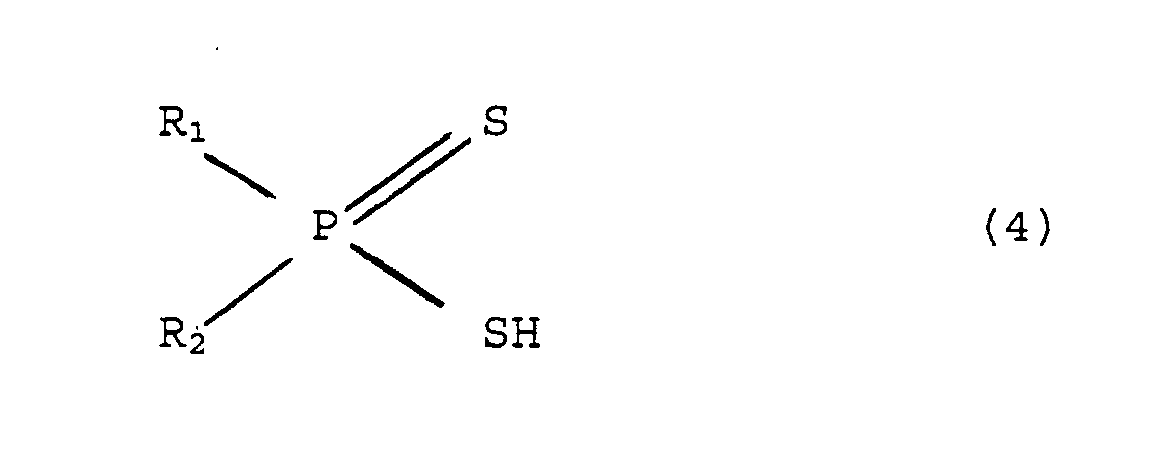
Erfindungegemäß enthält die organische Phase mindestens
einen Synergisten aus der Gruppe bestehend aus Trioctylphosphat
(Formel (5)), Tris-(2-ethylhexyl)-phosphat
(Formel (6)) und Tris-(2-propylpentyl)-phosphat (Formel
(7)).


Mit der Zugabe der erfindungsgemäßen Synergisten wird eine erhebliche Zunahme des Trennfaktors α bewirkt. Die Selektivität bei der Abtrennung der Actinide von den Lanthaniden wird erheblich gesteigert.With the addition of the synergists according to the invention causes a significant increase in the separation factor α. The Selectivity in the separation of the actinides from the Lanthanides are increased significantly.
Das organische Lösungmittel ist vorteilhafterweise ein eine aromatische Komponente, wie Benzol, enthaltendes Lösungsmittel oder ein rein aromatisches Lösungsmittel. In einer besondes vorteilhaften Ausgestaltung der Erfindung wird als Lösungsmittel mindestens eine Komponente aus der Gruppe von Toluol, Xylol, tert.-Butylbenzol, sowie bis- oder tris- (tert.-Butyl)-benzol, Isopropylbenzol, bis- oder tris- (Isopropyl)-benzol eingesetzt. Der Einsatz dieser Lösungsmittel führt zu zwei zusätzlichen positiven Effekten: Zum Einen wird die Selektivität der An3+ Extraktion weiterhin gesteigert, zum Anderen wird der Verteilungskoeffizient DAn(III) zusätzlich verbessert.The organic solvent is advantageously a solvent containing an aromatic component such as benzene or a purely aromatic solvent. In a particularly advantageous embodiment of the invention, at least one component from the group of toluene, xylene, tert-butylbenzene, and bis- or tris (tert-butyl) -benzene, isopropylbenzene, bis- or tris- (isopropyl ) -benzene used. The use of these solvents leads to two additional positive effects: On the one hand, the selectivity of the An 3+ extraction is further increased, on the other hand, the distribution coefficient D An (III) is additionally improved.
Die Reihenfolge der Wirksamkeit für den Trennfaktor α
und den Verteilungskoeffizient verhalten sich wie
folgt:
Benzol < Toluol < Xylol < tert.-Butylbenzol < Bis(isopropyl)-benzol,
Tri-isopropylbenzol, Bis-(tert.-Butyl)-benzol,
Tris-(tert.-Butyl)-benzol.The order of effectiveness for the separation factor α and the distribution coefficient are as follows:
Benzene <toluene <xylene <tert-butylbenzene <bis (isopropyl) benzene, tri-isopropylbenzene, bis (tert-butyl) benzene, tris (tert-butyl) benzene.
Im Folgenden sind einige Ausführungsbeispiele dargestellt:Some exemplary embodiments are shown below:
In den Tabellen sind Ergebnisse des erfindungsgemäßen Verfahrens zusammengefaßt:In the tables are results of the invention Process summarized:
Es zeigt:
- Tabelle 1:
- Den Einfluß von erfindungsgemäßen Synergisten auf die Extraktion.
- Tabelle 2:
- Den Einfluß des Lösungsmittels auf die Extraktion.
- Tabelle 3:
- Die Zusammensetzung von simulierten Actiniden(III)- Lanthaniden (III)- Lösungen aus der Wiederaufarbeitung für Extraktionsuntersuchungen.
- Tabelle 4:
- Selektive Extraktion von Am(III) aus den simulierten Lösungen nach Tabelle 3
- Table 1:
- The influence of synergists according to the invention on the extraction.
- Table 2:
- The influence of the solvent on the extraction.
- Table 3:
- The composition of simulated actinides (III) - lanthanides (III) - solutions from reprocessing for extraction studies.
- Table 4:
- Selective extraction of Am (III) from the simulated solutions according to Table 3
Die Chemikalien Tributylphosphat (Aldrich, 99 %) , TOPO (= Trioctylphosphinoxid; Merck, p.a.quality), Trimethylphosphat (Aldrich, 97 %), Triphenylphosphat (Aldrich, 98 %), Trihexylphosphat (Aldrich, 97 %), Trioctylphosphat (Alfa), Tris(2-ethylhexyl)phosphat (Aldrich, 97 %) wurden wie bezogen eingesetzt. Die Lösungsmittel Toluol, Xylol, ter. Butylbenzol und Triisopropylbenzol besaßen p.a. Qualität. Die gemischten Lanthaniden(III) Lösungen von Ce(III), Eu(III), Gd(III), Nd(III), Pr(III), Sm(III), und Y(III), La (III) wurden durch Einwaage derer Nitratsalze in HNO3 hergestellt. Die von der Firma Blaseg, Isotopendienst bezogenen Tracer Am241 (3,7 MBq in 1 ml 1 M HCl) und Eu152-154 (3,7 MBq in 5 ml 0,5 M HCl) wurden jeweils auf 100 ml mit dest. H2O verdünnt. Ein 1:1 Gemisch beider Lösungen (pH 2) wurde als Stammlösung verwendet.The chemicals tributyl phosphate (Aldrich, 99%), TOPO (= trioctyl phosphine oxide; Merck, paquality), trimethyl phosphate (Aldrich, 97%), triphenyl phosphate (Aldrich, 98%), trihexyl phosphate (Aldrich, 97%), trioctyl phosphate (Alfa), Tris (2-ethylhexyl) phosphate (Aldrich, 97%) was used as supplied. The solvents toluene, xylene, ter. Butylbenzene and triisopropylbenzene were of pa quality. The mixed lanthanide (III) solutions of Ce (III), Eu (III), Gd (III), Nd (III), Pr (III), Sm (III), and Y (III), La (III) were made by Weighing out of their nitrate salts produced in HNO3. The tracers Am 241 (3.7 MBq in 1 ml 1 M HCl) and Eu 152-154 (3.7 MBq in 5 ml 0.5 M HCl) obtained from Blaseg, Isotope Dienst were each made up to 100 ml with dist. H 2 O diluted. A 1: 1 mixture of both solutions (pH 2) was used as the stock solution.
Die aromatischen Dithiophosphinsäuren wurden nach der Methode von W. A. Higgins, P. W. Vogel, W.G. Craig, Journal of the American Chemical Society 77, 1864-1866 (1955) hergestellt. In guten Ausbeuten konnten neben der beschriebenen Synthese von Bisphenyldithiophosphinsäure auch bis(methylphenyl), bis(chlorphenyl) und bis(fluorphenyl)Dithiophosphinsäure hergestellt werden. The aromatic dithiophosphinic acids were prepared by the method of WA Higgins, PW Vogel, WG Craig, Journal of the American Chemical Society 77 , 1864-1866 (1955). In addition to the synthesis of bisphenyldithiophosphinic acid described, bis (methylphenyl), bis (chlorophenyl) and bis (fluorophenyl) dithiophosphinic acid could also be prepared in good yields.
Das Extraktionsmittel wurde durch Lösen eingewogener Mengen an Dithiophosphinsäure und Synergist in einem aromatischen Lösungsmittel hergestellt. Die Extraktionsexperimente wurden in Zentrifugengläser mit Teflon-Stopfen durchgeführt. 2 mL einer salpetersauren wässrigen Lösung, die vorher mit Am-241 und Eu-152 getracert wurde, wurde mit 2 mL Extraktionsmittel intesiv vermischt. Durch Zentrifugieren wurden die Phasen getrennt und anschließend jeweils ein Aliquot von 1 mL der organischen und wässrigen Phase zur Analyse entnommen. Die Konzentrationen der gammaaktiven Nuklide Am-241 und Eu-152 wurden mir Hilfe eines Gammaspektrometers bestimmt. Die Konzentrationen der inaktiven Elemente La, Ce, Pr, Nd, Sm, Eu, Gd und Y wurden mit Hilfe von ICP-MS ermittelt.The extractant was weighed out by dissolving it Amounts of dithiophosphinic acid and synergist in one aromatic solvent. The extraction experiments were in centrifuge tubes with Teflon stoppers carried out. 2 mL of an aqueous nitric acid Solution previously tracked with Am-241 and Eu-152 became intensive with 2 mL extractant mixed. The phases were separated by centrifugation and then an aliquot of 1 mL each taken from the organic and aqueous phase for analysis. The concentrations of the gamma-active nuclides Am-241 and Eu-152 were using a gamma spectrometer certainly. The concentrations of the inactive elements La, Ce, Pr, Nd, Sm, Eu, Gd and Y were created with the help determined by ICP-MS.
Für die in den Tabellen 1 bis 4 angegebenen Daten gelten die folgenden Bedingungen:For the data given in Tables 1 to 4 apply the following conditions:
Der Einfluß des Synergisten auf die Extraktion von Am(III) und Eu(III) mit einem Gemisch von 0,5 mol/L bis(chlorphenyl)Dithiophosphinsäure + 0,25 mol/L Synergist in Toluol aus salpetersaurer Lösung. The influence of the synergist on the extraction of Am (III) and Eu (III) with a mixture of 0.5 mol / L bis (chlorophenyl) dithiophosphinic acid + 0.25 mol / L synergist in toluene from nitric acid solution.
Der Einfluß des Lösungsmittel auf die Extraktion von Am(III) und Eu(III) mit einem Gemisch von 0,5 mol/L bis(chlorphenyl)Dithiophosphinsäure + 0,25 mol/L Trioctylphosphinoxid aus salpetersaurer Lösung.The influence of the solvent on the extraction of Am (III) and Eu (III) with a mixture of 0.5 mol / L bis (chlorophenyl) dithiophosphinic acid + 0.25 mol / L trioctylphosphine oxide from nitric acid solution.
Zusammensetzung von simulierten Actiniden(III)-Lanthaniden(III) Lösungen unterschiedlicher HNO3-Konzentration aus der Wiederaufbereitung von Kernbrennstoffen nach dem PUREX-Process für Extraktionsuntersuchungen.Composition of simulated actinide (III) -lanthanide (III) solutions of different HNO 3 concentrations from the reprocessing of nuclear fuels according to the PUREX process for extraction studies.
Die selektive Extraktion von Am(III) aus simulierten Actiniden(III)-Lanthaniden(III) Lösungen unterschiedlichen HNO3-Konzentrationen mit mit einem Gemisch von 0,5 mol/L bis(chlorophenyl)Dithiophosphinsäure + 0,25 mol/L Trioctylphophinoxid in tert.Butylbenzol.The selective extraction of Am (III) from simulated actinide (III) -lanthanide (III) solutions with different HNO 3 concentrations with a mixture of 0.5 mol / L bis (chlorophenyl) dithiophosphinic acid + 0.25 mol / L trioctylphophine oxide in tert.Butylbenzol.
Das erfindungsgemäße Verfahren und das Extraktionsmittel
ermöglichen eine hochwirksame Abtrennung der dreiwertigen
radioaktiven Actiniden von den dreiwertigen
Lanthaniden, die insbesondere bei Radioaktiven Reaktorabfällen
erwünscht ist.
Claims (8)
- A method of separating trivalent actinides from at least one trivalent lanthanide element and/or lanthanum and/or yttrium which are present in aqueous solution at an H+ concentration of 0.01 mol/l to 2 mol/l, wherein extraction of the trivalent actinide is effected by means of a bis(aryl)dithiophosphinic acid of general formula (4)
 wherein R1 and R2 can be substituted with at least one component from the group comprising methyl, ethyl, propyl, isopropyl, cyano, nitro and halogenyl, in an organic solvent or solvent mixture with the addition of a synergist,where R1 = phenyl or naphthyl,R2 = phenyl or naphthyl,
characterised in that
at least one component from the group comprising trioctyl phosphate, tris-(2-propylpentyl) phosphate or tris-(2-ethylhexyl) phosphate is used as a synergist. - A method according to claim 1,
characterised in that
an aromatic compound is used as an organic solvent. - A method according to claim 2,
characterised in that
at least one component from the group comprising toluene, xylene, tert.-butylbenzene, bis-(tert.-butyl)benzene, tris-(tert.-butyl)benzene, isopropylbenzene, bis-(isopropyl)-benzene and tris-(isopropyl)benzene is used as an aromatic solvent. - A method according to any one of claims 1 to 3,
characterised in that
the trivalent actinides americium3+ and/or curium3+ are separated. - A method according to any one of claims 1 to 4,
characterised in that
at least one component of the trivalent actinides and lanthanides which are present in the aqueous phase is radioactive. - An extractant,
characterised in that
it contains at least one component comprising a bis(aryl)dithiophosphinic acid of general formula (4) wherein R1 and R2 can be substituted with at least one component from the group comprising methyl, ethyl, propyl, isopropyl, cyano, nitro and halogenyl, and also contains, as a synergist in an organic solvent, at least one component from the group comprising trioctyl phosphate, tris-(2-propylpentyl) phosphate or tris-(2-ethylhexyl) phosphate.where R1 = phenyl or naphthyl,R2 = phenyl or naphthyl,
 - An extractant according to claim 6,
characterised in that
the organic solvent is an aromatic compound. - An extractant according to claim 7,
characterised in that
the aromatic solvent is at least one component from the group comprising toluene, xylene, (tert.-butyl)benzene, bis-(tert.-butyl)benzene, tris-(tert.-butyl)benzene, isopropylbenzene, bis-(isopropyl)benzene and tris-(isopropyl)-benzene.
Applications Claiming Priority (5)
| Application Number | Priority Date | Filing Date | Title |
|---|---|---|---|
| US931894 | 1997-09-17 | ||
| US08/931,894 US5966584A (en) | 1997-09-17 | 1997-09-17 | Method of separating trivalent actinides from trivalent lanthanides |
| DE19834152A DE19834152A1 (en) | 1997-09-17 | 1998-07-29 | Separating trivalent actinide elements from lanthanides |
| DE19834152 | 1998-07-29 | ||
| PCT/DE1998/002815 WO1999014386A1 (en) | 1997-09-17 | 1998-09-15 | Method for separating trivalent actinides from at least one trivalent lanthanide by means of (bis)aryldithiophosphonic acid as organophosphate as synergist |
Publications (2)
| Publication Number | Publication Date |
|---|---|
| EP1019552A1 EP1019552A1 (en) | 2000-07-19 |
| EP1019552B1 true EP1019552B1 (en) | 2002-04-03 |
Family
ID=26047768
Family Applications (1)
| Application Number | Title | Priority Date | Filing Date |
|---|---|---|---|
| EP98955342A Expired - Lifetime EP1019552B1 (en) | 1997-09-17 | 1998-09-15 | Method for separating trivalent actinides from at least one trivalent lanthanide by means of (bis)aryldithiophosphonic acid as organophosphate as synergist |
Country Status (5)
| Country | Link |
|---|---|
| EP (1) | EP1019552B1 (en) |
| JP (1) | JP4315591B2 (en) |
| DE (1) | DE59803657D1 (en) |
| EA (1) | EA002721B1 (en) |
| WO (1) | WO1999014386A1 (en) |
Families Citing this family (2)
| Publication number | Priority date | Publication date | Assignee | Title |
|---|---|---|---|---|
| DE10339328A1 (en) * | 2003-08-25 | 2005-03-24 | Forschungszentrum Jülich GmbH | Method for separating trivalent americium from trivalent curium |
| CN114525419B (en) * | 2022-01-04 | 2024-05-14 | 中国原子能科学研究院 | Method for separating trivalent americium curium from alkyl dithiophosphonic acid and nitrogenous reagent |
Citations (1)
| Publication number | Priority date | Publication date | Assignee | Title |
|---|---|---|---|---|
| US4867951A (en) * | 1988-03-31 | 1989-09-19 | The United States Of America As Represented By The United States Department Of Energy | Separation of actinides from lanthanides |
Family Cites Families (2)
| Publication number | Priority date | Publication date | Assignee | Title |
|---|---|---|---|---|
| FR2562059B1 (en) * | 1984-04-02 | 1989-12-01 | Rhone Poulenc Spec Chim | PROCESS FOR SEPARATING RARE EARTH BY LIQUID-LIQUID EXTRACTION |
| US4721605A (en) * | 1985-07-24 | 1988-01-26 | American Cyanamid Company | Selective removal of metals from aqueous solutions with dithiophosphinic acids |
-
1998
- 1998-09-15 EA EA200000293A patent/EA002721B1/en not_active IP Right Cessation
- 1998-09-15 EP EP98955342A patent/EP1019552B1/en not_active Expired - Lifetime
- 1998-09-15 DE DE59803657T patent/DE59803657D1/en not_active Expired - Lifetime
- 1998-09-15 JP JP2000511923A patent/JP4315591B2/en not_active Expired - Fee Related
- 1998-09-15 WO PCT/DE1998/002815 patent/WO1999014386A1/en not_active Ceased
Patent Citations (1)
| Publication number | Priority date | Publication date | Assignee | Title |
|---|---|---|---|---|
| US4867951A (en) * | 1988-03-31 | 1989-09-19 | The United States Of America As Represented By The United States Department Of Energy | Separation of actinides from lanthanides |
Also Published As
| Publication number | Publication date |
|---|---|
| EA002721B1 (en) | 2002-08-29 |
| JP2001516809A (en) | 2001-10-02 |
| JP4315591B2 (en) | 2009-08-19 |
| DE59803657D1 (en) | 2002-05-08 |
| EP1019552A1 (en) | 2000-07-19 |
| EA200000293A1 (en) | 2000-10-30 |
| WO1999014386A1 (en) | 1999-03-25 |
Similar Documents
| Publication | Publication Date | Title |
|---|---|---|
| DE2210106C2 (en) | Process for the selective extraction of metal ions from aqueous solutions | |
| DE69804321T2 (en) | SEPARATION OF ACTINOIDS AND LANTHANOIDS BY LIQUID-LIQUID EXTRACTION BY MEANS OF CALIXARENE COMPOUNDS | |
| DE3219660A1 (en) | METHOD FOR SOLVENT EXTRACTION OF METALS | |
| DE2449589C2 (en) | Process for the removal of decomposition products from extraction agents used for the reprocessing of spent nuclear fuel and / or breeding material | |
| EP1793387B1 (en) | Extraction of radionuclides using extractants containing crown ethers | |
| DE2929952C2 (en) | ||
| EP1664359B1 (en) | Method for separating trivalent americium from trivalent curium | |
| DE3872013T2 (en) | METHOD FOR EXTRACTING LIQUID-LIQUID FROM RARE EARTH. | |
| DE2312152C2 (en) | Process for the extraction of molybdenum and / or rhenium | |
| DE2050632A1 (en) | Process for cleaning, separating and recovering metals from solutions | |
| DE19834152A1 (en) | Separating trivalent actinide elements from lanthanides | |
| DE3784647T2 (en) | METHOD FOR SEPARATING TECHNETIUM THAT IS IN AN ORGANIC SOLUTION WITH ZIRCON AND AT LEAST ONE OTHER METAL, SUCH AS URANIUM OR PLUTONIUM, APPLICABLE IN PARTICULAR FOR THE REPROCESSING OF IRRADIATED OIL BURNERS. | |
| RU2106030C1 (en) | Method for extracting and separating high-melting and rare-earth elements from nitric solutions | |
| EP0073262A1 (en) | Process for separating cesium ions from aqueous solutions by using an addition compound consisting of a macrocyclic polyether and an inorganic heteropolyacid | |
| DE3346405C2 (en) | ||
| EP0170795B1 (en) | Method for recovering uranium values in an extractive reprocessing process for irradiated nuclear-fuel materials | |
| DE2363537A1 (en) | METHOD FOR SELECTIVE BACK EXTRACTION OF PLUTONIUM FROM ORGANIC SOLVENTS | |
| DE2633115A1 (en) | PROCESS FOR SEPARATION OF RARE EARTH | |
| DE1188061B (en) | Process for the separation of europium from other lanthanides and / or from actinides | |
| EP0170796A2 (en) | Process for separating great amounts of uranium from small amounts of fission products which are present in aqueous basic solutions containing carbonate | |
| EP1019552A1 (en) | Method for separating trivalent actinides from at least one trivalent lanthanide by means of (bis)aryldithiophosphonic acid as organophosphate as synergist | |
| US6312654B1 (en) | Method of separating a trivalent actinide from a trivalent lanthanide and/or yttrium in aqueous solution | |
| DE19810895C1 (en) | Process for separating the transpultonides from the split lanthanides by selective extraction | |
| DE2101690A1 (en) | Process for obtaining yttrium compounds or metallic yttrium | |
| DE1244139B (en) | Process for the separation of elements of the actinide and lanthanide groups |
Legal Events
| Date | Code | Title | Description |
|---|---|---|---|
| PUAI | Public reference made under article 153(3) epc to a published international application that has entered the european phase |
Free format text: ORIGINAL CODE: 0009012 |
|
| 17P | Request for examination filed |
Effective date: 20000315 |
|
| AK | Designated contracting states |
Kind code of ref document: A1 Designated state(s): DE FR GB |
|
| 17Q | First examination report despatched |
Effective date: 20001030 |
|
| GRAG | Despatch of communication of intention to grant |
Free format text: ORIGINAL CODE: EPIDOS AGRA |
|
| GRAG | Despatch of communication of intention to grant |
Free format text: ORIGINAL CODE: EPIDOS AGRA |
|
| GRAG | Despatch of communication of intention to grant |
Free format text: ORIGINAL CODE: EPIDOS AGRA |
|
| GRAH | Despatch of communication of intention to grant a patent |
Free format text: ORIGINAL CODE: EPIDOS IGRA |
|
| GRAH | Despatch of communication of intention to grant a patent |
Free format text: ORIGINAL CODE: EPIDOS IGRA |
|
| REG | Reference to a national code |
Ref country code: GB Ref legal event code: IF02 |
|
| GRAA | (expected) grant |
Free format text: ORIGINAL CODE: 0009210 |
|
| AK | Designated contracting states |
Kind code of ref document: B1 Designated state(s): DE FR GB |
|
| REF | Corresponds to: |
Ref document number: 59803657 Country of ref document: DE Date of ref document: 20020508 |
|
| RAP2 | Party data changed (patent owner data changed or rights of a patent transferred) |
Owner name: FORSCHUNGSZENTRUM JUELICH GMBH |
|
| GBT | Gb: translation of ep patent filed (gb section 77(6)(a)/1977) |
Effective date: 20020703 |
|
| PLBE | No opposition filed within time limit |
Free format text: ORIGINAL CODE: 0009261 |
|
| STAA | Information on the status of an ep patent application or granted ep patent |
Free format text: STATUS: NO OPPOSITION FILED WITHIN TIME LIMIT |
|
| 26N | No opposition filed |
Effective date: 20030106 |
|
| PGFP | Annual fee paid to national office [announced via postgrant information from national office to epo] |
Ref country code: DE Payment date: 20110816 Year of fee payment: 14 Ref country code: FR Payment date: 20111005 Year of fee payment: 14 Ref country code: GB Payment date: 20110923 Year of fee payment: 14 |
|
| GBPC | Gb: european patent ceased through non-payment of renewal fee |
Effective date: 20120915 |
|
| REG | Reference to a national code |
Ref country code: FR Ref legal event code: ST Effective date: 20130531 |
|
| PG25 | Lapsed in a contracting state [announced via postgrant information from national office to epo] |
Ref country code: DE Free format text: LAPSE BECAUSE OF NON-PAYMENT OF DUE FEES Effective date: 20130403 Ref country code: GB Free format text: LAPSE BECAUSE OF NON-PAYMENT OF DUE FEES Effective date: 20120915 |
|
| PG25 | Lapsed in a contracting state [announced via postgrant information from national office to epo] |
Ref country code: FR Free format text: LAPSE BECAUSE OF NON-PAYMENT OF DUE FEES Effective date: 20121001 |
|
| REG | Reference to a national code |
Ref country code: DE Ref legal event code: R119 Ref document number: 59803657 Country of ref document: DE Effective date: 20130403 |