EP1013761A2 - Humanized chimeric antibody directed against ganglioside GD3 - Google Patents
Humanized chimeric antibody directed against ganglioside GD3 Download PDFInfo
- Publication number
- EP1013761A2 EP1013761A2 EP99124345A EP99124345A EP1013761A2 EP 1013761 A2 EP1013761 A2 EP 1013761A2 EP 99124345 A EP99124345 A EP 99124345A EP 99124345 A EP99124345 A EP 99124345A EP 1013761 A2 EP1013761 A2 EP 1013761A2
- Authority
- EP
- European Patent Office
- Prior art keywords
- antibody
- dna
- plasmid
- ganglioside
- variable region
- Prior art date
- Legal status (The legal status is an assumption and is not a legal conclusion. Google has not performed a legal analysis and makes no representation as to the accuracy of the status listed.)
- Granted
Links
- 0 C1*NCC/C=C/C1 Chemical compound C1*NCC/C=C/C1 0.000 description 3
Images


Classifications
-
- C—CHEMISTRY; METALLURGY
- C07—ORGANIC CHEMISTRY
- C07K—PEPTIDES
- C07K16/00—Immunoglobulins [IG], e.g. monoclonal or polyclonal antibodies
- C07K16/18—Immunoglobulins [IG], e.g. monoclonal or polyclonal antibodies against material from animals or humans
- C07K16/28—Immunoglobulins [IG], e.g. monoclonal or polyclonal antibodies against material from animals or humans against receptors, cell surface antigens or cell surface determinants
- C07K16/30—Immunoglobulins [IG], e.g. monoclonal or polyclonal antibodies against material from animals or humans against receptors, cell surface antigens or cell surface determinants from tumour cells
- C07K16/3076—Immunoglobulins [IG], e.g. monoclonal or polyclonal antibodies against material from animals or humans against receptors, cell surface antigens or cell surface determinants from tumour cells against structure-related tumour-associated moieties
- C07K16/3084—Immunoglobulins [IG], e.g. monoclonal or polyclonal antibodies against material from animals or humans against receptors, cell surface antigens or cell surface determinants from tumour cells against structure-related tumour-associated moieties against tumour-associated gangliosides
-
- A—HUMAN NECESSITIES
- A61—MEDICAL OR VETERINARY SCIENCE; HYGIENE
- A61P—SPECIFIC THERAPEUTIC ACTIVITY OF CHEMICAL COMPOUNDS OR MEDICINAL PREPARATIONS
- A61P35/00—Antineoplastic agents
-
- C—CHEMISTRY; METALLURGY
- C07—ORGANIC CHEMISTRY
- C07K—PEPTIDES
- C07K16/00—Immunoglobulins [IG], e.g. monoclonal or polyclonal antibodies
- C07K16/18—Immunoglobulins [IG], e.g. monoclonal or polyclonal antibodies against material from animals or humans
-
- C—CHEMISTRY; METALLURGY
- C07—ORGANIC CHEMISTRY
- C07K—PEPTIDES
- C07K16/00—Immunoglobulins [IG], e.g. monoclonal or polyclonal antibodies
- C07K16/46—Hybrid immunoglobulins
- C07K16/461—Igs containing Ig-regions, -domains or -residues form different species
- C07K16/462—Igs containing a variable region (Fv) from one specie and a constant region (Fc) from another
-
- A—HUMAN NECESSITIES
- A61—MEDICAL OR VETERINARY SCIENCE; HYGIENE
- A61K—PREPARATIONS FOR MEDICAL, DENTAL OR TOILETRY PURPOSES
- A61K39/00—Medicinal preparations containing antigens or antibodies
- A61K2039/505—Medicinal preparations containing antigens or antibodies comprising antibodies
-
- A—HUMAN NECESSITIES
- A61—MEDICAL OR VETERINARY SCIENCE; HYGIENE
- A61K—PREPARATIONS FOR MEDICAL, DENTAL OR TOILETRY PURPOSES
- A61K38/00—Medicinal preparations containing peptides
-
- C—CHEMISTRY; METALLURGY
- C07—ORGANIC CHEMISTRY
- C07K—PEPTIDES
- C07K2317/00—Immunoglobulins specific features
- C07K2317/20—Immunoglobulins specific features characterized by taxonomic origin
- C07K2317/24—Immunoglobulins specific features characterized by taxonomic origin containing regions, domains or residues from different species, e.g. chimeric, humanized or veneered
-
- C—CHEMISTRY; METALLURGY
- C07—ORGANIC CHEMISTRY
- C07K—PEPTIDES
- C07K2317/00—Immunoglobulins specific features
- C07K2317/70—Immunoglobulins specific features characterized by effect upon binding to a cell or to an antigen
- C07K2317/73—Inducing cell death, e.g. apoptosis, necrosis or inhibition of cell proliferation
- C07K2317/732—Antibody-dependent cellular cytotoxicity [ADCC]
-
- C—CHEMISTRY; METALLURGY
- C07—ORGANIC CHEMISTRY
- C07K—PEPTIDES
- C07K2317/00—Immunoglobulins specific features
- C07K2317/70—Immunoglobulins specific features characterized by effect upon binding to a cell or to an antigen
- C07K2317/73—Inducing cell death, e.g. apoptosis, necrosis or inhibition of cell proliferation
- C07K2317/734—Complement-dependent cytotoxicity [CDC]
-
- C—CHEMISTRY; METALLURGY
- C07—ORGANIC CHEMISTRY
- C07K—PEPTIDES
- C07K2319/00—Fusion polypeptide
-
- C—CHEMISTRY; METALLURGY
- C07—ORGANIC CHEMISTRY
- C07K—PEPTIDES
- C07K2319/00—Fusion polypeptide
- C07K2319/01—Fusion polypeptide containing a localisation/targetting motif
- C07K2319/02—Fusion polypeptide containing a localisation/targetting motif containing a signal sequence
Definitions
- This invention relates to humanized chimera antibody to ganglioside GD 3 .
- humanized chimera antibody does not cause formation of anti-mouse immunoglobulin antibody in the body of a patient.
- side effects are reduced or eliminated and half life in blood increases when the chimera antibody is used.
- Therapeutic effects which are superior to those obtained in the case of using mouse monoclonal antibody can be obtained in the treatment of human cancers and the like.
- the antitumor activity of mouse monoclonal antibody to ganglioside GD 2 which is effected via human effector cells, is improved when the monoclonal antibody is converted into chimera antibody that has the human antibody Fc region (J. Immunol., 144 , 1382-1386 (1990)).
- Ganglioside is one of the animal cell membrane-constituting glycolipids and is composed of a sugar chain as a hydrophilic side chain, sphingosine as a hydrophobic side chain and fatty acids. It is known that expression of ganglioside varies depending on the type of cells, organs and animal species. In addition, it has been revealed that quantity and quality of the expressed ganglioside change during the canceration process of cells (Cancer Res., 45 , 2405 (1985)).
- gangliosides GD 2 , GD 3 , GM 2 and the like which hardly exist in normal cells were found in the cells of neuroblastoma, lung small cell carcinoma and melanoma belonging to neuroectodermal-origin tumor which is said to be highly malignant (J. Exp. Med., 155 , 1133 (1982); J. Biol. Chem., 257, 12752 (1982); Cancer Res., 47 , 225 (1987); ibid., 47 , 1098 (1987); ibid., 45 , 2642 (1985); Proc. Natl. Acad. Sci. U.S.A., 80 , 5392 (1983)).
- Ganglioside GD 3 has been found most frequently in melanoma cells among the neuroectodermal-origin tumors, and anti-ganglioside GD 3 monoclonal antibodies (to be referred to as "anti-GD 3 monoclonal antibody” hereinafter) belonging to the mouse IgM class and IgG class have been reported (Int. J. Cancer, 29 , 269 (1982); J. Biol. Chem., 257 , 12752 (1982); Cancer Res., 47 , 225 (1987); Acta Neuropathol., 79 , 317 (1989); Proc. Natl. Acad. Sci. U.S.A., 77 , 6114 (1980); J. Exp. Med., 155 , 1133 (1982); Proc. Natl. Acad. Sci. U.S.A., 81 , 5767 (1984)).
- KM-641 (FERM BP-3116) disclosed in EP-A-0 493 686 is an anti-GD 3 monoclonal antibody belonging to the mouse IgG3 class, which reacts not only with ganglioside GD 3 but also with ganglioside 3',8'-LD1 and is possessed of a broad range of antitumor spectrum.
- KM-641 has stronger binding activities to antigens than anti-GD 3 monoclonal antibody R24 which has been disclosed in J. Exp. Med., 155 , 1133 (1982) and it shows strong antitumor activities.
- mouse monoclonal antibody R24 to the ganglioside GD 3 was once used for the treatment of melanoma, but the administered mouse monoclonal antibody R24 did not fully exert its effect due to the formation of anti-mouse immunoglobulin antibody in the patient's body (Eur. J. Cancer Clin. Oncol., 24 , suppl 2, s 65 (1988)).
- chimera antibody for anti-GD 3 monoclonal antibody would be advantageous in that anti-mouse immunoglobulin antibody does not form in the body, side effects are reduced or eliminated, its half life in blood is prolonged and its antitumor effector effect increases, and thus therapeutic effects of the chimera antibody which are superior to those of mouse monoclonal antibody can be obtained in the treatment of human cancers and the like.
- Humanized chimera antibody in which constant regions of the heavy chain (to be referred to as “H chain” hereinafter) and the light chain (to be referred to as “L chain” hereinafter) of mouse monoclonal antibody are converted into human constant regions, is produced in animal cells making use of recombinant DNA techniques.
- Examples of such processes include a process in which humanized chimera antibody is produced using chromosomal DNA as a gene which encodes mouse H chain variable region (to be referred to as “V H “ hereinafter) and L chain variable region (to be referred to as “V L “ hereinafter) (Morrison et al., Proc. Natl. Acad. Sci.
- Liu et al. discloses a process for the expression of humanized chimera antibody in animal cells, which comprises using an expression vector for animal cells having inserted therein a chimera H chain cDNA obtained by linking mouse V H -encoding cDNA with human C H -encoding cDNA and a chimera L chain cDNA obtained by linking mouse V L -encoding cDNA with human C L -encoding cDNA.
- Riechmann et al. have prepared CDR graft antibody by grafting a rat antibody CDR into a human antibody framework and reported that binding activity of the antibody was reduced by the framework conversion and the antibody activity increased when amino acid sequence of the framework was partially changed (Nature, 332 , 323 (1988)). Consequently, there is a possibility that the binding activity of humanized chimera antibody is undesirably reduced when the antibody is produced by the mouse Jk5-aided process disclosed by Liu et al.
- An object of the present invention is to provide humanized chimera antibody to ganglioside GD 3 and a process for the production of such antibody.
- the present invention relates to a process for producing humanized chimera antibody which comprises the steps of:
- the cassette vector to be used in the present invention is a vector which is obtained by inserting a cDNA that encodes a constant region of human antibody into an expression vector for animal cell use, in which a cloning site is located in the upstream region of the constant region for inserting a cDNA that encodes a variable region of nonhuman animal antibody.
- An expression vector for humanized chimera antibody can be constructed easily by inserting a variable region of nonhuman animal antibody into the cloning site of the cassette vector, using a synthetic DNA which comprises a base sequence corresponding to the 5'-end side of a constant region of human antibody and a base sequence corresponding to the 3'-end side of a variable region of nonhuman animal antibody and is possessed of restriction enzyme recognition sites on its both ends.
- the present invention also relates to a humanized chimera antibody obtainable by the above-described process, a pharmaceutical composition comprising the humanized chimera antibody and a pharmaceutically acceptable carrier, and use of said humanized chimera antibody for the manufacture of the medicament for treating cancer.
- the cassette vector to be used in the present invention is constructed by inserting a cDNA which encodes a human antibody constant region into an expression vector for animal cell use.
- Essential components in the expression vector for animal cell use include promoter, enhancer, polyA signal, splicing signal, drug resistance gene as a selection marker (e.g., ampicillin resistance gene, etc.) and the like. Any expression vector for animal cell use may be used for this purpose, as long as it can contain and express the cDNA molecule which encodes a human antibody constant region.
- pAGE107 (Cytotechnology, 3 , 133 (1990)) is useful as such an expression vector.
- Examples of the promoter and enhancer for use in the expression vector for animal cell use include: SV40 early promoter and enhancer (J.
- the immunoglobulin H chain promoter and enhancer can be prepared using appropriate antibody-producing hybridoma cells, such as rat hybridoma KM50 cells which produce anti-human serum albumin antibody as disclosed in JP-A-60-258128 (the term "JP-A" as used herein means an "unexamined published Japanese patent application”).
- JP-A as used herein means an "unexamined published Japanese patent application”
- Each chromosomal DNA is obtained from cultured KM50 cells, and P3X63Ag8U.1 (to be referred to as "P3U1" hereinafter) cells (ATCC CRL1597) which are to be fused with KM50 and rat kidney cells in accordance with the procedure disclosed in Molecular Cloning (2nd. ed., Cold Spring Harbor Laboratory Press, 1989, p9.14).
- P3U1 P3X63Ag8U.1
- ATCC CRL1597 P3X63Ag8U.1 cells
- Plasmid pIg1SE1d4 is an illustrative example of the animal cell expression vector which contains the immunoglobulin H chain promoter and enhancer.
- a cloning site is established in the upstream region of a human constant region of a cassette vector, for inserting a cDNA which encodes a variable region of nonhuman animal antibody.
- a cDNA which encodes a variable region of nonhuman animal antibody, using a synthetic DNA which comprises a base sequence corresponding to the 5'-end side of a constant region of human antibody and a base sequence corresponding to the 3'-end side of a variable region-of nonhuman animal antibody and is possessed of restriction enzyme recognition sites on both of its ends.
- a humanized chimera antibody expression vector is constructed in which the cDNA coding for human antibody constant region and the cDNA coding for the variable region of nonhuman animal antibody are linked together through the synthetic DNA.
- the synthetic DNA to be used may be prepared using a DNA synthesizer, based on the base sequence which corresponds to the 5'-end side of a constant region of human antibody and the base sequence that corresponds to the 3'-end side of a variable region of nonhuman animal antibody.
- Illustrative examples of cloning site-containing cassette vectors include a cassette vector pChiIgHB2 which is used for the construction of an expression vector for the expression of humanized chimera antibody H chain and a cassette vector pChiIgLA2 which is used for the construction of an expression vector for the expression of humanized chimera antibody L chain.
- a cassette vector for use in the construction of an expression vector for the expression of humanized chimera antibody H chain is constructed, for example, by cutting out a human C H -encoding cDNA-containing fragment, from an Apa I site in the vicinity of the 5'-end of the cDNA to its 3'-end, and inserting the fragment into an appropriate expression vector for animal cell use such as plasmid pIg1SE1d4 or the like. Then, a cloning site is established in the thus constructed cassette vector for inserting a cDNA which encodes a V H of nonhuman animal antibody.
- a cDNA fragment encoding a nonhuman animal antibody V H which is obtained by digesting a V H -encoding cDNA with an appropriate restriction enzyme, using a synthetic DNA molecule which comprises a base sequence corresponding to the 5'-end side (5'-end to ApaI site) of a human antibody C H and a base sequence corresponding to the 3'-end side of a nonhuman animal antibody V H and is possessed of restriction enzyme recognition sites on both of its ends.
- a synthetic DNA molecule which comprises a base sequence corresponding to the 5'-end side (5'-end to ApaI site) of a human antibody C H and a base sequence corresponding to the 3'-end side of a nonhuman animal antibody V H and is possessed of restriction enzyme recognition sites on both of its ends.
- a cassette vector for constructing of an expression vector for the expression of humanized chimera antibody L chain may be constructed for example by introducing an Eco RV site into the vicinity of 5'-end side of a human C L -encoding cDNA by means of mutation, cutting out a fragment from the resulting human cDNA from the Eco RV site to the 3'-end and inserting the fragment into an appropriate expression vector such as plasmid pIg1SE1d4 or the like. Then, a cloning site is established in the thus constructed cassette vector for inserting a cDNA which encodes a nonhuman animal antibody V L .
- a cDNA fragment encoding a nonhuman animal antibody V L which is obtained by digesting a V L -encoding cDNA with an appropriate restriction enzyme, using a synthetic DNA which comprises a base sequence corresponding to the 5'-end side (5'-end to Eco RV site) of a human antibody C L and a base sequence corresponding to the 3'-end side of a nonhuman animal antibody V L and is possessed of restriction enzyme recognition sites on both of its ends.
- a synthetic DNA which comprises a base sequence corresponding to the 5'-end side (5'-end to Eco RV site) of a human antibody C L and a base sequence corresponding to the 3'-end side of a nonhuman animal antibody V L and is possessed of restriction enzyme recognition sites on both of its ends.
- cDNAS which encode the human C H and human C L described above are disclosed, for instance, in Cell 22 , 197 (1982).
- Such cDNAs can be prepared from human antibody-producing myeloma cells, humanized monoclonal antibody-producing hybridoma cells, humanized chimera antibody-producing cells (SP2-PC chimera; FEBS Letters, 244 , 301 (1989)) and the like, in accordance with known procedures disclosed for instance in Proc. Natl. Acad. Sci. U.S.A. 82 , 7025 (1985) and ibid., 79 7025 (1985) .
- cDNA is synthesized using mRNA extracted from the above-described cells, in accordance with the procedure disclosed in Molecular Cloning 2nd. ed.; 1989, p8.1.
- a library is prepared from the thus synthesized cDNA using a phage vector or a plasmid vector, in accordance with the procedure disclosed in Molecular Cloning 2nd. ed.; 1989, p8.1, 1.53.
- a recombinant phage or a recombinant plasmid which contains human C H -encoding cDNA or human C L -encoding cDNA is obtained from the thus prepared library using a human antibody constant region or a human antibody variable region as a probe, in accordance with the procedure disclosed in Molecular Cloning 2nd. ed.; 1989, p8.1, 1.53.
- Base sequences of the human C H -encoding cDNA and the human C L -encoding cDNA are determined in accordance with the procedure disclosed in Molecular Cloning, 2nd. ed.; 1989, p13.1.
- Introduction of an appropriate restriction enzyme recognition site into the human C L -encoding cDNA may be effected in accordance with the procedure disclosed in Molecular Cloning, 2nd. ed.; 1989, p15.1.
- cDNAs which encode V H and V L of nonhuman animal antibody, such as mouse anti-GD 3 monoclonal antibody are prepared in the following manner.
- cDNA is synthesized using mRNA extracted from appropriate hybridoma cells which produce mouse anti-GD 3 monoclonal antibody, such as mouse anti-GD 3 monoclonal antibody KM-641 (FERM BP-3116).
- a library is prepared from the thus synthesized cDNA using a phage vector or a plasmid vector.
- a recombinant phage or a recombinant plasmid which contains V H -encoding cDNA or V L -encoding cDNA is obtained from the thus prepared library using a constant region or a variable region of nonhuman antibody, such as mouse antibody, as a probe.
- Base sequences of the V H -encoding cDNA and the V L -encoding cDNA are determined in accordance with the aforementioned procedure.
- an expression vector for use in the expression of humanized chimera antibody H chain is constructed by linking the human antibody C H -encoding cDNA with the nonhuman antibody V H -encoding cDNA through the synthetic DNA.
- a fragment of the V L -encoding cDNA ranging from the 5'-end to an appropriate restriction enzyme site near the 3'-end (to be referred to as "site B" hereinafter), is cut out and inserted into the cloning site of the aforementioned cassette vector, using a synthetic DNA molecule which comprises a base sequence corresponding to the 5'-end side of a human antibody C L and a base sequence corresponding to the 3'-end side (from 3'-end to site B) of a nonhuman animal antibody V L and is possessed of restriction enzyme recognition sites on both of its ends.
- an expression vector for use in the expression of humanized chimera antibody L chain is constructed by linking the human antibody C L -encoding cDNA with the nonhuman antibody V L -
- a transformant which is capable of producing humanized chimera antibody is obtained by transforming appropriate host cells with the thus prepared expression vectors for use in the expression of the H chain and L chain of humanized chimera antibody.
- any type of cells may be used as host cells for use in the introduction of the humanized chimera antibody expression vectors, as long as these cells are capable of expressing the humanized chimera antibody.
- Illustrative examples of such host cells include mouse SP2/0-Ag14 cells (ATCC CRL1581; to be referred to as “SP2/0 cells” hereinafter), mouse P3X63-Ag8.653 (ATCC CRL1580) and CHO cells which are deficient in dihydrofolate reductase gene (to be referred to as "dhfr” hereinafter) (Urlaub et al., Proc. Natl. Acad. Sci. U.S.A., 77 , 4216 (1980)).
- Introduction of the expression vectors for use in the expression of the H chain and L chain of humanized chimera antibody into host cells may be effected for example by the electroporation technique disclosed in JP-A-2-257891.
- a transformant capable of producing the humanized chimera antibody may be selected using RPMI1640 medium supplemented with G418 and fetal calf serum, in accordance with the procedure disclosed in JP-A-2-257891.
- a transformant, KM-871, which produces humanized chimera antibody that reacts with ganglioside GD 3 is an illustrative example of the transformant capable of producing humanized chimera antibody.
- KM-871 has been deposited on August 13, 1991, with Fermentation Research Institute, Agency of Industrial Science and Technology of 1-3, Higashi 1-chome, Tsukuba-shi, Ibaraki, Japan under the Budapest Treaty, and has been assigned the accession number FERM BP-3512.
- any medium can be used as long as the desired antibody can be produced and accumulated in the medium.
- An example of such medium is RPMI-1640 medium supplemented with G418 and fetal calf serum.
- the transformants may be inoculated into 200 ⁇ l to 100 ml of the above-mentioned medium to give a cell concentration of 1 x 10 5 to 1 x 10 7 cells/ml and cultivated at 37°C in a 5% CO 2 incubator for 1 to 7 days.
- the desired chimera antibody is produced and accumulated in the culture medium.
- the humanized chimera antibody thus produced can be purified from supernatant fluid of the aforementioned cultured mixture making use of a protein A column (E. Harlow et al., Manual of Antibody Experiments, Cold Spring Harbor Laboratory Press, 1988).
- Illustrative examples of humanized chimera antibodies obtained in this way include those which react with ganglioside GD 3 , such as humanized chimera antibody KM-871 and the like.
- Reactivity of humanized chimera antibody is measured by ELISA method.
- the molecular weight of the H chain, the L chain or the entire molecule of purified humanized chimera antibody is measured by means of polyacrylamide gel electrophoresis (SDS-PAGE), Western blotting method (E. Harlow et al., Manual of Antibody Experiments, Cold Spring Harbor Laboratory Press, 1988) or the like.
- Binding activity, or avidity, of the humanized chimera antibody to ganglioside GD 3 to a cultured cancer cell line is measured by means of the fluorescent antibody technique, the ELISA method or the like.
- Complement-dependent cytotoxicity (CDC activity) and antibody-dependent cell-mediated cytotoxicity (ADCC activity) of humanized chimera antibody to a cultured cancer cell line are measured in accordance with the procedures disclosed in Menekigaku Jikken Nyumon, (Manual of Immunological Experiments) Matsuhashi et al., Gakkai Shuppan Center, Japan, 1981).
- the humanized chimera antibodies according to the present invention can be used alone as an anticancer agent. They may be formulated into an anticancer composition together with at least one pharmaceutically acceptable carrier. For instance, the humanized chimera antibodies are dissolved in physiological saline, an aqueous solution of glucose, lactose or mannitol and the like.
- the powder of the humanized chimera antibodies for injection can be prepared by lyophilizing the humanized chimera antibodies in accordance with the conventional method and mixing the lyophilized products with sodium chloride.
- the anticancer composition may further contain additives conventionally used well known in the art of medical preparation, for example, pharmaceutically acceptable salts.
- the humanized chimera antibodies according to the present invention can be administered in the form of the above-described anticancer composition to mammals including human in a dose of 0.2 to 20 mg/kg/day.
- the dose may vary depending on the age, condition, etc. of patients.
- the administration of the anticancer composition can be effected by intraveous injection once a day (single administration or consecutive administration) or intermittently one to three times a week or once every two to three weeks.
- the antincancer composition is expected to be useful for treating cancer such as melanoma, neuroblastoma and glioma.
- Chromosomal DNA was prepared in the following manner in accordance with the procedure disclosed in Molecular Cloning, Maniatis et al., 1989, p9.16.
- 1.2 x 10 8 KM50 cells, 2 x 10 8 P3U1 cells (ATCC CRL1597) and 1.6 g of rat kidney were each suspended in 2 ml of a buffer solution (pH 7.5) containing 10 mM Tris-HCl, 150 mM sodium chloride and 10 mM sodium ethylenediaminetetraacetate (to be referred to as "EDTA” hereinafter).
- EDTA sodium ethylenediaminetetraacetate
- the thus treated solution was extracted with the same volume of phenol, chloroform and ether (twice for each) in this order, and the extract was dialyzed for 10 hours against a buffer solution (pH 7.5) containing of 10 mM Tris-HCl and 1 mM EDTA.
- the DNA solution was recovered from the dialysis tube and used as a chromosomal DNA sample.
- a DNA concentration of each sample was determined by measuring the absorbance at 260 nm and, as a result, it was found that 1.6 mg, 1.5 mg and 1.9 mg of chromosomal DNA was obtained from 1.2 x 10 8 KM50 cells, 2 x 10 8 P3U1 cells and 1.6 g of rat kidney, respectively.
- a 3 ⁇ g portion of each of the chromosomal DNA samples obtained in the above step (1) from KM50 cells, P3U1 cells and rat kidney was dissolved in 25 ⁇ l of a buffer solution containing 10 mM Tris-HCl (pH 7.5), 6 mM magnesium chloride and 100 mM sodium chloride.
- a buffer solution containing 10 mM Tris-HCl (pH 7.5), 6 mM magnesium chloride and 100 mM sodium chloride.
- Each of the thus prepared solution was mixed with 15 units of Xba I (Takara Shuzo Co., Ltd.; all restriction enzymes used in the following experiments were purchased from the same company) and incubated at 37°C for 2 hours to cleave the chromosomal DNA at the Xba I site.
- the reaction mixture was subjected to agarose gel electrophoresis, resulting DNA fragments were transferred to a nitrocellulose filter in accordance with the method of Southern et al. (J. Mol. Biol., 98 , 503, (1975)) and then subjected to hybridization in the known method (Kameyama et al., FEBS Letters, 244 , 301-306 (1989)) using a mouse JH probe which is disclosed in the FEBS Letters article.
- a band equivalent to about 9.3 kb was observed only in the DNA sample of KM50 cells. In consequence, it was considered that the Xba I fragment of immunoglobulin DNA found in this band contained the activated immunoglobulin H chain gene derived from KM50 cells.
- a 60 ⁇ g portion of the KM50 cell chromosomal DNA obtained in the above step (1) was dissolved in 250 ⁇ l of a buffer solution containing 10 mM Tris-HCl (pH 7.5), 6 mM magnesium chloride and 100 mM sodium chloride.
- the thus prepared solution was mixed with 150 units of Xba I and incubated at 37°C for 2 hours to cleave the chromosomal DNA at the Iba I site.
- the reaction mixture was subjected to agarose gel electrophoresis and a 9.3 kb-equivalent fraction was recovered as about 2 ⁇ g of 9.3 kb DNA sample of KM50 cells, making use of the DEAE paper method (Maniatis et al ., Molecular Cloning, 1989, p6.24).
- a 3 ⁇ g portion of lambda-ZAP (Stratagene Cloning Systems) to be used as a vector was dissolved in 200 ⁇ l of a buffer solution containing 10 mM Tris-HCl (pH 7.5), 6 mM magnesium chloride and 100 mM sodium chloride.
- the thus prepared solution was mixed with 50 units of Xba I and incubated at 37°C for 2 hours to cleave the DNA at the Xba I site.
- the resulting reaction mixture was extracted with phenol-chloroform and then treated with ethanol to precipitate and recover about 3 ⁇ g of DNA.
- the thus recovered DNA sample was dissolved in a 100 ⁇ l of 100 mM Tris-HCl buffer (pH 7.5), and the resulting solution was mixed with 1 unit of alkaline phosphatase (Takara Shuzo Co., Ltd.) to effect dephosphorylation of restriction enzyme cleavage ends of the vector DNA.
- the resulting reaction mixture was extracted with phenol-chloroform and then treated with ethanol to precipitate and recover 2 ⁇ g of DNA.
- the thus recovered DNA sample was dissolved in 10 ⁇ l of a buffer solution containing 10 mM Tris-HCl (pH 7.5) and 1 mM EDTA to serve as a vector DNA sample.
- 0.2 ⁇ g of the thus prepared vector DNA sample and 0.2 ⁇ g of the KM50 cell-derived 9.3 kb DNA sample were dissolved in 5 ⁇ l of a buffer solution containing 66 mM Tris-HCl (pH 7.5), 6.6 mM magnesium chloride, 10 mM dithiothreitol (to be referred to as “DTT” hereinafter) and 0.1 mM adenosine triphosphate (to be referred to as "ATP” hereinafter)(to be referred to as "T4 ligase buffer” hereinafter).
- the resulting solution was mixed with 175 units of T4 DNA ligase (Takara Shuzo Co., Ltd.) and incubated at 4°C for 3 days.
- a 2 ⁇ l portion of the resulting reaction mixture was subjected to lambda phage packaging in the known method (Maniatis et al., Molecular Cloning, 1989, p2.95) using GigaPack Gold purchased from Stratagene Cloning Systems.
- E. coli BB4 cells were infected with this phage to obtain 200,000 phage clones. 100,000 out of these phage clones were fixed on nitrocellulose filters in the known method (Maniatis et al., Molecular Cloning, 1989, p2.112).
- Restriction enzyme cleavage maps of the two clones obtained in the above step (4) was prepared by digesting them with various restriction enzymes and it was found that completely the same DNA fragment (9.3 kb) has been inserted into these clones (Fig. 1).
- base sequence of a part of the 9.3 kb DNA fragment, which was considered to contain the promoter and variable regions of the rat immunoglobulin H chain was determined in accordance with the Sanger method (Sanger et al., Proc. Natl. Acad. Sci. U.S.A., 74 , 5463 (1977); M13 Cloning and Sequencing Handbook, Amersham).
- SEQ ID NO: 1 a region containing octamer sequences such as ATGCAAAT and TATA box sequences such as TTGAAAA and the like can be regarded as the immunoglobulin promoter region.
- a 1 ⁇ g portion of the 9.3 kb fragment of the immunoglobulin H chain variable region gene obtained in 1-(5) was dissolved in 30 ⁇ l of a buffer solution containing 10 mM Tris-HCl (pH 7.5), 6 mM magnesium chloride and 100 mM sodium chloride.
- the thus prepared solution was mixed with 10 units of Bgl II and 10 units of Hin dIII and incubated at 37°C for 2 hours to cleave the DNA fragment at the Bgl II and Hin dIII sites.
- the resulting reaction mixture was subjected to agarose gel electrophoresis and 0.01 ⁇ g of a DNA fragment containing 0.8 kb immunoglobulin promoter was recovered.
- a 1 ⁇ g portion of a plasmid pBR322- Bgl II (Kuwana et al., FEBS Letters, 219 , 360 (1987)) was dissolved in 30 ⁇ l of a buffer solution containing 10 mM Tris-HCl (pH 7.5), 6 mM magnesium chloride and 100 mM sodium chloride.
- the thus prepared solution was mixed with 10 units of Bgl II and 10 units of Hin dIII and incubated at 37°C for 2 hours to cleave the plasmid at the Bgl II and Hin dIII sites.
- the resulting reaction mixture was subjected to agarose gel electrophoresis, a DNA fragment of about 4.2 kb was recovered.
- the plasmid pKMB11 constructed in the above step (1) was digested with nuclease BAL31 from the Nco I Bite.
- a 10 ⁇ g portion of the plasmid pKMB11 was dissolved in 100 ⁇ l of a buffer solution containing 10 mM Tris-HCl (pH 7.5), 6 mM magnesium chloride and 50 mM potassium chloride.
- the thus prepared solution was mixed with 30 units of Nco I and incubated at 37°C for 2 hours to cleave the plasmid at the Nco I site.
- the resulting reaction mixture was extracted with phenol and chloroform and treated with ethanol.
- the thus precipitated DNA fragments were dissolved in 100 ⁇ l of BAL31 buffer which contained 20 mM Tris-HCl (pH 8.0), 600 mM sodium chloride, 12 mM calcium chloride, 12 mM magnesium chloride and 1 mM EDTA, and the resulting solution was mixed with 0.25 unit of BAL31 (Bethesda Research Laboratories, Inc. (BRL)) and incubated at 37°C for 5 seconds. The reaction was stopped by extracting the reaction mixture with phenol. After extraction with chloroform and precipitation with ethanol, 1 ⁇ g of DNA was recovered.
- BAL31 buffer contained 20 mM Tris-HCl (pH 8.0), 600 mM sodium chloride, 12 mM calcium chloride, 12 mM magnesium chloride and 1 mM EDTA
- BAL31 Bethesda Research Laboratories, Inc.
- the base sequence of the BAL31-digested portion of this plasmid was determined in accordance with the Sanger method and it was found that bases up to the third base (the 303 position base in the SEQ ID NO: 1) upstream from the initiation codon ATG of the immunoglobulin gene.
- a 1 ⁇ g portion of the 9.3 kb fragment of the immunoglobulin H chain variable region gene obtained in 1-(5) was dissolved in 30 ⁇ l of a buffer solution containing 10 mM Tris-HCl (pH 7.5), 6 mM magnesium chloride and 100 mM sodium chloride.
- the thus prepared solution was mixed with 10 units of Eco RV and 10 units of Xba I and incubated at 37°C for 2 hours to cleave the DNA fragment at the Eco RV and Xba I sites.
- the resulting reaction mixture was subjected to agarose gel electrophoresis and 0.1 ⁇ g of a DNA fragment of about 1 kb containing the immunoglobulin enhancer region was recovered.
- a 1 ⁇ g portion of the plasmid pKMD6 obtained in the above step (2) was dissolved in 100 ⁇ l of a buffer solution containing 10 mM Tris-HCl (pH 7.5), 6 mM magnesium chloride and 100 mM sodium chloride.
- the thus prepared solution was mixed with 10 units of Bgl II and incubated at 37°C for 2 hours to cleave the plasmid at the Bgl II site.
- the resulting reaction mixture was extracted with phenol and chloroform and precipitated with ethanol.
- the thus precipitated DNA fragments were dissolved in 40 ⁇ l of DNA polymerase I buffer containing 50 mM Tris-HCl (pH 7.5), 10 mM magnesium chloride, 0.1 mM dATP (deoxyadenosine triphosphate), 0.1 mM dCTP (deoxycytidine triphosphate), 0.1 mM dGTP (deoxyguanosine triphosphate) and 0.1 mM dTTP (deoxythymidine triphosphate).
- the resulting solution was mixed with 6 units of E. coli DNA polymerase I Klenow fragment and incubated at 16°C for 90 minutes to convert the cohesive 5'-end formed by the Bgl II digestion into blunt end.
- the reaction was stopped by extracting the reaction mixture with phenol. After extraction with chloroform and precipitation with ethanol, the resulting DNA fragments were dissolved in 30 ⁇ l of a buffer solution containing 10 mM Tris-HCl (pH 7.5), 6 mM magnesium chloride and 50 mM sodium chloride. The thus prepared solution was mixed with 10 units of Hin dIII and incubated at 37°C for 2 hours to cleave the DNA fragment at the Hin dIII site. The resulting reaction mixture was subjected to agarose gel electrophoresis, 0.1 ⁇ g of a DNA fragment of about 0.8 kb containing the immunoglobulin promoter region was recovered.
- plasmid pUC18 (Messing, Methods in Enzymology, 101 , 20 (1983)) was dissolved in 30 ⁇ l of a buffer solution containing 10 mM Tris-HCl (pH 7.5), 6 mM magnesium chloride and 100 mM sodium chloride.
- the thus prepared solution was mixed with 10 units of Hin dIII and 10 units of Xba I and incubated at 37°C for 2 hours to cleave the plasmid at the Hin dIII and xba I sites.
- the resulting reaction mixture was subjected to agarose gel electrophoresis, 0.1 ⁇ g of a DNA fragment of about 2.7 kb was recovered.
- a 0.1 ⁇ g portion of the thus obtained pKMD6-derived 0.8 kb DNA fragment, 0.02 ⁇ g of the DNA fragment containing the immunoglobulin enhancer region and 0.1 ⁇ g of the pUC18 fragment were dissolved in 20 ⁇ l of the T4 ligase buffer, and the resulting solution was mixed with 175 units of T4 DNA ligase and incubated at 4°C for 24 hours. Using the resulting reaction mixture, transformation of E. coli HB101 was carried out to isolate an ApR colony. Plasmid DNA was recovered from the colony to obtain pEPKMA1 as shown in Fig. 4.
- a 1 ⁇ g portion of the plasmid pEPKMA1 was dissolved in 100 ⁇ l of a buffer solution containing 10 mM Tris-HCl (pH 7.5), 6 mM magnesium chloride and 100 mM sodium chloride.
- the thus prepared solution was mixed with 10 units of Xba I and incubated at 37°C for 2 hours to cleave the plasmid at the Xba I site.
- the resulting reaction mixture was extracted with phenol and chloroform and precipitated with ethanol.
- the thus precipitated DNA fragments were dissolved in 40 ⁇ l of the aforemetioned DNA polymerase I buffer solution, and the resulting solution was mixed with 6 units of E.
- SV40 early gene promoter and enhancer regions (to be referred to as "P SE " hereinafter) of an expression vector pAGE107 for use in the expression of heterologous genes in animal cells (Miyaji et al., Cytotechnology, 3 , 133 - 140 (1990)) were converted into KM50-derived immunoglobulin H chain promoter and enhancer (to be referred to as “P IH " hereinafter) of pEPKMB1 in the following manner.
- a 1 ⁇ g portion of the plasmid pAGE107 was dissolved in 30 ⁇ l of a buffer solution containing 10 mM Tris-HCl (pH 7.5), 6 mM magnesium chloride and 150 mM sodium chloride.
- the thus prepared solution was mixed with 10 units of Sal I and 10 units of Xho I and incubated at 37°C for 2 hours to cleave the plasmid at the Sal I and Xho I sites.
- the resulting reaction mixture was subjected to agarose gel electrophoresis and 0.5 ⁇ g of a DNA fragment of about 5.95 kb containing G418 resistance gene was recovered.
- a 1 ⁇ g portion of the plasmid pEPKMB1 was dissolved in 30 ⁇ l of a buffer solution containing 10 mM Tris-HCl (pH 7.5), 6 mM magnesium chloride and 150 mM sodium chloride.
- the thus prepared solution was mixed with 10 units of Sal I and 10 units of Xho I and incubated at 37°C for 2 hours to cleave the plasmid at the Sal I and Xho I sites.
- the resulting reaction mixture was subjected to agarose gel electrophoresis and 0.1 ⁇ g of a DNA fragment of about 1.7 kb containing immunoglobulin promoter and enhancer regions was recovered.
- a 2 ⁇ g portion of the expression vector pAGE106 for use in the expression of heterologous genes in animal cells was dissolved in 100 ⁇ l of a buffer solution containing 10 mM Tris-HCl (pH 7.5), 6 mM magnesium chloride and 50 mM sodium chloride.
- the thus prepared solution was mixed with 10 units of Eco RI and 10 units of Sac I and incubated at 37°C for 4 hours.
- the resulting reaction mixture was subjected to agarose gel electrophoresis and about 1.5 ⁇ g of a pAGE106 DNA fragment (4.3 kb) was recovered which contained the SV40 early gene promoter and G418 resistance gene cleaved with Eco RI and Sac I.
- the thus recovered DNA fragment was dissolved in 40 ⁇ l of the DNA polymerase I buffer solution, and the resulting solution was mixed with 5 units of E. coli DNA polymerase I large fragment and incubated at 16°C for 2 hours to convert the cohesive 3'-end formed by the Sac I digestion and the cohesive 5'-end formed by the Eco RI digestion into blunt ends.
- the resulting reaction mixture was extracted with phenol and chloroform and then treated with ethanol.
- the thus precipitated sample was dissolved in 20 ⁇ l of the T4 ligase buffer, and the resulting solution was mixed with 350 units of T4 DNA ligase and incubated at 4°C for 4 hours.
- transformation of E. coli HB101 was carried out to obtain plasmid pAGE109 as shown in Fig. 7.
- Plasmid pAGE502 was constructed in the following manner in order to convert the SV40 promoter and enhancer of pAGE107 into immunoglobulin H chain promoter and enhancer.
- a 2 ⁇ g portion of the plasmid pAGE107 disclosed in JP-A-3-22979 or EP-A-0 405 285 was dissolved in 100 ⁇ l of a buffer solution containing 10 mM Tris-HCl (pH 7.5), 6 mM magnesium chloride and 50 mM sodium chloride.
- the thus prepared solution was mixed with 10 units of Hin dIII and incubated at 37°C for 4 hours.
- the resulting reaction mixture was subjected to phenol-chloroform extraction and ethanol precipitation and the thus recovered sample was dissolved in 40 ⁇ l of the DNA polymerase I buffer solution.
- the resulting solution was mixed with 5 units of E.
- the resulting reaction mixture was subjected to agarose gel electrophoresis and about 1.5 ⁇ g of a pAGE107 DNA fragment of about 5.95 kb was obtained which contained G418 resistance gene and ApR gene cleaved with Xho I and Hin dIII.
- a 2 ⁇ g portion of the plasmid pAGE501 obtained in the above step (3) was dissolved in 100 ⁇ l of a buffer solution containing 10 mM Tris-HCl (pH 7.5), 6 mM magnesium chloride and 175 mM sodium chloride.
- the thus prepared solution was mixed with 10 units of Sal I and incubated at 37°C for 4 hours.
- the thus recovered sample was dissolved in 40 ⁇ l of the DNA polymerase I buffer solution.
- the resulting solution was mixed with 5 units of E. coli DNA polymerase I Klenow fragment and incubated at 16°C for 2 hours to convert the cohesive 5'-end formed by the Sal I digestion into blunt end.
- the resulting reaction mixture was extracted with phenol and chloroform and then treated with ethanol.
- the thus precipitated sample was dissolved in 30 ⁇ l of a buffer solution containing 10 mM Tris-HCl (pH 7.5), 6 mM magnesium chloride and 100 mM sodium chloride.
- the thus prepared solution was mixed with 10 units of Xho I and incubated at 37°C for 4 hours.
- the resulting reaction-mixture was subjected to agarose gel electrophoresis and about 0.2 ⁇ g of a pAGE501 DNA fragment of about 1.8 kb was obtained which contained KM50 immunoglobulin H chain promoter and enhancer genes cleaved with Xho I and Sal I.
- a 2 ⁇ g portion of the plasmid pAGE109 obtained in the above step (4) was dissolved in 30 ⁇ l of a buffer solution containing 10 mM Tris-HCl (pH 7.5), 6 mM magnesium chloride and 50 mM sodium chloride.
- the thus prepared solution was mixed with 10 units of Hin dIII and 10 units of Cla I and incubated at 37°C for 4 hours.
- the resulting reaction mixture was subjected to agarose gel electrophoresis and about 0.2 ⁇ g of a pAGE109 DNA fragment of about 1 kb was recovered which contained the poly(A) signal gene of beta-globin and SV40 early genes cleaved with Cla I and Hin dIII.
- a 2 ⁇ g portion of the plasmid pAGE502 obtained in the above step (5) was dissolved in 30 ⁇ l of a buffer solution containing 10 mM Tris-HCl (pH 7.5), 6 mM magnesium chloride and 50 mM sodium chloride.
- the thus prepared solution was mixed with 10 units of Hin dIII and 10 units of Cla I and incubated at 37°C for 4 hours.
- the resulting reaction mixture was subjected to agarose gel electrophoresis and then to the aforementioned DEAE paper method to recover about 1 ⁇ g of a pAGE502 DNA fragment of about 6.1 kb which contained KM50 immunoglobulin H chain promoter and enhancer genes, ApR gene and G418 resistance gene cleaved with Hin dIII and Cla I.
- a dhfr gene was introduced into plasmid pAGE107 in the following manner to construct plasmid pSE1d1.
- a 2 ⁇ g portion of the plasmid pAGE107 disclosed in JP-A 3-22979 or EP-A-0 405 285 was dissolved in 100 ⁇ l of a buffer solution containing 100 mM Tris-HCl (pH 7.5), 6 mM magnesium chloride and 50 mM sodium chloride.
- the thus prepared solution was mixed with 10 units of Eco RI and incubated at 37°C for 4 hours. After subjecting the resulting reaction mixture to phenol-chloroform extraction and ethanol precipitation, the thus recovered sample was dissolved in 40 ⁇ l of the DNA polymerase I buffer solution. The resulting solution was mixed with 5 units of E.
- the resulting reaction mixture was subjected to agarose gel electrophoresis and about 1.5 ⁇ g of a pAGE107 DNA fragment of about 5.6 kb was recovered which contained G418 resistance gene and ApR gene cleaved with Eco RI and Hin dIII.
- a 2 ⁇ g portion of a plasmid pSV2-dhfr (Subramani et al., Mol. Cell. Biology, 1 , 854 (1981)) was dissolved in 100 ⁇ l of a buffer solution containing 10 mM Tris-HCl (pH 7.5), 6 mM magnesium chloride and 100 mM sodium chloride.
- the thus prepared solution was mixed with 10 units of Bgl II and incubated at 37°C for 4 hours. After subjecting the resulting reaction mixture to phenol-chloroform extraction and ethanol precipitation, the thus recovered sample was dissolved in 40 ⁇ l of the DNA polymerase I buffer solution. The resulting solution was mixed with 5 units of E.
- the resulting reaction mixture was subjected to agarose gel electrophoresis, about 0.2 ⁇ g of a pSV2-dhfr DNA fragment of about 0.76 kb was recovered which contained dhfr gene cleaved with Bgl II and Hin dIII.
- the Hin dIII cleavage site was removed from the plasmid pSE1d1 in the following manner to construct plasmid pSE1d2.
- a 2 ⁇ g portion of the plasmid pSE1d1 obtained in the above step (7) was dissolved in 100 ⁇ l of a buffer solution containing 10 mM Tris-HCl (pH 7.5), 6 mM magnesium chloride and 50 mM sodium chloride.
- the thus prepared solution was mixed with 10 units of Hin dIII and incubated at 37°C for 4 hours. After subjecting the resulting reaction mixture to phenol-chloroform extraction and ethanol precipitation, the thus recovered sample was dissolved in 40 ⁇ l of the DNA polymerase I buffer solution. The resulting solution was mixed with 5 units of E .
- the dhfr gene was introduced into plasmid pAGE503 in the following manner to construct plasmid pIg1SE1d2.
- a 2 ⁇ g portion of the plasmid pAGE503 obtained in the above step (6) was dissolved in 100 ⁇ l of a buffer solution containing 100 mM Tris-HCl (pH 7.5), 6 mM magnesium chloride and 50 mM sodium chloride.
- the thus prepared solution was mixed with 10 units of Cla I and incubated at 37°C for 4 hours.
- the thus recovered sample was dissolved in 40 ⁇ l of the DNA polymerase I buffer solution.
- the resulting solution was mixed with 5 units of E. coli DNA polymerase I Klenow fragment and incubated at 16°C for 2 hours to convert the cohesive 5'-end formed by the Cla I digestion into blunt end.
- the resulting reaction mixture was extracted with phenol and chloroform and then treated with ethanol.
- the thus precipitated sample was dissolved in 30 ⁇ l of a buffer solution containing 10 mM Tris-HCl (pH 7.5), 6 mM magnesium chloride and 50 mM sodium chloride.
- the thus prepared solution was mixed with 10 units of Mlu I and incubated at 37°C for 4 hours.
- the resulting reaction mixture was subjected to agarose gel electrophoresis and about 1 ⁇ g of a pAGE503 DNA fragment of about 5.4 kb was recovered which contained the KM50 immunoglobulin H chain promoter and enhancer genes cleaved with Cla I and Mlu I.
- a 2 ⁇ g portion of the plasmid pSE1d2 obtained in the above step (8) was dissolved in 100 ⁇ l of a buffer solution containing 10 mM Tris-HCl (pH 7.5), 6 mM magnesium chloride and 100 mM sodium chloride.
- the thus prepared solution was mixed with 10 units of Xho I and incubated at 37°C for 4 hours.
- the resulting reaction mixture was subjected to phenol-chloroform extraction and ethanol precipitation and the thus recovered sample was dissolved in 40 ⁇ l of the DNA polymerase I buffer solution.
- the resulting solution was mixed with 5 units of E.
- the resulting reaction mixture was subjected to agarose gel electrophoresis and about 1 ⁇ g of a pSE1d2 DNA fragment of about 3.8 kb was recovered which contained dhfr gene cleaved with Xho I and Mlu I.
- the ApaI cleavage site was removed from the plasmid pIg1SE1d2 in the following manner to construct plasmid pIg1SE1d3.
- a 2 ⁇ g portion of the plasmid pIg1SE1d2 obtained in the above step (9) was dissolved in 100 ⁇ l of a buffer solution containing 10 mM Tris-HCl (pH 7.5) and 6 mM magnesium chloride.
- the thus prepared solution was mixed with 10 units of Apa I and incubated at 37°C for 4 hours.
- the thus recovered sample was dissolved in 40 ⁇ l of the DNA polymerase I buffer solution.
- the resulting solution was mixed with 5 units of E. coli DNA polymerase I Klenow fragment and incubated at 16°C for 2 hours to convert the cohesive 3'-end formed by the Apa I digestion into blunt end.
- the resulting reaction mixture was extracted with phenol and chloroform and then treated with ethanol.
- the thus precipitated sample was dissolved in 20 ⁇ l of the T4 ligase buffer, and the resulting solution was mixed with 350 units of T4 DNA ligase and incubated at 4°C for 24 hours.
- transformation of E. coli HE101 was carried out to obtain plasmid pIg1SE1d3 as shown in Fig. 13.
- plasmid pIg1SE1d4 was constructed by inserting the synthetic DNA shown in SEQ ID NO:2 into the plasmid pIg1SE1d3 in the following manner.
- a 2 ⁇ g portion of the plasmid pIg1SE1d3 obtained in the above step (10) was dissolved in 30 ⁇ l of a buffer solution containing 10 mM Tris-HCl (pH 7.5), 6 mM magnesium chloride and 50 mM sodium chloride.
- the thus prepared solution was mixed with 10 units of Hin dIII and 10 units of Eco RI and incubated at 37°C for 4 hours.
- the resulting reaction mixture was subjected to agarose gel electrophoresis and about 1 ⁇ g of a pIg1SE1d3 DNA fragment of about 9.2 kb was recovered which contained the KM50 immunoglobulin H chain promoter and enhancer genes, ApR gene, G418 resistance gene and dhfr gene cleaved with Hin dIII and Eco RI.
- MoLTR Since MoLTR is known to have promoter and enhancer activities (Kuwana et al., Biochem. Biophys. Res. Cons., 149 , 960 (1987)), a plasmid pPMOL3 containing MoLTR was prepared in the following manner in order to use MoLTR as cassette vector promoter and enhancer.
- a 3 ⁇ g portion of the plasmid pPMOL1 disclosed in JP-A 1-63394 was dissolved in 30 ⁇ l of a buffer solution containing 10 mM Tris-HCl (pH 7.5), 7 mM magnesium chloride and 6 mM 2-mercaptoethanol.
- the thus prepared solution was mixed with 10 units of Cla I and incubated at 37°C for 4 hours. After subjecting the resulting reaction mixture to phenol-chloroform extraction and ethanol precipitation, the thus recovered sample was dissolved in 40 ⁇ l of the DNA polymerase I buffer solution. The resulting solution was mixed with 5 units of E .
- coli HB101 was carried out to obtain plasmid pPMOL2 as shown in Fig. 15.
- a 3 ⁇ g portion of the thus obtained plasmid pPMOL2 was dissolved in 30 ⁇ l of a buffer solution containing 10 mM Tris-HCl (pH 7.5), 7 mM magnesium chloride, 10 mM sodium chloride and 6 mM 2-mercaptoethanol.
- the thus prepared solution was mixed with 10 units of Sma I and incubated at 37°C for 4 hours.
- the resulting reaction mixture was subjected to phenol-chloroform extraction and ethanol precipitation and 2 ⁇ g of DNA fragments were recovered.
- mRNA extraction kit Fast Track (No. K1593-02, available from Invitrogen), 6.2 ⁇ g of mRNA was obtained from 1 x 10 8 cells of chimera antibody-producing SP2-PC Chimera-1 which has anti-phosphorylcholine activity and is disclosed in FEBS Letters ( 244 , 301 - 306 (1989)).
- a 2 ⁇ g portion of the mRNA obtained in the above step (1) was subjected to Eco RI adaptor addition using cDNA Synthesis Kit (No. 27-9260-01, available from Pharmacia) followed by kination.
- the resulting cDNA solution was subjected to phenol-chloroform extraction and ethanol precipitation to recover 4 ⁇ g of cDNA.
- the thus recovered cDNA was dissolved in 20 ⁇ l of sterile water, and the resulting solution was subjected to agarose gel electrophoresis to recover about 0.3 ⁇ g of a DNA fragment of about 1.8 kb and about 0.3 ⁇ g of a DNA fragment of about 1.0 kb.
- a 5 ⁇ g portion of the vector pUC18 was dissolved in 100 ⁇ l of a buffer solution containing 100 mM Tris-HCl (pH 7.5), 6 mM magnesium chloride and 100 mM sodium chloride.
- the thus prepared solution was mixed with 50 units of Eco RI and incubated at 37°C for 4 hours to cleave the pUC18 DNA at its Eco RI cleavage site.
- the resulting reaction mixture was subjected to phenol-chloroform extraction and ethanol precipitation to recover about 3 ⁇ g of a pUC18 DNA fragment cleaved with Eco RI.
- An Eco RV site was introduced into 5'-end side of the human Ig k chain constant region by means of site-specific mutagenesis using a kit purchased from Promega (Catalogue No. Q6210).
- a 2 ⁇ g portion of the plasmid pPCVLhCK1 was dissolved in 30 ⁇ l of a buffer solution containing 10 mM Tris-HCl (pH 7.5), 6 mM magnesium chloride and 50 mM sodium chloride.
- the thus prepared solution was mixed with 10 units of Eco RI and 10 units of Kpn I and incubated at 37°C for 4 hours.
- the resulting reaction mixture was subjected to agarose gel electrophoresis and about 0.2 ⁇ g of a pPCVLhCK1 DNA fragment of about 0.8 kb was recovered which contained the human immunoglobulin L chain constant region cleaved with Eco RI and Kpn I.
- pSELECT1 a kit available from Promega, Catalogue No. 06210
- a buffer solution containing 10 mM Tris-HCl (pH 7.5), 6 mM magnesium chloride and 50 mM sodium chloride was dissolved in 30 ⁇ l of a buffer solution containing 10 mM Tris-HCl (pH 7.5), 6 mM magnesium chloride and 50 mM sodium chloride.
- the thus prepared solution was mixed with 10 units of Eco RI and 10 units of Kpn I and incubated at 37°C for 4 hours.
- the resulting reaction mixture was subjected to agarose gel electrophoresis and about 1 ⁇ g of a pSELECT1 DNA fragment of about 5.7 kb cleaved with Eco RI and Kpn I was recovered.
- 0.1 ⁇ g of the pPCVLhCK1 Eco RI- Kpn I fragment (about 0.8 kb) and 0.1 ⁇ g of the pSELECT1 Eco RI- Kpn I fragment (about 5.7 kb) obtained above were dissolved in 20 ⁇ l of the T4 ligase buffer, and the resulting solution was mixed with 350 units of T4 DNA ligase and incubated at 4°C for 24 hours.
- transformation of E. coli JM109 was carried out to obtain plasmid pchCKA7 as shown in Fig. 17.
- the ACC sequence of the human immunoglobulin L chain constant region (12 to 14 position bases from the N-terminal) was converted into GAT in order to construct a plasmid pchCKB1 (Fig. 18) in which an Eco RV site was introduced into the converted site.
- the Eco RV site of the plasmid pchCKB1 was converted into Hin dIII cleavage site in the following manner.
- a 2 ⁇ g portion of the plasmid pchCKB1 obtained above was dissolved in 10 ⁇ l of a buffer solution containing 100 mM Tris-HCl (pH 7.5), 6 mM magnesium chloride and 100 mM sodium chloride.
- the thus prepared solution was mixed with 10 units of Eco RI and incubated at 37°C for 4 hours. After subjecting the resulting reaction mixture to phenol-chloroform extraction and ethanol precipitation, the thus recovered sample was dissolved in 40 ⁇ l of the DNA polymerase I buffer solution. The resulting solution was mixed with 5 units of E.
- a 2 ⁇ g portion of the plasmid pIg1SEId4 obtained in the aforementioned step 2-(11) was dissolved in 30 ⁇ l of a buffer solution containing 10 mM Tris-HCl (pH 7.5), 6 mM magnesium chloride and 100 mM sodium chloride.
- the thus prepared solution was mixed with 10 units of Eco RV and 10 units of Apa I and incubated at 37°C for 4 hours.
- the resulting reaction mixture was subjected to agarose gel electrophoresis and about 1.5 ⁇ g of a pIg1SEId4 DNA fragment of about 9.2 kb cleaved with Eco RV and Apa I was recovered.
- a 2 ⁇ g portion of the plasmid pPCVHhCGI1 obtained in the aforementioned step 4-(2) was dissolved in 30 ⁇ l of a buffer solution containing 10 mM Tris-HCl (pH 7.5) and 6 mM magnesium chloride.
- the thus prepared solution was mixed with 10 units of Apa I and 10 units of Sma I and incubated at 37°C for 1 hour.
- the resulting reaction mixture was subjeced to agarose gel electrophoresis and about 0.2 ⁇ g of a pPCVHhCGI1 DNA fragment of about 1 kb was recovered which contained the human immunoglobulin H chain constant region gene cleaved with Apa I and Sma I.
- 0.1 ⁇ g of the pIg1SEId4 Eco RV- Apa I fragment (about 9.2 kb) and 0.1 ⁇ g of the pPCVHhCGI1 Apa I- Sma I fragment (about 1 kb) prepared above were dissolved in 20 ⁇ l of the T4 ligase buffer.
- the resulting solution was mixed with 350 units of T4 DNA ligase and incubated at 4°C for 24 hours.
- transformation of E. coli HB101 was carried out to obtain a plasmid pChiIgHB2 (Fig. 20) as a cassette vector for use in the construction of a humanized chimera antibody H chain expression vector.
- a 2 ⁇ g portion of the plasmid pIg1SEId4 obtained in the aforementioned step 2-(11) was dissolved in 30 ⁇ l of a buffer solution containing 10 mM Tris-HCl (pH 7.5), 6 mM magnesium chloride and 100 mM sodium chloride.
- the thus prepared solution was mixed with 10 units of Eco RV and 10 units of Hin dIII and incubated at 37°C for 4 hours.
- the resulting reaction mixture was subjected to agarose gel electrophoresis and about 1.5 ⁇ g of a pIg1SEId4 DNA fragment of about 9.2 kb cleaved with Eco RV and Hin dIII was recovered.
- a 2 ⁇ g portion of the plasmid pchCKC1 obtained in the aforementioned step 4-(3) was dissolved in 30 ⁇ l of a buffer solution containing 10 mM Tris-HCl (pH 7.5), 6 mM magnesium chloride and 100 mM sodium chloride.
- the thus prepared solution was mixed with 10 units of Eco RV and 10 units of Hin dIII and incubated at 37°C for 1 hour.
- the resulting reaction mixture was subjected to agarose gel electrophoresis and about 0.2 ⁇ g of a pPCVLhCK1 DNA fragment of about 0.6 kb was recovered which contained the human immunoglobulin L chain constant region gene cleaved with Eco RV and Hin dIII.
- 0.1 ⁇ g of the pIg1SEId4 Eco RV- Hin dIII fragment (about 9.2 kb) and 0.1 ⁇ g of the pchCKC1 Eco RV- Hin dIII fragment (about 0.6 kb) prepared above were dissolved in 20 ⁇ l of the T4 ligase buffer.
- the resulting solution was mixed with 350 units of T4 DNA ligase and incubated at 4°C for 24 hours.
- transformation of E. coli HB101 was carried out to obtain a plasmid pChiIgLA1 (Fig. 21) as a cassette vector for use in the construction of a humanized chimera antibody L chain expression vector.
- cDNA having Eco RI adaptor on its 5'-end and Xho I adaptor on its 3'-end was prepared from 3 ⁇ g of the mRNA obtained in the above procedure 1.
- About 6 ⁇ g of the cDNA was dissolved in 10 ⁇ l of sterile water and subjected to agarose gel electrophoresis to recover 0.1 ⁇ g of an H chain-corresponding cDNA fragment of about 1.8 kb and 0.1 ⁇ g of an L chain-corresponding cDNA fragment of about 1.0 kb.
- 0.1 ⁇ g of the 1.8 kb cDNA fragment, 0.1 ⁇ g of the 1.0 kb cDNA fragment and 1 ⁇ g of Uni-ZAP XR available from Stratagene Cloning Systems; a preparation obtained by digesting Lambda ZAPII vector with Eco RI and Xho I, followed by treatment with calf intestine alkaline phosphatase) to be used as a vector were dissolved in 11.5 ⁇ l of the T4 ligase buffer, and the resulting solution was mixed with 175 units of T4 DNA ligase and incubated at 12°C for 10 hours and then at room temperature for 2 hours.
- Uni-ZAP XR available from Stratagene Cloning Systems; a preparation obtained by digesting Lambda ZAPII vector with Eco RI and Xho I, followed by treatment with calf intestine alkaline phosphatase
- a 4 ⁇ l portion of the resulting reaction mixture was subjected to lambda phage packaging using Giga Pack Gold (Stratagene Cloning Systems) in accordance with the conventional method (Maniatis et al., Molecular cloning, 1989, p2.95).
- An E. coli strain PLK-F was infected with the thus packaged product in accordance with the conventional method (Maniatis et al., Molecular Cloning, 1989, p2.95-107) to obtain an H chain cDNA library and an L chain cDNA library, each containing about 10,000 phage clones.
- these phage particles were fixed on nitrocellulose filters in accordance with the conventional method (Maniatis et al., Molecular Cloning, 1989, p2.112).
- Two 32 P-labeled probes were prepared from an Eco RI fragment of about 6.8 kb containing a mouse immunoglobulin constant region chromosomal gene Cg1 (Roeder et al., Proc. Natl. Acad. Sci. U.S.A., 78 , 474 (1981)) and a mouse Ck gene-containing Hin dIII- Bam HI fragment of about 3 kb (Sakano et al., Nature, 280 , 288 (1979)).
- a phage clone which showed strong reaction at 65°C with one of these two probes were obtained from each of the H chain cDNA library and the L chain cDNA library prepared in the above procedure 2 in accordance with the conventional method (Maniatis et al., Molecular Cloning, 1989, p2.108). Next, using ZAP-cDNA Synthesis Kit (No.
- Immunoglobulin variable region base sequences of the plasmids pKM641HA3 and pKM641LA2 obtained in the above procedure 3 were determined by the dideoxy method (Maniatis et al., Molecular cloning, 1989, p13.42) using Sequenase Version 2.0 DNA Sequencing Kit (United States Biochemical Corporation). The results are shown in SEQ ID NO:4 and SEQ ID NO:5.
- the amino acid sequence as defined by from the first residue to the 120th residue in SEQ ID NO:4 corresponds to the heavy chain variable region of KM-641 and the amino acid sequence as defined by from the first residue to the 108th residue in SEQ ID NO:5 corresponds to the light chain variable region of KM-641.
- the plasmid pKM641LA2 was a complete cDNA containing a leader sequence and having a methionine-corresponding sequence which was assumed to be the initiation codon ATG located close to the 5'-end.
- the plasmid pKM641HA3 did not have such a methionine-corresponding initiation codon-like sequence on its 5'-end side, and its leader sequence was partially deficient.
- H chain variable region gene obtained by cleaving the plasmid pKM641HA3 variable region at the 5'-end Alu I site and 3'-end Sty I site was ligated with the cassette vector for use in the construction of the humanized chimera antibody H chain obtained in Example 1 using the synthetic DNA sequences shown in SEQ ID NO:6 and SEQ ID NO:7, thereby constructing a humanized chimera antibody H chain expression vector pchi641HA1 (Fig. 23).
- the DNA shown in SEQ ID NO:7 was synthesized using a DNA synthesizer.
- This synthetic DNA comprises a base sequence derived from plasmid pKM641HA3 ranging from the 3'-end of its immunoglobulin H chain variable region to a Sty I cleavage site in the vicinity of the 3'-end and a base sequence derived from plasmid pAGE28 ranging from the 5'-end of its immunoglobulin H chain constant region to an Apa I cleavage site in the vicinity of the 5'-end.
- the synthetic DNA has a Sty I cleavage site and an Apa I cleavage site on both of its end.
- the thus synthesized DNA was introduced into the plasmid pKM641HA3 in the following manner.
- a 3 ⁇ g portion of the plasmid pKM641HA3 was dissolved in 30 ⁇ l of a buffer solution containing 50 mM Tris-HCl (pH 7.5), 10 mM magnesium chloride, 50 mM sodium chloride and 1 mM DTT.
- the thus prepared solution was mixed with 10 units of Eco RI and 10 units of Sty I and incubated at 37°C for 4 hours.
- the resulting reaction mixture was subjected to agarose gel electrophoresis and about 0.3 ⁇ g of a DNA fragment of about 0.41 kb was recovered.
- pAGE28 Mizukami et al., J.
- 0.1 ⁇ g of the pKM641HA3 Eco Ri- Sty I fragment (about 0.41 kb) and 0.1 ⁇ g of the pAGE28 Eco Ri- Apa I fragment (about 2.45 kb) prepared above and 0.3 ⁇ g of the synthetic DNA of SEQ ID NO:7 were dissolved in 20 ⁇ l of the T4 ligase buffer solution.
- the resulting solution was mixed with 350 units of T4 DNA ligase and incubated at 4°C for 24 hours.
- transformation of E. coli HB101 was carried out to obtain a plasmid pKM641HE1 as shown in Fig. 24.
- a 3 ⁇ g portion of the plasmid pKM641HE1 was dissolved in 30 ⁇ l of a buffer solution containing 10 mM Tris-HCl (pH 7.5), 7 mM magnesium chloride and 6 mM 2-mercaptoethanol.
- the thus prepared solution was mixed with 10 units of Eco RI and 10 units of Apa I and incubated at 37°C for 4 hours.
- the resulting reaction mixture was subjected to agarose gel electrophoresis and about 0.4 ⁇ g of a DNA fragment of about 0.42 kb was recovered.
- a 0.4 ⁇ g portion of the thus prepared pKM641HE1 Eco RI- Apa I fragment (about 0.42 kb) was dissolved in 30 ⁇ l of a buffer solution containing 10 mM Tris-HCl (pH 7.5), 7 mM magnesium chloride, 50 mM sodium chloride and 6 mM 2-mercaptoethanol.
- the thus prepared solution was mixed with 10 units of Alu I and incubated at 37°C for 4 hours.
- the resulting reaction mixture was subjected to phenol-chloroform extraction and ethanol precipitation and about 0.3 ⁇ g of a DNA fragment of about 0.4 kb was recovered.
- 0.1 ⁇ g of the pKM641HE1 Alu I- Apa I fragment (about 0.4 kb) and 0.1 ⁇ g of the pAGE28 Eco RI- Apa I fragment (about 2.45 kb) prepared above and 0.3 ⁇ g of the synthetic DNA of SEQ ID NO:6 were dissolved in 20 ⁇ l of the T4 ligase buffer solution. The resulting solution was mixed with 350 units of T4 DNA ligase and incubated at 4°C for 24 hours. Using the thus obtained recombinant plasmid DNA, transformation of E. coli HB101 was carried out to obtain a plasmid pKM641HF1 as shown in Fig. 25.
- immunoglobulin H chain variable region of the thus obtained plasmid pKM641HF1 was introduced into the aforementioned cassette vector pChiIgHB2 in the following manner.
- a 3 ⁇ g portion of the plasmid pKMS41HF1 was dissolved in 30 ⁇ l of a buffer solution containing 10 mM Tris-HCl (pH 7.5), 7 mM magnesium chloride and 6 mM 2-mercaptoethanol.
- the thus prepared solution was mixed with 10 units of Eco RI and 10 units of Apa I and incubated at 37°C for 4 hours.
- the resulting reaction mixture was subjected to agarose gel electrophoresis and about 0.5 ⁇ g of a DNA fragment of about 0.44 kb was recovered.
- a 3 ⁇ g portion of the pChiIgHB2 was dissolved in 30 ⁇ l of a buffer solution containing 10 mM Tris-HCl (pH 7.5), 7 mM magnesium chloride and 6 mM 2-mercaptoethanol.
- the thus prepared solution was mixed with 10 units of Eco RI and 10 units of Apa I and incubated at 37°C for 4 hours.
- the resulting reaction mixture was subjected to phenol-chloroform extraction and ethanol precipitation and about 3 ⁇ g of DNA was recovered.
- 0.1 ⁇ g of the pKM641HP1 Eco RI- Apa I fragment (about 0.44 kb) and 0.1 ⁇ g of the pChiIgHB2 Eco RI- Apa I fragment (about 10.1 kb) prepared above were dissolved in 20 ⁇ l of the T4 ligase buffer.
- the resulting solution was mixed with 350 units of T4 DNA ligase and incubated at 4°C for 24 hours.
- transformation of E. coli HB101 was carried out to obtain a plasmid pChi641HA1 as shown in Fig. 26.
- KM50-derived immunoglobulin H chain promoter and enhancer regions of the thus obtained plasmid pChi641HA1 were converted into MoLTR in the following manner.
- a 3 ⁇ g portion of the plasmid pChi641HA1 was dissolved in 30 ⁇ l of a buffer solution containing 50 mM Tris-HCl (pH 7.5), 10 mM magnesium chloride, 50 mM sodium chloride and 1 mM DTT.
- the thus prepared solution was mixed with 10 units of Eco RI and 10 units of Xho I and incubated at 37°C for 4 hours.
- the resulting reaction mixture was subjected to agarose gel electrophoresis and about 0.2 ⁇ g of a DNA fragment of about 8.8 kb was recovered.
- a 3 ⁇ g portion of the pPMOL3 prepared in procedure 2 of Example 1 was dissolved in 30 ⁇ l of a buffer solution containing 50 mM Tris-HCl (pH 7.5), 10 mM magnesium chloride, 50 mM sodium chloride and 1 mM DTT.
- the thus prepared solution was mixed with 10 units of Eco RI and 10 units of Xho I and incubated at 37°C for 4 hours.
- the resulting reaction mixture was subjected to agarose gel electrophoresis and about 0.3 ⁇ g of a DNA fragment of about 0.63 kb containing MoLTR was recovered.
- 0.1 ⁇ g of the pChi641HA1 Eco RI- Xho I fragment and 0.1 ⁇ g of the pPMOL3 Eco RI- Xho I fragment prepared above were dissolved in 20 ⁇ l of the T4 ligase buffer solution.
- the resulting solution was mixed with 175 units of T4 DNA ligase and incubated at 4°C for 24 hours.
- transformation of E. coli HB101 was carried out to obtain a plasmid pChi641HAM1 (Fig. 27) as a KM-641 chimera H chain expression vector.
- L chain variable region gene obtained by cleaving the plasmid pKM641LA2 variable region gene at its 5'-end Eco RI site and 3'-end Hin dIII site was ligated with the cassette vector for the expression of chimera L chain, using the synthetic DNA shown in SEQ ID NO: 8, thereby constructing an L chain expression vector pchi641LG11 (Fig. 28).
- the DNA of SEQ ID NO: 8 (see Fig. 29) was synthesized using a DNA synthesizer.
- This synthetic DNA comprises a base sequence corresponding to a region of the plasmid pKM641LA2 ranging from the 3'-end of the immunoglobulin L chain variable region to a Hin dIII cleavage site in the vicinity of the 3'-end and a base sequence corresponding to a region of the plasmid pChiIgLA1 ranging from the 5'-end to an Eco RV cleavage site in the vicinity of the 5'-end.
- it has a Hin dIII cleavage site and an Eco RV cleavage site on both ends.
- the thus synthesized DNA was introduced into the plasmid pKM641LA2 in the following manner.
- a 3 ⁇ g portion of the plasmid pKM641LA2 was dissolved in 30 ⁇ l of a buffer solution containing 10 mM Tris-HCl (pH 7.5), 7 mM magnesium chloride, 50 mM sodium chloride and 6 mM 2-mercaptoethanol.
- the thus prepared solution was mixed with 10 units of Eco RI and 10 units of Hin dIII and incubated at 37°C for 4 hours.
- the resulting reaction mixture was subjected to agarose gel electrophoresis and about 0.3 ⁇ g of a DNA fragment of about 0.35 kb was recovered.
- pChiIgLA1 a 3 ⁇ g portion of pChiIgLA1 was dissolved in 30 ⁇ l of a buffer solution containing 50 mM Tris-HCl (pH 7.5), 10 mM magnesium chloride, 50 mM sodium chloride and 1 mM DTT.
- the thus prepared solution was mixed with 10 units of Eco RI and 10 units of Eco RV and incubated at 37°C for 4 hours.
- the resulting reaction mixture was subjected to phenol-chloroform extraction and ethanol precipitation and about 3 ⁇ g of DNA was recovered and dissolved in 10 ⁇ l of the TE solution (a buffer solution containing 10 mM Tris-HCl and 1 mM EDTA (pH 7.5)).
- 0.1 ⁇ g of the pKM641LA2 Eco Ri- Hin dIII fragment (about 0.35 kb) and 0.1 ⁇ g of the pChiIgLA1 Eco RI- Eco RV fragment (about 9.7 kb) prepared above and 0.3 ⁇ g of the synthetic DNA of SEQ ID NO:8 were dissolved in 20 ⁇ l of the T4 ligase buffer solution. The resulting solution was mixed with 350 units of T4 DNA ligase and incubated at 4°C for 24 hours. Using the thus obtained recombinant plasmid DNA, transformation of E. coli HB101 was carried out to obtain a plasmid pChi641LG11 as shown in Fig. 29.
- KM50-derived immunoglobulin H chain promoter and enhancer regions of the thus obtained plasmid pChi641LG11 were converted into MoLTR in the following manner.
- a 3 ⁇ g portion of the plasmid pChi641LG11 was dissolved in 30 ⁇ l of a buffer solution containing 50 mM Tris-HCl (pH 7.5), 10 mM magnesium chloride, 50 mM sodium chloride and 1 mM DTT.
- the thus prepared solution was mixed with 10 units of Eco RI and 10 units of Xho I and incubated at 37°C for 4 hours.
- the resulting reaction mixture was subjected to agarose gel electrophoresis and about 0.2 ⁇ g of a DNA fragment of about 8.3 kb was recovered.
- 0.1 ⁇ g of the pChi641LG11 Eco RI- Xho I fragment and 0.1 ⁇ g of the pPMOL3 Eco RI- Xho I fragment prepared above were dissolved in 20 ⁇ l of the T4 ligase buffer.
- the resulting solution was mixed with 175 units of T4 DNA ligase and incubated at 4°C for 24 hours.
- transformation of E. coli HB101 was carried out to obtain a plasmid pChi641LGM11 (Fig. 30) as a KM-641 chimera L chain expression vector.
- RPMI1640-FCS(10) which has been prepared by supplementing RPMI1640 medium (Nissui Pharmaceutical Co., Ltd.) with 10% of FCS, 1/4
- the thus prepared cell suspension was distributed in 200 ⁇ l-portions into wells of a 96-well microtiter plate (Flow Laboratories), and the cells were cultured at 37°C in a CO 2 incubator. After 24 hours of the culturing, G418 (GIBCO) was added to the cell suspension to a final concentration of 0.5 mg/ml, and the culturing was continued for 1 to 2 weeks. When transformant colonies were developed and grown into confluent stages, culture broths were recovered from the wells to measure anti-GD 3 chimera antibody activities by ELISA method in the following manner.
- a 2 ng portion of GD 3 (available from Iatron) or other type of ganglioside was dissolved in 2 ⁇ l of ethanol solution containing 5 ng of phosphatidylcholine (Sigma Chemical Co.) and 2.5 ng of cholesterol (Sigma Chemical Co.).
- a 20 ⁇ l portion of the thus prepared solution or the same volume of its dilution solution was distributed into each well of a 96-well microtiter plate (available from Greiner). After air-drying, blocking was effected with PBS containing 1% BSA. To each well was added 50 to 100 ⁇ l of a culture supernatant of a transformant, a purified mouse monoclonal antibody solution or a purified chimera antibody solution.
- each well was washed with PBS and charged with 50 to 100 ⁇ l of peroxidase-labeled protein A (Funakoshi Pharmaceutical Co., Ltd.), followed by 1 to 2 hours of reaction at room temperature.
- 50 to 100 ⁇ l of ABTS substrate solution prepared by dissolving 550 mg of diammonium 2,2'-azinobis(3-ethylbenzothiazoline-6-sulfonate) in 0.1 M citrate buffer (pH 4.2) and adding 1 ⁇ l/ml of hydrogen peroxide to the resulting solution just before its use was added to each well to develop color, and OD 415 of the reaction mixture was measured.
- culture broth of a clone having the highest activity measured by ELISA method contained anti-GD 3 chimera antibody in an amount of about 0.1 ⁇ g/ml.
- the clone having anti-GD 3 chimera antibody activity was suspended in the aforementioned RPMI1640-FCS(10) medium supplemented with 0.5 mg/ml of G418 and 50 nM of methotrexate (to be referred to as "MTX" hereinafter) to a final cell density of 1-2 x 10 5 cells /ml.
- the thus prepared cell suspension was distributed in 2-ml portions into wells of a 24 well plate, and the cells were cultured at 37°C for 2 to 3 weeks in a CO 2 incubator to induce clones resistant to 50 nM MTX.
- anti-GD 3 chimera antibody activities in the culture broths were measured by the ELISA method.
- culture broth of a 50 nM MTX-resistant clone having the highest activity measured by ELISA method contained anti-GD 3 chimera antibody in an amount of about 0.3 ⁇ g/ml.
- the 50 nM MTX-resistant clone was suspended in the RPMI1640-FCS(10) medium supplemented with 0.5 mg/ml of G418 and 200 nM of MTX to a final cell density of 1-2 x 10 5 cells /ml.
- the thus prepared cell suspension was distributed in 2-ml portions into wells of a 24 well plate, and the cells were cultured at 37°C for 2 to 3 weeks in a CO 2 incubator to induce clones resistant to 200 nM MTX.
- anti-GD 3 chimera antibody activities in the culture broths were measured by the ELISA method.
- culture broth of a 200 nM MTX-resistant clone having the highest activity measured by ELISA method contained anti-GD 3 chimera antibody in an amount of about 2 ⁇ g/ml.
- This 200 nM MTX-resistant clone was named transformant KM-871.
- the transformant KM-871 was suspended in GIT medium (Nihon Seiyaku Co., Ltd.) supplemented with 0.5 mg/ml of G418 and 200 nM of MTX to a final cell density of 1-2 x 10 5 cells /ml.
- GIT medium Nihon Seiyaku Co., Ltd.
- the thus prepared cell suspension was distributed in 100-ml portions in 175 cm 2 flasks (available from Greiner), and the cells were cultured at 37°C for 3 to 5 days in a CO 2 incubator. When the cells were grown into confluent stage, the resulting culture broth (about 900 ml) was recovered and subjected to salting-out with 50% ammonium sulfate.
- molecular weights of the chimera H chain and the chimera L chain were found to be about 50 kilodaltons and about 25 kilodaltons, respectively, thus confirming expression of the H and L chains having correct molecular weights.
- molecular weight of the chimera antibody was found to be about 150 kilodaltons which confirmed expression of the correct size antibody consisting of two H chains and two L chains.
- GM 1 and GD 1a were purified from bovine brain, N-glycolyl GM 2 and N-glycolyl GM 3 from mouse liver, N-acetyl GM 3 from dog erythrocytes and GD 2 from a cultured cell line IMR32 (ATCC CCL127), in accordance with the conventional method (J. Biol. Chem., 263 , 10915 (1988)). The results are shown in Table 1.
- anti-GD 3 chimera antibody KM-871 and mouse anti-GD 3 antibody KM-641 reacted only with GD 3 , thus showing no changes in the reaction specificity by the chimera formation.
- the cultured human malignant melanoma SK-MEL-28 (ATCC HTB72) and G361 cells (JCRB) both of which produced ganglioside GD 3 were placed in a microtube (Treff) to give a cell number of 1 x 10 6 cells per tube and washed by centrifugation (1,200 rpm, 5 minutes) with PBS. 50 ⁇ l of anti-GD 3 chimera antibody KM-871 (10 ⁇ g/ml) was added to the microtube and the mixture was allowed to react at 4°C for 30 minutes.
- the cells were washed three times by dentrifugation (1,200 rpm, 5 minutes) with PBS, then 20 ⁇ l of fluorescein isocyanate-labeled Protein A (Boehringer Mannheim-Yamanouchi, 30-fold diluted) was added and, after stirring, the mixture was allowed to react at 4°C for 30 minutes. Thereafter, the cells were washed three times by centrifugation (1,200 rpm, 5 minutes) with PBS, further suspended in PBS, and submitted for analysis using FCS-1 flow cell sorter (Nippon Bunko).
- the results are shown in Fig. 32.
- the fluorescence intensity peak for KM-871 showed shifting to the right (increased fluorescence intensity) as compared with the control, indicating that this antibody had reacted directly with ganglioside GD 3 on the surface of the SK-MEL-28 and G361 cells.
- Suspensions of the target cells namely SK-MEL-28 cells and G361 cells, in RPMI-1640 medium supplemented with 10% FCS were respectively adjusted to a cell concentration of 1 x 10 7 cells/ml, Na 2 51 CrO 4 was added to a concentration of 100 ⁇ Ci/1 x 10 7 cells, reaction was performed at 37°C for 1 hour and, thereafter, the cells were washed three times with the medium. The cells were allowed to stand in the medium at 4°C for 30 minutes for spontaneous dissociation and then centrifuged (1,200 rpm, 5 minutes), and the medium was added to adjust the cell concentration to 4 x 10 6 cells/ml.
- Serum from three healthy subjects were mixed to serve as a source of human complement.
- the amount of 51 Cr resulting from spontaneous dissociation was determined by adding to target cells the medium alone in place of the antibody and complement solution and determining the amount of 51 Cr in the supernatant in the same manner as described above.
- the total amount of free 51 Cr was determined by adding 5 N sodium hydroxide in place of the antibody and complement solution, proceeding as described above, and determining the amount of 51 Cr in the supernatant.
- CDC activity (%) Amount of 51 Cr in sample supernatant - Amount of 51 Cr resulting from spontaneous dissociation Total amount of free 51 Cr - Amount of 51 Cr resulting from spontaneous dissociation x 100
- the target SK-MEL-28 and G361 cells were prepared in the same manner as described above under 10 (a).
- the amount of 51 Cr resulting from spontaneous dissociation was determined by adding to target cells the medium alone in place of the antibody and effector cells and measuring the amount of 51 Cr in the supernatant in the same manner as described above.
- the total amount of free 51 Cr was determined by adding 5 N sodium hydroxide in place of the antibody and effector cells, proceeding as described above, and determining the amount of 51 Cr in the supernatant.
- the medium was added in place of the antibodies, the procudure mentioned above was followed, and the amount of 51 Cr in the control supernatant was determined for ADCC activity calculation.
- chimera antibody KM-871 showed strong antibody-dependent cell-mediated cytotoxicity against the G361 cells as compared to mouse antibody KM-641, which indicates that chimera antibody KM-871 would be clinically more useful than mouse antibody KM-641.
- Fig. 35 The results are shown in Fig. 35. As shown in Fig. 35, remarkable growth of tumors was observed in the control group to which AMC-462 was administered, while the growth of tumors was significantly suppressed in the group to which KM-641 was administered. KM-871 showed further stronger therapeutic effect so that the establishment of tumors was completely inhibited 65 days after the transplantation.
- mice was immunized by administering 0.5 ml of the antigen solution obtained in the above step (1) into the caudal vein once every week for 7 weeks.
- ganglioside GD 3 -positive SK-MEL-28 (ATCC HTB 72) cells (1 x 10 7 cells) were intraperitoneally administered once every week for three weeks.
- spleen cells were prepared from each mouse for use in the following cell fusion.
- a mouse myeloma cell line P3-U1 having 8-azaguanine resistance was cultured in normal medium (RPMI1640 medium containing 10% fetal calf serum (FCS)) to obtain 2 x 10 7 or more cells for use in the following cell fusion as parent cells.
- normal medium RPMI1640 medium containing 10% fetal calf serum (FCS)
- HAT medium prepared by supplementing normal medium with hypoxanthin (10 -4 M), thymidine (1.5 x 10 -5 M) and aminopterine (4 x 10 -7 M)
- HAT medium prepared by supplementing normal medium with hypoxanthin (10 -4 M), thymidine (1.5 x 10 -5 M) and aminopterine (4 x 10 -7 M)
- HAT medium prepared by supplementing normal medium with hypoxanthin (10 -4 M), thymidine (1.5 x 10 -5 M) and aminopterine (4 x 10 -7 M)
- HT medium HAT medium minus aminopterine
- hybridomas which showed specific reaction with ganglioside GD 3 were selected by enzyme immunoassay or immunohistological evaluation (ABC method). That is, 2 ng of ganglioside GM 3 (purified from dog erythrocytes in accordance with the method of Nores et al., J. Immunol., 139 , 3171 (1987)) and 2 ng of ganglioside GD 3 (Iatron) were dissolved in 2 ml of ethanol solution containing 5 ng of phosphatidylcholine (Sigma Chemical Co.) and 2.5 ng of cholesterol (Sigma Chemical Co.).
- the thus prepared solution was distributed in 20- ⁇ l portions into wells of a 96 well microtiter plate (Flow Laboratories), air-dried and then subjected to blocking using 1% BSA-PBS solution.
- Each of the resulting hybridoma culture supernatant was distributed in 50- ⁇ l portions into the plate wells carrying a ganglioside GD 3 adsorbed and the plate carrying ganglioside GM 3 adsorbed thereon, and the reaction was allowed to proceed at 4°C for 18 hours.
- a hybridoma strain capable of producing mouse monoclonal antibody specifically reactive with ganglioside GD 3 but not with ganglioside GM 3 were selected in accordance with the known method (Cancer Res., 46 , 4438 (1986)).
- This mouse monoclonal antibody was named "mouse monoclonal antibody KM-641", and the hybridoma which produces this antibody was named "hybridoma KM-641".
- the hybridoma KM-641 has been deposited on September 27, 1990, with Fermentation Research Institute, Agency of Industrial Science and Technology, under the Budapest Treaty and has been assigned the designation as FERM BP-3116.
- the present invention provides a process for the production of humanized chimera antibody wherein the chimera antibody can be produced easily without changing any one of amino acids of its mouse antibody variable region, as well as a humanized chimera antibody specific for ganglioside GD 3 .
Landscapes
- Chemical & Material Sciences (AREA)
- Health & Medical Sciences (AREA)
- Organic Chemistry (AREA)
- Immunology (AREA)
- Life Sciences & Earth Sciences (AREA)
- Medicinal Chemistry (AREA)
- General Health & Medical Sciences (AREA)
- Proteomics, Peptides & Aminoacids (AREA)
- Biochemistry (AREA)
- Molecular Biology (AREA)
- Genetics & Genomics (AREA)
- Biophysics (AREA)
- Cell Biology (AREA)
- Veterinary Medicine (AREA)
- General Chemical & Material Sciences (AREA)
- Pharmacology & Pharmacy (AREA)
- Public Health (AREA)
- Nuclear Medicine, Radiotherapy & Molecular Imaging (AREA)
- Chemical Kinetics & Catalysis (AREA)
- Animal Behavior & Ethology (AREA)
- Peptides Or Proteins (AREA)
- Preparation Of Compounds By Using Micro-Organisms (AREA)
- Medicines Containing Antibodies Or Antigens For Use As Internal Diagnostic Agents (AREA)
- Micro-Organisms Or Cultivation Processes Thereof (AREA)
- Saccharide Compounds (AREA)
Abstract
Description
| Binding activity of antibody (OD415) | ||
| Ganglioside | Anti-GD3 chimera antibody (0.3 µg/ml) | Mouse anti-GD3 antibody (0.4 µg/ml) |
| N-acetyl GM3 | 0.007 | 0.006 |
| N-glycolyl GM3 | 0 | 0 |
| N-acetyl GM2 | 0 | 0 |
| N-glycolyl GM2 | 0 | 0 |
| GM1 | 0 | 0 |
| GD2 | 0 | 0 |
| GD3 | 0.717 | 1.33 |
| GD1a | 0 | 0 |
| GD1b | 0 | 0 |
| GT1b | 0 | 0 |
| GQ1b | 0 | 0.16 |
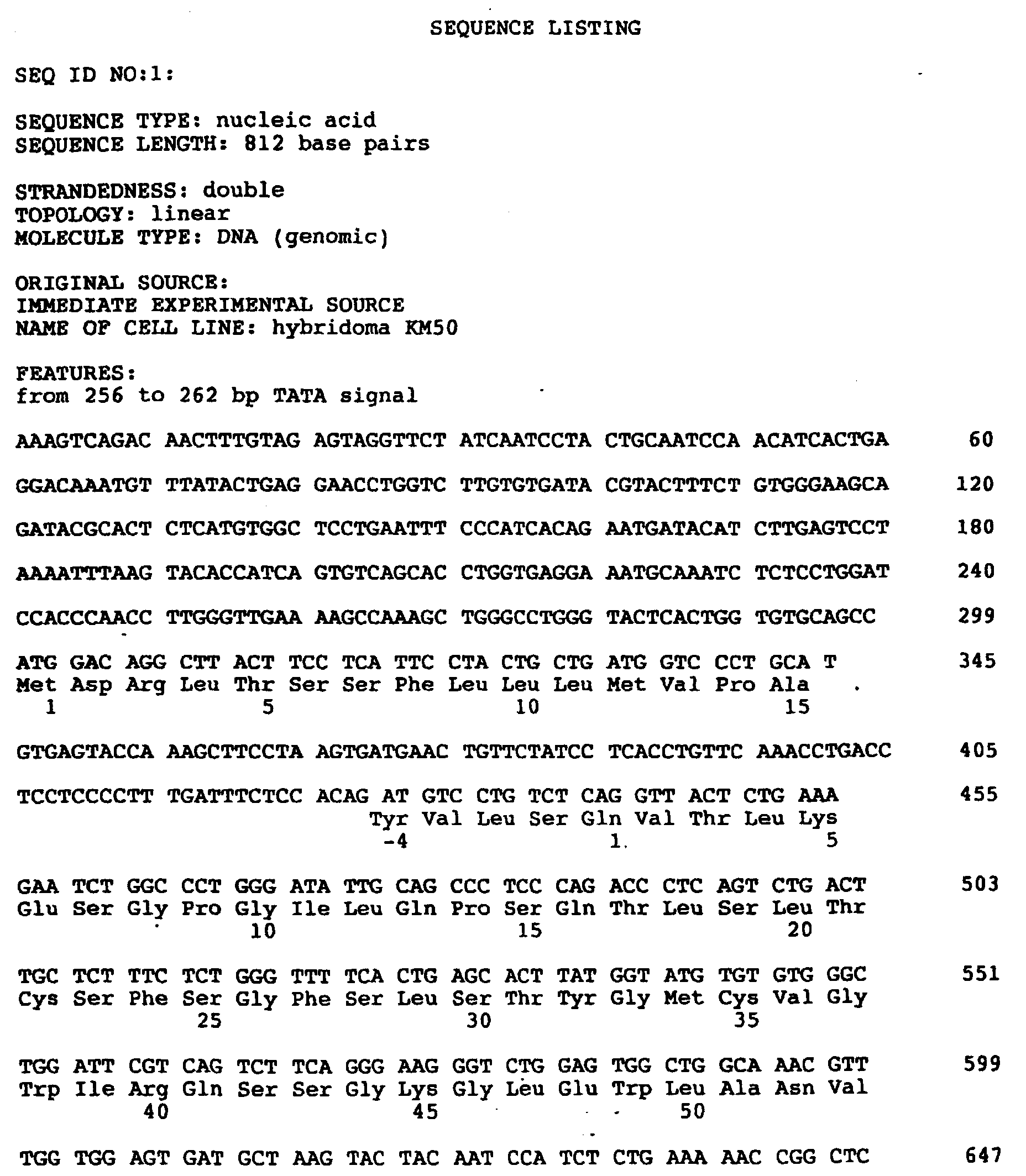
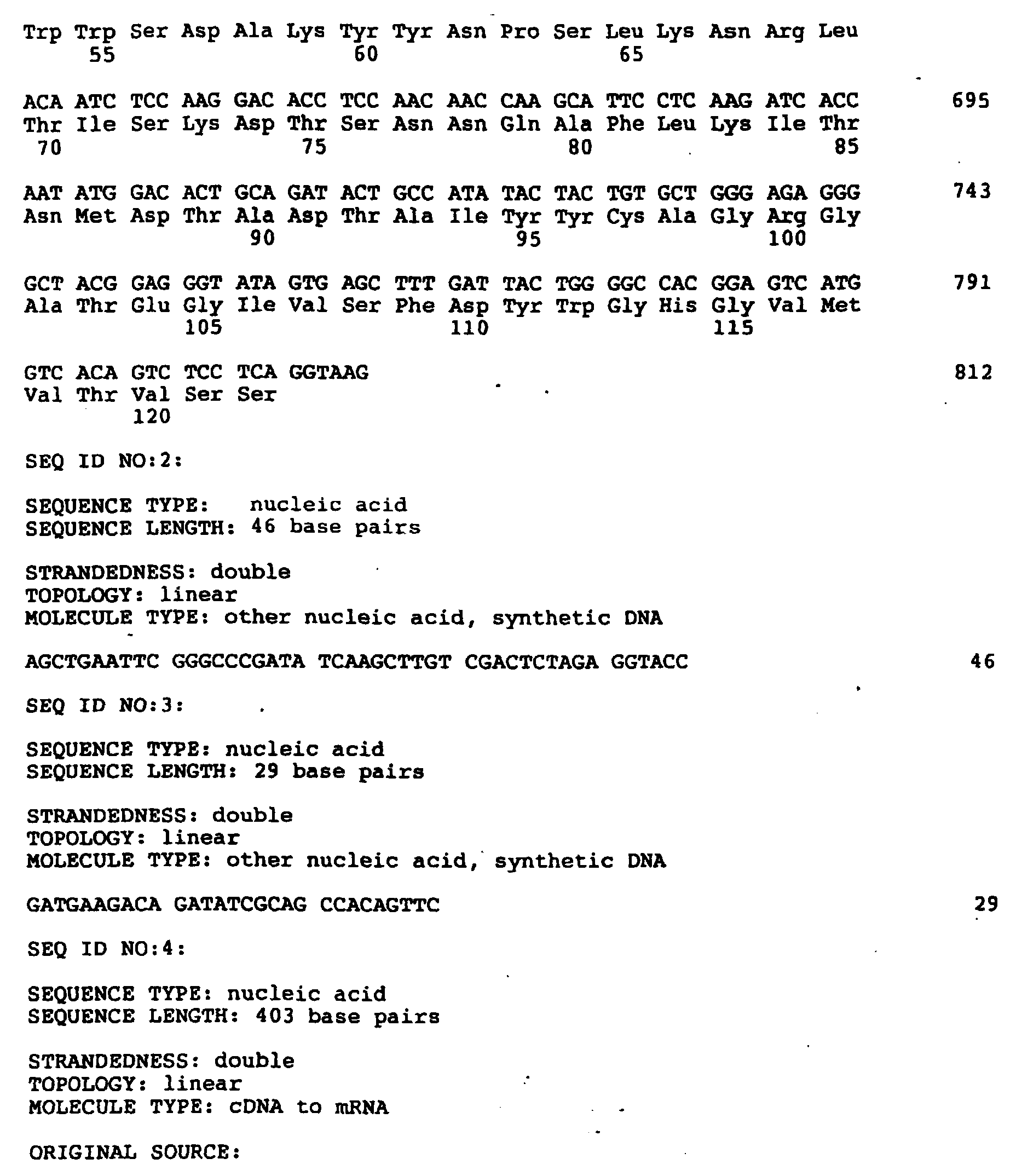
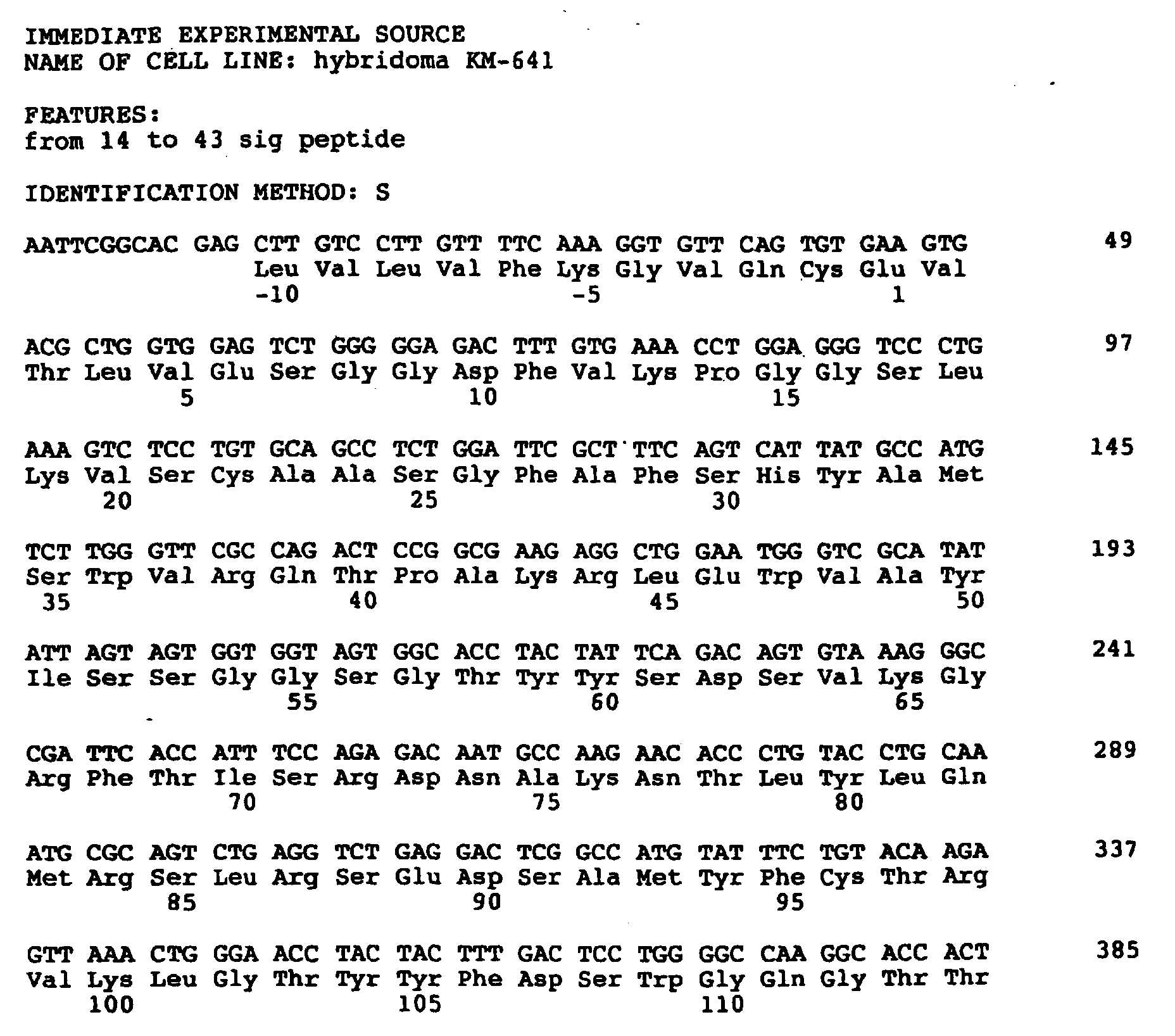
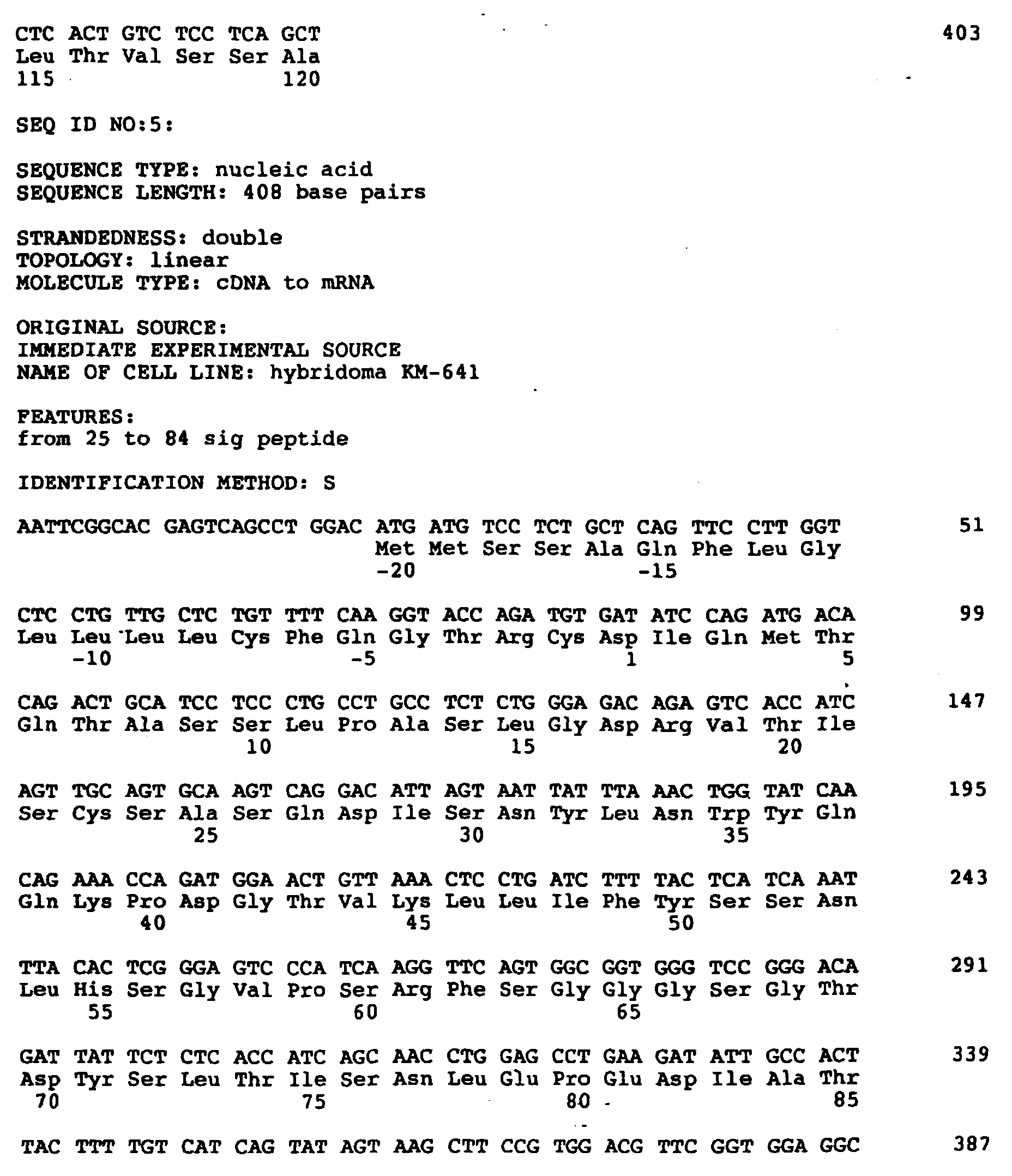
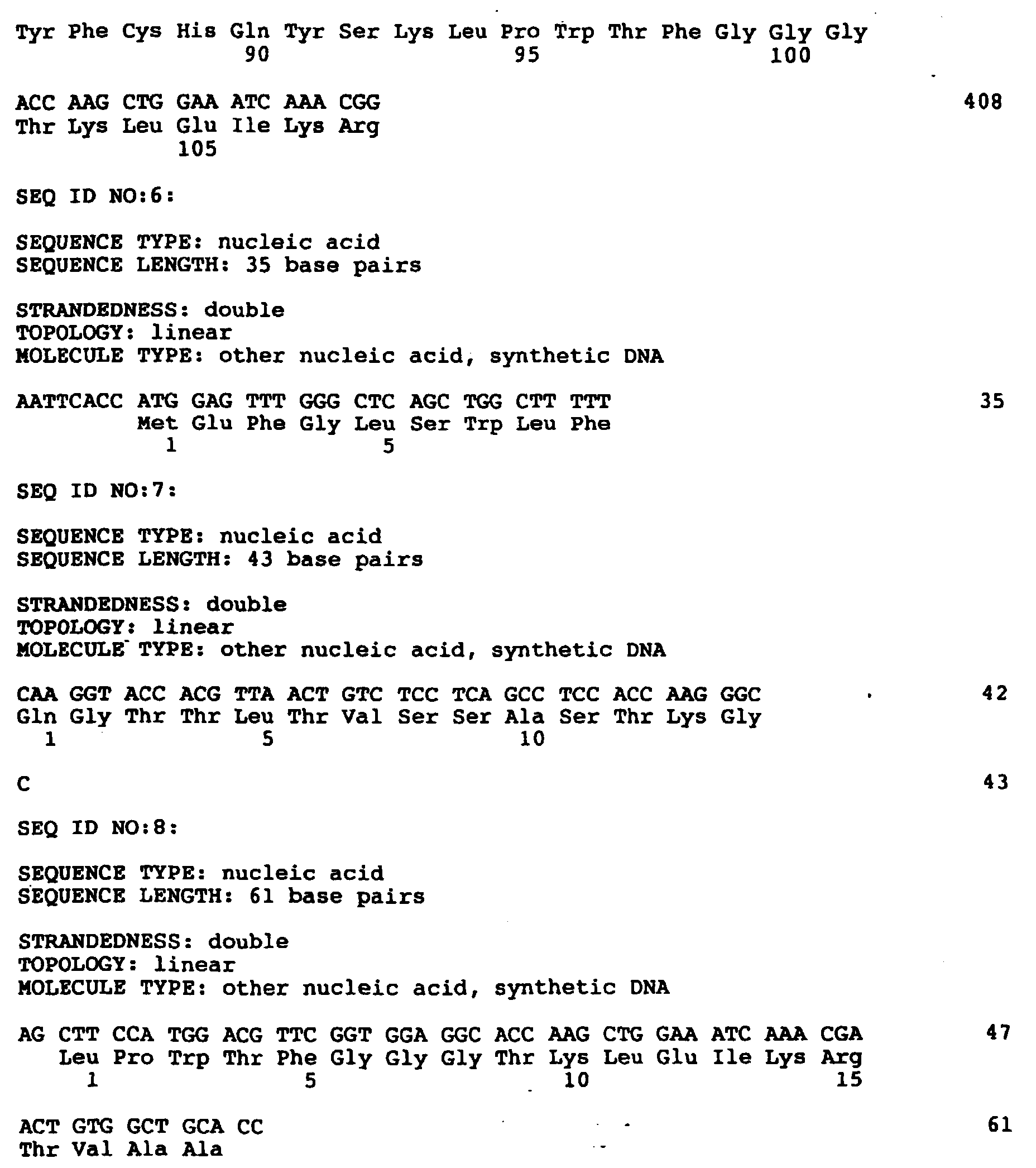
Claims (16)
- A humanized chimera antibody which comprises a variable region of a mouse monoclonal antibody KM-641 (FERM BP-3116) which is reactive with ganglioside GD3 and 3',8'-LD1 and a human antibody constant region.
- A humanized chimera antibody which is reactive with ganglioside GD3.
- A humanized chimera antibody KM-871 which is reactive with ganglioside GD3.
- A transformant capable of producing a humanized chimera antibody, wherein said antibody comprises a variable region of a mouse monoclonal antibody KM-641 (FERM BP-3116) which is reactive with ganglioside GD3 and 3',8'-LD1 and a human antibody constant region.
- A transformant capable of producing a humanized chimera antibody, wherein said antibody is reactive with ganglioside GD3.
- A transformant KM-871 (FERM BP-3512) capable of producing humanized chimera antibody KM-871, wherein said antibody is reactive with ganglioside GD3.
- A pharmaceutical composition comprising a humanized chimera antibody which is reactive with ganglioside GD3.
- Use of a humanized chimera antibody which is reactive with ganglioside GD3 for the manufacture of the medicament for treating cancer.
- A process for producing the humanized chimera antibody of any of claims 1 to 3, which comprises the steps of:(1) constructing a cassette vector by inserting a cDNA coding for a heavy chain constant region of human antibody into an expression vector for animal cell use and establishing a cloning site in the upstream region of the heavy chain constant region of said cassette vector for inserting a cDNA which encodes a heavy chain variable region of nonhuman animal antibody;(2) digesting a cDNA coding for the heavy chain variable region of nonhuman animal antibody with restriction enzymes;(3) inserting said cDNA coding for the heavy chain variable region of nonhuman animal antibody into the cassette vector, using a synthetic DNA which comprises a base sequence corresponding to the 5'-end side of said heavy chain constant region of human antibody and a base sequence corresponding to the 3'-end side of said heavy chain variable region of nonhuman animal antibody and is possessed of the restriction enzyme recognition sites on both of its ends, thereby constructing a humanized chimera antibody heavy chain expression vector in which said cDNA coding for the heavy chain constant region of human antibody and said cDNA coding for the heavy chain variable region of nonhuman animal antibody are linked together through said synthetic DNA;(4) constructing a cassette vector by inserting a cDNA coding for a light chain constant region of human antibody into an expression vector for animal cell use and establishing a cloning site in the upstream region of the light chain constant region of said cassette vector for inserting a cDNA which encodes a light chain variable region of nonhuman animal antibody;(5) digesting a cDNA coding for the light chain variable region of nonhuman animal antibody with restriction enzymes;(6) inserting said cDNA coding for a light chain variable region of nonhuman animal antibody into the cassette vector, using a synthetic DNA which comprises a base sequence corresponding to the 5'-end side of said light chain constant region of human antibody and a base sequence corresponding to the 3'-end side of said light chain variable region of nonhuman animal antibody and is possessed of the restriction enzyme recognition sites on both of its ends, thereby constructing a humanized chimera antibody light chain expression vector in which said cDNA coding for the light chain constant region of human antibody and said cDNA coding for the light chain variable region of nonhuman animal antibody are linked together through said synthetic DNA;(7) introducing these expression vectors into host cells to obtain a transformant; and(8) culturing said transformant in an appropriate culture medium, thereby allowing the transformant to produce and accumulate a humanized chimera antibody, and collecting said humanized chimera antibody from the resulting culture broth.
- The process according to claim 9, wherein said nonhuman animal is mouse.
- The process according to claim 9, wherein said nonhuman animal antibody is reactive with ganglioside.
- The process according to claim 9, wherein said nonhuman animal antibody is reactive with ganglioside GD3.
- The process according to claim 9, wherein said nonhuman animal antibody is reactive with mouse ganglioside GD3.
- The process according to claim 9, wherein said heavy chain variable region of antibody comprises the poly-peptide having the amino acid sequence as defined by from the first residue to the 120th residue in SEQ ID NO: 4 and said light chain variable region of antibody comprises the poly-peptide having the amino acid sequence as defined by from the first residue to the 108th residue in SEQ ID NO: 5.
- The process according to claim 9, wherein said humanized chimera antibody is reactive with ganglioside GD3.
- The process according to claim 9, wherein said humanized chimera antibody is an antibody KM-871 reactive with ganglioside GD3.
Applications Claiming Priority (3)
| Application Number | Priority Date | Filing Date | Title |
|---|---|---|---|
| JP23837591 | 1991-09-18 | ||
| JP23837591 | 1991-09-18 | ||
| EP92116026A EP0533199B1 (en) | 1991-09-18 | 1992-09-18 | Process for producing humanized chimera antibodies: Application to a chimera antibody directed against ganglioside GD3 |
Related Parent Applications (1)
| Application Number | Title | Priority Date | Filing Date |
|---|---|---|---|
| EP92116026A Division EP0533199B1 (en) | 1991-09-18 | 1992-09-18 | Process for producing humanized chimera antibodies: Application to a chimera antibody directed against ganglioside GD3 |
Publications (3)
| Publication Number | Publication Date |
|---|---|
| EP1013761A2 true EP1013761A2 (en) | 2000-06-28 |
| EP1013761A3 EP1013761A3 (en) | 2004-11-03 |
| EP1013761B1 EP1013761B1 (en) | 2007-08-08 |
Family
ID=17029253
Family Applications (2)
| Application Number | Title | Priority Date | Filing Date |
|---|---|---|---|
| EP99124345A Expired - Lifetime EP1013761B1 (en) | 1991-09-18 | 1992-09-18 | Humanized chimeric antibodies against ganglioside GD3 |
| EP92116026A Expired - Lifetime EP0533199B1 (en) | 1991-09-18 | 1992-09-18 | Process for producing humanized chimera antibodies: Application to a chimera antibody directed against ganglioside GD3 |
Family Applications After (1)
| Application Number | Title | Priority Date | Filing Date |
|---|---|---|---|
| EP92116026A Expired - Lifetime EP0533199B1 (en) | 1991-09-18 | 1992-09-18 | Process for producing humanized chimera antibodies: Application to a chimera antibody directed against ganglioside GD3 |
Country Status (10)
| Country | Link |
|---|---|
| US (10) | US5750078A (en) |
| EP (2) | EP1013761B1 (en) |
| JP (1) | JP3440104B2 (en) |
| AT (2) | ATE239078T1 (en) |
| AU (2) | AU669124B2 (en) |
| CA (1) | CA2078539C (en) |
| DE (2) | DE69233027T2 (en) |
| DK (1) | DK0533199T3 (en) |
| ES (1) | ES2195995T3 (en) |
| PT (1) | PT533199E (en) |
Cited By (39)
| Publication number | Priority date | Publication date | Assignee | Title |
|---|---|---|---|---|
| WO2004094477A1 (en) * | 2003-04-23 | 2004-11-04 | Centro De Inmunologia Molecular | Recombinant antibodies and fragments recognising ganglioside n-glycolyl-gm3 and use thereof in the diagnosis and treatment of tumours |
| EP1384487A4 (en) * | 2001-03-29 | 2007-07-11 | Kyowa Hakko Kogyo Kk | MEDICAMENTS CONTAINING A GENETICALLY MODIFIED ANTIBODY AGAINST GD3 GANGLIOSIDE |
| TWI392503B (en) * | 2007-07-16 | 2013-04-11 | 建南德克公司 | Anti-cd79b antibodies and immunoconjugates and methods of use |
| US9085630B2 (en) | 2002-11-15 | 2015-07-21 | Genentech, Inc. | Compositions and methods for the treatment of tumor of hematopoietic origin |
| WO2015142675A2 (en) | 2014-03-15 | 2015-09-24 | Novartis Ag | Treatment of cancer using chimeric antigen receptor |
| WO2016014530A1 (en) | 2014-07-21 | 2016-01-28 | Novartis Ag | Combinations of low, immune enhancing. doses of mtor inhibitors and cars |
| WO2016126608A1 (en) | 2015-02-02 | 2016-08-11 | Novartis Ag | Car-expressing cells against multiple tumor antigens and uses thereof |
| WO2016172583A1 (en) | 2015-04-23 | 2016-10-27 | Novartis Ag | Treatment of cancer using chimeric antigen receptor and protein kinase a blocker |
| WO2017027392A1 (en) | 2015-08-07 | 2017-02-16 | Novartis Ag | Treatment of cancer using chimeric cd3 receptor proteins |
| WO2017091786A1 (en) | 2015-11-23 | 2017-06-01 | Novartis Ag | Optimized lentiviral transfer vectors and uses thereof |
| WO2017114497A1 (en) | 2015-12-30 | 2017-07-06 | Novartis Ag | Immune effector cell therapies with enhanced efficacy |
| WO2017165683A1 (en) | 2016-03-23 | 2017-09-28 | Novartis Ag | Cell secreted minibodies and uses thereof |
| WO2018111340A1 (en) | 2016-12-16 | 2018-06-21 | Novartis Ag | Methods for determining potency and proliferative function of chimeric antigen receptor (car)-t cells |
| WO2018140725A1 (en) | 2017-01-26 | 2018-08-02 | Novartis Ag | Cd28 compositions and methods for chimeric antigen receptor therapy |
| WO2018144535A1 (en) | 2017-01-31 | 2018-08-09 | Novartis Ag | Treatment of cancer using chimeric t cell receptor proteins having multiple specificities |
| WO2018160731A1 (en) | 2017-02-28 | 2018-09-07 | Novartis Ag | Shp inhibitor compositions and uses for chimeric antigen receptor therapy |
| WO2018229715A1 (en) | 2017-06-16 | 2018-12-20 | Novartis Ag | Compositions comprising anti-cd32b antibodies and methods of use thereof |
| WO2019081983A1 (en) | 2017-10-25 | 2019-05-02 | Novartis Ag | Antibodies targeting cd32b and methods of use thereof |
| WO2019084288A1 (en) | 2017-10-25 | 2019-05-02 | Novartis Ag | Methods of making chimeric antigen receptor-expressing cells |
| WO2019089798A1 (en) | 2017-10-31 | 2019-05-09 | Novartis Ag | Anti-car compositions and methods |
| WO2019210153A1 (en) | 2018-04-27 | 2019-10-31 | Novartis Ag | Car t cell therapies with enhanced efficacy |
| WO2019213282A1 (en) | 2018-05-01 | 2019-11-07 | Novartis Ag | Biomarkers for evaluating car-t cells to predict clinical outcome |
| WO2019227003A1 (en) | 2018-05-25 | 2019-11-28 | Novartis Ag | Combination therapy with chimeric antigen receptor (car) therapies |
| WO2019237035A1 (en) | 2018-06-08 | 2019-12-12 | Intellia Therapeutics, Inc. | Compositions and methods for immunooncology |
| WO2020012337A1 (en) | 2018-07-10 | 2020-01-16 | Novartis Ag | 3-(5-amino-1-oxoisoindolin-2-yl)piperidine-2,6-dione derivatives and their use in the treatment of i karos family zinc finger 2 (ikzf2)-dependent diseases |
| WO2020052692A2 (en) | 2018-12-04 | 2020-03-19 | Novartis Ag | Binding molecules against cd3 and uses thereof |
| WO2020128972A1 (en) | 2018-12-20 | 2020-06-25 | Novartis Ag | Dosing regimen and pharmaceutical combination comprising 3-(1-oxoisoindolin-2-yl)piperidine-2,6-dione derivatives |
| WO2020165833A1 (en) | 2019-02-15 | 2020-08-20 | Novartis Ag | 3-(1-oxo-5-(piperidin-4-yl)isoindolin-2-yl)piperidine-2,6-dione derivatives and uses thereof |
| WO2020165834A1 (en) | 2019-02-15 | 2020-08-20 | Novartis Ag | Substituted 3-(1-oxoisoindolin-2-yl)piperidine-2,6-dione derivatives and uses thereof |
| WO2021123996A1 (en) | 2019-12-20 | 2021-06-24 | Novartis Ag | Uses of anti-tgf-beta antibodies and checkpoint inhibitors for the treatment of proliferative diseases |
| WO2021252920A1 (en) | 2020-06-11 | 2021-12-16 | Novartis Ag | Zbtb32 inhibitors and uses thereof |
| WO2021260528A1 (en) | 2020-06-23 | 2021-12-30 | Novartis Ag | Dosing regimen comprising 3-(1-oxoisoindolin-2-yl)piperidine-2,6-dione derivatives |
| WO2022029573A1 (en) | 2020-08-03 | 2022-02-10 | Novartis Ag | Heteroaryl substituted 3-(1-oxoisoindolin-2-yl)piperidine-2,6-dione derivatives and uses thereof |
| EP3858855A4 (en) * | 2018-07-25 | 2022-04-27 | Nanjing GenScript Biotech Co., Ltd. | HUMANIZED ANTI-CTLA4 MONOCLONAL ANTIBODY, METHOD FOR PREPARATION AND USE |
| WO2022215011A1 (en) | 2021-04-07 | 2022-10-13 | Novartis Ag | USES OF ANTI-TGFβ ANTIBODIES AND OTHER THERAPEUTIC AGENTS FOR THE TREATMENT OF PROLIFERATIVE DISEASES |
| WO2022229853A1 (en) | 2021-04-27 | 2022-11-03 | Novartis Ag | Viral vector production system |
| WO2023214325A1 (en) | 2022-05-05 | 2023-11-09 | Novartis Ag | Pyrazolopyrimidine derivatives and uses thereof as tet2 inhibitors |
| WO2024089639A1 (en) | 2022-10-26 | 2024-05-02 | Novartis Ag | Lentiviral formulations |
| WO2024243441A1 (en) | 2023-05-24 | 2024-11-28 | Kumquat Biosciences Inc. | Heterocyclic compounds and uses thereof |
Families Citing this family (245)
| Publication number | Priority date | Publication date | Assignee | Title |
|---|---|---|---|---|
| CA2078539C (en) * | 1991-09-18 | 2005-08-02 | Kenya Shitara | Process for producing humanized chimera antibody |
| US6042828A (en) | 1992-09-07 | 2000-03-28 | Kyowa Hakko Kogyo Co., Ltd. | Humanized antibodies to ganglioside GM2 |
| US5830470A (en) * | 1992-09-07 | 1998-11-03 | Kyowa Hakko Kogyo Co., Ltd. | Humanized antibodies to ganglioside GM2 |
| US5939532A (en) * | 1993-09-07 | 1999-08-17 | Kyowa Hakko Kogyo Co., Ltd | Humanized antibodies to ganglioside GM2 |
| US6824777B1 (en) * | 1992-10-09 | 2004-11-30 | Licentia Ltd. | Flt4 (VEGFR-3) as a target for tumor imaging and anti-tumor therapy |
| US7105159B1 (en) | 1992-11-05 | 2006-09-12 | Sloan-Kettering Institute For Cancer Research | Antibodies to prostate-specific membrane antigen |
| AU7949394A (en) | 1993-11-19 | 1995-06-06 | Chugai Seiyaku Kabushiki Kaisha | Reconstituted human antibody against human medulloblastomatous cell |
| US6088323A (en) * | 1996-07-16 | 2000-07-11 | Sony Corporation | Optical disk, optical disk device, and optical disk recording method |
| ATE331806T1 (en) | 1996-11-21 | 2006-07-15 | Kyowa Hakko Kogyo Kk | MONOCLONAL ANTIBODY DIRECTED AGAINST HUMAN VEGF RECEPTOR FLT-1. |
| US6986890B1 (en) | 1996-11-21 | 2006-01-17 | Kyowa Hakko Kogyo Co., Ltd. | Anti-human VEGF receptor Flt-1 monoclonal antibody |
| US20030170248A1 (en) * | 1997-12-23 | 2003-09-11 | Jeffrey R. Stinson | Humanized monoclonal antibodies that protect against shiga toxin induced disease |
| EP1086956B1 (en) * | 1998-05-20 | 2009-04-15 | Kyowa Hakko Kogyo Co., Ltd. | Gene recombinant antibodies |
| EP1096955B9 (en) | 1998-07-13 | 2006-07-05 | Board of Regents, The University of Texas System | Uses of antibodies to aminophospholipids for cancer treatment |
| JP4841724B2 (en) * | 1998-10-09 | 2011-12-21 | ベジェニクス ピーティーワイ リミテッド | Flt4 (VERG-3) as a target for tumor imaging and anti-tumor therapy |
| US7026449B2 (en) * | 1999-01-05 | 2006-04-11 | Genentech, Inc. | Secreted and transmembrane polypeptides and nucleic acids encoding the same |
| EP2275540B1 (en) | 1999-04-09 | 2016-03-23 | Kyowa Hakko Kirin Co., Ltd. | Method for controlling the activity of immunologically functional molecule |
| WO2001023432A1 (en) * | 1999-09-30 | 2001-04-05 | Kyowa Hakko Kogyo Co., Ltd. | Human type complementarity determining region transplantation antibody against ganglioside gd3 and derivatives of antibody against ganglioside gd3 |
| WO2001081401A1 (en) | 2000-04-21 | 2001-11-01 | Fuso Pharmaceutical Industries, Ltd. | Novel collectins |
| DE60127113T2 (en) | 2000-04-25 | 2007-06-14 | Otsuka Pharmaceutical Co., Ltd. | GD3-MIMETIC PEPTIDES |
| US6946292B2 (en) * | 2000-10-06 | 2005-09-20 | Kyowa Hakko Kogyo Co., Ltd. | Cells producing antibody compositions with increased antibody dependent cytotoxic activity |
| CN103333860B (en) | 2000-10-06 | 2015-07-08 | 协和发酵麒麟株式会社 | Cells producing antibody compositions |
| JP4669984B2 (en) * | 2001-01-19 | 2011-04-13 | ベジェニクス リミテッド | F1t4 (VEGFR-3) and antitumor therapy as a target for tumor imaging |
| US6820011B2 (en) * | 2001-04-11 | 2004-11-16 | The Regents Of The University Of Colorado | Three-dimensional structure of complement receptor type 2 and uses thereof |
| AU2002327704A1 (en) * | 2001-09-21 | 2003-04-01 | Raven Biotechnologies, Inc. | Antibodies that bind to cancer-associated antigen cytokeratin 8 and methods of use thereof |
| CA2463927A1 (en) * | 2001-10-16 | 2003-04-24 | Raven Biotechnologies, Inc. | Antibodies that bind to cancer-associated antigen cd46 and methods of use thereof |
| WO2003034903A2 (en) * | 2001-10-23 | 2003-05-01 | Psma Development Company, L.L.C. | Psma antibodies and protein multimers |
| US20050215472A1 (en) | 2001-10-23 | 2005-09-29 | Psma Development Company, Llc | PSMA formulations and uses thereof |
| CA2481920A1 (en) | 2002-04-09 | 2003-10-16 | Kyowa Hakko Kogyo Co., Ltd. | Antibody composition-containing medicament |
| WO2003087340A2 (en) * | 2002-04-12 | 2003-10-23 | Raven Biotechnologies, Inc. | Antibodies that bind to integrin alpha-v-beta-6 and methods of use thereof |
| CN1662254A (en) * | 2002-05-03 | 2005-08-31 | 雷文生物技术公司 | ALCAM and ALCAM modulators |
| US7893218B2 (en) | 2003-06-16 | 2011-02-22 | Stowers Institute For Medical Research | Antibodies that specifically bind SOST peptides |
| ATE488530T1 (en) | 2002-06-19 | 2010-12-15 | Raven Biotechnologies Inc | INTERNALIZING ANTIBODIES SPECIFIC TO THE RAAG10 CELL SURFACE TARGET |
| DE60335383D1 (en) | 2002-07-15 | 2011-01-27 | Univ Texas | ANTIBODIES BINDING TO ANIONIC PHOSPHOLIPIDES AND AMINOPHOSPHOLIPIDES AND THEIR USE IN THE TREATMENT OF VIRUS INFECTIONS |
| EP1545615A4 (en) * | 2002-10-04 | 2006-03-01 | Rinat Neuroscience Corp | Methods for treating cardiac arrhythmia and preventing death due to cardiac arrhythmia using ngf antagonists |
| WO2004032870A2 (en) | 2002-10-08 | 2004-04-22 | Rinat Neuroscience Corp. | Methods for treating post-surgical pain by admisnistering a nerve growth factor antagonist and compositions containing the same |
| UA80447C2 (en) | 2002-10-08 | 2007-09-25 | Methods for treating pain by administering nerve growth factor antagonist and opioid analgesic | |
| US7255860B2 (en) * | 2002-10-08 | 2007-08-14 | Rinat Neuroscience Corp. | Methods for treating post-surgical pain by administering an anti-nerve growth factor antagonist antibody |
| AU2003279216A1 (en) * | 2002-10-09 | 2004-05-04 | Rinat Neuroscience Corp. | Methods of treating alzheimer's disease using antibodies directed against amyloid beta peptide and compositions thereof |
| EP1629090B1 (en) * | 2002-11-06 | 2014-03-05 | iBio, Inc. | Expression of foreign sequences in plants using trans-activation system |
| US7692063B2 (en) * | 2002-11-12 | 2010-04-06 | Ibio, Inc. | Production of foreign nucleic acids and polypeptides in sprout systems |
| US7683238B2 (en) * | 2002-11-12 | 2010-03-23 | iBio, Inc. and Fraunhofer USA, Inc. | Production of pharmaceutically active proteins in sprouted seedlings |
| WO2004043239A2 (en) * | 2002-11-13 | 2004-05-27 | Raven Biotechnologies, Inc. | Antigen pipa and antibodies that bind thereto |
| US7276589B2 (en) | 2002-11-26 | 2007-10-02 | Pdl Biopharma, Inc. | Chimeric and humanized antibodies to α5β1 integrin that modulate angiogenesis |
| US7285268B2 (en) | 2002-11-26 | 2007-10-23 | Pdl Biopharma, Inc. | Chimeric and humanized antibodies to α5β1 integrin that modulate angiogenesis |
| MXPA05005558A (en) | 2002-11-26 | 2005-07-26 | Protein Design Labs Inc | CHIMERIC AND HUMANIZED ANTIBODIES TO alpha5beta1 INTEGRIN THAT MODULATE ANGIOGENESIS. |
| ATE431157T1 (en) * | 2002-12-23 | 2009-05-15 | Rinat Neuroscience Corp | METHOD FOR TREATING TAXOL-INDUCED SENSORY NEUROPATHY |
| DK1575517T3 (en) | 2002-12-24 | 2012-05-14 | Rinat Neuroscience Corp | ANTI-NGF ANTIBODIES AND PROCEDURES FOR USING THE SAME |
| US7569364B2 (en) * | 2002-12-24 | 2009-08-04 | Pfizer Inc. | Anti-NGF antibodies and methods using same |
| US9498530B2 (en) | 2002-12-24 | 2016-11-22 | Rinat Neuroscience Corp. | Methods for treating osteoarthritis pain by administering a nerve growth factor antagonist and compositions containing the same |
| ES2531125T3 (en) | 2003-02-03 | 2015-03-10 | Ibio Inc | System for gene expression in plants |
| KR20050111598A (en) | 2003-02-19 | 2005-11-25 | 리나트 뉴로사이언스 코퍼레이션 | Methods for treating pain by administering a nerve growth factor antagonist and an nsaid and compositions containing the same |
| WO2004084836A2 (en) * | 2003-03-20 | 2004-10-07 | Rinat Neuroscience Corp. | Methods for treating taxol-induced gut disorder |
| JP2007524605A (en) * | 2003-04-03 | 2007-08-30 | ピーディーエル バイオファーマ,インコーポレイティド | Inhibitors of integrin α5β1 and their use for control of tissue granulation |
| CN1833030B (en) | 2003-05-22 | 2014-07-23 | 美国弗劳恩霍夫股份有限公司 | Recombinant carrier molecules for expression, delivery and purification of target polypeptides |
| US20050232926A1 (en) * | 2003-06-06 | 2005-10-20 | Oncomax Acquisition Corp. | Antibodies specific for cancer associated antigen SM5-1 and uses thereof |
| CN1279056C (en) * | 2003-06-06 | 2006-10-11 | 马菁 | Specific antibody of tumor-associated antigen SM5-1 and use thereof |
| US20050131219A1 (en) * | 2003-08-18 | 2005-06-16 | Urdea Michael S. | Methods for reducing complexity of a sample using small epitope antibodies |
| AU2004274487B2 (en) * | 2003-09-18 | 2011-09-01 | Macrogenics West, Inc. | KID3 and KID3 antibodies that bind thereto |
| CN100522998C (en) | 2003-10-01 | 2009-08-05 | 协和发酵麒麟株式会社 | Method for stabilizing antibody and stabilized solution-like antibody preparation |
| JP4503617B2 (en) | 2003-12-23 | 2010-07-14 | ライナット ニューロサイエンス コーポレイション | Agonist anti-trkC antibody and method using the antibody |
| ES2532609T3 (en) * | 2004-02-20 | 2015-03-30 | Ibio, Inc. | Systems and methods for clonal expression in plants |
| ATE531388T1 (en) * | 2004-03-24 | 2011-11-15 | Abbott Biotherapeutics Corp | USE OF ANTI-ALPHA5BETA1 ANTIBODIES TO INHIBIT CANCER CELL PROLIFERATION |
| KR101637908B1 (en) * | 2004-04-07 | 2016-07-11 | 리나트 뉴로사이언스 코프. | Methods for treating bone cancer pain by administering a nerve growth factor antagonist |
| KR101295139B1 (en) | 2004-06-07 | 2013-08-12 | 레이븐 바이오테크놀로지스, 인코퍼레이티드 | Transferrin receptor antibodies |
| TR201808440T4 (en) | 2004-07-09 | 2018-07-23 | Henry M Jackson Found Advancement Military Medicine Inc | Soluble forms of Hendra and nipah virus G glycoprotein. |
| AU2005290250A1 (en) * | 2004-07-30 | 2006-04-06 | Rinat Neuroscience Corp. | Antibodies directed against amyloid-beta peptide and methods using same |
| EP1846767B1 (en) | 2005-01-12 | 2012-06-06 | MacroGenics West, Inc. | Kid31 and antibodies that bind thereto |
| EP1846032A4 (en) * | 2005-01-31 | 2009-01-28 | Raven Biotechnologies Inc | LUCA2 AND ANTIBODY BINDING |
| WO2006084078A2 (en) * | 2005-02-02 | 2006-08-10 | Raven Biotechnologies, Inc. | Jam-3 and antibodies that bind thereto |
| JP5328155B2 (en) | 2005-02-02 | 2013-10-30 | マクロジェニックス ウエスト, インコーポレイテッド | ADAM-9 modulator |
| CA2597171A1 (en) * | 2005-02-03 | 2006-08-10 | Raven Biotechnologies, Inc. | Antibodies to oncostatin m receptor |
| BRPI0607450A2 (en) * | 2005-02-04 | 2009-09-01 | Raven Biotechnologies Inc | epha2-binding antibodies and methods for their use |
| US20070003557A1 (en) * | 2005-04-21 | 2007-01-04 | Andres Forero | Method for treating cancer using premedication |
| AR054260A1 (en) * | 2005-04-26 | 2007-06-13 | Rinat Neuroscience Corp | METHODS OF TREATMENT OF DISEASES OF THE LOWER MOTOR NEURONE AND COMPOSITIONS USED IN THE SAME |
| PE20061323A1 (en) * | 2005-04-29 | 2007-02-09 | Rinat Neuroscience Corp | ANTIBODIES TARGETED AGAINST AMYLOID BETA PEPTIDE AND METHODS USING THEM |
| RU2486204C2 (en) | 2005-07-22 | 2013-06-27 | Уай'З Терапьютикс Ко., Лтд. | Cd26 antibodies and methods of using them |
| EP1919504B1 (en) * | 2005-08-03 | 2013-10-16 | iBio, Inc. | Antibody to bacillus anthracis protective antigen |
| SI3045182T1 (en) | 2005-11-14 | 2018-08-31 | Teva Pharmaceuticals International Gmbh | Antagonist antibodies directed against calcitonin gene-related peptide for treating cluster headache |
| WO2007095320A2 (en) * | 2006-02-13 | 2007-08-23 | Fraunhofer Usa, Inc. | Hpv antigens, vaccine compositions, and related methods |
| WO2008048344A2 (en) * | 2006-02-13 | 2008-04-24 | Fraunhofer Usa, Inc. | Bacillus anthracis antigens, vaccine compositions, and related methods |
| US8124103B2 (en) * | 2006-02-13 | 2012-02-28 | Fraunhofer Usa, Inc | Influenza antigens, vaccine compositions, and related methods |
| WO2007103290A2 (en) * | 2006-03-03 | 2007-09-13 | Government Of The United States Of America, Represented By The Secretary, Department Of Health And Human Services | Materials and methods directed to asparagine synthetase and asparaginase therapies |
| WO2008076139A1 (en) * | 2006-03-10 | 2008-06-26 | Tethys Bioscience, Inc. | Multiplex protein fractionation |
| EP2004230A4 (en) * | 2006-03-21 | 2009-05-20 | Univ California | N-CADHERIN AND LY6 E: TARGETS FOR DIAGNOSIS AND TREATMENT OF CANCER |
| US8663635B2 (en) | 2006-03-21 | 2014-03-04 | The Regents Of The University Of California | N-cadherin: target for cancer diagnosis and therapy |
| US20100278821A1 (en) * | 2006-03-21 | 2010-11-04 | The Regents Of The University Of California | N-cadherin: target for cancer diagnosis and therapy |
| AU2007240614B2 (en) * | 2006-04-20 | 2013-09-12 | The Henry M. Jackson Foundation For The Advancement Of Military Medicine Incorporated | Methods and compositions based on Shiga toxin type 1 protein |
| BRPI0712850A8 (en) | 2006-06-07 | 2018-05-02 | Bioalliance Cv | antibodies that recognize a cd-43 and cea carbohydrate-containing epitope expressed in cancer cells and methods of using them |
| EP2094307A4 (en) * | 2006-11-08 | 2015-08-26 | Macrogenics West Inc | TES7, AND ANTIBODY BINDING THERETO |
| SI3345607T1 (en) | 2006-12-29 | 2023-03-31 | Ossifi-Mab Llc | Methods of altering bone growth by administration of sost or wise antagonist or agonist |
| WO2008118324A2 (en) | 2007-03-26 | 2008-10-02 | Macrogenics, Inc. | Composition and method of treating cancer with an anti-uroplakin ib antibody |
| AP2009005028A0 (en) | 2007-04-10 | 2009-12-31 | Univ Tulane | Soluble and membrane-anchored forms of lassa virussubunit proteins |
| CN101687024A (en) * | 2007-04-28 | 2010-03-31 | 美国弗劳恩霍夫股份有限公司 | trypanosoma antigens, vaccine compositions, and related methods |
| US8404252B2 (en) | 2007-07-11 | 2013-03-26 | Fraunhofer Usa, Inc. | Yersinia pestis antigens, vaccine compositions, and related methods |
| PE20140625A1 (en) | 2007-07-16 | 2014-05-29 | Genentech Inc | ANTI-CD79b ANTIBODIES AND HUMANIZED IMMUNOCONJUGATES |
| AU2008282331A1 (en) * | 2007-07-27 | 2009-02-05 | Facet Biotech Corporation | Pharmaceutical combinations comprising a tyrosine kinase inhibitor and an antibody against integrin alpha 1 beta 5 (CD49E) |
| CN105732813A (en) | 2007-12-18 | 2016-07-06 | 生物联合公司 | Antibodies recognizing a carbohydrate containing epitope on cd-43 and cea expressed on cancer cells and methods using same |
| DK2657253T3 (en) | 2008-01-31 | 2017-10-09 | Genentech Inc | Anti-CD79b antibodies and immune conjugates and methods of use |
| CN106349390B (en) | 2008-04-02 | 2019-12-10 | 宏观基因有限公司 | BCR-complex-specific antibodies and methods of use thereof |
| EA201001603A1 (en) * | 2008-04-04 | 2011-06-30 | Те Риджентс Оф Те Юниверсити Оф Калифорния | ANTIBODIES AGAINST CADGERINE, BLOCKING GROWTH OF TUMOR, ANGIOGENESIS AND METASTASIS |
| WO2009150623A1 (en) | 2008-06-13 | 2009-12-17 | Pfizer Inc | Treatment of chronic prostatitis |
| TWI445716B (en) | 2008-09-12 | 2014-07-21 | Rinat Neuroscience Corp | Pcsk9 antagonists |
| SI2331090T1 (en) | 2008-09-19 | 2018-04-30 | Pfizer Inc. | Stable liquid antibody formulation |
| WO2010037046A1 (en) | 2008-09-28 | 2010-04-01 | Fraunhofer Usa, Inc. | Humanized neuraminidase antibody and methods of use thereof |
| US8703920B2 (en) * | 2008-11-10 | 2014-04-22 | The Regents Of The University Of California | Fully human antibodies against N-cadherin |
| EP2370819A4 (en) * | 2008-12-01 | 2012-09-19 | Univ Johns Hopkins | METHODS OF DIAGNOSING AND TREATING CANCER BASED ON IMMUNE INHIBITORS |
| US8969529B2 (en) | 2009-01-23 | 2015-03-03 | The Henry M. Jackson Foundation For The Advancement Of Military Medicine, Inc. | Methods and compositions based on shiga toxin type 2 protein |
| WO2010086828A2 (en) | 2009-02-02 | 2010-08-05 | Rinat Neuroscience Corporation | Agonist anti-trkb monoclonal antibodies |
| WO2010129609A2 (en) | 2009-05-07 | 2010-11-11 | The Regents Of The University Of California | Antibodies and methods of use thereof |
| WO2010146511A1 (en) | 2009-06-17 | 2010-12-23 | Pfizer Limited | Treatment of overactive bladder |
| MX337468B (en) | 2009-06-18 | 2016-03-02 | Pfizer | Anti notch-1 antibodies. |
| EP2464661B1 (en) | 2009-08-13 | 2018-01-17 | The Johns Hopkins University | Methods of modulating immune function with anti-b7-h7cr antibodies |
| US8784819B2 (en) | 2009-09-29 | 2014-07-22 | Ibio Inc. | Influenza hemagglutinin antibodies, compositions and related methods |
| US20110118178A1 (en) * | 2009-11-13 | 2011-05-19 | Sanofi-Aventis Deutschland Gmbh | Method of treatment of diabetes type 2 comprising add-on therapy to insulin glargine and metformin |
| TW201125583A (en) * | 2009-12-23 | 2011-08-01 | Bioalliance Cv | Anti-EpCAM antibodies that induce apoptosis of cancer cells and methods using same |
| AR080291A1 (en) | 2010-02-24 | 2012-03-28 | Rinat Neuroscience Corp | ANTI-BODIES ANTAGONISTS ANTI RECEIVER OF IL-7 AND PROCEDURES |
| PH12012501751A1 (en) | 2010-03-04 | 2012-11-12 | Macrogenics Inc | Antibodies reactive with b7-h3, immunologically active fragments thereof and uses thereof |
| DK2542256T3 (en) | 2010-03-04 | 2019-08-26 | Macrogenics Inc | ANTIBODIES REACTIVE WITH B7-H3, IMMUNOLOGICALLY ACTIVE FRAGMENTS THEREOF AND APPLICATIONS THEREOF |
| NZ602220A (en) | 2010-03-11 | 2014-10-31 | Rinat Neuroscience Corp | Antibodies with ph dependent antigen binding |
| MY195217A (en) * | 2010-06-22 | 2023-01-11 | Regeneron Pharma | MICE Expressing An Immunoglobulin Hybrid Light Chain |
| JP2013533286A (en) | 2010-07-30 | 2013-08-22 | セントルイス ユニバーシティ | How to treat pain |
| EP2601298B1 (en) * | 2010-08-02 | 2016-11-30 | Regeneron Pharmaceuticals, Inc. | Mice that make binding proteins comprising vl domains |
| ES2665954T3 (en) | 2010-08-19 | 2018-04-30 | Zoetis Belgium S.A. | Anti-NGF antibodies and their use |
| WO2012071216A2 (en) * | 2010-11-22 | 2012-05-31 | Duke University | Antibodies for tumor gangliosides |
| WO2012080926A2 (en) | 2010-12-15 | 2012-06-21 | Wyeth Llc | Anti-notch1 antibodies |
| WO2012162067A2 (en) | 2011-05-21 | 2012-11-29 | Macrogenics, Inc. | Cd3-binding molecules capable of binding to human and non-human cd3 |
| EP2717916B1 (en) | 2011-06-10 | 2017-03-08 | Mersana Therapeutics, Inc. | Protein-polymer-drug conjugates |
| AU2012305807B2 (en) | 2011-09-09 | 2015-08-20 | Department of Medical Sciences (DMSc) | Dengue-virus serotype neutralizing antibodies |
| SG11201401699WA (en) | 2011-11-11 | 2014-09-26 | Rinat Neuroscience Corp | Antibodies specific for trop-2 and their uses |
| SMT201900296T1 (en) | 2011-12-20 | 2019-07-11 | Regeneron Pharma | Humanized light chain mice |
| RU2014123030A (en) | 2011-12-22 | 2016-02-20 | Ринат Ньюросайенс Корп. | ANTAGONISTIC ANTIBODIES AGAINST THE HUMAN GROWTH HORMONE RECEPTOR AND WAYS OF THEIR APPLICATION |
| WO2013093693A1 (en) | 2011-12-22 | 2013-06-27 | Rinat Neuroscience Corp. | Staphylococcus aureus specific antibodies and uses thereof |
| US10114023B2 (en) | 2012-04-18 | 2018-10-30 | Massachusetts Institute Of Technology | Method of enhancing the efficacy of anti-hepatocyte growth factor receptor breast cancer therapy by administering an inhibitor of menaINV |
| US9617334B2 (en) | 2012-06-06 | 2017-04-11 | Zoetis Services Llc | Caninized anti-NGF antibodies and methods thereof |
| JP6246199B2 (en) | 2012-07-02 | 2017-12-13 | ザ ヘンリー エム. ジャクソン ファウンデーション フォー ザ アドヴァンスメント オブ ミリタリー メディシン インコーポレイテッド | Paramyxovirus and usage |
| EP2914628A1 (en) | 2012-11-01 | 2015-09-09 | Max-Delbrück-Centrum für Molekulare Medizin | An antibody that binds cd269 (bcma) suitable for use in the treatment of plasma cell diseases such as multiple myeloma and autoimmune diseases |
| RU2015115956A (en) | 2012-11-09 | 2017-01-10 | Пфайзер Инк. | ANTIBODIES SPECIFIC TO THE THROMBOCYTE B GROWTH FACTOR, AND THEIR COMPOSITION AND APPLICATION |
| CN104884056A (en) | 2012-11-12 | 2015-09-02 | 雷德伍德生物科技股份有限公司 | Compounds and methods for preparing conjugates |
| WO2014078733A1 (en) | 2012-11-16 | 2014-05-22 | The Regents Of The University Of California | Pictet-spengler ligation for protein chemical modification |
| US9310374B2 (en) | 2012-11-16 | 2016-04-12 | Redwood Bioscience, Inc. | Hydrazinyl-indole compounds and methods for producing a conjugate |
| US10226535B2 (en) | 2012-12-10 | 2019-03-12 | Mersana Therapeutics, Inc. | Auristatin compounds and conjugates thereof |
| WO2014093394A1 (en) | 2012-12-10 | 2014-06-19 | Mersana Therapeutics, Inc. | Protein-polymer-drug conjugates |
| MY170528A (en) | 2013-02-18 | 2019-08-09 | Vegenics Pty Ltd | Vegfr-3 ligand binding molecules and uses thereof |
| US9487587B2 (en) | 2013-03-05 | 2016-11-08 | Macrogenics, Inc. | Bispecific molecules that are immunoreactive with immune effector cells of a companion animal that express an activating receptor and cells that express B7-H3 and uses thereof |
| US9302005B2 (en) | 2013-03-14 | 2016-04-05 | Mayo Foundation For Medical Education And Research | Methods and materials for treating cancer |
| CA2906566C (en) | 2013-03-14 | 2024-09-10 | Macrogenics, Inc. | Bispecific molecules that are immunoreactive with immune effector cells that express an activating receptor |
| WO2014176696A1 (en) | 2013-04-30 | 2014-11-06 | Université de Montréal | Novel biomarkers for acute myeloid leukemia |
| CN105189560A (en) | 2013-05-07 | 2015-12-23 | 瑞纳神经科学公司 | Anti-glucagon receptor antibodies and methods of use thereof |
| JP6403668B2 (en) | 2013-05-30 | 2018-10-10 | 国立大学法人千葉大学 | Composition for treating inflammatory diseases comprising anti-myosin regulatory light chain polypeptide antibody |
| MX371455B (en) | 2013-08-02 | 2020-01-28 | Pfizer | Anti-cxcr4 antibodies and antibody-drug conjugates. |
| EP3470081A1 (en) | 2013-10-01 | 2019-04-17 | Mayo Foundation for Medical Education and Research | Methods for treating cancer in patients with elevated levels of bim |
| WO2015054659A1 (en) | 2013-10-11 | 2015-04-16 | Mersana Therapeutics, Inc. | Protein-polymer-drug conjugates |
| CA2927022C (en) | 2013-10-11 | 2018-08-21 | Asana Biosciences, Llc | Protein-polymer-drug conjugates |
| CN105814081B (en) | 2013-11-13 | 2021-02-02 | 辉瑞大药厂 | Antibodies specific to tumor necrosis factor-like ligand 1A and their compositions and uses |
| CN115504924A (en) | 2013-11-27 | 2022-12-23 | 雷德伍德生物科技股份有限公司 | Hydrazino-pyrrolo compounds and methods for producing conjugates |
| WO2015087187A1 (en) | 2013-12-10 | 2015-06-18 | Rinat Neuroscience Corp. | Anti-sclerostin antibodies |
| WO2015109212A1 (en) | 2014-01-17 | 2015-07-23 | Pfizer Inc. | Anti-il-2 antibodies and compositions and uses thereof |
| AU2015230938C1 (en) | 2014-03-21 | 2021-10-14 | Regeneron Pharmaceuticals, Inc. | Non-human animals that make single domain binding proteins |
| SG10201808083VA (en) | 2014-03-21 | 2018-10-30 | Regeneron Pharma | Vl antigen binding proteins exhibiting distinct binding characteristics |
| MX378344B (en) | 2014-03-21 | 2025-03-10 | Teva Pharmaceuticals Int Gmbh | ANTAGONIST ANTIBODIES DIRECTED AGAINST CALCITONIN GENE-RELATED PEPTIDE AND METHODS USING THEM. |
| SMT202100146T1 (en) | 2014-04-30 | 2021-05-07 | Pfizer | Anti-ptk7 antibody-drug conjugates |
| US10302653B2 (en) | 2014-05-22 | 2019-05-28 | Mayo Foundation For Medical Education And Research | Distinguishing antagonistic and agonistic anti B7-H1 antibodies |
| US10647768B2 (en) | 2014-05-29 | 2020-05-12 | Macrogenics, Inc. | Multi-chain polypeptide-containing tri-specific binding molecules |
| AU2015271100B2 (en) | 2014-06-06 | 2020-07-30 | Redwood Bioscience, Inc. | Anti-HER2 antibody-maytansine conjugates and methods of use thereof |
| TWI693232B (en) | 2014-06-26 | 2020-05-11 | 美商宏觀基因股份有限公司 | Covalently bonded diabodies having immunoreactivity with pd-1 and lag-3, and methods of use thereof |
| US10517875B2 (en) | 2014-07-23 | 2019-12-31 | Mayo Foundation for Medical Engineering and Research | Targeting DNA-PKcs and B7-H1 to treat cancer |
| WO2016034968A1 (en) | 2014-09-02 | 2016-03-10 | Pfizer Inc. | Therapeutic antibody |
| CA2979671C (en) | 2014-09-23 | 2020-03-10 | Genentech, Inc. | Methods of using anti-cd79b immunoconjugates |
| EA201790719A1 (en) | 2014-09-26 | 2017-07-31 | Макродженикс, Инк. | BISPECIFIC MONOVALENT DIATELS, WHICH ARE CAPABLE TO BIND CD19 AND CD3, AND THEIR APPLICATION THEREOF |
| WO2016054101A1 (en) | 2014-09-29 | 2016-04-07 | Duke University | Bispecific molecules comprising an hiv-1 envelope targeting arm |
| US20170247460A1 (en) | 2014-10-18 | 2017-08-31 | Pfizer Inc. | Anti-il-7r antibody compositions |
| WO2016065329A1 (en) | 2014-10-24 | 2016-04-28 | The Board Of Trustees Of The Leland Stanford Junior University | Compositions and methods for inducing phagocytosis of mhc class i positive cells and countering anti-cd47/sirpa resistance |
| US9982057B2 (en) | 2014-11-17 | 2018-05-29 | Pelican Therapeutics, Inc. | Human TNFRSF25 antibody |
| TWI595006B (en) | 2014-12-09 | 2017-08-11 | 禮納特神經系統科學公司 | Anti-PD-1 antibodies and methods of using same |
| US20170360929A1 (en) | 2014-12-23 | 2017-12-21 | Pfizer Inc. | Stable aqueous antibody formulation for anti tnf alpha antibodies |
| CN107250161A (en) | 2015-01-26 | 2017-10-13 | 宏观基因有限公司 | Multivalent molecules comprising DR5‑binding domains |
| WO2016120753A1 (en) | 2015-01-28 | 2016-08-04 | Pfizer Inc. | Stable aqueous anti- vascular endothelial growth factor (vegf) antibody formulation |
| CN107438622A (en) | 2015-03-19 | 2017-12-05 | 瑞泽恩制药公司 | Non-human animals selected for antigen-binding light chain variable regions |
| HUE057285T2 (en) | 2015-04-13 | 2022-04-28 | Pfizer | Therapeutic antibodies and their uses |
| TWI773646B (en) | 2015-06-08 | 2022-08-11 | 美商宏觀基因股份有限公司 | Lag-3-binding molecules and methods of use thereof |
| TWI870335B (en) | 2015-06-12 | 2025-01-21 | 美商宏觀基因股份有限公司 | Variant chimeric 4d5 antibodies and uses thereof in combination with anti-pd-1 antibodies for the treatment of cancer |
| WO2017015334A1 (en) | 2015-07-21 | 2017-01-26 | Saint Louis University | Compositions and methods for diagnosing and treating endometriosis-related infertility |
| US11066481B2 (en) | 2015-07-23 | 2021-07-20 | The Regents Of The University Of California | Antibodies to coagulation factor XIa and uses thereof |
| PE20231958A1 (en) | 2015-07-30 | 2023-12-06 | Macrogenics Inc | BINDING MOLECULES TO PD-1 AND METHODS OF USE THEREOF |
| UA128469C2 (en) | 2015-10-08 | 2024-07-24 | Макродженікс, Інк. | Combination therapy for the treatment of cancer |
| EP3365369A1 (en) | 2015-10-23 | 2018-08-29 | Pfizer Inc | Anti-il-2 antibodies and compositions and uses thereof |
| WO2017075045A2 (en) | 2015-10-30 | 2017-05-04 | Mayo Foundation For Medical Education And Research | Antibodies to b7-h1 |
| US20190209697A1 (en) | 2015-11-05 | 2019-07-11 | The Regents Of The University Of California | Cells labelled with lipid conjugates and methods of use thereof |
| WO2017083306A1 (en) | 2015-11-09 | 2017-05-18 | R.P. Scherer Technologies, Llc | Anti-cd22 antibody-maytansine conjugates and methods of use thereof |
| CN108367069B (en) | 2015-12-14 | 2022-08-23 | 宏观基因有限公司 | Bispecific molecules immunoreactive for PD-1 and CTLA-4 and methods of use thereof |
| WO2017120534A1 (en) | 2016-01-08 | 2017-07-13 | Bioalliance C.V. | Tetravalent anti-psgl-1 antibodies and uses thereof |
| ES2904593T3 (en) | 2016-01-21 | 2022-04-05 | Pfizer | Monospecific and bispecific antibodies to epidermal growth factor receptor variant III and CD3 and their uses |
| AR108034A1 (en) | 2016-02-17 | 2018-07-11 | Macrogenics Inc | MOLECULES OF UNION TO ROR1, AND METHODS OF USE OF THE SAME |
| US10443054B2 (en) | 2016-03-06 | 2019-10-15 | Massachusetts Institute Of Technology | Methods for identifying and treating invasive/metastatic breast cancers |
| CN109069633A (en) | 2016-04-15 | 2018-12-21 | 宏观基因有限公司 | Novel B7-H3- binding molecule, its antibody drug conjugate and its application method |
| US12048718B2 (en) | 2016-06-07 | 2024-07-30 | Max-Delbrück-Centrum für Molekulare Medizin in der Helmholtz-Geminschaft | Chimeric antigen receptor and CAR-T cells that bind BCMA |
| RU2746314C2 (en) | 2016-06-09 | 2021-04-12 | Пеликан Терапьютикс, Инк. | Anti-tnfrsf25 antibodies |
| EP3529268B1 (en) | 2016-10-19 | 2025-02-26 | The Scripps Research Institute | Chimeric antigen receptor effector cell switches with humanized targeting moieties and/or optimized chimeric antigen receptor interacting domains and uses thereof |
| US11198723B2 (en) | 2016-12-05 | 2021-12-14 | The Administrators Of The Tulane Educational Fund | Arenavirus monoclonal antibodies and uses |
| MD3558391T2 (en) | 2016-12-23 | 2022-05-31 | Immunogen Inc | Immunoconjugates targeting ADAM9 and methods of use thereof |
| BR112019012950A2 (en) | 2016-12-23 | 2019-11-26 | Macrogenics, Inc. | adam9 binding molecule, pharmaceutical composition, use of the adam9 binding molecule and method for treating a disease or condition associated with or characterized by the expression of adam9 in an individual |
| US20190367600A1 (en) | 2017-01-27 | 2019-12-05 | A-Clip Institute, Co., Ltd. | Prophylactic and/or therapeutic agent of infectious diseases or inflammatory diseases |
| BR112019017628A2 (en) | 2017-02-24 | 2020-07-07 | Macrogenics, Inc. | cd137 x ta binding molecule, pharmaceutical compositions, use of cd137 x ta binding molecule, cd137 binding molecule, use of cd137 binding molecule, her2 / neu binding molecule, use of her2 binding molecule / neu, and use of a composition |
| US11198735B2 (en) | 2017-03-03 | 2021-12-14 | Rinat Neuroscience Corp. | Anti-GITR antibodies and methods of use thereof |
| EP3609915A1 (en) | 2017-04-12 | 2020-02-19 | Pfizer Inc | Antibodies having conditional affinity and methods of use thereof |
| JP7234142B2 (en) | 2017-06-02 | 2023-03-07 | ファイザー・インク | Antibodies specific for FLT3 and uses thereof |
| CA3072859A1 (en) | 2017-08-23 | 2019-02-28 | Max-Delbruck-Centrum Fur Molekulare Medizin In Der Helmholtz-Gemeinscht | Chimeric antigen receptor and car-t cells that bind cxcr5 |
| WO2019113065A1 (en) * | 2017-12-05 | 2019-06-13 | Regeneron Pharmaceuticals, Inc. | Non-human animals having an engineered immunoglobulin lambda light chain and uses thereof |
| US11795226B2 (en) | 2017-12-12 | 2023-10-24 | Macrogenics, Inc. | Bispecific CD16-binding molecules and their use in the treatment of disease |
| MX2020008184A (en) | 2018-02-01 | 2020-09-22 | Pfizer | CHIMERIC ANTIGEN RECEPTORS DIRECTED TO CD70. |
| MX2020008183A (en) | 2018-02-01 | 2020-09-22 | Pfizer | Antibodies specific for cd70 and their uses. |
| CN111787949A (en) | 2018-02-15 | 2020-10-16 | 宏观基因有限公司 | Variant CD3-binding domains and their use in combination therapy for the treatment of disease |
| MX387358B (en) | 2018-02-28 | 2025-03-18 | Pfizer | IL-15 VARIANTS AND THEIR USES |
| BR112020017701A2 (en) | 2018-03-12 | 2020-12-29 | Zoetis Services Llc | ANTI-NGF ANTIBODIES AND METHODS OF THE SAME |
| CN112189018A (en) | 2018-04-20 | 2021-01-05 | 汉诺威医学院 | Chimeric antigen receptor and CAR-T cells that bind to herpes virus antigens |
| US11525010B2 (en) | 2018-05-23 | 2022-12-13 | Pfizer Inc. | Antibodies specific for GUCY2c and uses thereof |
| AU2019274654B2 (en) | 2018-05-23 | 2023-07-20 | Pfizer Inc. | Antibodies specific for CD3 and uses thereof |
| CA3045370A1 (en) | 2018-06-08 | 2019-12-08 | Pfizer Inc. | Methods of treating metabolic disease |
| MX2020013466A (en) | 2018-06-26 | 2021-04-19 | Immunogen Inc | Immunoconjugates targeting adam9 and methods of use thereof. |
| KR102917630B1 (en) | 2018-08-21 | 2026-01-27 | 앨버트 아인슈타인 컬리지 오브 메디신 | Monoclonal antibodies to human Tim-3 |
| US12264189B2 (en) | 2018-10-31 | 2025-04-01 | Mayo Foundation For Medical Education And Research | Methods and materials for treating cancer |
| US12624086B2 (en) | 2018-10-31 | 2026-05-12 | Mayo Foundation For Medical Education And Research | Materials and methods for treating cancer |
| US12257286B2 (en) | 2018-10-31 | 2025-03-25 | Mayo Foundation For Medical Education And Research | Methods and materials for treating cancer |
| CN113330034A (en) | 2018-11-16 | 2021-08-31 | 阿尔伯特爱因斯坦医学院 | Monoclonal antibodies directed against the IgV domain of B7-H3 and uses thereof |
| TWI821474B (en) | 2018-12-07 | 2023-11-11 | 大陸商江蘇恆瑞醫藥股份有限公司 | Cd3 antibody and its pharmaceutical use thereof |
| CN113661176B (en) | 2019-03-19 | 2025-02-18 | 阿尔伯特爱因斯坦医学院 | Monoclonal antibodies for the prevention and treatment of herpes simplex virus infection |
| AU2020247119A1 (en) | 2019-03-25 | 2021-09-23 | Max-Delbrück-Centrum Für Molekulare Medizin In Der Helmholtz-Gemeinschaft | Enhancement of cytolytic T-cell activity by inhibiting EBAG9 |
| EP4037712A4 (en) | 2019-10-04 | 2023-11-01 | Albert Einstein College of Medicine | Kir3dl3 is an inhibitory receptor of the immune system and uses thereof |
| JP7745556B2 (en) | 2020-02-21 | 2025-09-29 | マクロジェニクス,インコーポレーテッド | CD137-binding molecules and uses thereof |
| EP4118105A2 (en) | 2020-03-09 | 2023-01-18 | Pfizer Inc. | Cd80-fc fusion protein and uses thereof |
| WO2021207348A1 (en) | 2020-04-07 | 2021-10-14 | Albert Einstein College Of Medicine | Method of treating and preventing ocular disease with hsv-2 delta gd |
| US20240279353A1 (en) | 2020-07-06 | 2024-08-22 | Kiromic BioPharma, Inc. | Mesothelin isoform binding molecules and chimeric pd1 receptor molecules, cells containing the same and uses thereof |
| MX2023000734A (en) | 2020-07-14 | 2023-02-13 | Pfizer | Recombinant vaccinia virus. |
| MX2023000662A (en) | 2020-07-17 | 2023-02-27 | Pfizer | THERAPEUTIC ANTIBODIES AND THEIR USES. |
| US20240009310A1 (en) | 2020-08-24 | 2024-01-11 | Charité - Universitätsmedizin Berlin | A CHIMERIC ANTIGEN RECEPTOR CONSTRUCT ENCODING A CHECKPOINT INHIBITORY MOLECULE AND AN IMMUNE STIMULATORY CYTOKINE AND CAR-EXPRESSING CELLS RECOGNIZING CD44v6 |
| AU2021334950A1 (en) | 2020-08-24 | 2023-03-02 | Charité - Universitätsmedizin Berlin | Chimeric antigen receptor (CAR)-expressing cells recognizing CEA |
| CA3202233A1 (en) | 2020-11-18 | 2022-05-27 | Kiromic BioPharma, Inc. | Gamma-delta t cell manufacturing processes and chimeric pd1 receptor molecules |
| MX2023005979A (en) | 2020-11-20 | 2023-08-11 | Scherer Technologies Llc R P | Glycoside dual-cleavage linkers for antibody-drug conjugates. |
| WO2022265912A1 (en) | 2021-06-16 | 2022-12-22 | Gundersen Lutheran Medical Foundation, Inc. | Antibodies targeting an amphiregulin-derived cell surface neo-epitope |
| WO2024192373A1 (en) | 2023-03-16 | 2024-09-19 | A-Alpha Bio | Interferon alpha-2 variants |
| WO2025038726A2 (en) | 2023-08-14 | 2025-02-20 | A-Alpha Bio | Interleukin 21 variants |
| AU2024339935A1 (en) | 2023-09-14 | 2026-04-09 | Medizinische Universität Innsbruck | Enhancement of car-t cell efficacy by inhibiting nr2f6 |
| EP4570262A1 (en) | 2023-12-15 | 2025-06-18 | Max-Delbrück-Centrum für Molekulare Medizin in der Helmholtz-Gemeinschaft | Chimeric antigen receptor directed against the chemokine receptor ccr7 |
| WO2025176860A1 (en) | 2024-02-23 | 2025-08-28 | Charité - Universitätsmedizin Berlin Körperschaft des öffentlichen Rechts | Dual chimeric antigen receptor construct targeting cea and epcam |
| EP4674430A1 (en) | 2024-07-01 | 2026-01-07 | Universität zu Köln | Edited cytotoxic cells with chimeric antigen receptors targeting cd30 for the treatment of infections |
Family Cites Families (14)
| Publication number | Priority date | Publication date | Assignee | Title |
|---|---|---|---|---|
| JPS60258128A (en) * | 1984-06-06 | 1985-12-20 | Kyowa Hakko Kogyo Co Ltd | Rat monoclonal antibody |
| JPS6147500A (en) * | 1984-08-15 | 1986-03-07 | Res Dev Corp Of Japan | Chimera monoclonal antibody and its preparation |
| EP0173494A3 (en) * | 1984-08-27 | 1987-11-25 | The Board Of Trustees Of The Leland Stanford Junior University | Chimeric receptors by dna splicing and expression |
| GB8422238D0 (en) * | 1984-09-03 | 1984-10-10 | Neuberger M S | Chimeric proteins |
| GB8607679D0 (en) * | 1986-03-27 | 1986-04-30 | Winter G P | Recombinant dna product |
| NO873164L (en) * | 1986-07-30 | 1988-02-01 | Teijin Ltd | MUSEUM-HUMAN CHEMICAL ANTIBODIES. |
| IL84285A (en) * | 1986-10-27 | 1993-03-15 | Int Genetic Engineering | Chimeric antibody with specificity to human tumor antigen |
| EP0267615A3 (en) * | 1986-11-13 | 1989-05-03 | Sloan-Kettering Institute For Cancer Research | Compositions and method for treatment of cancer using monoclonal antibody against gd3 ganglioside together with il-2 |
| US4849509A (en) * | 1987-02-20 | 1989-07-18 | The Wistar Institute | Monoclonal antibodies against melanoma-associated antigens and hybrid cell lines producing these antibodies |
| FI884924A7 (en) * | 1987-10-28 | 1989-04-29 | Oncogen | Human immunoglobulins produced by recombinant DNA technology |
| JP2706777B2 (en) * | 1988-02-19 | 1998-01-28 | メクト株式会社 | Monoclonal antibody recognizing non-natural GD |
| GB8928874D0 (en) * | 1989-12-21 | 1990-02-28 | Celltech Ltd | Humanised antibodies |
| DK0493686T3 (en) * | 1990-11-30 | 1997-03-10 | Kyowa Hakko Kogyo Kk | Monoclonal antibodies for glycolipid carbohydrate chains |
| CA2078539C (en) | 1991-09-18 | 2005-08-02 | Kenya Shitara | Process for producing humanized chimera antibody |
-
1992
- 1992-09-17 CA CA002078539A patent/CA2078539C/en not_active Expired - Lifetime
- 1992-09-17 AU AU24581/92A patent/AU669124B2/en not_active Expired
- 1992-09-18 JP JP24911892A patent/JP3440104B2/en not_active Expired - Lifetime
- 1992-09-18 AT AT92116026T patent/ATE239078T1/en active
- 1992-09-18 PT PT92116026T patent/PT533199E/en unknown
- 1992-09-18 DK DK92116026T patent/DK0533199T3/en active
- 1992-09-18 ES ES92116026T patent/ES2195995T3/en not_active Expired - Lifetime
- 1992-09-18 DE DE69233027T patent/DE69233027T2/en not_active Expired - Lifetime
- 1992-09-18 AT AT99124345T patent/ATE369424T1/en not_active IP Right Cessation
- 1992-09-18 EP EP99124345A patent/EP1013761B1/en not_active Expired - Lifetime
- 1992-09-18 EP EP92116026A patent/EP0533199B1/en not_active Expired - Lifetime
- 1992-09-18 DE DE69233706T patent/DE69233706T2/en not_active Expired - Lifetime
-
1995
- 1995-03-21 US US08/408,133 patent/US5750078A/en not_active Expired - Lifetime
- 1995-05-31 US US08/454,680 patent/US5866692A/en not_active Expired - Lifetime
- 1995-05-31 US US08/454,683 patent/US5807548A/en not_active Expired - Lifetime
-
1996
- 1996-07-24 AU AU60694/96A patent/AU691116B2/en not_active Expired
-
1999
- 1999-01-05 US US09/225,322 patent/US6437098B1/en not_active Expired - Fee Related
-
2001
- 2001-01-19 US US09/764,304 patent/US6495666B2/en not_active Expired - Fee Related
-
2002
- 2002-06-12 US US10/166,626 patent/US7045129B2/en not_active Expired - Fee Related
- 2002-10-08 US US10/265,713 patent/US6965024B2/en not_active Expired - Fee Related
-
2005
- 2005-09-19 US US11/228,319 patent/US20060058512A1/en not_active Abandoned
- 2005-09-19 US US11/228,206 patent/US20070073043A1/en not_active Abandoned
- 2005-10-25 US US11/228,293 patent/US20060057139A1/en not_active Abandoned
Cited By (48)
| Publication number | Priority date | Publication date | Assignee | Title |
|---|---|---|---|---|
| EP1384487A4 (en) * | 2001-03-29 | 2007-07-11 | Kyowa Hakko Kogyo Kk | MEDICAMENTS CONTAINING A GENETICALLY MODIFIED ANTIBODY AGAINST GD3 GANGLIOSIDE |
| US9085630B2 (en) | 2002-11-15 | 2015-07-21 | Genentech, Inc. | Compositions and methods for the treatment of tumor of hematopoietic origin |
| EA008353B1 (en) * | 2003-04-23 | 2007-04-27 | Сентро Де Инмунология Молекулар | Recombinant antibodies and fragments recognising ganglioside n-glycolyl-gm3 and use thereof in the diagnosis and treatment of tumours |
| AU2004232391B2 (en) * | 2003-04-23 | 2008-10-30 | Centro De Inmunologia Molecular | Recombinant antibodies and fragments recognising ganglioside N-glycolyl-gm3 and use thereof in the diagnosis and treatment of tumours |
| WO2004094477A1 (en) * | 2003-04-23 | 2004-11-04 | Centro De Inmunologia Molecular | Recombinant antibodies and fragments recognising ganglioside n-glycolyl-gm3 and use thereof in the diagnosis and treatment of tumours |
| USRE48558E1 (en) | 2007-07-16 | 2021-05-18 | Genentech, Inc. | Anti-CD79B antibodies and immunoconjugates and methods of use |
| TWI392503B (en) * | 2007-07-16 | 2013-04-11 | 建南德克公司 | Anti-cd79b antibodies and immunoconjugates and methods of use |
| US8545850B2 (en) | 2007-07-16 | 2013-10-01 | Genentech, Inc. | Anti-CD79B antibodies and immunoconjugates and methods of use |
| US8691531B2 (en) | 2007-07-16 | 2014-04-08 | Genentech, Inc. | Anti-CD79B antibodies and immunoconjugates and methods of use |
| WO2015142675A2 (en) | 2014-03-15 | 2015-09-24 | Novartis Ag | Treatment of cancer using chimeric antigen receptor |
| WO2016014530A1 (en) | 2014-07-21 | 2016-01-28 | Novartis Ag | Combinations of low, immune enhancing. doses of mtor inhibitors and cars |
| WO2016126608A1 (en) | 2015-02-02 | 2016-08-11 | Novartis Ag | Car-expressing cells against multiple tumor antigens and uses thereof |
| WO2016172583A1 (en) | 2015-04-23 | 2016-10-27 | Novartis Ag | Treatment of cancer using chimeric antigen receptor and protein kinase a blocker |
| WO2017027392A1 (en) | 2015-08-07 | 2017-02-16 | Novartis Ag | Treatment of cancer using chimeric cd3 receptor proteins |
| WO2017091786A1 (en) | 2015-11-23 | 2017-06-01 | Novartis Ag | Optimized lentiviral transfer vectors and uses thereof |
| EP4458957A2 (en) | 2015-11-23 | 2024-11-06 | Novartis AG | Optimized lentiviral transfer vectors and uses thereof |
| WO2017114497A1 (en) | 2015-12-30 | 2017-07-06 | Novartis Ag | Immune effector cell therapies with enhanced efficacy |
| EP4219689A2 (en) | 2015-12-30 | 2023-08-02 | Novartis AG | Immune effector cell therapies with enhanced efficacy |
| WO2017165683A1 (en) | 2016-03-23 | 2017-09-28 | Novartis Ag | Cell secreted minibodies and uses thereof |
| WO2018111340A1 (en) | 2016-12-16 | 2018-06-21 | Novartis Ag | Methods for determining potency and proliferative function of chimeric antigen receptor (car)-t cells |
| WO2018140725A1 (en) | 2017-01-26 | 2018-08-02 | Novartis Ag | Cd28 compositions and methods for chimeric antigen receptor therapy |
| EP4043485A1 (en) | 2017-01-26 | 2022-08-17 | Novartis AG | Cd28 compositions and methods for chimeric antigen receptor therapy |
| WO2018144535A1 (en) | 2017-01-31 | 2018-08-09 | Novartis Ag | Treatment of cancer using chimeric t cell receptor proteins having multiple specificities |
| WO2018160731A1 (en) | 2017-02-28 | 2018-09-07 | Novartis Ag | Shp inhibitor compositions and uses for chimeric antigen receptor therapy |
| WO2018229715A1 (en) | 2017-06-16 | 2018-12-20 | Novartis Ag | Compositions comprising anti-cd32b antibodies and methods of use thereof |
| WO2019081983A1 (en) | 2017-10-25 | 2019-05-02 | Novartis Ag | Antibodies targeting cd32b and methods of use thereof |
| WO2019084288A1 (en) | 2017-10-25 | 2019-05-02 | Novartis Ag | Methods of making chimeric antigen receptor-expressing cells |
| WO2019089798A1 (en) | 2017-10-31 | 2019-05-09 | Novartis Ag | Anti-car compositions and methods |
| WO2019210153A1 (en) | 2018-04-27 | 2019-10-31 | Novartis Ag | Car t cell therapies with enhanced efficacy |
| WO2019213282A1 (en) | 2018-05-01 | 2019-11-07 | Novartis Ag | Biomarkers for evaluating car-t cells to predict clinical outcome |
| WO2019227003A1 (en) | 2018-05-25 | 2019-11-28 | Novartis Ag | Combination therapy with chimeric antigen receptor (car) therapies |
| WO2019237035A1 (en) | 2018-06-08 | 2019-12-12 | Intellia Therapeutics, Inc. | Compositions and methods for immunooncology |
| WO2020012337A1 (en) | 2018-07-10 | 2020-01-16 | Novartis Ag | 3-(5-amino-1-oxoisoindolin-2-yl)piperidine-2,6-dione derivatives and their use in the treatment of i karos family zinc finger 2 (ikzf2)-dependent diseases |
| US12037396B2 (en) | 2018-07-25 | 2024-07-16 | Nanjing GenScript Biotech Co., Ltd. | Humanized anti-human CTLA4 monoclonal antibody, preparation method therefor and use thereof |
| EP3858855A4 (en) * | 2018-07-25 | 2022-04-27 | Nanjing GenScript Biotech Co., Ltd. | HUMANIZED ANTI-CTLA4 MONOCLONAL ANTIBODY, METHOD FOR PREPARATION AND USE |
| WO2020052692A2 (en) | 2018-12-04 | 2020-03-19 | Novartis Ag | Binding molecules against cd3 and uses thereof |
| WO2020128972A1 (en) | 2018-12-20 | 2020-06-25 | Novartis Ag | Dosing regimen and pharmaceutical combination comprising 3-(1-oxoisoindolin-2-yl)piperidine-2,6-dione derivatives |
| WO2020165834A1 (en) | 2019-02-15 | 2020-08-20 | Novartis Ag | Substituted 3-(1-oxoisoindolin-2-yl)piperidine-2,6-dione derivatives and uses thereof |
| WO2020165833A1 (en) | 2019-02-15 | 2020-08-20 | Novartis Ag | 3-(1-oxo-5-(piperidin-4-yl)isoindolin-2-yl)piperidine-2,6-dione derivatives and uses thereof |
| WO2021123996A1 (en) | 2019-12-20 | 2021-06-24 | Novartis Ag | Uses of anti-tgf-beta antibodies and checkpoint inhibitors for the treatment of proliferative diseases |
| WO2021252920A1 (en) | 2020-06-11 | 2021-12-16 | Novartis Ag | Zbtb32 inhibitors and uses thereof |
| WO2021260528A1 (en) | 2020-06-23 | 2021-12-30 | Novartis Ag | Dosing regimen comprising 3-(1-oxoisoindolin-2-yl)piperidine-2,6-dione derivatives |
| WO2022029573A1 (en) | 2020-08-03 | 2022-02-10 | Novartis Ag | Heteroaryl substituted 3-(1-oxoisoindolin-2-yl)piperidine-2,6-dione derivatives and uses thereof |
| WO2022215011A1 (en) | 2021-04-07 | 2022-10-13 | Novartis Ag | USES OF ANTI-TGFβ ANTIBODIES AND OTHER THERAPEUTIC AGENTS FOR THE TREATMENT OF PROLIFERATIVE DISEASES |
| WO2022229853A1 (en) | 2021-04-27 | 2022-11-03 | Novartis Ag | Viral vector production system |
| WO2023214325A1 (en) | 2022-05-05 | 2023-11-09 | Novartis Ag | Pyrazolopyrimidine derivatives and uses thereof as tet2 inhibitors |
| WO2024089639A1 (en) | 2022-10-26 | 2024-05-02 | Novartis Ag | Lentiviral formulations |
| WO2024243441A1 (en) | 2023-05-24 | 2024-11-28 | Kumquat Biosciences Inc. | Heterocyclic compounds and uses thereof |
Also Published As
Similar Documents
| Publication | Publication Date | Title |
|---|---|---|
| EP0533199B1 (en) | Process for producing humanized chimera antibodies: Application to a chimera antibody directed against ganglioside GD3 | |
| EP0598998B1 (en) | Humanized antibodies reacting with the ganglioside GM2 | |
| US6872392B2 (en) | Humanized antibodies | |
| US5354847A (en) | Chimeric antibody with specificity to human tumor antigen | |
| EP0731167B1 (en) | Modular assembly of antibody genes, antibodies prepared thereby and use | |
| EP0960936B1 (en) | Reconstituted human anti-hm1.24 antibody | |
| EP0882794B1 (en) | Human complementarity determining region (CDR)-grafted antibody to ganglioside gm2 | |
| US5939532A (en) | Humanized antibodies to ganglioside GM2 | |
| JP3565572B2 (en) | Humanized antibodies |
Legal Events
| Date | Code | Title | Description |
|---|---|---|---|
| PUAI | Public reference made under article 153(3) epc to a published international application that has entered the european phase |
Free format text: ORIGINAL CODE: 0009012 |
|
| 17P | Request for examination filed |
Effective date: 19991206 |
|
| AC | Divisional application: reference to earlier application |
Ref document number: 533199 Country of ref document: EP |
|
| AK | Designated contracting states |
Kind code of ref document: A2 Designated state(s): AT BE CH DE DK ES FR GB GR IT LI LU MC NL PT SE |
|
| RIN1 | Information on inventor provided before grant (corrected) |
Inventor name: KUWANA, YOSHIHISA, C/O KYOWA HAKKO KOGYO CO.,LTD. Inventor name: MIYAJI, HIROMASA, C/O KYOWA HAKKO KOGYO CO.,LTD. Inventor name: HASEGAWA, MAMORU, C/O DNAVEC RESEARCH INC. Inventor name: HANAI, NOBUO, C/O KYOWA HAKKO KOGYO CO.,LTD. Inventor name: SHITARA, KENYA, C/O KYOWA HAKKO KOGYO CO.,LTD. |
|
| PUAL | Search report despatched |
Free format text: ORIGINAL CODE: 0009013 |
|
| AK | Designated contracting states |
Kind code of ref document: A3 Designated state(s): AT BE CH DE DK ES FR GB GR IE IT LI LU MC NL PT SE |
|
| AKX | Designation fees paid |
Designated state(s): AT BE CH DE DK ES FR GB GR IE IT LI LU MC NL PT SE |
|
| RTI1 | Title (correction) |
Free format text: HUMANIZED CHIMERIC ANTIBODIES AGAINST GANGLIOSIDE GD3 |
|
| 17Q | First examination report despatched |
Effective date: 20050729 |
|
| GRAP | Despatch of communication of intention to grant a patent |
Free format text: ORIGINAL CODE: EPIDOSNIGR1 |
|
| GRAS | Grant fee paid |
Free format text: ORIGINAL CODE: EPIDOSNIGR3 |
|
| GRAA | (expected) grant |
Free format text: ORIGINAL CODE: 0009210 |
|
| AC | Divisional application: reference to earlier application |
Ref document number: 0533199 Country of ref document: EP Kind code of ref document: P |
|
| AK | Designated contracting states |
Kind code of ref document: B1 Designated state(s): AT BE CH DE DK ES FR GB GR IE IT LI LU MC NL PT SE |
|
| REG | Reference to a national code |
Ref country code: GB Ref legal event code: FG4D |
|
| REG | Reference to a national code |
Ref country code: CH Ref legal event code: EP |
|
| REG | Reference to a national code |
Ref country code: IE Ref legal event code: FG4D |
|
| REF | Corresponds to: |
Ref document number: 69233706 Country of ref document: DE Date of ref document: 20070920 Kind code of ref document: P |
|
| ET | Fr: translation filed | ||
| PG25 | Lapsed in a contracting state [announced via postgrant information from national office to epo] |
Ref country code: NL Free format text: LAPSE BECAUSE OF FAILURE TO SUBMIT A TRANSLATION OF THE DESCRIPTION OR TO PAY THE FEE WITHIN THE PRESCRIBED TIME-LIMIT Effective date: 20070808 Ref country code: ES Free format text: LAPSE BECAUSE OF FAILURE TO SUBMIT A TRANSLATION OF THE DESCRIPTION OR TO PAY THE FEE WITHIN THE PRESCRIBED TIME-LIMIT Effective date: 20071119 |
|
| NLV1 | Nl: lapsed or annulled due to failure to fulfill the requirements of art. 29p and 29m of the patents act | ||
| REG | Reference to a national code |
Ref country code: CH Ref legal event code: PL |
|
| PG25 | Lapsed in a contracting state [announced via postgrant information from national office to epo] |
Ref country code: CH Free format text: LAPSE BECAUSE OF FAILURE TO SUBMIT A TRANSLATION OF THE DESCRIPTION OR TO PAY THE FEE WITHIN THE PRESCRIBED TIME-LIMIT Effective date: 20070808 Ref country code: AT Free format text: LAPSE BECAUSE OF FAILURE TO SUBMIT A TRANSLATION OF THE DESCRIPTION OR TO PAY THE FEE WITHIN THE PRESCRIBED TIME-LIMIT Effective date: 20070808 Ref country code: LI Free format text: LAPSE BECAUSE OF FAILURE TO SUBMIT A TRANSLATION OF THE DESCRIPTION OR TO PAY THE FEE WITHIN THE PRESCRIBED TIME-LIMIT Effective date: 20070808 |
|
| PG25 | Lapsed in a contracting state [announced via postgrant information from national office to epo] |
Ref country code: BE Free format text: LAPSE BECAUSE OF FAILURE TO SUBMIT A TRANSLATION OF THE DESCRIPTION OR TO PAY THE FEE WITHIN THE PRESCRIBED TIME-LIMIT Effective date: 20070808 |
|
| PG25 | Lapsed in a contracting state [announced via postgrant information from national office to epo] |
Ref country code: MC Free format text: LAPSE BECAUSE OF NON-PAYMENT OF DUE FEES Effective date: 20070930 Ref country code: GR Free format text: LAPSE BECAUSE OF FAILURE TO SUBMIT A TRANSLATION OF THE DESCRIPTION OR TO PAY THE FEE WITHIN THE PRESCRIBED TIME-LIMIT Effective date: 20071109 Ref country code: DK Free format text: LAPSE BECAUSE OF FAILURE TO SUBMIT A TRANSLATION OF THE DESCRIPTION OR TO PAY THE FEE WITHIN THE PRESCRIBED TIME-LIMIT Effective date: 20070808 |
|
| PG25 | Lapsed in a contracting state [announced via postgrant information from national office to epo] |
Ref country code: PT Free format text: LAPSE BECAUSE OF FAILURE TO SUBMIT A TRANSLATION OF THE DESCRIPTION OR TO PAY THE FEE WITHIN THE PRESCRIBED TIME-LIMIT Effective date: 20080108 |
|
| PLBE | No opposition filed within time limit |
Free format text: ORIGINAL CODE: 0009261 |
|
| STAA | Information on the status of an ep patent application or granted ep patent |
Free format text: STATUS: NO OPPOSITION FILED WITHIN TIME LIMIT |
|
| PG25 | Lapsed in a contracting state [announced via postgrant information from national office to epo] |
Ref country code: SE Free format text: LAPSE BECAUSE OF FAILURE TO SUBMIT A TRANSLATION OF THE DESCRIPTION OR TO PAY THE FEE WITHIN THE PRESCRIBED TIME-LIMIT Effective date: 20071108 |
|
| 26N | No opposition filed |
Effective date: 20080509 |
|
| PG25 | Lapsed in a contracting state [announced via postgrant information from national office to epo] |
Ref country code: IE Free format text: LAPSE BECAUSE OF NON-PAYMENT OF DUE FEES Effective date: 20070918 |
|
| PG25 | Lapsed in a contracting state [announced via postgrant information from national office to epo] |
Ref country code: LU Free format text: LAPSE BECAUSE OF NON-PAYMENT OF DUE FEES Effective date: 20070918 |
|
| REG | Reference to a national code |
Ref country code: FR Ref legal event code: CD |
|
| PG25 | Lapsed in a contracting state [announced via postgrant information from national office to epo] |
Ref country code: IT Free format text: LAPSE BECAUSE OF NON-PAYMENT OF DUE FEES Effective date: 20070930 |
|
| PGFP | Annual fee paid to national office [announced via postgrant information from national office to epo] |
Ref country code: DE Payment date: 20100915 Year of fee payment: 19 |
|
| PGFP | Annual fee paid to national office [announced via postgrant information from national office to epo] |
Ref country code: GB Payment date: 20110914 Year of fee payment: 20 Ref country code: FR Payment date: 20110922 Year of fee payment: 20 |
|
| REG | Reference to a national code |
Ref country code: DE Ref legal event code: R071 Ref document number: 69233706 Country of ref document: DE |
|
| REG | Reference to a national code |
Ref country code: DE Ref legal event code: R071 Ref document number: 69233706 Country of ref document: DE |
|
| REG | Reference to a national code |
Ref country code: GB Ref legal event code: PE20 Expiry date: 20120917 |
|
| PG25 | Lapsed in a contracting state [announced via postgrant information from national office to epo] |
Ref country code: DE Free format text: LAPSE BECAUSE OF EXPIRATION OF PROTECTION Effective date: 20120919 Ref country code: GB Free format text: LAPSE BECAUSE OF EXPIRATION OF PROTECTION Effective date: 20120917 |