EP1011899B1 - Advertisement page with incorporated sample material which can be trimmed to fit flush with the edges of a publication and methods of making same - Google Patents
Advertisement page with incorporated sample material which can be trimmed to fit flush with the edges of a publication and methods of making same Download PDFInfo
- Publication number
- EP1011899B1 EP1011899B1 EP98907600A EP98907600A EP1011899B1 EP 1011899 B1 EP1011899 B1 EP 1011899B1 EP 98907600 A EP98907600 A EP 98907600A EP 98907600 A EP98907600 A EP 98907600A EP 1011899 B1 EP1011899 B1 EP 1011899B1
- Authority
- EP
- European Patent Office
- Prior art keywords
- opposing
- layer
- publication
- layers
- sample material
- Prior art date
- Legal status (The legal status is an assumption and is not a legal conclusion. Google has not performed a legal analysis and makes no representation as to the accuracy of the status listed.)
- Expired - Lifetime
Links
Images



Classifications
-
- A—HUMAN NECESSITIES
- A45—HAND OR TRAVELLING ARTICLES
- A45D—HAIRDRESSING OR SHAVING EQUIPMENT; EQUIPMENT FOR COSMETICS OR COSMETIC TREATMENTS, e.g. FOR MANICURING OR PEDICURING
- A45D40/00—Casings or accessories specially adapted for storing or handling solid or pasty toiletry or cosmetic substances, e.g. shaving soaps or lipsticks
- A45D40/0087—Casings or accessories specially adapted for storing or handling solid or pasty toiletry or cosmetic substances, e.g. shaving soaps or lipsticks for samples
-
- B—PERFORMING OPERATIONS; TRANSPORTING
- B32—LAYERED PRODUCTS
- B32B—LAYERED PRODUCTS, i.e. PRODUCTS BUILT-UP OF STRATA OF FLAT OR NON-FLAT, e.g. CELLULAR OR HONEYCOMB, FORM
- B32B3/00—Layered products comprising a layer with external or internal discontinuities or unevennesses, or a layer of non-planar shape; Layered products comprising a layer having particular features of form
- B32B3/02—Layered products comprising a layer with external or internal discontinuities or unevennesses, or a layer of non-planar shape; Layered products comprising a layer having particular features of form characterised by features of form at particular places, e.g. in edge regions
-
- B—PERFORMING OPERATIONS; TRANSPORTING
- B42—BOOKBINDING; ALBUMS; FILES; SPECIAL PRINTED MATTER
- B42D—BOOKS; BOOK COVERS; LOOSE LEAVES; PRINTED MATTER CHARACTERISED BY IDENTIFICATION OR SECURITY FEATURES; PRINTED MATTER OF SPECIAL FORMAT OR STYLE NOT OTHERWISE PROVIDED FOR; DEVICES FOR USE THEREWITH AND NOT OTHERWISE PROVIDED FOR; MOVABLE-STRIP WRITING OR READING APPARATUS
- B42D1/00—Books or other bound products
- B42D1/003—Books or other bound products characterised by shape or material of the sheets
- B42D1/006—Books or other bound products characterised by shape or material of the sheets with at least one foldable or folded sheet
-
- B—PERFORMING OPERATIONS; TRANSPORTING
- B42—BOOKBINDING; ALBUMS; FILES; SPECIAL PRINTED MATTER
- B42D—BOOKS; BOOK COVERS; LOOSE LEAVES; PRINTED MATTER CHARACTERISED BY IDENTIFICATION OR SECURITY FEATURES; PRINTED MATTER OF SPECIAL FORMAT OR STYLE NOT OTHERWISE PROVIDED FOR; DEVICES FOR USE THEREWITH AND NOT OTHERWISE PROVIDED FOR; MOVABLE-STRIP WRITING OR READING APPARATUS
- B42D1/00—Books or other bound products
- B42D1/003—Books or other bound products characterised by shape or material of the sheets
- B42D1/007—Sheets or sheet blocks combined with other articles
-
- G—PHYSICS
- G09—EDUCATION; CRYPTOGRAPHY; DISPLAY; ADVERTISING; SEALS
- G09F—DISPLAYING; ADVERTISING; SIGNS; LABELS OR NAME-PLATES; SEALS
- G09F5/00—Means for displaying samples
- G09F5/04—Cards of samples; Books of samples
-
- B—PERFORMING OPERATIONS; TRANSPORTING
- B42—BOOKBINDING; ALBUMS; FILES; SPECIAL PRINTED MATTER
- B42P—INDEXING SCHEME RELATING TO BOOKS, FILING APPLIANCES OR THE LIKE
- B42P2221/00—Books or filing appliances with additional arrangements
- B42P2221/08—Books or filing appliances with additional arrangements with odors or fragrance
-
- Y—GENERAL TAGGING OF NEW TECHNOLOGICAL DEVELOPMENTS; GENERAL TAGGING OF CROSS-SECTIONAL TECHNOLOGIES SPANNING OVER SEVERAL SECTIONS OF THE IPC; TECHNICAL SUBJECTS COVERED BY FORMER USPC CROSS-REFERENCE ART COLLECTIONS [XRACs] AND DIGESTS
- Y10—TECHNICAL SUBJECTS COVERED BY FORMER USPC
- Y10S—TECHNICAL SUBJECTS COVERED BY FORMER USPC CROSS-REFERENCE ART COLLECTIONS [XRACs] AND DIGESTS
- Y10S428/00—Stock material or miscellaneous articles
- Y10S428/905—Odor releasing material
-
- Y—GENERAL TAGGING OF NEW TECHNOLOGICAL DEVELOPMENTS; GENERAL TAGGING OF CROSS-SECTIONAL TECHNOLOGIES SPANNING OVER SEVERAL SECTIONS OF THE IPC; TECHNICAL SUBJECTS COVERED BY FORMER USPC CROSS-REFERENCE ART COLLECTIONS [XRACs] AND DIGESTS
- Y10—TECHNICAL SUBJECTS COVERED BY FORMER USPC
- Y10T—TECHNICAL SUBJECTS COVERED BY FORMER US CLASSIFICATION
- Y10T156/00—Adhesive bonding and miscellaneous chemical manufacture
- Y10T156/10—Methods of surface bonding and/or assembly therefor
- Y10T156/1052—Methods of surface bonding and/or assembly therefor with cutting, punching, tearing or severing
- Y10T156/1084—Methods of surface bonding and/or assembly therefor with cutting, punching, tearing or severing of continuous or running length bonded web
-
- Y—GENERAL TAGGING OF NEW TECHNOLOGICAL DEVELOPMENTS; GENERAL TAGGING OF CROSS-SECTIONAL TECHNOLOGIES SPANNING OVER SEVERAL SECTIONS OF THE IPC; TECHNICAL SUBJECTS COVERED BY FORMER USPC CROSS-REFERENCE ART COLLECTIONS [XRACs] AND DIGESTS
- Y10—TECHNICAL SUBJECTS COVERED BY FORMER USPC
- Y10T—TECHNICAL SUBJECTS COVERED BY FORMER US CLASSIFICATION
- Y10T156/00—Adhesive bonding and miscellaneous chemical manufacture
- Y10T156/12—Surface bonding means and/or assembly means with cutting, punching, piercing, severing or tearing
- Y10T156/1317—Means feeding plural workpieces to be joined
- Y10T156/1343—Cutting indefinite length web after assembly with discrete article
-
- Y—GENERAL TAGGING OF NEW TECHNOLOGICAL DEVELOPMENTS; GENERAL TAGGING OF CROSS-SECTIONAL TECHNOLOGIES SPANNING OVER SEVERAL SECTIONS OF THE IPC; TECHNICAL SUBJECTS COVERED BY FORMER USPC CROSS-REFERENCE ART COLLECTIONS [XRACs] AND DIGESTS
- Y10—TECHNICAL SUBJECTS COVERED BY FORMER USPC
- Y10T—TECHNICAL SUBJECTS COVERED BY FORMER US CLASSIFICATION
- Y10T428/00—Stock material or miscellaneous articles
- Y10T428/14—Layer or component removable to expose adhesive
-
- Y—GENERAL TAGGING OF NEW TECHNOLOGICAL DEVELOPMENTS; GENERAL TAGGING OF CROSS-SECTIONAL TECHNOLOGIES SPANNING OVER SEVERAL SECTIONS OF THE IPC; TECHNICAL SUBJECTS COVERED BY FORMER USPC CROSS-REFERENCE ART COLLECTIONS [XRACs] AND DIGESTS
- Y10—TECHNICAL SUBJECTS COVERED BY FORMER USPC
- Y10T—TECHNICAL SUBJECTS COVERED BY FORMER US CLASSIFICATION
- Y10T428/00—Stock material or miscellaneous articles
- Y10T428/15—Sheet, web, or layer weakened to permit separation through thickness
Definitions
- the present invention relates to a publications comprising an advertisment page and to a method of moking the same.
- the sample material is usually enclosed between two panels or flaps of paper which are typically formed from one continuous sheet by folding it over the sample material, which is located near the unbound edge of the sheet.
- the consumer either lifts one of the panels or removes a perforated tear strip to expose or access the sample material.
- advertisement pages In order to avoid this consequence, advertisers manufacture advertisement pages to be smaller than the size of a normal magazine page. This results in a number of disadvantages. First, after paying for an entire page of advertising, the advertiser fails to use the maximum area of the page in creating the advertisement. Thus, the impact on the customer and the amount of information transmitted is reduced. Secondly, an advertiser spends a large amount of time and money designing an attractive and effective advertisement in which to deliver its sample material. Ideally, this advertisement should stand alone in the consumer's field of vision when the consumer looks at the page, in order to direct as much attention as possible to the advertising material and to encourage the consumer to try the sample material. However, with the current method of advertisement page construction, the border of the sample advertisement is surrounded by the magazine text or advertisement which appears on the subsequent page, and this lessens the impact of the advertiser's message on the consumer.
- a folding device can cause unsightly wrinkling or creasing of the page near the fold line.
- sample materials such as fragrance samples
- a sample material so positioned may be damaged by the folding device. If the sample material is a microencapsulated fragrance, some of the microcapsules may be crushed, resulting in unwanted premature release of the fragrance.
- US Patent No. 5,188,236 to SAYERS et al discloses a z-shaped scent sampler for use in magazines.
- US Patent No. 4,925,667 to FELLOWS et al discloses a method of binding cosmetic samplers to a substrate for use in magazine inserts and the like.
- US Patent No. 5,050,910 to SCHECHTER et al discloses a complex, multi-layered sampler device in which part of the device must be entirely removed from the publication before the material can be sampled.
- US 5,248,537 to GIANNAVOLA discloses a fragrance releasing insert for magazines which provides a fragrance sample to readers.
- the insert which is formed from a single substrate, which has a removable portion that contains the fragrance sample.
- the removable portion forms a diffusion resistance envelope around the fragrance sample, which reduces the possibility of inadvertent contamination of the magazine by fragrance. While the removable diffusion resistance envelope is attached to the remainder of the insert in the magazine, the fragrance cannot be sampled. However, after removal of the envelope along a pair of perforations, the fragrance may be sampled by peeling open the envelope, thus causing a release of the fragrance.
- the prior art does not disclose an advertisement page which may span the entire area of a publication page and which comprises a simple two-layer construction to contain sample material. Also, the prior art does not disclose an advertisement page which may be constructed by folding but avoids the unsightly appearance and damage to the sample material that folding can cause. Therefore, there is a need for an advertisement page bound within a publication having an edge which is flush with the outside edge of the publication pages and which thereby spans the entire area of the publication pages. There is also a need for a trimmable advertisement page which may be bound flush within a publication. There is also a need for an efficient and economical method of making such advertisement page.
- a publication comprising a plurality of pages, each page having an outside edge the publication further comprising an advertisement page, the advertising page comprising a sample material disposed between opposing surfaces of a first opposing layer and a second opposing layer which are attached to each other, wherein the advertisement page has an outside edge which is opposite to the spine of the publication and which is flush with the outside edge of at least one page of the publication.
- a publica tion comprising an advertisement page wherein the two opposing layers are removably attached together, such that one of the two opposing layers may be completely and entirely detached From the other of the two opposing layers to access the sample material.
- FIG. 1a is a cross-sectional view of a first embodiment of the advertisement page bound within a publication
- FIG. 1b is a perspective view of the first embodiment showing the publication opened to expose the advertisement page;
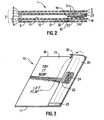
- FIG. 2 is a cross-sectional view of a second embodiment of the advertisement page which includes a microencapsulated fragrance and no additional adhesive;
- FIG. 3 is a perspective view of a third embodiment of the advertisement page
- FIG. 4a is a cross-sectional view of a fourth embodiment of the advertisement page bound within a publication
- FIG. 4b is a perspective view of the fourth embodiment showing the publication opened to expose the advertisement page
- FIG. 5 is a perspective view of a fifth embodiment of the advertisement page having two tear strips
- FIG. 6 is a perspective view of a sixth embodiment of the advertisement page having two portions of sample material maintained between a first opposing layer and a second and third opposing layer;
- FIG. 7a is a top view of a seventh embodiment of the advertisement page which may be trimmed to be flush with pages within a publication;
- FIG. 7b is a cross-sectional view of an alternative embodiment having continuous first and second opposing layers
- FIG. 7c is a cross-sectional view of an alternative embodiment having two separate opposing layers permanently attached to each other;
- FIG. 8 is a plan view which illustrates a step in a method of making the advertisement page before the advertisement page has been folded and bound in the publication.
- FIG. 9 is an illustration of the final step in the method of making the advertisement page of the present invention.
- FIGS. 1a and 1b represent a bound publication 1 containing an advertisement page 10 according to the first embodiment of the present invention.
- the publication 1 comprises a number of pages 3 and an advertisement page 10.
- the pages 3 are joined together at their inside edges 4 to form spine 2.
- the pages 3 are joined together by binding means 8, which may comprise staples, glue, tape, or any other suitable binding means.
- the advertisement page 10 is also bound to spine 2 at its inside edge 15 to become part of the publication 1.
- a single publication may contain more than one advertisement page, and the advertisement pages may be placed at the front and back covers of the publication as well as inside the publication 1.
- outside edge 18 of the advertisement page 10 is flush with outside edge 5 of the pages 3 of the publication 1.
- top edge 16 of the advertisement page 10 is also flush with top edges 6 of the pages 3 of the publication 1
- bottom edge 17 of the advertisement page 10 is flush with bottom edges 7 of the pages 3 of the publication 1.
- the advertisement page 10 comprises a first opposing layer 21 and a second opposing layer 20.
- the first and second opposing layers 21, 20 comprise materials suitable to be bound within the publication and which will withstand the manufacturing process, shipping and handling.
- the layers preferably comprise paper, but may comprise any other suitable material. If desired, the layers may be treated or coated for various purposes, including improved adhesion, de-adhesion, or to prevent migration of the sample material. The treatments or coatings may be applied continuously or discontinuously.
- the contour of the inside edge 19 of the second opposing layer 20 may be a straight line, a curved line, a zigzag, or any other decorative shape.
- the first and second opposing layers 21, 20 are separate pieces. However, they may be formed from a single, continuous sheet of material which has been folded over and then trimmed to form two separate pieces or layers.
- the first and second opposing layers 21, 20 are joined together by both a peelable adhesive 22 and a permanent adhesive 25.
- the user peels the second opposing layer 20 from the first opposing layer 21, thereby breaking the bond created by the peelable adhesive 22.
- the user may peel the second opposing layer 20 from the first opposing layer 21 up to the permanent adhesive 25 which acts as a hinge, maintaining the attachment between the two opposing layers 21, 20.
- sample material 24 is a microencapsulated fragrance.
- sample material 24 may be a cosmetic.
- Cosmetics include any external application intended to beautify or improve the complexion, skin, or hair. These include, for example, lipsticks, powders, foundations, mascaras, blushes, and eyeshadows.
- fragrances and cosmetics a wide variety of sample materials may be included in the present invention, such as personal care products or medical treatments.
- the sample materials may be presented in various forms, such as a pure product or a product which is microencapsulated, contained in a matrix material, or which is in gel or powder form.
- the sample material 24 is maintained within sample area 23 between the first and second opposing layers 21, 20.
- the cosmetic sample material 24 may be bonded to either or both of the first and second opposing layers 21, 20.
- the cosmetic may contain a special treatment or cover to keep it from attaching to one or both of the opposing layers 21, 20.
- the sample material 24 is also a microencapsulated fragrance.
- This microencapsulated fragrance includes an adhesive binder which serves not only to bind the microcapsules of fragrance to each other, but also serves to attach the fragrance to the opposing layers 21, 20.
- the two opposing layers 21, 20 are attached together solely by means of the adhesive binder; therefore, no additional adhesive is required.
- areas of peelable adhesive may be disposed between or among discontinuous areas of sample material 24.
- FIGS. 1a and 1b there is a strip of permanent adhesive 25 near the outside edge 18 of the advertisement page 10 to maintain the hinged attachment between the two opposing layers 21, 20.
- a flap 32 is provided on the opposite or inside edge 19 of the second opposing layer 20. The flap 32 is unattached to the first opposing layer 21 in order to facilitate detachment of the second opposing layer 20 from the first opposing layer 21.
- the permanent adhesive 25 and the flap 32 may be placed at alternative locations between the opposing layers 20, 21.
- the permanent adhesive 25 is provided near the bottom edge 17 of the advertisement page 10, with a flap 32 located near the top edge 16 of the advertisement page 10.
- the permanent adhesive 25 may be provided near the top edge 16 of the page 10, with a flap 32 located near the bottom edge 17.
- permanent adhesive 25 may be provided near the inside edge 19 of the second opposing layer 20, with a flap 32 located near the outside edge 18.
- the flap 32 shown in FIGS. 1a and 1b comprises a strip which spans the entire length of the second opposing layer 20, the flap 32 may be of various shapes.
- the flap 32 may comprise a small triangle-shaped area at a corner of the second opposing layer 20.
- more than one sample material may be incorporated into the advertisement page. Multiple sample materials may be accessed by lifting a single flap, or each sample material may have a flap associated with it.
- the peelable adhesive 22 reinforces the attachment between the two opposing layers 21, 20 and provides protection for the sample material 24, yet it allows the advertisement page 10 to be easily opened. Together, the strip of permanent adhesive 25 and the peelable adhesive 22 surround the sample material 24 as shown in FIG. 1b . Alternatively, the peelable adhesive 22 may completely surround the entire sample area 23 or portions of it. In addition, the peelable adhesive 22 may be applied in discrete portions or spots. The peelable adhesive 22 also may be resealable to allow repeated use of the page 10.
- a strip of permanent adhesive may be located between the two opposing layers 21, 20 across the center of the page, thereby dividing the second opposing layer 20 into two segments.
- One sample material may be located underneath the top segment of the second opposing layer 20 of the page 10 and a second sample material may be located underneath the bottom segment of the second opposing layer 20 of the page 10 and the second opposing layer 20 may be provided with two flaps, one near the top edge 16 of the page 10 and the other near the bottom edge 17 of the page 10. The user may then peel back the top segment of the second opposing layer 20 in order to expose the first sample material and the bottom segment of the second opposing layer 20 in order to expose the second sample material.
- the strip of permanent adhesive across the center of the page 10 will maintain the attachment between the first and second opposing layers 21, 20.
- multiple strips of peelable adhesive may be located between the two opposing layers 21, 20, thereby defining a plurality of segments.
- the second opposing layer may be cross-cut to separate the segments. Each segment may have a flap, and sample material may be located underneath each segment. Alternatively, the second opposing layer is not cross-cut, and the multiple sample materials may be exposed by lifting a single flap. In this way, a plurality of sample materials may be delivered in a single advertisement page.
- a single band of adhesive 22 surrounds sample material 24 and attaches the first opposing layer 21 to the second opposing layer 20.
- the adhesive 22 must maintain the attachment between the first opposing layer 21 and the second opposing layer 20 as long as the advertisement page 10 is not in use.
- the adhesive 22 is also peelable, allowing the user to separate the first opposing layer 21 from the second opposing layer 20 to access the sample material 24. The user may completely separate the first opposing layer 21 from the second opposing layer 20.
- the adhesive 22 also may serve to enclose the sample material 24. For a sample material 24 which tends to migrate, the advertisement page 10 may require a substantially continuous band of adhesive 22, which completely encloses the sample area 23, as shown in FIG. 4b .
- adhesive 22 may be applied in alternative configurations, such as one or more bands, stripes, patches, or spots. Furthermore, in alternative embodiments, the adhesive 22 is not flush with the outside edge 18 of the advertisement page 10 as pictured in FIG. 4a , but is offset from the outside edge 18. The adhesive 22 may be applied in any pattern suitable to maintain the attachment of the first and second opposing layers 21, 20 and to maintain the sample material 24 between these layers.
- the adhesive 22 may be resealable if desired, thereby allowing the user of the advertisement page 10 to reattach the second opposing layer 20 to the first opposing layer 21.
- a hermetic peelable seal may be included in the present invention to protect the sample material 24 from exposure to the atmosphere.
- adhesives are suitable for use in the advertisement page 10. Some examples are glues or adhesives activated by heat, moisture, pressure, and ultraviolet or other radiation.
- the two opposing layers 21, 20 may be attached to each other using attachment means other than an adhesive, such as a heat seal bond.
- the front surface 11 of the advertisement page 10 may display advertising material 13 encouraging the reader to test the sample material 24. If the advertising material comprises a continuous design covering both the first and second layers 21, 20, it may be advantageous to provide a resealable advertisement page, such that the continuous design may be restored after the sample material is accessed.
- the back surface 12 of the advertisement page 11, which is shown in FIGS. 1a and 4a also may display advertising material.
- the second opposing layer 20 contains a flap 32 which is substantially similar to the flap 32 in the first embodiment pictured in FIGS. 1a. and 1b .
- the reader can seize the flap 32 and pull it up, thereby breaking the peelable adhesive attachment between the first opposing layer 21 and the second opposing layer 20. The reader may then completely separate the second opposing layer 20 from the first opposing layer 21 in order to expose and then use the sample material 24.
- the flap 32 may be located anywhere along the edges of the second opposing layer 20.
- the advertisement page may incorporate more than one sample material. Multiple sample materials may be accessed by lifting a single flap, or the second opposing layer 20 may comprise multiple sections, and a separate flap may be provided for accessing each sample material.
- FIG. 5 A fifth embodiment of the present invention is shown in FIG. 5 .
- two different sample materials 24, 24' are deposited between the first opposing layer 21 and the second opposing layer 20.
- the two sample materials 24, 24' are maintained in separate areas between the opposing layers 21, 20 by adhesive 25 so that the sample materials 24, 24' do not come into contact or commingle with each other.
- a reader accesses sample materials 24, 24' by removing or peeling back tear strips 31, 31'.
- the adhesive 25 is a permanent adhesive. Permanent glue, permanent tack glue, or a combination of both may be used.
- a peelable adhesive also may be used.
- the tear strips 31, 31' are provided by creating a perforated or die-cut area 30 in the second opposing layer 20 and a perforated or die-cut area 30' in the first opposing layer 21. Both tear strips 31, 31' are provided with tabs 32, 32'. Tab 32 is unattached to first opposing layer 21 in order to facilitate the removal of tear strip 31, and tab 32' is similarly unattached to second opposing layer 20 in order to facilitate the removal of tear strip 31'.
- the perforated or die-cut areas 30, 30' may be shaped such that the tear strips 31, 31' remain attached to the advertisement page 10 after use, or alternatively they may be shaped such that the tear strips 31, 31' can be completely removed from the advertisement page 10. With this design, multiple samples can be delivered in a single advertisement page.
- an alternative embodiment providing a single sample material may also incorporate one or more tear strips to access the sample material.
- the sample material may be accessed by a plurality of tear strips located on the same side of the advertisement page or on opposite sides of the advertisement page as shown in FIG. 5 .
- adhesive is not necessary to hold the tear strips in place before use.
- a peelable adhesive may be used to attach the tear strips to the opposing layers.
- a resealable or re-closeable adhesive may be incorporated if the page is intended for repeated use.
- the inside edge 15 of the advertisement page 10 is bound into the spine 2. This is known in the art as "perfect" binding. However, there are alternative forms of binding to which the advertisement page 10 may easily be adapted. For example, the advertisement page may be made wider than the pages 3 depicted in FIG. 1a . This page would then be "saddle stitched" or stapled into the publication 1, thereby forming a narrow bindery lip which folds over the page when the publication 1 is closed.
- each of the embodiments discussed above is an example of a single fold advertisement pages in which there are two opposing layers 21, 20.
- the present invention also includes a dual advertisement page 50 as shown in FIG. 6 .
- the dual advertisement page 50 essentially comprises a first opposing layer 51, a second opposing layer 50, a third opposing layer 52, and two portions of sample material 53, 54 (shown in phantom).
- the first opposing layer 51 is approximately the size of two pages.
- the first portion of sample material 53 is maintained between the first opposing layer 51 and the second opposing layer 50, which is attached to the first opposing layer 51 near one edge 55 of the first opposing layer 51, and the second portion of sample material 54 is maintained between the first opposing layer 51 and the third opposing layer 52, which is attached to the first opposing layer 51 near the opposite edge 56 of the first opposing layer 51.
- Each portion of sample material 53, 54 may comprise a single sample material or a plurality of sample materials. Such a page also may be saddle stitched or stapled into a publication.
- the advertisement page 10 is not bound within a publication but possesses certain characteristics which allow it to be bound within a publication such that at least the outside edge is flush with pages of the publication.
- This trimmable advertisement page 10 comprises sample material 24 disposed between a first opposing layer 21 and a second opposing layer 20. The sample material 24 is offset from the outside edge 18 of the advertisement page 10, and this offset allows the advertisement page to be trimmed without breaching or damaging the sample material 24.
- the first and second opposing layers 21, 20 are two separate pieces, which are joined together by an adhesive 22.
- a band of adhesive 22 encircles the sample material 24.
- glue tips may be applied between the first and second opposing layers 21, 20.
- the user peels the second opposing layer 20 from the first opposing layer 21, thereby breaking the bond created by the adhesive 22.
- the user may then completely detach the second opposing layer 20 from the first opposing layer 21.
- the adhesive 22 may be resealable to enable the user to reattach the second opposing layer 20 to the first opposing layer 21.
- the advertisement page may contain an area of permanent adhesive 25. As described above with respect to the embodiment pictured in FIGS.
- this permanent adhesive could act as a hinge, maintaining an attachment between the first and second opposing layers 21, 20.
- Adhesive 22 may not be necessary in embodiments in which the sample material 24 already contains adhesive material, such as certain cosmetic slurries.
- the peelable adhesive 22 may be resealable or, if desired, additional resealing means may be provided.
- More than one sample material may be disposed between the two opposing layers.
- the two opposing layers 21, 20 may be formed from one continuous layer folded at a fold line 33.
- a strip of permanent adhesive 25 is placed between sample material 24 and the fold line 33.
- the permanent adhesive may or may not extend to the fold line 33.
- Both the permanent adhesive 25 and a peelable adhesive 22 maintain the attachment between the two opposing layers 21, 20.
- the user may peel the second opposing layer 20 from the first opposing layer 21, thereby breaking the bond created by the peelable adhesive 22.
- the user may separate the opposing layers 21, 20 only to the strip of permanent adhesive 25.
- this embodiment relies on the permanent adhesive 25 to maintain a fixed bond or hinge between the opposing layers 21, 20.
- Permanent adhesive 25 also may be used in an advertisement page 10 having two separate opposing layers 21, 20 as shown in FIG. 7c .
- the permanent adhesive 25 may be placed anywhere between the two opposing layers 21, 20 as long as it does not interfere with use of the sample material 24.
- the permanent adhesive 25 may form configurations other than a straight strip. For example, it may form a wavy strip or a zigzag. In addition, in lieu of a continuous strip of permanent adhesive 25, which may not be necessary, permanent adhesive 25 may be discontinuously applied. Furthermore, the sample material 24 and the permanent adhesive 25 may be located anywhere on the first opposing layer 21, and the distance between the sample material 24 and the permanent adhesive 25 may be varied depending on the nature of the sample material and the desires of the manufacturer.
- the permanent adhesive 25 protects the sample material 24 during the trimming process.
- the advertisement page may be trimmed anywhere from the fold line 33 or the outside edge 18 to the permanent adhesive 25. In fact, the advertisement page 10 may be trimmed along the permanent adhesive 25 as long as sufficient permanent adhesive remains to maintain the hinged attachment between the first and second opposing layers 21, 20.
- the embodiments described herein generally comprise an advertisement page which has sample material located along its outside edge, and having an outside edge which is flush with or may be trimmed to be flush with the outside edge of the pages of a publication. It will be readily apparent to those skilled in the art, however, that the present invention may also be embodied in an advertisement page which has a sample material located along the top or bottom edge of the advertisement page, and wherein the top or bottom edge is flush with, or may be trimmed to be flush with, the top or bottom edge of the pages of a publication.
- the present invention also relates to methods of making an advertisement page within a bound publication which is flush with the outside edge of the pages of the publication.
- the common method of making bound publications such as magazines is to arrange the printed pages in the proper order, bind them together with staples, glue, or other suitable binding material, and then trim the excess material from the edges of the pages to give the pages a uniform size.
- the present invention uses this process to create a bound publication containing an advertisement page which is flush with the outside edge of the pages of the publication.
- the method of the present invention involves depositing adhesive 22 and sample material 24 onto the first opposing layer 21 of the advertisement page 10.
- the sample material 24 and/or adhesive 22 may be deposited onto the second opposing layer 20, or onto both of the opposing layers 21, 20, without affecting the utility of the method.
- the adhesive may comprise peelable adhesive, permanent adhesive, or a combination of adhesives.
- the second opposing layer 20 is then brought into position over the sample material 24 by folding the second opposing layer 20 over the first opposing layer 21 at fold line 33 in advertisement page 10.
- the first and second opposing layers 21, 20 are attached to each other by means of the adhesive 22.
- the first opposing layer 20 and the second opposing layer 21 may be separate pieces which are subsequently joined together.
- the adhesive may comprise a permanent adhesive to create a hinge between the first and second opposing layers 21, 20, or a combination of different adhesives may be used.
- the sample material 24 may be applied to one of the two opposing layers 21, 20 and the adhesive 22 applied to the other of the two opposing layers 21, 20. Then, when the opposing layers 21, 20 are attached to each other, the sample material 24 and the adhesive 22 come into contact with each other.
- adhesive may be applied to either opposing layer, followed by the application of the sample material to the same opposing layer on top of the adhesive, leaving sufficient adhesive exposed to maintain the attachment between the two opposing layers 21, 20.
- the sample material may be applied to either opposing layer, followed by the application of the adhesive to the same opposing layer, either partially or completely covering the sample material.
- the advertisement page 10 is then bound at its inside edge 15 to pages 3 at spine 2, as shown in FIGS. 1a and 4a .
- the size of the unfinished advertisement page 10 is such that excess protruding material 34 would extend from the edge of the publication 1.
- Excess protruding material 34 may comprise page material (such as paper), and may further comprise excess adhesive 22.
- This excess protruding material 34 is cut and removed from the edge 18 of the advertisement page 10 as shown in FIG. 9 .
- the result is a bound publication 1 in which the outside edge 18 of the advertisement page 10 is flush with the outside edge 5 of the pages 3 of the publication.
- unsightly wrinkles have been formed in the excess protruding material 34 near the fold line 33, they will be removed when the excess protruding material 34 is trimmed, improving the appearance of the advertisement page.
- the adhesive 22 and the sample material 24 are positioned on the advertisement page 10 such that when the cut is made along the outside edge 18, the sample material 24 is neither disturbed, exposed, nor damaged during the folding process.
- a similar method may be used to remove any excess material from the top and bottom edges of an advertisement page to make all edges of the page flush with the edges of the publication.
- Tear strips 31, 31' are formed by perforating or die cutting sections in the opposing layers 21, 20. This step may be performed prior to depositing sample material 24 on either or both layers 21, 20. Alternatively, this step may be performed after the opposing layers 21, 20 are attached to each other.
- the present invention also relates to methods of making trimmable advertisement pages, such as the trimmable advertisement pages described above.
- the method of making the trimmable advertisement page shown in FIG. 7a involves several steps. First, sample material 24 is deposited onto a first opposing layer 21. Sample material 24 is deposited such that it is offset from the outside edge 18 of the advertisement page 10. Next, a top layer (not shown) is laid over the sample material 24 and the first opposing layer 21. The top layer may be continuous with the first opposing layer 21 or it may be formed from a separate piece of material.
- a portion of the top layer directly overlying the sample material 24 composes the second opposing layer 20.
- This second opposing layer 20 is attached to the first opposing layer 21 by adhesive 22, such that sample material 24 is located between the first opposing layer 21 and the second opposing layer 20.
- the adhesive 22 may be resealable, thereby allowing the user to reattach the second opposing layer 20 to the first opposing layer 21.
- both a peelable and permanent adhesive may be applied, allowing the user to peel the opposing layer 21, 20 apart to access the sample material 24 while maintaining the attachment between the layers 21, 20 during use.
- the top layer is next die cut, thereby forming and separating the second opposing layer 20 from the rest of the top layer which is ultimately removed. If the top layer and the first opposing layer 21 are continuous, they ultimately will be separated during the manufacturing process. Advertisement may be printed on the first opposing layer 21, the second opposing layer 20, or both.
- sample material 24 may be deposited anywhere on the first opposing layer 21.
- more than one discrete portion of sample material 24 may be placed in several locations on the first opposing layer 21 and covered by several second opposing layers. These portions may all comprise the same sample material, or they may comprise a variety of different sample materials, enabling a user to sample many different products on one page.
- the method of making the trimmable advertisement page shown in FIG. 7b involves substantially similar steps as described above with regard to the trimmable advertisement page shown in FIG. 7a .
- the first opposing layer 21 and the second opposing layer 20 are continuous and are attached at a fold line 33.
- Sample material 24 and a band of peelable adhesive 22 are applied to the first opposing layer 21 along with a strip of permanent adhesive 25 which is applied to the first opposing layer 21 approximately 6.35mm (0.25 inches) from the fold line 33.
- the first opposing layer 21 is then folded over the second opposing layer 20, the sample material 24, and the adhesives 22, 25 at fold line 33.
- the advertisement page 10 may be distributed as is or may be trimmed flush with a publication without damaging the sample material 24.
Landscapes
- Engineering & Computer Science (AREA)
- Business, Economics & Management (AREA)
- Educational Administration (AREA)
- Educational Technology (AREA)
- Physics & Mathematics (AREA)
- General Physics & Mathematics (AREA)
- Theoretical Computer Science (AREA)
- Credit Cards Or The Like (AREA)
- Sampling And Sample Adjustment (AREA)
- Laminated Bodies (AREA)
- Wrappers (AREA)
Abstract
Description
- The present invention relates to a publications comprising an advertisment page and to a method of moking the same.
- Manufacturers of a variety of products often distribute small samples of their products to potential customers. This is often accomplished by incorporating samples into advertisement pages which are then bound within publications such as magazines and catalogs. This is an especially popular method of advertising and promoting perfumes and cosmetics.
- In these advertisement pages, the sample material is usually enclosed between two panels or flaps of paper which are typically formed from one continuous sheet by folding it over the sample material, which is located near the unbound edge of the sheet. Depending upon the design of the device, the consumer either lifts one of the panels or removes a perforated tear strip to expose or access the sample material.
- The current practice is to make these advertisement pages narrower or smaller than the publication or magazine pages. This is a consequence of the way magazines are typically bound. When a magazine is first assembled, its untrimmed pages typically extend beyond the length and width of the finished magazine size. The excess on the top, side, and bottom of the magazine pages is then cut off to prepare the magazine. If the advertiser's sample, which is frequently situated at the outside edge of the advertisement, extends beyond the borders of the finished magazine page, the sample area may be breached by the page trimming process, or the unbound panel may become unintentionally detached from the magazine.
- In order to avoid this consequence, advertisers manufacture advertisement pages to be smaller than the size of a normal magazine page. This results in a number of disadvantages. First, after paying for an entire page of advertising, the advertiser fails to use the maximum area of the page in creating the advertisement. Thus, the impact on the customer and the amount of information transmitted is reduced. Secondly, an advertiser spends a large amount of time and money designing an attractive and effective advertisement in which to deliver its sample material. Ideally, this advertisement should stand alone in the consumer's field of vision when the consumer looks at the page, in order to direct as much attention as possible to the advertising material and to encourage the consumer to try the sample material. However, with the current method of advertisement page construction, the border of the sample advertisement is surrounded by the magazine text or advertisement which appears on the subsequent page, and this lessens the impact of the advertiser's message on the consumer.
- Another problem encountered in the construction of folded-sheet advertisement pages is that the equipment and process used to fold the page can have detrimental effects on the page. For example, a folding device can cause unsightly wrinkling or creasing of the page near the fold line. Furthermore, although it is desirable to position certain sample materials, such as fragrance samples, near the fold line, a sample material so positioned may be damaged by the folding device. If the sample material is a microencapsulated fragrance, some of the microcapsules may be crushed, resulting in unwanted premature release of the fragrance.
- There are a number of sampler devices in the prior art. For example,
US Patent No. 5,188,236 to SAYERS et al discloses a z-shaped scent sampler for use in magazines. Similarly,US Patent No. 4,925,667 to FELLOWS et al discloses a method of binding cosmetic samplers to a substrate for use in magazine inserts and the like. In addition,US Patent No. 5,050,910 to SCHECHTER et al discloses a complex, multi-layered sampler device in which part of the device must be entirely removed from the publication before the material can be sampled. -
US 5,248,537 to GIANNAVOLA discloses a fragrance releasing insert for magazines which provides a fragrance sample to readers. The insert, which is formed from a single substrate, which has a removable portion that contains the fragrance sample. The removable portion forms a diffusion resistance envelope around the fragrance sample, which reduces the possibility of inadvertent contamination of the magazine by fragrance. While the removable diffusion resistance envelope is attached to the remainder of the insert in the magazine, the fragrance cannot be sampled. However, after removal of the envelope along a pair of perforations, the fragrance may be sampled by peeling open the envelope, thus causing a release of the fragrance. - The prior art does not disclose an advertisement page which may span the entire area of a publication page and which comprises a simple two-layer construction to contain sample material. Also, the prior art does not disclose an advertisement page which may be constructed by folding but avoids the unsightly appearance and damage to the sample material that folding can cause. Therefore, there is a need for an advertisement page bound within a publication having an edge which is flush with the outside edge of the publication pages and which thereby spans the entire area of the publication pages. There is also a need for a trimmable advertisement page which may be bound flush within a publication. There is also a need for an efficient and economical method of making such advertisement page.
- According to a first aspect of the present invention there is provided a publication comprising a plurality of pages, each page having an outside edge the publication further comprising an advertisement page, the advertising page comprising a sample material disposed between opposing surfaces of a first opposing layer and a second opposing layer which are attached to each other, wherein the advertisement page has an outside edge which is opposite to the spine of the publication and which is flush with the outside edge of at least one page of the publication.
- According to a second aspect of the present invention there is provided a publica tion comprising an advertisement page wherein the two opposing layers are removably attached together, such that one of the two opposing layers may be completely and entirely detached From the other of the two opposing layers to access the sample material.
- Reference is next made to a brief description of the drawings, which are intended to illustrate a number of embodiments of the advertisement page and methods of making the advertisement page according to the present invention. The drawings and detailed descriptions which follow are intended to be merely illustrative, and are not intended to limit the scope of the invention as set forth in the appended claims.
-
FIG. 1a is a cross-sectional view of a first embodiment of the advertisement page bound within a publication; -
FIG. 1b is a perspective view of the first embodiment showing the publication opened to expose the advertisement page; -
FIG. 2 is a cross-sectional view of a second embodiment of the advertisement page which includes a microencapsulated fragrance and no additional adhesive; -
FIG. 3 is a perspective view of a third embodiment of the advertisement page; -
FIG. 4a is a cross-sectional view of a fourth embodiment of the advertisement page bound within a publication; -
FIG. 4b is a perspective view of the fourth embodiment showing the publication opened to expose the advertisement page; -
FIG. 5 is a perspective view of a fifth embodiment of the advertisement page having two tear strips; -
FIG. 6 is a perspective view of a sixth embodiment of the advertisement page having two portions of sample material maintained between a first opposing layer and a second and third opposing layer; -
FIG. 7a is a top view of a seventh embodiment of the advertisement page which may be trimmed to be flush with pages within a publication; -
FIG. 7b is a cross-sectional view of an alternative embodiment having continuous first and second opposing layers; -
FIG. 7c is a cross-sectional view of an alternative embodiment having two separate opposing layers permanently attached to each other; -
FIG. 8 is a plan view which illustrates a step in a method of making the advertisement page before the advertisement page has been folded and bound in the publication; and -
FIG. 9 is an illustration of the final step in the method of making the advertisement page of the present invention. -
FIGS. 1a and 1b represent a boundpublication 1 containing anadvertisement page 10 according to the first embodiment of the present invention. As shown inFIG. 1a , thepublication 1 comprises a number ofpages 3 and anadvertisement page 10. Thepages 3 are joined together at theirinside edges 4 to formspine 2. Thepages 3 are joined together by bindingmeans 8, which may comprise staples, glue, tape, or any other suitable binding means. As shown, theadvertisement page 10 is also bound tospine 2 at itsinside edge 15 to become part of thepublication 1. A single publication may contain more than one advertisement page, and the advertisement pages may be placed at the front and back covers of the publication as well as inside thepublication 1. - As shown in
FIGS. 1a and 1b ,outside edge 18 of theadvertisement page 10 is flush withoutside edge 5 of thepages 3 of thepublication 1. Although not necessary,top edge 16 of theadvertisement page 10 is also flush withtop edges 6 of thepages 3 of thepublication 1, andbottom edge 17 of theadvertisement page 10 is flush with bottom edges 7 of thepages 3 of thepublication 1. Thus, when thepublication 1 is opened to expose theadvertisement page 10, thesubsequent page 3 of thepublication 1 is not visible to the reader as it is completely covered by theadvertisement page 10. - As shown in
FIGS. 1a and 1b , theadvertisement page 10 comprises a first opposinglayer 21 and a second opposinglayer 20. The first and second opposinglayers inside edge 19 of the second opposinglayer 20 may be a straight line, a curved line, a zigzag, or any other decorative shape. - The first and second opposing
layers layers peelable adhesive 22 and apermanent adhesive 25. In order to expose or access thesample material 24, the user peels the second opposinglayer 20 from the first opposinglayer 21, thereby breaking the bond created by thepeelable adhesive 22. The user may peel the second opposinglayer 20 from the first opposinglayer 21 up to thepermanent adhesive 25 which acts as a hinge, maintaining the attachment between the two opposinglayers - In the first embodiment,
sample material 24 is a microencapsulated fragrance. Alternatively,sample material 24 may be a cosmetic. Cosmetics include any external application intended to beautify or improve the complexion, skin, or hair. These include, for example, lipsticks, powders, foundations, mascaras, blushes, and eyeshadows. In addition to fragrances and cosmetics, a wide variety of sample materials may be included in the present invention, such as personal care products or medical treatments. The sample materials may be presented in various forms, such as a pure product or a product which is microencapsulated, contained in a matrix material, or which is in gel or powder form. - The
sample material 24 is maintained withinsample area 23 between the first and second opposinglayers cosmetic sample material 24 may be bonded to either or both of the first and second opposinglayers layers sample area 23, which is located near theoutside edge 18 of theadvertisement page 10. In alternative embodiments, there may be more than one sample area, and sample areas may be located anywhere between the two opposinglayers - In the second embodiment illustrated in
FIG. 2 , thesample material 24 is also a microencapsulated fragrance. This microencapsulated fragrance includes an adhesive binder which serves not only to bind the microcapsules of fragrance to each other, but also serves to attach the fragrance to the opposinglayers layers sample material 24. - In the first embodiment shown in
FIGS. 1a and 1b , there is a strip ofpermanent adhesive 25 near theoutside edge 18 of theadvertisement page 10 to maintain the hinged attachment between the two opposinglayers flap 32 is provided on the opposite orinside edge 19 of the second opposinglayer 20. Theflap 32 is unattached to the first opposinglayer 21 in order to facilitate detachment of the second opposinglayer 20 from the first opposinglayer 21. Thepermanent adhesive 25 and theflap 32 may be placed at alternative locations between the opposinglayers FIG. 3 , thepermanent adhesive 25 is provided near thebottom edge 17 of theadvertisement page 10, with aflap 32 located near thetop edge 16 of theadvertisement page 10. Alternatively, thepermanent adhesive 25 may be provided near thetop edge 16 of thepage 10, with aflap 32 located near thebottom edge 17. Alternatively,permanent adhesive 25 may be provided near theinside edge 19 of the second opposinglayer 20, with aflap 32 located near theoutside edge 18. Furthermore, while theflap 32 shown inFIGS. 1a and 1b comprises a strip which spans the entire length of the second opposinglayer 20, theflap 32 may be of various shapes. For example, theflap 32 may comprise a small triangle-shaped area at a corner of the second opposinglayer 20. Also, more than one sample material may be incorporated into the advertisement page. Multiple sample materials may be accessed by lifting a single flap, or each sample material may have a flap associated with it. - The
peelable adhesive 22 reinforces the attachment between the two opposinglayers sample material 24, yet it allows theadvertisement page 10 to be easily opened. Together, the strip ofpermanent adhesive 25 and the peelable adhesive 22 surround thesample material 24 as shown inFIG. 1b . Alternatively, thepeelable adhesive 22 may completely surround theentire sample area 23 or portions of it. In addition, thepeelable adhesive 22 may be applied in discrete portions or spots. The peelable adhesive 22 also may be resealable to allow repeated use of thepage 10. - In alternative embodiments, a strip of permanent adhesive may be located between the two opposing
layers layer 20 into two segments. One sample material may be located underneath the top segment of the second opposinglayer 20 of thepage 10 and a second sample material may be located underneath the bottom segment of the second opposinglayer 20 of thepage 10 and the second opposinglayer 20 may be provided with two flaps, one near thetop edge 16 of thepage 10 and the other near thebottom edge 17 of thepage 10. The user may then peel back the top segment of the second opposinglayer 20 in order to expose the first sample material and the bottom segment of the second opposinglayer 20 in order to expose the second sample material. The strip of permanent adhesive across the center of thepage 10 will maintain the attachment between the first and second opposinglayers layers - In the fourth embodiment illustrated in
FIGS. 4a and 4b , a single band of adhesive 22 surroundssample material 24 and attaches the first opposinglayer 21 to the second opposinglayer 20. The adhesive 22 must maintain the attachment between the first opposinglayer 21 and the second opposinglayer 20 as long as theadvertisement page 10 is not in use. The adhesive 22 is also peelable, allowing the user to separate the first opposinglayer 21 from the second opposinglayer 20 to access thesample material 24. The user may completely separate the first opposinglayer 21 from the second opposinglayer 20. The adhesive 22 also may serve to enclose thesample material 24. For asample material 24 which tends to migrate, theadvertisement page 10 may require a substantially continuous band of adhesive 22, which completely encloses thesample area 23, as shown inFIG. 4b . Alternatively, adhesive 22 may be applied in alternative configurations, such as one or more bands, stripes, patches, or spots. Furthermore, in alternative embodiments, the adhesive 22 is not flush with theoutside edge 18 of theadvertisement page 10 as pictured inFIG. 4a , but is offset from theoutside edge 18. The adhesive 22 may be applied in any pattern suitable to maintain the attachment of the first and second opposinglayers sample material 24 between these layers. - The adhesive 22 may be resealable if desired, thereby allowing the user of the
advertisement page 10 to reattach the second opposinglayer 20 to the first opposinglayer 21. In addition, a hermetic peelable seal may be included in the present invention to protect thesample material 24 from exposure to the atmosphere. Those skilled in the art will recognize that many different adhesives are suitable for use in theadvertisement page 10. Some examples are glues or adhesives activated by heat, moisture, pressure, and ultraviolet or other radiation. In addition, the two opposinglayers - As shown in
FIGS. 1b and4b , thefront surface 11 of theadvertisement page 10 may displayadvertising material 13 encouraging the reader to test thesample material 24. If the advertising material comprises a continuous design covering both the first andsecond layers back surface 12 of theadvertisement page 11, which is shown inFIGS. 1a and4a , also may display advertising material. - In the fourth embodiment pictured in
FIGS. 4a and 4b , the second opposinglayer 20 contains aflap 32 which is substantially similar to theflap 32 in the first embodiment pictured inFIGS. 1a. and 1b . The reader can seize theflap 32 and pull it up, thereby breaking the peelable adhesive attachment between the first opposinglayer 21 and the second opposinglayer 20. The reader may then completely separate the second opposinglayer 20 from the first opposinglayer 21 in order to expose and then use thesample material 24. Theflap 32 may be located anywhere along the edges of the second opposinglayer 20. Alternatively, the advertisement page may incorporate more than one sample material. Multiple sample materials may be accessed by lifting a single flap, or the second opposinglayer 20 may comprise multiple sections, and a separate flap may be provided for accessing each sample material. - A fifth embodiment of the present invention is shown in
FIG. 5 . In this embodiment, twodifferent sample materials 24, 24' are deposited between the first opposinglayer 21 and the second opposinglayer 20. The twosample materials 24, 24' are maintained in separate areas between the opposinglayers sample materials 24, 24' do not come into contact or commingle with each other. A reader accessessample materials 24, 24' by removing or peeling back tear strips 31, 31'. Preferably, the adhesive 25 is a permanent adhesive. Permanent glue, permanent tack glue, or a combination of both may be used. A peelable adhesive also may be used. - The tear strips 31, 31' are provided by creating a perforated or die-cut
area 30 in the second opposinglayer 20 and a perforated or die-cut area 30' in the first opposinglayer 21. Both tear strips 31, 31' are provided withtabs 32, 32'.Tab 32 is unattached to first opposinglayer 21 in order to facilitate the removal oftear strip 31, and tab 32' is similarly unattached to second opposinglayer 20 in order to facilitate the removal of tear strip 31'. The perforated or die-cutareas 30, 30' may be shaped such that the tear strips 31, 31' remain attached to theadvertisement page 10 after use, or alternatively they may be shaped such that the tear strips 31, 31' can be completely removed from theadvertisement page 10. With this design, multiple samples can be delivered in a single advertisement page. It is also contemplated that an alternative embodiment providing a single sample material may also incorporate one or more tear strips to access the sample material. Alternatively, the sample material may be accessed by a plurality of tear strips located on the same side of the advertisement page or on opposite sides of the advertisement page as shown inFIG. 5 . - In an embodiment incorporating perforated tear strips, adhesive is not necessary to hold the tear strips in place before use. However, in an embodiment incorporating die cut tear strips (in lieu of perforated tear strips), a peelable adhesive may be used to attach the tear strips to the opposing layers. In both embodiments, a resealable or re-closeable adhesive may be incorporated if the page is intended for repeated use.
- In all of the embodiments discussed above, the
inside edge 15 of theadvertisement page 10 is bound into thespine 2. This is known in the art as "perfect" binding. However, there are alternative forms of binding to which theadvertisement page 10 may easily be adapted. For example, the advertisement page may be made wider than thepages 3 depicted inFIG. 1a . This page would then be "saddle stitched" or stapled into thepublication 1, thereby forming a narrow bindery lip which folds over the page when thepublication 1 is closed. - In addition, each of the embodiments discussed above is an example of a single fold advertisement pages in which there are two opposing
layers dual advertisement page 50 as shown inFIG. 6 . Thedual advertisement page 50 essentially comprises a first opposinglayer 51, a second opposinglayer 50, a third opposinglayer 52, and two portions ofsample material 53, 54 (shown in phantom). The first opposinglayer 51 is approximately the size of two pages. The first portion ofsample material 53 is maintained between the first opposinglayer 51 and the second opposinglayer 50, which is attached to the first opposinglayer 51 near oneedge 55 of the first opposinglayer 51, and the second portion ofsample material 54 is maintained between the first opposinglayer 51 and the third opposinglayer 52, which is attached to the first opposinglayer 51 near theopposite edge 56 of the first opposinglayer 51. Each portion ofsample material - In the seventh alternative embodiment shown in
FIG. 7a , theadvertisement page 10 is not bound within a publication but possesses certain characteristics which allow it to be bound within a publication such that at least the outside edge is flush with pages of the publication. Thistrimmable advertisement page 10 comprisessample material 24 disposed between a first opposinglayer 21 and a second opposinglayer 20. Thesample material 24 is offset from theoutside edge 18 of theadvertisement page 10, and this offset allows the advertisement page to be trimmed without breaching or damaging thesample material 24. - The first and second opposing
layers sample material 24. Alternatively, in lieu of a continuous band, glue tips may be applied between the first and second opposinglayers sample material 24, the user peels the second opposinglayer 20 from the first opposinglayer 21, thereby breaking the bond created by the adhesive 22. The user may then completely detach the second opposinglayer 20 from the first opposinglayer 21. The adhesive 22 may be resealable to enable the user to reattach the second opposinglayer 20 to the first opposinglayer 21. Alternatively, the advertisement page may contain an area ofpermanent adhesive 25. As described above with respect to the embodiment pictured inFIGS. 1a, 1b , and3 , this permanent adhesive could act as a hinge, maintaining an attachment between the first and second opposinglayers Adhesive 22 may not be necessary in embodiments in which thesample material 24 already contains adhesive material, such as certain cosmetic slurries. The peelable adhesive 22 may be resealable or, if desired, additional resealing means may be provided. - More than one sample material may be disposed between the two opposing layers. Alternatively, there may be a plurality of second opposing layers attached to one first opposing layer, and a separate sample material may be maintained between each second opposing layer and the first opposing layer.
- As shown in
FIG. 7b , the two opposinglayers fold line 33. In this embodiment, a strip ofpermanent adhesive 25 is placed betweensample material 24 and thefold line 33. The permanent adhesive may or may not extend to thefold line 33. Both thepermanent adhesive 25 and a peelable adhesive 22 maintain the attachment between the two opposinglayers sample material 24, the user may peel the second opposinglayer 20 from the first opposinglayer 21, thereby breaking the bond created by thepeelable adhesive 22. However, the user may separate the opposinglayers permanent adhesive 25. In lieu of folds found in conventional scent strip samplers, this embodiment relies on thepermanent adhesive 25 to maintain a fixed bond or hinge between the opposinglayers -
Permanent adhesive 25 also may be used in anadvertisement page 10 having two separate opposinglayers FIG. 7c . Thepermanent adhesive 25 may be placed anywhere between the two opposinglayers sample material 24. - In alternative embodiments, the
permanent adhesive 25 may form configurations other than a straight strip. For example, it may form a wavy strip or a zigzag. In addition, in lieu of a continuous strip ofpermanent adhesive 25, which may not be necessary,permanent adhesive 25 may be discontinuously applied. Furthermore, thesample material 24 and thepermanent adhesive 25 may be located anywhere on the first opposinglayer 21, and the distance between thesample material 24 and thepermanent adhesive 25 may be varied depending on the nature of the sample material and the desires of the manufacturer. - The
permanent adhesive 25 protects thesample material 24 during the trimming process. The advertisement page may be trimmed anywhere from thefold line 33 or theoutside edge 18 to thepermanent adhesive 25. In fact, theadvertisement page 10 may be trimmed along thepermanent adhesive 25 as long as sufficient permanent adhesive remains to maintain the hinged attachment between the first and second opposinglayers - The embodiments described herein generally comprise an advertisement page which has sample material located along its outside edge, and having an outside edge which is flush with or may be trimmed to be flush with the outside edge of the pages of a publication. It will be readily apparent to those skilled in the art, however, that the present invention may also be embodied in an advertisement page which has a sample material located along the top or bottom edge of the advertisement page, and wherein the top or bottom edge is flush with, or may be trimmed to be flush with, the top or bottom edge of the pages of a publication.
- The present invention also relates to methods of making an advertisement page within a bound publication which is flush with the outside edge of the pages of the publication. The common method of making bound publications such as magazines is to arrange the printed pages in the proper order, bind them together with staples, glue, or other suitable binding material, and then trim the excess material from the edges of the pages to give the pages a uniform size. The present invention uses this process to create a bound publication containing an advertisement page which is flush with the outside edge of the pages of the publication.
- As shown in
FIG. 8 , the method of the present invention involves depositingadhesive 22 andsample material 24 onto the first opposinglayer 21 of theadvertisement page 10. Alternatively, thesample material 24 and/or adhesive 22 may be deposited onto the second opposinglayer 20, or onto both of the opposinglayers layer 20 is then brought into position over thesample material 24 by folding the second opposinglayer 20 over the first opposinglayer 21 atfold line 33 inadvertisement page 10. The first and second opposinglayers layer 20 and the second opposinglayer 21 may be separate pieces which are subsequently joined together. Furthermore, the adhesive may comprise a permanent adhesive to create a hinge between the first and second opposinglayers - In an alternative method, the
sample material 24 may be applied to one of the two opposinglayers layers layers sample material 24 and the adhesive 22 come into contact with each other. In an alternative method, adhesive may be applied to either opposing layer, followed by the application of the sample material to the same opposing layer on top of the adhesive, leaving sufficient adhesive exposed to maintain the attachment between the two opposinglayers - The
advertisement page 10 is then bound at itsinside edge 15 topages 3 atspine 2, as shown inFIGS. 1a and4a . As described above, there are a variety of different binding techniques, such as perfect binding, saddle stitching or stapling. The size of theunfinished advertisement page 10 is such that excess protrudingmaterial 34 would extend from the edge of thepublication 1.Excess protruding material 34 may comprise page material (such as paper), and may further compriseexcess adhesive 22. This excess protrudingmaterial 34 is cut and removed from theedge 18 of theadvertisement page 10 as shown inFIG. 9 . The result is a boundpublication 1 in which theoutside edge 18 of theadvertisement page 10 is flush with theoutside edge 5 of thepages 3 of the publication. Furthermore, if unsightly wrinkles have been formed in the excess protrudingmaterial 34 near thefold line 33, they will be removed when the excess protrudingmaterial 34 is trimmed, improving the appearance of the advertisement page. - The adhesive 22 and the
sample material 24 are positioned on theadvertisement page 10 such that when the cut is made along theoutside edge 18, thesample material 24 is neither disturbed, exposed, nor damaged during the folding process. A similar method may be used to remove any excess material from the top and bottom edges of an advertisement page to make all edges of the page flush with the edges of the publication. - In addition, an embodiment such as is shown in
FIG. 5 may be formed by the methods of the present invention. Tear strips 31, 31' are formed by perforating or die cutting sections in the opposinglayers sample material 24 on either or bothlayers layers - The present invention also relates to methods of making trimmable advertisement pages, such as the trimmable advertisement pages described above. The method of making the trimmable advertisement page shown in
FIG. 7a involves several steps. First,sample material 24 is deposited onto a first opposinglayer 21.Sample material 24 is deposited such that it is offset from theoutside edge 18 of theadvertisement page 10. Next, a top layer (not shown) is laid over thesample material 24 and the first opposinglayer 21. The top layer may be continuous with the first opposinglayer 21 or it may be formed from a separate piece of material. - A portion of the top layer directly overlying the
sample material 24 composes the second opposinglayer 20. This second opposinglayer 20 is attached to the first opposinglayer 21 by adhesive 22, such thatsample material 24 is located between the first opposinglayer 21 and the second opposinglayer 20. The adhesive 22 may be resealable, thereby allowing the user to reattach the second opposinglayer 20 to the first opposinglayer 21. Alternatively, both a peelable and permanent adhesive may be applied, allowing the user to peel the opposinglayer sample material 24 while maintaining the attachment between thelayers - The top layer is next die cut, thereby forming and separating the second opposing
layer 20 from the rest of the top layer which is ultimately removed. If the top layer and the first opposinglayer 21 are continuous, they ultimately will be separated during the manufacturing process. Advertisement may be printed on the first opposinglayer 21, the second opposinglayer 20, or both. - As long as the
sample material 24 is offset from theoutside edge 18 of theadvertisement page 10, it may be deposited anywhere on the first opposinglayer 21. In an alternative embodiment, more than one discrete portion ofsample material 24 may be placed in several locations on the first opposinglayer 21 and covered by several second opposing layers. These portions may all comprise the same sample material, or they may comprise a variety of different sample materials, enabling a user to sample many different products on one page. - The method of making the trimmable advertisement page shown in
FIG. 7b involves substantially similar steps as described above with regard to the trimmable advertisement page shown inFIG. 7a . However, the first opposinglayer 21 and the second opposinglayer 20 are continuous and are attached at afold line 33.Sample material 24 and a band of peelable adhesive 22 are applied to the first opposinglayer 21 along with a strip ofpermanent adhesive 25 which is applied to the first opposinglayer 21 approximately 6.35mm (0.25 inches) from thefold line 33. The first opposinglayer 21 is then folded over the second opposinglayer 20, thesample material 24, and theadhesives fold line 33. Theadvertisement page 10 may be distributed as is or may be trimmed flush with a publication without damaging thesample material 24.
Claims (21)
- A publication (1) comprising a plurality of pages (3) joined together to four a spine, each page having an outside edge (5), the publication further comprising an advertisement page, the advertising page comprising a sample material (24; 53) disposed between opposing surfaces of a first opposing layer (21; 51) and a second opposing layer (20; 50) which arc attached to each other, characterised in that the advertisement page has an outside edge (18) which is opposite to the spine (2) of the publication and which is flush with the outside edge (5) of at least one page of the publication.
- The publication according to claim 1, wherein the two opposing layers are removably attached together, such that at least a portion of one of the two opposing layers may be detached from the other of the two opposing layers to access the sample material.
- The publication according to claim 2, wherein the portion of one of the two opposing layers may be reattached to the other of the two opposing layers.
- The publication according to claim 1, wherein the two opposing layers are removably attached together, such that one of the two opposing layers may be completely and entirely detached from the other of the two opposing layers to access the sample material.
- The publication according to claim 4, wherein the one of the two opposing layers may be reattached to the other of the two opposing layers.
- The publication according to claim 1, wherein the sample material is microencapsulated fragrance.
- The publication of claim 1, wherein the publication comprises a plurality of pages and a spine (2), wherein each page has a plurality of edges (5,6,7), one of which is bound to the spine, and wherein the first opposing layer (21) has a plurality of edges, one of which is bound to the spine of the publication, wherein
an outside edge of the first opposing layer is flush respectively with an outside edge (5) of the pages of the publication; and
the second opposing layer (20) has a plurality of edges, wherein an outside edge of the second opposing layer is flush respectively with the outside edge of the first opposing layer; and
at least a portion of the second opposing layer may be detached from the first opposing layer to access the sample material. - The publication of claim 1, further comprising a second portion (54) of sample material disposed between opposing surfaces of the first opposing layer and a third opposing layer (52) which are attached to each other, wherein the advertisement page has two outside edges which are flush with the outside edge of the plurality of pages.
- The publication of claim 1, wherein the second opposing layer is a discrete opposing layer and the sample material is disposed between the first opposing layer and the second discrete opposing layer, wherein the sample material is offset from the outside edge of the advertisement page and wherein the second discrete opposing layer may be peeled apart and removed from the first opposing layer in order to access the sample material.
- The publication according to claim 9, wherein at least one second opposing layer may be reattached to the first opposing layer.
- The publication according to claim 9, further comprising a permanent attachment between the first opposing layer and at least one second discrete opposing layer.
- The publication according to claim 11, wherein at least one second opposing layer may be reattached to the first opposing layer.
- The publication of claim 1, wherein the first opposing layer and the second opposing layer are attached at a fold line (33), wherein the first opposing layer is permanently attached to the second opposing layer by an adhesive (25) placed between the sample material and the fold line to provide a hinge attachment between the first and second opposing layers in case the fold line is trimmed from the advertisement page, and wherein a portion of one of the two opposing layers may be detached from the other of the two opposing layers, both opposing layers remaining intact, in order to access the sample material.
- A method of making the advertisement page of the publication of claim 1, comprising the steps of:depositing sample material onto a first opposing layer (21);attaching at least a portion of a second opposing layer (20) to the first opposing layer, such that the second opposing layer covers the sample material;binding one of the two opposing layers to or into the publication; andtrimming the two opposing layers such that an outside edge (18) of the advertisement page is opposite to the spine of the publication and is flush with the outside edge of the pages of the publication.
- The method of making the advertisement page of the publication according to claim 14, wherein the first opposing layer is continuous with the second opposing layer; the method comprises the step of:folding the two opposing layers such that the sample material is located between the two opposing layers;attaching at least a portion of one of the two opposing layers to the other of the two opposing layers.
- The method of making the advertisement page of the publication according to claim 15, wherein trimming the two opposing layers separates the second opposing layer from the first opposing layer such that they are no longer continuous.
- The method of making the advertisement page of the publication according to claim 15, further comprising the step of perforating a section (30) in at least one of the two opposing layers such that at least a portion of the section may be detached from the other of the two opposing layers to access the sample material,
- The method of making the advertisement page of the publication according to claim 15, further comprising the step of die-cutting a section (30) in at least one of the two opposing layers such that at least a portion of the section may be detached from the other of the two opposing layers to access the sample material.
- The method of making the advertisement page of the publication according to claim 14, comprising the steps of:die-cutting the top layer around the portion of the top layer, thereby forming a second opposing layer (20); andremoving portions of the top layer other than the second opposing layer, such that the second opposing layer covers only a portion of the first opposing layer.
- The method of making the advertisement page of the publication according to claim 15, comprising the steps of:die-cutting a top layer around a portion of the top layer, thereby forming the second opposing layer (20); andremoving portions of the top layer other a second opposing layer.
- The method of making the advertisement page of the publication according to claim 15, comprising the steps of:applying permanent adhesive (25) onto said one of the first opposing layer (21) and the second opposing layer (20) between the sample material and the other of said one of the first opposing layer and the second opposing layer; andfolding and attaching the first opposing layer to the second opposing layer such that the sample material is located between the two opposing layers, wherein the permanent adhesive maintains a permanent attachment between the two opposing layers and provides a hinge attachment between the two opposing layers in case the first opposing layer and the second opposing layer arc trimmed such that the two layers are no longer continuous.
Applications Claiming Priority (3)
| Application Number | Priority Date | Filing Date | Title |
|---|---|---|---|
| US08/807,097 US5918908A (en) | 1997-02-27 | 1997-02-27 | Advertisement page with incorporated sample material which can be trimmed to fit flush with the edges of a publication and methods of making same |
| US807097 | 1997-02-27 | ||
| PCT/US1998/003563 WO1998037998A1 (en) | 1997-02-27 | 1998-02-24 | Advertisement page with incorporated sample material which can be trimmed to fit flush with the edges of a publication and methods of making same |
Publications (3)
| Publication Number | Publication Date |
|---|---|
| EP1011899A1 EP1011899A1 (en) | 2000-06-28 |
| EP1011899A4 EP1011899A4 (en) | 2004-08-04 |
| EP1011899B1 true EP1011899B1 (en) | 2009-04-15 |
Family
ID=25195568
Family Applications (1)
| Application Number | Title | Priority Date | Filing Date |
|---|---|---|---|
| EP98907600A Expired - Lifetime EP1011899B1 (en) | 1997-02-27 | 1998-02-24 | Advertisement page with incorporated sample material which can be trimmed to fit flush with the edges of a publication and methods of making same |
Country Status (7)
| Country | Link |
|---|---|
| US (2) | US5918908A (en) |
| EP (1) | EP1011899B1 (en) |
| AT (1) | ATE428522T1 (en) |
| AU (1) | AU6336598A (en) |
| CA (1) | CA2282366C (en) |
| DE (1) | DE69840747D1 (en) |
| WO (1) | WO1998037998A1 (en) |
Families Citing this family (33)
| Publication number | Priority date | Publication date | Assignee | Title |
|---|---|---|---|---|
| AU1942599A (en) | 1998-02-10 | 1999-08-23 | Delta Graphics, Inc. | Product sampler |
| US6129346A (en) * | 1998-05-08 | 2000-10-10 | Morre U.S.A., Inc. | Method for forming a brochure attached to a periodical |
| US6895702B1 (en) * | 1999-04-22 | 2005-05-24 | Darrell R. Colbert | Scented calendar |
| DE19936794A1 (en) * | 1999-08-10 | 2001-02-22 | Deotexis Inc | Articles made of cardboard, paper or the like, and method and intermediate for its manufacture |
| US6213303B1 (en) * | 1999-11-30 | 2001-04-10 | Color Prelude, Inc. | Fluid or volatile cosmetic sampler package for subscription rate magazine insertion |
| US6511097B2 (en) * | 2000-02-17 | 2003-01-28 | Sleepeck Printing Company | Coupon booklet and method |
| US6739785B2 (en) | 2000-03-15 | 2004-05-25 | Meadwestvaco Corporation | Extended width notebook system |
| WO2002014174A1 (en) * | 2000-08-15 | 2002-02-21 | Girl Squared, Llc | An entertainment and education device having a message displaying medium and a message enhancing product sample |
| JP3862949B2 (en) * | 2000-11-28 | 2006-12-27 | 株式会社マツモト | Printed material production method and printed material obtained thereby |
| WO2002091274A2 (en) * | 2001-05-03 | 2002-11-14 | Quinn, Gaellen & Michael | Offline-to-online traffic generation and demographic identification process and method |
| US6629705B1 (en) | 2001-06-20 | 2003-10-07 | Gary R. Ellis | Magazine insert and method for making same |
| US6974158B1 (en) | 2002-05-09 | 2005-12-13 | Concord Litho Group, Inc. | Cover and insert assembly for a periodical or other multi-page printed material |
| US20030212591A1 (en) * | 2002-05-10 | 2003-11-13 | Eli Research, Inc. | Methods for marketing newsletter subscriptions with direct response mailings without use of an envelope |
| US20030222096A1 (en) * | 2002-06-04 | 2003-12-04 | Kennedy Christine Elizabeth | Cosmetic article selection device and related method |
| USD503425S1 (en) * | 2002-07-01 | 2005-03-29 | Thomas Blaine Rogers | 6 page and coupon format for printed material |
| EP1460636A1 (en) * | 2003-03-17 | 2004-09-22 | Wallon Imprimeur S.A. | Flexible storage system and process for making the same |
| US20050048243A1 (en) * | 2003-09-02 | 2005-03-03 | Jeff Brown | Scented magazine blow-in with extension flap |
| US20060263579A1 (en) * | 2004-06-04 | 2006-11-23 | Perfect Scents Of Illinois, Llc. | Advertising page containing micro-encapsulated material |
| US20060145465A1 (en) * | 2005-01-03 | 2006-07-06 | Abbondante, Llc | Separable sheet system and method |
| DE602005012253D1 (en) * | 2005-07-14 | 2009-02-26 | Procter & Gamble | Container for dispensing towels |
| US20070148293A1 (en) * | 2005-12-27 | 2007-06-28 | Kimberly-Clark Worldwide, Inc. | Packaged consumable products with user-selectable aromas |
| WO2007091166A2 (en) * | 2006-02-08 | 2007-08-16 | Mikael Anthony Ford Latif | Perfumed decalcomania |
| US20080241453A1 (en) * | 2007-03-26 | 2008-10-02 | Akins Gary L | Fragrance advertising assembly |
| US8753863B2 (en) * | 2007-04-27 | 2014-06-17 | Ocean Nourishment Corporation Pty Limited | Carbon sequestration using a floating vessel |
| US20080272584A1 (en) * | 2007-05-01 | 2008-11-06 | Carolyn Marie Eisele | Method for advertising tissue products |
| US7878494B1 (en) | 2007-05-29 | 2011-02-01 | Volkert John K | Making magazine pop-up formats |
| US9074784B2 (en) | 2007-08-03 | 2015-07-07 | Honeywell International Inc. | Fan coil thermostat with fan ramping |
| US9182141B2 (en) | 2007-08-03 | 2015-11-10 | Honeywell International Inc. | Fan coil thermostat with activity sensing |
| EP2206609B1 (en) * | 2009-01-13 | 2012-05-16 | meiller direct GmbH | Method for producing a personalised magazine cover |
| US20100323134A1 (en) * | 2009-06-23 | 2010-12-23 | Appleton Papers Inc. | Laminate with Aroma Burst |
| JP5282755B2 (en) * | 2010-03-29 | 2013-09-04 | 富士ゼロックス株式会社 | Sheet processing apparatus and sheet processing system |
| US8881895B2 (en) | 2010-07-30 | 2014-11-11 | Samplemax, Inc. | Apparatus and method for distributing samples |
| BR102015023819B1 (en) * | 2015-09-16 | 2022-08-30 | Adhespack Industria, Comércio, Importação E Exportação Ltda | ROTATING PROCESS OF MANUFACTURING SAMPLES OF COSMETICS AND AUTOMATIC APPLICATION OF SAMPLES OF COSMETICS |
Citations (1)
| Publication number | Priority date | Publication date | Assignee | Title |
|---|---|---|---|---|
| GB2257090A (en) * | 1991-05-22 | 1993-01-06 | Sleepeck Printing Company | Multiweb folded magazine insert or display. |
Family Cites Families (27)
| Publication number | Priority date | Publication date | Assignee | Title |
|---|---|---|---|---|
| US33299A (en) * | 1861-09-17 | Improvement in pumps | ||
| US3685734A (en) * | 1971-02-19 | 1972-08-22 | Minnesota Mining & Mfg | Controlled fragrance release device |
| US3866900A (en) * | 1972-01-25 | 1975-02-18 | John J Kebba | Method for forming special insert for advertising brochures, magazines and the like |
| USRE33299E (en) | 1984-12-11 | 1990-08-14 | Minnesota Mining And Manufacturing Company | Fragrance-releasing pull apart sheet |
| US4606956A (en) * | 1984-12-21 | 1986-08-19 | Minnesota Mining And Manufacturing Company | On page fragrance sampling device |
| US5072831A (en) * | 1985-04-10 | 1991-12-17 | Webcraft Technologies, Inc. | Rub-off advertising sampler and method of manufacture |
| US4925667A (en) * | 1986-05-27 | 1990-05-15 | Qmax Technology Group, Inc. | Substrate with particulate cosmetic |
| US4752496A (en) * | 1986-05-27 | 1988-06-21 | Qmax Technology Group, Inc. | Method of applying cosmetics to a substrate and article |
| US4789187A (en) * | 1987-02-06 | 1988-12-06 | Quetzel, Inc. | Removable and reattachable index for bound volumes |
| US4842303A (en) * | 1987-07-23 | 1989-06-27 | Minnesota Mining And Manufacturing Company | Repositionable advertising insert |
| US5407233A (en) * | 1987-07-30 | 1995-04-18 | Wilen; Richard | Magazine assembly |
| US4925517A (en) * | 1988-06-27 | 1990-05-15 | Minnesota Mining And Manufacturing Company | Method of forming fragrance releasing pull-apart sheets |
| US4889755A (en) * | 1988-11-01 | 1989-12-26 | Minnesota Mining And Manufacturing Company | Fragrance releasing pull-out sampler |
| DE8906448U1 (en) * | 1989-05-25 | 1989-07-13 | Hoolt, Albertus G., Purmerend | Magazine or similar |
| US5050910A (en) * | 1989-07-13 | 1991-09-24 | Sheldon Schechter | Fragrance-releasing insert for a magazine |
| US5098127A (en) * | 1989-10-06 | 1992-03-24 | Williamson Printing Corporation | Magazine advertising insert |
| US5188236A (en) * | 1990-11-21 | 1993-02-23 | Herbert M. Sayers | Scent sampler construction |
| US5072931A (en) * | 1991-02-28 | 1991-12-17 | Carlson Mylo M | Jump measuring device |
| US5141254A (en) * | 1991-03-22 | 1992-08-25 | Larry Tucker, Inc. | Retail coupon document |
| US5139286A (en) * | 1991-05-24 | 1992-08-18 | Raymond Gold | Retail couponing systems with improved coupon separation |
| US5391420A (en) * | 1991-07-16 | 1995-02-21 | Thermedics Inc. | Fragrance-laden pouch samplers and process for their manufacture |
| US5242521A (en) * | 1991-09-25 | 1993-09-07 | The Lehigh Press, Inc. | Method of making a controllable fragrance sampler |
| US5160022A (en) * | 1992-01-02 | 1992-11-03 | Flexpaq Corporation | Sample packet and media mailing system |
| US5419958A (en) * | 1992-05-28 | 1995-05-30 | Minnesota Mining And Manufacturing Company | Reduced odor fragrance sampler |
| US5248537A (en) * | 1992-07-22 | 1993-09-28 | Danbury Printing & Litho, Inc. | Non-contaminating fragrance releasing insert for magazines |
| US5637401A (en) * | 1994-06-08 | 1997-06-10 | Fragrance Technology Trust | Odorant composition, delivery system and method |
| US5645161A (en) * | 1996-01-22 | 1997-07-08 | Orlandi Inc. | Fragrance packet sampler |
-
1997
- 1997-02-27 US US08/807,097 patent/US5918908A/en not_active Expired - Lifetime
-
1998
- 1998-02-24 DE DE69840747T patent/DE69840747D1/en not_active Expired - Lifetime
- 1998-02-24 AT AT98907600T patent/ATE428522T1/en not_active IP Right Cessation
- 1998-02-24 WO PCT/US1998/003563 patent/WO1998037998A1/en not_active Ceased
- 1998-02-24 AU AU63365/98A patent/AU6336598A/en not_active Abandoned
- 1998-02-24 CA CA002282366A patent/CA2282366C/en not_active Expired - Fee Related
- 1998-02-24 EP EP98907600A patent/EP1011899B1/en not_active Expired - Lifetime
- 1998-12-15 US US09/211,805 patent/US5992889A/en not_active Expired - Lifetime
Patent Citations (1)
| Publication number | Priority date | Publication date | Assignee | Title |
|---|---|---|---|---|
| GB2257090A (en) * | 1991-05-22 | 1993-01-06 | Sleepeck Printing Company | Multiweb folded magazine insert or display. |
Also Published As
| Publication number | Publication date |
|---|---|
| US5918908A (en) | 1999-07-06 |
| DE69840747D1 (en) | 2009-05-28 |
| EP1011899A4 (en) | 2004-08-04 |
| EP1011899A1 (en) | 2000-06-28 |
| ATE428522T1 (en) | 2009-05-15 |
| AU6336598A (en) | 1998-09-18 |
| CA2282366C (en) | 2006-07-11 |
| US5992889A (en) | 1999-11-30 |
| CA2282366A1 (en) | 1998-09-03 |
| WO1998037998A1 (en) | 1998-09-03 |
Similar Documents
| Publication | Publication Date | Title |
|---|---|---|
| US5992889A (en) | Method of making advertisement page with incorporated sample material which can be trimmed to fit flush with the edges of a publication | |
| EP1012061B1 (en) | Laminated page and method for making same | |
| WO1998033721A9 (en) | Laminated page and method for making same | |
| RU2176413C2 (en) | Self-adhesive label | |
| US6301860B1 (en) | Liquid product sampler package with frame structure for enhanced burst strength | |
| US4884680A (en) | Cosmetic display | |
| US20080003410A1 (en) | Labels and method of making same | |
| US6213303B1 (en) | Fluid or volatile cosmetic sampler package for subscription rate magazine insertion | |
| JPH08308633A (en) | Cosmetic sampler with integrated applicator | |
| GB2141994A (en) | A label | |
| JP2002519717A (en) | label | |
| JPH0628290Y2 (en) | Calendar with address book that can be peeled off and reattached | |
| US6095565A (en) | Bookmark and pocket assembly for books | |
| US4758022A (en) | Writing tablet with two-ply cover | |
| US20030118768A1 (en) | Label assembly | |
| US6974158B1 (en) | Cover and insert assembly for a periodical or other multi-page printed material | |
| US6686013B1 (en) | Article comprising board, paper or the like and process and intermediate product for the production thereof | |
| US6629705B1 (en) | Magazine insert and method for making same | |
| WO1997047465A1 (en) | Labels and method of making same | |
| US20080241453A1 (en) | Fragrance advertising assembly | |
| US20060263579A1 (en) | Advertising page containing micro-encapsulated material | |
| GB2299568A (en) | Label/leaflet assembly | |
| WO2005068212A1 (en) | Multi-leaf page for mounting substrate articles | |
| JP4218085B2 (en) | Cosmetic filling container | |
| GB2292325A (en) | Adhesive-coated wrapping paper |
Legal Events
| Date | Code | Title | Description |
|---|---|---|---|
| PUAI | Public reference made under article 153(3) epc to a published international application that has entered the european phase |
Free format text: ORIGINAL CODE: 0009012 |
|
| 17P | Request for examination filed |
Effective date: 19990915 |
|
| AK | Designated contracting states |
Kind code of ref document: A1 Designated state(s): AT BE CH DE DK ES FI FR GB GR IE IT LI LU MC NL PT SE |
|
| A4 | Supplementary search report drawn up and despatched |
Effective date: 20040623 |
|
| RIC1 | Information provided on ipc code assigned before grant |
Ipc: 7B 41F 13/28 B Ipc: 7A 45D 40/26 B Ipc: 7B 42D 15/00 B Ipc: 7B 23B 7/00 A |
|
| 17Q | First examination report despatched |
Effective date: 20050126 |
|
| RAP1 | Party data changed (applicant data changed or rights of an application transferred) |
Owner name: AKI, INC. |
|
| 17Q | First examination report despatched |
Effective date: 20050126 |
|
| R17C | First examination report despatched (corrected) |
Effective date: 20050126 |
|
| GRAP | Despatch of communication of intention to grant a patent |
Free format text: ORIGINAL CODE: EPIDOSNIGR1 |
|
| GRAS | Grant fee paid |
Free format text: ORIGINAL CODE: EPIDOSNIGR3 |
|
| GRAA | (expected) grant |
Free format text: ORIGINAL CODE: 0009210 |
|
| AK | Designated contracting states |
Kind code of ref document: B1 Designated state(s): AT BE CH DE DK ES FI FR GB GR IE IT LI LU MC NL PT SE |
|
| REG | Reference to a national code |
Ref country code: GB Ref legal event code: FG4D Ref country code: CH Ref legal event code: EP |
|
| REG | Reference to a national code |
Ref country code: IE Ref legal event code: FG4D |
|
| REF | Corresponds to: |
Ref document number: 69840747 Country of ref document: DE Date of ref document: 20090528 Kind code of ref document: P |
|
| PG25 | Lapsed in a contracting state [announced via postgrant information from national office to epo] |
Ref country code: PT Free format text: LAPSE BECAUSE OF FAILURE TO SUBMIT A TRANSLATION OF THE DESCRIPTION OR TO PAY THE FEE WITHIN THE PRESCRIBED TIME-LIMIT Effective date: 20090915 Ref country code: FI Free format text: LAPSE BECAUSE OF FAILURE TO SUBMIT A TRANSLATION OF THE DESCRIPTION OR TO PAY THE FEE WITHIN THE PRESCRIBED TIME-LIMIT Effective date: 20090415 Ref country code: ES Free format text: LAPSE BECAUSE OF FAILURE TO SUBMIT A TRANSLATION OF THE DESCRIPTION OR TO PAY THE FEE WITHIN THE PRESCRIBED TIME-LIMIT Effective date: 20090726 Ref country code: AT Free format text: LAPSE BECAUSE OF FAILURE TO SUBMIT A TRANSLATION OF THE DESCRIPTION OR TO PAY THE FEE WITHIN THE PRESCRIBED TIME-LIMIT Effective date: 20090415 |
|
| PG25 | Lapsed in a contracting state [announced via postgrant information from national office to epo] |
Ref country code: SE Free format text: LAPSE BECAUSE OF FAILURE TO SUBMIT A TRANSLATION OF THE DESCRIPTION OR TO PAY THE FEE WITHIN THE PRESCRIBED TIME-LIMIT Effective date: 20090715 |
|
| PG25 | Lapsed in a contracting state [announced via postgrant information from national office to epo] |
Ref country code: DK Free format text: LAPSE BECAUSE OF FAILURE TO SUBMIT A TRANSLATION OF THE DESCRIPTION OR TO PAY THE FEE WITHIN THE PRESCRIBED TIME-LIMIT Effective date: 20090415 |
|
| PLBE | No opposition filed within time limit |
Free format text: ORIGINAL CODE: 0009261 |
|
| STAA | Information on the status of an ep patent application or granted ep patent |
Free format text: STATUS: NO OPPOSITION FILED WITHIN TIME LIMIT |
|
| 26N | No opposition filed |
Effective date: 20100118 |
|
| REG | Reference to a national code |
Ref country code: CH Ref legal event code: PL |
|
| PG25 | Lapsed in a contracting state [announced via postgrant information from national office to epo] |
Ref country code: MC Free format text: LAPSE BECAUSE OF NON-PAYMENT OF DUE FEES Effective date: 20100301 Ref country code: LI Free format text: LAPSE BECAUSE OF NON-PAYMENT OF DUE FEES Effective date: 20100228 Ref country code: GR Free format text: LAPSE BECAUSE OF FAILURE TO SUBMIT A TRANSLATION OF THE DESCRIPTION OR TO PAY THE FEE WITHIN THE PRESCRIBED TIME-LIMIT Effective date: 20090716 Ref country code: CH Free format text: LAPSE BECAUSE OF NON-PAYMENT OF DUE FEES Effective date: 20100228 |
|
| PG25 | Lapsed in a contracting state [announced via postgrant information from national office to epo] |
Ref country code: IT Free format text: LAPSE BECAUSE OF FAILURE TO SUBMIT A TRANSLATION OF THE DESCRIPTION OR TO PAY THE FEE WITHIN THE PRESCRIBED TIME-LIMIT Effective date: 20090415 |
|
| PG25 | Lapsed in a contracting state [announced via postgrant information from national office to epo] |
Ref country code: LU Free format text: LAPSE BECAUSE OF NON-PAYMENT OF DUE FEES Effective date: 20120229 |
|
| PGFP | Annual fee paid to national office [announced via postgrant information from national office to epo] |
Ref country code: LU Payment date: 20140226 Year of fee payment: 17 |
|
| PGFP | Annual fee paid to national office [announced via postgrant information from national office to epo] |
Ref country code: IE Payment date: 20140211 Year of fee payment: 17 Ref country code: NL Payment date: 20140208 Year of fee payment: 17 |
|
| PGFP | Annual fee paid to national office [announced via postgrant information from national office to epo] |
Ref country code: BE Payment date: 20140214 Year of fee payment: 17 Ref country code: FR Payment date: 20140211 Year of fee payment: 17 |
|
| PGFP | Annual fee paid to national office [announced via postgrant information from national office to epo] |
Ref country code: GB Payment date: 20140219 Year of fee payment: 17 |
|
| PGFP | Annual fee paid to national office [announced via postgrant information from national office to epo] |
Ref country code: DE Payment date: 20140417 Year of fee payment: 17 |
|
| PG25 | Lapsed in a contracting state [announced via postgrant information from national office to epo] |
Ref country code: BE Free format text: LAPSE BECAUSE OF NON-PAYMENT OF DUE FEES Effective date: 20150228 |
|
| REG | Reference to a national code |
Ref country code: DE Ref legal event code: R119 Ref document number: 69840747 Country of ref document: DE |
|
| REG | Reference to a national code |
Ref country code: NL Ref legal event code: V1 Effective date: 20150901 |
|
| PG25 | Lapsed in a contracting state [announced via postgrant information from national office to epo] |
Ref country code: NL Free format text: LAPSE BECAUSE OF NON-PAYMENT OF DUE FEES Effective date: 20150901 Ref country code: LU Free format text: LAPSE BECAUSE OF NON-PAYMENT OF DUE FEES Effective date: 20150224 |
|
| GBPC | Gb: european patent ceased through non-payment of renewal fee |
Effective date: 20150224 |
|
| REG | Reference to a national code |
Ref country code: IE Ref legal event code: MM4A |
|
| REG | Reference to a national code |
Ref country code: FR Ref legal event code: ST Effective date: 20151030 |
|
| PG25 | Lapsed in a contracting state [announced via postgrant information from national office to epo] |
Ref country code: DE Free format text: LAPSE BECAUSE OF NON-PAYMENT OF DUE FEES Effective date: 20150901 Ref country code: IE Free format text: LAPSE BECAUSE OF NON-PAYMENT OF DUE FEES Effective date: 20150224 Ref country code: GB Free format text: LAPSE BECAUSE OF NON-PAYMENT OF DUE FEES Effective date: 20150224 |
|
| PG25 | Lapsed in a contracting state [announced via postgrant information from national office to epo] |
Ref country code: FR Free format text: LAPSE BECAUSE OF NON-PAYMENT OF DUE FEES Effective date: 20150302 |