EP1010265B1 - Verfahren zur Demodulation von Informationen in einem Kommunikationssystem mit mehreren Modulationsarten - Google Patents
Verfahren zur Demodulation von Informationen in einem Kommunikationssystem mit mehreren Modulationsarten Download PDFInfo
- Publication number
- EP1010265B1 EP1010265B1 EP98941979A EP98941979A EP1010265B1 EP 1010265 B1 EP1010265 B1 EP 1010265B1 EP 98941979 A EP98941979 A EP 98941979A EP 98941979 A EP98941979 A EP 98941979A EP 1010265 B1 EP1010265 B1 EP 1010265B1
- Authority
- EP
- European Patent Office
- Prior art keywords
- modulation scheme
- information
- scheme
- linear
- modulated
- Prior art date
- Legal status (The legal status is an assumption and is not a legal conclusion. Google has not performed a legal analysis and makes no representation as to the accuracy of the status listed.)
- Expired - Lifetime
Links
- 238000000034 method Methods 0.000 title claims abstract description 47
- 238000004891 communication Methods 0.000 title claims description 43
- 230000011664 signaling Effects 0.000 claims abstract description 39
- 238000012549 training Methods 0.000 claims description 22
- 230000005540 biological transmission Effects 0.000 claims description 17
- 238000007493 shaping process Methods 0.000 claims description 8
- 238000010295 mobile communication Methods 0.000 claims description 2
- 238000010586 diagram Methods 0.000 description 13
- 230000006978 adaptation Effects 0.000 description 12
- 230000008569 process Effects 0.000 description 5
- 230000004044 response Effects 0.000 description 5
- 230000008901 benefit Effects 0.000 description 4
- 238000012545 processing Methods 0.000 description 4
- 230000001413 cellular effect Effects 0.000 description 3
- 238000012937 correction Methods 0.000 description 3
- 230000006870 function Effects 0.000 description 3
- 208000033498 Non-syndromic pontocerebellar hypoplasia Diseases 0.000 description 2
- 238000006243 chemical reaction Methods 0.000 description 2
- 230000000977 initiatory effect Effects 0.000 description 2
- 238000013507 mapping Methods 0.000 description 2
- 208000017262 paroxysmal cold hemoglobinuria Diseases 0.000 description 2
- 208000004351 pontocerebellar hypoplasia Diseases 0.000 description 2
- 238000001228 spectrum Methods 0.000 description 2
- 238000007476 Maximum Likelihood Methods 0.000 description 1
- 238000013459 approach Methods 0.000 description 1
- 230000015556 catabolic process Effects 0.000 description 1
- 230000008859 change Effects 0.000 description 1
- 238000006731 degradation reaction Methods 0.000 description 1
- 230000001934 delay Effects 0.000 description 1
- 230000001419 dependent effect Effects 0.000 description 1
- 238000001514 detection method Methods 0.000 description 1
- 239000006185 dispersion Substances 0.000 description 1
- 238000012423 maintenance Methods 0.000 description 1
- 238000005259 measurement Methods 0.000 description 1
- 239000000203 mixture Substances 0.000 description 1
- 238000012986 modification Methods 0.000 description 1
- 230000004048 modification Effects 0.000 description 1
- 238000012544 monitoring process Methods 0.000 description 1
- 230000010363 phase shift Effects 0.000 description 1
- 230000003252 repetitive effect Effects 0.000 description 1
- 230000000979 retarding effect Effects 0.000 description 1
- 230000009131 signaling function Effects 0.000 description 1
- 230000001360 synchronised effect Effects 0.000 description 1
Images


Classifications
-
- H—ELECTRICITY
- H04—ELECTRIC COMMUNICATION TECHNIQUE
- H04B—TRANSMISSION
- H04B7/00—Radio transmission systems, i.e. using radiation field
- H04B7/24—Radio transmission systems, i.e. using radiation field for communication between two or more posts
- H04B7/26—Radio transmission systems, i.e. using radiation field for communication between two or more posts at least one of which is mobile
-
- H—ELECTRICITY
- H04—ELECTRIC COMMUNICATION TECHNIQUE
- H04L—TRANSMISSION OF DIGITAL INFORMATION, e.g. TELEGRAPHIC COMMUNICATION
- H04L27/00—Modulated-carrier systems
- H04L27/0008—Modulated-carrier systems arrangements for allowing a transmitter or receiver to use more than one type of modulation
Definitions
- This invention generally relates to the field of communication systems and, more particularly, to digital communication systems that supports multiple modulation schemes.
- GMSK modulation scheme is a non-linear low level modulation (LLM) scheme with a symbol rate that supports a specified user bit rate.
- LLM low level modulation
- HLM high-level modulation
- Linear modulation schemes such as QAM scheme, may have different level of modulation. For example, 16QAM scheme is used to represent the sixteen variation of 4 bits of data.
- a QPSK modulation scheme is used to represent the four variations of 2 bits of data.
- 16QAM scheme provides a higher bit rate than QPSK, both of these modulation schemes could have the same symbol rate.
- Application of modulation schemes however, differ in many aspects, for example symbol rate and/or burst format, which complicates their support in systems that use multiple modulation schemes.
- GSM Global System for Mobile Communications
- TDMA time division multiple access
- RF radio frequency
- Telecommunication Industry Association has published a number of Interim Standards, such as IS-54 and IS-136, that define various versions of digital advanced mobile phone service (D-AMPS), a TDMA system that uses a Differential QPSK (DQPSK) modulation scheme for communicating data over RF links.
- D-AMPS digital advanced mobile phone service
- DQPSK Differential QPSK
- TDMA systems subdivide the available frequency band into one or several RF channels.
- the RF channels are divided into a number of physical channels corresponding to time slots in TDMA frames.
- Logical channels are formed from one or more physical channels, where modulation and channel coding schemes are specified.
- the mobile stations communicate with a plurality of scattered base stations by transmitting and receiving bursts of digital information over uplink and downlink RF channels.
- a corresponding minimum user bit rate is required.
- user bit rate corresponds to voice quality and/or data throughput, with a higher user bit rate producing better voice quality and/or higher data throughput.
- the total user bit rate is determined by a selected combination of techniques for speech coding, channel coding, modulation scheme, and for a TDMA system, the number of assignable time slots per call.
- link adaptation methods which provide the ability to change modulation and/or coding based on the channel conditions, are used to balance the user bit rate against link quality. Generally, these methods dynamically adapt a system's combination of speech coding, channel coding, modulation, and number of assignable time slots to achieve optimum performance over a broad range of C/I conditions.
- HLM high-level modulation
- 16QAM modulation scheme e.g., 16QAM modulation scheme or 8PSK
- IMT-2000 International Mobile Telecommunication 2000
- a high level linear modulation, such as 16QAM modulation scheme has the potential to be more spectrum efficient than, for example, GMSK, which is a low-level modulation (LLM) scheme.
- GMSK low-level modulation
- the use of 16QAM modulation scheme in conjunction with a higher symbol rate significantly increase the user bit rate compared to the GMSK modulation scheme.
- the maximum user bit rate offered by an HLM scheme such as 16QAM modulation scheme, may be more than doubled.
- higher level modulation schemes require a higher minimum C/I ratio for acceptable performance, their availability in the system becomes limited to certain coverage areas of the system or certain parts of the cells, where more robust links can be maintained.
- a system can be planned to provide full coverage for HLM scheme.
- the modulation schemes provided in a cell may be a mixture of non-linear and linear modulation, with different symbol rates.
- control channels CCH
- traffic channels TCH
- CCHs are used for control signalling such as registration, authentication, call set-up, and the like.
- TCHs which are single user channels, are used to handle voice or data communication.
- some of the standards define various user bit rates.
- control signalling is carried out using different types of CCHs, including dedicated control channels (DCCHs), Broadcast Channels (BCHs), and Common Control Channels (CCCHs).
- BCHs include Frequency Correction channel (FCCH), Synchronization Channel (SCH), and Broadcast Control Channel (BCCH).
- the CCCHs include Paging channel (PCH), Access Grant Channel (AGCH) and Random Access Channel (RACCH).
- DCCHs include Stand-alone Dedicated Control Channel (SDCCH), Fast Associated Control Channel (FACCH), and Slow Associated Control Channels (SACCH).
- FCCH indicates a BCCH carrier signal and enables a mobile station to synchronize to its frequency.
- SCH is used to signal TDMA frame structure in a cell and a Base Station Identity Code (BSIC) that indicates whether a base station belongs to a GSM system or not.
- BCCHs is transmitted a during predefined time slot (e.g., time slot 0 in single carrier base stations) of a downlink RF channel, to provide general information to the mobile stations.
- SDCCH which may be transmitted at a time slot adjacent to BCCH, is used for registration, location updating, authentication and call set-up.
- PCH is a downlink only channel, which is used for informing the mobile station 12 of a network's signaling requirement, for example when the mobile unit is called.
- AGCH is a downlink only channel used for replies to access requests for assigning a dedicated control channel for a subsequent signaling.
- RACH is used by a mobile station to request a channel, when it is paged, or when it wants to initiate
- FACCH and SAACH are always associated with traffic channels.
- Applicable standards specify a number of bits for FACCH and SACCH, which are communicated according to a pre-defined format.
- SACCH is used for communicating control and supervisory signals associated with traffic channels, including the transmission of parameters corresponding to a measure of bit error rate (BER) or a measure of received signal strength (RSS) at mobile stations 12.
- BER bit error rate
- RSS received signal strength
- stealing flags which are time-multiplexed at predefined positions within a burst, are used to distinguish between a FACCH burst and a TCH burst. By reading the stealing flags, the receiver determines the type of logical channels.
- a 16-point signal structure with non redundant coding for 9600 bit/s and subset A, B, C, and D of states used at 4800 bit/s and for training is known.
- a scrambled data stream to be transmitted is divided into groups of 4 consecutive data bits, wherein the first two bits in each group, where a subscript designates the sequence number of the group, are differentially encoded.
- the present invention that addresses this need is exemplified in a method of demodulating variously modulated information using an identical demodulator in systems that support multiple modulation schemes.
- voice or data is communicated over a traffic channel using a first linear modulation scheme, such as 16QAM or 8PSK modulation schemes.
- the traffic channel has an associated control channel that uses a second linear modulation scheme for communicating associated control information.
- the second linear modulation scheme is a QPSK modulation scheme.
- the second linear modulation scheme which has a lower level of modulation relative to the first modulation scheme, uses a reduced signal set of the first modulation scheme to communicate voice or data and control information.
- the subject matter of the present invention is capable of using the same demodulator to demodulate signals modulated using the second linear modulation scheme as that used to demodulate signals modulated using the first linear modulation scheme.
- the second modulation scheme uses the outer points of the modulation constellation of the first modulation scheme.
- the first and second linear modulation schemes have the same symbol rate, the same pulse shaping, and the same burst format.
- the traffic channel and control channel use the same training sequences.
- the training sequences of the traffic channel and control channel are modulated using the second linear modulation scheme.
- voice or data are communicated using the first modulation scheme and in-band signalling information are communicated using the second modulation scheme.
- voice or data and in-band signalling information are demodulated using the same demodulation scheme, which corresponds to demodulation of signals modulated using the first modulation scheme.
- the in-band signalling information may include stealing flags that indicate whether a transmitted burst contains control information or voice and data information.
- the in-band signalling information may indicate at least one or more of a modulation type, a channel coding, or a speech coding used by a transmitted burst.
- a communication system 10 supports multiple modulation schemes.
- the system 10 supports three modulation schemes: a first LLM (LLM1) scheme, a second LLM (LLM2) scheme, and a HLM scheme.
- the first LLM (LLM1) scheme is a non-linear modulation scheme, such as GMSK modulation scheme used in GSM systems.
- a second LLM (LLM2) scheme is a linear modulation scheme, such as QPSK.
- the HLM modulation scheme is a higher level linear modulation schemes, for example, 16QAM or 8PSK scheme.
- LLM2 and HLM schemes have the same symbol rate that is different from the symbol rate of LLM1 scheme.
- ETSI European Telecommunication Standard Institute
- the communication system 10 covers a geographical area that is subdivided into communication cells, which together provide communication coverage to a service area, for example, an entire city.
- the communication cells are patterned according to a cell pattern that allows some of the spaced apart cells to use the same uplink and downlink RF channels. In this way, the cell pattern of the system 10 reduces the number of RF channels needed to cover the service area.
- the system 10 may also employ frequency hopping techniques, for example, to avoid "deadspots.”
- the signal sets in modulation constellations of 16QAM scheme and QPSK scheme are shown, respectively.
- the outer signal points of 16QAM scheme are shown by points A, B, C, and D
- the signal points of QPSK scheme are shown by points A', B', C', and D'.
- QPSK scheme can be viewed as having a reduced signal set relative to 16QAM scheme. If the symbol rates of QPSK and 16QAM schemes are the same, a 16QAM demodulator can demodulate the reduced signal set of QPSK modulation scheme by using exclusively the outer signal points A, B, C and D of 16QAM scheme.
- the same demodulator can be used to demodulate signals that are modulated with QPSK and 16QAM schemes, if the same pulse shaping and burst format is used for both of these schemes.
- This arrangement significantly facilitates demodulation switching between QPSK and 16QAM schemes, for example, during link adaptation.
- the present invention takes advantage of demodulation interchangeability with modulation schemes that have the same symbol rate, pulse shaping, burst format, and where one modulation schemes has a reduced signal set relative to the other, to effectively demodulate a first set of information that is modulated using a first linear modulation scheme and a second set of information that is modulated using a second linear modulation scheme that is different from the first linear modulation scheme.
- the first linear modulation scheme has a higher level of modulation than the second linear modulation scheme.
- the present invention demodulates the first set of information and the second set of information using the same demodulation scheme that corresponds to demodulation of information modulated by the first modulation scheme.
- receivers treat GMSK modulation scheme as a linear modulation scheme.
- a single demodulator can be used to demodulate GMSK and off-set QPSK modulated signals, as long as their symbol rates are the same.
- a single demodulator can be used to demodulate GMSK and higher level linearly modulated signals, as long as the signal points used by the demodulator during GMSK de-modulation are the reduced signal sets of a higher level modulation scheme and as long as the modulated signals have the same symbol rate.
- the present invention communicates voice or data between a base station and a mobile station 12 over traffic channels.
- Voice and data are communicated over the traffic channel using the first linear modulation scheme.
- the first modulation scheme is preferably HLM scheme.
- voice or data are communicated using LLM2 scheme, which may be a QPSK modulation scheme.
- the present invention also communicates control information over associated or non-associated control channels.
- the second modulation scheme of the associated control channels and the first modulation scheme of the traffic channels have the same symbol rate, even though their modulation levels may be different, or they may be the same.
- the traffic channels have associated control channels for communicating associated control information between the base station and the mobile station 12.
- the second modulation scheme of the associated control channels is the second lower level modulation scheme LLM2, which is a QPSK modulation scheme.
- LLM2 scheme uses the same pulse shaping, symbol rate, and burst format.
- LLM2 scheme uses a reduced signal set of the HLM scheme. As described above, this requirement allows for the use of an identical demodulator at the receivers to demodulate outer signal points of 16QAM scheme and signal points of QPSK modulation scheme, which is used to communicate control information on associated control channels. As described later, in-band signalling information and training sequences are also communicated, preferably, using LLM2 scheme. Because LLM2 scheme uses a reduced signal set of HLM scheme, HLM demodulator, in addition to HLM modulated signals, can also demodulate LLM2 modulated signals by detecting the outer signal points of HLM modulation constellations.
- the system 10 is designed as a hierarchial network with multiple levels for managing calls. Using an allocated set of uplink and downlink RF links, mobile stations 12 operating within the system 10 participate in calls using allocated time slots.
- a group of Mobile Service Switching Centers (MSCs) 14 are responsible for the routing of calls from an originator to a destination. In particular, they are responsible for setup, control and termination of calls.
- MSCs 14 One of the MSCs 14, known as the gateway MSC, handles communication with a Public Switched Telephone Network (PSTN) 18, or other public and private networks.
- PSTN Public Switched Telephone Network
- the communication system 10 uses the present invention to provide for link adaptation, when mobile stations 12 within a cell move within coverage areas that support one or more of LLM1, LLM2, HLM schemes.
- each one of the MSCs 14 are connected to a group of base station controllers (BSCs) 16.
- BSCs base station controllers
- the primary function of a BSC 16 is radio resource management. For example, based on reported received signal strength at the mobile stations 12, the BSC 16 determines whether to initiate a hand-over. Under the GSM standard, the BSC 16 communicates with a MSC 14 under a standard interface known as the A-interface, which is based on the Mobile Application Part of CCTTT Signaling System No. 7.
- each one of the BSCs 16 controls, a group of base transceiver stations (BTSs) 20.
- Each BTS 20 includes a number of TRXs that use the uplink and downlink RF channels to serve a particular common geographical area.
- the BTSs 20 primarily provide the RF links for the transmission and reception of data bursts to and from the mobile stations 12 within their designated cell.
- a number of BTSs 20 are incorporated into a radio base station (RBS) 22.
- the RBS 22 may be configured according to a family of RBS-2000 products, which is offered by Ericsson, the assignee of the present invention.
- an RF channel 26 (uplink or downlink) is divided into repetitive time frames 27 during which information are communicated. Each frame 27 is further divided into time slots 28 that carry packets of information. Speech or data is transmitted during time slots designated as traffic channels (TCH 1 ,...,TCH n ). All signaling functions pertaining to call management in the system, including initiations, hand overs, and termination are handled via control information transmitted over control channels.
- the system 10 uses GMSK modulation scheme for communicating control information over the non-associated control channels.
- the mobile stations 12 use the slow associated control channels (SACCHs) to transmit associated control signals, such as an RX-LEV signal, which corresponds to the received signal strength at the mobile station 12 and RX-QUAL signal, which is a measure of various levels of bit error rate at the mobile station 12, as defined by the GSM standard.
- SACCHs slow associated control channels
- FACCHs perform control functions, such as hand-overs, by stealing time slots allocated for TCHs.
- Fast signalling procedure is used to indicate whether a time slot contains control or voice and/or data.
- the FACCHS and SACCHs may use LLM2 or HLM modulation schemes to communicate control information independent from the modulation scheme used for TCHs, if LLM2 and HLM are supported.
- the BSC 16 instructs the RBS 22 based on measures of channel characteristics of RF links between mobile stations 12 to the RBS 22.
- the channel characteristics may be measured based on a number of parameters, including received signal strength at the mobile station 12, bit error rate at the mobile station 12, the multipath propagation property of the uplink RF channel, for example, time dispersion, or a combination of them.
- the system 10 carries out the transmission of information during a time slot in a burst that contain a predefined number of coded bits.
- the GSM specification defines various types of bursts: normal burst (NB), frequency correction burst (FB), synchronization burst (SB), access burst (AB), and dummy burst.
- the normal burst which has a duration of 576 ⁇ s, is used both during the traffic and some control signalling channels. The remaining bursts are primarily used for access and maintaining signal and frequency synchronization within the system.
- a normal burst 29 includes two separate data portions 30 during which digital data bits are communicated.
- the normal burst also includes tail and guard sections 31 and 32 as shown.
- the guard section 32 is used to allow for up-ramping of the burst and for down-ramping of the bursts.
- the tail section 31 is used for demodulation purposes. All burst transmissions, except dummy burst transmissions, include training sequences.
- the training sequences are patterned with predefined autocorrelation characteristics. During demodulation process, the auto correlation characteristic of the training sequence helps in the synchronization of the received bit sequences over an RF channel.
- a training sequence 33 is positioned in the middle of the burst between its data portions.
- the communication system 10 uses a time alignment process by which the mobile stations 12 align their burst transmissions to arrive at the BTSs 20 in proper time relationship relative to other bursts transmissions.
- the mobile station 12 and the RBS 22 incorporate equalizers, which correlate received baseband bit sequences over the uplink or downlink RF channels with the training sequences, to provide correlator responses that correspond to the properties of multipath propagation.
- the receiver section of the BTS 20 Based on the correlator responses, the receiver section of the BTS 20 generates a timing advance (TA) parameter, which corresponds to a propagation delay over the uplink RF channel.
- the mobile station 12 uses the TA parameter, which is transmitted from the RBS 22, for advancing or retarding its burst transmissions relative to a time reference.
- TA timing advance
- the mobile station 12 includes a receiver section 34 and a transmitter section 36, which are coupled to an antenna 38 through a duplexer 39.
- the antenna 38 is used for receiving and transmitting RF signals to and from the BTS 20 over allocated uplink and downlink RF channels.
- the receiver section 34 includes an RF receiver 40, which includes a local oscillator 41, a mixer 42, and selectivity filters 43 arranged in a well known manner, for down-converting and demodulating received signals to a baseband level.
- the RF receiver 40 which is tuned by the local oscillator 41 to the downlink channel, also provides an RX-LEV signal on line 44 that corresponds to the received signal strength at the mobile station 12.
- the RF receiver provides a baseband signal to a demodulator 46 that demodulates coded data bits representing the received speech, data and signaling information.
- the demodulator 46 can support one or more demodulation schemes corresponding to LLM1, LLM2, and HLM schemes.
- the demodulator of a mobile station 12 subscribed to an operator that supports LLM1 scheme may be capable of demodulating LLM1 modulated signals only.
- the demodulator of a mobile station 12 subscribed to an operator that supports all of the three modulation schemes is preferably capable of demodulating LLM1, LLM2, and HLM schemes.
- the demodulator 46 includes an equalizer (not shown) that processes the coded bit pattern disposed on the training sequences, to provide correlator response that are used for predictive demodulation of the baseband signal.
- the equalizer uses the correlator responses to determine the most probable bit sequence for demodulation.
- a channel decoder/interleaver 50 also provides an RX-QUAL signal on line 48, which is a measure of various levels of bit error rate at the mobile station 12.
- the mobile station 12 reports the RX-QUAL signal and the RX-LEV signal to the BSC 16 on a SACCH channel.
- bursts modulated according to LLM2 and HLM scheme i.e., 16QAM and QPSK schemes
- LLM2 and HLM scheme i.e., 16QAM and QPSK schemes
- Both modulation schemes use the same signal points to modulate the training sequence.
- a 16 QAM modulator modulates the training sequence using outer signal points A, B, C, and D, (shown in FIG. 2(a) ).
- a QPSK modulated signal which has a reduced signal set relative to 16QAM modulated signal, uses signal points A', B', C', and D' (shown in FIG. 2(b) ) for transmitting the training sequence.
- the modulation scheme used for communicating the training sequence of a control channel is different from that of a traffic channel.
- the in-band signalling information as well as the stealing flags are modulated using the outer signal point of the linear modulation constellation.
- the mobile station 12 can use the same demodulator, i.e., a 16QAM demodulator, to demodulate the in-band signalling information, as well as the training sequences. This arrangement significantly facilitates decoding of both the training sequence and in-band signalling information of HLM and LLM2 modulated signals.
- the channel decoder/de-interleaver 50 decodes and de-interleaves the modulated signal.
- the speech data bits are applied to a speech decoder 52 that decodes the speech pattern using one of a variety of speech decoding algorithms.
- the speech decoder 52 applies an analog speech signal to a output device 53, e.g., a speaker, via an audio amplifier 54.
- the channel decoder 50 provides the decoded data and signalling information to a microprocessor 56 for further processing, for example, displaying the data to a user.
- the transmitter section 36 includes an input device 57, e.g., a microphone and/or keypad, for inputting voice or data information.
- a speech coder 58 digitizes and codes the voice signals according to a variety of supported speech coding schemes.
- a channel coder/interleaver 62 codes the uplink data according to a specified coding/interleaving algorithms, which improves error detection and correction at the BTS 12.
- the channel coder/interleaver 62 provides an uplink baseband signal to a modulator 64.
- the modulator 64 modulates the uplink baseband signal according to one or more of supported modulation schemes. Similar to the demodulator 46, the modulator 64 of the mobile station 12 may support one or more of LLM1, LLM2, and HLM schemes.
- the modulator 64 applies the coded signal to an up-converter 67, which receives a carrier signal from the up-converted signal local oscillator 41.
- An RF amplifier 65 amplifies the up-converted signal for transmission trough the antenna 38.
- a well known frequency synthesizer 66 under the control of the microprocessor 56, supplies the operating frequency information to the local oscillator 41.
- the microprocessor 56 causes the mobile station 12 to transmit the RX-QUAL and RX-LEV parameters to the RBS 22 over the SACCH.
- an exemplary block diagram of the RBS 22 is shown to include a plurality of BTSs 20 that serve different geographical areas. Through a timing bus 72, the BTSs 20 are synchronized with each other. Voice and data information are provided to and from the RBS 22 through a traffic bus 74 that may be coupled, through the A-bis interface, to a public or private voice and data transmission line, such as a T1 line (not shown).
- Each BTS 20 includes TRXs 75 and 76 that communicate with the mobile station 12. As shown, two antennas designated as 24A and 24B are spaced accordingly to cover cells 77 and 78.
- the TRXs 76 are coupled to the antennas 24 through combiner/duplexers 80 that combine downlink transmission signals from the TRXs 76 and distribute the uplink received signals from the mobile station 12.
- the RBS 22 also includes a base station common function (BCF) block 68 that controls the operation and maintenance of the RBS 22.
- BCF base station common function
- the TRX 76 incudes a transmitter section 86, a receiver section 87, a baseband processor 88 and a TRX controller 90. Through a corresponding antenna 24 (shown in FIG. 6 ), the receiver section 87 receives uplink signals from the mobile station 12. A downconversion block 91 down-converts the received signal. After down-converting the received signals, the receiver section 87 samples its phase and magnitude, via a sampler block 92, to provide received bit sequence to the baseband processor 88. An RSSI estimator 94 provides an RSSI signal on line 95, which is a measure of the received signal strength. The RSSI estimator 94 may also measure noise disturbance levels during idle channels.
- the TRX controller 90 which is coupled to the traffic bus 74, processes the commands received from the BSC 16 and transmits TRX related information, such as various TRX measurements, to the BSC 16. Under this arrangement, the TRX 76 periodically reports the RSSI signal and noise disturbance levels to the BSC 16.
- the baseband processor 88 includes a demodulator 96 that receives uplink baseband data from the receiver section 87.
- the demodulator 96 generates correlator responses that are processed in a well known manner to retrieve the uplink baseband data.
- the demodulator 96 may support demodulation of signals that are modulated using one or more of LLM1, LLM2 or HLM schemes.
- the uplink baseband data is applied to a channel decoder 97 that decodes the baseband signal according to one or more supported channel decoding scheme.
- the channel decoder 97 places the decoded baseband signal on the traffic bus 78, for further processing by the BSC 16.
- the baseband processor 88 When transmitting downlink baseband data, the baseband processor 88 receives properly coded data or digitized speech information from the BSC 16 over the traffic bus 74 and applies them to a channel coder 102 that codes and inter-leaves speech and data according to one or more of supported channel coding schemes.
- the transmitter section includes a modulator 104 that modulates the supplied data bits according to one or more of LLM1, LLM2, and HLM schemes.
- the modulator 104 provides downlink baseband signals to an up-conversion block 106 for up-conversion.
- a power amplifier 108 amplifies the up-converted signal for transmission through a corresponding antenna.
- the system 10 establishes a call between a mobile station 12 and a RBS 20 using LLM1 on the SDCCH. Afterward, the mobile station 12 remains in an idle mode, while monitoring PCHs for paging signals directed to it.
- the system 10 uses one or a combination of the RX-QUAL, RX-LEV, or TA parameters, which are measures of channel characteristic of the RF link, to decide whether a inter-cell hand-over, an intra-cell hand-over, or a link adaptation procedure should be initiated or not.
- the initiation of a intra-cell link adaptation procedure within coverage areas that support LLM1, LLM2, and HLM schemes is based on the channel characteristic of the RF link as well.
- the BSC 16 compares the channel characteristic parameter to corresponding thresholds to determine whether to perform a link adaptation, or an inter-cell or intra-cell hand-over.
- TCHs are allocated based on the capabilities of both the mobile station 12 and BTS 20 to use LLM2 and HLM schemes. When only LLM1 is supported, TCHs use LLM1. If the system 10, including the mobile station 12, can support LLM2 or HLM schemes, allocated TCHs use LLM2 or HLM schemes. If link quality is sufficient for HLM scheme, the system 10 uses HLM scheme for communicating over the allocated TCHs. Otherwise, the system 10 uses LLM2 scheme. After hand-over is completed, a link algorithm for switching modulation within a cell continues.
- the BTS 20 detects a hand-over condition based on the channel characteristic of the RF link, according to one aspect of the invention, a method of communication between the mobile station 12 and BTS 20 initiates a hand-over on an associated control channel using LLM2 scheme. After the hand-over is complete, the mobile station 12 and the BTS 20 resume communication over TCH using HLM scheme.
- the present invention provides an easy hand-over method because the hand-over commands over FACCHs are communicated using a reduced signal set of HLM scheme that is easily demodulated by the same demodulator used for demodulating HLM modulated voice or data over TCHs.
- the number of bits in one FACCH block that should be transmitted must remain the same.
- a significantly higher maximum number of bits may be transmitted.
- a greater number of redundancy bits can be used to increase communication reliability of control information.
- the system 10 uses LLM2 to transmit control information over FACCH, independent of the modulation scheme used on TCHs, which may be one of LLM2 or HLM schemes.
- LLM2 scheme which has a lower level of modulation relative to HLM scheme, uses reduced signal set of HLM modulation scheme to communicate control information.
- LLM2 scheme may be QPSK modulation scheme and HLM scheme may be a 16QAM modulation scheme. In this way, both QPSK modulated signals and 16QAM modulated signals can be demodulated using a 16QAM demodulator.
- the system 10 uses HLM scheme with very low-rate convolutional coding to transmit control information over FACCHs.
- the system 10 uses stealing flags to indicate whether a transmitted burst contains voice and data or control information.
- the stealing flags contained in the transmitted burst may be transmitted using either QPSK or 16QAM modulation schemes. In case they are transmitted using QPSK modulation scheme, no additional bit is transmitted for stealing flags over TCHs.
- QPSK modulation scheme i.e., LLM2 scheme
- LLM2 scheme The advantage of transmitting the stealing flags using, QPSK modulation scheme, i.e., LLM2 scheme, is that they can be demodulated and evaluated independent of the modulation applied to voice or data.
- SACCHs are transmitted on the same carrier as TCHs.
- the position of SACCHs is well defined so that the receiver is able to demodulate SACCH bursts.
- LLM2 scheme is used for transmissions over SACCHs. In this way, the demodulation process is simplified, because the symbol rates of LLM2 and HLM are the same.
- the present invention may also use LLM2 scheme for SDCCHs and other control channel, such as PCHs and AGCH, in the same way as that used for the SACCHs.
- in-band signalling procedure places control signals in each burst, i.e., time-slot for TDMA systems, on pre-defined positions.
- in-band signaling is used to indicate at least one or more of a modulation type, a channel coding, and/or a speech coding used for a transmitted burst.
- the present invention reserves a number of bits (or symbols), similar to the stealing flags, as in-band signaling information to indicate which modulation scheme or channel coding scheme or speech coding is used in the transmitted burst.
- the reserved symbols or bits have a predefined location within the burst.
- the reserved bits or symbols are preferably modulated using LLM2 scheme.
- the receiver can demodulate and evaluate the in-band signaling information independent of the modulation scheme used for voice or data by using identical demodulation schemes. Therefore, the present invention may modulate in-band signalling information and voice or data using separate modulation schemes, but it demodulates them using the same demodulation scheme.
- Each 16QAM symbol comprises four bits.
- all four bits contain information that are estimated at receivers.
- bits 1 and 2 bear signalling information, the other two bits, bits 3 and 4, are set to zero.
- in-band signalling method of the invention preferably only the four outer signal points (in the corners of the 16QAM constellation) are used.
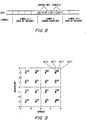
- FIG. 9 an example diagram of a mapping scheme used for demodulation of LLM2 and HLM modulated symbols is shown.
- all four outer signal points have the bit pattern 'xy00', where x and y are equivalent to the bits 0 and 1 of the symbol used for in-band signaling.
- in-band signaling is efficiently used for transmission of fast control information, for example, to indicate the used modulation scheme.
- System 10 transmits HLM and LLM modulated symbols next to each other.
- inter-symbol interference is handled by the equalizer in the receiver.
- Many equalizers use a-priori information on the used signal set. Such equalizers are for example based on maximum-likelihood sequence estimation, decision-feedback sequence estimation, etc.
- An embodiment of the invention is to apply an equalizer that assumes the signal set of HLM scheme for equalization of the whole burst, although LLM2 symbols may be transmitted in this burst as well. The benefit of this procedure is that in-band signaling information can be evaluated after equalization.
- the present invention significantly facilitates demodulation of information in a system that supports multiple modulation schemes, by reducing the overhead associated with demodulation of control information and in-band signalling information.
- the present invention uses demodulation capability of a demodulator for higher level modulation to demodulate lower level modulated signals that have a reduced signal set. In this way, the present invention improves communication quality of systems that support multiple modulation schemes.
Landscapes
- Engineering & Computer Science (AREA)
- Signal Processing (AREA)
- Computer Networks & Wireless Communication (AREA)
- Mobile Radio Communication Systems (AREA)
- Digital Transmission Methods That Use Modulated Carrier Waves (AREA)
- Time-Division Multiplex Systems (AREA)
Claims (33)
- Verfahren zum Kommunizieren von Information, umfassend:eine erste Menge von Information, die gemäß einem ersten linearen Modulationsschema moduliert ist;eine zweite Menge von Information, die gemäß einem zweiten linearen Modulationsschema moduliert ist, wobei das zweite Modulationsschema eine reduzierte Signalmenge des ersten Modulationsschemas verwendet;wobei die ersten und zweiten linearen Modulationsschemata die gleiche Modulationssymbolrate und Pulsform aufweisen.
- Verfahren nach Anspruch 1, wobei
die erste Menge von Information und die zweite Menge von Information moduliert sind zum Demodulieren gemäß dem gleichen Demodulationsschema. - Verfahren nach Anspruch 1, wobei
das erste lineare Modulationsschema und das zweite lineare Modulationsschema zum Demodulieren gemäß dem gleichen Demodulationsschema eingerichtet sind. - Verfahren nach Anspruch 1, wobei das erste lineare Modulationsschema einen höheren Modulationsgrad als das zweite Modulationsschema aufweist.
- Verfahren nach Anspruch 4, wobei ein Modulationszustandsdiagramm des zweiten linearen Modulationsschemas äußeren Signalpunkten in einem Modulationszustandsdiagramm des ersten linearen Modulationsschemas entspricht.
- Verfahren nach Anspruch 5, wobei die erste Menge von Information über einen Verkehrskanal kommuniziert wird und die zweite Menge von Information über einen Steuerkanal kommuniziert wird.
- Verfahren nach Anspruch 6, wobei der Steuerkanal ein assoziierter Steuerkanal ist.
- Verfahren nach Anspruch 4, wobei die zweite Menge von Information eine In-Band-Signalisierungsinformation ist.
- Verfahren nach Anspruch 8, wobei die In-Band-Signalisierungsinformation einem Modulationstyp und/oder einem Kanalcode und/oder einem Sprachcode entspricht.
- Verfahren nach Anspruch 4, wobei die zweite Menge von Information Stealing-Flags beinhaltet, die anzeigen, ob ein übertragener Burst Steuerinformation oder Stimm- und Dateninformation beinhaltet.
- Verfahren nach Anspruch 4, wobei die zweite Menge von Information eine Trainingsabfolge ist.
- Verfahren nach Anspruch 4, wobei das gleiche Burst-Format für die ersten und zweiten linearen Modulationsschemata angewendet wird.
- Verfahren nach Anspruch 4, wobei das erste Modulationsschema ein QAM-Modulationsschema ist und das zweite Modulationsschema ein QPSK-Modulationsschema ist.
- Verfahren nach Anspruch 4, wobei das erste Modulationsschema ein 8-PSK-Modulationsschema und das zweite Modulationsschema ein QPSK-Modulationsschema ist.
- Verfahren nach Anspruch 1, wobei die erste Menge von Information Sprache oder Daten umfasst; und
die zweite Menge von Information In-Band-Signalisierungsinformation umfasst. - Verfahren nach Anspruch 15, wobei die ersten und zweiten linearen Modulationsschemata die gleiche Symbolrate aufweisen, und wobei das zweite Modulationsschema eine reduzierte Signalmenge des ersten linearen Modulationsschemas verwendet.
- Verfahren nach Anspruch 15 oder 16, wobei die In-Wand-Signalisierungsinformation Stealing-Flags beinhaltet, die anzeigen, ob ein übertragener Burst Steuerinformation oder Sprach- und Dateninformation beinhaltet.
- Verfahren nach Anspruch 1, wobei
die erste Menge von Information Sprache oder Daten zur Kommunikation über einen Verkehrskanal umfasst; und
die zweite Menge von Information Steuerinformation zur Übertragung über einen Steuerkanal umfasst, der mit dem Verkehrskanal assoziiert ist. - Verfahren nach Anspruch 1, wobei die gleichen Trainingsabfolgen für Kanäle angewendet werden, die die erste Menge von Information und die zweite Menge von Information tragen.
- Kommunikationsstation zum Übertragen und Empfangen von Funksignalen in einem Funktelekommunikationsnetzwerk, wobei die Kommunikationsstation umfasst einen Übertragungsabschnitt (86), der beinhaltet:eine Schaltung (90, 104) zum Modulieren einer ersten Menge von Information unter Verwendung eines ersten linearen Modulationsschemas;eine Schaltung (90, 104) zum Modulieren einer zweiten Menge von Information unter Verwendung eines zweiten linearen Modulationsschemas, wobei die ersten und zweiten linearen Modulationsschemata die gleiche Modulationssymbolrate und Pulsform aufweisen, und wobei das zweite Modulationsschema eine reduzierte Signalmenge des ersten Modulationsschemas verwendet; undeinen Funkfrequenzverstärker (106, 108) innerhalb des Übertragungsabschnitts (86), der modulierte Information von dem Modulator (104) empfängt und die modulierte erste Menge von Information über einen ersten Kanal überträgt und die modulierte zweite Menge von Information über einen zweiten Kanal überträgt; undein Empfangsabschnitt (87), der ein einzelnes Demodulationsschema anwendet, um empfangene Signale zu demodulieren, die moduliert wurden unter Verwendung des ersten Modulationsschemas, und um andere empfangene Signale zu demodulieren, die unter Verwendung des zweiten Modulationsschemas moduliert wurden.
- Kommunikationsstation nach Anspruch 20, wobei die Kommunikationsstation eine Mobilstation ist.
- Kommunikationsstation nach Anspruch 20, wobei die Kommunikationsstation eine Funkbasisstation ist.
- Kommunikationsstation nach Anspruch 20, wobei das einzelne Demodulationsschema ein Schema ist zum Demodulieren von Information, die unter Verwendung des ersten linearen Modulationsschemas moduliert wird.
- Kommunikationsstation nach Anspruch 23, wobei das erste lineare Modulationsschema einen höheren Modulationsgrad als das zweite lineare Modulationsschema aufweist.
- Kommunikationsstation nach Anspruch 24, wobei die zweite Menge von Information eine In-Band-Signalisierungsinformation ist.
- Kommunikationsstation nach Anspruch 20, wobei die ersten und zweiten linearen Modulationsschemata das gleiche Burst-Format verwenden.
- Kommunikationsstation nach Anspruch 20, wobei die ersten und zweiten linearen Modulationsschemata die gleiche Trainingsabfolge verwenden.
- Ein Demodulator, umfassend:Mittel zum Demodulieren von Information, die unter Verwendung eines ersten linearen Modulationsschemas moduliert wird, undMittel zum Demodulieren anderer Information, die unter Verwendung eines zweiten linearen Modulationsschemas moduliert wird;wobei der Demodulator für das erste lineare Modulationsschema angepasst ist und das zweite lineare Modulationsschema die gleiche Pulsform aufweist;wobei die ersten und zweiten linearen Modulationsschemata die gleiche Symbolrate aufweisen, und wobei das zweite Modulationsschema eine reduzierte Signalmenge des ersten linearen Modulationsschemas verwendet.
- Demodulator nach Anspruch 28, wobei die erste Menge von Information, die moduliert wird unter Verwendung des ersten linearen Modulationsschemas, und eine zweite Menge von Information, die moduliert wird, unter Verwendung des zweiten linearen Modulationsschemas, unter Verwendung des gleichen Demodulators demoduliert werden.
- Demodulator nach Anspruch 29, wobei die erste Menge von Information und die zweite Menge von Information das gleiche Burst-Format aufweisen.
- Eine Vorrichtung zum Kommunizieren von Information, umfassend Mittel (76, 86, 87, 88, 90, 91, 92, 94, 96, 97, 102, 104, 106, 108), eingerichtet zur Kommunikation gemäß des Verfahrens nach einem der Ansprüche 1 bis 19.
- Eine Mobilkommunikationsstation eines Funktelekommunikationssystems, umfassend die Vorrichtung nach Anspruch 31.
- Eine Basisstation eines Funktelekommunikationssystems, umfassend die Vorrichtung nach Anspruch 31.
Applications Claiming Priority (3)
| Application Number | Priority Date | Filing Date | Title |
|---|---|---|---|
| US921374 | 1997-08-29 | ||
| US08/921,374 US6125148A (en) | 1997-08-29 | 1997-08-29 | Method for demodulating information in a communication system that supports multiple modulation schemes |
| PCT/SE1998/001540 WO1999012283A1 (en) | 1997-08-29 | 1998-08-28 | A method for demodulating information in a communication system that supports multiple modulation schemes |
Publications (2)
| Publication Number | Publication Date |
|---|---|
| EP1010265A1 EP1010265A1 (de) | 2000-06-21 |
| EP1010265B1 true EP1010265B1 (de) | 2012-05-09 |
Family
ID=25445336
Family Applications (1)
| Application Number | Title | Priority Date | Filing Date |
|---|---|---|---|
| EP98941979A Expired - Lifetime EP1010265B1 (de) | 1997-08-29 | 1998-08-28 | Verfahren zur Demodulation von Informationen in einem Kommunikationssystem mit mehreren Modulationsarten |
Country Status (11)
| Country | Link |
|---|---|
| US (1) | US6125148A (de) |
| EP (1) | EP1010265B1 (de) |
| JP (1) | JP4198880B2 (de) |
| KR (1) | KR100552883B1 (de) |
| CN (1) | CN100370712C (de) |
| AU (1) | AU9012698A (de) |
| BR (1) | BR9811393A (de) |
| CA (1) | CA2300852C (de) |
| MY (1) | MY120342A (de) |
| TW (1) | TW391107B (de) |
| WO (1) | WO1999012283A1 (de) |
Families Citing this family (93)
| Publication number | Priority date | Publication date | Assignee | Title |
|---|---|---|---|---|
| US6542481B2 (en) | 1998-06-01 | 2003-04-01 | Tantivy Communications, Inc. | Dynamic bandwidth allocation for multiple access communication using session queues |
| US6081536A (en) | 1997-06-20 | 2000-06-27 | Tantivy Communications, Inc. | Dynamic bandwidth allocation to transmit a wireless protocol across a code division multiple access (CDMA) radio link |
| US6456627B1 (en) * | 1997-08-29 | 2002-09-24 | Telefonaktiebolaget Lm Ericsson (Publ) | Method for communicating information in a communication system that supports multiple modulation schemes |
| US6539031B1 (en) * | 1997-10-14 | 2003-03-25 | Innowave Eci Wireless Systems Ltd. | Adaptive countermeasures for wireless communication of fast ethernet data packages |
| IL135876A0 (en) * | 1997-11-03 | 2001-05-20 | Harris Corp | Reconfigurable radio system architecture |
| US7248626B2 (en) | 1997-12-05 | 2007-07-24 | Paradyne Corporation | System and method of communication via embedded modulation |
| US9432172B2 (en) | 1997-12-05 | 2016-08-30 | Rembrandt Wireless Technologies, Lp | System and method of communication using at least two modulation methods |
| US7936728B2 (en) | 1997-12-17 | 2011-05-03 | Tantivy Communications, Inc. | System and method for maintaining timing of synchronization messages over a reverse link of a CDMA wireless communication system |
| US6222832B1 (en) * | 1998-06-01 | 2001-04-24 | Tantivy Communications, Inc. | Fast Acquisition of traffic channels for a highly variable data rate reverse link of a CDMA wireless communication system |
| US9525923B2 (en) | 1997-12-17 | 2016-12-20 | Intel Corporation | Multi-detection of heartbeat to reduce error probability |
| DE69838228T2 (de) * | 1997-12-17 | 2008-05-08 | Kabushiki Kaisha Kenwood | Einrichtung zur Erzeugung der absoluten Phase eines von einem Empfänger empfangenen Signals |
| US7394791B2 (en) | 1997-12-17 | 2008-07-01 | Interdigital Technology Corporation | Multi-detection of heartbeat to reduce error probability |
| US8175120B2 (en) | 2000-02-07 | 2012-05-08 | Ipr Licensing, Inc. | Minimal maintenance link to support synchronization |
| EP1367794B1 (de) | 1998-01-30 | 2007-03-14 | Matsushita Electric Industrial Co., Ltd. | Modulationsverfahren und Funkkommunikationssystem |
| US8134980B2 (en) | 1998-06-01 | 2012-03-13 | Ipr Licensing, Inc. | Transmittal of heartbeat signal at a lower level than heartbeat request |
| CN1257368A (zh) * | 1998-07-24 | 2000-06-21 | 休斯电子公司 | 通信系统中的扩展接口单元 |
| FI108202B (fi) * | 1998-12-22 | 2001-11-30 | Nokia Networks Oy | Signalointimenetelmä ja tietoliikennejärjestelmä |
| FI111598B (fi) * | 1999-03-03 | 2003-08-15 | Nokia Corp | Menetelmä ja järjestelmä nopean kontrollikanavan toteuttamiseksi solukkoradioverkossa |
| DE19933814A1 (de) * | 1999-07-20 | 2001-01-25 | Abb Research Ltd | Verfahren und Anordnung zur drahtlosen Informationsübertragung sowie Informationssystem für eine eine Vielzahl von Sensoren und/oder Aktoren aufweisende Maschine |
| US6804211B1 (en) * | 1999-08-03 | 2004-10-12 | Wi-Lan Inc. | Frame structure for an adaptive modulation wireless communication system |
| US6115406A (en) | 1999-09-10 | 2000-09-05 | Interdigital Technology Corporation | Transmission using an antenna array in a CDMA communication system |
| US6278726B1 (en) | 1999-09-10 | 2001-08-21 | Interdigital Technology Corporation | Interference cancellation in a spread spectrum communication system |
| US6366601B1 (en) * | 1999-11-17 | 2002-04-02 | Motorola, Inc. | Variable rate spread spectrum communication method and apparatus |
| US6748021B1 (en) * | 2000-06-22 | 2004-06-08 | Nortel Networks Limited | Cellular radio communications system |
| AU2002226927A1 (en) * | 2000-11-15 | 2002-05-27 | Ensemble Communications, Inc. | Improved frame structure for a communication system using adaptive modulation |
| US8155096B1 (en) | 2000-12-01 | 2012-04-10 | Ipr Licensing Inc. | Antenna control system and method |
| US8009667B1 (en) | 2001-01-16 | 2011-08-30 | Wi—LAN, Inc. | Packing source data packets into transporting packets with fragmentation |
| US6954448B2 (en) | 2001-02-01 | 2005-10-11 | Ipr Licensing, Inc. | Alternate channel for carrying selected message types |
| US7551663B1 (en) | 2001-02-01 | 2009-06-23 | Ipr Licensing, Inc. | Use of correlation combination to achieve channel detection |
| US7350225B2 (en) * | 2001-03-27 | 2008-03-25 | Intel Corporation | System and related methods facilitating the rapid detection and acquisition of data channels in a cable modem using various modulation techniques |
| US7162732B2 (en) * | 2001-03-27 | 2007-01-09 | Intel Corporation | System and related methods facilitating the detection and acquisition of a data channel in a cable modem |
| US20020181407A1 (en) * | 2001-03-28 | 2002-12-05 | Anders Khullar | Link quality control by using time dispersion information |
| US7151807B2 (en) * | 2001-04-27 | 2006-12-19 | The Directv Group, Inc. | Fast acquisition of timing and carrier frequency from received signal |
| US7471735B2 (en) | 2001-04-27 | 2008-12-30 | The Directv Group, Inc. | Maximizing power and spectral efficiencies for layered and conventional modulations |
| US7173981B1 (en) | 2001-04-27 | 2007-02-06 | The Directv Group, Inc. | Dual layer signal processing in a layered modulation digital signal system |
| WO2004040403A2 (en) | 2001-04-27 | 2004-05-13 | The Directv Group, Inc. | Lower complexity layered modulation signal processor |
| US7209524B2 (en) | 2001-04-27 | 2007-04-24 | The Directv Group, Inc. | Layered modulation for digital signals |
| US7778365B2 (en) | 2001-04-27 | 2010-08-17 | The Directv Group, Inc. | Satellite TWTA on-line non-linearity measurement |
| US7184473B2 (en) * | 2001-04-27 | 2007-02-27 | The Directv Group, Inc. | Equalizers for layered modulated and other signals |
| US7822154B2 (en) | 2001-04-27 | 2010-10-26 | The Directv Group, Inc. | Signal, interference and noise power measurement |
| US7423987B2 (en) | 2001-04-27 | 2008-09-09 | The Directv Group, Inc. | Feeder link configurations to support layered modulation for digital signals |
| US7245671B1 (en) | 2001-04-27 | 2007-07-17 | The Directv Group, Inc. | Preprocessing signal layers in a layered modulation digital signal system to use legacy receivers |
| US7184489B2 (en) | 2001-04-27 | 2007-02-27 | The Directv Group, Inc. | Optimization technique for layered modulation |
| US7502430B2 (en) | 2001-04-27 | 2009-03-10 | The Directv Group, Inc. | Coherent averaging for measuring traveling wave tube amplifier nonlinearity |
| US8005035B2 (en) | 2001-04-27 | 2011-08-23 | The Directv Group, Inc. | Online output multiplexer filter measurement |
| US7583728B2 (en) | 2002-10-25 | 2009-09-01 | The Directv Group, Inc. | Equalizers for layered modulated and other signals |
| US7639759B2 (en) | 2001-04-27 | 2009-12-29 | The Directv Group, Inc. | Carrier to noise ratio estimations from a received signal |
| US7483505B2 (en) | 2001-04-27 | 2009-01-27 | The Directv Group, Inc. | Unblind equalizer architecture for digital communication systems |
| KR100665077B1 (ko) | 2001-06-13 | 2007-01-09 | 탄티비 커뮤니케이션즈 인코포레이티드 | 하트비트 요구보다 낮은 레벨로의 하트비트 신호의 전송 |
| KR100441196B1 (ko) * | 2002-01-14 | 2004-07-21 | 기가텔레콤 (주) | 연속 위상 직교 진폭 변조 및 복조 장치 |
| US20040001539A1 (en) * | 2002-06-26 | 2004-01-01 | Sankaran Sundar G. | Training using overhead data in a wireless communications network |
| EP1540909A4 (de) | 2002-07-01 | 2007-10-17 | Directv Group Inc | Verbessern der hierarchischen 8psk-leistung |
| AR040395A1 (es) | 2002-07-03 | 2005-03-30 | Hughes Electronics Corp | Metodo y aparato para modulacion por capas |
| US8190163B2 (en) | 2002-08-08 | 2012-05-29 | Qualcomm Incorporated | Methods and apparatus of enhanced coding in multi-user communication systems |
| US7363039B2 (en) | 2002-08-08 | 2008-04-22 | Qualcomm Incorporated | Method of creating and utilizing diversity in multiple carrier communication system |
| US6961595B2 (en) | 2002-08-08 | 2005-11-01 | Flarion Technologies, Inc. | Methods and apparatus for operating mobile nodes in multiple states |
| JP4251841B2 (ja) * | 2002-09-24 | 2009-04-08 | 京セラ株式会社 | 無線装置、チャネル割当方法、およびチャネル割当プログラム |
| ATE491296T1 (de) | 2002-10-25 | 2010-12-15 | Directv Group Inc | Verfahren und vorrichtung zum anpassen von trägerleistungsanforderungen gemäss verfügbarkeit in geschichteten modulationssystemen |
| ES2343005T3 (es) | 2002-10-25 | 2010-07-21 | The Directv Group, Inc. | Estimacion del punto de funcionamiento en un amplificador de tubo de ondas viajeras no lineal. |
| US7463676B2 (en) | 2002-10-25 | 2008-12-09 | The Directv Group, Inc. | On-line phase noise measurement for layered modulation |
| US7474710B2 (en) | 2002-10-25 | 2009-01-06 | The Directv Group, Inc. | Amplitude and phase matching for layered modulation reception |
| US7529312B2 (en) | 2002-10-25 | 2009-05-05 | The Directv Group, Inc. | Layered modulation for terrestrial ATSC applications |
| JP4718442B2 (ja) | 2003-02-19 | 2011-07-06 | クゥアルコム・インコーポレイテッド | マルチユーザ通信システムにおける制御重畳コーディング |
| RU2364047C2 (ru) * | 2003-02-19 | 2009-08-10 | Квэлкомм Инкорпорейтед | Способы и устройство усовершенствованного кодирования в многопользовательских системах связи |
| US9049722B2 (en) | 2004-04-23 | 2015-06-02 | Qualcomm Incorporated | Methods and apparatus of enhancing performance in wireless communication systems |
| US8452294B2 (en) | 2003-04-23 | 2013-05-28 | Qualcomm Incorporated | In-band ate indicator methods and apparatus |
| US8593932B2 (en) | 2003-05-16 | 2013-11-26 | Qualcomm Incorporated | Efficient signal transmission methods and apparatus using a shared transmission resource |
| US7925291B2 (en) | 2003-08-13 | 2011-04-12 | Qualcomm Incorporated | User specific downlink power control channel Q-bit |
| US7502429B2 (en) | 2003-10-10 | 2009-03-10 | The Directv Group, Inc. | Equalization for traveling wave tube amplifier nonlinearity measurements |
| US7298788B2 (en) * | 2003-10-27 | 2007-11-20 | Ge Medical Systems Information Technologies, Inc. | Wireless communication system and method |
| US7437135B2 (en) | 2003-10-30 | 2008-10-14 | Interdigital Technology Corporation | Joint channel equalizer interference canceller advanced receiver |
| US8494071B2 (en) * | 2003-12-08 | 2013-07-23 | Kabushiki Kaisha Kenwood | Device and method for correcting a data error in communication path |
| JP4220365B2 (ja) * | 2003-12-08 | 2009-02-04 | 株式会社ケンウッド | 送信装置、受信装置、データ送信方法及びデータ受信方法 |
| JP4388366B2 (ja) * | 2003-12-26 | 2009-12-24 | 株式会社ケンウッド | 送信装置、受信装置、データ送信方法、データ受信方法及びプログラム |
| US7400692B2 (en) | 2004-01-14 | 2008-07-15 | Interdigital Technology Corporation | Telescoping window based equalization |
| US7680278B2 (en) * | 2004-02-04 | 2010-03-16 | Microsoft Corporation | Domino scheme for wireless cryptographic communication and communication method incorporating same |
| JP4542405B2 (ja) * | 2004-09-30 | 2010-09-15 | 株式会社ケンウッド | ベースバンド信号生成装置、ベースバンド信号生成方法及びプログラム |
| CN1787510B (zh) * | 2004-12-10 | 2010-07-14 | 中兴通讯股份有限公司 | 数字通信系统中16级正交幅度调制的解调方法及装置 |
| US9385843B2 (en) * | 2004-12-22 | 2016-07-05 | Qualcomm Incorporated | Method and apparatus for using multiple modulation schemes for a single packet |
| KR100611507B1 (ko) | 2005-02-07 | 2006-08-11 | 삼성전자주식회사 | 무선 통신 수신기에 있어서의 블라인드 디텍션 방법 및장치, 이를 포함하는 무선 통신 수신기 |
| GB2428164B (en) * | 2005-07-06 | 2007-09-19 | Motorola Inc | Mobile station, system and method for use in cellular communications |
| US7936831B2 (en) * | 2005-07-20 | 2011-05-03 | Qualcomm Incorporated | Methods and apparatus for implementing and using an in-band rate indicator |
| PT2793439T (pt) | 2005-08-05 | 2019-01-17 | Panasonic Corp | Sistema para transmitir e receber dados modulados |
| WO2007073832A1 (en) * | 2005-12-27 | 2007-07-05 | Telefonaktiebolaget Lm Ericsson (Publ) | Method and device for communicating incremental broadcast information |
| EP1804541B1 (de) | 2005-12-27 | 2012-11-21 | Telefonaktiebolaget L M Ericsson (Publ) | Verfahren, System, Vorrichtung und computerlesbares Medium zur Übertragung inkrementaler Rundsendeinformationen |
| US20070211669A1 (en) * | 2006-03-07 | 2007-09-13 | Bhupesh Manoharlal Umatt | Method and apparatus for searching radio technologies |
| JP4440909B2 (ja) * | 2006-09-25 | 2010-03-24 | 京セラ株式会社 | 無線通信システム、無線通信端末及び基地局並びに無線通信方法 |
| US8755313B2 (en) | 2007-01-11 | 2014-06-17 | Qualcomm Incorporated | Using DTX and DRX in a wireless communication system |
| GB2499050A (en) * | 2012-02-06 | 2013-08-07 | British Broadcasting Corp | Non-uniform QAM constellations with constellation points at positions of maximum capacity for a selected signal to noise ratio |
| JP6405153B2 (ja) * | 2014-08-25 | 2018-10-17 | 日本放送協会 | 送信装置 |
| US9473983B1 (en) * | 2016-04-26 | 2016-10-18 | Tm Ip Holdings, Llc | Transpositional modulation communications between devices |
| US11259164B2 (en) | 2020-02-27 | 2022-02-22 | Shure Acquisition Holdings, Inc. | Low overhead control channel for wireless audio systems |
| CN119402322B (zh) * | 2024-12-31 | 2025-05-09 | 西安微合智联科技有限公司 | 数据解调方法、装置、电子设备及存储介质 |
Family Cites Families (17)
| Publication number | Priority date | Publication date | Assignee | Title |
|---|---|---|---|---|
| US4866395A (en) * | 1988-11-14 | 1989-09-12 | Gte Government Systems Corporation | Universal carrier recovery and data detection for digital communication systems |
| US5633873A (en) * | 1990-12-06 | 1997-05-27 | Hughes Electronics | Combined fixed and mobile radio communication system and method |
| US5369637A (en) * | 1991-04-03 | 1994-11-29 | U.S. Philips Corporation | Signal transmission system |
| ATE162035T1 (de) * | 1991-06-03 | 1998-01-15 | British Telecomm | Funksystem |
| JP2776094B2 (ja) * | 1991-10-31 | 1998-07-16 | 日本電気株式会社 | 可変変調通信方法 |
| US5363408A (en) * | 1992-03-24 | 1994-11-08 | General Instrument Corporation | Mode selective quadrature amplitude modulation communication system |
| US5839071A (en) * | 1993-09-21 | 1998-11-17 | Telstra Corporation Limited | Base station for a mobile telecommunications system |
| US5537434A (en) * | 1993-10-25 | 1996-07-16 | Telefonaktiebolaget Lm Ericsson | Frequency hopping control channel in a radio communication system |
| FR2718906B1 (fr) * | 1994-04-13 | 1996-05-24 | Alcatel Mobile Comm France | Procédé d'adaptation de l'interface air, dans un système de radiocommunication avec des mobiles, station de base, station mobile et mode de transmission correspondants. |
| US5535215A (en) * | 1995-05-01 | 1996-07-09 | Motorola, Inc. | Method and apparatus for providing control channels and message channels in a radio communication system |
| FI97927C (fi) * | 1995-05-09 | 1997-03-10 | Nokia Telecommunications Oy | Ei-transparentti datansiirto digitaalisessa tietoliikennejärjestelmässä |
| US5974106A (en) * | 1995-09-01 | 1999-10-26 | Motorola, Inc. | Method and apparatus for multirate data communications |
| US5701294A (en) * | 1995-10-02 | 1997-12-23 | Telefonaktiebolaget Lm Ericsson | System and method for flexible coding, modulation, and time slot allocation in a radio telecommunications network |
| US5757813A (en) * | 1995-10-18 | 1998-05-26 | Telefonaktiebolaget Lm Ericsson | Method for achieving optimal channel coding in a communication system |
| GB2307152B (en) * | 1995-11-10 | 1999-04-07 | Motorola Ltd | Method and apparatus for enhanced communication capability while maintaining standard channel modulation compatibility |
| US5966412A (en) * | 1997-06-30 | 1999-10-12 | Thomson Consumer Electronics, Inc. | Apparatus and method for processing a Quadrature Amplitude Modulated (QAM) signal |
| US5909469A (en) * | 1997-08-29 | 1999-06-01 | Telefonaktoebolaget Lm Ericsson | Link adaptation method for links using modulation schemes that have different symbol rates |
-
1997
- 1997-08-29 US US08/921,374 patent/US6125148A/en not_active Expired - Lifetime
-
1998
- 1998-08-26 MY MYPI98003906A patent/MY120342A/en unknown
- 1998-08-27 TW TW087114135A patent/TW391107B/zh not_active IP Right Cessation
- 1998-08-28 EP EP98941979A patent/EP1010265B1/de not_active Expired - Lifetime
- 1998-08-28 WO PCT/SE1998/001540 patent/WO1999012283A1/en not_active Ceased
- 1998-08-28 KR KR1020007002039A patent/KR100552883B1/ko not_active Expired - Fee Related
- 1998-08-28 CN CNB988108186A patent/CN100370712C/zh not_active Expired - Lifetime
- 1998-08-28 JP JP2000509175A patent/JP4198880B2/ja not_active Expired - Lifetime
- 1998-08-28 BR BR9811393-3A patent/BR9811393A/pt not_active IP Right Cessation
- 1998-08-28 AU AU90126/98A patent/AU9012698A/en not_active Abandoned
- 1998-08-28 CA CA002300852A patent/CA2300852C/en not_active Expired - Lifetime
Also Published As
| Publication number | Publication date |
|---|---|
| WO1999012283A1 (en) | 1999-03-11 |
| CN100370712C (zh) | 2008-02-20 |
| CA2300852C (en) | 2009-11-03 |
| US6125148A (en) | 2000-09-26 |
| BR9811393A (pt) | 2000-08-29 |
| AU9012698A (en) | 1999-03-22 |
| JP4198880B2 (ja) | 2008-12-17 |
| KR100552883B1 (ko) | 2006-02-20 |
| MY120342A (en) | 2005-10-31 |
| TW391107B (en) | 2000-05-21 |
| CA2300852A1 (en) | 1999-03-11 |
| JP2001515301A (ja) | 2001-09-18 |
| CN1278379A (zh) | 2000-12-27 |
| EP1010265A1 (de) | 2000-06-21 |
| KR20010023398A (ko) | 2001-03-26 |
Similar Documents
| Publication | Publication Date | Title |
|---|---|---|
| EP1010265B1 (de) | Verfahren zur Demodulation von Informationen in einem Kommunikationssystem mit mehreren Modulationsarten | |
| EP1010264B1 (de) | Methode zur information übertragung in einem kommunikationssystem mit mehreren modulationsverfahren | |
| US5909469A (en) | Link adaptation method for links using modulation schemes that have different symbol rates | |
| CA2300884C (en) | A method for selecting a combination of modulation and channel coding schemes in a digital communication system | |
| US6134230A (en) | Method for selecting a link protocol for a transparent data service in a digital communications system | |
| US5930248A (en) | Radio communication system selectively using multicast with variable offset time | |
| US6298095B1 (en) | Communicating signaling information in a cellular system that has a tight frequency reuse pattern | |
| MXPA00001928A (en) | A method for demodulating information in a communication system that supports multiple modulation schemes | |
| MXPA00001579A (en) | A method for communicating information in a communication system that supports multiple modulation schemes | |
| MXPA00001670A (en) | A method for selecting a combination of modulation and channel coding schemes in a digital communication system | |
| MXPA00002098A (en) | A method for selecting a link protocol for a transparent data service in a digital communications system |
Legal Events
| Date | Code | Title | Description |
|---|---|---|---|
| PUAI | Public reference made under article 153(3) epc to a published international application that has entered the european phase |
Free format text: ORIGINAL CODE: 0009012 |
|
| 17P | Request for examination filed |
Effective date: 20000309 |
|
| AK | Designated contracting states |
Kind code of ref document: A1 Designated state(s): DE GB |
|
| RAP1 | Party data changed (applicant data changed or rights of an application transferred) |
Owner name: TELEFONAKTIEBOLAGET LM ERICSSON (PUBL) |
|
| 17Q | First examination report despatched |
Effective date: 20050419 |
|
| GRAP | Despatch of communication of intention to grant a patent |
Free format text: ORIGINAL CODE: EPIDOSNIGR1 |
|
| GRAJ | Information related to disapproval of communication of intention to grant by the applicant or resumption of examination proceedings by the epo deleted |
Free format text: ORIGINAL CODE: EPIDOSDIGR1 |
|
| GRAP | Despatch of communication of intention to grant a patent |
Free format text: ORIGINAL CODE: EPIDOSNIGR1 |
|
| RTI1 | Title (correction) |
Free format text: A METHOD FOR DEMODULATING INFORMATION IN A COMMUNICATION SYSTEM THAT SUPPORTS MULTIPLE MODULATION SCHEMES |
|
| GRAC | Information related to communication of intention to grant a patent modified |
Free format text: ORIGINAL CODE: EPIDOSCIGR1 |
|
| GRAS | Grant fee paid |
Free format text: ORIGINAL CODE: EPIDOSNIGR3 |
|
| GRAA | (expected) grant |
Free format text: ORIGINAL CODE: 0009210 |
|
| RIN1 | Information on inventor provided before grant (corrected) |
Inventor name: SCHRAMM, PETER Inventor name: HOEOEK, MIKAEL Inventor name: MUELLER, FRANK Inventor name: SKOELD, JOHAN Inventor name: FRODIGH, CARL MAGNUS |
|
| AK | Designated contracting states |
Kind code of ref document: B1 Designated state(s): DE GB |
|
| REG | Reference to a national code |
Ref country code: GB Ref legal event code: FG4D |
|
| REG | Reference to a national code |
Ref country code: DE Ref legal event code: R081 Ref document number: 69842720 Country of ref document: DE Owner name: OPTIS CELLULAR TECHNOLOGY, LLC (N. D. GES. D. , US Free format text: FORMER OWNER: TELEFONAKTIEBOLAGET LM ERICSSON (PUBL), STOCKHOLM, SE |
|
| RAP2 | Party data changed (patent owner data changed or rights of a patent transferred) |
Owner name: TELEFONAKTIEBOLAGET L M ERICSSON (PUBL) |
|
| REG | Reference to a national code |
Ref country code: DE Ref legal event code: R096 Ref document number: 69842720 Country of ref document: DE Effective date: 20120705 |
|
| PLBE | No opposition filed within time limit |
Free format text: ORIGINAL CODE: 0009261 |
|
| STAA | Information on the status of an ep patent application or granted ep patent |
Free format text: STATUS: NO OPPOSITION FILED WITHIN TIME LIMIT |
|
| 26N | No opposition filed |
Effective date: 20130212 |
|
| REG | Reference to a national code |
Ref country code: DE Ref legal event code: R097 Ref document number: 69842720 Country of ref document: DE Effective date: 20130212 |
|
| REG | Reference to a national code |
Ref country code: DE Ref legal event code: R082 Ref document number: 69842720 Country of ref document: DE Representative=s name: GRUENECKER PATENT- UND RECHTSANWAELTE PARTG MB, DE Ref country code: DE Ref legal event code: R082 Ref document number: 69842720 Country of ref document: DE Representative=s name: GRUENECKER, KINKELDEY, STOCKMAIR & SCHWANHAEUS, DE |
|
| REG | Reference to a national code |
Ref country code: GB Ref legal event code: 732E Free format text: REGISTERED BETWEEN 20150521 AND 20150527 |
|
| REG | Reference to a national code |
Ref country code: DE Ref legal event code: R082 Ref document number: 69842720 Country of ref document: DE Representative=s name: GRUENECKER PATENT- UND RECHTSANWAELTE PARTG MB, DE Ref country code: DE Ref legal event code: R081 Ref document number: 69842720 Country of ref document: DE Owner name: OPTIS CELLULAR TECHNOLOGY, LLC (N. D. GES. D. , US Free format text: FORMER OWNER: CLUSTER LLC, DOVER, DEL., US Ref country code: DE Ref legal event code: R081 Ref document number: 69842720 Country of ref document: DE Owner name: OPTIS CELLULAR TECHNOLOGY, LLC (N. D. GES. D. , US Free format text: FORMER OWNER: TELEFONAKTIEBOLAGET LM ERICSSON (PUBL), STOCKHOLM, SE |
|
| PGFP | Annual fee paid to national office [announced via postgrant information from national office to epo] |
Ref country code: GB Payment date: 20170719 Year of fee payment: 20 Ref country code: DE Payment date: 20170719 Year of fee payment: 20 |
|
| REG | Reference to a national code |
Ref country code: DE Ref legal event code: R071 Ref document number: 69842720 Country of ref document: DE |
|
| REG | Reference to a national code |
Ref country code: GB Ref legal event code: PE20 Expiry date: 20180827 |
|
| PG25 | Lapsed in a contracting state [announced via postgrant information from national office to epo] |
Ref country code: GB Free format text: LAPSE BECAUSE OF EXPIRATION OF PROTECTION Effective date: 20180827 |