EP1009725B1 - 13c,15n,2h labeled proteins for nmr structure determinations and their preparation - Google Patents
13c,15n,2h labeled proteins for nmr structure determinations and their preparation Download PDFInfo
- Publication number
- EP1009725B1 EP1009725B1 EP98945835A EP98945835A EP1009725B1 EP 1009725 B1 EP1009725 B1 EP 1009725B1 EP 98945835 A EP98945835 A EP 98945835A EP 98945835 A EP98945835 A EP 98945835A EP 1009725 B1 EP1009725 B1 EP 1009725B1
- Authority
- EP
- European Patent Office
- Prior art keywords
- amino acids
- isotopically substituted
- molecule
- carbons
- amino acid
- Prior art date
- Legal status (The legal status is an assumption and is not a legal conclusion. Google has not performed a legal analysis and makes no representation as to the accuracy of the status listed.)
- Expired - Lifetime
Links
Images


Classifications
-
- C—CHEMISTRY; METALLURGY
- C12—BIOCHEMISTRY; BEER; SPIRITS; WINE; VINEGAR; MICROBIOLOGY; ENZYMOLOGY; MUTATION OR GENETIC ENGINEERING
- C12N—MICROORGANISMS OR ENZYMES; COMPOSITIONS THEREOF; PROPAGATING, PRESERVING, OR MAINTAINING MICROORGANISMS; MUTATION OR GENETIC ENGINEERING; CULTURE MEDIA
- C12N5/00—Undifferentiated human, animal or plant cells, e.g. cell lines; Tissues; Cultivation or maintenance thereof; Culture media therefor
- C12N5/0018—Culture media for cell or tissue culture
-
- C—CHEMISTRY; METALLURGY
- C07—ORGANIC CHEMISTRY
- C07B—GENERAL METHODS OF ORGANIC CHEMISTRY; APPARATUS THEREFOR
- C07B59/00—Introduction of isotopes of elements into organic compounds ; Labelled organic compounds per se
- C07B59/008—Peptides; Proteins
-
- C—CHEMISTRY; METALLURGY
- C07—ORGANIC CHEMISTRY
- C07K—PEPTIDES
- C07K14/00—Peptides having more than 20 amino acids; Gastrins; Somatostatins; Melanotropins; Derivatives thereof
- C07K14/435—Peptides having more than 20 amino acids; Gastrins; Somatostatins; Melanotropins; Derivatives thereof from animals; from humans
- C07K14/575—Hormones
- C07K14/59—Follicle-stimulating hormone [FSH]; Chorionic gonadotropins, e.g.hCG [human chorionic gonadotropin]; Luteinising hormone [LH]; Thyroid-stimulating hormone [TSH]
-
- C—CHEMISTRY; METALLURGY
- C12—BIOCHEMISTRY; BEER; SPIRITS; WINE; VINEGAR; MICROBIOLOGY; ENZYMOLOGY; MUTATION OR GENETIC ENGINEERING
- C12N—MICROORGANISMS OR ENZYMES; COMPOSITIONS THEREOF; PROPAGATING, PRESERVING, OR MAINTAINING MICROORGANISMS; MUTATION OR GENETIC ENGINEERING; CULTURE MEDIA
- C12N1/00—Microorganisms; Compositions thereof; Processes of propagating, maintaining or preserving microorganisms or compositions thereof; Processes of preparing or isolating a composition containing a microorganism; Culture media therefor
- C12N1/20—Bacteria; Culture media therefor
-
- C—CHEMISTRY; METALLURGY
- C12—BIOCHEMISTRY; BEER; SPIRITS; WINE; VINEGAR; MICROBIOLOGY; ENZYMOLOGY; MUTATION OR GENETIC ENGINEERING
- C12P—FERMENTATION OR ENZYME-USING PROCESSES TO SYNTHESISE A DESIRED CHEMICAL COMPOUND OR COMPOSITION OR TO SEPARATE OPTICAL ISOMERS FROM A RACEMIC MIXTURE
- C12P21/00—Preparation of peptides or proteins
-
- G—PHYSICS
- G01—MEASURING; TESTING
- G01R—MEASURING ELECTRIC VARIABLES; MEASURING MAGNETIC VARIABLES
- G01R33/00—Arrangements or instruments for measuring magnetic variables
- G01R33/20—Arrangements or instruments for measuring magnetic variables involving magnetic resonance
- G01R33/44—Arrangements or instruments for measuring magnetic variables involving magnetic resonance using nuclear magnetic resonance [NMR]
- G01R33/46—NMR spectroscopy
- G01R33/465—NMR spectroscopy applied to biological material, e.g. in vitro testing
-
- C—CHEMISTRY; METALLURGY
- C12—BIOCHEMISTRY; BEER; SPIRITS; WINE; VINEGAR; MICROBIOLOGY; ENZYMOLOGY; MUTATION OR GENETIC ENGINEERING
- C12N—MICROORGANISMS OR ENZYMES; COMPOSITIONS THEREOF; PROPAGATING, PRESERVING, OR MAINTAINING MICROORGANISMS; MUTATION OR GENETIC ENGINEERING; CULTURE MEDIA
- C12N2500/00—Specific components of cell culture medium
- C12N2500/30—Organic components
- C12N2500/32—Amino acids
-
- Y—GENERAL TAGGING OF NEW TECHNOLOGICAL DEVELOPMENTS; GENERAL TAGGING OF CROSS-SECTIONAL TECHNOLOGIES SPANNING OVER SEVERAL SECTIONS OF THE IPC; TECHNICAL SUBJECTS COVERED BY FORMER USPC CROSS-REFERENCE ART COLLECTIONS [XRACs] AND DIGESTS
- Y10—TECHNICAL SUBJECTS COVERED BY FORMER USPC
- Y10T—TECHNICAL SUBJECTS COVERED BY FORMER US CLASSIFICATION
- Y10T436/00—Chemistry: analytical and immunological testing
- Y10T436/24—Nuclear magnetic resonance, electron spin resonance or other spin effects or mass spectrometry
Definitions
- This invention is concerned with determining the three-dimensional structure of biological macromolecules, especially proteins.
- it is concerned with methods for rapidly determining protein structures by NMR spectroscopy, by providing methods for simplifying NMR spectra using labeled proteins prepared from specifically isotopically labeled amino acids, and the means whereby these labeled proteins and amino acids may be obtained.
- This strategy for the design of drugs involves determining the three-dimensional structure of an "active part" of a particular biological molecule, such as a protein. Knowing the three-dimensional structure of the active part can enable scientists to design a synthetic analogue of the active part that will block, mimic or enhance the natural biological activity of the molecule. ( Appelt, K. et al., J. Mend. Chem., 34:1925 (1991 )).
- the biological molecule may, for example, be a receptor, an enzyme, a hormone, or other biologically active molecule. Determining the three-dimensional structures of biological molecules is, therefore, of great practical and commercial significance.
- the first technique developed to determine three-dimensional structures was X-ray crystallography.
- the structures of hemoglobin and DNA were determined using this technique.
- X-ray crystallography a crystal (or fiber) of the material to be examined is bombarded with a beam of X-rays which are refracted by the atoms of the ordered molecules in the crystal.
- the scattered X-rays are captured on a photographic plate which is then developed using standard techniques.
- the diffracted X-rays are thus visualized as a series of spots on the plate and from this pattern, the structure of the molecules in the crystal can be determined.
- NMR nuclear magnetic resonance
- Isotopic substitution is usually accomplished by growing a bacterium or yeast, transformed by genetic engineering to produce the protein of choice, in a growth medium containing 13 C-, 15 N- and/or 2 H-labeled substrates.
- bacterial growth media usually consist of 13 C-labeled glucose and/or 15 N-labeled ammonium salts dissolved in D 2 O where necessary.
- isotopically labeled media especially adapted for the labeling of bacterially produced macromolecules have been described. See U.S. patent 5,324,658 .
- the library is then "screened” by allowing each member of the library to come into contact with the target protein. Those that bind are identified, and similar compounds are synthesized and screened. The whole process continues in an iterative manner until a drug candidate of suitably high binding affinity has been identified.
- This screening strategy has recently been published by Fesik et al., Science, 274, 1531-34 (1996 ), wherein the screening of the libraries takes place using NMR against an isotopically labeled protein and the binding is detected from perturbations in the NMR spectrum.
- Prior knowledge of the three-dimensional structure of a target protein can enable the design of a "focused" combinatorial library, thereby increasing the likelihood of finding potential drug candidates that interact with the biological molecule of interest.
- genomic and combinatorial chemistry each can be performed in months, known methods for protein structural determinations usually take much longer. Therefore, there is a need for methods to increase the speed with which high resolution structures of proteins, including those that are the targets of potential drug candidates, may be determined.
- the present invention provides an isotopically substituted molecule suitable for NMR structural determination comprising a peptidic sequence of at least 50 amino acid residues, wherein said molecule is specifically isotopically substituted in all residues of any combination of one or more amino acids of choice at specific positions of the residue only, with 13 C and 15 N, said specific positions being in the backbone structure but not the side chains of said amino acids and which is further specifically isotopically substituted with 2 H at the hydrogen atoms bonded to the ⁇ -carbons of said isotopically substituted amino acid residues.
- the invention provides a method for making an isotopically substituted molecule as defined above which comprises
- Also described herein is a method for determining three-dimensional structure information of a peptidic sequence of 50 or more amino acids comprising subjecting the isotopically substituted molecule defined above to NMR spectroscopic analysis to determine information about its three-dimensional structure.
- the invention provides a means for rapidly determining the three-dimensional structure of proteins by NMR. As described in further detail below, this improvement in NMR spectroscopic techniques is accomplished by i) increasing the resolution of key signals in the NMR spectrum and ii) eliminating the splitting of the key signals by an adjacent NMR active nucleus. These effects are accomplished by specifically isotopically labeling all residues of any combination of one or more amino acids utilized in the synthesis of the protein with only those atoms that the analyst wishes to detect in the NMR spectrum, so that all other atoms, including those adjacent to the key nuclei, are unlabeled. This approach is a departure from current NMR labeling techniques wherein the goal has been to prepare proteins in a universally labeled form.
- Proteins containing specifically labeled amino acids can be expressed by bacteria, yeast or mammalian or insect cells or in cell-free systems, (cell-free systems are described in Yokoyama et al .).
- the labeled proteins of the invention comprise at least about 50 amino acid residues.
- the compositions and methods of the invention may advantageously be employed in connection with proteins having molecular masses of at least about 5kD.
- the medium should contain all of the amino acids necessary for protein biosynthesis in the desired specifically labeled form to prevent non-specific labeling. Notwithstanding the provisions of substantially all amino acids in specifically labeled form, isotope shuffling may still occur with bacteria or yeast grown in such a medium. Accordingly, proteins containing specifically isotopically labeled amino acids are preferably expressed either in a cell-free system or in mammalian or insect cells grown in a medium containing the amino acids required for protein biosynthesis. It is well known that nearly all naturally occurring amino acids cannot be synthesized by mammalian or insect cells, therefore, isotope shuffling will be at a minimum in such cells.
- amino acid compositions for insect and mammalian cell culture media are well known. Such media are described in U.S. patents 5,393,669 and 5,627,044 , the disclosures of which are incorporated herein by reference. Generally, all twenty essential amino acids are present in such media, and in accordance with the present invention, any or all such amino acids may be specifically isotopically labeled.
- the labeled amino acids of the target protein are labeled at specific positions with the NMR isotopes 13 C and 15 N, in the backbone structure but not the side chains, such that only those atoms desired to be detectable in the spectrum are NMR active.
- the labeled amino acids are further specifically labeled with 2 H at the hydrogen atoms bonded to the ⁇ -carbons of said amino acids. It will be recognized by those skilled in the art that a key set of identifications required in elucidating protein structure by NMR is obtained from the assignment of signals from the backbone of the protein, i.e., in the signals between the ⁇ -carbon of a given amino acid and the amino protons of the same and adjacent residues in the protein sequence. Grzesiek, S.
- the amino acids of the target protein are advantageously labeled at the ⁇ -amino group with 15 N and at the C-carbonyl and the ⁇ -carbon with 13 C, while the side chains are left unlabeled.
- the signals from the C-carbonyl and the ⁇ -carbon are uncoupled from each other using conventional NMR techniques.
- the signal from the ⁇ -carbon is not split into two parts by the adjacent ⁇ -carbon atom when that carbon is in the inactive, 12 C form.
- This approach contrasts with the method described by Matsuo et al., J. Magn. Reson., 113,91-96 (1996 ), which uses a selective radio-frequency field to decouple the ⁇ -carbon resonances.
- This method lacks generality, particularly, for serine residues, where the ⁇ -carbon and the ⁇ -carbon resonances are insufficiently resolved.
- all of the amino acids of the target protein are not only labeled at the ⁇ -amino group with 15 N and at the C-carbonyl and the ⁇ -carbon with 13 C, but are also deuterated at the ⁇ -carbon, the side chains being left unlabeled.
- the linewidth of the signals from each ⁇ -carbon is significantly narrowed because the carbon nucleus is no longer efficiently relaxed by an attached proton. This decrease in linewidth significantly increases the resolution of the distinct signals from each amino acid residue ( Grzesiek et al., J. Am. Chem. Soc., 115, 4369-4370 (1993 )).
- all of the amino acids of the target protein are not only labeled at the ⁇ -amino group with 15 N and at the C-carbonyl and the ⁇ -carbon with 13 C, but are also partially protonated at the ⁇ -carbon.
- This approach preserves the advantage of line-narrowing mentioned in the previous paragraph, as well as permits the application of experiments that involve protonation at the ⁇ -carbon. These experiments include those described for determining long-range structure in macromolecules, which experiments exploit the presence of residual dipolar couplings between atoms such as 13 C and 1 H in dilute liquid crystalline solutions.
- the angular information derived from these experiments may be used for determining the structures of large proteins (>40kDa).
- the present invention thus may be used in connection with these experiments to restrict the dipolar coupling information to N-H and C ⁇ -H spin pairs, which greatly simplifies the relevant NMR spectra.
- the amino acids are deuterated at the ⁇ -carbon to a level of about 30-70% in a preferred embodiment, about 40-60% in a more preferred embodiment, and about 50% in a most preferred embodiment.
- Amino acids have been chemically synthesized in unlabeled forms by various means, and some have been synthesized in specifically isotopically labeled forms. See, e.g., Martin, Isotopes Environ. Health Stud., 32:15 (1996 ); Schmidt, Isotopes Environ., Health Stud., 31:161 (1995 ). Ragnarsson et al., J. Chem. Soc.
- isotopically labeled amino acids may be synthesized by asymmetric synthesis from an appropriately isotopically labeled precursor.
- Glycine specifically labeled with any combination of 13 C and 15 N, is readily available commercially.
- the amino acids are synthesized using glycine, isotopically labeled as required, as a precursor.
- 13 C 2 , 15 N-glycine is first esterified with a suitable alcohol, such as methanol, ethanol or isopropanol, to give the corresponding ester.
- a suitable alcohol such as methanol, ethanol or isopropanol
- the amino group of the glycine ester may be protected by procedures known in the art. See Green, Protective Groups in Organic Synthesis, Wiley, N.Y. (1991 ). Schiff bases ( Stork, J. Org. Chem., 41:3491 (1976 )) are preferred for protection with the diphenyl ketimine ( O'Donnell, J. Org. Chem., 47:2663 (1982 )) or bis(methylsulfanyl) imine ( Hoppe, Liebigs Ann.
- Introducing the protecting group may be accomplished by reacting the glycine ester with the corresponding aryl imine for the diphenyl ketimine protecting group, or by reacting the glycine ester with carbon disulfide and methyl iodide for the bis(methylsulfanyl) imine protecting group.
- the amino acids in the expression medium are deuterated at the ⁇ -carbon. If deuterated amino acids are required, then the doubly protected glycine derivative obtained above is deuterated at the ⁇ -carbon by treating it with a base in a deuteronic solvent, such as sodium carbonate in D 2 O ( Ragnarsson, J. Chem. Soc. Chem. Commun., 935 (1996 )).
- a deuteronic solvent such as sodium carbonate in D 2 O ( Ragnarsson, J. Chem. Soc. Chem. Commun., 935 (1996 )
- the deuteration is preferably accomplished by treating the doubly protected glycine derivative with a catalytic amount of sodium in an anhydrous deuteronic solvent such as deuteromethanol (MeOD) or deuteroethanol (EtOD).
- the required backbone labeled amino acids can now be synthesized from the doubly protected glycine derivative or, preferably, its deuterated analogue, by introducing the characteristic sidechain in a stereospecific manner to preserve the L-configuration at the ⁇ -carbon chiral center.
- Methods for such chiral syntheses are known to those skilled in the art. They involve reacting the glycine derivative with a chiral molecule, called a "chiral auxiliary," which directs the subsequent incorporation of the amino acid sidechain in a chiral manner ( March, J., Advanced Organic Chemistry, 4th ed., Wiley, N.Y., p. 118, 1992 ).
- the deuterated glycine analogue is converted to the chiral "sultam" derivative.
- a chiral "sultam" derivative See Oppolzer, J. Chem. Soc. Perkin 1: 2503 (1996 ).
- methyl or ethyl N-[bis(methylthio)methylidene]glycinate or methyl or ethyl N-(diphenyl methylene)glycinate is treated with (2R)-bornane-10,2-sultam or (2S)-bornane-10,2-sultam in the presence of trimethylaluminum or triethylaluminum and a solvent (usually toluene).
- (2R)-Bornane-10,2-sultam, ethyl N-(diphenyl methylene)glycinate and trimethylaluminum are particularly preferred for forming the L-amino acids.
- the resulting sultam derivative is then treated with a strong base such as lithium diisopropylamide (“LDA”) or n-butyl lithium, in an appropriate solvent such as tetrahydrofuran (“THF”), in the presence of a coordinating solvent such as hexamethylphosphoramide (“HMPA”) or N,N-dimethylpropyleneurea (“DMPU”) to give the resulting glycine derivative.
- a strong base such as lithium diisopropylamide (“LDA”) or n-butyl lithium
- THF tetrahydrofuran
- HMPA hexamethylphosphoramide
- DMPU N,N-dimethylpropyleneurea
- the derivatized glycine molecule is treated with the appropriate alkyl halide to form the fully protected amino acid.
- the derivatized glycine molecule is treated with benzyl iodide to form the fully protected amino acid.
- treating the derivatized glycine molecule with benzyl iodide leads to the formation of protected phenylalanine.
- Table 1 A list of alkyl halides and corresponding amino acids is provided in Table 1. TABLE 1 Alanine Me -I Isoleucine Leucine Methionine Phenylalanine Valine
- the fully protected amino acid thus prepared may be unblocked by a variety of means.
- the preferred method is a simple two-step procedure consisting of treating the protected amino acid with aqueous acid to remove the imine protecting group, followed by treating the amino acid with an aqueous base to remove the sultam group.
- aqueous acid and base can be employed, but dilute HCL followed by dilute LiOH is preferred.
- the liberated, specifically isotopically labeled amino acid may then be further purified by, for instance, ion exchange chromatography.
- the functional groups present in the sidechains are advantageously protected prior to reaction with the derivatized glycine molecule.
- the derivatized glycine molecule is treated with a previously protected alkyl halide.
- aspartic and glutamic acid may be prepared via the commercially available tert-butyl bromoacetate ( Oppolzer, Helvetica Chimica Acta, 77:2363 (1994 )) and methyl acrylate ( Schollkopf, Synthesis, 737 (1986 )), respectively.
- the alkyl ester protecting group is removed by treating the glycine anion with acid during the two-step unblocking procedure described above to give the desired amino acid.
- tyrosine may be prepared via the commercially available 4-benzyloxybenzyl or 4-methoxybenzyl chloride.
- the benzyl or methyl protecting group may be removed prior to the two-step unblocking procedure by, for instance, treating the derivatized glycine molecule with trimethyl silyl iodide in a suitable solvent such as dichloromethane.
- Protected sidechaim precursors for histidine and tryptophan may be prepared, for example, by the reaction shown in Table 2.
- a suitable protecting group such as t-boc, F-moc, tosyl, etc.
- the alcohol functional group of the protected molecule is then converted to a suitable leaving group, e.g., the corresponding halide such as bromide, by reacting the alcohol with a suitable brominating agent, such as free bromine, or triphenylphosphine and carbon tetrabromide, in a suitable solvent such as carbon tetrachloride.
- a suitable brominating agent such as free bromine, or triphenylphosphine and carbon tetrabromide
- the required tryptophan precursor may be prepared from commercially available indole-3-carboxaldehyde via protection of the ring nitrogen with a suitable protecting group such as t-boc, F-moc, etc., followed by conversion to the corresponding alcohol by reduction with, for example, sodium borohydride in ethanol, and halogenation as described above.
- a suitable protecting group such as t-boc, F-moc, etc.
- the protected bromomethylindole derivative may then be reacted directly with the derivatized glycine molecule.
- Table 2 The production of these heterocyclic halides and corresponding amino acids is illustrated in Table 2.
- Fully protected tryptophan and histidine may be unlocked by the simple two-step procedure described above as t-boc, F-moc, or tosyl groups may be removed by the acid/base treatment.
- acid/base treatment any combination of an aqueous acid or base can be employed.
- aqueous HCL followed by LiOH is preferred.
- isotopically labeled asparagine and glutamine may be prepared respectively from labeled aspartic acid and glutamic acid prepared above using established techniques. For example, the techniques described in U.S. patents 5,393,669 and 5,627,044 may be used.
- asparagine and glutamine, and arginine and lysine can be prepared by treating the derivatized glycine molecule with an alkyl halide carrying a terminal nitrile group. For example, treating the derivatized glycine molecule with 3-bromopropionitrile leads to the formation of the corresponding fully protected nitrile derivative.
- lysine may be formed by reacting 4-bromobutyronitrile with the derivatized glycine molecule and then reducing the resulting nitrile with a suitable reducing agent such as sodium borohydride and cobalt chloride.
- arginine is prepared from the nitrile isolated from the two-step unblocking procedure by reducing the nitrile with sodium borohydride and cobalt chloride, followed by treating the resulting ornithine with O-methylisourea tosylate.
- the O-methylisourea tosylate compound is prepared from urea treated with methyl tosylate in the presence of basic copper II carbonate, followed by treatment with sodium sulfhydride ( Kurtz, J. Biol. Chem., 180:1259 (1949 )).
- the remaining specifically isotopically labeled amino acids required for a specifically labeled mammalian or insect cell medium i.e., serine, cysteine and threonine
- a specifically labeled mammalian or insect cell medium i.e., serine, cysteine and threonine
- the specifically isotopically labeled amino acids thus prepared may be incorporated into a mammalian or insect cell medium individually or in any combination so that the protein expressed by the cells growing in the medium may be specifically labeled at the amino acid residues of choice.
- the composition and use of such medium for bacterial, yeast, mammalian and insect cell lines are well known.
- the compositions described in U.S. patent 5,324,658 and in U.S. patents 5,393,669 and 5,627,044 may advantageously be used for the media of this invention.
- NMR analysis of the specifically labeled protein thus produced may be used to interpret NMR data from the same protein separately obtained in universally labeled form and thereby expedite the determination of the structure of the protein.
- application of the HNCA experiment to.a specifically labeled protein will enable the maximum sensitivity and resolution to be obtained for the determination of the protein backbone resonance assignments.
- the C ⁇ resonance for each amino acid residue will exhibit a correlation with the amide nitrogen atom of the same residue via the one-bond C ⁇ i-Ni coupling, which is then transferred to the amide proton using another transfer via the one-bond Ni-Hi coupling.
- Deprotection was effected by adding 0.1 M HCL (100 ml) to a solution of the oil in THF (100 ml). After 15 minutes, lithium hydroxide (2.11 g, 5 eq) was added and the reaction stirred at room temperature overnight. Removing the solvent in vacuo, extracting with diethyl ether (5 x 50 ml) then with hexane (50 ml) and purifying the aqueous phase by ion exchange chromatography (Dowex 8 x 400 H+ resin) gave the title compound (889 mg, 60%) as a white powder.
- Deprotection was effected by adding 0.2 M HCL (160 ml) to a solution of the oil in THF (160 ml). After 15 minutes, lithium hydroxide (6.71 g, 10 eq) was added and the reaction stirred at room temperature overnight. Removing the solvent in vacuo , extracting with diethyl ether (5 x 50 ml) then with hexane (50 ml), and purifying the aqueous phase by ion exchange chromatography (Dowex 8 x 400 H+ resin) gave the title compound (1.2 g, 45%) as a white powder.
- Deprotection was effected by adding 0.2 M HCL (60 ml) to a solution of the crystals in THF (70 ml). After 15 minutes, lithium hydroxide (2.17 g, 10 eq) was added and the reaction stirred at room temperature overnight. Removing the solvent in vacuo , extracting with diethyl ether (5 x 50 ml) and purifying the aqueous phase by ion exchange chromatography (Dowex 8 x 400 H+ resin) gave the title compound (395 mg, 68%) as a white powder.
- Two-dimensional HNCA spectra were acquired with deuterium decoupling on said acylated derivative of backbone-labeled Phe versus the acylated derivative of uniformly triple (>95% 13 C, 15 N, 50% 2 H) labeled Phe ( Fig. 1(b) ). As indicated, these spectra are shown in Figures 1(a) and 1(b) , respectively.
- the acylated derivative of backbone ( 13 C, 15 N) labeled and uniformly 2 H enriched Phe was dissolved in 700 ul glycerol-d7/H 2 O (85% v/v) to a final concentration of 1mM.
- a sample of the acylated derivative of uniformly ( 13 C, 15 N, 2 H) Phe was similarly prepared.
- Two-dimensional HNCA spectra with 2 H decoupling were acquired identically on these samples at 0°C. At this temperature, the rotational correlation time of the molecule ( ⁇ 18 ns) and hence resonance linewidths equaled that expected for a ⁇ 40 kDa protein. These spectra are shown in Figures 2(a) and 2(b) , respectively.
- Deprotection (of 2.74 g, 5.74 mmol) was effected by adding 1 M HCL (9.06 ml) to a solution of the solid in THF (150 ml) and water (60 ml). After 15 minutes, lithium hydroxide (0.88 g, 3.65 eq) was added and the reaction stirred at room temperature overnight. Removing the solvent in vacuo, extracting with diethyl ether (5 x 50 ml), then with hexane (50 ml), and purifying the aqueous phase by ion exchange chromatography (Dowex 8 x 400 H+ resin) gave the title compound (560 mg, 83%) as a white powder.
- Deprotection was effected by adding 1 M HCL (10.93 ml) to a solution of the oil in THF (72.8 ml) and water (72.8 ml). After 15 minutes, lithium hydroxide (1.07 g, 4.2 eq) was added and the reaction stirred at room temperature overnight. Removing the solvent in vacuo, extracting with diethyl ether (5 x 50 ml), then with hexane (50 ml), and purifying the aqueous phase by ion exchange chromatography (Dowex 8 x 400 H+ resin) gave the title compound (0.24 g, 23%) as a white powder.
- Deprotection was effected by adding 1 M HCL (12.1 ml) to a solution of the solid in THF (110 ml) and water (81 ml). After 15 minutes, lithium hydroxide (1.1 g, 3.5 eq) was added and the reaction stirred at room temperature overnight. Removing the solvent in vacuo, extracting with diethyl ether (5 x 50 ml), then with hexane (50 ml), and purifying the aqueous phase by ion exchange chromatography (Dowex 8 x 400 H+ resin) gave the title compound (0.976 g, 97 %) as a white powder.
- the components were mixed for ten minutes, sonicated for three one-minute intervals, stirred for ten more minutes, and sterile filtered with a 0.2 m PES Nalgene sterile filter. The filtered mixture was transferred to a Nalge bottle for shipping.
- the resulting medium was used to culture a CHO cell line engineered to express human choriogonadotropin ("hCG"). Cells were cultured and the specifically isotopically labeled hCG ⁇ -subunit was purified by procedures known in the art.
- hCG human choriogonadotropin
Landscapes
- Health & Medical Sciences (AREA)
- Chemical & Material Sciences (AREA)
- Life Sciences & Earth Sciences (AREA)
- Organic Chemistry (AREA)
- Engineering & Computer Science (AREA)
- Zoology (AREA)
- Biotechnology (AREA)
- Genetics & Genomics (AREA)
- Wood Science & Technology (AREA)
- General Health & Medical Sciences (AREA)
- Bioinformatics & Cheminformatics (AREA)
- Biochemistry (AREA)
- Physics & Mathematics (AREA)
- Biomedical Technology (AREA)
- Microbiology (AREA)
- General Engineering & Computer Science (AREA)
- Molecular Biology (AREA)
- Endocrinology (AREA)
- Medicinal Chemistry (AREA)
- Biophysics (AREA)
- High Energy & Nuclear Physics (AREA)
- Toxicology (AREA)
- Reproductive Health (AREA)
- Proteomics, Peptides & Aminoacids (AREA)
- Tropical Medicine & Parasitology (AREA)
- Virology (AREA)
- Chemical Kinetics & Catalysis (AREA)
- General Chemical & Material Sciences (AREA)
- Cell Biology (AREA)
- Spectroscopy & Molecular Physics (AREA)
- Gastroenterology & Hepatology (AREA)
- Condensed Matter Physics & Semiconductors (AREA)
- General Physics & Mathematics (AREA)
- Peptides Or Proteins (AREA)
- Investigating Or Analysing Biological Materials (AREA)
- Measuring Or Testing Involving Enzymes Or Micro-Organisms (AREA)
- Preparation Of Compounds By Using Micro-Organisms (AREA)
- Organic Low-Molecular-Weight Compounds And Preparation Thereof (AREA)
- Micro-Organisms Or Cultivation Processes Thereof (AREA)
- Investigating Or Analysing Materials By The Use Of Chemical Reactions (AREA)
Abstract
Description
- This invention is concerned with determining the three-dimensional structure of biological macromolecules, especially proteins. In particular, it is concerned with methods for rapidly determining protein structures by NMR spectroscopy, by providing methods for simplifying NMR spectra using labeled proteins prepared from specifically isotopically labeled amino acids, and the means whereby these labeled proteins and amino acids may be obtained.
- For many years, there has been intense interest in determining the three-dimensional structures of biological macromolecules, particularly proteins. So called "structure-function" studies have been carried out to determine the structural features of a molecule, or class of molecules, that are important for biological activity. Since the pioneering work of Perutz and coworkers on the structure of hemoglobin (Perutz, M.F. et al., Nature, 185:416-22 (1960)) and that of Watson and Crick on DNA in the 1950's (Watson, J.D. and Crick, F.H.C., Nature, 171:737 (1953), both of which led to the respective scientists receiving the Nobel Prize, this field has been of major importance in the biological sciences.
- More recently, the concept of "rational drug design" has evolved. This strategy for the design of drugs involves determining the three-dimensional structure of an "active part" of a particular biological molecule, such as a protein. Knowing the three-dimensional structure of the active part can enable scientists to design a synthetic analogue of the active part that will block, mimic or enhance the natural biological activity of the molecule. (Appelt, K. et al., J. Mend. Chem., 34:1925 (1991)). The biological molecule may, for example, be a receptor, an enzyme, a hormone, or other biologically active molecule. Determining the three-dimensional structures of biological molecules is, therefore, of great practical and commercial significance.
- The first technique developed to determine three-dimensional structures was X-ray crystallography. The structures of hemoglobin and DNA were determined using this technique. In X-ray crystallography, a crystal (or fiber) of the material to be examined is bombarded with a beam of X-rays which are refracted by the atoms of the ordered molecules in the crystal. The scattered X-rays are captured on a photographic plate which is then developed using standard techniques. The diffracted X-rays are thus visualized as a series of spots on the plate and from this pattern, the structure of the molecules in the crystal can be determined. For larger molecules, it is frequently necessary to crystallize the material with a heavy ion, such as ruthenium, in order to remove ambiguity due to phase differences.
- More recently, a second technique, nuclear magnetic resonance (NMR) spectroscopy, has been developed to determine the three-dimensional structures of biological molecules, particularly proteins. NMR was originally developed in the 1950's and has evolved into a powerful procedure to analyze the structure of small compounds such as those with a molecular weight of ≤ 1000 Daltons. Briefly, the technique involves placing the material to be examined (usually in a suitable solvent) in a powerful magnetic field and irradiating it with radio frequency (rf) electromagnetic radiation. The nuclei of the various atoms will align themselves with the magnetic field until energized by the rf radiation. They then absorb this resonant energy and re-radiate it at a frequency dependent on i) the type of nucleus and ii) its atomic environment. Moreover, resonant energy can be passed from one nucleus to another, either through bonds or through three-dimensional space, thus giving information about the environment of a particular nucleus and nuclei in its vicinity.
- However, it is important to recognize that not all nuclei are NMR active. Indeed, not all isotopes of the same element are active. For example, whereas "ordinary" hydrogen, 1H, is NMR active, heavy hydrogen (deuterium), 2H, is not active in the same way. Thus, any material that normally contains 1H hydrogen can be rendered "invisible" in the hydrogen NMR spectrum by replacing all the 1H hydrogens with 2H. It is for this reason that NMR spectroscopic analyses of water-soluble materials frequently are performed in 2H2O to eliminate the water signal.
- Conversely, "ordinary" carbon, 12C, is NMR inactive whereas the stable isotope, 13C, present to about 1% of total carbon in nature, is active. Similarly, while "ordinary" nitrogen, 14N, is nmr active, it has undesirable properties for NMR and resonates at a different frequency from the stable isotope 15N, present to about 0.4% of total nitrogen in nature. For small molecules, these low level natural abundances were sufficient to generate the required experimental information, provided that the experiment was conducted with sufficient quantities of material and for a sufficient time.
- As advances in hardware and software were made, the size of molecules that could be analyzed by these techniques increased to about 10kD, the size of a small protein. Thus, the application of NMR spectroscopy to protein structural determinations began only a few years ago. It was quickly realized that this size limit could be raised by substituting the NMR inactive isotopes 14N and 12C in the protein with the NMR active stable isotopes 15N and 13C.
- Over the past few years, labeling proteins with 15N and 15N/13C has raised the analytical molecular size limit to approximately 15kD and 40kD, respectively. More recently, partial deuteration of the protein in addition to 13C- and 15N-labeling has increased the size of proteins and protein complexes still further, to approximately 60-70kD. See Shan et al., J. Am. Chem.Soc., 118:6570-6579 (1996) and references cited therein.
- Isotopic substitution is usually accomplished by growing a bacterium or yeast, transformed by genetic engineering to produce the protein of choice, in a growth medium containing 13C-, 15N- and/or 2H-labeled substrates. In practice, bacterial growth media usually consist of 13C-labeled glucose and/or 15N-labeled ammonium salts dissolved in D2O where necessary. Kay, L. et al., Science, 249:411 (1990) and references therein and Bax, A., J. Am. Chem. Soc., 115, 4369 (1993). More recently, isotopically labeled media especially adapted for the labeling of bacterially produced macromolecules have been described. See
U.S. patent 5,324,658 . - The goal of these methods has been to achieve universal and/or random isotopic enrichment of all of the amino acids of the protein. By contrast, some workers have described methods whereby certain residues can be relatively enriched in 1H, 2H, 13C and 15N. For example, Kay et al., J. Mol. Biol., 263, 627-636 (1996) and Kay et al., J. Am. Chem. Soc., 119, 7599-7600 (1997) have described methods whereby isoleucine, alanine, valine and leucine residues in a protein may be labeled with 2H, 13C and 15N, but specifically labeled with 1H at the terminal methyl position. In this way, study of the proton-proton interactions between some of the hydrophobic amino acids may be facilitated. Similarly, a cell-free system has been described by Yokoyama et al., J. Biomol. NMR, 6(2), 129-134 (1995)., wherein a transcription-translation system derived from E. coli was used to express human Ha-Ras protein incorporating 15N serine and/or aspartic acid.
- These methods are important, in that they provide additional means for interpreting the complex, spectra obtained from proteins. However, it should be noted that the Kay et al. methods are limited to the aliphatic amino acids described above. By contrast, the method described by Yokoyama will facilitate the selective enrichment of any amino acid, but is limited to those proteins that can be expressed in a cell-free system. Glycoproteins, for example, may not be expressed in this system.
- Techniques for producing isotopically labeled proteins and macromolecules, such as glycoproteins, in mammalian or insect cells have been described. See
U.S. patents 5,393,669 and5,627,044 ; Weller, C.T., Biochem., 35, 8815-23 (1996) and Lustbader, J.W., J. Biomol. NMR, 7, 295-304 (1996). Weller et al. applied these techniques to the determination of the structure of a glycoprotein including its glycosyl sidechain. - While the above techniques represent remarkable advances in this field, they each suffer from certain disadvantages. For example, all are time-consuming. In X-ray crystallographic methods, crystals can take years to form before the experiment even starts. In NMR spectroscopy, although the protein sample may be used immediately in the NMR experiment, processing the data obtained, i.e., analyzing which signal comes from which set of which atoms (the "assignments"), may also take years. Modern drug discovery research depends heavily on knowledge of the structures of biologically active macromolecules. This research would benefit substantially from enhancements in the capabilities and speed of three-dimensional structural analyses of proteins and other macromolecules.
- In the past few years, growth in discovering alternative, rapid methods for the identification of candidate drugs has occurred. Genomic techniques, using rapid DNA sequencing methods and computer assisted homology identification, have enabled the rapid identification of target proteins as potential drug candidates. O'Brien, C., Nature, 385 (6616):472 (1997). Once identified, a target protein can be quickly produced using modern recombinant technology. Combinatorial chemistry, wherein large numbers of chemical compounds are simultaneously synthesized on plastic plates, frequently by robots, has revolutionized the synthesis of drug candidates, with tens of thousands of compounds ("libraries") able to be synthesized in a few months. See Gordon, F.M. et al., J. Mol. Chem., 37(10), 1385-1401 (1994). The library is then "screened" by allowing each member of the library to come into contact with the target protein. Those that bind are identified, and similar compounds are synthesized and screened. The whole process continues in an iterative manner until a drug candidate of suitably high binding affinity has been identified. One variation of this screening strategy has recently been published by Fesik et al., Science, 274, 1531-34 (1996), wherein the screening of the libraries takes place using NMR against an isotopically labeled protein and the binding is detected from perturbations in the NMR spectrum.
- Prior knowledge of the three-dimensional structure of a target protein can enable the design of a "focused" combinatorial library, thereby increasing the likelihood of finding potential drug candidates that interact with the biological molecule of interest. However, whereas genomic and combinatorial chemistry each can be performed in months, known methods for protein structural determinations usually take much longer. Therefore, there is a need for methods to increase the speed with which high resolution structures of proteins, including those that are the targets of potential drug candidates, may be determined.
- The present invention provides an isotopically substituted molecule suitable for NMR structural determination comprising a peptidic sequence of at least 50 amino acid residues, wherein said molecule is specifically isotopically substituted in all residues of any combination of one or more amino acids of choice at specific positions of the residue only, with 13C and 15N, said specific positions being in the backbone structure but not the side chains of said amino acids and which is further specifically isotopically substituted with 2H at the hydrogen atoms bonded to the α-carbons of said isotopically substituted amino acid residues.
- In another aspect the invention provides a method for making an isotopically substituted molecule as defined above which comprises
- (a) providing a medium suitable for cultivation of bacterial, yeast, mammalian or insect cells or a cell-free system, wherein said medium contains all twenty amino acids required for protein biosynthesis and wherein said amino acid(s) of choice are isotopically substituted in the backbone nitrogen and carbon but not the side chains of the amino acids with 15N and 13C and are further specifically isotopically substituted with 2H at the hydrogen atoms bonded to the α-carbons of said isotopically substituted amino acid residues and the remaining amino acids are not isotopically substituted;
- (b) cultivating bacterial, yeast mammalian or insect cells or a cell-free system in said medium; and
- (c) isolating the specifically isotopically substituted peptide or protein molecule from said medium or said cells,
- Also described herein is a method for determining three-dimensional structure information of a peptidic sequence of 50 or more amino acids comprising subjecting the isotopically substituted molecule defined above to NMR spectroscopic analysis to determine information about its three-dimensional structure.
-
-
Figures 1A and1B show the HNCA spectra, obtained with deuterium decoupling, of N-acetylated, 2H, 13C, 15N backbone labeled and 50% deuterated, fully 13C/15N labeled phenylalanine, respectively. -
Figures 2A and 2B show the HNCA spectra, obtained with deuterium decoupling, of N-acetylated, backbone labeled and 50% deuterated, fully 13C/15N labeled phenylalanine, respectively, dissolved in fully deuterated glycerol-H2O 85:15 v/v, acquired at 0° C. -
Figure 3 shows the HNCA spectrum, obtained without deuterium decoupling, of HCG β-subunit, in which the valine, leucine and phenylalanine are triple backbone labeled with 2H (50%), 13C and 15N. -
Figure 4 shows the HNCA spectrum, obtained with deuterium decoupling, of HCG β-subunit, in which the valine, leucine and phenylalanine are triple backbone labeled with 2H (50%), 13C and 15N. - The invention provides a means for rapidly determining the three-dimensional structure of proteins by NMR. As described in further detail below, this improvement in NMR spectroscopic techniques is accomplished by i) increasing the resolution of key signals in the NMR spectrum and ii) eliminating the splitting of the key signals by an adjacent NMR active nucleus. These effects are accomplished by specifically isotopically labeling all residues of any combination of one or more amino acids utilized in the synthesis of the protein with only those atoms that the analyst wishes to detect in the NMR spectrum, so that all other atoms, including those adjacent to the key nuclei, are unlabeled. This approach is a departure from current NMR labeling techniques wherein the goal has been to prepare proteins in a universally labeled form.
- Proteins containing specifically labeled amino acids can be expressed by bacteria, yeast or mammalian or insect cells or in cell-free systems, (cell-free systems are described in Yokoyama et al.). The labeled proteins of the invention comprise at least about 50 amino acid residues. The compositions and methods of the invention may advantageously be employed in connection with proteins having molecular masses of at least about 5kD.
- If bacterial or yeast expression is desired, then the medium should contain all of the amino acids necessary for protein biosynthesis in the desired specifically labeled form to prevent non-specific labeling. Notwithstanding the provisions of substantially all amino acids in specifically labeled form, isotope shuffling may still occur with bacteria or yeast grown in such a medium. Accordingly, proteins containing specifically isotopically labeled amino acids are preferably expressed either in a cell-free system or in mammalian or insect cells grown in a medium containing the amino acids required for protein biosynthesis. It is well known that nearly all naturally occurring amino acids cannot be synthesized by mammalian or insect cells, therefore, isotope shuffling will be at a minimum in such cells. The amino acid compositions for insect and mammalian cell culture media are well known. Such media are described in
U.S. patents 5,393,669 and5,627,044 , the disclosures of which are incorporated herein by reference. Generally, all twenty essential amino acids are present in such media, and in accordance with the present invention, any or all such amino acids may be specifically isotopically labeled. - The labeled amino acids of the target protein are labeled at specific positions with the NMR isotopes 13C and 15N, in the backbone structure but not the side chains, such that only those atoms desired to be detectable in the spectrum are NMR active. The labeled amino acids are further specifically labeled with 2H at the hydrogen atoms bonded to the α-carbons of said amino acids. It will be recognized by those skilled in the art that a key set of identifications required in elucidating protein structure by NMR is obtained from the assignment of signals from the backbone of the protein, i.e., in the signals between the α-carbon of a given amino acid and the amino protons of the same and adjacent residues in the protein sequence. Grzesiek, S. and Bax, A. J., J. Magn. Reson., vol. 96:432-440 (1992). In the Grzesiek et al. experiment (the "HNCA experiment"), less than optimal sensitivity and resolution were achieved due to the influence of neighboring atoms whose presence is not essential for background structural assignments, but which nevertheless were detected due to the universal labeling strategies employed. These complications are reduced by employing only specifically labeled amino acids in accordance with this invention.
- In the instant invention, the amino acids of the target protein are advantageously labeled at the α-amino group with 15N and at the C-carbonyl and the α-carbon with 13C, while the side chains are left unlabeled. In this way, the signals from the C-carbonyl and the α-carbon are uncoupled from each other using conventional NMR techniques. Importantly, the signal from the α-carbon is not split into two parts by the adjacent β-carbon atom when that carbon is in the inactive, 12C form. This approach contrasts with the method described by Matsuo et al., J. Magn. Reson., 113,91-96 (1996), which uses a selective radio-frequency field to decouple the β-carbon resonances. This method lacks generality, particularly, for serine residues, where the α-carbon and the β-carbon resonances are insufficiently resolved.
- In a particularly preferred aspect of the invention, all of the amino acids of the target protein are not only labeled at the α-amino group with 15N and at the C-carbonyl and the α-carbon with 13C, but are also deuterated at the α-carbon, the side chains being left unlabeled. In this way, in addition to the above advantages, the linewidth of the signals from each α-carbon is significantly narrowed because the carbon nucleus is no longer efficiently relaxed by an attached proton. This decrease in linewidth significantly increases the resolution of the distinct signals from each amino acid residue (Grzesiek et al., J. Am. Chem. Soc., 115, 4369-4370 (1993)).
- In a further preferred aspect of this invention, all of the amino acids of the target protein are not only labeled at the α-amino group with 15N and at the C-carbonyl and the α-carbon with 13C, but are also partially protonated at the α-carbon. This approach preserves the advantage of line-narrowing mentioned in the previous paragraph, as well as permits the application of experiments that involve protonation at the α-carbon. These experiments include those described for determining long-range structure in macromolecules, which experiments exploit the presence of residual dipolar couplings between atoms such as 13C and 1H in dilute liquid crystalline solutions. (Tjandra and Bax, Science 278, 1111-1114 (1997)) The angular information derived from these experiments may be used for determining the structures of large proteins (>40kDa). The present invention thus may be used in connection with these experiments to restrict the dipolar coupling information to N-H and Cα-H spin pairs, which greatly simplifies the relevant NMR spectra.
- In this preferred aspect of the invention, the amino acids are deuterated at the α-carbon to a level of about 30-70% in a preferred embodiment, about 40-60% in a more preferred embodiment, and about 50% in a most preferred embodiment.
- Amino acids have been chemically synthesized in unlabeled forms by various means, and some have been synthesized in specifically isotopically labeled forms. See, e.g., Martin, Isotopes Environ. Health Stud., 32:15 (1996); Schmidt, Isotopes Environ., Health Stud., 31:161 (1995). Ragnarsson et al., J. Chem. Soc. ) synthesized BOC labeled forms of the following amino acids: 1,2-13C2, 15N Ala, Phe, Leu, and Tyr; 1,2-13C2, 3, 3, 3-2H3, 15N Ala; 1,2-13C2, 3, 3-2H2, 15N Phe; 3, 3, 3-2H3 Ala. Ragnarsson, J. Chem. Soc. Chem. Commun., 935 (1996) also synthesized BOC labeled 1,2-13C2 2-2H, 15N Ala, Leu and Phe; and 1,2-13C2, 2,2-2H2, 15N Gly which were partly used for conformational studies of the pentapeptide, Leu-Enkephalin (Biopolymers, 41:591 (1997)). Unkefer (J. Lab. Cpd. Radiopharm., 38:239 (1996)) synthesized 15N labeled Ala, Val, Leu, and Phe as well as 1-13C, 15N Val. However, as noted above, mammalian cell media require all twenty amino acids for cell growth. Methods for synthesizing all twenty amino acids in specifically labeled from and culture media containing all or any combination of such amino acids are provided herein.
- Specifically isotopically labeled amino acids may be synthesized by asymmetric synthesis from an appropriately isotopically labeled precursor. Glycine, specifically labeled with any combination of 13C and 15N, is readily available commercially. Preferably, therefore, the amino acids are synthesized using glycine, isotopically labeled as required, as a precursor.
- Methods for synthesizing amino acids from glycine have been described which may be used in accordance with the present invention (Duthaler, Tetrahedron, 50:1539 (1994); Schöllkopf, Topics Curr. Chem., 109:65 (1983); Oppolzer, Tett. Letts., 30:6009 (1989); Helvetica Chimica Acta, 77:2363 (1994); Helvetica Chimica Acta, 75:1,965 (1992)).
- In one aspect of the invention, 13C2, 15N-glycine is first esterified with a suitable alcohol, such as methanol, ethanol or isopropanol, to give the corresponding ester.

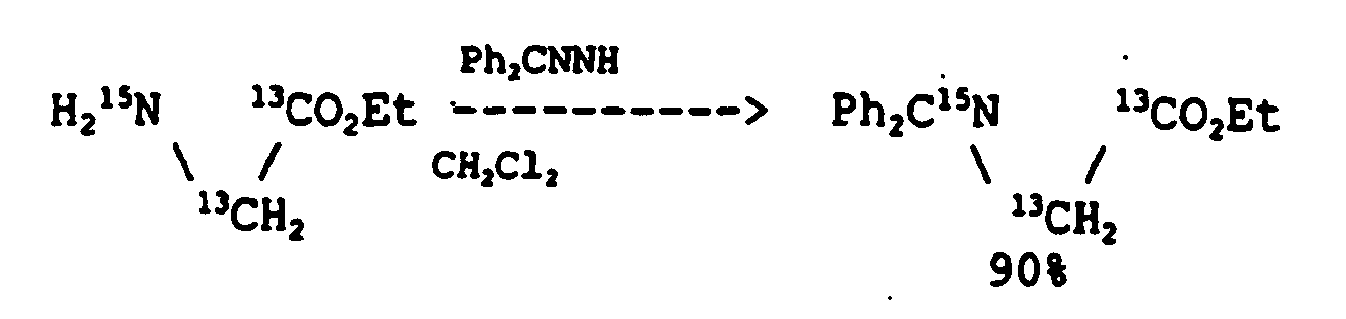
- As described above, the amino acids in the expression medium are deuterated at the α-carbon. If deuterated amino acids are required, then the doubly protected glycine derivative obtained above is deuterated at the α-carbon by treating it with a base in a deuteronic solvent, such as sodium carbonate in D2O (Ragnarsson, J. Chem. Soc. Chem. Commun., 935 (1996)). To minimize loss of material due to hydrolysis of the ester function, the deuteration is preferably accomplished by treating the doubly protected glycine derivative with a catalytic amount of sodium in an anhydrous deuteronic solvent such as deuteromethanol (MeOD) or deuteroethanol (EtOD).

- The required backbone labeled amino acids can now be synthesized from the doubly protected glycine derivative or, preferably, its deuterated analogue, by introducing the characteristic sidechain in a stereospecific manner to preserve the L-configuration at the α-carbon chiral center. Methods for such chiral syntheses are known to those skilled in the art. They involve reacting the glycine derivative with a chiral molecule, called a "chiral auxiliary," which directs the subsequent incorporation of the amino acid sidechain in a chiral manner (March, J., Advanced Organic Chemistry, 4th ed., Wiley, N.Y., p. 118, 1992).
- In a particularly preferred aspect of the invention, the deuterated glycine analogue is converted to the chiral "sultam" derivative. See Oppolzer, J. Chem. Soc. Perkin 1: 2503 (1996). For example, methyl or ethyl N-[bis(methylthio)methylidene]glycinate or methyl or ethyl N-(diphenyl methylene)glycinate is treated with (2R)-bornane-10,2-sultam or (2S)-bornane-10,2-sultam in the presence of trimethylaluminum or triethylaluminum and a solvent (usually toluene). (2R)-Bornane-10,2-sultam, ethyl N-(diphenyl methylene)glycinate and trimethylaluminum are particularly preferred for forming the L-amino acids.

- To prepare amino acids with simple alkyl sidechains, i.e., alanine, leucine, isoleucine, phenylalanine, methionine, and valine, the derivatized glycine molecule is treated with the appropriate alkyl halide to form the fully protected amino acid. For example, treating the derivatized glycine molecule with benzyl iodide leads to the formation of protected phenylalanine. A list of alkyl halides and corresponding amino acids is provided in Table 1.

TABLE 1 Alanine Me -I Isoleucine 
Leucine 
Methionine 
Phenylalanine 
Valine 

- To prepare aspartic acid, glutamic acid, tyrosine, histidine and tryptophan, the functional groups present in the sidechains are advantageously protected prior to reaction with the derivatized glycine molecule. Preferably, the derivatized glycine molecule is treated with a previously protected alkyl halide. For example, aspartic and glutamic acid may be prepared via the commercially available tert-butyl bromoacetate (Oppolzer, Helvetica Chimica Acta, 77:2363 (1994)) and methyl acrylate (Schollkopf, Synthesis, 737 (1986)), respectively. The alkyl ester protecting group is removed by treating the glycine anion with acid during the two-step unblocking procedure described above to give the desired amino acid.
- Similarly, tyrosine may be prepared via the commercially available 4-benzyloxybenzyl or 4-methoxybenzyl chloride. The benzyl or methyl protecting group may be removed prior to the two-step unblocking procedure by, for instance, treating the derivatized glycine molecule with trimethyl silyl iodide in a suitable solvent such as dichloromethane.
- Protected sidechaim precursors for histidine and tryptophan may be prepared, for example, by the reaction shown in Table 2. For the preparation of the histidine precursor, commercially available 4-hydroxymethyl imidazole hydrochloride is protected at the ring amino nitrogen by a suitable protecting group such as t-boc, F-moc, tosyl, etc. The alcohol functional group of the protected molecule is then converted to a suitable leaving group, e.g., the corresponding halide such as bromide, by reacting the alcohol with a suitable brominating agent, such as free bromine, or triphenylphosphine and carbon tetrabromide, in a suitable solvent such as carbon tetrachloride. The protected bromomethylimidazole derivative may then be reacted directly with the derivatized glycine molecule.
- Similarly, the required tryptophan precursor may be prepared from commercially available indole-3-carboxaldehyde via protection of the ring nitrogen with a suitable protecting group such as t-boc, F-moc, etc., followed by conversion to the corresponding alcohol by reduction with, for example, sodium borohydride in ethanol, and halogenation as described above. The protected bromomethylindole derivative may then be reacted directly with the derivatized glycine molecule. The production of these heterocyclic halides and corresponding amino acids is illustrated in Table 2. Table 2


- Fully protected tryptophan and histidine may be unlocked by the simple two-step procedure described above as t-boc, F-moc, or tosyl groups may be removed by the acid/base treatment. Again, in principle any combination of an aqueous acid or base can be employed. However, aqueous HCL followed by LiOH is preferred.
- Specifically isotopically labeled asparagine and glutamine may be prepared respectively from labeled aspartic acid and glutamic acid prepared above using established techniques. For example, the techniques described in
U.S. patents 5,393,669 and5,627,044 may be used. Alternatively, asparagine and glutamine, and arginine and lysine, can be prepared by treating the derivatized glycine molecule with an alkyl halide carrying a terminal nitrile group. For example, treating the derivatized glycine molecule with 3-bromopropionitrile leads to the formation of the corresponding fully protected nitrile derivative. Following unblocking by the two-step acid/base treatment described above, the resulting amino acid nitriles are converted to the desired amino acids. For example, lysine may be formed by reacting 4-bromobutyronitrile with the derivatized glycine molecule and then reducing the resulting nitrile with a suitable reducing agent such as sodium borohydride and cobalt chloride. - A list of amino acids, corresponding halo-alkyl nitriles and methods for their conversion are provided in Table 3.
TABLE 3 Asparagine 
partial hydrolysis Arginine 
see below Glutamine 
partial hydrolysis Lysine 
reduction - Preferably, arginine is prepared from the nitrile isolated from the two-step unblocking procedure by reducing the nitrile with sodium borohydride and cobalt chloride, followed by treating the resulting ornithine with O-methylisourea tosylate. The O-methylisourea tosylate compound is prepared from urea treated with methyl tosylate in the presence of basic copper II carbonate, followed by treatment with sodium sulfhydride (Kurtz, J. Biol. Chem., 180:1259 (1949)).
- The remaining specifically isotopically labeled amino acids required for a specifically labeled mammalian or insect cell medium, i.e., serine, cysteine and threonine, may be prepared, for example, by the enzymatic procedures described in
U.S. patents 5,393,669 and5,627,044 and the references cited therein using 13C2, 15N glycine and/or 2H2, 13C, 15N glycine as a precursor. - The specifically isotopically labeled amino acids thus prepared may be incorporated into a mammalian or insect cell medium individually or in any combination so that the protein expressed by the cells growing in the medium may be specifically labeled at the amino acid residues of choice. The composition and use of such medium for bacterial, yeast, mammalian and insect cell lines are well known. The compositions described in
U.S. patent 5,324,658 and inU.S. patents 5,393,669 and5,627,044 may advantageously be used for the media of this invention. - NMR analysis of the specifically labeled protein thus produced may be used to interpret NMR data from the same protein separately obtained in universally labeled form and thereby expedite the determination of the structure of the protein. For instance, application of the HNCA experiment to.a specifically labeled protein will enable the maximum sensitivity and resolution to be obtained for the determination of the protein backbone resonance assignments. The Cα resonance for each amino acid residue will exhibit a correlation with the amide nitrogen atom of the same residue via the one-bond Cαi-Ni coupling, which is then transferred to the amide proton using another transfer via the one-bond Ni-Hi coupling. In addition, certain residues will exhibit a two-bond Cαi-1-(Ci-1)-Ni correlation to the previous residue in such cases where this two-bond coupling is of sufficient magnitude. These latter data can be complemented by data from an experiment known as HN(CO)CA which exhibits exclusively all such two-bond correlations due to transfer via the intervening carbonyl carbon. This latter experiment also shares the advantages gained by the HNCA experiments with respect to selective labeling. Hence, the HNCA and HN(CO)CA experiments combined, can be used sequentially to assign the backbone resonances of proteins with high-sensitivity, and with sufficient resolution to permit automated analysis with computational algorithms.
- The invention is illustrated by the following examples which are for illustrative purposes only and in no way limit the scope of the invention.
- Under anhydrous conditions, 4MHCL in dioxane (50 ml) was added to a solution of [1,2-13C2, 15N]glycine (5 g, 66.6 mmol) in ethanol (100 ml) and refluxed for 1 hour. Evaporating the solvent in vacuo and repeating the procedure twice yielded a white crystalline solid. Benzophenone imine (1 eq.) was added to the ethyl glycinate hydrochloride in dry dichloromethane (100 ml) and stirred at room temperature overnight. Solid was filtered off and the solvent removed in vacuo. The resulting ethyl N-(diphenylmethylene)[1,2-13C2, 15N]glycinate was recrystallized from hexane.
- Under anhydrous conditions, sodium metal (198 mg, 8.6 mmol) was added to a solution of ethyl N-(diphenylmethylene)[1,2-13C2, 15N]glycinate (19.31 g, 71..25 mmol) in freshly distilled deuteroethanol (250 ml, 60 eq). After stirring overnight at room temperature, the reaction was quenched by adding deuteroacetic acid (0.5 g, 8.6 mmol). Removing the solvent in vacuo, resuspending in dichloromethane (100 ml), filtering and evaporating yielded a white crystalline solid. Recrystallizing from hexane/ethyl acetate gave ethyl N-(diphenylmethylene)[1,2-13C2, 15N, 2,2-2H2]glycinate (17 g, 87%).
- Over 20 minutes, 2 M trimethylaluminum in hexane (40 ml, 1.2 eq) was added to (2R)-bornane-10,2-sultam (15.7 g, 1.1 eq) in toluene (110 ml) at 0°C, then left for 30 minutes. Ethyl N-(diphenylmethylene)[12-13C2, 15N, 2,2-2H2]glycinate (18.1 g, 66.4 mmol) in toluene (10 ml) was added and the reaction stirred overnight. Heating to 50°C for 3-4 hours drove the reaction to completion. Workup was effected by cooling the reaction in ice and carefully adding MeOD (20 ml). After 1 hour, D2O (30 ml) was carefully added. Filtering, extracting with ethyl acetate (2 x 250 ml), drying over MgSO4 and purifying by silica gel flash chromatography (Hexane: Ethyl Acetate 10:1 to 1:1) gave (2R)-N-(diphenylmethylene)[1,2-13C2, 15N, 2,2-2H2]glycylbornane-10,2-sultam (28.7 g, 99% yield) as an orange oil.
- Under anhydrous conditions, a solution of n-butyl lithium (2.5 M solution in hexane, 5.39 ml, 1.1 eq) was added to a stirred solution of (2R)-N-(diphenylmethylene)[1,2-13C2, 15N, 2,2-2H2]glycylbornane-10,2-sultam (5.4 g, 12.3 mmol) in dry THF (120 ml) at -78°C. After 15 minutes, the resulting solution was treated with HMPA (21.3 ml, 10 eq). After 1 hour, 2-iodopropane (6.12 ml, 5 eq) was added and the temperature raised to -10°C. After 2 days, the reaction was warmed to room temperature and quenched by adding D2O (50 ml). Extracting with diethyl ether (100 ml), drying, evaporating and purifying by silica gel chromatography (hexane:ethyl acetate 80:20) yielded 4.85 g (82%) of a semi-crystalline oil.
- Deprotection was effected by adding 0.1 M HCL (100 ml) to a solution of the oil in THF (100 ml). After 15 minutes, lithium hydroxide (2.11 g, 5 eq) was added and the reaction stirred at room temperature overnight. Removing the solvent in vacuo, extracting with diethyl ether (5 x 50 ml) then with hexane (50 ml) and purifying the aqueous phase by ion exchange chromatography (Dowex 8 x 400 H+ resin) gave the title compound (889 mg, 60%) as a white powder.
- A solution of n-butyl lithium (2.5 M soln. in hexane, 10 ml, 1.6 eq) was added to a stirred solution of (2R) -N- (diphenylmethylene) [1,2-13C2, 15N, 2,2-2H2]glycylbornane-10,2-sultam (4.32 g, 9.8 mmol) in dry THF (50 ml) at -78°C. After 15 minutes, the resulting solution was treated with HMPA (13 ml, 7 eq) and the' temperature raised to -50°C. After 1 hour, benzyl iodide (11.6 g, 5 eq) in THF (50 ml) was added. After 1 hour, the reaction was warmed to room temperature and quenched by adding water (50 ml). Extracting with diethyl ether (5 x 100 ml), washing with water, drying, and evaporating yielded an oil which was immediately deprotected.
- Deprotection was effected by adding 0.2 M HCL (160 ml) to a solution of the oil in THF (160 ml). After 15 minutes, lithium hydroxide (6.71 g, 10 eq) was added and the reaction stirred at room temperature overnight. Removing the solvent in vacuo, extracting with diethyl ether (5 x 50 ml) then with hexane (50 ml), and purifying the aqueous phase by ion exchange chromatography (Dowex 8 x 400 H+ resin) gave the title compound (1.2 g, 45%) as a white powder.
- A solution of n-butyl lithium (2.5 M soln in hexane, 2.8 ml, 1.1 eq) was added to a stirred solution of (2R)-N-(diphenylmethylene)[1,2-13C2, 15N]glycylbornane-10,2-sultam (2.77 g, 6.3 mmol) in dry THF (63 ml) at -78°C. After 15 minutes, the resulting solution was treated with HMPA (11 ml, 10 eq). After 1 hour, methyl iodide (2 ml, 5 eq) was added, the reaction temperature raised to -10°C, stirred overnight, then quenched by adding water (20 ml). Extracting with diethyl ether (5 x 20 ml), washing with water, drying (MgSO4), evaporating and purifying by silica gel chromatography (hexane:ethyl acetate 80:20) yielded 2.34 g (82%) of a yellow crystalline solid.
- Deprotection was effected by adding 0.2 M HCL (60 ml) to a solution of the crystals in THF (70 ml). After 15 minutes, lithium hydroxide (2.17 g, 10 eq) was added and the reaction stirred at room temperature overnight. Removing the solvent in vacuo, extracting with diethyl ether (5 x 50 ml) and purifying the aqueous phase by ion exchange chromatography (Dowex 8 x 400 H+ resin) gave the title compound (395 mg, 68%) as a white powder.
- Backbone labeled (>95% 13C, 15N, >90% 2H) Phe (20 mg) (
Figure 1(a) ) was dissolved in 10 ml saturated NaHCO3, to which was added 5 mole equivalents of acetic anhydride over a period of two hours. Following desalting on a mixed-bed anion and cation exchange resin, the sample was prepared for NMR studies by dissolution in 700 ml H2O/D2O (95:5 v/v). Two-dimensional HNCA spectra were acquired with deuterium decoupling on said acylated derivative of backbone-labeled Phe versus the acylated derivative of uniformly triple (>95% 13C, 15N, 50% 2H) labeled Phe (Fig. 1(b) ). As indicated, these spectra are shown inFigures 1(a) and1(b) , respectively. - The acylated derivative of backbone (13C, 15N) labeled and uniformly 2H enriched Phe was dissolved in 700 ul glycerol-d7/H2O (85% v/v) to a final concentration of 1mM. A sample of the acylated derivative of uniformly (13C, 15N, 2H) Phe was similarly prepared. Two-dimensional HNCA spectra with 2H decoupling were acquired identically on these samples at 0°C. At this temperature, the rotational correlation time of the molecule (∼18 ns) and hence resonance linewidths equaled that expected for a ∼40 kDa protein. These spectra are shown in
Figures 2(a) and 2(b) , respectively. - Over 20 minutes, 2 M trimethylaluminium in hexane (10.55 ml, 1.0 eq) was added to (2R)-bornane-10,2-sultam (6.11 g, 1.02 eq) in toluene (50 ml) at 0°C, then left for 30 minutes. Ethyl N-(diphenylmethylene)[1,2-13C2, 15N]glycinate (6.11 g, 22.8 mmol) in toluene (17 ml) was added and the reaction stirred overnight. Heating to 60°C for 4-6 hours drove the reaction to completion. Workup was effected by cooling the reaction in ice and carefully adding MeOD (9.1 ml). After 1 hour, D2O (10.1 ml) was carefully added. Filtering, extracting with ethyl acetate (2 x 250 ml), and drying over NaSO4 gave (2R)-N-(diphenylmethylene)[1,2-13C2, 15N, 2-1H, 2-2H]glycylbornane-10,2-sultam (9.9 g, 96% yield) as an orange foam.
- Under anhydrous conditions, a solution of n-butyl lithium (2.5 M soln in hexane, 5.5 ml, 1.1 eq) was added to a stirred solution of (2R)-N-(diphenylmethylene)[1,2-13C2, 15N, 2-1H, 2-2H]glycylbornane-10,2-sultam (5.49 g, 12.6 mmol) in dry THF (100 ml) at -78°C. After 15 minutes, the resulting solution was treated with HMPA (21.3 ml , 10 eq). After 1 hour, 2-iodopropane (6.12 ml, 5 eq) was added and the reaction was warmed to room temperature overnight and quenched by adding D2O (2.2 ml). Extraction with diethyl ether (100 ml), drying and evaporation yielded 6.01 g (87.4%) of a white crystalline solid.
- Deprotection (of 2.74 g, 5.74 mmol) was effected by adding 1 M HCL (9.06 ml) to a solution of the solid in THF (150 ml) and water (60 ml). After 15 minutes, lithium hydroxide (0.88 g, 3.65 eq) was added and the reaction stirred at room temperature overnight. Removing the solvent in vacuo, extracting with diethyl ether (5 x 50 ml), then with hexane (50 ml), and purifying the aqueous phase by ion exchange chromatography (Dowex 8 x 400 H+ resin) gave the title compound (560 mg, 83%) as a white powder.
- A solution of n-butyl lithium (2.5 M soln. in hexane, 5.77 ml, 1.1 eq) was added to a stirred solution of (2R)-N-(diphenylmethylene)[1,2-13C2, 15N, 2-1H, 2-2H]glycylbornane-10,2-sultam (5.77 g, 13.24 mmol) in dry THF (200 ml) at -78°C. After 15 minutes, the resulting solution was treated with HMPA (22.7 ml, 10 eq). After 1 hour, benzyl bromide (7.87 ml, 5 eq) was added. The reaction was warmed to room temperature overnight and quenched by adding D2O (2.36 ml). Extracting with diethyl ether (5 x 100 ml), washing with water, drying, and evaporating yielded an oil which was immediately deprotected.
- Deprotection was effected by adding 1 M HCL (10.93 ml) to a solution of the oil in THF (72.8 ml) and water (72.8 ml). After 15 minutes, lithium hydroxide (1.07 g, 4.2 eq) was added and the reaction stirred at room temperature overnight. Removing the solvent in vacuo, extracting with diethyl ether (5 x 50 ml), then with hexane (50 ml), and purifying the aqueous phase by ion exchange chromatography (Dowex 8 x 400 H+ resin) gave the title compound (0.24 g, 23%) as a white powder.
- A solution of n-butyl lithium (2.5 M soln. in hexane, 5.77 ml, 1.1 eq) was added to a stirred solution of (2R)-N-(diphenylmethylene)[1,2-13C2, 15N, 2-1H, 2-2H]glycylbornane-10,2-sultam (5.77 g, 13.24 mmol) in dry THF (200 ml) at -78°C. After 15 minutes, the resulting solution was treated with HMPA (22.74 ml, 10 eq). After 1 hour, 1-iodo-2-methyl propane (12.18 g, 5 eq) was added. The reaction was warmed to room temperature overnight and quenched by adding D2O (2.36 ml). Extraction with diethyl ether (5 x 100 ml), washing with water, drying, and evaporation yielded a solid (6.49 g, 99.7%) which was immediately deprotected.
- Deprotection was effected by adding 1 M HCL (12.1 ml) to a solution of the solid in THF (110 ml) and water (81 ml). After 15 minutes, lithium hydroxide (1.1 g, 3.5 eq) was added and the reaction stirred at room temperature overnight. Removing the solvent in vacuo, extracting with diethyl ether (5 x 50 ml), then with hexane (50 ml), and purifying the aqueous phase by ion exchange chromatography (Dowex 8 x 400 H+ resin) gave the title compound (0.976 g, 97 %) as a white powder.
- To one liter of CHO S SFM, serum-free media (Life Technologies), supplied by the manufacturer with amino acids, pyruvate and carbohydrate omitted (Catalog No. 0920261) at 37°C were added 212 mg (1,2-13C2, 15N, 50% 2-2H)leucine, 162 mg (1,2-13C2, 15N, 50% 2-2H)valine, and 188 mg of backbone labeled (1,2-13C2, 15N, 50% 2-2H)phenylalanine. The remaining unlabeled components were added as follows:
- ten milliliters of sodium pyruvate 100x solution from Life Technologies (Catalog No. 11360-070),
- 3.9 grams of glucose,
- 20 mg aspartic acid,
- 31 mg glutamic acid,
- 57 mg asparagine,
- 82 mg histidine,
- 820 mg glutamine,
- 240 mg proline,
- 240 mg arginine,
- 135 mg threonine,
- 155 mg tyrosine,
- 60 mg methionine,
- 21 mg tryptophan,
- 210 mg isoleucine,
- 291 mg lysine,
- 18 mg alanine
- 17 mg glycine
- 48 mg serine
- 81 mg cysteine,
- 81 mg cystine, and
- 7.4 mg hydroxyproline.
- The components were mixed for ten minutes, sonicated for three one-minute intervals, stirred for ten more minutes, and sterile filtered with a 0.2 m PES Nalgene sterile filter. The filtered mixture was transferred to a Nalge bottle for shipping.
- The resulting medium was used to culture a CHO cell line engineered to express human choriogonadotropin ("hCG"). Cells were cultured and the specifically isotopically labeled hCG β-subunit was purified by procedures known in the art.
- Backbone labeled (Phe, Val, Leu) hCG β-subunit (-2.3 mg) was dissolved in 650 ul 100 mM phosphate buffer, and 50 ul 99.96% D2O was added for the field/frequency lock. Two-dimensional HNCA spectra without deuterium decoupling (
Figure 3 ) and with deuterium decoupling (Figure 4 ) were acquired at 45°C with spectral widths of 3600 Hz and 1200 Hz in the 1H and 13C dimensions, respectively. Totals of 256 transients were acquired for each increment in the 13C dimension, resulting in total acquisition times of 22 hours.
Claims (16)
- An isotopically substituted molecule suitable for NMR structural determination comprising a peptidic sequence of at least 50 amino acid residues, wherein said molecule is specifically isotopically substituted in all residues of any combination of one or more amino acids of choice at specific positions of the residue only, with 13C and 15N, said specific positions being in the backbone structure but not the side chains of said amino acids and which is further specifically isotopically substituted with 2H at the hydrogen atoms bonded to the α-carbons of said isotopically substituted amino acid residues.
- The isotopically substituted molecule of claim 1 wherein any hydrogen atoms bonded to the α-carbons of said isotopically substituted amino acids are about 30% to about 70% 2H.
- The isotopically substituted molecule of claim 1 wherein any hydrogen atoms bonded to the α-carbons of said isotopically substituted amino acids are about 40% to about 60% 2H.
- The isotopically substituted molecule of claim 1 wherein any hydrogen atoms bonded to the α-carbons of said isotopically substituted amino acids are about 50% 2H.
- The isotopically substituted molecule of claim 1, wherein substantially all of said amino acid residues contain an isotopic substitution.
- A method for making an isotopically substituted molecule comprising a peptidic sequence of at least 50 amino acid residues, wherein said molecule is specifically isotopically substituted in all residues of any combination of one or more amino acids of choice at specific positions of the residue only, with 13C and 15N, said specific positions being in the backbone structure but not the side chains of said amino acids and which is further specifically isotopically substituted with 2H at the hydrogen atoms bonded to the α-carbons of said isotopically substituted amino acid residues which comprises;(a) providing a medium suitable for cultivation of bacterial, yeast, mammalian or insect cells or a cell-free system, wherein said medium contains all twenty amino acids required for protein biosynthesis and wherein said amino acid(s) of choice are isotopically substituted in the backbone nitrogen and carbon but not the side chains of the amino acids with 15N and 13C and are further specifically isotopically substituted with 2H at the hydrogen atoms bonded to the α-carbons of said isotopically substituted amino acid residues and the remaining amino acids are not isotopically substituted;(b) cultivating bacterial, yeast, mammalian or insect cells or a cell-free system in said medium; and(c) isolating the specifically isotopically substituted peptide or protein molecule from said medium or said cells,wherein the amino acids of the peptide or protein molecule contain the specific isotopic substitution or substitutions of the isotopically substituted amino acids in said medium and the remaining amino acids of the peptide or protein molecule are not isotopically substituted.
- The method of claim 6 wherein any hydrogen atoms bonded to the α-carbons of said isotopically substituted amino acids are about 30% to about 70% 2H.
- The method of claim 6 wherein any hydrogen atoms bonded to the α-carbons of said isotopically substituted amino acids are about 40% to about 60% 2H
- The method of claim 6 wherein any hydrogen atoms bonded to the α-carbons of said isotopically substituted amino acids are about 50% 2H.
- The method of claim 6, wherein substantially all of said amino acid residues are isotopically substituted with 15N and 13C.
- The method of any of claims 6-10, wherein said cultivating is of a cell culture system.
- The method of claim 11, wherein said cell culture system comprises mammalian cells.
- The method of claim 11, wherein said cell culture system comprises insect cells.
- The method of claim 11, wherein said cell culture system comprises yeast cells.
- The method of claim 11, wherein said cell culture system comprises bacterial cells.
- The isotopically substituted molecule of any of claims 1 to 5 which is produced by the method of any of claims 6-15.
Priority Applications (1)
| Application Number | Priority Date | Filing Date | Title |
|---|---|---|---|
| EP07120079A EP1889823A1 (en) | 1997-09-02 | 1998-09-02 | 13c,15n,2h labeled proteins for nmr structure determinations and their preparation |
Applications Claiming Priority (3)
| Application Number | Priority Date | Filing Date | Title |
|---|---|---|---|
| US08/921,554 US6111066A (en) | 1997-09-02 | 1997-09-02 | Peptidic molecules which have been isotopically substituted with 13 C, 15 N and 2 H in the backbone but not in the sidechains |
| US921554 | 1997-09-02 | ||
| PCT/US1998/018197 WO1999011589A1 (en) | 1997-09-02 | 1998-09-02 | 13c, 15n, 2h labeled proteins for nmr structure determinations and their preparation |
Related Child Applications (1)
| Application Number | Title | Priority Date | Filing Date |
|---|---|---|---|
| EP07120079A Division EP1889823A1 (en) | 1997-09-02 | 1998-09-02 | 13c,15n,2h labeled proteins for nmr structure determinations and their preparation |
Publications (2)
| Publication Number | Publication Date |
|---|---|
| EP1009725A1 EP1009725A1 (en) | 2000-06-21 |
| EP1009725B1 true EP1009725B1 (en) | 2009-01-07 |
Family
ID=25445613
Family Applications (2)
| Application Number | Title | Priority Date | Filing Date |
|---|---|---|---|
| EP98945835A Expired - Lifetime EP1009725B1 (en) | 1997-09-02 | 1998-09-02 | 13c,15n,2h labeled proteins for nmr structure determinations and their preparation |
| EP07120079A Withdrawn EP1889823A1 (en) | 1997-09-02 | 1998-09-02 | 13c,15n,2h labeled proteins for nmr structure determinations and their preparation |
Family Applications After (1)
| Application Number | Title | Priority Date | Filing Date |
|---|---|---|---|
| EP07120079A Withdrawn EP1889823A1 (en) | 1997-09-02 | 1998-09-02 | 13c,15n,2h labeled proteins for nmr structure determinations and their preparation |
Country Status (12)
| Country | Link |
|---|---|
| US (4) | US6111066A (en) |
| EP (2) | EP1009725B1 (en) |
| JP (1) | JP2001514239A (en) |
| AT (1) | ATE420061T1 (en) |
| AU (1) | AU754232B2 (en) |
| CA (1) | CA2301046C (en) |
| DE (1) | DE69840448D1 (en) |
| HU (1) | HUP0003383A3 (en) |
| NO (1) | NO20001052L (en) |
| TW (1) | TW581772B (en) |
| WO (1) | WO1999011589A1 (en) |
| ZA (1) | ZA987975B (en) |
Families Citing this family (41)
| Publication number | Priority date | Publication date | Assignee | Title |
|---|---|---|---|---|
| US6111066A (en) | 1997-09-02 | 2000-08-29 | Martek Biosciences Corporation | Peptidic molecules which have been isotopically substituted with 13 C, 15 N and 2 H in the backbone but not in the sidechains |
| AU2002224440A1 (en) * | 2000-10-20 | 2002-05-06 | Martek Biosciences Corporation | Rapid determination of protein global folds |
| US6882939B2 (en) * | 2000-10-20 | 2005-04-19 | Prospect Pharma | Rapid determination of protein global folds |
| WO2003002724A2 (en) * | 2001-03-12 | 2003-01-09 | Affinium Pharmaceuticals, Inc. | Proteins, druggable regions of proteins and target analysis for chemistry of therapeutics |
| WO2003006488A1 (en) * | 2001-07-13 | 2003-01-23 | The Regents Of The University Of California | In-cell nmr spectroscopy |
| JP2003096098A (en) * | 2001-09-25 | 2003-04-03 | Nippon Sanso Corp | Stable isotope-labeled antibody, method for producing the same, and detection method using the same |
| US20030077572A1 (en) * | 2001-10-11 | 2003-04-24 | Abramson Fred P. | Quantitative differential display using isotope ratio monitoring |
| US20040030239A1 (en) * | 2001-12-13 | 2004-02-12 | The Johns Hopkins University School Of Medicine | Method for MR/NMR imaging |
| EP1457482B9 (en) * | 2001-12-19 | 2012-10-24 | Japan Science and Technology Agency | Stable isotope-labeled amino acid, method of integrating the same into target protein, method of NMR structural analysis of protein |
| EP1551291A4 (en) * | 2002-06-10 | 2007-11-28 | Prospect Pharma | Method for obtaining dynamic and structural data pertaining to proteins and protein/ligand complexes |
| EP1572950B1 (en) | 2002-06-17 | 2012-10-10 | Thrasos, Inc. | Single domain tdf-related compounds and analogs thereof |
| US7473535B2 (en) * | 2002-08-20 | 2009-01-06 | The Institute For Systems Biology | Chemical reagents and methods for detection and quantification of proteins in complex mixtures |
| US7553455B1 (en) * | 2003-04-02 | 2009-06-30 | Sandia Corporation | Micromanifold assembly |
| US7672791B2 (en) * | 2003-06-13 | 2010-03-02 | International Business Machines Corporation | Method of performing three-dimensional molecular superposition and similarity searches in databases of flexible molecules |
| AU2004256368B2 (en) | 2003-07-11 | 2010-08-05 | Tatiana A. Egorova-Zachernyuk | Compositions and methods for stable isotope labelling of biological compounds |
| EP1678198A4 (en) * | 2003-10-07 | 2007-12-05 | Prospect Pharma | Side chain deuterated amino acids and methods of use |
| EP1679302B1 (en) | 2003-10-31 | 2014-04-30 | Japan Science and Technology Agency | Aromatic amino acid labeled with stable isotope, method for incorporating the same into target protein and method for analyzing protein structure using nmr |
| JP4475237B2 (en) * | 2004-02-02 | 2010-06-09 | 三菱化学株式会社 | NMR signal assignment method |
| EP2789342A1 (en) | 2004-06-17 | 2014-10-15 | Thrasos Innovation, Inc. | TDF-related compounds and analogs thereof |
| US7372895B2 (en) * | 2004-12-08 | 2008-05-13 | Telefonaktiebolaget Lm Ericsson (Publ) | Method of and system for delay estimation with minimized finger allocation |
| US7480356B2 (en) * | 2004-12-08 | 2009-01-20 | Telefonaktiebolaget L M Ericsson (Publ) | Method of and system for path selection in rich multipath conditions |
| ES2909600T3 (en) | 2005-06-07 | 2022-05-09 | Dsm Nutritional Products Ag | Eukaryotic microorganisms to produce lipids and antioxidants |
| US8299212B2 (en) | 2005-09-20 | 2012-10-30 | Thrasos Therapeutics, Inc. | TDF-related compounds and analogs thereof, analogs and bioactive fragments |
| US20070196280A1 (en) * | 2006-02-21 | 2007-08-23 | The Government Of The U.S.A. As Represented By The Sec. Of The Dept. Of Health And Human Services | In vivo magnetic resonance spectroscopy of aspartate transaminase activity |
| GB0604647D0 (en) * | 2006-03-08 | 2006-04-19 | Shchepinov Mikhail | Stabilized food supplements and their derivatives |
| JP2007255910A (en) * | 2006-03-20 | 2007-10-04 | Hokkaido Univ | NMR signal assignment method |
| US9023616B2 (en) * | 2006-08-01 | 2015-05-05 | Dsm Nutritional Products Ag | Oil producing microbes and method of modification thereof |
| US8637486B2 (en) * | 2008-03-14 | 2014-01-28 | Retrotope, Inc. | Therapeutic substances that modulate genome methylation |
| DK2268604T3 (en) * | 2008-03-14 | 2017-03-27 | Retrotope Inc | CANCER THERAPIES BY USING ISOTO-SUBSTITUTED LYSIN |
| DK2493296T3 (en) | 2009-10-30 | 2019-04-15 | Retrotope Inc | REMOVAL OF OXIDATIVE STRESS STATES WITH PUFA DERIVATIVES |
| CN101914030B (en) * | 2010-07-23 | 2013-04-24 | 上海化工研究院 | A kind of synthetic method of 13C, 15N double-labeled glycine |
| KR102020579B1 (en) | 2011-04-26 | 2019-09-10 | 레트로토프 인코포레이티드 | Impaired energy processing disorders and mitochondrial deficiency |
| US10154983B2 (en) | 2011-04-26 | 2018-12-18 | Retrotope, Inc. | Neurodegenerative disorders and muscle diseases implicating PUFAs |
| WO2012148929A2 (en) | 2011-04-26 | 2012-11-01 | Retrotope, Inc. | Disorders implicating pufa oxidation |
| US10058522B2 (en) | 2011-04-26 | 2018-08-28 | Retrotope, Inc. | Oxidative retinal diseases |
| AU2014229307B2 (en) | 2013-03-13 | 2017-08-31 | Dsm Nutritional Products Ag | Engineering microorganisms |
| WO2017091279A1 (en) | 2015-11-23 | 2017-06-01 | Retrotope, Inc. | Site-specific isotopic labeling of 1, 4-diene systems |
| FR3055337A1 (en) * | 2016-08-24 | 2018-03-02 | Commissariat A L'energie Atomique Et Aux Energies Alternatives | PROCESS FOR THE PREPARATION OF RICH CULTURING MEDIA FOR THE MARKING OF AMINO ACIDS INCORPORATED IN PROTEINS |
| EP4107163A4 (en) | 2020-02-21 | 2024-06-19 | Retrotope, Inc. | Processes for isotopic modification of polyunsaturated fatty acids and derivatives thereof |
| US12109194B2 (en) | 2021-02-05 | 2024-10-08 | Biojiva Llc | Synergistic combination therapy for treating ALS |
| US11491130B2 (en) | 2021-02-05 | 2022-11-08 | Retrotope, Inc. | Methods of treating amyotrophic lateral sclerosis |
Family Cites Families (10)
| Publication number | Priority date | Publication date | Assignee | Title |
|---|---|---|---|---|
| JPH0768446B2 (en) * | 1988-11-09 | 1995-07-26 | 三菱化学株式会社 | Medical parts using aromatic polycarbonate resin composition |
| JP2518917B2 (en) | 1989-02-07 | 1996-07-31 | 日本電子株式会社 | Protein structure analysis method |
| ES2102984T3 (en) | 1989-06-14 | 1997-08-16 | Martek Corp | MEANS FOR CELL GROWTH AND PROCEDURE TO PREPARE THEM. |
| JP2517688B2 (en) * | 1989-12-25 | 1996-07-24 | 日本電子株式会社 | Three-dimensional nuclear magnetic resonance spectrum symmetry processing method |
| JPH0446143A (en) * | 1990-06-11 | 1992-02-17 | Hitachi Ltd | Synthesis of isotopic multiply labeled amino acid |
| US5393669A (en) * | 1993-02-05 | 1995-02-28 | Martek Biosciences Corp. | Compositions and methods for protein structural determinations |
| US5698401A (en) | 1995-11-14 | 1997-12-16 | Abbott Laboratories | Use of nuclear magnetic resonance to identify ligands to target biomolecules |
| US5891643A (en) | 1995-11-14 | 1999-04-06 | Abbott Laboratories | Use of nuclear magnetic resonance to design ligands to target biomolecules |
| US6043024A (en) | 1997-04-18 | 2000-03-28 | Abbott Laboratories | Use of one-dimensional nuclear magnetic resonance to identify ligands to target biomolecules |
| US6111066A (en) | 1997-09-02 | 2000-08-29 | Martek Biosciences Corporation | Peptidic molecules which have been isotopically substituted with 13 C, 15 N and 2 H in the backbone but not in the sidechains |
-
1997
- 1997-09-02 US US08/921,554 patent/US6111066A/en not_active Expired - Lifetime
-
1998
- 1998-09-01 ZA ZA9807975A patent/ZA987975B/en unknown
- 1998-09-02 HU HU0003383A patent/HUP0003383A3/en unknown
- 1998-09-02 EP EP98945835A patent/EP1009725B1/en not_active Expired - Lifetime
- 1998-09-02 TW TW087114552A patent/TW581772B/en not_active IP Right Cessation
- 1998-09-02 AU AU92988/98A patent/AU754232B2/en not_active Ceased
- 1998-09-02 JP JP2000508633A patent/JP2001514239A/en active Pending
- 1998-09-02 EP EP07120079A patent/EP1889823A1/en not_active Withdrawn
- 1998-09-02 WO PCT/US1998/018197 patent/WO1999011589A1/en not_active Ceased
- 1998-09-02 US US09/486,837 patent/US6335196B1/en not_active Expired - Lifetime
- 1998-09-02 DE DE69840448T patent/DE69840448D1/en not_active Expired - Lifetime
- 1998-09-02 AT AT98945835T patent/ATE420061T1/en not_active IP Right Cessation
- 1998-09-02 CA CA002301046A patent/CA2301046C/en not_active Expired - Fee Related
-
2000
- 2000-03-01 NO NO20001052A patent/NO20001052L/en not_active Application Discontinuation
- 2000-07-10 US US09/613,571 patent/US6340578B1/en not_active Expired - Lifetime
- 2000-07-10 US US09/613,570 patent/US6376253B1/en not_active Expired - Lifetime
Also Published As
| Publication number | Publication date |
|---|---|
| HUP0003383A3 (en) | 2003-07-28 |
| NO20001052D0 (en) | 2000-03-01 |
| US6111066A (en) | 2000-08-29 |
| CA2301046A1 (en) | 1999-03-11 |
| CA2301046C (en) | 2009-03-10 |
| DE69840448D1 (en) | 2009-02-26 |
| AU9298898A (en) | 1999-03-22 |
| US6340578B1 (en) | 2002-01-22 |
| WO1999011589A1 (en) | 1999-03-11 |
| ATE420061T1 (en) | 2009-01-15 |
| HUP0003383A2 (en) | 2001-02-28 |
| JP2001514239A (en) | 2001-09-11 |
| US6335196B1 (en) | 2002-01-01 |
| US6376253B1 (en) | 2002-04-23 |
| TW581772B (en) | 2004-04-01 |
| AU754232B2 (en) | 2002-11-07 |
| EP1889823A1 (en) | 2008-02-20 |
| ZA987975B (en) | 2000-01-21 |
| EP1009725A1 (en) | 2000-06-21 |
| NO20001052L (en) | 2000-04-28 |
Similar Documents
| Publication | Publication Date | Title |
|---|---|---|
| US6376253B1 (en) | 13C, 15N, 2H labeled proteins for NMR structure determinations and their preparation | |
| McIntosh et al. | Biosynthetic incorporation of 15N and 13C for assignment and interpretation of nuclear magnetic resonance spectra of proteins | |
| Gardner et al. | The use of 2H, 13C, 15N multidimensional NMR GTO study the structure and dynamics of proteins | |
| Hunkapiller et al. | Carbon nuclear magnetic resonance studies of the histidine residue in α-lytic protease. Implications for the catalytic mechanism of serine proteases | |
| FI112116B (en) | A method for determining the 3-dimensional structure information of proteins and a nutrient medium | |
| Rosen et al. | Selective methyl group protonation of perdeuterated proteins | |
| Fesik et al. | NMR studies of [U-13C] cyclosporin A bound to cyclophilin: bound conformation and portions of cyclosporin involved in binding | |
| EP0839152B1 (en) | Combinatorial libraries of labeled biochemical compounds and methods for producing same | |
| Ramer et al. | Formation of peptide amides by peptidylglycine. alpha.-amidating monooxygenase: a new assay and stereochemistry of hydrogen loss | |
| Takeuchi et al. | 1-13C amino acid selective labeling in a 2H15N background for NMR studies of large proteins | |
| CA2365385C (en) | Use of 13c-nmr to detect binding | |
| Rohden et al. | Synthesis of Selectively 13C/2H/15N‐Labeled Arginine to Probe Protein Conformation and Interaction by NMR Spectroscopy | |
| JP3145431B2 (en) | Method for producing stable isotope-labeled protein and reagent kit | |
| EP1169282B1 (en) | Site-specific isotopically-labeled proteins, amino acids, and biochemical precursors therefor | |
| US20060293229A1 (en) | Site-specific isotopically-labeled proteins, amino acids, and biochemical precursors therefor | |
| Kahana et al. | Biosynthesis of l-[15N] aspartic acid and l-[15N] alanine by immobilized bacteria | |
| Illos et al. | Dual role of hydrophobic racemic thioesters of α-amino acids in the generation of isotactic peptides and co-peptides in water; implications for the origin of homochirality | |
| Matsuo et al. | Assignments of1H− 15N magnetic resonances and identification of secondary structure elements of the λ-cro repressor | |
| JPS58209991A (en) | Method for synthesizing peptides or peptide derivatives | |
| Gast et al. | MAS NMR on a uniformly [13C, 15N] labeled LH2 |
Legal Events
| Date | Code | Title | Description |
|---|---|---|---|
| PUAI | Public reference made under article 153(3) epc to a published international application that has entered the european phase |
Free format text: ORIGINAL CODE: 0009012 |
|
| 17P | Request for examination filed |
Effective date: 20000331 |
|
| AK | Designated contracting states |
Kind code of ref document: A1 Designated state(s): AT BE CH CY DE DK ES FI FR GB GR IE IT LI LU MC NL PT SE |
|
| 17Q | First examination report despatched |
Effective date: 20030620 |
|
| 17Q | First examination report despatched |
Effective date: 20030620 |
|
| GRAP | Despatch of communication of intention to grant a patent |
Free format text: ORIGINAL CODE: EPIDOSNIGR1 |
|
| GRAS | Grant fee paid |
Free format text: ORIGINAL CODE: EPIDOSNIGR3 |
|
| GRAA | (expected) grant |
Free format text: ORIGINAL CODE: 0009210 |
|
| AK | Designated contracting states |
Kind code of ref document: B1 Designated state(s): AT BE CH CY DE DK ES FI FR GB GR IE IT LI LU MC NL PT SE |
|
| REG | Reference to a national code |
Ref country code: GB Ref legal event code: FG4D |
|
| REG | Reference to a national code |
Ref country code: CH Ref legal event code: EP |
|
| REG | Reference to a national code |
Ref country code: IE Ref legal event code: FG4D |
|
| REF | Corresponds to: |
Ref document number: 69840448 Country of ref document: DE Date of ref document: 20090226 Kind code of ref document: P |
|
| REG | Reference to a national code |
Ref country code: CH Ref legal event code: NV Representative=s name: MOINAS & SAVOYE SA |
|
| PG25 | Lapsed in a contracting state [announced via postgrant information from national office to epo] |
Ref country code: NL Free format text: LAPSE BECAUSE OF FAILURE TO SUBMIT A TRANSLATION OF THE DESCRIPTION OR TO PAY THE FEE WITHIN THE PRESCRIBED TIME-LIMIT Effective date: 20090107 |
|
| NLV1 | Nl: lapsed or annulled due to failure to fulfill the requirements of art. 29p and 29m of the patents act | ||
| PG25 | Lapsed in a contracting state [announced via postgrant information from national office to epo] |
Ref country code: FI Free format text: LAPSE BECAUSE OF FAILURE TO SUBMIT A TRANSLATION OF THE DESCRIPTION OR TO PAY THE FEE WITHIN THE PRESCRIBED TIME-LIMIT Effective date: 20090107 Ref country code: ES Free format text: LAPSE BECAUSE OF FAILURE TO SUBMIT A TRANSLATION OF THE DESCRIPTION OR TO PAY THE FEE WITHIN THE PRESCRIBED TIME-LIMIT Effective date: 20090418 |
|
| PG25 | Lapsed in a contracting state [announced via postgrant information from national office to epo] |
Ref country code: SE Free format text: LAPSE BECAUSE OF FAILURE TO SUBMIT A TRANSLATION OF THE DESCRIPTION OR TO PAY THE FEE WITHIN THE PRESCRIBED TIME-LIMIT Effective date: 20090407 Ref country code: PT Free format text: LAPSE BECAUSE OF FAILURE TO SUBMIT A TRANSLATION OF THE DESCRIPTION OR TO PAY THE FEE WITHIN THE PRESCRIBED TIME-LIMIT Effective date: 20090608 Ref country code: AT Free format text: LAPSE BECAUSE OF FAILURE TO SUBMIT A TRANSLATION OF THE DESCRIPTION OR TO PAY THE FEE WITHIN THE PRESCRIBED TIME-LIMIT Effective date: 20090107 |
|
| PG25 | Lapsed in a contracting state [announced via postgrant information from national office to epo] |
Ref country code: BE Free format text: LAPSE BECAUSE OF FAILURE TO SUBMIT A TRANSLATION OF THE DESCRIPTION OR TO PAY THE FEE WITHIN THE PRESCRIBED TIME-LIMIT Effective date: 20090107 |
|
| PG25 | Lapsed in a contracting state [announced via postgrant information from national office to epo] |
Ref country code: DK Free format text: LAPSE BECAUSE OF FAILURE TO SUBMIT A TRANSLATION OF THE DESCRIPTION OR TO PAY THE FEE WITHIN THE PRESCRIBED TIME-LIMIT Effective date: 20090107 |
|
| PLBE | No opposition filed within time limit |
Free format text: ORIGINAL CODE: 0009261 |
|
| STAA | Information on the status of an ep patent application or granted ep patent |
Free format text: STATUS: NO OPPOSITION FILED WITHIN TIME LIMIT |
|
| 26N | No opposition filed |
Effective date: 20091008 |
|
| PG25 | Lapsed in a contracting state [announced via postgrant information from national office to epo] |
Ref country code: MC Free format text: LAPSE BECAUSE OF NON-PAYMENT OF DUE FEES Effective date: 20090930 |
|
| REG | Reference to a national code |
Ref country code: IE Ref legal event code: MM4A |
|
| PG25 | Lapsed in a contracting state [announced via postgrant information from national office to epo] |
Ref country code: IE Free format text: LAPSE BECAUSE OF NON-PAYMENT OF DUE FEES Effective date: 20090902 |
|
| PG25 | Lapsed in a contracting state [announced via postgrant information from national office to epo] |
Ref country code: GR Free format text: LAPSE BECAUSE OF FAILURE TO SUBMIT A TRANSLATION OF THE DESCRIPTION OR TO PAY THE FEE WITHIN THE PRESCRIBED TIME-LIMIT Effective date: 20090408 |
|
| PG25 | Lapsed in a contracting state [announced via postgrant information from national office to epo] |
Ref country code: IT Free format text: LAPSE BECAUSE OF FAILURE TO SUBMIT A TRANSLATION OF THE DESCRIPTION OR TO PAY THE FEE WITHIN THE PRESCRIBED TIME-LIMIT Effective date: 20090107 |
|
| PG25 | Lapsed in a contracting state [announced via postgrant information from national office to epo] |
Ref country code: LU Free format text: LAPSE BECAUSE OF NON-PAYMENT OF DUE FEES Effective date: 20090902 |
|
| PG25 | Lapsed in a contracting state [announced via postgrant information from national office to epo] |
Ref country code: CY Free format text: LAPSE BECAUSE OF FAILURE TO SUBMIT A TRANSLATION OF THE DESCRIPTION OR TO PAY THE FEE WITHIN THE PRESCRIBED TIME-LIMIT Effective date: 20090107 |
|
| REG | Reference to a national code |
Ref country code: FR Ref legal event code: PLFP Year of fee payment: 18 |
|
| PGFP | Annual fee paid to national office [announced via postgrant information from national office to epo] |
Ref country code: CH Payment date: 20150928 Year of fee payment: 18 Ref country code: GB Payment date: 20150930 Year of fee payment: 18 |
|
| PGFP | Annual fee paid to national office [announced via postgrant information from national office to epo] |
Ref country code: DE Payment date: 20150929 Year of fee payment: 18 |
|
| PGFP | Annual fee paid to national office [announced via postgrant information from national office to epo] |
Ref country code: FR Payment date: 20150930 Year of fee payment: 18 |
|
| REG | Reference to a national code |
Ref country code: CH Ref legal event code: PFA Owner name: MARTEK BIOSCIENCES CORPORATION, US Free format text: FORMER OWNER: MARTEK BIOSCIENCES CORPORATION, US |
|
| REG | Reference to a national code |
Ref country code: DE Ref legal event code: R119 Ref document number: 69840448 Country of ref document: DE |
|
| REG | Reference to a national code |
Ref country code: CH Ref legal event code: PL |
|
| GBPC | Gb: european patent ceased through non-payment of renewal fee |
Effective date: 20160902 |
|
| REG | Reference to a national code |
Ref country code: FR Ref legal event code: ST Effective date: 20170531 |
|
| PG25 | Lapsed in a contracting state [announced via postgrant information from national office to epo] |
Ref country code: GB Free format text: LAPSE BECAUSE OF NON-PAYMENT OF DUE FEES Effective date: 20160902 Ref country code: CH Free format text: LAPSE BECAUSE OF NON-PAYMENT OF DUE FEES Effective date: 20160930 Ref country code: DE Free format text: LAPSE BECAUSE OF NON-PAYMENT OF DUE FEES Effective date: 20170401 Ref country code: FR Free format text: LAPSE BECAUSE OF NON-PAYMENT OF DUE FEES Effective date: 20160930 Ref country code: LI Free format text: LAPSE BECAUSE OF NON-PAYMENT OF DUE FEES Effective date: 20160930 |