EP1009524B1 - Improvements in or relating to capsules - Google Patents
Improvements in or relating to capsules Download PDFInfo
- Publication number
- EP1009524B1 EP1009524B1 EP98932640A EP98932640A EP1009524B1 EP 1009524 B1 EP1009524 B1 EP 1009524B1 EP 98932640 A EP98932640 A EP 98932640A EP 98932640 A EP98932640 A EP 98932640A EP 1009524 B1 EP1009524 B1 EP 1009524B1
- Authority
- EP
- European Patent Office
- Prior art keywords
- capsules
- chitosan
- alginate
- active ingredient
- solution
- Prior art date
- Legal status (The legal status is an assumption and is not a legal conclusion. Google has not performed a legal analysis and makes no representation as to the accuracy of the status listed.)
- Expired - Lifetime
Links
Images





Classifications
-
- B—PERFORMING OPERATIONS; TRANSPORTING
- B01—PHYSICAL OR CHEMICAL PROCESSES OR APPARATUS IN GENERAL
- B01J—CHEMICAL OR PHYSICAL PROCESSES, e.g. CATALYSIS OR COLLOID CHEMISTRY; THEIR RELEVANT APPARATUS
- B01J13/00—Colloid chemistry, e.g. the production of colloidal materials or their solutions, not otherwise provided for; Making microcapsules or microballoons
- B01J13/02—Making microcapsules or microballoons
-
- A—HUMAN NECESSITIES
- A61—MEDICAL OR VETERINARY SCIENCE; HYGIENE
- A61P—SPECIFIC THERAPEUTIC ACTIVITY OF CHEMICAL COMPOUNDS OR MEDICINAL PREPARATIONS
- A61P1/00—Drugs for disorders of the alimentary tract or the digestive system
- A61P1/04—Drugs for disorders of the alimentary tract or the digestive system for ulcers, gastritis or reflux esophagitis, e.g. antacids, inhibitors of acid secretion, mucosal protectants
-
- A—HUMAN NECESSITIES
- A61—MEDICAL OR VETERINARY SCIENCE; HYGIENE
- A61P—SPECIFIC THERAPEUTIC ACTIVITY OF CHEMICAL COMPOUNDS OR MEDICINAL PREPARATIONS
- A61P23/00—Anaesthetics
- A61P23/02—Local anaesthetics
-
- A—HUMAN NECESSITIES
- A61—MEDICAL OR VETERINARY SCIENCE; HYGIENE
- A61P—SPECIFIC THERAPEUTIC ACTIVITY OF CHEMICAL COMPOUNDS OR MEDICINAL PREPARATIONS
- A61P31/00—Antiinfectives, i.e. antibiotics, antiseptics, chemotherapeutics
- A61P31/04—Antibacterial agents
Definitions
- the present invention relates to capsules, in particular microcapsules, comprising a polyanionic bead core and a polycationic membrane, and to a process for their production. More especially, the invention relates to such capsules having a higher strength and to a process for their formation.
- Capsules consisting of a gelled polyanionic core and a polycationic membrane are known in the art and examples have comprised a core of an alginate and a membrane layer of poly-L-lysine. Capsules having a membrane layer comprising chitosan are also known. Such capsules have found various uses such as the encapsulation of cells or other biological matter, (as described in "Alginate as immobilisation matrix for cells", Olav Smidsr ⁇ d, Gudmund Skjak-Braek, TIBTECH, March (1990), Vol. 8, No. 3[74]), in drug delivery, especially sustained release drug delivery, and also other agricultural and industrial uses.
- Alginates are salts of alginic acids which are linear polysaccharides consisting of (1-4) bound residues of ⁇ -D-mannuronic acid ("M units") and ⁇ -L-guluronic acid (“G units”).
- Alginate polymers may consist of homopolymeric sequences of mannuronic acid residues ("M blocks"), homopolymeric sequences of guluronic acid residues ("G blocks”) and sequences including both mannuronic and guluronic acid residues (“MG” blocks).
- Alginates will usually contain all three types of block each comprising from about three to about twenty monomer units. The distribution and relative quantities of the M and G units influences the properties of the alginate, and depends on the source of the alginate. Alginates are most commonly extracted from various types of algae.
- Alginate gels can be formed by cross-linking the alginate polymer units and suitable cross-linking agents are polyvalent or divalent (hereinafter polyvalent) cations, in particular Ca 2+ and Al 3+ .
- suitable cross-linking agents are polyvalent or divalent (hereinafter polyvalent) cations, in particular Ca 2+ and Al 3+ .
- a particular advantage, especially in relation to biological matter, of capsules prepared from polysaccharides such as alginates is that the encapsulation can be performed under mild conditions. Thus, gelling of alginate can take place at room temperature and in aqueous conditions. The procedure is rapid and does not require organic cross-linking agents or solvents. Alginates also have the particular advantage of being non-toxic and suitable for use in food and as pharmaceutical adjuvants or excipients.
- alginate beads per se have been considered for uses such as sustained drug delivery
- alginates have significant disadvantages in terms of stability and porosity.
- Alginates are biodegradable and alginate gels are reversible ionic networks which can be destabilised by calcium sequestering agents such as citrates and phosphates, and also by non-gelling ions such as Na + and Mg 2+ .
- the pore structure of the alginate gel is unsuitable for sustained drug delivery.
- capsules have been prepared by creating a membrane on the surface of the alginate bead. Most commonly the membrane has been formed from the polycation poly-L-lysine, but chitosan (also a polycation) has also been used. In this way, a polycationic barrier is formed around the alginate gel which provides added stability and which can be effective in controlling parameters such as pore size and the rate of drug release in sustained drug delivery.
- US 4,352,883 A discloses a basic process for encapsulating a core material, such as a viable cell, within capsules having semipermeable membranes.
- This process comprises suspending the core material in a solution of a water-soluble polyanionic polymer capable of being gelled (especially an alginate salt), forming droplets which are then suspended in a solution of a polyvalent cation such as Ca 2+ , and thereby producing soft, shape-retaining, hydrated gelled masses. Thereafter a membrane is formed about each of these gelled masses by reaction of the anionic groups from the polyanionic polymer hydrogel with cationic groups from a polycationic polymer.
- Useful polymeric cations include proteins and aminated polysaccharides or aminated polymers. The most preferred polycationic of this reference is polylysine.
- the capsule membrane can be used for differential screening to separate molecules on a weight basis.
- US 4,409,331 A discloses a method of differential screening wherein lower molecular weight molecules secreted by a cell within the capsule core may traverse the capsule membrane while other higher molecular weight molecules are confined within the capsule. This is achieved through control of permeability within limits by selecting the molecular weight of the cross-linking polymer used and by regulating the concentration of the polymer solution and the duration of exposure. In general, the higher the molecular weight of the polymer solution and the less penetration, the larger the pore size.
- release of the core material may be achieved through reliquifying the intracapsular volume by immersing the capsule in a solution of a sequestering agent that will remove the multivalent gelforming ions from the network.
- a sequestering agent that will remove the multivalent gelforming ions from the network.
- only the pore size of the membrane will have a determining effect on the sustained release properties of the capsule.
- a very large reservoir of core material must be maintained within the capsule and the core material which is released must be removed from the exterior of the capsule at a relatively rapid rate.
- poly-L-lysine Whilst poly-L-lysine (hereinafter polylysine) has most commonly been used for the formation of the membrane layer of the capsules, it has particular disadvantages in use. Thus, polylysine is known to be an irritant which makes it less suitable for use in pharmaceutical preparations, more especially for preparations intended for use in easily irritated areas such as the throat or stomach. Also, it has been suggested that polylysine can be enzymatically degraded which in some applications will reduce unacceptably the life time of the capsule. The prior art has addressed this problem by adding further layers of polyanionic or polycationic polymers, but this is expensive and cumbersome. It may also be noted the polylysine itself is an expensive synthetic protein.
- chitosan As an alternative to polylysine, chitosan has been proposed because it is a natural, non-toxic, biodegradable polymer already known as a natural component in many consumer food products and is also cheaper than polylysine.
- Chitosan is a partially de-acetylated chitin, which is one of the most common biopolymers in nature and which appears in many organisms as a structural component. Through the deacetylation of chitin (which is insoluble) chitosan may be produced which is soluble in acidic solutions.
- Commercially available chitosans generally contain about 75 to 95% glucosamine units and about 5 to 25% N-acetylglucosamine units connected through (1-4) linked ⁇ -glycosidic linkages. Through the amino groups, chitosan may be protonated with the result that chitosan is one of the few biopolymers which are cations at physiological pH.
- chitosan has not found acceptance because capsules prepared by the addition of cross-linked polyanionic (e.g. alginate) beads to a chitosan solution have been found to have insufficient strength. This is because it has been possible to provide only a small, thin layer of the chitosan on the polyanionic polymer (e.g. alginate) bead.
- Commercially available chitosans which have been used in prior art capsules have had a high molecular weight of 100,000 or more.
- the reaction time required to form a layer of chitosan on an alginate bead is also considerably longer than the time required to provide a corresponding polylysine layer.
- the present invention seeks to provide a method of preparing polyanion-polycation (e.g. alginate-chitosan) capsules of higher strength.
- polyanion-polycation e.g. alginate-chitosan
- a first aspect of the present invention provides a process for preparing high strength capsules comprising the steps of:
- step (a) comprises:
- the process of the invention further comprises providing a solution of a non-gelling ion, preferably sodium ions, and immersing the beads of step (a) in the solution of non-gelling ion, thereby to prepare homogeneous capsules.
- a non-gelling ion preferably sodium ions
- the process further comprises including an active ingredient, material or substance in the gelled bead of step (a).
- the active ingredient material or substance may advantageously be encapsulated in the gelled bead.
- the polyvalent cation in the membrane forming step (step (e)) is present at a concentration of from 50 mM to 400 mM, preferably 100 mM to 300 mM.
- the non-gelling ion is present at a concentration of at least 10 mM, more preferably 100 mM to 300 mM.
- the membrane forming step (step (b)) proceeds for at least 15 minutes, preferably 2 to 5 hours, more preferably 30 minutes to 1 hour. Where a non-gelling ion is not employed, the membrane forming step (step (b)) preferably proceeds for at least 30 minutes, more preferably 2 to 5 hours and especially 1 to 2 hours.
- a second aspect of the invention provides capsules obtainable by the process of the first aspect of the invention.
- the capsules contain a pharmaceutically active ingredient or composition.
- the pharmaceutically active ingredient is selected from acid neutralising agents, local anaesthetics, histamine H 2 -receptor antagonists and antimicrobial agents.
- capsules for use in therapy more especially in the treatment of one or more of gastro-oesophageal reflux, sore throat, dyspepsia and/or heartburn, and Helicobacter pylori infections.
- Additional aspects of the invention comprise the use of the capsules of the second aspect in the preparation of a medicament for the treatment of one or more of gastro-oesophageal reflux, sore throat, dyspepsia and/or hearburn, and Helicobacter pylori infections.
- the polyanionic polysaccharide is an alginate, but any other polyanionic polysaccharide with can be cross-linked and/or is gellable by means of a polyvalent cation may be used, of which pectin is an example.
- pectin is an example.
- the inventors have found that further improved chitosan binding is achieved when the alginate bead core has a higher G-block content. Accordingly, preferred alginates have a G-block content of at least 50%, more preferably 60 to 75%.
- the polycationic polysaccharide is chitosan.
- any other polycationic polysaccharide which is capable of interaction with the polyanionic polysaccharide may be used. Suitable examples are polycationic polysaccharides carrying an amino group or an immine group, of which diethylaminoethyl dextran (DEAE Dextran) may be specifically mentioned.
- DEAE Dextran diethylaminoethyl dextran
- the polyvalent cation in step (e) is selected from calcium, strontium, barium, aluminium (III) or iron (III), and is most preferably calcium.
- other polyvalent ions such as nickel, lead or copper may be used, although these latter ions may not be suitable in some uses because of possible toxic or allergenic effects.
- the polycationic polysaccharide can be bound to the polyanionic polysaccharide bead, whereby higher strength capsules result.
- the inventors suggest that the improved binding of the polycationic polysaccharide to the polyanionic polysaccharide bead in the present invention may be attributable to the effect of the added polyvalent cation on the pore structure of the polyanionic polysaccharide gel.
- the added polyvalent cation may provide a further alignment of the polyanionic polysaccharide polymer chains in the gelled bead so that the existing pore network is further defined or even enlarged. In this way, a more open network results which the polycationic polysaccharide is better able to penetrate and which thus enhances the anion-cation interactions of the polyanionic polysaccharide and the polycationic polysaccharide.
- polycationic or polyanionic polymers used in the optional additional membrane layers in step (c) above may be the same as or different from those used to prepare the gelled bead in step (a) or the first membrane layer of step (b).
- alternative polymers include pectin, acacia, sterculia, carrageenan and polylactic acid.
- alternative polycationic polymers include dermatan and chondroitin.
- an active ingredient, material or substance can advantageously be provided in the polyanionic polysaccharide core of the capsules prepared according to the invention, and may be encapsulated by or dispersed in the core, depending on its nature and purpose.
- Any active ingredient, material or substance may in principle be included, in particular pharmaceutically active drugs, catalysts, living or dead cells, tissue, agriculturally useful substances such as pesticides, herbicides, nutrients and fertilisers or seeds, cosmetic products and food ingredients.
- the capsules prepared in accordance with the invention need not include any active ingredient at all, or may include only additives providing a desired colour or taste, or sweeteners or the like.
- the properties of the capsules prepared according the process of the invention it is possible to tailor the properties of the capsules prepared according the process of the invention.
- properties such as: the porosity of the polycationic polysaccharide membrane, the capsule size, the adherence of the capsules to different surfaces, and, if an active ingredient is included in the core of the capsule, the rate of release of said active ingredient.
- the size (eg molecular size) of the active ingredient and the molecular weight of the polycationic polysaccharide it is necessary to take into account the size (eg molecular size) of the active ingredient and the molecular weight of the polycationic polysaccharide.
- the addition of the polycationic polysaccharide membrane will reduce the porosity of the capsule as compared with that of the polyanionic polysaccharide bead and the capsule porosity will be dependant on the molecular weight of the polycationic polysaccharide.
- Increasing molecular weights of the polycationic polysaccharide will in general provide a lower porosity.
- alginate-chitosan capsules wherein the chitosan has a low molecular weight in the range of from about 5000 to about 30,000 will have a relatively open pore structure and consequently a higher rate of release of active ingredient.
- the molecular weight of the polycationic polysaccharide also has an effect on the strength of the capsules according to the invention.
- a molecular weight of about 60,000 or more, preferably about 60,000 to about 100,000 results in a relatively thin chitosan membrane layer whereas a chitosan molecular weight in the range of from about 5,000 to about 60,000 provides increasingly thicker membrane layers with decreasing molecular weight.
- Relatively thicker chitosan membrane layers provide higher strength capsules and in this respect it is preferred to use chitosans having a molecular weight in the range of from about 10,000 to about 30,000.
- the thickness of the polycationic polysaccharide membrane layer can also be selected in accordance with the desired end use of the capsule.
- capsules according to the invention can be used to mask the taste of unpleasant tasting drugs, in which case a capsule having only a thin chitosan layer is suitable.
- a thicker chitosan membrane layer may be desirable.
- capsules of the invention are used for drug release
- blends of capsules with different membrane layers and/or different membrane thickness may be used to provide a pulsed release of the drug.
- the size of the capsules according to the invention may also affect the capsule strength.
- the capsule has a diameter of from about 0.1mm to about 1.0mm, preferably about 0.2mm to about 0.7mm.
- Capsules having a diameter of from about 0.3mm to about 0.4mm are especially preferred where high strength is required.
- a particular advantage of the capsules prepared according to the process of the invention, and more especially of such capsules where the polycationic polysaccharide is chitosan, is that the capsules adhere well to negatively charged surfaces.
- the polycationic polysaccharide (e.g. chitosan) membrane layer in the capsules of the invention allows the capsules to adhere to and be retained at suitable body locations by means of polyanion-polycation interactions.
- the capsules can adhere to mucous membrane surfaces such as those of the gastro-intestinal tract.
- Capsules having a homogeneous polyanionic polysaccharide core are particularly advantageous in this respect.
- the ability of the capsules of the invention to adhere to body surfaces is especially beneficial in achieving enhanced drug delivery to the body . Because the capsules adhere well to body tissues, drugs contained in the capsules can be delivered to the body in a sustained and/or targeted manner.
- the capsules of the invention may be prepared by the following general method:
- Figure 1 it can be seen from Figure 1 that with increasing CaCl 2 concentration there is a surprising and significant increase in the amount of chitosan which binds to the alginate bead to form the membrane layer, over a period of 24 hours.
- Figure 2 illustrates that although there is an increase with increasing NaCl concentration in the amount of chitosan which binds to the alginate bead, the increase is significantly less than that achieved with CaCl 2. This suggests that the increase in chitosan binding efficiency which occurs with increasing CaCl 2 concentration cannot simply be attributable to increasing ionic strength of the chitosan solution in which the binding reaction occurs.
- Figure 4 illustrates the relative increase in binding efficiency of chitosan on homogeneous and inhomogeneous alginate beads in the presence of CaCl 2 , and demonstrates that a further improved degree of chitosan binding can be achieved with homogeneous alginate beads.
- the resulting alginate gel therefore has an inhomogeneous structure with respect to the alginate concentration across a cross-section of the bead, with the highest alginate concentration tending to be towards the surface of the bead.
- More homogeneous alginate gel beads can be prepared by including sodium chloride in the cross-linking polyvalent cation solution at the initial bead-forming step.
- an increasing NaCl concentration indicates an increasing degree of homogeneity.
- the alginate concentration at the surface of the bead can be at least five times that at the centre.
- the increased degree of chitosan binding to homogeneous alginate beads is further illustrated in Figure 5 for a range of chitosan molecular weights (expressed as degree of polymerisation).
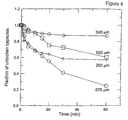
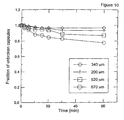
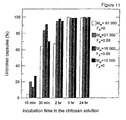
- Figures 6 to 12 show the results of explosion assays of capsules according to the invention, illustrating the strength of the capsules for various parameters.
- Figure 6 illustrates capsules having an inhomogeneous alginate core for incubation times of the alginate beads in a chitosan/CaCl 2 bath of from 15 minutes to 24 hours. It can be seen that stronger capsules are formed with an incubation time of at least 30 minutes and more preferably two hours or more.
- Figure 7 demonstrates the effect of incubation time of homogeneous alginate beads in the chitosan/CaCl 2 bath and shows that higher strength capsules can be formed with shorter reaction times than is required for inhomogeneous alginate beads.
- Figure 8 shows the variation of capsule strength with the concentration of chitosan in the chitosan/CaCl 2 bath.
- a chitosan concentration of at least 0.10% is preferable in order to obtain high strength capsules.
- Figure 9 The dependence of the capsule strength on the size of the capsule is shown in Figure 9, for inhomogeneous capsules having a short incubation time in the chitosan/CaCl 2 bath of 30 minutes. Of the capsule sizes tested, capsules having a diameter of 0.34mm were found to be optimal.
- Figure 10 illustrates the improvement in capsule strength which can be achieved using homogeneous alginate beads and an incubation time in the chitosan/CaCl 2 bath of two hours.
- Figure 12 clearly illustrates the higher strength capsules obtainable by the process of the present invention as compared with the processes of the prior art, for homogeneous and inhomogeneous alginate cores.
- the prior art process including no addition of calcium ions to the chitosan bath, and the prior art one-step process of dropping alginate directly into the chitosan bath each produces capsules of inadequate strength.
- the step of adding calcium ions to the chitosan bath provides a remarkable increase in the capsule strength.
- Figure 13 demonstrates that in the process of the invention, increased chitosan binding can be achieved at higher pH, in particular at pH 5 to pH 6.
- the alginate beads were incubated in the chitosan/CaCl 2 bath for 24 hours.
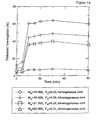
- Figure 14 illustrates how the rate of release of an active ingredient from the capsule can be controlled.
- different release rates can be achieved by varying the molecular weight of the chitosan used and by using homogeneous or inhomogeneous capsules.
- higher release rates are achieved with lower chitosan molecular weights.
- Figure 15 shows the results of an explosion assay demonstrating the strength of capsules prepared according to the process of the invention and subjected to various environments mimicking those of the body. It is evident that the capsules of the invention show excellent stability in these environments over a long period of time of at least 60 hours.
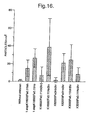
- Figure 16 shows a comparison of the adhesion capacity for negatively charged particles of capsules prepared according to the invention and capsules prepared according to the prior art one-step process. All capsules were prepared with both homogeneous and inhomogeneous alginate cores, and for the capsules prepared according to the process of the invention, two different chitosan molecular weights were tested.
- Figure 16 shows a comparison of the adhesion capacity for negatively charged particles of capsules prepared according to the invention and capsules prepared according to the prior art one-step process. All capsules were prepared with both homogeneous and inhomogeneous alginate cores, and for the capsules prepared according to the process of the invention, two different chitosan molecular weights were tested.
- Figure 16 shows a comparison of the adhesion capacity for negatively charged particles of capsules prepared according to the invention and capsules prepared according to the prior art one-step process. All capsules were prepared with both homogeneous and inhomogeneous alginate cores, and for the capsules prepared according to the
- This product adheres to the affected site providing local acid neutralisation and relief from heartburn caused by acid on the oesophageal mucosa.
- the capsules adhere to the throat and release the active ingredient slowly to provide a sustained pain killing effect.
- a high molecular weight chitosan 63000Da with a short incubation time was used to give only a thin coating - this gives taste masking but minimises the delay to drug release which could otherwise occur due to slow diffusion through a thick coating of chitosan.
- the suspension is used to treat dyspepsia and heartburn.
- Cimetidine is a well known agent for such treatments but suffers from an unacceptable taste in traditional solution formulations. Incorporation of the drug into the capsule system enables the taste of the drug to be masked during its presence in the mouth.
- the suspension is used to treat Helicobacter Pylori infections.
- the capsules adhere to the mucus lining the stomach to provide a slow release of the Triclosan which has antibacterial activity against H.pylori.
- the drug is retained at the site of action for longer periods than a for a simple suspension giving a more effective action against this organism.
Landscapes
- Health & Medical Sciences (AREA)
- Chemical & Material Sciences (AREA)
- Organic Chemistry (AREA)
- Chemical Kinetics & Catalysis (AREA)
- General Health & Medical Sciences (AREA)
- Public Health (AREA)
- Medicinal Chemistry (AREA)
- Nuclear Medicine, Radiotherapy & Molecular Imaging (AREA)
- Veterinary Medicine (AREA)
- Pharmacology & Pharmacy (AREA)
- Life Sciences & Earth Sciences (AREA)
- Animal Behavior & Ethology (AREA)
- General Chemical & Material Sciences (AREA)
- Anesthesiology (AREA)
- Dispersion Chemistry (AREA)
- Communicable Diseases (AREA)
- Oncology (AREA)
- Engineering & Computer Science (AREA)
- Bioinformatics & Cheminformatics (AREA)
- Medicinal Preparation (AREA)
- Manufacturing Of Micro-Capsules (AREA)
- Agricultural Chemicals And Associated Chemicals (AREA)
- Medicines That Contain Protein Lipid Enzymes And Other Medicines (AREA)
- Polysaccharides And Polysaccharide Derivatives (AREA)
Abstract
Description
characterised in that the process further includes the step of
- Active Ingredient:
- Calcium Carbonate
- Active ingredient:
- Lignocaine base
Active ingredient:
Cimetidine hydrochloride
- Active ingredient:
- Triclosan
Claims (32)
- A process for preparing high strength capsules comprising the steps of:(a) preparing gelled beads of a polyanionic polysaccharide which are cross-linked with a polyvalent cation,(b) forming capsules having a polycation-polyanion membrane layer on the gelled beads by adding the beads to a solution comprising a polycationic polysaccharide,(c) optionally forming one or more polycationic or polyanionic layers on the microcapsules, and(d) harvesting the resulting capsules, characterised in that the process further comprises the step of(e) providing a polyvalent cation in the polycationic polysaccharide solution of step (b).
- A process as claimed in claim 1 wherein step(a) comprises:(i) providing a first solution comprising the polyanionic polysaccharide,(ii) providing a second solution comprising the cross-linking polyvalent ions and a non-gelling ion, preferably sodium ions, and(iii) adding the first solution in drops to the second solution, thereby to prepare homogeneous beads.
- A process as claimed in claim 1 further comprising providing a solution of a non-gelling ion, preferably sodium ions, and immersing the beads of step(a) in the solution of non-gelling ion, thereby to prepare homogeneous capsules.
- A process as claimed in claim 1, 2 or 3 further comprising including an active ingredient, material or substance in the gelled bead of step (a).
- A process as claimed in claim 4 wherein the active ingredient, material or substance is encapsulated in the gelled bead.
- A process as claimed in claim 4 or 5 wherein the active ingredient, material or substance is selected from one or more of pharmaceutically active materials or compositions', catalysts, living or dead cells, tissue, pesticides, herbicides, agricultural nutrients or fertilisers, seeds, cosmetic products and food ingredients.
- A process as claimed in any preceding claim wherein the polyanionic polysaccharide is an alginate.
- A process as claimed in claim 7 wherein the alginate has a G-block content of at least 50%, preferably 60 to 75%.
- A process as claimed in any of claims 1 to 6 wherein the polyanionic polysaccharide is pectin.
- A process as claimed in any preceding claim wherein the polycationic polysaccharide includes imino or amino groups.
- A process as claimed in claim 10 wherein the polycationic polysaccharide is chitosan.
- A process as claimed in claim 11 wherein the chitosan has a molecular weight in the range of from 5,000 to 60,000, preferably 10,000 to 30,000.
- A process as claimed in claim 11 wherein the chitosan has a molecular weight of from 60,000 to 100,000.
- A process as claimed in any preceding claim wherein the polyvalent cation of step (e) is selected from calcium, strontium, barium, aluminium (III) or iron (III), preferably calcium.
- A process as claimed in any preceding claim wherein the polyvalent cation in the membrane forming step (step (e)) is present at a concentration of from 50mM to 400mM, preferably 100mM to 300mM.
- A process as claimed in claim 2 or 3 or any of claims 4 to 15 when dependent on claim 2 or 3 wherein the non-gelling ion is present at a concentration of at least 10mM, preferably from 100mM to 300mM.
- A process as claimed in 1 or any of claims 4 to 15 when dependent on claim 1 wherein the membrane forming step (step (b)) proceeds for at least 30 minutes, preferably 2 to 5 hours, more preferably 1 to 2 hours.
- A process as claimed in claim 2 or 3 or any of claims 4 to 16 when dependent on claim 2 or 3 wherein the membrane forming step (step (b)) proceeds for at least 15 minutes, preferably 2 to 5 hours, more preferably 30 minutes to 1 hour.
- Capsules obtainable by the process of any of claims 1 to 18.
- Capsules as claimed in claim 19, wherein the diameter of the capsules is from 0.1 mm to 1.0 mm, preferably 0.2 mm to 0.7 mm, more preferably 0.3 mm to 0.4 mm.
- Capsules obtainable by the process of claim 6, wherein the active ingredient, material or substance is a pharmaceutically active ingredient or composition.
- Capsules as claimed in claim 21, wherein the pharmaceutically active ingredient is an acid neutralising agent.
- Capsules as claimed in claim 21, wherein the pharmaceutically active ingredient is a local anaesthetic.
- Capsules as claimed in claim 21, wherein the pharmaceutically active ingredient is a histamine H2-receptor antagonist.
- Capsules as claimed in claim 21, wherein the pharmaceutically active ingredient is an anti-microbial agent.
- Capsules obtainable by the process of claim 4 or 5 wherein the active ingredient, material or substance is selected from one or more catalysts, living or dead cells, tissue, pesticides, herbicides, agricultural nutrients or fertilisers, seeds, cosmetic products and food ingredients.
- A capsule as claimed in claim 21, for use in therapy.
- A capsule as claimed in claim 22, for use in the treatment of gastro-oesphagael reflux.
- A capsule as claimed in claim 23, for use in the treatment of sore throat.
- A capsule as claimed in claim 24, for use in the treatment of dyspepsia and heartburn.
- A capsule as claimed in claim 25, for use in the treatment of Helicobactor pylori infections.
- A capsule as claimed in claim 26, for use in pesticidal, herbicidal, agricultural, nutrient or fertiliser preparations.
Applications Claiming Priority (3)
| Application Number | Priority Date | Filing Date | Title |
|---|---|---|---|
| GB9714293A GB2327074B (en) | 1997-07-07 | 1997-07-07 | Improvements in or relating to capsules |
| GB9714293 | 1997-07-07 | ||
| PCT/NO1998/000199 WO1999002252A1 (en) | 1997-07-07 | 1998-07-01 | Improvements in or relating to capsules |
Publications (2)
| Publication Number | Publication Date |
|---|---|
| EP1009524A1 EP1009524A1 (en) | 2000-06-21 |
| EP1009524B1 true EP1009524B1 (en) | 2003-01-15 |
Family
ID=10815484
Family Applications (1)
| Application Number | Title | Priority Date | Filing Date |
|---|---|---|---|
| EP98932640A Expired - Lifetime EP1009524B1 (en) | 1997-07-07 | 1998-07-01 | Improvements in or relating to capsules |
Country Status (8)
| Country | Link |
|---|---|
| US (1) | US6165503A (en) |
| EP (1) | EP1009524B1 (en) |
| JP (1) | JP2002511796A (en) |
| AT (1) | ATE231029T1 (en) |
| DE (1) | DE69810782T2 (en) |
| ES (1) | ES2187040T3 (en) |
| GB (1) | GB2327074B (en) |
| WO (1) | WO1999002252A1 (en) |
Families Citing this family (38)
| Publication number | Priority date | Publication date | Assignee | Title |
|---|---|---|---|---|
| US5681585A (en) * | 1991-12-24 | 1997-10-28 | Euro-Celtique, S.A. | Stabilized controlled release substrate having a coating derived from an aqueous dispersion of hydrophobic polymer |
| JPH11246392A (en) * | 1998-03-03 | 1999-09-14 | Makoto Otsuka | Oral solid preparation |
| DE10100689A1 (en) * | 2001-01-09 | 2002-07-18 | Henkel Kgaa | Microcapsules containing washing and cleaning active substances |
| GB0121037D0 (en) | 2001-08-30 | 2001-10-24 | Isp Alginates Uk Ltd | Process and equipment |
| US6753017B2 (en) * | 2001-11-07 | 2004-06-22 | Jrs Pharma Lp | Process for preparing dry extracts |
| NO20021592D0 (en) | 2002-04-04 | 2002-04-04 | Fmc Biopolymer As | Polysaccharide Capsules and Method of Preparation thereof |
| JP2005522488A (en) * | 2002-04-09 | 2005-07-28 | 大正製薬株式会社 | Formulation for taste masking |
| EP1362583A1 (en) * | 2002-05-15 | 2003-11-19 | CUM Taste Masking AG | Process for masking the taste of substances by microencapsulation |
| EP1502646B1 (en) * | 2003-08-01 | 2016-07-13 | The Procter & Gamble Company | Microcapsules |
| EP1502645A1 (en) * | 2003-08-01 | 2005-02-02 | The Procter & Gamble Company | Microcapsules |
| FR2859479B1 (en) * | 2003-09-05 | 2008-09-19 | Oligocaps Lab | CHITOSAN GRANULE FOR DIETETIC, FOOD OR PHYTOSANITARY PURPOSES |
| CA2543458A1 (en) * | 2003-10-24 | 2005-05-12 | Josef Rettenmaier & Soehne Gmbh & Co., Kg | Process for co-spray drying agents with dry silicified mcc |
| US20070275080A1 (en) * | 2003-10-31 | 2007-11-29 | Engineered Release Systems Inc. | Polymer-Based Microstructures |
| EP1634944A1 (en) * | 2004-08-23 | 2006-03-15 | The Procter & Gamble Company | Microcapsules |
| EP1632560B1 (en) * | 2004-08-23 | 2011-01-05 | The Procter & Gamble Company | Microcapsules |
| EP1669437A1 (en) * | 2004-12-03 | 2006-06-14 | The Procter & Gamble Company | Microcapsules |
| ATE494357T1 (en) * | 2004-08-23 | 2011-01-15 | Procter & Gamble | MICRO CAPSULES |
| FR2882665B1 (en) * | 2005-03-04 | 2007-05-25 | Univ Claude Bernard Lyon | PLURIMEMBRANE CAPSULES OF POLYSACCHARIDES AND ESPECIALLY CHITOSAN AND PROCESS FOR THE PREPARATION THEREOF |
| JP5372525B2 (en) | 2006-03-03 | 2013-12-18 | エフ エム シー コーポレーション | Capsule manufacturing method and capsule manufactured by the manufacturing method |
| EP2032149A4 (en) * | 2006-06-13 | 2010-09-01 | Fmc Biopolymer As | METHOD AND SYSTEMS FOR USING BIOPOLYMER-BASED BALLS AND HYDROGELS |
| NL1032873C2 (en) * | 2006-11-15 | 2008-05-19 | Friesland Brands Bv | Capsules from demixed polymer solutions. |
| WO2008087608A1 (en) * | 2007-01-19 | 2008-07-24 | The Iams Company | Composition and method of stabilized sensitive ingredient |
| WO2008087606A2 (en) * | 2007-01-19 | 2008-07-24 | The Iams Company | Composition and method of stabilized sensitive ingredient |
| BRPI0806806A2 (en) * | 2007-01-19 | 2011-09-13 | Iams Company | composition and method of sensitively stabilized ingredient |
| EP1972361A1 (en) * | 2007-03-21 | 2008-09-24 | Cognis IP Management GmbH | Mild cleansing compositions with an encapsultated dye |
| WO2009147973A1 (en) | 2008-06-02 | 2009-12-10 | 国立大学法人新潟大学 | Microcapsules, method of producing the microcapsules and food and drink containing the microcapsules |
| WO2010010902A1 (en) | 2008-07-24 | 2010-01-28 | 国立大学法人新潟大学 | Microcapsule, process for production thereof, and food or beverage containing microcapsule |
| WO2011031621A2 (en) | 2009-09-10 | 2011-03-17 | Fmc Corporation | High strength seamless alginate capsules |
| EP2361640A1 (en) * | 2010-02-25 | 2011-08-31 | Université de Liège | Cell cultivation in chitosan alginate hydrogel beads |
| ITRM20120041A1 (en) * | 2012-02-08 | 2013-08-09 | Dicofarm Spa | "PRODUCT BASED ON GLUCOMANNAN AND CHITOSAN PROFITABLE FOR THE TREATMENT OF GASTROESOFAGEO REFLUX" |
| EP3288394A4 (en) | 2015-04-28 | 2019-01-23 | Mars, Incorporated | PROCESS FOR THE PREPARATION OF A STERILIZED WASTE FOOD PRODUCT |
| WO2017186948A1 (en) | 2016-04-29 | 2017-11-02 | Laminaria Group Ab | Nutritional supplements |
| RU2739601C2 (en) | 2016-04-29 | 2020-12-28 | Ламинария Груп Аб | Nutrient additive |
| CN107929259B (en) * | 2018-01-17 | 2020-09-15 | 南京健辉生物科技有限公司 | Soft capsule with different disintegration modes and preparation method thereof |
| WO2019172261A1 (en) * | 2018-03-05 | 2019-09-12 | 国立大学法人東京大学 | Esophageal stricture preventing material |
| CA3095096A1 (en) | 2018-03-27 | 2019-10-03 | Laminaria Group Ab | Nutritional supplements |
| JP7236533B2 (en) * | 2019-04-09 | 2023-03-09 | 富士フイルム株式会社 | Microcapsule manufacturing method and coating liquid |
| JP7346097B2 (en) * | 2019-06-26 | 2023-09-19 | キヤノン株式会社 | Hydrophilic coating material, hydrophilic coating film and manufacturing method thereof, and inkjet recording head |
Family Cites Families (12)
| Publication number | Priority date | Publication date | Assignee | Title |
|---|---|---|---|---|
| US4409331A (en) * | 1979-03-28 | 1983-10-11 | Damon Corporation | Preparation of substances with encapsulated cells |
| US4352883A (en) * | 1979-03-28 | 1982-10-05 | Damon Corporation | Encapsulation of biological material |
| US4690682A (en) * | 1983-04-15 | 1987-09-01 | Damon Biotech, Inc. | Sustained release |
| US4663286A (en) * | 1984-02-13 | 1987-05-05 | Damon Biotech, Inc. | Encapsulation of materials |
| DE3575375D1 (en) * | 1984-02-15 | 1990-02-22 | Massachusetts Inst Technology | ENCLOSURE METHOD AND SYSTEMS WITH ENCLOSED ACTIVE MATERIAL. |
| US4749620A (en) * | 1984-02-15 | 1988-06-07 | Massachusetts Institute Of Technology | Encapsulated active material system |
| JPS60175539A (en) * | 1984-02-23 | 1985-09-09 | Snow Brand Milk Prod Co Ltd | Capsule and its production |
| JPS63177791A (en) * | 1987-01-16 | 1988-07-21 | Kibun Kk | Production of immobilized enzyme or immobilized microorganism |
| US4808707A (en) * | 1987-06-08 | 1989-02-28 | University Of Delaware | Chitosan alginate capsules |
| US5089272A (en) * | 1989-03-29 | 1992-02-18 | Snow Brand Milk Products Co., Ltd. | Process for producing capsules having a permeability-controllable membrane |
| US5116747A (en) * | 1989-08-11 | 1992-05-26 | University Of Waterloo | Immobilization of biologically active material in capsules prepared from a water-soluble polymer and chitosan acetate |
| WO1991009119A1 (en) * | 1989-12-13 | 1991-06-27 | Trancel Corporation | Improved alginate microcapsules, methods of making and using same |
-
1997
- 1997-07-07 GB GB9714293A patent/GB2327074B/en not_active Expired - Fee Related
-
1998
- 1998-07-01 JP JP50849099A patent/JP2002511796A/en not_active Ceased
- 1998-07-01 WO PCT/NO1998/000199 patent/WO1999002252A1/en not_active Ceased
- 1998-07-01 DE DE69810782T patent/DE69810782T2/en not_active Expired - Lifetime
- 1998-07-01 EP EP98932640A patent/EP1009524B1/en not_active Expired - Lifetime
- 1998-07-01 ES ES98932640T patent/ES2187040T3/en not_active Expired - Lifetime
- 1998-07-01 US US09/108,809 patent/US6165503A/en not_active Expired - Fee Related
- 1998-07-01 AT AT98932640T patent/ATE231029T1/en not_active IP Right Cessation
Also Published As
| Publication number | Publication date |
|---|---|
| JP2002511796A (en) | 2002-04-16 |
| WO1999002252A1 (en) | 1999-01-21 |
| US6165503A (en) | 2000-12-26 |
| GB2327074A (en) | 1999-01-13 |
| GB9714293D0 (en) | 1997-09-10 |
| ES2187040T3 (en) | 2003-05-16 |
| GB2327074A8 (en) | 1999-05-17 |
| GB2327074B (en) | 2001-09-12 |
| ATE231029T1 (en) | 2003-02-15 |
| DE69810782T2 (en) | 2003-10-23 |
| EP1009524A1 (en) | 2000-06-21 |
| DE69810782D1 (en) | 2003-02-20 |
Similar Documents
| Publication | Publication Date | Title |
|---|---|---|
| US6165503A (en) | High strength capsules, process of preparing and using the same | |
| Shilpa et al. | Controlled delivery of drugs from alginate matrix | |
| Patil et al. | Ionotropic gelation and polyelectrolyte complexation: the novel techniques to design hydrogel particulate sustained, modulated drug delivery system: a review | |
| EP0610178B1 (en) | Therapeutical composition and process for its preparation | |
| Anal et al. | Chitosan–alginate multilayer beads for controlled release of ampicillin | |
| Pal et al. | Interpenetrating polymer network hydrogels of chitosan: applications in controlling drug release | |
| Bodmeier et al. | Preparation and evaluation of drug-containing chitosan beads | |
| AU685458B2 (en) | Nasal drug delivery composition containing nicotine | |
| US11672756B2 (en) | Temperature sensitive hydrogel composition including nucleic acid and chitosan | |
| US4690682A (en) | Sustained release | |
| CN103040727A (en) | Preparation method of drug and protein sustained-release alginate hybrid gel | |
| JPH07508048A (en) | Cross-linked biocompatible encapsulation compositions and methods | |
| WO2000015272A1 (en) | Polymer immobilized living cells and applications thereof | |
| Vasiliu et al. | Chitosan-based polyelectrolyte complex hydrogels for biomedical applications | |
| JPH0448494B2 (en) | ||
| US4789516A (en) | Production of sustained released system | |
| US20150126619A1 (en) | Ionic gel | |
| CN101909608A (en) | Sustained-release formulations based on conjugates of glycogen and alginate | |
| Alaa | Chitosan-coated alginate microbeads improve the anti-inflammatory potential of Etodolac: optimization using Box-Behnken design, in-vitro drug release and in-vivo study | |
| CN102026620B (en) | Cross-linked polymer matrix, in particular for administering active ingredients | |
| Hafsa et al. | Alginates in drug delivery systems | |
| KOFUJI et al. | Preparation and drug retention of biodegradable chitosan gel beads | |
| US20210113481A1 (en) | Encapsulating agent with improved properties adapted for cell encapsulation | |
| Liempepas et al. | Application of Polysaccharide Polymer Combination in Microsphere Delivery System for Anti-Tuberculosis | |
| Gomes et al. | Gellan gum microspheres and their applications in the biomedical industry |
Legal Events
| Date | Code | Title | Description |
|---|---|---|---|
| PUAI | Public reference made under article 153(3) epc to a published international application that has entered the european phase |
Free format text: ORIGINAL CODE: 0009012 |
|
| 17P | Request for examination filed |
Effective date: 19991223 |
|
| AK | Designated contracting states |
Kind code of ref document: A1 Designated state(s): AT BE CH CY DE DK ES FI FR GB GR IE IT LI LU MC NL PT SE |
|
| RIN1 | Information on inventor provided before grant (corrected) |
Inventor name: JOLLIFFE, IAN Inventor name: SJAK-BRAEK, GUDMUND Inventor name: DETTMAR, PETER Inventor name: SKAUGRUD, OIVIND Inventor name: GASEROD, OLAV |
|
| 17Q | First examination report despatched |
Effective date: 20010321 |
|
| GRAG | Despatch of communication of intention to grant |
Free format text: ORIGINAL CODE: EPIDOS AGRA |
|
| GRAG | Despatch of communication of intention to grant |
Free format text: ORIGINAL CODE: EPIDOS AGRA |
|
| GRAG | Despatch of communication of intention to grant |
Free format text: ORIGINAL CODE: EPIDOS AGRA |
|
| GRAH | Despatch of communication of intention to grant a patent |
Free format text: ORIGINAL CODE: EPIDOS IGRA |
|
| GRAH | Despatch of communication of intention to grant a patent |
Free format text: ORIGINAL CODE: EPIDOS IGRA |
|
| GRAA | (expected) grant |
Free format text: ORIGINAL CODE: 0009210 |
|
| AK | Designated contracting states |
Kind code of ref document: B1 Designated state(s): AT BE CH CY DE DK ES FI FR GB GR IE IT LI LU MC NL PT SE |
|
| PG25 | Lapsed in a contracting state [announced via postgrant information from national office to epo] |
Ref country code: NL Free format text: LAPSE BECAUSE OF FAILURE TO SUBMIT A TRANSLATION OF THE DESCRIPTION OR TO PAY THE FEE WITHIN THE PRESCRIBED TIME-LIMIT Effective date: 20030115 Ref country code: GR Free format text: LAPSE BECAUSE OF FAILURE TO SUBMIT A TRANSLATION OF THE DESCRIPTION OR TO PAY THE FEE WITHIN THE PRESCRIBED TIME-LIMIT Effective date: 20030115 Ref country code: FI Free format text: LAPSE BECAUSE OF FAILURE TO SUBMIT A TRANSLATION OF THE DESCRIPTION OR TO PAY THE FEE WITHIN THE PRESCRIBED TIME-LIMIT Effective date: 20030115 Ref country code: BE Free format text: LAPSE BECAUSE OF FAILURE TO SUBMIT A TRANSLATION OF THE DESCRIPTION OR TO PAY THE FEE WITHIN THE PRESCRIBED TIME-LIMIT Effective date: 20030115 Ref country code: AT Free format text: LAPSE BECAUSE OF FAILURE TO SUBMIT A TRANSLATION OF THE DESCRIPTION OR TO PAY THE FEE WITHIN THE PRESCRIBED TIME-LIMIT Effective date: 20030115 |
|
| REG | Reference to a national code |
Ref country code: GB Ref legal event code: FG4D Ref country code: CH Ref legal event code: EP |
|
| REG | Reference to a national code |
Ref country code: CH Ref legal event code: NV Representative=s name: TROESCH SCHEIDEGGER WERNER AG |
|
| REG | Reference to a national code |
Ref country code: IE Ref legal event code: FG4D |
|
| REF | Corresponds to: |
Ref document number: 69810782 Country of ref document: DE Date of ref document: 20030220 Kind code of ref document: P |
|
| PG25 | Lapsed in a contracting state [announced via postgrant information from national office to epo] |
Ref country code: PT Free format text: LAPSE BECAUSE OF FAILURE TO SUBMIT A TRANSLATION OF THE DESCRIPTION OR TO PAY THE FEE WITHIN THE PRESCRIBED TIME-LIMIT Effective date: 20030415 Ref country code: DK Free format text: LAPSE BECAUSE OF FAILURE TO SUBMIT A TRANSLATION OF THE DESCRIPTION OR TO PAY THE FEE WITHIN THE PRESCRIBED TIME-LIMIT Effective date: 20030415 |
|
| REG | Reference to a national code |
Ref country code: ES Ref legal event code: FG2A Ref document number: 2187040 Country of ref document: ES Kind code of ref document: T3 |
|
| NLV1 | Nl: lapsed or annulled due to failure to fulfill the requirements of art. 29p and 29m of the patents act | ||
| PG25 | Lapsed in a contracting state [announced via postgrant information from national office to epo] |
Ref country code: LU Free format text: LAPSE BECAUSE OF NON-PAYMENT OF DUE FEES Effective date: 20030701 Ref country code: CY Free format text: LAPSE BECAUSE OF FAILURE TO SUBMIT A TRANSLATION OF THE DESCRIPTION OR TO PAY THE FEE WITHIN THE PRESCRIBED TIME-LIMIT Effective date: 20030701 |
|
| PGFP | Annual fee paid to national office [announced via postgrant information from national office to epo] |
Ref country code: ES Payment date: 20030723 Year of fee payment: 6 |
|
| PGFP | Annual fee paid to national office [announced via postgrant information from national office to epo] |
Ref country code: IE Payment date: 20030729 Year of fee payment: 6 |
|
| PG25 | Lapsed in a contracting state [announced via postgrant information from national office to epo] |
Ref country code: MC Free format text: LAPSE BECAUSE OF NON-PAYMENT OF DUE FEES Effective date: 20030731 |
|
| ET | Fr: translation filed | ||
| PLBE | No opposition filed within time limit |
Free format text: ORIGINAL CODE: 0009261 |
|
| STAA | Information on the status of an ep patent application or granted ep patent |
Free format text: STATUS: NO OPPOSITION FILED WITHIN TIME LIMIT |
|
| 26N | No opposition filed |
Effective date: 20031016 |
|
| PG25 | Lapsed in a contracting state [announced via postgrant information from national office to epo] |
Ref country code: IE Free format text: LAPSE BECAUSE OF NON-PAYMENT OF DUE FEES Effective date: 20040701 |
|
| PG25 | Lapsed in a contracting state [announced via postgrant information from national office to epo] |
Ref country code: ES Free format text: LAPSE BECAUSE OF NON-PAYMENT OF DUE FEES Effective date: 20040702 |
|
| REG | Reference to a national code |
Ref country code: IE Ref legal event code: MM4A |
|
| PG25 | Lapsed in a contracting state [announced via postgrant information from national office to epo] |
Ref country code: IT Free format text: LAPSE BECAUSE OF NON-PAYMENT OF DUE FEES Effective date: 20050701 |
|
| REG | Reference to a national code |
Ref country code: ES Ref legal event code: FD2A Effective date: 20040702 |
|
| REG | Reference to a national code |
Ref country code: HK Ref legal event code: WD Ref document number: 1029768 Country of ref document: HK |
|
| PGFP | Annual fee paid to national office [announced via postgrant information from national office to epo] |
Ref country code: CH Payment date: 20100726 Year of fee payment: 13 |
|
| PGFP | Annual fee paid to national office [announced via postgrant information from national office to epo] |
Ref country code: SE Payment date: 20100708 Year of fee payment: 13 Ref country code: GB Payment date: 20100616 Year of fee payment: 13 Ref country code: FR Payment date: 20100813 Year of fee payment: 13 Ref country code: DE Payment date: 20100730 Year of fee payment: 13 |
|
| REG | Reference to a national code |
Ref country code: CH Ref legal event code: PL |
|
| REG | Reference to a national code |
Ref country code: SE Ref legal event code: EUG |
|
| GBPC | Gb: european patent ceased through non-payment of renewal fee |
Effective date: 20110701 |
|
| REG | Reference to a national code |
Ref country code: FR Ref legal event code: ST Effective date: 20120330 |
|
| PG25 | Lapsed in a contracting state [announced via postgrant information from national office to epo] |
Ref country code: CH Free format text: LAPSE BECAUSE OF NON-PAYMENT OF DUE FEES Effective date: 20110731 Ref country code: FR Free format text: LAPSE BECAUSE OF NON-PAYMENT OF DUE FEES Effective date: 20110801 Ref country code: LI Free format text: LAPSE BECAUSE OF NON-PAYMENT OF DUE FEES Effective date: 20110731 Ref country code: DE Free format text: LAPSE BECAUSE OF NON-PAYMENT OF DUE FEES Effective date: 20120201 |
|
| REG | Reference to a national code |
Ref country code: DE Ref legal event code: R119 Ref document number: 69810782 Country of ref document: DE Effective date: 20120201 |
|
| PG25 | Lapsed in a contracting state [announced via postgrant information from national office to epo] |
Ref country code: GB Free format text: LAPSE BECAUSE OF NON-PAYMENT OF DUE FEES Effective date: 20110701 |
|
| PG25 | Lapsed in a contracting state [announced via postgrant information from national office to epo] |
Ref country code: SE Free format text: LAPSE BECAUSE OF NON-PAYMENT OF DUE FEES Effective date: 20110702 |