EP1006511A1 - Procédé et dispositif pour le traitement des sons pour correction auditive des malentendants - Google Patents
Procédé et dispositif pour le traitement des sons pour correction auditive des malentendants Download PDFInfo
- Publication number
- EP1006511A1 EP1006511A1 EP99403027A EP99403027A EP1006511A1 EP 1006511 A1 EP1006511 A1 EP 1006511A1 EP 99403027 A EP99403027 A EP 99403027A EP 99403027 A EP99403027 A EP 99403027A EP 1006511 A1 EP1006511 A1 EP 1006511A1
- Authority
- EP
- European Patent Office
- Prior art keywords
- parameters
- modified
- synthesis
- speech signal
- hearing
- Prior art date
- Legal status (The legal status is an assumption and is not a legal conclusion. Google has not performed a legal analysis and makes no representation as to the accuracy of the status listed.)
- Granted
Links
Images


Classifications
-
- H—ELECTRICITY
- H04—ELECTRIC COMMUNICATION TECHNIQUE
- H04R—LOUDSPEAKERS, MICROPHONES, GRAMOPHONE PICK-UPS OR LIKE ACOUSTIC ELECTROMECHANICAL TRANSDUCERS; ELECTRIC HEARING AIDS; PUBLIC ADDRESS SYSTEMS
- H04R25/00—Electric hearing aids
- H04R25/35—Electric hearing aids using translation techniques
- H04R25/356—Amplitude, e.g. amplitude shift or compression
-
- G—PHYSICS
- G10—MUSICAL INSTRUMENTS; ACOUSTICS
- G10L—SPEECH ANALYSIS TECHNIQUES OR SPEECH SYNTHESIS; SPEECH RECOGNITION; SPEECH OR VOICE PROCESSING TECHNIQUES; SPEECH OR AUDIO CODING OR DECODING
- G10L21/00—Speech or voice signal processing techniques to produce another audible or non-audible signal, e.g. visual or tactile, in order to modify its quality or its intelligibility
- G10L21/02—Speech enhancement, e.g. noise reduction or echo cancellation
- G10L21/0316—Speech enhancement, e.g. noise reduction or echo cancellation by changing the amplitude
- G10L21/0364—Speech enhancement, e.g. noise reduction or echo cancellation by changing the amplitude for improving intelligibility
-
- G—PHYSICS
- G10—MUSICAL INSTRUMENTS; ACOUSTICS
- G10L—SPEECH ANALYSIS TECHNIQUES OR SPEECH SYNTHESIS; SPEECH RECOGNITION; SPEECH OR VOICE PROCESSING TECHNIQUES; SPEECH OR AUDIO CODING OR DECODING
- G10L21/00—Speech or voice signal processing techniques to produce another audible or non-audible signal, e.g. visual or tactile, in order to modify its quality or its intelligibility
- G10L21/06—Transformation of speech into a non-audible representation, e.g. speech visualisation or speech processing for tactile aids
- G10L2021/065—Aids for the handicapped in understanding
-
- H—ELECTRICITY
- H04—ELECTRIC COMMUNICATION TECHNIQUE
- H04R—LOUDSPEAKERS, MICROPHONES, GRAMOPHONE PICK-UPS OR LIKE ACOUSTIC ELECTROMECHANICAL TRANSDUCERS; ELECTRIC HEARING AIDS; PUBLIC ADDRESS SYSTEMS
- H04R25/00—Electric hearing aids
- H04R25/50—Customised settings for obtaining desired overall acoustical characteristics
- H04R25/505—Customised settings for obtaining desired overall acoustical characteristics using digital signal processing
Definitions
- the present invention relates to a method and a device for correction of hearing impaired sounds. It applies equally to the production of hearing aids, as software executable on personal computers or answering machines and so general to all devices intended to improve listening comfort and understanding the speech of people with deafness.
- the twentieth century saw a continuous effort in the design of machines to relieve and assist the hearing impaired.
- a first class is aimed at "mild” deafness and aims to correct the hearing and make it normal as much as possible. That's what make the usual prostheses widely available on the market.
- a second class is intended for heavier deafness and aims to transform speech into synthetic speech accessible to the hearing impaired person.
- most achievements are aimed at the "deep deaf”.
- a remarkable example is that of the cochlear implant which acts by means of electrodes by stimulation direct from the auditory nerve.
- the present invention aims to propose a solution for so-called “intermediate" deaf people. These people currently no suitable technical assistance. They are too affected to be served by standard prostheses, but their hearing is sufficient to be able to do without devices for the deaf.
- the usual prostheses generally use a method of selective amplification of speech as a function of frequency.
- an automatic regulation of the sound level acts on the gain of amplification, the aim being to give the best listening comfort and protection against instantaneous power peaks.
- these prostheses are miniaturized to be worn behind the ear or as an insert, which leads to performance relatively poor can only satisfy hearing corrections very coarse. Typically it is defined only three bands of frequencies for frequency correction. These prostheses are intended without ambiguity with the most frequent "light" deafness. More deafness can be relieved, but at the cost of painful inconvenience caused in particular by the amplification of background noise, and the phenomenon of Larsen. On the other hand there is no possibility of correction in the zones frequencies for which there is no hearing.
- the idea behind the invention is to overcome the drawbacks above using a parametric model of the speech signal capable carry out relevant transformations for hearing correction for the hearing impaired by implementing a method capable of satisfy the three constraints mentioned above.
- the subject of the invention is a method for correcting hearing impaired characterized in that it consists in extracting the parameters characterizing the pitch, the energy voicing and the spectrum of the speech signal, to modify the parameters to make the speech intelligible to the hearing impaired, and to reconstruct a speech signal noticeable by the hearing impaired from the modified parameters.
- the invention also relates to a device for setting work of the aforementioned process.
- the method and the device according to the invention have the advantages of implement the parametric models which are commonly used in vocoders for adapters to hearing impaired hearing. This allows you to no longer work on the sound signal, as do previous techniques but at the level of the symbolic structure of the signal to preserve its intelligibility
- the vocoders present in indeed the advantage of using an alphabet that incorporates the notions of "pitch”, " spectrum “,” voicing “and” energy "which are very close to the model physiological of the mouth and ear.
- SHANNON the information transmitted then carries intelligibility of speech.
- the materialization of speech intelligibility in a form IT thus opens up a new perspective. The intelligibility can thus be acquired during the analysis operation, and it is restored during the synthesis.
- the operation of synthesizing a vocoder parametric can therefore be adapted to the hearing characteristics of deaf.
- This technique associated with more conventional, allows to consider a prosthetic process particularly general that can serve a very large population, including people with intermediate deafness.
- the method and the device according to the invention offer great freedom in settings, each parameter can be modified independently of the others without reciprocal impact, with a specific setting for each ear.
- Figure 2 a parametric model of signal generation word.
- Figure 4 a transformation curve during the synthesis of speech signal the energy of the speech signal measured during the process speech signal analysis.
- FIG. 5 an embodiment of a device for setting work of the method according to the invention.
- the method for processing the speech signal according to the invention is based on a parametric model of the speech signal of the type of that commonly used in the technique of making HSX digital vocoders and a description of which can be found in the article by MM P. Gournay, F. Charotti, entitled “A 1200 bits / s HSX speech coder for very low bit rate communications ", and published in IEEE Proceedings Workshop on Signal Processing System (Sips'98), Boston, 8-10 October 1998.
- the spectral envelope of the signal can be obtained by autoregressive modeling using a linear prediction filter or by a short-term Fourier analysis synchronous with the pitch. These four parameters are estimated periodically on the speech signal of one to several times per frame depending on the parameter, for a frame duration typically between 10 and 30 ms.
- the speech signal is restored in the same way represented in figure 2, by exciting by the pitch or by a noise stochastic, a digital synthesis filter 1 which models by its transfer function the vocal tract depending on whether the sound is respectively voiced or unvoiced.
- a switch 2 transmits the pitch or noise to the input of the synthesis filter 1.
- a variable gain amplifier 3 depending on the energy of the speech signal is placed at the output of the synthesis filter 1.
- the synthesis procedure can be summarize to that shown in Figure 2.
- the process according to the invention which is represented in FIG. 3 in the form of a flowchart, is more complex and takes place in four stages, breaking down into one step 4 of preprocessing, a step 5 of analysis of the signal obtained in step 4 for the extraction of the parameters characterizing the pitch, the voicing, the energy, and the spectrum of the speech signal, a step 6 during which the parameters obtained in step 5 are modified and a step 7 of synthesis a speech signal composed from the modified parameters of step 6.
- Stage 4 is that which is conventionally implemented in vocoders. It consists notably, after having converted the speech signal in a digital signal, to reduce the background noise by using for example the method described by M.D. Malah, published in IEEE trans.Acoust., Speech Processing, Volume-12 N.6, pp.1109-1121 1984, entitled "Speech enhancement using a minimum square error short time spectral amplitude estimator ", to cancel the acoustic echoes using for example the method described in the article by MM.Murano, S. Unjani and F. Amano having for title: "Echo cancellation and applications" published in the IEEE journal Com. May, 28 (1), pp 49-55, January 1990, to place an order automatic gain, or even to boost the signal.
- the parametric processing of the speech signal obtained at the end of step 4 is carried out in step 5. It consists of cutting the speech signal into samples of constant analysis duration (typically 5 to 30 milliseconds) to perform on each of them the estimation of the parameters of the speech signal model.
- the pitch and the voicing are estimated every 22.5 milliseconds.
- the voicing information is given in the form of a transition frequency between a voiced low band and an unvoiced high band.
- the signal energy is estimated every 5.625 milliseconds. During unvoiced periods of the signal, it is estimated over a duration of 45 samples (5.625 ms) and expressed in dB per sample.
- the synthesis procedure consists, for each interval of duration of the analysis, to stimulate the synthesis filter giving S ( ⁇ ) by the sum frequency weighted (low band / high band defined by frequency voicing), a pseudo-random white noise for the high band and a Dirac comb periodic signal of fundamental frequency equal to pitch for the low band.
- transformations can be applied to the parameters from the analysis in step 5.
- Each parameter can indeed be modified independently of the others, without reciprocal interaction.
- these transformations can be constant or be activated only under special conditions (for example, triggering of the modification of the spectral envelope for certain energy distribution configurations as a function of frequency, ).
- steps 6 1 to 6 4 relate essentially to the value of the pitch which characterizes the fundamental frequency, the voicing, the energy and the spectral envelope.
- step 6 any transformation defining a new “pitch” value from the value of the analysis pitch obtained in step 5 is applicable.
- the Pitch Factor is adjustable for the type of deafness considered.
- the voicing frequency can be modified by any transformation defining a "voicing frequency For each value of the voicing frequency analyzed in step 5.
- the factor Factor Voisement is adjustable for the type of deafness considered.
- step 6 3 The energy is processed in step 6 3 As before, any transformation defining an energy from the energy of the speech signal analyzed in step 6 3 is applicable.
- the method according to the invention applies to energy a compression function with four linear segments as shown in the graph of FIG. 4.
- step 6 4 The processing of the spectral envelope takes place in step 6 4 In this step any transformation defining a spectrum S '( ⁇ ) from the spectrum S ( ⁇ ) analyzed in step 5 is applicable.
- the frequency scale is compressed by a factor Factor Spectrum so that useful bands before and after treatment are respectively equal to [O..FECH / 2] and to [O..FECH / (2 * FacteurSpectre)], where FECH is the sampling frequency of the system.
- Speech restored in step 7 can be further accelerated or slowed down by simple modification of the duration of the time interval taken into account for the summary phase.
- TimeFactor> 1 If TimeFactor> 1, then it is a slowdown in the word. If TimeFactor ⁇ 1, then it is an acceleration of speech.
- a number of post-treatments can be envisaged consisting for example of carrying out a bandpass filtering and linear equalization of the synthesized signal, or still a multiplexing of sound on both ears.
- the objective of the linear equalization operation is to compensate the patient's audiogram by amplifying or attenuating certain bands of frequencies.
- the gain at 7 frequencies (0, 125, 250, 500, 1000, 2000 and 4000 Hz) can be adjusted over time between -80 and +10 dB according to the patient's needs or the specifics of his audiogram.
- This operation can be carried out for example by filtering by a fast Fourier transform (FFT) as described for example in the book of M.D Elliott entitled “Handbook of Digital signal processing” published in 1987 by Academic Press.
- FFT fast Fourier transform
- Multiplexing operation allows monophonic playback (for example a signal processed alone) or stereophonic (for example a signal processed on one channel and an unprocessed signal on another). Restitution allows the hearing impaired to adapt the treatment to each of his ears (two linear equalizers to compensate for two different audiograms for example), and possibly keep intact on one ear a form of signal to which it is accustomed and on which it can be supported to, for example, synchronize.
- the device for implementing the method according to the invention which is represented in FIG. 5 comprises a first channel composed of an analysis device 8, a synthesis device 9 and a first equalizer 10 and d a second channel comprising a second equalizer 11, the assembly of the two channels being coupled between a sound pickup device 13 and a pair of headphones 12 a , 12 b .
- the analysis 8 and synthesis 9 devices can be implemented by borrowing the known techniques for producing vocoders and in particular that of the aforementioned HSX vocoders.
- the outputs of the equalizers of the two channels are multiplexed by a multiplexer 14 to allow reproduction of the monophonic or stereophonic sound.
- a processing device 15 formed by a microprocessor or any equivalent device is coupled to the synthesis device 9 to ensure the modification of the parameters supplied by the analysis device 8.
- a pretreatment device 16 interposed between the sound recording 13 and each of the two channels ensures denoising and conversion of the speech signal into digital samples
- the samples denoised digital are applied respectively to the input of the equalizer 11 and at the input of the analysis device 8.
- the processing device 15 can be integrated into the processing device.
- synthesis 9 as it is also possible to integrate all the treatments analysis and synthesis in the same software executable on a personal computer or answering machine for example.
Landscapes
- Engineering & Computer Science (AREA)
- Acoustics & Sound (AREA)
- Physics & Mathematics (AREA)
- Signal Processing (AREA)
- Health & Medical Sciences (AREA)
- General Health & Medical Sciences (AREA)
- Human Computer Interaction (AREA)
- Audiology, Speech & Language Pathology (AREA)
- Computational Linguistics (AREA)
- Quality & Reliability (AREA)
- Neurosurgery (AREA)
- Multimedia (AREA)
- Otolaryngology (AREA)
- Circuit For Audible Band Transducer (AREA)
- Stereophonic System (AREA)
- Compression, Expansion, Code Conversion, And Decoders (AREA)
- Auxiliary Devices For Music (AREA)
- Percussion Or Vibration Massage (AREA)
Abstract
Description
- un paramètre de voisement qui décrit le caractère plus ou moins périodique des sons voisés ou aléatoire des sons non voisés du signal de parole,
- un paramètre définissant la fréquence fondamentale ou « PITCH » des sons voisés,
- un paramètre représentatif de l'évolution temporelle de l'énergie,
- et un paramètre représentatif de l'enveloppe spectrale du signal de parole.
où A(z) est défini par:
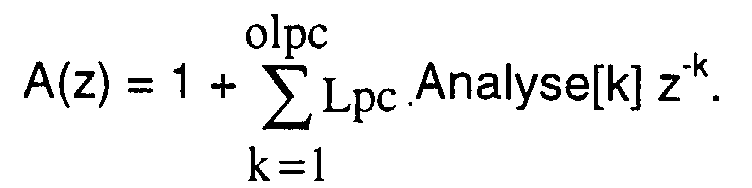
Pente = PenteBasse pour EnergieAnalyse < EnergieAnalyseSeuil ;
Pente = PenteHaute pour EnergieAnalyse >= EnergieAnalyseSeuil ;
et avec les limitations suivantes :
EnergieSynthèse <= EnergieSynthèseMax ;
EnergieSynthèse = - Infini pour EnergieAnalyse < EnergieAnalyseMin.
Les paramètres de traitements EnergieAnalyseMin, EnergieSynthèseMax, PenteBasse, PenteHaute et EnergieSynthèseSeuil sont ajustables pour le type de surdité considéré.
S(ω) analysé à l'étape 5 est applicable.

Claims (3)
- Procédé pour la correction auditive des malentendants, du type consistant à extraire (5) par une analyse LPC les paramètres caractérisant le pitch, le voisement l'énergie et le spectre du signal de parole, à modifier (6) les paramètres pour rendre la parole intelligible à un malentendant, et à reconstituer (7) un signal de parole perceptible par le malentendant à partir des paramètres modifiés caractérisé en ce que :le paramètre caractérisant le pitch est modifié (61) en appliquant à la valeur du pitch extrait un facteur multiplicateur,le paramètre caractérisant le voisement est modifié (62) par un facteur multiplicateur,le paramètre caractérisant l'énergie est modifié (63) par une fonction de compression,le paramètre caractérisant l'enveloppe spectrale est modifié (64) par une compression homothétique de l'échelle des fréquences,et la durée de l'intervalle de temps pris en compte pour la phase de synthèse est modifié (7) en multipliant l'intervalle de temps par un facteur temps.
- Dispositif pour la mise en oeuvre du procédé selon la revendication 1, caractérisé en ce qu'il comprend un dispositif d'analyse (8) pour l'extraction des paramètres du signal de parole couplé à un dispositif de synthèse (9) ainsi qu'un dispositif de traitement (14) couplé au dispositif de synthèse (9) pour modifier les paramètres fournis par le dispositif d'analyse (8) et appliquer les paramètres modifiés au dispositif de synthèse(9) afin de reconstituer un signal de parole avec les paramètres modifiés.
- Dispositif selon la revendication 2, caractérisé en ce que le dispositif d'analyse (8) et le dispositif de synthèse (9) comportent un dispositif d'analyse et de synthèse de vocodeur à prédiction linéaire.
Applications Claiming Priority (2)
| Application Number | Priority Date | Filing Date | Title |
|---|---|---|---|
| FR9815354A FR2786908B1 (fr) | 1998-12-04 | 1998-12-04 | Procede et dispositif pour le traitement des sons pour correction auditive des malentendants |
| FR9815354 | 1998-12-04 |
Publications (2)
| Publication Number | Publication Date |
|---|---|
| EP1006511A1 true EP1006511A1 (fr) | 2000-06-07 |
| EP1006511B1 EP1006511B1 (fr) | 2004-04-28 |
Family
ID=9533606
Family Applications (1)
| Application Number | Title | Priority Date | Filing Date |
|---|---|---|---|
| EP99403027A Expired - Lifetime EP1006511B1 (fr) | 1998-12-04 | 1999-12-03 | Procédé et dispositif pour le traitement des sons pour correction auditive des malentendants |
Country Status (5)
| Country | Link |
|---|---|
| US (1) | US6408273B1 (fr) |
| EP (1) | EP1006511B1 (fr) |
| AT (1) | ATE265733T1 (fr) |
| DE (1) | DE69916756T2 (fr) |
| FR (1) | FR2786908B1 (fr) |
Cited By (2)
| Publication number | Priority date | Publication date | Assignee | Title |
|---|---|---|---|---|
| WO2003071523A1 (fr) * | 2002-02-19 | 2003-08-28 | Qualcomm, Incorporated | Convertisseur vocal utilisant des profils vocaux preprogrammes |
| EP1173044A3 (fr) * | 2000-06-30 | 2005-08-17 | Cochlear Limited | Système implantable de réhabilitation d'un trouble auditif |
Families Citing this family (31)
| Publication number | Priority date | Publication date | Assignee | Title |
|---|---|---|---|---|
| FR2784218B1 (fr) * | 1998-10-06 | 2000-12-08 | Thomson Csf | Procede de codage de la parole a bas debit |
| US7110951B1 (en) * | 2000-03-03 | 2006-09-19 | Dorothy Lemelson, legal representative | System and method for enhancing speech intelligibility for the hearing impaired |
| FR2815457B1 (fr) * | 2000-10-18 | 2003-02-14 | Thomson Csf | Procede de codage de la prosodie pour un codeur de parole a tres bas debit |
| US6823312B2 (en) * | 2001-01-18 | 2004-11-23 | International Business Machines Corporation | Personalized system for providing improved understandability of received speech |
| US6829355B2 (en) * | 2001-03-05 | 2004-12-07 | The United States Of America As Represented By The National Security Agency | Device for and method of one-way cryptographic hashing |
| US7660715B1 (en) | 2004-01-12 | 2010-02-09 | Avaya Inc. | Transparent monitoring and intervention to improve automatic adaptation of speech models |
| US7610196B2 (en) * | 2004-10-26 | 2009-10-27 | Qnx Software Systems (Wavemakers), Inc. | Periodic signal enhancement system |
| US8170879B2 (en) * | 2004-10-26 | 2012-05-01 | Qnx Software Systems Limited | Periodic signal enhancement system |
| US7680652B2 (en) | 2004-10-26 | 2010-03-16 | Qnx Software Systems (Wavemakers), Inc. | Periodic signal enhancement system |
| US7949520B2 (en) * | 2004-10-26 | 2011-05-24 | QNX Software Sytems Co. | Adaptive filter pitch extraction |
| US8306821B2 (en) | 2004-10-26 | 2012-11-06 | Qnx Software Systems Limited | Sub-band periodic signal enhancement system |
| US7716046B2 (en) * | 2004-10-26 | 2010-05-11 | Qnx Software Systems (Wavemakers), Inc. | Advanced periodic signal enhancement |
| US8543390B2 (en) * | 2004-10-26 | 2013-09-24 | Qnx Software Systems Limited | Multi-channel periodic signal enhancement system |
| KR100707339B1 (ko) * | 2004-12-23 | 2007-04-13 | 권대훈 | 청력도 기반 이퀄라이제이션 방법 및 장치 |
| DK1920632T3 (da) * | 2005-06-27 | 2010-03-08 | Widex As | Høreapparat med forbedret højfrekvensgengivelse og fremgangsmåde til at behandle et lydsignal |
| US7653543B1 (en) * | 2006-03-24 | 2010-01-26 | Avaya Inc. | Automatic signal adjustment based on intelligibility |
| US7831420B2 (en) * | 2006-04-04 | 2010-11-09 | Qualcomm Incorporated | Voice modifier for speech processing systems |
| DE102006019694B3 (de) * | 2006-04-27 | 2007-10-18 | Siemens Audiologische Technik Gmbh | Verfahren zum Einstellen eines Hörgeräts mit Hochfrequenzverstärkung |
| US7962342B1 (en) | 2006-08-22 | 2011-06-14 | Avaya Inc. | Dynamic user interface for the temporarily impaired based on automatic analysis for speech patterns |
| US7925508B1 (en) | 2006-08-22 | 2011-04-12 | Avaya Inc. | Detection of extreme hypoglycemia or hyperglycemia based on automatic analysis of speech patterns |
| US20080231557A1 (en) * | 2007-03-20 | 2008-09-25 | Leadis Technology, Inc. | Emission control in aged active matrix oled display using voltage ratio or current ratio |
| US8041344B1 (en) | 2007-06-26 | 2011-10-18 | Avaya Inc. | Cooling off period prior to sending dependent on user's state |
| US8904400B2 (en) * | 2007-09-11 | 2014-12-02 | 2236008 Ontario Inc. | Processing system having a partitioning component for resource partitioning |
| US8850154B2 (en) | 2007-09-11 | 2014-09-30 | 2236008 Ontario Inc. | Processing system having memory partitioning |
| US8694310B2 (en) | 2007-09-17 | 2014-04-08 | Qnx Software Systems Limited | Remote control server protocol system |
| US8209514B2 (en) * | 2008-02-04 | 2012-06-26 | Qnx Software Systems Limited | Media processing system having resource partitioning |
| EP2151822B8 (fr) * | 2008-08-05 | 2018-10-24 | Fraunhofer-Gesellschaft zur Förderung der angewandten Forschung e.V. | Appareil et procédé de traitement d'un signal audio pour amélioration de la parole utilisant une extraction de fonction |
| WO2012003602A1 (fr) * | 2010-07-09 | 2012-01-12 | 西安交通大学 | Procédé de reconstitution de la parole d'un larynx électronique et système associé |
| EP2649813B1 (fr) * | 2010-12-08 | 2017-07-12 | Widex A/S | Prothèse auditive et procédé pour améliorer la reproduction de données audio |
| US9570066B2 (en) * | 2012-07-16 | 2017-02-14 | General Motors Llc | Sender-responsive text-to-speech processing |
| AU2015336275A1 (en) * | 2014-10-20 | 2017-06-01 | Audimax, Llc | Systems, methods, and devices for intelligent speech recognition and processing |
Citations (4)
| Publication number | Priority date | Publication date | Assignee | Title |
|---|---|---|---|---|
| US4051331A (en) * | 1976-03-29 | 1977-09-27 | Brigham Young University | Speech coding hearing aid system utilizing formant frequency transformation |
| US4791672A (en) * | 1984-10-05 | 1988-12-13 | Audiotone, Inc. | Wearable digital hearing aid and method for improving hearing ability |
| WO1996016533A2 (fr) * | 1994-11-25 | 1996-06-06 | Fink Fleming K | Procede destine a transformer un signal vocal au moyen d'un manipulateur de hauteur |
| US5737719A (en) * | 1995-12-19 | 1998-04-07 | U S West, Inc. | Method and apparatus for enhancement of telephonic speech signals |
Family Cites Families (3)
| Publication number | Priority date | Publication date | Assignee | Title |
|---|---|---|---|---|
| FR2572535B1 (fr) | 1984-10-30 | 1986-12-19 | Thomson Csf | Analyseur de spectre a filtres dispersifs a ondes de surface |
| US5765127A (en) * | 1992-03-18 | 1998-06-09 | Sony Corp | High efficiency encoding method |
| US6233550B1 (en) * | 1997-08-29 | 2001-05-15 | The Regents Of The University Of California | Method and apparatus for hybrid coding of speech at 4kbps |
-
1998
- 1998-12-04 FR FR9815354A patent/FR2786908B1/fr not_active Expired - Fee Related
-
1999
- 1999-12-02 US US09/453,085 patent/US6408273B1/en not_active Expired - Fee Related
- 1999-12-03 AT AT99403027T patent/ATE265733T1/de not_active IP Right Cessation
- 1999-12-03 DE DE69916756T patent/DE69916756T2/de not_active Expired - Fee Related
- 1999-12-03 EP EP99403027A patent/EP1006511B1/fr not_active Expired - Lifetime
Patent Citations (4)
| Publication number | Priority date | Publication date | Assignee | Title |
|---|---|---|---|---|
| US4051331A (en) * | 1976-03-29 | 1977-09-27 | Brigham Young University | Speech coding hearing aid system utilizing formant frequency transformation |
| US4791672A (en) * | 1984-10-05 | 1988-12-13 | Audiotone, Inc. | Wearable digital hearing aid and method for improving hearing ability |
| WO1996016533A2 (fr) * | 1994-11-25 | 1996-06-06 | Fink Fleming K | Procede destine a transformer un signal vocal au moyen d'un manipulateur de hauteur |
| US5737719A (en) * | 1995-12-19 | 1998-04-07 | U S West, Inc. | Method and apparatus for enhancement of telephonic speech signals |
Cited By (4)
| Publication number | Priority date | Publication date | Assignee | Title |
|---|---|---|---|---|
| EP1173044A3 (fr) * | 2000-06-30 | 2005-08-17 | Cochlear Limited | Système implantable de réhabilitation d'un trouble auditif |
| US7376563B2 (en) | 2000-06-30 | 2008-05-20 | Cochlear Limited | System for rehabilitation of a hearing disorder |
| WO2003071523A1 (fr) * | 2002-02-19 | 2003-08-28 | Qualcomm, Incorporated | Convertisseur vocal utilisant des profils vocaux preprogrammes |
| US6950799B2 (en) | 2002-02-19 | 2005-09-27 | Qualcomm Inc. | Speech converter utilizing preprogrammed voice profiles |
Also Published As
| Publication number | Publication date |
|---|---|
| DE69916756T2 (de) | 2005-04-07 |
| EP1006511B1 (fr) | 2004-04-28 |
| US6408273B1 (en) | 2002-06-18 |
| ATE265733T1 (de) | 2004-05-15 |
| DE69916756D1 (de) | 2004-06-03 |
| FR2786908B1 (fr) | 2001-06-08 |
| FR2786908A1 (fr) | 2000-06-09 |
Similar Documents
| Publication | Publication Date | Title |
|---|---|---|
| EP1006511B1 (fr) | Procédé et dispositif pour le traitement des sons pour correction auditive des malentendants | |
| EP2518724B1 (fr) | Combiné audio micro/casque comprenant des moyens de débruitage d'un signal de parole proche, notamment pour un système de téléphonie "mains libres" | |
| Drullman et al. | Effect of temporal envelope smearing on speech reception | |
| Stone et al. | Tolerable hearing aid delays. III. Effects on speech production and perception of across-frequency variation in delay | |
| EP1250703B1 (fr) | Dispositif et procede de reduction de bruit | |
| EP0745363A1 (fr) | Prothèse auditive comportant un implant cochléaire à ondelettes | |
| US7243060B2 (en) | Single channel sound separation | |
| EP2113913B1 (fr) | Procédé et système de reconstitution de basses fréquences dans un signal audio | |
| EP0623238B1 (fr) | Appareil convertisseur audiofrequence perfectionne, installation pour le traitement de sujets comprenant un tel appareil et procede mettant en uvre une telle installation | |
| EP0054450B1 (fr) | Perfectionnements aux dispositifs de prothèse auditive | |
| Bor et al. | Multichannel compression: Effects of reduced spectral contrast on vowel identification | |
| CN111107478A (zh) | 一种声音增强方法及声音增强系统 | |
| CA2494697A1 (fr) | Procede de calibrage d'audio-intonation | |
| Nogaki et al. | Effect of training rate on recognition of spectrally shifted speech | |
| EP0246970B1 (fr) | Perfectionnements aux dispositifs de prothèse auditive | |
| Kuk et al. | Improving hearing aid performance in noise: Challenges and strategies | |
| EP3711307B1 (fr) | Procede de sonorisation live, au casque, tenant compte des caracteristiques de perception auditive de l'auditeur. | |
| EP1886535B1 (fr) | Procede pour produire une pluralite de signaux temporels | |
| FR2695750A1 (fr) | Dispositif de traitement d'un signal sonore et appareil comportant un tel dispositif. | |
| EP0989544A1 (fr) | Dispositif et procédé de filtrage d'un signal de parole, récepteur et système de communications téléphonique | |
| Baltzell et al. | Binaural consequences of speech envelope enhancement | |
| WO1998007130A1 (fr) | Procede et dispositif pour l'enseignement des langues | |
| CA2548949C (fr) | Dispositif de traitement de signaux audio, notamment pour le traitement des troubles audiophonatoires | |
| Buerkli-Halevy | PHONAK FOCUS | |
| Dhulekar et al. | Spectral Splitting of Speech by Wavelet Packets to Shrink Simultaneous Masking |
Legal Events
| Date | Code | Title | Description |
|---|---|---|---|
| PUAI | Public reference made under article 153(3) epc to a published international application that has entered the european phase |
Free format text: ORIGINAL CODE: 0009012 |
|
| AK | Designated contracting states |
Kind code of ref document: A1 Designated state(s): AT BE CH CY DE DK ES FI FR GB GR IE IT LI LU MC NL PT SE |
|
| AX | Request for extension of the european patent |
Free format text: AL;LT;LV;MK;RO;SI |
|
| 17P | Request for examination filed |
Effective date: 20000816 |
|
| AKX | Designation fees paid |
Free format text: AT BE CH CY DE DK ES FI FR GB GR IE IT LI LU MC NL PT SE |
|
| RAP1 | Party data changed (applicant data changed or rights of an application transferred) |
Owner name: THALES |
|
| 17Q | First examination report despatched |
Effective date: 20030211 |
|
| GRAP | Despatch of communication of intention to grant a patent |
Free format text: ORIGINAL CODE: EPIDOSNIGR1 |
|
| GRAS | Grant fee paid |
Free format text: ORIGINAL CODE: EPIDOSNIGR3 |
|
| GRAA | (expected) grant |
Free format text: ORIGINAL CODE: 0009210 |
|
| AK | Designated contracting states |
Kind code of ref document: B1 Designated state(s): AT BE CH CY DE DK ES FI FR GB GR IE IT LI LU MC NL PT SE |
|
| PG25 | Lapsed in a contracting state [announced via postgrant information from national office to epo] |
Ref country code: NL Free format text: LAPSE BECAUSE OF FAILURE TO SUBMIT A TRANSLATION OF THE DESCRIPTION OR TO PAY THE FEE WITHIN THE PRESCRIBED TIME-LIMIT Effective date: 20040428 Ref country code: IT Free format text: LAPSE BECAUSE OF FAILURE TO SUBMIT A TRANSLATION OF THE DESCRIPTION OR TO PAY THE FEE WITHIN THE PRESCRIBED TIME-LIMIT;WARNING: LAPSES OF ITALIAN PATENTS WITH EFFECTIVE DATE BEFORE 2007 MAY HAVE OCCURRED AT ANY TIME BEFORE 2007. THE CORRECT EFFECTIVE DATE MAY BE DIFFERENT FROM THE ONE RECORDED. Effective date: 20040428 Ref country code: IE Free format text: LAPSE BECAUSE OF FAILURE TO SUBMIT A TRANSLATION OF THE DESCRIPTION OR TO PAY THE FEE WITHIN THE PRESCRIBED TIME-LIMIT Effective date: 20040428 Ref country code: FI Free format text: LAPSE BECAUSE OF FAILURE TO SUBMIT A TRANSLATION OF THE DESCRIPTION OR TO PAY THE FEE WITHIN THE PRESCRIBED TIME-LIMIT Effective date: 20040428 Ref country code: CY Free format text: LAPSE BECAUSE OF FAILURE TO SUBMIT A TRANSLATION OF THE DESCRIPTION OR TO PAY THE FEE WITHIN THE PRESCRIBED TIME-LIMIT Effective date: 20040428 Ref country code: AT Free format text: LAPSE BECAUSE OF FAILURE TO SUBMIT A TRANSLATION OF THE DESCRIPTION OR TO PAY THE FEE WITHIN THE PRESCRIBED TIME-LIMIT Effective date: 20040428 |
|
| REG | Reference to a national code |
Ref country code: GB Ref legal event code: FG4D Free format text: NOT ENGLISH |
|
| REG | Reference to a national code |
Ref country code: CH Ref legal event code: EP |
|
| REG | Reference to a national code |
Ref country code: IE Ref legal event code: FG4D Free format text: FRENCH |
|
| REF | Corresponds to: |
Ref document number: 69916756 Country of ref document: DE Date of ref document: 20040603 Kind code of ref document: P |
|
| PG25 | Lapsed in a contracting state [announced via postgrant information from national office to epo] |
Ref country code: SE Free format text: LAPSE BECAUSE OF FAILURE TO SUBMIT A TRANSLATION OF THE DESCRIPTION OR TO PAY THE FEE WITHIN THE PRESCRIBED TIME-LIMIT Effective date: 20040728 Ref country code: GR Free format text: LAPSE BECAUSE OF FAILURE TO SUBMIT A TRANSLATION OF THE DESCRIPTION OR TO PAY THE FEE WITHIN THE PRESCRIBED TIME-LIMIT Effective date: 20040728 Ref country code: DK Free format text: LAPSE BECAUSE OF FAILURE TO SUBMIT A TRANSLATION OF THE DESCRIPTION OR TO PAY THE FEE WITHIN THE PRESCRIBED TIME-LIMIT Effective date: 20040728 |
|
| PG25 | Lapsed in a contracting state [announced via postgrant information from national office to epo] |
Ref country code: ES Free format text: LAPSE BECAUSE OF FAILURE TO SUBMIT A TRANSLATION OF THE DESCRIPTION OR TO PAY THE FEE WITHIN THE PRESCRIBED TIME-LIMIT Effective date: 20040808 |
|
| GBT | Gb: translation of ep patent filed (gb section 77(6)(a)/1977) |
Effective date: 20040831 |
|
| NLV1 | Nl: lapsed or annulled due to failure to fulfill the requirements of art. 29p and 29m of the patents act | ||
| REG | Reference to a national code |
Ref country code: IE Ref legal event code: FD4D |
|
| PG25 | Lapsed in a contracting state [announced via postgrant information from national office to epo] |
Ref country code: LU Free format text: LAPSE BECAUSE OF NON-PAYMENT OF DUE FEES Effective date: 20041203 |
|
| PG25 | Lapsed in a contracting state [announced via postgrant information from national office to epo] |
Ref country code: MC Free format text: LAPSE BECAUSE OF NON-PAYMENT OF DUE FEES Effective date: 20041231 Ref country code: LI Free format text: LAPSE BECAUSE OF NON-PAYMENT OF DUE FEES Effective date: 20041231 Ref country code: CH Free format text: LAPSE BECAUSE OF NON-PAYMENT OF DUE FEES Effective date: 20041231 Ref country code: BE Free format text: LAPSE BECAUSE OF NON-PAYMENT OF DUE FEES Effective date: 20041231 |
|
| PLBE | No opposition filed within time limit |
Free format text: ORIGINAL CODE: 0009261 |
|
| STAA | Information on the status of an ep patent application or granted ep patent |
Free format text: STATUS: NO OPPOSITION FILED WITHIN TIME LIMIT |
|
| 26N | No opposition filed |
Effective date: 20050131 |
|
| BERE | Be: lapsed |
Owner name: *THALES Effective date: 20041231 |
|
| REG | Reference to a national code |
Ref country code: CH Ref legal event code: PL |
|
| PGFP | Annual fee paid to national office [announced via postgrant information from national office to epo] |
Ref country code: GB Payment date: 20061129 Year of fee payment: 8 |
|
| PGFP | Annual fee paid to national office [announced via postgrant information from national office to epo] |
Ref country code: DE Payment date: 20061130 Year of fee payment: 8 |
|
| PGFP | Annual fee paid to national office [announced via postgrant information from national office to epo] |
Ref country code: FR Payment date: 20061208 Year of fee payment: 8 |
|
| BERE | Be: lapsed |
Owner name: *THALES Effective date: 20041231 |
|
| PG25 | Lapsed in a contracting state [announced via postgrant information from national office to epo] |
Ref country code: PT Free format text: LAPSE BECAUSE OF NON-PAYMENT OF DUE FEES Effective date: 20040928 |
|
| GBPC | Gb: european patent ceased through non-payment of renewal fee |
Effective date: 20071203 |
|
| PG25 | Lapsed in a contracting state [announced via postgrant information from national office to epo] |
Ref country code: DE Free format text: LAPSE BECAUSE OF NON-PAYMENT OF DUE FEES Effective date: 20080701 |
|
| REG | Reference to a national code |
Ref country code: FR Ref legal event code: ST Effective date: 20081020 |
|
| PG25 | Lapsed in a contracting state [announced via postgrant information from national office to epo] |
Ref country code: GB Free format text: LAPSE BECAUSE OF NON-PAYMENT OF DUE FEES Effective date: 20071203 |
|
| PG25 | Lapsed in a contracting state [announced via postgrant information from national office to epo] |
Ref country code: FR Free format text: LAPSE BECAUSE OF NON-PAYMENT OF DUE FEES Effective date: 20071231 |