EP1005318B1 - Optimum particle sized hybrid composite - Google Patents
Optimum particle sized hybrid composite Download PDFInfo
- Publication number
- EP1005318B1 EP1005318B1 EP99925867A EP99925867A EP1005318B1 EP 1005318 B1 EP1005318 B1 EP 1005318B1 EP 99925867 A EP99925867 A EP 99925867A EP 99925867 A EP99925867 A EP 99925867A EP 1005318 B1 EP1005318 B1 EP 1005318B1
- Authority
- EP
- European Patent Office
- Prior art keywords
- composite
- particles
- particle size
- volume
- filler
- Prior art date
- Legal status (The legal status is an assumption and is not a legal conclusion. Google has not performed a legal analysis and makes no representation as to the accuracy of the status listed.)
- Revoked
Links
Images
Classifications
-
- A—HUMAN NECESSITIES
- A61—MEDICAL OR VETERINARY SCIENCE; HYGIENE
- A61K—PREPARATIONS FOR MEDICAL, DENTAL OR TOILETRY PURPOSES
- A61K6/00—Preparations for dentistry
- A61K6/70—Preparations for dentistry comprising inorganic additives
- A61K6/71—Fillers
-
- A—HUMAN NECESSITIES
- A61—MEDICAL OR VETERINARY SCIENCE; HYGIENE
- A61K—PREPARATIONS FOR MEDICAL, DENTAL OR TOILETRY PURPOSES
- A61K6/00—Preparations for dentistry
- A61K6/80—Preparations for artificial teeth, for filling teeth or for capping teeth
- A61K6/884—Preparations for artificial teeth, for filling teeth or for capping teeth comprising natural or synthetic resins
- A61K6/887—Compounds obtained by reactions only involving carbon-to-carbon unsaturated bonds
-
- Y—GENERAL TAGGING OF NEW TECHNOLOGICAL DEVELOPMENTS; GENERAL TAGGING OF CROSS-SECTIONAL TECHNOLOGIES SPANNING OVER SEVERAL SECTIONS OF THE IPC; TECHNICAL SUBJECTS COVERED BY FORMER USPC CROSS-REFERENCE ART COLLECTIONS [XRACs] AND DIGESTS
- Y10—TECHNICAL SUBJECTS COVERED BY FORMER USPC
- Y10S—TECHNICAL SUBJECTS COVERED BY FORMER USPC CROSS-REFERENCE ART COLLECTIONS [XRACs] AND DIGESTS
- Y10S977/00—Nanotechnology
- Y10S977/70—Nanostructure
- Y10S977/773—Nanoparticle, i.e. structure having three dimensions of 100 nm or less
-
- Y—GENERAL TAGGING OF NEW TECHNOLOGICAL DEVELOPMENTS; GENERAL TAGGING OF CROSS-SECTIONAL TECHNOLOGIES SPANNING OVER SEVERAL SECTIONS OF THE IPC; TECHNICAL SUBJECTS COVERED BY FORMER USPC CROSS-REFERENCE ART COLLECTIONS [XRACs] AND DIGESTS
- Y10—TECHNICAL SUBJECTS COVERED BY FORMER USPC
- Y10S—TECHNICAL SUBJECTS COVERED BY FORMER USPC CROSS-REFERENCE ART COLLECTIONS [XRACs] AND DIGESTS
- Y10S977/00—Nanotechnology
- Y10S977/70—Nanostructure
- Y10S977/832—Nanostructure having specified property, e.g. lattice-constant, thermal expansion coefficient
- Y10S977/834—Optical properties of nanomaterial, e.g. specified transparency, opacity, or index of refraction
-
- Y—GENERAL TAGGING OF NEW TECHNOLOGICAL DEVELOPMENTS; GENERAL TAGGING OF CROSS-SECTIONAL TECHNOLOGIES SPANNING OVER SEVERAL SECTIONS OF THE IPC; TECHNICAL SUBJECTS COVERED BY FORMER USPC CROSS-REFERENCE ART COLLECTIONS [XRACs] AND DIGESTS
- Y10—TECHNICAL SUBJECTS COVERED BY FORMER USPC
- Y10S—TECHNICAL SUBJECTS COVERED BY FORMER USPC CROSS-REFERENCE ART COLLECTIONS [XRACs] AND DIGESTS
- Y10S977/00—Nanotechnology
- Y10S977/902—Specified use of nanostructure
- Y10S977/904—Specified use of nanostructure for medical, immunological, body treatment, or diagnosis
- Y10S977/919—Dental
Definitions
- the present invention is generally related to a composite resin material used for dental restoration, and more particularly to a universal composite resin material suitable for all dental restorations incorporating a uniformly dispersed submicron sized reinforcing particulate which provides high strength, improved wear resistance and gloss retention in clinical use.
- Composite resins are a type of restorative material which are suspensions of strengthening agents, such as mineral filler particles. in a resin matrix. These materials may be dispersion reinforced, particulate reinforced, or hybrid composites.
- Dispersion reinforced composites include a reinforcing filler of, for example, fumed silica having a mean particle size of about 0.05 ⁇ m or less, with a filler loading of about 30%-45% by volume. Because of the small particle size and high surface area of the filler. the filler loading into the resin is limited by the ability of the resin to wet the filler. Consequently, the filler loading is limited to about 45% by volume. Due to the low loading, the filler particles are not substantially in contact with one another. Thus. the primary reinforcing mechanism of such dispersion reinforced composites is by dislocation of flaws in the matrix around the filler. In dispersion reinforced materials, the strength of the resin matrix contributes significantly to the total strength of the composite.
- dispersion reinforced composite resins or microfills are typically used for cosmetic restorations due to their ability to retain surface luster.
- these microfill resins use free radical-polymerizable resins such as methacrylate monomers, which, after polymerization, are much weaker than the dispersed filler.
- methacrylate monomers which, after polymerization, are much weaker than the dispersed filler.
- microfill resins are structurally weak, limiting their use to low stress restorations.
- HELIOMOLAR® is a dental composite including fumed silica particles on the order of 0.05 ⁇ m mean particle size and rare earth fluoride particle on the order of less than 0.2 ⁇ m mean particle size.
- HELIOMOLAR® is a radiopaque microfill-type composite. The rare earth fluoride particles contribute to both flexural strength and radiopacity.
- Particulate reinforced composites typically include a reinforcing filler having an average particle size greater than about 0.6 ⁇ m and a filler loading of about 60% by volume. At these high filler loadings. the filler particles begin to contact one another and contribute substantially to the reinforcing mechanism due to the interaction of the particles with one another and to interruption of flaws by the particles themselves. These particulate reinforced composite resins are stronger than microfill resins. As with the dispersion reinforced composites, the resin matrix typically includes methacrylate monomers. However, the filler in particulate reinforced composites has a greater impact on the total strength of the composite. Therefore, particulate reinforced composites are typically used for stress bearing restorations.
- Hybrid composites include the features and advantages of dispersion reinforcement and those of particulate reinforcement.
- Hybrid composite resins contain fillers having an average particle size of 0.6 ⁇ m or greater with a microfiller having an average particle size of about 0.05 ⁇ m or less.
- HERCULITE® XRV Kelr Corp.
- HERCULITE® is considered by many as an industry standard for hybrid composites. It has an average particle size of 0.84 ⁇ m and a filler loading of 57.5% by volume. The filler is produced by a wet milling process that produces fine particles that are substantially contaminant free. About 10% of this filler exceeds 1.50 ⁇ m in average particle size.
- the surface of HERCULITE® turns to a semi-glossy matte finish over time. Because of this, the restoration may become distinguishable from normal tooth structure when dry, which is not desirable for a cosmetic restoration.
- Another class of composites have a volume fraction of structural filler of about 10% to about 30% by volume. These flowable composites are mainly used in low viscosity applications to obtain good adaptation and to prevent the formation of gaps during the filling of a cavity.
- the particle size range includes particle sizes up to 1.0 ⁇ m and thus a dental composite using such filler will not provide a glossy surface in clinical use.
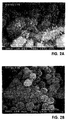
- the particles formed by the sol-gel process are spherical as shown in FIGS. 2A and 2B.
- the formulations described are designed to improve mechanical performance, wear and surface roughness of restorations, but do not provide for the retention of surface gloss in clinical use. Clinical studies of this material have actually shown high wear rates of 22.4 ⁇ m per year. which cannot establish a stable surface (S. Inokoshi, "Posterior Restorations: Ceramics or Composites?” in Transactions Third international Congress on Dental Materials Ed. H. Nakajima, Y. Tani JSDMD 1997).
- Comminution by a milling method may also be used for forming the submicron particles.
- the predominant types of milling methods are dry milling and wet milling. In dry milling, air or an inert gas is used to keep particles in suspension. However, fine particles tend to agglomerate in response to van der Waals forces, which limits the capabilities of dry milling.
- Wet milling uses a liquid such as water or alcohol to control reagglomeration of fine particles. Therefore, wet milling is typically used for comminution of submicron-sized particles.
- a wet mill typically includes spherical media that apply sufficient force to break particles that are suspended in a liquid medium. Milling devices are categorized by the method used to impart motion to the media. The motion imparted to wet ball mills includes tumbling, vibratory, planetary and agitation. While it is possible to form submicron particles with each of these types of mills, the agitation or agitator ball mill is typically most efficient.
- the agitator ball mill also known as an attrition or stirred mill, has several advantages including high energy efficiency, high solids handling, narrow size distribution of the product output. and the ability to produce homogeneous slurries.
- the major variables in using an agitator ball mill are agitator speed, suspension flow rate, residence time. slurry viscosity, solid size of the in-feed, milling media size and desired product size.
- agitator mills typically grind particles to a mean particle size approximately 1/1000 of the size of the milling media in the most efficient operation. In order to obtain mean particle sizes on the order of 0.05 ⁇ m to 0.5 ⁇ m, milling media having a size of less than 0.45 mm can be used.
- Milling media having diameters of 0.2 mm and about 0.6 mm are also available from Tosoh Ceramics. Bound Brook. New Jersey. Thus. to optimize milling, it is desired to use a milling media approximately 1000 times the size of the desired particle. This minimizes the time required for milling.
- YTZ yttria stabilized zirconia
- TZP tetragonal zirconia polycrystal
- Y-TZP has a fine grain, high strength and a high fracture toughness.
- YTZ is the hardest ceramic and because of this high hardness, the YTZ will not structurally degenerate during milling.
- High strength Y-TZP is formed by sintering at temperatures of about 1550°C to form tetragonal grains having 1-2 ⁇ m tetragonal grains mixed with 4-8 ⁇ m cubic grains and high strength ( 1000 MPa), high fracture toughness (8.5 MPa m) and excellent wear resistance.
- the use of Y-TZP provides a suitable milling media for providing relatively pure structural fillers having mean particle sizes less than 0.5 ⁇ m.
- the present invention provides a resin-containing dental composite as defined by claim 1 including a structural filler of ground particles having an average particle size of between about 0.05 ⁇ m and about 0.5 ⁇ m that has the high strength required for load bearing restorations, yet maintains a glossy appearance in clinical use required for cosmetic restorations. Further, because the structural filler particles are ground, the particles are nonspherical, providing increased adhesion of the resin to the structural filler, thereby further enhancing the overall strength of the composite. Through the use of structural filler particles that are ground and that have an average particle size less than the wavelength of light, that is less than about 0.50 ⁇ m, the dental composite of the present invention provides the luster and translucency required for cosmetic restorations.
- the surface of a dental restoration will reflect more light in some directions than in others even after wear of the composite by brushing.
- the visible light waves do not substantially interact with the structural filler particles protruding out of the surface of the composite, and therefore, haze is reduced and the luster of the surface is maintained even after substantial brushing.
- a known method of milling, agitator milling has been adapted for use in the field of dental composites.
- this method is capable of further reducing the average particle size of the HERCULITE® filler to an average particle size of between about 0.05 ⁇ m and 0.5 ⁇ m.
- the particle size is at or below the wavelength of light, which minimizes interaction with light, thus producing a stable glossy surface in clinical use.
- the particles are still large enough to reinforce the composite by the particulate reinforcement mechanism, so the restorations are also stress bearing.
- the number of larger particles, above 0.5 ⁇ m in diameter are also minimized to help produce the stable glossy surface.
- the structural filler particles are ground to an average particle size between about 0.05 ⁇ m and about 0.50 ⁇ m, the particles interact with one another to strengthen the composite, in the manner of typical hybrid composites, to allow a composite of the present invention to be useful in stress bearing restorations.
- the structural filler is ground, typically by agitator milling, to the preferred mean particle size.
- the grinding of the structural filler results in nonspherical particles which due to their irregular shape interact with the polymerized resin to a much greater extent to increase adhesion of the resin to the structural filler and thereby increase the overall strength of the composite.
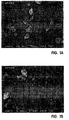
- the irregular shape of the particles is shown in FIGS. 1A and 1B.
- Agitator milling with selected media and optimized parameters produces the required size particles, free of contamination in a narrow particle size distribution. This reduces the small percentage of particles above 0.5 ⁇ m which can contribute to producing a non-glossy surface in clinical use.
- the microfill particles contribute to dispersion reinforcement, fill the interstices between the larger structural filler particles reducing occluded volume, and provide a large surface area to be wetted by the resin to increase strength.
- the microfill particles also contribute to the flow properties of the uncured resin.
- the present invention in a preferred form, is a dental restorative composite as defined by claim 1 which includes a ground structural filler having a mean particle size between about 0.05 ⁇ m and about 0.50 ⁇ m and a microfill having a mean particle size less than about 0.04 ⁇ m in a curable resin, preferably a photopolymerizable resin containing methacrylate monomers.
- a curable resin preferably a photopolymerizable resin containing methacrylate monomers.
- methacrylate monomer resins are cured when exposed to blue visible light.
- the dental composite is applied to teeth by the dental practitioner and exposed to a visible light source to cure the resin.
- the cured resin has a flexural strength higher than 100 MPa which allows for the use of the resin in stress bearing applications.
- an extensive comminution step is required.
- Comminution is preferably performed in an agitator mill and more preferably an agitator mill designed to minimize contamination.
- Comminution deagglomerates the structural filler particles by separating particles from clusters, decreases the size of the structural filler particles, eliminates large particles by breakage and increases the specific surface area of the structural filler particles by producing a large quantity of very fine particles. Size reduction with an agitator mill occurs due to a combination of impact with the milling media, abrasion with the milling media and attrition of the particles.
- Structural fillers suitable for use in the present invention include barium magnesium aluminosilicate glass, barium aluminoborosilicate glass, amorphous silica, silica-zirconia, silica-titania, barium oxide, quartz, alumina and other inorganic oxide particles.
- the filler material to be milled such as barium aluminoborosilicate glass (for example, type SP-345, Specialty Glass, Oldsmar FL), is charged into an agitator mill, such as a one-liter total capacity agitator mill from Draiswerke Inc., Mahwah, New Jersey, type PML-H/V, modified to include a clear polyurethane clad agitator and grinding chamber, a YTZ main seal and a YTZ gap separator.
- barium aluminoborosilicate glass for example, type SP-345, Specialty Glass, Oldsmar FL
- an agitator mill such as a one-liter total capacity agitator mill from Draiswerke Inc., Mahwah, New Jersey, type PML-H/V, modified to include a clear polyurethane clad agitator and grinding chamber, a YTZ main seal and a YTZ gap separator.
- Method A used milling media with a size of 0.65 mm
- Method B used milling media with a size of 0.40 mm.
- the agitator mill was operated at a tip speed of 10 m/sec. for 3 hours.
- Method C the ground slurry of Method A was used, and the mill was then charged with 70% of its volume of 0.20 mm Y-TZP milling media, and the milling process was repeated for 1.5 hours.
- rough edges and facets were created on the structural filler particles by the impact with the milling media, abrasion with the milling media and attrition of the particles. Each of these edges provide an adhesion site for the resin which increases the overall strength of the cured composite.
- the mean particle size is measured, typically by laser scattering.
- Laser scattering is a method of measuring mean particle size by sensing the average relative angular intensity of scattered light. A beam of monochromatic light with a uniform wave front is directed at the sample, the light is diffracted or scattered by the particles and a detector is used to measure the relative average intensity of the scattered light at various angles. The mean particle size and size distribution may then be calculated from the relative average intensity.
- One such laser scattering device is disclosed in U.S. Patent No. 5,610,712 to Schmitz et al., incorporated herein by reference in its entirety. For the present example, a Horiba Model 2A-910 Laser Scattering Mean Particle Size Analyzer was used.
- the particle size range of the structural fillers prepared by methods A, B and C are set forth in TABLE 1, as well as the particle size range for the PRODIGY® (Kerr Corp.) hybrid composite.
- TABLE 1 shows, for example, that for Method A, 10% by volume of the filler particles have a mean particle size of less than 0.40 ⁇ m; 50% by volume of the filler particles have a mean particle size less than 0.62 ⁇ m; and 90% by volume of the filler particles have a mean particle size less than 0.82 ⁇ m.
- the slurry was then dried at 110° C and the dried cake was sieved through a 100 mesh (150 ⁇ m) plastic screen.
- the ground glass was then silanated by spraying in a V-blender with a 20% hydrolyzed solution of gamma-methacryloxypropyltrimethoxysilane in water to make the powder hydrophobic.
- the loading of the silane in the filler was 2.5% by weight.
- the properly sized structural filler is combined with colloid sized particles, such as types of silica, alumina and silicates, for example silica zirconia or silica titania, the particles having a mean particle size less than 0.05 ⁇ m.
- colloid sized particles such as types of silica, alumina and silicates, for example silica zirconia or silica titania, the particles having a mean particle size less than 0.05 ⁇ m.
- hydrophobic fumed silica is used in an amount between 1-15 wt% of the final composition.
- it is possible to use two types of fumed silica such as TS-530 having an average particle size of 0.02 ⁇ m and OX-50 having an average particle size of 0.04 ⁇ m.
- the structural filler and the colloidal fillers are then combined with a light-curable resin base material which may include commercially available monomers containing methacrylate groups.
- a light-curable resin base material which may include commercially available monomers containing methacrylate groups.
- TABLE 2 lists the components of the resin that will be used in later examples. Pigments such as titanium dioxide may be added to control optical properties of the composite.
- Other monomers may be used in the resin composition, such as diethylene glycol dimethacrylate. triethylene glycol dimethacrylate, tetraethylene glycol dimethacrylate, 1,6-hexanediol dimethacrylate, 1,12-dodecanediol dimethacrylate, diurethane dimethacrylate (Rohamere 6661-0, Huls America, Somerset, NJ). trimethylolpropane trimethacrylate, glyceryl dimethacrylate, neopentylglycol dimethacrylate.
- diethylene glycol dimethacrylate triethylene glycol dimethacrylate, tetraethylene glycol dimethacrylate, 1,6-hexanediol dimethacrylate, 1,12-dodecanediol dimethacrylate, diurethane dimethacrylate (Rohamere 6661-0, Huls America, Somerset, NJ). trimethylolpropane trim
- the resin is introduced into a planetary mixer thermostated at 50° C.
- the planetary mixer is then started and the filler containing the physically admixed components listed in TABLE 3 are added slowly over a period of 3 hours.
- the composite is subsequently mixed for another hour and then de-aerated under attenuated oxygen pressure.
- the OX-50 particles are AEROSIL® OX-50 fumed silica, available commercially from Degussa Corp., Ridgefield Park, N.J.
- the OX-50 particles have a surface area of 50 ⁇ 15 m 2 /g and an average agglomerated particle size of 40 nanometers.
- the OX-50 particle is greater than 99.8 wt% SiO 2 with traces of Al 2 O 3 , Fe 2 O 3 , TiO 2 and HCl.
- the OX-50 particles are then silanated by spraying in a V-blender with a 20% hydrolyzed solution of gamma-methacryloxypropyltrimethoxysilane in water to make the powder hydrophobic.
- the loading of the silane in the filler was 5% by weight.
- the CAB-0-SIL TS-530 treated fumed silica is a high purity silica treated with hexamethyldisilazane to make the particles extremely hydrophobic.
- the CAB-O-SIL particles are fumed silica produced by hydrolysis of silicon tetrachloride vapor in a flame of hydrogen and oxygen. Any hydrogen chloride adsorbed onto the CAB-O-SIL particle during the combustion process is reduced by a calcination (typically to less than 200 ppm HCl).
- the colloid filler particles contribute to dispersion reinforcement, fill the interstices between the larger structural filler particles which reduces occluded volume, provide a large surface area to be wetted by the resin and therefore increases strength.
- the use of the colloidal fillers reduces polymer shrinkage and allows a match between the modulus of elasticity and the coefficient of thermal expansion of the composite with that of the tooth.
- the improved adhesion coupled with the control of the polymer shrinkage, the modulus of elasticity and the coefficient of thermal expansion reduces micro-leakage of bacteria along the bond interface between the tooth and the cured dental composite.
- the surface of the tooth is prepared by removing any portion of the tooth enamel, and if necessary the dentin, that is decayed or damaged. A retention groove is then formed in the dentin if needed to maintain the restoration on the tooth. The practitioner then adds opacifiers and pigments to match the color of the composite with the color of the tooth. The composite is then built up on the surface of the tooth to replace any lost material. Once the practitioner is satisfied with the appearance of the restoration the composite is exposed to a visible light source to cure the resin and activate the adhesive by crosslinking the polymer matrix. After the composite has been cured, the surface is polished.
- the mean particle size of the structural tiller is limited to less than the wavelength of light to prevent the structural filler from decreasing surface gloss after substantial brushing. However, it is expected that as the particle size is reduced below about 1 ⁇ m the strength needed for load bearing restorations demises due to increasing occluded volume of resin. Currently, it is believed that a mean particle size between about 0.05 ⁇ m and about 0.5 ⁇ m provides the best balance between optical and structural properties.
- a resin composite was prepared by mixing:
- a resin composite was prepared by mixing:
- a resin composite was prepared by mixing:
- the properties of the dental composites of EXAMPLES A, B, and C are compared with the PRODIGY® hybrid composite.
- the hybrid composite (PRODIGY®) has a flexural strength over 100 MPa, which allows its use in stress bearing restorations.
- the composites of EXAMPLES A, B, and C each have a flexural strength above 100 MPa. approaching that of the PRODIGY® composite, which allows their use in stress bearing restorations.
- the flexural modulus for the composites of EXAMPLES A and C is 9,248 MPa, which approaches the modulus of the PRODIGY® composite.
- the Rockwell hardness which is similar for the four composites reported in TABLE 3, is an average of 3 measurements on the surface of a cylindrical sample 10 mm in diameter and 4 mm in height.
- the composites were light cured for 40 seconds and stored in water for 24 hours at 37° C prior to the hardness measurement.
- the glossy appearance of the PRODIGY® material is lost leaving a matte finish as occurs in normal clinical use.
- the dental composite of the present invention provides a restoration having the high strength useful for load bearing restorations and also provides translucency and surface gloss, useful in cosmetic restorations. The gloss is apparent even after substantial wear as can be observed in a recall appointment 6 months or longer after the placement of the restoration.
- the dental composite of the present invention provides the luster and translucency of dispersion reinforced composites with the strength of hybrid composites.
Landscapes
- Health & Medical Sciences (AREA)
- Oral & Maxillofacial Surgery (AREA)
- Epidemiology (AREA)
- Life Sciences & Earth Sciences (AREA)
- Animal Behavior & Ethology (AREA)
- General Health & Medical Sciences (AREA)
- Public Health (AREA)
- Veterinary Medicine (AREA)
- Plastic & Reconstructive Surgery (AREA)
- Chemical & Material Sciences (AREA)
- Inorganic Chemistry (AREA)
- Dental Preparations (AREA)
Description
| Mean Particle Sizes In Microns | ||||
| VOLUME | PRODIGY® | A | B | C |
| 10% | 0.42 µm | 0.40µm | 0.27µm | 0.24µm |
| 50% | 0.84 µm | 0.62µm | 0.47µm | 0.36µm |
| 90% | 1.50 µm | 0.82µm | 0.76µm | 0.61 µm |
| RESIN COMPOSITION | |
| COMPONENT | % BY WEIGHT |
| BisGMA (Bisphenol A Diglycidyl ether dimethacrylate) | 3.0 |
| Trethylene Glycol Dimethacrylate | 24.7 |
| Ethoxylated Bisphenol A Dimethacrylate | 71.1 |
| 2-Ethylhexyl-4-(dimethylamino)benzoate | 0.49 |
| Camphorquinone | 0.17 |
| 2-Hydroxy-4-methoxy Benzophenone | 0.49 |
| (BHT) Butylated Hydroxytoluene | 0.05 |
| Physical Properties of Small Particle Composites (SD) | ||||
| PRODIGY® | EXAMPLE A | EXAMPLE B | EXAMPLE C | |
| Resin | 23 | 27.6 | 28.2 | 29.2 |
| Mean Particle Size of Ground Filler | 0.84 µm | 0.6 µm | 0.47 µm | 0.35 µm |
| Ground Barium aluminum silicate, SP-345, wt% | 69.4 | 63.7 | 64.7 | 65.2 |
| 40nm silanated Silica, OX-50, wt% | 3.5 | 5 | 3.1 | 2.3 |
| 20 nm hydrophobic Silica, TS-530, wt% | 4.1 | 3.7 | 3.9 | 3.3 |
| Load Weight % | 77 | 72.4 | 71.8 | 70.8 |
| Load Volume % | 57.5 | 51.6 | 50.7 | 49.3 |
| Flexural Strength (MPa) | 136 ( 18) | 122 (9) | 105 (14) | 111 (7) |
| Flexural Modulus (MPa) | 10,960 (744) | 9,248 (522) | 8801 (720) | 9,248 (522) |
| Compressive Strength (MPa) | 367 (52) | 366 (23) | 312 (40) | 368 (42) |
| Rockwell Hardness 15T | 83.3 | 80.1 | 80.4 | 77.5 |
| Depth of Cure 40 s (mm) | 5.5 | 4.7 | 4.3 | 4.3 |
| Consistency-Slump (cm) | 2.5 | 2.7 | 1.6 | 1.7 |
| Gloss, 60 degrees | 19.6 (0.3) | 30.1 (0.8) | 46.7 (0.3) | 45.8 (0.1) |
| Physical Property Comparison of Fine Particle Composite with Commercial Composites (SD) | |||||
| EXAMPLE B | PALFIQUE ESTELITE® (TOKOYAMA) | HELIOMOLAR ® (VIVADENT) | SILUX PLUS® (3M) | DURAFIL® (KULZER) | |
| Load Weight % | 71.8 | 69 | 67 | ca50 | ca50 |
| Load Volume % | 50.7 | ca45 | 44 | ca38 | ca38 |
| Flexural Strength (MPa) | 105 (14) | 78 (8) | 92 (13) | 79 (10) | 83 (12) |
| Flexural Modulus (MPa) | 8801 (720) | 6690 (500) | 6,277 (388) | 7,000 (639) | 5,325 (301) |
| Compressive Strength (MPa) | 312 (40) | 357 (25) | 279 (81) | 248 (96) | 428 (47) |
| Rockwell Hardness 15T | 80.4 | 80.6 | 77.0 | 81.7 | 76.9 |
| Depth of Cure 40 s (mm) | 4.3 | 4.2 | 4.4 | 4.4 | 5.5 |
| Consistency-Slump (cm) | 1.6 | 2.7 | 4.3 | 2.7 | |
| Gloss, 60 degrees | 46.7 (0.3) | 46.9 (0.2) | 40.4 (0.5) | 41.4 (0.5) | 41.5 (1.1) |
| Radiopacity (%A1) | 210 | 175 | 200 | 0 | 0 |
Claims (12)
- A dental composite comprising a resin base and about 11% by volume to about 80% by volume filler comprising a ground structural filler and a microfiller, wherein the ground structural filler comprises between about 10% by volume and about 70% by volume of the composite and comprises ground particles of mean particle size between about 0.05 µm and about 0.5 µm and wherein the microfiller comprises between 1 and 10.0% by volume of the composite and comprises particles of mean particle size of about 0.04 µm or less.
- The dental composite of claim 1 wherein the ground structural filler contains less than 50% by volume of particles above 0.5 µm in diameter.
- The dental composite of either claim 1 or claim 2 wherein the ground structural filler contains less than 10% by volume of particles above 0.8 µm in diameter.
- The dental composite of either claim 1 or claim 2 wherein the microfiller comprises between about 0.5% by volume and about 5.0% by volume particles having a mean particle size of approximately 0.04 µm and between about 0.5% by volume and about 5.0% by volume particles having a mean particle size of approximately 0.02 µm.
- The dental composite of claim 1 wherein the resin base includes bis-phenol-A-bis-(2-hydroxy-3-methacryloxypropyl) ether, triethyleneglycoldimethacrylate, and ethoxylated bis-phenol-A-dimethacrylate.
- The dental composite of either claim 1 or claim 2 wherein the cured resin composite has a flexural strength of at least 70 MPa.
- The dental composite of claim 6 wherein the cured resin composite has a flexural strength of at least 100 MPa.
- The dental composite of either claim 1 or claim 2 wherein the cured resin composite has a gloss at a 60° measurement angle of about 30 or greater.
- The dental composite of claim 8 wherein the cured resin composite has a flexural strength of about 105 MPa or greater.
- The dental composite of either claim 1 or claim 2 wherein the cured resin composite has a radiopacity of at least about 100% Al.
- The dental composite of either claim 1 or claim 2 wherein the cured resin composite has a radiopacity of at least about 200% Al.
- The dental composite of any preceding claim wherein the cured resin composite maintains surface gloss after wear.
Applications Claiming Priority (5)
| Application Number | Priority Date | Filing Date | Title |
|---|---|---|---|
| US8985998P | 1998-06-19 | 1998-06-19 | |
| US89859P | 1998-06-19 | ||
| US270999 | 1999-03-17 | ||
| US09/270,999 US6121344A (en) | 1998-06-19 | 1999-03-17 | Optimum particle sized hybrid composite |
| PCT/US1999/011618 WO1999065453A1 (en) | 1998-06-19 | 1999-05-26 | Optimum particle sized hybrid composite |
Publications (2)
| Publication Number | Publication Date |
|---|---|
| EP1005318A1 EP1005318A1 (en) | 2000-06-07 |
| EP1005318B1 true EP1005318B1 (en) | 2004-11-17 |
Family
ID=26781010
Family Applications (1)
| Application Number | Title | Priority Date | Filing Date |
|---|---|---|---|
| EP99925867A Revoked EP1005318B1 (en) | 1998-06-19 | 1999-05-26 | Optimum particle sized hybrid composite |
Country Status (8)
| Country | Link |
|---|---|
| US (1) | US6121344A (en) |
| EP (1) | EP1005318B1 (en) |
| JP (1) | JP2002518309A (en) |
| CN (1) | CN1112909C (en) |
| AU (1) | AU4206999A (en) |
| BR (1) | BR9906530A (en) |
| DE (1) | DE69921943T2 (en) |
| WO (1) | WO1999065453A1 (en) |
Families Citing this family (50)
| Publication number | Priority date | Publication date | Assignee | Title |
|---|---|---|---|---|
| US6300390B1 (en) * | 1998-06-09 | 2001-10-09 | Kerr Corporation | Dental restorative composite |
| US6232367B1 (en) * | 1999-10-07 | 2001-05-15 | Kerr Corporation | Opalescent fillers for dental restorative composites |
| JP4800535B2 (en) | 1999-10-28 | 2011-10-26 | スリーエム イノベイティブ プロパティズ カンパニー | Dental material containing nano-sized silica particles |
| US7566412B2 (en) * | 1999-11-10 | 2009-07-28 | Dentsply International Inc. | Dental method and device |
| US7476347B1 (en) * | 1999-11-10 | 2009-01-13 | Dentsply International, Inc. | Process for making denture having integral teeth and denture base |
| US20040225029A1 (en) * | 2000-02-17 | 2004-11-11 | Uwe Walz | Dental composition with improved light stability |
| US8026295B2 (en) * | 2000-02-17 | 2011-09-27 | Dentsply International, Inc. | Dental composition with improved light stability |
| US20030225182A1 (en) * | 2001-01-04 | 2003-12-04 | Dentsply Detrey Gmbh | Dental composition with improved light stability |
| US20040171716A1 (en) * | 2002-12-03 | 2004-09-02 | Uwe Walz | Dental compositions comprising bisacrylamides and use thereof |
| US20030069327A1 (en) * | 2001-08-09 | 2003-04-10 | Uwe Walz | Dental compostions comprising bisacrylamides and use thereof |
| WO2002013767A2 (en) * | 2000-08-11 | 2002-02-21 | Dentsply International Inc. | Polyaminoester and their application in dental compositions |
| DE10108261B4 (en) * | 2001-02-21 | 2006-07-20 | Ivoclar Vivadent Ag | Polymerizable composition with particulate composite based filler |
| DE10111449A1 (en) * | 2001-03-09 | 2002-09-26 | Schott Glas | Use of bioactive glass in tooth filling material |
| US6593395B2 (en) * | 2001-05-16 | 2003-07-15 | Kerr Corporation | Dental composition containing discrete nanoparticles |
| US6890968B2 (en) * | 2001-05-16 | 2005-05-10 | Kerr Corporation | Prepolymerized filler in dental restorative composite |
| ATE307552T1 (en) * | 2001-08-13 | 2005-11-15 | Dentsply Int Inc | CONE FOR FILLING TOOTH ROOT CANALS |
| WO2003015720A1 (en) | 2001-08-15 | 2003-02-27 | 3M Innovative Properties Company | Hardenable self-supporting structures and methods |
| US7204875B2 (en) | 2001-10-24 | 2007-04-17 | Pentron Clinical Technologies, Llc | Dental filling material |
| US7204874B2 (en) | 2001-10-24 | 2007-04-17 | Pentron Clinical Technologies, Llc | Root canal filling material |
| US7303817B2 (en) | 2001-10-24 | 2007-12-04 | Weitao Jia | Dental filling material |
| US7750063B2 (en) | 2001-10-24 | 2010-07-06 | Pentron Clinical Technologies, Llc | Dental filling material |
| US7211136B2 (en) | 2001-10-24 | 2007-05-01 | Pentron Clinical Technologies, Llc | Dental filling material |
| JP4748938B2 (en) | 2002-01-31 | 2011-08-17 | スリーエム イノベイティブ プロパティズ カンパニー | Dental paste, dental article, and method |
| US20040209990A1 (en) * | 2003-04-15 | 2004-10-21 | Uwe Walz | Low shrinking polymerizable dental material |
| US20050040551A1 (en) | 2003-08-19 | 2005-02-24 | Biegler Robert M. | Hardenable dental article and method of manufacturing the same |
| US20050042577A1 (en) * | 2003-08-19 | 2005-02-24 | Kvitrud James R. | Dental crown forms and methods |
| EP1667599B1 (en) * | 2003-09-23 | 2015-10-21 | DENTSPLY International Inc. | Packaged dental composition |
| EP1570831A1 (en) * | 2004-03-02 | 2005-09-07 | Ernst Mühlbauer GmbH & Co.KG | Polymerisable dental material containing a filler |
| US8481007B2 (en) | 2004-03-30 | 2013-07-09 | Chien-Min Sung | Compositions and methods for providing ultraviolet radiation protection |
| US7294340B2 (en) * | 2004-03-30 | 2007-11-13 | Chien-Min Sung | Healthcare and cosmetic compositions containing nanodiamond |
| EP1755528B1 (en) * | 2004-06-15 | 2012-04-25 | DENTSPLY International Inc. | Low shrinkage and low stress dental compositions |
| US20060287459A1 (en) * | 2004-06-15 | 2006-12-21 | Xiaoming Jin | Radical polymerizable macrocyclic resin compositions with low polymerization stress |
| WO2006030645A1 (en) * | 2004-09-16 | 2006-03-23 | Kuraray Medical Inc. | Dental polymerizable core build-up material of separately packed type |
| DE102005051387B3 (en) * | 2005-10-27 | 2007-01-25 | Ivoclar Vivadent Ag | Dental glass useful as a filler for dental composites comprises oxides of silicon, aluminum, magnesium, lanthanum, tungsten and zirconium |
| US20090030109A1 (en) * | 2005-11-18 | 2009-01-29 | Hare Robert V | Dental composite restorative material |
| CN101610749B (en) | 2006-12-28 | 2013-01-02 | 3M创新有限公司 | Dental filler and methods |
| US8735463B2 (en) | 2007-05-31 | 2014-05-27 | Creighton University | Self-healing dental composites and related methods |
| EP2072028A1 (en) * | 2007-12-21 | 2009-06-24 | Ernst Mühlbauer GmbH & Co.KG | Stump construction |
| US7946850B2 (en) * | 2008-08-13 | 2011-05-24 | Kerr Corporation | Single-part, light-curable, self-adhering dental restorative composition and method of using the same |
| EP2370362B1 (en) * | 2008-10-15 | 2013-11-27 | 3M Innovative Properties Company | Fillers and composite materials with zirconia and silica nanoparticles |
| DE102012203875A1 (en) * | 2011-04-21 | 2012-10-25 | Schott Ag | Glass powder with improved particle size distribution and process for its preparation |
| US8822564B2 (en) | 2011-05-27 | 2014-09-02 | Kerr Corporation | Dental restorative material |
| EP2537507A3 (en) | 2011-06-20 | 2013-09-04 | Kerr Corporation | Compositions dentaires contenant des fibres raccourcies |
| EP2604247A1 (en) * | 2011-12-15 | 2013-06-19 | Dentsply DeTrey GmbH | Composite filler particles and process for the preparation thereof |
| BR112015001337B1 (en) | 2012-08-10 | 2021-02-23 | Sika Technology Ag | silicone formulation of one or two components, use thereof, method to fill a space between two substrates, and arrangement comprising said formulation |
| DE102012016418B4 (en) * | 2012-08-21 | 2024-04-25 | Kulzer Gmbh | Dental bonding agent for high performance polymers |
| CN104797232B (en) | 2012-11-30 | 2017-11-07 | 可乐丽则武齿科株式会社 | Curable composition for dental applications and dental flowable composite resin |
| ES3060760T3 (en) | 2015-02-09 | 2026-03-30 | Zest Ip Holdings Llc | Dental compositions and methods of use |
| US10261430B2 (en) * | 2016-01-14 | 2019-04-16 | Samsung Electronics Co., Ltd. | Photoreceptor for electrophotography and image forming apparatus employing the same |
| CN106619142A (en) * | 2016-12-20 | 2017-05-10 | 天津盛易联科技股份有限公司 | Novel dental restoration material for stomatology and preparation method of novel dental restoration material |
Citations (1)
| Publication number | Priority date | Publication date | Assignee | Title |
|---|---|---|---|---|
| DE4029230A1 (en) | 1990-09-14 | 1992-03-19 | Ivoclar Ag | POLYMERIZABLE DENTAL MATERIAL |
Family Cites Families (61)
| Publication number | Priority date | Publication date | Assignee | Title |
|---|---|---|---|---|
| US35264A (en) * | 1862-05-13 | Improvement in miners lamps | ||
| US3792531A (en) * | 1970-12-28 | 1974-02-19 | Lee Pharmaceuticals | Dental restorative material of improved polishability |
| US3893840A (en) * | 1972-09-06 | 1975-07-08 | Huber Corp J M | Amorphous precipitated siliceous pigments and methods for their production |
| DE2403211C3 (en) * | 1974-01-23 | 1981-12-24 | Etablissement Dentaire Ivoclar, Schaan | Material for dental purposes |
| DE2458841C2 (en) * | 1974-12-12 | 1985-03-14 | Draiswerke Gmbh, 6800 Mannheim | Agitator mill |
| US4422880A (en) * | 1975-03-12 | 1983-12-27 | J. M. Huber Corporation | Precipitated siliceous products |
| AU505536B2 (en) * | 1975-03-12 | 1979-11-22 | J.M. Huber Corp. | Methods for production and use of siliceous products |
| US4336245A (en) * | 1975-03-12 | 1982-06-22 | J. M. Huber Corporation | Novel precipitated siliceous products and methods for their use and production |
| DE2629251C2 (en) * | 1976-06-30 | 1987-03-19 | Draiswerke Gmbh, 6800 Mannheim | Agitator mill |
| DE2631623C2 (en) * | 1976-07-14 | 1985-06-13 | Draiswerke Gmbh, 6800 Mannheim | Agitator mill |
| US4156766A (en) * | 1977-01-10 | 1979-05-29 | Johnson & Johnson | Acrylic polymerization systems and diacyl peroxide catalysts therefor |
| US4202813A (en) * | 1977-05-16 | 1980-05-13 | J. M. Huber Corporation | Rubber containing precipitated siliceous products |
| DE2728764A1 (en) * | 1977-06-25 | 1979-01-18 | Bayer Ag | FORMULATED DENTAL FILLING MATERIALS |
| AT367657B (en) * | 1978-08-24 | 1982-07-26 | Buehler Ag Geb | AGITATOR BALL MILL CONTROL |
| US4215033A (en) * | 1978-09-08 | 1980-07-29 | American Dental Association Health Foundation | Composite dental material |
| US4260454A (en) * | 1978-10-10 | 1981-04-07 | J. M. Huber Corporation | Precipitated siliceous products used in paper |
| US4380432A (en) * | 1980-09-03 | 1983-04-19 | Scientific Pharmaceuticals | Method for adhering structures to teeth |
| DE3039664C2 (en) * | 1980-10-21 | 1986-07-17 | Kulzer & Co Gmbh, 6380 Bad Homburg | Radiopaque dental material with filler based on silicate |
| DE3106062A1 (en) * | 1981-02-19 | 1982-09-09 | Draiswerke Gmbh, 6800 Mannheim | AGITATOR MILL |
| US4936775A (en) * | 1981-05-04 | 1990-06-26 | Dentsply Research & Development, Corp. | Dental adhesive system |
| USRE35264E (en) | 1981-05-04 | 1996-06-04 | Dentsply Research & Development Corp. | Dental adhesive system |
| US4801528A (en) * | 1981-05-04 | 1989-01-31 | Dentsply Research & Development Corporation | Dental adhesive system |
| DE3372930D1 (en) * | 1982-05-25 | 1987-09-17 | Netzsch Maschinenfabrik | Agitator mill |
| US5210109A (en) * | 1983-11-16 | 1993-05-11 | Dentsply Research & Development Corp. | Interpenetrating polymer network compositions employing rubber-modified polymers |
| US4711913A (en) * | 1983-11-16 | 1987-12-08 | Dentsply International Inc. | Interpenetrating polymer network compositions employing rubber-modified polymers |
| US4863977A (en) * | 1983-11-16 | 1989-09-05 | Dentsply Research & Development Corp. | Process for preparing interpenetrating polymer network objects employing rubber-modified polymers |
| US4551486A (en) * | 1983-11-16 | 1985-11-05 | Dentsply Research & Development Corp. | Interpenetrating polymer network compositions |
| US4544359A (en) * | 1984-01-13 | 1985-10-01 | Pentron Corporation | Dental restorative material |
| DE3406233A1 (en) * | 1984-02-21 | 1985-08-22 | Bayer Ag, 5090 Leverkusen | MODIFIED FILLERS FOR SILICONE PASTES, THEIR USE AND THE DENTAL IMPRESSIONS CONTAINING THESE FILLERS |
| US4503169A (en) * | 1984-04-19 | 1985-03-05 | Minnesota Mining And Manufacturing Company | Radiopaque, low visual opacity dental composites containing non-vitreous microparticles |
| US5177120A (en) * | 1984-07-31 | 1993-01-05 | Dentsply Research & Development Corp. | Chain extended urethane diacrylate and dental impression formation |
| US4813875A (en) * | 1984-07-31 | 1989-03-21 | Dentsply Research & Development Corp. | Chain extended urethane diacrylate and dental impression formation |
| US4846165A (en) * | 1986-11-26 | 1989-07-11 | Dentsply Research & Development Corp. | Wound dressing membrane |
| DE3716587C1 (en) * | 1987-05-18 | 1988-04-28 | Draiswerke Gmbh | Agitator mill |
| US4793809A (en) * | 1987-05-21 | 1988-12-27 | Myron International, Inc. | Fiber filled dental porcelain |
| US4859716A (en) * | 1987-11-06 | 1989-08-22 | Den-Mat Corporation | Microfilled dental composite and method for making it |
| US4978640A (en) * | 1988-02-24 | 1990-12-18 | Massachusetts Institute Of Technology | Dispersion strengthened composite |
| DE68904665T2 (en) * | 1988-03-17 | 1993-09-02 | Kuraray Co | HARDENABLE RESIN COMPOSITION. |
| US5065946A (en) * | 1988-07-21 | 1991-11-19 | Matsushita Electric Industrial Co., Ltd. | Media agitating mill and method for milling ceramic powder |
| US5211748A (en) * | 1989-03-21 | 1993-05-18 | National Research Development Corporation | Identifiable dental restorative material |
| DE4002613A1 (en) * | 1990-01-30 | 1991-08-01 | Draiswerke Gmbh | AGITATOR MILL |
| DE59103582D1 (en) * | 1990-11-17 | 1995-01-05 | Heraeus Kulzer Gmbh | Polymerizable dental material. |
| US5218070A (en) * | 1991-02-11 | 1993-06-08 | Dentsply G.M.B.H. | Dental/medical composition and use |
| US5221202A (en) * | 1991-04-12 | 1993-06-22 | James Jack L | Packaging and adhesive for predispensed orthodontic brackets |
| DE4122680C2 (en) * | 1991-07-09 | 1994-03-31 | Draiswerke Gmbh | Agitator mill |
| US5338773A (en) * | 1993-04-19 | 1994-08-16 | Dentsply Research & Development Corp. | Dental composition and method |
| US5710194A (en) * | 1993-04-19 | 1998-01-20 | Dentsply Research & Development Corp. | Dental compounds, compositions, products and methods |
| ATE295551T1 (en) * | 1993-06-04 | 2005-05-15 | Coulter Int Corp | METHOD AND DEVICE FOR MEASURING PARTICLE SIZE DISTRIBUTION USING LASER SCATTERING |
| US5502087A (en) * | 1993-06-23 | 1996-03-26 | Dentsply Research & Development Corp. | Dental composition, prosthesis, and method for making dental prosthesis |
| JPH0788391A (en) * | 1993-09-20 | 1995-04-04 | Showa Shell Sekiyu Kk | Manufacturing method of ultra fine powder |
| US5612414A (en) * | 1993-11-05 | 1997-03-18 | Lanxide Technology Company, Lp | Organic/inorganic polymers |
| US5616650A (en) * | 1993-11-05 | 1997-04-01 | Lanxide Technology Company, Lp | Metal-nitrogen polymer compositions comprising organic electrophiles |
| DE4412831C2 (en) * | 1994-04-14 | 1996-03-21 | Heraeus Kulzer Gmbh | Artificial tooth |
| EP0767651B1 (en) * | 1994-06-30 | 2002-01-30 | Minnesota Mining And Manufacturing Company | Method for bonding amalgam to dental surfaces |
| US5554030A (en) * | 1994-06-30 | 1996-09-10 | Minnesota Mining And Manufacturing Company | Method for bonding non-amalgam restorative materials to dental surfaces |
| JP3214982B2 (en) * | 1994-07-04 | 2001-10-02 | 株式会社トクヤマ | Inorganic composition |
| US5547379A (en) * | 1994-10-06 | 1996-08-20 | Hasel; Robert W. | Method of restoring a tooth |
| US5604626A (en) * | 1995-02-10 | 1997-02-18 | Donnelly Corporation | Photochromic devices |
| DE19617931C5 (en) * | 1996-04-26 | 2010-07-22 | Ivoclar Vivadent Ag | Use of a filled and polymerizable material as dental material |
| JPH10323353A (en) * | 1997-05-26 | 1998-12-08 | G C:Kk | Dental resin material and method for producing the same |
| US5837752A (en) * | 1997-07-17 | 1998-11-17 | Massachusetts Institute Of Technology | Semi-interpenetrating polymer networks |
-
1999
- 1999-03-17 US US09/270,999 patent/US6121344A/en not_active Expired - Lifetime
- 1999-05-26 DE DE69921943T patent/DE69921943T2/en not_active Expired - Lifetime
- 1999-05-26 AU AU42069/99A patent/AU4206999A/en not_active Abandoned
- 1999-05-26 JP JP2000554333A patent/JP2002518309A/en active Pending
- 1999-05-26 EP EP99925867A patent/EP1005318B1/en not_active Revoked
- 1999-05-26 WO PCT/US1999/011618 patent/WO1999065453A1/en not_active Ceased
- 1999-05-26 CN CN99800986A patent/CN1112909C/en not_active Expired - Fee Related
- 1999-05-26 BR BR9906530-4A patent/BR9906530A/en not_active IP Right Cessation
Patent Citations (1)
| Publication number | Priority date | Publication date | Assignee | Title |
|---|---|---|---|---|
| DE4029230A1 (en) | 1990-09-14 | 1992-03-19 | Ivoclar Ag | POLYMERIZABLE DENTAL MATERIAL |
Also Published As
| Publication number | Publication date |
|---|---|
| WO1999065453A1 (en) | 1999-12-23 |
| WO1999065453A9 (en) | 2000-07-20 |
| CN1112909C (en) | 2003-07-02 |
| DE69921943T2 (en) | 2005-12-01 |
| US6121344A (en) | 2000-09-19 |
| BR9906530A (en) | 2000-07-18 |
| CN1272781A (en) | 2000-11-08 |
| JP2002518309A (en) | 2002-06-25 |
| DE69921943D1 (en) | 2004-12-23 |
| AU4206999A (en) | 2000-01-05 |
| EP1005318A1 (en) | 2000-06-07 |
Similar Documents
| Publication | Publication Date | Title |
|---|---|---|
| US6121344A (en) | Optimum particle sized hybrid composite | |
| EP1387658B1 (en) | Dental composite containing discrete nanoparticles | |
| EP1396254B1 (en) | Prepolymerized filler in dental restorative composite | |
| EP1050291B1 (en) | Dental restorative composite | |
| EP1137387B1 (en) | Opalescent fillers for dental restorative composites | |
| Klapdohr et al. | New inorganic components for dental filling composites | |
| JP3683861B2 (en) | Filler based on particle composite | |
| CA2202732C (en) | Filled and polymerizable dental material | |
| US6362251B1 (en) | Dental material comprising porous glass ceramics, porous glass ceramics, processes and use | |
| CA2051333C (en) | Polymerizable dental material | |
| EP2724706B1 (en) | Dental restorative material | |
| JPH0564604B2 (en) | ||
| JP2007538071A (en) | Dental compositions containing nanofillers and related methods | |
| JP2005517688A (en) | Dental paste, dental article, and method | |
| US5707440A (en) | Inorganic filler material with retention properties, and method and use of such material | |
| WO2008140800A2 (en) | Dental compositions for coating restorations and tooth surfaces | |
| US6098906A (en) | Vibratory mill and method of use for low contamination grinding | |
| US20060116438A1 (en) | Composite material and use of a composite material | |
| MXPA00001821A (en) | Optimum particle sized hybrid composite | |
| EP4696297A1 (en) | Composite material for dental cutting | |
| Saveanu et al. | NANOMETRIC ANALYSIS OF ADHESIVE MATERIALS USED IN SECONDARY PREVENTION OF DENTAL CARIES | |
| Sideridou | Trends in dental polymer nanocomposites |
Legal Events
| Date | Code | Title | Description |
|---|---|---|---|
| PUAI | Public reference made under article 153(3) epc to a published international application that has entered the european phase |
Free format text: ORIGINAL CODE: 0009012 |
|
| AK | Designated contracting states |
Kind code of ref document: A1 Designated state(s): DE FR GB IT |
|
| 17P | Request for examination filed |
Effective date: 20000621 |
|
| 17Q | First examination report despatched |
Effective date: 20030311 |
|
| GRAP | Despatch of communication of intention to grant a patent |
Free format text: ORIGINAL CODE: EPIDOSNIGR1 |
|
| GRAS | Grant fee paid |
Free format text: ORIGINAL CODE: EPIDOSNIGR3 |
|
| GRAA | (expected) grant |
Free format text: ORIGINAL CODE: 0009210 |
|
| AK | Designated contracting states |
Kind code of ref document: B1 Designated state(s): DE FR GB IT |
|
| REG | Reference to a national code |
Ref country code: GB Ref legal event code: FG4D |
|
| REF | Corresponds to: |
Ref document number: 69921943 Country of ref document: DE Date of ref document: 20041223 Kind code of ref document: P |
|
| PLBI | Opposition filed |
Free format text: ORIGINAL CODE: 0009260 |
|
| PLAX | Notice of opposition and request to file observation + time limit sent |
Free format text: ORIGINAL CODE: EPIDOSNOBS2 |
|
| 26 | Opposition filed |
Opponent name: 3M ESPE AG Effective date: 20050817 |
|
| ET | Fr: translation filed | ||
| PLAF | Information modified related to communication of a notice of opposition and request to file observations + time limit |
Free format text: ORIGINAL CODE: EPIDOSCOBS2 |
|
| PLAF | Information modified related to communication of a notice of opposition and request to file observations + time limit |
Free format text: ORIGINAL CODE: EPIDOSCOBS2 |
|
| PLBB | Reply of patent proprietor to notice(s) of opposition received |
Free format text: ORIGINAL CODE: EPIDOSNOBS3 |
|
| REG | Reference to a national code |
Ref country code: HK Ref legal event code: WD Ref document number: 1029739 Country of ref document: HK |
|
| RDAF | Communication despatched that patent is revoked |
Free format text: ORIGINAL CODE: EPIDOSNREV1 |
|
| APBP | Date of receipt of notice of appeal recorded |
Free format text: ORIGINAL CODE: EPIDOSNNOA2O |
|
| APAH | Appeal reference modified |
Free format text: ORIGINAL CODE: EPIDOSCREFNO |
|
| APBQ | Date of receipt of statement of grounds of appeal recorded |
Free format text: ORIGINAL CODE: EPIDOSNNOA3O |
|
| PLAB | Opposition data, opponent's data or that of the opponent's representative modified |
Free format text: ORIGINAL CODE: 0009299OPPO |
|
| R26 | Opposition filed (corrected) |
Opponent name: 3M ESPE AG Effective date: 20050817 |
|
| PLAB | Opposition data, opponent's data or that of the opponent's representative modified |
Free format text: ORIGINAL CODE: 0009299OPPO |
|
| R26 | Opposition filed (corrected) |
Opponent name: 3M ESPE AG Effective date: 20050817 |
|
| APBY | Invitation to file observations in appeal sent |
Free format text: ORIGINAL CODE: EPIDOSNOBA2O |
|
| APCA | Receipt of observations in appeal recorded |
Free format text: ORIGINAL CODE: EPIDOSNOBA4O |
|
| APAT | Information on receipt of observation in appeal modified |
Free format text: ORIGINAL CODE: EPIDOSCOBA4O |
|
| APBU | Appeal procedure closed |
Free format text: ORIGINAL CODE: EPIDOSNNOA9O |
|
| PLAB | Opposition data, opponent's data or that of the opponent's representative modified |
Free format text: ORIGINAL CODE: 0009299OPPO |
|
| R26 | Opposition filed (corrected) |
Opponent name: 3M DEUTSCHLAND GMBH Effective date: 20050817 |
|
| RDAD | Information modified related to despatch of communication that patent is revoked |
Free format text: ORIGINAL CODE: EPIDOSCREV1 |
|
| APBM | Appeal reference recorded |
Free format text: ORIGINAL CODE: EPIDOSNREFNO |
|
| APBP | Date of receipt of notice of appeal recorded |
Free format text: ORIGINAL CODE: EPIDOSNNOA2O |
|
| APAH | Appeal reference modified |
Free format text: ORIGINAL CODE: EPIDOSCREFNO |
|
| APBQ | Date of receipt of statement of grounds of appeal recorded |
Free format text: ORIGINAL CODE: EPIDOSNNOA3O |
|
| PLAB | Opposition data, opponent's data or that of the opponent's representative modified |
Free format text: ORIGINAL CODE: 0009299OPPO |
|
| R26 | Opposition filed (corrected) |
Opponent name: 3M DEUTSCHLAND GMBH Effective date: 20050817 |
|
| REG | Reference to a national code |
Ref country code: FR Ref legal event code: PLFP Year of fee payment: 18 |
|
| APBU | Appeal procedure closed |
Free format text: ORIGINAL CODE: EPIDOSNNOA9O |
|
| REG | Reference to a national code |
Ref country code: FR Ref legal event code: PLFP Year of fee payment: 19 |
|
| APAH | Appeal reference modified |
Free format text: ORIGINAL CODE: EPIDOSCREFNO |
|
| APBM | Appeal reference recorded |
Free format text: ORIGINAL CODE: EPIDOSNREFNO |
|
| APBP | Date of receipt of notice of appeal recorded |
Free format text: ORIGINAL CODE: EPIDOSNNOA2O |
|
| APBQ | Date of receipt of statement of grounds of appeal recorded |
Free format text: ORIGINAL CODE: EPIDOSNNOA3O |
|
| REG | Reference to a national code |
Ref country code: FR Ref legal event code: PLFP Year of fee payment: 20 |
|
| PGFP | Annual fee paid to national office [announced via postgrant information from national office to epo] |
Ref country code: DE Payment date: 20180529 Year of fee payment: 20 |
|
| PGFP | Annual fee paid to national office [announced via postgrant information from national office to epo] |
Ref country code: FR Payment date: 20180525 Year of fee payment: 20 Ref country code: IT Payment date: 20180522 Year of fee payment: 20 |
|
| PGFP | Annual fee paid to national office [announced via postgrant information from national office to epo] |
Ref country code: GB Payment date: 20180529 Year of fee payment: 20 |
|
| REG | Reference to a national code |
Ref country code: DE Ref legal event code: R071 Ref document number: 69921943 Country of ref document: DE |
|
| REG | Reference to a national code |
Ref country code: GB Ref legal event code: PE20 Expiry date: 20190525 |
|
| PLAB | Opposition data, opponent's data or that of the opponent's representative modified |
Free format text: ORIGINAL CODE: 0009299OPPO |
|
| R26 | Opposition filed (corrected) |
Opponent name: 3M DEUTSCHLAND GMBH Effective date: 20050817 |
|
| PG25 | Lapsed in a contracting state [announced via postgrant information from national office to epo] |
Ref country code: GB Free format text: LAPSE BECAUSE OF EXPIRATION OF PROTECTION Effective date: 20190525 |
|
| APBU | Appeal procedure closed |
Free format text: ORIGINAL CODE: EPIDOSNNOA9O |
|
| REG | Reference to a national code |
Ref country code: DE Ref legal event code: R103 Ref document number: 69921943 Country of ref document: DE Ref country code: DE Ref legal event code: R064 Ref document number: 69921943 Country of ref document: DE |
|
| RDAD | Information modified related to despatch of communication that patent is revoked |
Free format text: ORIGINAL CODE: EPIDOSCREV1 |
|
| STAA | Information on the status of an ep patent application or granted ep patent |
Free format text: STATUS: PATENT REVOKED |
|
| RDAG | Patent revoked |
Free format text: ORIGINAL CODE: 0009271 |
|
| 27W | Patent revoked |
Effective date: 20200427 |