EP1005193A2 - Verfahren zur Berechnung von Leitungskapazität und Gerät zum Entwurf von IP Netzwerken mit Leistungsgarantien - Google Patents
Verfahren zur Berechnung von Leitungskapazität und Gerät zum Entwurf von IP Netzwerken mit Leistungsgarantien Download PDFInfo
- Publication number
- EP1005193A2 EP1005193A2 EP99309097A EP99309097A EP1005193A2 EP 1005193 A2 EP1005193 A2 EP 1005193A2 EP 99309097 A EP99309097 A EP 99309097A EP 99309097 A EP99309097 A EP 99309097A EP 1005193 A2 EP1005193 A2 EP 1005193A2
- Authority
- EP
- European Patent Office
- Prior art keywords
- link
- network
- packet
- fifo
- connection
- Prior art date
- Legal status (The legal status is an assumption and is not a legal conclusion. Google has not performed a legal analysis and makes no representation as to the accuracy of the status listed.)
- Withdrawn
Links
- 238000000034 method Methods 0.000 title claims abstract description 94
- 230000006870 function Effects 0.000 claims description 18
- 239000013598 vector Substances 0.000 claims description 15
- 230000015654 memory Effects 0.000 claims description 8
- 230000003139 buffering effect Effects 0.000 claims description 7
- 235000008694 Humulus lupulus Nutrition 0.000 claims description 6
- 238000004519 manufacturing process Methods 0.000 claims 2
- 238000013461 design Methods 0.000 description 67
- 238000005457 optimization Methods 0.000 description 40
- 238000013459 approach Methods 0.000 description 29
- 230000003416 augmentation Effects 0.000 description 25
- 230000008569 process Effects 0.000 description 13
- 230000009467 reduction Effects 0.000 description 13
- 238000007726 management method Methods 0.000 description 11
- 238000012545 processing Methods 0.000 description 10
- 230000000694 effects Effects 0.000 description 9
- 238000006243 chemical reaction Methods 0.000 description 7
- 230000001934 delay Effects 0.000 description 6
- 230000005540 biological transmission Effects 0.000 description 4
- 238000002955 isolation Methods 0.000 description 4
- 239000000203 mixture Substances 0.000 description 4
- 238000012856 packing Methods 0.000 description 4
- 238000012552 review Methods 0.000 description 4
- 230000006399 behavior Effects 0.000 description 3
- 230000008901 benefit Effects 0.000 description 3
- 238000010586 diagram Methods 0.000 description 3
- 230000003044 adaptive effect Effects 0.000 description 2
- 230000008859 change Effects 0.000 description 2
- 238000001514 detection method Methods 0.000 description 2
- 239000011159 matrix material Substances 0.000 description 2
- 230000008450 motivation Effects 0.000 description 2
- 239000002957 persistent organic pollutant Substances 0.000 description 2
- 238000011160 research Methods 0.000 description 2
- 238000004088 simulation Methods 0.000 description 2
- 230000032258 transport Effects 0.000 description 2
- 230000006978 adaptation Effects 0.000 description 1
- 239000000654 additive Substances 0.000 description 1
- 238000004458 analytical method Methods 0.000 description 1
- 230000015572 biosynthetic process Effects 0.000 description 1
- 239000000969 carrier Substances 0.000 description 1
- 230000001419 dependent effect Effects 0.000 description 1
- 238000012938 design process Methods 0.000 description 1
- 238000005516 engineering process Methods 0.000 description 1
- 238000009472 formulation Methods 0.000 description 1
- RGNPBRKPHBKNKX-UHFFFAOYSA-N hexaflumuron Chemical compound C1=C(Cl)C(OC(F)(F)C(F)F)=C(Cl)C=C1NC(=O)NC(=O)C1=C(F)C=CC=C1F RGNPBRKPHBKNKX-UHFFFAOYSA-N 0.000 description 1
- 230000006698 induction Effects 0.000 description 1
- 238000013507 mapping Methods 0.000 description 1
- 230000007246 mechanism Effects 0.000 description 1
- 238000012986 modification Methods 0.000 description 1
- 230000004048 modification Effects 0.000 description 1
- 230000006855 networking Effects 0.000 description 1
- 230000000737 periodic effect Effects 0.000 description 1
- 230000009046 primary transport Effects 0.000 description 1
- 238000000638 solvent extraction Methods 0.000 description 1
- 238000012360 testing method Methods 0.000 description 1
- 238000010200 validation analysis Methods 0.000 description 1
Images



Classifications
-
- H—ELECTRICITY
- H04—ELECTRIC COMMUNICATION TECHNIQUE
- H04L—TRANSMISSION OF DIGITAL INFORMATION, e.g. TELEGRAPHIC COMMUNICATION
- H04L12/00—Data switching networks
- H04L12/28—Data switching networks characterised by path configuration, e.g. LAN [Local Area Networks] or WAN [Wide Area Networks]
-
- H—ELECTRICITY
- H04—ELECTRIC COMMUNICATION TECHNIQUE
- H04L—TRANSMISSION OF DIGITAL INFORMATION, e.g. TELEGRAPHIC COMMUNICATION
- H04L47/00—Traffic control in data switching networks
- H04L47/10—Flow control; Congestion control
Definitions
- a packet switch such as Lucent's PacketStarTM (from Lucent Technologies, Inc. of Murray Hill, New Jersey) IP Switch supports novel traffic scheduling and buffer management capabilities, including per-flow queuing with weighted fair queuing (WFQ) and longest-queue drop (LQD), which enable minimum bandwidth guarantees for VPNs while achieving a very high level of resource utilization.
- WFQ weighted fair queuing
- LQD longest-queue drop
- a network design tool that permits users, i.e., network designers, to design IP networks having the same (homogeneous) or different (heterogeneous) types of routers which provide substantial performance guarantees for a variety of applications such as, for example, VPN.
- a design tool which: automatically computes worst-case and optimistic link capacity requirements based on a designer's specifications; optimizes the network topology; and determines optimal router placement in the network.
- the present invention provides methods and apparatus for designing IP networks with substantially improved performance as compared to existing IP networks such as, for example, those networks designed under best-effort criteria.
- the invention includes methods and apparatus for: computing worst-case and optimistic link capacity requirements; optimizing network topology; and determining router placement within a network.
- a first aspect of the invention methods and apparatus are provided for computing link capacity requirements of the links of the network. Particularly, upper and lower link capacity bounds are computable to provide the user of the design methodology with worst-case and optimistic results as a function of various design parameters. That is, given a network topology, specific IP demands and network delays, the design methodology of the invention permits a user to compute link capacity requirements for various network congestion scenarios, e.g., network-wide multiple bottleneck events, for each link of the given network. In this design methodology, the user may design the IP network, given a specific topology, without the need to know where specific bottlenecks are located within the specific network. Also, the link capacity computation methods and apparatus of the invention handle the case where there are one or more connections within a given demand.
- an optimal network topology is formulated according to the invention which attempts to reduce overall network costs.
- an iterative augmentation methodology is provided which attempts to reduce network costs by packing small demands on the spare capacity of some existing links rather than introducing additional poorly utilized links into the network topology.
- an iterative deloading methodology is provided which attempts to reduce network costs by removing identified links which are lightly loaded to form an optimal network topology.
- a third aspect of the invention methods and apparatus are provided for determining the placement of WFQ/LQD routers in order to replace FIFO/RED routers in an existing network such that network cost savings are maximized.
- the methodology of the invention accomplishes such determination by employing a mixed integer programming model.
- processor as used herein is intended to include any processing device, including a CPU (central processing unit) and associated memory.
- memory as used herein is intended to include memory associated with a processor or CPU, such as RAM, ROM, a fixed memory device (e.g., hard drive), or a removable memory device (e.g., diskette).
- the processing device may include one or more input devices, e.g., keyboard, for inputting data to the processing unit, as well as one or more output devices, e.g., CRT display and/or printer, for providing results associated with the processing unit.
- input devices e.g., keyboard
- output devices e.g., CRT display and/or printer
- various elements associated with a processor may be shared by other processors. Accordingly, the software instructions or code for performing the methodologies of the invention, described herein, may be stored in one or more of the associated memory devices (ROM, fixed or removable memory) and, when ready to be utilized, loaded into RAM and executed by a CPU. Further, it is to be appreciated that, unless otherwise noted, the terms “node,” “switch,” and “router” as used herein are interchangeable.
- IP networks are becoming mission-critical and the best-effort service in today's IP networks is no longer adequate.
- the present invention provides methodologies for designing IP networks that provide bandwidth and other QoS guarantees to such networks as, for example, VPNs. For example, given the network connectivity and the traffic demand, the design procedures of the invention generate the network topology and the corresponding link capacities that meet the demand when all the routers in the subject network have WFQ/LQD capabilities, such as PacketStar IP Switch. The same may be done in a second design for the case of legacy routers using the FIFO/RED scheme.
- a comparison may then be performed with respect to quantified savings in terms of network cost.
- models for TCP throughput performance under FIFO scheduling with RED are used.
- OSPF Open Shortest Path First
- the present invention also addresses the router placement problem for migrating a conventional router network to a guaranteed performance network via replacement of legacy routers with WFQ/LQD routers.
- the methodologies of the invention identify the strategic locations in the network where WFQ/LQD routers need to be introduced in order to yield the maximum savings in network cost.
- FIG. 1 illustrates a block diagram of an embodiment of an IP network design system according to the present invention.
- the IP network design system 10 itself, includes several interconnected functional processors, namely; a routing processor 12; a worst-case link capacity requirements processor 14, operatively coupled to the routing processor 12; an optimistic link capacity design processor 16, operatively coupled to the worst-case link capacity requirements processor 14; a network topology optimization processor 18, operatively coupled to the worst-case link capacity requirements processor 14; and a router replacement processor 20, operatively coupled to the optimistic link capacity design processor 16.
- the functional processors 12 through 20, illustrated in FIG. 1 may be implemented via respective dedicated processing devices (e.g., CPUs and associated memories) or collectively via one or more processing devices. That is, the IP network design system 10 of the invention may be implemented via a single processing device or multiple processing devices.
- V the set of nodes corresponding to the points of presence (POPs where routers are located)
- E the set of links which can be used to provide direct connectivity between the POPs.
- an initial network topology may be provided by the network topology optimization processor 18.
- the mileage vector L [ L 1 , L 2 ,..., L
- TCP transport protocol type
- UDP User Datagram Protocol
- F be the set which contains all the f i 's
- F 1 be the subset of F whose elements are those demands which are routed through link I according to some routing algorithm R .
- the selected routing algorithm R is executed by the routing processor 12 (FIG. 1) based on such above inputs thereto.
- the output of the routing processor 12, denoted by reference designation A in FIG. 1, is routing information as a function of the demand flow and network topology, that is, the flow (traffic) found on each link or the f i 's passing through each link.
- the design system of the invention focuses on shortest-path routing similar to that used in the standard OSPF protocol.
- the shortest paths are computed based on a given link metric l 1 for each link I in E .
- l [ l 1 , l 2 ,..., l
- the capacity of link I be C 1 which is expressed in the unit of trunk capacity (e.g. DS3, OC3, etc.) with the assumption that a single value of trunk size (or capacity) is used throughout the network.
- C [ C 1 , C 2 ,..., C
- the network design system 10 and associated methodologies address, inter alia, the following capacity assignment problem: find the required capacity vector C so that the throughput demand requirements given by F are satisfied while minimizing the total network cost. Note that by assigning zero capacity to a subset of links in E , the topology of G can, in effect, be changed by reducing its connectivity and subsequently influence the routing of the demands. As such, as will be discussed, the IP network design methodologies of the invention also include a topology optimization component.
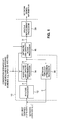
- one embodiment of a general design algorithm 200 of the system proceeds as follows.
- First, the traffic mix F 1 at each link is computed (by routing processor 12) based on an initial network topology G s (from optimization processor 18) which is a subgraph of G , the routing algorithm R , the link metric vector l , and the set of IP demands F (step 202).
- Second, the capacity of each link required to satisfy the bandwidth demands in F 1 is computed (by link capacity requirements processors 14 and 16) based on the type(s) of routers in the network, the different assumptions on congestion scenario, and in some cases the end-to-end delays of the TCP demands (step 204).
- Third, the design system determines whether the final network design (by optimization processor 18) is obtained (step 206).
- step 208 the network topology is perturbed (by optimization processor 18) and the new network cost is evaluated in accordance with steps 202 and 204. This design iteration is then repeated until the final network design is obtained.
- the results of the final design are output (step 210), e.g., in the form of information displayed to the user of the design system, including: (1) the vector C ; (2) the route of each traffic flow f i ; and (3) the corresponding network cost.
- Section 1.0 estimation of required link bandwidth in order to satisfy any given TCP/UDP throughput requirements according to the invention is explained. It is to be appreciated that the worst-case link capacity design requirements processor 14 and the optimistic link capacity design processor 16 are employed in this aspect of the invention.
- Network topology optimization according to the invention as performed by the network topology optimization processor 18, is described in Section 2.0.
- Section 3.0 optimal placement of WFQ/LQD routers in a heterogeneous router network according to the invention, as computed by the router replacement processor 20, is explained.
- Sample IP network design cases are given in Section 4.0.
- Section 5.0 provides an explanation of throughput allocation under FIFO/RED with reference to Section 1.0.
- Section 6.0 provides an explanation of NP-Hardness with reference to the router placement embodiment of the invention explained in Section 3.0. Also, for further ease of reference, certain of these sections are themselves divided into subsections.
- the present invention determines how much capacity must any given link in the network have in order to guarantee a given set of demands each associated with a group of TCP connections routed through this link.
- each group of connections belongs to a different VPN and represents one of the VPN's point-to-point demands.
- the answer to this question depends primarily on the packet scheduling and the buffer management strategies used in the routers of the network. The most popular one in the Internet today uses FIFO scheduling with RED as the packet dropping policy.
- Advanced next-generation routers such as PacketStar IP Switch, however, use a WFQ scheduler with longest queue drop (LQD) policy to provide bandwidth guarantees at the VPN level with the fairness and isolation properties at the flow (or connection) level.
- LQD longest queue drop
- conventional FIFO combined with RED FIFO/RED
- WFQ/LQD WFQ/LQD
- the link capacity processors 14 and 16 compute the link capacity requirements given the demand flow requirements and the selected scheduling and buffering schemes.
- the design considerations at issue due to the use of the FIFO/RED scheme are discussed, as well as the methodologies implemented by the link capacity design processors 14 and 16 for addressing these design issues.
- the design considerations for the WFQ/LQD scheme are discussed, the link capacity requirements of which may be computed by either of the processors 14 and 16.
- embodiments of several link capacity design methods according to the invention are explained in detail.
- ⁇ i and h i are the round trip delay (RTD) and the number of congested links in the path of connection i , respectively.
- RTD round trip delay
- a congested link refers to a link having a high enough load that its queue experiences packet losses, in contrast to a non-congested link which has zero packet loss.
- the link capacity is shared among the competing TCP connections in proportion to their weight which is given in equation (1) as the inverse of the product of the round trip delay ⁇ and the square root of h . Note the following fundamental difference between FIFO/RED and WFQ/LQD.
- connection's weight is under the network operator's control and can be set arbitrarily.
- the weight is dictated by the characteristics of the connection's path, namely ⁇ and h , which to a large extent are not controllable.
- Each point-to-point demand i of a given VPN actually corresponds to a number of TCP connections, each having the same weight w i since they all follow the same shortest path characterized by ⁇ i and h i .
- the parameters involved in the computation of the required link capacity according to equation (5) are d i , ⁇ i , and h i , i ⁇ F l .
- the demands d i are given, the fixed part of the delays ⁇ i (propagation delays) are determined from the shortest path and are expected to be dominant in the wide area (an average queuing delay component could also be added), the value of the third parameter h i is non-trivial.
- h i be the number of hops corresponding to the shortest path of connection i. Obviously, the number of congested hops h i satisfies h i ⁇ h i , ⁇ i ⁇ F l .
- I [ I 1 , I 2 ,..., I
- H [ h 1 , h 2 ,..., h
- H i [ h i1 , h i2 ,..., h
- and H ⁇ 0, 1,..., h i ⁇ x ... x ⁇ 0, 1, ..., h
- g be the mapping between I and H as defined above:
- ⁇ H ⁇ denote the set of H l , I ⁇ E.
- An entry for h i corresponding to demand i appears in every vector H l satisfying l ⁇ p(i), i.e., all links in the path of connection i. If all the entries for the same demand are equal, ⁇ H ⁇ is said to be consistent.
- the vector H with h i being the common entry for demand i in all H l , l ⁇ p(i), is referred to as the common vector of ⁇ H ⁇ .
- ⁇ H ⁇ is said to be feasible if: (i) it is consistent; and (ii) its common vector is feasible.
- c FIFO / l is obtained as: which is now a function of not only H l but H l' for all l ' ⁇ p(i) , which is a subset of ⁇ H ⁇ .
- the reason c FIFO / l is a lower bound is that for any given feasible ⁇ H ⁇ , there may exist some demand idling scenarios that result in shifting the bottleneck of some demands which will then require a capacity larger than c FIFO / l to meet the requirements of the active demands.
- these bounds provide us with upper and lower bounds on link capacities independent of the actual value of H ⁇ H f .
- H one corresponds to the case where each demand has one single congested link on its path, which may not be feasible.
- H hop is feasible and corresponds to the case where all demands are active and greedy and each link carries at least one one-hop demand. Embodiments of these methodologies will be explained below in Section 1.4.
- PacketStar's IP Switch supports 64000 flow queues per output link with a three-level hierarchical WFQ scheduler, e.g., V. P. Kumar, T. V. Lakshman, and D. Stiliadis, "Beyond Best Effort: Router Architectures for the Differentiated Services of Tomorrow's Internet," IEEE Comm. Magazine, Vol. 36, No. 5, pp. 152-164 (March 1998).
- the link capacity is partitioned among different VPNs, within each VPN it can be partitioned based on application classes (e.g., Ftp-like TCP flows, Telnet-like TCP flows, UDP flows, etc.), and finally the bandwidth of each application class can be further partitioned among the flows belonging to that class (typically equal weight at the flow level within each class, but could be made different).
- application classes e.g., Ftp-like TCP flows, Telnet-like TCP flows, UDP flows, etc.
- PacketStar IP Switch uses soft partitioning of a shared buffer pool among all flows.
- a flow can achieve its weight's worth of link capacity (i.e., get a link share proportional to its weight) if it can maintain an adequate backlog of packets in the shared buffer.
- the WFQ scheduler provides fair opportunities for each flow to access the link for packet transmission but this may not translate into a fair share of the link capacity if the flow is unable to sustain an appropriate backlog of packets due to inadequate control of access to the shared buffer.
- This problem could take place for instance when loss-sensitive traffic like TCP is competing with non-loss-sensitive traffic such as uncontrolled UDP, or when TCP connections with different round trip delays (RTD) are competing for the link capacity.
- RTD round trip delays
- TCP throughput is sensitive to packet loss (TCP sources reduce their rate by shrinking their window when packet loss is detected)
- applications that do not adapt their rate according to loss conditions are able to capture an unfair share of the common buffer pool.
- the second scenario of TCP connections with different RTD is a well known problem, e.g., S. Floyd and V. Jacobson, "On Traffic Phase Effects in Packet-Switched Gateways," Internetworking: Research and Experience, Vol. 3, No. 3, pp. 115-156 (Sept. 1992); T. V. Lakshman and U.
- PacketStar IP Switch uses the following buffer management strategy: each flow is allocated a nominal buffer space which is always guaranteed and the flow's buffer occupancy is allowed to exceed this nominal allocation when buffer space is available. This nominal allocation is ideally set proportional to the connection's bandwidth delay product but in the absence of delay information could be set proportional to the connection's weight in the WFQ scheduler.
- This nominal allocation is ideally set proportional to the connection's bandwidth delay product but in the absence of delay information could be set proportional to the connection's weight in the WFQ scheduler.
- the LQD policy alleviates unfairness to large RTD connections.
- non-adaptive sources are likely to have long queues and will be penalized by the LQD policy.
- the flow isolation provided by WFQ combined with the protection and fairness provided by LQD, allow each flow, class of flows, or a VPN's end-to-end demand to obtain a share of the link capacity proportional to its assigned weight, e.g., see B. Suter, T. V. Lakshman, D. Stiliadis, and A K. Choudhury, "Design Considerations for Supporting TCP with Per-flow Queuing," Proc. IEEE Infocom, pp. 299-306, San Francisco (March 1998).
- the scheduler weights and the nominal buffer allocations are set at a given link 1 in such a way that the link capacity needed to meet a set of point-to-point VPN demands d i is simply equal to the sum of the demands, i.e., where F 1 is the set of all VPN demands that are routed through link 1 (i.e. they have link 1 in their shortest path).
- F 1 is the set of all VPN demands that are routed through link 1 (i.e. they have link 1 in their shortest path).
- a larger capacity is needed to meet the same demands when the router can only support FIFO/RED.
- the link capacity requirement for the WFQ/LQD case is given by: and for the FIFO/RED case, the upper bound is: the lower bound is: Furthermore, under the special cases of H hop and H one , the upper and lower bounds are given by: where d UDP / i denotes the UDP throughput requirement for demand i and the ceiling function ⁇ . is introduced to account for the fact that link capacity is discrete (in units of trunk capacity).
- the following are various embodiments of methodologies of the invention for calculating link capacity requirements relevant to the particular design criteria selected by the user of the network design system of the invention. As will be indicated, the methodologies are performed by the worst-case link capacity design requirements processor 14 and/or the optimistic link capacity design processor 16 (FIG. 1).
- a method 300 of computing FIFO/RED-based worst-case link capacity requirements is shown.
- the notation c denotes the link capacity taking into account only the TCP traffic
- C denotes the link capacity taking into account both TCP and UDP traffic.
- the first addition term is the link capacity requirement for TDP traffic
- the second addition term is the link capacity requirement for UDP traffic.
- the worst-case link capacity requirements processor 14 FIG. 1
- such design methodology provides the user of the system 10 with a computation, based on particular input specifications, of link capacity requirements on a link by link basis.
- the processor 14 receives input parameters from routing processor 12 and the user.
- the inputs from processor 12 include the set of point-to-point VPN demands, d i , the round trip delay, ⁇ i , associated with connection i.
- these inputs are initially specified by the user.
- the user specifies the scheduling/buffering scheme, which in this case is FIFO/RED, and the congestion option H 0 (e.g., H worst , H hop , and H one ).
- the congestion option is an assignment of some h i value for the given design criteria.
- h i refers to the number of congested links in the path of connection i.
- H worst is the upper bound defined in equation (15) and, along with the lower bound H best (computed by the optimistic link capacity processor 16) apply to all values of H .
- H one corresponds to the case where each demand has one single congested link on its path, which may not be feasible.
- H hop is feasible and corresponds to the case where all demands are active and greedy and each link carries at least one one-hop demand. It is to be understood that in accordance with the invention, the user need only specify the option H o , since the values of h i corresponding thereto are preferably stored in the memory associated with processor 14.
- step 304 depending on the option chosen by the user, the worst-case link capacity requirements are computed. That is, the link capacity for each link in the current network topology is computed based on the demands, the delay, the scheduling/buffering scheme and congestion option selected. It should be noted that the equations for H worst , H hop , H one shown in step 304 of FIG. 3 are, respectively, the same as the equations (15), (17) and (19) above, with the right side of equation (6) inserted as the first term in the ceiling function. Lastly, the link capacity requirements (denoted as reference designation B in FIG. 1) for each link of the current topology are output to the user via, for example, a display associated with the processor 14.
- the first addition term is the link capacity requirement for TDP traffic and the second addition term is the link capacity requirement for UDP traffic.
- the optimistic link capacity design processor 14 (FIG. 1) based on input from the routing processor 12, the user and the worst-case link capacity requirements processor 14 (i.e., since, the share r i is a function of c FIFO / l ). Accordingly, such design methodology permits the user of the system 10 to compute, based on particular input specifications, link capacity requirements on a link by link basis.
- the processor 16 receives similar input as processor 14, that is, the network topology, the source-destination demands, round trip delay and the congestion scenario selection made by the user. Also, the link capacity requirements computed by the processor 14 are provided to processor 16.
- the user need only specify the option H o (e.g., H best , H hop , H one ), since the values of h i corresponding thereto are preferably stored in the memory associated with processor 16.
- the optimistic link capacity requirements are computed. That is, the link capacity for each link in the current network topology is computed based on the demands, the delay, the scheduling/buffering scheme and congestion option selected.
- the equations for H best , H hop , H one shown in step 404 of FIG. 4 are, respectively, the same as the equations (16), (18), and (20) above, with the right side of equation (6) inserted as the first term in the ceiling function of equation (16) and the right side of equation (8) inserted as the first term in the ceiling function of equations (18) and (20).
- the link capacity requirements (denoted as reference designation D in FIG.
- FIG. 5 a method 500 of computing WFQ/LQD-based link capacity C WFQ / l according to the invention is shown.
- This embodiment assumes that the user has selected the WFQ/LQD scheduling/buffering scheme for his design. As such, it is to be appreciated that computations based on bounds and congestion options are not necessary and, as result, only the VPN demands d i for each link l with respect to TCP/UDP traffic is required as input, in step 502, to compute link capacity requirements. It is also to be appreciated that since upper and lower bounds need not be computed in the WFQ/LQD scheme, either processor 14 or processor 16 may be used to compute such link capacity requirements.
- step 504 the scheduler weights and the nominal buffer allocations are set at a given link 1 in such a way that the link capacity needed to meet a set of point-to-point VPN demands d i is simply equal to the sum of the demands, as per the equation shown in step 506 (which is the same as equation (14)), where F 1 is the set of all VPN demands that are routed through link 1 (i.e. they have link 1 in their shortest path).
- step 508 the link capacity is output to the user (e.g., via a display).
- the network cost is computed based on the following function: where M(.,.) and T(.) are the mileage and termination cost functions, respectively. It is to be appreciated that this cost function is selected for its simplicity and ease of illustration. Other more general forms of cost functions can be readily incorporated with the present invention. It is to be appreciated that the network topology optimization processor 18 preferably computes the network cost. However, processors 14 or 16 could do the same.
- network topology optimization we will consider two embodiments and their variants for network topology optimization. They are the link augmentation approach and the link deloading approach. The process of network topology optimization is also performed by the network topology optimization processor 18. Also, the network topology provided initially to the routing processor 12 for use by the system 10 may be provided by the network topology optimization processor 18 or, alternatively, by the user of system 10.
- a method 600 of optimizing the network topology employing the augmentation approach according to the invention is shown.
- the augmentation approach we start with a proper subgraph G s of G and augment it with additional links and/or capacities until all the demands can be routed.
- G s a subset of the edges in G is selected to form G s .
- the way to form G s is as follows: First, in step 602, all the end-to-end demand flows i are divided into two sets, namely, the keepers and the stragglers, based on their minimum throughput demand d i .
- the criteria is to make demands which require at least one unit of trunk bandwidth as keepers while the rest, i.e.
- step 620 straggler f i is cdnverted to a keeper and then routed along the shortest path in G from its source node to its destination node, adding required capacity along its path. For those links along its path which are not included in the current G s , these links are added onto G s to form the new G s . Then, f i is removed from the working-list L1, in step 618.
- step 612 the list is checked to see if any other stragglers are left (step 612). If there are, then steps 614 through 620 are repeated. If not, the processor proceeds to step 622. Recall that in step 608, the option to select straggler connectivity is given to the user of the design system 10. If the straggler connectivity option is not selected or the straggler connectivity option was selected and completed, the following procedure is performed. All stragglers are placed into a working-list L2, in step 622. As the process progresses, the working-list L2 is iteratively checked to see if there are any more stragglers left (step 624).
- An alternative straggler conversion approach is referred to as direct straggler conversion wherein a straggler is directly converted to a keeper when it cannot be routed on the current G s (step 646). Again, the converted straggler is then routed on G while extra links (if necessary) and capacities are added to augment G s . Due to possible changes in shortest paths after the augmentation of G s , all previously routed stragglers have to be undone, in step 648, and then re-routed (step 622), as in the case of threshold-controlled conversion.
- the output of the optimization processor 18 (denoted as reference designation C in FIG. 1) is a network topology that is preferably provided to the worst-case link capacity requirements processor 14, through the routing processor 12, which then computes link capacity requirements given the topology received, as explained above. Then, as explained in the context of FIG. 2, it is determined if this is the final topology which meets the designers criteria, e.g., due to network cost or validation considerations. If not, the optimization process (whichever one is implemented) is repeated until the final network topology is formulated.
- T FIFO ( C ) and T WFQ ( C ) be the termination cost for a FIFO/RED router and a WFQ/LQD router, respectively, to terminate a link of capacity C .
- M (C, L) be the mileage cost of a link of capacity C and length L , regardless of what type of routers are used.
- the present invention provides the following 2-step process. First, we perform a one-for-one replacement of a selected set of FIFO/RED routers using WFQ/LQD routers which have the same number of interfaces and termination capacity of the routers they replace. Denote such replacement cost for a selected FIFO/RED router i by Q i .
- S i,j _M (C FIFO l , L l ) + T WFQ (C FIFO l )-M (C WFQ l , L l ) - T WFQ (C WFQ l ) _
- C FIFO / l and C WFQ / l are the corresponding capacity requirements for the FIFO/RED and WFQ/LQD case.
- S i,j is a conservative estimate of the actual savings derived from such replacement because it only considers the impact of the capacity requirement on an isolated link-by-link basis. It is possible that extra capacity reduction may be achieved elsewhere in the network when WFQ/LQD routers are added due to their tighter bandwidth control on flows passing through link l .
- N max is an input parameter specifying the maximum number of FIFO/RED routers allowed to be replaced. If N max is set to
- the router replacement processor 20 implements an optimal router replacement software program using standard MIP optimization packages.
- standard MIP optimization packages which may be used include: AMPL, as is known in the art and described in R. Fourer, D. M. Gay and B. W. Kernighan, "AMPL - A Modeling Language For Mathematical Programming," Boyd & Fraser Publishing Company (1993); and CPLEX Mixed Integer Solver from the CPLEX division of ILOG, Inc.
- AMPL as is known in the art and described in R. Fourer, D. M. Gay and B. W. Kernighan, "AMPL - A Modeling Language For Mathematical Programming," Boyd & Fraser Publishing Company (1993); and CPLEX Mixed Integer Solver from the CPLEX division of ILOG, Inc.
- the first case study is based on the topology of NSFNET at the end of 1994.
- FIG. 9 shows this topology which may be used as the full topology G in the design framework of the invention.
- the trunk size is set to 240 units throughout the network.
- FIG. 10A gives the matrix whose entries are the corresponding point-to-point traffic demand used for the example.
- the relative magnitudes of the traffic demands are set according to 1994 statistics reported in Merit Network Information Center Services, "Statistical Reports Pertaining to the NSFNET Backbone Networks," (1994), using the scaling method proposed in R. H. Hwang, "Routing in High-speed Networks," PhD.
- the overall network cost J is computed based on some arbitrary termination cost per trunk and some arbitrary mileage cost per unit length. The termination and mileage costs are assumed to be the same for FIFO/RED and WFQ/LQD routers. While designing the network, we have experimented with the various topology optimization strategies and different network congestion assumptions described in the previous sections.
- the cost of the all-WFQ/LQD case is invariant with respect to different network congestion scenario, the cost of the all-FIFO/RED configuration varies depending on the assumptions of network congestion scenario.
- the all-WFQ/LQD configuration costs less than 1/3 of the all-FIFO/RED one under the worst-case congestion scenario, i.e., based on C FIFO / l ( H worst ). It still costs considerably less even when the very optimistic congestion scenario based on H best is assumed. Observe that there are significant cost differences for the FIFO case when different congestion scenarios are assumed ( H worst , H hop , H one , H best ).
- ⁇ Given a final network topology G s ( V ', E' ) and the associated link capacities C l 's for satisfying the minimum throughput requirements d i 's, ⁇ is defined as: To motivate the definition of ⁇ , let us consider an individual link 1 and the corresponding ratio Ideally, if link capacity is available in continuous units as opposed to discrete steps of trunk size, and if ideal link bandwidth scheduling and buffer management is available, it should suffice to have equal to one to meet minimum throughput requirements of all the demands. When the same argument is applied to all the links in the network, it is clear that the ideal (minimum) value of ⁇ is also equal to one.
- ⁇ is slightly greater than one for the WFQ/LQD case which is merely due to the discrete nature of link capacity.
- much greater capacity overbuild is required for the FIFO/RED cases due to the lack of adequate traffic management capabilities in the FIFO/RED routers, i.e., excess link capacity is needed to overcome the inherent unfairness of TCP in order to satisfy the minimum throughput requirements.
- Such performance is typical among other design cases we have tested and can be attributed to the effects of a lack of adaptation while classifying demands as keepers or stragglers: once a threshold is selected, each demand is classified and typically never converted.
- the selected threshold is such that the connectivity of the subgraph G s formed by the keepers is not rich enough so that some demands have to traverse longer paths than in the case of the other more optimal topologies.
- One possible way to enhance the "capacity-only" augmentation approach is to try multiple thresholds and select the one which yields the lowest network cost.
- link deloading-only approach tries to deload almost all of the links in G while the augmentation approach can speed-up the process by rapidly selecting a subset of links to form the "core" topology via the routing of the keepers.
- link deloading typically results in equal or better network cost, it is advisable to apply it after the augmentation approach is completed. By doing so, we have observed an additional cost savings ranging from 0 to 15% in various design cases that we carried out.
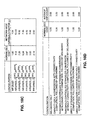
- FIG. 10H shows the corresponding cost reductions when different portions of the routers in the all-FIFO/RED configuration are replaced with optimally located WFQ/LQD routers.
- 10% of the FIFO/RED routers are optimally replaced by WFQ/LQD routers, there is about 15% reduction in network cost.
- the large cost reduction is due to large capacity reduction of expensive (long-haul) links.
- the fraction of WFQ/LQD routers increases to 20% and subsequently to 30%, the cost reduction is still considerable.
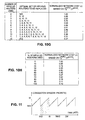
- connection's congestion window behaves as a periodic sawtooth as shown in FIG. 11.
- W max the maximum window size
- the window opens by one every round trip time (which implies that the slope in FIG. 11 is equal to one) and each cycle lasts W /2 round trips ( ⁇ ⁇ W /2).
- connection i 1 - (1 - p 0 ) hi
- h i the number of congested hops in the path of the TCP connection.
- j 1 , j 2 ,...,j hi be the ordered set of congested links in the path of connection i with j 1 and j hi being the first and last congested links traversed by connection i, respectively. If N packets of connection i are transmitted at the source, then p 0 N are dropped at link j 1 and ( 1 -p 0 ) N are successfully transmitted.
- Equation (27) From equation (27) we obtain the value of ⁇ as: and the throughput share of connection i as: Simulations are used in the above-referenced Mathis et al. article to validate the result in equation (24). In the above-referenced Floyd article, a different approach is used to derive and validate through simulations a similar result for the special case mentioned above with two connections per link. However, the result we obtained in equation (28) is a generalization to arbitrary topology with arbitrary TCP traffic pattern and recognizes the weighted nature of the throughput allocation.
- the invention may also implement other heuristics to solve the NP-hard router-placement problem.
- the invention may be used for designing, for example, an infrastructure for supporting differentiated services via a two-tier network that combines a homogeneous WFQ/LQD router network with a homogeneous FIFO/RED router network.
- the TCP throughput model may be extended to cover regimes where time-outs and/or maximum receiver/sender window size dominate, as well as to cover other types of packet scheduling such as WFQ among classes and FIFO among the flows of each class.
Landscapes
- Engineering & Computer Science (AREA)
- Computer Networks & Wireless Communication (AREA)
- Signal Processing (AREA)
- Data Exchanges In Wide-Area Networks (AREA)
Applications Claiming Priority (2)
| Application Number | Priority Date | Filing Date | Title |
|---|---|---|---|
| US09/198,727 US6795399B1 (en) | 1998-11-24 | 1998-11-24 | Link capacity computation methods and apparatus for designing IP networks with performance guarantees |
| US198727 | 2002-07-17 |
Publications (1)
| Publication Number | Publication Date |
|---|---|
| EP1005193A2 true EP1005193A2 (de) | 2000-05-31 |
Family
ID=22734554
Family Applications (1)
| Application Number | Title | Priority Date | Filing Date |
|---|---|---|---|
| EP99309097A Withdrawn EP1005193A2 (de) | 1998-11-24 | 1999-11-16 | Verfahren zur Berechnung von Leitungskapazität und Gerät zum Entwurf von IP Netzwerken mit Leistungsgarantien |
Country Status (5)
| Country | Link |
|---|---|
| US (1) | US6795399B1 (de) |
| EP (1) | EP1005193A2 (de) |
| JP (1) | JP2000165450A (de) |
| KR (1) | KR20000035662A (de) |
| CA (1) | CA2285789A1 (de) |
Cited By (4)
| Publication number | Priority date | Publication date | Assignee | Title |
|---|---|---|---|---|
| DE10116835A1 (de) * | 2001-04-04 | 2002-10-17 | Alcatel Sa | Netzplanungswerkzeug zur Bestimmung der optimalen Restaurationskapazität bei Verbindungsunterbrechung in einem TK-Netzwerk |
| KR100856647B1 (ko) * | 2002-04-22 | 2008-09-03 | 주식회사 케이티 | IP(Internet Protocol)망 설계 시스템 |
| KR100920117B1 (ko) * | 2002-09-30 | 2009-10-01 | 주식회사 케이티 | 버스티한 트래픽 특성을 고려한 ip망의 링크 용량 설계 방법과 서비스 품질 검증방법 |
| WO2019101085A1 (zh) * | 2017-11-22 | 2019-05-31 | 华为技术有限公司 | 链路优先级设置方法及装置 |
Families Citing this family (61)
| Publication number | Priority date | Publication date | Assignee | Title |
|---|---|---|---|---|
| US7027448B2 (en) * | 2000-04-21 | 2006-04-11 | At&T Corp. | System and method for deriving traffic demands for a packet-switched network |
| US7111163B1 (en) | 2000-07-10 | 2006-09-19 | Alterwan, Inc. | Wide area network using internet with quality of service |
| JP3578062B2 (ja) * | 2000-08-09 | 2004-10-20 | 日本電気株式会社 | 通信ネットワーク設計回路及びその設計方法並びにその制御プログラムを記録した記録媒体及び伝送媒体 |
| US7194549B1 (en) * | 2000-09-06 | 2007-03-20 | Vulcan Patents Llc | Multicast system using client forwarding |
| US7363367B2 (en) | 2000-10-17 | 2008-04-22 | Avaya Technology Corp. | Systems and methods for robust, real-time measurement of network performance |
| US7336613B2 (en) | 2000-10-17 | 2008-02-26 | Avaya Technology Corp. | Method and apparatus for the assessment and optimization of network traffic |
| US7720959B2 (en) * | 2000-10-17 | 2010-05-18 | Avaya Inc. | Method and apparatus for characterizing the quality of a network path |
| US7349994B2 (en) | 2000-10-17 | 2008-03-25 | Avaya Technology Corp. | Method and apparatus for coordinating routing parameters via a back-channel communication medium |
| EP1356634B1 (de) | 2000-10-17 | 2010-02-24 | Avaya Technology Corp. | Verfahren und vorrichtung zur optimierung der leistung und des kosten in einem internetzwerk |
| US8023421B2 (en) | 2002-07-25 | 2011-09-20 | Avaya Inc. | Method and apparatus for the assessment and optimization of network traffic |
| US7406539B2 (en) | 2000-10-17 | 2008-07-29 | Avaya Technology Corp. | Method and apparatus for performance and cost optimization in an internetwork |
| US7756032B2 (en) | 2000-10-17 | 2010-07-13 | Avaya Inc. | Method and apparatus for communicating data within measurement traffic |
| US7149187B1 (en) * | 2000-12-28 | 2006-12-12 | Cisco Technology, Inc. | Random early detection policer using randomization of packet drops |
| US7230924B2 (en) * | 2001-03-28 | 2007-06-12 | At&T Corp. | Method and apparatus for communications traffic engineering |
| AU2002310411A1 (en) * | 2001-06-14 | 2003-01-02 | Cariden Technologies Incorporated | Methods and systems to generate and implement a changeover sequence to reconfigure a connection-oriented network |
| US7787370B1 (en) * | 2001-09-06 | 2010-08-31 | Nortel Networks Limited | Technique for adaptively load balancing connections in multi-link trunks |
| AU2002326995A1 (en) * | 2001-09-19 | 2003-04-01 | Bay Microsystems, Inc. | Vertical instruction and data processing in a network processor architecture |
| US20030088620A1 (en) * | 2001-11-05 | 2003-05-08 | Microsoft Corporation | Scaleable message dissemination system and method |
| US20030214908A1 (en) * | 2002-03-19 | 2003-11-20 | Anurag Kumar | Methods and apparatus for quality of service control for TCP aggregates at a bottleneck link in the internet |
| JP3805710B2 (ja) * | 2002-04-03 | 2006-08-09 | 株式会社日立製作所 | トラフィック流量の制御方法及びその装置 |
| US7263069B2 (en) * | 2002-07-03 | 2007-08-28 | Verizon Business Global Llc | Arrangement for evaluating network capacity, network utilization, and network efficiency in a communications network |
| US7305464B2 (en) * | 2002-09-03 | 2007-12-04 | End Ii End Communications, Inc. | Systems and methods for broadband network optimization |
| US7961594B2 (en) * | 2002-10-23 | 2011-06-14 | Onaro, Inc. | Methods and systems for history analysis for access paths in networks |
| AU2003295356A1 (en) * | 2002-10-23 | 2004-05-13 | Onaro | Method and system for validating logical end-to-end access paths in storage area networks |
| US7546333B2 (en) * | 2002-10-23 | 2009-06-09 | Netapp, Inc. | Methods and systems for predictive change management for access paths in networks |
| US7426562B1 (en) * | 2003-07-11 | 2008-09-16 | At&T Corp. | Method for network capacity planning with proper accounting of spare capacity |
| US7987250B2 (en) * | 2003-07-30 | 2011-07-26 | International Business Machines Corporation | Maximum clique in a graph |
| US7283814B2 (en) * | 2003-07-31 | 2007-10-16 | Lucent Technologies Inc. | Method and apparatus for scheduling transmissions in wireless data networks |
| US20080089347A1 (en) * | 2003-08-29 | 2008-04-17 | End Ii End Communications Inc. | Systems and methods for broadband network optimization |
| JP4213546B2 (ja) * | 2003-09-09 | 2009-01-21 | 富士通株式会社 | 通信装置および通信方法 |
| US7626948B1 (en) * | 2003-09-12 | 2009-12-01 | Cisco Technology, Inc. | System and method for verifying the validity of a path in a network environment |
| US7386606B2 (en) * | 2003-09-12 | 2008-06-10 | Microsoft Corporation | Self-organizing overlay networks |
| US7610361B2 (en) * | 2004-01-05 | 2009-10-27 | At&T Intellectual Property I, L.P. | System and method for ethernet network design |
| WO2006137764A1 (en) * | 2005-06-22 | 2006-12-28 | Telefonaktiebolaget Lm Ericsson (Publ) | Method and arrangement for route cost determination and selection with link cost interaction. |
| US7532632B2 (en) | 2005-07-08 | 2009-05-12 | At&T Intellectual Property Ii, L.P. | Method for controlling memory consumption in router-based virtual private networks |
| US7532586B2 (en) * | 2005-07-18 | 2009-05-12 | Sbc Knowledge Ventures, L.P. | Method of augmenting deployed networks |
| JP5060485B2 (ja) | 2005-09-27 | 2012-10-31 | オナロ インコーポレイテッド | 複製データの可用性及び最新性を検証するための方法及びシステム。 |
| US7710896B2 (en) * | 2005-12-21 | 2010-05-04 | Sri International | Ad-hoc network routing metric optimization |
| US20080173167A1 (en) * | 2006-09-15 | 2008-07-24 | Armor Holdings | Vehicular based mine blast energy mitigation structure |
| US7660261B2 (en) * | 2006-11-14 | 2010-02-09 | The Trustees Of Columbia University In The City Of New York | Systems and methods for computing data transmission characteristics of a network path based on single-ended measurements |
| US20080140469A1 (en) * | 2006-12-06 | 2008-06-12 | International Business Machines Corporation | Method, system and program product for determining an optimal configuration and operational costs for implementing a capacity management service |
| US7986713B2 (en) * | 2006-12-09 | 2011-07-26 | Mark Henrik Sandstrom | Data byte load based network byte-timeslot allocation |
| US8826032B1 (en) | 2006-12-27 | 2014-09-02 | Netapp, Inc. | Systems and methods for network change discovery and host name resolution in storage network environments |
| US8332860B1 (en) | 2006-12-30 | 2012-12-11 | Netapp, Inc. | Systems and methods for path-based tier-aware dynamic capacity management in storage network environments |
| JP2008226181A (ja) * | 2007-03-15 | 2008-09-25 | Fujitsu Ltd | 並列実行プログラム、該プログラムを記録した記録媒体、並列実行装置および並列実行方法 |
| US9042263B1 (en) | 2007-04-06 | 2015-05-26 | Netapp, Inc. | Systems and methods for comparative load analysis in storage networks |
| US20090028559A1 (en) * | 2007-07-26 | 2009-01-29 | At&T Knowledge Ventures, Lp | Method and System for Designing a Network |
| DK2083532T3 (da) * | 2008-01-23 | 2014-02-10 | Comptel Corp | Konvergerende formidlingssystem med forbedret dataoverføring |
| EP2107464A1 (de) | 2008-01-23 | 2009-10-07 | Comptel Corporation | Konvergentes Vermittlungssystem mit dynamischer Ressourcenzuweisung |
| US7970905B2 (en) * | 2008-07-03 | 2011-06-28 | International Business Machines Corporation | Method, system and computer program product for server selection, application placement and consolidation planning of information technology systems |
| JP5327915B2 (ja) * | 2009-02-02 | 2013-10-30 | レベル スリー コミュニケーションズ,エルエルシー | ネットワークトラフィックの分析 |
| US8595374B2 (en) * | 2010-12-08 | 2013-11-26 | At&T Intellectual Property I, L.P. | Method and apparatus for capacity dimensioning in a communication network |
| US8862744B2 (en) * | 2012-02-14 | 2014-10-14 | Telefonaktiebolaget L M Ericsson (Publ) | Optimizing traffic load in a communications network |
| CN103731357B (zh) * | 2012-10-15 | 2018-02-27 | 中兴通讯股份有限公司 | 网络拓扑结构的确定方法及装置 |
| US9444748B2 (en) | 2013-03-15 | 2016-09-13 | International Business Machines Corporation | Scalable flow and congestion control with OpenFlow |
| US9596192B2 (en) | 2013-03-15 | 2017-03-14 | International Business Machines Corporation | Reliable link layer for control links between network controllers and switches |
| US9609086B2 (en) | 2013-03-15 | 2017-03-28 | International Business Machines Corporation | Virtual machine mobility using OpenFlow |
| US9407560B2 (en) * | 2013-03-15 | 2016-08-02 | International Business Machines Corporation | Software defined network-based load balancing for physical and virtual networks |
| US9769074B2 (en) | 2013-03-15 | 2017-09-19 | International Business Machines Corporation | Network per-flow rate limiting |
| US9686142B2 (en) * | 2013-09-30 | 2017-06-20 | International Business Machines Corporation | Node-pair process scope definition and scope selection computation |
| US11510073B2 (en) * | 2020-10-23 | 2022-11-22 | At&T Intellectual Property I, L.P. | Mobility backhaul bandwidth on demand |
-
1998
- 1998-11-24 US US09/198,727 patent/US6795399B1/en not_active Expired - Fee Related
-
1999
- 1999-10-08 CA CA002285789A patent/CA2285789A1/en not_active Abandoned
- 1999-11-16 EP EP99309097A patent/EP1005193A2/de not_active Withdrawn
- 1999-11-22 JP JP33131199A patent/JP2000165450A/ja active Pending
- 1999-11-24 KR KR1019990052510A patent/KR20000035662A/ko not_active Withdrawn
Cited By (5)
| Publication number | Priority date | Publication date | Assignee | Title |
|---|---|---|---|---|
| DE10116835A1 (de) * | 2001-04-04 | 2002-10-17 | Alcatel Sa | Netzplanungswerkzeug zur Bestimmung der optimalen Restaurationskapazität bei Verbindungsunterbrechung in einem TK-Netzwerk |
| KR100856647B1 (ko) * | 2002-04-22 | 2008-09-03 | 주식회사 케이티 | IP(Internet Protocol)망 설계 시스템 |
| KR100920117B1 (ko) * | 2002-09-30 | 2009-10-01 | 주식회사 케이티 | 버스티한 트래픽 특성을 고려한 ip망의 링크 용량 설계 방법과 서비스 품질 검증방법 |
| WO2019101085A1 (zh) * | 2017-11-22 | 2019-05-31 | 华为技术有限公司 | 链路优先级设置方法及装置 |
| US11356386B2 (en) | 2017-11-22 | 2022-06-07 | Huawei Technologies Co., Ltd. | Method and apparatus for setting link priority |
Also Published As
| Publication number | Publication date |
|---|---|
| KR20000035662A (ko) | 2000-06-26 |
| CA2285789A1 (en) | 2000-05-24 |
| JP2000165450A (ja) | 2000-06-16 |
| US6795399B1 (en) | 2004-09-21 |
Similar Documents
| Publication | Publication Date | Title |
|---|---|---|
| US6795399B1 (en) | Link capacity computation methods and apparatus for designing IP networks with performance guarantees | |
| US6909700B1 (en) | Network topology optimization methods and apparatus for designing IP networks with performance guarantees | |
| US6240463B1 (en) | Router placement methods and apparatus for designing IP networks with performance guarantees | |
| Bera et al. | FlowStat: Adaptive flow-rule placement for per-flow statistics in SDN | |
| US6584071B1 (en) | Routing with service level guarantees between ingress-egress points in a packet network | |
| US9197544B2 (en) | Comprehensive multipath routing for congestion and quality-of-service in communication networks | |
| US8493869B2 (en) | Distributed constraints-based inter-domain network traffic management | |
| US20040196787A1 (en) | Managing congestion and traffic flow by considering the minimization of link utilization values | |
| Benmohamed et al. | Designing IP networks with performance guarantees | |
| Wu et al. | Capacity planning of DiffServ networks with Best-Effort and Expedited Forwarding traffic | |
| Magaña et al. | Router scheduling configuration based on the maximization of benefit and carried best effort traffic | |
| Simon et al. | End-to-end relative Differentiated Services for IP networks | |
| Vutukury et al. | SMART: A scalable multipath architecture for intra-domain QoS provisioning | |
| Wang et al. | Routing algorithms for supporting resource reservation | |
| MXPA99010767A (en) | Network topology optimization methods and devices for designing internet protocol networks with functional warranties | |
| Lassila et al. | Dimensioning of data networks: a flow‐level perspective | |
| Lemeshko et al. | Traffic Engineering QoS-Driven Disjoint Path Routing Model Research | |
| He et al. | From multiple decompositions to TRUMP: Traffic management using multipath protocol | |
| MXPA99010769A (en) | Methods and apparatus for locating channels to design internet protocol networks congarantias de funcionamie | |
| Yilmaz et al. | Unicast Routing: Cost-Performance Tradeoffs | |
| Atov et al. | Framework for capacity planning of multiservice IP networks | |
| Balandin et al. | Closed equation to incorporate quality of service criteria in network planning | |
| Naumov | Aggregate multipath QoS routing in the Internet | |
| Murphy | A flexible, abstract network optimisation framework and its application to telecommunications network design and configuration problems | |
| He | Rethinking traffic management: Design of optimizable networks |
Legal Events
| Date | Code | Title | Description |
|---|---|---|---|
| PUAI | Public reference made under article 153(3) epc to a published international application that has entered the european phase |
Free format text: ORIGINAL CODE: 0009012 |
|
| AK | Designated contracting states |
Kind code of ref document: A2 Designated state(s): AT BE CH CY DE DK ES FI FR GB GR IE IT LI LU MC NL PT SE |
|
| AX | Request for extension of the european patent |
Free format text: AL;LT;LV;MK;RO;SI |
|
| STAA | Information on the status of an ep patent application or granted ep patent |
Free format text: STATUS: THE APPLICATION HAS BEEN WITHDRAWN |
|
| 18W | Application withdrawn |
Effective date: 20010824 |