EP1005186A2 - Verfahren und Vorrichtung für die Verteilung von audiovisuellen Informationen von einem Server und Gerät für die Wiedergabe dieser Informationen - Google Patents
Verfahren und Vorrichtung für die Verteilung von audiovisuellen Informationen von einem Server und Gerät für die Wiedergabe dieser Informationen Download PDFInfo
- Publication number
- EP1005186A2 EP1005186A2 EP99309429A EP99309429A EP1005186A2 EP 1005186 A2 EP1005186 A2 EP 1005186A2 EP 99309429 A EP99309429 A EP 99309429A EP 99309429 A EP99309429 A EP 99309429A EP 1005186 A2 EP1005186 A2 EP 1005186A2
- Authority
- EP
- European Patent Office
- Prior art keywords
- information
- chargeable
- allotting
- center
- recording medium
- Prior art date
- Legal status (The legal status is an assumption and is not a legal conclusion. Google has not performed a legal analysis and makes no representation as to the accuracy of the status listed.)
- Withdrawn
Links
Images




Classifications
-
- H—ELECTRICITY
- H04—ELECTRIC COMMUNICATION TECHNIQUE
- H04N—PICTORIAL COMMUNICATION, e.g. TELEVISION
- H04N7/00—Television systems
- H04N7/16—Analogue secrecy systems; Analogue subscription systems
- H04N7/173—Analogue secrecy systems; Analogue subscription systems with two-way working, e.g. subscriber sending a programme selection signal
- H04N7/17309—Transmission or handling of upstream communications
- H04N7/17336—Handling of requests in head-ends
-
- H—ELECTRICITY
- H04—ELECTRIC COMMUNICATION TECHNIQUE
- H04N—PICTORIAL COMMUNICATION, e.g. TELEVISION
- H04N21/00—Selective content distribution, e.g. interactive television or video on demand [VOD]
- H04N21/20—Servers specifically adapted for the distribution of content, e.g. VOD servers; Operations thereof
- H04N21/25—Management operations performed by the server for facilitating the content distribution or administrating data related to end-users or client devices, e.g. end-user or client device authentication, learning user preferences for recommending movies
- H04N21/254—Management at additional data server, e.g. shopping server, rights management server
- H04N21/2543—Billing, e.g. for subscription services
-
- H—ELECTRICITY
- H04—ELECTRIC COMMUNICATION TECHNIQUE
- H04N—PICTORIAL COMMUNICATION, e.g. TELEVISION
- H04N21/00—Selective content distribution, e.g. interactive television or video on demand [VOD]
- H04N21/40—Client devices specifically adapted for the reception of or interaction with content, e.g. set-top-box [STB]; Operations thereof
- H04N21/43—Processing of content or additional data, e.g. demultiplexing additional data from a digital video stream; Elementary client operations, e.g. monitoring of home network or synchronising decoder's clock; Client middleware
- H04N21/433—Content storage operation, e.g. storage operation in response to a pause request, caching operations
- H04N21/4331—Caching operations, e.g. of an advertisement for later insertion during playback
-
- H—ELECTRICITY
- H04—ELECTRIC COMMUNICATION TECHNIQUE
- H04N—PICTORIAL COMMUNICATION, e.g. TELEVISION
- H04N21/00—Selective content distribution, e.g. interactive television or video on demand [VOD]
- H04N21/40—Client devices specifically adapted for the reception of or interaction with content, e.g. set-top-box [STB]; Operations thereof
- H04N21/43—Processing of content or additional data, e.g. demultiplexing additional data from a digital video stream; Elementary client operations, e.g. monitoring of home network or synchronising decoder's clock; Client middleware
- H04N21/442—Monitoring of processes or resources, e.g. detecting the failure of a recording device, monitoring the downstream bandwidth, the number of times a movie has been viewed, the storage space available from the internal hard disk
- H04N21/44204—Monitoring of content usage, e.g. the number of times a movie has been viewed, copied or the amount which has been watched
-
- H—ELECTRICITY
- H04—ELECTRIC COMMUNICATION TECHNIQUE
- H04N—PICTORIAL COMMUNICATION, e.g. TELEVISION
- H04N21/00—Selective content distribution, e.g. interactive television or video on demand [VOD]
- H04N21/40—Client devices specifically adapted for the reception of or interaction with content, e.g. set-top-box [STB]; Operations thereof
- H04N21/47—End-user applications
- H04N21/472—End-user interface for requesting content, additional data or services; End-user interface for interacting with content, e.g. for content reservation or setting reminders, for requesting event notification, for manipulating displayed content
- H04N21/47202—End-user interface for requesting content, additional data or services; End-user interface for interacting with content, e.g. for content reservation or setting reminders, for requesting event notification, for manipulating displayed content for requesting content on demand, e.g. video on demand
-
- H—ELECTRICITY
- H04—ELECTRIC COMMUNICATION TECHNIQUE
- H04N—PICTORIAL COMMUNICATION, e.g. TELEVISION
- H04N21/00—Selective content distribution, e.g. interactive television or video on demand [VOD]
- H04N21/60—Network structure or processes for video distribution between server and client or between remote clients; Control signalling between clients, server and network components; Transmission of management data between server and client, e.g. sending from server to client commands for recording incoming content stream; Communication details between server and client
- H04N21/65—Transmission of management data between client and server
- H04N21/658—Transmission by the client directed to the server
- H04N21/6582—Data stored in the client, e.g. viewing habits, hardware capabilities, credit card number
-
- H—ELECTRICITY
- H04—ELECTRIC COMMUNICATION TECHNIQUE
- H04N—PICTORIAL COMMUNICATION, e.g. TELEVISION
- H04N5/00—Details of television systems
- H04N5/76—Television signal recording
- H04N5/91—Television signal processing therefor
- H04N5/913—Television signal processing therefor for scrambling ; for copy protection
- H04N2005/91357—Television signal processing therefor for scrambling ; for copy protection by modifying the video signal
- H04N2005/91364—Television signal processing therefor for scrambling ; for copy protection by modifying the video signal the video signal being scrambled
Definitions
- This invention relates to an information furnishing system and an information furnishing method for sending the chargeable information including video and/or audio data from an information center to a subscriber, and an information reproducing apparatus provided on the side of the subscriber.
- the information such as video, audio or game
- the information is furnished unidirectionally via a ground wave or satellite television, while it is not possible to receive the service such as receiving and viewing a software the subscriber desires to view at a desired time.
- a rental system such as video rental, other than the broadcast, in which the software can be selected by the user and can be viewed and stopped or rewound as desired by the user.
- This system has a drawback that the user has to borrow the software at a video rental shop and to return it after replay, which significantly inconveniences the user.
- VOD video-on-demand
- CATV cable television
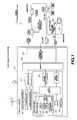
- This VOD cable television system is made up of a cable television center 51, furnishing the chargeable information, a wired transmission unit 70 for transmitting the chargeable information from the cable television center 51 and a set top box 80 for receiving the chargeable information furnished from the cable television center 51 over the wired transmission unit 70 for reproduction in the user's premises, as shown in Fig.1.
- a system having the function in which the user can stop or rewind the software at a desired time.
- a system which can furnish as many as 10,000 titles of video software for selection and use by the user.
- This system can furnish the service comparable to that furnished by the video rental shop such that a large quantities of the software are present and available for the user for selection and replay on the VTR without the user having to borrow or return the video software at the video rental shop.
- the cable television center 51 to store as many as thousands and even tens of thousands of titles of the video software and to furnish them speedily and interactively responsive to user's requests.
- the chargeable information is digitized and stored in the video server 52 which is made up of a large number of recording mediums, such as hard discs 53, CD-ROMs 54, DVDs 55 and VTRs 56, and transient storage mediums, such as hard discs or RAMs 57.
- recording mediums such as hard discs 53, CD-ROMs 54, DVDs 55 and VTRs 56
- transient storage mediums such as hard discs or RAMs 57.
- a scheduler 58 is responsive to a request by a user to retrieve a title requested by the user and controls the video server 52 to supply the retrieved title to the user.
- the current transmission path of the CATV is an analog transmission path presupposed to be used for broadcast re-transmission, as shown in Fig.2, with the most prevalent one bing such a transmission path designed to render broadcast services for up to approximately 50 channels with the transmission band of approximately 450 MHz.
- the current transmission capacity of the CATV is insufficient to process and transmit the requested software if hundreds or thousands of requests occur simultaneously in a concentrated fashion, such that it is necessary to alter or supplement the current transmission equipment to a large-capacity analog transmission path that is able to furnish a large quantity of the digital data.
- the transmission band for the CATV is prevalently 450 MHz. If the totality of transmission paths of analog modulation is to be changed to the transmission paths of digital modulation, the number of channels that can be transmitted simultaneously is approximately 200, which is about four times as many as that for analog modulation, as shown in Fig.3A.
- the band is extended to 650 MHz, it is possible to increase the number of channels to 320.
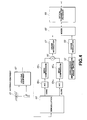
- the routine broadcast is received over an antenna equipment 61 and amplified by a head end equipment 62.
- the video and audio are demodulated by a demodulator 63.
- the video and audio signals are converted by A/D converters 64, 64A into digital signals, which then are compressed in signal volume by compressors 65V and 65A, using a compression method, such as MPEG2.
- the video and audio signals then are multiplexed in a digital system by an adder 66.
- the multiplexed signals are modulated by 64 QAM (quadrature amplitude modulation) unit 67 and frequency multiplexed by a mixer 68.
- the resulting multiplexed signals then are transmitted to a wired transmission unit 70 via an optical transmission/reception unit 69.
- the VOD system selects the demanded video title from the video server 52 in which a number of video titles are stored under compression.
- the selected video title is modulated by 64 QAM modulation by a QAM modulation unit 59 and frequency multiplexed by the mixer 68.
- the pre-existing system needs to be changed significantly.
- the capacity for concurrent transmission that can be acquired is 120 channels at most. If the serviceability for subscribers simultaneously employing the network is assumed to be 10% at the maximum, the number of subscribed that can be connected simultaneously to the network is 1000. If the number of the subscribers to the CATV is 10000, it is necessary to provide approximately 10 transmission paths branched from the CATV station.
- the video server 52 is also required to have the capabilities of concurrently processing hundreds or even thousands of titles, so that the server is required to be of large capacity and fast access type, whilst the control software of the server is required to have the capability of intricately supervising the server.
- the copyright has accrued in this system in the information utilized by the user. Since the information is distributed among household servers in each home, there is a possibility of jeopardizing the right of the copyright owner such as unauthorized use or duplication.
- the present invention provides an information allotting system for allotting the chargeable information composed of data including video data and/or audio data, including an allotting center for allotting the chargeable information, and information terminal means for storing the chargeable information allotted from the allotting center.
- the allotting center allots the chargeable information based on the categories of the chargeable information transmitted from the allotting center. If the chargeable information in the stored categories is reproduced and used, the information terminal means transmits the using information corresponding to the use to the allotting center.
- the present invention provides an information allotting system for allotting the chargeable information composed of data including video data and/or audio data, including an allotting center for allotting the chargeable information, and information terminal means for storing the chargeable information allotted from the allotting center.
- the information terminal means includes reproducing means for reproducing the stored chargeable information, decoding means for decoding the chargeable information on coincidence of the encryption information appended to the chargeable information outputted from the reproducing means with the encryption information of the information terminal means, and storage means for storing the hysteresis information testifying to the decoding of the chargeable information.
- the allotting center charges the information terminal means based on the hysteresis information.
- the present invention provides an information allotting system for allotting the chargeable information composed of data including video data and/or audio data, including an allotting center for allotting the chargeable information, and information terminal means having reproducing means for reproducing the chargeable information from a removable recording medium in which the chargeable information allotted from the allotting center is stored.
- the information terminal means further includes decoding means for decoding the chargeable information on coincidence ofthe encryption information appended to the chargeable information outputted from the reproducing means with the encryption information of the information terminal means, and storage means for storing the hysteresis information testifying to the decoding of the chargeable information.
- the allotting center charges the information terminal means based on the hysteresis information.
- the present invention provides an information transmission apparatus for transmitting the chargeable information composed of data including image and/or audio data to an information terminal including supervising means for being fed with the category information of the chargeable information transmitted from the information terminal to output an output control command which performs control to output the chargeable information included in the category information, and output means for outputting the chargeable information recorded on a recording medium to the information terminal based on the output control command from the supervising means.
- the present invention provides an information reception apparatus for receiving the chargeable information composed of data including video and/or audio data allotted from the allotting center, including transmission means for transmitting the information specifying the category in the chargeable information to the allotting center, reproducing means for reproducing the chargeable information from a recording medium on which has been recorded the chargeable information allotted from the allotting center based on the category information, control means for controlling the recording and/or reproducing means in such a manner as to select the desired chargeable information from the titles of the chargeable information recorded on the recording medium and to reproduce the chargeable information recorded on the recording medium, and storage means for storing the hysteresis information indicating that the chargeable information has been used.
- the present invention provides an information allotting method for allotting the chargeable information composed of data including video and/or audio data from an allotting center to each information terminal, including a first step of transmitting the category-specifying category information of the chargeable information from the information terminal to the allotting center, a second step of allotting the chargeable information from the allotting center to the information terminal, based on the category information, irrespective of whether the allotted information will be used by the information terminal, and a third step of selectively reproducing the chargeable information allotted by the information terminal.
- the present invention provides an information allotting method for allotting the chargeable information composed of data including video and/or audio data from an allotting center to each information terminal, including a first step of transmitting the category-specifying category information of the chargeable information from the information terminal to the allotting center, a second step of allotting the chargeable information from the allotting center to the information terminal, based on the category information, irrespective of whether the allotted information will be used by the information terminal, a third step of decoding the chargeable information on coincidence of the encryption information appended to the chargeable information with the encryption information of each information terminal on reproducing the chargeable information and of transmitting the hysteresis information specifying the fact of use of the chargeable information to the allotting center and a fourth step of charging the information terminal by the allotting center based on the hysteresis information.
- the present invention provides an information allotting method for allotting the chargeable information composed of data including video and/or audio data from an allotting center to each information terminal, including a first step of appending the encryption information discriminating each information terminal to the chargeable information stored in the allotting center, a second step of recording the chargeable information, to which has been appended the encryption information, on a removable recording medium, a third step of selectively reproducing the chargeable information recorded on the removable recording medium, at the information terminal, a fourth step of decoding the chargeable information on coincidence of the encryption information contained in the reproduced chargeable information with the encryption information of the information terminal and storing the hysteresis information specifying that the encryption information has been decrypted, and a fifth step of charging the information terminal by the allotting center based on the stored hysteresis information.
- the present invention provides an information transmitting method for allotting the chargeable information composed of data including video and/or audio data from an allotting center to each information terminal, including a first step of receiving the category-specifying category information of the chargeable information from the information terminal to the allotting center and a second step of transmitting the chargeable information contained in the category information to each information terminal irrespective of whether or not the chargeable information is used by each information terminal.
- the present invention provides an information receiving method for receiving the chargeable information allotted from an allotting center, the chargeable information being composed of data including video and/or audio data, including a first step of transmitting the category-specifying category information, in the chargeable information, to the allotting center, a second step of selectively reproducing the chargeable information included in the category information from titles of the chargeable information, a third step of storing the hysteresis information specifying the fact of use of the chargeable information and a fourth step of transmitting the stored hysteresis information to the allotting center.
- Fig.1 is a block diagram showing the structure of a conventional VOD cable system.
- Fig.2 is a diagrammatic view showing the transmission band of the transmission path for the current CATV with respect to the frequency.
- Figs.3A and 3B are diagrammatic views showing specified examples of changing the totality of transmission bands of the current CATV to transmission paths of digital modulation.
- Fig.4 is a block diagram showing the structure of a CATV station of the all-digital transmission system employing an analog transmission path.
- Fig.5 illustrates the problems of the number of channels of a CATV station of the all-digital transmission system.
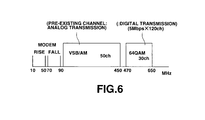
- Fig.6 is a diagrammatic view showing a specified example of the transmission band and the frequency actually used in the conventionally VOD cable television system.
- Fig.7 is a block diagram of the VOD cable television system embodying the present invention.
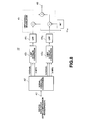
- Fig.8 is a block diagram showing a detailed structure of a 64 QAM modulation unit in the cable television center constituting the VOD cable television system.
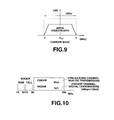
- Fig.9 is a graph showing frequency band characteristics of 64 QAM modulated wave from the 64 QAM modulation unit.
- Fig.10 is a diagrammatic view showing the transmission band and the frequency as used in the VOD cable television system.
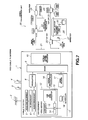
- Fig. 11 is a block diagram showing the structure of a VOD cable television system embodying the present invention.
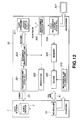
- Fig.12 is a block diagram showing the structure of a modification of the VOD cable television system shown in Fig.1.
- Figs.13A and 13B are overall views showing a specified structure of a home server used in the VOD cable television system.
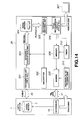
- Fig.14 is a block diagram showing the structure of a modification of the VOD cable television system shown in Fig.1.
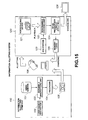
- Fig.15 is a block diagram showing the structure of an information furnishing system embodying the present invention.
- VOD video-on-demand
- the configuration of the preferred embodiment is a video-on-demand (VOD) cable television system furnishing the chargeable information including data such as video data and/or audio data to a cable television subscriber (user).
- VOD video-on-demand
- This VOD cable television system is made up of a cable television center 1, furnishing the chargeable information, a wired transmission unit 20 for transmitting the chargeable information from the cable television center 1 and a home server 30 for pre-storing the chargeable information furnished via the wired transmission unit 20 from the cable television center 1.
- This VOD cable television system has a marked feature that, by installing the home server 30 in the user's premises and distributing the storage of the chargeable information, the load imposed on the transmission path is relieved to enable the video-on-demand services to be rendered inexpensively without significantly varying the transmission capability of the pre-existing CATV stations.
- the home server 30 installed in the user's premises is such a system in which the information of a category retained to be used by a user no matter whether or not the information is actually used by the user and in which the user can instantaneously read out and exploit the information at any desired time, if selectively.
- the information storage means in the home server 30 utilized in this case, such information storage means as is the most inexpensive and desirable for the user at the use time can be used, irrespective of the types of the information storage means, such as tapes, hard discs, MO discs, CD-RAMs, semiconductor memories or DVD-RAMs.
- the recording medium most inexpensive at present is a tape. Therefore, such a hybrid system is herein contemplated in which the main recording medium used is a tape and a hard disc is used as a transient memory. It is also contemplated to switch the recording mediums depending on the contents of the stored chargeable information.
- the chargeable information having instantaneous character such as a news program or weather forecast, can be recorded on the hard disc, whilst the chargeable information not having such character, such as sports, drama or motion pictures, can be recorded on a tape.
- the home server 30 it may be advisable to set on the GUI which recording medium is to be used for recording by the user.
- a head-end equipment 5 in the cable television center 1 amplifies and demodulates the ground wave, BS broadcast wave and the CS broadcast wave, received over an antenna for ground wave 2, an antenna for BS 3 and an antenna for CS 4, to route the resulting wave to a TV broadcasting equipment 6.
- the TV broadcasting equipment 6 produces the routine TV information for voluntary TV broadcasting or broadcasting unique to the CATV station.
- An audio broadcasting equipment 7 produces the routine audio information for voluntary audio broadcasting.
- a modulator 8 applies vestigial sideband modulation (VSB modulation) for cable channel on the TV information from the TV broadcasting equipment 6 or on the audio information from the audio broadcasting equipment 7.
- VSB modulation vestigial sideband modulation
- a mixer 9 multiplexes the routine broadcast, composed of the VSB modulated TV information or audio information, on the signal transmitted from a VOD equipment 11, as later explained, to route the resulting multiplexed signals to an optical transmitter/receiver 10, which then applies electro-optical conversion to the multiplexed signals from the mixer 9 to send out the resulting converted signals over the wired transmission unit 20 comprised of a coaxial cable.
- the cable television center 1 also includes a VOD equipment 11.
- the video server 12 in the VOD equipment 11 is an automated system in which sequential devices, such as a tape streamer 13 or a VTR 14, which can be purchased at low costs despite large capacity, are used as main devices, and in which a hard disc drive (HDD) or a semiconductor memory for transient storage of the chargeable information from this main device is used as an auxiliary device.
- the chargeable information can also be recorded on two different mediums, namely the HDD and the semiconductor memory. In this case, the chargeable information is previously stored in the HDD and the chargeable information to be reproduced is transferred from the HDD to the semiconductor memory, from which the information is reproduced, because the readout speed of the semiconductor memory is faster than that of the HDD.
- the video server is provided with plural input/output channels each of which is configured for time-divisionally accessing the HDD 15 to enable concurrent input/output.
- a 2-IN 1-OUT configuration is realized by two input/outputs of the streamer 13 and the VTR 14 and an output to the 64 QAM modulator 16.
- an 1-IN 5-OUT configuration or other various input/out configurations may also be used.
- the 64 QAM modulator 16 is briefly explained. It is assumed for example that video and audio serial digital data compressed by MPEG to 6 Mbps and turned into 8 Mbps on appendage of the error correction code (ECC) (digital data input) is inputted from a video server 12 to the 64 QAM modulator 16 via an input terminal 41.
- ECC error correction code
- a serial/parallel conversion circuit 42 converts the digital data input into parallel data every three bits, so that former 3 bits and latter 3 bits will be an I-signal and a Q-signal, respectively.
- the I- and Q-signals are converted by 3-bit 8-value converters 43I, 43Q to 8-valued analog signals at a sampling frequency of 2 MHz.
- These 8-values analog signals are bandwidth-limited by LPFs 44I, 44Q, and are used to modulate a carrier wave ( ⁇ ct) by an orthogonal modulator 45. This outputs a 64QAM modulated wave, having a frequency band from 3 MHz to 3 MHz, to a mixer 9.
- a QPSK modem 17 and a scheduler 18 are provided in the VOD equipment 11.
- the QPSK modem 17 performs the up and down modem functions and takes charge of the input/output function of the scheduler 18.
- the wired transmission unit 20 includes an optical trunk line 21, such as an optical fiber, an optical transmission device 22 for transmitting, distributing and photoelectrically converting the optical signals from the optical trunk line 21, a coaxial cable 23, an amplifier 24, a distributor 25, a lead-in line 26, an arrester 27 and a wiring in user's premises 28.
- an optical trunk line 21 such as an optical fiber
- an optical transmission device 22 for transmitting, distributing and photoelectrically converting the optical signals from the optical trunk line 21, a coaxial cable 23, an amplifier 24, a distributor 25, a lead-in line 26, an arrester 27 and a wiring in user's premises 28.
- the chargeable information is transmitted from the cable television center 1 to the home server 30 by exploiting the vacant channel of the wired transmission unit 20 of the analog transmission system.
- Fig.10 shows a specified example of the relation between the frequency and the transmission band used in the preferred embodiment.
- the frequency band of 90 to 450 MHz of the analog transmission path of the pre-existing CATV station five vacant channels are used to enable digital transmission of 20 channels of 5 Mbps data.
- the home server 30 stores the transmitted chargeable information in the hard disc.
- the storage medium of the home server 30 may be a random-accessible recording medium, such as a semiconductor memory or DVD, or a tape as in the VTR, either alone or in combination.
- the reason is that news or weather forecast, having an instantaneous character, may be stored in the random-accessible medium, whilst the drama, sports or motion pictures can be recorded on a tape-shaped recording medium, as in the above-mentioned video server 12.
- the above-mentioned chargeable information, transmitted from the cable television center 1, may be plural chargeable information, previously selected by the user, or the plural chargeable information of a category that is anticipated to be used by the customer. These chargeable information are transmitted in advance and stored in information storage means in the home server 30, no matter whether the information is actually used by the customers.
- the user's request when the user selects the chargeable information in advance is transmitted to the scheduler 18 by exploiting the up transmission path of the wired transmission unit 20, that is the transmission path in which the information flows from the user's premises to the cable television center 1. That is, the user's request is sent via the up transmission path of the wired transmission unit 20 to the scheduler 18 via the optical transmitter/receiver 10, mixer 9 and the QPSK modem 17.
- the category information such as motion picture, sports, drama or game software, is transmitted as the user's request by exploiting the home server 30.
- the category of a motion picture may also include that of an US motion picture, a French motion picture, a Japanese motion picture, an action motion picture, a comedy or a love romance, among the motion pictures, or the actress-based category.
- the category of sports may be soccer or baseball.
- the category of soccer may also be event-based such as Olympic soccer or the world soccer.
- the category of a game software may be that of an action game, a sports game etc.
- the scheduler 18 is responsive to the transmitted user's request to control and supervise the video server 12 to transmit in advance the chargeable information which is in meeting with the request.
- the chargeable information stored in the video server 12, VTR 14 or in the tape streamer 13 the chargeable information requested by the user's request is transmitted.
- the chargeable information, transmitted from the center 1 via the wired transmission unit 20, is stored in the home server 30.
- the user selects and views the chargeable information he or she desires to view. If the desired chargeable information is not stored in the home server 30, the user waits until it is stored, in a manner different from the conventional VOD or new VOD (NVOD).
- NVOD new VOD
- the home server 30 includes five cassette compartments 32 for housing the cassette tapes. Each cassette tape 31 has a storage capacity of 45 GB. Each cassette compartment 32 is able to accommodate four cassette tapes 31.
- the home server 30 has an enclosed recording and/or reproducing unit 33 for selectively recording and/or reproducing the 20 cassette tapes.
- a tape movement belt 34 shown in a top plan view of Fig.13A, pulls out the cassette tape 31, desired by the user, from the cassette compartment 32, and houses it in a box or bin 35, which then is moved upwards to an inlet to the recording and/or reproducing device 33.
- the bin 35 is moved by an elevator 36 up to the tape inlet to a tape streamer 33.
- the cassette tape 31, transported by the elevator 36, is inserted by the pin 35 into the tape streamer 33.
- the chargeable information is reproduced by the tape streamer 33 from the cassette tape 31.
- the structure and the operation of the home server 30 is hereinafter explained.
- the source of supply of the chargeable information is the CATV station 1. It is noted that the information is not necessarily transmitted over the wired transmission unit 20, such that it may also be a satellite.
- the above-mentioned chargeable information is sent from the video server 12 of the CATV station 1 to the totality of the subscribers (users) over the wired transmission unit 20. It is noted that the wired transmission unit 20 is the analog transmission system and the chargeable information is transmitted using a vacant channel.
- the chargeable information namely several thousand and even a ten thousand titles of, for example, motion pictures, is transmitted sequentially and repeatedly in a pre-set period.
- the title herein means a unit of the chargeable information, for example, a motion picture.
- the title pre-empted by the title recognition unit 301 is sent to a scrambler 303 which also is fed with the encrypted codes from an encryption generator 302 configured to generate the encryption proper to the home server 30.
- the scrambler 303 synthesizes or appends the encryption to the chargeable information of the title, by way of scrambling, for recording and storage in a HDD 304.
- the chargeable information stored in the HDD 304 that subjected to the control command by the user for reproduction is reproduced from the HDD 304.
- This chargeable information is the encrypted chargeable information.
- the chargeable information, reproduced on selection by the user, is outputted from the HDD 304 and inputted to a descrambler 305.
- the descrambler 305 collates the inherent encryption generated by the encryption generator 302 to the encryption synthesized or appended to the encrypted chargeable information. In case of coincidence, the descrambler descrambles the encrypted chargeable information to decode the information.
- the chargeable information, descrambled and decoded by the scrambler 303, is sent to a title recognition circuit 306, which outputs the chargeable information of the title via video route to display the image on a receiver 307.
- the title recognition circuit 306 also recognizes the title number of the chargeable information to store the recognized title number in a memory 308. This title number is sent at a pre-set timing to a modem 309.
- This modem 309 appends an inherent mechanical number from a mechanical number holding unit 300 to the title number.
- the title number having the mechanical number appended thereto, becomes the decoding hysteresis information indicating the decoding of the encrypted chargeable information.
- This decoded hysteresis information may also be termed the information using hysteresis information.
- the decoding hysteresis information is sent to the CATV station 1 using the decoding hysteresis information. It is also sent to the CATV station 1 over the Internet. Alternatively, the decoding hysteresis information may be sent to the CATV station 1 using the up network of the wired transmission unit 20.
- the CATV station 1 receives the decoding hysteresis information by its scheduler 18, which controls the video server 12 and which also generates the charging information from the decoding hysteresis information. Thus, the CATV station 1 can charge the user for using the system. The CATV station 1 can also be apprised of the user's request via this scheduler 18. It is also possible to anticipate new titles likely to be requested in future, from user to user, and to send the chargeable information of the anticipated title to the home server 30.
- the decoding hysteresis information may also be sent in real-time to the scheduler 18 of the CATV station 1, using a telephone network 41 or the up network of the wired transmission unit 20, each time the encrypted chargeable information is reproduced and decoded.
- the home server 30 superposes the encryption generated by the encryption generator on the chargeable information and reproduces the chargeable information only if the encryption descrambled by the descrambler 305 coincides with the encryption generated by the encryption generator, so that the right of the copyright owner can be protected against an act possibly jeopardizing the right of the copyright owner, such as unauthorized use.
- the present invention is not limited to the home server shown in Fig. 11 and can be applied to a modification shown in Fig.12.
- the home server 30, shown in Fig.12 is characterized in that a tape streamer 311 for recording and/or reproducing the information for the plural cassette tapes, rather than the HDD, is used as a recording medium.
- the cassette tape is able to record the large capacity, while being inexpensive and portable.
- the tape streamer itself may be configured to be portable.
- the scrambler 305 is fed with the encryption from an encryption generator 312 configured for generating the encryption inherent to the system.
- the scrambler 303 synthesizes or appends this encryption to the title-based chargeable information, recorded on the cassette tape, by way of scrambling.
- the scrambled encrypted chargeable information is recorded and stored in the home server 30.
- the streamer 311 is loaded on the home server 30 of another user's premises, or if the cassette tape is loaded on a tape streamer 311 of the other user's premises, it is not possible for the home server 30 of the other user's premises to descramble the scrambled information.
- the home server 30, shown in Fig.12 since the home server 30, shown in Fig.12, records the encryption proper to the reception device on the title-based chargeable information on the cassette tape, the information cannot be restored, even if the cassette tape or the tape streamer is dismounted for reproduction on another device, thus obstructing unauthorized use.
- a hard disc 38 On the hard disc 38, the table of contents of 200 titles recorded on the above 20 cassette tapes and those of the titles stored in the video server 12 of the cable television center 1 are recorded along with epitomes thereof. On startup of the home server 30, the contents initially recorded on the hard disc 38 are demonstrated on e.g., a display.
- controller 39 Within the home server 30, there is also mounted a controller 39. If the user has selected a desired title from the table of contents demonstrated on the display, and if the title has been recorded on a cassette tape in the home server 30, the controller 39 automatically selects the cassette tape to control the tape movement belt 34, bin 35 and the elevator 36 to set the cassette tape on the tape streamer 33 to reproduce the thus set tape streamer 33.
- the recording medium may also be a semiconductor memory in the hard disc, either alone or in combination, as described above.
- the present invention may also be applied to the home server 30 shown in Fig.14.
- the home server 30 shown in Fig.14 differs from the home server of Figs.11 and 12 in having a timer 312.
- charging is made each time the chargeable information is used.
- the timer 312 and data accessed once is deemed to be used only once if it is used a number of times within a pre-set time period.
- the timer 312 has the function of supervising the time of initial information accessing, from title to title, not counting the number of times within the pre-set time if the title accessed is the title accessed previously, counting the accessing as the second accessing if the title accessed second time is the title accessed once but a pre-set time period has elapsed as from the first accessing, and of deeming the second accessing as the initial accessing and not counting the next accessing for the pre-set time period which begins with the second accessing.
- the home server 30 permits the reproducing decoding of the encoded information any number of times within the pre-set time period since the time the subscriber generates and decodes the encrypted information.
- the home server is assumed to be a desk top type disc recording and/or reproducing apparatus, it may also be of a tape streamer type configured for recording and/or reproducing the information for plural cassette tapes.
- the home server may also be the combination of the tape-shaped recording medium and a random access recording medium, such as HDD or semiconductor memory.
- the present invention may also be applied to an information furnishing system shown in Fig.15.
- the system of Fig.15 differs most appreciably from the system of Fig.14 as to the information furnishing method. That is, the system of Fig.15 is characterized in that the recording medium carrying the information (removable recording medium, such as the tape, disc etc) is transferred by physical transporting means instead of being transmitted by electrical transmission means, such as the cable or the satellite.
- a home server is installed in subscriber's premises where there no near-by rental video shop.
- the information is exchanged every pre-set period irrespective of whether the subscriber uses the information and, at this time, the subscriber is charged for the accessed information.
- An information furnishing firm 100 selects the information of the category requested by the subscriber or the information anticipated to be used by the subscriber from a video server 101.
- the chargeable information is sent to a scrambler 103, which also is fed with the user-based encryption generated by a user-based encryption generator 102.
- the scrambler 103 synthesizes or appends the user-based encryption to the chargeable information to generate the encrypted chargeable information.
- the encrypted chargeable information from the scrambler 103 is recorded on a tape cassette 105 by a recorder 105.
- the recording medium is a tape cassette 105, as an example, it may also be a disc-shaped recording medium, such as a hard disc (HD), or a semiconductor memory, such as a memory card, it being only sufficient if the recording medium is a removable medium.
- the home server 30 may be configured to select the medium depending on a reproducing device 121 of the home server 120.
- the home server 120 includes the recording device 121, a descrambler 122, an encryption generator 123 for generating the encryption used for decoding the descrambler 122, a title recognition circuit 124 for confirming the title number from the chargeable information descrambled and decoded by the descrambler 122 and a memory card 125 for storing the title number recognized by the title recognition circuit 124 for storing the title number recognized by the title recognition circuit 124 as the decoding state information.
- the decoding hysteresis information is stored in the memory card 125 of the user's premises.
- the information for charging is generated in the information furnishing company 100 to charge the subscriber.
- the process for recording the recording information is as described above and hence is here omitted. Since the chargeable information scrambled from user to user is delivered from the information distributing company 100, the reproduction of the chargeable information from other users, if attempted, cannot be realized to prohibit unauthorized copying or dubbing to protect the right of the copyright owner.
- encryption may also be reflected in a polynominal used for solving the ECC.
- the playback hysteresis information is inputted via the telephone network 41, inclusive of the Internet, and wired transmission unit 20, to the scheduler 18 of the CATV station 1. Based on the playback hysteresis information, the scheduler generates the information for charging the user, that is the information for charging.
- the scheduler 18 anticipates the chargeable information likely to be requested in future by the user. For example, plural chargeable information of categories (fields or genres) likely to be used in future by the user is anticipated. Specifically, if the chargeable information frequently reproduced by the user is the action motion picture, new action motion pictures are transmitted in advance from the video server 12 to the home server 30 irrespective of whether these motion pictures are actually requested by the user. The motion pictures possibly requested by the user may also be anticipated based on the names of the performers or on other key words. As the chargeable information, possible requests ofthe music video clips, game software or sports may be anticipated in addition to the motion pictures. The anticipation may also be made based on the categories.
- categories fields or genres
- the wired transmission unit 20 is not requested to have high concurrent transmission capability.
- the video server 12 also is not requested to have high concurrent processing capability or the high processing speed, large capacity or high speed accessing capability exhibiting high instantaneity.
- the server control software also is not requested to exhibit an intricate control capability.
- the home server 30 sends the playback hysteresis information to the cable television center 1, it is possible for the cable television center 1 to acquire the information for charging. It is moreover possible to anticipate the chargeable information that will possibly be requested by the user in future.
- the user is able to view a title he or she desires to view at a desired time.
- the user is also free to quit the viewing site at his or her convenience.
- the user is also not obliged to borrow or return the title at the rental shop.
- VOD cable television system it is possible with the VOD cable television system to curtail the costs in development or equipments to render inexpensive services to the user.
- the information proper to the home server 30 is scrambled by the chargeable information before the chargeable information delivered from the center 1 is reproduced in the home server 30, the chargeable information can only be reproduced in the home server 30. It is therefore possible to protect the copyright of the copyright owner.
Landscapes
- Engineering & Computer Science (AREA)
- Multimedia (AREA)
- Signal Processing (AREA)
- Databases & Information Systems (AREA)
- Computer Networks & Wireless Communication (AREA)
- Human Computer Interaction (AREA)
- Two-Way Televisions, Distribution Of Moving Picture Or The Like (AREA)
- Television Signal Processing For Recording (AREA)
Applications Claiming Priority (4)
| Application Number | Priority Date | Filing Date | Title |
|---|---|---|---|
| JP33770298 | 1998-11-27 | ||
| JP10337701A JP2000165838A (ja) | 1998-11-27 | 1998-11-27 | 情報供給システム及び方法、並びに情報再生装置 |
| JP33770198 | 1998-11-27 | ||
| JP10337702A JP2000165842A (ja) | 1998-11-27 | 1998-11-27 | 情報供給システム及び方法、並びに情報再生装置 |
Publications (2)
| Publication Number | Publication Date |
|---|---|
| EP1005186A2 true EP1005186A2 (de) | 2000-05-31 |
| EP1005186A3 EP1005186A3 (de) | 2003-05-28 |
Family
ID=26575884
Family Applications (1)
| Application Number | Title | Priority Date | Filing Date |
|---|---|---|---|
| EP99309429A Withdrawn EP1005186A3 (de) | 1998-11-27 | 1999-11-25 | Verfahren und Vorrichtung für die Verteilung von audiovisuellen Informationen von einem Server und Gerät für die Wiedergabe dieser Informationen |
Country Status (1)
| Country | Link |
|---|---|
| EP (1) | EP1005186A3 (de) |
Cited By (2)
| Publication number | Priority date | Publication date | Assignee | Title |
|---|---|---|---|---|
| WO2003060627A3 (en) * | 2001-12-31 | 2003-10-16 | Sk Telecom Co Ltd | Method for protecting copyright of multimedia contents |
| CN109624772A (zh) * | 2018-11-21 | 2019-04-16 | 国电科技新能源(深圳)有限公司 | 一种充电桩运营管理方法及充电桩 |
Family Cites Families (4)
| Publication number | Priority date | Publication date | Assignee | Title |
|---|---|---|---|---|
| US5841971A (en) * | 1992-12-17 | 1998-11-24 | Voxson International Pty. Limited | Information transmission system for transmitting video signals over cellular telephone networks |
| US5758257A (en) * | 1994-11-29 | 1998-05-26 | Herz; Frederick | System and method for scheduling broadcast of and access to video programs and other data using customer profiles |
| US5654747A (en) * | 1994-12-29 | 1997-08-05 | International Business Machines Corporation | Intelligent multimedia set-top control method and apparatus in which billing signals are communicated to an information network upon presentation of downloaded media programs |
| US5790935A (en) * | 1996-01-30 | 1998-08-04 | Hughes Aircraft Company | Virtual on-demand digital information delivery system and method |
-
1999
- 1999-11-25 EP EP99309429A patent/EP1005186A3/de not_active Withdrawn
Cited By (2)
| Publication number | Priority date | Publication date | Assignee | Title |
|---|---|---|---|---|
| WO2003060627A3 (en) * | 2001-12-31 | 2003-10-16 | Sk Telecom Co Ltd | Method for protecting copyright of multimedia contents |
| CN109624772A (zh) * | 2018-11-21 | 2019-04-16 | 国电科技新能源(深圳)有限公司 | 一种充电桩运营管理方法及充电桩 |
Also Published As
| Publication number | Publication date |
|---|---|
| EP1005186A3 (de) | 2003-05-28 |
Similar Documents
| Publication | Publication Date | Title |
|---|---|---|
| US6266481B1 (en) | Conditional access system for local storage device | |
| US8677152B2 (en) | Method and apparatus for encrypting media programs for later purchase and viewing | |
| US8677423B2 (en) | Digital residential entertainment system | |
| US7496941B2 (en) | Stored program pay-per-play | |
| EP1176826B1 (de) | Superverschlüsselte Speicherung und Rückgewinnung von Medienprogrammen in einem paarweisen Empfänger und einer Speichervorrichtung | |
| US8601519B1 (en) | Digital residential entertainment system | |
| US7801303B2 (en) | Video on demand in a broadcast network | |
| US20010051037A1 (en) | Personal versatile recorder: enhanced features, and methods for its use | |
| CA2408232C (en) | Method and apparatus for enabling random access to individual pictures in an encrypted video stream | |
| US20070107019A1 (en) | Methods and apparatuses for an integrated media device | |
| US20020009285A1 (en) | Personal versatile recorder: enhanced features, and methods for its use | |
| US20030070174A1 (en) | Wireless video-on-demand system | |
| US20070079341A1 (en) | Dvd multi-room playback after headend conversation | |
| US7117534B2 (en) | Interfacing a conditional access circuit to a digital device using input and output stream switching | |
| JP2007535202A (ja) | 遠隔再生機能付きペーパープレーアーキテクチャにおけるメディア配送の方法と装置 | |
| US20040103319A1 (en) | Transmitter apparatus, receiver apparatus and receiving method | |
| JP3586953B2 (ja) | データ記録装置および記録方法 | |
| EP1005186A2 (de) | Verfahren und Vorrichtung für die Verteilung von audiovisuellen Informationen von einem Server und Gerät für die Wiedergabe dieser Informationen | |
| JPH08181965A (ja) | 電子レンタルシステム | |
| JP2003110980A (ja) | 受信装置及び課金システム | |
| JP2000165838A (ja) | 情報供給システム及び方法、並びに情報再生装置 | |
| JP2002010229A (ja) | Catv放送システム及びそのcatv放送送出システム並びに放送番組鍵開け方法 | |
| HK1017551B (en) | Conditional access system for local storage device |
Legal Events
| Date | Code | Title | Description |
|---|---|---|---|
| PUAI | Public reference made under article 153(3) epc to a published international application that has entered the european phase |
Free format text: ORIGINAL CODE: 0009012 |
|
| AK | Designated contracting states |
Kind code of ref document: A2 Designated state(s): AT BE CH CY DE DK ES FI FR GB GR IE IT LI LU MC NL PT SE |
|
| AX | Request for extension of the european patent |
Free format text: AL;LT;LV;MK;RO;SI |
|
| PUAL | Search report despatched |
Free format text: ORIGINAL CODE: 0009013 |
|
| AK | Designated contracting states |
Designated state(s): AT BE CH CY DE DK ES FI FR GB GR IE IT LI LU MC NL PT SE |
|
| AX | Request for extension of the european patent |
Extension state: AL LT LV MK RO SI |
|
| STAA | Information on the status of an ep patent application or granted ep patent |
Free format text: STATUS: THE APPLICATION HAS BEEN WITHDRAWN |
|
| 17P | Request for examination filed |
Effective date: 20031114 |
|
| AKX | Designation fees paid |
Designated state(s): DE FR GB |
|
| 18W | Application withdrawn |
Effective date: 20031217 |