EP1004078B1 - Regeneration agent for back-up software - Google Patents
Regeneration agent for back-up software Download PDFInfo
- Publication number
- EP1004078B1 EP1004078B1 EP97911863A EP97911863A EP1004078B1 EP 1004078 B1 EP1004078 B1 EP 1004078B1 EP 97911863 A EP97911863 A EP 97911863A EP 97911863 A EP97911863 A EP 97911863A EP 1004078 B1 EP1004078 B1 EP 1004078B1
- Authority
- EP
- European Patent Office
- Prior art keywords
- agent
- workstation
- backup
- updated
- regeneration module
- Prior art date
- Legal status (The legal status is an assumption and is not a legal conclusion. Google has not performed a legal analysis and makes no representation as to the accuracy of the status listed.)
- Expired - Lifetime
Links
Images



Classifications
-
- G—PHYSICS
- G06—COMPUTING OR CALCULATING; COUNTING
- G06F—ELECTRIC DIGITAL DATA PROCESSING
- G06F13/00—Interconnection of, or transfer of information or other signals between, memories, input/output devices or central processing units
- G06F13/38—Information transfer, e.g. on bus
- G06F13/42—Bus transfer protocol, e.g. handshake; Synchronisation
-
- G—PHYSICS
- G06—COMPUTING OR CALCULATING; COUNTING
- G06F—ELECTRIC DIGITAL DATA PROCESSING
- G06F11/00—Error detection; Error correction; Monitoring
- G06F11/07—Responding to the occurrence of a fault, e.g. fault tolerance
- G06F11/14—Error detection or correction of the data by redundancy in operations
- G06F11/1446—Point-in-time backing up or restoration of persistent data
- G06F11/1458—Management of the backup or restore process
- G06F11/1464—Management of the backup or restore process for networked environments
-
- G—PHYSICS
- G06—COMPUTING OR CALCULATING; COUNTING
- G06F—ELECTRIC DIGITAL DATA PROCESSING
- G06F8/00—Arrangements for software engineering
- G06F8/60—Software deployment
- G06F8/65—Updates
Definitions
- the present invention relates to agent modules used in back-up software systems, and more particularly, to a system and method for updating agent modules on a remote workstation.
- a client/server architecture is an arrangement used on local area networks ("LANs") that treats both the server and the individual workstations as intelligent, programmable devices.
- LANs local area networks
- a LAN comprises a number of "front-end” client computers and a "back-end” server.
- the client component typically a personal computer, offers the user its full range of power and features for running programs.
- the client computer (called herein a workstation) has its own processing capability and a hard disk drive or other local storage device.
- the server which can be a personal computer, a minicomputer or a mainframe, enhances the client component by providing services such as data management, information sharing and security. Servers provide services to workstations including, for example, back-up services.
- a user of the LAN (typically a network manager) wishes to back-up data stored on the hard drive(s) of some or all of the computers on the LAN, including the workstations.
- the files stored on workstations and servers of the LAN are down-loaded onto a central storage device, such as a tape on a tape drive.
- a central storage device such as a tape on a tape drive.
- a typical back-up program has a number of components.
- a backup engine running centrally on the server, can control the writing of data to the backup storage device (for a backup job), control the reading of data from the backup storage device (for a restore job), manage a task queue of jobs, and control communications with the client computers.
- An administrator console which typically runs on a client computer, assists the network manager manage the backup of workstations. For example, the administrator console will perform tasks such as job submission, viewing log files, database management, scheduling and the like.
- Back-up programs often include agents.
- An agent is a small piece of software that is stored on and processed by each workstation to perform slave tasks for the server. Thus, the agent runs on each computer to be backed up.
- the agent is not a complete computer program, but rather, a piece of software to support the server in completing a task defined for the workstation on which the agent is running.
- one job of the agent is to move data from the workstation to the server and receive data from the server and store it at the workstation.
- agents to assist in the backup and restore process has a number of advantages. Because there is an agent running on each workstation (and each workstation, of course, has its own processor), processing can take place concurrently on each workstation. Communication overhead is reduced and network security is enhanced, as the agent can, for example, determine the content of a workstation's storage device and make decisions as to files to be backed up, without the need to provide the server with a list of files stored on the workstation.
- a disadvantage of current agent technology in backup programs results from the fact that agents are located at each workstation. Thus, if the network administrator wishes to update the backup program to a newer release of the program, the network administrator will often need to locate and update each agent on each workstation. Since there may be many workstations located in many physical locations, this could be a difficult and time consuming task.
- agents for various backup programs are often bundled with operating system programs for workstations.
- a user will then purchase the backup program, comprising the backup engine and administrator console.
- the backup engine will communicate with each workstation, as each workstation has an agent preinstalled with the operating system.
- the backup engine and administrator console can easily be replaced/updated, but it is difficult and time consuming to replace/update each agent.
- WO 95/13580 discloses the use of agents in network nodes to assist a central server in making network backups.
- EP 0 703 531 A1 discusses centralised control of network software upgrades.
- the invention provides a method for updating an agent used in a backup software program as set out in claim 1, and a system for updating an agent used in a backup software program as set out in claim 11.
- Embodiments of the invention are directed to methods and systems for updating or replacing agents stored and executing on a remote computer, in particular, a workstation in a client/server network.
- the agents are utilized in a backup software program and perform slave tasks for a backup engine running on a central server.
- Each agent is a small piece of software that is stored and executes on each workstation to support the backup engine in completing a task defined for that workstation.
- each agent is a module that resides on a workstation that is being backed up or restored and performs, e.g., file processing on that workstation.
- the backup program that utilizes the present invention has three major components.
- the backup engine located on the server, controls the writing of data to the backup storage device (for a backup job), controls the reading of data from the backup storage device (for a restore job), manages a task queue of jobs, and controls communications with the client computers.
- An administrator console which runs on a client computer, enables management of the backup and restore operations.
- an agent runs on each workstation to be backed up.
- backup includes “restore”
- update includes “replace” and “modify”
- LAN includes a wide area network (“WAN”) and an enterprise wide network.
- each agent is named A1.
- the backup engine electronically transmits, across the network to each workstation, a replacement agent file (A2) that comprises the executable code for the agent to replace A1.
- the backup engine also electronically transmits to each workstation an executable regeneration module, for example, named "Swapit”.
- A2 and Swapit are stored by A1 at the workstation.
- each agent A1 transmits a message to the backup engine verifying successful receipt of A2 and Swapit.
- the backup engine transmits to each workstation (i.e., to A1 on each workstation) an "execute/terminate" command.
- Each agent A1 then loads and causes to be executed by its workstation the Swapit module, and then each agent A1 terminates its own operation.
- the Swapit module executing on each workstation, renames A1 to preserve a copy of A1.
- the Swapit module then renames A2 to a new name appropriate for execution, for example, to A1.
- the Swapit module causes A1 to execute or to be available for execution, for example, upon receipt of a command from the backup engine.
- the present invention can be used to update a subset of the agents on a LAN.
- Each workstation may have more than one backup agent.
- Embodiments of the invention are scalable and can easily accommodate updating of more than one agent stored on a workstation.
- the described embodiments have the capability to allow a graceful backing out of the process and restoration of the old agent (e.g., A1 in the example above).
- Embodiments can coordinate the timing of the update. For example, for a large LAN, the transmission of the new agent (e.g. A2) can occur over a number of evenings, and execution of the Swapit module can take place on all workstations simultaneously.
- the new agent e.g. A2
- the Swapit module can take place on all workstations simultaneously.
- the described backup agent has capabilities to enable the efficient backup of the storage devices on all workstations on the network. When used in conjunction with the update process, network communication overheads are reduced.
- the backup engine need only communicate with the workstations on two occasions (when transferring the new agent and the Swapit module and when issuing the "execute/terminate” instruction). All processing is performed “automatically” either by the "old” agent or the Swapit module, broth executing on the workstation, rather than in response to a series of commands from the server.
- Compression and decompression techniques also can be used to reduce transmission times and intermediate storage costs.
- a server 110 is coupled to client computers C1 - Cn through a network 120.
- the network 120 may be any type of network that supports computer-to-computer communication such as a local area network (LAN), a wide area network (WAN), or a public switched network (PSN) supporting any range of protocols such as TCP/IP, Ethernet, X.25, etc.
- the server 110 executes a backup engine program.
- the server 110 is coupled to a backup storage device (not shown).
- Each of the client computers C1 - Cn is a workstation having an operating system program, such as, for example, the Windows 95 or Windows NT operating system.
- Each client computer C1 - Cn stores and can execute (when instructed to do so by the backup engine) an agent.
- Each agent performs certain tasks for the backup engine at each of the client computers C1 - Cn.
- the agent is configured, for example, to open and/or connect to a socket and "listen" for commands directed to it from the backup engine on the server 110.
- the backup engine may request that each agent "push" selected files to the server 110 so that the server 110 (under control of the backup engine) can copy the files to the backup storage device.
- a backup job may specify particular files that are to be backed up or criteria for files to be backed up (e.g., all files created by Bob, all WordPerfect files, etc.).
- the backup job is created at the administrator console, which runs on a client computer (e.g. C2), and is executed by the backup engine on the server 110. If a specified file is to be backed up, the backup engine sends a request to the agent running on the client computer where the file is located, and the agent checks to see if the file is available for backup, and sends a copy of the file to the backup engine.
- the backup engine provides the criteria to the agents on the appropriate client computers. Each agent will then traverse the directory structure of the storage devices. If a file is located by the agent that matches the criteria, a copy of the file is sent by the agent to the backup engine. Alternatively, a circular buffer can be used -- the agentA adds file names that match the criteria to the buffer and agentB performs the read/write operation to send that file to the backup engine. Thus, it will be seen that the agent supports, as a slave, the server in completing a task defined for that client computer.
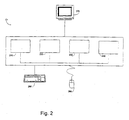
- Fig. 2 illustrates in further detail the hardware configuration of the client computer (e.g., C1) of Fig. 1 .
- the client computer C1 comprises a central processing unit 210 for executing computer programs (including the agent according to the present invention) and managing and controlling the operation of the client computer C1.
- Storage device 220 such as a floppy disk drive, is coupled to the central processing unit 210.
- Storage device 230 coupled to the central processing unit 210, also provides a means for storing computer programs and data.
- Storage device 230 is preferably a hard disk having a high storage capacity.
- a dynamic memory device 240 such as a RAM, is coupled to the central processing unit 210.
- the client computer C1 includes typical input/output devices, such as, for example, a keyboard 250, a mouse 260 and a monitor 270. Each of the remaining client computers C2 - Cn may be similarly configured.
- the server 110 may also be similarly configured but may further include connections to a plurality of high capacity storage media.
- agent on each client computer C1 - Cn is updated from the server 110.
- the "new” agent is received from a storage device on the server.
- the "new” agent may be originally stored on, and therefore received from, any other computer connected to the network 120 and communicating with the client computers C1 - Cn.
- Fig. 3 is a flowchart illustrating a representative update process according to the present invention.
- the backup engine first transmits (or causes to be transmitted) to each client computer C1 - Cn (or to a subset thereof) files containing the updated agent (step 310). Also transmitted is a "Swapit" module that is described in detail in connection with the flow chart of Fig. 4 (step 310).
- the "old” agent (executing on each client computer C1 - Cn) receives and stores the files transmitted by the workstation (step 320).
- the received files are stored locally at the client computer C1 - Cn (e.g., in storage device 230) and may have a file extension of "new" to indicate a new file.
- "agent new” may represent the new executable agent (to be later renamed).
- the "old” agent may then optionally transmit messages back to the backup engine verifying the files were successfully received and stored (step 310a).
- the backup engine transmits an "execute/terminate" command to the appropriate client computers C1 - Cn (step 330).
- the execute/terminate command may include a parameter identifying a procedure for the client computer C1 - Cn to execute (e.g., in this case "Swapit.")
- each agent loads and causes to be executed the program identified in the parameter, e.g., Swapit (step 340) and then shuts itself down (step 350).
- the flowchart of Fig. 4 provides details of an exemplary program flow of the Swapit module of steps 310 and 340 of Fig. 3 .
- the Swapit module executes on each client computer C1 - Cn.
- the Swapit module may execute concurrently on each client computer C1 - Cn.
- the Swapit module renames the "old" agent to a new name so as to preserve a copy of that version of the agent (step 410). For example, "agent.exe” may be renamed to "agent old.” (Alternatively, the Swapit module may simply delete the old agent.)
- the Swapit module then renames the files associated with the updated agent to a new name appropriate for execution (step 410). E.g., "agent.new" is renamed to "agent.exe.”
- the Swapit module determines whether the old agent is still executing (step 420). This may be accomplished, for example, by invoking a Windows NT command which returns the "handle" of an executing module. If a handle is returned when the handle for the agent module is requested, the agent is still executing. In that case, the Swapit module waits for a predetermined length of time (step 430) and then checks again for a "handle" (step 420). If a handle is not returned, the old agent has terminated. The Swapit module then starts the agent software, i.e., the updated agent (step 440).
- steps 310 to 320 can be performed over a period of time, for example, when network use is low. Once all client computers C1 - Cn have received the updated agent and the Swapit module, then the "execute/terminate" command can be sent substantially simultaneously to all client computers C1 - Cn where updating is to take place.
- the new agent and the Swapit module can be transmitted to the client computers C1 - Cn in one package or, alternatively, in separate files at separate times.
- the new agent can delete the Swapit module.
- An variation to the above may include the transmission of software patch to the agent rather than a replacement agent.
- the Swapit module would i) make a backup copy of the old agent, ii) apply the software patches to the old agent, and iii) make the agent available for execution.
- the Swapit module can be configured to be self executing, for example, at a predetermined time. Thus, there would be no need for step 330.
- the Swapit module would, at step 350, determine if the agent was executing, and pause operation until a time when the agent was not executing.
- the agent and Swapit modules of the present invention can be implemented utilizing a logic circuit or a computer memory comprising encoded computer-readable instructions, such as a computer program.
- the functionality of the logic circuit or computer memory is described in detail above.
Landscapes
- Engineering & Computer Science (AREA)
- Theoretical Computer Science (AREA)
- General Engineering & Computer Science (AREA)
- Physics & Mathematics (AREA)
- General Physics & Mathematics (AREA)
- Software Systems (AREA)
- Computer Security & Cryptography (AREA)
- Quality & Reliability (AREA)
- Information Retrieval, Db Structures And Fs Structures Therefor (AREA)
- Medicines Containing Material From Animals Or Micro-Organisms (AREA)
- Multi Processors (AREA)
- Stored Programmes (AREA)
- Solid-Sorbent Or Filter-Aiding Compositions (AREA)
Abstract
Description
- The present invention relates to agent modules used in back-up software systems, and more particularly, to a system and method for updating agent modules on a remote workstation.
- A portion of the disclosure of this patent document contains material that is subject to copyright protection. The copyright owner has no objection to the facsimile reproduction by anyone of the patent document or patent disclosure as it appears in the Patent and Trademark Office patent file or records, but otherwise reserves all copyright rights whatsoever.
- Modern computer networks are often organized according to a client/server architecture. A client/server architecture is an arrangement used on local area networks ("LANs") that treats both the server and the individual workstations as intelligent, programmable devices. Typically, a LAN comprises a number of "front-end" client computers and a "back-end" server. The client component, typically a personal computer, offers the user its full range of power and features for running programs. Usually, the client computer (called herein a workstation) has its own processing capability and a hard disk drive or other local storage device. The server, which can be a personal computer, a minicomputer or a mainframe, enhances the client component by providing services such as data management, information sharing and security. Servers provide services to workstations including, for example, back-up services.
- Often, a user of the LAN (typically a network manager) wishes to back-up data stored on the hard drive(s) of some or all of the computers on the LAN, including the workstations. In the back-up process, the files stored on workstations and servers of the LAN are down-loaded onto a central storage device, such as a tape on a tape drive. Thus, for example, if a file is damaged on a workstation, the network manager can retrieve the back-up copy of the lost data from the central back-up storage device.
- A typical back-up program has a number of components. A backup engine, running centrally on the server, can control the writing of data to the backup storage device (for a backup job), control the reading of data from the backup storage device (for a restore job), manage a task queue of jobs, and control communications with the client computers. An administrator console, which typically runs on a client computer, assists the network manager manage the backup of workstations. For example, the administrator console will perform tasks such as job submission, viewing log files, database management, scheduling and the like.
- Back-up programs often include agents. An agent is a small piece of software that is stored on and processed by each workstation to perform slave tasks for the server. Thus, the agent runs on each computer to be backed up. The agent is not a complete computer program, but rather, a piece of software to support the server in completing a task defined for the workstation on which the agent is running. In backup programs, one job of the agent is to move data from the workstation to the server and receive data from the server and store it at the workstation.
- Using agents to assist in the backup and restore process has a number of advantages. Because there is an agent running on each workstation (and each workstation, of course, has its own processor), processing can take place concurrently on each workstation. Communication overhead is reduced and network security is enhanced, as the agent can, for example, determine the content of a workstation's storage device and make decisions as to files to be backed up, without the need to provide the server with a list of files stored on the workstation.
- A disadvantage of current agent technology in backup programs results from the fact that agents are located at each workstation. Thus, if the network administrator wishes to update the backup program to a newer release of the program, the network administrator will often need to locate and update each agent on each workstation. Since there may be many workstations located in many physical locations, this could be a difficult and time consuming task.
- In particular, in a distributed application, it is difficult to synchronize the updating of agents on the plurality of workstations.
- The need to update agents is likely to become more common. For example, agents for various backup programs are often bundled with operating system programs for workstations. A user will then purchase the backup program, comprising the backup engine and administrator console. The backup engine will communicate with each workstation, as each workstation has an agent preinstalled with the operating system. However, when the backup program is updated to a new release, the backup engine and administrator console can easily be replaced/updated, but it is difficult and time consuming to replace/update each agent.
- There is also a need to apply updates and cause the updated agents to be available for use by the backup engine at the same time.
-
WO 95/13580 EP 0 703 531 A1 discusses centralised control of network software upgrades. - The invention provides a method for updating an agent used in a backup software program as set out in claim 1, and a system for updating an agent used in a backup software program as set out in claim 11.
- Embodiments of the invention are directed to methods and systems for updating or replacing agents stored and executing on a remote computer, in particular, a workstation in a client/server network. The agents are utilized in a backup software program and perform slave tasks for a backup engine running on a central server.
- Each agent is a small piece of software that is stored and executes on each workstation to support the backup engine in completing a task defined for that workstation. Thus, in summary, each agent is a module that resides on a workstation that is being backed up or restored and performs, e.g., file processing on that workstation.
- In the representative embodiment, the backup program that utilizes the present invention has three major components. The backup engine, located on the server, controls the writing of data to the backup storage device (for a backup job), controls the reading of data from the backup storage device (for a restore job), manages a task queue of jobs, and controls communications with the client computers. An administrator console, which runs on a client computer, enables management of the backup and restore operations. As stated above, an agent runs on each workstation to be backed up.
- For ease of explanation, when used herein, the term "backup" includes "restore", the term "update" includes "replace" and "modify", and the term "LAN" includes a wide area network ("WAN") and an enterprise wide network.
- The updating of an agent occurs according to the representative embodiment of the present invention as follows. Assume that each agent is named A1. The backup engine electronically transmits, across the network to each workstation, a replacement agent file (A2) that comprises the executable code for the agent to replace A1. The backup engine also electronically transmits to each workstation an executable regeneration module, for example, named "Swapit". A2 and Swapit are stored by A1 at the workstation.
- Optionally, each agent A1 transmits a message to the backup engine verifying successful receipt of A2 and Swapit.
- Thereafter, the backup engine transmits to each workstation (i.e., to A1 on each workstation) an "execute/terminate" command. Each agent A1 then loads and causes to be executed by its workstation the Swapit module, and then each agent A1 terminates its own operation.
- The Swapit module, executing on each workstation, renames A1 to preserve a copy of A1. The Swapit module then renames A2 to a new name appropriate for execution, for example, to A1. The Swapit module causes A1 to execute or to be available for execution, for example, upon receipt of a command from the backup engine.
- If desirable, the present invention can be used to update a subset of the agents on a LAN.
- Each workstation may have more than one backup agent.
Embodiments of the invention are scalable and can easily accommodate updating of more than one agent stored on a workstation. - If the update operation is not successful, the described embodiments have the capability to allow a graceful backing out of the process and restoration of the old agent (e.g., A1 in the example above).
- Embodiments can coordinate the timing of the update.
For example, for a large LAN, the transmission of the new agent (e.g. A2) can occur over a number of evenings, and execution of the Swapit module can take place on all workstations simultaneously. - The described backup agent has capabilities to enable the efficient backup of the storage devices on all workstations on the network. When used in conjunction with the update process, network communication overheads are reduced.
- It will be noted, for example, that the backup engine need only communicate with the workstations on two occasions (when transferring the new agent and the Swapit module and when issuing the "execute/terminate" instruction). All processing is performed "automatically" either by the "old" agent or the Swapit module, broth executing on the workstation, rather than in response to a series of commands from the server.
- Compression and decompression techniques also can be used to reduce transmission times and intermediate storage costs.
- The foregoing and other features will be more readily apparent from the following detailed description of exemplary embodiments taken in conjunction with the attached drawings wherein:
-
Fig. 1 is a system diagram of a network architecture in which embodiments of the invention are set. -
Fig. 2 is a block diagram of an illustrative hardware configuration of a client system. -
Fig. 3 is a flowchart of an exemplary update process of a representative embodiment of the present invention. -
Fig. 4 is a flowchart of the operation of an exemplary update module. - Referring now to the drawings and initially
Fig. 1 , there is illustrated a diagram of a representative network used in conjunction with the present invention. Aserver 110 is coupled to client computers C1 - Cn through anetwork 120. Thenetwork 120 may be any type of network that supports computer-to-computer communication such as a local area network (LAN), a wide area network (WAN), or a public switched network (PSN) supporting any range of protocols such as TCP/IP, Ethernet, X.25, etc. Theserver 110 executes a backup engine program. Theserver 110 is coupled to a backup storage device (not shown). - Each of the client computers C1 - Cn is a workstation having an operating system program, such as, for example, the Windows 95 or Windows NT operating system. Each client computer C1 - Cn stores and can execute (when instructed to do so by the backup engine) an agent. Each agent performs certain tasks for the backup engine at each of the client computers C1 - Cn. The agent is configured, for example, to open and/or connect to a socket and "listen" for commands directed to it from the backup engine on the
server 110. For example, the backup engine may request that each agent "push" selected files to theserver 110 so that the server 110 (under control of the backup engine) can copy the files to the backup storage device. - The following is a more detailed illustrative description of some of the functions that can be performed by the agent of the present invention. A backup job may specify particular files that are to be backed up or criteria for files to be backed up (e.g., all files created by Bob, all WordPerfect files, etc.). The backup job is created at the administrator console, which runs on a client computer (e.g. C2), and is executed by the backup engine on the
server 110. If a specified file is to be backed up, the backup engine sends a request to the agent running on the client computer where the file is located, and the agent checks to see if the file is available for backup, and sends a copy of the file to the backup engine. If criteria is used to identify the files to be backed up, the backup engine provides the criteria to the agents on the appropriate client computers. Each agent will then traverse the directory structure of the storage devices. If a file is located by the agent that matches the criteria, a copy of the file is sent by the agent to the backup engine. Alternatively, a circular buffer can be used -- the agentA adds file names that match the criteria to the buffer and agentB performs the read/write operation to send that file to the backup engine. Thus, it will be seen that the agent supports, as a slave, the server in completing a task defined for that client computer. -
Fig. 2 illustrates in further detail the hardware configuration of the client computer (e.g., C1) ofFig. 1 . In the representative embodiment, the client computer C1 comprises acentral processing unit 210 for executing computer programs (including the agent according to the present invention) and managing and controlling the operation of the client computer C1.Storage device 220, such as a floppy disk drive, is coupled to thecentral processing unit 210.Storage device 230, coupled to thecentral processing unit 210, also provides a means for storing computer programs and data.Storage device 230 is preferably a hard disk having a high storage capacity. Adynamic memory device 240, such as a RAM, is coupled to thecentral processing unit 210. The client computer C1 includes typical input/output devices, such as, for example, akeyboard 250, amouse 260 and amonitor 270. Each of the remaining client computers C2 - Cn may be similarly configured. Theserver 110 may also be similarly configured but may further include connections to a plurality of high capacity storage media. - According to the present invention, agent on each client computer C1 - Cn is updated from the
server 110. Thus, the "new" agent is received from a storage device on the server. Alternatively, the "new" agent may be originally stored on, and therefore received from, any other computer connected to thenetwork 120 and communicating with the client computers C1 - Cn. -
Fig. 3 is a flowchart illustrating a representative update process according to the present invention. - In accordance with an exemplary embodiment of the invention, the backup engine first transmits (or causes to be transmitted) to each client computer C1 - Cn (or to a subset thereof) files containing the updated agent (step 310). Also transmitted is a "Swapit" module that is described in detail in connection with the flow chart of
Fig. 4 (step 310). - The "old" agent (executing on each client computer C1 - Cn) receives and stores the files transmitted by the workstation (step 320). The received files are stored locally at the client computer C1 - Cn (e.g., in storage device 230) and may have a file extension of "new" to indicate a new file. Thus, for example, "agent new" may represent the new executable agent (to be later renamed). The "old" agent may then optionally transmit messages back to the backup engine verifying the files were successfully received and stored (
step 310a). - Next, the backup engine transmits an "execute/terminate" command to the appropriate client computers C1 - Cn (step 330). The execute/terminate command may include a parameter identifying a procedure for the client computer C1 - Cn to execute (e.g., in this case "Swapit.") In response thereto, each agent loads and causes to be executed the program identified in the parameter, e.g., Swapit (step 340) and then shuts itself down (step 350).
- The flowchart of
Fig. 4 provides details of an exemplary program flow of the Swapit module ofsteps Fig. 3 . The Swapit module executes on each client computer C1 - Cn. The Swapit module may execute concurrently on each client computer C1 - Cn. Upon commencement of execution, the Swapit module renames the "old" agent to a new name so as to preserve a copy of that version of the agent (step 410). For example, "agent.exe" may be renamed to "agent old." (Alternatively, the Swapit module may simply delete the old agent.) The Swapit module then renames the files associated with the updated agent to a new name appropriate for execution (step 410). E.g., "agent.new" is renamed to "agent.exe." - Once updated, the new agent can remain ready to act as the slave of the backup engine. Alternatively, it may be desirable to cause the new agent to execute upon the end of the update process. Thus, the following additional steps take place at the client computer. Subsequent to renaming all appropriate files, the Swapit module determines whether the old agent is still executing (step 420). This may be accomplished, for example, by invoking a Windows NT command which returns the "handle" of an executing module. If a handle is returned when the handle for the agent module is requested, the agent is still executing. In that case, the Swapit module waits for a predetermined length of time (step 430) and then checks again for a "handle" (step 420). If a handle is not returned, the old agent has terminated. The Swapit module then starts the agent software, i.e., the updated agent (step 440).
- It will be appreciate that
steps 310 to 320 can be performed over a period of time, for example, when network use is low. Once all client computers C1 - Cn have received the updated agent and the Swapit module, then the "execute/terminate" command can be sent substantially simultaneously to all client computers C1 - Cn where updating is to take place. - If desirable, the new agent and the Swapit module can be transmitted to the client computers C1 - Cn in one package or, alternatively, in separate files at separate times.
- Optionally, the new agent can delete the Swapit module.
- An variation to the above may include the transmission of software patch to the agent rather than a replacement agent. In that case, the Swapit module would i) make a backup copy of the old agent, ii) apply the software patches to the old agent, and iii) make the agent available for execution.
- In an alternative embodiment, the Swapit module can be configured to be self executing, for example, at a predetermined time. Thus, there would be no need for
step 330. The Swapit module would, atstep 350, determine if the agent was executing, and pause operation until a time when the agent was not executing. - It will be appreciated that the principles of the present invention can be applied to the updating of any agent executing on a remote system, not merely backup agents.
- The agent and Swapit modules of the present invention can be implemented utilizing a logic circuit or a computer memory comprising encoded computer-readable instructions, such as a computer program. The functionality of the logic circuit or computer memory is described in detail above.
- While the present invention has been particularly shown and described with reference to exemplary embodiments thereof, it will be understood by those skilled in the art that various changes in form and details may be made therein without departing from the scope of the invention.
Claims (14)
- A method for updating an agent used in a backup software program, the backup software program operating on a network (120) having a server (110) and a plurality of workstations (C1,C2,Cn), the backup software program including a backup engine executing on the server, the method comprising the steps of:providing an agent for execution on each workstation as a slave of the backup engine;under the control of the backup engine, transmitting (310) an updated agent to each workstation;under the control of the backup engine, transmitting (310) an executable regeneration module to each workstation;under the control of the agent at each workstation, storing (320) the updated agent and the executable regeneration module at each workstation;under the control of the backup engine, transmitting (330) an execute command to the agent at each workstation;under the control of the agent at each workstation, causing the execution (340) of the executable regeneration module;terminating (350) the operation of the agent;under the control of the executable regeneration module at each workstation, either deleting the agent or renaming the agent to a recovery name;under the control of the executable regeneration module at each workstation, renaming the updated agent to the name of the agent; andunder the control of the executable regeneration module at each workstation, enabling operation of the updated agent as the agent.
- The method of claim 1 wherein, under the control of the backup engine, the updated agent and the executable regeneration module are transmitted to the agent at each workstation.
- The method of claim 1 or 2 further comprising the step of, under the control of the agent at each workstation, notifying (310a) the backup engine of successful receipt of the updated agent and the executable regeneration module.
- The method of claim 1 or 2 further comprising the step of deleting the executable regeneration module.
- The method of claim 1 or 2 wherein the step of transmitting (330) an execute command to the agent at each workstation occurs so as to enable simultaneous updating of each agent.
- The method of claim 1 further comprising the step of executing the agent at a workstation to assist the backup engine in a backup operation where files stored on the workstation are backed up across the network to the backup storage device.
- The method of claim 6 further comprising the step of, under the control of the agent at each workstation, notifying (310a) the backup engine of successful receipt of the updated agent and the executable regeneration module.
- The method of claim 6 wherein the step of transmitting an execute command to the agent at each workstation occurs so as to enable simultaneous updating of each agent.
- The method of claim 1 or 2 further comprising the step of, following renaming the agent to a recovery name, restoring back the old agent by renaming the agent having the recovery name to be given the name of the updated agent.
- The method of any preceding claim wherein the server is coupled to a backup storage device.
- A system for updating an agent used in a backup software program, the backup software program operating on a network (120) having a server (110) and a plurality of workstations (C1,C2,Cn), the system comprising:a backup engine executing on the server, the backup engine includingmeans for transmitting an updated agent to each workstation,means for transmitting an executable regeneration module to each workstation, andmeans for transmitting an execute command to the agent at each workstation;andan agent for execution at each workstation as a slave of the backup engine, the agent includingwherein the executable regeneration module at each workstation is adapted to: terminate the operation of the agent; delete the agent or rename (410) the agent to a recovery name; rename (410) the updated agent to the name of the agent; and enable operation of the updated agent as the agent.means for storing the updated agent and the executable regeneration module at each workstation, andcausing the execution of the executable regeneration module;
- The system of claim 11 wherein the server is coupled to a backup storage device.
- The system of claim 11 further comprising means for executing the agent at a workstation to assist the backup engine in a backup operation where files stored on the workstation are backed up across the network (120) to the backup storage device.
- The system of claim 11 further comprising means for notifying the backup engine of successful receipt of the updated agent and the executable regeneration module.
Applications Claiming Priority (3)
| Application Number | Priority Date | Filing Date | Title |
|---|---|---|---|
| US08/743,459 US5797016A (en) | 1996-10-29 | 1996-10-29 | Regeneration agent for back-up software |
| US743459 | 1996-10-29 | ||
| PCT/US1997/019090 WO1998019247A1 (en) | 1996-10-29 | 1997-10-22 | Regeneration agent for back-up software |
Publications (3)
| Publication Number | Publication Date |
|---|---|
| EP1004078A1 EP1004078A1 (en) | 2000-05-31 |
| EP1004078A4 EP1004078A4 (en) | 2002-03-13 |
| EP1004078B1 true EP1004078B1 (en) | 2010-03-03 |
Family
ID=24988858
Family Applications (1)
| Application Number | Title | Priority Date | Filing Date |
|---|---|---|---|
| EP97911863A Expired - Lifetime EP1004078B1 (en) | 1996-10-29 | 1997-10-22 | Regeneration agent for back-up software |
Country Status (13)
| Country | Link |
|---|---|
| US (1) | US5797016A (en) |
| EP (1) | EP1004078B1 (en) |
| JP (1) | JP3592721B2 (en) |
| KR (1) | KR100513935B1 (en) |
| CN (2) | CN1095128C (en) |
| AT (1) | ATE459922T1 (en) |
| AU (1) | AU728308B2 (en) |
| BR (1) | BR9712596A (en) |
| CA (1) | CA2270462C (en) |
| DE (1) | DE69739791D1 (en) |
| RU (1) | RU2192039C2 (en) |
| WO (1) | WO1998019247A1 (en) |
| ZA (1) | ZA979615B (en) |
Families Citing this family (34)
| Publication number | Priority date | Publication date | Assignee | Title |
|---|---|---|---|---|
| DE19518266A1 (en) * | 1995-05-18 | 1996-11-21 | Philips Patentverwaltung | Communication system with means for exchanging software |
| DE19617976A1 (en) * | 1996-05-06 | 1997-11-13 | Philips Patentverwaltung | Communication system with means for exchanging software processes |
| US6195678B1 (en) * | 1996-09-03 | 2001-02-27 | Fujitsu Limited | Remote resource management system for automatically downloading required files from application server depending on contents of selected files on requesting computer |
| US6202207B1 (en) * | 1998-01-28 | 2001-03-13 | International Business Machines Corporation | Method and a mechanism for synchronized updating of interoperating software |
| GB2333864B (en) | 1998-01-28 | 2003-05-07 | Ibm | Distribution of software updates via a computer network |
| US6179492B1 (en) * | 1998-06-15 | 2001-01-30 | Intelligent Computer Solutions, Inc. | Method of and apparatus for duplicating, upgrading and configuring hard disk drives |
| GB9819354D0 (en) | 1998-09-04 | 1998-10-28 | Seiko Epson Corp | Pos terminal,method of controlling the pos terminal,pos system using the pos terminal and information storage medium |
| US6477703B1 (en) * | 1999-06-29 | 2002-11-05 | Hewlett-Packard Company | Software patch selection tool |
| JP3916806B2 (en) * | 1999-07-26 | 2007-05-23 | 富士通株式会社 | Remote loading execution method, remote loading execution system, information processing apparatus, management apparatus, and computer-readable recording medium |
| FI19991811L (en) * | 1999-08-25 | 2001-02-26 | Nokia Networks Oy | Method and system for backup |
| US6496840B1 (en) * | 2000-05-31 | 2002-12-17 | International Business Machines Corporation | Method, system and program products for atomically and persistently swapping resource groups |
| DE50004160D1 (en) * | 2000-07-04 | 2003-11-27 | Siemens Ag | System and method for operating an interactive server in a cellular communication network |
| US20020078182A1 (en) * | 2000-12-15 | 2002-06-20 | International Business Machines Corporation | Failover service method and system |
| GB2375191B (en) * | 2001-04-06 | 2005-09-21 | Hewlett Packard Co | Storage system |
| US6772177B2 (en) * | 2001-06-01 | 2004-08-03 | International Business Machines Corporation | System and method for parallelizing file archival and retrieval |
| WO2005008457A1 (en) * | 2003-07-08 | 2005-01-27 | Seventh Knight | Automatic regeneration of computer files description |
| US7812844B2 (en) * | 2004-01-28 | 2010-10-12 | Lucid Information Technology, Ltd. | PC-based computing system employing a silicon chip having a routing unit and a control unit for parallelizing multiple GPU-driven pipeline cores according to the object division mode of parallel operation during the running of a graphics application |
| US20060047855A1 (en) | 2004-05-13 | 2006-03-02 | Microsoft Corporation | Efficient chunking algorithm |
| US7555531B2 (en) * | 2004-04-15 | 2009-06-30 | Microsoft Corporation | Efficient algorithm and protocol for remote differential compression |
| US20060031425A1 (en) * | 2004-06-07 | 2006-02-09 | Northrop Grumman Corporation | Method for imaging computer systems |
| US7613787B2 (en) | 2004-09-24 | 2009-11-03 | Microsoft Corporation | Efficient algorithm for finding candidate objects for remote differential compression |
| US7512939B2 (en) * | 2004-10-05 | 2009-03-31 | Neopost Technologies | System and method of secure updating of remote device software |
| CN100576799C (en) * | 2004-11-10 | 2009-12-30 | 英业达股份有限公司 | System and method for updating firmware on line |
| KR100910802B1 (en) * | 2005-09-21 | 2009-08-04 | 엘지전자 주식회사 | Device Management System and Device Management Object Management Method |
| WO2007035036A1 (en) | 2005-09-21 | 2007-03-29 | Lg Electronics Inc. | Device management system and method for managing device management object |
| CN100435105C (en) * | 2005-09-26 | 2008-11-19 | 西安交通大学 | System regeneration method for application server in cluster environment |
| CN100442901C (en) * | 2005-10-25 | 2008-12-10 | 华为技术有限公司 | Method and device for monitoring and upgrading software in equipment management |
| US7730538B2 (en) * | 2006-06-02 | 2010-06-01 | Microsoft Corporation | Combining virus checking and replication filtration |
| US7698305B2 (en) * | 2006-12-01 | 2010-04-13 | Microsoft Corporation | Program modification and loading times in computing devices |
| US7788234B2 (en) * | 2007-08-23 | 2010-08-31 | Microsoft Corporation | Staged, lightweight backup system |
| US8805953B2 (en) * | 2009-04-03 | 2014-08-12 | Microsoft Corporation | Differential file and system restores from peers and the cloud |
| US8769049B2 (en) * | 2009-04-24 | 2014-07-01 | Microsoft Corporation | Intelligent tiers of backup data |
| JP5838810B2 (en) * | 2011-12-28 | 2016-01-06 | 富士通株式会社 | Backup control program, backup control method, and backup control apparatus |
| CN103942066A (en) * | 2014-03-25 | 2014-07-23 | 中国科学院长春光学精密机械与物理研究所 | Satellite-borne embedded software module on-orbit updating method |
Family Cites Families (48)
| Publication number | Priority date | Publication date | Assignee | Title |
|---|---|---|---|---|
| FR2258112A5 (en) * | 1973-11-30 | 1975-08-08 | Honeywell Bull Soc Ind | |
| US4725977A (en) * | 1983-06-03 | 1988-02-16 | Cpt, Ltd. | Cartridge programming system and method using a central and local program library |
| US4856787B1 (en) * | 1986-02-05 | 1997-09-23 | Fortunet Inc | Concurrent game network |
| US4751648A (en) * | 1986-03-31 | 1988-06-14 | Halliburton Company | Local area network data transfer system |
| US5005122A (en) * | 1987-09-08 | 1991-04-02 | Digital Equipment Corporation | Arrangement with cooperating management server node and network service node |
| US5204954A (en) * | 1987-11-18 | 1993-04-20 | International Business Machines Corporation | Remote storage management mechanism and method |
| JPH0743676B2 (en) * | 1988-03-11 | 1995-05-15 | 株式会社日立製作所 | Back-up data dump control method and device |
| JPH0776939B2 (en) * | 1988-03-16 | 1995-08-16 | 富士ゼロックス株式会社 | Communication network system |
| US5056000A (en) * | 1988-06-21 | 1991-10-08 | International Parallel Machines, Inc. | Synchronized parallel processing with shared memory |
| US5109384A (en) * | 1988-11-02 | 1992-04-28 | Tseung Lawrence C N | Guaranteed reliable broadcast network |
| US5313637A (en) * | 1988-11-29 | 1994-05-17 | Rose David K | Method and apparatus for validating authorization to access information in an information processing system |
| US5131081A (en) * | 1989-03-23 | 1992-07-14 | North American Philips Corp., Signetics Div. | System having a host independent input/output processor for controlling data transfer between a memory and a plurality of i/o controllers |
| US5317691A (en) * | 1989-05-02 | 1994-05-31 | Norand Corporation | Data communication system with communicating and recharging docking apparatus for hand-held terminal |
| US5144551A (en) * | 1989-05-19 | 1992-09-01 | Compaq Computer Corporation | Computer memory management method utilizing segmentation and protection techniques |
| JP3453757B2 (en) * | 1989-05-29 | 2003-10-06 | 株式会社日立製作所 | Buffer management method |
| GB8915875D0 (en) * | 1989-07-11 | 1989-08-31 | Intelligence Quotient United K | A method of operating a data processing system |
| US5101479A (en) * | 1989-07-21 | 1992-03-31 | Clearpoint Research Corporation | Bus device for generating and responding to slave response codes |
| US5133065A (en) * | 1989-07-27 | 1992-07-21 | Personal Computer Peripherals Corporation | Backup computer program for networks |
| US5163131A (en) * | 1989-09-08 | 1992-11-10 | Auspex Systems, Inc. | Parallel i/o network file server architecture |
| US5138712A (en) * | 1989-10-02 | 1992-08-11 | Sun Microsystems, Inc. | Apparatus and method for licensing software on a network of computers |
| US5170466A (en) * | 1989-10-10 | 1992-12-08 | Unisys Corporation | Storage/retrieval system for document |
| US5321816A (en) * | 1989-10-10 | 1994-06-14 | Unisys Corporation | Local-remote apparatus with specialized image storage modules |
| WO1991008535A1 (en) * | 1989-11-27 | 1991-06-13 | Olin Corporation | Method and apparatus for providing backup process control |
| US5495610A (en) * | 1989-11-30 | 1996-02-27 | Seer Technologies, Inc. | Software distribution system to build and distribute a software release |
| US5276860A (en) * | 1989-12-19 | 1994-01-04 | Epoch Systems, Inc. | Digital data processor with improved backup storage |
| US5218695A (en) * | 1990-02-05 | 1993-06-08 | Epoch Systems, Inc. | File server system having high-speed write execution |
| US5247626A (en) * | 1990-05-29 | 1993-09-21 | Advanced Micro Devices, Inc. | Fddi controller having flexible buffer management |
| CA2044022A1 (en) * | 1990-06-28 | 1991-12-29 | Miriam A. Nihart | Common agent computer management system and method |
| US5365577A (en) * | 1990-09-27 | 1994-11-15 | Radish Communications Systems, Inc. | Telecommunication display system |
| US5212772A (en) * | 1991-02-11 | 1993-05-18 | Gigatrend Incorporated | System for storing data in backup tape device |
| US5187750A (en) * | 1991-03-15 | 1993-02-16 | Unisys Corporation | Archival document image processing and printing system |
| RU2022342C1 (en) * | 1991-06-03 | 1994-10-30 | Серпуховское высшее военное командно-инженерное училище ракетных войск им.Ленинского комсомола | Device for multicomputer system reconfiguration |
| SE513182C2 (en) * | 1991-06-12 | 2000-07-24 | Icl Systems Ab | Procedure and system for auditing data in a distributed computer system |
| US5297195A (en) * | 1991-10-02 | 1994-03-22 | Teledirect International, Inc. | Method and apparatus for automatic telephone scheduling system |
| US5274815A (en) * | 1991-11-01 | 1993-12-28 | Motorola, Inc. | Dynamic instruction modifying controller and operation method |
| US5324035A (en) * | 1991-12-02 | 1994-06-28 | Infinational Technologies, Inc. | Video gaming system with fixed pool of winning plays and global pool access |
| US5222122A (en) * | 1992-03-31 | 1993-06-22 | At&T Bell Laboratories | Payphone having master and slave modes |
| JPH0827754B2 (en) * | 1992-05-21 | 1996-03-21 | インターナショナル・ビジネス・マシーンズ・コーポレイション | File management method and file management system in computer system |
| US5339430A (en) * | 1992-07-01 | 1994-08-16 | Telefonaktiebolaget L M Ericsson | System for dynamic run-time binding of software modules in a computer system |
| US5544320A (en) * | 1993-01-08 | 1996-08-06 | Konrad; Allan M. | Remote information service access system based on a client-server-service model |
| US5469573A (en) * | 1993-02-26 | 1995-11-21 | Sytron Corporation | Disk operating system backup and recovery system |
| WO1995013580A1 (en) * | 1993-11-09 | 1995-05-18 | Arcada Software | Data backup and restore system for a computer network |
| US5522042A (en) * | 1994-01-28 | 1996-05-28 | Cabletron Systems, Inc. | Distributed chassis agent for distributed network management |
| JP3140906B2 (en) * | 1994-04-12 | 2001-03-05 | 株式会社エヌ・ティ・ティ・データ | How to update and restore system files |
| US5689732A (en) * | 1994-06-21 | 1997-11-18 | Sony Corporation | Apparatus for recording and reproducing data having a single recording and reproducing unit and a plurality of detachable interfaces for connecting to different types of computer ports |
| US5586304A (en) * | 1994-09-08 | 1996-12-17 | Compaq Computer Corporation | Automatic computer upgrading |
| US5682533A (en) * | 1994-09-27 | 1997-10-28 | Telefonaktiebolaget Lm Ericsson (Publ) | Updating software within a telecommunications switch without interrupting existing communication and neither moving nor converting data |
| US5634052A (en) * | 1994-10-24 | 1997-05-27 | International Business Machines Corporation | System for reducing storage requirements and transmission loads in a backup subsystem in client-server environment by transmitting only delta files from client to server |
-
1996
- 1996-10-29 US US08/743,459 patent/US5797016A/en not_active Expired - Lifetime
-
1997
- 1997-10-22 EP EP97911863A patent/EP1004078B1/en not_active Expired - Lifetime
- 1997-10-22 WO PCT/US1997/019090 patent/WO1998019247A1/en not_active Ceased
- 1997-10-22 DE DE69739791T patent/DE69739791D1/en not_active Expired - Lifetime
- 1997-10-22 RU RU99111595/09A patent/RU2192039C2/en not_active IP Right Cessation
- 1997-10-22 KR KR10-1999-7003799A patent/KR100513935B1/en not_active Expired - Fee Related
- 1997-10-22 BR BR9712596-2A patent/BR9712596A/en not_active Application Discontinuation
- 1997-10-22 AU AU49139/97A patent/AU728308B2/en not_active Ceased
- 1997-10-22 CN CN97181132A patent/CN1095128C/en not_active Expired - Fee Related
- 1997-10-22 JP JP52057198A patent/JP3592721B2/en not_active Expired - Fee Related
- 1997-10-22 CA CA002270462A patent/CA2270462C/en not_active Expired - Fee Related
- 1997-10-22 AT AT97911863T patent/ATE459922T1/en not_active IP Right Cessation
- 1997-10-27 ZA ZA979615A patent/ZA979615B/en unknown
-
2002
- 2002-04-20 CN CN02118145A patent/CN1410901A/en active Pending
Also Published As
| Publication number | Publication date |
|---|---|
| JP2001503174A (en) | 2001-03-06 |
| CN1095128C (en) | 2002-11-27 |
| US5797016A (en) | 1998-08-18 |
| ZA979615B (en) | 1998-07-27 |
| JP3592721B2 (en) | 2004-11-24 |
| ATE459922T1 (en) | 2010-03-15 |
| BR9712596A (en) | 1999-10-26 |
| EP1004078A1 (en) | 2000-05-31 |
| RU2192039C2 (en) | 2002-10-27 |
| EP1004078A4 (en) | 2002-03-13 |
| CN1410901A (en) | 2003-04-16 |
| KR100513935B1 (en) | 2005-09-13 |
| CN1242089A (en) | 2000-01-19 |
| KR20000052929A (en) | 2000-08-25 |
| WO1998019247A1 (en) | 1998-05-07 |
| CA2270462A1 (en) | 1998-05-07 |
| DE69739791D1 (en) | 2010-04-15 |
| CA2270462C (en) | 2005-01-11 |
| AU4913997A (en) | 1998-05-22 |
| AU728308B2 (en) | 2001-01-04 |
| HK1025165A1 (en) | 2000-11-03 |
Similar Documents
| Publication | Publication Date | Title |
|---|---|---|
| US5797016A (en) | Regeneration agent for back-up software | |
| JP4446738B2 (en) | System and method for efficiently backing up computer files | |
| US5805897A (en) | System and method for remote software configuration and distribution | |
| CA2452251C (en) | Data backup system and method | |
| US7908339B2 (en) | Transaction based virtual file system optimized for high-latency network connections | |
| US8407690B2 (en) | Method in a network of the delivery of files | |
| US9606787B1 (en) | Method and system for restoring software | |
| US6647399B2 (en) | Method, system, program, and data structures for naming full backup versions of files and related deltas of the full backup versions | |
| US7831968B1 (en) | Method and system for restoring software | |
| US20090222498A1 (en) | System and method for system state replication | |
| JPH0683746A (en) | Distributed information processing system | |
| US7802247B1 (en) | Method and system for restoring software | |
| JP3901060B2 (en) | Application update processing method, update processing system, and update processing program | |
| CN117850812A (en) | Distributed application dynamic deployment and upgrading method based on agent | |
| US7506116B2 (en) | Maintaining and using information on updates to a data group after a logical copy is made of the data group | |
| CN113934575A (en) | Big data backup system and method based on distributed copy | |
| JPH10124419A (en) | Method for consistent distribution of software and data in client-server system | |
| MXPA99003972A (en) | Regeneration agent for back-up software | |
| JPH0887410A (en) | Program update / recovery method | |
| CN103559100B (en) | Server is utilized to preserve method and the server of client data | |
| HK1025165B (en) | System and process for regeneration agent for back-up software | |
| JP2007072805A (en) | Electronic document management system, electronic document client, and electronic document management server | |
| JP3659614B2 (en) | Software distribution management system | |
| JPH1145174A (en) | File replacement method | |
| JP2003248589A (en) | Job start / management method and job start / management program |
Legal Events
| Date | Code | Title | Description |
|---|---|---|---|
| PUAI | Public reference made under article 153(3) epc to a published international application that has entered the european phase |
Free format text: ORIGINAL CODE: 0009012 |
|
| 17P | Request for examination filed |
Effective date: 19990525 |
|
| AK | Designated contracting states |
Kind code of ref document: A1 Designated state(s): AT BE CH DE DK ES FI FR GB GR IE IT LI LU MC NL PT SE |
|
| A4 | Supplementary search report drawn up and despatched |
Effective date: 20020129 |
|
| AK | Designated contracting states |
Kind code of ref document: A4 Designated state(s): AT BE CH DE DK ES FI FR GB GR IE IT LI LU MC NL PT SE |
|
| RIC1 | Information provided on ipc code assigned before grant |
Free format text: 7G 06F 13/42 A, 7G 06F 11/14 B |
|
| 17Q | First examination report despatched |
Effective date: 20021024 |
|
| RAP1 | Party data changed (applicant data changed or rights of an application transferred) |
Owner name: COMPUTER ASSOCIATES THINK, INC. |
|
| GRAP | Despatch of communication of intention to grant a patent |
Free format text: ORIGINAL CODE: EPIDOSNIGR1 |
|
| GRAS | Grant fee paid |
Free format text: ORIGINAL CODE: EPIDOSNIGR3 |
|
| GRAA | (expected) grant |
Free format text: ORIGINAL CODE: 0009210 |
|
| AK | Designated contracting states |
Kind code of ref document: B1 Designated state(s): AT BE CH DE DK ES FI FR GB GR IE IT LI LU MC NL PT SE |
|
| REG | Reference to a national code |
Ref country code: GB Ref legal event code: FG4D |
|
| REG | Reference to a national code |
Ref country code: CH Ref legal event code: EP |
|
| REG | Reference to a national code |
Ref country code: IE Ref legal event code: FG4D |
|
| REF | Corresponds to: |
Ref document number: 69739791 Country of ref document: DE Date of ref document: 20100415 Kind code of ref document: P |
|
| REG | Reference to a national code |
Ref country code: NL Ref legal event code: VDEP Effective date: 20100303 |
|
| PG25 | Lapsed in a contracting state [announced via postgrant information from national office to epo] |
Ref country code: FI Free format text: LAPSE BECAUSE OF FAILURE TO SUBMIT A TRANSLATION OF THE DESCRIPTION OR TO PAY THE FEE WITHIN THE PRESCRIBED TIME-LIMIT Effective date: 20100303 Ref country code: AT Free format text: LAPSE BECAUSE OF FAILURE TO SUBMIT A TRANSLATION OF THE DESCRIPTION OR TO PAY THE FEE WITHIN THE PRESCRIBED TIME-LIMIT Effective date: 20100303 |
|
| PG25 | Lapsed in a contracting state [announced via postgrant information from national office to epo] |
Ref country code: SE Free format text: LAPSE BECAUSE OF FAILURE TO SUBMIT A TRANSLATION OF THE DESCRIPTION OR TO PAY THE FEE WITHIN THE PRESCRIBED TIME-LIMIT Effective date: 20100303 Ref country code: NL Free format text: LAPSE BECAUSE OF FAILURE TO SUBMIT A TRANSLATION OF THE DESCRIPTION OR TO PAY THE FEE WITHIN THE PRESCRIBED TIME-LIMIT Effective date: 20100303 Ref country code: GR Free format text: LAPSE BECAUSE OF FAILURE TO SUBMIT A TRANSLATION OF THE DESCRIPTION OR TO PAY THE FEE WITHIN THE PRESCRIBED TIME-LIMIT Effective date: 20100604 Ref country code: ES Free format text: LAPSE BECAUSE OF FAILURE TO SUBMIT A TRANSLATION OF THE DESCRIPTION OR TO PAY THE FEE WITHIN THE PRESCRIBED TIME-LIMIT Effective date: 20100614 Ref country code: BE Free format text: LAPSE BECAUSE OF FAILURE TO SUBMIT A TRANSLATION OF THE DESCRIPTION OR TO PAY THE FEE WITHIN THE PRESCRIBED TIME-LIMIT Effective date: 20100303 |
|
| PLBE | No opposition filed within time limit |
Free format text: ORIGINAL CODE: 0009261 |
|
| STAA | Information on the status of an ep patent application or granted ep patent |
Free format text: STATUS: NO OPPOSITION FILED WITHIN TIME LIMIT |
|
| PG25 | Lapsed in a contracting state [announced via postgrant information from national office to epo] |
Ref country code: PT Free format text: LAPSE BECAUSE OF FAILURE TO SUBMIT A TRANSLATION OF THE DESCRIPTION OR TO PAY THE FEE WITHIN THE PRESCRIBED TIME-LIMIT Effective date: 20100705 Ref country code: DK Free format text: LAPSE BECAUSE OF FAILURE TO SUBMIT A TRANSLATION OF THE DESCRIPTION OR TO PAY THE FEE WITHIN THE PRESCRIBED TIME-LIMIT Effective date: 20100303 |
|
| PGFP | Annual fee paid to national office [announced via postgrant information from national office to epo] |
Ref country code: NL Payment date: 20101009 Year of fee payment: 14 |
|
| 26N | No opposition filed |
Effective date: 20101206 |
|
| PG25 | Lapsed in a contracting state [announced via postgrant information from national office to epo] |
Ref country code: IT Free format text: LAPSE BECAUSE OF FAILURE TO SUBMIT A TRANSLATION OF THE DESCRIPTION OR TO PAY THE FEE WITHIN THE PRESCRIBED TIME-LIMIT Effective date: 20100303 |
|
| PGFP | Annual fee paid to national office [announced via postgrant information from national office to epo] |
Ref country code: MC Payment date: 20120926 Year of fee payment: 16 |
|
| PGFP | Annual fee paid to national office [announced via postgrant information from national office to epo] |
Ref country code: LU Payment date: 20121031 Year of fee payment: 16 |
|
| PGFP | Annual fee paid to national office [announced via postgrant information from national office to epo] |
Ref country code: IE Payment date: 20121010 Year of fee payment: 16 Ref country code: FR Payment date: 20121018 Year of fee payment: 16 Ref country code: CH Payment date: 20121012 Year of fee payment: 16 |
|
| PGFP | Annual fee paid to national office [announced via postgrant information from national office to epo] |
Ref country code: GB Payment date: 20121017 Year of fee payment: 16 |
|
| PG25 | Lapsed in a contracting state [announced via postgrant information from national office to epo] |
Ref country code: MC Free format text: LAPSE BECAUSE OF NON-PAYMENT OF DUE FEES Effective date: 20131031 |
|
| REG | Reference to a national code |
Ref country code: CH Ref legal event code: PL |
|
| GBPC | Gb: european patent ceased through non-payment of renewal fee |
Effective date: 20131022 |
|
| REG | Reference to a national code |
Ref country code: IE Ref legal event code: MM4A |
|
| PG25 | Lapsed in a contracting state [announced via postgrant information from national office to epo] |
Ref country code: CH Free format text: LAPSE BECAUSE OF NON-PAYMENT OF DUE FEES Effective date: 20131031 Ref country code: LI Free format text: LAPSE BECAUSE OF NON-PAYMENT OF DUE FEES Effective date: 20131031 Ref country code: GB Free format text: LAPSE BECAUSE OF NON-PAYMENT OF DUE FEES Effective date: 20131022 |
|
| REG | Reference to a national code |
Ref country code: FR Ref legal event code: ST Effective date: 20140630 |
|
| PG25 | Lapsed in a contracting state [announced via postgrant information from national office to epo] |
Ref country code: FR Free format text: LAPSE BECAUSE OF NON-PAYMENT OF DUE FEES Effective date: 20131031 |
|
| PG25 | Lapsed in a contracting state [announced via postgrant information from national office to epo] |
Ref country code: IE Free format text: LAPSE BECAUSE OF NON-PAYMENT OF DUE FEES Effective date: 20131022 |
|
| PG25 | Lapsed in a contracting state [announced via postgrant information from national office to epo] |
Ref country code: LU Free format text: LAPSE BECAUSE OF NON-PAYMENT OF DUE FEES Effective date: 20131022 |
|
| PGFP | Annual fee paid to national office [announced via postgrant information from national office to epo] |
Ref country code: DE Payment date: 20161018 Year of fee payment: 20 |
|
| REG | Reference to a national code |
Ref country code: DE Ref legal event code: R071 Ref document number: 69739791 Country of ref document: DE |