EP1002059B1 - Endo-beta-1,4-glucanases from saccharothrix - Google Patents
Endo-beta-1,4-glucanases from saccharothrix Download PDFInfo
- Publication number
- EP1002059B1 EP1002059B1 EP98929243A EP98929243A EP1002059B1 EP 1002059 B1 EP1002059 B1 EP 1002059B1 EP 98929243 A EP98929243 A EP 98929243A EP 98929243 A EP98929243 A EP 98929243A EP 1002059 B1 EP1002059 B1 EP 1002059B1
- Authority
- EP
- European Patent Office
- Prior art keywords
- enzyme
- polypeptide
- dna
- strain
- saccharothrix
- Prior art date
- Legal status (The legal status is an assumption and is not a legal conclusion. Google has not performed a legal analysis and makes no representation as to the accuracy of the status listed.)
- Expired - Lifetime
Links
- 101710111935 Endo-beta-1,4-glucanase Proteins 0.000 title claims abstract description 28
- 241000204098 Saccharothrix Species 0.000 title claims abstract description 19
- 102000004190 Enzymes Human genes 0.000 claims abstract description 171
- 108090000790 Enzymes Proteins 0.000 claims abstract description 171
- 239000000203 mixture Substances 0.000 claims abstract description 139
- 108090000765 processed proteins & peptides Proteins 0.000 claims abstract description 71
- 229920001184 polypeptide Polymers 0.000 claims abstract description 67
- 102000004196 processed proteins & peptides Human genes 0.000 claims abstract description 67
- 108010059892 Cellulase Proteins 0.000 claims abstract description 60
- 108020004414 DNA Proteins 0.000 claims abstract description 58
- 239000003599 detergent Substances 0.000 claims abstract description 57
- 108091028043 Nucleic acid sequence Proteins 0.000 claims abstract description 53
- 239000004744 fabric Substances 0.000 claims abstract description 50
- 108091033319 polynucleotide Proteins 0.000 claims abstract description 48
- 102000040430 polynucleotide Human genes 0.000 claims abstract description 48
- 239000002157 polynucleotide Substances 0.000 claims abstract description 48
- 230000000694 effects Effects 0.000 claims abstract description 36
- 239000002773 nucleotide Substances 0.000 claims abstract description 28
- 125000003729 nucleotide group Chemical group 0.000 claims abstract description 28
- 241000204094 Saccharothrix australiensis Species 0.000 claims abstract description 25
- 238000002360 preparation method Methods 0.000 claims abstract description 20
- 125000000539 amino acid group Chemical group 0.000 claims abstract description 15
- 125000003275 alpha amino acid group Chemical group 0.000 claims abstract description 14
- 239000004753 textile Substances 0.000 claims abstract description 14
- 230000001747 exhibiting effect Effects 0.000 claims abstract description 6
- 239000002979 fabric softener Substances 0.000 claims abstract description 5
- 229940088598 enzyme Drugs 0.000 claims description 141
- 210000004027 cell Anatomy 0.000 claims description 73
- 238000000034 method Methods 0.000 claims description 61
- 239000004367 Lipase Substances 0.000 claims description 31
- 108090001060 Lipase Proteins 0.000 claims description 30
- 102000004882 Lipase Human genes 0.000 claims description 30
- 235000019421 lipase Nutrition 0.000 claims description 30
- 229920002678 cellulose Polymers 0.000 claims description 27
- 239000001913 cellulose Substances 0.000 claims description 27
- 108010084185 Cellulases Proteins 0.000 claims description 25
- 102000005575 Cellulases Human genes 0.000 claims description 25
- 241000588724 Escherichia coli Species 0.000 claims description 24
- 230000001580 bacterial effect Effects 0.000 claims description 16
- 230000027455 binding Effects 0.000 claims description 14
- 239000013604 expression vector Substances 0.000 claims description 14
- 239000000523 sample Substances 0.000 claims description 14
- 241000894006 Bacteria Species 0.000 claims description 13
- 102000035195 Peptidases Human genes 0.000 claims description 12
- 108091005804 Peptidases Proteins 0.000 claims description 12
- 238000004140 cleaning Methods 0.000 claims description 11
- 102000004316 Oxidoreductases Human genes 0.000 claims description 10
- 108090000854 Oxidoreductases Proteins 0.000 claims description 10
- 239000004365 Protease Substances 0.000 claims description 10
- 239000012535 impurity Substances 0.000 claims description 9
- 230000008569 process Effects 0.000 claims description 9
- 230000036961 partial effect Effects 0.000 claims description 8
- 241000193830 Bacillus <bacterium> Species 0.000 claims description 7
- 102100032487 Beta-mannosidase Human genes 0.000 claims description 7
- 239000003298 DNA probe Substances 0.000 claims description 7
- 102000003992 Peroxidases Human genes 0.000 claims description 7
- 108010055059 beta-Mannosidase Proteins 0.000 claims description 7
- 238000013518 transcription Methods 0.000 claims description 7
- 230000035897 transcription Effects 0.000 claims description 7
- 102000053602 DNA Human genes 0.000 claims description 6
- 108010005400 cutinase Proteins 0.000 claims description 6
- 241000187747 Streptomyces Species 0.000 claims description 5
- 241000186361 Actinobacteria <class> Species 0.000 claims description 4
- 235000014469 Bacillus subtilis Nutrition 0.000 claims description 4
- 108010008885 Cellulose 1,4-beta-Cellobiosidase Proteins 0.000 claims description 4
- 101710121765 Endo-1,4-beta-xylanase Proteins 0.000 claims description 4
- 108700020962 Peroxidase Proteins 0.000 claims description 4
- 108010059820 Polygalacturonase Proteins 0.000 claims description 4
- 241000204102 Pseudonocardiaceae Species 0.000 claims description 4
- 244000063299 Bacillus subtilis Species 0.000 claims description 3
- 108010029541 Laccase Proteins 0.000 claims description 3
- 241000235070 Saccharomyces Species 0.000 claims description 3
- 240000004808 Saccharomyces cerevisiae Species 0.000 claims description 3
- 108090000637 alpha-Amylases Proteins 0.000 claims description 3
- 238000012258 culturing Methods 0.000 claims description 3
- 241000193422 Bacillus lentus Species 0.000 claims description 2
- 101001096557 Dickeya dadantii (strain 3937) Rhamnogalacturonate lyase Proteins 0.000 claims description 2
- 108010029182 Pectin lyase Proteins 0.000 claims description 2
- 241000589516 Pseudomonas Species 0.000 claims description 2
- 241000589540 Pseudomonas fluorescens Species 0.000 claims description 2
- 241000589755 Pseudomonas mendocina Species 0.000 claims description 2
- 108060008539 Transglutaminase Proteins 0.000 claims description 2
- 102000003425 Tyrosinase Human genes 0.000 claims description 2
- 108060008724 Tyrosinase Proteins 0.000 claims description 2
- 108010093305 exopolygalacturonase Proteins 0.000 claims description 2
- 108010002430 hemicellulase Proteins 0.000 claims description 2
- 108010062085 ligninase Proteins 0.000 claims description 2
- 108010087558 pectate lyase Proteins 0.000 claims description 2
- 108010072638 pectinacetylesterase Proteins 0.000 claims description 2
- 102000004251 pectinacetylesterase Human genes 0.000 claims description 2
- 108020004410 pectinesterase Proteins 0.000 claims description 2
- 102000003601 transglutaminase Human genes 0.000 claims description 2
- 108010083879 xyloglucan endo(1-4)-beta-D-glucanase Proteins 0.000 claims description 2
- 108700038091 Beta-glucanases Proteins 0.000 claims 1
- 102100022624 Glucoamylase Human genes 0.000 claims 1
- 108050008938 Glucoamylases Proteins 0.000 claims 1
- 108091007187 Reductases Proteins 0.000 claims 1
- 235000014680 Saccharomyces cerevisiae Nutrition 0.000 claims 1
- 102000004139 alpha-Amylases Human genes 0.000 claims 1
- 210000004748 cultured cell Anatomy 0.000 claims 1
- 210000001236 prokaryotic cell Anatomy 0.000 claims 1
- -1 arabinofuranosidases Proteins 0.000 description 68
- 108090000623 proteins and genes Proteins 0.000 description 43
- 125000000217 alkyl group Chemical group 0.000 description 41
- 239000004094 surface-active agent Substances 0.000 description 32
- 239000000463 material Substances 0.000 description 29
- 239000007844 bleaching agent Substances 0.000 description 28
- 125000004432 carbon atom Chemical group C* 0.000 description 27
- XLYOFNOQVPJJNP-UHFFFAOYSA-N water Substances O XLYOFNOQVPJJNP-UHFFFAOYSA-N 0.000 description 27
- IAYPIBMASNFSPL-UHFFFAOYSA-N Ethylene oxide Chemical compound C1CO1 IAYPIBMASNFSPL-UHFFFAOYSA-N 0.000 description 26
- 102000004169 proteins and genes Human genes 0.000 description 25
- 235000001014 amino acid Nutrition 0.000 description 24
- 235000018102 proteins Nutrition 0.000 description 24
- 229940117927 ethylene oxide Drugs 0.000 description 23
- 239000013598 vector Substances 0.000 description 22
- 229940024606 amino acid Drugs 0.000 description 20
- 230000001461 cytolytic effect Effects 0.000 description 20
- 239000013612 plasmid Substances 0.000 description 20
- 150000001413 amino acids Chemical class 0.000 description 19
- KRKNYBCHXYNGOX-UHFFFAOYSA-N citric acid Chemical compound OC(=O)CC(O)(C(O)=O)CC(O)=O KRKNYBCHXYNGOX-UHFFFAOYSA-N 0.000 description 18
- 150000003839 salts Chemical class 0.000 description 18
- 239000007859 condensation product Substances 0.000 description 17
- 239000002736 nonionic surfactant Substances 0.000 description 17
- 239000011734 sodium Substances 0.000 description 17
- 239000002253 acid Substances 0.000 description 16
- 229940106157 cellulase Drugs 0.000 description 16
- LFQSCWFLJHTTHZ-UHFFFAOYSA-N Ethanol Chemical compound CCO LFQSCWFLJHTTHZ-UHFFFAOYSA-N 0.000 description 15
- LYCAIKOWRPUZTN-UHFFFAOYSA-N Ethylene glycol Chemical compound OCCO LYCAIKOWRPUZTN-UHFFFAOYSA-N 0.000 description 15
- 239000002609 medium Substances 0.000 description 15
- 238000005406 washing Methods 0.000 description 15
- VYPSYNLAJGMNEJ-UHFFFAOYSA-N Silicium dioxide Chemical compound O=[Si]=O VYPSYNLAJGMNEJ-UHFFFAOYSA-N 0.000 description 14
- 239000003795 chemical substances by application Substances 0.000 description 14
- 150000001875 compounds Chemical class 0.000 description 14
- 229920001577 copolymer Polymers 0.000 description 14
- 229920000642 polymer Polymers 0.000 description 14
- 229910052708 sodium Inorganic materials 0.000 description 14
- DGAQECJNVWCQMB-PUAWFVPOSA-M Ilexoside XXIX Chemical compound C[C@@H]1CC[C@@]2(CC[C@@]3(C(=CC[C@H]4[C@]3(CC[C@@H]5[C@@]4(CC[C@@H](C5(C)C)OS(=O)(=O)[O-])C)C)[C@@H]2[C@]1(C)O)C)C(=O)O[C@H]6[C@@H]([C@H]([C@@H]([C@H](O6)CO)O)O)O.[Na+] DGAQECJNVWCQMB-PUAWFVPOSA-M 0.000 description 13
- HNPSIPDUKPIQMN-UHFFFAOYSA-N dioxosilane;oxo(oxoalumanyloxy)alumane Chemical compound O=[Si]=O.O=[Al]O[Al]=O HNPSIPDUKPIQMN-UHFFFAOYSA-N 0.000 description 13
- 239000007788 liquid Substances 0.000 description 13
- 230000003248 secreting effect Effects 0.000 description 12
- FAPWRFPIFSIZLT-UHFFFAOYSA-M Sodium chloride Chemical compound [Na+].[Cl-] FAPWRFPIFSIZLT-UHFFFAOYSA-M 0.000 description 11
- 125000002768 hydroxyalkyl group Chemical group 0.000 description 11
- WQZGKKKJIJFFOK-GASJEMHNSA-N Glucose Natural products OC[C@H]1OC(O)[C@H](O)[C@@H](O)[C@@H]1O WQZGKKKJIJFFOK-GASJEMHNSA-N 0.000 description 10
- 241001468274 Saccharothrix mutabilis Species 0.000 description 10
- WQZGKKKJIJFFOK-VFUOTHLCSA-N beta-D-glucose Chemical compound OC[C@H]1O[C@@H](O)[C@H](O)[C@@H](O)[C@@H]1O WQZGKKKJIJFFOK-VFUOTHLCSA-N 0.000 description 10
- 238000004061 bleaching Methods 0.000 description 10
- 230000002538 fungal effect Effects 0.000 description 10
- 239000008103 glucose Substances 0.000 description 10
- 229920005646 polycarboxylate Polymers 0.000 description 10
- 108010065511 Amylases Proteins 0.000 description 9
- 102000013142 Amylases Human genes 0.000 description 9
- MHAJPDPJQMAIIY-UHFFFAOYSA-N Hydrogen peroxide Chemical compound OO MHAJPDPJQMAIIY-UHFFFAOYSA-N 0.000 description 9
- 229920003171 Poly (ethylene oxide) Polymers 0.000 description 9
- 229910021536 Zeolite Inorganic materials 0.000 description 9
- 150000007513 acids Chemical class 0.000 description 9
- 235000019418 amylase Nutrition 0.000 description 9
- 239000000872 buffer Substances 0.000 description 9
- 239000000835 fiber Substances 0.000 description 9
- 125000003147 glycosyl group Chemical group 0.000 description 9
- 230000002209 hydrophobic effect Effects 0.000 description 9
- 229910052760 oxygen Inorganic materials 0.000 description 9
- 239000001301 oxygen Substances 0.000 description 9
- 229920001296 polysiloxane Polymers 0.000 description 9
- 239000000243 solution Substances 0.000 description 9
- 239000010457 zeolite Substances 0.000 description 9
- VKZRWSNIWNFCIQ-UHFFFAOYSA-N 2-[2-(1,2-dicarboxyethylamino)ethylamino]butanedioic acid Chemical compound OC(=O)CC(C(O)=O)NCCNC(C(O)=O)CC(O)=O VKZRWSNIWNFCIQ-UHFFFAOYSA-N 0.000 description 8
- NBIIXXVUZAFLBC-UHFFFAOYSA-N Phosphoric acid Chemical compound OP(O)(O)=O NBIIXXVUZAFLBC-UHFFFAOYSA-N 0.000 description 8
- DNIAPMSPPWPWGF-UHFFFAOYSA-N Propylene glycol Chemical compound CC(O)CO DNIAPMSPPWPWGF-UHFFFAOYSA-N 0.000 description 8
- QVGXLLKOCUKJST-UHFFFAOYSA-N atomic oxygen Chemical compound [O] QVGXLLKOCUKJST-UHFFFAOYSA-N 0.000 description 8
- 150000001768 cations Chemical class 0.000 description 8
- 238000009396 hybridization Methods 0.000 description 8
- 230000000813 microbial effect Effects 0.000 description 8
- 238000005498 polishing Methods 0.000 description 8
- 239000000047 product Substances 0.000 description 8
- 238000006467 substitution reaction Methods 0.000 description 8
- 239000000758 substrate Substances 0.000 description 8
- CPELXLSAUQHCOX-UHFFFAOYSA-M Bromide Chemical compound [Br-] CPELXLSAUQHCOX-UHFFFAOYSA-M 0.000 description 7
- BPQQTUXANYXVAA-UHFFFAOYSA-N Orthosilicate Chemical compound [O-][Si]([O-])([O-])[O-] BPQQTUXANYXVAA-UHFFFAOYSA-N 0.000 description 7
- 108010076504 Protein Sorting Signals Proteins 0.000 description 7
- 229920002472 Starch Polymers 0.000 description 7
- QAOWNCQODCNURD-UHFFFAOYSA-L Sulfate Chemical compound [O-]S([O-])(=O)=O QAOWNCQODCNURD-UHFFFAOYSA-L 0.000 description 7
- 229940025131 amylases Drugs 0.000 description 7
- 239000003945 anionic surfactant Substances 0.000 description 7
- 229920001223 polyethylene glycol Polymers 0.000 description 7
- 239000000377 silicon dioxide Substances 0.000 description 7
- 235000019698 starch Nutrition 0.000 description 7
- FRPJTGXMTIIFIT-UHFFFAOYSA-N tetraacetylethylenediamine Chemical compound CC(=O)C(N)(C(C)=O)C(N)(C(C)=O)C(C)=O FRPJTGXMTIIFIT-UHFFFAOYSA-N 0.000 description 7
- 108091032973 (ribonucleotides)n+m Proteins 0.000 description 6
- CSCPPACGZOOCGX-UHFFFAOYSA-N Acetone Chemical compound CC(C)=O CSCPPACGZOOCGX-UHFFFAOYSA-N 0.000 description 6
- 229920000742 Cotton Polymers 0.000 description 6
- 102000004157 Hydrolases Human genes 0.000 description 6
- 108090000604 Hydrolases Proteins 0.000 description 6
- WHNWPMSKXPGLAX-UHFFFAOYSA-N N-Vinyl-2-pyrrolidone Chemical compound C=CN1CCCC1=O WHNWPMSKXPGLAX-UHFFFAOYSA-N 0.000 description 6
- ZLMJMSJWJFRBEC-UHFFFAOYSA-N Potassium Chemical compound [K] ZLMJMSJWJFRBEC-UHFFFAOYSA-N 0.000 description 6
- 241001468272 Saccharothrix longispora Species 0.000 description 6
- 239000004902 Softening Agent Substances 0.000 description 6
- ZMANZCXQSJIPKH-UHFFFAOYSA-N Triethylamine Chemical compound CCN(CC)CC ZMANZCXQSJIPKH-UHFFFAOYSA-N 0.000 description 6
- 239000002585 base Substances 0.000 description 6
- 229960004106 citric acid Drugs 0.000 description 6
- 235000014113 dietary fatty acids Nutrition 0.000 description 6
- 239000000194 fatty acid Substances 0.000 description 6
- 229930195729 fatty acid Natural products 0.000 description 6
- 150000004665 fatty acids Chemical class 0.000 description 6
- 239000012634 fragment Substances 0.000 description 6
- 238000011534 incubation Methods 0.000 description 6
- 229920000036 polyvinylpyrrolidone Polymers 0.000 description 6
- 235000013855 polyvinylpyrrolidone Nutrition 0.000 description 6
- 229910052700 potassium Inorganic materials 0.000 description 6
- 239000011591 potassium Substances 0.000 description 6
- 230000010076 replication Effects 0.000 description 6
- 239000011780 sodium chloride Substances 0.000 description 6
- 241000894007 species Species 0.000 description 6
- 239000008107 starch Substances 0.000 description 6
- 238000012546 transfer Methods 0.000 description 6
- DNIAPMSPPWPWGF-GSVOUGTGSA-N (R)-(-)-Propylene glycol Chemical compound C[C@@H](O)CO DNIAPMSPPWPWGF-GSVOUGTGSA-N 0.000 description 5
- 229920001817 Agar Polymers 0.000 description 5
- QGZKDVFQNNGYKY-UHFFFAOYSA-O Ammonium Chemical compound [NH4+] QGZKDVFQNNGYKY-UHFFFAOYSA-O 0.000 description 5
- 244000060011 Cocos nucifera Species 0.000 description 5
- 235000013162 Cocos nucifera Nutrition 0.000 description 5
- 101000598987 Homo sapiens Medium-wave-sensitive opsin 1 Proteins 0.000 description 5
- ISWSIDIOOBJBQZ-UHFFFAOYSA-N Phenol Natural products OC1=CC=CC=C1 ISWSIDIOOBJBQZ-UHFFFAOYSA-N 0.000 description 5
- 241001468203 Saccharothrix coeruleofusca Species 0.000 description 5
- PMZURENOXWZQFD-UHFFFAOYSA-L Sodium Sulfate Chemical compound [Na+].[Na+].[O-]S([O-])(=O)=O PMZURENOXWZQFD-UHFFFAOYSA-L 0.000 description 5
- 108010056079 Subtilisins Proteins 0.000 description 5
- 102000005158 Subtilisins Human genes 0.000 description 5
- 239000012190 activator Substances 0.000 description 5
- 239000008272 agar Substances 0.000 description 5
- 238000004458 analytical method Methods 0.000 description 5
- 238000003556 assay Methods 0.000 description 5
- 150000001720 carbohydrates Chemical class 0.000 description 5
- 125000003178 carboxy group Chemical group [H]OC(*)=O 0.000 description 5
- 239000001768 carboxy methyl cellulose Substances 0.000 description 5
- 238000000224 chemical solution deposition Methods 0.000 description 5
- 238000010367 cloning Methods 0.000 description 5
- 239000000975 dye Substances 0.000 description 5
- JPZROSNLRWHSQQ-UHFFFAOYSA-N furan-2,5-dione;prop-2-enoic acid Chemical compound OC(=O)C=C.O=C1OC(=O)C=C1 JPZROSNLRWHSQQ-UHFFFAOYSA-N 0.000 description 5
- 125000001183 hydrocarbyl group Chemical group 0.000 description 5
- 239000004615 ingredient Substances 0.000 description 5
- 125000005647 linker group Chemical group 0.000 description 5
- 238000004519 manufacturing process Methods 0.000 description 5
- 238000003752 polymerase chain reaction Methods 0.000 description 5
- 235000013772 propylene glycol Nutrition 0.000 description 5
- QAEDZJGFFMLHHQ-UHFFFAOYSA-N trifluoroacetic anhydride Chemical compound FC(F)(F)C(=O)OC(=O)C(F)(F)F QAEDZJGFFMLHHQ-UHFFFAOYSA-N 0.000 description 5
- FWMNVWWHGCHHJJ-SKKKGAJSSA-N 4-amino-1-[(2r)-6-amino-2-[[(2r)-2-[[(2r)-2-[[(2r)-2-amino-3-phenylpropanoyl]amino]-3-phenylpropanoyl]amino]-4-methylpentanoyl]amino]hexanoyl]piperidine-4-carboxylic acid Chemical compound C([C@H](C(=O)N[C@H](CC(C)C)C(=O)N[C@H](CCCCN)C(=O)N1CCC(N)(CC1)C(O)=O)NC(=O)[C@H](N)CC=1C=CC=CC=1)C1=CC=CC=C1 FWMNVWWHGCHHJJ-SKKKGAJSSA-N 0.000 description 4
- ZMZGIVVRBMFZSG-UHFFFAOYSA-N 4-hydroxybenzohydrazide Chemical compound NNC(=O)C1=CC=C(O)C=C1 ZMZGIVVRBMFZSG-UHFFFAOYSA-N 0.000 description 4
- 241000282988 Capreolus Species 0.000 description 4
- BVKZGUZCCUSVTD-UHFFFAOYSA-L Carbonate Chemical compound [O-]C([O-])=O BVKZGUZCCUSVTD-UHFFFAOYSA-L 0.000 description 4
- KRKNYBCHXYNGOX-UHFFFAOYSA-K Citrate Chemical compound [O-]C(=O)CC(O)(CC([O-])=O)C([O-])=O KRKNYBCHXYNGOX-UHFFFAOYSA-K 0.000 description 4
- 241000196324 Embryophyta Species 0.000 description 4
- QUSNBJAOOMFDIB-UHFFFAOYSA-N Ethylamine Chemical compound CCN QUSNBJAOOMFDIB-UHFFFAOYSA-N 0.000 description 4
- 241000192125 Firmicutes Species 0.000 description 4
- PEDCQBHIVMGVHV-UHFFFAOYSA-N Glycerol Natural products OCC(O)CO PEDCQBHIVMGVHV-UHFFFAOYSA-N 0.000 description 4
- DHMQDGOQFOQNFH-UHFFFAOYSA-N Glycine Chemical compound NCC(O)=O DHMQDGOQFOQNFH-UHFFFAOYSA-N 0.000 description 4
- 241000970318 Lechevalieria aerocolonigenes Species 0.000 description 4
- 241001478479 Lechevalieria flava Species 0.000 description 4
- 241001661388 Lentzea waywayandensis Species 0.000 description 4
- 239000006142 Luria-Bertani Agar Substances 0.000 description 4
- OFOBLEOULBTSOW-UHFFFAOYSA-N Malonic acid Chemical compound OC(=O)CC(O)=O OFOBLEOULBTSOW-UHFFFAOYSA-N 0.000 description 4
- 229920000297 Rayon Polymers 0.000 description 4
- 241000082882 Saccharothrix sp. Species 0.000 description 4
- 241001478482 Saccharothrix syringae Species 0.000 description 4
- 241001478458 Saccharothrix texasensis Species 0.000 description 4
- ULUAUXLGCMPNKK-UHFFFAOYSA-N Sulfobutanedioic acid Chemical class OC(=O)CC(C(O)=O)S(O)(=O)=O ULUAUXLGCMPNKK-UHFFFAOYSA-N 0.000 description 4
- 239000012670 alkaline solution Substances 0.000 description 4
- 125000005907 alkyl ester group Chemical group 0.000 description 4
- 150000008051 alkyl sulfates Chemical class 0.000 description 4
- 229910000323 aluminium silicate Inorganic materials 0.000 description 4
- 230000015572 biosynthetic process Effects 0.000 description 4
- 230000003197 catalytic effect Effects 0.000 description 4
- 125000002091 cationic group Chemical group 0.000 description 4
- 239000003093 cationic surfactant Substances 0.000 description 4
- 238000012512 characterization method Methods 0.000 description 4
- 229960005091 chloramphenicol Drugs 0.000 description 4
- WIIZWVCIJKGZOK-RKDXNWHRSA-N chloramphenicol Chemical compound ClC(Cl)C(=O)N[C@H](CO)[C@H](O)C1=CC=C([N+]([O-])=O)C=C1 WIIZWVCIJKGZOK-RKDXNWHRSA-N 0.000 description 4
- 150000001860 citric acid derivatives Chemical class 0.000 description 4
- 238000005352 clarification Methods 0.000 description 4
- 239000004927 clay Substances 0.000 description 4
- 238000000151 deposition Methods 0.000 description 4
- 230000008021 deposition Effects 0.000 description 4
- 238000000605 extraction Methods 0.000 description 4
- 239000008187 granular material Substances 0.000 description 4
- 229920001519 homopolymer Polymers 0.000 description 4
- 230000002401 inhibitory effect Effects 0.000 description 4
- 159000000003 magnesium salts Chemical class 0.000 description 4
- 125000002496 methyl group Chemical group [H]C([H])([H])* 0.000 description 4
- 235000011007 phosphoric acid Nutrition 0.000 description 4
- 229920000058 polyacrylate Polymers 0.000 description 4
- 229920000728 polyester Polymers 0.000 description 4
- 238000012545 processing Methods 0.000 description 4
- 238000000746 purification Methods 0.000 description 4
- 229920005989 resin Polymers 0.000 description 4
- 239000011347 resin Substances 0.000 description 4
- 238000012163 sequencing technique Methods 0.000 description 4
- 229910021647 smectite Inorganic materials 0.000 description 4
- MWNQXXOSWHCCOZ-UHFFFAOYSA-L sodium;oxido carbonate Chemical compound [Na+].[O-]OC([O-])=O MWNQXXOSWHCCOZ-UHFFFAOYSA-L 0.000 description 4
- 239000002689 soil Substances 0.000 description 4
- 239000000126 substance Substances 0.000 description 4
- 150000003467 sulfuric acid derivatives Chemical class 0.000 description 4
- 230000009466 transformation Effects 0.000 description 4
- ZMPRRFPMMJQXPP-UHFFFAOYSA-N 2-sulfobenzoic acid Chemical compound OC(=O)C1=CC=CC=C1S(O)(=O)=O ZMPRRFPMMJQXPP-UHFFFAOYSA-N 0.000 description 3
- QTBSBXVTEAMEQO-UHFFFAOYSA-N Acetic acid Chemical compound CC(O)=O QTBSBXVTEAMEQO-UHFFFAOYSA-N 0.000 description 3
- 239000004382 Amylase Substances 0.000 description 3
- 241000157310 Crossiella cryophila Species 0.000 description 3
- QXNVGIXVLWOKEQ-UHFFFAOYSA-N Disodium Chemical compound [Na][Na] QXNVGIXVLWOKEQ-UHFFFAOYSA-N 0.000 description 3
- 241000193385 Geobacillus stearothermophilus Species 0.000 description 3
- 239000004705 High-molecular-weight polyethylene Substances 0.000 description 3
- 241001480714 Humicola insolens Species 0.000 description 3
- WHXSMMKQMYFTQS-UHFFFAOYSA-N Lithium Chemical compound [Li] WHXSMMKQMYFTQS-UHFFFAOYSA-N 0.000 description 3
- PWHULOQIROXLJO-UHFFFAOYSA-N Manganese Chemical compound [Mn] PWHULOQIROXLJO-UHFFFAOYSA-N 0.000 description 3
- 241001465754 Metazoa Species 0.000 description 3
- 229910019142 PO4 Inorganic materials 0.000 description 3
- GOOHAUXETOMSMM-UHFFFAOYSA-N Propylene oxide Chemical compound CC1CO1 GOOHAUXETOMSMM-UHFFFAOYSA-N 0.000 description 3
- 229920001131 Pulp (paper) Polymers 0.000 description 3
- DPXJVFZANSGRMM-UHFFFAOYSA-N acetic acid;2,3,4,5,6-pentahydroxyhexanal;sodium Chemical compound [Na].CC(O)=O.OCC(O)C(O)C(O)C(O)C=O DPXJVFZANSGRMM-UHFFFAOYSA-N 0.000 description 3
- 230000009471 action Effects 0.000 description 3
- 238000007792 addition Methods 0.000 description 3
- 229910052784 alkaline earth metal Inorganic materials 0.000 description 3
- 229910000147 aluminium phosphate Inorganic materials 0.000 description 3
- 150000001412 amines Chemical class 0.000 description 3
- 150000003863 ammonium salts Chemical class 0.000 description 3
- 125000000129 anionic group Chemical group 0.000 description 3
- 150000001450 anions Chemical class 0.000 description 3
- 125000001797 benzyl group Chemical group [H]C1=C([H])C([H])=C(C([H])=C1[H])C([H])([H])* 0.000 description 3
- 150000007942 carboxylates Chemical class 0.000 description 3
- 239000003054 catalyst Substances 0.000 description 3
- 239000011248 coating agent Substances 0.000 description 3
- 238000000576 coating method Methods 0.000 description 3
- 239000003086 colorant Substances 0.000 description 3
- 230000000295 complement effect Effects 0.000 description 3
- 238000009990 desizing Methods 0.000 description 3
- 125000000118 dimethyl group Chemical group [H]C([H])([H])* 0.000 description 3
- 230000002255 enzymatic effect Effects 0.000 description 3
- 150000002148 esters Chemical class 0.000 description 3
- 125000001301 ethoxy group Chemical group [H]C([H])([H])C([H])([H])O* 0.000 description 3
- 150000002191 fatty alcohols Chemical class 0.000 description 3
- 229940083124 ganglion-blocking antiadrenergic secondary and tertiary amines Drugs 0.000 description 3
- 238000000760 immunoelectrophoresis Methods 0.000 description 3
- 238000004255 ion exchange chromatography Methods 0.000 description 3
- 239000002563 ionic surfactant Substances 0.000 description 3
- 229910052744 lithium Inorganic materials 0.000 description 3
- FPYJFEHAWHCUMM-UHFFFAOYSA-N maleic anhydride Chemical compound O=C1OC(=O)C=C1 FPYJFEHAWHCUMM-UHFFFAOYSA-N 0.000 description 3
- 229910052748 manganese Inorganic materials 0.000 description 3
- 239000011572 manganese Substances 0.000 description 3
- 244000005700 microbiome Species 0.000 description 3
- 238000002703 mutagenesis Methods 0.000 description 3
- 231100000350 mutagenesis Toxicity 0.000 description 3
- 230000035772 mutation Effects 0.000 description 3
- 239000003921 oil Substances 0.000 description 3
- 235000019198 oils Nutrition 0.000 description 3
- 230000037361 pathway Effects 0.000 description 3
- 210000001322 periplasm Anatomy 0.000 description 3
- 235000021317 phosphate Nutrition 0.000 description 3
- 239000008363 phosphate buffer Substances 0.000 description 3
- 229960004838 phosphoric acid Drugs 0.000 description 3
- IEQIEDJGQAUEQZ-UHFFFAOYSA-N phthalocyanine Chemical compound N1C(N=C2C3=CC=CC=C3C(N=C3C4=CC=CC=C4C(=N4)N3)=N2)=C(C=CC=C2)C2=C1N=C1C2=CC=CC=C2C4=N1 IEQIEDJGQAUEQZ-UHFFFAOYSA-N 0.000 description 3
- 150000003138 primary alcohols Chemical class 0.000 description 3
- 210000001938 protoplast Anatomy 0.000 description 3
- 150000003856 quaternary ammonium compounds Chemical class 0.000 description 3
- 230000000717 retained effect Effects 0.000 description 3
- 238000012216 screening Methods 0.000 description 3
- 235000019812 sodium carboxymethyl cellulose Nutrition 0.000 description 3
- NLJMYIDDQXHKNR-UHFFFAOYSA-K sodium citrate Chemical compound O.O.[Na+].[Na+].[Na+].[O-]C(=O)CC(O)(CC([O-])=O)C([O-])=O NLJMYIDDQXHKNR-UHFFFAOYSA-K 0.000 description 3
- 238000002415 sodium dodecyl sulfate polyacrylamide gel electrophoresis Methods 0.000 description 3
- 229910052938 sodium sulfate Inorganic materials 0.000 description 3
- 235000011152 sodium sulphate Nutrition 0.000 description 3
- 235000000346 sugar Nutrition 0.000 description 3
- 229910021653 sulphate ion Inorganic materials 0.000 description 3
- 239000006228 supernatant Substances 0.000 description 3
- 239000003760 tallow Substances 0.000 description 3
- 150000003512 tertiary amines Chemical class 0.000 description 3
- VZCYOOQTPOCHFL-UHFFFAOYSA-N trans-butenedioic acid Natural products OC(=O)C=CC(O)=O VZCYOOQTPOCHFL-UHFFFAOYSA-N 0.000 description 3
- 150000003751 zinc Chemical class 0.000 description 3
- 239000002888 zwitterionic surfactant Substances 0.000 description 3
- 125000004178 (C1-C4) alkyl group Chemical group 0.000 description 2
- GHPCICSQWQDZLM-UHFFFAOYSA-N 1-(4-chlorophenyl)sulfonyl-1-methyl-3-propylurea Chemical compound CCCNC(=O)N(C)S(=O)(=O)C1=CC=C(Cl)C=C1 GHPCICSQWQDZLM-UHFFFAOYSA-N 0.000 description 2
- OSSNTDFYBPYIEC-UHFFFAOYSA-N 1-ethenylimidazole Chemical compound C=CN1C=CN=C1 OSSNTDFYBPYIEC-UHFFFAOYSA-N 0.000 description 2
- XMVBHZBLHNOQON-UHFFFAOYSA-N 2-butyl-1-octanol Chemical compound CCCCCCC(CO)CCCC XMVBHZBLHNOQON-UHFFFAOYSA-N 0.000 description 2
- YJHSJERLYWNLQL-UHFFFAOYSA-N 2-hydroxyethyl(dimethyl)azanium;chloride Chemical compound Cl.CN(C)CCO YJHSJERLYWNLQL-UHFFFAOYSA-N 0.000 description 2
- UHPMCKVQTMMPCG-UHFFFAOYSA-N 5,8-dihydroxy-2-methoxy-6-methyl-7-(2-oxopropyl)naphthalene-1,4-dione Chemical compound CC1=C(CC(C)=O)C(O)=C2C(=O)C(OC)=CC(=O)C2=C1O UHPMCKVQTMMPCG-UHFFFAOYSA-N 0.000 description 2
- RSWGJHLUYNHPMX-UHFFFAOYSA-N Abietic-Saeure Natural products C12CCC(C(C)C)=CC2=CCC2C1(C)CCCC2(C)C(O)=O RSWGJHLUYNHPMX-UHFFFAOYSA-N 0.000 description 2
- NLXLAEXVIDQMFP-UHFFFAOYSA-N Ammonia chloride Chemical compound [NH4+].[Cl-] NLXLAEXVIDQMFP-UHFFFAOYSA-N 0.000 description 2
- 241000228212 Aspergillus Species 0.000 description 2
- 241000972773 Aulopiformes Species 0.000 description 2
- 241000194108 Bacillus licheniformis Species 0.000 description 2
- 241000194103 Bacillus pumilus Species 0.000 description 2
- 108091005658 Basic proteases Proteins 0.000 description 2
- 125000002853 C1-C4 hydroxyalkyl group Chemical group 0.000 description 2
- 108010022172 Chitinases Proteins 0.000 description 2
- 102000012286 Chitinases Human genes 0.000 description 2
- 108020004705 Codon Proteins 0.000 description 2
- 241000242346 Constrictibacter antarcticus Species 0.000 description 2
- GUBGYTABKSRVRQ-CUHNMECISA-N D-Cellobiose Chemical compound O[C@@H]1[C@@H](O)[C@H](O)[C@@H](CO)O[C@H]1O[C@@H]1[C@@H](CO)OC(O)[C@H](O)[C@H]1O GUBGYTABKSRVRQ-CUHNMECISA-N 0.000 description 2
- 238000001712 DNA sequencing Methods 0.000 description 2
- 239000004375 Dextrin Substances 0.000 description 2
- 229920001353 Dextrin Polymers 0.000 description 2
- ROSDSFDQCJNGOL-UHFFFAOYSA-N Dimethylamine Chemical group CNC ROSDSFDQCJNGOL-UHFFFAOYSA-N 0.000 description 2
- ULGZDMOVFRHVEP-RWJQBGPGSA-N Erythromycin Chemical compound O([C@@H]1[C@@H](C)C(=O)O[C@@H]([C@@]([C@H](O)[C@@H](C)C(=O)[C@H](C)C[C@@](C)(O)[C@H](O[C@H]2[C@@H]([C@H](C[C@@H](C)O2)N(C)C)O)[C@H]1C)(C)O)CC)[C@H]1C[C@@](C)(OC)[C@@H](O)[C@H](C)O1 ULGZDMOVFRHVEP-RWJQBGPGSA-N 0.000 description 2
- PIICEJLVQHRZGT-UHFFFAOYSA-N Ethylenediamine Chemical compound NCCN PIICEJLVQHRZGT-UHFFFAOYSA-N 0.000 description 2
- 241000282326 Felis catus Species 0.000 description 2
- VZCYOOQTPOCHFL-OWOJBTEDSA-N Fumaric acid Chemical compound OC(=O)\C=C\C(O)=O VZCYOOQTPOCHFL-OWOJBTEDSA-N 0.000 description 2
- 241000233866 Fungi Species 0.000 description 2
- 241000223218 Fusarium Species 0.000 description 2
- 108700007698 Genetic Terminator Regions Proteins 0.000 description 2
- 239000004471 Glycine Substances 0.000 description 2
- AEMRFAOFKBGASW-UHFFFAOYSA-N Glycolic acid Chemical compound OCC(O)=O AEMRFAOFKBGASW-UHFFFAOYSA-N 0.000 description 2
- 102100027612 Kallikrein-11 Human genes 0.000 description 2
- CKLJMWTZIZZHCS-REOHCLBHSA-N L-aspartic acid Chemical compound OC(=O)[C@@H](N)CC(O)=O CKLJMWTZIZZHCS-REOHCLBHSA-N 0.000 description 2
- 108020005187 Oligonucleotide Probes Proteins 0.000 description 2
- ABLZXFCXXLZCGV-UHFFFAOYSA-N Phosphorous acid Chemical class OP(O)=O ABLZXFCXXLZCGV-UHFFFAOYSA-N 0.000 description 2
- 241000187603 Pseudonocardia Species 0.000 description 2
- 108020004511 Recombinant DNA Proteins 0.000 description 2
- KHPCPRHQVVSZAH-HUOMCSJISA-N Rosin Natural products O(C/C=C/c1ccccc1)[C@H]1[C@H](O)[C@@H](O)[C@@H](O)[C@@H](CO)O1 KHPCPRHQVVSZAH-HUOMCSJISA-N 0.000 description 2
- 244000061456 Solanum tuberosum Species 0.000 description 2
- 235000002595 Solanum tuberosum Nutrition 0.000 description 2
- 241000187398 Streptomyces lividans Species 0.000 description 2
- 108090000787 Subtilisin Proteins 0.000 description 2
- KKEYFWRCBNTPAC-UHFFFAOYSA-N Terephthalic acid Chemical compound OC(=O)C1=CC=C(C(O)=O)C=C1 KKEYFWRCBNTPAC-UHFFFAOYSA-N 0.000 description 2
- WYURNTSHIVDZCO-UHFFFAOYSA-N Tetrahydrofuran Chemical compound C1CCOC1 WYURNTSHIVDZCO-UHFFFAOYSA-N 0.000 description 2
- 241000223259 Trichoderma Species 0.000 description 2
- 101710152431 Trypsin-like protease Proteins 0.000 description 2
- 108020005202 Viral DNA Proteins 0.000 description 2
- UAOKXEHOENRFMP-ZJIFWQFVSA-N [(2r,3r,4s,5r)-2,3,4,5-tetraacetyloxy-6-oxohexyl] acetate Chemical compound CC(=O)OC[C@@H](OC(C)=O)[C@@H](OC(C)=O)[C@H](OC(C)=O)[C@@H](OC(C)=O)C=O UAOKXEHOENRFMP-ZJIFWQFVSA-N 0.000 description 2
- 230000002378 acidificating effect Effects 0.000 description 2
- 125000001931 aliphatic group Chemical group 0.000 description 2
- 229910052783 alkali metal Inorganic materials 0.000 description 2
- 150000003973 alkyl amines Chemical class 0.000 description 2
- 125000005037 alkyl phenyl group Chemical group 0.000 description 2
- 125000002947 alkylene group Chemical group 0.000 description 2
- WQZGKKKJIJFFOK-PHYPRBDBSA-N alpha-D-galactose Chemical group OC[C@H]1O[C@H](O)[C@H](O)[C@@H](O)[C@H]1O WQZGKKKJIJFFOK-PHYPRBDBSA-N 0.000 description 2
- 150000001408 amides Chemical class 0.000 description 2
- 125000003118 aryl group Chemical group 0.000 description 2
- 210000004899 c-terminal region Anatomy 0.000 description 2
- 235000010948 carboxy methyl cellulose Nutrition 0.000 description 2
- 239000008112 carboxymethyl-cellulose Substances 0.000 description 2
- 229940105329 carboxymethylcellulose Drugs 0.000 description 2
- 238000005119 centrifugation Methods 0.000 description 2
- 239000002738 chelating agent Substances 0.000 description 2
- 238000006243 chemical reaction Methods 0.000 description 2
- 239000013611 chromosomal DNA Substances 0.000 description 2
- 230000002759 chromosomal effect Effects 0.000 description 2
- 210000000349 chromosome Anatomy 0.000 description 2
- 229910052681 coesite Inorganic materials 0.000 description 2
- 238000004590 computer program Methods 0.000 description 2
- 238000009833 condensation Methods 0.000 description 2
- 230000005494 condensation Effects 0.000 description 2
- IQFVPQOLBLOTPF-HKXUKFGYSA-L congo red Chemical compound [Na+].[Na+].C1=CC=CC2=C(N)C(/N=N/C3=CC=C(C=C3)C3=CC=C(C=C3)/N=N/C3=C(C4=CC=CC=C4C(=C3)S([O-])(=O)=O)N)=CC(S([O-])(=O)=O)=C21 IQFVPQOLBLOTPF-HKXUKFGYSA-L 0.000 description 2
- 229910052906 cristobalite Inorganic materials 0.000 description 2
- 230000009260 cross reactivity Effects 0.000 description 2
- 210000000805 cytoplasm Anatomy 0.000 description 2
- 238000012217 deletion Methods 0.000 description 2
- 230000037430 deletion Effects 0.000 description 2
- 235000019425 dextrin Nutrition 0.000 description 2
- HPNMFZURTQLUMO-UHFFFAOYSA-N diethylamine Chemical compound CCNCC HPNMFZURTQLUMO-UHFFFAOYSA-N 0.000 description 2
- WOZVHXUHUFLZGK-UHFFFAOYSA-N dimethyl terephthalate Chemical compound COC(=O)C1=CC=C(C(=O)OC)C=C1 WOZVHXUHUFLZGK-UHFFFAOYSA-N 0.000 description 2
- DUYCTCQXNHFCSJ-UHFFFAOYSA-N dtpmp Chemical compound OP(=O)(O)CN(CP(O)(O)=O)CCN(CP(O)(=O)O)CCN(CP(O)(O)=O)CP(O)(O)=O DUYCTCQXNHFCSJ-UHFFFAOYSA-N 0.000 description 2
- 238000001962 electrophoresis Methods 0.000 description 2
- 238000004520 electroporation Methods 0.000 description 2
- 230000007515 enzymatic degradation Effects 0.000 description 2
- 239000003797 essential amino acid Substances 0.000 description 2
- 235000020776 essential amino acid Nutrition 0.000 description 2
- RTZKZFJDLAIYFH-UHFFFAOYSA-N ether Substances CCOCC RTZKZFJDLAIYFH-UHFFFAOYSA-N 0.000 description 2
- 238000002474 experimental method Methods 0.000 description 2
- 238000000855 fermentation Methods 0.000 description 2
- 230000004151 fermentation Effects 0.000 description 2
- 239000000945 filler Substances 0.000 description 2
- 229930182830 galactose Chemical group 0.000 description 2
- 239000000499 gel Substances 0.000 description 2
- 230000002068 genetic effect Effects 0.000 description 2
- 229930182478 glucoside Natural products 0.000 description 2
- 150000008131 glucosides Chemical class 0.000 description 2
- 125000000623 heterocyclic group Chemical group 0.000 description 2
- 150000002402 hexoses Chemical class 0.000 description 2
- 239000001257 hydrogen Substances 0.000 description 2
- 229910052739 hydrogen Inorganic materials 0.000 description 2
- 125000001165 hydrophobic group Chemical group 0.000 description 2
- ROBFUDYVXSDBQM-UHFFFAOYSA-N hydroxymalonic acid Chemical compound OC(=O)C(O)C(O)=O ROBFUDYVXSDBQM-UHFFFAOYSA-N 0.000 description 2
- 230000001900 immune effect Effects 0.000 description 2
- 150000002500 ions Chemical group 0.000 description 2
- JVTAAEKCZFNVCJ-UHFFFAOYSA-N lactic acid Chemical compound CC(O)C(O)=O JVTAAEKCZFNVCJ-UHFFFAOYSA-N 0.000 description 2
- 238000004900 laundering Methods 0.000 description 2
- 239000011777 magnesium Substances 0.000 description 2
- VZCYOOQTPOCHFL-UPHRSURJSA-N maleic acid Chemical compound OC(=O)\C=C/C(O)=O VZCYOOQTPOCHFL-UPHRSURJSA-N 0.000 description 2
- YDSWCNNOKPMOTP-UHFFFAOYSA-N mellitic acid Chemical compound OC(=O)C1=C(C(O)=O)C(C(O)=O)=C(C(O)=O)C(C(O)=O)=C1C(O)=O YDSWCNNOKPMOTP-UHFFFAOYSA-N 0.000 description 2
- 229910052751 metal Inorganic materials 0.000 description 2
- 239000002184 metal Substances 0.000 description 2
- 108010020132 microbial serine proteinases Proteins 0.000 description 2
- 229910052757 nitrogen Inorganic materials 0.000 description 2
- 102000039446 nucleic acids Human genes 0.000 description 2
- 108020004707 nucleic acids Proteins 0.000 description 2
- 150000007523 nucleic acids Chemical class 0.000 description 2
- GLDOVTGHNKAZLK-UHFFFAOYSA-N octadecan-1-ol Chemical compound CCCCCCCCCCCCCCCCCCO GLDOVTGHNKAZLK-UHFFFAOYSA-N 0.000 description 2
- 239000002751 oligonucleotide probe Substances 0.000 description 2
- 230000003287 optical effect Effects 0.000 description 2
- 239000012188 paraffin wax Substances 0.000 description 2
- 108040007629 peroxidase activity proteins Proteins 0.000 description 2
- 150000004965 peroxy acids Chemical class 0.000 description 2
- NBIIXXVUZAFLBC-UHFFFAOYSA-K phosphate Chemical compound [O-]P([O-])([O-])=O NBIIXXVUZAFLBC-UHFFFAOYSA-K 0.000 description 2
- 239000010452 phosphate Substances 0.000 description 2
- 229920001282 polysaccharide Polymers 0.000 description 2
- 239000005017 polysaccharide Substances 0.000 description 2
- 150000004804 polysaccharides Chemical class 0.000 description 2
- 239000001267 polyvinylpyrrolidone Substances 0.000 description 2
- 239000000843 powder Substances 0.000 description 2
- 125000002924 primary amino group Chemical group [H]N([H])* 0.000 description 2
- 230000000644 propagated effect Effects 0.000 description 2
- 239000008262 pumice Substances 0.000 description 2
- CYIDZMCFTVVTJO-UHFFFAOYSA-N pyromellitic acid Chemical compound OC(=O)C1=CC(C(O)=O)=C(C(O)=O)C=C1C(O)=O CYIDZMCFTVVTJO-UHFFFAOYSA-N 0.000 description 2
- 239000002964 rayon Substances 0.000 description 2
- 238000010188 recombinant method Methods 0.000 description 2
- 230000006798 recombination Effects 0.000 description 2
- 238000005215 recombination Methods 0.000 description 2
- 230000003362 replicative effect Effects 0.000 description 2
- 235000019515 salmon Nutrition 0.000 description 2
- 229920006395 saturated elastomer Polymers 0.000 description 2
- 238000009991 scouring Methods 0.000 description 2
- 230000028327 secretion Effects 0.000 description 2
- 239000013049 sediment Substances 0.000 description 2
- 150000004760 silicates Chemical class 0.000 description 2
- 238000002791 soaking Methods 0.000 description 2
- 239000000344 soap Substances 0.000 description 2
- 239000001509 sodium citrate Substances 0.000 description 2
- 235000011083 sodium citrates Nutrition 0.000 description 2
- 159000000000 sodium salts Chemical class 0.000 description 2
- 238000000527 sonication Methods 0.000 description 2
- 239000007921 spray Substances 0.000 description 2
- 238000010561 standard procedure Methods 0.000 description 2
- 229910052682 stishovite Inorganic materials 0.000 description 2
- 239000011550 stock solution Substances 0.000 description 2
- 150000008163 sugars Chemical class 0.000 description 2
- 239000000375 suspending agent Substances 0.000 description 2
- 239000008399 tap water Substances 0.000 description 2
- 235000020679 tap water Nutrition 0.000 description 2
- 238000012360 testing method Methods 0.000 description 2
- QEMXHQIAXOOASZ-UHFFFAOYSA-N tetramethylammonium Chemical compound C[N+](C)(C)C QEMXHQIAXOOASZ-UHFFFAOYSA-N 0.000 description 2
- KHPCPRHQVVSZAH-UHFFFAOYSA-N trans-cinnamyl beta-D-glucopyranoside Natural products OC1C(O)C(O)C(CO)OC1OCC=CC1=CC=CC=C1 KHPCPRHQVVSZAH-UHFFFAOYSA-N 0.000 description 2
- 230000001131 transforming effect Effects 0.000 description 2
- 230000014616 translation Effects 0.000 description 2
- 229910052905 tridymite Inorganic materials 0.000 description 2
- 238000009941 weaving Methods 0.000 description 2
- KUHSEZKIEJYEHN-BXRBKJIMSA-N (2s)-2-amino-3-hydroxypropanoic acid;(2s)-2-aminopropanoic acid Chemical compound C[C@H](N)C(O)=O.OC[C@H](N)C(O)=O KUHSEZKIEJYEHN-BXRBKJIMSA-N 0.000 description 1
- JQFLYFRHDIHZFZ-RXMQYKEDSA-N (2s)-3,3-dimethylpyrrolidine-2-carboxylic acid Chemical compound CC1(C)CCN[C@@H]1C(O)=O JQFLYFRHDIHZFZ-RXMQYKEDSA-N 0.000 description 1
- CNPSFBUUYIVHAP-AKGZTFGVSA-N (2s)-3-methylpyrrolidine-2-carboxylic acid Chemical compound CC1CCN[C@@H]1C(O)=O CNPSFBUUYIVHAP-AKGZTFGVSA-N 0.000 description 1
- WRIDQFICGBMAFQ-UHFFFAOYSA-N (E)-8-Octadecenoic acid Natural products CCCCCCCCCC=CCCCCCCC(O)=O WRIDQFICGBMAFQ-UHFFFAOYSA-N 0.000 description 1
- CIOXZGOUEYHNBF-UHFFFAOYSA-N (carboxymethoxy)succinic acid Chemical class OC(=O)COC(C(O)=O)CC(O)=O CIOXZGOUEYHNBF-UHFFFAOYSA-N 0.000 description 1
- PUNFIBHMZSHFKF-KTKRTIGZSA-N (z)-henicos-12-ene-1,2,3-triol Chemical compound CCCCCCCC\C=C/CCCCCCCCC(O)C(O)CO PUNFIBHMZSHFKF-KTKRTIGZSA-N 0.000 description 1
- QLAJNZSPVITUCQ-UHFFFAOYSA-N 1,3,2-dioxathietane 2,2-dioxide Chemical compound O=S1(=O)OCO1 QLAJNZSPVITUCQ-UHFFFAOYSA-N 0.000 description 1
- YRIZYWQGELRKNT-UHFFFAOYSA-N 1,3,5-trichloro-1,3,5-triazinane-2,4,6-trione Chemical compound ClN1C(=O)N(Cl)C(=O)N(Cl)C1=O YRIZYWQGELRKNT-UHFFFAOYSA-N 0.000 description 1
- OWEGMIWEEQEYGQ-UHFFFAOYSA-N 100676-05-9 Natural products OC1C(O)C(O)C(CO)OC1OCC1C(O)C(O)C(O)C(OC2C(OC(O)C(O)C2O)CO)O1 OWEGMIWEEQEYGQ-UHFFFAOYSA-N 0.000 description 1
- DBRHJJQHHSOXCQ-UHFFFAOYSA-N 2,2-dihydroxyethyl(methyl)azanium;chloride Chemical compound [Cl-].C[NH2+]CC(O)O DBRHJJQHHSOXCQ-UHFFFAOYSA-N 0.000 description 1
- RYRZSXJVEILFRR-UHFFFAOYSA-N 2,3-dimethylterephthalic acid Chemical compound CC1=C(C)C(C(O)=O)=CC=C1C(O)=O RYRZSXJVEILFRR-UHFFFAOYSA-N 0.000 description 1
- OMGHIGVFLOPEHJ-UHFFFAOYSA-N 2,5-dihydro-1h-pyrrol-1-ium-2-carboxylate Chemical compound OC(=O)C1NCC=C1 OMGHIGVFLOPEHJ-UHFFFAOYSA-N 0.000 description 1
- QOVUSIZUVWPIAP-UHFFFAOYSA-N 2,6-bis(methoxycarbonyl)benzenesulfonic acid Chemical compound COC(=O)C1=CC=CC(C(=O)OC)=C1S(O)(=O)=O QOVUSIZUVWPIAP-UHFFFAOYSA-N 0.000 description 1
- CFPOJWPDQWJEMO-UHFFFAOYSA-N 2-(1,2-dicarboxyethoxy)butanedioic acid Chemical class OC(=O)CC(C(O)=O)OC(C(O)=O)CC(O)=O CFPOJWPDQWJEMO-UHFFFAOYSA-N 0.000 description 1
- UURYKQHCLJWXEU-UHFFFAOYSA-N 2-(2-hydroxypropanoyloxy)butanedioic acid Chemical class CC(O)C(=O)OC(C(O)=O)CC(O)=O UURYKQHCLJWXEU-UHFFFAOYSA-N 0.000 description 1
- SMZOUWXMTYCWNB-UHFFFAOYSA-N 2-(2-methoxy-5-methylphenyl)ethanamine Chemical compound COC1=CC=C(C)C=C1CCN SMZOUWXMTYCWNB-UHFFFAOYSA-N 0.000 description 1
- LVVZBNKWTVZSIU-UHFFFAOYSA-N 2-(carboxymethoxy)propanedioic acid Chemical class OC(=O)COC(C(O)=O)C(O)=O LVVZBNKWTVZSIU-UHFFFAOYSA-N 0.000 description 1
- HZAXFHJVJLSVMW-UHFFFAOYSA-N 2-Aminoethan-1-ol Chemical compound NCCO HZAXFHJVJLSVMW-UHFFFAOYSA-N 0.000 description 1
- FUOOLUPWFVMBKG-UHFFFAOYSA-N 2-Aminoisobutyric acid Chemical compound CC(C)(N)C(O)=O FUOOLUPWFVMBKG-UHFFFAOYSA-N 0.000 description 1
- NIXOWILDQLNWCW-UHFFFAOYSA-N 2-Propenoic acid Natural products OC(=O)C=C NIXOWILDQLNWCW-UHFFFAOYSA-N 0.000 description 1
- CQWXKASOCUAEOW-UHFFFAOYSA-N 2-[2-(carboxymethoxy)ethoxy]acetic acid Chemical compound OC(=O)COCCOCC(O)=O CQWXKASOCUAEOW-UHFFFAOYSA-N 0.000 description 1
- SQAKQVFOMMLRPR-UHFFFAOYSA-N 2-[2-[4-[4-[2-(2-sulfophenyl)ethenyl]phenyl]phenyl]ethenyl]benzenesulfonic acid Chemical group OS(=O)(=O)C1=CC=CC=C1C=CC1=CC=C(C=2C=CC(C=CC=3C(=CC=CC=3)S(O)(=O)=O)=CC=2)C=C1 SQAKQVFOMMLRPR-UHFFFAOYSA-N 0.000 description 1
- GOJUJUVQIVIZAV-UHFFFAOYSA-N 2-amino-4,6-dichloropyrimidine-5-carbaldehyde Chemical group NC1=NC(Cl)=C(C=O)C(Cl)=N1 GOJUJUVQIVIZAV-UHFFFAOYSA-N 0.000 description 1
- OARDBPIZDHVTCK-UHFFFAOYSA-N 2-butyloctanoic acid Chemical compound CCCCCCC(C(O)=O)CCCC OARDBPIZDHVTCK-UHFFFAOYSA-N 0.000 description 1
- MPNXSZJPSVBLHP-UHFFFAOYSA-N 2-chloro-n-phenylpyridine-3-carboxamide Chemical compound ClC1=NC=CC=C1C(=O)NC1=CC=CC=C1 MPNXSZJPSVBLHP-UHFFFAOYSA-N 0.000 description 1
- 125000000954 2-hydroxyethyl group Chemical group [H]C([*])([H])C([H])([H])O[H] 0.000 description 1
- CDUUKBXTEOFITR-UHFFFAOYSA-N 2-methylserine zwitterion Chemical compound OCC([NH3+])(C)C([O-])=O CDUUKBXTEOFITR-UHFFFAOYSA-N 0.000 description 1
- YZTJKOLMWJNVFH-UHFFFAOYSA-N 2-sulfobenzene-1,3-dicarboxylic acid Chemical compound OC(=O)C1=CC=CC(C(O)=O)=C1S(O)(=O)=O YZTJKOLMWJNVFH-UHFFFAOYSA-N 0.000 description 1
- LQJBNNIYVWPHFW-UHFFFAOYSA-N 20:1omega9c fatty acid Natural products CCCCCCCCCCC=CCCCCCCCC(O)=O LQJBNNIYVWPHFW-UHFFFAOYSA-N 0.000 description 1
- MNPHLWRFWWHIOK-UHFFFAOYSA-N 3,4-dimethyl-2-sulfobenzoic acid Chemical compound CC1=CC=C(C(O)=O)C(S(O)(=O)=O)=C1C MNPHLWRFWWHIOK-UHFFFAOYSA-N 0.000 description 1
- NHQDETIJWKXCTC-UHFFFAOYSA-N 3-chloroperbenzoic acid Chemical compound OOC(=O)C1=CC=CC(Cl)=C1 NHQDETIJWKXCTC-UHFFFAOYSA-N 0.000 description 1
- MHKLKWCYGIBEQF-UHFFFAOYSA-N 4-(1,3-benzothiazol-2-ylsulfanyl)morpholine Chemical compound C1COCCN1SC1=NC2=CC=CC=C2S1 MHKLKWCYGIBEQF-UHFFFAOYSA-N 0.000 description 1
- KOEDSBONUVRKAF-UHFFFAOYSA-N 4-(nonylamino)-4-oxobutaneperoxoic acid Chemical compound CCCCCCCCCNC(=O)CCC(=O)OO KOEDSBONUVRKAF-UHFFFAOYSA-N 0.000 description 1
- ZJTOLOPMZGNFCJ-UHFFFAOYSA-N 5-[[4-anilino-6-(1-hydroxypropan-2-ylamino)-1,3,5-triazin-2-yl]amino]-2-[2-[4-[[4-anilino-6-(1-hydroxypropan-2-ylamino)-1,3,5-triazin-2-yl]amino]-2-sulfophenyl]ethenyl]benzenesulfonic acid Chemical compound N=1C(NC=2C=C(C(C=CC=3C(=CC(NC=4N=C(NC=5C=CC=CC=5)N=C(NC(C)CO)N=4)=CC=3)S(O)(=O)=O)=CC=2)S(O)(=O)=O)=NC(NC(CO)C)=NC=1NC1=CC=CC=C1 ZJTOLOPMZGNFCJ-UHFFFAOYSA-N 0.000 description 1
- XSVSPKKXQGNHMD-UHFFFAOYSA-N 5-bromo-3-methyl-1,2-thiazole Chemical compound CC=1C=C(Br)SN=1 XSVSPKKXQGNHMD-UHFFFAOYSA-N 0.000 description 1
- AVLQNPBLHZMWFC-UHFFFAOYSA-N 6-(nonylamino)-6-oxohexaneperoxoic acid Chemical compound CCCCCCCCCNC(=O)CCCCC(=O)OO AVLQNPBLHZMWFC-UHFFFAOYSA-N 0.000 description 1
- 108010011619 6-Phytase Proteins 0.000 description 1
- QSBYPNXLFMSGKH-UHFFFAOYSA-N 9-Heptadecensaeure Natural products CCCCCCCC=CCCCCCCCC(O)=O QSBYPNXLFMSGKH-UHFFFAOYSA-N 0.000 description 1
- RZVAJINKPMORJF-UHFFFAOYSA-N Acetaminophen Chemical compound CC(=O)NC1=CC=C(O)C=C1 RZVAJINKPMORJF-UHFFFAOYSA-N 0.000 description 1
- 108010013043 Acetylesterase Proteins 0.000 description 1
- 229920002126 Acrylic acid copolymer Polymers 0.000 description 1
- 229920002972 Acrylic fiber Polymers 0.000 description 1
- 241001534002 Actinokineospora Species 0.000 description 1
- 241000187619 Actinopolyspora Species 0.000 description 1
- 229910002012 Aerosil® Inorganic materials 0.000 description 1
- GUBGYTABKSRVRQ-XLOQQCSPSA-N Alpha-Lactose Chemical compound O[C@@H]1[C@@H](O)[C@@H](O)[C@@H](CO)O[C@H]1O[C@@H]1[C@@H](CO)O[C@H](O)[C@H](O)[C@H]1O GUBGYTABKSRVRQ-XLOQQCSPSA-N 0.000 description 1
- QGZKDVFQNNGYKY-UHFFFAOYSA-N Ammonia Chemical compound N QGZKDVFQNNGYKY-UHFFFAOYSA-N 0.000 description 1
- 241000187643 Amycolatopsis Species 0.000 description 1
- 241001468213 Amycolatopsis mediterranei Species 0.000 description 1
- 241000203069 Archaea Species 0.000 description 1
- 241000186063 Arthrobacter Species 0.000 description 1
- DCXYFEDJOCDNAF-UHFFFAOYSA-N Asparagine Natural products OC(=O)C(N)CC(N)=O DCXYFEDJOCDNAF-UHFFFAOYSA-N 0.000 description 1
- 241001513093 Aspergillus awamori Species 0.000 description 1
- 241000351920 Aspergillus nidulans Species 0.000 description 1
- 241000228245 Aspergillus niger Species 0.000 description 1
- 240000006439 Aspergillus oryzae Species 0.000 description 1
- 235000002247 Aspergillus oryzae Nutrition 0.000 description 1
- 241000193744 Bacillus amyloliquefaciens Species 0.000 description 1
- 101000775727 Bacillus amyloliquefaciens Alpha-amylase Proteins 0.000 description 1
- 241000193752 Bacillus circulans Species 0.000 description 1
- 241000193749 Bacillus coagulans Species 0.000 description 1
- 108010029675 Bacillus licheniformis alpha-amylase Proteins 0.000 description 1
- 241000194107 Bacillus megaterium Species 0.000 description 1
- 241000193388 Bacillus thuringiensis Species 0.000 description 1
- BVKZGUZCCUSVTD-UHFFFAOYSA-M Bicarbonate Chemical class OC([O-])=O BVKZGUZCCUSVTD-UHFFFAOYSA-M 0.000 description 1
- 240000008564 Boehmeria nivea Species 0.000 description 1
- 241000283690 Bos taurus Species 0.000 description 1
- 241000193764 Brevibacillus brevis Species 0.000 description 1
- 241000589513 Burkholderia cepacia Species 0.000 description 1
- 125000006539 C12 alkyl group Chemical group [H]C([H])([H])C([H])([H])C([H])([H])C([H])([H])C([H])([H])C([H])([H])C([H])([H])C([H])([H])C([H])([H])C([H])([H])C([H])([H])C([H])([H])* 0.000 description 1
- OYPRJOBELJOOCE-UHFFFAOYSA-N Calcium Chemical compound [Ca] OYPRJOBELJOOCE-UHFFFAOYSA-N 0.000 description 1
- 241000222120 Candida <Saccharomycetales> Species 0.000 description 1
- 229920002134 Carboxymethyl cellulose Polymers 0.000 description 1
- 229920002299 Cellodextrin Polymers 0.000 description 1
- 241000186320 Cellulomonas fimi Species 0.000 description 1
- 241000186220 Cellulomonas flavigena Species 0.000 description 1
- 241000186219 Cellulomonas gelida Species 0.000 description 1
- 241000186217 Cellulomonas uda Species 0.000 description 1
- 229920003043 Cellulose fiber Polymers 0.000 description 1
- 108091026890 Coding region Proteins 0.000 description 1
- 108700010070 Codon Usage Proteins 0.000 description 1
- 240000000491 Corchorus aestuans Species 0.000 description 1
- 235000011777 Corchorus aestuans Nutrition 0.000 description 1
- 235000010862 Corchorus capsularis Nutrition 0.000 description 1
- 229920002261 Corn starch Polymers 0.000 description 1
- 241000195493 Cryptophyta Species 0.000 description 1
- FBPFZTCFMRRESA-FSIIMWSLSA-N D-Glucitol Natural products OC[C@H](O)[C@H](O)[C@@H](O)[C@H](O)CO FBPFZTCFMRRESA-FSIIMWSLSA-N 0.000 description 1
- FBPFZTCFMRRESA-KVTDHHQDSA-N D-Mannitol Chemical compound OC[C@@H](O)[C@@H](O)[C@H](O)[C@H](O)CO FBPFZTCFMRRESA-KVTDHHQDSA-N 0.000 description 1
- FBPFZTCFMRRESA-JGWLITMVSA-N D-glucitol Chemical compound OC[C@H](O)[C@@H](O)[C@H](O)[C@H](O)CO FBPFZTCFMRRESA-JGWLITMVSA-N 0.000 description 1
- GUBGYTABKSRVRQ-WFVLMXAXSA-N DEAE-cellulose Chemical compound OC1C(O)C(O)C(CO)O[C@H]1O[C@@H]1C(CO)OC(O)C(O)C1O GUBGYTABKSRVRQ-WFVLMXAXSA-N 0.000 description 1
- 108010092681 DNA Primase Proteins 0.000 description 1
- 102000016559 DNA Primase Human genes 0.000 description 1
- 102000004163 DNA-directed RNA polymerases Human genes 0.000 description 1
- 108090000626 DNA-directed RNA polymerases Proteins 0.000 description 1
- FEWJPZIEWOKRBE-JCYAYHJZSA-N Dextrotartaric acid Chemical compound OC(=O)[C@H](O)[C@@H](O)C(O)=O FEWJPZIEWOKRBE-JCYAYHJZSA-N 0.000 description 1
- MYMOFIZGZYHOMD-UHFFFAOYSA-N Dioxygen Chemical compound O=O MYMOFIZGZYHOMD-UHFFFAOYSA-N 0.000 description 1
- 108010083608 Durazym Proteins 0.000 description 1
- KCXVZYZYPLLWCC-UHFFFAOYSA-N EDTA Chemical compound OC(=O)CN(CC(O)=O)CCN(CC(O)=O)CC(O)=O KCXVZYZYPLLWCC-UHFFFAOYSA-N 0.000 description 1
- 229940120146 EDTMP Drugs 0.000 description 1
- 241000701959 Escherichia virus Lambda Species 0.000 description 1
- 108090000371 Esterases Proteins 0.000 description 1
- VGGSQFUCUMXWEO-UHFFFAOYSA-N Ethene Chemical compound C=C VGGSQFUCUMXWEO-UHFFFAOYSA-N 0.000 description 1
- 239000005977 Ethylene Substances 0.000 description 1
- 229930091371 Fructose Natural products 0.000 description 1
- RFSUNEUAIZKAJO-ARQDHWQXSA-N Fructose Chemical compound OC[C@H]1O[C@](O)(CO)[C@@H](O)[C@@H]1O RFSUNEUAIZKAJO-ARQDHWQXSA-N 0.000 description 1
- 239000005715 Fructose Substances 0.000 description 1
- 241000223221 Fusarium oxysporum Species 0.000 description 1
- 241000427940 Fusarium solani Species 0.000 description 1
- WHUUTDBJXJRKMK-UHFFFAOYSA-N Glutamic acid Natural products OC(=O)C(N)CCC(O)=O WHUUTDBJXJRKMK-UHFFFAOYSA-N 0.000 description 1
- UFHFLCQGNIYNRP-UHFFFAOYSA-N Hydrogen Chemical compound [H][H] UFHFLCQGNIYNRP-UHFFFAOYSA-N 0.000 description 1
- 229920000663 Hydroxyethyl cellulose Polymers 0.000 description 1
- 239000004354 Hydroxyethyl cellulose Substances 0.000 description 1
- PMMYEEVYMWASQN-DMTCNVIQSA-N Hydroxyproline Chemical compound O[C@H]1CN[C@H](C(O)=O)C1 PMMYEEVYMWASQN-DMTCNVIQSA-N 0.000 description 1
- 108060003951 Immunoglobulin Proteins 0.000 description 1
- 241000203790 Kibdelosporangium Species 0.000 description 1
- 241000204076 Kitasatospora setae Species 0.000 description 1
- 241000235649 Kluyveromyces Species 0.000 description 1
- 241001138401 Kluyveromyces lactis Species 0.000 description 1
- ONIBWKKTOPOVIA-BYPYZUCNSA-N L-Proline Chemical group OC(=O)[C@@H]1CCCN1 ONIBWKKTOPOVIA-BYPYZUCNSA-N 0.000 description 1
- QNAYBMKLOCPYGJ-REOHCLBHSA-N L-alanine Chemical compound C[C@H](N)C(O)=O QNAYBMKLOCPYGJ-REOHCLBHSA-N 0.000 description 1
- DCXYFEDJOCDNAF-REOHCLBHSA-N L-asparagine Chemical compound OC(=O)[C@@H](N)CC(N)=O DCXYFEDJOCDNAF-REOHCLBHSA-N 0.000 description 1
- AGPKZVBTJJNPAG-WHFBIAKZSA-N L-isoleucine Chemical compound CC[C@H](C)[C@H](N)C(O)=O AGPKZVBTJJNPAG-WHFBIAKZSA-N 0.000 description 1
- ROHFNLRQFUQHCH-YFKPBYRVSA-N L-leucine Chemical compound CC(C)C[C@H](N)C(O)=O ROHFNLRQFUQHCH-YFKPBYRVSA-N 0.000 description 1
- FFEARJCKVFRZRR-BYPYZUCNSA-N L-methionine Chemical compound CSCC[C@H](N)C(O)=O FFEARJCKVFRZRR-BYPYZUCNSA-N 0.000 description 1
- COLNVLDHVKWLRT-QMMMGPOBSA-N L-phenylalanine Chemical compound OC(=O)[C@@H](N)CC1=CC=CC=C1 COLNVLDHVKWLRT-QMMMGPOBSA-N 0.000 description 1
- HXEACLLIILLPRG-YFKPBYRVSA-N L-pipecolic acid Chemical compound [O-]C(=O)[C@@H]1CCCC[NH2+]1 HXEACLLIILLPRG-YFKPBYRVSA-N 0.000 description 1
- DZLNHFMRPBPULJ-VKHMYHEASA-N L-thioproline Chemical compound OC(=O)[C@@H]1CSCN1 DZLNHFMRPBPULJ-VKHMYHEASA-N 0.000 description 1
- KKJQZEWNZXRJFG-UHFFFAOYSA-N L-trans-4-Methyl-2-pyrrolidinecarboxylic acid Chemical compound CC1CNC(C(O)=O)C1 KKJQZEWNZXRJFG-UHFFFAOYSA-N 0.000 description 1
- QIVBCDIJIAJPQS-VIFPVBQESA-N L-tryptophane Chemical compound C1=CC=C2C(C[C@H](N)C(O)=O)=CNC2=C1 QIVBCDIJIAJPQS-VIFPVBQESA-N 0.000 description 1
- OUYCCCASQSFEME-QMMMGPOBSA-N L-tyrosine Chemical compound OC(=O)[C@@H](N)CC1=CC=C(O)C=C1 OUYCCCASQSFEME-QMMMGPOBSA-N 0.000 description 1
- KZSNJWFQEVHDMF-BYPYZUCNSA-N L-valine Chemical compound CC(C)[C@H](N)C(O)=O KZSNJWFQEVHDMF-BYPYZUCNSA-N 0.000 description 1
- 241000235087 Lachancea kluyveri Species 0.000 description 1
- 241000186660 Lactobacillus Species 0.000 description 1
- GUBGYTABKSRVRQ-QKKXKWKRSA-N Lactose Natural products OC[C@H]1O[C@@H](O[C@H]2[C@H](O)[C@@H](O)C(O)O[C@@H]2CO)[C@H](O)[C@@H](O)[C@H]1O GUBGYTABKSRVRQ-QKKXKWKRSA-N 0.000 description 1
- 108091026898 Leader sequence (mRNA) Proteins 0.000 description 1
- ROHFNLRQFUQHCH-UHFFFAOYSA-N Leucine Natural products CC(C)CC(N)C(O)=O ROHFNLRQFUQHCH-UHFFFAOYSA-N 0.000 description 1
- 240000006240 Linum usitatissimum Species 0.000 description 1
- 235000004431 Linum usitatissimum Nutrition 0.000 description 1
- 101710098556 Lipase A Proteins 0.000 description 1
- 101710098554 Lipase B Proteins 0.000 description 1
- 241000023320 Luma <angiosperm> Species 0.000 description 1
- 229920000433 Lyocell Polymers 0.000 description 1
- 101710099648 Lysosomal acid lipase/cholesteryl ester hydrolase Proteins 0.000 description 1
- 102100026001 Lysosomal acid lipase/cholesteryl ester hydrolase Human genes 0.000 description 1
- 239000007987 MES buffer Substances 0.000 description 1
- 239000007993 MOPS buffer Substances 0.000 description 1
- FYYHWMGAXLPEAU-UHFFFAOYSA-N Magnesium Chemical compound [Mg] FYYHWMGAXLPEAU-UHFFFAOYSA-N 0.000 description 1
- 235000019759 Maize starch Nutrition 0.000 description 1
- GUBGYTABKSRVRQ-PICCSMPSSA-N Maltose Natural products O[C@@H]1[C@@H](O)[C@H](O)[C@@H](CO)O[C@@H]1O[C@@H]1[C@@H](CO)OC(O)[C@H](O)[C@H]1O GUBGYTABKSRVRQ-PICCSMPSSA-N 0.000 description 1
- 240000003183 Manihot esculenta Species 0.000 description 1
- 235000016735 Manihot esculenta subsp esculenta Nutrition 0.000 description 1
- 229920000057 Mannan Polymers 0.000 description 1
- 229930195725 Mannitol Natural products 0.000 description 1
- CERQOIWHTDAKMF-UHFFFAOYSA-N Methacrylic acid Chemical compound CC(=C)C(O)=O CERQOIWHTDAKMF-UHFFFAOYSA-N 0.000 description 1
- 241000218917 Micromonospora inositola Species 0.000 description 1
- 229920000881 Modified starch Polymers 0.000 description 1
- 102100036617 Monoacylglycerol lipase ABHD2 Human genes 0.000 description 1
- 108010014251 Muramidase Proteins 0.000 description 1
- 102000016943 Muramidase Human genes 0.000 description 1
- 241000863434 Myxococcales Species 0.000 description 1
- PQNASZJZHFPQLE-LURJTMIESA-N N(6)-methyl-L-lysine Chemical compound CNCCCC[C@H](N)C(O)=O PQNASZJZHFPQLE-LURJTMIESA-N 0.000 description 1
- 108010062010 N-Acetylmuramoyl-L-alanine Amidase Proteins 0.000 description 1
- 150000001204 N-oxides Chemical class 0.000 description 1
- 238000005481 NMR spectroscopy Methods 0.000 description 1
- 229910000503 Na-aluminosilicate Inorganic materials 0.000 description 1
- KKCBUQHMOMHUOY-UHFFFAOYSA-N Na2O Inorganic materials [O-2].[Na+].[Na+] KKCBUQHMOMHUOY-UHFFFAOYSA-N 0.000 description 1
- 229910003252 NaBO2 Inorganic materials 0.000 description 1
- 244000061176 Nicotiana tabacum Species 0.000 description 1
- 235000002637 Nicotiana tabacum Nutrition 0.000 description 1
- 241000520851 Nocardiopsis alba Species 0.000 description 1
- 238000000636 Northern blotting Methods 0.000 description 1
- 239000005642 Oleic acid Substances 0.000 description 1
- ZQPPMHVWECSIRJ-UHFFFAOYSA-N Oleic acid Natural products CCCCCCCCC=CCCCCCCCC(O)=O ZQPPMHVWECSIRJ-UHFFFAOYSA-N 0.000 description 1
- 241000283973 Oryctolagus cuniculus Species 0.000 description 1
- 239000004435 Oxo alcohol Substances 0.000 description 1
- 238000012408 PCR amplification Methods 0.000 description 1
- 241000194109 Paenibacillus lautus Species 0.000 description 1
- 235000019482 Palm oil Nutrition 0.000 description 1
- 239000005662 Paraffin oil Substances 0.000 description 1
- 244000271379 Penicillium camembertii Species 0.000 description 1
- 235000002245 Penicillium camembertii Nutrition 0.000 description 1
- SCKXCAADGDQQCS-UHFFFAOYSA-N Performic acid Chemical compound OOC=O SCKXCAADGDQQCS-UHFFFAOYSA-N 0.000 description 1
- 241000235648 Pichia Species 0.000 description 1
- 241000235061 Pichia sp. Species 0.000 description 1
- 239000004952 Polyamide Substances 0.000 description 1
- 239000004698 Polyethylene Substances 0.000 description 1
- 239000002202 Polyethylene glycol Substances 0.000 description 1
- 239000004743 Polypropylene Substances 0.000 description 1
- 229920002396 Polyurea Polymers 0.000 description 1
- 239000004372 Polyvinyl alcohol Substances 0.000 description 1
- 229920001328 Polyvinylidene chloride Polymers 0.000 description 1
- 101000847786 Porphyra purpurea Anthranilate synthase component 2 Proteins 0.000 description 1
- ONIBWKKTOPOVIA-UHFFFAOYSA-N Proline Natural products OC(=O)C1CCCN1 ONIBWKKTOPOVIA-UHFFFAOYSA-N 0.000 description 1
- XBDQKXXYIPTUBI-UHFFFAOYSA-N Propionic acid Substances CCC(O)=O XBDQKXXYIPTUBI-UHFFFAOYSA-N 0.000 description 1
- 241000168225 Pseudomonas alcaligenes Species 0.000 description 1
- 241000589630 Pseudomonas pseudoalcaligenes Species 0.000 description 1
- 101000968491 Pseudomonas sp. (strain 109) Triacylglycerol lipase Proteins 0.000 description 1
- 241000589614 Pseudomonas stutzeri Species 0.000 description 1
- 230000004570 RNA-binding Effects 0.000 description 1
- 101000968489 Rhizomucor miehei Lipase Proteins 0.000 description 1
- 241000235527 Rhizopus Species 0.000 description 1
- 241000303962 Rhizopus delemar Species 0.000 description 1
- 240000005384 Rhizopus oryzae Species 0.000 description 1
- 108091028664 Ribonucleotide Proteins 0.000 description 1
- 241000283984 Rodentia Species 0.000 description 1
- 244000157378 Rubus niveus Species 0.000 description 1
- 241000187792 Saccharomonospora Species 0.000 description 1
- 235000003534 Saccharomyces carlsbergensis Nutrition 0.000 description 1
- 241001123227 Saccharomyces pastorianus Species 0.000 description 1
- 241000582914 Saccharomyces uvarum Species 0.000 description 1
- 241000187560 Saccharopolyspora Species 0.000 description 1
- 241000235347 Schizosaccharomyces pombe Species 0.000 description 1
- 241000720795 Schizosaccharomyces sp. Species 0.000 description 1
- 229920005654 Sephadex Polymers 0.000 description 1
- 239000012507 Sephadex™ Substances 0.000 description 1
- 102000012479 Serine Proteases Human genes 0.000 description 1
- 108010022999 Serine Proteases Proteins 0.000 description 1
- 239000004965 Silica aerogel Substances 0.000 description 1
- KEAYESYHFKHZAL-UHFFFAOYSA-N Sodium Chemical compound [Na] KEAYESYHFKHZAL-UHFFFAOYSA-N 0.000 description 1
- CDBYLPFSWZWCQE-UHFFFAOYSA-L Sodium Carbonate Chemical compound [Na+].[Na+].[O-]C([O-])=O CDBYLPFSWZWCQE-UHFFFAOYSA-L 0.000 description 1
- 239000004115 Sodium Silicate Substances 0.000 description 1
- VMHLLURERBWHNL-UHFFFAOYSA-M Sodium acetate Chemical compound [Na+].CC([O-])=O VMHLLURERBWHNL-UHFFFAOYSA-M 0.000 description 1
- 241001148652 Sorghum australiense Species 0.000 description 1
- 240000006394 Sorghum bicolor Species 0.000 description 1
- 235000011684 Sorghum saccharatum Nutrition 0.000 description 1
- 238000002105 Southern blotting Methods 0.000 description 1
- 241000194017 Streptococcus Species 0.000 description 1
- 241000187760 Streptomyces albogriseolus Species 0.000 description 1
- 241000958211 Streptomyces flavogriseus Species 0.000 description 1
- 241000187392 Streptomyces griseus Species 0.000 description 1
- 241001468239 Streptomyces murinus Species 0.000 description 1
- KDYFGRWQOYBRFD-UHFFFAOYSA-N Succinic acid Natural products OC(=O)CCC(O)=O KDYFGRWQOYBRFD-UHFFFAOYSA-N 0.000 description 1
- FEWJPZIEWOKRBE-UHFFFAOYSA-N Tartaric acid Natural products [H+].[H+].[O-]C(=O)C(O)C(O)C([O-])=O FEWJPZIEWOKRBE-UHFFFAOYSA-N 0.000 description 1
- 239000004098 Tetracycline Substances 0.000 description 1
- 241000521303 Thermobifida alba Species 0.000 description 1
- 241001524191 Thermocrispum Species 0.000 description 1
- 241000203783 Thermomonospora curvata Species 0.000 description 1
- 241000223258 Thermomyces lanuginosus Species 0.000 description 1
- ZMZDMBWJUHKJPS-UHFFFAOYSA-M Thiocyanate anion Chemical compound [S-]C#N ZMZDMBWJUHKJPS-UHFFFAOYSA-M 0.000 description 1
- 108091036066 Three prime untranslated region Proteins 0.000 description 1
- AYFVYJQAPQTCCC-UHFFFAOYSA-N Threonine Natural products CC(O)C(N)C(O)=O AYFVYJQAPQTCCC-UHFFFAOYSA-N 0.000 description 1
- 239000004473 Threonine Substances 0.000 description 1
- 241000223260 Trichoderma harzianum Species 0.000 description 1
- 241000499912 Trichoderma reesei Species 0.000 description 1
- 241000223261 Trichoderma viride Species 0.000 description 1
- GSEJCLTVZPLZKY-UHFFFAOYSA-N Triethanolamine Chemical compound OCCN(CCO)CCO GSEJCLTVZPLZKY-UHFFFAOYSA-N 0.000 description 1
- 239000007983 Tris buffer Substances 0.000 description 1
- 108090000631 Trypsin Proteins 0.000 description 1
- 102000004142 Trypsin Human genes 0.000 description 1
- QIVBCDIJIAJPQS-UHFFFAOYSA-N Tryptophan Natural products C1=CC=C2C(CC(N)C(O)=O)=CNC2=C1 QIVBCDIJIAJPQS-UHFFFAOYSA-N 0.000 description 1
- KZSNJWFQEVHDMF-UHFFFAOYSA-N Valine Natural products CC(C)C(N)C(O)=O KZSNJWFQEVHDMF-UHFFFAOYSA-N 0.000 description 1
- TVXBFESIOXBWNM-UHFFFAOYSA-N Xylitol Natural products OCCC(O)C(O)C(O)CCO TVXBFESIOXBWNM-UHFFFAOYSA-N 0.000 description 1
- 241000235015 Yarrowia lipolytica Species 0.000 description 1
- 241000490645 Yarrowia sp. Species 0.000 description 1
- 240000008042 Zea mays Species 0.000 description 1
- 235000016383 Zea mays subsp huehuetenangensis Nutrition 0.000 description 1
- 235000002017 Zea mays subsp mays Nutrition 0.000 description 1
- HCHKCACWOHOZIP-UHFFFAOYSA-N Zinc Chemical compound [Zn] HCHKCACWOHOZIP-UHFFFAOYSA-N 0.000 description 1
- 238000005299 abrasion Methods 0.000 description 1
- 239000003082 abrasive agent Substances 0.000 description 1
- 125000002252 acyl group Chemical group 0.000 description 1
- 239000000654 additive Substances 0.000 description 1
- 230000000996 additive effect Effects 0.000 description 1
- 238000001042 affinity chromatography Methods 0.000 description 1
- 239000011543 agarose gel Substances 0.000 description 1
- 235000004279 alanine Nutrition 0.000 description 1
- 238000012867 alanine scanning Methods 0.000 description 1
- 150000001298 alcohols Chemical class 0.000 description 1
- 125000002723 alicyclic group Chemical group 0.000 description 1
- 229910000288 alkali metal carbonate Inorganic materials 0.000 description 1
- 150000008041 alkali metal carbonates Chemical class 0.000 description 1
- 229910000272 alkali metal oxide Inorganic materials 0.000 description 1
- 150000001340 alkali metals Chemical class 0.000 description 1
- 150000001342 alkaline earth metals Chemical class 0.000 description 1
- 150000001336 alkenes Chemical class 0.000 description 1
- 125000003342 alkenyl group Chemical group 0.000 description 1
- 150000004996 alkyl benzenes Chemical class 0.000 description 1
- 125000006177 alkyl benzyl group Chemical group 0.000 description 1
- 125000005211 alkyl trimethyl ammonium group Chemical group 0.000 description 1
- 239000004411 aluminium Substances 0.000 description 1
- 229910052782 aluminium Inorganic materials 0.000 description 1
- XAGFODPZIPBFFR-UHFFFAOYSA-N aluminium Chemical compound [Al] XAGFODPZIPBFFR-UHFFFAOYSA-N 0.000 description 1
- 235000019270 ammonium chloride Nutrition 0.000 description 1
- BFNBIHQBYMNNAN-UHFFFAOYSA-N ammonium sulfate Chemical compound N.N.OS(O)(=O)=O BFNBIHQBYMNNAN-UHFFFAOYSA-N 0.000 description 1
- 229910052921 ammonium sulfate Inorganic materials 0.000 description 1
- 239000001166 ammonium sulphate Substances 0.000 description 1
- 235000011130 ammonium sulphate Nutrition 0.000 description 1
- 239000003242 anti bacterial agent Substances 0.000 description 1
- 230000000844 anti-bacterial effect Effects 0.000 description 1
- 229940088710 antibiotic agent Drugs 0.000 description 1
- 239000007864 aqueous solution Substances 0.000 description 1
- 239000004760 aramid Substances 0.000 description 1
- 229920006231 aramid fiber Polymers 0.000 description 1
- 108010062796 arginyllysine Proteins 0.000 description 1
- 235000009582 asparagine Nutrition 0.000 description 1
- 229960001230 asparagine Drugs 0.000 description 1
- 235000003704 aspartic acid Nutrition 0.000 description 1
- JXLHNMVSKXFWAO-UHFFFAOYSA-N azane;7-fluoro-2,1,3-benzoxadiazole-4-sulfonic acid Chemical compound N.OS(=O)(=O)C1=CC=C(F)C2=NON=C12 JXLHNMVSKXFWAO-UHFFFAOYSA-N 0.000 description 1
- 229940054340 bacillus coagulans Drugs 0.000 description 1
- 229940097012 bacillus thuringiensis Drugs 0.000 description 1
- 239000003899 bactericide agent Substances 0.000 description 1
- 239000007982 barbital buffer Substances 0.000 description 1
- SRSXLGNVWSONIS-UHFFFAOYSA-M benzenesulfonate Chemical compound [O-]S(=O)(=O)C1=CC=CC=C1 SRSXLGNVWSONIS-UHFFFAOYSA-M 0.000 description 1
- 229940077388 benzenesulfonate Drugs 0.000 description 1
- JBIROUFYLSSYDX-UHFFFAOYSA-M benzododecinium chloride Chemical compound [Cl-].CCCCCCCCCCCC[N+](C)(C)CC1=CC=CC=C1 JBIROUFYLSSYDX-UHFFFAOYSA-M 0.000 description 1
- 108010047754 beta-Glucosidase Proteins 0.000 description 1
- OQFSQFPPLPISGP-UHFFFAOYSA-N beta-carboxyaspartic acid Natural products OC(=O)C(N)C(C(O)=O)C(O)=O OQFSQFPPLPISGP-UHFFFAOYSA-N 0.000 description 1
- GUBGYTABKSRVRQ-QUYVBRFLSA-N beta-maltose Chemical compound OC[C@H]1O[C@H](O[C@H]2[C@H](O)[C@@H](O)[C@H](O)O[C@@H]2CO)[C@H](O)[C@@H](O)[C@@H]1O GUBGYTABKSRVRQ-QUYVBRFLSA-N 0.000 description 1
- 230000004071 biological effect Effects 0.000 description 1
- 230000008033 biological extinction Effects 0.000 description 1
- 230000009141 biological interaction Effects 0.000 description 1
- KGBXLFKZBHKPEV-UHFFFAOYSA-N boric acid Chemical compound OB(O)O KGBXLFKZBHKPEV-UHFFFAOYSA-N 0.000 description 1
- 239000004327 boric acid Substances 0.000 description 1
- KDYFGRWQOYBRFD-NUQCWPJISA-N butanedioic acid Chemical class O[14C](=O)CC[14C](O)=O KDYFGRWQOYBRFD-NUQCWPJISA-N 0.000 description 1
- 229910052791 calcium Inorganic materials 0.000 description 1
- 239000011575 calcium Substances 0.000 description 1
- 229940041514 candida albicans extract Drugs 0.000 description 1
- 239000002775 capsule Substances 0.000 description 1
- 235000014633 carbohydrates Nutrition 0.000 description 1
- 229910052799 carbon Inorganic materials 0.000 description 1
- BVKZGUZCCUSVTD-UHFFFAOYSA-N carbonic acid Chemical class OC(O)=O BVKZGUZCCUSVTD-UHFFFAOYSA-N 0.000 description 1
- 125000002057 carboxymethyl group Chemical group [H]OC(=O)C([H])([H])[*] 0.000 description 1
- 239000005018 casein Substances 0.000 description 1
- BECPQYXYKAMYBN-UHFFFAOYSA-N casein, tech. Chemical compound NCCCCC(C(O)=O)N=C(O)C(CC(O)=O)N=C(O)C(CCC(O)=N)N=C(O)C(CC(C)C)N=C(O)C(CCC(O)=O)N=C(O)C(CC(O)=O)N=C(O)C(CCC(O)=O)N=C(O)C(C(C)O)N=C(O)C(CCC(O)=N)N=C(O)C(CCC(O)=N)N=C(O)C(CCC(O)=N)N=C(O)C(CCC(O)=O)N=C(O)C(CCC(O)=O)N=C(O)C(COP(O)(O)=O)N=C(O)C(CCC(O)=N)N=C(O)C(N)CC1=CC=CC=C1 BECPQYXYKAMYBN-UHFFFAOYSA-N 0.000 description 1
- 235000021240 caseins Nutrition 0.000 description 1
- 210000002421 cell wall Anatomy 0.000 description 1
- 229920002301 cellulose acetate Polymers 0.000 description 1
- 239000013522 chelant Substances 0.000 description 1
- 239000007795 chemical reaction product Substances 0.000 description 1
- 150000001805 chlorine compounds Chemical class 0.000 description 1
- 238000012411 cloning technique Methods 0.000 description 1
- 239000013599 cloning vector Substances 0.000 description 1
- 238000007621 cluster analysis Methods 0.000 description 1
- 238000004040 coloring Methods 0.000 description 1
- 239000002299 complementary DNA Substances 0.000 description 1
- 230000000536 complexating effect Effects 0.000 description 1
- 230000003750 conditioning effect Effects 0.000 description 1
- 230000021615 conjugation Effects 0.000 description 1
- 238000010276 construction Methods 0.000 description 1
- 238000007796 conventional method Methods 0.000 description 1
- SINKOGOPEQSHQD-UHFFFAOYSA-N cyclopentadienide Chemical compound C=1C=C[CH-]C=1 SINKOGOPEQSHQD-UHFFFAOYSA-N 0.000 description 1
- 230000003247 decreasing effect Effects 0.000 description 1
- CDJGWBCMWHSUHR-UHFFFAOYSA-M decyl(triethyl)azanium;chloride Chemical compound [Cl-].CCCCCCCCCC[N+](CC)(CC)CC CDJGWBCMWHSUHR-UHFFFAOYSA-M 0.000 description 1
- RLGGVUPWOJOQHP-UHFFFAOYSA-M decyl-(2-hydroxyethyl)-dimethylazanium;chloride Chemical compound [Cl-].CCCCCCCCCC[N+](C)(C)CCO RLGGVUPWOJOQHP-UHFFFAOYSA-M 0.000 description 1
- 230000007547 defect Effects 0.000 description 1
- 230000000593 degrading effect Effects 0.000 description 1
- 239000002761 deinking Substances 0.000 description 1
- 239000008367 deionised water Substances 0.000 description 1
- 229910021641 deionized water Inorganic materials 0.000 description 1
- 239000005547 deoxyribonucleotide Substances 0.000 description 1
- 125000002637 deoxyribonucleotide group Chemical group 0.000 description 1
- 238000013461 design Methods 0.000 description 1
- 238000000502 dialysis Methods 0.000 description 1
- 150000001991 dicarboxylic acids Chemical class 0.000 description 1
- 150000005690 diesters Chemical class 0.000 description 1
- 229940090960 diethylenetriamine pentamethylene phosphonic acid Drugs 0.000 description 1
- 238000002050 diffraction method Methods 0.000 description 1
- 238000009792 diffusion process Methods 0.000 description 1
- 229940079919 digestives enzyme preparation Drugs 0.000 description 1
- 238000007865 diluting Methods 0.000 description 1
- 238000004851 dishwashing Methods 0.000 description 1
- TVMXXLUFDNBORP-UHFFFAOYSA-L disodium;5-(4-phenyltriazol-2-yl)-2-[2-[4-(4-phenyltriazol-2-yl)-2-sulfonatophenyl]ethenyl]benzenesulfonate Chemical compound [Na+].[Na+].[O-]S(=O)(=O)C1=CC(N2N=C(C=N2)C=2C=CC=CC=2)=CC=C1C=CC(C(=C1)S([O-])(=O)=O)=CC=C1N(N=1)N=CC=1C1=CC=CC=C1 TVMXXLUFDNBORP-UHFFFAOYSA-L 0.000 description 1
- VVYVUOFMPAXVCH-UHFFFAOYSA-L disodium;5-[[4-anilino-6-[2-hydroxyethyl(methyl)amino]-1,3,5-triazin-2-yl]amino]-2-[2-[4-[[4-anilino-6-[2-hydroxyethyl(methyl)amino]-1,3,5-triazin-2-yl]amino]-2-sulfonatophenyl]ethenyl]benzenesulfonate Chemical compound [Na+].[Na+].N=1C(NC=2C=C(C(C=CC=3C(=CC(NC=4N=C(N=C(NC=5C=CC=CC=5)N=4)N(C)CCO)=CC=3)S([O-])(=O)=O)=CC=2)S([O-])(=O)=O)=NC(N(CCO)C)=NC=1NC1=CC=CC=C1 VVYVUOFMPAXVCH-UHFFFAOYSA-L 0.000 description 1
- VTIIJXUACCWYHX-UHFFFAOYSA-L disodium;carboxylatooxy carbonate Chemical compound [Na+].[Na+].[O-]C(=O)OOC([O-])=O VTIIJXUACCWYHX-UHFFFAOYSA-L 0.000 description 1
- OQEVSCYDUYRAAM-UHFFFAOYSA-N disodium;oxido-[oxido(oxo)silyl]oxy-oxosilane Chemical compound [Na+].[Na+].[O-][Si](=O)O[Si]([O-])=O OQEVSCYDUYRAAM-UHFFFAOYSA-N 0.000 description 1
- 238000009826 distribution Methods 0.000 description 1
- PMMYEEVYMWASQN-UHFFFAOYSA-N dl-hydroxyproline Natural products OC1C[NH2+]C(C([O-])=O)C1 PMMYEEVYMWASQN-UHFFFAOYSA-N 0.000 description 1
- JHUXOSATQXGREM-UHFFFAOYSA-N dodecanediperoxoic acid Chemical compound OOC(=O)CCCCCCCCCCC(=O)OO JHUXOSATQXGREM-UHFFFAOYSA-N 0.000 description 1
- 238000005553 drilling Methods 0.000 description 1
- 238000001035 drying Methods 0.000 description 1
- 238000010410 dusting Methods 0.000 description 1
- NFDRPXJGHKJRLJ-UHFFFAOYSA-N edtmp Chemical compound OP(O)(=O)CN(CP(O)(O)=O)CCN(CP(O)(O)=O)CP(O)(O)=O NFDRPXJGHKJRLJ-UHFFFAOYSA-N 0.000 description 1
- 238000002003 electron diffraction Methods 0.000 description 1
- 238000005538 encapsulation Methods 0.000 description 1
- 108010091371 endoglucanase 1 Proteins 0.000 description 1
- 108010091384 endoglucanase 2 Proteins 0.000 description 1
- 108010092450 endoglucanase Z Proteins 0.000 description 1
- 239000003623 enhancer Substances 0.000 description 1
- 230000002708 enhancing effect Effects 0.000 description 1
- 230000007613 environmental effect Effects 0.000 description 1
- 229960003276 erythromycin Drugs 0.000 description 1
- 150000002170 ethers Chemical class 0.000 description 1
- 238000007046 ethoxylation reaction Methods 0.000 description 1
- 125000001495 ethyl group Chemical group [H]C([H])([H])C([H])([H])* 0.000 description 1
- 229940071106 ethylenediaminetetraacetate Drugs 0.000 description 1
- 210000003527 eukaryotic cell Anatomy 0.000 description 1
- 238000011156 evaluation Methods 0.000 description 1
- 238000001914 filtration Methods 0.000 description 1
- 239000012530 fluid Substances 0.000 description 1
- 235000012041 food component Nutrition 0.000 description 1
- 239000005417 food ingredient Substances 0.000 description 1
- 238000009472 formulation Methods 0.000 description 1
- 235000011389 fruit/vegetable juice Nutrition 0.000 description 1
- 239000001530 fumaric acid Substances 0.000 description 1
- 230000004927 fusion Effects 0.000 description 1
- 125000002519 galactosyl group Chemical group C1([C@H](O)[C@@H](O)[C@@H](O)[C@H](O1)CO)* 0.000 description 1
- 150000008195 galaktosides Chemical class 0.000 description 1
- 238000007429 general method Methods 0.000 description 1
- 108010061330 glucan 1,4-alpha-maltohydrolase Proteins 0.000 description 1
- 125000002791 glucosyl group Chemical group C1([C@H](O)[C@@H](O)[C@H](O)[C@H](O1)CO)* 0.000 description 1
- 235000013922 glutamic acid Nutrition 0.000 description 1
- 239000004220 glutamic acid Substances 0.000 description 1
- ZDXPYRJPNDTMRX-UHFFFAOYSA-N glutamine Natural products OC(=O)C(N)CCC(N)=O ZDXPYRJPNDTMRX-UHFFFAOYSA-N 0.000 description 1
- 239000001963 growth medium Substances 0.000 description 1
- 150000004820 halides Chemical class 0.000 description 1
- 229910052736 halogen Inorganic materials 0.000 description 1
- 125000005843 halogen group Chemical group 0.000 description 1
- 150000002367 halogens Chemical class 0.000 description 1
- 229910001385 heavy metal Inorganic materials 0.000 description 1
- 229940059442 hemicellulase Drugs 0.000 description 1
- 239000004009 herbicide Substances 0.000 description 1
- HKZVDXUEAWCPIQ-UHFFFAOYSA-N hexane-1,2,3,4,5,6-hexacarboxylic acid Chemical class OC(=O)CC(C(O)=O)C(C(O)=O)C(C(O)=O)C(C(O)=O)CC(O)=O HKZVDXUEAWCPIQ-UHFFFAOYSA-N 0.000 description 1
- HNDVDQJCIGZPNO-UHFFFAOYSA-N histidine Natural products OC(=O)C(N)CC1=CN=CN1 HNDVDQJCIGZPNO-UHFFFAOYSA-N 0.000 description 1
- ZMZDMBWJUHKJPS-UHFFFAOYSA-N hydrogen thiocyanate Natural products SC#N ZMZDMBWJUHKJPS-UHFFFAOYSA-N 0.000 description 1
- 230000007062 hydrolysis Effects 0.000 description 1
- 238000006460 hydrolysis reaction Methods 0.000 description 1
- 230000003301 hydrolyzing effect Effects 0.000 description 1
- KCYQMQGPYWZZNJ-BQYQJAHWSA-N hydron;2-[(e)-oct-1-enyl]butanedioate Chemical group CCCCCC\C=C\C(C(O)=O)CC(O)=O KCYQMQGPYWZZNJ-BQYQJAHWSA-N 0.000 description 1
- 125000002887 hydroxy group Chemical group [H]O* 0.000 description 1
- 125000002349 hydroxyamino group Chemical group [H]ON([H])[*] 0.000 description 1
- 235000019447 hydroxyethyl cellulose Nutrition 0.000 description 1
- 229940071826 hydroxyethyl cellulose Drugs 0.000 description 1
- 229960002591 hydroxyproline Drugs 0.000 description 1
- 230000003053 immunization Effects 0.000 description 1
- 230000000984 immunochemical effect Effects 0.000 description 1
- 102000018358 immunoglobulin Human genes 0.000 description 1
- 229940072221 immunoglobulins Drugs 0.000 description 1
- 238000000338 in vitro Methods 0.000 description 1
- 210000003000 inclusion body Anatomy 0.000 description 1
- 239000003112 inhibitor Substances 0.000 description 1
- 230000000977 initiatory effect Effects 0.000 description 1
- 239000011256 inorganic filler Substances 0.000 description 1
- 229910003475 inorganic filler Inorganic materials 0.000 description 1
- 229910001410 inorganic ion Inorganic materials 0.000 description 1
- 229910010272 inorganic material Inorganic materials 0.000 description 1
- 239000011147 inorganic material Substances 0.000 description 1
- 230000010354 integration Effects 0.000 description 1
- 238000005342 ion exchange Methods 0.000 description 1
- SUMDYPCJJOFFON-UHFFFAOYSA-N isethionic acid Chemical class OCCS(O)(=O)=O SUMDYPCJJOFFON-UHFFFAOYSA-N 0.000 description 1
- 238000002955 isolation Methods 0.000 description 1
- AGPKZVBTJJNPAG-UHFFFAOYSA-N isoleucine Natural products CCC(C)C(N)C(O)=O AGPKZVBTJJNPAG-UHFFFAOYSA-N 0.000 description 1
- 229960000310 isoleucine Drugs 0.000 description 1
- QXJSBBXBKPUZAA-UHFFFAOYSA-N isooleic acid Natural products CCCCCCCC=CCCCCCCCCC(O)=O QXJSBBXBKPUZAA-UHFFFAOYSA-N 0.000 description 1
- 125000001449 isopropyl group Chemical group [H]C([H])([H])C([H])(*)C([H])([H])[H] 0.000 description 1
- GCHPUFAZSONQIV-UHFFFAOYSA-N isovaline Chemical compound CCC(C)(N)C(O)=O GCHPUFAZSONQIV-UHFFFAOYSA-N 0.000 description 1
- 238000005304 joining Methods 0.000 description 1
- SBUJHOSQTJFQJX-NOAMYHISSA-N kanamycin Chemical compound O[C@@H]1[C@@H](O)[C@H](O)[C@@H](CN)O[C@@H]1O[C@H]1[C@H](O)[C@@H](O[C@@H]2[C@@H]([C@@H](N)[C@H](O)[C@@H](CO)O2)O)[C@H](N)C[C@@H]1N SBUJHOSQTJFQJX-NOAMYHISSA-N 0.000 description 1
- 229960000318 kanamycin Drugs 0.000 description 1
- 229930027917 kanamycin Natural products 0.000 description 1
- 229930182823 kanamycin A Natural products 0.000 description 1
- HXEACLLIILLPRG-RXMQYKEDSA-N l-pipecolic acid Natural products OC(=O)[C@H]1CCCCN1 HXEACLLIILLPRG-RXMQYKEDSA-N 0.000 description 1
- 239000004310 lactic acid Substances 0.000 description 1
- 235000014655 lactic acid Nutrition 0.000 description 1
- 229940039696 lactobacillus Drugs 0.000 description 1
- 239000008101 lactose Substances 0.000 description 1
- 238000010412 laundry washing Methods 0.000 description 1
- 230000000670 limiting effect Effects 0.000 description 1
- 230000002366 lipolytic effect Effects 0.000 description 1
- 239000012669 liquid formulation Substances 0.000 description 1
- 239000002932 luster Substances 0.000 description 1
- 239000012139 lysis buffer Substances 0.000 description 1
- 239000004325 lysozyme Substances 0.000 description 1
- 229960000274 lysozyme Drugs 0.000 description 1
- 235000010335 lysozyme Nutrition 0.000 description 1
- 229910052749 magnesium Inorganic materials 0.000 description 1
- FODOUIXGKGNSMR-UHFFFAOYSA-L magnesium;2-oxidooxycarbonylbenzoate;hexahydrate Chemical compound O.O.O.O.O.O.[Mg+2].[O-]OC(=O)C1=CC=CC=C1C([O-])=O FODOUIXGKGNSMR-UHFFFAOYSA-L 0.000 description 1
- 238000012423 maintenance Methods 0.000 description 1
- 235000009973 maize Nutrition 0.000 description 1
- 239000011976 maleic acid Substances 0.000 description 1
- 239000000594 mannitol Substances 0.000 description 1
- 235000010355 mannitol Nutrition 0.000 description 1
- 239000003550 marker Substances 0.000 description 1
- 239000011159 matrix material Substances 0.000 description 1
- 108010003855 mesentericopeptidase Proteins 0.000 description 1
- HEBKCHPVOIAQTA-UHFFFAOYSA-N meso ribitol Natural products OCC(O)C(O)C(O)CO HEBKCHPVOIAQTA-UHFFFAOYSA-N 0.000 description 1
- LULAYUGMBFYYEX-UHFFFAOYSA-N metachloroperbenzoic acid Natural products OC(=O)C1=CC=CC(Cl)=C1 LULAYUGMBFYYEX-UHFFFAOYSA-N 0.000 description 1
- 229910021645 metal ion Inorganic materials 0.000 description 1
- 150000002739 metals Chemical class 0.000 description 1
- 229930182817 methionine Natural products 0.000 description 1
- 125000001360 methionine group Chemical group N[C@@H](CCSC)C(=O)* 0.000 description 1
- 229920000609 methyl cellulose Polymers 0.000 description 1
- OSWPMRLSEDHDFF-UHFFFAOYSA-N methyl salicylate Chemical compound COC(=O)C1=CC=CC=C1O OSWPMRLSEDHDFF-UHFFFAOYSA-N 0.000 description 1
- VXBSKVAMQMBCCA-UHFFFAOYSA-M methyl sulfate;trimethyl(tetradecyl)azanium Chemical compound COS([O-])(=O)=O.CCCCCCCCCCCCCC[N+](C)(C)C VXBSKVAMQMBCCA-UHFFFAOYSA-M 0.000 description 1
- XJRBAMWJDBPFIM-UHFFFAOYSA-N methyl vinyl ether Chemical compound COC=C XJRBAMWJDBPFIM-UHFFFAOYSA-N 0.000 description 1
- 239000001923 methylcellulose Substances 0.000 description 1
- 235000010981 methylcellulose Nutrition 0.000 description 1
- 229960002900 methylcellulose Drugs 0.000 description 1
- 210000001724 microfibril Anatomy 0.000 description 1
- 238000012986 modification Methods 0.000 description 1
- 230000004048 modification Effects 0.000 description 1
- 235000019426 modified starch Nutrition 0.000 description 1
- 238000010369 molecular cloning Methods 0.000 description 1
- 108010009719 mutanolysin Proteins 0.000 description 1
- GOQYKNQRPGWPLP-UHFFFAOYSA-N n-heptadecyl alcohol Natural products CCCCCCCCCCCCCCCCCO GOQYKNQRPGWPLP-UHFFFAOYSA-N 0.000 description 1
- 210000004897 n-terminal region Anatomy 0.000 description 1
- 229910021527 natrosilite Inorganic materials 0.000 description 1
- 125000004433 nitrogen atom Chemical group N* 0.000 description 1
- 229920000847 nonoxynol Polymers 0.000 description 1
- SNQQPOLDUKLAAF-UHFFFAOYSA-N nonylphenol Chemical class CCCCCCCCCC1=CC=CC=C1O SNQQPOLDUKLAAF-UHFFFAOYSA-N 0.000 description 1
- JRZJOMJEPLMPRA-UHFFFAOYSA-N olefin Natural products CCCCCCCC=C JRZJOMJEPLMPRA-UHFFFAOYSA-N 0.000 description 1
- 239000011368 organic material Substances 0.000 description 1
- 230000003204 osmotic effect Effects 0.000 description 1
- MPQXHAGKBWFSNV-UHFFFAOYSA-N oxidophosphanium Chemical class [PH3]=O MPQXHAGKBWFSNV-UHFFFAOYSA-N 0.000 description 1
- 239000002540 palm oil Substances 0.000 description 1
- 229940055076 parasympathomimetics choline ester Drugs 0.000 description 1
- 239000002245 particle Substances 0.000 description 1
- 239000006072 paste Substances 0.000 description 1
- 239000002304 perfume Substances 0.000 description 1
- 239000010451 perlite Substances 0.000 description 1
- 235000019362 perlite Nutrition 0.000 description 1
- JRKICGRDRMAZLK-UHFFFAOYSA-L peroxydisulfate Chemical compound [O-]S(=O)(=O)OOS([O-])(=O)=O JRKICGRDRMAZLK-UHFFFAOYSA-L 0.000 description 1
- 238000002823 phage display Methods 0.000 description 1
- 229940044652 phenolsulfonate Drugs 0.000 description 1
- COLNVLDHVKWLRT-UHFFFAOYSA-N phenylalanine Natural products OC(=O)C(N)CC1=CC=CC=C1 COLNVLDHVKWLRT-UHFFFAOYSA-N 0.000 description 1
- 238000005222 photoaffinity labeling Methods 0.000 description 1
- 150000003021 phthalic acid derivatives Chemical class 0.000 description 1
- 229940085127 phytase Drugs 0.000 description 1
- 239000006187 pill Substances 0.000 description 1
- 238000007517 polishing process Methods 0.000 description 1
- 229920002006 poly(N-vinylimidazole) polymer Polymers 0.000 description 1
- 230000008488 polyadenylation Effects 0.000 description 1
- 229920001281 polyalkylene Polymers 0.000 description 1
- 229920002647 polyamide Polymers 0.000 description 1
- 229920000768 polyamine Polymers 0.000 description 1
- 229920001748 polybutylene Polymers 0.000 description 1
- 229920000573 polyethylene Polymers 0.000 description 1
- 229920001155 polypropylene Polymers 0.000 description 1
- 102000023848 polysaccharide binding proteins Human genes 0.000 description 1
- 108091008395 polysaccharide binding proteins Proteins 0.000 description 1
- 229920006306 polyurethane fiber Polymers 0.000 description 1
- 229920002451 polyvinyl alcohol Polymers 0.000 description 1
- 239000004800 polyvinyl chloride Substances 0.000 description 1
- 229920000915 polyvinyl chloride Polymers 0.000 description 1
- 239000005033 polyvinylidene chloride Substances 0.000 description 1
- 230000004481 post-translational protein modification Effects 0.000 description 1
- LJCNRYVRMXRIQR-OLXYHTOASA-L potassium sodium L-tartrate Chemical compound [Na+].[K+].[O-]C(=O)[C@H](O)[C@@H](O)C([O-])=O LJCNRYVRMXRIQR-OLXYHTOASA-L 0.000 description 1
- 229940074439 potassium sodium tartrate Drugs 0.000 description 1
- 230000001376 precipitating effect Effects 0.000 description 1
- 238000001556 precipitation Methods 0.000 description 1
- 239000011164 primary particle Substances 0.000 description 1
- 238000007639 printing Methods 0.000 description 1
- 239000001294 propane Substances 0.000 description 1
- ULWHHBHJGPPBCO-UHFFFAOYSA-N propane-1,1-diol Chemical compound CCC(O)O ULWHHBHJGPPBCO-UHFFFAOYSA-N 0.000 description 1
- 125000002572 propoxy group Chemical group [*]OC([H])([H])C(C([H])([H])[H])([H])[H] 0.000 description 1
- 238000001243 protein synthesis Methods 0.000 description 1
- 239000005297 pyrex Substances 0.000 description 1
- 150000003242 quaternary ammonium salts Chemical class 0.000 description 1
- 150000004023 quaternary phosphonium compounds Chemical class 0.000 description 1
- 150000003248 quinolines Chemical class 0.000 description 1
- 229920005604 random copolymer Polymers 0.000 description 1
- 238000003259 recombinant expression Methods 0.000 description 1
- 230000009467 reduction Effects 0.000 description 1
- 238000006722 reduction reaction Methods 0.000 description 1
- 238000006268 reductive amination reaction Methods 0.000 description 1
- 230000008929 regeneration Effects 0.000 description 1
- 238000011069 regeneration method Methods 0.000 description 1
- 108091008146 restriction endonucleases Proteins 0.000 description 1
- 230000002441 reversible effect Effects 0.000 description 1
- 239000002336 ribonucleotide Substances 0.000 description 1
- 125000002652 ribonucleotide group Chemical group 0.000 description 1
- 210000003705 ribosome Anatomy 0.000 description 1
- 238000007790 scraping Methods 0.000 description 1
- 150000003335 secondary amines Chemical class 0.000 description 1
- 239000003352 sequestering agent Substances 0.000 description 1
- 230000035939 shock Effects 0.000 description 1
- 229920002545 silicone oil Polymers 0.000 description 1
- 238000002741 site-directed mutagenesis Methods 0.000 description 1
- 239000002002 slurry Substances 0.000 description 1
- IRHWMYKYLWNHTL-UHFFFAOYSA-M sodium 2-(N-morpholino)ethanesulfonate Chemical compound [Na+].[O-]S(=O)(=O)CCN1CCOCC1 IRHWMYKYLWNHTL-UHFFFAOYSA-M 0.000 description 1
- 239000001632 sodium acetate Substances 0.000 description 1
- 235000017281 sodium acetate Nutrition 0.000 description 1
- 239000000429 sodium aluminium silicate Substances 0.000 description 1
- 235000012217 sodium aluminium silicate Nutrition 0.000 description 1
- URGAHOPLAPQHLN-UHFFFAOYSA-N sodium aluminosilicate Chemical compound [Na+].[Al+3].[O-][Si]([O-])=O.[O-][Si]([O-])=O URGAHOPLAPQHLN-UHFFFAOYSA-N 0.000 description 1
- 229920001027 sodium carboxymethylcellulose Polymers 0.000 description 1
- NVIFVTYDZMXWGX-UHFFFAOYSA-N sodium metaborate Chemical compound [Na+].[O-]B=O NVIFVTYDZMXWGX-UHFFFAOYSA-N 0.000 description 1
- DZCAZXAJPZCSCU-UHFFFAOYSA-K sodium nitrilotriacetate Chemical compound [Na+].[Na+].[Na+].[O-]C(=O)CN(CC([O-])=O)CC([O-])=O DZCAZXAJPZCSCU-UHFFFAOYSA-K 0.000 description 1
- 239000012418 sodium perborate tetrahydrate Substances 0.000 description 1
- 229940045872 sodium percarbonate Drugs 0.000 description 1
- 235000011006 sodium potassium tartrate Nutrition 0.000 description 1
- NTHWMYGWWRZVTN-UHFFFAOYSA-N sodium silicate Chemical compound [Na+].[Na+].[O-][Si]([O-])=O NTHWMYGWWRZVTN-UHFFFAOYSA-N 0.000 description 1
- 229910052911 sodium silicate Inorganic materials 0.000 description 1
- 235000019832 sodium triphosphate Nutrition 0.000 description 1
- IBDSNZLUHYKHQP-UHFFFAOYSA-N sodium;3-oxidodioxaborirane;tetrahydrate Chemical compound O.O.O.O.[Na+].[O-]B1OO1 IBDSNZLUHYKHQP-UHFFFAOYSA-N 0.000 description 1
- 239000007787 solid Substances 0.000 description 1
- 239000000600 sorbitol Substances 0.000 description 1
- 235000010356 sorbitol Nutrition 0.000 description 1
- UNFWWIHTNXNPBV-WXKVUWSESA-N spectinomycin Chemical compound O([C@@H]1[C@@H](NC)[C@@H](O)[C@H]([C@@H]([C@H]1O1)O)NC)[C@]2(O)[C@H]1O[C@H](C)CC2=O UNFWWIHTNXNPBV-WXKVUWSESA-N 0.000 description 1
- 238000001228 spectrum Methods 0.000 description 1
- 238000005507 spraying Methods 0.000 description 1
- 239000007858 starting material Substances 0.000 description 1
- 238000003756 stirring Methods 0.000 description 1
- 238000003860 storage Methods 0.000 description 1
- 125000001424 substituent group Chemical group 0.000 description 1
- 150000003890 succinate salts Chemical class 0.000 description 1
- 150000005846 sugar alcohols Polymers 0.000 description 1
- DIORMHZUUKOISG-UHFFFAOYSA-N sulfoformic acid Chemical compound OC(=O)S(O)(=O)=O DIORMHZUUKOISG-UHFFFAOYSA-N 0.000 description 1
- 150000003871 sulfonates Chemical class 0.000 description 1
- 238000006277 sulfonation reaction Methods 0.000 description 1
- 150000003462 sulfoxides Chemical class 0.000 description 1
- 229910052717 sulfur Inorganic materials 0.000 description 1
- 239000000725 suspension Substances 0.000 description 1
- 229950009390 symclosene Drugs 0.000 description 1
- 238000003786 synthesis reaction Methods 0.000 description 1
- 229920002994 synthetic fiber Polymers 0.000 description 1
- 239000012209 synthetic fiber Substances 0.000 description 1
- 239000003784 tall oil Substances 0.000 description 1
- 239000011975 tartaric acid Substances 0.000 description 1
- 235000002906 tartaric acid Nutrition 0.000 description 1
- 229920001897 terpolymer Polymers 0.000 description 1
- 150000004026 tertiary sulfonium compounds Chemical class 0.000 description 1
- 229960002180 tetracycline Drugs 0.000 description 1
- 229930101283 tetracycline Natural products 0.000 description 1
- 235000019364 tetracycline Nutrition 0.000 description 1
- 150000003522 tetracyclines Chemical class 0.000 description 1
- 230000002103 transcriptional effect Effects 0.000 description 1
- 238000000844 transformation Methods 0.000 description 1
- 229910052723 transition metal Inorganic materials 0.000 description 1
- 150000003624 transition metals Chemical class 0.000 description 1
- 150000003626 triacylglycerols Chemical class 0.000 description 1
- LENZDBCJOHFCAS-UHFFFAOYSA-N tris Chemical compound OCC(N)(CO)CO LENZDBCJOHFCAS-UHFFFAOYSA-N 0.000 description 1
- 239000012588 trypsin Substances 0.000 description 1
- OUYCCCASQSFEME-UHFFFAOYSA-N tyrosine Natural products OC(=O)C(N)CC1=CC=C(O)C=C1 OUYCCCASQSFEME-UHFFFAOYSA-N 0.000 description 1
- 239000004474 valine Substances 0.000 description 1
- 235000013311 vegetables Nutrition 0.000 description 1
- 230000000007 visual effect Effects 0.000 description 1
- 235000015099 wheat brans Nutrition 0.000 description 1
- 235000014101 wine Nutrition 0.000 description 1
- 210000002268 wool Anatomy 0.000 description 1
- 239000002759 woven fabric Substances 0.000 description 1
- 229920001221 xylan Polymers 0.000 description 1
- 150000004823 xylans Chemical class 0.000 description 1
- 239000000811 xylitol Substances 0.000 description 1
- HEBKCHPVOIAQTA-SCDXWVJYSA-N xylitol Chemical compound OC[C@H](O)[C@@H](O)[C@H](O)CO HEBKCHPVOIAQTA-SCDXWVJYSA-N 0.000 description 1
- 235000010447 xylitol Nutrition 0.000 description 1
- 229960002675 xylitol Drugs 0.000 description 1
- 239000012138 yeast extract Substances 0.000 description 1
- 229910052725 zinc Inorganic materials 0.000 description 1
- 239000011701 zinc Substances 0.000 description 1
Classifications
-
- D—TEXTILES; PAPER
- D06—TREATMENT OF TEXTILES OR THE LIKE; LAUNDERING; FLEXIBLE MATERIALS NOT OTHERWISE PROVIDED FOR
- D06P—DYEING OR PRINTING TEXTILES; DYEING LEATHER, FURS OR SOLID MACROMOLECULAR SUBSTANCES IN ANY FORM
- D06P5/00—Other features in dyeing or printing textiles, or dyeing leather, furs, or solid macromolecular substances in any form
- D06P5/15—Locally discharging the dyes
- D06P5/158—Locally discharging the dyes with other compounds
-
- C—CHEMISTRY; METALLURGY
- C11—ANIMAL OR VEGETABLE OILS, FATS, FATTY SUBSTANCES OR WAXES; FATTY ACIDS THEREFROM; DETERGENTS; CANDLES
- C11D—DETERGENT COMPOSITIONS; USE OF SINGLE SUBSTANCES AS DETERGENTS; SOAP OR SOAP-MAKING; RESIN SOAPS; RECOVERY OF GLYCEROL
- C11D3/00—Other compounding ingredients of detergent compositions covered in group C11D1/00
- C11D3/0005—Other compounding ingredients characterised by their effect
- C11D3/001—Softening compositions
-
- C—CHEMISTRY; METALLURGY
- C11—ANIMAL OR VEGETABLE OILS, FATS, FATTY SUBSTANCES OR WAXES; FATTY ACIDS THEREFROM; DETERGENTS; CANDLES
- C11D—DETERGENT COMPOSITIONS; USE OF SINGLE SUBSTANCES AS DETERGENTS; SOAP OR SOAP-MAKING; RESIN SOAPS; RECOVERY OF GLYCEROL
- C11D3/00—Other compounding ingredients of detergent compositions covered in group C11D1/00
- C11D3/16—Organic compounds
- C11D3/38—Products with no well-defined composition, e.g. natural products
- C11D3/386—Preparations containing enzymes, e.g. protease or amylase
- C11D3/38636—Preparations containing enzymes, e.g. protease or amylase containing enzymes other than protease, amylase, lipase, cellulase, oxidase or reductase
-
- C—CHEMISTRY; METALLURGY
- C11—ANIMAL OR VEGETABLE OILS, FATS, FATTY SUBSTANCES OR WAXES; FATTY ACIDS THEREFROM; DETERGENTS; CANDLES
- C11D—DETERGENT COMPOSITIONS; USE OF SINGLE SUBSTANCES AS DETERGENTS; SOAP OR SOAP-MAKING; RESIN SOAPS; RECOVERY OF GLYCEROL
- C11D3/00—Other compounding ingredients of detergent compositions covered in group C11D1/00
- C11D3/16—Organic compounds
- C11D3/38—Products with no well-defined composition, e.g. natural products
- C11D3/386—Preparations containing enzymes, e.g. protease or amylase
- C11D3/38645—Preparations containing enzymes, e.g. protease or amylase containing cellulase
-
- C—CHEMISTRY; METALLURGY
- C12—BIOCHEMISTRY; BEER; SPIRITS; WINE; VINEGAR; MICROBIOLOGY; ENZYMOLOGY; MUTATION OR GENETIC ENGINEERING
- C12N—MICROORGANISMS OR ENZYMES; COMPOSITIONS THEREOF; PROPAGATING, PRESERVING, OR MAINTAINING MICROORGANISMS; MUTATION OR GENETIC ENGINEERING; CULTURE MEDIA
- C12N9/00—Enzymes; Proenzymes; Compositions thereof; Processes for preparing, activating, inhibiting, separating or purifying enzymes
- C12N9/14—Hydrolases (3)
- C12N9/24—Hydrolases (3) acting on glycosyl compounds (3.2)
- C12N9/2402—Hydrolases (3) acting on glycosyl compounds (3.2) hydrolysing O- and S- glycosyl compounds (3.2.1)
- C12N9/2405—Glucanases
- C12N9/2434—Glucanases acting on beta-1,4-glucosidic bonds
- C12N9/2437—Cellulases (3.2.1.4; 3.2.1.74; 3.2.1.91; 3.2.1.150)
-
- C—CHEMISTRY; METALLURGY
- C12—BIOCHEMISTRY; BEER; SPIRITS; WINE; VINEGAR; MICROBIOLOGY; ENZYMOLOGY; MUTATION OR GENETIC ENGINEERING
- C12Y—ENZYMES
- C12Y302/00—Hydrolases acting on glycosyl compounds, i.e. glycosylases (3.2)
- C12Y302/01—Glycosidases, i.e. enzymes hydrolysing O- and S-glycosyl compounds (3.2.1)
- C12Y302/01004—Cellulase (3.2.1.4), i.e. endo-1,4-beta-glucanase
-
- D—TEXTILES; PAPER
- D06—TREATMENT OF TEXTILES OR THE LIKE; LAUNDERING; FLEXIBLE MATERIALS NOT OTHERWISE PROVIDED FOR
- D06M—TREATMENT, NOT PROVIDED FOR ELSEWHERE IN CLASS D06, OF FIBRES, THREADS, YARNS, FABRICS, FEATHERS OR FIBROUS GOODS MADE FROM SUCH MATERIALS
- D06M16/00—Biochemical treatment of fibres, threads, yarns, fabrics, or fibrous goods made from such materials, e.g. enzymatic
- D06M16/003—Biochemical treatment of fibres, threads, yarns, fabrics, or fibrous goods made from such materials, e.g. enzymatic with enzymes or microorganisms
-
- D—TEXTILES; PAPER
- D06—TREATMENT OF TEXTILES OR THE LIKE; LAUNDERING; FLEXIBLE MATERIALS NOT OTHERWISE PROVIDED FOR
- D06P—DYEING OR PRINTING TEXTILES; DYEING LEATHER, FURS OR SOLID MACROMOLECULAR SUBSTANCES IN ANY FORM
- D06P5/00—Other features in dyeing or printing textiles, or dyeing leather, furs, or solid macromolecular substances in any form
- D06P5/02—After-treatment
-
- D—TEXTILES; PAPER
- D06—TREATMENT OF TEXTILES OR THE LIKE; LAUNDERING; FLEXIBLE MATERIALS NOT OTHERWISE PROVIDED FOR
- D06P—DYEING OR PRINTING TEXTILES; DYEING LEATHER, FURS OR SOLID MACROMOLECULAR SUBSTANCES IN ANY FORM
- D06P5/00—Other features in dyeing or printing textiles, or dyeing leather, furs, or solid macromolecular substances in any form
- D06P5/13—Fugitive dyeing or stripping dyes
- D06P5/137—Fugitive dyeing or stripping dyes with other compounds
-
- D—TEXTILES; PAPER
- D06—TREATMENT OF TEXTILES OR THE LIKE; LAUNDERING; FLEXIBLE MATERIALS NOT OTHERWISE PROVIDED FOR
- D06M—TREATMENT, NOT PROVIDED FOR ELSEWHERE IN CLASS D06, OF FIBRES, THREADS, YARNS, FABRICS, FEATHERS OR FIBROUS GOODS MADE FROM SUCH MATERIALS
- D06M2101/00—Chemical constitution of the fibres, threads, yarns, fabrics or fibrous goods made from such materials, to be treated
- D06M2101/02—Natural fibres, other than mineral fibres
- D06M2101/04—Vegetal fibres
- D06M2101/06—Vegetal fibres cellulosic
Definitions
- the present invention relates to an endo- ⁇ -1,4-glucanase preparation derived from a Saccharothrix strain, an isolated polynucleotide molecule encoding an endo- ⁇ -1,4-glucanase, an isolated enzyme produced by recombinant techniques, and use of the preparation or the enzyme in the detergent, paper and pulp, oil drilling, oil extraction, wine and juice, food ingredients, animal feed and textile industries.
- Cellulose is a polymer of glucose linked by ⁇ -1,4-glucosidic bonds. Cellulose chains form numerous intra- and intermolecular hydrogen bonds, which result in the formation of insoluble cellulose microfibrils. Microbial hydrolysis of cellulose to glucose involves the following three major classes of cellulases: (i) endoglucanases (EC 3.2.1.4) which cleave ⁇ -1,4-glucosidic links randomly throughout cellulose molecules; (ii) cellobiohydrolases (EC 3.2.1.91) which digest cellulose from the nonreducing end, releasing cellobiose; and (iii) ⁇ -glucosidases (EC 3.2.1.21) which hydrolyse cellobiose and low-molecular-mass cellodextrins to release glucose.
- endoglucanases EC 3.2.1.4
- cellobiohydrolases EC 3.2.1.91
- ⁇ -glucosidases EC 3.2.
- Cellulases are produced by many microorganisms and are often present in multiple forms. Recognition of the economic significance of the enzymatic degradation of cellulose has promoted an extensive search for microbial cellulases which can be used industrially. As a result, the enzymatic properties and the primary structures of a large number of cellulase have been investigated. On the basis of the results of a hydrophobic cluster analysis of the amino acid sequence of the catalytic domain, these cellulases have been placed into different families of glycosyl hydrolases; fungal and bacterial glycosyl hydrolases have been grouped into 35 families (Henrissat et. al. (1991), (1993)).
- cellulases consist of a cellulose-binding domain (CBD) and a catlytic domain (CAD) separated by a linker which may be rich in proline and hydroxy amino residues.
- CBD cellulose-binding domain
- CAD catlytic domain
- Another classification of cellulases has been established on the basis of the similarity of their CBDs (Gilkes et al. (1991)) giving five families of glycosyl hydrolases (I-V).
- Cellulases are synthesized by a large number of microorganisms which include fungi, actinomycetes, myxobacteria and true bacteria but also by plants. Especially endo- ⁇ -1,4-glucanases of a wide variety of specificities have been identified. Many bacterial endoglucanases have been described (Henrissat (1993); Gilbert et al.,(1993)).
- the taxonomic family Pseudonocardiaceae belongs to the order of Actinomycetes under the class of gram-positive bacteria ( Firmicutes ) and covers the genera Actinokineospora, Actinopolyspora, Amycolata , Amycolatopsis, Kibdelosporangium, Pseudonocardia, Saccharomonospora, Saccharopolyspora, Saccharothrix, and Thermocrispum.
- Taxonomy of bacteria and Archaea refers to the Ribosomal Database Project ( B.L. Maidak et al. (1996) Nucleic Acids Res. 24:82-85 ), the Gram-Positive Phylum, High mol% G+C Subdivision comprises Streptomyces group (e.g. Kitasatosporia setae, Streptomyces albogriseolus, Streptomyces lividans, Streptomyces celluflavus, Streptomyces flavogriseus and Streptomyces griseus ), Arthrobacter group (e.g.
- Cellulomonas fimi Cellulomonas gelida, Cellulomonas flavigena and Cellulomonas uda
- Sachharopolyspora group e.g. Thermomonospora curvata, Thermomonospora mesouviformis micromonospora inositola, Saccharothix australiensis, Saccharothrix longispora, Saccharothrix mutabilis, Amycolatopsis mediterranei and Nocardiopsis albus ).
- cellulolytic enzymes A very important industrial use of cellulolytic enzymes is the use for treatment of cellulosic textile or fabric, e.g. as ingredients in detergent compositions or fabric softener compositions, for bio-polishing of new fabric (garment finishing), and for obtaining a "stone-washed" look of cellulose-containing fabric, especially denim, and several methods for such treatment have been suggested, e.g. in GB-A-1 368 599 , EP-A-0 307 564 and EP-A-0 435 876 , WO 91/17243 , WO 91/10732 , WO 91/17244 , PCT/DK95/000108 and PCT/DK95/00132 .
- Another important industrial use of cellulolytic enzymes is the use for treatment of paper pulp, e.g. for improving the drainage or for deinking of recycled paper.
- the object of the present invention is to provide novel enzymes and enzyme compositions having substantial cellulolytic activity under slightly acidic to alkaline conditions and improved performance in paper pulp processing, textile treatment, laundry processes, extraction processes or in animal feed; preferably are such novel well-performing endoglucanases producible or produced by using recombinant techniques in high yields.
- the present invention relates to an enzyme preparation comprising an enzyme having endo- ⁇ -1,4-glucanase activity which is obtainable from or endogeneous to a strain belonging to the genus Saccharothrix, preferably belonging to a strain selected from the species Saccharothrix australiensis, Saccharothrix texasensis, Saccharothrix waywayandensis, Saccharothrix cryophilis, Saccharothrix flava, Saccharothrix coeruleofusca, Saccharothrix longispora, Saccharothrix mutabilis ssp.
- the invention relates to an isolated polynucleotide molecule, preferably a DNA molecule, encoding an enzyme or enzyme core (ie the catalytically active domain of the enzyme) exhibiting endo- ⁇ -1,4-glucanase activity selected from the group consisting of (a) polynucleotide molecules comprising a nucleotide sequence as shown in SEQ ID NO:1 from nucleotide 676 to nucleotide 1470, (b) polynucleotide molecules that encode a polypeptide that is at least 80% identical to the amino acid sequence of SEQ ID NO:2 from amino acid residue 226 to amino acid residue 490, and (c) degenerate nucleotide sequences of (a) or (
- a plasmid pSJ1678 comprising a DNA sequence encoding the endoglucanase of the invention has been transformed into a strain of the Escherichia coli which was deposited by the inventors according to the Budapest Treaty on the International Recognition of the Deposit of Microorganisms for the Purposes of Patent Procedure at the Deutsche Sammlung von Mikroorganismen und Zellkulturen GmbH, Mascheroder Weg 1b, D-38124 Braunschweig, Federal Republic of Germany, on 17 March 1997 under the deposition number DSM 11476.
- the invention provides an expression vector comprising a DNA segment which is eg a polynucleotide molecule of the invention; a cell comprising the DNA segment or the expression vector; and a method of producing an enzyme exhibiting cellulolytic activity, which method comprises culturing the cell under conditions permitting the production of the enzyme, and recovering the enzyme from the culture.
- the invention provides an isolated enzyme exhibiting cellulolytic activity, characterized in (i) being free from homologous impurities and (ii) the enzyme is produced by the method described above.
- the invention further relates to an endo-beta-1,4-glucanase being either a polypeptide produced by Saccharothrix australiensis , IFO 14444, or a polypeptide comprising an amino acid sequence as shown in positions 226-490 of SEQ ID NO:2, or an analogue of any of these polypeptides which is at least 75% homologous therewith.
- the present invention relates to the use of such an enzyme or the enzyme preparation of the invention for industrial applications such as in a detergent composition or fabric softener composition intended for domestic or industrial use in conventional laundry washing processes; in industrial cleaning processes; and in the textile industry for improving the properties of cellulosic fibres or fabric or for providing a stone-washed look of denim.
- the invention also relates to an isolated substantially pure biological culture of the Escherichia coli strain DSM 11476 harbouring a cellulase encoding DNA sequence (the cellulase encoding part of the DNA sequence cloned into plasmid pSJ1678 present in Escherichia coli DSM 11476 derived from a strain of the bacterial species Saccharothrix australiensis , or any mutant of said E.coli strain.
- the enzyme or enzyme preparation of the invention is obtainable from or endogeneous to a strain belonging to the genus Saccharothrix , preferably from the species selected from the group consisting of Saccharothrix australiensis, Saccharothrix texasensis, Saccharothrix waywayandensis, Saccharothrix cryophilis, Saccharothrix flava, Saccharothrix coeruleofusca, Saccharothrix longispora, Saccharothrix mutabilis sp. capreolus, Saccharothrix aerocolonigenes, Saccharothrix mutabilis sp.
- Saccharothrix syringae Saccharothrix sp.
- useful strains are Saccharothrix australiensis , IFO 14444, Saccharothrix texasensis , NRRL B-16134, Saccharothrix waywayandensis , NRRL B-16159, Saccharothxix cryophilis , NRRL B-16238, Saccharothrix sp., IFO 13785, Saccharothrix flava , ATCC 29533, Saccharothrix coeruleofusca (Actinomadura coeruleofusca), ATCC 35108 or DSM 43679, Saccharothrix longispora (Actinomadura longispora ), ATCC 31109 or DSM 43749, Saccharothrix mutabilis ssp .
- the enzyme and the enzyme preparation of the invention is active over a broad pH range, preferably active at a pH between about 4 and about 11, preferably between about 5.5 and about 10.
- the enzyme or the enzyme preparation of the invention belongs to family 6 of glycosyl hydrolases (Henrissat et al., op.cit .).
- expression vector denotes a DNA molecule, linear or circular, that comprises a segment encoding a polypeptide of interest operably linked to additional segments that provide for its transcription.
- additional segments may include promoter and terminator sequences, and may optionally include one or more origins of replication, one or more selectable markers, an enhancer, a polyadenylation signal, and the like.
- Expression vectors are generally derived from plasmid or viral DNA, or may contain elements of both.
- the expression vector of the invention may be any expression vector that is conveniently subjected to recombinant DNA procedures, and the choice of vector will often depend on the host cell into which the vector is to be introduced.
- the vector may be an autonomously replicating vector, i.e.
- the vector which exists as an extrachromosomal entity, the replication of which is independent of chromosomal replication, e.g. a plasmid.
- the vector may be one which, when introduced into a host cell, is integrated into the host cell genome and replicated together with the chromosome(s) into which it has been integrated.
- recombinant expressed or “recombinantly expressed” used herein in connection with expression of a polypeptide or protein is defined according to the standard definition in the art. Recombinantly expression of a protein is generally performed by using an expression vector as described immediately above.
- isolated when applied to a polynucleotide molecule, denotes that the polynucleotide has been removed from its natural genetic milieu and is thus free of other extraneous or unwanted coding sequences, and is in a form suitable for use within genetically engineered protein production systems.
- isolated molecules are those that are separated from their natural environment and include cDNA and genomic clones.
- Isolated DNA molecules of the present invention are free of other genes with which they are ordinarily associated, but may include naturally occurring 5' and 3' untranslated regions such as promoters and terminators. The identification of associated regions will be evident to one of ordinary skill in the art (see for example, Dynan and Tijan, Nature 316:774-78, 1985 ).
- the term "an isolated polynucleotide” may alternatively be termed "a cloned polynucleotide”.
- the term "isolated” indicates that the protein is found in a condition other than its native environment.
- the isolated protein is substantially free of other proteins, particularly other homologous proteins (i.e . "homologous impurities” (see below)). It is preferred to provide the protein in a greater than 40% pure form, more preferably greater than 60% pure form.
- the protein in a highly purified form, i.e., greater than 80% pure, more preferably greater than 95% pure, and even more preferably greater than 99% pure, as determined by SDS-PAGE.
- isolated protein/polypeptide may alternatively be termed “purified protein/polypeptide”.
- homologous impurities means any impurity (e.g. another polypeptide than the polypeptide of the invention) which originate from the homologous cell where the polypeptide of the invention is originally obtained from.
- the term "obtained from” as used herein in connection with a specific microbial source means that the polynucleotide and/or polypeptide produced by the specific source, or by a cell in which a gene from the source have been inserted.
- operably linked when referring to DNA segments, denotes that the segments are arranged so that they function in concert for their intended purposes, e.g. transcription initiates in the promoter and proceeds through the coding segment to the terminator
- polynucleotide denotes a single- or double-stranded polymer of deoxyribonucleotide or ribonucleotide bases read from the 5' to the 3' end.
- Polynucleotides include RNA and DNA, and may be isolated from natural sources, synthesized in vitro, or prepared from a combination of natural and synthetic molecules.
- complements of polynucleotide molecules denotes polynucleotide molecules having a complementary base sequence and reverse orientation as compared to a reference sequence. For example, the sequence 5' ATGCACGGG 3' is complementary to 5' CCCGTGCAT 3'.
- degenerate nucleotide sequence denotes a sequence of nucleotides that includes one or more degenerate codons (as compared to a reference polynucleotide molecule that encodes a polypeptide).
- Degenerate codons contain different triplets of nucleotides, but encode the same amino acid residue (i.e., GAU and GAC triplets each encode Asp).
- promoter denotes a portion of a gene containing DNA sequences that provide for the binding of RNA polymerase and initiation of transcription. Promoter sequences are commonly, but not always, found in the 5' non-coding regions of genes.
- secretory signal sequence denotes a DNA sequence that encodes a polypeptide (a "secretory peptide") that, as a component of a larger polypeptide, directs the larger polypeptide through a secretory pathway of a cell in which it is synthesized.
- secretory peptide a polypeptide that, as a component of a larger polypeptide, directs the larger polypeptide through a secretory pathway of a cell in which it is synthesized.
- the larger peptide is commonly cleaved to remove the secretory peptide during transit through the secretory pathway.
- an isolated polynucleotide of the invention will hybridize to similar sized regions of SEQ ID No. 1, or a sequence complementary thereto, under at least medium stringency conditions.
- polynucleotides of the invention will hybridize to a denatured double-stranded DNA probe comprising either the full sequence shown in positions 676-1470 of SEQ ID NO:1 or any probe comprising a subsequence of SEQ ID NO:1 having a length of at least about 100 base pairs under at least medium stringency conditions, but preferably at high stringency conditions as described in detail below.
- Suitable experimental conditions for determining hybridization at medium, or high stringency between a nucleotide probe and a homologous DNA or RNA sequence involves presoaking of the filter containing the DNA fragments or RNA to hybridize in 5 x SSC (Sodium chloride/Sodium citrate, Sambrook et al.
- the filter is then washed twice for 30 minutes in 2 x SSC, 0.5 % SDS at least 60°C (medium stringency), still more preferably at least 65°C (medium/high stringency), even more preferably at least 70°C (high stringency), and even more preferably at least 75°C (very high stringency).
- Molecules to which the oligonucleotide probe hybridizes under these conditions are detected using a x-ray film.
- the isolated polynucleotides of the present invention include DNA and RNA.
- Methods for isolating DNA and RNA are well known in the art.
- DNA and RNA encoding genes of interest can be cloned in Gene Banks or DNA libraries by means of methods known in the art.
- Polynucleotides encoding polypeptides having endogucanase activity of the invention are then identified and isolated by, for example, hybridization or PCR.
- the present invention further provides counterpart polypeptides and polynucleotides from different bacterial strains (orthologs or paralogs).
- bacterial strains orthologs or paralogs.
- endoglucanase polypeptides from gram-positive alkalophilic strains, including species of Saccharothrix.
- Species homologues of a polypeptide with endoglucanase activity of the invention can be cloned using information and compositions provided by the present invention in combination with conventional cloning techniques.
- a DNA sequence of the present invention can be cloned using chromosomal DNA obtained from a cell type that expresses the protein. Suitable sources of DNA can be identified by probing Northern blots with probes designed from the sequences disclosed herein. A library is then prepared from chromosomal DNA of a positive cell line.
- a DNA sequence of the invention encoding an polypeptide having endoglucanase activity can then be isolated by a variety of methods, such as by probing with probes designed from the sequences disclosed in the present specification and claims or with one or more sets of degenerate probes based on the disclosed sequences.
- a DNA sequence of the invention can also be cloned using the polymerase chain reaction, or PCR (Mullis, U.S. Patent 4,683,202 ), using primers designed from the sequences disclosed herein.
- the DNA library can be used to transform or transfect host cells, and expression of the DNA of interest can be detected with an antibody (monoclonal or polyclonal) raised against the endoglucanase cloned from S.australienses, IFO 14444, expressed and purified as described in Materials and Methods and Examples 1 and 3, or by an activity test relating to a polypeptide having endoglucanase activity.
- an antibody monoclonal or polyclonal
- the endoglucanase encoding part of the DNA sequence cloned into plasmid pSJ1678 present in Escherichia coli DSM 11476 and/or an analogue DNA sequence of the invention may be cloned from a strain of the bacterial species Saccharothrix australiensis , preferably the strain IFO 14444, producing the enzyme with endoglucanase activity, or another or related organism as described herein.
- the analogous sequence may be constructed on the basis of the DNA sequence obtainable from the plasmid present in Escherichia coli DSM 11476 (which is believed to be identical to the attached SEQ ID NO:1), e.g be a sub-sequence thereof, and/or by introduction of nucleotide substitutions which do not give rise to another amino acid sequence of the mannanase encoded by the DNA sequence, but which corresponds to the codon usage of the host organism intended for production of the enzyme, or by introduction of nucleotide substitutions which may give rise to a different amino acid sequence ( i.e . a variant of the mannan degrading enzyme of the invention).
- sequence of amino acids nos. 226-490 of SEQ ID NO: 2 is a mature endoglucanase sequence of the catalytic active domain.
- the present invention also provides endoglucanase polypeptides that are substantially homologous to the polypeptide of SEQ ID NO:2 and species homologs (paralogs or orthologs) thereof.
- substantially homologous is used herein to denote polypeptides having 75%, preferably at least 80%, more preferably at least 85%, and even more preferably at least 90%, sequence identity to the sequence shown in amino acids nos. 226-490 of SEQ ID NO:2 or their orthologs or paralogs.
- Such polypeptides will more preferably be at least 95% identical, and most preferably 98% or more identical to the sequence shown in amino acids nos. 226-490 of SEQ ID NO:2 or its orthologs or paralogs.
- Percent sequence identity is determined by conventional methods, by means of computer programs known in the art such as GAP provided in the GCG program package (Program Manual for the Wisconsin Package, Version 8, August 1994, Genetics Computer Group, 575 Science Drive, Madison, Wisconsin, USA 53711 ) as disclosed in Needleman, S.B. and Wunsch, C.D., (1970), Journal of Molecular Biology, 48, 443-453 , which is hereby incorporated by reference in its entirety. GAP is used with the following settings for polypeptide sequence comparison: GAP creation penalty of 3.0 and GAP extension penalty of 0.1.
- Sequence identity of polynucleotide molecules is determined by similar methods using GAP with the following settings for DNA sequence comparison: GAP creation penalty of 5.0 and GAP extension penalty of 0.3.
- Substantially homologous proteins and polypeptides are characterized as having one or more amino acid substitutions, deletions or additions. These changes are preferably of a minor nature, that is conservative amino acid substitutions (see Table 2) and other substitutions that do not significantly affect the folding or activity of the protein or polypeptide; small deletions, typically of one to about 30 amino acids; and small amino- or carboxyl-terminal extensions, such as an amino-terminal methionine residue, a small linker peptide of up to about 20-25 residues, or a small extension that facilitates purification (an affinity tag), such as a poly-histidine tract, protein A ( Nilsson et al., EMBO J.
- non-standard amino acids such as 4-hydroxyproline, 6- N -methyl lysine, 2-aminoisobutyric acid, isovaline and a-methyl serine
- a limited number of non-conservative amino acids, amino acids that are not encoded by the genetic code, and unnatural amino acids may be substituted for amino acid residues.
- "Unnatural amino acids” have been modified after protein synthesis, and/or have a chemical structure in their side chain(s) different from that of the standard amino acids.
- Unnatural amino acids can be chemically synthesized, or preferably, are commercially available, and include pipecolic acid, thiazolidine carboxylic acid, dehydroproline, 3- and 4-methylproline, and 3,3-dimethylproline.
- Essential amino acids in the endoglucanase polypeptides of the present invention can be identified according to procedures known in the art, such as site-directed mutagenesis or alanine-scanning mutagenesis ( Cunningham and Wells, Science 244: 1081-1085, 1989 ). In the latter technique, single alanine mutations are introduced at every residue in the molecule, and the resultant mutant molecules are tested for biological activity (i.e mannanase activity) to identify amino acid residues that are critical to the activity of the molecule. See also, Hilton et al., J. Biol. Chem. 271:4699-4708, 1996 .
- the active site of the enzyme or other biological interaction can also be determined by physical analysis of structure, as determined by such techniques as nuclear magnetic resonance, crystallography, electron diffraction or photoaffinity labeling, in conjunction with mutation of putative contact site amino acids. See, for example, de Vos et al., Science 255:306-312, 1992 ; Smith et al., J. Mol. Biol. 224:899-904, 1992 ; Wlodaver et al., FEBS Lett. 309:59-64, 1992 .
- the identities of essential amino acids can also be inferred from analysis of homologies with polypeptides which are related to a polypeptide according to the invention.
- Mutagenesis/shuffling methods as disclosed above can be combined with high-throughput, automated screening methods to detect activity of cloned, mutagenized polypeptides in host cells.
- Mutagenized DNA molecules that encode active polypeptides can be recovered from the host cells and rapidly sequenced using modern equipment. These methods allow the rapid determination of the importance of individual amino acid residues in a polypeptide of interest, and can be applied to polypeptides of unknown structure.
- the endoglucanase enzyme of the invention may, in addition to the enzyme core comprising the catalytically domain, also comprise a cellulose binding domain (CBD), the cellulose binding domain and enzyme core (the catalytically active domain) of the enzyme being operably linked.
- the cellulose binding domain (CBD) may exist as an integral part the encoded enzyme, or a CBD from another origin may be introduced into the endoglucanase thus creating an enzyme hybride.
- the term "cellulose-binding domain” is intended to be understood as defined by Peter Tomme et al. "Cellulose-Binding Domains: Classification and Properties" in "Enzymatic Degradation of Insoluble Carbohydrates", John N. Saddler and Michael H.
- CBDs are found in various enzymes such as cellulases, xylanases, mannanases, arabinofuranosidases, acetyl esterases and chitinases. CBDs have also been found in algae, e.g. the red alga Porphyra purpurea as a non-hydrolytic polysaccharide-binding protein, see Tomme et al., op.cit.
- CBDs are from cellulases and xylanases, CBDs are found at the N and C termini of proteins or are internal.
- Enzyme hybrids are known in the art, see e.g. WO 90/00609 and WO 95/16782 , and may be prepared by transforming into a host cell a DNA construct comprising at least a fragment of DNA encoding the cellulose-binding domain ligated, with or without a linker, to a DNA sequence encoding the endoglucanase and growing the host cell to express the fused gene.
- Enzyme hybrids may be described by the following formula: CBD - MR - X wherein CBD is the N-terminal or the C-terminal region of an amino acid sequence corresponding to at least the cellulose-binding domain; MR is the middle region (the linker), and may be a bond, or a short linking group preferably of from about 2 to about 100 carbon atoms, more preferably of from 2 to 40 carbon atoms; or is preferably from about 2 to to about 100 amino acids, more preferably of from 2 to 40 amino acids; and X is an N-terminal or C-terminal region of a polypeptide encoded by the first or second DNA sequence of the invention.
- the isolated polynucleotide molecule of the invention further comprises a partial DNA sequence encoding a cellulose binding domain (CBD).
- CBD cellulose binding domain
- An example of such a partial DNA sequence is the sequence corresponding to the nucleotides in positions 60-435 of SEQ ID NO:1 or the CBD encoding part of the DNA sequence cloned into the plasmid pSJ1678 present in Escherichia coli, DSM 11476.
- the isolated polynucleotide molecule of the invention may comprise a further partial nucleotide sequence encoding a linking region, the linking region operably linking the cellulose binding domain (CBD) and the catalytically active domain (CAD) of the enzyme encoded by the nucleotide sequence comprised by the isolated polynucleotide molecule.
- the linking region consists of from about 2 amino acid residues to about 120 amino acid residues, especially 10-80 amino acid residues.
- polynucleotide molecules of the invention including the partial DNA sequences described above can be cloned from the strain Escherichia coli DSM 11476 using standard methods e.g. as described by Sambrook et al., (1989), Molecular Cloning: A Laboratory Manual. Cold Spring Harbor Lab.; Cold Spring Harbor, NY .
- polynucleotide molecules of the invention and partial DNA sequences thereof can also be cloned by any general method involving
- the DNA encoding a cellulase of the invention may, in accordance with well-known procedures, conveniently be cloned from a suitable source, such as any of the below mentioned organisms, by use of synthetic oligonucleotide probes prepared on the basis of the DNA sequence obtainable from the plasmid present in Escherichia coli DSM 11476.
- the disclosed sequence information herein relating to a polynucleotide sequence encoding an endo-beta-1,4-glucanase of the invention can be used as a tool to identify other homologous mannanases.
- polymerase chain reaction PCR
- PCR polymerase chain reaction
- Polyclonal antibodies especially monospecific polyclonal antibodies, to be used in determining immunological cross-reactivity may be prepared by use of a purified cellulolytic enzyme. More specifically, antiserum against the endoglucanase of the invention may be raised by immunizing rabbits (or other rodents) according to the procedure described by N. Axelsen et al. in: A Manual of Quantitative Immunoelectrophoresis, Blackwell Scientific Publications, 1973, Chapter 23 , or A. Johnstone and R. Thorpe, Immunochemistry in Practice, Blackwell Scientific Publications, 1982 (more specifically p. 27-31 ).
- Purified immunoglobulins may be obtained from the antisera, for example by salt precipitation ((NH 4 ) 2 SO 4 ), followed by dialysis and ion exchange chromatography, e.g. on DEAE-Sephadex.
- Immunochemical characterization of proteins may be done either by Outcherlony double-diffusion analysis ( O. Ouchterlony in: Handbook of Experimental Immunology (D.M. Weir, Ed.), Blackwell Scientific Publications, 1967, pp. 655-706 ), by crossed immunoelectrophoresis (N. Axelsen et al., supra , Chapters 3 and 4), or by rocket immunoelectrophoresis (N. Axelsen et al., Chapter 2).
- the term "obtained from” or “obtainable from” as used herein in connection with a specific source means that the enzyme is produced or can be produced by the specific source, or by a cell in which a gene from the source have been inserted.
- the cellulase of the invention may be obtained from a gram positive bacterium belonging to the family Pseudonocardiaceae, in particular a strain of the genus Saccharothrix, in particular a strain of Saccharothrix australiensis.
- the cellulase of the invention is obtained from the strain Saccharothrix australiensis , IFO 14444. It is at present contemplated that a DNA sequence encoding an enzyme homologous to the enzyme of the invention may be obtained from other strains belonging to the genus Saccharothrix.
- An isolate of a strain of Saccharothrix australiensis from which an endo- ⁇ -1,4-glucanase of the invention can be derived is publicly available from Institute for Fermentation (IFO), 17-85 Juso-honmachi 2-chome, Yodogawa-ku, Osaka 532, Japan, under the deposition number IFO 14444.
- the plasmid pSJ1678 comprising the DNA sequence encoding the endoglucanase of the invention has been transformed into a strain of the Escherichia coli and deposited under the deposition number DSM 11476.
- a recombinant vector comprising a DNA construct encoding the enzyme of the invention may be any vector which may conveniently be subjected to recombinant DNA procedures, and the choice of vector will often depend on the host cell into which it is to be introduced.
- the vector may be an autonomously replicating vector, i.e. a vector which exists as an extrachromosomal entity, the replication of which is independent of chromosomal replication, e.g. a plasmid.
- the vector may be one which, when introduced into a host cell, is integrated into the host cell genome in part or in its entirety and replicated together with the chromosome(s) into which it has been integrated.
- the vector is preferably an expression vector in which the DNA sequence encoding the enzyme of the invention is operably linked to additional segments required for transcription of the DNA.
- the expression vector is derived from plasmid or viral DNA, or may contain elements of both.
- operably linked indicates that the segments are arranged so that they function in concert for their intended purposes, e.g. transcription initiates in a promoter and proceeds through the DNA sequence coding for the enzyme.
- the promoter may be any DNA sequence which shows transcriptional activity in the host cell of choice and may be derived from genes encoding proteins either homologous or heterologous to the host cell.
- suitable promoters for use in bacterial host cells include the promoter of the Bacillus stearothermophilus maltogenic amylase gene, the Bacillus licheniformis alpha-amylase gene, the Bacillus amyloliquefaciens alpha-amylase gene, the Bacillus subtilis alkaline protease gen, or the Bacillus pumilus xylosidase gene, or the phage Lambda P R or P L promoters or the E. coli lac , trp or tac promoters.
- the DNA sequence encoding the enzyme of the invention may also, if necessary, be operably connected to a suitable terminator.
- the recombinant vector of the invention may further comprise a DNA sequence enabling the vector to replicate in the host cell in question.
- the vector may also comprise a selectable marker, e.g. a gene the product of which complements a defect in the host cell, or a gene encoding resistance to e.g. antibiotics like kanamycin, chloramphenicol, erythromycin, tetracycline, spectinomycine, or the like, or resistance to heavy metals or herbicides.
- a selectable marker e.g. a gene the product of which complements a defect in the host cell, or a gene encoding resistance to e.g. antibiotics like kanamycin, chloramphenicol, erythromycin, tetracycline, spectinomycine, or the like, or resistance to heavy metals or herbicides.
- a secretory signal sequence (also known as a leader sequence, prepro sequence or pre sequence) may be provided in the recombinant vector.
- the secretory signal sequence is joined to the DNA sequence encoding the enzyme in the correct reading frame.
- Secretory signal sequences are commonly positioned 5' to the DNA sequence encoding the enzyme.
- the secretory signal sequence may be that normally associated with the enzyme or may be from a gene encoding another secreted protein.
- the cloned DNA molecule introduced into the host cell may be either homologous or heterologous to the host in question. If homologous to the host cell, i.e. produced by the host cell in nature, it will typically be operably connected to another promoter sequence or, if applicable, another secretory signal sequence and/or terminator sequence than in its natural environment.
- the term "homologous” is intended to include a DNA sequence encoding an enzyme native to the host organism in question.
- heterologous is intended to include a DNA sequence not expressed by the host cell in nature. Thus, the DNA sequence may be from another organism, or it may be a synthetic sequence.
- the host cell into which the cloned DNA molelcule or the recombinant vector of the invention is introduced may be any cell which is capable of producing the desired enzyme and includes bacteria, yeast, fungi and higher eukaryotic cells.
- Examples of bacterial host cells which on cultivation are capable of producing the enzyme of the invention may be a gram-positive bacteria such as a strain of Bacillus, in particular Bacillus alkalophilus, Bacillus amyloliquefaciens, Bacillus brevis, Bacillus lautus, Bacillus lentus, Bacillus licheniformis, Bacillus circulans, Bacillus coagulans, Bacillus megatherium, Bacillus stearothermophilus, Bacillus subtilis and Bacillus thuringiensis, a strain of Lactobacillus, a strain of Streptococcus, a strain of Streptomyces, in particular Streptomyces lividans and Streptomyces murinus, or the host cell may be a gram-negative bacteria such as a strain of Escherichia coli.
- the transformation of the bacteria may be effected by protoplast transformation, electroporation, conjugation, or by using competent cells in a manner known per se (cf. e.g. Sambrook et al. , supra ).
- the enzyme When expressing the enzyme in a bacteria such as Escherichia coli, the enzyme may be retained in the cytoplasm, typically as insoluble granules (known as inclusion bodies), or may be directed to the periplasmic space by a bacterial secretion sequence. In the former case, the cells are lysed and the granules are recovered and denatured after which the enzyme is refolded by diluting the denaturing agent. In the latter case, the enzyme may be recovered from the periplasmic space by disrupting the cells, e.g. by sonication or osmotic shock, to release the contents of the periplasmic space and recovering the enzyme.
- the enzyme When expressing the enzyme in a gram-positive bacteria such as a strain of Bacillus or a strain of Streptomyces, the enzyme may be retained in the cytoplasm, or may be directed to the extracellular medium by a bacterial secretion sequence.
- Examples of a fungal host cell which on cultivation are capable of producing the enzyme of the invention is e.g. a strain of Aspergillus or Fusarium, in particular Aspergillus awamori, Aspergillus nidulans, Aspergillus niger, Aspergillus oryzae, and Fusarium oxysporum , and a strain of Trichoderma, preferably Trichoderma harzianum, Trichoderma reesei and Trichoderma viride.
- Fungal cells may be transformed by a process involving protoplast formation and transformation of the protoplasts followed by regeneration of the cell wall in a manner known per se .
- the use of a strain of Aspergillus as a host cell is described in EP 238 023 (Novo Nordisk A/S), the contents of which are hereby incorporated by reference.
- Examples of a host cell of yeast origin which on cultivation are capable of producing the enzyme of the invention is e.g. a strain of Hansenula sp., a strain of Kluyvexomyces sp., in particular Kluyveromyces lactis and Kluyveromyces marcianus , a strain of Pichia sp., a strain of Saccharomyces, in particular Saccharomyces carlsbergensis, Saccharomyces cerevisae, Saccharomyces kluyveri and Saccharomyces uvarum, a strain of Schizosaccharomyces sp., in particular Schizosaccharomyces pombe, and a strain of Yarrowia sp., in particular Yarrowia lipolytica .
- Examples of a host cell of plant origin which on cultivation are capable of producing the enzyme of the invention is e.g. a plant cell of Solanum tuberosum or Nicotiana tabacum.
- the present invention provides a method of producing an isolated enzyme according to the invention, wherein a suitable host cell, which has been transformed with a DNA sequence encoding the enzyme, is cultured under conditions permitting the production of the enzyme, and the resulting enzyme is recovered from the culture.
- an isolated polypeptide e.g. an enzyme
- isolated polypeptide may alternatively be termed “purified polypeptide”.
- homologous impurities means any impurities (e.g. other polypeptides than the enzyme of the invention) which originate from the homologous cell where the enzyme of the invention is originally obtained from.
- the homologous host cell may be a strain of Saccharothrix australiensis.
- the medium used to culture the transformed host cells may be any conventional medium suitable for growing the host cells in question.
- the expressed cellulolytic enzyme may conveniently be secreted into the culture medium and may be recovered therefrom by well-known procedures including separating the cells from the medium by centrifugation or filtration, precipitating proteinaceous components of the medium by means of a salt such as ammonium sulphate, followed by chromatographic procedures such as ion exchange chromatography, affinity chromatography, or the like.
- the present invention relates to an enzyme composition
- an enzyme composition comprising an enzyme exhibiting cellulolytic activity as described above.
- the enzyme composition of the invention may, in addition to the cellulase of the invention, comprise one or more other enzyme types, for instance hemicellulase such as xylanase and mannanase, other cellulase or endo- ⁇ -1,4-glucanase components, chitinase, lipase, esterase, pectinase, cutinase, phytase, oxidoreductase (peroxidase, haloperoxidase, oxidase, laccase), protease, amylase, reductase, phenoloxidase, ligninase, pullulanase, pectate lyase, xyloglucanase, pectin acetyl esterase, polygalacturonase, rhamnogalacturonase, pectin lyase, pectin methyleste
- the enzyme composition may be prepared in accordance with methods known in the art and may be in the form of a liquid or a dry composition.
- the enzyme composition may be in the form of a granulate or a microgranulate.
- the enzyme to be included in the composition may be stabilized in accordance with methods known in the art.
- Endoglucanases have potential uses in a lot of different industries and applications. Examples are given below of preferred uses of the enzyme composition of the invention.
- the dosage of the enzyme composition of the invention and other conditions under which the composition is used may be determined on the basis of methods known in the art.
- the enzyme composition according to the invention may be useful for at least one of the following purposes
- colour clarification is meant the partly restoration of the initial colours of fabric or garment throughout multiple washing cycles.
- de-pilling denotes removing of pills from the fabric surface.
- soaking liquor denotes an aqueous liquor in which laundry may be immersed prior to being subjected to a conventional washing process.
- the soaking liquor may contain one or more ingredients conventionally used in a washing or laundering process.
- washing liquor denotes an aqueous liquor in which laundry is subjected to a washing process, i.e. usually a combined chemical and mechanical action either manually or in a washing machine.
- the washing liquor is an aqueous solution of a powder or liquid detergent composition.
- rinsing liquor denotes an aqueous liquor in which laundry is immersed and treated, conventionally immediately after being subjected to a washing process, in order to rinse the laundry, i.e. essentially remove the detergent solution from the laundry.
- the rinsing liquor may contain a fabric conditioning or softening composition.
- the laundry subjected to the method of the present invention may be conventional washable laundry.
- the major part of the laundry is sewn or unsewn fabrics, including knits, wovens, denims, yarns, and toweling, made from cotton, cotton blends or natural or manmade cellulosics (e.g. originating from xylan-containing cellulose fibers such as from wood pulp) or blends thereof.
- blends are blends of cotton or rayon/viscose with one or more companion material such as wool, synthetic fibers (e.g.
- polyamide fibers acrylic fibers, polyester fibers, polyvinyl alcohol fibers, polyvinyl chloride fibers, polyvinylidene chloride fibers, polyurethane fibers, polyurea fibers, aramid fibers), and cellulose-containing fibers (e.g. rayon/viscose, ramie, flax/linen, jute, cellulose acetate fibers, lyocell).
- cellulose-containing fibers e.g. rayon/viscose, ramie, flax/linen, jute, cellulose acetate fibers, lyocell.
- the detergent compositions according to the present invention comprise a surfactant system, wherein the surfactant can be selected from nonionic and/or anionic and/or cationic and/or ampholytic and/or zwitterionic and/or semi-polar surfactants.
- the surfactant is typically present at a level from 0.1% to 60% by weight.
- the surfactant is preferably formulated to be compatible with enzyme components present in the composition.
- the surfactant is most preferably formulated in such a way that it promotes, or at least does not degrade, the stability of any enzyme in these compositions.
- Preferred systems to be used according to the present inven-tion comprise as a surfactant one or more of the nonionic and/or anionic surfactants described herein.
- Polyethylene, polypropylene, and polybutylene oxide conden-sates of alkyl phenols are suitable for use as the nonionic surfactant of the surfactant systems of the present inven-tion, with the polyethylene oxide condensates being preferred.
- These compounds include the condensation products of alkyl phenols having an alkyl group containing from about 6 to about 14 carbon atoms, preferably from about 8 to about 14 carbon atoms, in either a straight chain or branched-chain configuration with the alkylene oxide.
- the ethylene oxide is present in an amount equal to from about 2 to about 25 moles, more preferably from about 3 to about 15 moles, of ethylene oxide per mole of alkyl phenol.
- nonionic surfactants of this type include Igepal TM CO-630, marketed by the GAF Corporation; and Triton TM X-45, X-114, X-100 and X-102, all marketed by the Rohm & Haas Company. These surfactants are commonly referred to as alkylphenol alkoxylates (e.g., alkyl phenol ethoxylates).
- the condensation products of primary and secondary aliphatic alcohols with about 1 to about 25 moles of ethylene oxide are suitable for use as the nonionic surfactant of the nonionic surfactant systems of the present invention.
- the alkyl chain of the aliphatic alcohol can either be straight or branched, primary or secondary, and generally contains from about 8 to about 22 carbon atoms.
- About 2 to about 7 moles of ethylene oxide and most preferably from 2 to 5 moles of ethylene oxide per mole of alcohol are present in said condensation products.
- Nonionic surfactants of this type include Tergitol TM 15-S-9 (The condensation product of C 11 -C 15 linear alcohol with 9 moles ethylene oxide), Tergitol TM 24-L-6 NMW (the condensation product of C 12 -C 14 primary alcohol with 6 moles ethylene oxide with a narrow molecular weight distribution), both marketed by Union Carbide Corporation; Neodol TM 45-9 (the condensation product of C 14 -C 15 linear alcohol with 9 moles of ethylene oxide), Neodol TM 23-3 (the condensation product of C 12 -C 13 linear alcohol with 3.0 moles of ethylene oxide), Neodol TM 45-7 (the condensation product of C 14 -C 15 linear alcohol with 7 moles of ethylene oxide), Neodol TM 45-5 (the condensation product of C 14 -C 15 linear alcohol with 5 moles of ethylene oxide) marketed by Shell Chemical Company, Kyro TM EOB (the condensation product of C 13 -C 15 alcohol with 9 moles ethylene oxide), marketed by
- alkylpolysaccharides disclosed in US 4,565,647 , having a hydrophobic group containing from about 6 to about 30 carbon atoms, preferably from about 10 to about 16 carbon atoms and a polysaccharide, e.g. a polyglycoside, hydrophilic group containing from about 1.3 to about 10, preferably from about 1.3 to about 3, most preferably from about 1.3 to about 2.7 saccharide units.
- Any reducing saccharide containing 5 or 6 carbon atoms can be used, e.g., glucose, galactose and galactosyl moieties can be substituted for the glucosyl moieties (optionally the hydrophobic group is attached at the 2-, 3-, 4-, etc. positions thus giving a glucose or galactose as opposed to a glucoside or galactoside).
- the intersaccharide bonds can be, e.g., between the one position of the additional saccharide units and the 2-, 3-, 4-, and/or 6-positions on the preceding saccharide units.
- the preferred alkylpolyglycosides have the formula R 2 O(C n H 2n O) t (glycosyl) x wherein R 2 is selected from the group consisting of alkyl, alkylphenyl, hydroxyalkyl, hydroxyalkylphenyl, and mixtures thereof in which the alkyl groups contain from about 10 to about 18, preferably from about 12 to about 14, carbon atoms; n is 2 or 3, preferably 2; t is from 0 to about 10, pre-ferably 0; and x is from about 1.3 to about 10, preferably from about 1.3 to about 3, most preferably from about 1.3 to about 2.7.
- the glycosyl is preferably derived from glucose.
- the alcohol or alkylpolyethoxy alcohol is formed first and then reacted with glucose, or a source of glucose, to form the glucoside (attachment at the 1-position).
- the additional glycosyl units can then be attached between their 1-position and the preceding glycosyl units 2-, 3-, 4-, and/or 6-position, preferably predominantly the 2-position.
- the condensation products of ethylene oxide with a hydrophobic base formed by the condensation of propylene oxide with propylene glycol are also suitable for use as the additional nonionic surfactant systems of the present invention.
- the hydrophobic portion of these compounds will preferably have a molecular weight from about 1500 to about 1800 and will exhibit water insolubility.
- the addition of polyoxyethylene moieties to this hydrophobic portion tends to increase the water solubility of the molecule as a whole, and the liquid character of the product is retained up to the point where the polyoxyethylene content is about 50% of the total weight of the condensation product, which corresponds to condensation with up to about 40 moles of ethylene oxide.
- Examples of compounds of this type include certain of the commercially available Pluronic TM surfactants, marketed by BASF.
- nonionic surfactant of the nonionic surfactant system of the present invention are the condensation products of ethylene oxide with the product resulting from the reaction of propylene oxide and ethylenediamine.
- the hydrophobic moiety of these products consists of the reaction product of ethylenediamine and excess propylene oxide, and generally has a molecular weight of from about 2500 to about 3000.
- This hydrophobic moiety is condensed with ethylene oxide to the extent that the condensation product contains from about 40% to about 80% by weight of polyoxyethylene and has a molecular weight of from about 5,000 to about 11,000.
- this type of nonionic surfactant include certain of the commercially available Tetronic TM compounds, marketed by BASF.
- Preferred for use as the nonionic surfactant of the surfactant systems of the present invention are polyethylene oxide condensates of alkyl phenols, condensation products of primary and secondary aliphatic alcohols with from about 1 to about 25 moles of ethyleneoxide, alkylpolysaccharides, and mixtures hereof. Most preferred are C 8 -C 14 alkyl phenol ethoxylates having from 3 to 15 ethoxy groups and C 8 -C 18 alcohol ethoxylates (preferably C 10 avg.) having from 2 to 10 ethoxy groups, and mixtures thereof.
- Highly preferred nonionic surfactants are polyhydroxy fatty acid amide surfactants of the formula wherein R 1 is H, or R 1 is C 1-4 hydrocarbyl, 2-hydroxyethyl, 2-hydroxypropyl or a mixture thereof, R 2 is C 5-31 hydrocarbyl, and Z is a polyhydroxyhydrocarbyl having a linear hydrocarbyl chain with at least 3 hydroxyls directly connected to the chain, or an alkoxylated derivative thereof.
- R 1 is methyl
- R 2 is straight C 11-15 alkyl or C 16-18 alkyl or alkenyl chain such as coconut alkyl or mixtures thereof
- Z is derived from a reducing sugar such as glucose, fructose, maltose or lactose, in a reductive amination reaction.
- Highly preferred anionic surfactants include alkyl alkoxylated sulfate surfactants.
- Examples hereof are water soluble salts or acids of the formula RO(A) m SO3M wherein R is an unsubstituted C 10 -C- 24 alkyl or hydroxyalkyl group having a C 10 -C 24 alkyl component, preferably a C 12 -C 20 alkyl or hydro-xyalkyl, more preferably C 12 -C 18 alkyl or hydroxyalkyl, A is an ethoxy or propoxy unit, m is greater than zero, typically between about 0.5 and about 6, more preferably between about 0.5 and about 3, and M is H or a cation which can be, for example, a metal cation (e.g., sodium, potassium, lithium, calcium, magnesium, etc.), ammonium or substituted-ammonium cation.
- R is an unsubstituted C 10 -C- 24 alkyl or hydroxyalkyl group
- Alkyl ethoxylated sulfates as well as alkyl propoxylated sulfates are contemplated herein.
- Specific examples of substituted ammonium cations include methyl-, dimethyl, trimethyl-ammonium cations and quaternary ammonium cations such as tetramethyl-ammonium and dimethyl piperdinium cations and those derived from alkylamines such as ethylamine, diethylamine, triethylamine, mixtures thereof, and the like.
- Exemplary surfactants are C 12 -C 18 alkyl polyethoxylate (1.0) sulfate (C 12 -C 18 E(1.0)M), C 12 -C 18 alkyl polyethoxylate (2.25) sulfate (C 12 -C 18 (2.25)M, and C 12 -C 18 alkyl polyethoxylate (3.0) sulfate (C 12 -C 18 E(3.0)M), and C 12 -C 18 alkyl polyethoxylate (4.0) sulfate (C 12 -C 18 E(4.0)M), wherein M is conveniently selected from sodium and potassium.
- Suitable anionic surfactants to be used are alkyl ester sulfonate surfactants including linear esters of C 8 -C 20 carboxylic acids (i.e., fatty acids) which are sulfonated with gaseous SO 3 according to " The Journal of the American Oil Chemists Society", 52 (1975), pp. 323-329 .
- Suitable starting materials would include natural fatty substances as derived from tallow, palm oil, etc.
- the preferred alkyl ester sulfonate surfactant especially for laundry applications, comprise alkyl ester sulfonate surfactants of the structural formula: wherein R 3 is a C 8 -C 20 hydrocarbyl, preferably an alkyl, or combination thereof, R 4 is a C 1 -C 6 hydrocarbyl, preferably an alkyl, or combination thereof, and M is a cation which forms a water soluble salt with the alkyl ester sulfonate.
- Suitable salt-forming cations include metals such as sodium, potassium, and lithium, and substituted or unsubstituted ammonium cations, such as monoethanolamine, diethonolamine, and triethanolamine.
- R 3 is C 10 -C 16 alkyl
- R 4 is methyl, ethyl or isopropyl.
- methyl ester sulfonates wherein R 3 is C 10 -C 16 alkyl.
- alkyl sulfate surfactants which are water soluble salts or acids of the formula ROSO 3 M wherein R preferably is a C 10 -C 24 hydrocarbyl, preferably an alkyl or hydroxyalkyl having a C 10 -C 20 alkyl component, more preferably a C 12 -C 18 alkyl or hydroxyalkyl, and M is H or a cation, e.g., an alkali metal cation (e.g. sodium, potassium, lithium), or ammonium or substituted ammonium (e.g.
- R preferably is a C 10 -C 24 hydrocarbyl, preferably an alkyl or hydroxyalkyl having a C 10 -C 20 alkyl component, more preferably a C 12 -C 18 alkyl or hydroxyalkyl
- M is H or a cation, e.g., an alkali metal cation (e.g. sodium, potassium, lithium), or ammonium or substituted am
- alkylamines such as ethylamine, diethylamine, triethylamine, and mixtures thereof, and the like.
- alkyl chains of C 12 -C 16 are preferred for lower wash temperatures (e.g. below about 50°C) and C 16 -C 18 alkyl chains are preferred for higher wash temperatures (e.g. above about 50°C).
- anionic surfactants useful for detersive purposes can also be included in the laundry detergent compositions of the present invention.
- Theses can include salts (including, for example, sodium, potassium, ammonium, and substituted ammonium salts such as mono- di- and triethanolamine salts) of soap, C 8 -C 22 primary or secondary alkanesulfonates, C 8 -C 24 olefinsulfonates, sulfonated polycarboxylic acids prepared by sulfonation of the pyrolyzed product of alkaline earth metal citrates, e.g., as described in British patent specification No.
- alkylpolyglycolethersulfates (containing up to 10 moles of ethylene oxide); alkyl glycerol sulfonates, fatty acyl glycerol sulfonates, fatty oleyl glycerol sulfates, alkyl phenol ethylene oxide ether sulfates, paraffin sulfonates, alkyl phosphates, isethionates such as the acyl isethionates, N-acyl taurates, alkyl succinamates and sulfosuccinates, monoesters of sulfosuccinates (especially saturated and unsaturated C 12 -C 18 monoesters) and diesters of sulfosuccinates (especially saturated and unsaturated C 6 -C 12 diesters), acyl sarcosinates, sulfates of alkylpolysaccharides such as the s
- Alkylbenzene sulfonates are highly preferred. Especially preferred are linear (straight-chain) alkyl benzene sulfonates (LAS) wherein the alkyl group preferably contains from 10 to 18 carbon atoms.
- LAS linear (straight-chain) alkyl benzene sulfonates
- the laundry detergent compositions of the present invention typically comprise from about 1% to about 40%, preferably from about 3% to about 20% by weight of such anionic surfactants.
- the laundry detergent compositions of the present invention may also contain cationic, ampholytic, zwitterionic, and semi-polar surfactants, as well as the nonionic and/or anionic surfactants other than those already described herein.
- Cationic detersive surfactants suitable for use in the laundry detergent compositions of the present invention are those having one long-chain hydrocarbyl group.
- cationic surfactants include the ammonium surfactants such as alkyltrimethylammonium halogenides, and those surfactants having the formula: [R 2 (OR 3 ) y ][R 4 (OR 3 ) y ] 2 R 5 N+X- wherein R 2 is an alkyl or alkyl benzyl group having from about 8 to about 18 carbon atoms in the alkyl chain, each R 3 is selected form the group consisting of -CH 2 CH 2 -, -CH 2 CH(CH 3 )-,-CH 2 CH(CH 2 OH)-, -CH 2 CH 2 CH 2 -, and mixtures thereof; each R 4 is selected from the group consisting of C 1 -C 4 alkyl, C 1 -C 4 hydroxyalkyl, benzyl ring structures formed by joining the two R 4 groups, -CH
- Highly preferred cationic surfactants are the water soluble quaternary ammonium compounds useful in the present composition having the formula: R 1 R 2 R 3 R 4 N + X - (i) wherein R 1 is C 8 -C 16 alkyl, each of R 2 , R 3 and R 4 is independently C 1 -C 4 alkyl, C 1 -C 4 hydroxy alkyl, benzyl, and-(C 2 H 40 ) x H where x has a value from 2 to 5, and X is an anion. Not more than one of R 2 , R 3 or R 4 should be benzyl.
- the preferred alkyl chain length for R 1 is C 12 -C 15 , particularly where the alkyl group is a mixture of chain lengths derived from coconut or palm kernel fat or is derived synthetically by olefin build up or OXO alcohols synthesis.
- R 2 R 3 and R 4 are methyl and hydroxyethyl groups and the anion X may be selected from halide, methosulphate, acetate and phosphate ions.
- the laundry detergent compositions of the present invention typically comprise from 0.2% to about 25%, preferably from about 1% to about 8% by weight of such cationic surfactants.
- Ampholytic surfactants are also suitable for use in the laundry detergent compositions of the present invention. These surfactants can be broadly described as aliphatic derivatives of secondary or tertiary amines, or aliphatic derivatives of heterocyclic secondary and tertiary amines in which the aliphatic radical can be straight- or branched-chain.
- One of the aliphatic substituents contains at least about 8 carbon atoms, typically from about 8 to about 18 carbon atoms, and at least one contains an anionic water-solubilizing group, e.g. carboxy, sulfonate, sulfate. See US 3,929,678 (column 19, lines 18-35) for examples of ampholytic surfactants.
- the laundry detergent compositions of the present invention typically comprise from 0.2% to about 15%, preferably from about 1% to about 10% by weight of such ampholytic surfactants.
- Zwitterionic surfactants are also suitable for use in laundry detergent compositions. These surfactants can be broadly described as derivatives of secondary and tertiary amines, derivatives of heterocyclic secondary and tertiary amines, or derivatives of quaternary ammonium, quaternary phosphonium or tertiary sulfonium compounds. See US 3,929,678 (column 19, line 38 through column 22, line 48) for examples of zwitterionic surfactants.
- the laundry detergent compositions of the present invention typically comprise from 0.2% to about 15%, preferably from about 1% to about 10% by weight of such zwitterionic surfactants.
- Semi-polar nonionic surfactants are a special category of nonionic surfactants which include water-soluble amine oxides containing one alkyl moiety of from about 10 to about 18 carbon atoms and 2 moieties selected from the group consisting of alkyl groups and hydroxyalkyl groups containing from about 1 to about 3 carbon atoms; watersoluble phosphine oxides containing one alkyl moiety of from about 10 to about 18 carbon atoms and 2 moieties selected from the group consisting of alkyl groups and hydroxyalkyl groups containing from about 1 to about 3 carbon atoms; and water-soluble sulfoxides containing one alkyl moiety from about 10 to about 18 carbon atoms and a moiety selected from the group consisting of alkyl and hydroxyalkyl moieties of from about 1 to about 3 carbon atoms.
- Semi-polar nonionic detergent surfactants include the amine oxide surfactants having the formula: wherein R 3 is an alkyl, hydroxyalkyl, or alkyl phenyl group or mixtures thereof containing from about 8 to about 22 carbon atoms; R 4 is an alkylene or hydroxyalkylene group containing from about 2 to about 3 carbon atoms or mixtures thereof; x is from 0 to about 3: and each R 5 is an alkyl or hydroxyalkyl group containing from about 1 to about 3 carbon atoms or a polyethylene oxide group containing from about 1 to about 3 ethylene oxide groups.
- the R 5 groups can be attached to each other, e.g., through an oxygen or nitrogen atom, to form a ring structure.
- amine oxide surfactants in particular include C 10 -C 18 alkyl dimethyl amine oxides and C 8 -C 12 alkoxy ethyl dihydroxy ethyl amine oxides.
- the laundry detergent compositions of the present invention typically comprise from 0.2% to about 15%, preferably from about 1% to about 10% by weight of such semi-polar nonionic surfactants.
- compositions according to the present invention may further comprise a builder system.
- a builder system Any conventional builder system is suitable for use herein including aluminosilicate materials, silicates, polycarboxylates and fatty acids, materials such as ethylenediamine tetraacetate, metal ion sequestrants such as aminopolyphosphonates, particularly ethylenediamine tetramethylene phosphonic acid and diethylene triamine pentamethylenephosphonic acid.
- phosphate builders can also be used herein.
- Suitable builders can be an inorganic ion exchange material, commonly an inorganic hydrated aluminosilicate material, more particularly a hydrated synthetic zeolite such as hydrated zeolite A, X, B, HS or MAP.
- SKS-6 is a crystalline layered silicate consisting of sodium silicate (Na 2 Si 2 O 5 ).
- Suitable polycarboxylates containing one carboxy group include lactic acid, glycolic acid and ether derivatives thereof as disclosed in Belgian Patent Nos. 831,368 , 821,369 and 821,370 .
- Polycarboxylates containing two carboxy groups include the water-soluble salts of succinic acid, malonic acid, (ethylenedioxy) diacetic acid, maleic acid, diglycollic acid, tartaric acid, tartronic acid and fumaric acid, as well as the ether carboxylates described in German Offenle-enschrift 2,446,686 , and 2,446,487 , US 3,935,257 and the sulfinyl carboxylates described in Belgian Patent No. 840,623 .
- Polycarboxylates containing three carboxy groups include, in particular, water-soluble citrates, aconitrates and citraconates as well as succinate derivatives such as the carboxymethyloxysuccinates described in British Patent No. 1,379,241 , lactoxysuccinates described in Netherlands Application 7205873 , and the oxypolycarboxylate materials such as 2-oxa-1,1,3-propane tricarboxylates described in British Patent No. 1,387,447 .
- Polycarboxylates containing four carboxy groups include oxydisuccinates disclosed in British Patent No. 1,261,829 , 1,1,2,2 ,-ethane tetracarboxylates, 1,1,3,3-propane tetrac7arboxylates containing sulfo substituents include the sulfosuccinate derivatives disclosed in British Patent Nos. 1,398,421 and 1,398,422 and in US 3,936,448 , and the sulfonated pyrolysed citrates described in British Patent No. 1,082,179 , while polycarboxylates containing phosphone substituents are disclosed in British Patent No. 1,439,000 .
- Alicyclic and heterocyclic polycarboxylates include cyclopentane-cis,cis-cis-tetracarboxylates, cyclopentadienide pentacarboxylates, 2,3,4,5-tetrahydro-furan - cis, cis, cis-tetracarboxylates, 2,5-tetrahydro-furan-cis, discarboxylates, 2,2,5,5,-tetrahydrofuran - tetracarboxylates, 1,2,3,4,5,6-hexane - hexacarboxylates and carboxymethyl derivatives of polyhydric alcohols such as sorbitol, mannitol and xylitol.
- Aromatic polycarboxylates include mellitic acid, pyromellitic acid and the phthalic acid derivatives disclosed in British Patent No. 1,425,343 .
- the preferred polycarboxylates are hydroxy-carboxylates containing up to three carboxy groups per molecule, more particularly citrates.
- Preferred builder systems for use in the present compositions include a mixture of a water-insoluble aluminosilicate builder such as zeolite A or of a layered silicate (SKS-6), and a water-soluble carboxylate chelating agent such as citric acid.
- a water-insoluble aluminosilicate builder such as zeolite A or of a layered silicate (SKS-6)
- a water-soluble carboxylate chelating agent such as citric acid.
- a suitable chelant for inclusion in the detergent composiions in accordance with the invention is ethylenediamine-N,N'-disuccinic acid (EDDS) or the alkali metal, alkaline earth metal, ammonium, or substituted ammonium salts thereof, or mixtures thereof.
- EDDS compounds are the free acid form and the sodium or magnesium salt thereof. Examples of such preferred sodium salts of EDDS include Na 2 EDDS and Na 4 EDDS. Examples of such preferred magnesium salts of EDDS include MgEDDS and Mg 2 EDDS. The magnesium salts are the most preferred for inclusion in compositions in accordance with the invention.
- Preferred builder systems include a mixture of a water-insoluble aluminosilicate builder such as zeolite A, and a water soluble carboxylate chelating agent such as citric acid.
- Suitable water-soluble organic salts are the homo- or co-polymeric acids or their salts, in which the polycarboxylic acid comprises at least two carboxyl radicals separated form each other by not more than two carbon atoms.
- Polymers of this type are disclosed in GB-A-1,596,756 .
- Examples of such salts are polyacrylates of MW 2000-5000 and their copolymers with maleic anhydride, such copolymers having a molecular weight of from 20,000 to 70,000, especially about 40,000.
- Detergency builder salts are normally included in amounts of from 5% to 80% by weight of the composition. Preferred levels of builder for liquid detergents are from 5% to 30%.
- Preferred detergent compositions in addition to the enzyme preparation of the invention, comprise other enzyme(s) which provides cleaning performance and/or fabric care benefits.
- Such enzymes include proteases, lipases, cutinases, amylases, cellulases, peroxidases, oxidases (e.g. laccases).
- protease suitable for use in alkaline solutions can be used.
- Suitable proteases include those of animal, vegetable or microbial origin. Microbial origin is preferred. Chemically or genetically modified mutants are included.
- the protease may be a serine protease, preferably an alkaline microbial protease or a trypsin-like protease.
- alkaline proteases are subtilisins, especially those derived from Bacillus, e.g., subtilisin Novo, subtilisin carlsberg, subtilisin 309, subtilisin 147 and subtilisin 168 (described in WO 89/06279 ).
- trypsin-like proteases are trypsin (e.g. of porcine or bovine origin) and the Fusarium protease described in WO 89/06270 .
- Preferred commercially available protease enzymes include those sold under the trade names Alcalase, Savinase, Primase, Durazym, and Esperase by Novo Nordisk A/S (Denmark), those sold under the tradename Maxatase, Maxacal, Maxapem, Properase, Purafect and Purafect OXP by Genencor International, and those sold under the tradename Opticlean and Optimase by Solvay Enzymes.
- Protease enzymes may be incorporated into the compositions in accordance with the invention at a level of from 0.00001% to 2% of enzyme protein by weight of the composition, preferably at a level of from 0.0001% to 1% of enzyme protein by weight of the composition, more preferably at a level of from 0.001% to 0.5% of enzyme protein by weight of the composition, even more preferably at a level of from 0.01% to 0.2% of enzyme protein by weight of the composition.
- Lipases Any lipase suitable for use in alkaline solutions can be used. Suitable lipases include those of bacterial or fungal origin. Chemically or genetically modified mutants are included.
- useful lipases include a Humicola lanuginosa lipase, e.g., as described in EP 258 068 and EP 305 216 , a Rhizomucor miehei lipase, e.g., as described in EP 238 023 , a Candida lipase, such as a C. antarctica lipase, e.g., the C. antarctica lipase A or B described in EP 214 761 , a Pseudomonas lipase such as a P. alcaligenes and P. pseudoalcaligenes lipase, e.g., as described in EP 218 272 , a P.
- a Humicola lanuginosa lipase e.g., as described in EP 258 068 and EP 305 216
- a Rhizomucor miehei lipase e.g., as described in EP 238 023
- cepacia lipase e.g., as described in EP 331 376 , a P. stutzeri lipase, e.g., as disclosed in GB 1,372,034 , a P. fluorescens lipase, a Bacillus lipase , e.g., a B. subtilis lipase ( Dartois et al., (1993), Biochemica et Biophysica acta 1131, 253-260 ), a B. stearothermophilus lipase ( JP 64/744992 ) and a B. pumilus lipase ( WO 91/16422 ).
- cloned lipases may be useful, including the Penicillium camembertii lipase described by Yamaguchi et al., (1991), Gene 103, 61-67 ), the Geotricum candidum lipase ( Schimada, Y. et al., (1989), J. Biochem., 106, 383-388 ), and various Rhizopus lipases such as a R. delemar lipase ( Hass, M.J et al., (1991), Gene 109, 117-113 ), a R. niveus lipase ( Kugimiya et al., (1992), Biosci. Biotech. Biochem. 56, 716-719 ) and a R. oryzae lipase.
- Rhizopus lipases such as a R. delemar lipase ( Hass, M.J et al., (1991), Gene 109, 117-113 ), a R. nive
- cutinases may also be useful, e.g., a cutinase derived from Pseudomonas mendocina as described in WO 88/09367 , or a cutinase derived from Fusarium solani pisi (e.g. described in WO 90/09446 ).
- lipases such as M1 Lipase TM , Luma fast TM and Lipomax TM (Genencor), Lipolase TM and Lipolase Ultra TM (Novo Nordisk A/S), and Lipase P "Amano” (Amano Pharmaceutical Co. Ltd.).
- the lipases are normally incorporated in the detergent composition at a level of from 0.00001% to 2% of enzyme protein by weight of the composition, preferably at a level of from 0.0001% to 1% of enzyme protein by weight of the composition, more preferably at a level of from 0.001% to 0.5% of enzyme protein by weight of the composition, even more preferably at a level of from 0.01% to 0.2% of enzyme protein by weight of the composition.
- Amylases Any amylase (a and/or b) suitable for use in alkaline solutions can be used. Suitable amylases include those of bacterial or fungal origin. Chemically or genetically modified mutants are included. Amylases include, for example, a-amylases obtained from a special strain of B. licheniformis , described in more detail in GB 1,296,839 . Commercially available amylases are Duramyl TM , Termamyl TM , Fungamyl TM and BAN TM (available from Novo Nordisk A/S) and Rapidase TM and Maxamyl P TM (available from Genencor).
- amylases are normally incorporated in the detergent composition at a level of from 0.00001% to 2% of enzyme protein by weight of the composition, preferably at a level of from 0.0001% to 1% of enzyme protein by weight of the composition, more preferably at a level of from 0.001% to 0.5% of enzyme protein by weight of the composition, even more preferably at a level of from 0.01% to 0.2% of enzyme protein by weight of the composition.
- Cellulases Any cellulase suitable for use in alkaline solutions can be used. Suitable cellulases include those of bacterial or fungal origin. Chemically or genetically modified mutants are included. Suitable cellulases are disclosed in US 4,435,307 which discloses fungal cellulases produced from Humicola insolens, in WO 96/34108 and WO 96/34092 which disclose bacterial alkalophilic cellulases (BCE 103) from Bacillus, and in WO 94/21801 , US 5,475,101 and US 5,419,778 which disclose EG III cellulases from Trichoderma. Especially suitable cellulases are the cellulases having colour care benefits.
- cellulases examples include cellulases described in European patent application No. 0 495 257 and the endoglucanase of the present invention.
- Commercially available cellulases include Celluzyme TM and Carezyme TM produced by a strain of Humicola insolens (Novo Nordisk A/S), KAC-500(B) TM (Kao Corporation), and Puradax TM (Genencor International).
- Cellulases are normally incorporated in the detergent composition at a level of from 0.00001% to 2% of enzyme protein by weight of the composition, preferably at a level of from 0.0001% to 1% of enzyme protein by weight of the composition, more preferably at a level of from 0.001% to 0.5% of enzyme protein by weight of the composition, even more preferably at a level of from 0.01% to 0.2% of enzyme protein by weight of the composition.
- Peroxidases/Oxidases Peroxidases/Oxidases : Peroxidase enzymes are used in combination with hydrogen peroxide or a source thereof (e.g. a percarbonate, perborate or persulfate). Oxidase enzymes are used in combination with oxygen. Both types of enzymes are used for "solution bleaching", i.e. to prevent transfer of a textile dye from a dyed fabric to another fabric when said fabrics are washed together in a wash liquor, preferably together with an enhancing agent as described in e.g. WO 94/12621 and WO 95/01426 . Suitable peroxidases/oxidases include those of plant, bacterial or fungal origin. Chemically or genetically modified mutants are included.
- Peroxidase and/or oxidase enzymes are normally incorporated in the detergent composition at a level of from 0.00001% to 2% of enzyme protein by weight of the composition, preferably at a level of from 0.0001% to 1% of enzyme protein by weight of the composition, more preferably at a level of from 0.001% to 0.5% of enzyme protein by weight of the composition, even more preferably at a level of from 0.01% to 0.2% of enzyme protein by weight of the composition.
- Mixtures of the above mentioned enzymes are encompassed herein, in particular a mixture of a protease, an amylase, a lipase and/or a cellulase.
- the enzyme of the invention is normally incorporated in the detergent composition at a level from 0.00001% to 2% of enzyme protein by weight of the composition, preferably at a level from 0.0001% to 1% of enzyme protein by weight of the composition, more preferably at a level from 0.001% to 0.5% of enzyme protein by weight of the composition, even more preferably at a level from 0.01% to 0.2% of enzyme protein by weight of the composition.
- bleaching agents such as PB1, PB4 and percarbonate with a particle size of 400-800 microns.
- These bleaching agent components can include one or more oxygen bleaching agents and, depending upon the bleaching agent chosen, one or more bleach activators. When present oxygen bleaching compounds will typically be present at levels of from about 1% to about 25%. In general, bleaching compounds are optional added components in non-liquid formulations, e.g. granular detergents.
- the bleaching agent component for use herein can be any of the bleaching agents useful for detergent compositions including oxygen bleaches as well as others known in the art.
- the bleaching agent suitable for the present invention can be an activated or non-activated bleaching agent.
- oxygen bleaching agent that can be used encompasses percarboxylic acid bleaching agents and salts thereof. Suitable examples of this class of agents include magnesium monoperoxyphthalate hexahydrate, the magnesium salt of meta-chloro perbenzoic acid, 4-nonylamino-4-oxoperoxybutyric acid and diperoxydodecanedioic acid. Such bleaching agents are disclosed in US 4,483,781 , US 740,446 , EP 0 133 354 and US 4,412,934 . Highly preferred bleaching agents also include 6-nonylamino-6-oxoperoxycaproic acid as described in US 4,634,551 .
- bleaching agents that can be used encompasses the halogen bleaching agents.
- hypohalite bleaching agents include trichloro isocyanuric acid and the sodium and potassium dichloroisocyanurates and N-chloro and N-bromo alkane sulphonamides. Such materials are normally added at 0.5-10% by weight of the finished product, preferably 1-5% by weight.
- the hydrogen peroxide releasing agents can be used in combination with bleach activators such as tetraacetylethylenediamine (TAED), nonanoyloxybenzenesulfonate (NOBS, described in US 4,412,934 ), 3,5-trimethylhexsanoloxybenzenesulfonate (ISONOBS, described in EP 120 591 ) or pentaacetylglucose (PAG), which are perhydrolyzed to form a peracid as the active bleaching species, leading to improved bleaching effect.
- bleach activators such as tetraacetylethylenediamine (TAED), nonanoyloxybenzenesulfonate (NOBS, described in US 4,412,934 ), 3,5-trimethylhexsanoloxybenzenesulfonate (ISONOBS, described in EP 120 591 ) or pentaacetylglucose (PAG), which are perhydrolyzed to form a per
- bleach activators C8(6-octanamido-caproyl) oxybenzene-sulfonate, C9(6-nonanamido caproyl) oxybenzenesulfonate and C10 (6-decanamido caproyl) oxybenzenesulfonate or mixtures thereof.
- acylated citrate esters such as disclosed in European Patent Application No. 91870207.7 .
- bleaching agents including peroxyacids and bleaching systems comprising bleach activators and peroxygen bleaching compounds for use in cleaning compositions according to the invention are described in application USSN 08/136,626 .
- the hydrogen peroxide may also be present by adding an enzymatic system (i.e. an enzyme and a substrate therefore) which is capable of generation of hydrogen peroxide at the beginning or during the washing and/or rinsing process.
- an enzymatic system i.e. an enzyme and a substrate therefore
- Such enzymatic systems are disclosed in European Patent Application EP 0 537 381 .
- Bleaching agents other than oxygen bleaching agents are also known in the art and can be utilized herein.
- One type of non-oxygen bleaching agent of particular interest includes photoactivated bleaching agents such as the sulfonated zinc and/or aluminium phthalocyanines. These materials can be deposited upon the substrate during the washing process. Upon irradiation with light, in the presence of oxygen, such as by hanging clothes out to dry in the daylight, the sulfonated zinc phthalocyanine is activated and, consequently, the substrate is bleached.
- Preferred zinc phthalocyanine and a photoactivated bleaching process are described in US 4,033,718 .
- detergent composition will contain about 0.025% to about 1.25%, by weight, of sulfonated zinc phthalocyanine.
- Bleaching agents may also comprise a manganese catalyst.
- the manganese catalyst may, e.g., be one of the compounds described in " Efficient manganese catalysts for low-temperature bleaching", Nature 369, 1994, pp. 637-639 .
- a suds suppressor exemplified by silicones, and silica-silicone mixtures.
- Silicones can generally be represented by alkylated polysiloxane materials, while silica is normally used in finely divided forms exemplified by silica aerogels and xerogels and hydrophobic silicas of various types. Theses materials can be incorporated as particulates, in which the suds suppressor is advantageously releasably incorporated in a water-soluble or waterdispersible, substantially non surface-active detergent impermeable carrier.
- the suds suppressor can be dissolved or dispersed in a liquid carrier and applied by spraying on to one or more of the other components.
- a preferred silicone suds controlling agent is disclosed in US 3,933,672 .
- Other particularly useful suds suppressors are the self-emulsifying silicone suds suppressors, described in German Patent Application DTOS 2,646,126 .
- An example of such a compound is DC-544, commercially available form Dow Corning, which is a siloxane-glycol copolymer.
- Especially preferred suds controlling agent are the suds suppressor system comprising a mixture of silicone oils and 2-alkyl-alkanols. Suitable 2-alkyl-alkanols are 2-butyl-octanol which are commercially available under the trade name Isofol 12 R.
- compositions can comprise a silicone/ silica mixture in combination with fumed nonporous silica such as Aerosil R .
- the suds suppressors described above are normally employed at levels of from 0.001% to 2% by weight of the composition, preferably from 0.01% to 1% by weight.
- detergent compositions may be employed such as soil-suspending agents, soil-releasing agents, optical brighteners, abrasives, bactericides, tarnish inhibitors, coloring agents, and/or encapsulated or nonencapsulated perfumes.
- encapsulating materials are water soluble capsules which consist of a matrix of polysaccharide and polyhydroxy compounds such as described in GB 1,464,616 .
- Suitable water soluble encapsulating materials comprise dextrins derived from ungelatinized starch acid esters of substituted dicarboxylic acids such as described in US 3,455,838 . These acid-ester dextrins are, preferably, prepared from such starches as waxy maize, waxy sorghum, sago, tapioca and potato. Suitable examples of said encapsulation materials include N-Lok manufactured by National Starch. The N-Lok encapsulating material consists of a modified maize starch and glucose. The starch is modified by adding monofunctional substituted groups such as octenyl succinic acid anhydride.
- Antiredeposition and soil suspension agents suitable herein include cellulose derivatives such as methylcellulose, carboxymethylcellulose and hydroxyethylcellulose, and homo- or co-polymeric polycarboxylic acids or their salts.
- Polymers of this type include the polyacrylates and maleic anhydride-acrylic acid copolymers previously mentioned as builders, as well as copolymers of maleic anhydride with ethylene, methylvinyl ether or methacrylic acid, the maleic anhydride constituting at least 20 mole percent of the copolymer. These materials are normally used at levels of from 0.5% to 10% by weight, more preferably form 0.75% to 8%, most preferably from 1% to 6% by weight of the composition.
- Preferred optical brighteners are anionic in character, examples of which are disodium 4,4'-bis-(2-diethanolamino-4-anilino -s- triazin-6-ylamino)stilbene-2:2' disulphonate, disodium 4, - 4'-bis-(2-morpholino-4-anilino-s-triazin-6-ylamino-stilbene-2:2' - disulphonate, disodium 4,4' - bis-(2,4-dianilino-s-triazin-6-ylamino)stilbene-2:2' - disulphonate, monosodium 4',4" - bis-(2,4-dianilino-s-tri-azin-6 ylamino)stilbene-2-sulphonate, disodium 4,4' -bis-(2-anilino-4-(N-methyl-N-2-hydroxyethylamino)-s-triazin-6-ylamino)stilbene-2,2' -
- polyethylene glycols particularly those of molecular weight 1000-10000, more particularly 2000 to 8000 and most preferably about 4000. These are used at levels of from 0.20% to 5% more preferably from 0.25% to 2.5% by weight. These polymers and the previously mentioned homo- or co-polymeric poly-carboxylate salts are valuable for improving whiteness maintenance, fabric ash deposition, and cleaning performance on clay, proteinaceous and oxidizable soils in the presence of transition metal impurities.
- Soil release agents useful in compositions of the present invention are conventionally copolymers or terpolymers of terephthalic acid with ethylene glycol and/or propylene glycol units in various arrangements. Examples of such polymers are disclosed in US 4,116,885 and 4,711,730 and EP 0 272 033 .
- a particular preferred polymer in accordance with EP 0 272 033 has the formula: (CH 3 (PEG) 43 ) 0.75 (POH) 0.25 [T-PO) 2.8 (T-PEG) 0.4 ]T(POH) 0.25 ((PEG) 43 CH 3 ) 0.75 where PEG is -(OC 2 H 4 )O-, PO is (OC 3 H 6 O) and T is (pOOC 6 H 4 CO).
- modified polyesters as random copolymers of dimethyl terephthalate, dimethyl sulfoisophthalate, ethylene glycol and 1,2-propanediol, the end groups consisting primarily of sulphobenzoate and secondarily of mono esters of ethylene glycol and/or 1,2-propanediol.
- the target is to obtain a polymer capped at both end by sulphobenzoate groups, "primarily", in the present context most of said copolymers herein will be endcapped by sulphobenzoate groups.
- some copolymers will be less than fully capped, and therefore their end groups may consist of monoester of ethylene glycol and/or 1,2-propanediol, thereof consist “secondarily” of such species.
- the selected polyesters herein contain about 46% by weight of dimethyl terephthalic acid, about 16% by weight of 1,2-propanediol, about 10% by weight ethylene glycol, about 13% by weight of dimethyl sulfobenzoic acid and about 15% by weight of sulfoisophthalic acid, and have a molecular weight of about 3.000.
- the polyesters and their method of preparation are described in detail in EP 311 342 .
- Fabric softening agents can also be incorporated into laundry detergent compositions in accordance with the present invention. These agents may be inorganic or organic in type. Inorganic softening agents are exemplified by the smectite clays disclosed in GB-A-1 400898 and in US 5,019,292 .
- Organic fabric softening agents include the water insoluble tertiary amines as disclosed in GB-A1 514 276 and EP 0 011 340 and their combination with mono C 12 -C 14 quaternary ammonium salts are disclosed in EP-B-0 026 528 and di-long-chain amides as disclosed in EP 0 242 919 .
- Other useful organic ingredients of fabric softening systems include high molecular weight polyethylene oxide materials as disclosed in EP 0 299 575 and 0 313 146 .
- Levels of smectite clay are normally in the range from 5% to 15%, more preferably from 8% to 12% by weight, with the material being added as a dry mixed component to the remainder of the formulation.
- Organic fabric softening agents such as the water-insoluble tertiary amines or dilong chain amide materials are incorporated at levels of from 0.5% to 5% by weight, normally from 1% to 3% by weight whilst the high molecular weight polyethylene oxide materials and the water soluble cationic materials are added at levels of from 0.1% to 2%, normally from 0.15% to 1.5% by weight.
- These materials are normally added to the spray dried portion of the composition, although in some instances it may be more convenient to add them as a dry mixed particulate, or spray them as molten liquid on to other solid components of the composition.
- the detergent compositions according to the present invention may also comprise from 0.001% to 10%, preferably from 0.01% to 2%, more preferably form 0.05% to 1% by weight of polymeric dye- transfer inhibiting agents.
- Said polymeric dye-transfer inhibiting agents are normally incorporated into detergent compositions in order to inhibit the transfer of dyes from colored fabrics onto fabrics washed therewith. These polymers have the ability of complexing or adsorbing the fugitive dyes washed out of dyed fabrics before the dyes have the opportunity to become attached to other articles in the wash.
- Especially suitable polymeric dye-transfer inhibiting agents are polyamine N-oxide polymers, copolymers of N-vinylpyrrolidone and N-vinylimidazole, polyvinylpyrrolidone polymers, polyvinyloxazolidones and polyvinylimidazoles or mixtures thereof.
- the detergent composition according to the invention can be in liquid, paste, gels, bars or granular forms.
- Non-dusting granulates may be produced, e.g., as disclosed in US 4,106,991 and 4,661,452 (both to Novo Industri A/S) and may optionally be coated by methods known in the art.
- waxy coating materials are poly(ethylene oxide) products (polyethyleneglycol, PEG) with mean molecular weights of 1000 to 20000; ethoxylated nonylphenols having from 16 to 50 ethylene oxide units; ethoxylated fatty alcohols in which the alcohol contains from 12 to 20 carbon atoms and in which there are 15 to 80 ethylene oxide units; fatty alcohols; fatty acids; and mono- and di- and triglycerides of fatty acids.
- film-forming coating materials suitable for application by fluid bed techniques are given in GB 1483591 .
- Granular compositions according to the present invention can also be in "compact form", i.e. they may have a relatively higher density than conventional granular detergents, i.e. form 550 to 950 g/l; in such case, the granular detergent compositions according to the present invention will contain a lower amount of "Inorganic filler salt", compared to conventional granular detergents; typical filler salts are alkaline earth metal salts of sulphates and chlorides, typically sodium sulphate; "Compact" detergent typically comprise not more than 10% filler salt.
- the liquid compositions according to the present invention can also be in "concentrated form", in such case, the liquid detergent compositions according to the present invention will contain a lower amount of water, compared to conventional liquid detergents. Typically, the water content of the concentrated liquid detergent is less than 30%, more preferably less than 20%, most preferably less than 10% by weight of the detergent compositions.
- compositions of the invention may for example, be formulated as hand and machine laundry detergent compositions including laundry additive compositions and compositions suitable for use in the pretreatment of stained fabrics, rinse added fabric softener compositions, and compositions for use in general household hard surface cleaning operations and dishwashing operations.
- a granular fabric cleaning composition in accordance with the invention may be prepared as follows: Sodium linear C 12 alkyl benzene sulfonate 6.5 Sodium sulfate 15.0 Zeolite A 26.0 Sodium nitrilotriacetate 5.0 Enzyme of the invention 0.1 PVP 0.5 TAED 3.0 Boric acid 4.0 Perborate 18.0 Phenol sulphonate 0.1 Minors Up to 100
- a compact granular fabric cleaning composition in accord with the invention may be prepared as follows: 45AS 8.0 25E3S 2.0 25E5 3.0 25E3 3.0 TFAA 2.5 Zeolite A 17.0 NaSKS-6 12.0 Citric acid 3.0 Carbonate 7.0 MA/AA 5.0 CMC 0.4 Enzyme of the invention 0.1 TAED 6.0 Percarbonate 22.0 EDDS 0.3 Granular suds suppressor 3.5 water/minors Up to 100%
- Granular fabric cleaning compositions in accordance with the invention which are especially useful in the laundering of coloured fabrics were prepared as follows: LAS 10.7 - TAS 2.4 - TFAA - 4.0 45AS 3.1 10.0 45E7 4.0 - 25E3S - 3.0 68E11 1.8 - 25E5 - 8.0 Citrate 15.0 7.0 Carbonate - 10 citric acid 2.5 3.0 Zeolite A 32.1 25.0 Na-SKS-6 - 9.0 MA/AA 5.0 5.0 DETPMP 0.2 0.8 Enzyme of the invention 0.10 0.05 Silicate 2.5 - Sulphate 5.2 3.0 PVP 0.5 - Poly (4-vinylpyridine)-N-Oxide/copolymer of vinyl-imidazole and vinyl-pyrrolidone - 0.2 Perborate 1.0 - Phenol sulfonate 0.2 - Water/Minors Up to 100%
- Granular fabric cleaning compositions in accordance with the invention which provide "Softening through the wash” capability may be prepared as follows: 45AS - 10.0 LAS 7.6 - 68AS 1.3 - 45E7 4.0 - 25E3 - 5.0 Coco-alkyl-dimethyl hydroxy-ethyl ammonium chloride 1.4 1.0 Citrate 5.0 3.0 Na-SKS-6 - 11.0 Zeolite A 15.0 15.0 MA/AA 4.0 4.0 DETPMP 0.4 0.4 Perborate 15.0 - Percarbonate - 15.0 TAED 5.0 5.0 Smectite clay 10.0 10.0 HMWPEO - 0.1 Enzyme of the invention 0.10 0.05 Silicate 3.0 5.0 Carbonate 10.0 10.0 Granular suds suppressor 1.0 4.0 CMC 0.2 0.1 Water/Minors Up to 100%
- Heavy duty liquid fabric cleaning compositions in accordance with the invention may be prepared as follows: I II LAS acid form - 25.0 Citric acid 5.0 2.0 25AS acid form 8.0 - 25AE2S acid form 3.0 - 25AE7 8.0 - CFAA 5 - DETPMP 1.0 1.0 Fatty acid 8 - Oleic acid - 1.0 Ethanol 4.0 6.0 Propanediol 2.0 6.0 Enzyme of the invention 0.10 0.05 Coco-alkyl dimethyl hydroxy ethyl ammonium chloride - 3.0 Smectite clay - 5.0 PVP 2.0 - Water / Minors Up to 100%
- the present invention relates to use of the endoglucanase of the invention in the bio-polishing process.
- Bio-Polishing is a specific treatment of the yarn surface which improves fabric quality with respect to handle and appearance without loss of fabric wettability. The most important effects of Bio-Polishing can be characterized by less fuzz and pilling, increased gloss/luster, improved fabric handle, increased durable softness and altered water absorbency.
- Bio-Polishing usually takes place in the wet processing of the manufacture of knitted and woven fabrics. Wet processing comprises such steps as e.g. desizing, scouring, bleaching, washing, dying/printing and finishing. During each of these steps, the fabric is more or less subjected to mechanical action.
- Desizing is the act of removing size from textiles.
- warp yarns Prior to weaving on mechanical looms, warp yarns are often coated with size starch or starch derivatives in order to increase their tensile strength. After weaving, the size coating must be removed before further processing the fabric in order to ensure a homogeneous and wash-proof result. It is known that in order to achieve the effects of Bio-Polishing, a combination of cellulytic and mechanical action is required. It is also known that "super-softness" is achievable when the treatment with a cellulase is combined with a conventional treatment with softening agents.
- Bio-polishing may be obtained by applying the method described e.g. in WO 93/20278 .
- Saccharothrix australiensis IFO 14444, comprises the cellulase encoding DNA sequence of the invention.
- E. coli strain Cells of E. coli SJ2 (Diderichsen, B. et al. (1990)), were prepared for and transformed by electroporation using a Gene Pulser TM electroporator from BIO-RAD as described by the supplier.
- the DNA sequence comprising the DNA sequence shown in SEQ ID No. 1, encoding the endoglucanase of the invention, can be obtained from the deposited organism E . coli, DSM 11476, by extraction of plasmid DNA by methods known in the art (Sambrook et al. (1989)).
- Genomic DNA was partially digested with restriction enzyme Sau3A, and size-fractionated by electrophoresis on a 0.7 % agarose gel. Fragments between 2 and 7 kb in size were isolated by electrophoresis onto DEAE-cellulose paper (Dretzen et al., (1981)).
- Isolated DNA fragments were ligated to BamHI digested pSJ1678 plasmid DNA, and the ligation mixture was used to transform E. coli SJ2.
- CMC Sodium-Carboxy-Methyl-Cellulose, Aqualon, France
- CMC Sodium-Carboxy-Methyl-Cellulose, Aqualon, France
- the original plates were coloured using 1 mg/ml of Congo Red (SIGMA, USA). The coloring was continued for half an hour with moderate orbital shaking, after which the plates were washed two times 15 minutes using 1 M NaCl.
- SIGMA Congo Red
- the endoglucanase gene was characterized by DNA sequencing using the Taq deoxy-terminal cycle sequencing kit (Perkin-Elmer, USA), fluorescent labeled terminators and 5 pmol of the primer #3507:
- sequence data was performed according to Devereux et al., (1984). The sequence corresponds to the DNA sequence shown in SEQ ID No 1. This first DNA sequences derived in this way was used to design new primers for further sequencing of the endoglucanase gene, and again new primers were designed, used for sequencing and so forth.
- the cellulolytic activity of endoglucanase is determined relative to an analytical standard and may be expressed in the unit ECU.
- Cellulolytic enzymes hydrolyse CMC, thereby decreasing the viscosity of the incubation mixture.
- the resulting reduction in viscosity may be determined by a vibration viscosimeter (e.g. MIVI 3000 from Sofraser, France).
- Determination of the cellulolytic activity may be determined according to the analysis method AF 301.1 which is available from the Applicant upon request.
- the ECU assay quantifies the amount of catalytic activity present in the sample by measuring the ability of the sample to reduce the viscosity of a solution of carboxy-methylcellulose (CMC).
- the assay is carried out at 40°C, pH 7.5 using a relative enzyme standard for reducing the viscosity of the CMC substrate.
- the nucleotide sequence is designated SEQ ID NO 1.
- the DNA corresponding to the endo- ⁇ -1,4-glucanase gene is obtainable from the plasmid obtainable from the strain deposited as DSM 11476.
- Suitable conditions for determining hybridization between a nucleotide probe and a homologous DNA or RNA sequence involves presoaking of the filter containing the DNA fragments or RNA to hybridize in 5 x SSC (standard saline citrate) for 10 min, and prehybridization of the filter in a solution of 5 x SSC (Sambrook et al. 1989), 5 x Denhardt's solution (Sambrook et al. 1989), 0.5 % SDS and 100 ⁇ g/ml of denatured sonicated salmon sperm DNA (Sambrook et al. 1989), followed by hybridization in the same solution containing a random-primed ( Feinberg, A. P. and Vogelstein, B. (1983) Anal.
- 5 x SSC standard saline citrate
- the plasmid of example 1 was inserted into E. coli JM 109.
- the E . coli strain was grown in super broth (pancreatic digest of casein 32 g/l, yeast extract 20 g/l and NaCl 5 gram/l adjusted to pH 7.0) at 37°C for one day. Cells were collected and lysed by sonication. The supernatant was freeze dried. 24 gram was obtained from 13 1 of fermentation with a total activity of 4600 ECU.
- the powder was diluted in ion exchanged water total of 175 ml. Using 50 gram of Avicel at 4°C, on a column 50 mM phosphate buffer pH 7.5 and washed using high salt (0.5 M NaCl in the same buffer). The enzyme eluted using ion exchanged pure water. Total 2550 ECU was obtained. The sample still contained some color and was further purified using ion exchange chromatography. A HPQ column equilibrated with 50 mM Tris pH 7.5 was used for binding of the enzyme and the color eluted the pure enzyme was eluted using a NaCl gradient.
- the purified protein gave a single band in SDS-PAGE of 50 kDa with a pI of around 3.7.
- ECU The specific activity on ECU was 50 ECU per mg of protein.
- a molar extinction value of 113380 was based on the amino acid composition and was used for determination of the protein concentration after a ratio of 1.8 (E280/E260) was obtained and using the MW of 50 kDa.
- Catalytic activity on phosphoric acid swollen cellulose at pH 8.5 was apparent k cat of 22 per sec and apparent K M of 0.6 g/l.
- the cellulase has no activity on PNP-beta cellobioside.
- the pH activity profiles were obtained using CMC.
- the final CMC concentration was 7.5 gram per liter, incubation was for 20 min at 40°C and the formation of reducing sugars determined by using p -hydroxy-benzoic-acid-hydrazide (PHBAH) modified from Lever (1972) using 5 g of potassium sodium tartrate in addition to 1.5 g of PHBAH.
- PHBAH p -hydroxy-benzoic-acid-hydrazide
- the pH optimum was 8.0, and more than 50% relative activity was obtained between pH 6.5 and 9.0.
- PASC phosphoric-acid swollen cellulose
- PASC stock solution was prepared as follows: 5 g of cellulose (Avicel) was moistened with water, and 150 ml ice cold 85% ortho-phosphoric-acid was added. The suspension was slowly stirred in an ice-bath for 1 h. Then 100 ml ice cold acetone was added while stirring. The slurry was transfered to a Buchner filter with Pyrex sintered disc number 3 and then washed three times with 100 ml ice cold acetone, sucked as dry as possible after each wash. Finally it was washed twice with 500 ml water, and again sucked as dry as possible after each wash. The PASC was mixed with deionized water to a total volume of 300 ml. It was blended to homogeneity (using an Ultra Turrax Homogenizer) and stored in a refrigerator for up to one month.
- Substrate was equilibrated with buffer using the following procedure: 20 g phosphoric-acid swollen cellulose PASC stock solution was centrifuged for 20 min at 5000 rpm, the supernatant was poured off, and the sediment was resuspended in 30 ml of buffer. After 20 min centrifugation at 5000 rpm, the supernatant was decanted, and the sediment was resuspended in buffer to a total of 30 g. This corresponds to a substrate concentration of 10 mg l -1 .
- the enzyme concentration was calculated using the molar absorbancy.
- the apparent kinetic constants K M(app.) , V max(app.) and k cat(app.) were calculated using the equation for enzyme kinetics in the computer program GraFit (Leatherbarrow, 1992).
- Tensile strength loss induced by treating textile with the purified endoglucanase from example 3 was measured and compared with a fungal family 6 endoglucanase.
- Buffer 0.05 M phosphate buffer pH 7.0 Volume : 100 ml Temperature : room temperature Textile :Tea towels pre-aged ED 9613829 5 pieces á 5 x 25 cm Dosage : 2x0, 1000, 10.000, 100.000 ECU/l Carezyme 59100 ECU/l MB145 1900, 19.000, 190.000 ECU/l of family 6 cellulases Time : 7 days dark storage Rinse time : 10 min. in running tap water Evaluation : Tensile strength loss measured on an Instron instrument 5564. Breakage within 20+/-3 sec.
- Pre-aged fabric was incubated for a week with different dosages of enzyme in phosphate buffer pH 7.0. Afterwards the fabric was rinsed in water, acclimatised in climate room for 24 hours (60 % RH, 20°C). Tensile strength was measured on an Instron instrument. The tensile strength loss is calculated relative to pre-aged textile which has not been incubated (reference). Blank (no enzyme) and the EG VI from the fungus Humicola insolens (family 6 endoglucanase) were included in the experiment for comparison.
- the enzyme of the invention gave not rise to any tensile strength loss.
Landscapes
- Chemical & Material Sciences (AREA)
- Engineering & Computer Science (AREA)
- Life Sciences & Earth Sciences (AREA)
- Organic Chemistry (AREA)
- Wood Science & Technology (AREA)
- Textile Engineering (AREA)
- Biochemistry (AREA)
- Chemical Kinetics & Catalysis (AREA)
- Health & Medical Sciences (AREA)
- Oil, Petroleum & Natural Gas (AREA)
- Genetics & Genomics (AREA)
- Bioinformatics & Cheminformatics (AREA)
- Zoology (AREA)
- Microbiology (AREA)
- General Health & Medical Sciences (AREA)
- General Engineering & Computer Science (AREA)
- General Chemical & Material Sciences (AREA)
- Medicinal Chemistry (AREA)
- Molecular Biology (AREA)
- Biomedical Technology (AREA)
- Biotechnology (AREA)
- Enzymes And Modification Thereof (AREA)
- Micro-Organisms Or Cultivation Processes Thereof (AREA)
Abstract
Description
- The present invention relates to an endo-β-1,4-glucanase preparation derived from a Saccharothrix strain, an isolated polynucleotide molecule encoding an endo-β-1,4-glucanase, an isolated enzyme produced by recombinant techniques, and use of the preparation or the enzyme in the detergent, paper and pulp, oil drilling, oil extraction, wine and juice, food ingredients, animal feed and textile industries.
- Cellulose is a polymer of glucose linked by β-1,4-glucosidic bonds. Cellulose chains form numerous intra- and intermolecular hydrogen bonds, which result in the formation of insoluble cellulose microfibrils. Microbial hydrolysis of cellulose to glucose involves the following three major classes of cellulases: (i) endoglucanases (EC 3.2.1.4) which cleave β-1,4-glucosidic links randomly throughout cellulose molecules; (ii) cellobiohydrolases (EC 3.2.1.91) which digest cellulose from the nonreducing end, releasing cellobiose; and (iii) β-glucosidases (EC 3.2.1.21) which hydrolyse cellobiose and low-molecular-mass cellodextrins to release glucose. Cellulases are produced by many microorganisms and are often present in multiple forms. Recognition of the economic significance of the enzymatic degradation of cellulose has promoted an extensive search for microbial cellulases which can be used industrially. As a result, the enzymatic properties and the primary structures of a large number of cellulase have been investigated. On the basis of the results of a hydrophobic cluster analysis of the amino acid sequence of the catalytic domain, these cellulases have been placed into different families of glycosyl hydrolases; fungal and bacterial glycosyl hydrolases have been grouped into 35 families (Henrissat et. al. (1991), (1993)). Most cellulases consist of a cellulose-binding domain (CBD) and a catlytic domain (CAD) separated by a linker which may be rich in proline and hydroxy amino residues. Another classification of cellulases has been established on the basis of the similarity of their CBDs (Gilkes et al. (1991)) giving five families of glycosyl hydrolases (I-V).
- Cellulases are synthesized by a large number of microorganisms which include fungi, actinomycetes, myxobacteria and true bacteria but also by plants. Especially endo-β-1,4-glucanases of a wide variety of specificities have been identified. Many bacterial endoglucanases have been described (Henrissat (1993); Gilbert et al.,(1993)).
- According to the NCBI Taxonomy Browser (Internet address: http://www.ncbi.nlm.nih.gov/Taxonomy/tax.html), the taxonomic family Pseudonocardiaceae belongs to the order of Actinomycetes under the class of gram-positive bacteria (Firmicutes) and covers the genera Actinokineospora, Actinopolyspora, Amycolata, Amycolatopsis, Kibdelosporangium, Pseudonocardia, Saccharomonospora, Saccharopolyspora, Saccharothrix, and Thermocrispum. According to Taxonomy of bacteria and Archaea refers to the Ribosomal Database Project (B.L. Maidak et al. (1996) Nucleic Acids Res. 24:82-85), the Gram-Positive Phylum, High mol% G+C Subdivision comprises Streptomyces group (e.g. Kitasatosporia setae, Streptomyces albogriseolus, Streptomyces lividans, Streptomyces celluflavus, Streptomyces flavogriseus and Streptomyces griseus), Arthrobacter group (e.g. Cellulomonas fimi, Cellulomonas gelida, Cellulomonas flavigena and Cellulomonas uda), and Sachharopolyspora group (e.g. Thermomonospora curvata, Thermomonospora mesouviformis micromonospora inositola, Saccharothix australiensis, Saccharothrix longispora, Saccharothrix mutabilis, Amycolatopsis mediterranei and Nocardiopsis albus).
- A very important industrial use of cellulolytic enzymes is the use for treatment of cellulosic textile or fabric, e.g. as ingredients in detergent compositions or fabric softener compositions, for bio-polishing of new fabric (garment finishing), and for obtaining a "stone-washed" look of cellulose-containing fabric, especially denim, and several methods for such treatment have been suggested, e.g. in
GB-A-1 368 599 EP-A-0 307 564 andEP-A-0 435 876 ,WO 91/17243 WO 91/10732 WO 91/17244 PCT/DK95/000108 PCT/DK95/00132 - There is an ever existing need for providing novel cellulase enzymes or enzyme preparations which may be used for applications where cellulase, preferably an endo-β-1,4-glucanase, activity is desirable.
- The object of the present invention is to provide novel enzymes and enzyme compositions having substantial cellulolytic activity under slightly acidic to alkaline conditions and improved performance in paper pulp processing, textile treatment, laundry processes, extraction processes or in animal feed; preferably are such novel well-performing endoglucanases producible or produced by using recombinant techniques in high yields.
- It has now been found that a variety of strains belonging to the genus Saccharothrix produces an enzyme having substantial cellulolytic activity, i.e. an endo-β-1,4-glucanase which is endogenous to Saccharothrix, and the inventors have succeeded in cloning and expressing a DNA sequence encoding such an enzyme.
- Accordingly, in its first aspect the present invention relates to an enzyme preparation comprising an enzyme having endo-β-1,4-glucanase activity which is obtainable from or endogeneous to a strain belonging to the genus Saccharothrix, preferably belonging to a strain selected from the species Saccharothrix australiensis, Saccharothrix texasensis, Saccharothrix waywayandensis, Saccharothrix cryophilis, Saccharothrix flava, Saccharothrix coeruleofusca, Saccharothrix longispora, Saccharothrix mutabilis ssp. capreolus, Saccharothrix aerocolonigenes, Saccharothrix mutabilis ssp. mutabilis, Saccharothrix syringae, Saccharothrix sp., and in its second aspect the invention relates to an isolated polynucleotide molecule, preferably a DNA molecule, encoding an enzyme or enzyme core (ie the catalytically active domain of the enzyme) exhibiting endo-β-1,4-glucanase activity selected from the group consisting of (a) polynucleotide molecules comprising a nucleotide sequence as shown in SEQ ID NO:1 from nucleotide 676 to nucleotide 1470, (b) polynucleotide molecules that encode a polypeptide that is at least 80% identical to the amino acid sequence of SEQ ID NO:2 from amino acid residue 226 to amino acid residue 490, and (c) degenerate nucleotide sequences of (a) or (b); preferably a polynucleotide molecule capable of hybridizing to a denatured double-stranded DNA probe under medium stringency conditions, wherein the probe is selected from the group consisting of DNA probes comprising the sequence shown in positions 676-1470 of SEQ ID NO:1 and DNA probes comprising a subsequence of positions 676-1470 of SEQ ID NO:1 having a length of at least about 100 base pairs.
- A plasmid pSJ1678 comprising a DNA sequence encoding the endoglucanase of the invention has been transformed into a strain of the Escherichia coli which was deposited by the inventors according to the Budapest Treaty on the International Recognition of the Deposit of Microorganisms for the Purposes of Patent Procedure at the Deutsche Sammlung von Mikroorganismen und Zellkulturen GmbH, Mascheroder Weg 1b, D-38124 Braunschweig, Federal Republic of Germany, on 17 March 1997 under the deposition number DSM 11476.
- In its third, fourth and fifth aspect the invention provides an expression vector comprising a DNA segment which is eg a polynucleotide molecule of the invention; a cell comprising the DNA segment or the expression vector; and a method of producing an enzyme exhibiting cellulolytic activity, which method comprises culturing the cell under conditions permitting the production of the enzyme, and recovering the enzyme from the culture.
- In yet another aspect the invention provides an isolated enzyme exhibiting cellulolytic activity, characterized in (i) being free from homologous impurities and (ii) the enzyme is produced by the method described above.
- The invention further relates to an endo-beta-1,4-glucanase being either a polypeptide produced by Saccharothrix australiensis, IFO 14444, or a polypeptide comprising an amino acid sequence as shown in positions 226-490 of SEQ ID NO:2, or an analogue of any of these polypeptides which is at least 75% homologous therewith.
- Further, the present invention relates to the use of such an enzyme or the enzyme preparation of the invention for industrial applications such as in a detergent composition or fabric softener composition intended for domestic or industrial use in conventional laundry washing processes; in industrial cleaning processes; and in the textile industry for improving the properties of cellulosic fibres or fabric or for providing a stone-washed look of denim.
- The invention also relates to an isolated substantially pure biological culture of the Escherichia coli strain DSM 11476 harbouring a cellulase encoding DNA sequence (the cellulase encoding part of the DNA sequence cloned into plasmid pSJ1678 present in Escherichia coli DSM 11476 derived from a strain of the bacterial species Saccharothrix australiensis, or any mutant of said E.coli strain.
- The enzyme or enzyme preparation of the invention is obtainable from or endogeneous to a strain belonging to the genus Saccharothrix, preferably from the species selected from the group consisting of Saccharothrix australiensis, Saccharothrix texasensis, Saccharothrix waywayandensis, Saccharothrix cryophilis, Saccharothrix flava, Saccharothrix coeruleofusca, Saccharothrix longispora, Saccharothrix mutabilis ssp. capreolus, Saccharothrix aerocolonigenes, Saccharothrix mutabilis ssp. mutabilis, Saccharothrix syringae, Saccharothrix sp. Examples of useful strains are Saccharothrix australiensis, IFO 14444, Saccharothrix texasensis, NRRL B-16134, Saccharothrix waywayandensis, NRRL B-16159, Saccharothxix cryophilis, NRRL B-16238, Saccharothrix sp., IFO 13785, Saccharothrix flava, ATCC 29533, Saccharothrix coeruleofusca (Actinomadura coeruleofusca), ATCC 35108 or DSM 43679, Saccharothrix longispora (Actinomadura longispora), ATCC 31109 or DSM 43749, Saccharothrix mutabilis ssp. mutabilis, ATCC 31520, Saccharothrix aerocolonigenes, ATCC 23870, Saccharothrix mutabilis ssp. capreolus, ATCC 23892, Saccharothrix mutabilis, DSM 40225 or DSM 43853, Saccharothrix syringae, DSM 43886.
- The enzyme and the enzyme preparation of the invention is active over a broad pH range, preferably active at a pH between about 4 and about 11, preferably between about 5.5 and about 10.
- In a preferred embodiment, the enzyme or the enzyme preparation of the invention belongs to family 6 of glycosyl hydrolases (Henrissat et al., op.cit.).
- In the present context the term "expression vector" denotes a DNA molecule, linear or circular, that comprises a segment encoding a polypeptide of interest operably linked to additional segments that provide for its transcription. Such additional segments may include promoter and terminator sequences, and may optionally include one or more origins of replication, one or more selectable markers, an enhancer, a polyadenylation signal, and the like. Expression vectors are generally derived from plasmid or viral DNA, or may contain elements of both. The expression vector of the invention may be any expression vector that is conveniently subjected to recombinant DNA procedures, and the choice of vector will often depend on the host cell into which the vector is to be introduced. Thus, the vector may be an autonomously replicating vector, i.e. a vector which exists as an extrachromosomal entity, the replication of which is independent of chromosomal replication, e.g. a plasmid. Alternatively, the vector may be one which, when introduced into a host cell, is integrated into the host cell genome and replicated together with the chromosome(s) into which it has been integrated.
- The term "recombinant expressed" or "recombinantly expressed" used herein in connection with expression of a polypeptide or protein is defined according to the standard definition in the art. Recombinantly expression of a protein is generally performed by using an expression vector as described immediately above.
- The term "isolated", when applied to a polynucleotide molecule, denotes that the polynucleotide has been removed from its natural genetic milieu and is thus free of other extraneous or unwanted coding sequences, and is in a form suitable for use within genetically engineered protein production systems. Such isolated molecules are those that are separated from their natural environment and include cDNA and genomic clones. Isolated DNA molecules of the present invention are free of other genes with which they are ordinarily associated, but may include naturally occurring 5' and 3' untranslated regions such as promoters and terminators. The identification of associated regions will be evident to one of ordinary skill in the art (see for example, Dynan and Tijan, Nature 316:774-78, 1985). The term "an isolated polynucleotide" may alternatively be termed "a cloned polynucleotide".
- When applied to a protein/polypeptide, the term "isolated" indicates that the protein is found in a condition other than its native environment. In a preferred form, the isolated protein is substantially free of other proteins, particularly other homologous proteins (i.e. "homologous impurities" (see below)). It is preferred to provide the protein in a greater than 40% pure form, more preferably greater than 60% pure form.
- Even more preferably it is preferred to provide the protein in a highly purified form, i.e., greater than 80% pure, more preferably greater than 95% pure, and even more preferably greater than 99% pure, as determined by SDS-PAGE.
- The term "isolated protein/polypeptide may alternatively be termed "purified protein/polypeptide".
- The term "homologous impurities" means any impurity (e.g. another polypeptide than the polypeptide of the invention) which originate from the homologous cell where the polypeptide of the invention is originally obtained from.
- The term "obtained from" as used herein in connection with a specific microbial source, means that the polynucleotide and/or polypeptide produced by the specific source, or by a cell in which a gene from the source have been inserted.
- The term "operably linked", when referring to DNA segments, denotes that the segments are arranged so that they function in concert for their intended purposes, e.g. transcription initiates in the promoter and proceeds through the coding segment to the terminator
- The term "polynucleotide" denotes a single- or double-stranded polymer of deoxyribonucleotide or ribonucleotide bases read from the 5' to the 3' end. Polynucleotides include RNA and DNA, and may be isolated from natural sources, synthesized in vitro, or prepared from a combination of natural and synthetic molecules.
- The term "complements of polynucleotide molecules" denotes polynucleotide molecules having a complementary base sequence and reverse orientation as compared to a reference sequence. For example, the sequence 5' ATGCACGGG 3' is complementary to 5' CCCGTGCAT 3'.
- The term "degenerate nucleotide sequence" denotes a sequence of nucleotides that includes one or more degenerate codons (as compared to a reference polynucleotide molecule that encodes a polypeptide). Degenerate codons contain different triplets of nucleotides, but encode the same amino acid residue (i.e., GAU and GAC triplets each encode Asp).
- The term "promoter" denotes a portion of a gene containing DNA sequences that provide for the binding of RNA polymerase and initiation of transcription. Promoter sequences are commonly, but not always, found in the 5' non-coding regions of genes.
- The term "secretory signal sequence" denotes a DNA sequence that encodes a polypeptide (a "secretory peptide") that, as a component of a larger polypeptide, directs the larger polypeptide through a secretory pathway of a cell in which it is synthesized. The larger peptide is commonly cleaved to remove the secretory peptide during transit through the secretory pathway.
- Within preferred embodiments of the invention an isolated polynucleotide of the invention will hybridize to similar sized regions of SEQ ID No. 1, or a sequence complementary thereto, under at least medium stringency conditions.
- In particular polynucleotides of the invention will hybridize to a denatured double-stranded DNA probe comprising either the full sequence shown in positions 676-1470 of SEQ ID NO:1 or any probe comprising a subsequence of SEQ ID NO:1 having a length of at least about 100 base pairs under at least medium stringency conditions, but preferably at high stringency conditions as described in detail below. Suitable experimental conditions for determining hybridization at medium, or high stringency between a nucleotide probe and a homologous DNA or RNA sequence involves presoaking of the filter containing the DNA fragments or RNA to hybridize in 5 x SSC (Sodium chloride/Sodium citrate, Sambrook et al. 1989) for 10 min, and prehybridization of the filter in a solution of 5 x SSC, 5 x Denhardt's solution (Sambrook et al. 1989), 0.5 % SDS and 100 µg/ml of denatured sonicated salmon sperm DNA (Sambrook et al. 1989), followed by hybridization in the same solution containing a concentration of 10ng/ml of a random-primed (Feinberg, A. P. and Vogelstein, B. (1983) Anal. Biochem. 132:6-13), 32P-dCTP-labeled (specific activity higher than 1 x 10⁹ cpm/µg) probe for 12 hours at ca. 45°C. The filter is then washed twice for 30 minutes in 2 x SSC, 0.5 % SDS at least 60°C (medium stringency), still more preferably at least 65°C (medium/high stringency), even more preferably at least 70°C (high stringency), and even more preferably at least 75°C (very high stringency).
- Molecules to which the oligonucleotide probe hybridizes under these conditions are detected using a x-ray film.
- As previously noted, the isolated polynucleotides of the present invention include DNA and RNA. Methods for isolating DNA and RNA are well known in the art. DNA and RNA encoding genes of interest can be cloned in Gene Banks or DNA libraries by means of methods known in the art.
- Polynucleotides encoding polypeptides having endogucanase activity of the invention are then identified and isolated by, for example, hybridization or PCR.
- The present invention further provides counterpart polypeptides and polynucleotides from different bacterial strains (orthologs or paralogs). Of particular interest are endoglucanase polypeptides from gram-positive alkalophilic strains, including species of Saccharothrix.
- Species homologues of a polypeptide with endoglucanase activity of the invention can be cloned using information and compositions provided by the present invention in combination with conventional cloning techniques. For example, a DNA sequence of the present invention can be cloned using chromosomal DNA obtained from a cell type that expresses the protein. Suitable sources of DNA can be identified by probing Northern blots with probes designed from the sequences disclosed herein. A library is then prepared from chromosomal DNA of a positive cell line. A DNA sequence of the invention encoding an polypeptide having endoglucanase activity can then be isolated by a variety of methods, such as by probing with probes designed from the sequences disclosed in the present specification and claims or with one or more sets of degenerate probes based on the disclosed sequences. A DNA sequence of the invention can also be cloned using the polymerase chain reaction, or PCR (Mullis,
U.S. Patent 4,683,202 ), using primers designed from the sequences disclosed herein. Within an additional method, the DNA library can be used to transform or transfect host cells, and expression of the DNA of interest can be detected with an antibody (monoclonal or polyclonal) raised against the endoglucanase cloned from S.australienses, IFO 14444, expressed and purified as described in Materials and Methods and Examples 1 and 3, or by an activity test relating to a polypeptide having endoglucanase activity. - The endoglucanase encoding part of the DNA sequence cloned into plasmid pSJ1678 present in Escherichia coli DSM 11476 and/or an analogue DNA sequence of the invention may be cloned from a strain of the bacterial species Saccharothrix australiensis, preferably the strain IFO 14444, producing the enzyme with endoglucanase activity, or another or related organism as described herein.
- Alternatively, the analogous sequence may be constructed on the basis of the DNA sequence obtainable from the plasmid present in Escherichia coli DSM 11476 (which is believed to be identical to the attached SEQ ID NO:1), e.g be a sub-sequence thereof, and/or by introduction of nucleotide substitutions which do not give rise to another amino acid sequence of the mannanase encoded by the DNA sequence, but which corresponds to the codon usage of the host organism intended for production of the enzyme, or by introduction of nucleotide substitutions which may give rise to a different amino acid sequence (i.e. a variant of the mannan degrading enzyme of the invention).
- The sequence of amino acids nos. 226-490 of SEQ ID NO: 2 is a mature endoglucanase sequence of the catalytic active domain.
- The present invention also provides endoglucanase polypeptides that are substantially homologous to the polypeptide of SEQ ID NO:2 and species homologs (paralogs or orthologs) thereof. The term "substantially homologous" is used herein to denote polypeptides having 75%, preferably at least 80%, more preferably at least 85%, and even more preferably at least 90%, sequence identity to the sequence shown in amino acids nos. 226-490 of SEQ ID NO:2 or their orthologs or paralogs. Such polypeptides will more preferably be at least 95% identical, and most preferably 98% or more identical to the sequence shown in amino acids nos. 226-490 of SEQ ID NO:2 or its orthologs or paralogs. Percent sequence identity is determined by conventional methods, by means of computer programs known in the art such as GAP provided in the GCG program package (Program Manual for the Wisconsin Package, Version 8, August 1994, Genetics Computer Group, 575 Science Drive, Madison, Wisconsin,
USA 53711 ) as disclosed in Needleman, S.B. and Wunsch, C.D., (1970), Journal of Molecular Biology, 48, 443-453, which is hereby incorporated by reference in its entirety. GAP is used with the following settings for polypeptide sequence comparison: GAP creation penalty of 3.0 and GAP extension penalty of 0.1. - Sequence identity of polynucleotide molecules is determined by similar methods using GAP with the following settings for DNA sequence comparison: GAP creation penalty of 5.0 and GAP extension penalty of 0.3.
- Substantially homologous proteins and polypeptides are characterized as having one or more amino acid substitutions, deletions or additions. These changes are preferably of a minor nature, that is conservative amino acid substitutions (see Table 2) and other substitutions that do not significantly affect the folding or activity of the protein or polypeptide; small deletions, typically of one to about 30 amino acids; and small amino- or carboxyl-terminal extensions, such as an amino-terminal methionine residue, a small linker peptide of up to about 20-25 residues, or a small extension that facilitates purification (an affinity tag), such as a poly-histidine tract, protein A (Nilsson et al., EMBO J. 4:1075, 1985; Nilsson et al., Methods Enzymol. 198:3, 1991. See, in general Ford et al., Protein Expression and Purification 2: 95-107, 1991, which is incorporated herein by reference. DNAs encoding affinity tags are available from commercial suppliers (e.g., Pharmacia Biotech, Piscataway, NJ; New England Biolabs, Beverly, MA).
- However, even though the changes described above preferably are of a minor nature, such changes may also be of a larger nature such as fusion of larger polypeptides of up to 300 amino acids or more both as amino- or carboxyl-terminal extensions to a polypeptide of the invention having endoglucanase activity.
Table 1 Conservative amino acid substitutions Basic: arginine lysine histidine Acidic: glutamic acid aspartic acid Polar: glutamine asparagine Hydrophobic: leucine isoleucine valine Aromatic: phenylalanine tryptophan tyrosine Small: glycine alanine serine threonine methionine - In addition to the 20 standard amino acids, non-standard amino acids (such as 4-hydroxyproline, 6-N-methyl lysine, 2-aminoisobutyric acid, isovaline and a-methyl serine) may be substituted for amino acid residues of a polypeptide according to the invention. A limited number of non-conservative amino acids, amino acids that are not encoded by the genetic code, and unnatural amino acids may be substituted for amino acid residues. "Unnatural amino acids" have been modified after protein synthesis, and/or have a chemical structure in their side chain(s) different from that of the standard amino acids. Unnatural amino acids can be chemically synthesized, or preferably, are commercially available, and include pipecolic acid, thiazolidine carboxylic acid, dehydroproline, 3- and 4-methylproline, and 3,3-dimethylproline.
- Essential amino acids in the endoglucanase polypeptides of the present invention can be identified according to procedures known in the art, such as site-directed mutagenesis or alanine-scanning mutagenesis (Cunningham and Wells, Science 244: 1081-1085, 1989). In the latter technique, single alanine mutations are introduced at every residue in the molecule, and the resultant mutant molecules are tested for biological activity (i.e mannanase activity) to identify amino acid residues that are critical to the activity of the molecule. See also, Hilton et al., J. Biol. Chem. 271:4699-4708, 1996. The active site of the enzyme or other biological interaction can also be determined by physical analysis of structure, as determined by such techniques as nuclear magnetic resonance, crystallography, electron diffraction or photoaffinity labeling, in conjunction with mutation of putative contact site amino acids. See, for example, de Vos et al., Science 255:306-312, 1992; Smith et al., J. Mol. Biol. 224:899-904, 1992; Wlodaver et al., FEBS Lett. 309:59-64, 1992. The identities of essential amino acids can also be inferred from analysis of homologies with polypeptides which are related to a polypeptide according to the invention.
- Multiple amino acid substitutions can be made and tested using known methods of mutagenesis, recombination and/or shuffling followed by a relevant screening procedure, such as those disclosed by Reidhaar-Olson and Sauer (Science 241:53-57, 1988), Bowie and Sauer (Proc. Natl. Acad. Sci. USA 86:2152-2156, 1989),
WO95/17413 WO 95/22625 WO95/17413 WO95/22625 Ladner et al., U.S. Patent No. 5,223,409 ; Huse, WIPO PublicationWO 92/06204 - Mutagenesis/shuffling methods as disclosed above can be combined with high-throughput, automated screening methods to detect activity of cloned, mutagenized polypeptides in host cells. Mutagenized DNA molecules that encode active polypeptides can be recovered from the host cells and rapidly sequenced using modern equipment. These methods allow the rapid determination of the importance of individual amino acid residues in a polypeptide of interest, and can be applied to polypeptides of unknown structure.
- Using the methods discussed above, one of ordinary skill in the art can identify and/or prepare a variety of polypeptides that are substantially homologous to residues 226 to 490 of SEQ ID NO: 2 and retain the endoglucanase activity of the wild-type protein.
- The endoglucanase enzyme of the invention may, in addition to the enzyme core comprising the catalytically domain, also comprise a cellulose binding domain (CBD), the cellulose binding domain and enzyme core (the catalytically active domain) of the enzyme being operably linked. The cellulose binding domain (CBD) may exist as an integral part the encoded enzyme, or a CBD from another origin may be introduced into the endoglucanase thus creating an enzyme hybride. In this context, the term "cellulose-binding domain" is intended to be understood as defined by Peter Tomme et al. "Cellulose-Binding Domains: Classification and Properties" in "Enzymatic Degradation of Insoluble Carbohydrates", John N. Saddler and Michael H. Penner (Eds.), ACS Symposium Series, No. 618, 1996. This definition classifies more than 120 cellulose-binding domains into 10 families (I-X), and demonstrates that CBDs are found in various enzymes such as cellulases, xylanases, mannanases, arabinofuranosidases, acetyl esterases and chitinases. CBDs have also been found in algae, e.g. the red alga Porphyra purpurea as a non-hydrolytic polysaccharide-binding protein, see Tomme et al., op.cit. However, most of the CBDs are from cellulases and xylanases, CBDs are found at the N and C termini of proteins or are internal. Enzyme hybrids are known in the art, see e.g.
WO 90/00609 WO 95/16782
CBD - MR - X
wherein CBD is the N-terminal or the C-terminal region of an amino acid sequence corresponding to at least the cellulose-binding domain; MR is the middle region (the linker), and may be a bond, or a short linking group preferably of from about 2 to about 100 carbon atoms, more preferably of from 2 to 40 carbon atoms; or is preferably from about 2 to to about 100 amino acids, more preferably of from 2 to 40 amino acids; and X is an N-terminal or C-terminal region of a polypeptide encoded by the first or second DNA sequence of the invention. - In a preferred embodiment, the isolated polynucleotide molecule of the invention further comprises a partial DNA sequence encoding a cellulose binding domain (CBD). An example of such a partial DNA sequence is the sequence corresponding to the nucleotides in positions 60-435 of SEQ ID NO:1 or the CBD encoding part of the DNA sequence cloned into the plasmid pSJ1678 present in Escherichia coli, DSM 11476. The isolated polynucleotide molecule of the invention may comprise a further partial nucleotide sequence encoding a linking region, the linking region operably linking the cellulose binding domain (CBD) and the catalytically active domain (CAD) of the enzyme encoded by the nucleotide sequence comprised by the isolated polynucleotide molecule. Preferably, the linking region consists of from about 2 amino acid residues to about 120 amino acid residues, especially 10-80 amino acid residues.
- The polynucleotide molecules of the invention including the partial DNA sequences described above can be cloned from the strain Escherichia coli DSM 11476 using standard methods e.g. as described by Sambrook et al., (1989), Molecular Cloning: A Laboratory Manual. Cold Spring Harbor Lab.; Cold Spring Harbor, NY.
- The polynucleotide molecules of the invention and partial DNA sequences thereof can also be cloned by any general method involving
- cloning, in suitable vectors, a DNA library from any organism, preferably a prokaryot, more preferably from a bacterium, more preferably from a gram positive bacterium, especially from a strain belonging to the class Actinomycetes, more especially from the family Pseudonocardiaceae, for example from the genus Saccharothrix, especially from Saccharothrix australiensis, expected to produce the endo-β-1,4-glucanase of interest,
- transforming suitable host cells with said vectors,
- culturing the host cells under suitable conditions to express any enzyme of interest encoded by a clone in the DNA library,
- screening for positive clones by determining any cellulolytic activity of the enzyme produced by such clones, and
- isolating the enzyme encoding DNA from such clones.
- Alternatively, the DNA encoding a cellulase of the invention may, in accordance with well-known procedures, conveniently be cloned from a suitable source, such as any of the below mentioned organisms, by use of synthetic oligonucleotide probes prepared on the basis of the DNA sequence obtainable from the plasmid present in Escherichia coli DSM 11476.
- How to use a sequence of the invention to get other related sequences: The disclosed sequence information herein relating to a polynucleotide sequence encoding an endo-beta-1,4-glucanase of the invention can be used as a tool to identify other homologous mannanases. For instance, polymerase chain reaction (PCR) can be used to amplify sequences encoding other homologous mannanases from a variety of microbial sources, in particular of different Saccharothrix species.
- Polyclonal antibodies, especially monospecific polyclonal antibodies, to be used in determining immunological cross-reactivity may be prepared by use of a purified cellulolytic enzyme. More specifically, antiserum against the endoglucanase of the invention may be raised by immunizing rabbits (or other rodents) according to the procedure described by N. Axelsen et al. in: A Manual of Quantitative Immunoelectrophoresis, Blackwell Scientific Publications, 1973, Chapter 23, or A. Johnstone and R. Thorpe, Immunochemistry in Practice, Blackwell Scientific Publications, 1982 (more specifically p. 27-31). Purified immunoglobulins may be obtained from the antisera, for example by salt precipitation ((NH4)2 SO4), followed by dialysis and ion exchange chromatography, e.g. on DEAE-Sephadex. Immunochemical characterization of proteins may be done either by Outcherlony double-diffusion analysis (O. Ouchterlony in: Handbook of Experimental Immunology (D.M. Weir, Ed.), Blackwell Scientific Publications, 1967, pp. 655-706), by crossed immunoelectrophoresis (N. Axelsen et al., supra, Chapters 3 and 4), or by rocket immunoelectrophoresis (N. Axelsen et al., Chapter 2).
- For the purpose of the present invention the term "obtained from" or "obtainable from" as used herein in connection with a specific source, means that the enzyme is produced or can be produced by the specific source, or by a cell in which a gene from the source have been inserted.
- It is at present contemplated that the cellulase of the invention may be obtained from a gram positive bacterium belonging to the family Pseudonocardiaceae, in particular a strain of the genus Saccharothrix, in particular a strain of Saccharothrix australiensis.
- In a preferred embodiment, the cellulase of the invention is obtained from the strain Saccharothrix australiensis, IFO 14444. It is at present contemplated that a DNA sequence encoding an enzyme homologous to the enzyme of the invention may be obtained from other strains belonging to the genus Saccharothrix.
- An isolate of a strain of Saccharothrix australiensis from which an endo-β-1,4-glucanase of the invention can be derived is publicly available from Institute for Fermentation (IFO), 17-85 Juso-honmachi 2-chome, Yodogawa-ku, Osaka 532, Japan, under the deposition number IFO 14444.
- Further, the plasmid pSJ1678 comprising the DNA sequence encoding the endoglucanase of the invention has been transformed into a strain of the Escherichia coli and deposited under the deposition number DSM 11476.
- A recombinant vector comprising a DNA construct encoding the enzyme of the invention may be any vector which may conveniently be subjected to recombinant DNA procedures, and the choice of vector will often depend on the host cell into which it is to be introduced. Thus, the vector may be an autonomously replicating vector, i.e. a vector which exists as an extrachromosomal entity, the replication of which is independent of chromosomal replication, e.g. a plasmid. Alternatively, the vector may be one which, when introduced into a host cell, is integrated into the host cell genome in part or in its entirety and replicated together with the chromosome(s) into which it has been integrated.
- The vector is preferably an expression vector in which the DNA sequence encoding the enzyme of the invention is operably linked to additional segments required for transcription of the DNA. In general, the expression vector is derived from plasmid or viral DNA, or may contain elements of both. The term, "operably linked" indicates that the segments are arranged so that they function in concert for their intended purposes, e.g. transcription initiates in a promoter and proceeds through the DNA sequence coding for the enzyme.
- The promoter may be any DNA sequence which shows transcriptional activity in the host cell of choice and may be derived from genes encoding proteins either homologous or heterologous to the host cell.
- Examples of suitable promoters for use in bacterial host cells include the promoter of the Bacillus stearothermophilus maltogenic amylase gene, the Bacillus licheniformis alpha-amylase gene, the Bacillus amyloliquefaciens alpha-amylase gene, the Bacillus subtilis alkaline protease gen, or the Bacillus pumilus xylosidase gene, or the phage Lambda PR or PL promoters or the E. coli lac, trp or tac promoters.
- The DNA sequence encoding the enzyme of the invention may also, if necessary, be operably connected to a suitable terminator.
- The recombinant vector of the invention may further comprise a DNA sequence enabling the vector to replicate in the host cell in question.
- The vector may also comprise a selectable marker, e.g. a gene the product of which complements a defect in the host cell, or a gene encoding resistance to e.g. antibiotics like kanamycin, chloramphenicol, erythromycin, tetracycline, spectinomycine, or the like, or resistance to heavy metals or herbicides.
- To direct an enzyme of the present invention into the secretory pathway of the host cells, a secretory signal sequence (also known as a leader sequence, prepro sequence or pre sequence) may be provided in the recombinant vector. The secretory signal sequence is joined to the DNA sequence encoding the enzyme in the correct reading frame. Secretory signal sequences are commonly positioned 5' to the DNA sequence encoding the enzyme. The secretory signal sequence may be that normally associated with the enzyme or may be from a gene encoding another secreted protein.
- The procedures used to ligate the DNA sequences coding for the present enzyme, the promoter and optionally the terminator and/or secretory signal sequence, respectively, or to assemble these sequences by suitable PCR amplification schemes, and to insert them into suitable vectors containing the information necessary for replication or integration, are well known to persons skilled in the art (cf., for instance, Sambrook et al., op.cit.).
- The cloned DNA molecule introduced into the host cell may be either homologous or heterologous to the host in question. If homologous to the host cell, i.e. produced by the host cell in nature, it will typically be operably connected to another promoter sequence or, if applicable, another secretory signal sequence and/or terminator sequence than in its natural environment. The term "homologous" is intended to include a DNA sequence encoding an enzyme native to the host organism in question. The term "heterologous" is intended to include a DNA sequence not expressed by the host cell in nature. Thus, the DNA sequence may be from another organism, or it may be a synthetic sequence.
- The host cell into which the cloned DNA molelcule or the recombinant vector of the invention is introduced may be any cell which is capable of producing the desired enzyme and includes bacteria, yeast, fungi and higher eukaryotic cells.
- Examples of bacterial host cells which on cultivation are capable of producing the enzyme of the invention may be a gram-positive bacteria such as a strain of Bacillus, in particular Bacillus alkalophilus, Bacillus amyloliquefaciens, Bacillus brevis, Bacillus lautus, Bacillus lentus, Bacillus licheniformis, Bacillus circulans, Bacillus coagulans, Bacillus megatherium, Bacillus stearothermophilus, Bacillus subtilis and Bacillus thuringiensis, a strain of Lactobacillus, a strain of Streptococcus, a strain of Streptomyces, in particular Streptomyces lividans and Streptomyces murinus, or the host cell may be a gram-negative bacteria such as a strain of Escherichia coli.
- The transformation of the bacteria may be effected by protoplast transformation, electroporation, conjugation, or by using competent cells in a manner known per se (cf. e.g. Sambrook et al., supra).
- When expressing the enzyme in a bacteria such as Escherichia coli, the enzyme may be retained in the cytoplasm, typically as insoluble granules (known as inclusion bodies), or may be directed to the periplasmic space by a bacterial secretion sequence. In the former case, the cells are lysed and the granules are recovered and denatured after which the enzyme is refolded by diluting the denaturing agent. In the latter case, the enzyme may be recovered from the periplasmic space by disrupting the cells, e.g. by sonication or osmotic shock, to release the contents of the periplasmic space and recovering the enzyme.
- When expressing the enzyme in a gram-positive bacteria such as a strain of Bacillus or a strain of Streptomyces, the enzyme may be retained in the cytoplasm, or may be directed to the extracellular medium by a bacterial secretion sequence.
- Examples of a fungal host cell which on cultivation are capable of producing the enzyme of the invention is e.g. a strain of Aspergillus or Fusarium, in particular Aspergillus awamori, Aspergillus nidulans, Aspergillus niger, Aspergillus oryzae, and Fusarium oxysporum, and a strain of Trichoderma, preferably Trichoderma harzianum, Trichoderma reesei and Trichoderma viride.
- Fungal cells may be transformed by a process involving protoplast formation and transformation of the protoplasts followed by regeneration of the cell wall in a manner known per se. The use of a strain of Aspergillus as a host cell is described in
EP 238 023 - Examples of a host cell of yeast origin which on cultivation are capable of producing the enzyme of the invention is e.g. a strain of Hansenula sp., a strain of Kluyvexomyces sp., in particular Kluyveromyces lactis and Kluyveromyces marcianus, a strain of Pichia sp., a strain of Saccharomyces, in particular Saccharomyces carlsbergensis, Saccharomyces cerevisae, Saccharomyces kluyveri and Saccharomyces uvarum, a strain of Schizosaccharomyces sp., in particular Schizosaccharomyces pombe, and a strain of Yarrowia sp., in particular Yarrowia lipolytica.
- Examples of a host cell of plant origin which on cultivation are capable of producing the enzyme of the invention is e.g. a plant cell of Solanum tuberosum or Nicotiana tabacum.
- The present invention provides a method of producing an isolated enzyme according to the invention, wherein a suitable host cell, which has been transformed with a DNA sequence encoding the enzyme, is cultured under conditions permitting the production of the enzyme, and the resulting enzyme is recovered from the culture.
- As defined herein, an isolated polypeptide (e.g. an enzyme) is a polypeptide which is essentially free of other polypeptides, e.g., at least about 20% pure, preferably at least about 40% pure, more preferably about 60% pure, even more preferably about 80% pure, most preferably about 90% pure, and even most preferably about 95% pure, as determined by SDS-PAGE.
- The term "isolated polypeptide" may alternatively be termed "purified polypeptide".
- When an expression vector comprising a DNA sequence encoding the enzyme is transformed into a heterologous host cell it is possible to enable heterologous recombinant production of the enzyme of the invention.
- Thereby it is possible to make a highly purified or monocomponent cellulolytic composition, characterized in being free from homologous impurities.
- In this context homologous impurities means any impurities (e.g. other polypeptides than the enzyme of the invention) which originate from the homologous cell where the enzyme of the invention is originally obtained from.
- In the present invention the homologous host cell may be a strain of Saccharothrix australiensis.
- The medium used to culture the transformed host cells may be any conventional medium suitable for growing the host cells in question. The expressed cellulolytic enzyme may conveniently be secreted into the culture medium and may be recovered therefrom by well-known procedures including separating the cells from the medium by centrifugation or filtration, precipitating proteinaceous components of the medium by means of a salt such as ammonium sulphate, followed by chromatographic procedures such as ion exchange chromatography, affinity chromatography, or the like.
- In a still further aspect, the present invention relates to an enzyme composition comprising an enzyme exhibiting cellulolytic activity as described above.
- The enzyme composition of the invention may, in addition to the cellulase of the invention, comprise one or more other enzyme types, for instance hemicellulase such as xylanase and mannanase, other cellulase or endo-β-1,4-glucanase components, chitinase, lipase, esterase, pectinase, cutinase, phytase, oxidoreductase (peroxidase, haloperoxidase, oxidase, laccase), protease, amylase, reductase, phenoloxidase, ligninase, pullulanase, pectate lyase, xyloglucanase, pectin acetyl esterase, polygalacturonase, rhamnogalacturonase, pectin lyase, pectin methylesterase, cellobiohydrolase, transglutaminase; or mixtures thereof.
- The enzyme composition may be prepared in accordance with methods known in the art and may be in the form of a liquid or a dry composition. For instance, the enzyme composition may be in the form of a granulate or a microgranulate. The enzyme to be included in the composition may be stabilized in accordance with methods known in the art.
- Endoglucanases have potential uses in a lot of different industries and applications. Examples are given below of preferred uses of the enzyme composition of the invention. The dosage of the enzyme composition of the invention and other conditions under which the composition is used may be determined on the basis of methods known in the art.
- The enzyme composition according to the invention may be useful for at least one of the following purposes
- During washing and wearing, dyestuff from dyed fabrics or garment will conventionally bleed from the fabric which then looks faded and worn. Removal of surface fibers from the fabric will partly restore the original colours and looks of the fabric. By the term "colour clarification", as used herein, is meant the partly restoration of the initial colours of fabric or garment throughout multiple washing cycles.
- The term "de-pilling" denotes removing of pills from the fabric surface.
- The term "soaking liquor" denotes an aqueous liquor in which laundry may be immersed prior to being subjected to a conventional washing process. The soaking liquor may contain one or more ingredients conventionally used in a washing or laundering process.
- The term "washing liquor" denotes an aqueous liquor in which laundry is subjected to a washing process, i.e. usually a combined chemical and mechanical action either manually or in a washing machine. Conventionally, the washing liquor is an aqueous solution of a powder or liquid detergent composition.
- The term "rinsing liquor" denotes an aqueous liquor in which laundry is immersed and treated, conventionally immediately after being subjected to a washing process, in order to rinse the laundry, i.e. essentially remove the detergent solution from the laundry. The rinsing liquor may contain a fabric conditioning or softening composition.
- The laundry subjected to the method of the present invention may be conventional washable laundry. Preferably, the major part of the laundry is sewn or unsewn fabrics, including knits, wovens, denims, yarns, and toweling, made from cotton, cotton blends or natural or manmade cellulosics (e.g. originating from xylan-containing cellulose fibers such as from wood pulp) or blends thereof. Examples of blends are blends of cotton or rayon/viscose with one or more companion material such as wool, synthetic fibers (e.g. polyamide fibers, acrylic fibers, polyester fibers, polyvinyl alcohol fibers, polyvinyl chloride fibers, polyvinylidene chloride fibers, polyurethane fibers, polyurea fibers, aramid fibers), and cellulose-containing fibers (e.g. rayon/viscose, ramie, flax/linen, jute, cellulose acetate fibers, lyocell).
- The detergent compositions according to the present invention comprise a surfactant system, wherein the surfactant can be selected from nonionic and/or anionic and/or cationic and/or ampholytic and/or zwitterionic and/or semi-polar surfactants.
- The surfactant is typically present at a level from 0.1% to 60% by weight.
- The surfactant is preferably formulated to be compatible with enzyme components present in the composition. In liquid or gel compositions the surfactant is most preferably formulated in such a way that it promotes, or at least does not degrade, the stability of any enzyme in these compositions.
- Preferred systems to be used according to the present inven-tion comprise as a surfactant one or more of the nonionic and/or anionic surfactants described herein.
- Polyethylene, polypropylene, and polybutylene oxide conden-sates of alkyl phenols are suitable for use as the nonionic surfactant of the surfactant systems of the present inven-tion, with the polyethylene oxide condensates being preferred. These compounds include the condensation products of alkyl phenols having an alkyl group containing from about 6 to about 14 carbon atoms, preferably from about 8 to about 14 carbon atoms, in either a straight chain or branched-chain configuration with the alkylene oxide. In a preferred embodiment, the ethylene oxide is present in an amount equal to from about 2 to about 25 moles, more preferably from about 3 to about 15 moles, of ethylene oxide per mole of alkyl phenol. Commercially available nonionic surfactants of this type include Igepal™ CO-630, marketed by the GAF Corporation; and Triton™ X-45, X-114, X-100 and X-102, all marketed by the Rohm & Haas Company. These surfactants are commonly referred to as alkylphenol alkoxylates (e.g., alkyl phenol ethoxylates).
- The condensation products of primary and secondary aliphatic alcohols with about 1 to about 25 moles of ethylene oxide are suitable for use as the nonionic surfactant of the nonionic surfactant systems of the present invention. The alkyl chain of the aliphatic alcohol can either be straight or branched, primary or secondary, and generally contains from about 8 to about 22 carbon atoms. Preferred are the condensation products of alcohols having an alkyl group containing from about 8 to about 20 carbon atoms, more preferably from about 10 to about 18 carbon atoms, with from about 2 to about 10 moles of ethylene oxide per mole of alcohol. About 2 to about 7 moles of ethylene oxide and most preferably from 2 to 5 moles of ethylene oxide per mole of alcohol are present in said condensation products. Examples of commercially available nonionic surfactants of this type include Tergitol™ 15-S-9 (The condensation product of C11-C15 linear alcohol with 9 moles ethylene oxide), Tergitol™ 24-L-6 NMW (the condensation product of C12-C14 primary alcohol with 6 moles ethylene oxide with a narrow molecular weight distribution), both marketed by Union Carbide Corporation; Neodol™ 45-9 (the condensation product of C14-C15 linear alcohol with 9 moles of ethylene oxide), Neodol™ 23-3 (the condensation product of C12-C13 linear alcohol with 3.0 moles of ethylene oxide), Neodol™ 45-7 (the condensation product of C14-C15 linear alcohol with 7 moles of ethylene oxide), Neodol™ 45-5 (the condensation product of C14-C15 linear alcohol with 5 moles of ethylene oxide) marketed by Shell Chemical Company, Kyro™ EOB (the condensation product of C13-C15 alcohol with 9 moles ethylene oxide), marketed by The Procter & Gamble Company, and Genapol LA 050 (the condensation product of C12-C14 alcohol with 5 moles of ethylene oxide) marketed by Hoechst. Preferred range of HLB in these products is from 8-11 and most preferred from 8-10.
- Also useful as the nonionic surfactant of the surfactant systems of the present invention are alkylpolysaccharides disclosed in
US 4,565,647 , having a hydrophobic group containing from about 6 to about 30 carbon atoms, preferably from about 10 to about 16 carbon atoms and a polysaccharide, e.g. a polyglycoside, hydrophilic group containing from about 1.3 to about 10, preferably from about 1.3 to about 3, most preferably from about 1.3 to about 2.7 saccharide units. Any reducing saccharide containing 5 or 6 carbon atoms can be used, e.g., glucose, galactose and galactosyl moieties can be substituted for the glucosyl moieties (optionally the hydrophobic group is attached at the 2-, 3-, 4-, etc. positions thus giving a glucose or galactose as opposed to a glucoside or galactoside). The intersaccharide bonds can be, e.g., between the one position of the additional saccharide units and the 2-, 3-, 4-, and/or 6-positions on the preceding saccharide units. - The preferred alkylpolyglycosides have the formula
R2O(CnH2nO)t(glycosyl)x
wherein R2 is selected from the group consisting of alkyl, alkylphenyl, hydroxyalkyl, hydroxyalkylphenyl, and mixtures thereof in which the alkyl groups contain from about 10 to about 18, preferably from about 12 to about 14, carbon atoms; n is 2 or 3, preferably 2; t is from 0 to about 10, pre-ferably 0; and x is from about 1.3 to about 10, preferably from about 1.3 to about 3, most preferably from about 1.3 to about 2.7. The glycosyl is preferably derived from glucose. To prepare these compounds, the alcohol or alkylpolyethoxy alcohol is formed first and then reacted with glucose, or a source of glucose, to form the glucoside (attachment at the 1-position). The additional glycosyl units can then be attached between their 1-position and the preceding glycosyl units 2-, 3-, 4-, and/or 6-position, preferably predominantly the 2-position. - The condensation products of ethylene oxide with a hydrophobic base formed by the condensation of propylene oxide with propylene glycol are also suitable for use as the additional nonionic surfactant systems of the present invention. The hydrophobic portion of these compounds will preferably have a molecular weight from about 1500 to about 1800 and will exhibit water insolubility. The addition of polyoxyethylene moieties to this hydrophobic portion tends to increase the water solubility of the molecule as a whole, and the liquid character of the product is retained up to the point where the polyoxyethylene content is about 50% of the total weight of the condensation product, which corresponds to condensation with up to about 40 moles of ethylene oxide. Examples of compounds of this type include certain of the commercially available Pluronic™ surfactants, marketed by BASF.
- Also suitable for use as the nonionic surfactant of the nonionic surfactant system of the present invention, are the condensation products of ethylene oxide with the product resulting from the reaction of propylene oxide and ethylenediamine. The hydrophobic moiety of these products consists of the reaction product of ethylenediamine and excess propylene oxide, and generally has a molecular weight of from about 2500 to about 3000. This hydrophobic moiety is condensed with ethylene oxide to the extent that the condensation product contains from about 40% to about 80% by weight of polyoxyethylene and has a molecular weight of from about 5,000 to about 11,000. Examples of this type of nonionic surfactant include certain of the commercially available Tetronic™ compounds, marketed by BASF.
- Preferred for use as the nonionic surfactant of the surfactant systems of the present invention are polyethylene oxide condensates of alkyl phenols, condensation products of primary and secondary aliphatic alcohols with from about 1 to about 25 moles of ethyleneoxide, alkylpolysaccharides, and mixtures hereof. Most preferred are C8-C14 alkyl phenol ethoxylates having from 3 to 15 ethoxy groups and C8-C18 alcohol ethoxylates (preferably C10 avg.) having from 2 to 10 ethoxy groups, and mixtures thereof.
Highly preferred nonionic surfactants are polyhydroxy fatty acid amide surfactants of the formula
- Highly preferred anionic surfactants include alkyl alkoxylated sulfate surfactants. Examples hereof are water soluble salts or acids of the formula RO(A)mSO3M wherein R is an unsubstituted C10-C-24 alkyl or hydroxyalkyl group having a C10-C24 alkyl component, preferably a C12-C20 alkyl or hydro-xyalkyl, more preferably C12-C18 alkyl or hydroxyalkyl, A is an ethoxy or propoxy unit, m is greater than zero, typically between about 0.5 and about 6, more preferably between about 0.5 and about 3, and M is H or a cation which can be, for example, a metal cation (e.g., sodium, potassium, lithium, calcium, magnesium, etc.), ammonium or substituted-ammonium cation. Alkyl ethoxylated sulfates as well as alkyl propoxylated sulfates are contemplated herein. Specific examples of substituted ammonium cations include methyl-, dimethyl, trimethyl-ammonium cations and quaternary ammonium cations such as tetramethyl-ammonium and dimethyl piperdinium cations and those derived from alkylamines such as ethylamine, diethylamine, triethylamine, mixtures thereof, and the like. Exemplary surfactants are C12-C18 alkyl polyethoxylate (1.0) sulfate (C12-C18E(1.0)M), C12-C18 alkyl polyethoxylate (2.25) sulfate (C12-C18(2.25)M, and C12-C18 alkyl polyethoxylate (3.0) sulfate (C12-C18E(3.0)M), and C12-C18 alkyl polyethoxylate (4.0) sulfate (C12-C18E(4.0)M), wherein M is conveniently selected from sodium and potassium.
Suitable anionic surfactants to be used are alkyl ester sulfonate surfactants including linear esters of C8-C20 carboxylic acids (i.e., fatty acids) which are sulfonated with gaseous SO3 according to "The Journal of the American Oil Chemists Society", 52 (1975), pp. 323-329. Suitable starting materials would include natural fatty substances as derived from tallow, palm oil, etc. - The preferred alkyl ester sulfonate surfactant, especially for laundry applications, comprise alkyl ester sulfonate surfactants of the structural formula:

- Other suitable anionic surfactants include the alkyl sulfate surfactants which are water soluble salts or acids of the formula ROSO3M wherein R preferably is a C10-C24 hydrocarbyl, preferably an alkyl or hydroxyalkyl having a C10-C20 alkyl component, more preferably a C12-C18 alkyl or hydroxyalkyl, and M is H or a cation, e.g., an alkali metal cation (e.g. sodium, potassium, lithium), or ammonium or substituted ammonium (e.g. methyl-, dimethyl-, and trimethyl ammonium cations and quaternary ammonium cations such as tetramethyl-ammonium and dimethyl piperdinium cations and quaternary ammonium cations derived from alkylamines such as ethylamine, diethylamine, triethylamine, and mixtures thereof, and the like). Typically, alkyl chains of C12-C16 are preferred for lower wash temperatures (e.g. below about 50°C) and C16-C18 alkyl chains are preferred for higher wash temperatures (e.g. above about 50°C).
- Other anionic surfactants useful for detersive purposes can also be included in the laundry detergent compositions of the present invention. Theses can include salts (including, for example, sodium, potassium, ammonium, and substituted ammonium salts such as mono- di- and triethanolamine salts) of soap, C8-C22 primary or secondary alkanesulfonates, C8-C24 olefinsulfonates, sulfonated polycarboxylic acids prepared by sulfonation of the pyrolyzed product of alkaline earth metal citrates, e.g., as described in
British patent specification No. 1,082,179 - Alkylbenzene sulfonates are highly preferred. Especially preferred are linear (straight-chain) alkyl benzene sulfonates (LAS) wherein the alkyl group preferably contains from 10 to 18 carbon atoms.
- Further examples are described in "Surface Active Agents and Detergents" (Vol. I and II by Schwartz, Perrry and Berch). A variety of such surfactants are also generally disclosed in
US 3,929,678 , (Column 23, line 58 through Column 29, line 23, herein incorporated by reference). - When included therein, the laundry detergent compositions of the present invention typically comprise from about 1% to about 40%, preferably from about 3% to about 20% by weight of such anionic surfactants.
- The laundry detergent compositions of the present invention may also contain cationic, ampholytic, zwitterionic, and semi-polar surfactants, as well as the nonionic and/or anionic surfactants other than those already described herein.
- Cationic detersive surfactants suitable for use in the laundry detergent compositions of the present invention are those having one long-chain hydrocarbyl group. Examples of such cationic surfactants include the ammonium surfactants such as alkyltrimethylammonium halogenides, and those surfactants having the formula:
[R2(OR3)y][R4(OR3)y]2R5N+X-
wherein R2 is an alkyl or alkyl benzyl group having from about 8 to about 18 carbon atoms in the alkyl chain, each R3 is selected form the group consisting of -CH2CH2-, -CH2CH(CH3)-,-CH2CH(CH2OH)-, -CH2CH2CH2-, and mixtures thereof; each R4 is selected from the group consisting of C1-C4 alkyl, C1-C4 hydroxyalkyl, benzyl ring structures formed by joining the two R4 groups, -CH2CHOHCHOHCOR6CHOHCH2OH, wherein R6 is any hexose or hexose polymer having a molecular weight less than about 1000, and hydrogen when y is not 0; R5 is the same as R4 or is an alkyl chain,wherein the total number of carbon atoms or R2 plus R5 is not more than about 18; each y is from 0 to about 10,and the sum of the y values is from 0 to about 15; and X is any compatible anion. - Highly preferred cationic surfactants are the water soluble quaternary ammonium compounds useful in the present composition having the formula:
R1R2R3R4N+X- (i)
wherein R1 is C8-C16 alkyl, each of R2, R3 and R4 is independently C1-C4 alkyl, C1-C4 hydroxy alkyl, benzyl, and-(C2H40)xH where x has a value from 2 to 5, and X is an anion. Not more than one of R2, R3 or R4 should be benzyl. - The preferred alkyl chain length for R1 is C12-C15, particularly where the alkyl group is a mixture of chain lengths derived from coconut or palm kernel fat or is derived synthetically by olefin build up or OXO alcohols synthesis.
- Preferred groups for R2R3 and R4 are methyl and hydroxyethyl groups and the anion X may be selected from halide, methosulphate, acetate and phosphate ions.
- Examples of suitable quaternary ammonium compounds of formulae (i) for use herein are:
- coconut trimethyl ammonium chloride or bromide;
- coconut methyl dihydroxyethyl ammonium chloride or bromide;
- decyl triethyl ammonium chloride;
- decyl dimethyl hydroxyethyl ammonium chloride or bromide;
- C12-15 dimethyl hydroxyethyl ammonium chloride or bromide;
- coconut dimethyl hydroxyethyl ammonium chloride or bromide;
- myristyl trimethyl ammonium methyl sulphate;
- lauryl dimethyl benzyl ammonium chloride or bromide;
- lauryl dimethyl (ethenoxy)4 ammonium chloride or bromide;
- choline esters (compounds of formula (i) wherein R1 is

- di-alkyl imidazolines [compounds of formula (i)].
- Other cationic surfactants useful herein are also described in
US 4,228,044 and inEP 000 224 - When included therein, the laundry detergent compositions of the present invention typically comprise from 0.2% to about 25%, preferably from about 1% to about 8% by weight of such cationic surfactants.
- Ampholytic surfactants are also suitable for use in the laundry detergent compositions of the present invention. These surfactants can be broadly described as aliphatic derivatives of secondary or tertiary amines, or aliphatic derivatives of heterocyclic secondary and tertiary amines in which the aliphatic radical can be straight- or branched-chain. One of the aliphatic substituents contains at least about 8 carbon atoms, typically from about 8 to about 18 carbon atoms, and at least one contains an anionic water-solubilizing group, e.g. carboxy, sulfonate, sulfate. See
US 3,929,678 (column 19, lines 18-35) for examples of ampholytic surfactants. - When included therein, the laundry detergent compositions of the present invention typically comprise from 0.2% to about 15%, preferably from about 1% to about 10% by weight of such ampholytic surfactants.
- Zwitterionic surfactants are also suitable for use in laundry detergent compositions. These surfactants can be broadly described as derivatives of secondary and tertiary amines, derivatives of heterocyclic secondary and tertiary amines, or derivatives of quaternary ammonium, quaternary phosphonium or tertiary sulfonium compounds. See
US 3,929,678 (column 19, line 38 through column 22, line 48) for examples of zwitterionic surfactants. - When included therein, the laundry detergent compositions of the present invention typically comprise from 0.2% to about 15%, preferably from about 1% to about 10% by weight of such zwitterionic surfactants.
- Semi-polar nonionic surfactants are a special category of nonionic surfactants which include water-soluble amine oxides containing one alkyl moiety of from about 10 to about 18 carbon atoms and 2 moieties selected from the group consisting of alkyl groups and hydroxyalkyl groups containing from about 1 to about 3 carbon atoms; watersoluble phosphine oxides containing one alkyl moiety of from about 10 to about 18 carbon atoms and 2 moieties selected from the group consisting of alkyl groups and hydroxyalkyl groups containing from about 1 to about 3 carbon atoms; and water-soluble sulfoxides containing one alkyl moiety from about 10 to about 18 carbon atoms and a moiety selected from the group consisting of alkyl and hydroxyalkyl moieties of from about 1 to about 3 carbon atoms.
- Semi-polar nonionic detergent surfactants include the amine oxide surfactants having the formula:

- These amine oxide surfactants in particular include C10-C18 alkyl dimethyl amine oxides and C8-C12 alkoxy ethyl dihydroxy ethyl amine oxides.
- When included therein, the laundry detergent compositions of the present invention typically comprise from 0.2% to about 15%, preferably from about 1% to about 10% by weight of such semi-polar nonionic surfactants.
- The compositions according to the present invention may further comprise a builder system. Any conventional builder system is suitable for use herein including aluminosilicate materials, silicates, polycarboxylates and fatty acids, materials such as ethylenediamine tetraacetate, metal ion sequestrants such as aminopolyphosphonates, particularly ethylenediamine tetramethylene phosphonic acid and diethylene triamine pentamethylenephosphonic acid. Though less preferred for obvious environmental reasons, phosphate builders can also be used herein.
- Suitable builders can be an inorganic ion exchange material, commonly an inorganic hydrated aluminosilicate material, more particularly a hydrated synthetic zeolite such as hydrated zeolite A, X, B, HS or MAP.
- Another suitable inorganic builder material is layered silicate, e.g. SKS-6 (Hoechst). SKS-6 is a crystalline layered silicate consisting of sodium silicate (Na2Si2O5).
- Suitable polycarboxylates containing one carboxy group include lactic acid, glycolic acid and ether derivatives thereof as disclosed in
Belgian Patent Nos. 831,368 821,369 821,370 2,446,686 , and2,446,487 ,US 3,935,257 and the sulfinyl carboxylates described inBelgian Patent No. 840,623 British Patent No. 1,379,241 Netherlands Application 7205873 British Patent No. 1,387,447 - Polycarboxylates containing four carboxy groups include oxydisuccinates disclosed in
British Patent No. 1,261,829 1,1,2,2 British Patent Nos. 1,398,421 1,398,422 US 3,936,448 , and the sulfonated pyrolysed citrates described inBritish Patent No. 1,082,179 British Patent No. 1,439,000 - Alicyclic and heterocyclic polycarboxylates include cyclopentane-cis,cis-cis-tetracarboxylates, cyclopentadienide pentacarboxylates, 2,3,4,5-tetrahydro-furan - cis, cis, cis-tetracarboxylates, 2,5-tetrahydro-furan-cis, discarboxylates, 2,2,5,5,-tetrahydrofuran - tetracarboxylates, 1,2,3,4,5,6-hexane - hexacarboxylates and carboxymethyl derivatives of polyhydric alcohols such as sorbitol, mannitol and xylitol. Aromatic polycarboxylates include mellitic acid, pyromellitic acid and the phthalic acid derivatives disclosed in
British Patent No. 1,425,343 - Of the above, the preferred polycarboxylates are hydroxy-carboxylates containing up to three carboxy groups per molecule, more particularly citrates.
- Preferred builder systems for use in the present compositions include a mixture of a water-insoluble aluminosilicate builder such as zeolite A or of a layered silicate (SKS-6), and a water-soluble carboxylate chelating agent such as citric acid.
- A suitable chelant for inclusion in the detergent composiions in accordance with the invention is ethylenediamine-N,N'-disuccinic acid (EDDS) or the alkali metal, alkaline earth metal, ammonium, or substituted ammonium salts thereof, or mixtures thereof. Preferred EDDS compounds are the free acid form and the sodium or magnesium salt thereof. Examples of such preferred sodium salts of EDDS include Na2EDDS and Na4EDDS. Examples of such preferred magnesium salts of EDDS include MgEDDS and Mg2EDDS. The magnesium salts are the most preferred for inclusion in compositions in accordance with the invention.
- Preferred builder systems include a mixture of a water-insoluble aluminosilicate builder such as zeolite A, and a water soluble carboxylate chelating agent such as citric acid.
- Other builder materials that can form part of the builder system for use in granular compositions include inorganic materials such as alkali metal carbonates, bicarbonates, silicates, and organic materials such as the organic phosphonates, amino polyalkylene phosphonates and amino polycarboxylates.
- Other suitable water-soluble organic salts are the homo- or co-polymeric acids or their salts, in which the polycarboxylic acid comprises at least two carboxyl radicals separated form each other by not more than two carbon atoms.
- Polymers of this type are disclosed in
GB-A-1,596,756 MW 2000-5000 - Detergency builder salts are normally included in amounts of from 5% to 80% by weight of the composition. Preferred levels of builder for liquid detergents are from 5% to 30%.
- Preferred detergent compositions, in addition to the enzyme preparation of the invention, comprise other enzyme(s) which provides cleaning performance and/or fabric care benefits.
- Such enzymes include proteases, lipases, cutinases, amylases, cellulases, peroxidases, oxidases (e.g. laccases).
- Proteases: Any protease suitable for use in alkaline solutions can be used. Suitable proteases include those of animal, vegetable or microbial origin. Microbial origin is preferred. Chemically or genetically modified mutants are included. The protease may be a serine protease, preferably an alkaline microbial protease or a trypsin-like protease. Examples of alkaline proteases are subtilisins, especially those derived from Bacillus, e.g., subtilisin Novo, subtilisin carlsberg, subtilisin 309, subtilisin 147 and subtilisin 168 (described in
WO 89/06279 WO 89/06270 - Preferred commercially available protease enzymes include those sold under the trade names Alcalase, Savinase, Primase, Durazym, and Esperase by Novo Nordisk A/S (Denmark), those sold under the tradename Maxatase, Maxacal, Maxapem, Properase, Purafect and Purafect OXP by Genencor International, and those sold under the tradename Opticlean and Optimase by Solvay Enzymes. Protease enzymes may be incorporated into the compositions in accordance with the invention at a level of from 0.00001% to 2% of enzyme protein by weight of the composition, preferably at a level of from 0.0001% to 1% of enzyme protein by weight of the composition, more preferably at a level of from 0.001% to 0.5% of enzyme protein by weight of the composition, even more preferably at a level of from 0.01% to 0.2% of enzyme protein by weight of the composition.
- Lipases: Any lipase suitable for use in alkaline solutions can be used. Suitable lipases include those of bacterial or fungal origin. Chemically or genetically modified mutants are included.
- Examples of useful lipases include a Humicola lanuginosa lipase, e.g., as described in
EP 258 068 EP 305 216 EP 238 023 EP 214 761 EP 218 272 EP 331 376 GB 1,372,034 JP 64/744992 WO 91/16422 - Furthermore, a number of cloned lipases may be useful, including the Penicillium camembertii lipase described by Yamaguchi et al., (1991), Gene 103, 61-67), the Geotricum candidum lipase (Schimada, Y. et al., (1989), J. Biochem., 106, 383-388), and various Rhizopus lipases such as a R. delemar lipase (Hass, M.J et al., (1991), Gene 109, 117-113), a R. niveus lipase (Kugimiya et al., (1992), Biosci. Biotech. Biochem. 56, 716-719) and a R. oryzae lipase.
- Other types of lipolytic enzymes such as cutinases may also be useful, e.g., a cutinase derived from Pseudomonas mendocina as described in
WO 88/09367 WO 90/09446 - Especially suitable lipases are lipases such as M1 Lipase™, Luma fast™ and Lipomax™ (Genencor), Lipolase™ and Lipolase Ultra™ (Novo Nordisk A/S), and Lipase P "Amano" (Amano Pharmaceutical Co. Ltd.).
- The lipases are normally incorporated in the detergent composition at a level of from 0.00001% to 2% of enzyme protein by weight of the composition, preferably at a level of from 0.0001% to 1% of enzyme protein by weight of the composition, more preferably at a level of from 0.001% to 0.5% of enzyme protein by weight of the composition, even more preferably at a level of from 0.01% to 0.2% of enzyme protein by weight of the composition.
- Amylases: Any amylase (a and/or b) suitable for use in alkaline solutions can be used. Suitable amylases include those of bacterial or fungal origin. Chemically or genetically modified mutants are included. Amylases include, for example, a-amylases obtained from a special strain of B. licheniformis, described in more detail in
GB 1,296,839 - The amylases are normally incorporated in the detergent composition at a level of from 0.00001% to 2% of enzyme protein by weight of the composition, preferably at a level of from 0.0001% to 1% of enzyme protein by weight of the composition, more preferably at a level of from 0.001% to 0.5% of enzyme protein by weight of the composition, even more preferably at a level of from 0.01% to 0.2% of enzyme protein by weight of the composition.
- Cellulases: Any cellulase suitable for use in alkaline solutions can be used. Suitable cellulases include those of bacterial or fungal origin. Chemically or genetically modified mutants are included. Suitable cellulases are disclosed in
US 4,435,307 which discloses fungal cellulases produced from Humicola insolens, inWO 96/34108 WO 96/34092 WO 94/21801 US 5,475,101 andUS 5,419,778 which disclose EG III cellulases from Trichoderma. Especially suitable cellulases are the cellulases having colour care benefits. Examples of such cellulases are cellulases described inEuropean patent application No. 0 495 257 and the endoglucanase of the present invention. Commercially available cellulases include Celluzyme™ and Carezyme™ produced by a strain of Humicola insolens (Novo Nordisk A/S), KAC-500(B)™ (Kao Corporation), and Puradax™ (Genencor International). - Cellulases are normally incorporated in the detergent composition at a level of from 0.00001% to 2% of enzyme protein by weight of the composition, preferably at a level of from 0.0001% to 1% of enzyme protein by weight of the composition, more preferably at a level of from 0.001% to 0.5% of enzyme protein by weight of the composition, even more preferably at a level of from 0.01% to 0.2% of enzyme protein by weight of the composition.
- Peroxidases/Oxidases :Peroxidase enzymes are used in combination with hydrogen peroxide or a source thereof (e.g. a percarbonate, perborate or persulfate). Oxidase enzymes are used in combination with oxygen. Both types of enzymes are used for "solution bleaching", i.e. to prevent transfer of a textile dye from a dyed fabric to another fabric when said fabrics are washed together in a wash liquor, preferably together with an enhancing agent as described in e.g.
WO 94/12621 WO 95/01426 - Peroxidase and/or oxidase enzymes are normally incorporated in the detergent composition at a level of from 0.00001% to 2% of enzyme protein by weight of the composition, preferably at a level of from 0.0001% to 1% of enzyme protein by weight of the composition, more preferably at a level of from 0.001% to 0.5% of enzyme protein by weight of the composition, even more preferably at a level of from 0.01% to 0.2% of enzyme protein by weight of the composition.
- Mixtures of the above mentioned enzymes are encompassed herein, in particular a mixture of a protease, an amylase, a lipase and/or a cellulase.
- The enzyme of the invention, or any other enzyme incorporated in the detergent composition, is normally incorporated in the detergent composition at a level from 0.00001% to 2% of enzyme protein by weight of the composition, preferably at a level from 0.0001% to 1% of enzyme protein by weight of the composition, more preferably at a level from 0.001% to 0.5% of enzyme protein by weight of the composition, even more preferably at a level from 0.01% to 0.2% of enzyme protein by weight of the composition.
- Additional optional detergent ingredients that can be included in the detergent compositions of the present invention include bleaching agents such as PB1, PB4 and percarbonate with a particle size of 400-800 microns. These bleaching agent components can include one or more oxygen bleaching agents and, depending upon the bleaching agent chosen, one or more bleach activators. When present oxygen bleaching compounds will typically be present at levels of from about 1% to about 25%. In general, bleaching compounds are optional added components in non-liquid formulations, e.g. granular detergents.
- The bleaching agent component for use herein can be any of the bleaching agents useful for detergent compositions including oxygen bleaches as well as others known in the art.
- The bleaching agent suitable for the present invention can be an activated or non-activated bleaching agent.
- One category of oxygen bleaching agent that can be used encompasses percarboxylic acid bleaching agents and salts thereof. Suitable examples of this class of agents include magnesium monoperoxyphthalate hexahydrate, the magnesium salt of meta-chloro perbenzoic acid, 4-nonylamino-4-oxoperoxybutyric acid and diperoxydodecanedioic acid. Such bleaching agents are disclosed in
US 4,483,781 ,US 740,446 ,EP 0 133 354 andUS 4,412,934 . Highly preferred bleaching agents also include 6-nonylamino-6-oxoperoxycaproic acid as described inUS 4,634,551 . - Another category of bleaching agents that can be used encompasses the halogen bleaching agents. Examples of hypohalite bleaching agents, for example, include trichloro isocyanuric acid and the sodium and potassium dichloroisocyanurates and N-chloro and N-bromo alkane sulphonamides. Such materials are normally added at 0.5-10% by weight of the finished product, preferably 1-5% by weight.
- The hydrogen peroxide releasing agents can be used in combination with bleach activators such as tetraacetylethylenediamine (TAED), nonanoyloxybenzenesulfonate (NOBS, described in
US 4,412,934 ), 3,5-trimethylhexsanoloxybenzenesulfonate (ISONOBS, described inEP 120 591 European Patent Application No. 91870207.7 - Useful bleaching agents, including peroxyacids and bleaching systems comprising bleach activators and peroxygen bleaching compounds for use in cleaning compositions according to the invention are described in application
USSN 08/136,626 . - The hydrogen peroxide may also be present by adding an enzymatic system (i.e. an enzyme and a substrate therefore) which is capable of generation of hydrogen peroxide at the beginning or during the washing and/or rinsing process. Such enzymatic systems are disclosed in
European Patent Application EP 0 537 381 . - Bleaching agents other than oxygen bleaching agents are also known in the art and can be utilized herein. One type of non-oxygen bleaching agent of particular interest includes photoactivated bleaching agents such as the sulfonated zinc and/or aluminium phthalocyanines. These materials can be deposited upon the substrate during the washing process. Upon irradiation with light, in the presence of oxygen, such as by hanging clothes out to dry in the daylight, the sulfonated zinc phthalocyanine is activated and, consequently, the substrate is bleached. Preferred zinc phthalocyanine and a photoactivated bleaching process are described in
US 4,033,718 . Typically, detergent composition will contain about 0.025% to about 1.25%, by weight, of sulfonated zinc phthalocyanine. - Bleaching agents may also comprise a manganese catalyst. The manganese catalyst may, e.g., be one of the compounds described in "Efficient manganese catalysts for low-temperature bleaching", Nature 369, 1994, pp. 637-639.
- Another optional ingredient is a suds suppressor, exemplified by silicones, and silica-silicone mixtures. Silicones can generally be represented by alkylated polysiloxane materials, while silica is normally used in finely divided forms exemplified by silica aerogels and xerogels and hydrophobic silicas of various types. Theses materials can be incorporated as particulates, in which the suds suppressor is advantageously releasably incorporated in a water-soluble or waterdispersible, substantially non surface-active detergent impermeable carrier. Alternatively the suds suppressor can be dissolved or dispersed in a liquid carrier and applied by spraying on to one or more of the other components.
- A preferred silicone suds controlling agent is disclosed in
US 3,933,672 . Other particularly useful suds suppressors are the self-emulsifying silicone suds suppressors, described in German Patent Application DTOS2,646,126 . An example of such a compound is DC-544, commercially available form Dow Corning, which is a siloxane-glycol copolymer. Especially preferred suds controlling agent are the suds suppressor system comprising a mixture of silicone oils and 2-alkyl-alkanols. Suitable 2-alkyl-alkanols are 2-butyl-octanol which are commercially available under the trade name Isofol 12 R. - Such suds suppressor system are described in
European Patent Application EP 0 593 841 . - Especially preferred silicone suds controlling agents are described in
European Patent Application No. 92201649.8 - The suds suppressors described above are normally employed at levels of from 0.001% to 2% by weight of the composition, preferably from 0.01% to 1% by weight.
- Other components used in detergent compositions may be employed such as soil-suspending agents, soil-releasing agents, optical brighteners, abrasives, bactericides, tarnish inhibitors, coloring agents, and/or encapsulated or nonencapsulated perfumes.
- Especially suitable encapsulating materials are water soluble capsules which consist of a matrix of polysaccharide and polyhydroxy compounds such as described in
GB 1,464,616 - Other suitable water soluble encapsulating materials comprise dextrins derived from ungelatinized starch acid esters of substituted dicarboxylic acids such as described in
US 3,455,838 . These acid-ester dextrins are, preferably, prepared from such starches as waxy maize, waxy sorghum, sago, tapioca and potato. Suitable examples of said encapsulation materials include N-Lok manufactured by National Starch. The N-Lok encapsulating material consists of a modified maize starch and glucose. The starch is modified by adding monofunctional substituted groups such as octenyl succinic acid anhydride. - Antiredeposition and soil suspension agents suitable herein include cellulose derivatives such as methylcellulose, carboxymethylcellulose and hydroxyethylcellulose, and homo- or co-polymeric polycarboxylic acids or their salts. Polymers of this type include the polyacrylates and maleic anhydride-acrylic acid copolymers previously mentioned as builders, as well as copolymers of maleic anhydride with ethylene, methylvinyl ether or methacrylic acid, the maleic anhydride constituting at least 20 mole percent of the copolymer. These materials are normally used at levels of from 0.5% to 10% by weight, more preferably form 0.75% to 8%, most preferably from 1% to 6% by weight of the composition.
- Preferred optical brighteners are anionic in character, examples of which are disodium 4,4'-bis-(2-diethanolamino-4-anilino -s- triazin-6-ylamino)stilbene-2:2' disulphonate, disodium 4, - 4'-bis-(2-morpholino-4-anilino-s-triazin-6-ylamino-stilbene-2:2' - disulphonate, disodium 4,4' - bis-(2,4-dianilino-s-triazin-6-ylamino)stilbene-2:2' - disulphonate, monosodium 4',4" - bis-(2,4-dianilino-s-tri-azin-6 ylamino)stilbene-2-sulphonate, disodium 4,4' -bis-(2-anilino-4-(N-methyl-N-2-hydroxyethylamino)-s-triazin-6-ylamino)stilbene-2,2' - disulphonate, di-sodium 4,4' -bis-(4-phenyl-2,1,3-triazol-2-yl)-stilbene-2,2' disulphonate, di-so-dium 4,4'bis(2-anilino-4-(1-methyl-2-hydroxyethylamino)-s-triazin-6-ylamino)stilbene-2,2'disulphonate, sodium 2(stilbyl-4''-(naphtho-1',2':4,5)-1,2,3, - triazole-2''-sulphonate and 4,4'-bis(2-sulphostyryl)biphenyl.
- Other useful polymeric materials are the polyethylene glycols, particularly those of molecular weight 1000-10000, more particularly 2000 to 8000 and most preferably about 4000. These are used at levels of from 0.20% to 5% more preferably from 0.25% to 2.5% by weight. These polymers and the previously mentioned homo- or co-polymeric poly-carboxylate salts are valuable for improving whiteness maintenance, fabric ash deposition, and cleaning performance on clay, proteinaceous and oxidizable soils in the presence of transition metal impurities.
- Soil release agents useful in compositions of the present invention are conventionally copolymers or terpolymers of terephthalic acid with ethylene glycol and/or propylene glycol units in various arrangements. Examples of such polymers are disclosed in
US 4,116,885 and4,711,730 andEP 0 272 033 . A particular preferred polymer in accordance withEP 0 272 033 has the formula:
(CH3(PEG)43)0.75(POH)0.25[T-PO)2.8(T-PEG)0.4]T(POH)0.25((PEG)43CH3)0.75
where PEG is -(OC2H4)O-, PO is (OC3H6O) and T is (pOOC6H4CO). - Also very useful are modified polyesters as random copolymers of dimethyl terephthalate, dimethyl sulfoisophthalate, ethylene glycol and 1,2-propanediol, the end groups consisting primarily of sulphobenzoate and secondarily of mono esters of ethylene glycol and/or 1,2-propanediol. The target is to obtain a polymer capped at both end by sulphobenzoate groups, "primarily", in the present context most of said copolymers herein will be endcapped by sulphobenzoate groups. However, some copolymers will be less than fully capped, and therefore their end groups may consist of monoester of ethylene glycol and/or 1,2-propanediol, thereof consist "secondarily" of such species.
- The selected polyesters herein contain about 46% by weight of dimethyl terephthalic acid, about 16% by weight of 1,2-propanediol, about 10% by weight ethylene glycol, about 13% by weight of dimethyl sulfobenzoic acid and about 15% by weight of sulfoisophthalic acid, and have a molecular weight of about 3.000. The polyesters and their method of preparation are described in detail in
EP 311 342 - Fabric softening agents can also be incorporated into laundry detergent compositions in accordance with the present invention. These agents may be inorganic or organic in type. Inorganic softening agents are exemplified by the smectite clays disclosed in
GB-A-1 400898 US 5,019,292 . Organic fabric softening agents include the water insoluble tertiary amines as disclosed inGB-A1 514 276 EP 0 011 340 and their combination with mono C12-C14 quaternary ammonium salts are disclosed inEP-B-0 026 528 and di-long-chain amides as disclosed inEP 0 242 919 . Other useful organic ingredients of fabric softening systems include high molecular weight polyethylene oxide materials as disclosed inEP 0 299 575 and0 313 146 . - Levels of smectite clay are normally in the range from 5% to 15%, more preferably from 8% to 12% by weight, with the material being added as a dry mixed component to the remainder of the formulation. Organic fabric softening agents such as the water-insoluble tertiary amines or dilong chain amide materials are incorporated at levels of from 0.5% to 5% by weight, normally from 1% to 3% by weight whilst the high molecular weight polyethylene oxide materials and the water soluble cationic materials are added at levels of from 0.1% to 2%, normally from 0.15% to 1.5% by weight. These materials are normally added to the spray dried portion of the composition, although in some instances it may be more convenient to add them as a dry mixed particulate, or spray them as molten liquid on to other solid components of the composition.
- The detergent compositions according to the present invention may also comprise from 0.001% to 10%, preferably from 0.01% to 2%, more preferably form 0.05% to 1% by weight of polymeric dye- transfer inhibiting agents. Said polymeric dye-transfer inhibiting agents are normally incorporated into detergent compositions in order to inhibit the transfer of dyes from colored fabrics onto fabrics washed therewith. These polymers have the ability of complexing or adsorbing the fugitive dyes washed out of dyed fabrics before the dyes have the opportunity to become attached to other articles in the wash.
- Especially suitable polymeric dye-transfer inhibiting agents are polyamine N-oxide polymers, copolymers of N-vinylpyrrolidone and N-vinylimidazole, polyvinylpyrrolidone polymers, polyvinyloxazolidones and polyvinylimidazoles or mixtures thereof.
- Addition of such polymers also enhances the performance of the enzymes according the invention.
- The detergent composition according to the invention can be in liquid, paste, gels, bars or granular forms.
- Non-dusting granulates may be produced, e.g., as disclosed in
US 4,106,991 and4,661,452 (both to Novo Industri A/S) and may optionally be coated by methods known in the art. Examples of waxy coating materials are poly(ethylene oxide) products (polyethyleneglycol, PEG) with mean molecular weights of 1000 to 20000; ethoxylated nonylphenols having from 16 to 50 ethylene oxide units; ethoxylated fatty alcohols in which the alcohol contains from 12 to 20 carbon atoms and in which there are 15 to 80 ethylene oxide units; fatty alcohols; fatty acids; and mono- and di- and triglycerides of fatty acids. Examples of film-forming coating materials suitable for application by fluid bed techniques are given inGB 1483591 - Granular compositions according to the present invention can also be in "compact form", i.e. they may have a relatively higher density than conventional granular detergents, i.e. form 550 to 950 g/l; in such case, the granular detergent compositions according to the present invention will contain a lower amount of "Inorganic filler salt", compared to conventional granular detergents; typical filler salts are alkaline earth metal salts of sulphates and chlorides, typically sodium sulphate; "Compact" detergent typically comprise not more than 10% filler salt. The liquid compositions according to the present invention can also be in "concentrated form", in such case, the liquid detergent compositions according to the present invention will contain a lower amount of water, compared to conventional liquid detergents. Typically, the water content of the concentrated liquid detergent is less than 30%, more preferably less than 20%, most preferably less than 10% by weight of the detergent compositions.
- The compositions of the invention may for example, be formulated as hand and machine laundry detergent compositions including laundry additive compositions and compositions suitable for use in the pretreatment of stained fabrics, rinse added fabric softener compositions, and compositions for use in general household hard surface cleaning operations and dishwashing operations.
- The following examples are meant to exemplify compositions for the present invention, but are not necessarily meant to limit or otherwise define the scope of the invention.
In the detergent compositions, the abbreviated component identifications have the following meanings: - LAS:
- Sodium linear C12 alkyl benzene sulphonate
- TAS:
- Sodium tallow alkyl sulphate
- XYAS:
- Sodium C1X - C1Y alkyl sulfate
- SS:
- Secondary soap surfactant of formula 2-butyl octanoic acid
- 25EY:
- A C12 - C15 predominantly linear primary alcohol condensed with an average of Y moles of ethylene oxide
- 45EY:
- A C14 - C15 predominantly linear primary alcohol condensed with an average of Y moles of ethylene oxide
- XYEZS:
- C1X - C1Y sodium alkyl sulfate condensed with an average of Z moles of ethylene oxide per mole
- Nonionic:
- C13 - C15 mixed ethoxylated/propoxylated fatty alcohol with an average degree of ethoxylation of 3.8 and an average degree of propoxylation of 4.5 sold under the tradename Plurafax LF404 by BASF Gmbh
- CFAA:
- C12 - C14 alkyl N-methyl glucamide
- TFAA:
- C16 - C18 alkyl N-methyl glucamide
- Silicate:
- Amorphous Sodium Silicate (SiO2:Na2O ratio = 2.0)
- NaSKS-6:
- Crystalline layered silicate of formula d-Na2Si2O5
- Carbonate:
- Anhydrous sodium carbonate
- Phosphate:
- Sodium tripolyphosphate
- MA/AA:
- Copolymer of 1:4 maleic/acrylic acid, average molecular weight about 80,000
- Polyacrylate:
- Polyacrylate homopolymer with an average molecular weight of 8,000 sold under the tradename PA30 by BASF GmbH
- Zeolite A:
- Hydrated Sodium Aluminosilicate of formula Na12(AlO2SiO2)12. 27H2O having a primary particle size in the range from 1 to 10 micrometers
- Citrate:
- Tri-sodium citrate dihydrate
- Citric:
- Citric Acid
- Perborate:
- Anhydrous sodium perborate monohydrate bleach, empirical formula NaBO2.H2O2
- PB4:
- Anhydrous sodium perborate tetrahydrate
- Percarbonate:
- Anhydrous sodium percarbonate bleach of empirical formula 2Na2CO3.3H2O2
- TAED:
- Tetraacetyl ethylene diamine
- CMC:
- Sodium carboxymethyl cellulose
- DETPMP:
- Diethylene triamine penta (methylene phosphonic acid), marketed by Monsanto under the Tradename Dequest 2060
- PVP:
- Polyvinylpyrrolidone polymer
- EDDS:
- Ethylenediamine-N, N'-disuccinic acid, [S,S] isomer in the form of the sodium salt
- Suds Suppressor:
- 25% paraffin wax Mpt 50°C, 17% hydrophobic silica, 58% paraffin oil
- Granular Suds suppressor:
- 12% Silicone/silica, 18% stearyl alcohol, 70% starch in granular form
- Sulphate:
- Anhydrous sodium sulphate
- HMWPEO:
- High molecular weight polyethylene oxide
- TAE 25:
- Tallow alcohol ethoxylate (25)
- A granular fabric cleaning composition in accordance with the invention may be prepared as follows:
Sodium linear C12 alkyl benzene sulfonate 6.5 Sodium sulfate 15.0 Zeolite A 26.0 Sodium nitrilotriacetate 5.0 Enzyme of the invention 0.1 PVP 0.5 TAED 3.0 Boric acid 4.0 Perborate 18.0 Phenol sulphonate 0.1 Minors Up to 100 - A compact granular fabric cleaning composition (density 800 g/l) in accord with the invention may be prepared as follows:
45AS 8.0 25E3S 2.0 25E5 3.0 25E3 3.0 TFAA 2.5 Zeolite A 17.0 NaSKS-6 12.0 Citric acid 3.0 Carbonate 7.0 MA/AA 5.0 CMC 0.4 Enzyme of the invention 0.1 TAED 6.0 Percarbonate 22.0 EDDS 0.3 Granular suds suppressor 3.5 water/minors Up to 100% - Granular fabric cleaning compositions in accordance with the invention which are especially useful in the laundering of coloured fabrics were prepared as follows:
LAS 10.7 - TAS 2.4 - TFAA - 4.0 45AS 3.1 10.0 45E7 4.0 - 25E3S - 3.0 68E11 1.8 - 25E5 - 8.0 Citrate 15.0 7.0 Carbonate - 10 citric acid 2.5 3.0 Zeolite A 32.1 25.0 Na-SKS-6 - 9.0 MA/AA 5.0 5.0 DETPMP 0.2 0.8 Enzyme of the invention 0.10 0.05 Silicate 2.5 - Sulphate 5.2 3.0 PVP 0.5 - Poly (4-vinylpyridine)-N-Oxide/copolymer of vinyl-imidazole and vinyl-pyrrolidone - 0.2 Perborate 1.0 - Phenol sulfonate 0.2 - Water/Minors Up to 100% - Granular fabric cleaning compositions in accordance with the invention which provide "Softening through the wash" capability may be prepared as follows:
45AS - 10.0 LAS 7.6 - 68AS 1.3 - 45E7 4.0 - 25E3 - 5.0 Coco-alkyl-dimethyl hydroxy-ethyl ammonium chloride 1.4 1.0 Citrate 5.0 3.0 Na-SKS-6 - 11.0 Zeolite A 15.0 15.0 MA/AA 4.0 4.0 DETPMP 0.4 0.4 Perborate 15.0 - Percarbonate - 15.0 TAED 5.0 5.0 Smectite clay 10.0 10.0 HMWPEO - 0.1 Enzyme of the invention 0.10 0.05 Silicate 3.0 5.0 Carbonate 10.0 10.0 Granular suds suppressor 1.0 4.0 CMC 0.2 0.1 Water/Minors Up to 100% - Heavy duty liquid fabric cleaning compositions in accordance with the invention may be prepared as follows:
I II LAS acid form - 25.0 Citric acid 5.0 2.0 25AS acid form 8.0 - 25AE2S acid form 3.0 - 25AE7 8.0 - CFAA 5 - DETPMP 1.0 1.0 Fatty acid 8 - Oleic acid - 1.0 Ethanol 4.0 6.0 Propanediol 2.0 6.0 Enzyme of the invention 0.10 0.05 Coco-alkyl dimethyl hydroxy ethyl ammonium chloride - 3.0 Smectite clay - 5.0 PVP 2.0 - Water / Minors Up to 100% - In another embodiment, the present invention relates to use of the endoglucanase of the invention in the bio-polishing process. Bio-Polishing is a specific treatment of the yarn surface which improves fabric quality with respect to handle and appearance without loss of fabric wettability. The most important effects of Bio-Polishing can be characterized by less fuzz and pilling, increased gloss/luster, improved fabric handle, increased durable softness and altered water absorbency. Bio-Polishing usually takes place in the wet processing of the manufacture of knitted and woven fabrics. Wet processing comprises such steps as e.g. desizing, scouring, bleaching, washing, dying/printing and finishing. During each of these steps, the fabric is more or less subjected to mechanical action. In general, after the textiles have been knitted or woven, the fabric proceeds to a desizing stage, followed by a scouring stage, etc. Desizing is the act of removing size from textiles. Prior to weaving on mechanical looms, warp yarns are often coated with size starch or starch derivatives in order to increase their tensile strength. After weaving, the size coating must be removed before further processing the fabric in order to ensure a homogeneous and wash-proof result. It is known that in order to achieve the effects of Bio-Polishing, a combination of cellulytic and mechanical action is required. It is also known that "super-softness" is achievable when the treatment with a cellulase is combined with a conventional treatment with softening agents. It is contemplated that use of the endoglucanase of the invention for bio-polishing of cellulosic fabrics is advantageous, e.g. a more thorough polishing can be achieved. Bio-polishing may be obtained by applying the method described e.g. in
WO 93/20278 - It is known to provide a "stone-washed" look (localized abrasion of the colour) in dyed fabric, especially in denim fabric or jeans, either by washing the denim or jeans made from such fabric in the presence of pumice stones to provide the desired localized lightening of the colour of the fabric or by treating the fabric enzymatically, in particular with cellulytic enzymes. The treatment with an endoglucanase of the present invention may be carried out either alone such as disclosed in
US 4,832,864 , together with a smaller amount of pumice than required in the traditional process, or together with perlite such as disclosed inWO 95/09225 - Saccharothrix australiensis, IFO 14444, comprises the cellulase encoding DNA sequence of the invention.
- Escherichia coli, DSM 11476, containing the plasmid comprising the DNA sequence encoding the cellulolytic enzyme of the invention, in the cloning vector pSJ1678.
- E. coli strain: Cells of E. coli SJ2 (Diderichsen, B. et al. (1990)), were prepared for and transformed by electroporation using a Gene Pulser™ electroporator from BIO-RAD as described by the supplier.
- pSJ1678 (see
WO 94/19454 - DNA manipulations and transformations were performed using standard methods of molecular biology (Sambrook et al, (1989); Ausubel et al., (1995); Harwood et al., (1990)).
- Enzymes for DNA manipulations were used according to the specifications of the suppliers.
- The DNA sequence, comprising the DNA sequence shown in SEQ ID No. 1, encoding the endoglucanase of the invention, can be obtained from the deposited organism E. coli, DSM 11476, by extraction of plasmid DNA by methods known in the art (Sambrook et al. (1989)).
- Strain Saccharothrix australiensis, IFO 14444, was propagated on TY-agar medium at 30 °C for 2-3 days. Cells were harvested by scraping them of the plates, and genomic DNA isolated by the method described by Pitcher et al. (1989). The only modification to the published method is the adding of Mutanolysin (Cataloge no. M-9901, SIGMA, USA) of 30 ug/ml to the lysis buffer originally only containing lysozyme.
- Genomic DNA was partially digested with restriction enzyme Sau3A, and size-fractionated by electrophoresis on a 0.7 % agarose gel. Fragments between 2 and 7 kb in size were isolated by electrophoresis onto DEAE-cellulose paper (Dretzen et al., (1981)).
- Isolated DNA fragments were ligated to BamHI digested pSJ1678 plasmid DNA, and the ligation mixture was used to transform E. coli SJ2.
- Cells were plated on LB agar plates containing 0.1% CMC (Sodium-Carboxy-Methyl-Cellulose, Aqualon, France) and 9 µg/ml Chloramphenicol and incubated overnight at 37°C.
- A DNA library in E. coli, constructed as described above, was screened on LB agar plates containing 0.1% CMC (Sodium-Carboxy-Methyl-Cellulose, Aqualon, France) and 9 µg/ml Chloramphenicol and incubated overnight at 37°C. The transformants were subsequently replica plated onto the same type of plates, and these new plates were incubated 8 hours or overnight at 37°C.
- The original plates were coloured using 1 mg/ml of Congo Red (SIGMA, USA). The coloring was continued for half an hour with moderate orbital shaking, after which the plates were washed two times 15 minutes using 1 M NaCl.
- Yellowish halos appeared at positions where cellulase positive clones were present, from the replica plates these cellulase positive clones were rescued and restreaked onto LB agar plates containing 0.1% CMC and 9 µg/ml Chloramphenicol and incubated overnight at 37°C.
- From the restreaking plates the endoglucanase positive clones were obtained as single colonies, and plasmids were extracted. Phenotypes were confirmed by retransformation of E.coli SJ2, and plasmids characterized by restriction digests.
- The endoglucanase gene was characterized by DNA sequencing using the Taq deoxy-terminal cycle sequencing kit (Perkin-Elmer, USA), fluorescent labeled terminators and 5 pmol of the primer #3507:
- 5'-GGC TTT TAA GCC GTC TGT ACG -3'.
- In another reaction the nucleotide sequence was determined using the primer #8392:
- 5'-CTC ACG TTA AGG GAT TTT GGT CTG G -3'
- Analysis of the sequence data was performed according to Devereux et al., (1984). The sequence corresponds to the DNA sequence shown in SEQ ID No 1. This first DNA sequences derived in this way was used to design new primers for further sequencing of the endoglucanase gene, and again new primers were designed, used for sequencing and so forth.
- TY and LB agar (as described in Ausubel et al.,(1995)).
- The cellulolytic activity of endoglucanase is determined relative to an analytical standard and may be expressed in the unit ECU.
- Cellulolytic enzymes hydrolyse CMC, thereby decreasing the viscosity of the incubation mixture. The resulting reduction in viscosity may be determined by a vibration viscosimeter (e.g. MIVI 3000 from Sofraser, France).
- Determination of the cellulolytic activity, measured in terms of ECU, may be determined according to the analysis method AF 301.1 which is available from the Applicant upon request.
- The ECU assay quantifies the amount of catalytic activity present in the sample by measuring the ability of the sample to reduce the viscosity of a solution of carboxy-methylcellulose (CMC). The assay is carried out at 40°C, pH 7.5 using a relative enzyme standard for reducing the viscosity of the CMC substrate.
- The following non-limiting examples illustrate the invention.
- Preparation of genomic DNA from Saccharothrix australiensis, IFO 14444, cloning of the endoglucanase gene and DNA sequencing was performed as described in Materials and Methods. One positive transformant isolated was DSM 11476, containing the plasmid pSJ1678 containing an insert of approximately 2.300 base-pairs. This insert was partially DNA sequenced, and revealed the presence of the sequence of an endoglucanase-encoding gene. According to the classification of glycosyl hydrolases (Henrissat et al.,(1993)) the endoglucanase belongs to the family 6 of glycosyl hydrolases.
- The nucleotide sequence is designated SEQ ID NO 1.
- The DNA corresponding to the endo-β-1,4-glucanase gene is obtainable from the plasmid obtainable from the strain deposited as DSM 11476.
- The following strains were tested:
- Saccharothrix texasensis, NRRL B-16134,
- Saccharothrix waywayandensis, NRRL B-16159,
- Saccharothrix cryophilis, NRRL B-16238,
- Saccharothrix sp., IFO 13785,
- Saccharothrix flava, ATCC 29533,
- Saccharothrix coeruleofusca, ATCC 35108,
- Saccharothrix longispora, ATCC 31109,
- Saccharothrix mutabilis ssp. mutabilis, ATCC 31520,
- Saccharothrix aerocolonigenes, ATCC 23870,
- Saccharothrix mutabilis ssp. capreolus, ATCC 23892,
- Saccharothrix syringae, DSM 43886.
- Each Saccharothrix strain (see above) was propagated on TY-agar medium supplemented with 2% soluble starch at 25 °C for 3-4 days. Cells were harvested, and genomic DNA isolated by the method described by Pitcher et al. (Pitcher, D. G., Saunders, N. A., Owen, R. J. (1989). Rapid extraction of bacterial genomic DNA with guanidium thiocyanate. Lett. Appl. Microbiol., 8, 151-156).
- Suitable conditions for determining hybridization between a nucleotide probe and a homologous DNA or RNA sequence involves presoaking of the filter containing the DNA fragments or RNA to hybridize in 5 x SSC (standard saline citrate) for 10 min, and prehybridization of the filter in a solution of 5 x SSC (Sambrook et al. 1989), 5 x Denhardt's solution (Sambrook et al. 1989), 0.5 % SDS and 100 µg/ml of denatured sonicated salmon sperm DNA (Sambrook et al. 1989), followed by hybridization in the same solution containing a random-primed (Feinberg, A. P. and Vogelstein, B. (1983) Anal. Biochem. 132:6-13), 32P-dCTP-labeled (specific activity > 1 x 10⁹ cpm/µg) probe for 12 hours at ca. 45°C. The filter is then washed two times for 30 minutes in 2 x SSC, 0.5 % SDS at preferably at least 55°C, more preferably at least 60°C, more preferably at least 65°C, even more preferably at least 70°C, especially at least 75°C.
- 2.5 kb fragment from pMB145 (Saccharothrix australiensis, IFO 14444).
Result: All strains hybridized to BamHI.
Accordingly, all strains produce endo-β-1,4-glucanase belonging to family 6. - Strains were grown on wheat bran medium (w. bran 4%, y. ext. 0.1% and agar 1.5%) at 30°C for 4 days. Agar plugs were placed on CMC assay plates (basal: CMC 0.1%, agar 1.5%) at various pHs (pH 5, 7, 9, 10). LAS (linear alkyl sulfate) was added to the final conc. of 0.1%. AZCL-HE was used at pH 7. Incubation was carried out at 40°C, overnight. Then the plate was stained with Congo Red and the diameter of clearing zones (mm) were measured.
-
Source AZCl-HE pH 7 pH 9 IFO 14444 12 17 13 NRRL B-16134 10 17 15 NRRL B-16159 9 13 12 NRRL B-16238 - 9 - IFO 13785 22 23 16 ATCC 29533 8 9 - ATCC 35108 13 16 15 ATCC 31109 13 18 10 ATCC 31520 18 21 16 ATCC 23870 13 16 10 ATCC 23892 13 16 13 DSM 43886 12 16 13 - The plasmid of example 1 was inserted into E. coli JM 109. The E. coli strain was grown in super broth (pancreatic digest of casein 32 g/l, yeast extract 20 g/l and NaCl 5 gram/l adjusted to pH 7.0) at 37°C for one day. Cells were collected and lysed by sonication. The supernatant was freeze dried. 24 gram was obtained from 13 1 of fermentation with a total activity of 4600 ECU.
- The powder was diluted in ion exchanged water total of 175 ml. Using 50 gram of Avicel at 4°C, on a column 50 mM phosphate buffer pH 7.5 and washed using high salt (0.5 M NaCl in the same buffer). The enzyme eluted using ion exchanged pure water. Total 2550 ECU was obtained. The sample still contained some color and was further purified using ion exchange chromatography. A HPQ column equilibrated with 50 mM Tris pH 7.5 was used for binding of the enzyme and the color eluted the pure enzyme was eluted using a NaCl gradient.
- The purified protein gave a single band in SDS-PAGE of 50 kDa with a pI of around 3.7.
- The specific activity on ECU was 50 ECU per mg of protein. A molar extinction value of 113380 was based on the amino acid composition and was used for determination of the protein concentration after a ratio of 1.8 (E280/E260) was obtained and using the MW of 50 kDa.
- Catalytic activity on phosphoric acid swollen cellulose at pH 8.5 was apparent k cat of 22 per sec and apparent K M of 0.6 g/l. The cellulase has no activity on PNP-beta cellobioside.
- All enzyme experiments were performed in one of the following buffers:
pH 3.0 to 3.5: 0.1 M sodium citrate pH 4.0 to 5.5: 0.1 M sodium acetate pH 6.0: 0.1 M sodium MES buffer pH 6.5 to 7.5: 0.1 M sodium MOPS buffer pH 8.0 to 8.5: 0.1 M Barbital buffer pH 9.0 to 10.0: 0.1 M Glycine buffer - The pH activity profiles were obtained using CMC. The final CMC concentration was 7.5 gram per liter, incubation was for 20 min at 40°C and the formation of reducing sugars determined by using p-hydroxy-benzoic-acid-hydrazide (PHBAH) modified from Lever (1972) using 5 g of potassium sodium tartrate in addition to 1.5 g of PHBAH. The pH optimum was 8.0, and more than 50% relative activity was obtained between pH 6.5 and 9.0.
- PASC stock solution was prepared as follows: 5 g of cellulose (Avicel) was moistened with water, and 150 ml ice cold 85% ortho-phosphoric-acid was added. The suspension was slowly stirred in an ice-bath for 1 h. Then 100 ml ice cold acetone was added while stirring. The slurry was transfered to a Buchner filter with Pyrex sintered disc number 3 and then washed three times with 100 ml ice cold acetone, sucked as dry as possible after each wash. Finally it was washed twice with 500 ml water, and again sucked as dry as possible after each wash. The PASC was mixed with deionized water to a total volume of 300 ml. It was blended to homogeneity (using an Ultra Turrax Homogenizer) and stored in a refrigerator for up to one month.
- Substrate was equilibrated with buffer using the following procedure: 20 g phosphoric-acid swollen cellulose PASC stock solution was centrifuged for 20 min at 5000 rpm, the supernatant was poured off, and the sediment was resuspended in 30 ml of buffer. After 20 min centrifugation at 5000 rpm, the supernatant was decanted, and the sediment was resuspended in buffer to a total of 30 g. This corresponds to a substrate concentration of 10 mg l-1.
- To measure kinetic parameters, substrate concentrations from 0.2 mg ml-1 to 8 mg ml-1 were used. Rates were measured at 8 different substrate concentrations in duplicate. The amount of reducing sugars was determined using the PHBAH method modified from Lever (1972).
- The enzyme concentration was calculated using the molar absorbancy. The apparent kinetic constants K M(app.), Vmax(app.) and k cat(app.) were calculated using the equation for enzyme kinetics in the computer program GraFit (Leatherbarrow, 1992).
- Tensile strength loss induced by treating textile with the purified endoglucanase from example 3 was measured and compared with a fungal family 6 endoglucanase.
-
Buffer : 0.05 M phosphate buffer pH 7.0 Volume : 100 ml Temperature : room temperature Textile :Tea towels pre-aged ED 9613829 5 pieces á 5 x 25 cm Dosage : 2x0, 1000, 10.000, 100.000 ECU/l Carezyme 59100 ECU/l MB145 1900, 19.000, 190.000 ECU/l of family 6 cellulases Time : 7 days dark storage Rinse time : 10 min. in running tap water Evaluation : Tensile strength loss measured on an Instron instrument 5564. Breakage within 20+/-3 sec. - Pre-aged fabric was incubated for a week with different dosages of enzyme in phosphate buffer pH 7.0. Afterwards the fabric was rinsed in water, acclimatised in climate room for 24 hours (60 % RH, 20°C). Tensile strength was measured on an Instron instrument. The tensile strength loss is calculated relative to pre-aged textile which has not been incubated (reference). Blank (no enzyme) and the EG VI from the fungus Humicola insolens (family 6 endoglucanase) were included in the experiment for comparison.
-
ECU/l % TSL Reference 0 Blank 0 -3.6 Fungal EG VI 19,000 1.2 190,000 12.5 Enzyme of the invention 59,100 -6.7 - The enzyme of the invention gave not rise to any tensile strength loss.
- In this example the capability of the endoglucanase of the invention to rejuvenate the colour of cotton textile is demonstrated using an assay for determining colour care benefits, i.e. "Color Clarification", of cotton cloth in a miniaturised washing machine, the 100 ml Terg-O-Meter.
- 250 ml beakers with 100 ml buffer (or detergent) eas positioned in a Terg-O-Meter and equilibrated to 35°C. Then two 7x7 cm swatches of black, woven cotton cloth was added to each beaker, the stirrers were put in motion, and finally enzyme was added: A) A blank, B) Three different dosages of a standard (e.g. the commercial available enzyme preparation Celluzyme™), and C) Two different dosages of the inventive endoglucanase. Incubation then proceeded for 30 minutes at 35°C
- After the 30 minutes of incubation the swatches were rinsed in cold tap water for 10 minutes and dried in a tumble dryer.
- The cycle of incubation and rinsing/drying was repeated once - or until the swatches clearly differed in respect to colour and/or fuzz in the swatches surface.
- Finally the swatches were graded against the blank (no enzyme) and the standard (e.g. Celluzyme) swatches. Visual grading was performed by a panel of trained graders, and colour was measured with a remission spectrometer. Results are expressed in Table 1 as "Colour Clarification" (CC) of the swatches obtained per activity unit of enzyme.
Table 1: Enzyme Cellulase Family CC - black, woven Celluzyme multi-component 1.0 Blank no enzyme 0.0 Saccharothrix australiensis endoglucanase 1.8 -
- Ausubel, F. M. et al. (eds.) "Current protocols in Molecular Biology". John Wiley and Sons, 1995.
- Axelsen, N., et al. in: A Manual of Quantitative Immunoelectrophoresis, Blackwell Scientific Publications, 1973, Chapter 23.
- Denman, S. et al.: Characterization of a Neocallumastix patriarum cellulase cDNA (celA) homologous to Trichoderma reesei cellobiohydrolase II, Appl. Environ. Microbiol. (1996), 62(6), 1889-1896.
- Damude, H.G. et al.: Substrate specificity of endoglucanase A from Cellulomonas fimi: fundamental differences between endoglucanases and exoglucanases from family 6, Biochem.J. (1996), 315(2), 467-72.
- Devereux et al. (1984) Nucleic Acids Res. 12, 387-395.
- Diderichsen, B., Wedsted, U., Hedegaard, L., Jensen, B. R., Sjøholm, C. (1990) Cloning of aldB, which encodes alpha-acetolactate decarboxylase, an exoenzyme from Bacillus brevis. J. Bacteriol., 172, 4315-4321
- Dretzen, G., Bellard, M., Sassone-Corsi, P., Chambon, P. (1981) A reliable method for the recovery of DNA fragments from agarose and acrylamide gels. Anal. Biochem., 112, 295-298.
- Feinberg, A. P. and Vogelstein, B. (1983) Anal. Biochem. 132:6-13.
- Gilbert, H.J. and Hazlewood, G.P. (1993) J. Gen. Microbiol. 139:187-194.
- Gilkes, N.R., Henrissat, B., Kilburn, D.G., Miller Jr., R.C. and Warren, R.A.J.: Domains in microbial β-1,4-glycanases; sequence conservation, function, and enzyme families. Microbiol. Rev. 55 (1991), 305-315.
- Harwood, C. R., and Cutting, S. M. (eds.) "Molecular Biological Methods for Bacillus". John Wiley and Sons, 1990.
- Henrissat, B.: A classification of glycosyl hydrolases based on amino acid sequence similarities. Biochem. J. 280 (1991), 309-316.
- Henrissat, B., and Bairoch, A.: New families in the classification of glycosyl hydrolases based on amino acid sequence similarities. Biochem. J. 293 (1993), 781-788.
- Johnstone, A. and R. Thorpe, Immunochemistry in Practice, Blackwell Scientific Publications, 1982 (pp. 27-31).
- Leatherbarrow, R. J. (1992) Grafit version 3.0 Erithacus Software Ltd. Staines, U.K.
- Lever, M. (1972) A new reaction for colormetric determination of carbohydrates. Anal. Biochem. 47, 273-279.
- O. Ouchterlony in: Handbook of Experimental Immunology (D.M. Weir, Ed.), Blackwell Scientific Publications, 1967, pp. 655-706.
- Pitcher, D. G., Saunders, N. A., Owen, R. J. (1989): Rapid extraction of bacterial genomic DNA with guanidium thiocyanate. Lett. Appl. Microbiol., 8, 151-156).
- Sambrook et al. (1989) Molecular cloning: A laboratory manual, Cold Spring Harbor lab., Cold Spring Harbor, NY.
- Quillet, L. et al.: The gene encoding the beta-1,4-endoglucanase (Cel) from Myxococcus xanthus: evidence for independent acquisition by horizontal transfer of binding and catalytic domains from actinomycetes, Gene (1995), 158(1), 23-9.
-
- (1) GENERAL INFORMATION:
- (i) APPLICANT:
- (A) NAME: NOVO NORDISK A/S
- (B) STREET: Novo Alle
- (C) CITY: Bagsvaerd
- (E) COUNTRY: Denmark
- (F) POSTAL CODE (ZIP): DK-2880
- (G) TELEPHONE: +45 44 44 88 88
- (H) TELEFAX: +45 44 49 32 56
- (ii) TITLE OF INVENTION: ENDO-BETA-1,4-GLUCANASES FROM SACCHAROTHRIX
- (iii) NUMBER OF SEQUENCES: 2
- (iv) COMPUTER READABLE FORM:
- (A) MEDIUM TYPE: Floppy disk
- (B) COMPUTER: IBM PC compatible
- (C) OPERATING SYSTEM: PC-DOS/MS-DOS
- (D) SOFTWARE: PatentIn Release #1.0, Version #1.30 (EPO)
- (i) APPLICANT:
- (2) INFORMATION FOR SEQ ID NO: 1:
- (i) SEQUENCE CHARACTERISTICS:
- (A) LENGTH: 1470 base pairs
- (B) TYPE: nucleic acid
- (C) STRANDEDNESS: single
- (D) TOPOLOGY: linear
- (ii) MOLECULE TYPE: DNA (genomic)
- (xi) SEQUENCE DESCRIPTION: SEQ ID NO: 1:


- (i) SEQUENCE CHARACTERISTICS:
- 2) INFORMATION FOR SEQ ID NO: 2:
- (i) SEQUENCE CHARACTERISTICS:
- (A) LENGTH: 490 amino acids
- (B) TYPE: amino acid
- (C) STRANDEDNESS: single
- (D) TOPOLOGY: linear
- (ii) MOLECULE TYPE: protein
- (xi) SEQUENCE DESCRIPTION: SEQ ID NO: 2:


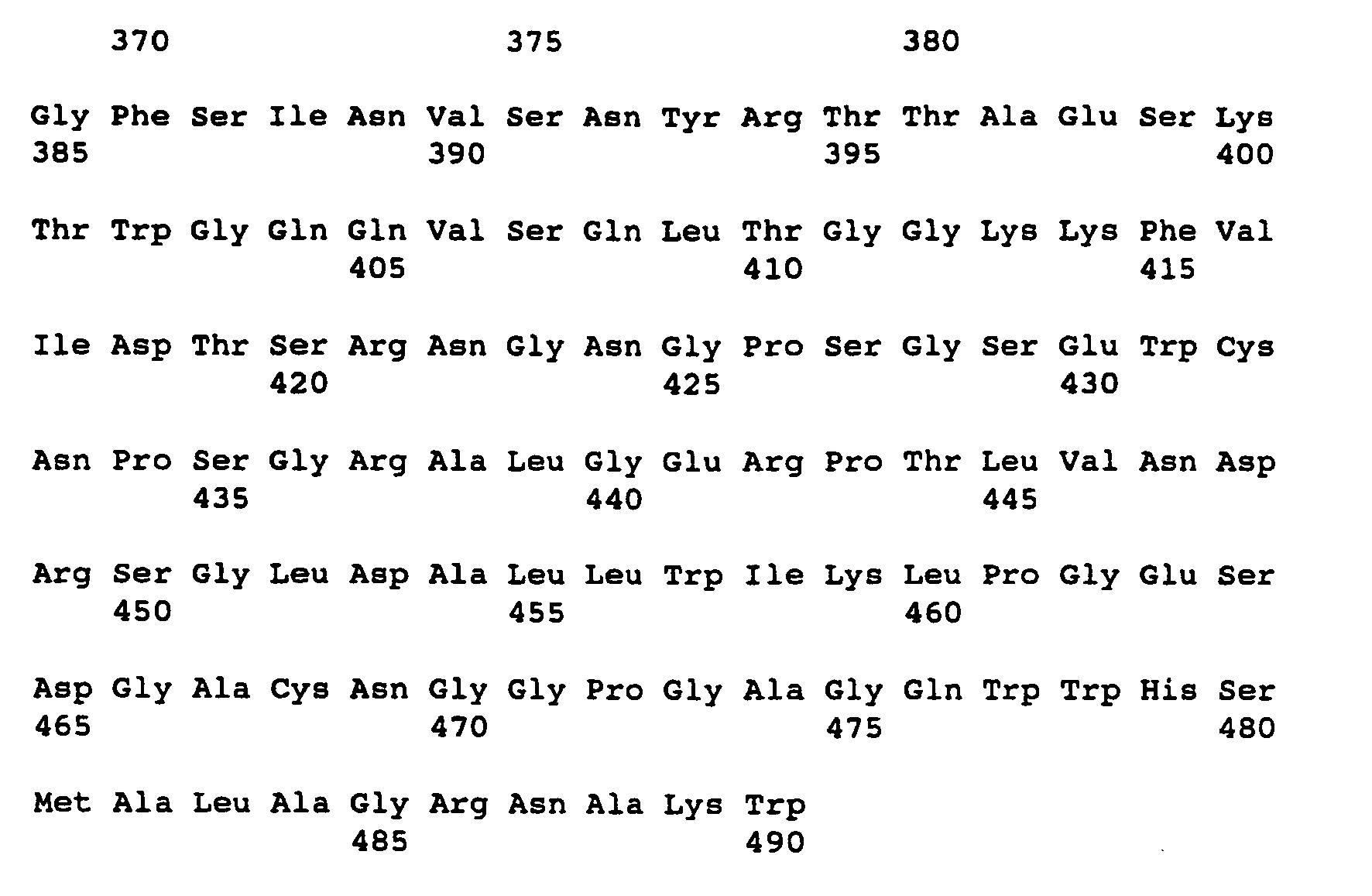
- (i) SEQUENCE CHARACTERISTICS:
Claims (26)
- An endo-β-1,4-glucanase which is(a) a polypeptide comprising an amino acid sequence as shown in positions 226-490 of SEQ ID NO:2, or(b) a polypeptide which is at least 75% homologous with the polypeptide defined in (a).
- An isolated polynucleotide molecule encoding a polypeptide having endo-beta-1,4-endoglucanase activity selected from the group consisting of:(a) polynucleotide molecules comprising a nucleotide sequence as shown in SEQ ID NO:1 from nucleotide 676 to nucleotide 1470;(b) polynucleotide molecules that encode a polypeptide that is at least 80% identical to the amino acid sequence of SEQ ID NO:2 from amino acid residue 226 to amino acid residue 490; and(c) degenerate nucleotide sequences of (a) or (b).
- The isolated polynucleotide molecule according to claim 2, wherein the polynucleotide is DNA.
- An isolated polynucleotide molecule encoding a polypeptide having endo-beta-1,4-glucanase activity which polynucleotide molecule hybridizes to a denatured double-stranded DNA probe under high stringency conditions, wherein the probe is selected from the group consisting of DNA probes comprising the sequence shown in positions 676-1470 of SEQ ID NO:1 and DNA probes comprising a subsequence of positions 676-1470 of SEQ ID NO:1 having a length of at least about 100 base pairs.
- The isolated polynucleotide molecule according to claim 4 which is isolated from or produced on the basis of a DNA library from a prokaryot, preferably from a bacterium, more preferably from a gram positive bacterium.
- The isolated polynucleotide molecule according to claim 5 which is isolated from or produced on the basis of a DNA library from a strain belonging to the class Actinomycetes, preferably to the family Pseudonocardiaceae, more preferably to the genus Saccharothrix, in particular a strain of Saccharothrix australiensis, especially Saccharothrix australiensis, IFO 14444.
- The isolated polynucleotide molecule according to any of the claims 2-6 which is isolated from Escherichia coli, DSM 11476.
- The isolated polynucleotide molecule according to any of the claims 2-7 which further comprises a partial DNA sequence encoding a cellulose binding domain (CBD).
- The isolated polynucleotide molecule according to claim 8, wherein the partial nucleotide sequence encoding a cellulose binding domain (CBD) corresponds to the nucleotides in positions 60-435 of SEQ ID NO:1.
- The isolated polynucleotide molecule according to claim 8 or 9, which further comprises a partial nucleotide sequence encoding a linking region, the linking region operably linking the cellulose binding domain (CBD) and the catalytically active domain (CAD) of the enzyme encoded by the nucleotide sequence comprised by the isolated polynucleotide molecule.
- An expression vector comprising the following operably linked elements: a transcription promoter; a DNA segment selected from the group consisting of (a) polynucleotide molecules encoding a polypeptide having endo-beta-1,4-glucanase activity comprising a nucleotide sequence as shown in SEQ ID NO:1 from nucleotide 676 to nucleotide 1470, (b) polynucleotide molecules encoding a polypeptide having endo-beta-1,4-glucanase activity that is at least 80% identical to the amino acid sequence of SEQ ID NO:2 from amino acid residue 226 to amino acid residue 490, and (c) degenerate nucleotide sequences of (a) or (b); and a transcription terminator.
- A cultured cell into which has been introduced an expression vector according to claim 11, wherein said cell expresses the polypeptide encoded by the DNA segment.
- The cell according to claim 12, which is a prokaryotic cell, in particular a bacterial cell, or an endogenous cell from which the DNA segment, encoding the polypeptide exhibiting endoglucanase activity, originates.
- The cell according to claim 12, wherein the cell belongs to a strain of Bacillus, preferably a strain of Bacillus subtilis or Bacillus lentus.
- A cell according to claim 12, wherein the cell belongs to a strain of Saccharothrix australiensis, preferably Saccharothrix australiensis, IFO 14444.
- The cell according to claim 12, wherein the cell belongs to a strain of Pseudomonas, preferably a strain of Pseudomonas fluorescens or Pseudomonas mendocina.
- The cell according to claim 12, wherein the cell belongs to a strain of Streptomyces.
- A cell according to claim 12 wherein the cell belongs to a strain of Saccharomyces, preferably a strain of Saccharomyces cerevisiae.
- A method of producing a polypeptide having endo-beta-1,4-glucanase activity comprising culturing a cell into which has been introduced an expression vector according to claim 11, whereby said cell expresses a polypeptide encoded by the DNA segment; and recovering the polypeptide.
- An enzyme preparation comprising a purified polypeptide according to claim 1.
- The preparation according to claim 20 which further comprises one or more enzymes selected from the group consisting of proteases, cellulases (endoglucanases), β-glucanases, hemicellulases, lipases, peroxidases, laccases, α-amylases, glucoamylases, cutinases, pectinases, reductases, oxidases, phenoloxidases, ligninases, pullulanases, pectate lyases, xyloglucanases, xylanases, pectin acetyl esterases, polygalacturonases, rhamnogalacturonases, pectin lyases, other mannanases, pectin methylesterases, cellobiohydrolases, transglutaminases; or mixtures thereof.
- An isolated enzyme having endo-beta-1,4-glucanase activity, in which the enzyme is (i) free from homologous impurities, and (ii) produced by the method according to claim 19.
- An isolated substantially pure biological culture of the strain Escherichia coli, DSM 11476.
- Use of the enzyme according to claim 1 or 22 or the enzyme preparation according to claim 20 and 21 in the textile industry for improving the properties of cellulosic fibres or fabric or for providing a stone-washed look of denim; or in industrial cleaning processes.
- A detergent composition comprising the enzyme according to claim 1 or 22 or the enzyme preparation according to claim 20 and 21.
- A fabric softener composition comprising the enzyme according to claim 1 or 22 or the enzyme preparation according to claim 20 and 21.
Applications Claiming Priority (7)
| Application Number | Priority Date | Filing Date | Title |
|---|---|---|---|
| DK81297 | 1997-07-04 | ||
| DK81297 | 1997-07-04 | ||
| DK84697 | 1997-07-11 | ||
| DK84697 | 1997-07-11 | ||
| US5350697P | 1997-07-23 | 1997-07-23 | |
| US53506P | 1997-07-23 | ||
| PCT/DK1998/000286 WO1999001543A1 (en) | 1997-07-04 | 1998-06-30 | ENDO-β-1,4-GLUCANASES FROM $i(SACCHAROTHRIX) |
Publications (2)
| Publication Number | Publication Date |
|---|---|
| EP1002059A1 EP1002059A1 (en) | 2000-05-24 |
| EP1002059B1 true EP1002059B1 (en) | 2007-12-26 |
Family
ID=27220938
Family Applications (1)
| Application Number | Title | Priority Date | Filing Date |
|---|---|---|---|
| EP98929243A Expired - Lifetime EP1002059B1 (en) | 1997-07-04 | 1998-06-30 | Endo-beta-1,4-glucanases from saccharothrix |
Country Status (5)
| Country | Link |
|---|---|
| US (1) | US6207436B1 (en) |
| EP (1) | EP1002059B1 (en) |
| CN (1) | CN1261913A (en) |
| AU (1) | AU7908298A (en) |
| WO (1) | WO1999001543A1 (en) |
Families Citing this family (28)
| Publication number | Priority date | Publication date | Assignee | Title |
|---|---|---|---|---|
| JP2002510756A (en) * | 1998-04-03 | 2002-04-09 | ノボザイムス アクティーゼルスカブ | Treatment of denim fabric with pectin-degrading enzyme |
| NL1021820C2 (en) * | 2002-11-01 | 2004-05-06 | Tno | Process for treating cellulose-containing raw textile cloth, textile cloth obtained with the method, the use of the treated textile cloth for the manufacture of textile products, and textile products made from the treated textile cloth. |
| DE10346256B3 (en) * | 2003-09-24 | 2004-10-21 | E. Begerow Gmbh & Co | Production of filter material, especially deep filter layer, with predetermined number of natural fibers, e.g. cellulose, includes adding specific enzyme to suspension to convert each toxic polysaccharide to nontoxic or less toxic product |
| CN1328967C (en) * | 2005-03-09 | 2007-08-01 | 陕西科技大学 | Tea buccal tablet and its manufacturing method |
| US8765199B2 (en) | 2006-06-15 | 2014-07-01 | Novozymes A/S | Mashing process |
| WO2009074650A2 (en) | 2007-12-12 | 2009-06-18 | Novozymes A/S | Brewing process |
| US7491362B1 (en) * | 2008-01-28 | 2009-02-17 | Ecolab Inc. | Multiple enzyme cleaner for surgical instruments and endoscopes |
| HUE045496T2 (en) | 2009-03-30 | 2019-12-30 | Fiberlean Tech Ltd | Process for the production of nano-fibrillar cellulose suspensions |
| PL2236545T3 (en) | 2009-03-30 | 2015-02-27 | Omya Int Ag | Process for the production of nano-fibrillar cellulose gels |
| US20100316764A1 (en) * | 2009-06-10 | 2010-12-16 | Engrain, LLC | Flour supplement compositions and methods for preparing wheat flour |
| IN2012DN00345A (en) * | 2009-07-24 | 2015-05-08 | Univ California | |
| CN101736023B (en) * | 2010-01-22 | 2012-05-09 | 南京农业大学 | Cellulolytic enzyme beta-1,4 endoglucanase gene |
| DK2386682T3 (en) | 2010-04-27 | 2014-06-23 | Omya Int Ag | Process for preparing structured materials using nano-fibrillar cellulose gels |
| EP2386683B1 (en) | 2010-04-27 | 2014-03-19 | Omya International AG | Process for the production of gel-based composite materials |
| ES2628190T3 (en) * | 2011-09-22 | 2017-08-02 | Novozymes A/S | Polypeptides with protease activity and polynucleotides encoding them |
| CN102677476A (en) * | 2012-06-04 | 2012-09-19 | 江苏联发纺织股份有限公司 | Desizing and refining working solution of pure cotton woven fabric |
| US9109212B2 (en) * | 2012-07-05 | 2015-08-18 | Jiangnan University | Method for enhancing extracellular secretion of recombinant proteins in Escherichia coli by co-expressing Thermobifida fusca cutinase |
| CN102899340B (en) * | 2012-10-27 | 2013-09-25 | 广西大学 | Endoglucanase gene Cel6 of encoding glycosyl hydrolase family 6, and application thereof |
| US8771993B1 (en) * | 2013-02-12 | 2014-07-08 | Novozymes A/S | Polypeptides having endoglucanse activity and polynucleotides encoding same |
| US8778639B1 (en) * | 2013-02-12 | 2014-07-15 | Novozymes Inc. | Polypeptides having endoglucanase activity and polynucleotides encoding same |
| US9850512B2 (en) | 2013-03-15 | 2017-12-26 | The Research Foundation For The State University Of New York | Hydrolysis of cellulosic fines in primary clarified sludge of paper mills and the addition of a surfactant to increase the yield |
| CN103614488B (en) * | 2013-12-16 | 2016-01-27 | 盎亿泰地质微生物技术(北京)有限公司 | A kind of method of PCR primer for saccharothrix and detection saccharothrix and test kit |
| US9951363B2 (en) | 2014-03-14 | 2018-04-24 | The Research Foundation for the State University of New York College of Environmental Science and Forestry | Enzymatic hydrolysis of old corrugated cardboard (OCC) fines from recycled linerboard mill waste rejects |
| US20180171271A1 (en) * | 2015-06-30 | 2018-06-21 | Novozymes A/S | Laundry detergent composition, method for washing and use of composition |
| PL3362508T3 (en) | 2015-10-14 | 2019-10-31 | Fiberlean Tech Ltd | 3d-formable sheet material |
| CN109679866B (en) * | 2018-12-26 | 2022-06-10 | 江西省农业科学院农业应用微生物研究所(江西省农村能源研究中心) | Screening method and application of efficient endoxylanase producing strain |
| US20220169953A1 (en) * | 2019-04-03 | 2022-06-02 | Novozymes A/S | Polypeptides having beta-glucanase activity, polynucleotides encoding same and uses thereof in cleaning and detergent compositions |
| WO2023074074A1 (en) * | 2021-10-25 | 2023-05-04 | 花王株式会社 | Method for restoring lost shape of textile product |
Family Cites Families (2)
| Publication number | Priority date | Publication date | Assignee | Title |
|---|---|---|---|---|
| US5643791A (en) * | 1986-08-07 | 1997-07-01 | University Of British Columbia | Characterization and structure of an endodglucanase gene of Cellulomonas fimi |
| JP2728531B2 (en) | 1988-03-24 | 1998-03-18 | ノボ ノルディスク アクティーゼルスカブ | Cellulase preparation |
-
1998
- 1998-06-30 CN CN98806769A patent/CN1261913A/en active Pending
- 1998-06-30 WO PCT/DK1998/000286 patent/WO1999001543A1/en not_active Ceased
- 1998-06-30 EP EP98929243A patent/EP1002059B1/en not_active Expired - Lifetime
- 1998-06-30 AU AU79082/98A patent/AU7908298A/en not_active Abandoned
- 1998-07-02 US US09/109,841 patent/US6207436B1/en not_active Expired - Fee Related
Also Published As
| Publication number | Publication date |
|---|---|
| CN1261913A (en) | 2000-08-02 |
| WO1999001543A1 (en) | 1999-01-14 |
| AU7908298A (en) | 1999-01-25 |
| EP1002059A1 (en) | 2000-05-24 |
| US6207436B1 (en) | 2001-03-27 |
Similar Documents
| Publication | Publication Date | Title |
|---|---|---|
| US6207436B1 (en) | Endo-B-1,4-glucanases from saccharothrix | |
| EP1002060B1 (en) | Alkaline xyloglucanase | |
| EP1259594B1 (en) | Family 44 xyloglucanases | |
| US6268197B1 (en) | Xyloglucan-specific alkaline xyloglucanase from bacillus | |
| US6815192B2 (en) | Family 44 xyloglucanases | |
| US6630340B2 (en) | Family 5 xyloglucanases | |
| EP2311941B1 (en) | Detergent composition comprising endo-glucanase | |
| US7993898B2 (en) | Cellulase variants | |
| WO1998008940A1 (en) | A novel endoglucanase | |
| WO2002077242A2 (en) | Family 74 xyloglucanases | |
| WO2001064853A1 (en) | Family 5 xyloglucanases | |
| US6500658B1 (en) | Xyloglucanase from Malbranchea | |
| EP1210414B1 (en) | Alkaline xyloglucanase from malbranchea | |
| DE69838910T2 (en) | ENDO-BETA-1,4-GLUCANASES OF SACCHAROTHRIX | |
| US20030087415A1 (en) | Extracellular expression of pectate lyase using Bacillus or Escherichia coli | |
| EP1276854A2 (en) | Extracellular expression of pectate lyase using bacillus or escherichia coli | |
| MXPA99011756A (en) | Alkaline xyloglucanase |
Legal Events
| Date | Code | Title | Description |
|---|---|---|---|
| PUAI | Public reference made under article 153(3) epc to a published international application that has entered the european phase |
Free format text: ORIGINAL CODE: 0009012 |
|
| 17P | Request for examination filed |
Effective date: 20000204 |
|
| AK | Designated contracting states |
Kind code of ref document: A1 Designated state(s): AT BE CH DE DK ES FI FR GB GR IE IT LI NL PT SE |
|
| RTI1 | Title (correction) |
Free format text: ENDO-BETA-1,4-GLUCANASES FROM SACCHAROTHRIX |
|
| RAP1 | Party data changed (applicant data changed or rights of an application transferred) |
Owner name: NOVOZYMES A/S |
|
| 17Q | First examination report despatched |
Effective date: 20031107 |
|
| GRAP | Despatch of communication of intention to grant a patent |
Free format text: ORIGINAL CODE: EPIDOSNIGR1 |
|
| RIN1 | Information on inventor provided before grant (corrected) |
Inventor name: NIELSEN, JACK, BECH Inventor name: SCHUELEIN, MARTIN Inventor name: HATAKEYAMA, MARIKO Inventor name: BJORNVAD, MADS, ESKELUND |
|
| GRAS | Grant fee paid |
Free format text: ORIGINAL CODE: EPIDOSNIGR3 |
|
| GRAA | (expected) grant |
Free format text: ORIGINAL CODE: 0009210 |
|
| AK | Designated contracting states |
Kind code of ref document: B1 Designated state(s): AT BE CH DE DK ES FI FR GB GR IE IT LI NL PT SE |
|
| REG | Reference to a national code |
Ref country code: GB Ref legal event code: FG4D |
|
| REG | Reference to a national code |
Ref country code: IE Ref legal event code: FG4D |
|
| REG | Reference to a national code |
Ref country code: CH Ref legal event code: EP |
|
| REF | Corresponds to: |
Ref document number: 69838910 Country of ref document: DE Date of ref document: 20080207 Kind code of ref document: P |
|
| PG25 | Lapsed in a contracting state [announced via postgrant information from national office to epo] |
Ref country code: SE Free format text: LAPSE BECAUSE OF FAILURE TO SUBMIT A TRANSLATION OF THE DESCRIPTION OR TO PAY THE FEE WITHIN THE PRESCRIBED TIME-LIMIT Effective date: 20080326 Ref country code: LI Free format text: LAPSE BECAUSE OF FAILURE TO SUBMIT A TRANSLATION OF THE DESCRIPTION OR TO PAY THE FEE WITHIN THE PRESCRIBED TIME-LIMIT Effective date: 20071226 Ref country code: CH Free format text: LAPSE BECAUSE OF FAILURE TO SUBMIT A TRANSLATION OF THE DESCRIPTION OR TO PAY THE FEE WITHIN THE PRESCRIBED TIME-LIMIT Effective date: 20071226 |
|
| PG25 | Lapsed in a contracting state [announced via postgrant information from national office to epo] |
Ref country code: NL Free format text: LAPSE BECAUSE OF FAILURE TO SUBMIT A TRANSLATION OF THE DESCRIPTION OR TO PAY THE FEE WITHIN THE PRESCRIBED TIME-LIMIT Effective date: 20071226 Ref country code: FI Free format text: LAPSE BECAUSE OF FAILURE TO SUBMIT A TRANSLATION OF THE DESCRIPTION OR TO PAY THE FEE WITHIN THE PRESCRIBED TIME-LIMIT Effective date: 20071226 |
|
| NLV1 | Nl: lapsed or annulled due to failure to fulfill the requirements of art. 29p and 29m of the patents act | ||
| REG | Reference to a national code |
Ref country code: CH Ref legal event code: PL |
|
| PG25 | Lapsed in a contracting state [announced via postgrant information from national office to epo] |
Ref country code: AT Free format text: LAPSE BECAUSE OF FAILURE TO SUBMIT A TRANSLATION OF THE DESCRIPTION OR TO PAY THE FEE WITHIN THE PRESCRIBED TIME-LIMIT Effective date: 20071226 |
|
| PG25 | Lapsed in a contracting state [announced via postgrant information from national office to epo] |
Ref country code: ES Free format text: LAPSE BECAUSE OF FAILURE TO SUBMIT A TRANSLATION OF THE DESCRIPTION OR TO PAY THE FEE WITHIN THE PRESCRIBED TIME-LIMIT Effective date: 20080406 |
|
| ET | Fr: translation filed | ||
| PG25 | Lapsed in a contracting state [announced via postgrant information from national office to epo] |
Ref country code: BE Free format text: LAPSE BECAUSE OF FAILURE TO SUBMIT A TRANSLATION OF THE DESCRIPTION OR TO PAY THE FEE WITHIN THE PRESCRIBED TIME-LIMIT Effective date: 20071226 |
|
| PG25 | Lapsed in a contracting state [announced via postgrant information from national office to epo] |
Ref country code: PT Free format text: LAPSE BECAUSE OF FAILURE TO SUBMIT A TRANSLATION OF THE DESCRIPTION OR TO PAY THE FEE WITHIN THE PRESCRIBED TIME-LIMIT Effective date: 20080526 |
|
| PG25 | Lapsed in a contracting state [announced via postgrant information from national office to epo] |
Ref country code: DK Free format text: LAPSE BECAUSE OF FAILURE TO SUBMIT A TRANSLATION OF THE DESCRIPTION OR TO PAY THE FEE WITHIN THE PRESCRIBED TIME-LIMIT Effective date: 20071226 |
|
| PLBE | No opposition filed within time limit |
Free format text: ORIGINAL CODE: 0009261 |
|
| STAA | Information on the status of an ep patent application or granted ep patent |
Free format text: STATUS: NO OPPOSITION FILED WITHIN TIME LIMIT |
|
| 26N | No opposition filed |
Effective date: 20080929 |
|
| PG25 | Lapsed in a contracting state [announced via postgrant information from national office to epo] |
Ref country code: GR Free format text: LAPSE BECAUSE OF FAILURE TO SUBMIT A TRANSLATION OF THE DESCRIPTION OR TO PAY THE FEE WITHIN THE PRESCRIBED TIME-LIMIT Effective date: 20080327 |
|
| PG25 | Lapsed in a contracting state [announced via postgrant information from national office to epo] |
Ref country code: IE Free format text: LAPSE BECAUSE OF NON-PAYMENT OF DUE FEES Effective date: 20080630 |
|
| PG25 | Lapsed in a contracting state [announced via postgrant information from national office to epo] |
Ref country code: IT Free format text: LAPSE BECAUSE OF NON-PAYMENT OF DUE FEES Effective date: 20080630 |
|
| PGFP | Annual fee paid to national office [announced via postgrant information from national office to epo] |
Ref country code: DE Payment date: 20110829 Year of fee payment: 14 |
|
| PGFP | Annual fee paid to national office [announced via postgrant information from national office to epo] |
Ref country code: GB Payment date: 20120627 Year of fee payment: 15 |
|
| PGFP | Annual fee paid to national office [announced via postgrant information from national office to epo] |
Ref country code: FR Payment date: 20120712 Year of fee payment: 15 |
|
| REG | Reference to a national code |
Ref country code: DE Ref legal event code: R119 Ref document number: 69838910 Country of ref document: DE Effective date: 20130101 |
|
| PG25 | Lapsed in a contracting state [announced via postgrant information from national office to epo] |
Ref country code: DE Free format text: LAPSE BECAUSE OF NON-PAYMENT OF DUE FEES Effective date: 20130101 |
|
| GBPC | Gb: european patent ceased through non-payment of renewal fee |
Effective date: 20130630 |
|
| REG | Reference to a national code |
Ref country code: FR Ref legal event code: ST Effective date: 20140228 |
|
| PG25 | Lapsed in a contracting state [announced via postgrant information from national office to epo] |
Ref country code: GB Free format text: LAPSE BECAUSE OF NON-PAYMENT OF DUE FEES Effective date: 20130630 |
|
| PG25 | Lapsed in a contracting state [announced via postgrant information from national office to epo] |
Ref country code: FR Free format text: LAPSE BECAUSE OF NON-PAYMENT OF DUE FEES Effective date: 20130701 |