EP0996755B1 - Aluminium-lithium alloys - Google Patents
Aluminium-lithium alloys Download PDFInfo
- Publication number
- EP0996755B1 EP0996755B1 EP98903188A EP98903188A EP0996755B1 EP 0996755 B1 EP0996755 B1 EP 0996755B1 EP 98903188 A EP98903188 A EP 98903188A EP 98903188 A EP98903188 A EP 98903188A EP 0996755 B1 EP0996755 B1 EP 0996755B1
- Authority
- EP
- European Patent Office
- Prior art keywords
- alloys
- alloy
- weight percent
- manganese
- strength
- Prior art date
- Legal status (The legal status is an assumption and is not a legal conclusion. Google has not performed a legal analysis and makes no representation as to the accuracy of the status listed.)
- Expired - Lifetime
Links
Images


Classifications
-
- C—CHEMISTRY; METALLURGY
- C22—METALLURGY; FERROUS OR NON-FERROUS ALLOYS; TREATMENT OF ALLOYS OR NON-FERROUS METALS
- C22C—ALLOYS
- C22C21/00—Alloys based on aluminium
-
- C—CHEMISTRY; METALLURGY
- C22—METALLURGY; FERROUS OR NON-FERROUS ALLOYS; TREATMENT OF ALLOYS OR NON-FERROUS METALS
- C22C—ALLOYS
- C22C21/00—Alloys based on aluminium
- C22C21/12—Alloys based on aluminium with copper as the next major constituent
- C22C21/16—Alloys based on aluminium with copper as the next major constituent with magnesium
Definitions
- the invention relates to high-strength aluminium-lithium alloys and in particular to those alloys suitable for fabrication into high-strength plate materials for aerospace applications.
- Aluminium-lithium based alloys are becoming established as lightweight alternatives to conventional aluminium alloys in weight critical applications, such as for aerospace construction.
- JP-A-61023751 discloses an aluminium lithium alloy in which the ductility and toughness of the alloy is improved by controlling the crystal grain shape by hot and cold working of the alloy.
- the present invention is directed towards the provision of a high-strength aluminium-lithium alloy material based on the Al-LI-Cu-Mg system which mitigates some or all of the above problems whilst maintaining low density and in particular which exhibits reduced tensile strength anisotropy in comparison with conventional Al-Li-Cu-Mg-Zr alloys.
- an aluminium lithium manganese based alloy has a composition within the following ranges, all of the ranges being in weight percent: lithium 2.0 to 2.8, magnesium 0.4 to 1.0, copper 2.0 to 3.0, manganese 1.0 to 1.2, zirconium up to 0.2 and the balance aluminium, save for incidental impurities and up to 2.0 in total of one or more other grain controlling elements selected from the group consisting of scandium, titanium, vanadium, niobium, nickel, chromium, hafnium and cerium.
- the principal alloying elements are lithium, magnesium, copper and manganese, with zirconium optionally present at up to 0.2 weight percent and further optional additions of one or more other elements selected from those established in the art as suitable for the optimisation and control of the recrystallised microstructure (as precipitate formers and elements controlling grain size and grain growth on recrystallization) up to a maximum of 2.0 weight percent in total.
- these further grain controlling elements are selected from scandium. titanium, vanadium and niobium at up to 0.2 weight percent, nickel and chromium at up to 0.5 weight percent and preferably at up to 0.2 weight percent, hafnium at up to 0.6 weight percent and cerium at up to 0.5 weight percent.
- Alloys in accordance with the invention are found to exhibit improved tensile performance and in particular decreased tensile property anisotropy in comparison with the marked tensile property anisotropy exhibited by conventional Al-Li-Cu-Mg-Zr alloys, whilst retaining adequate base line strength.
- Al 6 Mn/Al 6 (Mn,Fe) forms as coarse particles (of >1 ⁇ m diameter) which assist the recrystallization processes and thus produce the required tensile isotropy; however such particles do not implicitly strengthen the material.
- 8090 alloy contains coarse constituent particles, these phases are deleterious since they assume needle shaped morphologies and act as stress concentration sites; alloys in accordance with the invention feature predominantly rounded Al 6 Mn / Al 6 (Mn,Fe) constituent particles which are much less damaging to the microstructure.
- Al-Cu-Mn orthorhombic phases (Al 20 Cu 2 Mn 3 and Al 12 CuMn 3 ) form as fine particles (of length less than 1 ⁇ m and a length: diameter ratio of about 5) which are homogeneously distributed throughout the matrix.
- These fine particles which neither pin sub-grain boundaries nor promote recrystallisation, may represent ⁇ 5 vol% of the alloy and facilitate slip dispersion and thus strengthen the alloy beyond the level attained by Mn-free Al-Li-Cu-Mg alloys of otherwise comparable matrix composition.
- the Al-Cu-Mn particles indirectly strengthen the alloy by introduction of dislocation networks (without recourse to cold-working) on account of the mismatch of intermetallic and matrix thermal expansion coefficients (CTE).
- the dislocations provide a high density of nucleation sites for precipitation of highly desirable age hardening phases, such as S' (Al 2 CuMg) and T 1 (Al 2 CuLi).
- the alloy comprises at least1.0 weight percent manganese. It is further preferred that the copper: manganese ratio in the alloy is in the range 2.4 to 2.6. An upper limit on levels of copper and manganese is imposed by weight requirements and alloys having copper levels above 3.0 weight percent and manganese levels above 1.2 weight percent are not considered practical.
- the alloy preferably comprises at least 0.02 weight percent of zirconium as the preferred alloying addition for microstructural optimisation control and preferably at least 0.02 weight percent of one or more of the further grain controlling elements. Addition of zirconium to alloys within the composition ranges in accordance with the invention is associated with improved tensile performance but increased anisotropy.
- zirconium should be kept at less than 0.06 weight percent, and may be omitted. Higher levels of up to 0.2 weight percent produce greater strength alloys.
- an alloy with nominally isotropic tensile properties is particularly preferred and the alloy should at least exhibit a reduction in anisotropy to a degree where off-angle strength levels were comparable with those typical of the minimum off-angle tensile performance of conventional aluminium 7XXX series alloy plate, say 0.2 % proof stress (0.2 %PS) 450MPa and tensile strength (TS) 500MPa.
- Alloys according to the invention can be prepared as plate products.
- the alloy is thermomechanically processed (by forging and hot-rolling) to the desired plate thickness before solution heat treatment in air, followed by cold water quench (CWQ) and optional subsequent stretch, maintaining a quench delay of under 2 hours.
- Alloy plate is finally artificially aged, to the desired temper.
- Table 1 Examples of Al-Li-Cu-Mg Alloys example Major alloying elements (wt%) Li Cu Mg Mn 1 2.46 1.19 0.76 0.55 2 2.46 1.21 0.77 0.78 3 2.46 1.51 0.82 1.06 4 2.40 1.67 0.78 1.02 5 2.28 1.99 0.78 1.02 6 2.42 2.45 0.79 1.07
- 1 is illustrative of a conventional prior art Al-Li-Cu-Mg alloy
- 2 is illustrative of the effect of raising manganese levels
- 3 and 4 are illustrative of the effect of raising copper content in high manganese alloys to levels intermediate between those in conventional 8090 alloys and those in alloys in accordance with the invention
- 5 and 6 are examples of the invention.
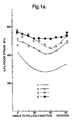
- Figures 1a shows the effect of test orientation on 0.2% proof stress and 1b the effect of test orientation on UTS comparing examples 1, 3, 5 and 6. It is illustrated that at the copper and manganese levels of examples 1 and 3 which fall outside the invention, strength levels are low. At copper levels of example 5 an appreciable degree of anisotropy is still shown, but base-line strength has been significantly raised to mitigate this, and at the levels of example 6 a substantial degree of isotropy is achieved with good baseline strength.
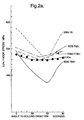
- Figures 2a (0.2% proof stress data) and 2b (UTS data) illustrate that example 6 achieved substantial degree of isotropy in comparison with many conventional alloys, and with 8090 in particular. Off-angle performance well in excess of 8090 and comparable with alloys of the 7XXX series and even with the off-angle minimum of the high-strength alloy 2095 are achieved. Although there is some density penalty with respect to 8090 the plate of example 6 is 8% lighter and 10% stiffer than conventional 7XXX series plate at comparable strength levels and 5% lighter than 2095 of comparable minimum useable strength levels.
- Plates of the invention composition aged to the -T651 condition thus demonstrate proof stresses at intermediate angles between L and LT directions in excess of 460MPa; i.e. the baseline proof stress is 460MPa, whereas that of 8090-T651 is just 360MPa.
- example 4 The tendency for an increase in the copper content to produce an initial increase in the brass component, to reach a maximum at 1.7 wt% Cu, is illustrated by example 4.
- This alloy produced the most unrecrystallised - and hence anisotropic - plate of the example.
- the cube texture is recovered and the brass component simultaneously reduced. This results in a recrystallised grain structure, having isotropic tensile properties (in plane) as is illustrated in example 6.
- Sheet products of the invention alloy are produced from billet by standard procedure, including forging, hot and cold-rolling to the desired thickness, implementing >30% reduction.
- Fine recrystallised grain structures that are essential for tensile isotropy, can be produced by SHT in either air or salt bath (followed) by CWQ. this offers an advantage over 8090 alloy sheet which may recrystallize on salt bath SHT.
- An optional stretch can be applied, after SHT but maintaining a quench delay of less than 2 hours, prior to artificial ageing to the desired temper.
Landscapes
- Chemical & Material Sciences (AREA)
- Engineering & Computer Science (AREA)
- Materials Engineering (AREA)
- Mechanical Engineering (AREA)
- Metallurgy (AREA)
- Organic Chemistry (AREA)
- Metal Rolling (AREA)
- Battery Electrode And Active Subsutance (AREA)
- Heat Treatment Of Steel (AREA)
- Electric Double-Layer Capacitors Or The Like (AREA)
- Cell Electrode Carriers And Collectors (AREA)
Description
lithium 2.0 to 2.8, magnesium 0.4 to 1.0, copper 2.0 to 3.0, manganese 1.0 to 1.2, zirconium up to 0.2 and the balance aluminium, save for incidental impurities and up to 2.0 in total of one or more other grain controlling elements selected from the group consisting of scandium, titanium, vanadium, niobium, nickel, chromium, hafnium and cerium.
Manganese exhibits only limited solid solubility in the Al-Li matrix, and reaction with the other alloying elements provide particles of three different intermetallic phases that assist strengthening mechanisms either directly or indirectly. Al6Mn/Al6(Mn,Fe) forms as coarse particles (of >1 µm diameter) which assist the recrystallization processes and thus produce the required tensile isotropy; however such particles do not implicitly strengthen the material. Although 8090 alloy contains coarse constituent particles, these phases are deleterious since they assume needle shaped morphologies and act as stress concentration sites; alloys in accordance with the invention feature predominantly rounded Al6Mn / Al6(Mn,Fe) constituent particles which are much less damaging to the microstructure.
Improved tensile performance has been demonstrated for plate and sheet alloy products, though the alloy is not in any way theoretically limited to these specific products, and these product are given for example purposes only.
| Examples of Al-Li-Cu-Mg Alloys | |||||
| example | Major alloying elements (wt%) | ||||
| Li | | Mg | Mn | ||
| 1 | 2.46 | 1.19 | 0.76 | 0.55 | |
| 2 | 2.46 | 1.21 | 0.77 | 0.78 | |
| 3 | 2.46 | 1.51 | 0.82 | 1.06 | |
| 4 | 2.40 | 1.67 | 0.78 | 1.02 | |
| 5 | 2.28 | 1.99 | 0.78 | 1.02 | |
| 6 | 2.42 | 2.45 | 0.79 | 1.07 |
| Analysis of crystallographic texture for the example plates | ||||
| example | strength of brass component (110)<112> x random | strength of cube component (100)<001> x | grain structure | |
| 1 | 5.0 | 31.3 | recrystallised | |
| 2 | - | 30.8 | recrystallised | |
| 3 | 20.4 | - | mixed | |
| 4 | 94.2 | - | unrecrystallised | |
| 5 | 27.1 | 17.0 | mixed | |
| 6 | - | 18.2 | recrystallised |
Claims (2)
- An aluminium based alloy having a composition within the following ranges, all of the ranges being specified in weight percent:wherein said alloy exhibits reduced tensile strength anisotropy in comparison with conventional Al-Li-Cu-Mg-Zr alloys.lithium 2.0 to 2.8;magnesium 0.4 to 1.0;copper 2.0 to 3.0;manganese 1.0 to 1.2;zirconium up to 0.2;grain controlling elements up to 2.0, being selected from scandium, titanium, vanadium and niobium at up to 0.2 weight percent, nickel and chromium, at up to 0.5 weight percent and preferably at up to 0.2 weight percent, hafnium at up to 0.6 weight percent, and cerium at up to 0.5 weight percent; and,aluminium balance.
- An alloy in accordance with any preceding claim wherein copper and manganese are present in the alloy in a ratio in the range 2.4 to 2.6.
Applications Claiming Priority (5)
| Application Number | Priority Date | Filing Date | Title |
|---|---|---|---|
| GB9703820 | 1997-02-24 | ||
| GBGB9703820.2A GB9703820D0 (en) | 1997-02-24 | 1997-02-24 | Aluminium-lithium alloys |
| GB9715159A GB9715159D0 (en) | 1997-07-19 | 1997-07-19 | Aluminium-lithium alloys |
| GB9715159 | 1997-07-19 | ||
| PCT/GB1998/000419 WO1998037250A1 (en) | 1997-02-24 | 1998-02-11 | Aluminium-lithium alloys |
Publications (2)
| Publication Number | Publication Date |
|---|---|
| EP0996755A1 EP0996755A1 (en) | 2000-05-03 |
| EP0996755B1 true EP0996755B1 (en) | 2002-10-02 |
Family
ID=26311053
Family Applications (1)
| Application Number | Title | Priority Date | Filing Date |
|---|---|---|---|
| EP98903188A Expired - Lifetime EP0996755B1 (en) | 1997-02-24 | 1998-02-11 | Aluminium-lithium alloys |
Country Status (6)
| Country | Link |
|---|---|
| US (1) | US6991689B2 (en) |
| EP (1) | EP0996755B1 (en) |
| DE (1) | DE69808477T2 (en) |
| ES (1) | ES2181166T3 (en) |
| GB (1) | GB2338491B (en) |
| WO (1) | WO1998037250A1 (en) |
Families Citing this family (2)
| Publication number | Priority date | Publication date | Assignee | Title |
|---|---|---|---|---|
| US10161020B2 (en) * | 2007-10-01 | 2018-12-25 | Arconic Inc. | Recrystallized aluminum alloys with brass texture and methods of making the same |
| CN110923525B (en) * | 2019-12-30 | 2021-02-09 | 天津忠旺铝业有限公司 | A kind of preparation technology of high performance 7 series aluminum alloy sheet |
Family Cites Families (7)
| Publication number | Priority date | Publication date | Assignee | Title |
|---|---|---|---|---|
| EP0088511B1 (en) * | 1982-02-26 | 1986-09-17 | Secretary of State for Defence in Her Britannic Majesty's Gov. of the United Kingdom of Great Britain and Northern Ireland | Improvements in or relating to aluminium alloys |
| FR2561260B1 (en) | 1984-03-15 | 1992-07-17 | Cegedur | AL-CU-LI-MG ALLOYS WITH VERY HIGH SPECIFIC MECHANICAL RESISTANCE |
| US4806174A (en) * | 1984-03-29 | 1989-02-21 | Aluminum Company Of America | Aluminum-lithium alloys and method of making the same |
| JPS6123751A (en) * | 1984-07-11 | 1986-02-01 | Kobe Steel Ltd | Manufacture of al-li alloy having superior ductility and toughness |
| US5066342A (en) | 1988-01-28 | 1991-11-19 | Aluminum Company Of America | Aluminum-lithium alloys and method of making the same |
| GB8926861D0 (en) * | 1989-11-28 | 1990-01-17 | Alcan Int Ltd | Improvements in or relating to aluminium alloys |
| JPH0689439B2 (en) * | 1990-04-27 | 1994-11-09 | 住友軽金属工業株式会社 | Method for producing structural Al-Cu-Mg-Li aluminum alloy material |
-
1998
- 1998-02-11 DE DE69808477T patent/DE69808477T2/en not_active Expired - Fee Related
- 1998-02-11 ES ES98903188T patent/ES2181166T3/en not_active Expired - Lifetime
- 1998-02-11 EP EP98903188A patent/EP0996755B1/en not_active Expired - Lifetime
- 1998-02-11 GB GB9918693A patent/GB2338491B/en not_active Expired - Fee Related
- 1998-02-11 WO PCT/GB1998/000419 patent/WO1998037250A1/en not_active Ceased
-
2003
- 2003-03-27 US US10/397,246 patent/US6991689B2/en not_active Expired - Fee Related
Also Published As
| Publication number | Publication date |
|---|---|
| DE69808477T2 (en) | 2003-08-07 |
| GB2338491B (en) | 2000-11-08 |
| GB9918693D0 (en) | 1999-10-13 |
| US6991689B2 (en) | 2006-01-31 |
| US20030202900A1 (en) | 2003-10-30 |
| EP0996755A1 (en) | 2000-05-03 |
| ES2181166T3 (en) | 2003-02-16 |
| DE69808477D1 (en) | 2002-11-07 |
| WO1998037250A1 (en) | 1998-08-27 |
| GB2338491A (en) | 1999-12-22 |
Similar Documents
| Publication | Publication Date | Title |
|---|---|---|
| JP3194742B2 (en) | Improved lithium aluminum alloy system | |
| US4336075A (en) | Aluminum alloy products and method of making same | |
| EP0247181B1 (en) | Aluminum-lithium alloys and method of making the same | |
| JP3654466B2 (en) | Aluminum alloy extrusion process and high strength and toughness aluminum alloy material obtained thereby | |
| EP0610006B1 (en) | Superplastic aluminum alloy and process for producing same | |
| US4844750A (en) | Aluminum-lithium alloys | |
| US4961792A (en) | Aluminum-lithium alloys having improved corrosion resistance containing Mg and Zn | |
| CA1338007C (en) | Aluminum-lithium alloys | |
| EP0851942B1 (en) | Use of rolled aluminum alloys for structural comonents of vehicles | |
| EP0646655B1 (en) | Method of manufacturing natural aging-retardated aluminum alloy sheet exhibiting excellent formability and excellent bake hardening ability | |
| JP3022922B2 (en) | Method for producing plate or strip material with improved cold rolling characteristics | |
| US6918975B2 (en) | Aluminum alloy extrusions having a substantially unrecrystallized structure | |
| US4921548A (en) | Aluminum-lithium alloys and method of making same | |
| Muddle et al. | High strength microalloyed aluminium alloys | |
| EP0229075B1 (en) | High strength, ductile, low density aluminum alloys and process for making same | |
| US6991689B2 (en) | Aluminium-lithium alloys | |
| JPS6339661B2 (en) | ||
| JPH1068054A (en) | Production of aluminum-lithium series alloy steel material excellent in toughness | |
| JPH06145918A (en) | Production of al-li alloy extruded material excellent in toughness | |
| JPH04160131A (en) | Al-mg-si alloy plate excellent in strength and formability, and its manufacture | |
| KR100199408B1 (en) | Method of manufacturing non-heat treatment aluminum alloy and the same product | |
| JP2678675B2 (en) | Method for producing aluminum alloy sheet for forming having excellent deep drawability | |
| JP2652016B2 (en) | Method for producing aluminum alloy material having fine crystal grains | |
| JPH03183750A (en) | Production of superplastic aluminum alloy having high strength | |
| JPH1068053A (en) | Production of aluminum-lithium base alloy thin sheet material excellent in isotropy of toughness |
Legal Events
| Date | Code | Title | Description |
|---|---|---|---|
| PUAI | Public reference made under article 153(3) epc to a published international application that has entered the european phase |
Free format text: ORIGINAL CODE: 0009012 |
|
| 17P | Request for examination filed |
Effective date: 19991223 |
|
| AK | Designated contracting states |
Kind code of ref document: A1 Designated state(s): DE ES FR GB IT SE |
|
| 17Q | First examination report despatched |
Effective date: 20001011 |
|
| RAP1 | Party data changed (applicant data changed or rights of an application transferred) |
Owner name: QINETIQ LIMITED |
|
| GRAG | Despatch of communication of intention to grant |
Free format text: ORIGINAL CODE: EPIDOS AGRA |
|
| GRAG | Despatch of communication of intention to grant |
Free format text: ORIGINAL CODE: EPIDOS AGRA |
|
| GRAH | Despatch of communication of intention to grant a patent |
Free format text: ORIGINAL CODE: EPIDOS IGRA |
|
| GRAH | Despatch of communication of intention to grant a patent |
Free format text: ORIGINAL CODE: EPIDOS IGRA |
|
| GRAA | (expected) grant |
Free format text: ORIGINAL CODE: 0009210 |
|
| AK | Designated contracting states |
Kind code of ref document: B1 Designated state(s): DE ES FR GB IT SE |
|
| PG25 | Lapsed in a contracting state [announced via postgrant information from national office to epo] |
Ref country code: IT Free format text: LAPSE BECAUSE OF FAILURE TO SUBMIT A TRANSLATION OF THE DESCRIPTION OR TO PAY THE FEE WITHIN THE PRESCRIBED TIME-LIMIT;WARNING: LAPSES OF ITALIAN PATENTS WITH EFFECTIVE DATE BEFORE 2007 MAY HAVE OCCURRED AT ANY TIME BEFORE 2007. THE CORRECT EFFECTIVE DATE MAY BE DIFFERENT FROM THE ONE RECORDED. Effective date: 20021002 |
|
| REG | Reference to a national code |
Ref country code: GB Ref legal event code: FG4D |
|
| REF | Corresponds to: |
Ref document number: 69808477 Country of ref document: DE Date of ref document: 20021107 |
|
| ET | Fr: translation filed | ||
| PG25 | Lapsed in a contracting state [announced via postgrant information from national office to epo] |
Ref country code: SE Free format text: LAPSE BECAUSE OF FAILURE TO SUBMIT A TRANSLATION OF THE DESCRIPTION OR TO PAY THE FEE WITHIN THE PRESCRIBED TIME-LIMIT Effective date: 20030102 |
|
| REG | Reference to a national code |
Ref country code: ES Ref legal event code: FG2A Ref document number: 2181166 Country of ref document: ES Kind code of ref document: T3 |
|
| PLBE | No opposition filed within time limit |
Free format text: ORIGINAL CODE: 0009261 |
|
| STAA | Information on the status of an ep patent application or granted ep patent |
Free format text: STATUS: NO OPPOSITION FILED WITHIN TIME LIMIT |
|
| 26N | No opposition filed |
Effective date: 20030703 |
|
| PGFP | Annual fee paid to national office [announced via postgrant information from national office to epo] |
Ref country code: ES Payment date: 20090220 Year of fee payment: 12 |
|
| PGFP | Annual fee paid to national office [announced via postgrant information from national office to epo] |
Ref country code: DE Payment date: 20090219 Year of fee payment: 12 |
|
| PGFP | Annual fee paid to national office [announced via postgrant information from national office to epo] |
Ref country code: FR Payment date: 20090213 Year of fee payment: 12 |
|
| PGFP | Annual fee paid to national office [announced via postgrant information from national office to epo] |
Ref country code: GB Payment date: 20100218 Year of fee payment: 13 |
|
| REG | Reference to a national code |
Ref country code: FR Ref legal event code: ST Effective date: 20101029 |
|
| PG25 | Lapsed in a contracting state [announced via postgrant information from national office to epo] |
Ref country code: FR Free format text: LAPSE BECAUSE OF NON-PAYMENT OF DUE FEES Effective date: 20100301 |
|
| PG25 | Lapsed in a contracting state [announced via postgrant information from national office to epo] |
Ref country code: DE Free format text: LAPSE BECAUSE OF NON-PAYMENT OF DUE FEES Effective date: 20100901 |
|
| REG | Reference to a national code |
Ref country code: ES Ref legal event code: FD2A Effective date: 20110328 |
|
| PG25 | Lapsed in a contracting state [announced via postgrant information from national office to epo] |
Ref country code: ES Free format text: LAPSE BECAUSE OF NON-PAYMENT OF DUE FEES Effective date: 20110314 |
|
| PG25 | Lapsed in a contracting state [announced via postgrant information from national office to epo] |
Ref country code: ES Free format text: LAPSE BECAUSE OF NON-PAYMENT OF DUE FEES Effective date: 20100212 |
|
| GBPC | Gb: european patent ceased through non-payment of renewal fee |
Effective date: 20110211 |
|
| PG25 | Lapsed in a contracting state [announced via postgrant information from national office to epo] |
Ref country code: GB Free format text: LAPSE BECAUSE OF NON-PAYMENT OF DUE FEES Effective date: 20110211 |