EP0995411B1 - Zementierbare Endoprothese - Google Patents
Zementierbare Endoprothese Download PDFInfo
- Publication number
- EP0995411B1 EP0995411B1 EP99120067A EP99120067A EP0995411B1 EP 0995411 B1 EP0995411 B1 EP 0995411B1 EP 99120067 A EP99120067 A EP 99120067A EP 99120067 A EP99120067 A EP 99120067A EP 0995411 B1 EP0995411 B1 EP 0995411B1
- Authority
- EP
- European Patent Office
- Prior art keywords
- shaft
- bone
- bone cement
- sealing element
- bone cavity
- Prior art date
- Legal status (The legal status is an assumption and is not a legal conclusion. Google has not performed a legal analysis and makes no representation as to the accuracy of the status listed.)
- Expired - Lifetime
Links
- 210000000988 bone and bone Anatomy 0.000 claims description 66
- 239000002639 bone cement Substances 0.000 claims description 62
- 238000007789 sealing Methods 0.000 claims description 39
- 238000009423 ventilation Methods 0.000 claims description 16
- 238000013022 venting Methods 0.000 claims 1
- 238000003780 insertion Methods 0.000 description 6
- 230000037431 insertion Effects 0.000 description 6
- 210000000689 upper leg Anatomy 0.000 description 4
- 238000005429 filling process Methods 0.000 description 3
- 238000005520 cutting process Methods 0.000 description 2
- 238000004026 adhesive bonding Methods 0.000 description 1
- 239000000560 biocompatible material Substances 0.000 description 1
- 210000001124 body fluid Anatomy 0.000 description 1
- 239000010839 body fluid Substances 0.000 description 1
- 230000006378 damage Effects 0.000 description 1
- 230000007423 decrease Effects 0.000 description 1
- 230000009969 flowable effect Effects 0.000 description 1
- 239000007789 gas Substances 0.000 description 1
- 238000009434 installation Methods 0.000 description 1
- 210000004197 pelvis Anatomy 0.000 description 1
- 230000035515 penetration Effects 0.000 description 1
- 238000002360 preparation method Methods 0.000 description 1
- 230000007704 transition Effects 0.000 description 1
Images

Classifications
-
- A—HUMAN NECESSITIES
- A61—MEDICAL OR VETERINARY SCIENCE; HYGIENE
- A61F—FILTERS IMPLANTABLE INTO BLOOD VESSELS; PROSTHESES; DEVICES PROVIDING PATENCY TO, OR PREVENTING COLLAPSING OF, TUBULAR STRUCTURES OF THE BODY, e.g. STENTS; ORTHOPAEDIC, NURSING OR CONTRACEPTIVE DEVICES; FOMENTATION; TREATMENT OR PROTECTION OF EYES OR EARS; BANDAGES, DRESSINGS OR ABSORBENT PADS; FIRST-AID KITS
- A61F2/00—Filters implantable into blood vessels; Prostheses, i.e. artificial substitutes or replacements for parts of the body; Appliances for connecting them with the body; Devices providing patency to, or preventing collapsing of, tubular structures of the body, e.g. stents
- A61F2/02—Prostheses implantable into the body
- A61F2/30—Joints
- A61F2/32—Joints for the hip
- A61F2/36—Femoral heads ; Femoral endoprostheses
- A61F2/3662—Femoral shafts
- A61F2/367—Proximal or metaphyseal parts of shafts
-
- A—HUMAN NECESSITIES
- A61—MEDICAL OR VETERINARY SCIENCE; HYGIENE
- A61B—DIAGNOSIS; SURGERY; IDENTIFICATION
- A61B17/00—Surgical instruments, devices or methods
- A61B17/56—Surgical instruments or methods for treatment of bones or joints; Devices specially adapted therefor
- A61B17/58—Surgical instruments or methods for treatment of bones or joints; Devices specially adapted therefor for osteosynthesis, e.g. bone plates, screws or setting implements
- A61B17/88—Osteosynthesis instruments; Methods or means for implanting or extracting internal or external fixation devices
- A61B17/8802—Equipment for handling bone cement or other fluid fillers
- A61B17/8805—Equipment for handling bone cement or other fluid fillers for introducing fluid filler into bone or extracting it
- A61B17/8808—Equipment for handling bone cement or other fluid fillers for introducing fluid filler into bone or extracting it with sealing collar for bone cavity
-
- A—HUMAN NECESSITIES
- A61—MEDICAL OR VETERINARY SCIENCE; HYGIENE
- A61F—FILTERS IMPLANTABLE INTO BLOOD VESSELS; PROSTHESES; DEVICES PROVIDING PATENCY TO, OR PREVENTING COLLAPSING OF, TUBULAR STRUCTURES OF THE BODY, e.g. STENTS; ORTHOPAEDIC, NURSING OR CONTRACEPTIVE DEVICES; FOMENTATION; TREATMENT OR PROTECTION OF EYES OR EARS; BANDAGES, DRESSINGS OR ABSORBENT PADS; FIRST-AID KITS
- A61F2/00—Filters implantable into blood vessels; Prostheses, i.e. artificial substitutes or replacements for parts of the body; Appliances for connecting them with the body; Devices providing patency to, or preventing collapsing of, tubular structures of the body, e.g. stents
- A61F2/02—Prostheses implantable into the body
- A61F2/30—Joints
- A61F2/30721—Accessories
- A61F2/30723—Plugs or restrictors for sealing a cement-receiving space
-
- A—HUMAN NECESSITIES
- A61—MEDICAL OR VETERINARY SCIENCE; HYGIENE
- A61F—FILTERS IMPLANTABLE INTO BLOOD VESSELS; PROSTHESES; DEVICES PROVIDING PATENCY TO, OR PREVENTING COLLAPSING OF, TUBULAR STRUCTURES OF THE BODY, e.g. STENTS; ORTHOPAEDIC, NURSING OR CONTRACEPTIVE DEVICES; FOMENTATION; TREATMENT OR PROTECTION OF EYES OR EARS; BANDAGES, DRESSINGS OR ABSORBENT PADS; FIRST-AID KITS
- A61F2/00—Filters implantable into blood vessels; Prostheses, i.e. artificial substitutes or replacements for parts of the body; Appliances for connecting them with the body; Devices providing patency to, or preventing collapsing of, tubular structures of the body, e.g. stents
- A61F2/02—Prostheses implantable into the body
- A61F2/30—Joints
- A61F2/30721—Accessories
- A61F2/30724—Spacers for centering an implant in a bone cavity, e.g. in a cement-receiving cavity
-
- A—HUMAN NECESSITIES
- A61—MEDICAL OR VETERINARY SCIENCE; HYGIENE
- A61F—FILTERS IMPLANTABLE INTO BLOOD VESSELS; PROSTHESES; DEVICES PROVIDING PATENCY TO, OR PREVENTING COLLAPSING OF, TUBULAR STRUCTURES OF THE BODY, e.g. STENTS; ORTHOPAEDIC, NURSING OR CONTRACEPTIVE DEVICES; FOMENTATION; TREATMENT OR PROTECTION OF EYES OR EARS; BANDAGES, DRESSINGS OR ABSORBENT PADS; FIRST-AID KITS
- A61F2/00—Filters implantable into blood vessels; Prostheses, i.e. artificial substitutes or replacements for parts of the body; Appliances for connecting them with the body; Devices providing patency to, or preventing collapsing of, tubular structures of the body, e.g. stents
- A61F2/02—Prostheses implantable into the body
- A61F2/30—Joints
- A61F2/30721—Accessories
- A61F2/30728—Collars; Bone edge protectors
-
- A—HUMAN NECESSITIES
- A61—MEDICAL OR VETERINARY SCIENCE; HYGIENE
- A61F—FILTERS IMPLANTABLE INTO BLOOD VESSELS; PROSTHESES; DEVICES PROVIDING PATENCY TO, OR PREVENTING COLLAPSING OF, TUBULAR STRUCTURES OF THE BODY, e.g. STENTS; ORTHOPAEDIC, NURSING OR CONTRACEPTIVE DEVICES; FOMENTATION; TREATMENT OR PROTECTION OF EYES OR EARS; BANDAGES, DRESSINGS OR ABSORBENT PADS; FIRST-AID KITS
- A61F2/00—Filters implantable into blood vessels; Prostheses, i.e. artificial substitutes or replacements for parts of the body; Appliances for connecting them with the body; Devices providing patency to, or preventing collapsing of, tubular structures of the body, e.g. stents
- A61F2/02—Prostheses implantable into the body
- A61F2/30—Joints
- A61F2/32—Joints for the hip
- A61F2/36—Femoral heads ; Femoral endoprostheses
-
- A—HUMAN NECESSITIES
- A61—MEDICAL OR VETERINARY SCIENCE; HYGIENE
- A61B—DIAGNOSIS; SURGERY; IDENTIFICATION
- A61B17/00—Surgical instruments, devices or methods
- A61B17/56—Surgical instruments or methods for treatment of bones or joints; Devices specially adapted therefor
- A61B17/58—Surgical instruments or methods for treatment of bones or joints; Devices specially adapted therefor for osteosynthesis, e.g. bone plates, screws or setting implements
- A61B17/68—Internal fixation devices, including fasteners and spinal fixators, even if a part thereof projects from the skin
- A61B17/70—Spinal positioners or stabilisers, e.g. stabilisers comprising fluid filler in an implant
- A61B17/7097—Stabilisers comprising fluid filler in an implant, e.g. balloon; devices for inserting or filling such implants
- A61B17/7098—Stabilisers comprising fluid filler in an implant, e.g. balloon; devices for inserting or filling such implants wherein the implant is permeable or has openings, e.g. fenestrated screw
-
- A—HUMAN NECESSITIES
- A61—MEDICAL OR VETERINARY SCIENCE; HYGIENE
- A61B—DIAGNOSIS; SURGERY; IDENTIFICATION
- A61B17/00—Surgical instruments, devices or methods
- A61B17/56—Surgical instruments or methods for treatment of bones or joints; Devices specially adapted therefor
- A61B17/58—Surgical instruments or methods for treatment of bones or joints; Devices specially adapted therefor for osteosynthesis, e.g. bone plates, screws or setting implements
- A61B17/88—Osteosynthesis instruments; Methods or means for implanting or extracting internal or external fixation devices
- A61B17/8802—Equipment for handling bone cement or other fluid fillers
- A61B17/8805—Equipment for handling bone cement or other fluid fillers for introducing fluid filler into bone or extracting it
- A61B17/8827—Equipment for handling bone cement or other fluid fillers for introducing fluid filler into bone or extracting it with filtering, degassing, venting or pressure relief means
-
- A—HUMAN NECESSITIES
- A61—MEDICAL OR VETERINARY SCIENCE; HYGIENE
- A61F—FILTERS IMPLANTABLE INTO BLOOD VESSELS; PROSTHESES; DEVICES PROVIDING PATENCY TO, OR PREVENTING COLLAPSING OF, TUBULAR STRUCTURES OF THE BODY, e.g. STENTS; ORTHOPAEDIC, NURSING OR CONTRACEPTIVE DEVICES; FOMENTATION; TREATMENT OR PROTECTION OF EYES OR EARS; BANDAGES, DRESSINGS OR ABSORBENT PADS; FIRST-AID KITS
- A61F2/00—Filters implantable into blood vessels; Prostheses, i.e. artificial substitutes or replacements for parts of the body; Appliances for connecting them with the body; Devices providing patency to, or preventing collapsing of, tubular structures of the body, e.g. stents
- A61F2/02—Prostheses implantable into the body
- A61F2/30—Joints
- A61F2/32—Joints for the hip
- A61F2/36—Femoral heads ; Femoral endoprostheses
- A61F2/3662—Femoral shafts
-
- A—HUMAN NECESSITIES
- A61—MEDICAL OR VETERINARY SCIENCE; HYGIENE
- A61F—FILTERS IMPLANTABLE INTO BLOOD VESSELS; PROSTHESES; DEVICES PROVIDING PATENCY TO, OR PREVENTING COLLAPSING OF, TUBULAR STRUCTURES OF THE BODY, e.g. STENTS; ORTHOPAEDIC, NURSING OR CONTRACEPTIVE DEVICES; FOMENTATION; TREATMENT OR PROTECTION OF EYES OR EARS; BANDAGES, DRESSINGS OR ABSORBENT PADS; FIRST-AID KITS
- A61F2/00—Filters implantable into blood vessels; Prostheses, i.e. artificial substitutes or replacements for parts of the body; Appliances for connecting them with the body; Devices providing patency to, or preventing collapsing of, tubular structures of the body, e.g. stents
- A61F2/02—Prostheses implantable into the body
- A61F2/30—Joints
- A61F2/32—Joints for the hip
- A61F2/36—Femoral heads ; Femoral endoprostheses
- A61F2/3662—Femoral shafts
- A61F2/3676—Distal or diaphyseal parts of shafts
-
- A—HUMAN NECESSITIES
- A61—MEDICAL OR VETERINARY SCIENCE; HYGIENE
- A61F—FILTERS IMPLANTABLE INTO BLOOD VESSELS; PROSTHESES; DEVICES PROVIDING PATENCY TO, OR PREVENTING COLLAPSING OF, TUBULAR STRUCTURES OF THE BODY, e.g. STENTS; ORTHOPAEDIC, NURSING OR CONTRACEPTIVE DEVICES; FOMENTATION; TREATMENT OR PROTECTION OF EYES OR EARS; BANDAGES, DRESSINGS OR ABSORBENT PADS; FIRST-AID KITS
- A61F2/00—Filters implantable into blood vessels; Prostheses, i.e. artificial substitutes or replacements for parts of the body; Appliances for connecting them with the body; Devices providing patency to, or preventing collapsing of, tubular structures of the body, e.g. stents
- A61F2/02—Prostheses implantable into the body
- A61F2/30—Joints
- A61F2002/30001—Additional features of subject-matter classified in A61F2/28, A61F2/30 and subgroups thereof
- A61F2002/30316—The prosthesis having different structural features at different locations within the same prosthesis; Connections between prosthetic parts; Special structural features of bone or joint prostheses not otherwise provided for
- A61F2002/30329—Connections or couplings between prosthetic parts, e.g. between modular parts; Connecting elements
-
- A—HUMAN NECESSITIES
- A61—MEDICAL OR VETERINARY SCIENCE; HYGIENE
- A61F—FILTERS IMPLANTABLE INTO BLOOD VESSELS; PROSTHESES; DEVICES PROVIDING PATENCY TO, OR PREVENTING COLLAPSING OF, TUBULAR STRUCTURES OF THE BODY, e.g. STENTS; ORTHOPAEDIC, NURSING OR CONTRACEPTIVE DEVICES; FOMENTATION; TREATMENT OR PROTECTION OF EYES OR EARS; BANDAGES, DRESSINGS OR ABSORBENT PADS; FIRST-AID KITS
- A61F2/00—Filters implantable into blood vessels; Prostheses, i.e. artificial substitutes or replacements for parts of the body; Appliances for connecting them with the body; Devices providing patency to, or preventing collapsing of, tubular structures of the body, e.g. stents
- A61F2/02—Prostheses implantable into the body
- A61F2/30—Joints
- A61F2002/30001—Additional features of subject-matter classified in A61F2/28, A61F2/30 and subgroups thereof
- A61F2002/30316—The prosthesis having different structural features at different locations within the same prosthesis; Connections between prosthetic parts; Special structural features of bone or joint prostheses not otherwise provided for
- A61F2002/30329—Connections or couplings between prosthetic parts, e.g. between modular parts; Connecting elements
- A61F2002/30331—Connections or couplings between prosthetic parts, e.g. between modular parts; Connecting elements made by longitudinally pushing a protrusion into a complementarily-shaped recess, e.g. held by friction fit
-
- A—HUMAN NECESSITIES
- A61—MEDICAL OR VETERINARY SCIENCE; HYGIENE
- A61F—FILTERS IMPLANTABLE INTO BLOOD VESSELS; PROSTHESES; DEVICES PROVIDING PATENCY TO, OR PREVENTING COLLAPSING OF, TUBULAR STRUCTURES OF THE BODY, e.g. STENTS; ORTHOPAEDIC, NURSING OR CONTRACEPTIVE DEVICES; FOMENTATION; TREATMENT OR PROTECTION OF EYES OR EARS; BANDAGES, DRESSINGS OR ABSORBENT PADS; FIRST-AID KITS
- A61F2/00—Filters implantable into blood vessels; Prostheses, i.e. artificial substitutes or replacements for parts of the body; Appliances for connecting them with the body; Devices providing patency to, or preventing collapsing of, tubular structures of the body, e.g. stents
- A61F2/02—Prostheses implantable into the body
- A61F2/30—Joints
- A61F2002/30001—Additional features of subject-matter classified in A61F2/28, A61F2/30 and subgroups thereof
- A61F2002/30316—The prosthesis having different structural features at different locations within the same prosthesis; Connections between prosthetic parts; Special structural features of bone or joint prostheses not otherwise provided for
- A61F2002/30329—Connections or couplings between prosthetic parts, e.g. between modular parts; Connecting elements
- A61F2002/30331—Connections or couplings between prosthetic parts, e.g. between modular parts; Connecting elements made by longitudinally pushing a protrusion into a complementarily-shaped recess, e.g. held by friction fit
- A61F2002/30332—Conically- or frustoconically-shaped protrusion and recess
-
- A—HUMAN NECESSITIES
- A61—MEDICAL OR VETERINARY SCIENCE; HYGIENE
- A61F—FILTERS IMPLANTABLE INTO BLOOD VESSELS; PROSTHESES; DEVICES PROVIDING PATENCY TO, OR PREVENTING COLLAPSING OF, TUBULAR STRUCTURES OF THE BODY, e.g. STENTS; ORTHOPAEDIC, NURSING OR CONTRACEPTIVE DEVICES; FOMENTATION; TREATMENT OR PROTECTION OF EYES OR EARS; BANDAGES, DRESSINGS OR ABSORBENT PADS; FIRST-AID KITS
- A61F2/00—Filters implantable into blood vessels; Prostheses, i.e. artificial substitutes or replacements for parts of the body; Appliances for connecting them with the body; Devices providing patency to, or preventing collapsing of, tubular structures of the body, e.g. stents
- A61F2/02—Prostheses implantable into the body
- A61F2/30—Joints
- A61F2002/30001—Additional features of subject-matter classified in A61F2/28, A61F2/30 and subgroups thereof
- A61F2002/30316—The prosthesis having different structural features at different locations within the same prosthesis; Connections between prosthetic parts; Special structural features of bone or joint prostheses not otherwise provided for
- A61F2002/30329—Connections or couplings between prosthetic parts, e.g. between modular parts; Connecting elements
- A61F2002/30331—Connections or couplings between prosthetic parts, e.g. between modular parts; Connecting elements made by longitudinally pushing a protrusion into a complementarily-shaped recess, e.g. held by friction fit
- A61F2002/30354—Cylindrically-shaped protrusion and recess, e.g. cylinder of circular basis
-
- A—HUMAN NECESSITIES
- A61—MEDICAL OR VETERINARY SCIENCE; HYGIENE
- A61F—FILTERS IMPLANTABLE INTO BLOOD VESSELS; PROSTHESES; DEVICES PROVIDING PATENCY TO, OR PREVENTING COLLAPSING OF, TUBULAR STRUCTURES OF THE BODY, e.g. STENTS; ORTHOPAEDIC, NURSING OR CONTRACEPTIVE DEVICES; FOMENTATION; TREATMENT OR PROTECTION OF EYES OR EARS; BANDAGES, DRESSINGS OR ABSORBENT PADS; FIRST-AID KITS
- A61F2/00—Filters implantable into blood vessels; Prostheses, i.e. artificial substitutes or replacements for parts of the body; Appliances for connecting them with the body; Devices providing patency to, or preventing collapsing of, tubular structures of the body, e.g. stents
- A61F2/02—Prostheses implantable into the body
- A61F2/30—Joints
- A61F2002/30001—Additional features of subject-matter classified in A61F2/28, A61F2/30 and subgroups thereof
- A61F2002/30316—The prosthesis having different structural features at different locations within the same prosthesis; Connections between prosthetic parts; Special structural features of bone or joint prostheses not otherwise provided for
- A61F2002/30535—Special structural features of bone or joint prostheses not otherwise provided for
- A61F2002/30604—Special structural features of bone or joint prostheses not otherwise provided for modular
-
- A—HUMAN NECESSITIES
- A61—MEDICAL OR VETERINARY SCIENCE; HYGIENE
- A61F—FILTERS IMPLANTABLE INTO BLOOD VESSELS; PROSTHESES; DEVICES PROVIDING PATENCY TO, OR PREVENTING COLLAPSING OF, TUBULAR STRUCTURES OF THE BODY, e.g. STENTS; ORTHOPAEDIC, NURSING OR CONTRACEPTIVE DEVICES; FOMENTATION; TREATMENT OR PROTECTION OF EYES OR EARS; BANDAGES, DRESSINGS OR ABSORBENT PADS; FIRST-AID KITS
- A61F2/00—Filters implantable into blood vessels; Prostheses, i.e. artificial substitutes or replacements for parts of the body; Appliances for connecting them with the body; Devices providing patency to, or preventing collapsing of, tubular structures of the body, e.g. stents
- A61F2/02—Prostheses implantable into the body
- A61F2/30—Joints
- A61F2/30721—Accessories
- A61F2/30728—Collars; Bone edge protectors
- A61F2002/30729—Separate collars
-
- A—HUMAN NECESSITIES
- A61—MEDICAL OR VETERINARY SCIENCE; HYGIENE
- A61F—FILTERS IMPLANTABLE INTO BLOOD VESSELS; PROSTHESES; DEVICES PROVIDING PATENCY TO, OR PREVENTING COLLAPSING OF, TUBULAR STRUCTURES OF THE BODY, e.g. STENTS; ORTHOPAEDIC, NURSING OR CONTRACEPTIVE DEVICES; FOMENTATION; TREATMENT OR PROTECTION OF EYES OR EARS; BANDAGES, DRESSINGS OR ABSORBENT PADS; FIRST-AID KITS
- A61F2/00—Filters implantable into blood vessels; Prostheses, i.e. artificial substitutes or replacements for parts of the body; Appliances for connecting them with the body; Devices providing patency to, or preventing collapsing of, tubular structures of the body, e.g. stents
- A61F2/02—Prostheses implantable into the body
- A61F2/30—Joints
- A61F2/30767—Special external or bone-contacting surface, e.g. coating for improving bone ingrowth
- A61F2/30771—Special external or bone-contacting surface, e.g. coating for improving bone ingrowth applied in original prostheses, e.g. holes or grooves
- A61F2002/30772—Apertures or holes, e.g. of circular cross section
-
- A—HUMAN NECESSITIES
- A61—MEDICAL OR VETERINARY SCIENCE; HYGIENE
- A61F—FILTERS IMPLANTABLE INTO BLOOD VESSELS; PROSTHESES; DEVICES PROVIDING PATENCY TO, OR PREVENTING COLLAPSING OF, TUBULAR STRUCTURES OF THE BODY, e.g. STENTS; ORTHOPAEDIC, NURSING OR CONTRACEPTIVE DEVICES; FOMENTATION; TREATMENT OR PROTECTION OF EYES OR EARS; BANDAGES, DRESSINGS OR ABSORBENT PADS; FIRST-AID KITS
- A61F2/00—Filters implantable into blood vessels; Prostheses, i.e. artificial substitutes or replacements for parts of the body; Appliances for connecting them with the body; Devices providing patency to, or preventing collapsing of, tubular structures of the body, e.g. stents
- A61F2/02—Prostheses implantable into the body
- A61F2/30—Joints
- A61F2/30767—Special external or bone-contacting surface, e.g. coating for improving bone ingrowth
- A61F2/30771—Special external or bone-contacting surface, e.g. coating for improving bone ingrowth applied in original prostheses, e.g. holes or grooves
- A61F2002/30772—Apertures or holes, e.g. of circular cross section
- A61F2002/30784—Plurality of holes
- A61F2002/30785—Plurality of holes parallel
-
- A—HUMAN NECESSITIES
- A61—MEDICAL OR VETERINARY SCIENCE; HYGIENE
- A61F—FILTERS IMPLANTABLE INTO BLOOD VESSELS; PROSTHESES; DEVICES PROVIDING PATENCY TO, OR PREVENTING COLLAPSING OF, TUBULAR STRUCTURES OF THE BODY, e.g. STENTS; ORTHOPAEDIC, NURSING OR CONTRACEPTIVE DEVICES; FOMENTATION; TREATMENT OR PROTECTION OF EYES OR EARS; BANDAGES, DRESSINGS OR ABSORBENT PADS; FIRST-AID KITS
- A61F2/00—Filters implantable into blood vessels; Prostheses, i.e. artificial substitutes or replacements for parts of the body; Appliances for connecting them with the body; Devices providing patency to, or preventing collapsing of, tubular structures of the body, e.g. stents
- A61F2/02—Prostheses implantable into the body
- A61F2/30—Joints
- A61F2/30767—Special external or bone-contacting surface, e.g. coating for improving bone ingrowth
- A61F2/30771—Special external or bone-contacting surface, e.g. coating for improving bone ingrowth applied in original prostheses, e.g. holes or grooves
- A61F2002/30772—Apertures or holes, e.g. of circular cross section
- A61F2002/30784—Plurality of holes
- A61F2002/30787—Plurality of holes inclined obliquely with respect to each other
-
- A—HUMAN NECESSITIES
- A61—MEDICAL OR VETERINARY SCIENCE; HYGIENE
- A61F—FILTERS IMPLANTABLE INTO BLOOD VESSELS; PROSTHESES; DEVICES PROVIDING PATENCY TO, OR PREVENTING COLLAPSING OF, TUBULAR STRUCTURES OF THE BODY, e.g. STENTS; ORTHOPAEDIC, NURSING OR CONTRACEPTIVE DEVICES; FOMENTATION; TREATMENT OR PROTECTION OF EYES OR EARS; BANDAGES, DRESSINGS OR ABSORBENT PADS; FIRST-AID KITS
- A61F2/00—Filters implantable into blood vessels; Prostheses, i.e. artificial substitutes or replacements for parts of the body; Appliances for connecting them with the body; Devices providing patency to, or preventing collapsing of, tubular structures of the body, e.g. stents
- A61F2/02—Prostheses implantable into the body
- A61F2/30—Joints
- A61F2/30767—Special external or bone-contacting surface, e.g. coating for improving bone ingrowth
- A61F2/30771—Special external or bone-contacting surface, e.g. coating for improving bone ingrowth applied in original prostheses, e.g. holes or grooves
- A61F2002/30772—Apertures or holes, e.g. of circular cross section
- A61F2002/30784—Plurality of holes
- A61F2002/30789—Plurality of holes perpendicular with respect to each other
-
- A—HUMAN NECESSITIES
- A61—MEDICAL OR VETERINARY SCIENCE; HYGIENE
- A61F—FILTERS IMPLANTABLE INTO BLOOD VESSELS; PROSTHESES; DEVICES PROVIDING PATENCY TO, OR PREVENTING COLLAPSING OF, TUBULAR STRUCTURES OF THE BODY, e.g. STENTS; ORTHOPAEDIC, NURSING OR CONTRACEPTIVE DEVICES; FOMENTATION; TREATMENT OR PROTECTION OF EYES OR EARS; BANDAGES, DRESSINGS OR ABSORBENT PADS; FIRST-AID KITS
- A61F2/00—Filters implantable into blood vessels; Prostheses, i.e. artificial substitutes or replacements for parts of the body; Appliances for connecting them with the body; Devices providing patency to, or preventing collapsing of, tubular structures of the body, e.g. stents
- A61F2/02—Prostheses implantable into the body
- A61F2/30—Joints
- A61F2/30767—Special external or bone-contacting surface, e.g. coating for improving bone ingrowth
- A61F2/30771—Special external or bone-contacting surface, e.g. coating for improving bone ingrowth applied in original prostheses, e.g. holes or grooves
- A61F2002/30772—Apertures or holes, e.g. of circular cross section
- A61F2002/3079—Stepped or enlarged apertures, e.g. having discrete diameter changes
-
- A—HUMAN NECESSITIES
- A61—MEDICAL OR VETERINARY SCIENCE; HYGIENE
- A61F—FILTERS IMPLANTABLE INTO BLOOD VESSELS; PROSTHESES; DEVICES PROVIDING PATENCY TO, OR PREVENTING COLLAPSING OF, TUBULAR STRUCTURES OF THE BODY, e.g. STENTS; ORTHOPAEDIC, NURSING OR CONTRACEPTIVE DEVICES; FOMENTATION; TREATMENT OR PROTECTION OF EYES OR EARS; BANDAGES, DRESSINGS OR ABSORBENT PADS; FIRST-AID KITS
- A61F2/00—Filters implantable into blood vessels; Prostheses, i.e. artificial substitutes or replacements for parts of the body; Appliances for connecting them with the body; Devices providing patency to, or preventing collapsing of, tubular structures of the body, e.g. stents
- A61F2/02—Prostheses implantable into the body
- A61F2/30—Joints
- A61F2/30767—Special external or bone-contacting surface, e.g. coating for improving bone ingrowth
- A61F2/30771—Special external or bone-contacting surface, e.g. coating for improving bone ingrowth applied in original prostheses, e.g. holes or grooves
- A61F2002/30878—Special external or bone-contacting surface, e.g. coating for improving bone ingrowth applied in original prostheses, e.g. holes or grooves with non-sharp protrusions, for instance contacting the bone for anchoring, e.g. keels, pegs, pins, posts, shanks, stems, struts
- A61F2002/30879—Ribs
-
- A—HUMAN NECESSITIES
- A61—MEDICAL OR VETERINARY SCIENCE; HYGIENE
- A61F—FILTERS IMPLANTABLE INTO BLOOD VESSELS; PROSTHESES; DEVICES PROVIDING PATENCY TO, OR PREVENTING COLLAPSING OF, TUBULAR STRUCTURES OF THE BODY, e.g. STENTS; ORTHOPAEDIC, NURSING OR CONTRACEPTIVE DEVICES; FOMENTATION; TREATMENT OR PROTECTION OF EYES OR EARS; BANDAGES, DRESSINGS OR ABSORBENT PADS; FIRST-AID KITS
- A61F2/00—Filters implantable into blood vessels; Prostheses, i.e. artificial substitutes or replacements for parts of the body; Appliances for connecting them with the body; Devices providing patency to, or preventing collapsing of, tubular structures of the body, e.g. stents
- A61F2/02—Prostheses implantable into the body
- A61F2/30—Joints
- A61F2/30767—Special external or bone-contacting surface, e.g. coating for improving bone ingrowth
- A61F2/30771—Special external or bone-contacting surface, e.g. coating for improving bone ingrowth applied in original prostheses, e.g. holes or grooves
- A61F2002/30878—Special external or bone-contacting surface, e.g. coating for improving bone ingrowth applied in original prostheses, e.g. holes or grooves with non-sharp protrusions, for instance contacting the bone for anchoring, e.g. keels, pegs, pins, posts, shanks, stems, struts
- A61F2002/30891—Plurality of protrusions
-
- A—HUMAN NECESSITIES
- A61—MEDICAL OR VETERINARY SCIENCE; HYGIENE
- A61F—FILTERS IMPLANTABLE INTO BLOOD VESSELS; PROSTHESES; DEVICES PROVIDING PATENCY TO, OR PREVENTING COLLAPSING OF, TUBULAR STRUCTURES OF THE BODY, e.g. STENTS; ORTHOPAEDIC, NURSING OR CONTRACEPTIVE DEVICES; FOMENTATION; TREATMENT OR PROTECTION OF EYES OR EARS; BANDAGES, DRESSINGS OR ABSORBENT PADS; FIRST-AID KITS
- A61F2/00—Filters implantable into blood vessels; Prostheses, i.e. artificial substitutes or replacements for parts of the body; Appliances for connecting them with the body; Devices providing patency to, or preventing collapsing of, tubular structures of the body, e.g. stents
- A61F2/02—Prostheses implantable into the body
- A61F2/30—Joints
- A61F2/32—Joints for the hip
- A61F2/36—Femoral heads ; Femoral endoprostheses
- A61F2/3609—Femoral heads or necks; Connections of endoprosthetic heads or necks to endoprosthetic femoral shafts
- A61F2002/3625—Necks
- A61F2002/3627—Necks with lateral apertures, holes or openings
-
- A—HUMAN NECESSITIES
- A61—MEDICAL OR VETERINARY SCIENCE; HYGIENE
- A61F—FILTERS IMPLANTABLE INTO BLOOD VESSELS; PROSTHESES; DEVICES PROVIDING PATENCY TO, OR PREVENTING COLLAPSING OF, TUBULAR STRUCTURES OF THE BODY, e.g. STENTS; ORTHOPAEDIC, NURSING OR CONTRACEPTIVE DEVICES; FOMENTATION; TREATMENT OR PROTECTION OF EYES OR EARS; BANDAGES, DRESSINGS OR ABSORBENT PADS; FIRST-AID KITS
- A61F2/00—Filters implantable into blood vessels; Prostheses, i.e. artificial substitutes or replacements for parts of the body; Appliances for connecting them with the body; Devices providing patency to, or preventing collapsing of, tubular structures of the body, e.g. stents
- A61F2/02—Prostheses implantable into the body
- A61F2/30—Joints
- A61F2/32—Joints for the hip
- A61F2/36—Femoral heads ; Femoral endoprostheses
- A61F2/3609—Femoral heads or necks; Connections of endoprosthetic heads or necks to endoprosthetic femoral shafts
- A61F2002/3625—Necks
- A61F2002/3631—Necks with an integral complete or partial peripheral collar or bearing shoulder at its base
-
- A—HUMAN NECESSITIES
- A61—MEDICAL OR VETERINARY SCIENCE; HYGIENE
- A61F—FILTERS IMPLANTABLE INTO BLOOD VESSELS; PROSTHESES; DEVICES PROVIDING PATENCY TO, OR PREVENTING COLLAPSING OF, TUBULAR STRUCTURES OF THE BODY, e.g. STENTS; ORTHOPAEDIC, NURSING OR CONTRACEPTIVE DEVICES; FOMENTATION; TREATMENT OR PROTECTION OF EYES OR EARS; BANDAGES, DRESSINGS OR ABSORBENT PADS; FIRST-AID KITS
- A61F2/00—Filters implantable into blood vessels; Prostheses, i.e. artificial substitutes or replacements for parts of the body; Appliances for connecting them with the body; Devices providing patency to, or preventing collapsing of, tubular structures of the body, e.g. stents
- A61F2/02—Prostheses implantable into the body
- A61F2/30—Joints
- A61F2/32—Joints for the hip
- A61F2/36—Femoral heads ; Femoral endoprostheses
- A61F2/3609—Femoral heads or necks; Connections of endoprosthetic heads or necks to endoprosthetic femoral shafts
- A61F2002/365—Connections of heads to necks
-
- A—HUMAN NECESSITIES
- A61—MEDICAL OR VETERINARY SCIENCE; HYGIENE
- A61F—FILTERS IMPLANTABLE INTO BLOOD VESSELS; PROSTHESES; DEVICES PROVIDING PATENCY TO, OR PREVENTING COLLAPSING OF, TUBULAR STRUCTURES OF THE BODY, e.g. STENTS; ORTHOPAEDIC, NURSING OR CONTRACEPTIVE DEVICES; FOMENTATION; TREATMENT OR PROTECTION OF EYES OR EARS; BANDAGES, DRESSINGS OR ABSORBENT PADS; FIRST-AID KITS
- A61F2/00—Filters implantable into blood vessels; Prostheses, i.e. artificial substitutes or replacements for parts of the body; Appliances for connecting them with the body; Devices providing patency to, or preventing collapsing of, tubular structures of the body, e.g. stents
- A61F2/02—Prostheses implantable into the body
- A61F2/30—Joints
- A61F2/32—Joints for the hip
- A61F2/36—Femoral heads ; Femoral endoprostheses
- A61F2/3662—Femoral shafts
- A61F2002/3678—Geometrical features
- A61F2002/368—Geometrical features with lateral apertures, bores, holes or openings, e.g. for reducing the mass, for receiving fixation screws or for communicating with the inside of a hollow shaft
-
- A—HUMAN NECESSITIES
- A61—MEDICAL OR VETERINARY SCIENCE; HYGIENE
- A61F—FILTERS IMPLANTABLE INTO BLOOD VESSELS; PROSTHESES; DEVICES PROVIDING PATENCY TO, OR PREVENTING COLLAPSING OF, TUBULAR STRUCTURES OF THE BODY, e.g. STENTS; ORTHOPAEDIC, NURSING OR CONTRACEPTIVE DEVICES; FOMENTATION; TREATMENT OR PROTECTION OF EYES OR EARS; BANDAGES, DRESSINGS OR ABSORBENT PADS; FIRST-AID KITS
- A61F2/00—Filters implantable into blood vessels; Prostheses, i.e. artificial substitutes or replacements for parts of the body; Appliances for connecting them with the body; Devices providing patency to, or preventing collapsing of, tubular structures of the body, e.g. stents
- A61F2/02—Prostheses implantable into the body
- A61F2/30—Joints
- A61F2/32—Joints for the hip
- A61F2/36—Femoral heads ; Femoral endoprostheses
- A61F2/3662—Femoral shafts
- A61F2002/3678—Geometrical features
- A61F2002/3694—Geometrical features with longitudinal bores
-
- A—HUMAN NECESSITIES
- A61—MEDICAL OR VETERINARY SCIENCE; HYGIENE
- A61F—FILTERS IMPLANTABLE INTO BLOOD VESSELS; PROSTHESES; DEVICES PROVIDING PATENCY TO, OR PREVENTING COLLAPSING OF, TUBULAR STRUCTURES OF THE BODY, e.g. STENTS; ORTHOPAEDIC, NURSING OR CONTRACEPTIVE DEVICES; FOMENTATION; TREATMENT OR PROTECTION OF EYES OR EARS; BANDAGES, DRESSINGS OR ABSORBENT PADS; FIRST-AID KITS
- A61F2/00—Filters implantable into blood vessels; Prostheses, i.e. artificial substitutes or replacements for parts of the body; Appliances for connecting them with the body; Devices providing patency to, or preventing collapsing of, tubular structures of the body, e.g. stents
- A61F2/02—Prostheses implantable into the body
- A61F2/30—Joints
- A61F2/46—Special tools for implanting artificial joints
- A61F2002/4631—Special tools for implanting artificial joints the prosthesis being specially adapted for being cemented
-
- A—HUMAN NECESSITIES
- A61—MEDICAL OR VETERINARY SCIENCE; HYGIENE
- A61F—FILTERS IMPLANTABLE INTO BLOOD VESSELS; PROSTHESES; DEVICES PROVIDING PATENCY TO, OR PREVENTING COLLAPSING OF, TUBULAR STRUCTURES OF THE BODY, e.g. STENTS; ORTHOPAEDIC, NURSING OR CONTRACEPTIVE DEVICES; FOMENTATION; TREATMENT OR PROTECTION OF EYES OR EARS; BANDAGES, DRESSINGS OR ABSORBENT PADS; FIRST-AID KITS
- A61F2/00—Filters implantable into blood vessels; Prostheses, i.e. artificial substitutes or replacements for parts of the body; Appliances for connecting them with the body; Devices providing patency to, or preventing collapsing of, tubular structures of the body, e.g. stents
- A61F2/02—Prostheses implantable into the body
- A61F2/30—Joints
- A61F2/46—Special tools for implanting artificial joints
- A61F2002/4685—Special tools for implanting artificial joints by means of vacuum
-
- A—HUMAN NECESSITIES
- A61—MEDICAL OR VETERINARY SCIENCE; HYGIENE
- A61F—FILTERS IMPLANTABLE INTO BLOOD VESSELS; PROSTHESES; DEVICES PROVIDING PATENCY TO, OR PREVENTING COLLAPSING OF, TUBULAR STRUCTURES OF THE BODY, e.g. STENTS; ORTHOPAEDIC, NURSING OR CONTRACEPTIVE DEVICES; FOMENTATION; TREATMENT OR PROTECTION OF EYES OR EARS; BANDAGES, DRESSINGS OR ABSORBENT PADS; FIRST-AID KITS
- A61F2220/00—Fixations or connections for prostheses classified in groups A61F2/00 - A61F2/26 or A61F2/82 or A61F9/00 or A61F11/00 or subgroups thereof
- A61F2220/0025—Connections or couplings between prosthetic parts, e.g. between modular parts; Connecting elements
-
- A—HUMAN NECESSITIES
- A61—MEDICAL OR VETERINARY SCIENCE; HYGIENE
- A61F—FILTERS IMPLANTABLE INTO BLOOD VESSELS; PROSTHESES; DEVICES PROVIDING PATENCY TO, OR PREVENTING COLLAPSING OF, TUBULAR STRUCTURES OF THE BODY, e.g. STENTS; ORTHOPAEDIC, NURSING OR CONTRACEPTIVE DEVICES; FOMENTATION; TREATMENT OR PROTECTION OF EYES OR EARS; BANDAGES, DRESSINGS OR ABSORBENT PADS; FIRST-AID KITS
- A61F2220/00—Fixations or connections for prostheses classified in groups A61F2/00 - A61F2/26 or A61F2/82 or A61F9/00 or A61F11/00 or subgroups thereof
- A61F2220/0025—Connections or couplings between prosthetic parts, e.g. between modular parts; Connecting elements
- A61F2220/0033—Connections or couplings between prosthetic parts, e.g. between modular parts; Connecting elements made by longitudinally pushing a protrusion into a complementary-shaped recess, e.g. held by friction fit
-
- A—HUMAN NECESSITIES
- A61—MEDICAL OR VETERINARY SCIENCE; HYGIENE
- A61F—FILTERS IMPLANTABLE INTO BLOOD VESSELS; PROSTHESES; DEVICES PROVIDING PATENCY TO, OR PREVENTING COLLAPSING OF, TUBULAR STRUCTURES OF THE BODY, e.g. STENTS; ORTHOPAEDIC, NURSING OR CONTRACEPTIVE DEVICES; FOMENTATION; TREATMENT OR PROTECTION OF EYES OR EARS; BANDAGES, DRESSINGS OR ABSORBENT PADS; FIRST-AID KITS
- A61F2310/00—Prostheses classified in A61F2/28 or A61F2/30 - A61F2/44 being constructed from or coated with a particular material
- A61F2310/00005—The prosthesis being constructed from a particular material
- A61F2310/00353—Bone cement, e.g. polymethylmethacrylate or PMMA
Definitions
- the invention relates to an endoprosthesis with a shaft insertable into a bone cavity, which accommodates a bone cement supply line which opens on its outside and, in the inserted state, closes the bone cavity proximally by means of a sealing element.
- Shank-shaped endoprostheses can be cementless and fixed into a bone cavity using age-hardenable bone cement.
- the stem endoprostheses are inserted into the bone cavity and the space between the stem and the wall of the bone cavity is filled with a bone cement which cures after insertion.
- EP 0 428 127 B1 describes such a shaft endoprosthesis in which bone cement can be introduced into the bone cavity over the entire length of the shaft.
- the filling of the bone cement takes place at the distal end of the stem so that the bone cavity is continuously filled with bone cement from the distal to the proximal end of the stem.
- the bone cement supply line opens into a directly adjoining the sealing element upper portion of the shaft into the bone cavity and that in the sealing element at least one bone cavity is connected to the surrounding ventilation opening ,
- the filling of the bone cavity takes place on its upper side, ie in the proximal part of the stem endoprosthesis, and the bone cement entering the bone cavity in this region flows from the point of entry both into the distal one Direction as well as in the proximal direction, so there is a division of the bone cement stream.
- the current flowing in the proximal direction is limited very quickly by the proximal sealing element, in the proximal direction then only an outflow of bone cement through the ventilation opening of the sealing element, in the distal direction, however, the bone cement can enter freely into the bone cavity.
- the bone cement fills the bone cavity in the described endoprosthesis from proximal to distal.
- the filling process can be stopped when a certain filling depth is reached, so that in this way a hybrid cementation can be achieved, wherein the shaft in the distal region not of bone cement is surrounded.
- the sealing element may be a collar integrally connected to the shaft, which is preferably sealingly inserted into the bone cavity, but which may additionally or instead rest on a bone cutting surface at the proximal end of the bone cavity.
- the sealing element is a ring surrounding the shank, a separate component.
- This may be, for example, annular or multi-part design and be connected to the shaft by a clamping fit or by a bond.
- the sealing element may consist of bone cement, so that connect after filling the bone cavity with bone cement, the bone cement of the sealing element and the filled bone cement to form a uniform bone cement jacket.
- the cross-section of the ventilation opening or, if appropriate, the ventilation openings in total can be between 1 mm 2 and 150 mm 2 , preferably between 5 mm 2 and 15 mm 2 .
- the shaft carries a centering element at the distal end, so that it can be fixed in a precisely defined centering position in the bone cavity before filling the bone cement.
- the shaft carries at the distal end a sealing element, by which the bone cavity is sealed.
- a sealing element by which the bone cavity is sealed.
- centering element and sealing element can be realized by a single component.
- the shaft may be connected to the centering element and / or the sealing element via an adapter, so that centering and / or sealing element can be attached to the shaft, for example by insertion into a designated opening.
- the adapter consists of bone cement. With a complete filling of the bone cavity with bone cement thus the filled bone cement connects with the bone cement of the adapter to a uniform bone cement jacket.
- the shaft further has a vent opening, which in the region of the distal End of the shaft exits into the bone cavity.
- a vent line which can be easily opened into the environment, but which can also be connected to a suction source body fluids and gases are sucked when filling the bone cavity with bone cement, after complete filling of the bone cavity passes through this vent line then bone cement and shows the end of the filling.
- the vent line is also used during the filling process to avoid pressure peaks in the bone cavity.
- the endoprosthesis of the invention is suitable for insertion in various tubular bones, for example in the femur, but it can also be used in the area of the pelvis or the shoulder.
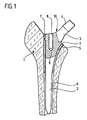
- the invention will be explained below with reference to a socket endoprosthesis, which is inserted into a femur 1.
- This Schaftendoprothese comprises a stem-shaped shaft 2, whose cross section in the distal direction, ie towards its lower end, continuously decreases and which has at its proximal end a connection part 3 for a joint element, for example a ball joint, on a cone-shaped portion 4 of the connecting part. 3 can be placed (not shown in the drawing).
- the shaft 2 At the proximal end of the shaft 2 at its transition region to the connecting part 3, the shaft 2 carries a radially outwardly projecting sealing collar 5, which enters upon insertion of the shaft 2 in a correspondingly prepared bone cavity 6 of the femur 1 in this and closes it at its proximal end.
- the sealing collar 5 could also carry radially projecting, flange-like projections which rest on the cutting surface of the femur 1, this is not shown in the illustrated embodiment.
- two continuous ventilation channels 7 are arranged in the illustrated embodiment, which connect the bone cavity 6 with the environment.
- These ventilation channels 7 have a relatively small cross-section, it can be between 1 mm 2 and 150 mm 2 in total, preferably between 5 mm 2 and 15 mm 2 .
- a bone cement supply line 8 is received, which opens slightly below the sealing collar 5 via a lateral opening 9 in the bone cavity 6.
- the junction must not be immediately adjacent to the sealing collar 5, but it can be slightly distanced distally from the sealing collar 5, but in any case is this lateral opening 9 in the proximal portion of the shaft 2 at a distance from the sealing collar, the maximum 40%, preferably 20% of the total length of the shaft equivalent.
- the shaft 2 is inserted into the correspondingly prepared bone cavity 6 and positioned in this in the desired installation position, the bone cavity 6 is completed in the manner described by the sealing collar 5.
- the shaft 2 may carry a centering element, which is not shown in the illustration of Figure 1, and which ensures that the shaft 2 inside the bone cavity 6 on all sides the desired distance from the wall of the bone cavity 6 complies.
- a bone cement supply line is connected to the bone cement supply line 8, which can be connected, for example, to a conventional device for providing flowable bone cement.
- the bone cement which is normally prepared shortly before application and has an increasing viscosity from the moment of preparation, is introduced at a time when this viscosity is in a desired range, this can be checked by appropriate means.
- the supply preferably takes place via the source at a constant volume flow, and in this way the viscous bone cement enters the bone cavity 6 through this lateral opening 9.
- the incoming stream of bone cement is divided in the bone cavity into two sub-streams, namely a first sub-stream, which is directed in the proximal direction, and a second sub-stream, which is directed in the distal direction.
- the first partial flow fills the entire part of the bone cavity 6 remaining above the lateral opening 9 and bounded by the sealing collar 5, and then the bone cement enters this partial flow through the ventilation channels 7 into the environment.
- These ventilation channels act as a throttle and thus prevent that too much amount of bone cement leaking through these openings. This ensures that the essential part of the incoming bone cement after complete filling of the upper part of the bone cavity 6 in the distal direction enters the bone cavity 6 and this gradually fills up from top to bottom.
- This filling process can be completed before the bone cavity 6 is completely filled, such a partial filling or hybrid filling is shown in the embodiment of Figure 1.
- this endoprosthesis 10 does not carry an integrally formed sealing collar, but the shaft 2 is surrounded at its proximal end by an annular sealing element 11 which can be inserted into the bone cavity 6 between the shaft 2 and the inner wall of the bone cavity 6 thereby sealing off to the outside.
- the sealing element 11 may be formed as a pushed onto the shaft 2 ring, in other cases, the sealing element 11 is formed in several parts and the parts are fixed from the outside to the shaft 2, for example by gluing.
- the sealing element 11 consists of hardened bone cement.
- an adapter 12 which may for example be inserted into an insertion opening 13 on the shaft end 2.
- the adapter 12 carries a so-called medullary stopper 14, this is a deformable plug which seals the bone cavity 6 downwards and at the same time centering the shaft 2 in the bone cavity 6.
- the adapter 12 may in particular consist of already cured bone cement, but other biocompatible materials are possible.
- vent line 15 In the interior of the shaft 2 extends from the proximal end to its distal end a vent line 15 according to the characterizing part of claim 1, which at the distal end of the shaft 2 or only in the region of the adapter 12 and / or the medullary block 14 in opens the bone cavity 6 and thus a connection of the distal End Studes the bone cavity 6 with the environment allows.
- the vent line 15 can easily exit into the environment at the proximal end of the shaft 2, but there may also be connected to a suction of a suction source, so that via the vent line 15, the distal end of the bone cavity 6 is connected to a suction source.
- the insertion of the shaft 2 into the bone cavity 6 and the filling with bone cement takes place exactly in the same manner as in the embodiment of Figure 1, but here during the filling optionally additionally via the vent line 15 an active or passive ventilation of the bone cavity 6 is performed so that thereby the filling quality can be further improved.
- the sealing collar 5 and / or the adapter 12 are made of solidified bone cement, the bone cement filled in via the bone cement supply line 8 can be integrally connected to these parts after it has hardened so that a completely homogeneous sheathing of the bone cement sheath can be achieved.
- the endoprosthesis 10 according to Figure 1 could be provided with a medullary block and / or a vent line, as shown and explained in the embodiment of Figure 2.
Landscapes
- Health & Medical Sciences (AREA)
- Orthopedic Medicine & Surgery (AREA)
- Life Sciences & Earth Sciences (AREA)
- Animal Behavior & Ethology (AREA)
- Veterinary Medicine (AREA)
- Public Health (AREA)
- Engineering & Computer Science (AREA)
- Biomedical Technology (AREA)
- Heart & Thoracic Surgery (AREA)
- General Health & Medical Sciences (AREA)
- Transplantation (AREA)
- Vascular Medicine (AREA)
- Oral & Maxillofacial Surgery (AREA)
- Cardiology (AREA)
- Surgery (AREA)
- Nuclear Medicine, Radiotherapy & Molecular Imaging (AREA)
- Medical Informatics (AREA)
- Molecular Biology (AREA)
- Prostheses (AREA)
Description
- Die Erfindung betrifft eine Endoprothese mit einem in einen Knochenhohlraum einführbaren Schaft, der eine sich an seiner Außenseite öffnende Knochenzementzufuhrleitung aufnimmt und der im eingeführten Zustand mittels eines Dichtelementes den Knochenhohlraum proximal verschließt.
- Schaftförmige Endoprothesen können zementlos und unter Verwendung von aushärtbarem Knochenzement in einem Knochenhohlraum befestigt werden. Bei Verwendung des Knochenzementes werden die Schaftendoprothesen in den Knochenhohlraum eingesetzt und der Zwischenraum zwischen Schaft und der Wand des Knochenhohlraumes wird mit einem Knochenzement ausgefüllt, der nach dem Einbringen aushärtet.
- Es ist bekannt, den Knochenzement über eine Knochenzementzufuhrleitung im Inneren des Schaftes in den Knochenhohlraum einzubringen, beispielsweise beschreibt die EP 0 428 127 B1 eine solche Schaftendoprothese, bei der Knochenzement über die gesamte Länge des Schaftes in den Knochenhohlraum eingefüllt werden kann.
- Bei anderen Schaftendoprothesen erfolgt die Einfüllung des Knochenzementes am distalen Ende des Schaftes, so daß der Knochenhohlraum vom distalen zum proximalen Ende des Schaftes kontinuierlich mit Knochenzement aufgefüllt wird.
- Eine Endoprothese gemäß der Präambel des Anspruchs 1 wird in DE 196 13 081 beschrieben.
- Es hat sich herausgestellt, daß es sehr schwer ist, die Druckverhältnisse im Knochenhohlraum beim Einfüllen des Knochenzementes zu kontrollieren, zumal da sich die Viskosität des eingefüllten Knochenzementes zeitlich ändert, so daß davon auszugehen ist, daß Knochenzement mit unterschiedlicher Viskosität eingefüllt wird. Um eine homogene Befüllung des Knochenhohlraumes zu erreichen, ist es wesentlich, daß diese Druckverhältnisse genau reproduzierbar sind, außerdem müssen zu hohe Druckwerte in jedem Fall vermieden werden, da durch zu hohe Druckwerte Verletzungen der Knochensubstanz erfolgen können.
- Es ist Aufgabe der Erfindung, eine gattungsgemäße Endoprothese so auszubilden, daß sie auch bei unterschiedlicher Viskosität des eingefüllten Knochenzementes die Befüllung des Knochenhohlraumes unter kontrollierbaren Druckverhältnissen ermöglicht.
- Diese Aufgabe wird bei einer Endoprothese der eingangs beschriebenen Art erfindungsgemäß dadurch gelöst, daß die Knochenzementzufuhrleitung ausschließlich in einem sich direkt an das Dichtelement anschließenden oberen Abschnitt des Schaftes in den Knochenhohlraum einmündet und daß in dem Dichtelement mindestens eine den Knochenhohlraum mit der Umgebung verbindende Belüftungsöffnung angeordnet ist.
- Bei einer solchen Ausgestaltung erfolgt die Befüllung des Knochenhohlraumes an dessen Oberseite, also im proximalen Teil der Schaftendoprothese, und der in diesem Bereich in den Knochenhohlraum eintretende Knochenzement fließt von der Eintrittsstelle sowohl in distaler Richtung als auch in proximaler Richtung, es erfolgt also eine Aufteilung des Knochenzementstromes. Der in proximaler Richtung fließende Strom wird sehr schnell durch das proximale Dichtelement begrenzt, in proximaler Richtung erfolgt dann lediglich ein Abströmen des Knochenzementes durch die Belüftungsöffnung des Dichtelementes, in distaler Richtung hingegen kann der Knochenzement frei in den Knochenhohlraum eintreten.
- Durch das Abströmen des Knochenzementes durch die Belüftungsöffnung erfolgt eine Reduzierung des Druckes im zugeführten Knochenzement, und zwar entsprechend den Querschnittsverhältnissen der Belüftungsöffnung in genau definierter Weise.
- Es hat sich nun überraschenderweise herausgestellt, daß bei einer solchen Ausgestaltung der Endoprothese der sich im Knochenhohlraum maximal aufbauende Druck im wesentlichen unabhängig ist von der Viskosität des Knochenzementes, so daß vollständig reproduzierbare und im wesentlichen durch den Querschnitt der Belüftungsöffnung bestimmte Druckverhältnisse im Knochenhohlraum erzielt werden können. Dies führt zu einer optimalen Qualität des Knochenzementmantels, und es hat sich auch herausgestellt, daß dieser Knochenzementmantel äußerst homogen aufgebaut ist.
- Der Knochenzement füllt den Knochenhohlraum bei der beschriebenen Endoprothese von proximal nach distal. Der Füllvorgang kann abgebrochen werden, wenn eine bestimmte Einfülltiefe erreicht ist, so daß auf diese Weise eine Hybridzementierung erreicht werden kann, bei der der Schaft im distalen Bereich nicht von Knochenzement umgeben ist. Es ist aber auch möglich, den Knochenhohlraum vollständig mit Knochenzement auszufüllen, sobald die Füllung vollständig ist, tritt weiter zugeführter Knochenzement quantitativ durch die Belüftungsöffnung aus und verhindert so einen übermäßigen Druckanstieg im Inneren des Knochenhohlraums.
- Das Dichtelement kann ein mit dem Schaft einstückig verbundener Kragen sein, der vorzugsweise in den Knochenhohlraum dichtend eingesteckt ist, der aber auch zusätzlich oder statt dessen auf einer Knochenschnittfläche am proximalen Ende des Knochenhohlraumes aufliegen kann.
- Bei einer anderen Ausführungsform ist vorgesehen, daß das Dichtelement ein den Schaft ringförmig umgebendes, separates Bauteil ist. Dieses kann beispielsweise ringförmig oder mehrteilig ausgebildet sein und mit dem Schaft durch einen Klemmsitz oder durch eine Verklebung verbunden sein.
- Insbesondere kann das Dichtelement aus Knochenzement bestehen, so daß nach Befüllung des Knochenhohlraumes mit Knochenzement sich der Knochenzement des Dichtelementes und der eingefüllte Knochenzement zu einem einheitlichen Knochenzementmantel verbinden.
- Der Querschnitt der Belüftungsöffnung oder gegebenenfalls der Belüftungsöffnungen insgesamt kann zwischen 1 mm2 und 150 mm2 liegen, vorzugsweise zwischen 5 mm2 und 15 mm2.
- Bei einer bevorzugten Ausführungsform ist vorgesehen, daß der Schaft am distalen Ende ein Zentrierelement trägt, so daß er vor dem Einfüllen des Knochenzementes in genau definierter Zentrierlage im Knochenhohlraum festgelegt werden kann.
- Weiterhin ist bei einer bevorzugten Ausführungsform möglich, daß der Schaft am distalen Ende ein Abdichtelement trägt, durch welches der Knochenhohlraum abgedichtet wird. Dadurch wird bei einer vollständigen Befüllung des Knochenhohlraumes sichergestellt, daß der Knochenzement nur eine begrenzte Eindringtiefe erhält und nicht wesentlich über die Länge des Schaftes der Endoprothese hinaus in den Knochenhohlraum eindringt.
- Gegebenenfalls können Zentrierelement und Abdichtelement durch ein einziges Bauteil realisiert werden.
- Der Schaft kann mit dem Zentrierelement und/oder dem Abdichtelement über einen Adapter verbunden sein, so daß Zentrierelement und/oder Abdichtelement an den Schaft angesetzt werden können, beispielsweise durch Einstecken in eine vorgesehene Öffnung.
- Insbesondere ist es vorteilhaft, wenn der Adapter aus Knochenzement besteht. Bei einer vollständigen Befüllung des Knochenhohlraumes mit Knochenzement verbindet sich somit der eingefüllte Knochenzement mit dem Knochenzement des Adapters zu einem einheitlichen Knochenzementmantel.
- Zur Lösung der oben beschriebenen Aufgabenstellung besitzt der Schaft weiterhin eine Entlüftungsöffnung, die im Bereich des distalen Endes des Schaftes in den Knochenhohlraum austritt. Durch diese Entlüftungsleitung, die einfach in die Umgebung geöffnet sein kann, die aber auch mit einer Saugquelle verbunden sein kann, werden beim Befüllen des Knochenhohlraumes mit Knochenzement Körperflüssigkeiten und Gase abgesaugt, nach vollständiger Befüllung des Knochenhohlraumes tritt durch diese Entlüftungsleitung dann auch Knochenzement aus und zeigt das Ende der Befüllung an. Die Entlüftungsleitung dient während des Befüllungsvorganges außerdem der Vermeidung von Druckspitzen im Knochenhohlraum.
- Die nachfolgende Beschreibung dient im Zusammenhang mit den Zeichnungen der näheren Erläuterung. Es zeigen:
- Figur 1:
- eine Längsschnittansicht einer in einen Knochenhohlraum eingesetzten Schaftendoprothese mit angeformtem Dichtkragen und
- Figur 2:
- eine Ansicht ähnlich Figur 1 einer Schaftendoprothese mit einem separaten Dichtelement am proximalen Ende und mit einem Markraumstopper am distalen Ende.
- Die Endoprothese der Erfindung ist für das Einsetzen in verschiedenartige Röhrenknochen geeignet, beispielsweise in den Femur, sie kann jedoch auch im Bereich des Beckens oder der Schulter eingesetzt werden. Nachstehend wird die Erfindung an einer Schaftendoprothese erläutert, die in einen Femur 1 eingesetzt ist. Diese Schaftendoprothese umfaßt einen stielförmigen Schaft 2, dessen Querschnitt in distaler Richtung, also zu seinem unteren Ende hin, kontinuierlich abnimmt und der an seinem proximalen Ende ein Anschlußteil 3 für ein Gelenkelement aufweist, beispielsweise eine Gelenkkugel, die auf einen konusförmigen Abschnitt 4 des Anschlußteiles 3 aufgesetzt werden kann (in der Zeichnung nicht dargestellt).
- Am proximalen Ende des Schaftes 2 an dessen Übergangsbereich zum Anschlußteil 3 trägt der Schaft 2 einen radial nach außen abstehenden Dichtkragen 5, der beim Einführen des Schaftes 2 in einen entsprechend vorbereiteten Knochenhohlraum 6 des Femurs 1 in diesen eintritt und diesen an seinem proximalen Ende verschließt. Der Dichtkragen 5 könnte auch radial abstehende, flanschartige Vorsprünge tragen, die sich auf die Schnittfläche des Femurs 1 auflegen, dies ist beim dargestellten Ausführungsbeispiel nicht gezeigt.
- Im Dichtkragen 5 sind im dargestellten Ausführungsbeispiel zwei durchgehende Belüftungskanäle 7 angeordnet, die den Knochenhohlraum 6 mit der Umgebung verbinden. Diese Belüftungskanäle 7 haben einen relativ kleinen Querschnitt, er kann zwischen 1 mm2 und 150 mm2 insgesamt liegen, vorzugsweise zwischen 5 mm2 und 15 mm2.
- Im proximalen Abschnitt des Schaftes 2 ist eine Knochenzementzufuhrleitung 8 aufgenommen, die geringfügig unterhalb des Dichtkragens 5 über eine seitliche Öffnung 9 in den Knochenhohlraum 6 einmündet. Die Einmündungsstelle muß nicht unmittelbar neben dem Dichtkragen 5 liegen, sondern sie kann in distaler Richtung geringfügig vom Dichtkragen 5 beabstandet sein, auf jeden Fall befindet sich aber diese seitliche Öffnung 9 im proximalen Abschnitt des Schaftes 2 in einem Abstand vom Dichtkragen, der maximal 40 %, vorzugsweise 20 % der Gesamtlänge des Schaftes entspricht.
- Zur Zementierung der in Figur 1 dargestellten Endoprothese 10 wird der Schaft 2 in den entsprechend vorbereiteten Knochenhohlraum 6 eingeführt und in diesem in der gewünschten Einbaulage positioniert, wobei der Knochenhohlraum 6 in der beschriebenen Weise durch den Dichtkragen 5 abgeschlossen wird.
- Der Schaft 2 kann ein Zentrierelement tragen, das in der Darstellung der Figur 1 nicht gezeigt ist, und das sicherstellt, daß der Schaft 2 im Inneren des Knochenhohlraumes 6 allseits den gewünschten Abstand von der Wand des Knochenhohlraumes 6 einhält.
- Nach dieser Positionierung des Schaftes 2 im Knochenhohlraum 6 wird an die Knochenzementzufuhrleitung 8 eine Zufuhrleitung für Knochenzement angeschlossen, diese kann beispielsweise mit einem herkömmlichen Gerät zur Bereitstellung von fließfähigem Knochenzement verbunden werden. Der Knochenzement, der normalerweise kurz vor der Applikation zubereitet wird und von dem Augenblick der Zubereitung an eine zunehmende Viskosität aufweist, wird in einem Zeitpunkt eingebracht, in dem diese Viskosität in einem gewünschten Bereich liegt, dies kann durch geeignete Maßnahmen überprüft werden.
- Die Zufuhr erfolgt über die Quelle vorzugsweise mit einem konstanten Volumenstrom, und auf diese Weise tritt der viskose Knochenzement durch diese seitliche Öffnung 9 in den Knochenhohlraum 6 ein. Der eintretende Strom des Knochenzementes teilt sich im Knochenhohlraum in zwei Teilströme auf, nämlich einen ersten Teilstrom, der in proximaler Richtung gerichtet ist, und einen zweiten Teilstrom, der in distaler Richtung gerichtet ist. Der erste Teilstrom füllt nach kurzer Zeit den gesamten oberhalb der seitlichen Öffnung 9 verbleibenden und durch den Dichtkragen 5 begrenzten Teil des Knochenhohlraumes 6 aus, anschließend tritt der Knochenzement dieses Teilstromes durch die Belüftungskanäle 7 in die Umgebung aus. Diese Belüftungskanäle wirken als Drossel und verhindern somit, daß eine zu große Menge des Knochenzementes über diese Öffnungen austritt. Dadurch ist sichergestellt, daß der wesentliche Teil des eintretenden Knochenzementes nach der vollständigen Ausfüllung des oberen Teils des Knochenhohlraumes 6 in distale Richtung in den Knochenhohlraum 6 eintritt und diesen von oben nach unten sukzessive auffüllt.
- Dieser Auffüllvorgang kann beendet werden, bevor der Knochenhohlraum 6 vollständig ausgefüllt ist, eine solche Teilfüllung oder Hybridfüllung ist im Ausführungsbeispiel der Figur 1 dargestellt.
- Es ist aber auch möglich, den Knochenhohlraum 6 vollständig auszufüllen.
- Die Endoprothese 10 gemäß Figur 2 ist ähnlich aufgebaut, einander entsprechende Teile tragen daher dieselben Bezugszeichen.
- Im Unterschied zur Endoprothese 10 der Figur 1 trägt diese Endoprothese 10 keinen angeformten Dichtkragen, sondern der Schaft 2 ist an seinem proximalen Ende von einem ringförmigen Dichtelement 11 umgeben, welches zwischen Schaft 2 und der Innenwand des Knochenhohlraumes 6 in den Knochenhohlraum 6 einschiebbar ist und diesen dadurch nach außen hin abdichtet. Das Dichtelement 11 kann als auf den Schaft 2 aufgeschobener Ring ausgebildet sein, in anderen Fällen ist das Dichtelement 11 mehrteilig ausgebildet und die Teile sind von außen her am Schaft 2 festgelegt, beispielsweise durch Verklebung.
- Insbesondere kann vorgesehen sein, daß das Dichtelement 11 aus ausgehärtetem Knochenzement besteht.
- Am distalen Ende des Schaftes 2 ist dieser mit einem Adapter 12 verbunden, der beispielsweise in eine Einstecköffnung 13 am Schaftende 2 eingesteckt sein kann. Der Adapter 12 trägt einen sogenannten Markraumstopper 14, dies ist ein verformbarer Stopfen, der den Knochenhohlraum 6 nach unten hin abdichtet und der gleichzeitig den Schaft 2 im Knochenhohlraum 6 zentriert. Der Adapter 12 kann insbesondere aus bereits ausgehärtetem Knochenzement bestehen, jedoch sind auch andere körperverträgliche Materialien möglich.
- Im Inneren des Schaftes 2 verläuft von dessen proximalem Ende ausgehend bis zu seinem distalen Ende eine Belüftungsleitung 15 entsprechend dem kennzeichnenden Teil des Anspruchs 1, die sich am distalen Ende des Schaftes 2 oder auch erst im Bereich des Adapters 12 und/oder des Markraumstoppers 14 in den Knochenhohlraum 6 öffnet und die somit eine Verbindung des distalen Endbereiches des Knochenhohlraumes 6 mit der Umgebung ermöglicht. Die Belüftungsleitung 15 kann am proximalen Ende des Schaftes 2 einfach in die Umgebung austreten, es kann dort aber auch eine Saugleitung einer Saugquelle angeschlossen werden, so daß über die Belüftungsleitung 15 das distale Ende des Knochenhohlraumes 6 mit einer Saugquelle verbunden wird.
- Das Einsetzen des Schaftes 2 in den Knochenhohlraum 6 und die Befüllung mit Knochenzement erfolgt genau in der gleichen Weise wie beim Ausführungsbeispiel der Figur 1, jedoch wird hier während der Befüllung gegebenenfalls zusätzlich über die Belüftungsleitung 15 eine aktive oder passive Belüftung des Knochenhohlraumes 6 durchgeführt, so daß dadurch die Befüllungsqualität zusätzlich verbessert werden kann. Wenn der Dichtkragen 5 und/oder der Adapter 12 aus verfestigtem Knochenzement bestehen, kann sich der über die Knochenzementzufuhrleitung 8 eingefüllte Knochenzement nach dessen Aushärtung mit diesen Teilen einstückig verbinden, so daß eine vollständig homogene Ummantelung des Schaftes mit Knochenzement erreicht werden kann.
- Im übrigen könnte selbstverständlich auch die Endoprothese 10 gemäß Figur 1 mit einem Markraumstopper und/oder einer Belüftungsleitung versehen werden, wie sie am Ausführungsbeispiel der Figur 2 dargestellt und erläutert worden sind.
Claims (10)
- Endoprothese mit einem in einen Knochenhohlraum einführbaren Schaft, der eine sich an seiner Aussenseite öffnende Knochenzementzufuhrleitung aufnimmt und der im eingeführten Zustand mittels eines Dichtelementes den Knochenhohlraum proximal verschließt wobei in dem Dichtelement (5; 11) mindestens eine den Knochenhohlraum (6) mit der Umgebung verbindende Belüftungsöffnung (7) angeordnet ist, dadurch gekennzeichnet, daß die Knochenzementzufuhrleitung (8) nur in einem sich direkt an das Dichtelement (5; 11) anschließenden oberen Abschnitt des Schaftes (2) in den Knochenhohlraum (6) einmündet, und daß der Schaft (2) eine Entlüftungsleitung (15) aufnimmt, die im Bereich des distalen Endes des Schaftes (2) in den Knochenhohlraum (6) austritt.
- Endoprothese nach Anspruch 1, dadurch gekennzeichnet, daß das Dichtelement (5) ein mit dem Schaft (2) einstückig verbundener Kragen ist.
- Endoprothese nach Anspruch 1, dadurch gekennzeichnet, daß das Dichtelement (11) ein den Schaft (2) ringförmig umgebendes, separates Bauteil ist.
- Endoprothese nach Anspruch 3, dadurch gekennzeichnet, daß das Dichtelement (11) aus Knochenzement besteht.
- Endoprothese nach einem der voranstehenden Ansprüche, dadurch gekennzeichnet, daß der Querschnitt der Belüftungsöffnung (7) oder der Belüftungsöffnungen (7) insgesamt zwischen 1 mm2 und 150 mm2 liegt.
- Endoprothese nach Anspruch 5, dadurch gekennzeichnet, daß der Querschnitt der Belüftungsöffnung (7) oder der Belüftungsöffnungen (7) insgesamt zwischen 5 mm2 und 15 mm2 liegt.
- Endoprothese nach einem der voranstehenden Ansprüche, dadurch gekennzeichnet, daß der Schaft (2) am distalen Ende ein Zentrierelement (14) trägt.
- Endoprothese nach einem der voranstehenden Ansprüche, dadurch gekennzeichnet, daß der Schaft (2) am distalen Ende ein Abdichtelement (14) trägt.
- Endoprothese nach einem der Ansprüche 7 oder 8, dadurch gekennzeichnet, daß der Schaft (2) mit dem Zentrierelement (14) und/oder dem Abdichtelement (14) über einen Adapter (12) verbunden ist.
- Endoprothese nach Anspruch 9, dadurch gekennzeichnet, daß der Adapter (12) aus Knochenzement besteht.
Applications Claiming Priority (3)
| Application Number | Priority Date | Filing Date | Title |
|---|---|---|---|
| DE29818742U DE29818742U1 (de) | 1998-10-21 | 1998-10-21 | Endoprothese |
| DE19848476A DE19848476C1 (de) | 1998-10-21 | 1998-10-21 | Endoprothese |
| DE19848476 | 1998-10-21 |
Publications (3)
| Publication Number | Publication Date |
|---|---|
| EP0995411A2 EP0995411A2 (de) | 2000-04-26 |
| EP0995411A3 EP0995411A3 (de) | 2001-10-24 |
| EP0995411B1 true EP0995411B1 (de) | 2007-06-06 |
Family
ID=26049666
Family Applications (1)
| Application Number | Title | Priority Date | Filing Date |
|---|---|---|---|
| EP99120067A Expired - Lifetime EP0995411B1 (de) | 1998-10-21 | 1999-10-19 | Zementierbare Endoprothese |
Country Status (2)
| Country | Link |
|---|---|
| EP (1) | EP0995411B1 (de) |
| DE (2) | DE29818742U1 (de) |
Families Citing this family (8)
| Publication number | Priority date | Publication date | Assignee | Title |
|---|---|---|---|---|
| NL1009832C2 (nl) * | 1998-08-10 | 2000-02-11 | Novarticulate Bv | Heupprothese. |
| GB2351671B (en) * | 1999-07-02 | 2004-02-25 | Bridgehall Consultants Ltd | Hip prosthesis with femoral component and corresponding cotyloid element with high implantation adaptability |
| EP1127559A1 (de) * | 2000-02-18 | 2001-08-29 | IsoTis N.V. | Pfropfen zum Einsetzen in einem Knochenkanal |
| DE10037345A1 (de) * | 2000-07-29 | 2002-02-07 | Juergen Buchholz | Chirurgisches Element |
| FR2831052B1 (fr) * | 2001-10-24 | 2004-07-30 | Alain Durand | Gamme de tiges femorales fixees par un liquide injecte par leur centre |
| FR2832310B1 (fr) * | 2001-11-21 | 2004-09-03 | Patrick Suret | Implant femoral pour prothese de hanche |
| US6926741B2 (en) | 2002-01-25 | 2005-08-09 | Depuy Products, Inc. | Centralizing cement plug with countersink |
| WO2016057919A1 (en) * | 2014-10-10 | 2016-04-14 | Encore Medical, Lp Dba Djo Surgical | Shoulder proximal centralizer and method to use the same |
Family Cites Families (11)
| Publication number | Priority date | Publication date | Assignee | Title |
|---|---|---|---|---|
| US4274163A (en) * | 1979-07-16 | 1981-06-23 | The Regents Of The University Of California | Prosthetic fixation technique |
| DE4011887A1 (de) * | 1989-11-14 | 1990-10-25 | Jansson Volkmar Dipl Ing Dr Me | Zementierbare endoprothese mit proximalem zentriersitz |
| CH680564A5 (de) * | 1989-12-07 | 1992-09-30 | Experimentelle Chirurgie Schwe | |
| EP0434604A1 (de) * | 1989-12-15 | 1991-06-26 | GebràDer Sulzer Aktiengesellschaft | Verankerungsschaft für eine Femurkopfprothese |
| DE4122950C2 (de) * | 1991-07-11 | 1994-10-06 | Haerle Anton | Knochenimplantat mit einem Hohlraum |
| DE4143617C2 (de) * | 1991-07-11 | 1998-06-10 | Haerle Anton | Knochenimplantatsystem |
| DE4136317A1 (de) * | 1991-11-04 | 1993-05-06 | Merck Patent Gmbh, 6100 Darmstadt, De | Hueftprothesenschaft mit einem markraumdrainagesystem fuer eine optimierte zementierungs- und implantationstechnik |
| DE9213218U1 (de) * | 1992-10-01 | 1992-11-26 | Aesculap AG, 7200 Tuttlingen | Endoprothesenschaft |
| DE9319132U1 (de) * | 1993-12-08 | 1994-03-10 | Artos Medizinische Produkte Gmbh, 12277 Berlin | Markraumsperre |
| DE4424883A1 (de) * | 1994-07-14 | 1996-01-18 | Merck Patent Gmbh | Femurprothese |
| DE19613081A1 (de) * | 1996-04-02 | 1997-10-09 | Franz Prof Dr Med Copf | Prothesenteil für eine Schaftprothese und Materialkit zur Verwendung mit einem solchen |
-
1998
- 1998-10-21 DE DE29818742U patent/DE29818742U1/de not_active Expired - Lifetime
- 1998-10-21 DE DE19848476A patent/DE19848476C1/de not_active Expired - Fee Related
-
1999
- 1999-10-19 EP EP99120067A patent/EP0995411B1/de not_active Expired - Lifetime
Non-Patent Citations (1)
| Title |
|---|
| None * |
Also Published As
| Publication number | Publication date |
|---|---|
| EP0995411A2 (de) | 2000-04-26 |
| EP0995411A3 (de) | 2001-10-24 |
| DE29818742U1 (de) | 1999-01-07 |
| DE19848476C1 (de) | 2000-08-31 |
Similar Documents
| Publication | Publication Date | Title |
|---|---|---|
| DE3912465C1 (de) | ||
| DE69417098T2 (de) | Biologisch abbaubarer medullärer Pfropfen | |
| EP0428127B1 (de) | Zementierbare Endoprothese | |
| EP1157677A2 (de) | Vorrichtung zum Applizieren von Knochenzement und Kanüle für eine solche Vorrichtung | |
| DE69418504T2 (de) | Prothese mit Doppelbefestigung | |
| DE2358159A1 (de) | Prothese, insbesondere hueftgelenkprothese | |
| DE3229027A1 (de) | Duese zum fuellen eines roehrenknochens mit zement | |
| EP0727197A1 (de) | Vorrichtung zum Anbringen einer Markraumsperre im Markraum eines Röhrenknochens und Markraumsperre für einen Röhrenknochen | |
| DE69610305T2 (de) | Knochenhöhlenabdichtungsanordnung | |
| DE19848476C1 (de) | Endoprothese | |
| EP1885294B1 (de) | Schenkelhalsprothese | |
| DE29822534U1 (de) | Vorrichtung zum Verschließen des Markraums des Femur bei der Implantation von Endoprothesen | |
| DE9213218U1 (de) | Endoprothesenschaft | |
| DE10301681B4 (de) | Vorrichtung zum Implantieren einer Intraokularlinse in ein Auge | |
| DE9109334U1 (de) | Vorrichtung zum Auskleiden von Rohrleitungen mit einer Innenbeschichtung | |
| EP3402608A1 (de) | Injektor zum verfüllen eines ringraums um einen ankerbolzen | |
| DE69222465T2 (de) | Chirurgische Prothesenvorrichtung | |
| DE2655862A1 (de) | Vorrichtung zum schmelzen und austeilen thermoplastischen materials sowie verfahren zur herstellung des schmelzkoerpers dieser vorrichtung | |
| EP0891168A1 (de) | Prothesenteil für eine schaftprothese und materialkit zur verwendung mit einem solchen | |
| DE4310592A1 (de) | Künstliche Hüftgelenkspfanne | |
| EP1124507B1 (de) | Gelenkprothesen-system | |
| DE9319132U1 (de) | Markraumsperre | |
| EP1728489B1 (de) | Hüftgelenk-Endoprothese mit Gelenkpfanne mit abgeschlossenen Bohrungen | |
| DE2441118A1 (de) | Abdichtung an profilbauteilen | |
| DE9313233U1 (de) | Endoprothese |
Legal Events
| Date | Code | Title | Description |
|---|---|---|---|
| PUAI | Public reference made under article 153(3) epc to a published international application that has entered the european phase |
Free format text: ORIGINAL CODE: 0009012 |
|
| AK | Designated contracting states |
Kind code of ref document: A2 Designated state(s): AT BE CH CY DE DK ES FI FR GB GR IE IT LI LU MC NL PT SE Kind code of ref document: A2 Designated state(s): CH FR GB IT LI |
|
| AX | Request for extension of the european patent |
Free format text: AL;LT;LV;MK;RO;SI |
|
| PUAL | Search report despatched |
Free format text: ORIGINAL CODE: 0009013 |
|
| AK | Designated contracting states |
Kind code of ref document: A3 Designated state(s): AT BE CH CY DE DK ES FI FR GB GR IE IT LI LU MC NL PT SE |
|
| AX | Request for extension of the european patent |
Free format text: AL;LT;LV;MK;RO;SI |
|
| 17P | Request for examination filed |
Effective date: 20020118 |
|
| AKX | Designation fees paid |
Free format text: CH FR GB IT LI |
|
| REG | Reference to a national code |
Ref country code: DE Ref legal event code: 8566 |
|
| GRAP | Despatch of communication of intention to grant a patent |
Free format text: ORIGINAL CODE: EPIDOSNIGR1 |
|
| GRAS | Grant fee paid |
Free format text: ORIGINAL CODE: EPIDOSNIGR3 |
|
| GRAA | (expected) grant |
Free format text: ORIGINAL CODE: 0009210 |
|
| AK | Designated contracting states |
Kind code of ref document: B1 Designated state(s): CH FR GB IT LI |
|
| REG | Reference to a national code |
Ref country code: GB Ref legal event code: FG4D Free format text: NOT ENGLISH |
|
| REG | Reference to a national code |
Ref country code: CH Ref legal event code: NV Representative=s name: ISLER & PEDRAZZINI AG Ref country code: CH Ref legal event code: EP |
|
| GBT | Gb: translation of ep patent filed (gb section 77(6)(a)/1977) |
Effective date: 20070822 |
|
| REG | Reference to a national code |
Ref country code: CH Ref legal event code: PCAR Free format text: ISLER & PEDRAZZINI AG;POSTFACH 1772;8027 ZUERICH (CH) |
|
| ET | Fr: translation filed | ||
| RAP2 | Party data changed (patent owner data changed or rights of a patent transferred) |
Owner name: AESCULAP AG & CO. KG |
|
| PLBE | No opposition filed within time limit |
Free format text: ORIGINAL CODE: 0009261 |
|
| STAA | Information on the status of an ep patent application or granted ep patent |
Free format text: STATUS: NO OPPOSITION FILED WITHIN TIME LIMIT |
|
| 26N | No opposition filed |
Effective date: 20080307 |
|
| PGFP | Annual fee paid to national office [announced via postgrant information from national office to epo] |
Ref country code: FR Payment date: 20141021 Year of fee payment: 16 Ref country code: GB Payment date: 20141024 Year of fee payment: 16 Ref country code: CH Payment date: 20141024 Year of fee payment: 16 |
|
| PGFP | Annual fee paid to national office [announced via postgrant information from national office to epo] |
Ref country code: IT Payment date: 20141027 Year of fee payment: 16 |
|
| REG | Reference to a national code |
Ref country code: CH Ref legal event code: PL |
|
| GBPC | Gb: european patent ceased through non-payment of renewal fee |
Effective date: 20151019 |
|
| PG25 | Lapsed in a contracting state [announced via postgrant information from national office to epo] |
Ref country code: IT Free format text: LAPSE BECAUSE OF NON-PAYMENT OF DUE FEES Effective date: 20151019 Ref country code: LI Free format text: LAPSE BECAUSE OF NON-PAYMENT OF DUE FEES Effective date: 20151031 Ref country code: CH Free format text: LAPSE BECAUSE OF NON-PAYMENT OF DUE FEES Effective date: 20151031 Ref country code: GB Free format text: LAPSE BECAUSE OF NON-PAYMENT OF DUE FEES Effective date: 20151019 |
|
| REG | Reference to a national code |
Ref country code: FR Ref legal event code: ST Effective date: 20160630 |
|
| PG25 | Lapsed in a contracting state [announced via postgrant information from national office to epo] |
Ref country code: FR Free format text: LAPSE BECAUSE OF NON-PAYMENT OF DUE FEES Effective date: 20151102 |