EP0991610B1 - Carbon composites - Google Patents
Carbon composites Download PDFInfo
- Publication number
- EP0991610B1 EP0991610B1 EP98930473A EP98930473A EP0991610B1 EP 0991610 B1 EP0991610 B1 EP 0991610B1 EP 98930473 A EP98930473 A EP 98930473A EP 98930473 A EP98930473 A EP 98930473A EP 0991610 B1 EP0991610 B1 EP 0991610B1
- Authority
- EP
- European Patent Office
- Prior art keywords
- carbon
- graphite
- matrix
- fabric
- reinforcement
- Prior art date
- Legal status (The legal status is an assumption and is not a legal conclusion. Google has not performed a legal analysis and makes no representation as to the accuracy of the status listed.)
- Expired - Lifetime
Links
- HFHJBWYDQAWSIA-UHFFFAOYSA-N CCCC1CC(C)CCC1 Chemical compound CCCC1CC(C)CCC1 HFHJBWYDQAWSIA-UHFFFAOYSA-N 0.000 description 1
Images

Classifications
-
- F—MECHANICAL ENGINEERING; LIGHTING; HEATING; WEAPONS; BLASTING
- F02—COMBUSTION ENGINES; HOT-GAS OR COMBUSTION-PRODUCT ENGINE PLANTS
- F02F—CYLINDERS, PISTONS OR CASINGS, FOR COMBUSTION ENGINES; ARRANGEMENTS OF SEALINGS IN COMBUSTION ENGINES
- F02F7/00—Casings, e.g. crankcases
- F02F7/0085—Materials for constructing engines or their parts
- F02F7/0087—Ceramic materials
-
- C—CHEMISTRY; METALLURGY
- C04—CEMENTS; CONCRETE; ARTIFICIAL STONE; CERAMICS; REFRACTORIES
- C04B—LIME, MAGNESIA; SLAG; CEMENTS; COMPOSITIONS THEREOF, e.g. MORTARS, CONCRETE OR LIKE BUILDING MATERIALS; ARTIFICIAL STONE; CERAMICS; REFRACTORIES; TREATMENT OF NATURAL STONE
- C04B35/00—Shaped ceramic products characterised by their composition; Ceramics compositions; Processing powders of inorganic compounds preparatory to the manufacturing of ceramic products
- C04B35/71—Ceramic products containing macroscopic reinforcing agents
- C04B35/78—Ceramic products containing macroscopic reinforcing agents containing non-metallic materials
- C04B35/80—Fibres, filaments, whiskers, platelets, or the like
- C04B35/83—Carbon fibres in a carbon matrix
-
- F—MECHANICAL ENGINEERING; LIGHTING; HEATING; WEAPONS; BLASTING
- F05—INDEXING SCHEMES RELATING TO ENGINES OR PUMPS IN VARIOUS SUBCLASSES OF CLASSES F01-F04
- F05C—INDEXING SCHEME RELATING TO MATERIALS, MATERIAL PROPERTIES OR MATERIAL CHARACTERISTICS FOR MACHINES, ENGINES OR PUMPS OTHER THAN NON-POSITIVE-DISPLACEMENT MACHINES OR ENGINES
- F05C2253/00—Other material characteristics; Treatment of material
- F05C2253/16—Fibres
Definitions
- This invention relates to improved methods for making carbon composite matrices and structures and to improved matrices and structures made by such methods.
- Carbon-Carbon (C-C) composites are a specialty class of materials having many unique properties making them attractive for a variety of demanding engineering applications. Similar to many other high-performance composites, C-C composites consist of a continuous fiber reinforcement (graphite fiber) held within a matrix phase (carbon). Unlike other composites, both the reinforcement and matrix phases consist of essentially pure carbon. Demonstrated desirable properties of C-C composites are very lightweight (1.4 - 1.9 g/cc), low coefficient of friction, good fatigue and shock resistance, moisture resistance, no outgassing, good biocompatibility, radiation resistant, low coefficient of thermal expansion (anisotropic in most cases), excellent strength retention versus temperature, does not melt or soften to mention some of its properties.
- Undesirable properties include anisotropicy in thermal expansion, oxidation above about 425°C, low interlaminar strength in two-directional (2-D) composite construction using graphite fabric reinforcement and very high cost of manufacture. These undesirable properties have largely limited major applications of C-C composites. Each undesirable properties have largely limited major applications of C-C composites. Each of these limitations must be overcome for widespread applications.
- C-C composites In aerospace applications such as the space shuttle, missile nose tips and rocket nozzle throats, C-C composites have found applications in spite of the property limitations and high cost which ranges from a few hundred dollars per pound to as much as S15,000/lb. For C-C composites to achieve success outside the specialty applications, their cost of manufacture must be substantially reduced. The high cost of C-C composites is directly related to the lengthy processing times and energy intensive manufacturing procedures used to make component shapes. Raw materials of graphite fibers (depending on the fiber type) and resin or pitch matrix precursors cost are generally relatively low. The matrix infiltration and densification processes are both time consuming and energy intensive, and therefore, costly.
- C-C composites There are several reinforcement architectures used in state-of-the-art C-C composites. The most often architecture is woven graphite fabric laid-up as laminates (2-D). There are also 3-dimensional and 4-dimensional woven structures that are considerably more expensive than cloth or fabric weaves. Other reinforcement architectures include multifilament threads referred to as tows, chopped discontinuous tows or fabrics, felts and other discontinuous reinforcement forms. Regardless of the reinforcement architecture, the C-C composites are produced by resin or pitch impregnation followed by cure (thermosetting) and pyrolysis.
- the carbon yield from resins or pitches is generally limited to less than 50-70%, multiple cycles of impregnation and pyrolysis is required as practiced, prior to the present invention, to achieve a reasonable density (low porosity) composite, the density of the composite is directly related to the composite mechanical properties.
- reimpregnation followed by further pyrolysis with the cycle repeated up to eight times is required to reduce the porosity to an acceptable level of under 10%.
- the matrix precursors pyrolize to result in closed porosity which cannot be reimpregnated and with these prior methods it is nearly impossible to produce a C-C composite with a porosity of less than about 20-15%, even with repeated reimpregnations.
- C-C composites are directly related to the hand lay-ups of 2-D composites to near net-shapes and the multiple matrix densification cycles often requiring 4-6 cycles.
- the laminates are characteristically thicker and subsequently heavier than required to carry-in-plane loads because the 2-D woven laminates have relatively low (a few hundred psi) interlaminar shear and cross-ply strengths.
- the parts must be thicker to maintain the interlaminar stresses below the allowable stress levels which adds to both the materials and manufacturing costs.
- Some approaches to overcome the interlaminar strength limitations is to utilize braiding, knitting or cross stitching, which is expensive and is known to degrade the graphite fibers in the 2-D orientations from the abrasion as well as reduce overall composite fiber loading and in-plane properties.
- Multidirectional 3-D, 4-D, etc. architectures improve interlaminar properties but are substantially more expensive to weave and the structures are processed as billets followed by extensive machining resulting in very expensive finished components.
- discontinuous graphite fiber C-C composites have resulted in very poor mechanical properties of one-fourth or less than 2-D fabric composites.
- US 4,683,809 column 3, line 47 reports 8ksi (55 MPa) strength for random oriented composites.
- Such results have been similarly obtained by the applicants, and in commercial literature, for example, 10-80 ksi (69-550 MPa) even lower mechanical properties are reported for discontinuous graphite.
- economical net shape molding of discontinuous reinforcements could be utilized to alleviate labor intensive hand lay-ups, mechanical properties are insufficient to permit commercial utilization.
- graphite reinforcement is typically 7 to 10 micron fibers in the form of tows or fabric architectures and the particulate fillers do not penetrate the fiber tow bundles or fabrics. Thus porosity remains in the fiber tows or fabrics including their interticies after pyrolysis resulting in poor mechanical properties.
- An alternative to increasing the carbon yield of any organic is to reduce volatilization during pyrolysis, that is prevent carbon species from evaporating during pyrolysis. If an overpressure is utilized, then the vapor pressure of any volatile component is reduced. If, for example, the carbon yield of a phenolic resin were 60% under atmospheric pressure, if the pressure were increased to above atmospheric, then the carbon yield should increase to above 60%. The higher the pressure, the higher the carbon yield up to the point that only hydrogen would be lost from the hydrocarbon.
- Certain organic structures in a resin/polymer results in less hydrocarbon 'loss than other structures.
- polyarylacetylene hereinafter referred to as PAA
- PAA polyarylacetylene
- the volatile loss in PAA is only methane and hydrogen which accounts for higher char yields.
- the effect of the organic composition and structure of the resin as well as pressure of pyrolysis and heating rate can have a direct and substantial effect on char yield that directly effects the residual porosity of the carbon matrix.
- CVI chemical vapor infiltration
- a major disadvantage is that the surface deposition forms a continuous layer sealing off and leaving a porous core.
- To overcome this disadvantage typically only regular shaped parts are produced such as brake linings which are machined on the surface to open the pores followed by additional deposition. The machining to open pores and redeposition cycle is often repeated up to five or six times which is quite similar to the resin or pitch reimpregnation process.
- gaseous silicon oxygen compounds react with carbon to produce silicon carbide and carbon monoxide.
- the temperature, pressure and concentration of reactants determine whether a solid carbon surface is converted to a layer of silicon carbide, whiskers are nucleated on the surface of the carbon or silicon carbide.
- Various methods of generating silicon oxide gases such as SiO 2(g) of SiO (g) are utilized to react with carbon bodies to form a silicon carbide layer. Such reactions are widely utilized to produce oxidation resistant coatings on carbon objects, and many attempts have been reported to convert graphite fibers to silicon carbide fibers.
- T300 graphite fiber from Hercules as received has a tensile strength of 3-5 GPa and its diameter is approximately 7 microns (7 ⁇ m). After converting to silicon carbide the average tensile strength was less than 1 ⁇ 2 GPa, which is so low that it is unusable.
- T300 (TM) graphite fiber was whiskerized as taught in US 3,580,731 and the strength of the whistcerized fiber was also less than 1 ⁇ 2 GPa and in some cases, unhandable with a strength less than 0.1 GPa.
- EP-A-0314869 discloses a process in which a mixture of a carbon particulate, an organic carbon precursor binder and an organic solvent are employed for preparing a matrix composition which is thereafter cured to form a C-C composite.
- the carbon particulate is disposed in the solvent to form a suspension.
- the present invention is concerned with a method of making a carbon composite structure containing reinforcement therein, which preferably comprise graphite fibers.
- the invention involves the preparation of an improved matrix comprised essentially of a mixture of a non crystalline carbon particulate that is soluble in an organic solvent and a binder comprised of an organic carbon precursor that has a liquid phase and wherein the non crystalline carbon particulate is further characterized as containing residual carbon hydrogen bonding.
- a method of making a carbon composite structure that comprises the steps of:
- the uncured structure is subjected to heat under non oxidizing, pyrolyzing conditions to produce the desired carbon composite structures which, for example, may be a piston for an internal combustion engine or a sheet or other shape for thermal management.
- the reinforcement structure comprises graphite fibers.
- the non crystalline carbon particulate of the matrix mixture should be chosen to have an average particle diameter of not more than one-half of the average diameter of the graphite fibers of the graphite reinforcement material.
- the reinforcement material comprises both a plurality of discontinuous reinforcement elements dispersed in said matrix mixture and a fabric that is impregnated with the matrix mixture having the reinforcement elements dispersed therein. It may comprise discontinuous carbon particles embedded in the matrix as a tow or cloth of graphite fabric to which the matrix mixture is applied to form the uncured structure to be cured by pyrolysis.
- the carbon fibers of the reinforcement structures are whiskerized before being combined with the matrix mixture to form the uncured structures.
- M y O x is a standard metal oxide
- R' and R" are reductants to reduce the metal oxide to suboxides
- t, y, x, n and m are stoichiometric constants
- R' and R" can be either metals or carbon; accordingly, the corresponding R' n O t-m and R"O can be different metal suboxides which would have the effect of producing a mixed carbide or could be carbon to produce carbon monoxide whereby whiskerizing of the carbon surface is achieved without materially reducing the strength of the original graphite fiber upon which the whisker is
- the matrix mixture of non crystalline carbon particulate and binder also includes an organic solvent, which solvates and at least partially dissolves said non crystalline particulate, preferably in an amount chosen to dissolve a sufficient amount of the carbon particulate to produce a slurry.
- the binder comprises a polymeric resin with at least 50 % char yield.
- the binder comprises pitch.
- a further embodiment is that the non-crystalline carbon particulate has a particle size of two microns (2 ⁇ m) or less.
- a further embodiment is that the non crystalline carbon particulate also has not been calcined to a temperature above 800°C to assure residual volatiles that contains carbon hydrogen bonding.
- the binder comprises a polymeric resin and pitch that are mixed and which contains an organic solvent that has dissolved at least partially therein a non crystalline carbon particulate that has carbon hydrogen bonding in the particulate.
- a composite mixture is formed utilizing one of the embodiment teachings that achieves a matrix cont aining at least 10% open porosity which is then subjected to chemical vapor infiltration (CVI) that further reduces the porosity that constitutes a hybrid carbon matrix.
- CVI chemical vapor infiltration
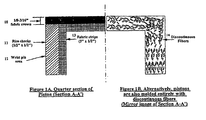
- the crown is made of graphite fabric pieces that encompasses the entire diameter of the piston and constitutes the outer most surface as shown at 10.
- the remaining cross section or the crown is made up of fabric pieces 13 that also build-up the wrist-pin section of the piston shown in Figure 1.
- the area of the crown that was not covered by the fabric strips 13 is filled in with small fabric tabs also called rice checks 11 or discontinuous fibers 14.
- the side wall sometimes called skirt of the piston is made up of fabric tabs 11 or discontinuous fiber 14 that is not made-up of the fabric strips 13 in the wrist-pin cross sections as shown in the bottom view in Figure 1.
- the piston or other C-C components can be fabricated with a single reinforcement architecture or different reinforcement architecture to achieve a specific performance requirement.
- the composition of the precursor that form the carbon matrix in the C-C composite piston can be any of those described in the following examples or a hybride of resin or pitch precursors followed by chemical vapor infiltration (CVI) to produce the final carbon matrix material.
- the problem of low porosity in the composite is overcome by the use of a liquid form of precursor that will penetrate the reinforcement architecture and which has a very high carbon yield to result in low porosity.
- processing has been discovered to achieve a liquid state matrix precursor that will yield well over 90% carbon on pyrolysis that results in well under 10% porosity in a C-C composite.
- the liquid matrix precursor will penetrate the graphite reinforcement architectures producing a low porosity matrix within the reinforcement as well as in the spaces between reinforcement.
- the carbon particulate need be 3.5 to 5 microns (3.5-5 ⁇ m) diameter or less and in the instant invention particulate that is two microns or less produced superior composites.
- Carbon materials investigated include bottoms or residual known as resid, uncalcined petroleum coke sometimes referred to as green carbon coke from refinery operations and cokes from various other sources such as from steel mill operations, cokes from coal precursors including coal tar and synthetic organics that produce cokes or fixed carbons.
- the non-crystalline carbons defined herein are any carboneous material which contains residual volatiles wherein the volatiles are composed of a carbon-hydrogen bond and/or hydrogen. This generally means the non crystalline carbon has generally not been calcined or heat treated to above about 1000 to 1400°C. Non-crystalline carbons which have not been calcined to above 1400°C and contain residual volatiles will have solubility to at least some extent in one or more types or classes of organic solvents.
- non crystalline carbons which have a fixed carbon content and are a part of the instant invention will possess one or more of the features of residual volatiles which contain a carbon-hydrogen bond and/or hydrogen, and (ii) has at least some solubility in one ore more types or classes of organic solvents.
- solvents that represents certain classes of hydrocarbon solvents such as alcohols, ketones, benzene ring compounds and solvents known to have a strong solvating ability for solids have been investigated.
- the solvents investigated included isopropyl alcohol as a low molecular weight alcohol, furfuryl alcohol as a high molecular weight alcohol, methyl ethyl ketone (MER) and 1-methyl-2-pyrrolidinone (NMP).
- a tar might have only 30-60% fixed carbon and the 70-40% volatiles would dissolve in many solvents but would result in a porous carbon matrix due to the high volatiles content, yet a fully graphitized particle would have little to no solubility in a solvent and present difficulty penetrating a graphite fiber tow or fabric architecture unless the graphite particles diameter was less than about 3.5 micron (3.5 ⁇ m) and preferably less than about one micron which could then penetrate the reinforcement architecture.
- Green carbon coke available from the petroleum industry is one of the most economical forms of carbon available which has a typical fixed carbon content of 80-85% and volatiles of approximately 20-15% depending on the temperature to which it has been exposed.
- a petroleum coke such as Asbury #4357 (TM) calcined to 1482°C has reported carbon of over 99% with volatiles of less than 1 ⁇ 2 %.
- TM Asbury #4357
- the solubility of the carbon product will increase.
- NMP whose boiling point is approximately 80°C/10mm, was heated to 60°C at atmospheric pressure and the solubility of the carbon product was found to be approximately' double the solubility at room temperature. It was also discovered that the smaller the size of the carbon particulate the greater the amount that would solvate or; be soluble in any given solvent.
- the char yield can be substantially increased through the use of matrix formulations that utilize fixed carbon which reduces the porosity in the final carbon matrix without the requirement of reimpregnation.
- the porosity be of the open type.
- Thermoplastics typically result in a matrix micro structure which has more open porosity than thermosets which is known in the art and particularly phenolic to result in more closed porosity depending on pyrolysis protocol.
- the use of carbon particulate which has some solubility in a solvent with thermosets produces a matrix with less closed porosity than the thermoset alone.
- formulations utilizing carbon particulate as well as thermoplastic ingredients or both are preferred.
- the matrix formulation should utilize carbon particulate with a high fixed carbon content in a particle size at least 1 ⁇ 2 and. preferably much less than 1 ⁇ 2 the diameter of the graphite fiber reinforcement and most preferably two microns (2 ⁇ m) or less, the carbon particulate utilized with a solvent that has at least some solubility for the carbon particulate in the solvent and in combination with a thermoset, thermoplastic or mixture of the two in which the char yield is above 90% and most preferably above 92-93%, but is in a liquid state to facilitate.penetrating the graphite reinforcement tow or fabric architecture at the prepregging stage.
- Such a formulation wherein the solvent is evaporated during the consolidation stage of molding a graphite composite will produce a C-C composite with very low porosity in a single step without costly reimpregnation requirements to reduce matrix porosity.
- Low porosity matrix C-C composites result in higher composite properties such as strength, thermal conductivity, etc.
- This table illustrates the importance of careful control'over the vapor species used to convert the carbon target to SiC, and the importance of the density of the precursor graphite material.
- Large molar volume increases are a result of the insertion of Si into the carbon structure without removal of additional carbon atoms, as exemplified by conversion using Si vapor.
- the result of this large increase in molar volume is a closure of the pores in monolithic carbon, substantially ending further reaction and fracture or cracking due to the large volume change as shown in Table IV.
- radial and longitudinal cracking results in the fiber yielding very low strength.
- SiO 2 vapor leads to a substantial molar volume decrease due to removal of two carbon atoms for every atom of SiC formed.
- the first step in the reaction to form SiC as a conversion of the carbon surface or to grow SiC whiskers on the surface consists of the following three steps:
- the first step is the production of gaseous conversion species, of which metal suboxides are the preferred species for reasons given above.
- R' and R" can be either metals or carbon; accordingly, the corresponding R' n O t-m and R' n O t-m could be different metal suboxides which would have the effect of producing a mixed carbide or could be carbon to produce carbon monoxide.
- SiO 2(s) + Si (s) 2SiO (g)
- SiO 2(s) + C (s) SiO (g) + CO (g)
- Reactions 4 and 4a can occur simultaneously or one can be pushed over the other by providing carbon in the gas phase such as methane or CO.
- the gaseous reaction species may be any of several types depending on the type and ratio of reactants in the gas generator and the thermodynamic conditions. Exact control of the type and concentration of gas species in the reaction is critical in achieving control reaction of the target due to the large molar volume changes that can adversely affect the extent and type of reaction (SiC surface or SiC whiskers), or microstructure and the resultant strength of the carbon/SiC. This is particularly true in the case of fibers which in general have low porosity and are thus extremely sensitive to possible molar volume change in the final strength of the fiber.
- carbide whiskers can also be formed with the use of oxides or suboxides to generate the whiskers.
- B 2 O 3 or B 2 O 2 will produce B 4 C whiskers. It is possible to produce whiskers of all carbide forming elements or mixed composition whiskers. If two or more reactants are utilized a mixed carbide whisker will be produced or both carbide whiskers produced.
Landscapes
- Chemical & Material Sciences (AREA)
- Engineering & Computer Science (AREA)
- Ceramic Engineering (AREA)
- Combustion & Propulsion (AREA)
- Mechanical Engineering (AREA)
- General Engineering & Computer Science (AREA)
- Composite Materials (AREA)
- Chemical Kinetics & Catalysis (AREA)
- Manufacturing & Machinery (AREA)
- Materials Engineering (AREA)
- Structural Engineering (AREA)
- Organic Chemistry (AREA)
- Ceramic Products (AREA)
- Manufacture Of Alloys Or Alloy Compounds (AREA)
Applications Claiming Priority (5)
| Application Number | Priority Date | Filing Date | Title |
|---|---|---|---|
| US5071597P | 1997-06-24 | 1997-06-24 | |
| US50715P | 1997-06-24 | ||
| US7573 | 1998-01-15 | ||
| US09/007,573 US6051167A (en) | 1997-06-24 | 1998-01-15 | Process of making carbon-carbon composites |
| PCT/US1998/013053 WO1998058888A1 (en) | 1997-06-24 | 1998-06-20 | Carbon composites |
Publications (2)
| Publication Number | Publication Date |
|---|---|
| EP0991610A1 EP0991610A1 (en) | 2000-04-12 |
| EP0991610B1 true EP0991610B1 (en) | 2004-12-15 |
Family
ID=26677151
Family Applications (1)
| Application Number | Title | Priority Date | Filing Date |
|---|---|---|---|
| EP98930473A Expired - Lifetime EP0991610B1 (en) | 1997-06-24 | 1998-06-20 | Carbon composites |
Country Status (7)
| Country | Link |
|---|---|
| US (1) | US6051167A (enExample) |
| EP (1) | EP0991610B1 (enExample) |
| JP (1) | JP2002507956A (enExample) |
| AU (1) | AU7985898A (enExample) |
| CA (1) | CA2335427C (enExample) |
| DE (1) | DE69828168T2 (enExample) |
| WO (1) | WO1998058888A1 (enExample) |
Cited By (2)
| Publication number | Priority date | Publication date | Assignee | Title |
|---|---|---|---|---|
| RU2708291C1 (ru) * | 2018-11-15 | 2019-12-05 | Общество с ограниченной ответственностью "ТрансТрибоЛогик" (ООО "ТрансТрибоЛогик") | Способ изготовления материала на основе графита для скользящих электрических контактов и материал |
| WO2020101520A1 (ru) * | 2018-11-15 | 2020-05-22 | Общество с ограниченной ответственностью "ТрансТрибоЛогик" (ООО "ТрансТрибоЛогик") | Способ изготовления материала на основе графита для скользящих электрических контактов и материал |
Families Citing this family (22)
| Publication number | Priority date | Publication date | Assignee | Title |
|---|---|---|---|---|
| FR2784695B1 (fr) * | 1998-10-20 | 2001-11-02 | Snecma | Densification de structures poreuses par infiltration chimique en phase vapeur |
| KR100447840B1 (ko) * | 2002-05-20 | 2004-09-08 | 주식회사 데크 | 탄소 복합재 제조 방법 |
| DE10233729B4 (de) * | 2002-07-24 | 2006-01-26 | Sgl Carbon Ag | Faserverstärkte keramische Bremsbeläge |
| US6699427B2 (en) | 2002-07-26 | 2004-03-02 | Ucar Carbon Company Inc. | Manufacture of carbon/carbon composites by hot pressing |
| US20040122515A1 (en) * | 2002-11-21 | 2004-06-24 | Xi Chu | Prosthetic valves and methods of manufacturing |
| US7207424B2 (en) * | 2002-12-03 | 2007-04-24 | Ucar Carbon Company Inc. | Manufacture of carbon/carbon composites by hot pressing |
| US6878331B2 (en) * | 2002-12-03 | 2005-04-12 | Ucar Carbon Company Inc. | Manufacture of carbon composites by hot pressing |
| US20040155382A1 (en) * | 2002-12-03 | 2004-08-12 | Dai Huang | Manufacture of carbon/carbon composites by hot pressing |
| DE10359484A1 (de) * | 2003-12-18 | 2005-07-14 | Deutsches Zentrum für Luft- und Raumfahrt e.V. | Verfahren zur Herstellung eines Bauteils aus einem Faserverbundwerkstoff und Faserverbundwerkstoff |
| US20060027792A1 (en) * | 2004-07-28 | 2006-02-09 | Butcher Jonah V | Carbon composite near-net-shape molded part and method of making |
| WO2006101799A2 (en) * | 2005-03-16 | 2006-09-28 | Honeywell International Inc. | Carbon fiber containing ceramic particles |
| US20100078839A1 (en) * | 2005-06-23 | 2010-04-01 | Honeywell International Inc. | Pitch densification of carbon fiber preforms |
| US20070023975A1 (en) * | 2005-08-01 | 2007-02-01 | Buckley Daniel T | Method for making three-dimensional preforms using anaerobic binders |
| JP2009538811A (ja) * | 2006-05-31 | 2009-11-12 | マックス−プランク−ゲゼルシャフト ツア フェルデルンク デア ヴィッセンシャフテン エー.ファウ. | 多孔質炭素鋳物の製造方法 |
| US8778488B2 (en) * | 2012-01-26 | 2014-07-15 | The United States Of America, As Represented By The Secretary Of The Navy | Formation of silicon carbide-silicon nitride nanoparticle carbon compositions |
| KR102432060B1 (ko) * | 2014-12-22 | 2022-08-16 | 솔브레인 주식회사 | 산화 탄소 나노 입자, 이의 제조 방법, 이를 포함하는 유무기 복합체 및 상기 유무기 복합체의 제조 방법 |
| US10227264B2 (en) | 2015-07-13 | 2019-03-12 | Rolls-Royce High Temperature Composites, Inc. | Method for making ceramic matrix composite articles |
| US11795114B1 (en) * | 2020-10-22 | 2023-10-24 | Witold Kowbel | Process far revolutionary, very thick and very high thermal conductivity carbon-carbon composites |
| CN112326726B (zh) * | 2020-10-30 | 2023-12-29 | 北京临近空间飞行器系统工程研究所 | 一种树脂基复合材料热解引射因子测试装置及方法 |
| KR102508857B1 (ko) * | 2020-11-26 | 2023-03-09 | 재단법인 포항산업과학연구원 | 등방 흑연 제조용 탄화 블록 제조방법 |
| CN112648104B (zh) * | 2020-12-07 | 2022-07-19 | 中国兵器科学研究院宁波分院 | 晶须增强铝合金活塞及制备方法 |
| EP4329955A4 (en) * | 2021-04-27 | 2025-03-12 | Carbon Technology Holdings, LLC | Biocarbon compositions with optimized fixed carbon and methods for producing the same |
Family Cites Families (5)
| Publication number | Priority date | Publication date | Assignee | Title |
|---|---|---|---|---|
| US3808087A (en) * | 1967-09-26 | 1974-04-30 | Gen Technologies Corp | Surface-treated lamination structures |
| US3580731A (en) * | 1967-09-26 | 1971-05-25 | Gen Technologies Corp | Method of treating the surface of a filament |
| JPS6340764A (ja) * | 1986-08-02 | 1988-02-22 | 株式会社アクロス | 無機質繊維強化炭素複合材料用の柔軟性中間材及びその製造方法 |
| US5206085A (en) * | 1987-08-13 | 1993-04-27 | Across Co., Ltd. | Preformed yarn useful for forming composite articles and process for producing same |
| JPH08157273A (ja) * | 1994-12-01 | 1996-06-18 | Tonen Corp | 一方向性炭素繊維強化炭素複合材料及びその製造方法 |
-
1998
- 1998-01-15 US US09/007,573 patent/US6051167A/en not_active Expired - Lifetime
- 1998-06-20 WO PCT/US1998/013053 patent/WO1998058888A1/en not_active Ceased
- 1998-06-20 AU AU79858/98A patent/AU7985898A/en not_active Abandoned
- 1998-06-20 DE DE69828168T patent/DE69828168T2/de not_active Expired - Lifetime
- 1998-06-20 EP EP98930473A patent/EP0991610B1/en not_active Expired - Lifetime
- 1998-06-20 JP JP50499199A patent/JP2002507956A/ja active Pending
- 1998-06-20 CA CA002335427A patent/CA2335427C/en not_active Expired - Lifetime
Cited By (2)
| Publication number | Priority date | Publication date | Assignee | Title |
|---|---|---|---|---|
| RU2708291C1 (ru) * | 2018-11-15 | 2019-12-05 | Общество с ограниченной ответственностью "ТрансТрибоЛогик" (ООО "ТрансТрибоЛогик") | Способ изготовления материала на основе графита для скользящих электрических контактов и материал |
| WO2020101520A1 (ru) * | 2018-11-15 | 2020-05-22 | Общество с ограниченной ответственностью "ТрансТрибоЛогик" (ООО "ТрансТрибоЛогик") | Способ изготовления материала на основе графита для скользящих электрических контактов и материал |
Also Published As
| Publication number | Publication date |
|---|---|
| US6051167A (en) | 2000-04-18 |
| JP2002507956A (ja) | 2002-03-12 |
| WO1998058888A1 (en) | 1998-12-30 |
| CA2335427A1 (en) | 1998-12-30 |
| CA2335427C (en) | 2007-08-14 |
| DE69828168D1 (de) | 2005-01-20 |
| DE69828168T2 (de) | 2005-09-15 |
| EP0991610A1 (en) | 2000-04-12 |
| AU7985898A (en) | 1999-01-04 |
Similar Documents
| Publication | Publication Date | Title |
|---|---|---|
| US6051167A (en) | Process of making carbon-carbon composites | |
| Kopeliovich | Advances in manufacture of ceramic matrix composites by infiltration techniques | |
| US6576076B1 (en) | Process for producing fiber-reinforced silicon carbide composites | |
| EP0827445B1 (en) | Method for rapid fabrication of fiber preforms and structural composite materials | |
| Rosso | Ceramic and metal matrix composites: Routes and properties | |
| US6706401B1 (en) | Carbon matrix composites fabricated by a rapid and low-cost process incorporating in-situ polymerization of wetting monomers | |
| US8748009B2 (en) | Material, method for producing a material and use thereof | |
| US20060261504A1 (en) | Carbon-carbon composite preform made with carbon fiber and pitch binder | |
| US7404922B2 (en) | Method for producing SiC fiber-reinforced SiC composite material by means of hot press | |
| US6013371A (en) | Carbon artifacts and compositions and processes for their manufacture | |
| US5865922A (en) | Producing fiber reinforced composites having dense ceramic matrices | |
| US6355338B1 (en) | Continuous composite coextrusion methods, apparatuses, and compositions | |
| US5494867A (en) | Method for making fiber-reinforced silicon nitride composites | |
| Udayakumar et al. | Carbon Fiber Reinforced Silicon Carbide Ceramic Matrix Composites: Processing and Characterization When Fabricated by CVI and Hybrid Technique | |
| Gottlieb et al. | Continuous fiber-reinforced ceramic matrix composites | |
| KR100307509B1 (ko) | 세라믹 함유 탄소/탄소 복합재료 및 그의 제조 방법 | |
| US5948330A (en) | Method of fabricating chopped-fiber composite piston | |
| Kim et al. | Nicalon-fibre-reinforced silicon-carbide composites via polymer solution infiltration and chemical vapour infiltration | |
| US20180194690A1 (en) | Carbon yielding resin for melt infiltration | |
| D'Angio | Microwave enhanced chemical vapour infiltration of silicon carbide fibre preforms | |
| Withers et al. | Process of making carbon-carbon composites | |
| Wali et al. | Reactive melt-infiltration processing of fiber-reinforced ceramic matrix composites | |
| US11795114B1 (en) | Process far revolutionary, very thick and very high thermal conductivity carbon-carbon composites | |
| Petrak | Ceramic matrices | |
| CN121248313A (zh) | 一种高性能炭炭复合材料轴及生产工艺与应用 |
Legal Events
| Date | Code | Title | Description |
|---|---|---|---|
| PUAI | Public reference made under article 153(3) epc to a published international application that has entered the european phase |
Free format text: ORIGINAL CODE: 0009012 |
|
| 17P | Request for examination filed |
Effective date: 20000124 |
|
| AK | Designated contracting states |
Kind code of ref document: A1 Designated state(s): DE FR GB IT SE |
|
| 17Q | First examination report despatched |
Effective date: 20010705 |
|
| RAP1 | Party data changed (applicant data changed or rights of an application transferred) |
Owner name: MATERIALS AND ELECTROCHEMICAL RESEARCH (MER) CORPO |
|
| GRAP | Despatch of communication of intention to grant a patent |
Free format text: ORIGINAL CODE: EPIDOSNIGR1 |
|
| GRAS | Grant fee paid |
Free format text: ORIGINAL CODE: EPIDOSNIGR3 |
|
| GRAA | (expected) grant |
Free format text: ORIGINAL CODE: 0009210 |
|
| AK | Designated contracting states |
Kind code of ref document: B1 Designated state(s): DE FR GB IT SE |
|
| REG | Reference to a national code |
Ref country code: GB Ref legal event code: FG4D |
|
| REF | Corresponds to: |
Ref document number: 69828168 Country of ref document: DE Date of ref document: 20050120 Kind code of ref document: P |
|
| PG25 | Lapsed in a contracting state [announced via postgrant information from national office to epo] |
Ref country code: SE Free format text: LAPSE BECAUSE OF FAILURE TO SUBMIT A TRANSLATION OF THE DESCRIPTION OR TO PAY THE FEE WITHIN THE PRESCRIBED TIME-LIMIT Effective date: 20050315 |
|
| PLBE | No opposition filed within time limit |
Free format text: ORIGINAL CODE: 0009261 |
|
| STAA | Information on the status of an ep patent application or granted ep patent |
Free format text: STATUS: NO OPPOSITION FILED WITHIN TIME LIMIT |
|
| 26N | No opposition filed |
Effective date: 20050916 |
|
| ET | Fr: translation filed | ||
| PG25 | Lapsed in a contracting state [announced via postgrant information from national office to epo] |
Ref country code: IT Free format text: LAPSE BECAUSE OF NON-PAYMENT OF DUE FEES Effective date: 20090620 |
|
| PGRI | Patent reinstated in contracting state [announced from national office to epo] |
Ref country code: IT Effective date: 20110616 |
|
| REG | Reference to a national code |
Ref country code: FR Ref legal event code: PLFP Year of fee payment: 19 |
|
| REG | Reference to a national code |
Ref country code: FR Ref legal event code: PLFP Year of fee payment: 20 |
|
| PGFP | Annual fee paid to national office [announced via postgrant information from national office to epo] |
Ref country code: DE Payment date: 20170621 Year of fee payment: 20 Ref country code: FR Payment date: 20170621 Year of fee payment: 20 Ref country code: GB Payment date: 20170620 Year of fee payment: 20 |
|
| PGFP | Annual fee paid to national office [announced via postgrant information from national office to epo] |
Ref country code: IT Payment date: 20170626 Year of fee payment: 20 |
|
| REG | Reference to a national code |
Ref country code: DE Ref legal event code: R071 Ref document number: 69828168 Country of ref document: DE |
|
| REG | Reference to a national code |
Ref country code: GB Ref legal event code: PE20 Expiry date: 20180619 |
|
| PG25 | Lapsed in a contracting state [announced via postgrant information from national office to epo] |
Ref country code: GB Free format text: LAPSE BECAUSE OF EXPIRATION OF PROTECTION Effective date: 20180619 |