EP0988976A2 - Verstellbare Schaufel zum Reinigen von Düsen eines Tintenstrahldruckers - Google Patents
Verstellbare Schaufel zum Reinigen von Düsen eines Tintenstrahldruckers Download PDFInfo
- Publication number
- EP0988976A2 EP0988976A2 EP99202977A EP99202977A EP0988976A2 EP 0988976 A2 EP0988976 A2 EP 0988976A2 EP 99202977 A EP99202977 A EP 99202977A EP 99202977 A EP99202977 A EP 99202977A EP 0988976 A2 EP0988976 A2 EP 0988976A2
- Authority
- EP
- European Patent Office
- Prior art keywords
- cleaning
- inkjet
- print head
- cleaning liquid
- vane
- Prior art date
- Legal status (The legal status is an assumption and is not a legal conclusion. Google has not performed a legal analysis and makes no representation as to the accuracy of the status listed.)
- Withdrawn
Links
- 238000004140 cleaning Methods 0.000 title claims abstract description 73
- 238000007641 inkjet printing Methods 0.000 title description 13
- 239000007788 liquid Substances 0.000 claims abstract description 38
- 239000012530 fluid Substances 0.000 claims abstract description 14
- 238000007639 printing Methods 0.000 claims abstract description 14
- 239000000463 material Substances 0.000 claims description 12
- 239000000976 ink Substances 0.000 description 56
- 230000015572 biosynthetic process Effects 0.000 description 12
- 238000000034 method Methods 0.000 description 8
- 230000005499 meniscus Effects 0.000 description 6
- XLYOFNOQVPJJNP-UHFFFAOYSA-N water Substances O XLYOFNOQVPJJNP-UHFFFAOYSA-N 0.000 description 6
- 239000000919 ceramic Substances 0.000 description 5
- 230000005684 electric field Effects 0.000 description 5
- INHCSSUBVCNVSK-UHFFFAOYSA-L lithium sulfate Chemical compound [Li+].[Li+].[O-]S([O-])(=O)=O INHCSSUBVCNVSK-UHFFFAOYSA-L 0.000 description 4
- 230000007246 mechanism Effects 0.000 description 4
- 238000005086 pumping Methods 0.000 description 4
- 238000007600 charging Methods 0.000 description 3
- 239000000203 mixture Substances 0.000 description 3
- 230000001095 motoneuron effect Effects 0.000 description 3
- LYCAIKOWRPUZTN-UHFFFAOYSA-N Ethylene glycol Chemical compound OCCO LYCAIKOWRPUZTN-UHFFFAOYSA-N 0.000 description 2
- LFVGISIMTYGQHF-UHFFFAOYSA-N ammonium dihydrogen phosphate Chemical compound [NH4+].OP(O)([O-])=O LFVGISIMTYGQHF-UHFFFAOYSA-N 0.000 description 2
- 229910000387 ammonium dihydrogen phosphate Inorganic materials 0.000 description 2
- 239000013078 crystal Substances 0.000 description 2
- 238000001035 drying Methods 0.000 description 2
- 230000000694 effects Effects 0.000 description 2
- 235000019837 monoammonium phosphate Nutrition 0.000 description 2
- 239000002245 particle Substances 0.000 description 2
- 150000003839 salts Chemical class 0.000 description 2
- 240000000254 Agrostemma githago Species 0.000 description 1
- 235000009899 Agrostemma githago Nutrition 0.000 description 1
- 241000894006 Bacteria Species 0.000 description 1
- ZAMOUSCENKQFHK-UHFFFAOYSA-N Chlorine atom Chemical compound [Cl] ZAMOUSCENKQFHK-UHFFFAOYSA-N 0.000 description 1
- LFQSCWFLJHTTHZ-UHFFFAOYSA-N Ethanol Chemical compound CCO LFQSCWFLJHTTHZ-UHFFFAOYSA-N 0.000 description 1
- 239000004809 Teflon Substances 0.000 description 1
- 229920006362 Teflon® Polymers 0.000 description 1
- RTAQQCXQSZGOHL-UHFFFAOYSA-N Titanium Chemical compound [Ti] RTAQQCXQSZGOHL-UHFFFAOYSA-N 0.000 description 1
- 230000001133 acceleration Effects 0.000 description 1
- 229910052782 aluminium Inorganic materials 0.000 description 1
- XAGFODPZIPBFFR-UHFFFAOYSA-N aluminium Chemical compound [Al] XAGFODPZIPBFFR-UHFFFAOYSA-N 0.000 description 1
- 230000000844 anti-bacterial effect Effects 0.000 description 1
- 229910002113 barium titanate Inorganic materials 0.000 description 1
- JRPBQTZRNDNNOP-UHFFFAOYSA-N barium titanate Chemical compound [Ba+2].[Ba+2].[O-][Ti]([O-])([O-])[O-] JRPBQTZRNDNNOP-UHFFFAOYSA-N 0.000 description 1
- 230000015556 catabolic process Effects 0.000 description 1
- 230000000739 chaotic effect Effects 0.000 description 1
- 229910052801 chlorine Inorganic materials 0.000 description 1
- 239000000460 chlorine Substances 0.000 description 1
- 238000005352 clarification Methods 0.000 description 1
- 239000004020 conductor Substances 0.000 description 1
- 230000007547 defect Effects 0.000 description 1
- 238000006731 degradation reaction Methods 0.000 description 1
- 239000003599 detergent Substances 0.000 description 1
- NKZSPGSOXYXWQA-UHFFFAOYSA-N dioxido(oxo)titanium;lead(2+) Chemical compound [Pb+2].[O-][Ti]([O-])=O NKZSPGSOXYXWQA-UHFFFAOYSA-N 0.000 description 1
- 239000006185 dispersion Substances 0.000 description 1
- 239000012153 distilled water Substances 0.000 description 1
- 238000005323 electroforming Methods 0.000 description 1
- 238000007786 electrostatic charging Methods 0.000 description 1
- 238000005516 engineering process Methods 0.000 description 1
- 239000011888 foil Substances 0.000 description 1
- 238000009472 formulation Methods 0.000 description 1
- 239000011521 glass Substances 0.000 description 1
- PCHJSUWPFVWCPO-UHFFFAOYSA-N gold Chemical compound [Au] PCHJSUWPFVWCPO-UHFFFAOYSA-N 0.000 description 1
- 239000010931 gold Substances 0.000 description 1
- 229910052737 gold Inorganic materials 0.000 description 1
- WGCNASOHLSPBMP-UHFFFAOYSA-N hydroxyacetaldehyde Natural products OCC=O WGCNASOHLSPBMP-UHFFFAOYSA-N 0.000 description 1
- HFGPZNIAWCZYJU-UHFFFAOYSA-N lead zirconate titanate Chemical compound [O-2].[O-2].[O-2].[O-2].[O-2].[Ti+4].[Zr+4].[Pb+2] HFGPZNIAWCZYJU-UHFFFAOYSA-N 0.000 description 1
- 229910052451 lead zirconate titanate Inorganic materials 0.000 description 1
- 238000004519 manufacturing process Methods 0.000 description 1
- 229910052751 metal Inorganic materials 0.000 description 1
- 239000002184 metal Substances 0.000 description 1
- 230000003287 optical effect Effects 0.000 description 1
- 239000003960 organic solvent Substances 0.000 description 1
- 239000011236 particulate material Substances 0.000 description 1
- 238000007747 plating Methods 0.000 description 1
- 239000003495 polar organic solvent Substances 0.000 description 1
- LJCNRYVRMXRIQR-OLXYHTOASA-L potassium sodium L-tartrate Chemical compound [Na+].[K+].[O-]C(=O)[C@H](O)[C@@H](O)C([O-])=O LJCNRYVRMXRIQR-OLXYHTOASA-L 0.000 description 1
- 239000003755 preservative agent Substances 0.000 description 1
- 230000002335 preservative effect Effects 0.000 description 1
- 239000010453 quartz Substances 0.000 description 1
- 238000010008 shearing Methods 0.000 description 1
- VYPSYNLAJGMNEJ-UHFFFAOYSA-N silicon dioxide Inorganic materials O=[Si]=O VYPSYNLAJGMNEJ-UHFFFAOYSA-N 0.000 description 1
- 235000011006 sodium potassium tartrate Nutrition 0.000 description 1
- 239000002904 solvent Substances 0.000 description 1
- 238000005507 spraying Methods 0.000 description 1
- 229910001220 stainless steel Inorganic materials 0.000 description 1
- 239000010935 stainless steel Substances 0.000 description 1
- 239000010936 titanium Substances 0.000 description 1
- 229910052719 titanium Inorganic materials 0.000 description 1
- 239000011032 tourmaline Substances 0.000 description 1
- 229940070527 tourmaline Drugs 0.000 description 1
- 229910052613 tourmaline Inorganic materials 0.000 description 1
- 231100000331 toxic Toxicity 0.000 description 1
- 230000002588 toxic effect Effects 0.000 description 1
- 229920002554 vinyl polymer Polymers 0.000 description 1
- 239000002699 waste material Substances 0.000 description 1
- 238000009736 wetting Methods 0.000 description 1
Images

Classifications
-
- B—PERFORMING OPERATIONS; TRANSPORTING
- B41—PRINTING; LINING MACHINES; TYPEWRITERS; STAMPS
- B41J—TYPEWRITERS; SELECTIVE PRINTING MECHANISMS, i.e. MECHANISMS PRINTING OTHERWISE THAN FROM A FORME; CORRECTION OF TYPOGRAPHICAL ERRORS
- B41J2/00—Typewriters or selective printing mechanisms characterised by the printing or marking process for which they are designed
- B41J2/005—Typewriters or selective printing mechanisms characterised by the printing or marking process for which they are designed characterised by bringing liquid or particles selectively into contact with a printing material
- B41J2/01—Ink jet
- B41J2/135—Nozzles
- B41J2/165—Prevention or detection of nozzle clogging, e.g. cleaning, capping or moistening for nozzles
- B41J2/16517—Cleaning of print head nozzles
- B41J2/16552—Cleaning of print head nozzles using cleaning fluids
-
- B—PERFORMING OPERATIONS; TRANSPORTING
- B41—PRINTING; LINING MACHINES; TYPEWRITERS; STAMPS
- B41J—TYPEWRITERS; SELECTIVE PRINTING MECHANISMS, i.e. MECHANISMS PRINTING OTHERWISE THAN FROM A FORME; CORRECTION OF TYPOGRAPHICAL ERRORS
- B41J2/00—Typewriters or selective printing mechanisms characterised by the printing or marking process for which they are designed
- B41J2/005—Typewriters or selective printing mechanisms characterised by the printing or marking process for which they are designed characterised by bringing liquid or particles selectively into contact with a printing material
- B41J2/01—Ink jet
- B41J2/135—Nozzles
- B41J2/165—Prevention or detection of nozzle clogging, e.g. cleaning, capping or moistening for nozzles
- B41J2/16585—Prevention or detection of nozzle clogging, e.g. cleaning, capping or moistening for nozzles for paper-width or non-reciprocating print heads
-
- B—PERFORMING OPERATIONS; TRANSPORTING
- B41—PRINTING; LINING MACHINES; TYPEWRITERS; STAMPS
- B41J—TYPEWRITERS; SELECTIVE PRINTING MECHANISMS, i.e. MECHANISMS PRINTING OTHERWISE THAN FROM A FORME; CORRECTION OF TYPOGRAPHICAL ERRORS
- B41J2/00—Typewriters or selective printing mechanisms characterised by the printing or marking process for which they are designed
- B41J2/005—Typewriters or selective printing mechanisms characterised by the printing or marking process for which they are designed characterised by bringing liquid or particles selectively into contact with a printing material
- B41J2/01—Ink jet
- B41J2/17—Ink jet characterised by ink handling
- B41J2/18—Ink recirculation systems
- B41J2/185—Ink-collectors; Ink-catchers
Definitions
- This invention generally relates to inkjet print head cleaning apparatus and more particularly relates to apparatus for cleaning orifices belonging to the inkjet print head.
- inkjet printing apparatus Many different types of digitally controlled printing systems of inkjet printing apparatus are presently being used. These inkjet printers use a variety of actuation mechanisms, a variety of marking materials, and a variety of recording media. For home applications, digital inkjet printing apparatus is the printing system of choice because low hardware cost make the printer affordable to every one. Another application for digital inkjet printing uses large format printers. It is a further requirement that these large format printers provide low cost copies with an ever improving quality. Inkjet printing technology is the first choice in today's art. Thus, there is a need for improved ways to make digitally controlled graphic arts media, such as billboards, large displays, and home photos for example, so that quality color images may be made at a high-speed and low cost, using standard or special paper.
- digitally controlled graphic arts media such as billboards, large displays, and home photos for example
- Inkjet printing has become recognized as a prominent contender in the digitally controlled, electronic printing arena because of its nonimpact, low-noise characteristics, its use of papers from plain paper to specialized high gloss papers and its avoidance of toner transfers and fixing.
- Inkjet printing mechanisms can be categorized as either continuous inkjet or droplet on demand inkjet. Continuous inkjet printing dates back to at least 1929. See U.S. Patent 1,941,001 to Hansell.
- U.S. Patent 3,416,153 issued to Hertz et al. in 1966, discloses a method of achieving variable optical density of printed spots in continuous inkjet printing using the electrostatic dispersion of a charged droplet stream to modulate the number of droplets which pass trough a small orifice. This technique is used in inkjet printers manufactured by Iris.
- US Patent 4,346,387 issued to Hertz in 1982 discloses a method and apparatus for controlling the electric charge on droplets formed by the breaking up of a pressurized liquid stream at a droplet formation point located within the electric field having an electric potential gradient. Droplet formation is effected at a point in the field corresponding to the desired predetermined charge to be placed on the droplets at the point of their formation. In addition to charging tunnels, deflection plates are used to actually deflect droplets.
- Conventional continuous inkjet utilizes electrostatic charging tunnels that are placed close to the point where the droplets are formed in a stream. In this manner individual droplets may be charged. The charged droplets may be deflected downstream by the presence of deflector plates that have a large potential difference between them. A gutter (sometimes referred to as a "catcher") may be used to intercept the charged droplets, while the uncharged droplets are free to strike the recording medium. If there is no electric field present or if the break off point from the droplet is sufficiently far from the electric field (even if a portion of the stream before droplets break off is in the presence of an electric field), then charging will not occur.
- the on demand type inkjet printers are covered by hundreds of patents and describe two techniques for droplet formation.
- a pressurization actuator is used to produce the inkjet droplet.
- the two types of actuators are heat and piezo materials.
- the heater at a convenient location heats ink and a quantity will phase change into a gaseous steam bubble and raise the internal ink pressure sufficiently for an ink droplet to be expelled to a suitable receiver.
- the piezo ink actuator incorporates a piezo material. It is said to possess piezo electric properties if an electric charge is produced when a mechanical stress is applied.
- piezoelectric ceramics are: lead zirconate titanate, barium titanate, lead titanate, and lead metaniobate.
- a ferroelectric ceramic is machined to produce ink chambers.
- the chamber is water proofed by gold plating and becomes a conductor to apply the charge and cause the piezo "motor effect". This "motor effect" causes the ink cavity to shrink, raise the internal pressure, and generate an ink droplet.
- Inks for high speed jet droplet printers must have a number of special characteristics. Typically, water-based inks have been used because of their conductivity and viscosity range. Thus, for use in a jet droplet printer the ink must be electrically conductive, having a resistivity below about 5000 ohm-cm and preferably below about 500 ohm-cm. For good flow through small orifices water-based inks generally have a viscosity in the range between about 1 to 15 centipoise at 25 degree C.
- the ink must be stable over a long period of time, compatible with the materials comprising the orifice plate and ink manifold, free of living organisms, and functional after printing.
- the required functional characteristics after printing are: smear resistance after printing, fast drying on paper, and waterproof when dry. Examples of different types of water-based jet droplet printing inks are found in U.S. Patents 3,903,034; 3,889,269; 3,870,528; 3,846,141; 3,776,642; and 3,705,043.
- the ink also has to incorporate a nondrying characteristic in the jet cavity so that the drying of ink in the cavity is hindered or slowed to such a degree that through occasional spitting of ink droplets the cavities can be kept open.
- the addition of glycol will facilitate the free flow of ink through the inkjet.
- Inkjet printing apparatus typically includes an inkjet print head that is exposed to the various environment where inkjet printing is utilized.
- the orifices are exposed to all kinds of air born particles. Particulate debris accumulates on the surfaces, forming around the orifices.
- the ink will combine with such particulate debris to form an interference burr to block the orifice or cause through an altered surface wetting to inhibit a proper formation of the ink droplet. That particulate debris has to be cleaned from the orifice to restore proper droplet formation. This cleaning commonly is achieved by wiping, spraying, vacuum suction, and/or spitting of ink through the orifice.
- the wiping is the most common application.
- Inks used in inkjet printers can be said to have the following problems:
- An object of the present invention to provide apparatus for cleaning orifices belonging to an inkjet print head.
- an inkjet print head cleaning apparatus comprising:
- An advantage of the present invention is that rapid cleaning of print head orifices can be accomplished in a short time.
- Another advantage of the present invention is that as cleaning liquid is pumped over the surfaces of the adjustable vane is filtered and is replenished at a predetermined rate the cleaning liquid removes waste ink and particulate debris permanently from the inkjet print head.
- Yet another advantage of this invention is that the cleaning liquid flowing over the adjustable vane can have a substantial thickness thereby minimizing the requirements for mechanical tolerances.
- Still another advantage of this invention is that with no mechanical rubbing, wear of the delicate orifice plate is eliminated or greatly reduced.
- the replacement of the inkjet head will be less frequent and more of the orifices will stay functional to result in a higher image quality.
- Another advantage of this invention is that individual inks can be cleaned by selecting the pumping rate of fluid and angle of vane to change the laminar flow, and speed rate. In this way, the speed, quantity and direction of the fluid can be selected to match the cleaning needs of a particular ink. In other words, red , green, and blue inks in the same cartridge can have different roller speeds.
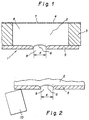
- FIG.. 1 shows a prior art cross sectional view of an inkjet print head 1.
- Orifices defining structures such as the depicted outlet plate 5 includes orifice 9 having a diameter "d" and can be manufactured by electro-forming or sheet metal fabrication methods. It will be understood that the outlet plate 5 actually includes a plurality of orifices for forming multiple ink droplets.
- the outlet plate 5 is glued to the piezo walls 3.
- Ink 2 is included in a pumping cavity 8.
- An inlet orifice 7 formed in a inlet plate 4 permits ink to be delivered to the pumping cavity 8.
- a meniscus 6 of ink is formed in the orifice 9.
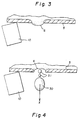
- FIG. 2 shows the outlet plate 5 with the ink outlet meniscus 6 and a elastomeric wiper blade 10 in contact with the outlet orifice plate.
- the blade is in position to wipe across the diameter "d" of the orifice 9 to clean any ink or other particulate debris that could interfere with the proper functioning of the inkjet print head 1.
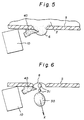
- FIG. 3 shows the meniscus 6 as it changes from an inward curve to an outward curve during the early stages before an actual ink droplet is manufactured.
- the elastomeric wiper blade 10 and the outlet orifice plate 5 are also shown.
- FIG. 4 shows the completed ink droplet 30, and its droplet direction is indicated by the arrow "X". Also shown are (as often is the case when an ink droplet is formed) two ink droplet satellites 31.
- the formation of satellites 31 is chaotic and can incorporate any number of ink droplet satellites 31 from 0 up to 10. These numbers of satellites 31 have been observed. Note that the outlet meniscus 6 has returned to the original state.
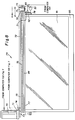
- FIG. 5 shows how debris40 can interfere with the meniscus 6 during the ink droplet formation.
- the droplet formation can be completely stopped by the ink surface condition change, due to the presence of the debris 40.
- outlet orifice plate 5 and elastomeric wiper blade 10 are shown for clarity.
- FIG.. 6 shows another defect caused by the presence of a debris 40.
- the direction of the droplet 30 with satellites 31 shown as "X" is changed and will result in a degradation of the image.
- outlet orifice plate 5 and elastomeric wiper blade 10 are shown for clarity. Note that the outlet meniscus 6 has returned to the original state but debris 40 can also interfere with that process.
- FIG.. 7 shows an inkjet printing apparatus 79 in accordance with the present invention, an inkjet head 75, a drive motor 70 linked with a gearbox 71, an inkjet head belt drive wheel 74, and the inkjet head drive belt 72 to drive the inkjet head 75 back and for across the print paper 85.
- the inkjet droplets are controlled by the position of the inkjet head 75. This position is monitored by a position encoder strip 76 and the image input from computer 100.
- the same computer controls the inkjet print head 75, drive motor 70, the cleaning liquid 95, and the cleaning liquid pump 83.
- the cleaning liquid pump 83 pumps the cleaning liquid at a desired velocity towards the adjustable vane so that the vane creates a flow of cleaning liquid 95 past the outlet orifice plate 5.
- the inkjet generates an image 81(shown in FIG. 8) on the print paper 85.
- the print paper 85 is supported by the platen roller 78 and registration of the paper is controlled by the capstan roller 88. Both rollers, platen 78 and capstan 88 are driven by a motor not shown and are controlled by the computer 100.
- a cleaning station 89 which receives cleaning liquid 95.
- the cleaning station 89 has liquid pump 83 with inlet and outlet connections 50 and 51 to the cleaning liquid pump 83 .
- a mounting structure 87 supports all the associated mechanism for the inkjet printer 79.
- FIG. 8 shows the same printer as FIG. 7 but in a 90 degree rotated position. It can now be visualized how the inkjet head 75 with ink droplets 77 move across the paper 85 driven by the inkjet print head drive motor 70, a gearbox 71 to match motor speed with print speed.
- An inkjet head drive belt 72 driven by the belt drive wheel 74 drives the inkjet print head 75 across the total width of the print paper 85.
- the position of the print head 75 is metered by the position encoder strip 76.
- the encoder strip 76 At the right location determined by the computer 100 (shown in FIG. 7) and the encoder strip 76 a ink droplet 77 is deposited to form the image 81.
- the cleaning station 89 is mounted at the far right side end of the inkjet printer 79.
- the cleaning station 89 has a cleaning fluid tank 92, a cleaning liquid pump 83, with inlet connection 50 and an outlet connection 51.
- the adjustable vane 73 deflects the cleaning liquid 95 into a wave 52 is as shown. This wave 52 is used to clean the orifice plate 5.
- a number of different cleaning liquids can be used in accordance with the present invention.
- such fluids can include plain water, distilled water, and alcohol or detergent mixtures.
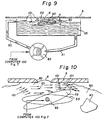
- FIG. 9 shows the cleaning liquid pump 83 with adjustable vane 73 mounted to a shaft 93 to rotate the adjustable vane 73.
- the vane is submerged in the cleaning liquid 95 and spaced from the outlet plate defining the orifices 9.
- the cleaning liquid 83 is pumped to flow across the adjustable vane 73, and occupies the cavity space 80 between the adjustable vane 73 and the outlet plate 5 so that a high enough fluid velocity is created to clean the orifices 9 and the outlet plate 5 from all debris 40.
- the adjustable vane 73 or the adjustable vane surface 53 is made from a material which conducive to laminar or turbulent flow of the cleaning liquid 95 through the cavity space 80.
- This adjustable vane 73 or vane surface material 53 can be selected from the group of materials consisting of aluminum, teflon, polyvinyl chlorine, stainless steel, glass, ceramic, and titanium.
- the friction of the cleaning liquid 95 on the on the outlet orifice plate 5 will cause a great amount of liquid shearing to remove dirt and ink from the outlet orifice plate 5.
- Arrows 101 indicates one of the possible two flow directions of the cleaning fluid.
- FIG. 10 shows in an enlarged form how the fluid friction shown by arrows 101 causes the flow of the cleaning liquid pump 83 to shear dirt and other debris 40 permanently from the outlet orifice plate 5.
- the arrows 101 indicate a laminar flow of fluid in the cleaning cavity space 80 but if desired a turbulent flow can be incorporated to enhance cleaning as desired.
- the adjustable vane 73 can be adjusted to squeeze the cavity dimension which will increases the flow at either end of the adjustable vane 73 to further help the cleaning effort. Also it is understood that the adjustable vane 73 can have many possible geometric shapes to facilitate the desired effects. Possible shapes are: cylinders, plates, foils, wedges, and ellipsoids.
Landscapes
- Ink Jet (AREA)
Applications Claiming Priority (2)
| Application Number | Priority Date | Filing Date | Title |
|---|---|---|---|
| US09/159,979 US5997127A (en) | 1998-09-24 | 1998-09-24 | Adjustable vane used in cleaning orifices in inkjet printing apparatus |
| US159979 | 1998-09-24 |
Publications (2)
| Publication Number | Publication Date |
|---|---|
| EP0988976A2 true EP0988976A2 (de) | 2000-03-29 |
| EP0988976A3 EP0988976A3 (de) | 2000-05-24 |
Family
ID=22574951
Family Applications (1)
| Application Number | Title | Priority Date | Filing Date |
|---|---|---|---|
| EP99202977A Withdrawn EP0988976A3 (de) | 1998-09-24 | 1999-09-13 | Verstellbare Schaufel zum Reinigen von Düsen eines Tintenstrahldruckers |
Country Status (3)
| Country | Link |
|---|---|
| US (1) | US5997127A (de) |
| EP (1) | EP0988976A3 (de) |
| JP (1) | JP2000094704A (de) |
Families Citing this family (15)
| Publication number | Priority date | Publication date | Assignee | Title |
|---|---|---|---|---|
| US6281909B1 (en) * | 1998-09-24 | 2001-08-28 | Eastman Kodak Company | Cleaning orifices in ink jet printing apparatus |
| US6224185B1 (en) * | 1998-10-09 | 2001-05-01 | Eastman Kodak Company | Cleaning fluid for inkjet printers |
| US6145952A (en) * | 1998-10-19 | 2000-11-14 | Eastman Kodak Company | Self-cleaning ink jet printer and method of assembling same |
| US6350007B1 (en) | 1998-10-19 | 2002-02-26 | Eastman Kodak Company | Self-cleaning ink jet printer using ultrasonics and method of assembling same |
| US6286929B1 (en) * | 1998-12-29 | 2001-09-11 | Eastman Kodak Company | Self-cleaning ink jet printer with oscillating septum and ultrasonics and method of assembling the printer |
| US6183058B1 (en) * | 1999-09-28 | 2001-02-06 | Eastman Kodak Company | Self-cleaning ink jet printer system with reverse fluid flow and method of assembling the printer system |
| JP2002019132A (ja) * | 2000-07-07 | 2002-01-23 | Mimaki Engineering Co Ltd | プロッタのインクジェットヘッドのクリーニング機構及びクリーニング方法 |
| US6513903B2 (en) | 2000-12-29 | 2003-02-04 | Eastman Kodak Company | Ink jet print head with capillary flow cleaning |
| US6572215B2 (en) | 2001-05-30 | 2003-06-03 | Eastman Kodak Company | Ink jet print head with cross-flow cleaning |
| US6905552B2 (en) * | 2001-12-26 | 2005-06-14 | Xerox Corporation | Contactless cleaning of vertical ink jet printheads |
| JP5150129B2 (ja) | 2007-04-20 | 2013-02-20 | 株式会社ミマキエンジニアリング | プリンター装置 |
| US9260973B2 (en) | 2012-12-31 | 2016-02-16 | United Technologies Corporation | Fan blade adjustment piezoelectric actuator |
| DE102017109020B3 (de) | 2017-04-27 | 2018-10-18 | Océ Holding B.V. | Reinigungseinheit und Verfahren zur Reinigung eines Druckkopfes |
| JP7206653B2 (ja) * | 2018-07-05 | 2023-01-18 | コニカミノルタ株式会社 | ヘッドクリーニング装置、画像形成装置、および画像形成装置のヘッドクリーニング方法 |
| CN110126479A (zh) * | 2019-05-29 | 2019-08-16 | 王改 | 一种滚筒式喷码机 |
Family Cites Families (18)
| Publication number | Priority date | Publication date | Assignee | Title |
|---|---|---|---|---|
| US3373437A (en) * | 1964-03-25 | 1968-03-12 | Richard G. Sweet | Fluid droplet recorder with a plurality of jets |
| GB1143079A (en) * | 1965-10-08 | 1969-02-19 | Hertz Carl H | Improvements in or relating to recording devices for converting electrical signals |
| US3705043A (en) * | 1970-12-07 | 1972-12-05 | Dick Co Ab | Infrared absorptive jet printing ink composition |
| US3846141A (en) * | 1970-12-07 | 1974-11-05 | Dick Co Ab | Jet printing ink composition |
| US3903034A (en) * | 1970-12-07 | 1975-09-02 | Dick Co Ab | Offset jet printing ink |
| US3776642A (en) * | 1972-08-01 | 1973-12-04 | Dickey John Corp | Grain analysis computer |
| DE2258835A1 (de) * | 1972-12-01 | 1974-06-12 | Agfa Gevaert Ag | Waessrige tinte fuer das ink-jetverfahren |
| US3870528A (en) * | 1973-12-17 | 1975-03-11 | Ibm | Infrared and visible dual dye jet printer ink |
| US3878519A (en) * | 1974-01-31 | 1975-04-15 | Ibm | Method and apparatus for synchronizing droplet formation in a liquid stream |
| CA1158706A (en) * | 1979-12-07 | 1983-12-13 | Carl H. Hertz | Method and apparatus for controlling the electric charge on droplets and ink jet recorder incorporating the same |
| JPS63242643A (ja) * | 1987-03-31 | 1988-10-07 | Canon Inc | 液体噴射記録装置 |
| US5305015A (en) * | 1990-08-16 | 1994-04-19 | Hewlett-Packard Company | Laser ablated nozzle member for inkjet printhead |
| JP3175366B2 (ja) * | 1992-12-01 | 2001-06-11 | 富士ゼロックス株式会社 | インクジェット記録用インク |
| US5350616A (en) * | 1993-06-16 | 1994-09-27 | Hewlett-Packard Company | Composite orifice plate for ink jet printer and method for the manufacture thereof |
| US5426458A (en) * | 1993-08-09 | 1995-06-20 | Hewlett-Packard Corporation | Poly-p-xylylene films as an orifice plate coating |
| US5412411A (en) * | 1993-11-26 | 1995-05-02 | Xerox Corporation | Capping station for an ink-jet printer with immersion of printhead in ink |
| US5738716A (en) * | 1996-08-20 | 1998-04-14 | Eastman Kodak Company | Color pigmented ink jet ink set |
| US5725647A (en) * | 1996-11-27 | 1998-03-10 | Minnesota Mining And Manufacturing Company | Pigmented inks and humectants used therewith |
-
1998
- 1998-09-24 US US09/159,979 patent/US5997127A/en not_active Expired - Fee Related
-
1999
- 1999-09-13 EP EP99202977A patent/EP0988976A3/de not_active Withdrawn
- 1999-09-24 JP JP11270253A patent/JP2000094704A/ja active Pending
Also Published As
| Publication number | Publication date |
|---|---|
| JP2000094704A (ja) | 2000-04-04 |
| EP0988976A3 (de) | 2000-05-24 |
| US5997127A (en) | 1999-12-07 |
Similar Documents
| Publication | Publication Date | Title |
|---|---|---|
| EP0988978B1 (de) | Düsenreinigung in einem Tintenstrahldrucker | |
| US5997127A (en) | Adjustable vane used in cleaning orifices in inkjet printing apparatus | |
| US6513903B2 (en) | Ink jet print head with capillary flow cleaning | |
| EP1060894B1 (de) | Reinigung mittels mehrerer Fluide für Tintenstrahldruckköpfe | |
| US6350007B1 (en) | Self-cleaning ink jet printer using ultrasonics and method of assembling same | |
| US6283575B1 (en) | Ink printing head with gutter cleaning structure and method of assembling the printer | |
| EP1005997B1 (de) | Selbstreinigender Tintenstrahldrucker mit Strömungsumkehr und Verfahren zum Zusammenbau des Druckers | |
| EP1170130B1 (de) | Anordnung zur Reinigung eines Tintenstrahldruckkopfes in einem selbstreinigenden Tintenstrahldrucksystem | |
| US6572215B2 (en) | Ink jet print head with cross-flow cleaning | |
| EP1016529A1 (de) | Tintenstrahldrucker mit einer Reinigungsvorrichtung mit Wischerblatt und Wandler und Verfahren zum Zusammenbau des Druckers | |
| EP1088665A1 (de) | Selbstreinigendes Tintenstrahldrucksystem mit umkehrbarer Flüssigkeitsströmungsrichtung und mit einer rotierenden Rolle, und Verfahren zum Zusammenbau des Druckersystems | |
| EP1088664A1 (de) | Selbstreinigendes Tintenstrahldruckersystem mit umkehrbarer Flüssigkeitsströmungsrichtung und Verfahren zum Zusammenbau des Druckersystems | |
| US6497472B2 (en) | Self-cleaning ink jet printer and print head with cleaning fluid flow system | |
| US10730305B2 (en) | Inkjet printing system with non-contact cleaning station | |
| EP1016531B1 (de) | Selbstreinigender Tintenstrahldrucker mit schwingender Trennwand und Verfahren zum Betrieb des Druckers | |
| EP0995602B1 (de) | Selbstreinigender Tintenstrahldrucker und Verfahren zu seinem Zusammenbau | |
| US6183057B1 (en) | Self-cleaning ink jet printer having ultrasonics with reverse flow and method of assembling same | |
| EP1016530B1 (de) | Selbstreinigender Tintenstrahldrucker mit schwingender Trennungsanordnung und Verfahren zum Zusammenbau des Druckers | |
| US6511155B1 (en) | Cleaning ink jet printheads and orifices | |
| CN101585261B (zh) | 液体喷头、液体喷射装置、图像形成装置 | |
| US6047715A (en) | Turbulent cleaning action for ink jet print heads and orifices | |
| US6367905B1 (en) | Print head cleaning assembly with roller and method for an ink jet print head with fixed gutter | |
| US6905552B2 (en) | Contactless cleaning of vertical ink jet printheads | |
| EP0992354A2 (de) | Reinigungsflüssigkeit in Tintenstrahldruckern | |
| JP3048022B2 (ja) | インクジェット記録装置 |
Legal Events
| Date | Code | Title | Description |
|---|---|---|---|
| PUAI | Public reference made under article 153(3) epc to a published international application that has entered the european phase |
Free format text: ORIGINAL CODE: 0009012 |
|
| AK | Designated contracting states |
Kind code of ref document: A2 Designated state(s): DE FR GB |
|
| AX | Request for extension of the european patent |
Free format text: AL;LT;LV;MK;RO;SI |
|
| PUAL | Search report despatched |
Free format text: ORIGINAL CODE: 0009013 |
|
| AK | Designated contracting states |
Kind code of ref document: A3 Designated state(s): AT BE CH CY DE DK ES FI FR GB GR IE IT LI LU MC NL PT SE |
|
| AX | Request for extension of the european patent |
Free format text: AL;LT;LV;MK;RO;SI |
|
| 17P | Request for examination filed |
Effective date: 20001109 |
|
| AKX | Designation fees paid |
Free format text: DE FR GB |
|
| STAA | Information on the status of an ep patent application or granted ep patent |
Free format text: STATUS: THE APPLICATION HAS BEEN WITHDRAWN |
|
| 18W | Application withdrawn |
Effective date: 20051024 |