EP0987643A2 - Vorhersage eines zukünftigen Werts einer mit einer Dateneingabesequenz assozierten Variablen - Google Patents
Vorhersage eines zukünftigen Werts einer mit einer Dateneingabesequenz assozierten Variablen Download PDFInfo
- Publication number
- EP0987643A2 EP0987643A2 EP99306726A EP99306726A EP0987643A2 EP 0987643 A2 EP0987643 A2 EP 0987643A2 EP 99306726 A EP99306726 A EP 99306726A EP 99306726 A EP99306726 A EP 99306726A EP 0987643 A2 EP0987643 A2 EP 0987643A2
- Authority
- EP
- European Patent Office
- Prior art keywords
- sequence
- input
- reference data
- prediction
- sequences
- Prior art date
- Legal status (The legal status is an assumption and is not a legal conclusion. Google has not performed a legal analysis and makes no representation as to the accuracy of the status listed.)
- Withdrawn
Links
Images


Classifications
-
- G—PHYSICS
- G06—COMPUTING OR CALCULATING; COUNTING
- G06Q—INFORMATION AND COMMUNICATION TECHNOLOGY [ICT] SPECIALLY ADAPTED FOR ADMINISTRATIVE, COMMERCIAL, FINANCIAL, MANAGERIAL OR SUPERVISORY PURPOSES; SYSTEMS OR METHODS SPECIALLY ADAPTED FOR ADMINISTRATIVE, COMMERCIAL, FINANCIAL, MANAGERIAL OR SUPERVISORY PURPOSES, NOT OTHERWISE PROVIDED FOR
- G06Q30/00—Commerce
- G06Q30/02—Marketing; Price estimation or determination; Fundraising
Definitions
- the present invention relates to a method and apparatus for predicting the value at a future time of a variable associated with an input data sequence.
- a data sequence may be a sequence of data representing the financial transactions and personal data of a customer of a business such as a bank or a retail establishment and the variable may be the profitability of the customer to the business.
- Businesses need to know the value to them of individual customers who conduct business transactions. Such transactions take place over time and as a result a pattern of transactions can be observed in relation to each individual customer.
- the products and facilities which are offered by a business may cover a wide spectrum and each product may have its individual overhead costs of provision and profitability.
- the products and facilities on offer will include current and savings accounts, financial equity investment products, stock market investment management, insurance products and lending products such as home purchase and business loans.
- customers will interact with the bank through personal contact at branches of the bank, telephone instructions and automated teller machine transactions.
- An individual facility such as a current account has an overhead cost to a bank which depends upon the number and type of transactions which pass through the account and the balance within the account.
- the bank will be able to determine a cost to be assigned to each account transaction whether it is the processing of a cheque or a cash withdrawal from an automated teller machine.
- the bank can also determine any profit from the charging of interest when an account is in deficit or the use of funds when the account is in credit.
- An individual customer of the bank may have accepted other financial products such as a loan or an insurance product and the profitability of that customer will depend on the number, the type and the value of those products.
- a bank will be interested to know the lifetime value to the bank of an individual customer. This lifetime value will vary depending upon factors such as job occupation, salary, marital status, age, number of children and transaction behaviour. Whilst methods currently exist to calculate the value of a customer based upon past customer transactions, there is a need to be able to predict the profitability of a customer by a projection into the future.
- a variable such as profitability
- apparatus for making a prediction from an input data sequence of a future value of a variable associated with the input data sequence, the apparatus comprising;
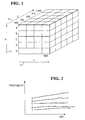
- a database of information 10 concerns a set of customers of an enterprise such as a bank.
- the database 10 is shown in three dimensions arranged along an X axis 11, a Y axis 12 and a Z axis 13.
- the X axis 11 is subdivided to include fields for each of five customers A to E although it will be understood that in practice the database would have fields along the X axis for a multiplicity of customers far in excess of five.
- Each customer has attributes which include personal information such as age, type of job and salary and financial attributes such as the number and types of bank accounts, including investment accounts, deposit and current accounts and loans.
- the customer attributes are arranged along the Z axis 13. Whilst only five fields of attributes for each customer are illustrated in Figure 1, it will be understood that these fields are illustrative only and that, in practice, provision would be made in the database to include a number of attributes for each customer far in excess of five.
- the Y axis 12 of the database 10 is a time axis. Each customer attribute is recorded for each of a regular succession of time intervals. The time intervals can conveniently be intervals of one month although intervals other than monthly intervals may be used.
- a portion of the entry for a customer A is illustrated in the following table A.
- the table A includes fields relating to age, salary and transactions in a current account.
- a table B illustrates the corresponding fields in the entry for a customer B.
- the tables A and B above are illustrative of five fields along the Z axis of the database 10 in Figure 1 to show the time progression on a monthly basis of salary, age, number of Automated Teller Machine transactions, payments of electricity and payments of a credit card bill.
- Other fields would relate for example to payments of interest by the customer on a loan account or payments of interest to a customer on a deposit account.
- the worth or profitability of an individual customer can be calculated by known methods based on the financial transaction data of the customer through the accounts held with the bank.
- the profitability of the individual customers A to E in the database 10 of Figure 1 can thus all be calculated individually using the known methods.
- the profitability of a customer is a variable with time which is associated with the sequence of data concerning that individual customer. It would benefit a bank to be able to predict the future profitability of an individual customer.
- each customer is represented as an individual graphical plot of profitability which varies with age.
- the graphical plots are aligned in time so that the profitability of each customer can be compared with that of the others, although the lengths of the plots are not all the same because of the different lifespans represented in Figure 2.
- the graphical plot of profitability for an individual customer is representative of the sequence of data in the database 10 of Figure 1.
- the profitability of each customer is stored as a continuous sequence of values within the database 10.
- a data processing apparatus which provides a means for receiving the data in the data base 10 of Figure 1.
- the data is entered by means of an I/O device 30 through an I/O port 31 for entry to a data bus 32.
- a group of central processing units (CPU) 33 are controlled by an operating system 34 to control the entry of data onto the data bus.
- a random access memory 35 is connected to the I/O bus 32 to receive and store data supplied by the bus 32.
- the parallel operating CPUs 33 are programmed to enter the data into the memory 35.
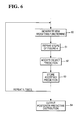
- the data in the memory 35 is a set of reference data sequences which is available to be processed in a series of processing operations as represented in the block flow diagram of Figure 4.
- step 40 the entry of the sequences of data from the fields of the database 10 through the I/O device 30 is shown as step 40 and the storage of the data in the memory 35 is shown as step 41.
- step 41 a data sequence representing information concerning a new customer is entered in step 42 by way of the I/O device 30 and registered in the memory 35.
- the CPU 33 is programmed to match data in the new customer data sequence to data of the reference data sequences according to a time warping algorithm as shown in step 43.
- Dynamic time warping is a known method of non-linear time alignment which allows signals or data sequences to be stretched and shrunk in time so as to maximise their alignment.
- step 44 the distance between the sequences is determined in step 44 by the amount of time warping.
- the distances between the new customer data sequence and the reference data sequences are based on the differences in transactional data summed over the successive monthly time periods of the database 10.
- the distance could either be 1 for identity and 0 otherwise.
- a matrix of category distances could be created which relates the distances between different categories.
- the distance between banker and banker is 0.0
- the distance between banker and accountant is 0.2
- the distance between banker and street sweeper is 10.0 etc.
- This nominal field comparison can then be inserted into the equation (1) above by changing the term ( x f - x f ') 2 into the term ( m [ x f , x f ']) 2 where m is the distance matrix entry for the two nominal variables.
- the CPU 33 is programmed to use a local linear regression model to perform regression in which a weighting is assigned for each reference data sequence according to its distance from the new customer data sequence.
- the weight of the ith example of the set of reference data sequences is w i (x j ,x i ) where x j represents the set of data in the new customer data sequence and x; represents the set of data in the ith reference data sequence.
- the weights calculated in the step 44 are summed over all the examples in the set of reference data sequences.
- the sum is a normalising term for use in a subsequent step of operation as will be explained.
- a projection at a future time t of the profitability value of the new customer is made in step 47.
- the profitability values of the reference data sequences are retrieved from the memory 35.
- the projection for the new customer is then made from the profitability values of each of the reference sequences multiplied by their weightings.
- the projection is represented by the expression :- i ⁇ w i x j ,x i v i t i + t
- v i is the profitability value of the ith reference data sequence
- t i is the time in the ith reference sequence that corresponds with the end of the new customer sequence
- t is the time at which the projection of the profitability of the new customer is to be made relative to the end of the new customer sequence.
- the projection made in step 47 is normalised.
- the normalising step consists of dividing the projection by the sum derived in the step 46.
- the weighting function can be any polynomial function of an order of one or more than one.
- a reference data sequence to be tested for redundancy is isolated.
- the operating steps shown in Figure 4 are completed using the stored reference data sequences to predict the value of the isolated sequence.
- the prediction is stored for future reference.
- the prediction stored in step 52 is compared with the actual known value for the isolated sequence and the degree of redundancy resulting from the comparison is stored in step 54.
- the isolated data sequence is replaced in the memory.
- a test is determined in step 56 to check whether the data sequence removed in step 50 is the last in the store 35. If the result is NO the steps 50 to 55 are repeated but a different reference data sequence is removed from the prediction for each repeated prediction.
- step 56 will lead to step 57 in which the values of redundancy stored in the step 55 of each iteration are ranked. Those data sequences having redundancy values which fall below a predetermined threshold are removed from the set of reference sequences.
- the prediction which is produced by the series of steps shown in Figure 4 is determined by the weighting function that is used in the prediction.
- Any weighting function may be used including by way of example a Gaussian function or a cubic function.
- multiple predictions using different weighting functions can be sampled to calculate posterior predictive distributions.
- a random weighting function is generated.
- the random weighting function may be made random in respect of the value of the constant c in the case of the Gaussian weighting function referred to above.
- the weighting function may be made random in respect of the values of the constants c 0 , c 1 , c 2 , and c 3 in the case of the cubic weighting function referred to above.
- step 61 the steps of Figure 4 are undertaken to form a prediction using the randomly generated weighting function from step 60.
- the resulting prediction is accepted or rejected using a known sampling method.
- the known sampling method is Markov Chain Monte Carlo (MCMC) sampling.
- MCMC Markov Chain Monte Carlo
- Each accepted prediction is stored in step 63.
- the steps 60 to 63 are repeated a multiplicity of times to generate a probability distribution of predictions.
- An output posterior predicitve distribution is made in step 64.
- the MCMC sampling requires a likelihood function. The likelihood of a particular set of parameters P is calculated by working out how well they predict the reference data sequences.
- the process is repeated for each of the other reference data sequences so as to calculate the individual likelihoods for each.
- the total likelihood is the product of all the individual likelihoods.
- the invention can be used to compare different individuals so as to rank them by trading off risk against potential profit. Thus the invention can be used to calculate the probability that an individual will make a loss as almost zero.
- the model may indicate that the lifetime profit predictive distribution for this individual is peaked at a particular value such as $10 000 very tightly and predict that there is a 95% chance that the lifetime profit of this individual will be between $9 000 and $11 000.
Landscapes
- Business, Economics & Management (AREA)
- Strategic Management (AREA)
- Engineering & Computer Science (AREA)
- Accounting & Taxation (AREA)
- Development Economics (AREA)
- Finance (AREA)
- Economics (AREA)
- Game Theory and Decision Science (AREA)
- Entrepreneurship & Innovation (AREA)
- Marketing (AREA)
- Physics & Mathematics (AREA)
- General Business, Economics & Management (AREA)
- General Physics & Mathematics (AREA)
- Theoretical Computer Science (AREA)
- Management, Administration, Business Operations System, And Electronic Commerce (AREA)
- Financial Or Insurance-Related Operations Such As Payment And Settlement (AREA)
- Complex Calculations (AREA)
Applications Claiming Priority (2)
| Application Number | Priority Date | Filing Date | Title |
|---|---|---|---|
| GBGB9819934.2A GB9819934D0 (en) | 1998-09-14 | 1998-09-14 | Predicting a future value of a variable associated with an input data sequence |
| GB9819934 | 1998-09-14 |
Publications (1)
| Publication Number | Publication Date |
|---|---|
| EP0987643A2 true EP0987643A2 (de) | 2000-03-22 |
Family
ID=10838792
Family Applications (2)
| Application Number | Title | Priority Date | Filing Date |
|---|---|---|---|
| EP99306726A Withdrawn EP0987643A2 (de) | 1998-09-14 | 1999-08-24 | Vorhersage eines zukünftigen Werts einer mit einer Dateneingabesequenz assozierten Variablen |
| EP99307142A Withdrawn EP0987645A3 (de) | 1998-09-14 | 1999-09-09 | Vorhersage eines zukünftigen Werts einer mit einer Dateneingabesequenz assoziierten Variablen |
Family Applications After (1)
| Application Number | Title | Priority Date | Filing Date |
|---|---|---|---|
| EP99307142A Withdrawn EP0987645A3 (de) | 1998-09-14 | 1999-09-09 | Vorhersage eines zukünftigen Werts einer mit einer Dateneingabesequenz assoziierten Variablen |
Country Status (5)
| Country | Link |
|---|---|
| EP (2) | EP0987643A2 (de) |
| JP (1) | JP2000099497A (de) |
| AU (1) | AU4739499A (de) |
| GB (1) | GB9819934D0 (de) |
| ZA (1) | ZA995600B (de) |
Cited By (1)
| Publication number | Priority date | Publication date | Assignee | Title |
|---|---|---|---|---|
| US10210528B2 (en) | 2001-09-05 | 2019-02-19 | International Business Machines Corporation | Method and system for assessing and improving individual customer profitability for a profit-making organization |
Families Citing this family (3)
| Publication number | Priority date | Publication date | Assignee | Title |
|---|---|---|---|---|
| GB0013011D0 (en) * | 2000-05-26 | 2000-07-19 | Ncr Int Inc | Method and apparatus for determining one or more statistical estimators of customer behaviour |
| CN107014635B (zh) * | 2017-04-10 | 2019-09-27 | 武汉轻工大学 | 粮食均衡抽样方法及装置 |
| US11810153B2 (en) * | 2020-12-15 | 2023-11-07 | Visa International Service Association | Method, system, and computer program product for matching card transaction data to mobile application usage |
-
1998
- 1998-09-14 GB GBGB9819934.2A patent/GB9819934D0/en not_active Ceased
-
1999
- 1999-08-24 EP EP99306726A patent/EP0987643A2/de not_active Withdrawn
- 1999-08-31 ZA ZA9905600A patent/ZA995600B/xx unknown
- 1999-09-06 AU AU47394/99A patent/AU4739499A/en not_active Abandoned
- 1999-09-09 EP EP99307142A patent/EP0987645A3/de not_active Withdrawn
- 1999-09-13 JP JP25876399A patent/JP2000099497A/ja active Pending
Cited By (1)
| Publication number | Priority date | Publication date | Assignee | Title |
|---|---|---|---|---|
| US10210528B2 (en) | 2001-09-05 | 2019-02-19 | International Business Machines Corporation | Method and system for assessing and improving individual customer profitability for a profit-making organization |
Also Published As
| Publication number | Publication date |
|---|---|
| GB9819934D0 (en) | 1998-11-04 |
| ZA995600B (en) | 2001-02-28 |
| JP2000099497A (ja) | 2000-04-07 |
| AU4739499A (en) | 2000-03-23 |
| EP0987645A2 (de) | 2000-03-22 |
| EP0987645A3 (de) | 2004-03-10 |
Similar Documents
| Publication | Publication Date | Title |
|---|---|---|
| US6725210B1 (en) | Process database entries to provide predictions of future data values | |
| US7236952B1 (en) | Invention in finance | |
| Gowrisankaran et al. | Network externalities and technology adoption: Lessons from electronic payments | |
| US20040215545A1 (en) | Power trading risk management system | |
| US8065227B1 (en) | Method and system for producing custom behavior scores for use in credit decisioning | |
| Kim et al. | Managing loan customers using misclassification patterns of credit scoring model | |
| US20150228014A1 (en) | Automated customer characterization | |
| JP7311495B2 (ja) | 改善された住宅ローン金利決定 | |
| US20160307272A1 (en) | System for reducing computational costs associated with predicting demand for products | |
| Bakhach et al. | TSFDC: A trading strategy based on forecasting directional change | |
| Purnama | Increasing Understanding of One-Way ANOVA Material for Accounting Students: A Case Study of Deposit Interest | |
| Gouvêa et al. | Credit risk analysis applying logistic regression, neural networks and genetic algorithms models | |
| Chen et al. | Modeling recovery rate for leveraged loans | |
| CN114820170A (zh) | 客户准入方法及装置 | |
| EP0987643A2 (de) | Vorhersage eines zukünftigen Werts einer mit einer Dateneingabesequenz assozierten Variablen | |
| Pratiwi et al. | Machine Learning Model using Times Series Analytics for Prediction of ATM Transactions | |
| Hassan et al. | Financial services credit scoring system using data mining | |
| Husejinovic et al. | Application of business intelligence in decision making for credit card approval | |
| Kartawinata et al. | Investment decision analysis with capital asset pricing model (CAPM) of technology sector stocks on ASEAN regional stock exchanges | |
| Perera et al. | Determinants of automated teller machine loading demand requirements in Sri Lankan cash supply chains | |
| CA2282113A1 (en) | Predicting a future value of a variable associated with an input data sequence | |
| Van Calster et al. | Profit-oriented sales forecasting: a comparison of forecasting techniques from a business perspective | |
| Dionne et al. | Default risk in corporate yield spreads | |
| Aru et al. | ADOPTING GENETIC ALGORITHM AS A SMART OPTION IN DEVELOPING AN INTELLIGENT DATA LOGGER FOR SETTLING CASH DISPENSE ALTERCATION | |
| Valadkhani | An empirical analysis of the black market exchange rate in Iran |
Legal Events
| Date | Code | Title | Description |
|---|---|---|---|
| PUAI | Public reference made under article 153(3) epc to a published international application that has entered the european phase |
Free format text: ORIGINAL CODE: 0009012 |
|
| AK | Designated contracting states |
Kind code of ref document: A2 Designated state(s): AT BE CH CY DE DK ES FI FR GB GR IE IT LI LU MC NL PT SE |
|
| AX | Request for extension of the european patent |
Free format text: AL;LT;LV;MK;RO;SI |
|
| STAA | Information on the status of an ep patent application or granted ep patent |
Free format text: STATUS: THE APPLICATION IS DEEMED TO BE WITHDRAWN |
|
| 18D | Application deemed to be withdrawn |
Effective date: 19990925 |