EP0983748B1 - Fertility monitoring method - Google Patents
Fertility monitoring method Download PDFInfo
- Publication number
- EP0983748B1 EP0983748B1 EP99121753A EP99121753A EP0983748B1 EP 0983748 B1 EP0983748 B1 EP 0983748B1 EP 99121753 A EP99121753 A EP 99121753A EP 99121753 A EP99121753 A EP 99121753A EP 0983748 B1 EP0983748 B1 EP 0983748B1
- Authority
- EP
- European Patent Office
- Prior art keywords
- day
- cycle
- ovulation
- concentration
- testing
- Prior art date
- Legal status (The legal status is an assumption and is not a legal conclusion. Google has not performed a legal analysis and makes no representation as to the accuracy of the status listed.)
- Expired - Lifetime
Links
- 238000000034 method Methods 0.000 title claims abstract description 65
- 238000012544 monitoring process Methods 0.000 title claims abstract description 22
- 230000035558 fertility Effects 0.000 title claims description 19
- 238000012360 testing method Methods 0.000 claims abstract description 140
- 230000016087 ovulation Effects 0.000 claims abstract description 67
- 239000012491 analyte Substances 0.000 claims abstract description 38
- 230000027758 ovulation cycle Effects 0.000 claims abstract description 22
- 210000001124 body fluid Anatomy 0.000 claims abstract description 21
- 239000010839 body fluid Substances 0.000 claims abstract description 21
- 238000005259 measurement Methods 0.000 claims abstract description 16
- 238000003556 assay Methods 0.000 claims description 23
- 210000002700 urine Anatomy 0.000 claims description 22
- VOXZDWNPVJITMN-ZBRFXRBCSA-N 17β-estradiol Chemical compound OC1=CC=C2[C@H]3CC[C@](C)([C@H](CC4)O)[C@@H]4[C@@H]3CCC2=C1 VOXZDWNPVJITMN-ZBRFXRBCSA-N 0.000 claims description 20
- 229960005309 estradiol Drugs 0.000 claims description 20
- 229930182833 estradiol Natural products 0.000 claims description 20
- 239000002207 metabolite Substances 0.000 claims description 17
- 238000001514 detection method Methods 0.000 claims description 11
- 150000002159 estradiols Chemical class 0.000 claims description 6
- 238000005096 rolling process Methods 0.000 claims description 6
- 230000036760 body temperature Effects 0.000 claims description 4
- 230000002045 lasting effect Effects 0.000 claims description 2
- FJAZVHYPASAQKM-JBAURARKSA-N estrone 3-O-(beta-D-glucuronide) Chemical compound C([C@@H]1[C@@H](C2=CC=3)CC[C@]4([C@H]1CCC4=O)C)CC2=CC=3O[C@@H]1O[C@H](C(O)=O)[C@@H](O)[C@H](O)[C@H]1O FJAZVHYPASAQKM-JBAURARKSA-N 0.000 abstract description 48
- 210000004914 menses Anatomy 0.000 abstract description 5
- 102000009151 Luteinizing Hormone Human genes 0.000 description 42
- 108010073521 Luteinizing Hormone Proteins 0.000 description 42
- 229940040129 luteinizing hormone Drugs 0.000 description 42
- 239000012071 phase Substances 0.000 description 32
- 230000002485 urinary effect Effects 0.000 description 19
- 208000021267 infertility disease Diseases 0.000 description 16
- ZFFFJLDTCLJDHL-JQYCEVDMSA-N Pregnanediol-3-glucuronide Chemical compound O([C@H]1C[C@H]2CC[C@H]3[C@@H]4CC[C@@H]([C@]4(CC[C@@H]3[C@@]2(C)CC1)C)[C@@H](O)C)[C@@H]1O[C@H](C(O)=O)[C@@H](O)[C@H](O)[C@H]1O ZFFFJLDTCLJDHL-JQYCEVDMSA-N 0.000 description 13
- 229940088597 hormone Drugs 0.000 description 13
- 239000005556 hormone Substances 0.000 description 13
- 230000008901 benefit Effects 0.000 description 7
- 230000005906 menstruation Effects 0.000 description 6
- 239000003153 chemical reaction reagent Substances 0.000 description 5
- 238000003018 immunoassay Methods 0.000 description 5
- 238000012806 monitoring device Methods 0.000 description 5
- 238000006243 chemical reaction Methods 0.000 description 3
- 239000012530 fluid Substances 0.000 description 3
- 230000029849 luteinization Effects 0.000 description 3
- 230000003287 optical effect Effects 0.000 description 3
- 239000008188 pellet Substances 0.000 description 3
- 241000124008 Mammalia Species 0.000 description 2
- 239000008280 blood Substances 0.000 description 2
- 210000004369 blood Anatomy 0.000 description 2
- 239000003433 contraceptive agent Substances 0.000 description 2
- 230000002254 contraceptive effect Effects 0.000 description 2
- 238000005516 engineering process Methods 0.000 description 2
- 230000006870 function Effects 0.000 description 2
- 210000003097 mucus Anatomy 0.000 description 2
- 210000003296 saliva Anatomy 0.000 description 2
- 239000013589 supplement Substances 0.000 description 2
- 230000000007 visual effect Effects 0.000 description 2
- XLYOFNOQVPJJNP-UHFFFAOYSA-N water Substances O XLYOFNOQVPJJNP-UHFFFAOYSA-N 0.000 description 2
- MUOHJTRCBBDUOW-QXYWQCSFSA-N 17beta-estradiol 3-glucosiduronic acid Chemical compound C([C@@H]1[C@@H](C2=CC=3)CC[C@]4([C@H]1CC[C@@H]4O)C)CC2=CC=3O[C@@H]1O[C@H](C(O)=O)[C@@H](O)[C@H](O)[C@H]1O MUOHJTRCBBDUOW-QXYWQCSFSA-N 0.000 description 1
- 102000002322 Egg Proteins Human genes 0.000 description 1
- 108010000912 Egg Proteins Proteins 0.000 description 1
- 241000282412 Homo Species 0.000 description 1
- 241000276498 Pollachius virens Species 0.000 description 1
- 208000031271 Unwanted pregnancy Diseases 0.000 description 1
- 238000002835 absorbance Methods 0.000 description 1
- 238000010521 absorption reaction Methods 0.000 description 1
- 239000000427 antigen Substances 0.000 description 1
- 238000013459 approach Methods 0.000 description 1
- 238000013528 artificial neural network Methods 0.000 description 1
- 238000002820 assay format Methods 0.000 description 1
- 238000003149 assay kit Methods 0.000 description 1
- 238000004364 calculation method Methods 0.000 description 1
- 210000003756 cervix mucus Anatomy 0.000 description 1
- 238000009535 clinical urine test Methods 0.000 description 1
- 239000003086 colorant Substances 0.000 description 1
- 238000012875 competitive assay Methods 0.000 description 1
- 230000002596 correlated effect Effects 0.000 description 1
- 230000000875 corresponding effect Effects 0.000 description 1
- 230000007547 defect Effects 0.000 description 1
- 238000009792 diffusion process Methods 0.000 description 1
- 230000000694 effects Effects 0.000 description 1
- FQYGGFDZJFIDPU-JRSYHJKYSA-N estriol 16-O-(beta-D-glucuronide) Chemical compound O([C@@H]1C[C@H]2[C@H]3[C@@H](C4=CC=C(O)C=C4CC3)CC[C@@]2([C@H]1O)C)[C@@H]1O[C@H](C(O)=O)[C@@H](O)[C@H](O)[C@H]1O FQYGGFDZJFIDPU-JRSYHJKYSA-N 0.000 description 1
- FQYGGFDZJFIDPU-UHFFFAOYSA-N estriol 16alpha-beta-D-glucuronide Natural products OC1C2(C)CCC(C3=CC=C(O)C=C3CC3)C3C2CC1OC1OC(C(O)=O)C(O)C(O)C1O FQYGGFDZJFIDPU-UHFFFAOYSA-N 0.000 description 1
- UZKIAJMSMKLBQE-JRSYHJKYSA-N estriol 3-O-(beta-D-glucuronide) Chemical compound C([C@@H]1[C@@H](C2=CC=3)CC[C@]4([C@H]1C[C@@H](O)[C@@H]4O)C)CC2=CC=3O[C@@H]1O[C@H](C(O)=O)[C@@H](O)[C@H](O)[C@H]1O UZKIAJMSMKLBQE-JRSYHJKYSA-N 0.000 description 1
- JKKFKPJIXZFSSB-CBZIJGRNSA-N estrone 3-sulfate Chemical compound OS(=O)(=O)OC1=CC=C2[C@H]3CC[C@](C)(C(CC4)=O)[C@@H]4[C@@H]3CCC2=C1 JKKFKPJIXZFSSB-CBZIJGRNSA-N 0.000 description 1
- 230000004720 fertilization Effects 0.000 description 1
- 208000000509 infertility Diseases 0.000 description 1
- 230000036512 infertility Effects 0.000 description 1
- 230000000977 initiatory effect Effects 0.000 description 1
- 238000002372 labelling Methods 0.000 description 1
- 239000004973 liquid crystal related substance Substances 0.000 description 1
- 230000001592 luteinising effect Effects 0.000 description 1
- 238000004519 manufacturing process Methods 0.000 description 1
- 230000011599 ovarian follicle development Effects 0.000 description 1
- 210000004681 ovum Anatomy 0.000 description 1
- 238000004806 packaging method and process Methods 0.000 description 1
- 229920000642 polymer Polymers 0.000 description 1
- 238000011176 pooling Methods 0.000 description 1
- 238000012545 processing Methods 0.000 description 1
- 230000000750 progressive effect Effects 0.000 description 1
- 238000012207 quantitative assay Methods 0.000 description 1
- 238000013214 routine measurement Methods 0.000 description 1
- 210000002374 sebum Anatomy 0.000 description 1
- 239000007790 solid phase Substances 0.000 description 1
- 230000009870 specific binding Effects 0.000 description 1
- 239000000126 substance Substances 0.000 description 1
- 210000004243 sweat Anatomy 0.000 description 1
- 210000001138 tear Anatomy 0.000 description 1
- 210000004291 uterus Anatomy 0.000 description 1
Images
Classifications
-
- G—PHYSICS
- G01—MEASURING; TESTING
- G01N—INVESTIGATING OR ANALYSING MATERIALS BY DETERMINING THEIR CHEMICAL OR PHYSICAL PROPERTIES
- G01N33/00—Investigating or analysing materials by specific methods not covered by groups G01N1/00 - G01N31/00
- G01N33/48—Biological material, e.g. blood, urine; Haemocytometers
- G01N33/50—Chemical analysis of biological material, e.g. blood, urine; Testing involving biospecific ligand binding methods; Immunological testing
- G01N33/74—Chemical analysis of biological material, e.g. blood, urine; Testing involving biospecific ligand binding methods; Immunological testing involving hormones or other non-cytokine intercellular protein regulatory factors such as growth factors, including receptors to hormones and growth factors
- G01N33/743—Steroid hormones
-
- A—HUMAN NECESSITIES
- A61—MEDICAL OR VETERINARY SCIENCE; HYGIENE
- A61B—DIAGNOSIS; SURGERY; IDENTIFICATION
- A61B10/00—Instruments for taking body samples for diagnostic purposes; Other methods or instruments for diagnosis, e.g. for vaccination diagnosis, sex determination or ovulation-period determination; Throat striking implements
- A61B10/0012—Ovulation-period determination
Definitions
- This invention relates to methods, devices and test kits for use in monitoring the ovulation cycle in female mammals especially humans.
- the invention is particularly, although not solely, concerned with simple practical procedures that can readily be applied by unskilled persons, e.g. in the home, to provide reliable information concerning fertility status as an aid to contraception.
- An important objective of the invention is to provide such information while avoiding the necessity for tests to be conducted on a frequent (eg. daily) basis throughout every ovulation cycle.
- regular, e.g. daily, testing throughout the cycle has characterised many ovulation cycle monitoring systems previously proposed.
- the invention may also be used by persons wishing to enhance the likelihood of conception, by providing an indication of the time during the ovulation cycle when fertilization is most likely to occur.
- Typical parameters which have been invoked are the concentration of a body fluid analyte, such as estradiol and metabolites thereof, for example estrone-3-glucuronide (E3G).
- Other parameters that have been used are basal body temperature (which can only provide predictive information of use in subsequent cycles) and various physiological changes such as the characteristics of vaginal mucous.
- EP-A-385621 (Coley et al/Unilever) the defects of ovulation cycle monitoring systems which rely primarily on the change in BBT to estimate the time of ovulation are described, and we propose therein a system which uses regular BBT measurement in combination with a knowledge of other parameters, particularly the measurement of certain urinary hormone levels.
- BBT is measured daily throughout each cycle and is used to estimate the timing of fertility status changes in a forthcoming cycle.
- urinary hormone levels are checked at certain times to confirm that the progress of the cycle, as predicted from the previous BBT knowledge, is consistent.
- Particular hormones selected are E3G, P3G and LH.
- the level of urinary E3G is measured on at least one day during the interval from day 5 to 7 of the predicted cycle, and again on at least one day during the interval from day 10 to day 15 of the predicted cycle.
- the hormone level it is sufficient for the hormone level to be either "high” or "low” relative to a threshold value.
- the document discloses a method having the features of the pre-characterising portion of claim 1 below.
- the emphasis throughout EP 385621 is that occasional hormone level measurements are used to supplement a monitoring system which relies on BBT measurement. There is no suggestion that hormone measurements alone could provide the basis for a reliable fertility monitoring system personalised for an individual subject.
- An objective of the present invention is to provide a system for monitoring the fertility status of an individual subject, which provides sufficient warning of the onset of the fertile phase to enable contraceptive advice to be given and which can be personalised to the individual subject, while being based solely on body fluid analyte measurements.
- the inherent unreliability, or limited usefulness, of other measuring systems can thereby be avoided.
- a further objective is to avoid the use of average data obtained from population studies, with its inherent risk that in an individual subject, the parameter under test can fluctuate considerably from the population norm.
- a further objective is to provide the option of basing an effective monitoring system solely on the measurement of a single body fluid analyte, namely estradiol or a metabolite thereof.
- Another objective of the invention is to provide a testing regime which is a good balance between the desire to minimise the testing burden on the user and the need to give the user worthwhile advice about the fertility status.
- estradiol metabolites that can also be assayed for the purposes of the invention include estradiol-3-glucuronide, estradiol-17-glucuronide, estriol-3-glucuronide, estriol-16-glucuronide and (principally for non-human subjects) estrone-3-sulphate.
- estradiol-3-glucuronide estradiol-17-glucuronide
- estriol-3-glucuronide estriol-16-glucuronide
- estradione-3-sulphate estradiol-3-glucuronide
- estradiol-17-glucuronide estradiol-17-glucuronide
- estriol-16-glucuronide estriol-16-glucuronide
- estradiol metabolites that can also be assayed for the purposes of the invention include estradiol-3-glucuronide, estradiol-17-glucuronide, estriol-3-glucuronide, estriol-16-glucuronide and (principally for non-human subjects
- the body fluid "concentration" of the chosen analyte or analytes need not be measured in absolute terms, although this can of course be done if desired. Generally, it will be sufficient to assay an analyte in a manner which yields a signal, convertible to numerical data, related to the actual concentration, so that such data can be compared with similar data obtained at a different stage in the cycle to determine whether or not a significant change in actual concentration has occurred. Accordingly, where the specification and claims below refer to the "concentration" of an analyte, this expression should be interpreted broadly.
- the invention provides a method of monitoring the fertility status of an individual female mammalian subject, according to claim 1 below. More particularly, the invention provides a method of monitoring the current fertility status of an individual human female, involving testing of the body fluid concentration of estradiol or a metabolite thereof and comparing the test result with a reference value or signal to ascertain whether an elevated concentration indicative of imminent ovulation is present, wherein the reference value or signal for the current cycle is established by testing the body fluid concentration in the same individual at least once .during the interval spanning days 4 to 7 inclusive, preferably on days 5 and/or 6, of the current cycle, testing is recommenced on day 9 of the current cycle and continued thereafter on at least a daily basis at least until a significantly elevated concentration is detected, and the status of the current cycle is declared to be "fertile" for the interval commencing on the day of significantly elevated concentration detection and for at least the immediately successive 12 days or until evidence of cycle termination (e.g.
- commencement of menses commencement of menses
- commencement of menses commencement of menses
- the invention provides a method of monitoring the fertility status of an individual female mammalian subject, involving testing of the body fluid concentration of estradiol or a metabolite thereof during the pre-ovulation phase, wherein testing for said analyte is conducted at least once during the interval spanning days 1 to 7 inclusive of the current cycle calculated from the onset of menses (day 1 being the day on which menstruation is first observed), to establish a reference concentration value or signal for said analyte in the current cycle, and thereafter testing is conducted at least once (generally repeatedly, e.g.
- analyte concentration values or signals obtained during said later or repeated testing being compared with the reference concentration value or signal to determine whether a concentration change indicative of imminent ovulation is occurring or has occurred since the previous test.
- the invention provides a method of monitoring the fertility status of an individual female subject, involving testing of the body fluid concentration of estradiol or a metabolite thereof during the pre-ovulation phase, wherein testing for said analyte is conducted at least once during the interval spanning days 1 to 7 inclusive calculated from the onset of menses (day 1 being the day on which menstruation is first observed), to establish a reference concentration value or signal for said analyte in the current cycle, and then testing is conducted at least once (generally repeatedly, e.g.
- the concentration reference value is established from test(s) conducted during the interval spanning days 4 to 7 7 inclusive, more preferably from test(s) conducted on day 5 and/or day 6, and most preferably from a single test conducted on day 6.
- the body fluid can be urine.
- a very suitable analyte is estrone-3-glucuronide.
- the mean ovulation day is derived from data collected during at least 3, and more preferably at least 5, consecutive previous cycles.
- the mean ovulation day used to calculate the time interval for the purposes of the current cycle is derived from data obtained during at least the immediately preceding cycle.
- a particularly convenient method involves the determination of the mean ovulation day from data obtained from a "rolling" reference base consisting of a fixed number of consecutive cycles immediately preceding the current cycle.
- this rolling reference base consists of the immediately preceding 3 to 12 cycles, more preferably the immediately preceding 5 or 6 cycles.
- Another feature of the invention which may be combined to advantage with any method as set forth above, involves:
- the user is directed to perform one test on day 6, and to use all of the remaining testing devices on a daily basis during the repeated testing period.
- the user benefits because the "monthly" testing schedule is simplified- there is no need for a decision to be taken on when to stop the repeated testing, or about using up during subsequent cycles testing devices left over from earlier cycles. For the manufacturer, there is assurance that data for each cycle is derived from a single batch of testing devices, thus eliminating problems of standardisation that might otherwise arise, and reducing the complexity of any monitor required to interpret the test data. No activity by the user is required to ensure calibration of the assays.
- the disposable testing devices can be supplied in standard "monthly" replenishment packs, streamlining the packaging operation. Because the problem of "leftover" testing devices is eliminated, one possible cause for customer enquiries is also avoided.
- An advantage of the methods of the present invention is that effective monitoring of the ovulation cycle can be achieved using data derived solely from the measurement of body fluid analyte concentration(s). It is unnecessary to combine this data with other parameters. In particular, there is no need to supplement this data with routine measurement of basal body temperature.
- the methods of the invention avoid the need for calibration and ensure that the base-line reference is personal to the subject under test. This leads to a clearer indication of the significant pre-ovulation concentration change, compared to previously proposed methods based on day-to-day measurements.
- the analyte chosen for providing the warning of imminent ovulation is not critical to the invention, provided that the analyte is estradiol or a metabolite thereof which exhibits a detectable concentration change within the time interval between the commencement of testing (as determined herein) and a safe time in advance of actual ovulation in the current cycle.
- the invention can be applied in any method of monitoring the status of a current ovulation cycle of an individual human female subject involving the measurement of estradiol or a metabolite thereof which exhibits a detectable change during the pre-ovulation phase of the cycle occurring at least 2 and more preferably at least 3 days in advance of the day of actual ovulation.
- the following description is provided, by way of example only, in relation to the urinary hormones E3G, luteinizing hormone (LH), and pregnanediol-3-glucuronide (P3G), although it will be readily appreciated that the principles of the method can be used in relation to other biochemical markers, for example the hormone estradiol found for example in the blood or in saliva.
- the method of the invention may be used in combination with observations of other physiological signs of the level of fertility in a female, of which she is aware, or can readily be made aware of, e.g. markers in other body fluids.
- Ovulation day can be determined by any of the known chemical or physiological parameters, although a preferred method is by measuring the level of LH. Once the LH surge has been detected, it can be said that ovulation is imminent. Also, the day of the cycle on which ovulation has occurred can-be noted for future reference. If the LH surge is detected, and hence the day of ovulation accurately pinpointed, it can be indicated to the user with a very high degree of certainty that the subject will no longer be fertile four days hence (3 days after ovulation). For practical purposes, a urinary LH concentration of 20 mIU/ml can be regarded as a universal threshold indicative of the LH surge under virtually all circumstances.
- LH surge is used herein to mean the dramatic rise in LH concentration that precedes the event of ovulation.
- LH max i.e. the peak concentration of LH.
- the actual peak concentration of LH is not observed until the day following the main concentration rise.
- the end of the fertile phase can be declared on the basis of knowledge of the estradiol (or metabolite thereof) concentration, in the current cycle. Conveniently, this may be declared on a set day following a peak concentration value. Because the peak concentration of urinary E3G, for example, appears to be a less readily detectable event than the LH surge, the E3G "peak” may be defined by reference to a threshold value, determined for example by the relationship: [i] [r] > 2.5, preferably ⁇ 3 the "peak” being taken to occur on the day when this relationship is first satisfied during the testing regime adopted in the current cycle. The inverse relationship will apply if the E3G signal in inversely proportional to actual concentration.
- the invention provides the option of a method of monitoring fertility in the current cycle based solely on data derived from estradiol/metabolite assays.
- Another method for predicting the end of the fertile period is to measure the levels of the urinary hormone P3G.
- P3G has a relatively low level in urine until the start of the luteal phase, at which point its level rises fairly sharply. Therefore, once an elevated level of P3G is detected, it can be indicated to the user that the luteal phase of the cycle - ie. the terminal infertile period - has commenced.
- An elevated level of urinary P3G can be based on data taken during the current and/or one or more preceding cycles.
- An “elevated” P3G level can be recorded, for example, when either the level of P3G detected is greater than the sum of the four previous recorded levels of P3G in the same menstrual cycle, or greater than 3500 ng/ml, whichever of these two thresholds is lower and is first achieved. Once an "elevated" P3G level is recorded, the subject can be advised that she is infertile for the remainder of that cycle.
- the detection of either LH or P3G can be used as a trigger to indicate that the subject is no longer fertile until the end of the cycle, with one hormone acting as a "back up" to the other.
- the detection of LH be used as a primary indicator of whether ovulation has or is about to occur, since the detection of LH lends itself to more accurate determination of the exact ovulation day than the use of P3G.
- analyte is detected by assay methods and devices as described in our UK patent GB 2204398 and our European patent application EP-A-383619, the contents of which are incorporated herein by reference.
- Disposable assay strips such as those described in GB 2204398 which simply require to be contacted with urine and which provide an assay result in semi-qualitative form, eg. by means of a series of test zones on the strip which are progressively positive at higher urinary analyte levels, can be used. Multiple strips that respond at different analyte thresholds can be used, rather than a single strip.
- a visually readable quantitative assay can be based on progression of a visible, eg. coloured, region or "front" over a surface (eg. radial diffusion), using for example an enzyme-labelled assay.
- a recording device which incorporates means for reading the result of the urine assay, eg. by measuring the absorbance by or fluorescence from an assay strip. This may enable a more precise numerical indication to be given of the analyte level, and further enhance the accuracy of the method.
- such measurement can if desired be performed using a single body fluid testing device, eg. a device incorporating multiple assay strips, or a single strip capable of independently detecting the level of the different analytes.
- a single body fluid testing device eg. a device incorporating multiple assay strips, or a single strip capable of independently detecting the level of the different analytes.
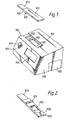
- the urine sample testing device comprises a flat elongate casing 100 having a locating means, represented by ridge 101 on its lower surface 102. Projecting from one end of the casing is a bibulous sample receiving member 103.
- the monitor comprises a casing 110 having a recess 111 in its upper surface 112 to accommodate the casing 100 of the testing device.
- Recess 111 incorporates a locating slot 113 into which the locating ridge 101 on the casing of the testing device can be inserted to positively locate the testing device in relation to a reading window 114 in the recess.
- Casing 110 contains means (not shown) such as a fluorescence reader or optical density reader to measure the result of a urinary analyte concentration assay performed using the testing device, according to the labelling system chosen to reveal the assay result.
- the sloping front face 115 of the monitor casing incorporates a large window 116 through which information can be conveyed to the user eg. by means of an LED display or other visual output. This information can be provided in a variety of forms, such as an indication of a calender and the need to perform urine tests, and an indication of the current status of the ovulation cycle.
- the sloping face 115 of the casing also incorporates a button 117 which the user can press to indicate the commencement of an ovulation cycle and to start the monitor processing information relative to that cycle.
- Information can be conveyed to the user by means of a liquid crystal or LED display, for example.
- information on the state of fertility can be conveyed by a simple visual indication, eg a combination of colours showing, for example, green for infertile and red for fertile.
- another signal e.g. yellow, for any intermediate stage when conception is less likely but still possible, may be shown.
- the device is intended primarily as an aid to contraception, it should “fail safe” by showing a "fertile” signal.
- the invention further provides a kit for monitoring the ovulation cycle of a female mammal, comprising a monitoring device as set forth above, together with at least one testing device capable of being used to measure the level of one or more urine components. It is envisaged that the monitoring device will generally be of a relatively durable nature and capable of being used over a considerable number of cycles.
- the testing devices for measuring the urine components are preferably disposable after individual use, and it is therefore envisaged that the user of the monitoring device will need to replenish the testing devices.
- the monitor will be battery-powered, and incorporates in side 118 of the casing an access point such as a removable cover 119 to permit batteries to be inserted and changed.
- the testing device is shown inverted relative to the aspect seen in Figure 1.
- the locating ridge 101 is now on the upper surface 200.
- a result window 201 is also in the surface 200 now uppermost.
- the body of the testing device can incorporate an immunochromatograhic strip (not shown) incorporating all necessary reagents to enable an immunoassay to be formed which detects the presence and concentration of analyte in a urine sample applied to the sample collecting member 103.
- the result of the assay can be effected by the immobilization of a labelled component, via a sandwich or competition reaction in the presence of analyte in an applied urine sample, the labelled reagent becoming concentrated in a zone revealed through the result window.
- the result window is immediately adjacent to the reading window 114 in the monitor and the assay result can be determined.
- the reading means within the monitor can detect and measure fluorescent light output from the accumulated label in the detection zone on the strip to provide a numerically accurate concentration value for the analyte in the urine sample.
- This information can be processed by the monitor together with calender information resulting from the initiation of the cycle process by the user and historical data which the monitor can retain from previous cycles.
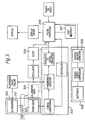
- a reading unit 300 to derive information from a test device, such as a test stick, the reading unit comprising an illuminator 301 and a reader 302 (represented here as a photo diode).
- the reading unit feeds into a conversion unit 303 to convert the optical signal into a form usable by a microprocessor 304.
- a calibration system 305 is provided to convert the signal derived from the reading unit into data corresponding, for example, to an absolute concentration value.
- a timer, such as a clock 306 is required to regulate measurements within a cycle.
- the microprocessor 304 processes, memorizes and interprets results in the light of previous events, particularly recorded from previous cycles.
- the user interface 307 will generally comprise at least means, such as a push button, which the user can operate at the commencement of a cycle to initiate the operation of the device as a whole.
- the power supply 308 should include means, such as a memory back up capacitator 309, to prevent loss of historical data if it becomes necessary to replace batteries.
- the kit provided to the user comprises a plurality of dual-analyte disposable urine testing devices, capable of assaying urinary E3G and urinary LH in a form readable by a monitor also provided.
- the monitor can receive each used testing device and determine the urinary concentration of each analyte. This information is stored in the monitor and compared with similar data obtained on subsequent days in the same cycle.
- the monitor has a menstruation button that the user must press at the start of the cycle, and a display panel or the like to convey information about cycle status, and to indicate to the user when testing should be performed.
- the objective is to:
- the number of tests available each routine month is limited to 8, and a test strategy which will maximise the chances of achieving i) and ii) is adopted.
- the monitor In order to establish an adequate initial data base, during the first cycle of use the monitor requires sixteen tests. This is to establish baseline data for the individual. The user presses the menstruation button on the monitor on the morning after her menstruation begins. This day is recorded as day 1 by the monitor. Testing commences on day 8 and continues daily until day 23. This testing is targeted to maximise the chance of observing the LH surge.
- the menstruation button is pressed as above. From cycle 2 onwards, eight tests only are used for each cycle. All eight tests must be from the same batch and all must be completed. In all cycles from cycle 2 onwards, testing commences on day 6. For cycles 2 and 3, tests two to eight are conducted on consecutive days starting on the typical LH surge day minus four days. From cycle 4 onwards, regarded as the first routine cycle, tests two to eight are conducted in sequence from typical LH surge minus five days. The typical LH surge day is defined as the mean day of LH surge for up to the previous six months.
- cycle 1 the monitor declares the woman fertile from day 6 onwards, as no information about cycle characteristics has been collected.
- the monitor can use the typical position of the LH surge from the previous cycle(s) to determine the start of the fertile phase. However, because of the limited amount of cycle data available, the monitor will still declare a woman fertile during cycles 2 and 3 on day 6 or on typical LH surge minus 7 days, whichever is later.
- the onset of the fertile phase is set by detection of a significant change in the E3G signal with respect to day 6.
- the ratio of the current day's signal for E3G (S i ) to the day 6 signal (S 6 ) reaches a set threshold as set forth above, the woman is declared fertile.
- the end of the fertile phase is defined as the fourth morning after the detection of the LH surge.
- the system declares the end of the fertile phase to be six days after the last test.
- the rationale for this calculation is as follows. The testing regime is designed to cover the typical position of the LH surge plus one day. Published WHO study data showed within- woman variability of LH surge position to be 1.8 days. Adding five days to the declared fertile period after testing has been completed allows two standard deviations confidence that the LH surge will occur within the assigned fertile period.
- cycle 1 In non-normal operation (cycle 1), where the monitor has no information about the typical LH surge position, if this parameter is not detected, the end of the fertile phase is declared on cycle day 28.
- This example uses representative E3G profiles from two women - one known to have low levels of urinary E3G and the other known to have relatively high levels.
- 30 days of each cycle are set out in terms of their fertility.
- the first phase is termed infertile and consists of that portion of the follicular phase during which unprotected intercourse would not be expected to result in conception, followed by a transitional phase during which changes occur that lead to a fertile state and during which a positive signal to indicate the onset of the fertile phase is required.
- the fertile phase is that phase before and after ovulation during which unprotected intercourse is most likely to result in conception.
- the post fertile, luteal phase is that time after which the ovum has left the uterus and conception in the current cycle is no longer possible.
- E3G values are given in the third column. These were derived by immunoassay on early morning urine samples collected each day. The immunoassay was a conventional enzyme-labelled-antigen competitive assay. The values given are in ng/ml.
- Example 1 The algorithm of Example 1 has been applied to each cycle, taking the E3G trigger point as: [i] [day 6] ⁇ 2
- Days warning of actual ovulation 5 LHS detected on last day at testing. Mean LHS from cycles B1 to B5: day "16.6". Repeated testing commencement day for next cycle: day 11.
- This example illustrates a very simple but convenient human contraceptive system, relying solely per cycle on a limited number of assays for the urinary analyte E3G.
- the user is provided with a 'monthly' batch of 8 identical disposable assay devices, each comprising an assay strip to which a urine sample can be applied, the strip including all necessary reagents to enable a signal indicative of the E3G concentration to be provided, for example by a competition reaction involving a labelled specific binding reagent which becomes bound in a detection zone on the strip in an amount directly or inversely proportional to the E3G concentration in the urine sample.
- An optical electronic reader is also provided, which converts signal information from the used strip into numerical data and processes this data to provide the user with appropriate information concerning cycle status.
- An initial urine assay is performed on day 6 of the current cycle (day 1 being the day on which menese is first observed), to establish a base reference for the E3G concentration in this cycle.
- a second urine assay is performed on day 9, and each day thereafter, until either all tests are used up, or until an indication of an elevated E3G concentration indicative of imminent ovulation is given.
- a sufficiently elevated E3G concentration is declared when the ratio of the reference concentration [r] to the test concentration [i] first meets the criterion: [i] [r] ⁇ 2 in the case of direct proportionality between the test signal and the E3G concentration, or [r] [i] ⁇ 2 in the case of inverse proportionality.
- This example provides the benefit to the user that only a few tests are required per month. Manufacturing simplicity is also provided, because only one analyte (E3G) is assayed.
- the assay can be made more sophisticated, for example by enabling the event of ovulation to be detected by including urinary LH concentration data, and by pooling data from previous cycles, so that the abstinence period may be reduced further without increasing the likelihood of conception, as described generally hereinbefore.
Landscapes
- Health & Medical Sciences (AREA)
- Life Sciences & Earth Sciences (AREA)
- Molecular Biology (AREA)
- Engineering & Computer Science (AREA)
- Biomedical Technology (AREA)
- Urology & Nephrology (AREA)
- Pathology (AREA)
- General Health & Medical Sciences (AREA)
- Hematology (AREA)
- Immunology (AREA)
- Chemical & Material Sciences (AREA)
- Analytical Chemistry (AREA)
- Medical Informatics (AREA)
- Food Science & Technology (AREA)
- Medicinal Chemistry (AREA)
- Physics & Mathematics (AREA)
- Cell Biology (AREA)
- Biochemistry (AREA)
- Biotechnology (AREA)
- General Physics & Mathematics (AREA)
- Endocrinology (AREA)
- Heart & Thoracic Surgery (AREA)
- Microbiology (AREA)
- Surgery (AREA)
- Animal Behavior & Ethology (AREA)
- Public Health (AREA)
- Veterinary Medicine (AREA)
- Investigating Or Analysing Biological Materials (AREA)
- Investigating Or Analysing Materials By The Use Of Chemical Reactions (AREA)
- Testing, Inspecting, Measuring Of Stereoscopic Televisions And Televisions (AREA)
- Transition And Organic Metals Composition Catalysts For Addition Polymerization (AREA)
- Detergent Compositions (AREA)
- Analysing Materials By The Use Of Radiation (AREA)
- Selective Calling Equipment (AREA)
Priority Applications (1)
| Application Number | Priority Date | Filing Date | Title |
|---|---|---|---|
| EP99121753A EP0983748B1 (en) | 1993-07-02 | 1994-06-24 | Fertility monitoring method |
Applications Claiming Priority (4)
| Application Number | Priority Date | Filing Date | Title |
|---|---|---|---|
| EP93305220 | 1993-07-02 | ||
| EP93305220 | 1993-07-02 | ||
| EP94921625A EP0706346B1 (en) | 1993-07-02 | 1994-06-24 | Methods for monitoring fertility status |
| EP99121753A EP0983748B1 (en) | 1993-07-02 | 1994-06-24 | Fertility monitoring method |
Related Parent Applications (1)
| Application Number | Title | Priority Date | Filing Date |
|---|---|---|---|
| EP94921625A Division EP0706346B1 (en) | 1993-07-02 | 1994-06-24 | Methods for monitoring fertility status |
Publications (3)
| Publication Number | Publication Date |
|---|---|
| EP0983748A2 EP0983748A2 (en) | 2000-03-08 |
| EP0983748A3 EP0983748A3 (en) | 2000-06-07 |
| EP0983748B1 true EP0983748B1 (en) | 2003-04-09 |
Family
ID=8214461
Family Applications (2)
| Application Number | Title | Priority Date | Filing Date |
|---|---|---|---|
| EP99121753A Expired - Lifetime EP0983748B1 (en) | 1993-07-02 | 1994-06-24 | Fertility monitoring method |
| EP94921625A Expired - Lifetime EP0706346B1 (en) | 1993-07-02 | 1994-06-24 | Methods for monitoring fertility status |
Family Applications After (1)
| Application Number | Title | Priority Date | Filing Date |
|---|---|---|---|
| EP94921625A Expired - Lifetime EP0706346B1 (en) | 1993-07-02 | 1994-06-24 | Methods for monitoring fertility status |
Country Status (18)
| Country | Link |
|---|---|
| EP (2) | EP0983748B1 (cs) |
| JP (2) | JP2907553B2 (cs) |
| CN (1) | CN1287742C (cs) |
| AT (2) | ATE236575T1 (cs) |
| AU (3) | AU7227894A (cs) |
| BR (1) | BR9406943A (cs) |
| CA (2) | CA2271506A1 (cs) |
| CZ (1) | CZ285706B6 (cs) |
| DE (2) | DE69424789T2 (cs) |
| DK (1) | DK0706346T3 (cs) |
| ES (2) | ES2148336T3 (cs) |
| GR (1) | GR3034296T3 (cs) |
| HU (1) | HUT74629A (cs) |
| NZ (1) | NZ268889A (cs) |
| PL (1) | PL312299A1 (cs) |
| PT (1) | PT706346E (cs) |
| WO (1) | WO1995001128A1 (cs) |
| ZA (1) | ZA944677B (cs) |
Families Citing this family (12)
| Publication number | Priority date | Publication date | Assignee | Title |
|---|---|---|---|---|
| DE69619236D1 (de) * | 1996-09-27 | 2002-03-21 | Unilever Plc | Überwachungsverfahren |
| GB9807134D0 (en) * | 1998-04-02 | 1998-06-03 | Unilever Plc | Test methods devices and test kits |
| GB2335983A (en) * | 1998-04-02 | 1999-10-06 | Unilever Plc | Estimating time of maximum fertility |
| IL124361A0 (en) | 1998-05-07 | 1998-12-06 | Benny Gaber | Uterine tissue collector |
| US6764825B1 (en) | 2000-10-13 | 2004-07-20 | Tang J. Wang | Methods and device for detecting prostate specific antigen (PSA) |
| EP1571451A1 (en) * | 2004-03-05 | 2005-09-07 | Inverness Medical Switzerland GmbH | Method and apparatus for estimating due date |
| GB2502287B (en) | 2012-05-21 | 2016-11-23 | Dermal Diagnostics Ltd | Cumulative measurement of an analyte |
| CN103126728B (zh) * | 2013-03-06 | 2014-03-19 | 成都大熊猫繁育研究基地 | 大熊猫正常或延迟排卵的确定方法 |
| CN105796134A (zh) * | 2016-03-02 | 2016-07-27 | 佛山市川东磁电股份有限公司 | 一种具有验孕触发装置的智能坐便器及其控制方法 |
| CN105807071A (zh) * | 2016-05-06 | 2016-07-27 | 贝知(上海)信息科技有限公司 | 一种e3g 和lh 胶体金检测试剂盒 |
| CN108614096B (zh) * | 2018-03-16 | 2022-09-13 | 深圳市金乐智能健康科技有限公司 | 一种排卵电子检测笔及检测方法 |
| EP4158051A4 (en) * | 2020-06-02 | 2024-03-06 | Easy Healthcare Corporation | QUANTITATIVE HORMONE AND CHEMICAL ANALYTE TESTING RESULTS SYSTEMS AND METHODS |
Family Cites Families (7)
| Publication number | Priority date | Publication date | Assignee | Title |
|---|---|---|---|---|
| US4151833A (en) * | 1976-04-20 | 1979-05-01 | Polishuk W Z | Method and apparatus for detecting the onset of ovulation |
| US4465077A (en) * | 1981-11-12 | 1984-08-14 | Howard Schneider | Apparatus and method of determining fertility status |
| GB2204398B (en) * | 1987-04-27 | 1991-08-28 | Unilever Plc | Analytical test device for use in assays |
| US5118630A (en) * | 1988-11-04 | 1992-06-02 | Quidel Corporation | Method for determining periodic infertility in females |
| GB8903626D0 (en) * | 1989-02-17 | 1989-04-05 | Unilever Plc | Methods and devices for use therein |
| US5043888A (en) * | 1990-04-12 | 1991-08-27 | Uriarte Jorge E | Fertility indicator |
| GB9217864D0 (en) * | 1992-08-21 | 1992-10-07 | Unilever Plc | Monitoring method |
-
1994
- 1994-06-24 CZ CZ965A patent/CZ285706B6/cs not_active IP Right Cessation
- 1994-06-24 NZ NZ268889A patent/NZ268889A/en not_active IP Right Cessation
- 1994-06-24 HU HU9503923A patent/HUT74629A/hu unknown
- 1994-06-24 DE DE69424789T patent/DE69424789T2/de not_active Expired - Lifetime
- 1994-06-24 ES ES94921625T patent/ES2148336T3/es not_active Expired - Lifetime
- 1994-06-24 ES ES99121753T patent/ES2196699T3/es not_active Expired - Lifetime
- 1994-06-24 PT PT94921625T patent/PT706346E/pt unknown
- 1994-06-24 AU AU72278/94A patent/AU7227894A/en not_active Abandoned
- 1994-06-24 AT AT99121753T patent/ATE236575T1/de not_active IP Right Cessation
- 1994-06-24 BR BR9406943A patent/BR9406943A/pt not_active IP Right Cessation
- 1994-06-24 EP EP99121753A patent/EP0983748B1/en not_active Expired - Lifetime
- 1994-06-24 AT AT94921625T patent/ATE193430T1/de not_active IP Right Cessation
- 1994-06-24 WO PCT/EP1994/002068 patent/WO1995001128A1/en not_active Ceased
- 1994-06-24 DE DE69432491T patent/DE69432491T2/de not_active Expired - Lifetime
- 1994-06-24 EP EP94921625A patent/EP0706346B1/en not_active Expired - Lifetime
- 1994-06-24 DK DK94921625T patent/DK0706346T3/da active
- 1994-06-24 PL PL94312299A patent/PL312299A1/xx unknown
- 1994-06-24 JP JP7503253A patent/JP2907553B2/ja not_active Expired - Fee Related
- 1994-06-24 CA CA002271506A patent/CA2271506A1/en not_active Abandoned
- 1994-06-24 CN CNB941932001A patent/CN1287742C/zh not_active Expired - Fee Related
- 1994-06-24 CA CA002166081A patent/CA2166081C/en not_active Expired - Fee Related
- 1994-06-29 ZA ZA944677A patent/ZA944677B/xx unknown
-
1998
- 1998-07-17 JP JP10203246A patent/JPH11133031A/ja active Pending
- 1998-08-17 AU AU80015/98A patent/AU8001598A/en not_active Abandoned
-
2000
- 2000-08-31 GR GR20000401983T patent/GR3034296T3/el unknown
-
2001
- 2001-02-16 AU AU23060/01A patent/AU771932B2/en not_active Ceased
Also Published As
Similar Documents
| Publication | Publication Date | Title |
|---|---|---|
| US5467778A (en) | Monitoring method | |
| US6454726B1 (en) | Monitoring method | |
| EP0745853B1 (en) | Monitoring method | |
| EP0983748B1 (en) | Fertility monitoring method | |
| AU2004201282B2 (en) | Monitoring method | |
| AU759245B2 (en) | Monitoring method | |
| AU759276B2 (en) | Monitoring method |
Legal Events
| Date | Code | Title | Description |
|---|---|---|---|
| PUAI | Public reference made under article 153(3) epc to a published international application that has entered the european phase |
Free format text: ORIGINAL CODE: 0009012 |
|
| 17P | Request for examination filed |
Effective date: 19991103 |
|
| AC | Divisional application: reference to earlier application |
Ref document number: 706346 Country of ref document: EP |
|
| AK | Designated contracting states |
Kind code of ref document: A2 Designated state(s): AT BE CH DE DK ES FR GB GR IE IT LI NL PT SE |
|
| PUAL | Search report despatched |
Free format text: ORIGINAL CODE: 0009013 |
|
| AK | Designated contracting states |
Kind code of ref document: A3 Designated state(s): AT BE CH DE DK ES FR GB GR IE IT LI NL PT SE |
|
| RIC1 | Information provided on ipc code assigned before grant |
Free format text: 7A 61B 10/00 A, 7G 01N 33/76 -, 7G 01N 33/74 - |
|
| AKX | Designation fees paid |
Free format text: AT BE CH DE DK ES FR GB GR IE IT LI NL PT SE |
|
| RAP1 | Party data changed (applicant data changed or rights of an application transferred) |
Owner name: UNILEVER PLC Owner name: UNILEVER N.V. |
|
| RAP1 | Party data changed (applicant data changed or rights of an application transferred) |
Owner name: UNILEVER PLC Owner name: UNILEVER N.V. |
|
| 17Q | First examination report despatched |
Effective date: 20010420 |
|
| RAP1 | Party data changed (applicant data changed or rights of an application transferred) |
Owner name: INVERNESS MEDICAL SWITZERLAND GMBH |
|
| RTI1 | Title (correction) |
Free format text: FERTILITY MONITORING METHOD |
|
| RAP1 | Party data changed (applicant data changed or rights of an application transferred) |
Owner name: INVERNESS MEDICAL SWITZERLAND GMBH |
|
| GRAH | Despatch of communication of intention to grant a patent |
Free format text: ORIGINAL CODE: EPIDOS IGRA |
|
| RTI1 | Title (correction) |
Free format text: FERTILITY MONITORING METHOD |
|
| GRAH | Despatch of communication of intention to grant a patent |
Free format text: ORIGINAL CODE: EPIDOS IGRA |
|
| GRAA | (expected) grant |
Free format text: ORIGINAL CODE: 0009210 |
|
| AC | Divisional application: reference to earlier application |
Ref document number: 0706346 Country of ref document: EP Kind code of ref document: P |
|
| AK | Designated contracting states |
Designated state(s): AT BE CH DE DK ES FR GB GR IE IT LI NL PT SE |
|
| PG25 | Lapsed in a contracting state [announced via postgrant information from national office to epo] |
Ref country code: NL Free format text: LAPSE BECAUSE OF FAILURE TO SUBMIT A TRANSLATION OF THE DESCRIPTION OR TO PAY THE FEE WITHIN THE PRESCRIBED TIME-LIMIT Effective date: 20030409 Ref country code: LI Free format text: LAPSE BECAUSE OF FAILURE TO SUBMIT A TRANSLATION OF THE DESCRIPTION OR TO PAY THE FEE WITHIN THE PRESCRIBED TIME-LIMIT Effective date: 20030409 Ref country code: IT Free format text: LAPSE BECAUSE OF FAILURE TO SUBMIT A TRANSLATION OF THE DESCRIPTION OR TO PAY THE FEE WITHIN THE PRESCRIBED TIME-LIMIT;WARNING: LAPSES OF ITALIAN PATENTS WITH EFFECTIVE DATE BEFORE 2007 MAY HAVE OCCURRED AT ANY TIME BEFORE 2007. THE CORRECT EFFECTIVE DATE MAY BE DIFFERENT FROM THE ONE RECORDED. Effective date: 20030409 Ref country code: GR Free format text: LAPSE BECAUSE OF FAILURE TO SUBMIT A TRANSLATION OF THE DESCRIPTION OR TO PAY THE FEE WITHIN THE PRESCRIBED TIME-LIMIT Effective date: 20030409 Ref country code: CH Free format text: LAPSE BECAUSE OF FAILURE TO SUBMIT A TRANSLATION OF THE DESCRIPTION OR TO PAY THE FEE WITHIN THE PRESCRIBED TIME-LIMIT Effective date: 20030409 Ref country code: BE Free format text: LAPSE BECAUSE OF FAILURE TO SUBMIT A TRANSLATION OF THE DESCRIPTION OR TO PAY THE FEE WITHIN THE PRESCRIBED TIME-LIMIT Effective date: 20030409 Ref country code: AT Free format text: LAPSE BECAUSE OF FAILURE TO SUBMIT A TRANSLATION OF THE DESCRIPTION OR TO PAY THE FEE WITHIN THE PRESCRIBED TIME-LIMIT Effective date: 20030409 |
|
| REG | Reference to a national code |
Ref country code: GB Ref legal event code: FG4D |
|
| REG | Reference to a national code |
Ref country code: CH Ref legal event code: EP |
|
| PGFP | Annual fee paid to national office [announced via postgrant information from national office to epo] |
Ref country code: AT Payment date: 20030508 Year of fee payment: 10 |
|
| PGFP | Annual fee paid to national office [announced via postgrant information from national office to epo] |
Ref country code: DK Payment date: 20030514 Year of fee payment: 10 |
|
| REG | Reference to a national code |
Ref country code: IE Ref legal event code: FG4D |
|
| PGFP | Annual fee paid to national office [announced via postgrant information from national office to epo] |
Ref country code: CH Payment date: 20030519 Year of fee payment: 10 |
|
| PGFP | Annual fee paid to national office [announced via postgrant information from national office to epo] |
Ref country code: NL Payment date: 20030522 Year of fee payment: 10 |
|
| PGFP | Annual fee paid to national office [announced via postgrant information from national office to epo] |
Ref country code: BE Payment date: 20030528 Year of fee payment: 10 |
|
| PGFP | Annual fee paid to national office [announced via postgrant information from national office to epo] |
Ref country code: GR Payment date: 20030529 Year of fee payment: 10 |
|
| PG25 | Lapsed in a contracting state [announced via postgrant information from national office to epo] |
Ref country code: SE Free format text: LAPSE BECAUSE OF FAILURE TO SUBMIT A TRANSLATION OF THE DESCRIPTION OR TO PAY THE FEE WITHIN THE PRESCRIBED TIME-LIMIT Effective date: 20030709 Ref country code: PT Free format text: LAPSE BECAUSE OF FAILURE TO SUBMIT A TRANSLATION OF THE DESCRIPTION OR TO PAY THE FEE WITHIN THE PRESCRIBED TIME-LIMIT Effective date: 20030709 Ref country code: DK Free format text: LAPSE BECAUSE OF FAILURE TO SUBMIT A TRANSLATION OF THE DESCRIPTION OR TO PAY THE FEE WITHIN THE PRESCRIBED TIME-LIMIT Effective date: 20030709 |
|
| 111Z | Information provided on other rights and legal means of execution |
Free format text: ATBECHDEDKESFRGBGRIEITLINLPTSE Effective date: 20030327 |
|
| NLV1 | Nl: lapsed or annulled due to failure to fulfill the requirements of art. 29p and 29m of the patents act | ||
| REG | Reference to a national code |
Ref country code: CH Ref legal event code: PL |
|
| REG | Reference to a national code |
Ref country code: ES Ref legal event code: FG2A Ref document number: 2196699 Country of ref document: ES Kind code of ref document: T3 |
|
| ET | Fr: translation filed | ||
| PLBE | No opposition filed within time limit |
Free format text: ORIGINAL CODE: 0009261 |
|
| STAA | Information on the status of an ep patent application or granted ep patent |
Free format text: STATUS: NO OPPOSITION FILED WITHIN TIME LIMIT |
|
| 26N | No opposition filed |
Effective date: 20040112 |
|
| REG | Reference to a national code |
Ref country code: GB Ref legal event code: 732E |
|
| PGFP | Annual fee paid to national office [announced via postgrant information from national office to epo] |
Ref country code: IE Payment date: 20100614 Year of fee payment: 17 |
|
| REG | Reference to a national code |
Ref country code: IE Ref legal event code: MM4A |
|
| PG25 | Lapsed in a contracting state [announced via postgrant information from national office to epo] |
Ref country code: IE Free format text: LAPSE BECAUSE OF NON-PAYMENT OF DUE FEES Effective date: 20110624 |
|
| PGFP | Annual fee paid to national office [announced via postgrant information from national office to epo] |
Ref country code: DE Payment date: 20120620 Year of fee payment: 19 |
|
| PGFP | Annual fee paid to national office [announced via postgrant information from national office to epo] |
Ref country code: FR Payment date: 20120619 Year of fee payment: 19 Ref country code: GB Payment date: 20120620 Year of fee payment: 19 |
|
| PGFP | Annual fee paid to national office [announced via postgrant information from national office to epo] |
Ref country code: ES Payment date: 20120726 Year of fee payment: 19 |
|
| GBPC | Gb: european patent ceased through non-payment of renewal fee |
Effective date: 20130624 |
|
| REG | Reference to a national code |
Ref country code: FR Ref legal event code: ST Effective date: 20140228 |
|
| REG | Reference to a national code |
Ref country code: DE Ref legal event code: R119 Ref document number: 69432491 Country of ref document: DE Effective date: 20140101 |
|
| PG25 | Lapsed in a contracting state [announced via postgrant information from national office to epo] |
Ref country code: GB Free format text: LAPSE BECAUSE OF NON-PAYMENT OF DUE FEES Effective date: 20130624 Ref country code: DE Free format text: LAPSE BECAUSE OF NON-PAYMENT OF DUE FEES Effective date: 20140101 |
|
| PG25 | Lapsed in a contracting state [announced via postgrant information from national office to epo] |
Ref country code: FR Free format text: LAPSE BECAUSE OF NON-PAYMENT OF DUE FEES Effective date: 20130701 |
|
| REG | Reference to a national code |
Ref country code: ES Ref legal event code: FD2A Effective date: 20140708 |
|
| PG25 | Lapsed in a contracting state [announced via postgrant information from national office to epo] |
Ref country code: ES Free format text: LAPSE BECAUSE OF NON-PAYMENT OF DUE FEES Effective date: 20130625 |