EP0983650B1 - Optical communications system including arrangement connecting a multimode fibre to a singlemode fibre - Google Patents
Optical communications system including arrangement connecting a multimode fibre to a singlemode fibre Download PDFInfo
- Publication number
- EP0983650B1 EP0983650B1 EP98921593A EP98921593A EP0983650B1 EP 0983650 B1 EP0983650 B1 EP 0983650B1 EP 98921593 A EP98921593 A EP 98921593A EP 98921593 A EP98921593 A EP 98921593A EP 0983650 B1 EP0983650 B1 EP 0983650B1
- Authority
- EP
- European Patent Office
- Prior art keywords
- fibre
- optical
- multimode
- radiation
- optical fibre
- Prior art date
- Legal status (The legal status is an assumption and is not a legal conclusion. Google has not performed a legal analysis and makes no representation as to the accuracy of the status listed.)
- Expired - Lifetime
Links
- 239000000835 fiber Substances 0.000 title claims abstract description 220
- 230000003287 optical effect Effects 0.000 title claims abstract description 115
- 238000004891 communication Methods 0.000 title claims abstract description 52
- 239000013307 optical fiber Substances 0.000 claims abstract description 76
- 230000005855 radiation Effects 0.000 claims abstract description 52
- 238000000034 method Methods 0.000 claims abstract description 11
- 230000005540 biological transmission Effects 0.000 claims description 20
- 230000007246 mechanism Effects 0.000 claims description 2
- 238000010586 diagram Methods 0.000 description 9
- 230000008878 coupling Effects 0.000 description 7
- 238000010168 coupling process Methods 0.000 description 7
- 238000005859 coupling reaction Methods 0.000 description 7
- 238000013459 approach Methods 0.000 description 6
- 230000005284 excitation Effects 0.000 description 6
- 230000008901 benefit Effects 0.000 description 5
- 238000005253 cladding Methods 0.000 description 4
- 230000001419 dependent effect Effects 0.000 description 4
- 238000000695 excitation spectrum Methods 0.000 description 4
- 238000009826 distribution Methods 0.000 description 3
- 230000007480 spreading Effects 0.000 description 3
- 238000003892 spreading Methods 0.000 description 3
- 230000003750 conditioning effect Effects 0.000 description 2
- 230000000694 effects Effects 0.000 description 2
- 230000006872 improvement Effects 0.000 description 2
- 238000004519 manufacturing process Methods 0.000 description 2
- 238000005259 measurement Methods 0.000 description 2
- 238000011084 recovery Methods 0.000 description 2
- 238000005070 sampling Methods 0.000 description 2
- 230000008859 change Effects 0.000 description 1
- 239000002131 composite material Substances 0.000 description 1
- 239000000470 constituent Substances 0.000 description 1
- 238000010276 construction Methods 0.000 description 1
- 238000007796 conventional method Methods 0.000 description 1
- 238000013461 design Methods 0.000 description 1
- 239000006185 dispersion Substances 0.000 description 1
- 238000006073 displacement reaction Methods 0.000 description 1
- 238000005516 engineering process Methods 0.000 description 1
- 239000003822 epoxy resin Substances 0.000 description 1
- 238000001914 filtration Methods 0.000 description 1
- 230000004927 fusion Effects 0.000 description 1
- 238000005286 illumination Methods 0.000 description 1
- 238000005498 polishing Methods 0.000 description 1
- 229920000647 polyepoxide Polymers 0.000 description 1
- 230000008569 process Effects 0.000 description 1
- 239000004065 semiconductor Substances 0.000 description 1
- 238000012360 testing method Methods 0.000 description 1
- 230000007704 transition Effects 0.000 description 1
Images



Classifications
-
- H—ELECTRICITY
- H04—ELECTRIC COMMUNICATION TECHNIQUE
- H04B—TRANSMISSION
- H04B10/00—Transmission systems employing electromagnetic waves other than radio-waves, e.g. infrared, visible or ultraviolet light, or employing corpuscular radiation, e.g. quantum communication
- H04B10/25—Arrangements specific to fibre transmission
- H04B10/2581—Multimode transmission
Definitions
- the present invention relates to methods and apparatus for improving the performance of multimode optical fibre communications systems, and in particular to methods and apparatus for use in connecting optical transceivers to multimode fibres.
- Multimode fibre has continued to be used in optical communications for systems operating at lower bit rates, and over shorter distances, for example in building or campus LANs.
- Such multimode fibres are predominantly used in the LAN backbone but may also be used in horizontal links to users and appliances. There is thus a large installed base of multimode fibre, which represents a significant investment.
- a key aspect in determining the bandwidth of a multimode optical fibre communications link is the number and distribution of modes within the multimode fibre which are excited, and therefore carry optical energy. See for example Chapter 7 of "Optical Fibres for Transmission” by John E. Midwinter, published by John Wiley & Sons in 1979. If a pure low order single mode is launched into a multimode fibre, and there is no mode mixing, the bandwidth and other characteristics of the optical communication link will be that of a single-mode fibre, i.e. the link will have high bandwidth.
- mode mixing occurs, for example due to fibre profile irregularities, or mechanical perturbations of the fibre, energy will be coupled from the single lowest order mode into higher order modes having higher group velocities, and additional pulse dispersion will inevitably result, leading to a lower overall bandwidth for the communications system.
- light is launched into the same multimode fibre in a manner so as to uniformally excite all modes of the multimode fibre, and if no mode mixing occurs, a maximum pulse spread will be seen, and the bandwidth of the communications system will be at a minimum. If mode mixing is introduced to this situation, because individual photons will then spend some time in many different modes, and will have travelled many short distances at different group velocities, less pulse spreading will be experienced. In the ideal case rather .
- pulse spreading builds up only in proportion of the square root of the length of the optical communications link.
- various alternative schemes were investigated (see eg US 4,050,782 and US 4,067,642), it was generally accepted that it was desirable to launch many modes into a multimode optical fibre, and to ensure that adequate mode mixing occurred in order to achieve a reasonable, and predictable, bandwidth for an optical communications link.
- European patent application No. 0361498A discloses an apparatus for optically connecting a single mode optical fibre to a multimode optical fibre using either axial or angular displacement between the single and multimode fibres.
- US patent No. 5,600,470 discloses a mixed fibre adapter cable which is capable of performing direct data transfers between multimode and single mode transceivers.
- an LED launch will be an overfilled launch and hence will cause the modes of the multimode fibre to be fully populated.
- Bandwidth of multimode fibre is characterised according to its performance for such a launch.
- a laser does not have an overfilled launch - instead, there will be a restricted launch in which only certain of the fibre modes will be partially populated or largely unpopulated.
- the nature of the restriction of the launch is dependent on a number of factors - lower numerical aperture of the laser than the multimode fibre, smaller spot size than core diameter, nature of the laser source and coupling arrangement ( constituents of the coupling mechanism such as lenses, fibre stubs etc.).
- the present inventors have found that restricted launch into a multimode fibre can have a serious effect on the bandwidth achievable with the fibre, even where the bandwidth of the fibre is nominally in specification according to the overfilled launch bandwidth.
- the particular difficulty found is that the bandwidth exhibited by a fibre is strongly dependent on the details of the restricted launch.
- the actual bandwidth achieved can be significantly higher than the overfilled launch bandwidth - it can also be significantly lower. This creates a serious problem for system designers, as it is thus not possible to guarantee what minimum bandwidth will be encountered.
- the invention provides apparatus for connecting an optical transceiver to multimode optical fibre in a multimode optical fibre communications system, the apparatus comprising: a transmission part adapted for receiving outgoing optical radiation admitted to the apparatus from an optical source of the optical transceiver at a radiation input into a single mode optical fibre of the transmission part and adapted for transmitting said outgoing radiation out into a first multimode optical fibre of the multimode optical fibre communications system after passage through the single mode optical fibre, the single mode optical fibre being of sufficient length such that the outgoing radiation transmitted into the first multimode optical fibre is substantially single mode radiation, and; a reception part adapted for receiving incoming optical radiation admitted to the apparatus from a second multimode optical fibre of the communications system into a multimode optical fibre of the reception part and adapted for transmitting said incoming radiation into a receiver of the optical transceiver.
- An advantage of the present invention is that the length of single mode fibre is sufficiently long so that the light emitted from the fibre will be substantially single mode light.
- This approach solves the problem of reliable bandwidth assessment indicated above, because the launch of a single mode of radiation from a single mode fibre into a multimode fibre is well understood, and will guarantee that at least the overfilled launch bandwidth of the multimode fibre will be achieved on a consistent basis.
- Experimental results relating to launching of a single mode into a multimode fibre are discussed in "A Mode-Filtering Scheme for Improvement of the Bandwidth-Distance Product in Multimode Fiber Systems", Haas, Z.
- the apparatus comprises only a single mode fibre for launching light into the multimode fibre system.
- a mode conditioning means is provided in the transmission part such that chosen modes of the multimode fibre will be preferentially excited by the outgoing radiation so as to increase the operational bandwidth of the first multimode optical fibre of the communications system.
- the apparatus has only a single mode fibre for launching light into the multimode fibre system by launching the outgoing radiation from the single mode fibre into the multimode fibre, such that the outgoing radiation illuminates an end face of the multimode fibre away from the axis of the multimode fibre.
- the mode conditioning means is achieved by using a further multimode fibre together in the apparatus with the single mode fibre, such that light passes into the single mode fibre, into the further multimode fibre through the connecting means, and out into the first multimode fibre of the multimode fibre communications system. Accordingly, a reliable and effective launch into multimode fibre can be achieved.
- the multimode fibre length of the apparatus (for providing light to the receiver) has a core size greater than or equal to the core size of the second multimode fibre of the multimode fibre system.
- This apparatus is advantageously embodied in a patchcord, although a dongle (with coiled fibres) is an alternative.
- appropriate keying or other means is provided to ensure correct connection between optical source or receiver and the corresponding multimode fibre through the appropriate fibre length.
- the apparatus is in the form of a duplex patchcord comprising the single mode fibre length and the multimode fibre length.
- a patchcord of some form will often be required in any event for connection between an optical transceiver and the installed fibres of an optical fibre communication system.
- Employing a patchcord in accordance with the invention for this purpose causes no change in practice for the user, but achieves a solution to the minimum bandwidth guarantee problem discussed above.
- the invention provides a communications device for use in an multimode fibre optical communications system, comprising an optical transceiver and an apparatus as indicated above.
- the invention provides a communications system comprising an optical transceiver and first and second multimode optical fibres for receiving outgoing optical radiation from and supplying incoming optical radiation to the optical transceiver respectively, the optical transceiver and the first and second multimode optical fibres being connected by a connecting apparatus, the connecting apparatus being an apparatus as described above.
- the invention provides a method of constructing a connection apparatus for connecting an optical transceiver to multimode optical fibre in a multimode optical fibre system, comprising: providing a length of single mode fibre terminating in a first ferrule, and providing a length of multimode fibre terminating in a second ferrule, wherein the wherein the second ferrule and the first ferrule are coaxial, wherein the single mode fibre and the multimode fibre are each mounted within the first ferrule and the second ferrule respectively such that the axis of each fibre is offset from the axis of the ferrule; rotating the first ferrule with respect to the second ferrule such that the single mode fibre is offset from the launch multimode fibre, measuring an output property of light from the multimode fibre, and fixing the first ferrule with respect to the second ferrule when a satisfactory value of the output property is achieved; providing a further length of multimode fibre, and adding connectors to the fibres, such that a first fibre path comprising the length of single mode fibre and the
- the invention provides a method for connecting an optical transceiver to multimode optical fibre in a multimode optical fibre communications system, comprising connecting the optical transceiver to first and second multimode optical fibres of the multimode optical fibre communications system with a connecting apparatus comprising a transmission part adapted for receiving outgoing optical radiation admitted to the apparatus from an optical source of the optical transceiver at a radiation input into a single mode optical fibre of the transmission part and adapted for transmitting said outgoing radiation out into a first multimode optical fibre of the multimode optical fibre communications system after passage through the single mode optical fibre, the single mode optical fibre being of sufficient length such that the outgoing radiation transmitted into the first multimode optical fibre is substantially single mode radiation, and a reception part adapted for receiving incoming optical radiation admitted to the apparatus from a second multimode optical fibre of the communications system into a multimode optical fibre of the reception part and adapted for transmitting said incoming radiation into a receiver of the optical transceiver, wherein outgoing radiation is transmitted from an optical source of the optical transceiver
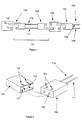
- FIG. 1 shows a first embodiment of the invention.
- This embodiment comprises an optical assembly 101 in the form of a patchcord to provide connection between a transceiver 102 and pre-existing (installed) multimode fibre 103.
- the patchcord is a duplex arrangement with two parts: a transmission part adapted for receiving radiation from the transceiver and providing it to the multimode optical fibre communications system (generally an installed base of multimode fibre), and a reception part for receiving optical radiation from the multimode optical fibre communications system.
- the transmission part and the reception part have respectively their own optical fibres - a single mode fibre 111 for connection between the optical source of the transceiver 102 and a first installed multimode fibre 108, and a multimode fibre 112 for connection between the optical receiver of the transceiver 102 and the second installed multimode fibre 109.
- the length of fibre in the patchcord is sufficiently great that essentially all the signal outside the single mode of the fibre is stripped away by the cladding, such that essentially single mode optical radiation is provided for launch into the first multimode fibre 108.
- the degree to which vestiges of radiation at other modes may remain is a matter which can readily be determined by the skilled man - the ke y criterion to be achieved is that at least the overfilled launch bandwidth is reliably achieved.
- the second optical fibre of the patchcord is a multimode fibre 112 for receiving optical radiation from the second installed multimode fibre 109 and conveying it to the receiver of the optical transceiver 102.
- this multimode fibre 112 will be of a similar type to the installed fibre 109 (for example, both would be graded index fibres with a 50 ⁇ m core or a 62.5 ⁇ m core). However, this is not essential. It is however important that the core of the multimode fibre 112 in the patchcord is of at least the diameter of the installed multimode fibre 109 - otherwise, there will be loss of signal on coupling and also modal noise. The core of the multimode fibre 112 in the patchcord should not be larger than the receiver size or, again, signal will be lost.
- the patchcord terminates at either end with a keyed connector 104,105.
- the connector may be of any conventional form for fibre-to-fibre connection.
- a duplex SC connector is an appropriate form of connector for this purpose, though alternative connector types, such as MT, can also be used.
- Keying is provided to ensure that light passes from optical source 131 to first installed fibre and from second installed fibre to optical receiver 132 through the correct fibres of the patchcord: so the light from optical source 131 enters radiation input 133 of the single mode fibre 111, for example.
- the keying structure as illustrated in Figure 2, comprising two keys 121 slotting into two key channels 122, ensures that only the one correct connection between patchcord and transceiver can be made.
- a similar connection (not shown) is made between the patchcord and the installed fibres.
- the adaptor 106 contains only means for aligning the patchcord fibres with the respective installed fibres: it does not contain any optical path element itself.
- the optical source 131 and optical receiver 132 in the transceiver may be of any type appropriate to this form of communications system.
- the transmitter is a semiconductor diode laser.
- the receiver is typically a p-i-n photodiode. Appropriate lasers and photodiodes for use in this type of communications system are discussed extensively in the literature of this field, and will not be discussed further here - the man skilled in the art could readily choose an optical source and optical receiver appropriate to this use.
- optical assembly for connecting the transceiver and the installed multimode fibre is provided here as a patchcord, other forms are quite as possible and may be advantageous in specific contexts.
- the assembly could be provided as a dongle, with the lengths of single mode and multimode fibre coiled within: other appropriate forms of assembly could readily be envisaged by the skilled man.
- the stripping of modes to achieve the overfilled launch condition is achieved by having a sufficient length of single mode fibre.
- Specific approaches to launching light into multimode fibre from single mode fibre are known which can assist in preventing bandwidth collapse.
- a second embodiment of the invention exploits this knowledge by controlling the launch from the single mode fibre into the installed multimode fibre appropriately.
- an offset launch from single mode fibre into the installed multimode fibre is employed, using the approach described in International Patent Application PCT/GB 97/00647 (Publication No. 97/33390). The basis of this approach is described briefly below - it is described in greater detail in the aforementioned application.
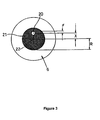
- An illuminating spot 20 is offset a distance X from the optical axis 22 of a multimode optical fibre 6.
- the illuminated spot 20 has a radius r and the multimode fibre 6 has a core 21 of radius R.
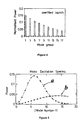
- Figure 4 and 5 are theoretical plots of the normalised mode excitation spectra for an overfilled launch (figure 4), an offset launch (Figure 5: a), and an angled launch (Figure 5: b) into a multimode fibre.
- An angled launch (described in US Patent No. 5,416,862) is one in which a multimode fibre is illuminated with a light beam at an angle to the fibre axis in order to excite higher order modes of the fibre.
- the multimode fibre is modelled to have a core of 62.5 ⁇ m diameter and a cladding of 125 ⁇ m diameter and the operating wavelength is 1300nm.
- the angled launch has been optimised as far as is possible.
- the mode excitation spectra of these three types of launch are very different.
- the OFL shows the expected excitation of a large number of modes including the strong excitation of lower order modes.
- the angled launch shows strong excitation of the higher order modes and very little excitation of the lower order modes.
- the mode excitation profile is relatively flat.
- the offset launch in contrast shows the strong excitation of a small mid order group of modes that is believed to lead to high bandwidth and good modal noise performance.
- a centre launch would excite only the first or perhaps first and second order modes.
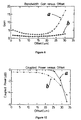
- Figure 6 shows the bandwidth gain for the angled launch (figure 6: b) and the offset launch (figure 6: a) of Figure 5.
- the bandwidth gain is calculated as a multiple of the bandwidth for an OFL. Both launches show increased bandwidth compared to OFL but the offset launch has a significantly greater bandwidth improvement.
- Figure 12 is a graph of the power coupled to the multimode fibre from the singlemode launch fibre for the angled launch (figure 12: b) and the offset launch (figure 12: a). From Figures 6 and 12 it can be seen that for these particular operating conditions there is a range of offsets from between 15 and 25 ⁇ m which give both high bandwidth gain and low loss for the offset launch. However, for the angled launch in order to achieve significant bandwidth gains an operating range of high coupling loss must be entered. Angles have been converted to equivalent offsets for the angled launch in Figures 6 and 12 in order to compare the two launch techniques. It can be seen from Figures 6 and 12 that there is a wide range of offsets that achieve these advantages and thus that, compared to a centre launch, significantly lower tolerances are required.
- the multimode optical fibre was standard graded index fibre, having a parabolic refractive index, and complying with ISO/IEC 793-2.
- the manufacturer's data for the bandwidth of this fibre is 500MHz.km at 1.3 ⁇ m and 20°c. Thus this should limit transmission at 1GBit/s to a length of 1km at best, and more likely to 700m when using conventional launch techniques.
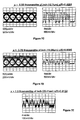
- Figures 7a to 7e show the data patterns and eye diagrams recorded at the sampling oscilloscope for various offsets x between the singlemode fibre axis and the multimode fibre axis.
- the data pattern can still be recovered, but the optical signal level at the optical receiver 7 is now very low and significant noise is present.
- the optimum x /R ratio, for a singlemode fibre with a core diameter of 9 ⁇ m launching 1.3 ⁇ m radiation into a multimode fibre having a core diameter of 62.5 ⁇ m, is approximately 0.5.
- Launch power and eye height for different launch offsets Offset x /R Average Launch Power Eye Height (dBm) (V) 0 -8.69 2.5 0.2 -8.70 2.5 0.4 -8.71 2.4 0.6 -8.86 ⁇ 0.85 0.8 -15.15 ⁇ 0.05
- a launch offset is achieved in the duplex adaptor 106 - the alignment between the single mode fibre 111 in the patchcord and the installed multimode fibre 108 is such that light is launched into the multimode fibre under an offset condition as described above.
- This serves to prevent bandwidth collapse as indicated in International Patent Application Publication No. 97/33390.
- manufacturing tolerances are such that it is difficult at present to produce adaptors which will achieve the necessary degree of alignment reliably. Consequently, a third embodiment of the invention is provided which achieves the offset launch condition reliably through active control of the alignment process. This embodiment is described with reference to Figures 8 to 11.
- the overall arrangement is shown in Figure 8.
- the arrangement of Figure 8 differs from that of Figure 1 in that the length of single mode fibre on the transmission side is replaced by a composite arrangement comprising a length of single mode fibre 141 for receiving light from the transmitter, a length of multimode fibre 142 for providing connection to the installed multimode fibre, and a connection means 143 between the single mode fibre and the multimode fibre.
- the connection means is used to achieve an offset launch from the single mode fibre 141 into the multimode fibre 142 according to the criteria described above.
- the length of single mode fibre 141 is sufficient that substantially single mode light is provided at the connection means 143 for illumination of the end of the multimode fibre length 142.
- the length of single mode fibre required for substantially single mode light to result in this arrangement is approximately 10 mm.
- FIGs 9 and 10 illustrate how active control of the offset launch from the single mode fibre length to the multimode fibre length can be achieved.
- Each fibre length is terminated with a ferrule 151 in which the fibre end is offset.
- the offset hole 155 is shown in Figure 9.
- the centre of the fibre is offset from the centre of the ferrule 151 by a predetermined amount - thi s amount is not critical, as will be indicated below, but a suitable amount for launch into a typical 50 or 62.5 ⁇ m multimode fibre is approximately 15 ⁇ m.
- the normal to the optical fibre face at the offset hole is parallel to the ferrule axis.
- the construction of such a ferrule with an offset fibre is straightforward: the fibre face is formed parallel with the ferrule face by polishing.
- the ferrules 151 are aligned to each other with a split sleeve 152.
- the offset holes 155 in each ferrule 151 are provided at equal offsets from the centre of the ferrule axis, the two fibres 141,142 could if desired be precisely aligned.
- the precise alignment is then achieved by relative rotation of the fibre ferrules and concurrently measuring the resulting output from the multimode fibre.
- the coupled power ratio can be measured at the output of the multimode fibre 142 (a qualitative measure can be obtained by observation of the nearfield, as the man skilled in the art will appreciate).
- the coupled power ratio is defined in the TIA/EIA standard TIA/EIA OFSTP-14A "Optical power loss measurements of installed multimode fiber cable plant", currently available in draft form - this is also referenced in the Gigabit Ethernet standard IEEE 802.3z.
- the CPR is a measure of how much the light fills the centre of the core of the multimode fibre relative to the whole fibre core.
- the power coupled out of the multimode fibre into a single mode fibre is measured, and this is compared with the power coupled out of the multimode fibre into a similar multimode fibre.
- the difference between the powers is the CPR.
- High CPR indicates that there is little light at the centre of the fibre, whereas low CPR indicates that there is a lot of light at the centre of the fibre.
- the measure is an appropriate one, as to prevent bandwidth collapse it is desired to avoid exciting low order modes which reside at the centre of the fibre and to rather excite mid order modes which have a much lower residence at the centre of the fibre.
- Suitable values for specific multimode fibres are shown in Table 2 below, together with the offsets between fibres generally necessary to achieve these CPR values.
- the relative position of the ferrules is fixed. This may be by bonding the ferrules 151 and the split sleeve 152 together into one unit with epoxy resin. The whole ferrule assembly is then encapsulated to protect it - in addition, an appropriate conventional strain relief element is provided to prevent any strain effects on the connection between the single mode fibre length and the multimode fibre length to preserve the integrity of the offset launch.
- Figure 8 can be provided advantageously even where no offset launch is achieved at the connection 143. If the single mode fibre length 141 is sufficiently long that substantially single mode radiation is provided at the connection 143, then the advantages of the first embodiment (well understood launch into multimode fibre) are achieved with the added benefit that the relative positions of the single mode and the multimode fibres across the launch can be fixed very accurately as they are established during the fabrication of the patchcord and are shielded from changes thereafter.
- a significant feature of embodiments according to the invention is their ease of use by end users, who may not be aware of the considerations required in connecting fibres, or, indeed, of the types of fibre present in their LAN. All that is required of the user is to connect together identified components, the keying assuring that only one connection orientation is possible.
- the first embodiment of the invention will function even if the installed fibre has been misidentified, and is single mode rather than multimode fibre.
- the launch from the patchcord to the first installed fibre is single mode to single mode
- the coupling from second installed fibre is single mode to multimode - with appropriate design, satisfactory bandwidth can be provided for the first connection and low loss for the second connection with this arrangement.
Landscapes
- Physics & Mathematics (AREA)
- Electromagnetism (AREA)
- Engineering & Computer Science (AREA)
- Computer Networks & Wireless Communication (AREA)
- Signal Processing (AREA)
- Optical Communication System (AREA)
- Optical Couplings Of Light Guides (AREA)
Applications Claiming Priority (3)
| Application Number | Priority Date | Filing Date | Title |
|---|---|---|---|
| GBGB9709627.5A GB9709627D0 (en) | 1997-05-13 | 1997-05-13 | Multimode communications systems |
| GB9709627 | 1997-05-13 | ||
| PCT/GB1998/001359 WO1998052303A1 (en) | 1997-05-13 | 1998-05-13 | Optical communications system including arrangement connecting a multimode fibre to a single mode fibre |
Publications (2)
| Publication Number | Publication Date |
|---|---|
| EP0983650A1 EP0983650A1 (en) | 2000-03-08 |
| EP0983650B1 true EP0983650B1 (en) | 2002-10-02 |
Family
ID=10812187
Family Applications (1)
| Application Number | Title | Priority Date | Filing Date |
|---|---|---|---|
| EP98921593A Expired - Lifetime EP0983650B1 (en) | 1997-05-13 | 1998-05-13 | Optical communications system including arrangement connecting a multimode fibre to a singlemode fibre |
Country Status (6)
| Country | Link |
|---|---|
| US (2) | US6304352B1 (cg-RX-API-DMAC7.html) |
| EP (1) | EP0983650B1 (cg-RX-API-DMAC7.html) |
| JP (1) | JP2001525944A (cg-RX-API-DMAC7.html) |
| DE (1) | DE69808454T2 (cg-RX-API-DMAC7.html) |
| GB (1) | GB9709627D0 (cg-RX-API-DMAC7.html) |
| WO (1) | WO1998052303A1 (cg-RX-API-DMAC7.html) |
Cited By (1)
| Publication number | Priority date | Publication date | Assignee | Title |
|---|---|---|---|---|
| WO2013130784A1 (en) * | 2012-03-01 | 2013-09-06 | Tyco Electronics Corporation | Keying for mpo systems |
Families Citing this family (32)
| Publication number | Priority date | Publication date | Assignee | Title |
|---|---|---|---|---|
| GB9605011D0 (en) * | 1996-03-08 | 1996-05-08 | Hewlett Packard Co | Multimode communications systems |
| US7576909B2 (en) | 1998-07-16 | 2009-08-18 | Imra America, Inc. | Multimode amplifier for amplifying single mode light |
| US7656578B2 (en) | 1997-03-21 | 2010-02-02 | Imra America, Inc. | Microchip-Yb fiber hybrid optical amplifier for micro-machining and marking |
| US6275512B1 (en) | 1998-11-25 | 2001-08-14 | Imra America, Inc. | Mode-locked multimode fiber laser pulse source |
| US6591123B2 (en) * | 2000-08-31 | 2003-07-08 | Mallinckrodt Inc. | Oximeter sensor with digital memory recording sensor data |
| US7212745B2 (en) * | 2000-11-30 | 2007-05-01 | Matsushita Electric Industrial Co., Ltd. | Optical transmission system |
| JP2003307657A (ja) * | 2002-04-15 | 2003-10-31 | Mitsubishi Cable Ind Ltd | 高出力パルス光用ファイバ及び光増幅装置 |
| US6810175B1 (en) * | 2002-04-22 | 2004-10-26 | Terabeam Corporation | Off-axis mode scrambler |
| USRE44472E1 (en) | 2002-04-22 | 2013-09-03 | Pertex Telecommunication Llc | Extended source transmitter for free space optical communication systems |
| GB0229238D0 (en) * | 2002-12-13 | 2003-01-22 | Univ London | An optical communication system |
| US7352937B2 (en) * | 2002-12-17 | 2008-04-01 | Finisar Corporation | Devices, systems and methods for connecting a single mode fiber to a legacy multi-mode fiber |
| US20040120720A1 (en) * | 2002-12-24 | 2004-06-24 | Chang Chin L. | Fiber optic transceiver with VCSEL source |
| US6973105B2 (en) * | 2003-03-21 | 2005-12-06 | Agilent Technologies, Inc. | Method and apparatus to enable adaptive equalization at high bandwidths when using single-mode VCSELs over multimode fibers |
| US7231114B2 (en) * | 2003-05-21 | 2007-06-12 | Ocp-Europe, Ltd. | Multimode fiber optical fiber transmission system with offset launch single mode long wavelength vertical cavity surface emitting laser transmitter |
| KR101032222B1 (ko) * | 2003-07-18 | 2011-05-02 | 네트워크 인테그리티 시스템스 인코퍼레이티드 | 다중모드 광섬유 침입탐지 시스템 |
| US7283701B2 (en) * | 2003-08-01 | 2007-10-16 | Optium Corporation | Optical fiber transmission system with increased effective modal bandwidth transmission |
| GB0329908D0 (en) * | 2003-12-23 | 2004-01-28 | Univ Cambridge Tech | Multiservice optical communication |
| JP4586546B2 (ja) * | 2005-01-21 | 2010-11-24 | 日立電線株式会社 | マルチモード波長多重光トランシーバ |
| US7477815B2 (en) * | 2004-05-22 | 2009-01-13 | Ocp-Europe, Ltd | Multi-mode fiber, optical fiber transmission system with offset-launch, single-mode, long-wavelength, vertical cavity surface emitting laser transmitter |
| WO2006018592A1 (en) * | 2004-08-20 | 2006-02-23 | Zinwave Limited | Multimode fibre optical communication system |
| GB2421585B (en) * | 2004-12-22 | 2009-06-17 | Agilent Technologies Inc | An adaptive transmitter arrangement for optical fibre communications and related method |
| DE102005000925A1 (de) * | 2005-01-07 | 2006-07-20 | Infineon Technologies Fiber Optics Gmbh | Bauteil und Verfahren zur exzentrischen Ausrichtung eines ersten und eines zweiten Stifts, die jeweils eine Lichtleitfaser zentrisch enthalten, sowie Modulvorsatz und Steckerkopplung mit meinem solchen Bauteil |
| US7258495B1 (en) | 2005-06-24 | 2007-08-21 | Corning Incorporated | Lensed fiber stub assemblies optical and optoelectronic packages including them |
| US7502533B2 (en) * | 2006-04-25 | 2009-03-10 | Intel Corporation | Mechanism for conditioning launched beams from an optical transmitter |
| GB0618941D0 (en) * | 2006-09-26 | 2006-11-08 | Zinwave Ltd | Multimode optical fibre system |
| US7509004B2 (en) * | 2006-10-31 | 2009-03-24 | Avago Technologies Fiber Ip (Singapore) Pte. Ltd. | Apertured fiber optic stub for control of multi-mode launch condition |
| US8244124B2 (en) * | 2007-04-30 | 2012-08-14 | Finisar Corporation | Eye safety mechanism for use in optical cable with electrical interfaces |
| US8326157B2 (en) * | 2009-06-30 | 2012-12-04 | Cambridge Enterprise Limited | High-speed optical transceiver, a bi-directional duplex optical fiber link, and a method for providing a bi-directional duplex optical fiber link |
| GB0919902D0 (en) * | 2009-11-13 | 2009-12-30 | Qinetiq Ltd | Improvements in fibre optic cables for distributed sensing |
| CA2755573A1 (en) * | 2009-12-04 | 2011-06-09 | Afl Telecommunications Llc | Quad optical time domain reflectometer (otdr) |
| US20120308180A1 (en) * | 2011-06-01 | 2012-12-06 | Cisco Technology, Inc. | Quad Small Form Factor Plus Pluggable Module for Medium Range Single Mode Fiber Applications |
| EP2597792B1 (en) * | 2011-11-28 | 2016-04-20 | Alcatel Lucent | Optical MIMO processing |
Family Cites Families (9)
| Publication number | Priority date | Publication date | Assignee | Title |
|---|---|---|---|---|
| JPS6075137A (ja) * | 1983-09-30 | 1985-04-27 | Showa Electric Wire & Cable Co Ltd | 光フアイバ双方向伝送方式 |
| GB2165712B (en) * | 1984-10-17 | 1988-05-11 | Stc Plc | Power transmission |
| US4705350A (en) * | 1985-09-19 | 1987-11-10 | Bell Communications Research, Inc. | Optical transmission network |
| US4778239A (en) * | 1987-02-02 | 1988-10-18 | Litton Systems, Inc. | Feed-backward lattice architecture and method |
| US5077815A (en) | 1988-09-30 | 1991-12-31 | Fujitsu Limited | Apparatus for optically connecting a single-mode optical fiber to a multi-mode optical fiber |
| US5600470A (en) * | 1993-06-21 | 1997-02-04 | Hewlett-Packard Co | Mixed fiber adapter cable |
| US6094532A (en) * | 1997-03-25 | 2000-07-25 | Sun Microsystems, Inc. | Multiprocessor distributed memory system and board and methods therefor |
| US5943461A (en) * | 1997-05-12 | 1999-08-24 | Lucent Technologies Inc | Connectorized optical module package and method using same with internal fiber connections |
| US6454464B1 (en) * | 1998-12-28 | 2002-09-24 | Computer Crafts, Inc. | Fiber optic connectors and transceiver test devices |
-
1997
- 1997-05-13 GB GBGB9709627.5A patent/GB9709627D0/en not_active Ceased
-
1998
- 1998-05-12 US US09/076,644 patent/US6304352B1/en not_active Expired - Lifetime
- 1998-05-13 JP JP54892298A patent/JP2001525944A/ja active Pending
- 1998-05-13 DE DE69808454T patent/DE69808454T2/de not_active Expired - Fee Related
- 1998-05-13 EP EP98921593A patent/EP0983650B1/en not_active Expired - Lifetime
- 1998-05-13 WO PCT/GB1998/001359 patent/WO1998052303A1/en not_active Ceased
-
2001
- 2001-08-20 US US09/932,911 patent/US6609834B2/en not_active Expired - Lifetime
Cited By (2)
| Publication number | Priority date | Publication date | Assignee | Title |
|---|---|---|---|---|
| WO2013130784A1 (en) * | 2012-03-01 | 2013-09-06 | Tyco Electronics Corporation | Keying for mpo systems |
| US9739971B2 (en) | 2012-03-01 | 2017-08-22 | Commscope Technologies Llc | Keying for MPO systems |
Also Published As
| Publication number | Publication date |
|---|---|
| EP0983650A1 (en) | 2000-03-08 |
| GB9709627D0 (en) | 1997-07-02 |
| DE69808454D1 (de) | 2002-11-07 |
| US6609834B2 (en) | 2003-08-26 |
| US6304352B1 (en) | 2001-10-16 |
| DE69808454T2 (de) | 2003-07-03 |
| US20020021469A1 (en) | 2002-02-21 |
| WO1998052303A1 (en) | 1998-11-19 |
| JP2001525944A (ja) | 2001-12-11 |
Similar Documents
| Publication | Publication Date | Title |
|---|---|---|
| EP0983650B1 (en) | Optical communications system including arrangement connecting a multimode fibre to a singlemode fibre | |
| US7184623B2 (en) | Apparatus, system and method for an adiabatic coupler for multi-mode fiber-optic transmission systems | |
| EP0826276B1 (en) | Multimode communications systems | |
| CA2324468C (en) | Method and system for removal of low order optical transmission modes to improve modal bandwidth in a multimode optical fiber computer network | |
| WO2006083938A2 (en) | Fiber stub for cladding mode coupling reduction | |
| CA2590459C (en) | Point-to-point optical fibre link | |
| US4955014A (en) | Broadband optical communication system, particularly in the subscriber area | |
| KR100560387B1 (ko) | 단일/다중 모드 변환기, 및 이를 이용한 광 부호 분할다중 접속 시스템 | |
| CN114616500B (zh) | 多芯光纤和扇出组件 | |
| US20040161240A1 (en) | Module having two bi-directional optical transceivers | |
| Sun | Recent advances for high speed short reach optical interconnects for datacom links | |
| JP2002139659A (ja) | 光通信システム、通信機器及び光トランシーバ | |
| Lemoff et al. | Zigzag waveguide demultiplexer for multimode WDM LAN | |
| Wegmuller et al. | Evolution of the beam diameter in a multimode fiber link through offset connectors | |
| WO2007127105A1 (en) | Mechanism for conditioning launched beams from an optical transmitter | |
| Butler et al. | Demonstration of intra-data center link based on 1x4 multicore fiber (mcf) edge-coupled to silicon photonics | |
| EP1250772B1 (en) | Network for distributing signals to a plurality of users | |
| Lim et al. | A novel low-cost fiber in-line-type bidirectional optical subassembly | |
| Chen et al. | Concept of BiDi Optimized OM4 Multimode Fiber for High Date Rate Short Reach VCSEL Transmission | |
| US20250052945A1 (en) | Smf to mmf coupler | |
| Liu et al. | Graded-index seven-core fiber optimized for high density and ultra-wideband parallel transmission application | |
| WO2025218479A1 (zh) | 一种空芯光纤连接器和光连接系统 | |
| Jain | An Approach to Optical Fibre Link Design | |
| Sano et al. | A design of optical wavelength‐division‐multiplexing transmission systems | |
| Khoe et al. | Status of plastic optical fibers and related technologies |
Legal Events
| Date | Code | Title | Description |
|---|---|---|---|
| PUAI | Public reference made under article 153(3) epc to a published international application that has entered the european phase |
Free format text: ORIGINAL CODE: 0009012 |
|
| 17P | Request for examination filed |
Effective date: 19991209 |
|
| AK | Designated contracting states |
Kind code of ref document: A1 Designated state(s): DE FR GB |
|
| RAP1 | Party data changed (applicant data changed or rights of an application transferred) |
Owner name: HEWLETT-PACKARD COMPANY, A DELAWARE CORPORATION |
|
| RAP1 | Party data changed (applicant data changed or rights of an application transferred) |
Owner name: AGILENT TECHNOLOGIES, INC. |
|
| 17Q | First examination report despatched |
Effective date: 20010509 |
|
| RAP1 | Party data changed (applicant data changed or rights of an application transferred) |
Owner name: AGILENT TECHNOLOGIES INC. |
|
| RAP1 | Party data changed (applicant data changed or rights of an application transferred) |
Owner name: AGILENT TECHNOLOGIES INC. A DELAWARE CORPORATION |
|
| RAP1 | Party data changed (applicant data changed or rights of an application transferred) |
Owner name: AGILENT TECHNOLOGIES, INC. (A DELAWARE CORPORATION |
|
| GRAG | Despatch of communication of intention to grant |
Free format text: ORIGINAL CODE: EPIDOS AGRA |
|
| GRAG | Despatch of communication of intention to grant |
Free format text: ORIGINAL CODE: EPIDOS AGRA |
|
| GRAH | Despatch of communication of intention to grant a patent |
Free format text: ORIGINAL CODE: EPIDOS IGRA |
|
| GRAH | Despatch of communication of intention to grant a patent |
Free format text: ORIGINAL CODE: EPIDOS IGRA |
|
| GRAA | (expected) grant |
Free format text: ORIGINAL CODE: 0009210 |
|
| AK | Designated contracting states |
Kind code of ref document: B1 Designated state(s): DE FR GB |
|
| REG | Reference to a national code |
Ref country code: GB Ref legal event code: FG4D |
|
| REF | Corresponds to: |
Ref document number: 69808454 Country of ref document: DE Date of ref document: 20021107 |
|
| ET | Fr: translation filed | ||
| PLBE | No opposition filed within time limit |
Free format text: ORIGINAL CODE: 0009261 |
|
| STAA | Information on the status of an ep patent application or granted ep patent |
Free format text: STATUS: NO OPPOSITION FILED WITHIN TIME LIMIT |
|
| 26N | No opposition filed |
Effective date: 20030703 |
|
| PGFP | Annual fee paid to national office [announced via postgrant information from national office to epo] |
Ref country code: FR Payment date: 20060517 Year of fee payment: 9 |
|
| PGFP | Annual fee paid to national office [announced via postgrant information from national office to epo] |
Ref country code: GB Payment date: 20060525 Year of fee payment: 9 |
|
| PGFP | Annual fee paid to national office [announced via postgrant information from national office to epo] |
Ref country code: DE Payment date: 20060630 Year of fee payment: 9 |
|
| REG | Reference to a national code |
Ref country code: GB Ref legal event code: 732E |
|
| GBPC | Gb: european patent ceased through non-payment of renewal fee |
Effective date: 20070513 |
|
| REG | Reference to a national code |
Ref country code: FR Ref legal event code: ST Effective date: 20080131 |
|
| PG25 | Lapsed in a contracting state [announced via postgrant information from national office to epo] |
Ref country code: DE Free format text: LAPSE BECAUSE OF NON-PAYMENT OF DUE FEES Effective date: 20071201 |
|
| PG25 | Lapsed in a contracting state [announced via postgrant information from national office to epo] |
Ref country code: GB Free format text: LAPSE BECAUSE OF NON-PAYMENT OF DUE FEES Effective date: 20070513 |
|
| PG25 | Lapsed in a contracting state [announced via postgrant information from national office to epo] |
Ref country code: FR Free format text: LAPSE BECAUSE OF NON-PAYMENT OF DUE FEES Effective date: 20070531 |